
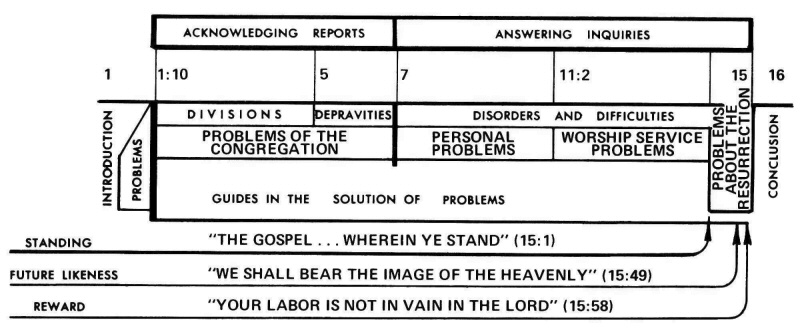
1 CORINTHIANS - PROBLEMS OF A LOCAL CHURCH
Click chart to enlarge
Charts from Jensen's Survey of the NT - used by permission
INTRODUCTORY THOUGHTS
1 CORINTHIANS
FROM CHART: Note 2 major divisions:
- FIRST DIVISION - Chapters 1-6 = Problems of Congregation - Divisions & Depravities,
- SECOND DIVISION - Chapters 7-16 = Personal Problems, Worship Problems
KEY WORDS IN 1 CORINTHIANS - see also "Key Word Bookmark"
- Love (17x/14v) - 1 Co. 2:9; 4:21; 8:1, 3; 13:1-4, 8, 13; 14:1; 16:14, 22, 24 (Most in the 2nd Division)
- Spirit (56x/42v) - 22 refer to the Holy Spirit - 1 Co. 2:4, 10, 11, 12, 13, 14, 15, 3:1, 16; 4:21; 5:3, 4, 5; 6:11, 17, 19; 7:34, 40; 9:11; 10:3,4; 12:1, 3, 4, 7, 8, 9, 10, 11, 13; 14:1,2, 12, 14, 15, 16, 32, 37; 15:44, 45, 46; 16:18
- Body (46x/34v) - 1 Co. 5:3; 6:13, 16, 18, 19, 20; 7:4, 34; 9:27; 10:16, 17; 11:24, 27, 29; 12:12, 13, 14, 15, 16, 17, 18, 19, 20, 22, 23, 24, 27; 13:3; 15:35, 37, 38, 42, 44 (Most in the 2nd Division)
- Idol (16x/12v) - 1 Co. 5:10, 11; 6:9; 8:1, 4, 7, 10; 10:7, 14, 19, 28; 12:2 (Most in the 2nd Division)
- Temple (6x/5v) - 1 Co. 3:16, 17; 6:19; 8:10; 9:13
- Immorality (10x/8v) - 1 Co. 5:1, 9, 10, 11; 6:13, 18 (twice); 1 Cor 7:2; 10:8
- Wisdom (18x/15v) - 1 Co. 1:19, 20, 21, 22, 24, 30; 2:1, 4, 5, 6, 7, 8, 13; 3:19; 12:8 (Most in 1st Division)
- Wise (11x/10v) - 1 Co. 1:19, 20, 26, 27; 3:10, 18, 19, 20; 6:5; 10:15 (Most in 1st Division)
- Fools, Foolishness, Foolish (11x/11v) - 1 Co. 1:18, 20, 21, 23, 25, 27; 2:14; 3:18, 19; 4:10; 15:36
- Power (11x/11v) - 1 Co. 1:18, 24; 2:4, 5; 4:19, 20; 5:4; 6:14; 15:24, 43, 56
- Gift (13x/13v) - 1 Co. 1:7; 7:7; 12:1, 4, 9, 28, 30, 31; 13:2, 8; 14:1, 12; 16:3 (Most in 2nd Division)
- Resurrection (4x/4v) - 1 Co 15:12, 13, 21, 42 (All in 2nd Division)
- Cross (2x/2v) - 1 Cor 1:17, 18
- Call, calling, called (17x/14v) - 1 Co. 1:1, 2, 9, 24, 26; 7:15, 17, 18, 20, 21, 22, 24; 14:24; 15:9
- Boast (9x/8v) - 1 Co. 1:29, 31; 3:21; 4:7; 5:6; 9:15, 16; 15:31 (Note: Boast occurs in another 20 verses in Second Corinthians!)
- Arrogant (6x/6v) - 1 Co. 4:6, 18, 19; 5:2; 8:1; 13:4
KEY VERSES - 1 Corinthians 1:10 (divisions), 1 Corinthians 7:1 (personal and corporate problems), 1 Corinthians 15:57
Ray Stedman feels that 1 Corinthians 1:9 is "the key verse of First Corinthians. The rest of the letter centers around it. It is a statement that God had called them to a very important relationship, and, by implication, here at the very beginning of this letter we learn that this is the reason for all of the problems in the Corinthian church. They had not understood the implications of their calling, and the relationship they personally and individually had with Jesus Christ himself."
PURPOSE: Paul’s purposes for writing the Corinthians were several. His first purpose was to deal with several moral problems and the divisions that had formed as people had divided into fan-clubs and were proclaiming themselves followers of Paul, Apollos, Peter or Christ (1 Cor 1:10). His second reason was to deal with several questions that had been asked in a letter the Corinthians had sent to him (1 Cor 7:1). A third purpose that appears throughout the book is Paul’s defense of his apostolic authority. (Paul Apple's Commentary - 445 pages - recommended)
CONTEXT - Paul began his ministry in Corinth on his second missionary journey under much opposition (Acts 18:6-17), but he was able to convert several influential people and consequently remained for about one and a half years in Corinth. See Paul's Relationship with the Church at Corinth
OUTLINE OF 1 CORINTHIANS (modified from Charles Swindoll's Overview Chart on right side of page - click to enlarge it)
I. Rebuke for Sinful Conditions (1 Cor 1:10-6:2)
A. Divisions in the Church (1 Cor 1:10-4:21)
B. Disorders in the Church (1 Cor 5:1-6:20)
II. Reply to Specific Questions re "Difficulties" (1 Cor 7:1-16:9)
A. Domestic Difficulty - marriage and divorce (1 Cor 7:1-40)
B. Social Difficulty - liberty and license (1 Cor 8:1-11:1)
C. Ecclesiastical Difficulty - women and worship (1 Cor 11:2-34)
D. Practical Difficulty - gifts and body (1 Cor 12:1-14:40)
E. Doctrinal Difficulty - death and resurrection (1 Cor 15:1-58)
F. Financial Difficulty - gifts and body (1 Cor 16:1-9)
OUTLINE OF 1 CORINTHIANS (John MacArthur's excellent introduction to 1 Corinthians)
I. Introduction: The Calling and Benefits of Sainthood (1 Corinthians 1:1–9)
II. Disunity in the Church (1 Corinthians 1:10–4:21)
A. The Need for Unity (1 Corinthians 1:10–3:23)
B. The Need for Servanthood (1 Corinthians 4:1–21)
III. Immorality in the Church (1 Corinthians 5:1–6:20)
IV. Marriage in the Church (1 Corinthians 7:1–40)
V. Liberty in the Church (1 Corinthians 8:1–11:1)
VI. Worship in the Church (1 Corinthians 11:2–14:40)
A. Roles of Men and Women in the Church (1 Corinthians 11:2–16)
B. The Lord’s Supper (1 Corinthians 11:17–34)
C. Spiritual Gifts (1 Corinthians 12:1–14:40)
VII. The Hope of the Church: Resurrection (1 Corinthians 15:1–58)
VIII. A Charge to the Church (1 Corinthians 16:1–24)
A. Stewardship (1 Corinthians 16:1–4)
B. Personal Plans and Greetings (1 Corinthians 16:5–24)
Middletown Bible has an excellent "practical" outline of problems in the church at Corinth:
The book of 1 Corinthians reveals many of the problems that the Corinthian church faced. In fact, there is a problem in almost every chapter of the book. Paul wrote to the believers living in this city to give them God’s answers to these many problems:
- The Problem of Divisions in the Church (1 Cor. 1:10-13)
- The Problem of Worldly Wisdom (1 Cor. 1:17-2:16)
- The Problem of Carnality (1 Cor. 3:1-4)
- The Problem of Immorality in the Church (1 Cor. 5:1-13)
- The Problem of Bringing a Fellow Believer to Court (1 Cor. 6:1-8)
- The Problem of Fornication (1 Cor. 6:15-20)
- The Problem of Marriage and Divorce (1 Cor. 7:1-40)
- The Problem of Meats Offered to Idols (1 Cor. 8:1-13)
- The Problem of the Role Men and Women Should Have in Christ's Church (1 Cor. 11:1-17)
- The Problem of Abusing the Lord’s Supper (1 Cor. 11:20-34)
- The Problem of Spiritual Gifts (1 Cor. 12:1-31)
- The Problem of a Lack of Love (1 Cor. 13:1-13)
- The Problem of Speaking in Tongues (1 Cor. 14:1-40)
- The Problem of Wrong Teaching About the Resurrection of the Dead (1 Cor. 15:1-58)
- The Problem of Collecting for the Saints (1 Cor. 16:1-3)
CITY OF CORINTH - Corinth was the capital of Achaia and located 40 miles west of Athens on the narrow isthmus (see pix from the air) connecting Peloponnese (on the south) with northern mainland of Greece (all uses of "Corinth" - Acts 18:1; 19:1; 1 Cor. 1:2; 2 Cor. 1:1, 23; 2 Tim. 4:20). Corinth was located between the Aegean and Adriatic Seas (see map below) and was a port city about five miles in circumference just south of the sharply rising 2000 foot Acrocorinth (see picture and see map "G") from which Athens could be seen on a clear day. The Temple of Aphrodite (Roman = Venus) was located on the Acrocorinth and housed the 1000 "priestesses" employed as hierodouloi (from hieros = consecrated to deity + doulos = bondservants) who served as temple prostitutes to facilitate idolatrous "worship" (cf "sacred prostitution"). As an aside it is notable that Scripture often associates sexual immorality (porneia) with idolatry (eidololatreia) (cf 1 Cor 5:11, 6:9, Eph 5:5, Rev 2:20, Rev 21:8). And remember that Paul also associated idolatry with covetousness writing that "greed...amounts to idolatry." (Col 3:5, Eph 5:5) Worship at the temple involved sexual encounters with these "priestesses" and this attracted "worshipers" from all across the Roman world. It is even recorded that the sandals of these notorious priestesses of Aphrodite were studded with an imprint that spelled our "Follow me" in the dust of the street (What a contrast with Jesus' call to "Follow Me" - Mt 4:19)! One cannot help but think of similar seductive pictures found on the internet even on seemingly innocent sites such as news pages! Clearly this illicit "worship" was a great temptation to the Christians at Corinth (just as is the internet to Christian's today!) as evidenced by Paul's exhortations and warnings in this first letter (1 Cor 5:1, 9,10, 11, 1 Cor 6:9-11, 12-17, 18, 19, 20). The immoral condition of Corinth is vividly seen in the fact that the Greek term (coined by Aristophanes) Korinthiazomai (lit., to act the Corinthian) came to mean "to practice fornication." Aleiphro wrote "I did not enter Corinth after all, for I learned in a short time the sordidness of the rich there and the misery of the poor."


.jpg)
"Ships wanting to avoid the dangerous trip around the southern tip of Greece were dragged across that isthmus. The city boasted an outdoor theater that accommodated 20,000 people (See reconstruction of Corinth circa A D 100), athletic games second only to the Olympics, a Greek, Roman, and Oriental population....There were taverns on the south side of the marketplace, and many drinking vessels have been dug up from those liquor lockers. Corinth was noted for everything sinful." (Charles Ryrie) Every shop in the city had a deep, spring-fed well in which to cool containers of wine. Strabo wrote that "All the people of Corinth gorge themselves." It was even customary in stage plays for actors to come on stage drunk.
In the picture below note the agora which was the city's marketplace and the Bema which was the judgment seat. Corinth had an extensive commerce, like all the large towns on the Mediterranean Sea, and became celebrated for its wealth, magnificence, and learning. Corinth's pottery, brass and marble for building columns were famous throughout the world. The city is now desolate with just a little village near the ancient Corinth. There is, however, a modern city of Corinth, a few miles away, with about twenty thousand inhabitants. Archaeologists have also discovered a broken lintel (part of a door) bearing the Greek description "synagogue of Hebrews."
Paul preached at Corinth about A.D. 53 for eighteen months (Acts 18:11). He paid Corinth a short second visit during the period A.D. 54–57, not mentioned specifically in Acts but implied in 1 Cor. 16:7; 2 Cor. 12:14; 13:1, where he speaks of an intended third journey to Corinth which coincides with that in Acts 20:2. He spent three winter months in Corinth (A.D. 57 and 58), during which he wrote the Epistle to the Romans (Acts 20:2, 3 [cf. 1 Cor. 16:6]; Rom. 16:1).
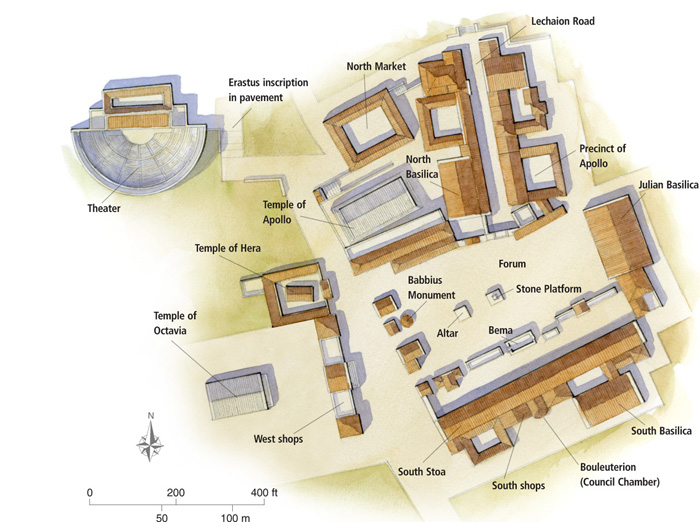
Click to Enlarge
Kay Arthur adds that "Sin abounded in the cosmopolitan city of Corinth...The Corinthians were intrigued by Greek philosophy and captivated by the disciplined training and athletic events (see events) held at the Isthmus (see Isthmian Games). At one time the city was home to at least 12 pagan temples. The people desperately needed to hear the Good News of Jesus Christ, the One crucified for sinners. The worship ceremonies carried out by a thousand temple prostitutes connected with the temple of Aphrodite (the goddess of love) bred blatant immorality throughout Corinth....Prostitutes openly plied their "wares," and meat markets thrived on sales from the sacrifices offered in the temples. The Corinthians ate well, satisfied their sexual urges without condemnation, flirted with the wisdom of men, and did all they could to keep their bodies as beautiful as those of the Greek gods. They loved to listen to great orators. For the 250,000 citizens (not slaves) there were almost two slaves per person (Ed: Therefore the total population was about 700,000). What more did Corinth need? Freedom! Freedom from sin and death. God met that need by blocking Paul at every hand on his second missionary journey (cf Acts 16:6, 7, 8) until he received the Macedonian call "Come and help us." (Acts 16:9) After establishing the Corinthian church, Paul eventually went to Ephesus, where he stayed for three years. From there he wrote his first epistle to the Corinthian believers, who so desperately needed help and correction. It was sometime between A.D. 52 and A. D. 56." (Discover the Bible for Yourself)
In summary, Corinth was a city with a prevalent pagan influence and a plethora of perversions (1 Cor 6:9,10) but despite these apparent obstacles to the Gospel, the Spirit enabled Paul to plant a church in the center of vice and idolatry on his Second Missionary journey (1 Cor 3:6, 10; 4:15; Acts 18:1–7).
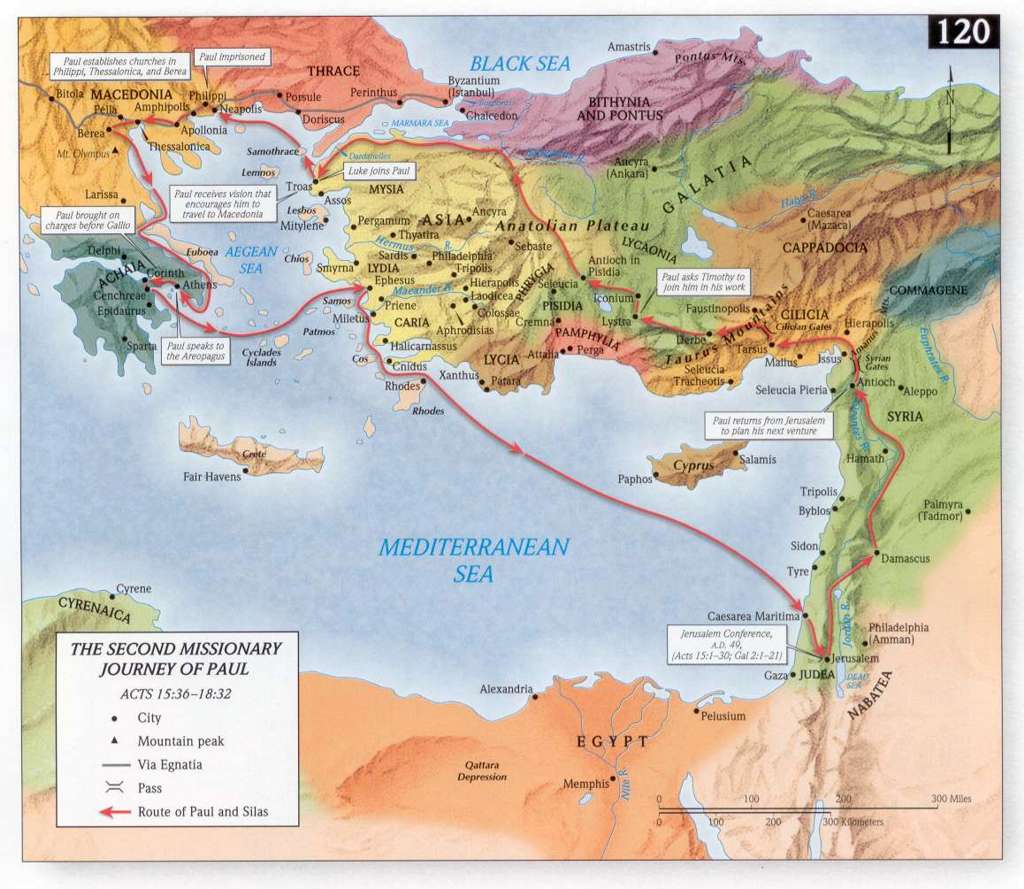
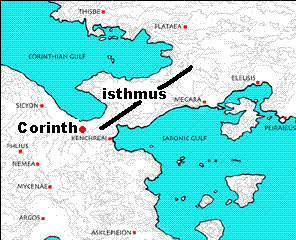
Click to enlarge
Middletown Bible
Dictionary Articles on Corinth:
- Bridgeway Bible Dictionary Corinth
- Easton's Bible Dictionary Corinth
- Fausset Bible Dictionary Corinth
- Holman Bible Dictionary Corinth
- Hastings' Dictionary of the Bible Corinth
- Watson's Theological Dictionary Corinth
- 1911 Encyclopedia Britannica Isthmus of Corinth
- International Standard Bible Encyclopedia Corinth
- Kitto Biblical Cyclopedia Corinth
- McClintock and Strong's Bible Encyclopedia Corinth (2) Divisions in the Church at Corinth Corinth
- The Nuttall Encyclopedia Corinth
- The Jewish Encyclopedia Corinth
Boyer: If Paul were to write a letter to the evangelical, Bible-believing churches of late twentieth century America, I believe it would be much like I Corinthians. Their world was like our world: the same thirst for intellectualism, the same permissiveness toward moral standards, the same fascination for the spectacular. And their church was like our churches: proud, affluent, materialistic, fiercely eager for intellectual and social acceptance by the world, doctrinally orthodox but morally and practically conforming to the world.
Morris: Paul’s purpose, then, in writing this Epistle, is principally to set right disorders which the Corinthians took lightly, but which he regarded as grave sins. Secondly, he wrote to answer some questions put to him. Thirdly, he wrote to give some doctrinal teaching, particularly on the resurrection.
Hodge: Paul’s relation to the church in Corinth was in some respects peculiar. He was not only the founder of the congregation, but he continued in the closest relation to it. It excited his solicitude, called for the wisest management, tried his patience and forbearance, rewarded him at times by signal evidence of affection and obedience, and filled him with hopes of its extended and healthful influence. His love for that church was therefore of special intensity. It was analogous to that of a father for a promising son beset with temptations, whose character combined great excellencies with great defects. The epistles to the Corinthians, therefore, reveal to us more of the personal character of the apostle than any of his other letters. They show him to us as a man, as a pastor, as a counsellor, as in conflict not only with heretics, but with personal enemies. They reveal his wisdom, his zeal, his forbearance, his liberality of principle and practice in all matters of indifference, his strictness in all matters of right and wrong, his humility, and perhaps above all, his unwearied activity and wonderful endurance.
Paul’s Ongoing Relationship With THE CORINTHIANS
| First Visit | 1st Letter (Lost) |
2nd Letter 1 Corinthians "Problem Letter" |
2nd Visit Swift, not scheduled "painful" |
3rd Letter (Lost" "Severe letter" |
4th Letter 2 Corinthians "Defense of his life" |
3rd Visit |
|
Acts 18 |
1 Cor 5:9 |
1-6 - Problems Addressed |
Mentioned in |
Mentioned |
|
Plans mentioned |
|
Paul stayed 18 months in Corinth Lived with Aquila & Priscilla, making tents/ teaching
|
|
2 groups from Corinth (Chloe, Stephanas) had already contacted him. Paul wrote from Ephesus where he taught for 3 years 1 Cor 16:8
|
Unpleasant for Paul & the church at Corinth… He promised to return again quickly, but wanted to spare them the pain so he went on to Asia |
Paul sent Titus to deliver this letter, and he finds Paul in Macedonia to give him the good news/ response of the Corinthians to this letter. |
Written from Macedonia,(Philippi?) (7:5) to ALL the saints in Achaia to “clear the air” of severity that his next visit will be pleasant (13:10) |
Stayed 3 months in Greece Gathered collection for poor saints in Jerusalem (II Cor 9:1-5)
|
|
Church established |
|
Problems Persisted |
Unsuccessful |
Majority Repented |
|
Writes Romans from Corinth |
| COMPARISON OF 1ST AND 2ND CORINTHIANS |
|
| 1 CORINTHIANS | 2 CORINTHIANS |
| Objective and practical |
Subjective and Personal |
| Insight into the Character of an Early Church |
Insight into the Character and Ministry of Paul |
| Deliberate Instruction |
Impassioned Testimony |
| Warns Against Pagan Influences |
Warns Against Judaistic Influences |
| From Irving Jensen | |
1 Corinthians Verse by Verse Commentary is under construction -- scheduled to be completed in April, 2021
EXPLANATORY NOTE: Verse by verse exposition with many conservative sources quoted, subtitles for many of the passages, many Greek word studies, practical notes on many of verb tenses, frequent practical applications (Labeled "THOUGHT"), multiple translations (including Wuest's paraphrase Eerdmans Publishing), frequent allusion to common idioms (with hyperlinks), cross-references from the Treasury of Scripture knowledge, related resources from Gotquestions.org on topics covered in the passages, references to Bible dictionaries on some topics, illustrations from Our Daily Bread and other sources, outlines of some sections, hyperlinks to additional in depth comments on many of the Scriptures referenced (additional commentary designated by a "+" sign following the chapter/verse reference e.g., Eph 5:18), list of literally hundreds of references (sermons, commentaries, study notes, journal articles, etc) which are archived by chapter (e.g., 1 Corinthians 1 Resources), occasional pictures to illustrate a particular verse. To God be all the glory. Amen.
1 Corinthians 1 Verse by Verse Comments
- 1 Corinthians 1 Resources - Multiple Sermons and Commentaries
- 1 Corinthians 1:1 Commentary
- 1 Corinthians 1:2 Commentary
- 1 Corinthians 1:3 Commentary
- 1 Corinthians 1:4 Commentary
- 1 Corinthians 1:5 Commentary
- 1 Corinthians 1:6 Commentary
- 1 Corinthians 1:7 Commentary
- 1 Corinthians 1:8 Commentary
- 1 Corinthians 1:9 Commentary
- 1 Corinthians 1:10 Commentary
- 1 Corinthians 1:11 Commentary
- 1 Corinthians 1:12 Commentary
- 1 Corinthians 1:13 Commentary
- 1 Corinthians 1:14 Commentary
- 1 Corinthians 1:15 Commentary
- 1 Corinthians 1:16 Commentary
- 1 Corinthians 1:17 Commentary
- 1 Corinthians 1:18 Commentary
- 1 Corinthians 1:19 Commentary
- 1 Corinthians 1:20 Commentary
- 1 Corinthians 1:21 Commentary
- 1 Corinthians 1:22 Commentary
- 1 Corinthians 1:23 Commentary
- 1 Corinthians 1:24 Commentary
- 1 Corinthians 1:25 Commentary
- 1 Corinthians 1:26 Commentary
- 1 Corinthians 1:27 Commentary
- 1 Corinthians 1:28 Commentary
- 1 Corinthians 1:29 Commentary
- 1 Corinthians 1:30 Commentary
- 1 Corinthians 1:31 Commentary
1 Corinthians 2 Verse by Verse Comments
- 1 Corinthians 2 Resources - Multiple Sermons and Commentaries
- 1 Corinthians 2:1 Commentary
- 1 Corinthians 2:2 Commentary
- 1 Corinthians 2:3 Commentary
- 1 Corinthians 2:4 Commentary
- 1 Corinthians 2:5 Commentary
- 1 Corinthians 2:6 Commentary
- 1 Corinthians 2:7 Commentary
- 1 Corinthians 2:8 Commentary
- 1 Corinthians 2:9 Commentary
- 1 Corinthians 2:10 Commentary
- 1 Corinthians 2:11 Commentary
- 1 Corinthians 2:12 Commentary
- 1 Corinthians 2:13 Commentary
- 1 Corinthians 2:14 Commentary
- 1 Corinthians 2:15 Commentary
- 1 Corinthians 2:16 Commentary
- 1 Corinthians 2:10 Commentary
- 1 Corinthians 2:11 Commentary
- 1 Corinthians 2:12 Commentary
- 1 Corinthians 2:13 Commentary
- 1 Corinthians 2:14 Commentary
- 1 Corinthians 2:15 Commentary
- 1 Corinthians 2:16 Commentary
1 Corinthians 3 Verse by Verse Comments
- 1 Corinthians 3 Resources - Multiple Sermons and Commentaries
- 1 Corinthians 3:1 Commentary
- 1 Corinthians 3:2 Commentary
- 1 Corinthians 3:3 Commentary
- 1 Corinthians 3:4 Commentary
- 1 Corinthians 3:5 Commentary
- 1 Corinthians 3:6 Commentary
- 1 Corinthians 3:7 Commentary
- 1 Corinthians 3:8 Commentary
- 1 Corinthians 3:9 Commentary
- 1 Corinthians 3:10 Commentary
- 1 Corinthians 3:11 Commentary
- 1 Corinthians 3:12 Commentary
- 1 Corinthians 3:13 Commentary
- 1 Corinthians 3:14 Commentary
- 1 Corinthians 3:15 Commentary
- 1 Corinthians 3:16 Commentary
- 1 Corinthians 3:17 Commentary
- 1 Corinthians 3:18 Commentary
- 1 Corinthians 3:19 Commentary
- 1 Corinthians 3:20 Commentary
- 1 Corinthians 3:21 Commentary
- 1 Corinthians 3:22 Commentary
- 1 Corinthians 3:23 Commentary
1 Corinthians 4 Verse by Verse Comments
- 1 Corinthians 4 Resources - Multiple Sermons and Commentaries
- 1 Corinthians 4:1 Commentary
- 1 Corinthians 4:2 Commentary
- 1 Corinthians 4:3 Commentary
- 1 Corinthians 4:4 Commentary
- 1 Corinthians 4:5 Commentary
- 1 Corinthians 4:6 Commentary
- 1 Corinthians 4:7 Commentary
- 1 Corinthians 4:8 Commentary
- 1 Corinthians 4:9 Commentary
- 1 Corinthians 4:10 Commentary
- 1 Corinthians 4:11 Commentary
- 1 Corinthians 4:12 Commentary
- 1 Corinthians 4:13 Commentary
- 1 Corinthians 4:14 Commentary
- 1 Corinthians 4:15 Commentary
- 1 Corinthians 4:16 Commentary
- 1 Corinthians 4:17 Commentary
- 1 Corinthians 4:18 Commentary
- 1 Corinthians 4:19 Commentary
- 1 Corinthians 4:20 Commentary
- 1 Corinthians 4:21 Commentary
1 Corinthians 5 Verse by Verse Comments
- 1 Corinthians 5 Resources - Multiple Sermons and Commentaries
- 1 Corinthians 5:1 Commentary
- 1 Corinthians 5:2 Commentary
- 1 Corinthians 5:3 Commentary
- 1 Corinthians 5:4 Commentary
- 1 Corinthians 5:5 Commentary
- 1 Corinthians 5:6 Commentary
- 1 Corinthians 5:7 Commentary
- 1 Corinthians 5:8 Commentary
- 1 Corinthians 5:9 Commentary
- 1 Corinthians 5:10 Commentary
- 1 Corinthians 5:11 Commentary
1 Corinthians 6 Verse by Verse Comments
- 1 Corinthians 6 Resources - Multiple Sermons and Commentaries
- 1 Corinthians 6:1 Commentary
- 1 Corinthians 6:2 Commentary
- 1 Corinthians 6:3 Commentary
- 1 Corinthians 6:4 Commentary
- 1 Corinthians 6:5 Commentary
- 1 Corinthians 6:6 Commentary
- 1 Corinthians 6:7 Commentary
- 1 Corinthians 6:8 Commentary
- 1 Corinthians 6:9 Commentary
- 1 Corinthians 6:10 Commentary
- 1 Corinthians 6:11 Commentary
- 1 Corinthians 6:12 Commentary
- 1 Corinthians 6:13 Commentary
- 1 Corinthians 6:14 Commentary
- 1 Corinthians 6:15 Commentary
- 1 Corinthians 6:16 Commentary
- 1 Corinthians 6:17 Commentary
- 1 Corinthians 6:18 Commentary
- 1 Corinthians 6:19 Commentary
- 1 Corinthians 6:20 Commentary
- 1 Corinthians 6:18 Commentary
- 1 Corinthians 6:19 Commentary
- 1 Corinthians 6:20 Commentary
1 Corinthians 7 Verse by Verse Comments
- 1 Corinthians 7 Resources - Multiple Sermons and Commentaries
- 1 Corinthians 7:1 Commentary
- 1 Corinthians 7:2 Commentary
- 1 Corinthians 7:3 Commentary
- 1 Corinthians 7:4 Commentary
- 1 Corinthians 7:5 Commentary
- 1 Corinthians 7:6 Commentary
- 1 Corinthians 7:7 Commentary
- 1 Corinthians 7:8 Commentary
- 1 Corinthians 7:9 Commentary
- 1 Corinthians 7:10 Commentary
- 1 Corinthians 7:11 Commentary
- 1 Corinthians 7:12 Commentary
- 1 Corinthians 7:13 Commentary
- 1 Corinthians 7:14 Commentary
- 1 Corinthians 7:15 Commentary
- 1 Corinthians 7:16 Commentary
- 1 Corinthians 7:17 Commentary
- 1 Corinthians 7:18 Commentary
- 1 Corinthians 7:19 Commentary
- 1 Corinthians 7:20 Commentary
- 1 Corinthians 7:21 Commentary
- 1 Corinthians 7:22 Commentary
- 1 Corinthians 7:23 Commentary
- 1 Corinthians 7:24 Commentary
- 1 Corinthians 7:25 Commentary
- 1 Corinthians 7:26 Commentary
- 1 Corinthians 7:27 Commentary
- 1 Corinthians 7:28 Commentary
- 1 Corinthians 7:29 Commentary
- 1 Corinthians 7:30 Commentary
- 1 Corinthians 7:31 Commentary
- 1 Corinthians 7:32 Commentary
- 1 Corinthians 7:33 Commentary
- 1 Corinthians 7:34 Commentary
- 1 Corinthians 7:35 Commentary
- 1 Corinthians 7:36 Commentary
- 1 Corinthians 7:37 Commentary
- 1 Corinthians 7:38 Commentary
- 1 Corinthians 7:39 Commentary
- 1 Corinthians 7:40 Commentary
1 Corinthians 8 Verse by Verse Comments
- 1 Corinthians 8 Resources - Multiple Sermons and Commentaries
- 1 Corinthians 8:1 Commentary
- 1 Corinthians 8:2 Commentary
- 1 Corinthians 8:3 Commentary
- 1 Corinthians 8:4 Commentary
- 1 Corinthians 8:5 Commentary
- 1 Corinthians 8:6 Commentary
- 1 Corinthians 8:7 Commentary
- 1 Corinthians 8:8 Commentary
- 1 Corinthians 8:9 Commentary
- 1 Corinthians 8:10 Commentary
- 1 Corinthians 8:11 Commentary
- 1 Corinthians 8:12 Commentary
- 1 Corinthians 8:13 Commentary
1 Corinthians 9 Verse by Verse Comments
- 1 Corinthians 9 Resources - Multiple Sermons and Commentaries
- 1 Corinthians 9:1 Commentary
- 1 Corinthians 9:2 Commentary
- 1 Corinthians 9:3 Commentary
- 1 Corinthians 9:4 Commentary
- 1 Corinthians 9:5 Commentary
- 1 Corinthians 9:6 Commentary
- 1 Corinthians 9:7 Commentary
- 1 Corinthians 9:8 Commentary
- 1 Corinthians 9:9 Commentary
- 1 Corinthians 9:10 Commentary
- 1 Corinthians 9:11 Commentary
- 1 Corinthians 9:12 Commentary
- 1 Corinthians 9:13 Commentary
- 1 Corinthians 9:14 Commentary
- 1 Corinthians 9:15 Commentary
- 1 Corinthians 9:16 Commentary
- 1 Corinthians 9:17 Commentary
- 1 Corinthians 9:18 Commentary
- 1 Corinthians 9:19 Commentary
- 1 Corinthians 9:20 Commentary
- 1 Corinthians 9:21 Commentary
- 1 Corinthians 9:22 Commentary
- 1 Corinthians 9:23 Commentary
- 1 Corinthians 9:24 Commentary
- 1 Corinthians 9:25 Commentary
- 1 Corinthians 9:26 Commentary
- 1 Corinthians 9:27 Commentary
1 Corinthians 9 THE FOLLOWING ARE MORE IN DEPTH
- 1 Corinthians 9:24 Commentary
- 1 Corinthians 9:25 Commentary
- 1 Corinthians 9:26 Commentary
- 1 Corinthians 9:27 Commentary
1 Corinthians 10 Verse by Verse Comments
- 1 Corinthians 10 Resources - Multiple Sermons and Commentaries
- 1 Corinthians 10:13 Commentary - more in depth
- 1 Corinthians 10:1 Commentary
- 1 Corinthians 10:2 Commentary
- 1 Corinthians 10:3 Commentary
- 1 Corinthians 10:4 Commentary
- 1 Corinthians 10:5 Commentary
- 1 Corinthians 10:6 Commentary
- 1 Corinthians 10:7 Commentary
- 1 Corinthians 10:8 Commentary
- 1 Corinthians 10:9 Commentary
- 1 Corinthians 10:10 Commentary
- 1 Corinthians 10:11 Commentary
- 1 Corinthians 10:12 Commentary
- 1 Corinthians 10:13 Commentary
- 1 Corinthians 10:14 Commentary
- 1 Corinthians 10:15 Commentary
- 1 Corinthians 10:16 Commentary
- 1 Corinthians 10:17 Commentary
- 1 Corinthians 10:18 Commentary
- 1 Corinthians 10:19 Commentary
- 1 Corinthians 10:20 Commentary
- 1 Corinthians 10:21 Commentary
- 1 Corinthians 10:22 Commentary
- 1 Corinthians 10:23 Commentary
- 1 Corinthians 10:24 Commentary
- 1 Corinthians 10:25 Commentary
- 1 Corinthians 10:26 Commentary
- 1 Corinthians 10:27 Commentary
- 1 Corinthians 10:28 Commentary
- 1 Corinthians 10:29 Commentary
- 1 Corinthians 10:30 Commentary
- 1 Corinthians 10:31 Commentary
- 1 Corinthians 10:32 Commentary
- 1 Corinthians 10:33 Commentary
1 Corinthians 11 Verse by Verse Comments
- 1 Corinthians 11 Resources - Multiple Sermons and Commentaries
- 1 Corinthians 11:1 Commentary
- 1 Corinthians 11:2 Commentary
- 1 Corinthians 11:3 Commentary
- 1 Corinthians 11:4 Commentary
- 1 Corinthians 11:5 Commentary
- 1 Corinthians 11:6 Commentary
- 1 Corinthians 11:7 Commentary
- 1 Corinthians 11:8 Commentary
- 1 Corinthians 11:9 Commentary
- 1 Corinthians 11:10 Commentary
- 1 Corinthians 11:11 Commentary
- 1 Corinthians 11:12 Commentary
- 1 Corinthians 11:13 Commentary
- 1 Corinthians 11:14 Commentary
- 1 Corinthians 11:15 Commentary
- 1 Corinthians 11:16 Commentary
- 1 Corinthians 11:17 Commentary
- 1 Corinthians 11:18 Commentary
- 1 Corinthians 11:19 Commentary
- 1 Corinthians 11:20 Commentary
- 1 Corinthians 11:21 Commentary
- 1 Corinthians 11:22 Commentary
- 1 Corinthians 11:23 Commentary
- 1 Corinthians 11:24 Commentary
- 1 Corinthians 11:25 Commentary
- 1 Corinthians 11:26 Commentary
- 1 Corinthians 11:27 Commentary
- 1 Corinthians 11:28 Commentary
- 1 Corinthians 11:29 Commentary
- 1 Corinthians 11:30 Commentary
- 1 Corinthians 11:31 Commentary
- 1 Corinthians 11:32 Commentary
- 1 Corinthians 11:33 Commentary
- 1 Corinthians 11:34 Commentary
1 Corinthians 12 Verse by Verse Comments
- 1 Corinthians 12 Resources - Multiple Sermons and Commentaries
- 1 Corinthians 12:1 Commentary
- 1 Corinthians 12:2 Commentary
- 1 Corinthians 12:3 Commentary
- 1 Corinthians 12:4 Commentary
- 1 Corinthians 12:5 Commentary
- 1 Corinthians 12:6 Commentary
- 1 Corinthians 12:7 Commentary
- 1 Corinthians 12:8 Commentary
- 1 Corinthians 12:9 Commentary
- 1 Corinthians 12:10 Commentary
- 1 Corinthians 12:11 Commentary
- 1 Corinthians 12:12 Commentary
- 1 Corinthians 12:13 Commentary
- 1 Corinthians 12:14 Commentary
- 1 Corinthians 12:15 Commentary
- 1 Corinthians 12:16 Commentary
- 1 Corinthians 12:17 Commentary
- 1 Corinthians 12:18 Commentary
- 1 Corinthians 12:19 Commentary
- 1 Corinthians 12:20 Commentary
- 1 Corinthians 12:21 Commentary
- 1 Corinthians 12:22 Commentary
- 1 Corinthians 12:23 Commentary
- 1 Corinthians 12:24 Commentary
- 1 Corinthians 12:25 Commentary
- 1 Corinthians 12:26 Commentary
- 1 Corinthians 12:27 Commentary
- 1 Corinthians 12:28 Commentary
- 1 Corinthians 12:29 Commentary
- 1 Corinthians 12:30 Commentary
- 1 Corinthians 12:31 Commentary
1 Corinthians 13 Verse by Verse Comments
- 1 Corinthians 13 Resources - Multiple Sermons and Commentaries
- 1 Corinthians 13:1 Commentary
- 1 Corinthians 13:2 Commentary
- 1 Corinthians 13:3 Commentary
- 1 Corinthians 13:4 Commentary
- 1 Corinthians 13:5 Commentary
- 1 Corinthians 13:6 Commentary
- 1 Corinthians 13:7 Commentary
- 1 Corinthians 13:8 Commentary
- 1 Corinthians 13:9 Commentary
- 1 Corinthians 13:10 Commentary
- 1 Corinthians 13:11 Commentary
- 1 Corinthians 13:12 Commentary
- 1 Corinthians 13:13 Commentary
1 Corinthians 13 The Commentaries below are more in depth
- 1 Corinthians 13:4 Commentary
- 1 Corinthians 13:5 Commentary
- 1 Corinthians 13:6 Commentary
- 1 Corinthians 13:7 Commentary
- 1 Corinthians 13:8 Commentary
1 Corinthians 14 Verse by Verse Comments
- 1 Corinthians 14 Resources - Multiple Sermons and Commentaries
- 1 Corinthians 14:1 Commentary
- 1 Corinthians 14:2 Commentary
- 1 Corinthians 14:3 Commentary
- 1 Corinthians 14:4 Commentary
- 1 Corinthians 14:5 Commentary
- 1 Corinthians 14:6 Commentary
- 1 Corinthians 14:7 Commentary
- 1 Corinthians 14:8 Commentary
- 1 Corinthians 14:9 Commentary
- 1 Corinthians 14:10 Commentary
- 1 Corinthians 14:11 Commentary
- 1 Corinthians 14:12 Commentary
- 1 Corinthians 14:13 Commentary
- 1 Corinthians 14:14 Commentary
- 1 Corinthians 14:15 Commentary
- 1 Corinthians 14:16 Commentary
- 1 Corinthians 14:17 Commentary
- 1 Corinthians 14:18 Commentary
- 1 Corinthians 14:19 Commentary
- 1 Corinthians 14:20 Commentary
- 1 Corinthians 14:21 Commentary
- 1 Corinthians 14:22 Commentary
- 1 Corinthians 14:23 Commentary
- 1 Corinthians 14:24 Commentary
- 1 Corinthians 14:25 Commentary
- 1 Corinthians 14:26 Commentary
- 1 Corinthians 14:27 Commentary
- 1 Corinthians 14:28 Commentary
- 1 Corinthians 14:29 Commentary
- 1 Corinthians 14:30 Commentary
- 1 Corinthians 14:31 Commentary
- 1 Corinthians 14:32 Commentary
- 1 Corinthians 14:33 Commentary
- 1 Corinthians 14:34 Commentary
- 1 Corinthians 14:35 Commentary
- 1 Corinthians 14:36 Commentary
- 1 Corinthians 14:37 Commentary
- 1 Corinthians 14:38 Commentary
- 1 Corinthians 14:39 Commentary
- 1 Corinthians 14:40 Commentary
1 Corinthians 15 Verse by Verse Comments
- 1 Corinthians 15 Resources - Multiple Sermons and Commentaries
- 1 Corinthians 15:1 Commentary
- 1 Corinthians 15:2 Commentary
- 1 Corinthians 15:3 Commentary
- 1 Corinthians 15:4 Commentary
- 1 Corinthians 15:5 Commentary
- 1 Corinthians 15:6 Commentary
- 1 Corinthians 15:7 Commentary
- 1 Corinthians 15:8 Commentary
- 1 Corinthians 15:9 Commentary
- 1 Corinthians 15:10 Commentary
- 1 Corinthians 15:11 Commentary
- 1 Corinthians 15:12 Commentary
- 1 Corinthians 15:13 Commentary
- 1 Corinthians 15:14 Commentary
- 1 Corinthians 15:15 Commentary
- 1 Corinthians 15:16 Commentary
- 1 Corinthians 15:17 Commentary
- 1 Corinthians 15:18 Commentary
- 1 Corinthians 15:19 Commentary
- 1 Corinthians 15:20 Commentary
- 1 Corinthians 15:21 Commentary
- 1 Corinthians 15:22 Commentary
- 1 Corinthians 15:23 Commentary
- 1 Corinthians 15:24 Commentary
- 1 Corinthians 15:25 Commentary
- 1 Corinthians 15:26 Commentary
- 1 Corinthians 15:27 Commentary
- 1 Corinthians 15:28 Commentary
- 1 Corinthians 15:29 Commentary
- 1 Corinthians 15:30 Commentary
- 1 Corinthians 15:31 Commentary
- 1 Corinthians 15:32 Commentary
- 1 Corinthians 15:33 Commentary
- 1 Corinthians 15:34 Commentary
- 1 Corinthians 15:35 Commentary
- 1 Corinthians 15:36 Commentary
- 1 Corinthians 15:37 Commentary
- 1 Corinthians 15:38 Commentary
- 1 Corinthians 15:39 Commentary
- 1 Corinthians 15:40 Commentary
- 1 Corinthians 15:41 Commentary
- 1 Corinthians 15:42 Commentary
- 1 Corinthians 15:43 Commentary
- 1 Corinthians 15:44 Commentary
- 1 Corinthians 15:45 Commentary
- 1 Corinthians 15:46 Commentary
- 1 Corinthians 15:47 Commentary
- 1 Corinthians 15:48 Commentary
- 1 Corinthians 15:49 Commentary
- 1 Corinthians 15:50 Commentary
- 1 Corinthians 15:51 Commentary
- 1 Corinthians 15:52 Commentary
- 1 Corinthians 15:53 Commentary
- 1 Corinthians 15:54 Commentary
- 1 Corinthians 15:55 Commentary
- 1 Corinthians 15:56 Commentary
- 1 Corinthians 15:57 Commentary
- 1 Corinthians 15:58 Commentary
1 Corinthians 15 The Following Commentaries are more in depth
- 1 Corinthians 15:1 Commentary
- 1 Corinthians 15:2 Commentary
- 1 Corinthians 15:3 Commentary
- 1 Corinthians 15:4 Commentary
- 1 Corinthians 15:5 Commentary
- 1 Corinthians 15:6 Commentary
- 1 Corinthians 15:7 Commentary
- 1 Corinthians 15:8 Commentary
- 1 Corinthians 15:9 Commentary
- 1 Corinthians 15:10 Commentary
- 1 Corinthians 15:58 Commentary
1 Corinthians 16 Verse by Verse Comments
- 1 Corinthians 16 Resources - Multiple Sermons and Commentaries
- 1 Corinthians 16:1 Commentary
- 1 Corinthians 16:2 Commentary
- 1 Corinthians 16:3 Commentary
- 1 Corinthians 16:4 Commentary
- 1 Corinthians 16:5 Commentary
- 1 Corinthians 16:6 Commentary
- 1 Corinthians 16:7 Commentary
- 1 Corinthians 16:8 Commentary
- 1 Corinthians 16:9 Commentary
- 1 Corinthians 16:10 Commentary
- 1 Corinthians 16:11 Commentary
- 1 Corinthians 16:12 Commentary
- 1 Corinthians 16:13 Commentary
- 1 Corinthians 16:14 Commentary
- 1 Corinthians 16:15 Commentary
- 1 Corinthians 16:16 Commentary
- 1 Corinthians 16:17 Commentary
- 1 Corinthians 16:18 Commentary
- 1 Corinthians 16:19 Commentary
- 1 Corinthians 16:20 Commentary
- 1 Corinthians 16:21 Commentary
- 1 Corinthians 16:22 Commentary
- 1 Corinthians 16:23 Commentary
- 1 Corinthians 16:24 Commentary
Explanation - The following list includes not only commentaries but other Christian works by well known evangelical writers. Most of the resources below are newer works (written after 1970) which previously were available only for purchase in book form or in a Bible computer program. The resources are made freely available by archive.org but have several caveats - (1) they do not allow copy and paste, (2) they can only be checked out for one hour (but can be checked out immediately when your hour expires giving you time to read or take notes on a lengthy section) and (3) they require creating an account which allows you to check out the books free of charge. To set up an account click archive.org and then click the picture of the person in right upper corner and enter email and a password. That's all you have to do. Then you can read these more modern resources free of charge! I have read or used many of these resources but not all of them so ultimately you will need to be a Berean (Acts 17:11) as you use them. I have also selected works that are conservative and Biblically sound. If you find one that you think does not meet those criteria please send an email at https://www.preceptaustin.org/
1 Corinthians by MacArthur, John - 520 pages - excellent
Be wise Commentary on 1 Corinthians by Warren Wiersbe
Bible Exposition Commentary - New Testament by Warren Wiersbe
With the Word - Devotional Commentary - Warren Wiersbe - 428 ratings
Wiersbe's Expository Outlines on the New Testament by Wiersbe, Warren W
Cyril Barber - This is a book of exceptional merit. Pastors, missionaries, and Christian workers will profit from its use. Wiersbe introduces each book of the NT, provides an outline, and then furnishes his readers with a chapter-by-chapter discussion of the contents. The homiletic style is a “plus.” Recommended.
The Preacher's Outline & Sermon Bible : New Testament, King James Version - Acts, Romans, 1 Corinthians, 2 Corinthians, Galatians, Ephesians, Philippians, Colossians - This is a very useful resource which always includes numerous related cross-references. It will be of aid to you preaching and teaching.
Rosscup says this is part of "A 12-vol. set done by 12 men selected for unusual ability to show the Bible is alive in biblical exposition, with spiritual refreshment and insight. The authors seek to combine scholarship on biblical meaning, illustrations to spark applications, and outlines."
Expository studies in 1 Corinthians : the deep things of God by Stedman, Ray C
The communicator's commentary. 1, 2 Corinthians By: Chafin, Kenneth (Now called the Preacher's Commentary)
The Expositor's Bible Commentary - 1994 edition - Abridged - New Testament
The First epistle of Paul to the Corinthians : an introduction and commentary by Morris, Leon,
Rosscup - Though the works in the Tyndale Series are concise, this is a good commentary and is recent. Morris is adequate a good part of the time in his comments on passages, but weak in detail on historical background, evidently because of the brevity to which he was held.
First Corinthians : unlocking the Scriptures for you by Staton, Knofel
Logos.com - This nontechnical commentary on First Corinthians analyzes the many problems the church in Corinth faced, including unity, relationships, liberty, and worship assembly. It provides a look into the historical, cultural, and religious contexts surrounding the epistle, and illustrates how the message of First Corinthians is still contemporarily relevant in today’s churches.
Conflict and community in Corinth : a socio-rhetorical commentary on 1 and 2 Corinthians by Witherington, Ben, III
The Cross and Christian ministry : leadership lessons from 1 Corinthians by Carson, D. A
Strong Reproofs for a scandalous church : a study of 1 Corinthians 1:1-6:11 : Bible study guide by Swindoll, Charles
Calm answers for a confused church : a study of 1 Corinthians 12-16, Bible study guide from the Bible-teaching ministry of by Swindoll, Charles
Showing the spirit : a theological exposition of 1 Corinthians 12-14 by Carson, D. A
Challenging church : the good book guide to 1 Corinthians 1-9 by Dever, Mark
The First Epistle to the Corinthians by Fee, Gordon D
The Epistles to the Corinthians by Hobbs, Herschel H (1963) 136 pages
Thru the Bible with J. Vernon McGee - 1 Corinthians
First Corinthians by McGee, J. Vernon
Accomodating Christians : an exegetical commentary on First Corinthians Ten By: Spiros Zodhiates
1 Corinthians : a self-study guide by Jensen, Irving
The Corinthian letters of Paul : an exposition of I and II Corinthians by Morgan, G. Campbell
A layman looks at the love of God : devotional study of 1 Corinthians 13 by Keller, W. Phillip
The First epistle of Paul to the Corinthians : an exposition by Erdman, Charles R
Paul's hymn of love, First Corinthians thirteen; an interpretation by Erdman, Charles R.
The Second epistle of Paul to the Corinthians; an exposition by Erdman, Charles R.
STUDY BIBLES
Note: The first 4 resources have no time restriction and allow copy and paste.
(1) KJV Bible Commentary - Hindson, Edward E; Kroll, Woodrow Michael. Over 3000 pages of the entire OT/NT. Well done conservative commentary that interprets Scripture from a literal perspective. Pre-millennial.
Very well done conservative commentary that interprets Scripture from a literal perspective
The King James Version Bible Commentary is a complete verse-by-verse commentary. It is comprehensive in scope, reliable in scholarship, and easy to use. Its authors are leading evangelical theologians who provide practical truths and biblical principles. Any Bible student will gain new insights through this one-volume commentary based on the timeless King James Version of the Bible.
(2) The King James Study Bible Second Edition 2240 pages (2013) (Thomas Nelson) General Editor - Edward Hindson with multiple contributing editors. . Pre-millennial. See introduction on How to Use this Study Bible.
(3) NKJV Study Bible: New King James Version Study Bible (formerly "The Nelson Study Bible - NKJV") by Earl D Radmacher; Ronald Barclay Allen; Wayne H House. 2345 pages. (1997, 2007). Very helpful notes. Conservative. Pre-millennial.
(4) The Wycliffe Bible Commentary - only the New Testament (for OT see below to borrow) - 1126 pages. (1971) Everett F Harrison - Editor of New Testament. Uses the KJV. Strictly speaking not a study Bible, but short notes are similar. The comments are generally verse by verse, short, conservative and to the point. Pre-millennial. Rosscup says "The treatments vary with the authors, but as a whole it is a fine one-volume commentary for pastors and students to use or give to a layman."
THE FOLLOWING CAN BE BORROWED
The MacArthur Study Bible - John MacArthur. Brief but well done notes 1,275 ratings
ESV Study Bible - Excellent resource but not always literal in eschatology and the nation of Israel 6,004 ratings
HCSB Study Bible - conservative notes.
The Holman Illustrated Study Bible Includes the excellent Holman maps but otherwise of little help in serious study.
NIV Study Bible - (2011) 2570 pages - Use this one if available as it has more notes than edition below. This resource has been fully revised in 2020.
Life Application Study Bible : New Living Translation. Has some very helpful notes. 4,445 ratings
The Defender's Study Bible : King James Version by Morris, Henry M. Excellent notes for well known creationist.
Ryrie Study Bible Expanded Edition (1994) 2232 pages
The David Jeremiah study bible - (2013) 2208 pages. 2,272 ratings Logos.com - "Drawing on more than 40 years of study, Dr. David Jeremiah has compiled a legacy resource that will make an eternal impact on generations to come. 8,000 study notes. Hundreds of enriching word studies"50+ Essentials of the Christian Faith" articles."
The Apologetics Study Bible Understand Why You Believe by Norman Geisler
NIV Archaeological Study Bible (2005) 2360 pages 950 ratings (See also Archaeology and the Bible - OT and NT)
NIV Cultural Backgrounds Study Bible. Bringing to Life the Ancient World of Scripture Keener, Craig and Walton, John. Editors (2017)
Believer's Bible Commentary by MacDonald, William (1995) 2480 pages. One of my favorites. Often has some excellent devotional comments.
Dr. John MacArthur, Jr. - "Concise yet comprehensive - the most complete single-volume commentary I have seen."
Warren Wiersbe - "For the student who is serious about seeing Christ in the Word."
The Word in life Study Bible - interesting format. Not your routine study Bible. Worth checking the very informative notes. (e.g., here is a picture of Jesus' post-resurrection appearances.)
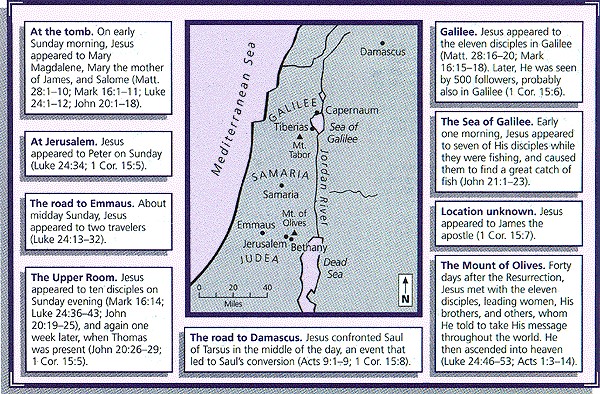
New Bible Commentary - (1994)
The Experiencing God Study Bible : the Bible for knowing and doing the will of God - Blackaby, Henry (1996) 1968 pages - CHECK THIS ONE! Each chapter begins with several questions under the title "PREPARE TO MEET GOD." Then you will interesting symbols before many of the passages. The chapter ends with a "DID YOU NOTICE?" question. This might make a "dry chapter" jump off the page! Read some of the 48 ratings
J.Sidlow Baxter: Explore The Book - pdf Vol. 6 Acts to Revelation
Compact Bible commentary by Radmacher, Earl D; Allen, Ronald Barclay; House, H Wayne, et al - 954 pages. Multiple contributors to the comments which are often verse by verse. The comments are brief but meaty and can really help your study through a given book. A sleeper in my opinion.
NIV archaeological study Bible (2005) 2360 pages 950 ratings (See also Archaeology and the Bible - OT and NT)
NIV cultural backgrounds study Bible. bringing to life the ancient world of scripture Keener, Craig and Walton, John. Editors (2017)
Evangelical Commentary on the Bible - editor Walter Elwell (1989) 1239 pages.
Dictionary of Biblical Imagery - free for use online with no restrictions (i.e., you do not need to borrow this book). Editors Leland Ryken, J C Wilhoit, Tremper Longman III - This is a potential treasure chest to aid your preaching and teaching as it analyzes the meaning of a host of Biblical figures of speech. Clue - use the "One-page view" which then allows you to copy and paste text. One downside is there is no index, so you need to search 3291 pages for entries which are alphabetical.
Dictionary of Paul and his letters IVP Series - No other single reference work presents as much information focused exclusively on Pauline theology, literature, background and scholarship. In-depth articles focus on individual theological themes (such as law, resurrection and Son of God), broad theological topics (such as Christology, eschatology and the death of Christ), methods of interpretation (such as rhetorical criticism and social-scientific approaches), background topics (such as apocalypticism, Hellenism and Qumran) and various other subjects specifically related to the scholarly study of Pauline theology and literature (such as early catholicism, the center of Paul's theology, and Paul and his interpreters since F. C. Baur).
GREEK WORD STUDIES
The Complete Word Study Dictionary: New Testament by Zodhiates, Spiros - This is my "go to" resource for Greek word studies. One on the best lexicons for laymen. Highly Recommended for Greek Word Studies to aid your interpretation of a passage.
Analytical Lexicon of the Greek New Testament by Friberg, Timothy. Shorter definitions than Zodhiates but does an excellent job in summarizing the various nuances of a specific Greek word. One of my favorites.
Shorter Lexicon of the Greek New Testament by Gingrich, F. Wilbur. Similar to Friberg but shorter definitions.
The New International Dictionary of New Testament Theology - NIDNTT - Colin Brown, ed
Kittel's Theological Dictionary of the New Testament : abridged in one volume - Classic fondly known as the "Little Kittel"
A Greek-English lexicon of the New Testament, and other early Christian literature; by Bauer, Walter,
Liddell and Scott's Greek-English lexicon, abridged : the little Liddell by Liddell, Henry George.
Vine's Expository Dictionary of Old Testament and New Testament Words - pdf.
Greek-English lexicon of the New Testament : based on semantic domains - Louw Nida.
The New Linguistic and Exegetical Key to the Greek New Testament by Rogers, Cleon.
New Testament Words in Today's Language by Detzler, Wayne A - Wonderful resource to supplement word studies.
New Testament Words - William Barclay
Expository Dictionary of Bible words by Richards, Larry
Synonyms of the New Testament by Trench, Richard Chenevix - or click here for list of 108 entries.
Christian Words By: Turner, Nigel, >500 pages. An interesting, unique resource on Greek words (no Hebrew) with extensive bibliography
Expository dictionary of Bible words : word studies for key English Bible words based on - Stephen Renn
So That's What it Means - This is another book formerly titled "Theological Wordbook" edited by Charles Swindoll. It is now under this new title So That's What it Means and can be borrowed - it is more like a dictionary than a lexicon but the comments are superb! The contributors include DKC—Donald K. Campbell, WGJ—Wendell G. Johnston, JAW—John A. Witmer, JFW—John F. Walvoord
Lectures on 1 Corinthians - Part 1 (Kay Arthur)
- Lecture 1 Paul & The Church
- Lecture 2 Sharing the Gospel - 1 Corinthians Overview
- Lecture 3 The Gospel Message - 1 Corinthian 1
- Lecture 4 "Carnal" Christian? - 1 Corinthians 3-4
- Lecture 5 Whom Do You Serve? - 1 Corinthians 3-4
- Lecture 6 Immorality Among You? - 1 Corinthians 5-6
- Lecture 7 Quarrelling Among You? - 1 Corinthians 5-6
Lectures on 1 Corinthians - Part 2 (Kay Arthur)
- Lecture Orientation - Cry for Revival! - 1 Corinthians 3-4
- Lecture 1 What Does God Say: Divorce, Living Together - 1 Corinthians 7
- Lecture 2 Questions about Sex, Marriage, Divorce - 1 Corinthians 7
- Lecture 3 My Rights? It's NOT About Me - 1 Corinthians 8-9
- Lecture 4 Is God Pleased with Your Life? - 1 Corinthians 10
- Lecture 5 Do I Look, Live Appropriately? - 1 Corinthians 11
- Lecture 6 Now Concerning Spiritual Gifts… - 1 Corinthians 12-14
- Lecture 7 What is the REAL Gospel? - 1 Corinthians 15
- Lecture 8 Life After Death - 1 Corinthians 15-16
- Lecture 9 The Resurrection-What's It Like? - 1 Corinthians 15-16
- The Danger Of Loving A Theological System More Than The Savior – Matthew 22:37-40; 1 Corinthians 8:1-3
- 1 Corinthians – 1 Corinthians 1:1
- Jesus, Yes! The Church, Yes! — 1 Corinthians 1:1-9
- No Superstars But A Savior — Corinthians 1:26-31
- How Do You Divide And Nearly Destroy A Church — 1 Corinthians 1:10-17
- The Power of the Cross – 1 Corinthians 1:18-25
- Jesus Christ and Him Crucified — 1 Corinthians 2:1–9
- What Kind of Person Are You — 1 Corinthians 2:10–3:4
- The Church of God — 1 Corinthians 3:5–17
- In Christ We Have It All — 1 Corinthians 3:18–23
- Five Truths A Minister of God Must Never Forget — 1 Corinthians 4:1–5
- Just Who Do You Think You Are — 1 Corinthians 4:6–13
- Listen to Your Daddy — 1 Corinthians 4:14–21
- The Basics of Church Discipline – 1 Corinthians 5:1-13
- The Basics of Church Discipline — 1 Corinthians 5:1–13
- Why Christians Should Not Sue Christians — 1 Corinthians 6:1–11
- God’s Guidelines For the “Gray Areas” of Life: Wise Decision-Making in a Wicked World (Eight-Part Series) – 1 Corinthians 6:12-13:13
- God’s Guidelines For The Gray Areas of Life – 1 Corinthians 6:12-11:1
- A Convergent Christian and Wise Decision Making (A Missiological, Theological, and Practical Matrix) – 1 Corinthians 6:12-13:13
- Ethical Decision-Making and The Wisdom of Alcohol Abstinence – 1 Corinthians 6:12-13:13
- My Body Belongs to God (Spring Convocation 2005) – 1 Corinthians 6:12-20
- My Body Belongs to God — 1 Corinthians 6:12–20
- God’s Wisdom For A Biblical Marriage — 1 Corinthians 7:1–16
- Find Your Contentment In Christ — 1 Corinthians 7:17–24
- Find Your Contentment in Christ: The Life and Missionary Ministry of Betsey Stockton, the First Single Woman to Go to the Nations
- The Saviors Superlative Single — 1 Corinthians 7:25–40
- Am I My Brother Keeper — 1 Corinthians 8:1–13
- The Gospel Above All — 1 Corinthians 9:1–18
- The Heart of a Soul Winner — 1 Corinthians 9:19–27
- A History Lesson From God—1 Corinthians 10:1-13
- Don’t Dine With Demons — 1 Corinthians 10:14–22
- My One Ambition, The Glory of God — 1 Corinthians 10:23-11:1
- Principles For Worship That Pleases God — 1 Corinthians 11:2–16, 7
- The Lord’s Supper Manuscript — 1 Corinthians 11:17–34
- Spiritual Gifts and the Church – 1 Corinthians 12:8-10
- A Lesson In Spiritual Anatomy From God — 1 Corinthians 12:12–31
- Making the Most of Your Marriage (Part 08) – Love: God’s Greatest Gift – 1 Corinthians 13
- How’s Your Love Life? – 1 Corinthians 13
- How’s Your Love Life? – 1 Corinthians 13
- How Does the Gospel Come to Life According to Jesus? (20/20 Conference) – 1 Corinthians 13
- The Characteristic of Love – 1 Corinthians 13
- Love: God’s More Excellent Way – 1 Corinthians 13
- An Old Kind of Christian – A Jesus Kind of Christian (Fall Convocation 2005) – 1 Corinthians 13
- How’s Your Love Life — 1 Corinthians 13:1–13
- The Truth About Tongues (Part 1) — 1 Corinthians 14:1–25
- The Truth About Tongues (Part 2) — 1 Corinthians 14:26–40
- The Gospel of Jesus Christ — 1 Corinthians 15:1–11
- What If There Is No Bodily Resurrection — 1 Corinthians 15:12-19
- Fruits of the Resurrection — 1 Corinthians 15:20–34
Read his fascinating brief biography - Henry Alford (1810-1871) and Phil Johnson's related comments
James Rosscup writes that Alford's series on the New Testament "contains much that is valuable in the Greek New Testament… though all of the Greek New Testament words have been changed to English throughout." (Commentaries for Biblical Expositors: An Annotated Bibliography of Selected Works)
Charles Haddon Spurgeon (see his comments in following entry on Alford).
Editorial Note: If you are not proficient in Greek, you will find this work considerably more useful than the following work by Alford, because in this volume he translates the Greek and Latin into English. While the "The Greek New Testament" is longer (e.g., English version of 1John = 66 pages compared to Greek version = 94 pages in part because the latter includes comments of more technical nature), the substance of the commentary is otherwise similar to that found in the "NT for English Readers".
- 1 Corinthians 1 Commentary
- 1 Corinthians 2 Commentary
- 1 Corinthians 3 Commentary
- 1 Corinthians 4 Commentary
- 1 Corinthians 5 Commentary
- 1 Corinthians 6 Commentary
- 1 Corinthians 7 Commentary
- 1 Corinthians 8 Commentary
- 1 Corinthians 9 Commentary
- 1 Corinthians 10 Commentary
- 1 Corinthians 11 Commentary
- 1 Corinthians 12 Commentary
- 1 Corinthians 13 Commentary
- 1 Corinthians 14 Commentary
- 1 Corinthians 15 Commentary
- 1 Corinthians 16 Commentary
James Rosscup writes that "This was the great work in the life of the versatile Dean of Canterbury. An outcome of this production was the New Testament for English Readers (4 vols.). Alford was a Calvinist, conservative and premillennial, though not dispensational. He takes a literal interpretation of the thousand years in Rev. 20 and has a famous quote there, is strong on sovereign election as in Ro 8:29, 30 and 1Pe 1:2, but, unfortunately, holds to baptismal regeneration in such texts as Titus 3:5 and John 3:5. He shows a great knowledge of the Greek text and faces problems of both a doctrinal and textual nature." (Commentaries for Biblical Expositors: An Annotated Bibliography of Selected Works)
John Piper writes ""When I’m stumped with a… grammatical or syntactical or logical [question] in Paul, I go to Henry Alford. Henry Alford… comes closer more consistently than any other human commentator to asking my kinds of questions."
Charles Haddon Spurgeon writes that this text "is an invaluable aid to the critical study of the text of the New Testament. You will find in it the ripened results of a matured scholarship, the harvesting of a judgment, generally highly impartial, always worthy of respect, which has gleaned from the most important fields of Biblical research, both modern and ancient, at home and abroad. You will not look here for any spirituality of thought or tenderness of feeling; you will find the learned Dean does not forget to do full justice to his own views, and is quite able to express himself vigorously against his opponents; but for what it professes to be, it is an exceedingly able and successful work. The later issues are by far the most desirable, as the author has considerably revised the work in the fourth edition. What I have said of his Greek Testament applies equally to Alford’s New Testament for English Readers,* which is also a standard work." (Spurgeon, C. H. Lectures to my Students, Vol. 4: Commenting and Commentaries; Lectures Addressed to the students of the Pastors' College, Metropolitan Tabernacle)
- Introduction
- 1 Corinthians 1 Commentary
- 1 Corinthians 2 Commentary
- 1 Corinthians 3 Commentary
- 1 Corinthians 4 Commentary
- 1 Corinthians 5 Commentary
- 1 Corinthians 6 Commentary
- 1 Corinthians 7 Commentary
- 1 Corinthians 8 Commentary
- 1 Corinthians 9 Commentary
- 1 Corinthians 10 Commentary
- 1 Corinthians 11 Commentary
- 1 Corinthians 12 Commentary
- 1 Corinthians 13 Commentary
- 1 Corinthians 14 Commentary
- 1 Corinthians 15 Commentary
- 1 Corinthians 16 Commentary
Over 450 pages of conservative, evangelical sermon material.
- Introduction
- 1 Corinthians 1:1-3 Our Position In Christ
- 1 Corinthians 1:4-9 Our Possessions In Christ
- 1 Corinthians 1:10-17 Divisions Because Of Personalities
- 1 Corinthians 1:17-24 The Foolishness Of The Cross
- 1 Corinthians 1:26-31 Gods Call To Salvation
- 1 Corinthians 2:1-5 Christ And Him Crucified
- 1 Corinthians 2:6-13 Gods Wisdom
- 1 Corinthians 2:14-16 Understanding The Truth
- 1 Corinthians 3:1-4 Three Types Of Christians
- 1 Corinthians 3:5-9 The Minister
- 1 Corinthians 3:10-17 The Ministry
- 1 Corinthians 3:18-4:5 Stewards Of The Gospel
- 1 Corinthians 4:6-21 Conceit: The Root Of Divisions
- 1 Corinthians 5:1-8 Church Discipline
- 1 Corinthians 5:9-13 Separation
- 1 Corinthians 6:1-11 The Case Against Lawsuits
- 1 Corinthians 6:9-11 Homosexuality And Lesbianism
- 1 Corinthians 6:12-20 What Every Christian Should Know About Illicit Sex But Doesn't!
- 1 Corinthians 7:1-7 Sexual Responsibilities Within Marriage
- 1 Corinthians 7:8-24 Advice About Marriage
- 1 Corinthians 7:14 Covenant Families
- 1 Corinthians 7:25-40 Meaningful Singlehood
- 1 Corinthians 8:1-13 Questionable Practices At Corinth
- 1 Corinthians 9:1-14 The Right Of The Minister To Receive Wages
- 1 Corinthians 9:15-23 Free To Be A Slave
- 1 Corinthians 9:21 Under Law But What Law?
- 1 Corinthians 9:24-27 Running The Spiritual Race
- 1 Corinthians 10:1-13 Things Which Disqualify
- 1 Corinthians 10:14-22 Idolatry, Demons And False Religion
- 1 Corinthians 10:23-11:1 Questionable Practices And The Unsaved
- 1 Corinthians 11:2-16 Headship, Hair And Hats
- 1 Corinthians 11:3 Feminism And The Ordination Of Women
- 1 Corinthians 11:17-34 The Lords Table
- 1 Corinthians 12-14 Spiritual Gifts
- 1 Corinthians 12:7-11 Discerning Spiritual Gifts
- 1 Corinthians 12:12-13 The Baptism of the Holy Spirit
- 1 Corinthians 12:14-26 Body Life
- 1 Corinthians 12:27-31 What Is This Tongues Phenomena?
- 1 Corinthians 13:1-3 The Preeminence Of Love
- 1 Corinthians 13:4-7 The Properties Of Love
- 1 Corinthians 13:8-13 The Permanence Of Love
- 1 Corinthians 14:1 Is the Gift of Prophecy for Today?
- 1 Corinthians 14:1-25 The Value Of Prophecy And Tongues
- 1 Corinthians 14:26-40 Rules For Conducting A New Testament Worship Service
- 1 Corinthians 15:1-11 The Resurrection And The Gospel
- 1 Corinthians 15:12-19 What If Christ Is Not Risen?
- 1 Corinthians 15:20-34 The Resurrection And The End Of The World
- 1 Corinthians 15:35-49 The New, Resurrected Body
- 1 Corinthians 15:50-58 Victory Through Christ
- 1 Corinthians 16:1-24 The International Church
D Edmond Hiebert - Uses author's own translation. Especially valuable for the historical background material presented. Good word studies and various illustrations. (from Hiebert's critique of Barclay on Peter's epistles - "Barclay holds that Christ's descent into Hades gave those who there heard Him a second chance.")
Comment: I appreciate Barclay's unique insights on Greek words, but clearly his teaching about a "second chance" is NOT sound doctrine! Be an Acts 17:11 Berean with Barclay. See discussion of his orthodoxy especially the article "The Enigmatic William Barclay".
- Introduction to 1 Corinthians
- 1 Corinthians 1 Commentary
- 1 Corinthians 2 Commentary
- 1 Corinthians 3 Commentary
- 1 Corinthians 4 Commentary
- 1 Corinthians 5 Commentary
- 1 Corinthians 6 Commentary
- 1 Corinthians 7 Commentary
- 1 Corinthians 8 Commentary
- 1 Corinthians 9 Commentary
- 1 Corinthians 10 Commentary
- 1 Corinthians 11 Commentary
- 1 Corinthians 12 Commentary
- 1 Corinthians 13 Commentary
- 1 Corinthians 14 Commentary
- 1 Corinthians 15 Commentary
- 1 Corinthians 16 Commentary
James Rosscup writes that Barnes "includes 16 volumes on the Old Testament, 11 on the New Testament. The New Testament part of this old work was first published in 1832–1851. Various authors contributed. It is evangelical and amillennial… Often the explanations of verses are very worthwhile." (Commentaries for Biblical Expositors: An Annotated Bibliography of Selected Works)
C H Spurgeon "Albert Barnes is a learned and able divine, but his productions are unequal in value, the gospels are of comparatively little worth, but his other comments are extremely useful for Sunday-school teachers and persons with a narrow range of reading, endowed with enough good sense to discriminate between good and evil… Placed by the side of the great masters, Barnes is a lesser light, but taking his work for what it is and professes to be, no minister can afford to be without it, and this is no small praise for works which were only intended for Sunday-school teachers." (Lectures to my Students, Vol. 4: Commenting and Commentaries; Lectures Addressed to the students of the Pastors' College, Metropolitan Tabernacle)
- I Corinthians 1:1-17 A Bride In Rehab
- I Corinthians 1:18-31 Sophia Meets Jesus
- I Corinthians 2 Blind Flying or Flying Blind?
- I Corinthians 3:1-4 Milk & Meat
- I Corinthians 3:5-23 Lord of the Harvest
- I Corinthians 4 Ramming Speed
- I Corinthians 5 Turn & Connect
- I Corinthians 6 Saint Litigation
- I Corinthians 7:1-9 Solo or Duo?
- I Corinthians 7:10-16 Value Your Vows
- 1 Corinthians 7:10-24 Marriage, Divorce, & Remarriage! (Word Doc)
- 1 Corinthians 7:25-40 Sensational Singleness! (Word Doc)
- I Corinthians 8 You Are Your Brother's Keeper
- I Corinthians 9 Winning your Rights or your Race
- I Corinthians 10:1-13 The Way of Escape
- I Corinthians 10:14-33 To God be the Glory
- I Corinthians 11:1-16 Headship, Hair, & Hats
- I Corinthians 11:17-34 A Meal to Remember
- I Corinthians 12:1-11 Charismaton/Gifts
- I Corinthians 12:12-31 E Pluribus Unum
- I Corinthians 13:1-7 What's Love Got To Do With It?
- I Corinthians 13:8-13 In the Name of Love
- I Corinthians 14:1-19 Curious & Confused
- I Corinthians 14:20-40 Order
- I Corinthians 15:1-11 The Gospel & The Resurrection
- 1 Corinthians 15:20-49 “Now Christ IS Risen!” (Word Doc)
- 1 Corinthians 15:50-58 “Changed!” (Word Doc)
- I Corinthians 15:35-58 The Death of Death
- I Corinthians 16 Practical Christianity
- 1 Corinthians 16:1-12 “The Collection!”
- 1 Corinthians 16:13-24 “Farewell!” (Word Doc)
Same Resource but another format - also lacks the Word Doc links noted above.
Note: If not proficient in Greek, see related Critical English Testament below.
James Rosscup writes "This work (Gnomon), originally issued in 1742, has considerable comment on the Greek, flavoring the effort with judicious details about the spiritual life. It has much that helps, but has been surpassed by many other commentaries since its day." (Commentaries for Biblical Expositors: An Annotated Bibliography of Selected Works)
- 1 Corinthians 1 Commentary
- 1 Corinthians 2 Commentary
- 1 Corinthians 3 Commentary
- 1 Corinthians 4 Commentary
- 1 Corinthians 5 Commentary
- 1 Corinthians 6 Commentary
- 1 Corinthians 7 Commentary
- 1 Corinthians 8 Commentary
- 1 Corinthians 9 Commentary
- 1 Corinthians 10 Commentary
- 1 Corinthians 11 Commentary
- 1 Corinthians 12 Commentary
- 1 Corinthians 13 Commentary
- 1 Corinthians 14 Commentary
- 1 Corinthians 15 Commentary
- 1 Corinthians 16 Commentary
Represents Combination of Bengel's Gnomon (above) and Comments by more modern expositors (in brackets) to make this more usable for those who do not read Greek.
Charles Haddon Spurgeon -- "'A Critical New Testament, so compiled as to enable a reader, unacquainted with Greek, to ascertain the exact English force and meaning of the language of the New Testament, and to appreciate the latest results of modern criticism.' Such is the professed aim of this commentary, and the compilers have very fairly carried out their intentions. The whole of Bengel’s Gnomon is bodily transferred into the work, and as one hundred and twenty years have elapsed since the first issue of that book, it may be supposed that much has since been added to the wealth of Scripture exposition; the substance of this has been incorporated in brackets, so as to bring it down to the present advanced state of knowledge. We strongly advise the purchase of this book, as it is multum in parvo, and will well repay an attentive perusal. Tischendorf and Alford have contributed largely, with other German and English critics, to make this one of the most lucid and concise commentaries on the text and teachings of the New Testament" (Lectures to my Students, Vol. 4: Commenting and Commentaries; Lectures Addressed to the students of the Pastors' College, Metropolitan Tabernacle)
D Edmond Hiebert - A clear and full interpretation by a British Methodist scholar of the past century. Its doctrinal summaries are intended as a contribution to systematic theology.
- 1 Corinthians 1 Commentary
- 1 Corinthians 2 Commentary
- 1 Corinthians 3 Commentary
- 1 Corinthians 4 Commentary
- 1 Corinthians 5 Commentary
- 1 Corinthians 6 Commentary
- 1 Corinthians 7 Commentary
- 1 Corinthians 8 Commentary
- 1 Corinthians 9 Commentary
- 1 Corinthians 10 Commentary
- 1 Corinthians 11 Commentary
- 1 Corinthians 12 Commentary
- 1 Corinthians 14 Commentary
- 1 Corinthians 15 Commentary
- 1 Corinthians 16 Commentary
- Introduction
- 1 Corinthians 1 Commentary
- 1 Corinthians 2 Commentary
- 1 Corinthians 3 Commentary
- 1 Corinthians 4 Commentary
- 1 Corinthians 5 Commentary
- 1 Corinthians 6 Commentary
- 1 Corinthians 7 Commentary
- 1 Corinthians 8 Commentary
- 1 Corinthians 9 Commentary
- 1 Corinthians 10 Commentary
- 1 Corinthians 11 Commentary
- 1 Corinthians 12 Commentary
- 1 Corinthians 13 Commentary
- 1 Corinthians 14 Commentary
- 1 Corinthians 15 Commentary
- 1 Corinthians 16 Commentary
Resources that Reference this Book
Illustrations from Bible.org
- 1 Corinthians 1:10
- 1 Corinthians 1:12ff
- 1 Corinthians 1:18
- 1 Corinthians 1:26
- 1 Corinthians 1:27
- 1 Corinthians 3:1-4
- 1 Corinthians 3:1-10
- 1 Corinthians 3:8
- 1 Corinthians 3:12ff
- 1 Corinthians 4:4-5
- 1 Corinthians 5:17
- 1 Corinthians 6:13-20
- 1 Corinthians 6:19-20
- 1 Corinthians 6:20
- 1 Corinthians 9:24
- 1 Corinthians 10:12
- 1 Corinthians 10:13
- 1 Corinthians 10:23ff
- 1 Corinthians 11-13
- 1 Corinthians 11:17-34
- 1 Corinthians 12
- 1 Corinthians 12:1-3
- 1 Corinthians 12:3
- 1 Corinthians 12:7
- 1 Corinthians 12:12ff
- 1 Corinthians 12:22
- 1 Corinthians 12:22-26
- 1 Corinthians 13
- 1 Corinthians 13:11
- 1 Corinthians 15:10
- 1 Corinthians 15:29
- 1 Corinthians 15:33
- 1 Corinthians 15:37
- 1 Corinthians 15:42ff
- 1 Corinthians 15:51-58
- 1 Corinthians 15:55
- 1 Corinthians 15:55
- 1 Corinthians 15:56
- 1 Corinthians 16
- 1 Corinthians 1 Commentary
- 1 Corinthians 2 Commentary
- 1 Corinthians 3 Commentary
- 1 Corinthians 4 Commentary
- 1 Corinthians 5 Commentary
- 1 Corinthians 6 Commentary
- 1 Corinthians 7 Commentary
- 1 Corinthians 8 Commentary
- 1 Corinthians 9 Commentary
- 1 Corinthians 10 Commentary
- 1 Corinthians 11 Commentary
- 1 Corinthians 12 Commentary
- 1 Corinthians 13 Commentary
- 1 Corinthians 14 Commentary
- 1 Corinthians 15 Commentary
- 1 Corinthians 16 Commentary
- Introduction
- 1 Corinthians 1 Commentary
- 1 Corinthians 2 Commentary
- 1 Corinthians 3 Commentary
- 1 Corinthians 4 Commentary
- 1 Corinthians 5 Commentary
- 1 Corinthians 6 Commentary
- 1 Corinthians 7 Commentary
- 1 Corinthians 8 Commentary
- 1 Corinthians 9 Commentary
- 1 Corinthians 10 Commentary
- 1 Corinthians 11 Commentary
- 1 Corinthians 12 Commentary
- 1 Corinthians 13 Commentary
- 1 Corinthians 14 Commentary
- 1 Corinthians 15 Commentary
- 1 Corinthians 16 Commentary
- 1 Corinthians Commentary another source - pdf some good material but Church of Christ perspective so be an "Acts 17:11" Berean.
- Introduction
- 1 Corinthians 1 Commentary
- 1 Corinthians 2 Commentary
- 1 Corinthians 3 Commentary
- 1 Corinthians 4 Commentary
- 1 Corinthians 5 Commentary
- 1 Corinthians 6 Commentary
- 1 Corinthians 7 Commentary
- 1 Corinthians 8 Commentary
- 1 Corinthians 9 Commentary
- 1 Corinthians 10 Commentary
- 1 Corinthians 11 Commentary
- 1 Corinthians 12 Commentary
- 1 Corinthians 13 Commentary
- 1 Corinthians 14 Commentary
- 1 Corinthians 15 Commentary
- 1 Corinthians 16 Commentary
Parry, R. S. J. The First Epistle of Paul to the Corinthians.
- Introduction
- 1 Corinthians 1 Commentary
- 1 Corinthians 2 Commentary
- 1 Corinthians 3 Commentary
- 1 Corinthians 4 Commentary
- 1 Corinthians 5 Commentary
- 1 Corinthians 6 Commentary
- 1 Corinthians 7 Commentary
- 1 Corinthians 8 Commentary
- 1 Corinthians 9 Commentary
- 1 Corinthians 10 Commentary
- 1 Corinthians 11 Commentary
- 1 Corinthians 12 Commentary
- 1 Corinthians 13 Commentary
- 1 Corinthians 14 Commentary
- 1 Corinthians 15 Commentary
- 1 Corinthians 16 Commentary
- 1 Corinthians 1:17-18 The Message Of The Cross
- 1 Corinthians 1:17-18 On A Hill Far Away
- 1 Corinthians 2:1-5 The Biblical Pattern For Preaching
- 1 Corinthians 2:14-3:1 The Road Map To Maturity
- 1 Corinthians 2:14-3:4 Who Are You?
- 1 Corinthians 2:14-3:5 The Saints And The Ain'ts
- 1 Corinthians 3:10-15 Heaven's Coronation Day
- 1 Corinthians 3:10-15 The Day Shall Declare It
- 1 Corinthians 6:9-11 Thanks To Calvary
- 1 Corinthians 6:12 Powerful Principles For Proper Practice
- 1 Corinthians 6:15-20 It May Be Your Body, But It's Still God's Temple
- 1 Corinthians 7:1-5 God's Word To Married Couples
- 1 Corinthians 7:6-9 God's Word To Singles
- 1 Corinthians 7:10-16 God's Word To The Separated
- 1 Corinthians 10:12-14 How To Tame Temptation
- 1 Corinthians 11:23-32 This Do In Remembrance Of Me
- 1 Corinthians 11:23-24 A Time We Call Communion
- 1 Corinthians 11:17-34 Our Time At The Lord's Table
- 1 Corinthians 11:17-34 The Lord's Supper Service
- 1 Corinthians 11:23-26 The Message In The Meal
- 1 Corinthians 12:12-14 The Baptism Of The Holy Ghost
- 1 Corinthians 12:12-27 Your Place In The Body Of Christ
- 1 Corinthians 13:1-13 What Matters Most
- 1 Corinthians 13:1-13 God's Greatest Gift To His Church
- 1 Corinthians 13:13 A Strong Rope For Rough Seas
- 1 Corinthians 15:1-23 The Glorious Resurrection of Jesus
- 1 Corinthians 15:10 By The Grace Of God I Am
- 1 Corinthians 15:12-20 What If There Had Been No Resurrection
- 1 Corinthians 15:12-23 The Benefits Of The Resurrection
- 1 Corinthians 15:50-58 We Shall All Be Changed
- 1 Corinthians 15:51-58 When Trumpets Fade - 1 Thessalonians 4:13-18
- 1 Corinthians 15:55-57 Truths That Silence Death
- 1 Corinthians 15:58 Walking In Absolute Hope
- 1 Corinthians 15:57 Victory In Jesus
Click for brief critique of Clarke
- 1 Corinthians 1 Commentary
- 1 Corinthians 2 Commentary
- 1 Corinthians 3 Commentary
- 1 Corinthians 4 Commentary
- 1 Corinthians 5 Commentary
- 1 Corinthians 6 Commentary
- 1 Corinthians 7 Commentary
- 1 Corinthians 8 Commentary
- 1 Corinthians 9 Commentary
- 1 Corinthians 10 Commentary
- 1 Corinthians 11 Commentary
- 1 Corinthians 12 Commentary
- 1 Corinthians 13 Commentary
- 1 Corinthians 14 Commentary
- 1 Corinthians 15 Commentary
- 1 Corinthians 16 Commentary
- 1 Corinthians 1 Commentary
- 1 Corinthians 2 Commentary
- 1 Corinthians 3 Commentary
- 1 Corinthians 4 Commentary
- 1 Corinthians 5 Commentary
- 1 Corinthians 6 Commentary
- 1 Corinthians 7 Commentary
- 1 Corinthians 8 Commentary
- 1 Corinthians 9 Commentary
- 1 Corinthians 10 Commentary
- 1 Corinthians 11 Commentary
- 1 Corinthians 12 Commentary
- 1 Corinthians 13 Commentary
- 1 Corinthians 14 Commentary
- 1 Corinthians 15 Commentary
- 1 Corinthians 16 Commentary
- 1 Corinthians 1:1-9 The Church of God at Corinth
- 1 Corinthians 1:6 The Testimony Of Christ Confirmed
- 1 Corinthians 1:10-17 Of Him Are Ye In Christ Jesus
- 1 Corinthians 1:10-17 Baptism to Preach
- 1 Corinthians 1:18-24 Christ the Power of God
- 1 Corinthians 1:18-20 Christ the Power of God
- 1 Corinthians 1:18-20 Christ the Power of God
- 1 Corinthians 1:18-24 Christ, the Power of God
- 1 Corinthians 1:21-24 Christ: the Power of God
- 1 Corinthians 1:21 Church of the Savior
- 1 Corinthians 1:21 Preaching (Lecture)
- 1 Corinthians 1:21-24 We Preach Christ
- 1 Corinthians 1:30 The Four-Fold Gift
- 1 Corinthians 1:30 God's Four-Fold Gift
- 1 Corinthians 2 The Cross of Christ
- 1 Corinthians 2:1 Nothing But Jesus
- 1 Corinthians 2:1-2 The Preaching Of The Cross
- 1 Corinthians 2:1-5 By the Spirit of the Lord
- 1 Corinthians 2:2 The Sign of the Cross (The Signs of God)
- 1 Corinthians 2:6-16 The Spiritual Revelations of God
- 1 Corinthians 2:9-10 The Deep Things Of God
- 1 Corinthians 2:9-10 The Spirit Opens the Treasures of God
- 1 Corinthians 2:10 The Deep Things Of God
- 1 Corinthians 2:9-10 The Deep Things Of God
- 1 Corinthians 2:9-10 The Revelations of God
- 1 Corinthians 2:9-14 The Deep Things Of God
- 1 Corinthians 3:1-9 GodΓÇÖs Fellow-Workers
- 1 Corinthians 3:21-22 For All Things Are Yours
- 1 Corinthians 3:21-23 For All Things Are Yours
- 1 Corinthians 3:9-11 Because We Believe, We Build
- 1 Corinthians 3:9-11 Because We Believe, We Build
- 1 Corinthians 3:10-15 The Testing Fire
- 1 Corinthians 4:1-3 Faithfulness: God's One Requirement
- 1 Corinthians 4:1 The Seven Mysteries Revealed to Paul
- 1 Corinthians 4:20 The Kingdom In Power
- 1 Corinthians 4:5 When The Lord Returns
- 1 Corinthians 4:6-7 Who Maketh Thee to Differ?
- 1 Corinthians 5:1 The Gospel Of Hope: The Good News
- 1 Corinthians 5:1-13 The Christ Life in an Evil World
- 1 Corinthians 5:7 Christ Our Passover
- 1 Corinthians 6:15-20 Bought With A Price
- 1 Corinthians 7:1-40 Paul Speaks of Marriage
- 1 Corinthians 7:12 Inspiration And Revelation
- 1 Corinthians 8:1-13 Christian Conscience
- 1 Corinthians 9:16 Our Assignment
- 1 Corinthians 9:16-17 A Gospel Imperative
- 1 Corinthians 9:16-17 Bold Advance In Missions
- 1 Corinthians 9:16-17 Necessity Is Laid Upon Me
- 1 Corinthians 9:19-23 The Soul Winner
- 1 Corinthians 9:24ΓÇô27 The Christian Runner
- 1 Corinthians 10:1-11 Types in the New Testament
- 1 Corinthians 10:1-11 Types in the Old Testament
- 1 Corinthians 10:1-4 And That Rock Was Christ
- 1 Corinthians 10:1-11 Types and Anti Types
- 1 Corinthians 10:12-13 Strength for the Tempted
- 1 Corinthians 10:14-22 Cup Of The Lord And Of Devils
- 1 Corinthians 10:16 The Communion of Saved Men
- 1 Corinthians 10:13-17 The Fellowship of God's People
- 1 Corinthians 10:14-22 The Koinonia
- 1 Corinthians 10:16 The Night He Was Betrayed
- 1 Corinthians 10:32 Israel And The Church
- 1 Corinthians 10:32 The Church
- 1 Corinthians 10:32 Three Great Divisions of Humanity
- 1 Corinthians 10:32 The Destiny of the Three Great Divisions of Humanity
- 1 Corinthians 11:1 Following In The Footsteps Of Christ
- 1 Corinthians 11 The Institution and Observance of the Lord's Supper
- 1 Corinthians 11:1-16 How The Christian Should Dress
- 1 Corinthians 11:10 What Angels Learn At Church
- 1 Corinthians 11:2 Keep the Ordinances
- 1 Corinthians 11:23 The Night He Was Betrayed
- 1 Corinthians 11:23 Jesus Our Hope
- 1 Corinthians 11:23 The Memorial Supper
- 1 Corinthians 11:23 The Night He Was Betrayed
- 1 Corinthians 11:23-26 The Lord's Supper
- 1 Corinthians 11:23-26 Holy Ordinance
- 1 Corinthians 11:23-26 The Gospel in Two Acts
- 1 Corinthians 11:23-26 The Breaking of Bread
- 1 Corinthians 11:23-26 A Decalogue of Remembrance
- 1 Corinthians 11:23-26 The Jesus of the Memorial Supper
- 1 Corinthians 11:23-26 The Jesus of The Breaking of Bread
- 1 Corinthians 11:25-26 The Memorial Supper
- 1 Corinthians 11:23-26 The Jesus of the Memorial Supper
- 1 Corinthians 11:25-26 The Jesus of the Memorial Supper
- 1 Corinthians 11:23-26 The Lord's Supper
- 1 Corinthians 11:24 Lest We Forget
- 1 Corinthians 11:24 Broken Things
- 1 Corinthians 11:24 Hymn of Death and Return
- 1 Corinthians 11:26 Is Jesus Really Coming Again?
- 1 Corinthians 11:26 Till He Comes
- 1 Corinthians 11:26 Till He Come
- 1 Corinthians 11:26 The New Creation
- 1 Corinthians 11:27-34 The Table of the Lord
- 1 Corinthians 12:1 The Gift and the Gifts
- 1 Corinthians 12:1-4 The Gifts and the Gifts
- 1 Corinthians 12:1 The Gifts of the Spirit
- 1 Corinthians 12:1 The Gifts of the Spirit
- 1 Corinthians 12:10 The Gift of Miracles
- 1 Corinthians 12:12-27 We All Have A Part
- 1 Corinthians 12:13 Baptism Of The Holy Spirit
- 1 Corinthians 12:13 Baptism By The Holy Spirit
- 1 Corinthians 12:13 The Work Of The Holy Spirit
- 1 Corinthians 12:28-29 The Gift of Miracles
- 1 Corinthians 12:2 If the Nations Have Any Hope
- 1 Corinthians 12:3 If the Nations Have Any Hope
- 1 Corinthians 12:3 Only By The Holy Spirit
- 1 Corinthians 12:3 Jesus Is Lord
- 1 Corinthians 12:4 The Miraculous Gifts of the Spirit
- 1 Corinthians 12:4-11 The Grace Gifts of God, The Holy Spirit
- 1 Corinthians 12:7-13 The Sameness of Religion
- 1 Corinthians 12:8 The Gifts of Healing
- 1 Corinthians 12:8-10 Precious Ministering Gifts of the Spirit
- 1 Corinthians 12:9 Faith and Healing
- 1 Corinthians 12:9 Faith and Healing
- 1 Corinthians 12:9 The Gifts of Healing
- 1 Corinthians 13:1-13 The More Excellent Way
- 1 Corinthians 13:1-13 The More Excellent Way
- 1 Corinthians 13:1-13 The More Excellent Way
- 1 Corinthians 13:4-8 Never-failing Love
- 1 Corinthians 13:9-12 Immortality and Recognition
- 1 Corinthians 13:9-12 Shall We Know One Another In Heaven?
- 1 Corinthians 13:9-12 Will We Know One Another In Heaven?
- 1 Corinthians 14:1-40 The Gift of the Speaking of Tongues
- 1 Corinthians 14:13 The Interpretation of Tongues
- 1 Corinthians 14:13 The Interpretation of Tongues
- 1 Corinthians 14:8 The Certainties of the Christian Faith
- 1 Corinthians 14:34 Manpower
- 1 Corinthians 14:34 Manpower
- 1 Corinthians 14:40 The Well-Ordered Church
- 1 Corinthians 14:9--40 Men, Women, Speaking In Tongues
- 1 Corinthians 15 The Triumph Of Christ Over Death
- 1 Corinthians 15 The Triumph Of Christ On the Cross
- 1 Corinthians 15 The Resurrection Body
- 1 Corinthians 15 The Resurrection Body
- 1 Corinthians 15 If Christ Be Not Risen
- 1 Corinthians 15 If Christ Be Not Risen
- 1 Corinthians 15:1 This Is The Good News
- 1 Corinthians 15:1 This is the Good News
- 1 Corinthians 15:1-3 The Good News
- 1 Corinthians 15:1-4 Types of the Resurrection
- 1 Corinthians 15:1-3 The Atonement Of Sin
- 1 Corinthians 15:3 The Atonement Of Sins
- 1 Corinthians 15:3 Jesus Is God's Sacrifice For Our Sins
- 1 Corinthians 15:3 The Sinner and the Sacrifice on the Cross
- 1 Corinthians 15:3-4 The Good News
- 1 Corinthians 15:4-22 The Resurrection of Jesus Christ: If Christ Be Not Risen
- 1 Corinthians 15:8-10 The Grace Bestowed Upon Paul
- 1 Corinthians 15:12-23 If Christ Be Not Raised
- 1 Corinthians 15:12-26 If Christ Be Not Raised
- 1 Corinthians 15:12-26 The Last Enemy: Death
- 1 Corinthians 15:12-49 Life Beyond Death
- 1 Corinthians 15:14 If Christ Be Not Risen
- 1 Corinthians 15:14 If Christ Be Not Risen
- 1 Corinthians 15:20 Proof: Death Resurrection of Christ
- 1 Corinthians 15:23 A Summary of Final Events: The Coming Again of the Lord
- 1 Corinthians 15:23-24 The Triumph Of Christ Over the World
- 1 Corinthians 15:23-24 The Last Enemy
- 1 Corinthians 15:26 Jesus Is The Destroyer Of Death
- 1 Corinthians 15:26 Resurrection from the Dead
- 1 Corinthians 15:35-49 The Spiritual Body
- 1 Corinthians 15:35ff The Resurrection Body
- 1 Corinthians 15:35ff The Resurrection Body
- 1 Corinthians 15:50-57 A Last Battle
- 1 Corinthians 15:55 The Triumph of Christ Over Death
- 1 Corinthians 15:55 Death: Terrible Or Triumphant
- 1 Corinthians 15:55 Death: Terrible Or Triumphant
- 1 Corinthians 15:55 Death: Terrible Or Triumphant
- 1 Corinthians 15 The Triumph Of Christ Over Sin and Hell
- 1 Corinthians 16:1-2 One Somebody You - Tithe
- 1 Corinthians 16:1-2 One Somebody You - Tithe
- 1 Corinthians 16:1-2 A History of Giving to God
- 1 Corinthians 16:1-4 Concerning The Collection
- 1 Corinthians 16:1-4 Concerning The Collection
- 1 Corinthians 16:2 The Best Way Is God's Way
- 1 Corinthians 16:2 The Best Way Is God's Way
- 1 Corinthians 16:2 The Best Way Is God's Way
- 1 Corinthians 16:21-24 Anathema Maranatha
Rosscup: This, after Fee, is the most detailed and the best critical commentary on the epistle. Though not as readable as works by Godet, Grosheide, Johnson and Morris, it is more detailed in discussing possibilities for a given passage. (Commentaries for Biblical Expositors: An annotated bibliography of selected works)
D Edmond Hiebert - Greek text Important introduction and a very thorough treatment of the Greek text, bringing out its finer shades of meaning. Essential for the careful student of the original text.
- 1 Corinthians 1 Commentary
- 1 Corinthians 2 Commentary
- 1 Corinthians 3 Commentary
- 1 Corinthians 4 Commentary
- 1 Corinthians 5 Commentary
- 1 Corinthians 6 Commentary
- 1 Corinthians 7 Commentary
- 1 Corinthians 8 Commentary
- 1 Corinthians 9 Commentary
- 1 Corinthians 10 Commentary
- 1 Corinthians 11 Commentary
- 1 Corinthians 12 Commentary
- 1 Corinthians 13 Commentary
- 1 Corinthians 14 Commentary
- 1 Corinthians 15 Commentary
- 1 Corinthians 16 Commentary
- 1 Corinthians 1:1-9 - Introduction - excellent discussion of the city of Corinth.
- 1 Corinthians 1:10-31 Multiplying Divisions
- 1 Corinthians 2:1-16 True Wisdom
- 1 Corinthians 3:1-4 Substandard Saints
- 1 Corinthians 3:5-17 A Different Look at Leadership
- 1 Corinthians 3:18-23 A Call to Repentance
- 1 Corinthians 4:1-21 Follow the Leader
- 1 Corinthians 5:1-13 Church Discipline: Taking Sin Seriously
- 1 Corinthians 6:1-11 Courting Sin
- 1 Corinthians 6:12-20 The Relationship Between Spirituality and Sexual Morality
- 1 Corinthians 7:1-7 Sex and the Spiritual Christian
- 1 Corinthians 7:8-16 The Relationship Between Spirituality and Sexuality
- 1 Corinthians 7:17-24 Spirituality and the Status Quo
- 1 Corinthians 7:25-40 Undistracted Devotion
- 1 Corinthians 8:1-13 The Great Divorce—Separating “Truth From Love”
- 1 Corinthians 9:1-23 When a Right May Be Wrong
- 1 Corinthians 9:24–10:10 Lessons From the Present and the Past
- 1 Corinthians 10:11-14 Lessons We Must Learn From Our “Fathers”
- 1 Corinthians 10:14-33 Table Talk
- 1 Corinthians 11:3-16 Headship and Head Coverings
- 1 Corinthians 11:1 What Happened to Discipleship in the Epistles?
- 1 Corinthians 11:1-16 – Its Issues and Implications
- 1 Corinthians 11:17-34 Corrections for Communion
- 1 Corinthians 12:1-11 Spiritual Gifts
- 1 Corinthians 12:1-3 Spirituality and Spiritual Gifts—Pt 1
- 1 Corinthians 12:4-11 Spirituality and Spiritual Gifts—Pt 2
- 1 Corinthians 12:12-31 Spirituality and Spiritual Gifts—Pt 3
- 1 Corinthians 13:1-13 What Is This Thing Called Love?
- 1 Corinthians 14:1-25 Spiritual Gifts: The Measure of a Gift-Pt 4
- 1 Corinthians 14:26-40 Spiritual Gifts: Spiritual Gifts and Self-Control--Pt 5
- 1 Corinthians 15 A Refresher Course on the Resurrection of the Dead
- 1 Corinthians 16 Paul’s Closing Words
- Introduction
- 1 Corinthians 1:2-9 The Church in Corinth
- 1 Corinthians 1:10-16 The Factions
- 1 Corinthians 1:17-31 The Foolishness of Preaching
- 1 Corinthians 2:1-5 The Foolishness of Preaching
- 1 Corinthians 2:6-16 Divine Wisdom
- 1 Corinthians 3:1-23 God's Husbandry and Building
- 1 Corinthians 4:1-16 The Ministry
- 1 Corinthians 5:1-13 Purging Out the Old Leaven
- 1 Corinthians 6:1-14 On Going to Law
- 1 Corinthians 6:15-20 Fornication
- 1 Corinthians 7:1-40 Marriage
- 1 Corinthians 8 Liberty and Love
- 1 Corinthians 9:1-22 Maintenance of the Ministry
- 1 Corinthians 9:24-27 Not All Who Run Win
- 1 Corinthians 10 Fallacious Presumptions
- 1 Corinthians 11:1-19 The Veil
- 1 Corinthians 11:20-34 Abuse of the Lord's Supper
- 1 Corinthians 12 Concerning Spiritual Gifts
- 1 Corinthians 13 No Gift Like Love
- 1 Corinthians 14 Spiritual Gifts and Public Worship
- 1 Corinthians 15:1-17 The Resurrection of Christ
- 1 Corinthians 15:12-34 Consequences of Denying the Resurrection
- 1 Corinthians 15:35-58 The Spiritual Body
- 1 Corinthians 16 The Poor
- 1 Corinthians 1 Commentary
- 1 Corinthians 2 Commentary
- 1 Corinthians 3 Commentary
- 1 Corinthians 4 Commentary
- 1 Corinthians 5 Commentary
- 1 Corinthians 6 Commentary
- 1 Corinthians 7 Commentary
- 1 Corinthians 8 Commentary
- 1 Corinthians 9 Commentary
- 1 Corinthians 10 Commentary
- 1 Corinthians 11 Commentary
- 1 Corinthians 12 Commentary
- 1 Corinthians 13 Commentary
- 1 Corinthians 14 Commentary
- 1 Corinthians 15 Commentary
- 1 Corinthians 16 Commentary
In Depth Verse by Verse Commentary
D Edmond Hiebert - Greek text. An exhaustive exposition by an independent, evangelical British scholar of the past century.
- 1 Corinthians 1 Commentary
- 1 Corinthians 2 Commentary
- 1 Corinthians 3 Commentary
- 1 Corinthians 4 Commentary
- 1 Corinthians 5 Commentary
- 1 Corinthians 6 Commentary
- 1 Corinthians 7 Commentary
- 1 Corinthians 8 Commentary
- 1 Corinthians 9 Commentary
- 1 Corinthians 10 Commentary
- 1 Corinthians 11 Commentary
- 1 Corinthians 12 Commentary
- 1 Corinthians 13 Commentary
- 1 Corinthians 14 Commentary
- 1 Corinthians 15 Commentary
- 1 Corinthians 16 Commentary
- 1 Corinthians 1:29-31 God Glorified in Man's Dependence
- 1 Corinthians 5:11 The Nature and End of Excommunication
- 1 Corinthians 13:1-3 Love, the Sum of All Virtue
- 1 Corinthians 13:1-2 Love More Excellent than the Extraordinary Gifts of the Spirit
- 1 Corinthians 13:3 The Greatest Performances or Sufferings in Vain Without Love
- 1 Corinthians 13:4 Love Disposes Us Meekly to Bear the Injuries Received From Others
- 1 Corinthians 13:4 Love Disposes Us to Do Good
- 1 Corinthians 13:4 Love Inconsistent with an Evil Spirit
- 1 Corinthians 13:4-5 The Spirit of Love is a Humble Spirit
- 1 Corinthians 13:5 The Spirit of Love the Opposite of a Selfish Spirit
- 1 Corinthians 13:5 The Spirit of Love the Opposite of an Angry or Wrathful Spirit
- 1 Corinthians 13:5 The Spirit of Love the Opposite of a Censorious Spirit
- 1 Corinthians 13:6 All True Grace in the Heart to Holy Practice in the Life
- 1 Corinthians 13:7 Love, or a Christian Spirit, Willing to Undergo all Sufferings in the Way of Duty
- 1 Corinthians 13:7 All the Graces of Christianity Connected
- 1 Corinthians 13:7 Love, or True Grace, Not to be Overthrown by Opposition
- 1 Corinthians 13:8 Holy Spirit to be Communicated to Saints in the Grace of Love or Divine Love
- 1 Corinthians 13:8-10 Heaven, A World of Love
- 1 Corinthians 15:25-26 Christ Exalted
- 1 Corinthians 16:1-2 The Perpetuity and Change of the Sabbath
D Edmond Hiebert - A brief conservative exposition by a Presbyterian professor of the past generation. Well adapted to the non-professional Bible student.
- Introduction
- Outline
- 1 Corinthians 1 Commentary
- 1 Corinthians 2 Commentary
- 1 Corinthians 3 Commentary
- 1 Corinthians 4 Commentary
- 1 Corinthians 5 Commentary
- 1 Corinthians 6 Commentary
- 1 Corinthians 7 Commentary
- 1 Corinthians 8 Commentary
- 1 Corinthians 9 Commentary
- 1 Corinthians 10 Commentary
- 1 Corinthians 11 Commentary
- 1 Corinthians 12 Commentary
- 1 Corinthians 13 Commentary
- 1 Corinthians 14 Commentary
- 1 Corinthians 15 Commentary
- 1 Corinthians 16 Commentary
D Edmond Hiebert - A thorough commentary on the Greek text by an evangelical Methodist scholar of the past generation. Characterized by a thorough grasp of Pauline thought in the epistle. For the advanced student.
- 1 Corinthians 1 Commentary
- 1 Corinthians 2 Commentary
- 1 Corinthians 3 Commentary
- 1 Corinthians 4 Commentary
- 1 Corinthians 5 Commentary
- 1 Corinthians 6 Commentary
- 1 Corinthians 7 Commentary
- 1 Corinthians 8 Commentary
- 1 Corinthians 9 Commentary
- 1 Corinthians 10 Commentary
- 1 Corinthians 11 Commentary
- 1 Corinthians 12 Commentary
- 1 Corinthians 13 Commentary
- 1 Corinthians 14 Commentary
- 1 Corinthians 15 Commentary
- 1 Corinthians 16 Commentary
- Introduction
- 1 Corinthians 1 Commentary
- 1 Corinthians 2 Commentary
- 1 Corinthians 3 Commentary
- 1 Corinthians 4 Commentary
- 1 Corinthians 5 Commentary
- 1 Corinthians 6 Commentary
- 1 Corinthians 7 Commentary
- 1 Corinthians 8 Commentary
- 1 Corinthians 9 Commentary
- 1 Corinthians 10 Commentary
- 1 Corinthians 11 Commentary
- 1 Corinthians 12 Commentary
- 1 Corinthians 13 Commentary
- 1 Corinthians 14 Commentary
- 1 Corinthians 15 Commentary
- 1 Corinthians 16 Commentary
Rosscup: Godet, a Swiss Protestant Reformed scholar, was Professor of New Testament in the Free Evangelical Theological School, Neuchatel. He deals seriously with the text in the Greek, usually giving solid comments in a serious effort to explain a passage and showing connections between sections. His is one of the finer works among the older commentaries, well-worth consulting for its scholarship and its warm strain. (Commentaries for Biblical Expositors)
D Edmond Hiebert - An exhaustive technical commentary by a conservative French scholar of the past century. Valuable for its exegesis and warm spiritual views but weak and out of date in matters of textual criticism.
- 1 Corinthians 1:1-9
- 1 Corinthians 1:10-17
- 1 Corinthians 1:18-31
- 1 Corinthians 2
- 1 Corinthians 3
- 1 Corinthians 4
- 1 Corinthians 5
- 1 Corinthians 6
- 1 Corinthians 7
- 1 Corinthians 8
- 1 Corinthians 9
- 1 Corinthians 10
- 1 Corinthians 11
- 1 Corinthians 12
- 1 Corinthians 13
- 1 Corinthians 14
- 1 Corinthians 15
- 1 Corinthians 16
- 1 Corinthians 1:1-9 Who is the Church
- 1 Corinthians 1:10-17 When God's People Are Divided
- 1 Corinthians 1:18-2:5 Two Different Approaches to God
- 1 Corinthians 2:6-16 Growing Up in the Truth
- 1 Corinthians 3:1-9 Working Together in the Body of Christ
- 1 Corinthians 3:10-23 Passing Inspection
- 1 Corinthians 4:1-7 Issues in Christian Leadership
- 1 Corinthians 4:8-21 The Pitfalls of Arrogance
- 1 Corinthians 5 One Bad Apple
- 1 Corinthians 6:1-11 Litigious Christianity
- 1 Corinthians 6:12-20 Walking Through Life With Jesus
- 1 Corinthians 7:1-7 Singleness and Marriage
- 1 Corinthians 7:10-16 Marriage, Divorce, and Remarriage
- 1 Corinthians 7:17-31 Bloom Where You Are Planted
- 1 Corinthians 8:1-13 Responsible Freedom
- 1 Corinthians 9:1-23 Picking Your Fights
- 1 Corinthians 9:19-23 All Things to All Men
- 1 Corinthians 9:24-27 Playing to Win
- 1 Corinthians 10:1-12 Building on the Past
- 1 Corinthians 10:13 Seized by Temptation
- 1 Corinthians 10:14-33 Freedom that Leads to Life
- 1 Corinthians 11:2-16 Showing Respect in Worship
- 1 Corinthians 11:17-33 More Harm Than Good
- 1 Corinthians 12:1-11 Perfect Harmony
- 1 Corinthians 12:12-30 Developing a Healthy Body
- 1 Corinthians 13:1-7 Learning to Love
- 1 Corinthians 13:4,5 Love is Not
- 1 Corinthians 13:5 Love is Not Angry
- 1 Corinthians 13:6,7 Love's Focus
- 1 Corinthians 13:8-12 Love Never Fails
- 1 Corinthians 14:1-25 Evaluating Spiritual Gifts
- 1 Corinthians 14:26-40 Biblical Worship
- 1 Corinthians 15:1-8 The Simple Truth That Changes Lives
- 1 Corinthians 15:1-11 Essential Christianity
- 1 Corinthians 15:12-34 If Christ did not Rise
- 1 Corinthians 15:35-49 Life After Death
- 1 Corinthians 15:35-44 Easter-Down on the Farm
- 1 Corinthians 15:50-58 The Great Mystery
- 1 Corinthians 16:1-4 The Collection
- 1 Corinthians 16:5-24 In Conclusion
Hold pointer over Scripture for passage popup. Click following links addressing the question.
- 1 Corinthians 2:11 What is the human spirit? see also What is the difference between the soul and spirit of man
- 1 Corinthians 2:14 What does the Bible say about discernment? see also What is spiritual blindness?
- 1 Corinthians 2:6-16 - What does Paul mean when he writes of the natural man?
- 1 Corinthians 2:7 What is the mystery of God referred to in the Bible
- 1 Corinthians 2:9 What does it mean that eyes have not seen what God has prepared for those who love Him?
- 1 Corinthians 2:16 How can I have the mind of Christ?
- How can I tap into the wisdom of God?
- 1 Corinthians 6:13 Is abstinence before marriage a realistic message?
- 1 Corinthians - Book of 1 Corinthians - Bible Survey
- 1 Corinthians 1:14 - Who was Gaius in the Bible?
- 1 Corinthians 1:31 - What does it mean to boast in the Lord?
- 1 Corinthians 2:6-16 - What does Paul mean when he writes of the natural man?
- 1 Corinthians 15:45-49 - What does it mean that Jesus is the second Adam?
- 1 Corinthians 6:2-3 - What does it mean that we will judge angels?
- 1 Corinthians 6:9-11 - What does it mean that a person will not inherit the kingdom of God?
- 1 Corinthians 6:9 - Does the Greek word arsenokoitai in 1 Corinthians 6:9 really mean ‘homosexuals’ or something else?
- 1 Corinthians 6:19-20 - What does it mean that the body is the temple of the Holy Spirit?
- 1 Corinthians 7:12 - Are the writings of the Apostle Paul inspired?
- 1 Corinthians 8:1ff - What does it mean that we are not to cause others to stumble?
- 1 Corinthians 11:3-16 - Do women have to wear head coverings in church?
- 1 Corinthians 11:28 - What does it mean to examine yourself?
- 1 Corinthians 12:1-14:40 - Are the miraculous gifts of the Spirit for today?
- 1 Corinthians 12:1-14:40 - What is the gift of speaking in tongues? Is it for today?
- 1 Corinthians 12:7-11 - How do I identify my spiritual gift?
- 1 Corinthians 12:7, 14:12 - How does God distribute spiritual gifts? Will God give me the gift I ask for?
- 1 Corinthians 14:4-17 - What is praying in tongues? Is praying in tongues a prayer language between a believer and God?
- 1 Corinthians 13:4 - What does it mean that love is patient?
- 1 Corinthians 13:4 - What does it mean that love is kind?
- 1 Corinthians 13:4 - What does it mean that love does not envy?
- 1 Corinthians 13:4 - What does it mean that love does not boast?
- 1 Corinthians 13:4 - What does it mean that love is not proud?
- 1 Corinthians 13:5 - What does it mean that love is not rude?
- 1 Corinthians 13:5 - What does it mean that love is not self-seeking?
- 1 Corinthians 13:5 - What does it mean that love is not easily angered?
- 1 Corinthians 13:5 - What does it mean that love keeps no record of wrongs?
- 1 Corinthians 13:6 - What does it mean that love does not delight in evil but rejoices with the truth?
- 1 Corinthians 13:7 - What does it mean that love always protects)?
- 1 Corinthians 13:7 - What does it mean that love always trusts?
- 1 Corinthians 13:7 - What does it mean that love always hopes?
- 1 Corinthians 13:7 - What does it mean that love always perseveres?
- 1 Corinthians 13:8 - What does it mean that love never fails?
- 1 Corinthians 13:10 - What is the meaning of "perfect"?
- 1 Corinthians 13:13 - What does it mean that faith, hope, and love remain (1 Corinthians 13:13)?
- 1 Corinthians 13:13 - What does it mean that the greatest of these is love?
- 1 Corinthians 14:33-35 - Do women have to remain silent in church?
- 1 Corinthians 15:33 - How does bad company corrupt good character?
- 1 Corinthians 15:58 - What does it mean to be steadfast and unmovable?
D Edmond Hiebert - A very helpful commentary aimed at meeting the needs of the theological student and the clergy by an evangelical British scholar. Various added notes supplement the concise comments on the individual verses.
Verse by verse and phrase by phrase.
- Introduction
- Outline Summary
- 1 Corinthians 1 Commentary
- 1 Corinthians 2 Commentary
- 1 Corinthians 3 Commentary
- 1 Corinthians 4 Commentary
- 1 Corinthians 5 Commentary
- 1 Corinthians 6 Commentary
- 1 Corinthians 7 Commentary
- 1 Corinthians 8 Commentary
- 1 Corinthians 9 Commentary
- 1 Corinthians 10 Commentary
- 1 Corinthians 11 Commentary
- 1 Corinthians 12 Commentary
- 1 Corinthians 13 Commentary
- 1 Corinthians 14 Commentary
- 1 Corinthians 15 Commentary
- 1 Corinthians 16 Commentary
- 1 Corinthians 1 Commentary
- 1 Corinthians 2 Commentary
- 1 Corinthians 3 Commentary
- 1 Corinthians 4 Commentary
- 1 Corinthians 5 Commentary
- 1 Corinthians 6 Commentary
- 1 Corinthians 7 Commentary
- 1 Corinthians 8 Commentary
- 1 Corinthians 9 Commentary
- 1 Corinthians 10 Commentary
- 1 Corinthians 11 Commentary
- 1 Corinthians 12 Commentary
- 1 Corinthians 13 Commentary
- 1 Corinthians 14 Commentary
- 1 Corinthians 15 Commentary
- 1 Corinthians 16 Commentary
Watch
Watch and take notesWatch
Watch and take notesWatch
Watch and take notesWatch
Watch and take notesWatch
Watch and take notesWatch
Watch and take notesWatch
Watch and take notesWatch
Watch and take notesWatch
Watch and take notesWatch
Watch and take notesWatch
Watch and take notes
- See also 1985 SERIES or 2000 SERIES but no transcripts, only audio/visual
- Introduction
- 1 Corinthians 1 Commentary
- 1 Corinthians 2 Commentary
- 1 Corinthians 3 Commentary
- 1 Corinthians 4 Commentary
- 1 Corinthians 5 Commentary
- 1 Corinthians 6 Commentary
- 1 Corinthians 7 Commentary
- 1 Corinthians 8 Commentary
- 1 Corinthians 9 Commentary
- 1 Corinthians 10 Commentary
- 1 Corinthians 11 Commentary
- 1 Corinthians 12 Commentary
- 1 Corinthians 13 Commentary
- 1 Corinthians 14 Commentary
- 1 Corinthians 15 Commentary
- 1 Corinthians 16 Commentary
See also: Questions from Charles Hodge adapted to his Exposition of 1 Corinthians.
Spurgeon: The more we use Hodge, the more we value him. This applies to all his commentaries. (Lectures to my Students, Vol. 4: Commenting and Commentaries)
Rosscup: The famous theologian’s work, originally in 1857, is very worthy of reprint and much used by pastors, students and lay people in general. As on Romans, he explains each verse in a careful manner, informed by much study, and is particularly adept and helpful in bringing out the doctrinal truth. Those who use his works find much assistance in thinking through issues consistently with Scripture, seen from a Reformed perspective.
Cyril Barber - This important exposition of the doctrine contained in this epistle explains the essence of church member effectiveness, enlarges on the nature of Christian liberty, and discusses the principles and practice of the Christian assembly.
Keith Mathison (Ligonier Ministries): There are many who would ignore these older commentaries in favor of newer works, but in this case at least, that would be a major mistake. Hodge’s work is filled with valuable insight into Paul’s letter. Highly recommended.
- 1 Corinthians 1 Commentary
- 1 Corinthians 2 Commentary
- 1 Corinthians 3 Commentary
- 1 Corinthians 4 Commentary
- 1 Corinthians 5 Commentary
- 1 Corinthians 6 Commentary
- 1 Corinthians 7 Commentary
- 1 Corinthians 8 Commentary
- 1 Corinthians 9 Commentary
- 1 Corinthians 10 Commentary
- 1 Corinthians 11 Commentary
- 1 Corinthians 12 Commentary
- 1 Corinthians 13 Commentary
- 1 Corinthians 14 Commentary
- 1 Corinthians 15 Commentary
- 1 Corinthians 16 Commentary
Rosscup: A popular work of a survey nature, this is helpful because of its insight into the problems of the Corinthians and the practical applications today. The illustrations are good. (One of the better commentaries with a devotional flavor).
D Edmond Hiebert - A series of 39 expository addresses by a well-known Bible teacher-pastor covering the entire epistle. Practical and informative lectures with numerous pertinent illustrations. Premillennial in emphasis.
- Introduction
- 1 Corinthians 1 Commentary
- 1 Corinthians 2 Commentary
- 1 Corinthians 3 Commentary
- 1 Corinthians 4 Commentary
- 1 Corinthians 5 Commentary
- 1 Corinthians 6 Commentary
- 1 Corinthians 7 Commentary
- 1 Corinthians 8 Commentary
- 1 Corinthians 9 Commentary
- 1 Corinthians 10 Commentary
- 1 Corinthians 11 Commentary
- 1 Corinthians 12 Commentary
- 1 Corinthians 13 Commentary
- 1 Corinthians 14 Commentary
- 1 Corinthians 15 Commentary
- 1 Corinthians 16 Commentary
- Introduction
- 1 Corinthians 1 Commentary
- 1 Corinthians 2 Commentary
- 1 Corinthians 3 Commentary
- 1 Corinthians 4 Commentary
- 1 Corinthians 5 Commentary
- 1 Corinthians 6 Commentary
- 1 Corinthians 7 Commentary
- 1 Corinthians 8 Commentary
- 1 Corinthians 9 Commentary
- 1 Corinthians 10 Commentary
- 1 Corinthians 11 Commentary
- 1 Corinthians 12 Commentary
- 1 Corinthians 13 Commentary
- 1 Corinthians 14 Commentary
- 1 Corinthians 15 Commentary
- 1 Corinthians 16 Commentary
Rosscup (on his work in Wycliffe Bible Commentary): This work in the English, based upon a careful study of the Greek text, is helpful because it gets right to the crux of problems. However, by necessity, it is brief.
- 1 Corinthians 1:1-9 The Apparently Ideal Church
- 1 Corinthians 1:10-17 Corinthian Dissention
- 1 Corinthians 1:18-25 God's Folly
- 1 Corinthians 1:26-31 God, Subverter of Human Canons
- 1 Corinthians 2:1-5 The Apostolic Message
- 1 Corinthians 2:6-13 The Secret Wisdom of God
- 1 Corinthians 2:14 - 3:4 Christian Carnality and the Bible
- 1 Corinthians 3:5-17 Church's Ministry, Reward, Resurrection
- 1 Corinthians 3:18-23 The Christian Heritage
- 1 Corinthians 4:1-5 The Final Tribunal
- 1 Corinthians 4:6-13 Augustine's Insight for Living
- 1 Corinthians 4:14-21 Appeal for Apostolic Imitation
- 1 Corinthians 5:1-13 When Satan has Power over Believers
- 1 Corinthians 6:1-11 Litigious Society - Shall We Join It?
- 1 Corinthians 6:12-20 Desecrating the Temple of God
- 1 Corinthians 7:1-7 Marriage Counsel, part I
- 1 Corinthians 7:8-24 Marriage Counsel, part II
- 1 Corinthians 7:25-40 Marriage Counsel, part III
- 1 Corinthians 8:1-13 Christian Liberty: Use and Abuse
- 1 Corinthians 9:1-14 Paul's Right to Compensation
- 1 Corinthians 9:15-23 Paul Under Law and Without Law
- 1 Corinthians 9:24-27 Winning the Prize
- 1 Corinthians 10:1-13 Lessons From the Past
- 1 Corinthians 10:14-22 Idol Feasts and Our Feasts
- 1 Corinthians 10:23 - 11:1 Liberty, Charity, Glory of God
- 1 Corinthians 11:2-16 Covering the Head in Worship
- Exodus 12:1-28 Paul and the Lord's Supper, part I
- Matthew 26:26-29 Paul and the Lord's Supper, part II
- Matthew 26:26-29 Paul and the Lord's Supper, part III
- 1 Corinthians 11:17-26 Paul and the Lord's Supper, part IV
- 1 Corinthians 11:27-34 Paul and the Lord's Supper, part V
- 1 Corinthians 12:1-11 The Issue of Spiritual Gifts
- 1 Corinthians 12:4-11 Unity and Variety of the Gifts
- 1 Corinthians 12:12-26 The Church -- Body of Christ
- 1 Corinthians 12:27-31 Exercise of Gifts in the Body
- 1 Corinthians 13:1-3 The More Excellent Way
- 1 Corinthians 13:4-7 The Face of Love
- 1 Corinthians 13:8-13 Unchanging Endless Love
- Acts 2:1-13 Pentecost and Gift of Tongues
- 1 Corinthians 14:1-5 Prophecy Superior to Tongues
- 1 Corinthians 14:6-19 Tongues and Intelligibility
- 1 Corinthians 14:20-25 Tongues Speaking in the Old Testament?
- 1 Corinthians 14:26-40 Instructions - Tongues and Women
- 1 Corinthians 15:1-11 Easter Before Christmas?
- 1 Corinthians 15:12-19 How to Be Miserable
- 1 Corinthians 15:20-28 Last Adam and His Kingdom, part I
- 1 Corinthians 15:20-28 Last Adam and His Kingdom, part II
- 1 Corinthians 15:20-28 Last Adam and His Kingdom, part III
- 1 Corinthians 15:20-28 Last Adam and His Kingdom, part IV
- 1 Corinthians 15:29-34 Baptized for the Dead?
- 1 Corinthians 15:35-49 Our Resurrection Body
- 1 Corinthians 15:50-58 Mystery of the Lord's Coming
- 1 Corinthians 16:1-12 The Collection
- 1 Corinthians 16:13-24 Final Words to the Corinthians
Web show Slide Presentation. Message Notes and Audio
- 1 Corinthians Introduction
- 1 Corinthians 1:1-9 Begin with God's Faithfulness
- 1 Corinthians 1:10-17 Divisions Within the Church
- 1 Corinthians 1:18-2:5 The Gospel Appears Foolish to the Intellectual
- 1 Corinthians 2:6-16 The True Wisdom of the Gospel
- 1 Corinthians 3:1-4 Believers Who Act Like Unbelievers
- 1 Corinthians 3:5-23 Ministers Are Merely God's Servants
- 1 Corinthians 4:1-21 Ministers Are Stewards of God’s Truth
- 1 Corinthians 5:1-13 Failure to Deal With Sin in the Church
- 1 Corinthians 6:1-20 Failure to Resolve Personal Differences
- 1 Corinthians 7:1-16 More About Sexual Purity and Male-Female Relations
- 1 Corinthians 7:17-28 The Principle of Peace and Contentment
- 1 Corinthians 7:29-40 Marriage During Difficult Times
- 1 Corinthians 8:1-13 The Abuse of Christian Liberty
- 1 Corinthians 9:1-27 Mastering Christian Liberty
- 1 Corinthians 10:1-13 Warnings About Abusing Liberty
- 1 Corinthians 10:14-33 Guidelines for Christian Behavior
- 1 Corinthians 11:2-17 Abusing Christian Liberty in Church
- 1 Corinthians 11:18-34 Abusing the Lord's Supper
- 1 Corinthians 12:1-11 The True Source & Purpose of Spiritual Gifts
- 1 Corinthians 12:12-31 The Illustration of the Body of Christ
- 1 Corinthians 13:1-13 Love as a Way of Life
- 1 Corinthians 14:1-40 Rules for Using Spiritual Gifts
- 1 Corinthians 15:1-34 Easter Before Christmas?
- Click for finished study of Book of 1st Corinthians
1 Corinthians 1
- 1 Corinthians 1:1-3 Called to Be Saints
- 1 Corinthians 1:4-9 The Benefits of Being a Saint
- 1 Corinthians 1:10-17 Splits and Quarrels in the Church
- 1 Corinthians 1:18-25 The Child to be Crucified
- 1 Corinthians 1:18-2:16 Why We Believe While Others Reject
- 1 Corinthians 1:18-21 The Foolishness of God, Part 1
- 1 Corinthians 1:18-21 The Foolishness of God, Part 1 Study Guide - click dropdown
- 1 Corinthians 1:21-28 The Foolishness of God, Part 2
- 1 Corinthians 1:21-28 The Foolishness of God, Part 2 Study Guide - click dropdown
- 1 Corinthians 1:29-2:5 Foolishness of God, Part 3
- 1 Corinthians 1:29-2:5 The Foolishness of God, Part 3 Study Guide - click dropdown
1 Corinthians 2
- 1 Corinthians 1:18-2:16 Why We Believe While Others Reject
- 1 Corinthians 2:6-7 The Sufficiency of God's Wisdom, Part 1
- 1 Corinthians 2:6-10 The Sufficiency of God's Wisdom, Part 2
- 1 Corinthians 2:6-16 Understanding the Wisdom of God - Study Guide - click dropdown
- 1 Corinthians 2:6-16 Understanding the Wisdom of God
- 1 Corinthians 2:10-16 The Sufficiency of God's Wisdom, Part 3
1 Corinthians 3
- 1 Corinthians 3:1-9 The Disease of Division
- 1 Corinthians 3:10-17 The Judgment of the Believer's Works
- 1 Corinthians 3:18-23 All Things Are Yours
1 Corinthians 4
- 1 Corinthians 4 Evaluating Ministers
- 1 Corinthians 4:1-5 Examining the Servants of Christ
- 1 Corinthians 4:6-13 Humility and Conceit
- 1 Corinthians 4:14-21 How to be a Spiritual Father
1 Corinthians 5
- 1 Corinthians 5-6 Sexual Purity in the Church
- 1 Corinthians 5:1-5 Immorality in the Church
- 1 Corinthians 5:6-13 Immorality in the Church, Part 2
1 Corinthians 6
- 1 Corinthians 6:1-8 Forbidden Lawsuits
- 1 Corinthians 6:9-11 Forgive Because You're Forgiven
- 1 Corinthians 6:12-20 Christian Liberty and Sexual Freedom
- 1 Corinthians 6:12-20 Christian Liberty and Sexual Freedom - Study Guide - click dropdown for 6 articles listed below:
- Christian Liberty and Sexual Freedom
- To Marry or Not to Marry,
- Divine Guidelines for Marriage,
- Christians and Social Revolution
- Reasons for Remaining Single, Part 1: Because of the World
- Reasons for Remaining Single, Part 2
1 Corinthians 7
- 1 Corinthians 7:1-7 To Marry or Not to Marry
- 1 Corinthians 7:1-7 To Marry or Not to Marry - Study Guide - click dropdown
- 1 Corinthians 7:1-7 Jesus' Teaching on Divorce, 5
- 1 Corinthians 7:8-40 Jesus' Teaching on Divorce, 6
- 1 Corinthians 7:8-16 Divine Guidelines for Marriage
- 1 Corinthians 7:8-16 Divine Guidelines for Marriage - Study Guide - click dropdown
- 1 Corinthians 7:17-24 Christians and Social Revolution
- 1 Corinthians 7:17-24 Christians and Social Revolution - Study Guide - click dropdown
- 1 Corinthians 7:25-31 Reasons for Remaining Single- 1
- 1 Corinthians 7:25-31 Reasons for Remaining Single- 1- Study Guide - click dropdown
- 1 Corinthians 7:32-40 Reasons for Remaining Single- 2
- 1 Corinthians 7:25-31 Reasons for Remaining Single- 2- Study Guide - click dropdown
- Matthew 19:1-6 Jesus' Teaching on Divorce, Part 1
- Matthew 19:1-6 Jesus' Teaching on Divorce, Part 2
- Matthew 19:7-9 Jesus' Teaching on Divorce, Part 3
- Matthew 19:10-12 Jesus' Teaching on Divorce, Part 4
- 1 Corinthians 7:1-7 Jesus' Teaching on Divorce- 5
- 1 Corinthians 7:8-40 Jesus' Teaching on Divorce- 6
- 1 Corinthians 7:25-40 The Fulfilled Family: Blessings of Being Single - click dropdown
- 1 Corinthians 7:25-31 Reasons for Remaining Single, Pt 1
- 1 Corinthians 7:32-40 Reasons for Remaining Single, Pt 2
1 Corinthians 8
- 1 Corinthians 8:1-3 The Limits of Our Liberty, Part 1
- 1 Corinthians 8:4-13 The Limits of Our Liberty, Part 2
1 Corinthians 9
- 1 Corinthians 9:1-14 Supporting the Man of God
- 1 Corinthians 9:15-18 Refusing to Use Your Liberty
- 1 Corinthians 9:19-27 Giving Up to Gain
1 Corinthians 10
- 1 Corinthians 10:1-6 Surviving the Danger of Blessing
- 1 Corinthians 10:1-6 Surviving the Danger of Blessing
- 1 Corinthians 10:1-13 The Danger of Spiritual Privilege
- 1 Corinthians 10:1-13 Avoiding the Pitfalls of Spiritual Pride
- 1 Corinthians 10:7-10 The Danger of Overconfidence, Part 2
- 1 Corinthians 10:13 The Danger of Overconfidence, Part 3
- 1 Corinthians 10:13 Triumphing over Temptation
- 1 Corinthians 10:14-15 The Truth About Idolatry
- 1 Corinthians 10:15-22 The Outrage of Idolatry
- 1 Corinthians 10:31 The Greatest Theme: The Glory of God
- 1 Corinthians 10:31 The Glory of God
- 1 Corinthians 10:23-11:1 Principles of Christian Freedom
- 1 Corinthians 12 Do All Christians Have One, and Only One, Spiritual Gift?
1 Corinthians 11
- 1 Corinthians Head Coverings for Women
- 1 Corinthians 11:2-6 The Subordination and Equality of Women
- 1 Corinthians 11:7-16 The Role of the Godly Woman
- 1 Corinthians 11:17:22 The Celebration of the Lord's Supper- 1
- 1 Corinthians 11:17:22 The Celebration of the Lord's Supper- 1 - Study Guide (see drop down)
- 1 Corinthians 11:23-34 The Celebration of the Lord's Supper- 2
- 1 Corinthians 11:23-34 The Celebration of the Lord's Supper- 2 - Study Guide (see drop down)
- The Last Passover Part 1 (Matthew 26:17-19)
- The Last Passover Part 1 (Matthew 26:17-19) - Study Guide
- The Last Passover Part 2 (Matthew 26:20-30)
- The Last Passover Part 2 (Matthew 26:20-30) - Study Guide
- 1 Corinthians 11:23-32 The Heart of Worship
1 Corinthians 12
- Marks of a Healthy Church - Selected Scriptures - 8 Sermons
- 1 Corinthians 12:1 Concerning Spiritual Gifts, Part 1
- 1 Corinthians 12:1 Concerning Spiritual Gifts, Part 1 - Study Guide (see drop down)
- 1 Corinthians 12:1 The Counterfeit Background of Spiritual Gifts - Study Guide (see drop down)
- 1 Corinthians 12:1-11 The Gifts of the Body, Part 1
- 1 Corinthians 12:1-3 The Importance of Spiritual Gifts - Study Guide (see drop down)
- 1 Corinthians 12:2-3 Concerning Spiritual Gifts, Part 2
- 1 Corinthians 12:2-3 Concerning Spiritual Gifts, Part 2 Study Guide (see drop down)
- 1 Corinthians 12:4-7, 11 The Source of Spiritual Gifts - Study Guide (see drop down)
- 1 Corinthians 12:4-7, 11 The Source of Spiritual Gifts
- 1 Corinthians 12:4-7, 11 Concerning Spiritual Gifts, Part 3 Study Guide (see drop down)
- 1 Corinthians 12:28a The Gifted Men--Apostles and Prophets - Study Guide (see drop down)
- 1 Corinthians 12:28a The Gifted Men--Apostles and Prophets
- 1 Corinthians 12:28a The Gifted Men--Evangelists, Pastors, and Teachers - Study Guide (see drop down)
- 1 Corinthians 12:28a The Gifted Men--Evangelists, Pastors, and Teachers
- 1 Corinthians 12:8-10 Permanent Edifying Gifts-The Speaking Gifts - Study Guide
- 1 Corinthians 12:8-10 Permanent Edifying Gifts-The Serving Gifts: Leadership, Serving & Giving - SG (drop down)
- 1 Corinthians 12:8-10 Permanent Edifying Gifts-The Serving Gifts: Leadership, Serving & Giving
- 1 Corinthians 12:9-10 Permanent Edifying Gifts-The Serving Gifts: Mercy, Faith & Discernment - SG (drop down)
- 1 Corinthians 12:9-10 Permanent Edifying Gifts-The Serving Gifts: Mercy, Faith & Discernment
- 1 Corinthians 12:10 The Temporary Sign Gifts--Miracles - Study Guide
- 1 Corinthians 12:10 The Temporary Sign Gifts--Miracles
- 1 Corinthians 12:9, 28, 30 The Temporary Sign Gifts--Healing- 1 - Study Guide (see drop down)
- 1 Corinthians 12:9, 28, 30 The Temporary Sign Gifts--Healing- 2 - Study Guide (see drop down)
- 1 Corinthians 12:9, 28, 30 The Temporary Sign Gifts--Healing- 2
- 1 Corinthians 12:9, 28, 30 The Temporary Sign Gifts, Part 3
- 1 Corinthians 12:12-13 Spirit Baptism - Study Guide
- 1 Corinthians 12:12-13 Spirit Baptism
- 1 Corinthians 12:12-14, 18, 24, 28 One Body, Many Gifts- 1 - Study Guide (see drop down)
- 1 Corinthians 12:12-14, 18, 24, 28 One Body, Many Gifts- 1
- 1 Corinthians 12:15-31 One Body, Many Gifts- 2 - Study Guide (see drop down)
- 1 Corinthians 12:15-31 One Body, Many Gifts- 2
- 1 Corinthians 12:12-27 The Body of Christ
1 Corinthians 13
- Marks of a Healthy Church - Selected Scriptures - 8 Sermons
- 1 Corinthians 13:1 Languages Without Love - Study Guide (see drop down)
- 1 Corinthians 13:1 Languages Without Love
- 1 Corinthians 13:1-3 The Prominence of Love - Study Guide (see drop down)
- 1 Corinthians 13:1-3 The Prominence of Love
- 1 Corinthians 13:4a The Qualities of True Love-- 1 - Study Guide (see drop down)
- 1 Corinthians 13:4a The Qualities of True Love-- 1
- 1 Corinthians 13:4d-5c The Qualities of True Love-- 2 - Study Guide (see drop down)
- 1 Corinthians 13:4d-5c The Qualities of True Love-- 2
- 1 Corinthians 13:5c-6 The Qualities of True Love-- 3 - Study Guide (see drop down)
- 1 Corinthians 13:5c-6 The Qualities of True Love-- 3
- 1 Corinthians 13:7 The Qualities of True Love-- 4 - Study Guide (see drop down)
- 1 Corinthians 13:7 The Qualities of True Love-- 4
- 1 Corinthians 13:8-13 Prophecy
- 1 Corinthians 13:8 The Permanence of Love-- 1 - Study Guide (see drop down)
- 1 Corinthians 13:8 The Permanence of Love-- 1
- 1 Corinthians 13:8 The Permanence of Love-- 2 - Study Guide (see drop down)
- 1 Corinthians 13:8 The Permanence of Love-- 2
- 1 Corinthians 13:8-13 The Permanence of Love-- 3 - Study Guide (see drop down)
- 1 Corinthians 13:8-13 The Permanence of Love-- 3
1 Corinthians 14
- Marks of a Healthy Church - Selected Scriptures - 8 Sermons
- 1 Corinthians 14:1-5 The Truth about Tongues-- 1 - Study Guide (see drop down)
- 1 Corinthians 14:1-5 The Truth about Tongues-- 1
- 1 Corinthians 14:6-19 The Truth about Tongues-- 2 - Study Guide (see drop down)
- 1 Corinthians 14:6-19 The Truth about Tongues-- 2
- 1 Corinthians 14:20-25 The Truth about Tongues-- 3 - Study Guide (see drop down)
- 1 Corinthians 14:20-25 The Truth about Tongues-- 3
- 1 Corinthians 14:26-40 The Truth about Tongues-- 4 - Study Guide (see drop down)
- 1 Corinthians 14:26-40 The Truth about Tongues-- 4
- Four points About Tongues - Phil Johnson
1 Corinthians 15
- 1 Corinthians 15:1-58 The Hope of the Resurrection
- 1 Corinthians 15:1-58 An Overview of Resurrection Truth
- 1 Corinthians 15:1-4 The Evidence for Resurrection, Part 1
- 1 Corinthians 15:1-11 The Evidence for the Resurrection, Part 2
- 1 Corinthians 15:1-11 Convincing Testimony to the Resurrection
- 1 Corinthians 15:12-19 The Results of Denying Bodily Resurrection
- 1 Corinthians 15:12-20 If Christ Didn't Rise--Then What?
- 1 Corinthians 15:19-26 The Triumph of the Resurrection
- 1 Corinthians 15:20-28 The Resurrection Plan
- 1 Corinthians 15:29-34 Resurrection Incentives
- 1 Corinthians 15:29-34 What Jesus' Resurrection Means to Us
- 1 Corinthians 15:35-49 Our Resurrection Bodies
- 1 Corinthians 15:50-58 Victory Over Death
- 1 Corinthians 15:54-58 Abolishing Death: the Ultimate Triumph
- 1 Corinthians 15:68-16:12 Abounding in the Work of the Lord
1 Corinthians 16
- Marks of a Healthy Church - Selected Scriptures - 8 Sermons
- 1 Corinthians 16:1-2 Concerning the Collection, Part 1
- 1 Corinthians 16:2 Concerning the Collection, Part 2
- 1 Corinthians 16:2-4 Concerning the Collection, Part 3
- 1 Corinthians 16:5-9 Doing the Lord's Work in the Lord's Way- 1
- 1 Corinthians 16:9-12 Doing the Lord's Work in the Lord's Way- 2
- 1 Corinthians 16:13-14 Principles for Powerful Living
- 1 Corinthians 16:14-18 Love in the Fellowship, Part 1
- 1 Corinthians 16:19-24 Love in the Fellowship, Part 2
JOHN MACARTHUR'S
QUESTIONS AND ANSWERS
- 1 Corinthians 1 Conversions of the Rich and Famous
- 1 Corinthians 1:26-29 Why Did God Choose the "Foolish Things of the World to Shame the Wise"?
- 1 Corinthians 3 Carnal Christians
- 1 Corinthians 3 Will Believers Be Judged When Christ Returns?
- 1 Corinthians 3:10-4:5, 2 Cor 5:10, Ro 14:10-12 What is the Purpose of the Judgment Seat of Christ?
- 1 Corinthians 3:14 Should Christians Be Motivated By Eternal Rewards?
- 1 Corinthians 5:5 What Does It Mean to Be Handed Over to Satan?
- 1 Corinthians 5 To Judge or Not to Judge?
- 1 Corinthians 6 Hope for Homosexuals
- 1 Corinthians 6 Christian Liberty
- 1 Corinthians 6 Believers Judging Angels
- 1 Corinthians 7 Self-Control, Passion, and Marriage
- 1 Corinthians 7 A Sanctified Spouse
- 1 Corinthians 7 Marriage or Divorce?
- 1 Corinthians 8 A Weak Conscience
- 1 Corinthians 9 Be All Things to All Men
- 1 Corinthians 9 The Apostle Paul Disqualified?
- 1 Corinthians 9 Becoming All Things to All People
- 1 Corinthians 10 Temptation and the Sovereignty of God
- 1 Corinthians 10:13 Is God the Source of Our Temptation?
- 1 Corinthians 10 Is a Temptation Also a Trial?
- 1 Corinthians 11 Head Coverings For Women
- 1 Corinthians 11 The Lord's Supper: Symbolic or Literal?
- 1 Corinthians 11 How Often Should Communion Be Held?
- 1 Corinthians 12:8-9 Do All Christians Have Only One Spiritual Gift?
- 1 Corinthians 12 What Is an Apostle?
- 1 Corinthians 13:1-3 Is Biblical Love a Feeling or an Action?
- 1 Corinthians 13 Why Is Love the Greatest?
- 1 Corinthians 13 Love: A Feeling, or Action?
- 1 Corinthians 14 Straight Talk About the Seeker Church Movement
- 1 Corinthians 14:23 Should Church Services Be Designed With Unbelievers In Mind, or Believers?
- 1 Corinthians 14 Should Women Teach in Church?
- 1 Corinthians 15 Baptism for the Dead
- 1 Corinthians 15 Bad Company Corrupts Good Character
- 1 Corinthians 1:1 CALLING ON THE NAME
- 1 Corinthians 1:18 PERISHING OR BEING SAVED
- 1 Corinthians 2:2 THE APOSTLE'S THEME
- 1 Corinthians 3:9 GOD'S FELLOW-WORKERS
- 1 Corinthians 3:12, 13 THE TESTING FIRE
- 1 Corinthians 3:16 TEMPLES OF GOD
- 1 Corinthians 3:21, 22 DEATH, THE FRIEND
- 1 Corinthians 3:21-23 SERVANTS AND LORDS
- 1 Corinthians 4:3, 4 THE THREE TRIBUNALS
- 1 Corinthians 5:8 THE FESTAL LIFE
- 1 Corinthians 7:19 FORMS VERSUS CHARACTER (Galatians 5:6, 6:15)
- 1 Corinthians 7:22 SLAVES AND FREE
- 1 Corinthians 7:24 THE CHRISTIAN LIFE
- 1 Corinthians 8:1-13 'LOVE BUILDETH UP’
- 1 Corinthians 9:16, 17 THE SIN OF SILENCE
- 1 Corinthians 9:19-23 A SERVANT OF MEN
- 1 Corinthians 9:24 HOW THE VICTOR RUNS
- 1 Corinthians 9:25 'CONCERNING THE CROWN’
- 1 Corinthians 10:23-33 THE LIMITS OF LIBERTY
- 1 Corinthians 11:24 'IN REMEMBRANCE OF ME’
- 1 Corinthians 12:7 THE UNIVERSAL GIFT
- 1 Corinthians 13:8, 13 WHAT LASTS
- 1 Corinthians 15:3, 4 THE POWER OF THE RESURRECTION
- 1 Corinthians 15:6 REMAINING AND FALLING ASLEEP
- 1 Corinthians 15:10 PAUL'S ESTIMATE OF HIMSELF
- 1 Corinthians 15:11 THE UNITY OF APOSTOLIC TEACHING
- 1 Corinthians 15:20 THE CERTAINTY AND JOY OF THE RESURRECTION
- 1 Corinthians 15:20, 21; 50-58 THE DEATH OF DEATH
- 1 Corinthians 16:13, 14 STRONG AND LOVING
- 1 Corinthians 16:21-24 ANATHEMA AND GRACE
- Introduction
- 1 Corinthians 1 Commentary
- 1 Corinthians 2 Commentary
- 1 Corinthians 3 Commentary
- 1 Corinthians 4 Commentary
- 1 Corinthians 5 Commentary
- 1 Corinthians 6 Commentary
- 1 Corinthians 7 Commentary
- 1 Corinthians 8 Commentary
- 1 Corinthians 9 Commentary
- 1 Corinthians 10 Commentary
- 1 Corinthians 11 Commentary
- 1 Corinthians 12 Commentary
- 1 Corinthians 13 Commentary
- 1 Corinthians 14 Commentary
- 1 Corinthians 15 Commentary
- 1 Corinthians 16 Commentary
- An Enquiry Into The Obligations Of Christians To Use Means Ror the Conversion of the Heathen - by William Carey
- 1 Corinthians: A Church Divided - John H Polhill
- Blue, Bradley B. “The House Church at Corinth and the Lord’s Supper: Famine, Food Supply, and the Present Distres,”
- Farmer, William R. “Peter and Paul, and the Tradition Concerning ‘The Lord’s Supper’ in 1 Cor 11:23-26
- Glenny, W. Edward. “1 Corinthians 7:29-31 and the Teaching of Continence in the Acts of Paul and Thecla,”
- Harding, Mark. “Church and Gentile Cults at Corinth
- Kent, Homer, A. “A Fresh Look at Corinthians 15:34: An Appeal for Evangelism or a Call to Purity?
- Lanier, David E. “With Stammering Lips and Another Tongue: 1 Cor 14:20-22 and Isa 28:11-12,
- Plummer, Robert L. “Imitation of Paul and the Church's Missionary Role in 1 Corinthians
- Reaume, John D. "Another Look at 1 Corinthians 15:29, "Baptized for the Dead,
- Two Recent Commentaries on 1 Corinthians - K A Fox
- Baptized into Moses - Baptized into Christ - William B Badke
- 1 Corinthians 12-14 - The Interpretation - David L Baker
- Miracles, Charismata and Benjamin B Warfield - L Philip Barnes
- 1 Corinthians 3:1-15 Rethinking a Much Abused Text - Brian Borgman
- 1 Corinthians 15:29 Baptism for the Dead - Problem Texts - F F Bruce
- The Nature and Function of New Testament Glossolalia - Mark J Cartledge
- Wisdom in First Corinthians - Gordon H Clark
- Another Corinthian Erastus Inscription - Andrew D Clarke
- 1 Corinthians 13:8-13 and the Cessation of Miraculous Gifts - R Bruce Compton
- 1 Corinthians 5-7 Twenty-First Century Problems in a First Century Church - William F Cook III
- "All Were Baptized" Ronald E Cottle
- 1 Corinthians 12 - Paul's Use of the Analogy of the Body of Christ - Brian Daines
- 1 Corinthians 15:29 Corinthian Religion and Baptism for the Dead… Richard E DeMaris
- Paul as Master-Builder - J Duncan M Derrett
- Wisdom and Knowledge in Corinthians - E Earle Ellis
- 1 Corinthians 10:4 The "Moveable Well"… An Extrabiblical Tradition in an Apostolic Text - P E Enns
- 1 Corinthians 7:1 in the NIV - Gordon Fee
- 1 Corinthians 3:10-15 - How are the Apostles Judges?
- Renaming in Paul's Churches - The Case of Crispus-Sosthenes Revisited - Richard G Fellows
- Ministry, Community and Spiritual Gifts - Ronald Y K Fung
- Revelation and Tradition: The Origins of Paul's Gospel - Ronald Y K Fung
- 1 Corinthians 13 Love is the Greatest Thing - Lee Gatiss
- Why Differences in the Church are Inevitable - Alan Gibson
- 1 Corinthians 11:2-16 The Importance of Roman Portraiture for Head-Coverings - David W J Gill
- David W.J. Gill, "In Search of the Social Elite in the Corinthian Church,"
- W. Edward Glenny, "1 Corinthians 7:29-31 and the teaching of continence in The acts of Paul and Thecla,"
- James Greenbury, "1 Corinthians 14:34-35: Evaluation of Prophecy Revisited," Journal of the Evangelical Theological Society 51.4 (Dec. 2008): 721-31.
- Wayne A. Grudem, "Prophecy - yes, but teaching - no: Paul's consistent advocacy of women's participation without governing authority," Journal of the Evangelical Theological Society 30.1 (March 1987): 11-23.
- The Meaning of 'Head' in the Bible (Wayne Grudem)
- Wayne Grudem, "Does kephale ("Head") Mean "Source" Or "Authority Over" in Greek Literature? A Survey of 2,336 Examples," Trinity Journal ns 6.1 (Spring 1985): 38-59.
- Wayne Grudem, "The Meaning of kephale ("Head"): A Response To Recent Studies"
- Wayne Grudem, "The Meaning of kephale ('Head': 'An Evaluation Of New Evidence, Real And Alleged,"
- Wayne Grudem, "The Meaning Of kephale ('Head': 'An Evaluation of New Evidence, Real and Alleged,"
- Alan R. Guenther, "One Woman or Two? 1 Corinthians 7:34"
- Mark Harding, "Church and Gentile Cults at Corinth,"
- John Ker Howard, "Baptism for the Dead: A Study of I Corinthians 15:29,"
- John Keir Howard, "'Christ our Passover': A Study of the Passover-Exodus Theme in I Corinthians,"
- David Instone-Brewer, "1 Corinthians 7 in the Light of the Graeco-Roman Marriage and Divorce Papyri,"
- David Instone-Brewer,"1 Corinthians 7 in the Light of the Jewish Greek and Aramaic Marriage and Divorce Papyri,"
- Andrew Johnson, "Turning the World Upside Down in 1 Corinthians 15: Apocalyptic Epistemology, the Resurrected Body and the New Creation,"
- Andrew Johnson, "Turning the World Upside Down in 1 Corinthians 15: Apocalyptic Epistemology, the Resurrected Body and the New Creation,
- Peter R. Jones, "1 Corinthians 15:8: Paul the Last Apostle,
- Dirk Jongkind, "Corinth in the First Century AD: The Search for Another Class,"
- Walter C. Kaiser Jr., "Current crisis in exegesis and the apostolic use of Deuteronomy 25:4 in 1 Corinthians 9:8-10,"
- Homer A. Kent, Jr., "A fresh look at 1 Corinthians 15:34: an appeal for evangelism or a call to purity?"
- Seyoon Kim, "Imitatio Christi (1 Corinthians 11:1): How Paul Imitates Jesus Christ in Dealing with Idol Food (1 Corinthians 8-10),"
- Brent Kinman, "Appoint the Despised as Judges!" (1 Corinthians 6:4),"
- Simon J. Kistemaker, "Deliver This Man to Satan (1 Corinthians 5:5): A Case Study in Church Discipline,"
- Andreas J. Köstenberger, "Gender Passages in the NT: Hermeneutical Fallacies Critiqued,"
- William L. Lane, "Covenant: the Key to Paul's Conflict with Corinth,"
- David E. Lanier, "With Stammering Lips and Another Tongue: 1 Cor 14:20-22 and Isa 28:11-12,"
- Eva-Maria Lassen, "The Use of the Father Image in Imperial Propaganda and 1 Corinthians 4:14-21,"
- G.J. Laughery, "Paul: Anti-marriage? Anti-sex? Ascetic? A Dialogue with 1 Corinthians 7:1-40,"
- William G. MacDonald, "Glossalalia in the New Testament,"
- William J. Martin, "1 Corinthians 11:2-16: An Interpretation,"
- Benjamin L. Merkle, "Implications for missions from Paul's ministry in 1 Corinthians,"
- Alan R. Millard, "Covenant and Communion in First Corinthians,"
- Ed. L. Miller, "More Pauline References to Homosexuality,"
- Paul's Advice on Spiritual Gifts: An Exposition of 1 Corinthians 12-14
- The New Testament Teaching on the Ministry of Women
- Derek Newton, "Food Offered to Idols in 1 Corinthians 8-10,"
- B.J. Oropeza, "Laying to Rest the Midrash: Paul's Message on Meat Sacrificed to Idols in Light of the Deuteronomic Tradition,"
- Alan G. Padgett, "Feminism in First Corinthians: A Dialogue with Elizabeth Schüssler Fiorenza,
- Alan G. Padgett, "The Significance of anti in 1 Corinthians 11:15,
- Terence Paige, "The Social Matrix of Women’s Speech at Corinth: The Context and Meaning of the Command to Silence in 1 Corinthians 14:33b–36,"
- James Patrick, "Insights from Cicero on Paul's Reasoning in 1 Corinthians 12-14: Love Sandwich or Five Course Meal?"
- Robert L. Plummer, "Imitation of Paul and the church's missionary role in 1 Corinthians,"
- Robert L. Plummer, "Eating idol meat in Corinth: enduring principles from Paul's instructions,"
- Wilbert G. Putman, "The Nature and Purpose of the Charismata," .
- Brian S. Rosner, "The Concept of Idolatry,"
- John D. Reaume, "Another Look at 1 Corinthians 15:29, "Baptized for the Dead",
- James E. Rosscup, "A New Look at 1 Corinthians 3:12: 'Gold, Silver, Precious Stones',"
- Arthur J. Rowe, "1 Corinthians 12-14: the Use of a Text for Christian Worship,"
- Stephen S. Smalley, "Spiritual gifts and 1 Corinthians 12-16,"
- Joop F.M. Smit, "Epideictic Rhetoric in Paul’s First Letter to the Corinthians 1–4,
- William David Spencer, "The power in Paul's teaching (1 Cor 4:9-20),"
- E. Coye Still, III, "Divisions Over Leaders And Food Offered To Idols: The Parallel Thematic Structures of I Corinthians 4:6-21 and 8:1-11:1,"
- Wilber B. Wallis, "Problem of an intermediate kingdom in I Corinthians 15:20-28,
- Wilber B. Wallis, "The use of Psalms 8 and 110 in I Corinthians 15:25-27 and in Hebrews 1 and 2"
- Randall C. Webber, "A note on 1 Corinthians 15:3-5,"
- Stephen J. Wellum, "Christ's Resurrection and Ours (1 Corinthians 15),"
- R. Fowler White, "Richard Gaffin and Wayne Grudem on 1 Cor 13:10: a comparison of cessationist and noncessationist argumentation,"
- Chris Alex Vlachos, "Law, sin, and death: an edenic triad? an examination with reference to 1 Corinthians 15:56,"
- Peter Richardson, "'I Say, Not the Lord': Personal Opinion, Apostolic Authority and the Development of Early Christian Halakah,
- D.W.B. Robinson, "To Submit to the Judgement of the Saints,"
- Brian S. Rosner, "Temple and Holiness in 1 Corinthians 5,"
- Brian S. Rosner, "'Stronger Than He?' The Strength of 1 Corinthians 10:22b,"
- Brian S. Rosner, "'Written for Our Instruction'"
- Stephen J. Wellum, "Christ's resurrection and ours (1 Corinthians 15),"
- H. H. Drake Williams, III, "Living as Christ Crucified: The Cross as a Foundation for Christian Ethics in 1 Corinthians,"
- Bruce W. Winter, "Secular and Christian Responses to Corinthian Famines,"
- Bruce W. Winter, "Theological and Ethical Responses to Religious Pluralism--1 Corinthians 8-10,"
- Bruce W. Winter, "1 Corinthians 7:6-7: A Caveat and a Framework for "the Sayings" in 7:8-24"
- Bruce W. Winter, "Puberty or Passion? The Referent of yperakmos in 1 Corinthians 7:36"
- Fred G. Zaspel, "The Apostolic Model For Christian Ministry: An Analysis Of 1 Corinthians 2:1-5,"
- Best Commentaries on 1 Corinthians - Challies Dot Com
- Top 5 Commentaries on the Book of 1 Corinthians by Keith Mathison - Ligonier Ministries Blog
- Candlish, Robert Smith. Studies in First Corinthians 15: Life in a Risen Savior. Grand Rapids: Kregel Publications, 1989. Candlish was a pastor as well as a NT scholar. In this work readers are treated to a fine exposition of this crucial portion of God's Word. Recommended.
- DeHaan, Martin Ralph. Grand Rapids: Kregel Publications, 1995.Studies in First Corinthians. First published in 1956. Of this exposition DeHaan wrote: “There is an abundance of pastoral instruction in this epistle, which the Church has overlooked for ages, and we pray that these simple studies may cause many to be revived, instructed, and corrected.” Of great value to lay people in their study of the Word.
- Ellicott, Charles John, Commentaries, Critical and Grammatical on the Epistles of Saint Paul, with Revised Translations. (Note: The link is not to the exact work Barber mentions but his related work.) 3 vols. Minneapolis: The James Family, 1978. These handy volumes, covering 1 Corinthians to Philemon, make available in beautiful format and binding the rich exegetical legacy of this nineteenth-century Anglican theologian.
- Fee, Gordon D. The First Epistle to the Corinthians. New International Commentary on the New Testament. Grand Rapids: Wm. B. Eerdmans Publishing Co., 1987. This is a massive work, copiously footnoted, and extensively indexed. The author's forte is textual criticism, and in this respect he is a master. His avowed evangelical/ pentecostal background and commitments provide an interesting test of his theology. Fee is not as conservative in his treatment of this letter as one might have desired. In spite of this, he has given us a remarkably lucid commentary which readily makes up for the glaring weaknesses of Grosheide's work (which this one now replaces).
- Green, Edward Michael Bankes. To Corinth With Love. Waco, TX: Word Books, 1988. A highly readable exposition in which the main tenets of Paul's first letter are made relevant to contemporary Christianity. Shows how modern phenomena have a precedent (treated in Scripture) as well as a viable solution.
- Hodge, Charles. An Exposition of the First Epistle to the Corinthians. Grand Rapids: Baker Book House, 1980. Reprinted from the 1857 edition. This important exposition of the doctrine contained in this epistle explains the essence of church member effectiveness, enlarges on the nature of Christian liberty, and discusses the principles and practice of the Christian assembly. (From Barber's 2009 comments) A clear, convincing, evangelical discussion of Paul’s letter. While not abreast of the critical theories of the last seven or eight decades, pastors and lay readers will get all they need from this volume.
- Hughes, Robert B. First Corinthians. Everyman's Bible Commentary. Chicago: Moody Press, 1985. As capable and concise a commentary as can be found. Deals adequately with all the important issues. Excellent for laypeople.
- Jones, John Daniel. An Exposition of First Corinthians 13. Reverent messages laying bare the truths of this important chapter. A fine example of British preaching.
- Laurin, Roy Leonard. First Corinthians: Where Life Matures. Grand Rapids: Kregel Publications, 1987. Clearly outlined and ably expounded, these practical messages can be read with profit by lay people everywhere. Recommended.
- *Lightfoot, Joseph Barber. Notes on the Epistles of St. Paul. Winona Lake, Ind.: Alpha Publications, 1979. Covers 1 and 2 Thessalonians, 1 Corinthians 1-7, Romans 1-7, and Ephesians 1. Follows the format of Lightfoot's other monumental works.
- *MacArthur, John E, Jr. First Corinthians. The MacArthur New Testament Commentary. Chicago: Moody Press, 1984. Consistently good, this is the modern work for the expository preacher and Bible teacher. MacArthur follows the theme of the epistle with care. His treatment is original without making originality the goal. He adheres loyally to Paul's purpose, and there emerges from his consideration of the text a work that well deserves to stand alongside Godet or Hodge or Lenski. (See his sermons which are expositional and verse by verse)
- Martin, Alfred. First Corinthians. Neptune, NJ: Loizeaux Brothers, 1990. A brief evangelical commentary that ably expounds the theme of this epistle. Ideal for lay use. Recommended.
- Martin, Ralph Philip. The Spirit and the Congregation: Studies in 1 Corinthians 12-15. Grand Rapids: Wm. B. Eerdmans Publishing Co., 1984. †This is a well-intentioned treatise. Martin believes that the claims of the "charismatics" need to be examined closely in light of the social context, textual issues, and the theological problems in Corinth. He identifies those who were abusing their spiritual gifts as an influential Hellenistic group. He is less clear in his views of the appropriate use of this phenomenon today. What he presents can well be viewed in light of MacArthur's The Charismatics and Thomas's Understanding Spiritual Gifts.
- Olford, Stephen F. The Christian Message for Contemporary Life: The Gospel’s Power to Change Life. Grand Rapids: Kregel, 1999. Described by Jerry Vines as “extremely helpful; as we seek to confront our culture with the challenge of the Christian message.” Covers Romans chs. 1—3. Recommended.
- *Olshausen, Hermann. A Commentary on Paul's First and Second Epistles to the Corinthians. Minneapolis: Klock & Klock Christian Publishers, 1984. First published in 1855. This highly esteemed exegetical and expository work enlivens the sacred page and enriches the spiritual life of the reader. "Pays careful attention to the theological exposition, entering into the marrow of religious ideas, and introducing the student to the spirit and inward unity of the divine revelation" (Philip Schaff).
- Orr, William Fridell, and James Arthur Walther. 1 Corinthians. The Anchor Bible. Garden City, N.Y.: Doubleday an Company, 1976. Includes a study of the life of Paul. Otherwise uninspiring.
- Phillips, John. Exploring 1 Corinthians: An Expositional Commentary. Grand Rapids: Kregel, 2002. Based on the text of the KJV. Well-outlined and beautifully produced, this conservative, evangelical commentary will serve the needs of lay students of the Word for many years to come.
- *Prior, David. The Message of 1 Corinthians: Life in the Local Church. The Bible Speaks Today. Downers Grove, Ill.: InterVarsity Press, 1985. From years of pastoral experience, Prior expounds 1 Corinthians as a tract for our times. He manifests a heavy reliance on C. K. Barrett and does a modest piece of work where the theme of the epistle is concerned. By far the greatest contribution he makes is in the application of the text to the situation facing the local church. In this respect, what he presents is worthy of serious consideration.
- Ramsay, William Mitchell. Historical Commentary on First Corinthians. - Ramsay’s writings are always worth reading. His discussions of perplexing issues are timely. He is unafraid of controversy, and his judgment on most issues is to be trusted. Two interesting chapters capture our attention: “Was Paul Married?” and “Had Paul Seen Jesus?” These essays originally appeared in The Expositor (1900--1901).
- Ruef, John. Paul's First Letter to Corinth Westminster Pelican Commentaries. Philadelphia: Westminster Press, 1977. †First published in England in 1971. This scholarly, critical work is based on the text of the RSV and aims at making modern liberal scholarship acceptable to laymen. Contains some valuable historical insights.
- Smedes, Lewis B. Love Within Limits: A Realist's View of 1 Corinthians 13. Grand Rapids: Wm. B. Eerdmans Publishing Co., 1978. An able blending of human and divine love that applies the latter to the needs of the former. Succeeds in showing the transcendence of divine love and the way in which it can transform human relationships.
- Stanley, Arthur Penryn. The Epistles of St. Paul to the Corinthians. 2d ed. Minneapolis: Klock & Klock Christian Publishers, 1981. A scholarly, critical study of the setting and text of these letters. Follows the format of Lightfoot's studies, with dissertations on different ideas that require extended treatment. Not of the same order as Lightfoot's commentaries, but nonetheless valuable for its insights.
- *Stedman, Ray C. Expository Studies in I Corinthians: The Deep Things of God. Waco, Tex.: Word Books, 1981 Excellent examples of biblical exposition, revealing at the same time rich insights into Paul's life and thought. Highly recommended.
- Thistleton, Anthony C. The First Epistle to the Corinthians. New International Greek Testament Commentary. Grand Rapids: Eerdmans, 2000. “No other commentary on 1 Corinthians embodies the wealth and depth of detail presented in [this] work, which takes account of nearly all scholarly research on 1 Corinthians and incorporates substantial bibliographies throughout.”—Craig L. Blomberg.
- *Thomas, Robert L. Understanding Spiritual Gifts: The Christian's Special Gifts in the Light of I Corinthians 12-14. Chicago: Moody Press, 1978. A well-researched exposition that should clarify much of the misunderstanding surrounding spiritual gifts and, in particular, the charismatic movement. Worthy of highest praise.
- Thomas, Robert L. Understanding Spiritual Gifts: A Verse-by-verse Study of 1 Corinthians 12—14. Rev. ed. Grand Rapids: Kregel, 1999. An indispensable work! It should be in every Christian’s personal library … and read regularly. Thomas resolves the misunderstandings associated with “speaking in tongues” movement and provides a solid basis for a belief in what the Bible teaches.
- Wimbush, Vincent L. Paul, the Worldly Ascetic: Response to the World and Self-Understanding According to 1 Corinthians 7. Macon, GA: Mercer University Press, 1987. A revision of the author's Harvard University doctoral dissertation. Bases his approach upon Graeco-Roman ascetic practices. Discounts revelation, and seeks instead to vindicate his views with an appeal to pagan cultic practices.
- Winter, Bruce W. After Paul Left Corinth: The Influence of Secular Ethics and Social Change. Grand Rapids: Eerdmans, 2001. A revealing work that boldly tackles the unresolved ethical issues facing the Corinthians, and faces squarely what happened in Corinth after Paul left the city. Winter takes each division of Paul’s letter and shows the kinds of dilemmas encountered by those who had so recently turned from paganism to Christianity.
- Zodhiates, Spiros. Immorality in the Church: Can We Sweep It Under the Rug? Chattanooga, TN: AMG Publishers, 1992. A timely exposition of 1 Corinthians 5. Deals with the issues in an uncompromising manner. Provides helpful insights into the meaning of Greek words and phrases. This book should be in every church library and every pastor’s study.
- Zodhiates, Spiros. May I Divorce and Remarry? An Exegetical Study of First Corinthians Chapter Seven. Revised ed. Chattanooga, TN: AMG Publishers, 1992. First published in 1984. Tackles the controversial issues surrounding divorce and remarriage. Draws some valid insights from the Greek text. Worthy of careful consideration.
- 1 Corinthians Commentary - Published 2009. 445 pages
- Excellent material for sermon preparation
- Introduction
- 1 Corinthians 1 Commentary
- 1 Corinthians 2 Commentary
- 1 Corinthians 3 Commentary
- 1 Corinthians 4 Commentary
- 1 Corinthians 5 Commentary
- 1 Corinthians 6 Commentary
- 1 Corinthians 7 Commentary
- 1 Corinthians 8 Commentary
- 1 Corinthians 9 Commentary
- 1 Corinthians 10 Commentary
- 1 Corinthians 11 Commentary
- 1 Corinthians 12 Commentary
- 1 Corinthians 13 Commentary
- 1 Corinthians 14 Commentary
- 1 Corinthians 15 Commentary
- 1 Corinthians 16 Commentary
EARLY CHURCH
- 1 Corinthians 1 Commentary
- 1 Corinthians 2 Commentary
- 1 Corinthians 3 Commentary
- 1 Corinthians 4 Commentary
- 1 Corinthians 5 Commentary
- 1 Corinthians 6 Commentary
- 1 Corinthians 7 Commentary
- 1 Corinthians 8 Commentary
- 1 Corinthians 9 Commentary
- 1 Corinthians 10 Commentary
- 1 Corinthians 11 Commentary
- 1 Corinthians 12 Commentary
- 1 Corinthians 13 Commentary
- 1 Corinthians 14 Commentary
- 1 Corinthians 15 Commentary
- 1 Corinthians 16 Commentary
- 1 Corinthians 1 Commentary
- 1 Corinthians 2 Commentary
- 1 Corinthians 3 Commentary
- 1 Corinthians 4 Commentary
- 1 Corinthians 5 Commentary
- 1 Corinthians 6 Commentary
- 1 Corinthians 7 Commentary
- 1 Corinthians 8 Commentary
- 1 Corinthians 9 Commentary
- 1 Corinthians 10 Commentary
- 1 Corinthians 11 Commentary
- 1 Corinthians 12 Commentary
- 1 Corinthians 13 Commentary
- 1 Corinthians 14 Commentary
- 1 Corinthians 15 Commentary
- 1 Corinthians 16 Commentary
- 1 Corinthians 1 Commentary
- 1 Corinthians 2 Commentary
- 1 Corinthians 3 Commentary
- 1 Corinthians 4 Commentary
- 1 Corinthians 5 Commentary
- 1 Corinthians 6 Commentary
- 1 Corinthians 7 Commentary
- 1 Corinthians 8 Commentary
- 1 Corinthians 9 Commentary
- 1 Corinthians 10 Commentary
- 1 Corinthians 11 Commentary
- 1 Corinthians 12 Commentary
- 1 Corinthians 13 Commentary
- 1 Corinthians 14 Commentary
- 1 Corinthians 15 Commentary
- 1 Corinthians 16 Commentary
- Introduction
- 1 Corinthians 1 Commentary
- 1 Corinthians 2 Commentary
- 1 Corinthians 3 Commentary
- 1 Corinthians 4 Commentary
- 1 Corinthians 5 Commentary
- 1 Corinthians 6 Commentary
- 1 Corinthians 7 Commentary
- 1 Corinthians 8 Commentary
- 1 Corinthians 9 Commentary
- 1 Corinthians 10 Commentary
- 1 Corinthians 11 Commentary
- 1 Corinthians 12 Commentary
- 1 Corinthians 13 Commentary
- 1 Corinthians 14 Commentary
- 1 Corinthians 15 Commentary
- 1 Corinthians 16 Commentary
- 1 Corinthians 1:22-24 The Power and Wisdom of God
- 1 Corinthians 2:2 The Sum of Saving Knowledge
- 1 Corinthians 2:9 Things Prepared for Love
- 1 Corinthians 3:9 God's Fellow Workers
- 1 Corinthians 3:11-13 The Teacher's Great Text
- 1 Corinthians 3:21-33 Yet Possessing All Things
- 1 Corinthians 4:3-4 Our Three Judges
- 1 Corinthians 4:5 Judging Prematurely
- 1 Corinthians 5:7-8 For the Feast
- 1 Corinthians 6:19-20 The Body For God
- 1 Corinthians 7:29, 31 Spiritual Detachment
- 1 Corinthians 9:22 Adaptability
- 1 Corinthians 9:25 For the Crown
- 1 Corinthians 10:13 Trust in God and Do the Right
- 1 Corinthians 10:31 Man's Chief End
- 1 Corinthians 11:26 Proclaiming the Lord's Death
- 1 Corinthians 13:1 The One Thing Needful
- 1 Corinthians 13:12 The Partial and the Perfect
- 1 Corinthians 13:13 These Three
- 1 Corinthians 15:20 The Resurrection from the Dead
- 1 Corinthians 16:13-14 The Christian Knight
- Introduction
- 1 Corinthians 1 Commentary
- 1 Corinthians 2 Commentary
- 1 Corinthians 3 Commentary
- 1 Corinthians 4 Commentary
- 1 Corinthians 5 Commentary
- 1 Corinthians 6 Commentary
- 1 Corinthians 7 Commentary
- 1 Corinthians 8 Commentary
- 1 Corinthians 9 Commentary
- 1 Corinthians 10 Commentary
- 1 Corinthians 11 Commentary
- 1 Corinthians 12 Commentary
- 1 Corinthians 13 Commentary
- 1 Corinthians 14 Commentary
- 1 Corinthians 15 Commentary
- 1 Corinthians 16 Commentary
- Introduction
- 1 Corinthians 1 Commentary
- 1 Corinthians 2 Commentary
- 1 Corinthians 3 Commentary
- 1 Corinthians 4 Commentary
- 1 Corinthians 5 Commentary
- 1 Corinthians 6 Commentary
- 1 Corinthians 7 Commentary
- 1 Corinthians 8 Commentary
- 1 Corinthians 9 Commentary
- 1 Corinthians 10 Commentary
- 1 Corinthians 11 Commentary
- 1 Corinthians 12 Commentary
- 1 Corinthians 13 Commentary
- 1 Corinthians 14 Commentary
- 1 Corinthians 15 Commentary
- 1 Corinthians 16 Commentary
- 1 Corinthians 1 Commentary
- 1 Corinthians 2 Commentary
- 1 Corinthians 3 Commentary
- 1 Corinthians 4 Commentary
- 1 Corinthians 5 Commentary
- 1 Corinthians 6 Commentary
- 1 Corinthians 7 Commentary
- 1 Corinthians 8 Commentary
- 1 Corinthians 9 Commentary
- 1 Corinthians 10 Commentary
- 1 Corinthians 11 Commentary
- 1 Corinthians 12 Commentary
- 1 Corinthians 13 Commentary
- 1 Corinthians 14 Commentary
- 1 Corinthians 15 Commentary
- 1 Corinthians 16 Commentary
BARRY HORNER -
- D Edmond Hiebert -An independent, conservative exposition by a Plymouth Brethren scholar of the past century. The footnotes deal mostly with manuscript evidence for variant textual readings.
- 1 Corinthians 1 Commentary
- 1 Corinthians 2 Commentary
- 1 Corinthians 3 Commentary
- 1 Corinthians 4 Commentary
- 1 Corinthians 5 Commentary
- 1 Corinthians 6 Commentary
- 1 Corinthians 7 Commentary
- 1 Corinthians 8 Commentary
- 1 Corinthians 9 Commentary
- 1 Corinthians 10 Commentary
- 1 Corinthians 11 Commentary
- 1 Corinthians 12 Commentary
- 1 Corinthians 13 Commentary
- 1 Corinthians 14 Commentary
- 1 Corinthians 15 Commentary
- 1 Corinthians 16 Commentary
- D Edmond Hiebert-A voluminous conservative Lutheran exposition. The epistles are divided into convenient paragraphs, with the material under each section appearing in three parts, exegetical and critical, doctrinal and ethical, homiletical and practical. Contains much rich ore to be mined by those willing to dig into its closely printed pages.
- Introduction
- Rise and Development of the Corinthian Church
- 1 Corinthians 1 Commentary
- 1 Corinthians 2 Commentary
- 1 Corinthians 3 Commentary
- 1 Corinthians 4 Commentary
- 1 Corinthians 5 Commentary
- 1 Corinthians 6 Commentary
- 1 Corinthians 7 Commentary
- 1 Corinthians 8 Commentary
- 1 Corinthians 9 Commentary
- 1 Corinthians 10 Commentary
- 1 Corinthians 11 Commentary
- 1 Corinthians 12 Commentary
- 1 Corinthians 13 Commentary
- 1 Corinthians 14 Commentary
- 1 Corinthians 15 Commentary
- 1 Corinthians 16 Commentary
- Introduction
- 1 Corinthians 1 Commentary
- 1 Corinthians 2 Commentary
- 1 Corinthians 3 Commentary
- 1 Corinthians 4 Commentary
- 1 Corinthians 5 Commentary
- 1 Corinthians 6 Commentary
- 1 Corinthians 7 Commentary
- 1 Corinthians 8 Commentary
- 1 Corinthians 9 Commentary
- 1 Corinthians 10 Commentary
- 1 Corinthians 11 Commentary
- 1 Corinthians 12 Commentary
- 1 Corinthians 13 Commentary
- 1 Corinthians 14 Commentary
- 1 Corinthians 15 Commentary
- 1 Corinthians 16 Commentary
- 1 Corinthians Intro - Corinth
- Foundation of Corinthian Church
- Date, Character, Genuineness
- Doctrine of the Resurrection
- Outline
- Map of Isthmus
- 1 Corinthians 1 Commentary
- 1 Corinthians 2 Commentary
- 1 Corinthians 3 Commentary
- 1 Corinthians 4 Commentary
- 1 Corinthians 5 Commentary
- 1 Corinthians 6 Commentary
- 1 Corinthians 7 Commentary
- 1 Corinthians 8 Commentary
- 1 Corinthians 9 Commentary
- 1 Corinthians 10 Commentary
- 1 Corinthians 11 Commentary
- 1 Corinthians 12 Commentary
- 1 Corinthians 13 Commentary
- 1 Corinthians 14 Commentary
- 1 Corinthians 15 Commentary
- 1 Corinthians 16 Commentary
- 1 Corinthians 1 Commentary
- 1 Corinthians 2 Commentary
- 1 Corinthians 3 Commentary
- 1 Corinthians 4 Commentary
- 1 Corinthians 5 Commentary
- 1 Corinthians 6 Commentary
- 1 Corinthians 7 Commentary
- 1 Corinthians 8 Commentary
- 1 Corinthians 9 Commentary
- 1 Corinthians 10 Commentary
- 1 Corinthians 11 Commentary
- 1 Corinthians 12 Commentary
- 1 Corinthians 13 Commentary
- 1 Corinthians 14 Commentary
- 1 Corinthians 15 Commentary
- 1 Corinthians 16 Commentary
- 1 Corinthians 1 Commentary
- 1 Corinthians 2 Commentary
- 1 Corinthians 3 Commentary
- 1 Corinthians 4 Commentary
- 1 Corinthians 5 Commentary
- 1 Corinthians 6 Commentary
- 1 Corinthians 7 Commentary
- 1 Corinthians 8 Commentary
- 1 Corinthians 9 Commentary
- 1 Corinthians 10 Commentary
- 1 Corinthians 11 Commentary
- 1 Corinthians 12 Commentary
- 1 Corinthians 13 Commentary
- 1 Corinthians 14 Commentary
- 1 Corinthians 15 Commentary
- 1 Corinthians 16 Commentary
- 1 Corinthians 1 Commentary
- 1 Corinthians 2 Commentary
- 1 Corinthians 3 Commentary
- 1 Corinthians 4 Commentary
- 1 Corinthians 5 Commentary
- 1 Corinthians 6 Commentary
- 1 Corinthians 7 Commentary
- 1 Corinthians 8 Commentary
- 1 Corinthians 9 Commentary
- 1 Corinthians 10 Commentary
- 1 Corinthians 11 Commentary
- 1 Corinthians 12 Commentary
- 1 Corinthians 13 Commentary
- 1 Corinthians 14 Commentary
- 1 Corinthians 15 Commentary
- 1 Corinthians 16 Commentary
- Introduction
- 1 Corinthians 1 Commentary
- 1 Corinthians 2 Commentary
- 1 Corinthians 3 Commentary
- 1 Corinthians 4 Commentary
- 1 Corinthians 5 Commentary
- 1 Corinthians 6 Commentary
- 1 Corinthians 7 Commentary
- 1 Corinthians 8 Commentary
- 1 Corinthians 9 Commentary
- 1 Corinthians 10 Commentary
- 1 Corinthians 11 Commentary
- 1 Corinthians 12 Commentary
- 1 Corinthians 13 Commentary
- 1 Corinthians 14 Commentary
- 1 Corinthians 15 Commentary
- 1 Corinthians 16 Commentary
- Contents
- Background
- 1 Corinthians 1 Commentary
- 1 Corinthians 2 Commentary
- 1 Corinthians 3 Commentary
- 1 Corinthians 4 Commentary
- 1 Corinthians 5 Commentary
- 1 Corinthians 6 Commentary
- 1 Corinthians 7 Commentary
- 1 Corinthians 8 Commentary
- 1 Corinthians 9 Commentary
- 1 Corinthians 10 Commentary
- 1 Corinthians 11 Commentary
- 1 Corinthians 12 Commentary
- 1 Corinthians 13 Commentary
- 1 Corinthians 14 Commentary
- 1 Corinthians 15 Commentary
- 1 Corinthians 16 Commentary
- 1 Corinthians 1 Commentary
- 1 Corinthians 2 Commentary
- 1 Corinthians 3 Commentary
- 1 Corinthians 4 Commentary
- 1 Corinthians 5 Commentary
- 1 Corinthians 6 Commentary
- 1 Corinthians 9 Commentary
- 1 Corinthians 10 Commentary
- 1 Corinthians 11 Commentary
- 1 Corinthians 12 Commentary
- 1 Corinthians 13 Commentary
- 1 Corinthians 14 Commentary
- 1 Corinthians 15 Commentary
- 1 Corinthians 16 Commentary
- 1 Corinthians 1 Commentary
- 1 Corinthians 2 Commentary
- 1 Corinthians 3 Commentary
- 1 Corinthians 4 Commentary
- 1 Corinthians 5 Commentary
- 1 Corinthians 6 Commentary
- 1 Corinthians 7 Commentary
- 1 Corinthians 8 Commentary
- 1 Corinthians 9 Commentary
- 1 Corinthians 10 Commentary
- 1 Corinthians 11 Commentary
- 1 Corinthians 12 Commentary
- 1 Corinthians 13 Commentary
- 1 Corinthians 14 Commentary
- 1 Corinthians 15 Commentary
- 1 Corinthians 16 Commentary
- Introduction
- 1 Corinthians 1 Commentary
- 1 Corinthians 2 Commentary
- 1 Corinthians 3 Commentary
- 1 Corinthians 4 Commentary
- 1 Corinthians 5 Commentary
- 1 Corinthians 6 Commentary
- 1 Corinthians 7 Commentary
- 1 Corinthians 8 Commentary
- 1 Corinthians 9 Commentary
- 1 Corinthians 10 Commentary
- 1 Corinthians 11 Commentary
- 1 Corinthians 12 Commentary
- 1 Corinthians 13 Commentary
- 1 Corinthians 14 Commentary
- 1 Corinthians 15 Commentary
- 1 Corinthians 16 Commentary
In addition to verse by verse, Dr Sanders has occasional illustrations and also does phrase by phrase - very useful if you are preaching through 1 Corinthians.
THE CALL OF GOD. 1 Corinthians 1:4-9
All true Christian experience has its origin in the call of God: "You have not chosen Me, but I have chosen you." "Whom He called, them He also justified" (Romans 8:30). We shall note some precious things inherent in this call. It is—
I. The Call of Grace. "The grace of God which is given you by Jesus Christ" (v. 4). This grace by Jesus Christ could never come as a response to human merit. "By grace are you saved, and that not of yourselves, it is the gift of God" (Ephesians 2:8). In grace He calls, because that, while "we were yet sinners, Christ died for us."
II. A Call to Enrichment. "In everything you are
enriched by Him, in all utterance and all knowledge" (v. 5). The new life in Christ is enriched with a new value and a new power. There is a deeper knowledge of God, a clear vision of the treasure of His Word, and fuller expression of all these in the life. Truly he is a rich man. Rich in faith, rich toward God.
III. A Call to Patient Waiting. "You came behind in no gift. Waiting for the Coming of our Lord Jesus Christ." It is to be feared that many do come behind in their gift of looking for the Coming of the Lord. The Christians at Thessalonica had this gift (1 Thessalonians 1:9, 10). We should be thankful that this gift is being freely bestowed on God's people in these days.
IV. A Call to a Blameless Life. "That you may be blameless in the Day of our Lord Jesus Christ" (v. 8) Herein lies the practical use of this "Blessed Hope," which if often questioned by the unbelieving. Our lives must be affected by our prospects. "Every man that has this hope in him purifies himself" (1 John 3:3). How say you then that there is no good in looking for His Coming?
V. A Call to Fellowship. "You were called into the fellowship of His Son Jesus Christ our Lord" (v. 9). Brethren, what a high calling this is! Called into partnership with God's Son in seeking to save the lost and in the building up of His Church, and in the hastening of His Kingdom. In all this we are to be—not sleeping partners, but—active "co-workers together with Him." We are called into fellowship with Him, but the "capital" is all His own in this great business. "For in Him dwells all the fullness of the Godhead bodily" (Colossians 2:9). And from this fullness have we all received.
VI. A Call by a Faithful God. "God is faithful by whom you were called" (v. 9). This holy calling does imply serious responsibility. We might well tremble when we think of our own poverty and ignorance and weakness. But then, it was by the God who is ever true to His promise that you were called. Hear what the apostle says to the merciful Philippians: "My God, so great in His wealth in Christ Jesus, will fully supply every need of yours" (Philippians 4:19). Only believe!
THE APPEAL OF THE CROSS. 1 Corinthians 1:18-31
The preaching, or message, of the Cross, is treated in these days much in the same way as Christ Himself was treated in the days of His humiliation and sorrow (v. 18). The worldly wise sneered, and official dignity denied Him. By the preaching of Christ crucified the Cross is still making its appeal.
I. To them that are Perishing it is Foolishness (v. 18). A man must be sinking into the blackness of final despair who thinks God's method of salvation is "foolishness." He might as well call it foolishness to expect light from the sun.
II. To them that are being Saved it is the Power of God (v. 18). To them who are being plucked out of the fire, like brands from the burning, and being delivered from the dominion of sin, and translated into the Kingdom of His dear Son, and being taught by His Holy Spirit and satisfied with His grace it is the power of God.
III. To the Jew it is a Stumbling block (v. 23). The poor Jew, blinded by unbelief has been stumbling over the Cross ever since Christ rose from the dead. The Cross of Christ lies right across his path. He cannot possibly get it out of his way. Some of the things spoken of by this prophet have been literally fulfilled by the life and death of this Man called Jesus, the Christ (Isaiah 53), whom they crucified. They as a nation will go on stumbling until the Lord Comes, and they look upon Him whom they have pierced (Zechariah 12:10).
IV. To the Greek it is Foolishness (v. 23). The Greeks seek after wisdom, but the message of the Cross, which is the embodiment of the wisdom of God, is to those worldly-wise ones "foolishness." Surely the "foolishness of God is wiser than the wisdom of the wisest men" (v. 25). "The age by its wisdom knew not God" (v. 21). There are many in our own day, like those Greeks, who are earnestly seeking after wisdom, and yet deliberately pausing by Him who is the wisdom of God (v. 24).
V. To the Christian, whether Jew or Greek, Christ and Him Crucified is the power of God and the wisdom of God (v. 24). The Gospel of Christ is the power of God to save to the uttermost of man's need, and the wisdom of God to satisfy to the uttermost man's search for truth. To know God as revealed in His Word is to be made wise unto salvation. Our view of Christ in relation to God may be a great thing, but God's view of Christ in relationship to us His people is a much greater thing. It is with His reckoning we have specially to do. For by the reckoning of Almighty Grace Christ is made of God unto us—
1. "Wisdom" for the Mind. The quality of being wise belongs more to character than to thought. He has given us capacity to understand spiritual things. He can make us to abound in this wisdom (Ephesians 1:8), so that we might be filled (Colossians 1:9).
2. "Righteousness" for the Heart. This righteousness comes not by the "works of the law," but by the reckoning of grace. "Abraham believed God, and it was counted to him for righteousness." To get right with God means, "Not I, but Christ."
3. "Sanctification" for the Work. Set apart, not as a recluse, but as a worker-together with Him. Jesus said: "On their behalf I consecrate Myself, in order that they may become perfectly consecrated in truth" (John 17:19, Weymouth). We are not saved as a miser saves his money, but as a wise father saves his son, by giving him fitness for his life's work.
4. "Deliverance" for our Assurance. This promise may well put cheer and confidence in our hearts, that He will work deliverance for us, whether as tempted and tried pilgrims, or as warriors for the truth. "Lo, I am with you always."
THE CHRISTIAN REVELATION. 1 Corinthians 2:9-16
I. This Revelation cannot Possibly be the Invention of Men. The eye of man's carnal mind has never seen it. The ear of man's worldly wisdom has never heard it. Neither has it ever entered into the heart of man (apart from the Holy Spirit) the things which God has prepared for them that love Him (v. 9), and since the beginning of the world it has been so (Isaiah 64:4). The world by wisdom knew not God (chapter 1:21).
II. It is a Revelation from God. "But God has revealed them unto us" (v. 10). God only could reveal the mysteries of His suffering Son. "O the depths of the riches, both of the wisdom and knowledge of God concerning His Son" (Romans 11:33). This is the glory of the Gospel message, that it is as true and as gracious as the God who gave it (Galatians 1:12).
III. What this Revelation Is. It is the unveiling of the mystery of Christ and Him crucified (v. 2). The revelation of the fact that He died for our sins, and rose again for our justification, and that He is coming again for our final deliverance (Hebrews 9:26). It is a revelation of His abounding grace to sinful men, and of His power to save to the very uttermost all that come unto Him.
IV. How this Revelation is Made Known. "God has revealed them unto us by His Spirit" (v. 10). It has come from God, and it comes home to the believing heart by the Spirit of God. For "the Spirit searches the deep things of God." "The things of God no man knows without the Spirit of God" (v. 11). The Holy Spirit is the minister of the things of Christ (1 Corinthians 12:8-11). He is the "Spirit of Truth," and He shall teach you all things bearing on the revealed will of the Father, "for He shall receive of Mine and shall show it unto you" (John 16:13). Oh, that all His people were so taught of God. With such a "Teacher, come from God," there is no excuse for spiritual poverty. "Receive you the Holy Spirit." For you may know the letter of the word, and yet be strangers to its mighty power.
V. How these Things should be Preached. "My preaching was not with enticing words of man's wisdom, but in demonstration of the Spirit and of power" (v. 4). "Our Gospel came not unto you in word only, but also in power and in the Holy Spirit" (1 Thessalonians 1:5). Without this power, preaching is without authority—"sounding brass." There may be a demonstration of eloquent words and fleshly energy, but without the demonstration of the Spirit it is spiritually powerless (v. 13). "But you shall receive power after that the Holy Spirit is come upon you: and you shall be witnesses unto Me" (Acts 1:8). You ministers of His, "Tarry you until you be endued with powers from on high" (Luke 24:49). "For the promise is unto you" (Acts 2:39).
VI. The Christian's Attitude Towards this Divine Revelation. "I am determined not to know anything among you, save Jesus Christ and Him crucified" (v. 2). In Corinth there were many contentions, as there are in the world everywhere today. But Paul knew that the one thing needed by all was the power of the Gospel of Christ. The worldly, in their wisdom, would call this narrow-minded; but it is the wisdom of God to offer the Divine remedy for all the world's woes. "I am determined," he declared. "This one thing I do." Would God that this determination was the settled motive in the hearts of all who serve in the preaching of God's Word. The whole counsel of God radiates from the "Christ and Him crucified." "I count all things but loss for the excellency of the knowledge of Christ Jesus, my Lord" (Philippians 3:8).
OUR LIFE'S WORK TESTED. 1 Corinthians 3:10-20
Paul, as a master builder, is here dealing with some fundamental facts concerning the Christian's life and work.
I. A Foundation has been Laid. "Other foundation can no man lay than that is laid, which is Jesus Christ" (v. 11). A foundation was needed, first, by God Himself, in which to build the structure of His redeemed Church; second, by man, on which to build his hopes for this life and the life to come. This foundation has been well and truly laid by the hand of infinite wisdom. Laid as deep as the grave, and as stable as the Eternal Throne. "Upon this Rock (Christ) I will build My Church, and the gates of Hell shall not prevail against it" (Matthew 16:18). "For the foundation of God stands sure" (2 Timothy 2:19). Since God the Father has purposed to build His Church and His Kingdom on that Rock, which is Christ, let us have the faith of God, and build our all on Him.
II. A Superstructure is Being Raised. "If any man build upon this foundation, gold, silver, precious stones," etc. (v. 2). Here are two different classes of builders—
1. The Wise Builder. Who builds "gold, silver, and precious stones." He puts in this foundation that which is consistent with its precious character (Rev. 21:19). He is careful about his doctrine, that the things he teaches in God's Name are in harmony with His Word. He is careful also about his manner of life. In 2 Peter 1:5-7 there is laid down before us a whole load of suitable material for a wise builder.
2. The Foolish Builder. He uses "wood, hay, and stubble, or timber, hay and straw." The foolish builder is wise in his own conceit. He thinks that as long as you believe in the foundation it matters little what you build upon it, and so false teaching becomes easy, and the vain philosophies of the proud in heart become attractive. He is careless and indifferent in practice, his faith in Christ has brought no change in his life and outlook. He still believes in building with "wood, hay, and stubble." These may be useful in some ways, but they are "after the tradition of men and not after Christ" (Colossians 2:8).
III. A Testing Time is Coming. "That day in which the fire shall try every man's work of what sort it is" (v. 13). The foundation has been already tried (Isaiah 28:16). But the work done that has been associated with His Name will be tried with the fire of God's searching judgment. "Behold the day comes that shall burn as an oven, when the proud and all that do iniquity shall be as stubble" (Malachi 4:1). If the proud and the workers of iniquity are reckoned as stubble, so also are the works of the proud self-seeking Christians. This fiery test is not to reveal whether we are Christians or not, but whether cur works as Christians are worthy of Christ or not. Will He own them, or will He burn then? That depends on their own intrinsic character, whether they are gold, or wood, silver or hay, precious stones or stubble. What they are will determine their destiny.
IV. The Results.
1. Some Rewarded. "If any man's work—or building which he has created—stands the test, he will be rewarded" (v. 14). He is not rewarded because he is a Christian. Salvation is not a reward for good works. It is the gift of God. The reward comes for the good works done in His Name, that are well pleasing in His sight; works that are consistent with the character of the Foundation. True and good, precious in. His eyes, and that bear the stamp of eternal value.
2. Some Not Rewarded. "If any man's work shall be burned, he shall suffer loss, but he himself shall be saved, yet so as by fire" (v. 15). If his work is burned up it is because it is as wood, hay, and stubble, fit fuel for the fire. He may have a saved soul, but he has a lost life. Such will be the poorer through all the coming ages, as the result of his present ignorance and folly. The wages of this sin is also death. Death to the prospect of being rewarded for faithful service at the Coming of the Lord (1 Peter 5:4), who shall try every man's work of what sort it is. For we must all of us appear before Christ's judgment, set in our true characters, in order that each may then receive an award for his actions in this life, in accordance with what he has done, whether it be good or worthless (2 Corinthians 5:10). "Let no man deceive himself" (v. 18), for we are assured that God will not be mocked. He cannot mistake the hollow, heartless, worthless hay and stubble service for the faith, love and works of the consecrated life. Let every man take heed how he builds thereupon (v. 10).
THINGS WE OUGHT TO KNOW. 1 Corinthians 6
At this time the Corinthian Church was unstable in doctrine and factious in fellowship. Some things are specially emphasized by the prefix: "Do you not know" or "Know you not." See what some of these things are. Know you not that—
I. The Saints shall Judge the World (v. 2). Daniel, in his vision, saw the Ancient of Days come, and the time that the saints possessed the kingdom (Daniel 7:22), Jesus said: "You which have followed Me in the times of regeneration, when the Son of Man shall be enthroned, you also shall sit upon thrones judging" (Matthew 19:28). They lived and reigned with Christ a thousand years (Rev. 20:4). It is a small matter for His saints to be judged of men now. Their day is coming.
II. Your Bodies are the Members of Christ (v. 15). "The body is for the Lord, and the Lord for the body" (v. 13). Know you not that these bodies of yours belong to Christ as really as your souls? The Lord is for your spirit, He also is for your body. Your body is a visible working member of Christ. The temptations of the Devil often come by way of the body. Keep it in subjection, lest by any means it might lead to uselessness (1 Corinthians 9:27).
III. Your Body is the Temple of the Holy Spirit (v. 19) In Solomon's Temple the glory of the Lord rested on the mercy seat, right in the center of the Holy of holies, making the Temple a true witness to His Presence and power. The Church of God is also His temple. "You are the temple of the living God; as God has said, I will dwell in them, and walk in them; and I will be their God, and they shall be My people" (2 Corinthians 6:16). "You also are built together for a habitation of God, through the Spirit" (Ephesians 2:21, 22). We are all one in Christ, as a corporate body, it is the temple of God. But the body of each individual believer becomes a temple of the Holy Spirit. This is a more humbling, searching, and inspiring thought than that God dwells in His Church. Your body is the temple of the Holy Spirit Right in the center of this temple, in the Holy of holies, the heart, the Holy Spirit broods and works, bringing comfort and guidance in life, and power for testimony. God in the midst.
IV. You are Not Your Own for You are Bought with a Price (vv. 19, 20). Is this freedom or bondage? It is both. It means the freedom of the sons of God, the liberty of the Spirit; and the bondage of a conquered love. Independence is an impossibility. To be independent we must be without a country, without a body, and without a God. "You are bought with a price." A price which only God Himself could pay: the precious Blood of His own dear Son (1 Peter 1:18, 19). Christ is much more than an Example for us, He is our Ransom. Having been bought by His Blood, you belong to Him; therefore, "you are not your own," and should "glorify God in your body and in your spirit, which are God's" (v. 20). The love of Christ ought to constrain us, that we who live by His redeeming grace should not henceforth live unto ourselves, but unto Him who died for us and rose again (2 Corinthians 3:14, 15), that we might show forth the praises of Him who has called us out of darkness into His marvelous light (1 Peter 2:9).
THE MINISTRY. 1 Corinthians 9:7-27
The apostle is here vindicating both his ministry and his method, and there are suggested some qualifications for a successful ministry.
I. He had a Personal Experience of Jesus Christ. "Have I not seen Jesus Christ our Lord?" (v. 1). He had both seen Him and heard Him, and knew the transforming power of His revelation. He could truthfully say: "I know Him whom I have believed." Should not this be the initial experience of every messenger of the Gospel? How can we say, "We speak that we do know," if we have no personal experience of His saving power?
II. He had Faith in God for the Supply of his Need. Although he asked nothing from those to whom he ministered the Word, but showed them that if he sowed spiritual things it was no great thing if he should reap their carnal things (v. 11), he reminded them that it was an ordination of the Lord, "that they which preach the Gospel should live of the Gospel (v. 14). The Gospel of Christ is without charge, and he would put no price on it for his own advantage (v. 18). He could say: "My God will supply all your need" (Philippians 4:19). It is a sorry service that can be bribed with money.
III. He has Enthusiasm for the Gospel. "Necessity is laid upon me; yes, woe is unto me if I preach not the Gospel" (v. 16). This is not that kind of enthusiasm that can be worked up for a special occasion; not a convulsive effort that may be produced by a torrent of words. It is the result of the holy fire from the altar of the Cross blazing in the heart, where the "wood, hay, and stubble" of all self-seeking has been burned up, and where the Holy Spirit has taken possession of the life, and focused the energies of the soul in Christ and Him crucified. "To me to live is Christ."
IV. He has Humility of Spirit. "I have made myself the slave of all, that I might gain the more" (v. 19). He was ready to take the lowest place that he might, if possible reach the lowest down. Like his Master, he took the towel of humility and girded himself, that he might wash the feet of others (John 13:4, 5). "He who humbles himself shall be exalted." "The proud He knows afar off." "If any man have not the Spirit of Christ he is none of His" (Romans 8:9).
V. He has the Power of Adaptation in Method. "To the Jews I become as a Jew, that I might gain the Jews. To them under the law, as under the law, that I might win them that are under the law" (vv. 20, 21). He declares further: "That I am made all things to all, that I might by all means save some. And this I do for the Gospel's sake" (vv. 22, 23). In all this we may be assured Paul never condescended to pander to that which was evil, or encourage customs and practices which were dishonoring to the Name of Jesus. He simply and lovingly stooped down far enough to get a hold of them, that he might lift up into God's salvation. No weakling in the faith should attempt this. It takes a strong man to swim against this tide.
VI. He is Self-denying that he might Keep Physically Fit. "I keep my body in subjection, lest I myself should be rejected" (v. 27). The body is a sacred instrument for the work of God. In eating and drinking, in work or in physical exercise, let us remember that the body is for the Lord, and the Lord for the body (1 Corinthians 6:13). "You are not your own," therefore take care of the Lord's property.
GOD'S PROVISION FOR HIS PILGRIM PEOPLE. 1 Corinthians 10:1-4
Paul assures us here twice over (vv. 6:11) that these things happened unto them as types, or examples unto us, upon whom the ends of the ages are come. We, like them, are pilgrims and strangers on the earth, enjoying great spiritual mercies. They had the "shadows," we have the realities.
I. The Moving Cloud. "All our fathers were under the cloud" (v. 1). The cloud of shelter by day, and of fire by night as their protection and guide (Exod. 13:21). The cloud was the symbol and evidence of the Divine Presence, in itself a mystery. When it moved they moved. It seemed to move easily, but nothing on earth outside could move it. What a suggestive emblem of the revealed Word of God! They all were under it, and God was in it, and all were baptized into the one name (Moses), their leader and law-giver (v. 2). They were infallibly led by the God-created cloud, just as we can be by His unerring Word. To move without the cloud was to go in their own name, wisdom, and strength, which would mean for them confusion and failure. This is what it means for us when we choose our way, and act without His authority. It was because they believed and followed the cloud that they were able to go into the midst of the sea upon dry ground (Exod. 14:22). It is because we have believed and acted on the "Word of the Lord" that we have passed from death into life, from the place of bondage into the liberty of the land of the promises. Keep on believing. Keep your eye on the God-inspired cloud.
II. The Daily Manna. "They did all eat the same spiritual meat" (v. 3). "He gave them bread from Heaven to eat" (John 6:31). Those who follow the Word of God will surely be fed by the "Bread of God." Jesus said: "I am the Living Bread which came down from Heaven" (John 6:48-51). The manna, then, is typical of Jesus Christ, who came down from Heaven as "the Bread of Life." The manna was like Christ in that—
1. It was the Gift of God. Of course all bread is God's gift, whether it comes out of the earth or out of the Heavens; but the wilderness could do nothing by way of producing it. So Christ was God's gift to a starving world (John 3:16). God knew what the hungry heart of man needed when He gave His Son as "the Bread of Life."
2. It was Suited for All. All alike found it what it pretended to be: something to satisfy the craving of hunger. What Christ has to give is just what all the sons of men need, that which exactly suits them, the forgiveness of sins and grace to help in every time of need. Satisfied with His abundance.
3. It was Offered to All. From the youngest to the oldest, without money, without price. The rich and the poor alike needed it. In this offer of Heaven's bread, God is no respecter of persons, for all have sinned. So Christ as the "Living Bread" from Heaven is offered, in God's grace, to any man who will eat this bread (John 6:51), promising that he who eats shall live forever.
4. It was Personally Used. "They did all eat the same spiritual meat." It was not enough to gather and boast of how much they had gotten. To be personally profited there must be a personal appropriation. We may possibly gather much knowledge about Christ, and yet receive little strength and satisfaction from it, if the truth is not assimilated in our own spiritual life. "He that eats Me shall live by Me" (John 6:47).
III. The Rock that Followed Them. "They drank of that Spiritual Rock that followed them, and that Rock was Christ" (v. 4).
1. Like Christ, this Rock was Revealed by God. It may only have taken God a few moments to show Moses this rock in Horeb, but it took Him over thirty years to show the Rock, Christ; for all the years of His earthly life was an unveiling of His character as the Chosen One. "This is My beloved Son, in whom I am well pleased."
2. Like Christ, this Rock was Divinely Possessed. 'Behold I will stand before you there upon the rock in Horeb" (Exod. 17:6). At Christ's baptism the Holy Spirit rested upon Him. There was to be no mistaking Him as the God-appointed medium of blessing to His trusting people. "God was in Christ seeking to reconcile a wandering world to Himself" (2 Corinthians 5:19).
3. Like Christ, this Rock was Rich in Unrealized Blessing. The Israelites might say, "How can any good come out of this rock?" as they said of Christ, "Can any good come out of Nazareth?" or, "How can this Man save us?" but it pleased God that in Him should all fullness dwell (Colossians 1:19). But they could say later on: "Of His fullness have all we received" (John 1:16).
4. Like Christ, this Rock must be Smitten. "You shall smite the rock, and there shall come water out of it, that the people may drink" (Exod. 17:6). The rock was not smitten for itself, but for the salvation of the people. He was wounded for our transgressions, the rod of God's judgment fell upon Him, and by His stripes we are healed (Isaiah 53).
5. Like Christ, the Smitten Rock Poured Forth its Hidden Treasures. "He cleave the rock, and gave them drink as out of the great depths" (Psalm 78:15). O wonder of wonders, that from His smitten Son there should come forth streams of redeeming mercies, out of the great depths of God's eternal purpose. In that day in which Christ was pierced, there was opened a fountain of cleansing for a sinful world. "He, every one that thirsts, come you to the waters" (Isaiah 55:1).
6. Like Christ, this Spiritual Rock followed Them. They drank of that Spiritual Rock that followed them: and that Rock was Christ" (v. 4). This water from the Rock was to them an abiding blessing. It followed them. Something to satisfy all the way. Jesus said "The water that I shall give him shall be in him a well, springing up into everlasting life" (John 4:14). And, "Lo, I am with you, and will never leave you nor forsake you." He is our Rock, the Rock of our eternal salvation and eternal supply.
OVERTHROWN BY SIN. 1 Corinthians 10:5-15
They went up out of Egypt a mixed multitude (Numbers 11:4), but not a man of them saw Caleb and Joshua enter into the promised possession (Numbers 26:65) What a warning we have here against secret sin, which leads to backsliding and to final overthrow
I. Who were They that Fell in the Wilderness? They had been—
1. Saved out of Egypt. They passed through the sea, and knew something of the God of Deliverance. They had identified themselves with the ransomed host.
2. Baptized into the Name of the God-appointed leader, acknowledging his authority, and professedly his followers.
3. In Full Communion. They did all eat of the same bread and drank from the same Rock (vv. 3, 4). What privileges were theirs, but how hollow their profession.
II. Their Failure. It was great, and brought fatal results. "They were overthrown in the wilderness," There fell on one day twenty-three thousand (v. 8). The character of their failure as backsliders may be seen in that they—
1. Displeased God. With many of them God was not well pleased (v. 5). God's displeasure may not be apparent for a time, as He is slow to anger, but if not repented of will certainly ripen into judgment.
2. Missing the Mark. The mark was the Land of Promise, but they missed it because of their unbelief (Jude 3). They failed because they lost their faith in God.
3. Premature Death. Every one of them died, we might say, before their time. God was willing to bring them into the "good land," but evil slays the wicked (Psalm 34:21). Those who wander in heart away from God scarcely realize how they are cutting short their lives.
III. The Causes of Failure. They are many, but all have their root in heart-departure from the Living God, by ceasing to honor and obey His Word. Their sins are the sins of many in our own day, who have turned aside in heart from following the Lord.
1. They Lusted after Forbidden Things (v. 6). The pleasures of the old unregenerate life are longed for, the bread of God has become stale (Numbers 11:4), God Himself has become unreal.
2. They Worshiped Other Gods (v. 7). When any other object is loved and honored more than the Lord our God, then we are idolaters, whether it be our business, our pleasures, our children, or ourselves. "He who loves any one or anything more than Me," says Christ, "is not worthy of Me" (Matthew 10:37, 38).
3. They Indulged in Social Impurity (v. 8). This secret, soul-withering sin is without a covering in the eyes of God. "Be sure your sin will find you out."
4. They Murmured at the Providence of God (v. 10). They murmured against Moses, against Aaron, against God's method of dealing with them, and became discontented even with the manna from Heaven (Numbers 14:2). When a professing Christian begins to murmur against God's servants, and to criticize and find fault with God's Word and message, be sure that in heart they are estranged from God, if they ever truly knew Him.
IV. The Present Application. These things are all examples unto us (vv. 6-11). All sins, secret or open, have still the same effect in separating the soul from fellowship with God, and overthrowing the testimony of the life as a witness to the power of Christ. Discontent with the provision and promises of God is the blighted fruit of a doubting heart. Brethren, let us labor therefore to enter into that "rest of faith," lest any man fall after the same example of unbelief (Hebrews 4:11). "You stand by faith; be not high-minded, but fear" (Romans 11:20). "The end of all things is at hand: be you therefore sober, and watch unto prayer" (1 Peter 4:7).
THE LORD'S SUPPER. 1 Corinthians 11:23-29
This ordinance is the heirloom of the Christian Church. The emblems are of a most simple and homely character— "Bread and Wine." Yet the significance of them in the hands of Christ embody the profoundest facts in the Christian faith. The bread, "My Body;" the wine, "My Blood." Symbols of His character and mission.
I. His Incarnation. "He took bread and said, This is My Body" (v. 23). A body have You prepared me. He took on Him not the nature of angels, but the "likeness of sinful flesh" (Romans 8:3). He took the body prepared for Him by the Father, that He might have somewhat to offer as a visible sacrifice for the sin of the world. The taking of the bread as a symbol of His body was a voluntary act, for He made Himself of no reputation when He took the form of a servant (Philippians 2:7).
II. His Devotion. "He gave thanks" (v. 24). He took the bread, emblem of His body, and gave thanks to God for it. Think of it! Giving thanks to God for a body that was to be bruised and broken on a Cross: thanks to the Father for the privilege of dying for a guilty and thankless humanity! In this simple, common act, see the whole-hearted devotion of our Lord to the awful work the Father had given Him to do. "Not My will, but Your be done."
III. His Suffering. After giving thanks He brake it. Every word and act seems full of meaning. He did not ask Judas to break it. He Himself broke it. He gave Himself a sacrifice for our sins. He could say: "No man takes My life from Me: I lay it down of Myself." He broke the bread, of which He said, "This is My Body" (John 10:18). It was because He loved us that He gave Himself for us an offering unto God (Ephesians 5:2). His life was a life of thanksgiving; His death was a voluntary offering. "Father, I will."
IV. His Substitution. "This is My Body which is broken for you." Not broken by accident. He was wounded for our transgressions, bruised for our iniquities, the chastisement of our peace was upon Him. He was "broken for you" (Isaiah 53:5). The wine of His precious blood was poured out for our redemption (1 Peter 1:19). We are apt to speak lightly and think little of these words uttered at His last meal on earth. "My body, broken for" you. What would be the thoughts in His mind when uttering them? He already saw the Cross, and perhaps already felt the pangs of Gethsemane in His soul. But love constrained Him. When we sit at the Lord's table and handle the bread and cup, do we realize this as we should: "My Body broken for you," "My Blood shed for you?"
V. His Invitation. "Take, eat." "Do this in remembrance of Me." After atonement has been made by His suffering and death, there comes (symbolically) the invitation to partake of the benefits purchased. "Take, eat," appropriate to yourselves what is here set before you. This is the message of the Gospel. "Do this in remembrance of Me." There is no virtue in the mere eating and drinking. The soul of the ordinance is in remembering Him. The elements are but the memorials of what He has done for us in giving His body and His Blood a Ransom for our souls.
VI. His Purpose in It. "As often as you eat this bread and drink this cup, you do show forth the Lord's death." There is no symbolic ordinance left us to show forth His Incarnation, or His Transfiguration, or His Ascension, but there is for His Crucifixion. Why is that His death is to be so prominently and persistently kept before our minds? Because all our salvation has come out of it, and all the hopes of the ungodly are in it. "God forbid that I should glory, save in the Cross of Jesus Christ our Lord" (Galatians 6:14). Preach Christ and Him crucified.
VII. His Prospect. "You do show forth the Lord's death until He come" (v. 26). When He comes again, according to His promise, the Church will have no need of this memorial of Him. We have little need for an absent friend's photograph when He Himself has come to us. The present dispensation is an interval between His Cross and His Throne. While we may sit at His table with sorrowful, yet peaceful, hearts; while we think of His sorrow and shame on our behalf, we can look hopefully up, knowing that He is coming again to receive us unto Himself (John 14:1-3). When we think of the Lord's table we must recognize that it is not the table of any particular Church or sect. It is the Lord's, and all have the right to it who are able to discern the Lord's body in the emblems. Our worthiness or unworthiness to sit at His table lie, not in our good education, not in our moral character, or religious profession, but in our spiritual discernment (v. 29).
THE CHURCH AS THE BODY OF CHRIST. 1 Corinthians 12:12-31
The human body is a perfect metaphor, or image, of the Church of Jesus Christ, as it is a living organism with many members, controlled by one spirit
I. The Church is One Body. A body with two heads would be a monstrosity. So would a head with two bodies. "You are the body of Christ" (v. 27). "You, being many, are one body in Christ" (Romans 12:5). We have Churches many, but Christ has only one.
II. The Members are all United by One Spirit. "By one Spirit are we all baptized into one Body" (v. 13). We may be admitted into a local Church on a profession of faith, but to be united to the Spiritual Body of Christ we need the regenerating power of the Holy Spirit. "It is the Spirit that quickens, the flesh profits nothing" (John 6:63). The Lord knows them that are His.
III. The Body of Christ includes Every Member. "Whether they be Jew or Gentile, bond or free" (v. 13). Whether they be black or white, brown or yellow, rich or poor, young or old, learned or ignorant, living or dead: all who in every age have been made to drink of the one soul-nourishing Spirit (v. 13), all are His. All who have been brought near by the Blood of Christ (Ephesians 2:13). Is the Church a failure? It may be. But the Church which is the Body of Christ is no failure, for when He comes to gather up His precious treasure, He will have a body that will be a glorious witness to the triumph of His sufferings.
IV. Each Member has its Own Function. "God has set the members every one of them, in the body as it has pleased Him" (v. 18). The foot is not expected to do the work of the hand, nor the eye to do what the ear is made for. There are diversities of gifts (see vv. 28-31), but one Spirit and one purpose. Be not discouraged if your gift is not so prominent and helpful as some others. The eye does not covet the function of the ear, nor the ear that of the eye. Let us prayerfully seek to find out what that gift is which God has been pleased to bestow. If you are a member of Christ's Body, there is something you can do for Him. A paralyzed member is a betrayal of His character.
V. All the Members are Interdependent. "The eye cannot say unto the hand, I have no need of you," etc. (v. 21). Each member of the body needs the help of the others. We ought to praise God for the gifts of other members, when the work of the Lord is being helped on. What does it matter which member has the special gift, so long as the will of the Head is being done through the body.
VI. There is no Division in the Body in His Sight (vv. 25-27). "You are all one in Christ Jesus" (Galatians 3:28). "The same Lord over all is rich unto all that call upon Him" (Romans 10:12). "There is one body, and one Spirit, even as you are called in one hope" (Ephesians 4:4). Things that divide the members of His Body, in the eyes of men, are things devised by the pride and prejudice of men. As Christians, let us "Endeavor to keep the unity of the Spirit in the bond of peace" (Ephesians 4. 3).
VII. All the Members of the Body are in Mutual Sympathy. So the members of Christ should have the same care one for another. "If one member suffer, all the members suffer with it: if one be honored, all the members rejoice with it" (vv. 25, 26). There is no place for envy or jealousy here. In the Lord's service such unclean spirits must be cast out. For "though I speak with the tongue of an angel and have not love, I am become as sounding brass" (chapter 13:1). "Love seeks not her own." Follow after love and desire spiritual gifts (chapter 14:1).
THE SIGNIFICANCE OF CHRIST'S RESURRECTION. 1 Corinthians 15:12-23
Here the apostle reasons on this great truth from two different standpoints—
1. The negative. "If Christ be not risen"—then what?
2. The positive. "But now is Christ risen,"—then what? As if one should say: "If the sun should not rise again, then what would happen?" But now the sun is risen and becomes self-evident.
I. If Christ be Not Risen.
1. Then Christ's Own Testimony was Untrue. He had given His promise: "I will rise again." "Destroy this temple (body) and in three days I will raise it up" (John 2:19). If He failed here, how could He be "the Resurrection and the Life?" (John 11:25).
2. Then His Disciples were Completely Deceived. For this was the keynote of their joyful testimony. "They taught the people, and preached through Jesus the resurrection from the dead" (Acts 4:2). When their Lord was crucified, the disciples were of all men the most miserable, hiding in shame from their countrymen. But suddenly they became the most joyful and courageous of mortals. What had happened? They had seen their Lord risen from the tomb.
3. Then the Christian Church is a Gigantic Fraud. It is a majestic structure, without any foundation. If there was no empty grave in Joseph's garden on the third day, then this is the emptiest thing on earth. It is built on the supposition that Christ rose from the dead. If He did not rise from the grave, then how are we to account for its strength and perpetuity all these long ages?
4. Then Christian Experience is a Grand Delusion. Our assurance of forgiveness, our joy in being justified in the light of God, our peace of heart and mind, our answered prayers, our sweet fellowship with God, our bright hopes for the world to come, are all imaginary; and all the millions in every age who have had these experiences have been fatally betrayed.
5. Then we who Believe in Immortality have been Living in a Fool's Paradise. Instead of "departing to be with Christ," those who have died in this faith have perished like the beast. The joys, hopes, and visions of the dying Christian have all been delusive. Their expectation of seeing Jesus and meeting the loved ones gone before have been but a treacherous empty fancy. Their whole life has been a mere hallucination.
6. Then we are of All Men the Most Miserable. For we, of all men, have stood on the highest pinnacle of expectation, having the brightest outlook and the most confident hopes of any other man. It means for us to be cast down from the high tower of our personal blessedness into the abyss of darkness and despair. If Christ be not risen then the Christian life is but a ghastly mirage, for there will be no resurrection of the dead (v. 12), our preaching has been in vain, and our faith is also vain (v. 14). We have been false witnesses, and we are yet in our sins, and all who have died in the faith are perished (v. 18).
II. But Now is Christ Risen (v. 20). What a joyful ring there is in this shout. It is like the blast of the trumpet of victory. "Now is Christ risen," and the foundations of Hell have been shaken. The sun has arisen in His strength and scattered the darkness, and brought health and beauty with His healing beams. "Now is Christ risen."
1. Then our Preaching is Not in Vain. The great commission still stands good and true: "All power is given unto Me in Heaven and in earth. Go you therefore" (Matthew 28:18-20). "Lo, I (the Risen One) am with you always." He will not fail you, be not discouraged. The Gospel of the Risen Christ is still the power of God unto salvation to every believer.
2. Then our Faith is Not Vain. We are not trusting a dead Savior, but Him who is "the Resurrection and the Life" (John 11:25). It is no vain thing to trust in the Living Lord, who had the power to lay down His life and to take it again. He who conquered death and the grave can easily restore our sickly faith and raise our dying efforts from the tomb of uselessness.
3. Then we are Not Now in our Sins (v. 17). He died for our sins, "but He rose again for our justification." His death was the paying of the price. His resurrection was the evidence that God had accepted the price paid for our redemption. Now we who believe are accepted in Him, being raised together with Him in the purpose of God.
4. Then those who have Fallen Asleep in Christ are Not Perished (v. 18). They are with their Lord, who was the first fruits from the dead (v. 23). "For if we believe that Jesus died and rose again, even so them also which sleep in Jesus will God bring with Him" when He comes to be glorified in His saints (1 Thessalonians 4:14, 15) "Knowing that He which raised up the Lord Jesus shall raise up us also by Jesus" (2 Corinthians 4:14).
5. Then we are Not of All Men the Most Miserable (v. 19). Christians should be the happiest people on the face of the earth. They have the best of all friends in Jesus, the sweetest of all promises in God's Word, the greatest of all treasures in the fullness of Divine Grace. They hold the highest of all earth's positions in being the servants of the Lord, crowned with honor and glory. They enjoy the brightest of all prospects in the Coming Kingdom. They shall reign with Him a thousand years (Rev. 20:6).
THE FINAL VICTORY. 1 Corinthians 15:51-58
"Thanks be to God, who gives us the victory through our Lord Jesus Christ" (v. 56).
I. Victory over Sin. "The sting of death is sin." "O death, where is your sting?" (vv. 55, 56). Death is as common as birth, as impartial as the law of gravitation, and as uncertain as a thief. To the Christian death is stingless, for the sting of sin was buried in the Crucified Christ, who bore our sins in His own body to the tree. The strength of sin is the Law, but His obedience unto the death on our behalf met the just demands of the righteousness of God. "Sin shall not have dominion over you; for you are not under the law, but under grace" (Romans 6:14). The Law was given by Moses, but grace and truth came by Jesus Christ (John 1:17). Thanks be to God, who gives us the victory over sin.
II. Victory over Mortality. "For this corruptible must put on incorruption, and this mortal (body) must put on immortality" (v. 53). These bodies of ours are to share the victory of our Savior's resurrection when He comes again. Then "in a moment, in the twinkling of an eye, the dead shall be raised incorruptible, and we (those who are still alive) shall be changed" (v. 52). "We that are in this tabernacle do groan, being burdened (with the infirmities of the body): not that we are ourselves to be unclothed but clothed upon, that mortality might be swallowed up of life" (2 Corinthians 5:4). He is longing for that "house which is from Heaven," the new abode of the Spirit. "It is sown a natural body, it is raised a spiritual body" (v. 44). Our resurrection bodies may differ in luster, according to the lives we have lived. "For one star differs from another star in glory. So also is the resurrection of the dead" (vv. 41, 42). "Thanks be to God who gives us this victory through our Lord Jesus Christ."
III. Victory over Death. "O death, where is your sting?" He has swallowed up death (Isaiah 25:8), Christ Himself took part of the same flesh and blood that through death He might destroy him that had the power of death, that is, the Devil, and deliver them who through feat of death were in their lifetime subject to bondage (Hebrews 2:14, 15). Death has always been a winged monster to the human race, where Christ and His resurrection is unknown. For Jesus Christ has abolished death, and has brought life and immortality to light through the Gospel (2 Timothy 1:10). Thanks be to God who gives us this victory through our Lord Jesus Christ.
IV. Victory over the Grave. "O grave, where is your victory?" The hour is coming in the which all that are in the graves shall hear His voice and come forth (John 5:28). "The Lord Himself shall descend from Heaven with a shout, with the voice of the archangel and the trumpet of God, and the dead in Christ shall rise first" (1 Thessalonians 4:16). Those who are the members of His Body shall be the first to share in the triumph of their Lord over the bondage and corruption of the grave. This is the first resurrection. "Blessed and holy is he who has part in the first resurrection, the terrors of the second death and the second grave will have no power over them" (Rev. 20:5, 6). "Therefore, beloved brethren, be you steadfast, unmoveable, always abounding in the work of the Lord, forasmuch as you know that your labor is not in vain in the Lord" (v. 58). Thanks be to God who gives us this victory through our Lord Jesus Christ.
- 1 Corinthians Commentary - Speaker's Commentary (1881)
- 1 Corinthians 1 Commentary
- 1 Corinthians 2 Commentary
- 1 Corinthians 3 Commentary
- 1 Corinthians 4 Commentary
- 1 Corinthians 5 Commentary
- 1 Corinthians 6 Commentary
- 1 Corinthians 7 Commentary
- 1 Corinthians 8 Commentary
- 1 Corinthians 9 Commentary
- 1 Corinthians 10 Commentary
- 1 Corinthians 11 Commentary
- 1 Corinthians 12 Commentary
- 1 Corinthians 13 Commentary
- 1 Corinthians 14 Commentary
- 1 Corinthians 15 Intro
- 1 Corinthians 15 Commentary
- 1 Corinthians 16 Commentary
- 1 Corinthians Introduction
- 1 Corinthians 1 Commentary
- 1 Corinthians 2 Commentary
- 1 Corinthians 3 Commentary
- 1 Corinthians 4 Commentary
- 1 Corinthians 5 Commentary
- 1 Corinthians 6 Commentary
- 1 Corinthians 7 Commentary
- 1 Corinthians 8 Commentary
- 1 Corinthians 9 Commentary
- 1 Corinthians 10 Commentary
- 1 Corinthians 11 Commentary
- 1 Corinthians 12 Commentary
- 1 Corinthians 13 Commentary
- 1 Corinthians 14 Commentary
- 1 Corinthians 15 Commentary
- 1 Corinthians 16 Commentary
- 1 Corinthians 1 Commentary
- 1 Corinthians 2 Commentary
- 1 Corinthians 3 Commentary
- 1 Corinthians 4 Commentary
- 1 Corinthians 5 Commentary
- 1 Corinthians 6 Commentary
- 1 Corinthians 7 Commentary
- 1 Corinthians 8 Commentary
- 1 Corinthians 9 Commentary
- 1 Corinthians 10 Commentary
- 1 Corinthians 11 Commentary
- 1 Corinthians 12 Commentary
- 1 Corinthians 13 Commentary
- 1 Corinthians 14 Commentary
- 1 Corinthians 15 Commentary
- 1 Corinthians 16 Commentary
- 1 Corinthians - Introduction
- 1 Corinthians 1:1-9 Enriched in Everything
- 1 Corinthians 1:1-9 Victory in Christ
- 1 Corinthians 1:10-17 Is Christ Divided?
- 1 Corinthians 1:18-31 The Foolishness of the Message
- 1 Corinthians 2:1-8 The Simple Wisdom of the Gospel
- 1 Corinthians 2:9-16 Access to God's Wisdom
- 1 Corinthians 3:1-9 Workers Together In God's Field
- 1 Corinthians 3:10-17 No Other Foundation
- 1 Corinthians 3:18-23 Wisely Foolish
- 1 Corinthians 4:1-5 Stewards of Mysteries
- 1 Corinthians 4:1-21 Characteristics of a Kingdom Hero
- 1 Corinthians 4:6-16 Fools for Christ
- 1 Corinthians 4:14-21 Warnings to the Beloved Children
- 1 Corinthians 5:1-8 A Little Leaven
- 1 Corinthians 5:9-13 Keeping Careful Company
- 1 Corinthians 6:1-11 Brother Against Brother
- 1 Corinthians 6:12-20 Body and Spirit
- 1 Corinthians 7:1-9 The Safety Zone
- 1 Corinthians 7:10-16 The Sanctifying Bond
- 1 Corinthians 7:17-24 Walking Where You Were Called
- 1 Corinthians 7:25-40 Undistracted Service
- 1 Corinthians 8:1-13 The Obligation of Love
- 1 Corinthians 9:1-18 Paul's Boast
- 1 Corinthians 9:19-27 For the Gospel's Sake
- 1 Corinthians 10:1-13 Learning the Lessons of History
- 1 Corinthians 10:14-22 Therefore, Beloved: Flee!
- 1 Corinthians 10:23 - 11:1 For Conscience' Sake
- 1 Corinthians 11:2-16 Holy Headwear
- 1 Corinthians 11:17-34 Scandal in the Supper
- 1 Corinthians 12:1-11 Lord of the Gifts
- 1 Corinthians 12:4-26 Body Dynamics
- 1 Corinthians 12:4-26 Care for the Body
- 1 Corinthians 12:27-31 Members of the Body
- 1 Corinthians 13:1-13 The Greatest of These Is Love
- 1 Corinthians 14:1-19 Zealous to Edify
- 1 Corinthians 14:20-25 With Other Tongues and Other Lips
- 1 Corinthians 14:26-40 All Things Done for Edification
- 1 Corinthians 15 The Difference the Resurrection Makes
- 1 Corinthians 15:1-11 The Essential Proclamation
- 1 Corinthians 15:12-20 If the Dead Do Not Rise
- 1 Corinthians 15:20-28 Each One in His Own Order
- 1 Corinthians 15:29-34 The Motivating Power of the Resurrection
- 1 Corinthians 15:35-49 How Are the Dead Raised Up?
- 1 Corinthians 16:1-12 Paul's Personal Touches
- 1 Corinthians 16:13-24 Parting Exhortations
- Teacher Notes and Lecture Notes are similar. Generally verse by verse but Anderson has many stories, etc that you have to sift through to get to the meat of the meaning of the text. Conservative. Evangelical.
- 1 Corinthians Teaching audios
- 1 Corinthians - Running to Win - Handling the Hurdles that can Hurt You
1 Corinthians Teacher Notes (studies 1-8):
1 Corinthians Teacher Notes (Studies 9-16):
1 Corinthians Teacher Notes (Studies 17-24):
1 Corinthians Lecture Notes (studies 1-8):
1 Corinthians Lecture Notes (studies 9-16):
1 Corinthians Lecture Notes (studies 17-24):
- Baker Evangelical Dictionary Corinthians, First and Second, Theology
- Easton's Bible Dictionary Corinthians, First Epistle to the
- Fausset Bible Dictionary Corinthians, the Epistles to the
- Hastings' Dictionary of the Bible Corinthians, First Epistle to the; Second Epistle
- International Standard Bible Encyclopedia Corinthians, First Epistle to the
- McClintock and Strong's Bible Encyclopedia Corinthians, First Epistle to The
- The Nuttall Encyclopedia Corinthians, Epistles to the
- Holman - 1 Corinthians , 2 Corinthians
NOTE - Unfortunately the end of many of the transcripts cuts off a significant portion of the sermon. My apologies as there was nothing I could do about that. However I can suggest a "workaround." Go to this page for the audios of all 105 1 Corinthians sermons which will allow you to listen to the last part of the sermon. As an example see the note at the end of the introduction. I can guarantee you will find Wayne's preaching style entertaining, edifying and challenging.
- 1 Corinthians Introduction
- 1 Corinthians 1:1 - The Authority of the Word of God
- 1 Corinthians 1:1 - The Fruit of Surrender
- 1 Corinthians 1:2 - What is the Church of God? 1
- 1 Corinthians 1:2 - What is the Church of God? 2
- 1 Corinthians 1:3 - What is the Church of God? 3
- 1 Corinthians 1:3 - What is the Church of God? 4
- 1 Corinthians 1:4-6 - What is the Church of God? 5
- 1 Corinthians 1:7 - What is the Church of God? 6
- 1 Corinthians 1:8 - What is the Church of God? 7
- 1 Corinthians 1:9 - What is the Church of God? 8
- 1 Corinthians 1:10 - Division Among God’s People
- 1 Corinthians 1:12-16 - Division Among God’s People - 2
- 1 Corinthians 1:17-20 - The Fallacy of Following After Man
- 1 Corinthians 1:30-31 - The Wisdom of Boasting in the Lord
- 1 Corinthians 1:21-25 - The Wonderful Message of the Cross
- 1 Corinthians 1:26-31 - That No Man Should Boast
- 1 Corinthians 2 - Grow Up
- 1 Corinthians 2 - The Wisdom of God
- 1 Corinthians 2 - The Wisdom of God - 2
- 1 Corinthians 3:1-3 - Spiritual Babies
- 1 Corinthians 3:3-9 - Vessels through Which God Works
- 1 Corinthians 3:9 - The Work of God
- 1 Corinthians 3:13 - The Work of God - 2
- 1 Corinthians 3:14-15 - The Preparation for the Test
- 1 Corinthians 3:16-17 - Don’t Mess with God’s People
- 1 Corinthians 3:18 - Beware of Self Deception
- 1 Corinthians 3:18 - The Meaning of Being Foolish
- 1 Corinthians 3:21-23 - All Things Belong to You
- 1 Corinthians 4:1-5 - The Marks of a God Called Preacher
- 1 Corinthians 4:6-8 - The Characteristics of a Conceited Church
- 1 Corinthians 4:9-13 - A Profile of the Approved
- 1 Corinthians 4:14-17 - Tough Love
- 1 Corinthians 4:18-21 - Spiritual Arrogance
- 1 Corinthians 5:1-6 - The Consequences of Fleshly Living
- 1 Corinthians 5:5 - The Painful Act of Church Discipline
- 1 Corinthians 5:9-13 - The Particular Focus of Church Discipline
- 1 Corinthians 6:1-2 - The Sin of Demanding Your Rights
- 1 Corinthians 6:3 - The Sin of Demanding Your Rights – Part 2
- 1 Corinthians 6:7-10 - The Sin of Demanding Your Rights – Part 3
- 1 Corinthians 6:11-14 - The Terrible Sin of Immorality
- 1 Corinthians 6:15-20 - The Terrible Sin of Immorality – Part 2
- 1 Corinthians 7:1 - Should I Remarry or Remain Single? – Part 1
- 1 Corinthians 7:2-3 - Should I Remarry or Remain Single? – Part 2
- 1 Corinthians 7:4-5 - Should I Remarry or Remain Single? – Part 3
- 1 Corinthians 7:6-7 - Should I Remarry or Remain Single? – Part 4
- 1 Corinthians 7:8-9 - Should I Remarry or Remain Single? – Part 5
- 1 Corinthians 7:10-14 -Should I Stay Married? – Part 1
- 1 Corinthians 7:15-17 - Should I Stay Married? – Part 2
- 1 Corinthians 7:18-24 - The Inward Work of Salvation
- 1 Corinthians 7:25-31 - What a Single Person Considers Before Marriage
- 1 Corinthians 7:32 - Our Supreme Goals in Life
- 1 Corinthians 7:34 - Our Supreme Goals in Life – Part 2
- 1 Corinthians 7:35-38 - Fathers and Daughters
- 1 Corinthians 7:39-8:3 - How to Deal with the Grey Areas of Life
- 1 Corinthians 8:4-13 - How to Deal with the Grey Areas of Life - Part 2
- 1 Corinthians 8:7-13 - Handling the Grey Areas of Life – Part 3
- 1 Corinthians 9:1-14 - Denying Self for the Sake of Others – Part 1
- 1 Corinthians 9:15-19 - Denying Self for the Sake of Others – Part 2
- 1 Corinthians 9:1-27 - Denying Self for the Sake of Others – Part 3
- 1 Corinthians 9 - Denying Self for the Sake of Others – Part 4
- 1 Corinthians 9:24-27 - The Discipline of the Christian Life – Part 1
- 1 Corinthians 9:26-27 - The Discipline of the Christian Life – Part 2
- 1 Corinthians 10:1-33 - A Caution to the Strong – Part 1
- 1 Corinthians 10:7-12 - A Caution to the Strong – Part 2
- 1 Corinthians 10:13 - Comfort in the Midst of Temptation
- 1 Corinthians 10:15 - A Word to the Wise – Part 2
- I Corinthians 10:16-33 - A Word to the Wise – Part 2
- 1 Corinthians 11:11 - Respecting God’s Order – Part 1
- 1 Corinthians 11:11 - Respecting God’s Order – Part 2
- 1 Corinthians 11:16 - The Silent Killer
- 1 Corinthians 11:27-29 - Examine Yourself
- 1 Corinthians 11:30-31 - The Chastening of God
- 1 Corinthians 12:1-2 - The Signs of Spiritual Immaturity–Part `
- 1 Corinthians 12:3 - The Signs of Spiritual Immaturity–Part 2
- 1 Corinthians 12:4-6 - The Essentials of Understanding Spiritual Gifts – Part 1
- 1 Corinthians 12:4-6 - The Essentials of Understanding Spiritual Gifts – Part 2
- 1 Corinthians 12:7-9 - To Each His Own – Part 1
- 1 Corinthians 12:7-9 - To Each His Own – Part 2
- 1 Corinthians 12:9-10 - To Each His Own – Part 3
- 1 Corinthians 12:9-10 - To Each His Own – Part 4
- 1 Corinthians 12:9-10 - To Each His Own – Part 5
- 1 Corinthians 12:9-10 - To Each His Own – Part 6
- 1 Corinthians 12:9-10 - To Each His Own – Part 7
- 1 Corinthians 12:10-11 - Just Who Is In Charge?
- 1 Corinthians 12:12-17 - All for One, and One for All
- 1 Corinthians 12:18-23 - All for One, and One for All – Part 2
- 1 Corinthians 12:31 - The Absolute Proof of a Surrendered Life – Part 1
- 1 Corinthians 13:1-3 - The Absolute Proof of a Surrendered Life – Part 2
- 1 Corinthians 13:4-5 - Nine Characteristics of Love
- 1 Corinthians 13:6-7 - When Love Is Present
- 1 Corinthians 13:8-12 - Love That Never Fails
- 1 Corinthians 13:12-13 - His Love That Will Not Let Us Go
- 1 Corinthians 14:1-3 - What Is the Problem in Corinth?
- 1 Corinthians 14:5-12 - The Spiritual Power of Language
- 1 Corinthians 14:13-17 - Baby Talk
- 1 Corinthians 14:20-25 - Good Intentions Don’t Necessarily Make Things Right
- 1 Corinthians 14:26-28 - Order in the Church – Part 1
- 1 Corinthians 14:29-33 - Order in the Church – Part 2
- 1 Corinthians 14:34-35 - Order in the Church – Part 3
- 1 Corinthians 14:36-40 - Who Do You Think You Are?
- 1 Corinthians 15 - Up From the Grave, He Arose!
- 1 Corinthians 15:1-8 - The Resurrection of the Dead
- 1 Corinthians 15:8-10 - A Man that God Can Use
- 1 Corinthians 15:11-19 - Christ the Solid Rock
- 1 Corinthians 1:18-25 The Foolishness of Preaching
- 1 Corinthians 1:26-31 Consider Your Calling
- 1 Corinthians 2:1-5 The Preaching of the Cross
- 1 Corinthians 2:1-5 Momentum in Ministry
- 1 Corinthians 2:6-9 Comprehending the Gospel
- 1 Corinthians 2:10-13 The Impartation of Truth
- 1 Corinthians 2:14 - 3:3 Three Classes of People
- 1 Corinthians 6:19-20 Maintaining the Temple
- 1 Corinthians 9:16-23 By all Means Save Some
- 1 Corinthians 9:19-23 Resolved to Reach Others
- 1 Corinthians 13:1-8, 13 What is Love?
- 1 Corinthians 15:1-6 The Gospel of Easter
- 1 Corinthians 15:19 The Hope of Salvation
- 1 Corinthians 15:58 Abounding in the Lord
- 1 Corinthians 1:1-12 Introduction To 1 Corinthians
- 1 Corinthians 1:13-30 The Power And Wisdom Of God
- 1 Corinthians 2 Resting On The Wisdom And Sufficiency Of God
- 1 Corinthians 3:1-8 The Milk Or Meat Of The Word?
- 1 Corinthians 3:8-21 Building Upon The Foundation Of Christ
- 1 Corinthians 4:1-8 A Leader Is Just A Servant And Steward
- 1 Corinthians 4:9-21 The Power Of A Godly Example
- 1 Corinthians 5 Church Discipline
- 1 Corinthians 6:1-11 Suing Brothers/What We're Saved From
- 1 Corinthians 6:12-20 Glorify God In Your Body
- 1 Corinthians 7:1-16 Instructions On Marriage & Divorce, No. 1
- 1 Corinthians 7:17-39 Instructions On Marriage & Divorce, No. 2
- 1 Corinthians 8 Beware Not To Cause Your Brother To Stumble
- 1 Corinthians 9:1-14 Ministers Are To Be Supported By The Ministry
- 1 Corinthians 9:15-23 Be All Things To All Men
- 1 Corinthians 9:24-27 Run In Such A Way As To Win
- 1 Corinthians 10:1-11 Learn The Lessons Of The Israelites
- 1 Corinthians 10:12-13 If Any Man Is Tempted"
- 1 Corinthians 10:14-33 You Can't Dine At The Table Of The Lord & Demons
- 1 Corinthians 11:1-2 Hold Fast To The Traditions Delivered To Us
- 1 Corinthians 11:3-16 God-given Roles For Men And Women
- 1 Corinthians 11:17-34 When We Come Together To Remember The Lord
- 1 Corinthians 12:1-11 Manifestation Gifts Of The Holy Spirit
- 1 Corinthians 12:12-26 When The Body Functions Like A Body
- 1 Corinthians 12:27-31 God Appoints Ministries And Offices In The Church
- 1 Corinthians 13:1-5a Love Is...: Part 1
- 1 Corinthians 13:5b-13 Love Is...: Part 2"
- 1 Corinthians 14:1-19 Desire Spiritual Gifts But Especially To Prophesy
- 1 Corinthians 14:20-40 God Is Not A God Of Confusion But Of Peace
- 1 Corinthians 15:1-20 Things Of First Importance Doctrinally
- 1 Corinthians 15:21-44 We'll Be Raised To Glory
- 1 Corinthians 15:45-58 Having Born The Image Of The Earthly, We Shall Bear The Image Of The Heavenly
- 1 Corinthians 16 Future Plans, Final Exhortations, And Personal Greetings
- 1 Corinthians- An Expanded Paraphrase - part 1
- 1 Corinthians- An Expanded Paraphrase - part 2 (only thru 8:13).
- 1 Corinthians 1-3 An Expanded Paraphrase
- 1 Corinthians 5:1-6:20 An Expanded Paraphrase
- 1 Corinthians 9:1-27 An Expanded Paraphrase
- 1 Corinthians 11:2-14:40 - An Expanded Paraphrase
- 1 Corinthians 11:2-14:40 - An Expanded Paraphrase
OSWALD CHAMBERS - DEVOTIONALS
- 1 Corinthians 1:2 The Vision and The Reality
- 1 Corinthians 1:17 The Call Of God
- 1 Corinthians 1:30 Sanctification
- 1 Corinthians 2:1-5 The Miracle Of Belief
- 1 Corinthians 2:4 The Miracle of Belief
- 1 Corinthians 2:4 Not By Might Nor By Power
- 1 Corinthians 2:12 Experience or God’s Revealed Truth?
- 1 Corinthians 2:14 Redemption Creates The Need It Satisfies
- 1 Corinthians 3:3 Am I Carnally Minded?
- 1 Corinthians 3:9 The Worship Of The Work
- 1 Corinthians 4:13 Becoming the “Filth of the World”
- 1 Corinthians 6:19 Will I Bring Myself Up to This Level?”
- 1 Corinthians 6:19 You Are Not Your Own”
- 1 Corinthians 9:16 The Consciousness Of The Call
- 1 Corinthians 9:22 The External Crush Of Things
- 1 Corinthians 9:27 The Worker’s Ruling Passion
- 1 Corinthians 10:13 What’s The Good Of Temptation?
- 1 Corinthians 10:13 Is There Good in Temptation?
- 1 Corinthians 10:31 Still Human
- 1 Corinthians 10:31 Shallow and Profound
- 1 Corinthians 13:4-8 The Key to the Missionary Devotion
- 1 Corinthians 13:4 Spontaneous Love
- 1 Corinthians 15:10 By The Grace Of God I Am What I Am
- 1 Corinthians 1.1-3 The Preacher and the Church
- 1 Corinthians 1.4-9 The Wealthy Church
- 1 Corinthians 1.10-17 The Divided Church
- 1 Corinthians 1:13-17 The Church and Baptism
- 1 Corinthians 1.18-25 The Folly of the Cross
- 1 Corinthians 1.24 The Wisdom & Power of the Cross
- 1 Corinthians 1.26-31 The Folly of the Church
- 1 Corinthians 2.1-5 The Folly of Preaching
- 1 Corinthians 2.6-9 Spiritual Wisdom
- 1 Corinthians 2.10-16 Spirit-Revealed Wisdom
- 1 Corinthians 2.12 The Holy Spirit
- 1 Corinthians 3.1-4 Only Human
- 1 Corinthians 3.5-9 God's Servants
- 1 Corinthians 3.10-13 The Church's One Foundation
- 1 Corinthians 3.14-17 Christian Rewards
- 1 Corinthians 3.18-23 What It Is All About
- 1 Corinthians 4.1-5 Judging Pride and Service
- 1 Corinthians 4.6-13 Pride and Service
- 1 Corinthians 4.14-21 Discipline by Admonition
- 1 Corinthians 5.1-5 Discipline for Restoration
- 1 Corinthians 5.6-13 Discipline for Purity
- 1 Corinthians 6.1-8 Peacemaking, I
- 1 Corinthians 6.1-8b Peacemaking, II
- 1 Corinthians 6.9-11 Behavior Matters
- 1 Corinthians 6.9-10 Homosexuality
- 1 Corinthians 6.12-20 Sexual Immorality
- 1 Corinthians 7.1-5 Sex in Marriage
- 1 Corinthians 7.6-9 Sex and the Single
- 1 Corinthians 7.10-11 Are Divorce & Remarriage OK?
- 1 Corinthians 7.12-16 Married to an Unbeliever
- 1 Corinthians 7.17-24 Living the Life Given
- 1 Corinthians 7.25-31 Living in the End Time
- 1 Corinthians 7.32-40 Single vs. Married
- 1 Corinthians 8.1-13 What Love Has to do with Freedom
- 1 Corinthians 9.1-14 Money and the Gospel
- 1 Corinthians 9.15-18 Why I Preach
- 1 Corinthians 9.19-27 For the Sake of the Gospel
- 1 Corinthians 10.1-5 Spirituality
- 1 Corinthians 10.1-7 Spiritual Idolatry
- 1 Corinthians 10.6-13 Temptation
- 1 Corinthians 10.14-22 Idolatry
- 1 Corinthians 10.23-11.1 To the Glory of God
- 1 Corinthians 11.2-16 Headship
- 1 Corinthians 11.2-16b Practice
- 1 Corinthians 11.17-34 Bad Table Manners
- 1 Corinthians 11.23-26 In Remembrance
- 1 Corinthians 11.27-34 Examination Time
- 1 Corinthians 12.1-11 Concerning Spiritual Gifts
- 1 Corinthians 12.12-13 Church Union
- 1 Corinthians 12.14-31 Church Anatomy
- 1 Corinthians 13.1-13 Christian Love
- 1 Corinthians 14.1-5,24-25 Edifying Worship
- 1 Corinthians 14.6-23 Speaking in Tongues
- 1 Corinthians 14.26-33,36-40 The Worship Service
- 1 Corinthians 14.33-35 Women, Worship and Church
- 1 Corinthians 15.1-11 The Gospel
- 1 Corinthians 15.12-19 The Futility of Christ's Passion
- 1 Corinthians 15.20-34 What the Resurrection Means For You
- 1 Corinthians 15.35-49 The Ultimate Extreme Makeover
- 1 Corinthians 15.50-58 Death, Be Not Proud
- 1 Corinthians 16.1-12 Money and Ministry
- 1 Corinthians 16.13-24 Final Words
- 1 Corinthians - Testing Tongues
- 1 Corinthians 5:1-13 Biblical Church Discipline
- 1 Corinthians 6:9-20 Killing Sexual Sin
- 1 Corinthians 7:1-9, 25-40 Some Practical Advice for Singles
- 1 Corinthians 9:19-23 Winning Others to Christ
- 1 Corinthians 11:17-34 How to Come to the Lord's Supper
- 1 Corinthians 13:4-7 A Loving Husband in Action
- 1 Corinthians 13:4-7 What Love Looks Like
- 1 Corinthians 15:1-19 Why the Resurrection Matters
- 1 Corinthians 1 No Divisions
- 1 Corinthians 2 Not With Persuasion
- 1 Corinthians 3 Fireproof Temples
- 1 Corinthians 4 Underrowers & Housekeepers
- 1 Corinthians 5 Dealing With Sin In The Church
- 1 Corinthians 6 Christians Suing Christians
- 1 Corinthians 7 Marriage Or Celibacy
- 1 Corinthians 8 Stumbling Others
- 1 Corinthians 9 Paid For Preaching
- 1 Corinthians 10 Dealing With Temptation
- 1 Corinthians 11 Men, Women, And Authority
- 1 Corinthians 12:1-11 Spiritual Gifts
- Tongues
- 1 Corinthians 12:12-31 The Body Of Christ
- 1 Corinthians 13 Love
- 1 Corinthians 14 Tongues Vs. Prophecy
- 1 Corinthians 15 The Rapture
- 1 Corinthians 16 Adversaries
- 1 Corinthians - Sermons
- 1 Corinthians 4:2 Thinking and Living Like a Stewardship
- 1 Corinthians 10:31 Biblical Priorities For the Life of the Church
- 1 Corinthians 11:2-16 Thinking and Living Biblically in a Gender-neutral Society - Christ's Example
- 1 Corinthians 12:7; 3:21-23 I Believe in the Communion of the Saints
- 1 Corinthians 13:1-13 Love is the Greatest Thing - David Strain
- 1 Corinthians 15:1-4 The Exaltation of Christ in the Resurrection
- 1 Corinthians 15:1-4 The Biblical Gospel
- 1 Corinthians 15:1-4 The Gospel Applied
- 1 Corinthians 15:1-11 On the Third Day He Rose Again
- 1 Corinthians 15:12-18 I Believe in the Resurrection of the Body
J R MILLER - DEVOTIONAL
- 1 Corinthians 1:17-31 - Paul's Preaching
- 1 Corinthians 8 - Abstaining for the Sake of Others
- 1 Corinthians 9:19-27 Christian Self-Restraint
- 1 Corinthians 10:23-33 - A Lesson in Self-Denial
- 1 Corinthians 11:20-34 - The Lord's Supper
- 1 Corinthians 13 - Paul on Christian Love
- 1 Corinthians 15:3-28 - The Risen Christ
- Defender's Study Bible Excellent, conservative, literal study Bible notes from a leading creationist Dr Henry Morris.
- Links to Notes in Right Margin = 1 2 3 4 5 6 7 8 9 10 11 12 13 14 15 16
- 1 Corinthians 1:1 Sosthenes
- 1 Corinthians 1:2 sanctified
- 1 Corinthians 1:8 unto the end
- 1 Corinthians 1:17 not to baptize
- 1 Corinthians 1:18 foolishness
- 1 Corinthians 1:19 it is written
- 1 Corinthians 1:21 wisdom knew not God foolishness of preaching
- 1 Corinthians 1:22 require a sign
- 1 Corinthians 1:26 not many
- 1 Corinthians 1:27 confound the wise
- 1 Corinthians 1:30 made unto us
- 1 Corinthians 1:31 it is written
- 1 Corinthians 2:6 come to nought
- 1 Corinthians 2:7 before the world
- 1 Corinthians 2:9 as it is written things which God hath prepared
- 1 Corinthians 2:10 hath revealed
- 1 Corinthians 2:13 the Holy Ghost teacheth
- 1 Corinthians 2:14 the natural man
- 1 Corinthians 2:16 mind of the Lord the mind of Christ
- 1 Corinthians 3:1 carnal
- 1 Corinthians 3:2 not with meat
- When Immorality Comes To Church 1 Cor. 5:1-2, 9-13; 6::15-20
- When Members Insist On Their Way 1 Cor. 8:1-4, 7-13; 10:31-33
- Honoring God In The Lord's Supper 1 Cor. 11:17-34
- Four Ways To Promote Church Unity 1 Cor. 1:10, 21-31; 3:9-10, 16-17
- Four Reasons To Practice Christian Morality 1 Cor. 6:1-9a, 11, 13b-20
- What Should I Do 1 Cor. 7:10-16, 32-39
- What Can I Do? 1 Cor. 8:1-3, 9-13; 9:19-23; 10:23-24, 31-11:1
- Can I Believe In Resurrection? 1 Cor. 15:1-6, 12-18, 50-52, 54b-57
- 1 Corinthians - The Gospel Coalition - multiple resources
- Knowing the Bible: 1 Corinthians by Jay Thomas
- Study 1 Corinthians - Lecture series by Garrett Kell
ERIC C REDMOND - Commentary on 1 Corinthians
- Invitation to 1 Corinthians
- Authorship
- Audience
- Occasion
- Purpose
- Key Verse
- Outline
- Introduction with Greeting and Prayer (1:1–9)
- The Calling of the Writer, Greeting, and Word of Blessings (1:1–3)
- The Prayer of Thanksgiving for the Church (1:4–9)
- Reply to Concerns Raised by Delegation from Chloe’s Household (1:10–6:20)
- Reply on Concerns of Division on Baptism Modes (1:10–31)
- Supporting Discourse on Ministry Weakness and the Spirit’s Revelation (2:1–15)
- Supporting Discourse on Leaders Building upon Christ as Foundation (3:1–23)
- Concluding Discourse on Assessing Leaders and Following Timothy and Paul (4:1–21)
- Reply to the Concern of Sexually Immoral and Sinning Members (5:1–13)
- Reply to the Concern of Lawsuits over Personal Grievances (6:1–11)
- Reply to the Concern of Separating the Body from Immorality (6:12–20)
- Response to Questions Written to Paul on Various Issues in the Assembly (7:1–16:4)
- Response on Decisions Related to Marriage and Singleness (7:1–40)
- Response on Decisions Related to Knowledge and Eating Liberties (8:1–13)
- Supporting Discourse on the Corinthians’ and Eating Liberties (9:1–23)
- Supporting Discourse to Display Danger in Flirting with Idols While Using Their Liberties (9:24–11:1)
- Responses on Decisions Related to Apostolic Traditions (11:2–34)
- Response on Decisions Related to Gifts Endowed by the Spirit (12:1–31)
- Supporting Discourse on Love as the More Excellent Way of Using Gifts Endowed by the Spirit (13:1–13)
- Response on Decisions Surrounding Tongues and Prophecy (14:1–40)
- Interlude on the Resurrection of the Dead and its Implications for Steadfastness (15:1–58)
- Response of Decisions Related to Collecting for Relief of Jerusalem Believers (16:1–4)
- Closing Greetings and Final Words (16:5–24)
- Plans for Visits of Paul, Timothy, Apollos, Stephanus, and Others (16:5–18)
- Greetings from Fellow Believers and Final Words of Assurance (16:19–24)
- Bibliography
- Studies in 1 Corinthians - 153 pages - Interesting resource. Outline format with lots of alliteration.
- 1 Corinthians 1:1-17; 3:1 Who's In Charge Here?
- 1 Corinthians 1:11-17 Why Baptize?
- 1 Corinthians 1:18-29 So Dumb, It's Smart
- 1 Corinthians 1:26-31 After Acts
- 1 Corinthians 3:9-15 Trial by Fire
- 1 Corinthians 3:9-15 Under Construction
- 1 Corinthians 3:10-15 Are Christians Judged?
- 1 Corinthians 4:3-5 If It Feels Right It Can't Be Wrong
- 1 Corinthians 4:8-20 Imitate Me
- 1 Corinthians 4:12-17 The Five P's of Patering
- 1 Corinthians 4:15-17 Molded By Mentors
- 1 Corinthians 4:20 What Is Ours in Christ - Power
- 1 Corinthians 5:1-13 How to Handle a Scandal
- 1 Corinthians 5:14-21 Witnessing To God's Power
- 1 Corinthians 6:1-8 To Sue, Or Not To Sue
- 1 Corinthians 6:9-11 Adam and Steve?
- 1 Corinthians 6:9-11 Homosexuality
- 1 Corinthians 6:9-11 Is Sexuality Negotiable?
- 1 Corinthians 6:9-20 Control Your Appetites
- 1 Corinthians 6:19-20 Are You Desecrating Your Temple?
- 1 Corinthians 7:1-40 Who Needs Marriage?
- 1 Corinthians 7:10-17 How Should We Deal With Divorce?
- 1 Corinthians 7:17-24 Get Me Outa Here!
- 1 Corinthians 8:1-13 Weaker Brothers
- 1 Corinthians 9:16-23 How To Reach People
- 1 Corinthians 9:24-27 Spiritual Jogging
- 1 Corinthians 9:24-27 Faith or Football?
- 1 Corinthians 10:1-11 Origen: How NOT To Read Your Bible
- 1 Corinthians 10:1-13 Lessons From Our History
- 1 Corinthians 11:8-12 Changing Sex-Roles
- 1 Corinthians 11:17-22 Our Church Is Perfect!
- 1 Corinthians 11:20-29 Real Communion
- 1 Corinthians 11:20-34 Crudeness or Communion?
- 1 Corinthians 12:9-10 The Weird Gifts
- 1 Corinthians 12:12-27 What A Great Body!
- 1 Corinthians 12 The Holy Spirit and Gifts
- 1 Corinthians 12:28a The Gift of Teaching
- 1 Corinthians 13 To Be In Love
- 1 Corinthians 13 Gifts Glue
- 1 Corinthians 13:1-13 What Love Is All About
- 1 Corinthians 13:4-7 Is Love Selfish?
- 1 Corinthians 14 Holy Spirit and Tongues
- 1 Corinthians 14:1-19 The Question of Tongues
- 1 Corinthians 14:1-25 Spiritual Gifts
- 1 Corinthians 14:26-33 True Worship
- 1 Corinthians 14:26-36 Orderly Worship & Women
- 1 Corinthians 15 Why I Believe in Resurrection
- 1 Corinthians 15:1-11 You Can Believe It
- 1 Corinthians 15:1-8,13-19 Why I Believe in the Resurrection
- 1 Corinthians 15:3-4,13-20 No One Saw It Happen
- 1 Corinthians 15:12-20 He Is Truly Risen
- 1 Corinthians 15:12-22 The Tipping Point
- 1 Corinthians 15:33 Corrupting Companions
- 1 Corinthians 15:35-44 Ashes to Ashes - Cremation
- 1 Corinthians 15:50 Rapture and Tribulation
- 1 Corinthians 15:50-58 Resurrection Bodies
- 1 Corinthians 16:1-24 The Tie That Binds - Christian Friendship
LOWELL JOHNSON - SERMONS ON 1 CORINTHIANS
- 1 Cor. 1:1-9 Resources-For-The-Journey
- 1 Cor. 1:10-17 Feudin-Folks
- 1 Cor. 1:18-25 Wisdom-In-The-Cross-Of-Christ
- 1 Cor. 1:26-31 Gods-Hall-Of-Fame
- 1 Cor. 2:1-5 Pauls-Declaration
- 1 Cor. 2:6-13 Gods-Teacher
- 1 Cor. 2:14-3:8 Where-Are-You-Spiritually
- 1 Cor. 3:9-15 Building-For-Eternity
- 1 Cor. 3:16-17 Defiling-The-Temple-Of-God
- 1 Cor. 3:18-23 All-Things-Are-Yours
- 1 Cor. 4:1-5 How-To-Evaluate-A-Minister
- 1 Cor. 4:6-21 Deflating-The-Inflated
- 1 Cor. 5:1-13 How-To-Handle-A-Church-Scandal
- 1 Cor. 6:1-11 Christians-And-Lawsuits
- 1 Cor. 6:12-20 You-And-Your-Body
- 1 Cor. 7:1-2, 6-9, 25-26, 32-35 The-Highway-Of-Helpfulness
- 1 Cor. 7:1-5 Marriage-By-The-Book
- 1 Cor. 7:1-24 The-Highway-Of-Happiness-For-The-Married-Life
- 1 Cor. 7:10-16 Should-I-Leave-Or-Not
- 1 Cor. 8:1-13 Gray-Areas-Questionable-Practices-Doubtful-Things
- 1 Cor. 9:1-23 The-Pastors-Provision
- 1 Cor. 9:24-27 The-Driving-Force-In-Pauls-Life
- 1 Cor. 10:1-13 Warning-For-The-Over-confident
- 1 Cor. 10:12-11:1 Determining-What-Is-Right-And-Wrong
- 1 Cor.10:13-14 Dealing-With-Temptation
- 1 Cor. 11:2-16 Women's-Rights-Or-Women's-Role-In-Public-Worship
- 1 Cor. 11:17-34 Right-Attitudes-At-The-Lords-Table
- 1 Cor. 12:1-11 Now-Concerning-Spiritual-Gifts
- 1 Cor. 12:1-11 Serving-Gifts
- 1 Cor. 12:1-11 Speaking-Gifts
- 1 Cor. 12:1-11 Sign-Gifts
- 1 Cor. 12:12-31 The-Church-A-Body
- 1 Cor. 12:31-13:33 The-Excellence-Of-Love
- 1 Cor. 13:4-7 Love Is Patient
- 1 Cor. 13:4-8 Love Is Kind
- 1 Cor. 13:4-8 Love Does Not Envy
- 1 Cor. 13:4-8 Love Is Not Prideful
- 1 Cor. 13:5 Love Is Not Rude
- 1 Cor. 13:5 Love Does Not Insist On Its Own Way
- 1 Cor. 13:5 Love Does Not Lose Its Temper
- 1 Cor. 13:5 Love Does Not Keep Records of Wrong Done To It
- 1 Cor. 13:6 Love Does Not Delight In Evil
- 1 Cor. 13:7 Love Always Protects
- 1 Cor. 13:8-13 Love Never Fails
- 1 Cor. 14:1-40 What-You-Should-Expect-From-Public-Worship
- 1 Cor. 15:1-11 The-Gospel
- 1 Cor. 15:12-34 The-Resurrection Plan
- 1 Cor. 15:35-49 New-Bodies
- 1 Cor. 15:50-58 Victory-Over-Death
- 1 Cor. 16:1-4 Concerning-The-Collection
- 1 Cor. 16:5-24 Pauls-Parting-Words
- 1 Corinthians Series
- Thank God! (1 Corinthians 1:1-9)
- 1 Corinthians: The Book of Unity - An Overview
- Unite and Conquer (1 Corinthians 1:10-17)
- A Wise Fool? (1 Corinthians 1:18-25)
- Humbled by Choice (1 Corinthians 1:26-31)
- Help Wanted: Fools for Christ (1 Corinthians 2:1-5)
- Deep Thoughts by the Holy Spirit (1 Corinthians 2:6-16)
- Team Work or Turf Wars? (1 Corinthians 3:1-9)
- It’s Harvest Time! (1 Corinthians 3:5-9)
- Works: Purified or Fried? (1 Corinthians 3:9-15)
- Warning: Don’t Touch the Temple! (1 Corinthians 3:16-17)
- Heavenly Minded and Earthly Good (1 Corinthians 3:18-4:5)
- Tough and Tender (1 Corinthians 4:6-21)
- How to Handle a Scandal (1 Corinthians 5:1-13)
- Courting Sin (1 Corinthians 6:1-11)
- God’s Bod (1 Corinthians 6:12-20)
- A Touchy Issue (1 Corinthians 7:1-5)
- Marriage Matters (1 Corinthians 7:6-24)
- Single-Minded (1 Corinthians 7:25-40)
- More than Meats the Eye (1 Corinthians 8:1-13)
- You Get What You Pay For? (1 Corinthians 9:1-23)
- Living for God's Approval (1 Corinthians 9:24-27)
- It Ain't Over 'Till It's Over (1 Corinthians 10:1-13)
- Community Jeopardy (1 Corinthians 10:14-11:1)
- Glory or Shame? (1 Corinthians 11:2-16)
- A Feeding Frenzy (1 Corinthians 11:17-34)
- Unity and Diversity (1 Corinthians 12:1-11)
- No Nobodies! (1 Corinthians 12:12-31)
- Love Knows No Limits (1 Corinthians 13:1-13)
- Prophets Are Up (1 Corinthians 14:1-25)
- Tools and Rules (1 Corinthians 14:26-40)
- The Facts of Faith (1 Corinthians 15:1-11)
- For Heaven's Sake (1 Corinthians 15:12-34)
- A Perfect 10 (1 Corinthians 15:35-49)
- Transformed: More than Meets the Eye (1 Corinthians 15:50-58)
- Give-and-Go (1 Corinthians 16:1-12)
- Love is the Last Word (1 Corinthians 16:13-24)
- 1 Corinthians 1: The Reason It Was Written
- 1 Corinthians 1:1-9: Grace Greater Than Their Sin
- 1 Corinthians 1:10-17: Dealing With Division - Part 1
- 1 Corinthians 1:10-17: Dealing With Division - Part 2
- 1 Corinthians 1:12-18: Strongholds Shaken - International Church Of Christ
- 1 Corinthians 1:18-2:5: The Foolishness Of God vs The Wisdom Of Men
- 1 Corinthians 1:20-21: Unitarianism
- 1 Corinthians 2:1-5 A Revival In Christ-Centred Gospel Preaching
- 1 Corinthians 2:2: Christ Alone
- 1 Corinthians 2:2 Just Jesus, Part 1 - The Sufficency Of Jesus
- 1 Corinthians 2:6-16: God's Wisdom Understood
- 1 Corinthians 3: How Many Crowns In Heaven?
- 1 Corinthians 3:1-9: Baby Christians
- 1 Corinthians 3:10-15: Built To Last For Eternity
- 1 Corinthians 3:16-23: Needed Knowledge For The Church
- 1 Corinthians 4:1-5: The Servant Of Christ
- 1 Corinthians 4:6-21: The Difference Between Those Who Think And Those Who Are Pt1
- 1 Corinthians 4:6-21: The Difference Between Those Who Think And Those Who Are Pt2
- 1 Corinthians 5:1-13: Discipline In The House Of God
- 1 Corinthians 6:1-11: Revelation Or Litigation?
- 1 Corinthians 6:12-20: Christian Liberty And The Christian's Purity
- 1 Corinthians 7:1-7 Marriage: To Be Or Not To Be?
- 1 Corinthians 7:8-17: Marriage Matters
- 1 Corinthians 7:17-24: Stay As You Are
- 1 Corinthians 7:25-40: Advantages Of Singlehood and Advice For Widowhood
- 1 Corinthians 8: Light, Liberty And Love
- 1 Corinthians 9: 1-14: The Worker's Rights
- 1 Corinthians 9:15-23: The Wisdom Of A Master Soul-Winner
- 1 Corinthians 9:22: Back To Basics: Love For The Lost
- 1 Corinthians 9:24-27: Discovering Discipline
- 1 Corinthians 10:1-13: A History Lesson In Holiness
- 1 Corinthians 10:12-23: The Saint, The System And Sin
- 1 Corinthians 10:13: Temptation (Back To Basics Series)
- 1 Corinthians 10:23-11:1: How To Use Your Liberty For The Lord
- 1 Corinthians 11:17-34: Celebrating The Supper Of The Lord
- 1 Corinthians 11:23-34: The Practice And Principles Of The Lord's Supper - Pt1
- 1 Corinthians 14:26-35: The Practice And Principles Of The Lord's Supper - Pt2
- 1 Corinthians 15:1-11: April Fool! Was The Resurrection A Hoax?
- 1 Corinthians 15:1-11: The Evidence For The Resurrection
- 1 Corinthians 15:12-19: The Repercussions Of No Resurrection
- 1 Corinthians 15:20-28: God's Resurrection Programme
- 1 Corinthians 15:29-34: Our Resurrection Incentives
- 1 Corinthians 15:35-49: Our Resurrection Bodies
- 1 Corinthians 15:50-58: The Death Of Death
- 1 Corinthians 16:1-2: The Grace Of Giving - Its Biblical Principles Pt1
- 1 Corinthians 16:1-4: Concerning Collections
- 1 Corinthians 16:5-12: Men At Work
- 1 Corinthians 16:13-14: Learn From Your Mistakes
- 1 Corinthians 16:22: Better To Have Loved Than Lost
- 1 Corinthians 16:15-24: Some Last Lessons In Love For The Lord's People
- 1 Corinthians 1:18-3 God Does the Unusual at Christmas
- 1 Corinthians 1:17-19, 22-25 Why Preach the Cross
- 1 Corinthians 4:1-5 The Five "Ts" of Stewardship.
- 1 Corinthians. 6:9-11 Contrasting the Effects of Sin and Salvation.
- 1 Corinthians 9:25 The Five Crowns 1 Thess 2:19; 2 Tim 4:8; James 1:12; 1 Pet 5:4
- 1 Corinthians 11:23-30 Questions About the Lord's Supper
- 1 Corinthians 12:1-28, 14:1-38 Spiritual Gifts
- 1 Corinthians 15:1-4 The Gospel
- 1 Corinthians 15:1-8 An Old Gospel ever New.
- 1 Corinthians 15:18-24 In Christ Or In Adam
- 1 Corinthians 15:58, What Does Real Commitment Involve?
- 1 Corinthians 16:1-2 Teachings Concerning Giving -
- 1 Corinthians 1:1-31: Amazing Grace
- 1 Corinthians 1:18-25: Giving Thanks For God's Foolishness
- 1 Corinthians 2:1,2: The Christ-Centered Church
- 1 Corinthians 2:1-16: What Is Your Faith Resting On?
- 1 Corinthians 3:1-23: God's Fellow Workers
- 1 Corinthians 4:1-16: Scum of the World
- 1 Corinthians 4:14-21: Trouble in Corinth
- 1 Corinthians 5:1-13: Judge Not?:
- Y1 Corinthians 6:9-20: ou Are Not Your Own
- 1 Corinthians 7: A Message To The Maried & Unmarried
- 1 Corinthians 8: Free, But Not Free
- 1 Corinthians 9:3-14: What Right Do We Have?
- 1 Corinthians 10:1-13: Is God Pleased With Us?
- 1 Corinthians 11:23-34: A Call For Unity
- 1 Corinthians 12: The Church Needs You
- 1 Corinthians 13: God's Greatest Gift, Modeled For You
- 1 Corinthians Mp3 Messages
- 1 Corinthians - Chapter 01 (46)
- 1 Corinthians - Chapter 02 (15)
- 1 Corinthians - Chapter 03 (12)
- 1 Corinthians - Chapter 04 (16)
- 1 Corinthians - Chapter 05 (12)
- 1 Corinthians - Chapter 06 (23)
- 1 Corinthians - Chapter 07 (22)
- 1 Corinthians - Chapter 08 (11)
- 1 Corinthians - Chapter 09 (15)
- 1 Corinthians - Chapter 10 (26)
- 1 Corinthians - Chapter 11 (21)
- 1 Corinthians - Chapter 12 (15)
- 1 Corinthians - Chapter 13 (21)
- 1 Corinthians - Chapter 14 (11)
- 1 Corinthians - Chapter 15 (35)
- 1 Corinthians - Chapter 16 (10)
- 1 Corinthians 1:1-17 Greetings and An Earnest Appeal
- 1 Corinthians 1:18-2:5 The Wisdom of the Gospel
- 1 Corinthians 2:6-16 The Wisdom of the Christian Message
- 1 Corinthians 3 Divisions and Personalities in the Church
- 1 Corinthians 4 Following the Apostles
- 1 Corinthians 5 A Situation of Immorality
- 1 Corinthians 6:1-11 The Problem of Litigations
- 1 Corinthians 6:12-20 Christian Prostitution
- 1 Corinthians 7 Should Christians Marry?
- 1 Corinthians 8 Food For Other Gods?
- 1 Corinthians 9 What About My Needs?
- 1 Corinthians 9 Relevance Without Irreverence
- 1 Corinthians 10:1-11:1 Demonic Worship
- 1 Corinthians 11:2-16 Hair and Headship
- 1 Corinthians 11:17-34 Dining with Deity
- 1 Corinthians 12:1-30 Spiritual Gifts: Here Today, Gone Tomorrow?
- 1 Corinthians 12:31-13:13 The Most Excellent Way
- 1 Corinthians 14 Love is Our Guide
- 1 Corinthians 15 If There is No Resurrection
- 1 Corinthians 16 And By the Way, Don'T Forget
- 1 Corinthians 1:16 The Cross
- 1 Corinthians 1:18 It's Still the Cross
- 1 Corinthians 1:18 The Message of the Cross
- 1 Corinthians 1:18-24 But What If We Don't?
- 1 Corinthians 2:1-2 The Importance of the Cross
- 1 Corinthians 2:2 Unchanging
- 1 Corinthians 2:9-16 A Normal Church
- 1 Corinthians 2:9-3:4 Three Classes of Men
- 1 Corinthians 2:14-15 What Kind of Tongues are Being Spoken Today?
- 1 Corinthians 3:1 Spiritual Maturity
- 1 Corinthians 3:1 Symptoms of Spiritual Immaturity
- 1 Corinthians 3:10-14 Biblical Facts about Rewards
- 1 Corinthians 4:7 Choose Humility over Pride
- 1 Corinthians 6:9-11 A.I.D.S. and This Church
- 1 Corinthians 9:16-23 Building Bridges!
- 1 Corinthians 9:19-27 By All Means Save Some
- 1 Corinthians 10:1-11 Well Pleasing to God
- 1 Corinthians 11:1 Follow the Leader
- 1 Corinthians 11:17-31 There must be heresies #1
- 1 Corinthians 11:18-19 There must be heresies #2
- 1 Corinthians 11:23-29 The Lord's Supper
- 1 Corinthians 12:10 A Look at the Corinthian Church
- 1 Corinthians 12, 13 What does the Bible Teach about Tongues
- 1 Corinthians 13:13 Faith, Hope, and Charity
- 1 Corinthians 14:26-40 Regulations of the Gift
- 1 Corinthians 15:1-23 The Resurrection
- 1 Corinthians 15:1-4 Buried!
- 1 Corinthians 15:1-4 What Does Easter Mean?
- 1 Corinthians 15:2 What Difference Does It Make?
- 1 Corinthians 15:12-20 Because He Lives
- 1 Corinthians 15:14 Faith and Logic
- 1 Corinthians 15:57-58 Since Jesus is Alive…
- 1 Corinthians 15:58 Will You Stay?
- 1 Corinthians 16:9 The Old and the New
- 1 Corinthians 1:18, 21, 24 The Incomparable Worth of Wisdom
- 1 Corinthians 10:12 Backsliding: Watch That First Step! (See on site article - Backsliding)
- 1 Corinthians 12:1-31 - Unwrapping Your Spiritual Gifts
- 1 Corinthians 15:12-19 What if There Had Been No Easter?
- 1 Corinthians 15:20-22, 25-26 The Day Christ Died
- 1 Corinthians 15:51-52 In the Twinkling of an Eye
Click here for Dr Rogers sermons on 1 Corinthians which are listed below (1061 pages)
- The Cross—1 Corinthians 1:17–24
- The Christmas Cross—1 Corinthians 1:17–25
- The Power of God—1 Corinthians 1:18
- Fool, Wise, or Otherwise—1 Corinthians 1:18–25
- Conquering Through The Cross—1 Corinthians 1:18–25; 2:1–5
- Good-bye to Boasting—1 Corinthians 1:18–29
- Conquering Through the Cross—1 Corinthians 1:18–31
- God’s Hall of Fame—1 Corinthians 1:26–31
- Inferiority—1 Corinthians 1:26–31
- Why Doesn’t God Heal All Sick Saints—1 Corinthians 1:27; 2:3
- Good-bye to Boasting—1 Corinthians 1:29
- How to Know God Through the Bible—1 Corinthians 2
- Superficial or Supernatural?—1 Corinthians 2
- Supernatural or Superficial?—1 Corinthians 2
- Knowing God—1 Corinthians 2:1–5
- A Road Map to Maturity—1 Corinthians 2:14–3:3
- The Road Map to Maturity—1 Corinthians 2:11–3:6
- Are You Spiritual, Natural, or Carnal?—1 Corinthians 2:12–3:4
- How to Be a Growing Christian—1 Corinthians 2:12–3:4
- A Road Map to Maturity—1 Corinthians 2:6–3:4
- It’s Time to Grow Up—1 Corinthians 2:14–15; 3:1
- The Judgment Seat of Christ—1 Corinthians 3:8, 11–16
- The Judgment Seat of Christ—1 Corinthians 3:8, 11–17
- When You Are Judged by Jesus—1 Corinthians 3:8–15
- Don’t Go to Heaven Empty-Handed—1 Corinthians 3:9–15
- The Judgment Seat of Christ—1 Corinthians 3:9–15
- The Judgment Seat of Christ—1 Corinthians 3:9–17
- Facing the Fire—1 Corinthians 3:11–16
- The Believer’s Judgment—1 Corinthians 3:11–17
- Faithfulness—1 Corinthians 4:1–2
- The Measure of a Minister—1 Corinthians 4:1–5
- Christ, Our Passover—1 Corinthians 5:7–11; 11:23–26
- Let’s Celebrate Passover—1 Corinthians 5:7–8
- The Passover Lamb—1 Corinthians 5:7–8
- Christ, Our Passover—1 Corinthians 5:7–8
- The Case for Moral Purity—1 Corinthians 6:9–7:2
- Safe Sex—1 Corinthians 7
- Six Positive Principles for Proper Practice—1 Corinthians 6:12
- Six Positive Principles for Proper Practice—1 Corinthians 6:12
- Positive Principles for Proper Practice—1 Corinthians 6:12; 8:8–13; 10:23, 31–33
- Family Fitness—1 Corinthians 6:19–20
- My Heart,—God’s Home—1 Corinthians 6:19–20
- The Cure for Carnality—1 Corinthians 6:19–20
- Survival for the Family—1 Corinthians 6:19–7:9
- Being a Family of Friends—1 Corinthians 9:14–22
- Every Christian’s Responsibility—1 Corinthians 9:14–27
- How to Bring Loved Ones to Christ—1 Corinthians 9:14–23
- Turning Temptations into Triumphs—1 Corinthians 10:12–14
- The Cup of Blessing—1 Corinthians 10:16; 11:20–29
- The Lord’s Supper: God’s Ordinance—1 Corinthians 11:1–2
- When Bellevue Breaks Bread—1 Corinthians 11:1–2
- Thoughts for the Lord’s Supper—1 Corinthians 11:1–2, 18–32
- The Breaking of Bread—1 Corinthians 11:1–2, 23–32
- Breaking Bread at Bellevue—1 Corinthians 11:1–2, 23–34
- The Ministry of Women—1 Corinthians 11:1–16
- The Priority of Authority—1 Corinthians 11:1–16
- Women in Ministry—1 Corinthians 11:1–16
- The Body Called Bellevue—1 Corinthians 11:29
- Are You a Gifted Child?—1 Corinthians 12
- The Distortion of Spiritual Gifts, Part 1—1 Corinthians 12
- The Distortion of Spiritual Gifts, Part 2—1 Corinthians 12
- Unwrapping Your Spiritual Gift—1 Corinthians 12
- You Are A Gifted Child—1 Corinthians 12:1–12
- Unity Through Diversity—1 Corinthians 12:1–13
- Faithful in Fellowship, Part 1—1 Corinthians 12:12–19, 25–27
- Faithful in Fellowship, Part 2—1 Corinthians 12:12–13, 25
- The Church: The Body of Christ—1 Corinthians 12:12–25
- You Are Somebody in His Body—1 Corinthians 12:12–27
- You Are Somebody in His Body—1 Corinthians 12:12–27
- Christmas is Spelled L-o-v-e—1 Corinthians 13
- Learning to Love—1 Corinthians 13
- Real Love—1 Corinthians 13
- The Gospel Truth—1 Corinthians 15:1–4
- What Is the Gospel?—1 Corinthians 15:1–4
- Good News—1 Corinthians 15:1–6
- The Guarantee of the Gospel—1 Corinthians 15:1–7
- Easter’s Good News—1 Corinthians 15:1–8
- The Gospel Truth—1 Corinthians 15:1–8
- The Ironclad Guarantee of the Gospel—1 Corinthians 15:1–8
- Freedom from the Performance Trap—1 Corinthians 15:9–10
- If There Had Been No Easter—1 Corinthians 15:12–20
- What If There Had Been No Easter?—1 Corinthians 15:12–20
- Things Unthinkable—1 Corinthians 15:13–20
- The Day Death Died—1 Corinthians 15:20–26
- The Resurrection Body—1 Corinthians 15:35–58
- The Resurrection Body—1 Corinthians 15:35–58
- The Resurrection Body—1 Corinthians 15:35–58
- Your Resurrection Body—1 Corinthians 15:35–38
- The Day Death Died—1 Corinthians 15:45–58
- In the Twinkling of an Eye—1 Corinthians 15:51–57
- How to Make the Rest Day the Best Day—1 Corinthians 16:1–2
- 1 Corinthians 1:1-9 (pdf)
- 1 Corinthians 1:10-17 (pdf)
- 1 Corinthians 1:18-25 (pdf)
- 1 Corinthians 1:26-31 (pdf)
- 1 Corinthians 2:1-5 (pdf)
- 1 Corinthians 2:6-8 (pdf)
- 1 Corinthians 2:9-12 (pdf)
- 1 Corinthians 2:9-16 (pdf)
- 1 Corinthians 2:13-16 (pdf)
- 1 Corinthians 3:1-4 (pdf)
- 1 Corinthians 3:5-9 (pdf)
- 1 Corinthians 3:10-15 (pdf)
- 1 Corinthians 3:16-23 (pdf)
- 1 Corinthians 4:1-5 (pdf)
- 1 Corinthians 4:6-13 (pdf)
- 1 Corinthians 4:14-21 (pdf)
- 1 Corinthians 5:1-8 (pdf)
- 1 Corinthians 5:9-13 (pdf)
- 1 Corinthians 6:1-8 (pdf)
- 1 Corinthians 6:9-11 (pdf)
- 1 Corinthians 6:12, 10:23-33 (pdf)
- 1 Corinthians 6:12-20 (pdf)
- 1 Corinthians 7:1-9 (pdf)
- 1 Corinthians 7:10-24 (pdf)
- 1 Corinthians 7:25-40 (pdf)
- 1 Corinthians 8:1-13 (pdf)
- 1 Corinthians 9:1-14 (pdf)
- 1 Corinthians 9:15-23 (pdf)
- 1 Corinthians 10:1-14 (pdf)
- 1 Corinthians 10:15-22 (pdf)
- 1 Corinthians 10:23-11:1 (pdf)
- 1 Corinthians 11:2-16 (pdf)
- 1 Corinthians 11:17-22 (pdf)
- 1 Corinthians 12:1-11 (pdf)
- 1 Corinthians 12:12-14 (pdf)
- 1 Corinthians 12:15-26 (pdf)
- 1 Corinthians 12:27-31 (pdf)
- 1 Corinthians 13:1-7 (pdf)
- 1 Corinthians 13:4-10 (pdf)
- 1 Corinthians 14:1-40 Part 1 (pdf)
- 1 Corinthians 14:1-40 Part 2 (pdf)
- 1 Corinthians 15:1-5 (pdf)
- 1 Corinthians 15:7-11 (pdf)
- 1 Corinthians 15:12-19 (pdf)
- 1 Corinthians 15:20-28 (pdf)
- 1 Corinthians 15:29-34 (pdf)
- 1 Corinthians 15:35-44 (pdf)
- 1 Corinthians 15:45-49 (pdf)
- 1 Corinthians 15:50-56 (pdf)
- 1 Corinthians 15:57-58 (pdf)
- 1 Corinthians 16:1-4 (pdf)
- 1 Corinthians 16:5-12 (pdf)
- 1 Corinthians 16:13-18 (pdf)
- 1 Corinthians 16:19-24 (pdf)
- 1 Corinthians 1 Sermons
- 1 Corinthians 2 Sermons
- 1 Corinthians 3 Sermons
- 1 Corinthians 4 Sermons
- 1 Corinthians 5 Sermons
- 1 Corinthians 6 Sermons
- 1 Corinthians 7 Sermons
- 1 Corinthians 8 Sermons
- 1 Corinthians 9 Sermons
- 1 Corinthians 10 Sermons
- 1 Corinthians 11 Sermons
- 1 Corinthians 12 Sermons
- 1 Corinthians 13 Sermons
- 1 Corinthians 14 Sermons
- 1 Corinthians 15 Sermons
- 1 Corinthians 16 Sermons
R C SPROUL - Ligonier Devotionals
- 1 Corinthians 1:2 The Church is Holy
- 1 Corinthians 1:10-17 The Infant Baptism Question
- 1 Corinthians 1:30 By Christ Alone
- 1 Corinthians 1:30–31 Christ Our Righteousness
- 1 Corinthians 2:1–5 The Ministry of Presence
- 1 Corinthians 2:1–5 The Need for Atonement
- 1 Corinthians 2:9–10 The Blessedness No One Has Imagined
- 1 Corinthians 2:10b–16 Illumining Scripture
- 1 Corinthians 3:1–4 No Such Thing
- 1 Corinthians 3:1-10 Letters to Corinth
- 1 Corinthians 3:1–4 The Carnal Christian
- 1 Corinthians 5 The Authority of the Church
- 1 Corinthians 5 Christ Our Passover
- 1 Corinthians 5:9–13 Church Discipline
- 1 Corinthians 6:9–11 Turning from Our Ungrateful Ways
- 1 Corinthians 6:11b Washed, Sanctified, and Justified
- 1 Corinthians 6:17 United to Christ and His Body
- 1 Corinthians 7:10–16 Apostolic Authority
- 1 Corinthians 7:14 Holy Children
- 1 Corinthians 8 The Weak Conscience
- 1 Corinthians 9:16b The Internal Call
- 1 Corinthians 10:1–11 Explicit and Implicit Teaching
- 1 Corinthians 10:1–4 Speaking Sacramentally
- 1 Corinthians 10:1–11 Explicit Vs. Implicit
- 1 Corinthians 10:16 Means of Grace
- 1 Corinthians 10:19–22 Eating and Drinking Judgment
- 1 Corinthians 10:16–17 The Whole Christ
- 1 Corinthians 10:31 Shades of Gray
- 1 Corinthians 10:12–13 Those Who Fall Away
- 1 Corinthians 11:1–16 Principle or Custom?
- 1 Corinthians 11:1–16 Principle or Custom?
- 1 Corinthians 11:17–34 Discerning Christ’s Body
- 1 Corinthians 11:17–34 Blessing and Judgment
- 1 Corinthians 11:17–34 The Marks of the Church
- 1 Corinthians 11:17–32 Self-Examination and the Sacrament
- 1 Corinthians 11:26 Proclaiming the Lord’s Death
- 1 Corinthians 11:27–34 The Importance of Communion
- 1 Corinthians 12:12–31 The Body of Christ
- 1 Corinthians 12:13 The Meaning of Baptism
- 1 Corinthians 13 Transformation into Glory
- 1 Corinthians 13 Patience and Kindness
- 1 Corinthians 13 Love Versus Death
- 1 Corinthians 13:1-3 The Priority of Love
- 1 Corinthians 13:1–3 The Priority of Love
- 1 Corinthians 13:4–8a Lovingkindness
- 1 Corinthians 13:4–5 Selfless Love
- 1 Corinthians 13:4-5 Selfless Love
- 1 Corinthians 13:4 Not Envious or Boastful
- 1 Corinthians 13:4 Not Envious or Boastful
- 1 Corinthians 13:5-6 Love and Evil
- 1 Corinthians 13:6-7 Truth and Hope
- 1 Corinthians 13:5–6 Love and Evil
- 1 Corinthians 13:7 Enduring Love
- 1 Corinthians 13:6–7 Truth and Hope
- 1 Corinthians 13:7–10 Love Never Ends
- 1 Corinthians 13:8–13 Maturity
- 1 Corinthians 13:11–13 Growing Up in Love
- 1 Corinthians 13:11-13 Growing Up in Love
- 1 Corinthians 14:26–40 The Form of Worship
- 1 Corinthians 15:1–58 Dying in Faith
- 1 Corinthians 15:3–34 The Surety of Our Resurrection
- 1 Corinthians 15:3–34 The Hope of Christ’s Resurrection
- 1 Corinthians 15:1-28 Is There Life After Death?
- 1 Corinthians 15:3–34 Christ is Risen
- 1 Corinthians 15:12-22 Trusting in Death
- 1 Corinthians 15:20-24 The Covenant Fulfilled
- 1 Corinthians 15:20–28 The Everlasting Reign
- 1 Corinthians 15:20–23 Christ’s Resurrection and Ours
- 1 Corinthians 15:35–49 Rising from the Dust
- 1 Corinthians 15:35–49 Bearing the Man of Heaven’s Image
- 1 Corinthians 15:50–58 An Imperishable Body
- Introduction to 1 Corinthians
- 1 Corinthians 1:1-3 - Opening Salutations
- 1 Corinthians 1:4-9 - The Basis for Godly Living
- 1 Corinthians 1:10-17 - Divisions in the Church
- 1 Corinthians 1:18-31 - The Wisdom of God
- 1 Corinthians 2:1-5 - The Simplicity of the Gospel
- 1 Corinthians 2:6-16 - The Wisdom of the Gospel
- 1 Corinthians 3:1-9 - The Ministry at Corinth
- 1 Corinthians 3:10-17 - No Other Foundation
- 1 Corinthians 3:16-23 - The Riches of the Believer
- 1 Corinthians 4:1-5 - The Servants of Christ
- 1 Corinthians 4:6-13 - Portrait of a Servant
- 1 Corinthians 4:14-21 - Warnings from a Spiritual Father
- 1 Corinthians 5:1-13 - Immorality Within The Church
- 1 Corinthians 6:1-8 - Christians in Court
- 1 Corinthians 6:9-11 - Your Spiritual Heritage
- 1 Corinthians 6:12-20 - Clean Living in an Unclean World
- 1 Corinthians 7:1-9 - A Case for Celibacy
- 1 Corinthians 7:10-16 - From Wedlock to Deadlock
- 1 Corinthians 7:17-28 - Called to Remain
- 1 Corinthians 7:25-40 - To Be of Single Mind
- 1 Corinthians 8:1-13 - When It's Wrong To Do Right
- 1 Corinthians 9:1-14 - The Rights of a Spiritual Leader
- 1 Corinthians 9:15-23 - Liberty in Bonds
- 1 Corinthians 9:24-27 - Running the Race
- 1 Corinthians 10:1-13 - An Example of Spiritual Failure
- 1 Corinthians 10:14-22 - What do you Worship?
- 1 Corinthians 10:23-33 - In Search of a Christian Ethic
- 1 Corinthians 11:1-16 - The Role of Women in the Church
- 1 Corinthians 11:17-34 - Unity at the Lord's Table
- 1 Corinthians 12:1-11 - Different and the Same
- 1 Corinthians 12:12-31 - We Are One
- 1 Corinthians 13:1-13 - The Most Important Thing of All
- 1 Corinthians 14:1-25 - The Truth about Tongues
- 1 Corinthians 14:26-40 - The Meeting of the New Testament Church
- 1 Corinthians 15:1-11 - Evidences for the Resurrection
- 1 Corinthians 15:12-34 - We Will Rise
- 1 Corinthians 15:29 - A brief Explanation of the Passage about being Baptized for the Dead
- 1 Corinthians 15:35-58 - The Resurrection Body
- 1 Corinthians 16:1-24 - Closing Comments
SAM STORMS - series on 1 Corinthians 12-14
- 1 Corinthians 12:4-7 Life in the Spirit: Experiencing the Grace and Gifts of the Holy Spirit
- 1 Corinthians 12:8-10 Revelatory Gifts: All for the Common Good
- 1 Corinthians 12:4-11 Faith, Healing, and Miracles: A Trio of Misunderstood Gifts
- 1 Corinthians 12:12-13 What is Baptism in the Spirit and When does it Happen?
- 1 Corinthians 12:14-31 Spiritual Medicine for what Ails the Body
- 1 Corinthians 13:1-13 Love as a Way of Life: Putting Spiritual Gifts in Perspective
- 1 Corinthians 13:8-13 When the Perfect Comes: The Ever-Increasing Joy of Heaven
- Ephesians 5:18-20 Worship in the Spirit
- 1 Corinthians 14:1-5 The Power and Pitfalls of Prophecy
- Acts 21:1-16, 27-36 Prophecy in Real Life
- Acts 2:1-8,11b; 1 Corinthians 14:1-19 Tongues: Praying and Praising in the Spirit (1)
- 1 Corinthians 14:20-25 Tongues: Praying and raising in the Spirit (2)
- 1 Corinthians 14:26-40 Interpretation of Tongues, Judging Prophetic Words, and Women!
- Introduction to 1 Corinthians (Part 1)
- Introduction to 1 Corinthians (Part 2)
- 1 Corinthians 1:1-3
- 1 Corinthians 1:4-9
- 1 Corinthians 1:10-17
- 1 Corinthians 1:18-25
- 1 Corinthians 1:26-31
- 1 Corinthians 2:1-5
- 1 Corinthians 2:6-13
- 1 Corinthians 2:14-16
- 1 Corinthians 3:1-4
- 1 Corinthians 3:5-9
- 1 Corinthians 3:10-11
- 1 Corinthians 3:12-17
- 1 Corinthians 3:18-23
- 1 Corinthians 4:1-5
- 1 Corinthians 4:6-17
- 1 Corinthians 4:18-21
- 1 Corinthians 5:1-8
- 1 Corinthians 5:9-13
- 1 Corinthians 6:1-8
- 1 Corinthians 6:9-11
- 1 Corinthians 6:12-20
- 1 Corinthians 7:1-5
- 1 Corinthians 7:6-9
- 1 Corinthians 7:10-11 (Part 1)
- 1 Corinthians 7:10-11 (Part 2)
- 1 Corinthians 7:12-24
- 1 Corinthians 7:25-35
- 1 Corinthians 7:35-40
- 1 Corinthians 8:1-13
- 1 Corinthians 9:1-14
- 1 Corinthians 9:15-18
- 1 Corinthians 9:19-27
- 1 Corinthians 10:1-13
- 1 Corinthians 10:14-22
- 1 Corinthians 10:23-11:1
- 1 Corinthians 11:2-16
- 1 Corinthians 11:17-22
- 1 Corinthians 11:23-34
- 1 Corinthians 12:1-3 (Part 1)
- 1 Corinthians 12:1-3 (Part 2)
- 1 Corinthians 12:4-7
- 1 Corinthians 12:8-11 (Part 1)
- 1 Corinthians 12:8-11 (Part 2)
- 1 Corinthians 12:10
- The Gift of Tongues (Part 1)
- The Gift of Tongues (Part 2)
- The Gift of Tongues (Part 3)
- The Gift of Tongues (Part 4)
- The Gift of Tongues (Part 5)
- The Gift of Tongues (Part 6)
- 1 Corinthians 12:12-19
- 1 Corinthians 12:20-26
- 1 Corinthians 12:27-31
- 1 Corinthians 13:1-3
- 1 Corinthians 13:4-7 (Part 1)
- 1 Corinthians 13:4-7 (Part 2)
- 1 Corinthians 13:4-7 (Part 3)
- 1 Corinthians 13:8-13
- 1 Corinthians 14:1-12
- 1 Corinthians 14:13-22
- 1 Corinthians 14:23-26
- 1 Corinthians 14:27-40
- 1 Corinthians 15:1-11
- 1 Corinthians 15:12-19
- 1 Corinthians 15:20-28
- 1 Corinthians 15:29-34
- 1 Corinthians 15:35-49
- 1 Corinthians 15:50-58
- 1 Corinthians 16:1-4
- 1 Corinthians 16:5-12
- 1 Corinthians 16:13-14
- 1 Corinthians 16:15-18
- 1 Corinthians 16:19-24
- 1 Corinthians 1:1-9 The Corinthian Crisis
- 1 Corinthians 1:10-17 A Crisis of Division
- 1 Corinthians 1:18-25 A Crisis of Arrogance
- 1 Corinthians 1:26-2:5 A Crisis of Self Confidence
MICHAEL ANDRUS
- 1 Corinthians 1:10-17 Divisive Politics in the Church SCRIPTURE: - 10 pages
- 1 Corinthians 1:18-31 The Scandal of the Cross - 10 pages
- 1 Corinthians 1:30- 31 Christ Pre-Eminent In Salvation
- 1 Corinthians 1:30-31 The Pre-Eminence Of Christ In Salvation
- 1 Corinthians 1:23 Christ Pre-Eminent In Preaching
- 1 Corinthians 1:23 The Pre-Eminence Of Christ In Preaching
- 1 Corinthians 1:19 God above Human Philosophy
- 1 Corinthians 1:23 Preaching Christ Crucified
- 1 Corinthians 1:23-24 Christ Crucified
- 1 Corinthians 1:24 Christ--The Power and Wisdom of God
- 1 Corinthians 1:30-31 The Fourfold Treasure
- 1 Corinthians 3:1-9 A Crisis of Jealousy
- 1 Corinthians 3:10-17 A Crisis of Church Building
- 1 Corinthians 3:18-23 A Crisis of Trusting Worldly Wisdom
OSWALD CHAMBERS
MICHAEL ANDRUS
- 1 Corinthians 3:9 GOD'S FELLOW-WORKERS
- 1 Corinthians 3:12, 13 THE TESTING FIRE
- 1 Corinthians 3:16 TEMPLES OF GOD
- 1 Corinthians 3:21, 22 DEATH, THE FRIEND
- 1 Corinthians 3:21-23 SERVANTS AND LORDS
- 1 Corinthians 5:1-5 On Being Faithful - Chapter 2
- From his book - Hearts Afire - Table of Contents
- 1 Corinthians 7:19 FORMS VERSUS CHARACTER (Galatians 5:6, 6:15)
- 1 Corinthians 7:22 SLAVES AND FREE
- 1 Corinthians 7:24 THE CHRISTIAN LIFE
- 1 Corinthians 7:20 Abide in the Same Calling Wherein Called
- 1 Corinthians 7:29-31 A Drama in Five Acts
- 1 Corinthians 9:7 The Battle of Life
- 1 Corinthians 9:16 Preach the Gospel
- 1 Corinthians 9:24 The Heavenly Race
- 1 Corinthians 9:16, 17 THE SIN OF SILENCE
- 1 Corinthians 9:19-23 A SERVANT OF MEN
- 1 Corinthians 9:24 HOW THE VICTOR RUNS
- 1 Corinthians 9:25 'CONCERNING THE CROWN’
- 1 Corinthians 9:24 Commentary
- 1 Corinthians 9:25 Commentary
- 1 Corinthians 9:26 Commentary
- 1 Corinthians 9:27 Commentary
- 1 Corinthians 10:12 Take heed
- 1 Corinthians 10:12 A Caution to the Presumptuous
- 1 Corinthians 10:13 Comfort for the Tempted
- 1 Corinthians 10:13 Comfort for the Tried Believers
MICHAEL ANDRUS
JOHN HENRY JOWETT
- 1 Corinthians 11:24 Do This in Remembrance of Me
- 1 Corinthians 11:24 The Remembrance of Christ
- 1 Corinthians 11:26 The Feast of the Lord
- 1 Corinthians 11:28 Fencing the Table
- 1 Corinthians 12:11 Discovering your Style
- 1 Corinthians 12- Defrosting Your Spiritual Assets
- 1 Corinthians 12:1-7 Serving According to Your Shape
C G WILKES
- 1 Corinthians 13:4 Love Disposes to Bear Injuries
- 1 Corinthians 13:4 Love Disposes to Do Good
- 1 Corinthians 13:4 Love Inconsistent with Evil
- 1 Corinthians 13:4-5 Spirit of Love is Humble
- 1 Corinthians 13:5 Spirit of Love Opposite Selfish
- 1 Corinthians 13:5 Spirit of Love Opposite Angry
- 1 Corinthians 13:5 Love Opposite of Censorious
- 1 Corinthians 13:6 All True Grace in the Heart
- 1 Corinthians 13:7 Love Willing to Suffer
- 1 Corinthians 13:7 All the Graces of Christianity
- 1 Corinthians 13:7 Love Not to be Overthrown
- Spiritual Gifts: What’s Love Got To Do With It - A Fresh Look at 1 Corinthians 13 (Lesson 12) - Mp3 Only
Cyril Barber - Reverent messages laying bare the truths of this important chapter. A fine example of British preaching.
- The Greatest of These - ADDRESSES ON THE THIRTEENTH CHAPTER OF FIRST CORINTHIANS
- THE HYMN OF LOVE
- LOVE’S EXCELLENCE
- THE QUALITIES OF LOVE (I)
- THE QUALITIES OF LOVE (II)
- THE QUALITIES OF LOVE (III)
- THE QUALITIES OF LOVE (IV)
- THE QUALITIES OF LOVE (V)
- THE PERMANENCE OF LOVE
- THE PARTIAL AND THE COMPLETE
- THE SUPREMACY OF LOVE
- THE HYMN OF LOVE
JOSH BLACK
- 1 Corinthians 15 Why I Preach the Literal Resurrection of Jesus Christ from the Grave
- 1 Corinthians 15:20-26 Night Vision Series: The Enemy - Death
- 1 Corinthians 15:1-4 Biblical Priorities For the Life of the Church - The Gospel Applied
- 1 Corinthians 15:1-11 On the Third Day He Rose Again
- 1 Corinthians 15:1-14 The Exaltation of Christ in the Resurrection
- 1 Corinthians 15:1-4 Biblical Priorities For the Life of the Church - The Biblical Gospel
- 1 Corinthians 15:12-19 I Believe in the Resurrection of the Body
- 1 Corinthians 15:1 Commentary
- 1 Corinthians 15:2 Commentary
- 1 Corinthians 15:3 Commentary
- 1 Corinthians 15:4 Commentary
- 1 Corinthians 15:5 Commentary
- 1 Corinthians 15:6 Commentary
- 1 Corinthians 15:7 Commentary
- 1 Corinthians 15:8 Commentary
- 1 Corinthians 15:9 Commentary
- 1 Corinthians 15:10 Commentary
EMIL TURNER
- 1 Corinthians 15:3, 4 THE POWER OF THE RESURRECTION
- 1 Corinthians 15:6 REMAINING AND FALLING ASLEEP
- 1 Corinthians 15:10 PAUL'S ESTIMATE OF HIMSELF
- 1 Corinthians 15:11 THE UNITY OF APOSTOLIC TEACHING
- 1 Corinthians 15:20 THE CERTAINTY AND JOY OF THE RESURRECTION
- 1 Corinthians 15:20, 21; 50-58 THE DEATH OF DEATH
- 1 Corinthians 15:8 A Leap Year Sermon
- 1 Corinthians 15:9 Alas For Us If Thou Wert All & Nought Beyond O Earth
- 1 Corinthians 15:20 Christ is Risen from the Dead
- 1 Corinthians 15:35-38 I Shall Rise Again (Resurgam)
- 1 Corinthians 15:56-57 Thoughts on the Last Battle
- 1 Corinthians 15:58 Motives for Steadfastness
STEPHEN WELLUM
- Treasures from 1 Corinthians Volume 1 - 336 pages - list of illustrations on page 333
- Treasures from 1 Corinthians Volume 2 - 384 pages - list of illustrations on page 382
D Edmond Hiebert -Based on Moffatt's own translation. A critical exposition by a liberal British scholar of note. Helpful for its treatment of critical problems raised by a close study of the text.
- Introduction
- 1 Corinthians 1 Commentary
- 1 Corinthians 2 Commentary
- 1 Corinthians 3 Commentary
- 1 Corinthians 4 Commentary
- 1 Corinthians 5 Commentary
- 1 Corinthians 6 Commentary
- 1 Corinthians 7 Commentary
- 1 Corinthians 8 Commentary
- 1 Corinthians 9 Commentary
- 1 Corinthians 10 Commentary
- 1 Corinthians 11 Commentary
- 1 Corinthians 12 Commentary
- 1 Corinthians 13 Commentary
- 1 Corinthians 14 Commentary
- 1 Corinthians 15 Commentary
- 1 Corinthians 16 Commentary
- Introduction
- 1 Corinthians 1 Commentary
- 1 Corinthians 2 Commentary
- 1 Corinthians 3 Commentary
- 1 Corinthians 4 Commentary
- 1 Corinthians 5 Commentary
- 1 Corinthians 6 Commentary
- 1 Corinthians 7 Commentary
- 1 Corinthians 8 Commentary
- 1 Corinthians 9 Commentary
- 1 Corinthians 10 Commentary
- 1 Corinthians 11 Commentary
- 1 Corinthians 12 Commentary
- 1 Corinthians 13 Commentary
- 1 Corinthians 14 Commentary
- 1 Corinthians 15 Commentary
- 1 Corinthians 16 Commentary
Cyril Barber - First published in 1855. This highly esteemed exegetical and expository work enlivens the sacred page and enriches the spiritual life of the reader. "Pays careful attention to the theological exposition, entering into the marrow of religious ideas, and introducing the student to the spirit and inward unity of the divine revelation" (Philip Schaff). (Click here for links to Second Corinthians comments).
- Contents and Introduction
- 1 Corinthians 1 Commentary
- 1 Corinthians 2 Commentary
- 1 Corinthians 3 Commentary
- 1 Corinthians 4 Commentary
- 1 Corinthians 5 Commentary
- 1 Corinthians 6 Commentary
- 1 Corinthians 7 Commentary
- 1 Corinthians 8 Commentary
- 1 Corinthians 9 Commentary
- 1 Corinthians 10 Commentary
- 1 Corinthians 11 Commentary
- 1 Corinthians 12 Commentary
- 1 Corinthians 13 Commentary
- 1 Corinthians 14 Commentary
- 1 Corinthians 15 Commentary
- 1 Corinthians 16 Commentary
- 2 Corinthians 1 Commentary
- 2 Corinthians 2 Commentary
- 2 Corinthians 3 Commentary
- 2 Corinthians 4 Commentary
- 2 Corinthians 5 Commentary
- 2 Corinthians 6 Commentary
- 2 Corinthians 7 Commentary
- 2 Corinthians 8 Commentary
- 2 Corinthians 9 Commentary
- 2 Corinthians 10 Commentary
- 2 Corinthians 11 Commentary
- 2 Corinthians 12 Commentary
- 2 Corinthians 13 Commentary
1 Corinthians 1
- 1 Corinthians 1:1-17 Turn Back to Get Ahead
- 1 Corinthians 1:4-9 The Power Of Affirmation
- 1 Corinthians 1:10-17 United Goal
- 1 Corinthians 1:10-17 Finding Harmony
- 1 Corinthians 1:17-29 Try Out My Tiger
- 1 Corinthians 1:17-29 Controversy Of The Cross
- 1 Corinthians 1:17-31 The Way Made Plain
- 1 Corinthians 1:18-31 Casting Shadows
- 1 Corinthians 1:18-25 Lead them to the Cross
- 1 Corinthians 1:18-25 Fashion or Faith?
- 1 Corinthians 1:18-25 The Truth About Truth
- 1 Corinthians 1:18-25 The Truth about Truth
- 1 Corinthians 1:18-25 Go Beyond the Cross
- 1 Corinthians 1:18-25 A Powerful Message
- 1 Corinthians 1:18-31 Which Way?
- 1 Corinthians 1:18-31 Amateur Christians
- 1 Corinthians 1:18-31 A Dime Among Pennies
- 1 Corinthians 1:18-31 A Fatal Omission
- 1 Corinthians 1:18-31 Higher Wisdom
- 1 Corinthians 1:18-31 The Big Cover-up
- 1 Corinthians 1:20 The Wisdom in God's Word
- 1 Corinthians 1:22 The Intrigue of the Ark
- 1 Corinthians 1:25-31 The Unlikely
- 1 Corinthians 1:26-31 Does He Want to Use Me?
- 1 Corinthians 1:26-31 No Small Deeds
- 1 Corinthians 1:26-31 Does He Want to Use Me?
- 1 Corinthians 1:26-31 Are You a Parakeet?
- 1 Corinthians 1:26-31 Christ-Our Everything
- 1 Corinthians 1:26-2:5 The Master's Hands
- 1 Corinthians 1:27 Unlikely Servants
- 1 Corinthians 1:27 Flawed and Frail
- 1 Corinthians 1:27 Different Goals
1 Corinthians 2
- 1 Corinthians 2 Distortion
- 1 Corinthians 2 Conquering Our Fears
- 1 Corinthians 2 Spiritual Eyesight
- 1 Corinthians 2 Spiritual Deafness
- 1 Corinthians 2:1-5 The Power Of Demonstration
- 1 Corinthians 2:1-16 A Foolish Cross?
- 1 Corinthians 2 Whom Do We Sound Like?
- 1 Corinthians 2:2 Talking About Jesus
- 1 Corinthians 2:3 Limited but Useful
- 1 Corinthians 2:1-5 Do Like He Done
- 1 Corinthians 2:1-5 A Reminder of the Cross
- 1 Corinthians 2:1-8 Our Message
- 1 Corinthians 2:1-9 Well Chosen Words
- 1 Corinthians 2:6-16 The Forgotten God
- 1 Corinthians 2:9-16 Baffled
- 1 Corinthians 2:9-16 Seeing the Rainbow
- 1 Corinthians 2:6-16 The Secret Is
- 1 Corinthians 2:6-16 Hi Tech Communication
- 1 Corinthians 2:6-16 Discovery
- 1 Corinthians 2:9 Beyond Imagination
- 1 Corinthians 2:9 Heaven's Greatest Delights
- 1 Corinthians 2:9 On the Other Side
- 1 Corinthians 2:12 High-Tech Communication
- 1 Corinthians 2:12 Blurred Vision
- 1 Corinthians 2:13-16 Dirty Laundry
- 1 Corinthians 2:9-16 Ask The Author
- 1 Corinthians 2:16 God Loveth Adverbs
1 Corinthians 3
- 1 Corinthians 3:1-9 God Alone
- 1 Corinthians 3:1-9 Many Voices One Choir
- 1 Corinthians 3:1-9 It's Up to God
- 1 Corinthians 3:1-9 Fertilizer Sure Helps
- 1 Corinthians 3:1-10 The Richness Of Humility
- 1 Corinthians 3:1-11 Let God Do His Work
- 1 Corinthians 3:1-15 Who is the Foolish One?
- 1 Corinthians 3:1-15 Spiritual Superstars
- 1 Corinthians 3:1-17 Making Music
- 1 Corinthians 3:1-17 Time to Grow Up
- 1 Corinthians 3:1-17 Gatekeepers
- 1 Corinthians 3:9-17 Building A Life That Matters
- 1 Corinthians 3:11 The Right Stuff
- 1 Corinthians 3:16 A Little Piece of Heaven
- 1 Corinthians 3:3 Fighting Off Jealousy
- 1 Corinthians 3:3 What's a Church For?
- 1 Corinthians 3:4-8 Lead Them to Jesus
- 1 Corinthians 3:5-15 Doing What We Can
- 1 Corinthians 3:5-15 Consumer Mentality
- 1 Corinthians 3:5-15 Ash Heap Christians
- 1 Corinthians 3:5-23 Who's the Builder of Your House
- 1 Corinthians 3:6-4:5 Our Awesome Responsibility
- 1 Corinthians 3:7-15 Our Work Matters
- 1 Corinthians 3:9 Fellow Workers
- 1 Corinthians 3:9 We Have Work to Do
- 1 Corinthians 3:9-15 Worthy of Reward
- 1 Corinthians 3:9-15 Work that Won't Burn
- 1 Corinthians 3:9-17 God's Building Program
- 1 Corinthians 3:10 God's Tool Kit
- 1 Corinthians 3:10-15 A Place to Stand
- 1 Corinthians 3:11 The Right Stuff
- 1 Corinthians 3:11 Our Foundation
- 1 Corinthians 3:11 A Rock Solid Foundation
- 1 Corinthians 3:11 Building to Code
- 1 Corinthians 3:16 Flying Solo
- 1 Corinthians 3:12-13 Your Biography
- 1 Corinthians 3:1-9 Guard Your Focus
- 1 Corinthians 3:13-14 A White Stone
- 1 Corinthians 3:18-4:1 Keep on Rowing
1 Corinthians 4
- 1 Corinthians 4:1-5 Our Desire for Praise
- 1 Corinthians 4:10-17 Color Courage
- 1 Corinthians 4:1-5 Home At Last
- 1 Corinthians 4:1-5 Do Your Best
- 1 Corinthians 4:1-5 Judge Not!
- 1 Corinthians 4:1-5,14-20 Faithfulness Required
- 1 Corinthians 4:1-8 Compliments Given Here
- 1 Corinthians 4:1-13 What Really Matters-2
- 1 Corinthians 4:14 Beware of Warnings
- 1 Corinthians 4:14-17 Just Watch
- 1 Corinthians 4:9-16 Apprenticeship Program
- 1 Corinthians 4:9-16 Imitate Me
1 Corinthians 5
- 1 Corinthians 5 Conduct Unbecoming
- 1 Corinthians 5:7 The Passover Picture
- 1 Corinthians 5 Purge Out The Old
1 Corinthians 6
- 1 Corinthians 6:9-20 Watch What You Watch
- 1 Corinthians 6:9-11 My Kind Of People
- 1 Corinthians 6:12-20 Clearing Out the Clutter
- 1 Corinthians 6:12-20 Enjoyment or Addiction?
- 1 Corinthians 6:12-20 Are You Free?
- 1 Corinthians 6:12-20 When Royalty Comes to Town
- 1 Corinthians 6:12-20 A Man Named Large
- 1 Corinthians 6:12-20 Return on Investment
- 1 Corinthians 6:18-20 Flee
- 1 Corinthians 6:18-7:9 Pure Love
- 1 Corinthians 6:19 Garbage in the Temple
- 1 Corinthians 6:19-20 Whose Are You?
- 1 Corinthians 6:20 The Total Package
- 1 Corinthians 6:20 Spared from Death
1 Corinthians 7
1 Corinthians 9
- 1 Corinthians 9:7-23 Loving Freely
- 1 Corinthians 9:11-23 Worse than Dying
- 1 Corinthians 9:19-23 The Lingo
- 1 Corinthians 9:19-27 True Teamwork
- 1 Corinthians 9:19-27 Run!
- 1 Corinthians 9:19-27 Train to Finish Strong
- 1 Corinthians 9:19-27 Make Your Body Listen
- 1 Corinthians 9:19-27 Running the Race
- 1 Corinthians 9:21 Common Ground
- 1 Corinthians 9:24 Running Well
- 1 Corinthians 9:24-27 Your Biography
- 1 Corinthians 9:24-27 The Finish Line
- 1 Corinthians 9:24-27 Grooves of Grace
- 1 Corinthians 9:24-27 Too Soon to Quit
- 1 Corinthians 9:24-27 Run to Win 3
- 1 Corinthians 9:24-27 Foolish Baggage
- 1 Corinthians 9:24-27 Run to Win
- 1 Corinthians 9:24-27 Winning the Race
- 1 Corinthians 9:24-27 Brother Donkey
- 1 Corinthians 9:24-27 Racing Toward the Goal
- 1 Corinthians 9:24-27 Run to Win 2
- 1 Corinthians 9:24-27 Running Every Day
- 1 Corinthians 9:24-27 Lasting Rewards
- 1 Corinthians 9:24-27 Going For The Prize
- 1 Corinthians 9:26 Purpose in Routine
- 1 Corinthians 9:26 Plan to Win
- 1 Corinthians 9:27 Where is Your Trust?
1 Corinthians 10
- 1 Corinthians 10:1, 5-11 Heed the Warning
- 1 Corinthians 10:1-11 Tell Me the Story
- 1 Corinthians 10:1-11 Black Boxes
- 1 Corinthians 10:1-12 The Pain of Falling
- 1 Corinthians 10:1-12 Confidence In What?
- 1 Corinthians 10:1-13 On Guard
- 1 Corinthians 10:1-13 Least Powerful People
- 1 Corinthians 10:1-13 A Sense Of History
- 1 Corinthians 10:1-13 Way Out
- 1 Corinthians 10:1-13 Be Careful
- 1 Corinthians 10:1-13 Ice Cream Man
- 1 Corinthians 10:1-13 Load Limit
- 1 Corinthians 10:1-13 Too Much For Me
- 1 Corinthians 10:1-13 What's You Load Limit?
- 1 Corinthians 10:1-13 When Someone Falls
- 1 Corinthians 10:1-13 Orange Peels
- 1 Corinthians 10:1-14 Idols of the Heart
- 1 Corinthians 10:10 Rumblings
- 1 Corinthians 10:11 Who's In the Picture
- 1 Corinthians 10:11 Real People
- 1 Corinthians 10:12-13 A Way Of Escape
- 1 Corinthians 10:13 Yield Not
- 1 Corinthians 10:13 Tested And True
- 1 Corinthians 10:13 Struggling With Addiction
- 1 Corinthians 10:13 Victory Over Temptation
- 1 Corinthians 10:14 Something Else to Serve
- 1 Corinthians 10:16-22 Removing Barriers
- 1 Corinthians 10:24 The Trouble With Me
- 1 Corinthians 10:31 More Than Just a Job
- 1 Corinthians 10:31 Living for God
- 1 Corinthians 10:31 Pascal’s Prayer
- 1 Corinthians 10:31 Give It Your Best
- 1 Corinthians 10:31 Those Dirty Jobs
- 1 Corinthians 10:31-11:1 Virtuoso
- 1 Corinthians 10:31-11:1 What On Earth Are We Doing?
1 Corinthians 11
- 1 Corinthians 11:1 Imitate Me
- 1 Corinthians 11:1 Color Courage
- 1 Corinthians 11:1 Just Watch
- 1 Corinthians 11:1 Scattered Fruit
- 1 Corinthians 11:1 Copy Me
- 1 Corinthians 11:1 Walking Our Faith
- 1 Corinthians 11:1 A Lasting Legacy
- 1 Corinthians 11:1 You Are a Role Model
- 1 Corinthians 11:1 Life Shadowing
- 1 Corinthians 11:1 Choosing A Good Leader
- 1 Corinthians 11:24 Remember the Sacrifice
- 1 Corinthians 11:17-32 Look at Yourself
- 1 Corinthians 11:17-34 Trouble At City Hall
- 1 Corinthians 11:17-34 Look At Yourself - 2
- 1 Corinthians 11:17-34 A Serious Celebration
- 1 Corinthians 11:17-34 What's Your Motive
- 1 Corinthians 11:17-34 The Benefits of Communion
- 1 Corinthians 11:17-34 To Be Clean Is To Be One
- 1 Corinthians 11:23-26 A Time to Remember
- 1 Corinthians 11:23-26 Between Past and Future
- 1 Corinthians 11:23-34 Remembrance Day
- 1 Corinthians 11:23-34 Handle With Care-3
- 1 Corinthians 11:23-34 The Toughest Exam
- 1 Corinthians 11:23-34 Till He Comes
- 1 Corinthians 11:24 Remember - 2
- 1 Corinthians 11:23-26 A Time to Remember
- 1 Corinthians 11:23-26 Celebrating Together
- 1 Corinthians 11:23-30 A Memorial
- 1 Corinthians 11:23-32 Tears Of Gratitude
- 1 Corinthians 11:23-34 This Do In Remembrance
- 1 Corinthians 11:23-34 Enjoying His Meal
- 1 Corinthians 11:23-34 The Power Of Ritual
- 1 Corinthians 11:23-34 Seeing Ourselves
- 1 Corinthians 11:27-29 Time For A Checkup
1 Corinthians 12
- 1 Corinthians 12:1-11 Use Your Gift
- 1 Corinthians 12 Blended Together
- 1 Corinthians 12:1-11 Don't Just Sit There
- 1 Corinthians 12:1-11 We’re A Community
- 1 Corinthians 12:1-18 Be Like A Bee
- 1 Corinthians 12:4-11 You Don't Need A Pulpit
- 1 Corinthians 12:4-11 The Bible Guy
- 1 Corinthians 12:4-11 Bicycle Riders
- 1 Corinthians 12:4-11 The Gifted Church
- 1 Corinthians 12:4-11 What Good Is A Rubber Tree?
- 1 Corinthians 12:4-11 We Need One Another
- 1 Corinthians 12:4-25 You Don't Need a Pulpit
- 1 Corinthians 12:7-18 The Right People
- 1 Corinthians 12:6 Gifted To Serve
- 1 Corinthians 12:7 Refusing Help
- 1 Corinthians 12:12-20 In Tune with Christ
- 1 Corinthians 12:12-25 It Takes Teamwork
- 1 Corinthians 12:12-26 Real Christians
- 1 Corinthians 12:12-26 Age Is Not a Factor
- 1 Corinthians 12:12-27 Sharing Space
- 1 Corinthians 12:12-27 Piece Of The Puzzle
- 1 Corinthians 12:12-27 Let’s Stick Together
- 1 Corinthians 12:12-27 Foot and Mouth Disease
- 1 Corinthians 12:12-27 No Body but Ours
- 1 Corinthians 12:12-27 Church Membership
- 1 Corinthians 12:12-27 Spare Change
- 1 Corinthians 12:12-27 Meet the Tates
- 1 Corinthians 12:12-27 It Takes Two
- 1 Corinthians 12:12-27 How the Body Works
- 1 Corinthians 12:12-27 Lend an Ear
- 1 Corinthians 12:12-27 Broken Toes, Broken World
- 1 Corinthians 12:12-27 I Hurt For You
- 1 Corinthians 12:12-31 No Nobodies
- 1 Corinthians 12:14-22 Eye Hand Coordination
- 1 Corinthians 12:14-26 You’re Necessary
- 1 Corinthians 12:14-26 The Wooden Rule
- 1 Corinthians 12:14-26 Zebras and Wildebeests
- 1 Corinthians 12:14-26 The Mighty Toe
- 1 Corinthians 12:14-27 Unused Muscles
- 1 Corinthians 12:20-31 Keep the Organ Playing
- 1 Corinthians 12:25 What Type Are You?
- 1 Corinthians 12:26-31 Family Therapy
- 1 Corinthians 12:27 The Church Indestructible
1 Corinthians 13
- 1 Corinthians 13 The Other Side of Thank You
- 1 Corinthians 13 You Missed the Chance
- 1 Corinthians 13 Patience Needed
- 1 Corinthians 13 Love Comes First
- 1 Corinthians 13 Love Never Fails
- 1 Corinthians 13 Loving Our Grown Up Children
- 1 Corinthians 13 The Greatest Race
- 1 Corinthians 13 How to Help Those Who Hurt
- 1 Corinthians 13 There is Love-2
- 1 Corinthians 13 Concrete Love
- 1 Corinthians 13 How Can We Love?
- 1 Corinthians 13 Love Is For Losers?
- 1 Corinthians 13 Helping Love Grow
- 1 Corinthians 13 Remembering to Forget
- 1 Corinthians 13 The Cry for Love
- 1 Corinthians 13 Learning How to Love
- 1 Corinthians 13 No Record of Wrongs
- 1 Corinthians 13 The Essential Ingredient
- 1 Corinthians 13 Love's Check List
- 1 Corinthians 13 Love Believes All Things
- 1 Corinthians 13 How To Help Those Who Hurt
- 1 Corinthians 13:1-8 Real Love
- 1 Corinthians 13:1-8 Enduring Love
- 1 Corinthians 13:1-7 Changing Your World
- 1 Corinthians 13:1-13 The Greatest Thing in the World
- 1 Corinthians 13:4 When to Speak Up
- 1 Corinthians 13:4 The Other Side Of Thank You
- 1 Corinthians 13:4 Bellyaching And Its Cure
- 1 Corinthians 13:4-5 Selfless Love
- 1 Corinthians 13:4-8 Too Helpful
- 1 Corinthians 13:4-5 Rudeness on the Rise
- 1 Corinthians 13:4-8 Love Goes Beyond Liking
- 1 Corinthians 13:4-13 Learning To Love
- 1 Corinthians 13:5 Beware Of A Judgmental Spirit!
- 1 Corinthians 13:7 There is Love
- 1 Corinthians 13:7 The Benefit Of The Doubt
- 1 Corinthians 13:8-13 Childish or Child-like
- 1 Corinthians 13:11 Pretend
- 1 Corinthians 13:12 Impaired Vision
- 1 Corinthians 13:12 What Will We Do in Heaven?
- 1 Corinthians 13:13 Love Never Fails
1 Corinthians 15
- 1 Corinthians 15 Thoughts of Heaven
- 1 Corinthians 15:1-4 Rescued
- 1 Corinthians 15:1-4 It's Not Manmade
- 1 Corinthians 15:1-8 He Paid the Toll
- 1 Corinthians 15:1-8 Empty Proof
- 1 Corinthians 15:1-8 Still New
- 1 Corinthians 15:1-11 Not A Myth
- 1 Corinthians 15:1-11 Proof Positive
- 1 Corinthians 15:1-11 Our Image Problem
- 1 Corinthians 15:1-11 Would Or Did?
- 1 Corinthians 15:1-11 Resurrection And Life
- 1 Corinthians 15:1-13 The Love of God
- 1 Corinthians 15:1-19 Fact Not Fable
- 1 Corinthians 15:1-19 Fact Not Fable - 2
- 1 Corinthians 15:3 King of Our Lives
- 1 Corinthians 15:3-4 A Dead Man Cannot Save
- 1 Corinthians 15:3-4 An Instructed Faith
- 1 Corinthians 15:3-4 The Cross Speaks
- 1 Corinthians 15:4-6 The Real Deal
- 1 Corinthians 15:9 Responsibility
- 1 Corinthians 15:12-19 The Resurrection
- 1 Corinthians 15:12-20 Saving Ourselves
- 1 Corinthians 15:12-20 Fear or Faith
- 1 Corinthians 15:12-20 A Sure Hope
- 1 Corinthians 15:12-26 Where Will Death Lead
- 1 Corinthians 15:17 Faith Rooted in History
- 1 Corinthians 15:19 Living for Eternity
- 1 Corinthians 15:20 The Triumph of Hope
- 1 Corinthians 15:20 Empty Explanations
- 1 Corinthians 15:22 The Transaction
- 1 Corinthians 15:22 Your Flight Is Confirmed
- 1 Corinthians 15:20-28 Sunrise Hope
- 1 Corinthians 15:20-28 The Death of Death
- 1 Corinthians 15:34 Ants and Elephant Seals
- 1 Corinthians 15:35-49 What Cancer Can't Do?
- 1 Corinthians 15:35-49 Lifelong but Temporary
- 1 Corinthians 15:35-49 Dirty Windows
- 1 Corinthians 15:35-58 Frozen Heads
- 1 Corinthians 15:42-49 Raised in Glory
- 1 Corinthians 15:42-49 New Bodies
- 1 Corinthians 15:42-53 The Planting
- 1 Corinthians 15:43 The Butterfly
- 1 Corinthians 15:43 The Adam Legacy
- 1 Corinthians 15:50-52 The Upside Of Dying
- 1 Corinthians 15:50-58 When the End is a Beginning
- 1 Corinthians 15:50-58 In His Presence
- 1 Corinthians 15:50-58 A New Edition
- 1 Corinthians 15:50-58 Waiting on Death Row
- 1 Corinthians 15:50-58 The End
- 1 Corinthians 15:51-56 For Whom the Bell Tolls
- 1 Corinthians 15:51-57 Keep Talking About Jesus
- 1 Corinthians 15:51-57 Pain No More
- 1 Corinthians 15:51-58 Scared to Death
- 1 Corinthians 15:51-58 A Mystery Solved
- 1 Corinthians 15:51-58 Not in Vain
- 1 Corinthians 15:53-57 Dying To Live
- 1 Corinthians 15:55 Three Certainties
- 1 Corinthians 15:55 “Dead Is Dead”
- 1 Corinthians 15:55 -57 What Will Happen?
- 1 Corinthians 15:56 The Sting
- 1 Corinthians 15:57 The Defeat of Death
- 1 Corinthians 15:57 Christ Our Champion
- 1 Corinthians 15:58 Behind the Building
- 1 Corinthians 15:58 Driven By Gratitude
- 1 Corinthians 15:58 Never A Quitter
- 1 Corinthians 15:58 Stand Firm
1 Corinthians 16
"The People's Bible"
- Introduction
- 1 Corinthians 1:1-9 The Apostle's Salutation
- 1 Corinthians 1:9-17 The Apostle's Appeal
- 1 Corinthians 1:13 Party Spirit
- 1 Corinthians 1:18-31 The Preaching of the Cross
- 1 Corinthians 2:1 Paul's Style of Preaching
- 1 Corinthians 2:2 A Supreme Purpose in Life
- 1 Corinthians 2:14 Spiritual Discernment
- 1 Corinthians 3:1-9 God's Fellow Workmen
- 1 Corinthians 3:10-23 The Fiery Test
- 1 Corinthians 4 Paul's Conception of the Ministry
- 1 Corinthians 7-9 Peculiar Questions
- 1 Corinthians 9:15 Apostolic Rights
- 1 Corinthians 11:14 The Teachings of Nature
- 1 Corinthians 11:23 The Night of Betrayal
- 1 Corinthians 13:1-6 The Essentials of Charity
- 1 Corinthians 13:7-13 Two Childhoods
- 1 Corinthians 14:8 Trumpet and Sword
- 1 Corinthians 14:18-19 Intelligible Speech
- 1 Corinthians 15 The Resurrection of Christ
- 1 Corinthians 15 Paul Speaks of Death
- 1 Corinthians 15:35 The Basis of Unity
- 1 Corinthians 1 God's Power in Unexpected Places - Mark Adams
- 1 Corinthians Why Is The Church So Important? Rick Lance
- 1 Corinthians 1:1-9 Thankful for a Carnal Church? J. Mike Minnix
- 1 Corinthians 1:3-7 How Can A Christian Be Comforted? James McCullen
- 1 Corinthians 1:12 The Local Church - Johnny Hunt
- 1 Corinthians 1:18-25 Crossgate Blake Carroll
- 1 Corinthians 1:18 A New Look at the Old Rugged Cross - J Mike Minix
- 1 Corinthians 18 The Offense of the Cross - Lord's Supper Sermon - J Mike Minnix
- 1 Corinthians 18:25 Crossgate - Blake Carroll
- 1 Corinthians 1:26-31 Overcoming Your Inferiority Complex - Blake Carroll
- 1 Corinthians 1:18-25 It's Still The Cross
- 1 Corinthians 2:1-5 Is There Determination In Your Guilt? - David E Owen
- 1 Corinthians 2:16 The Mind of Christ - Franklin L Kirksey
- 1 Corinthians 3:1-21 Money Matters - Terry Fields
- 1 Corinthians 3:1-18 How A Godly Church Grows Vince Hefner
- 1 Corinthians 3:5-9 Are You Planting A Garden This Year? David E. Owen
- 1 Corinthians 3:10-15 Living With Eternity On My Mind Johnny Hunt
- 1 Corinthians 3:3-11 It's All About Him Frank Page
- 1 Corinthians 3:10-15: Crown Him With Many Crowns - J Mike Minnix
- 1 Corinthians 3:16-23: Some Things We Need To Know - David E Owen
- 1 Corinthians 4:1-4 The Master of Stewardship - J Mike Minnix
- 1 Corinthians 4:1-5 The Five T's Of Stewardship James McCullen
- 1 Corinthians 4:2 Found Faithful - Preston A Taylor
- 1 Corinthians 4:2 Simple Marks of Faithfulness - Alan Stewart
- 1 Corinthians 4:9 Why Must We Suffer Michael A. Guido
- 1 Corinthians 5:1-11 Grace and Grievances - Mark Adams
- 1 Corinthians 5:1-13 Discipline In A Messy Church J. Mike Minnix
- 1 Corinthians 5 Things Destroying the Influence of the Church Jack Woodard
- 1 Corinthians 6: 2-20 It's Just Sex - Right? Mark Adams
- 1 Corinthians 6:19-20 Honoring God With Your Body - J Mike Minnix
- 1 Corinthians 6:19 All Is Vain, Unless The Spirit... David E. Owen
- 1 Corinthians 7:29-31 Time Is Short
- 1 Corinthians 7:1, 7,Single And Spiritual J. Mike Minnix
- 1 Corinthians 9 The Athlete - J Mike Minnix
- 1 Corinthians 9:1-15 Christian Love and Personal Rights - William R Shively
- 1 Corinthians 9:16 My Goals, By God's Grace Donnie L. Martin
- 1 Corinthians 9 :19-23 How to Win Friends and Influence People - J Gerald Harris
- 1 Corinthians 9:22 The Best Thing a Christian can do for America - J Mike Minnix
- 1 Corinthians 9 :24-27 Running With A Victory In Mind - David E Owen
- 1 Corinthians 10 God Always Comes Through - John Bisagno
- 1 Corinthians 10 The Danger of Losing God's Blessings J. Mike Minnix
- 1 Corinthians 10:13 Types of Temptation Miles Wesner
- 1 Corinthians 10:13 We All Live on Temptation Island - Johnny Hunt
- 1 Corinthians 10:4 Discovering the Rock of Ages - Franklin L Kirksey
- 1 Corinthians 11:23-26 The Cup of Blessing - Johnny Hunt
- 1 Corinthians 11 : 23-29 Why Communion? Mark Adams
- 1 Corinthians 11:23-32 Cleaning Up For Supper - William R Shively
- 1 Corinthians 11:23-26 The Significance of Spiritual Symbols J. Mike Minnix
- 1 Corinthians 11:26-34 The Proclamation and Examination of the Lord's Supper - Johnny Hunt
- 1 Corinthians 12 You are Essential to Your Church John Bisagno
- 1 Corinthians 12:12-27 Everybody in the Body is Somebody - Terry Trivette
- 1 Corinthians 12:12-17 The Church - Belonging To The Body J. Gerald Harris
- 1 Corinthians 12:31 Do I Love God - A Self-Examination - Johnny Hunt
- 1 Corinthians 13 Be My Valentine - J Mike Minnix
- 1 Corinthians 13 Life Interpreted Through Love - J Mike Minnix
- 1 Corinthians 13:1-13 Love is the Theme Franklin L. Kirksey
- 1 Corinthians 13 Love is the Key - Donnie L Martin
- 1 Corinthians 13 Love is an Action Word - Johnny Hunt
- 1 Corinthians 13 A Life Interpreted Through Love (funeral) J. Mike Minnix
- 1 Corinthians 13:4-7 The Love Chapter - The Attributes of Love David E. Owen
- 1 Corinthians 13:8-13 The Love Chapter - The Abiding Of Love David E. Owen
- 1 Corinthians 15 The Resurrection - How Important? - Paul E Brown
- 1 Corinthians 15:1-22 It All Comes Down To This Mark Adams
- 1 Corinthians 15:1-10 The Easter Message - David E Owen
- 1 Corinthians 15:1-11 All God's Children Need Shoes Denis Lyle
- 1 Corinthians 15:1-22 What the Resurrection Means to You - Gene L Jeffries
- 1 Corinthians 15:13-19 The Resurrection of Christ and it's Meaning to us Today - Jesse M Hendley
- 1 Corinthians 15:34-54 Our Eternal Home - Dennis M Davidson
- 1 Corinthians 15:45-49 The Real Man - Jerry N Watts
- 1 Corinthians 15:45-49 What We Lost In Adam And Gained In Christ Jesse M. Hendley
- 1 Corinthians 15:50-58 Donning The Royal Robe - William F Harrell
- 1 Corinthians 15:58 Getting Ahead This Year - Kenneth Hendricks
- 1 Corinthians 15:58 Quit Thinking About Quitting - Jack Woodard
- 1 Corinthians 15:58 All Because of the Resurrection - Franklin L Kirksey
- 1 Corinthians 16:10-12 The Kingdom Life: People We Wish To Grow - Johnny Hunt
- 1 Corinthians 16:1-24 The Kingdom Life - If The Lord Permits - Johnny Hunt
- 1 Corinthians 16:13-14 Stand Fast J. Mike Minnix
- 1 Corinthians 16:1-4 Stewardship - Possessions To Give - Johnny Hunt
- 1 Corinthians 16:19-31 Where Are You Going When You Die? - Terry Trivette
- 1 Corinthians 16:2-14 The Kingdom Life: Possessions and Principles - Johnny Hunt
- 1 Corinthians 16:5-12 The Kingdom Life - Johnny Hunt
1 Corinthians 1
- 1 Corinthians 1:1-9 Sustained By the Faithfulness of God
- 1 Corinthians 1:10 The Nature of the Unity We Seek
- 1 Corinthians 1:10-17 Christ Did Not Send Me to Baptize
- 1 Corinthians 1:10 The Nature of the Unity We Seek
- 1 Corinthians 1:10-17 Christian Unity and the Cross
- 1 Corinthians 1:18-25 God Called Us Into Life and Hope
- 1 Corinthians 1:26–31 Consider Your Calling - Desiring God
- 1 Corinthians 1:10-31 Let Him Who Boasts Boast in the Lord!
- 1 Corinthians 1:31 Let Him Who Boasts Boast in the Lord!
1 Corinthians 2
- 1 Corinthians 2:1-5 The Wisdom of Men and the Power of God
- 1 Corinthians 2:1-5 The Present Power of Christ Crucified
- 1 Corinthians 2:6-13 The Wisdom We Speak
- 1 Corinthians 2:14-16 How the Spirit Helps Us Understand
- 1 Corinthians 2:14-16 Natural People and Spiritual People
- 1 Corinthians 2:14 Joy Exchanged and Joy Forfeited
1 Corinthians 3
- 1 Corinthians 3:1-4 The Danger of Being Merely Human
- 1 Corinthians 3:1-11 A Call to Focused Prayer, Soul-Searching, and a Church-Wide Dream
- 1 Corinthians 3:5-9 Let God Be All in This Building!
- 1 Corinthians 3:5-9 I Planted, Apollos Watered, But God Gave the Growth
- 1 Corinthians 3:10-17 Let Christ Be All in This Building!
- 1 Corinthians 3:18-23 How Much Do You Own?
- 1 Corinthians 3:21–23 All Things Are Yours
1 Corinthians 4
- 1 Corinthians 4:7 Battling the Unbelief of a Haughty Spirit
- 1 Corinthians 4:7 Sustained By All His Grace
- 1 Corinthians 4:15-21 Compassion, Power, and the Kingdom of God An Introduction
1 Corinthians 5
1 Corinthians 6
- 1 Corinthians 6:9–10 Don’t Be a Sucker
- 1 Corinthians 6:12-20 I Will Not Be Enslaved By Anything
- 1 Corinthians 6:20 You Were Bought with a Price Glorify God with Your Bodies
1 Corinthians 7
1 Corinthians 8
- 1 Corinthians 7:1-7 Satan Uses Sexual Desire
- 1 Corinthians 8:1–3 Think Hard, Stay Humble- The Life of the Mind and the Peril of Pride
1 Corinthians 9
- 1 Corinthians 9:19-23 Becoming All Things to All Men to Save Some
- 1 Corinthians 9:23-27 Olympic Spirituality Part One - Beyond the Gold
- 1 Corinthians 9:23-27 Olympic Spirituality Part Two - How Then Shall We Run?
1 Corinthians 10
- 1 Corinthians 10:14-22 Idolatry, the Lord's Supper, and the Body of Christ
- 1 Corinthians 10:12 Avoiding Sexual Sin - Desiring God
- 1 Corinthians 10:31 The Joyful Duty of Man Part Two
1 Corinthians 11
- 1 Corinthians 11:17-34 The New Covenant and the New Covenant People
- 1 Corinthians 11:17-34 The Lord's Supper As Worship
- 1 Corinthians 11:17-34 Why and How We Celebrate the Lord's Supper
- 1 Corinthians 11:23-26 Why We Eat the Lord's Supper, Part 1
- 1 Corinthians 11:17-34 Why We Eat the Lord's Supper, Part 2
- 1 Corinthians 11:17-34 Why We Eat the Lord's Supper, Part 3
1 Corinthians 12
- 1 Corinthians 12:1 Spiritual Gifts
- 1 Corinthians 12:1-11 Gifts of Healings and Workings of Miracles
- 1 Corinthians 12:1-13 Living in the Spirit and in the Body for the Common Good
- 1 Corinthians 12:12-31 How Important Is Church Membership-
- 1 Corinthians 12:14-20 Body Pains Feelings of Uselessness
- 1 Corinthians 12:21-27 Body Pains Feelings of Self-Sufficiency
1 Corinthians 13
- 1 Corinthians 13:4-7 The Greatest of These Is Love Dying As a Means of Loving Part Two
- 1 Corinthians 13:8-14:5 Compassion, Power & the Kingdom of God When Will Prophecy Cease?
1 Corinthians 14
- 1 Corinthians 14:6-19 Amen - A Word Common to Many Languages
- 1 Corinthians 14:6–19 Amen - A Word Common to Many Languages
1 Corinthians 15
- 1 Corinthians 15:10 Grace with You
- 1 Corinthians 15:12-20 Six Gifts of the Resurrection
- 1 Corinthians 15:12-20 Pity Not Them Who Rise with Christ
- 1 Corinthians 15:17 Jesus Is Precious Because His Biblical Portrait Is True Part One
- 1 Corinthians 15:17-20 But Christ Has Been Raised You Are Not Still in Your Sins
- 1 Corinthians 15:20-28 He Must Reign
- 1 Corinthians 15:50-58 What Happens When You Die? The Dead Will Be Raised Imperishable
- 1 Corinthians 15:51-58 How God's Word Produces Our Work
- 1 Corinthians 15:55–57 Victor Watters Converses with Death- A Meditation on 1 Corinthians 15-55-57
- INTRODUCTION
- 1 CORINTHIANS 1 CRITICAL NOTES -- following topics are covered
1 Corinthians 1:1-3 Homiletical Analysis
1 Corinthians 1:1-10 To Me To Write is Christ - Homiletical Analysis
1 Corinthians 1:10-17 Homiletical Analysis
1 Corinthians 1:18-31 Homiletical Analysis
1 Corinthians 1:2 A Church in Corinth
1 Corinthians 1:17 The Kenosis of the Cross
1 Corinthians 1:17 The Preaching of the Cross
1 Corinthians 1:21 Seeking and Finding God
1 Corinthians 1:20 Christ Our Wisdom, Righteousness, Sanctification, Redemption
1 Corinthians 1 Homiletic Suggestions
- 1 CORINTHIANS 2 CRITICAL NOTES -- following topics are covered
1 Corinthians 2 Whole Chapter - Homiletical Analysis
1 Corinthians 2:1-5 Model - Preacher - Homiletical Analysis
1 Corinthians 2:2 Paul's One Topic
1 Corinthians 2:4 The Demonstration of the Spirit
1 Corinthians 2:6 Wisdom Justified Among the Perfect
1 Corinthians 2:12-14 The Causes of Ignorance; the Way of Knowledge
1 Corinthians 2 Homiletic Suggestions - The Mind of Christ
- 1 CORINTHIANS 3 CRITICAL NOTES (More Notes) -- following topics are covered
1 Corinthians 3:1-4 Babes in Christ - Homiletical Analysis
1 Corinthians 3:5-9 Paul, Apollos, God - Homiletical Analysis
1 Corinthians 3:10-15 Work Tried by Fire- Homiletical Analysis
1 Corinthians 3:16-20 The Temple of God - Homiletical Analysis
1 Corinthians 3:21-23 Our Estate and Our Title - Homiletical Analysis
- 1 CORINTHIANS 4 CRITICAL NOTES -- following topics are covered
1 Corinthians 4:1-5 Theme: Judgment - Homiletical Analysis
1 Corinthians 4:6-13 Kings; Real and False - Homiletical Analysis
1 Corinthians 4:14-21 Fatherly Appeals; Fatherly Discipline - Homiletical Analysis
1 Corinthians 4:1-2 The Stewardship of the Minister
1 Corinthians 4:2 Faithful Stewardship
1 Corinthians 4:20 Word and Power
- 1 CORINTHIANS 5 CRITICAL NOTES -- following topics are covered
1 Corinthians 5 Whole Chapter - Homiletical Analysis
1 Corinthians 5 Homiletic Suggestions
- 1 CORINTHIANS 6 CRITICAL NOTES -- following topics are covered
1 Corinthians 6:1-8 The Christian and Litigation - Homiletical Analysis
1 Corinthians 6:9-11 The Kingdom of God - Homiletical Analysis
1 Corinthians 6:12-20 - Homiletical Analysis
1 Corinthians 6:11 Perpetual Miracles
1 Corinthians 6:12 Christian Expediency
1 Corinthians 6:19 Temples of God
1 Corinthians 6 Homiletic Suggestions
1 Corinthians 7 Whole Chapter - Homiletical Analysis
1 Corinthians 7:14 Sanctified by the Wife
1 Corinthians 7:19 The Indifference of Circumcision and Uncircumcision
1 Corinthians 7:21 Use It Rather
1 Corinthians 7:29-32 As Not Abusing It
- 1 CORINTHIANS 8 CRITICAL NOTES -- following topics are covered
1 Corinthians 8 Whole Chapter - Homiletical Analysis
1 Corinthians 8:1-3 Knowledge Weighed in the Balances Against Love
1 Corinthians 8:6 Christian Monotheism
1 Corinthians 8:10-13 The Rights of Conscience
- 1 CORINTHIANS 9 CRITICAL NOTES -- following topics are covered
1 Corinthians 9:1-14 The Support of a Stipendiary Ministry - Homiletical Analysis
1 Corinthians 9:15-23 The Independence of the Minister - Homiletical Analysis
1 Corinthians 9:23-27 The Minister's Care for His Own Salvation - Homiletical Analysis
1 Corinthians 9:10 Hope Cheering Labor
1 Corinthians 9:12 Three Important Things
1 Corinthians 9:12 The Gospel Hindered
1 Corinthians 9:16 Woe If I Preach Not the Gospel
1 Corinthians 9:21 The Principle of Law Under the Gospel Order
1 Corinthians 9:24-27 Temperate in All Things
1 Corinthians 9:26 Christian Progress
1 Corinthians 9:27 An Apostle's Peril
1 Corinthians 9 Homiletic Suggestions
- 1 CORINTHIANS 10 CRITICAL NOTES -- following topics are covered
1 Corinthians 10 Whole Chapter - Homiletical Analysis
1 Corinthians 10:9 Temptation
1 Corinthians 10:13 Thus Far and No Farther (Of Temptations/Tests)
1 Corinthians 10:14 Flee From Idolatry!
1 Corinthians 10:15 Judge Ye What I Say
1 Corinthians 10:27 If You Be Disposed to Go Eat
1 Corinthians 10 Homiletic Suggestions
- 1 CORINTHIANS 11 CRITICAL NOTES -- following topics are covered
1 Corinthians 11:2-16 The Women's Veils - Homiletical Analysis
1 Corinthians 11:17-34 Evil Mingling with Good - Homiletical Analysis
1 Corinthians 11:11 Man and Woman
1 Corinthians 11:20 The Lord's Supper
1 Corinthians 11:31 Self-Judgment
1 Corinthians 11 Homiletic Suggestions
- 1 CORINTHIANS 12 CRITICAL NOTES -- following topics are covered
1 Corinthians 12 Whole Chapter - Homiletical Analysis
1 Corinthians 12:3 Jesus the Lord
1 Corinthians 12:27 The Body of Christ
1 Corinthians 12 Homiletic Suggestions
- 1 CORINTHIANS 13 CRITICAL NOTES -- following topics are covered
1 Corinthians 13 Whole Chapter - Homiletical Analysis
1 Corinthians 13 Love's Way of Life
1 Corinthians 13:1-3 Without Love -- Nothing!
1 Corinthians 13:2 Man Worth
1 Corinthians 13:5 Thinks No Evil
1 Corinthians 13:8 Love's Immortality
1 Corinthians 13:9 We Know in Part
1 Corinthians 13:11 Childhood and Manhood
1 Corinthians 13:13 Greatest Because Godlike
1 Corinthians 13:13 Love Greatest
1 Corinthians 13 Homiletic Suggestions
- 1 CORINTHIANS 14 CRITICAL NOTES -- following topics are covered
1 Corinthians 14 Whole Chapter - Homiletical Analysis
1 Corinthians 14 :34-35 Woman's Place and Woman's Work
- 1 CORINTHIANS 15 CRITICAL NOTES -- following topics are covered
1 Corinthians 15 Whole Chapter - Homiletical Analysis
1 Corinthians 15:1-11 Paul and the Gospel - Homiletical Analysis
1 Corinthians 15:12-19 Does Death End All? - Homiletical Analysis
1 Corinthians 15:20-34 The Divine Goal of Creation History - Homiletical Analysis
1 Corinthians 15:35-58 First Adam/Last Adam; Body Sown/Body Raised
1 Corinthians 15:50-54 This Corruptible, This Mortal - Homiletical Analysis
1 Corinthians 15:55-58 Triumph, Theology, Duty - Homiletical Analysis
1 Corinthians 15:5-6 According to the Scriptures
1 Corinthians 15:38 God Giveth It a Body
1 Corinthians 15:6 Fallen Asleep
1 Corinthians 15:26 The Last Enemy
1 Corinthians 15:31 I Die Daily
1 Corinthians 15:33 What Advangage
1 Corinthians 15:33 Evil Communications Corrupt Good Manners
1 Corinthians 15:38 God Giveth It a Body
1 Corinthians 15 Homiletic Suggestions
- 1 CORINTHIANS 16 CRITICAL NOTES -- following topics are covered
1 Corinthians 16:1-4 Concerning the Collection - Homiletical Analysis
1 Corinthians 16:5-14 Three Contrasts - Homiletical Analysis
1 Corinthians 16:9 An Opened Door
1 Corinthians 16:9 A Great Door and Effectual
1 Corinthians 16:15-24 Friends and Foes
1 Corinthians 16:22 Undesigned Illustrations of "To Me to Live is Christ"
- Introduction
- 1 Corinthians 1 Commentary
- 1 Corinthians 2 Commentary
- 1 Corinthians 3 Commentary
- 1 Corinthians 4 Commentary
- 1 Corinthians 5 Commentary
- 1 Corinthians 6 Commentary
- 1 Corinthians 7 Commentary
- 1 Corinthians 8 Commentary
- 1 Corinthians 9 Commentary
- 1 Corinthians 10 Commentary
- 1 Corinthians 11 Commentary
- 1 Corinthians 12 Commentary
- 1 Corinthians 13 Commentary
- 1 Corinthians 14 Commentary
- 1 Corinthians 15 Commentary
- 1 Corinthians 16 Commentary
Excellent sermons with illustrations and many practical applications.
- 1 Corinthians 1:18-25 What the Cross Means
- 1 Corinthians 1:26-31 Why God Chooses Splendid Sinners and Lovable Losers
- 1 Corinthians 1:26-31 How God Destroys Human Pride
- 1 Corinthians 2:1-5 Jesus Christ and Him Crucified
- 1 Corinthians 2:6-9 What the World Doesn't Know
- 1 Corinthians 2:10-13 How We Know What We Know
- 1 Corinthians 2:14-16 The Great Divide
- 1 Corinthians 6:9-11 Real Hope for Lasting Change
- 1 Corinthians 7:17-35 Overcoming Discontentment
- 1 Corinthians 10:13 Faithful to the Tempted
- See Also His Sermon - From Temptation to Triumph
- 1 Corinthians 10:31 Living in the Light of God's Glory
- 1 Corinthians 11:27-29 Unworthy
- 1 Corinthians 12 Unwrapping Your Spiritual Gifts (See also his sermon series)
- 1 Corinthians 12:9 What Moves Your Mountain?
- 1 Corinthians 12:10 How to Spot Counterfeit Christianity
- 1 Corinthians 12:28 My Favorite Teacher
- 1 Corinthians 12:28 Calling All Servants
- 1 Corinthians 12:28 Martha's Vineyard
- 1 Corinthians 13:1-3 The Greatest of These
- 1 Corinthians 13:4-6 Why Love Has a Bad Memory
- 1 Corinthians 13:7 Love Never Gives Up
- 1 Corinthians 13:7 Grow Up
- 1 Corinthians 14:29-33 Are We a Non-Prophet Ministry
- 1 Corinthians 15 The Hardest Doctrine to Believe- "The Resurrection of the Body"
- 1 Corinthians 15:12-20 What If
- 1 Corinthians 15:17-19 Going All In- "The Third Day He Rose from the Dead"
- 1 Corinthians 15:35-58 Acorns to Oak Trees: How are Dead Raised?
Published by Hodder and Stoughton - 1900–1901
Background - Sir William M. Ramsay: Archaeologist and New Testament Scholar
Review by Cyril Barber - Ramsay’s writings are always worth reading. His discussions of perplexing issues are timely. He is unafraid of controversy, and his judgment on most issues is to be trusted. Two interesting chapters capture our attention: “Was Paul Married?” and “Had Paul Seen Jesus?” These essays originally appeared in The Expositor (1900--1901).
INDEX - click here and scroll down for the chapters listed below
- I. INTRODUCTORY
- II. THE CONTRAST BETWEEN Galatians AND Corinthians
- III. PAUL’S ATTITUDE TO JUDAISM
- IV. THE OPENING ADDRESS (1 Cor 1:1–9)
- V. THE PARTIES IN THE CORINTHIAN CHURCH
- VI. THE DIGRESSION ON BAPTISM
- VII. RELATION TO PHILOSOPHY
- VIII. THE EARLY CHRISTIANS AS A PART OF SOCIETY
- IX. SOSTHENES AND CHLOE
- X. THE TITLE “CORINTHIANS.”
- XI. THE CRIME
- XII. RELATION OF THE CORINTHIAN CHURCH TO THE CRIME
- XIII. SOURCE OF PAUL’S KNOWLEDGE OF THE CRIME
- XIV. THE JUDGMENT OF PAUL
- XV. PRINCIPLES IN JUDGING THE CRIME
- XVI. THE RESULT
- XVII. LITIGATION IN THE CORINTHIAN CHURCH, 1 Cor 6:1–11
- XVIII. SEQUENCE OF TOPICS, 5–7
- XIX. JUDGING THE WORLD
- XX. PURITY AND IMMORTALITY, 1 Cor 6:12–20
- XXI. MARRIAGE
- XXII. THE CORINTHIAN VIEW REGARDING MARRIAGE
- XXIII. WAS PAUL MARRIED?
- XXIV. REMARRIAGE
- XXV. MARRIAGE AND THE DIVINE LIFE
- XXVI. APOLOGIA PRO VITA SUA
- XXVII. THE CORINTHIAN PHILOSOPHERS
- XXVIII. MEAT OF SACRIFICED ANIMALS
- XXIX. OFFICIALS IN THE CORINTHIAN CHURCH
- XXX. EATING IN AN IDOL TEMPLE (1 Cor 8:10)
- XXXI. THE CORINTHIAN CLUBS OR ASSOCIATIONS
- XXXII. THE COMMON MEAL (1 Cor 10:14–21)
- XXXIII.—THE PAGAN CLUBS AND THE CHRISTIAN CHURCH
- XXXIV. THE EUCHARIST IN ST. PAUL’S GOSPEL
- XXXV. THE IMPERIAL POLICY AND THE PAGAN CLUBS
- XXXVI. IMPORTANCE OF THE QUESTION IN THE EARLY GENTILE CHURCHES
- XXXVII. ST. JOHN AND ST. PAUL ON ASSOCIATIONS AND IDOLOTHYTA
- XXXVIII. ST. PETER, ST. JOHN AND ST. PAUL ON THE SACRIFICIAL FEASTS
- XXXIX. THE EPISTLE AND ITS PARTS
- XL. LETTER-WRITING IN EPHESUS
- XLI. INTERVALS AND PAUSES IN THE EPISTLE
- XLII. THE FIRST LETTER CONTAINED IN FIRST CORINTHIANS
- XLIII. THE SINGLE STANDARD AND THE MONARCHICAL BISHOP
- XLII. PLANS FOR A SECOND VISIT TO CORINTH
- XLV. THE APOSTOLATE
- XLVI. “AM I NOT FREE?” (1 Cor 9:1)
- XLVII. PRIVILEGES OF AN APOSTLE
- XLVIII. ST. PETER IN CORINTH
- XLIX. THE DATE OF ST. PETER’S VISIT TO ROME
- L. NOTE ON THE DATE OF SECOND JOHN
- LI. HAD PAUL SEEN JESUS? (1 Co 9:1)
Scroll Down Each Page for Homilies
- Introduction
- 1 Corinthians 1 Commentary
- 1 Corinthians 2 Commentary
- 1 Corinthians 3 Commentary
- 1 Corinthians 4 Commentary
- 1 Corinthians 5 Commentary
- 1 Corinthians 6 Commentary
- 1 Corinthians 7 Commentary
- 1 Corinthians 8 Commentary
- 1 Corinthians 9 Commentary
- 1 Corinthians 10 Commentary
- 1 Corinthians 11 Commentary
- 1 Corinthians 12 Commentary
- 1 Corinthians 13 Commentary
- 1 Corinthians 14 Commentary
- 1 Corinthians 15 Commentary
- 1 Corinthians 16 Commentary
- 1 Cor 1:1
- 1 Cor 1:2
- 1 Cor 1:5
- 1 Cor 1:8
- 1 Cor 1:10
- 1 Cor 1:11
- 1 Cor 1:12
- 1 Cor 1:13
- 1 Cor 1:14
- 1 Cor 1:16
- 1 Cor 1:17
- 1 Cor 1:18
- 1 Cor 1:20
- 1 Cor 1:21
- 1 Cor 1:23
- 1 Cor 1:24
- 1 Cor 1:26
- 1 Cor 1:29
- 1 Cor 1:30
- 1 Cor 2:1
- 1 Cor 2:2
- 1 Cor 2:3–5
- 1 Cor 2:6
- 1 Cor 2:7
- 1 Cor 2:8
- 1 Cor 2:9
- 1 Cor 2:10
- 1 Cor 2:11
- 1 Cor 2:12
- 1 Cor 2:13
- 1 Cor 2:14
- 1 Cor 2:15
- 1 Cor 2:16
- 1 Cor 3:1
- 1 Cor 3:3
- 1 Cor 3:6
- 1 Cor 3:9
- 1 Cor 3:10
- 1 Cor 3:12–15
- 1 Cor 3:16
- 1 Cor 3:17
- 1 Cor 3:18–20
- 1 Cor 3:21
- 1 Cor 4:1
- 1 Cor 4:3
- 1 Cor 4:5
- 1 Cor 4:8–13
- 1 Cor 4:14
- 1 Cor 4:15
- 1 Cor 4:17
- 1 Cor 4:18
- 1 Cor 5:1
- 1 Cor 5:2
- 1 Cor 5:3–5
- 1 Cor 5:6
- 1 Cor 5:7
- 1 Cor 5:8
- 1 Cor 5:9–11
- 1 Cor 5:12–13
- 1 Cor 6:1
- 1 Cor 6:2–5
- 1 Cor 6:7
- 1 Cor 6:9
- 1 Cor 6:11
- 1 Cor 6:12–13
- 1 Cor 6:14
- 1 Cor 6:15
- 1 Cor 6:18
- 1 Cor 6:19
- 1 Cor 7:1
- 1 Cor 7:3–5
- 1 Cor 7:6–9
- 1 Cor 7:10
- 1 Cor 7:11
- 1 Cor 7:12
- 1 Cor 7:14
- 1 Cor 7:15
- 1 Cor 7:16
- 1 Cor 7:17
- 1 Cor 7:19
- 1 Cor 7:21
- 1 Cor 7:23
- 1 Cor 7:25
- 1 Cor 7:26
- 1 Cor 7:29–31
- 1 Cor 7:36–38
- 1 Cor 7:39
- 1 Cor 8:1
- 1 Cor 8:3
- 1 Cor 8:4
- 1 Cor 8:7
- 1 Cor 8:10
- 1 Cor 8:11
- 1 Cor 8:12
- 1 Cor 8:13
- 1 Cor 9:1
- 1 Cor 9:3
- 1 Cor 9:5
- 1 Cor 9:10
- 1 Cor 9:12
- 1 Cor 9:14
- 1 Cor 9:15–16
- 1 Cor 9:19
- 1 Cor 9:20
- 1 Cor 9:21
- 1 Cor 9:22
- 1 Cor 9:24
- 1 Cor 9:27
- 1 Cor 10:2
- 1 Cor 10:3–4
- 1 Cor 10:6
- 1 Cor 10:11
- 1 Cor 10:12
- 1 Cor 10:13
- 1 Cor 10:14
- 1 Cor 10:16
- 1 Cor 10:20
- 1 Cor 10:23
- 1 Cor 10:25
- 1 Cor 10:28
- 1 Cor 10:30
- 1 Cor 10:31
- 1 Cor 10:33
- 1 Cor 11:1
- 1 Cor 11:3
- 1 Cor 11:4
- 1 Cor 11:5
- 1 Cor 11:7
- 1 Cor 11:9
- 1 Cor 11:10
- 1 Cor 11:11–12
- 1 Cor 11:14
- 1 Cor 11:15
- 1 Cor 11:16
- 1 Cor 11:17
- 1 Cor 11:19
- 1 Cor 11:20
- 1 Cor 11:21
- 1 Cor 11:23–25
- 1 Cor 11:23
- 1 Cor 11:26
- 1 Cor 11:27–34
- 1 Cor 12:1
- 1 Cor 12:2–3
- 1 Cor 12:4
- 1 Cor 12:7
- 1 Cor 12:8–10
- 1 Cor 12:10
- 1 Cor 12:11
- 1 Cor 12:12
- 1 Cor 12:13
- 1 Cor 12:14–20
- 1 Cor 12:22–23
- 1 Cor 12:27
- 1 Cor 12:28
- 1 Cor 12:29–30
- 1 Cor 12:31
- 1 Cor 13:1–3
- 1 Cor 13:4–7
- 1 Cor 13:5
- 1 Cor 13:7
- 1 Cor 13:8
- 1 Cor 13:10
- 1 Cor 13:12
- 1 Cor 13:13
- 1 Cor 14:1
- 1 Cor 14:2
- 1 Cor 14:4
- 1 Cor 14:6
- 1 Cor 14:7–8
- 1 Cor 14:13
- 1 Cor 14:14
- 1 Cor 14:16
- 1 Cor 14:18–19
- 1 Cor 14:20–25
- 1 Cor 14:26
- 1 Cor 14:27
- 1 Cor 14:29–33
- 1 Cor 14:34–35
- 1 Cor 14:36
- 1 Cor 14:38
- 1 Cor 14:39–40
- 1 Cor 15:1
- 1 Cor 15:2
- 1 Cor 15:3–5
- 1 Cor 15:5–8
- 1 Cor 15:7
- 1 Cor 15:8
- 1 Cor 15:10
- 1 Cor 15:12
- 1 Cor 15:14
- 1 Cor 15:19
- 1 Cor 15:20
- 1 Cor 15:21
- 1 Cor 15:22
- 1 Cor 15:24–28
- 1 Cor 15:29
- 1 Cor 15:32
- 1 Cor 15:33
- 1 Cor 15:34
- 1 Cor 15:35
- 1 Cor 15:36
- 1 Cor 15:38
- 1 Cor 15:42–43
- 1 Cor 15:44
- 1 Cor 15:45
- 1 Cor 15:48
- 1 Cor 15:50
- 1 Cor 15:51
- 1 Cor 15:54–57
- 1 Cor 15:58
- 1 Cor 16:1
- 1 Cor 16:2
- 1 Cor 16:3
- 1 Cor 16:5–9
- 1 Cor 16:10
- 1 Cor 16:12
- 1 Cor 16:15–18
- 1 Cor 16:19
- 1 Cor 16:20
- 1 Cor 16:21
- 1 Cor 16:22
- 1 Cor 16:24
- Introduction
- 1 Corinthians 1 Commentary
- 1 Corinthians 2 Commentary
- 1 Corinthians 3 Commentary
- 1 Corinthians 4 Commentary
- 1 Corinthians 5 Commentary
- 1 Corinthians 6 Commentary
- 1 Corinthians 7 Commentary
- 1 Corinthians 8 Commentary
- 1 Corinthians 9 Commentary
- 1 Corinthians 10 Commentary
- 1 Corinthians 11 Commentary
- 1 Corinthians 12 Commentary
- 1 Corinthians 13 Commentary
- 1 Corinthians 14 Commentary
- 1 Corinthians 15 Commentary
- 1 Corinthians 16 Commentary
Click here to access the 90 titles listed below - the Pdf has 1061 pages of sermons. Rogers is conservative, pithy and practical! He is one of the stellar expositors of the twentieth century. Highly recommended to aid your sermon and teaching preparation.
- The Cross—1 Corinthians 1:17–24
- The Christmas Cross—1 Corinthians 1:17–25
- The Power of God—1 Corinthians 1:18
- Fool, Wise, or Otherwise—1 Corinthians 1:18–25
- Conquering Through The Cross—1 Corinthians 1:18–25; 2:1–5
- Good-bye to Boasting—1 Corinthians 1:18–29
- Conquering Through the Cross—1 Corinthians 1:18–31
- God’s Hall of Fame—1 Corinthians 1:26–31
- Inferiority—1 Corinthians 1:26–31
- Why Doesn’t God Heal All Sick Saints—1 Corinthians 1:27; 2:3
- Good-bye to Boasting—1 Corinthians 1:29
- How to Know God Through the Bible—1 Corinthians 2
- Superficial or Supernatural?—1 Corinthians 2
- Supernatural or Superficial?—1 Corinthians 2
- Knowing God—1 Corinthians 2:1–5
- A Road Map to Maturity—1 Corinthians 2:14–3:3
- The Road Map to Maturity—1 Corinthians 2:11–3:6
- Are You Spiritual, Natural, or Carnal?—1 Corinthians 2:12–3:4
- How to Be a Growing Christian—1 Corinthians 2:12–3:4
- A Road Map to Maturity—1 Corinthians 2:6–3:4
- It’s Time to Grow Up—1 Corinthians 2:14–15; 3:1
- The Judgment Seat of Christ—1 Corinthians 3:8, 11–16
- The Judgment Seat of Christ—1 Corinthians 3:8, 11–17
- When You Are Judged by Jesus—1 Corinthians 3:8–15
- Don’t Go to Heaven Empty-Handed—1 Corinthians 3:9–15
- The Judgment Seat of Christ—1 Corinthians 3:9–15
- The Judgment Seat of Christ—1 Corinthians 3:9–17
- Facing the Fire—1 Corinthians 3:11–16
- The Believer’s Judgment—1 Corinthians 3:11–17
- Faithfulness—1 Corinthians 4:1–2
- The Measure of a Minister—1 Corinthians 4:1–5
- Christ, Our Passover—1 Corinthians 5:7–11; 11:23–26
- Let’s Celebrate Passover—1 Corinthians 5:7–8
- The Passover Lamb—1 Corinthians 5:7–8
- Christ, Our Passover—1 Corinthians 5:7–8
- The Case for Moral Purity—1 Corinthians 6:9–7:2
- Safe Sex—1 Corinthians 7
- Six Positive Principles for Proper Practice—1 Corinthians 6:12
- Six Positive Principles for Proper Practice—1 Corinthians 6:12
- Positive Principles for Proper Practice—1 Corinthians 6:12; 8:8–13; 10:23, 31–33
- Family Fitness—1 Corinthians 6:19–20
- My Heart,—God’s Home—1 Corinthians 6:19–20
- The Cure for Carnality—1 Corinthians 6:19–20
- Survival for the Family—1 Corinthians 6:19–7:9
- Being a Family of Friends—1 Corinthians 9:14–22
- Every Christian’s Responsibility—1 Corinthians 9:14–27
- How to Bring Loved Ones to Christ—1 Corinthians 9:14–23
- Turning Temptations into Triumphs—1 Corinthians 10:12–14
- The Cup of Blessing—1 Corinthians 10:16; 11:20–29
- The Lord’s Supper: God’s Ordinance—1 Corinthians 11:1–2
- When Bellevue Breaks Bread—1 Corinthians 11:1–2
- Thoughts for the Lord’s Supper—1 Corinthians 11:1–2, 18–32
- The Breaking of Bread—1 Corinthians 11:1–2, 23–32
- Breaking Bread at Bellevue—1 Corinthians 11:1–2, 23–34
- The Ministry of Women—1 Corinthians 11:1–16
- The Priority of Authority—1 Corinthians 11:1–16
- Women in Ministry—1 Corinthians 11:1–16
- The Body Called Bellevue—1 Corinthians 11:29
- Are You a Gifted Child?—1 Corinthians 12
- The Distortion of Spiritual Gifts, Part 1—1 Corinthians 12
- The Distortion of Spiritual Gifts, Part 2—1 Corinthians 12
- Unwrapping Your Spiritual Gift—1 Corinthians 12
- You Are A Gifted Child—1 Corinthians 12:1–12
- Unity Through Diversity—1 Corinthians 12:1–13
- Faithful in Fellowship, Part 1—1 Corinthians 12:12–19, 25–27
- Faithful in Fellowship, Part 2—1 Corinthians 12:12–13, 25
- The Church: The Body of Christ—1 Corinthians 12:12–25
- You Are Somebody in His Body—1 Corinthians 12:12–27
- You Are Somebody in His Body—1 Corinthians 12:12–27
- Christmas is Spelled L-o-v-e—1 Corinthians 13
- Learning to Love—1 Corinthians 13
- Real Love—1 Corinthians 13
- The Gospel Truth—1 Corinthians 15:1–4
- What Is the Gospel?—1 Corinthians 15:1–4
- Good News—1 Corinthians 15:1–6
- The Guarantee of the Gospel—1 Corinthians 15:1–7
- Easter’s Good News—1 Corinthians 15:1–8
- The Gospel Truth—1 Corinthians 15:1–8
- The Ironclad Guarantee of the Gospel—1 Corinthians 15:1–8
- Freedom from the Performance Trap—1 Corinthians 15:9–10
- If There Had Been No Easter—1 Corinthians 15:12–20
- What If There Had Been No Easter?—1 Corinthians 15:12–20
- Things Unthinkable—1 Corinthians 15:13–20
- The Day Death Died—1 Corinthians 15:20–26
- The Resurrection Body—1 Corinthians 15:35–58
- The Resurrection Body—1 Corinthians 15:35–58
- The Resurrection Body—1 Corinthians 15:35–58
- Your Resurrection Body—1 Corinthians 15:35–38
- The Day Death Died—1 Corinthians 15:45–58
- In the Twinkling of an Eye—1 Corinthians 15:51–57
- How to Make the Rest Day the Best Day—1 Corinthians 16:1–2
Excerpts from many expositors.
- 1 Corinthians 1 Commentary
- 1 Corinthians 2 Commentary
- 1 Corinthians 3 Commentary
- 1 Corinthians 4 Commentary
- 1 Corinthians 5 Commentary
- 1 Corinthians 6 Commentary
- 1 Corinthians 7 Commentary
- 1 Corinthians 8 Commentary
- 1 Corinthians 9 Commentary
- 1 Corinthians 10 Commentary
- 1 Corinthians 11 Commentary
- 1 Corinthians 12 Commentary
- 1 Corinthians 13 Commentary
- 1 Corinthians 14 Commentary
- 1 Corinthians 15 Commentary
- 1 Corinthians 16 Commentary
NOTE: If you are not familiar with the great saint Charles Simeon see Dr John Piper's discussion of Simeon's life - you will want to read Simeon's sermons after meeting him! - click Brothers We Must Not Mind a Little Suffering (Mp3 even better
- 1 Corinthians 1:4-9 THE BLESSINGS IMPARTED BY THE GOSPEL
- 1 Corinthians 1:23, 24 THE TRUE LIGHT IN WHICH THE GOSPEL IS TO BE REGARDED
- 1 Corinthians 1:26-29 THE OBJECTS OF GOD’S CALL
- 1 Corinthians 1:30 CHRIST IS ALL IN ALL
- 1 Corinthians 2:2 CHRIST CRUCIFIED, OR EVANGELICAL RELIGION DESCRIBED
- 1 Corinthians 2:3 THE FEELINGS OF A FAITHFUL MINISTER
- 1 Corinthians 2:4,5 APOSTOLIC PREACHING
- 1 Corinthians 2:6 WISDOM OF THE GOSPEL
- 1 Corinthians 2:7 MYSTERIOUSNESS OF THE GOSPEL
- 1 Corinthians 2:8 IGNORANCE OF THE GOSPEL, FATAL
- 1 Corinthians 2:9,10 THE GOSPEL A STUPENDOUS MYSTERY
- 1 Corinthians 2:10 THE DEEP THINGS OF GOD
- 1 Corinthians 2:12, 13 INFLUENCES OF THE SPIRIT
- 1 Corinthians 2:14 THE NATURAL MAN’S IGNORANCE OF DIVINE THINGS
- 1 Corinthians 2:15, 16 ADVANTAGES OF THE SPIRITUAL MAN
- 1 Corinthians 3:5-7 UNDUE PARTIALITY TO MINISTERS REPROVED
- 1 Corinthians 3:11 CHRIST THE ONLY FOUNDATION
- 1 Corinthians 3:12-15 INSTRUCTIONS TO THOSE WHO BUILD UPON THE TRUE FOUNDATION
- 1 Corinthians 3:16, 17 THE DANGER OF DEFILING GOD’S TEMPLE
- 1 Corinthians 3:18 THE MEANS OF ATTAINING TRUE WISDOM
- 1 Corinthians 3:21–23 THE CHRISTIAN’S PRIVILEGES
- 1 Corinthians 3:23 BELIEVERS ARE CHRIST’S PROPERTY
- 1 Corinthians 4:1,2 MINISTERS, THE LORD’S STEWARDS
- 1 Corinthians 4:3–5 PAUL’S INDIFFERENCE TO MEN’S JUDGMENT
- 1 Corinthians 4:7 GOD TO BE ACKNOWLEDGED IN EVERY THING
- 1 Corinthians 4:12, 13 PAUL’S MEEKNESS
- 1 Corinthians 4:21 AN IMPORTANT ALTERNATIVE
- 1 Corinthians 5:6 SIN A MALIGNANT LEAVEN
- 1 Corinthians 5:7, 8 CHRIST OUR PASSOVER
- 1 Corinthians 6:9–11 GOD’S MERCY TO THE VILEST SINNERS
- 1 Corinthians 6:19, 20 THE DUTY OF DEVOTING OURSELVES TO GOD
- 1 Corinthians 7:16 THE IMPORTANCE OF FAMILY RELIGION
- 1 Corinthians 7:24 ABIDING IN OUR CALLING
- 1 Corinthians 7:29–31 MODERATION IN THE USE OF EARTHLY THINGS INCULCATED
- 1 Corinthians 7:32 AGAINST CAREFULNESS
- 1 Corinthians 8:2 ACCOMPANIMENTS OF KNOWLEDGE
- 1 Corinthians 9:16 PREACHING THE GOSPEL
- 1 Corinthians 9:19–23 THE NATURE AND EXTENT OF CHRISTIAN LIBERTY
- 1 Corinthians 9:24 DIRECTIONS FOR RUNNING OUR RACE
- 1 Corinthians 9:26, 27 THE MANNER IN WHICH ST. PAUL SOUGHT FOR HEAVEN
- 1 Corinthians 10:3, 4 THE MANNA AND ROCK TYPES OF CHRIST
- 1 Corinthians 10:11 THE JUDGMENTS ON THE ISRAELITES TYPICAL
- 1 Corinthians 10:12 AGAINST SELF-CONFIDENCE
- 1 Corinthians 10:13 THE SECURITY OF GOD’S TEMPTED PEOPLE
- 1 Corinthians 10:15 APPEAL TO MEN OF WISDOM AND CANDOUR
- 1 Corinthians 10:15 ON THE CORRUPTION OF HUMAN NATURE
- 1 Corinthians 10:15 ON THE NEW BIRTH
- 1 Corinthians 10:15 ON JUSTIFICATION BY FAITH
- 1 Corinthians 10:32, 33, & 11:1 TRUE WISDOM AND CHARITY
- 1 Corinthians 11:24, 26 THE DESIGN AND IMPORTANCE OF THE LORD’S SUPPER
- 1 Corinthians 11:27, 29 ON EATING AND DRINKING OUR OWN DAMNATION
- 1 Corinthians 11:28 ON THE PREPARATION REQUISITE BEFORE THE LORD’S SUPPER
- 1 Corinthians 12:3 NO KNOWLEDGE OF CHRIST BUT BY THE SPIRIT
- 1 Corinthians 12:11 THE OPERATIONS OF THE HOLY SPIRIT
- 1 Corinthians 12:13 CHRISTIANS ONE IN HEART
- 1 Corinthians 12:31 GIFTS AND GRACES COMPARED
- 1 Corinthians 13:1–3 THE IMPORTANCE OF CHRISTIAN CHARITY
- 1 Corinthians 13:4–7 A DESCRIPTION OF CHARITY
- 1 Corinthians 13:9–12 THE SAINTS’ VIEWS IN HEAVEN
- 1 Corinthians 13:13 FAITH, HOPE, AND CHARITY, COMPARED
- 1 Corinthians 15:1, 2 CHRIST A DYING AND A RISEN SAVIOUR
- 1 Corinthians 15:10 ALL OF GRACE
- 1 Corinthians 15:17, 18 THE NECESSITY OF CHRIST’S RESURRECTION
- 1 Corinthians 15:22 ADAM A TYPE OF CHRIST
- 1 Corinthians 15:31 DYING DAILY
- 1 Corinthians 15:34 THE SHAMEFULNESS OF BEING IGNORANT OF GOD
- 1 Corinthians 15:51–58 DEATH A CONQUERED ENEMY
- 1 Corinthians 16:13, 14 CHRISTIAN COUNSEL
- 1 Corinthians 16:22 THE GUILT AND DANGER OF NOT LOVING CHRIST
- 1 Corinthians 1 Commentary
- 1 Corinthians 2 Commentary
- 1 Corinthians 3 Commentary
- 1 Corinthians 4 Commentary
- 1 Corinthians 5 Commentary
- 1 Corinthians 6 Commentary
- 1 Corinthians 7 Commentary
- 1 Corinthians 8 Commentary
- 1 Corinthians 9 Commentary
- 1 Corinthians 10 Commentary
- 1 Corinthians 11 Commentary
- 1 Corinthians 12 Commentary
- 1 Corinthians 13 Commentary
- 1 Corinthians 14 Commentary
- 1 Corinthians 15 Commentary
- 1 Corinthians 16 Commentary
- Sermon Notes for 1 Corinthians 1:18
- Sermon Notes for 1 Corinthians 2:14
- Sermon Notes for 1 Corinthians 3:1
- Sermon Notes for 1 Corinthians 4:10
- Sermon Notes for 1 Corinthians 5:7
- Sermon Notes for 1 Corinthians 6:12
- Sermon Notes for 1 Corinthians 7:29-31
- Sermon Notes for 1 Corinthians 8:1
- Sermon Notes for 1 Corinthians 8:5,6
- Sermon Notes for 1 Corinthians 10:4
- Sermon Notes for 1 Corinthians 11:28
- Sermon Notes for 1 Corinthians 12:2
- Sermon Notes for 1 Corinthians 13:13
- Sermon Notes for 1 Corinthians 14:33
- Sermon Notes for 1 Corinthians 15:20
- Sermon Notes for 1 Corinthians 15:35
- Sermon Notes for 1 Corinthians 16:22
- 1 Corinthians 1:6 Confirming the Witness of Christ
- 1 Corinthians 1:9 Partnership with Christ
- 1 Corinthians 1:9 The Special Call and the Unfailing Result
- 1 Corinthians 1:18 The Word of the Cross
- 1 Corinthians 1:23 Preaching Christ Crucified
- 1 Corinthians 1:23-24 Christ Crucified
- 1 Corinthians 1:24 Christ--The Power and Wisdom of God
- 1 Corinthians 1:26-29 God’s Strange Choice
- 1 Corinthians 1:30-31 The Fourfold Treasure
- 1 Corinthians 1:31 Glorying the Lord
- 1 Corinthians 2:2 Christ Crucified
- 1 Corinthians 2:2 The Man of One Subject
- 1 Corinthians 2:9-10 Heaven
- 1 Corinthians 2:12 Grace for Grace
- 1 Corinthians 2:14 Natural or Spiritual?
- 1 Corinthians 3:6-9 Farm Laborers
- 1 Corinthians 3:11 The One Foundation
- 1 Corinthians 3:21-23 The Christian’s Glorious Inventory
- 1 Corinthians 3:22 Things Present
- 1 Corinthians 3:22 “Things to Come”
- 1 Corinthians 4:1,2 Stewards
- 1 Corinthians 4:2 Faithful Stewardship
- 1 Corinthians 4:7 A Catechism for the Proud
- 1 Corinthians 4:7 Distinguishing Grace
- 1 Corinthians 4:7 Pride Catechized and Condemned
- 1 Corinthians 5:6-8 Purging Out the Leaven
- 1 Corinthians 5:7 Christ Our Passover
- 1 Corinthians 6:9-11 A Marvelous Change
- 1 Corinthians 6:17 The Saint One with His Savior
- 1 Corinthians 6:19-20 Bought with a Price
- 1 Corinthians 6:19-20. — Bought with a Price - Sermon Notes
- 1 Corinthians 6:20, 7:23 Redemption by Price
- 1 Corinthians 7:29 “The Time Is Short”
- 1 Corinthians 7:29-31 A Drama in Five Acts
- 1 Corinthians 7:31 The Fashion of This World
- 1 Corinthians 7:32 “Without Carefulness”
- 1 Corinthians 9:7 The Battle of Life
- 1 Corinthians 9:16 Preach the Gospel
- 1 Corinthians 9:22 “By All Means, Save Some”
- 1 Corinthians 9:22 Soul Saving Our One Business
- 1 Corinthians 9:24 The Heavenly Race
- 1 Corinthians 10:12 A Caution to the Presumptuous
- 1 Corinthians 10:13 Comfort for the Tempted
- 1 Corinthians 10:13 Comfort for the Tried Believers
- 1 Corinthians 10:16 Fellowship with Christ
- 1 Corinthians 10:16, 17 Communion with Christ and His People
- 1 Corinthians 11:23-26 The Right Observance of the Lord’s Supper
- 1 Corinthians 11:24 The Double Forget-Me-Not
- 1 Corinthians 11:24 The Remembrance of Christ
- 1 Corinthians 11:24, 25 In Remembrance
- I Corinthians 11:24 In Remembrance - Sermon Notes
- 1 Corinthians 11:24 In Remembrance - Sermon Notes
- 1 Corinthians 11:25,26 The Lord's Supper, Simple But Sublime
- 1 Corinthians 11:26 The Feast of the Lord
- 1 Corinthians 11:26 The Greatest Exhibition of the Age
- 1 Corinthians 11:26 The Lord’s Supper
- 1 Corinthians 11:26 The Object of the Lord's Supper
- 1 Corinthians 11:26 What the Lord’s Supper Sees and Says
- 1 Corinthians 11:26 The Witness of the Lord's Supper
- 1 Corinthians 11:28 Examination Before Communion
- I Corinthians 11:28 Examination before Communion - Sermon Notes
- 1 Corinthians 11:28 Fencing the Table
- 1 Corinthians 11:28 The Preparation for the Lord's Supper
- 1 Corinthians 11:28 Preparation Necessary for the Communion
- 1 Corinthians 11:32 The Nature and Design of Divine Chastening
- 1 Corinthians 12:28 Helps
- 1 Corinthians 12:31 Grace Preferred to Gifts
- 1 Corinthians 13:7 Love's Labors
- 1 Corinthians 13:12 Now, and Then
- 1 Corinthians 15:6 Fallen Asleep
- 1 Corinthians 15:6 The Fallen Asleep - Sermon Notes
- 1 Corinthians 15:8 A Leap Year Sermon
- 1 Corinthians 15:10 Lesson on Divine Grace
- 1 Corinthians 15:10 Paul's Parenthesis
- 1 Corinthians 15:12-19 “If There Is No Resurrection”
- 1 Corinthians 15:9 Alas For Us If You Were All Nought Beyond O Earth
- 1 Corinthians 15:20 Resurrection—Christ the First Fruits
- 1 Corinthians 15:25 Good News for Loyal Subjects
- 1 Corinthians 15:25 He Must Reign
- 1 Corinthians 15:26 Christ the Destroyer of Death
- 1 Corinthians 15:26 The Last Enemy Destroyed
- 1 Corinthians 15:31 Dying Daily
- 1 Corinthians 15:35-38 I Shall Rise Again (Resurgam)
- 1 Corinthians 15:55-58 A Challenge and a War Cry
- 1 Corinthians 15:56-57 Thoughts on the Last Battle
- 1 Corinthians 15:58 Motives for Steadfastness
Cyril Barber - Excellent examples of biblical exposition, revealing at the same time rich insights into Paul's life and thought. Highly recommended.
- 1 Corinthians 1:1-9 The Corinthian Crisis
- 1 Corinthians 1:10-19 Behind Divisions
- 1 Corinthians 1:18-25 God's Nonsense
- 1 Corinthians 1:26-31 God's Tools
- 1 Corinthians 2:1-10 God's Wisdom
- 1 Corinthians 2:10-16 God's Teacher
- 1 Corinthians 2:14-16 The Mind Of Christ
- 1 Corinthians 3:1-9 Carnal And Spiritual Christians
- 1 Corinthians 3:10-17 God's Builders
- 1 Corinthians 3:16-23 How To Destroy A Church
- 1 Corinthians 3:16-23 The True Minister
- 1 Corinthians 4:8-21 A Father In Action
- 1 Corinthians 5:1-13 Scandal In The Church
- 1 Corinthians 6:1-11 The Wrong Way To Right Wrongs
- 1 Corinthians 6:12-20 What Are Bodies For?
- 1 Corinthians 7:1-9 Sex In Marriage
- 1 Corinthians 7:10-24 Answers On Divorce
- 1 Corinthians 7:25-40 Alone But Not Lonely
- 1 Corinthians 8:1-13 What's Behind Your Influence
- 1 Corinthians 9:1-23 Rights Or Wrongs
- 1 Corinthians 9:24-10:13 Disqualified
- 1 Corinthians 10:14-11:1 The Focused Life
- 1 Corinthians 11:2-16 What Is Headship?
- 1 Corinthians 11:17-24 The Lord's Supper
- 1 Corinthians 12:1-6 The Spirit's Point
- 1 Corinthians 12:7-13 Guidelines On Gifts
- 1 Corinthians 12:7-13 How The Body Works
- 1 Corinthians 13:1-7 Supreme Priority
- 1 Corinthians 13:8-13 Love Never Quits
- 1 Corinthians 14:1-25 Speaking Of Tongues
- 1 Corinthians 14:26-40 When You Come Together
- 1 Corinthians 15:1-4 Of First Importance
- 1 Corinthians 15:5-11 They Saw Him Alive
- 1 Corinthians 15:12-20 What If?
- 1 Corinthians 15:20-34 Then Comes The End
- 1 Corinthians 15:35-49 The New Body: What Is It Like?
- 1 Corinthians 15:50-58 The Victory Of The Mystery
- 1 Corinthians 16:1-9 Giving And Living
- 1 Corinthians 16:10-24 Care & Feeding Of Fellow-Workers
- Introduction
- 1 Corinthians 1 Commentary
- 1 Corinthians 2 Commentary
- 1 Corinthians 3 Commentary
- 1 Corinthians 4 Commentary
- 1 Corinthians 5 Commentary
- 1 Corinthians 6 Commentary
- 1 Corinthians 7 Commentary
- 1 Corinthians 8 Commentary
- 1 Corinthians 9 Commentary
- 1 Corinthians 10 Commentary
- 1 Corinthians 11 Commentary
- 1 Corinthians 12 Commentary
- 1 Corinthians 13 Commentary
- 1 Corinthians 14 Commentary
- 1 Corinthians 15 Commentary
- 1 Corinthians 16 Commentary
THEOLOGY OF WORK - From the Theology of Work Project. CLICK HERE FOR LIST OF COMMENTARIES ON ALL 66 BOOKS - click "Bible Commentary" in upper left corner, select book of interest. (This work was published as a book in 2014-2016) but is available at no charge on the web.
Chapter 1
- Covenant Greetings - 1 Corinthians 1:1-9
- Called to be an apostle - 1 Corinthians 1:1
- Sanctified ... and called to be holy - 1 Corinthians 1:2-3
- Enriched in every way - 1 Corinthians 1:4-7
- He will keep you strong to the end - 1 Corinthians 1:8-9
- The Report of Chloe's Covenant Household - 1 Corinthians 1:10-6:20
- Divisions in Christ's Church - 1 Corinthians 1:10-4:21
- Kingdom Report - 1 Corinthians 1:10-17
- I appeal to you, brothers - 1 Corinthians 1:10
- Chloe's covenant household - 1 Corinthians 1:11
- I follow - 1 Corinthians 1:12
- Is Christ divided? - 1 Corinthians 1:13
- No one can say that you were baptized into my name - 1 Corinthians 1:14-16
- Human wisdom - 1 Corinthians 1:17
- The Kingdom Wisdom and Power of God vs. the World's - 1 Corinthians 1:18-3:4
- Perishing ... being saved - 1 Corinthians 1:18-19
- Wise man ... scholar ... philosopher - 1 Corinthians 1:20
- The foolishness of what was preached - 1 Corinthians 1:21
- We preach Christ crucified - 1 Corinthians 1:22-25
- So that no one may boast before him - 1 Corinthians 1:26-29
- It is because of him that you are in Christ Jesus - 1 Corinthians 1:30-31
Chapter 2
- I did not come with eloquence or superior wisdom - 1 Corinthians 2:1-2
- The Spirit's power ... man's wisdom ... God's power - 1 Corinthians 2:3-5
- A message of wisdom - 1 Corinthians 2:6
- God's secret wisdom - 1 Corinthians 2:7
- None of the rulers of this age understood it - 1 Corinthians 2:8-10
- The man's spirit within him? - 1 Corinthians 2:11-13
- Without the Spirit - 1 Corinthians 2:14
- The spiritual man makes judgments about all things - 1 Corinthians 2:15-16
Chapter 3
- Spiritual ... fleshly - 1 Corinthians 3:1-3
- Paul's Kingdom Ministry and Apostleship - 1 Corinthians 3:4-4:21
- Only servants - 1 Corinthians 3:4-5
- I planted, Apollos watered - 1 Corinthians 3:6-9
- Foundation - 1 Corinthians 3:10-11
- If any man builds on this foundation - 1 Corinthians 3:12-15
- God's temple - 1 Corinthians 3:16-17
- Do not deceive yourselves - 1 Corinthians 3:18-20
- No more boasting - 1 Corinthians 3:21-23
Chapter 4
- Ought to regard us as servants - 1 Corinthians 4:1
- Must prove faithful - 1 Corinthians 4:2
- I do not even judge myself - 1 Corinthians 4:3-5
- Do not go beyond what is written - 1 Corinthians 4:6-7
- Already you have become rich - 1 Corinthians 4:8-13
- I am not writing this to shame you - 1 Corinthians 4:14-16
- I am sending to you Timothy - 1 Corinthians 4:17
- Some of you have become arrogant - 1 Corinthians 4:18-21
Chapter 5
- Kingdom Moral and Ethical Problems in the Covenant Community - 1 Corinthians 5:1-6:20
- A case of incest in the covenant community - 1 Corinthians 5:1-13
- A man has his father's wife - 1 Corinthians 5:1
- You are proud - 1 Corinthians 5:2
- Hand this man over to Satan - 1 Corinthians 5:3-5
- Your boasting is not good - 1 Corinthians 5:6-8
- God will judge those outside - 1 Corinthians 5:12-13
Chapter 6
- Lawsuits in the kingdom - 1 Corinthians 6:1-11
- Dare he take it before the ungodly for judgment - 1 Corinthians 6:1
- Not competent ... nobody among you wise enough - 1 Corinthians 6:2-6
- Why not rather be wronged? - 1 Corinthians 6:7-8
- The wicked will not inherit the kingdom of God? - 1 Corinthians 6:9-11
- Sexual Immorality in the Covenant Community - 1 Corinthians 6:12-20
- Everything is permissible . . . but God - 1 Corinthians 6:12-13
- He will raise us also - 1 Corinthians 6:14
- Your bodies are members of Christ - 1 Corinthians 6:15-17
- Outside his body - 1 Corinthians 6:18
- Your body is a temple of the Holy Spirit - 1 Corinthians 6:19-20
Chapter 7
- Kingdom Ethics - 1 Corinthians 7:1-16:12
- Covenant Marriage and Divorce - 1 Corinthians 7:1-40
- Covenant marital relationships - 1 Corinthians 7:1-9
- It is good for a man not to marry - 1 Corinthians 7:1
- Immorality - 1 Corinthians 7:2
- Marital duty - 1 Corinthians 7:3-4
- Do not deprive each other except by mutual consent - 1 Corinthians 7:5-6
- I wish that all men were as I am - 1 Corinthians 7:7-8
- It is better to marry than to burn with passion - 1 Corinthians 7:9
- Divorce in the kingdom - 1 Corinthians 7:10-24
- Not I, but the Lord - 1 Corinthians 7:10
- Must remain unmarried - 1 Corinthians 7:11
- I, not the Lord - 1 Corinthians 7:12-13
- Sanctified ... holy - 1 Corinthians 7:14
- NA --Infant or believer's baptism: Should we baptize our children? (Try here)
- God has called us to live in peace - 1 Corinthians 7:15
- Whether you will save - 1 Corinthians 7:16
- Each one should retain the place in life that the Lord assigned to him and to which God has called him - 1 Corinthians 7:17-24
- Virgins in the Kingdom - 1 Corinthians 7:25-40
- Now about virgins - 1 Corinthians 7:25
- The present crisis - 1 Corinthians 7:26-28
- The time is short ... this world ... is passing away - 1 Corinthians 7:29-31
- I would like you to be free from concern - 1 Corinthians 7:32
- A married man is concerned ... his interests are divided - 1 Corinthians 7:33-34
- For your own good - 1 Corinthians 7:35
- Decisions in crisis - 1 Corinthians 7:36-40
Chapter 8
- Food Offered to Idols - 1 Corinthians 8:1-11:1
- The Problem of Idolatry - 1 Corinthians 8:1-13
- Food sacrificed to idols - 1 Corinthians 8:1-3
- An idol is nothing - 1 Corinthians 8:4-6
- Not everyone knows this - 1 Corinthians 8:7-8
- A stumbling block to the weak - 1 Corinthians 8:9-13
Chapter 9
- Paul's Kingdom Authority - 1 Corinthians 9:1-27
- Free? ... an apostle? ... seen Jesus our Lord? ... my work? - 1 Corinthians 9:1-2
- Those who sit in judgment of me - 1 Corinthians 9:3-6
- If others have this right of support from you - 1 Corinthians 9:7-12
- Those who preach the gospel should receive their living from the gospel - 1 Corinthians 9:13-14
- But I have not used any of these rights - 1 Corinthians 9:15-18
- I make myself a slave to everyone, to win as many as possible - 1 Corinthians 9:19-23
- Run in such a way as to get the prize - 1 Corinthians 9:24-27
Chapter 10
- Old Testament Covenant Examples - 1 Corinthians 10:1-22
- They were all baptized into Moses - 1 Corinthians 10:1-2
- Nevertheless, God was not pleased with most of them - 1 Corinthians 10:3-5
- These things occurred as examples to keep us - 1 Corinthians 10:6-10
- The fulfillment of the ages has come - 1 Corinthians 10:11
- Provide a way out - 1 Corinthians 10:12-13
- Flee from idolatry - 1 Corinthians 10:14
- The cup of thanksgiving ... the bread that we break - 1 Corinthians 10:15-17
- The sacrifices of pagans are offered to demons, not to God - 1 Corinthians 10:18-22
- Practical Kingdom Instruction - 1 Corinthians 10:23-11:1
- Everything is permissible, but not everything is beneficial - 1 Corinthians 10:23-33
- The Glory of God and Who Gets the Glory
Chapter 11
- Follow my example - 1 Corinthians 11:1
- Problems in Covenantal Worship - 1 Corinthians 11:2-34
- Head coverings - 1 Corinthians 11:2-16
- The head of every man is Christ - 1 Corinthians 11:2-3
- Head covered dishonors his head - 1 Corinthians 11:4-6
- The image and glory of God - 1 Corinthians 11:7-9
- Because of the angels - 1 Corinthians 11:10
- Woman is not independent of man, nor is man independent of woman - 1 Corinthians 11:11-16
- The Lord's Supper - 1 Corinthians 11:17-34
- I have no praise for you - 1 Corinthians 11:17-18
- Differences among you to show ... God's approval - 1 Corinthians 11:19-22
- The Lord Jesus, on the night he was betrayed - 1 Corinthians 11:23-25
- You proclaim the Lord's death until he comes - 1 Corinthians 11:26
- A man ought to examine himself before he eats of the bread and drinks of the cup - 1 Corinthians 11:27-34
Chapter 12
- Spiritual Gifts in the Kingdom - 1 Corinthians 12:1-14:40
- Unity and Diversity in the Covenant Community - 1 Corinthians 12:1-31
- Now about spiritual gifts - 1 Corinthians 12:1-3
- The same Spirit - 1 Corinthians 12:4-7
- Some gifts - 1 Corinthians 12:8-10
- All these are the work of one and the same Spirit - 1 Corinthians 12:11
- The body is a unit - 1 Corinthians 12:12-13
- The body is not made up of one part but of many - 1 Corinthians 12:14-20
- Weaker ... less honorable - 1 Corinthians 12:21-26
- Weaker ... less honorable - 1 Corinthians 12:27-30
- But eagerly desire the greater gifts - 1 Corinthians 12:31
Chapter 13
- The Supremacy of Love in the Covenant Community - 1 Corinthians 13:1-13
- Have not love - 1 Corinthians 13:1-3
- Love is ... love does not ... love is not ... love keeps not ... love does not ... love always ... - 1 Corinthians 13:4-7
- Love never fails - 1 Corinthians 13:8-13
Chapter 14
- Prophecy and Tongues in the Kingdom - 1 Corinthians 14:1-25
- Especially the gift of prophecy - 1 Corinthians 14:1
- For anyone who speaks in a tongue - 1 Corinthians 14:2-5
- Unless you speak intelligible words with your tongue - 1 Corinthians 14:6-12
- Pray that he may interpret - 1 Corinthians 14:13-17
- I speak in tongues more than all of you - 1 Corinthians 14:18-19
- Through the lips of foreigners I will speak to this people - 1 Corinthians 14:20-25
- Order in the Covenant Community - 1 Corinthians 14:26-40
- For the strengthening of the church - 1 Corinthians 14:26-28
- Two or three prophets should speak - 1 Corinthians 14:29-33
- Women should remain silent in the churches - 1 Corinthians 14:34-35
- Everything should be done in a fitting and orderly way - 1 Corinthians 14:36-40
Chapter 15
- Doctrine of the Resurrection - 1 Corinthians 15:1-58
- Behold Christ's Glorious Resurrection - 1 Corinthians 15:1-11
- The Resurrection of Jesus: Why Was Jesus Resurrected?
- The gospel I preached - 1 Corinthians 15:1
- By this gospel you are saved - 1 Corinthians 15:2
- He was raised on the third day according to the Scriptures - 1 Corinthians 15:3-5
- He appeared - 1 Corinthians 15:6-8
- By the grace of God I am what I am - 1 Corinthians 15:9-11
- Behold the Believers' Resurrection in the Consummation of the Kingdom - 1 Corinthians 15:12-34
- For if the dead are not raised, then Christ has not been raised either - 1 Corinthians 15:12-19
- The firstfruits - 1 Corinthians 15:20
- For as in Adam all die, so in Christ all will be made alive - 1 Corinthians 15:21-23
- Creation, Fall, Redemption: Why is Everything So Bad?
- Then the end will come - 1 Corinthians 15:24-28
- Baptized for the dead? - 1 Corinthians 15:29
- Bad company corrupts good character - 1 Corinthians 15:30-34
- Behold the Resurrection Kingdom Bodies - 1 Corinthians 15:35-49
- What kind of body will they become? - 1 Corinthians 15:35-41
- Perishable ... imperishable ... dishonor ... glory ... weakness ... power ... natural ... spiritual - 1 Corinthians 15:42-44
- So shall we bear the likeness of the man from heaven - 1 Corinthians 15:45-49
- Behold the Conclusions Regarding the Kingdom Resurrection - 1 Corinthians 15:50-58
- Flesh and blood - 1 Corinthians 15:50
- We will not all sleep, but we will all be changed - 1 Corinthians 15:51-53
- Death has been swallowed up in victory - 1 Corinthians 15:54-57
- Always give yourselves fully to the work of the Lord - 1 Corinthians 15:58
Chapter 16
- Collection for the Covenant Community at Jerusalem - 1 Corinthians 16:1-12
- About the collection for God's people - 1 Corinthians 16:1-4
- A great door for effective work has opened to me - 1 Corinthians 16:5-9
- Timothy ... Apollos - 1 Corinthians 16:10-12
- Final Exhortations - 1 Corinthians 16:13-24
- Be on your guard; stand firm in the faith - 1 Corinthians 16:13-14
- Stephanas, Fortunatus and Achaicus - 1 Corinthians 16:15-18
- Greetings - 1 Corinthians 16:19-20
- Write this greeting in my own hand - 1 Corinthians 16:21
- If anyone does not love the Lord - 1 Corinthians 16:22
- My love to all of you in Christ Jesus - 1 Corinthians 16:23-24
- 1 Corinthians 1 Devotionals
- 1 Corinthians 2 Devotionals
- 1 Corinthians 3 Devotionals
- 1 Corinthians 4 Devotionals
- 1 Corinthians 5 Devotionals
- 1 Corinthians 6 Devotionals
- 1 Corinthians 7 Devotionals
- 1 Corinthians 8 Devotionals
- 1 Corinthians 9 Devotionals
- 1 Corinthians 10 Devotionals
- 1 Corinthians 11 Devotionals
- 1 Corinthians 12 Devotionals
- 1 Corinthians 13 Devotionals
- 1 Corinthians 14 Devotionals
- 1 Corinthians 15 Devotionals
- 1 Corinthians 16 Devotionals
- 1 Corinthians 1 Commentary
- 1 Corinthians 2 Commentary
- 1 Corinthians 3 Commentary
- 1 Corinthians 4 Commentary
- 1 Corinthians 5 Commentary
- 1 Corinthians 6 Commentary
- 1 Corinthians 7 Commentary
- 1 Corinthians 8 Commentary
- 1 Corinthians 9 Commentary
- 1 Corinthians 10 Commentary
- 1 Corinthians 11 Commentary
- 1 Corinthians 12 Commentary
- 1 Corinthians 13 Commentary
- 1 Corinthians 14 Commentary
- 1 Corinthians 15 Commentary
- 1 Corinthians 16 Commentary
- Introduction
- 1 Corinthians 1 Commentary
- 1 Corinthians 2 Commentary
- 1 Corinthians 3 Commentary
- 1 Corinthians 4 Commentary
- 1 Corinthians 5 Commentary
- 1 Corinthians 6 Commentary
- 1 Corinthians 7 Commentary
- 1 Corinthians 8 Commentary
- 1 Corinthians 9 Commentary
- 1 Corinthians 10 Commentary
- 1 Corinthians 11 Commentary
- 1 Corinthians 12 Commentary
- 1 Corinthians 13 Commentary
- 1 Corinthians 14 Commentary
- 1 Corinthians 15 Commentary
- 1 Corinthians 16 Commentary
| Date | Sermon | Scripture References | Speaker |
|---|---|---|---|
| 31 May 2020 | The Main Thing | 1 Corinthians 13:1-13 | Burnham, Andy |
| 29 Dec 2019 | alternative - Jesus | 1 Corinthians 2:1-16 | Soderberg, Eric |
| 22 Jul 2012 | Raised in Glory | 1 Corinthians 15:35-58 | Zeisler, Steve |
| 15 Jul 2012 | All in This Together | 1 Corinthians 12:12-27 | Zeisler, Steve |
| 08 Jul 2012 | My Body Which Is For You | 1 Corinthians 10:14-17, 11:17-34 | Zeisler, Steve |
| 01 Jul 2012 | You Are Not Your Own | 1 Corinthians 7:1-7 | Zeisler, Steve |
| 24 Jun 2012 | Temple of the Holy Spirit | 1 Corinthians 6:12-20 | Zeisler, Steve |
| 17 Jun 2012 | Life Lessons | 1 Corinthians | Zeisler, Steve |
| 12 Feb 2012 | Fools for Christ | 1 Corinthians 4:1-21 | Zeisler, Steve |
| 05 Feb 2012 | All Things Are Yours | 1 Corinthians 3:1-23 | Zeisler, Steve |
| 22 Jan 2012 | The Ignorance of Arrogance | 1 Corinthians 5:1-13, 6:1-11 | Holmlund, Steve |
| 15 Jan 2012 | God's Secret Wisdom | 1 Corinthians 2:6-16 | Zeisler, Steve |
| 08 Jan 2012 | The Foolishness of God | 1 Corinthians 1:18-31, 2:1-5 | Zeisler, Steve |
| 01 Jan 2012 | The Danger of Divisiveness | 1 Corinthians 1:1-17 | Zeisler, Steve |
| 10 Oct 2010 | Sexuality: How to Live in Your Body | 1 Corinthians 6:12-20 | Taylor, Paul |
| 11 Nov 2007 | Becoming All Things | 1 Corinthians 9:19-23 | Taylor, Paul |
| 04 Mar 2007 | The Greatest of These is Love | 1 Corinthians 13:12-13 | Zeisler, Steve |
| 25 Feb 2007 | Giving Up Childish Things | 1 Corinthians 13:8-11 | Zeisler, Steve |
| 18 Feb 2007 | Love Never Fails | 1 Corinthians 13:4-8 | Zeisler, Steve |
| 11 Feb 2007 | Without Love I Am Nothing | 1 Corinthians 13:1-3 | Zeisler, Steve |
| 04 Feb 2007 | A More Excellent Way | 1 Corinthians 13:1-13 | Zeisler, Steve |
| 03 Apr 1999 | The Victory Over Death | 1 Corinthians 15:50-58 | Goins, Doug |
| 27 Mar 1999 | Our Resurrection Bodies | 1 Corinthians 15:35-49 | Goins, Doug |
| 20 Mar 1999 | Living And Loving | 1 Corinthians 16:13-24 | Goins, Doug |
| 13 Mar 1999 | Financial Planning And Time Management | 1 Corinthians 16:1-12 | Goins, Doug |
| 13 Sep 1998 | The Certainty Of Christ's Bodily Resurrection | 1 Corinthians 15:20-34 | Goins, Doug |
| 06 Sep 1998 | The Importance Of Christ's Bodily Resurrection | 1 Corinthians 15:12-19 | Goins, Doug |
| 30 Aug 1998 | Our Risen Lord Jesus Christ | 1 Corinthians 15:1-11 | Goins, Doug |
| 23 Aug 1998 | The Necessity Of Order In Our Worship | 1 Corinthians 14:26-40 | Goins, Doug |
| 16 Aug 1998 | The Priority Of Edification In Our Worship | 1 Corinthians 14:1-25 | Goins, Doug |
| 14 Jun 1998 | The Greatest Gift Of All | 1 Corinthians 13:1-13 | Goins, Doug |
| 07 Jun 1998 | Unity And Diversity In The Body Of Christ | 1 Corinthians 12:12-31 | Goins, Doug |
| 31 May 1998 | The Goal And Gifts Of The Spirit | 1 Corinthians 12:1-11 | Goins, Doug |
| 24 May 1998 | Celebrating The Lord's Supper | 1 Corinthians 11:17-34 | Goins, Doug |
| 17 May 1998 | Women Praying And Prophesying | 1 Corinthians 11:2-16 | Goins, Doug |
| 10 May 1998 | A Balanced Life | 1 Corinthians 10:14-33, 11:1 | Goins, Doug |
| 03 May 1998 | The Danger Of Disqualification | 1 Corinthians 9:24-27, 10:1-13 | Goins, Doug |
| 07 Feb 1998 | Personal Priorities In Leadership | 1 Corinthians 9:1-23 | Goins, Doug |
| 31 Jan 1998 | The Loving Limitation of Liberty | 1 Corinthians 8:1-13 | Goins, Doug |
| 24 Jan 1998 | Single But Not Alone | 1 Corinthians 7:25-40 | Goins, Doug |
| 17 Jan 1998 | Commitment In Marriage | 1 Corinthians 7:10-24 | Goins, Doug |
| 10 Jan 1998 | Sexual Intimacy In Marriage | 1 Corinthians 7:1-9 | Goins, Doug |
| 03 Jan 1998 | Inattention To True Sexual Freedom | 1 Corinthians 6:12-20 | Goins, Doug |
| 24 Aug 1997 | Inappropriate Legal Actions | 1 Corinthians 6:1-11 | Goins, Doug |
| 10 Aug 1997 | Indifference Toward Immorality | 1 Corinthians 5:1-13 | Goins, Doug |
| 03 Aug 1997 | A Crisis Of Complacency | 1 Corinthians 4:8-21 | Goins, Doug |
| 27 Jul 1997 | A Crisis In Ministry | 1 Corinthians 4:1-7 | Goins, Doug |
| 20 Jul 1997 | A Crisis Of Trusting Worldly Wisdom | 1 Corinthians 3:18-23 | Goins, Doug |
| 13 Jul 1997 | A Crisis Of Church-building | 1 Corinthians 3:10-17 | Goins, Doug |
| 06 Jul 1997 | A Crisis Of Jealousy | 1 Corinthians 3:1-9 | Goins, Doug |
| 22 Mar 1997 | A Crisis Of Trusting Their Own Wisdom | 1 Corinthians 2:6-16 | Goins, Doug |
| 15 Mar 1997 | A Crisis Of Self-confidence | 1 Corinthians 1:26-31, 2:1-5 | Goins, Doug |
| 01 Mar 1997 | A Crisis Of Arrogance | 1 Corinthians 1:18-25 | Goins, Doug |
| 22 Feb 1997 | A Crisis Of Division | 1 Corinthians 1:10-17 | Goins, Doug |
| 15 Feb 1997 | The Corinthian Crises | 1 Corinthians 1:1-9 | Goins, Doug |
| 10 Feb 1996 | Order Out Of Chaos | 1 Corinthians 14:1-40 | Ritchie, Ron |
| 03 Feb 1996 | Expressing Our Gifts With Love | 1 Corinthians 13:1-13 | Ritchie, Ron |
| 27 Jan 1996 | The Proper Use Of Gifts | 1 Corinthians 12:1-30 | Ritchie, Ron |
| 09 Oct 1988 | Giving, Greetings, And Goodbyes | 1 Corinthians 16:1-24 | Zeisler, Steve |
| 02 Oct 1988 | Imperishable, Immortal, Victorious | 1 Corinthians 15:50-58 | Zeisler, Steve |
| 25 Sep 1988 | Physical Fitness Forever | 1 Corinthians 15:29-49 | Zeisler, Steve |
| 11 Sep 1988 | Life Triumphant | 1 Corinthians 15:12-34 | Zeisler, Steve |
| 04 Sep 1988 | Witnesses For The Defense | 1 Corinthians 15:1-12 | Zeisler, Steve |
| 26 Jun 1988 | Edification In Everything | 1 Corinthians 14:26-40 | Zeisler, Steve |
| 17 Jun 1988 | The Gift Of Speech | 1 Corinthians 14:1-40 | Zeisler, Steve |
| 12 Jun 1988 | Mind And Spirit | 1 Corinthians 14:1-40 | Zeisler, Steve |
| 05 Jun 1988 | The Supremacy Of Love | 1 Corinthians 13:1-13 | Zeisler, Steve |
| 29 May 1988 | Unity And Diversity | 1 Corinthians 12:1-31 | Zeisler, Steve |
| 22 May 1988 | Let A Man Examine Himself | 1 Corinthians 11:17-34 | Zeisler, Steve |
| 15 May 1988 | Uncovering The Truth About Headship | 1 Corinthians 11:1-16 | Zeisler, Steve |
| 08 May 1988 | A Compelling Gospel | 1 Corinthians 9:1-27 | Zeisler, Steve |
| 01 May 1988 | Liberty, Limits, And Love | 1 Corinthians 8:1-13, 10:1-33 | Zeisler, Steve |
| 28 Nov 1987 | Temporary Assignments | 1 Corinthians 7:17-40 | Zeisler, Steve |
| 21 Nov 1987 | The Marriage Counselor | 1 Corinthians 7:1-9 | Zeisler, Steve |
| 14 Nov 1987 | Glorify God In Your Body | 1 Corinthians 6:12-20 | Zeisler, Steve |
| 27 Feb 1971 | God and Your Body | 1 Corinthians 6:9-20 | Roper, Dave | Old Testament Character Studies |