1 Peter 1:2
1 Peter 1:3
1 Peter 1:4
1 Peter 1:5
1 Peter 1:6
1 Peter 1:7
1 Peter 1:8
1 Peter 1:9
1 Peter 1:10
1 Peter 1:11
1 Peter 1:12
1 Peter 1:13
1 Peter 1:14
1 Peter 1:15
1 Peter 1:16
1 Peter 1:17
1 Peter 1:18
1 Peter 1:19
1 Peter 1:20
1 Peter 1:21
1 Peter 1:22
1 Peter 1:23
1 Peter 1:24
1 Peter 1:25
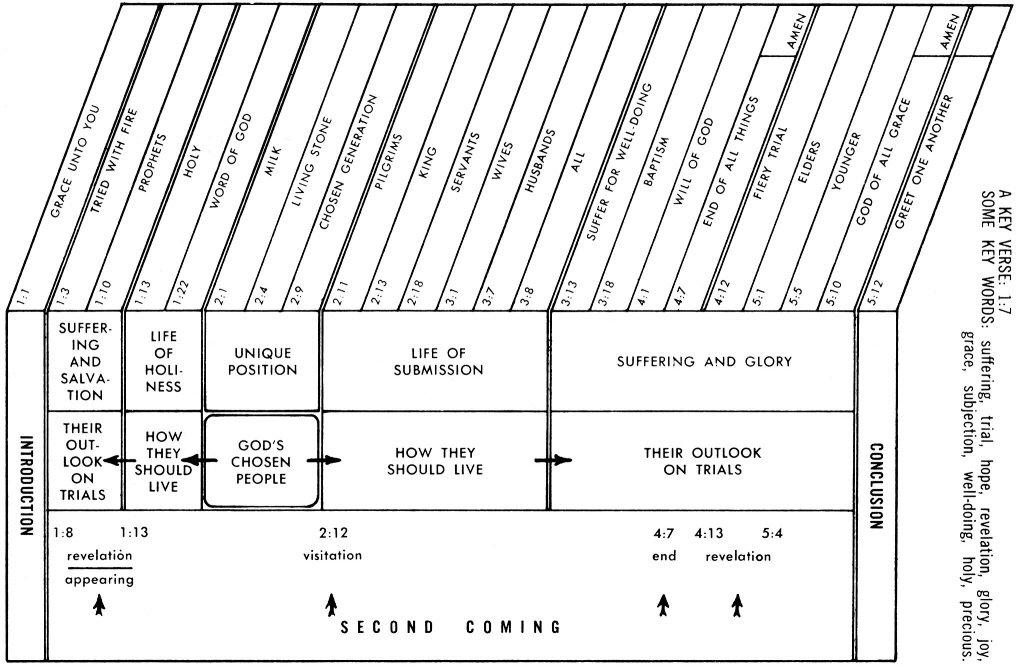
1 Peter: Trials, Holy Living & The Lord's Coming
Click chart to enlarge
Chart from Jensen's Survey of the NT - used by permission
See Another Chart from Charles Swindoll
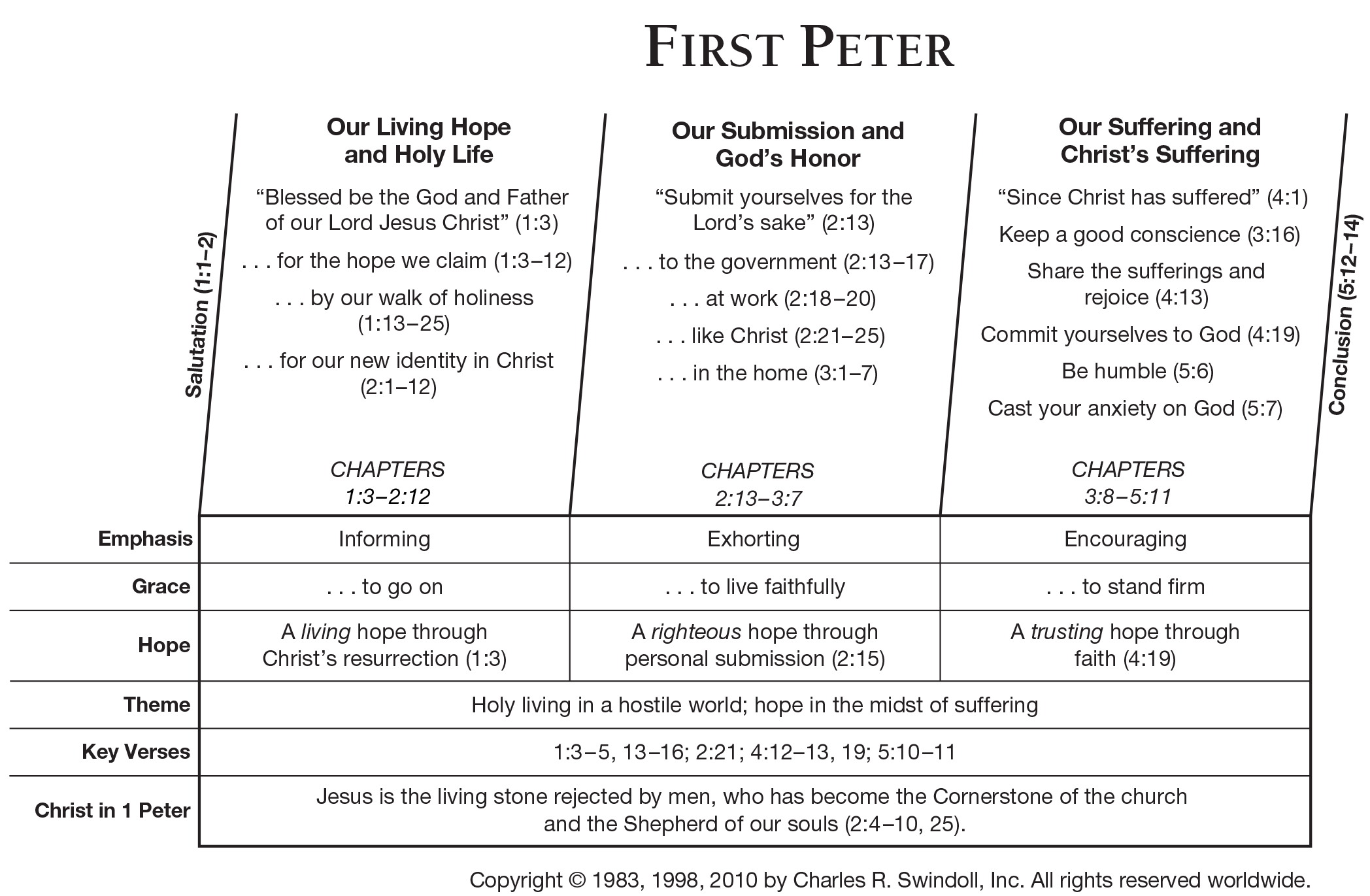
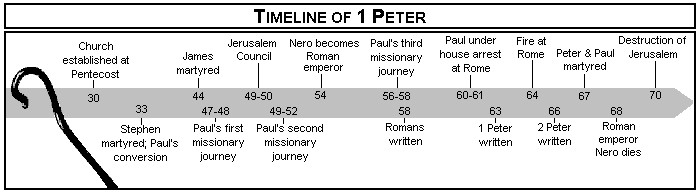
Source: Borrow Ryrie Study Bible
Click to enlarge
PART I: DOCTRINAL FOUNDATION
I. The Opening Salutation (1Pe 1:1-2)
A. The Writer (1Pe 1:1a)
B. The Readers (1Pe 1:1b-2a)
1. True character of the readers (1Pe 1:1b)
2. Geographical location of the readers (1Pe 1:1c)
3. Spiritual supports for the readers (1Pe 1:2a)
C. The Greeting (1Pe 1:2b)
II. The Thanksgiving for Our Salvation (1Pe 1:3-12)
A. The Description of Salvation (1Pe 1:3-5)
1. The author of salvation (1Pe 1:3a-b)
a. His relation to the Savior (1Pe 1:3a)
b. His act of mercy to the saved (1Pe 1:3b)
2. The nature of salvation (1Pe 1:3c-4a)
a. The living hope grounded in Christ's resurrection (1Pe 1:3c)
b. The glorious inheritance awaiting believers (1Pe 1:4a)
3. The certainty of salvation (1Pe 1:4b-5)
a. The safekeeping of the inheritance (1Pe 1:4b)
b. The preservation of the heirs (1Pe 1:5)
B. The Experiences Relating to Salvation (1Pe 1:6-9)
1. The paradoxical nature of the experiences (1Pe 1:6-7)
a. The experience of exultation (1Pe 1:6a)
b. The experience of distress (1Pe 1:66-7)
1. The nature of the distress (1Pe 1:6b)
2. The purpose behind the trials (1Pe 1:7)
a. The testing of faith (1Pe 1:7a)
b. The outcome of the testing (1Pe 1:7b)
2. The sustaining relations of believers (1Pe 1:8-9)
a. Their dual relation to Jesus Christ (1Pe 1:8)
b. Their experiential relation to their salvation (1Pe 1:9)
C. The Magnification of Salvation (1Pe 1:10-12)
1. The magnification through prophetic research (1Pe 1:10-12a)
a. Their intensive search (1Pe 1:10a)
b. Their prophetic function (1Pe 1:10b)
c. Their personal perplexity (1Pe 1:11)
1. The time and circumstances (1Pe 1:11a)
2. The sufferings and the glories (1Pe 1:11b)
d. Their restricted ministry (1Pe 1:12a)
2. The magnification through Christian proclamation (1Pe 1:12b)
3. The magnification through angelic inquiry (1Pe 1:12c)
PART 2: PRACTICAL EXHORTATION
I. Exhortations in View of Our Salvation (1Pe 1:13-2:10)
A. The Life Arising from Salvation (1Pe 1:13-2:3)
1. The Christian life in relation to God (1Pe 1:13-21)
a. A life of steadfast hope (1Pe 1:13)
1. The supports of hope (1Pe 1:13a)
2. The call to hope (1Pe 1:13b)
b. A life of personal holiness (1Pe 1:14-16)
1. The foundation for personal holiness (1Pe 1:14a)
2. The call to personal holiness (1Pe 1:14b-15)
a. The negative demand of holiness (1Pe 1:14b)
b. The positive call to holiness (1Pe 1:15)
3. The justification of the call to holiness (1Pe 1:16)
c. A life of motivated reverence (1Pe 1:17-21)
1. The basis for reverent living (1Pe 1:17a)
2. The call for reverent living (1Pe 1:17b)
3. The knowledge that motivates reverence (1Pe 1:18-21)
a. The means of our redemption (1Pe 1:18-19)
b. The nature of the Redeemer (1Pe 1:20)
c. The characteristics of the redeemed (1Pe 1:21)
2. The Christian life in relation to the brethren (1Pe 1:22-25)
a. The experience of inner purification (1Pe 1:22a)
b. The duty of mutual love (1Pe 1:22b)
c. The foundation in personal regeneration (1Pe 1:23-25)
1. The fact of their regeneration (1Pe 1:23a)
2. The nature of their regeneration (1Pe 1:23b-25a)
3. The evangelization leading to their regeneration (1Pe 1:25b) (D Edmond Hiebert)
1 Peter 1:3 Blessed [be] the God and Father of our Lord Jesus Christ Who according to His great mercy has caused us to be born again (AAP) to a living (PAP) hope through the resurrection of Jesus Christ from the dead (NASB: Lockman)
Greek: Eulogetos o theos kai pater tou kuriou hemon Iesou Christou, o kata to polu autou eleos anagennesas (AAPMSN) hemas eis elpida zosan (PAPFSA) di' anastaseoo Iesou Christou ek nekron,
Amplified: Praised (honored, blessed) be the God and Father of our Lord Jesus Christ (the Messiah)! By His boundless mercy we have been born again to an ever-living hope through the resurrection of Jesus Christ from the dead, (Amplified Bible - Lockman)
NLT: All honor to the God and Father of our Lord Jesus Christ, for it is by his boundless mercy that God has given us the privilege of being born again. Now we live with a wonderful expectation because Jesus Christ rose again from the dead. (NLT - Tyndale House)
Phillips: Thank God, the God and Father of our Lord Jesus Christ, that in his great mercy we men have been born again into a life full of hope, through Christ's rising again from the dead! (Phillips: Touchstone)
Wuest: Let the God and Father of our Lord Jesus Christ be eulogized, who impelled by His abundant mercy caused us to be born again so that we have a hope which is alive, this living hope having been made actual through the intermediate instrumentality of the resurrection of Jesus Christ out from among those who are dead
Young's Literal: Blessed is the God and Father of our Lord Jesus Christ, who, according to the abundance of His kindness did beget us again to a living hope, through the rising again of Jesus Christ out of the dead,
BLESSED BE : Eulogetos:
- 1 Ki 8:15; 1Chr 29:10, 11, 12, 13,20; Ps 41:13; 72:18,19; 2Cor 1:3; Ep 1:3,17; Ep 3:20
- 1 Peter 1 Resources - Multiple Sermons and Commentaries
- 1 Peter 1:1-2 Hope And Holiness In A Hostile World - Steven Cole
- 1 Peter The Glory of Christian Suffering - John MacArthur
- 1 Peter 1:1 The Man Who Was a Rock - John MacArthur
- 1 Peter 1:1 Chosen by God--Pt 1 - Study Guide (see dropdown list) - John MacArthur
- 1 Peter 1:1 Chosen by God--Pt 1 - John MacArthur
- 1 Peter 1:2 Chosen by God--Pt 2 - Study Guide (see dropdown list) - John MacArthur
- 1 Peter 1:2 Chosen by God--Pt 2 - John MacArthur
- 1 Peter 1:2 Chosen by God--Pt 3 - Study Guide (see dropdown list) - John MacArthur
- 1 Peter 1:2 Sovereignty of God in Salvation - Study Guide (see dropdown list) - John MacArthur
- 1 Peter 1:2 Chosen by God--Pt 3 - John MacArthur
Blessed [be] God - I fear we read this phrase much too quickly (certainly I can speak for myself this is true!) and thus sadly we miss the wonder and awe this statement should emote form our innermost being, the very depths of our heart and soul. Why? Because we are but the frail, finite creation, and sinful creation at that (even those of us who are saved, for we still sin against the God we bless!) and yet Peter says we as believers have the unspeakable privilege of offering blessings to the Most High God. Amazing grace indeed! Do you avail yourself of this high privilege? Do you regularly "Bless the LORD" as did the psalmist...
Ps 103:1 Bless the LORD, O my soul, And all that is within me, bless His holy name.
Ps 103:2 Bless the LORD, O my soul, And forget none of His benefits;
Listen to Charles Haddon Spurgeon's comments - Soul music is the very soul of music. The Psalmist strikes the best keynote when he begins with stirring up his inmost self to magnify the Lord. He soliloquizes, holds self-communion and exhorts himself, as though he felt that dullness would all too soon steal over his faculties, as, indeed, it will over us all, unless we are diligently on the watch. Jehovah is worthy to be praised by us in that highest style of adoration which is intended by the term bless "All thy works praise thee, O God, but thy saints shall bless thee." Our very life and essential self should be engrossed with this delightful service, and each one of us should arouse his own heart to the engagement. Let others forbear if they can: "Bless the Lord, O MY soul." Let others murmur, but do thou bless. Let others bless themselves and their idols, but do thou bless the LORD. Let others use only their tongues, but as for me I will cry, "Bless the Lord, O my soul." And all that is within me, bless his holy name. Many are our faculties, emotions, and capacities, but God has given them all to us, and they ought all to join in chorus to his praise. Half-hearted, ill-conceived, unintelligent praises are not such as we should render to our loving Lord. If the law of justice demanded all our heart and soul and mind for the Creator, much more may the law of gratitude put in a comprehensive claim for the homage of our whole being to the God of grace. It is instructive to note how the Psalmist dwells upon the holy name of God, as if his holiness were dearest to him; or, perhaps, because the holiness or wholeness of God was to his mind the grandest motive for rendering to him the homage of his nature in its wholeness. Babes may praise the divine goodness, but fathers in grace magnify his holiness. By the namewe understand the revealed character of God, and assuredly those songs which are suggested, not by our fallible reasoning and imperfect observation, but by unerring inspiration, should more than any others arouse all our consecrated powers. (Psalm 103 Treasury of David)
Blessed (2128) (eulogetos [word study] from eulogeo = to bless <> eú = good, well + logos = word. English = eulogize, eulogy = commendatory formal statement or set oration; high praise; to extol) means to be well spoken of or inherently worthy of praise. Eulogetos is an adjective ending in –tos which gives the meaning “inherently worthy to be praised”. All the uses of eulogetos refer to God as the One "well spoken of". Eulogetos, used of God indicates praise and adoration on the part of the creature, in recognition of the power and prerogatives of the Creator, and the privileges enjoyed at His hands. In Psalm 103:1, 2 when David says “Bless (LXX = the related verb form eulogeo) the Lord O my soul” he is praising God, speaking well of God.
There are 8 uses of eulogetos in the NT - Mark 14:61 (here it used as a title - "the blessed One"); Lk 1:68; Ro 1:25-note; Ro 9:5-note; 2Co 1:3; 11:31; Ep 1:3-note; 1Pe 1:3-note.
Spurgeon - And, truly, this is a blessing, beyond all comparison or imagination, that we have been begotten again by the Divine Esther unto a “living” hope, for that is a better rendering than “lively.” Our first birth brought us into sin and sorrow, but our second birth brings us into purity and joy. We were born to die; now are we born never to die, “begotten again” unto a life that shall remain in us for evermore, a life which shall even penetrate these mortal bodies, and make them immortal, “by the resurrection of Jesus Christ from the dead. How full of grace every sentence is. He blesses God because God has so freely blest us; and he abounds in thanksgiving because he sees that abundant mercy, by which believers have been begotten again — born again — made, therefore, children after a new sort, and so made heirs of an inheritance very different from that upon which we enter by nature “an inheritance incorruptible, and undefiled, and that fadeth not away.” Brethren and sisters, if you have, indeed, been born by divine grace, to what estates are you born — to what high dignities and saved privileges! Rejoice and bless the Lord. But, perhaps, the dark fear crossed your mind that, perhaps, after all, you may perish and miss the inheritance. Now, notice the double consolation of a double keeping. The inheritance is kept. It is reserved in heaven for you, and you are kept, too. It is kept for you, and you are kept for it, “For you, who are kept by the power of God, through faith, unto salvation.” (1 Peter 1- Commentary)
THE GOD AND FATHER OF OUR LORD JESUS CHRIST WHO ACCORDING TO HIS GREAT MERCY: o theos kai pater tou kuriou hemon Iesou Christou o kata to polu autou eleos:
- Ex 34:6; Ps 86:5,15; Jonah 4:2; Ro5:15, 16, 17, 18, 19, 29, 21; Ep1:7; 2:4,7, 8 9, 10; 1Ti 1:14; Titus 3:4, 5, 6
- 1 Peter 1 Resources - Multiple Sermons and Commentaries
- 1 Peter 1:1-2 Hope And Holiness In A Hostile World - Steven Cole
- 1 Peter The Glory of Christian Suffering - John MacArthur
- 1 Peter 1:1 The Man Who Was a Rock - John MacArthur
- 1 Peter 1:1 Chosen by God--Pt 1 - Study Guide (see dropdown list) - John MacArthur
- 1 Peter 1:1 Chosen by God--Pt 1 - John MacArthur
- 1 Peter 1:2 Chosen by God--Pt 2 - Study Guide (see dropdown list) - John MacArthur
- 1 Peter 1:2 Chosen by God--Pt 2 - John MacArthur
- 1 Peter 1:2 Chosen by God--Pt 3 - Study Guide (see dropdown list) - John MacArthur
- 1 Peter 1:2 Sovereignty of God in Salvation - Study Guide (see dropdown list) - John MacArthur
- 1 Peter 1:2 Chosen by God--Pt 3 - John MacArthur
The God and Father of our Lord Jesus Christ Who - The Who refers to the Father. Peter uses the name "Lord Jesus Christ" only here in this letter but 3 times in the second letter - 2Pe 1:8, 1:14, 16.
According to (2596) (Kata) has the primary meaning of “down” and gives the idea of domination, thus this new birth was but “impelled by His abundant mercy.” There is another nuance inherent in "kata" which is not out of but according to. For example, if I am a billionaire and I give you ten dollars, I have given you out of my riches; but if I give you a million dollars, I have given to you according to my riches. The first is a portion (like Mr. Rockefeller who used to give his caddy a dime) the second is a proportion. And notice that it is not just His "mercy" but His "great mercy", where the Greek Word for "great" (polus) means great in extent and magnitude. In fact, given that God is infinite, all His attributes are infinite, so that "great" in context speaks of "infinite" supply of mercy.
How many sins does His infinite mercy cover? What sin is too great that it is not covered by His infinite mercy? Do not let the accuser of your soul deceive you that there is not sufficient mercy to cover that sin you committed! Mercy does not (or at least should not) encourage us to continue committing sins knowing that they are covered by the blood of Christ (cp Ro 6:1-2). Instead His great mercy should motivate us to love God more, to obey Him more fully (depending more fully on His Spirit's enabling power) (Jn 14:15). When we sin our hearts should be broken, even overwhelmed by the thought the goodness of His mercy by which He forgives even one sin that would have been enough to separate us from Him forever! Praise to our God and Father for His great mercy. Amen
Mercy (1656) (eleos [word study]) is the outward manifestation of pity. Mercy refers to the outward manifestation of pity and assumes need on the part of those who receive it and sufficient resources to meet the need on the part of those who show it. (See related discussion of mercy in the commentary notes on "Blessed are the merciful" Matthew 5:7and the lesson notes on the study from the Sermon on the Mount: Blessed are the Merciful: Matthew 5:7) (Other related topics The Mercy of God by A. W. Pink, notes on God's Attribute of Mercy)
The idea of mercy is to show kindness or concern for someone in serious need or to give help to the wretched, to relieve the miserable. Here the essential thought is that mercy gives attention to those in misery.
Wuest writes that eleos is "God’s “kindness and goodwill toward the miserable and afflicted, joined with a desire to relieve them” (Vincent). Grace meets man’s need in respect to his guilt and lost condition; mercy, with reference to his suffering as a result of that sin. (Wuest's Word Studies from the Greek New Testament)
Marvin Vincent adds that eleos "emphasizes the misery with which grace deals; hence, peculiarly the sense of human wretchedness coupled with the impulse to relieve it, which issues in gracious ministry. Bengel remarks, “Grace takes away the fault, mercy the misery.” The pre-Christian definitions of the word eleos include the element of grief experienced on account of the unworthy suffering of another. So Aristotle. The Latin misericordia (miser “wretched,” cor “the heart”) carries the same idea. So Cicero defines it, the sorrow arising from the wretchedness of another suffering wrongfully. Strictly speaking, the word as applied to God, cannot include either of these elements, since grief cannot be ascribed to Him, and suffering is the legitimate result of sin. The sentiment in God assumes the character of pitying love. Mercy is kindness and good-will toward the miserable and afflicted, joined with a desire to relieve them. (Vincent, M. R. Word Studies in the New Testament)
In summary, mercy refers to the outward manifestation of pity and assumes a need on the part of the recipient (fallen mankind) and the resources adequate to meet that need on the part of the donor (God Himself).
HAS CAUSED US TO BE BORN AGAIN: anagennesas (AAPMSN) hemas:
- 1 Pe 1:23; 2:2; Jn 1:13; 3:3, 4, 5, 6, 7, 8; Jas 1:18; 1Jn 2:29; 3:9; 4:7; 5:1,4,18
- 1 Peter 1 Resources - Multiple Sermons and Commentaries
- 1 Peter 1:1-2 Hope And Holiness In A Hostile World - Steven Cole
- 1 Peter The Glory of Christian Suffering - John MacArthur
- 1 Peter 1:1 The Man Who Was a Rock - John MacArthur
- 1 Peter 1:1 Chosen by God--Pt 1 - Study Guide (see dropdown list) - John MacArthur
- 1 Peter 1:1 Chosen by God--Pt 1 - John MacArthur
- 1 Peter 1:2 Chosen by God--Pt 2 - Study Guide (see dropdown list) - John MacArthur
- 1 Peter 1:2 Chosen by God--Pt 2 - John MacArthur
- 1 Peter 1:2 Chosen by God--Pt 3 - Study Guide (see dropdown list) - John MacArthur
- 1 Peter 1:2 Sovereignty of God in Salvation - Study Guide (see dropdown list) - John MacArthur
- 1 Peter 1:2 Chosen by God--Pt 3 - John MacArthur
- See comments on the New Birth in John 3:3
GOD'S GRACIOUS
"CAUSE"
Has caused us - That phrase stops every mouth! (Or it should!) Sinful men are helpless and hopeless outside of this grace and mercy filled phrase! God is the "Cause" of all who are born from above by the Spirit of God. Men are not the "cause" for all of us were born first in Adam, in sin, in intractable hatred of God (regardless of what our lips profess or whether we cloak ourselves in clergy garb) and in terrible trouble! Ephesians 2 explains "has caused us," with a synonymous phrase "BUT GOD," Paul writing...
And you were dead (spiritually dead - death = separation = we were separated from God!) in (this was the "environment" in which we lived, and breathed and had our being - saturated with sin! Mastered by sin! Slaves to sin!) your trespasses and sins, 2 in which you formerly walked according to the course of this world, according to the prince of the power of the air (Satan - see Luke 4:6-note, cf 1 Jn 5:19-note), of the spirit that is now working in the sons of disobedience. 3 Among them we too ALL (all without exception!) formerly lived in the lusts of our flesh, indulging the desires of the flesh and of the mind, and were by nature children of wrath (Deserving God's righteous wrath because we were "sons of disobedience!"), even as the rest. 4 BUT GOD (a divine change of direction = "supernatural succor!"), being rich in mercy, because of His great love with which He loved us (God's motive? Love!), 5 even when we were dead in our transgressions, made us alive together with Christ (by grace you have been saved) (cf "has caused us"), 6 and raised us up with Him, and seated us with Him in the heavenly places in Christ Jesus, 7 so that in the ages to come He might show the surpassing riches of His grace in kindness toward us in Christ Jesus. 8 For by grace you have been saved through faith; and that not of yourselves (No "cause" within us saved us!), it is the gift of God (A gift can only be received, not earned!); 9 not as a result of works, so that no one may boast (If we could have caused ourselves to be born again, we would have boasted!). 10 For we are His workmanship, created in Christ Jesus for good works, which God prepared beforehand so that we would walk in them. (Ephesians 2:1-10-note)
Spurgeon - What a vast mass of meaning is packed away in these words! Men’s books, even when they are good, are like gold-leaf; a little precious metal is very thinly hammered out so as to cover a wide surface, but almost every word in the Bible seems to contain a whole mine of heavenly wealth. Note, beloved, what Peter says concerning your new birth; you are begotten by the God and Father of our Lord Jesus Christ. At your first birth, you were born in sin; but now you have been born again, through grace, by the almighty power of God. Notice, also, unto what you are born, — unto a hope that is full of life, a lively hope, a hope of immortality a hope whose root is in the grave of Christ, the empty grave from which he has risen, and which is the assurance that because he has risen, you also shall rise. See, further, to what you have been born: “to an inheritance incorruptible, and undefiled, and that fadeth not away.” See, also, how that inheritance is entailed upon you, for it is “reserved in heaven for you;” and see, too, how you are kept for it, for you “are kept by the power of God through faith unto salvation ready to be revealed in the last time.” (1 Peter 1- Commentary)
Wayne Detzler reminds us that being born again is not a work of man but solely of God - The new birth is worked by the Holy Spirit (Titus 3:5). Only the Holy Spirit can so work upon a mortal as to make him eternally alive. No human procedures can produce the new birth. That is God's business. God, who works the new birth in a person's life, does so in response to faith, which draws a clear line of distinction between a once-born and a twice-born individual (1 John 5:1, 4-5).
There are many today in America (probably a majority) who if asked "Are you a Christian?" would answer "Of course I am." The tragedy (and beloved I am not the judge of any individual, but just looking at the general drift of our morals and ethics in America) is that many of these souls are deceived (cf Mt 7:21-23-note) and have never been born again. To be born again is not some trite phrase invented by radical evangelical zealots, but plainly stated by the Lord Jesus Christ in His encounter with Nicodemus...
Now there was a man of the Pharisees, named Nicodemus, a ruler of the Jews; 2 this man came to Jesus by night and said to Him, “Rabbi, we know that You have come from God as a teacher; for no one can do these signs that You do unless God is with him.” 3 Jesus answered and said to him, “Truly, truly (AMEN, AMEN), I say to you, unless one is born again he cannot see the kingdom of God (THIS WAS THE LONGING OF EVERY JEW IN JESUS' DAY).” 4 Nicodemus said to Him, “How can a man be born when he is old? He cannot enter a second time into his mother’s womb and be born, can he?” 5 Jesus answered, “Truly, truly, I say to you, unless one is born of water and the Spirit he cannot enter into the kingdom of God. 6 “That which is born of the flesh is flesh, and that which is born of the Spirit is spirit. 7 “Do not be amazed that I said to you, ‘You MUST be born again.’ 8 “The wind blows where it wishes and you hear the sound of it, but do not know where it comes from and where it is going; so is everyone who is born of the Spirit.” 9 Nicodemus said to Him, “How can these things be?” 10 Jesus answered and said to him, “Are you the teacher of Israel and do not understand these things? 11 “Truly, truly, I say to you, we speak of what we know and testify of what we have seen, and you do not accept our testimony. 12 “If I told you earthly things and you do not believe, how will you believe if I tell you heavenly things? 13 “No one has ascended into heaven, but He who descended from heaven: the Son of Man. 14 “As Moses lifted up the serpent in the wilderness, even so must the Son of Man be lifted up; 15 so that whoever believes will in Him have eternal life (= BE BORN AGAIN). 16 “For God so loved the world, that He gave His only begotten Son, that whoever believes in Him shall not perish (ETERNAL PUNISHMENT), but have eternal life. 17 “For God did not send the Son into the world to judge the world, but that the world might be saved through Him. 18 “He who believes in Him is not judged; he who does not believe has been judged already, because he has not believed in the name of the only begotten Son of God. 19 “This is the judgment, that the Light has come into the world, and men loved the darkness rather than the Light, for their deeds were evil. 20 “For everyone who does (AS THEIR HABITUAL PRACTICE DOES) evil hates the Light (HATES GOD), and does not come to the Light for fear that his deeds will be exposed. 21 “But he who practices (AS THE GENERAL DIRECTION OF THEIR LIFE PRACTICES) the truth comes to the Light, so that his deeds may be manifested as having been wrought in God.” (John 3:1-21+)
Has caused… to be born again (313) (anagennao from aná = renewal, again or from above + gennáo = beget) means to be physically born again (but not used this way in the NT), to beget again, to father anew, to bring to birth again, to regenerate, cause to be born again. See comments on the New Birth in John 3:3
Anagennao is used only 2 times in the NT, here and in…
1Pe 1:23 (note) for you have been born again not of seed which is perishable but imperishable, that is, through the living and abiding word of God.
In the NT anagennao means to cause to be changed as a form of spiritual rebirth (aorist tense here points to a past completed act). The Enhanced Strong's has an interesting definition noting that the metaphorical or figurative meaning is
to have one’s mind changed so that he lives a new life and one conformed to the will of God.
In secular Greek literature anagennao is used in a botanical sense, as when the trees, plants, and flowers come to life in the spring.
Note that the aorist tense speaks of regeneration as a definite historical act accomplished once for all. God "caused" it! Hallelujah!
Peter pictures the heart of man as dry, shriveled, and dead in sin until God implants the principles of the new life. When this happens, we sprout into life, leaf out, and grow in the grace and knowledge of our Lord and Savior Jesus Christ. It is intriguing to note (and no accident of course) that at the time of Peter's letter, the idea of a new beginning through a new birth by virtue of infusion of divine life was a widespread idea in the ancient world, being well known not only in Judaism but also present in the "Mystery" religions. Furthermore, a proselyte to Judaism was regarded as a "new born baby". Note that to describe someone as a "born-again Christian" is redundant as there is no such thing as a "non-born-again Christian". An unregenerate (non-born-again) Christian is a contradiction in terms. By the power of God we have been give new life, making us partakers of His divine nature (2Pe 1:4-note) and thus children of God (Jn 1:12, Ro 8:16-note Ro 8:21-note) and so now we are "waiting eagerly for our adoption as sons, the redemption of our body." (Ro 8:23-note)
Pastor Steven Cole makes a good point writing that "We live in a culture which has taken some biblical words and used them in a way that redefines and cheapens them so that they no longer mean what the Bible means. But then they seep back into the vocabulary of Christians with their devalued meaning. Take the term “born again.” The media uses it to describe anyone who makes a comeback or gets a fresh start in life. A baseball team that has been in the cellar and suddenly starts winning is called “the born again” Dodgers. Chrysler under Lee Iacocca was a “born again” corporation. And so it’s not surprising when over 50 percent of Americans say that they’re “born again Christians.” They mean that they had some sort of religious or emotional experience that resulted in a fresh start in life. It may have involved praying to Jesus or “inviting Him into their hearts.” But in most cases, they have no idea what the Bible means by being born again. (Sermon) (Bolding added)
Wayne Detzler illustrates the idea of new birth with several related stories - "In the mid-'70s the term "born again" received an unexpected boost. Charles Colson had been a close adviser of President Richard Nixon and, like Nixon, Colson fell from power through the Watergate affair. As a result of this crisis Colson came to personal faith in Jesus Christ, and he wrote a book titled Born Again. At the same time an evangelical renaissance was sweeping the United States. The national magazines reported it. Both Time and Newsweek carried cover stories concerning "born-again" Christians. Some estimated that the born-again minority comprised one-third of America's population. Though no one would claim that a third of all Americans were biblical Christians, there is certainly a large and vocal minority of people who have experienced the new birth. Ironically the advocates of Communism have revived Karl Marx's teaching about "the new man," who is a product of socialistic indoctrination. Literature has many excellent examples to illuminate the concept of the new birth. In describing his conversion, Richard Knill wrote: "Clang! Clang! went every bell in heaven, for Richard Knill was born again." The great evangelical awakening in England in the 18th century had an impact on the American colonies. One of the major preachers was George White-field, a sometime colleague of John Wesley. As Whitefield attempted to win people to Christ, one of his evangelistic letters was directed to the American patriot Benjamin Franklin. To Franklin, Whitefield wrote these powerful lines: "As you have made a pretty considerable progress in the mysteries of electricity, I would now honestly recommend to your diligent unprejudiced pursuit and study the mysteries of the new birth." Another approach to the same subject emerged in the preaching of Bob Pierce, founder and first president of World Vision. In speaking of salvation he said: "There are too many grandchildren of Christ in the world, those whose parents were Christians but they aren't. Nowhere in the Bible does God claim grandchildren—just children, born again by faith in Christ." Though the Puritans were much more restrained in their discussion of conversion, they sometimes put it quite plainly. One of the most notable Puritan authors was Thomas Adams, a refugee during the Civil War in England. In writing concerning conversion Adams said: "Repentance is a change of the mind, and regeneration is a change of the man." Then he added concerning the new birth: "The Creation of the world is a shadow of the regeneration of a Christian. ... Adam was created after the image of God, and placed in Paradise; so the new man is confirmed to the image of Christ, and shall be reposed in the paradise of everlasting glory." Even Horace Bushnell, who was negatively quoted earlier, sometimes wrote quite acceptable theology. Especially did he say some straight things concerning the new birth. "There could be no growth if there were not something planted. ... Until the new man is born, or begotten, the soul abideth in death, and therefore cannot grow." An anonymous writer summarized the truth concerning this new birth, or regeneration. He wrote: "To be highborn is nice, but to be newborn is necessary!" (New Testament Words in Today's Language)
Related Resources:
- What is a Christian?
- What does it mean to be a born again Christian? (Watch the 3:30 minute video)
- How can I become a Christian?
- How can I become a child of God?
- Does John 3:5 teach that baptism is necessary for salvation? What does it mean to be born of water?
- What is the bad news / good news approach to sharing the gospel?
- What does it mean to be born of God?
- Is everyone born an atheist?
- What are the most famous/important questions in the Bible?
- What is the sin nature?
- Do Christians sin?
What’s Missing? Tennis star Boris Becker was at the very top of the tennis world—yet he was on the brink of suicide. He said, “I had won Wimbledon twice before, once as the youngest player. I was rich. I had all the material possessions I needed… It’s the old song of movie stars and pop stars who commit suicide. They have everything, and yet they are so unhappy. I had no inner peace. I was a puppet on a string.”
Becker is not the only one to feel that sense of emptiness. The echoes of a hollow life pervade our culture. One doesn’t have to read many contemporary biographies to find the same frustration and disappointment. Jack Higgens, author of such successful novels as The Eagle Has Landed, was asked what he would like to have known as a boy. His answer: “That when you get to the top, there’s nothing there.”
What’s missing? When a person has so much and is still bitterly dissatisfied—even suicidal—what’s not there? A relationship with God.
The Creator made us with a need for meaning and purpose and hope that only He can satisfy. He meets this need when we enter into a personal relationship with Jesus Christ. Trusting Jesus as Savior is the only way for anyone, successful or not, to find what’s missing.— David C. Egner (Our Daily Bread, Copyright RBC Ministries, Grand Rapids, MI. Reprinted by permission. All rights reserved)
We search for peace, although aware
That worldly roads lead to despair;
But if by faith to Christ we turn,
God’s grace and truth we’ll soon discern.
—DJDOnly God can fill
the emptiness of the human heart.
TO A LIVING HOPE: eis elpida zosan (PAPFSA):
- Ro 5:4,5; 8:24; 12:12; 15:13; 1 Cor 13:13; Col 1:23,27; 1 Th 1:3; Titus 2:13; Heb 3:6; 6:18,19; 1Jn 3:3
- 1 Peter 1 Resources - Multiple Sermons and Commentaries
- 1 Peter 1:1-2 Hope And Holiness In A Hostile World - Steven Cole
- 1 Peter The Glory of Christian Suffering - John MacArthur
- 1 Peter 1:1 The Man Who Was a Rock - John MacArthur
- 1 Peter 1:1 Chosen by God--Pt 1 - Study Guide (see dropdown list) - John MacArthur
- 1 Peter 1:1 Chosen by God--Pt 1 - John MacArthur
- 1 Peter 1:2 Chosen by God--Pt 2 - Study Guide (see dropdown list) - John MacArthur
- 1 Peter 1:2 Chosen by God--Pt 2 - John MacArthur
- 1 Peter 1:2 Chosen by God--Pt 3 - Study Guide (see dropdown list) - John MacArthur
- 1 Peter 1:2 Sovereignty of God in Salvation - Study Guide (see dropdown list) - John MacArthur
- 1 Peter 1:2 Chosen by God--Pt 3 - John MacArthur
OUR LIVING HOPE
IS SURE AND STEADFAST
Note: For more detailed discussion of the vital and not frequently taught truth of hope click Blessed Hope
Peter has been called “the apostle of hope” (the noun elpis is used in 1Pe 1:3, 21, 3:15;x 1 Peter & the verb 2x - 1Pe 1:13, 3:5).
Later in this same chapter Peter explains that God caused us to be born again to a living hope as a result of the living word, writing "for you have been born again not of seed which is perishable but imperishable, that is, through the living and abiding word of God." (1Pe 1:23)
To (into) a living hope - D Edmond Hiebert explains that "Into a living hope" sets forth the present character of the new pilgrim life. "Into" (eis) indicates the result of our new birth; it has given us a living hope as the energizing principle of the new life. As used here, "hope" is not an objective prospect that the gospel sets before the believer but the subjective attitude of expectancy that grips the newborn soul. Vincent notes that in classical Greek "hope" (elpis) "has the general signification of expectancy, relating to evil as well as to good," but that "in the New Testament the word always relates to a future good." In the present turbulent world, Christians are truly justified in viewing the future with optimism. Our new God-given life has delivered us from hopelessness (Eph. 2:12) and given us a joyous expectancy of what God still has in store for His people."
Living (2198) (zao) means to live, breathe, be among the living (not lifeless, not dead), to enjoy real life, to have true life and worthy of the Name, active, blessed, endless in the kingdom of God, having vital power in itself and exerting the same upon the soul, in full vigor, fresh, strong, efficient, active, powerful, efficacious. Now go back and "insert" some of these definitions of "living" into the phrase living hope. (e.g., a "breathing hope", an "active hope", etc). This should help you begin to understand some of the encouraging thoughts Peter means to convey.
Zao - 140x in 124v and 7 times in Peter -1 Pet. 1:3, 23; 2:4, 5, 24; 4:5, 6. Zao is rendered in the NAS as alive(15), get a living(1), life(6), live(53), lived(3), lives(19), living(44).
While living (zao) is a verb, in this context it is used as an adjective, expressing a vital and dynamic aspect of the hope God gives to every believer in Christ. Living is the quality of the hope believers now possess in Christ. Living is in the present tense which speaks of our hope as possessing an abiding quality. A living hope is never extinguished by untoward circumstances (yes, we may FEEL like it is, but God's word remains' TRUE regardless of how we feel), even in the same way as living waters never cease to flow fresh from a perennial spring. And why is a believer's hope a living hope? Because our hope is not in a principle but in a Person (1Ti 1:1) and that Person is living because He has been resurrected from the dead. And because He lives eternally, we also live eternally. That is our sure, steadfast, unchangeable living hope. Beloved, no matter what you might be experiencing as you read these notes, may this incontrovertible, irrevocable truth from God sink deep into your heart and mind and soul and spirit and may the Spirit of Christ use it to renew your mind and encourage you of the truth that because your hope is a living and not a dead hope, "the best is yet to come" when grace will be brought to us "at the revelation of Jesus Christ." (1 Peter 1:13-note) Indeed, "this is the true grace of God. Stand firm in it!" (1 Peter 5:12-note)
Hiebert adds that "Peter characterized Christian hope as "living" (zōsan), having in itself the very life of the "living God" (1 Th. 1:9-note). That hope stands in contrast to the empty, frustrating, deceptive, false hopes of the world. Tribulation cannot destroy the Christian's hope because the living God inspires it and guarantees its fruition. He is assured that the best is yet to be! This personal hope is grounded in the objective reality of Jesus Christ's resurrection from the dead....The resurrection of Christ is the crowning point of His redemptive work and the valid foundation for all of God's saving work, both present and future."
Alan Carr - Our hope is a “living hope” that is sure, certain, and real, as opposed to the deceptive, empty, false hope the world offers. You see, many in our day are pinning their hopes on their 401K plan. Many have their hope in the stock market. Some have their hope in their health or their family. This is a hope based in wishful thinking! When the New Testament uses the word “hope” it does not refer to a fond wish or desire. It means, “a confident assurance based on the Word of God and the resurrection of Jesus Christ from the dead that produces an excited response.” Do you get it? When we, as believers, speak of our hope of heaven, we are not talking about “pie in the sky, by and by.” We are talking about a sure thing! We are talking about something that is more solid that the ground under our feet. We are referring to something that is settled by the inerrant, infallible, Word of God! Friend, the world may be in turmoil today, but those who are saved possess a hope that is out of this world! (1 Peter 1:1-5 Why Every Baptist Ought To Shout)
William MacDonald says "This is our living hope—the expectation of being taken home to heaven to be with Christ and to be like Him forever."
F. B. Meyer calls the living hope "the link between our present and future."
David Guzik - We are born again to a living hope because we have eternal life in a Savior who has conquered death Himself. The hope lives because it is set upon an inheritance incorruptible that can never fade away because it is reserved in heaven. This is a significant contrast to any inheritance on this earth.
Time destroys most hopes; they fade and then die. But the passing of time only makes a Christian’s living hope that much more imminent and glorious.
A living hope then is not static and dead but is active and vigorous in expressing itself in the hearts, minds and lives of Christians, if we keep our minds set on the things above.
Detzler - The early church father Chrysostom, writing in the fourth century, observed that being born to new life was like resurrection from the dead. Much as Christ came alive to new life after the Crucifixion, so a Christian is born again to new life through conversion.
Gene Getz writes that "When a Christian truly understands the hope he has in Christ, it results in a steadfast sense of security and stability. Note the following references which illustrate these results.
• "We continually remember before our God and Father... your endurance inspired by hope in our Lord Jesus Christ (1 Thess. 1:3).
• "Let us hold unswervingly to the hope we profess, for he who promised is faithful" (Heb. 10:23).
• "Command those who are rich in this present world not to be arrogant nor to put their hope in wealth, which is so uncertain, but to put their hope in God, who richly provides us with everything for our enjoyment" (1 Tim. 6:17).
• "Set your hope fully on the grace to be given you when Jesus Christ is revealed" (1 Pet. 1:13).
Spurgeon writes…
A third blessing strictly connected with this new life, is a Lively Hope.
“He hath begotten us again unto a lively hope.”
Could a man live without hope? Men manage to survive the worst condition of distress when they are encouraged by a hope, but is not suicide the natural result of the death of hope? Yes, we must have a hope, and the Christian is not left without one. He has “a lively hope,” that is to say, first, he has a hope within him, real, true, and operative. Some men’s hopes of heaven are not living hopes,” for they never stir them to action. They live as if they were going to hell, and yet they coolly talk about hoping that all will be well with them at last! A Christian’s hope purifies him, excites him to diligence, makes him seek after that which he expects to obtain. A student at the University hoping to gain a prize uses his best endeavors, burns the midnight oil, strains all his faculties that he may reach the mark which will ensure his passing the examiners. Even thus the Christian with a lively hope devotes himself to obtaining the blessings which God has promised in his word. The Lord hath begotten us to a “lively hope,” that is to say, to a vigorous, active, operating hope.
It is a “lively hope” in another sense, namely, that it cheers and enlivens. The swimmer who is ready to sink, if he sees a boat nearing him, plucks up courage and swims with all his strength, because now he expects that his swimming will be of effectual service to him. The Christian amid the waves and billows of adversity retains his hope, a glorious hope of future bliss, and therefore he strikes out like a man towards the heavenly shore. Our hope buoys up the soul, keeps the head above water, inspires confidence, and sustains courage.
It is also called a “living hope,” because it is imperishable. Other hopes fade like withering flowers. The hopes of the rich, the boasts of the proud, all these will die out as a candle when it flickers in the socket. The hope of the greatest monarch has been crushed before our eyes; he set up the standard of victory too soon, and has seen it trailed in the mire. There is no unwaning hope beneath the changeful moon: the only imperishable hope is that which climbs above the stars, and fixes itself upon the throne of God and the person of Jesus Christ.
The hope which God has given to his truly quickened people is a lively hope, however, mainly because it deals with life. Brethren, it may be Christ will come while yet we live, and then we shall not die but shall be fitted for heaven by a change. However, it is probable that we may have to depart out of this world unto the Father by the usual course of nature, and in expecting to do so let us not look at death as a gloomy matter, as though it could at all jeopardise our welfare or ultimately injure us. No, my brethren, we have a living hope, a lively hope. Charles Borromeo, the famous bishop of Milan, ordered a painter who was about to draw a skeleton with a scythe over a sepulcher, to substitute for it the golden key of Paradise. Truly this is a most fitting emblem for a believer’s tomb, for what is death but the key of heaven to the Christian. We notice frequently over cemetery gates, as an emblematic device, a torch turned over ready to be quenched. Ah, my brethren, it is not so, the torch of our life burns the better, and blazes the brighter for the change of death. The breaking of the pitcher which now surrounds the lamp and conceals the glory, will permit our inner life to reveal its lofty nature, and ere long even the pitcher shall be so remodelled as to become an aid to that light; its present breaking is but preparatory to its future refashioning. It is a blessed thought that the part of us which must most sadly feel the mortal stroke is secured beyond all fear from permanent destruction. We know that this very body, though it moulders into dust, shall live again; these weeping eyes shall have all tears wiped from them; these hands which grasp to-day the sword of a conflict shall wave the palm branch of triumph. My brethren, it were not just that one body should fight and another body should be crowned, that one body should labor and another body have the reward. The same identical body shall rise from the dead at the Lord’s coming, marvellously changed, strangely developed as the seed develops into the full-blown flower, but still the same, in very deed the selfsame; this very body shall be resplendent with glory, even the same which now beareth sickness and pain. This is our lively hope, that death hath no dominion over any part of our manhood. There is awhile a separation between the soul and the body, it is but for awhile; there is for the flesh a temporary slumbering in the tomb, it is but a slumber, and the waking shall be in the likeness of Christ. As for the soul, it shall be for ever with the Lord, waiting for the latter day and the coming of Christ, when the body itself shall be raised from corruption into the likeness of the glory of him who is the first begotten from the dead. Thus, then, I have brought you up from the abundant mercy to the new life, and onward, to the lively hope. (1 Peter 1:3-5: A String of Pearls)
CHRISTIAN HOPE
IS A LIVING HOPE
Hope (1680) (elpis) in Scripture is not the world's definition of "I hope so", with a few rare exceptions (e.g., Acts 27:20) Hope is defined as a desire for some future good with the expectation of obtaining it. Hope is always an expectation of something good as well as descriptive of something for which we must wait. Hope is the opposite of despair. And the opposite of a "living hope" is a "dead hope."
See Preceptaustin Related Posts:
- Christ Jesus Our Hope
- Are You Looking for the Blessed Hope?
- The Blessed Hope: Part 1
- The Blessed Hope: Part 2
Gabriel Marcel said "Hope is for the soul what breathing is for the living organism." Indeed, a study of concentration camp survivors found that those prisoners who were able to hold onto their sense of hope (‘things are going to get better’ or ‘we’re going to get out of here one day’) were much more likely to survive. Hope then is not optional but for these prisoners proved to be a matter of life and death.
Biblical hope is not "finger crossing", but is alive and certain because of the resurrection of Jesus Christ from the dead. Life without Christ is a hopeless end whereas life in Christ is an endless hope. Biblical hope is confident expectancy. Someone has put it this way "Hope is faith in the future tense." John Blanchard rightly says that "'Hope' is biblical shorthand for unconditional certainty." The Puritan writer Thomas Brooks says that "Hope can (allow us to) see heaven through the thickest clouds." In short, Biblical hope is not a "Hope so" but a "Hope sure!"
F F Bruce gives this description of Christian hope…
We are refugees from the sinking ship of this present world order, so soon to disappear; our hope is fixed in the eternal order, where the promises of God are made good to His people in perpetuity.
Hope as the world typically defines it is a desire for some future occurrence of which one is not assured of attaining. The ancient world did not generally regard hope as a virtue, but merely as a temporary illusion. Historians tell us that a great cloud of hopelessness covered the ancient world. Philosophies were empty; traditions were disappearing; religions were powerless to help men face either life or death. People longed to pierce the veil and get some message of hope from the other side, but there is none outside of Christ.
Stephen Renn emphasizes that…
the Christian hope is not based on mere wishful thinking, but on a certain outcome of blessing that is grounded in the finished redemptive work of Jesus Christ. The believer’s explicit hope in God’s finished work of salvation through Christ constitutes the dominant usage of elpis (e.g., Ro 5: 5; 1Co. 9:10; 2Co 3:12; Eph 1:18; Php 1:20; Col. 1:23, 27; 1Th. 5: 8; Heb. 3: 6; 1Pe. 3:15; 1Jn 3: 3). Related to this theme is the Christian hope of resurrection from the dead (Acts 23: 6), and also hope in the promises of God for salvation (cf. Acts 26: 6, 7; Ro 4:18; 8:20). Other uses of the term indicate the hope of sharing God’s glory (cf. Ro 5: 2); hope as a Christian virtue (cf. Ro 5: 4; 1Co. 13:13). See also 2Co. 1: 7; 1Th. 2:19; Gal. 5: 5. The tragedy of the unbeliever who has no hope is cited in Eph. 2:12; 1Th. 4:13. (Expository Dictionary of Bible Words Word Studies for Key English Bible Words Based on the Hebrew And Greek Stephen D. Renn)
Mounce writes that…
Hope is directed toward the future. Once we have received what we have hoped for, hope ceases (Ro 8:24)… Christian hope is strengthened by the Scriptures (Ro 15:4), by the work of Jesus (1Pe 1:3, 21), and by God’s present gift of the Spirit to believers (Ro 5:5). (Mounce's Complete Expository Dictionary of Old & New Testament Words. Grand Rapids, MI: Zondervan)
NIDNTT notes that…
In secular Greek elpis does not correspond with our word hope, since it is a general word for the anticipation of future events of all kinds, of good (hope) or evil (fear)… Living hope as a fundamental religious attitude was unknown in Greek culture. Admittedly Theognis said, “As long as you live by honoring the gods, hold on to hope!” and Horace called fides (faith, loyalty) the companion of spes (hope). But in the final analysis men had to stand without hope before the hostile forces of guilt and death. Sophocles’ chorus lamented, “The highest remains, never to be brought to life.” Seneca called hope the definition of “an uncertain good”. But deification and immortality promised by the mystery religions were human pipe dreams. (Brown, Colin, Editor. New International Dictionary of NT Theology. 1986. Zondervan)
Seneca, Rome's leading intellectual figure, tutor of the depraved emperor Nero (who forced Seneca to commit suicide!) and contemporary of Paul tragically defined hope as “an uncertain good”, the antithesis of Biblical hope! What a difference the new birth in Christ makes in one's perspective. The cynical editor H. L. Mencken also inaccurately defined (biblical) hope as “a pathological belief in the occurrence of the impossible.”
Webster defines hope as a "desire accompanied by expectation of or belief in fulfillment." In another definition in Webster's 10th Edition we read that hope "implies little certainty but suggests confidence or assurance in the possibility that what one desires or longs for will happen."!!! The 1828 edition of Webster's has this definition of hope…
(1) A desire of some good, accompanied with at least a sight expectation of obtaining it, or a belief that it is obtainable. Hope differs from wish and desire in this, that it implies some expectation of obtaining the good desired, or the possibility of possessing it. Hope therefore always gives pleasure or joy; whereas wish and desire may produce or be accompanied with pain and anxiety. (2) Confidence in a future event; the highest degree of well founded expectation of good; as a hope founded on God’s gracious promises; a Scriptural sense. A well founded scriptural hope, is, in our religion, the source of ineffable happiness. (3) That which gives hope; he or that which furnishes ground of expectation, or promises desired good. The hope of Israel is the Messiah. The Lord will be the hope of his people, Joel 3. (4) An opinion or belief not amounting to certainty, but grounded on substantial evidence. The Christian indulges a hope, that his sins are pardoned.
Comment: It is fascinating that definition #2 is no longer present in the newer editions of Webster's Dictionary. One wonders what Noah Webster would have to say about this tendency to diminish the importance of the Bible in defining English words! On the other hand definition #4 almost seems to counter definition #2 and is the antithesis of Christian hope. My goodness, if we don't have a certainty that our sins are pardoned by the finished work of Christ on the Cross, then frankly we are a people who are to be most pitied. Jesus became a perfect Man to become a perfect Sacrificial Lamb and thereby a perfect Redeemer so that He might give "His people the knowledge of salvation By the forgiveness of their sins." (Luke 1:77, 24:45-47, Acts 10:45) The Greek word for forgiveness is aphesis (verb = aphíemi from apo = from + hiemi = put in motion, send) describes an action causing separation and was a secular and legal term meaning to repay or cancel a debt. Through the shedding of His blood, Christ took our sins upon Himself and carried them an infinite distance away with no return possible (compare the fate of the scapegoat in Lev 16:21 on the annual Day of Atonement). Thus even this fundamental meaning of forgiveness of separating the sin from the sinner directly counters Webster's 1828 definition #4. Beloved in Christ, the hope that our sins have been pardoned forever is a certainty, a firm foundation for our souls!
Lawrence Richards writes that…
The Bible seldom uses “hope” in (a) doubt-filled way (As in Acts 24:26). Instead, hope focuses attention on God and fills us with eager expectation.
No one who learns to hope in a biblical way will ever be overcome by disappointment but will be filled with patience, encouragement, and enthusiasm…
The NT also shows us that there is a vital need for us to have hope. NT hope has not only an objective content but also a subjective impact. When we fix our eyes on the future that God has in store for us, we taste the wonders of his transforming power. (1Jn 3:3). We are told that “faith and love (Col 1:4)…spring from the hope that is stored up for [us] in heaven” (Col 1:5) and that faith rests “on the hope of eternal life, which God, who does not lie, promised” (Titus 1:2). The NT also associates hope with character. In the NT, character development is linked with patient endurance: doing the right thing despite delay in reaching goals or receiving rewards. So it is particularly significant when we are told that “endurance [is] inspired by hope in our Lord Jesus Christ” (1Th 1:3; cf. Ro 5:4–5).
What is more, hope brings us a deep sense of joy (Ro 12:12). With hope we can maintain an optimistic outlook even when things go wrong (1Pe 3:15; cf. 1Pe 3:13-17). Our life will still have its stress and its personal tragedies. But the believer whose hope is in the Lord and who has a grasp of God’s plan will not be overcome. (Richards, L O: Expository Dictionary of Bible Words: Regency)
Spurgeon - Oh, what a blessed hope this is, — that, though we fall asleep, we shall surely wake again; and when we awaken, it will be in the likeness of the great Head of the family, and we ourselves shall be heirs of an inheritance in which there will be no sin and no corruption. That inheritance is kept for us, and we are kept for it; so the double keeping makes it doubly sure. Happy are the people to whom these verses apply. (1 Peter 1- Commentary)
Vincent writes that hope "in classical Greek, has the general signification of expectancy, relating to evil as well as to good. Thus Plato speaks of living in evil hope (“Republic,” i., 330); i.e., in the apprehension of evil; and Thucydides, of the hope of evils to come; i.e., the expectation or apprehension. In the New Testament the word always relates to a future good. (Vincent, M. R. Word Studies in the New Testament Vol. 1)
The book of Hebrews defines hope as that which gives "full assurance" (He 6:11-note). Thus we can have strong confidence that God is going to do good to us in future. The opposite of hope is despair, (hopelessness; a hopeless state; a destitution of hope or expectation) which is all that those without Christ as Savior can know, for Paul defines hope as "Christ Jesus, Who is our Hope" (1Ti 1:1). Thus genuine Biblical hope is not a Principle but a Person, Christ Jesus!
A little over a month before he died, the famous atheist and philosopher Jean-Paul Sartre declared that he so strongly resisted feelings of despair that he would say to himself, “I know I shall die in hope.” Then in profound sadness, he would add, “But hope needs a foundation.” Sartre died in 1980. I would imagine he is no longer an atheist! And sadly he will remain eternally hopeless! May the hopeless state of the lost around us motivate us not to judge them but to be filled with the Spirit so that we genuinely live and gently speak of the living hope found only in the Gospel of our resurrected and living Lord Jesus Christ. Amen
Hope in the NT is a...
- living hope 1 Pe 1:3
- blessed hope Titus 2:13
- joyful hope 1 Th 2:19 (cf Ro 12:12)
- comforting hope 1Th 4:13-18
- hope of glory Col 1:27
- anchoring hope Heb 6:19
- purifying hope 1 Jn 3:3
Source of HOPE is God's Word:
- Ro 15:4 (cf Col 1:5, 23) for whatever was written in earlier times (OT) was written for our instruction, that through perseverance and the encouragement of the Scriptures we might have hope.
Paul prayed for HOPE:
- Ep 1:18 (cf Ps 62:5 42:5,11 43:5) I pray that the eyes of your heart may be enlightened, so that you may know what is the hope of His calling, what are the riches of the glory of His inheritance in the saints,19 and what is the surpassing greatness of His power toward us who believe.
Other believers are our HOPE:
- 1 Th 2:19 For who is our hope or joy or crown of exultation? Is it not even you, in the presence of our Lord Jesus at His coming?
Hope is something we should tell others about:
- 1 Pe 3:15 but sanctify Christ as Lord in your hearts, always being ready to make a defense to everyone who asks you to give an account for the hope that is in you, yet with gentleness and reverence;
Hope is our helmet of salvation:
- 1Th 5:8 But since we are of the day, let us be sober, having put on the breastplate of faith and love, and as a helmet, the hope of salvation.
Hope is a motivation to a holy life:
- 1Jn 3:3 (cf Titus 2:11-13) And everyone who has this hope fixed on Him purifies himself, just as He is pure.
Hope describes the looking forward to something with a reason for confidence that it will inevitably be fulfilled (cf Titus 2:13-note!!!). In this same chapter Peter used this aspect of the truth of hope to encourage the saints who were suffering for their faith…
Therefore (term of conclusion = on the basis of the salvation and the "living hope" they now possessed) gird your minds for action, keep sober in spirit, fix your hope (elpizo - verb form of elpis - in the aorist imperative = Do it now! It is our responsibility but it is ONLY possible in submission to and dependence upon the Spirit! cf Php 2:12-note, see especially Php 2:13-note) completely on the grace to be brought to you at the revelation (apokalupsis) of Jesus Christ." (1Pe 1:13-note)
Comment: Observe that Peter links hope with the Second Coming of Jesus Christ, Who will put an end to all suffering for those who are in Him by grace through faith! Hallelujah, what a Savior, what a hope!
Click in depth study of Biblical hope: chart summarizing the definition of hope, the source of hope, the stabilizing effect of hope and sanctifying effect of hope.
Elpis - 53x in 48v in the NAS (The top four books - Romans 13x -25%, Acts 8x - 15%; Heb 5x - 9%, 1Th 4x - 8%) It is interesting that elpis does not appear in the Gospels. And yet the concept/truth expressed in the word elpis does appear because as Paul says it is "Christ Jesus our Hope." (1Ti 1:1 literal translation - there is no verb in the Greek). In short, in the NT, Hope is not just an ideal but is a Person, Jesus Christ, our Peace, our Life, our All in all!
Acts 2:26 'THEREFORE MY HEART WAS GLAD AND MY TONGUE EXULTED; MOREOVER MY FLESH ALSO WILL LIVE IN HOPE;
Comment: This is a quote from Psalm 16:9, specifically from the Septuagint (Greek) version in which the Hebrew word for security (Hebrew = betach = Safety, security, carelessness, place of refuge; feeling of trust, assurance, without care, confidence, hope, secure) is translated with the Greek noun elpis.
Acts 16:19 But when her masters saw that their hope of profit was gone, they seized Paul and Silas and dragged them into the market place before the authorities,
Comment: This is one of the Biblical uses of elpis in which hope is used in a manner that most of the world today uses hope - "I hope so!".
Acts 23:6 But perceiving that one group were Sadducees and the other Pharisees, Paul began crying out in the Council, "Brethren, I am a Pharisee, a son of Pharisees; I am on trial for the hope and resurrection of the dead!"
Comment: Observe the juxtaposition of hope and resurrection. Paul as a Pharisee (albeit a born again liberated, not legalistic Pharisee) believed the dead would be raised to life and saw this hope (certainty) realized in and founded upon the truth of the resurrection of Jesus Christ from the dead. NET Bible notes that "With an objective genitive construction, the resurrection of the dead would be the ‘object’ of the hope."
Acts 24:15 (Paul on trial before Festus declares) having a hope in God, which these men cherish themselves, that there shall certainly be a resurrection of both the righteous and the wicked.
Comment: Again observe the association of hope with the certainty of a future resurrection. Paul's hope is in God, in His faithfulness to keep all of His promises, in this case His promise to raise the dead.
Acts 26:6 (Paul's defense before King Agrippa) "And now I am standing trial for the hope of the promise made by God to our fathers; 7 the promise to which our twelve tribes hope to attain, as they earnestly serve God night and day. And for this hope, O King, I am being accused by Jews. (For context read Acts 26:6)
Comment: The hope of the promise is the hope of Messiah (His first and second comings, His kingdom) (Ge 3:15, 12:3, 22:18 26:4, 49:10, Dt 18:15 cf Acts 1:6, 3:22-24, Acts 13:32,33) and the good news associated with His appearing that righteousness is available to all who believe (Ro1:16-17).
The hope of the 12 tribes in Acts 26:7 refers to Israel's hope of national deliverance, a deliverance that Paul explains will occur when the Deliverer Himself returns to Zion (Ro 11:26-note) and sets up His Millennial Kingdom at the end of Daniel's Seventieth Week of 7 Years (commonly referred to as the "Tribulation").
Bible Knowledge Commentary: Because Yahweh is the God of Abraham, Isaac, and Jacob, people must be resurrected in order to receive the promise God made to them. Likewise the promises made to the Jews demand they be resurrected in the coming Messianic Age. (Walvoord, J. F., Zuck, R. B., et al: The Bible Knowledge Commentary. 1985. Victor)
William MacDonald comments that: The flow of Paul’s argument here seems to be as follows: In the OT God made various covenants with the leaders of Israel, such as Abraham, Isaac, Jacob, David, and Solomon. The principal covenant had to do with the promise of the Messiah, His coming to deliver the nation of Israel and to reign over the earth. The patriarchs of the OT died without seeing the fulfillment of this promise. Does this mean that God would not carry out the terms of the covenants? He would most assuredly do so! But how could He do it when the fathers were already dead? The answer is, “By raising them from the dead.” Thus, in a very direct way, the apostle links the promises made to the OT saints with the resurrection of the dead. (MacDonald, W & Farstad, A. Believer's Bible Commentary: Thomas Nelson)
Acts 27:20 Since neither sun nor stars appeared for many days, and no small storm was assailing us, from then on all hope of our being saved was gradually abandoned.
Comment: This is another Biblical uses of elpis in which hope is used in a manner that expresses the idea "I hope so!".
Acts 28:20 "For this reason, therefore, I requested to see you and to speak with you, for I am wearing this chain for the sake of the hope of Israel."
Romans 4:18 In hope against hope he believed, so that he might become a father of many nations according to that which had been spoken, "SO SHALL YOUR DESCENDANTS BE."
Romans 5:2 through Whom (Ro 5:1) also we have obtained our introduction by faith into this grace in which we stand; and we exult (boast) in hope of the glory of God (future glory - His glorious return, our glorification in Him forever). 5:4 and perseverance, proven character; and proven character, hope; 5:5 and hope does not disappoint, because the love of God has been poured out within our hearts through the Holy Spirit who was given to us.
Comment: The hope provides the ground of our exultation. One day we will see Him in all His glory. Until that day we live motivated by this sure, certain hope of seeing His glory. And so even in suffering produced by tribulations we can rejoice and praise God.
How does "proven character" bring about hope? Isn't the answer that when your faith has been tried in affliction, and persevered, and thus proven genuine and authentic you know you are real and not a fake Christian and that gives you hope that you really are a child of God and will inherit his glory. In other words, one of the great obstacles to a full and strong hope in the glory of God is the fear that we are hypocrites - that our faith is not real and that we just inherited it from our parents and have been motivated by things that are not honoring to God. One of the purposes of afflictions in our lives is to give us victory over those fears and make us full of hope and confidence as the children of God.
Simon Kistemaker wrote that "Hope teaches endurance and an eager anticipation of that which will become reality."
Romans 8:20 For the creation was subjected to futility, not willingly, but because of Him who subjected it, in hope
Comment: Where was the hope? Even before the ground was cursed ("subjected to futility") (Ge 3:17), God in His great mercy and grace gave the promise of redemption through a Redeemer through the Seed of a woman (Ge 3:15 = the Messiah) and this great truth provided the firm foundation for hope, which became the basis for the creation’s eager anticipation that Paul is describing (Ro 8:19)
Romans 8:24 For in hope we have been saved, but hope that is seen is not hope; for who hopes (elpizo) for what he already sees?
Comment: The best is yet to come! The believer does not get frustrated as he sees and experiences suffering and pain in this world. He knows (his hope = a certainty) that the temporary suffering will one day give way to eternal glory. Since the believer's hope is based on God's promise, the completion of his salvation is more certain by far than anything he sees with his eyes.
J. Gresham Machen adds that "The Christian hope is the hope of a time when even the possibility of our sinning will be over. It is not the hope then of a return to the condition of Adam before the Fall but the hope of an entrance into a far higher condition."
Romans 12:12 rejoicing in hope, persevering in tribulation, devoted to prayer,
Comment: What is this hope in which causes us to be continually rejoicing? Hope of future salvation - The coming of our Savior, the redemption of our bodies, and our eternal glory - These truths energize present joy. Calvin said that Paul warns us against remaining content with earthly joys and counseled us to “raise our minds to heaven, that we may enjoy full and solid joy.” The reality of that (future) hope brings (present) joy. This hope of salvation is the most effective way of producing patience under present sufferings, for if we feel “that our present sufferings are not worth comparing with the glory that will be revealed in us” (Ro 8:18), it will be less difficult to bear them patiently.
Romans 15:4 For whatever was written in earlier times was written for our instruction, so that through perseverance and the encouragement of the Scriptures we might have hope.
Thomas Manton wrote: What an excellent ground of hope and confidence we have when we reflect upon these three things in prayer—the Father's love, the Son's merit and the Spirit's power!
Romans 15:13 Now may the God of hope fill you with all joy and peace in believing, so that you will abound in hope by the power of the Holy Spirit.
Comment: God is the Source of hope which is distributed if you will by the Holy Spirit. Is it any wonder that when we willfully sin against God and grieve and quench the Spirit, that our Christian hope often flags to the point that we even question the certainty of our salvation! Oh, how vitally important that we quickly confess and repent our sins against His holiness! (Cf, Pr 28:13, 1Jn 1:9, Ps 32:3-4)
1 Corinthians 9:10 Or is He speaking altogether for our sake? Yes, for our sake it was written, because the plowman ought to plow in hope, and the thresher to thresh in hope of sharing the crops.
1 Corinthians 13:13 But now faith, hope, love, abide these three; but the greatest of these is love.
Comment: The triad of "faith, hope and love" is common in the NT - 1Th 5:8; Gal 5:5, 6; 1Cor 13:13; Eph 4:2–5; Col 1:4, 5; Heb 10:22–24; 1Pet 1:21-22. Richard Sibbes links faith and hope noting that "The nature of hope is to expect that which faith believes."
2 Corinthians 1:7 and our hope for you is firmly grounded, knowing that as you are sharers of our sufferings, so also you are sharers of our comfort.
Comment: The same wonderful promise is repeated often in the New Testament epistles (Romans 8:18; 2 Corinthians 4:17; 1 Peter 4:13).
2 Corinthians 3:12 Therefore having such a hope, we use great boldness in our speech,
Comment: For the gist of Paul's hope read 2Cor 3:4-11. In brief, his hope is in the New Covenant in which we are given the enabling power of the Holy Spirit. We should all frequently meditate on the better New Covenant promises (better than the Old Covenant) to allow this truth to renew our minds and give us a Spirit endued boldness (cp Acts 4:31, see Acts 9:17 and Acts 9:27-28, 14:3, 19:8). See Related Resources: Covenant: New Covenant in the Old Testament ; Covenant: Why the New is Better; Covenant: Abrahamic vs Old vs New.
2 Corinthians 10:15 not boasting beyond our measure, that is, in other men's labors, but with the hope that as your faith grows, we will be, within our sphere, enlarged even more by you,
Comment: Here "hope" is used in the sense of "hope so."
Galatians 5:5 For (term of explanation - What is Paul is explaining? He has just addressed the futility and the spiritual "dead end" of those who seek righteousness via their works - see Gal 5:4) we through the Spirit, by faith, are waiting (apekdechomai) for the hope of righteousness.
Comment: While all believers are justified (declared righteous) by grace through faith, righteousness according to this verse is our hope (certainty), not our full present reality.
John MacArthur: Paul here mentions three characteristics of the godly life, the life that continues to live by the grace through which salvation was received. First of all, it is a life lived through the Spirit rather than the flesh. Second, it is a life lived by faith rather than works. And third, it is a life lived in patient waiting and hope rather than in the anxious uncertainty of bondage to the law. (MacArthur, J. Galatians. Chicago: Moody Press)
John Piper: The hope and confidence of every Christian is that at the end of the world, when he stands before the Judge of the universe, the verdict he will hear is “righteous.” And the point of this verse is that the only way to hear that verdict is to wait for it through the Spirit, not the flesh, and by faith, not by works. That’s the main point of Gal 3:1–5, indeed, of the whole book. So let’s listen carefully to Gal 3:1–5 and let the Lord teach us how to live through the Spirit by faith rather than through the flesh by works. For as Paul says in Romans 8:13, “Those who live according to the flesh will die.” (Can You Begin by the Spirit and Be Completed by the Flesh)
Ephesians 1:18 I pray that the eyes of your heart may be enlightened, so that you will know what is the hope of His calling, what are the riches of the glory of His inheritance in the saints,
Comment: We should pray to be enabled to see and savor our present hope which is based on past calling. Our sure hope for the future is based on the fact that God has called us to salvation through election. Instead of grumbling about "election", we need to pray that God would enlighten our hearts to the wonder of the fact that we are recipients of so great a salvation!
Ephesians 2:12 remember that you were at that time separate from Christ, excluded from the commonwealth of Israel, and strangers to the covenants of promise, having no hope and without God in the world.
Comment: Unregenerate men put their faith in man not the God-Man and thus are hopeless. As Don Basham put it the believer's "hope lies not in the man we put on the moon, but in the man we put on the cross." Life separate from Christ is a hopeless end, but life in oneness with Christ results in an endless hope. John W White adds that "The world hopes for the best, but Jesus Christ offers the best hope."
Related Resource: Hope Springs Eternal - Devotional
Feodor Dostoevski wrote: "Totally without hope one cannot live." To live without hope is to cease to live. Hell is hopelessness. It is no accident that above the entrance to Dante's hell is the inscription: "Leave behind all hope, you who enter here."
Ephesians 4:4 There is one body and one Spirit, just as also you were called in one hope of your calling;
John MacArthur: Believers are also unified in the one hope of their calling. Our calling to salvation is ultimately a calling to Christlike eternal perfection and glory. In Christ we have different gifts, different ministries, different places of service, but only one … calling, the calling to “be holy and blameless before Him” (Eph. 1:4) and “to become conformed to the image of His Son” (Rom. 8:29), which will occur when we see the glorified Christ (1 John 3:2). It is the Spirit who has placed us in the one Body and who guarantees our future glory. (MacArthur, J: Ephesians. Chicago: Moody Press)
Philippians 1:20 according to my earnest expectation and hope, that I will not be put to shame in anything, but that with all boldness, Christ will even now, as always, be exalted in my body, whether by life or by death.
Colossians 1:5 because of the hope laid up for you in heaven (cf 1Pe 1:4), of which you previously heard in the word of truth, the gospel
John MacArthur has an excellent note: One result of our hope is a willingness to sacrifice the present on the altar of the future. That runs contrary to human nature. Young children, for example, have a difficult time waiting for something they want. My father warned me repeatedly while I was growing up not to sacrifice the future on the altar of the immediate. The world wants what it wants now. The Christian has a different perspective. He is willing to forsake the present glory, comfort, and satisfaction of this present world for the future glory that is his in Christ. In contrast to the “buy now—pay later” attitude prevalent in the world, the Christian is willing to pay now and receive it later. What makes Christians willing to make such sacrifices? Hope, based on faith (cf 2Cor 5:7, Col 2:6) that the future holds something far better than the present. (MacArthur, J. Colossians. Chicago: Moody Press)
Colossians 1:23 if indeed you continue in the faith firmly established and steadfast, and not moved away from the hope of the gospel that you have heard, which was proclaimed in all creation under heaven, and of which I, Paul, was made a minister.
Comment: Notice that Paul teaches that a genuine believer will continue in the faith and that the hope of the Gospel anchors us. He is not implying a believer can lose their salvation or that we need to do certain things to keep it. Believers are enabled to "keep" their salvation (cf Jude 1:21) because they are "kept by God!" (Jude 1:1) So fight that sense of hopelessness that can so easily discourage any of us -- fight it by taking up the Word of Truth, the truth of hope of the Gospel, the absolute certainty that we will one day be glorified and forever like Christ (1Jn 3:2)! Biblical hope is a great antidote for the sense of hopelessness that permeates our fallen world.
Piper adds: And there is no sweeter message of hope in all the world than to hear God announce that when you get up in the morning miserable and depressed with a sense of guilt and estrangement before a holy God, you can go to bed that very night—this very night—with a quiet and peaceful heart knowing that every sin you have ever committed and ever will commit is forgiven and you are reconciled to the Almighty by the death of his Son. That’s the free offer of the Gospel! (Why Hope Gospel!)
Colossians 1:27 to whom God willed to make known what is the riches of the glory of this mystery among the Gentiles, which is Christ in you, the hope of glory.
Comment: Christ is in us in the form of His Spirit (Ro 8:9) Who indwells us and serves as a seal and a down payment (cf Eph 1:13-14, 4:30) which guarantees our hope or certainty of future glory.
1 Thessalonians 1:3 constantly bearing in mind your work of faith and labor of love and steadfastness of hope in our Lord Jesus Christ in the presence of our God and Father,
Comment: What does hope secure for us as believers in this passage? Is not our Christian hope our firm foundation for perseverance or remaining stedfast in a world system that seeks to sweep us off our feet spiritually speaking? Note again the Source of hope is not a concept nor an idea but the Person of Christ! Thus the more we know Him and the power of His resurrection, the greater will be our hope, our confidence, our certainty. As the NET Bible Note succinctly summarizes, Paul's "staccato-like" phrases describe "the work produced by faith, labor motivated by love, and endurance that stems from hope in Christ."
John Bunyan wrote that: Hope has a thick skin and will endure many a blow; it will put on patience as a vestment, it will wade through a sea of blood, it will endure all things if it be of the right kind, for the joy that is set before it. Hence patience is called “patience of hope,” because it is hope that makes the soul exercise patience and long-suffering under the cross, until the time comes to enjoy the crown.
Illustration of Power of Hope: In 1965, naval aviator James B. Stockdale became one of the first American pilots to be shot down during the Vietnam War. As a prisoner of the Vietcong, he spent seven years as a P.O.W., during which he was frequently tortured in an attempt to break him and get him to denounce the U.S. involvement in the war. He was chained for days at a time with his hands above his head so that he could not even swat the mosquitoes. Today, he still cannot bend his left knee and walks with a severe limp from having his leg broken by his captors and never reset. One of the worst things done to him was that he was held in isolation away from the other American P.O.W.s and allowed to see only his guards and interrogators. How could anyone survive seven years of such treatment? As he looks back on that time, Stockdale says that it was his hope that kept him alive. Hope of one day going home, that each day could be the day of his release. Without hope, he knew that he would die in hopelessness, as others had done. Such is the power of hope that it can keep one alive when nothing else can. (Illustrations for Biblical Preaching: Over 1500 sermon illustrations)
1 Thessalonians 2:19 For (term of explanation - What is Paul is explaining? He is referring to the saints at Thessalonica in whose lives he played a vital role - 1Th 2:13, 17-18) who is our hope or joy or crown of exultation? Is it not even you, in the presence of our Lord Jesus at His coming?
1 Thessalonians 4:13 But we do not want you to be uninformed, brethren, about those who are asleep, so that you will not grieve as do the rest who have no hope.
Comment: Unbelievers have no hope of a future resurrection to eternal life. Dr. Victor Frankl, an Austrian psychiatrist, observed that a prisoner did not continue to live very long after hope was lost. But even the slightest ray of hope—the rumor of better food; a whisper about an escape—helped some of the camp inmates to continue living even under systematic horror (Man's Search for Meaning).
1 Thessalonians 5:8 But since we are of the day, let us be sober, having put on the breastplate of faith and love, and as a helmet, the hope of salvation.
Comment: Scriptures such as this one repeatedly link our character ("day people") with our conduct. What we are should always determine how we act. In short we are "day people" and should act accordingly. In other words, while believers will always be "day people," because of our fallen flesh nature inherited from Adam, we can still fall into the trap of doing deeds done by night (unregenerate) people (at least for a period of time). How can one be sober (spiritually alert) in a world that makes us "drunk" with assorted "intoxicating" temptations and pleasures that appeal to our old flesh nature? Putting on our spiritual armor is key. The helmet is a picture of our hope (our absolute assurance that God will do good to us in the future - future tense salvation - glorification) which protects our mind from fiery missiles of doubt about our salvation. Focusing on the certainty of our future glory, serves to protect us from temptation in the present!
2 Thessalonians 2:16 Now may our Lord Jesus Christ Himself and God our Father, who has loved us and given us eternal comfort and good hope by grace,
Comment: Good hope is a gift of God's grace. Beloved, that should take the "pressure" off! Our future is guaranteed not by our efforts but by God's grace, His totally undeserved favor. (Cf grace in Ro 11:6, 2Ti 1:9, 1Cor 15:10, Acts 18:27)
John Piper: Why are you downcast, O my soul, and why are you disquieted within me? Hope in God. For he is a God of matchless grace. He elects by grace. He calls by grace. He sanctifies by grace. He sustains faith by grace. And he will glorify you by grace. You cannot earn it or deserve it or merit it. It is free. Believe it. Rest in it. Delight in it. And it is yours. (Why Hope? Grace!)
1 Timothy 1:1 Paul, an apostle of Christ Jesus according to the commandment of God our Savior, and of Christ Jesus, Who is (in italics because not in original Greek) our hope,
Comment: Hope is not a vague, abstract concept but ultimately finds its essence in a Person, Christ Jesus. As J C Ryle said "From Christ's death flow all our hopes."
Titus 1:2 in the hope of eternal life, which God, who cannot lie, promised long ages ago,
Comment: Paul is NOT saying eternal life is a "I hope I go to heaven when I die" type mindset I hear so often when I share the Gospel. What Paul IS saying is that every genuine believer can have an absolute assurance that when they take their last breath, they will instantly be in the presence of their Lord forever (2Cor 5:8-note). That's the sound (healthy) doctrinal truth about Biblical hope!
Titus 2:13-note looking for the blessed hope and the appearing of the glory of our great God and Savior, Christ Jesus,
Comment: Our hope is that Christ is coming back! Remember that God considers the truth of the Second Coming as a most important doctrine, for it is alluded to (directly or indirectly) in about one of every 20 NT verses! What you are looking for will (should) determine what you are living for!
Ray Stedman: One of the great reasons the church is so confused in this day, one of the reasons the church says so little of true significance to the world, is that it has neglected and abandoned, by and large, the hope of the coming of the Lord. There are very few sermons preached on it. There is very little said about it. There is no time given to a consideration of what this hope means and why it is set forth so frequently and so clearly in the Scriptures. Great sections of the Scriptures that deal with the hope of our Lord's return are simply ignored by Christians. (Defense Against Defeat, Part 3 Ephesians 6:17)
Titus 3:7 so that being justified by His grace we would be made heirs according to the hope of eternal life.
Hebrews 3:6 but Christ was faithful as a Son over His house-- whose house we are, if we hold fast our confidence and the boast of our hope firm until the end.
Comment: Holding fast one's hope does not save, but is evidence that one is truly saved.
Hebrews 6:11 And we desire that each one of you show the same diligence so as to realize the full assurance of hope until the end,
Comment: Here we see a "mini" definition of hope = full assurance (until the end).
Hebrews 6:18 so that by two unchangeable things in which it is impossible for God to lie, we who have taken refuge would have strong encouragement to take hold of the hope set before us.
Comment: In context, hope is like an anchor of our souls (see Heb 6:19-20) in the midst of the tumult and dangers of this present world. No matter what tribulation or trial or temptation that assaults our mind, we can cling to the absolute assurance that God will do good to us in the future.
“Hope is like an anchor. Our hope in Christ stabilizes us in the storms of life, but unlike an anchor, it does not hold us back.”
June Hunt has an interesting note on the use the anchor to symbolize hope: For centuries, anchors have been a symbol of hope. This emblem was especially significant to the early persecuted church. Many etchings of anchors were discovered in the catacombs of Rome, where Christians held their meetings in hiding. Threatened with death because of their faith, these committed Christians used the anchor as a disguised cross and as a marker to guide the way to their secret meetings. Located beneath the ancient city, 600 miles of these tomb-like burial chambers served as a place of refuge during perilous times of persecution. Thus, the anchor—found even on some tombstones today—has become the symbol of guaranteed hope for the eternal security of true Christians. (Biblical Counseling Keys on Hope: The Anchor of Your Soul)
Hebrews 7:19 (for the Law made nothing perfect), and on the other hand there is a bringing in of a better hope, through which we draw near to God.
Comment: Better hope refers to the better priesthood of Christ, through Whom we have perfect and continual access to the Throne of the Father!
Hebrews 10:23 Let us hold fast the confession of our hope without wavering, for He who promised is faithful;
John MacArthur: Holding on is the human side of eternal security. The Reformers called it “the perseverance of the saints.” It is not something we do to keep ourselves saved, but it is evidence, on the human side, that we are saved. (MacArthur, John: Hebrews. Moody Press)
1 Peter 1:3 Blessed be the God and Father of our Lord Jesus Christ, who according to His great mercy has caused us to be born again to a living hope through the resurrection of Jesus Christ from the dead,
Comment: Peter states that the foundation of our absolute assurance is based on the resurrection. So because He lives, so does our hope! Indeed, a living hope should motivate a "looking" hope, so that we are waiting anxiously for Christ's return at any time, this event providing great incentive to "discipline (one's self) for the purpose of godliness" (1Ti 4:7-note:) knowing that godliness "is profitable for all things, since it holds promise for the present life and also for the life to come." (1Ti 4:8-note)
1 Peter 1:21 who through Him are believers in God, who raised Him from the dead and gave Him glory, so that your faith and hope are in God.
Comment: Peter uses hope here to refer to the grace to be revealed to us in the future, grace that assures us of our glorification.
1Pe 3:15-note but sanctify Christ as Lord in your hearts, always being ready to make a defense to everyone who asks you to give an account for the hope that is in you, yet with gentleness and reverence;
Comment: The unregenerate are without hope (Eph 2:12, 1Thes 4:13), and need to here about the hope we have a hope made possible by the Gospel of grace.
MacArthur adds: Hope is synonymous with the Christian faith because the motive for believers’ embracing Jesus Christ as Lord and Savior is their anticipation of escaping hell and entering eternal glory (cf. Acts 26:6; Eph. 1:18; 4:4; Col. 1:23; Heb. 10:23). Thus hope becomes the focal point of any rational explanation believers should be able to provide regarding their salvation. (MacArthur, J. 1 Peter. Chicago: Moody Press)
1 John 3:3 And everyone who has this hope (1Jn 3:2) fixed on Him purifies himself, just as He is pure.
Comment: In this context, our hope is the certainty that we will one day in the future be like Christ (1Jn 3:2)! This great sure hope should serve as a strong motivation to live a life of holiness (not by "trying harder" but by jettisoning self reliance and in its place surrendering to the Spirit's enabling power to live holy as God is holy!) As John Calvin says "When hope animates us there is a vigor in the whole body." William Gurnall adds that "The nearer to heaven in hopes, the farther from earth in desires."
Revelation - Observe that there are no uses of elpis in John's great book! Why? I think because in the Revelation of Jesus Christ, in His glorious, victorious return, the hope of every believer throughout the ages is finally and fully realized. As Paul says in Romans 8:24 "hope that is seen is not hope." Our age long hope is finally consummated becomes a reality in the Revelation (unveiling, revealing) of Jesus Christ! Hallelujah! Maranatha. Come Lord Jesus!
Elpis - used in 80 verses in the non-apocryphal Septuagint: Deut 24:15; Jdg 18:7, 10, 27; 2Chr 35:26; Job 2:9; 4:6; 5:16; 6:8; 7:6; 8:13; 11:18, 20; 14:7; 17:15; 19:10; 27:8; 30:15; Ps 4:8; 14:6; 16:9; 22:9; 40:4; 60:8; 61:2; 62:7; 65:5; 71:5; 73:28; 78:7, 53; 91:9; 94:22; 108:9; 142:5; 146:5; Pr 1:33; 10:28; 11:7, 23; 13:12; 14:26; 22:19; 23:18; 24:14; 26:12; 29:20; Eccl 9:4; Isa 24:16; 28:4f, 10, 13, 15, 17ff; 30:32; 31:2; 32:9f; 47:10; Jer 2:37; 17:5, 7; 48:13; Lam 3:18; Ezek 28:26; 29:16; 34:27f; 37:11; Hos 2:18; Mic 2:8; Zeph 2:15
Jeremiah pleaded with God on the basis of His Name, "Hope of Israel" (God's Names all reveal some aspect or attribute of His character), declaring
"Thou Hope of Israel, its Savior in time of distress. Why art Thou like a stranger in the land Or like a traveler who has pitched his tent for the night?" (Jer 14:8)
Again Jeremiah says
O LORD, the hope of Israel, all who forsake Thee will be put to shame. Those who turn away on earth will be written down, because they have forsaken the fountain of living water, even the LORD." (Jer 17:13)
The psalmist declares
Thou art my hope; O Lord GOD, Thou art my confidence from my youth." (Ps 71:5-note)
Paul uses makes an allusion to this OT name ("Hope of Israel") speaking to the Jews explaining that
I requested to see you and to speak with you, for I am wearing this chain for the sake of the hope of Israel." (Acts 28:20)
Although the Old Testament spoke of the Hope of Israel and predicted His coming to save His people as well as Gentiles, there was only one mention that the Messiah of hope would actually live within the redeemed (See Ezek 36:26, 27). Paul explained that in the New Covenant, "God willed to make known what is the riches of the glory of this mystery among the Gentiles, which is Christ in you, the hope of glory." (Col 1:27-note) The unsaved are born into the world but have "no hope and (are) without God in the world" (Ep 2:12-note, 1Th 4:13-note) and if they die without Christ, he will be hopeless forever. The Italian poet, Dante, in his Divine Comedy, put this inscription over the world of the dead: “Abandon all hope, you who enter here!” In other words, life without Christ is a hopeless end whereas life in Christ is an endless hope.
Spurgeon wrote that…
The New Zealander has a word for hope which signifies “the swimming-thought”; because when all other thoughts are drowned, hope still swims.
G K Chesterton said that
Hope means hoping when things are hopeless or it is no virtue at all… As long as matters are really hopeful, hope is mere flattery or platitude. It is only when everything is hopeless that hope begins to be a strength.
Make us thy mountaineers
We would not linger on the lower slope,
Fill us afresh with hope,
O God of hope.
-Amy Carmichael
Chuck Swindoll writes that…
- HOPE IS A wonderful gift from God, a source of strength and courage in the face of life’s harshest trials.
- When we are trapped in a tunnel of misery, hope points to the light at the end.
- When we are overworked and exhausted, hope gives us fresh energy.
- When we are discouraged, hope lifts our spirits.
- When we are tempted to quit, hope keeps us going.
- When we lose our way and confusion blurs the destination, hope dulls the edge of panic.
- When we struggle with a crippling disease or a lingering illness, hope helps us persevere beyond the pain.
- When we fear the worst, hope brings reminders that God is still in control.
- When we must endure the consequences of bad decisions, hope fuels our recovery.
- When we find ourselves unemployed, hope tells us we still have a future.
- When we are forced to sit back and wait, hope gives us the patience to trust.
- When we feel rejected and abandoned, hope reminds us we’re not alone … we’ll make it.
- When we say our final farewell to someone we love, hope in the life beyond gets us through our grief.
- Put simply, when life hurts and dreams fade, nothing helps like hope. (Hope Again Charles R. Swindoll)
THE DIVINE TRIAD:
FAITH, HOPE AND LOVE
Hope is an essential and fundamental element of Christian life, so essential indeed, that, like faith and love, Peter refers to it in this verse to designate the essence of Christianity
Hope is one component of the great triad of Christian virtues, along with faith and love. “But now abide faith, hope, love, these three; but the greatest of these is love” (1Cor 13:13; Gal 5:5, 6; see 1Th 1:3-note, 1Th 5:8-note; Ep 1:15, 16, 17, 18- note; 18; Ep 4:2, 3-note,Eph 4:4, 5-note; Col 1:4, 5-note; He 10:22, 23, 24-note; 1Pe 1:21-noee; 1Pe 1:22-note)
Faith and hope are inseparably linked. We believe and so we hope.
John Piper explains that a living hope is grounded on the
"living Word" (1Pe 1:23-note) and was made possible by the "living Son" Who rose from the dead (1Pe 1:3). The opposite of a "living hope" would be a "dead hope," like Ja 2:17-note, namely "dead faith." "Faith without works is dead" (Ja 2:26-note), James says. That is, faith is barren, fruitless, unproductive (Ja 2:20-note). So our FAITH is in essence a "living faith" thus by analogy "living hope" would be fertile, fruitful, productive hope. Living hope is hope that has power and produces changes in our present life because we know what our future destiny is. We can thus live as aliens and strangers and be distressed now for a little while with various trials… Why? because we have a Living Hope, one which knows for certainty that this world is not our home and our flesh is like grass which will soon wither. This is what "living' means in He 4:12 (note) where it says, "The word of God is living and active…" So Christian hope is a strong confidence in God which has power to produce changes in how we live. This hope enables us to keep our minds under (His) control and “hope to the end” (1Pe 1:13-note) when Jesus shall return. We must not be ashamed of our hope but be ready to explain and defend it (1Pe 3:15-note). Like Sarah, Christian wives can hope in God (1Pe 3:5-note , where “trusted” should be translated “hoped”). Since suffering brings glory, and because Jesus is coming again, we can indeed be hopeful! This confident hope gives us the encouragement and enablement we need for daily living. It does not put us in a rocking chair where we complacently await the return of Jesus Christ. Instead, it puts us in the marketplace, on the battlefield, where we keep on going when the burdens are heavy and the battles are hard. Hope is not a sedative; it is a shot of adrenaline, a spiritual blood transfusion. Like an anchor, our hope in Christ stabilizes us in the storms of life (He 6:18, 19-note); but unlike an anchor, our hope moves us forward, it does not hold us down. Everything begins with salvation, our personal relationship to God through Jesus Christ. If we know Christ as Saviour, then we have hope! If we have hope, then we can be obedient to Jesus Christ & can walk in holiness. We can then submit to those around us in society, the home, and the church family. Salvation and submission are preparation for suffering so keep your focus on our Living Hope… keep focused on Christ & His Spirit will enable you to live out "the time of your stay upon earth" as an OVERCOMER as God transforms your suffering into glory (Ro 8:28-note; Ro 8:29, 30-note) Our living hope includes the certainty of eternal life—the glorious privilege of living forever with God… face to face with God forever! No greater privilege could ever be given the creature by His Creator. Thank You Lord. How does this living hope arise in our hearts? One part of the answer is given here in 1Pe 1:3, another part is given in 1Pe 1:23-25. In 1Pe 1:3, Peter says, "we are born anew to a living hope thru the resurrection of Jesus Christ from the dead. That is, our hope arises from being born anew and this new birth comes in some sense thru Jesus' resurrection. There is a big gap between the resurrection of Jesus and my new birth 2000 years later. 1Pe 1:23, 24, 25 help fill the gap. That word is the good news which was preached to you." Connecting the historical resurrection of Jesus and my life 2000 years later is the Word of God, namely the gospel. The gospel is the message, preached in the power of the Holy Spirit, 1Co 15:3, 4-note. Peter is fond of “living” (present active participle of zao as in 1Pe 1:23; 2:4, 5, 24; 4:5, 6).A “living hope” is one that has life in it and therefore can give life to us. Because it has life, it grows and becomes greater and more beautiful as time goes on. Time destroys most hopes; they fade and then die. But the passing of time only makes a Christian’s hope that much more glorious. Our "living hope" is actively alive and is therefore that energizing principle in the Christian that produces hopefulness and optimism. All of the past hopes of man for a better world have been dashed to pieces, simply because Jesus Christ and His Word have not been taken into account. But the Christian hope is operative and vital." (Read the complete message The Power of Hope) (Bolding and reference links added)
In light of the truth about a believer's living hope, how sad it is to read the German philosopher Friedrich Nietzsche's statement that hope is…
the worst of all evils, because it prolongs the torments of man.
That may be true of hope as the lost world defines it but for every soul who believes in Jesus Christ there is born a “living hope” that grows more wonderful every day. Dead hope fades away because it has no roots, but a believer's “living hope” gets better and brighter because it is rooted in the living Christ and His Living Word. The sure hope of our resurrection, glorification and eternal life with Christ should be a strong motivation for us to
be (present imperative - not a suggestion but a command -- as we discard self reliance and yield to dependence on the Spirit, He enables us to continually be) steadfast, immovable, always abounding in the work of the Lord, knowing that your toil is not in vain in the Lord. (1Cor 15:58-note).
For some helpful illustrations on various aspects of hope, click one of the links to the following devotionals, all found in Our Daily Bread --
- There Is Hope
- The Brightest Hope
- Waiting Hope Beyond Hope
- What Keeps Us Going
- The King Could
- Too Much With Us
- Finding New Hope
- Treadmill
- A City Of Smiles
- Do You Have Hope?
- Hope In The Sad Times
- Prepare To Live Letdown
- Reason To Hope
- Renewed Hope
- Seeing With Hope
- Hopeful Derelicts
- A Living Hope
- Click for other resources on the Blessed Hope
We have a living hope:
I. Which Embraces…
A. the assurance of an incorruptible inheritance (1Pe 1:4).
B. a redemption purchased with a price of imperishable value (1Pe 1:18).
C. a life begotten of incorruptible seed (1Pe 1:23).
II. Which is Contrasted with …
A. heaviness of sprit, which is for a season (1Pe 1:6).
B. silver and gold, which perisheth (1Pe 1:18).
C. the glory of man, which falleth away (1Pe 1:24).
III. Which Demands of Those Begotten Again …
A. that they should greatly rejoice (1Pe 1:6).
B. that they should be sober (1Pe 1:13).
C. that they should love one another fervently (1Pe 1:22).
Threshed Wheat, Sword, p.31
THROUGH THE RESURRECTION OF JESUS CHRIST FROM THE DEAD: di anastaseos Iesou Christou ek nekron:
- 1 Peter 3:21; Ro 4:25; 5:10; 8:11; Ep 2:6; 1Th 4:13
- 1 Peter 1 Resources - Multiple Sermons and Commentaries
- 1 Peter 1:1-2 Hope And Holiness In A Hostile World - Steven Cole
- 1 Peter The Glory of Christian Suffering - John MacArthur
- 1 Peter 1:1 The Man Who Was a Rock - John MacArthur
- 1 Peter 1:1 Chosen by God--Pt 1 - Study Guide (see dropdown list) - John MacArthur
- 1 Peter 1:1 Chosen by God--Pt 1 - John MacArthur
- 1 Peter 1:2 Chosen by God--Pt 2 - Study Guide (see dropdown list) - John MacArthur
- 1 Peter 1:2 Chosen by God--Pt 2 - John MacArthur
- 1 Peter 1:2 Chosen by God--Pt 3 - Study Guide (see dropdown list) - John MacArthur
- 1 Peter 1:2 Sovereignty of God in Salvation - Study Guide (see dropdown list) - John MacArthur
- 1 Peter 1:2 Chosen by God--Pt 3 - John MacArthur
Through the resurrection of Jesus Christ - Through (dia) is often uses as a function word to indicate the means or agency of something being accomplished. A good practice is to pause and interrogate this use of through, asking what is the the means of the living hope? The firm foundation of our sure hope is based on the solid rock of our Redeemer's resurrection from the dead. All other hope is sinking sand (cp 1Th 4:13-note).
Resurrection (386) (anastasis from ana = up, again + histemi = to cause to stand) literally means “to stand again" or "to cause to stand again" and most NT uses refer to a physical body rising from the dead or coming back to life after having once died.
The resurrection is distinguished from belief in reincarnation, which usually involves a series of rebirths from which the soul may seek release. Resurrection has primary reference to the body. The resurrection is the central, defining doctrine and claim of the gospel for as Paul wrote "if Christ has not been raised, then our preaching is vain, your faith also is vain." (1Cor 15:14)
Anastasis - 42x in 40v in NAS -
Matt. 22:23, 28, 30, 31; Mk. 12:18, 23; Lk. 2:34; 14:14; 20:27, 33, 35, 36; Jn. 5:29; 11:24, 25; Acts 1:22; 2:31; 4:2, 33; 17:18, 32; 23:6, 8; 24:15, 21; 26:23; Ro 1:4; 6:5; 1 Co. 15:12, 13, 21, 42; Phil. 3:10; 2Ti 2:18; Heb. 6:2; 11:35; 1Pe 1:3; 3:21; Rev. 20:5, 6)
Anastasis - 4 times in the Septuagint (LXX) (Ps. 66:1 reads in LXX "For the end, a Song of Psalm of resurrection."; Lam. 3:63; Dan. 11:20; Zeph. 3:8) = none of these OT uses refer to physical resurrection as used in this verse.
Related Resources on resurrection
- Why is the resurrection of Jesus Christ important?
- Why does it matter that Jesus rose from the dead?
- Is the resurrection of Jesus Christ true?
- When will the Resurrection take place?
- What is the first resurrection? What is the second resurrection?
- What is more important, the death of Christ or His resurrection?
- What did Jesus mean when He said, “I am the Resurrection and the Life” (John 11:25)?
- Where do the Hebrew Scriptures prophesy the death and resurrection of the Messiah?
- Why should I believe in Christ’s resurrection?
- What does it mean that Jesus rose “again”?
- Torrey's Topic - Resurrection of Christ
- American Tract Society • Resurrection of Christ • Resurrection of the Dead
- Bridgeway Bible Dictionary • Resurrection
- aker Evangelical Dictionary • Resurrection
- Charles Buck Dictionary • Resurrection • Resurrection of Christ
- CARM Theological Dictionary • Resurrection, resurrection bodies
- Easton's Bible Dictionary • Resurrection of Christ • Resurrection of the Dead
- Fausset Bible Dictionary • Resurrection
- Holman Bible Dictionary • Resurrection of Jesus Christ • Resurrection
- Hastings' Dictionary of the Bible • Resurrection
- Hastings' Dictionary of the NT • Resurrection • Resurrection of Christ • Resurrection of Christ (2) • Resurrection of the Dead
- International Standard Bible Encyclopedia • Resurrection of Jesus Christ, the • Resurrection
- Kitto Biblical Cyclopedia • Resurrection of the body • Resurrection of christ
- McClintock and Strong's Bible Encyclopedia • Resurrection • Resurrection of Christ. • Christ, Resurrection Of.
- The Jewish Encyclopedia • Resurrection
Speaking to Martha on the occasion of the death of her brother Lazarus, Jesus in His fifth great "I Am" statement declared
I am the resurrection and the life; he who believes in Me will live even if he dies. (Jn 11:25)
Martha had just declared her belief in the resurrection (implying that she believed the OT Scriptures) stating
I know that he will rise again in the resurrection on the last day.” (Jn 11:24)
What Jesus did was move Mary from an abstract belief in the resurrection that will take place "at the last day" (cf. Jn 5:28, 29) to a personal faith in Him Who Alone can raise the dead. Beloved, remember that wherever Jesus is, God’s resurrection power is available now (Ro 6:4-note; Ga 2:20- note; Php 3:10-note).
Given these clear references to the resurrection it is interesting that "the Sadducees… say that there is no resurrection" (Mt 22:23), the very subject on which they attempted to entrap Jesus. Jesus rebuked them declaring that
regarding the resurrection of the dead, have you not read that which was spoken to you by God, saying, 'I AM THE GOD OF ABRAHAM, AND THE GOD OF ISAAC, AND THE GOD OF JACOB'? He is not the God of the dead but of the living." (Mt 22:31-32)
Jesus’ argument was taken from the Pentateuch (the Sadducees recognized only the authority of Moses) where the Septuagint translates “I AM” in (Ex 3:6) with the present tense which speaks of continuous existence. After Abraham and Isaac and Jacob were long dead, the Lord said in essence He was still their God every bit as much as when they were on earth, the clear implication being that they were alive, which in turn presupposes the patriarch's resurrection from the grave. This subtle but effective argument utterly silenced the Sadducees.
Jesus addressing one of the leaders of the Pharisees (who believed in the resurrection) who had invited Him to eat at his house on the Sabbath, declared that there would be rewards at the resurrection, stating that "you will be blessed, since they do not have the means to repay you (those to whom hospitality was shown); for you will be repaid at the resurrection of the righteous.” (Lu 14:14)
Jesus addressing a multitude of Jews seeking to kill Him stated that
an hour is coming, in which all who are in the tombs shall hear His voice, and will come forth; those who did the good deeds to a resurrection of life, those who committed the evil deeds to a resurrection of judgment." (Jn 5:28, 29) (See The Two Resurrections - "First" and "Second" - on a timeline)
Every person who has every lived will participate in one of these two resurrections. Jesus was not teaching salvation by works but a salvation that produced good works. He went on to make it clear that salvation was based on
the work of God, that you believe in Him Whom He has sent.” (Jn 6:29)
The only work that God requires of people for salvation is faith in His Son and was not a "physical" work but simply placing one's trusted in the Messiah's finished work of salvation. From other Scriptures this resurrection equates with the "first resurrection" which precedes the "second" resurrection by 1000 years (the Millennial reign of Christ = the Messianic Age). John records "The rest of the dead did not come to life until the thousand years were completed. This is the first resurrection. Blessed and holy is the one who has a part in the first resurrection; over these the second death has no power, but they will be priests of God and of Christ and will reign with Him first resurrection for a thousand years." (Re 20:5, 6-notes Re 20:5; 20:6) (Click here or here for more on the "first resurrection")
In preparing to select a replacement apostle for Judas, Peter emphasized that not only was it necessary for him to have witnessed the Lord's entire earthly ministry, from baptism to ascension, but the one selected be
a witness with us of His resurrection. (Acts 1:22)
Later Peter alludes to the prophesy of Messiah's resurrection in the OT, declaring that David
looked ahead and spoke of the resurrection of the Christ, that He was neither abandoned to Hades, nor did His flesh suffer decay. (Acts 2:31 quoting Ps 16:10 -Note)
Peter’s argument is that Psalm 16 speaks of a resurrection and since David was not resurrected, it cannot speak of him but instead prophesies Messiah's resurrection from the dead. The truth of Messiah's resurrection formed one the central message for the proclamation of the gospel, Luke recording that the priests, captain of the temple guard and the Sadducees, were
greatly disturbed because (Peter and John) were teaching the people (in Jerusalem) and proclaiming in Jesus the resurrection from the dead. (Acts 4:2)
Paul in defending himself before the Sanhedrin perceived "that one group were Sadducees and the other Pharisees" and so he "began crying out in the Council,
Brethren, I am a Pharisee, a son of Pharisees; I am on trial for the hope and resurrection of the dead! (Acts 23:6)
Thus Paul was asserting his belief in the resurrection of Christ as the central truth of the gospel message, which he later reaffirmed in 1Corinthians 15 explaining that
if Christ has not been raised, then our preaching is vain, your faith also is vain. (1Cor 15:14)…
But now Christ has been raised from the dead, the first fruits of those who are asleep. (1Cor 15:20)
Christ's resurrection is the first of the harvest to eternal life and guarantees that all of the saints who have died will be resurrected also.
In Romans Paul explains how a believer's union with Christ's death, burial and resurrection result in a new quality of life no longer dominated by the power of sin. Paul explains that believers
have been buried with Him through baptism into death, in order that as Christ was raised from the dead through the glory of the Father, so we too might walk in newness of life." (see note Romans 6:4)
Peter was an eyewitness of not only His glory (2Pe 1:16, 17, 18-note; Mt 17:1-6) but also of His resurrected body from the dead (1Cor 15:5 which seems to suggest a private "audience", Lk 24:36-49 Jn 20:19,26, 21:7,14, Acts 1:1-14)
Luke uses anastasis figuratively recording that after Simeon blessed Jesus' parents, he said "to Mary His mother, “Behold, this Child is appointed for the fall and rise (anastasis) of many in Israel, and for a sign to be opposed". (Lk 2:34) To those who reject Him, Jesus becomes a Stone of stumbling (1Pe 2:8-note) and those who confess Him as Lord and Savior are "raised… up with Him and seated… with Him in the heavenly places, in Christ Jesus" (see note Ephesians 2:6).
The Greek word anastasis is used only four times in the Septuagint (LXX), the Greek translation of the Hebrew OT, but none of these uses clearly describes the resurrection. Nevertheless the resurrection is taught in the Old Testament, for the writer of Hebrews tells us that Abraham believed in the resurrection, writing that "He considered that God is able to raise men even from the dead; from which he also received him (Isaac in Ge 22:122) back as a type." (Heb 11:19-note)
Isaiah records that
Your dead will live; their corpses will rise. You who lie in the dust, awake and shout for joy, for your dew is as the dew of the dawn, and the earth will give birth to the departed spirits. (Isaiah 26:19)
Job declared
as for me, I know that my Redeemer lives, and at the last He will take His stand on the earth. Even after my skin is destroyed, Yet from my flesh I shall see God. (Job 19:25, 26)
In Daniel we read that
many of those who sleep in the dust of the ground will awake, these to everlasting life, but the others to disgrace and everlasting contempt. (Da 12:2)
Thus Daniel gives us a preview of two distinct resurrections which are explained in more detail in the New Testament references above.
J C Philpot Devotional (June 21)…
The resurrection of Jesus Christ was God's grand attestation to the truth of his divine mission and Sonship, for by it he was "declared to be the Son of God with power." It therefore set a divine stamp upon his sacrifice, blood shedding, and death; showed God's acceptance of his offering; and that sin was thus forever put away. Now, just think what would have been the dreadful consequences if Christ had not been raised from the dead, or if we had no infallible proofs (Acts 1:3) of his resurrection. There would have been, there could have been no forgiveness of sin (1Co 15:17); and therefore, when the conscience became awakened to a sense of guilt and condemnation, there could have been nothing before it but black and gloomy despair. But Christ being raised from the dead and having gone up on high to be the High Priest over the house of God, and the Holy Spirit bearing witness of this both in the word and through the word to the soul, a door of hope is opened even in the very valley of Achor. The Holy Spirit, who would not have been given had not Christ risen from the dead and gone to the Father, now comes and testifies of him to the soul, takes of the things which are his, reveals them to the heart, and raises up faith to look unto and believe in him as the Son of God, and thus, according to the measure of the revelation, it abounds in hope through the power of the Holy Spirit (Ro 15:13-note).
1 Peter 1:4 to obtain an inheritance which is imperishable & undefiled & will not fade away, reserved (RPP) in heaven for you (NASB: Lockman)
Greek: eis kleronomian aphtharton kai hamianton kai amaranton, teteremenen (RPP) en ouranois eis humas
Amplified: [Born anew] into an inheritance which is beyond the reach of change and decay [imperishable], unsullied and unfading, reserved in heaven for you, (Amplified Bible - Lockman)
NLT: For God has reserved a priceless inheritance for his children. It is kept in heaven for you, pure and undefiled, beyond the reach of change and decay. (NLT - Tyndale House)
Phillips: You can now hope for a perfect inheritance beyond the reach of change and decay, "reserved" in Heaven for you. (Phillips: Touchstone)
Wuest: resulting in an inheritance, imperishable and undefiled, and that does not fade away, which inheritance has been laid up and is now kept guarded in safe deposit in heaven for you
Young's Literal: to an inheritance incorruptible, and undefiled, and unfading, reserved in the heavens for you,
TO OBTAIN AN INHERITANCE: eis klêronomian:
- 1 Peter 1 Resources - Multiple Sermons and Commentaries
- 1 Peter 1:1-2 Hope And Holiness In A Hostile World - Steven Cole
- 1 Peter The Glory of Christian Suffering - John MacArthur
- 1 Peter 1:1 The Man Who Was a Rock - John MacArthur
- 1 Peter 1:1 Chosen by God--Pt 1 - Study Guide (see dropdown list) - John MacArthur
- 1 Peter 1:1 Chosen by God--Pt 1 - John MacArthur
- 1 Peter 1:2 Chosen by God--Pt 2 - Study Guide (see dropdown list) - John MacArthur
- 1 Peter 1:2 Chosen by God--Pt 2 - John MacArthur
- 1 Peter 1:2 Chosen by God--Pt 3 - Study Guide (see dropdown list) - John MacArthur
- 1 Peter 1:2 Sovereignty of God in Salvation - Study Guide (see dropdown list) - John MacArthur
- 1 Peter 1:2 Chosen by God--Pt 3 - John MacArthur
To obtain - There is no verb "obtain" in the Greek. The preposition eis could be literally rendered "into inheritance."
Spurgeon - Joy, my brethren, in the glorious inheritance which is prepared for you, unstained, uncorrupted, perfectly pure, and therefore to last for ever, because the elements which produce decay are not in it. It is without sin, and therefore it shall be without end. What a mercy it is to be “kept by the power of God”! See, heaven is kept for us, and we are kept for heaven; heaven is prepared for us, and we are prepared for heaven. There is a double action of God’s grace thus working in us, sad working for us, unto bliss eternal. (1 Peter 1- Commentary)
Hiebert - The word "inheritance" (klēronomian) originally denoted "the portion which one received by lot," hence the portion that one received as his inheritance or possession. It may refer to a present possession (Gal. 3:18; Heb. 11:7), but in 1:4 it clearly refers to an expected possession (Col. 3:24; Heb. 9:15). It is the heavenly kingdom that will be fully manifested at the return of Christ (Phil. 3:20-21). As members of God's family, we are already heirs, yet our full possession of the inheritance awaits the future (Rom. 8:15-17; Eph 1:13-14). The adjectives that follow were probably intended to establish a contrast between the heavenly inheritance and the earthly inheritance of the Israelites in the land of Canaan.
Inheritance (2817) (kleronomia from kleros = lot + némo = give or distribute) is literally that which is distributed by lot and so refers to a portion which one receives by lot in a general distribution and then, in a more general sense means to possess oneself of, to receive as one's own, to obtain. In other words it can refer to a property already received as well as one that is expected. Although kleronomia is an inheritance which one receives by lot, in the NT the idea of chance associated with the lot is not found.
Kleronomia is used 14 times
Matthew 21:38 "But when the vine-growers saw the son, they said among themselves, 'This is the heir; come, let us kill him, and seize his inheritance.'
Mark 12:7 "But those vine-growers said to one another, 'This is the heir; come, let us kill him, and the inheritance will be ours!'
Luke 12:13 And someone in the crowd said to Him, "Teacher, tell my brother to divide the family inheritance with me."
Luke 20:14 "But when the vine-growers saw him, they reasoned with one another, saying, 'This is the heir; let us kill him that the inheritance may be ours.'
Acts 7:5 "And He gave him no inheritance in it, not even a foot of ground; and yet, even when he had no child, He promised that He would give it to him as a possession, and to his offspring after him.
Acts 20:32 "And now I commend you to God and to the word of His grace, which is able to build you up and to give you the inheritance among all those who are sanctified. (What does the Word of God do?)
Galatians 3:18 For if the inheritance is based on law, it is no longer based on a promise; but God has granted it to Abraham by means of a promise.
Ephesians 1:14 (note) (Holy Spirit) Who is given as a pledge of our inheritance, with a view to the redemption of God's own possession, to the praise of His glory.
Ephesians 1:18 I pray that the eyes of your heart may be enlightened, so that you may know what is the hope of His calling, what are the riches of the glory of His inheritance in the saints, (What is God's desire for His children in regard to their inheritance?)
Ephesians 5:5 (note) For this you know with certainty, that no immoral or impure person or covetous man, who is an idolater, has an inheritance in the kingdom of Christ and God. (Note: No inheritance ~ no salvation.)
Colossians 3:24 (note) knowing that from the Lord you will receive the reward of the inheritance. It is the Lord Christ Whom you serve. (What is associated with the inheritance?)
Hebrews 9:15 (note) And for this reason He is the mediator of a new covenant, in order that since a death has taken place for the redemption of the transgressions that were committed under the first covenant, those who have been called may receive the promise of the eternal inheritance.
Hebrews 11:8 (note) By faith Abraham, when he was called, obeyed by going out to a place which he was to receive for an inheritance; and he went out, not knowing where he was going.
1 Peter 1:4 (note) to obtain an inheritance which is imperishable and undefiled and will not fade away, reserved in heaven for you, (compare "eternal inheritance" in Hebrews 9:15!)
See Spurgeon's sermon related to inheritance - Psalm 47:4 A Wise Desire
Kleronomia becomes the portion or heritage which one receives by virtue of birth or by special gift. It can mean a property already received as well as one that is expected. But here the inheritance is kept for the believer, not on earth but in heaven, and is another name for that salvation which is ready to be revealed.
The idea of an inheritance was much more important to a New Testament Jew than it is to us today.
Our living HOPE includes this inheritance as begotten (birthed) children who are now heirs of God and fellow heirs with Christ (Ro8:17) We are included in Christ’s last will and testament, and we share the glory with Him (Jn 17:22–24).
In 1 Pe 1:5,9, (see note 1 Peter 5:9) this inheritance is called “salvation.” The believer is already saved by grace through faith in Christ (Ep 2:8, 9, 10 (notes Ep 2:8; 2:9; 10), but the consummation of that salvation awaits the return of the Savior. Then we shall have new bodies and enter into a new environment, the heavenly Jerusalem.
Kleronomia - 150 uses in the Septuagint (LXX)
Gen. 31:14; Exod. 15:17; Num. 18:20, 23; 24:18; 26:54, 56; 27:7ff; 32:18; 34:2; 35:8; 36:2ff, 7ff, 12; Deut. 2:12; 3:20; 12:9; 19:14; 32:9; 33:4; Jos. 1:15; 11:23; 12:6; 13:1, 7, 14, 23, 28; 15:20; 16:5, 8f; 17:4; 18:7, 20, 28; 19:1, 8ff, 16, 23, 31, 39, 47; Jdg. 2:6, 9; 18:1; 20:6; 21:17, 23f; Ruth 4:5f, 10; 1 Sam. 10:1; 26:19; 2 Sam. 14:16; 20:1, 19; 21:3; 1 Ki. 8:12, 36, 51; 12:16, 24; 21:3, 6; 2 Ki. 21:14; 1 Chr. 16:18; 21:12; 2 Chr. 6:27; 10:16; 20:11; 31:1; Est. 4:17; 10:3; Job 31:2; 42:15; Ps. 2:8; 16:5f; 28:9; 33:12; 37:18; 47:4; 61:5; 68:9; 74:2; 78:62, 71; 79:1; 94:5, 14; 105:11; 106:5, 40; 111:6; 127:3; 135:12; 136:21f; Isa. 17:14; 19:25; 47:6; 49:8; 54:17; 58:14; 63:17; Jer. 2:7; 3:19; 10:16; 12:7ff, 14f; 16:18; 50:11; 51:19; Lam. 5:2; Ezek. 11:15; 25:4, 10; 44:28; 45:1; 46:16ff; 47:14, 22f; 48:28; Joel 2:17; 3:2; Mic. 1:14f; 2:2; 7:14, 18; Zech. 4:7; Mal. 1:3
The Septuagint (LXX) uses often refers to Israel’s promised possession of the land (cf. Nu 26:54, 56; 34:2; Joshua 11:23) which was her possession, granted as a gift from God. As the children of the King, we share His inheritance in glory (Ro 8:17-note; Ep 1:14-note; Ephesians 1:18). We are included in Christ’s last will and testament, and we share the glory with Him (Jn 17:22,24).
David Guzik makes an excellent point that "Peter didn’t really describe our inheritance. All he can tell us is what it is not. What our inheritance actually is is something too great for him to describe. Yet we can know that our inheritance can’t perish, it can’t spoil, and it can’t fade away. Our inheritance is like the inheritance of Aaron (Numbers 18:20) and the inheritance of the Psalmist (Psalm 16:5–6), which is the gift of God Himself. Since God gives Himself to us now, our inheritance begins here and now. We cannot experience this inheritance unless we are born again. Unregenerate man does not have the capacity to enjoy this inheritance. It would be like rewarding a blind man by showing him the most beautiful sunset or taking him to an art museum. In speaking with those who don’t know Jesus we shouldn’t just tell them of the agonies of hell they will experience, but also of the glories of heaven they will miss.
F B Meyer writes…
Yes, it is an inheritance. It is a free gift, and yet we have a right to it. We do not ask for it — we were born into its blessed privilege. The child that lies in yonder cradle, over which the coronet is emblazoned, may claim his broad ancestral estates simply by right of birth: and it is on that tenure that the saints hold heaven. By God’s great mercy we have been begotten again.
Oh, blessed heritage! Incorruptible! The gnawing tooth of decay cannot injure it. Moth and rust cannot consume, nor thieves break through to steal. No spendthrift hand can scatter or over-spend its treasures. Undefiled! Not a stain on its pure robes; not a freckle on its leaves; not a taint of miasma on its atmosphere. Into the city entereth nothing that defileth, or worketh abomination, or maketh a lie. That fadeth not away! To use the Greek word, it is amaranthine. Some of the fairest hopes that ever blessed human vision; the most delightful friendships; the most perfect dreams of delight, have faded and withered before our eyes. That never can.
It is kept for us, and we are kept for it. It is reserved in heaven for you.
“I have a heritage of joy, That yet I must not see; The hand that bled to make it mine, Is keeping it for me.”
Who by the power of God are guarded through faith. — The idea is that we are being brought through an enemy’s country under a strong escortas the women and children from Lucknow, between the double line of English soldiers, till they were safe from the onset of the Sepoys. We are not in heaven yet; but we are as safe as if we were. (Our Daily Homily)
WHICH IS IMPERISHABLE (incorruptible, will never perish) : aphtharton:
- 1 Peter 1 Resources - Multiple Sermons and Commentaries
- 1 Peter 1:1-2 Hope And Holiness In A Hostile World - Steven Cole
- 1 Peter The Glory of Christian Suffering - John MacArthur
- 1 Peter 1:1 The Man Who Was a Rock - John MacArthur
- 1 Peter 1:1 Chosen by God--Pt 1 - Study Guide (see dropdown list) - John MacArthur
- 1 Peter 1:1 Chosen by God--Pt 1 - John MacArthur
- 1 Peter 1:2 Chosen by God--Pt 2 - Study Guide (see dropdown list) - John MacArthur
- 1 Peter 1:2 Chosen by God--Pt 2 - John MacArthur
- 1 Peter 1:2 Chosen by God--Pt 3 - Study Guide (see dropdown list) - John MacArthur
- 1 Peter 1:2 Sovereignty of God in Salvation - Study Guide (see dropdown list) - John MacArthur
- 1 Peter 1:2 Chosen by God--Pt 3 - John MacArthur
"an inheritance which is beyond the reach of change and decay"
OUR INHERITANCE
WILL NEVER DECAY!
Imperishable (862) (aphthartos from a = negates what follows + phtheiro = to corrupt) means nothing can corrupt or ruin, not liable to pass away, not subject to corruption, decay or dissolution and so imperishable. Absolutely nothing can ruin your eternal inheritance beloved. The root verb phtheiro was sometimes used of the ravaging of a country by hostile armies!
In secular Greek aphthartos described something that had not been ravaged by an invading army.
Aphthartos is used 7 times in the NT (1x Ro;2x 1Co;1x 1Ti;3x 1 Pe) and is translated in the as immortal, 1; imperishable, 4; imperishable quality, 1; incorruptible, 1.
Paul calls God aphthartos writing in Romans that men
"exchanged the glory of the incorruptible (aphthartos) God for an image in the form of corruptible man and of birds and four-footed animals and crawling creatures." (see note Romans 1:23)
This inheritance is totally unlike any earthly inheritance. A Christian’s inheritance cannot be ravaged by hostile forces! Sometimes wills are successfully contested by parties not mentioned in them. Sometimes people are deprived of an inheritance because of legal technicalities. So many inheritances vanish away before they are obtained or are quickly squandered after they are obtained… but not this one.
Hiebert adds our inheritance "belongs to the heavenly realm where "neither moth nor rust doth consume" (Matt. 6:20) and shares the nature of the incorruptible God Himself (Ro. 1:23; 1 Ti 1:17)."
As John reminds us
the world is passing away, and also its lusts but the one who does the will of God abides forever. (1Jn 2:17)
Every stone of earth will crumble, every column will fall, every arch will collapse. Diamonds chip, gold wears away, but this inheritance of ours is a truly “imperishable” commodity and will endure forever.
The psalmist speaks of the transient nature of earthly riches writing
Surely every man walks about as a phantom. Surely they make an uproar for nothing. He amasses riches, and does not know who will gather them. (Ps 39:6)
In this same chapter Peter explains they had
been born again not of seed which is perishable but imperishable (aphthartos), that is, through the living and abiding word of God. (see note 1 Peter 1:23)
Human life is brought into being by means of seed that must obey physical laws of decay and death, but not so with the spiritual life implanted by the Holy Spirit Who uses the Word of God to produce this new life.
Paul uses aphthartos in the letter to the "sports crazed" Corinthians writing that
everyone who competes in the games exercises self-control in all things. They then do it to receive a perishable wreath (one that will wither), but we an imperishable (aphthartos - one that cannot wither)." (1Cor 9:25-note)
The blessings of heaven that shall be bestowed on the righteous are often represented under the image of a crown, here one that is unfading.
Paul uses to aphthartos describe the believer's transformed, glorified, resurrection body writing
Behold, I tell you a mystery; we shall not all sleep, but we shall all be changed, in a moment, in the twinkling of an eye, at the last trumpet; for the trumpet will sound, and the dead will be raised imperishable (aphthartos - free and immune from decay), and we shall be changed." (1 Cor 15:51)
Spurgeon on “An inheritance that is imperishable.” - The substance of everything earthly passes away by degrees. Even solid granite will rot and crumble. It is a paradox that the substance of things seen is devoid of substance. Empires, dynasties, and thrones have tottered by internal corruption. But the inheritance of the saints of God has nothing within it that can make it perish.
Albert Barnes adds that this inheritance "It will not fade away and vanish, as that which we inherit in this world does. The meaning here is, that the inheritance will be imperishable, or will endure forever. Here, to whatever we may be heirs, we must soon part with the inheritance; there it will be eternal." (Barnes' Notes on NT)
J Vernon McGee told the following story - I heard of a man who was willed a beautiful Southern home in Louisiana, but the very night the original owner died, the house caught on fire and burned down—and there was no insurance. The wonderful home that he was to inherit went up in smoke. (McGee, J V: Thru the Bible Commentary: Thomas Nelson)
Compare the following passages that speak of our inheritance in heaven (Mt 5:12-note; Mt 6:19, 20, 21-notes, Lk 12:33) If you want to be further encouraged study the passages compiled by Torrey relating to the topic the Reward of Saints.
Tony Evans says that "Imperishable applies to something that is not subject to decay and cannot be spoiled. There is nothing else in life you can say that about. I got an expensive reminder of that truth not too long ago when I had some repair work done to our house. We have a lot of foundation problems in Texas because the soil is unstable and shifts back and forth. It’s not unusual for cracks to appear in walls and over doors. My problem was that the patio had developed a crack. The repairman assured me that after he redid the patio by putting in the new concrete and reinforcements I would no longer have any problem whatsoever with the patio. I believed him so much that I paid him to do the job. Everything was fine for a while. But then I went outside one day and saw a black line running across the patio. It looked like someone had taken a marker and drawn a line across the surface. Unfortunately, it wasn’t a marker but a crack. I cut my finger on it when I bent down and rubbed the line to see what it was. The “imperishable” concrete on my patio proved to be all too perishable, so I picked up my phone and called the repairman to tell him the bad news. Thankfully, his telephone number had not perished in the meantime. Having a hope in heaven that cannot perish suggests security to me. So does Peter’s description of our inheritance as “undefiled.” This means it cannot be affected by contamination or stain or pollution. This is the other side of the coin because defilement has to do with what enters from outside, while perishable refers to decay that arises from within. Nothing from the inside or the outside can destroy our salvation—and since those are the only two sides that matter, that pretty well settles the matter." (Totally Saved)
UNDEFILED: kai amianton:
- 1 Peter 1 Resources - Multiple Sermons and Commentaries
- 1 Peter 1:1-2 Hope And Holiness In A Hostile World - Steven Cole
- 1 Peter The Glory of Christian Suffering - John MacArthur
- 1 Peter 1:1 The Man Who Was a Rock - John MacArthur
- 1 Peter 1:1 Chosen by God--Pt 1 - Study Guide (see dropdown list) - John MacArthur
- 1 Peter 1:1 Chosen by God--Pt 1 - John MacArthur
- 1 Peter 1:2 Chosen by God--Pt 2 - Study Guide (see dropdown list) - John MacArthur
- 1 Peter 1:2 Chosen by God--Pt 2 - John MacArthur
- 1 Peter 1:2 Chosen by God--Pt 3 - Study Guide (see dropdown list) - John MacArthur
- 1 Peter 1:2 Sovereignty of God in Salvation - Study Guide (see dropdown list) - John MacArthur
- 1 Peter 1:2 Chosen by God--Pt 3 - John MacArthur
OUR INHERITANCE IS
UNCONTAMINATED BY SIN
Undefiled (283) (amiantos from a = negates what follows + miaino = to color something by painting or staining it and then to defile) means without contamination, unpolluted, untainted, unstained (stainless), unsoiled, without uncleanness or impurity. The idea is free from that by which the nature of a thing is deformed or debased, or its force or vigor is impaired. In secular Greek writings amiantos was used to describe things such as unstained hands, heart, flesh or body. Aeschylus calls the sea simply "the undefiled". Amiantos describes "that which is morally and spiritually free from stain and "unsusceptible of any stain."" (Hiebert)
Amiantos is used four times in the NT 4x: Heb. 7:26; 13:4; Jas. 1:27; 1 Pet. 1:4
Our inheritance is in perfect condition, free from any spot of dirt or pollution on it. It has nothing in it that defiles. Our inheritance is pure as the driven snow and free from any effect or influence that would deform and debase it or cause it to lose its vigor or value. It cannot be cheapened in any way. It cannot disappoint us in any way.
Matthew Henry adds that "Sin and misery, the two grand defilements that spoil this world, and mar its beauty, have no place there."
The undefiled inheritance of the Christian is in marked contrast to an earthly inheritance, all of which is corrupted and defiled (2Pe1:4 "the corruption that is in the world by lust.") Corruption cannot touch our inheritance or ever wear out its freshness, brightness, and beauty. Even as Jesus was uncontaminated by sin (see below), so to is our inheritance. Hiebert adds that " our inheritance has the very character of Christ, our great High Priest (Heb. 7:26). The term suggests that the inheritance is free from defilement since the threat from external evil has been resisted. Wesley suggested that it was incapable "of being enjoyed by any polluted soul." "
The writer of Hebrews uses amiantos to describe Jesus, writing that
it was fitting that we should have such a high priest, holy, innocent, undefiled (amiantos - free from any moral or spiritual blemish - not even a taint of sin - Not merely ritual purity [Lv 21:10, 11, 12, 13, 14, 15] but real ethical cleanness), separated from sinners and exalted above the heavens. (He 7:26-note)
Sin always defiles the soul, but from every such pollution the Lord Jesus was free. And so our inheritance is undefiled even as is our great High Priest Who is now in possession of it!
James says real religion is
pure and undefiled (amiantos)… in the sight of our God and Father" and is shown to be genuine when we "visit orphans and widows in their distress, and… keep oneself unstained by the world. (Jas 1:27-note)
The writer of Hebrews exhorts us to
let the marriage bed be undefiled (amiantos); for fornicators and adulterers God will judge. (He 13:4-note)
Trench aptly remarks that “it is a remarkable testimony to the reign of sin, and therefore of imperfection, of decay, of death throughout this whole fallen world, that as often as we desire to set forth the glory, purity, and perfection of that other, higher world toward which we strive, we are almost inevitably compelled to do this by the aid of negatives; by the denying to that higher order of things the leading features and characteristics of this.” (Re 21:1-note Re 22:3-note)
Barnes adds that as amiantos is "applied to an inheritance, it means that it will be pure. It will not have been obtained by dishonesty, nor will it be held by fraud; it will not be such as will corrupt the soul, or tempt to extravagance, sensuality, and lust, as a rich inheritance often does here; it will be such that its eternal enjoyment will never tend in any manner to defile the heart. “How many estates,” says Benson, “have been got by fraudulent and unjust methods; by poisoning, or in some other way murdering the right heir; by cheating of helpless orphans; by ruining the fatherless and widows; by oppressing their neighbors, or grinding the faces of the poor, and taking their garments or vineyards from them! But this future inheritance of the saints is stained by none of these vices; it is neither got nor detained by any of these methods; nor shall persons polluted with vice have any share in it.” Here no one can be heir to an inheritance of gold or houses without danger of soon sinking into indolence, effeminacy, or vice; there the inheritance may be enjoyed forever, and the soul continually advance in knowledge, holiness, and the active service of God." (Barnes' Notes on the Bible)
AND WILL NOT FADE AWAY: kai amaranton:
- 1 Peter 1 Resources - Multiple Sermons and Commentaries
- 1 Peter 1:1-2 Hope And Holiness In A Hostile World - Steven Cole
- 1 Peter The Glory of Christian Suffering - John MacArthur
- 1 Peter 1:1 The Man Who Was a Rock - John MacArthur
- 1 Peter 1:1 Chosen by God--Pt 1 - Study Guide (see dropdown list) - John MacArthur
- 1 Peter 1:1 Chosen by God--Pt 1 - John MacArthur
- 1 Peter 1:2 Chosen by God--Pt 2 - Study Guide (see dropdown list) - John MacArthur
- 1 Peter 1:2 Chosen by God--Pt 2 - John MacArthur
- 1 Peter 1:2 Chosen by God--Pt 3 - Study Guide (see dropdown list) - John MacArthur
- 1 Peter 1:2 Sovereignty of God in Salvation - Study Guide (see dropdown list) - John MacArthur
- 1 Peter 1:2 Chosen by God--Pt 3 - John MacArthur
OUR INHERITANCE HAS
"PERMANENT BEAUTY"
Will not fade away(263) (amarantos from a = negates what follows + maraíno = to fade, dry up, wither) and thus literally "unfading". It was a word found on several tombstone inscriptions, which will fade away, but not our inheritance in Christ.
Our inheritance will not lose its pristine quality or character, like a beautiful flower that never fades or falls as do beautiful earthly flowers. Imagine the most beautiful flower you have ever seen -- your inheritance in Christ is BETTER because it will retain its priceless, unspeakable beauty forever and ever. Amen!
Fading was often used of flowers that wither and decay (cf 1Pe 1:24, 25-note) and the "amaranth" in antiquity was the name of an unfading flower, a symbol of perpetuity. Our inheritance is like that flower and cannot wither, is always in bloom and never loses its hue or fragrance!
Amarantos describes "the loveliness of the heavenly inheritance… as exempt from the blight which attaches to earthly bloom." (Vincent)
Someone has written our inheritance "is unfading, unwithering as flowers wither, or as the celery leaf crown of the victorious Olympic athlete withers (contrast the fading crowns of men with the "unfading crown" in 1 Peter 5:4 which uses the related noun amarantinos)."
Vincent goes on to add regarding the difference between "aphthartos, incorruptible, and amarantos, unwithering, the former emphasizes the indestructibility of substance, and the latter of grace, and beauty. The latter adjective appears in the familiar botanical name amaranth. It will be observed that all of these three epithets are compounded with the negative particle alpha ("a" which means" not. Archbishop Trench aptly remarks that “it is a remarkable testimony to the reign of sin, and therefore of imperfection, of decay, of death throughout this whole fallen world, that as often as we desire to set forth the glory, purity, and perfection of that other, higher world toward which we strive, we are almost inevitably compelled to do this by the aid of negatives; by the denying to that higher order of things the leading features and characteristics of this.” (Re 21:1, 4, 22, 23, 27, 22:3, 22:5-See notes on Re 21:1; 4; 22; 23; 27; 22:3; 5" (Vincent)
Hiebert adds that amarantos "denies the mutability and perishableness of that inheritance. The attractiveness of the inheritance will never diminish nor will it lose its charm for Christians. "The fountain of immortal youth is there, and in all the universe of God to be found there, and there alone." This reminds me of the fabled "fountain of youth" which the world has desperately but futilely sought in every age of man. Christians have FOUND IT! Hallelujah! Thank You Lord! We possess forever what men have been seeking but never found! Indeed in Christ "are hidden all the treasures of wisdom and knowledge." (Col 2:3)
Our inheritance can never suffer variation in value, glory or beauty. It is "time proof". Or as your investment advisor might say this inheritance is the perfect "diversified portfolio". You don't have to fear… the market will never "crash" regarding this inheritance. Though earthly inheritances eventually fade away & the stock market make take a major nosedive destroying billions of dollars of wealth in seconds, the eternal inheritance of a Christian has no decaying elements. It will never grow old because it is eternal. It cannot wear out nor can it disappoint us in any way.
Matthew Henry writes that our inheritance "fadeth not away, but always retains its vigour and beauty, and remains immarcescible (unfading, lasting), ever entertaining and pleasing the saints who possess it, without the least weariness or distaste.
Barnes adds that amarantos "is properly applied to that which does not fade or wither, in contradistinction from a flower that fades. It may then denote anything that is enduring, and is applied to the future inheritance of the saints to describe its perpetuity in all its brilliance and splendor, in contrast with the fading nature of all that is earthly. The idea here, therefore, is not precisely the same as is expressed by the word “incorruptible.” Both words indeed denote perpetuity, but that refers to perpetuity in contrast with decay; this denotes perpetuity in the sense that everything there will be kept in its original brightness and beauty. The crown of glory, though worn for millions of ages, will not be dimmed; the golden streets will lose none of their luster; the flowers that bloom on the banks of the river of life will always be as rich in color, and as fragrant, as when we first beheld them. (Barnes' Notes on the Bible)
All of this glorious truth begs the question: Am I really living as if I truly believe this "precious & magnificent promise"? What do I need to do to order or re-order my priorities so that they are set on ever lasting rather than ever passing? (cf Mt 6:21-note)
Amarantos has been found in several inscriptions on ancient tombs. These inscriptions will fade away, but not this inheritance in Christ. It will not be like a faded rose, but like the "Rose of Sharon" (Song 2:1)
Rienecker & Rogers add that Amárantos "was used of flowers and suggests a supernatural beauty that time does not impair. The 3 verbal adjectives (modifying "inheritance") indicate that the inheritance is untouched by death, unstained by evil, unimpaired by time. It is composed of immortality, purity and beauty.
Hiebert sums up our inheritance quoting MacDonald who "remarks that those three negative terms picture the inheritance as "death-proof," "sin-proof," and "time-proof." In its internal nature it is free from the germs of destruction; in its outward appearance it is untouched by the stain of sin; in its abiding character it is without diminution of its beauty. The three negative terms indicate that in seeking to describe the heavenly inheritance, Peter could only tell us what it is not like in terms of our present life. Trench remarked, "It is a remarkable testimony to the reign of sin, and therefore of imperfection, of decay, of death, throughout this whole fallen world, that as often as we desire to set forth the glory, purity, and perfection of that other higher world toward which we strive, we are almost inevitably compelled to do this by the aid of negatives, by the denying to that higher order of things the leading features and characteristics of this."
RESERVED FOR YOU IN HEAVEN: teteremenen (RPPFSA) en ouranois eis humas:
- Ps 31:19; Col 1:5; Col 3:3; 2Ti 4:8
- 1 Peter 1 Resources - Multiple Sermons and Commentaries
- 1 Peter 1:1-2 Hope And Holiness In A Hostile World - Steven Cole
- 1 Peter The Glory of Christian Suffering - John MacArthur
- 1 Peter 1:1 The Man Who Was a Rock - John MacArthur
- 1 Peter 1:1 Chosen by God--Pt 1 - Study Guide (see dropdown list) - John MacArthur
- 1 Peter 1:1 Chosen by God--Pt 1 - John MacArthur
- 1 Peter 1:2 Chosen by God--Pt 2 - Study Guide (see dropdown list) - John MacArthur
- 1 Peter 1:2 Chosen by God--Pt 2 - John MacArthur
- 1 Peter 1:2 Chosen by God--Pt 3 - Study Guide (see dropdown list) - John MacArthur
- 1 Peter 1:2 Sovereignty of God in Salvation - Study Guide (see dropdown list) - John MacArthur
- 1 Peter 1:2 Chosen by God--Pt 3 - John MacArthur
THE SAFEKEEPING OF
OUR INHERITANCE
Hiebert explains our inheritance "is immune from the disasters that often befall an inheritance on earth. Its preservation in heaven (en ouranois) adds to the assurance of safety. It is safely beyond the reach of all destructive forces. Its preservation in heaven indicates that the inheritance is not merely the believer's arrival in heaven."
Reserved for you - More literally "unto you" which Hiebert says "brings out the implication that this inheritance was intended for his readers from the very beginning. It assures that the trials and sufferings they were experiencing on behalf of their faith would not undermine the certainty of their coming inheritance; they would possess it in due time."
Reserved (5083) (tereo from teros - a guard or warden) (4 more times in 2 Peter) means to keep an eye on, to keep something in view, to hold firmly, to attend carefully, or to watch over it (watchful care - Jesus' prayer to His Father for His disciples - Jn 17:11). Tereo speaks of watching over, of taking care of, of guarding something which is in one’s possession keeping it from loss or injury. It means to watch as one would some precious thing. The idea is to observe attentively, to heed, to keep watch over and to retain in custody.
Tereo with the idea of obey - Mt 19:17, Mt 23:3 (tereo = observe), Mt 28:20, Jn 8:51, 52 (one who keeps Jesus' Word = a believer = one who will never see the second death in hell), Jn 9:16 (keep = observe the Sabbath), Jn 14:15 (description of a genuine disciple - love is not just with one's lips but is validated by one's life lived in loving obedience to God), Jn 14:21, 23, 24 (no love = no obedience = not a believer - Note Jesus is not talking about legalistic obedience but Spirit enabled obedience which is the only obedience that pleases the Father!), Jn 15:10 (used twice), Jn 15:20 (used twice), Jn 17:6 (the 11 disciples), Acts 15:5, 1Ti 6:14, James 2:10, 1Jn 2:3, 4, 5, 3:22, 1Jn 3:24, 1Jn 5:2, 3, Rev 1:3 (heed), Rev 2:26, 3:3, 3:8, 3:10, 12:17, 14:12, Rev 22:7 (heeds), Rev 22:9.
Tereo with idea of keep watch or guard - Mt 27:36, 27:54, Mt 28:4 (guards = tereo), Jn 17:11, 12, Jn 17:15 (with nuance of protection from Satan), Acts 12:5, Acts 12:6 (watching), Acts 16:23, Acts 24:23, 25:4, 25:21 (held in custody), 1Jn 5:18, Jude 1:1, 6,
Tereo in the sense of to preserve or maintain -Jn 2:10, 1Cor 7:37, 2Cor 11:9, Eph 4:3, 1Th 5:23, 1Ti 5:22, 2Ti 4:7, James 1:27, 1Pe 1:4, 2Pe 2:4, 2Pe 2:9, 2Pe 2:17, 2Pe 3:7, Jude 1:13, 21, Rev 16:15
Jesus uses tereo in his "job description" of a genuine Christ follower (disciple) in Mt 28:20 , where tereo "does not merely speak of the act of obeying His commands, but of a solicitous desire that we do not disobey any of them but on the other hand, that we obey them perfectly." (Wuest)
Tereo -71 times in 64v in the NAS - and is translated in as: continue, 1; guard, 1; guards, 1; heed, 2; heeds, 1; held in custody, 1; keep, 27; keep watch over, 1; keeping, 1; keeping guard over, 1; keeps, 9; kept, 12; kept in custody, 3; observe, 3; preserve, 1; preserved, 1; reserved, 4; watching over, 1.
Matt. 19:17; 23:3; 27:36, 54; 28:4, 20; Jn. 2:10; 8:51f, 55; 9:16; 12:7; 14:15, 21, 23f; 15:10, 20; 17:6, 11f, 15; Acts 12:5f; 15:5; 16:23; 24:23; 25:4, 21; 1 Co. 7:37; 2 Co. 11:9; Eph. 4:3; 1 Thess. 5:23; 1 Tim. 5:22; 6:14; 2 Tim. 4:7; Jas. 1:27; 2:10; 1 Pet. 1:4; 2 Pet. 2:4, 9, 17; 3:7; 1 Jn. 2:3ff; 3:22, 24; 5:3, 18; Jude 1:1, 6, 13, 21; Rev. 1:3; 2:26; 3:3, 8, 10; 12:17; 14:12; 16:15; 22:7, 9
Tereo - 35 times in the non-apocryphal Septuagint -
Gen 3:15; 1Sam 15:11; Ezra 8:29; Pr 2:11; 3:1, 21; 4:6, 23; 7:5; 8:32; 13:3; 15:32; 16:17; 19:16; 23:18, 26; 25:10; 31:2; Eccl 11:4; Song 3:3; 7:13; 8:11f; Jer 20:10; Dan 6:11; 9:4
The literal sense of tereo is seen in the action of…
the centurion, and those who were with him keeping guard (tereo) over Jesus" (Mt 27:54)
After the Philippian chief magistrates had Paul and Silas beaten with rods
and… inflicted many blows upon them, they threw them into prison, commanding the jailer to guard (tereo) them securely (Acts 16:23).
Herod after putting James to death with the sword, seized Peter and he
was kept (tereo) in the prison, but prayer for him was being made fervently by the church to God." (Acts 12:5) (Comment: As an aside, remember that prisons are no match for prayers, however, as both friend and foe soon learned - read Acts 12).
As used here in first Peter, the idea of tereo is that our inheritance is being kept, held, preserved for a definite purpose and a suitable time. Furthermore Peter uses the perfect tense which pictures the reservation or preservation made in past (it was placed under safekeeping) and which is still being held for each believer, awaiting our arrival at the "box office" so to speak to pick up our tickets! It won't be like human hotel/motel reservations or airplane reservations where sometimes we discover to our dismay that the reservations have not been held for us but have been given to someone else! This won't happen with the believer's inheritance!
Jesus prayed to His Father on behalf of His disciples (which includes us) declaring…
I am no more in the world; and yet they themselves are in the world, and I come to Thee. Holy Father (Holy speaks of One who is infinitely high. Father speaks of One Who is intimately nigh!), keep (tereo - aorist imperative) them in Thy name, the name which Thou hast given Me, that they may be one, even as We are. (John 17:11)
So here we see Jesus pray for the eternal security of those who had placed their faith in Him. In fact Jesus used the verb tereo 3 times in His high priestly prayer --
While I was with them, I was keeping (tereo) them in Thy name which Thou hast given Me; and I guarded them, and not one of them perished but the son of perdition, that the Scripture might be fulfilled. (John 17:12)
I do not ask Thee to take them out of the world, but to keep (tereo) them from the evil one (John 17:15)
In a parallel thought Jude speaks of believers as
those who are the called, beloved in God the Father, and kept (tereo - preserved, held firmly, perfect tense = the permanence of the keeping) for Jesus Christ." (Jude 1)
In other words, the saints have been kept guarded by God the Father with the present result that they continue to be the objects of His permanent, watchful care! Are you wrestling with your eternal security? Then go back over Jesus' prayer in John 17 and if you're still not convinced meditate on the promise in Jude. Better yet commit these verses to memory so you can recall them to mind when those doubting thoughts begin to assail you.
In somewhat of an opposite thought, Peter declares that "the present heavens and earth by His word are (continuously) being reserved for fire, kept (tereo) for the day of judgment and destruction of ungodly men" (2Pe 3;7-note) on the day of judgment of ungodly men, the Great White Throne judgment which will occur at the close of the Millennium, at which time the wicked dead, fallen angels, and demons will be judged, to be sent to an eternity of suffering, banished from the presence of a holy God (Re 20:11, 12, 13, 14, 15-see notes Revelation 20:11ff)
In Jude 6 the angels "keep their own domain" and thus did not exercise watchful care. In other words, they "did not fulfil their obligation of carefully guarding and maintaining their original position in which they were created, but transgressed those limits to invade territory which was foreign to them, namely, the human race." (Wuest)
Paul knowing that his time to leave had come reminded Timothy "I have fought the good fight, I have finished the course, I have kept (tereo - watched over, heeded, preserved) the faith." (2Ti 4;7-note) Paul "kept the faith" not only by continuing to believe in and obey the Gospel, but as a good steward by guarding the standard and the treasure of the Gospel which had been entrusted to him to pass on in its original purity to faithful men who would be able to teach others also (2Ti 2:2).
John writes that
By this we know that we love the children of God, when we love God and observe His commandments." (1Jn 5:2).
Wuest comments that tereo: in (1Jn 5:2) speaks of a watchful, solicitous guarding and care of God’s commandments lest we disobey them, with the thought that we are concerned with His honor and glory and our Christian testimony to the same. It is a jealous safe-keeping of His commandments lest they be violated. The words “love” (second occurrence) and “keep” are in the present subjunctive, speaking of continuous action." (Wuest's word studies from the Greek New Testament : For the English reader. Grand Rapids: Eerdmans)
In a similar thought Jude exhorts the saints to
keep (aorist imperative - command to do this effectively. We obey this command by continual surrender to the Spirit and His enabling power) yourselves in (within the sphere of) the love of God (they were to stay within the circle of God's love), waiting anxiously for the mercy of our Lord Jesus Christ to eternal life." (Jude 1:21)
Tereo used with the idea of protection…
We know that no one who is born of God sins; but He who was born of God keeps (present tense = continually, all the days of our life beloved! The NET helps understand the intended meaning - "God protects the one He has fathered") him, and the evil one does not touch him. (1 Jn 5:18).
OUR HEAVENLY
"SAFE DEPOSIT BOX"
Do you have your will (to be read when you die) and other valuable possessions in a safe deposit box? Peter is saying here that Heaven is the safe-deposit box where God is guarding our inheritance for us under constant surveillance. Furthermore, tereo in the perfect tense speaks of the permanence of this keeping because the perfect tense defines a past completed action having present results. The perfect tense indicates that the heavenly inheritance became ours at the moment we believed in Jesus and that it is being kept reserved for those who themselves are now being guarded (1Pe 1:5). This phrase could be translated, “has been laid up and is now kept guarded in safe deposit.” No burglars or bandits can break through where this inheritance is kept. It will not be given to someone else by mistake. It cannot be devalued by taxes. And title insurance is provided.
In our travels we have all arrived our motel, only to discover that the reservations have been confused or cancelled. This will not happen to us when we arrive in heaven, for our future home and inheritance have a guaranteed reservation. The recipients of the letter were undergoing persecution for Christ's sake and Peter was informing them of their "reserved" eternal inheritance so that they might look past their troubles. We all need this ''future tense'' vision don't we?!
"There are plenty of ways to lose money, but not many ways to replace it. However, the government will replace currency that has been waterlogged, burned, torn, or otherwise marred, provided certain criteria are met. The Treasury will replace damaged bills if more than half of the bill is identifiable. If less than half remains, Treasury officials will replace the money if they are satisfied it was destroyed. Bills that are so damaged that their value is unrecognizable must be redeemed by the Bureau of Engraving. We can thank the Lord that no such restoration or reclamation project will be necessary for our ""heavenly currency,"" the inheritance God has reserved for us in heaven." (Today In The Word)
1 Peter 1:4 says the inheritance is reserved for us, whereas 1 Peter 1:5 assures us that we are reserved for the inheritance! In this life an heir may die before an inheritance is divided. But the same grace that preserves the heavenly inheritance preserves us as heirs to enjoy it. God’s election of His people can never be frustrated. Those who were chosen in eternity past are saved in time now and kept for eternity to come. The believer in Christ is eternally secure (cf Col 3:3-note).
The Land of Cabul - "An incorruptible inheritance." 1 Peter 1:4
All earthly inheritances are liable to corruption; they are true gardens of Adonis—where we can gather nothing but trivial flowers, surrounded with many briars, thorns and thistles.
Oh, the hands, the hearts, the thoughts, the lives—which have been corrupted by earthly inheritances! Oh, the impure love, the carnal confidence, the vain boastings, the sensual joys—which have been the products of earthly inheritances!
If a man's estate lies in money—that may rust, or thieves may break in and steal it. If a man's estate lies in cattle—they may die, or fall into the hands of the Sabeans and Chaldeans. If a man's estate lies in houses—they may be burnt. Witness the recent dreadful fire that turned London into a ruinous heap! If a man's estate lies in lands—a foreign enemy may invade them and conquer them.
All earthly inheritances are no better than the cities which Solomon gave to Hiram, which he called Cabul, that is, 'worthless, good-for-nothing, displeasing, dirty.'
"But when Hiram went from Tyre to see the towns that Solomon had given him, he was not pleased with them. 'What kind of towns are these you have given me, my brother?' he asked. And he called them the Land of Cabul, a name they have to this day." 1Ki 9:12, 13
Earthly inheritances do but dirt, daub, and dust people. It is only the heavenly inheritance which is incorruptible.
J C Philpot - Whatever you may have in this world, be it much or little, you must leave. And if you have no other inheritance than earth gives, where will be your portion in death and to all eternity? But if you are begotten again unto a lively hope, even if you do not enjoy the full assurance of faith, you have before you an inheritance which fades not away. We imagine sometimes how happy we would be if we had this man's fine estate, or that man's large property; how much better we would spend it than he does, and what good we would do with it. And do you think that these men are happy with all their possessions, and that you would be happier or better if you had them? It is not in nature to be happy. These rich men have a canker which eats up all their happiness. And even if free from the heavier troubles of life, all satisfaction of the flesh fades away, for possession of itself rubs off all the bloom, and with possession come all the anxieties and cares connected with it. But this eternal inheritance "fades not away." The sweetest flowers fade and are thrown away as they become nauseous to sight and smell. But there is an abiding freshness, a constant verdure, a perpetual bloom, an unceasing fragrance, a permanent sweetness in this eternal inheritance, so that it is never flat or stale, but remains ever the same, or rather is ever increasing in beauty and blessedness, as more known, believed in, hoped unto, and loved. (March 1)
Our Daily Bread - Amazing Good Fortune - Columnist L. M. Boyd recently described the amazing good fortune of a man named Jack Wurm. In 1949, Mr. Wurm was broke and out of a job. One day he was walking along a San Francisco beach when he came across a bottle with a piece of paper in it. As he read the note, he discovered that it was the last will and testament of Daisy Singer Alexander, heir to the Singer sewing machine fortune. The note read,
To avoid confusion, I leave my entire estate to the lucky person who finds this bottle and to my attorney, Barry Cohen, share and share alike.
According to Boyd, the courts accepted the theory that the heiress had written the note 12 years earlier, and had thrown the bottle into the Thames River in London, from where it had drifted across the oceans to the feet of a penniless and jobless Jack Wurm. His chance discovery netted him over 6 million dollars in cash and Singer stock. How would you like to have been making Mr. Wurm’s footprints on that San Francisco beach? What a find! Now let’s compare Jack Wurm’s inheritance with yours if you are trusting Christ as your Savior. You have become an heir with Christ. Your eternal future is secure! Think about what you have. Think about what it will mean to you 100 years from now. Try to imagine the eternal life, the eternal happiness, the eternal gratitude, the eternal peace, the eternal profit. The psalmist said that this “inheritance shall be forever.” Six million dollars doesn’t even begin to compare with our spiritual inheritance! - M. R. De Haan II (Our Daily Bread, Copyright RBC Ministries, Grand Rapids, MI. Reprinted by permission. All rights reserved)
J R Miller Devotional - The children of God are heirs to a glorious inheritance. It is not an earthly inheritance, but a heavenly. It is not given to them in full possession in this world, but is reserved for them in heaven. They could not receive it here - they have a pilgrimage to make to get to it.
But while the inheritance is securely kept for them in heaven, they have the promise of guardianship on the way. They are kept by the power of God through faith.
All our life in this world is intended to prepare us for receiving our inheritance. If we have troubles, we need not be afraid - we may rejoice in them all. If we have dangers, we need not be dismayed - we have the promise of protection.
Some day we shall see Christ, whom now we love but cannot see. Heaven is sure for all who are faithful in this world. If we do God’s will and do not lose faith, we shall be kept in safety through this world and brought at last home to our inheritance.
OUR INHERITANCE
Untouched by death
Unstained by evil
Unimpaired by time
It will always be new; it will never decay.
No night ever comes; it will always be day.
How it gladdens my heart with joy that’s untold
To think of that land where nothing grows old.
Here is a well done sermon by Ray Pritchard…
God Guarantees Our Salvation - 1 Peter 1:3-5
I have two aims for this sermon: 1) That you should praise God that you have been born again by God’s mercy, and 2) that you will understand why this matters so much at this particular moment in history. It’s easy to see the first aim in the words of verse 3 where Peter explicitly praises God “who has caused us to be born again.” We can set this off in two statements:
God has done something—“caused us to be born again.”
We should do something—declare “Blessed be God” or “Praise the Lord!”
As John Piper points out in his sermon on this text (“God’s Great Mercy and Our New Birth,” October 10, 1993), Peter could have written in the fashion of a bored and boring college professor: “Today I would like to lecture on five topics—God’s mercy, our new birth, the resurrection of Jesus, our inheritance in heaven, and our security in Christ. Please take out your notebook and your syllabus, and let’s begin with Point #1.” But he didn’t do that. Peter begins his letter with an explosive statement of praise: “Blessed be God” or “Praise the Lord” or, as one translation puts it, “What a God we have!”
From the Heart to the Heart
The way he begins his letter says something crucial about how we should present spiritual truth. Biblical preaching always touches the head and the heart. It is never enough for a preacher to say, “Well, at least I covered those four verses today.” We must also convey the truth from the heart to the heart. This applies both to the way I preach and to the way you listen. I must not be content with merely imparting facts, and you must not be content simply to gain biblical knowledge. The real goal of our time together is life transformation through God’s Word in the power of the Holy Spirit. We should not be satisfied with anything less. My favorite definition of preaching comes from Phillips Brooks who called preaching the impartation of truth through human personality. That’s excellent because it means that before I share the truth with others, it must first impact my own life. Truth that comes through human personality has the ring of authenticity about it. It’s not that human personality changes the truth, but truth that transforms human personality. So here are three questions for you to ask of the person who preaches to you:
1) Are you telling me the truth?
2) Does it matter to you?
3) Why should it matter to me?
The first is vital because preaching based on anything other than the truth of Scripture is dangerous and misleading. The second question reminds us that truth ought to matter deeply to those who claim to know it and share it. Third, the preacher ought to make clear why his hearers should care about the truth he proclaims. In verse 3 Peter is declaring, “This matters!” This text is far more than a dry recital of biblical doctrine. It’s a call to praise God because of what he has done for us.
Two More Questions
And this touches how we should listen to a sermon. Here are two questions to ask yourself every time you hear a sermon:
1) Do I want to know what God says?
2) Am I willing to be changed by the truth I hear?
Peter begins by saying “Blessed be God” because the truth has profoundly changed his life. So here’s the bottom line: If at the end of this message, you are not praising God, then we have both failed somewhere along the line. Either I have failed to tell you the truth in the right manner, or you have failed to hear what God is saying.
A few weeks ago I watched a video of Edith Schaeffer who is now 90 years old. In a slow, clear voice, she said, “Truth matters.” She’s right, of course, and if you’ve read anything by Francis or Edith Schaeffer, you know that truth matters because it is the foundation of all of life. God’s truth is always much more than storing up intellectual information. While speaking at Mount Hermon Conference Center this week, I met a lady who showed me a notebook filled with 34 years of sermon notes from various speakers she had heard. “Here are the notes from 1983, and these are from 1987,” she said as she flipped through the pages of her handwritten notebook. There were sermons by world-famous preachers, and sermons by preachers whose names I did not recognize. In a way, it was a remarkable achievement, and I congratulated her on her diligence. It is a personal treasure worth passing along to her children someday. But I wanted to ask her this question, “How is your life different for hearing all that great preaching?” Taking notes is wonderful and ought to be encouraged, but the end result of all Bible teaching is the transformation of the mind Paul talks about in Romans 12:2. Sometimes people will say to me, “Pastor Ray, I have all your books.” I smile when I hear that because almost no one has all my books. I don’t even have copies of all my books. But it doesn’t matter anyway. You could have the collected works of Luther, Calvin, Edwards, Spurgeon, and a dozen other giants of the faith, and if you want to put my books down in the corner of the basement, that’s fine with me. But the real question is not, “Do you own those books?” but rather “Have you read them and have they changed you at all?” It’s not mere knowledge that we’re after—it’s a life so transformed that it cannot help but declare “Blessed be God” and “Praise the Lord!” and “What a God we have!”
Worship and Preaching
So we must always say that preaching and worship go together. I met a man at Mount Hermon, an older gentlemen, who said the way to end the debate over worship is to restructure our worship services this way (and here I am quoting him exactly): Have 15 minutes of “preliminaries” and then preach for 45-50 minutes. I chuckled when I heard that because that wouldn’t work in most churches. And I don’t agree with it anyway. For one thing, when the body comes together to worship, we need to sing, we need to pray, we need to share, and we need to read Holy Scripture together. Second, it’s wrong to call everything that happens before I preach the “preliminaries,” as if the music and prayer is the under card and my sermon is the main event. That’s not biblical. When we come together, it is not that we worship and then I preach, as if preaching were merely an intellectual exercise whereby I impart assorted nuggets from the biblical text. Everything we do from beginning to end is part of the worship service. We worship through singing the truth, and we worship through hearing the truth.
It is certainly possible to sing without worshipping, just as you can preach or listen to preaching without worshipping God. But that approach produces formalism or ritualism. It’s good to say, “I went to church.” That’s fine, but did you worship today? That’s the true question. It is dangerous to go to a worship service and not worship God when you are there. That produces cold, dead, dry, proud Pharisees who go through the motions and whose hearts are never touched and changed by the living God.
May God deliver us from handling great truth in a casual manner. William Temple, who was the Archbishop of Canterbury, gave us this stirring definition of worship: “Worship is the submission of all of our nature to God. It is the quickening of conscience by His holiness, nourishment of mind by His truth, purifying of imagination by His beauty, opening of the heart to His love, and submission of will to His purpose.” Worship is the total response of who we are to all that God is. Seen in that light, worship is not really a “service” we attend, it’s the ongoing response of the heart to the revelation of God to us.
Why This Matters
At this point, I want to stop and ask myself a question. Perhaps someone is reading this and saying, “Are you making too much of just one phrase?” After all, everything to this point is really dealing with the first phrase of verse 3: “Blessed be God.” My answer is no, I’m not making too much of it because this is the way Peter begins his message so it must be extremely important. The note of praise is key to the whole book. We know that I Peter was written to persecuted believers scattered far and wide across Asia Minor. They were far from each other and far from Peter himself. They faced numerous “fiery trials” that were about to grow worse. I find it highly significant that Peter doesn’t begin by talking about their problems. He begins by talking about who God is and what he has done for them. God comes first! And when God comes first, his people instinctively praise his name. What a crucial insight this is. When we start with God, we see our problems in proper perspective, but when we start with our problems, it’s often hard to find God at all.
On Sunday morning, just as the first service was beginning, I was standing near the east entrance to the sanctuary when a woman came in. When I asked how she was doing, she told me about various difficulties in her life, her marriage, and with her children. But then she smiled and said, “I’m seeing God everywhere. Almost every day I’m having a God sighting.” To use a biblical phrase, her countenance was peaceful. She has discovered the secret that when God is in his proper place, you see the problems of life in their proper perspective. That’s why Peter begins with a burst of praise—not a statement of their problems.
God Did It!
And that brings us back again to Peter’s main point: Praise God who caused us to be born again! Everything else in verses 3-5 relates to that main idea. Let’s break down the text into five major statements:
- 1) We have experienced God’s mercy—v. 3a
- 2) We have been born again—v. 3b
- 3) We have a living hope—v. 3c
- 4) We have a guaranteed inheritance in heaven—v. 4
- 5) We are kept by God’s power—v. 5
Here’s another way to look at it:
- Theme—Blessed be God who has done great things for us!
- Source—God’s Mercy
- Means—New Birth
- Evidence—Living Hope
- Guarantee—Resurrection of Christ
- Goal—Inheritance in Heaven
- Assurance—Kept by God’s Power
- Result—Salvation Ready to be Revealed
What is the main point in all that Peter mentions? Verse 3 is very clear: God “who has caused us to be born again.” In our text Peter explains the great blessings that are ours through Jesus Christ. And he wraps it around one particular phrase—“new birth.” God has given us new birth and now we are new people. That’s what everyone wants—a new start, a fresh beginning. New birth. What a wonderful idea. And God has given it to us. Sometimes we talk about a “born-again” Christian but the adjective is unnecessary. There is no other kind of Christian. If you aren’t born again, you aren’t a Christian at all. To be “born again” means you receive the very life of God in your soul, and as a result, you become a brand-new person. The key word is “new.” Once you come to Christ, you are a “new creation” with a new hope, a new life, new confidence, new joy, and a new destiny.
God “Fathered” Us
Notice how Peter puts it: God “caused us” to be born again. That’s a very strong statement about God’s sovereign activity on our behalf. We did not cause ourselves to be born again. You didn’t “cause” your spiritual birth any more than you caused your physical birth. Peter looks at our new birth and he declares, “God did it!” If we do not exult in this truth it is because either we don’t understand it or we don’t believe it. Sometimes people want to take credit for their salvation by saying things like, “I had faith so God saved me.” But that’s not the way the Bible puts it. Ephesians 2:8-9 reminds us that “it is by grace you have been saved, through faith—and this not from yourselves, it is the gift of God—not by works, so that no one can boast.” Even the faith to believe is a gift from God.
God gave birth to us. He “fathered” us by an act of his own will (John 1:13). He acted unilaterally on our behalf to rescue us while we were yet sinners and his enemies, estranged from him, going our own way, and rebelling against his holy decrees. He did not save us because he had to, but because he wanted to. Therefore, he alone gets the glory for our salvation.
How Do You Know You Were Born?
Let me ask a question that may help us grasp this truth. How do you know you were born? Ponder that for a moment. It’s not as easy to answer as you might think. You’re here so you must have been born, right? How else could you be here if you had not been born? But we can think of other answers:
- “I have a birth certificate that proves I was born.” Those can be faked.
- “I have pictures of me as a baby.” How do we know the pictures are really of you?
- “I have a paper with my baby footprint on it.” Very cute, but your foot is a lot bigger now. How can we be sure it’s your footprint?
- “I have an affidavit signed by seven people who witnessed my birth.” That’s impressive, but perhaps they’re all lying.
And so it goes. Once you discount the outward evidence, how do you prove you were really born? There’s really only one answer: “I’m alive, and my life proves I must have been born.” That’s really an unanswerable argument.
So let me ask a second question: How do you know you’ve been born again? The same principles apply. You can bring forth various proofs, such as baptism, walking the aisle, raising your hand, praying a prayer, joining the church, and so on. Those outward signs are not useless, but you could do all those things and still be unsaved. The only real answer is the same one I just mentioned: “I know I’m born again because I have the life of God in my soul.” Last Thursday at Mount Hermon, I was asked to give my testimony at a pancake breakfast at the top of the mountain. I enjoyed sharing my story because it’s been quite a while since I’ve talked about how I came to Christ. I told how I was raised in a Baptist church in Alabama, how I was baptized when I was nine years old and joined the church. But no one ever asked if I was truly saved. When I was 16, I encountered some college students at a youth retreat who truly knew the Lord. I immediately recognized that they had something I didn’t have. I had religion but they knew the Lord. I knew all the words and the verses, but they had the life of God and it showed. So I told the group last Thursday that after the retreat, I went home and got alone to think about all that had happened that weekend. And at 5:15 p.m., Sunday, June 21, 1969, while sitting on the steps outside my house, I prayed a very simple prayer, “Lord Jesus, if you are real, come into my heart.” And “something” happened. Though I didn’t hear angels sing and no outward miracles occurred, I was aware that “something” had happened to me. I had been born again by the Spirit of God. That one event radically changed the course of my life. Now for those who read these words, I should add that it doesn’t matter whether or not you can remember the time or the place or if you even can remember an event like that or not. But what matters is that you know that you have the life of God in your soul.
Thank You, Lord
We ought to say it this way:
Once I was blind, but now I can see.
Once I was lost, but now I am found.
Once I had no hope, but now I have a living hope.
Once I was guilty, but now I am forgiven.
Once I was an enemy, but God made me his friend.
Once I was a rebel, but now I am a servant of the living God.
Once I was dead, but now I am alive.
And God did it!
After I preached this on Sunday morning, a dear lady who has been a Christian for many years thanked me and said that she has often struggled with doubts about her salvation. It helped her to know that you don’t need a time and a place. It is enough to say, “Jesus Christ has truly changed my life.” That’s what the new birth is all about.
Why does this matter so much? It directly impacts how you tell the story and who gets the glory. Many years ago we used to sing a chorus that goes like this:
Thank you, Lord, for saving my soul.
Thank you, Lord, for making me whole. <
Thank you, Lord, for giving to me,
Thy great salvation so rich and free.
That’s good theology. Peter would sing it and then he would say “Amen!”
If you think you accomplished your own salvation, you will no doubt feel good about yourself. But if you think God caused you to be born again, your heart will be like Peter’s—bursting with praise. It’s the difference between a self-made faith and a God-created faith.
Love Lifted Me
When I got to this point in my sermon preparation, I began to hum an old gospel song. We sang it often when I was growing up, but it’s not even in our hymnals any more. Probably the young folks won’t know it, and the older folks will. It goes like this:
I was sinking deep in sin, far from the peaceful shore,
Very deeply stained within, sinking to rise no more,
But the Master of the sea, heard my despairing cry,
From the waters lifted me, now safe am I.
Love lifted me! Love lifted me!
When nothing else could help
Love lifted me!
There is wonderful truth in those words. After the service on Sunday, a man thanked me for the sermon, and then he said, “I had forgotten what my life was like until this morning. I had forgotten how angry I was and what alcohol had done to my life. Thanks for the reminder of what God has done for me.” We all need that reminder from time to time, don’t we?
Everything else Peter says in these verses flows from this truth: God caused us to be born again. Therefore …
- We have a living hope – v. 3.
- We have a guaranteed inheritance – v. 4.
- We are kept by God’s power – v. 5.
Let us then never boast in ourselves. If we do anything good, it is God who enabled us to do it. If we accomplish anything great, it is only by God’s help and God’s grace. Let our boasting be only in the Lord. “I will extol the LORD at all times; his praise will always be on my lips” (Psalm 34:1).
Why It Matters Now
At the beginning of this sermon, I mentioned that I had two aims: 1) That you should praise God that you have been born again by God’s mercy, and 2) that you will understand why this matters so much at this particular moment in history. The whole sermon up to this point has dealt with the first aim. But why does this matter so much at this particular moment? Remember that I Peter was written to Christians facing open hostility in the first century. Because they didn’t follow the status quo, they were mocked, ridiculed, harassed, marginalized, and some were imprisoned, and some were put to death. Peter’s message to them can be summarized this way:
My brothers and sisters, hard times are coming and are already here. Some of you are in the midst of fiery trials. More are on the way. Remember what God has done for you. He caused you to be born again. Your future is eternally secure because it rests on God himself. No one can take from you what God has given to you. If you know what God has done for you, everything else is just details.
Those words could have been written for the summer of 2004. Around the world there is a great and growing divide between men and women of faith and the secular powers-that-be. We are called to be salt and light in a world that does not understand us, often opposes us, and in some cases actively hates us. Hard times may be on the way for Christians in the West who have had an easy road compared to our brothers and sisters around the world. Here in Oak Park we plan to engage our community starting five weeks from today over the issue of marriage, the family, moral purity, same-sex marriage, the hope for change through the gospel, and love in the place of hatred. We have no illusions that this will win us the “Most Popular Church” award. But God has called us, and we move forward by faith, firmly committed to speaking his truth because it is the only hope for new life.
And for all who read these words, wherever you may be, now is the time to get your faith firmly planted in the right place. Now is the time to stand on the rock called God. Now is the time to put your faith into action. Don’t be surprised when hard times come. That’s what you signed up for when you became a Christian.
And cheer yourself with these words:
We have experienced God’s mercy.
We have been born again.
We have a living hope.
We have an inheritance in heaven.
We are kept by God’s power.
That ought to put some steel in your soul in the days ahead.
In the meantime, let all who read these words bless the Lord and praise his name. It may be that God is drawing you to himself. Do not resist, but run to the cross and be saved. Trust in Jesus as your Lord and Savior and all will be well. May God grant you faith to believe the gospel. And for all of us, no matter what may come, stand up and bless the Lord. Amen. (Ray Pritchard - God Guarantees Our Salvation)
J H Jowett Devotional
April The Eighth
MY INHERITANCE IN THE RISEN LORD
1 Peter 1:1-9.
IN my risen Lord I am born into “a living hope,” a hope not only vital, but vitalizing, sending its mystic, vivifying influences through every highway and by-way of my soul.
In my risen Lord mine is “an inheritance incorruptible.” It is not exposed to the gnawing tooth of time. Moth and rust can not impair the treasure. It will not grow less as I grow old. Its glories are as invulnerable as my Lord.
In my risen Lord mine is “an inheritance … undefiled.” There is no alloy in the fine gold. The King will give me of His best. “Bring forth the best robe, and put it on him.” The holiest ideal proclaims my possibility, and foretells my ultimate attainment. Heaven’s wine is not to be mixed with water. I am to awake “in His likeness.”
And mine is “an inheritance … that fadeth not away.” It shall not be as the garlands offered by men—green to-day and to-morrow sere and yellow. “Its leaf also shall not wither.” It shall always retain its freshness, and shall offer me a continually fresh delight. And these are all mine in Him!
“Thou, O Christ, art all I want.”