1 Peter 2:2
1 Peter 2:3
1 Peter 2:4
1 Peter 2:5
1 Peter 2:6
1 Peter 2:7
1 Peter 2:8
1 Peter 2:9
1 Peter 2:10
1 Peter 2:11
1 Peter 2:12
1 Peter 2:13
1 Peter 2:14
1 Peter 2:15
1 Peter 2:16
1 Peter 2:17
1 Peter 2:18
1 Peter 2:19
1 Peter 2:20
1 Peter 2:21
1 Peter 2:22
1 Peter 2:23
1 Peter 2:24
1 Peter 2:25
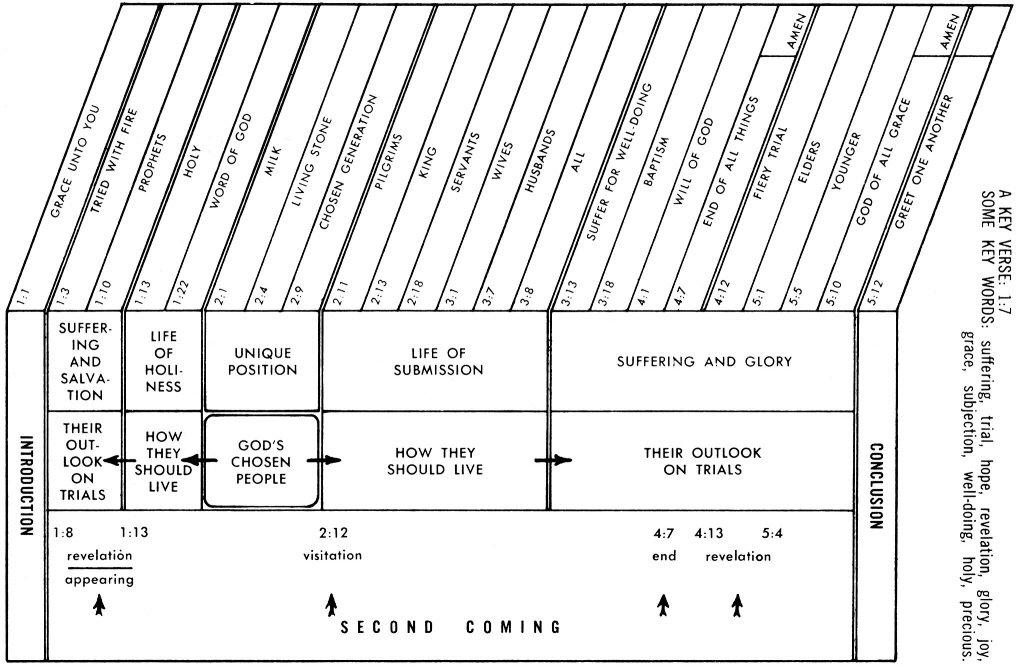
1 Peter: Trials, Holy Living & The Lord's Coming
Click chart to enlarge
Chart from Jensen's Survey of the NT - used by permission
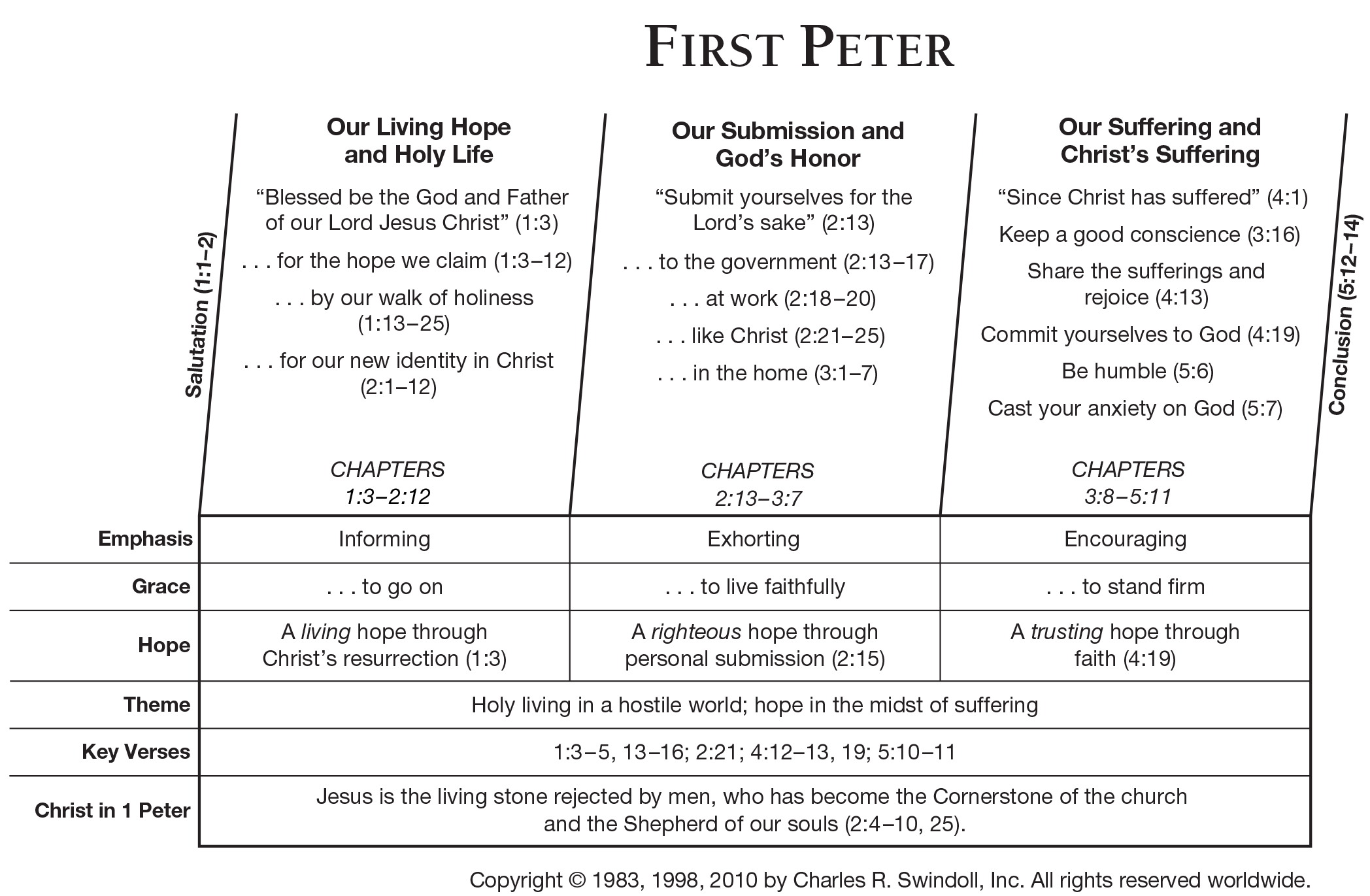
See Another Chart from Charles Swindoll
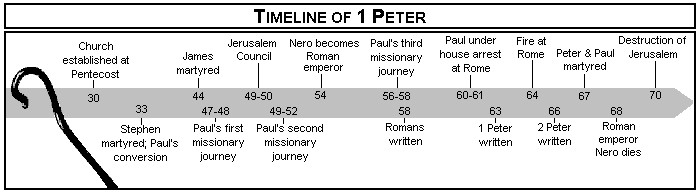
Source: Borrow Ryrie Study Bible
Click to enlarge
1 Peter 2:1 Therefore, putting aside (AMPMPN) all malice and all deceit and hypocrisy and envy and all slander, (NASB: Lockman)
Greek: Apothemenoi (AMPMPN) oun pasan kakian kai panta dolon kai hupokriseis (plural) kai pthonous (plural) kai pasas katalalias (plural)
Amplified: So be done with every trace of wickedness (depravity, malignity) and all deceit and insincerity (pretense, hypocrisy) and grudges (envy, jealousy) and slander and evil speaking of every kind. (Amplified Bible - Lockman)
ICB: So then, get rid of all evil and all lying. Do not be a hypocrite. Do not be jealous or speak evil of others. Put all these things out of your life.
KJV: Wherefore laying aside all malice, and all guile, and hypocrisies, and envies, and all evil speakings,
NET: So get rid of all evil and all deceit and hypocrisy and envy and all slander. (NET Bible)
NLT: So get rid of all malicious behavior and deceit. Don't just pretend to be good! Be done with hypocrisy and jealousy and backstabbing. (NLT - Tyndale House)
Phillips: Have done, then, with all evil and deceit, all pretence and jealousy and slander. (Phillips: Touchstone)
Wuest: Wherefore, having put away once for all every wickedness and every craftiness, and hypocrisies and envies, and all slanderings,
Young's Literal: Having put aside, then, all evil, and all guile, and hypocrisies, and envyings, and all evil speakings,
THEREFORE: oun:
- 1 Peter 1:18, 19, 20, 21, 22, 23, 24, 25
- 1 Peter 2 Resources - Multiple Sermons and Commentaries
- 1 Peter 2:1-3 Getting Into The Word - Steven Cole
- 1 Peter 2:1-3 Hungering for God's Word - John MacArthur
- 1 Peter 2:1-3 Desiring the Word - John MacArthur
- 1 Peter 2:1-3 Cultivating a Hunger for God's Word - John MacArthur
THEREFORE: WHAT'S IT
THERE FOR?
The next few verses are filled with a mixture of interesting metaphors which make for fascinating meditation -“putting off clothes,” “long for milk,” “tasting” the goodness of the Lord, “stones” and “spiritual houses.”
Therefore (oun) - Why therefore? (Always pause to ponder the passage and ask "What's it 'there for'?") Clearly we must go to the previous chapter for the answer (Notice how this discipline forces you to re-read the Scripture to establish the context). What is the main subject of chapter 1? Clearly the new birth, so that most would say that this term of conclusion takes us back to the details of the conversion of the readers (first mentioned in 1Pe 1:3-note) and then reiterated in (1Pe 1:22-note). And what is Peter talking about in 1Peter 2:1? Sins. In fact a "sin list!" So Peter now introduces a conclusion based on the fact that we are born again. We now have the ability (enabled by the Spirit, e.g., Ro 8:13-note) to cast off, to throw off these sins which "envelop" us like dirty, smelly clothes! Now that we are in Christ (in union with Him, identified with Him, in covenant with Him, one with Him) Sin is no longer our "Master" and no longer has power over us (Ro 6:11-note, Ro 6:14-note). In other words we no longer have to obey Sin. We no longer have to let Sin reign over us (Ro 6:12, 13-note). However, since the old flesh nature still indwells all believers, we can still be influenced by Sin. The difference now is that if we listen to Sin and commit personal sins, we do so because we are choosing to do so. This is a choice we did not have in our unregenerate state in Adam, when Sin was our "Master," our "King". In other words, before we were born again, we were still in Adam and we had no choice to obey or not obey but were obligated to obey Sin's demands (that's called bondage or enslavement!) But now in Christ (cp 1Cor 15:22), now that we have been born by the imperishable seed (the living and enduring Word of God-1Pe 1:23-note, cp James 1:18-note) which abides forever (1Pe 1:25-note). This living and enduring Word of God saved us (the first time - justification), and is the same "seed" that God uses to sanctify us and make us holy (Jn 17:17, Jn 17:17NLT), growing us in the grace and knowledge of our Lord Jesus Christ (2Pe 3:18-note). And that "Word" in this verse calls for us to lay aside the sins which Peter lists. Now that we are born again, we have the power to carry out this instruction, because God's Spirit of holiness indwells us and enables us to obey. Glory to God!
Hiebert - Peter's "therefore" closely relates chapter 2 with chapter 1. The inferential particle (oun) indicates that the call to spiritual growth in 1Pe 2:1-3 is a logical and natural consequence of Peter's previous remarks on the new birth in 1Pe 1:12-25; the Godward and the manward aspects of the Christian life make their inescapable demands on the believer. (1Peter 2:1-3) constitute one sentence that centers on the imperative "crave" (1Pe 2:2). That craving is essential to the healthy growth of the new life. The obligation to grow involves the negative duty to remove all hindrances to growth (1Pe 2:1), and the positive duty to actively appropriate nourishment that furthers growth (1Pe 2:2). 1Pe 2:3 cites past experience as an incentive to growth… Before their craving for milk can be realized, there must be a definite break with all the evils that hinder spiritual growth. (1 Peter Commentary - recommended)
I love Charles Simeon's explanation for the therefore - A strange opinion has obtained amongst some, that there is no such thing as growth in grace. But the whole tenor of Scripture, from one end of it to the other, proclaims the contrary. We will go no further than to the passage before us, and to the context connected with it. In the beginning of his epistle, the Apostle had spoken of Christians as “begotten by God the Father to a lively hope.” (1Peter 1:3-note) To stir them up to walk worthy of their high calling, he says to them, “Gird up the loins of your mind, be sober, and hope to the end, as obedient children; not fashioning yourselves according to your former lusts in your ignorance; but, as he who hath called you is holy, so be ye holy in all manner of conversation; because it is written, Be ye holy, for I am holy.” (1Pe 1:13-16-note) This injunction he enforces by a great variety of arguments. He urges, first, the consideration, that God the Father will judge them according to their works (1Pe 1:17-note); then, that they have been redeemed by God the Son (1Pe 1:18-19-note); and then, that they have been born of God the Holy Ghost, through the instrumentality of the preached word (1Pe 1:23-25-note), which unalterably inculcates and requires holiness. From these premises he deduces the exhortation (THEREFORE)… (1 Peter 2:1-3 Growth in Grace is to Be Desired )
Wayne Grudem feels that the therefore "refers back to the command ‘love one another’ in 1Peter 1:22-note. This verse explains in more detail what is involved in loving one another ‘earnestly’ (fervently): one must put away (give up, get rid of) (Ed: How? As we are enabled to do so by the Holy Spirit [cp Ro 8:13-note] - He gives us the desire and power to cast off these attitudes and action, but we must still carry out the "casting off" - that's our responsibility. We cast them off because we now have the desire and power to do so! Mysterious "synergism?" Yes, but it's the Biblical way!) attitudes and habits which are harmful to others… Genuine love requires ridding one’s life of all malice (etc) (Tyndale New Testament Commentaries)
To be sure, all of the sins in this vice list represent violations of the fundamental command love your neighbor as yourself (Lev 19:18, Mt 5:43, 19:19, 22:39, Mk 12:31, 33, Lk 10:27, Ro 13:8,9,10, Gal 5:14, James 2:8) and are not to be retained by a disciple of Jesus. We are to imitate His example, which was love for others regardless of their response!
Guzik - Peter has just demonstrated the glory and eternal character of God’s Word. Now, therefore, in light of what God’s Word is to us, we should receive the word, and receive it with a particular heart. (1 Peter 2 Commentary)
Pritchard writes that…
This is a passage with huge implications for our church at this particular moment in our history. Peter’s words are rich with insight and deep with meaning. If you have any interest in growing spiritually, pay attention to what Peter says because he is speaking to you. And if you haven’t been growing as you would like, pay even closer attention because Peter connects two things that we often keep separate.
You can see those two things quite clearly in verses 1 and 2. 1Peter 1:1 speaks of five wrong attitudes that must be put out of the Christian life. When Peter says “rid yourselves,” he uses a verb that was used for stripping off dirty clothes. If you are a Christian, you must strip these five things out of your life: malice, deceit, hypocrisy, envy, and slander of every kind. Becoming a Christian means changing you wardrobe. These five attitudes went out of style when you were born again… These rotten attitudes have no place in the Christian life. There is no room for them in the Christian wardrobe! And there should be no room for them inside the Christian church. These are all relational sins. You might call them horizontal sins because they touch on how we relate to others around us. And by definition, they deal with how we respond to the difficult people we rub shoulders with every day…
Let me put these two thoughts together:
1) We are to lay aside the rotten attitudes that hinder our brotherly love. That’s verse 1.
2) We are to earnestly crave God’s Word so we can grow spiritually. That’s verse 2.
We can say this in a slightly different way:
Verse 1 describes certain horizontal sins that we need to put off.
Verse 2 describes the vertical reality of spiritual growth and a closer walk with God.
Here is Peter’s whole point:
The way we treat one another has a direct impact on our relationship with God. As long as we harbor these relational sins and wrong attitudes, we will never grow spiritually. These relational sins are like junk food of the soul. They choke off our craving for the Word so that instead of growing, we stay just as we are.
You can treat people unkindly and gossip about them and harbor bitterness, you can have a sharp tongue and a critical spirit and you can look down your nose at people who aren’t like you. As long as you do that, you will never grow spiritually not even if you come to church four times a week and go to Bible study every other day. Those relational sins will choke off the Word of God in your life. That explains why some people can come to church for years and never get better. They’re harboring a relational garbage pit on the inside. They make excuses for their envy, they ignore their gossip, they make light of their cutting comments, and they justify their meanness toward others. And they don’t grow because they can’t grow.
When your horizontal is messed up,
your vertical will never be right!
God has wired us up so that the horizontal and the vertical go together. John says it very plainly in his first epistle:
If anyone says, ‘I love God,’ yet hates his brother, he is a liar. For anyone who does not love his brother, whom he has seen, cannot love God, whom he has not seen” (1John 4:20).
We cannot say, “I hate you” to a friend or family member and then say, “Lord, I love you. Please bless me right now.” God says, “No deal.” It doesn’t work that way…
The horizontal is the key to the vertical, and the vertical is the key to the horizontal. It’s all about God. (From His Sermon - Got Milk? on 1Peter 2:1-3) (Bolding added)
In horticulture, plant growth is impossible without pruning away the diseased wood. Growth is also impossible without proper nourishment. That's true with physical trees, but it is even more true of "spiritual trees," those whom God is growing into "oaks of righteousness." (Isaiah 61:3-Spurgeon sermon) The timeless principle of spiritual growth is simple - Cast off the old ("pruning"), so you will desire the pure Word ("nourishment")! The corollary principle is that if you find yourself not desiring the Word which gives you spiritual life (Mt 4:4, Lk 4:4), it could be because you have failed to cast off the sins listed in 1 Peter 2:1. You may need to do inventory asking the Spirit of the Living God to…
Search me, O God, and know my heart;
Try me and know my anxious thoughts;|
And see if there be any hurtful way in me,
And lead me in the everlasting way. (Amen)
Psalm 139:23-24-Spurgeon's Note
SIN IN THE LIFE
DESTROYS
'SENSITIVITY TO' THE SCRIPTURE
The Christian who tries to find satisfaction in the husks of the world, has no appetite left for the holy things of God. A heart filled with the former has no room for the latter. As oil does not mix with water, so too holy does not mix with profane.
A healthy infant is a hungry infant.
A spiritually healthy Christian is a hungry Christian.
1Peter 1:1-2 are very important verses. To a large degree, they explain the pervasive problem of why so many professed "Christians" have no or at best little desire for the pure milk of the Word. In fact, no desire for the only source of spiritual nourishment, begs the question whether they are true "babes?" If a person claims to have been born again and NEVER desires "milk," they need to carefully and honestly examine themselves as to the authenticity of their "new birth" experience (2Cor 13:5-note). This question is a serious matter which clearly has eternal ramifications! If you have friends or relatives who fall into this group, you need to lovingly discuss this passage with them, allowing the Holy Spirit (Jn 16:7) to convict them of sin (Jn 16:8-9), righteousness (Jn 16:10) and the judgment to come (Jn 16:11), lest they in the future find themselves among those the fearful, fateful folks Jesus describes in His most sobering warning in Mt 7:21-note, Mt 7:22, 23-note.
And so as alluded to earlier, 1Peter 1:1 takes the form of a “vice list,” a form of writing found in the NT and in ethical writers in the ancient world. Such lists can be used to describe the sins of the pagan world (Ro 1:29-note Titus 3:3-note) and also sins that might carry over into the lives of Christians (Gal 5:19, 20-note, Gal 5:21-note; Col 3:5-note, Col 3:6, 7, 8-note).
Robert Leighton says it well, noting that…
If God’s children are to grow by the Word of God, the apostle Peter requires two things from them.
First, the innocency of children;
Second, the appetite of children
Our hearts are by nature cages for those unclean birds—malice, deceit, hypocrisy, envy, and slander. The apostle sometimes mentions some of these evils, and at other times he mentions others. But they cannot be separated from each other. They are all one set of clothes and are all included in that one term “old self” (Ephesians 4:22), which the apostle Paul tells them to “put off.” Here throwing out these base habits is shown to be a necessary evidence of their new birth, as well as for their future spiritual growth. Filthy habits do not become children of God. They are the marks of an unrenewed mind, the very character of the children of Satan, for they constitute his image. His very names denote malice, deceit, and slander. Satan means “the adversary or enemy.” Devil, diabolos, means “the envious accuser or slanderer.” Satan is that great hypocrite and deceiver who “masquerades as an angel of light” (2 Corinthians 11:14).
In contrast, the Spirit of God who dwells in God’s children is the spirit of meekness, love, and truth. That dove-like Spirit who descended on our Saviour is given by him to believers. It is the greatest impudence to pretend to be Christians and still cling to hatred and envy, for our Saviour lavishes his love upon our hearts by his Spirit. “Take from the devil envy, pride and arrogance, and what evil is there in him? Take from the elect love, meekness and humility, and what goodness is there in them?” (Dr. H. More). (1 Peter 2:1-2 Recommended Commentary)
Spurgeon reminds us that as newborn babes in Christ we should…
lay aside all that is inconsistent with that character. Newborn children have no malice; they have no guile or craftiness; they have no hypocrisies, nor envies, nor evil speakings. They are clear from all these evils; would to God we were as clear as they are! It would be better to be infants, not speaking at all, than to be among those who speak evil. It would be better to begin life over again than to live long enough to have gained a treasure of malice, and a hoard of cunning, and to have learned the tricks of hypocrisy.
Let us be as simple as little children, as guileless, as harmless, as free from anything like unkindness as newborn babes are. And inasmuch as we are to follow them in what they have not, let us also imitate them in what they have. Let us desire ardently, as for our very life, the unadulterated milk of the Word. Let us cultivate that combination of hunger and thirst which is found in a little child, that we may hunger and thirst thus after God’s Word. We have done more than taste the Word; we have tasted that the Lord himself is gracious. Let us long to feast more and more upon this divine food, that we may grow thereby. (1 Peter 2- Commentary )
A C Gaebelein reminds us that "Those who are born again of incorruptible seed, in possession of a new nature, are still in the world, though they are no longer of it. Evil is on all sides and there is still the old nature, the flesh, in every child of God though believers are reckoned as being no longer in the flesh (Ro 8:9-note). The old things of the flesh must be put off, completely laid aside. This is the necessary thing for spiritual growth; if there is no putting off of these there can be no progress."
PUTTING ASIDE: Apothemenoi (AMPMPN) oun:
- 1Pe 4:2-note; Isa 2:20; 30:22; Ezek 18:31,32; Col 3:5-note, Col 3:6, 7, 8- note; Heb 12:1-note; Jas 5:9)
- 1 Peter 2 Resources - Multiple Sermons and Commentaries
- 1 Peter 2:1-3 Getting Into The Word - Steven Cole
- 1 Peter 2:1-3 Hungering for God's Word - John MacArthur
- 1 Peter 2:1-3 Desiring the Word - John MacArthur
- 1 Peter 2:1-3 Cultivating a Hunger for God's Word - John MacArthur
Eph 4:22-note that, in reference to your former manner of life, you lay aside the old self, which is being corrupted in accordance with the lusts of deceit, 23 and that you be renewed in the spirit of your mind, 24 and put on the new self, which in the likeness of God has been created in righteousness and holiness of the truth. (Ep 4:23, 24-note)
Eph 4:25-note Therefore, laying aside falsehood, SPEAK TRUTH, EACH ONE of you, WITH HIS NEIGHBOR, for we are members of one another.
Heb 12:1-note Therefore, since we have so great a cloud of witnesses surrounding us, let us also lay aside every encumbrance, and the sin which so easily entangles us, and let us run with endurance the race that is set before us,
CAST OFF YOUR
"DIRTY CLOTHES"
Putting aside - Peter places this phrase first in the Greek sentence to give it emphasis.
Spurgeon says believers should be "Putting these evil things right away from you, having nothing further to do with any of them. Notice the repetition of the word all. “All malice, and all guile,” — everything in the shape of deceit, — “and all evil speakings.” All these are to be put away by all believers, as rags are put away in the rag-bucket, or refuse on the dunghill. This is what we are to lay aside, to put away from us, to banish altogether. These are the old garments of the flesh which we are to give up to the moths that they may devour them, and leave not a fragment of the old rags for us to wear." (1 Peter 2 Commentary )
Jamiesonl rightly observe that Peter's "exhortation applies to Christians alone, for in none else is the new nature existing which, as “the inward man” (Eph 3:16-note) can cast off the old as an outward thing, so that the Christian, through the continual renewal of his inward man, can also exhibit himself externally as a new man." (1 Peter 2 Commentary)
Putting aside (659) (apotithemi from apo = away from, marker of dissociation, implying a rupture from a former association, separation, departure, cessation, any separation of one thing from another by which the union or fellowship of the two is destroyed + tithemi = place, put) means literally to put or take something away from its normal location and put it out of the way.
Luke uses apotithemi literally to describe the laying aside of robes in Acts 7:58 - "And when they had driven him out of the city, they began stoning him, and the witnesses laid aside their robes at the feet of a young man named Saul."
Apotithemi literally referred to the laying aside of clothes or taking off one’s clothes, even as did the runners who participated in the Olympic Games . The runners ran in the stadium nearly naked. Figuratively apotithemi meant to cease doing what one was accustomed to doing. Stop doing it, "throw it off" and be done with it.
Apotithemi - 9x in NAS - Mt 14:3; Acts 7:58; Ro 13:12; Eph 4:22, 25; Col 3:8; Heb 12:1; Jas 1:21; 1Pet 2:1. NAS = laid aside(1), lay aside(3), laying aside(1), put(1), put… aside(1), putting aside(2).
In Romans Paul exhorts his readers to put off "deeds of darkness" writing "And this do (Do what? In context Paul is referring to what he has just emphasized - Ro 13:8-10. We are called to Love because it fulfills the Law), knowing the time, that it is already the hour for you to awaken from sleep; for now salvation is nearer to us than when we believed. The night (of man’s depravity and Satan’s dominion) is almost gone (Hallelujah! Thank You, Jesus!), and the day (of Christ’s return and reign - see Table comparing Rapture vs Second Coming) is at hand (perfect tense = indicates this glorious day was imminent in Paul's day and it continues to remain imminent - IT COULD BE TODAY!). Let us therefore (term of conclusion) lay aside (apotithemi - in light of Christ’s imminent return, believers are to repent and forsake) the deeds of darkness and put on (enduo) the armor of light (protection that Spirit enabled obedience to the Word and practical righteousness provides). (Ro 13:11-note, Ro 13:12-note)
Note the preposition "apo" (apotithemi) is a marker of dissociation, implying a rupture from a former association. This truth helps us picture what a believer is to do. The idea is that he or she is to "place some distance between" the old life (the former lusts which were ours when we were ignorant of so great a salvation in Christ Jesus - 1Pe 1:14-note, 1Pe 1:15-note).
The verb apotithemi is in the form of a participle which in the context of this verse conveys an imperative force (sense of a command - see imperative mood). The idea is that in view of the fact that divine life has been imparted to the believer (all through 1 Peter chapter one we have this wonderful truth explained), it is imperative that he or she “put away once for all” (aorist tense conveys the idea of effective action) any and all of the sins listed that might be in one's life. We are adjured to throw these off like a filthy, soiled garments, loathsome to touch, (spiritually) "noxious to the nose" (of God).
Peter is picturing the putting off of dirty, defiled clothing and is using the aorist tense is saying in essence "do it now". The middle voice is reflexive which can be paraphrased "you yourself initiate this action and you participate in the effects thereof". When we were in Adam we could not carry out this discipline of godliness, "for as in Adam all die, so also in Christ all shall be made alive." (1Cor 15:22)
In James 1:21-note the verb apotithemi is also in the aorist tense, middle voice that as "Therefore putting aside all filthiness and all that remains of wickedness, in humility receive the word implanted, which is able to save your souls."Dusty Bibles
As in 1 Peter, James indicates that the putting off precedes the taking in of the word of truth (James 1:18-note). Both Peter and James are calling their readers to make a definite decision (enabled by grace, empowered by the Spirit Who's desire is that they be holy -1Pe 1:14-note, 1Pe 1:15-note) to cast off these evil attitudes and actions. The order is important for only after having cast these sins aside will one have a God given appetite for "the living and enduring word of God" (1Pe 1:23-note)… only then do we desire the Word's teaching, reproof, correction, training in righteousness (2Ti 3:16, 17-note).
How's your spiritual appetite?
Are you hungry for the pure milk of the word?
If your appetite for God's Word is a bit "dulled", it may be you are "wearing" some "dirty clothes" of malice or envy or slander, etc. Peter says take them off and throw them away.
Charles Spurgeon commenting on Psalm 18:22 wrote that “To put away the Scriptures from the mind’s study is the certain way to prevent their influencing the outward conversation. Backsliders begin with dusty Bibles and go on to filthy garments.” And here Peter says we need to cast off filthy garments.
Howard Hendricks wisely said "you are either in the Word and the Word is conforming you to the image of Jesus Christ, or you are in the world and the world is squeezing you into its mold. And yet the great tragedy among Christians today is that too many of us are under the Word of God, but not in it for ourselves." Remember… Dusty Bibles always lead to dirty lives.
The old Scottish preacher's wise saying still holds true
Sin will keep you from the Bible
or
The Bible will keep you from sin
Jon Courson sums up the thrust of Peter's exhortation writing that "The degree to which those attributes (the sins of 1Pe 2:1) exist in our lives will be the degree to which our hunger for the Word will be diminished. No matter how good the meal my wife, Tammy, prepares for me, if I stop off at McDonald’s on the way home and score a couple of Quarter Pounders with large fries—and super-size the whole deal—when I get home, I won’t be interested in what she’s made. When people stop reading or studying the Word, it’s because they’re eating the junk food of the world (Ed: Even more to the point it is because of the sin in their life!). That’s why Peter says, “First lay aside the junk and then you will desire the milk of the Word.” (Courson, J: Jon Courson's Application Commentary: NT. Nelson. 2004)
Charles Simeon reminds us that "The unconverted man, though he may appear righteous before men, is in reality full of the most abominable evils. He may not indulge in any gross sins; but he is full of “malice” towards those who have injured him in any tender point; and would feel gratified, rather than pained, at any evil that should befall him. His whole converse with mankind, too, is for the most part little better than one continued system of “guile and hypocrisy,” which are the two chief constituents of what is called politeness. If a rival surpass him in any thing on which his heart is set, and gain the honors which he panted for, he will soon find that the spirit which is in him lusts to “envy.” Moreover, whether he be more or less guarded in his general conversation, he will find in himself a propensity to “evil speaking,” as if he felt himself more elevated in proportion as others are depressed. Now these dispositions are more or less dominant in the natural man, as St. Paul has strongly and repeatedly declared — — — and, after a person is converted to the faith of Christ, he needs to watch and pray against them with all imaginable care: for as inveterate disorders in the constitution will impede the growth, and destroy the vigour, of the body, so will these hateful dispositions “war against,” and, if not subdued and mortified, prevail to the destruction of, the soul (1Pe 2:11-note). These things therefore must be “put away.” (1 Peter 2:1-3 Growth in Grace is to Be Desired)
John Henry Jowett…
THERE is a wonderful ascending gradation in the earlier portions of this great chapter. It begins in the darkness, amid “wickedness” and “guile” and “hypocrisies,” and it winds its way through the wealthy, refining processes of grace, until it issues in the “marvellous light” of perfected redemption. It begins with individuals, who are possessed by uncleanness, holding aloof from one another in the bondage of “guile “and “envies “and “evil speakings”; it ends in the creation of glorious families, sanctified communities, elect races, “showing forth the excellencies” of the redeeming Lord. We pass from the corrupt and isolated individual to a redeemed and perfected fellowship. We begin with an indiscriminate heap of unclean and undressed stones; we find their consummation in a “spiritual house,” standing consistent and majestic in the light of the glory of God. We begin with scattered units; we end with co-operative communions. The subject of the passage is therefore clearly defined. It is concerned with the making of true society, the creation of spiritual fellowship, the realisation of the family, the welding of antagonistic units into a pure and lovely communion.
Where must we begin in the creation of this communion? The building of the house, says the apostle, must begin in the preparation of the stones. If the family is to be glorified, the individual must be purified. A choir is no richer than its individual voices, and if we wish to enrich the harmony we must refine the constituent notes. The basis of all social reformation is individual redemption. And so I am not surprised that the apostle, who is contemplating the creation of beautified brotherhoods, should primarily concern himself with the preparation of the individual. But how are the stones to be cleaned and shaped and dressed for the house? How is the individual to be prepared? By what spiritual processes is he to be fitted for larger fellowships and family communion? I think the apostle gives us a threefold answer.
“If ye have tasted that the Lord is gracious.” [1Pe 2:3KJV, kindness in the NAS] That is the basal clause of the entire chapter. Everything begins here. It is no use our dreaming of perfected human relationships until the individual has deliberately tasted the things that are Divine. A chastened palate in the individual is a primary element in the consolidation of the race. There must be a personal experimenting with God. There must be a willingness to try the spiritual hygiene enjoined in the Gospel of Christ. We must “taste and see” what the grace is like that is so freely offered to us of God. We must taste it, and find out for ourselves its healthy and refreshing flavour. What is implied in the apostle’s figure? In the merely physical realm, when we taste a thing, what are the implications of the act? When we take a thing up critically for the purpose of discerning its flavour, there are at any rate two elements contained in the method of our approach. There is an application of a sense, and there is the exercise of the judgment. We bring an alertness of palate that we may register sensitive perceptions, and we bring an alertness of mind that we may exercise a discriminating judgment. Well, these two elements are only symbolic of the equipment that is required if we would “taste and see how gracious the Lord is.” We need to present to the Lord a sensitive sense and a vigilant mind. There is no word which is read so drowsily as the Word of God. There is no business so sluggishly executed as the business of prayer. If men would discern the secret flavours of the Gospel, they must come to it wide awake, and sensitively search for the conditions by which its hidden wealth may be disclosed. “Son of man, eat that thou findest… Then did I eat it, and it was in my mouth as honey for sweetness.” He had tasted and seen. “Eat that thou findest!” Well, the only way in which we can eat a message is to obey it. Obedience is spiritual consumption; and in the act of obedience, in the act of consumption, we discern the wondrous flavours of grace. We are, there fore, to approach the Gospel of our Lord. We are to patiently and sensitively realise its conditions. We are to put ourselves in the attitude of obedience, and, retaining a bright and wakeful mind, we shall begin to discern the glories of our redemption. We shall taste the flavour of reconciliation, the fine grace of forgiveness, and the exquisite quality of peace. This is the primary step in the creation of the family; the individual is to taste and appreciate the things of God.
All delights imply repulsions. All likes necessitate dislikes. A strong taste for God implies a strong distaste for the ungodly. The more refined my taste, the more exacting becomes my standard. The more I appreciate God, the more shall I depreciate the godless. I do not wonder, therefore, that in the chapter before us the “tasting” of grace is accompanied by a “putting away” [1Pe 2:1] of sin.
If I welcome the one, I shall “therefore” repel the other. The finer my taste, the more scrupulous will be my repulsions. Mark the ascending refinement in this black catalogue of expulsions: “wickedness, guile, hypocrisies, envies, evil speakings!” The list ranges from thick, soddened, compact wickedness up to un kindly speech, and I am so to grow in my Divine appreciation that I just as strongly repel the gilded forms of sin as I do those that savour of the exposed and noisome sewer. The taste of grace implies the “putting away” of sin; and therefore the second step in the creation of the family is the cleansing of the individual.
Is the cleansing essential?
Let us lay this down as a primary axiom in the science of life—
there can be no vital communion between the unclean.
Why, we cannot do a bit of successful soldering unless the surfaces we wish to solder are vigorously scraped of all their filth. I suppose that, in the domain of surgery, one of the greatest discoveries of the last fifty years has been the discovery of dirt, and the influence which it has exercised as the minister of severance and alienation. It has been found to be the secret cause of inflammation, the hidden agent in retarded healing, the subtle worker in embittered wounds; and now surgical science insists that all its operations be performed in the most scrupulous cleanliness, and its intensified vigilance has been rewarded by pure and speedy healings and communions. It is not otherwise in the larger science of life.
Every bit of uncleanness in the individual
is a barrier to family communion.
All dirt is the servant of alienation.
It is essential, if we would have strong and intimate fellowships, that every member be sweet and clean.
“Therefore put away all wickedness, and all guile, and hypocrisies, and envies and all evil speakings,” and by purified surfaces let us prepare ourselves for spiritual communion. (Epistles of St. Peter)
James Moffatt = Off with (see Colossians 3:8-note) all habits and tempers that thwart brotherly love in your fellowship! The regenerate nature has instincts of love (Why? Because the Spirit pours it = Ro 5:5-note; How? The Spirit grows it = Gal 5:22-note as we yield to His control or filling = Eph 5:18-note), but it demands a moral effort (Phil 2:12-note = our responsibility); old inconsistent ways of life have to be thrown aside (Ephesians 4:22-note), all manner of malice (ill-feeling, shown in word or deed), guile (pretence or underhand dealing, but specially deceitful speech—see on 1Pe 2:22-note, 1Pe 3:10-note), insincerity (saying what one does not really mean—a common vice of the religious world, where pious language may be used by those who hide their true feelings; see 1Pe 1:22-note), envy (‘almost the only vice which is practicable at all times and in every place,’ Johnson) and slander of every kind; Christians might be guilty of slander as well as exposed to it (1Pe 2:12-note, 1Pe 3:16-note).
ALL MALICE: pasan kakian:
- Torrey's Topic "Malice"
- 1Peter 2:16-note; 1Cor 5:8; 1Cor 14:20; Eph 4:31-note; Titus 3:3, 4, 5-note
- 1 Peter 2 Resources - Multiple Sermons and Commentaries
- 1 Peter 2:1-3 Getting Into The Word - Steven Cole
- 1 Peter 2:1-3 Hungering for God's Word - John MacArthur
- 1 Peter 2:1-3 Desiring the Word - John MacArthur
- 1 Peter 2:1-3 Cultivating a Hunger for God's Word - John MacArthur
Augustine - Malice is pleased with another's harm: envy is tormented with another's good; guile doubles the heart; flattery, the tongue: slander wounds the good fame" (Quoted by Henry Alford in The New Testament for English Readers)
Spurgeon - ridding yourselves of all malice “Revenge is sweet,” but not to the man who has tasted Christ. For he says, “How can I have vengeance upon my fellow, when Christ has put away my sin?” Now, forgiveness is sweet, and he loathes malice and turns aside from it as from venom itself.
Matthew Henry - Whereas it is said all malice, all guile, learn, That one sin, not laid aside, will hinder our spiritual profit and everlasting welfare. (4.) Malice, envy, hatred, hypocrisy, and evil-speaking, generally go together. Evil-speaking is a sign that malice and guile lie in the heart; and all of them combine to hinder our profiting by the word of God.
How much are we to discard? All without exception for all are utterly inconsistent with the “love of the brethren,” that is to characterize those who have “purified your souls” (1Pe 1:22-note).
FREELY FORGIVE
WHOLLY FORGET!
Spurgeon - “Laying aside all malice.” Has anybody injured you? Are you angry with him because of what he has done to you? Thou freely forgive the injury, and wholly forget it. (1Peter 2 Commentary)
Comment: Be careful! Do not count your natural resolve to accomplish the supernatural - your old self might even voice words like "I forgive" and "I will forget" but the seeds of malice still lurk within because they were not as it were "pulled up by the roots!" Surrender to the Spirit. Allow Him to enable you to walk by the Spirit and you will absolutely not carry out the desire of the flesh! Galatians 5:16-note . There is simply no other way for victory over malice, a victory that supernaturally enables one to freely forgive and wholly forget!
All (pas) means all with no "exception clauses". "All manner of" (Henry Alford).
Malice (2549) (kakia) describes wickedness which comes from within a person. It refers wickedness of every kind, but especially having it in for someone.
Kakia - 11x in 11v in NAS - Mt 6:34; Acts 8:22; Ro 1:29; 1Co 5:8; 14:20; Ep 4:31; Col 3:8; Titus 3:3; Jas 1:21; 1Pe 2:1, 16. NAS = evil(3), malice(5), trouble(1), wickedness(2).
Kakia in a moral sense means depravity, vice or baseness. It is the opposite of arete (note) and all virtue and therefore lacks social value.
J Vernon McGee asks " What is malice? The best definition I have found is congealed anger. It means to have an unforgiving spirit. My friend, are you carrying bitterness in your heart and a chip on your shoulder? Although you witness about being born again and about loving Jesus, nobody around you will be able to distinguish that if you are carrying malice, congealed anger, in your heart. (Thru the Bible - Listen to his crusty comments on 1Peter 2:1-2)
Malice is a vicious intention, a feeling of hostility and strong dislike including desire to do harm. This sort of malignant act breeds further evil in and of itself. It includes a desire to harm other people, (Col 3:8-note, Jas 1:21-note) often hides behind apparently good actions (1Pe 2:16-note). Malice is often irrational, usually based on the false belief that the person against whom it is directed has the same intention. It speaks of a smoldering resentment that causes you to lash out at others.
Lightfoot defines malice as "the vicious nature which is bent on doing harm to others
Trench says that kakia is "that peculiar form of evil which manifests itself in a malignant interpretation of the actions of others, an attributing of them all to the worst motive”
Aristotle defined malice as "taking all things in the evil part.
Webster says malice is the "desire to cause pain, injury, or distress to another and implies a deep-seated desire to see another suffer.
Malice is not only a moral deficiency but destroys fellowship. To varying degrees, the unsaved spend their life maliciously.
MacDonald - Malice—the harboring of evil thoughts against another person. Malice nourishes antagonism, builds up grudges, and secretly hopes that revenge, harm, or tragedy will overtake another. George Washington Carver was refused admission at a university because he was black. Years later, when someone asked him the name of the university, he replied, “Never mind. That doesn’t matter now.” He harbored no malice. (Believer's Bible Commentary)
In Romans Paul describes those who have refused to acknowledge God and are given over by God to a depraved mind as "being filled with all unrighteousness, wickedness (kindred word "kakoetheia"), greed, evil; full of envy, murder, strife, deceit, malice; they are gossips. (Ro 1:29-note).
Malice for believers belongs to the old life (Titus 3:3-note) and yet all believers still need to heed the exhortation to ‘clean it out’ (1Co 5:78.) and strip it off (Jas 1:21-note; Col 3:8-note). Christians are to be ‘babes in evil’ (1Co 14:20), for Christian liberty is not lawlessness (1Pe 2:16-note).
Leighton relates the different sins writing "Study shows that malice and envy are two branches growing out of the same bitter root—self-love. Slander is the fruit that malice and envy bear. Malice wishes evil on another person, while envy is jealous of his goodness. Both malice and envy express themselves by speaking evil about a person. This infernal fire within smokes and flashes out through the tongue, which James says “is itself set on fire by hell” (James 3:6). These evils of malice, envy, slander, and the like should not be hidden by us in ourselves and carried around under better appearances. They should be thrown out. So the apostle commands (Ed: "Putting Aside" is not literally imperative mood but does have that "force") us here to throw off also the outer garment and cloak of the others—namely, hypocrisy. What advantage is it to wear this mask? A person may in the sight of men act this part well, but we know there is an Eye that sees through this, and a Hand that, if we will not take the mask off, will pull it off to our shame, either here in the sight of men or on the appointed day when all hypocrites will be unveiled and be seen for what they are before men and angels… the evils mentioned here are especially to be thrown off, as they prevent the profitable receiving of the Word of God. This part of the exhortation (rid) leads to that which follows (crave) and should be carefully noted. This is the double task of true religion. When a person begins the Christian life, he is not only to be taught the true religion but also has to reject the errors and wickedness that are deeply rooted in his mind, which he has not only learned through the corrupt world, but that he himself brought into the world. These evil seeds are originally in our nature and grow with the influence of the surrounding world. No one comes to the school of Christ, in the words of Aristotle, “as blank paper.” On the contrary, everyone is scribbled upon and blurred with such base habits as malice, envy, hypocrisy, and so on. Therefore, the first task is to cleanse and purify these blots and foul characters from the heart so that it may receive God’s image. Because it is the Word of God that starts and carries on the work, in order to receive this Word rightly the heart must be purged of such impurities as malice, envy, and hypocrisy. These dispositions are so opposed to receiving the Word of God profitably that, while they possess and rule the soul, it cannot embrace these divine truths at all. While it is filled with such guests there is no room to entertain the Word. (Ibid)
AND ALL GUILE: kai panta dolon:
- 1Pe 2:22- note; 1Pe 3:10-note; Ps 32:2; Ps 34:13; Jn 1:47; 1Th 2:3- note; Re 14:5- note
- Deceit in Torrey's Topic
- 1 Peter 2 Resources - Multiple Sermons and Commentaries
- 1 Peter 2:1-3 Getting Into The Word - Steven Cole
- 1 Peter 2:1-3 Hungering for God's Word - John MacArthur
- 1 Peter 2:1-3 Desiring the Word - John MacArthur
- 1 Peter 2:1-3 Cultivating a Hunger for God's Word - John MacArthur
PUT ASIDE ALL
FORMS OF DECEIT
Spurgeon defines all guile as "All crafty tricks, all falsehood, exaggeration, double meanings to your words, and the like… That is, everything that is of the nature of craftiness and deception. Be honest, simple, straightforward, transparent; this is a trait of character which well becomes all Christians… Guile (deceit) is craftiness whereby men rob their fellow-creatures. It is guile: low craftiness and cunning. A man of God hates that thing. As surely as the Lord says concerning the Laodicean Church, “I am about to vomit you out of my mouth” (Rev 3:16), so the believer says concerning anything that is not true and straightforward: “I am sick of it; I loathe it; I abhor it; I turn from it.”
Guile (1388) (dolos from delo = to bait) literally refers to a fishhook, trap, or trick all of which are various forms of deception. Dolos is a deliberate attempt to mislead, trick, snare or "bait" (baiting the trap in attempt to "catch" the unwary victim) other people by telling lies. It is a desire to gain advantage or preserve position by deceiving others, to get the better of another by cunning and deception. A modern term in advertising is called "bait and switch" where the unwary consumer is lured in by what looks like an price too good to be true!
Hiebert says dolos "is the selfish, two-faced attitude that deceives and hurts others for personal gain."
Dolos - 11x in 11v in the NAS - Matt 26:4; Mark 7:22; 14:1; John 1:47; Acts 13:10; Rom 1:29; 2 Cor 12:16; 1 Thess 2:3; 1 Pet 2:1, 22; 3:10. NAS = deceit(9), stealth(2).
Dolos - 33x in 33v in the Septuagint (Lxx) - Gen 27:35; 34:13; Exod 21:14; Lev 19:16; Deut 27:24; 2 Kgs 9:23; Job 13:7, 16; 15:35; 31:5; Ps 10:7; 24:4; 32:2; 34:13; 35:20; 36:3; 52:2; 55:11; Prov 10:10; 12:5, 20; 16:28; 26:23f, 26; Isa 9:5; 53:9; Jer 5:27; 9:6; Ezek 35:5; Dan 8:25; Mic 6:11; Zeph 1:9
J Vernon McGee writes that…
Guile is using cleverness to get even or to try to make a good impression upon someone. Ananias and Sapphira used guile when they tried to represent themselves as being very generous givers to the church. That old nature which you and I have is good at that sort of thing. J. B. Lightfoot calls it “the vicious nature which is bent on doing harm to others.” (Thru the Bible - Listen to his crusty comments on 1Peter 2:1-2)
MacDonald - Deceit (guile)—any form of dishonesty and trickery (and what a variety of forms it takes!). Deceit falsifies income tax returns, cheats on exams, lies about age, bribes officials, and pulls shady deals in business. (Believer's Bible Commentary: Thomas Nelson)
Pritchard aptly observes that "As a fisherman, Peter would have understood the word deceit, which really means to “bait the hook.” It’s what you do when you play a trick in order to get your way. You are deceitful when you tell a lie or omit the truth in order to gain a personal advantage. Deceit is a clever form of deliberate dishonesty.
The related verb dolioo (1387) is used in Romans 3:13 where Paul indicts all mankind writing that "THEIR THROAT IS AN OPEN GRAVE, WITH THEIR TONGUES THEY KEEP DECEIVING," "THE POISON OF ASPS IS UNDER THEIR LIPS" (Ro 3:13-note)
Larry Richards explains that dolos "picks up the metaphor from hunting and fishing. Deceit is an attempt to trap or to trick and thus involves treachery… Deception sometimes comes from within, as our desires impel us to deceive. But more often in the NT, deceit is error urged by external evil powers or by those locked into the world's way of thinking." (Richards, L O: Expository Dictionary of Bible Words: Regency)
Barclay on dolos - We best get the meaning of this from the corresponding verb (doloun). Doloun has two characteristic usages. It is used of debasing precious metals and of adulterating wines. Dolos is deceit; it describes the quality of the man who has a tortuous and a twisted mind, who cannot act in a straightforward way, who stoops to devious and underhand methods to get his own way, who never does anything except with some kind of ulterior motive. It describes the crafty cunning of the plotting intriguer who is found in every community and every society." In another writing Barclay explains that dolos can be translated "guile" and that "It comes from a word which means bait; it is used for trickery and deceit. It is used for instance of a mousetrap. When the Greeks were besieging Troy and could not gain entry, they sent the Trojans the present of a great wooden horse, as if it was a token of good will. The Trojans opened their gates and took it in. But the horse was filled with Greeks who in the night broke out and dealt death and devastation to Troy. That exactly is dolos. It is crafty, cunning, deceitful, clever treachery. Dolos is the trickery of the man who is out to deceive others to attain his own ends, the vice of the man whose motives are never pure. (Daily Study Bible)
Dolos means a snare, bait, trick, deliberate dishonesty. Deliberate attempt to mislead other people by telling lies, conspicuously absent from behavior of Christ (1Pe 2:22-note).
Guile or deception has to do primarily with words. When a person wants something, he tries to get it… by flattery, false promises, false tales, suggestive talk, off-colored suggestions, enticing words, outright lying
Truth (Illustration) - The organizers of World Book Day, an annual celebration of reading in Britain have found that 2 out of 3 Brits have lied about reading the books they claim to have read. The books lied about most often include classics like George Orwell’s 1984, Tolstoy’s War and Peace, and the works of Charles Dickens. The fourth most lied about book on the list was the Bible, which specifically teaches against lying. When respondents were asked why they lied about reading a book, the most common answer given was that an individual wanted to impress the person they were speaking to.--Most Britons have lied about the books they read; (Jim L. Wilson)
Beloved, do you have ulterior motives when you communicate with others? If you do you are guilty of guile!
AND HYPOCRISY: kai hupokriseis:
- Job 36:13; Mt 7:5-note; Mt 15:7; 23:28; 24:51; Mk 12:15; Lk 6:42; 11:44; 12:1; Jas 3:17
- 1 Peter 2 Resources - Multiple Sermons and Commentaries
- 1 Peter 2:1-3 Getting Into The Word - Steven Cole
- 1 Peter 2:1-3 Hungering for God's Word - John MacArthur
- 1 Peter 2:1-3 Desiring the Word - John MacArthur
- 1 Peter 2:1-3 Cultivating a Hunger for God's Word - John MacArthur
TAKE OFF THE MASK
OF HYPOCRISY
And hypocrisy - In the Greek it is actually in the plural so more literally "hypocrisies". The preceding two negative traits are in the singular and the following two are also in the plural ("envyings", "slanders"). Notice how this wrong behavior dovetails with the previous attitudes - if we are guilty of malice and guile, we will try to hide it and this hiding who we really are inside produces “hypocrisy.”
Spurgeon - “And hypocrisies” of all sorts. Let us not profess to be what we are not, nor pretend to know what we do not know, or talk of experiences which we have never felt; in fact, let us never be hypocrites in any respect whatsoever. The God of truth loves his children to be the embodiments of truth. Hypocrisy he hates with a perfect hatred. (1Peter 2 Commentary)
Spurgeon adds that hypocrisy is that sin "whereby men are not so much robbed and injured as deceived. A Christian can be no hypocrite. Hypocrisy, like all other sins, lurks in man till the very last, but a believer hates to pretend to be what he is not. A man who has once tasted that the Lord is gracious is a true and transparent man in his profession. If any suppose him to be better than he is, he does not wish to wear feathers that are not his own. He would not be glorified by another man’s labors nor build upon another man’s foundation. He utterly detests hypocrisy, and would sooner die a pauper than live a pretender."
Hypocrisy (5272) (hupokrisis/hypokrisis from hupo = under + krino =to judge; See also word study on Hypocrite = hupokrites) refers literally to delivery of a speech, along with interpretive gestures and imitation. The word hypocrisy comes from the Greek theater and referred to the practice of putting on a mask and playing a part on stage. It originally conveyed the idea of playing the playing a part on the stage and described the actor's art. The NT gives hupokrisis only a negative connotation referring to hypocrisy, duplicity (the quality of being double - belying of one’s true intentions by deceptive words or action), insincerity, dissimulation (hiding under a false appearance; hiding or disguising one's thoughts or feelings - don't we all do this from time to time?!). The idea is to pretend, to act as something one is not and so to act deceitfully, pretending to manifest traits like piety and love. It means to create a public impression that is at odds with one’s real purposes or motivations, and thus is characterized by play-acting, pretense or outward show. It means to give an impression of having certain purposes or motivations, while in reality having quite different ones.
Vincent commenting on related word hypocrite (Greek noun = hypokrites - one who acts pretentiously, a counterfeit, a man who assumes and speaks or acts under a feigned character) writes that it is derived from "hupokrino, to separate gradually; so of separating the truth from a mass of falsehood, and thence to subject to inquiry, and, as a result of this, to expound or interpret what is elicited. Then, to reply to inquiry, and so to answer on the stage, to speak in dialogue, to act. From this the transition is easy to assuming, feigning, playing a part. The hypocrite is, therefore, etymologically, an actor."
Webster defines hypocrisy as "a feigning to be what one is not or to believe what one does not; especially the false assumption of an appearance of virtue or religion"
Hypocrisy is the practice of claiming to have higher standards or more laudable beliefs than is the case.
Hiebert - "Hypocrisy" (hupokriseis) is a plural noun and depicts the various forms of pretense (counterfeit acts) to which deceit resorts in its endeavor to throw the intended victim off guard. The term readily developed an evil connotation to denote the hypocrite, "a man who all the time is concealing his real motives, a man who meets you with a face which is very different from his heart, and with words which are very different from his real feelings." Such religious impersonation is seen in the case of Ananias and Sapphira (Acts 5:1-10), who cloaked evil desires behind pious appearances. The unfeigned love called for in 1:22 must be without that terrible quality. (Ibid)
There are only 6 uses of hupokrisis in the NT…
Matthew 23:28 "Even so you too outwardly appear righteous to men, but inwardly you are full of hypocrisy and lawlessness.
Mark 12:15 "Shall we pay, or shall we not pay?" But He, knowing their hypocrisy, said to them, "Why are you testing Me? Bring Me a denarius to look at."
Luke 12:1 Under these circumstances, after so many thousands of the multitude had gathered together that they were stepping on one another, He began saying to His disciples first of all, "Beware of the leaven of the Pharisees, which is hypocrisy."
Galatians 2:13 And the rest of the Jews joined him in hypocrisy, with the result that even Barnabas was carried away by their hypocrisy.
1Timothy 4:2 by means of the hypocrisy of liars seared in their own conscience as with a branding iron,
1Peter 2:1 Therefore, putting aside all malice and all guile and hypocrisy and envy and all slander,
Thayer summarizes hupokrisis writing that it is…
1. an answering; an answer (Herodotus). 2. the acting of a stage-player (Aristotle, Polybius, Dionysius Halicarnassus, Plutarch, Lucian, Artemidorus Daldianus, others). 3. dissimulation, hypocrisy:
Wuest adds that this Greek word "is made up of hupo under, and krinō “to judge” and referred originally to “one who judged from under the cover of a mask,” thus, assuming an identity and a character which he was not. This person was the actor on the Greek stage, one who took the part of another. The Pharisees were religious actors, so to speak, in that they pretended to be on the outside, what they were not on the inside… Our word hypocrite (See word study on hupokrites = hypocrit) comes from this Greek word. It usually referred to the act of concealing wrong feelings or character under the pretence of better ones." (Wuest, K. S. Wuest's Word Studies from the Greek New Testament: Eerdmansh)
In another note Wuest explains that "The Greek word for “hypocrite” was used of an actor on the Greek stage, one who played the part of another. The word means literally, “to judge under,” and was used of someone giving off his judgment from behind a screen or mask… The true identity of the person is covered up. It refers to acts of impersonation or deception. It was used of an actor on the Greek stage. Taken over into the New Testament, it referred to a person we call a hypocrite, one who assumes the mannerisms, speech, and character of someone else, thus hiding his true identity. Christianity requires that believers should be open and above-board. They should be themselves. Their lives should be like an open book, easily read." (Ibid)
Hupokrisis describes a kind of deceit in which persons pretend to be different from what they really are, and esp that they are acting from good motives when in reality they are motivated by selfish desire. Jesus warns hypocrites, severely warns them. Believers must, therefore, strip off any semblance of hypocrisy. Hypocrisy is one of the sins that God hates above all others. Hypocrites shall receive the greater damnation (Mt23:14ff). A hypocrite has God on his tongue and the world in his heart.
William Barclay writes that the related word "Hupokrites (hypocrite) is a word with a curious history. It is the noun from the verb hupokrinesthai which means to answer; a hupokritēs begins by being an answerer. Then it it goes on to mean one who answers in a set dialogue or a set conversation, that is to say an actor, the man who takes part in the question and answer of the stage… It then came to mean an actor in the worse sense of the term, a pretender, one who acts a part, one who wears a mask to cover his true feelings, one who puts on an external show while inwardly his thoughts and feelings are very different… it comes to mean a hypocrite, a man who all the time is acting a part and concealing his real motives… one whose whole life is a piece of acting without any sincerity behind it at all. Anyone to whom religion is a legal thing, anyone to whom religion means carrying out certain external rules and regulations, anyone to whom religion is entirely connected with the observation of a certain ritual and the keeping of a certain number of taboos is in the end bound to be, in this sense, a hypocrite. The reason is this—he believes that he is a good man if he carries out the correct acts and practices, no matter what his heart and his thoughts are like. To take the case of the legalistic Jew in the time of Jesus, he might hate his fellow man with all his heart, he might be full of envy and jealousy and concealed bitterness and pride; that did not matter so long as he carried out the correct handwashings and observed the correct laws about cleanness and uncleanness. Legalism takes account of a man’s outward actions; but it takes no account at all of his inward feelings. He may well be meticulously serving God in outward things, and bluntly disobeying God in inward things—and that is hypocrisy… There is no greater religious peril than that of identifying religion with outward observance. There is no commoner religious mistake than to identify goodness with certain so-called religious acts. Church-going, bible-reading, careful financial giving, even time-tabled prayer do not make a man a good man. The fundamental question is, how is a man’s heart towards God and towards his fellow-men? And if in his heart there are enmity, bitterness, grudges, pride, not all the outward religious observances in the world will make him anything other than a hypocrite… The hypocrite is the man whose alleged Christian profession is for his own profit and prestige and not for the service and glory of Christ." (Daily Study Bible)
MacDonald - Hypocrisy—insincerity, pretense, sham. The hypocrite is a play-actor, pretending to be someone he is not. He pretends to be happily married when his home is actually a battlefield. He pretends to be spiritual on Sundays but he is as carnal as a goat on weekdays. He pretends interest in others but his motives are selfish. (Believer's Bible Commentary)
Related Dictionary Discussions on Hypocrisy:
- American Tract Society Hypocrite
- Easton's Bible Dictionary Hypocrite
- Bridgeway Bible Dictionary Hypocrisy
- Baker Evangelical Dictionary Hypocrisy
- The Topic Concordance Hypocrisy
- Holman Bible Dictionary Hypocrisy
- Hastings' Dictionary of the NT Hypocrisy Hypocrisy
- Vines' Expository Dictionary Hypocrisy
- 1911 Encyclopedia Britannica Hypocrisy
- McClintock and Strong's Bible Encyclopedia Hypocrisy Hypocrite
- The Jewish Encyclopedia Hypocrisy
Related Questions on Hypocrisy:
- Multiple Quotes, Illustrations, Devotionals on Hypocrisy-Hypocrites
- What does the Bible say about hypocrisy?
- Why are all Christians hypocrites? Are all Christians hypocrites?
- Why do so many preachers' kids walk away from the faith?
- If Jesus condemned the Pharisees for praying out loud, should we pray aloud?
- Why is skepticism of religion so prevalent today?
- Why are Christians so judgmental?
- Why do so many Christians fail the "practice what you preach" standard?
Spurgeon on hypocrisy - In the olden times even the best rooms were usually of bare brick or stone, damp, and moldy, but over these in great houses when the family was resident, were hung up arras or hangings of rich materials, between which and the wall persons might conceal themselves, so that literally walls had ears. It is to be feared that many a brave show of godliness is but an arras to conceal rank hypocrisy; and this accounts for some men's religion being but occasional, since it is folded up or exposed to view as need may demand. Is there no room for conscience to pry between thy feigned profession and thy real ungodliness, and bear witness against thee? Remember, if conscience do it not, certainly 'the watcher and the Holy One' will make a thorough search within thee.
Spurgeon on hypocrisy - In the pursuit of pastoral duty, I stood a little while ago in a cheesemonger's shop, and being in a fidgety humour, and having a stick in my hand, I did what most Englishmen are sure to do, I was not content with seeing, but must needs touch as well. My stick came gently upon a fine cheese in the window, and to my surprise a most metallic sound emanated from it. The sound was rather hollow, or one might have surmised that all the tasteholes had been filled up with sovereigns, and thus the cheese had been greatly enriched, and the merchant had been his own banker. There was, however, a sort of crockery jingle in the sound, like the ring of a huge bread or milk pan, such as our country friends use so abundantly; and I came to the very correct conclusion that I had found a very well got-up hypocrite in the shop window. Mark, from this time, when I pass by, I mentally whisper, 'Pottery;' and the shams may even be exchanged for realities, but I shall be long in believing it. In my mind the large stock has dissolved into potsherds, and the fine show in the window only suggests the potter's vessel. The homely illustration is simply introduced because we find people of this sort in our churches, looking extremely like what they should be, yet having no substance in them, so that if; accidentally, one happens to tap them somewhere or other with sudden temptation or stern duty, the baked earth gives forth its own ring, and the pretender is esteemed no longer.
Spurgeon on hypocrisy -
Beloved, how does your behavior on Sunday compare with your behavior Monday through Saturday? if you are inconsistent between how you behave at church and how you behave at home, work, school, etc, you are guilty of hypocrisies.
AND ENVY: kai phthonous:
- 1Sa 18:8,9; Ps 37:1; 73:3; Pr 3:31; 14:30; 24:1,19, Ro 1:29-note; Ro 1:3:13-note; 1Cor 3:2,3; 2Cor 12:20, Gal 5:21, 22, 23, 24, 25, 26-note; James 3:14,16; 4:5
- 1 Peter 2 Resources - Multiple Sermons and Commentaries
- 1 Peter 2:1-3 Getting Into The Word - Steven Cole
- 1 Peter 2:1-3 Hungering for God's Word - John MacArthur
- 1 Peter 2:1-3 Desiring the Word - John MacArthur
- 1 Peter 2:1-3 Cultivating a Hunger for God's Word - John MacArthur
JETTISON
JEALOUSY!
Spurgeon - “And envies.” We must lay them all aside, all envies of men because they are richer, or more gifted, or more highly esteemed than we are. Let us not envy anybody, for envy eats a man’s own heart out and slays him, as Eliphaz said to Job “Envy slayeth the silly one.”… All hatred of those who are either better or better off than you are. (1Peter 2 Commentary )
Envy (5355) (phthonos) describes pain felt and malignity conceived at the sight of excellence or happiness. It means not just wanting what another person has, but also resenting that person for having it. It is an attitude of ill-will and jealousy that leads to division and strife and even murder. When we envy, we cannot bear to see the prosperity of others, because we ourselves feel continually wretched. Envy begins with desire to possess what another has but merges into resentful discontent.
Phthonos - 9x in 9v in the NAS - Matt 27:18; Mark 15:10; Rom 1:29; Gal 5:21; Phil 1:15; 1Tim 6:4; Titus 3:3; Jas 4:5; 1 Pet 2:1. NAS = envy(7), envying(1), jealously(1). Not found in the Septuagint (which is somewhat surprising).
Hiebert - Envy is the feeling of displeasure produced by witnessing or hearing of the advantage or prosperity of others." Envy is the running-mate of hypocrisy. "As hypocrisy has its spring in claiming to have the good we lack, envy seeks to deny and defame the real good of others." It is a moral cancer (Pr. 14:30) that plagues "all voluntary organizations, not least religious organizations." It reared its ugly head even among the twelve, while Jesus was yet with them (Mark 10:41). It is "almost the only vice which is practicable at all times and in every place" (Johnson).
Pritchard - Envy was one of the seven deadly sins. One writer called envy the last sin Christians will confess because it is so ugly. Envy is jealousy at the success of others or happiness at another’s misfortune. It is the poison of the soul that turns you into a resentful, angry, grouchy, miserable, critical person.
Envy is a sin that carries its own reward for it guarantees its own frustration and disappointment. By definition, the envious person cannot be satisfied with what he has and will always crave for more. His evil desires and pleasures are insatiable, and he cannot abide any other person’s having something that he himself does not have or having more of something than he himself has.
As lust is directed toward a specific object, so envy is directed toward a specific person. (cp Mt 27:18!)
Envy is one of the sins that was behind the crucifixion of our Lord, Mark recording that Jesus "was aware that the chief priests had delivered Him up because of envy." (Mark 15:10)
Compare Matthew's words "For he (Jesus) knew that because of envy they had delivered Him up." (Matthew 27:18)
Vine says that "envy differs from jealousy in that the former desires merely to deprive another of what he has, whereas the latter desires as well to have the same, or a similar, thing for itself." On this account envy is said to be “as the rottenness of the bones (Pr 14:30). (Collected writings of W. E. Vine. Nashville: Thomas Nelson) (Comment: Thus Trench calls envy “the meaner sin” of the two.)
Barclay adds that
there is the envy which is essentially a grudging thing. It looks at a fine person, and is not so much moved to aspire to that fineness, as to resent it. It is the most warped and twisted of human emotions… a mean word. Euripides called it “the greatest of all diseases among men". The essence of it is that it does not describe the spirit which desires, nobly or ignobly, to have what someone else has; it describes the spirit which grudges the fact that the other person has these things at all. It does not so much want the things for itself; it merely wants to take them from the other. The Stoics defined it as “grief at someone else’s good.” Basil called it “grief at your neighbor’s good fortune.” It is the quality, not so much of the jealous, but rather of the embittered mind.”
It may well be said that envy is the last sin to die. It reared its ugly head even in the apostolic band. The other ten were envious of James and John, when they seemed to steal a march upon them in the matter of precedence in the coming Kingdom (Mk 10:41). Even at the last supper the disciples were disputing about who should occupy the seats of greatest honour (Lk 22:24). So long as self remains active within a man’s heart there will be envy in his life.
E. G. Selwyn calls envy “the constant plague of all voluntary organizations, not least religious organizations.”
C. E. B. Cranfield says that “we do not have to be engaged in what is called ‘church work’ very long to discover what a perennial source of trouble envy is.” (1 Peter 2 Commentary - William Barclay's Daily Study Bible)
MacDonald - Envy—bare-faced jealousy. Vine defines it as the feeling of displeasure produced by observing or hearing of the advantage or prosperity of others. It was envy that caused the chief priests to deliver Jesus up to Pilate for death (Matt. 27:18). Envy is still a killer. Women can look daggers at others because of their better homes and gardens, smarter clothes, or superior cooking. A man can praise another fellow’s new car or speedboat but what he is thinking is, “I’ll show him. I’ll get something better.” (MacDonald, W & Farstad, A. Believer's Bible Commentary: Thomas Nelson)
F B Meyer held meetings in Northfield, Mass., and large crowds thronged to hear him. Then the great British Bible teacher G. Campbell Morgan came to Northfield and people were soon flocking to hear his brilliant expositions of scripture. Meyer confessed at first he was envious. He said, "The only way I can conquer my feelings is to pray for Morgan daily, which I do."
Dwight L. Moody once told the fable of an eagle who was envious of another that could fly better than he could. One day the bird saw a sportsman with a bow and arrow and said to him, “I wish you would bring down that eagle up there.” The man said he would if he had some feathers for his arrow. So the jealous eagle pulled one out of his wing. The arrow was shot, but it didn’t quite reach the rival bird because he was flying too high. The first eagle pulled out another feather, then another—until he had lost so many that he himself couldn’t fly. The archer took advantage of the situation, turned around, and killed the helpless bird. Moody made this application: if you are envious of others, the one you will hurt the most by your actions will be yourself.
Matthew Henry comments that malice and envy are "both roots of bitterness, whence many evils spring: evil thoughts and speeches, tongues set on fire of hell, detracting from and impairing the just and due praises of others. Their words are swords, wherewith they slay the good name and honour of their neighbour. This was the sin of Satan, and of Cain who was of that evil one, and slew his brother; for wherefore slew he him, but of this envy and malice, because his own works were evil, and his brother's righteous? These were some of the sins in which we lived in our natural state.
Phthonos refers to wrong desires to possess what belongs to someone else. Covet what someone else has, covet it so much that he wants it even if it has to be taken away from the other person. He may even wish that the other person did not have it or had not received it. But thanks be to God our Savior. He saves and delivers us from envy. Through Christ He gives us real life, and He satisfies our hearts and lives with pleasures forevermore (Ps 16:11, cp Pr 14:30, 23:17, 24:1, Ro 13:13-note, 1Co 13:4, Gal 5:26)
AND ALL SLANDER: kai pasas katalalias:
- 1Pe 4:4-note; Ep 4:31-note; Col 3:8-note; 1Ti 3:11; Titus 2:3-note; Jas 4:11
- Torrey's Topic "Slander"
- 1 Peter 2 Resources - Multiple Sermons and Commentaries
- 1 Peter 2:1-3 Getting Into The Word - Steven Cole
- 1 Peter 2:1-3 Hungering for God's Word - John MacArthur
- 1 Peter 2:1-3 Desiring the Word - John MacArthur
- 1 Peter 2:1-3 Cultivating a Hunger for God's Word - John MacArthur
Jas 4:11 Do not speak against one another, brethren. He who speaks against a brother, or judges his brother, speaks against the law, and judges the law; but if you judge the law, you are not a doer of the law, but a judge of it.
STOP SLANDERING
All slander - Not just the "worst" but "all!"
Hiebert - The repeated "all" leaves no room for exceptions in the demand for holiness. Its threefold repetition groups moral evils into three categories. All such evil behavior is a holdover from the old, unregenerate nature. None of it relates directly to God. (Ibid)
Spurgeon on all slander - A Christian should have nothing to do with scandal, but should say in a company, “Stop! I cannot sit by and hear you say that of an absent person. If he were here, you might say what you liked, but as he is not, please hold your tongue, for I am here as a defender of those who are backbitten.” Every absent man should have an advocate in a Christian. More especially should this be true when the rumor injures a brother. “It is an ill bird that fouls its own nest,” and he is an ill believer who tells tales about his fellow Christians. If you, as a church member, have anything against a brother, tell him alone. Then, if it should be some public and crying sin, tell it in an orderly manner to the church officers. But for you to go chattering about things you do not know to be true is such an offense against church order that if you are expelled from church communion for it the ejectment will be justifiable. You certainly cannot expect to have fellowship with Christ if you mar the fellowship of Christ’s church by talking one against the other.
As an aside all of the sins listed in this passage seek in some way to harm others, whereas (agape) love always seeks the good of others. Only a Spirit filled saint can manifest true agape love. It follows that the sins in 1Peter 2:1 are clear evidence of an "unfilled" saint, in fact one who has grieved the Holy Spirit (Eph 4:30-note, The "juxtaposition" of the "grieved Spirit" with the list of sins in Eph 4:31-note is no accident! And notice the repetition of slander and malice!) If the Holy Spirit Who indwells us is grieved, He will hardly be giving us the "desire" (Php 2:13NLT-note = "desire") for holy things such as the Holy Word! The solution needed is for us to recognize that we are guilty of practicing these sins (one clue is "no hunger or thirst" for the Holy Word!) and we willingly confess and repent of them, so that we might be clean and desirous of the "pure milk of the Word."
Slander naturally follows envy, for we are prone to "run down" or defame the status or reputation of those individuals toward which we are jealous.
Spurgeon - And all evil speakings.” We are not to be the repeaters of stories to the discredit of others, or to make up or to exaggerate any evil reports concerning anything in their lives. Let us have nothing to do with “evil speakings” of any kind. Lay all these rags aside. Is any one of them still clinging to you? Let it be laid aside this very hour. (1Peter 2 Commentary )
Slander (plural = slanders) (2636) (katalalia from katá = against, down + laleo = to speak) means evil speaking, evil speech, evil report. Slander. Back-biting lies. Defamation. Disparagement. Speaking about others in such a way as to belittle or defame their character. This word is not found in classic Greek.
Peter uses the related verb katalaleo (speak against, speak evil of) in 1Peter 2:12-note and 1Peter 3:16-note.
The UBS Handbook says katalalia may be expressed "metaphorically as 'to shoot people with words' (Ed: An excellent word picture!) or 'to harm others by whispering' or 'to spoil someone's honor with evil words.'"
The final sin we are called upon to strip off is making derogatory, defaming, disparaging statements about others. Clearly, God expects us to focus on the good in our fellow men and not on their bad. (Cp 2Cor 12:20, Ep 4:31- note, Jas 4:11, Ps 101:5 [Spurgeon's note])
Literally katalalia means "Speaking against" or "Speaking down" to a person, by extension describing the act of defaming or slandering. Katalalia describes evil, malicious talk intended to damage or destroy another person. The greatest slanderer of all is the Devil, Satan, the adversary who opposes God’s people and accuses them before God.
The English word slander (synonym = calumny) refers to a misrepresentation intended to "blacken" another’s reputation. Slander is the act of uttering false charges or misrepresentations maliciously calculated to damage another’s reputation. The slanderer says nice things to the person’s face but disparaging things behind his back, with the motive of making himself look good in everyone else’s eyes.
The 1828 Webster's Dictionary defines slander as “a false tale or report maliciously uttered, and tending to injure the reputation of another by lessening him in the esteem of his fellow citizens, by exposing him to impeachment and punishment, or by impairing his means of living.”
A thought to ponder about evil speaking of others -- MacArthur explains that "(katalalias), an onomatopoeic word designed to sound like the whispers and tattles reported behind someone’s back in gossip and backbiting (2 Cor. 12:20). It referred essentially to defamation of character (cf. 1Pe 2:12; 3:16; James 4:11)."
Pritchard writes that "slander translates a Greek word that literally means to “speak down” about someone. It includes gossip, tale bearing, backbiting, spreading rumors, passing along a bad report, taking cheap shots, using humor to lacerate others, disparaging comments, unkind words. You can slander someone with the raised eyebrow, the unfinished sentence, veiled accusations, twisting the truth to make another person look bad, using subtle nuance to give a negative cast, judging others unfairly, and putting others down to make yourself look good. Slander is usually the fruit of envy, and because it is almost always done behind the back of another person, it is the seedbed of hypocrisy.
Spurgeon - There is a little mischief in the village about Miss A or Mr. B, and Mrs. Tittle-tattle is up as early as possible, and calls on Mrs. Scandal, and says, “Have you heard the sad news? I hope it is not true.” “No, I have not heard it.” “Well, don’t mention it to anybody else. I hope it is not correct, but I have heard so-and-so.” And the two sit down, and they make such a breakfast over it. And they both say they hope it is not true, while all the time they are as glad of it in their hearts as ever they can be. They go on telling others they hope it is not true, and telling them not to mention it to anybody else, until they do all the mischief before they have stopped to inquire whether or not they are telling lies.
Katalalia is used only 2x in the NT. The only other NT use of katalalia is by Paul who writes "For (referring to Paul's speaking to build up the Corinthians) I am afraid that perhaps when I come I may find you to be not what I wish and may be found by you to be not what you wish; that perhaps there may be strife, jealousy, angry tempers, disputes, slanders, gossip, arrogance, disturbances (2Corinthians 12:20)
The psalmist writes
Keep your tongue from evil, and your lips from speaking deceit. (Ps 34:13) (See Spurgeon's note)
Spurgeon: Guard with careful diligence that dangerous member, the tongue, lest it utter evil, for that evil will recoil upon thee, and mar the enjoyment of thy life. Men cannot spit forth poison without feeling some of the venom burning their own flesh.
And thy lips from speaking guile. Deceit must be very earnestly avoided by the man who desires happiness. A crafty schemer lives like a spy in the enemy's camp, in constant fear of exposure and execution. Clean and honest conversation, by keeping the conscience at ease, promotes happiness, but lying and wicked talk stuffs our pillow with thorns, and makes life a constant whirl of fear and shame. David had tried the tortuous policy, but he here denounces it, and begs others as they would live long and well to avoid with care the doubtful devices of guile.
Solomon adds "Do not be a witness against your neighbor without cause, and do not deceive with your lips. (Pr 24:28)
Barclay says that "Katalalia is a word with a definite flavor. It means evil-speaking; it is almost always the fruit of envy in the heart; and it usually takes place when its victim is not there to defend himself. Few things are so attractive as hearing or repeating spicy gossip. Disparaging gossip is something which everyone admits to be wrong and which at the same time almost everyone enjoys; and yet there is nothing more productive of heartbreak and nothing is so destructive of brotherly love and Christian unity." (Daily Study Bible)
MacDonald on slander - Evil speaking—backbiting, malicious gossip, recrimination. Slander is the attempt to make oneself look cleaner by slinging mud at someone else. It may take very subtle forms such as: “Yes, she is a lovely person but she has this one failing …” and then the knife is deftly thrust into her back. Or it may even have a religious pose: “I mention this only for your prayer fellowship, but did you know that he …” and then the character is assassinated. (Believer's Bible Commentary: Thomas Nelson)
Example of the slandering of Edgar Alan Poe- The story is told that author Edgar Allen Poe died in 1849 in a drunken stupor while lying in a Baltimore gutter. But a new look at the medical evidence from Poe's last days shows that the writer was not drunk, but suffering from rabies. Furthermore, he did not die on the street, but in a hospital. So how did the false story get started? It may have been concocted by Poe's doctor. A strong temperance advocate, he might have wanted to turn the writer's death into a propaganda lesson about the evils of alcoholism. Whatever Edgar Allen Poe's personal shortcomings were, it appears that his reputation has suffered from more than a century of slander. It's a classic case. Like most slander, the story contains a kernel of truth. Poe was seen in a bar acting strangely shortly before his death, and he did drink occasionally. But these facts did not contribute to his death. Nonetheless, the slanderous account endured for more than one hundred years. (Today in the Word)
John Piper writes: One of the ways the word of God creates desire for the milk of God's kindness is by destroying desire for other things.
Piper goes on to give his definitions below
Malice: a desire to hurt someone with words or deeds.
Guile: a desire to gain some advantage or preserve some position by deceiving others.
Hypocrisy: a desire not to be known for what really is.
Envy: a desire for some privilege or benefit that belongs to another with resentment that another has it and you don't.
Slander: the desire for revenge and self-enhancement, often driven by the deeper desire to deflect attention from our own failings. The worse light we can put another in by slander, the less our own darkness shows." (See John Piper's full message - Long for the Pure Milk of the Word)
Piper continues "If you want to experience desire for God's word; if you want your desires to grow; if you want to taste fully the kindness of the Lord, realize that as our satisfaction in God's kindness rises, the controlling desires of malice, guile, hypocrisy, envy and slander are destroyed. And the reverse is true: as you resist them and lay them aside, desires for God grow stronger and more intense. Peter's point is: don't think that they can flourish in the same heart. Desire to taste and enjoy God's kindness cannot flourish where in the same heart with guile and hypocrisy." (Ibid)
Steven Cole reminds us that "Christian communication stands against all these worldly ways. We are to speak the truth in love with a view to building up the other person (Ep 4:15-note, Ep 4:29-note). Peter says that we are to put off these wrong ways of relating, which implies that we are both responsible for these sins and able, with the Spirit’s power, to stop doing them. You don’t need years of therapy and delving into your past to stop doing these things. It is a matter of obedience. Make a decisive break with your past and commit yourself to live as a Christian. If you don’t, you won’t be motivated to drink in God’s Word. (Getting Into the Word)
Cleaning House - 1 Peter 2:1
Read: 1 Peter 1:22–2:5
Rid yourselves of all malice and all deceit, hypocrisy, envy, and slander of every kind. 1 Peter 2:1
Recently, I switched rooms in the home I rent. This took longer than expected, because I didn’t want to simply transfer my (extensive) mess to a new room; I wanted a completely fresh and uncluttered start. After hours and hours of cleaning and sorting, bags of stuff sat by the front door to be thrown away, donated, or recycled. But at the end of this exhausting process was a beautiful room I was excited to spend time in.
My housecleaning project gave me a fresh perspective when reading 1 Peter 2:1, as paraphrased in The Message: “So, clean house! Make a clean sweep of malice and pretense, envy, and hurtful talk.” Interestingly, it’s after a joyful confession of their new life in Christ (1 Peter 1:1–12) that Peter urges them to throw away destructive habits (1 Peter 1:13–2:3). When our walk with the Lord feels cluttered and our love for others feels strained, this shouldn’t cause us to question our salvation. We don’t change our lives to be saved, but because we are (1 Peter 1:23).
Heavenly Father, thank You for the new life You are building in us through our Lord Jesus.
As real as our new life in Christ is, bad habits learned do not disappear overnight. So, on a daily basis, we need to “clean house,” throwing away all that prevents us from fully loving others (1 Peter 1:22) and growing (1 Peter 2:2). Then, in that new, clean space, we can experience the wonder of being freshly built (1 Peter 2:5) by Christ’s power and life.
Heavenly Father, thank You for the new life You are building in us through our Lord Jesus. Help us to daily turn to You for cleansing and renewal.
Every day we can reject destructive habits and experience new life in Jesus.
By Monica Brands
INSIGHT: The Scriptures include both the good and the bad of Peter’s life. After Jesus’s arrest, Peter denied even knowing Jesus, but later proclaimed Him to be the Son of God. Peter struggled to be consistent in his relationship with Christ. Perhaps that is why we can relate to his story. Writing to an audience of Jews and Gentiles, Peter encourages growth in salvation. Once we are saved, our journey has merely begun (1 Peter 2:2–3). Therefore, Peter encourages us to live an examined life, ridding ourselves of things that hinder our growth (1 Peter 2:1) and keep us from loving each other (1 Peter 1:22). But this is only half the journey; the other half is “craving pure spiritual milk”—desiring and partaking of spiritual food through God’s Word, which results in developing good habits. Are there habits you need to “rid yourself” of? What can you replace them with?
- For more on developing a relationship with God, read Living an Authentic Christian Life by J.R. Hudberg
Who Is Most Important? - During an operation, an experienced surgeon asked a young intern, "Who is the most important person in this operating room?" The intern searched for an appropriate answer. He didn't believe that his mentor was asking for personal compliments, so trying to sound gracious he replied, "I suppose that it would be these nurses who assist you in such an efficient manner." The surgeon shook his head and said, "No, the most important individual in this room is the patient." It's possible to overlook the obvious in studying the Bible. It's easy to forget how important YOU are in the process. Whether or not you find profit depends on your attitude. What is the right attitude to bring to Bible study? First, approach the Bible with a sense of your own need, not simply to teach it to someone else. Second, approach the Bible with humility. Don't try to make the Bible say what you would like it to say, but study to discover what God has said. German theologian Johann Bengel (1687-1752) said, "Be like a maker of a well who brings no water to his source but allows the water he finds there to flow freely without stoppage, diversion, or defilement." Those who do that will grow like trees "planted by the rivers" (Psalm 1:3-notes onsite). —H W Robinson (Our Daily Bread)
Bible study is meant
not merely to inform but to transform.
(Ro 12:2-note)