1 Peter 2:2
1 Peter 2:3
1 Peter 2:4
1 Peter 2:5
1 Peter 2:6
1 Peter 2:7
1 Peter 2:8
1 Peter 2:9
1 Peter 2:10
1 Peter 2:11
1 Peter 2:12
1 Peter 2:13
1 Peter 2:14
1 Peter 2:15
1 Peter 2:16
1 Peter 2:17
1 Peter 2:18
1 Peter 2:19
1 Peter 2:20
1 Peter 2:21
1 Peter 2:22
1 Peter 2:23
1 Peter 2:24
1 Peter 2:25
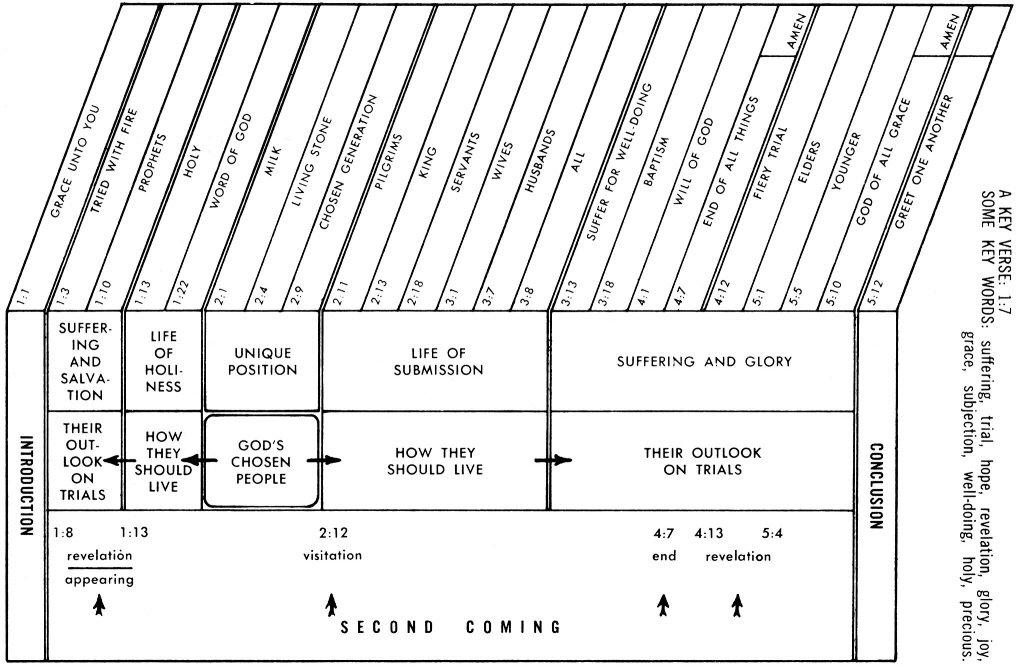
1 Peter: Trials, Holy Living & The Lord's Coming
Click chart to enlarge
Chart from Jensen's Survey of the NT - used by permission
See Another Chart from Charles Swindoll
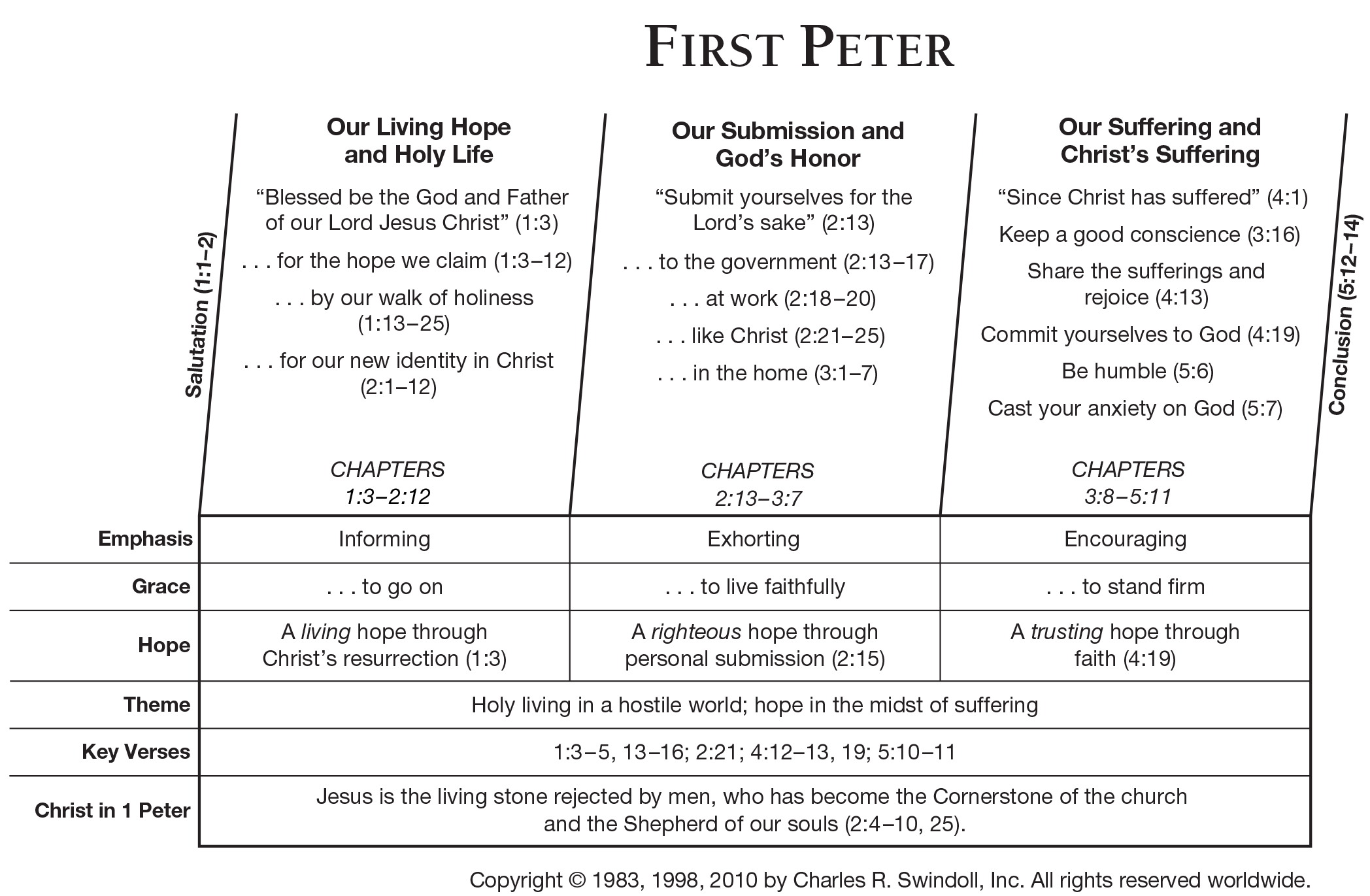
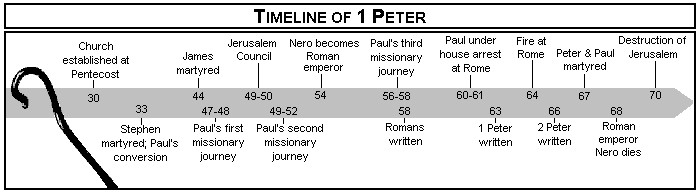
Source: Borrow Ryrie Study Bible
Click to enlarge
1 Peter 2:21 For you have been called for this purpose, since Christ also suffered for you, leaving you an example for you to follow in His steps (NASB: Lockman)
Greek: eis touto gar eklethete, (2PAPI) hoti kai Christos epathen (3SAAI) huper humon humin hupolimpanon (PAPMSN) hupogrammon hina epakolouthesete (2PAAS) tois ichnesin autou;
Amplified: For even to this were you called [it is inseparable from your vocation]. For Christ also suffered for you, leaving you [His personal] example, so that you should follow in His footsteps. (Amplified Bible - Lockman)
KJV: For even hereunto were ye called: because Christ also suffered for us, leaving us an example, that ye should follow his steps:
NLT: This suffering is all part of what God has called you to. Christ, who suffered for you, is your example. Follow in his steps.
Phillips: Indeed this is part of your calling. For Christ suffered for you and left you a personal example, and wants you to follow in his steps. (Phillips: Touchstone)
Wuest: For to this very thing were you called [namely, to patient endurance in the case of unjust punishment], because Christ also suffered on your behalf, leaving behind for you a model to imitate, in order that by close application you might follow in His footprints;
Young's Literal: for to this ye were called, because Christ also did suffer for you, leaving to you an example, that ye may follow his steps,
FOR YOU HAVE BEEN CALLED FOR THIS PURPOSE: eis touto gar eklethete (2PAPI):
- Mt 10:38; 16:24; Mk 8:34,35; Lk 9:23, 24, 25; 14:26,27; Jn 16:33; Acts 9:16; 14:22; 1Th 3:3; 4:2; 2Ti 3:12
- 1 Peter 2 Resources - Multiple Sermons and Commentaries
- 1 Peter 2:18-23 What To Do When Your Boss Isn't Fair - Steven Cole
- 1 Peter 2:19-23 Submission in the Workplace Pt 2 - Sermon - John MacArthur
- 1 Peter 2:19-23 Submission in Workplace Pt 2 - Study Guide (see dropdown) - John MacArthur
- 1 Peter 2:21 Jesus' Death Shows Us How to Live - John MacArthur
- 1 Peter 2:21-23 The Suffering Jesus: An Example - Sermon - John MacArthur
- 1 Peter 2:21-23 The Suffering Jesus: An Example - Study Guide (see dropdown) - John MacArthur
A "LESS POPULAR"
ASPECT OF OUR CALLING
For you is more literally "for into this you were called." The NAS leaves out the phrase "into this" (eis touto). What is "this?" Clearly Peter is alluding to what he has just written in 1Pe 2:20 about suffering for doing good (cp also 1Pe 2:19).
Hiebert commenting on 1Pe 2:21-25 - With another confirmatory "for" (omitted in NIV), Peter passed from duty to motivation with a graphic picture of the suffering Christ. In these verses there are numerous allusions to Isaiah 53, the prophetic portrait of the Suffering Servant of the Lord. Peter confirmed the call to submissive suffering by citing the example of Christ (1Pe 2:21), and then painted an elaborate picture of His exemplary and redemptive sufferings (1Pe 2:22-25).
Wuest explains that "The divine call of God to a lost sinner is an effectual call into salvation, and an accompaniment of that salvation is suffering for righteousness’ sake, the natural result of the Christian’s contact with the people of the world and their reaction towards the Lord Jesus who is seen in the life of the saint. Paul speaks of the same thing when he says, “For unto you it is given in the behalf of Christ, not only to believe on him, but also to suffer for his sake” (Phil. 1:29-note).
Undeserved suffering (cf "deserved" suffering 1Pe 2:20) in the lives of saints is not God's "Plan B." Suffering is not only possible, but even more it is probable. In fact it is so sure that it is even a promise, for as Paul wrote "indeed, all who desire to live godly in Christ Jesus will be persecuted." (2Ti 3:12-note) Little wonder that most of the booklets of "God's Promises" don't include this promise! In fact as Paul taught the saints at Thessalonica forewarned is forearmed writing these things "so that no man may be disturbed by these afflictions; for you yourselves know that we have been destined for this. For indeed when we were with you, we kept telling you in advance that we were going to suffer affliction; and so it came to pass, as you know." (1Thes 3:3-4-note)
As Dwight Edwards has written "There is an Arab proverb which says, "All sunshine makes a desert." Just as the rain is necessary for plants to grow, unjust suffering is just as necessary for us to grow in godliness. One of the mayor reasons we know this is because of the example Christ set for us… Undeserved suffering was a critical component in God's plan for Christ's life. "… in bringing many sons to glory, to make the author (pioneer) of their salvation perfect through sufferings." (Heb 2:10-note; Heb 5:8-note). Note Christ response to His affliction. He could easily have retaliated and overthrown His persecutors. But He "committed Himself under the mighty hand of God, knowing He would be exalted in due time." He could have avoided the cross and all the shame and agony it involved; "but for the joy set before Him, He patiently endured to the end" (Heb 12:2). We, too, are called down this rugged road to glory."
For (gar) - always pause to ponder this strategic term of explanation. Ask at least one question - What is he explaining? Peter has just said 'when you do what is right and suffer for it you patiently endure it, this finds favor with God." (1Pe 2:20)
Spurgeon- It is part of a true Christian’s calling to bear what is put upon him wrongfully. Whenever you think of the glory of your risen Lord, remember what your redemption cost him, and quit all dead works, lay aside the grave-clothes of care and anxiety, and live in newness of life as those who have been redeemed by the risen Savior. (1 Peter 2 Commentary)
Called (2564) (kaleo) (Click study of related noun kletos = the "called") means to speak to another person in order to bring them nearer, either physically or in a personal relationship and includes the nuance of giving them an invitation.
Kaleo is in the aorist passive, where the passive is what some linguists refer to as "divine" passive indicating that the action is performed by God. In this verse, it is God Who calls saints to bear up triumphantly though suffering unjustly for doing what is good. Most of us did not fully understand this aspect of God's calling, and as a result we are often caught "off guard" when we suffer unjustly for Christ (unless we have been previously taught this important truth).
Wuest makes the point that in this context kaleo describes "The divine call of God to a lost sinner (which) is an effectual call into salvation, and an accompaniment of that salvation is suffering for righteousness’ sake, the natural result of the Christian’s contact with the people of the world and their reaction towards the Lord Jesus who is seen in the life of the saint.
Hiebert explains that Peter gives "a clear reminder to all believers "that through many tribulations we must enter into the kingdom of God" (Acts 14:22). Jesus Himself repeatedly stressed that being His disciple involved cross-bearing (Mt. 10:38; 16:24; Lk 14:27). Paul also reminded his troubled readers of this reality (1Th. 3:3-note; 2Ti 3:12-note)."
Does the church (especially in America) really understand this aspect of the "call" on our life?
Do we understand that our life is not our own, for we have "bought with a price" and that our mission is to glorify God in our body? (1Cor 6:19-note, 1Co 6:20-note)
Do we understand that to us "it has been granted (literally a gift of grace) for Christ's sake, not only to believe in Him, but also to suffer for His sake? (Php 1:29-note)
Comment: Note not just to suffer mistreatment, derision, etc as a Christian but with a purpose - for Christ's sake. How so? We suffer for Jesus in the sense that by our patient endurance of unjust punishment [which is what Peter also describing], we are bearing a powerful testimony to His saving, transforming grace, grace that enables us to do something quite unnatural and yea, even supernatural. And Christ gets the glory. If we understand this truth and genuinely believe this truth suffering can take on a whole new significance.
Do we understand that "indeed, all who desire to live godly in Christ Jesus will be persecuted." (2Ti 3:12-note)
Do we understand the supernatural power that flows through us when we willingly joyfully submit to this truth? (2Cor 12:10-note).
In the present context the called refers to those who have been summoned by God (the following phrases are meant to be read as one long sentence which gives a Biblical statement regarding calling)…
according to His purpose (Romans 8:28 note)
to salvation (Romans 8:30 note)
saints by calling (1Cor 1:2)
both Jews and Greeks (1Cor 1:24)
having been called "with a holy" (2 Timothy 1:9 note)
heavenly calling (Hebrews 3:1 note)
out of darkness into His marvelous light (1 Peter 2:9 note)
to walk worthy (Ephesians 4:1 note)
by grace (Gal 1:6)
not from among Jews only, but also from among Gentiles (Romans 9:24 note)
through the "gospel" that we "may gain the glory of our Lord Jesus Christ" (2Th 2:14)
and be brought "into fellowship with His Son, Jesus Christ our Lord" (1Cor 1:9)
and return in triumph "with Him" at the end of this age (Revelation 17:14-note).
God's great doctrine of our calling should cause all the "called of Jesus Christ" to cry out "Glory!"… and to earnestly desire to walk worthy of the calling to which they have been called, motivated by the "hope of His calling".
The Christian’s holy calling is described in some detail in Ephesians 1-3, especially Ephesians 1:3-14 where we see the truths that saints are chosen (Eph 1:4-note), predestined (Eph 1:5, 1:11-see notes Ep1:5, 1:11), adopted as sons (Eph 1:5 note), accepted in the Beloved (Eph 1:6 note), redeemed through His blood (Ephesians 1:7 note), forgiven (Eph 1:7 note), sealed with the Holy Spirit (Ep 1:13-note) and given the earnest of our inheritance (Ep 1:14-note). In addition to a holy calling, saints also have a high ("upward") calling (Php 3:14-note) and a heavenly calling (Heb 3:1-note)
SINCE CHRIST ALSO SUFFERED FOR YOU, LEAVING YOU AN EXAMPLE: kai Christos epathen (3SAAI) huper humon humin hupolimpanon (PAPMSN) hupogrammon:
- 1Pe 2:24; 3:18; 4:1; Lk 24:26; Acts 17:3; Heb 2:10) (An example: Ps 85:13; Jn 13:15; Ro 8:29; 1Cor 11:1-note; Eph 5:2; Php 2:5; 1Jn2:6; 1Jn 3:16; Rev 12:11
- 1 Peter 2 Resources - Multiple Sermons and Commentaries
- 1 Peter 2:18-23 What To Do When Your Boss Isn't Fair - Steven Cole
- 1 Peter 2:19-23 Submission in the Workplace Pt 2 - Sermon - John MacArthur
- 1 Peter 2:19-23 Submission in Workplace Pt 2 - Study Guide (see dropdown) - John MacArthur
- 1 Peter 2:21 Jesus' Death Shows Us How to Live - John MacArthur
- 1 Peter 2:21-23 The Suffering Jesus: An Example - Sermon - John MacArthur
- 1 Peter 2:21-23 The Suffering Jesus: An Example - Study Guide (see dropdown) - John MacArthur
FOLLOW THE
LEADER!
Since Christ - Peter now proceeds to illustrate his exhortation to slaves by citing Christ's example of suffering unjustly. Jesus is the perfect example. In order to follow Him we have to keep our eyes on Him for He alone is the Author and Finisher of the faith (Heb 12:2).
Wuest on the little word also - Peter’s use of the word “also” puts the sufferings of these slaves on a new plane. They find comfort in knowing that someone else, and that person the Lord Jesus Himself, went through a like experience, that of suffering unjustly.
Spurgeon - There was no reason why he should be made to suffer, for he had done no wrong. He was buffeted for no fault of his own, yet how patiently he endured it all! He did not even open his mouth to murmur or complain; but he handed the whole matter over to the Supreme Court of Appeal: “to him that judgeth righteously.” It will be wise for us also to feel that we can afford to wait, knowing that our Avenger liveth, and that, in his own good time, he will rectify all wrongs, and justify his people against all their accusers. It is sweet, for the dear love of Jesus, to put up with a thousand things which, otherwise, we should resent. “But,” says one, “if you tread on a worm, it will turn.” Perhaps it will, but a Christian is not a worm; he is a being of a nobler order than that, and he does not go for his example to reptiles; he looks up to Christ, and follows his steps. (1 Peter 2 Commentary)
More Spurgeon - PETER in this chapter exhorts Christians to holiness and dwells upon that branch of holiness that consists in the patient endurance of wrong. He could find no better argument with which to plead with the saints than the life and example of their Lord. Indeed, who could find a better? Since the Lord Jesus is all our salvation, He is also all our desire, and to be like Him is the highest object of our ambition. If, therefore, we find Him patient under wrong, it is to us a conclusive argument that we should be patient too. If buffeting comes upon you for Christ’s sake, you are, in some sense, made partakers of His sufferings, and you shall also be partakers of His glory. A true child of God lives wholly for God. He is not merely a Christian when he goes up to the place of worship and sings the praise of the Lord, but he seeks to live for God as soon as he opens his eyes in the morning and until he closes them again at night. It is for God that he eats and drinks, and for God that he buys, and sells, and works, and gives, or saves, or does whatever it is right for him to do. The Levite of old had no business to do in the world but the business of God, and the true Christian is in the same condition. Though he keeps a shop or ploughs the fields, he keeps shop for Jesus and ploughs the fields for Jesus. He is not his own master, but he is the servant of Another, even the Lord Jesus Christ, and it is his joy to labor faithfully as a steward and a servant on behalf of his Master. (Spurgeon Commentary- 1 Peter)
Christ's suffering in 1 Peter - while Jesus is our perfect example in all conduct, He is especially our example of how to suffer, even when (especially when) we are in the will of God! Don't believe the false teaching that if you are suffering it is because you are not in the will of God! Such teachers show that they know very little about the Cross, the preeminent example of suffering in the will of God!
1Pe 2:24 and He Himself bore our sins in His body on the cross, that we might die to sin and live to righteousness; for by His wounds you were healed.
1Pe 3:18 For Christ also died for sins once for all, the just for the unjust, in order that He might bring us to God, having been put to death in the flesh, but made alive in the spirit;
1Pe 4:1 Therefore, since Christ has suffered in the flesh, arm yourselves also with the same purpose, because he who has suffered in the flesh has ceased from sin,
The writer of Hebrews notes that God perfected "the Author of (our) salvation through sufferings" (Hebrew 2:10-note). Author (archegos) is also translated Captain (KJV, NKJV) picturing Christ as the Commander of a mighty army, going on ahead of his men and attaining the victory for them! Archegos is also translated "Pioneer (NRSV)" picturing Christ as the Great Pioneer Who blazed the trail though death and resurrection leading to triumph over every enemy of God.
Dwight Edwards - Augustine once said, "When God allows us to suffer it is either to improve our imperfections or to prove our perfections." As we respond in a godly manner to undeserved suffering, that response becomes a blinking light which sets us apart in this darkened world.
Suffered (3958) (pascho) means to undergo an experience or experience a sensation including painful, usually difficult circumstances. The Aorist tense speaks of past completed action and indicative mood is the mood of reality. Christ truly did suffer during His life on our behalf even before His ultimate suffering and agony on the Cross.
Application: Christ understands what you are going through when you suffer. Note where He was when Paul suffered in 2Ti 4:17-18. For example - "Since He Himself was tempted (tested) in that which He has suffered, He is able (dunamai in the present tense = continually has the power) to come to the aid (boetheo = to run to the cry for help) of those who are tempted (peirazo in the present tense = are continually being tested)" (He 2:18-note).
- Suffering - Baker's Evangelical Dictionary of Biblical Theology
- Suffering - Holman Bible Dictionary
- Suffering - International Standard Bible Encyclopedia
- Why did Jesus have to experience so much suffering?
- What does the Bible say about suffering?
- Why do so many people have to experience terrible suffering before death?
- What is the passion of Christ?
- Where is God now? Where is God when it hurts?
- Why does God allow sickness?
- Why? Seeing God in our Pain
- Ten Reason God Allows Suffering
- Out of the Ashes
- Why Would A Good God Allow Suffering? Finding goodness in trouble
- How can a Christian cope while suffering with a degenerative disease?
For you - The preposition for (huper) can mean in behalf of or for the sake of and in this context clearly depicts Christ's substitutionary death.
Hiebert on for you - The fact that Christ had suffered "for you" (huper humōn) made His example personal and compelling. The preposition huper, "over," in the context conveys the picture of Christ bending over the readers to shield them from danger and destruction. He acted for their good, their personal advantage. The preposition was also used to convey the thought of substitution, a truth brought out in the latter part of the picture (1Pe 2:24-25-note).
UBS Handbook - For you gives a deeper purpose of Christ’s suffering; he suffered not only to set an example for the believers to follow, but his suffering was in fact vicarious. The content of such vicarious suffering is not completely developed here; one significant part of it is mentioned in 1 Peter 2:24 (note). (The United Bible Societies' New Testament Handbook Series)
Leaving ("leaving behind") (5277) (hupolimpano from hupo = under + leipo = to leave) means to leave behind something for someone.
"TRACING" CHRIST'S
EXAMPLE
Wuest - Peter changes over easily from the idea of a child tracing over the writing of the writing-master to a Christian planting his feet in the foot-prints left by our Lord. In this context, these footprints are foot-prints of suffering. But the illustration holds good for our Lord’s entire life. Just as a child slowly, with painstaking effort and close application, follows the shape of the letters of his teacher and thus learns to write, so saints should with like painstaking effort and by close application, endeavor to be like the Lord Jesus in their own personal lives. Or, as a small child endeavors to walk in the footprints made by his father’s feet in the snow, so we are to follow in the path which our Lord took. The Greek word “follow” means literally “to take the same road” as someone else takes. We should walk the same road that Jesus walked, in short, be Christlike. (Ed: And I would add that "road" is called the "Calvary Road!" for it is a road on which we are called to die to self and daily take up our cross pressing on to our crowning destination - glorification into the image of Jesus! Hallelujah! 1Jn 3:2-note, Php 3:20-21-note).
We see a similar pattern in other NT exhortations…
1Cor 11:1-note Be imitators of me, just as I also am of Christ.
1John 2:6-note the one who says he abides in Him ought (is obligated) himself to walk in the same manner as He walked.
Phil 3:17-note - Brethren, join in following my example, and observe those who walk according to the pattern you have in us.
Example (5261) (hupogrammos from hupo = before + grapho = write) (only used here in NT) literally means “writing under” and was used of words given to children to copy, both as a writing exercise and as a means of impressing a moral.
More specifically hupogrammos referred to a line of writing at the top of a tablet written by the teacher so that the child could write under it and make his letters like the master. Sometimes it was used with reference to the act of tracing over written letters.
Hupogrammos is used in the non-canonical book, 2 Maccabees 2:28, describing the outlines of a sketch which the artist fills in with details.
Figuratively as used by Peter hupogrammos signifies a model or example of conduct to be imitated or to be avoided. What is the example? Although not a popular teaching, suffering unjustly is the example believers are to be willing to follow (Ro 8:17-note)
Barclay writes that hupogrammos "can mean two things—an outline sketch which the learner had to fill in or the copyhead of copperplate handwriting in a writing exercise book which the child had to copy out on the lines below. Jesus gave us the pattern which we have to follow. If we have to suffer insult and injustice and injury, we have only to go through what he has already gone through. It may be that at the back of Peter's mind there was a glimpse of a tremendous truth. That suffering of Jesus was for the sake of man's sin; he suffered in order to bring men back to God. And it may be that, when the Christian suffers insult and injury with uncomplaining steadfastness and unfailing love, he shows such a life to others as will lead them to God. (Daily Study Bible - 1 Peter 2 Commentary)
A T Robertson notes that "Clement of Alexander (Strom. V. 8. 49) uses hupogrammos of the copy-head at the top of a child’s exercise book for the child to imitate, including all the letters of the alphabet. The papyri give many examples of hupographē and hupographō in the sense of copying a letter." It follows that if we truly want to become like Christ; we must be willing to copy His lifestyle of suffering. This is why Paul's primary goal in life was not just "to know Him and the power of His resurrection"; but also "the fellowship (koinonia, partnership) of His sufferings" (Phil 3:10).
UBS Handbook on hupogrammos - The word for example is used only here in the whole New Testament; in classical Greek literature, it has two meanings: (1) a piece of writing from a teacher which a child is expected to trace or imitate, and (2) an artist’s sketch which is prepared for others to color and complete. Christ therefore left a perfect model, upon which the Christian is expected to pattern his own life. (The United Bible Societies' New Testament Handbook Series)
Vincent writes that hupogrammos is "A graphic word, meaning a copy set by writing-masters for their pupils. Some explain it as a copy of characters over which the student is to trace the lines.
Spurgeon - We must put on a coat of mail and be enveloped in the whole panoply of God. We must have, as our great controlling principle, the mind of Christ, that, as He endured such contradiction of sinners against Himself, we also may endure it and not be weary or faint in our minds. We shall best bear our own sufferings when we find fellowship with Christ in them. Lest, however, we should think that the patience of our Lord was intended to be our example and nothing more, the apostle goes on to speak expressly of the expiatory nature of the sufferings alluded to. He has held up the Savior in all His woes as our example, but knowing the evil tendency of skeptical minds by any means to becloud the cross, he now puts aside the example for a moment and speaks of the Redeemer as the great sacrifice for sin. The sacred writers are always very clear and distinct upon this truth, and so must we be. There is no preaching the gospel if the atonement is left out. No matter how well we speak of Jesus as a pattern, we have done nothing unless we point Him out as the Substitute and Sin-bearer. We must, in fact, continually imitate the apostle and speak plainly of Him “who himself bore our sins in his body on the tree” (1 Pet 2:24). (Ibid)
><> ><> ><>
Tale of the Goats - A former missionary told the story of two rugged mountain goats who met on a narrow pathway. On one side was a chasm 1,000 feet deep; on the other, a steep cliff rising straight up. There was no room to turn around, and the goats could not back up without falling. What would they do? Finally, instead of fighting for the right to pass, one of the goats knelt down and became as flat as possible. The other goat then walked over him, and they both proceeded safely. In a sense, this is what Jesus Christ did for us when He left heaven's glory and came to this earth to die for our sins. He saw us trapped between our sin and God's righteousness with no way to help ourselves. He came in human likeness and took the form of a servant (Php 2:5, 6,7-note). Then, by dying for sinful mankind, He let us "walk over Him" so that we could experience forgiveness and receive eternal life. Peter pointed to Christ as an example of humility. When we are mistreated for Jesus' sake, we must learn to be humble enough to let others walk over us if need be. This is not a sign of weakness but of strength and true humility. Such a response, when done for Christ's sake, brings glory to His name. —D C Egner
Blessed Savior, make me humble,
Take away all sinful pride;
When I suffer from injustice,
Help me stay close by Your side. —DJD
The Example of Christ
- Is perfect -Hebrews 7:26
CONFORMITY TO, REQUIRED IN
- Holiness -1Peter 1:15,16; Romans 1:6
- Righteousness -1John 2:6
- Purity -1John 3:3
- Love -John 13:34; Ephesians 5:2; 1 John 3:16
- Humility -Luke 22:27; Philippians 2:5,7
- Meekness -Matthew 11:29
- Obedience -John 15:10
- Self-denial -Matthew 16:24; Romans 15:3
- Ministering to others -Matthew 20:28; John 13:14,15
- Benevolence -Acts 20:35; 2Corinthians 8:7,9
- Forgiving injuries -Colossians 3:13
- Overcoming the world -John 16:33; 1John 5:4
- Being not of the world -John 17:16
- Being guileless -1Peter 2:21, 22
- Suffering wrongfully -1Peter 2:21, 22, 23
- Suffering for righteousness -Hebrews 12:3,4
- Saints predestinated to follow -Romans 8:29
- Conformity to, progressive -2Corinthians 3:18
FOR YOU TO FOLLOW: hina epakolouthesete (2PAAS):
- 1 Peter 2 Resources - Multiple Sermons and Commentaries
- 1 Peter 2:18-23 What To Do When Your Boss Isn't Fair - Steven Cole
- 1 Peter 2:19-23 Submission in the Workplace Pt 2 - Sermon - John MacArthur
- 1 Peter 2:19-23 Submission in Workplace Pt 2 - Study Guide (see dropdown) - John MacArthur
- 1 Peter 2:21 Jesus' Death Shows Us How to Live - John MacArthur
- 1 Peter 2:21-23 The Suffering Jesus: An Example - Sermon - John MacArthur
- 1 Peter 2:21-23 The Suffering Jesus: An Example - Study Guide (see dropdown) - John MacArthur
FOLLOW HIS
FOOTPRINTS!
No trifling in this life of mine;
Not this the path the blessed Master trod;
But every hour and power employed
Always and all for God.
Steven Cole - Christ left an example for us to follow in His steps (1Pe 2:21). The word example is literally, “underwriting.” It was a school word. Teachers would lightly trace the letters of the alphabet so that students could write over them to learn how to write. Or, as in our day, teachers would put examples of the alphabet up in the room for students to look at to copy as they formed their letters. Christ is that kind of example for us. If we follow how He lived, we will form our lives correctly. Following “in His steps” pictures a child who steps in his father’s footprints in the snow. Where the father goes, the child goes, because he puts his feet in those same footprints. In like manner, we are to follow our Savior. Peter says that we are called to the same purpose as Christ was (1Pe 2:21). If our Master’s footprints led to the cross where He suffered unjustly, so we can expect to die to self (Mk 8:34-35, Lk 9:23) and suffer unjustly. If we respond as He did, people will see our Savior in us. Many people will never read the Bible, but they do read our lives. (cp Jn 12:24) They should see Christlikeness there, not a defiant spirit of self-will that characterizes those who are living for themselves and the things of this world. (1 Peter 2:18-23 What To Do When Your Boss Isn't Fair)
John Calvin on following His example - "Nothing seems more unworthy, and therefore less tolerable, than undeservedly to suffer, but when we turn our eyes to the Son of God, this bitterness is mitigated, for who would refuse to follow Him as He goes before us?"
For (2443) (hina) introduces a purpose clause explaining the reason or purpose for Christ's example. We are not just to stare at it or to read about it, but to do it! See discussion of terms of purpose or result.
To follow (1872) (epakoloutheo from epi = upon or an intensifier + akoloutheo = to follow and figuratively in a moral sense - see below) literally means to follow after, to follow upon or follow closely. To follow close upon. Literally to go along in someone's footsteps. The figurative meaning is to follow or imitate someone's life, living in the same way. Another nuance describes pursuing a matter (with devotion, dedication or attention) (as in 1Ti 5:10). Mark 16:20 refers to accompanying authenticating signs.
The root verb akoloutheo in the NT refers to being a disciple of Christ, which can include external following (Mt 8:19, Mk 10:28) but with the added idea of "a total commitment and in an exclusive relation to one who is recognized as not just a teacher but the Messiah. This discipleship brings participation in salvation (Mk 10:17, Lk 9:61, 62, Jn 8:12, Rev 14:4) but also in suffering (Mt 8:19, 20, Mk 8:34, Jn 12:25, 26)" (TDNTA)
Vincent - The compound verb implies close following. From writers and painters, the metaphor changes now to a guide.
Notice how Peter changes the metaphor from a writer (hupogrammos) to that of a guide.
In the present context, epakoloutheo is used figuratively to mean imitate Christ's example. Caleb, the godly OT saint gives us a wonderful illustration of what it means to follow in His steps…
Numbers 14:24 "But My servant Caleb, because he has had a different spirit and has followed (Lxx = epakoloutheo) Me fully, I will bring into the land which he entered, and his descendants shall take possession of it.
Comment: May his tribe increase! Amen
Moulton and Milligan - From its original meaning “follow,” “follow after,” this verb came to be used in a number of closely related senses from iii/B.C. onwards. Thus it means “am personally present at,”
Epakoloutheo - 4x in 4v in NAS - Mark 16:20; 1Ti 5:10, 24; 1Pet 2:21. NAS = devoted herself(1), follow(1), follow after(1), followed(1).
Mark 16:20 And they went out and preached everywhere, while the Lord worked with them, and confirmed the word by the signs that followed. [And they promptly reported all these instructions to Peter and his companions. And after that, Jesus Himself sent out through them from east to west the sacred and imperishable proclamation of eternal salvation.
1 Timothy 5:10 having a reputation for good works; and if she has brought up children, if she has shown hospitality to strangers, if she has washed the saints' feet, if she has assisted those in distress, and if she has devoted (followed after) herself to every good work.
1 Timothy 5:24 The sins of some men are quite evident, going before them to judgment; for others, their sins follow after.
1 Peter 2:21 For you have been called for this purpose, since Christ also suffered for you, leaving you an example for you to follow in His steps,
Epakoloutheo - 14x in Septuagint - Lev 19:4, 31; 20:6; Num 14:24; Deut 12:30; Josh 6:8; 14:8f, 14; Esther 5:1; Job 26:3; 31:7; Pr 7:22; Isa 55:3
Leviticus 19:4 'Do not turn to (Lxx = epakoloutheo) idols or make for yourselves molten gods; I am the LORD your God.
Leviticus 19:31 'Do not turn to (Lxx = epakoloutheo) mediums or spiritists; do not seek them out to be defiled by them. I am the LORD your God.
Deuteronomy 12:30 beware that you are not ensnared to follow (Lxx = epakoloutheo) them, after they are destroyed before you, and that you do not inquire after their gods, saying, 'How do these nations serve their gods, that I also may do likewise?'
Job 31:7 "If my step has turned from the way, Or my heart followed (Lxx = epakoloutheo) my eyes, Or if any spot has stuck to my hands,
Proverbs 7:22 Suddenly he follows (Lxx = epakoloutheo) her As an ox goes to the slaughter, Or as one in fetters to the discipline of a fool,
Isaiah 55:3 "Incline your ear and come to (Lxx = epakoloutheo) Me. Listen, that you may live; And I will make an everlasting covenant with you, According to the faithful mercies shown to David.
Paul has an interesting use of this verb noting that…
The sins of some men are quite evident, going before them to judgment; for others, their sins (although hidden still) follow after (epakoloutheo). (1Ti 5:24)
IN HIS STEPS: tois ichnesin autou:
- 1 Peter 2 Resources - Multiple Sermons and Commentaries
- 1 Peter 2:18-23 What To Do When Your Boss Isn't Fair - Steven Cole
- 1 Peter 2:19-23 Submission in the Workplace Pt 2 - Sermon - John MacArthur
- 1 Peter 2:19-23 Submission in Workplace Pt 2 - Study Guide (see dropdown) - John MacArthur
- 1 Peter 2:21 Jesus' Death Shows Us How to Live - John MacArthur
- 1 Peter 2:21-23 The Suffering Jesus: An Example - Sermon - John MacArthur
- 1 Peter 2:21-23 The Suffering Jesus: An Example - Study Guide (see dropdown) - John MacArthur
Literally "follow His steps" (No preposition for "in" in the Greek sentence)
Steps (2487) (ichnos) means the sole of the foot on which men and animals go, a footstep, a footprint or an impression left by the sole of the foot in walking and is used metaphorically here and elsewhere in the NT of imitating someone’s example.
Ichnos - 3x in the NT. In addition to this verse ichnos is also in…
Romans 4:12 and the father of circumcision to those who not only are of the circumcision, but who also follow in the steps of the faith of our father Abraham which he had while uncircumcised.
2Corinthians 12:18 I urged Titus to go, and I sent the brother with him. Titus did not take any advantage of you, did he? Did we not conduct ourselves in the same spirit and walk in the same steps?
Ichnos - 22x in the Septuagint (LXX) -
Gen 42:9, 12; Deut 11:24; 28:35, 65; Josh 1:3; 1 Sam 5:4; 2 Sam 14:25; 1 Kgs 5:3; 18:44; 2 Kgs 9:35; 19:24; Job 9:26; 11:7; 38:16; Ps 18:36; 77:19; Prov 5:5; 30:19; Ezek 32:13; 43:7; Dan 10:10
Deuteronomy 11:24 "Every place on which the sole (Lxx = ichnos) of your foot treads shall be yours; your border will be from the wilderness to Lebanon, and from the river, the river Euphrates, as far as the western sea.
Joshua 1:3 "Every place on which the sole (Lxx = ichnos) of your (plural = not just Joshua but the people of Israel entering the promised land) foot treads, I have given it to you, just as I spoke to Moses.
Comment: Great verse emphasizing the principle of a divine tension - God's sovereign promises, man's responsibility to in faith and trust obey Him and lay hold of that which He has already given us. The whole land was given, but they could only posses that which they claimed. In a similar way believers today have been granted every spiritual blessing in the heavenly places in Christ, and yet we must lay hold of these blessings by faith that obeys. F B Meyer puts it this way "The land of rest and triumph is ours by deed of gift; yet we must go up and possess it. We must claim it by putting down the foot of faith."
Psalm 18:36-note You enlarge my steps under me, and my feet (Lxx = ichnos) have not slipped.
NET Psalm 77:19-note You walked through the sea; you passed through the surging waters, but left no footprints (Lxx = ichnos).
In the plural (as in this verse) ichnos means a continuous line of impressions, a trail or a track.
To follow a man's footprints or footsteps is to move in the direction he is going. So in the figurative sense ichnos indicates a record left by someone's conduct or manner of life which provides an example for others to imitate.
Obviously to follow in His steps does not imply that we will do everything He did, but it does refer to the general idea that we will follow His example of enduring undeserved suffering, demonstrating the same attitude He had.
Following His steps, saints should "walk, even as He walked" (1John 2:6)
We should love as He loved…"By this all men will know that you are My disciples, if you have love for one another." (John 13:35)
We should think as He thought… "Have this attitude (present imperative = command to do this continually, make this your lifestyle) in yourselves which was also in Christ Jesus, (Php 2:5-note).
Ambrose wrote…Christ emptied Himself. Behold our pattern!
This is a good definition of a disciple! Jesus' disciples are called to follow exactly the footprints He left and they are not like footprints on the seashore which fade away and blur as the waves wash over them.
Topeka minister Charles Sheldon wanted to attract local college students to God, so he began preaching a series of practical, Sunday evening sermons on how to follow "in His steps" in business, in journalism, in other careers. From the popular series he wrote magazine articles, which in time became the best-selling book In His Steps (Click here for online version).
1 Peter 2:22 WHO COMMITTED NO SIN, NOR WAS ANY DECEIT FOUND IN HIS MOUTH (NASB: Lockman)
Greek: os hamartian ouk epoiesen (3AAI) oude heureete (3SAPI) dolos en to stomati autou;
Amplified: He was guilty of no sin, neither was deceit (guile) ever found on His lips. [Isa. 53:9]. (Amplified Bible - Lockman)
KJV: Who did no sin, neither was guile found in his mouth:
NLT: He never sinned, and he never deceived anyone. (NLT - Tyndale House)
Phillips: Who committed no sin, nor was guile found in his mouth'. Yet when he was insulted he offered no insult in return. (Phillips: Touchstone)
Wuest: Who never in a single instance committed a sin, and in whose mouth, after careful scrutiny, there was found not even craftiness;
Young's Literal: who did not commit sin, nor was guile found in his mouth,
WHO COMMITTED NO SIN: hos hamartian ouk epoiesen (3SAAI):
- Is 53:9; Mt 27:4,19,23,24; Lk 23:41,47; Jn 8:46; 2Co 5:21; Heb 4:15; 7:26,27; 9:28; 1Jn 2:1; 3:5
- 1 Peter 2 Resources - Multiple Sermons and Commentaries
- 1 Peter 2:18-23 What To Do When Your Boss Isn't Fair - Steven Cole
- 1 Peter 2:19-23 Submission in the Workplace Pt 2 - Sermon - John MacArthur
- 1 Peter 2:19-23 Submission in Workplace Pt 2 - Study Guide (see dropdown) - John MacArthur
- 1 Peter 2:21 Jesus' Death Shows Us How to Live - John MacArthur
- 1 Peter 2:21-23 The Suffering Jesus: An Example - Sermon - John MacArthur
- 1 Peter 2:21-23 The Suffering Jesus: An Example - Study Guide (see dropdown) - John MacArthur
No (3756) (ou) expresses direct and full negation, independently and absolutely, and objectively. Ou differs from the other Greek negative particle me (3361) which implies a conditional and hypothetical negation, and in contrast to ou is subjective. Peter is saying "no sin", no exceptions!
Peter had lived in closely company with Jesus for three years and knew that He was perfect. Isn't it true as a general principle that intimate relationships often reveal the best or the worst in people, and yet Peter's affirms that he had seen nothing but the best in Jesus, even in the worst of times! Peter is fully qualified to give a personal testimony of the sinless state of the unblemished and spotless Lamb of God. (1Pe 1:19-note)
NOR WAS ANY DECEIT FOUND IN HIS MOUTH: oude heurethe (3SAPI) dolos en to stomati autou:
- John 1:47; Re 14:5
- 1 Peter 2 Resources - Multiple Sermons and Commentaries
- 1 Peter 2:18-23 What To Do When Your Boss Isn't Fair - Steven Cole
- 1 Peter 2:19-23 Submission in the Workplace Pt 2 - Sermon - John MacArthur
- 1 Peter 2:19-23 Submission in Workplace Pt 2 - Study Guide (see dropdown) - John MacArthur
- 1 Peter 2:21 Jesus' Death Shows Us How to Live - John MacArthur
- 1 Peter 2:21-23 The Suffering Jesus: An Example - Sermon - John MacArthur
- 1 Peter 2:21-23 The Suffering Jesus: An Example - Study Guide (see dropdown) - John MacArthur
Peter is quoting from (Isaiah 53:9).
His grave was assigned with wicked men, Yet He was with a rich man in His death, Because He had done no violence, Nor was there any deceit in His mouth.
Deceit (1388) (dolos [word study] which is derived from dello meaning to bait) literally refers to a fishhook, trap, or trick all of which are various forms of deception. Dolos is a deliberate attempt to mislead, trick, snare or "bait" (baiting the trap in attempt to "catch" the unwary victim) other people by telling lies. It is a desire to gain advantage or preserve position by deceiving others. A modern term in advertising is called "bait and switch" where the unwary consumer is lured in by what looks like an price too good to be true!
Larry Richards explains that dolos "picks up the metaphor from hunting and fishing. Deceit is an attempt to trap or to trick and thus involves treachery… Deception sometimes comes from within, as our desires impel us to deceive. But more often in the NT, deceit is error urged by external evil powers or by those locked into the world's way of thinking. (Richards, L O: Expository Dictionary of Bible Words: Regency)
Barclay writes that "We best get the meaning of this from the corresponding verb (doloun). Doloun has two characteristic usages. It is used of debasing precious metals and of adulterating wines. Dolos is deceit; it describes the quality of the man who has a tortuous and a twisted mind, who cannot act in a straightforward way, who stoops to devious and underhand methods to get his own way, who never does anything except with some kind of ulterior motive. It describes the crafty cunning of the plotting intriguer who is found in every community and every society." In another writing Barclay explains that dolos can be translated "guile" and that "It comes from a word which means bait; it is used for trickery and deceit. It is used for instance of a mousetrap. When the Greeks were besieging Troy and could not gain entry, they sent the Trojans the present of a great wooden horse, as if it was a token of good will. The Trojans opened their gates and took it in. But the horse was filled with Greeks who in the night broke out and dealt death and devastation to Troy. That exactly is dolos. It is crafty, cunning, deceitful, clever treachery. Dolos is the trickery of the man who is out to deceive others to attain his own ends, the vice of the man whose motives are never pure. (Daily Study Bible - 1 Peter 2 Commentary)
The picture of dolos is that of one who takes advantage through craft and underhanded methods including guile, deceit (implies an intent to mislead and commonly suggests a false appearance or double-dealing), cunning (attaining or seeking to attain one’s ends by guileful or devious means) or slyness (implies furtiveness, lack of candor and skill in concealing one’s aims & methods).
1 Peter 2:23 and while being reviled, He did not revile in return; while suffering, He uttered no threats, but kept entrusting Himself to Him who judges righteously (NASB: Lockman)
Greek: os loidoroumenos (PPPMSN) ouk anteloidorei, (3SIAI) paschon (PAPMSN) ouk epeilei, (3SIAI) paredidou (3SIAI) de to krinonti (PAPMSD) dikaios;
Amplified: When He was reviled and insulted, He did not revile or offer insult in return; [when] He was abused and suffered, He made no threats [of vengeance]; but he trusted [Himself and everything] to Him Who judges fairly. (Amplified Bible - Lockman)
KJV: Who, when he was reviled, reviled not again; when he suffered, he threatened not; but committed himself to him that judgeth righteously:
NLT: He did not retaliate when he was insulted. When he suffered, he did not threaten to get even. He left his case in the hands of God, who always judges fairly. (NLT - Tyndale House)
Phillips: When he suffered he made no threats of revenge. He simply committed his cause to the one who judges fairly. (Phillips: Touchstone)
Wuest: who when His heart was being wounded with an accursed sting, and when He was being made the object of harsh rebuke and biting, never retaliated, and who while suffering never threatened, but rather kept on delivering all into the keeping of the One who judges righteously;
Young's Literal: who being reviled -- was not reviling again, suffering -- was not threatening, and was committing himself to Him who is judging righteously,
AND WHILE BEING REVILED: hos loidoroumenos (PPPMSN):
- Ps 38:12, 13, 14; Isa 53:7; Mt 27:39, 40, 41, 42, 43, 44; Mk 14:60,61; 15:29, 30, 31, 32; Lk 22:64,65; 23:9,34, 35, 36, 37, 38, 39; Jn 8:48,49; 19:9, 10, 11; Acts 8:32, 33, 34, 35; He 12:3
- 1 Peter 2 Resources - Multiple Sermons and Commentaries
- 1 Peter 2:18-23 What To Do When Your Boss Isn't Fair - Steven Cole
- 1 Peter 2:19-23 Submission in the Workplace Pt 2 - Sermon - John MacArthur
- 1 Peter 2:19-23 Submission in Workplace Pt 2 - Study Guide (see dropdown) - John MacArthur
- 1 Peter 2:21 Jesus' Death Shows Us How to Live - John MacArthur
- 1 Peter 2:21-23 The Suffering Jesus: An Example - Sermon - John MacArthur
- 1 Peter 2:21-23 The Suffering Jesus: An Example - Study Guide (see dropdown) - John MacArthur
While being reviled He did not revile - This passage parallels and fulfills the prophecies in the Psalms and Isaiah 53…
Psalm 38:12-14 - Those who seek my life lay snares for me and those who seek to injure me have threatened destruction, and they devise treachery all day long. 13 But I, like a deaf man, do not hear; and I am like a dumb man who does not open his mouth. 14 Yes, I am like a man who does not hear, And in whose mouth are no arguments. (Ps 38:12, 13, 14)
Spurgeon comments that in Ps 38:14 "He repeats the fact of his silence that we may note it, admire it, and imitate it. We have an Advocate, and need not therefore plead our own cause. The Lord will rebuke our foes, for vengeance belongs to Him; we may therefore wait patiently and find it our strength to sit still. (See all of Spurgeon's comments on Psalm 38 = Verse 12 , Verse 13 , Verse 14)
Isaiah 53:7 - He (Messiah) was oppressed and He was afflicted, yet He did not open His mouth. Like a lamb that is led to slaughter, and like a sheep that is silent before its shearers, so He did not open His mouth. ()
Comment: Observe that Christ's silence in the face of reproach is emphasized by repeating it three times! Oh, the forbearance of God!
Reviled (3058) (loidoreo from loidoros = reviling, railing, one who reviles as in 1 Cor 5:11) means to subject one to verbal abuse, and thus to reproach, vilify, speak in a highly insulting manner, insult strongly. Revile implies a scurrilous, abusive attack prompted by anger or hatred. Rail (against) means to scold someone using harsh, insolent, or abusive language.
Note the present tense indicating that Christ was continually reviled and railed against by His protagonists. Even continuous suffering at the hands of the angry mob did not elicit from our Lord any retaliatory words.
To show the strong character of the word loidoreo, Moulton and Milligan cite Calvin on the use 1Co 4:12 - "Loidoria (derived from loidoreo is used in 1Ti 5:14, 1Pe 3:9, "insult for insult") is a harsher railing, which not only rebukes a man, but also sharply bites him, and stamps him with open contumely (harsh language or treatment arising from haughtiness and contempt). Hence loidoreo is to wound man as with an accursed sting."
NIDNTT comments on the use of loidoreo in classic Greek…
The group of words connected with loidoreo (probably related to Lat. ludus, game), is frequently found in classic Greek. In general it is not used in a religious sense. It was rather in the political and social life of the Greeks that importance came to be attached to slander, insult and disparagement of an opponent, e.g. as a weapon of the orator in a political dispute, or of the Homeric heroes…
They (loidoreo, loidoria, loidoros = a reviler) retain the meaning which they have in classic Greek, although they are used chiefly in religious contexts. If for the Greek it was one of the arts of life to know how to insult others or bear insults against oneself, for the believer the suffering of slander and insults is evidence of the cross the Christian disciple is called to bear (1Pe 2:23) (See online page 346 for more discussion of loidoreo in the New International Dictionary of NT Theology)
TDNT…
This common word group has the secular sense of reproach, insult, calumny, and even blasphemy. In the LXX it carries the nuance of wrangling, angry remonstrance, or chiding as well as thee usual calumny. Philo has it for mockery or invective. (Kittel, G., Friedrich, G., & Bromiley, G. W. Theological Dictionary of the New Testament. Eerdmans)
Loidoreo - 4x in 4v - John 9:28; Acts 23:4; 1Cor 4:12; 1 Pet 2:23. Here are the other 3 uses…
John 9:28 They reviled him and said, "You are His disciple, but we are disciples of Moses.
Acts 23:4 But the bystanders said, "Do you revile God's high priest?"
1Corinthians 4:12 and we toil, working with our own hands; when we are reviled, we bless; when we are persecuted, we endure;
Loidoreo - 6x In the Septuagint (LXX) - Gen 49:23; Ex17:2; 21:18; Num 20:3, 13; Deut 33:8
HE DID NOT REVILE IN RETURN: ouk anteloidorei (3SIAI):
- Acts 4:29; 9:1; Ep 6:9
- 1 Peter 2 Resources - Multiple Sermons and Commentaries
- 1 Peter 2:18-23 What To Do When Your Boss Isn't Fair - Steven Cole
- 1 Peter 2:19-23 Submission in the Workplace Pt 2 - Sermon - John MacArthur
- 1 Peter 2:19-23 Submission in Workplace Pt 2 - Study Guide (see dropdown) - John MacArthur
- 1 Peter 2:21 Jesus' Death Shows Us How to Live - John MacArthur
- 1 Peter 2:21-23 The Suffering Jesus: An Example - Sermon - John MacArthur
- 1 Peter 2:21-23 The Suffering Jesus: An Example - Study Guide (see dropdown) - John MacArthur
Matthew records one such example of His not reviling in return "And while He was being accused by the chief priests and elders, He made no answer. Then Pilate said to Him, "Do You not hear how many things they testify against You?" And He did not answer him with regard to even a single charge, so that the governor was quite amazed. (Mt 27:12, 13, 14)
Not (ouk) signifies absolute negation. Jesus absolutely did not revile when reviled! He is our example! How are you doing, beloved of the Lord? Remember, if you try to "not revile in return" in your old self, you own strength, your natural ability, you don't stand a chance! Even if we catch the wicked words before they are propelled from our lips, we still have to deal with our heart, for out of our mouth comes that which fills our heart. And so how do we "not revile in return"? The truth is this response (or choice to not give a response) is not possibly naturally but only be achieved supernaturally. If Jesus is our example and He succeeded (which He did) then we must surrender to the Spirit of Christ in us and rely on His enabling power to give us the ability to "not revile in return". There is simply no other way to live like Jesus, then to live supernaturally by His Spirit. And He will give us many "opportunities" to practice dying to self and acknowledging our natural weakness so that we might begin to learn that it is only His grace that is truly sufficient and that it is only in our weakness that His power is made perfect. (2Cor 12:9-note; 2Co 12:10-note) And then God will receive the glory for something we and everyone else knows can only be achieved supernaturally! (Mt 5:16-note, cp the similar command to do all things without grumbling! Php 2:14-note)
Revile in return (486) (antiloidoreo from anti = in turn, return, back + loidoreo = revile) means to answer insults or slander with insulting or slanderous words.
Returning good for good is commendable and even natural. Returning good for evil is Christ like and supernatural. Christ is our Example. The Spirit of Christ is our Enabler.
And why did Christ not revile in return? As the perfect example of submission, He had submitted His will to His Father in His time of agony in the Garden of Gethsemane when He declared "Father, if Thou art willing, remove this cup from Me; yet not My will, but Thine be done." (Luke 22:42)
Remember that 1 Peter 2:13 through 1 Peter 3:9 deals repeatedly with submission, and in this section we see Christ's submission as the highest example of submission. And we are called to follow in His steps.
Note also that the verb indicating Christ was entrusting Himself to His Father is imperfect tense… this gives us the following picture of Jesus - each time He was attacked verbally with abusive insults, He gave Himself over to His Father for vindication of the injustice and did not seek to retaliate. This was His response again and again. Blessed holy forbearance!
This is the example He left for His disciples to follow when falsely accused or maligned --this is not easy (in fact in our own strength it is impossible!). The temptation of the flesh will always be to lash out at our adversaries, but we must master it (for it is "Him-possible"). God instructed Cain that
If you do well, will not your countenance be lifted up? And if you do not do well, sin is crouching (waiting to pounce like a lion, would fulfill its desire to overpower him) at the door; and its desire is for you, but you must master (to rule, reign, have dominion over) it. (Genesis 4:7) (Comment: And of course Cain did not master it and killed Abel in Ge 4:8. What is fascinating is that God would not have told him he could master sin unless He had provided the enablement for Cain to follow through. We cannot go too far where the text is silent, but it would not be unreasonable to surmise that in some way God provided access to His Spirit for there is no other power which could have mastered sin! How this worked in this context is not at all clear! We will have to wait until heaven and ask God to explain it to us then!)
So here we see even in the OT that what God demanded in the way of righteous behavior, He provided the power necessary to carry out (although as noted we can't state specifically how from this verse).
In the NT we can be more specific about how we are to master sin, for Paul writes that
if you are living (present tense = habitually, the "direction" of your life so to speak) according to the flesh, you must (are about to) die (this is a description of an unbeliever); but if by the Spirit (on Whom believers are 100% dependent) you are putting to death (apothnesko in the present tense = continually, which is 100% our responsibility) the deeds (Gk = praxis = habits ~ we all have old habits we learned in our unregenerate state!) of the body, you will live. (Ro 8:13-note).
Related Resources on the "100/100 Principle"
Paul is saying that the Spirit provides us with the energy and power to continually and gradually be killing our sins (including reviling in return!), and this is daily process (known as sanctification, present tense salvation [see Three Tenses of Salvation] or growth in Christ-likeness) never to be completed in this life and one reason we are called to daily, continually fight the good fight of faith (Not a good fight of flesh which will not "kill" itself! cp Paul's rhetorical question in Gal 3:3). The Spirit continually "energizes" us giving us the DESIRE and the POWER to carry out every exhortation and every command in the Scripture. As
So then, my beloved, just as you have always obeyed, not as in my presence only, but now much more in my absence, work out (present imperative = continually) your salvation with fear and trembling; FOR (Note this vital term of explanation - What is Paul explaining? Why is this so important? What would be one's doctrine if they just adhered to Phil 2:12? Would it not be a works based salvation?) it is God who is at work (energeo in the = describes the Spirit's unceasing supernatural energizing) in you, both to will and to work for His good pleasure. (Php 2:12, 13-See notes Php 2:12; 2:13) Read verse 13 (Phil 2:12NLT) in the New Living Translation to help see what the Spirit is continually doing (or providing us) to enable us to fulfill the command in Phil 2:12.
Right and Wronged - Several years ago, a university student who took the gospel of Christ to a rough London neighborhood encountered a group of hostile men. "You rat!" said one of the men, seizing him. "I've half a mind to break your jaw!"
"My friend," the young man replied, "if that is going to help you at all and make me less of a rat, go ahead and break it."
The writer who described the incident concluded his account by saying, "The jaw was not broken, and the group dispersed."
That student's calm response to a personal threat was powerful and Christlike. The apostle Peter said that when our Lord Jesus Christ was reviled, He "did not revile in return; when He suffered, He did not threaten, but committed Himself to Him who judges righteously" (1Pe 2:23).
Our profession of faith in a just, sovereign God meets the acid test when we are opposed for taking a stand for the truth. If we strike back, we stand in our own strength. If we follow Jesus' example, we stand in the power of God.
When the heat is on and we put our confidence in the Lord, we will be able to do what's right even when we're wronged. —RBC Ministries (Our Daily Bread, Copyright RBC Ministries, Grand Rapids, MI. Reprinted by permission. All rights reserved)
Lord, help me not retaliate
When someone's mocking You;
Instead, give me the strength to stand
For what I know is true. --Sper
WHILE SUFFERING, HE UTTERED NO THREATS: paschon (PAPMSN) ouk epeilei (3SIAI):
- 1 Peter 2 Resources - Multiple Sermons and Commentaries
- 1 Peter 2:18-23 What To Do When Your Boss Isn't Fair - Steven Cole
- 1 Peter 2:19-23 Submission in the Workplace Pt 2 - Sermon - John MacArthur
- 1 Peter 2:19-23 Submission in Workplace Pt 2 - Study Guide (see dropdown) - John MacArthur
- 1 Peter 2:21 Jesus' Death Shows Us How to Live - John MacArthur
- 1 Peter 2:21-23 The Suffering Jesus: An Example - Sermon - John MacArthur
- 1 Peter 2:21-23 The Suffering Jesus: An Example - Study Guide (see dropdown) - John MacArthur
Suffering (3958) (pascho) means to undergo an experience, usually difficult, normally with the implication of physical or mental suffering. Note the present tense indicates this was the "Suffering Servant's" continual lot in life!
Pascho - 42x in 41v - endured(1), endured… sufferings(1), suffer(22), suffered(10), suffering(4), suffers(2).
Matt 16:21; 17:12, 15; 27:19; Mark 5:26; 8:31; 9:12; Luke 9:22; 13:2; 17:25; 22:15; 24:26, 46; Acts 1:3; 3:18; 9:16; 17:3; 28:5; 1 Cor 12:26; 2 Cor 1:6; Gal 3:4; Phil 1:29; 1 Thess 2:14; 2 Thess 1:5; 2 Tim 1:12; Heb 2:18; 5:8; 9:26; 13:12; 1 Pet 2:19ff, 23; 3:14, 17f; 4:1, 15, 19; 5:10; Rev 2:10.
Uttered (no) threats (546) (apeileo) means to menace, to warn, to threaten and so to declare that one will cause harm to someone, particularly if certain conditions are not met. The word for "no" is the Greek particle "ouk" which speaks not of relative but of absolute negation… Jesus absolutely did not make threats of revenge.
BUT KEPT ENTRUSTING HIMSELF TO HIM WHO JUDGES RIGHTEOUSLY: paredidou (3SIAI) de to krinonti (PAPMSD) dikaios:
- 1 Peter 4:19; Ps 10:14; 31:5; 37:5; Lk 23:46; Acts 7:59; 2Ti 1:12, Ge 18:25; Ps 7:11; 96:13; Acts 17:31; Ro 2:5; 2Th 1:5; 2Ti 4:8; Rev 19:11
- 1 Peter 2 Resources - Multiple Sermons and Commentaries
- 1 Peter 2:18-23 What To Do When Your Boss Isn't Fair - Steven Cole
- 1 Peter 2:19-23 Submission in the Workplace Pt 2 - Sermon - John MacArthur
- 1 Peter 2:19-23 Submission in Workplace Pt 2 - Study Guide (see dropdown) - John MacArthur
- 1 Peter 2:21 Jesus' Death Shows Us How to Live - John MacArthur
- 1 Peter 2:21-23 The Suffering Jesus: An Example - Sermon - John MacArthur
- 1 Peter 2:21-23 The Suffering Jesus: An Example - Study Guide (see dropdown) - John MacArthur
But (de) - Always pause to ponder this important term of contrast which marks a change "direction" so to speak. Ask what is the change? Does this help us understand what He uttered no threats even though He was suffering unjustly? What is the pattern for believers today when we are being unjustly treated? Are we to fight back? If we are truly following in His steps, the pattern is very clear! Jesus' attitude recalls Paul's teaching in Romans 12
Bless those who persecute you; bless and curse not… Never pay back evil for evil to anyone. Respect what is right in the sight of all men. 18 If possible, so far as it depends on you, be at peace with all men. 19 Never take your own revenge, beloved, but leave room for the wrath of God, for it is written, “VENGEANCE IS MINE, I WILL REPAY,” says the Lord. 20 “BUT IF YOUR ENEMY IS HUNGRY, FEED HIM, AND IF HE IS THIRSTY, GIVE HIM A DRINK; FOR IN SO DOING YOU WILL HEAP BURNING COALS UPON HIS HEAD.” 21 Do not be overcome by evil, but overcome evil with good. (Ro 12:14-note, Ro 12:17-21-note)
As always Jesus was perfectly obedient repeatedly yielding His will to His Father and by so doing leaving us the example of "yet not My will, but Thine be done." (Lk 22:42)
Kept Entrusting (3860) (paradidomi [word study] from para = alongside, beside + didomi = give) means to hand over to or to convey something to someone particularly a right or an authority. Paradidomi was commonly used of delivering up a criminal to police or court for punishment. It was included the idea of one being given over into another's power and in this case means giving one's self over to God the righteous Judge.
Peter's use of the imperfect tense pictures Jesus surrendering Himself to His Father's righteous judgment again and again, as one unfounded injustice after another was hurled at Him.
John MacArthur explains the idea conveyed by use of the imperfect tense writing that "With each new wave of abuse, as it came again and again, Jesus was always “handing Himself over” to God for safekeeping. Luke records how that pattern continued until the very end ‘Father, into Your hands I commit (Ed note: paratithemi - not paradidomi but similar idea) My spirit.’ Having said this, He breathed His last” (Lk 23:46). Undergirding Jesus’ peaceful, resolute acceptance of suffering was an unshakeable confidence in the perfectly righteous plan of Him who judges righteously (cf. Jn 4:34; 15:10; 17:25). He knew God would vindicate Him according to His perfect, holy justice." (MacArthur, J. 1 Peter. Chicago: Moody Press)
Judges (2919) (krino) primarily signifies to distinguish, separate or discriminate and then, to distinguish between good and evil, right and wrong, without necessarily passing an adverse sentence, though this is usually involved.
Righteously (1346) (dikaios [word study] from díke = right, just) means God judges equitably, justly and in a manner that always conforms to His perfect justice. Why? Because God's judgments are an outcome of His character. He judges righteously in full conformity to His standard of truth and holiness. Christ could therefore with full assurance commit His vindication into God's hands.
Let us (in the power of the Spirit of Christ) follow His beautiful example and walk in His steps to the glory of God and not revile in return, utter threats or speak deceitfully when we suffer.
Alan Stibbs explains that there "is a double sense in which He (Jesus) may have acknowledged God as the righteous Judge. On the one hand, because voluntarily, and in fulfillment of God’s will, He was taking the sinner’s place and bearing sin, He did not protest at what He had to suffer. Rather He consciously recognized that it was the penalty righteously due to sin. So He handed Himself over to be punished. He recognized that in letting such shame, pain and curse fall upon Him, the righteous God was judging righteously. On the other hand, because He Himself was sinless, He also believed that in due time God, as the righteous Judge, would vindicate Him as righteous, and exalt Him from the grave, and reward Him for what He had willingly endured for others’ sake by giving Him the right completely to save them from the penalty and power of their own wrongdoing." (The Tyndale New Testament Commentaries, The First Epistle of Peter. Grand Rapids: Eerdmans, 1971)
In God's Hands- READ: 2 Samuel 16:5-14
It may be that the Lord will look on my affliction, and that the Lord will repay me with good. —2Sa 16:12 In 2 Samuel 16:5, 6, 7, 9, 10, 11, 12, 13, 14 we read of King David being cursed by Shimei. This happened while David was fleeing from his son Absalom, who wanted to kill him.
Unlike David, we often want to silence our critics, insist on fairness, and defend ourselves. But as we grow in our awareness of God's protective love, we become less concerned with what others say about us and more willing to entrust ourselves to our Father. Like David, we can say of each critic, "Let him alone, and let him curse" (2Sa 16:11). This is humble submission to God's will. We may ask our opponents to justify their charges, or we may counter them with steadfast denial. Or, like David (2Sa 16:12), we can wait patiently until God vindicates us.
It is good to look beyond those who oppose us and look to the One who loves us with infinite love. It is good to be able to believe that whatever God permits is for our ultimate good—good, though we're exposed to the curses of a Shimei; good, though our hearts break and we shed bitter tears.
You are in God's hands, no matter what others are saying about you. He has seen your distress, and in time He'll repay you for the cursing you have received. So trust Him and abide in His love. —David H. Roper (Our Daily Bread, Copyright RBC Ministries, Grand Rapids, MI. Reprinted by permission. All rights reserved)
THINKING IT OVER - Read 1Pe 2:20-23. How did Jesus respond to words spoken against Him? What did He do and not do? In what situations can you follow His example?
We can endure life's wrongs because we know that God will make all things right.
- Forbidden -1 Peter 3:9
- Of rulers specially forbidden -Exodus 22:28; Acts 23:4,5
THE WICKED UTTER, AGAINST
- God -Psalms 74:22; 79:12
- God, by opposing the poor -Proverbs 14:31
- Christ -Matthew 27:39; Luke 7:34
- Saints -Psalms 102:8; Zephaniah 2:8
- Rulers -2 Peter 2:10,11; Jude 1:8,9
- Of Christ, predicted -Psalms 69:9; Romans 15:3; Psalms 89:51
- The conduct of Christ under -1 Peter 2:23
SAINTS
- Endure -1 Timothy 4:10; Hebrews 10:33
- Endure for God’s sake -Psalms 69:7
- Endure for Christ’s sake -Luke 6:22
- Should expect Matthew 10:25
- Should not fear -Isaiah 51:7
- Sometimes depressed by -Psalms 42:10,11; 44:16; 69:20
- May take pleasure in -2 Corinthians 12:10
- Supported under -2 Corinthians 12:10
- Trust in God under -Psalms 57:3; 119:42
- Pray under -2 Kings 19:4,16; Psalms 89:50
- Return blessings for -1 Corinthians 4:12; 1 Peter 3:9
- Ministers should not fear -Ezekiel 2:6
- Happiness of enduring, for Christ’s sake -1 Peter 4:14
- Blessedness of enduring, for Christ’s sake -Matthew 5:11; Luke 6:22
- Excludes from heaven -1 Corinthians 6:10
- Punishment for -Zephaniah 2:8,9; Matthew 5:22
Exemplified
- Joseph’s brethren -Genesis 37:19
- Goliath -1 Samuel 17:43
- Michal -2 Samuel 6:20
- Shimei -2 Samuel 16:7,8
- Sennacherib -Isaiah 37:17,23,24
- Moabites and Ammonites -Zephaniah 2:8
- Pharisees -Matthew 12:24
- Jews -Matthew 27:39,40; John 8:48
- Malefactor -Luke 23:39
- Athenian philosophers -Acts 17:18