1 Peter 2:2
1 Peter 2:3
1 Peter 2:4
1 Peter 2:5
1 Peter 2:6
1 Peter 2:7
1 Peter 2:8
1 Peter 2:9
1 Peter 2:10
1 Peter 2:11
1 Peter 2:12
1 Peter 2:13
1 Peter 2:14
1 Peter 2:15
1 Peter 2:16
1 Peter 2:17
1 Peter 2:18
1 Peter 2:19
1 Peter 2:20
1 Peter 2:21
1 Peter 2:22
1 Peter 2:23
1 Peter 2:24
1 Peter 2:25
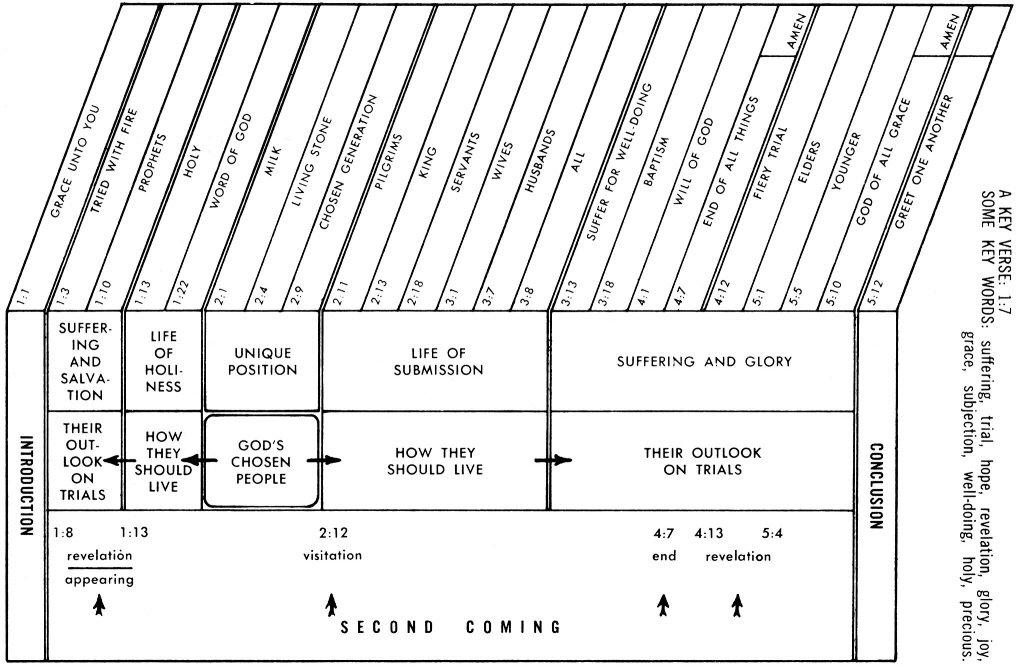
1 Peter: Trials, Holy Living & The Lord's Coming
Click chart to enlarge
Chart from Jensen's Survey of the NT - used by permission
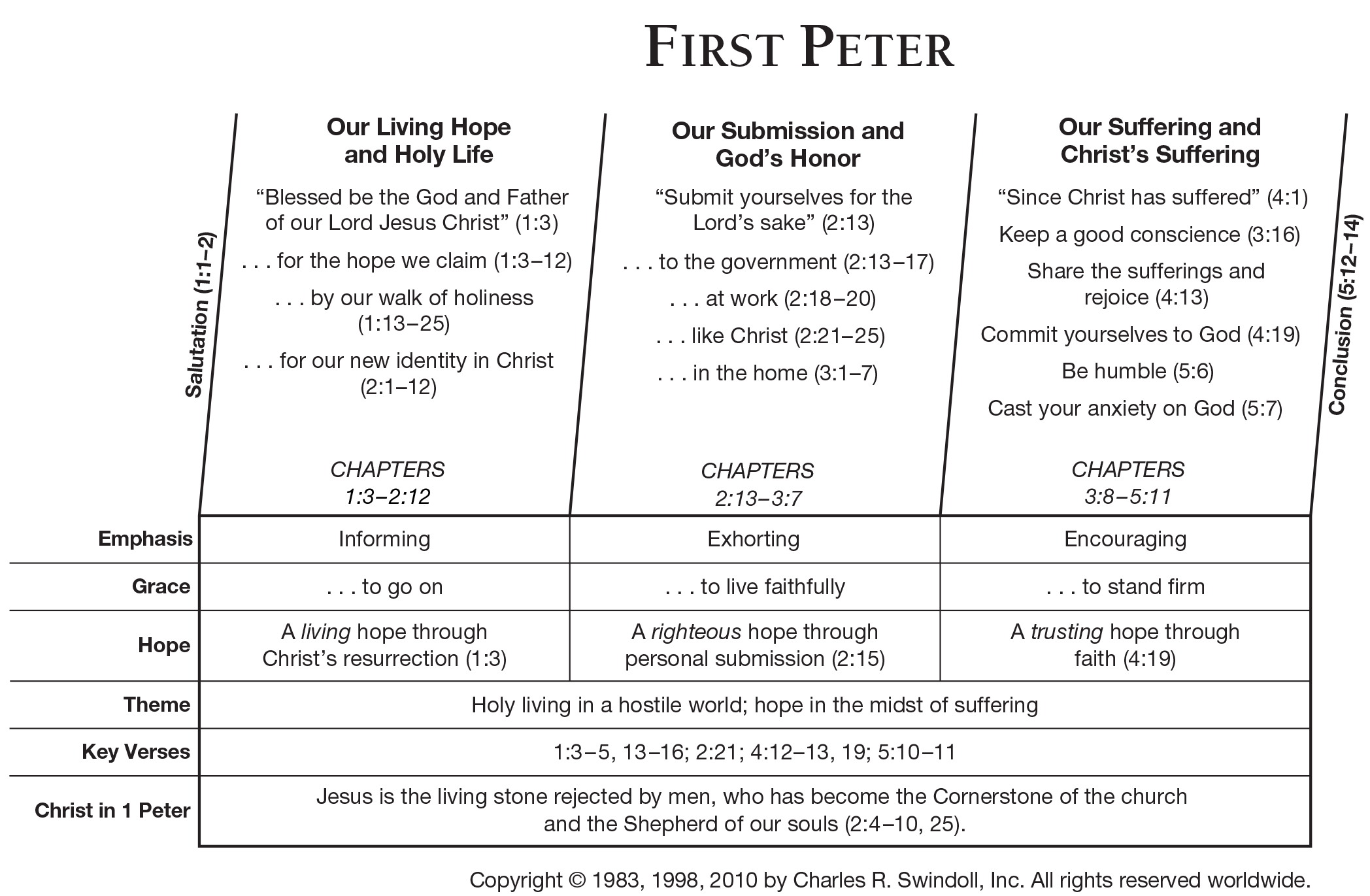
See Another Chart from Charles Swindoll
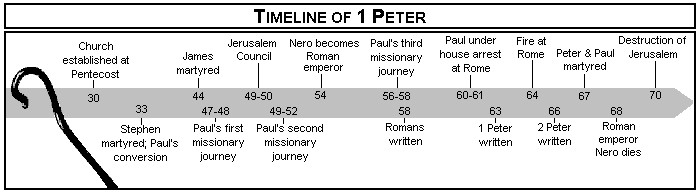
Source: Borrow Ryrie Study Bible
Click to enlarge
1Peter 2:24 and He Himself bore our sins in His body on the cross, so that we might die to sin and live to righteousness; for by His wounds you were healed. (NASB: Lockman)
Greek: os tas hamartias hemon autos anenegken (3SAAI) en to somati autou epi to xulon, hina tais hamartiais apothenomenoi (AMPMPN) te dikaiosune zosomen; (1PAAS) ou to molopi iathete. (2SAPI)
Amplified: He personally bore our sins in His [own] body on the tree [as on an altar and offered Himself on it], that we might die (cease to exist) to sin and live to righteousness. By His wounds you have been healed. (Amplified Bible - Lockman)
KJV: Who His own self bare our sins in His own body on the tree, that we, being dead to sins, should live unto righteousness: by whose stripes ye were healed.
NLT: He personally carried away our sins in his own body on the cross so we can be dead to sin and live for what is right. You have been healed by his wounds! (NLT - Tyndale House)
Phillips: And he personally bore our sins in his own body on the cross, so that we might be dead to sin and be alive to all that is good. It was the suffering that he bore which has healed you.
Wuest: Who himself carried up to the Cross our sins in His body and offered himself there as on an altar, doing this in order that we, having died with respect to our sins, might live with respect to righteousness, (Eerdmans Publishing)
Young's Literal: who our sins himself did bear in his body, upon the tree, that to the sins having died, to the righteousness we may live; by whose stripes ye were healed,
AND HE HIMSELF BORE OUR SINS: hos tas hamartias (sins is first for emphasis) hemon autos anenegken (3SAAI):
- Ex 28:38; Lev 16:22; 22:9; Nu 18:22; Ps 38:4; Is 53:4, 5, 6,11; Mt 8:17; Jn 1:29, 36; Heb 9:28
- 1 Peter 2 Resources - Multiple Sermons and Commentaries
- 1 Peter 2:24-25 The Meaning Of The Cross - Steven Cole
- 1 Peter 2:24-25 The Suffering Jesus: Our Substitute and Shepherd - John MacArthur
- 1 Peter 2:24-25 The Suffering Jesus: Our Substitute & Shepherd - Study Guide (see dropdown) - John MacArthur
THE SAVIOR OUR
SINLESS SUBSTITUTE
The Jews of all people should have understood this powerful picture of a Substitute Who would bear our sins, for it is clearly foreshadowed in the Law and then clearly portrayed in the prophets. So on the Day of Atonement we read in Leviticus 16:22+ that “The goat shall bear on itself all their iniquities to a solitary land; and he shall release the goat in the wilderness." And then the indisputably clear portrayal by the prophet Isaiah who wrote (not once, not twice but THREE TIMES!) that the Suffering Servant would bear the sins (clearly this was not the nation of Israel, for how could the nation bear the sins of others? Impossible! No, this is a clear picture of the Messiah, Christ Jesus") "our griefs", "their iniquities," "the sin of many"...
Isa 53:4 Surely our griefs He Himself bore, And our sorrows He carried; Yet we ourselves esteemed Him stricken, Smitten of God, and afflicted.
Isa 53:11 As a result of the anguish of His soul, He will see it and be satisfied; By His knowledge the Righteous One (ED: THE SINFUL NATION OF ISRAEL COULD HARDLY BE CALLED "THE RIGHTEOUS ONE!"), My Servant, will justify the many, As He will bear (Lxx = anaphero) their iniquities.
Isa 53:12 Therefore, I will allot Him a portion with the great, And He will divide the booty with the strong; Because He poured out Himself to death, And was numbered with the transgressors; Yet He Himself bore (Lxx = anaphero) the sin of many, And interceded for the transgressors.(Isaiah 53:4,11,12 - see in depth commentary)
He Himself bore our sins - This is an intensive pronoun "He", Jesus Himself, no substitute. This alludes to Isaiah's two prophecies - Isaiah 53:4 ("He Himself bore") and Isaiah 53:12 ("He Himself bore.") Jesus (the Great High Priest) like the high priest of old, brought the sacrifice to the altar, the OT altar foreshadowing the NT Cross, on which the offering was placed, and in this great story of divine redemption, the Great High Priest was Himself the blemish-free, sinless sacrificial offering! Amazing grace indeed! Christ's body was the "offering" to God, Paul writing in 1 Cor 11:24 "when He had given thanks, He broke it and said, “This is My body, which is for (preposition huper here means "in your place" = substitutionary sacrifice for) you; do this in remembrance of Me.”
MacArthur add that He Himself "is an emphatic personalization and stresses that the Son of God voluntarily and without coercion (John 10:15, 17, 18) died as the only sufficient sacrifice for the sins of all who would ever believe (cf. John 1:29; 3:16; 1Ti 2:5, 6; 4:10; He 2:9 [note] He 2:17 [note]). The very name Jesus indicated that He would “save His people from their sins” (Mt 1:21). (1 Peter. Chicago: Moody Press)
Bore (399)(anaphero from ana = up, again, back + phero = bear, carry) literally means to carry, bring or bear up and so to to cause to move from a lower position to a higher position. It serves as a technical term for offering sacrifices offer up (to an altar) offered up like Ge 8:20. Anaphero is the verb the translators of the LXX Old Testament usually used to picture the offering of a sacrifice. Figuratively (as used here by Peter) anaphero means to take up and bear sins by imputation (act of laying the responsibility or blame for) as typified by the ancient sacrifices. Jesus our Great High Priest bore our sins as our substitutionary sacrifice, dying in our place, in order to bring about atonement for our sins. The priests in the Old Covenant could not bear our sins.
Anaphero is used 9 times in the NT in the NAS (see below) and is translated as: bear, 1; bore, 1; brought, 1; led, 1; offer, 3; offered, 2.
Matthew 17:1 And six days later Jesus took with Him Peter and James and John his brother, and brought them up to a high mountain by themselves.
Mark 9:2 And six days later, Jesus took with Him Peter and James and John, and brought them up to a high mountain by themselves. And He was transfigured before them;
Luke 24:51 And it came to pass, while he blessed them, he was parted from them, and carried up into heaven. (KJV only)
Hebrews 7:27 (note) who does not need daily, like those high priests, to offer up sacrifices, first for His own sins, and then for the sins of the people, because this He did once for all when He offered up Himself.
Hebrews 9:28 (note) so Christ also, having been offered (prosphero) once to bear (anaphero) the sins of many, shall appear a second time for salvation without reference to sin, to those who eagerly await Him.
Comment: The writer of Hebrews utilizes anaphero with a meaning similar to Peter i.e., to refer to Christ's propitiatory or satisfactory sacrifice
Hebrews 13:15 (note) Through Him then, let us continually offer up a sacrifice of praise to God, that is, the fruit of lips that give thanks to His name.
Comment: Dear NT believers, you who are now priests of the Most High God and thus have the incredible privilege of continually doing what only the Jewish Levitical priests could do in the Old Testament. Are you "taking advantage" of your high and holy privilege as members of a royal priesthood? [1Pe 2:9-note]
James 2:21 Was not Abraham our father justified by works, when he offered up Isaac his son on the altar?
Comment: Justified in this context could be translated "shown to be justified". In other words, his offering up of Isaac showed that he had been declared righteous.
1 Peter 2:5 (note) you also, as living stones, are being built up as a spiritual house for a holy priesthood, to offer up spiritual sacrifices acceptable to God through Jesus Christ.
Comment: Believers now can offer up holy sacrifices because the Holy One offered up Himself! Precious truth!
1 Peter 2:24 and He Himself bore our sins in His body on the cross, that we might die to sin and live to righteousness; for by His wounds you were healed.
Anaphero is found 135 times in the Septuagint (LXX) (Greek translation of the OT Hebrew)
Ge 8:20; 22:2, 13; 31:39; 40:10; Ex 18:19, 22, 26; 19:8; 24:5; 29:18, 25; 30:9, 20; Lev. 2:16; 3:5, 11, 14, 16; 4:10, 19, 26, 31; 6:15, 26; 7:5, 31; 8:16, 20f, 27f; 9:10, 20; 14:20; 16:25; 17:5f; 23:11; Num. 5:26; 14:33; 18:17; 23:2, 30; Deut. 1:17; 12:13f, 27; 14:24; 27:6; Jdg. 6:26, 28; 11:31; 13:16, 19; 15:13; 16:8, 18; 20:26, 38; 21:4; 1 Sam. 2:19; 6:14f; 7:9f; 10:8; 13:9f, 12; 15:12; 18:27; 20:13; 2 Sam. 1:24; 6:17; 21:13; 24:22, 24f; 1 Ki. 2:35; 3:4; 5:13; 8:1; 9:15; 10:5; 12:27; 17:19; 2 Ki. 3:27; 4:21; 1 Chr. 15:3, 12, 14; 16:2, 40; 21:24, 26; 23:31; 29:21; 2 Chr. 1:4, 6; 2:4; 4:16; 5:2, 5; 8:12f; 9:4, 16; 23:18; 24:14; 29:21, 27, 29, 31f; 35:14; Ezra. 3:2, 6; Neh. 10:38; 12:31; Job 7:13; Ps. 51:19; 66:15; Prov. 8:6; Isa. 18:7; 53:11f; 57:6; 60:7; 66:3; Jer. 32:35; Ezek. 36:15; 43:18, 24; Da 6:23
Wuest's paraphrase conveys Peter's allusion to the Old Testament sacrificial system -- Jesus Himself carried up to the Cross our sins in His body and offered Himself there as on an altar (Wuest)
It is notable that anaphero is used 25 times in the Septuagint translation of Leviticus regarding offerings! For example, Moses records that
Aaron's sons shall offer it up (anaphero = bear, carry) in smoke on the altar on the burnt offering, which is on the wood that is on the fire; it is an offering by fire of a soothing aroma to the LORD. (Lev 3:5)
Jesus, as our Great High Priest , offered up the sacrifice of Himself by bringing His body up to the Cross. Anaphero is used in Hebrews which records that Jesus
"does not need daily, like those (Jewish) high priests, to offer up sacrifices, first for His own sins, and then for the sins of the people, because this He did once for all when He offered up Himself." (He 7:27-note)
Exodus discusses the parallel role of the OT high priests recording that
Aaron shall take away (to lift, to carry) the iniquity of the holy things which the sons of Israel consecrate, with regard to all their holy gifts; and (the turban) shall always be on his forehead, that they may be accepted before the Lord. (Ex 28:38)
Comment: This was but a shadow of which Jesus was the Substance. (Col 2:17)
Isaiah in his famous prophecy of the suffering Servant (the Messiah) is repeated from above but here note the bold font which repeatedly highlights the role of the Person of Jesus the Messiah...
Surely our griefs He Himself bore, and our sorrows He carried. Yet we ourselves esteemed Him stricken, smitten of God, and afflicted. But He was pierced through for our transgressions, He was crushed for our iniquities. The chastening for our well-being fell upon Him, and by His scourging we are healed. All of us like sheep have gone astray, each of us has turned to his own way, but the Lord has caused the iniquity of us all to fall on Him. (Isa 53:4, 5, 6+)
As a result of the anguish of His soul, He will see it and be satisfied; By His knowledge the Righteous One, My Servant, will justify the many, as He will bear (LXX uses anaphero) their iniquities. (12) Therefore, I will allot Him a portion with the great, and He will divide the booty with the strong, because He poured out Himself to death, and was numbered with the transgressors. Yet He Himself bore (LXX uses anaphero) the sin of many, and interceded for the transgressors. (Isa 53:11,12+)
When John the Baptist saw Jesus coming to him he declared the fulfillment of Isaiah's prophecy (and all the OT Messianic prophecies for that matter) saying
Behold, the Lamb of God Who takes away the sin of the world! (Jn 1:29, cp Jn 1:36)
It is interesting to note that the Jewish people did not crucify criminals. They stoned them to death. But if the victim was especially evil, his dead body was hung on a tree until evening, as a mark of shame (Dt 21:23). Jesus died on a tree—a cross—and bore the curse of the Law (Gal 3:13). The force of ana = up, appears in the fact of the altar was in fact elevated.
Anaphero is often used of carrying from a lower to a higher place (Mt 17:1; Lk 24:51)
Sins (noun) (266)(hamartia) our many times of "missing God's mark," of falling to do His will and selfishly seeking to do our will!
Matthew Henry writes that He Himself bore our sins teaches…
1.That Christ, in his sufferings, stood charged with our sins, as one who had undertaken to put them away by the sacrifice of himself, Isa. 53:6.
2 That he bore the punishment of them, and thereby satisfied divine justice.
3. That hereby he takes away our sins, and removes them away from us; as the scapegoat did typically bear the sins of the people on his head, and then carried them quite away, (Lev. 16:21, 22), so the Lamb of God does first bear our sins in his own body, and thereby take away the sins of the world, Jn. 1:29.
ILLUSTRATION - During the Napoleonic Wars, men were conscripted into the French army by a lottery system. If your name was drawn, you had to go off to battle. But in the rare case that you could get someone else to take your place, you were exempt. On one occasion the authorities came to a certain man and told him that his name had been drawn. But he refused to go, saying, “I was killed two years ago.” At first they questioned his sanity, but he insisted that this was in fact the case. He claimed that the records would show that he had been conscripted two years previously and that he had been killed in action. “How can that be?” they questioned. “You are alive now.” He explained that when his name came up, a close friend said to him, “You have a large family, but I’m not married and nobody is dependent on me. I’ll take your name and address and go in your place.” The records upheld the man’s claim. The case was referred to Napoleon himself, who decided that the country had no legal claim on that man. He was free because another man had died in his place.
While any illustration of Jesus' substitutionary death in our place must pale by comparison, I recently read an illustration recorded by Harry Ironside which gives us an inkling into this great exchange and especially speaks to how this grand truth should motivate our love for the Savior…
Many years ago, on a car one day, a number of high school girls were laughing and chatting. A woman with a heavy veil over her face boarded the car, and as she got on the wind blew the veil aside and one could see that she had a terribly scarred face; it had evidently been badly burned. It looked horrible and one of these girls exclaimed, “Oh, look at that fright!” Another of the girls seeing who it was about whom they were speaking wheeled around and turned to the other in flaming anger and said, “How dare you speak of my beautiful mother in that way?”
“Oh, I am so sorry, I didn’t think what I was saying. I did not mean to say anything unkind of your mother, I did not know it was your mother.”
“Yes, it is,” the other replied, “and her face is the most beautiful thing about her to me. Mother left me in my little crib when a small child and went to a store to get something. When she came back the house was on fire, and my mother fought her way through the fire and flames and wrapped me all up so that the flames could not reach me; but when she got outside again she fell down burned terribly, but I was safe. And whenever I look at her I think what a beautiful mother I have.”
They say beauty is only skin deep. Moral beauty goes to the depths of the soul (From Studies on Book One of the Psalms)
Comment: And even as this heroic mother was scarred for life, our great Redeemer is scarred for eternity, as His hands, feet and side bear the scars of His wounds for us on Calvary's Cross! May this truth motivate a deep, abiding love for Him, a love that in turn motivates passionate obedience to Him! (Jn 14:15, 21, 23, 24, 15:10, 1Jn 5:3) John describes his heavenly vision of Christ this way "And I saw between the throne (with the four living creatures) and the elders a Lamb standing, as if slain… " (Rev 5:6-note) The verb "slain" is in the perfect tense describing a past completed event (wounds on the Cross) with continuing, abiding (permanent) effects (scars forever and ever). The Lamb's scars are His marks of covenant as it were (cp Isa 49:16, Mal 3:1 - see Oneness of Covenant-Scar & Covenant), and as such are our assurance that we are forever safe and saved in Him. If you believe you can lose your salvation, you may as well believe John's record was a result of his poor vision. Once saved, always saved. But be careful - you want to be certain that you are truly saved by grace through faith, that you have truly been transferred from darkness into light, that you truly are a new creation in Christ (2Cor 5:17-note) -- How can you tell? New behavior. New desires. (cp 2Peter 1:10, 11-note, cp 2Cor 13:5-note, cp Mt 7:21-note, Mt 7:22,23-note).
IN HIS BODY ON THE CROSS: en to somati autou epi to xulon:
- Dt 21:22,23; Acts 5:30; 10:39; 13:29; Gal 3:13
- 1 Peter 2 Resources - Multiple Sermons and Commentaries
- 1 Peter 2:24-25 The Meaning Of The Cross - Steven Cole
- 1 Peter 2:24-25 The Suffering Jesus: Our Substitute and Shepherd - John MacArthur
- 1 Peter 2:24-25 The Suffering Jesus: Our Substitute & Shepherd - Study Guide (see dropdown) - John MacArthur
CHRIST CRUCIFIED
IN OUR PLACE
Moses records the OT teaching regarding "the tree"…
And if a man has committed a sin worthy of death, and he is put to death, and you hang him on a tree, his corpse shall not hang all night on the tree, but you shall surely bury him on the same day (for he who is hanged is accursed of God), so that you do not defile your land which the LORD your God gives you as an inheritance. (Dt 21:22,23)
Paul quotes in part from Moses declaring that on the Cross…
Christ redeemed us from the curse of the Law, having become a curse for us-- for it is written, "CURSED IS EVERYONE WHO HANGS ON A TREE"-- (Galatians 3:13)
Take up thy cross and follow on,
Nor think till death to lay it down,
For only he who bears the cross
May hope to wear the glorious crown. --EverestChrist showed His love by dying for us;
we show our love by living for Him.
Cross (3586) (xulon/xylon from xuo = to scrape) is literally wood and refers to anything made of wood, including a tree or other wooden article or substance. In Acts 5:30, 10:39, 13:29, 1Pe 2:24 and Gal 3:13 xulon refers to the old rugged Cross. The NT idea of xulon/xylon as a cross is related to Deuteronomy 21 which emphasizes the shame that befalls the one who is exposed and punished in such a way.
If a man has committed a sin worthy of death and he is put to death, and you hang him on a tree (Lxx = xulon) his corpse shall not hang all night on the tree (Lxx = xulon), but you shall surely bury him on the same day (for he who is hanged is accursed of God), so that you do not defile your land which the LORD your God gives you as an inheritance.(Deut. 21:22,23)
Later Paul in his letter to the Galatians would add a "commentary" on the "tree" explaining that Christ became a "curse" in our place. In other words, Christ became a curse that we might be blessed! Hallelujah, O what a Savior!
Christ redeemed us from the curse of the Law, having become a curse for us–for it is written, “CURSED IS EVERYONE WHO HANGS ON A TREE (xulon, quoting Dt 21:22)”– (Gal 3:13+)
Richards records that "In the Roman world the cross was used to execute only slaves and foreigners. Those with Roman citizenship were protected from the shame and the pain associated with crucifixion. As practiced by the Romans, crucifixion involved either tying or nailing the convicted person to a crossbeam, which was attached to the stauros (4716) ("pole"). The cross might be in the form of a T or, as it is more traditionally represented, as a t. Death came slowly to a crucified person, through exhaustion or by suffocation. And it came with great pain. Death by crucifixion was also considered a great disgrace. It is the theological implications of Jesus' crucifixion, however, that are of most concern to the Christian (BORROW Expository Dictionary of Bible Words)
BDAG says xylon is (1) "wood as a plant substance in unmanufactured form", then an (2) "object made of word" (pole = Nu 21:8, club = Mt 26:47, 55, Mk 14:43, 48, Lk 22:52, stocks (Job 33:11, Ac 16:24), a wooden structure used for crucifixion (cf OT passages referring to hanging or impalement of a criminal’s corpse on a post = Ge 40:19, Dt 21:22, 23, Josh 10:26) and finally (3) a "tree" (Ge 1:29, 2:9, 3:1ff, Is 14:8, Eccl 2:5, Lk 23:31, tree of life = Re 2:7; 22:2, 14, 19) (BORROW A Greek-English lexicon of the New Testament, and other early Christian literature BDAG)
Liddell-Scott says xulon/xylon means "wood cut and ready for use, firewood, timber, Homer; ship-timber; a piece of wood, a post; a perch; a stick, cudgel, club" (2) "a collar of wood, put on the neck of the prisoner; also stocks, for the feet", (3) "a plank or beam to which malefactors were bound, the Cross"; (4) "a money changer's table" (5) "of live wood, a tree". (BORROW Liddell and Scott's Greek-English lexicon, abridged : the little Liddell)
TDNT use of xulon for the Cross. A distinctive use of xyÃlon in the NT is for the cross. The basis is Dt. 21:22, which stresses the shame of being exposed on a tree. Acts 5:30; 10:39, etc. make the point that crucifixion is the greatest possible insult to Jesus, but that God has displayed his majesty by raising him from the dead. Paul in Gal. 3:13 shows that Christ has redeemed us from the curse by being made a curse for us according to Dt. 21:22. A curse lies on those who break the law, but Christ, who has not broken the law, voluntarily and vicariously becomes accursed, as his death on the accursed wood makes plain. He thus releases us from the curse and from the death that it entails. 1 Pet. 2:24 is to the same effect when it says that Christ bore our sins in his own body on the “tree” (with a plain reference to Is. 53:4, 12). The vicarious element is prominent here. Human sins are laid on Christ, crucified in him, and thus set aside. Christ does not lay sins on a scapegoat, but takes them to himself and cancels them on the cross, so that sinners, dead to sin, may live to righteousness. (BORROW Kittel's Theological Dictionary of the New Testament : abridged in one volume)
NIDNTT…
The word now normally translated as cross denotes in Greek an instrument of torture and execution. It has gained a special significance through its historic connection with the death of Jesus. Two words are used for the instrument of execution on which Jesus died: xylon (wood, tree) and stauros (stake, cross). xylon meant originally wood, and is often used in the NT of wood as a material. Through its connection with Deut. 21:23 (quoted in Gal. 3:13, “Cursed be everyone who hangs on a tree”), xylon could virtually be treated as synonymous with stauros. In the gospels stauros is used in the accounts of the execution of Jesus, and in the theological reflection of the Pauline literature it symbolizes the sufferings and death of Christ
Xylon is commonly used in classic literature for wood or timber, as a building material, fuel, and material from which utensils and cultic objects are made (e.g. Dem. 45, 33; Hesiod, Works 808). Cudgels, clubs, instruments of torture and punishment in the form of sticks, blocks and collars for slaves, lunatics and prisoners were called xylon (Hdt., 2, 63; 4, 180). xylon as a tree is rare. It is first attested in Hdt., 3:46; 7, 65; Euripides, Cyclops, 572; and Xen., Anab., 6, 4, 5.
In the Septuagint - Wood (xylon) is mentioned in the LXX as fuel (Gen. 22:3), building material (Gen. 6:14; Exod. 25:10ff.; 1 Ki. 6:15), and as an instrument of torture (stocks, Job 33:11, RSV). The meaning tree is more common than in secular Gk. xylon is used to denote fruit trees, cypresses and trees planted by running water (Ge 1:11; Isa. 14:8; Ps. 1:3)…
Disobedience turns a created thing into a god. The tree becomes a cultic object and the carving an idol. The prophets condemned Israel’s apostasy as “adultery with stone and tree” (Jer. 3:9; cf. Is 40:20; 44:13, 14, 15.; Ezek. 20:32).
The concepts of the tree and the curse and the “tree of life” are theologically more central (in the NT)… The picture of the tree of life reappears in Rev. 2:7. What was forbidden to Adam and Eve is given in the new creation. In the new Jerusalem on either side of the river of life grows “the tree of life with its twelve kinds of fruit, yielding its fruit each month; and the leaves of the tree were for the healing of the nations” (Rev. 22:2). The righteous alone have access to the tree of life (Rev. 22:14, 19). The living tree symbolizes life, and presents a contrast with the cross as the wooden instrument of death. But the significance of the cross is retained. It is the place where God bears and overcomes suffering and death, so that he may give life to a world overcome by sin and death (Rev. 22:14). (Brown, Colin, Editor. New International Dictionary of NT Theology. 1986. Zondervan or Computer version)
Gilbrant - Classical Greek uses xulon to denote a “tree,” a “piece of wood,” “timber,” etc. As a single piece of wood xulon may represent a variety of forms: “beam, post, or log” (Liddell-Scott). Moreover, xulon can refer to anything made of wood, including objects of punishment, such as “stocks, clubs, gallows, stakes,” etc. A living “tree” is xulon, and metaphorically xulon recalls the inanimate restrictions of wood or its properties of strength (although in a negative sense, “stubbornness”) (ibid.).In the Septuagint xulon most often translates ‛ēts, “tree, wood.” This can be a living “tree” that bears fruit (e.g., Genesis 1:29; Exodus 10:12,15), or “wood” that has been fashioned for construction purposes (e.g., Exodus 26:26; 27:1,6; Deuteronomy 20:20). A particularly interesting use of xulon (often plural) is as a symbol of idolatry. Thus we read of gods of wood and stone which are worshiped and served (Deuteronomy 28:36,64; 29:17). Also important religious symbols in the religion of Israel are the “tree of life” (Genesis 2:9; 3:22,24) and the “tree of the knowledge of good and evil” (Genesis 2:9,17). It is difficult to delineate precisely between the two. Apparently the “tree of life” continued to play a role in Israel’s religion. We find allusions to it in Proverbs 3:18; 11:30; 13:12; 15:4 in canonical material and in 4 Maccabees 18:16 in the Apocrypha. In other Jewish writings outside of the canon it is also mentioned in 1 Enoch 24:4ff.; 2 Enoch 8:3ff.; 4 Esdras 8:52 (cf. Smick, “Tree of Knowledge, Tree of Life,” Interpreter’s Dictionary of the Bible, 4:901-903). We observe the recurrence of the interest in the “tree of life” in the New Testament (Revelation 2:7; 22:2,14,19). (Complete Biblical Library)
Ralph Earle writes that "The word xylon has quite a history of usage. It first meant "wood" (1Cor. 3:12; Rev 18:12). Then it meant a piece of wood, and so anything made of wood. It was used for a staff or club (Mt. 26:47, 55; Mk 14:43, 48; Lk 22:52). Only in Acts 16:24 in the NT is it used for wooden "stocks," into which prisoners' feet were fastened. It is used a number of times in the NT for the cross on which Jesus was hanged. Finally, in late writers, it came to be used for a "tree," as we find in Luke 23:31. In Revelation (Re 2:7; 22:2, 14, 19) it is used for the "tree" of life. (BORROW Word Meanings in the New Testament)
Xulon- 20x in 18v - clubs(5), cross(4), stocks(1), tree(7), wood(3) = Matt 26:47, 55; Mark 14:43, 48; Luke 22:52; 23:31; Acts 5:30; 10:39; 13:29; 16:24; 1 Cor 3:12; Gal 3:13; 1 Pet 2:24; Rev 2:7; 18:12; 22:2, 14, 19
Matthew 26:47 While He was still speaking, behold, Judas, one of the twelve, came up accompanied by a large crowd with swords and clubs, who came from the chief priests and elders of the people.
Matthew 26:55 At that time Jesus said to the crowds, "Have you come out with swords and clubs to arrest Me as you would against a robber? Every day I used to sit in the temple teaching and you did not seize Me.
Mark 14:43 Immediately while He was still speaking, Judas, one of the twelve, came up accompanied by a crowd with swords and clubs, who were from the chief priests and the scribes and the elders.
Mark 14:48 And Jesus said to them, "Have you come out with swords and clubs to arrest Me, as you would against a robber?
Luke 22:52 Then Jesus said to the chief priests and officers of the temple and elders who had come against Him, "Have you come out with swords and clubs as you would against a robber?
Luke 23:31 "For if they do these things when the tree is green, what will happen when it is dry?"
Acts 5:30 "The God of our fathers raised up Jesus, whom you had put to death by hanging Him on a cross.
Acts 10:39 "We are witnesses of all the things He did both in the land of the Jews and in Jerusalem. They also put Him to death by hanging Him on a cross.
Acts 13:29 "When they had carried out all that was written concerning Him, they took Him down from the cross and laid Him in a tomb.
Acts 16:24 and he, having received such a command, threw them into the inner prison and fastened their feet in the stocks.
1Corinthians 3:12 Now if any man builds on the foundation with gold, silver, precious stones, wood, hay, straw,
Galatians 3:13 Christ redeemed us from the curse of the Law, having become a curse for us-- for it is written, "CURSED IS EVERYONE WHO HANGS ON A TREE "--
1Peter 2:24 and He Himself bore our sins in His body on the cross, so that we might die to sin and live to righteousness; for by His wounds you were healed.
Revelation 2:7 'He who has an ear, let him hear what the Spirit says to the churches. To him who overcomes, I will grant to eat of the tree of life which is in the Paradise of God.'
Revelation 18:12 cargoes of gold and silver and precious stones and pearls and fine linen and purple and silk and scarlet, and every kind of citron wood and every article of ivory and every article made from very costly wood and bronze and iron and marble,
Revelation 22:2 in the middle of its street. On either side of the river was the tree of life, bearing twelve kinds of fruit, yielding its fruit every month; and the leaves of the tree were for the healing of the nations.
Revelation 22:14 Blessed are those who wash their robes, so that they may have the right to the tree of life, and may enter by the gates into the city.
Revelation 22:19 and if anyone takes away from the words of the book of this prophecy, God will take away his part from the tree of life and from the holy city, which are written in this book.
Xulon - 275x in the non-apocryphal Septuagint -
Ge 1:11f, 29; 2:9, 16f; 3:1ff, 6, 8, 11f, 17, 22, 24; 6:14; 22:3, 6f, 9; 40:19; Ex 7:19; 9:25; 10:5, 12, 15; 15:25; 25:5, 10, 13, 28; 26:15, 26; 27:1, 6; 30:1, 5; 31:5; 35:7, 24, 33; Lev 1:7f, 12, 17; 3:5; 4:12; 6:5; 14:4, 6, 45, 49, 51f; 19:23; 23:40; 26:4, 20; Num 15:32f; 19:6; Deut 4:28; 10:3; 16:21; 19:5; 20:19f; 21:22f; 28:36, 64; 29:16; Josh 8:29; 10:26f; Judg 6:26; 9:8ff, 48; 1 Sam 6:14; 2 Sam 5:11; 21:19; 23:7, 21; 24:22; 1 Kgs 5:13, 20, 22, 32; 6:10, 15, 31ff; 9:11; 10:11f; 14:23; 15:22; 17:10; 18:23; 2 Kgs 3:19, 25; 6:4, 6; 12:12f; 16:4; 17:10; 19:18; 22:6; 1 Chr 14:1; 16:32f; 20:5; 21:23; 22:4, 14f; 29:2; 2 Chr 2:7ff, 13, 15; 3:5, 10; 7:13; 9:10f; 16:6; 28:4; 34:11; Ezra 3:7; 5:8; 6:11; Neh 2:8; 8:15; 9:25; 10:36, 38; Esth 5:14; 6:4; 7:9f; 8:7; Ps 1:3; 73:6; 95:12; 103:16; 104:33; 148:9; Prov 3:18; 12:4; 25:20; 26:20f; Eccl 2:5f; 10:9; 11:3; Song 2:3; 3:9; 4:14; Job 24:20; 30:4; 33:11; 41:19; Joel 1:12, 19; 2:22; Hab 2:11, 19; Hag 1:8; 2:19; Zech 5:4; 12:6; Isa 7:2, 4, 19; 10:15; 14:8; 30:33; 34:13; 37:19; 40:20; 44:13f, 23; 45:20; 55:12; 56:3; 60:17; 65:22; Jer 2:20, 27; 3:6, 9, 13; 5:14; 6:6; 7:18, 20; 10:3; 11:19; 17:8; 26:22; 38:12; Lam 4:8; 5:4, 13; Ezek 15:2f, 6; 17:24; 20:28, 32; 21:3, 15; 24:10; 26:12; 31:4f, 8f, 14ff, 18; 34:27; 36:30; 39:10; 41:25; 47:12
This great doctrine of the substitutionary atonement is the heart of the gospel. Actual atonement, sufficient for the sins of the whole world, was made for all who would ever believe, namely, the elect.
Related Resources:
- Was Jesus crucified on a cross, pole, or stake?
- Why is there a curse associated with hanging on a tree?
- What is the curse of the law?
- BORROW - The Cross of Christ by John Stott
QUESTION - What is the meaning of the cross?
ANSWER - Simply put, the meaning of the cross is death. From about the 6th century BC until the 4th century AD, the cross was an instrument of execution that resulted in death by the most torturous and painful of ways. In crucifixion a person was either tied or nailed to a wooden cross and left to hang until dead. Death would be slow and excruciatingly painful; in fact, the word excruciating literally means “out of crucifying.” However, because of Christ and His death on the cross, the meaning of the cross today is completely different.
In Christianity, the cross is the intersection of God’s love and His justice. Jesus Christ is the Lamb of God who takes away the sin of the world (John 1:29). The reference to Jesus as the Lamb of God points back to the institution of the Jewish Passover in Exodus 12:1-51. The Israelites were commanded to sacrifice an unblemished lamb and smear the blood of that lamb on the doorposts of their homes. The blood would be the sign for the Angel of Death to “pass over” that house, leaving those covered by blood in safety. When Jesus came to John to be baptized, John recognized Him and cried, “Behold, the Lamb of God, who takes away the sin of the world!” (John 1:29), thereby identifying Him and God’s plan for Him to be sacrificed for sin.
One might ask why Jesus had to die in the first place. This is the over-arching message of the Bible—the story of redemption. God created the heavens and the earth, and He created man and woman in His image and placed them in the Garden of Eden to be His stewards on the earth. However, due to the temptations of Satan (the serpent), Adam and Eve sinned and fell from God’s grace. Furthermore, they have passed the curse of sin on to their children so that everyone inherits their sin and guilt. God the Father sent his one and only Son into the world to take on human flesh and to be the Savior of His people. Born of a virgin, Jesus avoided the curse of the fall that infects all other human beings. As the sinless Son of God, He could provide the unblemished sacrifice that God requires. God’s justice demanded judgment and punishment for sin; God’s love moved Him to send His one and only Son to be the propitiation for sin.
Because of Jesus’ atoning sacrifice on the cross, those who place their faith and trust in Him alone for salvation are guaranteed eternal life (John 3:16). However, Jesus called His followers to take up their cross and follow Him (Matthew 16:24). This concept of “cross-bearing” today has lost much of its original meaning. Typically, we use “cross-bearing” to denote an inconvenient or bothersome circumstance (e.g., “my troubled teen is my cross to bear”). However, we must keep in mind that Jesus is calling His disciples to engage in radical self-denial. The cross meant only one thing to a 1st-century person—death. “Whoever would save his life will lose it, but whoever loses his life for my sake will find it” (Matthew 16:25). Galatians reiterates this theme of death of the sinful self and rising to walk in new life through Christ: “I have been crucified with Christ. It is no longer I who live, but Christ who lives in me. And the life I now live in the flesh I live by faith in the Son of God, who loved me and gave himself for me” (Galatians 2:20).
There are places in the world where Christians are being persecuted, even to the point of death, for their faith. They know what it means to carry their cross and follow Jesus in a very real way. For those of us who are not being persecuted in such fashion, our job is still to remain faithful to Christ. Even if we are never called to give the ultimate sacrifice, we must be willing to do so out of love for the One who saved us and gave His life for us. GotQuestions.org
- When Jesus said, “If you are going to follow me, you have to take up a cross,” it was the same as saying, “Come and bring your electric chair with you. Take up the gas chamber and follow me.” He did not have a beautiful gold cross in mind—the cross on a church steeple or on the front of your Bible. Jesus had in mind a place of execution. - Billy Graham in “The Offense of the Cross”
- What our Lord said about cross-bearing and obedience is not in fine type. It is in bold print on the face of the contract. - Vance Havner
- Jesus was crucified, not in a cathedral between two candles, but on a cross between two thieves. - George F. MacLeod
- The cross cannot be defeated, for it is defeat. - G K. Chesterton
- There are no crown-wearers in heaven who were not cross-bearers here below. - C H Spurgeon
- We need men of the cross, with the message of the cross, bearing the marks of the cross. - Vance Havner
- Christ’s cross is such a burden as sails are to a ship or wings to a bird. - Samuel Rutherford
- He came to pay a debt He didn’t owe because we owed a debt we couldn’t pay. - AnonymousThe old cross slew men; the new cross entertains them. The old cross condemned; the new cross amuses. The old cross destroyed confidence in the flesh; the new cross encourages it. - A.W. Tozer
- All heaven is interested in the cross of Christ, all hell is terribly afraid of it, while men are the only beings who more or less ignore its meaning. - Oswald Chambers
- The figure of the Crucified invalidates all thought which takes success for its standard. - Dietrich Bonhoeffer
- The cross is the lightning rod of grace that short-circuits God’s wrath to Christ so that only the light of His love remains for believers. - A. W. Tozer in “The Old Cross and the New.”
The Biblical Evangelist warns about a drift in modern day understanding of the significance of the Cross in the life of believers…
"The New Cross" - From this new cross has sprung a new philosophy of the Christian life; and from that new philosophy has come a new evangelical technique—a new type of meeting and new type of preaching. This new evangelism employs the same language as of the old, but its content is not the same, and the emphasis not as before.
The new cross encourages a new and entirely different evangelistic approach. The evangelist does not demand abnegation of the old life before a new life can be received. He preaches not contrasts but similarities. He seeks to key into the public view the same thing the world does, only a higher level. Whatever the sin-mad world happens to be clamoring after at the moment is cleverly shown to be the very thing the gospel offers, only the religious product is better.
The new cross does not slay the sinner; it re-directs him. It gears him to a cleaner and jollier way of living, and saves his self-respect… The Christian message is slanted in the direction of the current vogue in order to make it acceptable to the public.
The philosophy back of this kind of thing may be sincere, but its sincerity does not save it from being false. It is false because it is blind. It misses completely the whole meaning of the cross.
The old cross is a symbol of DEATH. It stands for the abrupt, violent end of a human being. The man in Roman times who took the cross and started down the road has already said goodbye to his friends. He was not coming back. He was not going out to have his life re-directed; he was going out to have it ended. The cross made no compromise; modified nothing; spared nothing. It slew all of the man completely, and for good. It did not try to keep on good terms with the victim. It struck cruel and hard, and when it had finished its work, the man was no more.
The race of Adam is under the death sentence. There is no commutation and no escape. God cannot approve any fruits of sin, however innocent they may appear, or beautiful to the eyes of men. God salvages the individual by liquidating him, and then raising him again to newness of life.
That evangelism which draws friendly parallels between the ways of God and the ways of men is false to the Bible and cruel to the souls of its hearers. The faith of Christ does not parallel the world; it intersects it. In coming to Christ we do not bring our old life to a higher plane; we leave it at the cross…
We, who preach the gospel, must not think of ourselves as public relations agents sent to establish good will between Christ and the world. We must not imagine ourselves commissioned to make Christ acceptable to big business, the press, or the world of sports, or modern entertainment. We are not diplomats, but prophets; and our message is not a compromise, but an ultimatum.” (The Biblical Evangelist, 11-1-91, p11)
Easton's Bible Dictionary entry on Cross…
in the New Testament the instrument of crucifixion, and hence used for the crucifixion of Christ itself (Eph. 2:16; Heb. 12:2; 1 Cor. 1:17, 18; Gal. 5:11; 6:12, 14; Phil. 3:18). The word is also used to denote any severe affliction or trial (Matt. 10:38; 16:24; Mark 8:34; 10:21).
The forms in which the cross is represented are these:
1. The crux simplex (I), a "single piece without transom."
2. The crux decussata (X), or St. Andrew's cross.
3. The crux commissa (T), or St. Anthony's cross.
4. The crux immissa (t), or Latin cross, which was the kind of cross on which our Saviour died. Above our Lord's head, on the projecting beam, was placed the "title."
After the conversion, so-called, of Constantine the Great (B.C. 313), the cross first came into use as an emblem of Christianity. He pretended at a critical moment that he saw a flaming cross in the heavens bearing the inscription, "In hoc signo vinces", i.e., By this sign thou shalt conquer, and that on the following night Christ himself appeared and ordered him to take for his standard the sign of this cross. In this form a new standard, called the Labarum, was accordingly made, and borne by the Roman armies. It remained the standard of the Roman army till the downfall of the Western empire. It bore the embroidered monogram of Christ, i.e., the first two Greek letters of his name, X and P (chi and rho), with the Alpha and Omega.
Smith's Bible Dictionary…
As the emblem of a slave's death and a murderer's punishment, the cross was naturally looked upon with the profoundest horror. But after the celebrated vision of Constantine, he ordered his friends to make a cross of gold and gems, such as he had seen, and "the towering eagles resigned the flags unto the cross," and "the tree of cursing and shame" "sat upon the sceptres and was engraved and signed on the foreheads of kings." (Jer. Taylor, "Life of Christ," iii., xv. 1.) The new standards were called by the name Labarum, and may be seen on the coins of Constantine the Great and his nearer successors. The Latin cross on which our Lord suffered, was int he form of the letter T, and had an upright above the cross-bar, on which the "title" was placed. There was a projection from the central stem, on which the body of the sufferer rested. This was to prevent the weight of the body from tearing away the hands. Whether there was also a support to the feet (as we see in pictures) is doubtful. An inscription was generally placed above the criminal's head, briefly expressing his guilt, and generally was carried before him. It was covered with white gypsum, and the letter were black.
ISBE extracts…
CROSS - (stauros, "a cross," "the crucifixion"; skolops, "a stake," "a pole"): The name is not found in the Old Testament. It is derived from the Latin word crux. In the Greek language it is stauros, but sometimes we find the word skolops used as its Greek equivalent. The historical writers, who transferred the events of Roman history into the Greek language, make use of these two words. No word in human language has become more universally known than this word, and that because all of the history of the world since the death of Christ has been measured by the distance which separates events from it. The symbol and principal content of the Christian religion and of Christian civilization is found in this one word.
The suffering implied in crucifixion naturally made the cross a symbol of pain, distress and burden-bearing. Thus Jesus used it Himself (Mt 10:38; 16:24). In Paulinic literature the cross stands for the preaching of the doctrine of the Atonement (1Cor 1:18; Gal 6:14; Phil 3:18; Col 1:20). It expresses the bond of unity between the Jew and the Gentile (Eph 2:16), and between the believer and Christ, and also symbolizes sanctification (Gal 5:24). The cross is the center and circumference of the preaching of the apostles and of the life of the New Testament church.
Crucifixion: As an instrument of death the cross was detested by the Jews. "Cursed is everyone that hangeth on a tree" (Gal 3:13; compare Dt 21:23), hence, it became a stumbling-block to them, for how could one accursed of God be their Messiah? Nor was the cross differently considered by the Romans. "Let the very name of the cross be far away not only from the body of a Roman citizen, but even from his thoughts, his eyes, his ears" (Cicero Pro Rabirio 5). The earliest mode of crucifixion seems to have been by impalation, the transfixion of the body lengthwise and crosswise by sharpened stakes, a mode of death-punishment still well known among the Mongol race. The usual mode of crucifixion was familiar to the Greeks, the Romans, the Egyptians, Persians and Babylonians (Thuc. 1, 110; Herod. iii.125, 159). Alexander the Great executed two thousand Tyrian captives in this way, after the fall of the city. The Jews received this form of punishment from the Syrians and Romans (Ant., XII, v, 4; XX, vi, 2; BJ, I, iv, 6). The Roman citizen was exempt from this form of death, it being considered the death of a slave (Cicero In Verrem i. 5, 66; Quint. viii.4). The punishment was meted out for such crimes as treason, desertion in the face of the enemy, robbery, piracy, assassination, sedition, etc. It continued in vogue in the Roman empire till the day of Constantine, when it was abolished as an insult to Christianity. Among the Romans crucifixion was preceded by scourging, undoubtedly to hasten impending death. The victim then bore his own cross, or at least the upright beam, to the place of execution. This in itself proves that the structure was less ponderous than is commonly supposed. When he was tied to the cross nothing further was done and he was left to die from starvation. If he was nailed to the cross, at least in Judea, a stupefying drink was given him to deaden the agony. The number of nails used seems to have been indeterminate. A tablet, on which the feet rested or on which the body was partly supported, seems to have been a part of the cross to keep the wounds from tearing through the transfixed members (Iren., Adv. haer., ii.42). The suffering of death by crucifixion was intense, especially in hot climates. Severe local inflammation, coupled with an insignificant bleeding of the jagged wounds, produced traumatic fever, which was aggravated the exposure to the heat of the sun, the strained of the body and insufferable thirst. The swelled about the rough nails and the torn lacerated tendons and nerves caused excruciating agony. The arteries of the head and stomach were surcharged with blood and a terrific throbbing headache ensued. The mind was confused and filled with anxiety and dread foreboding. The victim of crucifixion literally died a thousand deaths. Tetanus not rarely supervened and the rigors of the attending convulsions would tear at the wounds and add to the burden of pain, till at last the bodily forces were exhausted and the victim sank to unconsciousness and death. The sufferings were so frightful that "even among the raging passions of war pity was sometimes excited" (BJ, V, xi, 1). The length of this agony was wholly determined by the constitution of the victim, but death rarely ensued before thirty-six hours had elapsed. Instances are on record of victims of the cross who survived their terrible injuries when taken down from the cross after many hours of suspension (Josephus, Vita, 75). Death was sometimes hastened by breaking the legs of the victims and by a hard blow delivered under the armpit before crucifixion. Crura fracta was a well-known Roman term (Cicero Phil. xiii.12). The sudden death of Christ evidently was a matter of astonishment (Mk 15:44). The peculiar symptoms mentioned by John (Jn 19:34) would seem to point to a rupture of the heart, of which the Saviour died, independent of the cross itself, or perhaps hastened by its agony.
F B Meyer writes that…
He came into the sinner’s world. — Himself sinless, he took our nature. Accustomed to the pure atmosphere of his own bright home, He allowed his ears and eyes to be assailed by sounds and sight; beneath which they must have smarted. His blessed feet trod among the dust of death, the mounds of graves, and the traps that men laid to catch Him. And all for love of us.
He lived the sinner’s life. — Not a sinner’s life, but the ordinary life of men. He wrought in the carpenter’s shed; attended wedding festivals, and heartrending funerals; ate, and drank, and slept. He sailed in the boat with his fisher-friends; sat wearied at the well-head; and was hungry with the sharp morning air.
He sympathised with the sinners’ griefs. — In their affliction He was afflicted. He often groaned, and sighed, and wept. When leprosy with its sores, bereavement with its heart-rending loneliness, dumbness and deafness, and devil-possession, came beneath his notice, they elicited the profoundest response from his sympathetic heart.
He died the sinner’s death. — He was wounded for our transgressions. He was treated as the scapegoat, the leper, the sin-offering of the human family. The iniquities of us all met in Him, as the dark waters of the streets pour into one whirling pool. He stood as our substitute, sacrifice, and satisfaction the guilt, and curse, and penalty of a broken law borne and exhausted in his suffering nature.
He is preparing the sinner’s home. — “I go to prepare n place for you”; and no mother was ever more intent on preparing his bedroom for her sailor-boy on his return, than Jesus on preparing heaven. (Our Daily Homily)
In Leviticus Moses describes a ritual the Jewish high priest was to carry out on the Day of Atonement (Yom Kippur), a ritual which foreshadowed the Lamb of God's bearing away of all the sins of the world…
Leviticus 16:20 "When he finishes atoning (Hebrew = kaphar = cover over, cf English - Kippur; Greek = exilaskomai - to make atonement) for the holy place, and the tent of meeting and the altar, he shall offer the live goat.
21 "Then Aaron shall lay both of his hands on the head of the live goat, and confess over it all the iniquities of the sons of Israel, and all their transgressions in regard to all their sins; and he shall lay them on the head of the goat and send it away into the wilderness by the hand of a man who stands in readiness.
22 "And the goat shall bear on itself all their iniquities to a solitary land; and he shall release the goat in the wilderness.
23 "Then Aaron shall come into the tent of meeting, and take off the linen garments which he put on when he went into the holy place, and shall leave them there.
24 "And he shall bathe his body with water in a holy place and put on his clothes, and come forth and offer his burnt offering and the burnt offering of the people, and make atonement for himself and for the people.
Tale Of Two Goats - Two goats without blemish stood before the high priest in the bright Middle Eastern sun. Lots were cast, and the priest slowly led one to the altar to be killed as a sin offering for the people. Its blood was sprinkled on the mercy seat. That goat was a sacrifice.
The other goat, known as the scapegoat, portrays another truth. The priest placed both his hands on its forehead and confessed the sins of Israel. Then the goat was led out into the desert and turned loose. As it wandered away, never to be seen again, it symbolically took Israel's sins along with it. They were gone. The people were reconciled to God. That goat was a substitute.
Both of these goats were pictures of what Christ would do for us. The cross became an upright altar, where the Lamb of God gave His life as a sacrifice for sin. And what the scapegoat symbolically portrayed for Israel—the removal of their sins—Jesus fulfilled in reality. He became our substitute. Because of our identification with Him as believers, our sins have been taken away completely.
Two goats representing two truths: sacrifice and substitution. Both were fulfilled in Christ when He died on the cross and made full atonement for our sins. Praise God! —David C. Egner (Our Daily Bread, Copyright RBC Ministries, Grand Rapids, MI. Reprinted by permission. All rights reserved)
Guilty, vile, and helpless we,
Spotless Lamb of God was He;
Full atonement! Can it be?
Hallelujah, what a Savior! —BlissJesus took our place to give us His peace.
Vance Havner - The cross has become a pretty charm to wear around the neck. We preach a new Christianity that stresses similarities, not contrasts; that parallels the world instead of intersecting it; that makes no unpleasant demands of its converts. The church has devised a new cross today: an ornament to wear around the neck, a commonplace symbol twisted out of context, a charm, a holy horseshoe. Such an ornament does not interfere with godless living, never goes against the grain of our old nature. We need men of the cross, with the message of the cross, bearing the marks of the cross.
Under His Wings - He shall cover you with His feathers, and under His wings you shall take refuge. —Psalm 91:4
Indian evangelist Sundar Singh wrote about a devastating forest fire in the Himalayas where he was traveling. While many were trying to fight it, a group of men stood looking up at a tree with flames climbing up its branches. They were watching a mother bird flying frantically in circles above the tree. She was chirping out an alarm to her nest full of fledglings. As the nest began to burn, the mother bird didn't fly away; instead she zoomed down and covered her brood with her wings. In seconds she and her nestlings were burned to ashes.
Singh then said to the awe-stricken spectators: "We have witnessed a truly marvelous thing. God created that bird with such love and devotion that she gave her life trying to protect her young… That is the love that brought Him down from heaven to become man. That is the love that made Him suffer a painful death for our sake."
The above story is a stirring illustration of Christ's love for us. We also stand in awe as we think of Calvary where the fire of holy judgment burned. For there Jesus willingly suffered and "bore our sins in His own body on the tree" (1Peter 2:24).
Lord, thank You for dying in our place. How grateful we are for all that You have done! —Vernon C Grounds (Our Daily Bread, Copyright RBC Ministries, Grand Rapids, MI. Reprinted by permission. All rights reserved)
Under His wings I am safely abiding,
Though the night deepens and tempests are wild;
Still I can trust Him, I know He will keep me,
He has redeemed me and I am His child. —Cushing
Christ endured the fires of judgment
that we might enjoy the forgiveness of God.
From Bitter To Sweet (Ex 15:22-27 - Related resource: Study of Jehovah Rapha - The LORD our Healer) -The Lord showed him a tree. When he cast it into the waters, the waters were made sweet. —Exodus 15:25
Joy and sorrow are often close companions. Just as the Israelites went from the thrill of victory at the Red Sea to the bitter waters of Marah just 3 days later (Exodus 15:22,23), our rejoicing can quickly turn into anguish.
At Marah (bitter), the Lord told Moses to throw a tree into the water, which made it "sweet" and drinkable (Ex 15:25). Another "tree," when "cast into" the bitter circumstances of our lives, can make them sweet. It is the cross of Jesus (1Peter 2:24). Our outlook will be transformed as we contemplate His sacrificial death and His submission to the will of God (Luke 22:42).
Our pain may come from the ill-will of others, or worse, from their neglect. Nevertheless, our Lord has permitted it. We may not understand why, yet it is the will of our Father and Friend, whose wisdom and love are infinite.
When we say yes to God as His Spirit reveals His will to us through His Word, the bitter circumstances of our lives can become sweet. We must not grumble against what the Lord permits. Instead, we must do all that He asks us to do. Jesus said that we are to take up our cross daily and follow Him (Luke 9:23).
When we remember Jesus' cross and submit to the Father as He did, bitter experiences can become sweet. —David H. Roper (Our Daily Bread, Copyright RBC Ministries, Grand Rapids, MI. Reprinted by permission. All rights reserved)
Lord, I've not always understood
What plan You have for me;
Yet I will glory in Your cross
And bear mine patiently. —Anon.
God uses our difficulties to make us better—not bitter.
THAT WE MIGHT DIE TO SIN: hina tais hamartiais apogenomenoi (AMPMPN):
- 1 Peter 4:1,2; Ro 6:2,7,11; 7:6; Col 2:20; 3:3; 2Cor 6:17; Heb 7:26
- 1 Peter 2 Resources - Multiple Sermons and Commentaries
- 1 Peter 2:24-25 The Meaning Of The Cross - Steven Cole
- 1 Peter 2:24-25 The Suffering Jesus: Our Substitute and Shepherd - John MacArthur
- 1 Peter 2:24-25 The Suffering Jesus: Our Substitute & Shepherd - Study Guide (see dropdown) - John MacArthur
WE MIGHT DIE TO SIN
BECAUSE WE DIED WITH HIM
Romans 6:11 is discussed again below (because it is that important), but here gives us a good summary of the responsibility and privilege we now have because of our new position in Christ Who bore our sins in His body on the Cross. If we have believed in Him, then we have (past tense) also died a mystical, vicarious, but in God's eyes, real death on the Cross with Christ. Based on this truth (which Paul discusses in Ro 6:1-10), Paul issues a command (present tense) or imperative (imperatives are always based on the indicatives - the commands follow the discussion of those things now true about us in Christ [Ro 6:1-10] which make it possible to keep the command)...
Even so consider (present imperative = daily consider or "add up" the truths in Ro 6:1-10 and then, empowered by the indwelling Spirit, count) yourselves to be dead to sin, but alive to God in Christ Jesus. (Ro 6:11+)
Peter calls us to make "might die to sin" practical in chapter 4 writing
Therefore, since Christ has suffered in the flesh, arm (aorist imperative) yourselves also with the same purpose, because he who has suffered in the flesh has ceased from sin, so as to live the rest of the time in the flesh no longer for the lusts of men, but for the will of God. (1 Peter 4:1-2-note)
MacArthur on therefore - Therefore obviously points back to what Peter wrote in the preceding passage, that at the Cross Christ endured His greatest suffering, dying under divine judgment as the just for the unjust; yet there He also accomplished for believers His greatest triumph over sin and its condemning power, over the forces of hell, and over the power of death. (MacArthur New Testament Commentary – 1 Peter)
Steven Cole - Christians must arm themselves with the decisive intent to be holy. “Arm yourselves” is a military term for a warrior putting on his armor in preparation for battle. The word “purpose” means “intention.” It shows us that holiness must begin in our thinking and in our will. The intent is spelled out in the purpose clause of 1 Pe 4:2: “to live the rest of the time in the flesh no longer for the lusts of men, but for the will of God.”
Twenty-First Century Biblical Commentary – Christians are to arm themselves with the realization that as Christ suffered and "died to sin" (Rom. 6:10), therefore leaving the effects of sin behind forever, so should they die to sin as a way of life, leaving the past behind...Believers' identification with Christ in His death, burial, and resurrection is the answer. Because of believers' faith in Christ, God considers believers dead with Christ (Rom. 6:1-11). This cessation from sin does not mean total sinlessness. Remember, believers are being urged to arm themselves with a particular attitude. This attitude entails a determination to live a qualitatively different life that is no longer dominated by sin (ED: AND "DETERMINATION" IS NOT NATURALLY POSSIBLE BUT ONLY SUPERNATURALLY POSSIBLE. IF YOU TRY IN YOUR OWN STRENGTH, YOU WILL PLACE YOURSELF UNDER AN "BURDEN" AND THIS LEADS TO LEGALISM WHICH BLUNTS OR COUNTERS GOD'S GRACE. SO AGAIN THIS SUPERNATURAL LIFESTYLE IS ONLY POSSIBLE AS WE LEARN TO DAILY JETTISON "SELF" RELIANCE AND LEARN INSTEAD TO RELY ON THE HOLY SPIRIT WHO LIVES IN US AND IS CONTINUALLY ENERGIZING US GIVING US THE DESIRE AND POWER TO WORK OUT OUR SALVATION IN FEAR AND TREMBLING - SEE Php 2:12+, Php 2:13NLT+).
Warren Wiersbe - Suffering, plus Christ in our lives, can help us have victory over sin. But the central idea here seems to be the same truth taught in Romans 6: We are identified with Christ in His suffering and death, and therefore can have victory over sin. As we yield ourselves to God, and have the same attitude toward sin that Jesus had, we can overcome the old life and manifest the new life. (Bible Exposition Commentary – Be Hopeful).
Bruce Barton on he who has suffered in the flesh has ceased from sin - As Christians, having died in Christ, are one with Him and are legally free from the penalty of sin. They are in union with Christ, so they regard themselves as dead to sin (ED: cf Romans 6:11 above). Believers are no longer bound by sin's penalty; they must strive, in practice (ED: NOT SELF-RELIANCE BUT HOLY SPIRIT DEPENDENCE; NOT NATURAL BUT SUPERNATURAL ENABLEMENT BY THE SPIRIT - cf Ro 8:13), to be free from its power. Suffering can be helpful in that area. Just as Christ's sufferings led to death and resurrection, so our suffering can help us put sin and selfishness behind us and enter more fully into a new life of service to God. (Life Application Bible Commentary – 1 & 2 Peter and Jude)
Spurgeon comments…
There was a transference of sin from sinners to Christ. This is no fiction. He, “His own self,” bore that sin “in His own body on the tree,”
That we, being dead to sins, — Because He died for us, and we died in Him, — (1 Peter 2 Commentary)
That (hina) introduces a purpose clause and expresses the purpose of His death. He died for our sins that we might die to Sin -- the Sin principle or propensity inherited from Adam.
Peter thus draws the same inference as Paul did on the relation between the death of Christ for our sins and our death to sin explaining that…
through the Law I died to the Law, that I might live to God. I have been crucified with Christ; and it is no longer I who live, but Christ lives in me; and the life which I now live in the flesh I live by faith in the Son of God, who loved me, and delivered Himself up for me. (Galatians 2:19-20, see notes Galatians 2:20)
In Romans 6 Paul gives the answer to those individuals who thought they could now wantonly sin so that grace might increase (reaching this fallacious conclusion based on the truth that where sin abounds, grace abounds even more!) Paul counters their faulty thinking declaring…
May it never be! (that believers should and can go on sinning freely and prolifically) How shall we who died to sin still live in it?… 7 for he who has died is freed from sin. (Ro 6:2, 7-see notes Romans 6:2; 6:7)
Paul then brings the truths in Romans 6:1-10 to a conclusion charging believers…
Even so consider (present imperative = command to continually take accounting of these marvelous truths that flow from the Cross and your co-crucifixion with Christ) yourselves to be dead to Sin, (the power of Sin) but alive to God in Christ Jesus. Therefore do not let Sin reign (present imperative = stop letting this occur) in your mortal body that you should obey its lusts, and do not go on presenting the members of your body to Sin (present imperative = stop doing this) as instruments of unrighteousness; but present yourselves to God as those alive from the dead, and your members as instruments of righteousness to God. (see notes Romans 6:11; 6:12; 6:13)
In Romans 7 Paul explains another benefit of Jesus' death on the Cross…
But now we have been released from the Law (released means to make ineffective the power or force of something) having died to that by which we were bound (the Law seized on us and retained us… we were under it's power and it was our ''master''), so that we serve in newness of the Spirit and not in oldness of the letter. (see note Romans 7:6)
Might die (581) (apogenomenos/apoginomai from apo = marker of dissociation, implying a rupture from a former association + ginomai = cause to be, become) means to be afar off, to be away from, to be removed from, to depart. It means to cease existing and implies a complete and abrupt change. Classic Greek writers use apoginomai to mean "cease to exist" which was their euphemism for death, just as we today speak of a "departed one."
The Amplified version nicely brings out the meaning of this verb rendering it "that we might die (cease to exist) to sin"
Literally apogenomenos means "Having ceased to be what we were before" or "we having parted with (Sin).
When the Bible talks about death, it never means cessation of existence, but rather, speaks of separation. And so when we die physically, our soul is separated from our body. When we are born again, in a spiritual sense we die, for we are at that moment identified with Christ in His death, and that death or "co-crucifixion" brings about a separation from the power of the old nature, Sin. Now we can choose to obey God rather than the our old master Sin. In short, Peter's use of apoginomai highlights the idea this critically important truth of separation.
Thayer renders Peter's words “that we might be utterly alienated from our sins.”
Sin (266)(hamartia) literally conveys the sense of missing the mark as when hunting with a bow and arrow (in Homer some hundred times of a warrior hurling his spear but missing his foe). Later hamartia came to mean missing or falling short of any goal, standard, or purpose. Ryrie adds that "this is not only a negative idea but includes the positive idea of hitting some wrong mark."
See discussion of the verb form - hamartano
See discussion of "the Sin" = Sin "personified" as a principle
Disclaimer - Note that SIN is a major theological teaching in the Scriptures and the present discussion is but a feeble attempt to provide the reader with a "starting point" from which one can expand their concept of sin as one reads, studies and meditates on this vitally important topic in the Scriptures. Remember that a "low view of sin" will lead to a "low view of salvation". In fact a failure to understand the true nature of sin as God sees it (and describes it in Scripture), can result in a false understanding of salvation
Believers are now separated from the sin that previously ruled and reigned their every thought and action.
THOUGHT - A practical application point is if we are truly born again, we can never be the same as we were before (Why? because "having ceased to be"). If one is (as a lifestyle) unchanged then he or she is still in bondage to sin's power and is dead in his or her trespasses and sins (Eph 2:1) and needs to repent and believe (Mk 1:15) in the Gospel of our Lord Jesus Christ so that they might be born again by His Spirit.
Paul amplifies this truth in Romans writing…
Even so consider yourselves to be dead to sin, but alive to God in Christ Jesus. (see notes on Romans 6:11)
In Christ the power and tyranny of sin in our lives has been broken (Jn 8:36, Ro 6:1, 2, 3, 4, 5, 6ff-see notes), enabling us to conquer sin daily (led by the Spirit Galatians 5:18-note) so that now
by the Spirit you are putting to death the deeds of the body (Ro 8:13-note)
Pastor Steven Cole adds the important note that…
True conversion is not just intellectual assent to the truth of the gospel. Saving faith always involves an exchange of masters, from self to Jesus Christ. While we spend a lifetime growing in our submission to Christ, if we are not seeking to live under His Lordship, our claim to faith is suspect. (Sermon)
BUT LIVE TO RIGHTEOUSNESS: te dikaiosune zesomen (1PAAS):
- Mt 5:20; Lk 1:74,75; Acts 10:35; Ro 6:11,16,22; Eph 5:9; Php 1:11; 1 Jn 2:29; 3:7
- 1 Peter 2 Resources - Multiple Sermons and Commentaries
- 1 Peter 2:24-25 The Meaning Of The Cross - Steven Cole
- 1 Peter 2:24-25 The Suffering Jesus: Our Substitute and Shepherd - John MacArthur
- 1 Peter 2:24-25 The Suffering Jesus: Our Substitute & Shepherd - Study Guide (see dropdown) - John MacArthur
A DRAMATIC CHANGE
OF "DIRECTION"
Every saint is fully and forever POSITIONALLY righteous before God. But it is one thing to be righteous in our position but quite another for us to be righteous in our practice! Righteous standing should result in righteous walking! Beloved the only way to make righteousness our daily experience is by continual reliance on the enabling power of the Holy Spirit (e.g., Eph 5:18+, Gal 5:16+, Ro 8:13-note). The moment you TRY to live the Christ life, to live like Jesus lived (1 Jn 2:6-note), you are doomed to failure! Quit trying and start dying! (cp Jesus' two commands in Lk 9:23+ "If anyone wishes to come after Me [to live like I lived on earth as a Man], he must deny (aorist imperative = Don't delay, do it today!) himself, and take up (aorist imperative = Don't delay, do it today!) his cross daily (death to self daily!) and follow [present imperative - as your lifestyle = only possible by daily reliance on the indwelling Spirit] Me") A supernatural life requires a supernatural Source, the Spirit, the same Spirit Jesus Himself depended upon to live as a Man (see Lk 4:1, 14+, Acts 10:37-38)! While this is a mysterious truth, it is Biblical truth. And this is why Paul commanded the saints in Corinth to "Be imitators of me, just as I also am of Christ." (1 Cor 11:1-note) Obviously Paul was not imitating the glorified, risen Christ but the Man Christ Jesus as He walked upon this earth giving us the perfect pattern to pursue. Adam failed. Jesus succeeded. And when we follow Jesus, continually depending on the Spirit to give us the desire and the power (Memorize Php 2:13NLT-note) we will walk in a manner pleasing to the Father.
Related Resources on Walking Like Jesus Walked
- The Holy Spirit-Walking Like Jesus Walked!
- Make Disciples 1
- Make Disciples 2 - Begins study of Five Most Important Passages for Believers
- Make Disciples 3 - Chart comparing Filled with the Spirit and the Word
- Make Disciples 4
- Make Disciples 5
- Make Disciples 6
- Make Disciples 7
- Make Disciples 8
The International Children's Bible paraphrases this verse as follows…
Christ carried our sins in his body on the Cross. He did this so that we would stop living for sin and start living for what is right…
A T Robertson on might live to righteousness - Peter’s idea here is like that of Paul in Romans 6:1–23, especially Ro 6:2, 10f.)
Live (2198) (zao - see study on noun zoe) refers to natural physical life but figuratively (as used here) refers to how one conducts oneself. Ultimately Christ has opened the door for believers to enjoy life in its fullest, richest sense, as God intended it to be lived. And in context such a life is one that conforms to God's holy character (which equates with righteousness), for He is the essence of righteousness. When one lives to righteousness they will manifest rightness of character before God and rightness of actions before men. Both of these qualities are based on truth, which is conformity to the Word and will of God.
Righteousness (1343) (dikaiosune from dikaios [word study] = being proper or right in the sense of being fully justified being or in accordance with what God requires) is the quality of being upright. In its simplest sense dikaiosune conveys the idea of conformity to a standard or norm and in Biblical terms the "standard" is God and His perfect, holy character. In this sense righteousness is the opposite of hamartia (sin), which is defined as missing of the mark set by God.
Dikaiosune is rightness of character before God and rightness of actions before men. Righteousness of God could be succinctly stated as all that God is, all that He commands, all that He demands, all that He approves, all that He provides through Christ (Click here to read Pastor Ray Pritchard's interesting analysis of righteousness in the Gospel of Matthew).
Jesus Thy Blood and righteousness
My beauty are, my glorious dress;
’Midst flaming worlds in these arrayed,
With joy shall I lift up my head. (Play)
John says that
If you know that He is righteous, you know that everyone also who practices (present tense = as their lifestyle) righteousness is born (same verb used in John 3:7 where Jesus told Nicodemus that he must be “born” again) of Him. (1 John 2:29+)
We know in the physical realm that like begets like. So it is in the spiritual. John looks from effect (righteous behavior) to cause (being truly born again) to affirm that righteous living is the proof of being born again. Peter says that because of the work of Christ on the Cross, righteous living now can be our reality. If one lays claim to being "born again" and their life does not change but instead continually manifests unrighteousness, they are very likely deceived and have never been born again. Those who have truly been born again as God’s children have their heavenly Father’s righteous nature. How would you describe your lifestyle beloved?
FOR BY HIS WOUNDS YOU WERE HEALED: ou to molopi iathete (2SAPI):
- Isaiah 53:5,6; Mt 27:26; Mk 15:15; Jn 19:1, Ps 147:3; Mal 4:2; Lk 4:18; Rev 22:2
- 1 Peter 2 Resources - Multiple Sermons and Commentaries
- 1 Peter 2:24-25 The Meaning Of The Cross - Steven Cole
- 1 Peter 2:24-25 The Suffering Jesus: Our Substitute and Shepherd - John MacArthur
- 1 Peter 2:24-25 The Suffering Jesus: Our Substitute & Shepherd - Study Guide (see dropdown) - John MacArthur
CHRIST'S WOUNDS HEAL
OUR SIN SICK SOUL
For - Here "for" is added by the NAS translators and so is somewhat of an interpretative paraphrase. Other translations are more literal - 1 Pe 2:24ESV, 1 Pe 2:24NET, et al.
Spurgeon comments - By his sufferings, you were cured of sin. His death not only removed from you the penalty of sin; but what is far better, it also removed from you the dread disease itself. (1 Peter 2 Commentary)
Wounds (3468) (molops from molos = battle, fighting + ops = eye, face ) is literally "battle face" and means a welt, a "black eye", a mark of fighting, a blow or wound made in war, also a scar, a wheal, or the mark left on the body by the stripe of the whip, a stripe left by a lash. Molops refer to bruised, bloody welts as might result from sharp blows.
KJV has a more classic translation "by His stripes… "
Robertson notes that "Writing to slaves who may have received such stripes, Peter’s word is effective."
Healed (2390) (iaomai) literally speaks of deliverance from physical diseases and afflictions and so to make whole and restore to bodily health. It means to heal or cause someone to achieve health after having been sick. Figuratively as used by Peter iaomai speaks of deliverance from sin and its evil consequences and enabled to experience restoration, to recovery and wholeness.
By simple observation of the context one can discern that Peter is not referring to physical healing in this verse as some interpreters claim. Peter explains ("for") in the next verse that the healing was "for" or "because" his readers were continually straying like sheep, clearly a picture of "sin sickness" not physical sickness. In fairness, there is a sense in which Christ's substitutionary death did bring about the potential for "physical" healing -- in the sense that it guaranteed our future glorification when we receive our new resurrection bodies and when all sickness will be forever eradicated and believers will experience no sickness, pain, suffering, or death (Rev 21:1, 2, 3, 4, 22:1, 2, 3-see notes Rev 21:1; 21:2; 21:3; 21:4; 22:1; 22:2; 22:3).
Some falsely teach that physical healing is present in the atonement making referenced to the the Isaiah 53 passage and the passage from Matthew 8 where we read…
And when evening had come, they brought to Him many who were demon-possessed; and He cast out the spirits with a word, and healed all who were ill 17 in order that what was spoken through Isaiah the prophet might be fulfilled, saying, "HE HIMSELF TOOK OUR INFIRMITIES, AND CARRIED AWAY OUR DISEASES." (Mt 8:16-17)
Observe that the context of Mt 8:17 is clearly Jesus' healing activity during His earthly ministry so that the prophecy in Isaiah 53:4 was fulfilled (note that verse 17 begins "in order that" indicating the healing just mentioned was in order to fulfill Isaiah's prophecy). When did Jesus perform this healing which fulfilled Isaiah's prophecy? It was clearly before the atoning work of Christ on the cross. The point is that physical healing in this life is not inherent or promised in the atoning work of Christ. There is a false doctrine that teaches one should expect to be physically healed because of Christ's work on the Cross. If physical healing does not occur, the problem is that the ill or sick individual lacks the faith necessary to invoke God's healing power. The upshot of this false teaching is that the faith they teach about is faith in "faith" not in Christ. As already alluded to, clearly when believers die our physical bodies are delivered from the presence of disease in the future resurrection life. Furthermore God can and still does heal physical illnesses because He is a God of lovingkindness and mercy and it is His sovereign pleasure to chose to heal or not to heal. He alone is God.
McGee commenting on 1 Peter 2:24 asks "Healed of what? I notice that when so-called faith healers use the words, “by whose stripes ye were healed,” they refer to Isaiah 53:5 rather than to this verse in 1 Peter, because Peter makes it evident that the healing is of sins. I certainly agree that the Lord Jesus came to be the Great Healer—but the Great Healer heals of sins. No human physician can handle that problem. And Peter’s use of these words from Isaiah 53:5 reveals that the prophet Isaiah was not speaking primarily of physical healing but of that which is more important and more profound, healing from sin. (McGee, J V: Thru the Bible Commentary: Thomas Nelson)
Wiersbe adds "The paradoxes of the cross never cease to amaze us. Christ was wounded that we might be healed. He died that we might live. We died with Him, and thus we are “dead to sin” (Rom. 6) so that we might “live unto righteousness.” The healing Peter mentioned in 1Peter 2:24 is not physical healing, but rather the spiritual healing of the soul (Ps 103:3- see Spurgeon's comment). One day, when we have glorified bodies, all sicknesses will be gone; but meanwhile, even some of God’s choicest servants may have physical afflictions (see 2Cor 12:1ff). (Wiersbe, W: Bible Exposition Commentary. 1989. Victor)
Theodoret (ca AD 393-458) wrote that Jesus' death on the Cross brought about "A new and strange method of healing: the 'Doctor' suffered the cost and the sick received the healing."
Jack Arnold on miraculous healing today - This raises the question, “Does Christ heal today?” The answer is obviously, “Yes.” The evidence is overwhelming that Christ does heal today. There are many recorded instances of sudden, complete and permanent healings which came to Christians and there is no known medical explanation for the cure. If we say there is no supernatural healing today, we are adopting a very unscientific attitude, for the facts prove otherwise. God does heal today through believing prayer of Christians individually and collectively and through the prayers of the elders of the church.
“Is anyone among you sick? Let him call for the elders of the church, and let them pray over him, anointing him with oil in the name of the Lord; and the prayer offered in faith will restore the one who is sick, and the Lord will raise him up, and if he has committed sins, they will be forgiven him” (James 5:14-15).
God, however, is not obligated to heal everyone or anyone. God heals whom and when and where He will. He is sovereign. He sometimes heals miraculously but most of the time He heals through the use of medicine and skillful doctors. There have been many good and sincere Christian ministers who were sincerely wrong in their theology about healing. Every Christian and every Christian minister has blind spots and holds to some wrong theology. No one man has all the truth but obviously some men have more truth than others. Men such as the late S. D. Gordon, a Presbyterian, and A. B. Simpson, the founder of the Christian Missionary Alliance Church, taught that healing is in the atonement of Christ. They based their thinking on two verses.
“Surely our griefs (sickness) He Himself bore, And our sorrows (pains) He carried . . . And by His scourging we are healed” (Isa. 53:4-5+).
“And when evening had come, they brought to Him many who were demon-possessed; and He cast out the spirits with a word, and healed all who were ill in order that what was spoken through Isaiah the prophet might be fulfilled saying, ‘HE HIMSELF TOOK OUR INFIRMITIES, AND CARRIED AWAY OUR DISEASES’” (Mt. 8:16-17).Gotquestions has a succinct explanation referencing also 1 Peter 2:24 which Arnold for some reason does not mention - Isaiah 53:5, which is then quoted in 1 Peter 2:24, is a key verse on healing, but it is often misunderstood and misapplied. “But he was pierced for our transgressions, he was crushed for our iniquities; the punishment that brought us peace was upon him, and by his wounds we are healed.” The word translated “healed” can mean either spiritual or physical healing. However, the contexts (ED: Context should always be kept "king" to avoid the trap of misinterpretation and then as with Gordon and Simpson misapplication) of Isaiah 53 and 1 Peter 2 make it clear that it is speaking of spiritual healing. “He himself bore our sins in his body on the tree, so that we might die to sins and live for righteousness; by his wounds you have been healed” (1 Peter 2:24). The verse is talking about sin and righteousness, not sickness and disease. Therefore, being “healed” in both these verses is speaking of being forgiven and saved, not physically healed. (See also What does it mean that “by His stripes we are healed”?)
Spurgeon comments on 1 Peter 2:24 - By His sufferings, you were cured of sin. His death not only removed from you the penalty of sin; but what is far better, it also removed from you the dread disease itself. (1 Peter 2 Commentary)
Related Resource: Are We Physically Healed by Jesus' Stripes? by Cameron Buettel
They argue that since Christ bore our sicknesses, healing is in the atonement and just as our sins are forgiven completely by Christ so, too, we can claim freedom from sickness. They admitted that everyone must die, but no Christian had to die of an illness. They felt for anyone to die of sickness was to die out of the perfect will of God, for it was God's will to cure sickness as well as sin. They further argued that the only reason a person is not healed of sickness was because he did not exercise strong faith. If a man was not healed when he claimed a healing, the problem was not in the atonement but in the man's weak faith. This position was held by the late Kathryn Kuhlman and is presently held by Earnest Angley. Most Methodists, holiness pentecostals and modern day charismatics hold this view as well The simple answer to the belief that healing is in the atonement of Christ is that Isaiah 53:4 refers in context to spiritual healing and Matthew 8:16-17 refer to the earthly ministry of Christ, not his atoning work. Furthermore, Paul prayed three times for God to deliver him from some illness but was refused his request.
“. . . there was given me a thorn in the flesh, a messenger of Satan to buffet me--to keep me from exalting myself! Concerning this I entreated the Lord three times that it might depart from me” (2 Cor. 12:7b-8).
Lastly, Christ moved among multitudes of sick and only healed a few. Logically, if we believe that the atonement is effective or efficacious (actually works), then no Christian should ever be sick or die, for the atonement must remove sickness or be powerless. The final key, however, is understanding that healing is a sovereign act of God and He heals whom and when and where He pleases. It is also interesting to note that S. D. Gordon and A. B. Simpson, who both taught a Christian does not have to die of illness, both died of a drawn out, terminal sickness. Because they thought they could claim freedom from this sickness, they died under a sense of having had God turn His back on them, and they were disappointed with their own failure to muster enough faith to be healed. The theology that says healing is in the atonement is not only false teaching but it leads to despair and frustration for most people who hold it.
Are there then faith healers today? Men who have the spiritual gift of miracles? The sign gifts passed away with the Apostles and there are no people today who can claim the power of God to heal men. There is faith healing but no faith healers. What about people who claim to be healers and people seem to get healed in their meetings? My answer to that is the Devil also has the power to heal and does heal, and so convincing are these demonstrations that many Christians are led astray, but the Bible predicts this will happen, especially towards the end of the age. “For false Christs and false prophets will arise and will show great signs and wonders, so as to mislead, if possible, even the elect” (Matt. 24:24). We must test all healing by the ultimate criteria of the Bible and not by visible results. (Acts 9:32-43 The Miracle Worker)
1 Peter 2:25 For you were continually straying like sheep, but now you have returned to the Shepherd and Guardian of your souls. (NASB: Lockman)
Greek: ete (2PIAI) gar os probata planomenoi, (PPPMPN) alla epestraphete (2PAPI) nun epi ton poimena kai episkopon ton psuchon humon
Amplified: For you were going astray like [so many] sheep, but now you have come back to the Shepherd and Guardian (the Bishop) of your souls. [Isa. 53:5, 6]. (NASB: Lockman)
KJV: For ye were as sheep going astray; but are now returned unto the Shepherd and Bishop of your souls.
NLT: Once you were wandering like lost sheep. But now you have turned to your Shepherd, the Guardian of your souls. (NLT - Tyndale House)
Phillips: You had wandered away like so many sheep, but now you have returned to the shepherd and guardian of your souls. (Phillips: Touchstone)
Wuest: for you were as sheep that are going astray and are wandering about, but now have been turned back to the Shepherd and [spiritual] Overseer of your souls. (Eerdmans Publishing)
Young's Literal: for ye were as sheep going astray, but ye turned back now to the shepherd and overseer of your souls.
FOR YOU WERE CONTINUALLY STRAYING LIKE SHEEP: ete (2PIAI) gar os probata planomenoi (PPPMPN):
- Ps 119:176; Isa 53:6; Jer 23:2; Ezek 34:6; Mt 9:36; 18:12; Lk 15:4, 5, 6
- 1 Peter 2 Resources - Multiple Sermons and Commentaries
- 1 Peter 2:24-25 The Meaning Of The Cross - Steven Cole
- 1 Peter 2:24-25 The Suffering Jesus: Our Substitute and Shepherd - John MacArthur
- 1 Peter 2:24-25 The Suffering Jesus: Our Substitute & Shepherd - Study Guide (see dropdown) - John MacArthur
STRAYING SINFUL SHEEP
For (gar) - always pause to ponder this strategic term of explanation. Ask at least one question - What is he explaining? He is explaining their pre-conversion condition which needed spiritual correction (healing).
You were continually straying - continually being misled, continually being led astray. Notice the passive voice which indicates that as unsaved sheep they were being continually being acted upon (even "controlled") by other forces - specifically the world, the flesh and the devil . Peter uses the imperfect tense of eimi (to be) which pictures the act of straying as occurring again and again. This is a picture of "All of us (who) like sheep have gone astray" (Isa 53:6+) from the womb to the tomb unless God supernaturally intervenes with amazing grace which leads us to personally place our faith in the Good Shepherd.
Straying (4105) (planao [word study] from pláne = a wandering) can describe physical wandering but often (as here in Peter) planao is used of straying from spiritual truth and as such frequently describes the condition of an unsaved individual (which is Peter's intent in this verse). Beloved, the problem with "deception" is that you don't even know when you are deceived! That's what deception does to one's mind. You think you know, but you do not because you are deceived!
Planao - 39x in 37v - deceive(3), deceived(9), deceives(3), deceiving(2), go astray(1), gone astray(3), leads… astray(2), led astray(1), misguided(1), mislead(4), misleads(2), misled(1), mistaken(3), straying(2), strays(1), wandering(1).
Matt 18:12f; 22:29; 24:4f, 11, 24; Mark 12:24, 27; 13:5f; Luke 21:8; John 7:12, 47; 1 Cor 6:9; 15:33; Gal 6:7; 2 Tim 3:13; Titus 3:3; Heb 3:10; 5:2; 11:38; Jas 1:16; 5:19; 1 Pet 2:25; 2 Pet 2:15; 1 John 1:8; 2:26; 3:7; Rev 2:20; 12:9; 13:14; 18:23; 19:20; 20:3, 8, 10.
Sheep (4263) (probaton from probaíno = to go before, walk ahead) is literally something that walks forward (a quadruped) and in context refers to a sheep. One of the most famous uses of probaton in the Septuagint is in Isaiah 53:6-7+ "All of us like sheep have gone astray, Each of us has turned to his own way; But the LORD has caused the iniquity of us all To fall on Him. He was oppressed and He was afflicted, Yet He did not open His mouth; Like a lamb that is led to slaughter, And like a sheep that is silent before its shearers, So He did not open His mouth. "
Gilbrant - The New Testament also uses probaton literally of sheep and figuratively of mankind. An excellent portrayal of this double use is found in John 10 where in verses 1-4 Jesus described the literal condition of sheep and then in verses 7-16,26,27 applied it figuratively to mankind. In the literal sense there are sheep who fall into a pit (Matthew 12:11,12), the one lost sheep (Matthew 18:12; Luke 15:4), and those sold in the temple for sacrifice (John 2:14,15). Figuratively, probaton is used of false prophets (Matthew 7:15), the multitudes for which Jesus felt compassion (Matthew 9:36; Mark 6:34; cf. Numbers 27:17), the house of Israel (Matthew 10:6; 15:24), Jesus’ disciples (as sheep in the midst of wolves, Matthew 10:16), the righteous who inherit the Kingdom (Matthew 25:32,33), and the Church (John 21:16,17; Hebrews 13:20). (Complete Biblical Library Greek-English Dictionary)
Zodhiates summarizes probaton - Generally, tá próbata were animals, but especially smaller animals such as sheep and goats (Matt. 7:15, "in the dress of sheep" [a.t.]; Mt 9:36; 10:16; 12:11, 12; 18:12; Mark 6:34; Luke 15:4, 6; John 2:14, 15; 10:1-4, 12, 13; Acts 8:32; Rom. 8:36; 1 Pet. 2:25; Rev. 18:13; Sept.: Gen. 12:16; 13:5; Ex. 12:3ff). In Attic and NT usage sheep are distinguished from goats (Matt. 25:32, 33). Figuratively of those under the care and watch of someone as sheep under a shepherd (Mt. 10:6; 15:24; 26:31; Mk 14:27; Jn 10:7, 8, 11, 15, 16; 21:16, 17; Heb. 13:20). (Borrow Complete Word Study Dictionary)
Gilbrant - Probaton denotes the domestic sheep used for religious sacrifice, food, and clothing. In classical Greek it is used generally to refer to four-footed domesticated animals such as horses and oxen, to smaller animals like sheep and goats, and especially for sheep in Attic Greek. Epictetus used probaton figuratively of men who needed guidance (Discourses 1.23.7; cf. Isaiah 53:6).(Ibid)
SHEEP IN DICTIONARY OF BIBLICAL IMAGERY - Sheep are the most frequently mentioned animal in the Bible, with nearly four hundred references if we include references to flocks. Additionally, the figure of the shepherd receives approximately one hundred references. This prominence grows out of two phenomena—the importance of sheep to the nomadic and agricultural life of the Hebrews, and the qualities of sheep and shepherds that made them particularly apt sources of metaphor for spiritual realities. Sheep were a central part of the Israelite economy from the earliest days (Gen 4:2). Abraham, Isaac, Moses, David and Amos were all shepherds (Gen 12:16; 26:14; Ex 3:1; 2 Sam 7:8; Amos 1:1). Shepherds were not always men; shepherdesses include Rebekah (Gen 29:9) and the daughters of Jethro (Ex 2:16). Raised for both food (milk and meat) and wool, sheep were a natural part of life in the arid eastern Mediterranean because they can survive with a minimum of water and grass and can be moved to new grazing and watering areas during dry times (see PASTURE). Sheep also figured prominently in the OT sacrificial system. Conditions of shepherding in ancient Palestine provide the foundation for figurative references. These conditions were very different from most modern practices. Sheep were not fenced in and left to fend for themselves. Instead they were totally dependent on shepherds for protection, grazing, watering, shelter and tending to injuries. In fact, sheep would not survive long without a shepherd. Sheep are not only dependent creatures; they are also singularly unintelligent, prone to wandering and unable to find their way to a sheepfold even when it is within sight. (CLICK HERE FOR THE FULL ARTICLE ON SHEEP).
Probaton - 39x in 37v - sheep Matt 7:15; 9:36; 10:6, 16; 12:11f; 15:24; 18:12; 25:32f; 26:31; Mark 6:34; 14:27; Luke 15:4, 6; John 2:14f; 10:1ff, 7f, 11ff, 15f, 26f; 21:16f; Acts 8:32; Rom 8:36; Heb 13:20; 1 Pet 2:25; Rev 18:13
Probaton in Septuagint - there are almost 300 uses only Genesis is recorded Gen. 4:2; Gen. 4:4; Gen. 12:16; Gen. 13:5; Gen. 20:14; Gen. 21:27; Gen. 21:28; Gen. 21:29; Gen. 22:7; Gen. 22:8; Gen. 24:35; Gen. 26:14; Gen. 27:9; Gen. 29:2; Gen. 29:3; Gen. 29:6; Gen. 29:7; Gen. 29:8; Gen. 29:9; Gen. 29:10; Gen. 30:31; Gen. 30:32; Gen. 30:36; Gen. 30:38; Gen. 30:39; Gen. 30:40; Gen. 30:41; Gen. 30:42; Gen. 31:8; Gen. 31:10; Gen. 31:12; Gen. 31:19; Gen. 31:38; Gen. 31:41; Gen. 32:5; Gen. 32:7; Gen. 32:14; Gen. 33:13; Gen. 34:28; Gen. 37:2; Gen. 37:12; Gen. 37:14; Gen. 38:12; Gen. 38:13; Gen. 38:17; Gen. 45:10; Gen. 46:34; Gen. 47:3; Gen. 47:17; Gen. 50:8; Exod. 2:16; Exod. 2:17; Exod. 2:19; Exod. 3:1; Exod. 9:3; Exod. 10:9; Exod. 10:24; Exod. 12:3; Exod. 12:4; Exod. 12:5; Exod. 12:21; Exod. 12:32; Exod. 12:38; Exod. 13:13; Exod. 20:24; Exod. 22:1; Exod. 22:4; Exod. 22:9; Exod. 22:10; Exod. 22:30; Exod. 34:3; Exod. 34:19; Exod. 34:20; Lev. 1:2; Lev. 1:10; Lev. 3:6; Lev. 4:32; Lev. 4:35; Lev. 5:6; Lev. 5:7; Lev. 5:15; Lev. 5:18; Lev. 6:6; Lev. 7:23; Lev. 14:10; Lev. 17:3; Lev. 22:19; Lev. 22:21; Lev. 22:23; Lev. 22:27; Lev. 22:28; Lev. 23:12; Lev. 27:26; Lev. 27:32; Num. 11:22; Num. 15:3; Num. 15:11; Num. 18:17; Num. 22:40; Num. 27:17; Num. 31:28; Num. 31:30; Num. 31:32; Num. 31:36; Num. 31:37; Num. 31:43; Num. 32:16; Num. 32:36; Deut. 7:13; Deut. 8:13; Deut. 12:6; Deut. 12:17; Deut. 12:21; Deut. 14:4; Deut. 14:23; Deut. 14:26; Deut. 15:14; Deut. 15:19; Deut. 16:2; Deut. 17:1; Deut. 18:3; Deut. 18:4; Deut. 22:1; Deut. 28:4; Deut. 28:18; Deut. 28:31; Deut. 28:51; Deut. 32:14; Jos. 7:24; 1 Sam. 14:34; 1 Sam. 15:3; 1 Sam. 17:34; 1 Sam. 22:19; 1 Sam. 25:11; 1 Sam. 25:18; 2 Sam. 7:8; 2 Sam. 17:29; 2 Sam. 24:17; 1 Ki. 1:9; 1 Ki. 1:19; 1 Ki. 1:25; 1 Ki. 4:20; 1 Ki. 4:23; 1 Ki. 8:5; 1 Ki. 8:63; 2 Ki. 5:26; 1 Chr. 5:21; 1 Chr. 12:40; 1 Chr. 21:17; 1 Chr. 27:31; 2 Chr. 5:6; 2 Chr. 14:15; 2 Chr. 15:11; 2 Chr. 17:11; 2 Chr. 18:2; 2 Chr. 18:16; 2 Chr. 29:33; 2 Chr. 30:24; 2 Chr. 31:6; 2 Chr. 32:29; 2 Chr. 35:7; 2 Chr. 35:8; 2 Chr. 35:9; Ezr. 10:19; Neh. 5:18; Job 1:3; Job 1:16; Job 21:11; Job 42:12; Ps. 8:7; Ps. 44:11; Ps. 44:22; Ps. 49:14; Ps. 65:13; Ps. 74:1; Ps. 77:20; Ps. 78:52; Ps. 78:70; Ps. 79:13; Ps. 80:1; Ps. 95:7; Ps. 100:3; Ps. 107:41; Ps. 114:4; Ps. 114:6; Ps. 119:176; Ps. 144:13; Prov. 27:26; Isa. 7:21; Isa. 7:25; Isa. 13:14; Isa. 22:13; Isa. 43:23; Isa. 53:6; Isa. 53:7; Isa. 60:7; Isa. 61:5; Isa. 63:11; Jer. 3:24; Jer. 5:17; Jer. 10:20; Jer. 13:20; Jer. 23:1; Jer. 23:2; Jer. 25:34; Jer. 25:35; Jer. 25:36; Jer. 31:12; Jer. 33:12; Jer. 33:13; Jer. 49:20; Jer. 49:29; Jer. 50:6; Jer. 50:8; Jer. 50:17; Jer. 50:45; Ezek. 25:5; Ezek. 34:2; Ezek. 34:3; Ezek. 34:5; Ezek. 34:6; Ezek. 34:8; Ezek. 34:10; Ezek. 34:11; Ezek. 34:12; Ezek. 34:15; Ezek. 34:17; Ezek. 34:19; Ezek. 34:20; Ezek. 34:22; Ezek. 34:31; Ezek. 36:37; Ezek. 36:38; Ezek. 43:23; Ezek. 43:25; Ezek. 45:15; Hos. 5:6; Joel 1:18; Amos 7:15; Jon. 3:7; Mic. 2:12; Mic. 5:8; Mic. 7:14; Hab. 3:17; Zeph. 2:6; Zech. 9:16; Zech. 10:2; Zech. 11:4; Zech. 11:7; Zech. 11:11; Zech. 11:17; Zech. 13:7
Gilbrant - In the Septuagint probaton translates several different Hebrew words: (1) kesev or keves, “a young male sheep (ram),” as in Leviticus 7:23, “sheep”; Leviticus 17:3, “lamb”; Numbers 15:11, “ram”; sometimes kivsāh for “a young female sheep,” as in Leviticus 14:10, “ewe lamb”; (2) rāchēl, “a female sheep (ewe),” as in Genesis 32:14; (3) seh, “one of a flock,” either a sheep or goat, as in Isaiah 53:7, or Genesis 22:7,8, “lamb for a burnt offering”; (4) tsō’n or tsōneh, “flocks, small cattle, sheep or goats” (but especially sheep) of either sex. The term is used literally, as in Ge 4:2, “Abel was a keeper of sheep,” also figuratively of mankind, as in Nu 27:17, “that the congregation of the Lord be not as sheep which have no shepherd”; Ps 44:22, “we are counted as sheep for the slaughter”; Isa 53:6, “all we like sheep have gone astray”; Zechariah 11:4,7,11,17, “flock”; Zech 13:7, “smite the shepherd, and the sheep shall be scattered” (quoted in Matthew 26:31; Mark 14:27). (Ibid)
Sheep are notoriously dull witted, prone to stray and helpless to find their way back. Straying sheep, lost in the wilderness or mountains and exposed to wild beasts and destruction, present a wretched (albeit accurate) picture of the desperate, needy state of every lost person.
And so in the context of first part of this verse Peter uses the metaphor of sheep to describe his readers in their unsaved state. On the other hand (showing the importance of context) Jesus uses sheep in John 10 to refer to saved individuals. And actually Peter continues the metaphor of sheep to their saved state once they have returned (by grace through faith in the Gospel of Jesus) to the Shepherd.
Related Resource:
Isaiah describing Israel (and including himself in the picture) declared that
All of us like sheep have gone astray. Each of us has turned to his own way but the LORD has caused the iniquity of us all To fall on Him (when He bore our sins in His body on the Cross). (Isa 53:6)
Matthew recorded that Jesus upon
seeing the multitudes… felt compassion for them, because they were distressed (root word = flaying or skinning. Derived meaning = harassed or severely troubled with ideas of being battered, bruised, mangled, ripped apart, worn out, and exhausted) and downcast (thrown down prostrate and utterly helpless, as from drunkenness or a mortal wound) like sheep without a shepherd. (Mt 9:36)
The lost multitudes were like sheep in that they were helpless and defenseless and like sheep with no one to protect them, they had been spiritually battered, thrown down. Jesus saw the multitudes as being inwardly devastated by their sinful and hopeless condition.
In the Old Testament, the sheep died for the shepherd (i.e., sheep were used as sacrifice for their sins); but at Calvary, the Shepherd died for the sheep (Jn 10:11,17).
Let me look on the crowd as my Savior did,
Till my eyes with tears grow dim;
Let me view with pity the wandering sheep,
And love them for the love of Him.
BUT NOW YOU HAVE RETURNED TO: alla epestraphete (2PAPI) nun epi ton:
- 1 Peter 2 Resources - Multiple Sermons and Commentaries
- 1 Peter 2:24-25 The Meaning Of The Cross - Steven Cole
- 1 Peter 2:24-25 The Suffering Jesus: Our Substitute and Shepherd - John MacArthur
- 1 Peter 2:24-25 The Suffering Jesus: Our Substitute & Shepherd - Study Guide (see dropdown) - John MacArthur
- 1 Peter 2 Resources - Multiple Sermons and Commentaries
ONE OF THOSE GREAT
"BUT NOW'S"!
Spurgeon comments - Wherefore, since you have been brought back by the rich grace of God, continue to bear and forbear, that you may be the means of bringing others back. That is Peter’s counsel to servants, or slaves, as most of them were. (1 Peter 2 Commentary)
But (alla) is the strong adversative and marks a decisive change in the flow of the discourse. Always pause to ponder these changes of "direction" (ask what is the change, etc) with this important term of contrast.
Below are stanzas from the great hymn Come Thou Fount of Every Blessing which demonstrate this great BUT NOW contrasting sinful sheep who by grace through faith become set apart sheep, these stanzas emphasizing that even set apart sheep still have a sheep-like old nature and daily need to depend on our Great Shepherd and His Great Gift of the Holy Spirit...
The hymn stanza which describes our pre-conversion state as sinful sheep...
Jesus sought me when a stranger,
Wandering from the fold of God;
He, to rescue me from danger,
Interposed His precious blood;
The hymn stanzas which describe our post-conversion condition as set apart sheep...
O to grace how great a debtor
Daily I’m constrained to be!
Let Thy goodness, like a fetter,
Bind my wandering heart to Thee.
Prone to wander, Lord, I feel it,
Prone to leave the God I love;
Here’s my heart, O take and seal it,
Seal it for Thy courts above.
Returned (1994) (epistrepho from epí = motion toward + strepho = twist, turn quite around or reverse) means to revert, to turn about, to turn around, to turn toward, to return and figuratively to convert. The idea is a definite turn to God in conduct as well as in one's mind. Study the 39 uses below and note the association with repentance and conversion. Note that verses in bold green font are figurative uses of epistrepho.
Thayer's extended definition…
1. transitively,
a. “to turn to”: to the worship of the true God, Acts 26:20.
b. “to cause to return, to bring back”; figuratively, to the love and obedience of God, Luke 1:16;, to love for the children, Luke 1:17; that they may be in (R. V. to walk “in”) the wisdom of the righteous, Luke 1:17;
2. intransitive
a. “to turn,” “to turn oneself”: of Gentiles passing over to the religion of Christ, Acts 9:35; 11:21; 14:15; 15:19; 26:20, cf. 1Peter 2:25; Acts 9:40; 1Thessalonians 1:9; 2Corinthians 3:16; Acts 26:18.
b. “to turn oneself about, turn back”: absolutely, Acts 16:18; followed by an infinitive expressing purpose, Revelation 1:12.
c. “to return, turn back, come back”;
[α]. properly: Luke 2:20 Rec.; 8:55; Acts 15:36; with the addition of οπισω (as in Aelian v. h. 1, 6 (variant)), followed by an infinitive of purpose, Matthew 24:18: followed by εις with the accusative of place, Matthew 12:44; (Luke 2:39 T WH Tr marginal reading); εις τα οπισω, Mark 13:16; Luke 17:31; επι τι, “to,” 2 Peter 2:22.
[β]. metaphorically: Galatians 4:9; Luke 17:4, to leave the commandment and turn back to a worse mental and moral condition, 2Peter 2:21 R G; absolutely, to turn back morally, “to reform”: Matthew 13:15; Mark 4:12; Luke 22:32; Acts 3:19; 28:27. In the middle and 2 aorist passive a. “to turn oneself about, to turn around”: absolutely, Matthew 9:22 R G; Mark 5:30; 8:33; John 21:20.
d. “to return”: followed by pros (WH text epi) tina, Matthew 10:13, 1Peter 2:25 (see 2a. above); to return to a better mind, repent, John 12:40
Epistrepho is used 39 times in the NAS and is translated: back, 3; return, 6; returned, 3; returns, 2; take back, 1; turn, 8; turn back, 1; turned, 6; turned again, 1; turned around, 1; turning, 2; turning around, 2; turns, 2; turns… back, 1.
There are 414 uses of epistrepho in the Septuagint (LXX) .
Gen 8:12; 21:32; 24:49; 44:13; Exod 4:20; 5:22; 7:23; 16:10; 34:31; Num 10:36; 14:25; 16:50; 21:33; 23:5; Deut 1:7, 24, 40; 2:1, 3, 8; 3:1; 4:30, 39; 9:15; 10:5; 28:60; 30:2, 8, 9, 10; 31:18, 20; Josh 7:12; 19:27, 34; Jdg 6:14, 18; 7:3; 8:13, 33; 9:56, 57; 11:8f, 13, 31, 35, 39; 15:4, 19; 18:21, 23, 26; 19:3; 20:8, 41, 48; 21:14; Ruth 1:7, 10, 11, 12, 14, 15, 22; 4:3, 15; 1Sa 4:19; 7:3; 10:9; 14:21, 26f; 15:12; 22:18; 26:21, 23; 30:19; 2 Sam 2:22; 3:12, 26f; 6:20; 10:5; 11:1; 12:23, 31; 14:13, 21; 15:8, 19f, 25, 27, 34; 16:3, 8, 12; 17:3; 18:30; 19:10, 11, 12, 14, 15, 39, 43; 1 Kgs 2:33; 8:33, 44, 47f; 12:21, 26f; 13:4, 6, 9, 11, 16, 17, 18, 22f, 26, 29, 33; 17:21; 18:43; 19:6f; 20:9, 22, 26; 22:27f, 34; 2 Kgs 1:5f; 2:13, 25; 3:4, 27; 4:22, 31, 35, 38; 5:10, 14f, 21, 26; 7:8, 15; 8:3, 6, 29; 9:18f, 23, 36; 13:25; 14:22, 28; 16:6, 18; 17:3; 19:8f; 20:5, 9, 10, 11; 21:3; 22:9, 20; 23:16, 20, 25, 34; 24:1; 1 Chr 10:14; 12:19; 16:43; 21:20; 2 Chr 6:3, 24, 26, 37f; 10:12; 11:1; 12:11; 14:15; 15:4; 18:26f, 33; 19:4; 20:27; 22:6; 24:19; 25:10, 24; 26:2, 20; 28:15; 30:6, 9; 31:1; 33:3, 13, 19; 35:19; 36:10, 13; Ezra 2:1; 6:22; 9:14; 10:16; Neh 1:9; 2:6, 15, 20; 4:4, 15; 5:11; 7:6; 8:17; 9:17, 26, 28f; 13:9; Esther 6:12; 7:8; Job 7:10; 22:23; 30:15; 33:23; 36:10; Ps 6:4; 7:7, 12, 16; 14:7; 19:7; 22:27; 23:3; 51:13; 53:6; 56:9; 59:6, 14; 60:1; 68:22; 71:20f; 73:10; 78:34, 39, 41; 80:3, 7, 14, 19; 85:4, 6, 8; 90:2, 13; 94:15; 104:9, 29; 116:7; 119:59, 79; 126:1, 4; 146:4; Prov 17:8; Eccl 1:6f; 2:20; 3:20; 4:1, 7; 5:15; 9:11; 12:2, 7; Song 6:13; Isa 6:10; 19:22; 31:6; 44:22; 45:13, 22; 46:8; 49:6; 55:7; 63:15, 17; Jer 2:24; 3:10, 12, 14, 22; 4:1; 5:3; 6:9; 8:4f; 9:5; 11:10; 12:15, 17; 15:19; 18:8; 22:10; 24:7; 27:16; 28:6; 31:16, 18; 32:33, 37; 33:7; 34:10, 15f, 22; 42:12; 44:14, 28; 47:3; 50:9; Lam 1:11f, 16, 19; 2:8, 14; 3:3, 40; 5:21; Ezek 1:9, 12, 17; 7:13; 10:11, 16; 14:6; 18:30; 26:2; 34:4, 16; 35:2; 38:12; 42:17, 18, 19; 44:1; Dan 4:34, 36; 9:25; 10:8, 20; 11:9f, 13, 15, 18f, 28, 29, 30; Hos 2:7, 9; 3:5; 5:4, 15; 6:1, 11; 7:10; 11:5; 12:6; 14:1f, 7; Joel 2:12, 13, 14; 3:1; Amos 4:6, 8, 9, 10; 9:14; Jonah 1:13; Mic 5:3; 7:19; Zeph 3:20; Hag 2:17; Zech 1:3, 16; 4:1; 5:1; 6:1; 8:3; 10:9, 10; Mal 1:4; 2:6; 3:7, 18
Epistrepho is used some 18 times (out of 39 uses) with a figurative spiritual meaning.
Matthew 10:13 "And if the house is worthy, let your greeting of peace come upon it; but if it is not worthy, let your greeting of peace return to you.
Matthew 12:44 "Then it says, 'I will return to my house from which I came'; and when it comes, it finds it unoccupied, swept, and put in order.
Matthew 13:15 For the heart of this people has become dull, And with their ears they scarcely hear, And they have closed their eyes Lest they should see with their eyes, And hear with their ears, And understand with their heart and return, And I should heal them.' (Note: Here we see a picture of repentance.)
Matthew 24:18 and let him who is in the field not turn back to get his cloak. (Note: Turning back in this context is literal but also is ultimately a manifestation of a spiritual decision).
Mark 4:12 in order that while seeing, they may see and not perceive; and while hearing, they may hear and not understand lest they return and be forgiven." (Note: Here we again see a picture of repentance.)
Mark 5:30 And immediately Jesus, perceiving in Himself that the power proceeding from Him had gone forth, turned around in the crowd and said, "Who touched My garments?"
Mark 8:33 But turning around and seeing His disciples, He rebuked Peter, and said, "Get behind Me, Satan; for you are not setting your mind on God's interests, but man's."
Mark 13:16 and let him who is in the field not turn back to get his cloak. (Note: This turning back of course is ultimately a manifestation of a spiritual decision).
Luke 1:16+ "And he will turn back many of the sons of Israel to the Lord their God. (Note: Here again we see a picture of repentance.)
Luke 1:17+ "And it is he who will go as a forerunner before Him in the spirit and power of Elijah, to turn the hearts of the fathers back to the children, and the disobedient to the attitude of the righteous; so as to make ready a people prepared for the Lord." (Note: Disobedience is clearly associated with the unrighteousness. Genuine faith always obeys, albeit imperfectly in this life but perfectly in the one to come!)
Luke 2:39+ And when they had performed everything according to the Law of the Lord, they returned to Galilee, to their own city of Nazareth.
Luke 8:55+ And her spirit returned, and she rose immediately; and He gave orders for something to be given her to eat.
Luke 17:4+ "And if he sins against you seven times a day, and returns to you seven times, saying, 'I repent,' forgive him."
Luke 17:31+ "On that day, let not the one who is on the housetop and whose goods are in the house go down to take them away; and likewise let not the one who is in the field turn back.
Luke 22:32+ but I have prayed for you, that your faith may not fail; and you, when once you have turned again, strengthen your brothers."
Note: Here epistrepho is virtually synonymous with repentance, a change of heart and mind leading to a change of conduct.
John 21:20 Peter, turning around, saw the disciple whom Jesus loved following them; the one who also had leaned back on His breast at the supper, and said, "Lord, who is the one who betrays You?"
Acts 3:19+ "Repent therefore and return, that your sins may be wiped away, in order that times of refreshing may come from the presence of the Lord;
Note: Here epistrepho is clearly associated with repentance.
Acts 9:35+ And all who lived at Lydda and Sharon saw him, and they turned to the Lord.
Acts 9:40+ But Peter sent them all out and knelt down and prayed, and turning to the body, he said, "Tabitha, arise." And she opened her eyes, and when she saw Peter, she sat up.
Acts 11:21+ And the hand of the Lord was with them, and a large number who believed turned to the Lord.
Note: Again we see a picture of repentance.
Acts 14:15+ and saying, "Men, why are you doing these things? We are also men of the same nature as you, and preach the gospel to you in order that you should turn from these vain things to a living God, who made the heaven and the earth and the sea, and all that is in them.
Note: Again we see a picture of repentance.
Acts 15:19+ "Therefore it is my judgment that we do not trouble those who are turning to God from among the Gentiles,
Acts 15:36+ And after some days Paul said to Barnabas, "Let us return and visit the brethren in every city in which we proclaimed the word of the Lord, and see how they are."
Acts 16:18+ And she continued doing this for many days. But Paul was greatly annoyed, and turned and said to the spirit, "I command you in the name of Jesus Christ to come out of her!" And it came out at that very moment.
Acts 26:18+ to open their eyes so that they may turn from darkness to light and from the dominion of Satan to God, in order that they may receive forgiveness of sins and an inheritance among those who have been sanctified by faith in Me.' (Note: Here again we see a picture of repentance.)
Acts 26:20+ but kept declaring both to those of Damascus first, and also at Jerusalem and then throughout all the region of Judea, and even to the Gentiles, that they should repent and turn to God, performing deeds appropriate to repentance. (Note: Here again we see a picture of repentance.)
Acts 28:27+ For the heart of this people has become dull, And with their ears they scarcely hear, And they have closed their eyes; Lest they should see with their eyes, And hear with their ears, And understand with their heart and return, And I should heal them."'
2 Corinthians 3:16 but whenever a man turns to the Lord, the veil is taken away.
Galatians 4:9 But now that you have come to know God, or rather to be known by God, how is it that you turn back again to the weak and worthless elemental things, to which you desire to be enslaved all over again?
1Thessalonians 1:9-note For they themselves report about us what kind of a reception we had with you, and how you turned to God from idols to serve a living and true God,
James 5:19 My brethren, if any among you strays from the truth, and one turns him back,
James 5:20 let him know that he who turns a sinner from the error of his way will save his soul from death, and will cover a multitude of sins.
1 Peter 2:25 For you were continually straying like sheep, but now you have returned to the Shepherd and Guardian of your souls.
2 Peter 2:22-note It has happened to them according to the true proverb, "A dog returns to its own vomit," and, "A sow, after washing, returns to wallowing in the mire."
Revelation 1:12-note And I turned to see the voice that was speaking with me. And having turned I saw seven golden lampstands
Epistrepho is used frequently in the NT to describe a sinner’s turning to God, especially in the book of Acts noted above.
At the end of his second sermon at the Temple in the so-called portico of Solomon, Peter proclaimed to his Jewish audience
Repent (change your mind and let it issue in changed behavior) therefore and return (epistrepho - turn around), that your sins may be wiped away (completely - pictures wiping of ink off a document), in order that times of refreshing may come from the presence of the Lord. (Acts 3:19, 20+)
My sin, O, the bliss of this glorious thought,
My sin not in part but the whole
Is nailed to the cross and I bear it no more,
Praise the Lord, praise the Lord, O my soul!
- Horatio Spafford
In Paul's letter to the Thessalonians we get an excellent picture of the figurative meaning of epistrepho. Paul writes to those previously pagan idol worshippers who had become believers describing
how (they) turned to (epistrepho) God from idols to serve a living and true God". (1Th 1:9-note)
In short, epistrepho means turning from dead, hopeless, worthless idols to the living and true God.
It’s that look that melted Peter,
It’s that face that Stephen saw,
It’s that heart that wept with Mary,
Can alone from idols draw.
—Ora Rowan
In Acts we read that after Stephen's martyrdom and the dispersion of the young church from Jerusalem
men of Cyprus and Cyrene, who came to Antioch and began speaking to the Greeks (Jews evangelizing Gentiles!) also, preaching the Lord Jesus. And the hand of (pictures His power) the Lord was with them, and a large number who believed turned to (epistrepho) the Lord. (Acts 11:20, 21)
Jesus' apostolic commission to Paul upon was to go to the Gentiles that he might
open their eyes so that they may turn from (epistrepho) darkness to light and from the dominion of Satan to God, in order that they may receive forgiveness of sins and an inheritance among those who have been sanctified by faith in Me." (Acts 26:18).
Epistrepho is found 416 times in Septuagint (LXX - Greek translation of the Hebrew OT) where it frequently translates the ideas of restore, return, repent. For example David declares that
The law of the LORD is perfect (Heb = blameless, complete), restoring (Lxx = epistrepho = converting, restoring) the soul. (Ps 19:7-note)
Luke uses epistrepho in his description of John the Baptist who
will turn back (epistrepho) many of the sons of Israel to the Lord their God. (Lk 1:16)
See Harry Ironside's book - Except Ye Repent by Harry A. Ironside From Ironside's introduction to this treatise…
Fully convinced in my own mind that the doctrine of repentance is the missing note in many otherwise orthodox and fundamentally sound circles today, I have penned this volume out of a full heart. I hope and pray that God will be pleased to use it to awaken many of His servants to the importance of seeking so to present His truth as to bring men to the only place where He can meet them in blessing. That place is the recognition of their own demerit and absolute unworthiness of His least mercies and a new conception of His saving power for all who come to Christ as lost sinners, resting alone upon His redemptive work for salvation, and depending upon the indwelling Holy Spirit to make them victorious over sin's power in daily life.
Since many of the uses of epistrepho refer to conversion it behooves us to have proper understanding of that term. George Peters offers the following description…
Conversion is that principal act of faith in which the soul by the initiative and the enablement of the Holy Spirit on the basis of the finished work of Christ on Calvary and in response to the Word of God voluntarily turns to God from sin and ungodliness and enters into an abiding relationship with the Lord which vitally and permanently affects life in its various aspects and relationships and leads to its eventual and complete restoration.
Our definition establishes the following principles: (1) Conversion is a principal act of faith; (2) Conversion is an act of the soul by the initiative and the enablement of the Holy Spirit; (3) Conversion is based upon the finished work of Christ on Calvary; (4) Conversion is an act of the soul in response to the Word of God; (5) Conversion is a voluntary act; (6) Conversion is an act of turning to God from sin and ungodliness; (7) Conversion is an act which results in a relationship with the Lord; (8) Conversion is an act which vitally affects life in its various aspects and relationships; (9) Conversion is an act which leads to a process in the restoration of life. These principles are illustrated by the various Biblical records on conversion.
Conversion is essentially a turning to God and a turning away from sin. The two elements are unusually expressed by the two Biblical terms of faith and repentance.
It is very important to realize that the Bible emphasizes both aspects, although the emphasis upon the positive definitely outweighs the negative, far more passages speaking of turning to God than turning away from sin. It must be understood, however, that both aspects are always present, the one expressed, the other implied. They form an indissoluble unit in a Biblical conversion. (Peters, George: The Meaning of Conversion. Volume 120, Issue 479, page 240. Dallas TX: Dallas Theological Seminary)
TO THE SHEPHERD: poimena:
- 1Peter 5:4 [note]; Ps 23:1, 2, 3; 80:1; Song 1:7,8; Isa 40:11; Ezek 34:11, 12, 13, 14, 15, 16,23,24; 37:24; Zech 13:7; Jn 10:11, 12, 13, 14, 15, 16; Heb 13:20
- 1 Peter 2 Resources - Multiple Sermons and Commentaries
- 1 Peter 2:24-25 The Meaning Of The Cross - Steven Cole
- 1 Peter 2:24-25 The Suffering Jesus: Our Substitute and Shepherd - John MacArthur
- 1 Peter 2:24-25 The Suffering Jesus: Our Substitute & Shepherd - Study Guide (see dropdown) - John MacArthur
- 1 Peter 2 Resources - Multiple Sermons and Commentaries
THE SHEPHERD
OF OUR SOUL
Shepherd (4166) (poimen [word study]) describes one who takes care of flocks of sheep or goats and here is clearly a reference to the Lord Jesus Christ.
The fact that Jesus is the Good Shepherd and even "saved" sheep have wandering tendencies begs the question "Are you daily listening to your Shepherd's voice? If not, beware of the bramble bushes that grow in the garden of the the world, the flesh and the devil.
Related Resources:
- Are You Entangled? Sheep's wool is easily entangled in bramble bushes! See illustration.
- An Undivided Heart
- Backsliding
- No Compromise
- The Lord My Shepherd: Part 1: Jehovah Roi , Part 2: Jehovah Roi.
William Barclay - God is the Shepherd of the souls of men. The Greek is poimen (Greek #4166) and shepherd is one of the oldest descriptions of God. The Psalmist has it in the best-loved of all the Psalms: "The Lord is my shepherd" (Psalms 23:1). Isaiah has it: "He will feed his flock like a shepherd: he will gather the lambs in his arms; he will carry them in his bosom, and gently lead those that are with young" (Isaiah 40:11). The great king whom God was going to send to Israel would be the shepherd of his people. Ezekiel hears the promise of God: "And I will set up over them one shepherd, my servant David, and he shall feed them; he shall feed them, and be their shepherd" (Ezekiel 34:23; Ezekiel 37:24). This was the title which Jesus took to himself when he called himself the Good Shepherd and when he said that the Good Shepherd lays down his life for the sheep (John 10:1-18). To Jesus the men and women who did not know God and who were waiting for what he could give them were like sheep without a shepherd (Mark 6:34). The great privilege given to the servant and the minister of Christ is to shepherd the flock of God (John 21:16; 1 Peter 5:2). It may be difficult for those of us who live in an industrial civilization to grasp the greatness of this picture; but in the East the picture would be very vivid, particularly in Judaea, where there was a narrow central plateau which held danger on either side. It was on this narrow tableland that the sheep grazed. Grass was sparse; there were no protecting walls; and the sheep wandered. The shepherd, therefore, had to be ceaselessly and sleeplessly on the watch lest harm should come to his flock. In The Historical Geography of the Holy Land Sir George Adam Smith describes the shepherd of Judaea. "With us, sheep are often left to themselves; but I do not remember ever to have seen in the East a flock of sheep without a shepherd. In such a landscape as Judaea, where a day's pasture is thinly scattered over an unfenced track of country, covered with delusive paths, still frequented by wild beasts, and rolling off into the desert, the man and his character are indispensable. On some high moor, across which at night the hyenas howl, when you meet him, sleepless, far-sighted, weather-beaten, armed, leaning upon his staff, and looking out over his scattered sheep, everyone of them on his heart, you understand why the shepherd of Judaea sprang to the front in his people's history; why they gave his name to their king, and made him the symbol of providence; why Christ took him as the type of self-sacrifice." This word shepherd tells us most vividly of the ceaseless vigilance and the self-sacrificing love of God for us who are his flock. "We are his people and the sheep of his pasture" (Psalms 100:3). (1 Peter 2 Commentary - William Barclay's Daily Study Bible)
Marvin Vincent has a lengthy note on poimaino writing that…
The word involves the whole office of the shepherd — guiding, guarding, folding, as well as feeding. Hence appropriate and often applied to the guides and guardians of others. Homer calls kings “the shepherds of the people.” To David the people said, “The Lord said to thee, Thou shalt feed (as a shepherd) my people Israel” (2Sa 5:2; compare Ps. 78:70, 71, 72). God is often called a shepherd (Ge 48:15; Ps. 23:1; 77:20; 80:1; Isa. 40:11; Ezekiel 34:11-31). Jesus calls himself the good shepherd (John 10:11).
Peter, who is bidden by Jesus to shepherd his sheep (John 21:16, poimaine, Rev., tend), calls him the Shepherd of Souls (1Pe 2:25-note), and the Chief Shepherd (1Pe 5:4-note); and in the Epistle to the Hebrews (Heb 13:20-note), he is styled the great Shepherd of the sheep. In Rev 2:27- (note), rule is literally to shepherd (Rev 19:15-note); but Christ will shepherd his enemies, not with the pastoral crook, but with a sceptre of iron.
Finally, Jesus will perpetuate this name and office in heaven among his redeemed ones, for “the Lamb, which is in the midst of the throne, shall be their shepherd (Rev 7:17-note). In this verse the word governor is in harmony with the idea of shepherding, since the word hegoumenos originally means one who goes before, or leads the way, and suggests Christ’s words about the good shepherd in John 10:3, 4: “He calleth his own sheep by name, and leadeth them out… He goeth before them, and the sheep follow him.” (1Peter 5: Greek Word Studies)
Easton's Bible Dictionary has the following excellent description of "shepherd" (as you read it think of your Good Shepherd, the Lord Jesus Christ, Who watches over your soul)
"The duties of a shepherd in an unenclosed country like Palestine were very onerous. “In early morning he led forth the flock from the fold, marching at its head to the spot where they were to be pastured. Here he watched them all day, taking care that none of the sheep strayed, and if any for a time eluded his watch and wandered away from the rest, seeking diligently till he found and brought it back. In those lands sheep require to be supplied regularly with water, and the shepherd for this purpose has to guide them either to some running stream or to wells dug in the wilderness and furnished with troughs. At night he brought the flock home to the fold, counting them as they passed under the rod at the door to assure himself that none were missing. Nor did his labours always end with sunset. Often he had to guard the fold through the dark hours from the attack of wild beasts, or the wily attempts of the prowling thief (see 1Sa 17:34).”, Deane’s David. (Easton, M. Easton's Bible dictionary)
The writer of Hebrews ends his letter of exhortation with the following great prayer which describes Jesus as the "Great Shepherd":
Now the God of peace, who brought up from the dead the great Shepherd of the sheep through the blood of the eternal covenant, even Jesus our Lord, equip you in every good thing to do His will, working in us that which is pleasing in His sight, through Jesus Christ, to whom be the glory forever and ever. Amen. (He 13:20, 21-note)
LLUSTRATION - In Brazil there grows a common plant which forest-dwellers call the matador or “murderer.” Its slender stem creeps along the ground, but no sooner does it meet a vigorous tree, than it sends out an entangling tentacle, which cleaves and climbs up the tree, at intervals sending out arm-like tendrils that further entangle the tree. As the "murderer" ascends, these ligatures grow larger and their clasp becomes tighter. Up and up the rogue vine climbs until the last loftiest spire is gained and fettered. Then, as if in triumph, the parasite shoots a huge, flowery head above the strangled summit, and there from the dead tree’s crown, scatters its seed to begin its entangling work again. In a similar way everyday affairs can subtly entangle soldiers of Christ, in effect neutralizing their effectiveness in the ongoing spiritual war with the world, the flesh and the devil. John Piper says when a Christian soldier's "evenings and days off (begin to be) filled up with harmless, enjoyable diversions… the whole feel changes. The radical urgency fades. The wartime mentality shifts to a peacetime mentality. The lifestyle starts to get cushy. The all-consuming singleness of vision evaporates." Spurgeon adds that "Many of God's children are in this condition -- entangled, surrounded, captive, held fast!" Are their any "matador vines" in your life that need to be eradicated?

Divine, Ever-Living, Unchanging - 1Peter 1:25
All human teaching and, indeed, all human beings shall pass away as the grass of the meadow; but we are here assured that the Word of the Lord is of a very different character, for it shall endure forever.
We have here a divine gospel; for what word can endure forever but that which is spoken by the eternal God?
We have here an ever-living gospel, as full of vitality as when it first came from the lips of God; as strong to convince and convert, to regenerate and console, to sustain and sanctify as ever it was in its first days of wonder-working.
We have an unchanging gospel which is not today green grass and tomorrow dry hay but always the abiding truth of the immutable Jehovah. Opinions alter, but truth certified by God can no more change than the God who uttered it.
Here, then, we have a gospel to rejoice in, a word of the Lord upon which we may lean all our weight. "For ever" includes life, death, judgment, and eternity. Glory be to God in Christ Jesus for everlasting consolation. Feed on the word today and all the days of thy life.
AND GUARDIAN OF YOUR SOULS: kai episkopon ton psuchon humon:
- 1 Peter 2 Resources - Multiple Sermons and Commentaries
- 1 Peter 2:24-25 The Meaning Of The Cross - Steven Cole
- 1 Peter 2:24-25 The Suffering Jesus: Our Substitute and Shepherd - John MacArthur
- 1 Peter 2:24-25 The Suffering Jesus: Our Substitute & Shepherd - Study Guide (see dropdown) - John MacArthur
Heb 3:1-note; Therefore, holy brethren, partakers of a heavenly calling, consider Jesus, the Apostle and High Priest of our confession;
Acts 20:28 “Be on guard for yourselves and for all the flock, among which the Holy Spirit has made you overseers, to shepherd the church of God which He purchased with His own blood.
THE GUARDIAN
OF OUR SOUL
Guardian (1985) (episkopos from epi = upon + skopos = a watchman) refers literally to one who sees or watches over others and so describes one who looks over, who inspects, who oversees, who superintends or who exercises oversight or care over.
Episkopos implies vigilance far more than hierarchy. (Oden, Thomas C. Pastoral Theology: Essentials of Ministry)
Episkopos came originally from secular life, referring to the foreman of a construction gang or the supervisor of building construction, for instance.
In ancient Greek culture the word was often used of pagan gods, who supposedly watched over worshipers and over their nations. It also was used of human priests who represented a deity. Paul uses the term to emphasize the leadership responsibilities that pastors are to fulfill.
Episkopos is the secular Greek culture’s equivalent to the historic Hebrew idea of elders. Overseers (episkopos) were appointed by the emperors to lead captured or newly founded city-states. The overseer or bishop was responsible to the emperor, but oversight was delegated to him. He functioned as a commissioner, regulating the affairs of the new colony or acquisition. Thus episkopos suggested two ideas to the first-century Greek mind: responsibility to a superior power, and an introduction to a new order of things. Gentile converts would immediately understand those concepts.
Episkopos is sometimes translated "bishop". The fundamental idea of episkopos is overseeing.
Thayer says that the episkopos is "an overseer, a man charged with the duty of seeing that things to be done by others are done rightly, any curator, guardian, or superintendent."
Paul describes the overseers (episkopos) in the NT church as those whose are responsibilities include the oversight and direction of the spiritual life of the local church. Episkopos emphasizes guidance, oversight, and leadership.
John MacArthur feels that "Episkopos emphasizes the function; presbuteros the character." (MacArthur, J. The Master's Plan for the Church. Chicago: Moody Press)
MacArthur adds that "A shepherd’s oversight of the flock expresses itself broadly in two ways. First, shepherds provide truthful, positive direction and leadership to the flock. Second, they warn of spiritual dangers such as sin, false teaching, and false teachers, including Satan’s assaults against the saints. On one hand, the shepherd teaches truth, and on the other, he warns of sin and refutes doctrinal error. In leading the flock down the path of righteousness, the shepherd also watches for, warns, and even rescues the stray who has been enticed by false teaching and alluring sin. When shepherds exercise their oversight responsibly, they will have both a preventative and a confrontive side to their ministry. One cannot shepherd the flock with credibility unless he provides a corrective oversight of watching and warning." (MacArthur, J, et al: Rediscovering Pastoral Ministry: Shaping Contemporary Ministry with Biblical Mandates. Dallas: Word Pub)
William Barclay - Episkopos is a word with a great history. In Homer's Iliad, Hector, the great champion of the Trojans, is called the episkopos who, during his lifetime, guarded the city of Troy and kept safe its noble wives and infants. Episkopos is used of the gods who are the guardians of the treaties which men make and of the agreements to which men come, and who are the protectors of house and home. Justice, for instance, is the episkopos, who sees to it that a man shall pay the price for the wrong that he has done. In Plato's Laws the Guardians of the state are those whose duty it is to oversee the games, the feeding and the education of the children that "they may be sound of hand and foot, and may in no wise, if possible, get their natures warped by their habits." The people whom Plato calls market-stewards are the episkopoi who "supervise personal conduct, keeping an eye on temperate and outrageous behaviour, so as to punish him who needs punishment." In Athenian law and administration the episkopoi were governors and administrators and inspectors sent out to subject states to see that law and order and loyalty were observed. In Rhodes the main magistrates were five episkopoi who presided over the good government and the law and order of the state. Episkopos is, therefore, a many-sided but always a noble word. It means the protector of public safety; the guardian of honour and honesty; the overseer of right education and of public morals; the administrator of public law and order. So, then, to call God the episkopos of our souls is to call him our Guardian, our Protector, our Guide, and our Director. God is the Shepherd and the Guardian of our souls. In his love he cares for us; in his power he protects us; and in his wisdom he guides us in the right way. (1 Peter 2 Commentary - William Barclay's Daily Study Bible)
The Bishop, the Lord Jesus Christ, watches over and oversees our souls, which need such a divine Overseer because there is continual war being waged against our soul "Beloved, I urge you as aliens and strangers to abstain from fleshly lusts, which wage war against the soul. (see note 1 Peter 2:11).
Souls (5590) (psuche or psyche from psucho = to breathe, blow, English = psychology, "study of the soul") is the breath, then that which breathes, the individual, animated creature. However the discerning reader must understand that psuche is one of those Greek words that can have several meanings, the exact nuance being determined by the context. It follows that one cannot simply select of the three main meanings of psuche and insert it in a given passage for it may not be appropriate to the given context. The meaning of psuche is also contingent upon whether one is a dichotomist or trichotomist. Consult Greek lexicons for more lengthy definitions of psuche as this definition is only a brief overview. (Click an excellent article on Soul in the Evangelical Dictionary of Biblical Theology; see also ISBE article on Soul)
Psuche - 103x in 93v - NAS = heart(2), heartily(1), life(36), lives(7), mind(1), minds(1), person(1), persons(3), soul(33), souls(14), suspense*(1), thing(1).
Matt 2:20; 6:25; 10:28, 39; 11:29; 12:18; 16:25f; 20:28; 22:37; 26:38; Mark 3:4; 8:35ff; 10:45; 12:30; 14:34; Luke 1:46; 2:35; 6:9; 9:24; 10:27; 12:19f, 22f; 14:26; 17:33; 21:19; John 10:11, 15, 17, 24; 12:25, 27; 13:37f; 15:13; Acts 2:27, 41, 43; 3:23; 4:32; 7:14; 14:2, 22; 15:24, 26; 20:10, 24; 27:10, 22, 37; Rom 2:9; 11:3; 13:1; 16:4; 1 Cor 15:45; 2 Cor 1:23; 12:15; Eph 6:6; Phil 1:27; 2:30; Col 3:23; 1 Thess 2:8; 5:23; Heb 4:12; 6:19; 10:38f; 12:3; 13:17; Jas 1:21; 5:20; 1 Pet 1:9, 22; 2:11, 25; 3:20; 4:19; 2 Pet 2:8, 14; 1 John 3:16; 3 John 1:2; Jude 1:15; Rev 6:9; 8:9; 12:11; 16:3; 18:13f; 20:4.
There are some 458 uses of psuche in the Septuagint (LXX) and most of these translate the Hebrew word for "soul", nephesh (05315) with the majority of the uses of nephesh in the Psalms (See all 139 uses in Psalms)
BAGD's lexicon makes the point that…
It is often impossible to draw hard and fast lines in the use of this multivalent word. Generally it is used in reference to dematerialized existence or being… Without psuche a being, whether human or animal, consists merely of flesh and bones and without functioning capability. Speculations and views respecting the fortunes of psuche and its relation to the body find varied expression in our literature. (Arndt, W., Danker, F. W., & Bauer, W. A Greek-English Lexicon of the New Testament and Other Early Christian Literature)
Lawrence Richards adds that as…
As with many biblical terms, the basic meaning of psyche is established by its OT counterpart, rather than by its meaning in Greek culture. "Soul" refers to personal life, the inner person. Of its over one hundred NT uses, psyche is rendered by the NIV as "soul(s)" only twenty-five times… While there is much overlap in the NT uses of psyche and pneuma (spirit), there seems to be some areas of distinction as well. Often the focus of contexts in which these terms appear overlaps. Thus, both are used in speaking of personal existence, of life after death, emotions, purpose, and the self. But psyche is also used of one's physical life and of spiritual growth, while pneuma is associated distinctively with breath, worship, understanding, one's attitude or disposition, and spiritual power
(1) One meaning is reference to the principle of life generally, the vital force which animates the body which shows itself in breathing, the "life principle" (the breath of life) as found even with animals (cf Luke 12:20 "… this very night your soul is required of you… ", Acts 3:23 "every soul that does not heed that prophet shall be utterly destroyed") . To the Greeks the psuche was the principle of physical life. Everything which had physical life had psuche. Everything which is alive has psuche; a dog, a cat, any animal has psuche, but it has not got pneuma or spirit. Psuche is that physical life which a man shares with every living thing; but pneuma or spirit is that which makes a man different from the rest of creation and kin to God.
(2) A second meaning refers to the earthly, natural life in contrast to supernatural existence (Mt 6:25 "do not be anxious for your life… ", Ro 11:3 "… they are seeking my life… "). This refers to So that the word denotes “life in the distinctness of individual existence” (Cremer).
(3) A third meaning of psuche is in reference to the inner nonmaterial life of man for which the physical body serves as the dwelling place often with focus on various aspects of feeling, thinking, etc and thus can refer primarily to the mind, to the heart, to desire (Lk 10:27 "love the Lord… with all your soul", Mk 14:34 "My soul is deeply grieved...", Eph 6:6 "doing the will of God from the heart [psuche]", Heb 12:3 "so that you may not grow weary and lose heart"). One might say this meaning refers to the inner self, the essence of life in terms of thinking, willing, and feeling. Here psuche describes the seat and center of the inner human life in its many and varied aspects. (Richards, L O: Expository Dictionary of Bible Words: Regency)
It should be noted that there is an additional meaning of a derivative of psuche (psuchikos) which is used to described a "soulish" person, one who is still unregenerate and in Adam, and thus a person whose life is dominated by the unredeemed nature (1Cor 2:14, 15:44, 46, James 3:15, Jude 1:19)
Wuest says psuche (corresponding to meaning #3 above) is "that part of man which wills, and thinks, and feels, or in other words, to the will power, the reason, and the emotions, to the personality with all his activities, hopes, and aspirations." (Wuest Word Studies - Eerdman Publishing Company Volume 1, Volume 2, Volume 3 - used by permission)
Vincent says "psuche denotes life in the distinctness of individual existence, ‘the centre of the personal being, the I of each individual.
Henry Alford writes that "The psuche is the centre of the personal being, the ‘I’ of each individual. It is in each man bound to the spirit, man’s higher part, and to the body, man’s lower part; drawn upwards by the one, downward by the other. He who gives himself up to the lower appetites, is sarkikos (fleshly): he who by communion of his pneuma (spirit) with God’s Spirit is employed in the higher aims of his being, is pneumatikos (spiritual). He who rests midway, thinking only of self and self’s interests, whether animal or intellectual, is the psuchikos (sensual), the selfish man, the man in whom the spirit is sunk and degraded into subordination to the subordinate psuche (soul).
Vincent offers the follows thoughts on psuche "The soul (psuche) is the principle of individuality, the seat of personal impressions. It has a side in contact with both the material and the spiritual element of humanity, and is thus the mediating organ between body and spirit. Its meaning, therefore, constantly rises above life or the living individual, and takes color from its relation to either the emotional or the spiritual side of life, from the fact of its being the seat of the feelings, desires, affections, aversions, and the bearer and manifester of the divine life-principle (pneuma). Consequently psuche is often used in our sense of heart (Lk 1:46; Lk 2:35; Jn 10:24; Acts 14:2); and the meanings of psuche, soul, and pneuma, spirit, occasionally approach each other very closely. Compare Jn 12:27 and Jn 9:33; Mt 11:29 and 1Co 16:18. Also both words in Lk 1:47. In this passage psuche, soul, expresses the soul regarded as a moral being designed for everlasting life. See Heb 6:19-note; Heb 10:39-note; Heb 13:17-note; 1Pe 2:11-note; 1Pe 4:19-note. John commonly uses the word to denote the principle of the natural life. See Jn 10:11, 15; Jn 13:37; Jn 15:13; 1Jn 3:16" (Vincent, M. R. Word studies in the New Testament. Vol. 2, Page 1-400).
Vine gives the following detailed analysis of psuche…
1. the natural life of the body, Matthew 2:20; Luke 12:22; Acts 20:10; Rev 8:9-note; Re 12:11-note, cp. Leviticus 17:11; 2Samuel 14:14; Esther 8:11:
2. the immaterial invisible part of man, Matthew 10:28; Acts 2:27; cp. 1Kings 17:21:
3. the disembodied (or “unclothed” or “naked,” 2 Cor. 5:3, 4) man, Revelation 6:9-note:
4. the seat of personality, Luke 9:24, explained as = “own self” Lk 9:25, He 6:19-note; He 10:39-note, cp. Isaiah 53:10 with 1Timothy 2:6:
5. the seat of the sentient element in man, that by which he perceives, reflects, feels, desires, Matthew 11:29; Luke 1:46; 2:35; Acts 14:2, 22, cp. Psalms 84:2; 139:14; Isaiah 26:9:
6. the seat of will and purpose, Matthew 22:37; Acts 4:32; Ephesians 6:6-note; Philippians 1:27-note; Hebrews 12:3-note, cp. Numbers 21:4; Deuteronomy 11:13:
7. the seat of appetite, Revelation 18:14, cp. Psalm 107:9; Proverbs 6:30; Isaiah 5:14 (“desire”); Isa 29:8:
8. persons, individuals, Acts 2:41, 43; Ro 2:9-note; James 5:20;1PE 3:20-note; 2Pe 2:14-note, cp. Genesis 12:5; 14:21 (“persons”); Leviticus 4:2 (“any one”); Ezekiel 27:13, of dead bodies, Numbers 6:6, lit., “dead soul,” and of animals, Leviticus 24:18, lit., “soul for soul”:
9. the equivalent of the personal pronoun, used for emphasis and effect:—1st person, John 10:24 (“us”); Hebrews 10:38, cp. Genesis 12:13; Numbers 23:10; Judges 16:30; Psalm 120:2 (“me”); 2nd person, 2 Corinthians 12:15; Hebrews 13:17; James 1:21; 1Pe 1:9-note; 1Pe 2:25-note, cp. Leviticus 17:11; 26:15; 1 Samuel 1:26; 3rd person, 1Pe 4:19-note; 2Pe 2:8-note, cp. Exodus 30:12; Job 32:2; Hebrews “soul,” LXX “self”:
10. an animate creature, human or other, 1 Corinthians 15:45; Revelation 16:3-note, cp. Genesis 1:24; 2:7, 19:
11. “the inward man,” the seat of the new life, Luke 21:19 (cp. Matt. 10:39); 1Pe 2:11-note; 3John 2.
John MacArthur offer the following discussion on dichotomist versus trichotomist view…
There has been a significant debate over the years about the definition and usage of the terms spirit and soul. Some (historically called trichotomists) believe Paul was identifying two different, distinct categories of the nonmaterial essence of man. Those parts, along with the body, make man a three-part being. Others (historically called dichotomists) believe spirit and soul are interchangeable words denoting man’s indivisible inner nature. Those interpreters therefore view man as a two-part being, composed simply of a nonmaterial nature (spirit and soul) and a material nature (body).
No Scripture text ascribes different, distinct substance and functions to the spirit and soul. Trichotomists nevertheless usually propose that spirit is man’s Godward consciousness and soul is his earthward consciousness; however, neither the Greek usage of spirit (pneuma) nor of soul (psuche) sustains that proposition. The nonmaterial part of man does have myriad capacities to respond to God, Satan, and the world’s many stimuli, but it is untenable to arbitrarily separate the spirit from the soul. The two terms are used interchangeably in Scripture (Heb 6:19-note; He10:39-note; 1Pe 2:11-note; 2Pe 2:8-note). Spirit and soul are familiar and common synonyms that Paul used to emphasize the depth and scope of sanctification. Some suggest that an acceptable translation of this portion of Paul’s prayer could be, “May your spirit, even soul and body,” in which case “spirit” would refer to the whole person, and “soul and body” to the person’s nonmaterial and material parts. References from Paul’s other epistles provide clear evidence that he was a dichotomist (Ro 8:10-note; 1Cor. 2:11; 5:3, 5; 7:34; 2Co 7:1-note; Gal. 6:18; Col 2:5-note; 2Ti 4:22-note).
Some claim He 4:12 (note), “For the word of God is living and active and sharper than any two-edged sword, and piercing as far as the division of soul and spirit, of both joints and marrow, and able to judge the thoughts and intentions of the heart,” supports a trichotomist view of man’s essence because it suggests splitting soul and spirit. But a careful look at the verse’s language refutes that contention. The writer did not say the sword of the Word penetrates a person’s inner being and separates his soul from his spirit. He said only that the sword cuts open the soul and the spirit of the person. He used a second metaphorical expression “piercing … both joints and marrow” to further depict the deep penetration God’s Word makes into the inner person. This verse poses no special difficulty for the dichotomist position. (MacArthur, J. 1 & 2 Thessalonians. Chicago: Moody Press.)
ILLUSTRATION - VALUE OF YOUR SOUL
On-line auction houses are becoming more popular these days. While you can buy or sell almost anything with a computer, some items are still out of bounds.
In late February, the on-line auction company e-Bay removed a Canadian man's offer to sell his soul to the highest bidder. Sterling Jones, a self-described atheist, planned to send the successful bidder a paper stating that the person now owned his soul. Officials of e-Bay did not appreciate Jones' attempt to auction his soul, and removed the offer.
They sent Jones an e-mail explaining that if a soul does not exist, e-Bay could not allow the auction because there would be nothing to sell. If souls do exist, e-Bay said a soul would fall under the company's ban against auctioning human parts of remains.
The Riverside Press Enterprise, which first reported the story, says by the time the offer was pulled February 22nd, the site had recorded nine bids. The highest offer was $20.50.
Jesus asked, "What good will it be for a man if he gains the whole world, yet forfeits his soul? Or what can a man give in exchange for his soul?" E-Bay could not say whether or not man had a soul. The bidders on the site had no idea what to offer for a man's soul. Jesus showed us the true value of a soul. It is the most valuable thing we have. The best use of the soul is not selling it, but surrendering it to the Lord.
—AP, 2-24-2000, Illustration by Jim L. Wilson and Jim Sandell
"Anyone who wants to save his life will lose it, but anyone who losses his life for me will find it." (Matt. 16:25)