1 Peter 3:2
1 Peter 3:3
1 Peter 3:4
1 Peter 3:5
1 Peter 3:6
1 Peter 3:7
1 Peter 3:8
1 Peter 3:9
1 Peter 3:10
1 Peter 3:11
1 Peter 3:12
1 Peter 3:13
1 Peter 3:14
1 Peter 3:15
1 Peter 3:16
1 Peter 3:17
1 Peter 3:18
1 Peter 3:19
1 Peter 3:20
1 Peter 3:21
1 Peter 3:22
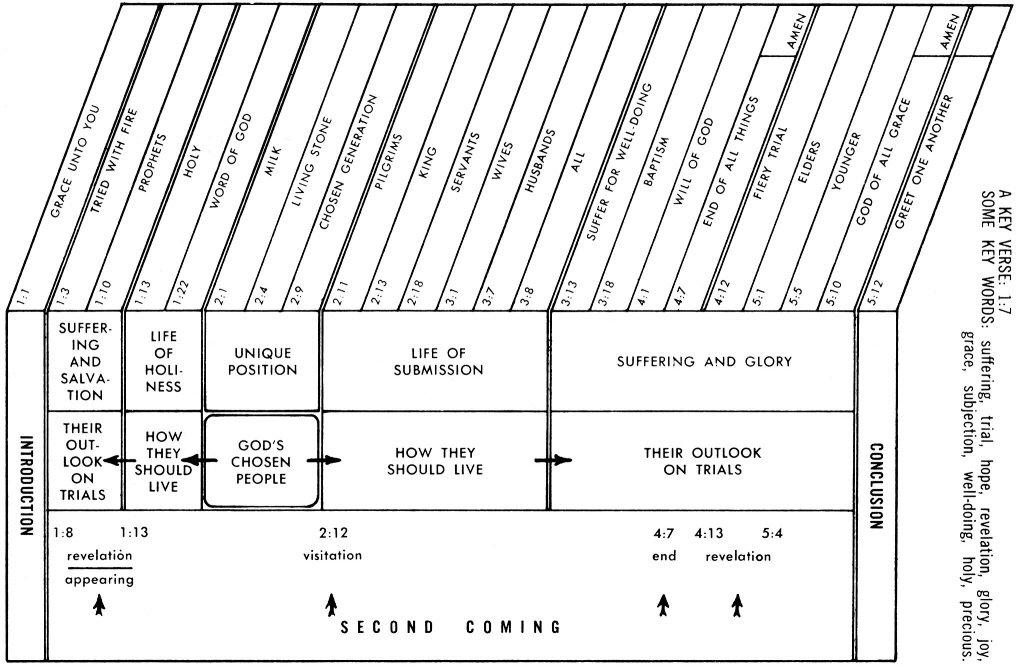
1 Peter: Trials, Holy Living & The Lord's Coming
Click chart to enlarge
Chart from Jensen's Survey of the NT - used by permission
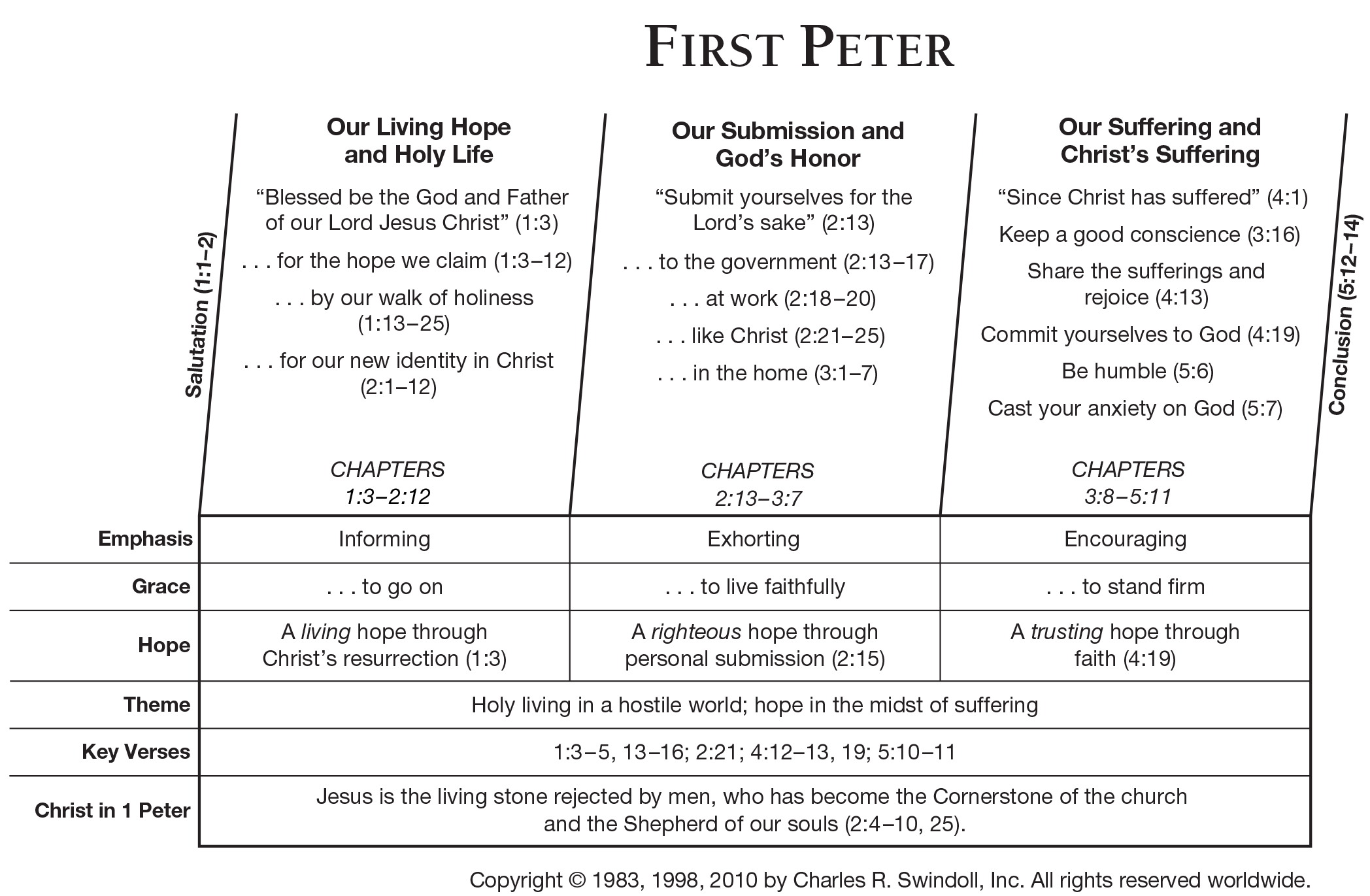
See Another Chart from Charles Swindoll
Source: Borrow Ryrie Study Bible
Click to enlarge
| Salvation of the Believer 1 Pe 1:1-2:12 |
Submission of the Believer 1 Pe 2:13-3:12 |
Suffering of the Believer 1 Pe 3:13-5:14 |
||||||||
| Salvation 1Pe 1:1-1:12 |
Sanctification 1Pe 1:13-2:12 |
Submit to Government 1Pe 2:13-17 |
Submit in Business 1Pe 2:18-25 |
Submit in Marriage 1Pe 3:1-8 |
Submit in all of life 1Pe 3:9-12 |
Conduct in Suffering 1Pe 3:13-17 |
Christ's Example of Suffering 1Pe 3:18-4:6 |
Commands in Suffering 1Pe 4:7-19 |
Minister in Suffering 1Pe 5:1-14 |
|
| Belief of Christians | Behavior of Christians | Buffeting of Christians | ||||||||
| Holiness | Harmony | Humility | ||||||||
|
Adapted from Bruce Wilkinson and Kenneth Boa's Talk Thru the Bible (borrow) |
||||||||||
1 Peter 3:18 For Christ also died for sins once for all, the just for the unjust, so that He might bring us to God, having been put to death in the flesh, but made alive in the spirit; (NASB: Lockman)
Greek: hoti kai Christos hapax peri hamartion epathen, (3SAAI) dikaios huper adikon, hina humas prosagage (3SAAS) to Theo, thanatotheis (5772) men sarki zoopoietheis (APPMSN) de pneumati;
Amplified: For Christ [the Messiah Himself] died for sins once for all, the Righteous for the unrighteous (the Just for the unjust, the Innocent for the guilty), that He might bring us to God. In His human body He was put to death, but He was made alive in the spirit, (Amplified Bible - Lockman)
KJV: For Christ also hath once suffered for sins, the just for the unjust, that he might bring us to God, being put to death in the flesh, but quickened by the Spirit
NLT: Christ also suffered when he died for our sins once for all time. He never sinned, but he died for sinners that he might bring us safely home to God. He suffered physical death, but he was raised to life in the Spirit. (NLT - Tyndale House)
Phillips: Remember that Christ the just suffered for us the unjust, to bring us to God. That meant the death of his body, but he came to life again in the spirit. (Phillips: Touchstone)
Wuest: Because Christ also died once for all in relation to sins, a just One on behalf of unjust ones, in order that He might provide you with an entree into the presence of God, having in fact been put to death with respect to the flesh [His human body], but made alive with respect to the spirit [His human spirit],
Young's Literal: because also Christ once for sin did suffer -- righteous for unrighteous -- that he might lead us to God, having been put to death indeed, in the flesh, and having been made alive in the spirit,
- Disclaimer - 1 Peter 3:18-22 are passages which are notoriously difficult to interpret and are reminiscent of Peter's statement about Paul's writings (2Pe 3:16).
- J. M. E. Ross writes that 1 Peter 3:18 is "one of the shortest and simplest, and yet one of the richest summaries given in the NT of the meaning of the Cross of Jesus
FOR CHRIST ALSO DIED (suffered) FOR SINS ONCE FOR ALL: hoti kai Christos hapax peri hamartion epathen (3SAAI):
- 1 Peter 2:21, 22,23, 24; 4:1; Isa 53:4, 5, 6; Ro 5:6, 7, 8; 8:3; 2Cor 5:21; Gal 1:4; 3:13; Titus 2:14; Heb 9:26,28
- 1 Peter 3 Resources - Multiple Sermons and Commentaries
For (3754) (hoti) means because, since. For shows us that Peter is beginning to explain why it is sometimes God's will for us to suffer for doing what is right as he has just discussed. He wants to remind them not to be surprised nor discouraged by suffering. Peter offers encouragement to his suffering readers because any suffering they might endure for Christ pales in comparison to His glorious suffering in our place, which is similar to what the writer of Hebrews said to his suffering Jewish audience...
You have not yet resisted to the point of shedding blood in your striving against sin (See note Hebrews 12:4)
So although most believers will not be martyred, they will be called to suffer for Christ and can take heart that even as He triumphed over the suffering of the Cross, they too will eventually triumph over whatever suffering they might be enduring for His Name.
As Greek scholar A T Robertson says "The example of Christ should stir us to patient endurance."
Wuest adds that Peter is encouraging his readers "in their sufferings which they incurred by the doing of good, for Christ’s example made it clear to them that they also would receive blessing and reward for suffering when doing good. The word for is the translation of a Greek conjunction which means because. The resurrection of Christ and His consequent glorification in view of His suffering for sinners are presented as proof of the fact that suffering for well-doing on the part of Christians is also followed by blessing and reward in their lives. (Wuest, K. S. Wuest's Word Studies from the Greek New Testament: Eerdmans)
Peter is saying in essence
Yes you are suffering but He suffered also. So don't lose hope. Let the truth that follows about the suffering of Christ serve to encourage you.
He who was perfect Righteousness willingly suffered for totally unrighteous men. Obviously, believers can never suffer the way He did (for His was redemptive suffering), but we can suffer for righteousness because He suffered and brought us into the kingdom of light which automatically puts the believer in contact with the kingdom of darkness. Remember that Peter's intent in this section is to help believers arm themselves (1Pe 4:1) with the faith to suffer for the sake of Christ and His kingdom.
Many of those even in evangelical churches in America do not realize that suffering is the norm for believers in many (probably most) places of the world. Christianity in America as we enter the new Millennium is the exception not the rule. For example, evangelical missionaries entered Cambodia in the 1920's but were expelled in 1965 at which time there were by best estimates only about 600 believers. However from 1965-1975 civil war ravaged Cambodia and yet during that time the Christian population soared to an estimated 90,000, clearly indicative of the power of the Gospel of Jesus Christ to spread and convert the lost. It was an amazing work of God. But when the Khmer Rouge took control and Pol Pot unleashed his maniacal fury on the nation, most of the believers in Christ were either martyred or fled the country. Surely the truths of Peter's first epistle helped them arm themselves for suffering even as their Lord suffered (1Pe 4:1)
Died (3958) (pascho) describes in its essence what one experiences or undergoes and virtually always refers to a bad sense. It should be noted however that pascho suffered is not in the best Greek texts, which instead have the verb apothnesko or died. The thought the same in either case because Christ’s death obviously involved suffering.
For (peri) sins - Literally reads concerning sins (see similar use in Hebrews 5:3 [note]) because the preposition peri means with regard to, with reference to, in relation to.
Sins (266) (hamartia) originally conveyed the idea of missing the mark as when hunting with a bow and arrow then missing or falling short of any goal, standard, or purpose.
Ray Stedman has an intriguing description of sin as self-centeredness and it's companions a sense of guilt and of fear. Stedman begins by asking "What is sin? Well, basically and fundamentally, sin is self-centeredness, that's all. We commit sins because we are thinking of ourselves, loving ourselves, indulging ourselves, looking out for ourselves, taking care that no one get ahead of us. That is the essence of sin -- self-centeredness. We are all victims of it. There is not one of us who does not struggle in this area. We find ourselves trapped in it constantly. That is the curse which hangs over our whole human race. We were made by God to be vessels to convey his outgoing love, to reach out with it to everyone around us. Somehow that has become twisted, so that now -- instead of reaching out -- we reach in, and we love ourselves first." And sin always produces guilt. Guilt is dislike of ourselves. We do not like the fact that we hurt others -- and we know we do. We feel responsible because we see the damage we do in other people's lives by our self-centeredness, and we feel guilty about it. We learn to hate ourselves to a considerable degree. That is why psychologists say that the great problem humanity wrestles with is self-hatred. Carl Menninger wrote a book, Man Against Himself, in which he documents that this is what we do. We hate ourselves. We do not like ourselves. We lose our self-respect. That is guilt. Guilt is always accompanied by fear, because fear is self-distrust. Fear is feeling unable to handle life anymore, being aware that there are forces and powers we are unable to control, and which eventually are going to confront us. We are not able to handle them, and so we run from them. Even in the Garden of Eden, as soon as Adam and Eve sinned they felt guilty, and they hid in fear. It has been the history of the race ever since. Fear looms up, that uncertainty about the future, and we become fearful, timid people, afraid of what will happen next. We are walking on eggs all the time, afraid of being accepted or rejected, afraid of what people will do to us -- and especially, finally, afraid of what God is going to do to us. That is an inner torment the like of which there is no equal. (Mark 1:1-8 The Place To Begin)
Once for all (530) (hapax compare ephapax) means of perpetual validity, not requiring repetition.
Spurgeon...
One thing I know: Christ thinks more of our sins than he does of our righteousness, for He gave himself for our sins. I never heard that he gave Himself for our righteousness.
No soul ever ate a morsel more dainty than this one—substitution. I do think that this is the grandest truth in heaven and earth—Jesus Christ the just one died for the unjust, that He might bring us to God. It is meat to my soul. I can feed on it every day, and all the day.
Christ suffered for doing what is right. He is our example (1Peter 2:21) and we are to follow closely in His steps. Peter emphasizes Christ's example, because Peter learned (denying Him 3x when faced with the possibility of suffering for His Name's sake) that keeping a good conscience (1Peter 3:16) and suffering even though one does what is right (1Peter 3:17) is not something which frail, sinful flesh can accomplish in its own strength but can only be accomplished in Christ's strength (filled with, controlled by, empowered by His Spirit, see Acts 1:8, 2:2ff, Ephesians 5:18 [note]).
And Peter a Spirit transformed and controlled man practiced what he is preaching in this section, willingly suffering for Christ and not shrinking back as summarized in passages from Dr Luke's record...
And when they had summoned them, they commanded them not to speak or teach at all in the name of Jesus. But Peter and John answered and said to them, "Whether it is right in the sight of God to give heed to you rather than to God, you be the judge for we cannot stop speaking what we have seen and heard." (Acts 4:18-20)
But an angel of the Lord during the night opened the gates of the prison, and taking them out he said, "Go your way, stand and speak to the people in the temple the whole message of this Life." (Acs 5:19,20)
"We (Jewish rulers, the Council, the Sanhedrin) gave you strict orders not to continue teaching in this name, and behold, you have filled Jerusalem with your teaching, and intend to bring this man's blood upon us." But Peter and the apostles answered and said, "We must obey God rather than men. (Acts 5:28, 29)
And they took his advice; and after calling the apostles in, they flogged them and ordered them to speak no more in the name of Jesus, and then released them. So they went on their way from the presence of the Council, rejoicing that they had been considered worthy to suffer shame for His name. (Acts 5:40, 41)
And in the end as indicated by the traditional account Peter apparently received his desire to be crucified upside down for His Lord. In short, Peter is fully qualified to speak about suffering and enduring for His Name's sake!
As alluded to above, it is notable how completely Peter's heart had changed after He received the Holy Spirit on the Day of Pentecost. The old Peter filled with a very different spirit strongly objected to the idea that Christ might have to suffer
And Peter took Him aside and began to rebuke Him, saying, "God forbid it, Lord! This shall never happen to You." But He turned and said to Peter, "Get behind Me, Satan! You are a stumbling block to Me; for you are not setting your mind on God's interests, but man's." (Mt 16:22, 23)!
Now Peter was sitting outside in the courtyard, and a certain servant-girl came to him and said, "You too were with Jesus the Galilean." But he denied it before them all, saying, "I do not know what you are talking about." (Mt 26:69, 70)
What a difference a Day made
And they were all filled with the Holy Spirit and began to speak with other tongues, as the Spirit was giving them utterance. (Acts 2:4).
And beloved we too must yield to the Spirit's Who will enable us to suffer for His sake as more than conquerors.
THE JUST FOR THE UNJUST IN ORDER THAT HE MIGHT BRING US TO GOD: peri hamartion dikaios huper (instead of, as substitute for) adikon hina humas prosagage (3SAAS) to theo:
- Zechariah 9:9; Mt 27:19,24; Acts 3:14; 22:14; Js 5:6; 1 John 1:9
- Ephesians 2:16, 17, 18
- Ro 1:4; 8:11
- 1 Peter 3 Resources - Multiple Sermons and Commentaries
THE GREAT
EXCHANGE
Just (1342)(dikaios from dike = right, just) defines that which is in accordance with high standards of rectitude. It is that which is in right relation to another and so in reference to persons defines the one who is morally and ethically righteous, upright or just
Unjust (94) ( adikos compare adikia from a = without + díke = justice) means falling short of the righteousness required by divine laws.
In order that (2443) (hina) introduces the purpose for which the perfect Righteous One suffered and died for unrighteous sinners.
Bring us to (4317) (prosago from pros = toward, facing + ago = to go) is used of a person who brings another into the presence of a third party. (Click study of related noun prosagoge) describes someone’s being introduced or given access to another. In classical Greek the noun form prosagoge refers to the one making the introduction. In ancient courts certain officials controlled access to the king. They verified someone’s right to see him and then introduced that person to the monarch. Christ now performs that function for believers. He opened the way of access to God.
Prosago - 4x in 4v - Translated - approaching(1), bring(2), brought(2).
Luke 9:41 And Jesus answered and said, "You unbelieving and perverted generation, how long shall I be with you and put up with you? Bring your son here."
Acts 16:20 and when they had brought them to the chief magistrates, they said, "These men are throwing our city into confusion, being Jews,
Acts 27:27 But when the fourteenth night came, as we were being driven about in the Adriatic Sea, about midnight the sailors began to surmise that they were approaching some land.
1 Peter 3:18 For Christ also died for sins once for all, the just for the unjust, so that He might bring us to God, having been put to death in the flesh, but made alive in the spirit;
Prosago is used repeatedly in the Septuagint (LXX) for the sin offering. For example Moses records...
Leviticus 5:8 'And he shall bring (prosago) them to the priest, who shall offer first that which is for the sin offering and shall nip its head at the front of its neck, but he shall not sever it.
This verb prosago conveys several pictures, all illustrating some aspect of this profound truth...
(1) Presentation of a sacrifice for reconciliation with God.
(2) The entry of the Levitical high priest into the Holy of Holies on the Day of Atonement.
(3). The presentation before the Judge in a court of law.
(4). The bringing in of an individual for an audience with a King.
(5). The bringing in of the initiate before the savior-god in the mystery cults (truth always has a counterfeit!).
The meaning here is the aim of Christ's work to bring about man's reconciliation with God so that the cleansed sinner can be brought into the presence of the King by Christ, our Redeemer.
To bring us to God was Christ's mission
For even the Son of Man did not come to be served, but to serve, and to give His life a ransom for many." (Mk 10:45).
Jesus was always a man on the Mission, declaring to His disciples who were worried about physical food..
My food is to do the will of Him who sent Me, and to accomplish His work. (Jn 4:34).
Later just before His suffering and crucifixion He once again reaffirmed His mission in His prayer to His Father declaring...
I glorified Thee on the earth, having accomplished the work which Thou hast given Me to do. (John 17:4)
The divine tearing of the temple veil from top to bottom symbolically demonstrated the reality that He had opened the way to God. Matthew recorded this momentous event writing that just as Jesus cried out and yielded up His Spirit...
behold, the veil of the temple was torn in two from top to bottom, and the earth shook; and the rocks were split (Mt 27:51)
The writer of Hebrews exampled that the temple veil tearing was but a picture of the tearing of our Lord's writing that now believers in His sacrificial, fully atoning death on the Cross...
have confidence to enter the holy place by the blood of Jesus, by a new and living way which He inaugurated for us through the veil (of the Temple, separating man from the presence of God in the Holy of holies), that is, His flesh (alluding to crucifixion) and since we have a great priest over the house of God (see notes Hebrews 10:19; 20; 21)
Because of the work of Christ on the cross He became our "Forerunner" and High Priest
This hope we have as an anchor of the soul, a hope both sure and steadfast and one which enters within the veil, where Jesus has entered as a forerunner for us, having become a high priest forever according to the order of Melchizedek. (See notes Hebrews 6:19; 20)
As a result of His death in our place, believers have been "brought to God" and have continual access to the Throne room of God, Paul explaining that...
through Him we both (believing Jews and Gentiles) have our access in one Spirit to the Father. (See note Ephesians 2:18)
in whom we have boldness and confident access through faith in Him. (See note Ephesians 3:12)
In Romans Paul explains that because of His death, burial and resurrection, we are how justified by faith, have peace with God through our Lord Jesus Christ...
through Whom also we have obtained our introduction by faith into this grace in which we stand; and we exult in hope of the glory of God. (See note Romans 5:2)
NT believers may now come boldly to His throne...
For we do not have a high priest who cannot sympathize with our weaknesses, but One who has been tempted in all things as we are, yet without sin. Let us therefore draw near with confidence to the throne of grace, that we may receive mercy and may find grace to help in time of need. (See notes Hebrews 4:15; 16)
In summary, 1 Peter 3:18 is one of the riches summaries in the Scriptures of the meaning of the Cross of Christ.
HAVING BEEN PUT TO DEATH IN THE FLESH BUT MADE ALIVE IN THE SPIRIT: thanatotheis (APPMSN) men sarki zoopoietheis (APPMSN) de pneumati
- 1 Peter 4:1; Da 9:26; Ro 4:25; 2 Cor 1:24; 13:4; Col 1:21,22
- Ro 1:4; 8:11
- 1 Peter 3 Resources - Multiple Sermons and Commentaries
Put to death (2289) (thanatoo) means to kill or cause to be put to death and leaves no doubt that on the Cross Jesus’ physical life ceased. The passive voice (speaks of action that comes to the subject from an outside source) indicates the total culpability of His executioners and stresses what man did to Him.
Flesh (4561) (sarx) refers to Jesus' physical body, His "flesh and blood" body.
In His flesh points out that He was no docetic phantom (Docetists deny that the incarnation and the true human life of Christ ever took place) Who only appeared to have a human body, as "flesh" refers to the humanity Christ assumed at the incarnation (Jn 1:14, 1Ti 3:16). Used without an article "flesh" is qualitative and characterizes Him as a human being, a man among men here on earth.
Made alive (2227) (zoopoieo from zoos = alive + poieo = to make) literally means to make alive. This verb is in the passive voice which indicates that there is operation of power from an outside source, the Spirit of...
But if the Spirit of Him Who raised Jesus from the dead dwells in you, He who raised Christ Jesus from the dead will also give life to your mortal bodies through His Spirit who indwells you (See note Romans 8:11)
In the spirit (4151) (pneuma) is a reference to Jesus’ eternal inner person. Christ's eternal spirit has always been alive, although His earthly body was then dead; but three days later His body was resurrected in a transformed and eternal state.
John MacArthur writes that...
The phrase made alive in the spirit refers to the life of Jesus' spirit--not to the Holy Spirit. There's no article in the Greek text indicates that Peter was referring to the Holy Spirit. Rather, he seems to be contrasting what happened to the flesh (or body) of Jesus with what happened to His spirit. His spirit was alive but His flesh was dead.
Some think made alive in the spirit refers to Christ's resurrection, but that would necessitate a statement like, He was put to death in the flesh but made alive in the flesh. The resurrection was a spiritual and physical occurrence. Thus Peter's point has to be that though Christ was physically dead, His spirit was still alive.
Though in spirit Christ was alive, He did experience spiritual death--not cessation of existence but separation from God. On the cross He said
My God, My God, why hast Thou forsaken Me? (Mt 27:46)
That shows the separation He temporarily experienced from the Father when He was made sin for us (2Cor. 5:21). Similarly, unbelievers experience spiritual death (separation from God) in this life and eternal death in the next, but they never cease to exist.
The separation between Christ and the Father was over quickly, for shortly after our Lord's lament He said,
Father, into Thy hands I commit My spirit (Luke 23:46)
That shows His spirit was alive again--no longer separated from God--and could be committed to the Father. (See full message Triumph of Christ's Suffering -2)
C H Spurgeon wrote...
One thing I know: Christ thinks more of our sins than he does of our righteousness, for he gave himself for our sins. I never heard that he gave himself for our righteousness.
---
No soul ever ate a morsel more dainty than this one—substitution. I do think that this is the grandest truth in heaven and earth—Jesus Christ the just one died for the unjust, that he might bring us to God. It is meat to my soul. I can feed on it every day, and all the day.
---
"The just for the unjust" I can understand. But the "just dying for the just" would be a double injustice—an injustice that the just should be punished at all, and another injustice that the just should be punished for them. Oh, no! If Christ died, it must be because there was a penalty to be paid for sin committed. Hence he must have died for those who had committed the sin.
The Judge's Compassion - During his years as mayor of New York City, Fiorello La Guardia sometimes presided as judge in a night court. In one case, a man was found guilty of stealing a loaf of bread. He pleaded that he had committed that theft to feed his starving family. "The law is the law," La Guardia declared. "I must therefore fine you $10." When the man sadly confessed that he had no money, the judge took $10 out of his wallet and paid the fine. He also asked each person in the courtroom to contribute 50 cents to help the man.
At the heart of the gospel stands the cross of Jesus Christ. Its message is so plain that even a child can understand it: Jesus took my place and died instead of me. But its truth is so awesome that the wisest of humans can't fully fathom its meaning. The Bible says, "Christ also suffered once for sins, the just for the unjust, that He might bring us to God" (1Peter 3:18). It also says, "When we were still without strength, in due time Christ died for the ungodly" (Ro 5:6).
As we look at the judge's compassion, we catch at least a glimpse of God's measureless grace. The demands of the law were satisfied. The judge himself paid the fine. The lawbreaker was set free and even blessed with an undeserved gift. What a profound picture of our Savior! —Vernon C Grounds (Our Daily Bread, Copyright RBC Ministries, Grand Rapids, MI. Reprinted by permission. All rights reserved)
There's a wideness in God's mercy
Like the wideness of the sea;
There's a kindness in His justice,
Which is more than liberty. —FaberThe way to face Christ as Judge
is to know Him as your Savior.
'I Belong There!' - A missionary was speaking to a remote tribe of people who had never heard about the life and ministry of Jesus. Seated in the front row, listening intently to all the missionary had to say, was the chief of the tribe.
As the story of Jesus came to its climax and the chief heard how Christ was cruelly crucified, he could restrain himself no longer. He jumped up and cried, "Stop! Take Him down from the cross! I belong there, not Him!" He had grasped the meaning of the gospel; he understood that he was a sinner, and that Christ was the sinless One.
As you consider that scene of the Son of God hanging on the cross in agony, with blood flowing from His wounds, can you say from your heart, "I belong there!" Then go one step further and put your trust in Him as your Savior, so that you can say with Paul, "I have been crucified with Christ; it is no longer I who live, but Christ lives in me" (Gal. 2:20). Jesus took our place and died in our stead. Because He bore our sins, He has opened the way for us to be brought into fellowship with the Father. If you identify yourself with Christ and believe that He died for you, God will identify you with Christ and give you His righteousness.(Our Daily Bread, Copyright RBC Ministries, Grand Rapids, MI. Reprinted by permission. All rights reserved)
Can you say, "I belong there!"—Henry G. Bosch
When Jesus died upon the cross,
He took our sin and shame;
He offers us His righteousness,
A gift for us to claim. —Sper
Jesus took my place on the cross
to give me a place in heaven.
1 Peter 3:19 in which also He went and made proclamation to the spirits now in prison, (NASB: Lockman)
Greek: en o kai tois en phulake pneumasin poreutheis (APPMSN) ekeruxen (3SAAI),
Amplified: In which He went and preached to the spirits in prison, (Amplified Bible - Lockman)
NLT: So he went and preached to the spirits in prison-- (NLT - Tyndale House)
Phillips: It was in the spirit that he went and preached to the imprisoned souls (Phillips: Touchstone)
Wuest: by which [human spirit] also having proceeded, He made a proclamation to the imprisoned spirits
Young's Literal: in which also to the spirits in prison having gone he did preach,
IN WHICH ALSO HE WENT: en o kai tois en phulake pneumasin poreutheis (APPMSN) ekeruxen (3SAAI):
- 1 Peter 1:11,12; 4:6; Neh 9:30; Rev 19:10
- 1 Peter 3 Resources - Multiple Sermons and Commentaries
In which - This phrase points to what happened to Christ's living spirit. While Christ's body lay in the tomb, He went in His spirit to another place.
Went (4198) (poreúomai from poros = a passing or passage) means to go from one place to another and is used in 1Peter 3:22 to describe Christ's ascension. Unlike the spirits of the unrighteous, who immediately experience the wrath of God after death, the spirit of Christ was able to accomplish God's perfect purpose.
This passage has been subject to many interpretations. Some say Peter referred to the descent of Christ into Hades (Sheol is the OT counterpart) between His death and resurrection to offer people who lived before the Flood a second chance for salvation which is clearly without scriptural support. For example Heb 9:27 says
And inasmuch as it is appointed for men to die once (Once for all time to die. No reincarnation) and after this (after this one death) comes judgment
Luke similarly records Abraham's words to the rich man in the "hot side" of Hades...
And besides all this, between us and you there is a great chasm fixed, in order that those who wish to come over from here to you may not be able, and that none may cross over from there to us. (Lk 16:26).
Others have said this passage refers to Christ’s descent into hell after His crucifixion to proclaim His victory to the imprisoned fallen angels referred to in 2Peter 2:4; 5 (notes), equating them with “the sons of God” (Ge 6:1, 2, cp Job 1:6, 2:1, Jude 1:6,7), an interpretation that a number of conservative commentators do not agree with.
Others say that Christ descended into Hades and made proclamation to all of disobedient mankind at the time of the flood. But if that is so why would these men and women be singled out compared for example to those of Sodom & Gomorrah?
Some such as Wayne Grudem and D. Edmond Hiebert (both respected Bible scholars) feel that Christ did not descend into Hades at all after His crucifixion.
Grudem: Did Christ Descend Into Hell? It is sometimes argued that Christ descended into hell after he died. The phrase “he descended into hell” does not occur in the Bible. But the widely used Apostles’ Creed reads, “was crucified, dead, and buried, he descended into hell; the third day he rose again from the dead.”
(Commenting on 1Pet 3:18-20 Grudem writes) Does this refer to Christ preaching in hell? Some have taken “he went and preached to the spirits in prison” to mean that Christ went into hell and preached to the spirits who were there—either p 590 proclaiming the gospel and offering a second chance to repent, or just proclaiming that he had triumphed over them and that they were eternally condemned. But these interpretations fail to explain adequately either the passage itself or its setting in this context. Peter does not say that Christ preached to spirits generally, but only to those “who formerly did not obey … during the building of the ark.” Such a limited audience—those who disobeyed during the building of the ark—would be a strange group for Christ to travel to hell and preach to. If Christ proclaimed his triumph, why only to these sinners and not to all? And if he offered a second chance for salvation, why only to these sinners and not to all? Even more difficult for this view is the fact that Scripture elsewhere indicates that there is no opportunity for repentance after death (Luke 16:26; Heb 10:26–27). Moreover, the context of 1Peter 3 makes “preaching in hell” unlikely. Peter is encouraging his readers to witness boldly to hostile unbelievers around them. He just told them to “always be prepared to give an answer to everyone who asks you” (1Peter 3:15NIV). This evangelistic motif would lose its urgency if Peter were teaching a second chance for salvation after death. And it would not fit at all with a “preaching” of condemnation.
Does it refer to Christ preaching to fallen angels? To give a better explanation for these difficulties, several commentators have proposed taking “spirits in prison” to mean demonic spirits, the spirits of fallen angels, and have said that Christ proclaimed condemnation to these demons. This (it is claimed) would comfort Peter’s readers by showing them that the demonic forces oppressing them would also be defeated by Christ. However, Peter’s readers would have to go through an incredibly complicated reasoning process to draw this conclusion when Peter does not explicitly teach it. They would have to reason from (1) some demons who sinned long ago were condemned, to (2) other demons are now inciting your human persecutors, to (3) those demons will likewise be condemned someday, to (4) therefore your persecutors will finally be judged as well. Finally Peter’s readers would get to Peter’s point: (5) Therefore don’t fear your persecutors. Those who hold this “preaching to fallen angels” view must assume that Peter’s readers would “read between the lines” and conclude all this (points 2–5) from the simple statement that Christ “preached to the spirits in prison, who formerly did not obey” (1Peter 3:19–20). But does it not seem too farfetched to say that Peter knew his readers would read all this into the text? Moreover, Peter emphasizes hostile persons not demons, in the context (1 Peter 3:14, 16). And where would Peter’s readers get the idea that angels sinned “during the building of the ark”? There is nothing of that in the Genesis story about the building of the ark. And (in spite of what some have claimed), if we look at all the traditions of Jewish interpretation of the flood story, we find no mention of angels sinning specifically “during the building of the ark.” Therefore the view that Peter is speaking of Christ’s proclamation of judgment to fallen angels is really not persuasive either.
p 591 Does it refer to Christ’s Proclaiming release to Old Testament saints?
Another explanation is that Christ, after his death, went and proclaimed release to Old Testament believers who had been unable to enter heaven until the completion of Christ’s redemptive work. But again we may question whether this view adequately accounts for what the text actually says. It does not say that Christ preached to those who were believers or faithful to God, but to those “who formerly did not obey—the emphasis is on their disobedience. Moreover, Peter does not specify Old Testament believers generally, but only those who were disobedient “in the days of Noah, during the building of the ark” (1Peter 3:20).
Finally, Scripture gives us no clear evidence to make us think that full access to the blessings of being in God’s presence in heaven were withheld from Old Testament believers when they died—indeed, several passages suggest that believers who died before Christ’s death did enter into the presence of God at once because their sins were forgiven by trusting in the Messiah who was to come (Gen. 5:24; 2Sam. 12:23; Ps 16:11; 17:15; 23:6; Eccl. 12:7; Matt. 22:31–32; Luke 16:22; Ro. 4:1–8; Heb. 11:5).
A more satisfying explanation. The most satisfactory explanation of 1Peter 3:19–20 seems rather to be one proposed (but not really defended) long ago by Augustine: the passage refers not to something Christ did between his death and resurrection, but to what he did “in the spiritual realm of existence” (or “through the Spirit”) at the time of Noah. When Noah was building the ark, Christ “in spirit” was preaching through Noah to the hostile unbelievers around him. This view gains support from two other statements of Peter. In 1Peter 1:11, he says that the “Spirit of Christ” was speaking in the Old Testament prophets. This suggests that Peter could readily have thought that the “Spirit of Christ” was speaking through Noah as well. Then in 2Peter 2:5, he calls Noah a “preacher of righteousness” (NIV), using the noun (kerux, G3061) that comes from the same root as the verb “preached” (Kerusso G3062) in 1Peter 3:19. So it seems likely that when Christ “preached to the spirits in prison” he did so through Noah in the days before the flood. The people to whom Christ preached through Noah were unbelievers on the earth at the time of Noah, but Peter calls them “spirits in prison” because they are now in the prison of hell—even though they were not just “spirits” but persons on earth when the preaching was done. (The NASB says Christ preached “to the spirits now in prison.”) We can speak the same way in English: “I knew President Clinton when he was a college student” is an appropriate statement, even though he was not president when he was in college. The sentence means, “I knew the man who is now President Clinton when he was still a student in college.” So “Christ preached to the spirits in prison” means “Christ preached to people who are now spirits in prison when they were still persons on earth.”30 (Systematic Theology) (See also Outlines of Grudem's Book and lectures corresponding to each chapter - these lectures are a great supplement of the written work - Online Messages - Grudem's Systematic Theology) see also Systematic Theology
In sum, 1Peter 3:19 is a very difficult and controversial passage and we should not break fellowship with someone who holds a different interpretation.
AND MADE PROCLAMATION: en o kai tois en phulake pneumasin poreutheis (APPMSN) ekeruxen (3SAAI):
- 1 Peter 3 Resources - Multiple Sermons and Commentaries
Proclamation (2784) (kerusso) means to announce as a herald, to proclaim. In the ancient world, heralds would come to town as representatives of the rulers to make public announcements or precede generals and kings in the processions celebrating military triumphs, announcing victories won in battle. Kerusso is not the word Peter used with the meaning “to preach the Gospel” (1Pe 1:12, 1Pe 4:6)
Peter did not tell us what Jesus proclaimed, but if these were indeed demonic spirits, it could not be a message of redemption since angels cannot be saved (Heb 2:16-te note).
MacArthur explains that "Christ went to preach a triumphant sermon before His resurrection Sunday morning. The verb translated "made proclamation" (kerusso) refers to making a proclamation or announcing a triumph. In ancient times a herald would proceed generals and kings in the celebration of military victories, announcing to all the victories won in battle. That's what Jesus went to do--not to preach the gospel (euaggelizomai "to evangelize") but to announce His triumph over sin, death, hell, demons, and Satan. He didn't go to win souls but to proclaim victory to the enemy in spite of the unjust suffering they subjected Him to. (Ed note: I personally agree with Dr MacArthur but again would not break fellowship with you if you disagreed - see Wayne Grudem's note below.)
Ray Pritchard - I personally believe that Jesus preached to those demonic spirits and proclaimed his ultimate victory over them. To say that he “preached” to them does not mean that he offered salvation to them. Salvation is for humans, not for angels or demons. The verb “preached” means to make a public announcement. It’s what a herald would do when he went from city to city announcing the king’s decrees. I believe that Jesus, either between his death and resurrection or after his resurrection, proclaimed his victory to those demon spirits that rebelled so greatly against the Lord in Noah’s day. (See full message - 1 Peter 3:18-22 The Triumphant Christ)
TO THE SPIRITS NOW IN PRISON: en o kai tois en phulake pneumasin poreutheis (APPMSN) ekeruxen (3SAAI):
- Isa 42:7; 49:9; 61:1; Rev 20:7
- 1 Peter 3 Resources - Multiple Sermons and Commentaries
Prison (5438) (phulake from phulasso) (See word study of phulasso) describes the act of guarding and by metonymy the place where guarding is done.
One of my favorite uses of phulake is in the Septuagint (Lxx) translation of Pr 4:23 where "watch (present imperative) over your heart" in the Greek translation reads more like "keep (tereo) a guard (phulake) over your heart."
Phulake - 47x in 45v - NAS translates phulake - guard(1), imprisonment(1), imprisonments(2), prison(34), prisons(3), time of the night(1), watch(4).
Matt 5:25; 14:3, 10, 25; 18:30; 24:43; 25:36, 39, 43f; Mark 6:17, 27, 48; Luke 2:8; 3:20; 12:38, 58; 21:12; 22:33; 23:19, 25; John 3:24; Acts 5:19, 22, 25; 8:3; 12:4ff, 10, 17; 16:23f, 27, 37, 40; 22:4; 26:10; 2 Cor 6:5; 11:23; Heb 11:36; 1 Pet 3:19; Rev 2:10; 18:2; 20:7.
To the Spirits - MacArthur feels that this does not refer to human spirits (or Peter would have used the word psuche for souls). Instead Peter used pneuma, a word the New Testament never uses to refer to people except when qualified by a genitive (e.g., Hebrews 12:23 “the spirits of the righteous”). Peter uses "psuche" for "persons" in the next verse which clearly indicates human beings. It would seem unlikely for him to spirits (of men) here in verse 19 and then souls of Noah et al in verse 20.
Nevertheless, in fairness, it must be noted that there are at least 3 views regarding the identity of the spirits in this passage...
(1) The spirits are evil supernatural beings. The word “spirits” can certainly be used in this sense, both of angels (Heb 1:14; 12:9; Acts 23:8 9) and evil beings (Mk 1:23; Lk 10:20; Acts 19:15, 16). The story of the “fallen angels” who seduced mankind in the days before the flood (Gen 6:1, 2, 3, 4) was a popular one in New Testament times. Furthermore, the story of their being kept in prison until the day of judgment was well known (2Pet 2:4; Jude 1:6)
(2). Christ preached to the spirits of dead people, kept in the abode of the dead until the last judgment. More commonly we would speak of the “souls” of the dead, but the word “spirit” can be used in this sense (Nu 16:22; 27:16; Heb 12:23). The thought that they are in prison is found in early Christian writings. Because the contemporaries of Noah, who spurned God, were proverbial for extreme wickedness, we can readily understand that they represent the wicked in general.
(3). If Christ preached in the person of Noah, then spirits in prison describes the human beings who were disobedient during the building of the ark.
MacDonald writes that the verses 1Peter 3:19, 20...
constitute one of the most puzzling and intriguing texts in the NT. It has been made the pretext for such unbiblical doctrines as purgatory on the one hand and universal salvation on the other. However, among evangelical Christians, there are two commonly accepted interpretations.
According to the first, Christ went to Hades in spirit between His death and resurrection, and proclaimed the triumph of His mighty work on the cross. There is disagreement among proponents of this view as to whether the spirits in prison were believers, unbelievers, or both. (or whether they were not men at all but demonic spirits). But there is fairly general agreement that the Lord Jesus did not preach the gospel to them. That would involve the doctrine of a second chance which is nowhere taught in the Bible. Those who hold this view often link this passage with Ephesians 4:9 (see notes) where the Lord is described as descending “into the lower parts of the earth.” They cite this as added proof that He went to Hades in the disembodied state and heralded His victory at Calvary. They also cite the words of the Apostles’ Creed —“descended into hell.”
(Ed note: Those who hold this view include many of the "early church fathers", Henry Morris, John Macarthur, Wayne Barber, Kay Arthur -- although the latter 2 believe He preached after His resurrection and before His ascension to the Right hand of the Father, Warren Wiersbe [although he does not accept that the "sons of God" in Ge 6:2 as indicative of demonic spirits], College Press NIV Commentary, IVP NT Commentary on 1Peter by I. Howard Marshall and Kenneth Wuest)
The second interpretation is that Peter is describing what happened in the days of Noah. It was the spirit of Christ (cp 1:11) who preached through Noah to the unbelieving generation before the flood. They were not disembodied spirits at that time, but living men and women who rejected the warnings of Noah and were destroyed by the flood. So now they are spirits in the prison of Hades. (MacDonald, W & Farstad, A. Believer's Bible Commentary: Thomas Nelson)
(Ed note: Those who hold the second interpretation include Scofield, Ryrie, Puritan John Owen, MacDonald, Wayne Grudem, J. Vernon McGee, Augustine & many leaders of the Reformation, John Piper. Note that this interpretation hangs primarily on interpreting "spirits" as those of men rather than angelic...but the only place in NT where pneuma refers to spirits of men is Heb 12:23)
The Net Bible has the following comment on the phrase "and preached to the spirits in prison" writing that...
The meaning of this preaching and the spirits to whom he preached are much debated. It is commonly understood to be:
(1) Christ’s announcement of his victory over evil to the fallen angels who await judgment for their role in leading the Noahic generation into sin; this proclamation occurred sometime between Christ’s death and ascension; or
(2) Christ’s preaching of repentance through Noah to the unrighteous humans, now dead and confined in hell, who lived in the days of Noah. The latter is preferred because of the temporal indications in v20a and the wider argument of the book. These verses encourage Christians to stand for righteousness and try to influence their contemporaries for the gospel in spite of the suffering that may come to them. All who identify with them and their Savior will be saved from the coming judgment, just as in Noah’s day. (Ed Note: this is not a bad thought but the problem is that "spirits" almost always refers to supernatural spirits, including evil spirits in the NT and not men). (NET Bible)
Morris explains it this way...
While in Hades in the Spirit, He "preached"--that is, "proclaimed" His victory over death and Hades (Mt 16:18; Col 2:15; Rev 1:18; Lk 4:18). Note that "hell" in these verses is the Greek Hades, the great pit at the center of the earth where lost souls and many rebellious angels are confined. Before Christ's resurrection, the souls of believers were also resting there, but these "captives" were "delivered" by Christ when He rose from the dead (Eph 4:8, 9, 10) (Ed note: not everyone agrees with this interpretation). The Greek word for "preached" here is not the word for "preached the gospel" (euaggelizo) as in 1Pe 1:12,25; 4:6, but rather kerusso, which means "proclaimed" (Lk 12:3) or "published" (Lk 8:39). Christ was not giving a second chance, as it were, to those who had died in unbelief, for there is no second chance after death (Heb 9:27). Rather, He was proclaiming victory over Satan and his hosts. (Morris, Henry: Defenders Study Bible. World Publishing)
Regarding the spirits in prison Morris says that...
These "spirits in prison" almost certainly were the evil spirits who had sinned in the days of Noah by trying to corrupt and control all flesh (Ge 6:1, 2, 3, 4,12). Whenever the word "spirits" is used in the plural and not clearly indicated otherwise (as in Heb 12:23 and 1Co 14:32), it always refers to supernatural beings, or angels. In support of this meaning, note that there are thirty such occurrences in the New Testament, with only two, as noted above, referring to spirits of men. At least twenty-six of these thirty occurrences refer to evil spirits, which strongly indicates that to be the meaning here.
The "prison" where these evil spirits are confined is identified elsewhere by Peter as Tártaros, the Greek name translated "hell" in 2Pe 2:4. This is, evidently, a special compartment of Hades where these "angels that sinned" are confined in "chains of darkness, to be reserved unto judgment" (2Pe 2:4). They are also described in similar terms by Jude (Jude 6). (Morris, Henry: Defenders Study Bible. World Publishing)
Related Resource:
- Who were the spirits in prison?
- Where was Jesus for the three days between His death and resurrection
1 Peter 3:20 who once were disobedient, when the patience of God kept waiting in the days of Noah, during the construction of the ark, in which a few, that is, eight persons, were brought safely through the water. (NASB: Lockman)
Greek: apeithesasin (AAPMPD) pote hote apexedecheto e tou theou makrothumia en emerais Noe kataskeuazomenes (PPPFSG) kibotou, eis en oligoi, tout' estin (3SPAI) okto psuchai, diesothesan (3PAPI) di' hudatos
Amplified: [The souls of those] who long before in the days of Noah had been disobedient, when God’s patience waited during the building of the ark in which a few [people], actually eight in number, were saved through water. (Amplified Bible - Lockman)
NLT: those who disobeyed God long ago when God waited patiently while Noah was building his boat. Only eight people were saved from drowning in that terrible flood. (NLT - Tyndale House)
Phillips: of those who had been disobedient in the days of Noah - the days of God's great patience during the period of the building of the ark, in which eventually only eight souls were saved in the flood. (Phillips: Touchstone)
Wuest: who were at one time rebels when the long-suffering of God waited out to the end in the days of Noah while the ark was being made ready; in which eight souls were brought safely through [the time of the deluge] by means of the intermediate agency of water,
Young's Literal: who sometime disbelieved, when once the long-suffering of God did wait, in days of Noah -- an ark being preparing -- in which few, that is, eight souls, were saved through water;
WHO ONCE WERE DISOBEDIENT: apeithesasin (AAPMPD) pote:
- Ge 6:3,5,13
- 1 Peter 3 Resources - Multiple Sermons and Commentaries
Disobedient (544)(apeitheo [word study] from a = without + peítho = persuade) literally describes one who refuses to be persuaded and who disbelieves willfully and perversely. Apeitheo in the present context means that these individuals possessed an attitude of unbelief because they deliberately disobeyed, consciously resisted and rebelled against authority and finally manifested an obstinate rejection of the will (truth) of God.
Apeitheo means not to allow oneself to be persuaded; not to comply with and to refuse or withhold belief (in the truth, but elsewhere in Christ, in the gospel). Apeitheo speaks of a stubborn, stiff-necked attitude. It speaks of disbelief manifesting itself in disobedience. It is opposed to pisteuo, the verb translated "believe".
Apeitheo - 14x in 14v - John 3:36; Acts 14:2; 19:9; Rom 2:8; 10:21; 11:30f; 15:31; Heb 3:18; 11:31; 1 Pet 2:8; 3:1, 20; 4:17. Translated - disbelieved(1), disobedient(10), do not obey(1), obey(2).
Marvin Vincent in discussing apeitheo in John 3:36 writes that..
Disbelief is regarded in its active manifestation, disobedience. The verb peitho means to persuade, to cause belief, to induce one to do something by persuading, and so runs into the meaning of to obey, properly as the result of persuasion...Obedience, however, includes faith. (Ed Note: See also the discussion of the phrase "obedience of faith" at Ro 1:5-notes)." (Vincent, M. R. Word studies in the New Testament Vol. 2, Page 1-109)
From the preceding comments, it should not surprise you to discover that in the New Testament the word group translated disobey, disobedience, etc (apeitheo and related words) does not stand in contrast with obedience but in contrast with faith!
Who are "the spirits in prison"? See the preceding verse for the differences of opinion. We know they "once were disobedient" and that they lived during the days of Noah.
I favor John MacArthur's assessment...
Peter further identifies the demons to whom Christ preached His triumphant sermon as those who once were disobedient. As the reason that God bound them permanently in the place of imprisonment, that disobedience is specifically related to something that happened in the time of Noah. What was that disobedience that had such severe and permanent results? Peter’s readers must have been familiar with the specific sin committed by the imprisoned demons because the apostle did not elaborate on it. (MacArthur, J. 1 Peter. Chicago: Moody Press)
WHEN THE PATIENCE OF GOD KEPT WAITING IN THE DAYS OF NOAH DURING THE CONSTRUCTION OF THE ARK IN WHICH A FEW, THAT IS, EIGHT PERSONS WERE BROUGHT SAFELY THROUGH THE WATER: hote apexedecheto e tou theou makrothumia en hemerais Noe kataskeuazomenes (PPPFSG) kibotou, eis en oligoi, tout' estin (3SPAI) okto psuchai, diesothesan (3PAPI) di' hudatos:
- Isa 30:18; Ro 2:4,5; 9:22; 2Pe 3:15
- days: Mt 24:37, 38, 39; Lk 17:26, 27, 28, 29, 30
- Ge 6:14-22; Heb 11:7
- Ge 7:1-7,13,23; 8:1,18; Mt 7:14; Lk 12:32; 13:24,25; 2Pe 2:5
- Ge 7:17, 18, 19, 20, 21, 22, 23; 2Cor 2:15,16; Eph 5:26
- 1 Peter 3 Resources - Multiple Sermons and Commentaries

Patience is a "long fuse" before the bomb goes off! God has a long fuse! Does that describe you beloved? If not then cultivate the fruit of the Spirit which includes a long fuse (Gal 5:22-23). You cannot "lengthen" the fuse (so to speak) by any fleshly means (cf Jn 6:63).
Patience (3115)(makrothumia from makros = long, distant, far off, large + thumos = temper, passion, emotion or thumoomai = to be furious or burn with intense anger) is literally long-temper (as opposed to "short tempered), a long holding out of the mind before it gives room to action or passion. It describes a state of emotional calm or quietness in the face of provocation, misfortune or unfavorable circumstances.
Makrothumia is the capacity to be wronged and not retaliate. It is the ability to hold one's feeling in restraint or bear up under the oversights and wrongs afflicted by others without retaliating. It is manifest by the quality of forbearance under provocation. Here it describes God's patience toward sinful men (see also note Romans 2:4).
Noah preached righteousness to his generation (see notes 2 Peter 2:4; 2:5). God was longsuffering, but only 8 heeded the Truth and only 8 were spared in the ark when the flood came.
Related Resources:
Kept waiting (553)(apekdechomai from apó = intensifier + ekdechomai = expect, look for <> from ek = out + dechomai = receive kindly, accept deliberately and readily) means waiting in great anticipation but with patience.
Construction (2680)(kataskeuazo from kata = intensifies the meaning of + skeuazo = prepare, make ready) means to prepare, make ready, put in a state of readiness (Mk 1:2). It is used of persons who are mentally and spiritually prepared - "make ready a people prepared for the Lord." (Lk 1:17). To build, construct, erect, create (Heb 3:3-4, Heb 11:7, 1 Pe 3:20). To furnish or equip (Heb 9:2, 6). Kataskeuazo means to make, construct or erect with idea of adorning and equipping with all things necessary.
Related Resources:
- What are some of the most common questions about Noah's Ark?
- Were there dinosaurs on Noah’s ark?
- Would the discovery of Noah's Ark be important?
- How did Noah fit all the animals on the Ark?
- What was it like in the days of Noah?
- How was the flood in the time of Noah just?
- Why did God send the flood when He knew sin would continue after the flood?
- Would the discovery of Noah's Ark be important?
- What does the Bible say about uniformitarianism vs. catastrophism?
- How long did it take Noah to build the ark? How long was Noah on the ark?
Persons - is the Greek word for souls and is used in 1Peter 1:9, 22, 2:25, 4:19, each use related to salvation.
Persons (5590) (psuche or psyche from psucho = to breathe, blow, English = psychology, "study of the soul") is the breath, then that which breathes, the individual, animated creature. However the discerning reader must understand that psuche is one of those Greek words that can have several meanings, the exact nuance being determined by the context. It follows that one cannot simply select of the three main meanings of psuche and insert it in a given passage for it may not be appropriate to the given context. The meaning of psuche is also contingent upon whether one is a dichotomist or trichotomist. Consult Greek lexicons for more lengthy definitions of psuche as this definition is only a brief overview. (Click an excellent article on Soul in the Evangelical Dictionary of Biblical Theology; see also ISBE article on Soul)
Were brought - The passive voice emphasizes that God saved Noah and family, the ark being the actual agent of their physical salvation. Noah was already saved (spiritually) by his faith & trust in God's promises (Heb 11:7), a faith that was shown to be a genuine and authentic saving faith by his works as he did all that the LORD had commanded him to do (Ge 6:22). His works did not save him, but did prove that he was genuinely saved.
Through (dia) may have an instrumental force which would be rendered "by means of water". However it is difficult to see how the floodwaters can be viewed as the means of their salvation, when in reality it was the Ark that saved them. More probable is the idea that they were saved in passing through the floodwaters. Yet there remains the paradoxical truth that the floodwaters that brought death to the wicked were the very means of the "8's" deliverance -- the waters buoyed up the ark and brought Noah and his family safely to the new world. They had been rescued in spite of the water not because of the water. Here, water was the agent of God’s judgment not the means of salvation. The waters however did bear up the Ark of safety, even as the same waters destroyed the world.
Note that KJV translates "saved by water" ("through water") in the sense that they were saved from the deadly moral and spiritual pollution that had engulfed all the antediluvian world. The waters bore up their Ark of safety, but these same waters destroyed the old world.
So too the Cross has a "paradoxical" effect and is either the power of God unto salvation (1Cor 1:18) or the Rock of stumbling. (1Pe 2:8, 1Co1:23 "Christ crucified, to Jews a stumbling block")
Allan Stibbs wrote,
"The ark passing safely through the flood provides a figure of God's method of saving men out inevitable judgment. First, God delayed the day of judgment long enough for an ark to be prepared. Then, the souls that went into the ark did not avoid the judgment. Rather in the ark they were saved through the very water which drowned others, and, because of it, they thus passed out of the old world into a new world. When they emerged from the ark they literally found that old things had passed away, and all things were become new.
"This figure is fulfilled in Christ...He was prepared of God to come in the fulness of time. The judgment due to sin and sinners was meanwhile delayed. Then the judgment fell upon Him, as the flood waters upon the ark. When sinners take refuge in Him, they do not avoid the judgment due to sin, they are saved through its falling upon Christ; and, because of it, instead of meeting their own doom, are brought safe unto God" (BORROW The First epistle general of Peter, 1971], pp. 139-40).
Summary: Only those who were in the Ark were saved. Only those who had in a sense "identified" with the Ark were saved. And thus Peter goes on make the analogy with baptism but not a ritual baptism like practiced in Peter's day. (Archeologists have found houses that possess "baptismal chambers" that the rich owners would use for daily "purification"). The "baptism" Peter is talking about is not this daily ritual but that which gives a clean conscience (Heb 10:19, 20, 21,22), when one is identified by grace thru faith in the finished work of Christ's death, burial & resurrection. Only then can a man have a "good conscience". And this truth of identification with Christ (baptism into Christ Ro 6:2, 3, 4, 5ff) would encourage the believers who might be called to suffer and even die for the sake of righteousness. After all why should they now fear man? (cp Mt 10:28) What could man do to them? They could not be killed because they had already died with Christ and they now had everlasting life. So Peter's allusion to Noah, baptism and good conscience is to encourage them about who they are in Christ (in the "Ark" so to speak) no matter what fiery trials might come their way. And to show the completeness of this victory over present sufferings, Peter teaches that after His suffering & death, Christ ascended to the right hand of the Father and now all powers were subjected to Him. He triumphed over evil. You are on the winning team. Keep a good conscience before God. Live the way you are supposed to live by doing what is right! Amen.
Today in the Word We've all seen cartoons featuring an oddly-dressed crank who carries a sign reading ""The End Is Near."" We laugh at the image, feeling superior. Perhaps the man is not quite sane. Perhaps he simply wants to attract attention. We don't really think he has ""inside information"" about the world's end or that his message is true.
Unfortunately, that is how the world sees us as followers of Christ. People without God often view Christians as cranks, perhaps amusing or annoying, but not as people with a vital message of life. Jesus warned His disciples it would be this way. Just as the world misunderstood and persecuted Him, so it misunderstands and persecutes believers in Him.
That has been true throughout human history, as Noah could attest. He preached for 120 years, but his neighbors only thought he was a crazy man. In today's text, Peter referred to Noah's ministry to illustrate the necessity of keeping a good testimony in spite of unjust persecution.
We'll get to the difficult verses in this text below, but first we need to pause at 1Peter 3:18, a text about which there can be no argument. One writer has called this verse a rich summary of the cross. It refers to the substitutionary nature of Christ's atonement, its finality, and its triumph in the resurrection.
In 1 Peter 3:19, Peter states that Christ preached to ""spirits in prison."" And verse 20 seems to indicate that the Spirit of the preincarnate Christ was speaking through Noah as he preached. Peter had earlier said the Spirit of Christ spoke through the Old Testament prophets (see 1Peter 1:11).
Some believe that Christ went to Hades in His spirit while His body was in the grave to announce His victory to human beings or to fallen angels. There is evidence for this interpretation, but the other explanation better fits the context.
1 Peter 3:21; 22 get us into another controversy. Here we reject any notion that baptism saves us. We are saved by the death and resurrection of Christ.
TODAY ALONG THE WAY - Evidently some readers of 1 Peter needed to take a step of obedience that would please Christ and draw them closer to Him (Copyright Moody Bible Institute. Used by permission. All rights reserved)
1 Peter 3:21 Corresponding to that, baptism now saves you--not the removal of dirt from the flesh, but an appeal to God for a good conscience --through the resurrection of Jesus Christ, (NASB: Lockman)
Grebek: o kai humas antitupon nun sozei (3SPAI) baptisma, ou sarkos apothesis rhupou alla suneideseos agathes eperotema eis theon, di' anastaseos Iesou Christou,
Amplified: And baptism, which is a figure [of their deliverance], does now also save you [from inward questionings and fears], not by the removing of outward body filth [bathing], but by [providing you with] the answer of a good and clear conscience (inward cleanness and peace) before God [because you are demonstrating what you believe to be yours] through the resurrection of Jesus Christ. (Amplified Bible - Lockman)
NLT: And this is a picture of baptism, which now saves you by the power of Jesus Christ's resurrection. Baptism is not a removal of dirt from your body; it is an appeal to God from a clean conscience. (NLT - Tyndale House)
Phillips: And I cannot help pointing out what a perfect illustration this is of the way you have been admitted to the safety of the Christian "ark" by baptism, which means, of course, far more than the mere washing of a dirty body: it means the ability to face God with a clear conscience. For there is in every true baptism the virtue of Christ's rising from the dead. (Phillips: Touchstone)
Wuest: which [water] also as a counterpart now saves you, [namely] baptism; not a putting off of filth of flesh, but the witness of a good conscience toward God, through the resurrection of Jesus Christ
Young's Literal: also to which an antitype doth now save us -- baptism, (not a putting away of the filth of flesh, but the question of a good conscience in regard to God,) through the rising again of Jesus Christ,
AND CORRESPONDING TO THAT BAPTISM NOW SAVES YOU: o kai humas antitupon nun sozei (3SPAI) baptisma:
- Ro 5:14; 1Co 4:6; Heb 9:24; Heb 11:19) (Mt 28:19; Mk 16:16; Acts 2:38; 22:16; Ro6:3, 4, 5, 6; 1Co12:13; Gal 3:27; Ep 5:26; Col 2:12; Titus 3:5, 6, 7
- 1 Peter 3 Resources - Multiple Sermons and Commentaries
A VERSE TO AVOID
AS A "PROOF TEXT"
And corresponding to that baptism now saves you - STOP right there! If you do, you have just created a proof text that you can then use to justify the false doctrine that a soul absolutely must be baptized in water in order to be truly saved! Failure to read Scripture in context (and failure to adhere to the critical hermeneutical principle of Comparing Scripture with Scripture) is how one can fall into the trap of arriving at such a fatal false teaching. While ALL false teachings are detrimental to our temporal spiritual health, SOME false teachings are eternally deadly and will take a person eternally to the Lake of Fire! The teaching that water baptism saves is one of those absolutely critical false teachings. If you are wrong on this one, you will be wrong eternally (I was baptized 3 times, but only the third was genuine - see My Testimony of God's Grace)! Any group who teaches this dangerous false doctrine must be assiduously avoided like the plague lest one is infected with the virulent strain of this deadly teaching!
Corresponding (499) (antitupon from anti = over against, opposite to + tupos = mark of a stroke or blow, figure formed by a blow or impression) first of all means striking back or struck back (of sound - echoing, of light - reflecting back) and then corresponding to, a copy or an exact representation.
Related Resources:
- Typology - Study of Biblical types, rationale, cautions, guidelines, contrasts with allegory discussion of type and antitype
- What is biblical typology?
In English antitype refers to a person or thing that represents the opposite of another. And so it can convey the meaning of the opposite, as the flesh is opposite the spirit, but it is not strictly speaking used that way in the NT. (but see example from Hebrews 9:24)
Thayer states that antitupon is "a thing resembling another, its counterpart; something in the Messianic times which answers to the type".
Here in the NT it refers to an earthly expression of a spiritual or heavenly reality. It indicates a symbol, picture, or pattern of some spiritual truth. Antitype is a thing that is foreshadowed or represented by a type or symbol, especially a character or event in the New Testament prefigured in the Old Testament.
Here is antitupon in a secular Greek writing - "I am placed opposite something that has gone before"
Antitupon is used only here and in Hebrews 9:24.
For Christ did not enter a holy place made with hands, a mere copy of the true one, but into heaven itself, now to appear in the presence of God for us (see note Hebrews 9:24)
Peter is teaching that the fact that 8 people were in an ark and went through the whole judgment, and yet were unharmed, is analogous to the Christian’s experience in salvation by being in (union with) Christ, identified with Christ our "Ark" of salvation so to speak.
Peter is not teaching (as some twist the Scriptures) that immersion in water by a particular denomination saves you. Peter pictures the waters of baptism as corresponding to (or prefigured by) the deliverance of Noah’s family by water. Noah and his family's identification with the Ark (by going into the ark when the flood came) is a type of the believer's identification with Christ (by grace through faith) in which he or she identifies with Christ's finished work on the Cross and in so doing in a manner of speaking that person is now safe within the "Ark", Who is Christ Jesus Himself.
This is message of security in Christ is one that Peter's recipients who were experiencing persecution needed to hear, so that might be stabilized when the waves of affliction came upon them.
Application: Biblical Truth sets us free from our fears of what might occur in this life. If one is suffering for the sake of righteousness, they have nothing to fear but can entrust their faithful Creator, Who will deliver them either in the storm or through the storm. Trust in God's faithfulness is the same shield that Shadrach, et al, took up to deflect the fiery missiles of doubt and which enabled them to say...
"If it be so (that "you will immediately be cast into the midst of a furnace of blazing fire"), our God Whom we serve is able to deliver us from the furnace of blazing fire; and He will deliver us out of your hand, O king. But even if He does not, let it be known to you, O king, that we are not going to serve your gods or worship the golden image that you have set up." (Daniel 3:17, 18)
John Piper answering the question "does baptism save?" writes...
In verse 19, Peter reminds the readers that, in the spirit, Jesus had gone to preach to the people in Noah's day, whose spirits are now in prison awaiting judgment. (I don't take the position that verse 19 refers to Jesus' preaching in hell between Good Friday and Easter.) But there was tremendous evil and hardness in Noah's day and only eight people enter the ark for salvation from the judgment through water.
Now Peter sees a comparison between the waters of the flood and the waters of baptism. Verse 21 is the key verse: "And corresponding to that [the water of the flood], baptism now saves you - not the removal of dirt from the flesh, but an appeal to God for a good conscience - through the resurrection of Jesus Christ." Now there are some denominations that love this verse because it seems at first to support the view called "baptismal regeneration." That is, baptism does something to the candidate: it saves by bringing about new birth. So, for example, one of the baptismal liturgies for infants says, "Seeing now, dearly beloved brethren, that this child is regenerate, and grafted into the body of Christ's Church, let us give thanks."
Now the problem with this is that Peter seems very aware that his words are open to dangerous misuse. This is why, as soon as they are out of his mouth, as it were, he qualifies them lest we take them the wrong way. In verse 21 he does say, "Baptism now saves you" - that sounds like the water has a saving effect in and of itself apart from faith. He knows that is what it sounds like and so he adds immediately, "Not the removal of dirt from the flesh, but an appeal to God for a good conscience - through the resurrection of Jesus Christ." (Or your version might have: "the pledge of a good conscience toward God").
But the point seems to be this: When I speak of baptism saving, Peter says, I don't mean that the water, immersing the body and cleansing the flesh, is of any saving effect; what I mean is that, insofar as baptism is "an appeal to God for a good conscience," (or is "a pledge of a good conscience toward God"), it saves. Paul said in Romans 10:13, "Everyone who calls on the name of the Lord - everyone who appeals to the Lord - will be saved." Paul does not mean that faith alone fails to save. He means that faith calls on God. That's what faith does. Now Peter is saying, "Baptism is the God-ordained, symbolic expression of that call to God. It is an appeal to God - either in the form of repentance or in the form of commitment.
What is Baptism? Now this is fundamentally important in our understanding of what baptism is in the New Testament. James Dunn is right I think when he says that "1Peter 3:21 is the nearest approach to a definition of baptism that the New Testament affords" (Baptism in the Holy Spirit, p. 219). What is baptism? Baptism is a symbolic expression of the heart's "appeal to God." Baptism is a calling on God. It is a way of saying to God with our whole body, "I trust you to take me into Christ like Noah was taken into the ark, and to make Jesus the substitute for my sins and to bring me through these waters of death and judgment into new and everlasting life through the resurrection of Jesus my Lord." (See full sermon What is Baptism & Does it Save?)
NOT THE REMOVAL OF DIRT FROM THE FLESH BUT AN APPEAL TO GOD FOR A GOOD CONSCIENCE THROUGH THE RESURRECTION OF JESUS CHRIST: ou sarkos apothesis rhupou alla suneideseos agathes eperotema eis theon di anastaseos Iesou Christou:
- Eze 36:25,26; Zec 13:1; 2Cor 7:1
- Acts 8:37; Ro 10:9,10; 2Cor 1:12; 1Ti 6:12
- 1 Peter 3 Resources - Multiple Sermons and Commentaries
Appeal (1906) (eperotema from epí = intensifies verb + erotáo =, to ask, inquire of, beg of) was a technical term used in making a contract. Here it refers to agreeing to meet certain conditions required by God before being placed into the ark of safety (Christ). Salvation requires the desire to obtain a cleansed conscience from God and a willingness to meet the conditions necessary to obtain it.
The baptism Peter speaks of is not water baptism. The Greek word translated "baptism" is more specifically translated "immerse." Noah didn't experience Christian baptism, but was immersed in judgment though protected by the ark. Noah and his family didn't miss the judgment--they were there--but were preserved through it. That's what happens to believers in Christ. Peter made it especially clear he wasn't talking about Christian baptism when he said, "Not the removal of dirt from the flesh." He wasn't speaking of an earthly ordinance but a spiritual reality, specifically of "an appeal to God for a good conscience--through the resurrection of Jesus Christ".
Conscience (4893) (suneidesis from sun = with + eido = know) literally means a "knowing with", a co-knowledge with oneself or a being of one's own witness in the sense that one's own conscience "takes the stand" as the chief witness, testifying either to one's innocence or guilt. It describes the witness borne to one's conduct by that faculty by which we apprehend the will of God. The Greek noun Suneidesis is the exact counterpart of the Latin con-science, “a knowing with,” a shared or joint knowledge. It is our awareness of ourselves in all the relationships of life, especially ethical relationships. We have ideas of right and wrong; and when we perceive their truth and claims on us, and will not obey, our souls are at war with themselves and with the law of God Suneidesis is that process of thought which distinguishes what it considers morally good or bad, commending the good, condemning the bad, and so prompting to do the former and avoid the latter.
The book of Hebrews clearly teaches that one acquires a good conscience by faith and not by works of the flesh.
Hebrews 9:9 (note) which is a symbol for the present time. Accordingly both gifts and sacrifices are offered which cannot make the worshiper perfect (Complete, accomplish or bring to an end, to the intended goal) in conscience
Comment: The old sacrifices were never meant to cleanse from sin but only symbolized cleansing. The conscience was never freed from the feeling of guilt because the guilt itself was never removed. The cleansing was predominantly external. Consequently, the worshiper could not obtain a clear conscience, that derives from a deep, abiding sense of forgiveness. Only the working of the Holy Spirit through the Word of God and the efficacy of the blood of the Messiah could give a good conscience.
Hebrews 9:14 (note) how much more will the blood of Christ, who through the eternal Spirit offered Himself without blemish to God, cleanse your conscience from dead works (I have never heard of a dead person doing live work—it just can’t be done. Anything that you do to try to earn your salvation is a dead work.) to serve the living God?
Hebrews 10:19 (note) Since therefore, brethren, we have confidence to enter the holy place by the blood of Jesus, 20 by a new and living way which He inaugurated for us through the veil, that is, His flesh, 21 and since we have a great priest over the house of God, 22 let us draw near with a sincere heart in full assurance of faith, having our hearts sprinkled clean from an evil conscience and our bodies washed with pure water.
Comment: In Hebrews we see the only way one can obtain a clean conscience is by having one's heart sprinkled (with the blood of Jesus) representing the blood of the New Covenant in which the unregenerate person is born from above and receives a new heart with a new "good" conscience
Coley - Conscience is God’s king, that He puts in a man’s breast; and conscience ought to reign. You may get up a civil war to fight against conscience; but you cannot kill the king. You may dethrone him for a while; but he struggles and fights for the mastery.
Baptism is a symbolic picture of the resurrection of Christ as well as our own spiritual renewal.
Peter's point is that just as the Flood immersed in the judgment of God everyone yet some passed through safely, so the final judgment will fall on all, but those who are in Jesus Christ will pass through judgment safely. Being in Christ is like being in the ark: we ride safely through the storms of judgment. Believers go through the death and burial of Christ because of their union with Him, and come out again into the new world of His resurrection.
Summary: Only those who were in the Ark were saved. Only those who had in a sense "identified" with the Ark were saved. And thus Peter goes on make the analogy with baptism but not a ritual baptism like practiced in Peter's day. (Archeologists have found houses that possess "baptismal chambers" that the rich owners would use for daily "purification").
The "baptism" Peter is talking about is not this daily ritual but that which gives a clean conscience (see notes Hebrews 9:9; 9:14; Hebrews 10:19; 20; 21; 22), when one is identified by grace through faith in the finished work of Christ's death, burial and resurrection. Only then can a man truly have a "good conscience". And this truth of identification with Christ (baptism into Christ - see notes Romans 6:2, 6:3, 6:4) would encourage the believers who might be called to suffer and even die for the sake of righteousness. After all why should they now fear man? (cp Mt 10:28) What could man do to them? They could not be killed because they had already died with Christ (baptized into His death = identified with Him in the New Covenant, by grace through faith, now experiencing oneness and union with Christ through this spiritual baptism - see notes on Greek word baptizo) and they now had everlasting life.
So Peter's allusion to Noah, baptism and good conscience is to encourage his readers about who they were in Christ (that they were "safe in the Ark" so to speak) no matter what fiery trials might come their way. And to show the completeness of this victory over present sufferings, Peter teaches that after His suffering and death, Christ ascended to the right hand of the Father and now all powers (including evil angels) were subject to Him. He triumphed over evil in every way. Peter was saying that "You are on the winning team. Keep a good conscience before God. Live the way you are supposed to live by doing what is right!" Amen.
Walter Kaiser - Hard Sayings - page 672 - Most Christians have been baptized, but they disagree about how to baptize, when to baptize, and what baptism means. This passage speaks to this latter issue (and perhaps by implication to the others), but for many Christians it complicates the problem rather than solves it. In fact, the whole paragraph of 1 Peter 3:18–22 is difficult. However, the problem on which we are going to focus is only that of baptism, for while several statements in the paragraph may be confusing, this appears to have major doctrinal issues at stake. If baptism saves a person, how does it do this? Isn’t it salvation by grace through faith? This seems to add a ceremonial work, much like circumcision. And what, then, is the state of people who are not baptized? Should our opening statement be modified to say that “all Christians have been baptized” and that those who believe themselves to be Christians but are not baptized have not in fact been saved?
The point of this paragraph (1 Pet 3:18–22) is to give a reason for suffering for doing good. The reason is found in the example of Christ. “For Christ died for sins once for all, the righteous for the unrighteous, to bring you to God. He was put to death in the body but made alive by the Spirit” (1 Pet 3:18). Christ also was righteous, but he still suffered. He was condemned to death in the arena of the world (better than “in the body” of the NIV). Yet this was not the end of him. Instead God raised him from the dead, no longer in the arena of this world, for death and evil can no longer touch him. Jesus was raised in the arena of the spirit, just as Paul taught in 1 Corinthians 15:42–49. And he has been exalted so that all beings in the universe are subject to him. Since he is an example for the Christians to whom Peter is writing, the implication (brought out clearly in the next chapter) is that for them also suffering for righteousness is not ultimately an evil, but the door to a resurrected life in which they too will be beyond the grasp of all evil and will reign with Christ.
In mentioning the triumph of Jesus at the resurrection (1 Pet 3:18–19), Peter is reminded that Noah built the ark and that “in it only a few people, eight in all, were saved through water” (1 Pet 3:20). Why would this fact be important to Peter and his readers? The believers in Asia Minor to whom he is writing were once pagans, very much part of their culture, fully accepted in their cities and villages. Now they are being ostracized and slandered because they are Christians. The whole world appears to be against them. True enough, Peter reminds them, but the world was also against Noah. He looked a fool building the ark, but the majority were wrong and drowned in the flood. The minority of eight people (Noah, his three sons and their wives) were the only ones saved, although they were saved through water, and it must have been a rough voyage at that.
This has set the stage for 1 Peter’s drawing an analogy to the Christian experience. The concept that an Old Testament event symbolized a New Testament one is common in Scripture. It is found in Paul (Rom 5:14; 1 Cor 10:6, 11) and in Hebrews (Heb 8:5; 9:24).4 This is not surprising, since the same God operates in both Testaments and his character is consistent. One would expect corresponding actions. There are, however, some differences; Paul sees a correspondence between baptism and the crossing of the Red Sea and the covering cloud in Exodus (1 Cor 10:2), while Peter draws his parallel with Noah. Neither interpretation is wrong since we are moving in the world of analogy, not of literal meaning.
As Noah was saved through water, so is the Christian: “Baptism now saves you.” How does baptism save a person? The answer is “by the resurrection of Jesus Christ.” In other words, baptism is a union with Christ, and, united with Christ, we are carried with him to resurrection life. Paul has similarly used baptism as the point of union with Christ (Rom 6:4–11; Col 2:12). The key is that, as in 1 Peter 1:3, it is being joined to Jesus that saves. Without Jesus and his resurrection, baptism would be useless.
Peter goes on to argue this when he explains his point in more detail. Christian baptism consists of being immersed in water (in fact, at least in the third and fourth centuries it was done naked to be sure that one came in full contact with the water). The amount and type of water is never mentioned, although by the second century cold running water was preferred. (See Didache 7:1–4 in the apostolic fathers for the order of preferred types of water in Asia Minor between A.D. 100 and 150.) The point in 1 Peter is that the outward washing is not the important part. That is simply “the removal of dirt from the body.” Without something more one would go into the water a dirty sinner and come out a clean sinner. The water has no magic properties, nor does the ritual itself save. If it did, baptism would be like circumcision was for the Jew, and Christians would indeed be saved by works (which in Paul means ritual acts), although not works of the Old Testament law.
What does save in the baptismal experience is the “pledge” or “answer” to God from “a good conscience.” For some scholars this means a request made to God for a good conscience; in other words, it is a request made in baptism that God would purify one and forgive one’s sins (see Heb 10:22). This certainly is a possible interpretation, for it makes the expressed commitment to Christ, not the ritual act, the point of salvation. More likely, however, is the interpretation based on parallels with Jewish rites and the use of the term “pledge” in other literature. This sees the candidate for baptism being asked a series of questions, such as “Do you pledge yourself to follow Jesus as Lord?” (perhaps reflected in Acts 8:37 and 1 Tim 6:12). The response of commitment to God and identification with Christ is what saves, if it comes from a good conscience. In other words, a hypocritical response will have no effect. An honest pledge of commitment, however, will result in salvation, for it joins the person to the resurrection of Christ.
However, this leaves many questions open for us, such as “What about people who are never baptized and yet make a commitment to Christ in another setting?” For Peter this would be a strange question, though, for after adequate instruction in the faith, baptism in the name of Jesus was the first thing done to all converts in the New Testament period. The idea that a person would confess Christ and yet would not be baptized would be absurd to Peter. Therefore he does not consider it a question needing an answer. He would surely have admitted that the thief on the cross had been saved without being baptized (Lk 23:43), but why should that be the norm for people who are not on crosses or otherwise inhibited from baptism? Are they trying to avoid a command of Christ? If so, have they ever committed themselves to Christ at all? These are the type of questions Peter would have wanted to ask had the question been put to him. In short, rather than ask such a question (unless we are concerned about a thief-on-the-cross type we know), why not simply get baptized? Yet all of this is unstated, an assumed part of New Testament teaching.
What Peter does say is clear enough, however. Christians are saved through their being joined to Christ and his resurrection. This should make them unafraid of what any human persecutor can do to them, for Christ has triumphed over all that sphere of life and the spirit world that operates behind it. The normal point of salvation for Christians in the early church was baptism. Even here it is not the ritual itself or the water that saves, but the commitment that one makes to Jesus as Lord. (Or the forgiveness one asks from Jesus the Lord, taking the alternative interpretation.) As in Paul, salvation is a relationship. Baptism in Christianity, just as a wedding in marriage, is simply the way of entering into that relationship.
See also comment on ACTS 2:38; 22:16.
QUESTION - Does 1 Peter 3:21 teach that baptism is necessary for salvation?
ANSWER - As with any single verse or passage, we discern what it teaches by first filtering it through what we know the Bible teaches on the subject at hand (ED: Compare Scripture with Scripture AND Establish the context) - . In the case of baptism and salvation, the Bible is clear that salvation is by grace through faith in Jesus Christ, not by works of any kind, including baptism (Ephesians 2:8-9). So, any interpretation which comes to the conclusion that baptism, or any other act, is necessary for salvation, is a faulty interpretation. For more information, please visit our webpage on "Is salvation by faith alone, or by faith plus works?"
Those who believe that baptism is required for salvation are quick to use 1 Peter 3:21 as a “proof text,” because it states “baptism now saves you.” Was Peter really saying that the act of being baptized is what saves us? If he were, he would be contradicting many other passages of Scripture that clearly show people being saved (as evidenced by their receiving the Holy Spirit) prior to being baptized or without being baptized at all. A good example of someone who was saved before being baptized is Cornelius and his household in Acts 10. We know that they were saved before being baptized because they had received the Holy Spirit, which is the evidence of salvation (Romans 8:9; Ephesians 1:13; 1 John 3:24). The evidence of their salvation was the reason Peter allowed them to be baptized. Countless passages of Scripture clearly teach that salvation comes when one believes in the gospel, at which time he or she is sealed “in Christ with the Holy Spirit of promise” (Ephesians 1:13).
Thankfully, though, we don’t have to guess at what Peter means in this verse because he clarifies that for us with the phrase “not the removal of dirt from the flesh, but an appeal to God for a good conscience.” While Peter is connecting baptism with salvation, it is not the act of being baptized that he is referring to (not the removal of dirt from the flesh). Being immersed in water does nothing but wash away dirt. What Peter is referring to is what baptism represents, which is what saves us (an appeal to God for a good conscience through the resurrection of Jesus Christ). In other words, Peter is simply connecting baptism with belief. It is not the getting wet part that saves but the “appeal to God for a clean conscience” which is signified by baptism, that saves us. The appeal to God always comes first. First belief and repentance, then we are baptized to publicly identify ourselves with Christ.
An excellent explanation of this passage is given by Dr. Kenneth Wuest, author of Word Studies in the Greek New Testament: “Water baptism is clearly in the apostle’s mind, not the baptism by the Holy Spirit, for he speaks of the waters of the flood as saving the inmates of the ark, and in this verse, of baptism saving believers. But he says that it saves them only as a counterpart. That is, water baptism is the counterpart of the reality, salvation. It can only save as a counterpart, not actually. The Old Testament sacrifices were counterparts of the reality, the Lord Jesus. They did not actually save the believer, only in type. It is not argued here that these sacrifices are analogous to Christian water baptism. The author is merely using them as an illustration of the use of the word 'counterpart.'
"So water baptism only saves the believer in type. The Old Testament Jew was saved before he brought the offering. That offering was only his outward testimony that he was placing faith in the Lamb of God of whom these sacrifices were a type....Water baptism is the outward testimony of the believer’s inward faith. The person is saved the moment he places his faith in the Lord Jesus. Water baptism is the visible testimony to his faith and the salvation he was given in answer to that faith. Peter is careful to inform his readers that he is not teaching baptismal regeneration, namely, that a person who submits to baptism is thereby regenerated, for he says, 'not the putting away of the filth of the flesh.' Baptism, Peter explains, does not wash away the filth of the flesh, either in a literal sense as a bath for the body, nor in a metaphorical sense as a cleansing for the soul. No ceremonies really affect the conscience. But he defines what he means by salvation, in the words 'the answer of a good conscience toward God," and he explains how this is accomplished, namely, 'by the resurrection of Jesus Christ,' in that the believing sinner is identified with Him in that resurrection.”
Part of the confusion on this passage comes from the fact that in many ways the purpose of baptism as a public declaration of one’s faith in Christ and identification with Him has been replaced by “making a decision for Christ” or “praying a sinner’s prayer.” Baptism has been relegated to something that is done later. Yet to Peter or any of the first-century Christians, the idea that a person would confess Christ as his Savior and not be baptized as soon as possible would have been unheard of. Therefore, it is not surprising that Peter would see baptism as almost synonymous with salvation. Yet Peter makes it clear in this verse that it is not the ritual itself that saves, but the fact that we are united with Christ in His resurrection through faith, “the pledge of a good conscience toward God through the resurrection of Jesus Christ” (1 Peter 3:21).
Therefore, the baptism that Peter says saves us is the one that is preceded by faith in the propitiatory sacrifice of Christ that justifies the unrighteous sinner (Romans 3:25-26; 4:5). Baptism is the outward sign of what God has done “by the washing of regeneration and renewing by the Holy Spirit” (Titus 3:5).GotQuestions.org
Related Resources: All from Gotquestions.org
- What are the seven baptisms mentioned in the Bible, and what do they mean?
- Is baptism necessary for salvation?
- What is the symbolism of water baptism?
- Why should I get baptized?
- Does Galatians 3:27 teach that baptism is necessary for salvation?
- Does Acts 2:38 teach that baptism is necessary for salvation?
- Does Mark 16:16 teach that baptism is necessary for salvation?
- Does John 3:5 teach that baptism is necessary for salvation?
- Does Acts 22:16 teach that baptism is necessary for salvation?
- Is baptism in the Old Testament?
- Is the Church of Christ a good biblical church? | GotQuestions.org Excerpt: "A third and very important issue is the Church of Christ’s emphasis on baptism as being necessary for salvation. Church of Christ advocates point to Scriptures such as Acts 2:38, John 3:5, Mark 16:16, 1 Peter 3:21, and Acts 22:16 as biblical evidence that baptism is required for salvation. There is no denying that baptism is very important. Baptism is intended to be an initial act of obedience to Christ, an illustration of Christ’s death and resurrection, a public declaration of faith in Christ, a step of identification with Him, and a proclamation of desire to follow Him. In the minds of the apostles and early Christians, baptism was so inextricably linked with salvation that the two were viewed as inseparable. The idea that a person could receive Christ as Savior and not be baptized was completely foreign to the early church. With that said, however, baptism is not required for salvation....So, are Church of Christ churches good biblical churches? This is a question that cannot be answered with an all-encompassing response. Many Church of Christ churches are in fact solid, biblically based churches. There are many Church of Christ churches which declare the true Gospel of salvation by faith alone, through grace alone, in Christ alone. At the same time, with an extreme over-emphasis on the absence of musical instruments, with a claim of exclusive access to salvation, and with a doctrine of salvation that is borderline (at best) works-based, there are other Church of Christ churches that should definitely not be attended / participated in. This requires discernment on the part of a believer considering joining a Church of Christ church. The answer to the question depends entirely on which type of Church of Christ church it is."
An Appeal for a Good Conscience by Richard Sibbes (Adapted into modern English and abridged from a sermon originally titled, “The Demand of a Good Conscience” first published in Sibbes’ Evangelical Sacrifices, published in London in 1640. From the The Vanishing Conscience - borrow)
And corresponding to that, baptism now saves you—not the removal of dirt from the flesh, but an appeal to God for a good conscience—through the resurrection of Jesus Christ (1 Pet. 3:21).
The context of these words from 1st Peter is this: the blessed apostle had just spoken of those who perished in the flood, and of Noah’s salvation in the ark (“few, that is, eight persons, were brought safely through the water”). Then he mentions baptism (“corresponding to that, baptism now saves you”).
Christ is the same yesterday, today, and forever (Heb. 13:8). He has always taken care to save His Noahs in the midst of destruction. Salvation is a work that He has carried since the beginning of the world. There were two cities prefigured in Cain and Abel. And God has always communicated Himself differently to the citizens of the two cities. “The Lord knows how to rescue the godly” (2 Pet. 2:9). All who were ever saved were saved by Christ, and all had different sacrifices that foreshadowed Christ.
For those who are not His, those of Cain’s posterity, God communicates Himself in a contrary way to them: He destroys them.
But to come to the words “and corresponding to that, baptism now saves you.…” The saving of Noah in the ark was an illustration of baptism; for as baptism pictures Christ, so did the saving of Noah in the ark. They correspond to one another in many things.
First, as everyone who was not in the ark perished, so shall everyone perish who is not in Christ (those not engrafted into Him by faith). Baptism is an emblem of that engrafting.
Second, as the same water in the flood preserved Noah in the ark and destroyed all the old world, so the same blood and death of Christ kills all our spiritual enemies. They are all drowned in the Red Sea of Christ’s blood, but it preserves His children. There were three main deluges in the Old Testament, which all prefigure Christ: the flood that drowned the old world; the passing through the Red Sea; and the waters of Jordan. In all these God’s people were saved and the enemies of God’s people destroyed. That is what Micah the prophet alludes when he says, “Thou wilt cast all their sins into the depths of the sea” (7:19). He alludes to Pharaoh and his host drowned in the bottom of the sea. They sunk as lead; so all our sins, which are our enemies if we be in Christ, they sink as lead.
Third, as Noah was mocked by the wretched world while he was making the ark, so all are derided who flee to Christ for salvation.
Yet Noah was thought a wise man when the flood came. Likewise when destruction comes, they are wise who have secured their standing in Christ before. There are many such resemblances between the ark and baptism. I name but a few, and move on.
Outward Ritual Is Not Enough
“Corresponding to that, baptism now saves you.” Here, first of all, in a word, is a description of the means of salvation, how we are saved: “baptism now saves you.”
Then he anticipates an objection: “—not the removal of dirt from the flesh,” the outward part of baptism.
Then he sets down how baptism saves us: “but an appeal to God for a good conscience.”
And then the ground of it: “through the resurrection of Jesus Christ.”
All that I pass over, so that I may come to that which I specially intend. I come, therefore, to the anticipated objection, which I will not speak much of. But I will say something, because it is a useful point.
The ritual of baptism does not save. When he said that baptism saves us, he said it is not that baptism which is a removal of dirt from the flesh—insinuating that baptism has two parts. There is a double baptism: the outward, which is the washing of the body; the inward, which is the washing of the soul. The outward does not save without the inward. Therefore he deflects the notion, lest they should think that all who are baptized outwardly with water are saved by Christ.
The danger of looking too much to externals. The apostle knew that people are naturally prone to give too much to outward things. The devil is an extremist. He labors to bring people to extremes, to make the outward rituals idols, or to make them idle rituals. That is, he wants us to focus so intently on the external aspects of our faith (such as baptism and the Lord’s Supper) that we make the ceremonies themselves objects of idolatry—or else get us to care so little for them that they mean nothing at all. The devil gets what he wants either way.
The apostle knew the disease of the times, especially in his time. People attributed too much to outward things. The apostle Paul, writing to the Galatians, twice repeats it: “Neither is circumcision anything, nor uncircumcision, but a new creation” (Gal. 6:15; cf. 5:6). You stand too much on outward things, he was saying. What counts with God is the “new creation.”
Likewise in the Old Testament, when God prescribed both outward and inward worship, they attributed too much to the outward, and let the inward alone. As in Psalm 50:16–17, God complains how they served Him: “What right have you to tell of My statutes, and to take My covenant in your mouth? For you hate discipline, and you cast My words behind you.” Also in Isaiah 1:13–14 and 66:3, we see God’s decisive dealing with them: “Bring your worthless offerings no longer, incense is an abomination to Me.… I hate your new moon festivals and your appointed feasts.” And, “He who kills an ox is like one who slays a man; he who sacrifices a lamb is like the one who breaks a dog’s neck; he who offers a grain offering is like one who offers swine’s blood; he who burns incense is like the one who blesses an idol”—yet these were sacrifices anointed by God Himself. What was the reason for this? They played the hypocrites with God, and gave Him only the shell. They brought Him outward performances. They attributed too much to that, and left the spiritual part that God most esteems.
Notice also how our Savior Christ rebukes the Pharisees: “Do not suppose that you can say to yourselves, ‘We have Abraham for our father’ ” (Matt. 3:9). They boasted too much of their outward privileges. You see throughout the Scriptures that people who don’t belong to God are especially apt to attribute too much to outward things. They ought to combine that with the inward, which they neglect.
Why people overemphasize external religion. There are always two parts of God’s service, outward and inward. The inward aspect is hard for flesh and blood to lay hold of. As in baptism there are two parts, outward and inward washing; and hearing the Word involves both the outward man and the inward soul, bowing to hear what God says; so in the Lord’s Supper, there is outward receiving of bread and wine, and inward making of a covenant with God. Now people give too much to the outward, and think that God owes them something for it. But they neglect the inward because they are protecting their own lust.
But more particularly, the reason is in corrupt nature.
First, because the outward part is easy and glorious to the eye of the world. Everyone can see the sacrament administered, everyone can see when one comes and hears the Word of God.
Second, people rest in the outward ritual because it does something to mollify the conscience, which would clamor if they did nothing religious, or if they were direct atheists. Therefore they say, We will hear the Word, and perform the outward things. But being loath to search into the bottom of their conscience, they stop with the outward things, and satisfy conscience by that. Those and similar reasons explain why so many people attend to external religion only.
Application. Let us take notice of this tendency to focus on externals; let us know that God does not regard the outward without the inward. More than that, He abhors it. If God can despise the worship that He Himself appointed, how much more must He loathe the empty devices and ceremonies of men’s own devising? The liturgy of papal religion, for example, is but a barren external. They labor to put off God with the work done. Their doctrine is tailor-made for corrupt human nature. They teach that the sacrament administered confers grace regardless of the person’s state of heart. In their system the elements themselves confer grace, as if grace could be transmitted through a lifeless substance. The whole process makes people dote too much on outward things. But our text shows that the outward part of baptism without the inward is nothing: “not the removal of dirt from the flesh, but an appeal to God for a good conscience,” says Peter.
Let us labor, therefore, in all our services to God, to rivet our hearts especially on the spiritual part. As Samuel told Saul, “Behold, to obey is better than sacrifice, and to hearken than the fat of rams” (1 Sam. 15:22). And God said through the prophet Hosea, “I delight in loyalty rather than sacrifice, and in the knowledge of God rather than burnt offerings” (Hos. 6:6). Too many Christians are content to do the externals, which is the easy part of religion.
But what is not done in the heart is not truly done. “God is spirit, and those who worship Him must worship in spirit and truth” (Jn. 4:24). There is a kind of divine power necessary in all true worship that goes beyond anything the outward person can bring. In hearing divine truth a divine power is required to make a person hear as he or she should (1 Cor. 2:9–15). Similarly in worship, more is required than the outward man is able to supply. There is both form and power in all the parts of religion. Let us not rest in the form, but labor for the power.
We see what kind of persons those were in 2 Timothy 3:5: “Holding to a form of godliness, although they have denied its power.” Paul names a catalogue of sins there: they were “lovers of pleasure rather than lovers of God.” Nevertheless, these people wanted a form of religion, although they denied the power of it. But I hasten to the issue I want to dwell on.
Appealing to God for a Good Conscience
After removing people’s false confidence in external religion, Peter positively sets down what it is that does save: It is “an appeal to God for a good conscience.” The holy apostle might have said, “Not water baptism, but the baptism by the Spirit into Christ’s Body” (1 Cor. 12:13). He might have said, “Not putting off the filth of the body, but putting off the filth of the soul.” Instead he names the act of the soul that lays hold of God’s gracious salvation—“an appeal to God for a good conscience.” Of course he is speaking of faith.
God must be satisfied before conscience can be satisfied. God is satisfied with the death of the mediator; so when we are sprinkled with the blood of Christ—when the death of Christ is applied to us—our conscience is satisfied too. That is how “the blood of Christ, who through the eternal Spirit offered Himself without blemish to God, cleanse[s our] conscience from dead works to serve the living God” (Heb. 9:14).
The “appeal to God for a good conscience,” then, is the same thing as faith. Peter is describing the attitude of those who engage themselves to believe and to live as Christians.
When we believe, our conscience is made good. If Satan lays anything to our charge, we can answer with a good conscience. “Who will bring a charge against God’s elect? God is the one who justifies; who is the one who condemns? Christ Jesus is He who died, yes, rather who was raised, who is at the right hand of God, who also intercedes for us” (Rom. 8:33–34). We may, with a heart sprinkled with the blood of Christ, answer all objections, and triumph against all enemies. We may “draw near with confidence to the throne of grace, that we may receive mercy and may find grace to help in time of need” (Heb. 4:16).
“A good conscience” in the sense Peter employs the term, then, is a conscience cleansed from the defilement of sin, set free to serve God. Only true Christians have such a conscience. It is a conscience that looks to God and will ultimately answer to Him. How can we know if we are “in Christ,” recipients of God’s saving grace and favor? Conscience is set in us for this very purpose, to tell us what we are doing, and with what motives we are doing it, and what our standing is before God. If you want to test your spiritual health, ask simply whether your conscience is set toward God.
If you are righteous, honorable, and good because your conscience responds to God’s commands, it is a good conscience. But if you are doing good works or religious ritual just so that others will see, those are not from a good conscience (Matt. 6:5–6, 16–18). A good conscience holds us accountable simply because God commands it. The conscience is God’s deputy in the heart of a believer.
Therefore what we do from a good conscience we do from the heart. When we do something grudgingly, not out of love, and not from the heart, that is not from a good conscience. A healthy conscience looks not merely to what we do, but it examines why we do it as well—whether it is out of love for God and a desire to obey, or from a sense of resentful obligation.
A good conscience renounces and denies all sin. Those, therefore, who labor to feed their corruptions while thinking they are Christians contradict their profession of faith. Those who feed their eyes with vanity and their ears with filthy discourse; those who allow their feet to carry them to places where they infect their souls; those who, instead of renouncing their sins, maintain them—what shall we think of them? Can they think to be saved by Christ when they live with a defiled conscience?
David prayed, “Restore to me the joy of Thy salvation, and sustain me with a willing spirit” (Ps. 51:12). He lost that joy and willingness by sin. For when we deliberately sin against conscience, we stop the mouth of our prayers, so that we cannot go to God. We stop the mouth of conscience, so that we cannot go boldly to God. Let us labor to be pliable to the Spirit. Let us submit to God in all that we are exhorted to do. And let us yield the obedience of faith to all His promises. That is what it means to have a good conscience. Therefore let us resolve to take this course if we would attain a good conscience.
Let us examine ourselves carefully so that our consciences may be convinced of the sin that is in us. Let us put questions to ourselves: Do I believe? Or have I merely placated my own heart without satisfying God? Do I obey? Do I willingly cast myself into the mold of God’s Word and willingly obey all that I hear? Or am I deceiving myself? Put those questions to your own heart. “For God is greater than our heart, and knows all things” (1 Jn. 3:20). If we answer God with reservations (I will obey God in this, but not in that; I will go along with Christ as long as I don’t have to give up a favorite sin) that is not the answer of a good conscience. What is done for God must be done wholeheartedly and without reservation. If our hearts balk, we do not have a good conscience. Partial obedience is no obedience at all. To single out easy things that do not oppose our lusts or threaten our pride is not the obedience God calls for. Our obedience must be universal to all His commands. Therefore let us search ourselves, and propound searching questions to ourselves, whether we believe and obey or not, and what are our motives in doing so.
The life of many is nothing but a breach of their profession of faith. What will they have to look for at the hour of death, and in the day of judgment? Can they possibly hope that God should keep His promise with them to give them life everlasting, when they never had grace to keep any commitment to Him? How can they look for God’s grace then, when they have spurned His grace here, and their whole life has been a satisfying of their base lusts? If your profession of faith is meaningless now, it will be meaningless at the judgment. Fetch that argument against sin when you are tempted.
On the other hand, when you fail, do not let Satan tempt you to discouragement, but come and cast yourself on Christ. Faith and repentance are not one-time acts; you must live your life believing and repenting.
The Advantage of a Pure Conscience
What a comfort to have a good conscience! It will uphold us in sickness, in death, and at the day of judgment. Let the devil object what he can; let our own unbelieving thoughts object what they can—if we have a renewed, sanctified conscience, it can answer all. Though we be ever so vexed in this world, we are never truly overcome until our conscience is cracked. If our conscience stands upright, we conquer, and are more than conquerors.
Conscience is either the greatest friend or the greatest enemy in the world. When it knows we have obeyed God in all things, conscience is a friend that speaks to God on our behalf. Then again at the hour of death, what a comfort a good conscience will be! And especially at the day of judgment—a sincere heart, a conscience that has labored to obey the gospel—it can look God in the face.
A Christian that has the answer of a good conscience, has Christ to be his ark in all deluges. Christ saves us not only from hell and damnation, but in all the miseries of this life.
But for those who live in rebellion and thus defile their conscience, alas! What comfort can such as these have? Their conscience tells them that their lives do not witness for God, but they rebel against Him. Their hearts tell them they cannot look to heaven for comfort. They carry a hell in their bosom, a guilty conscience. Those that have their conscience thus stained, especially those who deliberately live in sin—they can look for nothing but vengeance from God.
In times of trouble, and at the hour of death it is shown that they are the wisest people who kept their conscience pure and kept their covenant with God. Their faith is not external ceremony only—it emanates from a pure heart and a clear conscience. Let us bind our consciences to closer obedience.
1 Peter 3:22 Who is at the right hand of God, having gone into heaven, after angels and authorities and powers had been subjected to Him. (NASB: Lockman)
Greek: os estin (3SPAI) en dexia| [tou] theou, poreutheis (APPMSN) eis ouranon, hupotagenton (APPMPG) auto aggelon kai exousion kai dunameon.
Amplified: [And He] has now entered into heaven and is at the right hand of God, with [all] angels and authorities and powers made subservient to Him. (Amplified Bible - Lockman)
NLT: Now Christ has gone to heaven. He is seated in the place of honor next to God, and all the angels and authorities and powers are bowing before him. (NLT - Tyndale House)
Phillips: And he has now entered Heaven and is at God's right hand, with all angels, authorities and powers subservient to him. (Phillips: Touchstone)
Wuest: who is at the right hand of God, having proceeded into heaven, there having been made subject to Him, angels, and authorities, and powers.
Young's Literal: who is at the right hand of God, having gone on to heaven -- messengers, and authorities, and powers, having been subjected to him.
WHO IS AT THE RIGHT HAND OF GOD HAVING GONE INTO HEAVEN AFTER ANGELS AND AUTHORITIES AND POWERS HAD BEEN SUBJECTED TO HIM: os estin (3SPAI) en dexia (tou) theou poreutheis (APPMSN) eis ouranon hupotagenton (APPMPG) auto aggelon kai exousion kai dunameon:
- Mk 16:19; Acts 1:11; 2:34, 35, 36; 3:21; Heb 6:20; 8:1; 9:24
- Right hand: Ps 110:1; Mt 22:44; Mk 12:36; Lk 20:42; Ro 8:34; Ep 1:20; Col 3:1; Heb 1:3,13; 8:1; Heb 10:12; 12:2
- Ro 8:38; 1Co 15:24; Ep 1:21
- 1 Peter 3 Resources - Multiple Sermons and Commentaries
After describing all the suffering Christ endured, Peter ends this section of Scripture in a glorious final note of triumph. Throughout both the Old and New Testaments, the right hand of God is affirmed as the place of preeminence, power, and authority for all eternity, and that is where Jesus went when had He accomplished His work on the cross, and that's where He rules today. (Heb 10:12, 13, 14)
Authorities (1849) exousia - word study
Power (1411) dunamis-word study
MacArthur comments that "after angels and authorities and powers had been subjected to Him"...
looks back to when Christ declared His triumph to the demons in prison. It clarifies that the cross and the resurrection are what subjected the angelic hosts (angels, authorities, and powers are all descriptive of angelic beings) to Him.
Subjected (5293) (hupotasso [word study] from hupó = under + tasso = arrange in orderly manner) means literally to place under in an orderly fashion. In the active voice hupotasso means to subject, bring under firm control, subordinate as used in (Romans 8:20) is in the passive voice indicates that God did the subjecting.
Hupotásso was a military term meaning to draw up in order of battle, to form, array, marshal, both troops or ships.
Hupotásso meant that troop divisions were to be arranged in a military fashion under the command of the leader. In this state of subordination they were now subject to the orders of their commander. Thus, it speaks of the subjection of one individual under or to another. Hupotasso was also used to describe the arrangement of military implements on a battlefield in order that one might carry out effective warfare!
Subjected in military terms indicates that Jesus Christ outranks all spiritual entities (angels and authorities and powers).
The main point Peter emphasizes is Christ’s complete victory over all “angels and authorities and powers”, the evil hosts of Satan (Ep 6:10; 11; 12-see notes Ep 6:10; 11; 12).
As Christians, we do not fight for victory, but from victory—the mighty victory that our Lord Jesus Christ won for us in His death, resurrection, and ascension. This truth should encourage believers undergoing suffering: Take this one thought with you in preparation for your suffering. No harassing, oppressing, deceiving, accusing demon is free to do as he pleases. All angels, authorities, powers, devils, evil spirits, demons and Satan himself are subject to Jesus Christ.
When Peter says at the end of his letter (1Pe 5:9), that the devil prowls around like a lion seeking to devour, resist him firm in your faith, THIS is the faith he has in mind. The faith that all angels, authorities and powers are subject to Jesus. This is what we rebuke and resist the devil with: you are subject to Jesus. Jesus reigns at God's right hand and you are under him. You can do nothing without his permission. You are a cat on a chain. You cannot touch me unless he lets you. And he will only let you to the degree that your touch will turn for my good and for his glory.
When I was in seminary, one of the things they taught us in homiletics (how to preach) was, if an illustration is so complicated that you have to explain it, you’d better pick another one. The point of an illustration is to make something clear, not to make it more confusing.
While I believe that the Holy Spirit inspired Peter to write this epistle, humanly speaking I wish he had followed that principle. Our text is Peter’s illustration to explain the point made in the verses just above, namely, that we are called to bear witness in a hostile world, but we can trust God to vindicate us. Peter uses Christ as the main example, showing that His unjust suffering resulted in witness and that He was vindicated through His resurrection and ascension to the right hand of God. Noah was another example of a man who bore witness to a hostile world and was vindicated by God who delivered him and his family through the flood. Thus Peter’s readers should be willing to bear witness through baptism, even if it meant persecution, knowing that God will vindicate them.
While Peter’s overall point is clear, the details are incredibly complex. Most commentators acknowledge that these are some of the most difficult verses in the New Testament to interpret. Even Martin Luther says that this is perhaps the most obscure passage in the New Testament and admits that he does not know for certain just what Peter means (Commentary on the Epistles of Peter and Jude [Kregel], p. 168). Simon Kistemaker points out that the meaning of each word in verse 19 varies and he cites D. Edmond Hiebert who says, “Each of the nine words in the original has been differently understood” (New Testament Commentary: Peter and Jude [Baker], p. 141). So while the overall point is clear, we cannot be certain on the details. The main point is:
Since Christ bore witness through His suffering and was vindicated, we, too, can bear witness through suffering and trust God to vindicate us.
1. Christ bore witness through His unjust suffering and was vindicated through His resurrection and ascension.
There are three sub-points: A. Christ suffered unjustly on our behalf (1 Peter 3:18); B. Christ bore witness through His unjust suffering (1 Peter 3:19); C. Christ was vindicated through His resurrection and ascension (1 Peter 3:18b, 21b-22).
A. CHRIST SUFFERED UNJUSTLY ON OUR BEHALF.
The word “for” (3:18) shows that Peter is explaining what preceded, namely, that we may suffer for doing what is right as a means of bearing witness. As in 2:21-25, Peter points us to Christ as our chief example (“also,” 3:18), but then he takes us beyond Christ’s example to the uniqueness of His substitutionary death. So the overall effect is to urge us to imitate Christ, but also to show us that there is a point at which the imitation stops and we must bow before Christ who alone is exalted over all.
Some of you may have versions that read, “Christ suffered for sins” (rather than “died”). The textual evidence is evenly divided. Since “suffered” is a favorite word of Peter’s and since he doesn’t use the verb “to die” anywhere else (compare, “put to death,” 1 Peter 3:18), I lean toward “suffered” as the original. It fits Peter’s theme of linking his suffering readers with the Savior who suffered on their behalf (1 Peter 3:14, 17; 4:1).
Christ’s suffering involved “the just for the unjust” (or, “righteous for the unrighteous”). Right away we see that Christ is our example in suffering, but He is more than our example. Only Christ is just or righteous. None of us, when we suffer, can truly say, “I don’t deserve this!” We do say that because we erroneously compare ourselves with other sinners and think, “I’m a good person! I don’t do drugs or cheat on my mate or murder. I’m basically honest and law-abiding. Why should I suffer when scoundrels get away with murder and enjoy a good life?”
But our problem is, we’re comparing ourselves with the wrong standard! If we would compare ourselves with the absolute righteousness of God, we would see that the only thing we deserve is hell! Each of us has broken God’s Ten Commandments over and over and over, even as believers in Christ. We put other gods before the living and true God. We make idols for ourselves. We take His name in vain. We don’t keep His day as holy. We dishonor our parents. We murder, commit adultery, steal, lie, and covet. If we think we don’t, read the Sermon on the Mount, where Jesus shows the self-righteous what the true standard of the law means. Truly, we are unrighteous; only Jesus Christ is righteous.
God, in His perfect justice, cannot just shrug off our sin. But He took our sin and put it on Jesus Christ, the righteous, to bear the penalty we deserve. The purpose was that Christ might “bring us to God.” The word was used by the Greek writer Xenophon for an admission to an audience with the Great King. You just didn’t stroll into the presence of a great king and say, “How’s it going?” You had to have someone to introduce you properly. Because the righteous Christ bore our sins, He can bring us into an audience with the Great King.
One other point: Christ’s death for sins was “once for all.” His death was sufficient to pay for all the sins we have committed and will commit. The author of Hebrews makes this point repeatedly and with great emphasis, contrasting the repeated sacrifices of animals under the old covenant with the once-for-all sacrifice of Christ under the new (Heb. 10:1-18, esp. Heb 10:10, 11, 12, 14, 18).
The point is, if you’ve put your trust in Christ, then your sins are on Him and you have been reconciled to God once-for-all. God wants every believer to come to the place of full assurance where you understand that the basis of your acceptance with God is not your performance; it is His grace, that Christ died for your sins once for all and you have trusted in Him, not in your own good works. The hymn writer (Horatio Spafford, “It Is Well”) put it,
My sin, O, the bliss of this glorious thought,
My sin, not in part but the whole,
Is nailed to the cross and I bear it no more,
Praise the Lord, praise the Lord, O my soul!
That’s the good stuff! Now, for something a bit more complex:
B. CHRIST BORE WITNESS THROUGH HIS UNJUST SUFFERING.
We need to answer three questions: (1) To whom did Christ bear this witness? (2) What did Christ proclaim? (3) When did Christ bear this witness?
There are three main groups of interpretations (I’m relying on Edwin A. Blum, 1 Peter [12:241], in Expositor’s Bible Commentary [Zondervan], Frank Gabelein, general editor). In the first group, Christ went down to Hades (the realm of the dead) during the interval between His death and resurrection and preached to Noah’s contemporaries. Clement of Alexandria (ca. A.D. 200) taught this view (Kistemaker, p. 144). This group is subdivided into those who say that Christ gave a second offer of salvation to those who perished in the flood; those who say that He announced judgment to them; and, those who say that He announced salvation to those already saved.
Calvin (Institutes, II:XVI:9) seems to take it that Christ went to the nether world and preached the fulness of grace to the righteous dead and condemnation to the wicked dead. He also affirms the phrase in the Apostles’ Creed, that Christ “descended into hell,” to mean that He bore the full wrath of God on our behalf (II:, II:XVI:9) seems to take it that Christ went to the nether world and preached the fulness of grace to the righteous dead and condemnation to the wicked dead. He also affirms the phrase in the Apostles’ Creed, that Christ “descended into hell,” to mean that He bore the full wrath of God on our behalf (II:XVI:10-12).
A second group of interpreters take it that the pre-incarnate Christ preached through Noah to Noah’s disobedient contemporaries. Augustine (ca. A.D. 400) taught this view (Kistemaker, ibid.).
A third group of interpreters think that Christ proclaimed His victory on the cross to fallen angels. This group is subdivided into those who say that this took place between His death and resurrection (through a descent into hell) and those who say that He made this proclamation in His ascension.
With that as an overview, let’s try to answer the three questions: (1) To whom did Christ bear this witness? In other words, who are “the spirits who once were disobedient in the days of Noah”? To me, it is decisive that the word “spirits” in the New Testament “always refers to non-human spiritual beings unless qualified” (Peter Davids, The First Epistle of Peter [Eerdmans, NICNT], p. 139). Since these spirits are “in prison,” I take it to refer to demons who influenced the terrible wickedness on earth in Noah’s day and were put into hell to await the final judgment (2 Pet. 2:4; Jude 6). Thus I do not understand Peter to be referring to Christ’s preaching through Noah to his contemporaries.
Some say that these demons cohabited with women before the flood, leading to the increase of sin on earth in that day (Gen. 6:1-4), but I think that view creates many more problems than it solves. These demons influenced people then just as they do now, only to a greater extent then. When God judged the world through the flood, He also judged these demonic forces. It was to these confined demons that Christ bore witness of His triumph over Satan through the cross.
(2) What did Christ proclaim? The verb means, “to proclaim” or “announce.” Peter uses another verb for “proclaim the gospel” (1 Peter 1:12, 25; 4:6; noun in 1 Peter 4:17). The idea that Christ would give an offer of salvation to souls who have already died or to fallen angels is foreign to the Bible (Heb. 2:16; 1 Pet. 1:12). Hebrews 9:27 states that “it is appointed for men to die once and after this comes judgment.” There is no second chance for salvation after death (Luke 16:26). So I understand that Christ proclaimed His victory over sin, death, and Satan (Col. 2:15) to the fallen angels who had been confined to hell since the time of the flood.
(3) When did Christ bear this witness? The answer to this question largely depends on how you interpret the phrase, “put to death in the flesh, but made alive in the spirit” (1 Peter 3:18). If you take the two phrases, “in the flesh” and “in the spirit” to be exactly parallel, then the meaning is that in His human sphere Christ was killed, but in His resurrected sphere He went and made proclamation to the spirits in prison. Connecting the verb “went” in 1 Peter 3:19 with the same verb in 1 Peter 3:22, it is concluded that in His ascension the risen Christ made this proclamation.
But if you take the phrase “in the spirit” to mean “by the [Holy] Spirit” (there are no capital letters in the original text), then Peter would be referring to the Holy Spirit as the agent of Christ’s resurrection (see Rom. 1:4; 8:11). The passive voice may lend weight to this view (see discussion in Kistemaker, p. 140). Ephesians 4:8-9, which talks of Christ descending into the lower parts of the earth and then leading captivity captive in His ascension, seems to allow that Christ descended into hell before His ascension (“lower parts of the earth” can also mean “the grave”). Since the phrase in the Apostles’ Creed about Christ’s descent into hell has been there since the early centuries of the church (see Evangelical Dictionary of Theology [Baker], p. 314), I lean toward the view that between His death and resurrection, Christ went into Hades and made proclamation of His victory, which was further displayed in His ascension.
All of that is to explain what it means that Christ bore witness through His unjust suffering! Peter’s third point about Christ is:
C. CHRIST WAS VINDICATED THROUGH HIS RESURRECTION AND ASCENSION.
He was raised from the dead (1 Peter 3:18b, 21b) and now is at the right hand of God, with all the spiritual powers made subject to Him. Though “we do not yet see all things subjected to Him” (Heb. 2:8), we know that the victory was won and it’s just a matter of time for the outcome to be revealed. As the angels told the disciples as they gazed upward as the risen Lord Jesus ascended into heaven, “This Jesus, who has been taken up from you into heaven, will come in just the same way as you have watched Him go into heaven” (Acts 1:11).
If someone scoffs, “If this is true, then why hasn’t He come back sooner?” the answer is, “Because just as in the days of Noah, God is patient, not wishing for any to perish, but for all to come to repentance” (1 Pet. 3:20; 2 Pet. 3:3-10). Just as in Noah’s day the flood was delayed for many years, and yet certain, so the second coming of Jesus Christ to judge the earth has been delayed, but is drawing ever closer. The patience of God keeps waiting, but He will not wait forever. Today is the day of salvation!
The application of Peter’s pointing to Christ, who bore witness through suffering and was vindicated by God, is:
2. We can bear witness through suffering and trust God to vindicate us.
Peter implies that we bear witness through suffering in two ways: through baptism and holy living (as seen in the example of Noah).
A. WE BEAR WITNESS THROUGH BAPTISM.
The reason that many of Peter’s readers were suffering was that they had borne witness to their faith in Christ through baptism. Perhaps some had confessed Christ verbally, but were hesitant to confess Him through baptism because they had seen what had happened to others. So Peter here is urging these persecuted Christians to make public confession of their faith through baptism.
Peter is using the flood and deliverance of Noah and his family as a loose analogy or type of what is portrayed in Christian salvation and baptism. Just as Noah passed through the flood waters into salvation from God’s judgment, so believers pass through baptism into salvation from God’s judgment. But, before you leap to wrong conclusions, Peter clarifies—it is not the act of baptism which saves (“the removal of dirt from the flesh”), but what baptism signifies—the appeal to God for a good conscience.
“Appeal” can point either to the moment of salvation, when a person cries out to God for cleansing from sin; or, to the pledge given at the baptismal ceremony, when a person promises to live in a manner pleasing to God. Either way, baptism testifies to our faith in Christ’s substitutionary sacrifice on our behalf (1 Peter 3:18). Since Christ’s suffering did not minimize His witness, but rather enhanced it, Peter is urging his readers to be baptized, even if it means persecution, in order to bear witness of Christ’s saving grace.
B. WE BEAR WITNESS THROUGH HOLY LIVING IN THIS WICKED WORLD.
This is implied by the reference to Noah. It took him years (perhaps 120 years) to build the ark in obedience to God. His neighbors watched and no doubt ridiculed the old man who spent so much time building this ocean liner in the middle of dry ground. By his godly life and words, Noah preached righteousness to that generation (2 Pet. 2:5). But rather than having people stand in line to get a berth, only eight persons got on board (Noah, his wife, and his three sons and their wives; note that Peter believed in a literal flood account in Genesis). The rest of the world perished.
Peter’s point is clear: His readers were a small minority seeking to obey God, but surrounded by a godless culture. They were being chided for not joining in the dissipation around them (4:4). Peter uses the example of Noah to say, “The majority is seldom right on spiritual matters! Stand alone for God, if you must. Don’t cave in to the pressure to conform to this godless world. Like Noah, you will bear witness. Also like Noah, you will be delivered and this wicked world will perish.”
C. IF WE BEAR WITNESS THROUGH BAPTISM AND HOLY LIVING, GOD WILL VINDICATE US.
He vindicated Noah, although he was vastly outnumbered. He vindicated Christ, although it looked to His enemies as if He was defeated on the cross. Even if we give our lives in martyrdom, the day is coming when we will be vindicated (Rev. 6:9-11). Christ’s resurrection and ascension assure us that He is King of kings and Lord of lords! We need not fear what this wicked world can do to us.
Conclusion
We’ve covered a lot of difficult material. But I don’t want you to miss the clear application of this text for your life. Three questions we each need to answer:
(1) Have I truly trusted in Christ as my sin bearer? To do that I need to view myself as unrighteous, unable to present myself to God by my own good works. The pervasive pride of the human heart always wants to earn salvation based upon personal merit or worth. But God’s way is always to humble our pride and strip us of everything in ourselves that would commend us to Him. Many who have attended church for years do not understand this basic point. They are trusting in their own goodness or they are hoping that God’s standard is not absolute holiness. That’s a false hope. As Toplady put it (“Rock of Ages”), “Nothing in my hand I bring, simply to Thy cross I cling.” Make sure that you have let go of all human goodness and trust in the righteous Christ who died for the unrighteous.
(2) Have I testified to my faith in Christ through baptism? Baptism cannot save anyone, but it is an important step of obedience to Christ in which we publicly identify ourselves with Him in His death and resurrection. It was important enough that Jesus mentioned it as a part of His Great Commission (Matt. 28:19-20). We dare not neglect it.
(3) Am I standing alone for Christ in my sphere of influence? By standing alone, I mean, standing for Christ even if I’m the only one, or standing with others who are following Him. The Bible is clear that we can expect opposition and hostility if we take a stand for Christ. Frankly, it is most difficult when that opposition comes from those who profess to know Christ instead of from raw pagans. But if our Savior had to face hostility at the hands of sinners before He entered into glory, why shouldn’t we? But God’s truth is never established by majority vote. Even if, like Noah, no one else listens to our witness, we know that God listens and His cause will ultimately prevail. Make a commitment to be like Noah—to stand alone for God—and He will vindicate you.
Discussion Questions
- How prevalent is the idea of salvation based on human merit? Why is this so?
- How can a person know that his sins are forgiven?
- What Scriptures would you use to answer a person who said that we must be baptized to be saved?
- How would you counsel a Christian who wanted to stand alone, but felt weak and defeated?
Copyright, Steven J. Cole, 1992, All Rights Reserved.
Unless otherwise noted, all Scripture Quotations are from the New American Standard Bible, © The Lockman Foundation