1 Peter 3:2
1 Peter 3:3
1 Peter 3:4
1 Peter 3:5
1 Peter 3:6
1 Peter 3:7
1 Peter 3:8
1 Peter 3:9
1 Peter 3:10
1 Peter 3:11
1 Peter 3:12
1 Peter 3:13
1 Peter 3:14
1 Peter 3:15
1 Peter 3:16
1 Peter 3:17
1 Peter 3:18
1 Peter 3:19
1 Peter 3:20
1 Peter 3:21
1 Peter 3:22
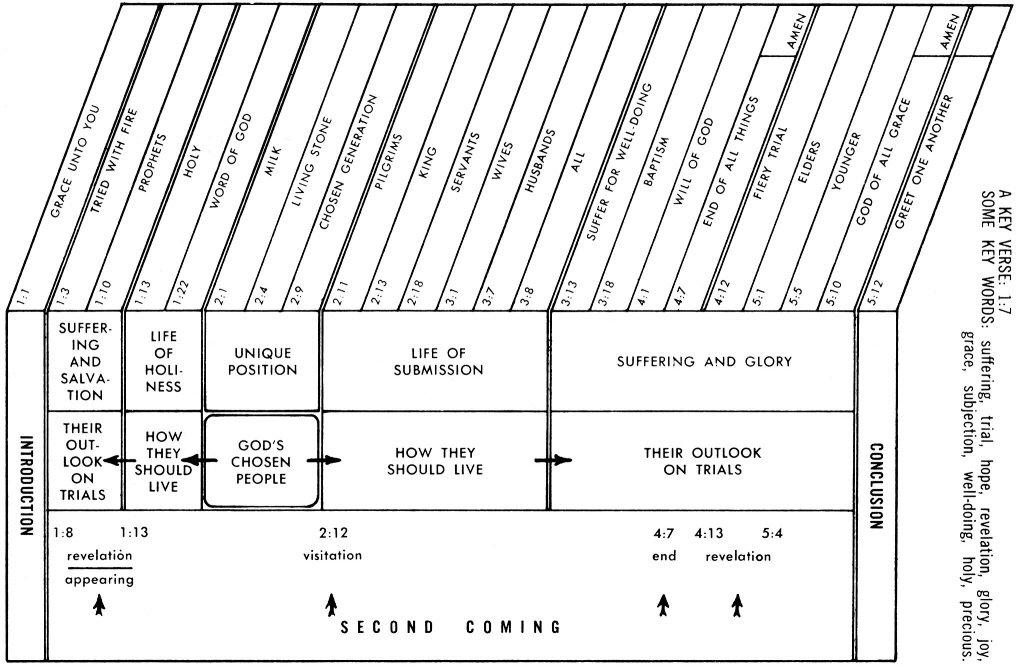
1 Peter: Trials, Holy Living & The Lord's Coming
Click chart to enlarge
Chart from Jensen's Survey of the NT - used by permission
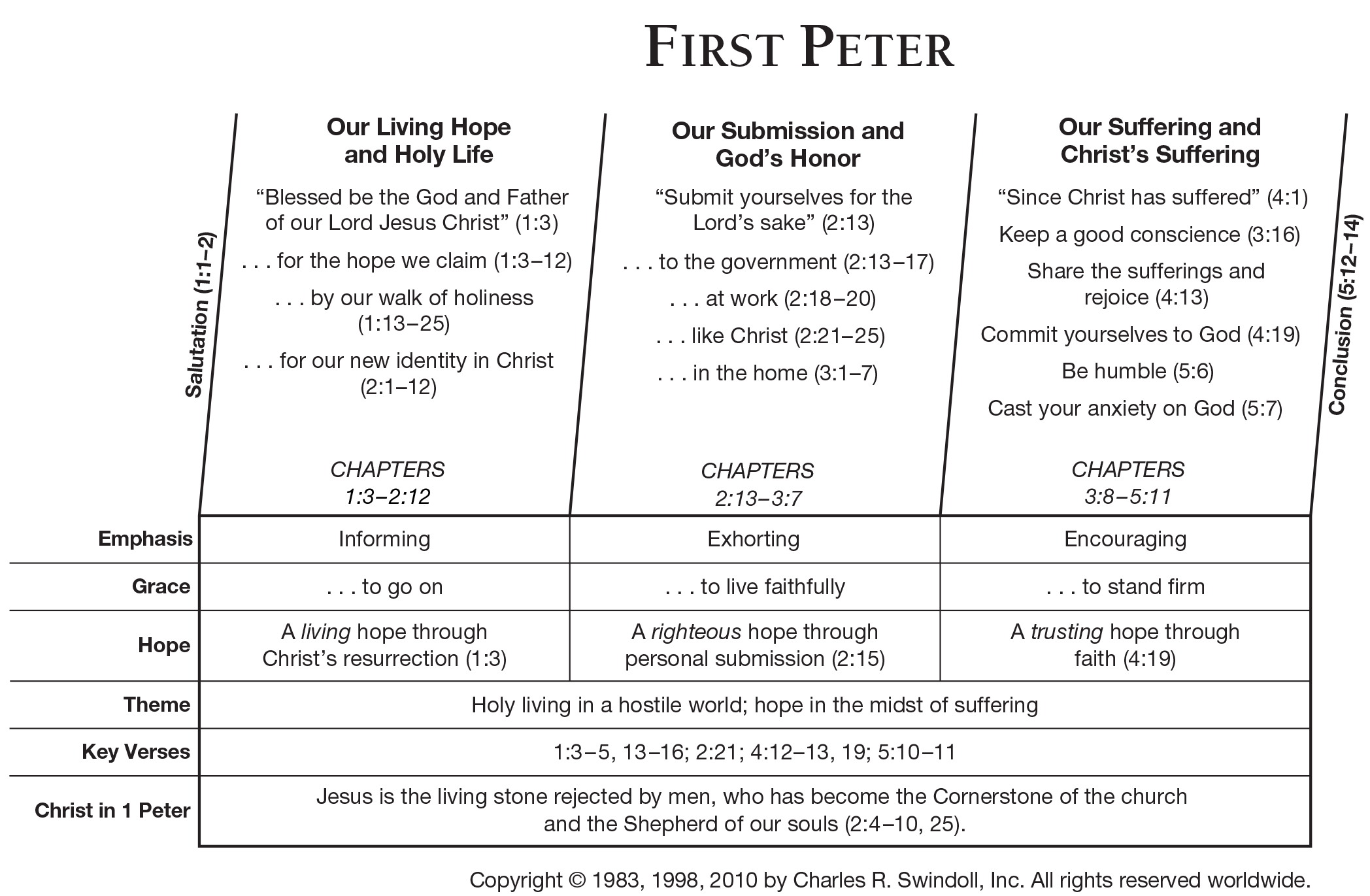
See Another Chart from Charles Swindoll
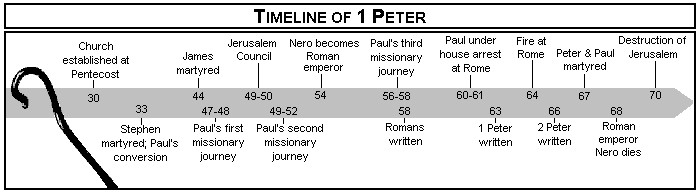
Source: Borrow Ryrie Study Bible
Click to enlarge
1 Peter 3:5 For in this way in former times the holy women also, who hoped in God, used to adorn themselves, being submissive to their own husbands; (NASB: Lockman)
Greek: houtos gar pote kai ai hagia gunaikes ai elpizousai (PAPFPN) eis theon ekosmoun (3PIAI) heautas hupotassomenai (PPPFPN) tois idiois andrasin,
Amplified: For it was thus that the pious women of old who hoped in God were [accustomed] to beautify themselves and were submissive to their husbands [adapting themselves to them as themselves secondary and dependent upon them]. (Amplified Bible - Lockman)
NLT: That is the way the holy women of old made themselves beautiful. They trusted God and accepted the authority of their husbands. (NLT - Tyndale House)
Phillips: This was the secret of the beauty of the holy women of ancient times who trusted in God and were submissive to their husbands. (Phillips: Touchstone)
Wuest: For thus formerly also the holy women, the ones whose hope is directed to and rests in God, were accustomed to adorn themselves, putting themselves in subjection with implicit obedience to their own husbands,
Young's Literal: for thus once also the holy women who did hope on God, were adorning themselves, being subject to their own husbands,
FOR IN THIS WAY IN FORMER TIMES THE HOLY WOMEN ALSO: houtos gar pote kai ai hagiai gunaikes ai:
- Pr 31:10,30; Lk 8:2,3; Acts 1:14; 9:36; 1Ti 2:10; 5:10; Titus 2:3,4
- 1 Peter 3 Resources - Multiple Sermons and Commentaries
Holy women is not a unique class of OT women, but as explained in the note directly below they were ordinary sinners saved by grace.
Spurgeon writes -It has been one of the most beautiful results of the spread of the Christian religion that it has uplifted womanhood; so that now, instead of women being, as they were, and still are where the gospel is not received, the slaves of their husbands, Christianity has taught that honor should be given to the wife. If there are any husbands who do not so, they err from the gospel way. (1 Peter 3 Commentary)
Holy (40) (hagios) (Click for study of hagios) literally means “set-apart ones.” These women lived holy lives because they lived separated lives, separated from the world out from which God had saved them. If these wives lived holy lives, it can be done in the amoral agnostic days in which we are living.
WHO HOPED IN GOD: elpizousai (PAPFPN) eis theon:
- 1Sa 2:1; Jer 49:11; Lk 2:37; 1Ti 2:15; 5:5; Heb 11:11
- 1 Peter 3 Resources - Multiple Sermons and Commentaries
Hoped (1679) (elpizo from elpis) (see study of Believer's Blessed Hope) means to look forward with confidence to that which is good and beneficial. An attitude of confidence that something will come to pass. Also conveys the sense of counting on something. (Lk 6:34) It means to to anticipate, usually with pleasure, expecting some benefit. The verb does not mean "I hope so" as does the unsaved world which has no eternal hope, for a future without Christ is eternally hopeless. The hope that Christian's possess by grace through faith is one that reflects an absolute certainty of future good or that God will do good to us in the future (and forever!) The present tense indicates this glorious, radiant hope was the habitual practice of holy women.
Elpizo - 31 NT uses - Mt 12:21; Lk 6:34; 23:8; 24:21; Jn 5:45; Acts 24:26; 26:7; Ro 8:24, 25; 15:12, 24; 1Co. 13:7; 15:19; 16:7; 2Co. 1:10, 13; 5:11; 8:5; 13:6; Phil. 2:19, 23; 1Ti 3:14; 4:10; 5:5; 6:17; Philemon. 1:22; Heb. 11:1; 1Pe 1:13; 3:5; 2Jn. 1:12; 3Jn. 1:14
These women had learned to preach to themselves the way the psalmist did
Why are you in despair, O my soul? And why have you become disturbed within me? Hope in God, for I shall again praise Him For the help of His presence. (Ps 42:5)
Comment: Spurgeon writes the following regarding hope… Hope thou in God. If every evil be let loose from Pandora's box, yet is there hope at the bottom. This is the grace that swims, though the waves roar and be troubled. God is unchangeable, and therefore His grace is the ground for unshaken hope. If everything be dark, yet the day will come, and meanwhile hope carries stars in her eyes; her lamps are not dependent on oil from without, her light is fed by secret visitations of God, which sustain the spirit.
Women who hope in God are women who look away from the troubles and miseries and obstacles of life that seem to make the future bleak, and they focus their attention on the sovereign power and love of God Who rules in heaven and does on earth whatever He pleases and Who alone can make the statement which He made to Sarah…
"Is anything too difficult for the LORD? At the appointed time I will return to you, at this time next year, and Sarah shall have a son."" (Ge18:14) [cf "Behold, I am the LORD, the God of all flesh; is anything too difficult for Me?" Jer 32:27]
Women who hoped in God - remembering that He 11:1 (note) teaches us that "faith = assurance of things hoped for", were undoubtedly women who were declared righteous in God's sight (by faith) apart from their works. In the context of this section of Peter he is referring to the woman as the one who is saved and whose behavior can win her husband to Christ. So in using the example of the OT women, Peter is certainly implying that they were genuinely saved and the phrase "hoped in God" supports this observation. Biblical hope is not our modern day flighty definition of "maybe so" but it is an absolute assurance of future good. So when they hoped in God, God reckoned (imputed) it to them His righteousness. They were justified (declared righteous) by faith.
USED TO ADORN THEMSELVES: ekosmoun (3PIAI) heautas:
- 1 Peter 3 Resources - Multiple Sermons and Commentaries
Adorn (2885) (kosmeo) (Click word study of kosmeo) means to cause something to be beautiful by decorating it. Here it refers to the correctness of a well-fitted garment, in no way outlandish or provocative. Christian wives are to dress themselves in good taste and appropriate to the occasion.
Kosmeo - 10 NT uses - Matt. 12:44; 23:29; 25:7; Lk. 11:25; 21:5; 1Tim. 2:9; Titus 2:10; 1 Pet. 3:5; Rev. 21:2, 19
Kosmeo is the source of our English word "cosmetic". Peter uses the imperfect tense which speaks of action going on in past time. These "holy women" were accustomed (over and over again) to adorn themselves in that manner. It was a repeated practice with them to adorn themselves with a meek and quiet spirit, not with the latest fad of the world. Dear sister in Christ, does this verse describe your practice?
BEING SUBMISSIVE TO THEIR OWN HUSBANDS: hupotassomenai (PPPFPN) tois idiois andrasin:
- 1 Peter 3 Resources - Multiple Sermons and Commentaries
Peter repeats (1Pe 3:1-note) the idea of a godly wife's submission to her husband. Godly women of the OT adorned themselves by cultivating the moral and spiritual beauty of the inner life. One aspect of this beauty was a dutiful submission to their own husbands.
Being submissive (5293) (hupotasso= hupo = under + tasso = arrange in an orderly manner) (Click word study of hupotasso) (Click the 6 uses of hupotasso in 1Peter) in the passive voice means to submit oneself, to subordinate oneself, to obey, to place oneself under, to put oneself under orders, to align oneself under the authority of another.
Hupotasso - 38 NT uses - Lk. 2:51; 10:17, 20; Ro 8:7, 20; 10:3; 13:1, 5; 1Co. 14:32, 34; 15:27, 28; 16:16; Ep 1:22; 5:21, 24; Phil. 3:21; Col. 3:18; Titus 2:5, 9; 3:1; Heb. 2:5, 8; 12:9; Jas 4:7; 1Pet. 2:13, 18; 3:1, 5, 22; 5:5
The use of the present tense indicates this is to be the wife's habitual practice or lifestyle, a lifestyle of continually submitting to her husband. Notice the little word own (idios = related to oneself, one's own) indicating her submission is to her own husband, not to another.
Hupotasso has in view the maintenance of God’s willed order, not personal inferiority of women in any way. This word may denote either voluntary or forced behavior, but not any sense of inferiority.
Hupotasso was used as military term to describe soldiers submitting to their superior or slaves submitting to their masters. The word has primarily the idea of giving up one’s own right or will. It meant to arrange [as for example troop divisions] in a military fashion under the command of a leader. Submission then is not so much to a person per se as to the position of rank that is established to ensure order rather than chaos. The buck private in the army may be a "better person" than the five-star general, but he is still a buck private. Slaves in the average Roman household in fact were "better people" in many ways when compared to their masters, yet they still had to be under authority to ensure order in the household. In non-military use hupotasso described "a voluntary attitude of giving in, cooperating, assuming responsibility, and carrying a burden".
Hupotasso is not a spineless submission but, as one writer has eloquently described it, a "voluntary selflessness."
Constable paraphrasing material from the Family Life Conference writes that…Submission involves at least four things. First, it begins with an attitude of entrusting oneself to God (see notes 1 Peter 2:23; 24; 25). The focus of our life must be on Jesus Christ. Second, submission requires respectful behavior (see notes 1 Peter 3:1; 3:2). Nagging is not respectful behavior. Third, submission involves the development of a godly character (see notes 1 Peter 3:3; 3:4; 3:5). Fourth, submission includes doing what is right (see note 1 Peter 3:6). It does not include violating other Scriptural principles. Submission is imperative for oneness in marriage. (Expository Notes)
Keep the historical context in mind reference to pagan husbands should be understood against the social background in which a wife was expected to accept the customs and religious rites of her husband.
Submission for Paul and Peter is a voluntary submission based on one’s own recognition of God’s order. It is the submission which is based on the death of pride on one hand and the desire to serve on the other. Ideally it is the submission not of fear but of perfect love. Christ Himself is the perfect example (1Pe 2:21, 22, 23, 24, 25 -see notes 1Pe 2:21; 22; 23; 24; 25) of a servant Who submitted without reservation to His Father's perfect will (Php 2:5, 6, 7, 8 -see notes Php 2:5; 6; 7;8). Thus there is nothing degrading about submitting to authority and accepting God’s ordained order that alone ensures the proper functioning of the marriage bond between a husband and wife.
1 Peter 3:6 just as Sarah obeyed Abraham, calling him lord, and you have become her children if you do what is right without * being frightened by any fear. (NASB: Lockman)
Greek: os Sarra hupekousen (3SAAI) to Abraam, kurion auton kalousa; (PAPFSN) es egenethete (2PAPI) tekna agathopoiousai (PAPFPN) kai me phoboumenai (PPPFPN) medemian ptoesin.
Amplified: It was thus that Sarah obeyed Abraham [following his guidance and acknowledging his headship over her by] calling him lord (master, leader, authority). And you are now her true daughters if you do right and let nothing terrify you [not giving way to hysterical fears or letting anxieties unnerve you]. (Amplified Bible - Lockman)
NLT: For instance, Sarah obeyed her husband, Abraham, when she called him her master. You are her daughters when you do what is right without fear of what your husbands might do. (NLT - Tyndale House)
Phillips: Sara, you will remember, obeyed Abraham and called him her lord. And you have become, as it were, her true descendants today as long as you too live good lives and do not give way to hysterical fears. (Phillips: Touchstone)
Wuest: as Sarah was in the habit of rendering obedience to Abraham, calling him lord, whose children [namely, Sarah’s] you become if the whole course of your life is in the doing of good, and you are not being caused to fear by even one particle of terror.
Young's Literal: as Sarah was obedient to Abraham, calling him 'sir,' of whom ye did become daughters, doing good, and not fearing any terror.
THUS SARAH OBEYED ABRAHAM CALLING HIM LORD: os Sarra hupekousen (3SAAI) to Abraam kurion auton kalousa (PAPFSN):
- 1 Peter 3 Resources - Multiple Sermons and Commentaries
Obeyed (5219) (hupakouo [word study] from hupó = under + akoúo = physical hearing and apprehension of something with the mind- akouo gives us our English acoustics - the science of design which helps one hear) (See also word study of noun hupakoe) literally means to listen under with attentiveness and to respond positively to what is heard. The sense is that one understands and responds accordingly. Note that hupakouo implies an inward attitude of respect and honor, as well as external acts of obedience. Obedience on the part of children consists in listening to the advice given by parents. In Genesis 22 Isaac's willingness to be offered as a sacrifice is a model of such submission.
Hupakouo conveys the sense of subordinating one’s self to the person or thing heard, and hence to obey. The word means to hearken or to give respectful attention and so to obey. This word was used to describe one coming to the door upon hearing a knock, a good picture of obedience.
Webster's 1828 dictionary says that to obey means to comply with the commands, orders or instructions of a superior, or with the requirements of law, moral, political or municipal; to do that which is commanded or required, or to forbear doing that which is prohibited. To submit to the direction or control of. Seamen say, the ship will not obey the helm. To yield to the impulse, power or operation of.
Our English word obey is from Latin oboedīre, from ob- = to, towards + audīre = to hear.
Hupakouo - 21 NT uses - Matt. 8:27; Mk. 1:27; 4:41; Lk. 8:25; 17:6; Acts 6:7; 12:13; Rom. 6:12, 16f; 10:16; Eph. 6:1, 5; Phil. 2:12; Col. 3:20, 22; 2 Thess. 1:8; 3:14; Heb. 5:9; 11:8; 1 Pet. 3:6
Wuest says that Obeyed" is constative (of, relating to, or being a verbal form that expresses past completed action) aorist in Greek which speaks of an action going on over a long period of time, looking at it in one single panoramic view. The whole tenor of Sarah’s life was one of obedience to her husband. (Wuest, K. S. Wuest's Word Studies from the Greek New Testament: Eerdmans)
Hughes adds that…Obedience involves conscious listening. If you do not really listen, you cannot really obey. That is why parents are always saying, “Listen to me!” The idea is to listen under with the intent to understand and do it… Much of this is a matter of attitude. We are not to be like the little boy who misbehaved and was told by his teacher to sit in the corner, which he did with grudging obedience, all the while saying to himself, “I’m sitting down on the outside, but I’m standing up on the inside!” (Hughes, R. K.: Ephesians: The Mystery of the Body of Christ. Crossway Books)
It means to hear under authority and pictures the one hearing as being under the authority of some one else. Hupakouo means to obey on the basis of having paid attention to.
Thayer's first entry states that "properly, of one who on a knock at the door comes to listen who it is" In secular Greek the word spoke of one standing at a door, listening intently, almost eavesdropping. Such was the reference in the writings of Plato, who used the word to describe a doorkeeper. Later on the word came to mean obedience, for after one hears and understands a command or request, he should obey it. (See this meaning in Acts 12:13)
In the context of family relationships, it is notable that the wife is not commanded to obey her husband, as children are to obey their parents and slaves their masters. In other words, a husband is to treat his wife as an equal (cp Ep 5:21-note) and not as his servant or as if she were a child. The husband is not to order the wife about, calling on her to respond to his every wish and command.
Calling him lord - Obviously not in the sense that he was a "god" although unfortunately some husbands do place themselves in such an exalted position (at least in their own mind).
Lord (2962) kurios from kúros = might, power in turn from kuróo = give authority, confirm) describes One who has absolute ownership and uncontrolled power. signifies sovereign power and authority. In the NT, Jesus is referred to some ten times as Savior and some 700 times as Lord. When the two titles are mentioned together, Lord always precedes Savior. Is He your kurios? In classical Greek, kurios was used of gods and was found on inscriptions applied to different gods such as Hermes, Zeus, etc. Secular Greek also used kurios to describe the head of the family, the one who is "lord" of wife and children (although that does not give him the right to "lord" it over them!).
Kurios was used by Philippian jailer when he said to Paul and Silas after a great earthquake rocked the prison, opening the doors to their prison cell…
Sirs, (kurios) what must I do to be saved? (Acts 16:30, Answer? Acts 16:31, 32, 33, 34)
Jesus used kurios in teaching that
No one can serve two masters; (kurios) for either he will hate the one and love the other, or he will hold to one and despise the other. You cannot serve God and mammon (Mt 6:24-note)
Kurios was used in secular Greek as a title of honor addressed by subordinates to their superiors, or as a courteous name in the case of persons closely related. In a petition to a high Roman authority we have, “I became very weak, my lord” and in another example “I entreat you, sir, to hasten to me.” Sarah used it as a wifely courtesy to her husband, as a recognition of her willing submission to Abraham's authority over her.
Moses records Sarah's reaction to the prophecy that she would bear a son…
And Sarah laughed to herself, saying, "After I have become old, shall I have pleasure, my lord (kurios in the LXX referring in this context to her husband Abraham) being old also?" (Ge 18:12)
In a similar used of kurios Ruth addressed Boaz saying…
"I have found favor in your sight, my lord (kurios in the LXX), for you have comforted me and indeed have spoken kindly to your maidservant, though I am not like one of your maidservants." (Ru 2:13-note)
AND YOU HAVE BECOME HER CHILDREN IF YOU (continually) DO WHAT IS RIGHT WITHOUT BEING FRIGHTENED BY ANY FEAR: es egenethete (2PAPI) tekna agathopoiousai (PAPFPN) kai me phoboumenai (PPPFPN) medemian ptoesin:
- Ro 9:7, 8, 9; Gal 4:22, 23, 24, 25, 26
- 1Pe 3:14,15; Ge 18:15; Is 57:11; Da3:16, 17, 18; Mt 26:69, 70, 71, 72, 73, 74, 75; Acts 4:8, 9, 10, 11, 12, 13,19
- 1 Peter 3 Resources - Multiple Sermons and Commentaries
Wuest translates it
whose children [namely, Sarah’s] you become if the whole course of your life is in the doing of good, and you are not being caused to fear by even one particle of terror.
The NLT is even more to the point:
You are her daughters when you do what is right without fear of what your husbands might do.
The Amplified Version adds that…
you are now her true daughters if you do right and let nothing terrify you [not giving way to hysterical fears or letting anxieties unnerve you].
Become (1096) (ginomai) is not the verb of being, but of “becoming.” It means to cause to become or to come into existence. It means to enter a new state.
Do what is right (15) (agathopoieofrom agathos = benevolent + poiéo = to make or do) literally means good doing. Agathos describes that which is beneficial in addition to being good. Agathos is that which is good in its character, beneficial in its effects and/or useful in its action. Agathos is used in the New Testament primarily of spiritual and moral excellence. Paul uses agathos to describe the gospel as the “glad tidings of good things” (Ro 10:15-note). The writer of Hebrews uses it in the same way, of “the good things to come” of which “Christ appeared as a high priest” (He 9:11-note) and of which the law was “only a shadow” (He 10:1 - note).
The whole matter of subjection is illustrated by a reference to Sarah, who referred to Abraham as lord. Peter is saying that if Sarah ‘obeyed’ Abraham and called him Lord, the Christian wives in Asia should also treat their husbands with deference and respect. Christian women have become the offspring of Sarah, spiritually speaking, and continually do what is right without fear of what their husbands might do.
Lenski explains that…Without being frightened by any fear” is not a condition for becoming a true daughter of Sarah in addition to doing what is right. It is rather the consequence of adopting the behavior that Peter advocated. If a Christian wife was suffering for her faith because of her conduct, she could gain great confidence by doing what Peter counseled and what Sarah practiced. She could understand that any suffering that came her way was not a result of her sinful behavior but in spite of her godly behavior (cf. 1Pe 2:20-note; Pr 3:25). The sense is that these Christian women are to let nothing terrifying frighten them from their course. Pagan women may disdain and insult them because they have adopted a nobler wifehood, they yet remain unafraid. Pagan husbands may resent their Christianity; this, too, does not frighten them. (Lenski, Richard C. H. The Interpretation of the Epistles of St. Peter, St. John and St. Jude. Augsburg Publishing House, 1961)
The daughters of Sarah are not to fear anything but displeasing God. They know that following Christ will mean suffering. But they believe God's promises…
But even if you should suffer for the sake of righteousness, you are blessed. AND DO NOT FEAR THEIR INTIMIDATION, AND DO NOT BE TROUBLED (see note 1 Peter 3:14)
Holy women who fix their hope in God take this promise of blessing through suffering, and they fight the tendency to fear by dwelling on the faithfulness of God.
"Sarah considered Him faithful Who had promised!" (see note Hebrews 11:11).
And then they do what Peter says in chapter 4
Therefore, let those also who suffer according to the will of God entrust their souls to a faithful Creator in doing what is right. (see note 1 Peter 4:19)
These women affirm the sovereign rule of God over their suffering and that they do not suffer apart from His will, ultimately resting their souls in the firm and omnipotent hands of their faithful Creator. They cast out fear and they hope in God. And so they prove themselves to
"not be sluggish, but imitators of those who through faith and patience inherit the promises (as daughters of Sarah) (see note Hebrews 6:12).
J H Jowett asks…
What is the third element in the portraiture of the ideal wife? “Not put in fear by any terror” How shall I describe the disposition? Let me call it the grace of repose. “Not put in fear by any terror.” [1Pe 3:6] They are not the victims of “sudden, wild alarms.” They are not easily aroused into the fearfulness which is so often the parent of thoughtlessness. They have reposefulness of spirit. Now, if I may be allowed to say it, I think this fearfulness is more characteristic of women than of men. There are larger enemies inside the gates of men’s gardens; but in the garden of woman’s life, I think that the heat of fearfulness and the slugs of worry and fretfulness will be found to be more abounding. Fearfulness is destructive of the deeper delights of human fellowship. Restfulness is essential to deep and fruitful communion.
1 Peter 3:7 You husbands in the same way, live with your wives in an understanding way, as with someone weaker, since she is a woman; and show her honor as a fellow heir of the grace of life, so that your prayers will not be hindered. (NASB: Lockman)
Greek: Oi andres homoios sunoikountes (PAPMPN) kata gnosin, os asthenestero skeuei to gunaikeio aponemontes (PAPMPN) timen, os kai sugkleronomois charitos zoes, eis to me egkoptesthai (PPN) tav proseuchas humon
Amplified: In the same way you married men should live considerately with [your wives], with an intelligent recognition [of the marriage relation], honoring the woman as [physically] the weaker, but [realizing that you] are joint heirs of the grace (God’s unmerited favor) of life, in order that your prayers may not be hindered and cut off. [Otherwise you cannot pray effectively.] (Amplified Bible - Lockman)
NLT: In the same way, you husbands must give honor to your wives. Treat her with understanding as you live together. She may be weaker than you are, but she is your equal partner in God's gift of new life. If you don't treat her as you should, your prayers will not be heard. (NLT - Tyndale House)
Phillips - Similarly, you husbands should try to understand the wives you live with, honoring them as physically weaker yet equally heirs with you of the grace of eternal life. If you don't do this, you will find it impossible to pray properly. (Phillips: Touchstone)
Wuest: Husbands, in like manner, let your domestic life with respect to them be governed by the dictates of knowledge, they being the weaker instrument, the feminine, holding in reserve for them particularly, honor as to those who are also fellow-inheritors with you of the grace of life, and this, in order that no (Satanic) inroads be made into your prayers.
Young's Literal: The husbands, in like manner, dwelling with them, according to knowledge, as to a weaker vessel -- to the wife -- imparting honour, as also being heirs together of the grace of life, that your prayers be not hindered.
YOU HUSBANDS LIKEWISE LIVE WITH YOUR WIVES : Oi andres homoios, sunoikountes (PAPMPN) kata gnosin:
- Ge 2:23; Ge 2:24,Pr 5:15, 16, 17, 18, 19; Mal 2:14, 15,16; Mt 19:3, 4, 5, 6, 7, 8, 9; 1Co7:3; Col 3:19; Ep 5:25, 26, 27, 28,33
- 1 Peter 3 Resources - Multiple Sermons and Commentaries
You husbands - Note that the first words in the Greek sentence (indicates emphasis) is husbands! Listen up! Treat your wife as precious, as a gift from God to be treasured, reassured, protected, and loved, with every tender provision being made for her.
In the same way (3668) (homoios from hómoios = like, resembling) means similarly, likewise, of equal degree or manner and denoting perfect agreement. In like manner. Equally. Too. In the same way. Similar in some respect. Resembling. In most of the NT uses homoios conveys the sense of "to do likewise".
This could refer back to (1 Peter 2:21,22, 23, 24, 25) thus calling on Christian husbands to be Christ-like even as Paul instructed Christian husbands in Ephesus writing…
Husbands, love (present imperative) your wives, just as Christ also loved the church and gave Himself up for her (Ep 5:25-note)
Likewise without a doubt clearly indicates that submission is the responsibility of a Christian husband as well. How is this possible? It is not naturally possible but is only supernaturally possible as the husband surrenders his will to the filling/control of the sweet will of the Holy Spirit, for as Paul writes he is…
not get drunk with wine, for that is dissipation, but be filled (present imperative = not a suggestion but a command to be continually filled. Notice the passive voice = action or in this case filling is from an outside Source which implies the husband must be willing to allow this external influence in his life) with the Spirit (Ep 5:18-note)
Then Paul instructs believers (both husbands and wives) who are under the control of the Holy Spirit, that one of the manifestations of a Spirit filled life is that they…
be subject to one another in the fear of Christ (Eph 5:21-note)
Homoios - 30 NT uses - Matt. 22:26; 26:35; 27:41; Mk. 15:31; Lk. 3:11; 5:10, 33; 6:31; 10:32, 37; 13:3; 16:25; 17:28, 31; 22:36; Jn. 5:19; 6:11; 21:13; Rom. 1:27; 1 Co. 7:3f, 22; Heb. 9:21; Jas. 2:25; 1 Pet. 3:1, 7; 5:5; Jude 1:8; Rev. 2:15; 8:12
Here the charge to the husband is to exercise his loving duty of being sensitive to the needs, fears, and feelings of his wife, to subordinate his needs to hers, whether she is a Christian or not. Husbands are to show consideration, chivalry, and companionship.
Live with (4924) (sunoikeo from sun/syn = together with + oikeo = to dwell) is used only here in the NT and means to dwell or reside together, to cohabit. Live with in this context has the same meaning as our modern expression and according to Ray Pritchard fundamentally means “to share the same bed.”
The present tense calls for this to be a husband's lifestyle, something only possible when he is "strengthened with power through His Spirit in the inner man" (Eph 3:16-note) and continually being "filled with the Spirit" (Eph 5:18-note, cp Gal 5:16-note).
In a sense live with is used like an imperative (1Pe 2:18-note, 1Pe 3:1-note). A truly spiritual husband will fulfill his marital duties and love his wife. Tragically, one survey revealed that the average husband and wife had 37 minutes a week (not a day, but a week!) together in actual communication! Is it any wonder that marriages fall apart after the children grow up and leave home? The husband and wife are left alone to co-habit as virtual strangers! The empty nest era should be the best of times, not the worst of times, dear believing husband or wife!
Writing to the saints at Colossae Paul instructs husbands to
love (present imperative see our need to depend on the Holy Spirit to obey) - not just when you feel like it, not just physically, not a suggestion, but a lifestyle, one possible only if you are continually filled with the Spirit! Eph 5:18-note, cp Gal 5:16-note) your wives, and do not be embittered (a settled hostility that poisons the whole inner man - don't let this come into the relationship) against them." (Col 3:19-note)
Comment: Paul tells husbands not to call their wives “honey,” and then act like vinegar! They must not display harshness of temper or resentment toward their wives. They are not to irritate or exasperate them, but rather to provide loving leadership in the home.
IN AN UNDERSTANDING WAY: kata gnosin:
- 1 Peter 3 Resources - Multiple Sermons and Commentaries
Pastor Ray Pritchard writes that…
The King James Version calls the husband to live with his wife “according to knowledge.” (1Pe 3:7KJV) That’s a good way to put it. Know your wife! Study her, get to know what makes her tick, figure out how her mind works, and learn what her gifts are, her desires, her talents, her hopes and dreams. A Christian husband who really knows his wife sees her talents and abilities, opens the door and says, “Sweetheart, go for it.” If she can sing, if she can teach, if she can write, if she can buy and sell, if she can organize, if she can design, if she can administrate, if she can encourage, if she can counsel, if she can program a computer, if she can start a company, if she can think creatively, he says, “Go for it!”…
So Peter says it’s your job to study your wife, to get to know her intimately, and to live together with her on the basis of that knowledge. Many years ago, when I was a student at Dallas Seminary, Dr. Craig Massey, then Pastor of Des Plaines Bible Church, came to hold a two-day conference on marriage. Most of what he said has long been forgotten. But one thing remains. He quoted Song of Solomon 4:3 where the lover says to his beloved: “Your temples behind your veil are like the halves of a pomegranate.” Craig Massey said if you open up a pomegranate, you find that it has many sections inside, little ones and big ones. He said that’s what a woman’s mind is like. Complex with many sections, big and small. Modern science backs up Solomon’s insight. We know that the brain contains two hemispheres—the left and the right. Neuroscientists tell us that women typically have a larger pathway between the two hemispheres so that information flows more freely. To put it simply, most men have a footpath, most women have a superhighway. They are generally more verbal and more in touch with their emotions and better at forming deep relationships. Men are better with non-verbal tasks. That’s why we have the remote control. I would say more about how women and men think differently, but the women already know this and the guys are going, “What’s he talking about?”
Women are amazing. That’s why you can be married for 30 years and still find your wife fascinating and captivating. Her mind works in so many ways. The wise husband recognizes in his wife all sorts of talents and abilities, and he encourages her to develop them. That’s what the virtuous woman of Proverbs 31 did. She developed them for the good of her own family. Many husbands fear their wives will change if they really turn them loose. They’re right. Your wife will change and all for the better. You have to lose the seed to gain the flower. How beautiful to see a Christian wife blossom under the creative encouragement of a wise husband. Men, don’t hold her back. Let her be all she can be for the glory of God. Don’t stifle that budding desire. Water it, nourish it, and bring it to full bloom. (Sermon)
Clearly as husbands, we need to get to know our wives - what pleases them, what displeases them, what we can tell them and what we can't tell them (because it might bring their spirits down -- we need to protect them). I know a godly young man who made a mistake in this area concerning his gentle believing wife. For some reason his parents became angry with this young couple and choose to take out their anger by making unfounded, derogatory remarks about their son's wife. Unfortunately, he passed these words along (when there was really no need to have done so) and it severely wounded her spirit and has the potential to adversely effect their familial interactions the rest of their life. Men, we need to study our wives to know what we can pass along to them and what is best kept to ourselves.
Knowledge (1108) (gnosis from ginosko = to know, learn by experience, take in knowledge of someone, knowledge that goes beyond the merely factual, speaks of a special relationship between the person who knows and the object of the knowledge) in the present context speaks of a practical knowledge, of discretion or of prudence.
With an intelligent recognition of the nature of the marriage relation!!! Somebody asked Mrs. Albert Einstein if she understood Dr. Einstein’s theory of relativity, and she replied, “No, but I understand the Doctor.”
In premarital counseling one pastor gives the couple pads of paper and asked them to write down the three things each one thinks the other enjoys doing the most. Usually, the prospective bride makes her list immediately but the man sits and ponders. And usually the girl is right but the man wrong! What a beginning for a marriage!
The Christian husband needs to know his wife’s moods, feelings, needs, fears, and hopes. He needs to “listen with his heart” and share meaningful communication with her.
How can a husband show consideration for his wife if he does not understand her needs or problems?
To say, “I never knew you felt that way!” is to confess that, at some point, one mate excommunicated the other. When either mate is afraid to be open and honest about a matter, then he or she is building walls and not bridges.
J H Jowett…
What are the lineaments of the ideal husband? “Dwell with your wives according to knowledge.” [Verse 7] How shall we describe the characteristic? Let us call it the atmosphere of reasonableness. “According to knowledge.” We may grasp its content by proclaiming its opposite: “Dwell with your wives according to ignorance. Just walk in blindness. Don’t look beyond your own desires. Let your vision be entirely introspective and microscopic. Never exercise your eyes in clear and comprehensive outlook. Dwell in ignorance!” No, says the apostle, “dwell according to knowledge.” Keep your eyes open. Let reason be alert and active. Let all your behaviour be governed by a sweet reasonableness. Don’t let appetite determine a doing. Don’t let thy personal wish have the first and last word. Exalt thy reason! Give sovereignty to thy reason! Be thoughtful and unceasingly considerate. It is the absence of this prevailing spirit of reasonableness which has marred and murdered many a bright and fair-promising communion. “He is not really bad at heart, but he doesn’t think!” That is the fatal defect. He does not think! He dwells according to ignorance; his reason is asleep, and the beautiful, delicate tie of wedded fellowship is smitten, wounded, and eventually destroyed.
AS WITH A WEAKER VESSEL, SINCE SHE IS A WOMAN: os asthenestero skeuei to gunaikeio:
- 1 Peter 3 Resources - Multiple Sermons and Commentaries
Ray Pritchard writes that…“weaker vessel” is similar to our word “vase.” This particular word was used of priceless, fragile china. It was also used of sacred vessels used in the temple for the worship of God. When Peter calls the wife the “weaker” vessel, he is not referring to moral character or to intellectual ability or to spiritual perception. It certainly does not refer to outward beauty. It refers primarily to the difference in physical strength between men and women. A man who takes that fully into account may end up doing some very odd things. For instance, he might actually help around the house, he might do the dishes or the wash or the ironing. He might take out the trash or do the cooking, or he might get the kids up in the morning and get them ready for school. (Ibid)
Weaker (772) (asthenes from a = without + sthénos = strength, bodily vigor) (See study of related verb astheneo - note the concentration of asthenes/astheneo in the epistles to the Corinthians - almost 50% of NT uses) is literally without strength or bodily vigor. Asthenes describes one's state of limited capacity to do or be something and is used literally of physical weakness (most of the uses in the Gospels) and figuratively of weakness in the spiritual arena (weak flesh, weak conscience, weak religious system or commandment [Gal 4:9, Heb 7:18], etc) and thus powerlessness to produce results.
Asthenes - 26 NT uses - Mt. 25:43, 44; 26:41; Mk. 14:38; Lk. 9:2; 10:9; Acts 4:9; 5:15, 16; Rom. 5:6; 1 Co. 1:25, 27; 4:10; 8:7, 9f; 9:22; 11:30; 12:22; 2 Co. 10:10; Gal. 4:9; 1 Thess. 5:14; Heb. 7:18; 1 Pet. 3:7
Weaker in the more literal use speaks of a state of limited capacity to do. It means to be something weak. Peter's point is not that the wife is in ANY WAY inferior but that she is physically weaker, and in need of protection, provision, and strength from her husband. Aristotle set a horrible tone arguing that women were by nature inferior to men in every way except sexually. Aristotle was wrong!
The following is a summary the nuances of meaning of asthenes (modified from BDAG)…
(1) Pertaining to suffering from a debilitating illness - sick, ill
(2) Pertaining to experiencing some incapacity or limitation - weak
a) Of physical weakness - the flesh is weak = gives up too easily (Mt 26:41, Mark 14:38); weaker vessel = sex (1Peter 3:7); personal appearance is weak = unimpressive (1Cor 10:10)
b) Of relative ineffectiveness, whether external or inward weak = feeble, ineffectual (1Cor 4:10); the weaker, less important members (1Cor 12:22); what is weak in (the eyes of) the world (1Cor 1:27)
c) Of the inner life -
Helpless in a moral sense (Romans 5:6)
Of a weakness in faith, which through lack of advanced knowledge, considers externals of the greatest importance (1Cor 8:7, 9, 9:10, cp similar use of related verb astheneo in Ro 14:1,2- [note v1; note v2])
To those who are weak in faith I became as they are (1Cor 9:22) (Arndt, W., Danker, F. W., & Bauer, W. A Greek-English Lexicon of the New Testament and Other Early Christian Literature)
Vessel (4632) (skeuos) describes something hollowed out for the purpose of containing something such as liquid. It is a container of any material used for a specific purpose, with the meaning varying according to the context.
Skeuos referred to a vessel used in the services of the temple (Mk 11:16) but was also used to describe household utensils. The English word vessel comes from a Latin word vasellum, the diminutive form of vas, a vase, the Latin words referring to a receptacle which covers and contains. Thus, the word comes to refer to an instrument whereby something is accomplished.
According to some lexicons, Peter's uses of skeuos in this passage is a euphemism in a Hebraist sense describing a wife as her husband's sexual partner.
BDAG summarizes the meanings of skeuos as
(1) material object used to meet some need in an occupation or other responsibility, generally thing, object used for any purpose at all - Mk 11:16, Re 18:12.
(2) a container of any king - vessel, jar, dish - Lk 8:16, Jn 19:29, 2Ti 2:20
(3) a human being exercising a function, instrument, vessel -Acts 9:15, 2Co 4:7, Ro 9:22 [cp Jer 27:25, Ro 9:23, 1Pe 3:7, 1Th 4:4] (Borrow A Greek-English lexicon of the New Testament, and other early Christian literature)
Jesus used skeuos to describe a recently converted man named Saul (Paul), Luke recording
he is a chosen instrument (skeuos) of Mine, to bear My name before the Gentiles and kings and the sons of Israel for I will show him how much he must suffer for My name's sake. (Acts 9:15, 16, 17+)
Keathley in his commentary on 1Thes 4:1-12 writes that…
Vessel,” skeuos, is used of any instrument, object or thing used for any purpose. It is used (1) of vessels in religious worship (temple vessels), (2) of men as instruments of the Lord (Acts 9:15; 2 Cor. 4:7), and (3) of husband and wife as vessels (1 Pet. 3:7). That 1 Peter 3:7 includes the husband is clear by the term “weaker.” In general, he is the stronger and she is the weaker physically speaking. So, we do have a biblical basis for using “vessel” for a marriage partner and for using kataomai in the sense of contracting a marriage (Ruth 4). Further, it was used of women in rabbinical literature. (see more notes 1Thessalonians 4:4)
Paul used skeuos in his last known epistle writing…
Now in a large house there are not only gold and silver vessels, but also vessels of wood and of earthenware, and some to honor and some to dishonor. Therefore, if a man cleanses himself from these things, he will be a vessel for honor, sanctified, useful to the Master, prepared for every good work. (See notes 2 Timothy 2:20; 21).
Other references to human beings as vessels for God's service are found in Jer 18:1, 2, 3, 4, 5, 6 (see Ro 9:21; 22; 23 - notes Ro 9:21; 22; 23).
There are 23 uses of skeuos in the NT Matt. 12:29; Mk. 3:27; 11:16; Lk. 8:16; 17:31; Jn. 19:29; Acts 9:15; 10:11, 16; 11:5; 27:17; Ro 9:21-note, Ro 9:22-note, Ro 9:23-note; 2Co 4:7; 1Th 4:4; 2Ti 2:20, 2Ti 2:21; Heb 9:21-note; 1Pe 3:7; Re 2:27-note; Re 18:12-note The NAS translate skeuos as article(2), container(1), goods(2), instrument(1), jar(1), object (3), property(2),sea anchor(1), vessel(4), vessels(6).
There are 226 uses of skeuos in the Septuagint - Gen. 24:53; 27:3; 31:37; 45:20; Exod. 3:22; 11:2; 12:35; 22:7; 25:9, 39; 27:3; 30:27, 28; 31:8; 35:13, 14, 16, 22; 37:16; 38:3, 30; 39:32, 33, 36, 38, 40; 40:9, 10; Lev. 6:28; 8:10; 11:32, 33; 13:49, 52, 53, 57, 58, 59; 14:50; 15:4, 6, 12, 22, 23, 26; Nu 1:50; 3:8, 31, 36; 4:10, 12, 14, 15, 26, 32; 7:1, 85; 18:3; 19:15, 17, 18; 31:6, 20, 50, 51; 35:16, 18, 20, 22; Deut. 1:41; 22:5; Jos. 7:11; Jdg. 9:54; 18:11, 16; Ruth 2:9; 1 Sam. 6:8, 15; 8:12; 10:22; 13:20, 21; 14:1, 6, 7, 12ff, 17; 16:21; 17:54; 20:40; 21:5, 8; 25:13; 30:24; 31:4ff, 9f; 2 Sam. 1:27; 8:8, 10; 17:28; 18:15; 23:37; 24:22; 1 Ki. 6:7; 7:45, 48, 51; 8:4; 10:21, 25; 15:15; 19:21; 2 Ki. 4:3f, 6; 7:15; 11:8, 11; 12:13; 14:14; 20:13; 23:4; 24:13; 25:14, 16; 1 Chr. 9:28f; 10:4f, 9f; 11:39; 12:33, 37; 18:8, 10; 22:19; 23:26; 28:13; 2 Chr. 4:11, 16, 18f; 5:1, 5; 9:20, 24; 15:18; 20:25; 23:7; 24:14; 25:24; 28:24; 29:18f; 32:27; 36:7, 10, 18f; Ezr. 1:6f, 10f; 5:14f; 6:5; 7:19; 8:25ff, 30, 33; Neh. 10:39; 13:5, 8f; Job 28:17; Ps. 2:9; 7:13; 31:12; 71:22; Eccl. 9:18; Is 10:28; 39:2; 52:11; 54:16f; 65:4; Jer. 22:28; 27:16, 19; 28:3, 6; 46:19; 48:12; 49:29; 50:25; 51:20, 34; 52:18; Ezek. 9:1; 12:3f, 7; 15:3; 16:17, 39; 23:26; 27:13; 40:42; Dan. 1:2; 5:2f, 23; 11:8; Hos. 8:8; 13:15; Jon. 1:5; Nah. 2:9; Zech. 11:15;
The husband is to dwell with the wife, remembering that she is an instrument of God as well as the husband, a child of God to be used by Him (not by him! [with a small "h"]) to His glory. The husband must ever keep in mind that she is the weaker instrument of the two, not morally or intellectually, but physically. This attitude toward the wife on the part of the husband therefore includes loving consideration of the wife in view of the fact that she is not physically as strong as he is.
Clearly by weaker Peter does not seek to convey any sense of inferiority as shown by the context. Of what is she also a recipient? She is a fellow heir or joint heir of the grace of life, and thus can in no way be considered inferior in God's eyes.
Since she is a woman - Pritchard comments on why husbands are to do this "since she is a woman"…That pushes us back to Genesis 2:18 where God created Eve as a helper for Adam. The old phrase “helpmeet” really isn’t too bad. God created your wife to be a helper meet for you or fit for you. The word means one who does for another what that person cannot do for himself. Men, your wife is given to you because you are incomplete without her. She’s not another man. She’s a woman—separate, unique, different in every aspect. Our problem is that we’ve been sold a bill of goods by the culture around us. We expect our wives to be superwomen—a combination of Florence Nightingale, Betty Crocker and Jennifer Lopez. Not so. When you married her, you married a designer original, not some robot put together by a computer. (Ibid)
AND (continually) GRANT HER HONOR: aponemontes (PAPMPN) timen os kai:
- 1Co 12:22, 23, 24; 1Th 4:4
- 1 Peter 3 Resources - Multiple Sermons and Commentaries
Matthew Henry said the husband’s duty to his wife consisted in "giving due respect to her, and maintaining her authority, protecting her person, supporting her credit, delighting in her conversation, affording her a handsome maintenance, and placing a due trust and confidence in her."
Grant (632) (aponemo from apó = away + némo = distribute) is used only here in the NT and means to apportion, bestow or give. It means to grant that which is appropriate in a relationship (BDAG).
In secular Greek aponemo was used of a prefect (any of various high officials or magistrates of differing functions and ranks in ancient Rome) who gives to all their dues. It describes an officer commended for giving to all their just dues. Josephus uses aponemo to describe the honors Titus paid his troops after the destruction of Jerusalem.
Husbands should continually grant (present tense) submissive wives their just due and not take liberties with their rights.
Honor (5092) (time from tío = pay honor, respect) refers to the worth or merit of some object. It is the amount at which something is valued!
Time - 41 NT uses - Matt. 27:6, 9; Jn. 4:44; Acts 4:34; 5:2f; 7:16; 19:19; 28:10; Rom. 2:7, 10; 9:21; 12:10; 13:7; 1 Co. 6:20; 7:23; 12:23f; Col. 2:23; 1 Thess. 4:4; 1 Tim. 1:17; 5:17; 6:1, 16; 2 Tim. 2:20f; Heb. 2:7, 9; 3:3; 5:4; 1 Pet. 1:7; 2:7; 3:7; 2 Pet. 1:17; Rev. 4:9, 11; 5:12f; 7:12; 21:26
Honor (time) reflects a manifestation of esteem (the regard with which one is held), honor, reverence. A related word timios in 1 Peter 1:19 (note) is translated “precious.”
Time is a term used to describe the value of a precious stone. Thus, wives are to be treasured as one would treasure a precious stone (cp Pr 31:10, Pr 31:10KJV speaking of her worth). Husbands are to show their wives they are precious by spending time with them, talking with them, praying with them, protecting them (see 1Cor 13:7-see note on meaning of "bears all things"), loving them as Christ loved the church and even as we do our own bodies (Eph 5:25-note, Eph 5:28-note, Eph 5:29-note).
Christian husbands are to deem their helpmate whom God has given them as precious, and so are to treat them with honor. Christianity introduced chivalry into the relationship between men and women. In the Greek and Roman culture it was common for the husband to expect his wife to carry out the domestic duties, but not to enter into a true, intimate friendship with him. In contrast, the Christian husband is to love and respect his wife so his prayers won't be impeded. Since his prayers would include petitions for her salvation, it's important that he develop an intimate friendship with her.
The NIV rendering of treat with respect is a bit "weak", since one can treat someone with detached, formal 'respect' and yet give no special honor to that person.
Peter says husbands are to be as a habitual practice (their lifestyle) assigning or apportioning honor to their wives.
To honor your wife includes respect or esteem but again it is not cold, methodical interaction. Meditate on the contrasting thought: contempt, despite, disdain, scorn; disregard, neglect, slighting or the overt opposite = dishonor. The cruelty which is often the hardest to bear is often not deliberate but the product of sheer thoughtlessness.
Compare Paul's admonition to the Christian husbands in the church at Ephesus where Paul helps understand what it means to honor our wives…
So husbands ought also to love their own wives as their own bodies. He who loves his own wife loves himself ;for no one ever hated his own flesh, but nourishes (nurtures, promotes the growth of, furnishes with "nutriments") and cherishes (primarily means to heat, to soften by heat, then, to keep warm, as of birds covering their young with their feathers, and so in this verse means to cherish with tender love or to foster with tender care) it, just as Christ also does the church." (see notes Ephesians 5:28; 29)
Wiersbe writes "Chivalry may be dead, but every husband must be a “knight in shining armor” who treats his wife like a princess… The husband should treat his wife like an expensive, beautiful, fragile vase, in which is a precious treasure. After they get married, many a husband forgets to be kind and gentlemanly and starts taking his wife for granted. He forgets that happiness in a home is made up of many little things, including the small courtesies of life. Big resentments often grow out of small hurts. Husbands and wives need to be honest with each other, admit hurts, and seek for forgiveness and healing. “Giving honor to the wife” does not mean “giving in to the wife.” A husband can disagree with his wife and still respect and honor her. As the spiritual leader in the home, the husband must sometimes make decisions that are not popular; but he can still act with courtesy and respect. “Grant honor” means that the husband respects his wife’s feelings, thinking, and desires. He may not agree with her ideas, but he respects them. Often God balances a marriage so that the husband needs what the wife has in her personality, and she likewise needs his good qualities. An impulsive husband often has a patient wife, and this helps to keep him out of trouble! The husband must be the “thermostat” in the home, setting the emotional and spiritual temperature. The wife often is the “thermometer,” letting him know what that temperature is! Both are necessary. The husband who is sensitive to his wife’s feelings will not only make her happy, but will also grow himself and help his children live in a home that honors God. (Bible Exposition Commentary - New Testament )
J H Jowett…
“Giving honour unto the woman, as unto the weaker vessel.” [Verse 7] Giving honour, paying homage, bowing down in the spirit in the posture of serious and religious regard. To the atmosphere of reasonableness we are to add the temper of reverence. Now, see the wealthy suggestiveness of this. Reverence implies at least two things—perception and homage. “We must first see a thing before we can pay it regard. We must first behold a dignity before we can pay homage to it. Homage implies perception: perception implies eyes. How are the seeing eyes obtained? Let us lay this down as an axiom: it is only the lofty in character that can discern the spiritual dignities in life. Men of little nature cannot apprehend spiritual magnitudes. John Ruskin has told his countrymen that they are incapable of depicting and portraying the sublime, because they cannot see it! You know his explanation. He says there is in the Englishman’s character an element of burlesque which has shortened and dimmed his sight, and rendered him in capable of discerning the superlative glories of far-off spiritual heights. Whatever may be the quality of the inference, the basal principle is true. Perception implies elevation, and we cannot see the enduring dignities of life unless we ourselves are dignified. To truly revere a woman, a man himself must be good. He must dwell on high. He must abide in the heavenly places in Christ. He must bathe his eyes in heaven, and he will acquire a power of perception which will discern in his wife, and in all womankind, spiritual dignities which will preserve his soul in the abiding posture of lowly and reverent regard. The husband will see in his wife a “joint-heir of the grace of life,” [1Pe 3:7] and in that perception every relationship is hallowed and enriched. The master who sees in his servant a “joint-heir of the grace of life,” and the servant who perceives in his master a similarly enthroned dignity, will create between themselves a relationship which will be the channel of “the river of the water of life.” “Give honour unto the woman,” and to preserve that sense of reverent perceptiveness, a man must dwell in “the secret place of the most High.” (Epistles of St. Peter)
AS A FELLOW HEIR OF THE GRACE OF LIFE: kai sugkleronomois charitos zoes:
- Eph 3:6; Titus 3:7; Heb 1:14
- 1 Peter 3 Resources - Multiple Sermons and Commentaries
Fellow heir (4789) (sugkleronomos [word study] from sun = together + Kleronomos = heir, sharer by lot) means one who participates in the same lot, a joint heir in this case refers to marriage, the best relationship earthly life has to offer. The husband must cultivate companionship and fellowship with his wife, Christian or not.
Joint heir is also used by Paul in Romans 8 to refer to those who have been saved by grace through faith writing that..
If children, heirs also, heirs of God and fellow heirs with Christ, if indeed we suffer with Him in order that we may also be glorified with Him (See note Romans 8:17)
Solomon (who had experience with too many wives - 1Ki 11:1, 2, 3, 4, 5, 6, 7, 8, 9, 10, 11f) wrote…
Enjoy life with the woman whom you love all the days of your fleeting life which He has given to you under the sun; for this is your reward in life, and in your toil in which you have labored under the sun. (Eccl 9:9)
Grace (5485)(charis [word study]) is a common NT word but one that is somewhat difficult to define and any definition I attempt will fall far short of the wealth of meaning found in this great Biblical word! That said, one of the most familiar short definitions of grace is "God's unmerited favor." (Lewis Sperry Chafer). Sadly, the working definition of grace for many believers goes little beyond this basic simple definition.
As Hampton Keathley says
since grace is at the very heart, indeed, it is the very foundation and fountain of true Christianity, we should have a better grasp of this important word and its truth… Furthermore, the doctrine of God’s Grace in Christ is multi-sided. As a doctrine of the Word it touches every area of truth or doctrine in one way or another. Every aspect of doctrine is related to grace. It is no wonder grace is an important word and one that Paul desires to be experienced by all. It is a fountain from which we must all drink deeply, but it is one that runs counter to our own natural tendencies. Rather than drink from God’s fountain, we tend to build our own broken cisterns. (Jer 2:13)
A Basic Definition—lexical: The Greek word for grace is charis. Its basic idea is simply “non-meritorious or unearned favor, an unearned gift, a favor or blessings bestowed as a gift, freely and never as merit for work performed.”
Expanded Definition—theological: Grace is “that which God does for mankind through His Son, which mankind cannot earn, does not deserve, and will never merit”1
Grace is all that God freely and non-meritoriously does for man and is free to do for man on the basis of Christ’s person and work on the cross. Grace, one might say, is the work of God for man and encompasses everything we receive from God. see Grace and Peace)
SO THAT YOUR PRAYERS MAY NOT BE HINDERED: eis to me egkoptesthai (PPN) tas proseuchas humon:
- Job 42:8; Mt 5:23,24; 18:19; Ro 8:26,27; Ep 4:30; 6:18
- 1 Peter 3 Resources - Multiple Sermons and Commentaries
So that (1519) (eis) is a preposition which primarily expresses the idea of motion into any place or thing but is used here in the figurative sense to mark the point toward which the husband's godly care of his wife will end - an open channel to the throne of the God of all grace! The result, effect or consequence of his treating his wife as God instructs (and enables by His indwelling Spirit) is beautiful fellowship with God Himself! This should be a strong motivating force for all of us husbands!
Ray Pritchard observes that…
Peter closes with a strong and strange warning. This is the motivation for taking his words with utmost seriousness: “that your prayers be not hindered.” The word for “hindered” is a military term for an army digging a trench in a road to stop the enemy’s advance. It describes what Satan will do in your spiritual life. If husbands do not take this seriously, Satan will dig a trench and your prayers will never get through. We all know that automobile engines get out of whack if only one little piece malfunctions. Likewise, our bodies have one breakdown and we end up in the hospital. There is a delicate balance between the physical and the spiritual. A marriage that is out of tune emotionally or physically will soon be out of tune spiritually. To put it bluntly, you can’t ignore your wife and get through to God. The Almighty takes the side of the weaker vessel! When we are truly one with each other, then we are truly one with God.
This principle applies in a broader way to all our relationships. If we harbor bitterness or if we are unkind or if we gossip about others, if we get angry and stay angry, our prayers will not get through to God. You cannot say, “I hate you,” to a brother or sister in Christ, and then blithely say, “I love you so much, Lord.” Or to be more accurate, you can say those words, but you’re just lying to yourself. If your prayers seem dead, dull and ineffective, maybe it’s time to do a relational inventory. God has wired us so that there is a direct connection between the horizontal and the vertical. The way you treat others has a direct impact on how God responds to your prayers. (1 Peter 3:7 Unhindered Prayers)
Hindered (1581) (ekkopto from ek =from, out + kópto = cut) literally means to cut off or from (literally of a tree - Mt 3:10). It was used as a military metaphor meaning to cut in on, throw obstacles in the way of, or cut up the road so that normal movement was impossible. It means to cause to cease by removing, to do away with, to eliminate and more figuratively as in the present verse to hinder, frustrate, impede or retard.
Related Resource: See Word Study on Hinder, thwart (1465) egkopto/enkopto
Note that ekkopto is used here in 1Peter 3:7 by the Greek Textus Receptus (from which the King James translation derives), while the more modern manuscripts use egkopto/enkopto (NAS).
The idea inherent in both verbs is the same so that in Peter's warning failure to treat one's wife with understanding will get in the way of or cut off the husband's attempts to pray.
TDNT writes that in secular Greek ekkopto had several nuances…
a. The first sense of ekkopto is “to strike out” (e.g., the eyes, branches in pruning, etc.).
b. A second sense is “to break open” (doors, locks, etc.).
c. A third meaning is “to hew down” (trees)
d. Figuratively we then have the sense “to drive out” or
e. “to exclude” or “repel.”
f. Another figurative meaning is “to extirpate” or “destroy” (cities etc., but also states of mind, impulses, claims, etc) (Borrow Kittel's Theological Dictionary of the New Testament : abridged in one volume)
Ekkopto - 11 NT uses and 36 in the Septuagint (LXX) (Gen. 32:8; 36:35; Exod. 21:27; 34:13; Num. 16:14; Deut. 7:5; 12:3; 20:19f; Jos. 15:16; Jdg. 16:21; 21:6; 1 Ki. 15:13; 2 Chr. 14:3, 14f; 31:1; Job 14:7; 19:10; 42:17; Ps. 74:5; Prov. 30:17; Isa. 9:10; 27:9; Jer. 6:6; 10:3; 22:7; 44:7f; 46:23; Dan. 2:40; 4:14, 17, 23; 9:26; Mic. 5:14; Zech. 12:11)
Matthew 3:10 "And the axe is already laid at the root of the trees; every tree therefore that does not bear good fruit is cut down and thrown into the fire.
Matthew 5:30-note "And if your right hand makes you stumble, cut it off, and throw it from you; for it is better for you that one of the parts of your body perish, than for your whole body to go into hell.
Matthew 7:19-note "Every tree that does not bear good fruit is cut down and thrown into the fire.
Matthew 18:8 "And if your hand or your foot causes you to stumble, cut it off and throw it from you; it is better for you to enter life crippled or lame, than having two hands or two feet, to be cast into the eternal fire.
Luke 3:9 "And also the axe is already laid at the root of the trees; every tree therefore that does not bear good fruit is cut down and thrown into the fire."
Luke 13:7 "And he said to the vineyard-keeper, 'Behold, for three years I have come looking for fruit on this fig tree without finding any. Cut it down! Why does it even use up the ground?'
Luke 13:9 and if it bears fruit next year, fine; but if not, cut it down.'"
Romans 11:22-note Behold then the kindness and severity of God; to those who fell, severity, but to you, God's kindness, if you continue in His kindness; otherwise you also will be cut off.
Comment: Paul is speaking of an eternally dire state, in which people are cut off from spiritual opportunity to be saved and by default are given over to eternal judgment judgment.
Romans 11:24-note For if you were cut off from what is by nature a wild olive tree, and were grafted contrary to nature into a cultivated olive tree, how much more shall these who are the natural branches be grafted into their own olive tree?
2Corinthians 11:12 But what I am doing, I will continue to do, that I may cut off opportunity from those who desire an opportunity to be regarded just as we are in the matter about which they are boasting.
1 Peter 3:7 You husbands likewise, live with your wives in an understanding way, as with a weaker vessel, since she is a woman; and grant her honor as a fellow heir of the grace of life, so that your prayers may not be hindered.
Webster says that hinder means to make slow or difficult the progress of and stresses causing harmful or annoying delay or interference with progress.
Ekkopto is in the present tense indicating continuous action (continuously cut off - at least until we confess, repent and obey) and the passive voice which signifies the action of hindering comes from an outside source, specifically God.
Failure to give due honor to the wife will result in a cutting in on the efficacy of prayer, probably both his individual prayers & their united prayer times.
Mark it down: A husband's domestic relationship to his wife has a profound impact on his own spiritual fellowship with God!
This warning is very vivid to us now with ''call waiting'' in which one party abruptly says ''Excuse me while I get this other line!" In context this might refer specifically to the husband’s prayer!
Our fellowship with God can never be right, if our fellowship with our fellow-man is wrong. It is when we are at one (peace, unity, one heart and mind) with each other that we are most at one with our God. Do not be deceived. John explains that…
If we say that we have fellowship with Him and yet walk in the darkness, we lie and do not practice the truth, 7 but if we walk in the light as He Himself is in the light, we have fellowship with one another, and the blood of Jesus His Son cleanses us from all sin. 8 If we say that we have no sin, we are deceiving ourselves, and the truth is not in us. 9 If we confess our sins, He is faithful and righteous to forgive us our sins and to cleanse us from all unrighteousness. 10 If we say that we have not sinned, we make Him a liar, and His word is not in us. (1Jn1:6-9)
Disrupted husband to wife communication places a "brass roof" over the husband's prayers so that they do not ascend to the throne of God.
The Psalmist writes that…
If I regard ("to look with favor upon" or "plan") wickedness in my heart, Jehovah will not hear. (Ps 66:18)
Spurgeon's commenting on this verse writes = If, having seen it to be there, I continue to gaze upon it without aversion; if I cherish it, have a side glance of love toward it, excuse it, and palliate it; The Lord will not hear me. How can he? Can I desire Him to connive at my sin, and accept me while I wilfully cling to any evil way? Nothing hinders prayer like iniquity harboured in the breast; as with Cain, so with us, sin lieth at the door, and blocks the passage. If thou listen to the devil, God will not listen to thee. If you refuse to hear God's commands, He will surely refuse to hear thy prayers. An imperfect petition God will hear for Christ's sake, but not one which is wilfully miswritten by a traitor's hand.
For God to accept our devotions, while we are delighting in sin, would be to make Himself the God of hypocrites, which is a fitter name for Satan than for the Holy One of Israel.
Our fellowship with God is closely related to that with his fellow human beings John making this quite clear writing that…
We love, because He first loved us. 20 If someone says, "I love God," and hates his brother, he is a liar; for the one who does not love his brother whom he has seen, cannot love God whom he has not seen. 21 And this commandment we have from Him, that the one who loves God should love his brother also. (1Jn 4:19, 20, 21)
Another way to look at this verse is to realize that God is so concerned that Christian husbands live in an understanding and loving way with their wives, that he "interrupts" His relationship with them when they are not treating their wives in a manner worthy of the Lord (cp grieving the Spirit - Ep 4:30-note).
The application of the principle in this passage in the life of every Christian husband is absolutely vital. No Christian husband should presume to think that any spiritual good will be accomplished by his life without an effective ministry of prayer. And no husband may expect an effective prayer life unless he lives with his wife "in an understanding way, granting her honor".
Husbands remember that the first manifestation of genuine, Spirit enabled love is a long fuse…
Love is patient (makrothumeo - makro = long + thumos = anger) , love is kind, and is not jealous; love does not brag and is not arrogant (1Co 13:4-note)
John MacArthur (Sermon - How to Win Your Unbelieving Spouse has a "checklist" to assess how we are doing as a marriage partner… and Study Guide - 1 Peter 3:1-7 How to Win Your Unbelieving Spouse - Study Guide (see dropdown)
1. Complete the following evaluation, asking the Lord to help you improve where necessary as a marriage partner:
Study Philippians 2:3, 4-note and Ephesians 4:1, 2, 3-note and write out five specific ways to demonstrate to your spouse that he or she is important.
Evaluate the changes you would like to see in your mate. Will they truly help your mate or are they for your own benefit?
List five things you do to please your mate and five things you should do more often.
List five deficiencies you have as a marriage partner. Specifically list ways you can change.
2. The wife is to be submissive, faithful, and modest toward her husband; and the husband is to show consideration, chivalry, and companionship toward his wife. Answer the following practical questions as a way of measuring those virtues in your life:
Are you faithful to maintain your spiritual life through Bible study, prayer, regular church attendance, and fellowship with God's people?
Do you ask forgiveness when you have done something wrong?
Do you accept corrective criticisms graciously?
Do you make excessive demands upon your mate, expecting too much from him or her?
Do you allow your mate to make mistakes without condemning him or her?
Do you focus on what you appreciate about your mate, or do you tend to find fault with him or her?
Can you discuss differing viewpoints without becoming irritated or upset?
When you disagree with your mate, do you seek biblical answers for the problem instead of blowing up emotionally or verbally attacking your mate?
Are you a good listener when your mate tries to explain something?
Do you become irritated over your mate's weaknesses, or do you provide acceptance, encouragement, and a proper example?
If you've spotted some problems in your life, prayerfully seek to make the necessary corrections. To help you in your resolve, seek the counsel and accountability of a godly friend who is a fellow wife or husband.
Husbands…
Honestly ask yourself
these questions…
1. Are we partners or competitors?
2. Are we helping each other become more spiritual?
3. Are we depending on the externals or the eternals? The artificial or the real?
4. Do we understand each other better?
5. Are we sensitive to each other’s feelings and ideas, or taking each other for granted?
6. Are we seeing God answer our prayers?
7. Are we enriched because of our marriage, or robbing each other of God’s blessing? (adapted from Warren Wiersbe Bible Exposition Commentary - New Testament )
J H Jowett…
“What is the last lineament in this ideal portraiture? How else must the husband live? “That your payers be not hindered.” [Verse 7] His conduct has to be the helpmeet of his prayers. There has to be no discord between the one and the other. The spirit of his supplications is to be found in his behaviour. When he has been into the garden of the Lord in lonely communion, the fragrance of the flowers has to cling to his garments when he moves about in the common life of the home. Here is a man, living out his own prayers, taking the spirit of his communion into ordinary conduct, so demeaning himself that his highest aspirations may receive fulfilment. “Whatever he prays for he seeks to be, finding a pertinent duty in every supplication. “Who would not covet such a companionship? The character of the ideal husband is just a beautiful commingling of reasonableness and reverence, manifesting itself in conduct which is in harmony with the range and aspirations of his prayers.
Here, then, are the spiritual portraitures of the wife and the husband: on the one hand, the robe of purity, the ornament of modesty, the grace of repose; on the other hand, an atmosphere of reasonableness, the temper of reverence, and the conformity of conduct and prayer. What, now, in the light of such relationships, can be the content of such terms as “subjection,” “obedience,” “fear”? The partners are a wife, clothed in purity, walking in modesty, with a reposefulness of spirit which reflects the very glory of God; and a husband, walking with his wife according to knowledge, bowing before her in reverence, and pervading all his behaviour with the temper of his secret communion with the Lord. There is no room for lordship, there is no room for servility. The subjection of the one is paralleled by the reverence of the other. I say there is no lordship, only eager helpfulness; there is no subjection, only the delightful ministry of fervent affection. The relationship is a mutual ministry of honour, each willing to be lost in the good and happiness of the other. Wherefore, “subject yourselves one to the other in the fear of Christ,” that in the communion of sanctified affection you may help one another into the light and joy and blessedness of the Christian. (1 Peter 3-1-8 Wives and Husbands.)
Opening the Door - When my wife and I went out to lunch with some friends, I noticed that the husband went around to the passenger side of the car and opened the door for his wife. I said to him, "Some women might consider that demeaning." "That's right," he said. "One woman saw me do that and remarked, 'I'm sure she's perfectly capable of opening the door for herself!' I told her, 'I don't open the door for my wife because she's incapable. I do it to honor her.'"
Jesus treated women with the utmost respect and honor (Jn 4:1-38; 8:3, 4, 5, 6, 7, 8, 9, 10, 11; 19:25, 26, 27). Likewise, in 1Peter 3:7, husbands are instructed to live with their wives "with understanding, giving honor to the wife, as to the weaker vessel." Men and women both have their weaknesses, but in general, women are physically weaker than men and have unique needs and sensitivities. This in no way means they are inferior. In fact, Peter said that as Christians, men and women are "heirs together of the grace of life" (1Pe 3:7).
Opening a door for a woman may seem to some like an old-fashioned courtesy. But it can also be a wonderful tribute to both the man and the woman if it symbolizes the honor and respect one has for the other. — Dennis J. De Haan (Our Daily Bread, Copyright RBC Ministries, Grand Rapids, MI. Reprinted by permission. All rights reserved)
THINKING IT OVER
Read Ro 12:10-note and Php 2:3-note.
How can you apply the truths of these verses
to male and female relationships?
We honor God when we honor one another.
Dwell With Understanding- My wife, Marlene, and I have been married for some 30 years, and have learned to appreciate each other and enjoy each other’s unique qualities. But even after all these years she still surprises me from time to time. Recently, she reacted to a news report in a way that was opposite to what I expected. I told her, “Wow, that shocks me. I never would have thought you would land there on this issue.” Her response? “Your job is to figure me out, and my job is to keep you guessing!” The responsibility to understand your spouse is what keeps married life interesting and stretching.
This is an ancient challenge. Peter wrote: “Husbands, likewise, dwell with them with understanding, giving honor to the wife, as to the weaker vessel, and as being heirs together of the grace of life, that your prayers may not be hindered” (1Peter 3:7). He saw it as a priority for the husband to become a student of his wife—to know and understand her. Without that commitment to understanding his spouse, a husband is not capable of doing what comes next—honoring her.
As a husband, if I am to love my wife as Christ loves the church (Eph. 5:25-note), it will begin with the intentional effort to grow in my understanding of her. — Bill Crowder (Our Daily Bread, Copyright RBC Ministries, Grand Rapids, MI. Reprinted by permission. All rights reserved)
FOR FURTHER STUDY: For practical biblical advice on how to improve your marriage, check out
Building Blocks To A Strong Marriage
Marriage thrives in a climate of love and respect.
Understand One Another - One of the best ways for a man to love his wife is to understand her. Peter explains that it is imperative for a husband to “dwell with [his wife] with understanding” (1Peter 3:7).
This principle works both ways. Husbands want to be understood as well. Actually, we all do. Everyone, married or not, longs to be understood by others at the deepest possible level. We’re born with that need, and we never seem to outgrow it.
It’s feeble avoidance to say we can’t understand one another. We can and we must. It takes time—time spent in one another’s presence asking questions, listening intently, then asking again. It’s as simple and as difficult as that. No one, of course, can fully plumb the mystery of another person’s heart, but we can learn something new every day. The wise man of Proverbs called understanding “a wellspring of life” (Pr 16:22), a deep source of wisdom to all who seek it.
Again, I say, understanding takes time—one of the most precious gifts we can give to others. How we choose to spend our time is the surest indicator of how much we care for those we love.
Ask the Lord today to give you the grace to take the time to understand the important people in your life. — David H. Roper (Our Daily Bread, Copyright RBC Ministries, Grand Rapids, MI. Reprinted by permission. All rights reserved)
To those whose lives we touch in life,
To whom our love we would impart,
The greatest gift that we can give
May be an understanding heart. —Branon
Listening is an open door to understanding.
Opening The Door - When my wife and I went out to lunch with some friends, I noticed that the husband went around to the passenger side of the car and opened the door for his wife. I said to him, "Some women might consider that demeaning." "That's right," he said. "One woman saw me do that and remarked, 'I'm sure she's perfectly capable of opening the door for herself!' I told her, 'I don't open the door for my wife because she's incapable. I do it to honor her.'"
Jesus treated women with the utmost respect and honor (John 4:1-38; 8:3-11; 19:25, 26, 27). Likewise, in 1Peter 3:7, husbands are instructed to live with their wives "with understanding, giving honor to the wife, as to the weaker vessel." Men and women both have their weaknesses, but in general, women are physically weaker than men and have unique needs and sensitivities. This in no way means they are inferior. In fact, Peter said that as Christians, men and women are "heirs together of the grace of life" (1Pe 3:7).
Opening a door for a woman may seem to some like an old-fashioned courtesy. But it can also be a wonderful tribute to both the man and the woman if it symbolizes the honor and respect one has for the other. — Dennis J. De Haan (Our Daily Bread, Copyright RBC Ministries, Grand Rapids, MI. Reprinted by permission. All rights reserved)
THINKING IT OVER
Read Romans 12:10 and Philippians 2:3.
How can you apply the truths of these verses
to male and female relationships?
We honor God when we honor one another.
Counterpoint - In a discussion about marriage, one person said, "The key to a good relationship is that 'two shall become one.'" Another countered, "Yes, but which one?" Is it possible to be "one" without sacrificing our individuality?
Consider the musical term counterpoint —"the combination of two or more independent melodies into a single harmonic texture in which each retains its linear character." In Bach's "Jesu, Joy of Man's Desiring," a moving piano accompaniment (which sounds like a simple finger exercise) is set against a beautiful melody. Together they form a single piece without losing their distinctiveness.
After instructing wives to submit to their husbands (1 Peter 3:1) and husbands to show their wives understanding and honor (1Pe 3:7), the apostle Peter said, "Finally, all of you be of one mind, having compassion for one another; love as brothers, be tenderhearted, be courteous; not returning evil for evil or reviling for reviling, but on the contrary blessing" (1Pe 3:8, 9).
How can two become one? Only through kindness and love; never by selfishness and retaliation. In the mystery of marriage, God allows each partner to be a unique melody. And in concert together, they become a beautiful harmony in His grand song. — David C. McCasland (Our Daily Bread, Copyright RBC Ministries, Grand Rapids, MI. Reprinted by permission. All rights reserved)
Harmony is pleasing
In music and in life;
What beauty when it resonates
In husband and in wife! —Hess
To keep harmony in your marriage,
keep in tune with Christ.
Steven Cole has the following excellent message…
I read a fictional story called “Johnny Lingo’s Eight-Cow Wife” (by Patricia McGerr, Reader’s Digest [2/88], pp. 138-141) that is a parable on our text. It took place on a primitive Pacific island, where a man paid the dowry for his wife in cows. Two or three cows could buy a decent wife, four or five a very nice one. But Johnny Lingo had offered an unheard of eight cows for Sarita, a girl whom everyone in her home village thought rather plain looking. The local folks all made fun of Johnny, who they thought was crazy to pay so much for a wife.
But when the teller of the story finally sees Johnny Lingo’s wife, he is stunned by her beauty. She asks him how this could be the same woman—how can she be so different? Johnny’s reply shows that he’s nobody’s fool:
“Do you ever think,” he asked, “what it must mean to a woman to know that her husband has settled on the lowest price for which she can be bought? And then later, when the women talk, they boast of what their husbands paid for them. One says four cows, another maybe six. How does she feel, the woman who was sold for one or two? This could not happen to my Sarita.”
“Then you did this just to make your wife happy?”
“I wanted Sarita to be happy, yes. But I wanted more than that. You say she is different. This is true. Many things can change a woman. Things that happen inside, things that happen outside. But the thing that matters most is what she thinks about herself. In Kiniwata, Sarita believed she was worth nothing. Now she knows she is worth more than any other woman in the islands.”
“Then you wanted—”
“I wanted to marry Sarita. I loved her and no other woman.”
“But--” I was close to understanding.
“But,” he finished softly, “I wanted an eight-cow wife.”
People tend to live up—or down—to how we treat them. If we offer repeated praise and affirmation, the person responds by living up to it. If we run the person down, they oblige us by meeting our negative expectations. Peter tells husbands that, like Johnny Lingo, they should treat their mates as eight-cow wives. Husbands should understand and honor their wives.
The reason Peter gives this command may startle you, if you aren’t overly familiar with the verse. We are not to treat our wives well so that we will have happy marriages, although that will be one result. Rather, we are to treat our wives properly so that our prayers will not be hindered! Isn’t that startling—that there is an undeniable connection between how you treat your wife and your prayer life! Since effective prayer is at the heart of a walk with God, this means that if a man mistreats his wife, I don’t care what he claims, he cannot be enjoying close communion with God.
Husbands are to understand and honor their wives
so that they will have an effective prayer life.
Although it is only a single verse, it is brimming with profound truth that will transform every marriage if we husbands will work at applying its principles. I would translate it freely like this: “Also, husbands should dwell together with their wives according to knowledge, assigning to them a place of honor as to a delicate instrument, namely, a feminine one, as a fellow-heir of the gracious gift of eternal life, so that a roadblock will not cut off your prayers.” There are two commands and one result:
(1) Live with your wife according to knowledge;
(2) Grant her honor as a fellow-heir of the grace of life (= salvation);
(3) The result: So that your prayers will not be hindered.
1. Husbands are to understand their wives.
We all have a deep-seated longing to be understood by at least one other person who cares for us and accepts us for who we are. We all enter marriage with high hopes for a deepening understanding to be built between us and our mate. And yet, all too often, a couple grows increasingly callused toward one another.
In American culture, for some reason, men are often inept at understanding their wives on a deep level. So there are disappointments and hurt feelings that never get resolved. The husband shrugs his shoulders, ignores his wife whom he doesn’t understand, and pours himself into his job, which seems to be something he can handle. She shares her feelings with women friends and gets caught up in the frenzy of raising children and running a household. And then the nest starts emptying and the wife starts thinking about going back to school and getting a fulfilling job at about the same time the husband realizes that he isn’t fulfilled through his job and what he really wants is intimacy with his distant wife (or with a younger version who excites him more). It’s no surprise that the divorce curve shoots up at this point in life.
This piece, called “The Wall” (author unknown) captures the drift that often sets in when understanding is lacking in a marriage:
Their wedding pictures mocked them from the table, these two, whose minds no longer touched each other.
They lived with such a heavy barricade between them that neither battering ram of words nor artilleries of touch could break it down.
Somewhere, between the oldest child’s first tooth and the youngest daughter’s graduation, they lost each other.
Throughout the years, each slowly unraveled that tangled ball of string called self, and as they tugged at stubborn knots each hid his searching from the other.
Sometimes she cried at night and begged the whispering darkness to tell her who she was.
He lay beside her, snoring like a hibernating bear, unaware of her winter…
She took a course in modern art, trying to find herself in colors splashed upon a canvas, and complaining to other women about men who were insensitive.
He climbed into a tomb called “the office,” wrapped his mind in a shroud of paper figures and buried himself in customers.
Slowly, the wall between them rose, cemented by the mortar of indifference.
One day, reaching out to touch each other, they found a barrier they could not penetrate, and recoiling from the coldness of the stone, each retreated from the stranger on the other side.
For when love dies, it is not in a moment of angry battle, nor when fiery bodies lose their heat.
It lies panting, exhausted, expiring at the bottom of a wall it could not scale.
No one plans for that to happen, but we all know it does happen all too frequently. How can we prevent it? By working at three aspects of understanding our wives implied in this verse:
A. Understanding your wife involves developing and maintaining togetherness in your marriage.
Peter says that you should “live with” your wife. You say, “I’ve got that down! We both live at the same address and share the same bed and eat many meals together.” But the Greek word means more than just sharing living quarters. It is used only here in the New Testament, but in the Greek Old Testament it is used several times to refer to the sexual relationship in marriage. Peter uses it to refer to the aspect of togetherness. A husband is to promote a spirit of emotional, spiritual, and physical closeness that is only possible in the commitment of marriage.
It’s significant that Peter puts the responsibility for togetherness on the husband, not on the wife. In our culture, women are often the relational ones. Men aren’t real communicative; they just sort of grunt. But the Bible puts the burden for intimacy in marriage primarily on the husband, not on the wife. If there is a drift in your marriage, men, you are to take the initiative to bring things back together. This doesn’t mean that a wife can’t act first if she notices a distance in the relationship. But it does mean that as men we are to be active, not passive, in developing and maintaining a close relationship with our wives.
I read a true story about a man who made a private vow to try to be a loving, giving, unselfish husband for the two weeks of the family’s vacation. He worked hard at noticing his wife, of attending to her needs, of doing what she wanted to do, even if he really rather would have done something else. It went great. Toward the end of the time, he made a new vow to keep on choosing to love his wife like this.
But on the last night of the vacation, his wife was obviously upset. Finally she blurted, “Tom, do you know something I don’t?” “What do you mean?” he asked. “Well … that checkup I had several weeks ago … our doctor … did he tell you something about me? Tom, you’ve been so good to me … am I dying?” It took a moment for it all to sink in. Then Tom burst out laughing, took her in his arms, and said, “No, honey, you’re not dying; I’m just starting to live.” (Tom Anderson, “How Love Came Back,” Reader’s Digest [10/86], pp. 129-130.) Maybe husbands should treat their wives as if they were about to die!
It may sound perfectly obvious, but one way to develop and maintain togetherness in your marriage is to do things together. So many couples live in their own separate worlds. Men, help your wife with the dishes sometimes, not just because she needs the help, but to be together. Take walks together, go shopping together when you can. If you can’t tolerate shopping, at least drive her there sometimes and sit in the mall and watch the people or read a book. The idea is, to be together so that you intertwine your lives. As Simone Signoret observed,
“Chains do not hold a marriage together. It is threads, hundreds of tiny threads, which sew people together through the years.”
B. Understanding your wife involves knowing her well.
“Dwell together with your wives according to knowledge.” This comes partly through spending time together. The Greek word means to grasp the full reality and nature of the object, based upon experience and evaluation. It is the apprehension of truth, especially (in the N. T.) of spiritual truth (see point C). But here it refers not just to spiritual knowledge, but also to a knowledge of your wife based on careful observation.
Shortly after Ray Perkins took over as head coach of the Tampa Bay Buccaneers football team, someone asked him if his wife objected to his 18-hour workdays. He replied, “I don’t know. I don’t see her that much.” He should have read the fortune cookie message that said, “If a man spend too much time with his fortune, someone else might steal his cookie!” Knowing your wife is not automatic. It takes time and effort.
Every husband needs to become an avid student of his wife. You need to know her personality, her likes and dislikes, her needs, her strengths, her weaknesses, her fears, her hopes, her joys. Such knowledge is a personal trust to be guarded with great care.
You should never bring up a vulnerable point as artillery in a disagreement.
Elaine and Dave arrived at the hotel exhausted. Elaine had made all the arrangements for the room and the concert they planned to attend, and she let Dave know about it all the way, telling him how hard she’d worked to coordinate everything.
Then—horrors—they walked up to the desk and the hotel manager told them they had no reservations. He pulled out the letter Elaine had written and proved he was right.
“I had put down the wrong dates,” she groans. “And having been so full of myself, I thought for sure Dave would give me my comeuppance.”
What Dave gave her instead was a hug. “Honey,” he said, “don’t worry. We’ll find something else.” It dawned on Elaine that she’d married the kind of person who never hits you when you’re down. (Judith Viorst, Reader’s Digest).
That man knew his wife and he didn’t use his knowledge to tear her down, but to build her up. That’s what Peter is talking about.
C. Understanding your wife involves knowing God and His truth well.
To dwell with your wife “according to knowledge” means knowing her well. But also it has the nuance of knowing spiritual truth well. This is implicit in the phrase, “as fellow-heirs of the grace of life.” This
points to the vast spiritual riches that are ours equally as men and women through faith in Christ (1Pe 1:4-note, 1Pe 1:13-note). As a husband leads his wife spiritually into a fuller knowledge of all that God has prepared for those who love Him, they will grow together in a depth of intimacy the world can’t know. In knowing God and His Word, we will come to know ourselves and our wives and thus be able to relate to them more adequately.
This means, men, that if you’re spiritually passive, you’re not being obedient to what God wants you to be doing as a husband. A lot of men feel inadequate spiritually. Their wives spend time going to Bible studies so that they know more about spiritual things than their husbands do. Many men leave early for work and come home late, too exhausted to spend time alone with God. I know it’s tough. But you can do what you want to do, and if growing and leading your family spiritually is a priority, you can do it.
Thus our first responsibility is to understand our wives, which means developing togetherness, knowing her well, and knowing God and His truth well.
2. Husbands are to honor their wives.
The word “grant” means to assign or apportion that which is due. A wife deserves honor (the Greek word has the nuance of value or worth). Grammatically, the phrase “as a delicate instrument, namely, a feminine one” can go either with “dwell together according to knowledge” or with “assigning her a place of honor.” I take it with the latter, the sense being, rather than take advantage of your wife because she is physically weaker, you should treat her carefully as you would a valuable instrument. A doctor would never think of taking an expensive, delicate instrument and using it to pound a nail. He would “honor” that instrument by treating it well.
In my opinion, if Christian husbands had practiced this well, we wouldn’t have the backlash of the so-called “evangelical feminist” movement. Notice the fine balance that Peter lays out: On the one hand, the wife is the “weaker vessel,” who should submit to her husband (1Pe 3:1-note) for the protection and care she needs. On the other hand, she is a fellow-heir of the grace of life, which means that she is not inferior personally or spiritually. Her husband is not to dominate her, but rather to assign to her a place of honor. Thus the Bible maintains a distinctive role for the sexes, but it does not put down women as second-class citizens.
A major part of honoring your wife involves how you speak to her and about her. There is no room for jokes or sarcasm that put down your wife. Also, if you have children, it is your job as head of the household to make sure that they honor their mother. You model it by treating her with honor, but you enforce it by disciplining them for disrespect toward her. You should join the husband of the virtuous woman (Pr 31:10, 11, 12, 13, 14, 15, 16, 17, 18, 19, 29, 21, 22, 23, 24, 25, 26, 27, 28, 29, 30, 31) in singing her praises. One of the things I often say to Marla and about her behind her back is that she makes our home a refuge for me. She serves you as a church by doing that, so that I get recharged for the ministry by being at home with her.
So the two commands are,
Understand your wife; and, honor your wife.
The result is:
3. The result of understanding and honoring your wife will be an effective prayer life.
As I said, this is a somewhat startling conclusion. I would think that Peter would have said, “so that you will have a happy marriage,” or “so that God will be glorified.” Both will be true, of course. But Peter is calling attention to something we often forget or deny: That there is always a correlation between your relationship with your wife and your relationship with God (Mt 5:23, 24-note; Mt 6:14, 15-note). If you don’t want a roadblock thrown up in your prayer life, then you must understand and honor your wife. It’s also interesting that if the Greek word translated “dwell together” has a sexual connotation, then both here and in 1Co 7:1, 2, 3, 4, 5, Scripture brings together that which we invariably separate, namely, sex and prayer. (I’ll let you explore the theological implications of that!)
But please note: If your prayers are not effective, your life is not effective in the ultimate sense. Prayer is at the very center of life, since it is our link with the living God. Everything else in life hinges on having an effective prayer life. Yet, sadly, many Christian couples never pray together. If you don’t pray with your wife, men, why not swallow your pride or fear and begin?
Conclusion
Husbands, your work is cut out for you: To make your wife an “eight-cow” wife! You are to understand her and honor her so that your prayers will not be hindered. The late Bible teacher Harry Ironside once had a super-spiritual young man come to him and say,
“Dr. Ironside, I have a spiritual problem. I love my wife too much!”
He probably thought that Ironside would commend him for his great dedication to God. But instead, Ironside wisely asked him,
“Do you love her as much as Christ loved the church?"
When the young man stammered,
"Well, no, I don’t love her that much"
Ironside said,
“Then go get on with it, because that’s the command.”
Discussion Questions
1. How can a man who has trouble expressing his feelings learn to communicate?
2. How can a man with a habit of putting down his wife learn to build her up instead?
3. How can a man who feels inadequate learn to lead spiritually?