
1 Peter 3:2
1 Peter 3:3
1 Peter 3:4
1 Peter 3:5
1 Peter 3:6
1 Peter 3:7
1 Peter 3:8
1 Peter 3:9
1 Peter 3:10
1 Peter 3:11
1 Peter 3:12
1 Peter 3:13
1 Peter 3:14
1 Peter 3:15
1 Peter 3:16
1 Peter 3:17
1 Peter 3:18
1 Peter 3:19
1 Peter 3:20
1 Peter 3:21
1 Peter 3:22
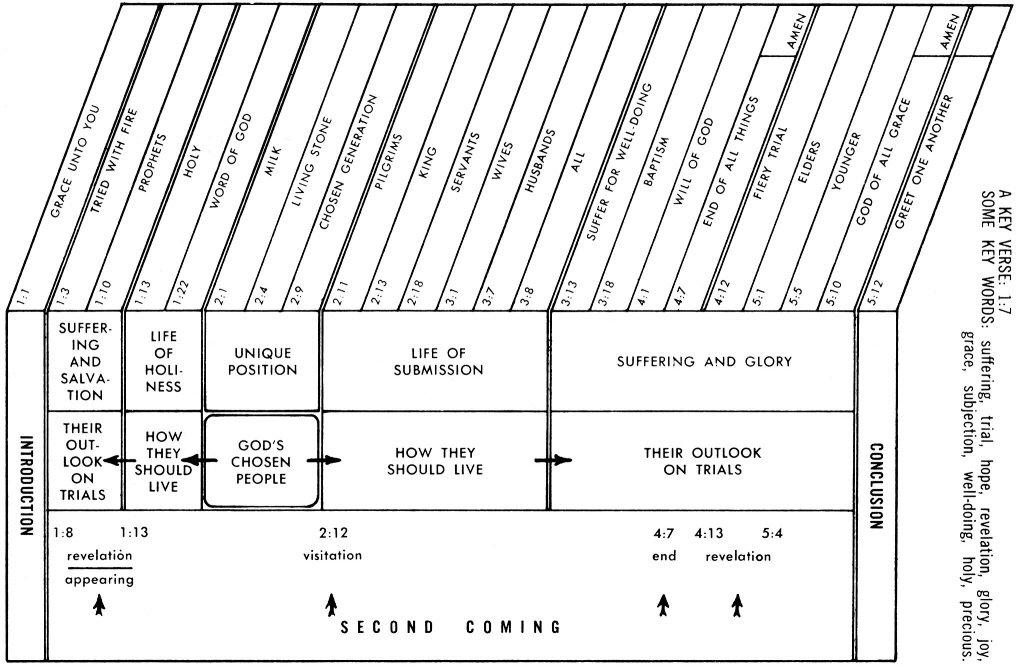
1 Peter: Trials, Holy Living & The Lord's Coming
Click chart to enlarge
Chart from Jensen's Survey of the NT - used by permission
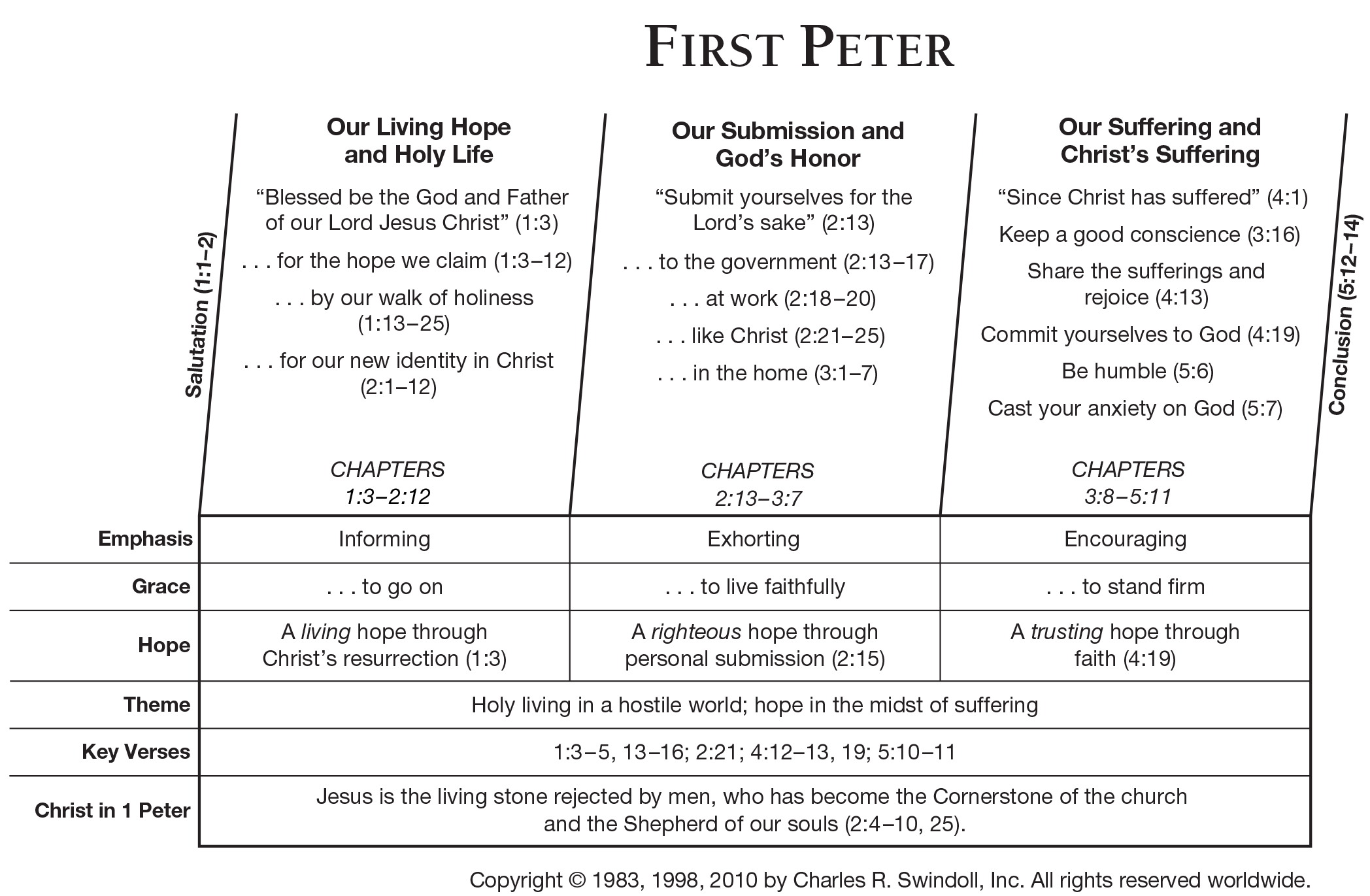
See Another Chart from Charles Swindoll
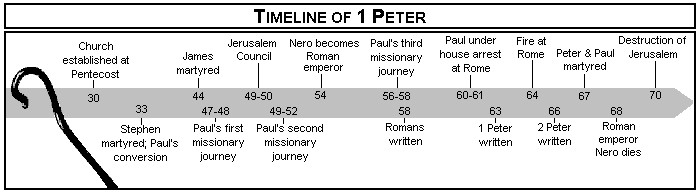
Source: Borrow Ryrie Study Bible
Click to enlarge
1 Peter 3:8 To sum up, all of you be harmonious, sympathetic, brotherly, kindhearted, and humble in spirit (NASB: Lockman)
Greek: To de telos pantes homophrones sumpatheis, phladelphoi, eusplagchnoi, tapeinophrones,
Amplified: Finally, all [of you] should be of one and the same mind (united in spirit), sympathizing [with one another], loving [each other] as brethren [of one household], compassionate and courteous (tenderhearted and humble). (Amplified Bible - Lockman)
ICB: Finally, all of you should live together in peace. Try to understand each other. Love each other as brothers. Be kind and humble. (ICB: Nelson)
NLT: Finally, all of you should be of one mind, full of sympathy toward each other, loving one another with tender hearts and humble minds. (NLT - Tyndale House)
Phillips: To sum up, you should all be of one mind living like brothers with true love and sympathy for each other, generous and courteous at all times. (Phillips: Touchstone)
Wuest: Now, to come to a conclusion. Be all of you like-minded. Be sympathetic. Have a brotherly affection for one another. Be tender-hearted. Be humble-minded,
Young's Literal: And finally, being all of one mind, having fellow-feeling, loving as brethren, compassionate, courteous,
TO SUM UP: To de telos :
- or "finally" as in most of the other translations.
Sum up (5056) (telos from tello = to set out for a definite point or goal) refers to the culmination or the outcome of a growth or development representing an attained objective.
Telos is never used in NT as a chronological end, as if something simply stops. Instead, telos refers to a consummation, a goal achieved, a result attained, or a realization. In the present context telos does not indicate the conclusion of the letter, but the conclusion of the exhortations in this section. In context this appears to be Peter’s conclusion to the topic submission, which he introduced in 1Pe 2:13 (see note)
These five virtues are to be normative qualities in the lives of the people of God, reflecting the attitude and example of Christ. Remember the context: The advice offered is for believers facing persecution. Just as the whole of the Law is summed up in love (Ro 13:8; 9; 10- see notes Ro 13:8; 9; 10), so the whole of human relationships is fulfilled in love. This applies to every Christian and to every area of life. Note that Peter deals not so much with the AUTHORITIES but with those under authority.
LET ALL BE HARMONIOUS (same mind, like–minded) : pantes homophrones:
- Acts 2:1; 4:32; Ro 12:16; 15:5; 1Cor 1:10; Php 3:16
More literally “all likeminded”. Compare Paul's exhortation to the saints at Rome…
Romans 12:16 Be of the same mind toward one another; do not be haughty in mind, but associate with the lowly. Do not be wise in your own estimation.
Spurgeon writes -
Be unanimous; do not hold church-meetings to talk about nothing, and so quarrel for the want of something to do. Be united with the resolve that you will glorify God, and that there shall be no dissension, no division among you: “Be ye all of one mind,” (1 Peter 3 Commentary)
Harmonious (3675) (homophron from homós = one and same + phren = mind, understanding) literally of one and the same mind, like-minded, having a common mindset but not necessarily all the same tastes or gifts or habits. The idea is that they are to possess the same thoughts and assessments of the essentials of life -- God, salvation, virtue.
Compare a similar word homothumadon used by Luke primarily in Acts to describe the early Church! (See Acts 1:14, 2:1, 2:46, 4:24, 5:12, 7:57, 8:6, 12:20, 15:25, 18:12, 19:29, Ro15:6)
Peter is not referring to minute details (like the color of the pew cushions!) but is referring to a unity on the major and important points of Christian doctrine and practice that should be maintained among members of the Body of Christ.
Wuest says harmonious…
cannot be pressed to refer to minute details but refers to a unity on the major and important points of Christian doctrine and practice that should be maintained among members of the Body of Christ.
That harmonious "one mind" should be the mind of Christ as Paul explained to the believers at Philippi…
make my joy complete (aorist imperative = do this now and do it effectively!) by being of the same mind, maintaining the same love, united in spirit, intent on one purpose… 5 Have this attitude (present imperative) in yourselves which was also in Christ Jesus, (See notes Philippians 2:2; Philippians 2:5)
Later in this same letter to the Philippians Paul wrote
Let us therefore, as many as are perfect (not sinless but maturing as believers), have this attitude (in context, the attitude of pursuing the prize of Christlikeness - a mark of spiritual maturity is a desire to go on with Christ) and if in anything you have a different attitude (in regard to what is involved in pressing on toward Christlikeness), God will reveal (uncover, unveil) that also to you." (see note Philippians 3:15)
Although the context of this passage is different than Peter's, the principle is true that God is willing to show the truth to those who are willing to follow it. A personal humility, willingness and openness to God to reveal the correct attitude one should have will tend to produce harmony in the local body.
Application: Beloved, are you open to God showing you whether your attitude or action contributes to or detracts from the harmony in your local body, in your family, in your marriage, in your workplace, etc?
All Christians are to be examples and purveyors of peace and unity, not disruption and disharmony.
Peter is saying in essence, "You brothers join hands together." The chain is only as strong as its weakest link.
A phrase that is appropriate in this context is
In essentials, Unity. In non-essentials, Liberty. In all things, Love.
Unity in diversity" and "Diversity in Unity.
Unity does not mean uniformity but it does mean cooperation in the midst of diversity. The members of the body work together in unity, even though they are all different. Christians may differ on how things are to be done, but they must agree on what is to be done and why.
A man criticized D. L. Moody’s methods of evangelism, and Moody said "Well, I’m always ready for improvement. What are your methods?"
The man confessed that he had none to which Moody quickly replied "Then I’ll stick to my own."
Whatever methods we may use, we must seek to honor Christ, win the lost, and build the church. Some methods are definitely not scriptural, but there is plenty of room for variety in the church. How would you describe your church… harmonious? Are you contributing to the harmony of your local body or are you marked by discord in attitude and action?
Think about your church as a "symphony orchestra" that the world is watching and listening to. Is you church "music" concordant or cacophonous?
A W Tozer - The Holy Spirit knew what He was doing when He moved the Apostle Peter to write to the early Christian church about the reality of being “of one mind” in their fellowship. Peter was not asking all the brothers and sisters to settle for some kind of regulated uniformity. He was recommending a spiritual unanimity—which means that the Spirit of God making Christ real within our beings will also give us a unity in certain qualities and disposition. Peter leaves little doubt about the fruits of genuine Christian unanimity within: “Be alike in compassion. Be alike in loving. Be alike in pity. Be alike in courtesy. Be alike in forgiving!” Then he sums it all up: “Finally, be ye all of one mind!” God’s love shed abroad in our hearts—compassion and love which can only be found in Jesus Christ—these are the only elements of true unity among men and women today!
J H Jowett - Are you surprised that the apostle’s answer begins with an enumeration of the softer graces: “compassionate, tenderhearted, humbleminded”? [1Pe 3:8] Did you anticipate that he would begin with attributes more majestic, more manly and commanding? Is it disappointing that the apostle should give emphasis to graces which we commonly associate with women rather than with men? I have called them the softer graces; perhaps I ought to have called them the riper fruit. The ultimate expression of the strongest tree is its sweetest and ripest fruit. The tender, exquisite colour of a ripening acorn is the finest expression of the oak. Hearts of oak reach their finished achievement in the softest hues of their ripest fruit. Manliness is never perfected until it issues in tenderest grace. Therefore I am not surprised to find the apostle giving prominence to the finished and ripened attainments in sanctified life. What, again, are their names? (Epistles of St. Peter)
SYMPATHETIC: sumpatheis:
- Zech 7:9; Mt 18:33; Lk 10:33; Ro 12:15; 1Cor 12:26; Jas 2:13; 3:17
John MacDuff - We need not always be on the outlook to do great services. Little sympathies and little kindnesses are always possible.
Sympathy (4835) (sumpathes from sun = with, implies a close, intimate association + páthos = suffering, misfortune <> compare sumpascho = suffer together with) describes a sincere feeling for and with the needs of others.
Sympathy is a feeling for or a capacity for sharing in the interests of another. The sympathetic individual manifests an affinity, association, or relationship with others such that whatever affects one similarly affects the other. Sympathy often suggests a tender concern and can also imply a power to enter into another’s emotional experience of any sort.
Sympathy is feeling what others feel so that you can respond with sensitivity to the need. It's the picture of suffering with another by entering into and sharing their feelings rather than simply by having compassion on them from a distance.
People who have true sympathy generally do not say, "I know how you feel." Because since they know how you feel, they also know how unhelpful it is to hear someone say, "I know how you feel."
True sympathy is usually a fairly quiet, time-intensive, presence-intensive way of being, feeling what others feel so that you can respond with sensitivity to the need.
Remember people usually don't care to know how much you know until they know how much you care.
Wuest explains that sympathy…
is made up of two Greek words, one word meaning “to be affected” by something, hence “to feel,” that is, to have feelings stirred up within one by some circumstance, the other word meaning “with.” The word means therefore, “to have a fellow-feeling.” It refers here to the interchange of fellow-feeling in either joy or sorrow. It is “rejoice with them that do rejoice, and weep with them that weep” (Ro 12:15). The English word “sympathy” refers to the fellow-feeling we should have with those that suffer, and that is the secondary meaning of our Greek word. The primary meaning refers to a fellow-feeling with a brother Christian either in his joys or in his sorrows. It takes as much grace sometimes to rejoice with another saint in the way God has blessed him as it does to sympathize with someone who is in sadness. What a miserable thing this petty jealousy is among the saints.
Tragically, too often the church is one of the cruelest places on earth in many situations.
Writing to Romans who he had just urged to present their bodies to God as living sacrifices (see note Romans 12:1), Paul made this presentation practical encouraging the believers to…
Be of the same mind toward one another; do not be haughty in mind, but associate with the lowly. Do not be wise in your own estimation. (See note Romans 12:16)
J H Jowett - “Compassion” The range of a man’s life is just the range of his compassions, which is only another name for the range of his correspondences. Death is just the destruction of all correspondence. The dying lose correspondence after correspondence; nerve after nerve and sense after sense collapse; communications are slowly broken; and by gradual paralysis and benumbment all correspondences end. The measure of my life is determined by the quality and quantity of my correspondences. This is true of the life of the flesh. It is true in the realm of the mind. How much am I in touch with? What is the range of my interests? What are my correspondences? It is true in the domains of the soul. How much do I live? That depends upon my compassion, my responsiveness, my “correspondence.” What is the extent of my fellow-feeling? What is my power of apprehending and realising my brother, and by the ministry of an unveiling imagination planting myself in the heart of his interests and estate? That is one of the rarest attainments in the sanctified life. The Lord refines His disciples into compassionateness. He indefinitely enlarges their correspondences. He endows them with sensitive passion, with profundity of feeling. “Deep calleth unto deep,” and they maintain fruitful fellowship with the joys and sorrows of their fellow-men. (Epistles of St. Peter)
BROTHERLY: philadelphoi:
- 1Peter 1:22; 2:17; Ro 12:10; Heb 13:1; 2Pe 1:7; 1Jn 3:14,18,19
Brotherly (5361) (philadelphos from phílos = friend + adelphos = brother) (See study of related word philadelphia) is fond of brethren, fraternal and so to love as brethren.
In his second letter in which he describes a growing/maturing faith (2Pe 1:4, 2Pe 1:5, 2Pe 1:6), Peter links brotherly kindness with godliness and Christian love…
2Pe 1:7 and in your godliness, brotherly kindness, and in your brotherly kindness, love (note the importance of these traits in context 2Pe 1:8, 9)
Philadelphos is an adjective which conveys the idea “Be loving brethren,” or “Be brethren who are loving.” The word here does not refer to the love that God produces in our hearts as one of the fruits of the Spirit. It is that human affection and fondness for one another as brother Christians which Peter spoke of in the first occurrence of the word “love” in chapter 1 writing to the born again ones…
Since you have in obedience to the truth purified your souls for a sincere love of the brethren (philadelphia), fervently love one another from the heart (1Pe 1:22).
Don't view each other as strangers, or as mere acquaintances, or as distant relatives. View each other as close family for after all we now all possess the same "Father". Family can have some pretty serious squabbles and exchange some very harsh words, but only in the rarest cases does the family break up over it. Mutual love is one of the strongest "arguments" for the Christian faith.
In Romans 12 Paul also instructed the believers to…
Be devoted to one another in brotherly love (philadelphia); give preference to one another in honor (see note Romans 12:10)
The writer of Hebrews exhorted his readers to…
Let love of the brethren (philadelphia) continue. (See note Hebrews 13:1)
John explained how important is the manifestation of love for one's brethren writing that…
We know that we have passed out of death into life, because we love the brethren. He who does not love abides in death. (1 John 3:14)
Beloved, let us love one another, for love is from God; and everyone who loves is born of God and knows God. The one who does not love does not know God, for God is love. (1 John 4:7-8)
The idea expressed by John could be summarized -
Know love, know God.
No love, no God.
Jesus related agape love with being "friends" (philos, the root of the word "brotherly") declaring
Greater love has no one than this, that one lay down his life for his friends. (Jn 15:13)
And then Jesus added that
You are My friends (philos), if you do what I command you. No longer do I call you slaves, for the slave does not know what his master is doing; but I have called you friends (philos), for all things that I have heard from My Father I have made known to you." (Jn 15:14-15)
We therefore should have a new motivation for being brethren who are loving.
F B Meyer asks…
Do we love the brethren, not always liking them perhaps, but treating them kindly, and making their interests more important than our own?
KINDHEARTED: eusplagchnoi:
- Ps 103:13; Pr 28:8; Mt 18:33; Jas 5:11
Ephesians 4:32 (note) Be (present imperative = calls for this to be our lifestyle now as new creations in Christ!) kind to one another, tender-hearted, forgiving each other (Why? How much? "You don't understand what they did to me!"), just as God in Christ also has forgiven you. (In context of Ep 4:30, the implication is that one needs to depend upon and be empowered by the Holy Spirit to accomplish this supernatural behavior!)
Spurgeon writes - The Christian should be the highest type of gentleman, in every respect the most gentle man, kind, self-forgetful, seeking the comfort and well-being of others to the utmost of his power. (1 Peter 3 Commentary)
Kindhearted (2155) (eusplagchnos [word study] [only other NT use = Ep 4:32 - see above] from eú = well + splagchnon = bowel = the viscera, an oriental metaphor for the seat of the tender affections and of human emotions and one of strongest Greek words to express compassionate love) means tender–hearted or full of compassion.
Tender–hearted has the idea of being compassionate, and reflects a feeling deep in the bowels, or stomach, a gnawing psychosomatic pain due to empathy for someone’s need.
F B Meyer asks…
Are we tender-hearted and pitiful towards the afflicted and distressed? Are we courteous, with true Christian politeness which differs from the world's code of manners?
Eusplagchnos is not a word about conduct but about your insides -- literally, your innards, your belly. The literal translation of the Greek means "feel generous in your belly". Be well-disposed to each other in your deeps. It's exactly the opposite of hypocrisy that acts tender and feels malice.
The idea is to have a tenderness of heart toward others. Being tender hearted means you have truly understood forgiveness. If you are not forgiving, you will have great difficulty with submission. Don't say you "Can't" forgive and forget, but tell the truth that you "Won't".
In the Roman Empire, eusplagchnos was not a quality that was admired; but the Christian message changed all of that.
Wuest adds a note that helps understand the historical context of eusplagchnos, writing that…
The first century was cold and hard-hearted. Christianity, with its tenderizing influence upon the heart, had not had time nor opportunity yet to make much of an impact upon the callous heart of man. Today we have as a result of its benign influence hospitals, homes for the aged, charities of one sort or another. And yet how callous our hearts are to another’s pain. Only the overflowing love of God and the experience of much suffering in one’s own life can fit us to really sympathize with others in the sense of feeling their pain ourselves, thus suffering with them.
J H Jowett…
Tenderheartedness. That carries one a step further than compassion. Tenderheartedness is more than correspondence; it is gentle ministry. It includes the service of the tender hand, it not only feels the pains of others; it touches the wounds with exquisite delicacy. Even the pitiful man can be clumsy. Six men may have the sympathy, but only one of the six may be able to touch the wound so as to heal it. The Lord will add a gentle hand to our compassion. He will take away all brusqueness, all spiritual clumsiness, so that in the very ministry of pity we may not “break the bruised reed, nor quench the smoking flax.” (Epistles of St. Peter)
AND HUMBLE IN SPIRIT: tapeinophrones:
- Acts 27:3; 28:7; Ep 4:31,32; 5:1,2; Php 4:8,9; Col 3:12
Here is the "secret" of how one partakes of grace as Peter alludes to later…
1 Peter 5:5 (note) You younger men, likewise, be subject to your elders; and all of you, clothe yourselves with humility toward one another, for GOD IS OPPOSED TO THE PROUD, BUT GIVES GRACE TO THE HUMBLE. (cp Jas 4:6)
The KJV which is translated from the Textus Receptus has the Greek word "philophrones" (from phílos = a friend + phronéo = to think, have a mindset) which means friendly, courteous, benign. NKJV translates it "courteous". Most scholars favor the Nestle-Aland manuscript which has tapeinophrones.
Humble of spirit (tapeinophron from tapeinos = humble + phren = think) (See related word tapeinophrosune) means thinking lowly, esteeming ourselves small. Inasmuch as we are small compared to God, this is the correct estimate of ourselves. In the NT this word describes a quality of voluntary submission and unselfishness, humility or self-effacement and is the opposite of arrogance and pride.
Humility was not thought of very highly in the ancient world (pun intended) and in fact was even considered to be a vice by the pagan moralists. Christ and Christianity elevated humility to the supreme virtue - the antidote for the self-love that poisons relationships.
Humility is not thinking poorly of oneself. Rather, it is having the proper estimate of oneself in the will of God. The person with humility thinks of others first and not of himself.
Humility, when it becomes self-conscious, ceases to have any value
It is not just that we are to act the role of a servant, but that inside, with all authenticity, we are to have a lowly spirit. We feel that we are utterly dependent on God for life and breath and intelligence and emotional stability and faith and safety and the use of our senses; and we feel utterly fragile and vulnerable in ourselves. On top of that we feel sinful and unworthy as we look at ourselves apart from the free grace of God. And this grace makes us wonder-struck that we are loved, not pushy and self-assertive.
Did you observe something that all five of those words have in common? They are all descriptions of what we are on the inside, not primarily how we act. A common mindset, sympathetic in feeling, a family love, kindly disposed in the depths of our innards, humble in spirit. That's an unusual human being. This is why Peter's call to us is not possible without a new birth and a new heart, one that now has the potential of being controlled by the Holy Spirit and life out these inner attitudes supernaturally. Be wary of trying to live out these attitudes in your own strength, because it is not possible.
J H Jowett - “Humblemindedness” [Verse 8] Surely that adds a still richer bloom to the heavenly grace! The Lord will not only give us a heart of compassion; it shall be compassion rid of all brusqueness; it shall also be purged of all superciliousness and pride! It shall be “humbleminded.” Even pity may wear some of the garments of pride! There is something bitter and offensive in all compassion which moves in patronage. The Man whose “compassions failed not” was “meek and lowly in heart!” Pity is petrifying when it comes from pride; it is soothing and healing when it flows from the humble mind, and this is the perfected grace of the sanctified life. (Epistles of St. Peter)
F B Meyer (Our Daily Walk) - CHRISTIAN COURTESY - "Finally, be ye all of one mind, having compassion one of another, love as brethren, be pitiful, be courteous."-- 1Pe 3:8.
IT WOULD be a marvel to find in any community under heaven a complete embodiment of the injunctions contained in this and the following verses. Yet nothing less than this is the Christian ideal, and it would be well if, without waiting for others, each one would adopt these precepts as the binding rule and regulation of daily life. This would be our worthiest contribution to the convincing of the world, and to the coming of the Kingdom of our Lord. Does not the Apostle's use of the word "finally" teach us that all Christian doctrine is intended to lead up to and inaugurate that life of love, the bold outlines of which are sketched in these words?
The general principle. "Be ye all of one mind, having compassion one of another." This oneness of mind does not demand the monotony of similarity, but unity in variety. We shall never be of one mind in the sense of all holding the same opinions; but we may be all of one mind when, beneath diversities of opinion, expression, and view, we are animated by a common devotion to Christ.
Note the specific applications.
Love as brethren. Love is not identical with like. Providence does not ask us whom we would like to be our brethren, that is settled for us, but we are bidden to love them, irrespective of our natural predilections and tastes. Love does not necessarily originate in the emotions, but in the will; it consists not in feeling, but in doing; not in sentiment, but in action; not in soft words, but in unselfish deeds.
Be pitiful Oh, for the compassion of our blessed Lord! How often it breaks out in the Gospel narrative to the weak and erring, to the hungry crowds, and to the afflicted who sought His help!
Be courteous. Be ready to take the least comfortable seat, or to let others sit while you stand. Let the manners of your Heavenly Father's Court be always evident in your daily life, so that the world may learn that Christianity produces not simply the heroism of a great occasion, but the minute courtesies of daily living.
PRAYER Blessed Lord, I beseech Thee to pour down upon me such grace as may not only cleanse this life of mine, but beautify it a little, if it be Thy will … Grant that I may love Thee with all my heart and soul and mind and strength, and my neighbour as myself. AMEN. (F B Meyer. Our Daily Walk)
A Father's Blessing - A man who was grieving the death of his father said, "I am crying not only for my father, but for me. His death means that I'll never hear the words I always wanted to hear from him: that he was proud of me, proud of the family I've raised and the life I've lived."
Instead of repeating his father's mistake, the man later gave his own son the words of encouragement he himself had never heard, saying he was proud of him and the life he had made.
Too often, tension between fathers and children are left unresolved. Old wounds remain unhealed. We are unwilling to forgive the angry words and hurts from the past. But for the sake of ourselves and our families, we need to do what we can to dismantle the walls of separation between us.
How can we begin? The Bible's command for all our relationships is: "Love as brothers, be tenderhearted, be courteous, not returning evil for evil or reviling for reviling, but on the contrary blessing … Turn away from evil and do good; … seek peace and pursue it" (1Peter 3:8-9,11).
Let's determine by God's grace to break the cycle of anger and give our children what they long to hear from us—words of blessing and love.— David C. McCasland (Our Daily Bread, Copyright RBC Ministries, Grand Rapids, MI. Reprinted by permission. All rights reserved)
Our children need to know we care,
That when they need us we'll be there;
For deep within they need to hear
That they are loved by someone dear. —D. De Haan
The best thing you spend
on your children is your time.
Overcoming Envy - With tongue in cheek, someone has defined happiness as "an agreeable sensation arising from contemplating the misery of another."
Few of us would agree with this definition, but I'm afraid all of us can see enough truth in it to make us flinch. It's understandable to want to be a success like a neighbor. But it is wrong to have an attitude that says, "If I can't have it, I don't want anyone else to have it either."
I was about 13 when I began to realize that my 10-year-old brother Len's athletic skills were greater than mine. At first a tinge of resentment rose up within me, but it didn't have a chance to develop into a strong feeling of envy. Why? Because I loved Len. I soon began to take pride in his athletic achievements and felt with him the joy of victory and the agony of defeat.
That experience taught me that love and envy cannot coexist in the human heart. Now, whenever envy rears its ugly head, I recall how my love for Len drove it out of me. I also remember the admonition of 1Peter 3:8, "Love as brothers." It enables me to "rejoice with those who rejoice, and weep with those who weep" (Ro 12:15).
Being committed to loving others is the secret to overcoming envy. — Herbert Vander Lugt (Our Daily Bread, Copyright RBC Ministries, Grand Rapids, MI. Reprinted by permission. All rights reserved)
From seeds of envy in the heart
Spring up the noxious weeds of hate;
So help me, Lord, to love the one
Whom I find hard to tolerate. —D. De Haan
A daily dose of Christlike love
will heal the heart disease of envy.
Moody Artwork - British and American computer scientists have created artwork that changes according to how the viewer feels. The computer program analyzes the position and shape of the mouth, the angle of the brows, the openness of the eyes, and five other facial features to determine the viewer’s emotional state. The artwork then alters, based on the viewer’s mood. If joy is seen on the face, the artwork will show up in bright colors. If there’s a scowl, the image will become dark and somber.
Our moods can also affect the people around us—our family, friends, co-workers, and acquaintances. Our life touches people, whether for good or bad. Each person is responsible for his or her own reaction to us, of course. Yet the way we behave makes a difference in others’ lives.
The apostle Peter encouraged us to have compassion for others, to love, to be tenderhearted and courteous, and not to return evil for evil but rather blessing (1 Peter 3:8-9). Following his instructions may be difficult for us on a day when we feel cranky. By depending on the Holy Spirit, we can have a positive impact on everyone we meet—even if all we do is smile or listen.
Let’s paint our world in bright colors today.— Anne Cetas (Our Daily Bread, Copyright RBC Ministries, Grand Rapids, MI. Reprinted by permission. All rights reserved)
My life will touch a dozen lives
Before this day is done,
Leave countless marks for good or ill
Before the setting sun. —Anon.
A heart touched by grace
brings joy to the face
1 Peter 3:9 not returning evil for evil or insult for insult, but giving a blessing instead; for you were called for the very purpose that you might inherit a blessing. (NASB: Lockman)
Greek: me apodidontes (PAPMPN) kakon anti kakou e loidorian anti loidorias, tounantion de eulogountes, (PAPMPN) hoti eis touto ekleqete (2PAPI) hina eulogian kleronomeshte. (2PAPS)
Amplified: Never return evil for evil or insult for insult (scolding, tongue-lashing, berating), but on the contrary blessing [praying for their welfare, happiness, and protection, and truly pitying and loving them]. For know that to this you have been called, that you may yourselves inherit a blessing [from God—that you may obtain a blessing as heirs, bringing welfare and happiness and protection]. (Amplified Bible - Lockman)
KJV: Not rendering evil for evil, or railing for railing: but contrariwise blessing; knowing that ye are thereunto called, that ye should inherit a blessing.
NLT: Don't repay evil for evil. Don't retaliate when people say unkind things about you. Instead, pay them back with a blessing. That is what God wants you to do, and he will bless you for it. (NLT - Tyndale House)
Phillips: Never pay back a bad turn with a bad turn or an insult with another insult, but on the contrary pay back with good. For this is your calling - to do good and one day to inherit all the goodness of God. (Phillips: Touchstone)
Wuest: not giving back evil in exchange for evil, or verbal abuse in exchange for verbal abuse, but instead, on the contrary, be constantly blessing, since for this very purpose you were called, that you might inherit a blessing.
Young's Literal: not giving back evil for evil, or railing for railing, and on the contrary, blessing, having known that to this ye were called, that a blessing ye may inherit;
NOT RETURNING EVIL FOR EVIL: me apodidontes (PAPMPN) kakon anti kakou:
-
1 Peter 2:20, 21, 23; Pr 17:13; 20:22; Mt 5:39,44; Lk 6:27, 28, 29; Ro 12:14,17,19, 20, 21; 1Cor 4:12,13; Eph 4:32; 1Th 5:15
Returning (591) (apodidomi from apó = from + didomi = give) means to pay or give back, implying a debt. This word carries the idea of obligation and responsibility for something that is not optional. The prefixed preposition apo (off, away from) makes the verb mean “to give off” from one’s self. To give back or pay back or to do something necessary in fulfillment of an obligation or expectation.
Retaliation was strongly condemned by Jesus in His sermon on the mount…
You have heard that it was said, 'AN EYE FOR AN EYE, AND A TOOTH FOR A TOOTH.' "But I say to you, do not resist him who is evil; but whoever slaps you on your right cheek, turn to him the other also. And if anyone wants to sue you, and take your shirt, let him have your coat also. And whoever shall force you to go one mile, go with him two. Give to him who asks of you, and do not turn away from him who wants to borrow from you. (see notes Matthew 5:38; 39; 40; 41; 42)
As God’s loving children, we must do more than give “an eye for an eye, and a tooth for a tooth”, which is the basis for justice. We must operate on the basis of mercy, for that is the way God deals with us.
Paul also strongly discouraged retaliation writing…
Never pay back evil for evil to anyone. Respect what is right in the sight of all men. (see note Romans 12:17)
For (anti) here means "in return for".
Evil (2556) (kakos) is a word which basically, denotes a lack of something. Evil, bad, destructive, damaging, unjust
Don't let your flesh rise up and try to "get even"… this is good advice but necessitates guarding one's heart and being alert so that you remain under the control of the Spirit (see note Ephesians 5:18) Beware of your fallen flesh, for it will always try to defend itself and use "righteous indignation" as justification. Instead remember the "example" of Jesus Who…
and while being reviled, He did not revile in return; while suffering, He uttered no threats, but kept entrusting Himself to Him who judges righteously (See note 1 Peter 2:23).
This principle is not just a NT truth but was also taught in the Old Testament..
You shall not take vengeance, nor bear any grudge against the sons of your people, but you shall love your neighbor as yourself; I am the LORD. (Lev 19:18)
Do not say, "I will repay evil"; Wait for the LORD, and He will save you. (Pr 20:22)
This admonition must have meant much to Peter, because he once tried to fight Christ’s enemies with a sword (see Lu 22:47-53).
What a wonderful encouragement this should be to Spirit indwelt persons, for if the coming of the promised Spirit can change Peter's heart, He can effect similar change in our heart and our response to unfair treatment. What a difference a day (Pentecost) makes. Before it was Peter's power but afterward when Peter and the Apostles were persecuted, they depended on prayer and Spirit power, not their wisdom or strength (Acts 4:23ff).
Spurgeon writes regarding returning evil -
That, is beastlike; it is certainly not the rule for a Christian. Good for evil is Godlike; and ye, who are the children of God, should seek to act as he does: “not rendering evil for evil” .
Every man should give away according to what he has. He who gives curses probably gives them because he has so much cursing in him. You can always tell what a man is like by noticing what comes from him. If he curses, it is because curses abound in him. But you are to give blessing to others because you have inherited so much blessing from Christ; your whole tone, temper, spirit, language, action should be the means of blessing to others (1 Peter 3 Commentary)
J H Jowett - “Not Tendering evil for evil, or reviling for reviling; but contrariwise blessing.” Surely that is the perfection of compassion! Compassion may go out on chivalrous errands with sensitive hands and lowly mind, and may meet with ingratitude and angry rebuff from those whom she seeks to serve. When the one we have been compassionately nursing turns and reviles us, and treats our ministry with contempt, how easy it is to become sour and hard, to return reviling for reviling, and to throw up the knightly service with disgust! But the Lord will so perfect the compassion that even in the midst of reviling it will continue in “blessing,” and in atmospheres of ingratitude and contempt will toil on in the ministry of “healing them that are bruised.” What say you now to these softer graces, these riper fruits of the sanctified life? Are they not a resplendent issue? He who continually, in his heart, sanctifies Christ as Lord, becomes possessed by a compassion which moves in delicate sensitiveness, and in humblemindedness, and which remains sweet and persistent in hostile atmospheres of murmuring and contempt.(Epistles of St. Peter)
OR INSULT FOR INSULT: e loidorian anti loidorias:
Insult (3059) (loidoria from loidoreo [word study] from loidoros = reviling, railing, one who reviles as in 1Cor 5:11) describes verbal abuse, reproach and/or vilification. Reviling implies a scurrilous, abusive attack prompted by anger or hatred. Railing (against) means scolding someone using harsh, insolent, or abusive language.
Neither evil deeds nor insulting words should be a Christian's response.
The Living Bible picks up the sense in modern slang
Don’t snap back at those who say unkind things about you.
Our fallen flesh wants to snap back when confronted (whether the accusation is justified but especially when it is not justified).
Have you been "snappy" lately? Confess, repent and be filled with the Spirit, some aspects of His fruit being gentleness and patience and self control!
Peter's point as he goes on is if you desire to enjoy life and have good days, you need to control your tongue as David taught in Psalm 34:12, 13, 14. Furthermore this behavior with positively or adversely affect the "efficacy" of your prayers (1Peter 3:12, cp 1Peter 3:7).
So watch out trying to retaliate "tit for tat"… it may be the world's way but it is not a Spirit-controlled believer's way. Turn your eyes on Jesus' example (see note 1Peter 2:23) and cry out for grace to make it (He 4:16, He 2:18), for the sake of righteousness and for the sake of His name.
F B Meyer asks…
How do we reply to injury? Do we bless when we are cursed, or do we retaliate with hot and indignant words? Are we willing to leave our vindication with God?
J H Jowett - Not Tendering evil for evil, or reviling for reviling; but contrariwise blessing. Surely that is the perfection of compassion! Compassion may go out on chivalrous errands with sensitive hands and lowly mind, and may meet with ingratitude and angry rebuff from those whom she seeks to serve. When the one we have been compassionately nursing turns and reviles us, and treats our ministry with contempt, how easy it is to become sour and hard, to return reviling for reviling, and to throw up the knightly service with disgust! But the Lord will so perfect the compassion that even in the midst of reviling it will continue in “blessing,” and in atmospheres of ingratitude and contempt will toil on in the ministry of “healing them that are bruised.” What say you now to these softer graces, these riper fruits of the sanctified life? Are they not a resplendent issue? He who continually, in his heart, sanctifies Christ as Lord, becomes possessed by a compassion which moves in delicate sensitiveness, and in humblemindedness, and which remains sweet and persistent in hostile atmospheres of murmuring and contempt. (Epistles of St. Peter)
BUT GIVING A BLESSING (continually speaking well of) INSTEAD: tounantion de eulogountes (PAPMPN):
Giving a blessing (2127) (eulogeo from eu = good + lógos = word) when used by men toward men it means to speak well of with praise and thanksgiving (English "eulogize"). It means to invoke God’s blessing upon them.
Eulogeo is in the present tense indicating we are to continually eulogize others (not while dead but alive) but not patronizing. How could we bless them? praying for their welfare, protection, truly pitying and loving them.
We must always be reminded of our calling as Christians, for this will help us love our enemies and do them good when they treat us badly. We are called to “inherit a blessing.” The persecutions we experience on earth today only add to our blessed inheritance of glory in heaven someday (Matthew 5:10; 11; 12-see notes Mt 5:10; 11; 12).
Wayne Barber explains that eulogeo…
means to speak good things about this person. Now careful, don’t jump ahead with surface interpretation. You may be thinking, "Now wait a minute! Do you mean when somebody, even in the body of Christ, treats me like dirt, I am supposed to say something good about them? That is a lie." Yeah, it sure is. And God is not telling you to lie about them. What does it mean to bless somebody, to speak well of somebody?
You have to read the whole verse. He says, "bless and curse not." The word "curse" means to wish evil upon someone. That is what it means to curse them. It means to say, "Oh, I hope he gets his. I hope this happens in his life," wishing evil upon them. Instead, wish that good things could come upon them. Speak that which is good. Don’t lie about them because they are mean people, but speak good. Wish that which is good to come upon them. Now that is the way you treat those in the body of Christ who bring great grief and pain in your Christian walk. You are seeking to walk surrendered to Christ and they treat you as if you are dirt. You don’t wish evil upon them.
Now you know, if you didn’t understand Romans 1-11, you can’t understand this. In Romans 8 we know why we can do this… Because God is causing all things, even those people who bring us grief, to work together for good to those that love God, to those who are called according to His purpose. You see, you have got to have the first 11 chapters of Romans to even begin to understand chapters 12 through 16. Everything in chapters 12 through 16 hinges on what we have already studied in Romans. God is in charge. He even uses the persecution. To do what? To drive us to the end of ourselves. Why? Because Ro 8:29 (note) says that we might be conformed into the image of Christ Jesus. So the pain and all the things that we go through in this quarry, in this school, in this workshop down here on this earth are all tools that God is using to chip off and to hone and to make us into the image of His Son, Jesus Christ. It drives us to the end of ourselves where we learn to decrease and then He is able to increase in our life. That is what life is all about.
So as a believer, when it comes, back off and say,
"God, I don’t know what you are doing in this, but thank you that you are in control of it and I am not about to wish evil upon this person. I want them to know the same God I know and trust and walk with day by day."
You don’t wish evil upon them. As a matter of fact, it is by the grace of God that you are not like they are. So speak well of them. Speak good of them. That is the response of a person whose love is without hypocrisy. Because you have got the bigger picture, you can see far beyond the pain and what the individual is doing to you in your life.
It is the saddest thing in the world when people live with bitterness inside them. Hebrews says,
"Don’t let a root of bitterness grow up thereby defiling many." (See note Hebrews 12:15)
Do you know where it comes from? It comes from not being surrendered. It comes from not understanding that only when you are surrendered, this is your logical, reasonable spiritual service of worship. When you make this offering of yourself to God, God can transform you, renew your mind and you are going to think differently from that point on. But a person not willing to live that way is a person who has put himself, his sinful body, right back up under bondage, the same bondage that God has freed him from. He lives in misery, bound to something that he should never be bound to. So, the response. (from sermon Romans 12:14-17 Responsibilities Under Grace 7)
FOR YOU WERE CALLED FOR THE VERY PURPOSE THAT YOU MIGHT INHERIT A BLESSING: hoti eis touto eklethete (2PAPI) hina eulogian kleronomesete (2PAPS):
- 1Pe 2:21; 5:10; Ro 8:28,30) (Mt 19:29; 25:34; Mk 10:17; Lk 10:25; 18:18
You were called - See notes on the called
Literally it reads “into this you were called in order that you may inherit a blessing.”
The called are those who have been summoned by God… called…
according to His purpose (Romans 8:28)
to salvation (Ro 8:30) (calling is an intrinsic, integral component in the process of salvation of a soul)
saints by calling (1Cor 1:2) (calling conveys a positional truth)
both Jews and Greeks (1Cor 1:24) (calling is all inclusive; i.e., not just
having been called "with a holy" (2Ti 1:9)
heavenly calling (He 3:1) (calling has a future aspect)
out of darkness into His marvelous light (1Pe 2:9)
to walk worthy (Ep 4:1) (calling conveys a responsibility)
by grace (Gal 1:6) (calling conveys a power or enablement to accomplish)
not from among Jews only, but also from among Gentiles (Ro 9:24) (calling conveys the idea of a separation)
through the "gospel" that we "may gain the glory of our Lord Jesus Christ" (2Th 2:14) (the gospel is God's "instrument" by which calling is "actuated" - so let us be zealous to speak forth the gospel to all we encounter - we do not know who the called are and should treat every soul we encounter as if they were called to salvation)
and be brought "into fellowship with His Son, Jesus Christ our Lord" (1Cor 1:9)
and return in triumph "with Him" at the end of this age (Rev 17:14)
Were called - The aorist tense defines this calling as a historical event, an action that has been completed. God called us. The theologians refer to this an "effectual" call.
Called (2564) (kaleo) means to speak to another in order to bring them nearer, either physically or in a personal relationship. Called is in the passive voice which indicates the call is external and clearly presupposes God as the One initiating the action of calling us.
Kaleo can refer to an invitation, but in this context conveys the idea of an effectual call and emphasizes God's sovereign work. God has invited us into His family and given us the privilege of inheriting a blessing.
G H Trever has a succinct summation of the Biblical doctrine of calling…
CALLING - kol'-ing (klesis, from kaleo, "I call"): Is a New Testament expression. The word is used chiefly by Paul, though the idea and term are found also elsewhere. It has a definite, technical sense, the invitation given to men by God to accept salvation in His kingdom through Jesus Christ. This invitation is given outwardly by the preaching of the gospel, inwardly by the work of the Holy Spirit. With reference to Israel, it is on the part of God irrevocable, not repented of. Having in His eternal counsel called this people, He entrusted them with great gifts, and because He did thus enrich them, He also, in the course of time, summoned them to fulfill the task of initiating the world into the way of salvation, and of preparing salvation for the world. Therefore, He will not desert His people (literal Israel, the Jews), for He Will not revoke that call (Ro 11:29). This calling is high or upward, in Christ, that is, made in heaven by God on account of Christ and calling man to heaven (Php 3:14). Similarly it is a heavenly calling (Heb 3:1); also a holy calling, holy in aim, means, and end (2Ti 1:9). Christians are urged to walk worthy of this calling (Ep 4:1) (the American Standard Revised Version and the Revised Version (British and American), but the King James Version has "vocation"). In it there is hope; it is the inspirer of hope, and furnishes for hope its supreme object (Ep 4:4). Men are exhorted so to live that God will count them worthy of their calling (2Th 1:11). They are also urged to make their calling and election sure (2Pe 1:10). See Election. There is a somewhat peculiar use of the word in 1Co 1:26 and 1Co 7:20, namely, that condition of life in which men were when God called them, not many of them wise after the flesh, not many mighty, not many noble, some circumcised, some uncircumcised, some bond, some free, some male, some female, some married, some unmarried.
That (hina) introduces a purpose clause, in this case the purpose of our calling! Do we really appreciate this truth!
Inherit (2816) (kleronomeo from kleros = First a pebble, piece of wood used in casting lots as in Acts 1:26 then the allotted portion or inheritance, and so a lot, heritage, inheritance + nemomai = to possess; see Kleronomos) means to receive a lot or share of an inheritance, inherit a portion of property or receive a possession as gift from someone who has died.
Kleronomeo means "to receive the portion assigned to one, receive an allotted portion, receive as one's own or as a possession; to become partaker of, to obtain" (Thayer)
Inherit - To take by descent from an ancestor; to take by succession, as the representative of the former possessor; to receive, as a right or title descendible by law from an ancestor at his decease. To receive by nature from a progenitor. To possess; to enjoy; to take as a possession, by gift or divine appropriation; as, to inherit everlasting life; to inherit the promises. (Noah Webster 1828 ed)
In the NT kleronomeo is used to describe inheriting
"the earth" (for those who are gentle, i.e., believers) (Mt 5:5), "many times more" (than a believer has given up in this present life) (Mt 19:29), "the Kingdom" (of God - referring to believing Gentiles who aid Jews) (Mt 25:34), "eternal life" (Mk 10:17, Lk 10:25, 18:18), "the Kingdom of God" (not given to the unrighteous - 1Co 6:9, 10, cp Gal 5:21 = those who practice unrighteous behavior; Not to "flesh and blood" 1Co 15:50), "a more excellent name" (of Jesus better than angels, Heb 1:4), "salvation" (speaking of believers who have angelic assistance in this life, Heb 1:14), "the promises" (which include the promises of salvation = He 6:12), "the blessing" (which was Esau's "lot", one he traded for food, He 12:17), "a blessing" (the lot of believers 1Pe 3:9), the things of heaven and eternity in the presence of God (Rev 21:7).
In classic Greek the root word kleros…
is derived from klao, break. In the first instance it means a lot. Used from Homer on it meant originally the fragment of stone or piece of wood which was used as a lot. Lots were drawn to discover the will of the gods. Since land was divided by lot, probably in the framework of common use of the fields, kleros came to mean a share, land received by lot, plot of land, and finally inheritance. The vb. belonging to this is kleroo, to draw lots, apportion by lot. kleronomia compounded from kleros and nemo, allot, is first the activity of dividing by lot, then the portion so divided, the inheritance. The kleronomos is one who has been given a kleros, the inheritor. sugkleronomos is a fellow heir, and kleronomeo means be an heir, inherit. (Brown, Colin, Editor. New International Dictionary of NT Theology. 1986. Zondervan)
Vine summarizes these uses…
a, birthright, that into the possession of which one enters in virtue of sonship, not because of a price paid or of a task accomplished, is said to be inherited, Gal 4:30, Hebrews 1:4; 12:17;
b, that which is received as a gift, in contrast with that which is received as the reward of law-keeping (see Gal 3:14–22) is said to be inherited, Heb 1:14; 6:12 (“through,” i.e., “through experiences that called for the exercise of faith and patience,” but not “on the ground of the exercise of faith and patience”);
c, that which is received on condition of obedience to certain precepts, 1Peter 3:9, and of faithfulness to God in the face of opposition, Rev 21:7, is also said to be inherited;
d, the reward of that condition of soul which forbears retaliation and self-vindication, which expresses itself in gentleness of behavior, seeking not its own, 1 Corinthians 13:5 (and to which, therefore, “its own,” Luke 16:12, is secure), Matthew 5:5.
The phrase “inherit the earth,” or “land,” occurs several times in the Old Testament, indeed the whole of this saying of the Lord Jesus is found in Ps 37:11, 22. It seems to refer, in the first place, to the undisputed and undisturbed possession of the Promised Land by renewed Israel under the glorious rule of Messiah, in contrast with the uncertain tenure and harassed condition of Israel in the psalmist’s day and in the days of the Lord’s humiliation;
e, of the reward (in the coming age, Mark 10:30) of the acknowledgment of the paramountcy of the claims of Christ, Matthew 19:29…
f, of the reward of those who have shown kindness to the “brethren” of the Lord in their distress, Matthew 25:34, where “to inherit the kingdom” is alternated with “to enter into eternal life,” see Mt 25:46;
g, the incompatibility of the present physical constitution of man with the new order to be ushered in at the coming of the Lord is declared in the words “flesh and blood [the living] cannot inherit the Kingdom of God; neither doth corruption [the dead] inherit incorruption,” 1Co 15:50;
h, so also of the morally corrupt, neither shall they inherit the kingdom of God, here, and 1Co 6:9, 10, cp. Ephesians 5. (Vine, W. Collected writings of W. E. Vine. Nashville: Thomas Nelson or Logos)
Kleronomeo - 18x in 17v - Mt 5:5; 19:29; 25:34; Mk 10:17; Luke 10:25; 18:18; 1 Cor 6:9f; 15:50; Gal 4:30; 5:21; Heb 1:4, 14; 6:12; 12:17; 1 Pet 3:9; Rev 21:7
Matthew 5:5 "Blessed are the gentle, for they shall inherit the earth.
Matthew 19:29 "And everyone who has left houses or brothers or sisters or father or mother or children or farms for My name's sake, will receive many times as much, and will inherit eternal life.
Matthew 25:34 "Then the King will say to those on His right, 'Come, you who are blessed of My Father, inherit the kingdom prepared for you from the foundation of the world.
Mark 10:17 As He was setting out on a journey, a man ran up to Him and knelt before Him, and asked Him, "Good Teacher, what shall I do to inherit eternal life?"
Comment: This question (and the following two passages) reflects a "works" mentality. What work can I do to gain eternal life and entrance into the Kingdom of God. Every cult and every religion (including as in this context, Judaism) other than Christianity, asks and answers this question by prescribing human works of various kinds, in lieu of the only "work" which is acceptable to God which of course is faith (cp Jn 6:29, Ep 2:8, 9).
Luke 10:25 And a lawyer stood up and put Him to the test, saying, "Teacher, what shall I do to inherit eternal life?"
Luke 18:18 A ruler questioned Him, saying, "Good Teacher, what shall I do to inherit eternal life?"
1 Corinthians 6:9 Or do you not know that the unrighteous will not inherit the kingdom of God? Do not be deceived; neither fornicators, nor idolaters, nor adulterers, nor effeminate, nor homosexuals, 10 nor thieves, nor the covetous, nor drunkards, nor revilers, nor swindlers, will inherit the kingdom of God.
1 Corinthians 15:50 Now I say this, brethren, that flesh and blood cannot inherit the kingdom of God; nor does the perishable inherit the imperishable.
Galatians 4:30 But what does the Scripture say? "CAST OUT THE BONDWOMAN AND HER SON, FOR THE SON OF THE BONDWOMAN SHALL NOT BE AN HEIR WITH THE SON OF THE FREE WOMAN."
Galatians 5:21 envying, drunkenness, carousing, and things like these, of which I forewarn you, just as I have forewarned you, that those who practice such things will not inherit the kingdom of God.
Vine comments: In the present passage, and indeed throughout the epistle, the idea of the inheritance is always of something given in grace and received apart from works, see Gal 3:18 and Gal 4:7; in fact the meaning "a" ( = birthright, that into the possession of which one enters in virtue of sonship, not because of a price paid or of a task accomplished, is said to be inherited) is appropriated to spiritual uses. No man could qualify himself to inherit the kingdom of God, however assiduously he might practice the virtues to which these vices are opposed. On the other hand, the practice of the vices is presumptive evidence of the absence of that new birth which is the sole qualification for heirship. On this point the words of the Lord are explicit, “Not every one that saith unto Me, Lord, Lord, shall enter into the Kingdom of Heaven; but He that doeth the will of My Father, which is in Heaven,” . (Vine, W. Collected writings of W. E. Vine. Nashville: Thomas Nelson or Logos)
Hebrews 1:4 having become as much better than the angels, as He has inherited a more excellent name than they.
Hebrews 1:14 Are they not all ministering spirits, sent out to render service for the sake of those who will inherit salvation?
Hebrews 6:12 so that you will not be sluggish, but imitators of those who through faith and patience inherit the promises.
Hebrews 12:17 For you know that even afterwards, when he desired to inherit the blessing, he was rejected, for he found no place for repentance, though he sought for it with tears.
1 Peter 3:9 not returning evil for evil or insult for insult, but giving a blessing instead; for you were called for the very purpose that you might inherit a blessing.
Revelation 21:7 "He who overcomes will inherit these things, and I will be his God and he will be My son.
Kleronomeo - 134x in non-apocryphal Septuagint (LXX)-
Ge 15:3, 4, 7f; 21:10; 22:17; 24:60; 28:4; 47:27; Ex 23:30; Lev 20:24; Nu 14:24, 31; 18:20, 23, 24; 21:35; 26:53, 55; 27:11; 32:19; 33:54; 34:17; 35:8; Deut 1:8, 21, 39; 2:9, 24, 31; 3:12; 4:1, 5, 14, 22, 26, 38, 47; 5:33; 6:1, 18; 7:1; 8:1; 9:1, 4, 5, 6, 23; 10:11; 11:8, 10, 11, 23, 29, 31; 12:2, 29; 16:20; 17:14; 20:16; 21:1; 23:20; 28:21, 63; 30:5, 16, 18; 31:13; 32:47; 33:23; Josh 1:15; 12:7; 14:2; 16:4; 17:6, 14; 18:2f; 19:9; 22:9; 24:4; Jdg 1:18, 19, 20; 3:13; 11:2, 21, 23, 24; 18:9; 1 Kgs 21:15, 16, 18, 19; 2Ki 17:24; 1 Chr 28:8; Ezra 9:11; Neh 9:15, 22, 23, 25; Ps 5:1; 25:13; 37:9, 11, 22, 29; 44:3; 69:35; 83:12; 105:44; 119:111; Pr 3:35; 11:29; 13:22; Isa 14:21; 17:14; 34:17; 49:8; 53:12; 54:3; 57:13; 58:11; 60:21; 61:7; 63:18; 65:9; Ezek 35:10; 36:12; Hos 9:6; Obad 1:20; Zeph 2:9; Zech 9:4.
Below are a few uses of kleronomeo on which you might take a few moments to meditate (cp Joshua 1:8; Ps 1:2, Ps 1:3)
Psalm 37:9 For evildoers will be cut off, but those who wait for the Lord (cp Is 40:31), they will inherit the land.
Spurgeon: Evil doers shall be cut off. Their death shall be a penal judgment; not a gentle removal to a better state, but an execution in which the axe of justice will be used. But those that wait upon the Lord -- those who in patient faith expect their portion in another life -- they shall inherit the earth. Even in this life they have the most of real enjoyment, and in the ages to come theirs shall be the glory and the triumph. Passion, according to Bunyan's parable, has his good things first, and they are soon over; Patience has his good things last, and they last for ever.
They shall inherit the earth. He means that they shall live in such a manner as that the blessing of God shall follow them, even to the grave. John Calvin.
Psalm 37:11 But the humble will inherit the land and will delight themselves in abundant prosperity.
Spurgeon: But the meek shall inherit the earth. Above all others they shall enjoy life. Even if they suffer, their consolations shall overtop their tribulations. By inheriting the land is meant obtaining covenant privileges and the salvation of God. Such as are truly humble shall take their lot with the rest of the heirs of grace, to whom all good things come by a sacred birthright. And shall delight themselves in the abundance of peace. Peace they love and peace they shall have. If they find not abundance of gold, abundance of peace will serve their turn far better. Others find joy in strife, and thence arises their misery in due time, but peace leads on to peace, and the more a man loves it the more shall it come to him. In the halcyon period of the latter days, when universal peace shall make glad the earth, the full prophetic meaning of words like these will be made plain.
Psalm 37:22 For those blessed by Him will inherit the land, but those cursed by Him will be cut off.
Spurgeon: For such as be blessed of him shall inherit the earth. God's benediction is true wealth after all. True happiness, such as the covenant secures to all the chosen of heaven, lies wrapped up in the divine favour. And they that be cursed of him shall be cut off. His frown is death; nay, more, It is hell.
The child of such a tenant as paid his rent well, shall not be put out of his farm. John Glascock
The divine blessing the secret of happiness. The divine displeasure the essence of misery.
Psalm 37:29 The righteous will inherit the land and dwell in it forever.
Spurgeon: The righteous shall inherit the land. As heirs with Jesus Christ, the Canaan above, which is the antitype of "the land," shall be theirs with all covenant blessing. And dwell therein for ever. Tenures differ, but none can match the holding which believers have of heaven. Paradise is theirs for ever by inheritance, and they shall live for ever to enjoy it. Who would not be a saint on such terms? Who would fret concerning the fleeting treasures of the godless?
Consider well this Bible truth, of the future exclusive possession of the earth by the righteous. The millennial kingdom furnishes a fuller explanation. T. C. Barth.
Psalm 119:111 - I have inherited Your testimonies forever, for they are the joy of my heart.
Spurgeon - Thy testimonies have I taken as an heritage for ever. He chose them as his lot, his portion, his estate; and what is more, he laid hold upon them and made them so, -- taking them into possession and enjoyment. David's choice is our choice (Ed: Not everyone agrees that David wrote Ps 119). If we might have our desire, we would desire to keep the commands of God perfectly. To know the doctrine, to enjoy the promise, to practise the command, -- be this a kingdom large enough for me. Here we have an inheritance which cannot fade and cannot be alienated; it is for ever, and ours for ever, if we have so taken it.
Sometimes, like Israel at the first coming into Canaan, we have to take our heritage by hard fighting, and, if so, it is worthy of all our labour and suffering; but always it has to be taken by a decided choice of the heart and grip of the will.
What God gives
We must take
Proverbs 3:35 The wise will inherit honor, but fools display dishonor.
Proverbs 11:29 He who troubles his own house will inherit wind, and the foolish will be servant to the wisehearted.
Proverbs 13:22 A good man leaves an inheritance to his children’s children, and the wealth of the sinner is stored up for the righteous.
Note the prominent Septuagint usage of kleronomeo in the latter portion of Isaiah which describes Israel's restoration and the complete fulfillment of God's covenant with Abraham - at this time, in the future Millennium, Israel will obtain the full inheritance promised to Abraham. For example…
Isaiah 60:21 Then (this time phrase describes the Millennium) all your people will be righteous (cp "all Israel will be saved" Ro 11:26); They will possess the land (promised to Abraham - Ge 15:18, 17:8) forever, The branch of My planting (cp Is 61:3), The work of My hands, That I may be glorified (cp Is 43:21, 44:23).
Isaiah 61:7 Instead of your shame you will have a double portion, And instead of humiliation they will shout for joy over their portion. Therefore they will possess a double portion in their land, Everlasting joy will be theirs.
Isaiah 65:9 “I will bring forth offspring from Jacob, And an heir of My mountains from Judah; Even My chosen ones shall inherit it, And My servants will dwell there.
(Compare) Psalm 69:35 For God will save Zion and build the cities of Judah, that they may dwell there and possess it.
Spurgeon's comment: Whatever captivities may occur, or desolations be caused, the land of Canaan belongs to Israel by a covenant of salt (Ed: Nu 18:19, 2Chr 13:5 - salt stands for permanence and incorruption. A "covenant of salt" was understood in ancient nations to be permanent and unbreakable. See also Trumbull's book = Covenant of Salt)), and they will surely repossess it; and this shall be a sign unto us, that through the atonement of the Christ of God, all the poor in spirit shall enjoy the mercies promised in the covenant of grace. The sure mercies of David shall be the heritage of all the seed. (Note: Clearly the "prince of preachers" understood the irrevocable promises to Israel would yet be fulfilled in the Millennium)
Frank Hirsch sums up the Biblical concept of inheritance…
INHERITANCE - in-her'-i-tans (nahalah, "something inherited," "occupancy," "heirloom," "estate," "portion"): The word is used in its widest application in the Old Testament Scriptures, referring not only to an estate received by a child from its parents, but also to the land received by the children of Israel as a gift from Yahweh. And in the figurative and poetical sense, the expression is applied to the kingdom of God as represented in the consecrated lives of His followers. In a similar sense, the Psalmist is represented as speaking of the Lord as the portion of his inheritance. In addition to the above word, the King James Version translations as inheritance, morashah, "a possession," "heritage" (Dt 33:4; Ezek 33:24); yerushshah, "something occupied," "a patrimony," "possession" (Jdg 21:17); cheleq, "smoothness," "allotment" (Ps 16:5); kleronomeo, "to inherit" (Mt 5:5, etc.); Kleronomos, "heir" (Mt 21:38, etc.); kleronomia, "heirship," "patrimony, "possession"; or kleros, "an acquisition" "portion," "heritage," from kleroo, "to assign," "to allot," "to obtain an inheritance" (Mt 21:38; Lk 12:13; Acts 7:5; 20:32; 26:18; Gal 3:18; Ep 1:11,Ep 1:14,Ep 1:18; Ep 5:5; Col 1:12; Col 3:24; He 1:4; He 9:15; He 11:8; 1Pe1:4). (Inheritance) (See well done article on Inheritance in Baker's Evangelical Dictionary)
The believer has a high and holy calling as evidenced by the words of Jesus and Paul.
Jesus said
Pray (present imperative = continually! Try to do this "naturally"! Impossible. Only "Him-possible"! Ep 5:18, Ga 5:16) for those who persecute you (Mt 5:44)
Paul wrote
When we are reviled, we bless (1Co 4:12)
Comment: No matter how we may be treated, we are to respond in a positive way and to seek to introduce others to that life in Christ that brings blessing. How have you done this past week beloved? Have your words of proper (not flattering) praise given evidence of your transformed life in Christ? Are others nearer to receiving Him as Lord and Savior, as a result of having had an encounter with you? (Woe is me! I am undone!)
Blessing (2129) (eulogia from eú = good, well + lógos = word; English = eulogy = a commendatory formal statement) is literally a good word, good speaking, fine speech or praise. Eulogia is the act of speaking favorably (cp Rev 5:12, 13, 7:12).
Eulogia can speak of favor or benefit bestowed by God (cp He 12:17, Lxx uses - Ge 49:25, Ex 32:29, Lev 25:41, He 6:7, Ep 1:3, Ro 15:29) or bestowed by people (cp 2Co 9:5, 6)
Eulogia is used once with the negative connotation of flattering speech (false eloquence - well chosen words but untrue words!) (Ro 16:18)
Blessing (Webster, 1828) = a wish of happiness pronounced; A solemn prophetic benediction, in which happiness is desired, invoked or foretold. Any means of happiness; a gift, benefit or advantage; that which promotes temporal prosperity and welfare, or secures immortal felicity. A benediction (something that promotes goodness or well-being).
William Brown discusses blessing noting that…
God's intention and desire to bless humanity is a central focus of his covenant relationships. For this reason, the concept of blessing pervades the biblical record. Two distinct ideas are present. First, a blessing was a public declaration of a favored status with God. Second, the blessing endowed power for prosperity and success. In all cases, the blessing served as a guide and motivation to pursue a course of life within the blessing…
Three common themes are present in formal Old Testament blessings. First, the greater blesses the lesser, a fact picked up by the writer of Hebrews to demonstrate the superiority of Melchizedek to Abraham (Heb 7:6-7). Second, the blessing is a sign of special favor that is intended to result in prosperity and success (Deu 28:3-7). Third, the blessing is actually an invocation for God's blessing: "May God Almighty bless you and make you fruitful" (Ge 28:3).
The New Testament The parallels between the Old and New Testament usages of blessing are striking. To be blessed is to be granted special favor by God with resulting joy and prosperity. In the New Testament, however, the emphasis is more on spiritual rather than on material blessings.
God's promise to Abraham again serves as a foundation for blessings. The pledge that "all peoples on earth shall be blessed" (Gen 12:3) is fulfilled in the person and work of Jesus Christ (Ga 3:8-14). He has borne the consequences of the curse for believers (Gal 3:13) and blessed them with the forgiveness of sins (Rom 4:6-9; see Psalm 32:1-2). Believers are "blessed … with every spiritual blessing in Christ" (Eph 1:3) and now inherit the blessings promised through the patriarchs (Heb 6:12, 15; 12:17; 1 Peter 3:9). As a result of receiving God's blessings in Christ, believers are called to be a source of blessing to the world, especially in response to those who persecute them (Luke 6:27-28; Ro 12:14; 1 Cor 4:12; 1Pe 3:9; cf. Isa 19:24; Zech 8:13).
In a general sense, the terms for blessing in the New Testament are used to designate that one is favored by God. Included among these are Jesus (Mark 11:9-10); children (Mark 10:13-16); Mary (Luke 1:42,48); the disciples (Luke 24:50); those who "have not seen and yet have believed" (John 20:29); and those who endure trials (James 1:12; 5:11). As in the Old Testament, when these words are ascribed to God they are rendered "praise" (Rom 1:25; 9:5; 2 Cor 11:31).
The most recognizable references to blessing come from the teachings of Jesus. He declares that in spite of difficulties at the present time, the promises of God's salvation and coming kingdom bring a state of happiness and recognized favor with God (Matt 5:3-10; Luke 6:20-22). The culmination of the Scriptures proclaims the end of the curse (Rev 22:3) and the eternal blessedness of the people of God (Rev 20:6; 22:7). (Blessing - Baker's Evangelical Dictionary of Biblical Theology)
NIDNTT…
Applied to form, speaking well (eulogia) refers to its aesthetic appeal, the attractive presentation of what one is saying… Applied to its content, speaking well (eulogia) expresses praise and extolling. This praise can be of things (e.g. a city; distinguished deeds) or persons (e.g. fathers; women). Occasionally it is used of the praise of the gods (e.g. Pan… and Isis… (Brown, Colin, Editor. New International Dictionary of NT Theology. 1986. Zondervann)
Peter uses eulogia to motivate his readers reminding them that they have are to conduct themselves as those to whom will be bestowed a benefit (a blessing). Peter is saying they are to bless others so that God Himself might bless them. Remember that the reason they are reviling the believers is because of their walk, for light always exposes darkness! And darkness always hates the light! (see Jn 3:19, 20, 21) In spite of this intractable, inevitable (and uncomfortable) enmity (Why? see Ge 3:15, cp the "two families" on earth today = 1Jn 3:8, Jn 8:44), believers are still called to speak words that are beautiful and edifying (not because the recipient "deserves" such, but because we are to be imitators of our Father in heaven and His Son's example on earth, cp Ep 5:1, 2)
Eulogia - 16x in 15v -
Romans 15:29 I know that when I come to you, I will come in the fullness of the blessing of Christ.
Comment: Here eulogia speaks of the sum of the favor shown by God to man in Christ.
Romans 16:18 For such men are slaves, not of our Lord Christ but of their own appetites; and by their smooth and flattering speech they deceive the hearts of the unsuspecting.
Comment: "Eulogia, which usually signifies “blessing,” here indicates a fine style of utterance with the appearance of reasonableness" (Vine)
1 Corinthians 10:16 Is not the cup of blessing which we bless a sharing in the blood of Christ? Is not the bread which we break a sharing in the body of Christ?
Vincent comments: "Literally, the blessing: the cup over which the familiar formula of blessing is pronounced. Hence the Holy Supper was often styled Eulogia (Blessing). It is the same as eucharistia (thanksgiving), applied as the designation of the Lord’s Supper: Eucharist.
2 Corinthians 9:5 So I thought it necessary to urge the brethren that they would go on ahead to you and arrange beforehand your previously promised bountiful gift, so that the same would be ready as a bountiful gift and not affected by covetousness (i.e., a gift given grudgingly or under compulsion). 6 Now this I say, he who sows sparingly will also reap sparingly, and he who sows bountifully will also reap bountifully (cp Pr11:24, 25; 19:17; 22:8, 9 Lk 6:38, Gal 6:7 Jesus words in Acts 20:35)
Comment: Eulogia is used in the sense of bounty only here in the NT. Bounty is something that is given generously. It reflects liberality in giving.
Webster (1828) on bounty = Liberality in bestowing gifts and favors; generosity; munificence. The word includes the gift or favor and the kindness of disposition with which it is bestowed; or a favor bestowed with a benevolent disposition. This distinguishes it from a mere gift. It is also observed by Johnson, that it differs from charity, as a present from an alms, in not being bestowed upon persons absolutely necessitous. This is often the case; but bounty includes charity, as the genus comprehends the species; charity however does not necessarily include bounty, for charity or an alms may be given with reluctance.
Galatians 3:14 in order that in Christ Jesus the blessing of Abraham might come to the Gentiles, so that we would receive the promise of the Spirit through faith.
Ephesians 1:3 Blessed be the God and Father of our Lord Jesus Christ, who has blessed us with every spiritual blessing in the heavenly places in Christ,
Hebrews 6:7 For ground that drinks the rain which often falls on it and brings forth vegetation useful to those for whose sake it is also tilled, receives a blessing from God;
Hebrews 12:17 For you know that even afterwards, when he desired to inherit the blessing, he was rejected, for he found no place for repentance, though he sought for it with tears. (See the related uses of eulogia in the Septuagint in Ge 27:12, 35, 36, 38, 41)
James 3:10 from the same mouth come both blessing and cursing. My brethren, these things ought not to be this way.
1 Peter 3:9 not returning evil for evil or insult for insult, but giving a blessing instead; for you were called for the very purpose that you might inherit a blessing.
Revelation 5:12 saying with a loud voice, "Worthy is the Lamb that was slain to receive power and riches and wisdom and might and honor and glory and blessing." 13 And every created thing which is in heaven and on the earth and under the earth and on the sea, and all things in them, I heard saying, "To Him who sits on the throne, and to the Lamb, be blessing and honor and glory and dominion forever and ever."
Revelation 7:12 saying, "Amen, blessing and glory and wisdom and thanksgiving and honor and power and might, be to our God forever and ever. Amen."
Eulogia - 63x in the non-apocryphal Septuagint (LXX) -
Ge 27:12, 35, 36, 38, 41; 28:4; 33:11; 39:5; 49:25, 26, 28; Exod 32:29; Lev 25:21; Num 23:11; Deut 11:26f, 29; 12:15; 16:17; 23:5; 28:2, 8; 30:1, 19; 33:1, 13, 23; Josh 8:30; 15:19; 24:10; Judg 1:15; 1 Sam 25:27; 2 Sam 7:29; 2 Kgs 5:15; 18:31; 1 Chr 5:1,2; 2 Chr 20:26; Neh 9:5; 13:2; Job 29:13; Ps 3:8; 21:3, 6; 24:5; 37:26; 84:6; 109:17; 129:8; 133:3; Pr 10:6, 22; 11:26; 24:25; Isa 27:9; 44:3; 65:8; Ezek 34:26; 44:30; Joel 2:14; Zech 8:13; Mal 2:2; 3:10.
Eulogia and its derivatives are used in the Septuagint to translate barak (H1288) which is the most common OT word for bless.
Below are some interesting OT uses of eulogia…
Genesis 27:12 (The speaker is Jacob [His name means [a] heel grabber = one who follows on another's heels or [b] supplanter = one who supersedes another especially by treachery - cp Ge 27:35, 36] as he seeks the blessing of Esau, the firstborn) “Perhaps my father (Isaac) will feel me, then I will be as a deceiver in his sight, and I will bring upon myself a curse and not a blessing.”
Genesis 39:5 (Referring to Joseph) It came about that from the time he made him overseer in his house and over all that he owned, the Lord blessed the Egyptian’s house on account of Joseph; thus the Lord’s blessing was upon all that he owned, in the house and in the field.
Genesis 49:28 All these are the twelve tribes of Israel, and this is what their father said to them when he blessed them. He blessed them, every one with the blessing appropriate to him.
Exodus 32:29 Then Moses said, “Dedicate yourselves today to the Lord—for every man has been against his son and against his brother—in order that He may bestow a blessing upon you today.”
Leviticus 25:21 then I will so order My blessing for you in the sixth year that it will bring forth the crop for three years.
Deut 11:26 “See, I am setting before you today a blessing and a curse: 27 the blessing, if you listen to the commandments of the Lord your God, which I am commanding you today.
Deuteronomy 28:2 “All these blessings will come upon you and overtake you if you obey the Lord your God:
Comment: Note the clear association of divine blessing with man's obedience!
Deuteronomy 30:1 “So it shall be when all of these things have come upon you, the blessing and the curse which I have set before you, and you call them to mind in all nations where the Lord your God has banished you,
Deuteronomy 30:19 “I call heaven and earth to witness against you today, that I have set before you life and death, the blessing and the curse. So choose life in order that you may live, you and your descendants,
Deuteronomy 33:1 Now this is the blessing with which Moses the man of God blessed the sons of Israel before his death.
Psalm 133:3 It is like the dew of Hermon coming down upon the mountains of Zion; For there the Lord commanded the blessing—life forever.
1 Peter 3:10 For, "THE ONE WHO DESIRES LIFE, TO LOVE AND SEE GOOD DAYS, MUST KEEP HIS TONGUE FROM EVIL AND HIS LIPS FROM SPEAKING DECEIT (NASB: Lockman)
Greek: o gar thelon (PAPMSN) zoen agapan (PAN) kai idein (AAN) hemeras agathas pausato (3SAAM) ten glossan apo kakou kai cheile tou me lalesai (AAN) dolon,
Amplified: For let him who wants to enjoy life and see good days [good—whether apparent or not] keep his tongue free from evil and his lips from guile (treachery, deceit). (Amplified Bible - Lockman)
KJV: For he that will love life, and see good days, let him refrain his tongue from evil, and his lips that they speak no guile:
NLT: For the Scriptures say, "If you want a happy life and good days, keep your tongue from speaking evil, and keep your lips from telling lies. (NLT - Tyndale House)
Phillips: For: 'He who would love life and see good days, let him refrain his tongue from evil, and his lips from speaking guile: (Phillips: Touchstone)
Wuest: For he who desires to be loving life and to see good days, let him stop the natural tendency of his tongue from evil, and the natural tendency of his lips to the end that they speak no craftiness,
Young's Literal: for `he who is willing to love life, and to see good days, let him guard his tongue from evil, and his lips--not to speak guile;
FOR THE ONE WHO DESIRES LIFE, TO LOVE AND SEE GOOD DAYS: o gar thelon (PAPMSN) zoen agapan (PAN) kai idein (AAN) hemeras agaqas:
- Ps 34:12, 13, 14, 15, 16) (love: Dt 32:47; Job 2:4; Pr 3:2,18; 4:22; 8:35; Mt 19:17; Mk 8:35; Jn 12:25
- 1Peter 3:10, 11, 12 essentially from Ps 34:12, 13, 14, 15, 16,17. (Job 7:7,8; 9:25; 33:28; Ps 27:13; 49:19; 106:5; Eccl 2:3; Mt 13:16,17
For (gar) (see note on value of pausing to ponder this term of explanation) expresses the reason for the good conduct Peter has just called for in his readers. It was Peter's practice to support his arguments, and thus he quotes from the Old Testament, specifically from Psalm 34:12-16, with its picture of the man whom God receives and the man whom God rejects. Peter thus supports his exhortation in the preceding two verses that believers must have a right response to hostility. Furthermore, Peter justifies his call to the way of life described in 1Peter 3:9 by pointing out that such a life leads to divine blessing.
Here in 1Peter 3:10 Peter begins with quotes from Psalm 34:12-13…
Psalm 34:12 Who is the man who desires life, and loves length of days that he may see good? 13 Keep your tongue from evil, and your lips from speaking deceit.
Spurgeon comments on Ps 34:12: Life spent in happiness is the desire of all, and he who can give the young a receipt for leading a happy life deserves to be popular among them. Mere existence is not life; the art of living, truly, really, and joyfully living, it is not given to all men to know. To teach men how to live and how to die, is the aim of all useful religious instruction. The rewards of virtue are the baits with which the young are to be drawn to morality. While we teach piety to God we should also dwell much upon morality towards man.
Spurgeon comments on Ps 34:13: Keep thy tongue from evil. Guard with careful diligence that dangerous member, the tongue, lest it utter evil, for that evil will recoil upon thee, and mar the enjoyment of thy life. Men cannot spit forth poison without feeling some of the venom burning their own flesh. And thy lips from speaking guile. Deceit must be very earnestly avoided by the man who desires happiness. A crafty schemer lives like a spy in the enemy's camp, in constant fear of exposure and execution. Clean and honest conversation, by keeping the conscience at ease, promotes happiness, but lying and wicked talk stuffs our pillow with thorns, and makes life a constant whirl of fear and shame. David had tried the tortuous policy, but he here denounces it, and begs others as they would live long and well to avoid with care the doubtful devices of guile.
The one who desires life - literally, “he who is wishing or desiring to be loving life.” The idea is, “he who is loving life and wishes to continue to do so.”
Desires (2309) (thelo) speaks of a desire that comes from one’s emotions and represents an active decision of the will (implying volition and purpose). Thelo is a conscious willing and denotes a more active resolution urging one on to action. Thelo is a predetermined and focused will that one sets to do. The present tense indicates this is to be one's continual action.
Loves (25) (agapao - see related study of noun agape) expresses the purest, noblest form of love, which is volitionally driven and is not motivated by superficial appearance, emotional attraction, or sentimental relationship. It is an intense feeling of affection and indicates a direction of one's will and the finding joy in something, in this context, in life.
To love life speaks of a love awakened by a sense of the value of life which causes one to prize it, recognizing its preciousness.
Life (2222)(zoe) describes the absolute fullness of life, real and genuine. The one who conducts himself or herself as Peter exhorts, will find life to be most gratifying. Non-believers think they are enjoying life, but in the absence of new life in Christ they lack the capacity to do so. As a believer, haven't you found yourself giving glory to your Father as you watched a gorgeous sunset or saw the roaring of the waves of the sea? That is real life. To have the privilege to give praise to Him Who Alone is the Give of every good thing and every perfect gift. Unbelievers, no matter how rich or how powerful, lack this God given capacity to enjoy life as the Creator created it to be enjoyed. Are you enjoying today? Remember that this is the day the LORD hath made. Rejoice and be glad in it and enjoy the new life He has given us in Christ Jesus! Remember Jesus declared…
I came that they might have life and might have it abundantly (John 10:10) (Note: Abundantly = perissos = that which exceeds the usual expectation. That which is extraordinary and remarkable. That is the life that is potentially available to believers, but obedience a major key to unlock that door. So next time you have an opportunity to think, say or do evil, turn away from it and pursue peace.)
Regarding the phrase love life J Vernon McGee observes that…
All of us want to live, but unfortunately there are a lot of believers today who are not enjoying life. They are not living life to its fullest, not getting all they should out of life. When I was a pastor in Nashville, Tennessee, many years ago, a young medical student—who was the president of the young people’s group in the church and not much younger than I was—said one day, “Vernon, I want life to be like an orange to me, an orange out of which I can squeeze every drop. I want to live for God!” “For he that will love life”—if you want to really live, here is a good formula, and here is the key to it. Peter says that we are to refrain from constantly speaking evil of others. And we are to refrain from speaking “guile,” from being deceptive and not telling the truth. (McGee, J V: Thru the Bible Commentary: Thomas Nelson)
See (3708) (horao) describes not merely the act of seeing, but also actual perception of object
Good (18) (agathos) means intrinsically good, inherently good in quality but with the idea of good which is also profitable, useful, benefiting others, benevolent (marked by or disposed to doing good). Agathos is that which is good in its character, beneficial in its effects and/or useful in its action. Agathos describes that which is perfect, producing pleasure, satisfaction, and a sense of well-being. In the present context it means good in the sense of “happy, prosperous”.
MacDonald explains that…
The force of the first verse is this: The one who wishes to enjoy life to the hilt and experience good days should refrain from speaking evil or deceit. He should not repay insult and lies in kind. To love life is condemned in John 12:25, but there it means to live for self and disregard the true purpose of life. Here it means to live in the way God intended. (MacDonald, W & Farstad, A. Believer's Bible Commentary: Thomas Nelson)
MUST KEEP HIS TONGUE FROM EVIL AND HIS LIPS FROM SPEAKING DECEIT: pausato (3SAAM) ten glossan apo kakou kai cheile tou me lalesai (AAN) dolon:
- Jas 1:26; 3:1-10
- 1Pe 2:1,22; Jn 1:47; Rev 14:5
Related Resource: Evil Speaking by A W Pink
A controlled tongue is a secret to a long and happy life. Peter employed apt scriptural confirmation of his exhortation in v9, by quoting from Ps. 34:12-16. The believer has been granted the legacy to enjoy his life (Jn 10:10). In this section, Peter gave straightforward advice on how to experience that rich joy and fullness of life, even in the midst of a hostile environment. Loving life is an act of the will: “He who wills to love life.” It is an attitude of faith that sees the best in every situation. It is the opposite of the pessimistic attitude expressed in Ec 2:17: We can decide to endure life and make it a burden, escape life as though we were running from a battle, or enjoy life because we know God is in control. Peter was not suggesting some kind of unrealistic psychological gymnastics that refused to face facts. Rather, he was urging his readers to take a positive approach to life and by faith make the most of every situation.
Must keep… from (3973) (pauo [word study]) means to cease or cause to cease from an activity in which one is engaged. It means to make one stop. To restrain, refrain, quit, desist. To come to an end. Pauo speaks of a natural tendency towards that from which the abstention exhorted is to take place. The idea here is “Let him stop the tendency of his tongue from evil.”
Tongue (1100) (glossa) is literally the tongue but as used in this context represents a spoken language.
George Sweeting speaking of the power of the tongue wrote…
Bernard of Clairvaux spoke, and thousands left all their earthly goods for the Second Crusade. Patrick Henry's immortal words, "Give me liberty, or give me death!" inspired a nation to fight furiously for liberty. Young William Jennings Bryan came to the 1896 Democratic National Convention simply as an alternate delegate. As he spoke to the great throng of delegates there, he lifted them out of their seats with his oratory and was acclaimed their nominee for the presidency of the United States. The tongue is powerful.
One slogan used during World War II was, "a slip of the lip may sink a ship." I have a picture of a South Pacific battle scene in which Marines are storming a beachhead. They are dropping everywhere. One Marine is wounded and bleeding. The picture bears a two-word title: Somebody Talked. It may be that the tongue has slain more than have all the bullets and bombs of battle. The book of Proverbs tells us that "A soft tongue breaketh the bone" (Pr 25:15b). And again we read, "He that keepeth his mouth keepeth his life" (Pr 13:3).
Edward Everett Hale in his story "The Man Without a Country" tells of the young naval officer, Philip Nolan, who with some others was on trial for being false to the service. As the court session dragged on and the trial came to a close, Nolan was asked if he wished to say anything to show that he had always been faithful to the United States. In a fit of temper he cursed and said, "I wish that I may never hear of the United States again!"The judge and the jury were shocked! In fifteen minutes they issued the verdict: "The Court decides, subject to the approval of the President, that you shall never hear the name of the United States again." Nolan laughed, but no one else laughed, and he became the man without a country. (Sweeting, G. Great Quotes & Illustrations)
Evil (2556) (kakos) speaks of lack of goodness, of a bad nature, not such as it ought to be and defines one who is evil in himself, wicked, vicious, bad in heart, conduct, and character and, as such, gets others in trouble. Kakos is found from Homer on in a large variety of associations and means bad in the sense of lacking something, always in contrast to agathos which is good. Kakos means bad, destructive, damaging, unjust. Kakos basically, denotes a lack of something which is not as it ought to be. It describes one who is evil in himself and, as such, gets others in trouble.
Trench says that the related word kakia is
that peculiar form of evil which manifests itself in a malignant interpretation of the actions of others, an attributing of them all to the worst motive
When kakos controls the tongue it results in speech which is malicious, degrading and shaming to the person spoken of.
Lips (5491) (cheilos) means the physical part of the mouth or can refer to language or dialect in some contexts.
Speaking (2980) (laleo) is the Greek verb meaning to make a sound and then to utter words.
Spurgeon writes regarding not speaking deceit -
Not only no lies, but no guile, no deceit, no shuffling. Say to a man’s face all that you say behind his back. You will soon be in trouble if you have two tales to tell, one in his presence, and the other in his absence; but if you are free from “policy” — from “knowing how to play your cards,” as the world says, then shall it be seen that you have one of the attributes of a true Christian. If you refrain your lips, that they speak no guile, people will know where to find you, and they will want to find you, for such men are always in demand. (1 Peter 3 Commentary)
Deceit (1388) (dolos which is derived from dello = to bait) literally refers to a fishhook, trap, or trick all of which are various forms of deception. Dolos is a deliberate attempt to mislead, trick, snare or "bait" (baiting the trap in attempt to "catch" the unwary victim) other people by telling lies. It is a desire to gain advantage or preserve position by deceiving others. A modern term in advertising is called "bait and switch" where the unwary consumer is lured in by what looks like an price too good to be true!
Larry Richards explains that dolos…
picks up the metaphor from hunting and fishing. Deceit is an attempt to trap or to trick and thus involves treachery… Deception sometimes comes from within, as our desires impel us to deceive. But more often in the NT, deceit is error urged by external evil powers or by those locked into the world's way of thinking. (Richards, L O: Expository Dictionary of Bible Words: Regency)
In Psalm 141 David prays…
Set a guard, O LORD, over my mouth; Keep watch over the door of my lips. (Psalm 141:3)
Spurgeon Comments on Psalm 141:3: That mouth had been used in prayer, it would be a pity it should ever be defiled with untruth, or pride, or wrath; yet so it will become unless carefully watched, for these intruders are ever lurking about the door. David feels that with all his own watchfulness he may be surprised into sin, and so he begs the Lord Himself to keep him. When Jehovah sets the watch the city is well guarded: when the Lord becomes the guard of our mouth the whole man is well garrisoned.
Keep the door of my lips. God has made our lips the door of the mouth, but we cannot keep that door of ourselves, therefore do we entreat the Lord to take the rule of it. O that the Lord would both open and shut our lips, for we can do neither the one nor the other aright if left to ourselves. In times of persecution by ungodly men we are peculiarly liable to speak hastily, or evasively, and therefore we should be specially anxious to be preserved in that direction from every form of sin. How condescending is the Lord! We are ennobled by being door keepers for Him, and yet He deigns to be a Door Keeper for us.
This is a good prayer to utter (maybe even daily). How well Peter knew the sad consequences of hasty speech!
Vance Havner once said "When I was a boy, the old country doctor came lumbering in with his bulging pill‑bag and always began his examination by saying, "Let me see your tongue." It is a good way to begin the examination of any Christian. What we talk about is a good index to our character. Our speech betrays us."
F B Meyer - THE GRACE OF CHRISTIAN SPEECH - "He that will love life, and see good days, let him refrain his tongue from evil, and his lips that they speak no guile."-- 1Pe 3:10. "Let your speech be alway with grace, seasoned with salt." -- Col 4:6.
THE IDEAL of Christian speech is given in the Apostle's words to the Colossians. Our speech should be always gracious; and grace stands for mercifulness, charity, the willingness to put the best constructions upon the words and actions of another. It is a great help in dealing with envy, jealousy, or unkind feeling to compel our lips to speak as Christ would have them. If you are jealous of another, the temptation is to say unkind or depreciating things, but if we live in the power of the Holy Spirit, He will enable us to check such words and replace them by those that suggest kindly consideration on the part of ourselves and others. Endeavour to say all the good that can be said, and none of the evil. It is remarkable that when we make the effort to speak kindly on behalf of those against whom we feel exasperated, the whole inward temper changes and takes on the tone of our voice.
There should be salt in our speech--purity, antiseptic, and sparkling like the Book of Proverbs. A playful wit, a bright repartee, are not inconsistent with the Apostle's standard, but whenever we mix in conversation with people, they should be aware of an element in us which makes it impossible for them to indulge in ill-natured gossip or coarse jokes.
We must continue in prayer that God would open to us doors of utterance, so that we may speak of the hidden beauty and glory of our Saviour. Sometimes, also, when we are hard pressed to know how to answer difficult questions, it is given to us in that same hour how we ought to speak, and we find that the Holy Spirit has found an utterance by our lips (Luk12:12; 1Pe3:15).
It is recorded of our Lord that during His trial He spoke not a word to Pilate or Herod, but as soon as He reached the Cross, He poured out His heart as their Intercessor, saying: "Father, forgive them: for they know not what they do!" Speak more to God than to men who may be reviling and threatening you. It is blessed to realize that He is able to guard the door of our lips, for probably there is no part of our nature that stands more in need of His keeping power.
PRAYER Live in us, Blessed Lord, by Thy Holy Spirit, that our lives may be gospels of helpfulness and blessedness. May all foolish talking and covetousness, bitterness, wrath, and anger be put away from us, with all malice. AMEN. September 23 (F B Meyer. Our Daily Walk)
1 Peter 3:11 HE MUST TURN AWAY FROM EVIL AND DO GOOD; HE MUST SEEK PEACE AND PURSUE IT. (NASB: Lockman)
Greek: ekklinato (3SAAM) de apo kakou kai poiesato (3SAAM) agathon, zetesato (3SAAM) eirenen kai dioxato (3SAAM) auten.
Amplified: Let him turn away from wickedness and shun it, and let him do right. Let him search for peace (harmony; undisturbedness from fears, agitating passions, and moral conflicts) and seek it eagerly. [Do not merely desire peaceful relations with God, with your fellowmen, and with yourself, but pursue, go after them!] (Amplified Bible - Lockman)
KJV: Let him eschew evil, and do good; let him seek peace, and ensue it.
NLT: Turn away from evil and do good. Work hard at living in peace with others. (NLT - Tyndale House)
Phillips: let him turn away from evil and do good; let him seek peace and pursue it. (Phillips: Touchstone)
Wuest: but let him rather at once and once for all turn away from evil and let him do good. Let him seek peace and pursue it,
Young's Literal: let him turn aside from evil, and do good, let him seek peace and pursue it
AND LET HIM TURN AWAY FROM (bend away from, avoid, shun) EVIL AND DO GOOD: ekklinato (3SAAM) de apo kakou kai poiesato (3SAAM) agathon:
- Job 1:1; 2:3; 28:28; Ps 34:14; 37:27; Pr 3:7; 16:6,17; Isa 1:16,17; Mt 6:13; Jn 17:15
- Ps 125:4; Mt 5:45; Mk 14:7; Lk 6:9,35; Ro 7:19,21; Gal 6:10; 1 Ti 6:18; Heb 13:16; Jas 4:17; 3Jn 1:11
Psalm 34:14 Depart from evil, and do good. Seek peace, and pursue it.
Spurgeon comments on Psalm 34:14: Go away from it. Not merely take your hands off, but yourself off. Live not near the pest house. Avoid the lion's lair, leave the viper's nest. Set a distance between yourself and temptation.
And do good. Be practical, active, energetic, persevering in good. Positive virtue promotes negative virtue; he who does good is sure to avoid evil.
Seek peace. Not merely prefer it, but with zeal and care endeavour to promote it. Peace with God, with thine own heart, with thy fellow man, search after this as the merchantman after a precious pearl. Nothing can more effectually promote our own happiness than peace; strife awakens passions which eat into the heart with corroding power. Anger is murder to one's own self, as well as to its objects.
And pursue it. Hunt after it, chase it with eager desire. It may soon be lost, indeed, nothing is harder to retain, but do your best, and if enmity should arise let it be no fault of yours. Follow after peace when it shuns you; be resolved not to be of a contentious spirit. The peace which you thus promote will be returned into your own bosom, and be a perennial spring of comfort to you.
KJV translation is picturesque here = "eschew evil" = avoid it because you despise and loathe it. It is not enough for us to avoid sin because sin is wrong; we ought to shun it because we hate it! Lord, give me a holy hatred of all that is unholy. Amen.
Turn away (1578)(ekklino [word study] from ek = out, out from + klíno = incline, bend, turn aside or away) basically means to lean in the wrong direction, to bend out of the regular line, to bend away, to lean out from. It means to stir clear of, stay away from, avoid. It means to turn aside or deviate from the right way or course (exemplified by the use in the Septuagint of Malachi 2:8, Deut 5:32). Ekklino is in the aorist imperative a command to carry this order out now and to not delay. Bend aside from the path at the approach of evil is the idea. Let's face it evil is all around us and in fact is on the rise in post-Christian America, to this command is very practical. Have you been "bending away" from evil or been attracted toward it?
Ekklino was used to describe a soldier’s running the wrong way or deserting. Another secular use describes staying clear of prickly shrubs. Hippocrates used this word to describe a dislocation.
Vincent writes that turn is a Greek word that…
occurs only twice elsewhere (Ro 3:12; Ro 16:17), where Rev. renders turn aside and turn away. It is compounded of ek , out of, and klino, to cause to bend or slope; so that the picture in the word is of one bending aside from his course at the approach of evil.
J Vernon McGee comments that…
A child of God is not to sit back and act piously. Let’s live it up, my friend, but let’s not live it up by indulging in gossip and evil. Let’s live it up by turning away from evil and pursuing that which ministers to peace. Let’s live for God today. How important this is! (McGee, J V: Thru the Bible Commentary: Thomas Nelson or Logos)
Evil (kakos) - see the note on kakos in the previous verse.
Do (4160)(poieo) means to bring to pass, to perform, to commit. Again Peter uses the aorist imperative commanding his readers to carry this out now and effectively (This command can sometimes convey a sense of urgency). Don't delay to do good if and when it is in your power to do so.
Good (18) (agathos [word study]) (click related topic of good deeds) is that which is good in its character, beneficial in its effects and/or useful in its action. Agathos is used in the New Testament to describe spiritual and moral excellence.
In a parallel passage Paul warns his readers…
Do not be deceived, (present imperative with the negative means to stop an attitude/action already in progress!) God is not mocked; for whatever a man sows, this he will also reap.8 For the one who sows to his own flesh shall from the flesh reap corruption, but the one who sows to the Spirit shall from the Spirit reap eternal life. 9 And let us not lose heart in doing good, for in due time we shall reap if we do not grow weary. 10 So then, while we have opportunity, let us do good to all men, and especially to those who are of the household of the faith.
HE MUST SEEK PEACE AND PURSUE IT: zetesato (3SAAM) eirenen kai dioxato (3SAAM) auten:
- Ps 120:6,7; Mt 5:9; Lk 1:79; Ro 5:1; 8:6; 12:18; 14:17,19; Gal 5:22; Col 3:15; Heb 12:14; Jas 3:17,18
The implication is that "peace" is "illusive". It's not automatic. Most of us who have been married 40 years or longer (our 40th wedding anniversary was on August 30, 2009), can appreciate the wisdom of Peter's commands to active seeking/pursuing of peace. One of these "intense" verbs would have sufficed, but two together places great emphasis on the necessity of Spirit enabled effort in this area.
TLB translation is interesting
Try to live in peace even if you must run after it to catch and hold it!
Note that both of the following verbs are both in the aorist imperative which calls for an urgent, effective response. Carry out these actions now and without delay.
Seek (2212) (zeteo) means to try to learn where something is or try to find as a searching for what is lost. It means to attempt to learn by careful investigation and describes a desire to have or experience something. Peter is saying one needs to exert significant effort to obtain peace. Peter a Jew would have been familiar the teaching of the Jewish rabbis who placed great emphasis on the active (rather than passive) pursuit of peace.
Peace (1515)(eirene [word study] from verb eiro = to join or bind together that which has been separated) literally pictures the binding or joining together again of that which had been separated or divided and thus setting at one again, a meaning convey by the common expression of one “having it all together”. It follows that peace is the opposite of division or dissension. Peace as a state of concord and harmony is the opposite of war. Peace was used as a greeting or farewell corresponding to the Hebrew word shalom - "peace to you". Eirene can convey the sense of an inner rest, well being and harmony. The ultimate peace is the state of reconciliation with God, effected by placing one's faith in the gospel. In eschatology, peace is prophesied to be an essential characteristic of the Messianic kingdom (Acts 10:36).
Peace is a condition of freedom from disturbance, whether outwardly, as of a nation from war or enemies or inwardly, as in the current context, within the soul. Peace implies health, well-being, and prosperity.
Make it the habit of your life to seek hard after peace with men and holiness before God, the holiness He desires and which He alone can work in us as we work out our salvation in fear and trembling.
Those who pursue peace seek to forgive and to forget and to be kind and to be thoughtful and be able to help others and be able to pray for their enemies!
Pursue (1377) (dioko [word study] from dío = pursue, prosecute, persecute) means to follow or press hard after, literally to pursue as one does a fleeing enemy. It means to chase, harass, vex and pressure and was used for chasing down criminals. Dioko speaks of an intensity of effort leading to a pursue with earnestness and diligence in order to lay hold of. It means to follow or pursue with earnestness and diligence in order to go after with the desire of obtaining.
In addition to doing good, on the positive side, we are to pursue or run after peace. Such a person can be happy because as the next verse teaches God’s eye is on him for protection, God’s ear is open to his prayer.
If we go out and seek trouble, we will find it; but if we seek peace, we can find it as well. This does not mean “peace at any price,” because righteousness must always be the basis for peace (Jas 3:13, 14, 15, 16, 17, 18). It simply means that a Christian exercises moderation as he relates to people and does not create problems because he wants to have his own way. Sometimes it is not possible! See Ro 14:19 where we are also admonished to work hard to achieve peace. It does not come automatically.
MacDonald adds that…
Not only evil speech, but evil deeds are forbidden. To retaliate only intensifies the conflict. It is stooping to use the world’s weapons. The believer should repay evil with good, and promote peace by meekly enduring abuse. Fire cannot be fought with fire.
The only way to overcome evil is to let it run its course, so that it does not find the resistance it is looking for. Resistance merely creates further evil and adds fuel to the flames. But when evil meets no opposition and encounters no obstacle but only patient endurance, its sting is drawn, and at last it meets an opponent which is more than its match. Of course, this can only happen when the last ounce of resistance is abandoned, and the renunciation of revenge is complete. Then evil cannot find its mark, it can breed no further evil, and is left barren (Selected). (MacDonald, W & Farstad, A. Believer's Bible Commentary: Thomas Nelson)
Peter quoted these statements from Ps 34:12, 13, 14, 15, so it would be profitable to read the entire psalm. It describes what God means by “good days.” They are not necessarily days free from problems, for the psalmist wrote about fears (Ps 34:4), troubles (Ps 34:6, 17), afflictions (Ps 34:19), and even a broken heart (Ps 34:18). A “good day” for the believer who “loves life” is not one in which he is pampered and sheltered, but one in which he experiences God’s help and blessing because of life’s problems and trials. It is a day in which he magnifies the Lord (Ps 34:1, 2, 3), experiences answers to prayer (Ps 34:4, 5, 6, 7), tastes the goodness of God (Ps 34:8), and senses the nearness of God (Ps 34:18). The next time you think you are having a “bad day,” and you hate life, read Ps 34 and you may discover you are really having a “good day” to the glory of God!
1 Peter 3:12 "FOR THE EYES OF THE LORD ARE TOWARD THE RIGHTEOUS, AND HIS EARS ATTEND TO THEIR PRAYER, BUT THE FACE OF THE LORD IS AGAINST THOSE WHO DO EVIL." (NASB: Lockman)
Greek: hoti ophthalmoi kuriou epi dikaious kai ota autou eis deesin auton, prosopon de kuriou epi poiountas (PAPMPA) kaka.
Amplified: For the eyes of the Lord are upon the righteous (those who are upright and in right standing with God), and His ears are attentive to their prayer. But the face of the Lord is against those who practice evil [to oppose them, to frustrate, and defeat them]. (Amplified Bible - Lockman)
KJV: For the eyes of the Lord are over the righteous, and his ears are open unto their prayers: but the face of the Lord is against them that do evil.
NLT: The eyes of the Lord watch over those who do right, and his ears are open to their prayers. But the Lord turns his face against those who do evil."
Suffering for Doing Good (NLT - Tyndale House)Phillips: For the eyes of the Lord are on the righteous, and his ears are open to their prayers; but the face of the Lord is against those who do evil'. (Phillips: Touchstone)
Wuest: because the Lord’s eyes are directed in a favorable attitude towards the righteous, and His ears are inclined unto their petitions, but the Lord’s face is against those who practice evil things.
Young's Literal: because the eyes of the Lord are upon the righteous, and His ears--to their supplication, and the face of the Lord is upon those doing evil;
FOR THE EYES OF THE LORD ARE UPON THE RIGHTEOUS AND HIS EARS ATTEND TO THEIR PRAYER: hoti ophthalmoi kuriou epi dikaious kai ota autou eis deesin auton:
- Dt 11:12; 2Chr 16:9; Ps 11:4; Pr 15:3; Zech 4:10
- 2Chr 7:15; Ps 65:2; Pr 15:8,29; Jn 9:31; Jas 5:16
For (hoti) - see note on value of pausing to ponder this term of explanation.
Psalm 34:15 The eyes of the LORD are toward the righteous, and His ears are open to their cry.
Spurgeon comments on Psalm 34:15: The eyes of the Lord are upon the righteous. He observes them with approval and tender consideration; they are so dear to him that he cannot take his eyes off them; he watches each one of them as carefully and intently as if there were only that one creature in the universe. His ears are open unto their cry. His eyes and ears are thus both turned by the Lord towards his saints; his whole mind is occupied about them: if slighted by all others they are not neglected by him. Their cry he hears at once, even as a mother is sure to hear her sick babe; the cry may be broken, plaintive, unhappy, feeble, unbelieving, yet the Father's quick ear catches each note of lament or appeal, and he is not slow to answer his children's voice.
The righteous (1342) (dikaios [word study] from dike = right, just) defines that which is in accordance with high standards of rectitude. It is that which is in right relation to another and so in reference to persons defines the one who is morally and ethically righteous, upright or just. From a legal viewpoint dikaios refers to one who is law-abiding (doing all that law or justice requires), honest and good in behavior and from a religious viewpoint one who is rightly related to God. In simple terms this trait describes being in accordance with what God requires. The righteous man does what he ought. He is the person who conforms to the standard, will or character of God.
The one who habitually (not perfectly) does what is right is righteous (dikaios). A righteous character expresses itself in righteous conduct. If a man knows God, he will obey God. A man cannot claim genuine salvation if he is habitually living in sin. On the other hand, a man can only practice genuine righteousness because he possesses the nature of the One Who is righteous. Notice that the practice of righteousness is not what makes the individual “righteous” (dikaios), but reveals the inner nature of the one who is practicing righteousness. One practices righteousness because of his righteous character.
You will know them by their fruits (Mt 7:16).
And Peter has just described the fruits of righteous conduct in the preceding verses (really going all the way back to chapter 2 beginning at 1Pe 2:11)
Attend to (eis) is a preposition denoting motion toward.
Prayer (1162) (deesis [word study]) refers to urgent requests or supplications to meet a need and are exclusively addressed to God. Deesis in the New Testament always carries the idea of genuine entreaty and supplication before God. It implies of need and a petition for its supply. Deesis prayers arise from a realization or sense of one's need (which reflects a humble heart) and a willingness to make a petition to God the Giver of every good gift to supply the need.
Deesis - 18x in 16v - entreaties(2), petition(3), prayer(6), prayers(6), supplication(1).
Luke 1:13; 2:37; 5:33; Rom 10:1; 2 Cor 1:11; 9:14; Eph 6:18; Phil 1:4, 19; 4:6; 1 Tim 2:1; 5:5; 2 Tim 1:3; Heb 5:7; Jas 5:16; 1 Pet 3:12.
Puritan Thomas Brooks…
"Lord! all my desire is before You; and my groaning is not hidden from You." Psalm 38:9
We cannot get into any blind hole, or dark corner, or secret place—but the Lord has an eye there, the Lord will keep us company there. There is not the darkest, dirtiest hole in the world into which a saint creeps—but God has a favorable eye there. God never lacks … an eye to see our secret tears,nor an ear to hear our secret cries and groans, nor a heart to grant our secret requests.
We cannot sigh out a prayer in secret—but He sees us; we cannot lift up our eyes to Him at midnight—but He observes us. The eye which God has upon His people when they are in secret, is such a special tender eye of love—as opens His ear, His heart, and His hand, for their good. "For the eyes of the Lord are on the righteous andHis ears are attentive to their prayer." 1 Peter 3:12
God's eye is upon … every secret sigh, and every secret groan, and every secret tear, and every secret desire, and every secret pant of love, and every secret breathing of soul, and every secret melting and working of heart. As a Christian is never out of the reach of God's hand, so he is never out of the view of God's eye.
BUT THE FACE OF THE LORD IS AGAINST THOSE WHO DO EVIL: prosopon de kuriou epi poiountas (PAPMPA) kaka:
- Lev 17:10; 20:3,6; 26:17; Ps 80:16; Jer 21:10; Ezekiel 15:7
Psalm 34:16 The face of the LORD is against evildoers, to cut off the memory of them from the earth.
Spurgeon comments on Psalm 34:16: The face of the Lord is against them that do evil. God is not indifferent to the deeds of sinners, but he sets his face against them, as we say, being determined that they shall have no countenance and support, but shall be thwarted and defeated. He is determinately resolved that the ungodly shall not prosper; he sets himself with all his might to overthrow them.
To cut off the remembrance of them from the earth. He will stamp out their fires, their honour shall be turned into shame, their names forgotten or accursed. Utter destruction shall be the lot of all the ungodly.
Face (4383) (prosopon from prós = toward + ops = the eye or face) literally means toward the face or eye of and so in front of Jehovah the Living God.
The psalmist writes…
And those who repay evil for good, They oppose me, because I follow what is good. (Ps 38:20) (Spurgeon's note)
Spurgeon writes regarding the face of the Lord is against -
He “sets his face against them,” as we say that we set our face against certain company which we do not approve. But “the eyes of the Lord are over the righteous,” — that is, those who seek to do good to others, for Christ’s sake, are under the special protection of God; and they have the high privilege of being permitted to pray with the certainty that “his ears are open unto their prayers.” (1 Peter 3 Commentary)
Doing good (1Pe 3:11) is one of the best ways to not be doing evil. Note that the verb do (poieo) in the phrase do evil is in the present tense which indicating that the general direction of one's lifestyle and conduct is toward that which is evil. While doing good per se does not save a person, such a lifestyle is fruit that is in keeping with genuine repentance and belief, and which thus supports that this person has a new heart and generally desires to please God their Father. If doing evil is the habitual practice in a person's life, it points to who their father truly is (cp Jn 8:44).
Ours is an era of glaring inequities, and the forces of wickedness seem destined to prevail. But let us not forget that "the face of the Lord is against them that do evil." A time of settlement is coming. God sees all that rears its head in defiance of Him and knows those who live unrighteously. However, "He will not always chide; neither will he keep his anger forever" (Ps. 103:9 - see C H Spurgeon's comment). While this is the age of grace in which He still bids the sinner to repent and accept His offer of pardon, it will not always be true. Judgment is coming!
You will note in checking our Scripture reading that the major portion of it is a quotation from Psalm 34. Man's heart does not change from age to age. The Psalmist had observed in his day just what the apostle was now seeing. The unbridled rebellion of the human heart runs wild, and havoc is the result in every area of conduct. Man is always trying to implement his own schemes and exclude his Creator. As a result, failure will again be written over the futile efforts of the human race to attain peace and happiness.
Out of the midst of this corrupt civilization God is calling a people for His name. And for these regenerated ones there is the promise, "The eyes of the Lord are over the righteous, and his ears are open unto their prayers." As the old spiritual says, "He hears all you say; He sees all you do. My Lord is writin' all the time."
Friend, be certain you are on the Lord's side, and that you are daily conscious of an all-seeing God. (Our Daily Bread, Copyright RBC Ministries, Grand Rapids, MI. Reprinted by permission. All rights reserved)
Jehovah's eyes are on the just,
He hearkens to their cry;
Against the wicked sets His face,
Their very name shall die. — Psalter
If your spiritual eyes are out of focus, you may not see God,
but remember He always sees you.
The following comforting comments were found in a clipping sent to us by an interested reader: "A child in Burma was permitted by his parents to go to a mission school in order that he might learn to read. By and by they found he was losing faith in the idols. This made them feel very sad. So the father took the lad to one of the gayest of the temples where the fragrance of incense filled the air. There he showed him the glittering images covered with gold and silver ornaments and surrounded by flowers and candles. `Here,' said the father, 'is a god you can see! The Christians cannot show you their God.' `Yes,' said the child, `we can see your god, but he cannot see us. We cannot see the Christian's God, but He sees us all the time!' Was not this child wise in choosing the God from whom even the thoughts of the heart cannot be hidden?"
How reassuring the truth that "the eyes of the Lord are over the righteous" so that we can say with Hagar, "Thou God seest me" (Ge 16:13). How precious the teaching of the Bible about the eyes of the Lord. Psalm 32:8 (See Spurgeon's Comment) tells us, "I will instruct thee and teach thee in the way which thou shalt go; I will guide thee with mine eye." And we read in Psalm 33:18 (See Spurgeon's Comment), "Behold, the eye of the Lord is upon those who fear him, upon those who hope in his mercy." 1Pe 3:12 tells us that "… the eyes of the Lord are over the righteous"
Child of God, perhaps unnoticed, or even forgotten and neglected by others, remember, you too can say with assurance, "Thou God seest me!" His eyes are not only upon you, but His ears are open unto your cry.
With the little child in Burma we as Christians can rejoice that although we are not able to see our God, we do know and have this assurance that He sees us all the time!
Sweet thought! We have a Friend above,
Our weary, faltering steps to guide,
He follows with His eye of love
The precious ones for whom He died.
—Anon.
It is comforting to know that He who "guides us with His eye" sees tomorrow clearer than we see today!— H G Bosch Our Daily Bread, Copyright RBC Ministries, Grand Rapids, MI. Reprinted by permission. All rights reserved)
Today in the Word In a classic case of knowing versus doing, a recent survey published in the Journal of Health Education reported that only eight percent of 100 people polled met the so-called ""Five-A-Day"" goal, the recommendation to eat five servings of fruits and vegetables each day to maintain good health. The researchers pointed out that despite the widespread knowledge that eating fruits and vegetables is important, there is a great gap between what people know and what they actually do.
Every sincere Christian understands that gap. When it comes to godly living, most of us know far more than we do. Today's reading gives us more of the meat-and-potatoes (or we should say, fruits-and-vegetables) exhortations that form the basics of the Christian life. But Peter also gives us encouragement to act on what we know.
Having just dealt with husbands and wives, the apostle now draws the circle as wide as he can by aiming his words at all Christians. But one thing that does not change is his theme of the way believers should respond to ill treatment.
Although Peter does not mention Jesus by name until 1Pe 3:15, it's obvious that He is our best example when it comes to returning good for evil. Peter has already said that Jesus did not retaliate when He was slandered (1Peter 2:23).
Jesus is also our example when it comes to love for one another as brothers and sisters in His body. In verse 9 of today's reading we can hear echoes of the Beatitude concerning the blessing of being ill-treated for Christ (Mt. 5:11, 12).
This is Peter's encouragement for us to be eager to do good. Even if our good results in suffering, we receive a blessing from God. And since life deals out some measure of suffering to everyone, it is better to suffer for doing good (v. 17) than for doing wrong.
TODAY ALONG THE WAY - One way you can be prepared to give an answer for your hope is by thinking through and organizing your personal testimony.
One simple outline you can use is to think about what your life was like before you met Christ, what He did for you in salvation, and how your life has been different since you have known Him.