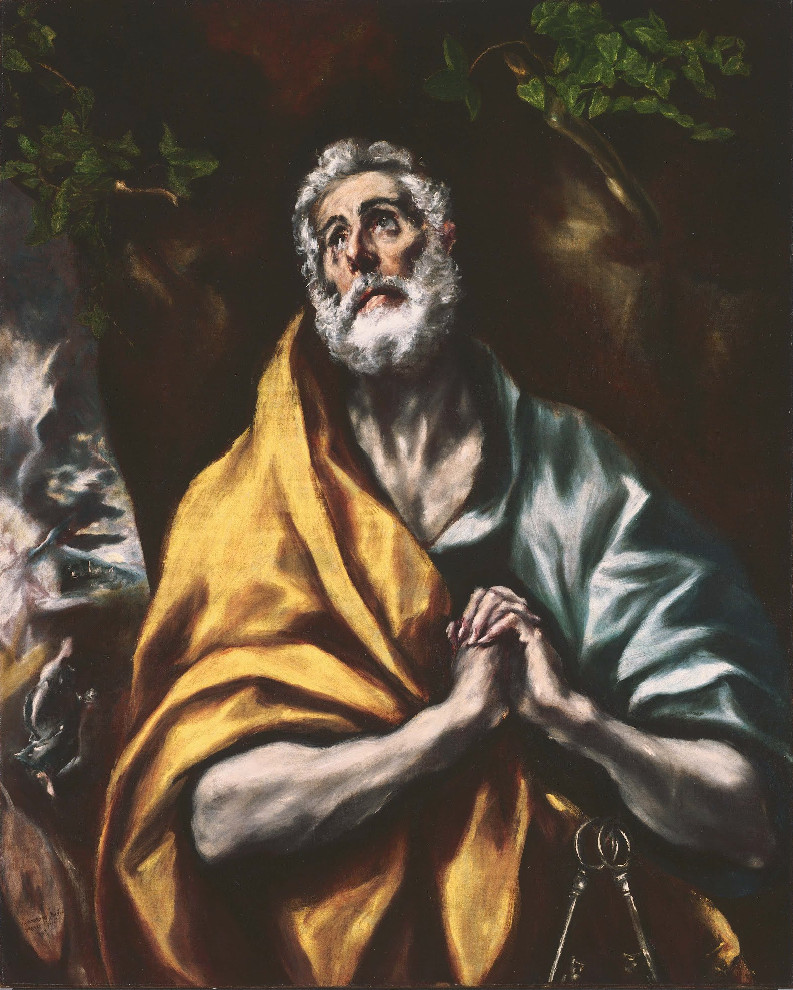
1 Peter 4 :2
1 Peter 4 :3
1 Peter 4 :4
1 Peter 4 :5
1 Peter 4 :6
1 Peter 4:7
1 Peter 4:8
1 Peter 4:9
1 Peter 4:10
1 Peter 4:11
1 Peter 4:12
1 Peter 4:13
1 Peter 4:14
1 Peter 4:15
1 Peter 4:16
1 Peter 4:17
1 Peter 4:18
1 Peter 4:19
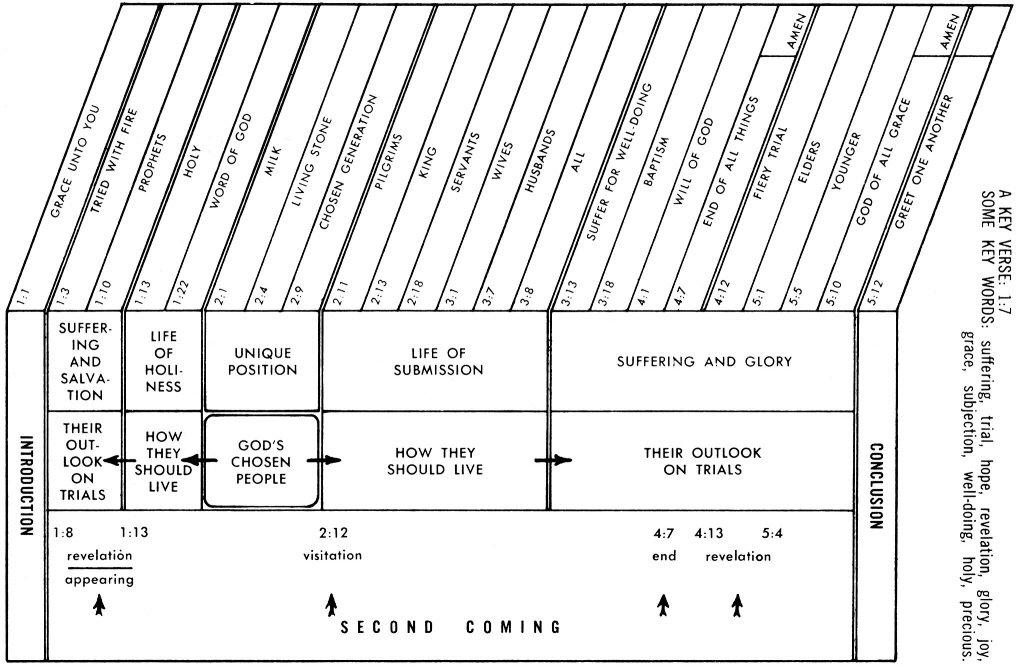
1 Peter: Trials, Holy Living & The Lord's Coming
Click chart to enlarge
Chart from Jensen's Survey of the NT - used by permission
See Another Chart from Charles Swindoll
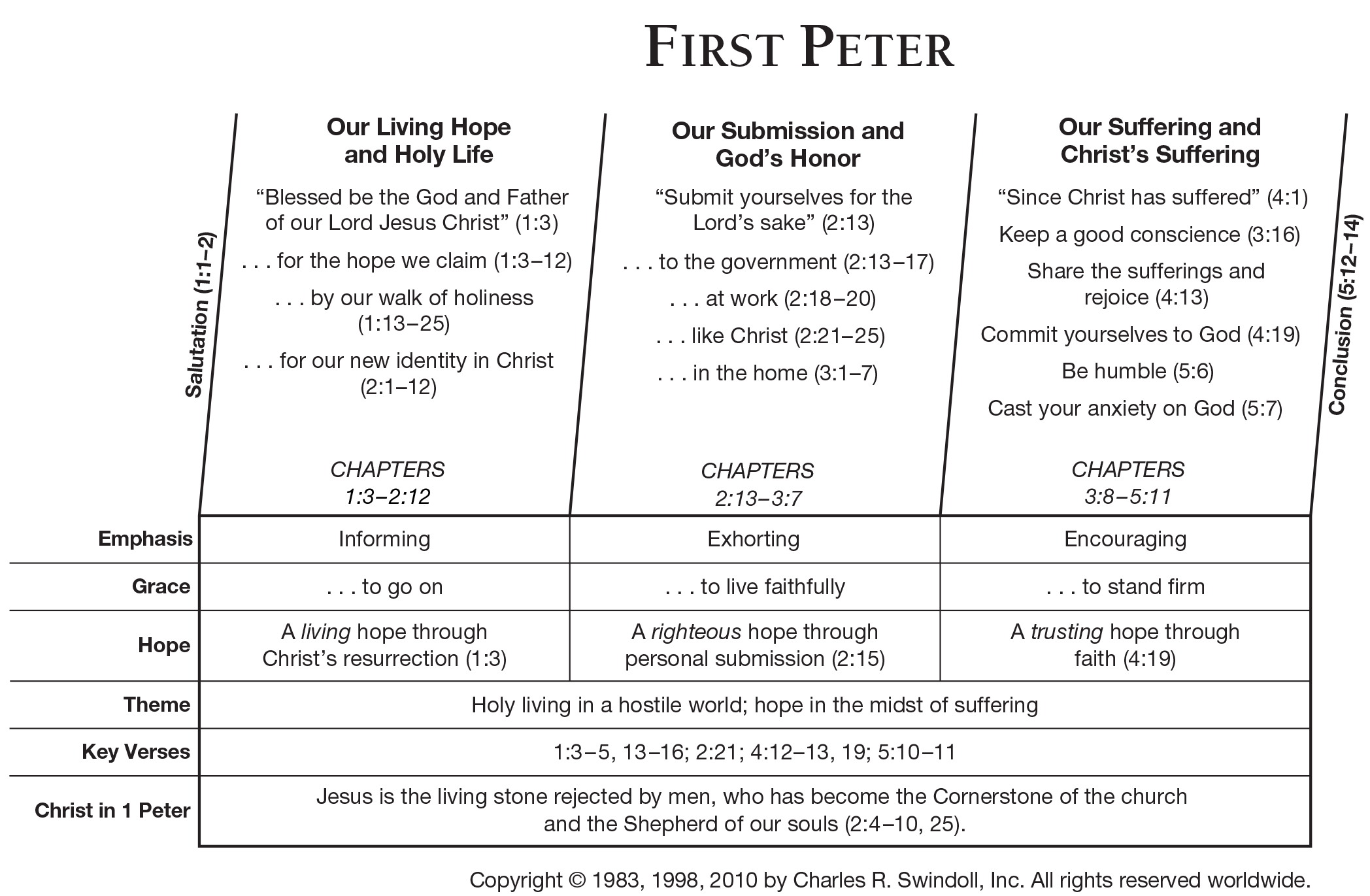
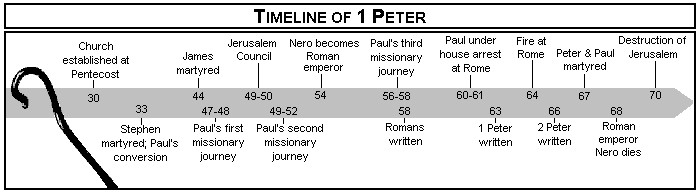
Source: Borrow Ryrie Study Bible
Click to enlarge
| Salvation of the Believer 1 Pe 1:1-2:12 |
Submission of the Believer 1 Pe 2:13-3:12 |
Suffering of the Believer 1 Pe 3:13-5:14 |
||||||||
| Salvation 1Pe 1:1-1:12 |
Sanctification 1Pe 1:13-2:12 |
Submit to Government 1Pe 2:13-17 |
Submit in Business 1Pe 2:18-25 |
Submit in Marriage 1Pe 3:1-8 |
Submit in all of life 1Pe 3:9-12 |
Conduct in Suffering 1Pe 3:13-17 |
Christ's Example of Suffering 1Pe 3:18-4:6 |
Commands in Suffering 1Pe 4:7-19 |
Minister in Suffering 1Pe 5:1-14 |
|
| Belief of Christians | Behavior of Christians | Buffeting of Christians | ||||||||
| Holiness | Harmony | Humility | ||||||||
|
Adapted from Bruce Wilkinson and Kenneth Boa's Talk Thru the Bible (borrow) |
||||||||||
1 Peter 4:10 As each one has received a special gift, employ it in serving one another as good stewards of the manifold grace of God. (NASB: Lockman)
Greek: hekastos kathos elaben (3SAAI) charisma, eis heautous auto diakonountes (PAPMPN) os kaloi oikonomoi poikiles charitos theou.
Amplified: As each of you has received a gift (a particular spiritual talent, a gracious divine endowment), employ it for one another as [befits] good trustees of God’s many-sided grace [faithful stewards of the zextremely diverse powers and gifts granted to Christians by unmerited favor]. (Amplified Bible - Lockman)
Wuest: In whatever quality or quantity each one has received a gift, be ministering it among yourselves as good stewards of the variegated grace of God.
Young's Literal: God has given gifts to each of you from his great variety of spiritual gifts. Manage them well so that God's generosity can flow through you.
AS EACH ONE HAS RECEIVED A SPECIAL GIFT: hekastos kathos (even as) elaben (3SAAI) charisma:
- Mt 25:14,15; Lk 19:13; Ro 12:6, 7, 8; 1Cor 4:7; 12:4, 5, 6, 7, 8, 9, 10,11
- Ro 12:6, 7, 8, 1Pe 4:10,11
- 1 Peter 4 Resources - Multiple Sermons and Commentaries
- 1 Peter 4:7-11 The Church's Conduct In The End Times - Steven Cole
- 1 Peter 4:12-19 Hard Lessons About Hard Times - Steven Cole
- 1 Peter 4:10-11 The Christian's Duty in a Hostile World, Pt 3 - Sermon - John MacArthur
- 1 Peter 4:10-11 The Christian's Duty in a Hostile World - Pt 3 Study Guide (see dropdown) - John MacArthur
- 1 Peter 4:12-14 The Fiery Trial-Pt 1 - Study Guide (see dropdown) - John MacArthur
ONE SPIRITUAL GIFT
PER SAINT!
In the Greek text this statement is a part of the sentence that began with 1Peter 4:9-note.
Every saint has at least one (but there can be more than one) spiritual gift from God the Spirit. What is your spiritual gift? You need to know it so that you can utilize it in turn so that the Body functions efficiently. See an illustration of what happens when your "key" gift is not utilized.
Dwight Edwards - Bud Wilkinson was once asked his opinion of football as a national sport. He replied that football was definitely lacking, for it consists of "twenty-two men who are desperately in need of rest being watched by twenty-thousand people who are desperately in need of exercise." Unfortunately this statement fits the church today like a glove. How often we can see ourselves in this little poem.
"I gave a little party this afternoon at three
'Twas very small, three guests in all
Just I, Myself, and Me.
Myself ate up the sandwiches
While I drank the tea
And it was I who ate the pie
And passed the cake to me."
And so Peter calls us out of the bleachers and away from our private tea parties by writing, "As every man has received the gift, even so minister the same one to another, as good stewards of the manifold grace of God." (Edwards)
Each one (1538) (hekastos) means each, every one, of any number separately. It means every single one and so each one of a totality in a distributive sense. Therefore hekastos teaches a very important truth. Peter's point is that each and every believer has received at least one specific gift.
John Piper - Gifts are not for a few but for all, and every believer has abilities which the Holy Spirit has given and can use to strengthen others. And it is the supreme joy of life to discover what they are and then pour yourself out to others through these gifts. And you will find them if you really desire to be God's instrument in bringing about faith and joy in other people. That, you recall, is the fundamental problem. (Spiritual Gifts)
Received (2983) (lambano) means to take or grasp. Lambano as in this verse can also mean to receive, and as such is used to embrace all areas of life from simple things to spiritual benefits as in the present verse. The aorist tense, indicative mood speaks of a definitive historical event, a specific time in the past when each one received their spiritual gift.
Special gift (5486) (charisma from charis = grace + the ending --ma which indicates the result of something, in this case the result of grace, "the subjective grace that works within and shows itself in its result" [Wuest]) is a Pauline word (with exception of 1Peter 4:10) which literally means a gift of grace or a free gift. Considering that the root is charis (grace) the favor or gift which one receives is without any merit of one's own. Stated another way, whatever spiritual gift a man has comes from God, and should be no cause for personal pride or praise. It is something given to a man by God which the man himself could not have acquired or attained.
See 10 page discussion in New International Dictionary of New Testament Theology - Topics covered include χάρις (charis), grace, gracefulness, graciousness, favour, thanks, gratitude; χάρισμα (charisma), gift given out of goodwill; χαρίζομαι (charizomai), show favour or kindness, give as a favour, to be gracious to someone, to pardon; χαριτόω (charitoō), endue with grace.
Thayer writes that charisma "in the technical Pauline sense of extraordinary powers distinguishing certain Christians and enabling them to serve the church of Christ, the reception of which is due to the power of divine grace operating in their souls by the Holy Spirit."
It is interesting to notice that the world uses charisma to describe a person with magnetic personality and a commanding appearance.
Notice also (and it is not surprising) that sixteen of the seventeen New Testament uses of charisma are connected to God as the Giver of the free gift. Specifically Paul explains (esp in 1 Cor 12:4, 6, 7, 11) that charisma is a special spiritual gift (or ability) bestowed by the Holy Spirit according to His will for the profit of the body of Christ and the work of the ministry in turn to enable believers to fulfill certain assigned functions in the body.
Notice the context says that each one (each and every one) who is a genuine Christian (who has the gift of the Spirit - see note Romans 8:9) has received at least one gift from the Spirit (1 Cor 12:1-11), both the gift of the Spirit and the spiritual gift being bestowed by God at the moment of conversion (see 1 Cor 12:13ff).
Richards - Charisma is a special term for grace gifts. It focuses attention on how we are called to function within the body of Christ. God has given each believer a special endowment of the Spirit, so that he or she can make a distinctive contribution to individuals and to the community of faith. Living together, united by the bonds of brotherly love, each of us is used by God to enrich our brothers and sisters and to stimulate their growth to Christian maturity. (Richards, L O: Expository Dictionary of Bible Words)
Cremer (in Herzog) writes that in the technical Pauline sense charismata denote "extraordinary powers, distinguishing certain Christians and enabling them to serve the church of Christ, the reception of which is due to the power of divine grace operating in their souls by the Holy Spirit." (See discussion of THE PARADOXICAL PRINCIPLE OF 100%/100%).
Charisma is used 17 times in the NASB (see below) and is translated favor, 1; free gift, 3; gift, 5; gifts, 7; spiritual gift, 1. There are no uses in the Septuagint (LXX).
Romans 1:11 (note) For I long to see you in order that I may impart some spiritual gift to you, that you may be established (This is the one occasion where God is not the specific Giver, but even here He is ultimately the Giver for nothing of genuine spiritual value would originate from any source other than God.)
Romans 5:15 (note) But the free gift is not like the transgression. For if by the transgression of the one the many died, much more did the grace of God and the gift by the grace of the one Man, Jesus Christ, abound to the many. 16 And the gift is not like that which came through the one who sinned; for on the one hand the judgment arose from one transgression resulting in condemnation, but on the other hand the free gift arose from many transgressions resulting in justification.
Romans 6:23 (note) For the wages of sin is death, but the free gift of God is eternal life in Christ Jesus our Lord.
Romans 11:29 (note) for the gifts and the calling of God are irrevocable.
Romans 12:6 (note) And since we have gifts that differ according to the grace given to us, let each exercise them accordingly: if prophecy, according to the proportion of his faith;
1 Corinthians 1:7 so that you are not lacking in any gift, awaiting eagerly the revelation of our Lord Jesus Christ
1 Corinthians 7:7 Yet I wish that all men were even as I myself am. However, each man has his own gift from God, one in this manner, and another in that.
1 Corinthians 12:4 Now there are varieties of gifts, but the same Spirit.
1 Corinthians 12:9 to another faith by the same Spirit, and to another gifts of healing by the one Spirit,
1 Corinthians 12:28 And God has appointed in the church, first apostles, second prophets, third teachers, then miracles, then gifts of healings, helps, administrations, various kinds of tongues.
1 Corinthians 12:30 All do not have gifts of healings, do they? All do not speak with tongues, do they? All do not interpret, do they?
1 Corinthians 12:31 But earnestly desire the greater gifts. And I show you a still more excellent way.
2 Corinthians 1:11 you also joining in helping us through your prayers, that thanks may be given by many persons on our behalf for the favor bestowed upon us through the prayers of many.
1 Timothy 4:14 Do not neglect the spiritual gift within you, which was bestowed upon you through prophetic utterance with the laying on of hands by the presbytery.
2 Timothy 1:6 (note) And for this reason I remind you to kindle afresh the gift of God which is in you through the laying on of my hands.
1 Peter 4:10 (note) As each one has received a special gift, employ it in serving one another, as good stewards of the manifold grace of God.
A spiritual gift is a graciously given supernaturally designed ability granted to every believer by which the Holy Spirit ministers to the body of Christ for the glory of the Father. The Greek word charisma emphasizes the freeness of the gift.
Barclay has an interesting perspective on charisma writing that…
A man might practise for a lifetime and yet never play the violin like Yehudi Menuhin. He has more than practice; he has the something plus, the charisma which is a gift of God. A man might toil for a lifetime and still be handless in the use of tools and wood and metals; another can fashion wood and mould metal with a special skill, and tools become part of himself; he has the something plus, the charisma which is a gift of God. One man might practise speaking for ever and a day, and still never acquire that magic something which moves an audience or congregation; another steps on to a platform or climbs into a pulpit, and the audience are in the hollow of his hand; he has that something plus, that charisma which is a gift of God. A man might toil for a lifetime and never acquire the gift of putting his thoughts on paper in a vivid and intelligible way; another without effort sees his thoughts grow on the sheet of paper in front of him; the second man has the something plus, the charisma, which is the gift of God.
Every man has his own charisma. It may be for writing sermons, building houses, sowing seeds, fashioning wood, manipulating figures, playing the piano, singing songs, teaching children, playing football or golf. It is a something plus given him by God. (Barclay, W: The Daily Study Bible Series. The Westminster Press )
In Romans, Paul uses charisma as a reference to the gift of salvation (Ro 5:15, 16, 6:23-see notes Ro 5:15; 16; 6:23), the blessings of God (Ro 1:11, 11:29-see notes Ro 1:11; 11:29), and divine enablements for ministry (Ro 12:6-note). Every other use of the word by Paul, and the one by Peter (1Pe 4:10-note), relates it to the divine enablements for believers to minister in the power of the Holy Spirit.
Vine writes that charisma is…
a gift of grace, a gift involving grace” (charis) on the part of God as the donor, is used
(a) of His free bestowments upon sinners, Ro 5:15, 16; Ro 6:23; Ro 11:29
(b) of His endowments upon believers by the operation of the Holy Spirit in the churches, Ro 12:6 1Cor 1:7, 12:4, 9, 28, 30, 31 1Ti 4:14; 2Ti 1:6; 1Pe 4:10;
(c) of that which is imparted through human instruction, Ro 1:11;
d) of the natural “gift” of continence, consequent upon the grace of God as Creator, 1Cor 7:7;
(e) of gracious deliverances granted in answer to the prayers of fellow believers, 2Cor 1:11 (Dictionary of New Testament Words)
A spiritual gift cannot be earned, pursued, or worked up but can only be “received” through the grace of God. Spiritual gifts are controlled by the Spirit. Paul writes that…
4 Now there are varieties of gifts, but the same Spirit.
5 And there are varieties of ministries, and the same Lord.
6 And there are varieties of effects, but the same God Who works all things in all persons.
7 But to each one is given the manifestation of the Spirit for the common good.
11 But one and the same Spirit works all these things, distributing to each one individually just as He wills. (1 Cor 12:4-11)
John MacArthur comments that…
Spiritual gifts are not talents. Natural talents, skills, and abilities are granted by God just as everything good and worthwhile is a gift from Him. But those things are natural abilities shared by believer and unbeliever alike. An unbeliever can be a highly skilled artist or musician. An atheist or agnostic can be a great scientist, carpenter, athlete, or cook. If a Christian excels in any such abilities it has nothing to do with his salvation. Though he may use his natural talents quite differently after he is saved, he possessed them before he became a Christian. Spiritual gifts come only as a result of salvation.
Spiritual gifts, however, are not natural, but rather are supernaturally given by the Holy Spirit only and always to believers in Jesus Christ, without exception (see 1Cor12:7 above).
Spiritual gifts are special capacities bestowed on believers to equip them to minister supernaturally to others, especially to each other. Consequently, if those gifts are not being used, or not being used rightly, the body of Christ cannot be the corporate manifestation of its Head, the Lord Jesus Christ, and the work of God is hindered.
Essential to unity is diversity. Unity of spirit and purpose can be maintained only through diversity of ministry. But unity is not uniformity. A football team whose players all wanted to play quarterback would have uniformity but not unity. It could not function as a team if everyone played the same position… God gives His people varieties of gifts just as players on a team have varieties of positions." (MacArthur, J. 1 Corinthians. Chicago: Moody Press) (Bolding added)
Click summary of what Scripture says about Spiritual Gifts.
John Piper say "the picture we have in 1Pe 4:10 is of a house with variously talented stewards who are given the owner's funds to administer. The house is the church, the stewards are all of you, the various talents are all our varied gifts, the funds are God's grace and the administration is the exercise of our gifts. The most striking part of this comparison is the analogy between the owner's funds and God's grace. Grace is the currency in the household of God. We are called to be stewards of grace. We have a board of stewards in the Minnesota Baptist Conference and they are given the responsibility to receive and disburse thousands of dollars for the household called the Minnesota Baptist Conference. That's the way we should think of our responsibility in the church - all of us. We are recipients of grace and it is our duty to disburse this grace for others. The vehicle by which we make these disbursements is our spiritual gift. So now we have another definition of spiritual gifts: they are abilities by which we receive the grace of God and disburse that grace to others. This fits beautifully with our earlier definition of spiritual gifts as the abilities given by the Spirit which express our faith and aim to strengthen the faith of others. They fit together because faith is what the house owner wants in all his stewards and grace is the only currency that can purchase faith. Or, to change the image, faith feeds on grace and is strengthened by grace. God gives us his grace in Christ and all the promises that are Yes in him, and our response is faith; then we, in the exercise of our spiritual gifts disburse that grace to others and thus feed their faith. It is the free and precious grace that strengthens the heart in faith (Heb 13:9-note). So, what should be happening at… (every church) is that all God's stewards -- all of you -- should be waking up to more and more of God's grace that you have in Christ, and finding more and more ways to creatively disburse that grace to each other and to those outside by the use of your spiritual gifts. O, that the Spirit might cause a wheeling and dealing in the currency of grace at Bethlehem Baptist Church (and in every one of His local bodies across the world)!" (Spiritual Gifts) (Bolding added) (Notes in parentheses added)
- Summary Chart on Spiritual Gifts
- Spiritual Gifts - Devotionals, Quotations, Illustrations
- ISBE Article on Spiritual Gifts
- Spiritual Gifts - Holman Bible Dictionary
- Spiritual Gifts - Hastings' Dictionary of the Bible
- Bible.org multiple sermons and articles on Spiritual Gifts
Quesions related to Spiritual Gifts from excellent site - Gotquestions:
- What is the role of the Holy Spirit in our lives today?
- Spiritual gifts survey - what are the different spiritual gifts the Bible mentions?
- How does God distribute spiritual gifts?
- Is there any value to a spiritual gifts test/inventory/assessment?
- Is there a biblical spiritual gifts list?
- What are the spiritual gifts of the word of wisdom and the word of knowledge?
- What is the difference between a talent and a spiritual gift?
- How do I identify my spiritual gift?
- What is continuationism? What is a continuationist?
- What is the spiritual gift of teaching?
- What is the spiritual gift of healing?
- What is the spiritual gift of faith?
- What is the spiritual gift of miracles?
- What is the spiritual gift of helps?
- What is the spiritual gift of leadership?
- What does it mean that tongues will cease?
- What is the spiritual gift of prophecy?
- What is the spiritual gift of interpreting tongues?
- What is glossolalia?
- What is praying in tongues? Is praying in tongues a prayer language between a believer and God?
- What is the gift of encouragement?
- Women pastors / preachers? Can a woman be a pastor or preacher?
- What is the Charismatic movement?
- What is the Vineyard Movement?
- What is the International House of Prayer (IHOP)?
- What is the Latter Rain Movement?
- How can I know if I have received a call to ministry?
Spiritual Gifts are discussed in the following on site Verse by Verse Commentaries by Bruce Hurt:
- ROMANS - Ro 12:6-note, Ro 12:7-note, Ro 12:8-note,
- EPHESIANS - Eph 4:11- note, Eph 4:12-note, Eph 4:13-note, Eph 4:14-note,
- 1 PETER - 1 Pe 4:10-note, 1 Pe 4:11-note
Messages by Steven Cole
Messages by S Lewis Johnson
- 1 Corinthians 12:1-11 The Issue of Spiritual Gifts
- 1 Corinthians 12:4-11 Unity and Variety of the Gifts
- 1 Corinthians 12:12-26 The Church -- Body of Christ
- 1 Corinthians 12:27-31 Exercise of Gifts in the Body
Messages by John Piper (he is not a cessationist)
Cessationism...is the view that the miraculous gifts of the Spirit, such as healing, tongues, and prophetic revelation, pertained to the apostolic era only, served a purpose that was unique to establishing the early church, and passed away before the canon of Scripture was closed (comp. 1 Cor. 13:8-12 with Heb. 2:3-4). It is contrasted with continuationism, which is the view that the miraculous gifts are normative, have not ceased, and are available for the believer today. (Source:Theopedia)
- 1 Corinthians 12:1 Spiritual Gifts
- Romans 12:1-8 We, Though Many, Are One Body in Christ
- Romans 12:1-8 Using Our Gifts in Proportion to Our Faith, Part 1
- Romans 12:1-8 Using Our Gifts in Proportion to our Faith, Part 2
- Romans 12:3-8 Using Our Gifts in Proportion to Our Faith, Part 3
Messages by John MacArthur (he is a cessationist- Is cessationism biblical?)
- Romans 12:3-5 Ministry of Spiritual Gifts, Part 1
- Romans 12:6-7 Ministry of Spiritual Gifts, Part 2
- Romans 12:8 Ministry of Spiritual Gifts, Part 3
- 1 Corinthians 12 - Spiritual Gifts - see list of articles in dropdown (may not function)
- 1Corinthians 12:1 Concerning Spiritual Gifts, Part 1
- 1Corinthians 12:2-3 Concerning Spiritual Gifts, Part 2
- 1Corinthians 12:4-7, 11 Concerning Spiritual Gifts, Part 3
- 1Corinthians 12:8-10 Permanent Edifying Gifts, Part 1
- 1Corinthians 12:8-10 The Permanent Edifying Gifts, Part 2
- 1Corinthians 12:9-10 The Permanent Edifying Gifts, Part 3
- 1Corinthians 12:1-11 The Gifts of the Body, Part 1
- 1Corinthians 12 & Romans 12 The Gifts of the Body, Part 2
- Selected Scriptures: The Gifts of the Body, Part 3
- 1Corinthians 12:12-27 The Body of Christ
- 1Corinthians 12:12-13 Spirit Baptism
- 1Corinthians 12:12-14, 18, 24 One Body, Many Gifts, Part 1
- 1Corinthians 12:15-31 One Body, Many Gifts, Part 2
- 1Corinthians 12:12-27 The Body of Christ
- 1Corinthians 12:28 The Gifted Men, Part 1: Apostles and Prophets
- 1Corinthians 12:28 The Gifted Men, Part 2: Evangelists, Pastors, and Teachers
- 1Corinthians 12:10 The Temporary Sign Gifts, Part 1
- 1Corinthians 12:9, 28, 30 The Temporary Sign Gifts, Part 2
- 1Corinthians 12:9, 28, 30 The Temporary Sign Gifts, Part 3
Wayne Barber sermon series (discussion of spiritual gifts)
- Romans 12:1 Our Responsibilities Under Grace - Pt 1
- Romans 12:2 Our Responsibilities Under Grace - Pt 2
- Romans 12:3-5 Our Responsibilities Under Grace - Pt 3
- Romans 12:5-8 Our Responsibilities Under Grace - Pt 4
- Romans 12:1-8 Our Responsibilities Under Grace - Pt 5
Ron Ritchie (series on Spiritual Gifts)
- Good Stewards Of God's Spiritual Gifts 1 Peter 4: 1-10
- The Benefits Of Spiritual Gifts Romans 12: 1-8
- The Joy Of Spiritual Growth Ephesians 4: 7-13
- The Proper Use Of Spiritual Gifts 1 Corinthians 12: 1-30
- Expressing Our Spiritual Gifts With Love 1 Corinthians 13:1-13
- Order Out Of Chaos 1 Corinthians 14
- Ron R. Ritchie's List of the Spiritual Gifts
Ray Stedman from his book "Body Life"
- All God's Children Have Spiritual Gifts
- Discovering and Using Your Spiritual Gift
- According to the Power
- How the Body Works (spiritual gifts)
Ray Stedman - other messages on Spiritual Gifts
God’s grace deals out different gifts to different people (every believer receiving at least one). And God gives the supernatural strength (by His indwelling Spirit) to effectively use those gifts. The distribution of the gives reflect God's sovereign will (1 Cor 12:6-11, 18, 28, 1Pe 4:10-note). Each believer has a solemn, holy responsibility to use his or her God-given abilities as would any good steward (1Pe 4:11-note). Whatever gift we have must be dedicated to God and used for the good of the body of Christ. It is sad (and not Biblical) when a specific gift is emphasized over other gifts in the local body. 1 Corinthians 12 (1 Co 12:14-31) emphasizes all gifts are critical for the local Body to be optimally functioning as God intended. Does this describe your church, dear saint or dear shepherd of the sheep?
HERE IS MY SUMMARY OF SPIRITUAL GIFTS...
SPIRITUAL GIFTS ARE...
- Supernatural abilities
- Sovereignly given to
- Strengthen His
- Saints who are to
- Serve (minister) one another being good
- Stewards of the manifold grace of God
EMPLOY IT IN SERVING ONE ANOTHER: eis heautous auto diakonountes (PAPMPN):
- Mt 20:28; 25:44; Mk 10:45; Lk 8:3; Ro 15:25,27; 2Cor 9:1; 2Ti 1:18; Heb 6:10
- 1 Peter 4 Resources - Multiple Sermons and Commentaries
- 1 Peter 4:7-11 The Church's Conduct In The End Times - Steven Cole
- 1 Peter 4:12-19 Hard Lessons About Hard Times - Steven Cole
- 1 Peter 4:10-11 The Christian's Duty in a Hostile World, Pt 3 - Sermon - John MacArthur
- 1 Peter 4:10-11 The Christian's Duty in a Hostile World - Pt 3 Study Guide (see dropdown) - John MacArthur
- 1 Peter 4:12-14 The Fiery Trial-Pt 1 - Study Guide (see dropdown) - John MacArthur
- Study the "one anothers" - most positive, some negative
Spiritual gifts were used, not for the exaltation of the one with the gift, but in loving concern for the benefit of others in the church (cf. 1Cor 12:7; 13). We are not meant to be the terminals of God’s gifts to us (like the Dead Sea that has no outlet and virtually no biologic life - ponder your life if you are refusing to use His gracious gift. Could this be part of the reason you are not experiencing "abundant life?"). God's grace reaches us (when His Spirit gifts us) but this grace should not terminate in us. ALL of God's children are intended to be channels through whom the blessing (His grace gifts) can flow to others in the Body. In this way the Body of Christ is like a finely tuned racing car ready for the Grand Prix.
Practicing hospitality is one way to use the gifts God has given to serve others.
Serving (1247)(diakoneo derivation uncertain - cp diakonis = in the dust laboring or running through the dust or possibly diako = to run on errands; see also study of related noun -diakonia) means to minister by way of rendering service in any form or to take care of by rendering humble service.
AS GOOD STEWARDS OF THE MANIFOLD GRACE OF GOD: os kaloi oikonomoi poikiles charitos theou:
- Mt 24:45; 24:14,21; Lk 12:42; 16:1-8; 1Cor 4:1,2; Titus 1:7
- 1Cor 3:10; 12:4; 15:10; 2Cor 6:1; Ep 3:8; 4:11
- 1 Peter 4 Resources - Multiple Sermons and Commentaries
- 1 Peter 4:7-11 The Church's Conduct In The End Times - Steven Cole
- 1 Peter 4:12-19 Hard Lessons About Hard Times - Steven Cole
- 1 Peter 4:10-11 The Christian's Duty in a Hostile World, Pt 3 - Sermon - John MacArthur
- 1 Peter 4:10-11 The Christian's Duty in a Hostile World - Pt 3 Study Guide (see dropdown) - John MacArthur
- 1 Peter 4:12-14 The Fiery Trial-Pt 1 - Study Guide (see dropdown) - John MacArthur
Spurgeon - Whatever “the gift” is, whether it be money, or talent, or grace, “even so minister the same one to another, as good stewards of the manifold grace of God.” God gives much to you that you may give it to others; it is only meant to run through you as through a pipe. You are a steward and if a steward should receive his lord’s goods, and keep them for himself he would be an unfaithful steward. Child of God, see to it that you faithfully discharge your responsibility as one of the “good stewards of the manifold grace of God.”
Good (2570) (kalos) means inherently excellent or intrinsically good and thus providing some special or superior benefit. Kalos conveys the idea of beauty and comeliness and thus that which is admirable and honorable.
Stewards (3623) (oikonomos from oíkos = house, + némo = to deal out, distribute, apportion) is literally “one who governs a household.” Oikonomos speaks of the responsibility of the proper use and disposition of something entrusted to one’s care.
Stewards had no wealth of their own, but distributed the Master’s wealth according to the Master’s will and direction.
A steward is responsible for another’s resources. Similarly, a Christian does not own his gifts, but God does & God has given him gifts for the proper functioning of His body, the church, and ultimately for His glory.
Manifold (4164) (poikilos) (see the 10 uses below translated manifold, 1; varied, 1; various, 8) (Click study of poikilos) means motley, various in character, different kinds, diversified manifold, variegated, many–colored.
I love the picturesque use of poikilos in the Septuagint (LXX) …
Genesis 37:3 Now Israel loved Joseph more than all his sons, because he was the son of his old age; and he made him a varicolored (LXX = poikilos) tunic.
Poikilos was used in secular Greek writings to describe the skin of a leopard, the different-colored veining of marble, or an embroidered robe; and thence passes into the meaning of changeful, diversified. Poikilos was also applied to the changing months or the variations of a strain of music.
Guy King gives an interesting illustration of manifold grace from manifold trials (temptations)…
We find that Peter joins Paul in magnifying the grace of GOD. There is an interesting Greek word, poikilos, which occurs several times in the New Testament, and which Peter uses twice, both in his First Epistle, and which is translated "manifold":
(a) "Ye are in heaviness, through manifold temptations," (see note 1 Peter 1:6).
(b) "Good stewards of the manifold grace of GOD," 4:10 (see note 1 Peter 4:10)
Put those two things together.
On the one hand, let the five digits, all so different in character, from the thumb to the little finger, stand for the manifold trials and testings of life. On the other hand, let the five digits stand for the manifold grace. Now put the right hand over the left, and observe how the fingers of the grace hand exactly correspond to those of the temptations hand. Only an illustration; but an illustration of a beautiful fact - that whatever may be the need, there is at hand just the very grace to meet it. (Colossians 4:15-18 His Kind Regard)
Below are all the NT uses (not including the present verse) for your study…
Mt 4:24 The news about Him spread throughout all Syria; and they brought to Him all who were ill, those suffering with various diseases and pains, demoniacs, epileptics, paralytics; and He healed them.
Mk 1:34 And He healed many who were ill with various diseases, and cast out many demons; and He was not permitting the demons to speak, because they knew who He was.
Lk 4:40 While the sun was setting, all those who had any who were sick with various diseases brought them to Him; and laying His hands on each one of them, He was healing them.
2Ti 3:6 (note) For among them are those who enter into households and captivate weak women weighed down with sins, led on by various impulses,
Titus 3:3 (note) For we also once were foolish ourselves, disobedient, deceived, enslaved to various lusts and pleasures, spending our life in malice and envy, hateful, hating one another.
He 2:4 (note) God also testifying with them, both by signs and wonders and by various miracles and by gifts of the Holy Spirit according to His own will.
He 13:9 (note) Do not be carried away by varied and strange teachings; for it is good for the heart to be strengthened by grace, not by foods, through which those who were so occupied were not benefited.
Jas 1:2 (note) Consider it all joy, my brethren, when you encounter various trials,
Peter like James used poikilos in describing trials writing that…
In this you greatly rejoice, even though now for a little while, if necessary, you have been distressed by various trials,
Variegated grace
for variegated trials!
Trouble and the grace to bear it come in the same package (Hallelujah).
He giveth more grace when the burdens grow greater,
He sendeth more strength when the labors increase;
To added affliction He addeth His mercy,
To multiplied trials, His multiplied peace.
-Annie Johnson Flint
(biography) (other poems)
Grace (favor) (5485) (charis from from chairo = to rejoice. English = charity. Beggars need "charity" even as sinners need grace, for we are all spiritual paupers outside of Christ, but "God gives where he finds empty hands"-Augustine [cp Mt 5:3-note]) is a word which defies a simple definition but at its core conveys the sense of favor while the specific nuances of charis depend on the context in which it is used. Someone has written that the word grace is probably the greatest word in the Scriptures, even greater even than “love,” because grace is love in action, and therefore includes it. It is hardly too much to say that God has in no word uttered Himself and all that was in His heart more distinctly than in this word grace (charis)!
See studies on related words - eucharisteo; eucharista; charisma; charizomai
The English word grace is from the Latin gratia meaning favor, charm or thanks. Gratia in turn is derived from gratus meaning free, ready, quick, willing, prompt. Webster defines grace as the…
unmerited love and favor of God which is the spring and source of all benefits men receive from Him, including especially His assistance given man for his regeneration or sanctification. (Grace is) a virtue from God influencing man, renewing his heart and restraining him from sin. (Compare this more "modern Webster" with Noah Webster's original definition of grace)
The story of martyr Thomas Hauker (England, 1555) illustrates the sufficiency of the grace of God (Dying grace for dying days) in our hour of need…
"I Have to Know"
"Thomas", his friend lowered his voice so as not to be heard by the guard. "I have to ask you a favor. I need to know if what the others say about the grace of God is true. Tomorrow, when they burn you at the stake, if the pain is tolerable and your mind is still at peace, lift your hands above your head. Do it right before you die. Thomas I HAVE to know."
Thomas Hauker whispered to his friend, "I will."
The next morning, Hauker was bound to the stake and the fire was lit. The fire burned a long time, but Hauker remained motionless. His skin was burnt to a crisp and his fingers were gone. Everyone watching supposed he was dead. Suddenly, miraculously, Hauker lifted his hands, still on fire, over his head. He reached them up to the living God and then, with great rejoicing, clapped them together three times. The people there broke into shouts of praise and applause. Hauker's friend had his answer."
You Can't Beat The Price (1 Peter 4:7-11) - Would you wait in line for 13-cents-a-gallon gasoline? Many drivers in Massachusetts did. More than 100 cars lined up along Route 12 a couple of hours before one gas station opened. The owner had advertised his gasoline at a price that was almost an outright gift. He said he was trying to give his customers a break.
In 1 Peter 4, the apostle wrote about another kind of gift that shows the generosity of the giver. It is the "manifold grace of God" (1Pe 4:10). Grace is undeserved favor--the free kindness that comes from the Lord. We experience His grace not only as the favor of His forgiveness but also as the energy and ability He gives to help us live the way He wants us to.
Accepting and using this gift has some far-reaching effects. It brings blessing to us and to others. But above all, it honors the name and kindness of the Giver. Peter urged his readers to use and express God's grace by being watchful in their prayers, showing love, being hospitable, and ministering through the spoken word (1Pe 4:7-11).
Gasoline for 13 cents a gallon--that's almost a giveaway! But the grace God gives us to serve Him is absolutely free! It surpasses anything this world has to offer--and it's ours for the asking. —Mart De Haan (Our Daily Bread, Copyright RBC Ministries, Grand Rapids, MI. Reprinted by permission. All rights reserved)
God freely gives His grace to all
Who on His Word rely,
For they have learned the secret of
His infinite supply.
-DJD
The only limit to God's grace
is the limit we put on it.
1 Peter 4:11 Whoever * speaks, is to do so as one who is speaking the utterances of God; whoever * serves is to do so as one who is serving by the strength which God supplies; so that in all things God may be glorified through Jesus Christ, to whom belongs the glory and dominion forever and ever. Amen. (NASB: Lockman)
Greek: ei tis lalei, (3SPAI) os logia theou; ei tis diakonei, (3SPAI) os ex ischuos ed choregei (3SPAI) o theos; hina en pasin doxazetai o theos dia Iesou Christou, o estin (3SPAI) e doxa kai to kratos eis tous aionas ton aionon; amen.
Amplified: Whoever speaks, [let him do it as one who utters] oracles of God; whoever renders service, [let him do it] as with the strength which God furnishes aabundantly, so that in all things God may be glorified through Jesus Christ (the Messiah). To Him be the glory and dominion forever and ever (through endless ages). Amen (so be it). (Amplified Bible - Lockman)
NLT: Are you called to be a speaker? Then speak as though God Himself were speaking through you. Are you called to help others? Do it with all the strength and energy that God supplies. Then God will be given glory in everything through Jesus Christ. All glory and power belong to him forever and ever. Amen. (NLT - Tyndale House)
Wuest: If anyone speaks, as utterances of God let them be. If anyone ministers, let him minister as out of the strength which God supplies, in order that in all things God may be glorified through Jesus Christ, in whom there is the glory and the power forever and ever. Amen.
Young's Literal: if any one doth speak -- 'as oracles of God;' if any one doth minister -- 'as of the ability which God doth supply;' that in all things God may be glorified through Jesus Christ, to whom is the glory and the power -- to the ages of the ages. Amen.
WHOEVER SPEAKS, LET HIM SPEAK, AS IT WERE, THE UTTERANCES OF GOD: ei tis lalei (3SPAI), os logia theou:
- Isa 8:20; Jer 23:22; Ep 4:29; Col 4:6; Jas 1:19, 26; 3:1, 2, 3, 4, 5, 6
- Utterances: Acts 7:38; Ro 3:2; Heb 5:12
- 1 Peter 4 Resources - Multiple Sermons and Commentaries
- 1 Peter 4:7-11 The Church's Conduct In The End Times - Steven Cole
- 1 Peter 4:12-19 Hard Lessons About Hard Times - Steven Cole
- 1 Peter 4:10-11 The Christian's Duty in a Hostile World, Pt 3 - Sermon - John MacArthur
- 1 Peter 4:10-11 The Christian's Duty in a Hostile World - Pt 3 Study Guide (see dropdown) - John MacArthur
- 1 Peter 4:12-14 The Fiery Trial-Pt 1 - Study Guide (see dropdown) - John MacArthur
SPEAKING OR SERVING BOTH
DEPENDENT ON GOD'S ENABLEMENT
See discussion of THE PARADOXICAL PRINCIPLE OF 100%/100%.
Whoever speaks - Literally "if anyone speaks" which is a first class condition and assumes that this is a fact, a fulfilled condition.
Speak (2980) (laleo) is the Greek verb meaning to make a sound and then to utter words.
Vincent says that laleo is "used of speaking, in contrast with or as a breaking of silence, voluntary or imposed. Thus the dumb man, after he was healed, spake (Mt 9:33 "And after the demon was cast out, the dumb man spoke; and the multitudes marveled, saying (lego), "Nothing like this was ever seen in Israel.") and Zacharias, when his tongue was loosed, began to speak (Lk 1:64 "And at once his mouth was opened and his tongue loosed, and he began to speak in praise of God") The use of the word laleo … contemplates the fact rather than the substance of speech. Hence it is used of God (He 1:1 -note), the point being, not what God said, but the fact that he spake to men. On the contrary, lego refers to the matter of speech. The verb originally means to pick out, and hence to use words selected as appropriate expressions of thought, and to put such words together in orderly discourse. (Vincent, M. R. Word Studies in the New Testament).
Peter is implying that there are two general categories of gifts: speaking gifts and serving gifts. Such distinctions are clear in the lists in Ro 12:6, 7, 8; 1Co 12:7, 8, 9, 10, 11,28, 29, 30. This division relates to the distinction God’s leaders made between ministry roles (Acts 6:2, 3,4). These two general ministry functions often overlap.
Utterances (3051) (logion from lógios = an orator) in classical Greek was used of oracular utterances of heathen deities, but as used in Scripture refers to divine utterances or revelations. The practical point of logion is that "The teacher or preacher is not to be the purveyor of his own notions, but the transmitter of the utterances of God; the minister [of the Word] must not be setting forth his own competence or importance, but regard himself as acting from resources which God supplies" (E. G. Selwyn).
MacArthur - Logion (oracles) is a diminutive of logos (note), which is most commonly translated word. Logion generally referred to important sayings or messages, especially supernatural utterances… In many pagan religions of that day, mediums and seers gave occultic predictions of the future and other messages from the spirit world through supernatural “oracles.” By observing the movements of fish in a tank, the formation of snakes in a pit, or listening to the calls of certain birds, fortune-tellers would purport to predict such things as business success or failure, military victory or defeat, and a happy or tragic marriage. Such a connotation could not have been further from Paul’s use of logion in this passage. (MacArthur, J: Romans 1-8. Chicago: Moody Press)
New American Commentary - Those who speak should endeavor to speak "the very words of God." The expression used is "oracles of God" (RSV, logia theou). The "oracles of God" refer to the words God has given his people (cf. Acts 7:38; Rom 3:2; Heb 5:12). The phrase is rooted in the Old Testament, where we have both "oracles of God" (LXX Num 24:4,16; Ps 106:11 and "oracles of the LORD," logia kyriou, LXX Pss 11:7; 17:31) and "your oracles" (LXX Pss 118:11,103, 148,158; 162; cf. Wis 16:11). Using speaking gifts to minister to others means that the one speaking endeavors to speak God's words. How easy it is to think that we can assist others with our own wisdom, but those who are entrusted with the ministry of speaking should be careful to speak God's words, to be faithful to the gospel (cf. 1 Cor 4:1-2; 2 Tim 4:1-5). Goppelt correctly argues that the injunction to speak God's words constitutes an exhortation to the speaker. Hence, the phrase does not suggest that somehow the words spoken in church constitute revelation from God. Peter wrote so that those who speak will do so in accord with the gospel, not to suggest that the words spoken become part of the revelational deposit for believers.
Logion is a striking synonym for the Holy Scriptures (in the NT the term "Scripture" or "Scriptures" usually was a reference to the OT) and is used only four times in the NT, stressing the fact that the Scriptures actually constituted the very utterances of God. These were given to and through the Jews and are preserved for us now in the Old Testament.
Acts 7:38 This (Moses) is the one who was in the congregation in the wilderness together with the angel who was speaking to him on Mount Sinai, and who was with our fathers; and he received living oracles (the Mosaic Law) to pass on to you
Romans 3:2 (note) First of all, that they (the Jews) were entrusted with the oracles of God. (refers to the Old Testament).
Hebrews 5:12 (note) For though by this time you ought to be teachers, you have need again for someone to teach you the elementary principles of the oracles of God, and you have come to need milk and not solid food. (in context considering that the epistle was addressed primarily to Jews, oracles of God most likely refers to the Old Testament),
1 Peter 4:11 the utterances of God (utterances of God through Christian teachers)
Peter's point in this use of logion is that even if a man is gifted to preach or teach, he must be sure that the words he speaks (the logion) are, as if were, the very words God would have him say on that particular occasion. Obviously the closer one sticks to the pure milk of the Word, the better. The more one is in prayer and communion with God prior to speaking or teaching, the more likely will his message be as if it were the utterances of God.
Ray Pritchard (1 Peter 4:7-11 Day Before the End of the World) writes that "Speaking includes anyone who teaches the Word of God whether publicly or privately, whether to a group or one-on-one. Whether from a pulpit or in a small group or to a Sunday School class. Peter says, if you speak, make sure you speak the very words of God. The primary temptation of any teacher is to render his opinion instead of God’s word. So we ought to ask a few questions:
§ What have you done with the gifts God has given you?
§ Who have you helped along the way?
§ Is your church better and stronger because you are here?
§ Are you wasting God’s gift or are you using it for his glory?
ILLUSTRATION - In Word War II, a little French town had a statue of Jesus in their town square. When the bombing came, the statue was damaged and pieces were broken off. They stored the pieces, and after the war, they began to rebuild the statue. It had cracks now, but they appreciated it even more. But to their dismay, the only pieces they couldn’t find were the hands of Jesus. That troubled them because the hands had the nail prints and that was significant to them. They thought they would have to take the statue down, until one person placed a gold plaque at the bottom of the statue that read, “He has no hands but ours.”
He has no hands but ours.
He has no eyes but ours.
He has no lips but ours.
He has no feet but ours.
Spurgeon puts it plainly - Reckon that every sermon is a wasted sermon which is not Christ's Word. Believe that all theology is rotten rubbish which is not the Word of the Lord. Do not be satisfied with going to a place of worship and hearing an eloquent discourse, unless the sum and substance of it is the Word of the Lord. My brothers and sisters, whether you teach children or their parents, do not think you have done any good unless you have taught the Word of the Lord. For saving purposes we must have the Lord's Word, and nothing else.
WHOEVER SERVES LET HIM DO SO AS BY THE STRENGTH WHICH GOD SUPPLIES: ei tis diakonei (3SPAI) os ex ischuos es choregei (3SPAI) o theos:
- 1 Chr 29:11, 12, 13, 14, 15, 16; Ro 12:6, 7, 8; 1Cor 3:10; 12:4
- 1 Peter 4 Resources - Multiple Sermons and Commentaries
- 1 Peter 4:7-11 The Church's Conduct In The End Times - Steven Cole
- 1 Peter 4:12-19 Hard Lessons About Hard Times - Steven Cole
- 1 Peter 4:10-11 The Christian's Duty in a Hostile World, Pt 3 - Sermon - John MacArthur
- 1 Peter 4:10-11 The Christian's Duty in a Hostile World - Pt 3 Study Guide (see dropdown) - John MacArthur
- 1 Peter 4:12-14 The Fiery Trial-Pt 1 - Study Guide (see dropdown) - John MacArthur
OUR SERVICE
HIS STRENGTH!
HIS GLORY!
Serves (1247) (diakoneo - see also noun diakonia) means to render or assist or help by performing certain duties, often of a humble or menial nature serve, including such mundane activities as waiting on tables or caring for household needs—activities without apparent dignity.
Since service associated with the word diakonia necessarily involved dependence, submission, and constraints of time and freedom, the Greeks regarded diakonia as degrading and dishonorable. Service for the public good was honored, but voluntary giving of oneself in service of one’s fellow man is alien to Greek thought. The highest goal before a man was the development of his own personality.
For believers, serving is not the activity of a lesser to a greater, but is the privilege and hopefully the lifestyle of a follower of the Lord Jesus. Serving in the form of diakonia pervades the NT, not merely in the frequency of the word’s usage but in the constant recurrence of attitudes and examples of service.
Phillips - The word for "minister" is diakoneō. It means "to serve," "to render service," "to wait upon" someone, to care for their needs. And what needs there would be among those facing the fury of the fire in Rome and among the terrified and tormented bereaved. The ministry required of us is according to God-given ability. The word used is ischus. It means strength, as an endowment, and also the physical strength one possesses.
It is used of the strength of God bestowed upon believers (Eph. 1:19; 6:10). We must put all that we have into helping others.
John Phillips Commentary Series, The - The John Phillips Commentary Series – Exploring the Epistles of Peter: An Expository Commentary.
Strength (2479) (ischus) refers to “power as an enduement.” Ischus is the inherent ability which stresses the factuality of the ability, not necessarily the accomplishment. Ischus is inherent power or force. A muscular man’s big muscles display his might, even if he doesn’t use them. It is the reserve of strength. Ischus therefore conveys the sense of endowed power or ability. The idea is that it is the active efficacy of the might that is inherent in God, His indwelling strength. Ischus is that strength which one has in possession or ability. One might think of ischus as God's latent power. It is His capability to function effectively. He is able! And in this passage this is the strength in which the believer is to serve.
Paul uses ischus in his command to the saints in Ephesus (and all of us) to "be strong (present imperative = calls for continual dependence - See discussion of Need for Holy Spirit to obey NT commands) in the Lord and in the strength (kratos) of His might (ischus)."
Life Application New Testament Commentary - If believers serve in their own strength alone or in order to look good to others, they will begin to find serving a wearisome task. But to serve with God’s strength is to be able to go above and beyond, and to do so for one purpose: God will be given glory in everything through Jesus Christ. When believers use their gifts as God directs (to help others and build up the church), others will see Jesus Christ in them and will glorify him for the help they have received.
Supplies (5524) (choregeo - see related derivative verb epichoregeo) means to furnish or supply. However study of the derivation of choregeo indicates that the meaning is rich especially considering it is God who is the "Supplier". His work done in His way will never lack His supply (present tense = He continuously supplies)!
Friberg - strictly lead a public chorus for a drama or pay the cost for one; hence furnish, supply, provide (abundantly)
Liddell-Scott - to lead a chorus, Plato: metaphorically to take the lead in a matter, , to defray the cost of bringing out a chorus at the public feasts, to act as choragus; Passive = to have choragi found for one; to furnish abundantly with a thing, esp. with supplies for war, Polybius.
BDAG - originally ‘lead a chorus’ or ‘pay the expenses for training a chorus’, then generally defray the expenses of something, provide, supply (in abundance). Aristophanes et al.; especially as technical term. for assumption of costs by public benefactors. (Secular example = they provided for every one from (the fruits of) their labor Hs 9, 24, 2)
The only other NT use of choregeo (3x in non-apocryphal Septuagint -1Ki 4:7, 1Ki 4:27; Da 4:12)
2 Corinthians 9:10 Now He who supplies (epichoregeo - present tense) seed to the sower and bread for food will supply (choregeo) and multiply your seed for sowing and increase the harvest of your righteousness;
Choregeo is derived from choregós the name of the wealthy patron who would lavishly pay the wages for singers in his chorus, as well as pay the expenses of grand productions that were put on in cooperation with a poet and the state. The practice in Greece was for the state to establish a chorus but a choirmaster (choregus = director) paid the expenses for training and was responsible for supplying everything needed for choir.
Wuest adds that epichoregeo was "derived from chorus, a chorus, such as was employed in the representation of Greek tragedies. The verb originally meant ‘to bear the expense of a chorus,’ which was done by a person selected by the state, who was obliged to defray all the expense of training and maintenance.” Strachan adds, “It was a duty that prompted to lavishness in execution. Hence choregeo came to mean ‘supplying costs for any purpose,’ a public duty or religious service, with a tending, as here, towards the meaning, ‘providing more than is barely demanded.’ ” Thus, the word means “to supply in copious measure, to provide beyond the need, to supply more than generously.”"(Wuest, K. S. Wuest's Word Studies from the Greek New Testament: Eerdmans )
What is the spiritual dynamic? Clearly when we rely on God’s strength, God Alone will receive the praise through Jesus Christ. This begs the question for us all believers with serving gifts -- Who is doing the serving? Or better yet in whose power and for whose glory are you doing what you are doing? Who (Who) does my teaching or serving draw attention to? To myself or to God? Does it give those around me a proper opinion of God?
See discussion of THE PARADOXICAL PRINCIPLE OF 100%/100%.
Peter is emphasizing that believers are not to try to use their gifts in their own strength. For then the gift will (in a sense) cease to be a "spiritual (supernatural) gift." The exercise of spiritual gifts must come from faith, obedience and surrender of one's rights and control to the control of the Holy Spirit and relying upon the strengthening grace that is in Christ Jesus your Lord (see similar charge from Paul to his young disciple Timothy in 2 Timothy 2:1 [note]).
SO THAT IN ALL THINGS GOD MAY BE GLORIFIED THROUGH JESUS CHRIST: hina en pasin doxazetai (3SPPS) o theos dia Iesou Christou:
- 1Pe 2:5; 1Cor 6:20; 10:31; 2Cor 9:13; Eph 3:20,21; 5:20
- through: 1 Pe 2:5; Phil 1:11; 2:11
- 1 Peter 4 Resources - Multiple Sermons and Commentaries
- 1 Peter 4:7-11 The Church's Conduct In The End Times - Steven Cole
- 1 Peter 4:12-19 Hard Lessons About Hard Times - Steven Cole
- 1 Peter 4:10-11 The Christian's Duty in a Hostile World, Pt 3 - Sermon - John MacArthur
- 1 Peter 4:10-11 The Christian's Duty in a Hostile World - Pt 3 Study Guide (see dropdown) - John MacArthur
- 1 Peter 4:12-14 The Fiery Trial-Pt 1 - Study Guide (see dropdown) - John MacArthur
THE CHIEF END OF MAN
GLORIFY GOD!
So that (2443) (hina) is a term of conclusion - always stop and ask what is the author concluding. Why? How?, etc.
Westminister Shorter Catechism
Q. 1. What is the chief end of man?
A. Man's chief end is to glorify God, and to enjoy him forever.
May be glorified (1392) (doxazo) in secular Greek means to have an opinion but in the NT the idea is to give a high status to (in the present context to give high status to the Most High God!). BDAG writes that the idea is "to influence one’s opinion about another so as to enhance the latter’s reputation". The idea in this context is to give others a proper opinion of God. To give glory to God is to ascribe to Him His full recognition and to cause people to praise God through Jesus Christ.
Glorified in the subjunctive mood expresses purpose. This means that God's aim in giving us supernatural gifts, and in giving us the faith (and strength) to exercise them, is that His glory might be displayed. He wants us and the world to have a proper opinion of His magnificence. Upshot: If you don't use your gift or gifts, you miss at least a portion of the purpose for which you were created and then "re-created" (redeemed, 2Cor 5:17). This begs the question - Do you know you gift and are you using it to glorify God. To fulfill this purpose will give you life on the highest plane!
In a parallel passage, we see that Jesus commanded the audience at His Sermon on the Mount (and believers today) to…
Let your light shine (aorist imperative) before men in such a way (this is a key phrase in this passage! ) that they may see your good works, and glorify (doxazo) your Father who is in heaven. (Mt 5:16-See note Matthew 5:16)
Comment: Don't miss the qualifier "in such a way" - your works, His glory! Others are to see Him working through you! There's no better way to live the Christian life!
As Paul exults after explaining the Gospel, the way of salvation to the Romans…
Oh, the depth of the riches both of the wisdom and knowledge of God! How unsearchable are His judgments and unfathomable His ways! 34 For WHO HAS KNOWN THE MIND OF THE LORD, OR WHO BECAME HIS COUNSELOR? 35 Or WHO HAS FIRST GIVEN TO HIM THAT IT MIGHT BE PAID BACK TO HIM AGAIN? 36 For from Him and through Him and to Him are all things. To Him be the glory forever. Amen. (Ro 11:33-36-notes Romans 11:33; 34; 35; 36)
John Piper adds the encouraging thought that "there is nothing more thrilling, more joyful, more meaningful, more satisfying than to find our niche in the eternal unfolding of God's glory. Our gift may look small but as a part of the revelation of God's infinite glory it takes on stupendous proportions. (Spiritual Gifts)
TO WHOM BELONGS THE GLORY AND DOMINION FOREVER AND EVER. AMEN: o estin (3SPAI) e doxa kai to kratos eis tous aionas ton aionon, amen:
- 1Pe 5:11; Ro 16:27; Ep 3:21; 1Ti 1:17; 6:16; Jude 1:25; Rev 1:5,6
- dominion: Ps 145:13; Da 4:3,34; 7:14; Mt 6:13; Rev 5:12, 13, 14
- 1 Peter 4 Resources - Multiple Sermons and Commentaries
- 1 Peter 4:7-11 The Church's Conduct In The End Times - Steven Cole
- 1 Peter 4:12-19 Hard Lessons About Hard Times - Steven Cole
- 1 Peter 4:10-11 The Christian's Duty in a Hostile World, Pt 3 - Sermon - John MacArthur
- 1 Peter 4:10-11 The Christian's Duty in a Hostile World - Pt 3 Study Guide (see dropdown) - John MacArthur
- 1 Peter 4:12-14 The Fiery Trial-Pt 1 - Study Guide (see dropdown) - John MacArthur
DOCTRINE
SHOULD LEAD TO
DOXOLOGY
Peter, overwhelmed by the truth of doctrine, responds with doxology, a good pattern for us all beloved! Worship should always be based on and flow from sound doctrine. Precepts should always motivate praise, making us not smarter sinners, but more like the Savior!
Glory (1391) (doxa from dokeo = to think) denotes primarily an opinion, or estimation. In the NT, doxa always refers to a good opinion, to praise, honor or glory, to an appearance commanding respect, to one's magnificence or excellence. The glory of God represents the true apprehension of God refers to His unchanging essence.
Dominion (2904) (kratos) means strength or might, especially manifested power, the power to rule or control or dominion (power to rule, supreme authority, sovereignty, the right to govern or rule or determine). Krátos denotes the presence and significance of force or strength rather than its exercise. It is the ability to exhibit or express resident strength. Most of the NT uses (10/12) are in references to God Almighty, and make the point that ultimate dominion belongs to God Alone.
Forever and ever (eis tous aionas ton aionon) is literally unto the ages of the ages.
Amen (281) (amen - See Hebrew word study = 0543 amen) conveys the root idea of that which is firm, steady or trustworthy. It signifies a strong affirmation of what is declared. The idea is so be it, may it be fulfilled.
1 Peter 4:12 Beloved, do not be surprised at the fiery ordeal among you, which comes upon you for your testing, as though some strange thing were happening to you (NASB: Lockman)
Greek: Agapetoi, me xenizesthe (2PPPM) te| en humin purosei pros peirasmon humin ginomene (PMPFSD) os xenou humin sumbainontos, (PAPNSG)
Amplified: Beloved, do not be amazed and bewildered at the fiery ordeal which is taking place to test your quality, as though something strange (unusual and alien to you and your position) were befalling you. (Amplified Bible - Lockman)
Wuest: Divinely loved ones [divinely loved by God], stop thinking that the smelting process which is [operating] among you and which has come to you for the purpose of testing [you], is a thing alien to you
Young's Literal: Dear friends, don't be surprised at the fiery trials you are going through, as if something strange were happening to you.
BELOVED DO NOT BE SURPRISED: agapetoi me xenizesthe (2PPPM):
- 1 Pe 4:4; Isa 28:21
- 1 Peter 4 Resources - Multiple Sermons and Commentaries
- 1 Peter 4:7-11 The Church's Conduct In The End Times - Steven Cole
- 1 Peter 4:12-19 Hard Lessons About Hard Times - Steven Cole
- 1 Peter 4:10-11 The Christian's Duty in a Hostile World, Pt 3 - Sermon - John MacArthur
- 1 Peter 4:10-11 The Christian's Duty in a Hostile World - Pt 3 Study Guide (see dropdown) - John MacArthur
- 1 Peter 4:12-14 The Fiery Trial-Pt 1 - Study Guide (see dropdown) - John MacArthur
Beloved (27) (agapetos from agapao = to love, agape = unconditional love borne by Spirit - Gal 5:22-note) means beloved, dear, very much loved. Agapetos describes the love of another, this love being called out of the "giver's" heart by preciousness of the recipient of the love (the "beloved'). Agapetos is used only of Christians as united (by covenant, the New Covenant) with God and/or with each other in love.
Agapetos describes "one who is in a very special relationship with another" (BDAG) and in secular Greek is used mostly of a child, especially an only child to whom all the love of his parents is given (cf use by the Father describing His only Son and Abraham describing his "only son" in Ge 22:2). BDAG adds that agapetos " pertains to one who is dearly loved, dear, beloved, prized, valued (papyri, LXX; pseudepigraphia) indicating a close relationship, especially that between parent and child."
Beloved is a term of endearment and is someone that you love, and someone you are deeply devoted to. In the context of the New Testament agape love speaks of God’s divine and infinite love, a love that seeks the ultimate spiritual welfare of the one loved. Agapetos could be translated “divinely loved ones.”
God the Father uses agapetos of Jesus at the transfiguration…
While he was still speaking, behold, a bright cloud overshadowed them; and behold, a voice out of the cloud, saying, “This is My beloved Son, with whom I am well-pleased; listen to Him (A command we do well to heed!)!” (Mt 17:5)
In fact the first 7 uses in the NT are of God the Father speaking of Christ, His beloved Son (Mt. 3:17; 12:18; 17:5; Mk. 1:11; 9:7; 12:6; Lk. 3:22) and as Friberg says these uses describe "One not only greatly loved but also unique, the only one of a class." This usage by God to describe His only Son, the Son of His love, gives you some idea of the preciousness of the word beloved! This truth makes it even more incredible that believers are referred to here by Peter as "beloved!"
In all of Paul's uses of agapetos, he is referring to saints and sometimes uses beloved to modify his description 1Cor 15:58 ("beloved brethren" - even in face of this church having multiple spiritual "issues", cf Eph 4:1), Eph 6:21,Col 4:7, 9 ("beloved brother", as in ). Col 4:14 (Luke the beloved physician). 1Cor 4:14, Eph 5:1 ("beloved children"). "Beloved brother" in Philemon 1:16. In 1Cor 4:17 Paul describes Timothy as his "beloved and faithful child in the Lord" where "child" does not speak of biology, but of soteriology. In other words, Paul was involved in Timothy's new birth experience (cf 2Ti 1:2).
Paul used the verb form agapao, to describe the saints at Thessalonica as "brethren beloved (agapao) by God, His choice (1Th 1:4-note).
In Ro 11:28 beloved describes Jews who are elect and therefore part of the remnant ("Messianic Jews").
Agapetos - 61x in 60v in NT - With the exception of 1Th 2:8 where agapetos is translated as "very dear," all the NT uses in NAS are translated "beloved."
Mt. 3:17; 12:18; 17:5; Mk. 1:11; 9:7; 12:6; Lk. 3:22; 20:13; Acts 15:25; Ro 1:7; 11:28; 12:19; 16:5, 8, 9, 12; 1 Co. 4:14, 17; 10:14; 15:58; 2Co. 7:1; 12:19; Eph 5:1; 6:21; Phil. 2:12; 4:1; Col. 1:7; 4:7, 9, 14; 1Th 2:8; 1Ti 6:2; 2Ti 1:2; Philemon 1:1, 16; Heb 6:9; Jas 1:16, 19; 2:5; 1Pe 2:11; 4:12; 2Pe 1:17; 3:1, 8, 14, 15, 17; 1Jn. 2:7; 3:2, 21; 4:1, 7, 11; 3Jn. 1:1, 2, 5, 11; Jude 1:3, 17, 20.
Peter uses beloved as a descriptive title, reminding his readers who were going through much suffering because of persecution, that they were not to trust their feelings but to remember that they were loved with all the love in the heart of God. What a sweet pillow upon which to rest our weary, tried, tested, tempted hearts, just to know that our Father loves us (cp He 13:5). It helps one endure the heartaches and pains of life.
Agapetos - 24x/24v in the non-apocryphal Septuagint -
Gen 22:2, 12, 16; Ps 38:20; 45:1; 60:5; 68:12; Ps 84:1; 108:6; 127:2; Isa 5:1; 26:17; Jer 6:26; 31:20; Amos 8:10; Zech 12:10; 13:6.
Note the first use in the OT…
Gen 22:2 And He said, “Take now your son, your only son, whom you love, Isaac, and go to the land of Moriah; and offer him there as a burnt offering on one of the mountains of which I will tell you.” 12 And he said, “Do not stretch out your hand against the lad, and do nothing to him; for now I know that you fear God, since you have not withheld your son, your only son from Me.”\
Comment: In Ge 22:12 the Lxx translates agapetos as "only son" (Hebrew = yachid) rather than as beloved. In a similar way, in Zech 12:10 agapetos is used to translate "only son" (again the Hebrew is yachid).
Ps 127:2 It is vain for you to rise up early, To retire late, To eat the bread of painful labors; For He gives to His beloved even in his sleep.
Isa 5:1 Let me sing now for my well-beloved (agapao in perfect tense) A song of my beloved (agapetos) concerning His vineyard. My well-beloved (agapao in perfect tense) had a vineyard on a fertile hill.
Comment: Here agapetos refers to the nation of Israel as a whole rather than as beloved.
Do not be surprised (3579) (xenizo from xenos = not being previously known and hence unheard of and unfamiliar, surprising) means to experience a sudden feeling of unexpected wonder, surprise or astonishment as the result of the strangeness and novelty of a something. To be shocked.
Xenizo - 10 times in NT - Acts 10:6, 18, 23, 32; 17:20; 21:16; 28:7; Heb. 13:2; 1 Pet. 4:4, 12
Peter is issuing a command (present imperative) which when combined with the negative ("not") implies they were in fact being surprised or shocked by the fiery trials that had come upon them. The idea of this command then is to “stop thinking it a thing alien”, "stop being shocked". Remember that all of the commands of God come with the power of God to carry them out! Submit. Yield. Surrender to His will. Continually walk in the Spirit (Gal 5:16-note). Continually be being filled with (controlled by) the Holy Spirit (Ep 5:18-note) See also discussion of the Need for the Holy Spirit to obey NT commands.
Peter repeated stressed mental readiness (what you believe determines how you behave) was vital for believers who would walk in the power of Christ's victory on the Cross over sin, Satan and the world (cf "gird your minds… keep sober… fix your hope" - see notes 1Pe 1:13-note; be of sound judgment and sober spirit - note 1Pe 4:7-note, "Be of sober spirit, be on the alert" - 1Pe 5:8-note).
Peter is saying here "Stop being caught off guard. Stop being surprised." The natural attitude is to look on persecution or testing or affliction as something strange and abnormal. We think things like "I've had a great quiet time all week. I don't deserve this trial. Why is this happening to me?" We are surprised when we have to suffer and often we feel like no one has ever suffered like we are suffering (cp 1Pe 5:9-note, 1Pe 5:10-note). We all tend to think that our suffering is strange and that it is unlike anything that has been suffered before (cp 1Co 10:13-note). When Paul was chosen as an apostle, the Lord warned him so that he would not be surprised…
I will show him how much he must suffer for my name’s sake (Acts 9:16, cp 2Co 4:11, Mt 5:11, 12-note, 2Ti 3:11, 12-note)
These Christians were thinking that the suffering which they were enduring was a thing foreign or alien to their Christian lives, as if Christianity made one an immune to suffering. Peter exhorts them to think rightly about suffering and to realize it an expected thing. Suffering for righteousness’ (Christ's) sake is clearly on the calendar of every genuine believer in view of the world’s hatred of our Lord Jesus Christ (see especially Jn 15:18, 19, 20, 21, 22, 16:33) and also in view of the truth that believers are in covenant with Jesus, identified with Him, and bear His name to the world who does not know Him and who flagrantly mocks Him (2Pe 3:3-note).
As Paul forewarned his young disciple Timothy…
Indeed, all who desire (continually desiring by an active decision of their will) to (continually) live godly in Christ Jesus will be (not "may be" but a guarantee "will be"!) persecuted (see note 2 Timothy 3:12)
Comment: As an aside, when you disciple young men or women, please do not forget to teach them early on about this basic principle - as believers we will suffer - it's guaranteed - so that they are not caught off guard when it occurs and their faith suffers.
This conflict between those who are still in Adam (cp Ro 5:12-note) and those who are in Christ (the two "families" on earth - see 1Co 15:22) is illustrated throughout the Bible. Cain was a religious man, yet he hated his brother Abel and killed him (study the following and note the God's provision of grace to Cain - Ge 4:1, 2, 3, 4, 5, 6, 7, 8). The world does not persecute religious people so much as it persecutes righteous people. Why Cain killed Abel is explained by John who tells us that…
Cain… was of the evil one (the Devil), and slew his brother. And for what reason did he slay him? Because his deeds were evil, and his brother's were righteous. (1Jn 3:12)
The Pharisees and Jewish leaders were very religious, self righteous people, and yet they crucified Christ and persecuted the early church. Some of the most vicious criticism and persecution believers receive comes from those within the institutional church (cp Acts 20:28, 29, 30, 31). Peter says we shouldn't be surprised.
Jesus warned His disciples to…
beware of men; for they will deliver you up to the courts, and scourge you in their synagogues (Mt 10:17)
Comment: Imagine the tragic irony of scourging the servants of God in the very house of God! Note Peter's reaction to persecution in Acts 5:41, cp the truth Paul teaches in Acts 14:22
Christians are “strangers and pilgrims” (cp He 11:13, 1Pe 2:11-note) in an alien world where Satan is the god and prince (Jn 14:30; 2Cor 4:3,4). MARK IT DOWN - Whatever glorifies God will anger the enemy, and he will attack. Are you beginning to love spending time with Him, eating His precious Word, growing in the grace and knowledge of our Lord and Savior Jesus Christ? Then gird you mind for fiery trials! Your adversary seeks to destroy your joy with Jesus for it glorifies the Father. Don't be surprised as the fiery missiles of doubt and discouragement that "pop" into your mind (cp Ep 6:16-note) For believers, persecution is not a strange thing, but an expected thing. The absence of satanic opposition would be strange!
John Piper explains that "This is an admonition to know what God is like. This is an admonition to have a true and deep theology. If you know that God sometimes wills for his people to suffer as 1Pe 4:19 says; that God's judgment begins with Christians to test us as 1Pe 4:17 says; and that if suffering befell the King how much more his subjects (Jn 15:20) as 1Pe 4:13 implies; then when your fiery ordeal comes you will not be surprised. You will not raise your fist and say, "Where is God now when a young missionary and father of two children is shot through the heart?" You may weep for the pain, you may be angry at the sin of the killers, but you will not be surprised. Your knowledge of God, learned from 1Pe 4:12, 13, 14, 15, 16, 17, 18, 19, will not let you be thrown into confusion or uncertainty. God is the all-powerful Creator and God is faithful to His people. So the first admonition is, Don't be surprised at suffering. Know your God! Have a true and deep theology. (See full sermon The Holy Spirit Will Help You Die) (Bolding added for emphasis)
Peter explains the mindset and actions necessary in order to be triumphant in persecution. Here is…
"Peter's preventative
for palliating persecution"
(1) Expect it (1Pe 4:12)
(2) Rejoice in it (now and later) (1Pe 4:13)
(3) Know you will be blessed and have His Spirit upon you in a special way evaluate (1Pe 4:14)
(4) Evaluate why you are suffering and do not be ashamed (1Pe 4:15, 16)
(5) Understand that judgment begins first with God's household, those who obey the gospel (1Pe 4:17)
(6) Entrust soul to God and keep doing what is right no matter the cost. (1Pe 4:19)
AT THE FIERY ORDEAL: te en humin purosei pros peirasmon humin:
- 1Pe 1:7; Da 11:35; 1Cor 3:13
- 1 Peter 4 Resources - Multiple Sermons and Commentaries
- 1 Peter 4:7-11 The Church's Conduct In The End Times - Steven Cole
- 1 Peter 4:12-19 Hard Lessons About Hard Times - Steven Cole
- 1 Peter 4:10-11 The Christian's Duty in a Hostile World, Pt 3 - Sermon - John MacArthur
- 1 Peter 4:10-11 The Christian's Duty in a Hostile World - Pt 3 Study Guide (see dropdown) - John MacArthur
- 1 Peter 4:12-14 The Fiery Trial-Pt 1 - Study Guide (see dropdown) - John MacArthur
Isaiah 48:10 "Behold, I have refined you (speaking of Israel), but not as silver; I have tested you in the furnace of affliction.
Peter is saying in this section that the sufferings which the recipients of this letter were undergoing constituted the smelting furnace (operation of melting ores for the purpose of extracting the metal) in which their lives were being purified. Peter probably wrote this letter shortly before or after the burning of Rome, and at the beginning of the horrors of a 200 year period of Christian persecution. So Peter's use of this word "fiery ordeal" (purosis) may have had a literal meaning fulfilled with the fiery persecution of Nero as well as the figurative or metaphorical use of the fires of trials and suffering used to purify the dross of sin from our lives.
The image of “fire” is often applied to testing or persecution even in modern conversation. “He is really going through the fire,” is a typical statement to describe someone experiencing personal difficulties. In the OT, fire was a symbol of the holiness of God and the presence of God. The fire on the altar consumed the sacrifice.
It is important to note that not all of the difficulties of life are necessarily fiery trials. There are some difficulties that are simply a part of human life and almost everybody experiences them. There are also some fiery trials on which we either "light a match" or "poor gasoline" so to speak. These are "fires" that we bring on ourselves because of disobedience and sin. Peter mentioned these in 1Pe 2:18, 19, 20, 3:13, 14, 15, 16, 17.
As C. S. Lewis once said "God whispers in our pleasures, but shouts in our pains."
G. Campbell Morgan rightly said "It is a very remarkable thing that the church of Christ persecuted has been the church of Christ pure. The church of Christ patronized has always been the church of Christ impure."
Fiery ordeal (4451) (purosis from puroo = to burn or púr = fire) means literally ignition, smelting (conflagration), burning. It pictures the act or condition of being on fire and figuratively as used here by Peter refers to fiery trial, calamity, suffering.
There are only 2 other uses of purosis in the NT, both in Revelation 18 and both refer to literal burning of the literal re-built city of Babylon…
Revelation 18:9 (note) "And the kings of the earth, who committed acts of immorality and lived sensuously with her, will weep and lament over her when they see the smoke of her burning,
Revelation 18:18 (note) and were crying out as they saw the smoke of her burning, saying, 'What city is like the great city?'
There are 2 uses of purosis in the non-apocryphal Septuagint (LXX) , one in Amos 4:9 (where purosis translates "scorching wind") and the second in Pr 27:21, which clearly refers to the process of refining.
The crucible (Lxx = dokimion = act of testing - see related word below dokimazo) is for silver and the furnace (Lxx = purosis referring to a smelting furnace where gold is refined) for gold, and a man is tested (Lxx = dokimazo) by the praise accorded him (Proverbs 27:21-see comments by Charles Bridges)
Comment by Charles Bridges: Fearful often is the trial to a minister of Christ. When he becomes the object of popular applause, his people’s idol, when men of strong impulse and weak judgment put the servant in the Master’s place, then he is in the furnace. “We should feel,” said the venerable Mr. Simeon in his own way, “as if our ears were stung with blasphemy when we discover any attempt to transfer the crown of glory from the head of the Redeemer to that of any of his servants.” Henry Martyn continually expresses his sensitive conscience on this besetting temptation. Dr. Payson, a careful self-observer, mentions among his trials, “well-meant, but injudicious, commendations!” When praised, “God, humble me” was the prayer of one marvelously preserved in the fearful furnace.
The cognate verb puroo was used by Jesus speaking to the "lukewarm" church at Laodicea…
I advise you to buy from Me gold refined (puroo) by fire (pur) , that you may become rich, and white garments, that you may clothe yourself, and that the shame of your nakedness may not be revealed; and eye salve to anoint your eyes, that you may see. (Rev 3:18-note)
The verb puroo was also used in the Septuagint to describe the process of purifying or refining fire as clearly shown in Ps 66:10
For Thou hast tried (Lxx = dokimazo) us, O God. Thou hast refined (puroo) us as silver is refined (puroo). (Psalm 66:10)
Comment: Puroo literally means “a burning,” and is used in this psalm to refer to a smelting furnace and the smelting process in which gold or silver ore is purified. The first use of puroo is figurative and refers to trials ("fiery trials" just like Peter warns us about) that come upon us to remove those aspects of our character which are not Christ-like. Then the psalmist gives a simile (a comparison to help us understand the purpose of a fiery trial or fiery refining), this second use of puroo describing a literal fiery refining process. In the ancient world the silversmith would heat the silver ore in a clay crucible and would control the temperature of the fire with bellows, making sure to never leave the fire unattended. As the ore heated up, impurities would rise to the surface to be skimmed off by the silversmith. This process was repeated until all impurities were removed, an endpoint he would determine had arrived when he could see his image reflected from the silver on the surface.
Warren Wiersbe speaks of God's refining process in the furnace of afflictions noting that "God has never promised that we would miss the storm, But He has promised that we would make the harbor. When God puts His own people into the furnace, He keeps His eye on the clock and His hand on the thermostat. He knows how long and how much." (Wiersbe, W: Bible Exposition Commentary. 1989. Victor)
And so God like the ancient silversmith prepares the crucible of affliction for His children, but He controls the intensity of the fiery trial, for He alone knows just how much "heat" is necessary to cause the "impurities" in our life to rise to the surface. And just like the ancient silversmith, God never leaves us in the refining fire, but continually keeps His eye on us. And finally just like the silversmith, God's goal is that He might see His face (so to speak) in us, and specifically we might reflect the image of His Son.
Spurgeon comments on Ps 66:10, specifically that on trials allowed by God: God proved (tried) Israel with sore trials. David had his temptations.
God had one Son without sin,
but he never had a son without trial.
Why ought we to complain if we are subjected to the rule which is common to all the family, and from which so much benefit has flowed to them? The Lord Himself tests us. Who then will question the wisdom and the love which are displayed in the operation? The day may come when, as in this case (of the psalmist), we shall make hymns out of our griefs, and sing all the more sweetly because our mouths have been purified with bitter draughts.
Thou hast refined (puroo) us - Searching and repeated, severe and thorough, has been the test; the same result has followed as in the case of precious metal, for the dross and tin have been consumed, and the pure ore has been discovered. Since trial is sanctified to so desirable an end, ought we not to submit to it with abounding resignation?
As silver is refined (puroo). Convinced from the frequent use of this illustration, that there was something more than usually instructive in the process of assaying and purifying silver, I have collected some few facts upon the subject. The hackneyed story of the refiner seeing his image in the molten silver while in the fire, has so charmed most of us, that we have not looked further; yet, with more careful study, much could be brought out. To assay silver requires great personal care in the operator. "The principle of assaying gold and silver is very simple theoretically, but in practice great experience is necessary to insure accuracy; and there is no branch of business which demands more personal and undivided attention. The result is liable to the influence of so many contingencies, that no assayer who regards his reputation will delegate the principal process to one not equally skilled with himself. Besides the result ascertainable by weight, there are allowances and compensations to be made, which are known only to an experienced assayer, and if these were disregarded, as might be the case with the mere novice, the report would be wide from the truth." (Encyclopaedia Britannica.) Pagnini's version reads: "Thou hast melted us by blowing upon us," and in the monuments of Egypt, artificers are seen with the blowpipe operating with small fire places, with cheeks to confine and reflect the heat; the worker evidently paying personal attention, which is evident also in Malachi 3:3, "He shall sit as a refiner and purifier of silver." To assay silver requires a skilfully constructed furnace. The description of this furnace would only weary the reader, but it is evidently a work of art in itself. Even the trial of our faith is much more precious than that of gold which perisheth. He has refined us, but not with silver, he would not trust us there, the furnace of affliction is far more skilfully arranged than that. To assay silver the heat must be nicely regulated. "During the operation, the assayer's attention should be directed to the heat of the furnace, which must be neither too hot nor too cold: if too hot, minute portions of silver will be carried off with the lead, and so vitiate the assay; moreover, the pores of the cupel being more open, greater absorption will ensue, and there is liability to loss from that cause. One indication of an excess of heat in the furnace, is the rapid and perpendicular rising of the fumes to the ceiling of the muffle, the mode of checking and controlling which has been pointed out in the description of the improved furnace. When the fumes are observed to fall to the bottom of the muffle, the furnace is then too cold; and if left unaltered, it will be found that the cupellation has been imperfectly performed, and the silver will not have entirely freed itself from the base metals. (Encyclopaedia Britannica.) The assayer repeats his trying process. Usually two or more trials of the same piece are made, so that great accuracy may be secured. Seven times silver is said to be purified, and the saints through varied trials reach the promised rest." C. H. S.
The design of the afflictions.
To prove them.
To reprove them.
The illustration of that design. As silver, etc.
The issue of the trial.
He Died Singing in a literal "fiery trial" - John Huss, the Bohemian reformer, was burned at the stake in 1415. Before his accusers lit the fire, they placed on his head a crown of paper with painted devils on it. He answered this mockery by saying, “My Lord, Jesus Christ, for my sake, wore a crown of thorns; why should not I then, for His sake, wear this light crown, be it ever so ignominious? Truly I will do it willingly.” After the wood was stacked up to Huss’ neck, the Duke of Bavaria asked him to renounce his preaching. Trusting completely in God’s Word, Huss replied, “In the truth of the gospel which I preached, I die willingly and joyfully today.” The wood was ignited, and Huss died while singing, “Jesus Christ, the Son of the living God, have mercy on me.”
THAT COMES UPON YOU FOR YOUR TESTING: pros peirasmon humin ginomene (PMPFSD):
- 1 Peter 4 Resources - Multiple Sermons and Commentaries
- 1 Peter 4:7-11 The Church's Conduct In The End Times - Steven Cole
- 1 Peter 4:12-19 Hard Lessons About Hard Times - Steven Cole
- 1 Peter 4:10-11 The Christian's Duty in a Hostile World, Pt 3 - Sermon - John MacArthur
- 1 Peter 4:10-11 The Christian's Duty in a Hostile World - Pt 3 Study Guide (see dropdown) - John MacArthur
- 1 Peter 4:12-14 The Fiery Trial-Pt 1 - Study Guide (see dropdown) - John MacArthur
Comes (ginomai) means to come into existence and here in the present tense pictures these trials as continually coming into existence.
Your testing - God often brings circumstances into our lives to test us. Like Job we usually do not recognize them as tests sent or allowed by God. But our response to them proves our faithfulness or unfaithfulness. How we react to financial difficulty, school problems, health trouble, or business setbacks will always test our faith and ultimately our reliance on our heavenly Father. If we do not turn to the Sovereign God, testing situations can make us bitter, resentful or angry. Rather than thanking God for the test, as James advises (Jas 1:2), we may even accuse Him. An opportunity to cheat on our income tax or take unfair advantage in a business deal will either prove our righteousness or our weakness. The circumstance or the opportunity is only a test, neither good nor evil in itself. Whether it results in good or evil, spiritual growth or spiritual decline, depends on our response.
Testing (3986) (peirasmos from peirazo [word study] = to make trial of, try, tempt, prove in either a good or bad sense) describes first the idea of putting to the test and then refers to the tests or pressures that come in order to discover a person’s nature or the quality of some thing. Peirasmos is used 20 times in the NASB and is translated: temptation, 12; testing, 2; trial, 3; trials, 4.
Peirasmos is a neutral word describing a test or trial but with no negative connotation. Whether it becomes a proof of righteousness or an inducement to evil depends on our response. If we interact with the fiery trial by renouncing our flesh and relying on the enabling power of the Holy Spirit, the test proves our faithfulness. As James says it hones and sharpens our faith! (cp James 1:2-note, James 1:3, 4-note) If we succumb to the trial, it becomes a solicitation to sin (James 1:14, 15-note). These two diametrically opposed responses help us understand why the Bible sometimes translates the same Greek word peirasmos (and the related verb peirazo) as trial in James 1:2 (testing in James 1:3) and tempt (or tempted in James 1:13-14). Think of yourself as a tube of "spiritual toothpaste". The pressure of affliction brings out what's really on the inside!
Satan tempts us to bring out the worst in us; God tests us to bring out the best.
J C Ryle - Trials are intended to make us think, to wean us from the world, to send us to the Bible, to drive us to our knees.
Spurgeon explains the great value of his personal trials writing "I am afraid that all the grace that I have got out of my comfortable and easy times and happy hours might almost lie on a penny. But the good that I have received from my sorrows, and pains, and griefs, is altogether incalculable. What do I not owe to the crucible and the furnace, the bellows that have blown up the coals, and the hand which has thrust me into the heat?… I bear my witness that the worst days I have ever had have turned out to be my best days… I can bear my personal testimony that the best piece of furniture that I ever had in the house was a cross. I do not mean a material cross; I mean the cross of affliction and trouble… In shunning a trial we are seeking to avoid a blessing.
William MacDonald -It is especially true that those who take a forthright stand for Christ become the object of savage attack. Satan doesn’t waste his ammunition on nominal Christians. He turns his big guns on those who are storming the gates of Hades. (MacDonald, W & Farstad, A. Believer's Bible Commentary: Thomas Nelson)
The theme of suffering runs throughout the letter, but so also does the theme of glory. One of the encouragements that Peter gives suffering saints is the assurance that their suffering will one day be transformed into glory.
Polycarp, Bishop of Smyrna, was martyred on Saturday, 23rd February, A.D. 155. The proconsul gave him the choice of cursing the name of Christ and making sacrifice to Caesar or death. "Eighty and six years have I served him and he has done me no wrong. How can I blaspheme my King who saved me?" The proconsul threatened him with burning, and Polycarp replied: "You threaten me with the fire that burns for a time, and is quickly quenched, for you do not know the fire which awaits the wicked in the judgment to come and in everlasting punishment. Why are you waiting? Come, do what you will." “I have respect for your age,” said the Roman officer. “Simply say, ‘Away with the atheists!’ and be set free.” By “the atheists” he meant the Christians who would not acknowledge that Caesar was “lord.” The old man pointed to the crowd of Roman pagans surrounding him, and cried, “Away with the atheists!” He was burned at the stake and in his martyrdom brought glory to the name of Jesus Christ.
Trouble (1 Peter 4:12-19) - Does it surprise you that trouble is a part of life? Probably not. We all know trouble close-up and personal--bad health, empty bank account, blighted love, grief, loss of job, and the list goes on.
It shouldn't surprise us, therefore, that God permits the added trials of being ridiculed and hated because we follow Christ (1 Pet. 4:12). But trouble, whether it is common to man or unique to Christians, can reveal to us the moral fiber of our soul.
I have never seen a golf course without hazards. They are part of the game. Golfers speak of the courses with the most hazards as the most challenging, and they will travel a long way to test their skill against the most demanding 18 holes.
Oliver Wendell Holmes said, "If I had a formula for bypassing trouble, I wouldn't pass it around. I wouldn't be doing anyone a favor. Trouble creates a capacity to handle it… Meet it as a friend, for you'll see a lot of it and you had better be on speaking terms with it."
Let's not think it strange when trouble comes, for God is using it to test the stamina of our souls. The best way to handle trouble is to commit "our souls to Him in doing good, as to a faithful Creator" (1Pe 4:19). —Haddon W. Robinson (Our Daily Bread, Copyright RBC Ministries, Grand Rapids, MI. Reprinted by permission. All rights reserved)
The troubles that we face each day
Reveal how much we need the Lord;
They test our faith and strength of will
And help us then to trust God's Word. --DJD
Great triumphs are born out of great troubles.
Strange Invaders - Back in the 1970s, the personal world of Francis Schaeffer, Christian thinker and theologian, was invaded by cancer. When asked how his diagnosis affected him, Schaeffer said that his reaction, though not without tears, was similar to the reactions of his four children. All of them, in their own way, said, "Dad, I couldn't have taken it if you hadn't emphasized the Fall so completely in your teaching."
Schaeffer said that although most Christians strongly believe that the entrance of sin into the human race (Gen. 3) has had devastating effects on the world, many get angry or question God when disease or hardship invades the lives of believers.
When the apostle Peter wrote his first letter, he acknowledged that his readers had been visited by troubling circumstances (1Pe 1:6). How did those early Christians react? They rejoiced (v.6), for they cherished more than life itself the purifying effect of their trials--the proving and preserving of their faith.
One day, when we see Christ, much of our praise to Him will be the direct result of life's difficulties, which He has used for His wise purposes. But remember, our praise needn't wait until then! —Joanie Yoder (Our Daily Bread, Copyright RBC Ministries, Grand Rapids, MI. Reprinted by permission. All rights reserved)
Thinking It Over
What troubling circumstances have invaded your life?
How are you responding? Why?
How does 1 Peter 1:1-9 encourage you?
God can use life's setbacks to move us ahead.
AS THOUGH SOME STRANGE THING (something alien or foreign in nature) WERE HAPPENING (falls on you by sheer chance) TO YOU: os xenou humin sumbainontos (PAPNSG):
- 1 Pe 5:9; 1Co 10:13; 1Th 3:2-4; 2Ti 3:12
- 1 Peter 4 Resources - Multiple Sermons and Commentaries
- 1 Peter 4:7-11 The Church's Conduct In The End Times - Steven Cole
- 1 Peter 4:12-19 Hard Lessons About Hard Times - Steven Cole
- 1 Peter 4:10-11 The Christian's Duty in a Hostile World, Pt 3 - Sermon - John MacArthur
- 1 Peter 4:10-11 The Christian's Duty in a Hostile World - Pt 3 Study Guide (see dropdown) - John MacArthur
- 1 Peter 4:12-14 The Fiery Trial-Pt 1 - Study Guide (see dropdown) - John MacArthur
Strange (3581)(xenos - xenophobia = fear of strangers) means not being previously known and hence unheard of and unfamiliar, foreign, alien, surprising or strange.
Henry Morris - "In the last days… all that will live godly in Christ Jesus shall suffer persecution" (2 Timothy 3:1,12). It is not a strange thing, but normal, for unbelievers to oppose and persecute Christians.
W A Criswell - Not only is suffering the inevitable consequence of following Christ, but also in suffering the child of God becomes a partaker of Christ's sufferings. By suffering with Christ, believers may also anticipate the future when they shall be made glad with Christ. Furthermore, if a believer is reproached for the name of Christ, he is twice said to be happy (3:14; 4:14) because the Spirit of God rests upon him in a special way.
Were happening (4819) (sumbaino from sun = together + baino =to walk, to come) means to come together and thus to happen. If God is sovereign (and He is), then nothing just "happens" to a believer (as by accident or chance). In other words, persecution and trials do not just “happen,” in the sense of being accidents, but are part of God's design to be worked out for good that we might be more and more conformed to the image of His Son.
And so the fiery ordeal is something which God allowed for the believer’s testing, purging, and cleansing (see similar idea in notes 1 Peter 1:7). And so even this suffering for righteousness’ sake is all within His plan. It is used of God to purify our lives from sin.
Someone has well said - Attacks come not to garbage dumps but jewelry stores. People do not attack what is valueless. The more you radiate the value of Christ, the more you threaten those addicted to fleshly values. The more you shed the light of the value of Christ the more you expose artificial values. The more you project the source of goodness, the more you challenge those in hiding in wickedness. The more Christ lives through you, the more you enrage the unbeliever whose life is maneuvered by Satan.
John Piper - In A.D. 202 the Roman emperor Septimus Severus issued an edict making conversion to Christianity illegal. The resulting persecution was felt most severely in Carthage, on the North African coast. Vibia Perpetua, a 22-year-old mother of an infant son, along with her servant girl who was eight months pregnant was arrested for joining a class of Christian believers. Perpetua nursed her child in prison and made arrangements with her mother to take him if anything should happen. The servant girl gave birth to her child in prison. When Perpetua's father learned that she was to be thrown into the arena with wild beasts he tried to get her out. But he was beaten instead. On the day of the execution the men were taken first. Among them was Saturus the Bible class leader. He stopped at the gate for one last word of testimony with Pudens, the prison governor, who later turned to Christ and became a martyr himself. The men were sent into the arena with a bear, a leopard, and a wild boar. As Saturus was mangled by the beasts the spectators shouted, "He is well baptized!" Next Perpetua and her servant were stripped and sent into the arena to face a "mad heifer." The torture soon became too much for the crowd and they cried, "Enough, enough!" The women were taken to the executioner. Perpetua called out to some grieving friends, "Give out the Word to the brothers and sisters; stand fast in the faith, love one another, and don't let our suffering become a stumbling block to you." The first blow of the gladiator was not sufficient. Perpetua cried out in pain, took the gladiator's hand and directed the sword to her throat. (For sources see Ruth Tucker, From Jerusalem to Irian Jaya, pp. 33-35.) On January 19, 1981, a group of terrorists called "M-19" broke into the S.I.L. residence in Bogota, Columbia, and kidnapped Wycliffe translator Chet Bitterman. The communiqué from the terrorists read, "Chet Bitterman will be executed unless the Summer Institute of Linguistics and all its members leave Columbia by 6:00 p.m. February 19." Wycliffe did not budge. Brenda Bitterman and her two little children waited 48 days. On March 7 the terrorists shot Chet Bitterman through the heart and left his body on a bus in Bogota. More than one hundred Wycliffe members in Columbia were given the choice of a new field. None left. And two hundred candidates volunteered to take Chet Bitterman's place. I have heard and read stories like these since I was a little child and my recurring thought has not been, Why does God let it happen? Jesus promised it would happen: Luke 21:16, "Some of you they will put to death." My recurring thought has been, could I stand it? Could I take the pain? Would I try to rationalize a denial of Christ? "I don't mean it, Lord. I just want to get free so I can serve you more. My children need me, Lord. I can do more good alive than dead." Would I be a coward? Or would I have the courage of Vibia Perpetua? I think it is very important for every one of you to think hard about what you would do if cultic terrorists hijacked your plane and before they blew it up offered to let everyone off who would say, "Jesus Christ is not my Savior and Lord." The reason I think it is important to think about this is that the resurgence of fundamentalist, anti-Christian violence in the world makes it very possible that it will happen. But more important is the fact that thinking about your own death for Christ will help you live for Christ as you should. A true Christian must be willing to say, "I will not renounce Christ even if it costs my life." But as soon as we say that it makes a whole lot of things in our lives look ridiculous. I will die for you but I can't find time to sit and read your teaching each day. I will die for you but prayer doesn't seem real. I will die for you but I can't talk to Jim about you at work. I will die for you but I can't support your cause with more than 10% of my income. One of the best ways to bring wonderful Christ-honoring changes into your life is to measure your way of life by your willingness to die for Jesus. (See full sermon The Holy Spirit Will Help You Die)
In the Crucible
—Author unknown
Out from the mine and the darkness,
Out from the damp and the mold,
Out from the fiery furnace,
Cometh each grain of gold.
Crushed into atoms and leveled
Down to the humblest dust
With never a heart to pity,
With never a hand to trust.
Molten and hammered and beaten
Seemeth it ne’er to be done.
Oh, for such fiery trial,
What hath the poor gold done?
Oh, ‘twere a mercy to leave it
Down in the damp and the mold.
If this is the glory of living,
Then better to be dross than gold.
Under the press and the roller,
Into the jaws of the mint,
Stamped with the emblem of freedom,
With never a flaw or a dint.
Oh, what a joy, the refining,
Out of the damp and the mold.
And stamped with the glorious image,
Oh, beautiful coin of gold!
Surprised By Trials - A young man looked forward to joining the US Marine Corps after high school. But after just 3 weeks in boot camp, he wanted out. After he got an administrative discharge, he said, “I didn’t know it would be that hard.” Like that recruit, many Christians are surprised by life’s trials. But just as this young man should have known what he was getting into, we too have been warned that the life of a follower of Christ is not all fun and games.
In 1 Peter 4:12 we read, “Beloved, do not think it strange concerning the fiery trial which is to try you, as though some strange thing happened to you.” The clear message: “Don’t be surprised by trials.” That doesn’t sound like good news, but it’s not the whole story. Consider the reassuring words of Romans 8:18, where Paul declared that our present sufferings cannot compare with the glory that will be ours in heaven. Our trials will be over, and everlasting joy will follow.
Trials are an inescapable part of this life. But God’s Word assures us that they will turn to joy in the morning of His heavenly presence. Facing tough times? Lean on God, and be encouraged by the glory that will someday replace those trials.— by Dave Branon
God's love for His Son was never a shield
To keep Him from Calvary's cross;
God's love for His children demands that we yield
To trials that burn out the dross.
—Gustafson
Man's highest good may come from his deepest suffering.
1 Peter 4:13 but to the degree that you share the sufferings of Christ, keep on rejoicing, so that also at the revelation of His glory you may rejoice with exultation. (NASB: Lockman)
Greek: alla katho koinoneite (2PPAI) tois tou Christou pathemasin chairete, (2PPAM) hina kai en te apokalupei tes doxes autou charete (2PAPS) agalliomenoi. (PMPMPN)
Amplified: But insofar as you are sharing Christ’s sufferings, rejoice, so that when His glory [full of radiance and splendor] is revealed, you may also rejoice with triumph [exultantly]. (Amplified Bible - Lockman)
Wuest: but insofar as you share in common with the sufferings of Christ, be rejoicing, in order that also at the time of the unveiling of His glory, you may rejoice exultingly.
Young's Literal: Instead, be very glad--because these trials will make you partners with Christ in his suffering, and afterward you will have the wonderful joy of sharing his glory when it is displayed to all the world.
BUT TO THE DEGREE THAT YOU SHARE THE SUFFERINGS OF CHRIST: alla katho koinoneite (2PPAI) tois tou Christou pathemasin:
- 1Pe 5:1,10; Ro 8:17; 2Cor 1:7; 4:10; Phil 3:10; Col 1:24; 2Ti 2:12; Rev 1:9
- 1 Peter 4 Resources - Multiple Sermons and Commentaries
- 1 Peter 4:7-11 The Church's Conduct In The End Times - Steven Cole
- 1 Peter 4:12-19 Hard Lessons About Hard Times - Steven Cole
- 1 Peter 4:10-11 The Christian's Duty in a Hostile World, Pt 3 - Sermon - John MacArthur
- 1 Peter 4:10-11 The Christian's Duty in a Hostile World - Pt 3 Study Guide (see dropdown) - John MacArthur
- 1 Peter 4:12-14 The Fiery Trial-Pt 1 - Study Guide (see dropdown) - John MacArthur
But (term of contrast) - Always seek to determine what the author is contrasting, which will usually force you to re-read the previous section (never a bad thing). In this case Peter contrasts an attitude of surprise with an attitude of acceptance, which takes a "future look" in which the value of the trial will be shown to be worth the suffering (because it results in rejoicing and exultation).
Share the sufferings of Christ - This is an amazing statement! That we could share His sufferings! Of course our suffering has no atoning value, but it nevertheless valuable as the context shows.
We see a similar thought by Paul writing to the saints at Colossae (notice the combination of rejoicing and suffering similar to Peter's description) "Now I rejoice in my sufferings for your sake, and in my flesh I do my share on behalf of His body (which is the church) in filling up that which is lacking in Christ’s afflictions." (Col 1:24-note)
In Romans Paul writes "and if children, heirs also, heirs of God and fellow heirs with Christ, if indeed we suffer with [Him] in order that we may also be glorified with [Him.] (Ro 8:17-note) (Notice juxtaposition of suffering and glory!
After the apostles were flogged for preaching Jesus Luke writes "So they went on their way from the presence of the Council, rejoicing that they had been considered worthy to suffer shame for His name." (Acts 5:41) Notice again the juxtaposition of rejoicing and suffering!
And remember the day of suffering will end and an eternity of glory will begin. Peter encourages the suffering saints writing "And after (which means it will end one day!) you have suffered for a little while (certainly short in comparison to eternity), the God of all grace, Who called you to His eternal glory in Christ, will Himself perfect, confirm, strengthen [and] establish you." (1Pe 5:10-note)
As Paul encourages the Corinthians that glory will follow their temporal suffering - "Therefore we do not lose heart, but though our outer man is decaying, yet our inner man is being renewed day by day, For (term of explanation) momentary, light affliction is producing for us an eternal weight of glory far beyond all comparison, while we look not at the things which are seen, but at the things which are not seen; for the things which are seen are temporal, but the things which are not seen are eternal. (2Cor 4:16-18-note)
Spurgeon - If you do not share in Christ’s humiliation, how can you expect to share in his exaltation? But if worldlings begin to rebuke and reproach you, take it for granted that they can discern something of Christ in you. Dogs do not usually bark at those who live in the same village with them; it is only at strangers that they bark. And when ribald tongues are lifted up against you, you have reason to hope that you are a stranger and a foreigner to the citizens of this world, for they love their own, as our Savior reminded his disciples, “If ye were of the world, the world would love his own: but because ye are not of the world, but I have chosen you out of the world, therefore the world hates you” (Jn 15:18-23)
The Christian who is persecuted for his faith is a partner in the same kind of suffering Jesus endured — suffering for doing what is right. We cannot of course share His atoning sufferings for He is the only Sin-Bearer. But we can share the same kind of sufferings He endured as a Man. We can share His rejection and reproach. We can receive the wounds and scars in our bodies which unbelievers would still like to inflict on Him.
Not every believer grows to the point where God can trust him with this kind of experience, so we ought to rejoice when the privilege comes to us.
And they [the Apostles] departed from the presence of the council, rejoicing that they were counted worthy to suffer shame (to be dishonored) for His name. And every day, in the temple and from house to house, they kept right on teaching and preaching Jesus as the Christ.” (Acts 5:41-42).
Christ is with us in the furnace of persecution (see notes on Paul's testimony that "the Lord stood with me" 2Ti 4:17-note).
When the three Hebrew boys were cast into the fiery furnace, they were not alone and even the Babylonian king Nebuchadnezzar testified that "the appearance of the fourth is like the Son of God!" (Da 3:23, 24, 25). Just before Jesus went back to His Father, He gave us His promise to be with us declaring "Lo, I am with you always, even to the end of the age." (Matthew 28:20) And remember, that when sinners persecute us, they are really persecuting Jesus Christ (see Acts 9:4).
Joseph Tson, a Romanian pastor who stood up to Ceausescu's repressions of Christianity, wrote:
This union with Christ is the most beautiful subject in the Christian life. It means that I am not a lone fighter here: I am an extension of Jesus Christ. When I was beaten in Romania, He suffered in my body. It is not my suffering: I only had the honor to share His sufferings." (undated paper: A Theology of Martyrdom)
In another paper, Tson wrote of his suffering…
I had the extremely rare privilege, for my generation of Romanians, of going to study theology at Oxford University in 1969. I was aware, during the three years that I spent abroad, that when I returned to Romania, I would be facing difficult situations. I was preparing myself for the worst. One way I prepared myself was by going repeatedly to the Martyrs' Monument in the center of Oxford. Three giants of the faith, Latimer, Ridley and Cranmer, were burned at the stake there in Oxford during the Reformation period. Over and over I meditated on the words engraved there: '… rejoicing that to them it was given not only to believe in Christ, but also to suffer for His sake… ' These three men went to the stake rejoicing that they were given the honor to suffer for Jesus.
Now what is involved in suffering? What does suffering mean? As we go further in Scripture, we find three deep meanings. When I try to arrange them in logical sequence, I see that they are actually three steps toward Christian maturity. As we examine them, please try to locate yourself-just where are you in these stages.
First of all, suffering is for our perfection. Peter speaks of this aspect of suffering. I especially appreciate his words in 1Peter 2:5. He is speaking about suffering and in that context mentions that we are living stones, to be built one day into a spiritual temple. What does he mean by that? He has in mind Solomon's temple.
Now Solomon had a fantastic team of architects who calculated every stone needed in that building and planned for each one individually. He had 80,000 stonecutters us in the mountains in the quarry, cutting and polishing every stone as it was planned. They were all brought to the building site and one day the signal was given 'Build!' And the temple was assembled.
We are specifically told that there was no noise of chisel or hammer. Why does the Old Testament emphasize that? Because only then can we understand what Peter says. We, God's saints from all ages, are living stones, which one day are going to be built into a spiritual temple. What a beauty that building will be-with God inside! And as we are assembled together, there will be no noise of chisel or hammer. Why? Because the chipping off will have been done on this planet. Here God has His stonecutters, His hammers and His chisels working on us for that day when we will be perfected.
At one time in Romania, the secret police were orchestrating a vicious campaign against me. Anonymous letters were sent to my church members-so ugly that I could hardly stand it. The church people were worried and disturbed. It was then that I understood this concept of the quarry. I gave a sermon explaining, 'Listen, I don't have enemies. All these people are my God's stonecutters to me. And you know what a stubborn stone I am-very difficult to work on. I still have rough corners that I hurt people with and they are working hard to chip them off. They teach me to be gracious. They teach me to be humble. They teach me to be longsuffering, patient and forgiving. How could I learn all these things without these troublemakers? They are not enemies-they are my Father's stonecutters for me.'
I spoke on this in a church here in America. The following day, a medical doctor called and asked me to meet him for lunch. There, over our meal, he told me that he had a million dollars-his whole fortune-invested in a building project which had gone bankrupt. He had lost everything. And he was now awaiting a court decision, expecting to have even his house sold to pay the final debt. He took me in his car and drove down by those half-finished houses. As he was driving, with a deep voice he said slowly. 'Pastor, this is my quarry. This is where God is working on me.'
What is your quarry? Each one of us has his own stonecutter. What is yours? This is the first meaning of suffering-for our perfection. God is working for us-ON us-preparing us for glory.
Then there is a second meaning in suffering--suffering for others. In II Corinthians 1:6, Paul says that if he suffers, it is 'for your comfort and salvation.' What does he mean? Of course, we cannot suffer for the salvation of others as Jesus suffered to atone for our sins. Yet we can suffer for the salvation of someone else. Let me illustrate.
In Romania, if you hold a high position, when you become a Christian you will be demoted. In my church, a man, who was top manager of a huge factory, got converted. About a month later, he came to me and said, 'Brother Joseph, they found out that I became a Christian. Now they are going to bring together thousands of people, the whole factory. They will mock me, deride me and then, of course, demote me. I'll be happy if they even keep me on the smallest salary possible. But they will give me a few minutes to defend myself. How shall I do it?'
'Oh,' I answered, 'don't defend yourself. This is your great chance. Tell them who Jesus is, what He did in you and what He is for you today.' Instantly his face shone and he said, 'Oh, I know what I'm going to do!' And he did it. So effectively that, afterwards, he kept coming to me saying, 'You know, I hardly can move in the factory today. Wherever I go, somebody grabs my hand, pulls me into the corner, checks to make sure that nobody sees him talking with me and then he says, ?Give me the address of your church.' Or, ?Tell me more about Jesus.' Or, ?Give me a Bible.'' People were saved because of the way that man suffered for the Lord.
Now you may never undergo that sort of treatment. But you can still suffer for someone else's salvation. A lady in my church came to me one day and shared, 'You know, I've been in the hospital recently. I've never been a hospital before and as they put me in the bed, I felt miserable. But I remembered the teaching in Scripture. I shook off my own misery. I saw there were three other ladies in that room. I took my Bible. Pastor, two of them accepted the Lord as their Savior. The third one promised me that she will come to church. Now I know why I had to get that sick-for the salvation of those women.'
Paul also says, 'I suffer for your comfort.' 'Comfort' is a Latin word which actually means 'empowering.' I suffer to make you stronger. Paul explains this in Philippians 1:12-14, where he says in effect, 'Don't worry about my imprisonment. You know it only helps to further the gospel. People here in Rome all know that I suffer for Christ and, because I am in prison, they have more courage to witness for the Lord.'
I had the same experience two years after I returned to Romania from England. Because of one of my writings, I was placed under house arrest for six months, during which time I was called in for interrogation almost daily. I was charged with propaganda endangering the security of the state. During that time, I still had to preach every Friday night and on Sundays. People listened just to see what sort of subject I would tackle. One Sunday, I preached on joy with Nehemiah 8:10 as my text, 'The joy of the Lord is your strength.' Somebody told me, 'Joseph, for me the message is just to know that for a whole week you were there at interrogation. I thought I was going to see a wreck on Sunday. But here you were with a shining face thundering about joy. That's the sermon for me.' People were inspired, they were strengthened, and they got a new vision. So it is when we suffer for someone else's encouragement and salvation.
Now, as you can see, the first step is great-for our perfection. But it is rather selfish. As we step upward, we see that suffering can be for others. There is yet a higher place, even higher than that. That is where suffering is only for the glory of God.
The Old Testament records how God boasted one day that He had a tremendously faithful man on earth. Satan said, 'Oh no, he worships you out of interest. You give him so much. Just take away all that he has and he will curse you. That will prove how you only buy people's worship.' God's honor was challenged. God accepted the challenge. Job knew nothing of this but one day the messengers started coming. One told him that all his grandchildren had perished in a storm. Another, that all his fortune was gone. He was poor. Nothing left. Then another day he saw that he was full of boils. There, with the dogs coming to lick his wounds, his wife came and said, 'Can't you see, just curse God and finish with it.'
Three other friends came and said the same. 'Why don't you give in? God is against you. God is punishing you.' But Job said, 'Wait a minute. Let's clarify this issue with God. I don't know what He has against me. But I can tell you one thing. Even if He kills me, I will still praise Him.' At that moment, all heaven began to applaud. Because all heaven was watching. All heaven knew that God's honor was uplifted, vindicated and defended.
God has His 'Jobs' in every generation. I had the privilege to know such a modern 'Job.' He spent over 16 years in prison for his Christian poetry. Last summer he was arrested again and sentenced to two years. This man is 70 years old. He wrote a poem there in prison which says:
God, help me to love you even if you never answer one of my prayers.
Help me to trust you even if my enemies continue to beat me all my life.
And help me to be faithful to you even if I know there will be no reward for me in Eternity.
Suffering just for the glory of God-that is sublime. You cannot go beyond that. That is beauty! That is the ultimate!
For many years, Brother Joseph was a pastor, teacher, and evangelist in his native Romania. In 1972, he began to stand against governmental intrusion into the affairs of the church, insisting that Jesus alone was Lord over His Church. Brother Joseph was immediately accused of 'endangering the security of the state' and spent the next ten years being harassed, interrogated, and even imprisoned by the Communist authorities. Finally, in 1981 Brother Joseph and his wife and daughter were permanently exiled from their homeland.
Born out of those years of suffering, a sweet resemblance to the likeness of Jesus radiates from the faces of these servants of God. Our hearts were captivated as they tenderly spoke of the spiritual riches and joy that have become theirs through suffering. This article, condensed from a message by Brother Joseph, reflects far more than a theoretical understanding of God's purpose in suffering. This is a message formed in a life under pressure of fire and testing. Our prayer is that it will enable you to view suffering from God's perspective.
May these words also serve to remind us to pray for our brothers and sisters around the world who are experiencing the fellowship of His sufferings. 'Let brotherly love continue. Remember them that are in bonds, as bound with them… (Hebrews 13:1, 3).(see The School of Suffering)
J Vernon McGee - I think we need to face up to the fact that there is no shortcut to living the Christian life. There is no easy way. Let me repeat, the Christian life is a banquet—because He has invited us to the table of salvation—but it is not a picnic. We are to suffer for Him and with Him. (McGee, J V: Thru the Bible Commentary: Thomas Nelson)
KEEP ON REJOICING: chairete (2PPAM):
- 1Peter 1:6; Mt 5:12; Lk 6:22,23; Acts 5:41; 16:25; Ro 5:3; 2Cor 4:17; 12:9,10; Jas 1:2,3
- 1 Peter 4 Resources - Multiple Sermons and Commentaries
- 1 Peter 4:7-11 The Church's Conduct In The End Times - Steven Cole
- 1 Peter 4:12-19 Hard Lessons About Hard Times - Steven Cole
- 1 Peter 4:10-11 The Christian's Duty in a Hostile World, Pt 3 - Sermon - John MacArthur
- 1 Peter 4:10-11 The Christian's Duty in a Hostile World - Pt 3 Study Guide (see dropdown) - John MacArthur
- 1 Peter 4:12-14 The Fiery Trial-Pt 1 - Study Guide (see dropdown) - John MacArthur
Keep on rejoicing (5463) (chairo) means rejoice, be glad, be delighted.
Stedman comments that rejoice "perhaps ought to be translated, "Be cheerful." Do not let things get you down. Society is filled with despair and gloom. I have had several phone calls this week from people who are at the end of themselves. The pressures under which we live today can do this. But a Christian has an inner resource. Therefore, we can obey the word of James, "Count it all joy, my brethren, when you encounter various trials and temptations," {cf, James 1:2-note}. Do not take it as an attack upon you. Do not moan and groan and say, "What have I done to deserve this sort of thing?" But rejoice, because it is good for you. Trials make you grow up, make you face yourself and learn things about yourself you did not know. That is what James goes on to say, "That you may be perfect and complete, lacking nothing," {James 1:4-note}. (Living Christianly)
Keep on rejoicing is in the present imperative which is a command (imperative mood) calling for for saints to continually (present tense) make a personal choice (active voice) to rejoice. The only way we can truly obey this command is by continually renouncing self-reliance and seeking to continually rely on the filling and empowering of the Holy Spirit.
In sum, this command is an appeal to the will of Peter's readers. It served as a reminder to them (and to all believers) that they had a part in maintaining this experience of joy (cp our part Php 2:12-note) - the choice to rejoice. Peter charged them not to allow persecution and adverse circumstances to rob them of their joy. Believers can rejoice always because their joy isn’t based in circumstances, but on God. Circumstances change, but God never changes (cf Malachi 3:6 "For I, the LORD, do not change… "). And ultimately they can choose to rejoice because it is God in us who gives us the desire and the power to rejoice! (Php 2:13NLT-note)
Hiebert - A Spirit-prompted attitude of rejoicing unlocks the whole of a believer's nature; it influences his outward conduct and stimulates his affections and desires… It was the exhibition of this joy amid suffering that was one of the distinctive features of the early Christian church, amazing the heathen world, and drawing many to Christ
Keep on rejoicing when you are thrown in the cellar of suffering. When you dive in the sea of affliction, keep on rejoicing. In fact, keep on rejoicing not in spite of the affliction but even because of it (cp 1Thes 5:16-note and 1Thes 5:18-note). This is not a advice about the power of positive thinking. This is a an utterly radical, unnatural, supernatural way to respond to suffering. It is not in our power (see fruit of joy Gal 5:22-note). It is not for the sake of our honor. It is the way spiritual aliens and exiles live on the earth and bring great glory of the great King. When pagans see us rejoicing in circumstances that are not naturally associated with rejoicing, then they are seeing the miraculous! They are witnessing the supernatural and these "good works" give a proper opinion of our Father in Heaven (Mt 5:16-note). They cannot see Him, but they can see His supernatural works in and through us, especially in times of suffering.
How is it possible to rejoice in affliction beloved?
In our own strength this is not possible (we can put up a good front but deep within there is no genuine rejoicing). Paul gives us the answer in his first letter to the Thessalonians writing "You (Thessalonians) also became imitators of us and of the Lord, having received the word in much (polus = much in number and/or quantity!) tribulation (thlipsis from the verb thlibo = crush, press, squeeze from thláō = to break; thlipsis is pressure from evils, affliction, distress) with the joy of the Holy Spirit" (1Th 1:6-note)
Joy is a divine benefit of the Christian’s standing in Christ and a fruit of the Spirit (see Gal 5:22-note), all believers are called on to pursue the practice of this joy (Php 4:4-note).
In Romans Paul prays for joy, a good prayer we can pray for any of our friends who are suffering -
Now may the God of hope fill you with all joy and peace in believing, that you may abound in hope by the power of the Holy Spirit." (Ro 15:13-note)
SO THAT ALSO AT THE REVELATION OF HIS GLORY: hina kai en te apokalupsei tes doxes:
- 1Peter 1:5,6,13; Mt 16:27; 25:31; Mk 8:38; Lk 17:30; 2Th 1:7, 8, 9, 10; Rev 1:7
- 1 Peter 4 Resources - Multiple Sermons and Commentaries
- 1 Peter 4:7-11 The Church's Conduct In The End Times - Steven Cole
- 1 Peter 4:12-19 Hard Lessons About Hard Times - Steven Cole
- 1 Peter 4:10-11 The Christian's Duty in a Hostile World, Pt 3 - Sermon - John MacArthur
- 1 Peter 4:10-11 The Christian's Duty in a Hostile World - Pt 3 Study Guide (see dropdown) - John MacArthur
- 1 Peter 4:12-14 The Fiery Trial-Pt 1 - Study Guide (see dropdown) - John MacArthur
So that (2443)(hina) is a term of purpose or result - always stop and ask what is the purpose (or result). Why? How?, etc.
At the revelation of His glory - When? At Christ’s Second Coming for Jesus declared that at the end of the last half of the seven year period of Daniel's Seventieth Week, at the Great Tribulation…
the sign of the Son of Man will appear in the sky (What is "the sign"? We don't have to guess - The text says it is Jesus Himself!), and then all the tribes of the earth will mourn, and they will see the SON OF MAN COMING ON THE CLOUDS OF THE SKY with power and great glory." (Matthew 24:30).
Revelation (602)(apokalupsis from apó = from + kalupto = cover, conceal, English = apocalypse) literally means cover from and so the idea is to remove that which conceals something. Apokalupsis conveys the idea of "taking the lid off" and means to remove the cover and expose to open view that which was heretofore not visible, known or disclosed. It means to make manifest or reveal a thing previously secret or unknown. It describes removing of a veil (an unveiling) or covering thus exposing to open view what was concealed. In all its uses, revelation refers to something or someone, once hidden, becoming visible and now made fully known.
Glory (1391) (doxa from dokeo = to think) in simple terms means to give a proper opinion or estimate of something and thus the glory of God expresses all that He is in His Being and in His nature, character, power and acts. He is glorified when He is allowed to be seen as He really is. To be where God is will be glory. To be what God intended will be glory. To do what God purposed will be glory.
Charles Ryrie says that the glory of God "is the manifestation of any or all of His attributes. In other words, it is the displaying of God to the world. Thus, things which glorify God are things which show the characteristics of His being to the world.
I like the way Puritan writer Thomas Watson described God's glory "Glory is the sparkling of the Deity… We may see God's glory blazing in the sun and twinkling in the stars (Ps 19:1)… A sight of God's glory humbles. The stars vanish when the sun appears.
YOU MAY REJOICE WITH EXULTATION: autou charete (2PAPS) agalliomenoi (PMPMPN):
- 1Peter 1:8; Isa 25:9; 35:10; 51:11; Mt 25:21,23,34
- 1 Peter 4 Resources - Multiple Sermons and Commentaries
- 1 Peter 4:7-11 The Church's Conduct In The End Times - Steven Cole
- 1 Peter 4:12-19 Hard Lessons About Hard Times - Steven Cole
- 1 Peter 4:10-11 The Christian's Duty in a Hostile World, Pt 3 - Sermon - John MacArthur
- 1 Peter 4:10-11 The Christian's Duty in a Hostile World - Pt 3 Study Guide (see dropdown) - John MacArthur
- 1 Peter 4:12-14 The Fiery Trial-Pt 1 - Study Guide (see dropdown) - John MacArthur
TRIALS A REASON TO…
"JUMP FOR JOY!"
Keep on rejoicing now,
so that you may rejoice then.
Our joy now through suffering is the means of attaining our joy then, a thousand-fold in glory.
First there is suffering,
Then there is glory.
The Spirit predicted the sufferings of Christ and the glory to follow (1Pe 1:11-note).
You may rejoice (chairo) with exultation (agalliao)
Exultation (Jump for joy) (21)(agalliao from agan = much + hallomai = jump; gush, leap, spring up) means literally to "jump much", "leap for joy", skip and jump with happy excitement and so to be exceedingly joyful, overjoyed or exuberantly happy. The idea is this person shows their excessive, ecstatic joy by leaping and skipping. It describes jubilant exultation, a quality of joy that remains unhindered and unchanged by what happens. As discussed below in the NT, agalliao describes an exceeding joy (independent of dire circumstances) which is initiated and empowered by the Holy Spirit.
Paul said believers are "children, heirs also, heirs of God and fellow heirs with Christ, if indeed we suffer with Him in order that we may also be glorified with Him. For I consider that the sufferings of this present time are not worthy to be compared with the glory that is to be revealed to us. (Ro 8:17-note; Ro 8:18-note)
First suffering, and then glory , the cross precedes the crown (cp James 1:12-note) -- both for Jesus and for those who are united to Him. If we become embittered at life and the pain it deals us, we are not preparing to rejoice at the revelation of Christ's glory. Beloved, keep on rejoicing now in suffering in order that you might rejoice with exultation at the revelation of his glory.
John Piper - "Paul Brand, the missionary surgeon to India wrote in his book: Pain: The Gift Nobody Wants… I have come to see that pain and pleasure come to us not as opposites but as Siamese twins, strangely joined and intertwined. Nearly all my memories of acute happiness, in fact, involve some element of pain or struggle. I have never heard anyone say, "The deepest and rarest and most satisfying joys of my life have come in times of extended ease and earthly comfort." Nobody says that. It isn't true. What's true is what Samuel Rutherford said when he was put in the cellars of affliction: "The Great King keeps his wine there" -- not in the courtyard where the sun shines. What's true is what Charles Spurgeon said: "They who dive in the sea of affliction bring up rare pearls." When Bernie May was the head of Wycliffe Bible Translators he visited a young family in a Muslim nation. They had been there three years working with a people group of 100,000 people and no knowledge of Christ. This couple had three children under five years old. The baby was covered with pox marks, some of which looked infected. He asked if the child had chicken pox. "No, those are ant bites," the mother said. "We can't keep the ants off him. Eventually he will become immune to them." Bernie May wrote: In a moment of honesty she confessed she felt guilty because she was suffering from stress. Stress! She and her young husband came there from mid-USA. Now they live in a place where the temperature is above 100 degrees most of the year. The children are covered with bites; a war is going on close by; their helpers are in danger for being their friends; many in the villages are suffering from hunger and disease; they can't even let their supporters know what they are doing so that they can pray for them since they are in a "critical" area -- and she feels guilty because she is under stress. I told her she had every right to feel stressful. I had only been their three days and I was already beginning to come unglued. Yet this dedicated young couple are laughing and joking and filled with the joy of the Lord. (Letter from Bernie May, Jan. 1990) (Why We Can Rejoice in Suffering)
F B Meyer in his devotional Our Daily Walk (June 3) writes that…
IT IS a mistake to think of our Lord's sufferings as a fact of history come and gone, an incident of the great past. It is this, but much more. He does not leave us to bear all the burden of life, unaided and alone. He shares everything with us now--our pain, our griefs, our weariness. "In all our affliction He is afflicted, and the Angel of His Presence saves us." As another has put it: "Not standing over against me, holding back a hand that might help, but side by side; nay, even, 'closer than breathing.' Within the inmost hiding-place of my sufferings, He suffers also, bears my griefs and carries my sorrows, as though they were His own. If only we will avail ourselves of His sympathy and help, they who watch us shall see One like unto the Son of Man walking in the fiery furnace, by our side."
God is ordering all things in our life to secure the best results here and hereafter. In the darkest sky there are a few inches of blue. Happy is the soul which watches these, and dwells on them, and believes that they will widen until the darkness is passed, and all the sky is clear! We often forget that what seems to be a disaster is really the seed of a joyous harvesting. If we had visited this earth of ours in one of the great eras of the past, we should have found it covered by a dense mass of vegetation. But that era was not destined to last. Volcanic action of the fiercest character overwhelmed those mighty trees, and hurled them into the dark caverns and cellars of the yawning gulfs which seamed the planet. You and I, had we been there, might have cried: "Wherefore this waste?" To our poor and limited vision, it would have seemed a contradiction to the ordered progress of the Creator's plan. Why hurl into the bowels of the earth all this fair growth! But out of that cataclysm, the profuse vegetation, pressed together in the heart of the earth, became coal to give us light and heat.
Once, when staying in the country with a friend, he took me into his garden and showed me the weather-vane over his coach-house, and asked if I could distinguish the sentence woven into its texture. I discovered it to be: "God is Love!… Yes," he said, "for I have found that whatever comes to me is from the quarter of the Love of God!" PRAYER: Help me to believe, O Lord, that all things are of Thee; and that Thou hast a plan for my life, of which each passing incident is a part. AMEN.
In his best-selling book, the Purpose-Driven Life, Rick Warren suggests there are five profound purposes for which we’ve been made, and our happiness and success in life comes from discovering and fulfilling those purposes. The first is worship, which can be defined to some extent as bringing God pleasure. The second is fellowship, which can be defined to some extent as being a refreshing person to others. The third is discipleship, which can be defined as the process of becoming Christ-like.
Today’s we’re looking at the fourth great purpose in life, which is ministry—which can be defined as allowing God to shape us into a vessel fit for His use. Most people think of the ministry as a fulltime vocational calling for those who preach or go out as missionaries. But let me show you a great verse of Scripture on this subject. It’s 1 Peter 5:10: As each one… Notice that Peter does not say “some” but “each one,” as in “each and every Christian.” As each one has received a gift, minister it to one another, as good stewards of the manifold grace of God. The Greek word here for “minister” means “to serve, to wait on, to take care of.” The word “ministry” simply implies “to serve.”
This verse says that each and everyone of us has been shaped with a special set of backgrounds, gifts, and abilities, and we must use those gifts to serve others as good stewards of the manifold (or many-faceted) grace of God. The writer is the old fisherman-apostle Peter, one of our Lord’s original twelve disciples. He is one of the twelve men whom Jesus sent out to change the world. And now, Peter is wanting to tell us how to do the same. Let’s begin with verse 7:
But the end of all things is at hand; therefore be serious and watchful in your prayers. And above all things have fervent love for one another, for “love will cover a multitude of sins.” Be hospitable to one another without grumbling. As each one has received a gift, minister it to one another, as good stewards of the manifold grace of God. If anyone speaks, let him speak as the oracles of God. If anyone ministers, let him do it as with the ability which God supplies, that in all things God may be glorified through Jesus Christ, to whom belong the glory and the dominion forever and ever. Amen. (1 Peter 4:7-11).
Peter begins here by telling us that the end of all things is at hand. Every generation of Christians have expected Jesus to come again during their own lifetime. Peter was no exception. He was writing this after years of serving Christ, and as he looked around him, he saw then then-known world as having been effectively evangelized. He saw persecution raging against the church—and most of this letter was written to comfort and strengthen Christians who were being persecuted. He saw world events lining up in a way that potentially corresponded to the predictions of Christ. And he just expected Jesus to come again at any moment. He longed for that. So should we; for if Peter thought the return of Christ was imminent in his day, how much closer is it in our own day. If we were more alert and mature people, we would wake up every morning saying, “Maybe this is the day Christ will return.” We’d fall asleep every night with the awareness that Christ might come before daybreak.
What, then, are the implications? How should we live? If you knew for certain that you and I and our children represented the last generation of Christian on this planet… and if we knew for certain that Christ would come in our lifetime, would it make a difference in the way we lived? Would it make a difference in our priorities?
Peter says: The end of all things is at hand, therefore… Therefore there are four implications. Therefore there are four ways in which we should live. There are four ways in which we should minister. There are four things we should do.
Be Serious and Watchful in Prayer
First, the end of all things is near, so we must be serious and watchful in prayer. The passage says: But the end of all things is at hand; therefore be serious and watchful in your prayers. The word serious is a word that meant, in the Greek, to be sane and sensible. And the word “watchful” was the word usually used for staying “sober” as opposed to being drunk. The idea was to keep your wits about you, to be alert, to be clear-headed and self-controlled.
I get the idea reading this that God puts a great deal more value on our prayers than we do. He considers prayer to be a serious thing that can influence events in this world—both events in our personal lives and events in world history and current events. The prophet Daniel was aware of current events and it influenced the way he prayed. In Daniel 9, Daniel began to earnestly pray about world affairs. I don’t have time to go into the passage, but I can tell you that Daniel’s prayers involved serious spiritual conflict and paved the way for the return of the Jewish remnant to Jerusalem and to the unfolding of revelation about the last days as recorded in Daniel 10-12. His prayers literally shaped history and moved heaven and earth and men and angels. Daniel was linked through prayer with the current events of his day, and his prayers were like a lever moving the arm of God’s providence.
Now in light of that, let me make a suggestion. If by any chance you are a person who watches quite a bit of television, I recommend you offer one of your favorite programs as a burnt offering, as a sacrifice. Tell the Lord, “I’m giving up Survivor or the reruns of Friends. I’m going to devote that hour or that half-hour each week to praying over national and world events.”
Have you ever tried taking a newspaper and praying over the stories that it contains? Have you ever prayed your way through a copy of Newsweek or Time Magazine? Turn it into a prayer guide. Take that bundle of missionary prayer letters that comes by mail or e-mail, and spread them out before the Lord. Pray for our world leaders.
Years ago, I read a biography of King Edward VII of England. He was the son of Queen Victoria, who was a Christian woman and who reigned for decades. Her remarkable longevity was great for Queen Victoria, but it led to a life of boredom and dissipation for Edward VII, and he became well-known for his drinking and immorality and debauchery. He finally became the King of England in 1901 and reigned for nine years before dying in 1910.
I remember being a little depressed when I read his biography. It just seemed like such a debauched and purpose-less life. But last year I read something that astounded me.
In the year 1910, there was a Christian named Joe Evans who was known as a man of prayer. He was on a holiday in New York, in the Adirondacks, where he had gone to rest and to study the Bible. He was fairly isolated, because in those days there were no radios, televisions, or newspapers in remote areas. One morning he arose and felt a strange and urgent burden to pray for King Edward VII. The burden on his heart increased through the day, and by the end of the day Joe Evans was praying with great agony of soul for the conversion of the King of England. Finally a sense of peace and release came, and he grew convinced that God had heard his prayer.
The following day came the sudden news, “King Edward is dead.”
Years passed, and Joe Evans was one day sharing dinner with Dr. J. Gregory Mantle of England, who was one of the most influential and prominent evangelical ministers in England in the early 1900s. During their conversation, Dr. Mantle said, “Joe, did you know that Edward VII was saved on his deathbed?”
“Tell me about it,” said Joe Evans.
“The king was in France when he was taken ill. He was brought to England and there was hope that he might recover. However, there came a turn for the worse. At that time, His Majesty called one of his lords-in-waiting and ordered him to go to Paternoster Row and secure for him a copy of a tract which his mother, Queen Victoria, had given to him when he was a lad. It was entitled The Sinner’s Friend. After much searching, the lord-in-waiting found the track, brought it to His Majesty, and upon reading it, King Edward VII made earnest repentance and received the Lord Jesus as his Savior.”
Upon hearing that, Joe Evans told his side of the story.
The Bible tells us that we are to pray for kings and for all who are in authority. The Bible says that God’s house is to be a house of prayer for all the nations. God is concerned about this world, and Peter tells us this in a very specific verse in 1 Peter 4:7: But the end of all things is at hand; therefore be serious and watchful in your prayers. God wants to shape us into men and women of prayer. That’s the foundation for all other ministry.
Have fervent love for one another
Now we must go on to verse 8: And above all things have fervent love for one another, for “love will cover a multitude of sins.” Remember all this is an outflow of verse 7, so we need to go back and add our preface. The end of all things is at hand, therefore… have fervent love for one another, for love will cover a multitude of sins.
The word fervent here is very interesting. In the English, it seems to imply something emotional; but the Greek word is ektenēs (ek-te-nass’) which conveys the idea of strenuous maintenance. It was the word the Greek writers used for a horse that was on a full stretch, barreling toward the finish line the way Smarty Jones did the other day at the Belmont Stakes.
Now, Peter said, this kind of love covers a multitude of sins.
Katrina and I built a house 15 years ago, and it was there that we raised our three daughters and went through about a hundred pets and hundreds of people and now three grandchildren. I’m ashamed to say that during those 15 years we never repainted the interior walls of the house or replaced our carpets. We were waiting for the children and animals to leave. And I can tell you that every wall in our house was dirty. So we had the painters come and they patched up the nail holes where I had tried to hang pictures and they covered those walls with two fresh coats of paint. And it was like walking into a different home.
A lot of you have been living with your husband or wife or kids for a long time, but it’s been a while since you applied a good fresh coat of love. Paul says that the end of all things is near, therefore we should cover everything with a new, fresh coat of love. It will be like walking into a new home. How do we do that?
We do it with binoculars. I wish that I could hand out a pair of binoculars to everybody in this room today. A little invisible pair that was always hanging around your neck. Do you know that if you look through the correct end of your binoculars, it enlarges everything? And if you turn them around and look through the wrong end, it reduces everything to the same proportions.
The person you are married to or the person sitting near to you here at church today has great strengths and great weaknesses. He or she has virtues and faults. When we love one another fervently, it means that we look out their strengths through the magnifying end of the binoculars and we look at their weaknesses through the minimizing end of the binoculars.
Did you see the story in this week’s paper about the cello that was stolen from the Los Angeles Philharmonic? It was a priceless, 320-year old Stradivarius cello. It’s value was put at $3.5 million, but it was truly irreplaceable at ay cost. It had been personally made by master craftsman Antonio Stradivari.
Well, after it was stolen, a nurse found it in a trash bin. It was damaged, but still in it’s silver-coated plastic case. She had no idea of its worth, so she threw it in the trunk of her car and wondered what to do with it. She didn’t know how to play a cello and had no interest in learning, so she asked her boyfriend to convert it into a CD holder to sit beside her sound system. She thought he could cut off the front, attach hinges to it, and build little shelves inside of it to hold her CDs.
Fortunately, she heard a news report about the missing Stradivarius cello and went to the authorities before the damage was done.
You and I have been made by a Master Craftsman. We’re built by the Master for a special work, and we are of great and rare value. We have a distinctive purpose. We’re made to play the music of worship, fellowship, discipleship, and ministry. The devil wants to turn us into a CD rack. He wants to divert us from our great and godly purpose in living and turn us into cheap, damaged instruments for his entertainment. Don’t let that happen. Don’t live for lesser things. Don’t fritter your life away in vain pursuits of no lasting value. The end of all things is at hand, therefore give yourself to serving God with all your hearts, becoming men and women of prayer and of love.
Be hospitable to one another without grumbling
Third, God wants to shape us into a vessel of hospitality. Look at the next verse in 1 Peter 4: Be hospitable to one another without grumbling. Sometime when you’re reading through the Gospel or the book of Acts, notice how often Christians were in each other’s homes. Just think of Jesus. When He left His home in Nazareth, He spent three years in other people’s spare bedrooms. Have you ever thought of that? Jesus did not own a house, and there were no hotels or motels in those days. For about a thousand nights in a row—for three years—He either slept out under the stars or He was borrowing a bed in someone else’s house. And He had twelve men with Him!
Acts 2:46 says about the early church: So continuing daily with one accord in the temple, and breaking bread from house to house, they ate their food with gladness and simplicity of heart, praising God and having favor with all the people.
I know that sometimes we can’t bring people into our homes for various reasons. What do we do then? How do we obey this command? You obey it wherever you are at any given moment. You can be hospitable here at church. Look around for someone you don’t recognize, someone who might be a visitor. Introduce yourself and be their friend. If you can’t bring your neighbor into your kitchen, take your kitchen to your neighbor. Bake a pan of brownies and take them over to their house with a view toward inviting their children to our Kid’s Jamboree.
Being hospitable means making room in your home, your heart, or your schedule for other people. Having an open home, an open heart, and/or an open schedule. And Peter says that as important as hospitality was in the first century, it’s even more important in the last century, in the final days before Christ comes again. The end of all things is near… therefore be hospitable to one another without grumbling.
Minister to one another as good stewards of the manifold grace of God
And now, finally, we get to our primary verse: The end of all things is near, therefore… as each one has received a gift, minister it to one another, as good stewards of the manifold grace of God.
There are two basic types of gifts. Some of us have speaking gifts. Look at verse 11: If anyone speaks, let him speak as the oracles of God. That’s sort of an archaic rendering of the verse. We don’t talk about oracles much. It sounds like a vacuum cleaner. This simply means that when we speak—when we preach or teach or talk about the Lord or take someone through a presentation of the Gospel—we should do so as if we were speaking the very words of God Himself.
Whenever you say a word about Christ, it is Christ Himself using your mouth to speak His message. He speaks through us by the Holy Spirit. That means if God has given you an opportunity to teach, preach, witness, evangelize, or encourage someone for Him, it is as though Jesus Christ Himself were personally speaking to those people. He is doing it through you. We’ve got to think of it in those terms. It isn’t us saying a word for the Lord. It is the Lord Himself saying a word for Himself through you and me.
There’s a little prayer that I silently pray before virtually all my sermons. It’s a prayer taken from the book of Psalms: Lord, set a watch before my mouth and keep the doors of my lips. Lord, appoint and ordain every word I speak.
The other kind of gift is the serving gifts. We’re to serve in the strength that God provides. The NKJV says “ability.” The Greek word is ischys (is-kus’), and it literally means “strength.” The NIV has it right: If anyone serves, he should do it with the strength that God supplies. This word ischys occurs 11 times in the New Testament. This is the word Jesus used when He told us to love the Lord our God with all our strength.
How do we serve Christ with the strength that He Himself provides? First, we serve Him with the strength of body that He provides. How often have we said something like, “I’ll serve Him as long as He gives me strength”? The Bible says, “As your days may demand shall your strength ever be.”
Second, we serve Him with strength of attitude that He provides. Look at Paul’s words in Philippians 4: I can do all things through Christ who strengthens me. What was he talking about in its immediate context? He was talking about his ability to be content in less-than-desirable circumstances. Not that I speak in regard to need, for I have learned in whatever state I am, to be content: I know how to be abased, and I know how to abound. Everywhere and in all things I have learned both to be full and to be hungry, both to abound and to suffer need. I can do all things through Christ who strengthens me. He was talking about the way Christ could strengthen him in his attitude of mind. Christ gives us strength in terms of our attitude and morale.
Finally, we serve Him with the strength of effectiveness He provides. The greatest thing I know to say about serving God is that is isn’t something that we do for God. It is Christ Himself ministering through us by means of the Holy Spirit. Acts 1:1 says: The former account I made, O Theophilus, of all that Jesus began both to do and teach.
The words “the former account” refer to Luke’s first volume, His Gospel. Theophilus was simply the man he was addressing and to whom he was dedicating his book of Acts. So Luke is saying here: “My first book—the Gospel of Luke—was the account of all that Jesus began to do and to say.”
The Gospel of Luke was not the account of what Jesus did and said. It was the account of all that Jesus began to do and to say. The implication being that this book of Acts—and the whole story of the church and of every Christian of the church era—is the account of what Jesus is continuing to do and to say through His church.
And so Peter is saying here in 1 Peter 4: If you do something, remember that it is the continuation of what Jesus is continuing to do on this earth through you. If you say something, remember that it is the continuation of what Jesus is continuing to say on this earth through you. Say it as though it were God speaking, and do it with the strength that God provides.
Now, let’s wrap it all up.
The end of all things is at hand. Therefore:
1. Be serious and sober in prayer.
2. Love one another fervently.
3. Be hospitable.
4. Use your gifts to speak and to serve Christ.
The result? Well, that’s the best thing of all. Look at the way the passage ends: …that in all things God may be glorified through Jesus Christ, to whom belong the glory and the dominion forever and ever. Amen.
Not just that we may glorify God. But that God may be glorified through Jesus Christ who is working in us and who is working through us. In other words, we become the vessels Jesus Christ uses as He Himself glorifies the Father. And in the process, Christ Himself is glorified in us.
…That in all things God may be glorified through Jesus Christ, to whom belong the glory and dominion forever and ever. Amen.