1 Peter 4 :2
1 Peter 4 :3
1 Peter 4 :4
1 Peter 4 :5
1 Peter 4 :6
1 Peter 4:7
1 Peter 4:8
1 Peter 4:9
1 Peter 4:10
1 Peter 4:11
1 Peter 4:12
1 Peter 4:13
1 Peter 4:14
1 Peter 4:15
1 Peter 4:16
1 Peter 4:17
1 Peter 4:18
1 Peter 4:19
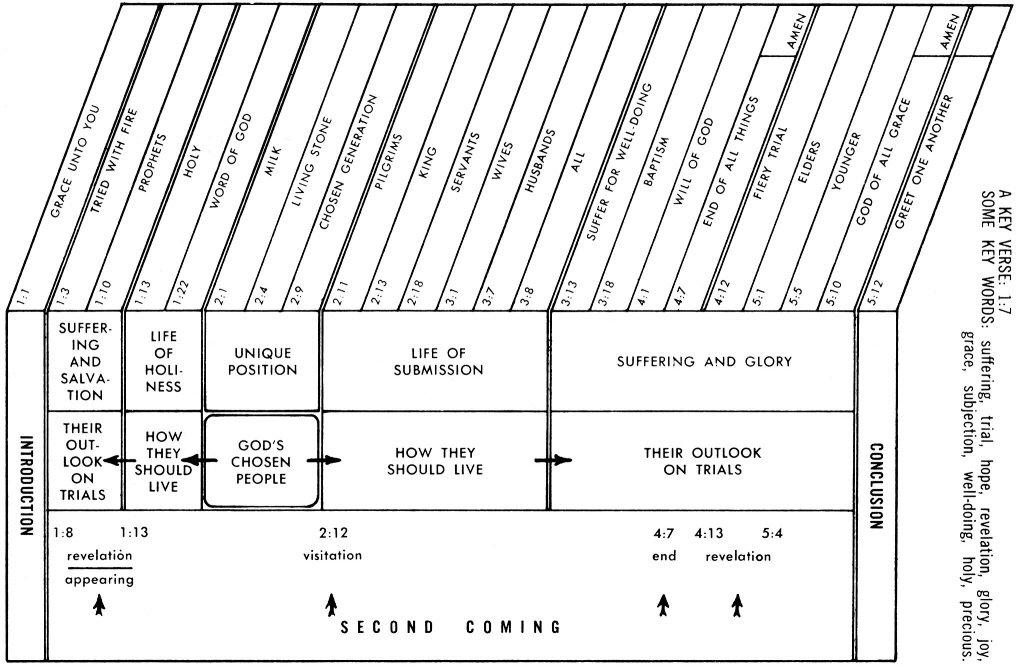
1 Peter: Trials, Holy Living & The Lord's Coming
Click chart to enlarge
Chart from Jensen's Survey of the NT - used by permission
See Another Chart from Charles Swindoll
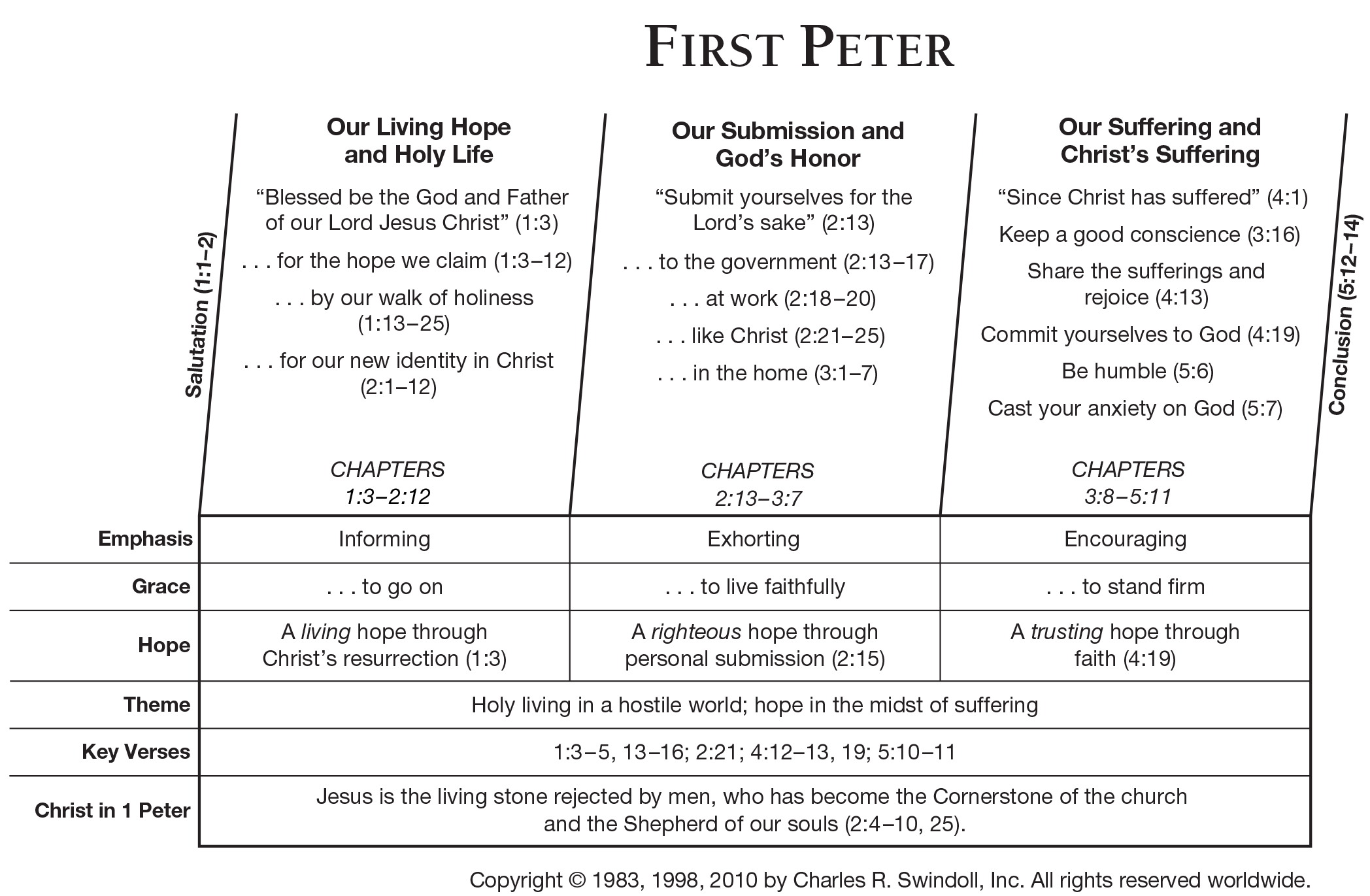
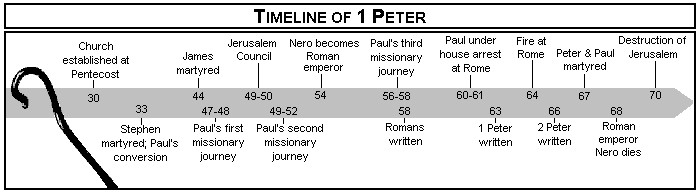
Source: Borrow Ryrie Study Bible
Click to enlarge
| Salvation of the Believer 1 Pe 1:1-2:12 |
Submission of the Believer 1 Pe 2:13-3:12 |
Suffering of the Believer 1 Pe 3:13-5:14 |
||||||||
| Salvation 1Pe 1:1-1:12 |
Sanctification 1Pe 1:13-2:12 |
Submit to Government 1Pe 2:13-17 |
Submit in Business 1Pe 2:18-25 |
Submit in Marriage 1Pe 3:1-8 |
Submit in all of life 1Pe 3:9-12 |
Conduct in Suffering 1Pe 3:13-17 |
Christ's Example of Suffering 1Pe 3:18-4:6 |
Commands in Suffering 1Pe 4:7-19 |
Minister in Suffering 1Pe 5:1-14 |
|
| Belief of Christians | Behavior of Christians | Buffeting of Christians | ||||||||
| Holiness | Harmony | Humility | ||||||||
|
Adapted from Bruce Wilkinson and Kenneth Boa's Talk Thru the Bible (borrow) |
||||||||||
1 Peter 4:18 AND IF IT IS WITH DIFFICULTY THAT THE RIGHTEOUS IS SAVED, WHAT WILL BECOME OF THE GODLESS MAN AND THE SINNER? (quote from Pr 11:31)
Greek: kai ei o dikaios molis sozetai, (3SPPI) o asebes kai hamartolos pou phaneitai? (3SFMI)
Amplified: And if the righteous are barely saved, what will become of the godless and wicked? [Pr 11:31.] (Amplified Bible - Lockman)
NLT: And "If the righteous are barely saved, what chance will the godless and sinners have?".(NLT - Tyndale House)
Phillips: 'If the righteous one is scarcely saved, where will the ungodly and the sinner appear?'. 4:19 - And if it is true that we are living in a time of judgment, then those who suffer according to God's will can only commit their souls to their faithful creator, and go on doing all the good they can.
Wuest: And if he who is righteous is with difficulty being saved, he that is impious and a sinner, where shall he appear? (Eerdmans)
Young's Literal: And if the righteous man is scarcely saved, the ungodly and sinner -- where shall he appear?
AND IF IT IS WITH DIFFICULTY THAT THE RIGHTEOUS IS SAVED: kai ei o dikaios molis sozetai (3SPPI):
- 1Peter 5:8; Pr 11:31; Jer 25:29; Ezek 18:24; Zech 13:9; Mt 24:22, 23, 24; Mk 13:20, 21, 22; Lk 23:31; Acts 14:22; 27:24,31, 42, 43, 44; 1Co 10:12; Heb 4:1; 10:38,39
And (kai) - And is an important "hinge word" that is often overlooked but which connects passages, ideas, thoughts and calls for us to be sure and examine the context when we encounter an "and" at the beginning of a sentence or clause. Peter is clearly adding further thoughts to what he has just said in 1Pe 4:16, 17). Peter's point is that divine judgment is not restricted to His "household."
John Wesley once referred to himself as “a brand plucked from the burning,” and that is true of most of us. J Vernon McGee goes on to tell the story of the difficulty that led to Wesley's being plucked from the burning…
When John Wesley came to America, he was not saved, he was not a Christian. He made this statement, “I came to America to convert Indians, but who is going to convert John Wesley?” His biographer tells us that at the governor’s court in Georgia he met one of the noblemen of Great Britain who had been sent over to administer that area. He was a very wealthy man with a name, and he had married a beautiful, young wife. That young woman and John Wesley began to eye each other, and evidently John Wesley fell in love with her. He asked her to leave and go with him to live among the Indians. And he thought he was a Christian and a missionary! But she sent him back to England, saying, “John, this won’t work. I love you, and I’ll always love you, but God has called you to do something for Him.” She evidently was a Christian, and so she sent him back to England. It is said that three times he started up the gangplank, and three times he started to walk back. But she motioned him to go, and he went back to England. One night walking down Aldersgate, he went upstairs and heard a man speaking on Galatians. Later, he could write in his journal, “I felt my heart strangely warmed. I felt that I did trust Christ, Christ alone, for my salvation, and there was given to me an assurance that He had forgiven me of my sins.”
Now if the righteous scarcely be saved, if they be but brands plucked from the burning, “where shall the ungodly and the sinner appear?” Peter asks. My friend, if you are not a Christian, and if Vernon McGee just barely made it and made it only by trusting Christ, how do you think you are going to make it? There is not but one hope—there is only one way of salvation. The Lord Jesus said, “I am the way” (see John 14:6). (McGee, J V: Thru the Bible Commentary: Thomas Nelson or Logos) (Or listen to the Mp3 of 1 Peter 4:18)
Peter is quoting from the Septuagint (LXX) of OT to support the previous thought. Here he offers another rhetorical question, the answer of which is not in doubt. His point is that if the sinner who is declared righteous by faith is saved only with great difficulty (including unjust suffering, divine purging, and the Father's discipline - Heb 12:7, 8-notes), what will be the end of the ungodly?
If the righteous will be rewarded in the earth, how much more the wicked and the sinner! (Pr 11:31)
If - Note that this is a first-class conditional particle with the present passive indicative of sozo (paraphrased as "continually being saved" - this would speak of day to day sanctification including the trials that are part of that daily process, not initial salvation, which itself is also difficult because it is a "strait gate" [Lk 13:24KJV] and it is easier for a camel to go thru the eye of a needle than for a rich man to be saved - Mt 19:24-26), signifying that it IS INDEED with difficulty that the righteous are saved.
Barton writes that "Peter was not introducing uncertainty to the believers’ assurance of salvation because in 1:4–5 he referred to the inheritance kept in heaven for us. Instead, he was talking about the difficult road believers must travel. It is not easy to be a Christian; we must count the cost. The phrase to be saved refers not to God’s work in salvation, nor to the initial step of coming to faith (new birth), but to the entire process of salvation with specific emphasis on persevering to the end. (Borrow Life application New Testament commentary) (Bolding added)
Dwight Edwards adds "I think the basic import of the passage is that the road of discipleship ("salvation of the soul") is one of rugged terrain and contains many pitfalls. (1 Peter - The Life That Lasts)
Wayne Grudem explains with difficulty this way - The fire of God’s holiness is so intense that even the righteous feel pain in its discipline. (Borrow The First Epistle of Peter : an introduction and commentary)
Marshall makes a good point that "The effect of persecution is to show up in the church those who really believe and are prepared to stand firm and those who do not really believe and so fall away when under trial. This judgment also purifies the true believers, encouraging them not to commit shameful acts. (IVP)
Difficulty (3433) (molis from molos = toil, labor pains) is an adverb which means hardly, barely, with difficulty, scarcely, not easily, very rarely. Molis refers to something that is hard to accomplish. BDAG adds that it can "pertain to rarity on a scale of occurrences. (Ro 5:7)"
Wuest comments that molis "is used in Acts 14:18 where Paul experienced difficulty in restraining the people at Lystra from sacrificing to him as a god. The context in First Peter speaks of the persecutions which were allowed to come by God as a disciplinary judgment, the purpose of which was to purify their lives. They were being saved with difficulty in the sense that if it was necessary for God to purify the lives of saints by these drastic means, namely, persecution and suffering, what can one say as to the position of the unsaved in relation to God? If the righteous need disciplinary judgments, how much more will the unrighteous merit the wrath of God whose offer of righteousness they have rejected. (See 1 Peter Commentary)
MacArthur notes tha molis
means “hardly” or “scarcely” and reveals the difficulty with which believers are brought to final salvation through the fires of unjust suffering, divine purging, and God-ordained discipline (see Heb. 12:7,8). (Ed: Believers are daily "being saved" as they experience trials and suffering as well as when they experience divine discipline when they commit sin. Peter could also be contrasting the believer's refining "judgment" of God versus the ungodly person's "judicial judgment," and will face the unquenchable wrath of God).
Thomas Schreiner writes that…
The word molis can mean “scarcely” (Ro 5:7) or “with difficulty” (Acts 14:18; 27:7–8, 16), but context here favors the latter. Peter was not saying that the righteous are scarcely saved, as if they were almost consigned to destruction and were just pulled from the flames. What he meant was that the righteous are saved “with difficulty.” The difficulty envisioned is the suffering believers must endure in order to be saved. God saves His people by refining and purifying them through suffering. It is implied here that salvation is eschatological, a gift that believers will receive after enduring suffering (cf. 1Pe 1:5, 9). If the godly are saved through the purification of suffering, then the judgment of the “ungodly and sinner” must be horrific indeed. (The New American Commentary)
Molis - 6x in 6v - (There is one use in the Septuagint [see comment below] in Pr 11:31 which is the verse Peter is quoting in 1Pe 4:17).
Acts 14:18 Even saying these things, with difficulty they restrained the crowds from offering sacrifice to them.
Acts 27:7 When we had sailed slowly for a good many days, and with difficulty had arrived off Cnidus, since the wind did not permit us to go farther, we sailed under the shelter of Crete, off Salmone; 8 and with difficulty sailing past it we came to a place called Fair Havens, near which was the city of Lasea… 16 Running under the shelter of a small island called Clauda, we were scarcely able to get the ship's boat under control.
Romans 5:7 For one will hardly die for a righteous man; though perhaps for the good man someone would dare even to die.
1 Peter 4:18 AND IF IT IS WITH DIFFICULTY THAT THE RIGHTEOUS IS SAVED, WHAT WILL BECOME OF THE GODLESS MAN AND THE SINNER?
J. Schneider in TDNT has this comment on molis…
1 Peter 4:18 is a quotation from Pr 11:31 LXX: In the Hebrew the saying applies to recompense in this life, but the author uses it of recompense in the last judgment The reference of the section in which 1 Peter 4:18 stands is to the sufferings of Christians, which are regarded as the fiery glow and beginning of judgment. They make great demands on Christians and above all represent a great temptation. Only with great difficulty will Christians pass through this hard time and stand in the divine judgment. The author wants to spur his readers on to faithfulness and to show them the seriousness of their responsibility. (Theological Dictionary of the New Testament)
In the Sermon on the Mount (Mt 7:14) Jesus alludes to this "difficulty" when He explains that "the gate is small (KJV = "strait is the gate" where "small" or "strait" = stenos), and the way is narrow (thlibo) that leads to life, and few are those who find it." Thlibo means to "press together, compress, afflict, squash, hem in and figuratively refers to sufferings that arise from the pressure of circumstances or from the antagonism of persons.
In Luke Jesus adds…
Luke 13:24 (or notes) “Strive (present imperative see our need to depend on the Holy Spirit to obey) to enter by the narrow (stenos) door (KJV = "Strait gate"); for many, I tell you, will seek to enter and will not be able.
In sum combining the various definitions, we see that the true way is not only narrow but also difficult. Jesus was saying that the narrow restricting way has connections with persecution, a major theme in Matthew’s Gospel (cf. Mt 5:10, 11, 12-note, Mt 5:44-note; 10:16-39; 11:11-12; 24:4-13; Acts 14:22) The upshot is that if the road you are on has a gate that is easy and well traveled, you do well to reconsider your journey through this life while you still have breath! The true way to God is narrow, difficult and demanding and has relatively few pilgrim travelers. In contrast the false way is broad, easy and permissive and has many lost souls traveling on it. (see discussion of these 2 gates and 2 ways in Mt 7:13, 14-note)
The writer of Hebrews issues an exhortation which also alludes to the difficulty of with which the righteous are saved…
Therefore (term of conclusion - always pause to ponder - based on Heb 3, especially Heb 3:18, 19), let us fear lest, while a promise remains of entering His rest, any one of you should seem to have come short of it. 2 For indeed we have had good news preached to us, just as they also; but the word they heard did not profit them, because it was not united by faith in those who heard. (Hebrews 4:1, 4:2)
As Ryrie puts it
Because of suffering (1Peter 4:16) and discipline (1Peter 4:17), the righteous work out their salvation (see Php 2:12; Php 2:13) with difficulty. (The Ryrie Study Bible: New American Standard Translation: 1995. Moody Publishers)
Believer's Study Bible comments that…
Modern society expresses amazement that God could condemn anyone. The biblical perspective is reflected, however, in this declaration. The point of amazement and astonishment is that the righteous are saved. If the righteous "scarcely" are saved, prospects for the unconverted sinner are hopeless indeed. (Criswell, W A. Believer's Study Bible: New King James Version. 1991. Thomas Nelson)
Jesus explains how difficult it is to enter the Kingdom of Heaven declaring…
For I say to you, that unless your righteousness surpasses (superabounds past) that of the scribes and Pharisees, you shall not (double negative - absolutely no way) enter the kingdom of heaven. (Mt 5:20-e note)
Believers pass through the testing fire of God's judgment -- not because He hates us, but because He loves us and wills our purity. God hates sin so much and loves his children so much that He will spare us no pain to rid us of what He hates. So suffering is not surprising; it is planned. It is a testing. It is purifying fire. It proves and strengthens real faith, and it consumes "performance faith."
In Psalm 26 we read of David's desire for God to put him in the fiery trial (he uses 3 Hebrew words for refining and purifying!)… could it be this has something to do with David being called a man after God's own heart?
Examine (Heb = bachan = focuses attention on an examination to prove the existence of some spiritual quality, such as integrity) me, O LORD, and try (Heb = nacah = test the quality through adversity or hardship to show what someone is really like) me. Test (Heb = “to refine,” usually indicating the purifying result of divine judgment) my mind and my heart. (Psalm 26:2)
Let us not fear or shy from fires of persecution for His name for the end result will be beyond our wildest imagination. Instead let us beseech the Lord to search us & try us (Ps 139:23,24).
Saved (4982) (sozo) has the basic meaning of rescuing one from great peril. Additional nuances include to protect, keep alive, preserve life, deliver, heal, be made whole. Sozo is used of physical deliverance from danger of perishing (see Mt 8:25; Mt 14:30; Lk 23:35; Acts 27:20 27:31 hold pointer over for popup verse), physical healing from sickness (Mt 9:21-22; Mk 5:23, Acts 4:9), and deliverance from demonic possession (Lk 8:36). More often sozo is used as in the present context to refer to salvation in a spiritual sense.
As noted above sozo is present tense and passive voice, which could be paraphrased "continually being saved."
ESV Study Bible - Scarcely saved does not mean that the righteous just barely receive salvation. “Scarcely” (Gk. molis, “with difficulty”) means that the righteous are saved in the midst of suffering; their salvation is not easy and simple.
WHAT WILL BECOME OF THE GODLESS MAN AND THE SINNER: o asebes kai hamartolos pou phaneitai (3SFMI):
- Ps 1:4-5; Ro 1:18; 5:6; 2Pe 2:5,6; 3:7; Jude 1:15
- Ge 13:13; 1Sa 15:18; Lk 15:1; Ro 5:8
A GOOD QUESTION FOR EVERY
PERSON TO ASK?
What will become - literally "where shall he appear".
Hiebert writes that Peter "implies that the judgment becomes more severe as it spreads. "If the sons are chastised, what have the most malicious slaves to expect?" (Augustine).
Become (appear) (5316) (phaino from phos = light) means to give light, illuminate, shine or give light, shine forth as a luminous body. In the middle voice as in this verse, phaino means to appear, be conspicuous, become visible, shine.
The godless man - Defined by Peter (1Pe 4:17) as those "who do not obey the Gospel of God."
Godless (765) (asebes [word study] from a = without + sébomai = worship, venerate) means a lack of interest in the things of God and a behavior and lifestyle consistent with such an irreverent attitude. Click study of asebes and the related word ungodliness - asebeia). Asebes pictures one lacking proper respect of God and/or living as if He did not exist with no fear of Him or His just punishment of ungodliness. Read Psalm 1:1-5, an excellent summary of the righteous versus the ungodly (wicked). Note especially…
Ps 1:4 The wicked are not so, But they are like chaff which the wind drives away. 5 Therefore the wicked will not stand in the judgment, Nor sinners in the assembly of the righteous.
The ungodly man or woman is the one who has little or no time for God in their life. They have deceived themselves into believing that they can rule God out of their affairs and their thinking even though God is the greatest Being in the universe, the One Who makes sense out of life, the One around Whom all of life revolves and without Whom no creature could even take a breath. To eliminate such a Glorious Being from one's thinking is what it means to be ungodly.
Paul draws the distinction between the earthly sufferings of the saints and the endless punishment of the lost explaining that persecution (of believers now)…
is a plain indication of God’s righteous judgment so that you will be considered worthy of the kingdom of God, for which indeed you are suffering. For after all it is only just for God to repay with affliction those who afflict you (the godless man and the sinner), and to give relief to you (believers) who are afflicted and to us (Paul, Silas, Timothy) as well when the Lord Jesus will be revealed from heaven with His mighty angels in flaming fire (cp Matthew 24:30, Re 19:11-16), dealing out retribution (repay harm w harm on assumption that initial harm was unjustified) to those who do not know God (not that do not "know" about Him but do not know Him - see Jesus' stern warning ) and to those who do not obey the gospel of our Lord Jesus. These will pay the penalty of eternal destruction (not annihilation but unavoidable distress & torment), away from the presence of the Lord and from the glory of His power. (2Th 1:5-9)
Thomas Constable explains that…
In this verse Peter contrasted the intensity of the two experiences of suffering, by disciples now and by unbelievers in the future. It is with difficulty that righteous people pass through this phase of our existence into the next phase because this phase involves suffering for us.
“Saved” (Gr. sozetai) here means delivered in the sense of being delivered from this life into the next. Yet it will be even more difficult for godless people to pass from this phase of their lives to the next because they will have to undergo God’s judgment. Their future sufferings will be more intense than our present sufferings.
The purpose of Peter’s quoting Proverbs 11:18 freely was to show that the Old Testament also taught that both the righteous and the wicked will receive from the Lord. The point in the proverb is that the wicked will receive even more punishment than the righteous will receive reward. If God disciplines His own children, how much more severely will He deal with those who are not His children. Our sufferings are light compared with those the ungodly will experience in the future. (Expository Notes)
Related Resource:
1 Peter 4:19 Therefore, those also who suffer according to the will of God shall entrust their souls to a faithful Creator in doing what is right.
Greek: hoste kai oi paschontes (PAPMPN) kata to thelema tou theou pisto ktiste paratithesthosan (3PPMM) tas psuchas auton en agathopoiia
Amplified: Therefore, those who are ill-treated and suffer in accordance with God’s will must do right and commit their souls [in charge as a deposit] to the One Who created [them] and will never fail [them].(Amplified Bible - Lockman)
NLT: So if you are suffering according to God's will, keep on doing what is right, and trust yourself to the God who made you, for he will never fail you. (NLT - Tyndale House)
Phillips: And if it is true that we are living in a time of judgment, then those who suffer according to God's will can only commit their souls to their faithful creator, and go on doing all the good they can.
Wuest: Therefore, also let those who are suffering according to the will of God be constantly committing the safekeeping of their souls by a continuance in the doing of good to a faithful Creator. (Eerdmans)
Young's Literal: so that also those suffering according to the will of god, as to a stedfast Creator, let them commit their own souls in good doing.
THEREFORE, LET THOSE ALSO WHO SUFFER ACCORDING TO THE WILL OF GOD: hoste kai oi paschontes (PAPMPN) kata to thelema tou theou:
- 1 Peter 3:17; Acts 21:11-14
Related Passages:
1 Peter 3:17 (For it is better, if God should will it so, that you suffer for doing what is right rather than for doing what is wrong.
Acts 21:11-14 And coming to us, he took Paul’s belt and bound his own feet and hands, and said, “This is what the Holy Spirit says: ‘In this way the Jews at Jerusalem will bind the man who owns this belt and deliver him into the hands of the Gentiles.’” 12 When we had heard this, we as well as the local residents began begging him not to go up to Jerusalem. 13 Then Paul answered, “What are you doing, weeping and breaking my heart? For I am ready not only to be bound, but even to die at Jerusalem for the name of the Lord Jesus.” 14 And since he would not be persuaded, we fell silent, remarking, “The will of the Lord be done!”
THEREFORE INTRODUCES
A CALL TO ACTION
Therefore - Always pause and ponder this term of conclusion as this discipline (slowing down and "chewing the cud" so to speak) will help you discern the meaning of the text in context. (for it allows your Teacher the Holy Spirit the opportunity to speak to you. If you "speed reading" or reading passively, you are much less likely to hear the "still small voice" of the Spirit! In this context therefore sums up the thought of the entire paragraph and specifically the effect this somber truth about suffering should have on the attitude of believers. As in this contextual use, therefore is also an introduction to an exhortation or call to action. Compare doctrine in Romans 1-11 and then the "therefore" in Romans 12:1, doctrine in Ephesians 1-3 and then the "therefore" in Ephesians 4:1.
Suffer (3958) (pascho]) means to experience a sensation, to suffer pain or experience something that falls to one's lot (good or ill). Note the present tense which describes suffering as a lifestyle (cp 2Ti 3:12, Php 1:29, 1Pe 4:12). Not just one bout of suffering but a "lifestyle" of suffering. The cross always precedes the crown in God's economy.
Disciple's Study Bible notes that…
The Creator permitted suffering in His world when people sinned. Now sufferers tend to feel suffering indicates God has forsaken them. Peter teaches us God is true to Himself, to His people, and to His promises. Suffering simply calls us to new commitment to Him and His way of life.
Though God made a good world, evil has become a part of it because of sin. The works of wicked people sometimes cause good people to suffer. Peter instructed his suffering readers to refrain from doubting God's interest in or His ability to help them. A willingness to do God's will, whatever the cost, is the only ultimate way to face the problem of unexplained suffering. That will is not something new. It is the Creator's eternal purpose. (Disciple's Study Bible)
Dwight Edwards - Josh Billings once wrote, "Life is a grindstone, and whether it grinds a man down or polishes him up depends on the stuff he's made of." I think this accurately portrays the path of each man or woman's life. As the grinding edge of undeserved suffering makes close contact with our lives, our response will cause us to become either a more polished vessel ( i.e., Christlike), or else it will mar us with a deeper root of bitterness. In short we will either become holy or bitter, depending on our response to undeserved suffering. And so we are told that those who suffer "according to the will of God" are not to be resentful but rather are to "commit the keeping of their souls to Him in well doing, as unto a faithful Creator." (1 Peter - The Life That Lasts)
According to the will of God - Don't miss this qualifying statement. This implies that the sovereign God allows the suffering. Suffering is "filtered" through the fingers (anthropomorphically speaking) of our Father Who loves us and has our good and His glory in view in allowing the suffering. "According to the will of God" also implies that we as believers should willingly submit to His will for our life. Peter is not referring to suffering in general as experienced by all of mankind, but to suffering because one is a "Christian," a Christ follower.
THOUGHT- Have you had this experience? Has your family ostracized you because of your faith in Christ? Have they told you not to mention the Name of "Jesus" in their presence (unless you mean to use it as a curse word!)?
Related Resources:
D Edmond Hiebert explains that "Their suffering was "according to God's will," "because of the name of Christ" (1Pe 4:14), "as a Christian" (1Pe 4:16)—a suffering now regarded from the standpoint of God's will. Behind the vicious activities of their enemies stood the wise will of God. Peter sought to assure the readers that Christian suffering "does not come at the caprice of blind chance or as the predetermination of inexorable fate but as a divine discipline." Assured that their suffering was in harmony with the divine will for them, they were "not [to] quarrel with that wise and gracious will; neither let them be discouraged, or grow faint and weary in their Christian course." (First Peter- D. Edmond Hiebert- Recommended Commentary)
Oswald Chambers expounds on this idea of suffering according to the will of God - To choose to suffer means that there is something wrong; to choose God’s will even if it means suffering is a very different thing. No healthy saint ever chooses suffering; he chooses God’s will, as Jesus did, whether it means suffering or not. Be merciful to God’s reputation. It is easy to blacken God’s character because God never answers back, He never vindicates Himself. Beware of the thought that Jesus needed sympathy in His earthly life; He refused sympathy from others because He knew far too wisely that no one on earth understood what He was going through. Notice God’s ‘waste’ of saints, according to the judgment of the world. God plants His saints in some of the most useless places. We say, ‘God intends me to be here because I am so useful.’ Jesus never estimated His life along the line of the greatest use. God puts His saints where they will glorify Him most, and we are no judges at all of where that is. (1 Peter 4:19 Bible.org)
Will (2307)(thelema from thelo = to will with the "-ma" suffix indicating the result of the will = "a thing willed") generally speaks of the result of what one has decided. One sees this root word in the feminine name "Thelma." In its most basic form, thelema refers to a wish, a strong desire, and the willing of some event. (Note: See also the discussion of the preceding word boule for comments relating to thelema).
Peter has previously described suffering according to the will of God…
1Pet 3:17 For it is better, if God should will it so, that you suffer for doing what is right rather than for doing what is wrong.
Zodhiates says that thelema is the…Will, not to be conceived as a demand, but as an expression or inclination of pleasure towards that which is liked, that which pleases and creates joy. When it denotes God's will, it signifies His gracious disposition toward something. Used to designate what God Himself does of His own good pleasure. (Borrow The Complete Word Study Dictionary: New Testament) Thelema has both an objective meaning (“what one wishes to happen” or what is willed) and a subjective connotation (“the act of willing or desiring”). The word conveys the idea of desire, even a heart’s desire, for the word primarily expresses emotion instead of volition. Thus God’s will is not so much God’s intention, as it is His heart’s desire.
Thelema - 62x in 58v - Mt 6:10; 7:21; 12:50; 18:14; 21:31; 26:42; Mark 3:35; Luke 12:47; 22:42; 23:25; Jn 1:13; 4:34; 5:30; 6:38, 39, 40; 7:17; 9:31; Acts 13:22; 21:14; 22:14; Ro 1:10; Ro 2:18; Ro 12:2; Ro 15:32; 1Cor 1:1; 7:37; 16:12; 2Cor 1:1; 8:5; Gal 1:4; Ep 1:1, Ep 1:5, Ep 1:9, Ep 1:11; Ep 2:3; Ep 5:17; Ep 6:6; Col 1:1, Col 1:9; Col 4:12; 1Th 4:3; 1Th 5:18; 2Ti 1:1; 2Ti 2:26; He 10:7, He 10:9, He 10:10, He 10:36; He 13:21; 1Pe 2:15; 1Pe 3:17; 1Pe 4:2, 1Pe 4:19; 2Pe 1:21; 1Jn 2:17; 5:14; Rev 4:11. NAS = desire(1), desires(1), will(57).
On September 15, 1732, the first two Moravian missionaries arrived in Copenhagen, seeking a ship to the Danish West Indies. They found nothing but opposition and discouragement. Even if they found a ship to take them to St. Thomas, they were told, they would never be allowed to preach to the slaves there. Leonard Dober and David Nitschmann replied they would be willing to become slaves themselves if necessary (Read the exciting details of how this transpired in History of the Moravian Church). Their suffering according to the will of God paved the way for the Protestant era of world missions. (Missionaries Against Terrible Odds)
ENTRUST THEIR SOULS TO A FAITHFUL CREATOR: pisto ktiste paratithesthosan (3PPMM) tas psuchas auton :
- Ps 31:5; 37:5; Lk 23:46; Acts 7:59; 2Ti 1:12
- faithful: Ps 138:8; 146:5,6; Isa 40:27,28; 43:7,21; 51:12,13; 54:16,17; Col 1:16, 17, 18, 19, 20; Heb 1:2,3; Rev 4:10,11; 5:9, 10, 11, 12, 13, 14)
Entrust their souls - Entrust as explained below is a banking term. The idea is they have "deposited" their souls in God's trustworthy bank. Have you made your deposit, my friend? Have you committed your soul unto Him? It's your choice. God won't force you. It requires an act of your will. And it is an act of faith, for we cannot see the Creator, but we can trust the Creator. (cp 2Cor 5:7, 2Cor 4:18, Ps 121:1, Ps 121:2). The next time you encounter suffering for His Name's sake, step out in faith in the sovereign power and purpose of the same God Who flung the stars into the sky with just a word (cp Heb 11:3). That same God continues to upholds "all things by the word of His power" (Heb 1:3). You can trust Him implicitly and eternally!
Steven Cole explains that…
As Christians, we should entrust ourselves to God in trials (1Pe 4:19). Where else can we go? If we suffer for our faith in Christ, then we can know that it is according to God’s will. Thus we can entrust ourselves to Him as the faithful Creator and continue to do what is right. “Entrust” is a banking term that meant to deposit one’s valuables to another for safe keeping. Paul used the noun when he told Timothy,
I know whom I have believed and I am convinced that He is able to guard what I have entrusted to Him until that day” (2Ti 1:12)
It was the word Jesus uttered from the cross when He expired:
Father, into Your hands I commit [entrust] My spirit” (Luke 23:46)
This is the only time in the New Testament God is called the Creator. If God created the universe by the word of His power, He is able to guard your deposit with Him and bring you safely to His heavenly kingdom (cp 1Pe 1:4, 1Pe 1:5). That He is the faithful Creator shows that He cares enough to guard you. So you can trust Him with your very life, even if evil men take it away from you, and know that He won’t lose it. You demonstrate your trust by continuing to do what is right when you suffer. You don’t plot revenge on those who wrong you. You pray that God will save them and know that if He doesn’t, He will judge them and exonerate you.
Trusting in God has fallen on hard times. We’re told today that when we suffer, we need to express all our anger toward God or we might do some psychological damage to ourselves. But trust the Lord? Get practical! I am! Trusting in the Faithful Creator is the most practical thing you can do when you’re going through a difficult trial.
Compared to what martyrs and other saints have suffered, I have not gone through much. But I can testify that whenever I have suffered, especially when I’ve suffered for the cause of Christ, I have grown closer to Christ, I have sensed His abiding peace and good pleasure, and I’ve known His joy in a deeper way than at any other time.
I just received a letter from a friend who met the Lord at 41 out of a night club background in which he was enslaved to drugs and alcohol. He went on to pastor a church near me in Southern California, where I got to know him and enjoyed many times of fellowship together. He’s now 72 and has just found out that he has prostate cancer. He wrote,
“The result has been that the Lord has provided many opportunities to share His sufficient grace with saved and unsaved alike, especially young people.”
He mentions how his relationship with his wife and with the Lord has deepened through this trial and adds, “Hallelujah!”
You say, “That’s not natural!” Precisely! Only God can bring such joy in the face of what the world calls a crisis. As Christians, we can expect trials. Don’t be surprised. More than that, by God’s power, we can exult in them if we see the result God is accomplishing. When they hit, we should examine ourselves more deeply and entrust ourselves to God more fully, knowing that we are in His perfect will. Hard lessons about hard times—but our God is faithful! (1 Peter 4:12-19 Hard Lessons About Hard Times)
Entrust (3908) (paratithemi from para = near + tithemi = place) literally means to place something beside, to set alongside or place before someone. It was used in Greek meaning (a banking term) to give someone something in trust and so to "deposit" with another. It conveys the picture of a precious treasure being deposited as a trust into the hands of other persons.
Note the present imperative which is a command calling for this attitude of entrusting to be one's lifestyle.
The TDNT has the following note regarding paratithemi writing that…
In the ancient Greek and Jewish sphere, as well as the ancient Roman, one finds the legal device whereby an object can be entrusted to another’s keeping for a specific period. This object was to be kept free, unused and undamaged until restoration. The trustworthiness of the trustee was thus most important. But there was, too, a stringent penalty for embezzlement, and the special wrath of the gods was also invoked. The legal formulae soon came to be used in a transferred sense, e.g., “to entrust someone to the care or protection of someone,” Diod. S., 17, 23, 5; "to submit words as entrusted goods" (Ed note: as here in 2 Timothy)… (In the Septuagint paratithemi is used 42 times including use as… ) "a term in commercial law “to give money to someone for safekeeping,”… The responsibility of the trustee for the money handed to him is regulated in Exodus 22:7-13… When the psalmist in Psalm 31:5 prays "into Thy hands I commit [Lxx = paratithemi] my spirit", as one who is persecuted, though innocent, he sets himself under the protection of the faithful God." (Ed note: And of course our Lord Jesus quoted these very words from the Cross as noted below)… (the Jewish Historian in using paratithemi… ) lays special emphasis on the honesty which, grounded on fear of God and the conscience, must hold sway in trusts." The TDNT appropriately adds that "All that man is and has he should regard as something entrusted to him by God" (Theological Dictionary of the New Testament) (Bolding added)
Paratithemi means to entrust or commit for safekeeping with the implication that one was committing to another with confidence. It can convey the idea of investing or charging someone with a duty or responsibility. It can convey the idea of putting something into the care or protection of someone. This is very similar to use of paratithemi in classical Greek to describe anything being deposited with a friend for the purpose of safekeeping.
Why would you deposit your "life savings" so to speak in any bank? It's because you trust the bank… it's been around a long time and has a record of faithfulness. How much more than should we be willing to deposit our very lives with our faithful Creator (we are His possession anyway!). We are willing to do so because we know Whom we have believed (2Ti 1:12). Be diligent to study God's Word of Truth (2Ti 2:15) to truly know His character and then you are less likely to be surprised at the fiery ordeal which is in His sovereign will and has a holy purpose. Let me suggest a painless way to become familiar with God's attributes - Study the Names of the LORD, for inherent in His glorious Names is the progressive, relatively easily "digested" revelation of His character.
Dwight Edwards writes that…
When suffering comes we all look for some source of comfort and, if possible, relief. There are many things into which a man can deposit his soul in order to alleviate the pains and heartaches of life. Money, alcohol, sports, business, even a favorite hobby can all be used to temporarily stifle the cries of the soul. Yet all these things are really ruthless bankers because they promise much but never fully keep their bargain. And so we are being told that in the midst of suffering, we need to be sure and "deposit" our soul into the hands of God. He alone is a faithful banker who will abundantly increase the value of our life. (1 Peter - The Life That Lasts)
A good example of this is given to us by Christ as He was dying on the cross. He was offered a stupefying drink of vinegar and gall in order to lessen the pain of the cross. Yet He refused this drink and was willing to experience to full pain of the cross. There are many drinks which this world holds out for us that we might deaden the pain of the cross by "depositing" our souls with one of them. Yet, like Christ it will be to our eternal benefit to "deposit" our soul only with God, no matter the cost.
The proof positive that we have sincerely made this divine transaction will be our "well doing" in the midst of suffering. The natural reaction of undeserved suffering is retaliation, yet God is calling us to a lifestyle which exemplifies that of Christ's, "Who when He was reviled, reviled not again; when he suffered, he threatened not, but committed Himself to Him that judges righteously" (1Pe 2:23).(1 Peter - The Life That Lasts)
My soul wait thou upon God;
for my expectation is from Him.
He only is my rock and my salvation:
He is my defense; I shall not be moved
Psalm 62:5-6 (note)
Warren Wiersbe explains that the idea of leaving our deposit with God for safekeeping ties in "beautifully with the “gold” illustration in 1Peter 1:7 (note). God sends the fiery trial to burn away the dross, and we commit ourselves to Him for safekeeping, knowing that He cannot fail us. We can be sure that God will “pay interest” on our deposit. But note that we commit ourselves in doing good; that is, we commit ourselves to God as we obey His Word. This is a daily and hourly surrender, living to please Him and serving others. Christians will go through fiery trials before Christ returns. The world situation will not get better. Attitudes toward Christians will not improve. The world has always hated the name of Christ and will continue to hate it. If we identify ourselves with the name of Christ, the world will hate us (John 15:18-21). If we compromise, we will escape persecution, but we will also miss the blessing and glory of sharing Christ’s sufferings. (Borrow Wiersbe's Expository Outlines on the New Testament )
John Piper agrees with this reasoning writing that "The purpose of good theology is to build and sustain great trust in God. In all Christian suffering Satan is seeking to devour faith (1Peter 5:8; 5:9-see notes 1 Peter 5:8; 5:9). God is seeking to test and refine faith (1Peter 4:12). God's great purpose in all our suffering will be accomplished when we do what Jesus did in the agony of the cross when he cried out (Lk 23:46, cp 1Peter 2:23), "Father, into your hands I entrust my spirit." He entrusted himself to a faithful Creator. According to 2Cor 1:9 God's purpose in suffering is to cause us to rely no longer on ourselves but utterly on him who raises the dead. (See full sermon The Holy Spirit will Help You Die - 1 Peter 4:12-19)
OUR FAITHFUL
CREATOR
Ps 146:5 How blessed is he whose help is the God of Jacob, Whose hope is in the LORD his God; 6 Who made heaven and earth, The sea and all that is in them; Who keeps faith forever;
Spurgeon comments: This God who still makes the world by keeping it in existence is assuredly able to keep us to His eternal kingdom and glory. The making of the worlds is the standing proof of the power and wisdom of that great God in Whom we trust. It is our joy that he not only made heaven, but the sea; not only things which are bright and blessed, but things which are deep and dark. Concerning all our circumstances, we may say the Lord is there. In storms and hurricanes the Lord reigneth as truly as in that great calm which rules the firmament above.
Who keeps faith forever. This is a second and most forcible justification of our trust: the Lord will never permit His promise to fail. He is true to His own nature, true to the relationships which He has assumed, true to His covenant, true to His Word, true to His Son. He keeps true, and is the Keeper of all that is true. Immutable fidelity is the character of Jehovah's procedure. None can charge Him with falsehood or vacillation.
Faithful (trustworthy) (4103) (pistos [word study]) from peítho = to persuade - induce one by words to believe, have confidence) is something or someone who is worthy of faith or keeps promises and is applied to God, humans, His Word, etc
Phrase "God is faithful" = 1Cor 1:9, 1Cor 10:13, 2Cor 1:18. See also God's Faithfulness
Here in Peter, pistos conveys the basic idea of that which is trustworthy. In this sense pistos describes God, Christ, servants, His Word as faithful, reliable, worthy of belief or trust, dependable. Marvin Vincent adds that pistos used of God describes Him as "True to his own nature and promises; keeping faith with Himself and with man." Vincent also gives a nice summary (expanded in the discussion that follows) of the meaning of pistos, faithful, writing that it is used
"(1), of one who shows Himself faithful in the discharge of a duty or the administration of a trust (Mt 24:45). Hence, trustworthy (2Ti 2:2). Of things that can be relied upon (2Ti 2:11). (2), Confiding; trusting; a believer (Gal 3:9; Acts16:1; 2Cor 6:15; 1Ti 5:16)" (Word Studies in the New Testament)
Webster says that "Faithful" means firm in adherence to whatever one owes allegiance and implies unswerving adherence to a person or thing or to the oath or promise by which a tie was contracted.
To a faithful Creator - This phrase is actually at the beginning of the Greek which gives it emphasis. Young's Literal version is a more accurate rendering of the Greek word order - " as to a stedfast Creator, let them commit their own souls in good doing."
A faithful Creator - Faithfulness is God's attribute of utter dependability, the antithesis of everything fickle and fluctuating in the world around us. In 2Timothy 2:13 (note) Paul says that faithfulness is a corollary of His self-consistency. Because God is faithful, His promises are infallibly reliable (Hebrews 10:23).
Faithful is He Who calls you, and He also will bring it to pass. (see note 1Th 5:24)
Spurgeon offers a few thoughts (from various of his sermons, devotionals and expositional comments) on our faithful Creator…
We must be tried or we cannot magnify the faithful God, who will not leave His people.
In life and death we prove the attributes of God’s righteousness. We find that He does not lie but is faithful to His Word.
Tested believer, the Lord will be as faithful to you as He has been to me. The Lord will not fail you. Do not be discouraged,
the eternal God is your refuge, and underneath are the everlasting arms (Dt 32:27).
The heavenly sun shines on in eternal brightness. You have a possession that is unfading, a promise that is unfailing, and a Protector who is unchanging. Though you live in a faithless world, you dwell in a faithful God.
There is love, immortal and unchanging love, in heaven toward you, which will never grow cold. You will be helped. God would sooner cease to be than cease to be faithful. Be of good courage, for today He will strengthen your heart.
Eternal faithfulness performs what eternal wisdom declares. Shall God lie? Is he a man as thou art? Will he deceive? Will he falsely promise, and then run from his word? That be far from him, and let it be far from us thus to blaspheme his name by such a thought. Come, then, child of God, thou who knowest him, if he has said, “I will help thee,” he will help thee. If he says, “I will strengthen thee,” he will strengthen thee. Believe God, without the trace of doubt; and “be of good courage, and he shall strengthen your heart, all ye that hope in the Lord.”
“Great is Your faithfulness,” (Lam 3:23, cp La 3:21, 22, 23, 24) - So great that there has never been an exception. Through the ages, our God has had billions of people to deal with. Yet there does not stand under heaven’s cover, or above the stars, or in hell itself a single soul who can say that God is not absolutely faithful. No item in the list of our divine promises is unfulfilled. God remembers every promise that He ever made, and He honors each in the experience of those who believe in Him. They who trust in the Lord will find Him faithful, not only in great things, but also in little things. His faintest word will stand firm and steadfast. His least truth will never grow dim. The glory of God’s faithfulness is that no sin of ours has ever made Him unfaithful. Unbelief is a damning thing, yet even when we do not believe, God is faithful. His children might rebel. They might wander far from His statutes and be chastened with many stripes. Nevertheless, He says,
My lovingkindness I will not utterly take from him, nor allow My faithfulness to fail. My covenant I will not break, nor alter the word that has gone out of My lips” (Psalm. 89:33, 34).
Great is Thy faithfulness, O God my Father;
There is no shadow of turning with Thee;
Thou changest not, Thy compassions, they fail not;
As Thou hast been, Thou forever will be.
Refrain
Refrain
Great is Thy faithfulness!
Great is Thy faithfulness!
Morning by morning new mercies I see.
All I have needed Thy hand hath provided;
Great is Thy faithfulness, Lord, unto me!
Summer and winter and springtime and harvest,
Sun, moon and stars in their courses above
Join with all nature in manifold witness
To Thy great faithfulness, mercy and love.
Refrain
Pardon for sin and a peace that endureth
Thine own dear presence to cheer and to guide;
Strength for today and bright hope for tomorrow,
Blessings all mine, with ten thousand beside!
Refrain
How has God shown Himself to be faithful to you and your family in the past? How can you make sure you'll remember? With whom can you talk about it today? Precious memories of yesterday's divine faithfulness gives power to endure today's trials! Trials will come and go in everyone's life, but God's faithfulness is unchanging and sure. Do you believe that statement is Biblical?
Trusting God's faithfulness
dispels our fearfulness.
Notice that the spiritual "antidote" for fear (of man) is faith (in God)! Satan traffics in the realm of doubt, God in the realm of faith. Stay in the Word. Better yet, let the Word stay in you, and your faith will be buoyed up by the Spirit of God Who utilizes the Word you have treasured in your heart (see Ro 10:17, Ps 119:11, see source of Job's strength in face of overwhelming trials = Job 23:12, see also Memorizing His Word and Biblical Meditation)
Related Resource:
IN DOING WHAT IS RIGHT: en agathopoiia
- 1Peter 2:15; Esther 4:16; Jer 26:11, 12, 13, 14, 15; Da 3:16, 17, 18; 6:10,11,22; Ro 2:7)
1Pet 2:15 For such is the will of God that by doing right you may silence the ignorance of foolish men.
Doing what is right (16) (agathopoiia [only found here in Bible] from agathopoieo from agathos = good, benevolent + poieo = to do, perform) is a noun which means well-doing, in context living in the right way or doing as a helpful action. BDAG = "engagement in doing what is good,"
F B Meyer (in Our Daily Walk) in a devotional on 1Peter 4:19 wrote that…
The more one ponders these words, the more wonderful they appear! That God is faithful is as clear as noonday. He is faithful in the return of the seasons and the orbit-order of the stars; faithful in holding back the flood, that it should not overflow the world and destroy the homes of men; faithful to every living creature that He has made, providing for its exact sustenance. Even the odd sparrow, which Christ must have seen thrown in by the dealer, when His Mother bought four others, does not fall to the ground without His notice. God is the Faithful Creator in the heavens above and in the earth beneath. We are not surprised, therefore, to find His faithfulness the theme of Holy Writ; but why does Peter lay emphasis on His faithfulness as Creator, when ministering to the special circumstances of suffering believers? Is not this the reason? We are apt to concentrate our thoughts on the Birth, the Cross, the Grave, the Intercession of our Lord, and to forget that behind all these, deep in the nature of God--the Almighty Creator--there are ever-welling fountains of faithfulness, love, and tenderness. We are summoned to go back beyond the story of Redemption to the infinite silence of Eternity, when each of us was a distinct thought in the mind of God. In His book, all our members were written, when as yet there was none of them.
Whether we have realised that eternal purpose is open to serious questioning, but everyone of us has a right to look into the face of God, and say
"Thine hands have made me, and fashioned me; give me understanding that I may learn Thy commandments."
We may not question God's dealings with us. They are immutably wise and right. But we may claim that in some way He should make good our deficiencies, so that though sorrowful, we should be always rejoicing; though poor we should make many rich; though having nothing, we should scatter our wealth, as though possessing all things. There is no reason why our life should be a failure, no reason why we should not minister richly to others, no reason why, by His grace, we should not be more than conquerors! We may humbly make this claim on the Almighty Creator, and He will not allow His faithfulness to fail!
PRAYER: Help us to commit ourselves to Thee in well-doing, O God, our Faithful Creator. May we find a solace for our own griefs and disappointments, in sympathy and ministry to others. AMEN.
God Hath Not Promised
Annie Johnson Flint
God hath not promised skies always blue,
Flower-strewn pathways all our lives through;
God hath not promised sun without rain,
Joy without sorrow, peace without pain.
God hath not promised we shall not know
Toil and temptation, trouble and woe;
He hath not told us we shall not bear
Many a burden, many a care.
God hath not promised smooth roads and wide,
Swift, easy travel, needing no guide;
Never a mountain, rocky and steep,
Never a river, turbid and deep.
But God hath promised strength for the day,
Rest for the laborer, light for the way,
Grace for the trials, help from above,
Unfailing sympathy, undying love.
When You're Betrayed - One of the toughest tests we face while serving God is betrayal. I saw it happen to a loving pastor. He encouraged a gifted teenager in his congregation to go to Bible school. He arranged for financial support. He continued to mentor the young man after graduation, letting him preach on occasion.
But then the graduate began to undermine the pastor with innuendo and criticism. Finally the heartbroken minister left. Then the young man announced himself as a candidate for pastor of the church.
Jesus knew about betrayal. He invested 3 years into the lives of His 12 disciples, one of whom was Judas. Jesus had taught him, performed miracles before his eyes, and even washed his feet. Yet Judas sold his allegiance for 30 pieces of silver. When Jesus predicted His own betrayal in John 13:18, He quoted David, who also knew what it was like to have a friend turn on him (Ps. 41:9).
Knowing that He would be betrayed, Jesus continued to do what the Father wanted Him to do. He taught us by example to serve people because we love and obey God, not because we want to be appreciated.
Have you been betrayed? Find comfort in knowing that true fulfillment comes in doing the will of God. — by David C. Egner (Our Daily Bread, Copyright RBC Ministries, Grand Rapids, MI. Reprinted by permission. All rights reserved)
When people turn against you
In spite of all you do,
Remember Christ's rejection
And all He's done for you.
—Anon.
If you are betrayed,
leave it with God.
Nothing to Do But Pray - For Lorraine Fusco, it may have seemed that her useful days on earth were behind her. Cancer struck at the base of her brain and traveled down her spine, paralyzing her completely. Tubes were used to feed her and help her breathe. The only voluntary movement she could make was to open and shut her eyes and mouth.
There certainly wasn’t much Lorraine could do, but she refused to sulk and turn sour, or to bemoan her fate and curse her condition.
According to her husband, pastor Bill Fusco, she became a prayer warrior and a shining light of hope. During one stay in the hospital, she so influenced two workers with her joyous outlook that they put their trust in Christ. Later, while her husband served as a college president, she spent entire days praying for each student.
When death finally claimed her, she left a powerful testimony. Lorraine lived joyfully for God despite her trials. She saw her suffering as part of God’s will—and she gave every ounce of her energy to serving Him (1 Pet. 4:19). She could do nothing but pray and live joyously, but that was enough.
We all have limitations. If we focus on them, we’ll find that serving God is a chore. But if we focus on what we can do, we’ll make an impact for His kingdom. by Dave Branon (Our Daily Bread, Copyright RBC Ministries, Grand Rapids, MI. Reprinted by permission. All rights reserved)
There may be nothing you can do but pray,
But through your prayer there's something God can do:
The ones for whom you intercede may feel
The touch of God upon their life anew.
—Hess
You'll accomplish far more by focusing on your abilities
instead of your limitations.