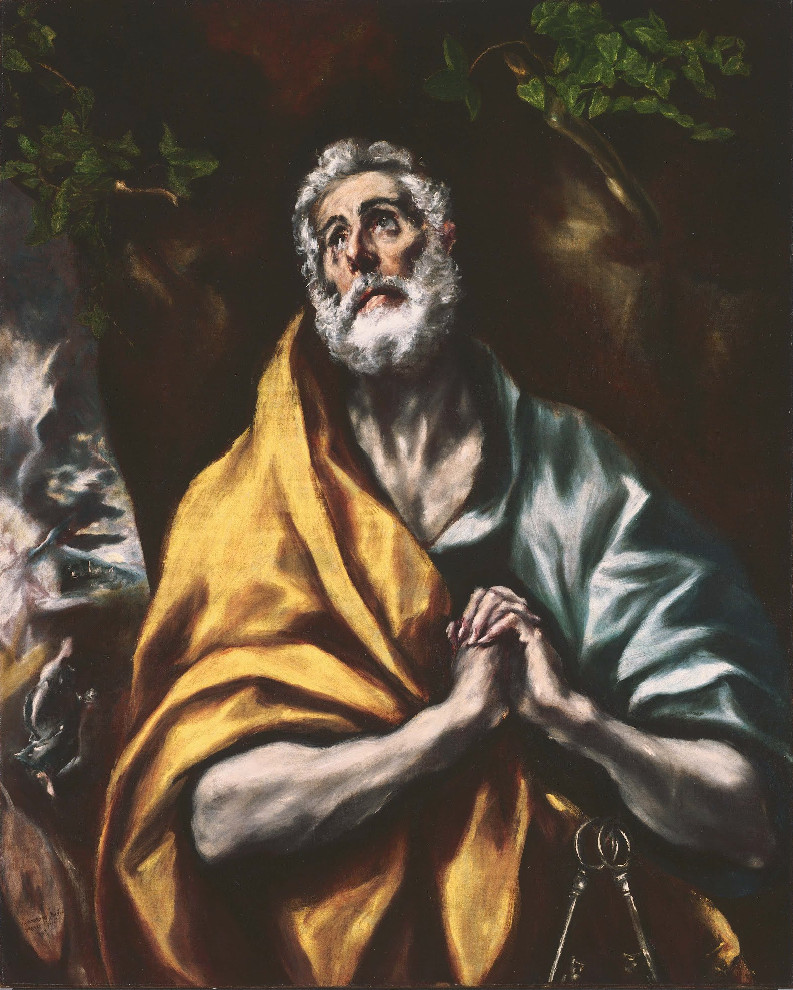
1 Peter 5:2
1 Peter 5:3
1 Peter 5:4
1 Peter 5:5
1 Peter 5:6
1 Peter 5:7
1 Peter 5:8
1 Peter 5:9
1 Peter 5:10
1 Peter 5:11
1 Peter 5:12
1 Peter 5:13
1 Peter 5: 14
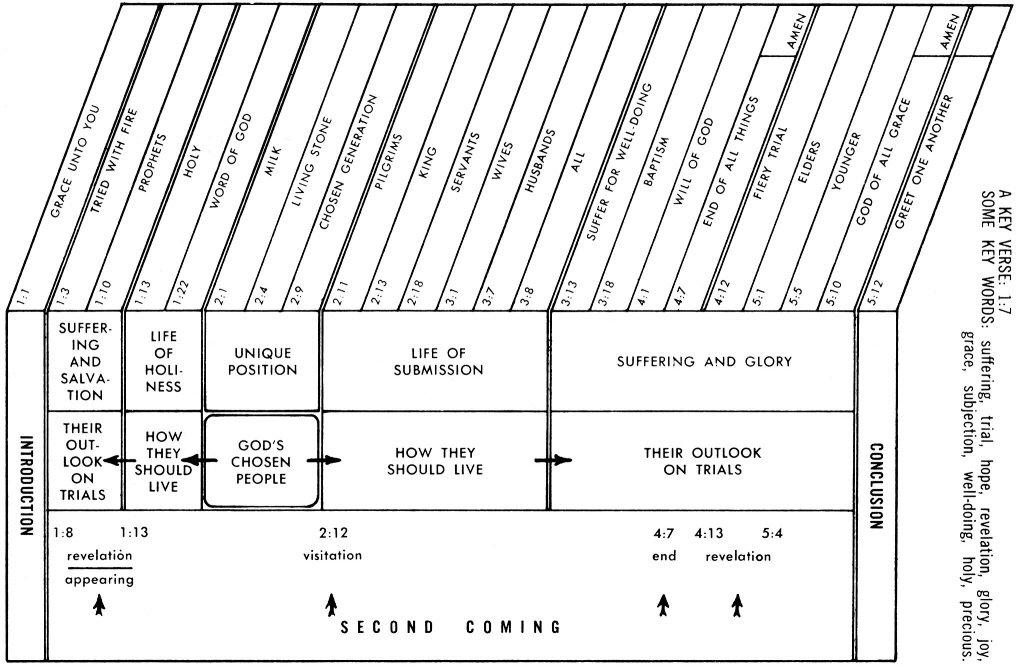
1 Peter: Trials, Holy Living & The Lord's Coming
Click chart to enlarge
Chart from Jensen's Survey of the NT - used by permission
See Another Chart from Charles Swindoll
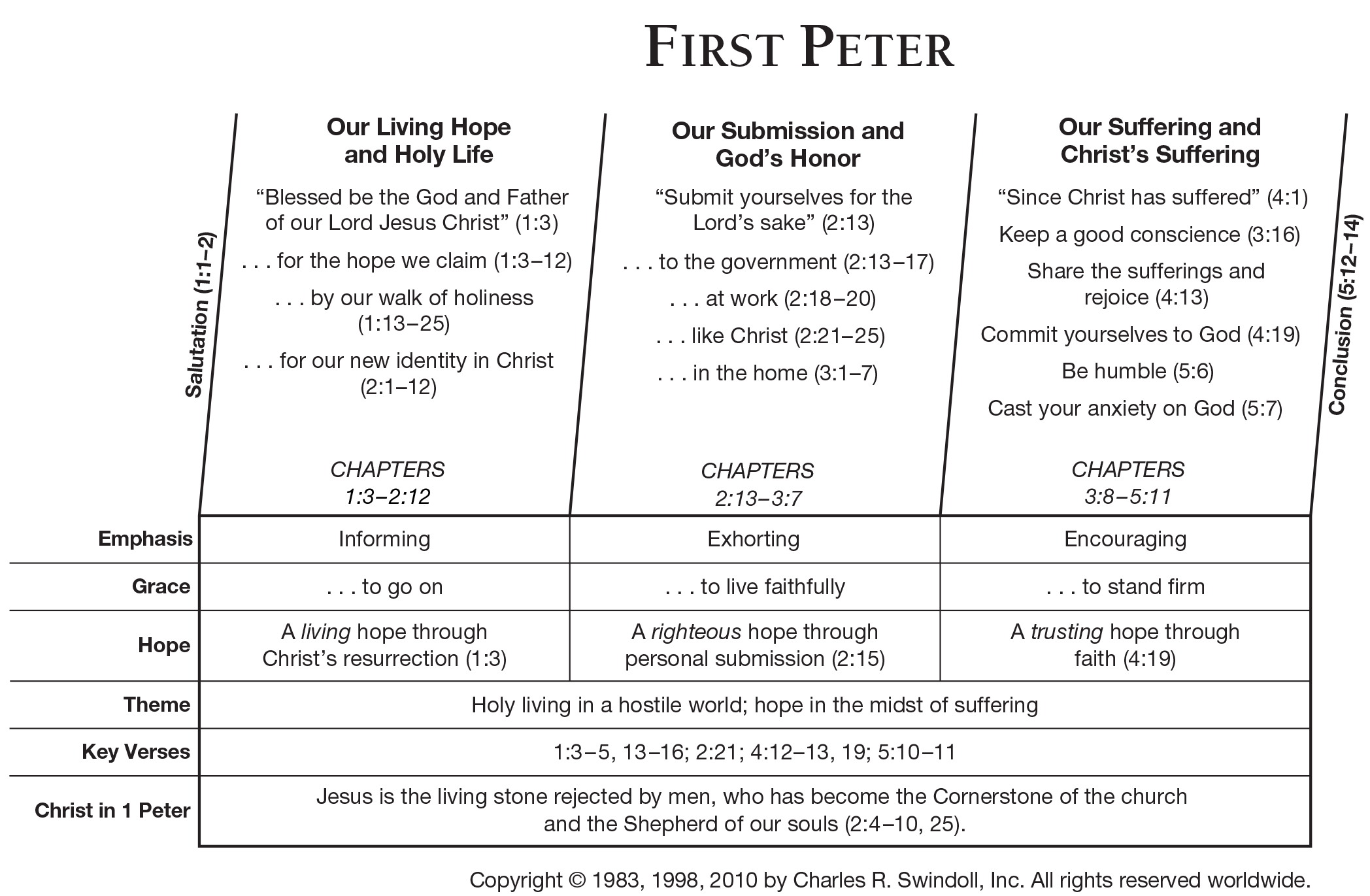
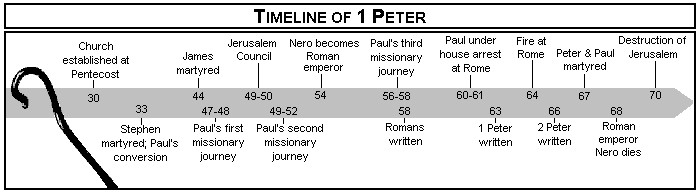
Source: Borrow Ryrie Study Bible
Click to enlarge
| Salvation of the Believer 1 Pe 1:1-2:12 |
Submission of the Believer 1 Pe 2:13-3:12 |
Suffering of the Believer 1 Pe 3:13-5:14 |
||||||||
| Salvation 1Pe 1:1-1:12 |
Sanctification 1Pe 1:13-2:12 |
Submit to Government 1Pe 2:13-17 |
Submit in Business 1Pe 2:18-25 |
Submit in Marriage 1Pe 3:1-8 |
Submit in all of life 1Pe 3:9-12 |
Conduct in Suffering 1Pe 3:13-17 |
Christ's Example of Suffering 1Pe 3:18-4:6 |
Commands in Suffering 1Pe 4:7-19 |
Minister in Suffering 1Pe 5:1-14 |
|
| Belief of Christians | Behavior of Christians | Buffeting of Christians | ||||||||
| Holiness | Harmony | Humility | ||||||||
|
Adapted from Bruce Wilkinson and Kenneth Boa's Talk Thru the Bible (borrow) |
||||||||||
1 Peter 5:10 After you have suffered for a little while, the God of all grace, who called you to His eternal glory in Christ, will Himself perfect, confirm, strengthen and establish you. (NASB: Lockman)
Greek: o de theos pases charitos o kalesas (AAPMSN) humas eis ten aionion autou doxan en Christo [Iesou], oligon pathontas (AAPMPA) autos katartisei, (3SFAI) sterixei (3SFAI), sthenosei, (3SFAI) themeliosei.
Amplified: And after you have suffered a little while, the God of all grace [Who imparts all blessing and favor], Who has called you to His [own] eternal glory in Christ Jesus, will Himself complete and make you what you ought to be, establish and ground you securely, and strengthen, and settle you. (Amplified Bible - Lockman)
Barclay: And after you have experienced suffering for a little while, the God of every grace, who called you to his eternal glory in Christ, will himself restore, establish, strengthen, settle you. (Westminster Press)
NLT: In his kindness God called you to his eternal glory by means of Jesus Christ. After you have suffered a little while, he will restore, support, and strengthen you, and he will place you on a firm foundation. (NLT - Tyndale House)
Phillips: And after you have borne these sufferings a very little while, God himself (from whom we receive all grace and who has called you to share his eternal splendor through Christ) will make you whole and secure and strong. All power is his for ever and ever, amen! (Phillips: Touchstone)
Wuest: But the God of every grace, the One who summoned you in Christ with a view to His eternal glory, after you have suffered a little while, shall himself make you complete, shall establish you firmly, shall strengthen you, shall ground you as on a foundation.
Young's Literal: And the God of all grace, who did call you to His age-during glory in Christ Jesus, having suffered a little, Himself make you perfect, establish, strengthen, settle you;
AND AFTER YOU HAVE SUFFERED FOR A LITTLE WHILE : oligon pathontas:
- 1 Peter 5 Resources - Multiple Sermons and Commentaries
Although most of the versions follows the pattern of the NASB and begin this verse with "and", the Greek particle "de" is also just as accurately translated "but" which is reflected in Kenneth Wuest's translation (above) and which better accentuates the contrast between the satanic opposition (in the previous verses) and God's purpose of and enablement in suffering as emphasized in this verse. In other words, in contrast to the devil's purpose which is to disable, discourage and destroy, God uses our suffering to bring about His gracious work in His children and to prepare them to share in His eternal glory.
As someone has well said times of suffering have the potential to make us either bitter or better. Will it be better for you because you cast yourself upon the God of all comfort and grace. I pray so (for you and for me).
Note the word order in this verse: first the suffering, then the glory! First, the Cross, then the Crown. In short, what Peter is saying is that believers are to live with the understanding that God's purpose realized in the future requires some pain in the present.
Suffered (3958) (pascho) means to undergo an experience or experience a sensation including painful, usually difficult circumstances. Peter had used this same verb to describe the suffering of Christ in (1 Peter 2:21- see note)
Aorist tense speaks of past completed action and indicative mood is the mood of reality.
Deffinbaugh -The very trials which may appear to be the means Satan employs for our destruction are the means God employs for our deliverance and development. Behind the opposition of unbelievers stands Satan seeking to devour us, and behind Satan stands God, sure to perfect and purify us. (1 Peter 5:8-14 Suffering, Satan, and Standing Firm)
The psalmist Asaph recorded that
I am continually with Thee. Thou hast taken hold of my right hand. With Thy counsel Thou wilt guide me, and afterward receive me to glory. (Ps 73:23-24)
In Jesus high priestly prayer He declared
And the glory which Thou hast given Me I have given to them; that they may be one, just as We are one… Father, I desire that they also, whom Thou hast given Me, be with Me where I am, in order that they may behold My glory, which Thou hast given Me; for Thou didst love Me before the foundation of the world. (Jn 17:22, 24)
In chapter 1 Peter used oligos in a similar statement reminding his suffering readers that
In this (a salvation ready to be revealed) you greatly rejoice, even though now for a little while (oligos) if (since it is) necessary, you have been distressed by various trials. (1Pe 1:6-note)
Little while (3641) (oligos) is an adjective which can have several nuances depending on the context…
(1) Small in number ("few" - few workers = Mt 9:37, few fish = Mt 15:34, a few sick people = Mk 6:5),
(2) Small in regard to the amount of time (little, small, short) and short in reference to amount or duration ("short time" Rev 12:12, Acts 26:28, Heb 12:10=of duration of paternal discipline, James 4:14, 1Pe 1:6; "rest a while" = Mk 6:31, Eph 3:3 = "in brief").
(3) Small in terms of distance (Mk 1:19).
(4) Slight or little ("something on a small scale, such as a disturbance"- Mounce; "relatively low on a scale of extent or existing only to a small degree" - BDAG. Acts 12:18, 19:23, Luke 7:47)
(5) Small in size (James 3:5="small fire").
Mounce adds that oligos "typically denotes a small number, a small amount of something, or shortness in size or time. There is significant overlap with mikros (small)."
Luke modifies oligos with a negative particle several times in Acts which most English Bibles translate in a manner opposite of the idea of "few" -- Acts 14:28 (long time =literally "not a little time"), Acts 15:2 (great dissension = literally "not a little"), Acts 17:4 (a number = literally "not a few"), and Acts 17:12 (a number = literally "not a few").
Oligos is used as a prefix in two words in the NT - Oligopistos = little faith (Mt 6:30, 8:26, 14:31, 16:8, Lk12:28) and oligopsuchos (literally "little souled") = "fainthearted" (1Thes 5:14-note) which conveys the sense of one who is fretful or worried.
A little while (literally "a little" which could refer to duration and/or degree of the sufferings) (3641) (oligos) one lexicon says means "puny in extent". Our suffering may not feel "little" to us (although it may make us feel "puny"), but we can know beyond a shadow of a doubt that it is of short duration (everything is short compared to eternity) and secondly that there will be an end to the suffering.
Writing to the Corinthians Paul reminds them that
we do not lose heart, but though our outer man is decaying, yet our inner man is being renewed day by day. For momentary (cf to Peter's "after a little while"), light affliction is producing for us an eternal weight of glory far beyond all comparison, while we look not at the things which are seen, but at the things which are not seen; for the things which are seen are temporal, but the things which are not seen are eternal. (2Cor 4:16-note, 2Co 4:17-note, 2Co 4:18-note)
Comment: Even a lifetime of suffering is only a little when measured by the standard of “eternal glory.”
Phillips paraphrases it
These little troubles (which are really so transitory) are winning for us a permanent, glorious, and solid reward out of all proportion to our pain
Oligos - 40x in 39v - Matt 7:14 (few find eternal life); Mt 9:37 (workers in the harvest fields are few); Mt 15:34 (a few small fish in the hands of Jesus are not oligos!); Mt 22:14; 25:21, 23; Mark 1:19; 6:5, 31; 8:7; Luke 5:3; 7:47; 10:2; 12:48; 13:23; Acts 12:18; 14:28; 15:2; 17:4, 12; 19:23f; 26:28f; 27:20; 2Cor 8:15; Eph 3:3; 1Ti 4:8; 5:23; Heb 12:10; Jas 4:14; 1Pet 1:6; 3:20; 5:10, 12; Rev 2:14; 3:4; 12:12; 17:10.
NAS translation of Oligos depends on the context - brief(1), briefly(1), few(11), few things(3), great*(1), little(7), little way(1), little while(4), long*(1), number*(2), short(3), short time(1), small(3), while(1).
Here are some uses of oligos…
Matthew 7:14 "For the gate is small and the way is narrow that leads to life, and there are few who find it.
Comment: Context is salvation.
Matthew 9:37 Then He said to His disciples, "The harvest is plentiful, but the workers are few.
Comment: Context is evangelism, missions.
Matthew 15:34 And Jesus said to them, "How many loaves do you have?" And they said, "Seven, and a few small fish."
Matthew 22:14 "For many are called, but few are chosen."
Comment: This is in the context of Jesus speaking to the Jews. The word called in this instance refers to being “invited,” not to the divine call to salvation as Paul used the word (Ro 8:28, 29 cp 1Cor 1:9 1Th 2:12). All Israel had been invited, but only a few would accept and follow Jesus. Not all those invited will be among the chosen of God, for not all will believe.
Matthew 25:21 "His master said to him, 'Well done, good and faithful slave. You were faithful with a few things, I will put you in charge of many things; enter into the joy of your master.'
Matthew 25:23 "His master said to him, 'Well done, good and faithful slave. You were faithful with a few things, I will put you in charge of many things; enter into the joy of your master.'
Mark 1:19 Going on a little farther, He saw James the son of Zebedee, and John his brother, who were also in the boat mending the nets.
Mark 6:5 And He could do no miracle there except that He laid His hands on a few sick people and healed them.
Mark 6:31 And He said to them, "Come away by yourselves to a secluded place and rest a while." (For there were many people coming and going, and they did not even have time to eat.)
Mark 8:7 They also had a few small fish; and after He had blessed them, He ordered these to be served as well.
Luke 5:3 And He got into one of the boats, which was Simon's, and asked him to put out a little way from the land. And He sat down and began teaching the people from the boat.
Luke 7:47 "For this reason I say to you, her sins, which are many, have been forgiven, for she loved much; but he who is forgiven little, loves little."
Comment: The more we are forgiven, the more we should love. We have all been forgiven an unspeakable number of sins, a number which increases daily. The realization of this truth should make every believer a great forgiver, not an "oligos" forgiver! Which phrase best describes you dear brother or sister in Christ?
Luke 10:2 And He was saying to them, "The harvest is plentiful, but the laborers are few; therefore beseech the Lord of the harvest to send out laborers into His harvest.
Luke 12:48 but the one who did not know it, and committed deeds worthy of a flogging, will receive but few. From everyone who has been given much, much will be required; and to whom they entrusted much, of him they will ask all the more.
Luke 13:23 And someone said to Him, "Lord, are there just a few who are being saved?" And He said to them (Lk 13:24)
Acts 12:18 Now when day came, there was no small disturbance among the soldiers as to what could have become of Peter.
Acts 14:28 And they spent a long time (literally "not a little time") with the disciples.
Acts 15:2 And when Paul and Barnabas had great (literally "no little") dissension and debate with them, the brethren determined that Paul and Barnabas and some others of them should go up to Jerusalem to the apostles and elders concerning this issue.
Acts 17:4 And some of them were persuaded and joined Paul and Silas, along with a large number of the God-fearing Greeks and a number (literally "not a few") of the leading women.
Acts 17:12 Therefore many of them believed, along with a number (literally "not a few") of prominent Greek women and men.
Acts 19:23 About that time there occurred no small disturbance concerning the Way. 24 For a man named Demetrius, a silversmith, who made silver shrines of Artemis, was bringing no little business to the craftsmen;
Acts 26:28 Agrippa replied to Paul, "In a short time you will persuade me to become a Christian."29 And Paul said, "I would wish to God, that whether in a short or long time, not only you, but also all who hear me this day, might become such as I am, except for these chains."
Comment: NIV is more accurate "“Do you think that in such a short time you can persuade me to be a Christian?” In this context "short time" (oligos) conveys the sense of something that can be accomplished without much difficulty or trouble.
Mounce: Oligos can also refer to a “short” time. Agrippa sarcastically asks Paul whether in a “short amount of time” he thinks he can make Agrippa a Christian (Acts 26:28, 29; cf. Heb 12:10; Rev 12:12; 17:10).
MacDonald: There is considerable disagreement as to exactly what Agrippa meant. Those who follow the King James tradition feel that the king had actually been brought to the threshold of decision for Christ (Acts 26:28KJV). They feel that Paul’s answer in Acts 26:29KJV substantiates this. Others think that Agrippa was using irony, asking Paul, as it were, “Do you think that with a little persuasion you can make me a Christian?” In other words, he was evading the pressure of the apostle’s words with a joke.
Acts 27:20 Since neither sun nor stars appeared for many days, and no small storm was assailing us, from then on all hope of our being saved was gradually abandoned.
2 Corinthians 8:15 as it is written, "HE WHO gathered MUCH DID NOT HAVE TOO MUCH, AND HE WHO gathered LITTLE HAD NO LACK."
Ephesians 3:3-note that by revelation there was made known to me the mystery, as I wrote before in brief.
1Ti 4:8-note For (term of explanation = Paul is explaining why we should be diligent to discipline ourselves spiritually 1Ti 4:7-note) bodily discipline is only of little (oligos) profit, but godliness is profitable for all things, since it holds promise for the present life and also for the life to come.
THOUGHT: Beloved, as believers we will enter into eternity either as eternal "paupers" (relatively speaking of course!) or as those who are eternally "rich"! Are you paying the price by seeking to live a godly life (only possible of course as you are enabled by the Spirit of Christ)? But what is godliness? Jerry Bridges give a practical definition as "“the attitude of regarding God in everything all the time.” How are you doing? Are you adding to your heavenly "bank account" by making choices that continually take God into account? Paul wanted Timothy to know that this was so important that he told him "for it is for this we labor and strive"! (1Ti 4:10-note) Godliness is work but it is ultimately God's Spirit working in us continually to give us both the desire and the power to pursue godliness (Php 2:13-note).
1 Timothy 5:23 No longer drink water exclusively, but use a little wine for the sake of your stomach and your frequent ailments.
Hebrews 12:10-note For they (earthly fathers) disciplined us for a short time as seemed best to them, but He disciplines us for our good, so that we may share His holiness.
James 4:14 Yet you do not know what your life will be like tomorrow. You are just a vapor that appears for a little while and then vanishes away.
Comment: God is sovereign over our every breath beloved! The word "vapor" can in fact refer one's breath as it appears for a moment in cold air! Our life is short and could end at any breath (Scripture is trying to "get our attention" repeatedly saying in one way or another that our life is short - Shortness of our lives: Job 7:6, 7 9:25, 26 14:1, 2 Ps 37:2 39:5, 6 Ps 90:4-6, 9, 10 Ps 102:3, 11, Ps 103:15,16 Ps 144:4 Isa 38:12,13 40:6,7 Jas 1:10, 11 4:14 1Pe 1:24 2Ki 19:26). The truth that our life is "oligos", should prompt us to "redeem the time" (Eph 5:16-note) that we have been allocated.
THOUGHT - Are you investing your life in "ventures" that will yield fruit for eternity (Jn 15:16) or are you ensnared by the deceptive pleasures (not even necessarily sins, but of no spiritual value) of this passing world?
1 Peter 1:6-note In this you greatly rejoice, even though now for a little while, if (since it is) necessary, you have been distressed by various trials,
Comment: It is notable that Peter uses "oligos" as "bookends" in his letter, speaking of "various trials" which are "now for a little while" (1Peter 1:6) and here in 1Peter 5:10 of suffering "for a little while". When we are in the "Refiner's fire" the trials and/or suffering do not "feel" short but long. Peter knows that is our nature and wants us to think of our trials and suffering in the context of eternity. Trials and suffering will end one day (soon), but eternity and glory will continue forever and ever!
1 Peter 3:20-note who once were disobedient, when the patience of God kept waiting in the days of Noah, during the construction of the ark, in which a few, that is, eight persons, were brought safely through the water.
1 Peter 5:10-note After you have suffered for a little while, the God of all grace, who called you to His eternal glory in Christ, will Himself perfect, confirm, strengthen and establish you.
1 Peter 5:12-note Through Silvanus, our faithful brother (for so I regard him), I have written to you briefly, exhorting and testifying that this is the true grace of God. Stand firm in it!
Comment: Oligos in this passage means in essence "in a few words."
Revelation 2:14-note 'But I have a few things against you, because you have there some who hold the teaching of Balaam, who kept teaching Balak to put a stumbling block before the sons of Israel, to eat things sacrificed to idols and to commit acts of immorality.
Revelation 3:4-note 'But you have a few people in Sardis who have not soiled their garments; and they will walk with Me in white, for they are worthy.
Revelation 12:12-note "For this reason, rejoice, O heavens and you who dwell in them. Woe to the earth and the sea, because the devil has come down to you, having great wrath, knowing that he has only a short time."
Comment: Satan is cast out of heaven at the midpoint of Daniel's Seventieth Week leaving him a "short time" or only 3.5 years (42 months, 1260 days) to inflict his woe on planet earth.
Revelation 17:10-note and they are seven kings; five have fallen, one is, the other has not yet come; and when he comes, he must remain a little while.
Oligos - 45x in the non-apocryphal Septuagint (Lxx)- Ge 29:20; Lev 25:52; Nu 11:32; 13:18; 26:56; Deut 4:27; 28:38; Josh 7:3; 1 Sam 14:6; 1Kgs 17:10, 12; 2Kgs 10:18; 2Chr 14:11; 24:24; 29:34; Neh 2:12; 7:4; Job 8:7; 10:20; 14:21; 15:11; Ps 17:14; 37:10, 16; 73:2; 109:8; Prov 5:14; 6:10; 15:29; 24:33; Eccl 5:2, 12; 9:14; 10:1; Isaiah 10:7; 21:17; 24:6; Jer 10:24; 42:2; 44:28; Ezek 5:3; Dan 11:23; Hag 1:6, 9; Zech 1:15
Deuteronomy 4:27 (A prophecy given through Moses predicting their corrupt behavior and idol worship, both of which transpired. Here is the punishment) "The LORD will scatter you (Jews) among the peoples (Gentiles), and you will be left few in number among the (Gentile) nations where the LORD drives you.
Psalm 37:10 Yet a little while (oligos) and the wicked man will be no more; and you will look carefully for his place and he will not be there.
Psalm 37:16 Better is the little of the righteous Than the abundance of many wicked.
TDNT comments on the importance of oligos in the Septuagint…
The idea of “little” is important in the Septuagint (Lxx). God can work with few means (1 Sam. 14:6), and so can the righteous with God’s help (cf. Job 8:7). A poor man who is wise can do much with little (Eccl. 9:14-15), and a little wisdom means much (Ecc 10:1). Such sayings may express practical experience, but they also denote the eschatological transvaluation of all values. Rather different is the thought that we are limited by a short span of life (Job 10:20). This is a punishment for sinners (Ps. 37:10). It is also a punishment that only a few remain in times of distress (Dt. 4:27), or that little is left of the harvest (28:38). The suffering of the righteous, however, is of little account (Zech. 1:15).
|
SUFFERING: |
|||
| TIME | WEIGHT | CHARACTER | |
| SUFFERINGS | "Little" "Momentary" "Temporal' |
"Little" "Light" |
"Seen" |
| GLORY | "Eternal" | "Weight" (Heavy) |
"Unseen" |
Be encouraged especially by the contrast between the "eternal glory" with the "temporal trials".
Regarding a "little while", Barton writes that
"For believers, suffering will not last forever. If you’re under stress, if food is scarce, if disease is spreading, God promises that suffering will last “just a little while more.” No matter what trouble you face, hard as it is, God has stamped your life “temporarily out of order,” with emphasis on “temporarily.” A day is coming when the Great Repairman will wrench evil from the world and restore your life so that it works as God intended. You will be in mint condition, guaranteed to function as God designed. Many times all we can do is trust God and look forward to Jesus’ return, when God will restore us. Our hope is in him!" (Barton, B, et al: The NIV Life Application Commentary Series: Tyndale)
You may be called to suffer for a season, but it will soon be over.
The psalmist writes
"I know, O Lord, that Thy judgments are righteous, and that in faithfulness Thou hast afflicted me." (Ps 119:75) (Spurgeon)
Guzik quips don't we all "wish we were called to His eternal glory on the "no suffering" plan."
Barnes - The Greek is, "having suffered a little," and may refer either to time or degree. In both respects the declaration concerning afflictions is true. They are short, compared with eternity; they are light, compared with the exceeding and eternal weight of glory.
John MacArthur - We're to live with the understanding that God's purpose realized in the future requires some pain in the present… It may seem intense and it may seem long but it's really very brief, just a little while." (Sermon: Fundamental Attitudes for Spiritual Maturity)
THE GOD OF ALL GRACE: ho de theos pases charitos:
- Ps 86:5,15; Micah 7:18,19; Ro 5:20,21; 15:5,13; 2Co 13:11; Heb 13:20
- 1 Peter 5 Resources - Multiple Sermons and Commentaries
The Psalmist writes…
For (term of explanation - always check context to see what the author is explaining - Ps 84:9,10) the LORD God is a sun and shield; The LORD gives grace and glory; No good thing does He withhold from those who walk uprightly. (Ps 84:11-note = This is a great verse to memorize so that you can meditate on it and be blessed - Ps 1:1-note, Ps 1:2-note, Ps 1:3-note, Joshua 1:8-note)
All grace - No exceptions! The ONLY Source of Grace is the God of Grace! And remember two principles (among others) for partaking of that grace - (1) Humility (James 4:6-note) and (2) Weakness (2Cor 12:9-note).
God is the God of all grace in the Old and New Testaments…
But Thou, O Lord, art a God merciful and gracious, Slow to anger and abundant in lovingkindness and truth. (Ps 86:15) (Spurgeon's note)
Who is a God like Thee, who pardons iniquity And passes over the rebellious act of the remnant of His possession? He does not retain His anger forever, Because He delights in unchanging love. He will again have compassion on us; He will tread our iniquities under foot. Yes, Thou wilt cast all their sins Into the depths of the sea. (Micah 7:18,19)
And the Law came in that the transgression might increase; but where sin increased, grace abounded all the more, that, as sin reigned in death, even so grace might reign through righteousness to eternal life through Jesus Christ our Lord. (Ro 5:20, 21-note)
The God of all grace is also the God of hope…
Now may the God of hope fill you with all joy and peace in believing, that (term of conclusion) you may abound in hope by the power (dunamis) of the Holy Spirit. (Ro 15:13-note)
The God of all grace is also the God of peace…
Now the God of peace, who brought up from the dead the great Shepherd of the sheep through the blood of the eternal covenant, even Jesus our Lord,
Raymond Ortlund - The Christian life is never just our part! Real Christianity always begins with God, not with us. It is sustained by God, not by us. Our final triumph will be of God, not of us.
Grace (5485) (charis) is God's unmerited favor made, God's riches at Christ's Expense (i.e., "Jesus Christ has already paid for every blessing you and I will ever receive from God the Father" Bridges), that by which we are saved (justified) but also that divine enabling power ministered by the Holy Spirit by which which we live now as supernatural beings day by day. Grace is (100%) independent of our performance (cp Paul 1Cor 15:10-note). God is indeed the God of ALL grace, grace to save us the first time (justification), grace to save us day after day (sanctification) and grace to save us in that final day (the Day of Christ Jesus- our glorification - Maranatha!)
Jerry Bridges helps give us a proper understanding of grace…
Grace stands in direct opposition to any supposed worthiness on our part. To say it another way: Grace and works are mutually exclusive. As Paul said in Romans 11:6, “And if by grace, then it is no longer by works; if it were, grace would no longer be grace.” Our relationship with God is based on either works or grace. There is never a works-plus-grace relationship with Him. Furthermore, grace does not first rescue us from the penalty of our sins, furnish us with some new spiritual abilities, and then leave us on our own to grow in spiritual maturity. Rather, as Paul said, “He who began a good work in you [by His grace] will [also by His grace] carry it on to completion until the day of Christ Jesus” (Philippians 1:6). John Newton captured this idea of the continuing work of grace in our lives when he wrote in the hymn “Amazing Grace,” “Tis grace hath brought me safe thus far, and grace will lead me home.” The apostle Paul asks us today, as he asked the Galatian believers, “After beginning with the Spirit, are you now trying to obtain your goal by human effort?” (Galatians 3:3). (Transforming Grace: Living Confidently in God’s Unfailing Love)
In the preceding section Peter has instructed his readers that it is their responsibility to
work out (their) salvation with fear (not of the devil but reverence for God) and trembling" but now he reminds them that is the God of all grace "Who is at work in (them), both to will and to work for His good pleasure. (see notes Philippians 2:12; 2:13)
The Pulpit Commentary - They were to be steadfast in their faith and in this verse we see the promise on which their faith could rest. The God of the promise is designated the God of all grace, Who could supply grace up to and beyond all their needs. The beginning of his grace was when he called them in Christ; but that beginning was connected with an end for He called them unto his eternal glory. The end was not to be reached, unless by means going before. The foregoing condition was suffering a little while . There is consolation in the manner of stating it, the shortness of the suffering being placed in contrast with the length of the glory. In and through the suffering God would support them, so that they would not fail of eternal glory." (The Pulpit Commentary)
This is one of the great benedictions of the Bible (Click here for Spurgeon's sermon on 1 Peter 5:10 entitled "A New Year's Benediction". Note that Spurgeon interprets the passage as a prayer but see below). Take time to read these other great benedictions: Nu 6:24, 25, 26; Ro 15:5,6,13; 16:25,27; Ep 3:20,21; 1Th 3:12,13; 2Th 2:16,17; 3:12,13; 1Ti 1:17; Jude 1:24,25; Rev 1:5,6.
Peter has finished his exhortations and has told his readers what they must do to fight the good fight. Now; he bids them to look to the God of all grace, declaring to them that in Him they will find strength to resist. God will work within them both to will and to do of His good pleasure, for He is the God of all grace. The grace that saved us out of our sin is the same grace that now saves us out of (or through) our sufferings, and both are received by faith that sees "Him Who is unseen" (Hebrews 11:27-note).
God of all grace is one of the great "Names" of God in Scripture and parallels the OT descriptions like God's Self declaration to Moses that
Jehovah, the LORD God, compassionate and gracious, slow to anger, and abounding in lovingkindness and truth; Who keeps lovingkindness for thousands, Who forgives iniquity, transgression and sin; yet He will by no means leave the guilty unpunished, visiting the iniquity of fathers on the children and on the grandchildren to the third and fourth generations." (Ex 34:6,7)
Alexander Maclaren writes
When surrounded by difficulties, crushed by sorrows, assaulted and battered by all the artillery of temptations, when faint of heart and conscious of one’s own weakness, when dull torpor seems to have taken all warmth of feeling out of us, and many defeats to have robbed us of hope, — there is one strong tower into which we may run and be safe (Pr 18:10) (see study on Name of the LORD a Strong Tower). The Name of the Lord, the thought of his revealed character as the God of all grace, is enough to scatter all the black-winged brood of cares and fears, and to bring the dove of peace into our hearts, though they be lonely as the ark, and all be one waste of waters around. For that great Name proclaims that his love is inexhaustible. Grace is love exercised to inferiors and undeserving persons; and, if he is the God of all grace, boundless love for the lowliest and foulest is in his heart. Anything short of such Divine fullness of love would be tired out by our slowness and repeated sin. Impatience steals into the most long-suffering heart, and the most liberal hand will shut fast at last when the ragged good-for- nothing comes for the hundredth time with the old story of shiftless improvidence and misery, and the old whining petition for help already so often given and squandered. But there is no wearying out his patient love, and no past misuse of his gifts can ever prompt him to deny us more. The God of all grace has grace for all. The Name, too, proclaims the infinite fullness of his resources. That great storehouse is inexhaustible, after all giving full. He works and is not weary. He bestows and is none the poorer. The stream has been pouring for ages with a rush like Niagara, and the flood to-day is as mighty as at the beginning. It is fed from the eternal fountains in the “mountains of God,” and cannot cease. Shall we fear drought whilst we are borne on its broad bosom? The coins in circulation, though enough to enrich the world, are as nothing to the masses of bullion stored in the depths. The sun itself will die by self-communication, and that great hearth-fire will grow cold, and all the family of worlds that move around it cease to be united and warmed by its beams; but the God who is our Sun burns and is not consumed. Shall we fear freezing or darkness while we walk in the light of his face? And that great Name implies an infinite variety of resources. All diversities of grace are his, that they may be ours. Grace is not only love in exercise to inferiors, but is also the gifts of that love, which are so inseparable from it that they are called by the same name. These take the shape of every man’s need, and of all the needs of every man. The bread-fruit tree to the South Sea Islanders is a storehouse from which they get all they require. Its fruit is their food, its juice their beverage, from its bark they prepare their clothing, from its wood they build their houses and fashion their weapons, its leaves make their thatch, its fibers their cordage. So the grace of God is all-sufficient — Protean in its forms, fitting each necessity as it arises, and shaped so as to give to every one of us the very thing which character and circumstances at the moment require. Shall we fear to be ever left to fall before enemies or to be crushed by our sorrows, when we have such an ever-full fountain of various grace to draw from?"
The God of all grace is also the Father of mercies and God of all comfort (2Cor 1:3) where the word for "comfort" (paraklesis) is related to the more familiar word paraclete (parakletos) who is "One Who comes alongside to help." Paul called God the "God of all comfort" because that was his experience. He was saying that God came to him in the midst of his sufferings to strengthen him and give him courage and boldness. And He will do the same for you beloved.
Calvin comments that when Peter "calls God the author of all grace, and reminds them that they were called to eternal glory, his purpose no doubt was, to confirm them in the conviction, that the work of their salvation, which he had begun, would be completed."
How much grace? All the Greek meaning all without exception. All conveys the idea of comprehensiveness and universality. God as the source of all spiritual comfort and help for all occasions. In the OT He tells Moses His Name is Jehovah or "I Am". Practically speaking God is saying
I Am… anything and everything you will need now and through all eternity!
God is the Supplier of every needed grace, of every kind of grace, of every means of grace. Here is the power that overcomes the adversary
My grace is sufficient for thee. (See notes on 2Cor 12:9)
God's grace is comprehensive and universally sufficient for every need of any and every believer at any and every time. God has a plan and provision for every situation that you face in life. Every problem you encounter already has a divine solution.
Paul says that
God is able to make all grace abound to you, that always having all sufficiency in everything, you may have an abundance for every good deed. (2Cor 9:8)
Comment: Notice all the all's of this verse! And all from the God of all grace!
James writes that God
gives a greater grace. Therefore it says, “God is opposed (military term depicting a full army ready for battle) to the proud (idea of disdainfully & arrogantly supposing oneself above others) (pride = the basic sin from which all others issue), but gives grace to the humble. (James 4:6-note)
God gives grace to those who put God’s desires first in their lives. He gives grace to withstand the onslaughts of the flesh within and the world without.
As the writer of Hebrews says
Let us therefore draw near (most ancient rulers were unapproachable by common people) with confidence to the throne of grace (because grace is dispensed there), that we may receive mercy (covers the things we should not have done) and may find grace (empowers us to do what we should do but do not have the power to do) to help in time of need (“in the nick of time” - grace just when and where you need it!). (see note Hebrews 4:16)
In 1Pe 4:10-note Peter described the “multicolored (poikilos -manifold) grace” of God, referring to the varied and diverse gifts given to believers by God empowering them for service in the Church. Peter uses the same adjective to describe trials writing that they will experience multicolored (poikilos) trials. (see note 1 Peter 1:6)
Trouble and the grace to bear it come in the same package! In God’s variegated grace is God’s provision for every "variegated" need.
We are saved by grace through faith (Eph 2:8-10-see notes Ephesians 2:8; 2:9; 2:10). The Holy Spirit who indwells us is called “the Spirit of grace” (Hebrews 10:29-note). God's Word is “the word of His grace” (Acts 20:32-note). It is grace from start to finish! Amazing grace!
God's grace is not a “mystical substance” that God pours into us when we have a need. Grace is God’s bountiful supply of our every need. Paul teaches in fact that through Christ
we have obtained our introduction (into an indescribable position of favor with God accepted in the Beloved One, near and dear to God as His Own Son!) by faith into this grace in which we stand (perfect tense = carries the idea of permanence, of standing firm and immovable -- embraces every aspect of our position before God, a position as perfect and permanent as Christ’s because we are in Him) (see note Romans 5:2)
Law means that I must do something for God, but “grace” means that God does something for me. Grace can never be earned and is not something we will ever deserve. Grace can only be given and received.
Hiebert writes that
having proved Himself rich in His bestowal of grace in the past, Christians can rest assured that God will supply all their present needs. (Hiebert, D. E. 1 Peter. page 317. Moody)
Peter knew all too well the futility of trying to face suffering and danger in one's own strength. His own failure taught him the need for constant reliance on God's grace.
WHO CALLED YOU TO HIS ETERNAL GLORY IN CHRIST: o kalesas (AAPMSN) humas eis ten aionion autou doxan en Christo (Iesou) :
- 1Pe 1:15; Ro 8:28, 19, 30; 9:11,24; 1 Co 1:9; 1Th 2:12; 2Th 2:14; 1Ti 6:12; 2Ti 1:9; 2Pe 1:3
- 1Jn 2:25
- 1 Peter 5 Resources - Multiple Sermons and Commentaries
Paul writes
For this reason (Always pause to ask something like "What reason?" see context - 2Ti 2:9) I endure all things for the sake of those who are chosen, that they also may obtain the salvation which is in Christ Jesus and with it eternal glory." (2Ti 2:10-note)
Paul reminds the Thessalonians that
Faithful (utterly trustworthy) is He who calls you, and He also will bring it (the sanctification and preservation of the Thessalonians) to pass. (1Thes 5:24-note)
God has called us to eventually stand blameless before Him. The only guarantee that any believer will have a worthy report at the final judgment is God’s faithfulness. Having begun this work in us, He will finish it. The God who calls will also bring those whom He calls to glory and none will be lost.
Their calling of course relates to God's gracious actions in the past but in context points the suffering reader to a glorious future forever.
Called (2564) (kaleo) (see study of the called) can refer to an invitation, but as discussed below in this context conveys the idea of an effectual call and emphasizes God's sovereign work. God has invited us to join Him in eternity in incorruptible, sinless, glorified bodies. The aorist tense points to the fact that God effectively had called them into His kingdom and service in the past.
The called are those who have been summoned by God… called…
- according to His purpose (Romans 8:28 note)
- to salvation (Romans 8:30 note)
- saints by calling (1Cor 1:2)
- both Jews and Greeks (1Cor 1:24)
- having been called "with a holy" (2 Timothy 1:9 note)
- heavenly calling (Hebrews 3:1 note)
- out of darkness into His marvelous light (1 Peter 2:9 note)
- to walk worthy (Ephesians 4:1 note)
- by grace (Gal 1:6)
- not from among Jews only, but also from among Gentiles (Romans 9:24 note)
- through the "gospel" that we "may gain the glory of our Lord Jesus Christ" (2Th 2:14)
- and be brought "into fellowship with His Son, Jesus Christ our Lord" (1Cor 1:9)
- and return in triumph "with Him" at the end of this age (Revelation 17:14-note).
The Christian’s holy calling is described in some detail in Ephesians 1-3, especially Ephesians 1:3-14 where we see the truths that saints are chosen (see note Ephesians 1:4), predestined (Eph 1:5, 1:11see notes Ep1:5, 1:11), adopted as sons (Ephesians 1:5 note), accepted in the Beloved (Ephesians 1:6 note), redeemed through His blood (Ephesians 1:7 note), forgiven (Ephesians 1:7 note), sealed with the Holy Spirit (Ephesians 1:13 note) and given the earnest of our inheritance (see note Ephesians 1:14). In addition to a holy calling, saints also have a high ("upward") calling (Philippians 3:14-note) and a heavenly calling (Hebrews 3:1-note)
The call came to Peter's readers at the time they heard and received the gospel message. Thus Paul writes to the Thessalonians that
"we should always give thanks to God for you, brethren beloved by the Lord, because God has chosen you from the beginning for salvation through sanctification by the Spirit and faith in the truth. And it was for this He called you through our gospel, that you may gain the glory of our Lord Jesus Christ." (2Th 2:13-14)
Peter has already reminded his readers that
"like the Holy One who called you, be holy yourselves also in all your behavior." (see note 1 Peter 1:15)
Being called by God is an incredible privilege, but it also entails an immense responsibility to "walk the talk." This was ever Paul's goal for his spiritual children writing for example to Thessalonians saints that they "walk (referring to daily conduct) in a manner worthy of the God Who calls you into His own kingdom and glory." (1Th 2:12 -note)
Calls in this verse is actually present tense, indicating that God Who had called them into salvation (past) is still calling them to the pursuit of holiness.
Peter reminds his readers of their calling in the second letter writing that
His divine power has granted to us everything pertaining to life and godliness, through the true knowledge of Him who called us by His own glory and excellence." (see note 2 Peter 1:3)
The writer of Hebrews states that
And for this reason He is the mediator of a (entirely) new covenant, in order that since a death has taken place for the redemption (John MacArthur writes that "Jesus’ death retroactively redeemed all those who had believed in God under the Old Covenant") of the transgressions that were committed under the first covenant (Mosaic Covenant = the Covenant of Law), those who have been called (looking back to those under the Old Covenant who were called to salvation by God on the basis of the sacrifice of Jesus Christ to come long after most of them had died) may receive the promise of the eternal inheritance. (see note Hebrews 9:15)
Wuest adds that "called" in this passage entails more than simply an invitation. He goes on to say that called is in fact equivalent to "a divine summons" or in other words
the one summoned is constituted (or appointed) willing to obey the summons, not against but with his free will and accord." The theologians refer to this call as "an effectual call. The one called always responds through the enablement of the Holy Spirit. This effectual call is with a view (in the Greek the preposition "eis" used here means "with a view to") to God’s eternal glory. That is, God calls us into salvation in order that He may derive glory for Himself by virtue of our being saved. He Who has called us in His grace will supply all needed grace until we are ushered into the Glory. God’s eternal glory is involved in His keeping a believer in salvation. Thus we see the eternal security of the Christian. The words “in Christ Jesus” are to be construed with the word “called.” Christ Jesus is the sphere in which that calling takes place. That is, in order that God might call sinners with a view to His eternal glory, they need to be saved, and salvation is found only in the Lord Jesus. Therefore, this calling is in the sphere of or within the scope of the Saviour’s saving power and work." (Wuest's Word Studies from the Greek New Testament)
God had not only called the saints "out of darkness into His marvelous light" (1 Peter 2:9-note), delivering them from the penalty and power of sin, but here in 1 Peter 5:10 had turned their faces toward the future calling them to "His eternal glory" which was to be the new goal of their lives.
Peter alluded to our calling again in chapter 2, writing
"what credit is there if, when you sin and are harshly treated, you endure it with patience? But if when you do what is right and suffer for it you patiently endure it, this finds favor with God. For you have been called for this purpose, since Christ also suffered for you, leaving you an example for you to follow in His steps." (see notes 1 Peter 2:20; 2:21)
Who's glory? His! Through all eternity it will be His glory! We share in it but ultimately it is His glory.
McGee - "We will have no glory in ourselves. The church is sort of like the moon which simply reflects the light of the sun. Our glory will be only reflected glory, but we in Christ are going to share in that glory." (McGee, J V: Thru the Bible Commentary)
In Christ could be translated "in union with Christ". Click here for more discussion of this great phrase used primarily by Paul.
"God called us “in Christ;” that is, through spiritual union with Christ; the glory is promised to these who are one with Christ; for the glory is Christ’s, and His members will share it. The very end and purpose of our calling was that we might inherit that glory. This is the apostle’s great topic of consolation." (The Pulpit Commentary)
All the blessings of God’s grace in this life and the next come through the believer’s union with Christ.
Paul tells us that since we are God's
"children (we are) heirs also, heirs of God and fellow heirs with Christ, if (since) indeed we suffer with Him in order that we may also be glorified with Him. For I consider that the sufferings of this present time are not worthy to be compared with the glory that is to be revealed to us… and whom He predestined, these He also called; and whom He called, these He also justified; and whom He justified, these He also glorified." (see notes Romans 8:17; 8:18; 8:30)
Troubles And Turns (Our Daily Bread) I once heard Warren Wiersbe say that where you turn when you're in trouble reveals your character.
Think about it. What does it tell us about young kids whose trouble turns them toward gangs or guns or drugs? What do we learn about adults whose difficulties direct them toward alcohol or illicit relationships or the bizarre teachings of a cult?
What does it tell us about ourselves? Where do we turn when we have trouble with a relationship? Do we turn to the Bible for wisdom? Do we pray for direction? And where do we look for help when we are struggling with sin? To the Lord Jesus, the Master of forgiveness? To Scripture for foolproof help? Or to the dark recesses of life for a self-preservation that always leads to destruction?
In 1 Peter 5:10, we see where we can turn when trouble visits us. Wiersbe summarized the verse by saying that we need to look up to the God of all grace, look back and remember that He called us, look ahead and recognize the coming glory, and look within to see how God is equipping us through our difficulties.
Trouble on the horizon? Turn to 1 Peter 5:10 and let it guide you as you turn to God for help. --J D Brannon (Our Daily Bread, Copyright RBC Ministries, Grand Rapids, MI. Reprinted by permission. All rights reserved)
Have we trials and temptations?
Is there trouble anywhere?
We should never be discouraged--
Take it to the Lord in prayer. --Scriven
(Play Hymn: What a Friend We Have in Jesus)
Life's challenges are designed not to break us
but to bend us toward God.
Doug Goins comments that in "verse 10, that we are dealing with the God of all grace,--the God of all resource, all adequacy, all provision. This is like a doxology, building in intensity, in volume, in enthusiasm. If it were set to music there would need to be a great crescendo. Tympany rolling, it would be getting louder and fuller and stronger. It's hope that we hang on to! The promises, in verse 10, tell us that God will do four things for us as we go through times of suffering."
MacArthur says that the following "four words all speak of strength and resoluteness. God is working through the Christian’s struggles to produce strength of character." (MacArthur, J. The MacArthur Study Bible Nashville: Word Pub)
WILL HIMSELF PERFECT: autos katartisei (3SFAI), sterixei (3SFAI), sthenosei (3SFAI), themeliosei (3SFAI):
- 2Cor 13:11; 2Th 2:17; Heb 13:21; Jude 1:24
- 1 Peter 5 Resources - Multiple Sermons and Commentaries
Himself (846) (autos) In the Greek sentence this pronoun (autos) is emphatically placed before the following four verbs. This observation clearly emphasizes God's personal interest and energy in the carrying out of the perfecting, confirming, strengthening and establishing of each of His children. This is amazing - the infinite God of the universe really does care about you and about me! This great truth ought to motivate us to walk in a manner that brings Him glory and honor.
John MacArthur reminds every saint that
while you are being personally attacked by the enemy, you are being personally perfected by God. It's personal, Himself He's doing it. Marvelous thought. He is intimately involved in the suffering of our lives."
The Psalmist writes…
Jehovah will accomplish what concerns me. Thy lovingkindness, O LORD, is everlasting. Do not forsake the works of Thy hands." (Ps 138:8) (Spurgeon)
Jude affirms
Now to Him who is able to keep you from stumbling, and to make you stand in the presence of His glory blameless with great joy" (Jude 24)
Selwyn writes that
It is no merely fortuitous or instrumental helps that are promised, but God's own active intervention and personal presence." (Selwyn, Edward Gordon. The First Epistle of St. Peter. London: Macmillan Press, 1946)
The Textus Receptus from which the KJV (and NKJV) was translated has katartizo and the three associated verbs each in the optative mood, expressing a wish or prayer. Here for example is the NKJV rendering
But may the God of all grace, who called us to His eternal glory by Christ Jesus, after you have suffered a while, perfect, establish, strengthen, and settle you.
A T Robertson however notes that the best modern Greek manuscripts have all four verbs in this section in the future tense, indicative mood expresses the firm assurance of what God will personally do for His suffering saints. There is help enough in this one passage for any victory.
John Calvin - Some (manuscript) copies have the future tense, as though a promise is made; but the other reading is more commonly received.
Stibbs states flatly that
The verbs here are not optative. They express a promise not a wish. Peter is not praying that God may, but making an affirmation that God will, in order to give his readers assurance.” (Bolding added. Stibbs, A. M., The First Epistle General of Peter. Tyndale NT Commentaries: Grand Rapids: Wm. B. Eerdmans Publishing Company, 1959)
The manuscripts vary between the future and the optative in these four verbs; the preponderance of evidence seems in favor of the future." (The Pulpit Commentary: New Testament)
In one manuscript reading, a prayer, in the other reading, a promise. We are blessed either way beloved.
Perfect is not the Greek word teleioo (from telos = goal) which means “to perfect” in the sense of to making one spiritually mature and complete (attaining to the goal).
Perfect (2675) (katartízō from katá = with + artízō = to adjust, fit, finish, in turn from ártios = fit, complete) means to fit or join together and so to mend or repair.
Katartízō conveys the fundamental idea of putting something into its appropriate condition so it will function well. It conveys the idea of making whole by fitting together, to order and arrange properly. When applied to that which is weak and defective, it denotes setting right what has gone wrong, to restore to a former condition, whether mending broken nets or setting broken bones.
Katartizo is used 13x in NT (Mt 4:21; 21:16; Mk. 1:19; Lk. 6:40; Ro 9:22; 1Co. 1:10; 2Co. 13:11; Gal 6:1; 1Th 3:10; Heb 10:5; 11:3; 13:21; 1Pe 5:10)
The NASB translates katartízō as follows: complete, 1; equip, 1; fully trained, 1; made complete, 2; mending, 2; perfect, 1; prepared, 4; restore, 1. There are 17 uses in the Septuagint - Ezr. 4:12, 13, 16; 5:3, 9, 11; 6:14; Ps. 8:2; 11:3; 17:5; 18:33; 29:9; 40:6; 68:9; 74:16; 80:15; 89:37
Peter is saying that God promises to repair the damage that sin and suffering have wrought. God will make us what we ought to be.
- To make fitted or equipped for a duty or function.
- To make someone completely adequate or sufficient for something.
- To thoroughly prepare something to meet demands.
- To supply that which is missing.
Wuest adds that katartízō "has in it the idea of equipping something or preparing it for future use." (Wuest, K. S. Wuest's Word Studies from the Greek New Testament: Eerdmans
Vincent says that katartízō "signifies to readjust, restore, set to rights, whether in a physical or a moral sense." (Vincent, M. R. Word Studies in the New Testament. Vol. 1, Page 3-317)
Westcott writes that the word "includes the thoughts of the harmonious combination of different powers, the supply of that which is defective, and the amendment of that which is faulty.
Hiebert notes that katartízō can also mean "to bring to completion a process of making whole already begun" as in Jesus statement that "A pupil is not above his teacher; but everyone, after he has been fully trained (katartízō), will be like his teacher. (Luke 6:40)
When the pupil's training is complete, he will be just like his master. Our standard of excellence is the perfection of Christ Himself. Hiebert in fact favors this intent here in 1 Peter 5:10, writing that "God will not allow the work He has begun in them to fall short of His perfecting grace. (Hiebert, D. E. 1 Peter. page 319. Moody)
Katartízō was sometimes used metaphorically of restoring harmony among quarreling factions in a dispute.
Katartízō was used in secular Greek to describe a trainer who adjusts parts of the body, as a surgical term of the setting of a broken bone or putting a dislocated limb back in place or of the repairing and refitting of a damaged vessel (ship). Katartízō is used in other contexts of the strengthening or sustaining of a worn down people, of the mixing of medicine or of politicians appeasing factions and restoring unity (used by Herodotus for composing civil disorder)
Barclay - Katarizo is "the word commonly used for setting a fracture, the word used in Mark 1:19 for mending nets. It means to supply that which is missing, to mend that which is broken. So suffering, if accepted in humility and trust and love, can repair the weaknesses of a man's character and add the greatness which so far is not there. It is said that Sir Edward Elgar once listened to a young girl singing a solo from one of his own works. She had a voice of exceptional purity and clarity and range, and an almost perfect technique. When she had finished, Sir Edward said softly, "She will be really great when something happens to break her heart." Barrie tells how his mother lost her favorite son, and then says, "That is where my mother got her soft eyes, and that is why other mothers ran to her when they had lost a child." Suffering had done something for her that an easy way could never have done. Suffering is meant by God to add the grace notes to life." (1 Peter 5 - William Barclay's Daily Study Bible)
Like a doctor setting a broken bone, God will mend our broken lives and make us whole.
TRIALS ARE
TRAINING FOR REIGNING
MacDonald - The final encouragement is that God uses suffering to educate us and mold our Christian character. He is training us for reigning… Trials make the believer fit; they supply needed elements in his character to make him spiritually mature. (MacDonald, W & Farstad, A. Believer's Bible Commentary: Thomas Nelson)
That the God of all grace would perfect them "is a promise that God will supply all that is lacking in the elements of character upon which strength depends." (The Pulpit Commentary: New Testament)
UBS Handbook Series - Perfect" is literally “restore,” denoting the idea of putting something in order, making something complete (compare Jerusalem Bible “will see that all is well again”; Phillips paraphrase “will make you whole”); it is a very fitting promise for Christians whose bodies are broken down because of persecution and whose wills are ever put to the test. A literal rendering of will himself perfect you may be misunderstood as a reference to complete sanctification in the sense of “make you perfect.” The focus here is upon restoration, not upon sanctification. An equivalent in some instances may be “will do for you all that is necessary” or “will fix everything up for you again.” (The United Bible Societies' New Testament Handbook Series)
Mills - Peter, who knew all about mending nets, says, “Do not worry, you think you are being torn apart by the lions in the lions’ den (that could have been a literal concern in his historic context-it certainly was a few years later), but God will put it all together again; He will restore you, don’t worry God will restore you!” 1 Peter : A study guide to the First Epistle by Peter. Dallas: 3E Ministries)
Ron Ritchie writes that after we have suffered the "God of all grace" will
restore you as a physician restores a broken bone. So if you humbly accept suffering from the hand of God, you can by God's grace have your weakness of character healed, and the greatness now missing but deeply desired in your life will be added to you.
Raymond Ortlund writes that katartízō "translated “restore” is used in Mark 1:19 for the disciples repairing their fishing nets. The point is that, after we have suffered a little while and taken some hits and gotten knocked around, the God who called us into his eternal glory will repair us and restore us. We will not be damaged goods. We will not carry psychological scars. We will be happy and whole. And to that end God himself promises to make us strong, firm and steadfast. God is on a personal mission to prove a point that not even the devil can debate, viz., that the power is his forever and ever. And that power is on our side." (from his sermon entitled Learning to Lose with God: How to defeat the devil)
Alexander Maclaren writes that katartízō "is employed here for that great work of Divine grace by which our defects are made good, the rents which sin has made mended, the tarnished purity given back, the scars effaced. That form of the Divine help answers to the deepest of our needs, and, in its incipient stages, is the first fruits of the great harvest of God’s grace which a believing soul reaps. We need first of all forgiveness and the removal of the guilt of our sins. All restoration of fallen men to the lost ideal of man, which is the likeness of God, must begin there, and then there follows a long process which the patient God carries on, mending us by slow degrees, and step by step supplementing this defect and repairing the results of that sin, till there be no gaps remaining needing to be filled and no flaws in character needing to be corrected. “‘Tis a lifelong task till the lump be leavened.” The restoring grace has to permeate all the crannies and corners of the soul. It must transform and expel, if it is to mend and restore. When we think of our own defects and see how much is lacking in our characters, we may well feel that nothing can ever fill up these. Then the confidence of this brave text may hearten us. It is the God of all grace to whom we look for our perfecting. No emptiness can be so vast and so empty that that “ all ” cannot fill it. No man can have gone so far from the right way, or had his nature so lacerated by sin’s cruel fangs, that that “all” cannot heal and repair the damage. Therefore the more we sound the height, and length, and breadth, and depth of our imperfections and sins, the more joyfully should we think of the completeness of that power which overlaps them on all sides and surpasses them in every dimension, and the more confidently should we exclaim, “ The God of all grace shall restore us and complete us.” (The Pulpit Commentary - Homily)
Katartízō does not necessarily imply, that that to which it is applied has been damaged. For example, in Hebrews we read that
by faith we understand that the worlds were prepared (put in order, equipped for the world might be made ready to fulfill its intended purpose) by the word of God, so that what is seen was not made out of things which are visible." (Heb 11:3-note)
Katartízō was used in Hellenistic literature to describe the act of creation.
Mark described James and John
in the boat mending (katartízō) the nets." (Mk 1:19, same use by Matthew in Mt 4:21)
Paul uses katartízō in his exhortation to the Galatians writing
Brethren, even if a man is caught in any trespass, you who are spiritual, restore such a one in a spirit of gentleness; each one looking to yourself, lest you too be tempted." (Gal 6:1)
Believers who are walking by (being controlled by) the Spirit are to restore fallen believers. They are to in a sense help to "mend" them like a torn net that can no longer fulfill its intended function. As an aside note that manifesting the fruit of the Spirit is not a mystical experience.
Paul writes the saints at Thessalonica that
we night and day keep praying most earnestly that we may see your face, and may complete (katartízō) what is lacking in your faith?" (1Th 3:10-note)
Paul is using katartízō with the idea of completing or making good that which was needed in their faith. He was not criticizing the church but rather acknowledging that their faith had not yet reached full development, which is what he prayed and labored for.
BKC - The Thessalonians were like tender young plants; their tender roots held them firm against the present storm, but they still needed to grow and mature. This is the first explicit reference to deficiencies in their spiritual condition— deficiencies due more to immaturity than to waywardness." (Walvoord, J. F., Zuck, R. B., et al: The Bible Knowledge Commentary. 1985. Victor)
Paul exhorted the Corinthians writing…
Now I exhort you, brethren, by the name of our Lord Jesus Christ, that you all agree, and there be no divisions among you, but you be made complete (thoroughly equipped) in the same mind and in the same judgment” (1Cor 1:10)
Paul is exhorting the Corinthians to be perfectly joined together in opposition to being divided. In other words he wants the individual members of the church to be knit together, like the medical use describing the knitting together fractured bones. The disunion was unnatural and must be cured for the sake of the health and efficiency of the body of Christ in Corinth.
In one of the great NT prayers, the writer of Hebrews prays for his readers:
Now the God of peace, who brought up from the dead the great Shepherd of the sheep through the blood of the eternal covenant, even Jesus our Lord, equip (equipping so that they might be made ready to fulfill their purpose for which they were saved) you in every good thing to do His will, working in us that which is pleasing in His sight, through Jesus Christ, to whom be the glory forever and ever. Amen." (Heb 13:20-21-note)
In this section God uses the tool of suffering to fully equip His people for life and service.
Peter’s promise is that God will intervene now. Yes, we suffer, but only for a brief moment, which pales to insignificance when compared to the eternal glory that awaits us. And, even as we wait we experience God’s work in our lives, mending us, strengthening us, that we may face life as firm and steadfast followers of our Lord.
CONFIRM: sterixei (3SFAI):
- Col 2:7; 2 Th 2:17; 3:3
- 1 Peter 5 Resources - Multiple Sermons and Commentaries
The "God of all grace will Himself… confirm us"
Confirm (4741) (stērízō from histemi = to stand as in 1 Pe 5:12 "stand firm in" the true grace of God. Histemi also root of "Resist" - anthistemi and of "firm" - stereos, both used by Peter in 1 Pe 5:9) means to make firm or solid, to set fast, to fix firmly in a place, to establish (make firm or stable), to cause to be inwardly firm or committed, to strengthen. The basic idea is that of stabilizing something by providing a support or buttress (a projecting structure of masonry or wood for supporting or giving stability to a wall or building), so that it will not totter.
Vine feels that stērízō is derived from stērix, a prop (something that sustains or supports).
Stērízō is used 14x in NT (Lk. 9:51; 16:26; 22:32; Ro 1:11; 16:25; 1Th. 3:2, 13; 2Th 2:17; 3:3; James 5:8; 1Pe 5:10; 2Pe 1:12; Re 3:2)a
NAS is translated as - confirm, 1; determined, 1; establish, 2; established, 2; fixed, 1; strengthen, 6; strengthening, 1.
There are 34 uses of sterizo in the Septuagint (LXX) -
Gen. 27:37; 28:12; Exod. 17:12; Lev. 13:55; Jdg. 19:5, 8; 1Sam. 26:19; 2 Ki. 18:16, 21; Ps. 51:12; 104:15; 111:8; 112:8; Prov. 15:25; 16:30; 27:20; Song 2:5; Is 22:25; 59:16; Jer. 3:12; 17:5; 21:10; 24:6; Ezek. 6:2; 13:17; 14:8; 15:7; 20:46; 21:2; 25:2; 28:21; 29:2; 38:2; Da 7:28; Amos 9:4;
In the present verse, stērízō refers to a divine promise that amid their sufferings, God will give the believers the needed fixity and immobility, and thus the inner strength and resolve to continue to resist the onslaughts of their adversary, the devil, and stand fast in their faith. And He will do the same for you, beloved.
God will "confirm" you. He will make you as solid as granite and enable you to stand against the fiery ordeal and the storms of life. (Ron Ritchie)
Commenting on stērízō MacDonald writes that
Suffering makes Christians more stable, able to maintain a good confession, and to bear up under pressure." (MacDonald, W & Farstad, A. Believer's Bible Commentary: Thomas Nelson)
Barclay writes that stērízō
means to make as solid as granite. Suffering of body and sorrow of heart do one of two things to a man. They either make him collapse or they leave him with a solidity of character which he could never have gained anywhere else. If he meets them with continuing trust in Christ, he emerges like toughened steel that has been tempered in the fire. (The Daily Study Bible)
Doug Goins writes that "We're being hardened and solidified and toughened through suffering, like fired and tempered steel."
Stērízō is used with a similar meaning in Second Thessalonians, Paul writing that when confronted by
perverse and evil men, for not all have faith, the Lord is faithful (trustworthy, worthy of confidence, dependable, reliable) and He will strengthen (stērízō) and protect (military term - of a sentinel keeping guard, of the garrison of a city guarding it against attack from without > to guard against robbery or loss, watch over and defend, keep a person so that they remain safe) you from the evil one. (2Th 3:2-3)
Paul teaches that we are to look away from faithless men to our never-failing God, Who will firmly establish us on the inside and guard us on the outside from the evil one (probably a reference to our "adversary, the devil… a roaring lion" and the ruler over evil men).
Study the following uses of sterizo and note that although God is the One Who confirms or stabilizes us, we as believers also have a responsibility. According to Scripture, saints are stabilized or strengthened -- in our heart (1Th 3:13-note, 2Th 2:17) not physical heart but the center of spiritual activity = the inner self that thinks, feels, and decides = the center of emotions, feelings, moods, and passions), by being reminded of the truth (2 Peter 1:12 note); according to the gospel (Ro 16:25 note); by the certainty of the second coming (Js 5:8); as an answer to the prayers of other godly men and women (1Pe 3:12; 3:13 see notes 1Pe3:12; 13, 2Th 2:16, 17); and by the strengthening ministered through other saints who come alongside (e.g., Peter in Lk 22:31, 32, Timothy 1Thessalonians 3:2 [note], Paul in Ro 1:11 (note). So although Peter teaches that it is the God of all grace Himself Who ultimately stabilizes us, these other NT uses of sterizo teach that God also uses the the encouragement and prayers of other saints and the truth of the gospel to carry out this stabilization.
Michaels adds that regarding stērízō
it is worth noting that Paul’s uses of the same verb, in contexts of pastoral care of ethical admonition, consider it sometimes as a work of God (1Th 3:13-note; 2Th 2:17; 2Th 3:3; Ro16:25 note), sometimes as a responsibility of believers to each other (Ro 1:11; 1Th 3:2; cf. Acts 14:22)." (Bolding added. Michaels, J. R. Vol. 49: Word Biblical Commentary: 1 Peter. page 303. Dallas: Word).
There is an excellent illustration of the meaning of stērízō in the Septuagint (LXX) where we read in the context of Israel battling the Amalekites that
Moses' hands were heavy. Then they took a stone and put it under him and he sat on it and Aaron and Hur supported (stērízō - imperfect tense - over and over they would support) his hands, one on one side and one on the other. Thus his hands were steady (stērízō - perfect tense - they continued in a state of steadiness) until the sun set. (Ex 17:12-note)
To get an added sense of the meaning of stērízō, hold your pointer over (or better yet click for context) the following four NT uses of the related verb, epistērizō - "strengthening the souls of the disciples" Acts 14:22; "strengthened the brethren with a lengthy message", Acts 15:32; "strengthening the churches", Acts 15:41; "strengthening all the disciples", Acts18:23.
1 Peter 5:10 is in a sense a fulfillment of a prophecy by Jesus. Stērízō had special meaning for Peter, who had heard his Lord use this word to encourage him even after warning that their adversary, the devil, like a roaring lion would seek to devour him. Jesus declared to Peter
Simon, Simon, behold, Satan has demanded permission to sift (literally to shake but here figuratively of inward agitation to test and prove his faith by trials and afflictions, which would separate good from bad in Peter's character) you like wheat (wheat was winnowed, the shaking being in order to separate the good part from the chaff which the wind would blow away) but I have prayed for you, that your faith may not fail; and you, when once you have turned again, strengthen (stērízō - aorist active imperative - command to do it even conveying sense of urgency) your brothers. (Lk 22:31-32)
In Luke, we encounter a long section (Lk 9:51-19:44) which introduces a new facet of Jesus' ministry (and which has no counterpart in Matthew or Mark, though much of its material is found in other contexts in those Gospels), Luke gives us a vivid picture of the meaning of stērízō recording that
it came about, when the days were approaching for (Jesus') ascension, that He resolutely (steadfastly and determinedly) set (stērízō) His face ("set his face" is a Hebrew idiom, common in the OT as illustrated in next note and implies fixedness of purpose, especially in the prospect of difficulty or danger) to go to Jerusalem. (Luke 9:51).
In the Septuagint (LXX), Greek translation of the Hebrew OT, God commanded His prophet Ezekiel
Son of man, set (stērízō aorist active imperative - do it now, command, with urgency) your face (this Hebrew idiom "set your face" is used 11x in Ezekiel!) toward the mountains of Israel, and prophesy against them. (Ezek 6:2-note)
In the perfect tense stērízō means established permanently or stands fixed as in the description of Hades (which one day will be thrown into the Lake of fire, Re 20:13; 20:14 see notes Re 20:13; 14)
Luke recording Abraham's words to the rich man that
besides all this, between us and you there is a great chasm fixed (perfect tense of stērízō), in order that those who wish to come over from here to you may not be able, and that none may cross over from there to us. (Lk 16:26)
In short this verse clearly teaches that the choices of this life will determine one's eternal destiny, and once death has taken place, that destiny is fixed. There is no passage from the abode of the saved to that of the damned or vice versa.
In his second epistle Peter wrote
Therefore, I shall always be ready to remind you of these things, even though you already know them, and have been established (stērízō - perfect tense speaks of permanence) in the truth which is present with you." (see note 2 Peter 1:12)
In other words, the perfect tense indicates that these saints had become stabilized in the truth at some point of time in the past and were still in a state of being set fast or placed firmly upon it. Their knowledge of the Word and the sound doctrines of the faith were set in their minds as it were. However, there is always the danger of a preoccupied moment or a forgetful hour and so the truth that we have been permanently fixed in the sphere of the truth is one which needs to be constantly reiterated. Perhaps as you read this verse, beloved, you too need to be reminded of your firm and eternally secure position in Christ.
For I long to see you in order that I may impart some spiritual gift to you, that you may be established (stērízō)" (Ro 1:11-note)
Vine has an interesting note on this verse in his discussion of stērízō writing that
to establish is to cause to lean by supporting. Ministry of God’s Word which leads us into fuller dependence on God, is ministry which establishes us. The Hebrew word for “believe” literally means “to lean upon” (cp 2Chr. 20:20); “Believe in the Lord your God, so shall ye be established,” where “believe” and “established” represent the same word. The means of this constant confirmation, then, is the impartation of spiritual benefit, and the response of faith." (Vine, W. Collected writings of W. E. Vine. Nashville: Thomas Nelson)
In a beautiful doxology, Paul emphasizes like Peter that saints are stabilized by God…
Now to Him Who is (continually) able to establish (stērízō) you according to (in agreement with) my gospel and the preaching of Jesus Christ, according to the revelation of the mystery which has been kept secret for long ages past. 26 but now is manifested, and by the Scriptures of the prophets, according to the commandment of the eternal God, has been made known to all the nations, leading to obedience of faith 27 to the only wise God, through Jesus Christ, be the glory forever. Amen." (see notes Romans 16:25; 16:26; 16:27)
In other words it is through the gospel which Paul preached ("my gospel") that God is able to establish the minds and hearts of believers in the truth, to settle, ground , and make them firm in Him. The point is that God Who uses the proclamation of His Truth to buttress the faith of His children.
We sent Timothy, our brother and God's fellow worker in the gospel of Christ, to strengthen (stērízō) and encourage you as to your faith." (see note 1Thessalonians 3:2)
Timothy was to buttress their faith with the intent of firmly establishing it. Strong faith is a result of knowing all that God has revealed, and has a firm foundation in sound doctrine. No faith can be strong without knowledge and understanding of the truth.
May the Lord cause you to increase and abound in love for one another, and for all men, just as we also do for you; so that He may establish your hearts unblamable in holiness before our God and Father at the coming of our Lord Jesus with all His saints." (see note 1Thessalonians 3:12; 3:13)
Again Paul teaches that is is the Lord who establishes and makes firm His saints.
Now may our Lord Jesus Christ Himself and God our Father, who has loved us and given us eternal comfort and good hope by grace comfort and strengthen (sterizo) your hearts in every good work and word." (2Th 2:16-17)
MacDonald writes that Paul is praying not just for
encouragement in the midst of distress, but strength to move forward in the battle. The word “retreat” wasn’t in the apostle’s vocabulary, and it shouldn’t be in ours either. Don’t miss the expression every good word and work. Truth on our lips is not enough; it must be worked out in our life. So in our lives there should be the order of teaching and doing, doctrine and duty, preaching and practice. (Believer's Bible Commentary)
James writes…
You too (like "the farmer waits for the precious produce of the soil") be patient; strengthen (stērízō - aorist active imperative - command to do this now - it is urgent) your hearts, for the coming of the Lord is at hand (The imminency of Christ’s return is a frequent theme in the NT and is that promised time when your "eternal glory in Christ" will come to fruition)." (James 5:8)
James gives the saints a command to buttress up their hearts like a wall and make them stable. But I thought Peter said God was the One Who would confirm or stabilize us? That's true but in this passage James exhorts those about to collapse under the weight of persecution to shore up their hearts with truth, in this case the great truth that Christ is coming back to bring us home. Our hearts should be buttressed by this sure hope of the second coming.
Jesus warns the church at Sardis
Wake up (gregoreuo as in 1 Peter 5:8 - note "be on the alert" - there was no time for indifference; they could not just go with the flow, they had to reverse it), and strengthen (stērízō - aorist imperative - command to do this now - it is urgent) the things that remain, which were about to die; for I have not found your deeds completed in the sight of My God. (see note Revelation 3:2)
The God of all grace will Himself make you stable, firmly fixed on the Rock of your salvation, resolutely setting your will toward your eternal home. The believer who is established will not be moved by the lion's loud roar.
Spurgeon comments that
we cannot have (this confirmation and establishment) until after we have suffered a while. We cannot be established except by suffering. It is of no use our hoping that we shall be well-rooted if no March winds have passed over us. The young oak cannot be expected to strike its roots so deep as the old one. Those old gnarlings on the roots, and those strange twistings of the branches, all tell of many storms that have swept over the aged tree. But they are also indicators of the depths into which the roots have dived; and they tell the woodman that he might as soon expect to rend up a mountain as to tear up that oak by the roots. We must suffer a while, then shall we be established. (from his sermon "A New Year's Benediction" on 1 Peter 5:10)
STRENGTHEN: autos… sthenosei (3SFAI):
- Ps 138:7; Zech 10:6,12; Lk 22:32; Php 4:13; Col 1:22,23
- 1 Peter 5 Resources - Multiple Sermons and Commentaries
God's strength to us to meet the demands of life.
Strengthen (4599) (sthenóō from sthénos = strength) denotes the idea of God giving them strength to bear all their sufferings without wavering in their faith. It means to cause someone to be or to become more able or capable, with the implication of a contrast with weakness. This verb is found only in this verse in the NT.
Peter says that the God of grace promises to Himself provide the strength needed to resist the devil, holding one's ground when he roars.
Barclay says that "Through suffering God will strengthen a man. The Greek is sthenóō, which means to fill with strength. Here is the same sense again. A life with no effort and no discipline almost inevitably becomes a flabby life. No one really knows what his faith means to him until it has been tried in the furnace of affliction. There is something doubly precious about a faith which has come victoriously through pain and sorrow and disappointment. The wind will extinguish a weak flame; but it will fan a strong flame into a still greater blaze. So it is with faith." (The Daily Study Bible)
Commenting on sthenóō MacDonald writes that
Persecution is intended by Satan to weaken and wear out believers, but it has the opposite effect. It strengthens them to endure. (Believer's Bible Commentary)
Wiersbe says Peter refers to - God’s strength given to us to meet the demands of life. What good is it to stand on a firm foundation if we do not have power to act?… Strengthen means just that: God’s strength given to us to meet the demands of life. What good is it to stand on a firm foundation if we do not have power to act?" (Bolding added) (Wiersbe, W: Bible Exposition Commentary. 1989. Victor)
Goins writes that this word is "literally, we will be "filled with bodily strength." It's like bodily discipline through exercise which toughens up a flabby body, replacing fat with muscle. That's what God's doing to us through suffering. In our suffering we have the perspective of the Olympic athlete who is in training because he is shooting for the gold medal. He knows that's where he's headed, he knows that's the purpose in all of his pain and difficulty.
ESTABLISH: autos… themeliosei (3SFAI):
- 1 Peter 5 Resources - Multiple Sermons and Commentaries
Note that some manuscripts omit this verb, which accounts for its omission in the ASV, although the majority of texts support it as in the original text.
Establish (2311) (themelióō from themélios = foundational, fundamental, describing that which lies beneath, foundation (stone), base and reference is always to something secure and permanent in itself) means to lay a foundation or provide with a foundation, to place on a firm, secure foundation. The radical notion of themelióō is to ground securely. Figuratively, it refers to providing a firm basis for belief or practice establish, strengthen, settle (place so as to stay, establish or secure permanently), cause to be firm and unwavering.
Themelioo is used 5x in the NT (Matt. 7:25; Eph. 3:17; Col. 1:23; Heb. 1:10; 1 Pet. 5:10) and is translated in the NAS as: establish, 1; firmly established, 1; founded, 1; grounded, 1; laid the foundation, 1. There are 40 uses of themelioo in the Septuagint - Josh. 6:26; 1 Ki. 5:17; 7:10; 16:34; 2 Chr. 8:16; 31:7; Ezr. 3:6, 10; 7:9; Job 38:4; Ps. 8:3; 24:2; 48:8; 78:69; 87:5; 89:11; 102:25; 104:5, 8; 119:90, 152; Prov. 3:19; 8:23; 18:19; Song 5:15; Is 14:32; 44:28; 48:13; 51:13, 16; Amos 9:6; Hag. 2:18; Zech. 4:9; 8:9; 12:1
Vincent writes that
The radical notion of (themelióō) is, therefore, to ground securely. (Vincent, M. R. Word studies in the New Testament. Vol. 1, Page 3-672)
In masonry the "foundation" refers to the underlying base or support or the whole substructure of a building, providing a stable base for any superstructure.
Peter says that the God of all grace Himself promises to place suffering, storm tossed saints on a firm foundation. Unlike the second term ("confirm", "establish") which refers to supports put around, themelióō refers to the secure foundation on which something rests, in this verse referring to the solid spiritual foundation on which God will establish Christians.
The picture conveyed by themelióō is that of a house which is so firmly fixed on a foundation that it is not moved by winds or floods or figuratively by the stormy waves of suffering or the loud howling roar of our adversary, the devil.
The refrain of the great hymn, My Hope is Built, beautifully describes the meaning of themelióō, the refrain declaring
On Christ the solid Rock I stand, all other ground is sinking sand, all other ground is sinking sand.
The "aggregation" of four promises from the God of all grace in this single verse, all four unconnected by conjunctions, indicates a strong predisposition by God Himself and forms the ground for an unshakeable confidence in the believer who by faith lays hold of these great promises. One way to "lay hold" of these truths is to memorize this section of Peter (1 Peter 5:8-11) and then periodically "chew over" these truths in your mind (meditate, see the benefits of this spiritual discipline in Psalm 1).
Commenting on themelióō MacDonald writes that
This verb is related to the word “foundation” in the original. God wants every believer to be firmly planted in a secure place in His Son and in His word. (Believer's Bible Commentary)
Doug Goins - Finally, Peter says God will settle us. He uses an architectural term in Greek. It means "to lay a foundation for a building." Suffering will drive us to the bedrock of our faith, to our foundation which is Jesus Himself. In suffering we figure out what's superficial in life, what's unnecessary, we're stripped of all the excess baggage and driven to the one thing that we can really build our lives on, Jesus Christ Himself. In that sense, suffering does us all a great service. It evaluates for us what's superfluous and what is essential." (Ref)
Barclay - Through suffering God will settle (establish) a man. The Greek is themelióō, which means to lay the foundations. When we have to meet sorrow and suffering we are driven down to the very bedrock of faith. It is then that we discover what are the things which cannot be shaken. It is in time of trial that we discover the great truths on which real life is founded. Suffering is very far from doing these precious things for every man. It may well drive a man to bitterness and despair; and may well take away such faith as he has. But if it is accepted in the trusting certainty that a father’s hand will never cause his child a needless tear, then out of suffering come things which the easy way may never bring. (Daily Study Bible Series)
Ritchie - God will… will lay in your lives a foundation of truth--a new set of values. In 2 Corinthians 1, the apostle Paul wrote that suffering produced in him the knowledge that he should not trust in himself, but in God who raises the dead."
Jesus summed up His Sermon on the Mount, teaching
Therefore everyone who hears (so as to heed) these words of Mine, and acts (present tense - as a way of life) upon them (hearing is not enough - we must obey), may be compared to a wise man, who built his house upon the rock.25 And the rain descended, and the floods came, and the winds blew, and burst against that house; and yet it did not fall, for it had been founded (themelióō - pluperfect tense - this tense emphasizes permanence or continuance of the founding) upon the rock. 26 And everyone who hears these words of Mine, and does not act upon them, will be like a foolish man, who built his house (externally this house looked secure) upon the sand.27 And the rain descended, and the floods came, and the winds blew, and burst against that house; and it fell (severe testing revealed the true quality of the builders’ work), and great was its fall. (see notes Matthew 7:24; 7:25; 7:26; 7:27)
The house founded on the rock withstood the storm.
Wiersbe - The foundation in this parable is obedience to God’s Word—obedience that is an evidence of true faith (James 2:14-26-note). (Bible Exposition Commentary)
Ye call me the “Way” and walk me not,
Ye call me the “Life” and live me not,
Ye call me “Master” and obey me not,
If I condemn thee, blame me not.
Ye call me “Bread” and eat me not,
Ye call me “Truth” and believe me not,
Ye call me “Lord” and serve me not,
If I condemn thee, blame me not.
—Geoffrey O’Hara
Speaking of the Creation of the universe by the Lord Jesus Christ in order to substantiate the immutability of the Son, the writer of Hebrews (quoting Ps 102:25) states that God Himself declares that "Thou, Jehovah, in the beginning didst lay the foundation (themelióō) of the earth, and the heavens are the works of Thy hands" (Heb 1:10-note) Note that in this passage, God the Father addresses His Son as LORD, Jehovah, which leads one to the inescapable conclusion that Jesus of the NT is Jehovah of the Old.
Paul prayed for the saints at Ephesus (a great prayer for us all to pray for our brethren)
For this reason (because our new identity makes us the dwelling place of God), I bow my knees before the Father,15 from Whom every family in heaven and on earth derives its name,16 that He would grant you, according to the riches of His glory, to be strengthened with power through His Spirit in the inner man;17 so that Christ may dwell in your hearts through faith; and that you, being rooted and grounded (themelióō - perfect tense - speaks of the permanence or continuance of this strong foundation of love, here an attitude of selflessness - as a consequence of the strengthening of the Spirit and of Christ’s indwelling) in love. 18 may be able to comprehend with all the saints what is the breadth and length and height and depth,19 and to know the love of Christ which surpasses knowledge, that you may be filled up to all the fulness of God. (see notes Ephesians 3:14;3:15; 3:16; 3:17; 3:18; 3:19)
As a result of a believer's permanent union with Christ his or her position before God is
holy and blameless and beyond reproach, if (this "if" is a first class conditional = emphasizes that they will continue = it could be translated "since") indeed you continue in the faith (not the Christian system of doctrine but their faith as exercised in the gospel message) firmly established (themelióō - having been firmly placed upon a foundation, well-grounded like a building on the firm foundation of the Rock, the Lord Jesus - perfect tense speaks of permanence - ) and steadfast and not moved away (not shifting - Colossae was in a region known for earthquakes) from the hope of the gospel that you have heard, which was proclaimed in all creation under heaven, and of which I, Paul, was made a minister." (see notes Colossians 1:22; 1:23)
Paul is not saying that our salvation depends on our continuing in the faith. That interpretation would counter the truth of "firmly established" which in the perfect tense speaks of having been founded in the past with the present result that they are still founded, which speaks of the permanent condition of their foundation! This verse is not teaching that loss of salvation is possible. The proper interpretation is that a person who has been genuinely born from above is a new creation with a new power (the Holy Spirit) and a new desire (God in us willing and working to God's good pleasure cf Php 2:13 [note]) to persevere in faith which obeys. In other words, we are not saved by continuing in the faith. But we continue in the faith and thus prove that we are saved. Continuance is the proof of the reality. Of course there is always the danger of backsliding, but a Christian falls only to rise again (cf Pr 24:16). He does not forsake the faith. Every true believer will endure to the end, for our Lord declared
"I give eternal life to them, and they shall never perish; and no one shall snatch them out of My hand." (Jn 10:28)
Peter himself is a perfect illustration of the truth of this passage, for even though he temporarily denied His Lord, ultimately he endured to the end and by extra-biblical account was martyred by being crucified upside down!
Wuest - In the case of those Colossians who professed to be recipients of this work of God, and who followed the Colossian heresy, this would only go to prove that their profession did not accord with the facts, namely, that they were never placed on that foundation, the Lord Jesus." ( Wuest's Word Studies from the Greek New Testament)
Themelióō is used some 35 times in the Septuagint (LXX, Greek of OT Hebrew), for example we read that King Solomon
"commanded and they quarried great stones, costly stones, to lay the foundation (LXX = themelióō) of the house with cut stones." (1Ki 5:17)
"Thus all the work of Solomon was carried out from the day of the foundation (LXX = themelióō) of the house of the LORD, and until it was finished. So the house of the LORD was completed." (2Chr 8:16)
Jehovah asks Job
"Where were you when I laid the foundation (LXX = themelióō) of the earth? Tell Me, if you have understanding." (Job 38:5)
David declares
"When I consider Thy heavens, the work of Thy fingers, The moon and the stars, which Thou hast ordained (LXX = themelióō) 4 What is man, that Thou dost take thought of him? And the son of man, that Thou dost care for him? (Ps 8:3-4) (Spurgeon's notes - Verse 3 Verse 4)
Beloved, this same God of all grace, Who flung the stars into the sky is able to set your feet on a firm foundation! In a description of the rebuilding of Solomon's destroyed Temple, Ezra records that
"when the builders had laid the foundation (LXX = themelióō) of the temple of the LORD, the priests stood in their apparel with trumpets, and the Levites, the sons of Asaph, with cymbals, to praise the LORD according to the directions of King David of Israel." (Ezra 3:10)
This last verse is an interesting parallel to this section of 1 Peter, as Peter likewise follows up the truth about God laying a firm foundation with a beautiful doxology of praise to Jehovah. This is a good practice to develop
"For it is good to sing praises to our God, for it is pleasant and praise is becoming." (Ps 147:1)
MacArthur sums this section up with the observation that "to perfect means to bring you to wholeness, to confirm means to set you fast, to strengthen means to make you strong, to establish you means to lay you as a foundation. They all speak of strength, resoluteness. And that's what God wants to do in your life through the spiritual battle. They ought to encourage you, those four words, in the spiritual battle. God Himself is there battling and through the battle you become perfect, confirmed, strong and established."
Tom Constable - What Peter has done is pile up a number of closely related terms that together by their reinforcing one another give a multiple underscoring of the good that God is intending for them and even now is producing in their suffering.” (1 Peter 5 - Expository Notes)
Some commentators such as Calvin feel these four verbs are somewhat redundant "there is not much importance with regard to the meaning. Besides, Peter intends the same thing by all these words"
Hiebert - "the use of those four verbs is not redundant rhetoric; there is an orderly thought development. The first assured the readers that God would keep on perfecting His suffering children so that no defect would remain in them. The remaining three verbs suggest different aspects of His work. God will supply believers with the needed support so that they will not topple and fall, impart the needed strength so that they will not collapse, and set them upon an immovable foundation so that they will not be swept away." (Hiebert, D E. First Peter. page 319-320. Moody).
Bengel thus sums up the whole - “Shall perfect, that no defect remain in you: shall stablish, that nothing may shake you: shall strengthen, that you may overcome every adverse force. A saying worthy of Peter. He is strengthening his brethren.” (Vincent, M. R. Word studies in the New Testament. Vol. 1, Page 3-672)
Lacey - "The inevitable suffering of the Christian life always yields the same blessed result in the character of believers; it will refine the faith, adjust the character, establish, strengthen and settle the people of God." (Lacey, Harry. God and the Nations, p. 92)
Wiersbe - "When an unbeliever goes through suffering, he loses his hope; but for a believer, suffering only increases his hope. “Not only so, but we also rejoice in our sufferings, because we know that suffering produces perseverance; perseverance, character; and character, hope” (Ro 5:3, 4, niv). God builds character and brightens hope when a believer trusts Him and depends on His grace. The result is that God receives the glory forever and ever." (Bible Exposition Commentary)
My hope is built on nothing less
Than Jesus’ blood and righteousness.
I dare not trust the sweetest frame,
But wholly trust in Jesus’ Name.
Refrain
On Christ the solid Rock I stand,
All other ground is sinking sand;
All other ground is sinking sand.
When darkness seems to hide His face,
I rest on His unchanging grace.
In every high and stormy gale,
My anchor holds within the veil.
His oath, His covenant, His blood,
Support me in the whelming flood.
When all around my soul gives way,
He then is all my Hope and Stay.
When He shall come with trumpet sound,
Oh may I then in Him be found.
Dressed in His righteousness alone,
Faultless to stand before the throne.