1 Peter 5:2
1 Peter 5:3
1 Peter 5:4
1 Peter 5:5
1 Peter 5:6
1 Peter 5:7
1 Peter 5:8
1 Peter 5:9
1 Peter 5:10
1 Peter 5:11
1 Peter 5:12
1 Peter 5:13
1 Peter 5: 14
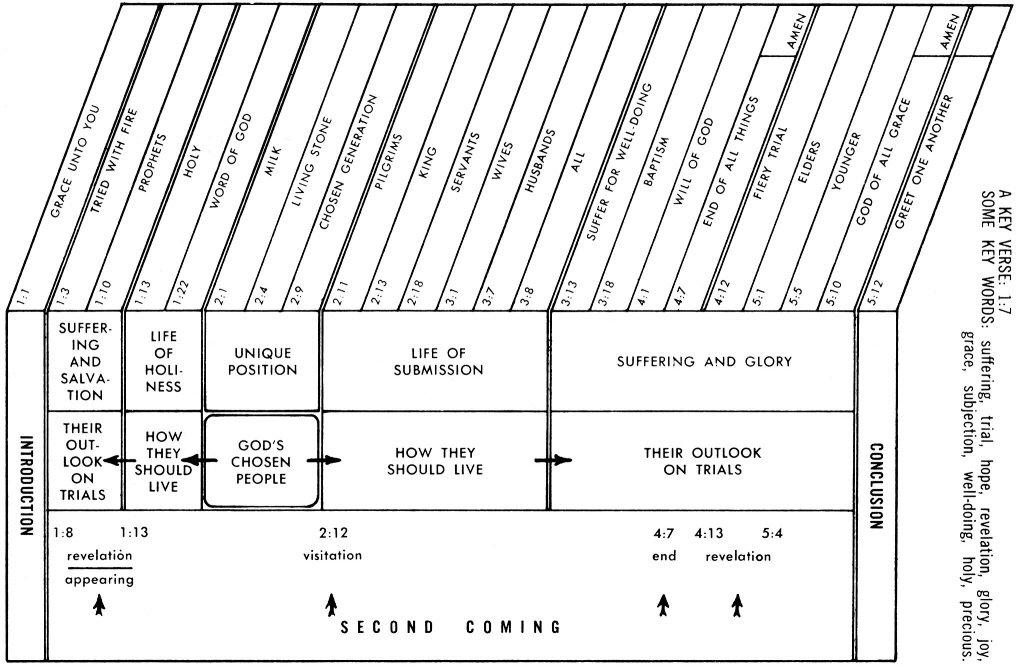
1 Peter: Trials, Holy Living & The Lord's Coming
Click chart to enlarge
Chart from Jensen's Survey of the NT - used by permission
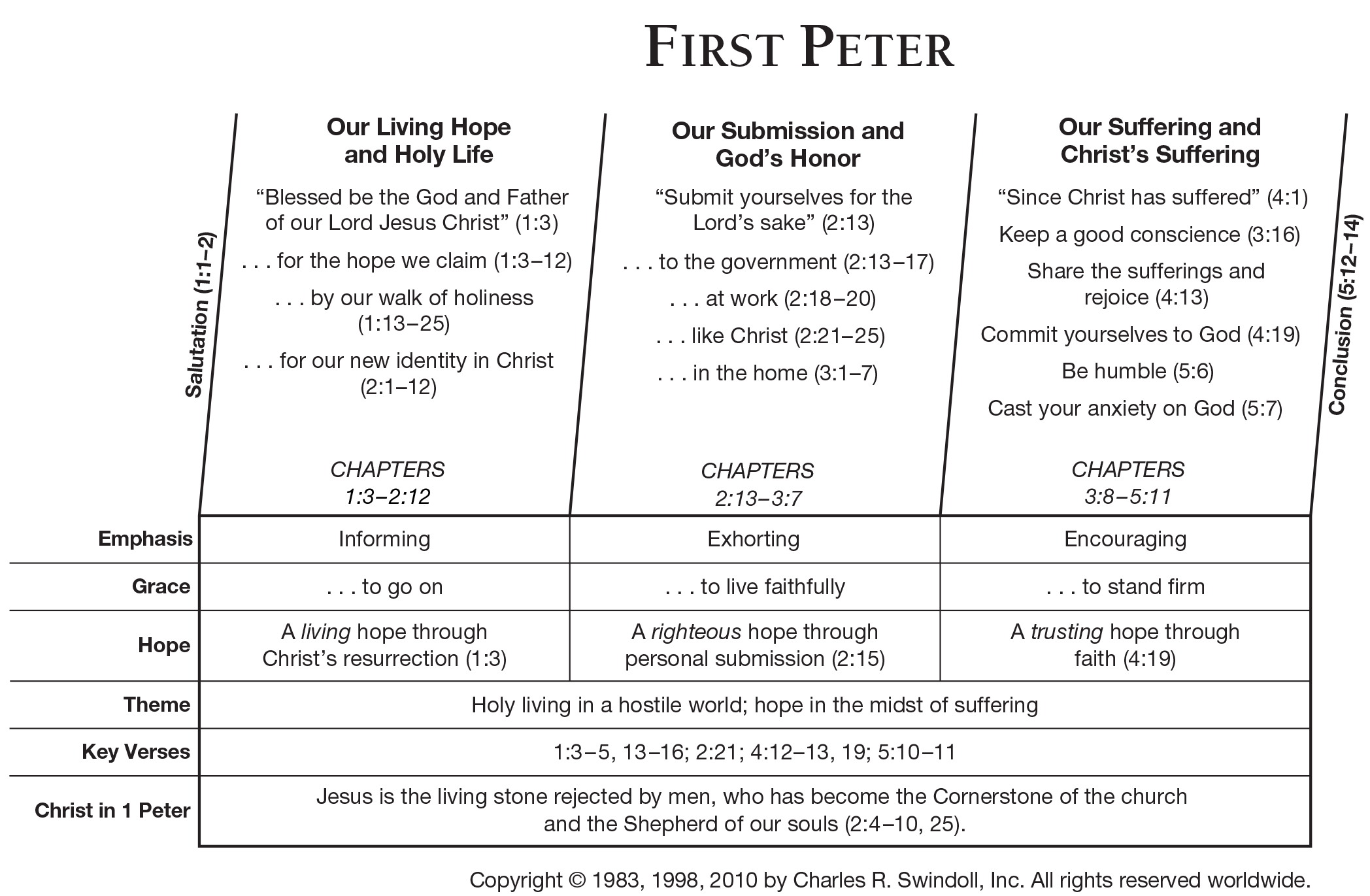
See Another Chart from Charles Swindoll
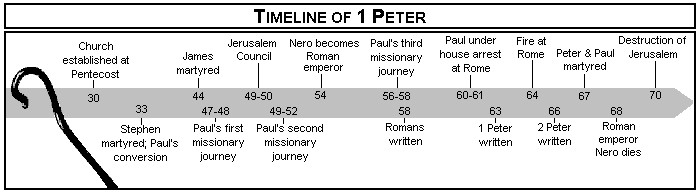
Source: Borrow Ryrie Study Bible
Click to enlarge
| Salvation of the Believer 1 Pe 1:1-2:12 |
Submission of the Believer 1 Pe 2:13-3:12 |
Suffering of the Believer 1 Pe 3:13-5:14 |
||||||||
| Salvation 1Pe 1:1-1:12 |
Sanctification 1Pe 1:13-2:12 |
Submit to Government 1Pe 2:13-17 |
Submit in Business 1Pe 2:18-25 |
Submit in Marriage 1Pe 3:1-8 |
Submit in all of life 1Pe 3:9-12 |
Conduct in Suffering 1Pe 3:13-17 |
Christ's Example of Suffering 1Pe 3:18-4:6 |
Commands in Suffering 1Pe 4:7-19 |
Minister in Suffering 1Pe 5:1-14 |
|
| Belief of Christians | Behavior of Christians | Buffeting of Christians | ||||||||
| Holiness | Harmony | Humility | ||||||||
|
Adapted from Bruce Wilkinson and Kenneth Boa's Talk Thru the Bible (borrow) |
||||||||||
1 Peter 5:6 Therefore humble yourselves under the mighty hand of God, that He may exalt you at the proper time, (NASB: Lockman) Greek: Tapeinothete (2PAPM ) oun hupo ten krataian cheira tou theou, hina humas hupsose (3SAAS) en kairo
Greek - Tapeinothete (2PAPM ) oun hupo ten krataian cheira tou theou, hina humas hupsose (3SAAS) en kairo
BGT Ταπεινώθητε οὖν ὑπὸ τὴν κραταιὰν χεῖρα τοῦ θεοῦ, ἵνα ὑμᾶς ὑψώσῃ ἐν καιρῷ,
Amplified: Therefore humble yourselves [demote, lower yourselves in your own estimation] under the mighty hand of God, that in due time He may exalt you, (Amplified Bible - Lockman)
ICB: So be humble under God's powerful hand. Then he will lift you up when the right time comes.
NLT: So humble yourselves under the mighty power of God, and in his good time he will honor you. (NLT - Tyndale House)
NLT (revised) So humble yourselves under the mighty power of God, and at the right time he will lift you up in honor.
Phillips: So, humble yourselves under God's strong hand, and in his own good time he will lift you up.
Wuest: Permit yourselves therefore to be humbled under the mighty hand of God, in order that you He may exalt in an appropriate season
Young's Literal: be humbled, then, under the powerful hand of God, that you He may exalt in good time,
KJV Humble yourselves therefore under the mighty hand of God, that he may exalt you in due time:
ESV Humble yourselves, therefore, under the mighty hand of God so that at the proper time he may exalt you,
NET And God will exalt you in due time, if you humble yourselves under his mighty hand
NIV Humble yourselves, therefore, under God's mighty hand, that he may lift you up in due time.
CSB Humble yourselves, therefore, under the mighty hand of God, so that He may exalt you at the proper time,
NKJ Therefore humble yourselves under the mighty hand of God, that He may exalt you in due time,
NRS Humble yourselves therefore under the mighty hand of God, so that he may exalt you in due time.
NAB So humble yourselves under the mighty hand of God, that he may exalt you in due time.
NJB Bow down, then, before the power of God now, so that he may raise you up in due time;
GWN Be humbled by God's power so that when the right time comes he will honor you.
THEREFORE HUMBLE YOURSELVES: Tapeinothete (2PAPM) oun:
- Make a list of the truths on humility you discover in the following OT cross references - you will be edified and you might also be humbled!
- Humble yourself - Ex 10:3; Lev 26:41; 1Ki 21:29; 2Ki 22:19; 2Chr 12:6,7,12; 30:11; 32:26; 2Chr 33:12,19,23; 36:12; Pr 29:23; Is 2:11; 57:15; Jer 13:18; 44:10; Da 5:22; Mic 6:8; Lk 14:11; 18:14; James 4:6, 4:10; 5:10
- Torrey's topic Humility
- Are You Humble Enough to be Care-Free? - John Piper
- 1 Peter 5 Resources - Multiple Sermons and Commentaries
Related Passages:
James 4:6 But He gives a greater grace. Therefore it says, “GOD IS OPPOSED TO THE PROUD, BUT GIVES GRACE TO THE HUMBLE.”
Proverbs 29:23 (PARADOX OF PROUD MEN SEEKING SELF HONOR BUT LOWLY MEN RECEIVING IT!) A man’s pride will bring him low, But a humble spirit will obtain honor.
Luke 14:11 “For everyone who exalts himself will be humbled, and he who humbles himself will be exalted
Isaiah 57:15 (IN NEED OF PERSONAL REVIVAL? SEEK HUMILITY!) For thus says the high and exalted One Who lives forever, whose name is Holy, “I dwell on a high and holy place, And also with the contrite and lowly of spirit In order to revive the spirit of the lowly And to revive the heart of the contrite.
Micah 6:8 He has told you, O man, what is good; And what does the LORD require of you But to do justice, to love kindness, And to walk humbly with your God?
A COMMAND TO BE
LOWLY IN MIND
Therefore (oun) (term of conclusion) which serves as a challenge to both leaders and followers in the previous verses, in order to receive God's grace, be willing to submit with a humble attitude for "GOD IS OPPOSED (antitasso in the present tense = He continually arrays Himself against) TO THE PROUD, BUT GIVES GRACE TO THE HUMBLE" (James 4:6)
Humble yourself - This in a sense is a command to walk like Jesus walked for though He is God, He gave up His rights and humbled Himself (Php 2:5-8) that we might be able to follow in His steps (1Pe 2:21), because the only way a man can humble himself is by relying on the power of the Holy Spirit. The fallen flesh continually seeks to be exalted, and thus is continually in opposition to the Holy Spirit Who indwells every believer. And it is only when the believer surrenders to the supernatural working of the Spirit and walks by the Spirit (Gal 5:16 see "Paradoxical Principle of 100% Dependent and 100% Responsible), that he can truly walk in humility like His Master, the Lord Jesus Christ. See The Holy Spirit-Walking Like Jesus Walked!
J Vernon McGee - "It is only when you and I come in humility that we will be able to know the grace of God (ED: AS JAMES TEACHES James 4:6)… In view of the coming of Christ, humility should be the attitude of the child of God. Christ is the one who will establish justice and make things right when He comes. You cannot straighten out this world, although you may think you can." (See Thru the Bible Vol. 54: The Epistles 1 Peter)
Humble (5013)(tapeinoo) (Click in depth study of root word tapeinos) literally means to bring to the ground or make level and figuratively to abase or cause someone to lose prestige or status) is an aorist command (aorist imperative) which is a call to make decision and even conveys a sense of urgency. The idea is "Do this now! Don't delay!" See our need to depend on the Holy Spirit to obey this otherwise impossible command (for our fallen flesh detests humility and continually ferociously fights to make us proud and puffed up and self-exalted!) The passive voice indicates that we are to allow ourselves to be humbled by God. Allow God to lower your level of autonomy or your own estimation of yourself. And this includes letting go of the subtle tendency of "self-reliance," which is just another word for pride cloaked in euphemistic garb.
Classic Use of the related root word tapeinos - tapeinos was originally used (from Pindar in the 5th cent. B.C. on) with the sense of low-lying. Metaphorical uses were soon developed: (a) low socially, poor, of little social position and influence (Hdt., 5th cent. B.C. onwards), powerless, unimportant; (b) as a result of one’s social standing, with slavish outlook, a synonym of not free; (c) despondent, downcast (Thuc., 5th cent. B.C. onwards; cf. Eng. “I’m feeling down”); (d) in Socratic and post-Socratic ethical teaching the word was separated from its social links, but retained a depreciatory connotation. Men should avoid the two extremes of arrogance, provocation and pride (hybris), and of grovelling, servile behaviour and base flattery. (e) Occasionally the word is used with a good connotation in individual, social, ethical and religious contexts. Where this is so, it does not mean humble, but unassuming (in Xen.), obedient, conforming one’s behaviour to the righteous laws of the gods (Aesch., Plato). In all these uses there remains the memory of the original physical meaning of below, low, in comparison with that which is above or higher.
The verb tapeinoō (from Hippocrates, 5th cent. B.C. onwards) represents in all its varieties of meaning the various shades of meaning of the adj.: to level, humble (socially, politically, economically), harm, make small, make humble, discourage (with fate or life as subject), make one obedient, or self-effacing, make a person obey a regulation (of the reason) (and also the appropriate pass. forms). The reflex. form with heauton and the mid. (from Diod.Sic., 1st cent. B.C. onwards used also for mental states) meaning humble oneself, demean oneself, are used normally only in a derogatory sense. Yet Philodemus of Gadara (1st cent. B.C.) demands that those who humbled themselves, should be comforted and lifted up and Plut. (1st cent. A.D.) mentions the custom of humbling oneself before the gods by covering the head during sacrifice and prayer....
OT The fundamental difference between the Gk. and the biblical use of these words has already been indicated. In the Gk. world, with its anthropocentric view of man, lowliness is looked on as shameful, to be avoided and overcome by act and thought. In the NT, with its theocentric view of man, the words are used to describe those events that bring a man into a right relationship with God and his fellow-man (From NIDNTT - tapeinos)
Related Resource: Older Articles on Humility
Enabled by the Spirit Who gives you the desire and the power (see Php 2:13NLT) be willing to take a low place (which is literally what he verb humble implies tapeinoo), a place such as becomes you (for we even began as nothing but "dust!" Ge 2:7). Do not evince pride and haughtiness and do not exalt yourself above others. Allow yourself to be humbled, accepting your lot and circumstances either sent by or allowed by the Omnipotent, Sovereign God Who loves you and desires your good and His glory. (cf 1Pe 1:6-7, 2Co 4:17-18). God will often allow suffering to bring about the fruit of humility in us (cf Dt 8:3-6). God allows or brings circumstances into our lives that we might understand that we are at the mercy of the Designer Who desires ultimately to conform us to "to the image of His Son" (Romans 8:29, 30). In His sovereignty and providence, God will place events and people into our live so that we can begin to see our need for Him.
Grant Richison points out that "Humility is our responsibility… Humility is not self-effacement. It is not standing round shouldered. Do not confuse humility with asceticism. A humble person can use the first person singular "I." Humility is an attitude toward God that gives Him the credit for who we are and what we do." (Ed comment: While I agree with Richison that being humble is our responsibility, the fact that it is commanded indicates that God gives us the enablement and ultimately the desire and the power to be truly humble come from the energizing power of the Holy Spirit - Php 2:13NLT. Stop "trying" to be humble and start "dying," and the Spirit will renew your mind so that it is a humble mind like Christ's mind - 2Cor 3:18, Php 2:8).
ONE CAVEAT REGARDING THE EXHORTATION - "STOP TRYING AND START DYING" - This statement DOES NOT mean that we are to "Let Go and Let God" which is a false teaching (probably originating from the Keswick Movement)! (See Andrew Naseli's excellent discussion) And so, as an example, the phrase "stop trying" means stop trying to live the supernatural life in your natural strength, but begin to trust in and rely wholly on God's Provision, the Holy Spirit. So does this signify you will have to do nothing? Does this signify you are a "passive participant" in your progressive sanctification? Of course not! Paul was very clear that while believers are totally dependent on the Spirit of Christ to live a supernatural life, we are also totally responsible to work out our salvation -- "So then, my beloved, just as you have always obeyed, not as in my presence only, but now much more in my absence, work out (command in the present imperative - but even our ability to obey this command necessitates the Spirit's enablement described in the next verse) your salvation with fear and trembling; 13 for (strategic "term of explanation") it is God who is at work in you, both to will (desire) and to work *power) for His good pleasure. (Php 2:12, Php 2:13NLT).
Humility is not thinking humbly of oneself (see discussion of the first beatitude - Mt 5:3). Rather, it is having the proper estimate of oneself in relationship to God (cf Romans 12:3). The Christian virtue of humility is the exact opposite of the worst of sins, which is pride. The pagan world did not admire humility, but held it is contempt! Instead, they admired pride and domination. The person with humility thinks of others first and not of himself and admits to a sense of dependence on God.
Kenneth Wuest - Humility is a vice with heathen moralists, but a virtue with Christian apostles. Humility, when it becomes self-conscious, ceases to have any value. (Wuest Word Studies - Eerdman Publishing Company Volume 1, Volume 2, Volume 3 - used by permission)
One more vital point to remember about humility is that this Spirit wrought attitude is necessary for preservation of the unity of the Body of Christ, Paul writing to the saints at Ephesus (after explaining the mystery of the new unity of Jews and Gentiles in one body - see Eph 2:14-22). Proud saints produce disruption of the unity and potentially even division of a local body (I have witnessed this firsthand as I am sure many of you have sadly seen!)
Therefore I, the prisoner of the Lord, implore you to walk in a manner worthy of the calling with which you have been called, 2 with all humility and gentleness, with patience, showing tolerance for one another in love, 3 being diligent to preserve the unity of the Spirit in the bond of peace. (Eph 4:1-3)
Related Resources:
- HUMILITY QUOTATIONS See bottom of this page.
UNDER THE MIGHTY HAND OF GOD: HUPSOO: hupo ten krataian cheira tou theou:
- Under the mighty hand of God - Ex 3:19,20; 32:11
- 1 Peter 5 Resources - Multiple Sermons and Commentaries
Related Passages:
Exodus 3:19-20 “But I know that the king of Egypt will not permit you to go, except under compulsion. “So I will stretch out My hand and strike Egypt with all My miracles which I shall do in the midst of it; and after that he will let you go.
Exodus 32:11 Then Moses entreated the LORD his God, and said, “O LORD, why does Your anger burn against Your people whom You have brought out from the land of Egypt with great power and with a mighty hand?
Jeremiah 32:17 (cf Jer 32:27) ‘Ah Lord GOD! Behold, You have made the heavens and the earth by Your great power and by Your outstretched arm! Nothing is too difficult for You,
THE MIGHTY HAND
OF GOD
Under the mighty hand of God - Under or beneath implies subjection to (under the power of) and in this context is the means of or agency of our being humbled. His mighty hand is a loving hand (read Jesus' comforting, assuring words we need to remember when we are being humbled - Jn 10:28-29) and He does not allow us to be humbled to crush us (which He could easily do), but to mold us and make us more and more conformed into the image of His Son (cf Ro 8:29).
Mighty (2900) (krataios from kratos = power, strength) refers to strength which is manifested. In context this indicates God is manifesting His strength in our lives, usually through allowing of providential circumstances (or people). Krataios refers to ruling power or the ability to rule and gives us our English words "autocratic" and "democratic".
"The… hand of God" was an OT picture of God's active presence and power working in the experience of men to accomplish His sovereign purpose (cf. Ex. 3:19,20; Dt 3:24 Job 30:20, 21 1Sa 5:11, 2Chr 30:12, Job 19:21). It refers to God's hand upon our destiny. Of course "the hand of God" is not literally referring to His hand but is what is called an anthropomorphism (an interpretation of God in terms of human or personal characteristics) and here is another way of describing God's providential activity or "manifest strength" in our lives, divinely orchestrating every circumstance and every trial that comes our way.
Related Resource:
Peter's inference is that we are not to fight the sovereign hand of God, even (or especially) when His hand brings us into times of testing. We need to remember that because He is sovereign (in total control), whatever we experience must first be "filtered" through His "strong (omnipotent) hand of everlasting love". Do you resent challenging circumstances that God places/allows into your life? We all need to come to the point where we like the Psalmist, declare to God that
"Thou hast a strong arm. Thy hand is mighty. Thy right hand is exalted." (Ps 89:13)
John MacArthur - "One of the evidences of lack of submission and humility is impatience with God in His work of humbling believers." (See The MacArthur Study Bible)
THAT HE MAY EXALT YOU: hina humas hupsose (3SAAS):
- That He may exalt you - Job 36:22; Ps 75:10; 89:16,17; Is 40:4; Ezek 17:21; 21:6; James 1:9,10
- 1 Peter 5 Resources - Multiple Sermons and Commentaries
THE PATH TO TRUE
EXALTATION
That (hina) is a purpose clause (see terms of purpose or result). Peter is giving the wonderful end result of of humbling one's self before God. He will lift up suffering, submissive believers in His wisely appointed time ("in his good time he will honor you", NLT)
Exalt (set you on high, lift up) (5312) (hupsoo) means to be lifted up or elevated and in context refers to a spiritual lifting or in a sense a revival. God will cause us to rise spiritually and we will placed on a higher spiritual plane when we humble ourselves before Him. James adds the command "Humble (aorist imperative) yourselves in the presence of the Lord, and He will exalt you." (James 4:10)
The cross before the crown principle was also taught by Jesus Who declared that "whoever exalts himself shall be humbled; and whoever humbles himself shall be exalted." (Mt 23:12)
Mary in her exaltation of the Lord said "He has brought down rulers from their thrones, and has exalted those who were humble." (Lk 1:52) Humbling ourselves in order to be exalted is one of those great paradoxes of Christianity. If you want to go up, you must go down. John the Baptist understood this important but basic spiritual principle declaring of Christ that "He must (present tense = continually) increase, but I must (present tense = continually) decrease." (Jn 3:30)
Paul had the "mighty hand of God" upon him in the form of a "thorn" (whatever that was) in his side and thereby came to understand that Christ's "… grace is sufficient… , for power is perfected in weakness."
As a result Paul went on to exclaim "Most gladly, therefore, I will rather boast about my weaknesses, that the power of Christ may dwell in me. Therefore I am well content with weaknesses, with insults, with distresses, with persecutions, with difficulties, for Christ's sake; for when I am weak, then I am strong." (2Cor 12:9, 2Cor 12:10)
AT THE PROPER TIME: en kairo:
- Dt 32:35; 1Ti 2:6; Titus 1:3
- 1 Peter 5 Resources - Multiple Sermons and Commentaries
Related Passages:
Deuteronomy 32:35 ‘Vengeance is Mine, and retribution, In due time their foot will slip; For the day of their calamity is near, And the impending things are hastening upon them.’
1 Timothy 2:6 Who (CHRIST JESUS - 1Ti 2:5) gave Himself as a ransom for all, the testimony given at the proper time.
GOD'S TIMING IS
ALWAY PERFECT
At the proper time - "In due time” (Amplified); "when the time comes you may be lifted up" (BBE); "in an appropriate season" (Wuest). The sovereign God controls everything, including time! God is never late, never early, but always on time. God will exalt us in His own good time. God never exalts anyone until that person is ready for it. First the cross, then the crown; first the suffering, then the glory. Moses was under God’s hand for 40 years in the desert herding dirty, disobedient sheep before God sent him to deliver the Jews from Egypt. Joseph was under God’s loving hand for at least 13 yrs before God lifted him to the throne, His perfect timing allowing Joseph to be able to testify “As for you, you meant evil against me, but God meant it for good in order to bring about this present result, to preserve many people alive." (Ge 50:20)
God moves in a mysterious way His wonders to perform;
He plants His footsteps in the sea, and rides upon the storm.
Deep in unfathomable mines of never-failing skill,
He treasures up His bright designs, and works His sovereign will.
Ye fearful saints, fresh courage take, the clouds ye so much dread,
are big with mercy, and shall break In blessings on your head.
Judge not the Lord by feeble sense, but trust Him for His grace;
Behind a frowning providence, He hides a smiling face.
His purposes will ripen fast, unfolding every hour;
The bud may have a bitter taste, but sweet will be the flower.
Blind unbelief is sure to err, and scan his work in vain;
God is His own interpreter, and He will make it plain.
(Play this song based on Cowper's beautiful words)
At the proper time (2540) (kairos) means a point of time or period of time, frequently with the implication of being especially fit for something and without emphasis on precise chronology. It means a moment or period as especially a favorable time (at the right time).
Vincent writes that kairos "implies a particular time; as related to some event, a convenient, appropriate time; absolutely, a particular point of time, or a particular season, like spring or winter."(1 Peter 5 Commentary)
TDNT writes that kairos "has the sense of a “decisive moment,” again with positive, neutral, or negative implications, though the positive one of fortune is the most common. Fortune in this sense is not fate, but the chance that must be boldly grasped… a cult of the god Kairos is also found… a statue of Kairos by Lysippos, (depicted a naked young man) with winged feet poised (prepared, ready, all set)… His only attribute apart from the winged feet was a striking hair-style, a lock at the front with short hair behind.” The latter characteristic confirms the fact that even religiously Kairos originally had the character of decision, since the lock of hair is a symbol that one must take the favorable opportunity by the forelock, so that even religiously a summons to action is implied." (See the epigram below… this annotation is not meant to condone the futility of pagan mythology but I do believe that this pagan epigram conveys a reasonable portrayal of what all Christians should seek to do - seize the day, redeem the time, take advantage of every kairos opportunity while there is yet time [opportunum tempus - opportunity flees] and the night is coming when no man can work.) (Kittel, G., Friedrich, G., and Bromiley, G. W. Theological Dictionary of the New Testament. Eerdmans)
This verse should encourage you that the trial does have an end and that the suffering saint will not forever be left in a low and depressed state. Also be encouraged that God will exalt you in the best time, for His timing is perfect. Paul says in Romans (speaking of God's timing in saving us) that
"while we were still helpless, at the right time Christ died for the ungodly." (Romans 5:6 note)
If He can save us the "first" time at the right time, much more He is able to save us at the right time after salvation.
In Faith's Checkbook, Spurgeon wrote the following devotional entitled "Bow Down to Be Lifted Up" on 1 Peter 5:6…
This is tantamount to a promise: if we will bow down, the Lord will lift us up. Humility leads to honor; submission is the way to exaltation. That same hand of God which presses us down is waiting to raise us up when we are prepared to bear the blessing. We stoop to conquer. Many cringe before men, and yet miss the patronage they crave. But he that humbles himself under the hand of God shall not fail to be enriched, uplifted, sustained, and comforted by the ever-gracious One. It is a habit of Jehovah to cast down the proud and lift up the lowly.
Yet there is a time for the Lord’s working. We ought now to humble ourselves, even at this present moment; and we are bound to keep on doing so whether the Lord lays His afflicting hand upon us or not. When the Lord smites, it is our special duty to accept the chastisement with profound submission. But as for the Lord’s exaltation of us, that can only come “in due time,” and God is the best judge of that day and hour. Do we cry out impatiently for the blessing? Would we wish for untimely honor? What are we at? Surely we are not truly humbled, or we should wait with quiet submission. So let us do.
1 Peter 5:7 casting all your anxiety on Him, because He cares for you. (NASB: Lockman)
Greek: pasan ten merimnan humon epiripsantes (AAPMPN) ep' auton, hoti auto melei (3SPAI) peri humon
Amplified: Casting the whole of your care [all your anxieties, all your worries, all your concerns, once and for all] on Him, for He cares for you affectionately and cares about you watchfully. (Amplified Bible - Lockman)
ICB: Give all your worries to him, because he cares for you.
NLT: Give all your worries and cares to God, for He cares about what happens to you. (NLT - Tyndale House)
Phillips: You can throw the whole weight of your anxieties upon him, for you are his personal concern. (Wuest: Expanded Translation: Eerdmans)
Wuest: having deposited with Him once for all the whole of your worry, because to Him it is a matter of concern respecting you.
Young's Literal: all your care having cast upon Him, because He careth for you.
CASTING ALL YOU ANXIETY UPON HIM: pasan ten merimnan humon epiripsantes (AAPMPN) ep auton:
- casting all your anxiety upon Him, because He cares for you - 1Sa 1:10-18; 30:6; Ps 27:13,14; Ps 37:5; 55:22; 56:3,4; Mt 6:25,34; Lk 12:11,12,22; Php 4:6; Heb 13:5,6
- Php 4:6, 1 Peter 5:7 How Can We Put Our Worries to Work for Us?
- What Worry Can Do for You
- See Topic Anxiety-Worry - Illustrations, Devotionals
- 1 Peter 5 Resources - Multiple Sermons and Commentaries
Related Passages:
Matthew 6:25 “For this reason I say to you, do not be worried (present imperative with a negative see our need to depend on the Holy Spirit to obey) about your life, as to what you will eat or what you will drink; nor for your body, as to what you will put on. Is not life more than food, and the body more than clothing?
Matthew 6:34 “So do not worry about tomorrow; for tomorrow will care for itself. Each day has enough trouble of its own.
Luke 12:11-12 “When they bring you before the synagogues and the rulers and the authorities, do not worry about how or what you are to speak in your defense, or what you are to say; 12 for the Holy Spirit will teach you in that very hour what you ought to say.”
Luke 12:22 And He said to His disciples, “For this reason I say to you, do not worry (present imperative with a negative see our need to depend on the Holy Spirit to obey) about your life, as to what you will eat; nor for your body, as to what you will put on.

CAST YOUR BURDENS ON
THE BURDEN BEARER
Casting all your anxiety upon Him - All is the first words in the Greek for emphasis and this Greek word means "all" without exception! Our Lord's "shoulders" are broad enough and strong enough to bear your burden whatever it might be. The verb casting is in the active voice signifying that we must make a conscious, volitional choice, a choice of our will, to cast the burden the Lord.
THOUGHT - The Lord is our Shepherd and we shall not want (Ps 23:1). As the picture above portrays, shepherds would carry weak lambs on their shoulders. Beloved, your burden is not too great for your Good Shepherd to carry on His shoulders!
Casting… upon (1977)(epirrhipto from epí = upon + rhípto = cast) means to throw or cast upon. To throw something upon something else, e.g., throw clothes on an animal for riding (Lu 19:35, the only other NT use)
Note that the verb "Casting… upon" is a participle (ends in "-ing") making it dependent upon verse six and therefore becoming one of the means by which we humble ourselves. What could inhibit us from doing this? Pride can keep you from being willing to humble yourself in this way. You say "I'll do it my way." But God's care comes when we humble ourselves and trust in and depend upon His grace. And we are humble when we depend on God's grace to live the Christian life. Peter earlier said to "let those also who suffer according to the will of God entrust their souls to a faithful Creator" (1Peter 4:19)
"Casting… upon" is in the aorist tense which Vincent says denotes "an act once for all; throwing the whole life with its care on Him." We must once and for all give all of our cares—past, present, and future—to the Lord. The literal picture is seen in Luke 19:35 where "They brought (the colt) to Jesus, and they threw their coats on the colt and put Jesus on it." They did not throw pieces of their coat on the colt but the "all" of the coat.
How did Paul say to "cast your cares upon God"? In his epistle to the Philippians, Paul exhorted them to "Worry about nothing; pray about everything." That is, take it to the Lord in prayer, and leave it there! Don’t pick it up again.
Similarly believers are to cast "all" (the whole in its entirety) of their care upon Him. The emphasis is not on casting each individual anxiety, but on casting the whole of one's life upon the Lord. Stated another way, Peter does not say to be "casting the big burdens and keeping the little ones!" We all need to come to the place where we realize that God is all sufficient for all problems that may come into our lives. No heartache, difficulty or problem is too difficult for the plan of God. No sin is too great for the plan of God. Beloved, our heavenly Father is willing and able to carry our heaviest (and lightest) burdens but before we can experience God's sufficiency, we need to acknowledge our insufficiency to live the Christian life. Is there some anxiety you carrying just now, dear child of God? What is your heartache? What grief do you bear today? What disappointment? What hurt feeling? Whatever the burden, go to His throne of grace to receive mercy and find grace by casting it upon Him, for He does not want you to carry that burden.
Peter is probably quoting from the psalm which
Cast your burden (releasing the weight of it) upon the LORD and He will sustain you; He will never allow the righteous to be shaken (made to slip, fall or fail). (Ps 55:22)
Spurgeon comments: Thy burden, or what thy God lays upon thee, lay thou it upon the Lord. His wisdom casts it on thee, it is thy wisdom to cast it on Him. He cast thy lot for thee, cast thy lot on Him. He gives thee thy portion of suffering, accept it with cheerful resignation, and then take it back to Him by thine assured confidence.
He shall sustain thee. Thy bread shall be given thee, thy waters shall be sure. Abundant nourishment shall fit thee to bear all thy labors and trials. As thy days so shall thy strength be.
He shall never suffer the righteous to be moved. He may move like the boughs of a tree in the tempest, but He shall never be moved like a tree torn up by the roots. He stands firm who stands in God. Many would destroy the saints, but God has not suffered it, and never will. Like pillars, the godly stand immoveable, to the glory of the Great Architect
Anxiety:(3308) (merimna from merizo = to divide or draw different directions - which is exactly what anxiety does to most of us!) refers to a care (the sole way it is translated in the KJV) or concern and so to care for someone or something. It is often used in a negative sense and thus is translated as "worry". From the origin, one can see that merimna describes the state of "being pulled apart.” Thus when circumstances are difficult, it is easy to let oneself be dominated by anxiety and worry.
Merimna is used 6 times in the NT (Matt. 13:22; Mk. 4:19; Lk. 8:14; 21:34; 2Co. 11:28; 1 Pet. 5:7) and is translated KJV (6) - care, 6 and NAS (6) - anxiety, 1; concern, 1; worries, 3; worry, 1 There are 5 uses in the Septuagint - Esther 1:1; Job 11:18; Ps. 55:22; Prov. 17:12; Da. 11:26
George Morrison - God does not make His children carefree (Ed note: freedom from anxiety producing situations) in order that they be careless. (ED: but that they might be care full [careful]).
Richards has an excellent summary of merimnao (see word study) and merimna noting that…
When used by the Greeks concerning the future… both came to connote anxious expectation. When used of the present, the words expressed an aching sense of grief. The meaning of any term, however, is defined by the way it is used. It is the way that Jesus and the writers of the Gospels and Epistles, guided by the Holy Spirit, used words that filled them with their biblical meaning… But while it is legitimate to have concerns that we will at times experience as demanding pressures, there is a limit to their legitimacy. The "worries of this life" may so dominate our attention that they make God's Word unfruitful in our lives (Mt 13:22; Mark 4:19). The pressures of legitimate concerns can cause us to so focus on worldly matters that we forget to relate our needs and our worries to the Lord… By linking legitimate concerns to God, believers are freed from anxiety and worry. This freedom allows us to concentrate on seeking God's kingdom and his righteousness, knowing that "all these things will be given to [us] as well." So Jesus concludes, "Do not worry about tomorrow, for tomorrow will worry about itself."
What the pagan Greeks experienced as anxious concern over a tomorrow they could not control, the believer who knows God as a loving Father can experience in calm confidence. Released from fears about tomorrow, we can concentrate on doing God's will today, as obedient subjects of a kingdom over which the Almighty rules.
The Gospels recognize the tendency of legitimate human concerns to lead to a loss of perspective; we can forget God and adopt a pagan materialism that looks ahead anxiously and concentrates on running after the material things that seem to offer security. In order to avoid this tendency, believers must orient life to God and realize that life's meaning is to be found in living as subjects who are responsive to their loving, wise, and powerful King.
Both anxiety and worry spring from natural and legitimate concerns that are part of life in this world. But legitimate concerns are handled wrongly when they do one or more of the following: (1) become dominating concerns in our life and lead to fear, (2) destroy our perspective on life and cause us to forget that God exists and cares, or (3) move us to drift into an attitude of constant worry and concern over a future that we cannot control.
Jesus deals with anxiety by calling us to an awareness of God. God does exist, and he cares. He is aware of our needs and is committed to meet our needs. Remaining aware of God frees us from the tyranny of things. It enables us to focus our lives on our relationship with God and go on living a righteous and productive life.
The Epistles add to our understanding by pointing out that areas of legitimate anxiety exist even for the strongest of believers. But the pressures of even legitimate concerns are not to dominate us or to make us habitually anxious, worried people. We escape by using anxiety creatively. This means that we must recognize the feelings of pressure and concern as a call to prayer. We should immediately turn to God to lay our needs and the needs of others before him. We then turn back to live our lives encompassed by his peace. Anxiety, rather than drawing us away from God, draws us to Him and thus fulfills His purpose for it in our lives.(Richards, L O: Expository Dictionary of Bible Words: Regency) (Bolding added)
Louw & Nida comment that merimna describes "a feeling of apprehension or distress in view of possible danger or misfortune. The term merimna may refer to either unnecessary worry or legitimate concern. The equivalent of ‘worry’ may be expressed in some languages in an idiomatic manner, for example, ‘to be killed by one’s mind’ or ‘to be pained by thinking.’ (Louw, J. P., & Nida, E. A. Greek-English Lexicon of the New Testament: Based on Semantic Domains Vol. 1, Page 312. New York: United Bible Societies)
Barclay observes that in a secular Greek writing (a papyrus letter)…
a wife writes to her absent husband:
“I cannot sleep at night or by day, because of the worry (merimna) I have about your welfare.”
A mother, on hearing of her son’s good health and prosperity writes back:
“That is all my prayer and all my anxiety (merimna).”
Anacreon, the poet, writes:
“When I drink wine, my worries (merimna) go to sleep.”
In Greek the word is the characteristic word for anxiety, and worry, and care. (1 Peter 5 Commentary)
Vine gives a very illustrative definition of "merimna" (Click in depth study on related verb merimnao): stating that "merimna (3308) is probably connected with merizo, (3307) “to draw in different directions, distract,” hence signifies “that which causes this [that is, this effect of being drawn in different directions], a care, especially an anxious care”. To worry is in essence to have a "divided mind"
Related Resource:
- RBC booklet What Can I Do With My Worry?
- RBC booklet Overcoming Worry
Strong's Lexicon also states that merimna is from "merizo, (3307) through the idea of distraction." So clearly that which worries or causes anxiety is that which distracts us and tends to draw us in different directions (compare our common expression "I feel like everything is falling apart").
Meyer writes that "The word anxiety comes from the same root as anger, and suggests the idea of choking. Worry chokes the life of faith. It does not help us to overcome our difficulties, but unfits us for dealing with them. No weapon that is formed against us shall prosper; every tongue that shall rise against us shall be condemned; our bread shall be given, and our water sure. God will perfect that which concerneth us, and His goodness and mercy shall never cease. Roll thyself and thy burden on the Lord, and leave them there. Too many take them back again! (F B Meyer. Our Daily Walk)
The picture even becomes more vivid when we look at a summary of English dictionary definitions of each word…
Anxious: Characterized by extreme uneasiness of mind or brooding fear about some contingency (Webster, modern). Worried and tense because of possible misfortune, danger, etc. (Collins) Experiencing worry, nervousness, or unease. (Oxford) Concern or solicitude respecting some event, future or uncertain, which disturbs the mind, and keeps it in a state of painful uneasiness. it expresses more than uneasiness or disturbance, and even more than trouble or solicitude. it usually springs from fear or serious apprehension of evil, and involves a suspense respecting an event, and often, a perplexity of mind, to know how to shape our conduct. (Webster, 1828) A state of restlessness and agitation, often with general indisposition and a distressing sense of oppression at the epigastrium. (Webster, 1913)
Worry: feel or cause to feel troubled over actual or potential difficulties. Expressing anxiety. (Concise Oxford). To choke or strangle - to harass by tearing, biting, or snapping especially at the throat. Mental distress or agitation resulting from concern usually for something impending or anticipated. Worry suggests fretting over matters that may or may not be real cause for anxiety (Webster) To be or cause to be anxious or uneasy, esp. about something uncertain or potentially dangerous. To disturb the peace of mind of (Collins)
Worry has a fascinating etymology summarized below
Worrying may shorten one's life, but not as quickly as it once did. The ancestor of our word, Old English wyrgan, meant “to strangle.” (Ed note: Isn't this what worry does to our joy?)
Its Middle English descendant, worien, kept this sense and developed the new sense “to grasp by the throat with the teeth and lacerate” or “to kill or injure by biting and shaking.” This is the way wolves or dogs might attack sheep, for example.
In the 16th century worry began to be used in the sense “to harass, as by rough treatment or attack,” or “to assault verbally,” and in the 17th century the word took on the sense “to bother, distress, or persecute.” It was a small step from this sense to the main modern senses “to cause to feel anxious or distressed” and “to feel troubled or uneasy,” first recorded in the 19th century. (American Heritage Dictionary)
Besides anxiety (be anxious) another word that is synonymous with worry is the verb fret (derived from Old English word fretan meaning to devour or consume), which literally means to eat or gnaw into and figuratively pictures causing one to suffer emotional strain, be distressed, or feel vexation. Again the etymology or origin of the word fret so perfectly describes the detrimental, destructive effect of the emotional state of worry and anxiety.
Are you worried about your tendency to worry? Let me encourage you to turn your attention to God, especially to an unhurried devotional study of His character revealed in His names or more specifically in His attributes (See "The Attributes of God"). You will be amazed at how the Spirit will renew our mind when we shift our focus off of the perplexity of the problems and onto the perfection of the Problem Solver, and once again appreciate that He is everywhere, knows everything, is all powerful, and is able and willing to carry our burdens (Ps 55:22, Heb 2:18).
Elisha Hoffman the writer of the hymn I MUST TELL JESUS tells the story that preceded his penning of the words…
There was a woman to whom God had permitted many visitations of sorrow and affliction. Coming to her home one day, I found her much discouraged. She unburdened her heart, concluding with the question, “Brother Hoffman, what shall I do?” I quoted from the word, then added, “You cannot do better than to take all of your sorrows to Jesus. You must tell Jesus.”
For a moment she seemed lost in meditation. Then her eyes lighted as she exclaimed, “Yes, I must tell Jesus.” As I left her home I had a vision of that joy-illuminated face…and I heard all along my pathway the echo, “I must tell Jesus. I must tell Jesus.”
I MUST TELL JESUS
(Gaither vocal)
I must tell Jesus all of my trials;
I cannot bear these burdens alone;
In my distress He kindly will help me;
He ever loves and cares for His own.
Refrain
I must tell Jesus! I must tell Jesus!
I cannot bear my burdens alone;
I must tell Jesus! I must tell Jesus!
Jesus can help me, Jesus alone.
I must tell Jesus all of my troubles;
He is a kind, compassionate friend;
If I but ask Him, He will deliver,
Make of my troubles quickly an end.
Refrain
Tempted and tried, I need a great Savior;
One Who can help my burdens to bear;
I must tell Jesus, I must tell Jesus;
He all my cares and sorrows will share.
Refrain
O how the world to evil allures me!
O how my heart is tempted to sin!
I must tell Jesus, and He will help me
Over the world the victory to win.
Refrain
Elisha's Hoffman's story and hymn beg the question…Have you told Jesus?
Spurgeon offers this interesting perspective to those who are hesitant to cast their cares on Him writing that…
There is nothing Christ dislikes more than for His people to make show of Him and not to use Him. He loves to be worked. He is a great laborer. He always was for His Father, and now He loves to be a great laborer for His brethren. The more burdens you put on His shoulders, the better He will love you. Cast your burden on Him.
Related Resources: Anxious? Worried? See Jesus' discussion on Worry/Anxiety in the Sermon on the Mount
- Matthew 6:25-26,
- Matthew 6:27-29,
- Matthew 6:30-32,
- Matthew 6:33-34
- For a small booklet click What Can I Do With My Worry? (see also Overcoming Worry)
- Click here for 26 Illustrative Stories on "Fear" from Our Daily Bread
Our Daily Bread has the following devotional on "worry"…
Worry is merely unbelief parading in disguise! The Scriptures repeatedly warn us against this grievous sin. Ian Maclaren ex-claims, "What does your anxiety do? It does not empty tomorrow of its sorrow, but it does empty today of its strength. It does not make you escape the evil; it makes you unfit to cope with it when it comes. God gives us the power to bear all the sorrow of His making, but He does not guarantee to give us strength to bear the burdens of our own making such as worry induces."
An experienced physician decided to analyze the "worriers" who were his patients. He found that 40 percent of them were apprehensive over things that never happened. About 30 per-cent concerned themselves with past matters now beyond their control. Another 12 percent anxiously feared the loss of their health, although their only illness was in their imagination. And the rest worried about their families, friends, and neighbors, but in most cases he discovered no basis for their fears.
A bassoon player once came to the great conductor Toscanini with furrowed brow and complained that his instrument would not sound the high E flat. Toscanini smiled and replied, "Don't worry. There is no E flat in your music tonight." The musician had been needlessly apprehensive. Many of our worries are like that — unfounded and unnecessary.
Worry is both unprofitable and ungodly. God's grace will be sufficient for each day's need. Take comfort in this thought, and tread the pathway of life with faith, not fear! (Our Daily Bread, Copyright RBC Ministries, Grand Rapids, MI. Reprinted by permission. All rights reserved)
I walked life's path with "Worry,"
Disturbed and quite unblessed,
Until I trusted Jesus;
Now "Faith" has given rest. — G.W.
Satan seeks to crush our spirit by getting us to bear tomorrow's burdens with only today's grace!
D. L. Moody once quipped that…
A great many people seem to embalm their troubles. I always feel like running away when I see them coming. They bring out their old mummy, and tell you in a sad voice:
You don't know the troubles I have!
My friends, if you go to the Lord with your troubles, He will take them away. Would you not rather be with the Lord and get rid of your troubles, than be with your troubles and without God? Let trouble come if it will drive us nearer to God.
It is a great thing to have a place of resort in the time of trouble. How people get on without the God of the Bible is a mystery to me. If I didn't have such a refuge, a place to go and pour out my heart to God in such times, I don't know what I would do. It seems as if I would go out of my mind. But to think, when the heart is burdened, we can go and pour it into His ear, and then have the answer come back, "I will be with him," there is comfort in that!
I thank God for the old Book. I thank God for this old promise. It is as sweet and fresh today as it has ever been. Thank God, none of those promises are out of date, or grown stale. They are as fresh and vigorous and young and sweet as ever.
See also - Anxiety-Worry-Quotes, Devotionals & Illustrations
Take courage: if God doesn't choose to remove an obstacle, He will help you plow around it!
Even though you can't control your circumstances, you can control your attitude.
The perfect cure for worry is trust in God.
Anxiety is a thin stream of fear trickling through the mind. If encouraged, it cuts a channel into which all others thoughts are drained. - Arthur Somers Roche
The great saint George Mueller once said that
The beginning of anxiety is the end of faith, and the beginning of true faith is the end of anxiety.
Robert Burdette wrote that
There are two days in the week about which I never worry. Two carefree days kept sacredly free from fear and apprehension. One of these days is yesterday—and the other day I do not worry about is tomorrow.
Anxiety is the interest paid on trouble before it is due. Or stated another way it is the interest paid by those who "borrow" trouble!
A S Roche said that
Worry is a thin stream of fear trickling through the mind. If encouraged, it cuts a channel into which all other thoughts are drained.
Oswald Chambers wrote that…
Fretfulness springs from a determination to get my own way.
Spurgeon said that…
Anxiety does not empty tomorrow of its sorrows but only empties today of its strength.
George Sweeting tells the story of Bishop William Quayle who, while he laid awake at night, because of fruitless worrying, heard God say to him, "Quayle, you go to bed; I'll sit up the rest of the night." Whimsically put, that experience symbolizes a matter of major importance in the cure of worry
Anxiety is the natural result when our hopes are centered in anything short of God and his will for us.
Someone has written that an average person’s anxiety is focused on
• 40% -- things that will never happen
• 30% -- things about the past that can’t be changed
• 12% -- things about criticism by others, mostly untrue
• 10% -- about health, which gets worse with stress
• 8% -- about real problems that will be faced
Thomas Jefferson noted
How much have cost us the evils that never happened!
Dr E Stanley Jones wrote
I am inwardly fashioned for faith, not for fear. Fear is not my native land; faith is. I am so made that worry and anxiety are sand in the machinery of life; faith is the oil. I live better by faith and confidence than by fear, doubt and anxiety. In anxiety and worry, my being is gasping for breath—these are not my native air. But in faith and confidence, I breathe freely—these are my native air. A John Hopkins University doctor says, “We do not know why it is that worriers die sooner than the non-worriers, but that is a fact.” But I, who am simple of mind, think I know; We are inwardly constructed in nerve and tissue, brain cell and soul, for faith and not for fear. God made us that way. To live by worry is to live against reality.
Day by Day
(Play hymn)
Day by day, and with each passing moment,
Strength I find, to meet my trials here;
Trusting in my Father’s wise bestowment,
I’ve no cause for worry or for fear.
He Whose heart is kind beyond all measure
Gives unto each day what He deems best—
Lovingly, its part of pain and pleasure,
Mingling toil with peace and rest.
Casting all your anxiety upon Him…
When Anne Graham Lotz faced a sudden crisis with her son’s unexpected cancer surgery, she opened a little book called Daily Light and found there just the verses she needed:
“Many are the afflictions of the righteous, but the Lord delivers him out of them all… We know that all things work together for good… With us is the Lord our God, to help us and to fight our battles. The Lord your God is in your midst, the Mighty One, will save.’
Anne later wrote,
“God has spoken to me more often through the verses in Daily Light than through any other book, except my Bible.”
When CIM missionary Arthur Matthews was trapped in Communist China, uncertain of life or death, he was summoned before authorities who were pressuring him to earn his freedom by agreeing to spy for the Communists. That morning he kissed his wife and little one goodbye, and left for the police station, not knowing if he would ever return. In his pocket, he put a copy of Daily Light.
Vance Havner, the quaint North Carolina evangelist and writer, faced the greatest heartbreak of his life when his beloved Sara contracted a fatal disease. He turned to his Daily Light, and the reading for the day said:
“This sickness is not unto death, but for the glory of God, that the Son of God might be glorified thereby.”
When Sara died, Havner remembered that Lazarus had died, too.
“I felt that God would be glorified in her passing,” Havner later wrote, “and He was.”
When missionaries Russell and Darlene Deibler were trapped in the South Pacific during the Japanese invasion in 1942, they faced the darkest days of their lives. Russell was shortly hauled away to a concentration camp, never to return. That evening, Darlene found comfort in her Daily Light. The reading for the evening of March 13 said:
“O my God, my soul is cast down within me… Thou wilt keep him in perfect peace, whose mind is stayed on Thee: because he trusteth in Thee… Cast thy burden upon the Lord.”
“For me in my need,” she later wrote, “the Lord had directed in the arrangement of the verses.” (Morgan, R. J. Nelson's Annual Preacher's Sourcebook : 2002 Edition Nashville: Thomas Nelson Publishers)
The antidote for anxiety and fear
Trusting In
and
Casting Upon God
Anxiety and fear is the fruit of the root of unbelief and unwillingness to accept God’s sovereignty over all of the aspects of one’s life. Faith (which comes by hearing… the Word of Christ) can break the stranglehold of anxiety and fear. Do you really trust God's sovereignty enough to cast your anxiety upon Him? The perfect cure for worry or anxiety is a child-like trust in our heavenly Father. Today, "cast" your cares upon God, declaring with the psalmist
"I will say of the Lord, 'He is my refuge and my fortress; my God, in Him I will trust'" (Ps. 91:2).
Stated another was, anxiety is a burden which faith casts off the man onto his God.
Wiersbe writes that…
We have little control over the circumstances of life. We can't control the weather or the economy, and we can't control what other people say about or do to us. There is only one area where we have control--we can rule the kingdom inside. The heart of every problem is the problem in the heart. Once we get to that throne room inside us and let God take over, we don't have to worry about others. (Comments on Psalm 10:12) (Bolding added)
Spurgeon wrote…
I heard of a man who was walking along the high road with a pack on his back. He was growing weary and was therefore glad when a gentleman came along in a carriage and asked him to take a seat with him. The gentleman noticed that he kept his pack strapped to his shoulders, and so he said, "Why do you not put your pack down?"
"Why, sir," said the traveler, "I did not venture to impose. It was very kind of you to take me up, and I could not expect you to carry my pack as well."
"Why," said his friend, "do you not see that whether your pack is on your back or off your back, I have to carry it?"
My hearer, it is so with your trouble. Whether you worry or do not worry, it is the Lord who must care for you.
Worry…
… gives a small thing a big shadow
… is the interest we pay on tomorrow's troubles.
… over tomorrow pulls shadows over today's sunshine.
… is like a rocking chair; it will give you something to do, but it won't get you anywhere.
… is an indication that we think God cannot look after us. (O. Chambers)
… is putting question marks where God has put periods. (J R Rice)
… is the interest we pay on tomorrow’s troubles. (E S Jones)
is an intrusion into God's providence. (J Haggai)
… is a guest admitted which quickly turns to be master.
… never robs tomorrow of its sorrow, it only saps today of its strength (A J Cronin)
… is the interest paid by those who borrow trouble (G W Lyon)
… is practical atheism and an affront to God (R. H. Mounce)
See also - Anxiety-Worry-Quotes, Devotionals & Illustrations
In Morning and Evening, Spurgeon wrote…
It is a happy way of soothing sorrow when we can feel—“He careth for me.” Christian! do not dishonour religion by always wearing a brow of care; come, cast your burden upon your Lord. You are staggering beneath a weight which your Father would not feel. What seems to you a crushing burden, would be to him but as the small dust of the balance. Nothing is so sweet as to
“Lie passive in God’s hands,
And know no will but His.”
O child of suffering, be thou patient; God has not passed thee over in his providence. He who is the feeder of sparrows, will also furnish you with what you need. Sit not down in despair; hope on, hope ever. Take up the arms of faith against a sea of trouble, and your opposition shall yet end your distresses. There is One who careth for you. His eye is fixed on you, his heart beats with pity for your woe, and his hand omnipotent shall yet bring you the needed help. The darkest cloud shall scatter itself in showers of mercy. The blackest gloom shall give place to the morning. He, if thou art one of his family, will bind up thy wounds, and heal thy broken heart. Doubt not his grace because of thy tribulation, but believe that he loveth thee as much in seasons of trouble as in times of happiness. What a serene and quiet life might you lead if you would leave providing to the God of providence! With a little oil in the cruse, and a handful of meal in the barrel, Elijah outlived the famine, and you will do the same. If God cares for you, why need you care too? Can you trust him for your soul, and not for your body? He has never refused to bear your burdens, he has never fainted under their weight. Come, then, soul! have done with fretful care, and leave all thy concerns in the hand of a gracious God.
A humorous story about the professional worrier emphasizes the point of Peter's exhortation to cast our burden upon God…
“I have a mountain of credit card debt,” one man told another. “I’ve lost my job, my car is being repossessed, and our house is in foreclosure, but I’m not worried about it.”
“Not worried about it!” exclaimed his friend.
“No. I’ve hired a professional worrier. He does all my worrying for me, and that way I don’t have to think about it.”
“That’s fantastic. How much does your professional worrier charge for his services?”
“Fifty thousand dollars a year,” replied the first man.
“Fifty thousand dollars a year? Where are you going to get that kind of money?”
“I don’t know,” came the reply. “That’s his worry.”
In a sense, the Lord’s servants do have a professional worrier to do all our worrying for them. As 1 Peter 5:7 says, “You can throw the whole weight of your anxieties upon him, for you are his personal concern” (Phillips). (Morgan, R. J. Nelson's Complete Book of Stories, Illustrations, and Quotes. Nashville: Thomas Nelson Publishers)
And here's another story regarding Pastor Jones, who must have wanted to "pull his hair out"…
We scarcely know when life will worry us half to death. Consider Pastor A. J. Jones in South Africa. Wanting to sell a television set, he ran a classified ad in a Pretoria paper. As first printed, the ad said: The Rev. A. J. Jones has a color TV set for sale. Telephone 555–1313 after 7 P.M. and ask for Mrs. Donnelley who lives with him, cheap.
The next day, the paper printed this correction: We regret any embarrassment caused to Rev. Jones by a typographical error in yesterday’s editions. It should have read, “The Rev. A. J. Jones has color TV set for sale, cheap. Telephone 555–1313 and ask for Mrs. Donnelley who lives with him after 7 P.M.
The next day, the paper said: The Rev. A. J. Jones informs us he has received several annoying telephone calls because of an incorrect advertisement in yesterday’s paper. It should have read, “The Rev. A. J. Jones has color TV set for sale. Cheap. Telephone 555–1313 and ask for Mrs. Donnelley who loves with him.”
One day later: Please take notice that I, the Rev. Jones, have no TV set for sale. I have smashed it. I have not been carrying on with Mrs. Donnelley. She was until yesterday my housekeeper.
There was, however, one more ad the next day: WANTED a housekeeper. Telephone Rev. A. J. Jones, 555–1313. Usual housekeeping duties, good pay, love in. (Morgan, R. J. Nelson's Complete Book of Stories, Illustrations, and Quotes. Nashville: Thomas Nelson Publishers)
Anxiety has its use, stimulating us to seek with keener longing for that security where peace is complete and unassailable. - Augustine
As discussed above, we must not hand our burdens to Him piecemeal, keeping those cares that we think we can handle ourselves. If we keep the "little" cares for ourselves, for they have a tendency to grow into "big" concerns! Each time a new burden arises, we must by faith remind the Lord (and ourselves) that we have already turned it over to Him. Don't be frustrated or overwhelmed, for this discipline of trusting God with our anxieties needs patient practice. As you practice "anxiety casting", God's Spirit will perform a wonderful work within you as He transforms you from glory to glory, including…
(1) Giving us the courage to face our cares honestly and not run away ("Do not fear, for I am with you. Do not anxiously look about you, for I am your God. I will strengthen you, surely I will help you. Surely I will uphold you with My righteous right hand." Is 41:10).
(2) Giving us the wisdom to understand the situation ("… if any of you lacks wisdom, let him ask of God, Who gives to all men generously and without reproach, and it will be given to him. But let him ask in faith without any doubting, for the one who doubts is like the surf of the sea driven and tossed by the wind." Ja 1:5-6).
(3) Giving us the strength to do what we must do ("Not that I speak from want; for I have learned to be content in whatever circumstances I am. I know how to get along with humble means, and I also know how to live in prosperity; in any and every circumstance I have learned the secret of being filled and going hungry, both of having abundance and suffering need. I can do all things through Him who strengthens me." (Philippians 4:11, 12, 13 - notes Phil 4:11-13).
(4) Giving us the faith to trust Him to do the rest ("Commit your way to the LORD, trust also in Him, and He will do it." Ps.37:5).
"Anxiety" (Click Jehovah Shalom [and scroll down for "Seven Thieves that Can Steal Your Peace] or Phil 4:6, 7-Notes for additional discussion) is the Greek word merimna (from merizo which means to divide or draw in different directions and so to distract) which pictures that which causes one's mind to be "split" or drawn in different directions which results in "anxiety". And so we begin to think things like "Will this turn out to be a bad thing or a good thing?" In the past anxiety was explained as a "dividing care", distracting the heart from the true object of life. It is the uneasiness and worry about the future which Peter exhorts us to cast upon El Shaddai, the Almighty, All Sufficient One.
Grant Richison exhorts us to
"Remember whenever God says or does anything, there is a reason behind it. God possesses indescribable intelligence. He has never had to learn anything since He has always known everything. Is your god smaller than that? The God of the Bible is not only omniscient (knows everything), but He is also omnipotent (all-powerful) and omnipresent (everywhere present). There is a big difference between human resources and divine resources. God is never surprised, astounded or shocked. God is never in a bind. God is never on the horns of a dilemma. When He says you are to cast, there is a reason. God never asks anything of us that is unreasonable. God's commandments are his enablements." (1Peter 5:7)
Allowing one's mind to go "in different directions" at the same time, will result in a loss of focus and concentration and may leave you virtually "incapacitated", not knowing which way to turn. Such a state also will distract one from our primary focus, which should be Christ Jesus our Lord.
Webster says that anxiety is a painful or apprehensive uneasiness of mind usually over an impending or anticipated ill, a fearful concern or interest or an abnormal and overwhelming sense of apprehension and fear often marked by physiological signs (as sweating, tension, and increased pulse). Webster goes on to add that anxiety is characterized by doubt concerning the reality and nature of the threat or by self-doubt about one’s capacity to cope.
Richison adds that
"Anxiety is a fearful anguish coupled with uncertainty. It is our anticipation of misfortune as if God and His resources for us do not exist. Anxiety distracts us from the resources of God. We enter into a state of turmoil, we cannot recognize the providence of God in our lives… (he adds that) Unbelief is an exalting of self against God. We depend on self rather than God. But why worry if we are His concern? God is infinitely more concerned about our welfare than we are. A child, who asks his parents every day, "Can I be sure that you will take care of me?" ruins his own well-being and breaks his parents' hearts. The trusting child goes about his play undisturbed and assured of his mother's love." (1Peter 5:7)
|
Nothing is hid from His all-seeing eye, |
Someone has well said anxiety and worry are both like a rocking chair—they will give you something to do, but they won't get you anywhere. Anxiety is a burden that God never meant for us to bear. Most of what we are anxious about never comes to pass. And so in a sense worrying and anxiety is like paying interest on troubles that may never come due! But even when trouble knocks, God is there to show us a new course. When fear knocks at your door, let faith open it. We can avoid the folly of anxiety by trusting Him today for all our tomorrows.
- About earthly things, forbidden - Matthew 6:25; Luke 12:22,29; John 6:27
- God’s providential goodness should keep us from -Matthew 6:26,28,30; Luke 22:35
- God’s promises should keep us from -Hebrews 13:5
- Trust in God should free us from -Jeremiah 17:7,8; Daniel 3:16
- Should be cast on God -Psalms 37:5; 55:22; Proverbs 16:3; 1 Peter 5:7
- An obstruction to the Gospel -Matthew 13:22; Luke 8:14; 14:18-20
- Be without -1 Corinthians 7:32; Philippians 4:6
- Unbecoming in saints -2 Timothy 2:4
- Uselessness of -Matthew 6:27; Luke 12:25,26
- Vanity of -Psalms 39:6; Ecclesiastes 4:8
- Warning against -Luke 21:34
- Sent as a punishment to the wicked -Ezekiel 4:16; 12:19
Exemplified -
- Martha -Luke 10:41
- Persons who offered to follow Christ -Luke 9:57
THREE KEYS TO PEACE
1. Fret not--because God loves you (1Jn. 4:16).
2. Faint not--because God holds you (Ps 139:10).
3. Fear not--because God keeps you (Ps 121:5)
BECAUSE HE CARES FOR YOU: hoti auto melei (3SPAI) peri humon:
- Ps 34:15; 142:4,5; Mt 6:26,33; Mk 4:38; Lk 12:30, 31, 32; Jn 10:13
- 1 Peter 5 Resources - Multiple Sermons and Commentaries
"Because it is a care to Him for you", "Because you are His concern."
WHY WE SHOULD CAST OUR
BURDENS ON THE LORD
J B Phillips has a comforting paraphrase "You can throw the whole weight of your anxieties upon Him, for you are His personal concern."
because He cares for you - Amplified = "He cares for you affectionately and cares about you watchfully." Meditate on what Peter is saying… literally he writes that "it matters to Him concerning you"! Why cast them upon Him? Upon what basis do we do so? In this beautiful phrase, Peter states that it is simply because God cares for us. We must first understand God's caring character before we can carry out carefree casting of our anxieties. Do you know Him this way? Do you really belief that the infinite, majestic, almighty God of the universe really cares for you in such a personal way? If you don't believe this truth, then you will in fact have difficulty casting your cares upon Him. A good way to renew your mind regarding God's character is to study God's Name, A Strong Tower or The Attributes of God.
God invites us to burden Him with what burdens us.
Cares (melo) means to be interested in, to show watchful care and affection or to show concern for. The verb melo is in the present tense which indicates that God cares for us continually, so much so that one might say that God is our caretaker!
This same verb (melo) is used by Mark, where we find a group of anxious disciples on a stormy sea
and (Jesus) Himself was in the stern, asleep on the cushion and they awoke Him and said to Him, "Teacher, do You not care (melo) that we are perishing? And being aroused, He rebuked the wind and said to the sea, "Hush, be still." And the wind died down and it became perfectly calm. And He said to them, "Why are you so timid? How is it that you have no faith?" (Mk 4:38-40)
THOUGHT - Jesus showed them how much He cared for them with a beautiful declaration "Hush, be still." Perhaps those are words you too need to hear today, beloved. And so we see that a stormy sea had been allowed by a sovereign God to teach the disciples a lesson in simple child-like faith. And the same God uses the variegated storms in our life to similar advantage. As a believer you have come to know Jesus as your "Sin-bearer" but have you also come to know Him as your "Burden-bearer"?
A T Robertson says cast your cares upon Him because it "is a care to Him"!
God does care and Luke records that He cares so much that "not a hair of your head will perish." (Lk 21:18)
All your anxiety, all your care,
Bring to the mercy seat, leave it there;
Never a burden He cannot bear,
Never a friend like Jesus.
—Joy
The psalmist says that "the eyes of the LORD are toward the righteous and His ears are open to their cry." (Ps 34:15) Dearly beloved, if your heart is weighed down today, the Lord is ready to bear every burden you give Him. When anxiety walks in, strength runs out, but strength returns when we let God in. We must remember that God does not design the stressful situations in our life to break us but to make us. Ultimately, His desire is that we move from trusting in ourselves, our abilities or resources, to a lifestyle of resting in Him and His all sufficient resources. This is abiding in the Vine (John 15:5).
As the psalmist declares
Blessed be the Lord, Who daily bears our burden, the God Who is our salvation. Selah ("pause and ponder")."(NAS) (NLT has a picturesque paraphrase -- "each day He carries us in His arms.") (Ps 68:19)
Spurgeon comments: Blessed be the Lord. At the mention of the presence of God among men the singers utter an earnest acclamation suggested by reverential love, and return blessings to him who so plentifully blesses his people.
Who daily loadeth us with benefits. Our version contains a great and precious truth, though probably not the doctrine intended here. God's benefits are not few nor light, they are loads; neither are they intermittent, but they come "daily;" nor are they confined to one or two favourites, for all Israel can say, he loadeth us with benefits.
Delitzsch reads it, "He daily bears our burden;" and Alexander, "Whoever lays a load upon us, the Mighty God is our salvation."
If He Himself burdens us with sorrow, He gives strength sufficient to sustain it; and if others endeavour to oppress us, there is no cause for fear, for the Lord will come to the rescue of His people. Happy nation, to be subdued by a King whose yoke is easy, and who secures His people from all fear of foreign burdens which their foes might try to force upon them.
Even the God of our salvation. A name most full of glory to Him, and consolation to us. No matter how strong the enemy, we shall be delivered out of his hands; for God Himself, as King, undertakes to save His people from all harm. What a glorious stanza this is! It is dark only because of its excessive light. A world of meaning is condensed into a few words. His yoke is easy, and His burden is light, therefore blessed be the Saviour's name for evermore. All hail! thou thrice blessed Prince of Peace! All Thy saved ones adore Thee, and call thee blessed.
Selah. Well may the strings need tuning, they have borne an unparalleled strain in this mighty song. Higher and yet higher, ye men of music, lift up the strain. Dance before the ark, ye maidens of Israel; bring forth the timbrel, and sing unto the Lord Who hath triumphed gloriously.
Octavius Winslow writes the following devotional entitled
THE LORD MY CARE-TAKER…
"The Lord is my portion, says my soul."
"He cares for you."--1 Pet. 5:7
This may be with you, my soul, a day of anxious care. The sun shines brightly, all nature is clad in beauty, and every object smiles. But with you it is a cloudy and dark day, and your heart is sad--a care presses you, anxiety shades you. And now you are casting about if perhaps you may respond to it--yet with much unbelief, despondency, and fear as to the result. But, be still! The Lord, who is your Portion, is enough for each cloudy day, and is enough for this. Come, sit down and meditate a while upon this truth, and see if this pressure may not prove a real uplifting, this anxiety a sweet repose, and this cloud reflect a silver light, by stirring you up to prayer, and leading you to learn more experimentally and blessedly what Jesus is in His all-sufficiency for all our needs (Philippians 4:13). Thus,
"Out of the eater will come forth meat,
and out of the strong will come forth sweetness."
(Judges 14:14 )
If the Lord cares for us, then without any figure of speech He is our Care-taker. Though all worlds, all beings, all events, all creatures, are hanging upon His arm, and yet we have not a care, infinitesimal though it be as an atom, or light as a cobweb, but the Lord cares for it. Can anything more truly and impressively illustrate the greatness of Jesus than this--that, as great is He, nothing in the history of His saints is too small or trivial for His notice and regard. Alas! we deal too imperfectly with God in the little sins and the trifling acts of disobedience in the daily duties of life. It is one of the believer's highest attainments in grace to live to God in small things. We think, for the most part, that because God is so great, He can bend His infinite mind only to objects and things that are great. Whereas, we forget that, He who is so great that the heaven of heavens cannot contain Him, has condescended to say
I dwell with him also who is of a contrite and humble spirit. (Isaiah 57:15)
But He cares for us. My soul, has not Jesus proved it? Did He not care for you when He embarked in the work of your salvation? Did He not care for you when you were dead in trespasses and in sins? (Ephesians 2:1) And when the Holy Spirit convinced you of sin, and broke your heart, and led you in holy contrition to the cross, did not Jesus manifest His care for you then by raising you up from His feet, enfolding you in His arms, and applying His atoning blood to your conscience, saying to your tempest-tossed spirit, 'Peace, be still,' and there was peace?
The Lord cares for you still. He cares for your needs, for your trials, for your temptations, for your sorrows. Still more, He cares for your holy, happy walk--for the doubts and fears and tremblings which sometimes assail you--for the darkness which often enshrouds you--for the loneliness and solitude of the way by which He is leading you home to Himself.
Only cast your care upon Him, whatever it may be, with a child's simple, unquestioning, unhesitating faith, and be anxious only how you may most love, trust, and glorify Him. Make His service your delight, His honor your study, His truth your care, and sweet peace will spring up in your soul, shedding its soothing influence throughout your whole being.
"Don't be anxious about anything--but in everything by prayer and supplication, with thanksgiving, let your requests be known unto God. And the peace of God (this is the Christian's true heart's ease), which passes all understanding, shall keep your hearts and minds through Christ Jesus." (Phil 4:6; 4:7- see notes Phil 4:6; 4:7)
But if you go to Him with your care, and return with it still corroding, shading, and crushing you, it is not because the Lord refuses to take it upon Himself, but because you refuse to transfer it to Him. You go, and you come away with it still entwined around your heart, and wonder that you find no relief. But, leave with Him your care, be it the care of your soul or the care of the body, hang it upon His arm, lay it upon His heart, and sweet will be the repose your Father in heaven will give.
"HE CARES FOR YOU."
"Casting all your care upon Him; for He careth for you." (1 Peter 5:7.)
EVERY word of this precious verse is golden. And the fact of its standing here as a Divine command is a proof, not only of what is possible for us to do, but of what God is prepared to enable us to do. His commands are enablings; his words are power-words; his light is life. If only you are willing to live this glad, free, uncareful life, and dare to step out on the waves of his carefulness, you will find that, with the resolve to obey, there will come from Him the wondrous power that makes obedience possible.
And it is in the highest degree necessary to obey this precept. So only can we be peaceful and strong. We cannot stand the strain of both work and worry. Two things come between our souls and unshadowed fellowship with God, sin and care. And we must be as resolute to cast our care on the Lord as to confess our sins to Him, if we would walk in the light as He is in the light. One yelping dog may break our slumber on the stillest night. One grain of dust in the eye will render it incapable of enjoying the fairest prospect. One care may break our peace and hide the face of God, and bring a funeral pall over our souls. We must cast all our care on Him, if we would know the blessedness of unshadowed fellowship.
But, besides the blessedness we lose in giving way to care, we must remember that such behaviour sorely grieves and dishonours God. It grieves Him, as love must grieve when suspected of insincerity. And it also sorely dishonours Him. We judge a parent by the report given of him in the words and behaviour of his children. If they seem half-starved and miserable, or look wistfully to us for a dole of help, or complain bitterly of the hardships of their lot, we conclude--however wealthy he may be as to his income, or munificent as to his gifts--that he is hard and cruel: and we withdraw from him as far as possible. So, if the world judges of God by the looks and words of many of his professed children, is it wonderful that it is less attracted than repelled? Either there is no God, or He is powerless to help, or He does not really love, or He is careless of the needs of his children--such must be the reflections of many, as they look on the weary, careworn, anxious faces of God's professed people, and remark in them the same long deeply-ploughed furrows as the years have made for themselves.
We are either libels or Bibles; either harbour-lights or warning signals; either attractions or detractors; and which we shall be depends very much on what we do with CARE.
Of course there must ever be the discipline and chastisement of life. Our Father deals with us as with sons: and what son is he whom the Father chasteneth not? And these strokes of his rod, these cups mingled by his hand, must be bitter to the flesh. But all this is very different from "care." There may be pain--but no doubt of the Father's love, no worry about the issues, no foreboding as to the long future, which to the eye of faith shines like the horizon-rim of the sea on which the sun is shining in its utmost splendour, while dark clouds brood overhead.
Care, according to the Greek word, is that which divides and distracts the soul, which diverts us from present duty to weary calculations of how to meet conditions which may never arrive. Fret; worry; anxiety; the habit of anticipating evil; crossing bridges before we reach them; the permission of foreboding fears about the future; all that attitude of mind which broods over the mistakes of the past and dwells on the shadows which coming events may cast, rather than on the love and will of God--this is Care.
1. OUR TREATMENT OF CARE.
Casting all your care upon Him.--The Greek verb indicates not that we must keep doing it, but do it once for all.
Who does not know what it is to awake in the morning with a sense of heaviness and depression, and, before one is well aroused, to be conscious of a voice whispering a long tale of burdens to be carried, and difficulties to be met, as the hours pass on!
"Ah," says the voice, "a miserable day will this be."
"How so?" we inquire, fearfully.
"Remember, there is that creditor to meet, that skein to disentangle, that irritation to soothe, those violent tempers to confront. It is no use praying, better linger longer where you are, and drag through the day as you may. You are like a victim in the tumbril going to be guillotined."
And too often we have yielded to the suggestion. If we have prayed, it has been in a kind of hopeless way, asking God to help, but not daring to think He would. There has been no assurance, no confidence, no calm within, no tranquility without. Alas for some! They always spend their lives thus. One long, weary monotone of anxiety--struggling against winds and waves, instead of walking over the crests of the billows; treading a difficult, stony pass, instead of being borne along in one of the twenty thousand chariots of God.
How infinitely better to cast our care upon the strong, broad shoulders of Christ! Treat cares as you treat sins. Hand them over to Jesus one by one as they occur. Commit them to Him. Roll them upon Him. Make them his. By an act of faith look to Him, saying, "This, Lord, and this, and this, I cannot bear. Thou hast taken my sins; take my cares: I lay them upon Thee, and trust Thee to do for me all, and more than all, I need. I will trust, and not be afraid." As George Herbert says so quaintly in his sonnet, put care into Christ's bag. There is no surer path to rest than to pass on to Jesus all the anxieties of life, believing that He takes what we give at the moment of our giving it; that it instantly becomes a matter of honour with Him to do his best for us: and surely it is a sacrilege to take back any gift which we have put into his hands. "Blessed be the Lord, who daily beareth our burden" (Ps 68:19, R.V.).
There are two or three preliminaries before this committal of care is possible. We must have cast our sins before we can cast our cares; in other words, we must be children in the Father's home. Then also we must be living in God's plan, sure that we are where He would have us be, camped under his brooding pillar-cloud. And, in addition, we must have yielded up our lives to Him, for Him to have his way in them. Nor must we neglect to feed our faith with promise. Without her natural food she pines. But when these conditions are fulfilled, it is not difficult to
"Kneel, and cast our load,
E'en while we pray, upon our God,
Then rise with lightened cheer."
The cup may still have to be drunk, the discipline borne, the work done; but the weary ache of care will have yielded to the anodyne of a child's trust in One who cannot fail.
2. DIFFERENT KINDS OF CARE.
There is care about our growth in grace.--It is very unreasonable; and yet how common! We fret because we fear that we are not getting on fast enough, and run to and fro in our anxiety to pick up something from other people. As well might a lad in an infant class fret because he may not enter the higher classes of the school. But surely his one business is to acquire the lessons set before him by the teacher. When those are learnt, it will be for the teacher to give him other and harder ones, and to advance him to positions where quicker progress may be made. And it is for us to learn each day the lessons which the Lord Jesus sets us, and to leave to Him the responsibility of leading us forward in the knowledge and love of God. Cast the care of your growth and attainments on the great Leader of souls, and be content to sit at his feet, learning the lessons He assigns.
There is care about our Christian work.--How to maintain our congregations? How to hold our own amid the competition of neighbouring workers? How to maintain the efficiency and vigour of our machinery? How to adjust differences between our fellow or subordinate workers? How to find material enough to supply the incessant demand for sermons and addresses? How to shepherd a large flock of souls? What elements of care are hidden in each of these! And in what numberless cases the look of weary anxiety betrays the heartache within!
But one is inclined to ask sometimes, Whose work is it? If it is yours, resting on your shoulders only, there may be some reasonableness in the carrying of care. But if, as is surely the case, the work is your Master's, the burden should be his also. The prime worker is not you, but Christ. He is working through you. You are but his servant. All that you are responsible for is to do what He bids to the uttermost of your power; and He must bear all the cost and responsibility beside. If things are not going smoothly, go and tell Him, and cast all the anxiety of it back on Him, leaving it to Him to extricate or reinforce you.
There is care about the ebb and flow of feeling.--Our feelings are very changeable. They are affected by changes in the weather and temperature, by the state of our digestion and liver, by over-weariness, by want of sleep, by a thousand nameless causes. No stringed instrument is more affected by minute changes than we are; and we are apt to worry when the tide of emotion is running fast out, defying our efforts to retain it. But, if we are not conscious of any sin or negligence to which this subsidence of emotion may be attributed, we may cast the care of such an experience on our Saviour. He knows our frame; and, as we pass down the dark staircase, let us hold fast to the hand-rail of his will, willing still to do his will, though in the dark. "I am as much thine, and devoted to Thee, in the depths of my being now, as when my heart was happiest in thy love."
There is care about household and commercial matters.--Servants, with their frequent changes; employers, with unreasonable demands; customers and clerks; creditors and debtors; children, with the ailments of childhood, and the waywardness of youth. To mention any one of these is to touch a bitter spring of care. There are some whose businesses are specially liable to cause anxious, worrying thoughts. Many Christians always think that they must come to beggary; they refuse to enjoy the good things within their reach, because of certain dreaded possibilities. Alas! for that phantom workhouse which bounds the pathway of so many lives, but which is never reached! But each of these sources of worry may become a means of grace, a bond between Jesus and the soul, if placed at his feet, and definitely entrusted to his care.
Do not be satisfied with rolling yourself on God, roll your burden also. He who can carry the one can carry the other. When a tiny boy, trying to help his father move his books, fell on the staircase beneath the weight of a heavy volume, his father ran to his aid and caught up in his arms boy and burden both, and carried them in his arms to his room. And will God deal worse with us? He cannot fail or forsake. He can smite rocks, and open seas, and unlock the treasuries of the air, and ransack the stores of the earth. Birds will bring meat, and fish coins, if He bid them. He takes up the isles as a very little thing--how easily, then, your heaviest load: while there is nothing so trivial but that you may make it a matter of prayer and faith.
So Leighton sweetly says:---
"When thou art either to do or suffer anything, when thou art about any purpose of business, go, tell God of it, and acquaint Him with it--yea, burden Him with it--and thou hast done for matter of caring. No more care, but sweet, quiet diligence in thy duty, and dependence on Him for the carriage of thy matters. Roll over on God, make one bundle of all; roll thy cares, and thyself with them, as one burden, all on thy God" (Psa. 36:5)
3. THE REASONABLENESS OF THIS METHOD OF LIFE.
"For He careth for you." Of course, if we persist in acting only for ourselves, we must do the best we can for ourselves; but if we can hand over all matters to God, we shall find that He will do infinitely better for us than we had dared to hope. Such is God's love to us that He always goes far beyond our farthest anticipations. "Exceeding abundantly above all that we ask or think."
If the father is providing for to-morrow's needs, why should his little boy leave his play, and lean pensively against the wall, wondering what had better be done? If the pilot has come on board, why should the captain also pace the deck with weary foot? If some wise, strong friend, thoroughly competent, has undertaken to adjust some difficult piece of perplexity for me, and if I have perfect confidence in him, and he assures me that he is well able to accomplish it, why should I fret longer? The thing is as good as done, since he has taken it in hand.
Doubtless there seems a marvellous chasm between Him and you. But it is bridged by the silver arch of Divine care. God cares for you so much that He came Himself in the person of his Son to redeem you; there was never a time He did not love you, brood over you, and care for you. He cares for you so much as to listen to your least sigh or cry amid the beat of heavenly music and the acclamations of the blessed. The mighty heart of Deity itself is full of a fathomless carefulness for all that concerns you. No mother cares over her sick child as He over you. Each movement and need and desire is read long before expressed or even felt.
Let us trust Him. Tongue cannot tell the completeness, the delicacy, the tender thoughtfulness of the care that will gather and shelter us, as the nervous, careful hen gathers her brood under her wing. "I would have you without carefulness." (F. B. Meyer. Tried By Fire)
Casting all your care upon him; for he careth for you— 1 Peter 5:7
(From his book Help Heavenward Online Index)
Were we to take the world’s estimate of the real value and happiness of a life of faith in God as the true one, how gloomy, joyless, and forlorn a life would it appear! The world imagines that there is nothing substantial, bright, or social in the religion of Christ—no reality, sunshine, or companionship! But how mistaken! We cite, as disproving this view, the precept we propose in this chapter to illustrate and enforce, which enjoins the transfer of human care to God. Where, in the world’s wilderness, grows the flower of heart’s ease as it blooms and blossoms here? “Casting all your care upon him; for he careth for you.” How full of soothing and repose are these words! What cares have they lightened,—what anxieties have they removed,—what burdens have they unclasped,—and what springs of joy and comfort and hope have they unsealed in many a sad and oppressed heart! But do you not, beloved reader, need to be put in constant remembrance of this divine secret of rest amidst toil, of repose amidst disquietude, of soothing amidst corroding cares, and of confidence and hope in the midst of change and depression? Bewildered and oppressed by the multitude of anxious thoughts within you, is there not a danger of being so absorbed by the care as to overlook the Caretaker? to forget the heart’s ease in the overwhelming of the heart’s anxiety? Verily we think so. Hagar, pining with thirst, and blinded by grief, saw not the well of water flowing at her side. The disciples in the storm, filled with alarm, and absorbed by fear, recognized not the Lord Jesus walking to them upon the waves which threatened the foundering of their vessel. Thus often is it with us—thus may it be now with you. We look at the want, and not at Him who supplies it; at the storm, and not at Him who controls it; at the care, and not at Him who assumes it. Is not the voice of the Lord mightier than the voice of many waters, yea, than the mighty waves of the sea? Is not the Caretaker greater than the care itself? Yet how we limit the Holy One, and magnify and multiply our cares, anxieties, and sorrows! But for the immutability of our redeeming God, whose unseen hand guides, and whose power, almost insensible to ourselves, sustains us, our care would consume us. How often we are upheld, we scarcely know by whom; kept in peace, we scarcely know how; preserved in safety, we scarcely know why. But “the secret of the Lord is with them that fear Him;” and, sooner or later, we learn that Jesus has done it all, and has done it for His own glory. Fain would I, beloved reader, proffer you a little help heavenward by inciting you to this transfer of anxious thought and chafing care to God. Lightened a little of your burden, with a more trustful heart and gladsome spirit you will speed your way homeward to that heaven of perfect repose, upon whose threshold you will leave the last anxious thought, and lay down the last earthly care, your weary, panting soul pillowed in eternal repose.
The world through which we pass heavenward—and oh, forget not, Christian pilgrim, it is a passage soon passed—is a world laden and crushed with care. Earthly care confronts us at every step, and in all whom we meet. The knitted brow, the restless eye, the compressed lip, the fevered expression, the bated breath, are as true an index of the mind oppressed with anxious thought, the heart shaded with human sorrow, as the dial is of the sun’s altitude. It is true the great device of the world is to conceal its care from others. But its transient gleam of artificial joy—the forced smile, the excited laugh, the unnatural levity, which imparts an air of happiness and freedom from eating care—but betray to the keen, penetrating eye of the spiritual observer that inward restlessness of the spirit, that lowering anxiety of mind, which can ill be concealed.
“If every man’s internal care
Were written on his brow,
How many would our pity share
Who move our envy now!”
But it is of the care peculiar to the Lord’s people that we particularly speak. And here we must be cautious to distinguish between the carefulness that is proper in a child of God and the carefulness which is the result of a distrust of God—the offspring of unbelief. We are to be careful, undoubtedly, to maintain good works, or our faith is vain; to take care of our own house, or we shall be found worse than the infidel; we are to care for the interests and prosperity of Christ’s Church, or we ignore our individual membership; we are to be careful to walk holily and circumspectly, as followers of the Lamb, or we dishonour Christ. Now this implies a heavy weight of holy care, unslumbering vigilance, and unceasing prayerfulness on our part. These are cares which especially appertain to, and are inseparable from, our Christianity. But let us consider that state of anxious carefulness which so much weighs down the spirit, so beclouds our spiritual joy, and is so corrosive of the best, holiest, and finest feelings of the soul, but which a simple, childlike confidence in our heavenly Father’s promise, care, and love should chasten and moderate, yea, entirely remove. Hence the precept,
“Casting all your care upon him;
for he careth for you.”
We may attempt to classify, but it would be impossible to enumerate, the cares which contribute so much to the mental anxiety and depression of the Christian. The cares of this life enter deeply into the carefulness of which the Lord seeks to lighten us. In proportion to the spiritual tone of the mind, and the closeness of the heart’s converse with God and heavenly realities, will be the tenderness of the believer to the chafing and pressure of temporal cares. The more heavenly we grow, the more acutely sensitive do we become to the encroachment and influence of earth and earthly things. In this connection let me remark that I fear too little prayerful consideration is felt by the Church in behalf of her Christian men of business. Sustaining responsibilities, burdened with cares, depressed by anxieties well-nigh crushing,—earnestly desirous, and that very desire intensifying their feelings, that integrity and uprightness should preserve them, that by no faltering, no receding, no departure from the strictest line of Christian consistency should the cause of Christ be dishonored and their Christian character be compromised,—are they sufficiently borne upon our sympathies and prayers? Do we, in measure, make their burdens, their dangers, their anxieties our own? Do we ask for them of God the grace that will keep them in prosperity, and for the strength and comfort that will sustain and soothe them under the pressure and perils of anxious care? Does the Church of God sufficiently sympathize with her Christian merchants? May not the low standard of commercial morality, which in some departments of trade has obtained in this and other lands,—the sad defection from honesty, probity, and uprightness which has marked the business transactions of some whose names have stood high in the Church’s roll,—the frauds, the defalcations, the nefarious dealings,—be traceable, in a great degree, to the Church’s unfaithfulness in her duty respecting them? Verily we think so. Oh, let us pray more for godly men of business! Their snares are many; their perils are great, their cares are crushing, their anxieties are absorbing! They demand our Christian sympathy, our tender forbearance, our unceasing supplications, that, in all the temptations and intricacies, perils and anxieties, by which their path is begirt, God may hold them up, and conduct them through,—kept from the low arts of trade,—from the questionable practices of the world,—from an inordinate anxiety for wealth,—from every the slightest deviation from the straightest and strictest line of Christian integrity, from the taint and evil of the world, to the honor of the Church and the glory of their Lord. Christian brethren, we proffer you our sympathy, and breathe on your behalf our prayers! You may often lay an anxious, aching brow on your pillow at night, not knowing how you will meet the stern claims of the coming day,—your commercial standing—dearer still, your Christian character—at stake. Be still! There is ONE who careth for you! Compose yourself to rest, in the calm assurance that on the morrow God will crown your obedience to the precept by His fulfillment of the promise—
“Casting all your care upon him;
for he careth for you.”
Thus, then, our temporal cares, to us often so depressing, are objects of God’s consideration. If godliness has the promise of the life that now is, it follows that no earthly care that saddens the heart or shades the brow is beneath His notice or regard. How many a child of God is struggling with large domestic claims and but slender revenues! Who can tell the troubled thoughts, the anxious feelings; the painful forebodings that pass through that mind! One only knows it. To Him there is nothing little, nothing insignificant, nothing beneath His notice and regard. Are you a widow, with narrowed income and heavy demands? Are you an orphan, combating with loneliness and want? Are you a man of business, sustaining heavy liabilities, involved in perilous investments, and weighed down by ceaseless anxiety and care? Veiled from every eye but God’s may be your pressure. These worldly engagements, these temporal cares and anxieties, are not too mean for Him.
Then, there often presses upon the heart the anxiety to know the path of duty in which we should walk. This is no small care to the child of God. We are often brought to a stand-still, and are, as it were, at our wits’ end. Two paths, intersecting each other, diverging to the right and to the left, confront us, and we are perplexed to know which one we should take. Oh for a voice, distinct and familiar, behind us, saying, “This is the way, walk ye in it!” In proportion, too, to the tenderness of conscience, and to the closeness and softness of the walk, will be the intense anxiety of the mind to know, and do, and even suffer the will of God. If such be the case with you, be assured that, though your faith and patience may be tried, the Lord will not leave you long in darkness and uncertainty. If the question be, How shall I know the will of my heavenly Father in this matter? you shall not in the end mistake it; for God cares for you.
But there are greater cares than these—the spiritual cares of the soul—which often press heavily upon the heart. You are anxious to know that you have an interest in Christ’s redeeming love,—that your name is written among the living in Jerusalem,—that your sins are pardoned,—that your person is adopted, accepted, saved,—and that after death you will reign with Jesus for ever. You are anxious, too, that your Christian walk should be obedient, perceptive, believing; that you should be more heavenly-minded, growing in knowledge, and grace, and divine conformity to the will of God and the image of Jesus. Ah! these are cares before which all others vanish into insignificance! There are no anxieties, no cares, no burdens like those which touch the present and future interests and well-being of the soul! How many a man would freely and joyfully part with all his worldly possessions for spiritual peace of mind, and for an assured hope of the future! Oh to be quite sure that we are SAVED! What is rank—what is wealth—what is learning—what is fame in comparison with this?—the dust, the foam, the dream, the shadow! Anxious soul! think you that you nurse that spiritual anxiety alone? that no eye is wakeful to see, that no ear is bending to listen, that no heart is interested to sympathize? Ah, yes! He who travailed in sorrow for your salvation is personally, tenderly cognizant of the anxious, the profoundly anxious, desire of your soul that there may not rest the shadow of a shade of doubt and uncertainty upon the fact of its everlasting safety. You are not alone in this soul-exercise. Jesus is with you. The travel of your heart after him, the panting of your spirit for His salvation, the longing of your soul for an assured interest in His love,—your tears, your sighs, your desires, your prayers, your watchings,—awaken in the heart of your Saviour the deepest, tenderest response. Ah! if the cares, anxieties, and solicitude you feel for your soul lie upon your heart with a pressure so intense as to shade the sunshine of life by day, and to bedew your pillow with tears by night, think you that He does not yet more closely entwine your precious and deathless interests around His heart, who bought you upon the cross, and who wearily trod many a step to seek and find you in the cloudy and dark day, and who will deck His brow with you as a sparkling jewel, when He cometh having on His head His many crowns!
But upon whom is the believer to place this care? There is no difficulty in determining. The transfer is at once from the human to the Divine, from the finite to the Infinite. We have but one true Burden-bearer—one Almighty Caretaker; even Him whom God has made strong for Himself and strong for us—the Mighty and the Almighty Saviour. In the matter of care the Lord would have us deal immediately and only with Himself. This is the controversy He has with us—our unwillingness to make the transfer to Him. Oh, could you be assured that the friend you best loved on earth could lighten the burden and chase away the care, ere the evening’s sun had set, would you not be found breathing your sorrows into his ear, and reposing your anxieties upon his heart? But to go to God—to pass by the human, and deal only with the Divine—to repair to the arm that was transfixed, and to the bosom that bled upon the cross, and repose your burden upon its power and love, oh, how difficult!—just because it is faith dealing with the Invisible. And yet, no task so easy, or, in its issue, more blessed—just because it is faith dealing with the Mighty One. But God, guardful of His honor, will not yield this controversy, and, jealous of His love, will not abate one iota of His claim. To Him the transfer must be made. Behold the key that unlocks the mystery of His dealings! Why has He smitten, as with paralysis, that arm upon which you leant? Why has He chilled, as with death, that bosom on which you reclined? Why has He exhausted, as by a burning drought, that cool spring, whose tide you quaffed? Why has He beclouded those sunny slopes, upheaved those verdant banks, which gave to the landscape of your life an aspect so picturesque, and to life itself a repose and a charm so exquisite? Oh, but to win, and woo, and draw you more closely beneath His own outstretched arm, and within His own sheltering bosom! He and He alone will share, and by sharing will soothe and exhaust, your care. Christ loves you too well, has bought you with a price too dear, has entwined you with interests too costly and precious, and has prepared for you a heaven and a destiny too glorious and lasting, to admit a rival, or unite with a partner in this office of Caretaker of the Church. Oh, thank Him for clearing the path by removing, so kindly and so gently, the object that intercepted your approach to Him, so that no angel, no saint, no minister, no church, no friend, should come between Christ and you, veiling Him for an instant, or in the slightest degree, from your eye.
But you will ask, How is this transfer of care to be made? In the directions which we suggest we would give prominence to the exercise of unquestioning faith. Here there must be a taking God at His word. Our warrant for an act apparently so impossible and presumptuous as the transferring of every thought of anxiety, and feeling of sadness, and pressure of want, to the Great JEHOVAH must be as divine and unquestionable as the act itself. That warrant is God’s revealed, infallible, unalterable word—“Cast thy burden on the Lord, and he shall sustain thee.” Your faith must credit, receive, trust in, and act upon this word without demur or condition, immediately and unreservedly, because it is the word of the living God! You must believe that God’s power is able, and that His love is willing, and that His grace is sufficient to assume the transfer,—that Christ, who has borne the heavier pressure of your curse, and your sins, and your very hell, is prepared to sustain, succor, and comfort you, removing your burden of care by absorbing it in Himself. O wondrous act! O precious life of faith! How happy to us! How glorifying to God! Beloved, can you not, will you not, believe that Jesus at this moment stands prepared to make all your care His own? that He means what He says when He invites you, the weary and the heavy-laden, to Himself for rest? Think you that He is taunting your sorrow, sporting with your care, trifling with your feelings, mocking your confidence, and asking you to believe, only that He might betray; to trust, only to deceive? Oh no! This is not the Christ of the Bible. Did He ever deal thus with a poor sinner! Was it ever known that He invited to His feet an anxious, care-depressed, burdened soul but to spurn that soul from His presence? Never! Oh, He is too true, too loving, too gentle, too kind, too faithful a Saviour for that! Will you, then, wound Him with your doubts, dishonour Him by your unbelief, and force from under you, buffeting, as you are, amidst the waves, this divine, sustaining plank—faith in the word and promise of the only true and living God?
Not less potent is prayer as a mean of transferring care to God. God often sends the care to rouse us to call upon Him. We want an errand, and He sends a trial; we want an impulse, and He sends a sorrow; we want earnestness and importunity, and He sends the heavy and the continuous stroke—all His waves breaking over us. Prayer is the safety valve of the soul. The heart would break, the spirit would sink, despair would fold its dark shroud around us, but for the privilege of access to God through Christ. Many a burdened believer has exclaimed, “Why sit I here nursing in lonely grief my sorrow? I will arise and give myself to prayer.” And the moment he has formed the resolution, ere he has presented or even framed his petition, unutterable relief has come. “When my heart is overwhelmed, lead me to the Rock that is higher than I.” What, then, is your sorrow? Is it sin? Arise, and in prayer pour out your confession to Christ, and cast this burden on the Sin-bearer. Is it temptation? Disclose it to Him who was once tempted too, and by the same Tempter, and who thus, from experience of what they feel, knows how to succor them that are tempted. Is it want? Betake yourself to the throne of grace, and let your requests he made known unto God, and in quick and ample response He will supply all your need. Oh, try the experiment of prayer! All others may have failed you—try yet this one! Spread your care before the Lord. His providence and grace stand pledged to meet your every necessity.
“Hast thou a care, whose presence dread
Expels sweet slumbers from thy bed?
To thy Redeemer take that care,
And turn anxiety to prayer.“Hast thou a wish, with which thy heart
Would feel it almost death to part?
Entreat thy God that wish to crown,
Or give thee strength to lay it down.“Hast thou a friend, whose image dear
May prove an idol worshipp’d here?
Implore thy God that nought may be
A shadow between heaven and thee.“Whate’er the wish that breaks thy rest,
Whate’er the care that swells thy breast,
Spread before God that wish, that care,
And turn anxiety to prayer.”
“He careth for you.” Such is the encouragement to a compliance with His holy precept. The care of God extends over all.
“Thou openest thine hand, and suppliest the wants of every living thing.” (Ps 145:16)
“Thou givest them their meat in due season.” (Ps 104:27)
Oh, what a God is our God! But if such is God’s goodness to His enemies,—for He maketh His sun to shine on the evil and the good,—what must be His goodness to His children! If he has regard to the raven, and feeds it when it cries, will He, think you, be indifferent to the plaintive note of His “dove, His undefiled one?” It is an especial care with which God cares for you. He cares for your temporal interests;—not one worldly anxiety, not one want of the life that now is, is too insignificant for His regard. He cares for your spiritual interests—for your soul’s prosperity, for your mental peace, for your joy of heart, for your growth in grace, for your character, your reputation, your usefulness. It is personal care. He careth for you. He careth for your individual cares, for your personal interests, never for an instant merging and forgetting your individual claims upon His interest, protection, and love in the great body of His Church. What encouragement this to betake yourself to the Lord, transferring all care from your heart to His! Let me conclude this chapter with one or two cautionary observations.
Do not anticipate care. This is to exceed the limit, which God has prescribed. With the future you have no concern, as you have no knowledge. A covenant God has, from eternity, provided for that future. It is all in the everlasting covenant of grace, and will unfold and assume just that form and complexion which thy God sees best. By anticipating care, and thus antedating your future, you grieve the Spirit of God, wound your own peace, and unfit yourself for present duty and trial. When that care comes—if come it should—it will bring with it its own support, and a fulfillment of the promise—
He careth for you
Sit not brooding over your state, deploring its existence, and lamenting your want of more faith, and grace, and love. Arise, responsive to the precept, and cast your burden upon the Lord, and He will sustain both you and it. This inordinate absorption within yourself will bring to you no relief, no heart’s ease, and no nourishment to faith. One uplifted glance—one sight of Jesus—one believing touch of the promise of God, will bring more repose to your anxious spirit, more succor to your burdened mind, than a lifetime of self-absorption.
“No profit canst thou gain
By self-consuming care;
To Him commend thy cause, His ear
Attends the softest prayer.“Give to the winds thy fears;
Hope, and he undismay’d;
God hears thy sighs, and counts thy tears,
God shall lift up thy head.“Through waves, and clouds, and storms,
He gently clears thy way:
Wait thou His time—thy darkest night
Shall end in brightest day.”
Remember that this casting of our care on God is a present and a constant duty. It is in the form of the present tense that the Holy Ghost, the Comforter, addresses us:
“CASTING all your care on Him.”
Defer it not until the morrow, nor wait a better frame—do it now! A present care will find a present Receiver, a present Helper, and a present relief. The Lord your God neither accepts nor rejects, grants nor denies you, because of the high or the low frame with which you approach Him. To suppose that He did—that the spiritual tone of your mind influenced His decision—were to make the turning-point of His love to centre in you rather than in Himself, and to argue that God was moved by other motives than those found within His own heart. God’s dealings with us from first to last, in the greatest and in the least,—from the love that chose us from everlasting, to the smile that sheds its bright halo around our dying pillow,—proceed upon the principle of His most free grace. And since He finds the motive of love and the bestowment of blessing solely within Himself, He, the unchangeable One, will not revoke the love, nor withdraw the gift, influenced by any fickleness or change He traces in you. Then, be your frame low, your heart dead, your faith weak—arise, and draw near to God, for the blood-tipped sceptre bids you approach, and the blessing, the richest God can bestow, or you desire, awaits your full acceptance.
Oh yes! the Lord cares for you. Little, obscure, despised, unworthy though you may be, or deem yourself to be, the Lord has an interest in you, the closest, the tenderest that ever dwelt in a heart of love. Bought with the Saviour’s blood, a temple of the Holy Ghost, sealed with the earnest of the Spirit as a child of God and an heir of glory, oh, there is not a bright angel in heaven for whom God so cares as He cares for you! Will you not respond to this truth by transferring all your care to Him in the exercise of a humble, unquestioning faith? Others may have ceased to care for you. Change has congealed the warm current of love, distance intercepts its flow, or death has stilled its pulse, and you feel as if there existed in this wide world no heart, no spirit, no mind that responded to, or that chimed and blended with your own. Yes; there is One!—Jesus cares for you. The HEART of GOD, from which all other hearts kindle their affection, entwines you with its thoughts, its sympathies, its love; and the Eye that searches the universe with a glance, bends upon you its ceaseless look of love. “When my father and my mother forsake me,”—when human affection quits its last, its latest, its most sacred home on earth,— “then the Lord will take me up.” The desolateness of widowhood shall claim His sympathy, the unbefriendedness of orphanage shall receive His protection, the suffering and languor of sickness shall be sustained by His grace, the grief of bereavement shall be soothed by His love, and the bed and valley of death shall be cheered and brightened with His radiant presence. Then, confide in and lean upon this divine, this human, this precious, this ever-present Saviour. He asks your boundless confidence and your warmest love. Most worthy of it is He. Will you withhold it? Take that anxious care which lies like lead upon your breast, which chases peace from your mind, joy from your heart, slumber from your pillow, shading all the landscape of life with wintry frost and storm, and lay it upon the heart pierced by the soldier’s lance,—the heart that distilled its last drop of life-blood on the tree,—and peace shall enfold you beneath its balmy wing.
“BE CAREFUL FOR NOTHING: BUT IN EVERYTHING BY PRAYER AND SUPPLICATION WITH THANKSGIVING LET YOUR REQUESTS BE MADE KNOWN UNTO GOD. AND THE PEACE OF GOD, WHICH PASSETH ALL UNDERSTANDING, SHALL KEEP YOUR HEARTS AND MINDS THROUGH CHRIST JESUS.”
“Shall I not trust my God,
Who doth so well love me—
Who, as a Father, cares so tenderly?
Shall I not lay the load
Which would my weakness break,
On His strong hand, who never doth forsake?“He doth know all my grief,
And all my heart’s desire;
He’ll stand by me till death, through flood and fire.
And He can send relief:
My Father’s love, so free,
Till the new morning shall remain to me.“Who doth the birds supply,
Who grass, and trees, and flowers,
Doth beautifully clothe, through ceaseless hours;
Who hears us ere we cry;
Can He my need forget?
Nay, though He slay me, I will trust Him yet.“When I His yoke do bear,
And seek my chiefest joy
But in His righteousness and sweet employ:
He makes my soul His care;
Early and late doth bless,
And crowneth work and purpose with success.“O blessed be His name!
My Father cares for me!
I can no longer unbelieving be;
All praise to Him proclaim;
I know He is my Friend—
I know the Lord will love me to the end!”
Click here for in depth discussion How to Handle Fear
Click Jehovah Shalom "LORD of peace for additional notes on this topic
Fear is to Satan what FAITH is to God.
Faith does God's work.
Fear does Satan's work
What are some of the FEARS that Satan will bring into your life?
a). Fear of death: "Since then the children share in flesh and blood, He Himself likewise also partook of the same, that through death He might render powerless him who had the power of death, that is, the devil and might deliver those who through fear of death were subject to slavery all their lives." (see notes Hebrews 2:14; 2:15).
b). Fear of failure: so you reason that it is safer not to do anything, because if I do it I will fail.
c). Fear of criticism: afraid men will reject us (see Pr 29:25). Along with this is a fear of loneliness of being left alone.
d). Fear of exposure of your weaknesses: if I do a work for God, and am out where people can see me, then my weaknesses will be exposed and that would bring criticism, etc. And so the result is that I am immobilized.
God has not given us a spirit of fear (2Ti 1:7) (see note) and we need to recognize that God has not given us a spirit of fear, but that it is a tool of Satan.
God operates on the basis of FAITH and faith energizes us, faith enables us to do great things for God.
FEAR can have significant effects including:
1). IMMOBILIZES people
2). Brings them into BONDAGE
GOD KNOWS THAT SATAN'S TACTIC IS FEAR
THEREFORE He gives us a weapon against fear, the SWORD OF THE SPIRIT, the WORD of God, the only weapon a child of God has. This is how Gideon went into battle -- with the sword of the Lord. He surely did not have any classic weaponry and so he was dependent totally on the faithfulness of God and the trustworthiness of His Word to him. That was his weapon against the fear that had previously bound him.
Isaiah 26:3 "The steadfast of mind Thou wilt keep in perfect peace, Because he trusts in Thee. (KJV = Thou wilt keep him in perfect peace, whose mind is stayed on thee: because he trusteth in thee.) So when I set my mind on God, I am setting it upon the truth of God's word.
WHAT DOES GOD'S WORD SAY ABOUT FEAR?
1). PERFECT LOVE CASTS OUT FEAR:
1Jn 4:17 By this, love is perfected with us, that we may have confidence in the day of judgment; because as He is, so also are we in this world. 18 There is no fear in love; but perfect love casts out fear, because fear involves punishment (or torment), and the one who fears is not perfected in love. 19 We love, because He first loved us.
So first you need to establish in your mind that God loves you with a PERFECT love. It is an unconditional love.
See Judges 6:22 Gideon had to deal with his fear of the Lord, but because of what God spoke to him, he came to have PEACE WITH GOD. When I have peace with God that enables me to encounter the world and handle any of the fears that come. It is then that I understand that because He loves me with a PERFECT LOVE, He will not let anything happen to me that is not for my ultimate good and my ultimate Christ-likeness. When that is your mindset you can then handle other fears.
Being secure in God's love becomes the foundation for dealing with all other fears.
When we have this mindset, we filter whatever event or circumstance that might be inciting the fear thru the grid of an all powerful, all knowing God Who loves me with a perfect love and Who is sovereign and rules over EVERYTHING. This goes back to the great truth in Is 26:3… keep your MIND steadfastly on Him, keep your MIND stayed on Him… you know that He loves you with a perfect love and that CASTS OUT FEAR.
FEAR never comes from God (2Ti 1:7) For God has not given us a spirit of timidity, but of power and love and discipline.
Satan is the father of lies and when this thought comes it is not from God but from the enemy. Acknowledge the truth in this Scripture when faced with fear.
POWER comes from God: God has given us power.
Lk 10:19 "Behold, I have given you authority to tread upon serpents and scorpions, and over all the power of the enemy, and nothing shall injure you.
God has given us authority over all the power of the enemy.
Ephesians 1:19 note "the greatness of His power"
We have the power to refuse to accept the thoughts of the enemy.
God has given us love: a perfect love
Know that you are loved with a perfect love. 1Jn 4:17, 18, 19
Ro 8:35-39 Who shall separate us from the love of Christ? Shall tribulation, or distress, or persecution, or famine, or nakedness, or peril, or sword? 36 Just as it is written, "FOR THY SAKE WE ARE BEING PUT TO DEATH ALL DAY LONG; WE WERE CONSIDERED AS SHEEP TO BE SLAUGHTERED." 37 But IN (note this very carefully… in the midst of the tribulation, in the midst of the distress, etc, the following is STILL TRUE) all these things we overwhelmingly conquer through Him who LOVED us. 38 For I am convinced that neither death, nor life, nor angels, nor principalities, nor things present, nor things to come, nor powers, 39 nor height, nor depth, nor any other created thing, shall be able to separate us from the LOVE of God, which is in Christ Jesus our Lord. (notes on Romans 8:34-36, 8:37-39)
God has given us a SOUND MIND: a mind under control.
Php 4:6 Be anxious for nothing, but in everything by prayer ( means to look at the character of God) and supplication (specific requests) with thanksgiving let your requests be made known to God. (What is the result of seeing His character, specifically asking Him and finally giving thanks for your circumstances? PEACE!) 7 And the peace of God, which surpasses all comprehension, shall guard your hearts and your MINDS in Christ Jesus. (see notes Philippians 4:6, Philippians 4:7)
When we begin to become anxious (knowing that anxiety often causes FEAR), we are to go to God in prayer and supplication
FEAR OF MAN BRINGS A SNARE:
Pr 29:25 The fear of man brings a snare, BUT he who trusts in the LORD will be exalted. (KJV = but whoso putteth his trust in the LORD shall be safe.)
Gal 1:10 For am I now seeking the favor of men, or of God? Or am I striving to please men? If I were still trying to please men, I would not be a bond-servant of Christ.
We fear man's criticism, rejection, being left alone.
What is the "snare" or the result of being ensnared by the "fear of man"? We become men pleasers and we try to do whatever it takes to make men like me. We cannot be a bondservant of God and a slave of man. If you want to walk without the fear of man, then you must walk as a "God-pleaser". You must live with the abandon that whatever pleases your Father, you are willing to do NO MATTER WHAT MAN THINKS OF ME! And you can be secure in this truth (Pr 29:25b) for God will never forsake you (Heb 13:5) but man will.
FEAR CAUSES US TO FORGET GOD:
You cannot have FAITH and FEAR at the same time. Fear puts your eyes on the circumstances or situations and takes them off the "I Am" ("I Am" anything and everything you will ever need). When you take your eyes off God, you are forgetting His sovereignty, His omniscience, His omnipotence, etc, all His qualities that we remain steadfast in mind in regard to (Isa26:3).
Is 51:12 "I, even I, am He who comforts you. Who are you that you are afraid of man who dies, And of the son of man who is made like grass;13 That you have forgotten the LORD your Maker, Who stretched out the heavens, And laid the foundations of the earth; That you FEAR CONTINUALLY ALL DAY LONG because of the fury of the oppressor, As he makes ready to destroy? But where is the fury of the oppressor?
So God says when we begin to FEAR MAN, we FORGET "I Am" our Maker, the omnipotent Creator of all. God is saying He is SOVEREIGN and in control of all these events. Take your eyes off men - they are going to die -- don't fear them. I am in control He is saying and so as we keep our minds stayed (Is 26:3 KJV) on Him, He keeps our minds in perfect peace (Shalom, Shalom > peace, peace > well-being, well-being) (cp Php 4:7 ).
WE ARE NOT TO BE AFRAID IN CONFLICT:
Dt 20:1 "When you go out to battle against your enemies and see horses and chariots and people more numerous than you, do not be afraid of them; (WHY NOT?) for the LORD your God, who brought you up from the land of Egypt, is with you. 2 "Now it shall come about that when you are approaching the battle, the priest shall come near and speak to the people. 3 "And he shall say to them, 'Hear, O Israel, you are approaching the battle against your enemies today. Do not be FAINTHEARTED. Do not be AFRAID or PANIC or TREMBLE before them, (WHY NOT?) 4 for the LORD your God is the one who goes with you, to fight for you against your enemies, to save you.' (Deuteronomy 20:1-4)
You might say "But what if I get killed?" Where will you be then? Present with the Lord!!! We do not need to fear death. Once we see Him we will never wonder why we died when we did. We will be exalting Him and worshiping Jesus our Redeemer. We will not want to go back into this world! And remember no one can kill you w/o God's permission. You are INVINCIBLE and INDESTRUCTIBLE until God says "Come on home". And no matter what you are called to go thru, God promises that He will never give you more than you can endure.
Php 1:28 in no way alarmed by your opponents-- which is a sign of destruction for them, but of salvation for you, and that too, from God. For to you it has been granted for Christ's sake, not only to believe in Him, but also to suffer for His sake, 30 experiencing the same conflict which you saw in me, and now hear to be in me. (see note Philippians 1:28, Philippians 1:29-30)
We are not to be afraid in CONFLICT. When we are not afraid in CONFLICT, it shows that we have confidence in God. In what attribute or truth of God? That God will keep you in perfect peace if you keep your mind stayed on Him (Is 26:3).
WHAT IS THE CURE FOR FEAR?
Ps 27:1 (of David.) The LORD is my light and my salvation; Whom shall I fear? The LORD is the defense of my life; Whom shall I dread?
2 When evildoers came upon me to devour my flesh, My adversaries and my enemies, they stumbled and fell.
3 Though a host encamp against me, My heart will not fear; Though war arise against me, In spite of this I shall be confident.
WHERE DOES HE GET HIS CONFIDENCE?
Psalm 27:4 One thing I have asked from the LORD, that I shall seek: That I may dwell in the house of the LORD all the days of my life, To behold the beauty of the LORD, And to meditate in His temple.
5 For in the day of trouble He will conceal me in His tabernacle; In the secret place of His tent He will hide me; He will lift me up on a rock.
6 And now my head will be lifted up above my enemies around me; And I will offer in His tent sacrifices with shouts of joy; I will sing, yes, I will sing praises to the LORD.
Pr 3:13-26, 22: Teach that "Wisdom" is the CURE for FEAR.
22 So they will be life to your soul, And adornment to your neck.
23 Then you will walk in your way securely, And your foot will not stumble.
24 When you lie down, you will not be afraid; When you lie down, your sleep will be sweet.
25 Do not be afraid of sudden fear, Nor of the onslaught of the wicked when it comes;
26 For the LORD will be your confidence, And will keep your foot from being caught.
WHEN YOU FEAR WHAT SHOULD YOU DO?
Psalm 56:3 When I am afraid, I will put my trust in Thee. 4 In God, whose word I praise, In God I have put my trust; I shall not be afraid. What can mere man do to me?
When I am afraid what should we do? PUT OUR TRUST IN GOD, IN HIS HOLY WORD. Learn to bury your head in the bosom of the Father and let Him put His omnipotent arms around you and here Him say "Hush child. I love you with a perfect love and all things will work together for good."
Related Resources: See in depth discussion
Likewise, you younger people, submit yourselves to your elders. Yes, all of you be submissive to one another, and be clothed with humility, for “God resists the proud, but gives grace to the humble.” Therefore, humble yourselves under the mighty hand of God, that He may exalt you in due time, casting all your care upon Him, for He cares for you (1 Peter 5:5-7).
This fall, we have been in a series of topical sermons on how we, as Christians, should interact with our culture. How can we remain holy in an unholy world? As we’ve worked through some of these issues, perhaps you’ve been a little discouraged. We’re living in a very pagan world, and our society is drifting further and further from its spiritual roots. On top of that, each one us has difficulties in our own lives. It’s hard to live in a world like ours. And so today’s topic is “How to Stay Positive in a Negative World.” It’s based on only one word in the Bible. It is very unusual for me to preach from only one word. I generally prefer preaching from paragraphs of Scripture, but today’s message is based on a tiny little word that occurs over 4000 times in the Bible. It is the word “all.” And it is a very easy word to exegete. “All” means “all” and that’s all “all” means. But if we can understand the significance of this word in certain Bible promises, it will enable us to remain positive in a negative world.
I first came to realize this a year or so ago during my quiet time. Being troubled about something, I went to the Scriptures and began reading in this book of 1 Peter. When I came to this familiar old verse—1 Peter 5:7, a verse I’ve read many times—I didn’t expect to see anything new. But suddenly like a bolt of lightning, this little word “all” flew out the verse and hit me. 1 Peter 5:7 doesn’t tell us to cast our cares on the Lord. It says to cast ALL our cares on Him, for He cares for us.
Nothing is too small for Him to notice. Nothing is too big for Him to handle.
Now, that made me wonder if there were some other “alls” that I had been missing, and that’s when I looked up this tiny word in the concordance and was staggered to find it occurring 4660 times in the Bible. And it shows up remarkably frequently in the promises. God has given us great and precious promises, and those promises are given to enable us to handle the negatives of living in a negative world. Over and over again, in our greatest and most precious promises, is that word “all;” and it is all-to-often overlooked. Obviously we can’t look up each of those occurrences, but I would like to show you a handful of other passages in which this word brings to us an unusual blessing.
Psalm 23:6
Notice the ending of the 23rd Psalm, for example. In the Authorized Version, it says: “Surely goodness and mercy shall follow me all the days of my life.” How many days? If you live to be 80 years old, you’ll live over 29,000 days on this earth. How many of those will be filled with goodness and mercy? Every one of them, if Christ is your Shepherd. All the blessings in this wonderful Psalm come to those who have made the Lord their Shepherd, and some of the old commentators used to say that goodness and mercy were God’s sheepdogs. Spurgeon called them twin guardian angels who are always at our back and at our beck. They follow behind us, guarding us, making sure that every day has its share of good blessings from God and rich mercy from the Throne of Grace. And notice also the word “surely.” This is a promise with two modifiers. SURELY—certainly, it is guaranteed, it is for sure, it is ordained by the God whose word cannot be broken—surely goodness and mercy shall follow me ALL the days of my life.
No days are exempt, although some may seem so. Earlier this year I read Catherine Marshall’s wonderful book To Live Again. Her husband, the Scottish preacher Peter Marshall, had become the much esteemed Chaplain of the United States Senate. He was young and eloquent. But on a cold Washington morning in January of 1949, Peter had suffered chest pains and had gone on the hospital. She had wanted to go with him, but there was no one to watch their little son, Peter John, who was getting ready for school. So she was going to get him off to school then proceed on to the hospital.
Suddenly the phone rang with the indigestible news that Peter was dead. He had suffered a massive heart attack at the hospital, and he was gone. She later said that she went to the hospital in a state of shock, saw her husband’s body, walked out of the room and heard the door click behind her. But, she said, despite the pain and anger and confusion, there was a deep abiding faith that goodness and mercy would surely follow her every day of her life. No days are exempt. If we will only look, all the days of our lives we will see the goodness and mercy of the God who invites us to cast all our cares on Him.
His mercies are new every morning. Great is His faithfulness.
1 John 1:7
Now, let me show you another of the Bible’s great promises in which this word “all” crops up. In 1 John 1:7 we read: “If we walk in the light as He is in the light we have fellowship one with another, and the blood of Jesus His Son cleanses us from ALL sin.”
And it’s repeated in 1John 1:9: “If we confess our sins, He is faithful and just and will forgive us our sins and purify us from ALL unrighteousness.”
There is a story that one night Martin Luther went to sleep troubled about his sin. In a dream he saw an angel standing by a blackboard. At the top of the board was Luther’s name. The angel, chalk in hand, was listing all of Luther’s sins, and the list filled the blackboard. Luther shuddered in despair, feeling that his sins were so many that he could never be forgiven. But suddenly in his dream he saw a pierced hand writing above the list these words: “The blood of Jesus Christ His Son cleanses us from all sin.” As Luther gazed in amazement, the blood flowed from the wounded hand and washed the record clean.
Do you feel that God cannot forgive that particular sin that you’d give anything to un-do? Do you feel He can forgive some of our sins, but not all of them? Do you sometimes feel there are too many sins for God to forgive? He cleanses us from all sin.
Matthew 6:33
Now, let’s move on to another of our favorite promises—Matthew 6:33: But seek ye first the kingdom of God and His righteousness, and all these things will be added to you. Here God promises that if we will allow Him to sit enthroned at the center of our lives, He will meet all our needs. That includes our physical and financial needs as the context indicates, but that also includes our social and emotional and relational needs. ALL these things.
College student Richard Greene worried about how to make ends meet. As he finished balancing his checkbook, he noticed that the numbers on his calculator, registering his final checkbook balance, were $6.33. Those figures looked familiar to him, and for a moment he studied them curiously. Then this verse came to mind, and it was a lesson he never forget.
Let me ask you a question. What do you need most right now in this life? Take a moment and think about that. If the Lord Jesus Himself were to come to you personally today and ask, “Tell me, what do you need most in your life right now?”—what would you say? He would then reply, “Seek first the Kingdom of God and His righteousness, and that need will be wonderfully provided in my own time and way.”
Philippians 4:19
Now we have the same promise stated in different words in Philippians 4:19: And my God shall supply ALL your need according to His riches in glory by Christ Jesus.
There is that word again—ALL. Not some. Not most. ALL your need. But, just as with Matthew 6:33, there is a condition. Notice the first word of the verse is “And…” which indicated that the promises of Philippians 4:19 is connected in some way with the previous verse. The context is this. The Apostle Paul was writing to this church in the city of Philippi, and we know from other references in the Bible that the apostle was very dear to these Philippians. He had actually been flogged for bringing them the Gospel, and they felt very indebted to him. Everywhere he went, they sent him financial assistance. Now he was in prison, and they sent one of their members, a man named Epaphroditus, with financial assistance.
So the actual occasion for the writing of the book of Philippians was Paul’s receipt of this gift. He was writing back to say “Thank you.” Look at Phil 4:15-17: Now you Philippians know also that in the beginning of the gospel, when I departed from Macedonia, no church shared with me concerning giving and receiving but you only. For even in Thessalonica you sent aid once and again for my necessities. Not that I seek the gift, but I seek the fruit that abounds to your account….
I think, incidentally, that this should be my attitude toward our church members regarding their tithes and offerings. I’m prone to look at the budget and to appeal for gifts because we want to meet our budget. Paul also had a missionary budget, but he said, “I’m not so concerned with meeting my budget. I’m more concerned that you church members experience the personal benefits that abound in your lives when you learn the blessing of giving—the fruit that abounds to your account.”
Phil 4:18 continues: Indeed I have all and abound. I am full, having received from Epaphroditus the things sent from you, a sweet-smelling aroma, an acceptable sacrifice, well pleasing to God. And my God shall supply all your need according to His riches in glory by Christ Jesus.
And so this promise was given to church members who had given of their means to help support God’s work through the ministry of the Apostle Paul. You see, it is very similar to Matthew 6:33: Seek ye first the kingdom of God and His righteousness and all these things shall be added to you.
Matthew 19:26
Now let’s go to another passage. In Matthew 19:23ff we have our Lord’s words: “Assuredly, I say to you that it is hard for a rich man to enter the kingdom of heaven. And again I say to you, it is easier for a camel to go through the eye of a needle than for a rich man to enter the kingdom of God.” When His disciples heard it, they were greatly astonished, saying, “Who then can be saved?” But Jesus looked at them and said to them, “With men this is impossible, but with God all things are possible.”
As I read that, I thought of a conversation the prophet Jeremiah had with the Lord in chapter 32 of his book. Jeremiah was greatly disturbed about something. He was anguished over something. So he did what we should all do—he took it to the Lord in prayer. And he began his prayer by saying, “Ah, Lord God! Behold, you have made the heavens and the earth by Your great power and outstretched arm. Nothing is too hard for you.” And then Jeremiah went on to pray—as we often do—complaining at the Lord’s lack of responsiveness.
Later in the chapter the Lord responds and he said to Jeremiah: “Behold, I am the Lord, the God of all flesh. Is there anything too hard for me?” He was reminding Jeremiah of the implications of His omnipotence. Nothing in your life is too hard for the Lord to do if it be His will. He can do all things. With men it is impossible, but not with God, for with Him all things are possible
Romans 8:28
And that brings us to Romans 8:28, one of the best-loved verses in the entire Bible. Romans 8 tells us about the role of the Holy Spirit in our Christian growth and victory. The Holy Spirit takes the work of Jesus Christ and applies it to our lives. He takes the character of Christ and reproduces it in our hearts. He will take the resurrection of Christ and reenact it in our bodies when Jesus comes in glory. Now, in the same way (says verse 26), the Holy Spirit helps us in our weakness. What kind of weakness is he talking about? We are weak in many ways. But in this passage the apostle Paul is very specific about the particular weakness he is addressing. It is in our prayer lives. We are weak when it comes to prayer. In what way are we weak in our prayer lives? Well, we are weak in many ways, but here again Paul has something specific in mind. We are weak, he says in this: many times we really don’t know what we should specifically pray for
In the same way, the Spirit helps us in our weakness. We do not know what we ought to pray for..
Why don’t we know what we should pray for? Because we are not omniscient. We don’t know everything, nor can we see into the future. So we don’t know whether the things we’re asking for will turn out being good or bad for us. We don’t know if the things we want will really be good for us, or bad. We can’t see the future. That’s why James tells to us to pray, “If it be thy will… ” For God does know the future. He is Alpha and Omega, the First and the Last. He knows the end from the beginning. And he knows how all things will turn out. So Ro 8:26 says, In the same way, the Spirit helps us in our weakness. We do not know what we ought to pray for, but the Spirit himself intercedes [prays on our behalf, makes prayer requests] for us..
And how does He do it? Intensely… with groans that words cannot express. And He who searches our hearts — who is that? God the Father – knows the mind of the Spirit. That is, he can understand the groanings of the Holy Spirit on our behalf. And he answers. God the Father always answers the prayers of God the Holy Spirit. And the result is what? The result is Romans 8:28 — And we know that in all things God works for the good of those who love him, who have been called according to his purpose. As the Holy Spirit prays for us, God answers his prayers and therefore all the things that happen to us turn out for good in the unfolding providence of the Lord
Romans 8:37
Now while we’re in Romans 8, look at Romans 8:37: Yet in all these things we are more than conquers through Him who loved us. Not just in some things, but in all things.
2 Corinthians 9:8
We could go on and on, but let’s close by turning to 2 Corinthians 9:8: And God is able to make all grace abound toward you, that you, always having all sufficiency in all things may have an abundance for every good work.
Earlier this year I read the biography of Amy Carmichael, the famous missionary to India. I later loaned my copy out, so I don’t have the exact details of this story; but I remember it reasonably well. Amy had gone to hear a great and famous old preacher, but to her disappointment the auditorium was packed and she could only squeeze into the back. And this was the days before amplification, and the old fellow was up in years. He didn’t have enough volume, and Amy could not make out a single word he said—except for one. He read this text—2 Corinthians 9:8—and as he read it he placed a special emphasis on the word “all”: And God is able to make all grace abound toward you, that you, always having all sufficiency in all things may have an abundance for every good work.
She later testified that the word “all” was all she had gotten out of the sermon, but it was all she needed. And that’s the point of my message today. Christ is our all-sufficient Savior. He is all we need. He is our all-in-all. We can cast all our cares on Him. His goodness and mercy follow us all the days of our lives. He cleanses all our sin. As we seek Him first, He adds to us all we’ll ever need. He meets all our needs. He can do all things. He makes all things work together for good in our lives. He is able to make all grace abound toward us, that we, always having all sufficiency, may always abound in every good work. So we can sing:
All I need my Savior gives me,
He has promised blessings sure.
Plenteous strength and peace and guidance,
Grace sufficient to endure
All my daily bread supplying;
Every need is fully met
All my cares on Him I’m casting;
There’s no need to worry or fret.
A part of God's plan for carrying out the work of the church is to set aside certain ones to give leadership to His people. To be called as a leader is not just a privilege. Rather, it is an awesome responsibility. Peter outlined this responsibility in a series of contrasts which we looked at last week:
not under compulsion, but voluntarily,
not for sordid gain, but with eagerness,
not yet as lording it over those allotted to your
charge, but proving to be examples to the flock.
In those three phrases we see
the measure,
the motive, and
the method
of leadership among God's people.
Another part of God's plan for carrying out the work of the church is to mobilize the laity. The history of Christianity is not just the story of the leaders who have pioneered for Christ but also the story of the laymen and laywomen who have faithfully used their gifts to serve Christ.
As Peter closed his letter, he also had a challenge for the laity. We see that in our text for today.
1 Peter 5:5
Peter began in verse 5 by saying, "Young men, in the same way be submissive to those who are older."
Age does not automatically produce wisdom. That is, just because a person is older does not mean he is necessarily wiser. There are old fools as well as young fools. Having said that, the fact remains that an older person has a broader perspective from which to view life. He has been around long enough to see fads come and go. He has a better perspective from which to determine the true value of things. That's why Peter advised the young men of the church to be submissive to the older men.
We have moved away from that approach to a large degree today. Many times young men push for their way against the suggestions of those who are older and wiser because they think they have all the answers. In reality, they have not been around or been involved long enough to have a broad enough perspective from which to view the matter.
We need to pronounce this word in our churches today, You younger men "be submissive to those who are older."
After that brief word to the younger men, Peter then directed his attention to the church as a whole. Still in verse 5, he added, "All of you, clothe yourselves with humility toward one another."
Whether we are young or old, one characteristic should mark all of us as Christians: humility. "All of you," Peter said, "clothe yourselves with humility."
"Clothe" literally means to tie a piece of clothing to our body. This was the way slaves would identify themselves. They would tie a white scarf or apron over their clothing so that everyone would know they were slaves. In the same way, every Christian should wear a scarf of humility so that all might know he is a servant of Jesus Christ.
What is humility? The Greek word [tapeinophrosune] literally means "lowliness of mind." It is an attitude about ourselves that avoids the extremes of pride or debasement.
Pride says, "I am really something special because of my ability or my money or my personality or my charisma."
Debasement says, "I am a nobody. I'm not worth anything."
Humility is in the middle. Humility says, "I am really something special because of Christ who lives within me."
Humility means to have a proper evaluation of ourselves.
There are two directions in which humility is manifest:
toward others and
toward God.
Peter dealt with each dimension.
Still in verse 5 he dealt with the human dimension. He wrote, "Clothe yourselves with humility toward one another, because, 'God opposes the proud but gives grace to the humble.'"
- Humility means we are to have a proper evaluation of ourselves in relationship to others.
- Humility means to understand we are children of God and because of that, we can relate to others as equals.
- Humility also means to understand that others are children of God as well and we must therefore relate to them as equals.
- Humility toward others means we see ourselves as neither above nor below other people. It leads to a proper evaluation of ourselves in relationship to others.
1 Peter 5:6
There is, however, another dimension to humility. Humility not only means having a proper evaluation of ourselves in relationship to others. It also means to have a proper evaluation of ourselves in relationship to God.
Peter probed into this second dimension beginning in verse 6. He said, "Humble yourselves, therefore, under God's mighty hand, that he may lift you up in due time."
"Humble yourselves" again has the same meaning. It means to have a proper evaluation of ourselves. It means to recognize that He is God and we are totally dependent on Him for everything we have and everything we are. Why should we do that? Peter gave two reasons.
First, we should humble ourselves before God
because of who He is.
Peter said, "Humble yourselves, therefore, under God's mighty hand."
"God's mighty hand" was an Old Testament phrase which described God's rule in regard to Israel. This phrase is a reminder that God is in charge of this world. Because of who He is, the one who is in charge of this world, we should humble ourselves before Him.
Second, we should humble ourselves before God
because of what He will do.
We are to humble ourselves before God, Peter said, "that he may lift you up in due time."
Peter was not saying that we could manipulate God to bless us by humbling ourselves. God does not get involved in a merit system. Instead, Peter was saying that because God loves us and knows what is best for us, if we will put ourselves in His hand, at the proper time, in due season, He will exalt us and bless our lives.
1 Peter 5:7
That is the thought Peter added in verse 7. He said, "Cast all your anxiety on him because he cares for you."
Of all the religions of the world, only Christianity has as the central tenet of its faith the belief that God loves us. At the heart of Christianity is a cross which is the ultimate expression of the depth and breadth of God's love. Because God loves us, we can take our anxieties to Him.
"Anxieties" are those things which pull us in different directions, those concerns which seem to pull our lives apart. We are to cast these anxieties on the Lord. The tense implies this casting is a single act.
Once for all, we are to cast all of our anxieties on God and not worry about them anymore.
That's what it means to humble ourselves before God. It means
• to recognize that God is in charge of the world,
• to realize that He knows what is best for us and will give it to us at the proper time, and
• to remember that He is big enough to take care of all of our anxieties.
1 Peter 5:8
In verse 8, Peter issued some other challenges to the Christians of his day and of our day. Let's consider them in closing.
First, Peter said, "Be self-controlled and alert."
"Alert" refers to a cautious mind which is always on watch. The fact that we can cast all our anxieties on God should not cause us to be careless or lazy. We too have a responsibility. What is our responsibility? To be controlled and cautious.
Why should we be controlled and cautions? Peter explained: "Your enemy the devil prowls around like a roaring lion looking for someone to devour."
The devil is not someone to fool around with. He is not our friend. He is not a harmless person. He is out to destroy us, and like a lion stalking its prey, the devil is always stalking us with the desire to destroy us. That's why we need to ever be on the alert.
1 Peter 5:9
Peter added an important challenge and an interesting thought in verse 9. He said, "Resist him, standing firm in the faith."
What is the Christian to do when the devil comes stalking? We are to "resist him."
How can we do that? By "standing firm in our faith." Firm means "solid." It means to build the foundation of our spiritual house on the teachings of God's Word and to refuse to budge, to refuse to move.
I recently put in a mail box. I put the post into the hole and then filled it up with concrete. Then I packed in the dirt on top of that. Two days later I checked it, and it was unmovable. It was solid. That's the picture Peter gave in our text: "Lay your foundation. And do not move from it."
That was the challenge. We see the interesting thought in the final part of verse 9: "because you know that your brothers throughout the world are undergoing the same kind of sufferings."
Have you ever thought you were all alone in your suffering? Have you ever thought that only you had problems? Many, after yielding to temptation, excuse it by saying, "You just don't know the circumstances I was having to deal with." Others respond to their sin by saying, "I couldn't help it. The burden was just more than I could bear. If you had my problems you would have yielded too."
Peter reminded the Christians of his day that they were not alone in their suffering, that others did have to face the same circumstances they faced. And all over the world, Christians
who face temptation,
who endure suffering,
who are stalked by the devil,
nevertheless remain firm in their faith. The knowledge that others have done it should motivate us to do it as well.
What does this mean for us today?
1. As Christians, our lives are to be characterized by HUMILITY.
The presumptuousness, arrogance, and judgmentalism of today's Baptists runs contrary to the spirit of humility
demonstrated in Jesus and
called for by every New Testament writer.
Humility would enable us to have a proper understanding of God, of our selves, and of others. That in turn would change the way we act.
- A proper understanding of God would prevent presumptuousness.
- A proper understanding of ourselves would prevent arrogance.
- A proper understanding of others would prevent judgmentalism.
2. As Christians, our lives are to be characterized by TRUST.
Anxiety chokes our spiritual power and prevents us from enjoying the Christian life. Trust would relieve us of that anxiety and would release that joy in our lives.
3. As Christians, our lives are to be characterized by ALERTNESS.
Trust does not suggest that we be naive and inactive. Trust should instead stimulate our sensitivity to what is going on around us. We are to love God not only with our hearts but also with our minds. The need today is for Christians whose lives are characterized by
humility,
trust, and
alertness.
Source: John Blanchard. Computer format = The Complete Gathered Gold: A Treasury of Quotations or book format = The Complete Gathered Gold: A Treasury of Quotations - highly recommended resource
HUMILITY—Blessings
He that will be knighted must kneel for it.
Thomas Adams
Humility is to the Christian what ballast is to the ship; it keeps him in his proper position and regulates all his thoughts and feelings.
Archibald Alexander
God is closest to those whose hearts are broken.
Anon.
Swallowing of pride seldom leads to indigestion.
Anon.
The easiest way to dignity is humility.
Anon.
The lowliest Christian is the loveliest Christian.
Anon.
It was pride that changed angels into devils; it is humility that makes men as angels.
Augustine
The proud hilltops let the rain run off; the lowly valleys are richly watered.
Augustine
God thinks most of the man who thinks himself least.
John Blanchard
If you lay yourself at Christ’s feet he will take you into his arms.
William Bridge
The most holy men are always the most humble men.
Thomas Brooks
He that is down needs fear no fall;
He that is low, no pride.
He that is humble ever shall
Have God to be his Guide.
John Bunyan
Humility is the beginning of true intelligence.
John Calvin
Humility is the root, mother, nurse, foundation and bond of all virtue.
Chrysostom
Humility is the hallmark of wisdom.
Jeremy Collier
It is with men as with wheat; the light heads are erect even in the presence of Omnipotence, but the full heads bow in reverence before him.
Joseph Cook
As rivers flow through valleys and low countries, so the root of all holy actions is nourished by humility.
Thomas De Villanova
Nothing sets a person so much out of the devil’s reach as humility.
Jonathan Edwards
When God intends to fill a soul, he first makes it empty. When he intends to enrich a soul, he first makes it poor. When he intends to exalt a soul, he first makes it sensible to its own miseries, wants and nothingness.
John Flavel
If we learned humility it might spare us humiliation.
Vance Havner
When we take least notice of our good deeds ourselves, God takes most notice of them.
Matthew Henry
God can only fill valleys, not mountains.
Roy Hession
If you want to see the height of the hill of God’s eternal love you must go down into the valley of humility.
Rowland Hill
God’s choice acquaintances are humble men.
Robert Leighton
Humility, after the first shock, is cheerful virtue.
C. S. Lewis
Only those who see themselves as utterly destitute can fully appreciate the grace of God.
Erwin W. Lutzer
The way to rise is to fall.
Thomas Manton
All God’s thrones are reached by going downstairs.
C. Campbell Morgan
Not until we have become humble and teachable, standing in awe of God’s holiness and sovereignty … acknowledging our own littleness, distrusting our own thoughts, and willing to have our minds turned upside down, can divine wisdom become ours.
J. I. Packer
Just as the sinner’s despair of any help from himself is the first prerequisite of a sound conversion, so the loss of all confidence in himself is the first essential in the believer’s growth in grace.
A. W. Pink
The humble Christian is far happier in a cottage than the wicked in a palace.
A. W. Pink
The best way to see divine light is to put out thine own candle.
Francis Quarles
Humble hearts lie in the valleys where streams of grace are flowing, and hence they drink of them.
C. H. Spurgeon
The more we are humbled in grace, the more we shall be exalted in glory.
C. H. Spurgeon
The less a person strives for himself, the more God will be his champion.
John Trapp
Humility solders Christians together in peace.
Thomas Watson
The right manner of growth is to grow less in one’s own eyes.
Thomas Watson
The lowest parts of the land are warm and fertile; the lofty mountains are cold and barren.
Spiros Zodhiates
HUMILITY—Characteristics
He is genuinely great who considers himself small and cares nothing about high honours.
Thomas á Kempis
If you know Hebrew, Greek and Latin, do not put them where Pilate did, at the head of Christ; put them at his feet.
Anon.
The sufficiency of my merit is to know that my merit is not sufficient.
Augustine
I did nothing that I might not have done better.
Richard Baxter
I have written about one hundred and twenty-eight books, but I would commend to the poor but a few.
Richard Baxter
I was but a pen in God’s hands, and what praise is due to a pen?
Richard Baxter
If there is one thing I would like to have said of me by those who are left behind when I have gone into the glory land, it would be just this that the overflow hid the vessel!
A. Lindsay Glegg
A humble spirit loves a low seat.
William Gurnall
Humility is a necessary veil to all other graces.
William Gurnall
The Christian is like the ripening corn; the riper he grows, the more lowly bends his head.
Thomas Guthrie
Humility is not thinking meanly of oneself, but rather it means not thinking of oneself at all.
Vance Havner
Better be a humble worm than a proud angel.
William Jenkyn
I sometimes think that the very essence of the whole Christian position and the secret of a successful spiritual life is just to realize two things … I must have complete, absolute confidence in God and no confidence in myself.
D. Martyn Lloyd-Jones
Humility is not only a clothing, but also an ornament.
Thomas Manton
Men frequently admire me; but I abhor the pleasure that I feel.
Henry Martyn
True humility makes way for Christ and throws the soul at his feet.
J. Mason
Humility is an invisible virtue.
Thomas Philippe
Of all garments, none is so graceful, none wears so well, and none is so rare, as humility.
J. C. Ryle
Oh for true, unfeigned humility! I know I have cause to be humble; and yet I do not know one half of that cause. I know I am proud; and yet I do not know the half of that pride.
Robert Murray M’Cheyne
The fullest and best ears of corn hang lowest towards the ground.
Edward Reynolds
He whose garments are the whitest will best perceive the spots upon them.
C. H. Spurgeon
The higher a man is in grace, the lower he will be in his own esteem.
C. H. Spurgeon
If pride and madness go together, so do humility and sanity.
John R. W. Stott
Let my name be forgotten, let me be trodden under the feet of all men, if Jesus may thereby be glorified.
George Whitefield
Lord, give me humility or I perish.
George Whitefield
Think as little as possible about yourself. Turn your eyes resolutely from any view of your influence, your success, your following. Above all speak as little as possible about yourself.
Samuel Wilberforce
HUMILITY—Essence
Humility is the knees of the soul.
Thomas Adams
Great men never think they are great—small men never think they are small.
Anon.
Humility is to have a just estimate of oneself.
Anon.
If you sincerely desire to hide your good actions, pride will not harm you.
Augustine
The true way to be humble is not to stoop until you are smaller than yourself, but to stand at your real height against some higher nature that will show you what the real smallness of your greatness is.
Phillips Brooks
It is one of the hardest matters under the sun to become nothing in ourselves.
Elisha Coles
Humility is not simply feeling small and useless—like an inferiority complex. It is sensing how great and glorious God is, and seeing myself in that light.
Sinclair Ferguson
By humility I mean not the abjectness of a base mind; but a prudent care not to over-value ourselves upon any account.
Obadiah Grew
Humility is the grace which lies prostrate at God’s footstool, self-abasing and self disparaging, amazed at God’s mercy and abhorring its own vileness.
James Hamilton
Humility is the ability to see ourselves as God describes us.
Henry Jacobsen
Humility is the ornament of angels and the deformity of devils.
William Jenkyn
If anyone would like to acquire humility, I can, I think, tell him the first step. The first step is to realize that one is proud.
C. S. Lewis
The way to become poor in spirit is to look at God.
D. Martyn Lloyd-Jones
The best of God’s people have abhorred themselves. Like the spire of a steeple, we are least at the highest.
Thomas Manton
Humility is not diffidence. Humility is that disposition of honest recognition: He is God, I am but a creature.
Al Martin
Humility is pure honesty.
Jack McAlister
Humility is a most strange thing. The moment that you think you have acquired it is just the moment you have lost it.
Bernard Meltzer
Humility is simply the sense of entire nothingness.
Andrew Murray
Humility is that grace that, when you know you have it, you have lost it.
Andrew Murray
Humility is the repentance of pride.
Nehemiah Rogers
The true secret of spiritual strength is selfdistrust and deep humility.
J. C. Ryle
Humility is not a Sunday frock, but a workaday smock.
J. Oswald Sanders
Pride is a sinner’s torment, but humility is a saint’s ornament.
William Secker
Humility is to make a right estimate of oneself.
C. H. Spurgeon
Poverty of spirit is a kind of self-annihilation.
Thomas Watson
The humble heart is God’s throne in regard to his gracious presence; and heaven is his throne as to his glorious presence.
Thomas Watson
The poor in spirit are divorced from themselves.
Thomas Watson
Let my name be forgotten, let me be trodden under the feet of all men, if Jesus may thereby be glorified.
George Whitefield
O heavenly Father, for thy dear Son’s sake, keep me from climbing.
George Whitefield
HUMILITY—False
He who brags of his humility loses it.
John Boys
There is nothing more awful than conscious humility; it is the most satanic type of pride.
Oswald Chambers
To see a man humble under prosperity is one of the greatest rarities in the world.
John Flavel
No pretence of humility must make us decline our duty.
Matthew Henry
You can have no greater sign of a confirmed pride than when you think you are humble enough.
William Law
If our humility is not unconsciousness it is exhibitionism.
D. Martyn Lloyd-Jones
We can be proud of our humility, indeed I think we always are if we try to give the impression of humility.
D. Martyn Lloyd-Jones
False humility is really a lie, and cannot be acceptable to a God of truth.
William S. Plumer
If any man tells me that he is humble, I know him to be profoundly proud.
C. H. Spurgeon
Our humility serves us falsely when it leads us to shrink from any duty. The plea of unfitness or inability is utterly insufficient to excuse us.
Spiros Zodhiates
HUMILITY—Importance
He who has other graces without humility is like one who carries a box of precious powder without a cover on a windy day.
Anon.
Many would be scantily clad if clothed in their humility.
Anon.
One test of a person’s strength is his knowledge of his weakness.
Anon.
There is no limit to the good a man can do if he doesn’t care who gets the credit.
Anon.
As pride was the beginning of sin, so humility must be the beginning of the Christian discipline.
Augustine
For those who would learn God’s ways, humility is the first thing, humility is the second, humility is the third.
Augustine
Life is a long lesson in humility.
James M. Barrie
He who knows himself best esteems himself least.
Henry G. Bohn
Much more of true religion consists in deep humility, brokenness of heart and an abasing sense of barrenness and want of grace and holiness than most who are called Christians imagine.
David Brainerd
Humility in every area of life, in every relationship with other people, begins with a right concept of God as the one who is infinite and eternal in his majesty and holiness.
Jerry Bridges
Show when you are tempted to hide, and hide when you are tempted to show.
A. B. Bruce
God will never come to his right unless we are totally reduced to nothing, so that it may be clearly seen that all that is laudable in us comes from elsewhere.
John Calvin
Nothing but the pure knowledge of God can teach us humility.
John Calvin
How easy it is to reason out man’s humility, but how hard to reason man into it.
Stephen Charnock
Christ demands a humility which is foolishness to the world.
J. N. Figgis
They that know God will be humble; they that know themselves cannot be proud.
John Flavel
There is no true holiness without humility.
Thomas Fuller
The richest pearl in the Christian’s crown of graces is humility.
John Mason Good
The greatest men are those who are humble before God. The tallest men are those who bend before God.
Richard Halverson
God grant us the beatitude of the background, that only he may be seen!
Vance Havner
Those whom God will employ are first struck with a sense of their unworthiness to be employed.
Matthew Henry
No garment is more becoming to a child of God than the cloak of humility.
Cyril M. Jackson
Humility is one of the chief of all the Christian virtues; it is the hallmark of the child of God.
D. Martyn Lloyd-Jones
In order to make us trust him, God works hard to make us lose trust in ourselves.
Dick Lucas
Until a man is nothing God can make nothing of him.
Martin Luther
The great secret of a right waiting upon God is to be brought down to utter impotence.
Andrew Murray
There is no need for us to devise means to draw attention to our work. God in his sovereign providence can well bear that responsibility.
Watchman Nee
There walks not this earth a man who is too humble in the sight of God.
William S. Plumer
I believe the first test of a truly great man is his humility.
John Ruskin
Humility is the very first letter in the alphabet of Christianity.
J. C. Ryle
The surest mark of true conversion is humility.
J. C. Ryle
If God has made us men, let us not make ourselves gods.
Richard Sibbes
No grace is stronger than humility.
Richard Sibbes
I believe every Christian man has a choice between being humble and being humbled.
C. H. Spurgeon
Let us be humble that we may not need to be humbled, but may be exalted by the grace of God.
C. H. Spurgeon
Humility neither falls far, or heavily.
Publilius Syrus
Esteem thyself not to have profited by religion unless thou thinkest well of others and meanly of thyself.
Jeremy Taylor
Knowledge without humility is vanity.
A. W. Tozer
They are quite mistaken that faith and humility are inconsistent; they not only agree well together, but they cannot be parted.
Robert Traill
Humility is the sweet spice that grows from poverty of spirit.
Thomas Watson
Till we are poor in spirit we are not capable of receiving grace.
Thomas Watson
HUMOUR
(See also: Happiness; Joy)
If you want to know whether a man’s life is made up of frivolous or serious things, watch what he laughs at.
Anon.
There ain’t much fun in medicine, but there’s a good deal of medicine in fun.
Josh Billings
Genuine laughing is the vent of the soul, the nostrils of the heart, and it is just as necessary for health and happiness as spring water is for a trout.
Josh Billings
I have never understood why it should be considered derogatory to the Creator to suppose that he has a sense of humour.
William Ralph Inge
Nothing is so insipid as indiscriminate good humour.
J. Gresham Machen
Few things are as useful in the Christian life as a gentle sense of humour and few things are as deadly as a sense of humour out of control.
A. W. Tozer
There’s plenty to laugh at in the world—but be sure you don’t laugh at something that God takes seriously.
A. W. Tozer
We should all be aware by this time that one way the devil has of getting rid of something is to make jokes about it.
A. W. Tozer
Whenever humour takes a holy thing as its object that humour is devilish at once.
A. W. Tozer
Nothing shows a man’s character more than what he laughs at.
Johann Wolfgang von Goethe
- Humility William Romaine, 1770
- The Touchstone of Humility Ashton Oxenden, 1882
- HUMILITY Jonathan Edwards
- HUMILITY Edward Griffin (1770—1837)
- Pride & Humility - List of Articles related to HUMILITY
- Who makes you different from anyone else?
- It has such an amazing appetite that it can feed both on grace and garbage!
- The most lovely Christian
- A truly humble man
- If God left us!
- We have been admiring our vile selves
- Satan's apes
- Can you think of all this, and still be proud
- High, supercilious thoughts of yourselves
- Do not be proud of your fine feathers
- The most hidden, secret, and deceitful of all lusts
- The mother and mistress of all the sins!
- The most secret, subtle, and insinuating of all sins!!
- HUMILITY
- Paul's highest attainment
- Paul's estimate of himself
- A holy man will follow after humility
- Deeply rooted in the heart of fallen man!
- The only suitable dress for a saved sinner
- Behold, I am vile
- How can I flaunt myself proudly?
- The poor worm is secretly indulging self-applause!
- If I had my deserts
- As many heads as Hydra, as many lives as a cat!
- Christ is exalted—and Self is abased
- The loathsome moral leprosy
- Pride cannot live beneath the cross
- Pope Self
- Selfishness withers and dies beneath Calvary
- Everything short of Hell—is a mercy
- The very acme of humility
- Of all sins, it is the most secret, subtle and insinuating
- If you are not as wicked as others
- To an angel's eye, it must be the ugliest thing on earth
- It is only the humble who can feel the value of a Savior
- Such a dead dog as me
- God's most stubborn enemy
- A rare grace
- Had he known me better
- God's palace
- The boaster
- As many heads as a Hydra—and as many lives as a cat
- Nothing is so subtle, so secret, so insinuating
- That white devil
- Vain-glory, self-delight and pride
- But when the mower comes
- The peacock of pride
- HUMILITY
- That monstrous creature within us
- Lumps of animated dust
- A proud sinner fighting against a holy God
- Broken people
- The worst viper in the human heart
- Humble souls
- Are you seeking great things for yourself?
- The great design of God
- A lump of vanity
- The garment which the Savior always wore!
- It cleaves to us like our skin
- If this does not humble you
- Shame on you, O silly heart!
- That sweet grace
- To nourish a serpent in the bosom!
- They tempt the devil to fall in love with them
- It is a creature of many lives
- Well-colored dirt
- It is a large family
- The seven-headed monster
- You will have a much lower opinion of yourself
- A tumor and swelling in the mind
- Proud, dogmatic, and self-important
- That man will never be a proud man!
- Notice their humility
- This sinner, not the Pharisee
- The rarest and most beautiful of graces
- They influence us more than we can imagine
- The Monster Pride
- You are a filthy pauper!
- Like a weed upon a dung-heap
- The worst kind of pride
- Stripped of his peacock feathers
- The devil's sin
- Unseen, and unsuspected
- The unsaved man's motto
- It is mercy that he is out of Hell
- All are more or less deeply infected with it
- A common, old, subtle, and most soul ruining sin
- It will even make the cross of Christ—a pedestal on which to erect its deformed visage
- Is any spot too low for me to creep into and lie in?
- The great idol
- The very first letter in the alphabet of Christianity
- It pulls down the plumes of his pride
- He is tossed from vanity to vanity
- A great lesson
- A vile, creeping, insinuating thing, which will twist itself like a serpent into our hearts!
- Building monuments to yourself
- This most hateful disposition
- He must increase—but I must decrease
- Low views of yourself?
- The soil where graces thrive best
- It is nothing else but human folly
- A proud sinner and a humble Savior
- The great master-scar of the soul
- Thousands imagine that they are humble
- That nasty weed!
- It is a heavenly grace
- Especially beautified
- A pound of grace
- The highest grace that can adorn the Christian character
- The flattery of his brethren is distasteful to him
- We know but little
- The foulest filth under the cleanest cloak
- The wretched worm of the earth
- A most soul-ruining sin
- The most holy men
- SELF
- The strong man sinks down into a babe
- The drop of water—and a giant being
- The idol SELF must be dethroned
- A delicious poison
- The flame of vainglory
- The leaven of pride
- A proud Christian
- The most incongruous of all things
- Man—that puny worm of the dust
- What have I to be proud of?
- Like coins from the same mint
- When a proud heart meets with flattering lips
- Self-esteem?
- HUMILITY
- The parent of numberless sins?
- Low in the deep valley of humility
- The queen of the Christian graces
- It will engraft itself upon our holy things
- The idol 'self' must fall
- Humility
- Self-Righteous and Proud?
- But how shall we attain this humble frame of spirit?
- Behold my talents, my eloquence, and my zeal
- The first lesson of a Christian
- When men have ridden the high horse
- The humble Christian
- To keep me from getting puffed up
- "By the grace of God I am what I am."
- A high esteem of yourself?
- That hideous idol SELF in his little shrine
- There is a 'boasting bump' on all our heads?
- A truly humble man
- O what a way of learning religion
- A heap of ostentatious service
- Pride, worldliness, and covetousness
- The heart of God's child
- Holy posture
- A vile, creeping, serpentine thing...
- Proud?
- The less you think of yourselves—the more will you esteem Christ
- Do you seek you great things for yourself?
- Appalling
- Who shall have the glory—the worm or Jesus?
- What a sin-killing, self-abasing sight
- Well, my proud friend....
- A filthy, stinking bag of worms
- This disclosure is revolting to our pride
- The idol, SELF, falls prostrate before Jesus Christ
- Perhaps in the time of our humiliation
- The humble heart
- Self dies
- The image and reflection of Christ
- Self-esteem?
- If Mr. Pride gets a wound in the head
- Oh lovely posture
- A mass of pollution,
- a den of filthiness,
- a seething mass of putrefaction
- Three steps in the Christian's life
- Pride cannot live beneath the cross
- Thousands imagine that they are humble
- A proud Christian?
- The pasture of worms
- Pithy gems on Pride & Humility
- When I die I shall then have my greatest grief and my greatest joy
- A subtle enemy
- Self-righteousness
- Where pride cannot live
- The best cure for pride
- A SIGHT OF SELF
- The sin before us is a very old one
- Proud Christians
- A flower that will adorn any garden
- Mark him down as a proud man
- All the miseries, vexations, and complaints
- SERVICE AND MEEKNESS
- Pride and Humility
- LOOKING IN THE MIRROR
- That demon of pride
- Ambition
- Dr. Ives
- Success
- Pride eats at the root of all happiness
- The trial of prosperity?
- The Destroyer
- The bane of all true godliness?
- Self
- That dear, idolized creature
- We are all born proud
- The greatest sinner that you know
- O Lord I desire to be humbled
- The highest grace that can adorn the Christian character
- Pride, self-conceit, and self-exaltation
- Pride and Worldliness
- The Touchstone of Humility