1 Thes 1:2
1 Thes 1:3
1 Thes 1:4
1 Thes 1:5
1 Thes 1:6
1 Thes 1:7
1 Thes 1:8
1 Thes 1:9
1 Thes 1:10
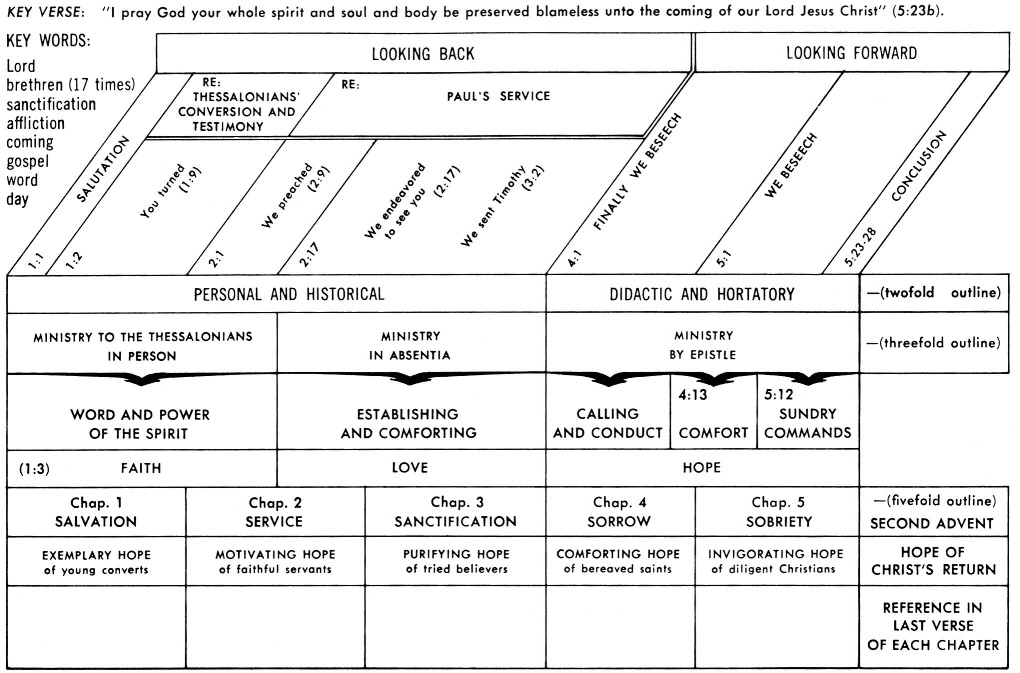
JESUS IS COMING AGAIN
Click chart to enlarge
Charts from Jensen's Survey of the NT - used by permission
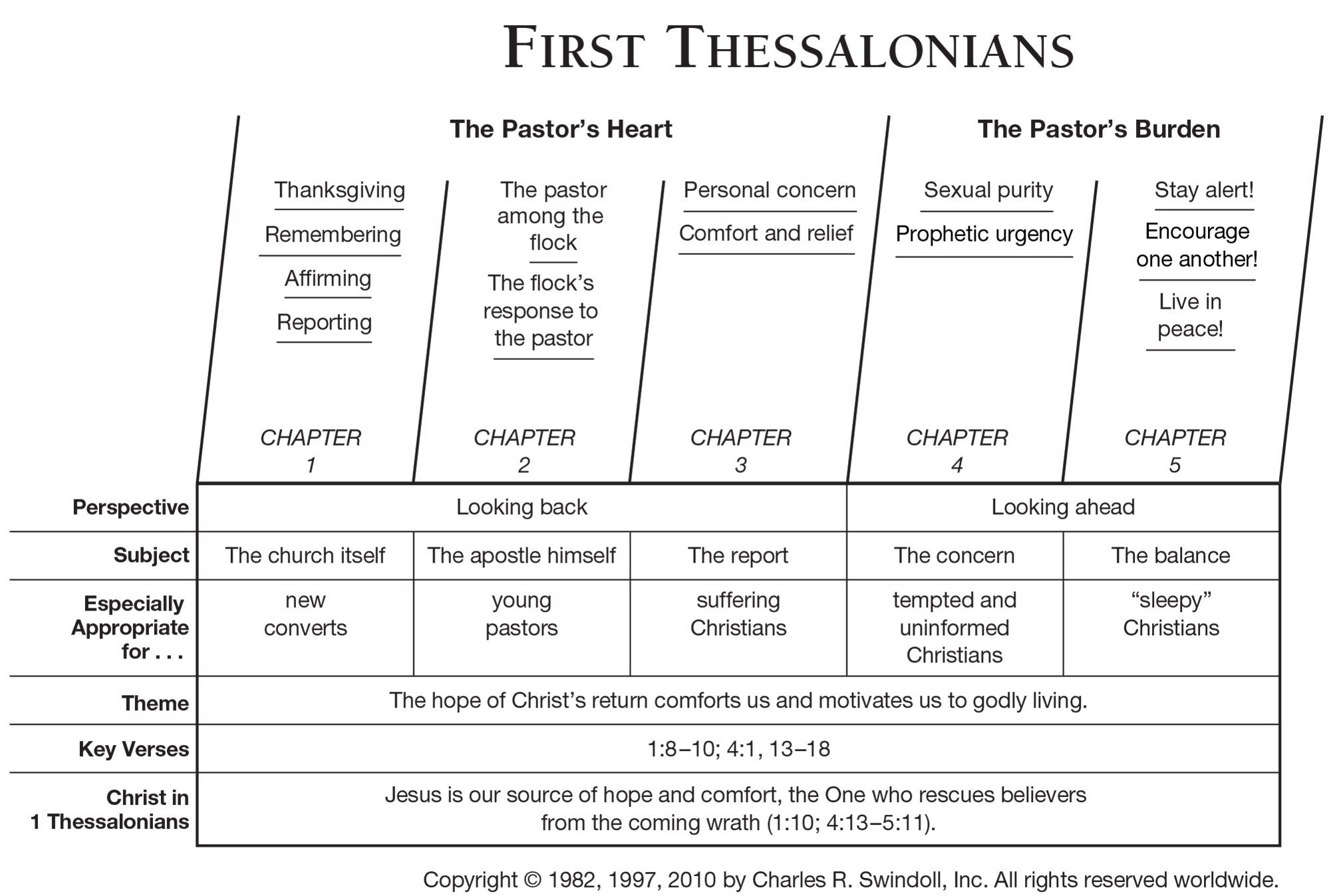
Chart by Charles Swindoll
|
1 Thessalonians |
||||||
| 1 Th 1:1-10 | 1 Th 2:1-20 | 1 Th 3:1-13 | 1 Th 4:1-18 | 1 Th 5:1-28 | ||
|
LOOKING BACK |
LOOKING FORWARD |
|||||
|
Personal Reflections |
Practical Instructions |
|||||
| Ministry In Person |
Ministry in Absentia (Thru Timothy) |
Ministry by Epistle |
||||
| Word and Power of the Spirit |
Establishing & Comforting |
Calling & Conduct | 1Th 4:13ff Comfort |
1Th 5:12ff Commands |
||
| 1 Salvation |
2 Service |
3 Sanctification |
4 Sorrow |
5 Sobriety |
||
| Paul Commends Spiritual Growth |
Paul Founds the Church |
Strengthening of the Church |
Directions for Spiritual Growth |
Holy Living in Light of Day of the Lord | ||
| Exemplary Hope of Young Converts | Motivating Hope of Faithful Servants |
Purifying Hope of Tried Believers | Comforting Hope of Bereaved Saints | Invigorating Hope of Diligent Christians | ||
|
Written from Corinth |
||||||
1 Thessalonians 1:1 Paul and Silvanus and Timothy, to the church of the Thessalonians in God the Father and the Lord Jesus Christ: Grace to you and peace. (NASB: Lockman)
Greek: Paulos kai Silouanos kai Timotheos te ekklesia Thessalonikeon en theo patri kai kurio Iesou Christo; charis humin kai eirene.
Amplified: PAUL, SILVANUS (Silas), and Timothy, to the assembly (church) of the Thessalonians in God the Father and the Lord Jesus Christ (the Messiah): Grace (spiritual blessing and divine favor) to you and [heart] peace. (Amplified Bible - Lockman)
NLT: This letter is from Paul, Silas, and Timothy. It is written to the church in Thessalonica, you who belong to God the Father and the Lord Jesus Christ. May his grace and peace be yours. (NLT - Tyndale House)
Phillips: To the church of the Thessalonians, founded on God the Father and Jesus Christ the Lord, grace and peace from Paul, Silvanus and Timothy. (New Testament in Modern English)
Wuest: Paul and Silvanus and Timothy to the [local] assembly of Thessalonians [which assembly is] in God the Father and the Lord Jesus Christ.
Young's Literal: Paul, and Silvanus, and Timotheus, to the assembly of Thessalonians in God the Father, and the Lord Jesus Christ: Grace to you, and peace, from God our Father, and the Lord Jesus Christ!
PAUL AND SILVANUS AND TIMOTHY: Paulos kai Silouanos kai Timotheos:
- Acts 15:27,32,34,40; 16:19,25,29; 17:4,15; 18:5
- Silvanus 2Cor 1:19; 2Th1:1; 1Pe 5:12
- Acts 16:1, 2, 3; 17:14,15; 18:5; 19:22; 20:4; 2Cor 1:1; Phil 1:1; Col 1:1; 1Ti 1:2; 2Ti 1:2; Heb 13:23
- 1 Thessalonians 1 Resources - Multiple Sermons and Commentaries
A B Simpson has an interesting comment on the Thessalonian epistles writing…
The New Testament epistles have, as a rule, some specific quality or characteristic by which they are known. Romans is the epistle of gospel truth; Corinthians of the Church; Galatians of grace; Ephesians of the highest Christian life; Philippians of the sweetest Christian life; Colossians of the Christ life, etc.
The letters to the Thessalonians are the advent epistles. The one theme that runs throughout the two letters like a sort of golden thread and appears in every chapter in connection with some important and practical doctrine, is the blessed hope of the Lord's coming. So prominently did this subject occupy the preaching of Paul during his visit to Thessalonica, that when his enemies brought charges against him before the rulers of the city, they made this the point of their accusation, that "these that have turned the world upside down have come hither also… and these all do contrary to the decrees of Caesar, saying there is another King, one Jesus." (see notes Acts 17:6-7) It is evident from this that the general impression received from his preaching in Thessalonica was that the Christ to Whom he bore witness was a real King, and was coming again to establish a kingdom on the earth. Otherwise there would have been no possible ground for jealousy on the part of Caesar's friends. Indeed, we know from the very first chapter of his epistle that he began with this theme in his first messages to the unconverted, and it was this that awakened their consciences while still heathen, and led them to turn "to God from idols to serve the living and true God; And to wait for his Son from heaven."
The fact that the letters to the Thessalonians were Paul's earliest epistles, and that this subject occupies so prominent a place in them, makes it very plain that the doctrine of the Lord's coming is not an advanced truth that can only be understood by deeply spiritual Christians. It is one of the primary doctrines of the Gospel, and is part of the very essence of the Gospel of the Kingdom. (A. B. Simpson. Christ in the Bible - Thessalonians)
| FIRST THESSALONIANS Segment Divisions |
|
| Chapters 1-3 | Chapters 4-5 |
|
LOOKING BACK |
LOOKING FORWARD |
| Reminding Encouraging |
Requesting Instructing |
| Personal Experience |
Practical Exhortation |
| Reflections | Instructions |
| Past Salvation |
Present Sanctification |
| Personal and Historical |
Practical and Hortatory |
First Thessalonians is a letter ("have this letter read to all the brethren" - 1Th 5:27) of exhortation (exhort - 1Th 2:3; 2:11, 4:1 - see notes 1Th 2:3; 2:11, 4:1, see related words - urge in 1Th 4:10, 1Th 5:14; encourage in 1Th 2:11,3:2, 5:11, 5:14 See notes -2:11, 3:2 , 5:11, 5:14, comfort in 1Th 4:18).
What is an exhortation? In simple terms it is a message of warning, urging or encouragement which is designed to motivate and/or move the hearers to assume certain attitudes and/or take certain actions. Exhortation is the act of presenting such motives before one's audience that the presentation might excite the listeners to behave or walk in a certain manner especially relating to specific moral principles or ethical standards.
As one reads (and re-reads) the entire letter (preferably without interruption just as you would read a personal letter from a close friend or relative), it becomes obvious that the first three chapters are looking back to past events, reminding and encouraging the saints, whereas the last two chapters switch to a forward look, Paul now requesting and instructing the saints.
As stated above this letter was to be read to all the brethren (1Th 5:27) that they might be encouraged and comforted in much tribulation (1Th 1:6), sufferings (1Th 2:14) and affliction (see note 1Th 3:3, 1Th 3:4) and also to remind them of the coming of the Lord (1Th 1:10, 2:19, 3:13, 4:15, 4:16, 5:23 -see notes 1Th 1:10, 2:19, 3:13, 4:15, 4:16, 5:23).
Who wrote this letter? At first glance, verse 1 mentions Paul, Silas and Timothy. However Paul is rightly listed first not only as the leading member of the triumvirate, but also as the true author of the letter as indicated by use of the singular pronoun "I"…
we wanted to come to you-- I, Paul, more than once-- and yet Satan thwarted us." (1Th 2:18, see also his use of the first person "I" - see 1Th 3:5,, 1Th 5:27).
Why is the purpose of this letter? As alluded to above, Paul had several reasons for writing this letter but the main purpose was that the saints at Thessalonica as well as the saints of all ages might (1) that they might excel still more (see notes 1Th 4:1 and 1Th 4:10) and (2) be unblamable at Christ's coming.
W Graham Scroggie wrote that…
This letter, more than any other of Paul's, is characterized by simplicity, gentleness, and affection… here there is no controversy.
MacDonald has an interesting introductory statement noting that…
Today the Rapture and Second Advent of our Lord are widely believed and looked for by evangelical Christians. This was not always so. The revival of interest in this doctrine, especially through the writings of the early Brethren in Great Britain (1825–1850) was largely based on 1 Thessalonians. Without this short Letter we would be terribly deprived in our understanding of the various aspects of Christ's return. (MacDonald, W & Farstad, A. Believer's Bible Commentary: Thomas Nelson or Logos)
It should be noted that for a writer to begin his letter with his own name was the accepted procedure and devoid of any egotistical implication. In Paul's day the practice was to begin with a salutation, composed of three elements: the writer, the recipients and a greeting and this "formula" was adhered to by Christians and non‑Christians alike.
As Hiebert says
It was certainly more logical than the modern practice of appending one's signature at the close, for who ever reads a letter without first turning to its close to identify the writer? (Hiebert, D. Edmond: 1 & 2 Thessalonians)
Can you imagine the effect on the hearts of the Thessalonian saints as they began to read the first line and realize who this epistle was from? To receive a letter from Paul, who had weathered the storm in Thessalonica successfully, must have greatly encouraged the Thessalonians.
Paul (3972) (click brief overview of his life) is from Latin, Paulos meaning "little, small". Before his Damascus Road experience he was known by his Hebrew name Saul (Greek Saulos) which means "desired", "ask" or "asked for". Paul is always referred to as Saul in Acts until his clash with Bar Jesus at Paphos, when Luke suddenly writes,
But Saul, who was also known as Paul, filled with the Holy Spirit, fixed his gaze upon him (Acts 13:9).
From this point on in Acts (and in the epistles) he is always referred to as Paul . Paul means "little" but there is no evidence in the New Testament that either Paul or any of his contemporaries attached any personal significance to the meaning of his name.
Note that although Paul is the leader and author, he is not in the least self-centered, for he gladly associates his name with the names of these co workers who have labored with him in the work of the gospel at Thessalonica.
One writer refers to these associates as
the joint asserters and approvers of the truth contained in it.
Lenski asserts that
this letter is the voice of the three " as shown by the repeated use of the plural pronoun we.
Only in the Thessalonian epistles does Paul give the salutation without any additional word of identification (like, "apostle", "brother", "bond-servants", etc) for all three men were known and love by the Thessalonians, and that was sufficient. The fact that no official status is necessary indicates the friendly relations between these three men and the readers.
Dwight Pentecost comments that…
The absence of any authoritative title indicates that the apostle is dealing with these Thessalonians in a personal and intimate way because his heart was knit to the hearts of these who were his children in the faith. If one were to turn to Galatians 1:1, he would find that Paul writes, “Paul, an apostle, not of men neither by men, but by Jesus Christ and God the Father who raised Him from the dead.” Paul, in this address, is rising above the personal comment in 1 Thessalonians, and is striking an authoritative note. In the Epistle to the Galatians he deals severely with error and false teachers; he declares the Gospel of the grace of God authoritatively. In the introduction he emphasizes the authoritative appointment which was given to him by the grace of God as he was called of God to be an apostle, a sent one, one who was the minister to the Gentiles. (Pentecost, Dwight: Paul the Prisoner: Part 1: An Exposition of Philemon. Bibliotheca Sacra: Volume 129, Issue 514, page 141, 1972. Dallas TX: Dallas Theological Seminary)
Calvin adds that Paul's omission of a specific claim to apostolic authority is
a proof that those to whom he is writing had had no reluctance in recognizing him for what he was." Hiebert notes that "It is clear that the enemies at Thessalonica had sought to undermine the converts' confidence in Paul, but the attack had not been launched against his apostolic authority. It was rather an attack upon his person, an attempt to destroy the validity of his message by discrediting his character. Thus Paul felt no need to approach the Thessalonians in his official capacity as an apostle; he instead recalled to their memory the facts concerning his character and conduct.
Silvanus (click more in depth discussion) is a Roman proper name ("person of the woods" from Latin "silva" = wood, originally the name of the "god" of the woods) and is generally regarded as synonymous with Silas apparently the contracted form of Silvanus (compare Acts 18:5 with 2Cor 1:19) Luke always calls him Silas, but Paul always uses Silvanus. Upon the separation of Paul and Barnabas, Silas was selected by Paul as the companion of his second missionary journey (Acts 15:40).
Vincent writes that Silvanus is the same as…
Silas of the Acts, where alone the form Silas occurs. By Paul always Silvanos, of which Silas is a contraction, as Loukas from Loukanos. Similar contractions occur in Classical Greek, as Alexis for Alexandros; Artas for Artemas , and that for Artemidoros. Silas first appears in Acts 15:22, as one of the bearers of the letter to the Gentile Christians at Antioch. He accompanied Paul on his second missionary tour, and was left behind with Timothy when Paul departed from Macedonia after his first visit. He was probably a Jewish Christian (see Acts 16:20 "and when they had brought them to the chief magistrates, they said, "These men are throwing our city into confusion, being Jews" - Who at this time were in special disgrace, having been lately banished from Rome by Claudius), and was, like Paul, a Roman citizen (Acts 16:37-38 " But Paul said to them, "They have beaten us in public without trial, men who are Romans, and have thrown us into prison; and now are they sending us away secretly? No indeed! But let them come themselves and bring us out. And the policemen reported these words to the chief magistrates. And they were afraid when they heard that they were Romans" - Cicero in his oration against Verres relates that there was a Roman citizen scourged at Messina; and that in the midst of the noise of the rods, nothing was heard from him but the words, “I am a Roman citizen.” He says: “It is a dreadful deed to bind a Roman citizen; it is a crime to scourge him; it is almost parricide to put him to death.). Hence his Roman name. He cannot with any certainty be identified with the Silvanus of 1 Peter 5:12+] (Probably the companion of Paul known in the Acts as Silas (Acts 15:22, 27, 32, 34, 40, etc.), and called Silvanus by Paul in 2 Cor. 1:19; 1 Thess. 1:1; 2 Thess. 1:1.) (Vincent, M. R.. Word studies in the New Testament)
Silas worked aggressively with Paul during the stirring events of the second missionary journey (Acts 15:40 Acts 18:6).
We hear no more of him in connection with Paul after the apostle left Corinth. Silvanus simply disappears and there is no further mention of him in Acts, nor do the Pauline epistles refer to him in connection with any subsequent event. The specific identity of the Silvanus mentioned in (1 Peter 5:12) is uncertain because the name was common at this time. Silvanus is mentioned only in 1 and 2 Thessalonians.
Note that God uses unknown, unsung believers like Silvanus for His glory and He desires to use you in the same way. Are you submitting your will to His? God desires our availability more that our ability. Silvanus was available for God's use. It did not matter whether he was called to "play second fiddle" to both Paul. Silvanus did not seek glory for himself, but only for his Lord. If God calls you to this lot, will you willingly accept it?
An interesting verse in the Old Testament (KJV) says that
as his part is that goeth down to the battle, so shall his part be that tarrieth by the stuff: they shall part alike. (1Sa 30:24)
Staying "by the stuff" means "staying by the supplies."
David told those who went out to battle the Amalekites that those who stayed by the "stuff" would also receive their share of the reward. Are you willing to "stay by the stuff"? The ministry of prayer and financial support for those who go to the mission field is equally important in the results and the reward.
|
PAUL AND TIMOTHY: |
||
|
47AD |
Paul's first missionary journey took him to Lystra, probably Timothy's home town, so that Timothy either witnessed or heard of Paul's stoning. |
Acts 14 |
|
49AD |
Paul's second missionary journey again to Lystra, where Paul chose Timothy to come with him |
Acts 16:1-3 |
| 49AD | Timothy followed Paul as they trekked westward across Turkey to Philippi where Timothy witnessed Paul and Silas being beaten and imprisoned for the sake of the Gospel |
Acts 16:22, 23 |
| 50-51AD | Paul writes first and second letter to the Thessalonians from Corinth | |
| 55AD | 1Corinthians written - Paul sends Timothy his beloved, faithful "child" in the Lord to remind them of his ways |
1Cor 4:17 |
| 61AD | Philippians written - excellent summary of Timothy's character based on over 10 years as a co-laborer in Christ |
Php 2:19, 20, 21, 22 |
| 66-67AD | Paul's last written communication was to Timothy |
2Ti 1:1, 2, 3 |
Timothy (timotheos from time = worth or merit of some object + theos = God) means "honoring God". The Greek word for "honor" has in it the ideas of reverence and veneration. What a great name. He is mentioned first by name in Acts 16 (during Paul's second missionary journey - see their chronological association in the table above), Luke describing him as
"certain disciple… named Timothy, the son of a Jewish woman who was a believer, but his father was a Greek, and he was well spoken of by the brethren who were in Lystra and Iconium. Paul wanted this man to go with him; and he took him and circumcised him because of the Jews who were in those parts, for they all knew that his father was a Greek." (Acts 16:1-3)
In sum Timothy was half Greek, half Jewish and had been reared in a thoroughly pagan community. Apparently Timothy did accompany Paul on his travels described in Acts 16, a chapter worth reading for context for it describes Paul's first trip into "Europe", upon receiving the vision
in the night (of) a certain man of Macedonia (kingdom lying north of Greece in Paul's time the capital of which was Thessalonica)… standing and appealing to him, and saying, "Come over to Macedonia and help us." And when he had seen the vision, immediately we sought to go into Macedonia, concluding that God had called us to preach the gospel to them." (Acts 16:9-10)
Vincent has a lengthy note on Timothy writing that…
Appears in all the Pauline Epistles except Galatians and Ephesians. He was associated with Paul longer than any one of whom we have notice. First mentioned Acts 16:1, 2: cf 2 Ti 3:10; 2 Ti 3:11. He accompanied Paul on his second missionary tour (Acts 16:3), and was one of the founders of the churches in Thessalonica and Philippi. He is often styled by Paul “the brother” (2Cor. 1:1; Col. 1:1; 1Th 3:2; Philemon 1); with Paul himself “a bondservant of Jesus Christ” (Php 1:1); comp. 1Tim. 2:18; see note 2 Timothy 1:2. Paul's confidence in him appears in Philippians (Philippians 2:19-22), and is implied in his sending him from Athens to the Thessalonian church to establish and comfort its members (1Th 3:2). Paul sent him again to Macedonia in company with Erastus (Acts 19:22), and also to Corinth (1Cor. 4:17). To the Corinthians he writes of Timothy as “his beloved and faithful child in the Lord” who shall remind them of his ways in Christ (1Cor. 4:17), and as one who worketh the work of the Lord as he himself (1Cor. 16:10). He joined Paul at Rome, and his name is associated with Paul's in the addresses of the letters to the Colossians and Philemon. In every case where he is mentioned by name with Silvanus, the name of Silvanus precedes. (Vincent, M. R. Word Studies in the New Testament).
Although it appears Timothy was with Paul and Silas at Philippi, where the latter two were jailed, we do not encounter Timothy name again until Acts 17, in Berea (in Macedonia, 50 miles SW of Thessalonica), Luke recording that upon the occasion of
the Jews of Thessalonica… agitating and stirring up the crowds. (Acts 17:13).
As a result of this Jewish disturbance
immediately the brethren sent Paul out to go as far as the sea and Silas and Timothy remained there (at Berea)." (Acts 17:14)
The relationship between Paul and his young co worker was deep and abiding. Paul associates the name of Timothy with that of his own in the salutation of four other epistles. Timothy himself was the recipient of two letters from the pen of Paul. None of Paul's companions more fully reflected the spirit of the apostle than Timothy, whom he sent to Corinth in order that the Corinthian believers might have a visual reminder of how their spiritual father lived, Paul writing that
I have sent to you Timothy, who is my beloved and faithful child in the Lord, and he will remind you of my ways which are in Christ, just as I teach everywhere in every church." (1 Cor 4:17).
TO THE CHURCH OF THE THESSALONIANS: te ekklesia Thessalonikeon:
- 1 Cor 1:2; Gal 1:2
- Acts 17:1-9,11,13
- 1 Thessalonians 1 Resources - Multiple Sermons and Commentaries
There is an interesting secular article on Thessalonica (See especially the topic Thessalonica in the Roman Era) and its history at Wikipedia.
Church (1577) (ekklesia from ekkaléo = call out in turn from ek = out + kaleo = call, English > ecclesiastical) is literally "the called out ones" or "a company called out".
Ekklesia was the familiar, nonreligious Greek political term for an assembly of citizens "called out" from their homes to assemble and transact public business (used this way by Luke in Acts 19:39).
Although the church as defined in the NT is not found in the OT, the Greek word ekklesia is used in the Septuagint (LXX) to describe Israel (Deut 18:16, Neh 13:1, compare Acts 7:38). Ekklesia used of a lawfully convened assembly of citizens in a Greek city in Acts 19:39, of a riotous mob in Acts 19:32, 41, of an assembly consisting exclusively of professed believers, 1Cor 1:2, cp. Acts 5:11, 14, of the whole company of the redeemed of this age, described as the church which is His [Christ's] body (see Matthew 16:18;Ephesians 1:22,23). In Acts 9:31 there is an isolated instance of its use in the singular to include all believers in a country—Palestine.
In his five earlier epistles (First and Second Thessalonians, Galatians, First and Second Corinthians), Paul addresses the assembly and in the four later (Romans, Philippians, Ephesians, Colossians) he addresses the saints.
Paul uses the term here in the same way as he did writing
to the church (ekklesia) of God which is at Corinth, to those who have been sanctified in Christ Jesus, saints by calling, with all who in every place call upon the name of our Lord Jesus Christ, their Lord and ours." (1Cor 1:2)
Not every gathering of religious people was a church for there were a number of other "assemblies" (ekklesia) in Thessalonica, including cults gathered around the gods of the pantheon and ancient labor unions gathered behind the ideology of their craft. This fact helps explain why Paul went on to give not just the physical address of this "assembly" but also its spiritual address (in God).
For the Jews of the Dispersion and the devout pagans who frequented the synagogues, ekklesia also had a religious connotation. In the Greek Bible (Septuagint = LXX)) the term was used of the Israelites assembled for religious purposes. The Septuagint usage however has no reference to the meaning of ekklesia as used by Paul, for the truth of the the church composed of Jews and Gentiles was a mystery not revealed until the New Testament. In the Septuagint ekklesia referred to the assembled people of God. This religious connotation led to its distinctively Christian usage as the assembly of the believers in Jesus Christ. When the Jewish nation forfeited its prerogative of being the distinctive people of God through its rejection of the Messiah, the believers in Jesus Christ carried on the claim to be the true ekklesia, the Christian church. With the multiplication of Gentile converts the term church lost its Jewish implications and became the distinctive designation of a spiritual fellowship that transcended all racial distinctions, not just Jew and Gentile. Barclay observes that "In the New Testament the Church is always a company of worshipping people who have given their hearts and pledged their lives to Jesus Christ."' It is interesting that in the New Testament the word church never means a building. In contrast ekklesia stresses that we are a people called out of the world (an elect assembly) unto the Lord to represent Him in a fallen world.
In this salutation then "church" clearly refers to a local church.
The thought of the church as the whole company of the redeemed of this age, the universal church, is not developed in the Thessalonian letters. Elsewhere in the New Testament this latter concept is fully developed so that we see the church, not ever as a building, but as a living organism, composed of living members called out of the domain of darkness, joined together; forming the body of Christ, through which He works, carries out His purposes and lives His life. Everyone who has been saved belongs to the body of Christ -- the universal church. The universal church is manifested in the world by individual local churches, each of which ideally is to function as a microcosm of the body of Christ.
This letter is addressed to the entire local membership, not just to the leaders, such as the elders and teachers.
Of the Thessalonians (in Macedonia, northern Greece) (Click here for map of ancient Greece with location of Thessalonica) There was a sizable Jewish population and it was Paul's custom when he arrived at a new city to go to the synagogue of the Jews. We know that Paul was in Thessalonica at least three weeks before riots broke out. Luke gives us the background for the "birth" of the local assembly in God and the Lord Jesus Christ (church) at Thessalonica recording that
when (Paul and Silas and probably Timothy)… had traveled through Amphipolis and Apollonia, they came to Thessalonica, where there was a synagogue of the Jews. And according to Paul's custom, he went to them, and for three Sabbaths reasoned with them from the Scriptures, explaining and giving evidence that the Christ had to suffer and rise again from the dead (in short he spoke the gospel to them), and saying, "This Jesus whom I am proclaiming to you is the Christ." And some of them were persuaded and joined Paul and Silas, along with a great multitude of the God-fearing Greeks and a number of the leading women. But the Jews, becoming jealous and taking along some wicked men from the market place, formed a mob and set the city in an uproar; and coming upon the house of Jason, they were seeking to bring them out to the people. And when they did not find them, they began dragging Jason and some brethren before the city authorities, shouting, "These men who have upset the world have come here also and Jason has welcomed them, and they all act contrary to the decrees of Caesar, saying that there is another king, Jesus." And they stirred up the crowd and the city authorities who heard these things. And when they had received a pledge from Jason and the others, they released them. And the brethren immediately sent Paul and Silas away by night to Berea; and when they arrived, they went into the synagogue of the Jews. (Acts 17:1-10)
Do you know the history of your local church? Did your church start on biblical principles? Most churches start with a passion to reach those in their community for Christ.
In 315 B.C. the Macedonian king Cassander rebuilt the city and named it Thessalonica after his wife who was half–sister to Alexander the Great. Rome annexed Macedonia in 167 B.C. and then gave her the status of a "free city" in 42 B.C. with many privileges provided by the Roman government and with autonomy in all internal affairs. The population rose to circa 200,000 during Paul's era. Today, Salonika has a population of 70,000 and resides on the same foundation as old Thessalonica. It is a bustling city of commerce in northern Greece and is one of the few New Testament cities still flourishing. The ancient city gate through which Paul entered the city is still standing.
Thessalonica in Paul's day was at the zenith of its splendor. Famous hot springs attracted tourists. It possessed a natural harbor situated on the Thermic Gulf which made it one of the world's greatest docking yards. Xerxes the Persian established his naval base at this bay when he invaded Europe. It lay about 100 miles southwest of Philippi and was at that time a more important center than Philippi, a Roman colony, while Thessalonica had a predominantly Grecian culture. This ancient city was located on the great Roman road that went from the Adriatic Sea to the Middle East called the Via Egnatia or Egnatian Way. The main street of city of Thessalonica was actually part of that road. This fact along with the excellent natural harbor were important factors that enabled the spread of the Gospel to all the world.
IN GOD THE FATHER AND THE LORD JESUS CHRIST: en theo patri kai kurio Iesou Christo:
- 2 Th 1:1 1Jn 1:3 Jude 1
- 1 Thessalonians 1 Resources - Multiple Sermons and Commentaries
you who belong to God the Father and the Lord Jesus Christ (NLT)
As alluded to earlier, after Paul had given their "physical address", he followed with there all important "spiritual address."
In God the Father distinguishes this assembly from any pagan secular or religious assembly ( which is what the word "ekklesia" meant in secular Greek), whereas "and the Lord Jesus Christ" distinguishes it from Jewish assemblies (they were "in God" but not "in Christ").
Of the two addresses, one's spiritual address is the more important. If we have come to Christ, we must see ourselves as primarily new creatures "in the Lord Jesus Christ," and "in God the Father." Paul stresses this truth throughout the letter. The root and ground of the church of Thessalonica's spiritual existence and her power in the pagan culture was based on her union (in) with the Father and the Son.
Paul's indication of the character of the readers gives a clear indication of the essential nature of the Christian church. Its members are people who have received and accepted the call of God and Christ unto eternal life and thus have been separated from the world in its spiritual alienation and death. They have been brought into a new sphere of life, into vital union in God the Father and the Lord Jesus Christ. Note how Paul places the two names side by side on a basis of equality providing clear witness to his conviction concerning the deity of Jesus Christ for to unite the name of a mere man, however exalted, with the eternal God Would have been unthinkable for a strong monotheist like Paul.
W E Vine comments that the preposition in "is frequently used by Paul to express intimacy of union, and is not readily explained by any simpler term. Here it introduces the spiritual description and may be paraphrased thus: "in relationship with God, as Father, and with Jesus Christ as Lord. (Collected writings of W. E. Vine)
Paul reiterates this principle of union describing
the churches of Judea which were in Christ (Gal 1:22)
In the New Testament Paul usually addresses the church in a specific place but here his emphasis is on the vital union of believers have with the Father and the Son. This new sphere is one of communion and participation with God and served to remind the Thessalonian saints of their new sphere of spiritual life and security. As such, it focused them on their intimate union and spiritual relationship with God the Father and the Lord Jesus Christ. This union of believers in the local body is in keeping with Jesus' prayer
that they (the men the Father gave to the Son) may all be one; even as Thou, Father, art in Me, and I in Thee, that they also may be in Us; that the world may believe that Thou didst send Me. (John 17:21).
This union in the Father and the Son is the basis for unity and spiritual growth in the church.
Furthermore the church at Thessalonica was undergoing persecution and needed to be reminded of their sphere of protection and provision which was in God. When you experience persecution for holding to the name of Jesus remember that they can "kill the body, but are unable to kill the soul" (Mt 10:28) because "your life is hidden with Christ in God." (3:3) Remembering the truth of this union with God and Christ was to be a source of comfort in the persecution and testing of the Thessalonian saints.
THOUGHT: No matter what our sphere of trouble or pain, as believers we need to remember the spiritual sphere in which we also live as those who are in God the Father and in the Savior, the Lord Jesus.
Barnes writes that Paul uses "strong language, denoting, that they were a true church" for as John writes
"we know that the Son of God has come, and has given us understanding so that we may know Him Who is true and we are in Him Who is true, in His Son Jesus Christ. This is the true God and eternal life." (1Jo 5:20)
Hiebert agrees with the idea of union writing that the members of the church in Thessalonica
are people who have received and accepted the call of God and Christ unto eternal life and thus have been separated from the world in its spiritual alienation and death. They have been brought into a new sphere of life, into vital union with God the Father and the Lord Jesus Christ. Their faith and experience center in these two names… Their new life as an assembly was the development of the communion that flowed from that new relationship with Christ. (1 & 2 Thessalonians: BMH Book. 1996)
God the Father is a family term which only applies to those who have been born again. John records for example that although Jesus
came to His own (Jews)… those who were His own did not receive Him. But as many as received Him, to them He gave the right to become children of God, even to those who believe in His name who were born not of blood, nor of the will of the flesh, nor of the will of man, but of God. (Jn 1:12-14)
Paul adds that "you are all sons of God through faith in Christ Jesus. (Gal 3:26)
John sums it up writing "See how great a love the Father has bestowed upon us, that we should be called children of God; and such we are. For this reason the world does not know us, because it did not know Him. (1Jn 3:1+) and "Whoever believes that Jesus is the Christ is born of God; and whoever loves the Father loves the child born of Him." (1Jn 5:1)
The Thessalonian saints had come to know God, the eternal, omnipresent, omnipotent One, as their own Father. Being our Father, God expects honor, obedience, and confidence from us as His children while He deals with us in grace, pity, and love (Ps 103:12-14; Mt 6:25-34 - see notes Mt 6:25-26, 6:27-29, 6:30-32, 6:33-34). At the same time this means that believers in Christ become His children by the new birth (John 1:12-13; Gal. 3:26) who are to look to the Father for direction, provision, and protection (Mt 6:34)
Lord (2962) (kurios) means Master or owner, the one who has the control over the disposal of anything.
Jesus is the English form of the Greek Iesous , which is a transliteration of the Hebrew Joshua which means Jehovah is salvation. In the Septuagint (Greek translation of the Hebrew OT) Kurios was the translation for Jehovah or Yahweh, the God of Israel, Who is none other than the incarnate Jesus, the Savior, Whom Christians accept and confess as the Christ, the Anointed One, the promised Messiah, the expected Deliverer awaited by God's people.
Christ is Greek Christos (from chrio = to smear with oil) corresponding to the Hebrew "Messiah" which describes one who has been ceremonially anointed, and is found in the Old Testament over thirty times, sometimes used in a literal anointing but other times describing a figurative anointing as of priests or kings. Paul uses the phrase “in Christ Jesus,” or “in Christ,” (never “in Jesus” nor “in Jesus Christ”) to
express the intimacy of the mystical union between the believer and the Lord in His death and resurrection. There are no simpler words available to explain the term, which is pregnant with meaning for those who have the mind of Christ. (Vine)
GRACE TO YOU AND PEACE: charis humin kai eirene:
- Ro 1:7; Ep 1:2
- 1 Thessalonians 1 Resources - Multiple Sermons and Commentaries
The common greeting among the Greeks was chairein ("rejoice, greetings")" while the Hebrew greeting was shalom ("peace, prosperity, wellbeing"). Christianity took these everyday words of greeting and transformed them into vehicles able to convey the distinctive truths of the gospel.
William Barclay writes: When Paul took and put together these two great words, grace and peace, charis and eirene, he was doing something very wonderful. He was taking the normal greeting phrases of two great nations and molding them into one.
What makes this greeting unique is that it is the only epistle where Paul writes nothing concerning the source of the grace and peace. For example, in the second epistle he writes "Grace to you and peace from God the Father and the Lord Jesus Christ." (2Th 1:2).
Grace (5485) (charis) is God’s free, unmerited favor bestowed through Christ upon guilty sinners. Grace is God's provision for us because of the death of Christ for our sins. God is the Source for all our provisions. We do not earn nor deserve His gifts. We do not deserve anything from God except condemnation and eternal punishment. Nothing undermines self-effort more than the grace of God. The Bible personifies Jesus as "grace." "For the grace of God has appeared bring salvation to all men…" (Titus 2:11). If people do the doing, they get the glory. If God does the doing, then God gets the glory. Grace glorifies God, because God does the doing.
Peace (1515) (eirene = from the verb eiro = binding or joining together what is broken or divided and set at one again) means set at one again and bringing about confident and unrestrained access after alienation.
Remember that because of a believer's position in Christ (justified by grace through faith - see for example Ro 5:1) every believer has peace with God but sadly not all Christians have the peace of God in their hearts. So many are disturbed in their spirit for their spiritual eyes are not open to (or accepting of) God's sovereign hand in their personal lives. As someone has said, many believers are so anxious and exercised about life events that they act (and react) as if God had taken the day or month or year off (this is "practical deism", belief that there is a God but that He has stepped back to let the universe meander along whatever path it will!). As you study this short letter to the Thessalonians, note that experiential peace is a gift of God and a gift that Paul prays for in this benediction but even this gift has to be received, for it does not happen magically, but as we sit at the Master's feet, allowing the Spirit to marinate our minds with His precious Word of Truth (Psalm 19:7 "The Law [Word] of the LORD is perfect, restoring the soul"!] and as we meditate on the truth about God, the Spirit will transform our thinking and renew our minds (Eph 4:23, Ro 12:2 cf 2 Cor 4:16, Col 3:10+; Col 3:11) so that we see the events in our everyday life not from our natural human perspective but from God's supernatural divine perspective (not as "little gods" but as "partakers of His divine nature" -2 Pe 1:4), with a "God's eye view" so to speak. Biblical peace is the ability to sit down on the inside. Remember that Jehovah is still the same, yesterday, today and forever (Heb 13:8) and therefore His promise remains certain that…
Thou wilt keep him in perfect peace, whose mind is stayed on thee: because he trusteth in thee. (Isaiah 26:3, KJV) (Comment: Perfect peace in Hebrew is the word Shalom [see discussion of Shalom and notes on Jehovah Shalom: LORD is Peace] repeated which more literally peace, peace. This is "peace that passes all human understanding [Php 4:7]. Remember that God is speaking to Israel in Isaiah and thus the specific application is to the faithful in Israel during the Great Tribulation [an interpretation arrived at from observing the context], but the principle certainly is true for all believers of all ages. Praise The Lord!)
One of the best illustrations I have ever heard of peace is the following story from missionary Jim Walton who was translating the New Testament for the Muinane people of La Sabana in the jungles of Colombia. But he was having trouble with the word peace. During this time, Fernando, the village chief, was promised a 20-minute plane ride to a location that would have taken him 3 days to travel by walking. The plane was delayed in arriving at La Sabana, so Fernando departed on foot. When the plane finally came, a runner took off to bring Fernando back. But by the time he had returned, the plane had left. Fernando was livid because of the mix-up. He went to Jim and launched into an angry tirade. Fortunately, Walton had taped the chief's diatribe. When he later translated it, he discovered that the chief kept repeating the phrase, "I don't have one heart." Jim asked other villagers what having one heart meant, and he found that it was like saying,
There is nothing between you and the other person.
That, Walton realized, was just what he needed to translate the word peace. To have peace with God means that there is nothing--no sin, no guilt, no condemnation--that separates us. And that peace with God is possible only through Christ (Ro 5:1). Do you have "one heart" with God? … with your fellow man (husband, wife, children, co-workers, etc)?
Grace is the cause and peace, the effect or the result to all who receive that favor in Christ. Grace is fountain of which peace is the stream. We must experience God's grace before we can experience His peace and thus these two words sum up the gospel, grace being the "cause" and peace the "effect". We cannot reverse the order for if we bypass grace, we cannot possibly have peace in our life. Christians must live their life based on grace. We cannot live the supernatural, abundant life on our own resources.
Richison writes that…
Before anyone can become a Christian, he or she must believe in an irreducible minimum of the gospel. No unbeliever can have true peace without accepting Jesus as Savior. Isaiah reminds us
"But the wicked are like the troubled sea, when it cannot rest, whose waters cast up mire and dirt. There is no peace, says my God, for the wicked (Isaiah 57:20–21) (See note 1Thessalonians 1:1)
Peace is that precious sense of inner tranquility and well being that comes to those who have been reconciled to God through Christ and are no longer at war with their Creator. Isaiah tells us that on the other hand
the wicked are like the troubled sea, when it cannot rest, whose waters cast up mire and dirt. 'There is no peace,' Says my God, 'for the wicked'" (Isa 57:20-21)
Paul sums it up in Romans explaining that we have been
justified as a gift by His grace through the redemption which is in Christ Jesus" (Ro 3:24) and
having been justified by faith, we have peace with God through our Lord Jesus Christ" (Ro 5:1)
Both the Father and Son are the source of grace. Christians must live their life based on grace. We cannot live the supernatural Christ life on our own resources. If we draw upon God's resources, we will possess His peace. Grace and peace are a couplet. We cannot have one without the other.
The order in the New Testament is always "grace and peace," never the reverse. No one can experience peace without first receiving the grace. Every believer has peace with God, but not all Christians have the peace of God. So many churn inside because they do not understand and therefore fail to see God's sovereign hand in every circumstance of their life. To experience this peace of God, one must soak one's mind with the Word of God and prayer. Although the context is different the principle in Isaiah applies that God
will keep in perfect peace all who trust in (Him), whose thoughts are fixed on (Him)! (NLT, Isa 26:3)
Biblical peace is the supernatural given ability to "sit down" on the inside. Are you standing up on the inside? Fix your thoughts on the Prince of Peace. Peace is the consequence of appropriating grace to our life. We cannot reverse this order. If we bypass grace, we cannot possibly have peace in our life.
The peace described here is in marked contrast to that Paul describes later in this same epistle warning unbelievers that
While they are saying, "Peace and safety!" then destruction will come upon them suddenly like birth pangs upon a woman with child; and they shall not escape. (1Th 5:3)
Keathley adds that
One of the signs and characteristics of the last days will be man’s clamor and pursuit of peace. But like a man trying to grasp oil with his hand, real and lasting peace will escape all those who seek it outside of the Lord. The society of the last days, as has been the case with the nations as a whole, will seek peace and safety by every avenue imaginable other than by God’s grace in Christ. Mankind typically seeks it through the occult, through drugs and alcohol, materialism, entertainment, wealth and possessions, religionism (man seeking the approbation of God and men by good works) which rejects grace, humanism, astrology, pantheism, and the list goes on.
C H Spurgeon well says that…
Blessed men scatter blessings. When the benediction of God rests upon us, we pour out benedictions upon others. (The Second Coming)
Guy King (in his expositional commentary on Philippians, Joy Way,1952 - online version) writes that…
Grace and peace - just the customary greeting:
"grace", the Western (or Greek)
"peace", the Eastern (or Hebrew)
but when the HOLY SPIRIT led Paul to combine them here, we may be sure that He intended their use to be something so much more than formal and usual; both writer and readers would be led to see in them very deep and rich meaning.
Wilson Cash makes the interesting suggestion that
Paul combines both Jewish 'peace' and Gentile 'grace' in one salutation as a pledge of unity between East and West, between Jew and Gentile, in the one Saviour, who unites all in the one fellowship of His Body.
Dr. Hugh Michael, in the Moffatt Commentary, speaks of
the enrichment of the commonplace by the new faith of CHRIST, which elevates a salutation into a benediction.
How arrestingly that is seen in the transmutation of everything, however lowly, that He touched - a common Name, a despised City, a humble workshop, even a felon's Cross.
Dr. Johnson said of Oliver Goldsmith,
He touched nothing that he did not adorn: how infinitely truer of the Master. So here the common greeting is invested with uncommon beauty.
What are these things that the apostle desires for his friends, and which are no less desirable for ourselves?
(a) Grace - a quality which is, at once
(i) an Attitude, which He adopts towards us, as in Ephesians 2:8 (note);
(ii) an Activity, which He exerts for our help, as in 1Corinthians 15:10; and
(iii) an Accomplishment, which He works in, and out from, us, as in Acts 4:33.
Paul ardently, and prayerfully, desires for his converts everywhere - for he uses the words in all his church letters - that they may experience to the full this "grace", which the late Bishop Handley Moule describes as "love in action".
Then comes:
(b) Peace - the "God of all grace" is the "God of peace", 1 Peter 5:10+); Romans 15:33+); and it is only by, and after, His grace that we can enjoy His peace.
- Peace of heart - no condemnation before GOD
- Peace of conscience - no controversy with GOD
- Peace of mind - no anxiety about life
- Peace of action - no grit in the machinery
This gift is an immensely precious boon; and it may be the possession, should be the possession, of every believer. Paul will have some deep things to say about this later.
These two joys come, says Philippians 1:1, "from God our Father, and from the Lord Jesus Christ" - the Father is the Source, from whom they come; the Saviour is the Medium, through whom they come. Not from the world arise such blessings, nor from our circumstances, however affluent and pleasant, nor from our own inner being, however much we strive, but only from Him, through Him, and "all the fulness of the Godhead … and ye are complete in Him" (Col 2:9-10) (King, Guy, Joy Way,1952 - online version)
To you marks the writers' desire that both the grace and peace would be the Thessalonians' in personal experience and in increasing measure.
1 Thessalonians 1:1 - A Gift Of Grace - In high schools in the US, being elected homecoming queen is a great honor for any young woman. But when a high school near Houston, Texas, crowned Shannon Jones, it was a special moment for her and for everyone in the community. Nineteen-year-old Shannon, who is an award-winning athlete and an active member of her church youth group, has Down syndrome.
Shannon knew this once-in-a-lifetime experience was a gift from her younger sister Lindsey, who was the catalyst to elect her. Their dad said, "I'm so proud of Lindsey. Probably somewhere in the back of her mind, this is something she'd like to do." But she made it happen for Shannon.
The most inspiring acts of human love are only a shadow of the immeasurable gift our Savior has given us. Paul wrote, "You know the grace of our Lord Jesus Christ, that though He was rich, yet for your sakes He became poor, that you through His poverty might become rich" (2 Corinthians 8:9).
Christ left His glory in heaven and died on the cross for our sin so that we could be forgiven through faith in Him. His sacrifice was based on His love, not on our merit. All we are and all we have are the Savior's loving gifts of grace to us.—David C. McCasland
God gives His grace so rich, so free—
No one will He deny;
For He has promised in His Word
An infinite supply. —D. De Haan
Grace is an unearned blessing to unworthy sinners.
1 Thessalonians 1:2 We give thanks to God always for all of you, making mention of you in our prayers (NASB: Lockman)
Greek: Eucharistoumen (1PPAI) to theo pantote peri panton humon, mneian poioumenoi (PMPMPN) epi ton proseuchon hemon,
Amplified: We are ever giving thanks to God for all of you, continually mentioning [you when engaged] in our prayers, (Amplified Bible - Lockman)
NLT: We always thank God for all of you and pray for you constantly. (NLT - Tyndale House)
Phillips: We are always thankful as we pray for you all, for we never forget… (New Testament in Modern English)
Wuest: We are always giving thanks to God concerning all of you, making mention of you in our prayers,
Young's Literal: We give thanks to God always for you all, making mention of you in our prayers
WE GIVE THANKS TO GOD ALWAYS FOR ALL OF YOU: Eucharistoumen (1PPAI) to theo pantote peri panton humon:
- Ro 1:8,9; 6:17; 1 Co 1:4; Eph 1:15,16; Php 1:3,4; Col 1:3; Phile 1:4
- 1 Thessalonians 1 Resources - Multiple Sermons and Commentaries
We instead of "I" suggests the three men were united in their thanksgiving. Note that the ground of their thanksgiving is the saints at Thessalonica ("you").
Vine comments that
Christians differ in attainment, but there is always something of Christ in each, and hence always something for which to thank God, since Christ is the oil that feeds the lamp of praise. (Vine, W. Collected writings of W. E. Vine. Nashville: Thomas Nelson or Logos)
Thanksgiving and prayer were frequent in Paul's opening, as for example in his epistle to the Romans writing
I thank my God through Jesus Christ for you all, because your faith is being proclaimed throughout the whole world. For God, whom I serve in my spirit in the preaching of the gospel of His Son, is my witness as to how unceasingly I make mention of you. (see note Romans 1:8-9)
He wrote to the Ephesians that he did
not cease giving thanks for (them), while making mention of (them) in (his) prayers. (Eph 1:16)
To the Philippian church Paul wrote
I thank my God in all my remembrance of you, always offering prayer with joy in my every prayer for you all, in view of your participation in the gospel from the first day until now." (Php 1:3-4)
One wonders how Paul was able to keep them all continually in mind without a "palm pilot"!
It is worth noting that only 2 Corinthians and Galatians, which are letters of severe correction, lack Paul’s usual report of thanksgiving.
Give thanks (2168) (eucharisteo from eú = well, + charízomai = to grant, give) means to show oneself grateful, be thankful or give thanks.
Thanksgiving is the capacity to appreciate God's goodness to us - even the disagreeable things that happen to us. We come to realize that everything that God allows to come into our lives, He does for our good (Ro 8:28). The regularly recurring nature of the thanksgiving is implied in the use of the present tense of the verb. It was their practice to give thanks to God "continually, never skipping a single day.
A reading of the Pauline epistles makes clear that Paul assigned a high place to thanksgiving in the Christian life. You can always tell a person's values by what he or she appreciates. Paul and his team constantly expressed their gratitude for God's operation in their lives and His work in the lives of the saints at Thessalonica. Rather than being a source of grief these Christians evoked gratitude. In this they served as models for all Christians. Do others give thanks to God for you or do you serve as a source of grief?
Hiebert commenting on the we writes…
That Paul should thus include his two co-workers in the thanksgiving is consistent with the fact that all three stood in the same close relation to the Thessalonians. It is further in accord with the consistent use of the plural in this epistle." He goes on to comment that "This expression of his thanks to God is an illustration of Paul's practice of taking his various experiences, whether sad or glad, into the presence of God. All experiences were viewed in relation to Him. Thus he practiced the presence of God in his life.(1 & 2 Thessalonians: BMH Book. 1996)
THOUGHT - Do you see all that comes into your life whether sad or glad as allowed by an omnipotent God Who is in control no matter how you feel?
Later in this letter Paul calls his readers and us to
Rejoice always, pray without ceasing (and) in everything give thanks for this is God's will for you in Christ Jesus." (1 Th 5:16-18-notes vv16; 17; 18)
The Pulpit Commentary writes that "Thanksgiving is the joy of the redeemed in heaven; it is the outpouring of the Christian heart upon earth. The nearer we can approach to perpetual thanksgiving, the nearer we draw to heaven. Sursum corda! — Lift up your hearts! is an exhortation which we daily need. May God give us grace to answer daily, hourly, "We lift them up unto the Lord… Thanksgiving and prayer ever go together. The man who prays earnestly must give thanks, for prayer brings him into the sense of God's most gracious presence; and with that presence cometh joy — joy in the Lord. True prayer must involve intercession, for in answer to prayer the Holy Spirit is given; and the first, the chief of the fruits of the Spirit is love. St. Paul is a remarkable example of perseverance in intercessory prayer. (The Pulpit Commentary: New Testament)
Thanksgiving to God for the Thessalonian believers was prompted by their Christian virtues (1 Th 1:3), their divine election (1 Th 1:4, 1 Th 1:5-7), and the reports of others concerning the nature and results of the mission at Thessalonica (1 Th 1:8-9,1 Th 1:10).
To God - This indicates that the thanksgiving is Godward, to "the" (the definite article here indicates specificity) God, the one true God already identified in the salutation, Who stands in contrast to the many false pagan gods the Thessalonians served before they came to know Him (cf 1 Th 1:9). Although Paul was full of thanksgiving because of the good report concerning the Thessalonians, he did not simply congratulate them on their "success", for he was aware that any praiseworthy spiritual results were ultimately from God, to Whom belonged the glory.
Always (3842) (pantote) means at all times and all occasions which indicates that their thanksgiving was continual and regularly repeated, not sporadic or occasional. a
THOUGHT - Would you characterize your prayer life as always thankful to God for something or someone? It's a good habit to develop.
An attitude of persistent prayer permeates the Scriptures: When Saul had disobeyed God, nevertheless Samuel said "as for me, far be it from me that I should sin against the LORD by ceasing to pray for you; but I will instruct you in the good and right way. (1Sa 12:23)
The psalmist writes "Evening and morning and at noon, I will complain and murmur, and He will hear my voice." (Ps 55:17)
And again "Seven times a day I praise Thee, because of Thy righteous ordinances. (Ps 119:164).
Paul exhorts saints to...
Always be prayerful (NLT, Ro 12:12),
With all prayer and petition pray (present tense - continually) at all times in the Spirit, and with this in view, be on the alert with all perseverance and petition for all the saints (Eph 6:18),
Devote (present imperative - charge to do as a lifestyle, make it part of the "air you breathe") yourselves to prayer, keeping alert in it with an attitude of thanksgiving (Col 4:2), (describing Epaphras) as "always laboring earnestly for you in his prayers, that you may stand perfect and fully assured in all the will of God" (Col 4:12), and in this letter to
Pray (present imperative - charge to do this continually) without ceasing (1Th 5:17).
All of you - This indicates that the thanksgiving was "all inclusive" and included all the Thessalonian believers without exception. We do not have to approve of Christians to pray for them. They do not have to answer to us before we can pray for them. Paul was well aware of the imperfections that still existed in the Thessalonian church, writing that
we night and day keep praying most earnestly that we may see your face, and may complete what is lacking in your faith. (1 Th 3:10)
We can and should be thankful for our fellow believers in spite of their imperfections. How encouraging this must have been to every believer in Thessalonica as they took in Paul's words like a breath of fresh air.
THOUGHT - Is your communication with other saints encouraging like a breath of fresh air or discouraging and disparaging like a stench of decaying matter? (see illustration below)
The true shepherd knows his sheep; he loves them all, he prays for all. He does not divide them into parties. The closer his own walk with God, the more he is enabled to keep himself apart from and above party divisions. But the infant Thessalonian Church seems to have enjoyed the blessing of unity. It was not, like Corinth, distracted by strife and party feeling (Pulpit Commentary)
MAKING MENTION OF YOU IN OUR PRAYERS: mneian poioumenoi (PMPMPN) epi ton proseuchon hemon:
- 1 Thessalonians 1 Resources - Multiple Sermons and Commentaries
Making mention (3417) is two separate Greek words which more literally is rendered "making remembrance" and in the present tense indicates that it was the habit of their life to "pray without ceasing" (1Th 5:18).
The gospel team did not take time to dial God… they did not need to. The receiver was off the hook. They had a good connection and ready access to heaven and were in constant close communication with the throne room of the Almighty. The verb is in the middle voice (meaning the subject initiates the action and participates in the results or effects) which indicates they had a personal interest in praying for the Thessalonians. Paul is saying that he makes mention of them in prayer. He calls people by name in prayer. This is the only good - gossip on your knees! Paul loved God's people enough to pray specifically for them by name. Prayer takes memory. How many fellow Christians do you remember in prayer?
The spiritual occasion for thanksgiving came during Paul and his associates’ prayers. It doesn’t mean that they didn’t express their gratitude at other times, but the most important thanksgiving was given to God who enacted and enabled the Thessalonians’ conversion. The writer of Hebrews associates prayer with thanksgiving exhorting us that
through Him (Christ) then, let us continually offer up a sacrifice of praise to God, that is, the fruit of lips that give thanks to His name. (see note Hebrews 13:15)
Prayers (4335) (proseuche) refers to prayers to God and conveys the ideas of adoration, devotion, and worship. If you are like me, too often we rush into His presence, blurting out our needs, when we should be adoringly approaching His throne of grace with a sense of deepest reverence and thankfulness. Remember that thanksgiving implies gratitude and also perfect submission to the will of God. It is only when we are fully convinced that God is working all things together for good that we can really give to Him the perfect gratitude which believing prayer demands.
Imitators of Christ - A respected author on Christian ethics. E. Calvin Beisner, said that when he was younger he greatly admired a very intelligent and articulate theology teacher for whom he worked. He imitated the older man’s “study habits, manners of speech, and writing style.” Beisner said, “And while I now recognize that some of that imitation was juvenile, I am convinced that I grew because of it.”
Having a godly role model can be very helpful, especially for Christians who are young in the faith. The trouble with all human models, however, is that they have flaws and sooner or later will disappoint us. Beisner experienced this. He gradually became aware that this teacher treated his assistants shabbily and showed little appreciation for their abilities. He tended to magnify his own accomplishments, even tot he point of stretching the truth.
How can we avoid being disillusioned by the spiritual examples we admire? The secret is to imitate them but not idolize them. Paul saw himself as a copy to be followed only tot he extent that he reflected the original. Therefore he wrote, “Imitate me, just as I also imitate Christ.” It’s good to follow godly examples, but our worship must be reserved for Christ alone.
What you worship
determines what you become.
Mary Chestnut's father-in-law had the enduring habit of returning thanks after his meals. As he left the table he would invariably say, "I thank God for a good dinner." When asked why he didn't pray prior to eating, he replied “My way is to be sure of a thing before I return thanks for it."
Christians never fear that giving thanks involves a gamble. Their experience verifies that nothing will ever be more certain than God's provisions for life. The feeding of the four and five thousand people offers a parable of God's provisions. After everyone had eaten to complete satisfaction, seven and twelve basketsful remained. Left over! Ready to serve to others! That's what Jesus accomplishes with those who commit themselves to him. For the use of Peter's boat, Jesus filled the nets so full of fish they began to tear and the boats nearly to sink. The divine bounty proved so lavish it threatened disaster! If that for the use of a boat, what will God give for the use of a life?
1 Thessalonians 1:1-10 - Eugene Lang, a self-made millionaire, greatly changed the lives of fifty-nine students in East Harlem. Asked to speak to the sixth-grade class at a school with a high drop-out rate, he wondered what he could say to inspire these students to stay in school. He wondered how he could get them to even look at him. Scrapping his notes, he decided to speak to them from his heart. "Stay in school," he admonished, "and I'll help pay college tuition for every one of you." For the first time, those children had hope. Said one student, "I had something to look forward to, something waiting for me. It was a golden feeling." Nearly ninety percent of that class went on to graduate from high school.
People without hope are people without a future. But when hope is restored, so is life. Nowhere is this more true than with those who come to know Christ. He gives a sure basis for hope. He has promised to return to earth to receive His own (1Thess. 1:10). Until then, we have help through the power of the Holy Spirit (1Thess. 1:5). The believer anticipates a new kind of life that begins now and is fulfilled when Jesus returns.
Knowing Christ gives us a hope that makes life worth living. —M. R. De Haan II (Our Daily Bread, Copyright RBC Ministries, Grand Rapids, MI. Reprinted by permission. All rights reserved)
Hope is the anchor of the soul, and the stimulus to action and achievement.
Look For The Good - I read about a young boy who had been naughty. During family devotions the father prayed for his son and mentioned a number of bad things the boy had done. Soon afterward the mother heard the 6-year-old sobbing. When she asked what was wrong, the boy cried out, "Daddy always tells God the bad things about me. He never tells Him the good things I do!"
What happened to that child underscores a shortcoming that is common to many of us. Instead of recognizing the good in people, we tend to notice their faults. We could learn from the example of the apostle Paul. In his letter to his spiritual sons and daughters in Thessalonica, he wrote, "We give thanks to God always for you all" (1Th 1:2). He remembered their "work of faith, labor of love, and patience of hope" (1Th 1:3). He told them that because they "received the word in much affliction, with joy of the Holy Spirit," they were an example to others (1Th 1:6,7). He said that from them "the word of the Lord has sounded forth… in every place" (1Th 1:8). Paul's words must have encouraged them and spurred them on to even greater service for the Lord.
Let's be more ready to commend than to condemn. When we see good in others, let's tell them. It will encourage them, and that's exactly what they need. —Richard De Haan (Our Daily Bread, Copyright RBC Ministries, Grand Rapids, MI. Reprinted by permission. All rights reserved)
Could we only see the goodness
Of the ones we meet each day,
We would overlook their failures
As we greet them on life's way. —Anon.
Correction does much, but encouragement does more.
PRAYER AND PRETZELS - I can imagine some of you are surprised by the title of this devotional — and I will freely admit that I used it to get your attention. However, there is a very real relationship between prayer and pretzels! The twisted bits of salted, baked dough that go by that name were first made in northern Italy about A.D. 610. A monk who had been baking bread found he had some dough left over, so he formed it into thin, pencil-like rolls, and then twisted them into little figures representing children with their arms folded in prayer! Coating them with syrup and salt he put them in the oven. Finding them very palatable, he gave them as rewards to the youngsters who learned their catechism lessons. He called these tasty morsels "pretiola" which in Latin means "little reward." This monk who invented pretzels, and gave them to the children for knowing answers to Bible questions, was using good psychology. Explaining that the twisted dough represented them in an attitude of devotion, perhaps he hoped thereby also to remind them to "pray in" the truths of the Word they had only mentally digested. Can we not all learn a lesson from this? Let us also add much prayer to our study of the Bible, beseeching God to give us a deeper "heart understanding" of its precepts, and a greater wisdom in applying its purifying lessons to our daily lives.
From now on, every time you see pretzels, I hope you are re-minded that they represent "children at prayer." Incidentally, if more people thought of their youngsters praying for them when they ate those salted goodies, they would not drink along with those snacks some of the things they do! (Enough said?)
Someone prayed as I met the test
Of temptation fierce and strong;
I felt God near, He gave me rest;
Somebody prayed, I know.
Someone prayed when my faith was dim
And when Satan pressed me sore,
God answered them, gave strength within;
Somebody prayed, I know. —Mrs. M. Spittal, alt.
Prayer will drive sin out of your life; or sin will drive prayer out!
Look For The Good - I read about a young boy who had been naughty. During family devotions the father prayed for his son and mentioned a number of bad things the boy had done. Soon afterward the mother heard the 6-year-old sobbing. When she asked what was wrong, the boy cried out, "Daddy always tells God the bad things about me. He never tells Him the good things I do!"
What happened to that child underscores a shortcoming that is common to many of us. Instead of recognizing the good in people, we tend to notice their faults. We could learn from the example of the apostle Paul. In his letter to his spiritual sons and daughters in Thessalonica, he wrote, "We give thanks to God always for you all" (1Th 1:2). He remembered their "work of faith, labor of love, and patience of hope" (1Th 1:3). He told them that because they "received the word in much affliction, with joy of the Holy Spirit," they were an example to others (1Th 1:6-7). He said that from them "the word of the Lord has sounded forth … in every place" (1Th 1:8). Paul's words must have encouraged them and spurred them on to even greater service for the Lord.
Let's be more ready to commend than to condemn. When we see good in others, let's tell them. It will encourage them, and that's exactly what they need. —Richard De Haan (Our Daily Bread, Copyright RBC Ministries, Grand Rapids, MI. Reprinted by permission. All rights reserved)
Could we only see the goodness
Of the ones we meet each day,
We would overlook their failures
As we greet them on life's way. —Anon.
Correction does much, but encouragement does more.