1 Thes 1:2
1 Thes 1:3
1 Thes 1:4
1 Thes 1:5
1 Thes 1:6
1 Thes 1:7
1 Thes 1:8
1 Thes 1:9
1 Thes 1:10
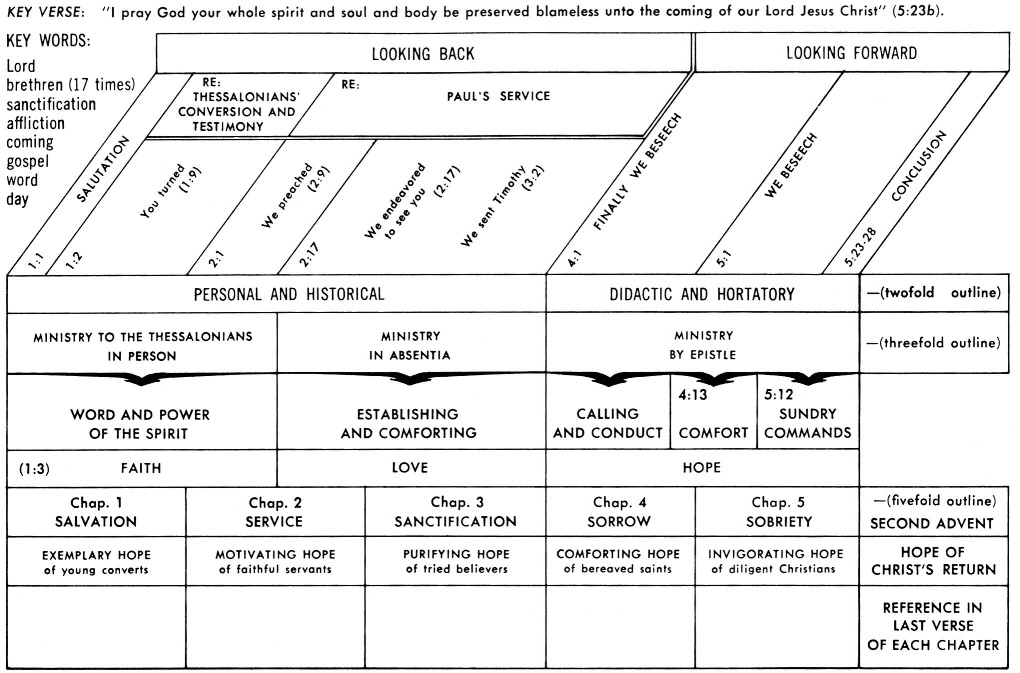
JESUS IS COMING AGAIN
Click chart to enlarge
Charts from Jensen's Survey of the NT - used by permission
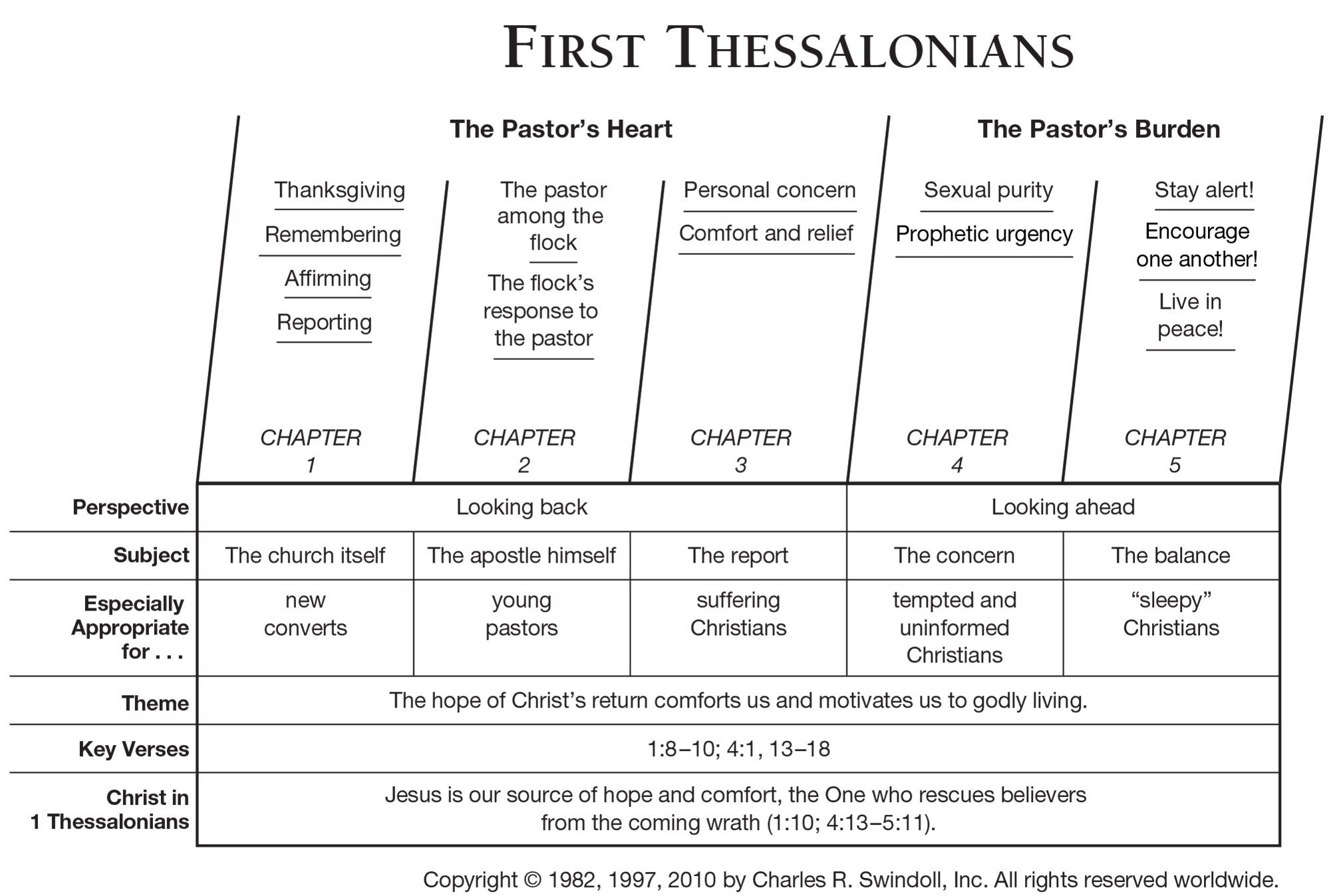
Chart by Charles Swindoll
|
1 Thessalonians |
||||||
| 1 Th 1:1-10 | 1 Th 2:1-20 | 1 Th 3:1-13 | 1 Th 4:1-18 | 1 Th 5:1-28 | ||
|
LOOKING BACK |
LOOKING FORWARD |
|||||
|
Personal Reflections |
Practical Instructions |
|||||
| Ministry In Person |
Ministry in Absentia (Thru Timothy) |
Ministry by Epistle |
||||
| Word and Power of the Spirit |
Establishing & Comforting |
Calling & Conduct | 1Th 4:13ff Comfort |
1Th 5:12ff Commands |
||
| 1 Salvation |
2 Service |
3 Sanctification |
4 Sorrow |
5 Sobriety |
||
| Paul Commends Spiritual Growth |
Paul Founds the Church |
Strengthening of the Church |
Directions for Spiritual Growth |
Holy Living in Light of Day of the Lord | ||
| Exemplary Hope of Young Converts | Motivating Hope of Faithful Servants |
Purifying Hope of Tried Believers | Comforting Hope of Bereaved Saints | Invigorating Hope of Diligent Christians | ||
|
Written from Corinth |
||||||
1 Thessalonians 1:3 constantly bearing in mind your work of faith and labor of love and steadfastness of hope in our Lord Jesus Christ in the presence of our God and Father, (NASB: Lockman)
Greek: adialeiptos mnemoneuontes (PAPMPN) humon tou ergou tes pisteos kai tou kopou tes agapes kai tes hupomones tes elpidos tou kuriou hemon Iesou Christou emprosthen tou theou kai patros hemon,
Amplified: Recalling unceasingly before our God and Father your work energized by faith and service motivated by love and unwavering hope in [the return of] our Lord Jesus Christ (the Messiah). (Amplified Bible - Lockman)
Barclay: We never cease to remember the work inspired by your faith, the labour prompted by your love and the endurance founded on your hope in our Lord Jesus Christ, before God who is also our Father.
ICB: When we pray to God our Father, we always thank him for the things you have done because of your faith. And we thank him for the work you have done because of your love. And we thank him that you continue to be strong because of your hope in our Lord Jesus Christ.
NIV: We continually remember before our God and Father your work produced by faith, your labor prompted by love, and your endurance inspired by hope in our Lord Jesus Christ. (NLT - Tyndale House)
Phillips: for we never forget that your faith has meant solid achievement, your love has meant hard work, and the hope that you have in our Lord Jesus Christ means sheer dogged endurance in the life that you live before God, the Father of us all. (New Testament in Modern English)
Wuest: remembering unceasingly your work produced and characterized by the faith which is yours, and your toil motivated and characterized by your divine and self-sacrificial love, and your patient endurance under trials which finds its source in your hope which rests in our Lord Jesus Christ in the presence of our God, even the Father
Young's Literal: unceasingly remembering of you the work of the faith, and the labour of the love, and the endurance of the hope, of our Lord Jesus Christ, in the presence of our God and Father,
CONSTANTLY BEARING IN MIND: mnemoneuontes (PAPMPN):
- 1 Thessalonians Resources - Multiple Sermons and Commentaries
- 1 Thessalonians - The Ideal Church - John MacArthur
- 1 Thessalonians 1:1-2 Identifying the Elect, Part 1 - John MacArthur
- 1 Thessalonians 1:3 Identifying the Elect, Part 2 - John MacArthur
- 1 Thessalonians 1:4-10 Identifying the Elect, Part 3 - John MacArthur
- 1 Thessalonians 1:4-10 What is a Christian? - Ray Pritchard
- What is Saving Faith? - Ray Pritchard
Hiebert notes that "A reading of the Pauline epistles makes clear that Paul assigned a high place to thanksgiving in the Christian life. Bicknell boldly asserts, "He seems to have made a rule never to offer a petition for himself or others without first giving thanks for blessings previously received."' In this rich paragraph of thanksgiving, Paul first sketches the character of the thanksgiving (v2) and then elaborates three grounds for the thanksgiving (vv 3-10). In the original, verses 2-10 form one long, involved sentence that presents some difficulties of punctuation and interpretation. (Hiebert, D. Edmond: 1 & 2 Thessalonians)
Constantly bearing in mind (remembering without ceasing, calling to mind) is placed emphatically at beginning of 3 phrases and probably should be taken as modifying each phrase. Paul calls to mind the circumstance for giving thanks. We need to kindle our memory so that we do not neglect prayer. Here Paul and his team remember three outstanding spiritual virtues of the Thessalonians. The character and convictions of the Thessalonians brought them regularly to minds of Paul's team when they went to prayer.
F F Bruce comments that Paul, Silvanus and Timothy...
rejoice that these graces (work of faith, labor of love, steadfastness of hope) are manifested in the life and activity of the Thessalonian Christians. “The triad of faith, hope and love is the quintessence of the God-given life in Christ” (Bornkamm, Paul, 219). (Bruce, F F: 1 and 2 Thessalonians. Word Biblical Commentary. Dallas: Word, Incorporated. 1982)
Comment: In short, these work...labor...and steadfastness are the aspects of faith... love... and hope that can be seen as fruit indicative of genuine conversion. These Thessalonians are not mere professors but possessors of new life in Christ as manifest by the outworking of each of these attributes in their lives.
Constantly (89) (adialeiptos [word study] from a = negative + dialeipô = leave off, cease, leave an interval whether of space or time) means uninterruptedly, without omission, without ceasing and was a word used to describe that which was done continuously.
An Egyptian papyrus letter written in the apostles' days uses adialeiptos to describe an "incessant cough."
And so the idea is not so much that of uninterrupted prayer, but of constantly recurring prayer (not a "hacking cough" but a "sweet savor"), praying every time you have a "tickle in your throat" so to speak, praying every time an opportunity presents itself. Jesus told "a parable to show that at all times (we) ought to pray and not to lose heart." (Lk 18:1)
Paul gives thanks to God that faith has produced work and love has produced labor and hope has produced endurance. If you took those words all by themselves you might treat faith, hope and love as very general psychological forces that have inevitable effects on our productivity and durability. You might say, for example, that faith in yourself produces hard work, and love for family produces labor to earn food, and hope for victory produces endurance to finish the race. And, of course, that would be true. But it wouldn't be Christian. It wouldn't be of any spiritual or eternal value. It wouldn't be what Paul is talking about here.
Hiebert comments that "constantly" presents "a problem of punctuation and consequent interpretation... because of the position in the original of the adverb rendered "continually" (constantly in NASB). Does it go with what precedes or with what follows? if the former, it connects with the making mention of the readers in prayer and emphasizes (by position) that this is without ceasing. If the latter, it properly describes the missionaries' unfailing remembrance of the Christian virtues of the readers. (Hiebert, D. Edmond: 1 & 2 Thessalonians)
The NASB, NIV and most other modern translations interpret "constantly, continually" as modifying "bearing in mind."
Bearing in mind (3421) (mnemoneuo from mimnesko = recall to one's mind) means to keep in mind, exercise memory, call something to mind or recollect. The present tense signifies that this was their lifestyle. The meaning is not that this memory occupied the missionaries to the exclusion of everything else but rather that their remembrance of it constantly recurred.
YOUR WORK OF FAITH: humon tou ergou tes pisteos:
- 1Th 2:13,14; Jn 6:27, 28, 29; Ro 16:26; 1Co 15:58; Gal 5:6; 2Th 1:3,11; Heb 4:11; 11:7,8,17,24-34; Jas 2:17-26; Rev 2:19
- 1 Thessalonians Resources - Multiple Sermons and Commentaries
- 1 Thessalonians - The Ideal Church - John MacArthur
- 1 Thessalonians 1:1-2 Identifying the Elect, Part 1 - John MacArthur
- 1 Thessalonians 1:3 Identifying the Elect, Part 2 - John MacArthur
- 1 Thessalonians 1:4-10 Identifying the Elect, Part 3 - John MacArthur
- 1 Thessalonians 1:4-10 What is a Christian? - Ray Pritchard
- What is Saving Faith? - Ray Pritchard
- Torrey's Topic Faith
WORK
OF FAITH
your work produced by faith (NIV)
how you put your faith into practice, how your love made you work so hard, and how your hope in our Lord Jesus Christ is firm (Today's English Version)
your work produced and characterized by the faith which is yours (Wuest)
not merely faith, hope, and love. It is faith which works, a love which labors, and a hope which endures (Stedman)
How did Paul become aware of the qualities he describes in this section? In chapter 3 he explains that
But now that Timothy has come to us from you, and has brought us good news of your faith and love, and that you always think kindly of us, longing to see us just as we also long to see you (1Th 3:6)
Comment: Remember that Paul was concerned that persecution might have led them to be tempted by the tempter and that his labor with them would prove vain. But with Timothy's return, his spirit soars with joy and thanksgiving, and so he opens this letter with thanks to God for the news of their work of faith, labor of love and steadfastness of faith, for these three "signs" clearly indicate his labor among them had not been in vain but that they were authentic saints as evidenced by their fruit - work, labor and steadfastness - clear evidence that they possessed genuine Christian character.
Green adds that...
Far from being passive or hidden virtues, their faith, love, and hope could be witnessed in the Thessalonians’ conduct...Although the object of their faith was God (1.8), this faith was given active expression in their work. (Green, G. L.. The Letters to the Thessalonians. The Pillar New Testament Commentary. Grand Rapids, Mich.; Leicester, England: W.B. Eerdmans Pub.; Apollos)
Ray Stedman observes that
these phrases, the work of faith, the labor of love, the persistence of hope constitute an outline of chapter one: The work of faith is explained in Verses 4-5 and Verse 9; the labor of love is described in the latter part of Verse 5 through Verses 6, 7 and 8; and the persistence of hope is found in Verse 10. ...
What is this work of faith that Paul speaks of? He sums it up himself in Verse 9. There he speaks of how the Thessalonians had "turned to God from idols, to serve the living and true God." That is faith at work. Faith is not merely belief; it is something that changes you. Faith makes you turn from what is wrong to what is right, from dark and hurtful things to right and true and healthy things. And, especially, faith will turn you from the worship of idols to God. Notice the direction of this action: to God, from idols. It is not put the other way around. You do not leave your idols for some reason and then painfully try to find God. What happens is that you discover something of the beauty, the glory and greatness of God, and, seeing that and wanting it, you are willing to forsake the cheap and tawdry things you have been trying to satisfy yourselves with. (Changed Lives)
|
PARALLEL PASSAGES |
|
|
1 Thessalonians 1:3 |
1 Thessalonians 1:9-10 |
|
Work of faith |
You turned to God from Idols |
|
Labor of love |
To serve a living and true God |
|
Steadfastness of hope |
To for His Son from Heaven |
Work of faith - Their work originated from, emanated from or sprang from their faith. Faith alone saves but genuine faith is evidenced by corresponding good works in the Spirit. Notice the pattern in Ephesians 2...
For by grace you have been saved through faith; and that not of yourselves, it is the gift of God;9 not as a result of works, that no one should boast. 10 For we are His workmanship, created in Christ Jesus for good works, which God prepared beforehand, that we should walk in them. (See notes Ephesians 2:8; 2:9; 2:10)
Notice that in this famous passage, faith alone saves but bears the fruit of good works which believers are to walk in. The work of the Thessalonians was the result of their faith and just as important was also the evidence that their faith was genuine and not simply an intellectual assent to an emotional, persuasive message to "believe". The principle of good works as the fruit of real faith is seen repeatedly in Hebrews 11...
By faith Abel offered to God a better sacrifice than Cain, through which he obtained the testimony that he was righteous, God testifying about his gifts, and through faith, though he is dead, he still speaks. (Comment: Abel's faith was genuine as evidenced by his "better sacrifice". Yes, Abel offered a blood sacrifice, but that was not the real reason it was better. The primary reason it was better was because of his authentic faith which led to true sacrifice, true righteousness and true witness declaring "Righteousness is only obtained by faith.") (Hebrews 11:4)
By faith Noah, being warned by God about things not yet seen, in reverence prepared an ark for the salvation of his household, by which he condemned the world, and became an heir of the righteousness which is according to faith. (Hebrews 11:7) (Comment: Was Noah's faith genuine? Clearly it was as demonstrated by his "works" in obedience to God's instructions.)
By faith Abraham, when he was called, obeyed by going out to a place which he was to receive for an inheritance; and he went out, not knowing where he was going. (see Hebrews 11:8) (Comment: Abraham demonstrated his faith by his obedience.)
James teaches this same association between genuine faith and good works writing...
What use is it, my brethren, if a man says he has faith, but he has no works? Can that faith save him? (Comment: The construction expects a negative answer "No it cannot save him". Then James illustrates such a futile, spurious faith in verses 15-16) 15 If a brother or sister is without clothing and in need of daily food, 16 and one of you says to them, "Go in peace, be warmed and be filled," and yet you do not give them what is necessary for their body, what use is that? (Comment: The answer is obvious - warm words with cold deeds are worthless!) 17 Even so faith, if it has no works, is dead, being by itself. (Comment: "Even so" or just as a profession of compassion without works is a "dead" compassion, so too is a faith that lacks works) 18 But someone may well say, "You have faith, and I have works; show me your faith without the works, and I will show you my faith by my works." 19 You believe that God is one. You do well; the demons also believe, and shudder. (Comment: The point is that even the demons have faith but that faith is not saving faith). 20 But are you willing to recognize, you foolish fellow, that faith without works is useless? 21 Was not Abraham our father justified (here the verb means shown to be righteous) by works, when he offered up Isaac his son on the altar? 22 You see that faith was working with his works, and as a result of the works, faith was perfected; 23 and the Scripture was fulfilled which says, "AND ABRAHAM BELIEVED (See word study on Hebrew word for "believed" = 'aman) GOD, AND IT WAS RECKONED TO HIM AS RIGHTEOUSNESS," and he was called the friend of God (Comment: Abraham's salvation was by faith alone, many years prior to his offering Isaac. Abraham's willingness to offer Isaac was proof to all that his faith was genuine). 24 You see that a man is justified (shown to be righteous) by works, and not by faith alone. 25 And in the same way was not Rahab the harlot also justified (shown to be righteous) by works, when she received the messengers and sent them out by another way? 26 For just as the body without the spirit is dead, so also faith without works is dead (Comment: Most of us have seen a corpse. The corpse lacks the person's spirit and is thus lifeless. In just the same way, a faith has no works shows itself to be a dead faith or a faith that cannot save the individual) (James 2:14-26) (Comment: Paul is thanking God for the faith of the Thessalonians which is clearly a live, vibrant, authentic faith as evidenced by their works. A faith that is dynamic, active and real rather than static and lifeless will produce good works) (James 2:24-26)See detailed notes on James 2:14 ; James 2:15; James 2:16; James 2:17; James 2:18; James 2:19; James 2:20; James 2:21; James 2:22; James 2:23; James 2:24; James 2:25; James 2:26)
Calvin - Faith alone saves, but faith that saves is not alone.
Moody - It is to him that worketh not, but believeth. We work because we are saved; we don’t work to be saved. We work from the cross but not towards it.
Work (2041) (ergon) refers to active work and can also refer to the results of the activity, i.e., "achievement." Ergon in context pictures the whole Christian life work, energized by faith, empowered by His Spirit. The phrase here is more literally "the work of the faith", and describes the work or activity that faith inspires or that springs from and is motivated by faith.
Utley - Each of these three phrases is in a grammatical construction that asserts that the work is produced by faith, the labor is produced by love, and the steadfastness is produced by hope. The focus is on active, faithful believers. Faith is always a response to God’s initiating activity. (Utley, R. J. D. Vol. Volume 11: Paul's First Letters: Galatians and I & II Thessalonians. Study Guide Commentary Series Marshall, Texas: Bible Lessons International)
A T Robertson - We are justified by faith, but faith produces works
Earnest Best (A Commentary on the 1st and 2nd Epistles to the Thessalonians) - For Paul faith is the total response of man to the goodness of God seen in the death and resurrection of Christ through which man is redeemed; such a total response includes man's obedience to God and must therefore result in activity on the part of man.
Barnes- Works of faith are those to which faith prompts, and which show that there is faith in the heart. This does not mean, therefore, a work of their own producing faith, but a work which showed that they had faith. (Albert Barnes. Barnes NT Commentary)
Hiebert adds that in the phrase work of faith "the emphasis is on the work that faith produces. If there were no faith there would have been no work. The faith of the Thessalonians was no mere speculative belief; it was energetic and productive. Paul fully agreed with James that faith without deeds is dead (James 2:26). Paul's reference is not to the initial work of saving faith but rather relates to the whole Christian life as it is ruled and energized by faith. (Hiebert, D. Edmond: 1 & 2 Thessalonians: BMH Book. 1996)
Faith (4102) (pistis) is synonymous with trust or belief and is the conviction of the truth of anything, but in Scripture usually speaks of belief respecting man's relationship to God and divine things, generally with the included idea of trust and holy fervor born of faith and joined with it. Note that this discussion of pistis is only an overview and not a detailed treatise of this vitally important subject. Those interested are directed to respected, conservative books on systematic theology for more in depth discussion (eg, Dr Wayne Grudem's book (See Systematic Theology) is an excellent, uncompromising, imminently readable resource for the lay person. See especially Chapter 35 which addresses the question "What is saving faith?" in an easy to understand manner.) Much of this "definition" deals with the general word group for faith (pistis = noun, pistos = adjective, pisteuo = verb)
Related Resources:
- Multiple articles (Spurgeon, J C Ryle, Thomas Watson, Thomas Brooks, et al) @ Saving Faith
- See 12 page discussion on pistis in the New International Dictionary Of New Testament Theology
“Faith is the foot of the soul; so it comes to Christ.
Faith is the hand of the soul; so it receives Christ.
Faith is the arm of the soul; so it embraces Christ.
Faith is the eye of the soul; so it looks upon Christ.
Faith is the mouth of the soul; so it feeds on Christ.
Faith is the lips of the soul; so it kisses Christ.”
--Unknown writer
Swindoll on pistis - This word denotes confidence in the reliability of a person or thing and can describe one’s trust in a person’s word, a compact or treaty, or a deity (or deities). The term implies both knowledge and action. One may receive knowledge of a certain truth and may even offer verbal agreement, but “trust” or “confidence” is not said to be present until one’s behavior reflects that truth. In the Hellenistic period, this word came to connote the conviction that gods do exist and are active. The Greeks worshiped and feared their gods, but they did not have a relationship with them. NT readers, however, would also have known the word from the Septuagint (the Greek translation of the Old Testament), where it—and related words, like pisteuo, “to believe,” “to accept as truth,” “to commit one’s trust”—is linked to the relationship with Israel’s covenant-keeping God. For the Jew, and therefore the Christian, pistis became a description of the means by which someone relates to God—so much so that the participial form came to designate members of the church as “believers” (e.g., Acts 2:44; 4:32; 5:14). (See Insights on Luke - Page 111)
It has well been said that faith is not believing in spite of evidence—that’s superstition—
but obeying in spite of circumstances and consequences.
As pistis relates to God, it is the conviction that God exists and is the Creator and Ruler of all things well as the Provider and Bestower of eternal salvation through Christ. As faith relates to Christ it represents a strong and welcome conviction or belief that Jesus is the Messiah, through Whom we obtain eternal salvation and entrance into the Kingdom of Heaven. Stated another way, eternal salvation comes only through belief in Jesus Christ and no other way.
Pistis - 243x in 227v in the NAS- See all these uses below.
Maclaren writes that
Faith is the hand that grasps. It is the means of communication, it is the channel through which the grace which is the life, or, rather, I should say, the life which is the grace, comes to us. It is the open door by which the angel of God comes in with his gifts. It is like the petals of the flowers, opening when the sunshine kisses them, and, by opening, laying bare the depths of their calyxes to be illuminated and coloured, and made to grow by the sunshine which itself has opened them, and without the presence of which, within the cup, there would have been neither life nor beauty. So faith is the basis of everything; the first shoot from which all the others ascend...Faith works. It is the foundation of all true work; even in the lowest sense of the word we might almost say that. But in the Christian scheme it is eminently the underlying requisite for all work which God does not consider as busy idleness...
Your work of faith. There is the whole of the thorny subject of the relation of faith and works packed into a nutshell. It is exactly what James said and it is exactly what a better than James said. When the Jews came to Him with their externalism, and thought that God was to be pleased by a whole rabble of separate good actions, and so said, ‘What shall we do that we might work the works of God?' Jesus said, ‘Never mind about Works. This is the work of God, that ye believe on Him whom He hath sent,' and out of that will come all the rest. That is the mother tincture; everything will flow from that. So Paul says, ‘Your work of faith.'
Does your faith work? Perhaps I should ask other people rather than you. Do men see that your faith works; that its output is different from the output of men who are not possessors of a ‘like precious faith'? Ask yourselves the question, and God help you to answer it. (Read full sermon on 1 Thessalonians 1:3)
Wayne Grudem defines faith that saves one's soul...
Saving faith is trust in Jesus Christ as a living person for forgiveness of sins and for eternal life with God. This definition emphasizes that saving faith is not just a belief in facts but personal trust in Jesus to save me... The definition emphasizes personal trust in Christ, not just belief in facts about Christ. Because saving faith in Scripture involves this personal trust, the word "trust" is a better word to use in contemporary culture than the word "faith" or "belief." The reason is that we can "believe" something to be true with no personal commitment or dependence involved in it. (See Systematic Theology) (Bolding added)
- What are some of the signs of genuine saving faith?
- What is saving grace?
- Why is faith without works dead?
- What does it mean to have faith in Jesus?
- What is the relationship of faith, works, and security in salvation?
- Where does faith come from?
- Can a person believe in some sense but not be saved?
- The faith
- Obedience of faith.
- See study on pistos
- Saving Faith by J.C. Ryle
- Miscellanies on Faith-- Jonathan Edwards
- The Spirit Working Faith -- A. W. Pink
- True Faith -- A. W. Pink
- Fact! Faith! Feeling! - F B Meyer
- The Nature of Faith -- Thomas Watson (Interesting)
- A Godly Man's Faith -- Thomas Watson
- Three Men in Fetters -- Jim Ehrhard from Pilgrim's Progress
- Faith’s Way of Approach -- Charles Spurgeon
- Genesis 17:1,2 - Life, Walk, and Triumph of Faith - C H Spurgeon
- Job 13:15 Faith Tried and Triumphing - C H Spurgeon
- Job 23:6 The Question of Fear and the Answer of Faith - C H Spurgeon
- Psalm 57:1, 55:22, Isa 50:10 Three Texts but One Subject - Faith - C H Spurgeon
- Isaiah 44:5 Converts and their Confession of Faith - C H Spurgeon
- Habakkuk 2:4 Faith: Life
- Matthew 15:21-28 Faith Victorious - C H Spurgeon
- Matthew 15:28 Perseverance of Faith - C H Spurgeon
- Mark 1:15 Faith and Repentance Inseparable - C H Spurgeon
- Mark 4:40 Why Is Faith So Feeble? - C H Spurgeon
- Mark 9:23 Faith Omnipotent - C H Spurgeon
- Mark 9:24 Faith’s Dawn and Its Clouds - C H Spurgeon
- Mark 9:24 Feeble Faith Appealing to a Strong Saviour - C H Spurgeon
- Mark 14:31 The History of Little Faith - C H Spurgeon
- Luke 7:50 Saving Faith - C H Spurgeon
- John 1:11-13 Faith and its Attendant Privileges - C H Spurgeon
- John 4:48 Characteristics of Faith - C H Spurgeon
- Acts 15:9 Faith Purifying the Heart - C H Spurgeon
- Romans 10:17 How Can I Obtain Faith? - C H Spurgeon
- Romans 10:17 Faith’s Way of Approach - C H Spurgeon
- 2 Corinthians 5:7 Faith Versus Sight - C H Spurgeon
- Galatians 3:2 The Hearing of Faith - C H Spurgeon
- Galatians 3:11 Life by Faith - C H Spurgeon
- Ephesians 2:8 Faith: What Is It? How Can It Be Obtained?- C H Spurgeon
- Ephesians 6:16 The Shield of Faith - C H Spurgeon
- Colossians 2:6 Life and Walk of Faith - C H Spurgeon
- 2 Timothy 1:12 Faith Illustrated - C H Spurgeon
- 2 Thessalonians 1:3 A Lecture for Little Faith - C H Spurgeon
- 2 Thessalonians 1:3 The Necessity of Growing Faith - C H Spurgeon
- Hebrews 11:6 Faith - C H Spurgeon
- Hebrews 11:6 Faith Essential to Pleasing God - C H Spurgeon
- Hebrews 11:8 The Obedience of Faith - C H Spurgeon
- James 2:17 Fruitless Faith - C H Spurgeon
- 1 Peter 2:6 Faith’s Sure Foundation - C H Spurgeon
- 2 Peter 1:1-4 Faith and Life - C H Spurgeon
- 1 John 5:1 Faith and Life - C H Spurgeon
- 1 John 5:4,5 Victorious Faith - C H Spurgeon
- 1 John 5:4 The Victory of Faith - C H Spurgeon
- 1 John 5:9,10 Faith and the Witness Upon Which it is Founded - C H Spurgeon
- Note: This preceding list includes most but not all of Spurgeon's sermons in which the word "faith" is in the sermon title.
Scofield wrote that...
The essence of faith consists in believing and receiving what God has revealed, and may be defined as that trust in the God of the Scriptures and in Jesus Christ whom He has sent, which receives Him as Lord and Savior and impels to loving obedience and good works (John 1:12; James 2:14-26-see notes).
The particular uses of faith give rise to its secondary definitions:
(1) For salvation, faith is personal trust, apart from meritorious works, in the Lord Jesus Christ as delivered because of our offenses and raised again because of our justification (Ro 4:5, Ro 4:23, 24, 25, 5:1 - see notes Ro 4:23; 24; 25; 5:1).
(2) As used in prayer, faith is the "assurance we have in approaching God: that if we ask anything according to his will, he hears us" (1John 5:14,15).
(3) As used in reference to unseen things of which Scripture speaks, faith gives substance to them, so that we act upon the conviction of their reality (He 11:1, 2, 3-see notes Heb 11:1; 11:2; 11:3). And
(4) as a working principle in life, the uses of faith are illustrated in Hebrews 11.
Biblical faith is not synonymous with mental assent or acquiescence which by itself is a superficial faith at best and not genuine (saving) faith.
For example, the apostle John distinguishes two types of belief (using the related verb pisteuo but still illustrating a truth relevant to the discussion of the noun pistis), one of which is only superficial...
Jn 2:22 When therefore He was raised from the dead, His disciples remembered that He said this; and they believed (pisteuo) the Scripture and the word which Jesus had spoken.
Henry Morris Comments: Note the superior category of faith of the disciples to that of the "many" (John 2:23) who believed "when they saw the miracles," (John 2:23) but soon fell away. The disciples did not believe because of the miracles but because of the Scripture and Jesus' words. It is far better to place one's faith in God's Word than in signs and wonders." (Defenders Study Bible Online)
Jn 2:23 Now when He was in Jerusalem at the Passover, during the feast, many believed (pisteuo) in His name, beholding His signs which He was doing. (Note that their belief was associated with His signs)
Jn 2:24 But Jesus, on His part, was not entrusting (pisteuo) Himself to them, for He knew all men
Morris writes: Although many in the Jerusalem crowd "believed in his name when they saw the miracles" (John 2:23), Jesus did not "believe" in them because He knew their hearts and knew their outward faith in Him was only superficial) (Defenders Study Bible Online)
Jn 2:25 and because He did not need anyone to bear witness concerning man for He Himself knew what was in man.
Charles Ryrie comments: The contrast is between people who put their trust (pisteuo, Gk.) in Jesus, and Jesus, who does not put His trust in people because He knows their motives and thoughts. Enthusiasm for the spectacular is present in them, but Jesus looks for genuine faith." Bolding added) (John 2:22-25) (The Ryrie Study Bible: New American Standard Translation: 1995. Moody Publishers)
In another example of belief that fell short of genuine saving belief John records that when Jesus spoke to the Jews "who had believed him" (John 8:31) but as their subsequent actions demonstrated their belief was not genuine for Jesus accused them declaring "you are seeking to kill Me" (John 8:40) and after several heated exchanges, these same "believing" Jews "fulfilled prophecy" and indeed sought to kill Jesus, picking
up stones to throw at Him; but Jesus hid Himself, and went out of the temple. (John 8:59).
THE
BELIEF
OF UNBELIEF
Charles Swindoll and Roy Zuck have an excellent discussion entitled the "Belief of Unbelief"
In the progress of belief there is a stage that falls short of genuine belief resulting in salvation. This is first seen in John 2:23, where many at the Passover "believed" as a result of Christ’s signs, yet He did not "believe" (trust) them (Jn 2:23, 24, 25). Jesus discerned that their faith was superficial, based only on the miracles they had seen. Later during the Feast of Tabernacles many of the people "believed in Him" but apparently not as Messiah (Jn 7:31, nasb). Jesus spoke to the Jews "who had believed him" (Jn 8:31) and accused them of seeking to kill Him (Jn 8:40). He later accused the same Jews of unbelief (Jn 8:45, 46).
A prominent example of the "belief of unbelief" in the Book of Acts is Simon, a practitioner of the magic arts in the city of Samaria (Acts 8:9, 10). Simon "believed" and was baptized (Acts 8:13), but the account that follows raises serious doubt over the genuineness of his faith. When Simon saw that the Spirit was bestowed through the laying on of the apostles’ hands, he offered money to buy the power and authority the apostles possessed (Acts 8:18, 19). Peter rebuked him with strong words, "May your money perish with you, because you thought you could buy the gift of God with money! You have no part or share in this ministry, because your heart is not right before God. Repent of this wickedness and pray to the Lord. Perhaps he will forgive you for having such a thought in your heart. For I see that you are full of bitterness and captive to sin" (Acts 8:20, 21, 22, 23).
The absence of any evidence of repentance or willingness to pray leads me to suspect that while Simon believed something about Jesus and went through the ritual of baptism, his belief was not genuine saving faith. Simon seems to have remained an unrepentant and unregenerate man in spite of his initial response and religious behavior.
Tenney refers to this kind of belief which falls short of genuine faith as "superficial." Morris calls it "transitory belief" which is not saving faith. It is based merely on outward profession. The problem with this belief is its object. It seems to have been based primarily on miracles and was not rooted in a clear understanding of the person of Christ as Messiah and Son of God. Many were inclined to believe something about Jesus but were unwilling to yield their allegiance to Him, trusting Him as their personal Sin-Bearer.
We see this today, don’t we? My Muslim friend believes in Jesus in the sense that he believes that Jesus is a prophet. But he says the greater prophet is Mohammed, who received God’s final revelation in the Koran. My Mormon friend believes in Jesus in the sense that he believes that Jesus is a man who became a god, and that we have the potential to do the same. His faith is founded on the Book of Mormon and other Mormon writings. Those of the Baha’i faith believe in Jesus in the sense that they believe that Jesus is one of many ways to God. They believe that various religious traditions, practiced by sincere people, will lead them to God.(Swindoll, C. R., & Zuck, R. B. Understanding Christian Theology.: Thomas Nelson Publishers) ) (Bolding added)
RELATED RESOURCES:
- Spurgeon's on belief John 8:30-32 Believing On Jesus, And Its Counterfeits
- Alexander Maclaren's on John 8:30, 31 Three Aspects of Faith
True faith that saves one's soul includes at least three main elements (1) firm persuasion or firm conviction, (2) a surrender to that truth and (3) a conduct emanating from that surrender. In sum, faith shows itself genuine by a changed life. (Click here for W E Vine's similar definition of faith)
The highly respected theologian Louis Berkhof defines genuine faith in essentially the same way noting that it includes an intellectual element (notitia), which is "a positive recognition of the truth"; an emotional element (assensus), which includes "a deep conviction of the truth"; and a volitional element (fiducia), which involves "a personal trust in Christ as Savior and Lord, including a surrender … to Christ." (Louis Berkhof, Systematic Theology. Grand Rapids: Eerdmans, 1939)
Larry Richards has an excellent discussion on faith writing that...
Originally this word group seems linked with a more formal contract between partners. It stressed faithfulness to the agreement made or trustworthiness in keeping promises. In time the use expanded. In the classical period, writers spoke of trust in the gods as well as trust in people. In the Hellenic era, "faith in God" came to mean theoretical conviction about a particular doctrine, a conviction expressed in one's way of life. As different schools of philosophy and religion developed, the particular emphasis given pistis was shaped by the tradition within which it was used. The NT retains the range of meanings. But those meanings are refined and reshaped by the dynamic message of the gospel.
The verb (pisteuo) and noun (pistis) are also used with a number of prepositions. "To believe through" (dia) indicates the way by which a person comes to faith (Jn 1:7; 1Pe 1:21 [note]). "Faith en" indicates the realm in which faith operates (Ep 1:15; Col 1:4; 2Ti 3:15). The most important construction is unique to the NT, an invention of the early church that expresses the inmost secret of our faith. That construction links faith with the preposition eis, "to" or "into." This is never done in secular Greek. In the NT it portrays a person committing himself or herself totally to the person of Jesus Christ, for our faith is into Jesus. (Ed note: Leon Morris in "The Gospel According to John" agrees with Richards writing that "Faith, for John, is an activity which takes men right out of themselves and makes them one with Christ" indicating that Morris likewise understands the Greek preposition eis in the phrase pisteuo eis, to be a significant indication that NT faith is not just intellectual assent but includes a "moral element of personal trust.")
One other aspect of the NT's use of faith words is fascinating. Usually the object of faith is Jesus. Only twelve verses have God as the object of faith (Jn 12:44; 14:1; Acts 16:34; Ro 4:3, 5, 17, 24 [see notes Ro 4:3, 4:5, 4:17, 4:24] Gal 3:6; 1Th 1:8 [note]; Titus 3:8 [note]; He 6:1 [note]; 1Pe 1:21 [note]). Why? The reason is clearly expressed by Jesus himself: "I am the way and the truth and the life. No one comes to the father except through me" (Jn 14:6). God the Father has revealed himself in the Son. The Father has set Jesus before us as the one to whom we must entrust ourselves for salvation. It is Jesus who is the focus of Christian faith. (Richards, L O: Expository Dictionary of Bible Words: Regency)
Wuest in his study of pistis and the related words in this family, pisteuo and pistos, explains that...
When these words refer to the faith which a lost sinner must place in the Lord Jesus in order to be saved, they include the following ideas; the act of considering the Lord Jesus worthy of trust as to His character and motives, the act of placing confidence in His ability to do just what He says He will do, the act of entrusting the salvation of his soul into the hands of the Lord Jesus, the act of committing the work of saving his soul to the care of the Lord. This means a definite taking of one's self out of one's own keeping and entrusting one's self into the keeping of the Lord Jesus. (Wuest's Word Studies from the Greek New Testament:)
William Barclay notes that "Faith begins with receptivity. It begins when a man is at least willing to listen to the message of the truth. It goes on to mental assent. A man first hears and then agrees that this is true. But mental assent need not issue in action. Many a man knows very well that something is true, but does not change his actions to meet that knowledge. The final stage is when this mental assent becomes total surrender. In full-fledged faith, a man hears the Christian message, agrees that it is true, and then casts himself upon it in a life of total yieldedness. (Barclay, W: The Daily Study Bible Series. The Westminster Press)
Faith is relying on what God has done rather than on one's own efforts. In the Old Testament, faith is rarely mentioned. The word trust is used frequently, and verbs like believe and rely are used to express the right attitude to God. The classic example is Abraham, whose faith was reckoned as righteousness (Ge 15:6 - See word study on Hebrew word for "believe" = 'aman). At the heart of the Christian message is the story of the cross: Christ's dying to bring salvation. Faith is an attitude of trust in which a believer receives God's good gift of salvation (Acts 16:30,31) and lives in that awareness thereafter (Gal 2:20; cp He 11:1).
J. B. Lightfoot discusses the concept of faith in his commentary on Galatians. He notes that in Hebrew, Greek, and Latin, the definition of the word for faith
"hovers between two meanings: trustfulness, the frame of mind which relies on another; and trustworthiness, the frame of mind which can be relied upon...the senses will at times be so blended together that they can only be separated by some arbitrary distinction. The loss in grammatical precision is often more than compensated by the gain in theological depth...They who have faith in God are steadfast and immovable in the path of duty."
Faith, like grace, is not static. Saving faith is more than just understanding the facts and mentally acquiescing. It is inseparable from repentance, surrender, and a supernatural longing to obey. None of those responses can be classified exclusively as a human work, any more than believing itself is solely a human effort.
ILLUSTRATION - It has been said that only man comprehends what he cannot see and believes what he cannot comprehend. Much of what we comprehend we cannot see: atoms, germs, love, hate, loyalty, sacrifice. He who lives by sight lives poorly indeed. Faith is learning to live by insight rather than by sight.
ILLUSTRATION - For centuries the islands of New Zealand were unpopulated. No human had ever set foot on them. Then the first settlers arrived. They were Polynesians from other Pacific islands who had sailed a thousand miles in outrigger canoes. The Polynesians came with the purpose of settling in New Zealand. How did they know the land was there? How did they know they would not simply sail across empty seas until food and water ran out and they perished? The Polynesians had known for generations that land was there because their voyagers had seen a long white cloud on the distant horizon. They knew that when a cloud stayed in one place over a very long period of time, there was land beneath it. They called New Zealand the Land of the Long White Cloud. Faith is like that. It is voyaging to an unseen land, journeying to an unknown future. But it is not mere guesswork, or chance, or superstition. There are facts behind faith, facts that suggest conclusions.
Faith is manifest by not believing in spite of evidence but obeying in spite of consequence. John uses the related verb pisteuo to demonstrate the relationship between genuine faith and obedience writing...
He who believes (present tense = continuous) in the Son has eternal life; but he who does not obey the Son shall not see life, but the wrath of God abides on him. (John 3:36)
Charles Swindoll commenting on faith and obedience in John 3:36 concludes that...
In John 3:36 the one who "believes in the Son has eternal life" as a present possession. But the one who "does not obey the Son shall not see life." To disbelieve Christ is to disobey Him. And logically, to believe in Christ is to obey Him. As I have noted elsewhere, "This verse clearly indicates that belief is not a matter of passive opinion, but decisive and obedient action." (quoting J. Carl Laney)...Tragically many people are convinced that it doesn't really matter what you believe, so long as you are sincere. This reminds me of a Peanuts cartoon in which Charlie Brown is returning from a disastrous baseball game. The caption read, "174 to nothing! How could we lose when we were so sincere?" The reality is, Charlie Brown, that it takes more than sincerity to win the game of life. Many people are sincere about their beliefs, but they are sincerely wrong!" (Swindoll, C. R., & Zuck, R. B. Understanding Christian Theology.: Thomas Nelson Publishers)
Comment: This book is recommended if you are looking for a very readable, non-compromising work on "systematic theology". Wayne Grudem's work noted above is comparable.
Subjectively faith is firm persuasion, conviction, belief in the truth, veracity, reality or faithfulness (though rare). Objectively faith is that which is believed (usually designated as "the faith"), doctrine, the received articles of faith. Click separate study of "the faith (pistis)"
True faith is not based on empirical evidence but on divine assurance.
A W Tozer spoke often of faith, especially genuine or true faith - True faith is not the intellectual ability to visualize unseen things to the satisfaction of our imperfect minds; it is rather the moral power to trust Christ. To be contented and unafraid when going on a journey with his father the child need not be able to imagine events; he need but know the father. Our earthly lives are one shining web of golden mystery which we experience without understanding, how much more our life in the Spirit. Jesus Christ is our all in all. We need but trust Him and He will take care of the rest....God has not failed me in this world; I can trust Him for the world to come.
Definitions of Faith
• Hebrews 11:1. “What is faith, unless it is to believe what you cannot see.” (Augustine)
• Faith is derived from the Word of God: Romans 10:17
• Faith’s demand: Hebrews 11:6
• Faith’s design: 2 Corinthians 5:7
• The dualism of faith: Hebrews 4:2
• Faith’s duty: Romans 1:17—live by it.
Divine Healing Today, Richard Mayhue, Moody Press, p. 100
True faith commits us to obedience.
Faith and morals are two sides of the same coin. Indeed the very essence of faith is moral. Any professed faith in Christ as personal Saviour that does not bring the life under plenary obedience to Christ as Lord is inadequate and must betray its victim at the last. The man that believes will obey. God gives faith to the obedient heart only. Where real repentance is, there is obedience.
True faith brings a spiritual and moral transformation and an inward witness that cannot be mistaken. These come when we stop believing in belief and start believing in the Lord Jesus Christ indeed.
Faith is not optimism, though it may breed optimism; it is not cheerfulness, though the man of faith is likely to be a reasonably cheerful; it is not a vague sense of well-being or a tender appreciation for the beauty of human togetherness. Faith is confidence in God's self-revelation as found in the Holy Scriptures.
To believe savingly in Jesus Christ is to believe all He has said about Himself and all that the prophets and apostles have said about Him. Let us beware that the Jesus we "accept" is not one we have created out of the dust of our imagination and formed after our own likeness. True faith commits us to obedience. That dreamy, sentimental faith which ignores the judgments of God against us and listens to the affirmations of the soul is as deadly as cyanide. Faith in faith is faith astray. To hope for heaven by means of such faith is to drive in the dark across a deep chasm on a bridge that does not quite reach the other side. (Of God and Men)
To escape the error of salvation by works we have fallen into the opposite error of salvation without obedience.
A whole new generation of Christians has come up believing that it is possible to "accept" Christ without forsaking the world.
Faith, as Paul saw it, was a living, flaming thing leading to surrender and obedience to the commandments of Christ.
Real faith invariably produces holiness of heart and righteousness of life.
If our faith is to have a firm foundation we must be convinced beyond any possible doubt that God is altogether worthy of our trust....
A promise is only as good as the one who made it, but it is as good, and from this knowledge springs our assurance. By cultivating the knowledge of God we at the same time cultivate our faith...
True faith rests upon the character of God and asks no further proof than the moral perfections of the One who cannot lie. It is enough that God said it, and if the statement should contradict every one of the five senses and all the conclusions of logic as well, still the believer continues to believe. "Let God be true, but every man a liar" is the language of true faith. Heaven approves such faith because it rises above mere proofs and rests in the bosom of God....
Faith as the Bible knows it is confidence in God and His Son Jesus Christ; it is the response of the soul to the divine character as revealed in the Scriptures; and even this response is impossible apart from the prior inworking of the Holy Spirit. Faith is a gift of God to a penitent soul and has nothing whatsoever to do with the senses or the data they afford. Faith is a miracle; it is the ability God gives to trust His Son, and anything that does not result in action in accord with the will of God is not faith but something else short of it.
Faith is at the foundation of all Christian living, and because faith has to do with the character of God, it is safe from all vacillations of mood. A man may be believing soundly and effectively even when his mood is low, so low that he is hardly aware that he is alive emotionally at all.
True faith is not an end; it is a means to an end. It is not a destination; it is a journey, and the initial act of believing in Christ is a gate leading into the long lane we are to travel with Christ for the rest of our earthly days. That journey is hard and tired, but it is wonderful also, and no one ever regretted the weariness when he came to the end of the road.
The faith of Paul and Luther was a revolutionizing thing. It upset the whole life of the individual and made him into another person altogether. It laid hold on the life and brought it under obedience to Christ. It had a finality about it. It snapped shut on a man's heart like a trap. It realigned all life's actions and brought them into accord with the will of God.
When missionary John Paton (biography) was translating the Scripture for the South Sea islanders, the Aniwa, he was unable to find a word in their vocabulary for the concept of believing, trusting, or having faith. Below is the story of how John Paton arrived at his definition for faith in the Aniwa language, a definition which God's Spirit would use to set many in this unreached people group free in Christ! Oh, the depth of the riches both of the wisdom and knowledge of God! How unsearchable are His judgments and unfathomable His ways! (Ro 11:33)...
(Adapted from the Biblical Illustrator) An intensely interesting incident was related lately by Dr. J. G. Paton of a discovery of a term in the language of Aniwa for “Faith.” It seems that for a long time no equivalent could be found, and the work of Bible translation was paralyzed for want of such a fundamental word.
The natives apparently regarded the verb “to hear” as equivalent to belief. For instance, suppose a native were asked whether he heard a certain statement. Should he credit the statement he would reply, “Yes, I heard it,” but should he disbelieve it, he would answer, “No, I did not hear it,” meaning not that his ears had failed to catch the words, but that he did not regard them as true. This definition of faith was obviously insufficient — many passages, such as “faith cometh by hearing,” (Ro 10:17, cp James 1:22) would be impossible of translation through so meager a channel; and prayer was made continually that God would supply the missing link. No effort had been spared in interrogating the most intelligent native pundits, but all in vain. None caught the hidden meaning of the word sought by the missionary.
One day Dr. Paton was sitting in his room anxiously pondering. He sat on an ordinary chair, his feet resting on the floor; just then an intelligent native entered the room, and the thought flashed to the missionary to ask the all-absorbing question yet once again in a new light. Was he not resting on that chair? Would that attitude lend itself to the discovery?
“Taea,” said Dr. Paton, “what am I doing now?”
“Koihae ana, Misi” (“You’re sitting down. Misi”), the native replied.
Then the missionary drew up his feet and placed them upon the bar of the chair just above the floor, and, leaning back upon the chair in an attitude of repose, asked, “What am I doing now?
Fakarongrongo, Misi” (“You are leaning wholly,” or “You have lifted yourself from every other support”).
“That’s it,” shouted the missionary, with an exultant cry; and a sense of holy joy awed him as he realised that his prayer had been so fully answered.
To lean on Jesus wholly and only is surely the true meaning of appropriating or saving faith. And now, “Fakarongrongo Iesu ea anea moure” (“Leaning on Jesus unto eternal life,” or, “for all the things of eternal life”), is the happy experience of those Christian islanders, as it is of all who thus cast themselves unreservedly on the Saviour of the world for salvation.
And so goes the story of how John Paton arrived at his word for Faith as resting one's whole weight on Jesus. That word fakarongrongo went into the translation of the Aniwa New Testament and helped bring many natives to Christ. Hallelujah! What a Savior! Beloved, on whom or what are you trusting (self, spouse, job, reputation, bank account, etc)? Or are you like a little child continually...Leaning On The Everlasting Arms — Play this great old hymn by Iris Dement — (as heard in the movie True Grit)
Nothing before, nothing behind,
The steps of faith
Fall on the seeming void, and find
The rock beneath
- Whittier
- It will not save me to know that Christ is a Savior; but it will save me to trust Him to be my Savior. I shall not be delivered from the wrath to come by believing that his atonement is sufficient; but I shall be saved by making that atonement my trust, my refuge, and my all. The pith, the essence of faith lies in this—a casting oneself on the promise.— C. H. Spurgeon
- Never put a question mark where God has put a period.— John R. Rice
- Misplaced Faith - On April 30, 1976 Evelyn Mooers attached a rappelling rope to a drain pipe grating on the roof of the Mark Twain South County Bank. Mooers, an experienced climber, had once scaled 14,410-foot Mt. Rainier in Washington state. The rappelling exercise from the bank building would have been routine but for one miscalculation. The drain pipe grating wasn’t anchored. Numerous bank officials and their friends watched as Mooers plummeted to her death. Her faith in the grating was fatally misplaced. -Today in the Word
- A faith that hasn't been tested can't be trusted.— Adrian Rogers
- Faith is the foot of the soul by which it can march along the road of the commandments.— C. H. Spurgeon
- Little faith will bring your soul to heaven; great faith will bring heaven to your soul. — C. H. Spurgeon (others say this is anonymous)
- What saves us is faith in Christ, not faith in our faith, or faith in the faith.—Augustus H. Strong
- Saving faith is resting faith, the trust which relies entirely on the Saviour. —John R. W. Stott
- Faith is a reasoning trust, a trust which reckons thoughtfully and confidently upon the trustworthiness of God.—John R. W. Stott
- Faith is not anti-intellectual. It is an act of man that reaches beyond the limits of our five senses.— Billy Graham
- Faith sees the invisible, believes the unbelievable, and receives the impossible.— Corrie ten Boom
- Faith is like radar that sees through the fog—the reality of things at a distance that the human eye cannot see.— Corrie ten Boom
- The African impala can jump to a height of over 10 feet and cover a distance of greater than 30 feet. Yet these magnificent creatures can be kept in an enclosure in any zoo with a 3-foot wall. The animals will not jump if they cannot see where their feet will fall. Faith is the ability to trust what we cannot see, and with faith we are freed from the flimsy enclosures of life that only fear allows to entrap us. - John Emmons
Faith, mighty faith, the promise sees,
And looks to that alone;
Laughs at impossibilities,
And cries it shall be done. -- Charles Wesley
- I prayed for faith and thought that some day faith would come down and strike me like lightning. But faith did not seem to come. One day I read in the tenth chapter of Romans, "Faith cometh by hearing, and hearing by the Word of God." I had up to this time closed my Bible and prayed for faith. I now opened my Bible and began to study, and faith has been growing ever since.— Dwight Lyman Moody
- Faith is the fountain, the foundation and the fosterer of obedience. — C. H. Spurgeon
- Faith and obedience are bound up in the same bundle. He that obeys God, trusts God; and he that trusts God, obeys God. — C. H. Spurgeon
- Obedience is the hallmark of faith. — C. H. Spurgeon
- When a person truly trusts Christ, he or she will obey Him. — Warren Wiersbe
- We see in the flood account (we see that) God has always saved people the same way: by grace (Genesis 6:8), through faith (Heb. 11:7)... (and) True faith leads to obedience (6:22; 7:5). — Warren Wiersbe
- James 2:14-26 discusses the relationship between faith and works, and James uses this event to illustrate his main point: true faith is always proved by obedience.— Warren Wiersbe
- Hebrews 11:17-19 indicates that Abraham believed that God could even raise Isaac from the dead! In short, Abraham proved his faith by his works. His obedience to the Word was evidence of his faith in the Word. His faith was made perfect (brought to maturity) in his act of obedience. — Warren Wiersbe
- The threefold purpose of the Bible is to inform, to inspire faith and to secure obedience. Whenever it is used for any other purpose, it is used wrongly and may do actual injury. The Holy Scriptures will do us good only as we present an open mind to be taught, a tender heart to believe and a surrendered will to obey.— A W Tozer
- The best measure of a spiritual life is not its ecstasies but its obedience. —Oswald Chambers
Important lessons are given by this alternation of the two ideas of faith and unbelief, obedience and disobedience.
• Disobedience is the root of unbelief.
• Unbelief is the mother of further disobedience.
• Faith is voluntary submission within a person’s own power.
- If faith is not exercised, the true cause lies deeper than all intellectual reasons. It lies in the moral aversion of human will and in the pride of independence, which says, “who is Lord over us? Why should we have to depend on Jesus Christ?”
- As faith is obedience and submission, so faith breeds obedience, but unbelief leads on to higher-handed rebellion. With dreadful reciprocity of influence, the less one trusts, the more he disobeys; the more he disobeys, the less he trusts. - Alexander Maclaren
- The message of the gospel is to call people to the obedience of faith, which is here used as a synonym for salvation...It is not that faith plus obedience equals salvation but that obedient faith equals salvation. True faith is verified in obedience. Obedient faith proves itself true, whereas disobedient faith proves itself false. It is for having true faith, that is, obedient faith, that Paul goes on to commend the Roman believers... Together, faith and obedience manifest the inseparable two sides of the coin of salvation, which Paul here calls the obedience of faith. — John MacArthur (Romans)
- Faith is the starting-post of obedience. — Thomas Chalmers
- Obedience to the faith is very important to God. God saves us by faith, not by works; but after He has saved us, He wants to talk to us about our works, about our obedience to Him. I hear many people talk about believing in Jesus, then they live like the Devil and seem to be serving him. My friend, saving faith makes you obedient to Jesus Christ.— J Vernon McGee
- Faith and obedience are bound up in the same bundle. He that obeys God, trusts God; and he that trusts God, obeys God. — C. H. Spurgeon
- Obedience is the hallmark of faith, and the proof of grace; but Judas and others worked miracles, and were lost.— C. H. Spurgeon
- He does not believe that does not live according to his belief. — Thomas Fuller
- Let the acts of the offspring indicate similarity to the Father. — Augustine
- It is faith alone that justifies, but the faith that justifies is not alone. —John Calvin
- If we would know whether our faith is genuine, we do well to ask ourselves how we are living. — J. C. Ryle
- The Bible recognizes no faith that does not lead to obedience, nor does it recognize any obedience that does not spring from faith. The two are opposite sides of the same coin.— A W Tozer
- Faith that saves has one distinguishing quality; saving faith is a faith that produces obedience, it is a faith that brings about a way of life. — Billy Graham
- Only he who believes is obedient; only he who is obedient believes. —Dietrich Bonhoeffer
- Believing and obeying always run side by side. — C. H. Spurgeon
- What saves is faith alone, but the faith that saves is never alone. —J. I. Packer
- Faith must have adequate evidence, else it is mere superstition. — A. A. Hodge
- True, God-exalting obedience comes from faith. Any other kind of obedience is not true obedience at all. — John Piper
Charles Swindoll explains genuine belief writing "My favorite illustration of what it means to believe is the true story of Ann Seward, a resident of Portland, Oregon. She was asked to costar with high-wire artist Philippe Petit at the opening of the Portland Center for the Performing Arts. Intrigued by the opportunity, she responded, "I'd like to meet this man and see if I trust him." Her stage would be on an eighty-foot wire between the new theater building and the Arlene Schnitzer Concert Hall. On August 31, 1987, the ninety-one-pound Seward placed her life in the hands of the high-wire artist and was carried on his back while he performed high above the street. (from Chris Myers, "Chance Encounter Led to a Truly High Time," Oregonian, 3 September 1987) She said that her performance had a lesson for those who witnessed it. "I think that one of the most beautiful things about the performance was that it took a lot of trust—absolute trust—to do that," she said. "I think in the world that is a very profound issue....Here it is—I'm putting my life in someone else's hands and trusting the whole crowd not to do anything to distract him." Many of those who witnessed the performance "believed" that Petit could successfully complete the performance with someone on his back. But their belief was merely intellectual and did not feature the absolute trust and total commitment exhibited by Ann Seward. She expressed her belief by placing her very life in the hands of the artist. This is the kind of "belief" referred to in the words of Paul, "Believe in the Lord Jesus, and you will be saved" (Acts 16:31). This belief is not merely head knowledge; it is the response of a heart to the person of Christ saying, "I trust Your redeeming work to deliver me from sin and carry me safely to heaven." (Swindoll, C. R., & Zuck, R. B. Understanding Christian Theology.: Thomas Nelson Publishers) (Bolding added)
Vine - Faith is the response of the soul to the life-giving word of God, Ro 10:8–17 ; the work of faith is the initial act of belief on the part of one who hears the voice of the Son of God, Jn 5:24. Faith is contrasted with sight "for we walk by faith, not by sight" (2 Cor 5:7)
Pulpit Commentary writes regarding faith...love...hope
1. Their order. Faith is the commencement of the spiritual life, love its progress and continuance, and hope its completion; faith is the foundation, love the structure, and hope the top-stone of God's spiritual temple in the soul.
2. Their manifestations. Faith is seen by its works; love, by its self-denying exertions; and hope, by its patience and endurance.
3. Their reference to time. Faith refers to the past, love to the present, and hope to the future. (The Pulpit Commentary)
AND LABOR OF LOVE: kai tou kopou tes agapes:
- Ge 29:20; Song 8:7; Jn 14:15,21, 22, 23; 15:10; 21:15, 16, 17; Ro 16:6; 1Co 13:4, 5, 6, 7; 2Co 5:14,15; 8:7, 8, 9; Gal 5:13; Philemon 1:5, 6, 7; Heb 6:10,11; 1John 3:18; 5:3; Rev 2:2, 3, 4
- 1 Thessalonians Resources - Multiple Sermons and Commentaries
- 1 Thessalonians - The Ideal Church - John MacArthur
- 1 Thessalonians 1:1-2 Identifying the Elect, Part 1 - John MacArthur
- 1 Thessalonians 1:3 Identifying the Elect, Part 2 - John MacArthur
- 1 Thessalonians 1:4-10 Identifying the Elect, Part 3 - John MacArthur
- 1 Thessalonians 1:4-10 What is a Christian? - Ray Pritchard
- What is Saving Faith? - Ray Pritchard
- Torrey's Topic Love to Christ
LABOR
OF LOVE
- your labor prompted by love (NIV)
- your labor actuated by love
- and your toil motivated and characterized by your divine and self-sacrificial love (Wuest)
Regarding labor of love Richison writes that literally the text says...
“your labor, the one out of love.” Love impelled their labor. Biblical love is more than sentiment. Love is not sweetness. We confuse cultural love with true biblical love. Agape love is willing to sacrifice for others. It is others oriented. To love sacrificially is to labour until it hurts. The word “labour” means labour to the point of exhaustion. It is a love of blood, sweat and tears. Self–sacrificial love moves us to labor. This love is willing to toil and to pay a price. Love activates arduous labor. Love prompts this tough grind. (Ref)
Labor (2873) (kopos from kopto = chop, hew, cut down, strike; figuratively to lament which apparently came from the idea of striking one's breast) (See also study of related verb kopiao) is strictly a smiting as a sign of sorrow, then sorrow itself. Kopos thus describes a state of discomfort or distress, trouble, difficulty, transferring the sense of the primary meaning which is beating.
A good example of kopos with this sense is found in Psalm 107 where we read...
He humbled their heart with labor (LXX = kopos). They stumbled and there was none to help. (Ps 107:12) (Comment: "In eastern prisons men are frequently made to labour like beasts of the field. As they have no liberty, so they have no rest. This soon subdues the stoutest heart, and makes the proud boaster sing another tune. Trouble and hard toil are enough to tame a lion. God has methods of abating the loftiness of rebellious looks; the cell and the mill make even giants tremble." Spurgeon's note)
Kopos referring to labor conveys the sense that the labor involves toil, fatigue, suffering, weariness and sorrow. It thus speaks of an intense effort which can be united with trouble. In short kopos conveys the idea of arduous toil involving sweat and fatigue and emphasizes the weariness which follows as a result of the straining of all of one's powers to the utmost.
Kopos is used 18 times in the NAS -- Matt 26:10; Mark 14:6; Luke 11:7; 18:5; John 4:38; 1 Cor 3:8; 15:58; 2 Cor 6:5; 10:15; 11:23, 27; Gal 6:17; 1 Thess 1:3; 2:9; 3:5; 2 Thess 3:8; Rev 2:2; 14:13) and is translated: bother, 3; bothers, 1; labor, 7; labors, 4; toil, 2; trouble, 1. Below are some representative uses that convey different nuances of kopos.
Mt 26:10 But Jesus, aware of this (the indignant attitude of the disciples over the woman "wasting" perfume - equivalent to about a year's salary for a rural worker - anointing Jesus' head - as done to kings in the OT), said to them, "Why do you bother (kopos) the woman? For she has done a good deed to Me. (Kopos has same meaning of "bother" in Mark 14:6, Luke 11:7, 18:5)
John 4:38 (Jesus addressing His disciples who had just brought Him food to eat) "I sent you to reap that for which you have not labored (related verb - kopiao); others have labored (related verb - kopiao), and you have entered into their labor (kopos)
1Cor 3:8 Now he who plants and he who waters are one; but each will receive his own reward according to his own labor (kopos - spiritual benefits for spiritual labor in the power of the Spirit of Christ) (Comment: Beware! Don't fall into the trap of believing you can earn rewards by your self effort, no matter how strenuous and exhausting such efforts are. Any reward believers receive in the future is a result of pure, amazing grace, given to those who have done the work God prepared for them, in a humble, properly motivated, Spirit filled and God glorifying manner, all apart from self effort or self aggrandizement).
1Cor 15:58 Therefore (This is a term of conclusion - based on what the truths he had just taught about the firm foundation of our future resurrection, believers should have ample incentive to carry on, even in exhausting service), my beloved brethren, be (present imperative - calls for the following traits to be our lifestyle) steadfast, immovable, always abounding in the work of the Lord, knowing that your toil (kopos) is not in vain in the Lord. (Comment: Paul's point is that no matter how great the temptation to compromise, do not yield! No matter how demanding and difficult may be the work to which God has called us, do not quit! There will be a day of resting and reward, but not yet - see notes on Hebrews 4:9, 4:11; 6:10. As an aside when you are serving the Lord, exhausting, wearying toil does not mean you are out of the will of God. As someone has said when you are in His perfect will He may well "wear you out")
Revelation 2:2 (Jesus addressing the church at Ephesus - see note) 'I know your deeds and your toil (kopos) and perseverance, and that you cannot endure evil men, and you put to the test those who call themselves apostles, and they are not, and you found them to be false (see note)
Kopos is used 25 times in the Septuagint (LXX) (Gen. 31:42; Deut. 1:12; Jdg. 10:16; Neh. 5:13; Job 4:2; 5:6f; 11:16; Ps. 10:7; 25:18; 55:10; 73:5, 16; 88:15; 90:10; 94:20; 107:12; 140:9; Jer. 20:18; 45:3; Hos. 12:3; Mic. 2:1; Hab. 1:3; 3:7; Zech. 10:2; Mal. 2:13)
In secular Greek writings kopos meant "beating," "weariness as though one had been beaten," and the "exertion" or "trouble" which causes this state. In prose kopos is the proper word for physical tiredness induced by work, exertion or heat. Expressing severe labor, it is synonymous with ponos, (4192) which signifies the most tense or strenuous effort, e.g., of the soldier in battle, or the exertions of messengers or manual workers. Ponos is the express term for the strenuous wrestling of the hero.
TDNT has a discussion on the Secular and OT uses of kopos and the derivative verb kopiao writing that....
In secular Greek kópos means a. "beating" or the "weariness" caused by it, and b. the "exertion" (e.g., of manual work) that brings on physical tiredness. kopiao [word study], then, means "to tire," "to wear oneself out." The Septuagint (LXX) uses it for tiring in battle (2Sa 23:10), for exertion in work (Josh 24:13), and for the groans of the afflicted (Ps 6:6).
Kópos is the human lot in the OT (Job 5:7 - For man is born for trouble [Lxx = kopos], as sparks fly upward.; Ps. 25:18 - Look upon my affliction and my trouble [Lxx = kopos], and forgive all my sins.). Present toil is contrasted with future rest (Isaiah 65:23). God, who never wearies (Isaiah 40:28ff.), will grant rest to the righteous (Isaiah 33:24)... Kopos has a general sense in Mt. 14:6 and an eschatological reference in Rev. 2:2. Paul as an apostle accepts troubles as normal (2Cor 6:5; cf. Mt 5:11, 12-notes notes). His special troubles strengthen his assurance (2Cor 11:23); kopoi (plural) take precedence in his appeal to things that show him to be a true servant of Christ (loc. cit.). (Kittel, G., Friedrich, G., & Bromiley, G. W. Theological Dictionary of the New Testament. Eerdmans)
Your labor prompted by love is the toilsome, laborious activity that is prompted and sustained by love when the going gets hard. The stress in the word labor is on the cost, exertion, fatigue, and exhaustion that it entails. Work (ergon) may be pleasant and stimulating, but labor implies toil that is strenuous and sweat‑producing. Had there been no love (agape) they would not have persisted in carrying on the hard and difficult activities now being performed. This love is not romantic love (eros), nor the love of personal affection and warmth drawn forth by the attractiveness and desirableness of the object of love (phileo), but distinctively Christian love, the love that springs from an unconquerable good will and persistent desire for the welfare of the one loved. Such love found its supreme expression on Calvary. Such a divinely imparted and sacrificial love prompted the toil of the Thessalonians.
Maclaren adds that...
Love labours. Labour is more than work, for it includes the notion of toil, fatigue, difficulty, persistence, antagonism. Ah! the work of faith will never be done unless it is the toil of love. You remember how Milton talks about the immortal garland that is to be run for, ‘not without dust and sweat.' The Christian life is not a leisurely promenade. The limit of our duty is not ease of work. There must be toil. And love is the only principle that will carry us through the fatigues, and the difficulties, and the oppositions which rise against us from ourselves and from without. Love delights to have a hard task set it by the beloved, and the harder the task the more poignant the satisfaction. Loss is gain when it brings us nearer the beloved.
And whether our love be love to God, or its consequence, love to man, it is the only foundation on which toil for either God or man will over permanently be rested. Do not believe in philanthropy which has not a bottom of faith, and do not believe in work for Christ which does not involve in toil And be sure that you will do neither, unless you have both these things: the faith and the love. (1 Thessalonians 1:3 - Faith, Love, Hope and Their Fruits)
Hiebert comments on their labor of love writing that...
Just what form this love-prompted toil took is not indicated. Alford thinks it was "probably towards the sick and needy strangers."" Certainly conditions in the persecuted church at Thessalonica offered opportunities for such activities. But Hendriksen, in the light of 1 Thes 1:6-10, holds that Paul is "thinking especially of the work of making propaganda for the gospel, and doing this even in the midst of bitter persecution."' That the toil, whatever its precise form, was ultimately Godward is certain from 1 Thessalonians 1:9 (note) ("to serve the true and living God").
Barclay gives us an example that illustrates to some degree what is meant by their labor of love writing that...
Bernard Newman tells how once he stayed in a Bulgarian peasant's house. All the time he was there the daughter was stitching away at a dress. He said to her, "Don't you ever get tired of that eternal sewing?" "O no!" she said, "you see this is my wedding dress." Work done for love always has a glory." (Barclay, William: New Testament Words:. Westminster John Know Press, 1964)
Now specifically what form this love‑prompted toil took is not indicated.
A T Robertson adds that the phrase means the "labour that love prompts, assuming gladly the toil."
Where love is the motive, the labor is light.
Someone has said that the sign of true consecration is when a man can find glory in drudgery.
Spurgeon calls the labor of love "Heaven's Cement"...
“Love is a grace that will make us industrious for the good of others, and therefore we read of the ‘labor of love’ (1Th. 1:3). It is gluten animarum, the glue of souls, the cement and solder of the church; the jointing that runneth throughout all the living and squared stones (Col 3:14). By this souls are mingled, and all mutual offices are cheerfully performed.”
O for more of this sacred cement. The walls of many churches gape with huge cracks for lack of it. Building with untempered mortar is an ancient fault, but nowadays some build with no mortar at all. Professors seem to be piled together like a load of bricks, without life, love, or living truth to unite them; and the promise is forgotten, “I will lay thy stones with fair colors.” Will not our reader, if he be a believer, endeavor to furnish his portion of the sacred cement of love, which is the perfect bond? This will be far more useful than complaining of the lack of unity, for this complaint often creates the evil which it deplores. Critics pick out from between the stones the mortar, of which there is little enough already; but loving hearts fill up the cracks, and do their best to keep the structure whole. “Blessed are the peacemakers.”
How am I acting? Am I a bond in the building, or do I, like the foolish woman in the Proverbs, pluck down the house with my hands? O Lord of peace, make me more and more a lover of peace. (Flowers from a Puritan's garden, distilled and dispensed).
Practice perseverance. Remember that if you have the work of faith and the labor of love, you must complete the trio with the addition of the patience of hope. (1Th 1:3.) You cannot go on without this last thing. (When Christ Returns)
Ray Stedman writes that...
The first sign of love at work is a changed attitude. Instead of wearisome complaining about their afflictions, the Thessalonians found "joy given by the Holy Spirit" (1Th 1:6). Not that there wasn't good reason to complain! These young believers were ostracized at their work, hounded out of their homes, arrested, and put into prison because of their newfound faith. But, says Paul, they had learned to see these afflictions in a new way. They saw them as privileges, given to them for Jesus' sake. The result was joy!
They responded to God's love by loving Him in return and welcoming the opportunities to bear suffering for His name's sake. Jesus taught us that the greatest commandment is to love the Lord our God. But there is always something that must come before that, something many people do not seem to understand. God asks us to love Him only because He first loved us. When trials, pressures, and hardships come along, we are able to see for ourselves what kind of solution God can work out. The Thessalonians had stopped complaining and started rejoicing because they saw God working through their trials. If only we could understand that afflictions are opportunities for God to demonstrate His sustaining grace and show His work in our lives today, we could experience the same joy they knew. (Changed Lives)
John writes
Whoever believes that Jesus is the Christ is born of God; and whoever loves the Father loves the child born of Him. By this we know that we love the children of God, when we love God and observe His commandments. For this is the love of God, that we keep His commandments; and His commandments are not burdensome. (1John 5:1, 2, 3)
Comment: The point is that love is shown to be authentic by keeping God's commandments. One who says "Sure I love God and the brethren" should have substantiation of that declaration.
What does this labor of love look like practically speaking? In 1Corinthians Paul teaches clearly that this love is not a warm, fuzzy, sentimental thing but is an active verb, manifest as a volitional choice and necessitating enablement of the Holy Spirit...
Love is patient, love is kind, and is not jealous; love does not brag and is not arrogant, does not act unbecomingly; it does not seek its own, is not provoked, does not take into account a wrong suffered, does not rejoice in unrighteousness, but rejoices with the truth; bears all things, believes all things, hopes all things, endures all things. Love never fails... (see notes 1 Corinthians 13:4; 13:5; 13:6; 13:7; 13:8)
Comment: Note that the "action" verbs (eg, is patient, is kind, is not jealous, not brag, not arrogant, etc are all in the present tense which calls for this to be the believer's lifestyle!) Continuous action and habitual practice is the idea! Try to carry out these instructions for a godly living in your own strength! We cannot do this on our own, but only as we abide (Jn 15:5), are filled (Ep 5:18), deny (Mk 8:34), are not conformed but transformed (Ro 12:2), live by faith (2Co 5:7, 4:18, Heb 11:1, Gal 2:20), walk by the Spirit (Gal 5:16, be led by Gal 5:18, keep in step with Gal 5:25NIV). Only as we submit and surrender and yield our "rights" to our Master, allowing Him to rule and reign and live through us, can we truly begin to experience the "victorious Christian life". The next time you have a divine "pop test" (someone you don't want to forgive, to speak to, to go see, etc or something that you don't really want to do because you are selfish to the core [as am I!]), make the conscious choice to yield your "rights" to Christ your Lord (realizing that even the desire to want to do so is a manifestation of amazing grace - Php 2:13, Ezek 36:26, 27 - Is this "mysterious"? Sure it is, but it is our Father's desire for us to experience this "Christ life" [Gal 2:20] in a world which is progressing deeper and deeper into the the depths of depravity of self [2Ti 3:1, 2ff.)
Vine sums up labor of love writing that first in 1Th 1:9 (note) it is expressed as service to God ("to serve a true and living God"). He goes on to explain that...
Labor, kopos = toil resulting in weariness, cp. John 4:6, 38; and see note at 1Th 5:12 (verb kopiao). Work (in "work of faith") refers to what is done, and may be easy and pleasant; labor refers to the doing of it, the pains taken, the strength spent.
Where love is the motive,
labor is light.The supreme expression of love is the Cross, Ro 5:8 (note), where “commendeth” = proves (demonstrates)... This is the type to which our love is to be conformed, 1John 3:16 ("We know love by this, that He laid down His life for us; and we ought to lay down our lives for the brethren"). Love to God is expressed in obedience, John 14:15 ("If you love me, you will keep my commandments.") John 14:21, 23; 1John 5:2, 3; 2John 6; to man in considering the interests of others rather than our own, Php 2:4 (note), cp. Ro 15:2 (note). The latter is exhaustively described in 1 Corinthians 13.
Love is contrasted with selfishness.
See also at 1 Thessalonians 3:12 (note). (Vine, W. Collected writings of W. E. Vine. Nashville: Thomas Nelson)
AND STEADFASTNESS OF HOPE IN OUR LORD JESUS CHRIST: tes hupomones tes elpidos tou kuriou hemon Iesou Christou:
- Ro 2:7; Ro 5:3-5; Ro 8:24,25; Ro 12:12; Ro 15:13; 1Co 13:13; Gal 6:9; Heb 6:15; Heb 10:36; Jas 1:3,4; Jas 5:7,8; 1Jn 3:3; Rev 3:10
- 1 Thessalonians Resources - Multiple Sermons and Commentaries
- 1 Thessalonians - The Ideal Church - John MacArthur
- 1 Thessalonians 1:1-2 Identifying the Elect, Part 1 - John MacArthur
- 1 Thessalonians 1:3 Identifying the Elect, Part 2 - John MacArthur
- 1 Thessalonians 1:4-10 Identifying the Elect, Part 3 - John MacArthur
- 1 Thessalonians 1:4-10 What is a Christian? - Ray Pritchard
- What is Saving Faith? - Ray Pritchard
- Torrey's Topic Hope
STEADFASTNESS
OF HOPE
- your endurance inspired by hope in our Lord Jesus Christ (NIV),
- the steadfast endurance that is inspired by true hope (Hiebert)
- the endurance of the hope (Literal translation)
- your continual anticipation of the return of our Lord Jesus Christ (NLT)
- steady looking forward to the return of our Lord Jesus Christ (TLB)
- and your patient endurance under trials which finds its source in your hope which rests in our Lord Jesus Christ (Wuest)
Vine commenting on the phrase steadfastness of hope in our Lord Jesus Christ writes that this phrase is further explained in the last verse of chapter 1...
waiting for His Son from heaven. (1Th 1:10) Patience is more than waiting, cp. Ro 2:7 (note), and Heb 12:3 (note), where the corresponding verb (hupomeno) is translated “endured.” Thus patience (steadfastness) of hope is that endurance under trial which is the effect of waiting for the coming of the Lord Jesus Christ. That the Thessalonian saints had shown this endurance is seen in 1Th 1:6 (note) ("having received the word in much tribulation with the joy of the Holy Spirit"); 1Th 2:14 (note) (" For you, brethren, became imitators of the churches of God in Christ Jesus that are in Judea, for you also endured the same sufferings at the hands of your own countrymen, even as they did from the Jews"); 2 Thessalonians 1:4 ("therefore, we ourselves speak proudly of you among the churches of God for your perseverance and faith in the midst of all your persecutions and afflictions which you endure.")...
Hope has to do with the unseen, Ro 8:24 (note), and the future, Ro 8:25 (note) ("For in hope we have been saved, but hope that is seen is not hope; for why does one also hope for what he sees? But if we hope for what we do not see, with perseverance we wait eagerly for it.").
Hope may be objective, as 1Timothy 1:1, or subjective, as Ro 15:4 (note). These uses must be distinguished, the latter preponderates in the New Testament. In Ro 5:4 (note) the order is reversed; “patience, through probation, i.e., trial or proving (cp. 2Cor 8:2; 9:13) works, i.e., accomplishes, results in, hope.” Both are true; hope encourages patience: patience strengthens hope.
Faith, love, hope recur at 1Thes 5:8 (note), 1 Corinthians 13:13 ("But now abide faith, hope, love, these three; but the greatest of these is love"); Col 1:4 (note); Col 1:5 (note), ("since we heard of your faith in Christ Jesus and the love which you have for all the saints; because of the hope laid up for you in heaven, of which you previously heard in the word of truth, the gospel") and, with “patience” instead of “hope,” 2Th 1:3,4 (We ought always to give thanks to God for you, brethren, as is only fitting, because your faith is greatly enlarged, and the love of each one of you toward one another grows ever greater therefore, we ourselves speak proudly of you among the churches of God for your perseverance and faith in the midst of all your persecutions and afflictions which you endure.);1Ti 6:11 ("But flee from these things, you man of God; and pursue righteousness, godliness, faith, love, perseverance and gentleness."); Titus 2:2 (note). ("Older men are to be temperate, dignified, sensible, sound in faith, in love, in perseverance.") Hope is contrasted with worldliness.
THE HOPE OF THE COMING OF THE LORD
by Daniel W WhittleA lamp in the night, a song in time of sorrow;
A great glad hope which faith can ever borrow
To gild the passing day, with the glory of the morrow,
Is the hope of the coming of the Lord.
Refrain
Blessèd hope, blessèd hope,
Blessèd hope of the coming of the Lord;
How the aching heart it cheers,
How it glistens through our tears,
Blessèd hope of the coming of the Lord.
A star in the sky, a beacon bright to guide us;
An anchor sure to hold when storms betide us;
A refuge for the soul, where in quiet we may hide us,
Is the hope of the coming of the Lord.
Refrain
A call of command, like trumpet clearly sounding,
To make us bold when evil is surrounding;
To stir the sluggish heart and to keep in good abounding,
Is the hope of the coming of the Lord.
Refrain
A word from the One to all our hearts the dearest,
A parting word to make Him aye the nearest;
Of all His precious words, the sweetest, brightest, clearest,
Is the hope of the coming of the Lord.
Refrain
Steadfastness (5281) (hupomone [word study] from hupo = under + meno = abide) is literally abiding under pressure. The root idea of hupomone is that of remaining under some discipline, subjecting one's self to something which demands the acquiescence of the will to something against which one naturally would rebel. It portrays a picture of steadfastly and unflinchingly bearing up under a heavy load and describes that quality of character which does not allow one to surrender to circumstances or succumb under trial. The picture is that of steadfastness, constancy and endurance. It has in it a forward look, the ability to focus on what is beyond the current pressures.
In English we say endurance and we think just stick it out or hang in there, but the Greek word does not mean a quiet resignation that passively endures whatever burdens are pilled on. Hiebert explains that instead...
it is that combination of heroic endurance and brave constancy that faces the various obstacles, trials, and persecutions that may befall the believer in his conflict with the inward and outward world. The persecution heaped upon the Thessalonian believers gave ample opportunity For the exercise of this steadfast endurance inspired by "the hope" the gospel had brought to them. This inspiring hope is a central feature of the Christian life. It stands in striking contrast to their former hopelessness as pagans. Hope relates to anticipations for the future, but biblical hope is always something that is completely certain. It is not a mere personal aspiration or yearning for something to come; it is something certain because it is based on what God has said He will yet do. (Hiebert, D. Edmond: 1 & 2 Thessalonians)
Hupomone describes that spirit of a man or woman which bears things not simply with a grim, fatalistic resignation, but with a courageous acceptance of hardship, suffering and loss, without giving up.
The difficulties in our lives,
The obstacles we face,
Give God the opportunity
To show His power and grace.
Hupomone is the ability to continue working in the face of strong opposition and great obstacles. Hupomone describes that steady determination to keep going, continuing even when everything in you wants to slow down or give up.
Morris says hupomone "is the attitude of the soldier who in the thick of battle is not dismayed but fights on stoutly whatever the difficulties. (Morris, Henry: Defenders Study Bible. World Publishing)
Thayer adds that hupomone is "the characteristic of a man who is unswerved from his deliberate purpose and his loyalty to faith and piety by even the greatest trials and sufferings.
Trench says that hupomone "does not mark merely endurance, or even patience, but the perseverance, the brave patience with which the Christian contends against the various hindrances, persecutions, and temptations that befall him in his conflict with the inward and outward world." He adds that hupomone is "that temper of spirit in which we accept God's dealings with us as good, and therefore without disputing or resisting. (Trench, R. C. Synonyms of the New Testament. Hendrickson Publishers. 2000)
Steadfastness is a permanent inner quality of strength, which increases each time a trial is patiently and trustingly endured. It is not resigned, stoic acquiescence but patient, courageous enduring of trouble. It is not passive resignation, but victorious, triumphant endurance, an unswerving loyalty to the Lord in the midst of trials. The steadfastness of the Thessalonians was a reflection of their maturity for as Michael Green writes
The mature Christian does not give up. His Christianity is like the steady burning of a star rather than the ephemeral brilliance (and speedy eclipse) of a meteor (2nd General Epistle of Peter and the General Epistle of Jude, page 69, 1968).
In the apocryphal book of Maccabees hupomone is used to describe the spiritual staying power that enabled men and women to die for their faith in God, as they did in the Maccabean Revolution commemorated each year in the Hanukkah celebration.
Jerry Bridges makes a slight distinction between endurance and perseverance...
Endurance is the ability to stand up under adversity; perseverance is the ability to progress in spite of it. These two English words are translations of the same Greek word and simply represent two different views of the same quality: a godly response to adversity. (The Fruitful Life- The Overflow of God's Love Through You)
Faith, love, hope are here listed in logical order. As Lightfoot remarks,
Faith rests on the past; love works in the present; hope looks to the future.
In the Christian life faith comes first as the source of all Christian virtues; love is the sustaining power that enables the believer to persevere in the face of opposition and suffering for the faith; and hope looks to the future, serving as the beacon‑star that guides the saint to his heavenly haven.
Faith looks back to a Crucified Saviour.
Love looks up to a Crowned Saviour.
Hope looks on to a Coming Saviour.
Maclaren adds that...
the third of the three, the topmost shoot, is hope. Hope is faith directed to the future. So it is clear enough that, unless I have that trust of which I have been speaking, I have none of the hope which the Apostle regards as flowing from it....
And then comes the last. Faith works, love toils, hope is patient. Is that all that ‘hope' is? Not if you take the word in the narrow meaning which it has in modern English; but that was not what Paul meant.
He meant something a great deal more than passive endurance, great as that is. It is something to be able to say, in the pelting of a pitiless storm, ‘Pour on! I will endure.' But it is a great deal more to be able, in spite of all, not to bate one jot of heart or hope, but ‘still bear up and steer right onward'; and that is involved in the true meaning of the word inadequately rendered ‘patience' in the New Testament. For it is no passive virtue only, but it is a virtue which, in the face of the storm, holds its course; brave persistence, active perseverance, as well as meek endurance and submission.
‘Hope' helps us both to bear and to do. They tell us nowadays that it is selfish for a Christian man to animate himself, either for endurance or for activity, By the contemplation of those great glories that lie yonder. If that is selfishness, God grant we may all become a great deal more selfish than we are! No man labours in the Christian life, or submits to Christian difficulty, for the sake of going to heaven. At least, if he does, he has got on the wrong tack altogether. But if the motive for both endurance and activity be faith and love, then hope has a perfect right to come in as a subsidiary motive, and to give strength to the faith and rapture to the love. We cannot afford to throw away that hope, as so many of us do — not perhaps, intellectually, though I am afraid there is a very considerable dimming of the clearness, and a narrowing of the place in our thoughts, of the hope of a future Blessedness, in the average Christian of this day — but practically we are all apt to lose sight of the recompense of the reward. And if we do, the faith and love, and the work and toil, and the patience will suffer. Faith will relax its grasp, love will cool down its fervor; and there will come a film over Hope's blue eye, and she will not see the land that is very far opt. So, dear brethren, remember the sequence, ‘faith, love, hope,' and remember the issues, ‘work, toil, patience.'
The precise connection of the last phrase, before our God and Father, has also been variously interpreted. Some, such as the NIV, connect it with "remember" at the beginning of v 3. Thus Conybeare renders it,
remembering in the presence of our God and Father, the working of your faith, etc.
Thus connected, the phrase relates to the devotional life of the missionaries. Their prayers were offered in their conscious sense of the presence of God. It would then serve to stress the solemn circumstances under which the Thessalonians were assured of the sincerity and earnestness of their Christian character by the writers.
Of hope describes the steadfastness as being characterized by hope, inspired by hope and sustained by hope in spite of set-backs and difficulties. Where is that hope derived from? From the good news, the Gospel, the truth which turns an upside down world right side up and provides the assurance that true life is far more that this world calls "life". This hope includes the assurance that we one day will be saved from even the presence of sin and receive perfect glorified bodies enabling us to have eternal unbroken fellowship with our Lord and all of His children. This is the hope that supernaturally inspires the believer to not just hold on but to press on assured that the victory has already been won at Calvary. This steadfastness is not characterized by a grim waiting but a joyful hoping. Hupomone does not simply accept and endure but always has a forward look in it. For example Jesus
for the joy that was set before Him, endured the Cross, despising the shame (He 12:2).
That is hupomone, Christian steadfastness motivated by a confident, sure hope which functions like an anchor for our souls. It is the courageous acceptance of everything that life can throw at us or do to us, for we know that the best is yet to come (the blessed hope of Christ's return).
Hope (1680) (elpis [word study]) is the desire for some good with the expectation of obtaining it. Hope in Scripture is the absolute certainty of future good.
The writer of Hebrews states that hope is that which gives full assurance (Heb 6:11) or a strong confidence that God is going to do good to us in future. It is interesting that Webster defines hope much like the NT stating that it is a desire with the expectation of obtainment. Paul relates hope and steadfastness (hupomone) in Romans, writing that
we exult in hope (confident expectation) of the (future) glory of God. And not only this, but we also exult in our tribulations (thlipsis - see verse 6) (used to describe being under pressure as olives in a press in order to extract the precious oil), knowing that tribulation brings about (produces) perseverance (hupomone - patient and unswerving endurance) and perseverance, proven character (used of testing of gold to demonstrate its purity); and proven character, hope; and hope does not disappoint, because the love of God has been poured out within our hearts through the Holy Spirit who was given to us. (see notes Romans 5:1-2, Romans 5:3, Romans 5:4-5)
As believers suffer tribulations, they develop steadfastness and that quality deepens their character, proving them genuine, and a deepened, tested character results in hope (confidence) that God will see them through to the end (when He returns). So it is true that not only does hope encourage steadfastness but that steadfastness strengthens hope.
MacArthur - Hope transcends mere human, wishful anticipation and rests confidently in the consummation of redemption that Scripture says will certainly occur when Christ returns. Such hope will inevitably cause believers to triumph over the struggles of life because it derives from the type of true faith the Thessalonians received from God.
Pulpit Commentary
The object of the Christian's hope is the Savior — our "Lord Jesus Christ, Who is our Hope" (1Ti 1:1) We hope for Him — for His gracious presence revealed in fuller measure now, for the blissful vision of His glorious beauty hereafter (Titus 2:13, 14, 15-notes). That hope is patient. The husbandman waiteth for the precious fruit of the earth (James 5:7); the Christian waits patiently for Christ. It works patience in the soul. He can endure the troubles of life who is blessed with the lively hope of the inheritance reserved in heaven (1Pe 1:3,4). The Thessalonians showed in their lives the presence of this lively (living, vibrant, supernaturally enabled) hope. All this the apostle remembered without ceasing before God in his prayers and meditations. (The Pulpit Commentary: New Testament)
William Barclay gives a somewhat sad illustration of the lost person's vision of hope writing that...
When Alexander the Great was setting out on his campaigns, he divided all his possessions among his friends. Someone said, "But you are keeping nothing for yourself." "O yes, I am," he said. "I have kept my hopes." A man can endure anything so long as he has hope, for then he is walking not to the night, but to the dawn. (Barclay, W: The Daily Study Bible Series. The Westminster Press)
This reasoning sounds plausible but did not prove true for Alexander who suffered an ignominious end, dying at the young age of 33. Unlike Alexander who held to a hope that ultimately proved vain, the Thessalonians as the foundation for their hope the Rock of their Salvation, the Hope of Israel, Who is the same yesterday, today and forever.
In our Lord Jesus Christ is amplified by the parallel passage 1Th 1:10 which states that the saints at Thessalonica were eagerly waiting for His Son from heaven . In other words, this was their hope and this hope was the grounds for their hanging on or exhibiting steadfastness. This hope is not the world's vapid, groundless hope (which is more like hype!), but is a certain, sure promise of future good from the hand of God. Paul is describing steadfastness or endurance under trial which is the result of conscious, active (rather than passive) waiting for the certain coming of the Lord Jesus Christ for it is "Christ Jesus, Who is our Hope (1Ti 1:1)
The Thessalonian saint's hope was also bound up with the assurance and conviction that God
Who has begun a good work" in them would continue His work in them until "the day of Christ Jesus" (Php 1:6).
Ray Stedman concludes that...
Paul puts it that way so that we may see these as the great motives of the Christian life. If you have true faith; if you have love, born of the Spirit; and if you have hope in the coming of Christ, you will be motivated to live as you ought today.
Later in this same epistle Paul reiterates the role of hope in maintaining steadfastness exhorting them since they are of the day to
be sober, having put on the breastplate of faith and love and as a helmet, the hope of salvation. For God has not destined us for wrath, but for obtaining salvation through our Lord Jesus Christ, Who died for us, that whether we are awake or asleep, we may live together with Him." And as result of this certain hope they should "encourage one another and build up one another... (1Th 5:8, 9, 10, 11-see notes 1Th 5:8; 9; 10; 11)
Stern (Jewish NT Commentary) comments that in the Corinthian letter Paul had stated that
for now, three things last—trust, hope, love; and the greatest of these is love" (1Cor 13:13). Here, however, Sha'ul mentions hope at the end of the list in order to emphasize it, because a major problem in the Thessalonian Messianic community was misunderstanding the nature of our hope in the Messiah's Second Coming, with impatience and laziness among the consequences. (see 2Th 3:6-15)
John Piper says that
We do not live in a generation that puts a high premium on endurance in relationships or jobs or in ministry. And we are very much children of our age. If we follow Scripture here we will be swimming against the tide. So be it! This is a call for the endurance of the saints! (1 Thessalonians 1:2-3: Fruit of Hope)
Dearly beloved, it does us well to recall that faith, love and hope are gifts from a gracious Father who gives us the fruits of His Spirit. It is possible to do God's work in carnality (natural strength, human motives such as to please men not God). To work, labor and exercise perseverance without God's power is empty human mechanics and stores up for one's self "wood, hay and stubble"! If we operate in the power of the Holy Spirit, we will do God's work in God's power. As the root, so the fruit. If we do what we do in the power of the Holy Spirit, He will produce like fruit.
It is interesting that in His warning to the church at Ephesus Jesus uses the same triad of nouns (work, labor, steadfastness) declaring
I know your deeds (ergon) and your toil (kopos) and perseverance (hupomone)... (Rev 2:2)
IN THE PRESENCE OF OUR GOD AND FATHER: emprosthen tou theou kai patros hemon:
- Eccl 2:26; Acts 3:19; 10:31; 2 Co 2:17; 1 Ti 2:3; Heb 13:21; 1Pe 3:4; 1Jn 3:21
- 1 Thessalonians Resources - Multiple Sermons and Commentaries
- 1 Thessalonians - The Ideal Church - John MacArthur
- 1 Thessalonians 1:1-2 Identifying the Elect, Part 1 - John MacArthur
- 1 Thessalonians 1:3 Identifying the Elect, Part 2 - John MacArthur
- 1 Thessalonians 1:4-10 Identifying the Elect, Part 3 - John MacArthur
- 1 Thessalonians 1:4-10 What is a Christian? - Ray Pritchard
- What is Saving Faith? - Ray Pritchard
In the presence of (1715) (emprosthen from en = in + prósthen = in front of) pertains to a position in front of or before and can include the idea of in the sight of (cf 1 Ti 2:3; Heb 13:21; 1Pe 3:4). The Thessalonians' work of faith, labor of love and steadfastness of hope are carried out in the presence of the all seeing eye of God (cp 2Chr 16:9, Pr 15:3, Heb 4:13).
Matthew Henry comments that
the great motive to sincerity is the apprehension of God's eye as always upon us; and it is a sign of sincerity when in all we do we endeavour to approve ourselves to God, and that is right which is so in the sight of God. Then is the work of faith, or labour of love, or patience of hope, sincere, when it is done under the eye of God.
A T Robertson adds that this ultimately comes to fruition in
the day of judgment when all shall appear before God.
In the next chapter Paul asked...
who is our hope or joy or crown of exultation? Is it not even you, in the presence (emprosthen) of our Lord Jesus at His coming?" (1Th 2:19) and again in chapter 3 in a prayer that God
(Paul prayed that God) may establish your hearts unblamable in holiness before (emprosthen) our God and Father at the coming of our Lord Jesus with all His saints. (1Th 3:13)
Paul uses this same word (emprosthen) in his description of the bema seat judgment of believers reminding the Corinthians that
we must all appear before (emprosthen) the judgment seat of Christ, that each one may be recompensed for his deeds in the body, according to what he has done, whether good or bad (2Cor 5:10) (Comment: Given that Corinth had a literal bema where both athletic rewards and legal justice were dispensed [see Acts 18:12ff above], the Corinthians clearly would understand Paul's reference)
1 Thessalonians 1:4 knowing, brethren beloved by God, His choice of you (NASB: Lockman)
Greek: eidotes, (RAPMPN) adelphoi egaphmenoi (RPPMPV) hupo [tou] theou, ten eklogen humon,
Amplified: [O] brethren beloved by God, we recognize and know that He has selected (chosen) you; (Amplified Bible - Lockman)
ICB: Brothers, God loves you. And we know that he has chosen you to be his. (ICB: Nelson)
NLT: We know that God loves you, dear brothers and sisters, and that he chose you to be his own people. (NLT - Tyndale House)
Phillips: We know that God not only loves you but has selected you for a special purpose. (New Testament in Modern English)
Wuest: since we know, brethren, that you who have always been loved by God and at the present time are the objects of His affection, are the subjects of the divine selection [in which God in sovereign grace selected you out for salvation],
Young's Literal: having known, brethren beloved, by God, your election,
KNOWING: eidotes (RAPMPN):
- 1Th 1:3; Ro 8:28, 29, 30; 11:5, 6, 7; Ep 1:4; Php 1:6,7; 1Pe 1:2; 2Pe 1:10
- 1 Thessalonians Resources - Multiple Sermons and Commentaries
- 1 Thessalonians - The Ideal Church - John MacArthur
- 1 Thessalonians 1:1-2 Identifying the Elect, Part 1 - John MacArthur
- 1 Thessalonians 1:3 Identifying the Elect, Part 2 - John MacArthur
- 1 Thessalonians 1:4-10 Identifying the Elect, Part 3 - John MacArthur
- 1 Thessalonians 1:4-10 What is a Christian? - Ray Pritchard
- What is Saving Faith? - Ray Pritchard
We know, brethren beloved by God, that He has chosen you (KJV Com)
since we know (Wuest)
Brothers loved by God, we know that He has chosen you, because our gospel came to you not simply with words, but also with power, with the Holy Spirit and with deep conviction. (Hiebert, D. Edmond: 1 & 2 Thessalonians)
We know, brethren beloved by God, that He has chosen you (KJV Bible Commentary)
PAUL'S ASSURANCE OF
THE GENUINENESS OF THEIR SALVATION
Although some interpret the Thessalonian saints as the ones knowing, the verb more accurately refers to the missionaries, Paul, et. al, who know that the Thessalonian believers are truly among the elect people of God. The fact of election cannot be known until after a person has been saved. They were the "real deal" as we might say today! They were not like so many who go to church on Sunday but live like the devil the other 6 days. Profession of Christ does not necessarily equate to possession of Christ as Savior.
Related Resources:
- What are some of the signs of genuine saving faith?
- Is salvation by faith alone, or by faith plus works?
- Can a person believe in some sense but not be saved?
- How can I have assurance of my salvation?
Knowing (1492) (as we do the genuineness of your election)(eido/oida) is the idea of perceiving or seeing and in the perfect tense speaks of the permanence (assurance) of Paul's (and Silas and Timothy's) knowing that the saints at Thessalonica were genuine believers. The Thessalonians response to the preaching of the Gospel by Paul, et. al, constituted indisputable proof of their salvation. Thus Paul, et. al, know that the Thessalonian believers are among the elect of God because of the unmistakable signs of new life, as elaborated on in 1 Th 1:5-9.. This knowledge enhances Paul's sense of thanksgiving to God. As someone has said Paul's knowing came from the Thessalonians doing as the Thessalonians brought forth with the fruit of true repentance (cf Mt 3:8).
W E Vine adds that "knowing" explains "the reason for the thanksgiving" and that the word "oida intimates that this knowledge came not by revelation, nor by intuition, but from observation; hence the rest of the chapter recounts what led Paul to conclude that these Thessalonians were among the elect of God."
BRETHREN BELOVED BY GOD: adelphoi egaphemenoi (RPPMPN) hupo (tou) theou:
- 1 Thessalonians Resources - Multiple Sermons and Commentaries
- 1 Thessalonians - The Ideal Church - John MacArthur
- 1 Thessalonians 1:1-2 Identifying the Elect, Part 1 - John MacArthur
- 1 Thessalonians 1:3 Identifying the Elect, Part 2 - John MacArthur
- 1 Thessalonians 1:4-10 Identifying the Elect, Part 3 - John MacArthur
- 1 Thessalonians 1:4-10 What is a Christian? - Ray Pritchard
- What is Saving Faith? - Ray Pritchard
GOD'S BELOVED
Brethren (adelphos from a = denoting unity + delphús = womb) is literally one born from the same womb and figuratively is a common word for the children of God in Christ. The term brethren appears nineteen times in 1 Thessalonians (more than any other epistle except 1 Corinthians) and is employed generically, referring to both male and female believers who, like Paul, have been adopted into the eternal family of God. In other contexts brethren can refer to those of the same nationality but not necessarily believers as Peter does in Acts 3 "And now, brethren, I know that you acted in ignorance, just as your rulers did also." (Acts 3:17)
The New Testament has a number of titles other than brethren for those who believe and obey the gospel...
- • holy brethren, He 3:1 (note)
- • faithful brethren, Col 1:2 (note)
- • the brotherhood, 1Pe 2:17 (note)
- • the household of the faith, Galatians 6:10:
- • friends, 3John 14, cp. John 15:13, 14, 15:
- • God's elect, Titus 1:1 (note): the elect, 1Pe 1:1 (note)
- • the called, Ro 8:28 (note)
- • the people of God, 1Pe 2:10 (note)
- • saints, Acts 9:32:
- • those that call on (the Name of) the Lord, 1Cor 1:2; 2Ti 2:22 (note), Ro 10:13 (note)
- • disciples, Acts 6:1, 2, 7, 9:1, et al (most common name for believers in Acts where it is used some 30 times and all except Acts 19:1 refer to believers! Would this term apply to most of those who profess Christ in America? cf Jesus' command Mt 28:18-20!)
- • Christians, Acts 11:26:
- • the believers, 1Timothy 4:12, 1Thes 1:7 (note)
- • the faithful, Ep 1:1 (note)
- • the sect of the Nazarenes, Acts 24:5
- • those of the Way, this Way, Acts 9:2; Acts 22:4:
- • sojourners, 1Pe 2:11 (note)
- • pilgrims, 1Pe 2:11 (note)
Beloved (25) (agapao) is an active love given independent of whether the recipient's deserve it and a love which seeks their best interest. The verb is perfect tense (speaks of the permanent, enduring and unchangeable nature of God's love) and passive voice (indicating that the believer is the "passive" recipient of God's unchangeable love). Note that God choice of us begins with God's love for us. It is in the cross that we see the love of God displayed. Paul writes that although we are helpless, ungodly and hateful sinners,
"For while we were still helpless, at the right time Christ died for the ungodly. For one will hardly die for a righteous man; though perhaps for the good man someone would dare even to die.God demonstrates His own love toward us, in that while we were yet sinners, Christ died for us." (see note Romans 5:8).
Believers are "brethren beloved by the Lord, because God has chosen you from the beginning for salvation through sanctification by the Spirit and faith in the truth" (2 Th 2:13), God's "beloved children" (Eph 5:1), "those who have been chosen of God, holy and beloved" (Col 3:12), "those who are called, beloved in God the Father and kept for Jesus Christ." (Jude 1:1)
Hiebert has some interesting comments on brethren beloved writing "The expression indicates both a manward and a Godward relationship. Manward, Paul gladly accepted them as brethren...The frequent use of this form of address in these letters, which Milligan calls one of their "most noticeable features," accentuates Paul's strong attachment to the Thessalonians. It is his happy acknowledgment that with him they have been born into the same family through faith in Christ; they were now members of the same spiritual brotherhood. This common spiritual experience caused the once proud Pharisee to welcome affectionately these once despised Gentiles as his beloved brethren. Insurmountable barriers between different groups have been effectively removed in Christ. Here is the true secret for effective brotherhood among men. The sense of the brotherhood of the redeemed was strong in the early church. it was a familiar concept. Papyrus usage shows that the term "brothers" was frequently used in secular circles to refer to members of the same guild or to those closely associated in some form of organized activity. It was also common in Jewish usage as a term of address for fellow Jews. But because of the rich nature of the brotherhood experienced in the church, the term developed a warm and vital connotation for believers. it testified to their sense of vital oneness, which they found through their common faith in Christ. (Hiebert, D. Edmond: 1 & 2 Thessalonians)
Barclay has an interesting note that beloved by God "was a phrase which the Jews applied only to supremely great men like Moses and Solomon, and to the nation of Israel itself. Now the greatest privilege of the greatest men of God's chosen people has been extended to the humblest of the Gentiles. (Barclay, W: The Daily Study Bible Series. The Westminster Press)
HIS CHOICE OF YOU: ten eklogen humon:
- Ro 1:7; 9:25; Ep 2:4,5; Col 3:12; 2Th 2:13; 2Ti 1:9,10; Titus 3:4,5)
- 1 Thessalonians Resources - Multiple Sermons and Commentaries
- 1 Thessalonians - The Ideal Church - John MacArthur
- 1 Thessalonians 1:1-2 Identifying the Elect, Part 1 - John MacArthur
- 1 Thessalonians 1:3 Identifying the Elect, Part 2 - John MacArthur
- 1 Thessalonians 1:4-10 Identifying the Elect, Part 3 - John MacArthur
- 1 Thessalonians 1:4-10 What is a Christian? - Ray Pritchard
- What is Saving Faith? - Ray Pritchard
- Torrey's Topics Assurance; Election
are the subjects of the divine selection [in which God in sovereign grace selected you out for salvation] (Wuest)
GOD'S ELECT
The IVP Background Commentary notes that "Chosenness was a term the Jewish people applied exclusively to themselves" but that here "Paul applies it here to a church that includes many Gentile converts. (Keener, Craig: The IVP Bible Background Commentary: New Testament. 1994. IVP)
Choice of you (1589) (literally "your election") (ekloge from eklegomai) refers to a believer's election by God. The Thessalonian believers were the elect, chosen of God solely by His sovereign, loving purpose, apart from any human merit or wisdom. God in eternity past sovereignly chose them (as well as all believers) for salvation, drawing them to Himself in time, by the work of the Holy Spirit. The root word (eklegomai) is used twice by Jesus who addressed His disciples informing them that "You did not choose Me, but I chose you, and appointed you, that you should go and bear fruit, and that your fruit should remain, that whatever you ask of the Father in My name, He may give to you." (Jn 15:16)
Paul wrote the saints at Ephesus that God "chose us in Him (in Christ) before the foundation of the world, that we should be holy and blameless before Him." (see note Ephesians 1:4)
That Paul uses the term in this letter without any further word of explanation indicates that the Thessalonians would readily understand the significance of the assertion. It seems obvious that doctrinal instruction had been given them on the point.
The doctrine of election confuses some people, frightens a few and angers others, yet none of these responses is justified. Someone once said "Try to explain election, and you may lose your mind. But explain it away—and you may lose your soul!"
We will never understand all that is involved in God's election this side of heaven, but we should not ignore this important doctrine taught throughout Scripture. To be sure the fact that one is elect or chosen cannot be known until after a person has been saved. Paul was able to recognize that the Thessalonians were chosen by their response to the gospel as discussed in verses 5-8. Stated another way a changed life reveals Gods choice and our faith.
Choice (election) (ekloge) denotes the act of picking out or choosing someone and implies a selection of some from among others who are not selected. Ekloge occurs six times in the New Testament (Ro 9:11, 11:5, 7, 28-see notes Ro 9:11 ,11:5, 7, 28; 1Th 1:4; 2Pe 2:10) and always denotes an act of Divine selection taking effect upon human objects so as to bring them into special and saving relations with God. In so doing God is completely free and uninfluenced by anything outside Himself. The doctrine of election teaches that believers are saved only because of God's grace and mercy, not on their own merit. God does not save anyone because that person deserves to be saved but rather, He graciously and freely gives salvation to whomever He chooses. No one can influence God's decision for it all happens according to His sovereign plan. No one can take pride in or credit for his or her salvation.
Hiebert adds that "In this age "the election of grace" (Ro 11:5ASV) includes all those who are saved. it assumes that there are those who remain unchosen. But the truth of election must not be turned into a harsh and arbitrary doctrine. That it presents some unfathomed mysteries is unquestioned. "Why God should choose one continent, one nation, one town, one man rather than another is the unsolved mystery of the doctrine of election."" The sovereign God has revealed Himself as infinitely righteous and holy and motivated by infinite love; this assures us that He is not an unprincipled tyrant in His selection. The truth of divine election has been revealed for the benefit of believers; it is a family doctrine that they only can truly appreciate. As Morris remarks, "Election protects us from thinking of salvation as depending on human whims, and roots it squarely in the will of God. (Hiebert, D. Edmond: 1 & 2 Thessalonians)
William MacDonald comments that "The doctrine of election teaches that God chose certain people in Christ before the foundation of the world (Eph 1:4). It does not teach that He chose some to be damned. If men are finally lost, it is because of their own sin and unbelief. The same Bible that teaches election also teaches human responsibility or man's free choice. God makes a bona fide offer of salvation to all people everywhere. Whoever comes to Christ will find a warm welcome. These two doctrines, election and freedom of choice, create an irreconcilable conflict in the human mind. But the Bible teaches both and so we should believe both even if we can't harmonize them. We do not know who the elect are, and so we should carry the gospel to all the world. Sinners should not use the doctrine of election as an excuse for not believing. If they will repent and believe on the Lord Jesus Christ, God will save them. (MacDonald, W., & Farstad, A. Believer's Bible Commentary: Old and New Testaments. Nashville: Thomas Nelson)
C H Spurgeon adds wise counsel on the often contentious issue of choice or election writing that "Many persons want to know their election before they look to Christ, but they cannot learn it thus, it is only to be discovered by "looking unto Jesus." (KJV of Isaiah 45:22 says "Look unto Me, and be ye saved, all the ends of the earth: for I am God, and there is none else") If you desire to ascertain your own election;-after the following manner, shall you assure your heart before God. Do you feel yourself to be a lost, guilty sinner? go straightway to the cross of Christ, and tell Jesus so, and tell him that you have read in the Bible, "Him that cometh unto me, I will in no wise cast out." Tell him that he has said, "This is a faithful saying, and worthy of all acceptation, that Christ Jesus came into the world to save sinners." (1Timothy 1:15) Look to Jesus and believe on him, and you shall make proof of your election directly, for so surely as thou believest, thou art elect. If you will give yourself wholly up to Christ and trust him, then you are one of God's chosen ones; but if you stop and say, "I want to know first whether I am elect," you ask you know not what. Go to Jesus, be you never so guilty, just as you are. Leave all curious inquiry about election alone. Go straight to Christ and hide in his wounds, and you shall know your election. The assurance of the Holy Spirit shall be given to you, so that you shall be able to say, "I know whom I have believed, and I am persuaded that he is able to keep that which I have committed to him." (2Ti 1:12) Christ was at the everlasting council: He can tell you whether you were chosen or not; but you cannot find it out in any other way. Go and put your trust in Him, and His answer will be-"I have loved thee with an everlasting love, therefore with lovingkindness have I drawn thee. " (Jer 31:3) There will be no doubt about his having chosen you, when you have chosen Him.
Resources on Election:
- Multiple articles on election from Bible.org
- How can I know if I am one of the elect?
- What is conditional election?
- Unconditional election - is it biblical?
- What does Peter mean when he tells us to make our calling and election sure in 2 Peter 1:10?
- How are predestination and election connected with foreknowledge?
- Who are the elect of God?
Octavius Winslow's devotional...
Knowing, brethren beloved, your election of God. - 1 Thessalonians 1:4
The question has often been asked by the trembling life, "How may I be assured of an interest in the eternal purpose and everlasting love of God? By what evidence may I conclude that I am one 'whom He predestinated?'" Listen to the words of the apostle, addressed to the Thessalonian saints: "Knowing, brethren beloved, your election of God." But how did he know this? Had he read their names in the Lamb's book of life? No! See how he solves the mystery. "For our gospel came not unto you in word only, but also in power, and in the Holy Spirit, and in much assurance." By this he knew their election of God. And by a similar test you must bring the question to an issue. Has the gospel come to your heart by the Holy Spirit? In other words, have you been called by the inward call? Have you fled as a poor sinner to Christ, and is He all your salvation and all your desire? Assume the truth of nothing; take nothing for granted as to your salvation, until this is the case.
It is with the fact of your open call, and not with the fact of your secret predestination, that you have mainly to do. It is this central and visible link in the chain that you must grasp. Secret things belong to God. The things revealed belong to us. You are assuming an attitude of the most appalling temerity, in attempting to force your way into the secret counsels of the Most High, plunging into the fathomless depths of a past eternity, and intruding into those mysteries, veiled and unsearchable, upon whose awful threshold an angel's foot dare not tread. But oh, how near, how visible, how precious, the truth with which you have to do-God standing in the most impressive and winning attitude of a gracious, sin-pardoning God-inviting you; imploring you, all guilty, and burdened, and sorrowful as you are, to accept His mercy; to avail yourself of His forgiveness, to believe in His Son; and thus, by grasping the outstretched hand, by heeding the earnest call, and accepting the gracious invitation, you may set forever at rest the question of your salvation. Let the great, the all-absorbing question with you be, "What shall I do to be saved?" Postpone every other inquiry, adjourn every other debate, until this is met and fairly settled, that you are the called of God. Take hold of the full and free invitations of the gospel-and Christ, and salvation, and heaven, are yours.
And for your encouragement we would say, that the feeblest putting forth of grace in the soul are indisputable evidences of the inward and effectual call of the Spirit. If in the spring-time I mark the tender budding of the costly plant, I rejoice, yet with trembling. The cold wind may blow, and the hoar frost may light upon those buds, and so nip and kill them, that they shall never burst into the beautiful and fragrant flower. But when I trace the budding of grace in the heart of a poor sinner, when I observe the evidence of the Spirit's operation in the soul, I feel no misgiving, I cherish no fear, for I am assured that He who has begun the good work will carry it on, and perfect it in glory. No worm shall kill its root, no frosts shall nip its leaf, no winds shall scatter its fruit; it shall never, never be destroyed. God will complete the work to which He puts His hand. Oh, precious truth, replete with encouragement to the sorrow-stricken, sin-burdened, Christ-seeking soul! Sweeter music is not heard in heaven than these words addressed to you-"Him that comes to me I will in no wise cast out."
Pistis - 243x in 227v - Usage: faith(238), faithfulness(3), pledge(1), proof(1)
Matthew 8:10 Now when Jesus heard this, He marveled and said to those who were following, "Truly I say to you, I have not found such great faith with anyone in Israel.
Matthew 9:2 And they brought to Him a paralytic lying on a bed. Seeing their faith, Jesus said to the paralytic, "Take courage, son; your sins are forgiven."
22 But Jesus turning and seeing her said, "Daughter, take courage; your faith has made you well." At once the woman was made well.
29 Then He touched their eyes, saying, "It shall be done to you according to your faith."
Matthew 15:28 Then Jesus said to her, "O woman, your faith is great; it shall be done for you as you wish." And her daughter was healed at once.
Matthew 17:20 And He said to them, "Because of the littleness of your faith; for truly I say to you, if you have faith the size of a mustard seed, you will say to this mountain, 'Move from here to there,' and it will move; and nothing will be impossible to you.
Matthew 21:21 And Jesus answered and said to them, "Truly I say to you, if you have faith and do not doubt, you will not only do what was done to the fig tree, but even if you say to this mountain, 'Be taken up and cast into the sea,' it will happen.
Matthew 23:23 "Woe to you, scribes and Pharisees, hypocrites! For you tithe mint and dill and cummin, and have neglected the weightier provisions of the law: justice and mercy and faithfulness; but these are the things you should have done without neglecting the others.
Mark 2:5 And Jesus seeing their faith said to the paralytic, "Son, your sins are forgiven."
Mark 4:40 And He said to them, "Why are you afraid? Do you still have no faith?"
Mark 5:34 And He said to her, "Daughter, your faith has made you well; go in peace and be healed of your affliction."
Mark 10:52 And Jesus said to him, "Go; your faith has made you well." Immediately he regained his sight and began following Him on the road.
Mark 11:22 And Jesus answered saying to them, "Have faith in God.
Luke 5:20 Seeing their faith, He said, "Friend, your sins are forgiven you."
Luke 7:9 Now when Jesus heard this, He marveled at him, and turned and said to the crowd that was following Him, "I say to you, not even in Israel have I found such great faith."
50 And He said to the woman, "Your faith has saved you; go in peace."
Luke 8:25 And He said to them, "Where is your faith?" They were fearful and amazed, saying to one another, "Who then is this, that He commands even the winds and the water, and they obey Him?"
48 And He said to her, "Daughter, your faith has made you well; go in peace."
Luke 17:5 The apostles said to the Lord, "Increase our faith!"
6 And the Lord said, "If you had faith like a mustard seed, you would say to this mulberry tree, 'Be uprooted and be planted in the sea'; and it would obey you.
19 And He said to him, "Stand up and go; your faith has made you well."
Luke 18:8 "I tell you that He will bring about justice for them quickly. However, when the Son of Man comes, will He find faith on the earth?"
42 And Jesus said to him, "Receive your sight; your faith has made you well."
Luke 22:32 but I have prayed for you, that your faith may not fail; and you, when once you have turned again, strengthen your brothers."
Acts 3:16 "And on the basis of faith in His name, it is the name of Jesus which has strengthened this man whom you see and know; and the faith which comes through Him has given him this perfect health in the presence of you all.
Acts 6:5 The statement found approval with the whole congregation; and they chose Stephen, a man full of faith and of the Holy Spirit, and Philip, Prochorus, Nicanor, Timon, Parmenas and Nicolas, a proselyte from Antioch.
7 The word of God kept on spreading; and the number of the disciples continued to increase greatly in Jerusalem, and a great many of the priests were becoming obedient to the faith.
Acts 11:24 for he was a good man, and full of the Holy Spirit and of faith. And considerable numbers were brought to the Lord.
Acts 13:8 But Elymas the magician (for so his name is translated) was opposing them, seeking to turn the proconsul away from the faith.
Acts 14:9 This man was listening to Paul as he spoke, who, when he had fixed his gaze on him and had seen that he had faith to be made well,
22 strengthening the souls of the disciples, encouraging them to continue in the faith, and saying, "Through many tribulations we must enter the kingdom of God."
27 When they had arrived and gathered the church together, they began to report all things that God had done with them and how He had opened a door of faith to the Gentiles.
Acts 15:9 and He made no distinction between us and them, cleansing their hearts by faith.
Acts 16:5 So the churches were being strengthened in the faith, and were increasing in number daily.
Acts 17:31 because He has fixed a day in which He will judge the world in righteousness through a Man whom He has appointed, having furnished proof to all men by raising Him from the dead."
Acts 20:21 solemnly testifying to both Jews and Greeks of repentance toward God and faith in our Lord Jesus Christ.
Acts 24:24 But some days later Felix arrived with Drusilla, his wife who was a Jewess, and sent for Paul and heard him speak about faith in Christ Jesus.
Acts 26:18 to open their eyes so that they may turn from darkness to light and from the dominion of Satan to God, that they may receive forgiveness of sins and an inheritance among those who have been sanctified by faith in Me.'
Romans 1:5 through whom we have received grace and apostleship to bring about the obedience of faith among all the Gentiles for His name's sake,
8 First, I thank my God through Jesus Christ for you all, because your faith is being proclaimed throughout the whole world.
12 that is, that I may be encouraged together with you while among you, each of us by the other's faith, both yours and mine.
17 For in it the righteousness of God is revealed from faith to faith; as it is written, "BUT THE RIGHTEOUS man SHALL LIVE BY FAITH."
Romans 3:3 What then? If some did not believe, their unbelief will not nullify the faithfulness of God, will it?
22 even the righteousness of God through faith in Jesus Christ for all those who believe; for there is no distinction;
25 whom God displayed publicly as a propitiation in His blood through faith. This was to demonstrate His righteousness, because in the forbearance of God He passed over the sins previously committed;
25 whom God displayed publicly as a propitiation in His blood through faith. This was to demonstrate His righteousness, because in the forbearance of God He passed over the sins previously committed;
27 Where then is boasting? It is excluded. By what kind of law? Of works? No, but by a law of faith.
28 For we maintain that a man is justified by faith apart from works of the Law.
30 since indeed God who will justify the circumcised by faith and the uncircumcised through faith is one.
31 Do we then nullify the Law through faith? May it never be! On the contrary, we establish the Law.
Romans 4:5 But to the one who does not work, but believes in Him who justifies the ungodly, his faith is credited as righteousness,
9 Is this blessing then on the circumcised, or on the uncircumcised also? For we say, "FAITH WAS CREDITED TO ABRAHAM AS RIGHTEOUSNESS."
11 and he received the sign of circumcision, a seal of the righteousness of the faith which he had while uncircumcised, so that he might be the father of all who believe without being circumcised, that righteousness might be credited to them,
12 and the father of circumcision to those who not only are of the circumcision, but who also follow in the steps of the faith of our father Abraham which he had while uncircumcised.
13 For the promise to Abraham or to his descendants that he would be heir of the world was not through the Law, but through the righteousness of faith.
14 For if those who are of the Law are heirs, faith is made void and the promise is nullified;
16 For this reason it is by faith, in order that it may be in accordance with grace, so that the promise will be guaranteed to all the descendants, not only to those who are of the Law, but also to those who are of the faith of Abraham, who is the father of us all,
19 Without becoming weak in faith he contemplated his own body, now as good as dead since he was about a hundred years old, and the deadness of Sarah's womb;
20 yet, with respect to the promise of God, he did not waver in unbelief but grew strong in faith, giving glory to God,
Romans 5:1 Therefore, having been justified by faith, we have peace with God through our Lord Jesus Christ,
2 through whom also we have obtained our introduction by faith into this grace in which we stand; and we exult in hope of the glory of God.
Romans 9:30 What shall we say then? That Gentiles, who did not pursue righteousness, attained righteousness, even the righteousness which is by faith;
32 Why? Because they did not pursue it by faith, but as though it were by works. They stumbled over the stumbling stone,
Romans 10:6 But the righteousness based on faith speaks as follows: "DO NOT SAY IN YOUR HEART, 'WHO WILL ASCEND INTO HEAVEN?' (that is, to bring Christ down),
8 But what does it say? "THE WORD IS NEAR YOU, IN YOUR MOUTH AND IN YOUR HEART "-- that is, the word of faith which we are preaching,
17 So faith comes from hearing, and hearing by the word of Christ.
Romans 11:20 Quite right, they were broken off for their unbelief, but you stand by your faith. Do not be conceited, but fear;
Romans 12:3 For through the grace given to me I say to everyone among you not to think more highly of himself than he ought to think; but to think so as to have sound judgment, as God has allotted to each a measure of faith.
6 Since we have gifts that differ according to the grace given to us, each of us is to exercise them accordingly: if prophecy, according to the proportion of his faith;
Romans 14:1 Now accept the one who is weak in faith, but not for the purpose of passing judgment on his opinions.
22 The faith which you have, have as your own conviction before God. Happy is he who does not condemn himself in what he approves.
23 But he who doubts is condemned if he eats, because his eating is not from faith; and whatever is not from faith is sin.
Romans 16:26 but now is manifested, and by the Scriptures of the prophets, according to the commandment of the eternal God, has been made known to all the nations, leading to obedience of faith;
1 Corinthians 2:5 so that your faith would not rest on the wisdom of men, but on the power of God.
1 Corinthians 12:9 to another faith by the same Spirit, and to another gifts of healing by the one Spirit,
1 Corinthians 13:2 If I have the gift of prophecy, and know all mysteries and all knowledge; and if I have all faith, so as to remove mountains, but do not have love, I am nothing.
13 But now faith, hope, love, abide these three; but the greatest of these is love.
1 Corinthians 15:14 and if Christ has not been raised, then our preaching is vain, your faith also is vain.
17 and if Christ has not been raised, your faith is worthless; you are still in your sins.
1 Corinthians 16:13 Be on the alert, stand firm in the faith, act like men, be strong.
2 Corinthians 1:24 Not that we lord it over your faith, but are workers with you for your joy; for in your faith you are standing firm.
2 Corinthians 4:13 But having the same spirit of faith, according to what is written, "I BELIEVED, THEREFORE I SPOKE," we also believe, therefore we also speak,
2 Corinthians 5:7 for we walk by faith, not by sight--
2 Corinthians 8:7 But just as you abound in everything, in faith and utterance and knowledge and in all earnestness and in the love we inspired in you, see that you abound in this gracious work also.
2 Corinthians 10:15 not boasting beyond our measure, that is, in other men's labors, but with the hope that as your faith grows, we will be, within our sphere, enlarged even more by you,
2 Corinthians 13:5 Test yourselves to see if you are in the faith; examine yourselves! Or do you not recognize this about yourselves, that Jesus Christ is in you-- unless indeed you fail the test?
Galatians 1:23 but only, they kept hearing, "He who once persecuted us is now preaching the faith which he once tried to destroy."
Galatians 2:16 nevertheless knowing that a man is not justified by the works of the Law but through faith in Christ Jesus, even we have believed in Christ Jesus, so that we may be justified by faith in Christ and not by the works of the Law; since by the works of the Law no flesh will be justified.
20 "I have been crucified with Christ; and it is no longer I who live, but Christ lives in me; and the life which I now live in the flesh I live by faith in the Son of God, who loved me and gave Himself up for me.
Galatians 3:2 This is the only thing I want to find out from you: did you receive the Spirit by the works of the Law, or by hearing with faith?
5 So then, does He who provides you with the Spirit and works miracles among you, do it by the works of the Law, or by hearing with faith?
7 Therefore, be sure that it is those who are of faith who are sons of Abraham.
8 The Scripture, foreseeing that God would justify the Gentiles by faith, preached the gospel beforehand to Abraham, saying, "ALL THE NATIONS WILL BE BLESSED IN YOU."
9 So then those who are of faith are blessed with Abraham, the believer.
11 Now that no one is justified by the Law before God is evident; for, "THE RIGHTEOUS MAN SHALL LIVE BY FAITH."
12 However, the Law is not of faith; on the contrary, "HE WHO PRACTICES THEM SHALL LIVE BY THEM."
14 in order that in Christ Jesus the blessing of Abraham might come to the Gentiles, so that we would receive the promise of the Spirit through faith.
22 But the Scripture has shut up everyone under sin, so that the promise by faith in Jesus Christ might be given to those who believe.
23 But before faith came, we were kept in custody under the law, being shut up to the faith which was later to be revealed.
24 Therefore the Law has become our tutor to lead us to Christ, so that we may be justified by faith.
25 But now that faith has come, we are no longer under a tutor.
26 For you are all sons of God through faith in Christ Jesus.
Galatians 5:5 For we through the Spirit, by faith, are waiting for the hope of righteousness.
6 For in Christ Jesus neither circumcision nor uncircumcision means anything, but faith working through love.
22 But the fruit of the Spirit is love, joy, peace, patience, kindness, goodness, faithfulness,
Galatians 6:10 So then, while we have opportunity, let us do good to all people, and especially to those who are of the household of the faith.
Ephesians 1:15 For this reason I too, having heard of the faith in the Lord Jesus which exists among you and your love for all the saints,
Ephesians 2:8 For by grace you have been saved through faith; and that not of yourselves, it is the gift of God;
Ephesians 3:12 in whom we have boldness and confident access through faith in Him.
17 so that Christ may dwell in your hearts through faith; and that you, being rooted and grounded in love,
Ephesians 4:5 one Lord, one faith, one baptism,
13 until we all attain to the unity of the faith, and of the knowledge of the Son of God, to a mature man, to the measure of the stature which belongs to the fullness of Christ.
Ephesians 6:16 in addition to all, taking up the shield of faith with which you will be able to extinguish all the flaming arrows of the evil one.
23 Peace be to the brethren, and love with faith, from God the Father and the Lord Jesus Christ.
Philippians 1:25 Convinced of this, I know that I will remain and continue with you all for your progress and joy in the faith,
27 Only conduct yourselves in a manner worthy of the gospel of Christ, so that whether I come and see you or remain absent, I will hear of you that you are standing firm in one spirit, with one mind striving together for the faith of the gospel;
Philippians 2:17 But even if I am being poured out as a drink offering upon the sacrifice and service of your faith, I rejoice and share my joy with you all.
Philippians 3:9 and may be found in Him, not having a righteousness of my own derived from the Law, but that which is through faith in Christ, the righteousness which comes from God on the basis of faith,
Colossians 1:4 since we heard of your faith in Christ Jesus and the love which you have for all the saints;
23 if indeed you continue in the faith firmly established and steadfast, and not moved away from the hope of the gospel that you have heard, which was proclaimed in all creation under heaven, and of which I, Paul, was made a minister.
Colossians 2:5 For even though I am absent in body, nevertheless I am with you in spirit, rejoicing to see your good discipline and the stability of your faith in Christ.
7 having been firmly rooted and now being built up in Him and established in your faith, just as you were instructed, and overflowing with gratitude.
12 having been buried with Him in baptism, in which you were also raised up with Him through faith in the working of God, who raised Him from the dead.
1 Thessalonians 1:3 constantly bearing in mind your work of faith and labor of love and steadfastness of hope in our Lord Jesus Christ in the presence of our God and Father,
8 For the word of the Lord has sounded forth from you, not only in Macedonia and Achaia, but also in every place your faith toward God has gone forth, so that we have no need to say anything.
1 Thessalonians 3:2 and we sent Timothy, our brother and God's fellow worker in the gospel of Christ, to strengthen and encourage you as to your faith,
5 For this reason, when I could endure it no longer, I also sent to find out about your faith, for fear that the tempter might have tempted you, and our labor would be in vain.
6 But now that Timothy has come to us from you, and has brought us good news of your faith and love, and that you always think kindly of us, longing to see us just as we also long to see you,
7 for this reason, brethren, in all our distress and affliction we were comforted about you through your faith;
10 as we night and day keep praying most earnestly that we may see your face, and may complete what is lacking in your faith?
1 Thessalonians 5:8 But since we are of the day, let us be sober, having put on the breastplate of faith and love, and as a helmet, the hope of salvation.
2 Thessalonians 1:3 We ought always to give thanks to God for you, brethren, as is only fitting, because your faith is greatly enlarged, and the love of each one of you toward one another grows ever greater;
4 therefore, we ourselves speak proudly of you among the churches of God for your perseverance and faith in the midst of all your persecutions and afflictions which you endure.
11 To this end also we pray for you always, that our God will count you worthy of your calling, and fulfill every desire for goodness and the work of faith with power,
2 Thessalonians 2:13 But we should always give thanks to God for you, brethren beloved by the Lord, because God has chosen you from the beginning for salvation through sanctification by the Spirit and faith in the truth.
2 Thessalonians 3:2 and that we will be rescued from perverse and evil men; for not all have faith.
1 Timothy 1:2 To Timothy, my true child in the faith: Grace, mercy and peace from God the Father and Christ Jesus our Lord.
4 nor to pay attention to myths and endless genealogies, which give rise to mere speculation rather than furthering the administration of God which is by faith.
5 But the goal of our instruction is love from a pure heart and a good conscience and a sincere faith.
14 and the grace of our Lord was more than abundant, with the faith and love which are found in Christ Jesus.
19 keeping faith and a good conscience, which some have rejected and suffered shipwreck in regard to their faith.
1 Timothy 2:7 For this I was appointed a preacher and an apostle (I am telling the truth, I am not lying) as a teacher of the Gentiles in faith and truth.
15 But women will be preserved through the bearing of children if they continue in faith and love and sanctity with self-restraint.
1 Timothy 3:9 but holding to the mystery of the faith with a clear conscience.
13 For those who have served well as deacons obtain for themselves a high standing and great confidence in the faith that is in Christ Jesus.
1 Timothy 4:1 But the Spirit explicitly says that in later times some will fall away from the faith, paying attention to deceitful spirits and doctrines of demons,
6 In pointing out these things to the brethren, you will be a good servant of Christ Jesus, constantly nourished on the words of the faith and of the sound doctrine which you have been following.
12 Let no one look down on your youthfulness, but rather in speech, conduct, love, faith and purity, show yourself an example of those who believe.
1 Timothy 5:8 But if anyone does not provide for his own, and especially for those of his household, he has denied the faith and is worse than an unbeliever.
12 thus incurring condemnation, because they have set aside their previous pledge.
1 Timothy 6:10 For the love of money is a root of all sorts of evil, and some by longing for it have wandered away from the faith and pierced themselves with many griefs.
11 But flee from these things, you man of God, and pursue righteousness, godliness, faith, love, perseverance and gentleness.
12 Fight the good fight of faith; take hold of the eternal life to which you were called, and you made the good confession in the presence of many witnesses.
21 which some have professed and thus gone astray from the faith. Grace be with you.
2 Timothy 1:5 For I am mindful of the sincere faith within you, which first dwelt in your grandmother Lois and your mother Eunice, and I am sure that it is in you as well.
13 Retain the standard of sound words which you have heard from me, in the faith and love which are in Christ Jesus.
2 Timothy 2:18 men who have gone astray from the truth saying that the resurrection has already taken place, and they upset the faith of some.
22 Now flee from youthful lusts and pursue righteousness, faith, love and peace, with those who call on the Lord from a pure heart.
2 Timothy 3:8 Just as Jannes and Jambres opposed Moses, so these men also oppose the truth, men of depraved mind, rejected in regard to the faith.
10 Now you followed my teaching, conduct, purpose, faith, patience, love, perseverance,
15 and that from childhood you have known the sacred writings which are able to give you the wisdom that leads to salvation through faith which is in Christ Jesus.
2 Timothy 4:7 I have fought the good fight, I have finished the course, I have kept the faith;
Titus 1:1 Paul, a bond-servant of God and an apostle of Jesus Christ, for the faith of those chosen of God and the knowledge of the truth which is according to godliness,
4 To Titus, my true child in a common faith: Grace and peace from God the Father and Christ Jesus our Savior.
13 This testimony is true. For this reason reprove them severely so that they may be sound in the faith,
Titus 2:2 Older men are to be temperate, dignified, sensible, sound in faith, in love, in perseverance.
10 not pilfering, but showing all good faith so that they will adorn the doctrine of God our Savior in every respect.
Titus 3:15 All who are with me greet you. Greet those who love us in the faith. Grace be with you all.
Philemon 1:5 because I hear of your love and of the faith which you have toward the Lord Jesus and toward all the saints;
6 and I pray that the fellowship of your faith may become effective through the knowledge of every good thing which is in you for Christ's sake.
Hebrews 4:2 For indeed we have had good news preached to us, just as they also; but the word they heard did not profit them, because it was not united by faith in those who heard.
Hebrews 6:1 Therefore leaving the elementary teaching about the Christ, let us press on to maturity, not laying again a foundation of repentance from dead works and of faith toward God,
12 so that you will not be sluggish, but imitators of those who through faith and patience inherit the promises.
Hebrews 10:22 let us draw near with a sincere heart in full assurance of faith, having our hearts sprinkled clean from an evil conscience and our bodies washed with pure water.
38 BUT MY RIGHTEOUS ONE SHALL LIVE BY FAITH; AND IF HE SHRINKS BACK, MY SOUL HAS NO PLEASURE IN HIM.
39 But we are not of those who shrink back to destruction, but of those who have faith to the preserving of the soul.
Hebrews 11:1 Now faith is the assurance of things hoped for, the conviction of things not seen.
3 By faith we understand that the worlds were prepared by the word of God, so that what is seen was not made out of things which are visible.
4 By faith Abel offered to God a better sacrifice than Cain, through which he obtained the testimony that he was righteous, God testifying about his gifts, and through faith, though he is dead, he still speaks.
5 By faith Enoch was taken up so that he would not see death; AND HE WAS NOT FOUND BECAUSE GOD TOOK HIM UP; for he obtained the witness that before his being taken up he was pleasing to God.
6 And without faith it is impossible to please Him, for he who comes to God must believe that He is and that He is a rewarder of those who seek Him.
7 By faith Noah, being warned by God about things not yet seen, in reverence prepared an ark for the salvation of his household, by which he condemned the world, and became an heir of the righteousness which is according to faith.
8 By faith Abraham, when he was called, obeyed by going out to a place which he was to receive for an inheritance; and he went out, not knowing where he was going.
9 By faith he lived as an alien in the land of promise, as in a foreign land, dwelling in tents with Isaac and Jacob, fellow heirs of the same promise;
11 By faith even Sarah herself received ability to conceive, even beyond the proper time of life, since she considered Him faithful who had promised.
13 All these died in faith, without receiving the promises, but having seen them and having welcomed them from a distance, and having confessed that they were strangers and exiles on the earth.
17 By faith Abraham, when he was tested, offered up Isaac, and he who had received the promises was offering up his only begotten son;
20 By faith Isaac blessed Jacob and Esau, even regarding things to come.
21 By faith Jacob, as he was dying, blessed each of the sons of Joseph, and worshiped, leaning on the top of his staff.
22 By faith Joseph, when he was dying, made mention of the exodus of the sons of Israel, and gave orders concerning his bones.
23 By faith Moses, when he was born, was hidden for three months by his parents, because they saw he was a beautiful child; and they were not afraid of the king's edict.
24 By faith Moses, when he had grown up, refused to be called the son of Pharaoh's daughter,
27 By faith he left Egypt, not fearing the wrath of the king; for he endured, as seeing Him who is unseen.
28 By faith he kept the Passover and the sprinkling of the blood, so that he who destroyed the firstborn would not touch them.
29 By faith they passed through the Red Sea as though they were passing through dry land; and the Egyptians, when they attempted it, were drowned.
30 By faith the walls of Jericho fell down after they had been encircled for seven days.
31 By faith Rahab the harlot did not perish along with those who were disobedient, after she had welcomed the spies in peace.
33 who by faith conquered kingdoms, performed acts of righteousness, obtained promises, shut the mouths of lions,
39 And all these, having gained approval through their faith, did not receive what was promised,
Hebrews 12:2 fixing our eyes on Jesus, the author and perfecter of faith, who for the joy set before Him endured the cross, despising the shame, and has sat down at the right hand of the throne of God.
Hebrews 13:7 Remember those who led you, who spoke the word of God to you; and considering the result of their conduct, imitate their faith.
James 1:3 knowing that the testing of your faith produces endurance.
6 But he must ask in faith without any doubting, for the one who doubts is like the surf of the sea, driven and tossed by the wind.
James 2:1 My brethren, do not hold your faith in our glorious Lord Jesus Christ with an attitude of personal favoritism.
5 Listen, my beloved brethren: did not God choose the poor of this world to be rich in faith and heirs of the kingdom which He promised to those who love Him?
14 What use is it, my brethren, if someone says he has faith but he has no works? Can that faith save him?
17 Even so faith, if it has no works, is dead, being by itself.
18 But someone may well say, "You have faith and I have works; show me your faith without the works, and I will show you my faith by my works."
20 But are you willing to recognize, you foolish fellow, that faith without works is useless?
22 You see that faith was working with his works, and as a result of the works, faith was perfected;
24 You see that a man is justified by works and not by faith alone.
26 For just as the body without the spirit is dead, so also faith without works is dead.
James 5:15 and the prayer offered in faith will restore the one who is sick, and the Lord will raise him up, and if he has committed sins, they will be forgiven him.
1 Peter 1:5 who are protected by the power of God through faith for a salvation ready to be revealed in the last time.
7 so that the proof of your faith, being more precious than gold which is perishable, even though tested by fire, may be found to result in praise and glory and honor at the revelation of Jesus Christ;
9 obtaining as the outcome of your faith the salvation of your souls.
21 who through Him are believers in God, who raised Him from the dead and gave Him glory, so that your faith and hope are in God.
1 Peter 5:9 But resist him, firm in your faith, knowing that the same experiences of suffering are being accomplished by your brethren who are in the world.
2 Peter 1:1 Simon Peter, a bond-servant and apostle of Jesus Christ, To those who have received a faith of the same kind as ours, by the righteousness of our God and Savior, Jesus Christ:
5 Now for this very reason also, applying all diligence, in your faith supply moral excellence, and in your moral excellence, knowledge,
1 John 5:4 For whatever is born of God overcomes the world; and this is the victory that has overcome the world-- our faith.
Jude 1:3 Beloved, while I was making every effort to write you about our common salvation, I felt the necessity to write to you appealing that you contend earnestly for the faith which was once for all handed down to the saints.
20 But you, beloved, building yourselves up on your most holy faith, praying in the Holy Spirit,
Revelation 2:13 'I know where you dwell, where Satan's throne is; and you hold fast My name, and did not deny My faith even in the days of Antipas, My witness, My faithful one, who was killed among you, where Satan dwells.
19 'I know your deeds, and your love and faith and service and perseverance, and that your deeds of late are greater than at first.
Revelation 13:10 If anyone is destined for captivity, to captivity he goes; if anyone kills with the sword, with the sword he must be killed. Here is the perseverance and the faith of the saints.
Revelation 14:12 Here is the perseverance of the saints who keep the commandments of God and their faith in Jesus.
PISTIS - USES IN THE SEPTUAGINT
Pistis 31v in the Septuagint -
Deuteronomy 32:20 "Then He said, 'I will hide My face from them, I will see what their end shall be; For they are a perverse generation, Sons in whom is no faithfulness.
1 Samuel 21:2 David said to Ahimelech the priest, "The king has commissioned me with a matter and has said to me, 'Let no one know anything about the matter on which I am sending you and with which I have commissioned you; and I have directed the young men to a certain place.'
1 Samuel 26:23 "The LORD will repay each man for his righteousness and his faithfulness; for the LORD delivered you into my hand today, but I refused to stretch out my hand against the LORD'S anointed.
2 Kings 12:15 Moreover, they did not require an accounting from the men into whose hand they gave the money to pay to those who did the work, for they dealt faithfully.
2 Kings 22:7 "Only no accounting shall be made with them for the money delivered into their hands, for they deal faithfully."
1 Chronicles 9:22 All these who were chosen to be gatekeepers at the thresholds were 212. These were enrolled by genealogy in their villages, whom David and Samuel the seer appointed in their office of trust.
26 for the four chief gatekeepers who were Levites, were in an office of trust, and were over the chambers and over the treasuries in the house of God.
31 Mattithiah, one of the Levites, who was the firstborn of Shallum the Korahite, had the responsibility over the things which were baked in pans.
2 Chronicles 31:12 They faithfully brought in the contributions and the tithes and the consecrated things; and Conaniah the Levite was the officer in charge of them and his brother Shimei was second.
15 Under his authority were Eden, Miniamin, Jeshua, Shemaiah, Amariah and Shecaniah in the cities of the priests, to distribute faithfully their portions to their brothers by divisions, whether great or small,
18 The genealogical enrollment included all their little children, their wives, their sons and their daughters, for the whole assembly, for they consecrated themselves faithfully in holiness.
2 Chronicles 34:12 The men did the work faithfully with foremen over them to supervise: Jahath and Obadiah, the Levites of the sons of Merari, Zechariah and Meshullam of the sons of the Kohathites, and the Levites, all who were skillful with musical instruments.
Nehemiah 9:38 ¶ "Now because of all this We are making an agreement in writing; And on the sealed document are the names of our leaders, our Levites and our priests."
Esther 3:13 Letters were sent by couriers to all the king's provinces to destroy, to kill and to annihilate all the Jews, both young and old, women and children, in one day, the thirteenth day of the twelfth month, which is the month Adar, and to seize their possessions as plunder.
Psalm 33:4 For the word of the LORD is upright, And all His work is done in faithfulness.
Proverbs 3:3 Do not let kindness and truth leave you; Bind them around your neck, Write them on the tablet of your heart.
Proverbs 12:17 He who speaks truth tells what is right, But a false witness, deceit.
22 Lying lips are an abomination to the LORD, But those who deal faithfully are His delight.
Proverbs 14:22 Will they not go astray who devise evil? But kindness and truth will be to those who devise good.
Proverbs 15:27 He who profits illicitly troubles his own house, But he who hates bribes will live.
28 The heart of the righteous ponders how to answer, But the mouth of the wicked pours out evil things.
Song of Solomon 4:8 "Come with me from Lebanon, my bride, May you come with me from Lebanon. Journey down from the summit of Amana, From the summit of Senir and Hermon, From the dens of lions, From the mountains of leopards.
Jeremiah 5:1 ¶ "Roam to and fro through the streets of Jerusalem, And look now and take note. And seek in her open squares, If you can find a man, If there is one who does justice, who seeks truth, Then I will pardon her.
3 O LORD, do not Your eyes look for truth? You have smitten them, But they did not weaken; You have consumed them, But they refused to take correction. They have made their faces harder than rock; They have refused to repent.
Jeremiah 7:27 ¶ "You shall speak all these words to them, but they will not listen to you; and you shall call to them, but they will not answer you.
Jeremiah 9:3 "They bend their tongue like their bow; Lies and not truth prevail in the land; For they proceed from evil to evil, And they do not know Me," declares the LORD.
Jeremiah 15:18 Why has my pain been perpetual And my wound incurable, refusing to be healed? Will You indeed be to me like a deceptive stream With water that is unreliable?
Jeremiah 28:9 "The prophet who prophesies of peace, when the word of the prophet comes to pass, then that prophet will be known as one whom the LORD has truly sent."
Jeremiah 32:41 "I will rejoice over them to do them good and will faithfully plant them in this land with all My heart and with all My soul.
Jeremiah 33:6 'Behold, I will bring to it health and healing, and I will heal them; and I will reveal to them an abundance of peace and truth.
Hosea 2:20 And I will betroth you to Me in faithfulness. Then you will know the LORD.
Habakkuk 2:4 "Behold, as for the proud one, His soul is not right within him; But the righteous will live by his faith.