
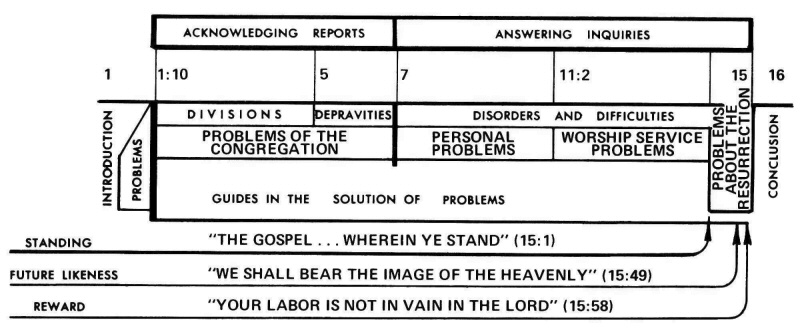
1 CORINTHIANS - PROBLEMS OF A LOCAL CHURCH
Click chart to enlarge
Charts from Jensen's Survey of the NT - used by permission
- 1 Corinthians 15:1 Commentary
- 1 Corinthians 15:2 Commentary
- 1 Corinthians 15:3 Commentary
- 1 Corinthians 15:4 Commentary
- 1 Corinthians 15:5 Commentary
- 1 Corinthians 15:6 Commentary
- 1 Corinthians 15:7 Commentary
- 1 Corinthians 15:8 Commentary
- 1 Corinthians 15:9 Commentary
- 1 Corinthians 15:10 Commentary
- 1 Corinthians 15:11 Commentary
- 1 Corinthians 15:12 Commentary
- 1 Corinthians 15:13 Commentary
- 1 Corinthians 15:14 Commentary
- 1 Corinthians 15:15 Commentary
- 1 Corinthians 15:16 Commentary
- 1 Corinthians 15:17 Commentary
- 1 Corinthians 15:18 Commentary
- 1 Corinthians 15:19 Commentary
- 1 Corinthians 15:20 Commentary
- 1 Corinthians 15:21 Commentary
- 1 Corinthians 15:22 Commentary
- 1 Corinthians 15:23 Commentary
- 1 Corinthians 15:24 Commentary
- 1 Corinthians 15:25 Commentary
- 1 Corinthians 15:26 Commentary
- 1 Corinthians 15:27 Commentary
- 1 Corinthians 15:28 Commentary
- 1 Corinthians 15:29 Commentary
- 1 Corinthians 15:30 Commentary
- 1 Corinthians 15:31 Commentary
- 1 Corinthians 15:32 Commentary
- 1 Corinthians 15:33 Commentary
- 1 Corinthians 15:34 Commentary
- 1 Corinthians 15:35 Commentary
- 1 Corinthians 15:36 Commentary
- 1 Corinthians 15:37 Commentary
- 1 Corinthians 15:38 Commentary
- 1 Corinthians 15:39 Commentary
- 1 Corinthians 15:40 Commentary
- 1 Corinthians 15:41 Commentary
- 1 Corinthians 15:42 Commentary
- 1 Corinthians 15:43 Commentary
- 1 Corinthians 15:44 Commentary
- 1 Corinthians 15:45 Commentary
- 1 Corinthians 15:46 Commentary
- 1 Corinthians 15:47 Commentary
- 1 Corinthians 15:48 Commentary
- 1 Corinthians 15:49 Commentary
- 1 Corinthians 15:50 Commentary
- 1 Corinthians 15:51 Commentary
- 1 Corinthians 15:52 Commentary
- 1 Corinthians 15:53 Commentary
- 1 Corinthians 15:54 Commentary
- 1 Corinthians 15:55 Commentary
- 1 Corinthians 15:56 Commentary
- 1 Corinthians 15:57 Commentary
- 1 Corinthians 15:58 Commentary
1 Corinthians 15:1 Now I make known to you, brethren, the gospel which I preached to you, which also you received, in which also you stand, (NASB: Lockman)
Greek: Gnorizo (1SPAI) de humin adelphoi, to euaggelion o eueggelisamen (1SAMI) humin o kai parelabete, (2PAAI) en o kai estekate, (2PRAI)
Amplified: AND NOW let me remind you [since it seems to have escaped you], brethren, of the Gospel (the glad tidings of salvation) which I proclaimed to you, which you welcomed and accepted and upon which your faith rests, (Amplified Bible - Lockman)
Barclay: Brothers, I want to make clear to you the nature of the good news that I preached to you, that gospel which you also received, and in which you stand, (Westminster Press)
KJV: Moreover, brethren, I declare unto you the gospel which I preached unto you, which also ye have received, and wherein ye stand;
NLT: Now let me remind you, dear brothers and sisters, of the Good News I preached to you before. You welcomed it then and still do now, for your faith is built on this wonderful message. (NLT - Tyndale House)
Phillips: Now, my brothers, I want to speak about the Gospel which I have previously preached to you, which you accepted, in which you are at present standing, (Phillips: Touchstone)
Wuest: Now, I am making known to you, brethren, the good news which I brought as glad tidings to you, which also you took to yourselves, in which also you have taken a stand, (Eerdmans)
Young's Literal: And I make known to you, brethren, the good news that I proclaimed to you, which also ye did receive, in which also ye have stood,
NOW I MAKE KNOWN TO YOU, BRETHREN, THE GOSPEL WHICH I PREACHED TO YOU: Gnorizo (1SPAI) de humin adelphoi, to euaggelion o eueggelisamen (1SAMI):
- 1Cor 15:3-11; 1:23,24; 2:2-7; Acts 18:4,5; Galatians 1:6-12
- 1 Corinthians 15 Resources
This verse literally reads
the gospel (euaggelion) which I gospelized (euaggelizo) to you
1Corinthians 15 is devoted entirely to the doctrine of the resurrection, and as such is the most extensive treatment of this subject in the Bible. Paul explains that without the truth of the resurrection Christianity would be little more than wishful thinking like all other speculative religious and philosophical thought concerning life after death. Therefore it is not surprising that the unbelieving world energized by Satan and his minions would seek to relentlessly attack the veracity of the doctrine of the resurrection, for if Christ did not live past the grave, those who place their trust in Him are without hope as Paul writes in verse 19…
If we have hoped in Christ in this life only, we are of all men most to be pitied. (1Cor 15:19).
Brian Bell gives some background noting that…
At the time Paul was writing the Corinthian church there were many strange views of “death” & “life after death”. Some Jews denied, namely the Sadducees, that there was any life after death at all. The Greek world had an instinctive fear of death. In Athens’ citadel of human philosophy, the Areopagus, believing in the resurrection of the body was unthinkable. They believed the body to be the source of man’s weakness & sin; they viewed it as a corpse, a tomb. Located near Athens was Corinth. The Corinthian Christians were denying “not the Resurrection of Jesus Christ” but the resurrection of the body. (1Co 10:12) Paul will build his case, “they must accept their resurrection, or reject Christ’s!” Let’s describe what we mean by a resurrection body. Celsus the Roman Physician (about 220AD) who was a bitter opponent of Christianity, said, “How can those who have died rise with their identical bodies? he demands. “Really it is the hope of worms! For what soul of a man would any longer wish for a body that had rotted?” But of course Paul never said that we would rise with the body with which we died. He explained we’d have a spiritual body. The individual remains, his personality survives, he believed in the resurrection of “the whole man”. (Barclay wrote that) “Everything of the body and of the soul that is necessary to make a man a person will survive, but, at the same time, all things will be new, and the body and spirit will alike be very different from earthly things, for they will alike be divine.” (1Corinthians 15)
Paul explains in Romans 10 why belief in the resurrection is central to Christianity writing…
that if you confess with your mouth Jesus as Lord, and believe in your heart that God raised Him from the dead, you shall be saved; for with the heart man believes, resulting in righteousness, and with the mouth he confesses, resulting in salvation. (See notes Romans 10:9; 10:10)
Comment: If one does not believe in Christ's resurrection clearly they will not be saved!
Vine introduces this chapter commenting that…
The subject of the Resurrection does not seem to have been one of the questions asked of the apostle by the church at Corinth. Apparently, a report had reached him that some were spreading the error that there was no such thing as the resurrection of the dead. While some of the converts may have been Sadducees, the error no doubt sprang from Greek conceptions. Even those Greeks who had accepted the Platonic teaching of the immortality of the soul, would be inclined to view the idea of the resurrection of the body as foolishness. So it was regarded in Athens (see notes Acts 17:18, 32-33).
A denial of the doctrine of the resurrection of the body would tend to further the moral laxity in the church. God often overrules the efforts of Satan to introduce error among His people by causing His faithful servants to meet it by truth. This was now the case, in a special way, in regard to the apostle’s divinely-imparted power to write this chapter for the strengthening of the faith of His saints. The chapter has four distinct sections: (1) 1Cor 15:1-11: the Resurrection of Christ, an essential truth of apostolic testimony; (2) 1Cor 15:12-34: the Resurrection of Christ a guarantee of that of believers who die, and all an essential part of God’s plan; (3) 1Cor 15:35-50: the nature of the resurrection of believers; (4) 1Cor 15:51-58: the effects, future and present. (Vine, W. Collected writings of W. E. Vine. Nashville: Thomas Nelson)
Someone has once said
If Jesus did not rise from the dead, then nothing in life really matters. But if He did rise from the dead, then nothing else in life really matters!
Hughes notes that
One of the problems the Corinthian church faced was that some were saying, “There will be no resurrection of the dead” (1Co 15:12). It has been suggested that these were Sadducees (Matt. 22:23-33), but this is unlikely since the Sadducees were associated with the Jerusalem temple, which was far from Corinth. They were probably Gentiles influenced by Greek philosophy. To the Greeks, immortality was a spiritual concept, and they had no place for the resurrection of the physical body. Since matter was considered essentially evil, release from a physical body was regarded as liberation, and a physical resurrection would amount to a return to bondage. Paul addressed these views through implications drawn from Christ’s resurrection. (Hughes, R. B., Laney, J. C., & Hughes, R. B. Tyndale Concise Bible Commentary. Wheaton, Ill.: Tyndale House Publishers)
Ray Stedman has this introduction…
We are beginning this great "resurrection" chapter, the fifteenth chapter of First Corinthians, which is undoubtedly the climax of this letter.
In the first eleven chapters the Apostle Paul has been dealing with what we have called "the carnalities," the things concerning the flesh, the hurtful, false and divisive things that were occurring there in the church at Corinth. These same things are also present in the churches of California, therefore, the letter is very pertinent to us.
But then, beginning with Chapter 12, Paul introduced what he himself called "the spiritualities," the things concerning the spirit, what the Spirit of God has come to do in your life and in mine. The Apostle pointed out that there was: First an indwelling of the Spirit, whose object is to exalt and magnify the person of Jesus our Lord. Then there were the "gifts of the Spirit," which are imparted to every one among us so that we have a ministry of our own by which we may see God's power manifest through us individually. This is the basis for all personal ministry. Then that merged, in Chapter 13, with the "fruit of the Spirit," how the exercise of gifts to one another is to help us produce in our lives that amazing fruit of the Spirit, which is love and all its manifestations. Finally we come in this section to the ultimate truth about the Spirit, the resurrection of the body after death.
You recognize that one of the most relevant questions of our day is, "What happens after death?" A dozen books have come off the presses recently dealing with this theme. Many are speculating about it; many testimonies are being given about various experiences of those who, supposedly, have died and then come back to life again. The apostle is dealing with that very theme in this chapter. Here he brings us face to face with the great reality of life, one that is even more certain than taxes, and that is death.
You may evade paying your taxes, but you are not going to avoid growing old and ultimately dying. We may try to avoid it. I know a lot of people who are working hard at it; they are trying to cover up all the evidences of age and decay. But we have to face the fact that there is an invisible, irresistible, and inevitable process going on in every one of us right now. No matter how old, or how young, we may be, this process is slowly stealing the bloom from our cheeks, taking the spring from our steps, reducing the sharpness of our senses so we do not see quite as well or hear quite as accurately, decreasing the potency of our sexual powers, and in many ways depriving us of what we thought to be the joy of living. (I read somewhere recently that death is nature's way of saying, "It's time to slow down.") (1 Corinthians 15:1-4 Of First Importance)
Have made known (1107) (gnorizo) means to cause information to be known by someone through communication of things before unknown or as in the present case of reasserting things already known by the Corinthians, in this case specifically the knowledge of Christ's resurrection. One author notes that gnorizo was used to introduce a solemn statement. One author writes that gnorizo "means to make one recognize what before he had under his senses, or in his mind, without grasping the import of it." (Ref)
The idea is that Paul is beginning this section saying "I draw your attention". Paul thus begins by stating the foundation truths he had ministered to them at the first. In essence he wants them to know what they should already know since they had believed the gospel that he had preached to them. He later reminds them that some of the Corinthians were questioning the resurrection so vital to the integrity of the Gospel…
1Cor 15:12 "Now if Christ is preached, that He has been raised from the dead, how do some among you say that there is no resurrection of the dead?"
Gnorizo - 25x in 24v in the NAS - Luke 2:15, 17; John 15:15; 17:26; Acts 2:28; Rom 9:22f; 16:26; 1 Cor 12:3; 15:1; 2 Cor 8:1; Gal 1:11; Eph 1:9; 3:3, 5, 10; 6:19, 21; Phil 1:22; 4:6; Col 1:27; 4:7, 9; 2 Pet 1:16, NAS = bring… information(1), have you know(1), inform(1), know(1), made… known(2), made known(11), make… known(2), make known(6), make… known(1).
Charles Ryrie comments that…
Nothing in the Greek background of the Gentile converts at Corinth led them to believe in the resurrection of the dead. In general, they (pagan Greeks) believed in the immortality of the soul, but not the resurrection of the body. To them, the body was the source of man's weakness and sin; death, therefore, was the welcomed means by which the soul was liberated from the body. Resurrection, in their thinking, would only enslave the soul again. (The Ryrie Study Bible: New American Standard Translation: 1995. Moody Publishers) (Comment: In fact it is worth noting that because the idea of resurrection was foreign to Greek thought, there existed no technical words in Greek to describe it.)
One is reminded of Paul's encounter with the pagan Greek philosophers in Athens, Luke recording…
And also some of the Epicurean and Stoic philosophers were conversing with him. And some were saying, "What would this idle babbler wish to say?" Others, "He seems to be a proclaimer of strange deities,"-- because he was preaching (euaggelizo/euangelizo) Jesus and the resurrection… (And on Mars Hill Paul explained that God) … has fixed a day in which He will judge the world in righteousness through a Man Whom He has appointed, having furnished proof to all men by raising Him from the dead." 32 Now when they heard of the resurrection of the dead, some began to sneer (literally throw out the lip, and so to scoff, mock, deride with words, etc, but others said, "We shall hear you again concerning this." (see notes Acts 17:18, 31-32)
The resurrection is the same central truth Paul preached everywhere he went, as for example on his first visit to Thessalonica where Luke records…
And according to Paul's custom, he went to them (into a synagogue of the Jews), and for three Sabbaths reasoned with them from the Scriptures (Old Testament writings), explaining and giving evidence that the Christ had to suffer and rise again from the dead, and saying, "This Jesus Whom I am proclaiming to you is the Christ (the Messiah)." (see notes Acts 17:2-3)
Richards adds that…
The culminating experience in our personal transformation is to be resurrection. Yet, some in Corinth denied this completion. They carried over into their new faith the typical Greek attitude toward life after death; they could not accept the idea of a bodily resurrection. Christian faith might have meaning for the here and now. It might even offer some astral form for their personalities after death. But, a literal resurrection? No. (Richards, L., & Richards, L. O. The Teacher's Commentary. Wheaton, Ill.: Victor Books)
Brethren (80) (adelphos from collative a = denoting unity + delphús = womb) is literally one born from same womb and so a male having the same father and mother as reference person. Figuratively, adelphos as in this verse refers to a close associate of a group of persons having well-defined membership, specifically here referring to fellow believers in Christ who are united by the bond of affection. What Paul does by addressing them again as brethren (he had called them brethren in 1Cor 1:10; 2:1; 9;3:1; 10:1; 11:33; 12:1; 14:6, 20, 26; 15:1, 58; 16:12, 15) is to assure his readers that he recognizes them as fellow believers. Adelphos also serves as a term of affection -- Paul begins this chapter referring to them as brethren and ends referring to them as beloved brethren (1Co 15:58-note).
Spurgeon comments on the the centrality of the resurrection in the Gospel…
Now, we expect to hear a whole list of doctrines when the apostle says "I declare unto you the gospel;" but instead of that, he simply tells us of the resurrection of Jesus, for that is the very marrow of the gospel, the foundation of it—that Jesus Christ died and rose again the third day, according to the Scriptures. (1Co 15:2 3 4) (Exposition of 1Cor 15)
Gospel (2098) (euaggelion [word study] from eú = good + aggéllo = proclaim, tell; Saxon = gōd-spell = lit. "good tale, message") means good news, glad tidings.
The Gospel is good news for those who have done their best and failed!
Martin Luther said it this way…
The law is what we must do; the Gospel is what God will give.
Euaggelion originally referred to a reward for good news and later became the good news itself. The word euaggelion was in just as common use in the first century as our words good news today. “Have you any good news for me today?” would have been a common question.
In this secular use euaggelion described good news of any kind and prior to the writing of the New Testament, had no definite religious connotation in the ancient world until it was taken over by the "Cult of Caesar" which was the state religion and in which the emperor was worshipped as a god (see more discussion of this use below).
The writers of the New Testament adapted the term as God's message of salvation for lost sinners. Euaggelion is found in several combination phrases, each describing the gospel like a multifaceted jewel in various terms from a different viewpoint (from the NASB, 1977).
It is the Gospel…
• of God (cf Mk 1:14, Romans 15:16 (note), 2Cor 11:7, 1Th 2:2, 8, 9 see notes 1Th 2:2, 8, 9, 1Pe 4:17-note) because it originates with God and was not invented by man
• of God… concerning His Son - Ro 1:1, 2, 3 (notes)
• of His Son - Ro 1:9 (note)
• of Jesus Christ, the Son of God, Mk 1:1 because it centers in Christ
• of our Lord Jesus - 2Th 1:8
• of Christ - Ro 15:19 (note), 1Cor 9:12, 2Cor 2:12, 9:13, 10:14, Gal 1:7, Php 1:27 (note), 1Th 3:2 (note)
• of the glory of Christ - 2Co 4:4
• of the grace of God - Acts 20:24
• of the glory of the blessed God - 1Ti 1:11
• of your salvation - Eph 1:13 (note)
• of peace - Eph 6:15 (note)
• of the Kingdom - Mt 4:23; 9:35; 24:14
• of the Kingdom of God - Lk 16:16
• an eternal gospel - Re 14:6 (note) (Some such as C I Scofield interpret this as a "different gospel" than the other "gospels" mentioned above but I think such a distinction is incorrect and is poorly substantiated).
• my Gospel - Ro 16:25, 26 (see note) Paul called it “my Gospel” indicating the special emphasis he gave the gospel in his ministry.
For a rewarding exercise, study the preceding references in context making notation of the truth you observe about the gospel. If you would like a special blessing, take an afternoon to go through all 76 uses of euaggelion in context making a list of what you learn about the gospel. The Spirit of God will enlighten your heart and encourage your spirit in a very special way… and you'll want to share the "good news" with someone because of your "discoveries"!
Euaggelion was commonly used in the Greco-Roman culture as "a technical term for "news of victory." The messenger appears, raises his right hand in greeting and calls out with a loud voice: "rejoice …we are victorious". By his appearance it is known already that he brings good news. His face shines, his spear is decked with laurel, his head is crowned, he swings a branch of palms, joy fills the city, euaggelia are offered, the temples are garlanded, an agon (race) is held, crowns are put on for the sacrifices and the one to whom the message is owed is honored with a wreath… [thus] euaggelion is closely linked with the thought of victory in battle. " (Theological Dictionary of the New Testament) This is a convicting definition - here a pagan messenger radiantly announces good news of an earthly victory. How much more radiant should we be who are the bearers of the great news of Christ's eternal triumph over sin, Satan, and death!
Euaggelion was used in secular Greek chiefly in connection with oracles (i.e. the promise of some future event) and in the imperial cult that euaggelion acquires a religious meaning. In the latter sphere news of the "divine" ruler’s birth, coming of age or enthronement and also his speeches, decrees and acts are glad tidings which bring long hoped-for fulfillment to the longings of the world for happiness and peace (albeit a counterfeit hope and peace). An instance of this is the decree of the Greeks of the province of Asia c. 9 B.C. marking the birthday of Augustus (23 September) the beginning of the civil year (this is worth reading as an example of thinking that has become darkened) --
“It is a day which we may justly count as equivalent to the beginning of everything—if not in itself and in its own nature, at any rate in the benefits it brings—inasmuch as it has restored the shape of everything that was failing and turning into misfortune, and has given a new look to the Universe at a time when it would gladly have welcomed destruction if Caesar had not been born to be the common blessing of all men… Whereas the Providence which has ordered the whole of our life, showing concern and zeal, has ordained the most perfect consummation for human life by giving to it Augustus, by filling him with virtue for doing the work of a benefactor among men, and by sending in him, as it were, a savior for us and those who come after us, to make war to cease, to create order everywhere… and whereas the birthday of the God [Augustus] was the beginning for the world of the glad tidings that have come to men through him… Paulus Fabius Maximus, the proconsul of the province … has devised a way of honoring Augustus hitherto unknown to the Greeks, which is, that the reckoning of time for the course of human life should begin with his birth” (compare our use of BC to AD because of the birth of Christ!) (E. Barker: From Alexander to Constantine: Passages and Documents Illustrating the History of Social and Political Ideas 336 B.C.-A.D. p337, 1956)
In contrast to the counterfeit gospel, the human proclamation of the gospel (euaggelion) does not merely herald a new era, but in fact actually brings it about because the euaggelion has within it the inherent power to germinate and generate salvation in those who hear it proclaimed. If this is true (and it is), then why are so many saints shy about speaking forth the good news of the greatest story ever told?!
The new testament evangelists appropriated euaggelion in reference to the good news of salvation by grace through faith in Jesus Christ. "Gospel" in fact was Paul’s favorite term for his message and occurs nine times in Philippians (more proportionately than in any other letter). In the NT in Paul’s letters the meaning of euaggelion narrows down to the specific sense of the "good news" that God has acted to save people from their sins and to reconcile them to Himself in or through Jesus Christ (cf Mt 1:21; 1Co 15:1, 2, 3; 2Co 5:19). For Paul, the gospel is not merely good news in the sense of words spoken and heard, i.e. a good story, but is itself "the (inherent, dynamic) power of God for salvation to everyone who believes, to the Jew first and also to the Greek" (Ro 1:16, 17-notes). The gospel then possesses the inherent power to deliver (rescue and preserve) otherwise eternally lost sinners "from the domain (the power = right and the might) of darkness" and transfer them "to the kingdom of His beloved Son" (Col 1:11, 12, 13-note).
Paul reiterated the truth of the living, dynamic aspect of the gospel in his epistle to the Colossians writing that because they were saved, the saints now had a
"hope laid up (reserved, laid away for preservation, waiting, in store) for (them) in heaven, of which (they) previously heard in the word of truth, the gospel, which has come to you, just as in all the world also it (the gospel) is constantly bearing fruit and increasing, even as it (gospel) has been doing in you also since the day you heard of it (gospel) and understood the grace of God in truth just as you learned it (gospel) from Epaphras… " (see note Colossians 1:5, 6-7)
The gospel is not a stagnant system of ethics but is the Word of Truth which is living, moving, growing, bearing fruit and spreading.
The gospel possesses a divine energy that causes it to spread like a mustard seed growing into a tree (Mt 13:31, 32).
The gospel produces fruit both in the internal transformation of individuals, and also in the external growth of the church. The living gospel is the power that transforms lives. As it does so, the witness of those transformed lives produces fruit, including new converts. So as the gospel produces fruit in individual lives, its influence spreads.
Finally, note that although the gospel reaches its consummation in the NT with the truth of the birth, death, burial, resurrection and soon, sure return of Jesus Christ, the gospel was also proclaimed in the Old Testament.
Paul teaches us that
"the Scripture (in context the Old Testament), foreseeing that God would justify the Gentiles by faith, preached the gospel beforehand to Abraham, saying, "ALL THE NATIONS SHALL BE BLESSED IN YOU." (Gal 3:8)
In other words, Old Testament saints were saved by faith in the gospel, just as are NT saints. In fact even in the face of man's first sin, God promised the gospel declaring to Satan "And I will put enmity between you and the woman, and between your seed and her seed. He shall bruise you (Satan) on the head, and you shall bruise him on the heel.” (Ge 3:15) The salvation we enjoy today was promised by the prophets, though they did not fully understand all that they were preaching and writing (1Pe 1:10, 11, 12-note).
William Tyndale, Christian martyr in the 1500's said…
Euaggelion (which we call gospel) is a Greek word, and signifies good, merry, glad, and joyful tidings, that makes a mans heart glad, and makes him sing, dance, and leap for joy.
A. B. Simpson is reported to have said that the gospel…
Tells rebellious men that God is reconciled, that justice is satisfied, that sin has been atoned for, that the judgment of the guilty may be revoked, the condemnation of the sinner canceled, the curse of the Law blotted out, the gates of hell closed, the portals of heaven opened wide, the power of sin subdued, the guilty conscience healed, the broken heart comforted, the sorrow and misery of the Fall undone.
Christ commands believers to share this Good News with the rest of the world. This Good News is Christ’s life-giving message to a dying world
Go into all the world and preach the gospel to all creation. (Mk 16:15)
Which I preached (2097) (see word study of euaggelizo/euangelizo in next verse). The use of the aorist tense in this verse views the total ministry of Paul, emphasizing the one gospel which he preached.
John Calvin once said that…
Whenever the gospel is preached it is as if God himself came into the midst of us.
Charles Colson…
The gospel is good news. But Jesus never said it was easy news.
Richard Owen Roberts…
The nature of the gospel is that it divides.
In a similar vein Oswald Chambers said that…
There is nothing attractive about the Gospel to the natural man; the only man who finds the Gospel attractive is the man who is convicted of sin.
Vance Havner on the proclamation of the Gospel…
The Gospel makes some people sad, some mad and some glad. It is better that people should go out of church mad than merely go out, neither sad, mad, nor glad.
Augustine
If you believe what you like in the gospel, and reject what you don't like, it is not the gospel you believe, but yourself.
WHICH ALSO YOU RECEIVED, IN WHICH ALSO YOU STAND: humin o kai parelabete (2PAAI):
- 1Cor 1:4, 5, 6, 7, 8; Mark 4:16, 17, 18, 19, 20; John 12:48; Acts 2:41; 11:1; 1Th 1:6; 2:13; 4:1; 2Th 3:6)
Writing to the Thessalonian saints Paul affirmed that…
You also became imitators of us and of the Lord, having received (dechomai) the word (the Gospel) in much tribulation with the joy of the Holy Spirit (1Th 1:6-note)
Paul uses the same verb paralambano in verse 3 explaining…
I delivered (paradidomi) to you as of first importance what I also received (paralambano), that Christ died for our sins according to the Scriptures (1Co 15:3-note)
Paul had earlier mentioned the ideas of receiving and delivering writing…
For I received (paralambano) from the Lord that which I also delivered (paradidomi) to you, that the Lord Jesus in the night in which He was betrayed took bread (1Cor 11:23)
Which you received - Note that no one discovers the Gospel for himself or herself. The Gospel is designed to be transmitted (proclaimed) and to be received. Think of an FM transmission sent out over the radio waves to be received by an FM radio. This same picture of reception of the "broadcast" of the Gospel is beautifully portrayed in the lives of the Thessalonian saints Paul writing…
And for this reason we also constantly thank God that when you received (paralambano) from us the word of God's message, you accepted (dechomai) it not as the word of men, but for what it really is, the word of God, which also performs its work in you who believe. (See note 1Thessalonians 2:13)
Commenting on the difference between received and accepted Warren Wiersbe writes that the verb received or paralambano "means simply 'to accept from another' while the second (dechomai) means 'to welcome.' One (paralambano) means 'the hearing of the ear,' while the other (dechomai) means “the hearing of the heart.' The believers at Thessalonica did not only hear the Word; they took it into their inner man and made it a part of their lives… How do we appropriate the Word? By understanding it and receiving it into our hearts, and by meditating on it so that it becomes part of the inner man. Meditation is to the spiritual life what digestion is to the physical life. If you did not digest your food, you would die. It takes time to meditate, but it is the only way to appropriate the Word and grow. (Wiersbe, W: Bible Exposition Commentary. 1989. Victor)
Paul writes…
How then shall they call upon Him in whom they have not believed? And how shall they believe in Him whom they have not heard? And how shall they hear without a preacher? (Ro 10:14-note)
James describes the reception this way…
Therefore putting aside all filthiness and all that remains of wickedness, in humility receive the word implanted, which is able (dunamai = present tense = the word of God, the Gospel, continually has intrinsic, inherent supernatural, miracle working power to accomplish its intended purpose which in this verse is) to save your souls. (Jas 1:21-note)
Received (3880) (paralambano [word study] from para = beside + lambano = appropriate, receive) means to receive from another, to receive alongside or to take to oneself.
The aorist tense looks back to the time when the Corinthians heard the proclamation the gospel and records their active response (active voice = made a decision of their will) to the message - they took hold of the divine message. They received it alongside. They took it to themselves as their possession.
Barclay writes that the good news…
was something which the Corinthians had received. No man ever invented the gospel for himself; in a sense no man ever discovers it for himself. It is something which he receives. (Barclay, W: The Daily Study Bible Series. The Westminster Press )
Paralambano also has nuances of seizing or taking to one's self or taking something into one's possession How do I respond when I am confronted with the word of God's message?
Paralambano is the verb the Lord used to to encourage Joseph's reception of Mary after her conception
Do not be afraid to take Mary as your wife… And Joseph… took her as his wife (Mt 1:20, 24)
John uses this verb describing the failure of most of the Jews (in contrast to the predominantly Gentile population at Thessalonica) refusal to receive Jesus as their Messiah…
He came to His own, and those who were His own did not receive (paralambano) Him. (John 1:11)
Paralambano denotes an objective, outward receiving. It was used for the reception of words which were to be conveyed, Paul writing…
For I received (paralambano) from the Lord that which I also delivered to you, that the Lord Jesus in the night in which He was betrayed took bread (1Cor 11:23)
Paul used paralambano in the context of the gospel proclamation in other epistles…
As we have said before, so I say again now, if any man is preaching to you a gospel contrary to that which you received (paralambano), let him be accursed… 12 For I neither received (paralambano) it from man, nor was I taught it, but I received it through a revelation of Jesus Christ. (Galatians 1:9, 12)
The things you have learned and received (paralambano) and heard and seen in me, practice these things; and the God of peace shall be with you. (see note Philippians 4:9)
As you therefore as you have received (paralambano) (the) Christ Jesus the Lord, so walk (present imperative) in Him" (see note Colossians 2:6).
Paralambano is the verb especially used of receiving a message or body of instruction handed down by tradition, to be delivered (paradidomi) to others in turn. Paul uses it in this sense in 2Thessalonians…
Now we command you, brethren, in the name of our Lord Jesus Christ, that you keep aloof from every brother who leads an unruly life and not according to the tradition (paradosis derived from paradidomi - give alongside) which you received (paralambano) from us. (2Thessalonians 3:6)
In summary, the verb paralambano conveys the idea that the Corinthians had received the Gospel into their mind and thus they had learned it.
IN WHICH ALSO YOU STAND: en o kai estekate, (2PRAI):
- Romans 5:2; 2Corinthians 1:24; 1Peter 5:12
- 1 Corinthians 15 Resources
In which also you stand - Picture the saints at Corinth standing in the Gospel. Like when we hear someone say "So and so took their stand on the truth." The Gospel is not spiritual quicksand but a sure foundation upon which their faith can stand.
Brian Bell (ref) comments that…
Once received, the Gospel gives a person stability. In a slippery world we need to be able to keep our feet!
Pr 4:11,12 “I have taught you in the way of wisdom; I have led you in right paths. When you walk, your steps will not be hindered, And when you run, you will not stumble.”
2Sa 22:32,34,37 “For who is God, except the LORD? And who is a rock, except our God?…He makes my feet like the feet of deer, and sets me on my high places…You enlarged my path under me; so my feet did not slip.”
Ray Stedman commenting on the gospel in which we stand…
There are two things, then, the gospel does for you, Paul says, two simple divisions: First, it makes you stand. Notice he says, the gospel, which you received, by which you stand.
That means you have a foundation; you have a place to handle life; you have a security to which you can resort at any time of pressure and problem and you can stand steady, no matter what kind of force comes against you. When you believe that God has forgiven your sins for Christ's sake, when you believe that God loves you and has accepted you as His child, when you believe that He is working in you by the power of His resurrected life to enable you to love and to live as you ought and to give you power to say "No" when you need to say "No," you have a place to stand that can handle anything that comes. That is what Paul said these Corinthians had. They were loved by God, therefore they had a place of emotional security. That is the first thing the gospel does.
In a dangerous and slippery world like this, it is a tremendous thing to have a place where you can find love and acceptance and understanding and support in all the pressures. Well, that is what the gospel does. When things are frightening and foreboding all around, the gospel gives you a place of reassurance. I do not know how you feel when you pick up the newspaper and read that China has now invaded Vietnam, that Russia is standing by, ready to retaliate. These two great powers are about to leap at one another's throats. The Middle East is all aflame and in turmoil; wars are breaking out in the African states; the South American countries are restless and filled with violence and the threat of revolution. What does it do to you, living in a world like that? Who knows, warfare may break out very shortly and nuclear bombs will scream across our country?
Well, in the face of an uncertain future the gospel gives us a sense of certainty. It reminds us, as we read in those wonderful words from Colossians 1:16, that there is One who is above all principalities and rulers and authorities and powers; He is in charge of all human events. When you fail and slide away and slip, the gospel is the place where you find recovery and an ability to come back again, sick of soul and hungry of heart, and find relief and forgiveness and healing for your hurting heart. That is the gospel -- the fact that God loves you despite all your failure and all your weakness. He is always ready to pick you up again and wash the hurt away, to start you out anew and teach you to walk in His strength and by His grace. That is a place to stand. (1 Corinthians 15:1-4 Of First Importance)
Stand (2476) (histemi) means literally to take up or maintain a specified position or posture. Paul uses histemi figuratively in this verse meaning that the Corinthians had adopted and remained in a resolute position or attitude regarding the Gospel.
Guzik comments that…
Despite all their problems with carnality, lack of understanding, strife, divisions, immorality, and weird spirituality, they still stood for the gospel. This is in contrast to the Galatian church, who was quickly being moved away to another gospel (Galatians 1:6 "I am amazed that you are so quickly deserting Him who called you by the grace of Christ, for a different gospel").
The perfect tense pictures the abiding results. They stood and they are still standing. How do they continue to stand? The same way they began to stand, by grace through faith (not sight, not self effort, not works, not flesh).
Bob Bolender (1Cor 15.pdf - very technical) writes that..
The principles of standing and standing firm are critical for the Christian Way of Life.
a. Positionally, believers are “having stood ones” (Ro 5:2-note; 1Co 15:1).
b. Experientially, believers must fight the good fight standing firm (1Co 10:12; 16:13; Gal 5:1; Ep 6:11-note, Ep 6:13,14-note; Col 4:12-note; 1Th 3:8-note; 2Th 2:15).
c. Ultimately, all believers will stand for reward (Ro 14:4-note; Jude 1:24).
Barclay writes that the gospel…
was something in which the Corinthians stood. The very first function of the good news was to give a man stability. In a slippery world it kept him on his feet. In a tempting world it gave him resistance power. In a hurting world it enabled him to endure a broken heart or an agonized body and not to give in. Moffatt finely translates Job 4:4, “Your words have kept men on their feet.” That is precisely what the gospel does. (Barclay, W: The Daily Study Bible Series. The Westminster Press)
John MacArthur adds that Paul's…
point of the first two verses is that the Corinthian believers were themselves living evidence that this doctrine was true. The fact that they came out of the spiritual blindness and deadness of Judaism or paganism and into the light and life of Christ testified to the power of the gospel, and therefore to the power of the resurrection. It also testified that they already believed in the truth of Christ’s resurrection. It was the gospel of the resurrection of Jesus Christ that Paul had preached to them, that they had received, and in which he assures them they now stand and by which they are saved, delivered from sin’s power and condemnation. Because of the reality of Christ’s resurrection and of their trust in it, they were now a part of His church and thereby were evidence of the power of that resurrection. (MacArthur, J: 1Corinthians. Chicago: Moody Press)
C H Spurgeon writes that…
There were people in the Apostles' days who had an idea that there was no resurrection. Paul endeavours to refute the idea, and teaches the Corinthians that there was a resurrection from the dead. From the 1st to the 11th verse he proves the resurrection of Jesus Christ, and upon that grounds the doctrine of the resurrection of the just. Now, we expect to hear a whole list of doctrines when the apostle says "I declare unto you the gospel;" but instead of that, he simply tells us of the resurrection of Jesus, for that is the very marrow of the gospel, the foundation of it—that Jesus Christ died and rose again the third day, according to the Scriptures.
Raymond Ortlund, Jr has a powerful and convicting "Afterword" on the Gospel in his excellent book A Passion for God: Prayers and Meditations on the Book of Romans. Ortlund entitles his "Afterword"…
AN EARNEST CALL FOR EVANGELICAL LEADERS TO RECOVER THE GOSPEL FROM ITS PRESENT HUMILIATION
A wave of authentic revival sweeps over the church when three things happen together: teaching the great truths of the gospel with clarity, applying those truths to people’s lives with spiritual power, and extending that experience to large numbers of people. We evangelicals urgently need such an awakening today. We need to rediscover the gospel.
Imagine the evangelical church without the gospel. I know this makes no sense, for evangelicals are defined by the evangel. But try to imagine it for just a moment. What might our evangelicalism, without the evangel, look like? We would have to replace the centrality of the gospel with something else, naturally.
So what might take the place of the gospel in our sermons and books and cassette tapes and Sunday school classes and home Bible studies and, above all, in our hearts?
A number of things, conceivably. An introspective absorption with recovery from past emotional traumas, for example. Or a passionate devotion to the pro-life cause. Or a confident manipulation of modern managerial techniques. Or a drive toward church growth and “success.” Or a deep concern for the institution of the family. Or a fascination with the more unusual gifts of the Spirit. Or a clever appeal to consumerism by offering a sort of cost-free Christianity Lite. Or a sympathetic, empathetic, thickly-honeyed cultivation of interpersonal relationships. Or a determination to take America back to its Christian roots through political power. Or a warm affirmation of self-esteem. The evangelical movement, stripped of the gospel, might fix upon any or several of such concerns to define itself and derive energy for its mission. In other words, evangelicals could marginalize or even lose the gospel and still potter on their way, perhaps even oblivious to their loss.
But not only is this conceivable, it is actually happening among us right now. Whatever one may think of the various concerns noted above as alternatives to the centrality of the gospel—and some of these matters possess genuine validity and even urgency, especially the family—not one of them is central to our faith. Not one of them is the gospel or deserves to push the gospel itself to the periphery of our message, our agenda and our affections. But the gospel of our blessed Lord Jesus Christ is today suffering humiliation among us evangelicals by our conspicuous neglect of it.
When we think of the gospel, we may have a feeling that “We already know that. Ho-hum.” We assume the gospel as a given. We assume that the people in our churches know the gospel, and we are anxious to move on to more “relevant” and “practical” topics. The gospel is being set aside in our minds and hearts in favor of a broad range of issues, as broadly ranging as evangelicalism is fragmented, while the heart and soul of our faith is falling into obscurity through neglect. The holy mysteries of the incarnation, cross, resurrection, ascension and heavenly reign of our Lord, the great themes of election, propitiation, justification and sanctification, the power and deceitfulness of sin (See Related Discussion: The Deceitfulness of Sin), the meaning of faith and repentance, our union with our crucified, buried and risen Lord, the infinitely superior value of our heavenly reward compared with anything this life has to offer (including the Christian life), the final judgment and eternity—these glorious themes which lie at the very center of our faith, which made the church great at her greatest moments in the past and which can do the same again for us today if only we will recover them and exploit them confidently, prayerfully and biblically, these infinitely precious treasures are being bypassed in favor of legitimate but secondary matters of concern. We must guard the centrality of that which is central.
We should not think, “Well, of course we have the gospel. The Reformation recovered it for us.” Such complacency will cost us dearly. Every generation of Christians must be retaught afresh the basic truths of our faith. The church is always one generation away from total ignorance of the gospel, and we today are making rapid progress toward that ruinous goal. Rather than carelessly assume the gospel, we must aggressively, deliberately, fully and passionately teach and preach the gospel. All the treasures of wisdom and knowledge are hidden in Christ. If we do not intentionally search them out, we will miss them.
Pastors and church leaders, in particular, are under enormous pressure today to satisfy the immediate demands of the marketplace at the cost of the gospel. People want what they want when they want it, or they will drive down the street to the First Church of Where-It’s-At to get it. Are we leaders losing our nerve? Have we come to feel that the gospel itself meets people’s needs less convincingly and helpfully? But think about it. Without a clear understanding of the central truths of our faith, where will the wisdom and motivation to live godly lives come from? We are constantly offering people “Five Steps to (whatever)” in answer to their problems. But it is not working. To a shameful degree, we Christians are morally indistinct from the world. Why? One reason is that we think piecemeal, and our lives show it. We do not perceive reality from God’s perspective. We perceive reality from the perspective of our ungodly culture, and then we try to slap a biblical principle onto the surface of our deep confusion. Consequently, very little actually changes. What we really need is not to be pandered to but to be re-educated in reality, as it is interpreted for us by the gospel. We need to know who God really is. We need to find out who we really are. We need to understand what our root problem really is and what God’s merciful answer really is. And we need that new perception of reality to percolate deep down into our affections and desires, reorienting us radically and joyfully to a whole new way of life. But if we frankly feel that the plain old gospel offers very little for people’s real needs, then we have never really known it at all.
We evangelicals today are suffering massive defeat, brilliantly disguised as massive success.
A record high 74% of Americans eighteen years of age and older say they have made a commitment to Jesus Christ, according to a recent Gallup Poll. That could suggest a high degree of effectiveness in our witness. But at the same time—as if we needed verification of the fact—a survey by the Roper Organization shows little difference in the moral behavior of “born-again” Christians before and after their conversion.
If we come under the spell of ratings appeal rather than the imperatives of the gospel, what room can there be for the narrow gate and the hard way? Even as our churches enjoy a measure of outward success, we remain the influenced, not the influential, as long as we shift our power-base from the ways of God to the ways of man, from Spirit-anointed biblical truth to human skills and novelties. Operating in a man-centered rather than a God-centered mode, our churches do not necessarily fail. They stand as good a chance of success as any other franchise network. Some even become popular—but popular as what? As a religious pastime, or as a force for God?
And you, O desolate one, what do you mean that you dress in scarlet, that you deck yourself with ornaments of gold, that you enlarge your eyes with paint? In vain you beautify yourself. Your lovers despise you; they seek your life.—Jeremiah 4:30
O desolate evangelicalism, what do you mean by your stylish fads and restless search for ever new “relevance”? Why are you so insecure that you long for the world’s approving recognition?
They despise everything you hold dear! “All things to all men” is no license to cater to the whims of the consumer. Christ alone is Lord. Or have you yourself forgotten his majesty? And why are you so boastful of your numbers and dollars? How poor you really are! Come back to the Gospel. Come back to the wellspring of true joy and life and power. Sanctify Christ again as Lord in your hearts. Wake up! Strengthen what remains, for it is on the point of death. But if you will not return to the centrality of the gospel as God’s power for the church today, then what reason does your Lord have for not abandoning you altogether? (Ortlund, R. C., Jr. A Passion for God: Prayers and Meditations on the Book of Romans. Wheaton, Ill.: Crossway Books