
Bo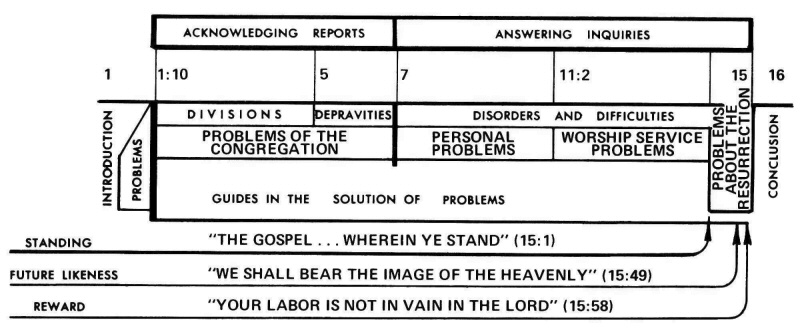
1 CORINTHIANS - PROBLEMS OF A LOCAL CHURCH
Click chart to enlarge
Charts from Jensen's Survey of the NT - used by permission
- 1 Corinthians 15:1 Commentary
- 1 Corinthians 15:2 Commentary
- 1 Corinthians 15:3 Commentary
- 1 Corinthians 15:4 Commentary
- 1 Corinthians 15:5 Commentary
- 1 Corinthians 15:6 Commentary
- 1 Corinthians 15:7 Commentary
- 1 Corinthians 15:8 Commentary
- 1 Corinthians 15:9 Commentary
- 1 Corinthians 15:10 Commentary
- 1 Corinthians 15:11 Commentary
- 1 Corinthians 15:12 Commentary
- 1 Corinthians 15:13 Commentary
- 1 Corinthians 15:14 Commentary
- 1 Corinthians 15:15 Commentary
- 1 Corinthians 15:16 Commentary
- 1 Corinthians 15:17 Commentary
- 1 Corinthians 15:18 Commentary
- 1 Corinthians 15:19 Commentary
- 1 Corinthians 15:20 Commentary
- 1 Corinthians 15:21 Commentary
- 1 Corinthians 15:22 Commentary
- 1 Corinthians 15:23 Commentary
- 1 Corinthians 15:24 Commentary
- 1 Corinthians 15:25 Commentary
- 1 Corinthians 15:26 Commentary
- 1 Corinthians 15:27 Commentary
- 1 Corinthians 15:28 Commentary
- 1 Corinthians 15:29 Commentary
- 1 Corinthians 15:30 Commentary
- 1 Corinthians 15:31 Commentary
- 1 Corinthians 15:32 Commentary
- 1 Corinthians 15:33 Commentary
- 1 Corinthians 15:34 Commentary
- 1 Corinthians 15:35 Commentary
- 1 Corinthians 15:36 Commentary
- 1 Corinthians 15:37 Commentary
- 1 Corinthians 15:38 Commentary
- 1 Corinthians 15:39 Commentary
- 1 Corinthians 15:40 Commentary
- 1 Corinthians 15:41 Commentary
- 1 Corinthians 15:42 Commentary
- 1 Corinthians 15:43 Commentary
- 1 Corinthians 15:44 Commentary
- 1 Corinthians 15:45 Commentary
- 1 Corinthians 15:46 Commentary
- 1 Corinthians 15:47 Commentary
- 1 Corinthians 15:48 Commentary
- 1 Corinthians 15:49 Commentary
- 1 Corinthians 15:50 Commentary
- 1 Corinthians 15:51 Commentary
- 1 Corinthians 15:52 Commentary
- 1 Corinthians 15:53 Commentary
- 1 Corinthians 15:54 Commentary
- 1 Corinthians 15:55 Commentary
- 1 Corinthians 15:56 Commentary
- 1 Corinthians 15:57 Commentary
- 1 Corinthians 15:58 Commentary
1Corinthians 15:2 by which also you are saved, if you hold fast the word which I preached to you, unless * you believed in vain. (NASB: Lockman)
Greek: di' ou kai sozesthe, (2PPPI) tini logo eueggelisamen (1SAMI) humin ei katexete, (2PPAI) ektos ei me eike episteusate. (2PAAI)
Amplified: And by which you are saved, if you hold fast and keep firmly what I preached to you, unless you believed at first without effect and all for nothing. (Amplified Bible - Lockman)
Barclay: and through which you are saved. I want to make clear to you what account I gave you of the good news, an account which can save you if you hold fast to it, unless your belief is a random and haphazard thing. (Westminster Press)
KJV: By which also ye are saved, if ye keep in memory what I preached unto you, unless ye have believed in vain.
NLT: And it is this Good News that saves you if you firmly believe it--unless, of course, you believed something that was never true in the first place. (NLT - Tyndale House)
Phillips: and by which, if you remain faithful to the message I gave you, your salvation is being worked out - unless, of course, your faith had no meaning behind it at all (Phillips: Touchstone)
Wuest: through which you are being saved, in what word I announced it to you as glad tidings, assuming that you are holding it fast unless you believed in vain; (Eerdmans)
Young's Literal: through which also ye are being saved, in what words I proclaimed good news to you, if ye hold fast, except ye did believe in vain,
BY WHICH ALSO YOU ARE SAVED: di' ou kai sozesthe (2PPPI):
- 1Cor 1:18,21; Acts 2:47; *Gr:; Romans 1:16; 2Corinthians 2:15; Ephesians 2:8; 2Timothy 1:9)
By which also you are saved - This is more literally through which also you are being saved
Ray Stedman commenting on this subtle difference (are saved versus being saved) writing that…
Paul goes on to say that the gospel is doing a second thing -- by which you are being saved. Now he puts it in the present tense; that is why I translated it that way. It is not by which you "were" saved. That is past tense; or by which you "will be" saved, that is future. It is by which you are now "being" saved. The present tense indicates that he is thinking here about our present, earthly experience of life.
There are three tenses of salvation simply because there are three parts of our human being, our human nature… Now, when you came to Christ that spirit was regenerated; it was made alive; it was indwelt by the Holy Spirit; it was linked to Jesus Himself so that you and He are one Spirit. That is salvation past; that is the past tense, by which you "were" saved, as certain texts say.
Then there is the one in the future: you will be saved. Paul will be talking about these bodies; this is the theme of this great resurrection chapter. This body too has a part in God's plan. God is not going to throw it away. I do not care if you grind it up and burn it up and scatter it to the winds, God can gather it together. We are going to see how, and why, he does it in this very chapter. God has a purpose for your body. He is going to redeem it, and restore it, and it will be useful to you all throughout eternity. That is salvation to come.
But now Paul is talking about the soul, about your life, about how you are living from day to day. He says that is "being" saved according to how much you are resting on God at work in you, and allowing yourself to be the instrument of his grace. In these terms, what he is talking about is buying you back from wasting your life. In these terms, he is telling us that as we walk with him what we do becomes eternally profitable, not only profitable for this present time, but eternally so, so that you can use your money for eternal profit, you can use your time for eternal profit, you can lay up treasures in heaven and not upon earth. By the way you use your moments and your days, whether you employ them in the strength of God or from the energy of the flesh, you can determine what is going to be good and bad at the judgment seat of Christ, when "every one may receive the things done in his body, whether it be good or bad," {cf, 2Cor 5:10}.
Now that is what the gospel is for. The gospel is to give us stability, to give us steadiness, to give us an immovable foundation, to give us a place of recovery, to give us a place of healing and of wholeness, and finally to redeem our present existence so that it has eternal meaning as we live day by day. What a tremendous theme that is! What a marvelous thing that God has prepared for us, in this solid place to stand!
Christ died for our sins according to the Scripture. He was buried. He rose again from the dead according to the Scripture, that we too might learn to die to our sins, to bury them, and to rise again to the freshness and newness of life that we experience right now by faith in Jesus Christ.
Prayer - Heavenly Father, thank you for the marvel, the wonder of the gospel. Help us to understand that this is to be the center of our life, the most basic thing about us is our faith in this good news. Nothing can be more foundational than that. Grant to us Lord, to take it seriously, to know that this is the beginning of a new life as we stand again and again at the place where the gospel brings us. We ask in Jesus' name, Amen. (1Corinthians 15:1-4 Of First Importance)
Saved (4982) (sozo) conveys the basic meaning of rescuing one from great peril. Additional nuances include to protect, keep alive, preserve life, deliver, heal, be made whole.
Sozo is in the present tense (not past tense) which more literally can be translated not as "you have been saved" but you are being saved. Note the passive voice which indicates it is God Who does the saving. See the related study of the Three Tenses of Salvation to help understand the multi-facet diamond of God's wondrous salvation. Here Paul is saying in essence that salvation is a continual progression toward Christlikeness. Justification (declaration of righteous standing before God) by faith (past tense salvation) is a once for all transaction in the past, but it initiates a process referred to as sanctification (present tense salvation, cf 1Co 1:18, 2Cor 2:15, 1Pe 3:21 - progressive sanctification) which continues (just as we began -- "by grace through faith", a gift from God, thus indicating the necessity of the believer's continual dependence upon the sanctifying power of the Holy Spirit; Gal 3:3 = "Are you so foolish? Having begun by the Spirit, are you now being perfected by the flesh?" of course not!) throughout our earthly life to one day be consummated in the glorification of our bodies (future tense salvation), when faith and hope become sight. In the meantime we are as Paul states in this verse "continually being saved" (aka progressive sanctification)! Praise God for so great a salvation, which provides for us from the inception to the consummation and then throughout eternity!
Sozo - 106x in 99v - NAS = bring… safely(1), cured(1), ensure salvation(1), get(1), get well(2), made… well(6), made well(5), preserved(1), recover(1), restore(1), save(36), saved(50), saves(1), saving(1).
Matt 1:21; 8:25; 9:21f; 10:22; 14:30; 16:25; 19:25; 24:13, 22; 27:40, 42, 49; Mark 3:4; 5:23, 28, 34; 6:56; 8:35; 10:26, 52; 13:13, 20; 15:30f; 16:16; Luke 6:9; 7:50; 8:12, 36, 48, 50; 9:24; 13:23; 17:19; 18:26, 42; 19:10; 23:35, 37, 39; John 3:17; 5:34; 10:9; 11:12; 12:27, 47; Acts 2:21, 40, 47; 4:9, 12; 11:14; 14:9; 15:1, 11; 16:30f; 27:20, 31; Rom 5:9f; 8:24; 9:27; 10:9, 13; 11:14, 26; 1 Cor 1:18, 21; 3:15; 5:5; 7:16; 9:22; 10:33; 15:2; 2 Cor 2:15; Eph 2:5, 8; 1 Thess 2:16; 2 Thess 2:10; 1 Tim 1:15; 2:4, 15; 4:16; 2 Tim 1:9; 4:18; Titus 3:5; Heb 5:7; 7:25; Jas 1:21; 2:14; 4:12; 5:15, 20; 1 Pet 3:21; 4:18; Jude 1:5, 23.
Barclay, commenting on the present tense aspect of our salvation, writes that…
Salvation goes from glory to glory. It is not something which is ever completed in this world. There are many things in this life which we can exhaust, but the meaning of salvation is something which a man can never exhaust. (The Daily Study Bible)
Sozo is sometimes used of physical deliverance from danger of perishing (see Mt 8:25; Mt 14:30; Lk 23:35; Acts 27:20 27:31), physical healing from sickness (Mt 9:21-22; Mk 5:23, Acts 4:9), and deliverance from demonic possession (Lk 8:36).
More often and here in 1Corinthians 15, sozo refers to salvation in a spiritual sense, a meaning which is illustrated in the following passage where Matthew records the angel's conversation with Joseph declaring
She (Mary) will bear a Son; and you shall call His name Jesus, for it is He who will save (sozo) His people from their sins. (Mt 1:21)
Here sozo is equated not with a physical deliverance as from the Roman oppression but to a spiritual deliverance from sins (guilt and power of) with Jesus' name being a transliteration of Joshua meaning "Jehovah is salvation".
Jesus warned His disciples
And you will be hated by all on account of My name, but it is the one who has endured to the end who will be saved (sozo). (Mt 10:22, cf Mt 24:13)
Note it is not one's holding fast or endurance (self effort or works) that saves but the fact that one is enabled to endure signifies that they are genuinely saved.
Again Jesus was teaching His disciples about salvation and declared
it is easier for a camel to go through the eye of a needle, than for a rich man to enter the kingdom of God." And when the disciples heard this, they were very astonished and said, "Then who can be saved? (Mt 19:24-25)
Here Jesus equated entrance into the kingdom of God with being saved. In explaining to His disciples and the multitudes what it meant to come after Him, denying self, taking up one's cross and following Him, Jesus declared that
whoever wishes to save (referring to one's physical life) his life shall lose it (eternally); but whoever loses his life for My sake and the gospel's shall save (spiritually) it (eternally). (Mk 8:34)
Jesus speaking to a
woman in the city who was a sinner" (Lk 7:37) "said to her ""Your sins have been forgiven" (Lk 7:48) and then "Your faith has saved (sozo) you; go in peace." (Lk 7:50).
In these passages Jesus equates sozo with forgiveness of sins, confession of faith and experiencing supernatural peace! In a parable explaining the role of the Word of God and the character of the "soil" in salvation, Jesus taught that
those (people) beside the road are those who have heard (the seed, the Word, the Gospel); then the devil comes (Mark's gospel adds "immediately", "at once") and takes away (present tense - continually) the word from their heart, so that they may not believe and be saved. (Lk 8:12)
Observe that one cannot be saved unless he or she believes the word which is the Gospel, and that merely hearing (and even assenting to the veracity) of the word does not result in salvation.
NET Bible notes add that
The word of Jesus has the potential to save if it germinates in a person’s heart, something the devil is very much against. (NET Bible)
Jesus addressing the repentant Zacchaeus declaring for all to hear
Today salvation has come to this house, because he, too, is a son of Abraham (who by faith was reckoned righteousness Ge 15:6). For the Son of Man has come to seek and to save that which was lost (this word speaks of eternal ruin, destitution and spiritual death). (Lk 19:9-10)
Jesus taught that
God did not send the Son into the world to judge the world, but that the world should be saved through Him." (Jn 3:17) (Comment: One is saved (only) by entering "through Christ" as He amplified later explaining "I am the door; if anyone enters through Me, he shall be saved, and shall go in and out, and find pasture.")
Peter explained to his Jewish audience how one could avoid the terrifying and dreadful Day of the LORD's wrath, quoting Joel 2:32 and declaring
that everyone who calls on the name of the LORD shall be saved. (Acts 2:21)
Peter later made it very clear that
there is salvation in no (absolute negative - no exception clauses) one else; for there is no other name (Jesus) under heaven that has been given among men, by which we must be saved. (Acts 4:12)
The Philippian jailer summed up spiritual salvation asking Paul and Silas
"Sirs, what must I do to be saved?" And they said, "Believe in the Lord Jesus, and you shall be saved, you and your household." (See notes Acts 16:31).
IF YOU HOLD FAST THE WORD WHICH I PREACHED TO YOU: tini logo eueggelisamen (1SAMI) humin ei katexete, (2PPAI):
- 1Cor 15:11,12; Proverbs 3:1; 4:13; 6:20, 21, 22, 23; 23:23; Colossians 1:23; 2Th 2:15; Hebrews 2:1; Hebrews 3:6,14; 4:14; 10:23)
If (1487) (ei) is a condition of first class. Paul assumes that they are holding it fast. In this case ei is used with the indicative mood, implying a possibility without the expression of uncertainty, a condition or contingency as to which there is no doubt.
John MacArthur observes that the if…"does not imply that the believers are in danger of losing their salvation, but it is a warning against non–saving faith. So a clearer rendering would be, “… if you hold fast what I preached to you, unless your faith is worthless or unless you believed without effect.” The Corinthians’ holding fast to what Paul had preached was the result of and an evidence of their genuine salvation, just as their salvation and new life were an evidence of the power of Christ’s resurrection. (See 1 Corinthians MacArthur New Testament Commentary)
If you hold fast the word - Charles Hodge explains that hold fast..
does not mean, "if you keep in mind." It simply means, "if you hold fast." Whether that is physically holding on or retaining in the memory or retaining in faith depends on the context. Here it is evident that the condition of salvation is not keeping in mind, but persevering in the faith. "The Gospel saves you," says the apostle, "if you hold firmly to the Gospel that I preached to you." (Hodge, C. 1 Corinthians)
Bob Utley has an interesting note observing that “if”…is a first class conditional sentence, which implies that they would hold fast to the truth of the gospel, which he preached to them, but it adds a note of contingency by a second ei (unless). This seems to parallel Jesus’ Parable of the Soils (cf. Matt. 13:1-9) and John’s discussion in 1 John 2:19 of those who were in the fellowship, but left. There were those factions in Corinth who by their actions, attitudes, and theology showed they were never believers! They rejected Paul’s Gospel and Apostolic authority and merged the gospel into Roman culture, whereby the culture became dominant! Cultural Christianity is always weak and sometimes not Christian! However, please note that contextually Paul is asserting his confidence that the Corinthian believers are true believers. (1) aorist tense, 1Cor 15:1, received (2). perfect tense, 1Cor 15:1, in which also you stand (3) first class conditional sentence, 1Cor 15:2, “since you hold fast”. (Bolding added)
Hold fast (2722) (katecho from katá = intensifies meaning + écho = have, hold) means to retain whether by avoiding the relinquishing of something. Paul uses katecho with the meaning of or keep in possession in 1 Cor 7:30 and 2 Cor 6:10 "as sorrowful yet always rejoicing, as poor yet making many rich, as having nothing yet possessing all things." Robertson writes "Paul means that all earthly relations are to hang loosely about us in view of the second coming." Katecho was used literally of holding one to keep them from going (Luke 4:42). Katecho was used figuratively with the idea of restraining or keeping someone (Antichrist) from exercising power (see 2Th 2:6-7). A closely related figurative use of katecho means to hold down or suppress as the ungodly do to the truth about God (see note Romans 1:18). One NT use of katecho means to take over or occupy, to have a place as one’s own or to take into one’s possession. (see Lk 14:9). In the passive sense, katecho describes one as being bound by the law (Ro 7:6)
Katecho as used here in 1 Corinthians 15:2 (see discussion below re Heb 3:6, Heb 3:14) means to adhere firmly to traditions, convictions, or beliefs. Note that our salvation is kept by Christ’s holding us fast, not primarily by our holding Him fast. Our holding onto Him is evidence that He is holding onto us.
Jesus used katecho with a this same meaning in the gospel of Luke declaring…
Luke 8:15 And the seed in the good soil, these are the ones who have heard the word in an honest and good heart, and hold it fast (present tense - refers to their continual attitude toward the word), and bear fruit (present tense - refers to their continual productivity) with perseverance (see study of hupomone).
Comment: The seed is the Word of God as revealed in the Gospel of Jesus Christ. They not only received this precious word but they allowed the word of God to perform its word in those who believed and were thereby molded into conformity with the image of Christ. They were teachable and obedient, developing true Christian character and producing genuine fruit of good works for the glory of their Father. Their spiritual fruit is clear evidence of their spiritual life. In short, this group manifested evidence of authentic salvation.
J Vernon McGee writes "These are the hearers who are genuinely converted by the Word of God." In this parable of the soils, Jesus point was that His disciples would sow much seed, but that they should not be distressed by seemingly poor results including cases of apparent salvation which were in reality nothing but an outward emotional experience as evidenced by the fact that they did not hold fast the word and bear fruit.
Katecho is used 17 times in the NT (including Lk 8:15)…
Luke 4:42 And when day came, He departed and went to a lonely place; and the multitudes were searching for Him, and came to Him, and tried to keep Him from going away from them.
Luke 14:9 and he who invited you both shall come and say to you, 'Give place to this man,' and then in disgrace you proceed to occupy the last place.
Acts 27:40 And casting off the anchors, they left them in the sea while at the same time they were loosening the ropes of the rudders, and hoisting the foresail to the wind, they were heading for the beach.
Romans 1:18 (note) For the wrath of God is revealed from heaven against all ungodliness and unrighteousness of men, who suppress the truth in unrighteousness,
Romans 7:6 (note) But now we have been released from the Law, having died to that by which we were bound, so that we serve in newness of the Spirit and not in oldness of the letter.
1 Corinthians 7:30 and those who weep, as though they did not weep; and those who rejoice, as though they did not rejoice; and those who buy, as though they did not possess;
1 Corinthians 11:2 Now I praise you because you remember me in everything, and hold firmly to the traditions, just as I delivered them to you.
1 Corinthians 15:2 by which also you are saved, if you hold fast the word which I preached to you, unless you believed in vain.
2 Corinthians 6:10 as sorrowful yet always rejoicing, as poor yet making many rich, as having nothing yet possessing all things.
1Thessalonians 5:21 (note) But examine everything carefully; hold fast (present imperative) to that which is good;
2 Thessalonians 2:6 And you know what restrains him now, so that in his time he may be revealed.
2 Thessalonians 2:7 For the mystery of lawlessness is already at work; only he who now restrains will do so until he is taken out of the way.
Philemon 1:13 whom I wished to keep with me, that in your behalf he might minister to me in my imprisonment for the gospel;
Hebrews 3:6 (note) but Christ was faithful as a Son over His house whose house we are, if (f indeed, if only, on condition that) we hold fast (First plural singular, aorist, active, subjunctive) our confidence and the boast of our hope firm until the end.
Hebrews 3:14 (note) For we have become partakers of Christ, if we hold fast (First plural singular, aorist, active, subjunctive) the beginning of our assurance firm until the end;
Hebrews 10:23 (note) Let us hold fast (present tense) the confession of our hope without wavering, for He who promised is faithful
Katecho is used about 41 times in the Septuagint (LXX) (Gen. 22:13; 24:56; 39:20; 42:19; Ex 32:13; Jos. 1:11; Jdg. 13:15f; 19:4; Ruth 1:13; 2 Sam. 1:9; 2:21; 4:10; 6:6; 1 Ki. 1:51; 2:28f; 2 Ki 12:12; 1 Chr. 13:9; 2 Chr. 15:8; Neh. 3:4f; Job 15:24; 23:9; 27:17; 34:14; Ps. 69:36; 73:12; 119:53; 139:10; Prov. 18:22; 19:15; Song 3:8; Isa 40:22; Jer. 6:24; 13:21; 30:6; 50:16; Ezek 33:24; Dan. 7:18, 22)
Genesis 22:13 Then Abraham raised his eyes and looked, and behold, behind him a ram caught (Lxx = katecho) in the thicket by his horns; and Abraham went and took the ram, and offered him up for a burnt offering in the place of his son.
Psalm 139:10 Even there Thy hand will lead me, and Thy right hand will lay hold (Lxx = katecho) of me.
Daniel 7:18 'But the saints of the Highest One will receive the kingdom and possess (Lxx = katecho) the kingdom (see Millennial Kingdom) forever, for all ages to come.'
Katecho gives a beautiful picture from its use by Luke who invokes katecho as a nautical term meaning to steer toward or land at writing…
casting off the anchors, they left them in the sea while at the same time they were loosening the ropes of the rudders, and hoisting the foresail to the wind, they were heading for (katecho) the beach. (Acts 27:40)
Comment: More literally rendered they were “holding fast their course toward beach"
Barclay commenting on hold fast writes that the gospel is…
something to which a man has to hold tenaciously. Life makes many an attempt to take away our faith. Things happen to us and to others which baffle our understanding; life has its problems to which there seems no solution and its questions to which there seems no answer; life has its dark places where there seems to be nothing to do but hold on. Faith is always a victory, the victory of the soul which tenaciously maintains its clutch on God. (The Daily Study Bible)
Comment: John writes "For whatever is born of God overcomes the world; and this is the victory that has overcome the world-- our faith." 1 John 5:4
The writer of Hebrews agrees writing that…
Christ was faithful as a Son over His house whose house we are, if we hold fast (katecho - present tense = speaks of our habitual practice) our confidence and the boast of our hope firm until the end. (see note Hebrews 3:6)
Comment: "If" (in contrast to the if in 1Cor 15:2) in Hebrews 3:6 is a third class conditional statement which reflects uncertainty or doubt. In other words a person proves they are truly God's "house" if they do not desert He Who Alone is the Way, the Truth and the Life. Although there are some who do not believe in the perseverance of the saints, verses such as Hebrews 3:6 clearly teach that steadfast faith marks the elect of God and that persistence and hope characterize the genuine members of God's family. One of the greatest of all American theologians, Jonathan Edwards, once said that the sure proof of election is that one holds out to the end. We can tell if we are really the house of God because we stay there. The one who falls away never belonged in the first place. He is not saying you "become the house of God by holding fast" but if you are the house of God you will hold fast (and you will be supernaturally enabled to hold fast by the indwelling Spirit). If you do not hold fast you are not the house of God (you do not have the Spirit Ro 8:9)! He is telling us the end result of our salvation… perseverance to the end. FF Bruce writes "Nowhere in the New Testament more than here do we find such repeated insistence on the fact that continuance in the Christian life is the test of reality."
By the grace of God we need to each keep our rudders firmly in hand and our faces fixed like flint toward Jerusalem/ so that our vessels are "headed for the beach" of God's Eternal Kingdom. Remember we are not home yet!
Remember that we can neither save ourselves nor keep ourselves saved. In the present verse, the meaning of hold fast is simply that continuance is the proof of reality. This is John's point in his first epistle where he writes that…
They went out from us, but they were not really of us; for if they had been of us, they would have remained with us; but they went out, in order that it might be shown that they all are not of us. (1John 2:19).
This theme on perseverance of the true saint is woven throughout the New Testament.
Jesus warned His disciples…
you will be hated by all on account of My name, but it is the one who has endured to the end who will be saved. (Matthew 10:22)
Comment: The Disciple's Study Bible writes that "Patient endurance of persecution and suffering to complete the missionary task marks the elect and shows they have eternal salvation."
Related Resources:
There are some who teach that in this previous verse (Lk 8:15) Jesus was not associating genuine belief with perseverance. For example, one evangelical author, Thomas Constable, (some of his notes are excellent but others are not so be a Berean Acts 17:11) commenting on Jesus' warning in Matthew 10:22 writes that "this verse does not say that all genuine believers will inevitably persevere in their faith and good works. Rather it says that those who do during the Tribulation can expect God to deliver them at its end. Jesus was not speaking about eternal salvation but temporal deliverance. Temporal deliverance depended on faithful perseverance. (Thomas Constable) (Bolding added) (Ed note: In a similar manner Constable does not interpret Hebrews 3:6 as a reference to the perseverance of the saints.)
Others such as John MacArthur commenting on this same verse explain that…
Endurance does not produce or protect salvation, which is totally the work of God’s grace. But endurance is evidence of salvation, proof that a person is truly redeemed and a child of God. (See Matthew Commentary) (Bolding added)
C H Spurgeon in his sermon Enduring to the End on (Matthew 10:22) writes that…
Perseverance Is The Badge Of True Saints. It is their Scriptural mark. How am I to know a Christian? By his words? Well, to some degree, words betray the man; but a man’s speech is not always the copy of his heart, for with smooth language many are able to deceive. What doth our Lord say? “Ye shall know them by their fruits.” But how am I to know a man’s fruits? By watching him one day? I may, perhaps, form a guess of his character by being with him for a single hour, but I could not confidently pronounce upon a man’s true state even by being with him for a week. George Whitfield was asked what he thought of a certain person’s character. “I have never lived with him,” was his very proper answer. If we take the run of a man’s life, say for ten, twenty, or thirty years, and, if by carefully watching, we see that he brings forth the fruits of grace through the Holy Spirit, our conclusion may be drawn very safely. As the truly magnetized needle in the compass, with many deflections, yet does really and naturally point to the pole; so, if I can see that despite infirmities, my friend sincerely and constantly aims at holiness, then I may conclude with something like certainty, that he is a child of God. Although works do not justify a man before God, they do justify a luau’s profession before his fellows. I cannot tell whether you are justified in calling yourself a Christian except by your works; by your works, therefore, as James saith, shall ye be justified. You cannot by your words convince me that you are a Christian, much less by your experience, which I cannot see but must take on trust from you; but your actions will, unless you be an unmitigated hypocrite, speak the truth, and speak the truth loudly too. If your course is as the shining light which shineth more unto the perfect day, I know that yours is the path of the just. All other conclusions are only the judgment of charity such as we are bound to exercise; but this is as far as man can get it, the judgment of certainty when a man’s life has been consistent through out… A simple faith brings the soul to Christ, Christ keeps the faith alive; that faith enables the believer to persevere, and so he enters heaven. May that be you." (Click for entire sermon) (Bolding added)
William MacDonald commenting on Hebrews 3:6 adds that…
At first this might seem to imply that our salvation is dependent on our holding fast. In that case, salvation would be by our endurance rather than by Christ’s finished work on the cross. The true meaning is that we prove we are God’s house if we hold fast. Endurance is a proof of reality. Those who lose confidence in Christ and in His promises and return to rituals and ceremonies show that they were never born again. It is against such apostasy that the following warning is directed. (Borrow Believer's Bible Commentary)
J Vernon McGee comments that…
Paul had a way of using “ifs,” not as a condition but as a method of argument and of logic. We would understand him better if he had said, “Since we hold fast the confidence.” In other words, if we are sons of God and if we are partakers of the heavenly calling, we will be faithful and we will hold fast. This is the proof that we are of God’s house." (McGee, J V: Thru the Bible Commentary: Thomas Nelson) (Bolding added)
Believer's Study Bible writes that…
perseverance in the Christian life is the test of whether one’s Christian commitment is genuine. (Criswell, W A. Believer's Study Bible: New King James Version. 1991. Thomas Nelson)
S Lewis Johnson has some interesting comments writing that…
Now the Christian, who has believed in the security of the believer, has always been troubled by the "If's of the Bible". I have heard, from very noble men, attempts to eliminate the "Ifs" of the Bible, but we can't do it. Whose house are we IF we hold fast the confidence and the rejoicing of the hope firm to the end. You ARE in God's house IF YOU HOLD FAST. You ARE NOT in God's house IF you don't hold fast.
What he is saying is simply this: continuance in the house of God, that is, continuance in the faith, is the proof of the reality of our faith. If we continue, we have surely believed. If we do not continue, then we have not truly believed…
I want to tell you that I have been a Christian for over 25 years and I have had the privilege of preaching to a lot of people. I have preached the word for over 20 years in North Dallas. Through the years I have seen some fall away for the pleasure of this world which choke the seed, and they fall by the wayside. And I have seen the seed fall on "good ground" and the fruit coming as 30 fold, 60 fold and 100 fold. Our Lord explains that some seed falls on rocky ground and, springing up, they wither and fall away, apostatize. (cf Luke 8:13-14) They seem to be the reality. They seem to have responded, but there was no perseverance to the end.
Our author says, "whose house we are IF we hold fast the confidence and the rejoicing of the hope firm to the end. "I am grateful for that "if" because I have been buffeted a good bit in my Christian life, and will surely be buffeted in the future, but I know that in the final analysis that if I have eternal life within me, I have assurance that He will preserve me. He will hold me because I belong to Him." (Bolding added)
Donald Barnhouse once illustrated this principle of perseverance by asking…
remember the child’s toy that’s a big vinyl doll with a heavy round weight of sand in the bottom? You punch it, it bounces right up again. Punch it again and it comes back to the upright position. Similarly those Christians in the early church kept bouncing back.
The life of a saint is the evidence of a new life in the saint. Someone has quipped that they have always believed that God has permitted the cults to come along to draw out of the churches those who are not really believers. The cults serve as God’s strainer. The proof that you are a child of God is that you hold to the faith.
If the Corinthian saints hold their course in life steadfastly along the lines of their present profession, that would show that they were saved. If they veered away from that course, that would show that they never had been saved, but that their profession of faith in the Gospel had been, not one of the heart but of the head. Their perseverance would not save them but would demonstrate that they were truly saved. You can have truth and even speak truth and still be lost as Jesus taught about scribes and Pharisees declaring…
therefore all that they tell you, do and observe, but do not do according to their deeds; for they say things, and do not do them. (Matthew 23:3)
The Word (3056) (logos from légō = to speak intelligently; English = logic, logical) means something said and describes a communication whereby the mind finds expression in words. Lógos is a general term for speaking, but always used for speaking with rational content. Lógos is a word uttered by the human voice which embodies an underlying concept or idea. When one has spoken the sum total of their thoughts concerning something, they have given to their hearer a total concept of that thing. Thus the word lógos conveys the idea of “a total concept” of anything. Lógos means the word or outward form by which the inward thought is expressed and made known. Note that lógos does not refer so much just to a part of speech but to a concept or idea. In other words, in classical Greek, lógos never meant just a word in the grammatical sense as the mere name of a thing, but rather the thing referred to, the material, not the formal part. In fact, the Greek language has 3 other words (rhema, onoma, epos) which designate a word in its grammatical sense.Logos then is translated in with a number of English words (saying, instruction, message, news, preaching, question, statement, teaching, etc) depending on the context, which in this case is clearly the Gospel.
I preached (2097) (euaggelizo/euangelizo from eu = good, well + aggéllo = proclaim, tell; English = evangelize) means to announce good news concerning something. Euaggelizo was often used in the Septuagint for preaching a glad or joyful message (cf. 1Sam. 31:9; 2 Sa 1:20; 4:10).
Euaggelizo/euangelizo in its original sense could be used to refer to a declaration of any kind of good news, but in the NT it (with 2 exceptions discussed below) refers especially to the glad tidings of the coming kingdom of God and of salvation obtained through Jesus Christ's death, burial and resurrection. Most of NT uses of euaggelizo are translated "preach" or "preach the gospel," whichever fits more smoothly into the context. There are two passages that illustrate the original meaning of simply to "bring glad tidings" or "bring good news" of any nature. The first is in Luke…
Lk 1:19 And the angel answered and said to him (Zacharias), "I am Gabriel, who stands in the presence of God; and I have been sent to speak to you, and to bring you this good news. (that he would have a son, John the Baptist).
The other is 1 Thessalonians…
1Thessalonians 3:6 (note) But now that Timothy has come to us from you, and has brought us good news (euaggelizo) of your faith and love, and that you always think kindly of us, longing to see us just as we also long to see you
Aside from these two passages euaggelizo usually has the technical meaning of publishing the good news of the Gospel of Jesus Christ. In the NAS, the verb is translated - bring glad tidings(1), bring good news(2 - one referring to birth of John the Baptist and the other to the birth of Jesus, so that the latter would in a sense refer to "preaching the good news"), brought good news (1Thes 3:6), good news preached(2), gospel preached(4), preach(4), preach good news(1), preach the gospel(12), preached (m) (9), preached the gospel(4), preaching(8),preaching a gospel(1), preaching good news(1), preaching the gospel(4).
Most of the NT uses of euaggelizo are in the passive voice or middle voice, but there are two uses in which the active voice is used in Revelation where those who do the announcing are respectively God and an angel…
but in the days of the voice of the seventh angel (the sounding of the seventh trumpet initiates the seven bowls of God’s wrath), when he is about to sound, then the mystery of God is finished, as He preached (euaggelizo) to His servants the prophets. (See note Revelation 10:7) (Comment: The message declared to the prophets was ultimately one of good news: the gospel! Not only of Christ’s provision for man’s sin, but of God’s ultimate reclamation of fallen creation. The complete gospel includes much more than individual redemption, but extends to the entire redemptive revelation of God: "We, therefore, plant ourselves upon the divinest of records, and upon the most authentic, direct, and solemn of all sacred utterances, and say, that he whose gospel drops and repudiates from its central themes the grand doctrine of the consummation of all things, as portrayed in this Apocalypse, is not the true Gospel of God." Reference)
And I saw another angel flying in midheaven, having an eternal gospel (euaggelion) to preach (euaggelizo) to those who live on the earth, and to every nation and tribe and tongue and people (See note Revelation 14:6) (Comment: The angel gospelled the gospel to those below on the earth. Not only was his message one of good news, but the very fact of his delivery of the message was a manifestation of that good news. For this angel on his lonely mission above the ravaged earth below stands as a beacon to the grace and mercy of God. He has not left these on the earth during the final week {Ed note: The last 3.5 years known as the Great Tribulation} of His wrath without recourse. In the midst of terrible devastation and turmoil, He has not left those who have not yet heard subject to the well-intentioned, but often ineffective, witness of men. He provides a supernatural messenger who will finally fulfill the gospel mandate to all the earth {"And this gospel of the kingdom shall be preached in the whole world for a witness to all the nations, and then the end shall come. Mt 24:14 And evidently many souls will respond to this eternal gospel during the 3.5 years of the Great Tribulation according to "numerical estimate" in Revelation 7:9 - see note).}. Reference)
NIDNTT adds that in Classical Greek…
The middle verb euangelizomai (Aristophanes), euangelizo, a form not encountered until later Greek., together with the adjectival noun euangelion (Homer) and the noun euangelos (Aesch.), are all derived from angelos, (aggelos) messenger (probably an Iranian loan-word originally), or the verb. angello (announce; Angel). Euangelos, messenger, is one who brings a message of victory or other political or personal news that causes joy.
In the Hellenistic period the word can also mean one who announces oracles.
Similarly the verb euangelizomai means to speak as a messenger of gladness, to proclaim good news; and where it is used in a religious sense, to promise. euangelizomai also gains a religious meaning when it is used in connection with the appearance of a “divine man”, whose approach is announced with joy (e.g. of Apollonius of Tyana in Philostratus, VA 1, 28, 3rd cent. A.D.). On the other hand, the verb. is often found with its original sense weakened to make it synonymous with angello, to bear a message, announce.
Moulton and Milligan record a secular example of euaggelizo where a…reference is made to the arrival from Memphis of a slave of the strategus Apollonius, announcing a victory he had gained.
Vine writes that euaggelizo …is almost always used of “the good news” concerning the Son of God as proclaimed in the gospel [exceptions are e.g., Luke 1:19; 1 Thess. 3:6, in which the phrase “to bring (or show) good (or glad) tidings” does not refer to the gospel]; Gal. 1:8 (2nd part). With reference to the gospel the phrase “to bring, or declare, good, or glad, tidings” is used in Acts 13:32; Rom. 10:15; Heb. 4:2… In the Septuagint (LXX) the verb is used of any message intended to cheer the hearers, e.g. 1Sa 31:9; 2Sa 1:20. (Vine, W E: Vine's Complete Expository Dictionary of Old and New Testament Words. 1996. Nelson)
Euaggelizo is used 55 times in the NT Matt. 11:5; Lk. 1:19; 2:10; 3:18; 4:18, 43; 7:22; 8:1; 9:6; 16:16; 20:1;Acts 5:42; 8:4, 12, 25, 35, 40; 10:36; 11:20; 13:32; 14:7, 15, 21; 15:35; 16:10; 17:18; Rom. 1:15; 10:15; 15:20; 1 Co. 1:17; 9:16, 18; 15:1f; 2 Co. 10:16; 11:7; Gal. 1:8f, 11, 16, 23; 4:13; Eph. 2:17; 3:8; 1 Th 3:6; Heb. 4:2, 6; 1 Pet. 1:12, 25; 4:6; Rev. 10:7; 14:6)
One other point we often forget or minimize is that not only is preaching the Gospel to be carried out to win the lost, but it also includes sharing the entire Gospel message of living for Christ with those who are saved! You may need to read that again! It is a very important truth and below are a few resources to re-enforce the importance of learning to preach the Gospel to yourself!
Related Resources:
- Preaching the Gospel to yourself - Tim Challies
- Preaching the Gospel to Yourself - Joe Thorn
- Preach the Gospel to Yourself (3' 42") Video - John Piper
In the following examples, note that the verb is translated "preach the gospel" or "preach the good news". In other instances, the verb is translated as "preach" with a separate Greek word or phrase added for what is being preached (Kingdom of God, Jesus, Jesus as the Christ)
Mt 11:5 the BLIND RECEIVE SIGHT and the lame walk, the lepers are cleansed and the deaf hear, and the dead are raised up, and the POOR HAVE THE GOSPEL PREACHED TO THEM.
Lk 2:10 And the angel said to them, "Do not be afraid; for behold, I bring you good news of a great joy which shall be for all the people;
Lk 3:18 So with many other exhortations also he (John the Baptist) preached the gospel to the people.
Lk 4:43 But He said to them, "I must preach the kingdom of God to the other cities also, for I was sent for this purpose."
Lk 8:1 And it came about soon afterwards, that He began going about from one city and village to another, proclaiming (kerusso) and preaching the kingdom of God; and the twelve were with Him (Note that kerusso signifies to proclaim as a herald {kerux} while euangelizo means to announce a good message).
Acts 5:42 And every day, in the temple and from house to house, they kept right on teaching and preaching Jesus as the Christ. (Note the preceding verse - 41 So they went on their way from the presence of the Council, rejoicing that they had been considered worthy to suffer shame for His name.)
Acts 8:12 But when they believed Philip preaching the good news about the kingdom of God and the name of Jesus Christ, they were being baptized, men and women alike.
Acts 8:35 And Philip opened his mouth, and beginning from this Scripture he preached Jesus to him.
Acts 11:20 But there were some of them, men of Cyprus and Cyrene, who came to Antioch and began speaking to the Greeks also, preaching the Lord Jesus.
Acts 13:32 "And we preach to you the good news of the promise made to the fathers,
Acts 17:18 And also some of the Epicurean and Stoic philosophers were conversing with him. And some were saying, "What would this idle babbler wish to say?" Others, "He seems to be a proclaimer of strange deities,"-- because he was preaching Jesus and the resurrection.
Acts 4:2 For indeed we have had good news preached to us, just as they also; but the word they heard did not profit them, because it was not united by faith in those who heard. (Comment: The "gospel" is not just a New Testament revelation, for it was preached to the children of Israel in the wilderness.)
1 Peter 1:12 (note) It was revealed to them that they were not serving themselves, but you, in these things which now have been announced to you through those who preached the gospel to you by the Holy Spirit sent from heaven-- things into which angels long to look.
Revelation 14:6 (note) And I saw another angel flying in midheaven, having an eternal gospel to preach to those who live on the earth, and to every nation and tribe and tongue and people
Euaggelizo is used 17 times in the Septuagint (LXX) (1Sa 31:9; 2Sam. 1:20; 4:10; 18:19f, 26, 31; 1 Ki. 1:42; 1 Chr. 10:9; Ps. 40:9; 68:11; 96:2; Isa. 40:9; 52:7; 60:6; 61:1; Jer. 20:15; Joel 2:32; Nah. 1:15). Below are several representative uses from the OT. Keep in mind that the use of euaggelizo in the Septuagint (LXX) had the basic sense meaning "to deliver a message,” but the stem itself contains the element of joy, so that announcing a victory was a common use and the messenger views himself as the bearer of good tidings.
2 Samuel 4:10 when one told me, saying, 'Behold, Saul is dead,' and thought he was bringing good news, (Lxx = euaggelizo) I seized him and killed him in Ziklag, which was the reward I gave him for his news.
Psalm 40:9 I have proclaimed glad tidings of righteousness in the great congregation; Behold, I will not restrain my lips, O LORD, Thou knowest.
Psalm 96:2 Sing to the LORD, bless His name; Proclaim good tidings (Lxx = euaggelizo) of His salvation from day to day.
Isaiah 40:9 Get yourself up on a high mountain, O Zion, bearer of good news, Lift up your voice mightily, O Jerusalem, bearer of good news (Lxx = euaggelizo); Lift it up, do not fear. Say to the cities of Judah, "Here is your God!"
Isaiah 52:7 How lovely on the mountains Are the feet of him who brings good news (Lxx = euaggelizo), Who announces peace And brings good news (Lxx = euaggelizo) of happiness, Who announces salvation, And says to Zion, "Your God reigns!"
Isaiah 61:1 The Spirit of the Lord God is upon me, Because the LORD has anointed me To bring good news (Lxx = euaggelizo) to the afflicted; He has sent me to bind up the brokenhearted, To proclaim liberty to captives, And freedom to prisoners; (Jesus quoted this verse in Luke 4:18 as He began His ministry)
Nahum 1:15 Behold, on the mountains the feet of him who brings good news (Lxx = euaggelizo), Who announces peace! Celebrate your feasts, O Judah; Pay your vows. For never again will the wicked one pass through you; He is cut off completely.
M. Luther, "The Gospel (2097/euaggelízō) . . . is not in truth that which is written in books and set down in letters, but rather a spoken message and living word, and a voice which sounds out into the world and is publicly proclaimed, that it may be heard everywhere" (Weimarer Ausgabe XII, 259).
Carl Henry, "The New Testament meaning of the term Gospel is clear and precise: the Gospel is the good news of God's merciful rescue, of an otherwise doomed humanity through the mediatorial life and work of Jesus Christ" (GRA III, 63).
Carl Henry, "One misses the whole meaning of the Gospel unless he realizes that, basic to all else, it is good news. The Greek verb for 'evangelize' means literally to 'address with good tidings.' There is a timeliness about the Gospel for every man in every succeeding generation" (SCP, 26).
M. Vincent, "The word gospel is the modern form of the Anglo-Saxon word godspell, which is used to translate the Greek term euangelion. In earlier days it was thought to have the literal meaning good news or good story. Now however, it is generally agreed to signify more specifically 'God's news' or 'God's story'. The Old Testament background for the distinctively Christian use of the term is Is 52:7 and 61:1. The latter passage is quoted by our Lord himself as fulfilled in himself (Lk 4:18). In its primary context it describes the function of the Servant of the Lord divinely appointed 'to bring good tidings to the afflicted.
"The Gospel (euangelion) signifies originally 'a present given in return for joyful news.' Thus Homer makes Ulysses say to Eumaeus, 'Let this reward euangelion be given me for my good news' (Od., 14:152). In Attic Greek it meant (in the plural) a sacrifice for good tidings. Later it comes to mean the good news itself – the joyful tidings of Messiah's kingdom. Though the word came naturally to be used as the title of books containing the history of the good tidings, in the New Testament itself it is never employed in the sense of a written book, but always means 'the word preached'" (Word Studies, 15).
UNLESS YOU BELIEVED IN VAIN: hektos ei me eike episteusate (2PAAI):
- 1Cor 15:14; Ps 106:12,13; Luke 8:13; John 8:31,32; Acts 8:13; 2Cor 6:1; Gal 3:4; Jas 2:14,17,26)
VAIN BELIEF!
WHAT DOES THIS MEAN?
Believed in vain - This phrase has been variously interpreted.
One way is to describe a belief that is only a mental assent and represents a dead faith like James warned against (see discussion of believe below)
Or this phrase could reflect a failure to believe in the truth of resurrection, the central tenet of the Gospel. To fail to believe in the resurrection would also make their faith worthless as regards genuine salvation.
Another way this belief might be in vain is if the object of the belief is not reliable or valid, specifically if the resurrection of Christ were not true. Later in this chapter Paul addresses this writing that…
if Christ has not been raised, then our preaching is vain (mataios - not the same word for "vain" as in verse 2), your faith also is vain. (1Cor 15:14)
Some commentators do not attempt to dogmatically separate these possibilities. For example, Garland comments that…
If they do not hold firmly to what has been preached about the resurrection, they jeopardize their future with God. If they do not have faith that holds out, they believed in vain (cf. 1Cor 15:58; 16:13). If they have faith in something that is untrue, they believed in vain (1Co 15:14). The resurrection is the keystone that integrates the incarnation and Christ’s atoning death. If it is removed, the whole gospel will collapse. If there is no resurrection of the dead (1Co 15:12), humans remain under the tyranny of sin and death, and their bouts of doubt and despair are fully justified. (Garland, D. E. 1 Corinthians. Baker Exegetical Commentary on the New Testament. Grand Rapids, Mich.: Baker Academic)
The Wycliffe Bible Commentary has a similar note writing that "Believed in vain does not indicate loss of salvation as a possibility. The apostle means either that a faith that does not persevere is not true saving faith, or that a faith lodged in a purported resurrection of the Messiah would be groundless if the message of Christ’s resurrection were untrue. The latter interpretation is probably correct. If Christ was not crucified and resurrected, salvation is impossible." (The Wycliffe Bible Commentary)
Albert Barnes writes that…
You will be saved by it, if you adhere to it, unless it shall turn out that it was vain to believe, and that the doctrine was false. That it was not false, he proceeds to demonstrate. Unless all your trials, discouragements, and hopes were to no purpose, and all have been the result of imposture; and unless all your profession is false and hollow, you will be saved by this great doctrine which I first preached to you (Albert Barnes. Barnes NT Commentary)
John Gill writing on in vain says Paul is not saying…
that true faith cannot be in vain; for that is the faith of God's elect, the gift of his grace, the operation of his Spirit; Christ is the author and finisher of it, and will never suffer it to fail; it will certainly issue in everlasting salvation:
But then as the word may be heard in vain, as it is by such who are compared to the wayside, and to the thorny and rocky ground; and as the Gospel of the grace of God may be received in vain; so a mere historical faith (Ed note: mental assent, intellectual belief) may be in vain; this a man may have, and not the grace of God, and so be nothing; with this he may believe for a while, and then drop it: and since each of these might possibly be the case of some in this church, the apostle puts in these exceptions, in order to awaken the attention of them all to this important doctrine he was reminding them of. (Gill, J. Exposition of the Entire Bible)
The Bible Knowledge Commentary writes that…
To reject bodily resurrection eviscerated “the gospel” and made faith vain (eikē, “without cause” or “without success”; cf. vv. 14, 17) because it had an unworthy object (cf. 1Cor 15:13, 17). Believing the gospel includes holding firmly to belief in Christ’s resurrection. Unless one holds firmly, his belief is “in vain”; cf. Matt. 13:18-22). (Walvoord, J. F., Zuck, R. B., et al: The Bible Knowledge Commentary. 1985. Victor)
Hodge in his classic commentary on Corinthians writes…
The Greek word translated in vain may mean either “without cause” (as in Colossians 2:18) or “without effect”—that is, to no purpose (as in Galatians 3:4 and 4:11). If it means the former, then Paul means to say, “Unless you believed without evidence—that is, you had no ground for your faith.” If it means the latter, the meaning is, “Unless your faith is worthless.”
The clause may be connected with the preceding words, “If you hold firmly, which you do, or will do, unless you believed without cause.” The better connection is with the words “you are saved”: “You are saved if you persevere, unless indeed faith is worthless.” If, as the people in Corinth taught, there is no resurrection, Paul says, our faith is vain (verse 14); it is an empty, worthless thing. So here he says that the Gospel secures salvation, unless faith is of no account. (Hodge, Charles. 1 Corinthians)
John MacArthur favors the interpretation that in vain refers to their faith being worthless writing that…
A professing Christian who holds to orthodox doctrine and living and then fully rejects it proves that his salvation was never real. He is able to let go of the things of God because he is doing the holding. He does not belong to God and therefore God’s power cannot keep him. Such a person does not hold fast the word because his faith is in vain. It was never real. He cannot hold fast because he is not held fast. (MacArthur, J: 1Corinthians. Chicago: Moody Press)
Jack Arnold - Notice Paul adds a condition. He says, "If you hold firmly.” It seems he is saying it is possible to believe in vain. A person can have an emotional or intellectual superficial human faith that accepts the words of the gospel as a kind of insurance policy against going to hell, but the gospel has not penetrated into and changed that person’s life so there are new desires for Christ, new striving for righteousness, new patterns for living. There can be a mechanical conformity to Christianity that never sees any need for faith, for change, for dynamic, for discipline, for Bible study, for prayer, for evangelism or for fellowship. This is believing in vain. Why? If a person has really met the resurrected Christ by faith, his or her life will be changed. Christianity is not facts, head knowledge, ritual or religion. Christianity is knowing and loving the resurrected Christ. It is holding fast to the truths about the death and resurrection of Christ. What then is Paul’s point? There is no gospel, there is no salvation apart from the resurrected Christ whom Paul will write about in the next nine verses and show how He appeared and changed people’s lives when they met Him. (1 Corinthians 15:1-11 The Resurrection And The Gospel)
Richard Pratt explains saying:"Anticipating the importance of what he would say about the resurrection, Paul made it clear that anyone who did not hold to the gospel he had preached could not be saved. Only by this gospel could they be saved from God's judgment. Salvation comes through belief in the good news of Christ's death and resurrection. Yet, Paul added an important qualification. They are saved, if they hold firmly to the word. As he indicated throughout this epistle, Paul believed that saving faith would set itself apart from insincerity (ED: "NON-SAVING FAITH" - MERELY INTELLECTUAL ASSENT) through time. True believers persevere in their commitments to Christ. (ED: e.g., Heb 3:6, 14, Mt 24:13) Paul did not mean that truly regenerate people could lose their salvation, nor that truly regenerate people were without sin and failure. He understood, as the entire Bible teaches, that saving faith proves itself over a lifetime. Paul warned that if the Corinthians had once trusted the gospel of Christ but did not hold fast to that gospel, then they believed in vain. In other words, their temporary commitments to Christ would not benefit them as they had hoped. Anyone who turns away from belief in the resurrection of Christ puts himself in a precarious position. He or she stands in line for God's judgment, not for his eternal salvation. (See Holman New Testament Commentary - 1 & 2 Corinthians) (Bold added)
ADDENDUM - While Pratt, Arnold and MacArthur interpret "unless you believed in vain" as descriptive of a "defective faith," there is another interpretation others favor and that is Paul is referring to a "defective Gospel." If one keeps the context of 1 Corinthians 15 in mind (remembering that context is king in interpretation), this chapter repeatedly emphasizes the importance of the resurrection. Notice especially 1Co 15:14 "if Christ has not been raised, then our preaching is vain, your faith also is vain." Although it is not the same Greek word as in 1Co 15:2 but the idea is the same. To believe in a Gospel that is devoid of the resurrection is to believe a defective Gospel. It is interesting that Matthew Henry's comment includes both senses (defective faith and defective gospel) - "We believe in vain, unless we continue and persevere in the faith of the gospel. We shall be never the better for a temporary faith; nay, we shall aggravate our guilt by relapsing into infidelity. And in vain is it to profess Christianity, or our faith in Christ, if we deny the resurrection; for this must imply and involve the denial of his resurrection; and, take away this, you make nothing of Christianity, you leave nothing for faith or hope to fix upon." In summary, I can see some merit in both interpretations and will leave it to your discernment as to which you favor.
Kistemaker takes the view of MacArthur writing…
Paul notes that even though the Corinthians are holding fast to Christ’s gospel, he wants them to live in accordance with its teachings. If they are merely hearers but not doers of the proclaimed gospel, they have believed in vain. The flow of the verse is that the Corinthians are saved because they have received the gospel; but they must hold on to that gospel and so demonstrate this in their conduct. Otherwise their faith will be hollow and worthless. Faith must exhibit perseverance in the teachings and application of the gospel to be genuinely active. If this is not the case, says Paul, “you have believed in vain.” (Hendriksen, W., & Kistemaker, S. J. NT Commentary Set. Baker Book) (Ed note: Kistemaker is not saying that by their perseverance they earn salvation but that since their faith is genuine, they will persevere. Their perseverance demonstrates that their faith is authentic saving faith.)
Calvin agrees writing that by the phrase unless you believed in vain…
he warns them that they had needlessly and uselessly professed allegiance to Christ, if they did not hold fast this main doctrine.
John Wesley commenting on this phrase writes it means in essence…
Unless indeed your faith was only a delusion.
J Vernon McGee comments on…
“Unless ye have believed in vain”—that is, unless it was an empty faith. There is a faith that is an empty faith (McGee, J V: Thru the Bible Commentary: Thomas Nelson)
Reformation Study Bible adds that…
Denying the resurrection of Christ makes our faith useless
Elwell writes that…
Paul begins by reminding the Corinthians “of the gospel I preached to you,” which they received, in which they have placed their trust, and by which they are saved if they continue to “hold firmly” to their faith in its truth. For otherwise, if initial acceptance gives way to confirmed disbelief, they will have believed in vain. (Evangelical Commentary on the Bible. Baker Book House)
Matthew Henry writes that…
We believe in vain, unless we continue and persevere in the faith of the Gospel. We shall be never the better for a temporary faith; nay, we shall aggravate our guilt by relapsing into infidelity. And in vain is it to profess Christianity, or our faith in Christ, if we deny the resurrection; for this must imply and involve the denial of his resurrection; and, take away this, you make nothing of Christianity, you leave nothing for faith or hope to fix upon.
Utley writes that the…
The word “vain” (eikē) means “to no purpose” (cf. Gal 3:4; 4:11). It is obvious from Mt 13:1-9, 18-23 that false professions are a reality of religious life. This phrase forms the fourth in a series which describes necessary elements of the Christian life: acceptance, position, progress, and continuance. Salvation is a process which involves repentance, faith, obedience (both initially and ongoing), as well as perseverance. (Utley, R. J. D. Volume 6: Paul's Letters to a Troubled Church: I and II Corinthians. Study Guide Commentary Series. Marshall, Texas: Bible Lessons International)
Oster writes that…
The doctrine of faith in Jesus’ resurrection is too central in Paul’s gospel for the interpreter to diminish the sense of a statement such as “you have believed in vain.” Fee is quite accurate when he observes, “To deny the objective reality of Christ’s resurrection is to have a faith considerably different from Paul’s” or again (quoting Fee)…
There seems to be little hope of getting around Paul’s argument, that to deny Christ’s resurrection is tantamount to a denial of Christian existence altogether…. Nothing else is the Christian faith, and those who reject the actuality of the resurrection of Christ need to face the consequences of such rejection, that they are bearing false witness against God himself. Like the Corinthians they will have believed in vain since the faith is finally predicated on whether or not Paul is right on this issue. (Oster, R. 1 Corinthians. The College Press NIV Commentary. Joplin, Mo.: College Press Pub. Co)
Bruce feels…
Not that Paul really entertains this as a serious possibility, but if the denial of the resurrection is carried to its logical conclusion, then it would be shown that their belief was fruitless, perhaps because it was exercised superficially or at random.
Expositor's Bible Commentary writes that…
the sentence "Otherwise you have believed in vain" means that the gospel assures salvation unless the supposed faith they had was actually empty and worthless and therefore unenduring. (Gaebelein, F, Editor: Expositor's Bible Commentary 6-Volume New Testament. Zondervan Publishing)
Barton comments that…
Because acceptance of that gospel had saved them, they should hold firmly to it. To do otherwise would mean that they had believed in vain. If they could be so easily swayed to other messages, tangents, and untruths, then perhaps what they claimed as belief was not belief at all. If the faith they thought they had could not assure them of salvation, then that faith was worthless. (Barton, B, et al: The NIV Life Application Commentary Series: Tyndale)
William MacDonald explains that…
It was by the gospel of the resurrection that they had been saved—unless, of course, there was no such thing as resurrection, in which case they could not have been saved at all. The if in this passage does not express any doubt as to their salvation, nor does it teach that they were saved by holding fast. Rather, Paul is simply stating that if there is no such thing as resurrection, then they weren’t saved at all. In other words, those who denied bodily resurrection were launching a frontal attack on the whole truth of the gospel. To Paul, the resurrection was fundamental. Without it there was no Christianity. Thus this verse is a challenge to the Corinthians to hold fast the gospel which they had received in the face of the attacks which were currently being made against it. (MacDonald, W & Farstad, A. Believer's Bible Commentary: Thomas Nelson)
W E Vine writes that…
This word eike, “in vain,” is taken by some to mean “without consideration.” It may signify “to no purpose.” That would be so, if Christ has not been raised. The most probable significance is “without cause”; the apostle’s preaching would have had no validity, and therefore would have afforded no ground for belief. (Vine, W. Collected writings of W. E. Vine. Nashville: Thomas Nelson)
Barnett writes that Paul's words…
‘If you are holding fast to it, unless you believed in vain, ’ are really a probing exhortation. They did not ‘believe in vain’ at the beginning, though he is concerned that they may not be ‘holding fast’ what they initially believed. ‘Drifting’ from the gospel is a continuing concern (cf. He 2:1). Clearly Paul is urging them to continue to hold tenaciously and purposefully to the gospel. (Barnett, P. W. Focus on the Bible: 1 Corinthians)
Believed (4100) (pisteuo from pistis; pistos; related studies the faith, the obedience of faith) means to consider something to be true and therefore worthy of one’s trust. To accept as true, genuine, or real. To have a firm conviction as to the goodness, efficacy, or ability of something or someone. To consider to be true. To accept the word or evidence of.
Vincent notes that pisteuo…
means to persuade, to cause belief, to induce one to do something by persuading, and so runs into the meaning of to obey, properly as the result of persuasion
In secular Greek literature, as well as in the New Testament, pisteuo (pistis, pistos) has a basic meaning of an intellectual assent or a belief that something is true. Michel says that this use arose during the Hellenistic period. During the struggle with skepticism and atheism, it acquired the sense of conviction concerning the existence and activity of the Greek gods. Thayer calls this the intransitive use of the word which conveys the idea of to be sure or be persuaded that something is a fact. This kind of faith does not require any action on the part of the believer but only an intellectual acceptance. As discussed below, James used this type of faith as an example of a dead faith stating that "The devils also believe, and tremble" (Ja 2:19).
The other secular Greek meaning that is the more common use in the New Testament is the transitive or active use which means to "put faith in" or "rely upon" someone or something. Sometimes it has even stronger meaning: "To entrust something to another." In classical usage it denoted conduct that honored a previous agreement, such as the honoring of a truce between opposing armies (Iliad 2.124). The meaning of entrusting something to someone is found in Xenophon (Memorabilia 4.4.17). An example of this use in the New Testament is 2 Timothy 1:12. Paul said
I know whom I have believed, and am persuaded that he is able to keep that which I have committed unto him against that day (see note 2 Timothy 1:12) (Comment: Here pisteuo means to trust in or rely upon Christ to save us)
Pisteuo means to entrust oneself to an entity in complete confidence. To believe in with the implication of total commitment to the one who is trusted. As discussed below Christ is the object of this type of faith that relies on His power and nearness to help, in addition to being convinced that His revelations or disclosures are true.
NIDNTT writes that in classical Greek literature…
pistis means the trust that a man may place in men or the gods (Hesiod, Works, 372; Soph., OT, 1445), credibility (Soph., OC, 611), credit in business (Dem., 36, 57), guarantee (Aesch., Frag. 394), proof (Democ., 125), or something entrusted (IG 14, 2012 A 23).
Similarly, pisteuo means to trust something or someone (Hdt., 1, 24; Aesch., Pers., 800 ff.). It can refer to and confirm legendary tales (Hdt., 4, 96) and mythical ideas (Plato, Grg., 524a). In the construction pisteuo tini ti it means to entrust something or someone to someone (Xen., Mem., 4, 4, 17).
With reference to people, pisteuo means to obey (Soph., OT, 625). The pass. means to enjoy trust (Xen., Anab., 7, 6, 33).
The adj. pistos means trusting (Theognis, 283), trustworthy (Hom., Il., 2, 124). to piston means dependability or the faithfulness of those bound through an agreement (Aesch., Ag., 651; Xen., Anab., 2, 4, 7).
The verb. pistoo has the meaning of binding someone or oneself to be faithful (Soph., OC, 650). In the pass. it means to be sure, to trust (Hom., Od., 21, 217 f.).
The pistis word-group has a special colouring, where it refers to believing doxa (opinion). In such a case dependability is limited (cf. Plato, Phd., 107b). (Brown, Colin, Editor. New International Dictionary of NT Theology. 1986. Zondervan)
The noun pistis and the verb pisteuo, mean an adherence to, committal to, faith in, reliance upon, trust in a person or an object, to be persuaded of or convinced of something, to place one's confidence in, to trust.
Pisteuo can also mean to be confident about or to be firmly persuaded as to something, and so Paul writes…
One man has faith (pisteuo) that he may eat all things, but he who is weak eats vegetables only. (see note Romans 14:2) (Here the believing conveys the sense of having an opinion, thinking)
As noted above, pisteuo can refer to an "heart belief" (saving faith, genuine belief that leads to salvation, this believing involves not only the consent of the mind, but an act of the heart and will of the subject) or an intellectual belief (mental assent, "head" knowledge, not associated with bringing salvation if it is by itself), both uses demonstrated by Jesus statement in John 11,
John 11:26 Everyone who lives and believes (refers to genuine saving faith) in Me shall never die. Do you believe (intellectually) this?
James 2:19 You believe (pisteuo) that God is one. You do well; the demons also believe (pisteuo), and shudder.
Comment: In this passage, James explains that not all believing will result in salvation. The believing he is describing in this passage is a mental or intellectual believing that is not associated in a change in one's heart and thus in one's behavior or actions. Belief in the New Testament sense that effects the new birth denotes more than a "demonic" like, intellectual assent to a set of facts or truths. The demons believe but they are clearly not saved. Genuine belief does involve an intellectual assent and consent of one's mind, but also includes an act of one's heart and will. Biblical saving faith is not passive assent but an active staking of one's life on the claims of God. The respected Greek lexicon author W E Vine defines belief as consisting of
(1) a firm conviction which produces full acknowledgment of God's revelation of Truth - (2Thes 2:11 -"in order that they all may be judged who did not believe [pisteuo] the truth, but took pleasure in wickedness.")
(2) a personal surrender to the Truth (Jn 1:12 "But as many as received Him, to them He gave the right to become children of God, even to those who believe [pisteuo] in His name") and
(3) a conduct inspired by and consistent with that surrender.
Pisteuo can also refer to a committing of something to someone and so to entrust them. And thus we find pisteuo is translated entrust (entrusted, entrusting) 8 times in the NT. Here are 2 examples of this meaning of pisteuo…
If therefore you have not been faithful (pistos) in the use of unrighteous mammon, who will entrust (pisteuo) the true riches to you? (Luke 16:11)
Great in every respect (Paul answers his question of what is the advantage of the Jew?). First of all, that they were entrusted (pisteuo) with the oracles of God. (see note Romans 3:2)
Pisteuo is one of the most frequent and important verbs in the NT used some 241x in 217v NAS = believe(118), believed(73), believers(3), believes(29), believing(10), do(1), entrust(1), entrusted(6), entrusting(1), has faith(1).
Matt 8:13; 9:28; 18:6; 21:22, 25, 32; 24:23, 26; 27:42; Mark 1:15; 5:36; 9:23f, 42; 11:23f, 31; 13:21; 15:32; 16:13f, 16f; Luke 1:20, 45; 8:12f, 50; 16:11; 20:5; 22:67; 24:25; John 1:7, 12, 50; 2:11, 22ff; 3:12, 15f, 18, 36; 4:21, 39, 41f, 48, 50, 53; 5:24, 38, 44, 46f; 6:29f, 35f, 40, 47, 64, 69; 7:5, 31, 38f, 48; 8:24, 30f, 45f; 9:18, 35f, 38; 10:25f, 37f, 42; 11:15, 25ff, 40, 42, 45, 48; 12:11, 36ff, 42, 44, 46; 13:19; 14:1, 10ff, 29; 16:9, 27, 30f; 17:8, 20f; 19:35; 20:8, 25, 29, 31; Acts 2:44; 4:4, 32; 5:14; 8:12f; 9:26, 42; 10:43; 11:17, 21; 13:12, 39, 41, 48; 14:1, 23; 15:5, 7, 11; 16:31, 34; 17:12, 34; 18:8, 27; 19:2, 4, 18; 21:20, 25; 22:19; 24:14; 26:27; 27:25; Rom 1:16; 3:2, 22; 4:3, 5, 11, 17f, 24; 6:8; 9:33; 10:4, 9ff, 14, 16; 13:11; 14:2; 15:13; 1 Cor 1:21; 3:5; 9:17; 11:18; 13:7; 14:22; 15:2, 11; 2 Cor 4:13; Gal 2:7, 16; 3:6, 22; Eph 1:13, 19; Phil 1:29; 1 Thess 1:7; 2:4, 10, 13; 4:14; 2 Thess 1:10; 2:11f; 1 Tim 1:11, 16; 3:16; 2 Tim 1:12; Titus 1:3; 3:8; Heb 4:3; 11:6; Jas 2:19, 23; 1 Pet 1:8; 2:6f; 1 John 3:23; 4:1, 16; 5:1, 5, 10, 13; Jude 1:5-
Pisteuo is found 24 times in the Septuagint (LXX)
Ge 15:6; 42:20; 45:26; Exod. 4:1, 5, 8f, 31; 14:31; 19:9; Num. 14:11; 20:12; Deut. 9:23; 28:66; 1 Sam. 3:21; 27:12; 1 Ki. 10:7; 2 Chr. 9:6; 32:15; Est. 8:12; Job 4:18; 9:16; 15:15, 22, 31; 24:22; 29:24; 39:12, 24; Ps. 27:13; 78:22, 32; 106:12, 24; 116:10; 119:66; Prov. 14:15; 30:1; Isa. 7:9; 28:16; 43:10; 53:1; Jer. 12:6; 25:8; 40:14; Lam. 4:12; Dan. 6:23; Hab. 1:5). The first use by Moses is one of the most important uses of pisteuo in all of Scripture…
Genesis 15:6 Then he (Abraham) believed (Hebrew = 'āman; LXX = pisteuo) in the LORD; and He reckoned it to him as righteousness.
Comment: Note that in the OT, salvation was by faith, not works. Paul explains that Abraham heard the gospel - see Galatians 3:8. It is also worth noting that the Hebrew word for "believe" in this verse is 'āman means to confirm, support or uphold and conveys the essential idea that one remains steadfast. At the heart of the meaning of the root of the Hebrew verb 'āman is the idea of certainty or firmness. The derivatives reflect the concept of certainty and dependability. In other words faith is not a blind leap into the dark but a confident commitment to the One about Whom abundant evidence bears ample testimony of His eternal, immutable trustworthiness. Faith is far more than mere hope that something unlikely may happen. It is a deep, internal certainty, rooted in our trust of what God has said.)
Numbers 14:11 And the LORD said to Moses "How long will this people spurn Me? And how long will they not believe (Hebrew = 'āman; LXX = pisteuo) in Me, despite all the signs which I have performed in their midst?"
Psalm 78:22 Because they did not believe (LXX = pisteuo) in God, and did not trust (hope) in His salvation.
Psalm 78:32 In spite of all this they still sinned, and did not believe (LXX = pisteuo) in His wonderful works. (In spite of all His works and lessons the generation of Israelites that left Egypt in the Exodus continued to disbelieve and disobey Yahweh)
Psalm 106:24 Then they (speaking of the nation’s rejection of Joshua’s and Caleb’s positive report of the Promised Land) despised the pleasant land. They did not believe (LXX = pisteuo) in His word.
Isaiah 28:16 Therefore thus says the Lord God, "Behold, I am laying in Zion a stone, a tested stone, A costly cornerstone for the foundation, firmly placed. He who believes (LXX = pisteuo) in it will not be disturbed. (quoted in part 3 times in the NT, see notes Romans 9:33; Romans 10:11; 1 Peter 2:6)
Isaiah 53:1 Who has believed (LXX = pisteuo) our message? And to whom has the arm of the LORD been revealed? (Quoted in NT, see note Romans 10:16)
It is important to remember that Biblical faith is not synonymous with mental assent or acquiescence which by itself is a superficial faith at best and not genuine (saving) faith. For example, the apostle John distinguishes two types of believing using the verb pisteuo, one of which is only a superficial profession…
John 2:22 When therefore He was raised from the dead, His disciples remembered that He said this; and they believed (pisteuo) the Scripture and the word which Jesus had spoken.
(Morris in Defenders Study Bible writes "Note the superior category of faith of the disciples to that of the "many" in John 2:23 who believed "when they saw the miracles," but soon fell away. The disciples did not believe because of the miracles but because of the Scripture and Jesus' words. It is far better to place one's faith in God's Word than in signs and wonders.")
23 Now when He was in Jerusalem at the Passover, during the feast, many believed (pisteuo) in His name, beholding His signs which He was doing.
(Note that their belief was associated with His signs)
24 But Jesus, on His part, was not entrusting (pisteuo) Himself to them, for He knew all men
(Morris writes "Although many in the Jerusalem crowd "believed in his name when they saw the miracles" (John 2:23), Jesus did not "believe" in them because He knew their hearts and knew their outward faith in Him was only superficial)
25 and because He did not need anyone to bear witness concerning man for He Himself knew what was in man.
(The Ryrie Study Bible notes that "The contrast is between people who put their trust (pisteuo) in Jesus, and Jesus, who does not put His trust in people because He knows their motives and thoughts. Enthusiasm for the spectacular is present in them, but Jesus looks for genuine faith.) (John 2:22-25)
In another example of believing that falls short of genuine saving belief John records that when Jesus spoke to the Jews "who had believed (pisteuo) Him" (John 8:31) but as their subsequent actions demonstrated their belief was not genuine for Jesus accused them declaring "you are seeking to kill Me" (John 8:40) and after several heated exchanges, these same "believing" Jews "fulfilled prophecy" and indeed sought to kill Jesus, picking
up stones to throw at Him; but Jesus hid Himself, and went out of the temple. (John 8:59) (Comment: These Jews had a profession but not genuine possession in respect to their belief in Jesus).
Hiebert adds…
That the participle (of pisteuo) is used absolutely, with no indication of what is believed, indicates that from the earliest times faith was recognized as central to Christianity "The believers" is a synonym for Christians. (Hiebert, D. Edmond: 1 & 2 Thessalonians: BMH Book. 1996)
Wuest writes that when pisteuo…
to the faith which a lost sinner must place in the Lord Jesus in order to be saved, they include the following ideas; the act of considering the Lord Jesus worthy of trust as to His character and motives, the act of placing confidence in His ability to do just what He says He will do, the act of entrusting the salvation of his soul into the hands of the Lord Jesus, the act of committing the work of saving his soul to the care of the Lord. This means a definite taking of one’s self out of one’s own keeping and entrusting one’s self into the keeping of the Lord Jesus. (Wuest, K. S. Wuest's Word Studies from the Greek New Testament: Eerdmans)
Nelson's New Illustrated Bible Dictionary says that…
A belief that saves is one that rests in the finished work of Christ; it trusts God alone for salvation (John 3:16). Believers are those who have trusted God with their will as well as their mind (see notes Romans 1:16; Romans 3:22; 1Thessalonians 1:7). (Youngblood, R. F., Bruce, F. F., Harrison, R. K., & Thomas Nelson Publishers. Nelson's New Illustrated Bible Dictionary)
Larry Richards has an excellent discussion on believing writing that…
Originally this word group (pisteuo, pistis, pistos) seems linked with a more formal contract between partners. It stressed faithfulness to the agreement made or trustworthiness in keeping promises. In time the use expanded. In the classical period, writers spoke of trust in the gods as well as trust in people. In the Hellenic era, "faith in God" came to mean theoretical conviction about a particular doctrine, a conviction expressed in one's way of life. As different schools of philosophy and religion developed, the particular emphasis given pistis was shaped by the tradition within which it was used. The NT retains the range of meanings. But those meanings are refined and reshaped by the dynamic message of the gospel.
The verb (pisteuo) and noun (pistis) are also used with a number of prepositions. "To believe through" (dia) indicates the way by which a person comes to faith (Jn 1:7; 1 Peter 1:21 [note]). "Faith en" indicates the realm in which faith operates (see notes Ephesians 1:15; Colossians 1:4; 2 Timothy 3:15). The most important construction is unique to the NT, an invention of the early church that expresses the inmost secret of our faith. That construction links faith with the preposition eis, "to" or "into." This is never done in secular Greek. In the NT it portrays a person committing himself or herself totally to the person of Jesus Christ, for our faith is into Jesus. (Ed note: Leon Morris in "The Gospel According to John" agrees with Richards writing that "Faith, for John, is an activity which takes men right out of themselves and makes them one with Christ" indicating that Morris likewise understands the Greek preposition eis in the phrase pisteuo eis, to be a significant indication that NT faith is not just intellectual assent but includes a "moral element of personal trust.")
One other aspect of the NT's use of faith words is fascinating. Usually the object of faith is Jesus. Only twelve verses have God as the object of faith (Jn 12:44; 14:1; Acts 16:34; see notes Romans 4:3, 4:5, 4:17, 4:24; Gal 3:6; 1Thessalonians 1:8 [note]; Titus 3:8 [note]; Hebrews 6:1 [note]; 1Peter 1:21 [note]). Why? The reason is clearly expressed by Jesus himself: "I am the way and the truth and the life. No one comes to the father except through me" (Jn 14:6). God the Father has revealed himself in the Son. The Father has set Jesus before us as the one to whom we must entrust ourselves for salvation. It is Jesus who is the focus of Christian faith. (Richards, L O: Expository Dictionary of Bible Words: Regency)
J. B. Lightfoot discusses the concept of faith in his commentary on Galatians. He notes that in Hebrew, Greek, and Latin, the definition of the word for faith
"hovers between two meanings: trustfulness, the frame of mind which relies on another; and trustworthiness, the frame of mind which can be relied upon… the senses will at times be so blended together that they can only be separated by some arbitrary distinction. The loss in grammatical precision is often more than compensated by the gain in theological depth… They who have faith in God are steadfast and immovable in the path of duty."
Faith, like grace, is not static. Saving faith is more than just understanding the facts and mentally acquiescing. It is inseparable from repentance, surrender, and a supernatural longing to obey. None of those responses can be classified exclusively as a human work, any more than believing itself is solely a human effort.
Faith is manifest by not believing in spite of evidence but obeying in spite of consequence. John uses pisteuo to demonstrate the relationship between genuine faith and obedience writing…
He who believes (pisteuo - present tense = continuous) in the Son has eternal life but he who does not obey (apeitho - present tense = continuously disobey, habitually, as their lifestyle) the Son shall not see life, but the wrath of God abides on him. (John 3:36) (Comment: The verb apeitho conveys more an attitude of unbelief but also involves deliberate disobedience, conscious resistance to authority)
Charles Swindoll commenting on faith and obedience in John 3:36 concludes that…
In John 3:36 the one who "believes in the Son has eternal life" as a present possession. But the one who "does not obey the Son shall not see life." To disbelieve Christ is to disobey Him. And logically, to believe in Christ is to obey Him. As I have noted elsewhere, "This verse clearly indicates that belief is not a matter of passive opinion, but decisive and obedient action." (quoting J. Carl Laney)… Tragically many people are convinced that it doesn't really matter what you believe, so long as you are sincere. This reminds me of a Peanuts cartoon in which Charlie Brown is returning from a disastrous baseball game. The caption read, "174 to nothing! How could we lose when we were so sincere?" The reality is, Charlie Brown, that it takes more than sincerity to win the game of life. Many people are sincere about their beliefs, but they are sincerely wrong!" (Swindoll, C. R., & Zuck, R. B. Understanding Christian Theology.: Thomas Nelson Publishers) (This book is recommended if you are looking for a very readable, non-compromising work on "systematic theology". Wayne Grudem's work noted above is comparable.)
Subjectively faith is firm persuasion, conviction, belief in the truth, veracity, reality or faithfulness (though rare). Objectively faith is that which is believed (usually designated as "the faith"), doctrine, the received articles of faith. Click separate study of "the faith (pistis)"
True faith is not based on empirical evidence but on divine assurance.
Spurgeon wrote that…
Faith is the foot of the soul by which it can march along the road of the commandments.
When missionary John Paton was translating the Scripture for the South Sea islanders, he was unable to find a word in their vocabulary for the concept of believing, trusting, or having faith. He had no idea how he would convey that to them. One day while he was in his hut translating, a native came running up the stairs into Paton's study and flopped in a chair, exhausted. He said to Paton,
It's so good to rest my whole weight in this chair.
John Paton had his word: Faith is resting your whole weight on God. That word went into the translation of their New Testament and helped bring that civilization of natives to Christ. Believing is putting your whole weight on God. If God said it, then it's true, and we're to believe it.
Nothing before, nothing behind,
The steps of faith
Fall on the seeming void, and find
The rock beneath -- Whittier
Some quotes on faith…
It will not save me to know that Christ is a Savior; but it will save me to trust him to be my Savior. I shall not be delivered from the wrath to come by believing that his atonement is sufficient; but I shall be saved by making that atonement my trust, my refuge, and my all. The pith, the essence of faith lies in this—a casting oneself on the promise. (C H Spurgeon)
Little faith will bring your soul to heaven; great faith will bring heaven to your soul. (C H Spurgeon)
Never put a question mark where God has put a period. (John R. Rice)
True faith commits us to obedience. (A. W. Tozer)
A faith that hasn't been tested can't be trusted. (Adrian Rogers)
Faith is a reasoning trust, a trust which reckons thoughtfully and confidently upon the trustworthiness of God. (John R. W. Stott)
Faith is not anti-intellectual. It is an act of man that reaches beyond the limits of our five senses. (Billy Graham)
Faith sees the invisible, believes the unbelievable, and receives the impossible. (Corrie ten Boom)
Faith, mighty faith, the promise sees,
And looks to that alone;
Laughs at impossibilities,
And cries it shall be done. -- Charles Wesley
I prayed for faith and thought that some day faith would come down and strike me like lightning. But faith did not seem to come. One day I read in the tenth chapter of Romans, "Faith cometh by hearing, and hearing by the Word of God." I had up to this time closed my Bible and prayed for faith. I now opened my Bible and began to study, and faith has been growing ever since. (Dwight Lyman Moody)
Vain (1500) (eike) has two general meanings, one referring to their being no cause or reason - without purpose, inconsiderately, groundlessly, without cause (see Col 2:18 below).
The more common NT meaning (as in the present verse) which refers to being without success or effect, to no avail, to no purpose or in vain (having no real value or failing to achieve a desired result).
Ray Stedman comments on in vain noting that …
it is possible to believe in vain. Your faith in Christ can be of such a superficial nature that you accept all the words of the gospel as a kind of an insurance policy against going to hell but you do not let it change anything in you. That is what Paul calls "believing in vain." And it happens all around us.
Just this week I heard of a very prominent leader of a church, an elder, a respected man who has been a faithful Christian for a long time, slipped away from what he had held his faith to be, and fell into moral evil in his life. This has raised the question of whether he has believed in vain or not. There can be a mechanical conformity to Christianity that never sees any need for discipline, for Bible study, for prayer or for fellowship. It merely goes for what it can get out of it. That is believing in vain. Jesus said that will not hold up in the tests of life. When the crisis comes it collapses and fails. He said of certain ones like that, "Many will say to me 'did we not do many mighty works in your name?'" But he will say, "I never knew you; depart from me," {cf, Matt 7:22-23}.The test of true faith, of course, is that it cannot quit. It can fail at times, temporarily, but it really cannot quit.
Some years ago a young man called me up and said, "I'm tired of being a Christian. I'm fed up with it. I've tried my best and nothing seems to work so I'm going to quit. I just wanted to let you know." I said, "I think it's a good idea. Why don't you do that? Why don't you give it up?" He said, "What do you mean?" "Well," I replied, "you said it. You said you were going to quit, and I think it's a good idea. Why don't you stop trying to be a Christian and go ahead and live the way you like? Pay no attention to the Bible, or the church, or the Word of God, or anything, and just enjoy yourself. Why don't you?" He said "You know I can't do that." I said, "Yes, I do, and I think it is about time you knew it too!" No, the test of true faith is that you cannot quit. (1Corinthians 15:1-4 Of First Importance)
TDNT writes that…
The basic meaning is “at random,” “with no plan or goal,” “for no objective reason.” It thus comes to mean “without true right,” and the further senses of “in vain,” “moderately” and “simply” have also to be taken into account. (Kittel, G., Friedrich, G., & Bromiley, G. W. Theological Dictionary of the New Testament. Eerdmans)
Eike is used only 6 times in the NT (once in Lxx - Pr 28:25)
Romans 13:4 (note) for it is a minister of God to you for good. But if you do what is evil, be afraid; for it does not bear the sword for nothing (for no purpose) for it is a minister of God, an avenger who brings wrath upon the one who practices evil.
1Corinthians 15:2 by which also you are saved, if you hold fast the word which I preached to you, unless you believed in vain.
Galatians 3:4 Did you suffer so many things in vain-- if indeed it was in vain?
Galatians 4:11 I fear for you, that perhaps I have labored over you in vain.
Colossians 2:18 (note) Let no one keep defrauding you of your prize by delighting in self-abasement and the worship of the angels, taking his stand on visions he has seen, inflated without cause (no legitimate reason) by his fleshly mind,