
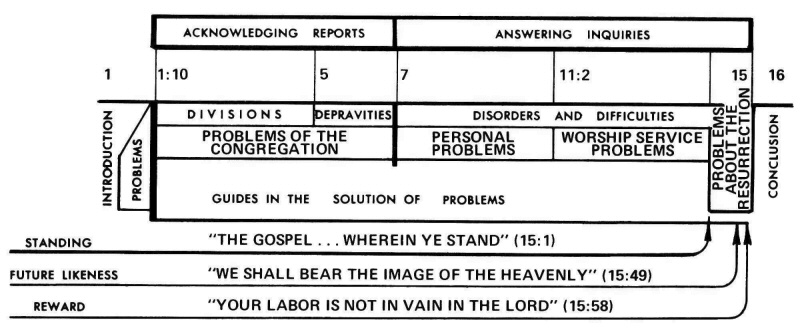
1 CORINTHIANS - PROBLEMS OF A LOCAL CHURCH
Click chart to enlarge
Charts from Jensen's Survey of the NT - used by permission
- 1 Corinthians 15:1 Commentary
- 1 Corinthians 15:2 Commentary
- 1 Corinthians 15:3 Commentary
- 1 Corinthians 15:4 Commentary
- 1 Corinthians 15:5 Commentary
- 1 Corinthians 15:6 Commentary
- 1 Corinthians 15:7 Commentary
- 1 Corinthians 15:8 Commentary
- 1 Corinthians 15:9 Commentary
- 1 Corinthians 15:10 Commentary
- 1 Corinthians 15:11 Commentary
- 1 Corinthians 15:12 Commentary
- 1 Corinthians 15:13 Commentary
- 1 Corinthians 15:14 Commentary
- 1 Corinthians 15:15 Commentary
- 1 Corinthians 15:16 Commentary
- 1 Corinthians 15:17 Commentary
- 1 Corinthians 15:18 Commentary
- 1 Corinthians 15:19 Commentary
- 1 Corinthians 15:20 Commentary
- 1 Corinthians 15:21 Commentary
- 1 Corinthians 15:22 Commentary
- 1 Corinthians 15:23 Commentary
- 1 Corinthians 15:24 Commentary
- 1 Corinthians 15:25 Commentary
- 1 Corinthians 15:26 Commentary
- 1 Corinthians 15:27 Commentary
- 1 Corinthians 15:28 Commentary
- 1 Corinthians 15:29 Commentary
- 1 Corinthians 15:30 Commentary
- 1 Corinthians 15:31 Commentary
- 1 Corinthians 15:32 Commentary
- 1 Corinthians 15:33 Commentary
- 1 Corinthians 15:34 Commentary
- 1 Corinthians 15:35 Commentary
- 1 Corinthians 15:36 Commentary
- 1 Corinthians 15:37 Commentary
- 1 Corinthians 15:38 Commentary
- 1 Corinthians 15:39 Commentary
- 1 Corinthians 15:40 Commentary
- 1 Corinthians 15:41 Commentary
- 1 Corinthians 15:42 Commentary
- 1 Corinthians 15:43 Commentary
- 1 Corinthians 15:44 Commentary
- 1 Corinthians 15:45 Commentary
- 1 Corinthians 15:46 Commentary
- 1 Corinthians 15:47 Commentary
- 1 Corinthians 15:48 Commentary
- 1 Corinthians 15:49 Commentary
- 1 Corinthians 15:50 Commentary
- 1 Corinthians 15:51 Commentary
- 1 Corinthians 15:52 Commentary
- 1 Corinthians 15:53 Commentary
- 1 Corinthians 15:54 Commentary
- 1 Corinthians 15:55 Commentary
- 1 Corinthians 15:56 Commentary
- 1 Corinthians 15:57 Commentary
- 1 Corinthians 15:58 Commentary
1Corinthians 15:3 For I delivered to you as of first importance what I also received, that Christ died for our sins according to the Scriptures, (NASB: Lockman)
Greek: paredoka (1SAAI) gar humin en protois, o kai parelabon, (1SAAI) hoti Christos apethanen (3SAAI) huper ton hamartion hemon kata tas graphas,
Amplified: For I passed on to you first of all what I also had received, that Christ (the Messiah, the Anointed One) died for our sins in accordance with [what] the Scriptures [foretold], (Amplified Bible - Lockman)
Barclay: In the very forefront of it I handed on to you what I myself received, that Christ died for our sins according to the scriptures (Westminster Press)
KJV: For I delivered unto you first of all that which I also received, how that Christ died for our sins according to the scriptures;
NLT: I passed on to you what was most important and what had also been passed on to me--that Christ died for our sins, just as the Scriptures said. (NLT - Tyndale House)
Phillips: For I passed on to you Corinthians first of all the message I had myself received - that Christ died for our sins, as the scriptures said he would; (Phillips: Touchstone)
Wuest: for I delivered to you among the first things that which also I received, that Christ died on behalf of our sins according to the scriptures, (Eerdmans Publishing)
Young's Literal: for I delivered to you first, what also I did receive, that Christ died for our sins, according to the Writings,
FOR I DELIVERED TO YOU AS OF FIRST IMPORTANCE WHAT I ALSO RECEIVED: paredoka (1SAAI) gar humin en protois, o kai parelabon, (1SAAI):
- 1Cor 4:1,2; 11:2,23; Ezekiel 3:17; Matthew 20:18,19; Mark 16:15,16; Luke 24:46,47; Galatians 1:12
- Multiple Resources - Sermons and Commentaries
THE SUMMUM
BONUM
Summum Bonum means the highest good, which is certainly a apropos designation for the "good news" of the Gospel. Indeed, it is God's "highest good," for man's "greatest bad!"
For I delivered to you as of first importance what I also received - Paul did not keep it to himself.
THOUGHT - How many believers have received of first importance the Gospel which delivered them from bondage to sin and Satan and the penalty of eternal destruction and sadly fail to share the "summum bonum" with the "walking dead" around them (no it is not just a television show but a real life drama!) who are in the greatest need (Eph 2:1). Are you actively sharing the Gospel. You will be held accountable for your stewardship of God's great Gospel, and best of all will be rewarded for Spirit enabled proclamation of the Gospel. Life is short. Do not waste your life. Only two things last forever. The Word of God and souls. Souls need the good Word of God. Redeem the time, your opportunity of a lifetime. When you about to breathe your last breath it is too late for regrets! Seize the day! Seize TODAY!.
Delivered (3860) (paradidomi from para = alongside, beside, to the side of, over to + didomi = to give) conveys the basic meaning of to give over from one's hand to someone or something, especially to give over to the power of another.
The use of paradidomi in 1 Corinthians 15:3 refers to the transmitting of or passing on of traditional instruction from Paul to the saints at Corinth. Paul is saying that he brought authoritative teaching, not something of his own origination. He did not design it, he only delivered what God had authored. Paul used paradidomi two other times in this same epistle to express a similar idea writing…
1 Corinthians 11:2 Now I praise you because you remember me in everything, and hold firmly to the traditions, just as I delivered (paradidomi) them to you.
1 Corinthians 11:23 For I received (paralambano - the same verb Paul uses in 1Cor 15:3 of the gospel the Corinthians had received) from the Lord that which I also delivered to (paradidomi) you, that the Lord Jesus in the night in which He was betrayed took bread
Comment: Paul explained that these "traditions" were not the traditions of men but of God writing that "For I neither received (paralambano) it from man, nor was I taught it, but I received it through a revelation of Jesus Christ." (Galatians 1:12) This is the message that Paul like a faithful steward delivered to the saints at Corinth.
Utley comments that I delivered to you refers to "(1) Christian witness that Paul received (from Stephen, Acts 7; from Ananias, Acts 5; and from persecuted Christians, Acts 9:1–2; I Cor. 15:9; (2) direct revelation from the Lord (cf. 1Cor 11:23; Gal. 1:12). Paul passed on the gospel truths he had received. Paul was not an innovator, but a faithful witness applying the gospel truths to new situations. (1 Corinthians 15 Commentary)
Keener notes that delivered "is the language of what scholars call “traditioning”: Jewish teachers (Rabbis) would pass on their teachings to their students, who would in turn pass them on to their own students. The students could take notes, but they delighted especially in oral memorization and became quite skilled at it; memorization was a central feature of ancient education. In the first generation, the tradition would be very accurate (Keener, C. S., The IVP Bible Background Commentary: New Testament. Downers Grove, Ill.: InterVarsity Press)
Synonyms used for paradidomi include surrender, yield up, entrust, deliver up, give over.
Paradidomi - 119x in 117v in NAS = betray(17), betrayed(10), betraying(9), betrays(3), commended(1), committed(3), deliver(6), delivered(21), delivered over(1), delivering(3), entrusted(3), entrusting(1), gave(4), gave… over(3), given… over(1), hand(6), handed(9), handed… over(1), handed down(4), handed over(4), hands(1), permits(1), put(1), putting(1), risked(1), surrender(1), taken into custody(2), turn… over(1). Mt 4:12; 5:25; 10:4, 17, 19, 21; 11:27; 17:22; 18:34; 20:18, 19; 24:9, 10; 25:14, 20, 22; 26:2, 15, 16, 21, 23, 24, 25, 45, 46, 48; 27:2, 3, 4, 18, 26; Mark 1:14; 3:19; 4:29; 7:13; 9:31; 10:33; 13:9, 11, 12; 14:10,11, 18, 21, 41f, 44; 15:1, 10, 15; Luke 1:2; 4:6; 9:44; 10:22; 12:58; 18:32; 20:20; 21:12, 16; 22:4, 6, 21, 22, 48; 23:25; 24:7, 20; Jn 6:64, 71; 12:4; 13:2, 11, 21; 18:2, 5, 30, 35, 36; 19:11, 16, 30; 21:20; Acts 3:13; 6:14; 7:42; 8:3; 12:4; 14:26; 15:26, 40; 16:4; 21:11; 22:4; 27:1; 28:17; Ro 1:24, 26, 28; 4:25; 6:17; 8:32; 1Co 5:5; 11:2, 23; 13:3; 15:3, 24; 2Co 4:11; Gal 2:20; Ep 4:19; 5:2, 25; 1Ti 1:20; 1Pe 2:23; 2Pe 2:4, 21; Jude 1:3
Paradidomi - Some 180x times in the non-apocryphal Septuagint (LXX) -Ge 14:20; 27:20; Exod. 21:13; 23:31; Lev. 26:25; Num. 21:2f, 34; 32:4; Deut. 1:8, 21, 27; 2:24, 30f, 33, 36; 3:2f; 7:2, 23f; 19:12; 20:13, 20; 21:10; 23:14f; 28:7; 31:5; 32:30; Jos. 2:14, 24; 6:2, 16; 7:7; 8:18; 10:8, 12, 19, 30, 32, 35; 11:6, 8; 21:44; 24:8, 10f, 33; Jdg. 1:4; 2:14, 23; 3:10, 28; 4:7, 14; 7:2, 9, 14f; 8:3; 11:9, 21, 32; 13:1; 15:13; 16:24; 1 Sam. 11:12; 14:10, 12, 37; 17:47; 23:4, 14; 24:4, 10; 26:23; 28:19; 30:15, 23; 2 Sam. 5:19; 1 Ki. 8:46; 2 Ki. 3:13, 18; 18:30; 19:10; 21:14; 1 Chr. 12:17; 2 Chr. 6:36; 13:16; 16:8; 24:24; 25:20; 28:5, 9; 30:7; 32:11; 35:12; 36:17; Ezra 7:19; 9:7; Est. 2:3, 13; 4:17; 8:12; Job 2:6; 9:24; 16:11; 24:14; Ps. 10:14; 27:12; 41:2; 63:10; 74:19; 78:48, 61; 88:8; 106:41; 118:18; 119:121; 140:8; Prov. 6:1; 11:8; 24:22; 27:24; 30:10; Isa. 19:4; 23:7; 25:5, 7; 33:1, 6, 23; 34:2; 36:15; 37:10; 38:12f; 47:3; 53:6, 12; 64:7; 65:12; Jer. 2:24; 15:4; 21:10; 22:25; 24:8; 26:24; 32:4, 28, 36, 43; 34:2; 37:17; 38:3, 20; 46:24; 50:2; Ezek. 7:21; 11:9; 16:27, 39; 21:15, 27, 29, 31; 23:9, 28; 25:4; 31:11; 39:23; Dan. 1:2; 2:38; 3:28; 4:17; 7:25; 11:6, 11; Hos. 8:10; Mic. 6:14, 16; Zech. 11:6
Note God's role in these representative OT Septuagint uses of paradidomi …
Genesis 14:20 And blessed be God Most High, Who has delivered (Lxx = paradidomi) your enemies into your hand." And he gave him a tenth of all.
Exodus 23:31 "And I will fix your boundary from the Red Sea to the sea of the Philistines, and from the wilderness to the River Euphrates; for I will deliver (Lxx = paradidomi) the inhabitants of the land into your hand, and you will drive them out before you.
Numbers 21:3 And the LORD heard the voice of Israel, and delivered up (Lxx = paradidomi) the Canaanites; then they utterly destroyed them and their cities. Thus the name of the place was called Hormah.
Numbers 21:34 But the LORD said to Moses, "Do not fear him (Og the King of Bashan who had come out for battle against Israel as they traveled by way of Bashan), for I have given him into (Lxx = paradidomi) your hand, and all his people and his land; and you shall do to him as you did to Sihon, king of the Amorites, who lived at Heshbon.
Psalm 27:12 Do not deliver me over (Lxx = paradidomi) to the desire of my adversaries; For false witnesses have risen against me, And such as breathe out violence.
Psalm 106:41 Then He gave them into (Lxx = paradidomi) the hand of the nations; And those who hated them ruled over them (His people Israel who played the harlot with the pagan nations so that God abhorred His inheritance).
Isaiah 64:7 And there is no one who calls on Thy name, Who arouses himself to take hold of Thee; For Thou hast hidden Thy face from us, And hast delivered us into (Lxx = paradidomi) the power of our iniquities.
Daniel 7:25 'And he (Antichrist = Little Horn) will speak out against the Most High and wear down the saints of the Highest One, and he (Antichrist = the little horn) will intend to make alterations in times and in law; and they will be given into (Lxx = paradidomi) his (Antichrist's) hand for a time, times, and half a time (3.5 years = Great Tribulation).
In the New Testament uses of paradidomi we find several different meanings as discussed below…
Paradidomi conveys the idea of handing over to or of conveying something to someone, particularly a right or an authority
Matthew 11:27 All things have been handed over to Me by My Father; and no one knows the Son, except the Father; nor does anyone know the Father, except the Son, and anyone to whom the Son wills to reveal Him.
Luke 4:6 And the devil said to Him, "I will give You all this domain and its glory; for it has been handed over to me, and I give it to whomever I wish.
Paradidomi can mean to entrust for care or preservation as when one gives over, commends or commits.
Acts 14:26 and from there they sailed to Antioch, from which they had been commended to the grace of God for the work that they had accomplished.
Acts 15:40 But Paul chose Silas and departed, being committed by the brethren to the grace of the Lord.
Romans 6:17 But thanks be to God that though you were slaves of sin, you became obedient from the heart to that form of teaching to which you were committed, (entrusted, NIV, NET)
1 Peter 2:23 and while being reviled, He did not revile in return; while suffering, He uttered no threats, but kept entrusting (present tense = His continual practice) Himself to Him who judges righteously;
Comment: Literally, Jesus kept handing Himself and the circumstance of every unjust suffering over to God. This pattern climaxed when Jesus was on the cross. What an example for believers to emulate when we are unjustly suffered. Christ gave Himself over to God, even in death, because He knew that the Father would evaluate fairly all His unjust suffering. Subsequently, when we are persecuted unjustly at our jobs, in our families, or in our social contacts, we need to follow His example and accept the persecution without retaliating. It is crucial that we resist [by God’s grace and power of His Spirit] the urge to strike back or seek revenge in the midst of unjust persecution [ Ro 12:17-21 - see notes Ro 12:17; 18; 19; 20; 21]. We need to entrust our souls continuously, by faith, to the care of the Holy One Who will pronounce a righteous verdict, Who will avenge unjust treatment now or later and Who will bring us to eternal glory.
Paradidomi is used in legal parlance to describe handing someone into the custody of the police, authorities, etc. To deliver up one to custody, to be judged, condemned, punished, scourged, tormented, put to death.
Matthew 10:17 "But beware of men; for they will deliver you up to the courts, and scourge you in their synagogues… 10:19 "But when they deliver you up, do not become anxious about how or what you will speak; for it shall be given you in that hour what you are to speak… 10:21 "And brother will deliver up brother to death, and a father his child; and children will rise up against parents, and cause them to be put to death.
Mark 15:1 And early in the morning the chief priests with the elders and scribes, and the whole Council, immediately held a consultation; and binding Jesus, they led Him away, and delivered Him up to Pilate.
2 Peter 2:4 For if God did not spare angels when they sinned, but cast them into hell and committed (paradidomi) them to pits of darkness, reserved for judgment;
Moulton and Milligan have these similar secular uses
"but he was handed over to Paos the gaoler (British = jailer),” in connexion with the breaking into a house.
“and if you have arrested the slave, deliver him to Semphtheus to bring to me”;
“send to us under guard the woman who was delivered to you with the contraband oil in her possession, and send also the person who delivered her to you”
Paradidomi can describe the "illegal", treacherous or unjustified handing of someone over to someone as in a betrayal. Thus it describes the delivering over of an individual to an enemy who will presumably take undue advantage of the victim
Matthew 4:12 Now when He heard that John had been taken into custody (paradidomi), He withdrew into Galilee
Matthew 10:4 Simon the Zealot, and Judas Iscariot, the one who betrayed (paradidomi) Him.
Matthew 20:18 Behold, we are going up to Jerusalem; and the Son of Man will be delivered to the chief priests and scribes, and they will condemn Him to death, 19 and will deliver Him to the Gentiles to mock and scourge and crucify Him, and on the third day He will be raised up. (Note the "Gospel" in this passage).
Matthew 26:16 And from then on he began looking for a good opportunity to betray Him.
Matthew 26:21 And as they were eating, He said, "Truly I say to you that one of you will betray Me… 26:23 And He answered and said, "He who dipped his hand with Me in the bowl is the one who will betray Me. 26:24 "The Son of Man is to go, just as it is written of Him; but woe to that man by whom the Son of Man is betrayed! It would have been good for that man if he had not been born." 26:25 And Judas, who was betraying Him, answered and said, "Surely it is not I, Rabbi?" He said to him, "You have said it yourself
Mark 9:31 For He was teaching His disciples and telling them, "The Son of Man is to be delivered into the hands of men, and they will kill Him; and when He has been killed, He will rise three days later."
Paradidomi is used in the context of dying, meaning to give up one’s life, to give up one’s spirit, i.e. to expire.
John 19:30 When Jesus therefore had received the sour wine, He said, "It is finished!" And He bowed His head, and gave up (paradidomi = active voice = His choice) His spirit.
Galatians 2:20 "I have been crucified with Christ; and it is no longer I who live, but Christ lives in me; and the life which I now live in the flesh I live by faith in the Son of God, who loved me, and delivered (paradidomi in the active voice = His choice) Himself up for me. (Compare Ro 4:25, Ro 8:32, Eph 5:2, Ep 5:25)
Paradidomi was used as a military term to describe surrender.
Paul uses paradidomi in describe delivering over rebellious, God and truth rejecting individuals to suffer the consequences of their sins
Romans 1:24 Therefore God gave them over in the lusts of their hearts to impurity, that their bodies might be dishonored among them.
Comment: This person becomes enslaved to his or her own lusts. In other words, God allows the consequences of that person’s sin to run their catastrophic course. That course, driven by uncontrolled lust, inevitably reverts to the worst forms of sexual promiscuity. To have God let one go is the worst fate that can overtake any human being. Yet that is the inevitable result of stubborn refusal to let God have His way. A. T. Robertson writes: "The words sound to us like clods on the) coffin as God leaves men to work their own wicked will"
Romans 1:26 For this reason God gave them over to degrading passions; for their women exchanged the natural function for that which is unnatural,
Romans 1:28 And just as they did not see fit to acknowledge God any longer, God gave them over to a depraved mind, to do those things which are not proper,
Ephesians 4:19 and they, having become callous, have given themselves over to sensuality, for the practice of every kind of impurity with greediness.
Paradidomi can speak of church discipline in which the guilty part is delivered over or given into the control of another so that they might be disciplined
1 Corinthians 5:5 I have decided to deliver such a one to Satan for the destruction of his flesh, that his spirit may be saved in the day of the Lord Jesus. (Compare 1Ti 1:20)
Moulton and Milligan have an illustration from pagan execratory formulas, e.g. the great magical Paris papyrus…“I shall give you over to black chaos in utter destruction,”
Paradidomi is used figuratively of a crop the ripeness of which "hands itself over" to be harvested.
Mark 4:29 "But when the crop permits (paradidomi), he immediately puts in the sickle, because the harvest has come." (it is an idiomatic use in which fruit gives itself over. It is at that time one knows the fruit is ripe and ready to harvest.) (Comment: Vincent suggests “When the fruit shall have allowed, i. e., shall have admitted of being harvested.” Xenophon and Herodotus use the word in the sense of permit or allow. An exact parallel to this occurs in the historian Polybius, “When the season permitted.")
As used here in 1Corinthians 15:3 paradidomi means to pass on traditional instruction.
Mark 7:13 thus invalidating the word of God by your tradition (of the Pharisees and scribes - traditions not in accord with God's Holy Word) which you have handed down; and you do many things such as that." (It refers to the oral laws of the Pharisees which are handed down from generation to generation to be kept. The Pharisees, to whom our Lord was speaking. were adding weight to these laws by themselves transmitting them to their posterity)
Luke 1:2 just as those who from the beginning were eyewitnesses and servants of the word have handed them down (handed them over, turned them over, pass) to us,
Acts 6:14 for we have heard him say that this Nazarene, Jesus, will destroy this place and alter the customs which Moses handed down to us.
Acts 16:4 Now while they were passing through the cities, they were delivering the decrees (dogmata or decisions), which had been decided upon by the apostles and elders who were in Jerusalem, for them to observe.
1 Peter 2:21 - For it would be better for them not to have known the way of righteousness, than having known it, to turn away from the holy commandment delivered to them.
Jude 1:3 Beloved, while I was making every effort to write you about our common salvation, I felt the necessity to write to you appealing that you contend earnestly for the faith (the teaching about the gospel) which was once for all delivered to the saints. (Comment: The point is that God committed the Christian doctrines to the saints as a deposit of truth to be guarded.)
NIDNTT writes that…Paradidomi is found in Gk. from Plato onwards, meaning to hand down, pass on instruction from teacher to pupil. In the sense of handing down instruction paradidomi is also found in Aristotle, Polybius, Plutarch and others. In the Hellenistic mysteries the word is used in connexion with the delivery of a hieros logos (holy teaching)… There are, then, 3 types of tradition in the NT expressed by paradidomi; the following are said to be handed down: (i) the Jewish Halachah (rabbinic exposition of the law) (Mk. 7:13; Acts 6:14; cf. Acts 16:4); (ii) early Christian narratives about Jesus (Lk. 1:2); (iii) confessions of faith and rules for the conduct of the church’s life (1 Cor. 11:2, 23; 15:3ff.; 2 Pet. 2:21; Jude 3). (Brown, Colin, Editor. New International Dictionary of NT Theology. 1986. Zondervan)
First importance (4413) (protos) in this context refers to first in prominence, most important or foremost. The truth that follows is among first things. In primis. Not to time, but to importance. It is notable that this section presents the only summary of the Gospel that is found in the NT.
The essential truths of the gospel are of first importance…
- Christ died for our sins
- He was dead and was buried
- He was raised from the dead
- He appeared to many witnesses
Received (3880) (paralambano from para = beside + lambano = appropriate, receive) means to receive from another, to receive alongside or to take to oneself. To receive as authoritative teaching what was passed on. (1 Cor 11:23) Paralambano also has nuances of seizing or taking to one's self or taking something into one's possession.
The aorist tense looks back to the time when God revealed the Gospel to Paul. He received it alongside and took it to himself as his possession, in some letters referring to it as "my gospel" (Ro 2:16; Ro 16:25; 2 Ti 2:8)
Barclay writes that "No man ever invented the gospel for himself; in a sense no man ever discovers it for himself. It is something which he receives. (Daily Study Bible Series. The Westminster Press)
THAT CHRIST DIED FOR OUR SINS: hoti Christos apethanen (3SAAI) huper ton hamartion hemon:
- Matthew 26:28; Romans 3:25; 4:25; 2Corinthians 5:21; Galatians 1:4; 3:13; Ephesians 1:7; 5:2; Hebrews 10:11,12; 1Peter 2:24; 3:18; 1John 2:2; Revelation 1:5
- Multiple Resources - Sermons and Commentaries
That Christ died for our sins according to the Scriptures
Christ (5547) Christos is the Greek translation of the Hebrew term Messiah
Died (599) (apothnesko from apo = intensifies meaning or away from + thnesko = die) literally means to die off. It means to die a natural death and is the term applied to both men and animals. It literally means to cease to have vital functions. Figuratively it means to be unable to respond or react to any impulse or desire, as in Romans 6 were Paul writes…
May it never be! How shall we who died to Sin still live in it? (see note Romans 6:2) (Comment: Believers have died to the power of sin in their lives. Death brings separation and so the idea is of not responding to something due to separation from it.)
Apothnesko here in 1Corinthians 15 refers not to a figurative but to a literal death of Christ with eternal spiritual ramifications, including the truth just mentioned - because of Christ's death, believers have died to sin.
For (5228) (huper) means on behalf of, for the sake of, in the sense of protection, care, favor, benefit. Huper in this passage expresses the idea of substitution or the substitutionary aspect of Lord’s death. Thus huper could be translated Christ dies instead of me for my sins or a substitute for me.
Paul uses huper in Romans 5 to express the idea of Christ's substitutionary death writing…
For while we were still helpless, at the right time Christ died for (huper) the ungodly. (see note Romans 5:6)
But God demonstrates His own love toward us, in that while we were yet sinners, Christ died for (huper) us. (see note Romans 5:8)
Other passages use huper to convey the truth of Christ's substitutionary atonement, His death in the sinner's place…
2 Corinthians 5:15 and He died for (huper) all, that they who live should no longer live for themselves, but for Him who died and rose again on their behalf (huper)
2 Corinthians 5:21 He made Him who knew no sin to be sin on our behalf (huper) that we might become the righteousness of God in Him.
Galatians 2:20 (note) "I have been crucified with Christ; and it is no longer I who live, but Christ lives in me; and the life which I now live in the flesh I live by faith in the Son of God, who loved me, and delivered Himself up for (huper - on my behalf) me.
Ephesians 5:2 (note) and walk in love, just as Christ also loved you, and gave Himself up for (huper - in our place) us, an offering and a sacrifice to God as a fragrant aroma.
Ephesians 5:25 (note) Husbands, love your wives, just as Christ also loved the church and gave Himself up for (huper) her;
1 Timothy 2:6 who gave Himself as a ransom (antilutron - a price paid or means used to set someone free from captivity or bondage) for (huper- on behalf of) all, the testimony borne at the proper time.
Titus 2:14 (note) (Christ) Who gave Himself for (huper- on our behalf) us, that He might redeem us from every lawless deed and purify for Himself a people for His own possession, zealous for good deeds.
Hebrews 7:27 (note) (Jesus) Who does not need daily, like those high priests, to offer up sacrifices, first for His own sins, and then for (huper - on behalf of) the sins of the people, because this He did once for all when He offered up Himself.
1 Peter 2:21 (note) For you have been called for this purpose, since Christ also suffered for (huper - in your place) you, leaving you an example for you to follow in His steps,
1 Peter 3:18 (note) For Christ also died for sins once for all, the just for (huper - in place of) the unjust, in order that He might bring us to God, having been put to death in the flesh, but made alive in the spirit;
As someone has well said Jesus paid a debt He did not owe and
we owed a debt we could not pay!
THANK YOU JESUS!
Sins (266) (hamartia) originally conveyed the idea of missing the mark as when hunting with a bow and arrow. It then came to mean missing or falling short of any goal, standard, or purpose. In a spiritual sense hamartia is missing the true and ultimate purpose God has for each individual, falling short of His standard of holiness, acting contrary to His will and Word, departing from doing what is right.
Vine writes that hamartia "is the most comprehensive of the many words for sin, and generally describes any moral obliquity. (Vine, W. Collected writings of W. E. Vine. Nashville: Thomas Nelson)
Ray Stedman says…
Ask people today what the gospel is… and this is often what they will say, "Well, Jesus lived and died." No, that is not the gospel. Everyone believes that Jesus died. Go to any of the modern presentations of the life of Jesus, such as Jesus Christ Superstar, and some of those, and you will find they all end at the death of Jesus. Every humanistic philosophy today accepts the fact that Jesus died. But there is no good news in that. The good news is Christ died for our sins according to the Scriptures. That is the good news, that his death accomplished something for us. It changed us, it delivered us, it set us free. That death had great significance in the mind and heart and eyes of God, and that is the good news. As Peter puts it in his words, "He himself bore our sins in his body on the tree," {1 Pet 2:24 RSV}. Or, to use the words of Isaiah, "He was wounded for our transgressions, he was bruised for our iniquities: the chastisement of our peace was upon him; and with his stripes we are healed," {Isa 53:5 KJV}.
That is the good news, that God did something for us in that marvelous event of the cross. As we contemplate the cross, and the dying of Jesus in our place, we see that the good news of it is that God takes it seriously, and he is prepared to treat us in an entirely different way than we deserve to be treated on the basis of the death of Jesus on our behalf. That is the good news. There on the cross, we are told, he dealt with our failures, he dealt with our rebellion, he dealt with our sinful, guilty lives. He did something about it so that besmirched and dark and stained past does not any longer need trouble us. It has been set aside by the death of Jesus, and with that fact we enter into hope and freedom.
Of course, without that fact, life is really hopeless. This philosophy that many people have that God is a judge weighing up the good and the evil of life -- and if the good outweighs the evil you get in and if it does not you have to go to hell -- is not only unbiblical but it is illogical, for how could a God of holiness and justice and purity ever accept any kind of evil at all? His demands are for perfection and never anything less. He himself is perfect, and he says to us over and over again, "Be ye perfect for I am perfect." What are we going to do with a guilty past in the light of that? The answer, of course, is the good news. In the cross of Jesus, God has already dealt with that sinful past. He offers to us freely the forgiveness of sins. (1 Corinthians 15:1-4 Of First Importance)
ACCORDING TO THE SCRIPTURES: kata tas graphas:
- Genesis 3:15; Psalms 22:1-31; 69:1-36; Isaiah 53:1-12; Da 9:24, 25, 26; Zech 13:7; Luke 24:26,27,46; Acts 3:18; 26:22,23; 1Pe 1:11
- Multiple Resources - Sermons and Commentaries
Vine writing on according to the Scriptures rightly states the believer's…
appeal must ever be, in accordance with that of the Lord Himself, “What saith the Scripture?”
According to the Scriptures - This phrase clearly indicates that the Messiah's substitutionary death for sins was predicted in the Old Testament. Below are some representative Messianic Prophecies (see notes on Messianic Prophecies).
Genesis 3:15 And I (God) will put enmity between you (Serpent) and the woman (Eve), and between your seed (see John 8:44) and her seed; He (Messiah) shall bruise you on the head (culminating in Rev 20:10-see note) , and you shall bruise Him (Messiah) on the heel (exactly what crucifixion did to one's heel!)."
Comment: This verse is often referred to as the Protevangelium or "First Gospel".
Henry Morris: This verse is famous as the Protevangel ("First Gospel"). The Curse was directed immediately toward the Serpent, but its real thrust was against the evil spirit possessing its body, "that old serpent called the devil" (Rev 12:9). Satan may have assumed he had now won the allegiance of the woman and all her descendants, but God told him there would be enmity between him and the woman. The "seed of the woman" can only be an allusion to a future descendant of Eve who would have no human father. Biologically, a woman produces no seed, and except in this case Biblical usage always speaks only of the seed of men. This promised Seed would, therefore, have to be miraculously implanted in the womb. In this way, He would not inherit the sin nature which would disqualify every son of Adam from becoming a Savior from sin. This prophecy thus clearly anticipates the future virgin birth of Christ. Satan will inflict a painful wound on the woman's Seed, but Christ in turn will inflict a mortal wound on the Serpent, crushing his head. This prophecy was fulfilled in the first instance at the cross, but will culminate when the triumphant Christ casts Satan into the lake of fire (Rev 20:10). This primeval prophecy made such a profound impression on Adam's descendants that it was incorporated, with varying degrees of distortion and embellishment, in all the legends, mythologies and astrologies of the ancients since they are filled with tales of mighty heroes engaged in life-and-death struggles with dragons and other monsters. Mankind, from the earliest ages, has recorded its hope that someday a Savior would come who would destroy the devil and reconcile man to God. (Defender's Study Bible Online)
Genesis 22:18 "And in your seed (singular = the Messiah) all the nations of the earth shall be blessed, because you have obeyed My voice." (Commentary: Gal 3:16 Now the promises were spoken to Abraham and to his seed. He does not say, "And to seeds," as referring to many, but rather to one, "And to your seed," that is, Christ [the Messiah].)
Peter places Paul's epistles on a par with the rest of the Scriptures writing…
as also in all his (Paul's) letters, speaking in them of these things, in which are some things hard to understand, which the untaught and unstable distort, as they do also the rest of the Scriptures, to their own destruction. (see note 2 Peter 3:16)
But know this first of all, that no prophecy of Scripture is a matter of one's own interpretation, for no prophecy was ever made by an act of human will (no part of Scripture was ever at any time produced because men wanted it so), but men moved by the Holy Spirit spoke from God. (see notes 2 Peter 1:20; 1:21) (Comment: What Peter is saying in context is that no prophecy came into being through anyone's personal or private disclosure. No true prophecy springs forth from the private reasoning of the man speaking or writing. The idea is that men did not bring forth or birth the ideas of Scripture. The writers of Scripture did not put their own construction upon the ‘God–breathed’ words they wrote. No prophet is a "self starter" in regard to Scripture… no one starts a prophecy by himself. The NIV picks up the meaning: ''No prophecy of the Scripture came about by the prophet's own interpretation.'' Men moved by the Holy Spirit is a beautiful figurative use of verb phero used by Luke to describe a sailing vessel being carried along by the wind. Thus these men moved by the Holy Spirit are a picture of the prophets who were "vessels" raising their sails so to speak and the Holy Spirit filling them and carrying their craft along in the direction He wished. Men spoke but what they spoke was from God. The Spirit moved them to write the inspired Scriptures. It is the Scriptures which were inspired, not the writers - they were moved to write!)
Scriptures (1124) (graphe from grapho = to write; English = graphite - the lead in a pencil!) means first a writing or thing written, a document. The majority of the NT uses refer to the Old Testament writings, in a general sense of the whole collection when the plural (= Scriptures - Matt. 21:42; 22:29; 26:54; Mk. 12:24; 14:49; Lk. 24:27, 32, 45; Jn. 5:39; Acts 17:2, 11; 18:24, 28; Rom. 15:4; 2Pe 3:16) is used and other times of a particular passage when the singular is used (= the Scripture - Mk. 12:10; 15:28; Lk. 4:21; Jn. 13:18; 19:24, 36f; Acts 1:16; 8:35; Ro 11:2; Jas. 2:8, 23) and is used in such a way that quoting Scripture is understood to be the same as quoting God! It is worth noting that the majority of the OT passages quoted in the NT Scriptures are not from the original Hebrew but are from the Greek translation of the Hebrew, the Septuagint (LXX). The full title, “the Holy Scriptures,” is found only in Romans 1:2 (see note).
NIDNTT notes that the root word of graphe is graph- which "has the primary meaning of to scratch on, engrave, with reference to an ornament, reports, letters, lists, and instructions. From it are derived the English “graphic”, “graph” etc. The material can be various: stone, wood, metal, wax, or leather. The verb form grapho is found in its original sense in Homer, Il. 17, 599. In Herodotus., 4, 36 the word is used meaning to draw, of lines on maps; and scholars of the 3rd cent. B.C. used it of drawing of mathematical figures. In Homer grapho is already used in the sense of scratching signs on a tablet as a kind of letter (Il. 6, 169). From the time of Herodotus it is used generally in the normal sense of to write, and from the time of Pindar in the derived sense of to prescribe, to order. From the practice of handing in a written accusation, grapho came in judicial language to mean to accuse (Plato, Euthyphro 2b).
The noun graphe originally carried the abstract verbal sense of the act of writing, drawing or painting; then the concrete sense of writing, inscription, letter (generally from 4th cent. B.C. onwards), indictment; in papyri of the 3rd cent. a list; in Plato the written law (Leg. 11, 934c).
Gramma means: (a) the product of the action, especially where contrast with the spoken word is stressed; occasionally (b) the action itself; but then also (c) ability to write. It can mean the individual letters of the alphabet (Hdt., 5, 58 f.), but also papers, letters, documents. The plural grammata is used in the sense of elementary knowledge, then literature, learning. The concept of “holy writings” or “holy scriptures” becomes important in the Hellenistic period: temple records, magic books and hermetic literature; also imperial letters and decrees which are regarded as quasi-divine. The authority of the written word leads, even in the classical period, to the composition of explanatory commentaries, especially on the writings of Homer. (SEE online Brown, Colin, Editor. New International Dictionary of NT Theology. PAGE 482 - FOR A 14 PAGE ARTICLE RELATED TO GRAPHE)
One of the most important NT descriptions of Scripture is found in 2Timothy where Paul reminds Timothy…
that from childhood you have known the sacred (holy - consecrated to God) writings (grammata) which are able to give you the wisdom that leads to salvation through faith which is in Christ Jesus. All Scripture is inspired by God and profitable for teaching, for reproof, for correction, for training in righteousness. (2Ti 3:15-16-notes 3:15; 3:16) (Comment: Note that it is not the writers who were inspired but the writings! Without dictation or blocking out the individuality of the human writers, God the Spirit bore them along as they wrote the inspired writings, so that the product is "the holy Scriptures" the Word of God)
Graphe is used 51 times in the NT - Matt. 21:42; Matt. 22:29; Matt. 26:54; Matt. 26:56; Mk. 12:10; Mk. 12:24; Mk. 14:49; Mk. 15:28; Lk. 4:21; Lk. 24:27; Lk. 24:32; Lk. 24:45; Jn. 2:22; Jn. 5:39; Jn. 7:38; Jn. 7:42; Jn. 10:35; Jn. 13:18; Jn. 17:12; Jn. 19:24; Jn. 19:28; Jn. 19:36; Jn. 19:37; Jn. 20:9; Acts 1:16; Acts 8:32; Acts 8:35; Acts 17:2; Acts 17:11; Acts 18:24; Acts 18:28; Rom. 1:2; Rom. 4:3; Rom. 9:17; Rom. 10:11; Rom. 11:2; Rom. 15:4; Rom. 16:26; 1 Co. 15:3; 1 Co. 15:4; Gal. 3:8; Gal. 3:22; Gal. 4:30; 1 Tim. 5:18; 2 Tim. 3:16; Jas. 2:8; Jas. 2:23; Jas. 4:5; 1 Pet. 2:6; 2 Pet. 1:20; 2 Pet. 3:16
Graphe is used 21 times in the Septuagint (LXX)
Ex 32:16; Deut. 10:4; 1 Chr. 15:15; 28:19; 2 Chr. 2:11; 24:27; 30:5, 18; 35:4; Ezra 2:62; 4:7; 6:18; 7:22; Neh. 7:64; Ps. 87:6; Ezek. 13:9; Dan. 5:6ff, 15ff, 24ff; 6:8; 10:21
Exodus 32:16 And the tables were the work of God, and the writing (Lxx = graphe) the writing (Lxx = graphe) of God written on the tables.
Ezra 6:18 Then they appointed the priests to their divisions and the Levites in their orders for the service of God in Jerusalem, as it is written (Lxx = graphe) in the book of Moses.
Below are some of the most (but not all) the uses of graphe in the NT. Notice how many have a Messianic "flavor" and allude to some aspect of the Gospel…
Matthew 21:42 Jesus said to them, "Did you never read in the Scriptures, 'The stone which the builders rejected, This became the chief corner stone; This came about from the Lord, and it is marvelous in our eyes'? (Comment: The Scripture cited here is Psalm 118:22,23--the same psalm sung by the multitude as Jesus was riding into Jerusalem -- Matthew 21:9. In their very rejection of Christ, these "builders" were fulfilling His Word.)
Matthew 22:29 But Jesus answered and said to them, "You (Sadducees) are mistaken, not understanding the Scriptures, or the power of God." (Comment: The Sadducees, who rejected the doctrine of resurrection, thought they could embarrass Jesus with their question of a woman who had married, successively, seven brothers. But all those who think they can find mistakes or contradictions in the Bible simply show that they know neither the Scriptures nor God's power.)
Matthew 26:56 "But all this (Jesus' betrayal and arrest by the Romans in the Garden of Gethsemane) has taken place that the Scriptures of the prophets may be fulfilled." Then all the disciples left Him and fled. (Comment: cf Mk 14:49, See Zechariah 13:7)
Luke 4:21 And He began to say to them, "Today this Scripture has been fulfilled in your hearing." (Comment: Jesus began His ministry by reading from Isaiah 61:1-2 but His reading stopped just before "the day of vengeance of our God," as this portion would not be fulfilled until His second coming!)
Luke 24:26 "Was it not necessary for the Christ (Messiah) to suffer these things and to enter into His glory?" 27 And beginning with Moses and with all the prophets ( = the Jewish way of designating the entire OT), He explained to them the things concerning Himself in all the Scriptures. (Comment: Jesus here confirms that all the Scriptures point, in one way or another, to the person and work of the Savior.)
Luke 24:45 Then He opened (open thoroughly what had been closed) their minds to understand (suniemi = entails the assembling of individual facts into an organized whole, as collecting the pieces of a puzzle and putting them together. The mind opened by Jesus grasps concepts and sees the proper relationship between them.) the Scriptures, 46 and He said to them, "Thus it is written, that the Christ should suffer and rise again from the dead the third day; 47 and that repentance for forgiveness of sins should be proclaimed in His name to all the nations, beginning from Jerusalem."
John 5:39 You search the Scriptures, because you think that in them you have eternal life; and it is these that bear witness of Me;40 and you are unwilling to come to Me, that you may have life. (Comment: The written Word reveals the living Word, the OT Scriptures which are replete with testimonies of the coming Messiah.)
John 7:38 "He who believes in Me, as the Scripture said, 'From his innermost being shall flow rivers of living water.'" (Comment: Isaiah 44:3 'For I will pour out water on the thirsty land And streams on the dry ground; I will pour out My Spirit on your offspring, And My blessing on your descendants. Isaiah 55:1 "Ho! Every one who thirsts, come to the waters; And you who have no money come, buy and eat. Come, buy wine and milk Without money and without cost.)
John 7:42 "Has not the Scripture said that the Christ comes from the offspring of David (2Sa 7:12), and from Bethlehem (Micah 5:2), the village where David was?"
John 10:35 "If he called them gods, to whom the word of God came (and the Scripture cannot be broken) (Comment: Morris writes that "Jesus is basing His entire defense against the charge of blasphemy on one word, "gods," in a relatively obscure psalm, commenting that the "Scripture"--that is the word actually written down--cannot be broken. This constitutes a very important testimony by Christ to the plenary verbal inspiration and authority of the Bible. The reasoning of Christ is very subtle yet powerful, relying entirely on the use of this precise word in its context. - Defenders Study Bible)
John 13:18 "I do not speak of all of you. I know the ones I have chosen; but it is that the Scripture may be fulfilled, 'HE WHO EATS MY BREAD HAS LIFTED UP HIS HEEL AGAINST ME.' (Comment: See also Acts 1:16. John is quoting the Scripture or grapho in Psalm 41:9 "Even my close friend, in whom I trusted, Who ate my bread, Has lifted up his heel against me")
John 17:12 "While I was with them, I was keeping them in Thy name which Thou hast given Me; and I guarded them, and not one of them perished but the son of perdition, that the Scripture might be fulfilled. (Comment: The son of perdition = Judas. See Ps. 41:9 above).
John 19:24 They said therefore to one another, "Let us not tear it, but cast lots for it, to decide whose it shall be"; that the Scripture might be fulfilled, "THEY DIVIDED MY OUTER GARMENTS AMONG THEM, AND FOR MY CLOTHING THEY CAST LOTS." (Comment: These actions were in precise fulfillment of an unlikely prophecy given a thousand years before in Psalm 22:18 and is one of the few events in the life of Christ recorded in all four Gospels.)
John 19:28 After this, Jesus, knowing that all things had already been accomplished (teleo = same verb as "It is finished" in John 19:30), in order that the Scripture might be fulfilled, said, "I am thirsty." (Comment: Psalm 69:21 "They also gave me gall for my food, And for my thirst they gave me vinegar to drink.")
John 19:36 For these things (Jesus' volitional death - He gave up His life) came to pass, that the Scripture might be fulfilled, "NOT A BONE OF HIM SHALL BE BROKEN." (Comment: This death of Jesus before His legs could be broken was in fulfillment of the prophecy in Psalm 34:19,20. Jesus also fulfilled the symbolism of the sacrificial Passover lamb in 1Cor 5:7, the bones of which were not to be broken as recorded in the OT Scriptures Ex 12:46; Nu 9:12).
John 19:37 And again another Scripture says, "THEY SHALL LOOK ON HIM WHOM THEY PIERCED." (Comment: Fulfilled the prophecy in Zechariah 12:10 ""And I will pour out on the house of David and on the inhabitants of Jerusalem, the Spirit of grace and of supplication, so that they will look on Me whom they have pierced; and they will mourn for Him, as one mourns for an only son, and they will weep bitterly over Him, like the bitter weeping over a first-born." His scars were still visible in His resurrected body in John 20:27 and will be with Him forever Revelation 1:7 {note} as marks of faithfulness to keep forever His inviolable blood covenant).
John 20:9 For as yet they did not understand the Scripture, that He must rise again from the dead. (Comment: Refer to Psalm 16:9,10, Isaiah 53:10-12, compare Hosea 6:2)
Acts 8:32 Now the passage of Scripture which he (the Ethiopian eunuch) was reading was this: "HE WAS LED AS A SHEEP TO SLAUGHTER; AND AS A LAMB BEFORE ITS SHEARER IS SILENT, SO HE DOES NOT OPEN HIS MOUTH. (from Isaiah 53:7-8)… 8:35 And Philip opened his mouth, and beginning from this Scripture he preached ("gospelized" = euaggelizo) Jesus to him. (Comment: This is a clear statement that the OT Scriptures relate to the Messiah, Jesus).
Acts 17:11 Now these were more noble-minded than those in Thessalonica, for they received the word with great eagerness, examining the Scriptures daily, to see whether these things were so.
Acts 18:28 for he (Apollos) powerfully refuted the Jews in public, demonstrating by the Scriptures that Jesus was the Christ (Messiah).
Romans 1:1 (note) Paul, a bond-servant of Christ Jesus, called as an apostle, set apart for the gospel of God, 1:2 which He promised beforehand through His prophets in the holy Scriptures, (Comment: Paul began by stressing that the gospel was not new, but was the prophetic fulfillment of the promises given in God's Holy Scriptures from the beginning. Cp Gal 3:8)
Romans 4:3 (note) For what does the Scripture say? "AND ABRAHAM BELIEVED GOD, AND IT WAS RECKONED TO HIM AS RIGHTEOUSNESS." (Quoting Ge 15:6 - Abraham was justified by faith before he was given the sign of circumcision in Genesis 17:9-14) and before the Law was given, so justification by faith is God's only way of salvation).
Romans 10:11 (note) For the Scripture says, "WHOEVER BELIEVES IN HIM WILL NOT BE DISAPPOINTED." (Paul quotes Isaiah 28:16 as he had done in Romans 9:33 - note)
Romans 11:2 (note) God has not rejected His people whom He foreknew. Or do you not know what the Scripture says in the passage about Elijah, how he pleads with God against Israel? (Comment: God's "foreknowledge," as is evident from His calling of Israel long before Israel was a nation, involves not just pre-knowledge but pre-planning… and what God plans, He finishes. God is not finished with Israel yet)
Romans 15:4 (note) For whatever was written in earlier times was written for our instruction, that through perseverance and the encouragement of the Scriptures we might have hope. (Comment: How much time do you spend in the OT Scriptures? They were all written for our benefit today, so by no means should Christians limit their Bible study to the New Testament)
Romans 16:26 (note) but now is manifested (the revelation of the mystery = the Gospel of Christ), and by the Scriptures of the prophets, according to the commandment of the eternal God, (the Gospel) has been made known to all the nations, leading to obedience of faith (Comment: In developing the doctrine of the Gospel, Paul did so within the prophetic framework of the OT Scriptures, and in this one epistle alone, he quoted from the Old Testament, directly or indirectly, at least fifty times, in support of his arguments.)
Galatians 3:8 And the Scripture, foreseeing that God would justify the Gentiles (the nations) by faith, preached the gospel beforehand to Abraham, saying, "ALL THE NATIONS SHALL BE BLESSED IN YOU." (Comment: God's original promise to Abraham, quoted here from Genesis 12:3, required the coming of Messiah to redeem the world in order to be fulfilled. Note the promise was to "all nations" not just to Israel, which did not even exist at that time. Abraham thus believed this early form of the Gospel and was justified by faith in the Gospel).
Hodge summarizes according to the Scriptures writing that "the fact that the Messiah was to die as a propitiation for sin had been revealed in the Old Testament. The New Testament constantly teaches that Christ’s death as an atoning sacrifice was predicted by the Law and the Prophets. Our Lord reproved his listeners for not believing what the prophets had said about this subject (Luke 24:25–26). Paul protested in front of Festus that in preaching the Gospel he had said “nothing beyond what the prophets and Moses said would happen—that the Christ would suffer and, as the first to rise from the dead, would proclaim light to his own people and to the Gentiles” (Acts 26:22–23). He assured the Romans that his Gospel was that “to which the Law and the Prophets testify” (Romans 3:21). The letter to the Hebrews is an exposition of the whole Mosaic service as a prefiguration of the office and work of Christ. And Isaiah 53 is the foundation of all the New Testament exhibitions of a suffering and atoning Messiah. Paul and all other faithful ministers of the Gospel, therefore, teach that atonement for sin by the death of Christ is the great doctrine of the whole word of God. (1 Corinthians 15 Commentary)
1Corinthians 15:4 and that He was buried, and that He was raised on the third day according to the Scriptures, (NASB: Lockman)
Greek: kai hoti etaphe, (3SAPI) kai hoti egegertai (3SRPI) te hemera te trite kata tas graphas,
Amplified: That He was buried, that He arose on the third day as the Scriptures foretold (Amplified Bible - Lockman)
Barclay: and that he was laid in the tomb, and that he was raised up on the third day according to the scriptures, (Westminster Press)
KJV: And that he was buried, and that he rose again the third day according to the scriptures:
NLT: He was buried, and he was raised from the dead on the third day, as the Scriptures said. (NLT - Tyndale House)
Phillips: that he was buried and rose again on the third day, again as the scriptures foretold. (Phillips: Touchstone)
Wuest: and that He was entombed, and that He has been raised on the third day according to the scriptures (Eerdmans Publishing)
Young's Literal: and that he was buried, and that he hath risen on the third day, according to the Writings,
AND THAT HE WAS BURIED: kai hoti etaphe, (3SAPI):
- Isaiah 53:9; Matthew 27:57, 58, 59, 60; Mark 15:43, 44, 45, 46; Luke 23:50, 51, 52,53; John 19:38, 39, 40, 41, 42; Acts 13:29; Romans 6:4; Colossians 2:12
- Multiple Resources - Sermons and Commentaries
Related Passages:
Psalm 16:10-11 For You will not abandon my soul to Sheol; Nor will You allow Your Holy One to undergo decay. 11You will make known to me the path of life; In Your presence is fullness of joy; In Your right hand there are pleasures forever.
Isaiah 53:9 His grave was assigned with wicked men, Yet He was with a rich man in His death, Because He had done no violence, Nor was there any deceit in His mouth.
Jonah 1:17 And the LORD appointed a great fish to swallow Jonah, and Jonah was in the stomach of the fish three days and three nights.
Matthew 12:40for just as JONAH WAS THREE DAYS AND THREE NIGHTS IN THE BELLY OF THE SEA MONSTER, so will the Son of Man be three days and three nights in the heart of the earth. (See Mt. 12:38-40; 16:21; 17:9,22, 23; 20:18-19; 26:32; 27:63)
Mark 10:34 “They will mock Him and spit on Him, and scourge Him and kill Him, and three days later He will rise again.” (See Mark 8:31; 9:1-10,31; 14:28,58)
Luke 24:46 and He said to them, “Thus it is written, that the Christ would suffer and rise again from the dead the third day, (See Luke 9:22-27)
John 2:19-22 Jesus answered them, “Destroy this temple, and in three days I will raise it up.” 20 The Jews then said, “It took forty-six years to build this temple, and will You raise it up in three days?” 21 But He was speaking of the temple of His body. 22 So when He was raised from the dead, His disciples remembered that He said this; and they believed the Scripture and the word which Jesus had spoken.
Acts 10:40 “God raised Him up on the third day and granted that He become visible,
That (hoti) is a demonstrative conjunction which is repeated before each of the four verbs (that… died… buried… raised… appeared) emphasizing each as a separate specific truth of the Gospel.
He was buried - It is somewhat ironic that a burial or funeral is part of the good news, but it is the subsequent events that make it such good news. The Christ had to be laid in the grave before He could be raised from the grave. Messiah's burial was foretold hundreds of years earlier in Isaiah, the prophet recording that…
His grave was assigned with wicked men, yet He was with a rich man in His death, because He had done no violence, nor was there any deceit in His mouth. (Isaiah 53:9) (Comment: Jesus would normally have been buried along with the two criminals in an unmarked grave, except for divine intervention. The rich man Joseph of Arimathea [see Mt 27:57ff below] intervened with the Roman authorities and had Jesus buried in his private tomb. It is notable that once Jesus died, God allowed no more wicked eyes to see Him or wicked hands to touch Him.)
Matthew 27:57-60 (with additional facts from the other 3 gospels in parentheses and green italics) firmly documents the fulfillment of Isaiah's prophecy noting that…
When it was evening, there came a rich man from Arimathea ("a city of the Jews" Lu 23:51), named Joseph ("a prominent member of the Council" [Sanhedrin] Mk 15:43; "a good and righteous man - he had not consented to their plan and action" Lu 23:50-51), who himself had also become a disciple of Jesus ("but a secret one, for fear of the Jews", Jn 19:38; "waiting {see prosdechomai} for the kingdom of God" Mk 15:43). This man ("gathered up courage and" Mk 15:43) went to Pilate and asked for the body of Jesus. Then Pilate ("wondered if He was dead by this time, and summoning the centurion, he questioned him as to whether He was already dead. And ascertaining this from the centurion" Jn 19:38) ordered it to be given over to him ("granted permission" Jn 19:38; "granted the body to Joseph." Mk 15:44-45). And Joseph ("came therefore and" Jn 19:38) took the body ("down" Mk 15:46; "And Nicodemus came also, who had first come to Him by night; bringing a mixture of myrrh and aloes, about a hundred pounds weight" Jn 19:39) and wrapped it in a clean linen cloth ("with the spices, as is the burial custom of the Jews" Jn 19:40), and ("on account of the Jewish day of preparation, because the tomb was nearby" Jn 19:42; "and the Sabbath was about to begin" Lu 23:54;) laid it ("in the place where He was crucified… in the garden" Jn 19:41) in his own new tomb ("where no one had ever lain" Lu 23:53), which he had hewn out in the rock and he rolled a large stone against the entrance of the tomb and went away.
Buried (2290) (thapto) means to put into a grave, to perform funeral rites, to inter, to entomb. The point is that Christ did not just "swoon" but that His human body was literally dead.
Here are the 11 uses of thapto in the NT and all refer to a literal burial…
Matthew 8:21 And another of the disciples said to Him, "Lord, permit me first to go and bury my father." 22 But Jesus said to him, "Follow Me; and allow the dead to bury their own dead."
Matthew 14:12 And his disciples came and took away the body and buried it; and they went and reported to Jesus.
Luke 9:59 And He said to another, "Follow Me." But he said, "Permit me first to go and bury my father." 60 But He said to him, "Allow the dead to bury their own dead; but as for you, go and proclaim everywhere the kingdom of God."
Luke 16:22 "Now it came about that the poor man died and he was carried away by the angels to Abraham's bosom; and the rich man also died and was buried.
Acts 2:29 "Brethren, I may confidently say to you regarding the patriarch David that he both died and was buried, and his tomb is with us to this day.
Acts 5:6 And the young men arose and covered him up, and after carrying him out, they buried him… 5:9 Then Peter said to her, "Why is it that you have agreed together to put the Spirit of the Lord to the test? Behold, the feet of those who have buried your husband are at the door, and they shall carry you out as well." 5:10 And she fell immediately at his feet, and breathed her last; and the young men came in and found her dead, and they carried her out and buried her beside her husband.
1 Corinthians 15:4 and that He was buried, and that He was raised on the third day according to the Scriptures
There is no question that the disciples believed that he was dead. In their minds there was no doubt about it. They could never have entertained any idea that he had merely fainted on the cross, or entered into a coma, for they themselves had performed the burial service. That is why Paul adds that here. It marked the acceptance of the disciples that Jesus was truly dead.
AND THAT HE WAS RAISED ON THE THIRD DAY: kai hoti egegertai (3SRPI) te hemera te trite:
- 1Cor 15:16, 17, 18, 19, 20, 21; Matthew 20:19; 27:63,64; 28:1-6; Mark 9:31; 10:33,34; 16:2-7; Luke 9:22; Luke 18:32,33; 24:5, 6, 7; John 2:19, 20, 21; 20:1-9; Acts 1:3; 2:23,24,32; 13:30; Acts 17:31; Hebrews 13:20
- Multiple Resources - Sermons and Commentaries
UP FROM THE GRAVE
HE AROSE
Vine - By the death and burial of His body He came down to our condition; by His Resurrection He raised us to His position. (Vine, W. Collected writings of W. E. Vine. Nashville: Thomas Nelson)
It is worth noting that because the idea of resurrection was foreign to Greek thought, there existed no technical words in Greek to describe it.
He was raised on the third day - It is notable that two of the "most famous" disciples of Jesus, Peter and John, did not understand what the Old Testament Scriptures and Jesus Himself had clearly prophesied regarding His resurrection. And so Matthew records that…
From that time (once the disciples had formally recognized Him as the Messiah the Lord began to prepare them for His real mission--and theirs) Jesus Christ began to show His disciples that He must go to Jerusalem, and suffer many things from the elders and chief priests and scribes, and be killed, and be raised up on the third day. (Matthew 16:21)
Even in the face of such clear teaching they did not fully comprehend, John testifying that…
the other disciple (John) who had first come to the tomb entered then also, and he saw (perceived - he perceived the significance of the grave clothes without a body!) and believed. For as yet they did not understand the Scripture, that He must rise again from the dead. (John 20:8-9) (Comment: John was the first to understand the truth of the resurrection and as a result to believe. Edwin A. Blum adds that "Peter must have been thinking, “Why would a grave robber have left the clothes in this order? Why take the body of Jesus?” But John perceived that the missing body and the position of the grave clothes was not due to a robbery. He realized that Jesus had risen from the dead and had gone through the grave clothes. The tomb was open not to let Jesus’ body out but to let the disciples and the world see that He rose." - Walvoord, J. F., Zuck, R. B., et al: The Bible Knowledge Commentary. 1985. Victor)
John believed and in fact recorded his and the other disciples' belief in chapter two writing that…
When therefore He was raised from the dead, His disciples remembered that He said this and they believed the Scripture, and the word which Jesus had spoken. (John 2:22)
Raised (1453) (egeiro) is used literally meaning to cause someone to wake from sleep. It means to cease sleeping and wake up literally (Mt 1:24) or figuratively (Ro 13:11) to awaken from thoughtless indolence. Egeiro means to cause some to stand up from a lower position of sitting or lying. Egeiro can mean to cause to come into existence as in Luke 1:69 where God "raised up a horn of salvation" speaking of Jesus' birth. The expression is Semitic for “cause to be born,” “raise up a progeny".
Egeiro as used in 1Corinthians 15:4 means to cause to return to life. This idea comes from the fact that the ancients closely associated death with sleep. Paul uses the perfect tense which emphasizes that Christ arose at a point in history and continues in His risen state. The passive voice indicates in this verse that Christ did not raise Himself but was raised by God.
Numerous passages attest to the importance of the doctrine that the Father raised the Lord Jesus…
(Peter in his first sermon on Pentecost declared that) God raised Him up again, putting an end to the agony of death, since it was impossible for Him to be held in its power. (Acts 2:24)
(Peter addressing a Jewish audience declares) (You) put to death the Prince of life, the One Whom God raised from the dead, a fact to which we are witnesses. (Acts 3:14)
(Peter filled with the Holy Spirit addressed the Jewish rulers and elders declaring) Let it be known to all of you, and to all the people of Israel, that by the name of Jesus Christ the Nazarene, Whom you crucified, Whom God raised from the dead-- by this name this man stands here before you in good health. (Acts 4:10)
(Peter and the apostles declared to the Sanhedrin who ordered them not to teach in the Name of Jesus) "The God of our fathers raised up Jesus, Whom you had put to death by hanging Him on a cross. (Acts 5:30)
(Peter speaking in the house of Simon the tanner declared) "God raised Him up on the third day, and granted that He should become visible" (Acts 10:40)
(Paul emphasizes Christ's resurrection 3 times as he speaks a word of exhortation in the Synagogue at Pisidian Antioch on his first missionary journey) "But God raised Him from the dead … 33 that God has fulfilled this promise to our children in that He raised up Jesus, as it is also written in the second Psalm, 'THOU ART MY SON; TODAY I HAVE BEGOTTEN THEE.' 34 "And as for the fact that He raised Him up from the dead, no more to return to decay, He has spoken in this way: 'I WILL GIVE YOU THE HOLY and SURE blessings OF DAVID.' (Acts 13:30, 33, 34) (Comment: Most commentaries cite the OT quote in Acts 13:34 from Isaiah 55:3 but it reads "I will make an everlasting covenant with you, according to the faithful mercies shown to David." This quote in Acts 13 therefore is not exact, but regardless of its OT source, it still implies the necessity of Christ's resurrection because a dead Messiah could not have been the channel for the blessing promised to David and his posterity, Christ being of the lineage of David. And Paul goes on to further substantiate that he is referring to the resurrection in the next verse quoting for the Messianic resurrection passage in Psalm 16:10)
(Paul on Mars Hill, the Areopagus, before the pagan Greek intelligentsia and philosophically minded declared) He (God) has fixed a day in which He will judge the world in righteousness through a Man Whom He has appointed, having furnished proof to all men by raising Him from the dead." (Acts 17:31)
Therefore we have been buried with Him through baptism into death, in order that as Christ was raised from the dead through the glory of the Father, so we too might walk in newness of life… 9 knowing that Christ, having been raised (passive voice = resurrection was effected by an outside power, in context the Father) from the dead, is never to die again; death no longer is master over Him. (see notes Romans 6:4; 6:9)
If you confess with your mouth Jesus as Lord, and believe in your heart that God raised Him from the dead, you shall be saved; (see note Romans 10:9)
Now God has not only raised the Lord, but will also raise us up through His power. (2Cor 6:14)
knowing that He who raised the Lord Jesus will raise us also with Jesus and will present us with you. (2Cor 4:14)
Paul, an apostle (not sent from men, nor through the agency of man, but through Jesus Christ, and God the Father, Who raised Him from the dead), (Galatians 1:1)
(The power available to believers is according to the working of the strength of His might) which He brought about in Christ, when He raised Him from the dead, and seated Him at His right hand in the heavenly places (see note Ephesians 1:20)
(Believers) having been buried with Him in baptism, in which you were also raised up with Him through faith in the working of God, who raised Him from the dead. (see note Colossians 2:11)
(The saints at Thessalonica) wait for His Son from heaven, Whom He raised from the dead, that is Jesus, who delivers us from the wrath to come. (see note 1Thessalonians 1:10)
The resurrection asserts the Father’s approval of Jesus’ life, teachings, and sacrificial death.
The OT Scriptures prophesied of Messiah's resurrection, David writing that…
For Thou wilt not abandon my soul to Sheol; Neither wilt Thou allow Thy Holy One to undergo decay. Thou wilt make known to me the path of life; In Thy presence is fulness of joy; In Thy right hand there are pleasures forever. (Psalm 16:10-11).
Peter and Paul both gave Psalm 16:10-11 a Messianic fulfillment…
(Peter declared) "For David says of Him (Messiah), 'I WAS ALWAYS BEHOLDING THE LORD IN MY PRESENCE; FOR HE IS AT MY RIGHT HAND, THAT I MAY NOT BE SHAKEN. 26 'THEREFORE MY HEART WAS GLAD AND MY TONGUE EXULTED; MOREOVER MY FLESH ALSO WILL ABIDE IN HOPE; 27 BECAUSE THOU WILT NOT ABANDON MY SOUL TO HADES, NOR ALLOW THY HOLY ONE TO UNDERGO DECAY. 28 'THOU HAST MADE KNOWN TO ME THE WAYS OF LIFE; THOU WILT MAKE ME FULL OF GLADNESS WITH THY PRESENCE.' (Acts 2:25-28)
(Paul declared) "Therefore He also says in another Psalm (Ps 16:10), 'THOU WILT NOT ALLOW THY HOLY ONE TO UNDERGO DECAY.' (Acts 13:35)
Spurgeon (ref) commenting on Psalm 16:10 wrote…
Into the outer prison of the grave his body might go, but into the inner prison of corruption he could not enter. He who in soul and body was preeminently God's "Holy One," was loosed from the pains of death, because it was not possible that he should be holden of it. This is noble encouragement to all the saints; die they must, but rise they shall, and though in their case they shall see corruption, yet they shall rise to everlasting life. Christ's resurrection is the cause, the earnest, the guarantee, and the emblem of the rising of all his people. Let them, therefore, go to their graves as to their beds, resting their flesh among the clods as they now do upon their couches.
Since Jesus is mine, I will not fear undressing,
But gladly put off these garments of clay;
To die in the Lord is a covenant blessing,
Since Jesus to glory through death led the way.
Wretched will that man be who, when the Philistines of death invade his soul, shall find that, like Saul, he is forsaken of God; but blessed is he who has the Lord at his right hand, for he shall fear no ill, but shall look forward to an eternity of bliss.
John S. Whale wrote that "The Gospels do not explain the Resurrection; the Resurrection explains the Gospels. Belief in the Resurrection is not an appendage to the Christian faith; it is the Christian faith."
UP FROM THE GRAVE HE AROSE
Daniel Thornton
Low in the grave He lay
Jesus my Savior!
Waiting the coming day
Jesus my Lord!
Up from the grave He arose
With a mighty triumph o'er His foes
He arose a Victor from the dark domain
And He lives forever with His saints to reign
He arose! (He arose)
He arose! (He arose)
Hallelujah! Christ arose!
Vainly they watch His bed
Jesus, my Savior!
Vainly they seal the dead
Jesus my Lord!
Up from the grave He arose
With a mighty triumph o'er His foes
He arose a Victor from the dark domain
And He lives forever with His saints to reign
He arose! (He arose)
He arose! (He arose)
Hallelujah! Christ arose!
Death cannot keep his prey
Jesus, my Savior!
He tore the bars away
Jesus my Lord!
Up from the grave He arose
With a mighty triumph o'er His foes
He arose a Victor from the dark domain
And He lives forever with His saints to reign
He arose! (He arose)
He arose! (He arose)
Hallelujah! Christ arose!
Up from the grave He arose
With a mighty triumph o'er His foes
He arose a Victor from the dark domain
And He lives forever with His saints to reign
He arose! (He arose)
He arose! (He arose)
Hallelujah! Christ arose!
On the third day according to the Scriptures - Paul states that this Christ's resurrection on the third day is according to the Scriptures. The question arises then as to where does the Old Testament declare Messiah will be resurrected on the third day? There are at least 2 (and possibly 3) places in the Scriptures that prophetically picture the fact that Jesus would rise on the third day:
(1) The sign of Jonah
(2) The Feast of Firstfruits
(3) The Third Day in Hosea
Jesus answered the Pharisee's call for a sign by appealing to the OT experience of Jonah
Then some of the scribes and Pharisees answered Him, saying, "Teacher, we want to see a sign from You." 39 But He answered and said to them, "An evil and adulterous generation craves for a sign; and yet no sign shall be given to it but the sign of Jonah the prophet; 40 for just as JONAH WAS THREE DAYS AND THREE NIGHTS IN THE BELLY OF THE SEA MONSTER, so shall the Son of Man be three days and three nights in the heart of the earth. 41 "The men of Nineveh shall stand up with this generation at the judgment, and shall condemn it because they repented at the preaching of Jonah; and behold, something greater than Jonah is here. (Mt 12:38-41).
The OT passage Jesus quoted was Jonah 1:17…
And the LORD appointed a great fish to swallow Jonah, and Jonah was in the stomach of the fish three days and three nights.
The Lord Jesus confirmed the historicity of both Jonah and his experience in the "whale" by citing it as a type of His own coming death, burial and resurrection. On another occasion Jesus again appealed to the book of Jonah..
And as the crowds were increasing, He began to say, "This generation is a wicked generation; it seeks for a sign, and yet no sign shall be given to it but the sign of Jonah. For just as Jonah became a sign to the Ninevites, so shall the Son of Man be to this generation. (Luke 11:29-30)
Matthew emphasizes the time preceding His resurrection, while Luke focuses on the actual event of deliverance from death.
Christ's resurrection was also pictured in the OT Scriptures describing the feast of first fruits and Paul made reference to this association in 1Corinthians 15 writing…
But now Christ has been raised from the dead, the first fruits of those who are asleep. 21 For since by a man came death, by a man also came the resurrection of the dead. 22 For as in Adam all die, so also in Christ all shall be made alive. 23 But each in his own order: Christ the first fruits, after that those who are Christ's at His coming, (1Cor 15:20-23)
Comment: Paul's main purpose in these verses on firstfruits is that Christ's resurrection serves as a pledge or guarantee of the resurrection of all believers, so that their faith was not in vain.
How does the Feast of Firstfruits prefigure Christ’s resurrection on the third day? Refer to the table below and observe that the Festival of Passover which took place in the month of Nisan (the first month on the Jewish calendar) actually encompassed three feasts.
| PASSOVER | UNLEAVENED BREAD |
FIRSTFRUITS |
| A Lamb | Unleavened Bread | Sheaf of barley |
| Lamb Slain Blood on Doorposts Exodus 12:6-7 |
Purging of All Leaven A symbol of sin |
Wave Offering of Sheaf Promise of harvest to come |
| First Month 14th Day of Nisan Leviticus 23:5 |
First Month 15th Day of Nisan Leviticus 23:6-8 |
Day after Sabbath Leviticus 23:9-14 |
| Christ our Passover has been sacrificed |
Clean out the old leaven… just as you are in fact unleavened |
Christ has been raised from the dead, the first fruits … each in his own order: Christ the first fruits, after that those who are Christ's at His coming |
| 1 Corinthians 5:7 | 1 Corinthians 5:7-8 | 1 Corinthians 15:20-23 |
The feast of firstfruits in ancient Israel served to symbolize the promise of a greater harvest to come in the future. As such it marked the beginning of the barley harvest, the first grain of the year. A sheaf of barley was waved by the priest before the Lord in thanksgiving for the first harvest. A burnt offering and a grain offering were also presented. This first harvest was viewed as the promise of the larger harvest to come.
In the OT celebration of the feast of first fruits, the first fruits of the barley harvest was presented (as a "wave offering") to God on the second day of the Feast of Unleavened Bread, which would be on "the day after the Sabbath" (Lev 23:11), which is the first day of the week, Sunday, which is also the day of our Lord’s resurrection from the dead. Passover was on Friday, the 14th of Nisan, the first day of the feast of unleavened bread was on Saturday, the Sabbath, and Christ rose on Sunday, the third day after Passover (in Hebrew thinking any portion of a day counted as an entire day) and thus our Lord's resurrection corresponded to ancient Israel's celebration of the Feast of First Fruits!
It follows that Christ was raised on the third day according to the Scriptures, in this case the Scriptures that prescribed the timing of these feasts
(1) Friday = Passover
(2) Saturday = Feast of Unleavened Bread and the Sabbath
(3) Sunday = Feast of Firstfruits
In summary, Christ was raised from the dead on the third day, which we usually refer to as Easter Sunday but which according to the Scriptures is more accurately designated as the Feast of First Fruits. Christ Himself the Firstfruit is God's guarantee of a greater harvest to come when all the dead in Christ will be resurrected in their order. (The so-called First Resurrection - see note ) His resurrection is the guarantee that all who put their faith in Him will also gain immortality through resurrection.
The prophet Hosea exhorts faithless Israel to…
"Come, let us return to the LORD. For He has torn us, but He will heal us; He has wounded us, but He will bandage us. He will revive us after two days; He will raise us up on the third day that we may live before Him. (Hosea 6:1-2)
Does this prophecy foretell the resurrection of the Messiah on the third day? It is difficult to state from a literal interpretation of this Scripture, that it foretells of Christ's resurrection on the third day. This passage is mentioned in this discussion because you may hear or read someone who favors that interpretation. And to be fair one cannot dogmatically exclude that this passage has some reference to Christ's resurrection, but this passage is by no means as clear as the sign of Jonah and the feast of firstfruits.
William MacDonald, an able conservative commentator for example suggests that "Verse 2 may contain an allusion to the resurrection of Christ, which took place after two days and on the third day. If so, the national restoration of Israel is founded on and foreshadowed by the resurrection of Christ. (MacDonald, W & Farstad, A. Believer's Bible Commentary: Thomas Nelson)
Old commentators like Matthew Henry and Augustine take a similar view. The Pulpit Commentary in fact states that "Theodoret and most of the Fathers understood this verse to refer to the resurrection of Christ on the third day after three days’ rest in the grave." The Pulpit Commentary goes on to add that "The political resurrection of Israel may dimly shadow forth, by way of type [see typology], the resurrection of Messiah and the general resurrection of which He is the Firstfruits.")
Adam Clarke (1762-1832) comments on Hosea 6:2 writing that "These words are supposed to refer to the death and resurrection of our Lord; and it is thought that the apostle refers to them, 1 Corinthians 15:4: "Christ rose again the third day, according to the Scriptures;" and this is the only place in the Scriptures, i.e., of the Old Testament, where his resurrection on the third day seems to be hinted at. (Comment: I disagree, as both the sign of Jonah and the Feast of Firstfruits at least "hint" at the third day.)
John MacArthur another superlative expositor states flatly that Hosea 6:2 is "Not a reference to the resurrection of Christ (illness, not death, is in the context), but to the quickness of healing and restoration (cf. the quickness with which the dry bones of Ezek. 37 respond). (MacArthur, J.: The MacArthur Study Bible Nashville: Word)
Comment: Although I tend to agree with Dr. MacArthur, in fairness it should be noted that the Greek Septuagint translates "raise" in Hosea 6:2 with the verb anistemi {450}, used some 111 times in the NT and never as far as I can discern in the context of "healing". On the other hand anistemi is used several times, including uses by Jesus, in reference to resurrection. Therefore while I tend to agree with MacArthur, I think he is a bit dogmatic.
Dr John Walvoord dean of evangelical prophetic scholars and now with the Lord seems to agree with MacArthur writing that "God promised to restore them like the rain restores the earth (Hos 6:1–3). Ultimate restoration will be fulfilled at the Second Coming. (The Prophecy Knowledge Handbook. Wheaton, Ill.: Victor Books) (Comment: He does not make any reference, pro or con, to Christ's resurrection.)
In summary, I tend to agree that one cannot state dogmatically (and cannot defend with sound hermeneutical principles) the interpretation that Hosea 6:2 specifically foretells of Christ's resurrection on the third day. I like what John Calvin said in reference to the various interpretations of Hosea 6:2…
We must always mind this, that we fly not in the air. Subtle speculations please at first sight, but afterwards vanish. Let every one, then, who desires to make proficiency in the Scriptures always keep to this rule — to gather from the Prophets and apostles only what is solid. (Calvin's Commentaries) (Comment: Good advice! Unfortunately, reading of Calvin's full commentary reveals he does not completely apply this warning regarding rightly dividing the Word of Truth! Another reason every believer should become proficient in Inductive Bible study!)
Paul in his defense before King Agrippa and Festus emphasized the fact that the truths about the Messiah were clearly expounded in the Old Testament Scriptures declaring..
And so having obtained help from God, I stand (expresses immoveable firmness) to this day testifying both to small and great (thus it applied to King Agrippa), stating nothing but what the Prophets and Moses (a reference to Messianic passages in the OT Scriptures emphasizing the Gospel he was teaching was not heretical, had been revealed in the OT and should not be unacceptable to Jewish hearers - cp Luke 24:27, 44) said was going to take place that the Christ was to suffer (see Isaiah 53:10, Psalm 22), and that by reason of His resurrection from the dead He should be the first (in preeminence) to proclaim light (see Isaiah 42:6, 49:6, 60:3) both to the Jewish people and to the Gentiles. (Acts 26:22-23)
Paul presented the OT prophesies concerning the Messiah's death, burial and resurrection when he spoke at the Jewish synagogue in Thessalonica, Luke recording that…
when they had traveled through Amphipolis and Apollonia, they came to Thessalonica, where there was a synagogue of the Jews. And according to Paul's custom, he went to them, and for three Sabbaths reasoned with (speaking in order to convince but not in the sense of a formal sermon but in a discussion format engaging in speech interchange - reasoning requires logical argumentation, graciously presented, based on thorough study of the Word and a firm persuasion in the divine authority of the Scriptures) them from the Scriptures, explaining (the idea is to open thoroughly what had been closed) and giving evidence that the Christ had to suffer (the thought that the Messiah would come to suffer and die at the hands of His own people was incomprehensible to most Jews and so to counter this false belief Paul resorted to the OT Scriptures that spoke of Messiah's suffering) and rise again from the dead, and saying, "This Jesus whom I am proclaiming to you is the Christ." And some of them were persuaded and joined Paul and Silas, along with a great multitude of the God-fearing Greeks and a number of the leading women. ( Acts 17:1-4)
Comment: In short what Paul presented in the Jewish Synagogue was the Gospel that he is summarizing in 1 Corinthians 15:1-8, but he did so not by resorting to NT passages which were not yet written but by complete reliance on and firm conviction in the OT Scriptures that explained the Gospel through Messianic prophecies.
He Has Taken the Stinger for Us - A small frail girl sat playing in her room when she heard a noise of a thing that could bring her almost instant death. For you see, she had been stung by a bee at and early age and had almost died. Since that day she had been very sickly and the doctors said that another attack could mean her death. At the sound of the bee's buzz a wave of distress came over her and she began to sob and call out for help. Hearing the sound of his child's cry, the little girl's father came rushing into the room to discover what the matter was.
After quickly looking about the room he found the cause of her trouble and with a quick movement he snatched it out of the air and held it in his hand. A moment or two later he released the insect back into the air.
With and audible gasp his daughter looked questioningly up at her father and asked him why he would release it again since it could mean her death if it should sting her. 'don't be afraid my child.? he said while opening his hand 'see here in my hand? Here is the stinger that could harm you. I have taken the sting for you and now it cannot hurt you and the bee itself will soon die.'
We all suffer under the curse of sin like the little girl from the first sting and the next sting from death would mean our ultimate demise. But we have a savior that came to our rescue and took the sting for us and we no longer have to fear death. Though it buzz over us and land on us it can do no harm and one day death itself will die.
1Cor 15:55 O death, where is thy sting? O grave, where is thy victory'
Question - What was the significance of Jesus being dead for three days?
Answer: There are several reasons it is significant Jesus was dead for three days before His resurrection. First, resurrection after three days of death proved to Jesus’ opponents that He truly rose from the dead. Why? According to Jewish tradition, a person’s soul/spirit remained with his/her dead body for three days. After three days, the soul/spirit departed. If Jesus’ resurrection had occurred on the same day or even the next day, it would have been easier for His enemies to argue He had never truly died. Significantly, Jesus waited several days after Lazarus had died before He came to resurrect Lazarus so that no one could deny the miracle (John 11:38–44).
A second reason it was important for Jesus to be dead for three days was to fulfill biblical prophecy. Jesus personally claimed He would be dead three days (Matthew 12:40; 16:21; 27:63; John 2:19). Also, some point to Hosea 6:1–3 as a prophecy of the Messiah’s resurrection after three days: “Come, let us return to the LORD. He has torn us to pieces but he will heal us; he has injured us but he will bind up our wounds. After two days he will revive us; on the third day he will restore us, that we may live in his presence. Let us acknowledge the LORD; let us press on to acknowledge him. As surely as the sun rises, he will appear; he will come to us like the winter rains, like the spring rains that water the earth.” This may also be the passage Paul refers to in 1 Corinthians 15:4 that Jesus “was raised on the third day according to the Scriptures.”
The three days were significant in other ways as well. Jesus died on a Friday, Nisan 14, the day when the Passover lamb was sacrificed. His death represents the death of a perfect, unblemished sacrifice on our behalf. His resurrection on the third day took place on the first day of the week, illustrating a new beginning and new life to all who trust in Him.
So, why was it important for Jesus to be dead for three days before His resurrection? (1) So the unbelieving Jews could not deny that Jesus had truly been dead. (2) Because three days is what Jesus Himself prophesied. Aside from these two reasons, the Word of God does not explicitly state the reason for the necessity of three days between Jesus’ death and resurrection. GotQuestions.org
Related Resources:
- The Resurrection of Christ - in depth discussion
- Where was Jesus for the three days between His death and resurrection? GotQuestions.org
- What is the sign of Jonah? GotQuestions.org
- Why should I believe in Christ’s resurrection? | GotQuestions.org
- Why is the resurrection of Jesus Christ important? | GotQuestions.org
- Why is the truth of the bodily resurrection of Jesus Christ so important?
- Is the resurrection of Jesus Christ true? | GotQuestions.org
- Why does it matter that Jesus rose from the dead? | GotQuestions.org
1Corinthians 15:5 and that He appeared to Cephas, then to the twelve. (NASB: Lockman)
Greek: kai hoti ophthe (3SAPI) Kepha, eita tois dodeka;
Amplified: And [also] that He appeared to Cephas (Peter), then to the Twelve. (Amplified Bible - Lockman)
Barclay: and that he was seen by Cephas and then by The Twelve (Westminster Press)
KJV: And that he was seen of Cephas, then of the twelve:
NLT: He was seen by Peter and then by the twelve apostles. (NLT - Tyndale House)
Phillips: He was seen by Cephas, then by the twelve (Phillips: Touchstone)
Wuest: and that He appeared to Cephas, then to the Twelve. (Eerdmans Publishing)
Young's Literal: and that he appeared to Cephas, then to the twelve,
AND THAT HE APPEARED TO CEPHAS, THEN TO THE TWELVE: kai hoti ophthe (3SAPI) Kepha, eita tois dodeka:
- that : Lu 24:34,35
- Cephas : 1Co 1:12 3:22 9:5 John 1:42
- then : Mk 16:14 Lu 24:36-49 Joh 20:19-26 Ac 1:2-14 Acts 10:41
- See also The Resurrection of Christ
- 1 Corinthians 15 Resources - Multiple Sermons and Commentaries
Related Passages:
Acts 1:3 To these (THE DISCIPLES) He also presented Himself alive after His suffering, by many convincing proofs, appearing to them over a period of forty days and speaking of the things concerning the kingdom of God.
Acts 10:41 not to all the people, but to witnesses who were chosen beforehand by God, that is, to us who ate and drank with Him after He arose from the dead.
Acts 13:31 and for many days He appeared to those who came up with Him from Galilee to Jerusalem, the very ones who are now His witnesses to the people.
AN "AMAZING GRACE"
APPEARANCE
Peter denied Jesus three times. If it had been baseball, Peter would be on the bench! But praise God it was "real life" and where sin abounded (times 3), God's mercy and grace abounded all the more! And when all is said and done the same epitaph could be written on all of our tombstones beloved!
Appeared (3708) (horao) means to see or perceive with the eye, to pay attention to, to understand or to experience. Horao is used a number of times in the NT referring to seeing visions but Paul here is clearly not speaking of a vision but the actual bodily appearance of our Lord. The same verb horao is used in Luke 24:34 (“The Lord has really risen and has appeared to Simon.”); Acts 9:17; 13:31, 26:16.
Ray Stedman writes that "Everyone here who is a Christian knows that the fundamental question upon which Christianity ultimately rests is, "Did Jesus Christ actually, literally, and physically, rise from the dead?" Everything hangs on that question. Well, that is the theme of this chapter, and this section of First Corinthians is one of the most significant passages in the Word of God that states that question most profoundly. As you read it, you see that there is a whole chorus of voices from the 1st century that say loudly and clearly, "Yes, he did rise from the dead. We saw him; we talked with him; we handled him." (John says that in his letter {cf, 1 Jn 1:1}.) "We ate and drank with him, {cf, Acts 10:41}. It was unmistakably Jesus. We recognized him by the marks of crucifixion still in his body, in his hands and in his feet. Our encounters with him were so frequent, so full and so satisfying that we have never been the same since. When he rose from the dead it completely changed our lives." Christianity has always rested, therefore, on that powerful evidence of eye witnesses who saw him alive from the dead. (1 Corinthians 15:5-11 They Saw Him Alive)
Charles Hodge gives an excellent synopsis of the significance of the witnesses writing that…
As the resurrection of Christ is a historical fact, it is to be proved by historical evidence. The apostle therefore appeals to the testimony of competent witnesses. All human laws assume that the testimony of two witnesses, when uncontradicted, and especially when confirmed by collateral evidence, produces such conviction of the truth of the fact asserted as to justify even taking the life of a fellow-creature. Confidence in such testimony is not based on experience, but on the constitution of our nature. We are so constituted that we cannot refuse assent to the testimony of good men to a fact fairly within their knowledge. To make such testimony irresistible it is necessary:
1. That the fact to be proved should be of a nature to admit of being certainly known.
2. That adequate opportunity be afforded to the witnesses to ascertain its nature and to be satisfied of its verity.
3. That the witnesses be of sound mind and discretion.
4. That they be men of integrity.
If these conditions are fulfilled, human testimony establishes the truth of a fact beyond reasonable doubt. If, however, in addition to these grounds of confidence the witnesses give their testimony at the expense of great personal sacrifice or confirm it with their blood; if, moreover, the occurrence had been predicted centuries before; if it had produced effects not otherwise to be accounted for, effects extending to all ages and nations; if people’s reason and conscience find the system of doctrine implied in that fact to be true; and if God’s Spirit confirms the testimony of the original witnesses and the truth of the doctrines based on that fact, then it is insanity and wickedness to doubt it. All these considerations combine to prove the resurrection of Christ and make it the best authenticated event in the history of the world. (1 Corinthians 15 Commentary)
A T Robertson observes that "There are ten appearances given besides the one to Paul. Nine are in the Gospels (Mary Magdalene in John and Mark, the other women in Matthew, the two going to Emmaus in Luke, Simon Peter in Luke and 1Corinthians, the ten apostles and others in Luke and John and Mark, the eleven and others in John, the seven by the sea in John, to over five hundred in Galilee in Matthew and Paul and Mark, to the apostles in Jerusalem in Luke and Mark and Acts and 1Corinthians) and one in 1Corinthians above (to James). It will be seen that Paul mentions only five of the ten, one, that to James, not given elsewhere. What he gives is conclusive evidence of the fact, particularly when re-enforced by his own experience (the sixth appearance mentioned by Paul). The way to prove this great fact is to start with Paul’s own witness given in this undoubted Epistle. (1 Corinthians 15 Commentary)
John MacArthur quotes a lawyer and a historian regarding the certainty of the resurrection of Christ…
Throughout history the testimony of responsible and honest eyewitnesses has been considered one of the most reliable forms of evidence in a court of law. Paul’s third evidence for Christ’s resurrection is in that form.
Lawyer Sir Edward Clarke said, "As a lawyer I have made a prolonged study of the evidences for the events of the first Easter day. For me, the evidence is conclusive, and over and over again in the high court I have secured the verdict on evidence not nearly so compelling. Inference follows on evidence, and a truthful witness is always artless and disdains effect; the gospel evidence for the resurrection is of this class, and as a lawyer I accept it unreservedly as the testimony of truthful men to facts they were able to substantiate."
The historian Thomas Arnold of Oxford has written. -- The evidence for our Lord’s life and death and resurrection may be and often has been shown to be satisfactory. It is good according to the common rules for distinguishing good evidence from bad. Thousands and tens of thousands of persons have gone through it piece by piece as carefully as every judge summing tip on an important case. I have myself done it many times over, not to persuade others but to satisfy myself. I have been used for many years to study the history of other times, and to examine and weigh the evidence of those who have written about them, and I know of no one fact in the history of mankind which is better proved by fuller evidence than the great sign that God has given as that Christ died and rose again from the dead. (1Corinthians. Chicago: Moody Press)
And that He appeared to Cephas - Ray Stedman reminds us that "According to the Gospel record the actual first appearance of our Lord was not to Peter but to Mary Magdalene. As the Gospel accounts tell us, she was first at the tomb and she mistook him for the gardener on that Easter Sunday morning. It was only when he spoke to her that she realized that this was the Lord, and she held him by the feet and worshipped him. Then he sent her away to find the disciples. But in the chauvinistic mentality of that 1st century, a woman's testimony did not count. Paul, therefore, is conceding a point here, perhaps to the age in which he lived, by listing the Apostle Peter as the one who first bore witness to the resurrection of Christ. (1 Corinthians 15:5-11 They Saw Him Alive)
Cephas (2786)(Kēphás) is a Aramaic surname which means rock and which translates the Greek name, Petros, which also means rock. Paul usually calls him Cephas in the Corinthian letters (cf. 1Cor 1:12; 3:22; 9:5; 15:50, but in Galatians he calls him both Cephas (cf. Gal 2:9) and Peter (Gal 1:18; 2:7, 8, 11, 14). Paul never calls him Simon.
Who was the one who denied Jesus three times? Peter of course and here we read that he is the very one who is privileged to see Jesus first! God is full of compassion and forgiveness, which is a good reminder for all of us because to one degree or another we have all denied our Lord. Amazing grace to Peter and to each of us!
Barclay - It is an amazing thing that one of the first appearances of the Risen Lord was to the disciple who had denied him. There is all the wonder of the love and grace of Jesus Christ here. Others might have hated Peter forever, but the one desire of Jesus was to set this erratic disciple of his upon his feet. Peter had wronged Jesus and then had wept his heart out; and the one desire of this amazing Jesus was to comfort him in the pain of his disloyalty. Love can go no further than to think more of the heartbreak of the man who wronged it than of the hurt that it itself has received. (Barclay, W: The Daily Study Bible Series. The Westminster Press)
Mary Magdalene and Mary the mother of James and Salome came to Jesus' tomb when the Sabbath was over (Sunday) and saw the stone rolled away from the tomb. Mark records that when they entered…
the tomb, they saw a young man (most likely an angel, cp Mt 28:2) sitting at the right, wearing a white robe; and they were amazed. And he said to them, "Do not be amazed; you are looking for Jesus the Nazarene, Who has been crucified. He has risen; He is not here; behold, here is the place where they laid Him. "But go, tell His disciples and Peter, 'He is going before you into Galilee; there you will see Him, just as He said to you.'" (Mark 16:5-7)
Referring to the first appearance to Peter Luke has the following record. When the two who had encountered the risen Lord on the road to Emmaus returned to Jerusalem…
and found gathered together the eleven and those who were with them, (they said) "The Lord has really risen, and has appeared to Simon." (Luke 24:34)
Comment: Thus sometime after His appearance to Mary Magdalene in John 20:14-16 {in which He did not reveal Himself as Messiah} and His appearance to the two disciples on the road to Emmaus, the Risen Lord made an appearance to Peter.
Continuing this story, Luke records that of how the 2 men who had been on their way to Emmaus…
began to relate their experiences on the road and how He was recognized by them in the breaking of the bread. 36 And while they were telling these things, He Himself stood in their midst (The doors were closed and locked = John 20:19). 37 But they were startled and frightened and thought that they were seeing a spirit. 38 And He said to them, "Why are you troubled, and why do doubts arise in your hearts? 39 "See My hands and My feet (the nail wounds from crucifixion), that it is I Myself; touch Me and see, for a spirit does not have flesh and bones as you see that I have."
40 <And when He had said this, He showed them His hands and His feet.>41 And while they still could not believe it for joy and were marveling, He said to them, "Have you anything here to eat?"42 And they gave Him a piece of a broiled fish;43 and He took it and ate it before them.
44 Now He said to them, "These are My words which I spoke to you while I was still with you, that all things which are written about Me in the Law of Moses and the Prophets and the Psalms (Taken together, they signify the entire OT) must be fulfilled."
45 Then He opened their minds (Luke 24 is a chapter full of opened things: opened tomb v12, opened home v29, opened eyes v31, opened Scriptures v32, opened lips v35, opened understanding v45, and opened heavens v51) to understand the Scriptures (referring to the Old Testament writings that bore ample testimony to the the fact that He was the Messiah), 46 and He said to them, "Thus it is written (has been written and stands written), that the Christ (Messiah) should suffer and rise again from the dead the third day; 47 and that repentance for forgiveness of sins should be proclaimed in His name to all the nations, beginning from Jerusalem. 48 You are witnesses (the very truth Paul is emphasizing in 1Cor 15:5-8) of these things. 49 "And behold, I am sending forth the promise of My Father upon you (Holy Spirit at Pentecost); but you are to stay in the city until you are clothed with power from on high."
50 And He led them out as far as Bethany, and He lifted up His hands and blessed them. 51 And it came about that while He was blessing them, He parted from them. 52 And they returned to Jerusalem with great joy, 53 and were continually in the temple, praising God. (Luke 24:35-53)
Later in the book of Acts Peter spoke the gospel to the Gentile Cornelius reiterating the fact that Jesus had appeared to him and others…
And we are witnesses of all the things He did both in the land of the Jews and in Jerusalem. And they also put Him to death by hanging Him on a cross. 40 "God raised Him up on the third day, and granted that He should become visible, 41 not to all the people, but to witnesses who were chosen beforehand by God, that is, to us, who ate and drank with Him after He arose from the dead. (Acts 10:39-41)
The Twelve (1427) - Vine writes that "The twelve had become a technical or official phrase for the complete apostolic company, though Judas Iscariot was not present, and on the first occasion Thomas was absent. Hence the number is used in a conventional way. There is, therefore, no discrepancy. The great point is the double confirmation of the fact of the Resurrection. (Vine, W. Collected writings of W. E. Vine. Nashville: Thomas Nelson)
John explains for example that "Thomas, one of the twelve, called Didymus, was not with them when Jesus came." (John 20:24)
Hodge agrees writing that "The apostles collectively, after the apostasy of Judas, are spoken of as the Twelve according to a common custom, although at the time there were only eleven. (1 Corinthians 15 Commentary)
Related Resources:
- The Evidence of the Principal Fisherman - chapter 10 from Frank Morrison's classic apologetic on the resurrection - Who Moved the Stone?
- Who was Cephas/Peter in the Bible? | GotQuestions.org
- Who were the twelve (12) disciples / apostles of Jesus Christ? | GotQuestions.org
DEFEAT - Thinking about the muddled mess of mankind, Gordon DePree lamented in his book A Time to Grow, "People sometimes disappoint me, and there are times when I disappoint others. This hurts. Ideals fall. Dreams fade. The concepts of life I was carefully constructing suddenly crumble into a rubble-heap at my feet … and I sit in the ruins, wondering if there is anything right about life, or if I even care."
After Peter had denied Jesus three times, He knew that nothing was right about life. He had become a blunder mouth beyond belief. With a few foolish words he had wrecked his life, becoming a heap of twisted metal at the feet of his fellow disciples. He had failed Jesus.
How Jesus dealt with Peter afterward is an example straight from God's body shop. Following the resurrection, Jesus reaffirmed His love for Peter. He evidently met with Peter alone (1 Corinthians 15:5) and later reminded him that He had a job for him—caring for God's children (John 21:17). No wonder Peter would later write that we can cast our cares upon Him because He really cares for us (1 Peter 5:7).
Even though we may be abandoned at the junkyard, Jesus is calling for a wrecker. He will lovingly restore us to mint condition.