
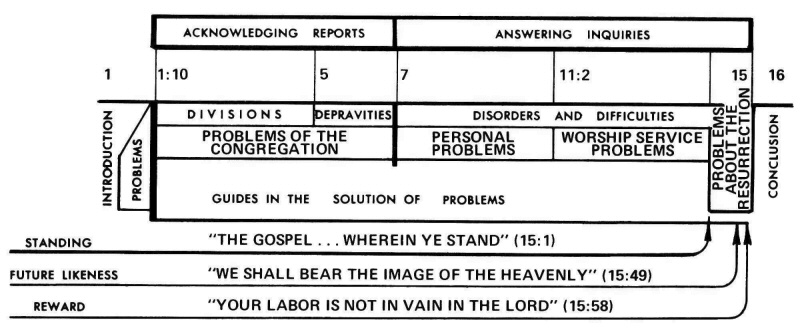
1 CORINTHIANS - PROBLEMS OF A LOCAL CHURCH
Click chart to enlarge
Charts from Jensen's Survey of the NT - used by permission
- 1 Corinthians 15:1 Commentary
- 1 Corinthians 15:2 Commentary
- 1 Corinthians 15:3 Commentary
- 1 Corinthians 15:4 Commentary
- 1 Corinthians 15:5 Commentary
- 1 Corinthians 15:6 Commentary
- 1 Corinthians 15:7 Commentary
- 1 Corinthians 15:8 Commentary
- 1 Corinthians 15:9 Commentary
- 1 Corinthians 15:10 Commentary
- 1 Corinthians 15:11 Commentary
- 1 Corinthians 15:12 Commentary
- 1 Corinthians 15:13 Commentary
- 1 Corinthians 15:14 Commentary
- 1 Corinthians 15:15 Commentary
- 1 Corinthians 15:16 Commentary
- 1 Corinthians 15:17 Commentary
- 1 Corinthians 15:18 Commentary
- 1 Corinthians 15:19 Commentary
- 1 Corinthians 15:20 Commentary
- 1 Corinthians 15:21 Commentary
- 1 Corinthians 15:22 Commentary
- 1 Corinthians 15:23 Commentary
- 1 Corinthians 15:24 Commentary
- 1 Corinthians 15:25 Commentary
- 1 Corinthians 15:26 Commentary
- 1 Corinthians 15:27 Commentary
- 1 Corinthians 15:28 Commentary
- 1 Corinthians 15:29 Commentary
- 1 Corinthians 15:30 Commentary
- 1 Corinthians 15:31 Commentary
- 1 Corinthians 15:32 Commentary
- 1 Corinthians 15:33 Commentary
- 1 Corinthians 15:34 Commentary
- 1 Corinthians 15:35 Commentary
- 1 Corinthians 15:36 Commentary
- 1 Corinthians 15:37 Commentary
- 1 Corinthians 15:38 Commentary
- 1 Corinthians 15:39 Commentary
- 1 Corinthians 15:40 Commentary
- 1 Corinthians 15:41 Commentary
- 1 Corinthians 15:42 Commentary
- 1 Corinthians 15:43 Commentary
- 1 Corinthians 15:44 Commentary
- 1 Corinthians 15:45 Commentary
- 1 Corinthians 15:46 Commentary
- 1 Corinthians 15:47 Commentary
- 1 Corinthians 15:48 Commentary
- 1 Corinthians 15:49 Commentary
- 1 Corinthians 15:50 Commentary
- 1 Corinthians 15:51 Commentary
- 1 Corinthians 15:52 Commentary
- 1 Corinthians 15:53 Commentary
- 1 Corinthians 15:54 Commentary
- 1 Corinthians 15:55 Commentary
- 1 Corinthians 15:56 Commentary
- 1 Corinthians 15:57 Commentary
- 1 Corinthians 15:58 Commentary
1 Corinthians 15:6 After that He appeared to more than five hundred brethren at one time, most of whom remain until now, but some have fallen asleep (NASB: Lockman)
Greek: epeita ophthe (3SAPI) epano pentakosiois adelphois ephapax , ex on oi pleiones menousin (3PPAI) eos arti, tines de ekoimethesan; (3PAPI)
Amplified: Then later He showed Himself to more than five hundred brethren at one time, the majority of whom are still alive, but some have fallen asleep [in death]. (Amplified Bible - Lockman)
KJV: After that, he was seen of above five hundred brethren at once; of whom the greater part remain unto this present, but some are fallen asleep.
NLT: After that, he was seen by more than five hundred of his followers at one time, most of whom are still alive, though some have died by now. (NLT - Tyndale House)
Phillips: and subsequently he was seen simultaneously by over five hundred Christians, of whom the majority are still alive, though some have since died. (Phillips: Touchstone)
Wuest: After that He appeared to more than five hundred brethren at one time, of whom the majority are remaining to the present time, but certain ones fell asleep. (Eerdmans)
Young's Literal: afterwards he appeared to above five hundred brethren at once, of whom the greater part remain till now, and certain also did fall asleep;
AFTER THAT HE APPEARED TO MORE THAN FIVE HUNDRED BRETHREN AT ONE TIME: epeita ophthe (3SAPI) epano pentakosiois adelphois ephapax:
- Matthew 28:10,16,17; Mark 16:7
- 1 Corinthians 15 Resources - Multiple Sermons and Commentaries
After (1899) (epeita from epi = upon, at + eita = then) means then, afterwards, next. See significance of observing expressions of time.
Appeared (3708) (horao) means to see or perceive with the eye, to pay attention to, to understand or to experience. Horao is used a number of times in the NT referring to seeing visions but Paul here is clearly not speaking of a vision but the actual bodily appearance of our Lord. It is not certain when this event occurred. The most likely possibility is Matthew 28:16-20. Since Jesus had previously announced this meeting (cf. Mt 26:32; 28:10, 16) it is unlikely that anyone would have intentionally missed it.
Horao - 113x in 109v - Matt 5:8; 8:4; 9:30; 16:6; 17:3; 18:10; 24:6, 30; 26:64; 27:4, 24; 28:7, 10; Mark 1:44; 8:15, 24; 9:4; 13:26; 14:62; 16:7; Luke 1:11, 22; 3:6; 9:31, 36; 12:15; 13:28; 16:23; 17:22; 21:27; 22:43; 23:49; 24:23, 34; John 1:18, 34, 39, 50f; 3:11, 32, 36; 4:45; 5:37; 6:36, 46; 8:38, 57; 9:37; 11:40; 14:7, 9; 15:24; 16:16f, 19, 22; 19:35, 37; 20:18, 25, 29; Acts 2:3, 17; 7:2, 26, 30, 35, 44; 8:23; 9:17; 13:31; 16:9; 18:15; 20:25; 22:15; 26:16; Rom 15:21; 1 Cor 9:1; 15:5ff; Col 2:1, 18; 1 Thess 5:15; 1 Tim 3:16; Heb 2:8; 8:5; 9:28; 11:27; 12:14; 13:23; Jas 2:24; 1 Pet 1:8; 1 John 1:1ff; 3:2, 6; 4:20; 3 John 1:11; Rev 1:7; 11:19; 12:1, 3; 19:10; 22:4, 9. NAS = appear(2), appeared(21), appearing(1), behold(3), beware(1), certainly seen(1), do(2), look(5), look after(1), looked(12), perceive(3), recognizing(1), saw(180), see(129), seeing(20), seen(63), seen… see(1), sees(2), suffer(1), undergo(3), underwent(1), watch(2), witnessed(1).
To more than 500 - These were eyewitnesses who testified that Jesus came back to life after He had been crucified.. There is no distinct record of this event in the Gospels. Since 1 Corinthians was written in about 55 AD, most of these witnesses had been alive and active witnesses for about 25 years.
Ryrie makes the point that "The citation of these and other witnesses to Christ's resurrection is of great apologetic value, especially in view of the fact that the Resurrection was still being attested to by living witnesses 25 years after the event. (The Ryrie Study Bible: New American Standard Translation: 1995. Moody Publishers)
One time (2178) (ephapax from epi = upon, at + hapax = once, a compound of "ha-" [="heis" in compounds] and "pax" [pegnumi = make firm, bring together] = giving hapax the fundamental meaning of numerical singularity and completeness which needs no additions) means once and for all or all at once. At the same time (all together) as here in 1Co 15:6. Friberg says that ephapax is used "as a religious technical term for the uniqueness and singularity of the Christ's death and the resultant redemption once (and) for all (Heb 10:10) (Analytical Lexicon of the Greek New Testament. Baker Academic)
Ephapax - 5x in 5v = once for all(4), one time(1). - Ro 6:10; 1Cor 15:6; Heb 7:27; 9:12; 10:10. As you observe these passages below, notice that all except for 1Co 15:6 relate to the sacrificial death of Christ. There are no uses in the Septuagint.
Romans 6:10 For the death that He died, He died to sin (see hamartia) once for all; but the life that He lives, He lives to God.
Comment: When Jesus cried out "It is finished!" (Jn 19:30), He was issuing a shout of victory testifying that once and for all time and eternity, the power of sin had been defeated by His work on the Cross, a work which was "validated" by His subsequent resurrection. Ephapax also points out the uniqueness of Christ's death.
Vine: Ephapax, “once for all,” once and completely, to be distinguished from pote, “once upon a time.” It is a strengthened form of hapax, which has the same significance, “once for all,” and is used with reference to the death of Christ in He 9:26, He 9:28; 1Pe 3:18. The word in this respect marks the absolute sufficiency and finality of the death of Christ for all the purposes for which He died. (Vine, W. Collected writings of W. E. Vine. Nashville: Thomas Nelsons)
1Corinthians 15:6 After that He appeared to more than five hundred brethren at one time (Here the idea of ephapax is while they were all together as opposed to separately), most of whom remain until now, but some have fallen asleep;
Hebrews 7:27 who does not need daily, like those high priests, to offer up sacrifices, first for His own sins and then for the sins of the people, because this He did once for all (See Ro 6:10 comment above) when He offered up Himself (.
Hebrews 9:12 and not through the blood of goats and calves, but through His own blood, He entered the holy place once for all, having obtained eternal redemption.
Comment: Jesus our Great High Priest fulfilled the "shadow" of the Day of Atonement (Lev 16:3, 15, 30 - notice that the Jewish high priest had to enter at least twice, while Jesus entered only once for He only needed one sacrifice -- Himself, the perfect Lamb of God, Jn 1:29) in which the Jewish high priest entered the holy of holies as a representative for the Jewish people. Notice that by entering thus into the Holy of Holies, the Messiah obtained eternal redemption for lost sinners - another truth to substantiate the surety of the eternal security for all who are genuinely by grace through faith in Christ. Believers cannot lose "eternal redemption"… now or ever!
Hebrews 10:10 By this will we have been sanctified (perfect tense = Set apart at a point in time = at the Cross [specifically all "we" of all the ages who are believers = we who were "co-crucified" with Christ - Ro 6:6-], the effect and power of which stands or remains) through the offering (1Pe 2:24) of the body of Jesus Christ once for all. (Note the superiority of the New Covenant and our Great High Priest's once for all sacrifice which stands in stark contrast to the daily sacrifices that the high priests were required to offer under the Old Covenant, the Mosaic Law.)
These five hundred brethren would be part of the "many infallible proofs" (Acts 1:3) that make this the greatest event in history since the creation.
Ray Stedman notes that "Every generation, the theory is propounded that Jesus really did not rise from the dead physically, that the disciples were so caught up in the wonder of his personality, that they so wanted him back they actually hallucinated and imagined they saw him. But this event, of course, can hardly fit that category, for here there were over five hundred individuals. Now it is hard enough to get one person to hallucinate, but to get five hundred people from various backgrounds and attitudes, etc., to do so all at once is simply incredible. I think this occurred up on a mountainside in Galilee, for even before his crucifixion the Lord had said that he would meet his disciples in Galilee after the resurrection. The first message he sent by the women at the tomb was, "go and tell my brethren to go to Galilee, and there they will see me," {cf, Matt 28:10}. Now you can imagine that word of that spread rapidly throughout the whole believing community and everybody who could get away headed for Galilee. Who would have wanted to miss that most exciting of all Christian meetings? So it is no wonder there were five hundred or more waiting for him on the mountainside, and to them he appeared. (1 Corinthians 15:5-11 They Saw Him Alive)
Related Resource:
Not A Myth
Read: 1 Corinthians 15:1-11 | Bible in a Year: Isaiah 7-9
After that He was seen by over five hundred brethren at once, of whom the greater part remain to the present, but some have fallen asleep. —1 Corinthians 15:6
I’m fascinated with history, so I eagerly watched a television special on England’s great King Arthur. A theme surfaced as each historian acknowledged that there were no eyewitness accounts nor historical evidence to support the story of King Arthur, his knights, and their Round Table. Repeatedly, the story was referred to as “legend” or “mythology.” It appears that the story is merely a legend woven together over centuries from fragments of other stories.
The good news of the gospel, however, is not rooted in mythology or legend but in verified fact, and it’s the greatest story ever told. Paul wrote that the most important event in human history—the resurrection of Jesus Christ—is supported by actual eyewitnesses. While listing disciples who had seen the risen Christ, Paul punctuated the list of eyewitnesses by writing, “After that He was seen by over five hundred brethren at once, of whom the greater part remain to the present, but some have fallen asleep” (1 Cor. 15:6). At the time of Paul’s writing, many of those witnesses were still alive and available for questioning.
The resurrection of Christ is not a myth. It is the factual pivot-point of history.By Bill Crowder (Our Daily Bread, Copyright RBC Ministries, Grand Rapids, MI. — Reprinted by permission. All rights reserved)
Up from the grave He arose,
With a mighty triumph o’er His foes;
He arose a Victor from the dark domain,
And He lives forever with His saints to reign.
—Lowry
The resurrection of Jesus Christ is the best attested fact of ancient history. —Arnold
MOST OF WHOM REMAIN UNTIL NOW, BUT SOME HAVE FALLEN ASLEEP: ex on oi pleiones menousin (3PPAI) eos arti, tines de ekoimethesan; (3PAPI):
- 1Cor 15:18; Acts 7:60; 13:36; 1Thessalonians 4:13,15; 2Peter 3:4
- 1 Corinthians 15 Resources - Multiple Sermons and Commentaries
Most of whom remain - Paul's point is that even though 1Corinthians was written more than 25 later, most of the witnesses of the Risen Christ were still alive.
MacArthur comments that "The quality of specific witnesses is represented by the apostles, all of whom were known by name and could easily be questioned. The quantity of witnesses is seen in the five hundred brethren who all saw the risen Christ at one time. Scripture gives no indication of who those people were, or where Jesus appeared to them, but they were surely well known in the early church, and, like the twelve, would often have been questioned about seeing the risen Savior. (MacArthur, J: 1Corinthians. Chicago: Moody Press)
Remain (3306) (meno) means to abide, to continue to be present, and in context to survive or live. In the present tense.
Fallen asleep (2837) (koimao related to keimai = to lie outstretched, to lie down) means to cause to sleep, is the word from which we get our word cemetery (see note below) which it was the early Christians optimistic name for a graveyard. It meant a sleeping place. It really was a synonym for a dormitory, a place where people sleep. This metaphorical use of the word sleep is appropriate because of the similarity in appearance between a sleeping body and a dead body; restfulness and peace normally characterize both. The object of the metaphor is to suggest that as the sleeper does not cease to exist while his body sleeps, so the dead person continues to exist despite his absence from the region in which those who remain can communicate with him, and that, as sleep is known to be temporary, so the death of the body will be found to be. Sleep has its waking, death will have its resurrection. In short, death to the believer is a sleep for his body—a period of rest to be followed by a glorious day.
Koimao is used 175 times in the Septuagint (LXX) (Gen. 19:4, 32ff; 24:54; 26:10; 28:11; 30:15f; 31:54; 32:13, 21; 34:2, 7; 35:22; 39:7, 12, 14, 17; 41:21; 47:30; 49:9; Exod. 22:16, 19, 27; 23:18; 34:25; Lev. 14:47; 15:4, 18, 24, 26, 33; 18:22; 19:13, 20; 20:11ff, 18, 20; 26:6; Num. 5:13, 19; 23:24; Deut. 16:4; 22:22f, 25, 28f; 24:12f; 27:20ff; 31:16; Jos. 2:8; 6:11; Jdg. 5:27; 16:3, 14; Ruth 3:4, 7f, 13f; 1 Sam. 3:9, 15; 9:26; 2 Sam. 7:12; 11:4, 9, 11, 13; 12:11, 24; 13:5f, 8, 11, 14, 31; 1 Ki. 1:2, 21; 2:10; 11:21, 43; 12:24; 14:31; 15:8, 24; 16:6, 28; 19:5f; 21:4; 22:40, 50; 2 Ki. 4:11, 20, 34; 8:24; 10:35; 13:9, 13; 14:16, 22, 29; 15:7, 22, 38; 16:20; 20:21; 21:18; 24:6; 1 Chr. 17:11; 2 Chr. 9:31; 16:13; 21:1; 26:2, 23; 27:9; 28:27; 32:33; 33:20; 36:8; Job 3:13; 7:4; 8:17; 14:12; 20:11; 21:13, 26; 22:11; 27:19; 39:9; 40:21; Ps. 3:5; 4:8; 41:8; 57:4; 68:13; Prov. 4:16; Eccl. 2:23; 4:11; Isa. 1:21; 5:27; 14:8, 18; 21:13; 43:17; 50:11; 57:8; 65:4; Jer. 3:25; 45:3; Lam. 2:21; Ezek. 4:4, 6; 23:8; 31:18; 32:20f, 27ff, 32; 34:14; Dan. 6:18; 8:18, 27)
18 times in the NT…
Matthew 27:52 and the tombs were opened; and many bodies of the saints who had fallen asleep were raised;
Matthew 28:13 and said, "You are to say, 'His disciples came by night and stole Him away while we were asleep.'
Luke 22:45 And when He rose from prayer, He came to the disciples and found them sleeping from sorrow,
John 11:11 This He said, and after that He said to them, "Our friend Lazarus has fallen asleep; but I go, that I may awaken him out of sleep." 12 The disciples therefore said to Him, "Lord, if he has fallen asleep, he will recover."
Acts 7:60 And falling on his knees, he cried out with a loud voice, "Lord, do not hold this sin against them!" And having said this, he fell asleep. (See similar uses in the Septuagint 1Ki 2:10 referring to David falling asleep, 1Ki 11:43 referring to Solomon falling asleep)
Acts 12:6 And on the very night when Herod was about to bring him forward, Peter was sleeping between two soldiers, bound with two chains; and guards in front of the door were watching over the prison.
Acts 13:36 "For David, after he had served the purpose of God in his own generation, fell asleep, and was laid among his fathers, and underwent decay;
1 Corinthians 7:39 A wife is bound as long as her husband lives; but if her husband is dead, she is free to be married to whom she wishes, only in the Lord.
1 Corinthians 11:30 For this reason many among you are weak and sick, and a number sleep.
1 Corinthians 15:6 After that He appeared to more than five hundred brethren at one time, most of whom remain until now, but some have fallen asleep… 18 Then those also who have fallen asleep in Christ have perished… 20 But now Christ has been raised from the dead, the first fruits of those who are asleep… 51 Behold, I tell you a mystery; we shall not all sleep, but we shall all be changed
1 Thessalonians 4:13 But we do not want you to be uninformed, brethren, about those who are asleep, that you may not grieve, as do the rest who have no hope. 14 For if we believe that Jesus died and rose again, even so God will bring with Him those who have fallen asleep in Jesus. 15 For this we say to you by the word of the Lord, that we who are alive, and remain until the coming of the Lord, shall not precede those who have fallen asleep.
2 Peter 3:4 and saying, "Where is the promise of His coming? For ever since the fathers fell asleep, all continues just as it was from the beginning of creation."
The early Christians adopted the word koimeterion (which was used by the Greeks of a place of rest, room for sleeping or bedroom, a rest house for strangers) for the place of interment of the bodies of their departed; thence the English word “cemetery” or “the sleeping place,” is derived. It was first applied in Christian burials in the Roman catacombs and by the 15th Century, the word cemetery had come into general usage.
It is interesting that Matthew used this same verb, koimao, in his description of the events surrounding the Lord's death on the Cross…
And Jesus cried out again with a loud voice, and yielded up His spirit. And behold, the veil of the temple was torn in two from top to bottom, and the earth shook; and the rocks were split, and the tombs were opened; and many bodies of the saints who had fallen asleep (koimao) were raised and coming out of the tombs after His resurrection they entered the holy city and appeared to many. (Mt 27:50-53)
Daniel uses this metaphor writing that…
And many of those who sleep in the dust of the ground will awake, these to everlasting life (believers), but the others to disgrace and everlasting contempt (unbelievers). (Daniel 12:2)
C H Spurgeon writes that…The resurrection of Jesus Christ from the dead is one of the best attested facts on record. There were so many witnesses to behold it, that if we do in the least degree receive the credibility of men's testimonies, we cannot and we dare not doubt that Jesus rose from the dead. It is all very easy for infidels to say that these persons were deceived, but it is equally foolish, for these persons could not every one of them have been so positively deceived as to say that they had seen this man, whom they knew to have been dead, afterwards alive; they could not all, surely, have agreed together to help on this imposture: if they did, it is the most marvellous thing we have on record, that not one of them ever broke faith with the others, but that the whole mass of them remained firm. We believe it to be quite impossible that so many rogues should have agreed for ever. They were men who had nothing to gain by it; they subjected themselves to persecution by affirming the very fact; they were ready to die for it, and did die for it. Five hundred or a thousand persons who had seen him at different times, declared that they did see him, and that he rose from the dead; the fact of his death having been attested beforehand. How, then, dare any man say that the Christian religion is not true, when we know for a certainty that Christ died and rose again from the dead? And knowing that, who shall deny the divinity of the Saviour? Who shall say that he is not mighty to save? Our faith hath a solid basis, for it hath all these witnesses on which to rest, and the more sure witness of the Holy Spirit witnessing in our hearts. "And last of all," says the apostle, "he was seen of me also, as of one born out of due time: for I am the least of the apostles." We should not have thought Paul proud if he had said, "I am the greatest of the apostles," for he occupies the largest portion of the sacred Scriptures with his writings; and he preached more abundantly than they all. There was not one who could exceed Paul, or even come near him in his arduous labours.
1 Corinthians 15:7 then He appeared to James, then to all the apostles; (NASB: Lockman)
Greek: epeita ophthe (3SAPI) Iakobo, eita tois apostolois pasin
Amplified: Afterward He was seen by James, then by all the apostles (the special messengers). (Amplified Bible - Lockman)
KJV: After that, he was seen of James; then of all the apostles.
NLT: Then he was seen by James and later by all the apostles. (NLT - Tyndale House)
Phillips: He was then seen by James, then by all the messengers. (Phillips: Touchstone)
Wuest: After that He appeared to James, then to all the apostles, and in the last of all His appearances, (Eerdmans)
Young's Literal: afterwards he appeared to James, then to all the apostles.
THEN HE APPEARED TO JAMES: epeita ophthe (3SAPI) Iakobo:
- 1 Corinthians 15 Resources - Multiple Sermons and Commentaries
Related Passage:
Acts 1:14 "These all with one mind were continually devoting themselves to prayer, along with the women, and Mary the mother of Jesus, and with His brothers."
Appeared (3708) (horao) means to see or perceive with the eye, to pay attention to, to understand or to experience. Horao is used a number of times in the NT referring to seeing visions but Paul here is clearly not speaking of a vision but the actual bodily appearance of our Lord.
James (2385) (Iakobos) used 42x in 38v - Matt 4:21; 10:2f; 13:55; 17:1; 27:56; Mark 1:19, 29; 3:17f; 5:37; 6:3; 9:2; 10:35, 41; 13:3; 14:33; 15:40; 16:1; Luke 5:10; 6:14ff; 8:51; 9:28, 54; 24:10; Acts 1:13; 12:2, 17; 15:13; 21:18; 1 Cor 15:7; Gal 1:19; 2:9, 12; Jas 1:1; Jude 1:1
Paul does not state which James He appeared to. There are three possibilities - Two original apostles were named James, one the son of Zebedee (Mt 4:21) and the other the son of Alphaeus (Mt 10:3, Mk 3:17, 18). The third is the Lord’s half-brother (Mt 13:55, Jas 1:1)
Vine writes that "the James here mentioned was probably the Lord’s brother. The next clause means “then to the apostles as a complete body,” not indicating that the James referred to was one of the apostles. (Vine, W. Collected writings of W. E. Vine. Nashville: Thomas Nelson)
A T Robertson comments that this is almost certainly the half brother of the Lord and "This fact explains the presence of the brothers of Jesus in the upper room (Acts 1:14)
And so most commentators favor is James, the half-brother of the Lord, the one who became the leader of the Jerusalem church.
"Is not this the carpenter's son? Is not His mother called Mary, and His brothers, James and Joseph and Simon and Judas? (Mt 13:55)
James had been skeptical of Jesus John recording…
not even His brothers were believing in Him. (John 7:5)
Stedman adds that Jesus' "brothers did not believe in him until the resurrection. It was that phenomenal event, that magnificent recovery, that finally convinced James that Jesus was the Son of God. We do not know when he appeared to him. Again, it would have been fascinating to have been there, and heard what he said, and how he revealed himself to his brother. But it is this James who wrote the Epistle of James in our New Testament. If you read through that letter you will see how reverently he refers to the Lord Jesus. He calls him twice the "Lord Jesus Christ," and once the "Lord of Glory," so that his brother was now solidly and firmly convinced that Jesus had risen from the dead. (1 Corinthians 15:5-11 They Saw Him Alive)
THEN TO ALL THE APOSTLES: eita tois apostolois pasin:
- Luke 24:50; Acts 1:2-12
- 1 Corinthians 15 Resources - Multiple Sermons and Commentaries
Apostles (652) (apostolos from apo = from + stello = send forth) (Click discussion of apostle) means one sent forth from by another, often with a special commission to represent another and to accomplish his work. It can be a delegate, commissioner, ambassador sent out on a mission or orders or commission and with the authority of the one who sent him. In the ancient world a apostle was the personal representatives of the king, functioning as an ambassador with the king’s authority and provided with credentials to prove he was the king's envoy. Cargo ships were sometimes called apostolic, because they were dispatched with a specific shipment for a specific destination.
Apostolos - 80x in 79v - Matt 10:2; Mark 3:14; 6:30; Luke 6:13; 9:10; 11:49; 17:5; 22:14; 24:10; John 13:16; Acts 1:2, 26; 2:37, 42f; 4:33, 35ff; 5:2, 12, 18, 29, 40; 6:6; 8:1, 14, 18; 9:27; 11:1; 14:4, 14; 15:2, 4, 6, 22f; 16:4; Rom 1:1; 11:13; 16:7; 1 Cor 1:1; 4:9; 9:1f, 5; 12:28f; 15:7, 9; 2 Cor 1:1; 8:23; 11:5, 13; 12:11f; Gal 1:1, 17, 19; Eph 1:1; 2:20; 3:5; 4:11; Phil 2:25; Col 1:1; 1 Thess 2:7; 1 Tim 1:1; 2:7; 2 Tim 1:1, 11; Titus 1:1; Heb 3:1; 1 Pet 1:1; 2 Pet 1:1; 3:2; Jude 1:17; Rev 2:2; 18:20; 21:14. NAS = apostle(19), apostles(52), apostles'(5), messenger(1), messengers(1), is sent(1).
In its broadest sense, apostle can refer to all believers, because every believer is sent into the world as a witness for Christ. But the term is primarily used as a specific and unique title for the thirteen men (the Twelve, with Matthias replacing Judas, and Paul) whom Christ personally chose and commissioned to authoritatively proclaim the gospel and lead the early church. The thirteen apostles not only were all called directly by Jesus but all were witnesses of His resurrection, Paul having encountered Him on the Damascus Road after His ascension. Those thirteen apostles were given direct revelation of God’s Word to proclaim authoritatively, the gift of healing, and the power to cast out demons (Mt 10:1). By these signs their teaching authority was verified (cf. 2Co 12:12). Their teachings became the foundation of the church (Eph 2:20), and their authority extended beyond local bodies of believers to the entire believing world. In the present context Peter uses apostle in its more common specialized or restricted meaning. The authority of Peter's message did not derive from the messenger but from the Sender.
In Acts 1:21-22 Peter delineates the necessary qualifications of the apostles…
Therefore it is necessary that of the men who have accompanied us all the time that the Lord Jesus went in and out among us--beginning with the baptism of John until the day that He was taken up from us--one of these must become a witness with us of His resurrection.
So as used here in 1Corinthians 15:7 an apostle was a man who had seen the risen Messiah and who was sent forth by Him with His full authority to plant the flag of faith in every community to which His master led him. Peter was Christ's emissary and spoke with His authority.
1 Corinthians 15:8 and last of all, as to one untimely born, He appeared to me also. (NASB: Lockman)
Greek: eschaton de panton osperei to ektromati ophthe (3SAPI) kamoi.
Amplified: And last of all He appeared to me also, as to one prematurely and born dead [no better than an unperfected fetus among living men]. (Amplified Bible - Lockman)
KJV: And last of all he was seen of me also, as of one born out of due time.
NLT: Last of all, I saw him, too, long after the others, as though I had been born at the wrong time. (NLT - Tyndale House)
Phillips: And last of all, as if to one born abnormally late, he appeared to me! (Phillips: Touchstone)
Wuest: and in the last of all His appearances, He appeared also to me, an unperfected, stillborn embryo. (Eerdmans)
Young's Literal: And last of all -- as to the untimely birth -- he appeared also to me,
AND LAST OF ALL, AS IT WERE TO ONE UNTIMELY BORN, HE APPEARED TO ME ALSO: eschaton de panton hosperei to ektromati ophthe (3SAPI) kamoi:
- 1Cor 9:1; Acts 9:3, 4, 5,17; 18:9; 22:14,18; 26:16; 2Corinthians 12:1-6
- 1 Corinthians 15 Resources - Multiple Sermons and Commentaries
LAST BUT CERTAINLY
NOT LEAST!
Last (2078) (eschatos) means the extreme or most remote, pertaining to being the last in a series of objects or events - Eschatos - 52x in 47v - Matt 5:26; 12:45; 19:30; 20:8, 12, 14, 16; 27:64; Mark 9:35; 10:31; 12:6, 22; Luke 11:26; 12:59; 13:30; 14:9f; John 6:39f, 44, 54; 7:37; 11:24; 12:48; Acts 1:8; 2:17; 13:47; 1 Cor 4:9; 15:8, 26, 45, 52; 2 Tim 3:1; Heb 1:2; Jas 5:3; 1 Pet 1:5, 20; 2 Pet 2:20; 3:3; 1 John 2:18; Jude 1:18; Rev 1:17; 2:8, 19; 15:1; 21:9; 22:13. NAS = end(1), last(46), last of all(1), last man(1), last men(1), late(1), remotest part(1).
Unmerited favors produce self-abasement. Paul could never think of the distinction conferred on him by Christ without alluding to his own unworthiness.
One untimely born -("an unperfected, stillborn embryo" - Amplified) Paul speaks of his own experience with the Resurrected Christ as analogous to a premature birth, birth before the time of the Lord's appearing to all His people. Paul uses it as a powerful figure of the unexpected, abnormal nature of his apostolic call. Unlike the other apostles, who had the benefit of an initial training period with Christ, Paul became an apostle abruptly, with no opportunity for earthly contact with Christ or His teaching.
Untimely born (1626) (ektroma from ek = out + titrosko = to wound thus to cut or excise out, to cause or suffer abortion, to miscarry) refers to an abortion, miscarriage, or one born prematurely, the picture of each being that of a life that was unable to sustain itself. The term implies an untimely, early birth. Thayer explains Paul's use writing "that he is as inferior to the rest of the apostles as an immature birth comes short of a mature one, and is no more worthy of the name of an apostle than an abortion is of the name of a child. Ektroma is only used three times in the Septuagint (LXX) (Nu 12:12; Job 3:16; and Eccl. 6:3) for a miscarriage.
Stedman quips that "Had Paul written his spiritual biography, the title would have not been Born Again, it would have been The Miscarriage, The Abortion, or something like that. This is what he thought of himself, largely because of the way he came to birth. He is thinking of the twelve apostles as being born in a very normal way. When they heard the word of the Lord, they began to believe it. Gradually it developed in their minds and hearts until they came to the place where they believed it totally. In this way their spiritual birth followed a normal pregnancy that could be observed developing. But Paul's experience was not like that. It was abnormal; it was sudden; it was very precipitous and unexpected. That may account for the fact that Paul had a difficult time in his early Christian life. When somebody is prematurely born he does not just leap out and handle life like a normal baby. He is cared for specially; he is nurtured in private; he is protected from exposure to danger and germs and it is a long time before he begins to function normally. And this was the case with Paul. He was born again on the Damascus road, but it was such a sudden, precipitous thing it took a long time for him to adjust his thinking and get it in line with this fantastic event that had occurred. That is why he spent three years in Damascus and Arabia and another seven years in his home town of Tarsus before he got it all together and felt he was ready to begin his great ministry of teaching and preaching all around the world. The Spirit of God led Barnabus to go down to Tarsus and find him ten years later (1 Corinthians 15:5-11 They Saw Him Alive)
David Lowery comments that "Paul considered himself abnormally born because he lacked the “gestation” period of having been with Christ during His earthly ministry (Walvoord, J. F., Zuck, R. B., et al: The Bible Knowledge Commentary. 1985. Victor)
MacArthur explains Paul's figure of speech noting that "the term could indicate hopelessness for life without divine intervention, and convey the idea that he was born without hope of meeting Christ. But the use of the term in the sense of an ill–timed birth, too early or too late, seems to fit Paul’s thought best. He came too late to have been one of the twelve. In carrying the idea of unformed, dead, and useless, the term was also used as a term of derision. Before his conversion, which coincided with his vision of the resurrected Lord, Paul was spiritually unformed, dead, and useless, a person to be scorned by God. Even when he was born it was wrong timing. Christ was gone. How could he be an apostle? Yet, by special divine provision, He appeared to me also, Paul testifies.
Ryrie comments that most likely Paul "is regarding himself as a miscarried infant when compared to the other apostles; that is, one thrust suddenly into apostleship without the nurture of Christ's friendship and direct teaching.
Appeared (3708) (horao) means to see or perceive with the eye, to pay attention to, to understand or to experience. Horao is used a number of times in the NT referring to seeing visions but Paul here is clearly not speaking of a vision but the actual bodily appearance of our Lord.
Note that the verb horao is repeated 4 times in this section. Paul's point was that the visible appearances of the Resurrected Christ prove that His resurrection was not a hallucination or some form of “spiritual” or noncorporeal existence. And as discussed elsewhere, Paul does not mention all the post-Resurrection appearances of the Christ.
Luke records Saul's encounter with the resurrected Christ...
Now Saul, still breathing threats and murder against the disciples of the Lord, went to the high priest, 2 and asked for letters from him to the synagogues at Damascus, so that if he found any belonging to the Way, both men and women, he might bring them bound to Jerusalem. 3 And it came about that as he journeyed, he was approaching Damascus, and suddenly a light from heaven flashed around him; 4 and he fell to the ground, and heard a voice saying to him, "Saul, Saul, why are you persecuting Me?"
5 And he said, "Who art Thou, Lord?" And He said," I am Jesus whom you are persecuting, 6 but rise, and enter the city, and it shall be told you what you must do." 7 And the men who traveled with him stood speechless, hearing the voice, but seeing no one.8 And Saul got up from the ground, and though his eyes were open, he could see nothing; and leading him by the hand, they brought him into Damascus. 9 And he was three days without sight, and neither ate nor drank.
10 Now there was a certain disciple at Damascus, named Ananias; and the Lord said to him in a vision, "Ananias." And he said, "Behold, here am I, Lord." 11 And the Lord said to him, "Arise and go to the street called Straight, and inquire at the house of Judas for a man from Tarsus named Saul, for behold, he is praying, 12 and he has seen in a vision a man named Ananias come in and lay his hands on him, so that he might regain his sight." 13 But Ananias answered, "Lord, I have heard from many about this man, how much harm he did to Thy saints at Jerusalem; 14 and here he has authority from the chief priests to bind all who call upon Thy name." 15 But the Lord said to him, "Go, for he is a chosen instrument of Mine, to bear My name before the Gentiles and kings and the sons of Israel; 16 for I will show him how much he must suffer for My name's sake." (Acts 9:1-15)
C H Spurgeon comments that "We should not have thought Paul proud if he had said, "I am the greatest of the apostles," for he occupies the largest portion of the sacred Scriptures with his writings; and he preached more abundantly than they all. There was not one who could exceed Paul, or even come near him in his arduous labours