1 John 3:2
1 John 3:3
1 John 3:4
1 John 3:5
1 John 3:6
1 John 3:7
1 John 3:8
1 John 3:9
1 John 3:10
1 John 3:11
1 John 3:12
1 John 3:13
1 John 3:14
1 John 3:15
1 John 3:16
1 John 3:17
1 John 3:18
1 John 3:19
1 John 3:20
1 John 3:21
1 John 3:22
1 John 3:23
1 John 3:24
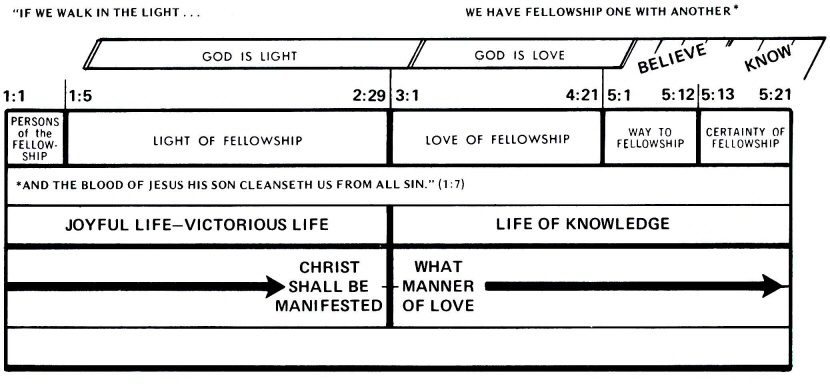
FELLOWSHIP WITH GOD AND HIS CHILDREN
Click chart to enlarge
Charts from Jensen's Survey of the NT - used by permission
Another Overview Chart - 1 John - Charles Swindoll
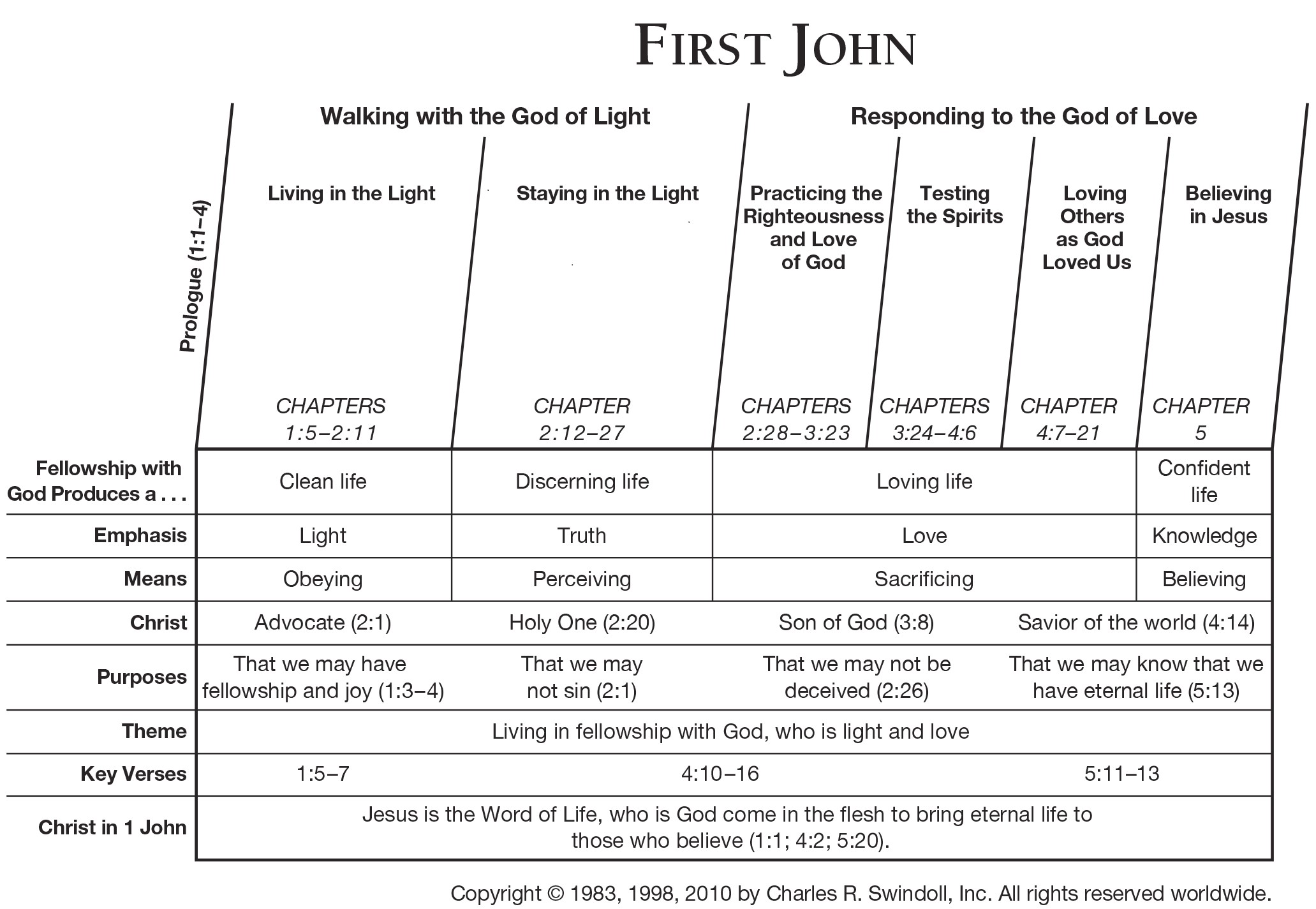
| BASIS OF FELLOWSHIP | BEHAVIOR OF FELLOWSHIP | ||||
| Conditions of Fellowship |
Cautions of Fellowship |
Fellowship Characteristics |
Fellowship Consequences |
||
| Meaning of Fellowship 1 Jn 1:1-2:27 |
Manifestations of Fellowship 1 Jn 2:28-5:21 |
||||
| Abiding in God's Light |
Abiding in God's Love |
||||
| Written in Ephesus | |||||
| circa 90 AD | |||||
| From Talk Thru the Bible | |||||
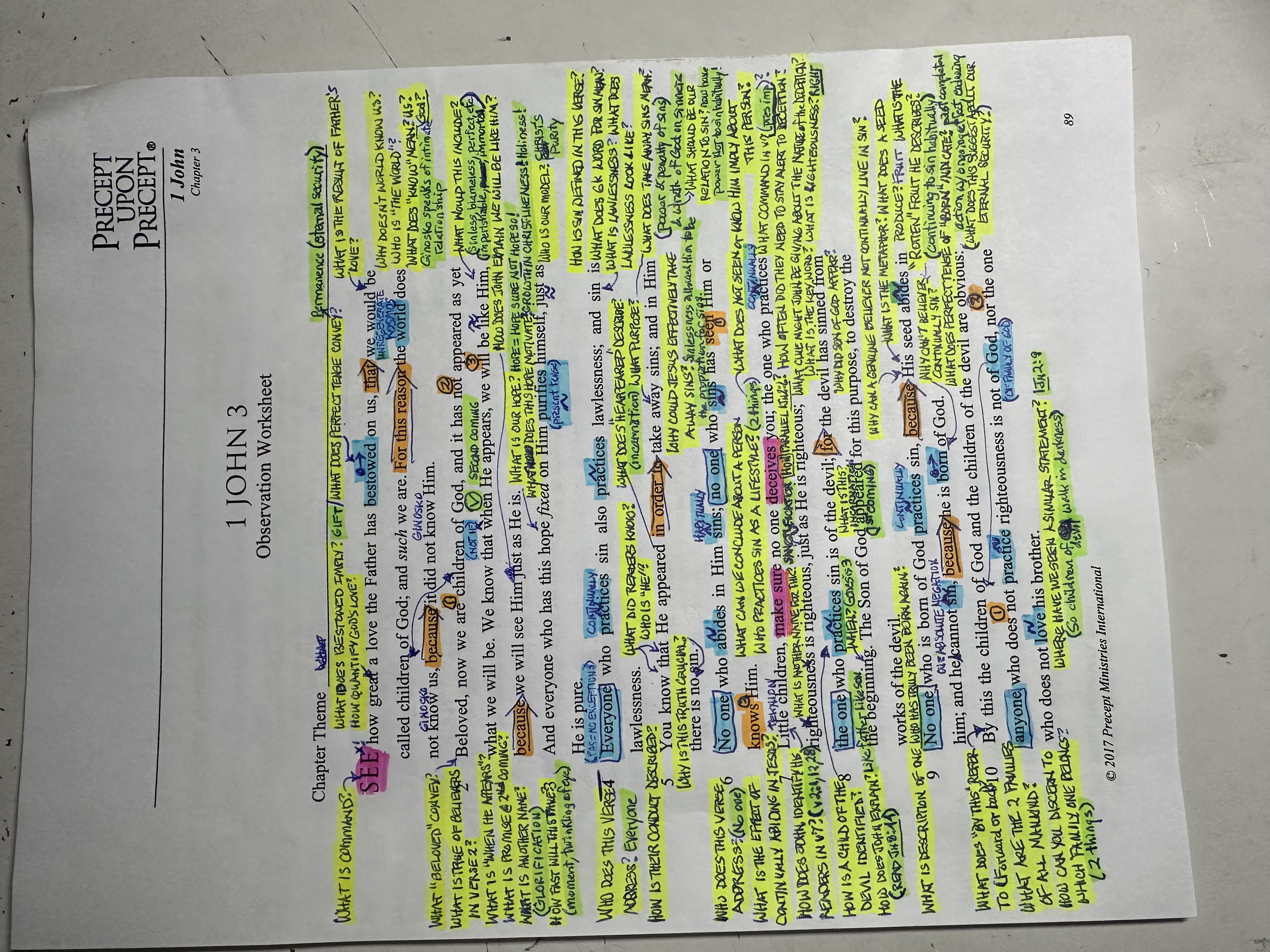
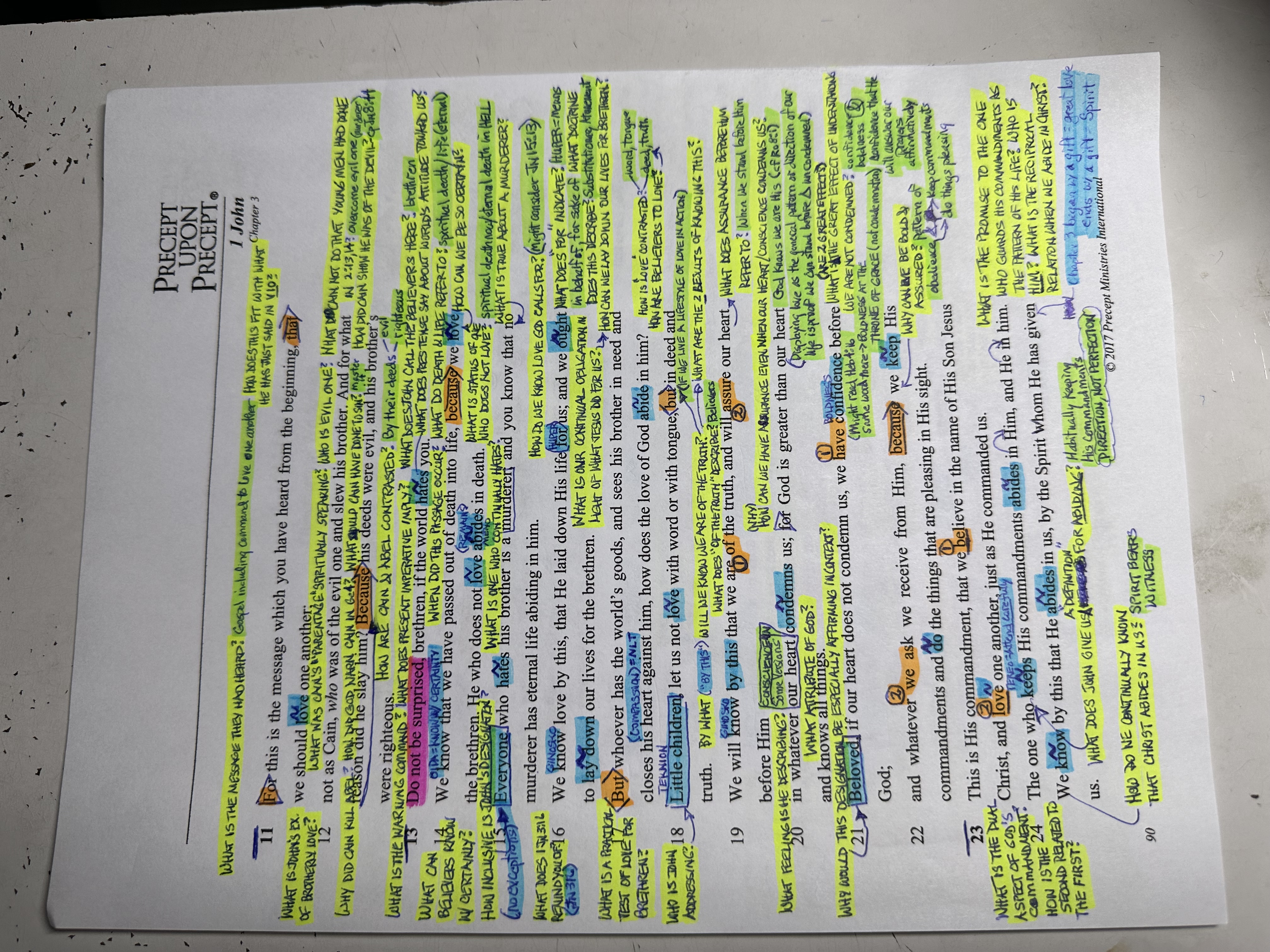
What is this? On the photograph of the Observation Worksheet for this chapter you will find handwritten 5W/H questions (Who? What? Where? When? Why? How?) on each verse to help you either personally study or lead a discussion on this chapter. The questions are generally very simple and are stated in such a way as to stimulate you to observe the text to discern the answer. As a reminder, given the truth that your ultimate Teacher is the Holy Spirit, begin your time with God with prayer such as Psalm 119:12+ "Blessed are You, O LORD; Teach me Your statutes." (you can vary it with similar prayers - Ps 119:18, 26, 33, 64, 66, 68, 108, 124, 135, 171, etc) The questions are generally highlighted in yellow and the answers in green. Some questions have no answers and are left to your observations and the illuminating/teaching ministry of the Holy Spirit. Some qualifying thoughts - (1) Use "As is" - these are handwritten and will include mistakes I made, etc. (2) They may not be the best question for a given verse and my guess is that on some verses you will think of a far superior 5W/H question and/or many other questions.
Dr Howard Hendricks once gave an assignment to his seminary students to list as many observations as they could from Acts 1:8. He said "So far they’ve come up with more than 600 different ones! Imagine what fun you could have with 600 observations on this passage. Would you like to see Scripture with eyes like that?" (P. 63 Living by the Book - borrow) With practice you can! And needless to say, you will likely make many more observations and related questions than I recorded on the pages below and in fact I pray that the Spirit would indeed lead you to discover a veritable treasure chest of observations and questions! In Jesus' Name. Amen
Why am I doing this? Mortimer Adler among others helped me develop a questioning mindset as I read, seeking to read actively rather than passively. Over the years I have discovered that as I have practiced reading with a 5W/H questioning mindset, it has yielded more accurate interpretation and the good fruit of meditation. In other words, consciously interacting with the inspired Holy Word of God and the illuminating Holy Spirit has honed my ability to meditate on the Scripture, and my prayer is that this tool will have the same impact in your spiritual life. The benefits of meditation are literally priceless in regard to their value in this life and in the life to come (cf discipline yourself for godliness in 1Ti 4:8+.) For some of the benefits - see Joshua 1:8+ and Psalm 1:2-3+. It will take diligence and mental effort to develop an "inductive" (especially an "observational"), interrogative mindset as you read God's Word, but it bears repeating that the benefits in this life and the rewards in the next will make it more than worth the effort you invest! Dear Christian reader let me encourage you to strongly consider learning the skills of inductive Bible study and spending the rest of your life practicing them on the Scriptures and living them out in your daily walk with Christ.
Although Mortimer Adler's advice is from a secular perspective, his words are worth pondering...
Strictly, all reading is active. What we call passive is simply less active. Reading is better or worse according as it is more or less active. And one reader is better than another in proportion as he is capable of a greater range of activity in reading. (Adler's classic book How to Read a Book is free online)
John Piper adds that "Insight or understanding is the product of intensive, headache-producing meditation on two or three verses and how they fit together. This kind of reflection and rumination is provoked by asking questions of the text. And you cannot do it if you hurry. Therefore, we must resist the deceptive urge to carve notches in our bibliographic gun. Take two hours to ask ten questions of Galatians 2:20+ and you will gain one hundred times the insight you would have attained by reading thirty pages of the New Testament or any other book. Slow down. Query. Ponder. Chew.... (John Dewey rightly said) "People only truly think when they are confronted with a problem. Without some kind of dilemma to stimulate thought, behavior becomes habitual rather than thoughtful.”
“Asking questions is the key to understanding.”
--Jonathan Edwards
That said, below are the 5W/H questions for each verse in this chapter (click page to enlarge). This is not neatly typed but is handwritten and was used for leading a class discussion on this chapter, so you are welcome to use it in this "as is" condition...
 |
 |
1 John 3:2 Beloved, now we are children of God, and it has not appeared as yet what we will be. We know that when He appears, we will be like Him, because we will see Him just as He is. (NASB: Lockman):
Greek: Agapetoi, nun tekna theou esmen, (1PPAI) kai oupo ephanerothe (3SAPI) ti esometha. (1PFMI) oidamen (1PRAI) hoti ean phanerothe (3SAPS) homoioi auto esometha, (1PFMI) hoti opsometha (1PFMI) auton kathos estin. (3SPAI)
Amplified: Beloved, we are [even here and] now God’s children; it is not yet disclosed (made clear) what we shall be [hereafter], but we know that when He comes and is manifested, we shall [as God’s children] resemble and be like Him, for we shall see Him just as He [really] is. (Amplified Bible - Lockman)
ASV: Beloved, now are we children of God, and it is not yet made manifest what we shall be. We know that, if he shall be manifested, we shall be like him; for we shall see him even as he is.
BBE: My loved ones, now we are children of God, and at present it is not clear what we are to be. We are certain that at his revelation we will be like him; for we will see him as he is.
CEV: My dear friends, we are already God's children, though what we will be hasn't yet been seen. But we do know that when Christ returns, we will be like him, because we will see him as he truly is. (CEV)
GWT: Dear friends, now we are God's children. What we will be isn't completely clear yet. We do know that when Christ appears we will be like him because we will see him as he is. (GWT)
ICB: Dear friends, now we are children of God. We have not yet been shown what we will be in the future. But we know that when Christ comes again, we will be like him. We will see him as he really is. (ICB: Nelson)
ISV: Dear friends, we are now God's children, but what we will be like hasn't been revealed yet. We know that when Christ is revealed we will be like him, because we will see him as he is.
KJV: Beloved, now are we the sons of God, and it doth not yet appear what we shall be: but we know that, when he shall appear, we shall be like him; for we shall see him as he is.
Macent: beloved, we are now the sons of God, tho' it does not yet appear what we shall be: but we know, that when this change shall be, his immediate presence will give us a divine resemblance.
MLB (Berkley): Beloved ones, we are God’s children now, and what we shall be has not yet been shown; but we know that when He appears we shall resemble Him, for we shall see Him as He is.
Moffatt: We are children of God now, beloved; what we are to be is313 not apparent yet, but we do know that when he appears, we are to be like him—for we are to see him as he is.
Montgomery: We are God’s children now, beloved; what we shall be has never yet been made manifest. But we know that when He is manifested we shall be like him; for we shall see him even as he is.
NCV: Dear friends, now we are children of God, and we have not yet been shown what we will be in the future. But we know that when Christ comes again, we will be like him, because we will see him as he really is. (NCV)
NET: Dear friends, we are God's children now, and what we will be has not yet been revealed. But we know that whenever it is revealed we will be like him, because we will see him just as he is. (NET Bible)
NIV: Dear friends, now we are children of God, and what we will be has not yet been made known. But we know that when He appears, we shall be like him, for we shall see him as he is. (NIV - IBS)
NJB: My dear friends, we are already God's children, but what we shall be in the future has not yet been revealed. We are well aware that when he appears we shall be like him, because we shall see him as he really is. (NJB)
NLT: Dear friends, we are already God’s children, but he has not yet shown us what we will be like when Christ appears. But we do know that we will be like him, for we will see him as he really is. (NLT - Tyndale House)
Phillips: Oh, dear children of mine (forgive the affection of an old man!), have you realized it? Here and now we are God's children. We don't know what we shall become in the future. We only know that, if reality were to break through, we should reflect his likeness, for we should see him as he really is! (Phillips: Touchstone)
TEV: My dear friends, we are now God's children, but it is not yet clear what we shall become. But we know that when Christ appears, we shall be like him, because we shall see him as he really is.
TLB: Yes, dear friends, we are already God’s children, right now, and we can’t even imagine what it is going to be like later on. But we do know this, that when he comes we will be like him, as a result of seeing him as he really is.
Weymouth: Dear friends, we are now God's children, but what we are to be in the future has not yet been fully revealed. We know that if Christ reappears we shall be like Him, because we shall see Him as He is.
Wuest: Divinely loved ones, now born-ones of God we are. And not yet has it been made visible what we shall be. We know absolutely that whenever it is made visible, like ones to Him we shall be, because we shall see Him just as He is. (Eerdmans Publishing - used by permission)
Young's Literal:beloved, now, children of God are we, and it was not yet manifested what we shall be, and we have known that if he may be manifested, like him we shall be, because we shall see him as he is;
Beloved, now we are children of God, and it has not appeared as yet what we will be: Agapetoi, nun tekna theou esmen, (1PPAI) kai oupo ephanerothe (3SAPI) ti esometha. (1PFMI):
- 1Jn 1:1; 5:1; Isaiah 56:5; Romans 8:14,15,18; Galatians 3:26; 4:6+
- Ps 31:19; Ro 8:18; 1Co 2:9; 13:12+; 2Co 4:17
- Click to listen to the timeless, raspy voiced exposition of 1Jn 3:2 by Dr J Vernon McGee
- 1 John 3 Resources - Multiples Sermons and Commentaries
Related Passages:
Romans 8:18 For I consider that the sufferings of this present time are not worthy to be compared with the glory that is to be revealed to us.
2 Corinthians 4:17 For momentary, light affliction is producing for us an eternal weight of glory far beyond all comparison,
1 Corinthians 2:9+ (Note: Context favors this as referring to truth revealed to the apostles - see 1Co 2:10) but just as it is written, “THINGS WHICH EYE HAS NOT SEEN AND EAR HAS NOT HEARD, AND which HAVE NOT ENTERED THE HEART OF MAN, ALL THAT GOD HAS PREPARED FOR THOSE WHO LOVE HIM.”
1 Corinthians 13:12+ For now we see in a mirror dimly, but then face to face; now I know in part, but then I shall know fully just as I also have been fully known.
1Jn 3:1: WHAT WE ARE
1Jn 3:2: WHAT WE SHALL BE
1Jn 3:3: WHAT WE SHOULD BE
Warren Wiersbe summarizes the first 3 verses of 1John 3 "First John 3:1 tells us what we are and 1 John 3:2 tells us what we shall be. The reference here, of course, is to the time of Christ’s coming for His church. This was mentioned in 1John 2:28+ as an incentive for holy living, and now it is repeated. God’s love for us does not stop with the new birth. It continues throughout our lives and takes us right up to the return of Jesus Christ! When our Lord appears, all true believers will see Him and will become like Him (Phil 3:20, 21+). This means, of course, that they will have new, glorified bodies, suited to heaven. But the apostle does not stop here! He has told us what we are and what we shall be. Now, in 1John 3:3, he tells us what we should be. In view of the return of Jesus Christ, we should keep our lives clean. (Bible Exposition Commentary)
First John 3:2 at first reading seems relatively straight forward but the profound truth it teaches is so amazing that it prompted the great British expositor Dr. Martyn-Lloyd Jones to confess…
I suppose we must agree that nothing more sublime than this has ever been written, and any man who has to preach upon such a text or upon such a word must be unusually conscious of his own smallness and inadequacy and unworthiness. One’s tendency with a statement like this always is just to stand in wonder and amazement at it. I have never chosen, in and of myself, to preach upon this text. I have often felt that I would like to, but there are certain great words like this in Scripture of which frankly I am, in a sense, frightened; frightened as a preacher, lest anything that I say may detract from them or may rob anyone of their greatness and their glory. That may be wrong, but this is how it always affects me…
Furthermore, it is when one confronts a text like this that one realises what a privilege it is to be a Christian minister. I am rather sorry for anyone who has not had to spend a week with a verse like this! (ED: Beloved pastor, how many kingdom hours do you invest each week in the pure milk of the word to assure that you handle it rightly that you might richly feed your sheep on Sunday?) I assure you it is a very enriching experience, a humbling one and an uplifting one. There is nothing surely in life that can be more wonderful or more glorious than to have to spend a week or so with a word like this, looking at it, listening to it, and considering what others have said about it. It is indeed something for which one humbly thanks God.
What we have here is one of those great New Testament descriptions of the Christian and of the Christian’s life in this world. A number of things inevitably must strike us on the very surface before we come to any detailed analysis. The first thing is how utterly inadequate are our ordinary, customary ideas of ourselves as Christian people. When you read this, and then when you think of yourself and what you generally see and observe about yourself and about your life as a Christian in this world, oh, how inadequate are all our ideas! Or take it as it was put in that hymn of the great Richard Baxter:
Lord, it belongs not to my care
Whether I die or live;
To love and serve Thee is my share,
And this Thy grace must give.
If life be long, I will be glad
That I may long obey;
If short, yet why should I be sad
To soar to endless day?
Christ leads me through no darker rooms
Than He went through before;
He that into God’s kingdom comes
Must enter by this door.
Come, Lord, when grace hath made me meet
Thy blessed face to see;
For if Thy work on earth be sweet,
What will Thy glory be?
Then shall I end my sad complaints
And weary sinful days,
And join with the triumphant saints
Who sing Jehovah’s praise.
My knowledge of that life is small;
The eye of faith is dim:
But ’tis enough that Christ knows all,
And I shall be with Him.
Can we really say those words from the heart? Is that our view of ourselves and of our life as Christian people in this world? Is that our view of the possibility of our life being short or of being long? Is that our view of life and of death and of eternity? Well, according to this text we are looking at in this chapter, that is the Christian view. ‘Beloved, now are we the sons of God, and it doth not yet appear what we shall be; but we know that, when he shall appear, we shall be like him; for we shall see him as he is.’ (Children of God: 1 John 3)
Alexander Maclaren, another respected expositor from yesteryear had a similar reaction to preaching a message on 1Jn 3:2 - I have hesitated, as you may well believe, whether I should take these words for a text. They seem so far to surpass anything that can be said concerning them, and they cover such immense fields of dim thought, that one may well be afraid lest one should spoil them by even attempting to dilate on them. And yet they are so closely connected with the words of the previous verse, which formed the subject of my last sermon (1Jn 3:1 The Love That Calls Us Sons), that I felt as if my work were only half done unless I followed that sermon with this. (The Unrevealed Future Of The Sons Of God ) {Ed: Note the KJV translates the Greek tekna with the word "sons" rather than the more accurate translation as "children". The Greek has another word for sons (huios) which conveys a different sense than the word for children (tekna)}
Beloved (agapetos), now (nun) we are children (teknon) of God (theos), and it has not appeared (phaneroo) as yet what we will be. We know (eido/oida - beyond a shadow of a doubt) that when (not "IF") He appears (phaneroo - aorist tense - a historical event), we will be like (homoios) Him, because we will see Him just as (kathos) He is (present tense - continually is) - The apostle launches into this great verse with beloved one of his favorite terms of endearment by which he loved to describe the saints of God - he used beloved 6 times in this short letter (1Jn 2:7; 3:2, 21; 4:1, 7, 11) and the similarly endearing phrase little children (teknion) 7 times (1Jn 2:1, 12, 28; 3:7, 18; 4:4; 5:21), this latter phrase being unique to John's writings (not used by any other NT writer).
One must asked the question "Beloved of whom or by whom?" To be sure we as believers are beloved of John the apostle, even though he has never seen us. And yet there is a greater love of which he speaks, the love of our Father, His Son and the Holy Spirit. How easy it is to miss the depth of the richness of this brief epithet (a characterizing word or phrase accompanying or occurring in place of the name of a person or thing). Ponder the truth that the Holy, Holy, Holy God of eternity, has willed to call you beloved today. Perhaps you need this reminder for others have deserted you or let you down, but God has promised His beloved that He would never, ever, ever leave us nor forsake us (Heb 13:5-+)
While paraphrase Bibles can be helpful to "flesh" out the intent of a passage, they can sometimes be misleading and in my opinion the Phillips fits the latter description on this verse, being rendered "Oh, dear children of mine (forgive the affection of an old man!)" John does not say "forgive the affection of an old man!" in the original Greek and in my opinion he does not mean to make apology for calling his readers beloved. So while I enjoy reading Phillip's thoughts on many texts, in this case, I think he has missed the mark completely! Never restrict your study to paraphrased Bibles, including dynamic paraphrases such as the NIV. (See chart comparing Bible Versions)
D Edmond Hiebert comments on "beloved" writing "Of vital significance for believers is the fact of God's transforming love. In enjoining his readers to contemplate God's love-gift, John gives personal expression to that love by addressing them as "Beloved" (agapetoi). (cp 1Jn 2:7). The recipients of God's love are also loved by the writer."
Dr Martyn-Lloyd Jones adds "I do feel that this is perhaps the greatest weakness of all in the Christian church, that we fail to realise what we are, or who we are. We spend our time in arguing about the implications of the Christian truth or the application of this, that and the other. But the central thing is to realise what the Christian is. We grumble and complain, and it is all due to the fact that we have not really seen ourselves in terms of this picture. Surely, as we read these words, we must of necessity be humbled, indeed in a sense humiliated, as we realise the inadequacy of our ideas and the unworthiness of our view of ourselves as Christian people. (Children of God: 1 John 3) (Ed: Beloved, are you not as convicted as I am by this gentle exhortative rebuke? Oh, how we all need to meditate on our identity in Christ, the ultimate Beloved of the Father!)
Steven Cole follows up with the practical note that "Godly conduct rests on our understanding of our true, great position as children of God. If you begin to see this truth and allow it to shape your identity, it works out like this: You are tempted to engage in some sin or to join the world in some degrading form of entertainment. But you think, “I can’t do that because I’m a child of God and it would disgrace the name of my heavenly Father.” Or, you’re reading the Bible and it convicts you that some of your behavior is not godly. It may be lustful thoughts or a grumbling, ungrateful attitude or words that put down others. Perhaps you frequently bend the truth to cover up your own misdeeds. But when Scripture confronts you, you think, “I’m now a child of God. I can’t do that as a member of His family.” Your new identity motivates you to grow in holiness. John begins with the foundation of our present position. (The Purifying Hope)
Beloved (verb) (27) (agapetos from agapao = to love, agape = unconditional love begotten by the Spirit in surrendered saints - Gal 5:22+) means beloved, dear, very much loved. Agapetos is love called out of one’s heart by preciousness of the object loved. Agapetos is used only of Christians, and reflects our covenant union with God or our "family union" with each other in His love.
Agapetos - 61x in 60v (Take a moment and observe who is referred to as beloved in Scripture) - Mt 3:17; 12:18; 17:5; Mk 1:11; 9:7; 12:6; Luke 3:22; 20:13; Acts 15:25; Rom 1:7; 11:28; 12:19; 16:5, 8f, 12; 1 Cor 4:14, 17; 10:14; 15:58; 2 Cor 7:1; 12:19; Eph 5:1; 6:21; Phil 2:12; 4:1; Col 1:7; 4:7, 9, 14; 1Th 2:8; 1Ti 6:2; 2Ti 1:2; Philemon 1:1, 16; Heb 6:9; Jas 1:16, 19; 2:5; 1Pe 2:11; 4:12; 2 Pet 1:17; 3:1, 8, 14f, 17; 1Jn 2:7; 3:2, 21; 4:1, 7, 11; 3 Jn 1:1f, 5, 11; Jude 1:3, 17, 20
Although primarily spoken to Israel (the remnant), the following words are also appropriately applicable to all believers who are beloved of God for Jehovah Himself promises…
To them I will give in My house and within My walls a memorial, and a name better than that of sons and daughters ("Beloved"); I will give them an everlasting name which will not be cut off. (Isaiah 56:5)
NOW…
NOT… YET
Now (3568) (nun) - A good reminder of our present position and the inherent privileges associated with that position. We are God's children now, not just in eternity future (which praise God we are also), and such great truth should now transform our thinking, renew our minds and radically impact our daily lives. We must ever fight to keep from forgetting that we are now His children, so that now we might conduct ourselves in a manner worthy of the children of the King so that we can give a proper opinion to the lost world of our great Father Who is now in heaven (cp Mt 5:16+)
Daniel Akin commenting on the juxtaposition of "now… not… yet" says here John "uncovers a stark contrast between the present and the future, the known and the unknown. On the one hand, John wants to accentuate the fact that we are the children of God here and now. At the same time, the full extent of what we will be has yet to be revealed. Although our present status as children of God is wonderful, our future state will be even more extraordinary. God has only begun a work in us that will not reach full fruition until the “not yet” has been fulfilled (cp Php 1:6+). John’s “apostolic confession of ignorance” affirms that the exact nature and state of the children of God after Christ’s return has not been revealed to him. It will be disclosed only when He appears. “What we shall be” (ti esometha) remains veiled from our sight until His coming. Wild speculation and guesswork are futile and should be avoided. (See 1,2,3 John: An Exegetical and Theological Exposition)
J Vernon McGee (Borrow 1 John page 80) comments (1Jn 3:1.mp3; 1Jn 3:2.mp3) with the use of the word "now" - John is saying that we do not expect to be the sons of God, we are the sons of God. A better translation includes the words “and we are.” The child of God can say emphatically, “I am a child of God through faith in Jesus Christ.” We don’t hope to be, we don’t expect to be, but the thrilling fact is that every believer can exult and rejoice and constantly thank Him that he is God’s child. We are boasters not in ourselves, but we are boasting of the wonderful Shepherd that we have. John makes it perfectly clear that if you are a born again child of God, you are going to exhibit a life that conforms to the Father (Ed: Cp the old aphorisms -- "Like father, like son" or "The apple doesn't fall very far from the tree"). A child of God need not be in the false position of saying as an old hymn says:
’Tis a point I long to know,
Oft it causes anxious thought,
Do I love my Lord or no?
Am I His, or am I not?
—Author unknown
A T Robertson offers an observation which should encourage all tried and weary children of the Living God "We have a present dignity and duty, though there is greater glory to come."
Vincent adds that "The two thoughts of the present (now) and the future condition of God’s children are placed side by side with the simple copula, and, as parts of one thought. Christian condition, now and eternally, centers in the fact of being children of God. In that fact lies the germ of all the possibilities of eternal life."
We are (2070) (esmen) - We unites John with his readers. The present tense signifies that we will never be "disinherited" as some earthly fathers do to their physical offspring. In contrast to the changing whims of earthly fathers, we as children of our heavenly Father can be absolutely assured that we will…
obtain an inheritance (kleronomia) which is imperishable (aphthartos) and undefiled (amiantos) and will not fade away (amarantos), reserved (tereoperfect tense = signifies a "permanent reservation" which cannot be "cancelled"!) in heaven for (us), who are protected (phroureo) by the power (dunamis) of God through faith (pistis) for a salvation (soteria) ready to be revealed in the last time. (1Pe 1:4+, 1Pe 1:5+)
Children of God - John explains the genesis of this supernatural parturition (act of giving birth to offspring) declaring that…
Whoever believes (pisteuo in the present tense) that Jesus is the Christ (the Messiah) is born (begotten) of God, and whoever loves (present tense) the Father loves (present tense) the child born (begotten) of Him. (1Jn 5:1+)
Marianne M. Thompson notes that "The present fact that we are children of God is contrasted with two things: the lack of present recognition by the world (1Jn 3:1), and the future revelation of what we shall be (1Jn 3:2). (The Privileges of the Children of God)
Alexander Maclaren - We are the children of God now—and if we are children now, we shall be grown up some time. Childhood leads to maturity. The infant becomes a man. That is to say, he that here, in an infantile way, is stammering with his poor, unskilled lips the name ‘Abba! Father! (Ro 8:15+, Gal 4:6+) will one day come to speak it fully. He that dimly trusts, he that partially loves, he that can lift up his heart in some more or less unworthy prayer and aspiration after God, in all these emotions and exercises, has the great proof in himself (cp 1Jn 2:20, 27, and "we know" here in 1Jn 3:2) that such emotions, such relationship, can never be put an end to. The roots have gone down through the temporal, and have laid hold of the Eternal. (cp 1Co 13:12+) Anything seems to me to be more credible than that a man who can look up and say, ‘My Father,’ shall be crushed by what befalls the mere outside of him; anything seems to me to be more believable than to suppose that the nature which is capable of these elevating emotions and aspirations of confidence and hope, which can know God and yearn after Him, and can love Him, is to be wiped out like a gnat by the finger of Death. The material has nothing to do with these feelings, and if I know myself, in however feeble and imperfect a degree, to be the son of God, I carry in the conviction the very pledge and seal of eternal life (cp "we know"). That is a thought ‘whose very sweetness yieldeth proof that it was born for immortality.’ ‘We are the sons (children) of God,’ therefore we shall always be so, in all worlds, and whatsoever may become of this poor wrappage in which the soul is shrouded. (The Unrevealed Future of the Sons of God)
Note that John repeats what he has just clearly state in 1Jn 3:1, that we are children of God, and undoubtedly his objective is to firmly fix this essential truth in our minds. He wants to emphasize that this is (now) our current position, and this great truth should dominate our think and transform every aspect of our daily conduct. Our position and privilege as children of God should saturate and shape how we think, how we live, and how we relate to the many temptations in this present evil world (Gal 1:4).
Children (5043) (teknon from tikto = to bring forth or bear children ) literally refers to those who are "born ones" and in the plural (tekna) refers to descendants, posterity or children, those viewed in relation to their parents or family. Here teknon is used figuratively to refer to those who have by grace through faith been born (by the Spirit - Jn 3:5, 6, 7, 8+, Ep 2:8, 9+) spiritually (Jn 1:12, 13+). How can we be certain we are children of the Living God? (Answer: 1Jn 5:13 What things? E.g., see 1Jn 2:29, 3:7, 9, 10, 5:2, et al - noting that all the verbs [practice, observe, love] in these passages are in the present tense = they reflect one's general lifestyle! They signify the direction of one's life, albeit not perfection in this life! cp Ro 8:14+) The Holy Spirit bears testimony to our human spirit that we are children of God, and our Spirit-energized spirit thus joins the Holy Spirit in a joint-testimony to that fact (Ro 8:16, 17+). Paul adds that now "because you are sons, God has sent forth the Spirit of His Son (Ro 8:9+) into our hearts, crying, "Abba! Father!"" (Gal 4:6+)
THE BEST IS
YET TO COME!
Not yet (3768) (oupo from ou = not [absolute negation] + po = yet) is an adverb which strongly negates an extension of time beyond a certain point = not yet, still not. BDAG says oupo conveys "the negation of extending time up to and beyond an expected point". Beloved, "no, not yet, but yes, then" ought to be our continual mindset. Oupo clearly promises a cessation to our present natural appearance which will be superseded by our supernatural appearance when He appears! Is this grand truth not every child of God's "blessed hope" (Titus 2:13+), a hope which like an anchor sustains us when the times are tough and the storm clouds of affliction hide our Father's face? When those seasons come beloved, may the Spirit bring to our minds a vivid recollection of the truth "no, not yet" but "yes, then" and may this sure truth enliven a faith in future grace which enables us to walk daily by faith and which stabilizes our "spiritual compass" so that we keep on pressing on toward the goal for the prize of the upward call of God in Christ Jesus. (Php 3:14+)
Oupo - 26x in 26v - NAS = ever(1), yet(24), yet… ever(1). Matt 16:9; 24:6; Mark 4:40; 8:17, 21; 11:2; 13:7; Luke 23:53; John 2:4; 3:24; 6:17; 7:6, 8, 30, 39; 8:20, 57; 11:30; 20:17; 1 Cor 3:2; 8:2; Heb 2:8; 12:4; 1 John 3:2; Rev 17:10, 12.
Daniel Akin on not yet - There is a tension in our Christian experience that theologians often refer to as the “already/not yet” of Christian salvation. We are already, today, children of God. However, we do not yet realize or experience all the benefits that salvation promises for God’s children. We are still in process, a work under construction, a divine work of art that is not yet complete. (See Exalting Jesus in 1,2,3 John - Page 60)
D Edmond Hiebert comments that "With "and … not yet" (kai oupo), John contrasts the present with the future and links the two aspects in connection with our new life as God's children. This God-imparted life "is not static but dynamic. A son grows, develops, matures. His goal of growth is maturity in the likeness of Christ Himself." While rejoicing in the present possession of eternal life believers also look forward to the undisclosed future still ahead; they know that God's work in and with them is not yet complete.
Paul draws on the truth of our "not yet, but yes, then" blessed hope to encourage us explaining…
I consider that the sufferings of this present time are not worthy to be compared with the glory that is to be revealed to us. For the anxious longing of the creation waits eagerly for the revealing of the sons of God (Ro 8:18, 19+)
And not only this, but also we ourselves, having the first fruits of the Spirit, even we ourselves groan within ourselves, waiting eagerly for our adoption as sons, the redemption of our body. For in hope we have been saved, but hope that is seen is not hope; for who hopes for what he already sees? (Ro 8:23+, Ro 8:24+)
And his first epistle to the church at Corinth, Paul encouraged the saints with a precious "not yet, but yes, then" promise…
just as it is written, “Things which eye has not seen and ear has not heard, and which have not entered the heart of man, all that God has prepared for those who love Him.” (1Cor 2:9)
Comment: Morris writes that "The reference comes from Is 64:4, but Paul has interpreted "wait for Him" as "love Him." The glories of "the new heavens and the new earth" (Is 6:22) are beyond human imagination, for they are being "prepared" for us by Christ Himself (Jn 14:2,3). Now in fairness while I love this thought, in context this refers primarily to the things revealed to the apostles as noted in 1Co 2:10. Nevertheless, I have no doubt that the things our eyes will see will be beyond our wildest imagination, so I think it is fair to apply the passage with that sense.
Paul latter adds that…
now we see in a mirror dimly, but then face to face (when we see Him just as He is); now I know in part, but then I will know fully (for then we will be like Him) just as I also have been fully known. (1Cor 13:12+)
Has not yet appeared (phaneroo) - It is not yet been made manifest. What the child of God's future will bring has not yet received open, visible display. The aorist tense emphasizes that it has never been previously manifested on any occasion. This statement stands in marked contrast with the opponents of Christianity who have been revealed (now) as antichrists! (See 1Jn 2:18, 22, 4:3 cp 2Jn 1:7)
Appeared (5319) (phaneroo from phanerós = manifest, visible, conspicuous in turn from phaino = give light; become visible in turn from phos = light) is literally "to bring to light" and primarily means "to make visible" or to cause to become visible. The basic meaning of phaneroo is to make known, to clearly reveal, to manifest (see Vine's elaboration of "to be manifest" below), to cause to be seen or to make clear or known.
Vine summarizes phaneroo "in the active voice, “to manifest”; in the passive voice, “to be manifested”… To be manifested, in the Scriptural sense of the word, is more than to “appear.” A person may “appear” in a false guise or without a disclosure of what he truly is; to be manifested is to be revealed in one’s true character; this is especially the meaning of phaneroo, see, e.g., John 3:21; 1Co 4:5; 2Cor 5:10, 11; Ep 5:13+.(Vine's Expository Dictionary) (Bolding added)
Phaneroo - 49x in 44v - Mark 4:22; 16:12, 14; John 1:31; 2:11; 3:21; 7:4; 9:3; 17:6; 21:1, 14; Rom 1:19; 3:21; 16:26; 1 Cor 4:5; 2 Cor 2:14; 3:3; 4:10f; 5:10f; 7:12; 11:6; Eph 5:13f; Col 1:26; 3:4+; Col 4:4; 1 Tim 3:16; 2 Tim 1:10; Titus 1:3; Heb 9:8, 26; 1 Pet 1:20; 5:4; 1 John 1:2; 2:19, 28; 3:2, 5, 8; 4:9; Rev 3:18; 15:4. NAS = appear(1), appeared(6), appears(3), become visible(1), becomes visible(1), disclose(1), disclosed(1), displayed(1), made… evident(2), made known(1), made manifest(2), make… clear(1), manifested(18), manifests(1), revealed(7), show(1), shown(1).
What we will be (2071) (esometha) describes a future event. This is the promise of future glory, of that moment in time when this natural will put on supernatural, or as Paul said…
A T Robertson points out a subtle observation noting that John does not say "tines (who), but ti (what) (which is) neuter singular predicate nominative."
So what? Bengel seems to be struck with wonder at this subtle point and adds that "This what ("what we shall be") suggests something unspeakable, contained in the likeness of God."
R C Lenski writes that "A child of God is here and now, indeed, like a diamond that is crystal white within but is still uncut and shows no brilliant flashes from reflected facets." (Borrow The Interpretation of the Epistles of St. Peter, St. John and St. Jude)
We know (eido/oida) that when He appears (phaneroo), we will be like Him, because we will see Him just as He is: oidamen (1PRAI) hoti ean phanerothe (3SAPS) homoioi auto esometha, (1PFMI) hoti opsometha (1PFMI) auton kathos estin. (3SPAI):
- When He appears Malachi 3:2; Colossians 3:4; Hebrews 9:28
- What we will be like - Psalm 17:15; Romans 8:29; 1 Corinthians 15:49; Philippians 3:21; 2 Peter 1:4 (See Glorification)
- Because we will see Him Job 19:26; Psalm 16:11; Matthew 5:8; John 17:24; 1Co 13:12+; 2Co 3:18; 5:6, 7, 8
- 1 John 3 Resources - Multiples Sermons and Commentaries
KNOW BEYOND A
SHADOW OF A DOUBT!
We know (eido/oida) … we will be like Him - While our final destiny as the children of God has not yet been either fully or openly revealed, John makes it clear that believers can be fully confident that this glorious promised manifestation will occur in the future when Christ appears. In other words, John does not say "we speculate that we might be like Him" but that we know beyond a shadow of a doubt that we will be like Christ some day in the future.
THOUGHT - Beloved child of God, are you discouraged, in despair, growing weary of well doing, trapped in the pit of despond, stuck in the miry clay, etc? Then mediate on John's uplifting hope filled truth in these opening verses of chapter 3. May we all continually recall to mind the truth "it has not appeared as yet what we will be… we will be like Him" - God is faithful and will complete what He has begun in each one of His Children! (Php 1:6+, 1Th 5:24+) - Play the beautiful song below sung by Steve Green -- be sure to ponder the encouraging words that go along with the melody - He Who Began — A Good Work In You
Grace is glory begun,
and glory is grace completed.
--Jonathan Edwards
Steven Cole explains that "Biblical hope (Ed: elpis [word study]) is not a good guess about the future. It is not, “There is a 50 percent chance that this will happen.” It is 100 percent certain because it is based on the sure promises of God and on the testimony of His Son as relayed to us by the apostles in the New Testament. As Francis Schaeffer so helpfully pointed out, one of the errors of our times is to relegate faith to the “upper story,” rather than to recognize that the Christian faith is rooted in true historical facts. In other words, the modern way of thinking is, “Your faith is your own subjective reality. It may be true for you personally, but it is not absolutely true for everyone.” But, the Bible is clear that God’s truth about Jesus Christ is what Schaeffer called “true truth.” It is supremely revealed in the life, death, and resurrection of Jesus Christ, all of which are historically validated. He fulfilled all of the Old Testament prophecies regarding the Messiah. His word about the future is not uncertain speculation. It is absolutely certain, but just not yet realized. We know certainly that He will appear and in that instant, we will be instantly transformed. (The Purifying Hope)
The psalmist seems to allude to this future event writing....
As for me, I shall behold Thy face in righteousness; I will be satisfied with Thy likeness when I awake. (Psalm 17:15)
Spurgeon comments "To behold God's face and to be changed by that vision into his image, so as to partake in his righteousness, this is my noble ambition; and in the prospect of this I cheerfully waive all my present enjoyments. My satisfaction is to come; I do not look for it as yet. I shall sleep awhile, but I shall wake at the sound of the trumpet; wake to everlasting joy, because I arise in thy likeness, O my God and King! Glimpses of glory good men have here below to stay their sacred hunger, but the full feast awaits them in the upper skies. Compared with this deep, ineffable, eternal fulness of delight, the joys of the worldlings are as a glowworm to the sun, or the drop of a bucket to the ocean."
Why can believers be so confident? Because the Scripture clearly teaches that one day in the future, we will become like Christ and that this divine transformation/conformation (to the image of Christ, Ro 8:29+, "into conformity with the body of His glory" = Php 3:20, 21+) will take place in a moment, in an instant! Paul explained this great truth in 1Co 15+, the "Resurrection Chapter" writing that…
Just as we have borne the image of the earthy, we will also bear the image of the heavenly. Now I say this, brethren, that flesh and blood cannot inherit the kingdom of God (cp Kingdom of Heaven or God); nor does the perishable inherit the imperishable. Behold, (idou = this word is inserted to add a peculiar vivacity to the text by bidding/commanding the reader to attend to what is said - "Behold! See! Lo!". The aorist imperative = a command to "Do it now! Listen up! Don't miss this next important point!") I tell you a mystery (musterion); we will not all sleep (at the Rapture), but we will all be changed, in a moment, in the twinkling of an eye, at the last trumpet; for the trumpet will sound, and the dead will be raised imperishable, and we will be changed (1Th 4:16+,1Th 4:17+). For this perishable must put on the imperishable, and this mortal must put on immortality. (1Cor 15:49-53+) (See also Table comparing Rapture vs Second Coming)
We know (1492) (eido/oida - eido is used primarily in the perfect tense = oida) literally means perception by sight (perceive, see) as in Mt 2:2 where the wise men saw His star. The meaning of eido is somewhat difficult to convey but in general this type of "knowing" is distinguished from ginosko (and epiginosko, epignosis), the other major NT word for knowing, because ginosko refers to knowledge obtained by experience or "experiential knowledge" whereas eido often refers to knowledge which is more intuitive, although the distinction is not always crystal clear. In spiritual terms, eido is the perception, the awareness, the understanding that only the Holy Spirit can give. And considering it's "genesis" eido is knowledge which is absolute and without a doubt. Oida further suggests fullness of knowledge, rather than progress in knowledge, which is expressed by ginosko, a distinction illustrated in John 8:55, (Jesus said "you have not come to know {ginosko} Him, but I know {oida} Him). Here Jesus says in essence "I know God perfectly (oida)". In John 13:7 Jesus addresses Peter (Jesus answered and said to him, "What I do you do not realize {oida} now, but you shall understand {ginosko} hereafter.")
Know (eido/oida) carries the idea of well assured knowledge and in context describes the divinely given intuitive knowledge which every one of John's readers received when they were born into the family as children of God and became partakers of His divine nature (2Pe 1:4+). Unsaved men cannot know divine truth intuitively unless they are born by the Spirit into God's family (1Co 2:14+). In short, the children of God know that this life is not all there is to eternal life, but that one day (soon) our Beloved Bridegroom, will appear in the sky, and call us home to be with Him forever. Hallelujah! In that day when He appears we will instantaneously transformed and conformed into His likeness (cp Php 3:20, 21+)
It is notable that the apostle John uses eido/oida 13 times in this short epistle (1 John 2:11, 20, 21, 29; 3:2, 5, 14, 15; 5:13, 15, 18, 19, 20) (for comparison, Paul uses eido/oida 16 times in the 16 chapter letter of Romans). Clearly John wants his readers to know that they know! (And beloved of God, he wants us today to have this same confidence and assurance! cp the principle in Ro 10:17+) In regard to their knowledge which John alludes to here in 1Jn 3:2, notice what the apostle had just taught the saints about their intuitive, "beyond a shadow of a doubt" knowledge…
But you (addressing the believers in Christ) have (present tense = continual possession of) an anointing (KJV = "unction" - chrisma - see below) from the Holy One (8x in the NT study to see "Who" the "Holy One" is = Mk 1:24, Lk 4:34, Jn 6:69, Ac 2:27, 13:35, 1Pe 1:15, 1Jn 2:20, Re 16:5), and you all know (eido/oida = not a studiously acquired knowledge, but an inner Spirit-imparted knowledge) (all = not just a few of the more "elite" saints but "you all without exception know beyond a shadow of a doubt"). (1John 2:20+)
Comment: Keep the context in mind - John knows that his readers are face with peril created by the presence of the many heretical antichrists (1Jn 2:18) and so he now reminds the saints of the resources which God has already provided them that they might meet and resist this doctrinal/spiritual crisis with confidence. The word for anoint is chrisma, where the -ma suffix refers to the result of an action… thus in 1Jn 2:20 the chrisma is the result of the Holy Spirit's work in us (cp Jesus' anointing Lk 4:18, saints anointing in 2Co 1:21, 22 - an anointing every believer receives at conversion!), as our Guide, Revealer of things to come, Witness and Glorifier of Christ. Each and every believer has received this "anointing" from the Holy One (Christ Jesus - cp His promise in Jn 14:17, 15:26, 16:13) in the form of His Holy Spirit Who now continually abides in and supernaturally enables every believer (especially in the context of 1John to discern between God's truth and the error of the Gnostics, cp Heb 5:14+)
John goes on to expand upon the significance of this anointing for the children of God writing…
And as for you (placed first for emphasis to contrast his believing readers with the deluded deceivers, cp 2Ti 3:13+), the anointing (chrisma - the only other NT use) which you received from Him abides (present tense) in you, and you have no need for anyone to teach you; but as His anointing (His indwelling Holy Spirit) teaches you (plural = emphasizes all believers have this competency) about all things (all things they need to know to distinguish truth from error in any teaching to which they are exposed. Eg, note the Spirit's teaching in Ro 8:16+), and is true and is not a lie (this is stated to assure the readers they have the necessary "equipment" to resist the deceivers), and just as it has taught you, you abide (although there is not clear consensus "abide" is most probably a present imperative which calls for the readers to accept responsibility to live in the sphere of the divine teaching and truth God has provided) in Him. (1Jn 2:27+)
Comment: Note that His anointing continually abides or dwells (present tense) in all believers, equipping them to stand firm against deceivers and assuring victory as they appropriate His power in the experiences of daily life. Note also that when John says "you have no need for anyone to teach you", he does not infer that they no longer need a teacher to instruct and edify them, for that in fact is the very purpose of his letter (i.e., John is in effect "teaching" them). Keeping in mind the context of many deceivers (those who play loose with the truth), John is saying that the believers have the Holy Spirit who will enable them to discern the heretical errors and as D Edmond Hiebert says they have "no need for some cult leader to initiate them into additional secret 'knowledge' or professed spiritual insight." Kistemaker adds that "Believers do not have to consult learned professors of theology before they can accept God's truth; in the sight of God, clergy and laity are the same; the Holy Spirit is the teacher of every believer, without distinction." (Amen!)
Note that this "beyond a shadow of a doubt" knowing in 1Jn 3:2 is also part of the fulfillment of the New Covenant promise made to those in Israel (the remnant) who would receive (Jn 1:11, 12+) and believe in their Messiah (Jer 31:31, 32, 33) and by way of application to all Gentiles who would believe in Him…
And they shall not teach again, each man his neighbor and each man his brother, saying, 'Know (Lxx = ginosko = aorist imp = know Jehovah by experience) the LORD,' for they shall all know (Septuagint/LXX = eido/oida - they shall all know by the Spirit given intuitive "beyond a shadow of a doubt" knowledge) Me, from the least of them to the greatest of them," declares the LORD, "for I will forgive their iniquity, and their sin I will remember no more." (Jer 31:34+)
Daniel Akin adds that "Although the exact nature of the “not yet” has not been disclosed to John, he can affirm with certainty (1) the reality of Christ’s appearance and (2) that when he appears we will be like him. The verb “know” (oidamen) carries an assurance, a certain knowledge concerning this particular aspect of the parousia. As in 1Jn 2:29 the conditional aspect of ean (“if” or “whenever”) does not cast doubt on the certainty of the event itself, but rather on the exact time of the event. John wants his readers to anticipate and be prepared for the event, even though they do not know the time of this occasion. (See 1,2,3 John: An Exegetical and Theological Exposition)
THE SECOND COMING
OF CHRIST
When He appears (phaneroo) - First, note that John does not vacillate or equivocate. He clearly "prophesies" that Jesus will appear. Our English versions rightly translate it "when" not "if" even though technically the Greek word is a conditional particle (ean) (cf ean with same meaning in 1Jn 2:28+ "WHEN he appears"), but in this context it does not indicate uncertainty that Christ will return, but rather uncertainty about the exact time the event will take place (See related discussion on imminency). John's point is that Jesus will return. On that sure word of prophecy (2Pe 1:19KJV+) we can stake our lives, beloved. John had heard this precious promise from our Lord's own lips and he believed His promise. And it was undoubtedly truth such as this with which he had girded his mind for action so that he might remain steadfast in the face of fierce opposition and strong temptation. The application for believers today is clear.
In his gospel John records Jesus' promises that…
In My Father's house are many dwelling places; if it were not so, I would have told you; for I go to prepare a place for you (PROMISE #1). And if I go and prepare a place for you, I will come again (PROMISE #2), and receive you to Myself (PROMISE #3); that where I am, there you may be also (PROMISE #4). (Jn 14:2, 3+)
And so here in 1Jn 3:2, John is clearly a making reference to the Second Coming (the "first phase") of Christ for believers in this present age, often termed the "church age", which will culminate at the Rapture of Christ's bride (Rapture), the Church (see Table comparing Rapture - the First Phase versus Second Coming; see also Table Outlining The Jewish Wedding Analogy - courtesy of Tony Garland)
A few verses earlier John clearly alluded to the Second Coming of Christ writing…
And now, little children, abide (present imperative - keep on abiding in Jesus. He is speaking not of perfection [which no one but Jesus could ever achieve] but of the general pattern of our life - only possible because of the Spirit Who is in us, continually "energizing us!") in Him, so that when He appears, we may have confidence and not shrink away from Him in shame at His coming (parousia). (1John 2:28+)
D Edmond Hiebert writes that "John has no doubt as to the certainty of Christ's return, but he was well aware that, from the standpoint of those cherishing this hope (Related study: The Blessed Hope), its occurrence during their lifetime was uncertain. The condition expresses an attitude of expectancy, however. God in His wisdom left the date of Christ's return undisclosed so that each successive generation of believers may know the stimulating power of that blessed hope (cp Titus 2:11+, Titus 2:12+, Titus 2:13+, 1Jn 3:3+).
The glory of God
In the face of His Son
To us who behold Him
Is heaven begun.
—Hess
WE WILL BE
LIKE HIM
We will be like Him - This is both a promise and an assurance of future glorification which all the children of God possess. No more will they have the limitations they now experience in their “lowly” bodies, which are humbled by disease and sin. Their resurrected bodies will be like Christ’s, and their sanctification will be completed. "Like Him" is not the same as being Him, and thus John is not saying believers will one day be "little gods" as some falsely teach.
The nature of our likeness to Christ will be
a likeness in respect to ethical purity.
--Colin Kruse
In a parallel passage Paul reminds the saints who were citizens of the Roman colony of Philippi that…
our citizenship is in heaven, from which also we eagerly wait (apekdechomai in the present tense = eager expectation for our next life should continually be our mindset in this present life!) for a Savior (soter), the Lord Jesus Christ Who will transform (metaschematizo) the body of our humble state (tapeinosis) into conformity with (summorphos) the body of His glory, by the exertion of the power (dunamai) that He has even to subject (hupotasso) all things to Himself. (Phil 3:20, 21+)
Like (homoios) means like or similar and denotes of the same nature or kind as. This adjective reminds John’s readers that our transformation will be to a resemblance of Christ but not into little "Christs" or "little gods". Our future glorification the consummation of the glorious process begun at the new birth.
And if our fellowship below
In Jesus be so sweet,
What heights of rapture shall we know
When round His throne we meet.
-- Charles Wesley
Daniel Akin points out that "Scholars also disagree concerning the antecedent to the words “like him” (homoioi autō). While some suggest that the pronoun refers to God the Father, others believe it refers to Christ. Again, context appears to suggest the reference is to becoming like Christ. While it is true that the New Testament teaches that the believer is to be like God (Eph 5:1+), more frequently it refers to our Christlikeness (Ro 8:29+; 2Cor 3:18; Phil 3:20, 21+). So when John states that “we shall be like him,” his reference is to the promise that the Christian will be made like Christ. (ILLUSTRATION) W. Alexander recorded that on the mission field, when native converts came to this phrase, the scribe laid down his pen and exclaimed: “No! It (sic) is too much; let us write, ‘We shall kiss His feet.’” .(See 1,2,3 John: An Exegetical and Theological Exposition)
Donald Burdick puts it this way - Believers can never be equal to Christ, since He is infinite and they are finite; but they can and will be similar to Him in holiness and in resurrection bodies. (Borrow The letters of John the Apostle : an in-depth commentary page 234)
We have a present dignity and duty,
though there is greater glory to come
-- A T Robertson
Paul explained that Christ-likeness is God's purpose for all of His children…
for those whom He (God) foreknew, He also predestined to become conformed to the image of His Son, so that He would be the firstborn among many brethren (Ro 8:29+)
David Guzik: God's ultimate goal in our lives is to make us like Jesus, and here (1Jn 3:2), John speaks of the fulfillment of that purpose.
This conformation into the image of God's Son is already under way in this life, Paul explaining that…
all of us (believers), as with unveiled face, [because we] continued to behold [in the Word of God] as in a mirror the glory of the Lord, are constantly being transfigured (progressive sanctification) into His very own image in ever increasing splendor and from one degree of glory to another; [for this comes] from the Lord [Who is] the Spirit. (2Cor 3:18+ AMP)
Paul describes the believer's future physical transformation at which time we will "be like Him"…
For our citizenship is in heaven, from which also we eagerly wait for a Savior, the Lord Jesus Christ; who will transform the body of our humble state into conformity with the body of His glory, by the exertion of the power that He has even to subject all things to Himself. (Php 3:20, 21+) (See Glorification)
In Colossians Paul declares
When Christ, who is our life, is revealed (phaneroo), then you also will be revealed (phaneroo) with Him in glory. (Colossians 3:4+) (See Glorification)
“A child of God is here and now, indeed, like a diamond that is crystal white within
but is still uncut and shows no brilliant flashes from reflected facets.
-- R C H Lenski
Ryrie comments that "like Him" "includes both physical changes of the resurrection body and spiritual changes of purity (1Jn 3:3), no sin (1Jn 3:5) and righteousness (1Jn 3:7)."
David Guzik comments on we will be like Him noting that "This does not mean that we cease to be ourselves, full of the distinct personality and character God has given us. Heaven will not be like the Nirvana of Eastern mysticism, where all personality is dissolved into God like a drop into the ocean. We will still be ourselves, but our character and nature will be perfected into the image of Jesus' perfection. We will not be "clones" of Jesus in heaven! (Ed: Nor will we be "little Christs" as the New Age movement teaches!) Do you long to be like Jesus? God will never force a person to be like Jesus if they don't want to. And that is what hell is for: people who don't want to be like Jesus. The sobering, eternal truth is this: God gives man what he really wants (Ed: cp Jn 3:19, 20+, "darkness" in Mt 8:12, 22:13, 25:30). If you really want to be like Jesus, it will show in your life now, and it will be a fact in eternity. If you don't really want to be like Jesus, it will also show in your life now, and it will also be a fact in eternity. We will be like Him: This reminds us that even though we grow into the image of Jesus now, we still have a long way to go. None of us will be finished until we see Jesus, and only then truly we shall be like Him.
“He will not be anything essentially different hereafter,
but he will be what he is now essentially more completely,
though in ways wholly beyond our powers of imagination.”
-- B F Westcott
Steven Cole adds that "Since sin now dwells in our earthly bodies (Ro 7:18, 23, 24; 8:10, 13), we have to do battle against it until we die or Jesus returns. But when He returns, instantly we will receive our new resurrection bodies (1Co 15:52+). At that moment, we will be freed from all sin. (Ed: In this present age believers are free from sin's penalty and power [domination - Ro 6:11+] and in the future age will be free from sin's presence and pleasure!) (The Purifying Hope)
James Smith - Every Christian expects to have a sight of Jesus—to see Him as He really is. He will gaze with rapture and delight on His glorified body, tracing the thorn-prints on His brow, and the nail-prints on His hands! He will realize with ecstatic delight that Jesus is his own Savior, his glorious Redeemer, his ever-living and ever-loving Lord. The sight of Christ will eclipse the glory of everything visible, and will leave impressions on the soul which will never be erased. It will exceed all that ever was seen, conceived, or anticipated. It will fire the soul with unutterable love, and fill it with inexpressible joy!
John MacArthur - It has been rightly said that imitation is the highest form of praise, and this transformation (We will be like Him) will be a supreme tribute to Jesus Christ—that He is the Chief One, the prototokos, among many who are made like Him (Ed: cp Christ the first fruits 1Cor 15:20+). Those whom the Father has elected to salvation through the Son will be made like the Son, conformed to the image of Christ (Ed: Instantly, 1Co 15:53+). He will be the first among His elect and redeemed humanity who will join with the holy angels to praise and glorify His name, reflect His goodness, and proclaim His greatness, as they worship Him endlessly. (See 1-3 Commentary - Page 117)(Ed: And all God's children cry "Maranatha! Amen!)
Jamieson, Fausset and Brown commenting on we will be like Him write that we will be like Christ, and since…
all sons have a substantial resemblance to their father, and Christ, Whom we shall be like, is “the express image of the Father’s person,” (Heb 1:3+) so that in resembling Christ, we shall resemble the Father. We wait for the manifestation (literally, the “apocalypse”; the same term as is applied to Christ’s own manifestation [in 1Jn 2:28+]) of the sons of God…
Our first temptation was that we should be like God in knowledge (Ge 3:5), and by that we fell; but being raised by Christ, we become truly like Him, by knowing Him as we are known, and by seeing Him as He is [Pearson, Exposition of the Creed].
As the first immortality which Adam lost was to be able not to die, so the last shall be not to be able to die.
As man’s first free choice or will was to be able not to sin, so our last shall be not to be able to sin [Augustine, The City of God, 22.30].
The devil fell by aspiring to God’s power; man, by aspiring to his knowledge; but aspiring after God’s goodness, we shall ever grow in His likeness. (ED COMMENT - As an aside JFB is one of the better "older" commentaries on prophetic matters - it tends to interpret prophetic Scriptures more literally and not to replace Israel with the church [see Israel of God] - as does Matthew Henry)
J Vernon McGee tells about the story (ILLUSTRATION) "when a great big piece of marble was brought in to (the great artist Michelangelo), Michelangelo walked around it, looking at it, and then said, “My, isn’t it beautiful!” One of his helpers who was standing there said, “Well, all I see is a great big piece of marble—that’s all.” Michelangelo exclaimed, “Oh, I forgot. You don’t see what I see. I see a statue of David there.” The helper looked again and replied, “Well, I don’t see it.” Michelangelo said, “That is because it is now in my own mind, but I am going to translate it into this piece of marble.” And that is what he did. God says, “It doth not yet appear what you shall be.” He sees what He is going to make out of us someday. We are discouraged when we look at each other as we are now, but God sees us as we shall be when He shall appear and we shall be like Him. What a glorious prospect this is for us! “We shall be like him; for we shall see him as he is.” We are going to see the glorified Christ. We are not going to be equal to Him, but we are going to be like Him in our own way. This does not mean that all of us are going to be little robots or simply little duplicates—it is not that at all. We will be like Him but with our own personalities, our own individualities, our own selves. He will never destroy the person of Vernon McGee. He’ll not destroy the person that you are, but He is going to bring you up to the full measure, the stature where you will be like Him—not identical to Him, but like Him. (Borrow 1 John page 84) (Listen to the Mp3 on 1Jn 3:2)
Because (3754) (hoti) serves as a marker of cause or reason, but interpreters are somewhat divided regarding whether this qualifies the previous verb oidamen (we know because - here the idea is that our future resemblance to Christ is based on the fact that “we shall see him just as he is.”) or the verb esometha ("we shall be like Him because we shall see Him just as He is") so that being like Him is the direct result or outcome of seeing Him (the cause - see explanations by Akin and Hiebert below). This latter seems to be John's emphasis -- that we shall be like Him -- rather than on how (the reason) the transformation (if the emphasis is on the verb oidamen) will take place.
Daniel Akin adds that "The better understanding is that our future likeness of Christ is based on the fact that we will one day see him as he is (cause). The transformation idea (reason) is not absent, but it is not the primary one here. (See 1,2,3 John: An Exegetical and Theological Exposition)
D Edmond Hiebert explains that because "may indicate either the reason for our assurance that we shall be like Christ or the cause of our being like Him. Under the former view "for" (hoti, or "because") is taken as introducing a dependent clause relating back to the main verb, "we know," giving the sense "we know that we shall be like Him, because we shall see Him." This rendering assumes that only those who shall be like Christ shall then be permitted to see Him as He really is. If the clause is connected with the immediately preceding words, "we shall be like him," then John explains that our future face-to-face encounter with the glorified Christ will complete our transformation into His likeness. Thus the amazing assertion that "we shall be like Him" receives the needed explanation. In the words of Bruce, "If progressive assimilation to the likeness of their Lord results from their present beholding of Him through a glass darkly, to behold Him face to face, to `see him even as he is,' will result in their being perfectly like Him. The comparative adverb "as" (kathos, "just as") emphasizes that then our beholding of Christ will no longer be as "through a glass, darkly," but we will truly be seeing our glorious Lord "face to face" (1Co 13:12+).
Just as (2531) (kathos) means in accordance with a degree as specified by the context or in proportion as. We shall see Him in all His radiant splendor and majestic glory and no longer through a mirror dimly. He is is in the present tense signifying our Lord Jesus Christ's continuing state of glorious grandeur.
To see His face, this is my goal,
The deepest longing of my soul;
Through storm and stress my path I’ll trace
Till, satisfied, I see His face!
—Chisholm
David Guzik commenting on we shall see Him just as He is writes that…
Perhaps this is the greatest glory of heaven: not to be personally glorified, but to be in the unhindered, unrestricted, presence of our Lord. Paul said of our present walk, "For now we see in a mirror, dimly, but then face to face. Now I know in part, but then I shall know just as I also am known." (1Cor 13:12+). Today, when we look in a good mirror, the image is clear. But in the ancient world, mirrors were made out of polished metal, and the image was always unclear and somewhat distorted. We see Jesus now only in a dim, unclear way, but one day we will see Him with perfect clarity.
Heaven is precious to us for many reasons. We long to be with loved ones who have passed before us and whom we miss so dearly. We long to be with the great men and women of God who have passed before us in centuries past. We want to walk the streets of gold, see the pearly gates, and see the angels round the throne of God worshipping Him day and night. However, none of those things, precious as they are, make heaven really "heaven." What makes heaven heaven is the unhindered, unrestricted, presence of our Lord, and to see Him as He is will be the greatest experience of your eternal existence.
What will we see when we see Jesus? Rev 1:13-16+ describes a vision of Jesus in heaven:
He was dressed in a long robe with a golden [breastplate]; His head and His hair were white as snow-white wool, His eyes blazed like fire, and His feet shone as the finest bronze glows in the furnace. His voice had the sound of a great waterfall, and I saw that in His right hand He held seven stars. A sharp two-edged sword came out of His mouth, and His face was ablaze like the sun at its height. (J. B. Phillips translation)
This isn't the same Jesus who walked this earth, looking like a normal man. At the same time, we know that in heaven, Jesus will still bear the scars of His suffering on this earth. After Jesus rose from the dead in His glorified body, His body uniquely retained the nail prints in His hands and the scar on his side (John 20:24, 25, 26, 27, 28, 29).
In Zechariah 12:10+, Jesus speaks prophetically of the day when the Jewish people, turned to Him, see Him in glory: "then they will look on Me Whom they pierced. Yes, they will mourn for Him as one mourns for his only son, and grieve for Him as one grieves for a firstborn."
Zechariah 13:6+ continues the thought: "And one will say to him, "What are these wounds between your arms?" Then he will answer, "Those with which I was wounded in the house of my friends." (see also Rev 5:6+ "Lamb… as if slain" = marks of His crucifixion)
John makes the connection between seeing Him as He is and our transformation to be like Jesus. Couldn't it be said that the same principle works right now? To the extent that you see Jesus as He is, to that same extent, you are like Him in your life.
Kenneth Wuest makes the point that "Only at the Rapture will we be able to see our Lord as He is now, for physical eyes in a mortal body could not look on that glory, only eyes in glorified bodies. And that is the reason we shall be like Him, for only in that state can we see Him just as He is. (Eerdmans Publishing - used by permission)
Marianne M. Thompson has an interesting note stating that "Both the Gospel and epistles assert that no one has ever seen God (Jn 1:18; 1Jn 4:12, 20) except the Son, who makes God known. The statement we shall see him as he is does not imply that we have somehow been misled in understanding God or that we have been granted an inadequate vision of God in Jesus (Jn 14:8, 9, 10), any more than it implies that our present status as children of God is somehow inadequate or unsatisfactory. Just as it is true that we shall be changed, so also is it true that a future and new "seeing" of God is promised. We shall see God face to face, even as the Son who is "always at the Father's side" (Jn 1:1-18) sees God. Here John is not so much interested in speculating on what God is like, or precisely what we shall see in our future vision of God. Rather, the accent falls upon knowing God more fully and intimately than is possible for us now. (The Privileges of the Children of God)
We shall be like Him, for we shall see Him as He is. —I JOHN 3:2
Being afflicted with early-onset Alzheimer's disease, Thomas DeBaggio chronicled his gradual memory loss in the book Losing My Mind. This book records the disturbing process by which—little by little—tasks, places, and people are all forgotten.
Alzheimer's disease involves the failure of nerve cells in the brain, leading to gradual memory loss, confusion, and disorientation. It can be tragic to watch a person slowly forget how to dress or fail to recognize the faces of loved ones. It's like losing the person before he or she dies.
Memory loss can occur by other means as well, such as injury or life trauma. And for those of us who live into old age, the breakdown of our bodies is inevitable.
But for the Christian, there is hope. When believers receive their glorified bodies at the resurrection, they will be perfect (2 Corinthians 5:1-5). But even more important, in heaven we will recognize the One who died to redeem us. We will remember what He did and know Him by the nail prints in His hands (John 20:25; 1 Corinthians 13:12).
Forgetfulness may beset our earthly bodies, but when we see the Lord, "We shall be like Him, for we shall see Him as He is" (1 John 3:2). —DF
Our Savior's life for us was given
That we might one day bloom in heaven,
Our mortal bodies changed to be
Like His through all eternity!
—Spicer
In the twinkling of an eye ... we shall all be changed. —Paul the Apostle
THE FINISHED PRODUCT -
Another day. Another strip of wallpaper goes up. Another wall gets painted. That's the way it's been around our house for the past year or so as we've tackled a remodeling project with a real do-it-yourself flavor. Living in an unfinished house where you have to push paint cans and ladders out of the way to get to the kitchen can be frustrating.
But once in a while, when we peer through the drywall dust, we can visualize the finished result. We have hope; we know that one day we will complete the job. Then we'll be able to live in our house the way people are supposed to—with carpet on the floors and the tools put away.
Hope. Completion. Those two words are even more meaningful to Christians. Our lives always seem to be in a state of remodeling. We are often frustrated by our inability to be complete in our likeness to Christ. We sin. We fail. We forget to honor the Lord in everything.
But just as our family keeps painting and papering because we know the finished product will be worth it, so also we as believers can keep going because we have the sure hope that someday we will be like the Lord Jesus (1Jn 3:2). That is every Christian's hope of completion. —J D Branon (Our Daily Bread, Copyright RBC Ministries, Grand Rapids, MI. Reprinted by permission. All rights reserved)
F F Bruce - These first two verses of 1 John 3 celebrate the accomplishment of God’s eternal purpose concerning man. This purpose finds expression in Genesis 1:26, where God, about to bring into being the crown of creation, says: “Let us make man in our image, after our likeness.” In other words, he declares his intention of bringing into existence beings like himself, as like himself as it is possible for creatures to be like their Creator. In words which echo the language of Genesis 1, the status and function of man in the purpose of God are celebrated in Psalm 8:5ff.: “thou hast made him little less than God, and dost crown him with glory and honor. Thou hast given him dominion over the works of thy hands; thou hast put all things under his feet.” But Genesis 3 tells how man, not content with the true likeness to God which was his by creation, grasped at the counterfeit likeness held out as the tempter’s bait: “you will be like God, knowing good and evil.” In consequence, things most unlike God manifested themselves in human life: hatred, darkness and death in place of love, light and life. The image of God in man was sadly defaced. Yet God’s purpose was not frustrated; instead, the fall itself, with its entail of sin and death, was overruled by God and compelled to become an instrument in the furtherance of his purpose.
In the fulness of time the image of God, undefaced by disobedience to his will, reappeared on earth in the person of his Son. In Jesus the love, light and life of God were manifested in opposition to hatred, darkness and death. With his crucifixion it seemed that hatred, darkness and death had won the day, and that God’s purpose, which had survived the fall, was now effectively thwarted. But instead, the cross of Jesus proved to be God’s chosen instrument for the fulfillment of his purpose.… This purpose is stated by Paul in terms which go back far beyond the act of creation in Genesis 1: “those whom he foreknew he also predestined to be conformed to the image of his Son, in order that he might be the first-born among many brethren” (Rom. 8:29). The children of God, who enter his family through faith in his Son, display their Father’s likeness, because of their conformity to him who is the perfect image of the invisible God. (Borrow The Gospel and epistles of John page 84)
Martyn Lloyd-Jones - DESTINED FOR GLORY
We shall be like him. 1 JOHN 3:2
“We shall see him as he is.” “Now we see through a glass, darkly; but then face to face: now I know in part; but then shall I know even as also I am known” (1 Corinthians 13:12). Do you know that you are destined for that? We shall see Him as He is—what a blessed, glorious vision to see the Son of God in all His glory, as He is, face to face—standing and looking at Him and enjoying Him for all eternity. It is only then that we will begin to understand what He did for us, the price He paid, the cost of our salvation. You and I are destined for that glorious vision; we shall see Him as He is, face to face.
But consider something still more amazing and incredible. We shall be like Him. “We know that, when he shall appear, we shall be like him; for we shall see him as he is.” This is John’s way of addressing the whole doctrine of the resurrection of our bodies, the ultimate final resurrection, the ultimate glorification of God’s people. What John is telling us, in other words, is that when that great day comes, we shall not only see Him—we shall be made like Him. Paul says that God’s purpose is that we shall be “conformed to the image of his Son” (Romans 8:29). That is the argument, and that is the doctrine.
In other words, while we are here on earth, the Holy Spirit is working in us, doing His work of holiness in us and ridding us of sin, so that eventually we shall be faultless, blameless, without spot, and without rebuke. We shall have been delivered from every sin and vestige and appearance of sin within us; and in addition to that, our very bodies shall be changed and shall be glorified.
We shall see Him as He is—
standing and looking at Him and enjoying Him for all eternity.
GOOD MUSIC TAKES TIME - When a man visited a piano manufacturing plant, the guide took him first to a large workroom where employees were cutting and shaping wood and steel. Nothing there bore any resemblance to a piano. Next they visited a department where parts were being fitted into frames, but still there were no strings or keys. In a third room, more pieces were being assembled—but still no music.
Finally the guide took the guest to the showroom. There a musician was playing classical music on a beautiful piano. The visitor, aware for the first time of all the steps involved in the development of this marvelous musical instrument, could now appreciate its beauty more fully.
The apostle John said, "It has not yet been revealed what we shall be" (1John 3:2). God has saved us and is now changing us into the image of Christ "from glory to glory" (2Corinthians 3:18). One day that work will be completed because we were "predestined to be conformed to the image of His Son" (Romans 8:29). But for now, we are in process.
Spiritual progress often seems slow. But good work takes time, and God has allowed plenty of time in His production schedule to make sure His work on us is of the highest quality.—Paul Van Gorder (Our Daily Bread, Copyright RBC Ministries, Grand Rapids, MI. Reprinted by permission. All rights reserved)
NT Words for Today - Warren Wiersbe - New Testament Words for Today: 100 Devotional Reflections
Beloved, now are we children of God; and it has not yet been revealed what we shall be, but we know that when He is revealed, we shall be like Him, for we shall see Him as He is. 1 JOHN 3:2
John began with a marvel, that people like you and me should not only be called children of God (1 John 3:1) but actually be the children of God. What grace! The children of notorious criminals have sometimes changed their names and moved to other cities because they didn’t want to be branded as criminals themselves. But here we have the Lord taking us into his family in spite of the reputation we have as sinners. “But God demonstrates His own love toward us, in that while we were still sinners, Christ died for us” (Rom.
5:8). If we have experienced a new birth through faith in Jesus Christ, then we should be growing in grace and pleasing the Lord in our character and conduct. If we ever lose the wonder of this miracle, we will grieve our Father in heaven and disgrace the family name here on earth. The early church magnified the name of Jesus in the way they lived and the message they preached, and they were told to stop (Acts 4:17–20) but they kept right on glorifying his name. How many family names have been disgraced by the conduct of its members? May the Lord help us honor the name of Jesus!
John continued by discussing a mystery: “and it has not yet been revealed what we shall be” (1 John 3:2). When John wrote the book of Revelation, the Lord showed him some of the glories of the new Jerusalem, but we do not know what life will be like in the Father’s house (John 14:1–6). To be like Jesus means to have the kind of body he had after his resurrection and now has in heaven. When Jesus returns, he will “transform our lowly body that it may be conformed to His glorious body” (Phil. 3:21). Our Lord lives “according to the power of an endless life” (Heb. 7:16). In heaven, the glorified body will feel no pain, sickness, or death, nor will it shed tears, which is good news for all of us but especially for the many who live with physical suffering or who fight painful emotional battles. The best is yet to come!
Then John used the marvel of what we are and the mystery of what we shall be to generate a motive in our hearts to become more like Jesus today. “And everyone who has this hope in Him purifies himself, just as He is pure” (1 John 3:3). If a holy city is our eternal destination, then we ought to become holy people while we are waiting. We don’t know when Jesus will return. His return will be “in a moment, in the twinkling of an eye” (1 Cor. 15:52). How much we enjoy the glories of heaven when we arrive will depend on the preparation we made while on earth. Every vessel will be filled in heaven, but some vessels will be larger than others. If today we are growing in grace and in the knowledge of Christ and his Word, we will appreciate our new home much more. When you plan to visit a different city or country, you wisely study up on the places you will see so that you will be better prepared to enjoy them. A holy life today will help prepare us to enjoy our heavenly home, and by living a holy life on earth we will help others go to heaven with us.
All who have trusted Jesus as their Lord and Savior have a home in heaven, but those who are surrendered to the Holy Spirit and are becoming more and more like Jesus will have “larger vessels” and will enjoy more of heaven’s blessings. Does that motivate you today to be like him? How large is your vessel?
Watch therefore, for you do not know what hour your Lord is coming. Matthew 24:4
When He is revealed, we shall be like Him. — 1 John 3:2
Sculptors have a term for the artist’s ability to look at a rough piece of stone and see it in its final, perfected form. It is called “hyperseeing.”
Gutzon Borglum (1867–1941) is the sculptor who created many well-known public works of art. Probably the most famous is Mt. Rushmore National Memorial in South Dakota. Borglum’s housekeeper captured the concept of hyperseeing when she gazed up at the massive faces of the four US presidents on Mt. Rushmore for the first time. “Mr. Borglum,” she gasped, “how did you know Mr. Lincoln was in that rock?”
Hyperseeing is also a good description of our all-seeing God. He sees all that we are and more. He sees what we shall be when He has completed His work and we stand before Him, holy and without blemish: the exact likeness, the very image of Jesus. The God who started this great work in you will keep at it until He completes it on the very day Jesus Christ appears (see Phil. 1:6).
God will not be denied! He has such a longing for our perfection that nothing can or will remain an obstacle until He has finished the work He began so long ago.
If only . . . if only we will put ourselves in the Master Sculptor’s hands. — David Roper (Reprinted by permission from Our Daily Bread Ministries. Please do not repost the full devotional without their permission.)
Doubt whispers, “Thou art such a blot;
He cannot love poor thee.”
If what I am He lovest not,
He loves what I shall be.
— MacDonald
God works in us to grow us into what He wants us to be.
James Smith - THE PURIFYING HOPE. 1 John 3:2, 3.
1. What is this hope? It is the hope of—
1. HIS APPEARING. "We know that when He shall appear." He will come again according to His promise (John 14:3). "Christ, who is our life, shall appear" (Col. 3:4).
2. BEING LIKE HIM. "We shall be like Him." This mortal shall put on immortality. "Our vile body shall be fashioned like unto His glorious body" (Phil. 3:21).
3. SEEING HIM. "We shall see Him as He is." "I will behold Thy face in righteousness, I shall be satisfied when I awake in Thy likeness" (Psa. 17:15). "Now we see through a glass darkly, but then face to face" (1 Cor. 13:12). What a bright and glorious prospect!
2. What is the effect of this hope? "He that hath this hope in Him purifieth himself even as He is pure." There is—
1. PERSONAL PURITY. "Purifieth himself." This sure and blessed hope constrains to voluntary purity. It is intensely practical (1 John 3:5), as all real faith is.
2. PURITY AFTER HIS EXAMPLE. "As He is pure." He willingly separated Himself unto God for the joy that was set before Him. Be ye holy, for I am holy. I live, yet not I, but Christ liveth in me. Those who look for His coming will long to live like Him, that there be no shame before Him at His appearing (1 John 2:28).
3. PURITY AS AN EVIDENCE OF FAITH. Every man that hath this hope purifieth himself. If a man is not seeking to purify himself, it is clear that this hope is not in him, there is no faith in the coming Saviour. "Dearly beloved, let us cleanse ourselves" (2 Cor. 7:1).
As Charles Simeon, the great nineteenth century English preacher, lay mortally ill in his Cambridge home, he realized that his time on earth was fast slipping away. He turned to those at his bedside and asked,
"Do you know what comforts me just now? I find infinite consolation in the fact that in the beginning God created the heaven and the earth."
His friends asked how that thought could give solace as he faced death. He answered with the confidence of one about to meet the Lord,
"Why, if God can bring all the wonder of the worlds out of nothing, He may still make something out of me!"
To think of the glory that awaits God's children—to have a spirit perfectly pure and a resurrected body that will enable us to enjoy eternity to its fullest—staggers the imagination. The great changes we will experience in glory are beyond our understanding.
Even now God's transforming power is at work in us. At conversion we became children of God and were made "alive together with Christ" (Eph 2:5). But that is not all. Paul said that in the future God will "show the exceeding riches of His grace in His kindness toward us in Christ Jesus" (Eph 2:7). No wonder the apostle John exclaimed with astonishment, "It has not yet been revealed what we shall be."
Glorious prospects await those who have trusted Christ for salvation. God is not done with us yet. The best is yet to be. —P. R. Van Gorder (Our Daily Bread, Copyright RBC Ministries, Grand Rapids, MI. Reprinted by permission. All rights reserved)
While you prepare a place for us, Lord, prepare us for that place.
Or as martyred missionary Jim Elliot once said…
When it comes time to die,
make sure that all you have to do is die.
MOTIVATION TO OBEY - A SCHOOL janitor posted a sign in front of the school that read: Keep Off the Grass. But the children still trampled the turf.
Then a fourth-grade class had an idea. That fall they gave each child a crocus bulb to plant along the edge of the sidewalk. As winter drew to a close and the snow receded from the sidewalk, the children watched for signs of spring. Instead of running across the lawn, they huddled over it looking for the first crocus. What a power those hidden bulbs had. Before they had even poked their heads out, they kept dozens of little feet on the right path.
Prohibitions against bad behavior rarely motivate anyone to do good. Some even stir up the desire to disobey. Tell kids not to do something and that's the one thing they'll want to do.
The strongest motivators of good conduct are those in which we have a personal investment.
We too need positive motivation to keep us on the right path. The Second Coming of Christ ought to motivate us to not do anything that would hinder the work He is doing in preparation for that day. –D J De Haan (Our Daily Bread, Copyright RBC Ministries, Grand Rapids, MI. Reprinted by permission. All rights reserved)
J R Miller writes that…
No sooner do we begin to behold the lovely face of Christ, which which looks out at us from the gospel chapters, than a great hope springs up in our hearts. We can become like Jesus! Indeed, if we are God's children, we shall become like him. We are foreordained to be conformed to his image. It matters not how faintly the divine beauty glimmers now in our soiled and imperfect lives--some day we shall be like him! As we struggle here with imperfections and infirmities, with scarcely one trace of Christlikeness yet apparent in our life, we still may say, when we catch glimpses of the glorious loveliness of Christ, "Some day I shall be like that!" (Transformed by Beholding)
Thomas Watson speaks of the consolation inherent in the great truth that we shall be like Him writing that…
Here is comfort to those who are by faith, married to Christ. This is their glorious privilege: Christ's beauty and loveliness shall be put upon them; they shall shine by His beams. This is the apex and crown of honor: the saints shall not only behold Christ's glory—but be transformed into it. 1Jn 3:2, "We shall be like Him, for we will see Him as He really is!" That is, we shall be irradiated and enameled with His glory. Christ is compared to the beautiful lily in Song 2:1. His lily-whiteness shall be put upon His saints. A glorified soul shall be a perfect mirror or crystal, where the beauty of Christ shall be transparent. Moses married a black woman—but he could not make her complexion white; but whoever Christ marries, He alters their complexion. He makes them altogether lovely. Other beauty causes pride; but no such worm breeds in heaven. The saints in glory shall admire their own beauty—but not grow proud of it. Other beauty is soon lost. The eye weeps to see its furrowed brows, and the cheeks blush at their own paleness; but this is a never-fading beauty. Age cannot wither it; it retains its glossiness, the white and vermillion mixed together to all eternity!
Think of this, O you saints, who mourn now for your sins and bewail your spiritual deformities! Remember, by virtue of your union with Christ, you shall be glorious creatures; then shall your clothing be of wrought gold; then shall you be brought unto the King in glorious raiment—and you shall hear Christ pronounce that blessed word from Song 4:7: "You are all beautiful, My love—there is no spot in you!" (The Loveliness of Christ)
QUESTION - What is glorification? | GotQuestions.org
ANSWER - The short answer is that “glorification” is God’s final removal of sin from the life of the saints (i.e., everyone who is saved) in the eternal state (Romans 8:18; 2 Corinthians 4:17). At Christ’s coming, the glory of God (Romans 5:2)—His honor, praise, majesty, and holiness—will be realized in us; instead of being mortals burdened with sin nature, we will be changed into holy immortals with direct and unhindered access to God’s presence, and we will enjoy holy communion with Him throughout eternity. In considering glorification, we should focus on Christ, for He is every Christian’s “blessed hope”; also, we may consider final glorification as the culmination of sanctification.
Final glorification must await the manifestation of the glory of our great God and Savior Jesus Christ (Titus 2:13; 1 Timothy 6:14). Until He returns, we are burdened with sin, and our spiritual vision is distorted because of the curse. “For now we see in a mirror dimly, but then face to face. Now I know in part; then I shall know fully, even as I have been fully known” (1 Corinthians 13:12). Every day, we should be diligent by the Spirit to put to death what is “fleshly” (sinful) in us (Romans 8:13).
How and when will we be finally glorified? At the last trumpet, when Jesus comes, the saints will undergo a fundamental, instant transformation (“we shall all be changed, in a moment, in the twinkling of an eye” – 1 Corinthians 15:51); then the “perishable” will put on the “imperishable” (1 Corinthians 15:53). Yet 2 Corinthians 3:18 clearly indicates that, in a mysterious sense, “we all,” in the present, “with unveiled face” are “beholding the glory of the Lord” and are being transformed into His image “from one degree of glory to another” (2 Corinthians 3:18). Lest anyone imagine that this beholding and transformation (as part of sanctification) is the work of especially saintly people, the Scripture adds the following bit of information: “For this comes from the Lord who is the Spirit.” In other words, it is a blessing bestowed on every believer. This does not refer to our final glorification but to an aspect of sanctification by which the Spirit is transfiguring us right now. To Him be the praise for His work in sanctifying us in the Spirit and in truth (Jude 24-25; John 17:17; 4:23).
We should understand what Scripture teaches about the nature of glory—both God’s unsurpassed glory and our share in it at His coming. God’s glory refers not merely to the unapproachable light that the Lord inhabits (1 Timothy 6:15-16), but also to His honor (Luke 2:13) and holiness. The “You” referred to in Psalm 104:2 is the same God referenced in 1 Timothy 6:15-16; He is “clothed with splendor and majesty,” covering Himself “with light as with a garment” (Psalm 104:2; cf. 93:1; Job 37:22; 40:10). When the Lord Jesus returns in His great glory to execute judgment (Matthew 24:29-31; 25:31-35), He will do so as the only Sovereign, who alone has eternal dominion (1 Timothy 6:14-16).
Created beings dare not gaze upon God’s awesome glory; like Ezekiel (Ezekiel 1:4-29) and Simon Peter (Luke 5:8), Isaiah was devastated by self-loathing in the presence of the all-holy God. After the seraphim proclaimed, “Holy, holy, holy is the Lord of hosts; the whole earth is full of his glory!” Isaiah said, “Woe is me! For I am lost; for I am a man of unclean lips, and I dwell in the midst of a people of unclean lips; for my eyes have seen the King, the Lord of hosts!” (Isaiah 6:4). Even the seraphim showed that they were unworthy to gaze upon the divine glory, covering their faces with their wings.
God’s glory may be said to be “heavy” or “weighty”; the Hebrew word kabod literally means “heavy or burdensome”; Most often, the Scriptural usage of kabod is figurative (e.g., “heavy with sin”), from which we get the idea of the “weightiness” of a person who is honorable, impressive, or worthy of respect.
When the Lord Jesus became incarnate, He revealed both the “weighty” holiness of God and the fullness of His grace and truth (“and the Word became flesh and dwelt among us, and we have seen his glory, glory as of the only Son from the Father, full of grace and truth” [John 1:14; cf. 17:1–5]). The glory revealed by the incarnate Christ accompanies the ministry of the Spirit (2 Corinthians 3:7); it is unchanging and permanent (Isaiah 4:6-7; cf. Job 14:2; Psalm 102:11; 103:15; James 1:10). The previous manifestations of God’s glory were temporary, like the fading effluence of God’s glory from Moses’ face. Moses veiled his face so that the hard-hearted Israelites might not see that the glory was fading (2 Corinthians 3:12–14), but in our case the veil has been removed through Christ, and we reflect the glory of the Lord and seek by the Spirit to be like Him.
In His high priestly prayer, the Lord Jesus requested that God would sanctify us by His truth (i.e., make us holy; John 17:17); sanctification is necessary if we are to see Jesus’ glory and be with Him in eternal fellowship (John 17:21-24). “Father, I desire that they also, whom you have given me, may be with me where I am, to see my glory that you have given me because you loved me before the foundation of the world” (John 17:24). If the glorification of the saints follows the pattern revealed in Scripture, it must entail our sharing in the glory (i.e., the holiness) of God.
According to Philippians 3:20–21, our citizenship is in heaven, and when our Savior returns He will transform our lowly bodies “to be like His glorious body.” Although it has not yet been revealed what we shall be, we know that, when He returns in great glory, we shall be like Him, for we shall see Him as He is (1 John 3:2). We will be perfectly conformed to the image of our Lord Jesus and be like Him in that our humanity will be free from sin and its consequences. Our blessed hope should spur us on to holiness, the Spirit enabling us. “Everyone who thus hopes in Him purifies himself as He is pure” (1 John 3:3).
J C Philpot speaks of the great mystery of saved sinners one day like Him writing that…
Now this is a mystery which nature, sense, and reason cannot grasp; a mystery hidden from the wise and prudent, and yet revealed unto babes.
Has it not struck you sometimes as an inexplicable mystery, how you could be ever holy enough for heaven, so as to find all your delight to center in looking at Jesus and being like him through the countless ages of eternity; and to have no other happiness but what consists in communion with the Three-One God? Is not this a mystery? Now you can scarcely for a quarter of an hour be spiritually-minded, scarcely now for the space of five minutes be engaged in meditating on the Person of Christ. When on your knees, vile thoughts will intrude; when at the ordinance, some wicked iniquity will suggest itself; in hearing the word, your minds cannot sometimes for a quarter of the sermon keep up their attention. Being now so earthly and sensual, is it not a mystery how you, who are God's people, shall one day be perfectly holy, perfectly pure, and perfectly conformed to the image of Christ; and that all your happiness and joy will be in being holy, and in holding communion with the Three-One God?
O what a mystery is this to nature, sense, and reason. Do they not stagger and give way beneath it?
When we compare the happiness and glory of the saints in heaven with what we are here on earth, how amazing the contrast.
When we see our vileness, baseness, carnality, and sensuality; how our souls cleave to dust, and grovel in things evil and hateful; how dark our minds, how earthly our affections, how depraved our hearts, how strong our lusts, how raging our passions; we feel ourselves, at times, no more fit for God, in our present state, than Satan himself!
What a mystery then is this, that such a wonderful change should take place as to make the saints perfectly holy in body, soul, and spirit, and fit guests to sit down at the marriage supper of the Lamb!
Sure I am, the more that a man becomes acquainted with the depravity of his fallen nature, and the more that he feels the workings of devilism in his heart, the more will he wonder how he can be brought into such a state as to be perfectly holy, enjoy uninterrupted communion with the Three-One God, and bask forever in the smiles of Jehovah!
But though this is a mystery which nature, sense, and reason cannot comprehend, yet faith receives it as revealed by the Holy Spirit. Would it be heaven, if we could carry our present depraved nature there; our pride, our presumption, our hypocrisy, with all the abominable workings of our fallen, filthy, and groveling hearts? To carry these with us to that glorious abode of perfection, holiness, and purity would make heaven to us a hell. Therefore, though it is indeed a mystery how it can be, yet, as received by faith, the child of God is happy that it should be so; for he is certain, were it otherwise, heaven would be no heaven for him. He would not be fit for it; he could not enjoy it; no, the very thought of being there forever would be irksome and intolerable to him.
No more, when the soul is tossed to and fro by exercises and perplexities, and the workings of sin in a depraved heart, and can look forward with something of gospel hope to that day when it shall feel the plague of sin no more, but be perfectly holy and perfectly pure in body and soul, it becomes commended to the conscience, and is embraced by faith as a blessed mystery suitable to us, and glorifying to God. (Spiritual Mysteries)
Andrew Murray - MOLDED IN LOVE 1 JOHN 3:2 NIV
The first and chief need of our Christian life is fellowship with God. As I need every moment fresh air to breathe, as the sun every moment sends down its light, so it is only in direct living communication with God that my soul can be strong. Let God’s love overwhelm you and bow you still lower down. Sink down before Him in humility, meekness, patience, and surrender to His goodness and mercy. Then accept and value your place in Christ Jesus. He loves you with a personal love. He looks every day for the personal response of your love. Look into His face with trust until His love really shines into your heart. Make His heart glad by telling Him that you do love Him. He offers Himself to you as a personal Savior and Keeper from the power of sin.
We have not only Christ’s life in us as a power, and His presence with us as a person, but we have His likeness to be clearly apparent in us. He is to be formed in us so that His form and His likeness can be seen in us. The God who revealed Jesus in the flesh and perfected Him will reveal Him in you and perfect you in Him. The Father loves the Son and delights to work out His image and likeness in you. Count upon it that this blessed work will be done in you as you wait on your God and hold fellowship with Him.
F B Meyer - 1 John 3:2 Beloved, now are we children of God. (R.V.)
IT is our privilege, not only to be children, but to know that we are such. “Such we are” (1 John 3:1, R.V.). The world knows us not; but God knows us, and we know Him, and we know that we are his sons and daughters, through regeneration and faith. How do we know?
We believe his Word (John 1:12). — By faith we have received Him, we do trust in his name; then, by the authority of that text, if there were no other, we may claim to have been born into the Divine household.
We have the witness of the Spirit (Galatians 4:6). — The fact that our hearts look to God as Father, and appeal to Him with the infant’s cry, Abba, is a proof that we are born again. Do not look for an audible voice in your heart, but notice whether the thought of the fatherly love of God towards you is not becoming more familiar and precious. It is not the perception of your childship, but of his fatherhood, which will reassure you.
We are led by the Spirit. — If we are led by the Spirit, we shall love the things we once hated, and hate those we once loved. Our choices, tastes, methods of life, habits, and companionships, will undergo a radical alteration.
We love the people of God (1 John 4:7, R.V.). — The converse is also true, that he who is begotten of God loveth.
We do not presumptuously and habitually yield to known sin (1 John 3:9, R.V.). — The apostle is not speaking of some isolated act into which a man may fall under unexpected temptation, but of habitual courses of inconsistency and wrong-doing. Test yourselves, therefore, whether ye are indeed born again.
End Of Construction
He who has begun a good work in you will complete it until the day of Jesus Christ. — Philippians 1:6
Today's Scripture : Philippians 1:1-7
One day Billy and Ruth Graham were driving through a long stretch of road construction. They had numerous slowdowns, detours, and stops along the way. Finally they reached the end of all that difficulty, and smooth pavement stretched out before them. This sign caught Ruth’s attention: “End of construction. Thanks for your patience.” She commented that those words would be a fitting inscription on her tombstone someday.
As a matter of fact, those words fit all of us as believers, because in this life we are “under construction.” When we accept Jesus Christ as Savior and Lord, we begin the lifelong process of spiritual growth. The Holy Spirit works in us to remove our selfishness (Philippians 2:4), to renew our thinking (Romans 12:2), and to develop qualities in us that are more and more Christlike (Colossians 3:5-14). Paul described this process as a work of God. He said, “He who has begun a good work in you will complete it until the day of Jesus Christ” (Philippians 1:6).
As we travel heavenward, let’s cooperate with God’s construction of our lives. When His work in us is complete, “we shall be like Him” (1 John 3:2), perfectly conformed to our Savior’s likeness. — Vernon Grounds (Reprinted by permission from Our Daily Bread Ministries. Please do not repost the full devotional without their permission.)
More about Jesus let me learn,
More of His holy will discern;
Spirit of God, my teacher be,
Showing the things of Christ to me.
—Hewitt
God loves us too much to let us stay as we are.
The Best Is Yet To Be
He who sat on the throne said, “Behold, I make all things new.” — Revelation 21:5
Today's Scripture : Revelation 21:1-8
Before Jesus left this earth, He promised to prepare a special place for those who love Him (John 14:2-3). Years later He spoke to His disciple John in a vision, giving him as much detail as man’s finite mind could grasp. Since then, God’s people have pondered with eager anticipation “a new heaven and a new earth,” where there will be no more death, nor sorrow, nor crying, nor pain (Rev. 21:1,4).
When we are released from sin’s curse, we will serve God without weariness (22:3-4). We will see Jesus and be like Him (1 John 3:2).
Thinking about these joys moved the renowned English physician Thomas Browne (1605-1682) to write, “When we begin to talk about life after death, we’re like two infants in a womb discussing the nature of their future life. The difference between our present knowledge and understanding of what it will be to share God’s glory is no less great than what exists between unborn babes and a man in the strength of his days. . . . As Christians, we know it is indescribable and thus we can rejoice, but it will be even greater than our wildest imagination.”
In life’s darkest or most joyous moments, let’s never forget that the best is yet to be.By: Dennis J. DeHaan (Reprinted by permission from Our Daily Bread Ministries. Please do not repost the full devotional without their permission.)
Heaven: no pain, no night, no death, no tears.
Joe Stowell - Dirty Windows -
A friend of mine, Bud Wood, founded Shepherds Home in Wisconsin for boys and girls with developmental disabilities. The original ministry opened its doors in 1964 to 36 children, providing them a loving residential environment and a school that would focus on their unique needs, helping them to reach their potential. Most importantly, this ministry started with a primary goal of sharing God’s love with the residents and encouraging them toward a personal and growing walk with Jesus. Many of those original residents, now adults, still reside at Shepherds. The home, now known as Shepherds Ministries, has grown to include vocational training and a variety of other ministries all clustered around that central passion for delivering and living out the gospel.
I remember Bud asking me one time, “Hey, Joe, do you know what our biggest maintenance problem at Shepherds is?”
“I have no idea,” I replied.
“Dirty windows. Our kids press their hands and faces against the windows because they’re looking to the sky to see if today might be the day that Jesus will return for them and take them to His home where they will be healed and complete.”
I love that! Talk about having your priorities in the right place. One of the hallmarks of a committed follower of Jesus is a longing for His return.
That’s what Paul anticipates as he writes to Timothy in the waning days of his earthly ministry. He acknowledges that he is “being poured out like a drink offering” and humbly states, “I have fought the good fight, I have finished the race, I have kept the faith” (2 Timothy 4:6-7). But rather than spending his last days looking in the rearview mirror, Paul continues to look forward to the “crown of righteousness, which the Lord . . . will award to me on that day” (2 Timothy 4:8).
Notice that the crown isn’t some merit award for Paul’s years of distinguished service. It isn’t the “Church Planter of the Year” trophy. And it isn’t exclusive to Paul. He makes that plainly clear when he adds, “and not only to me, but also to all who have longed for his appearing.” The “crown of righteousness” is available to all followers of Christ who live righteously because they have organized their lives around longing for Him to return—with the expectation that it could be any minute now!
That longing and expectation will change our priorities as well. It will make us think a whole lot less about how to build our kingdom and a whole lot more about His. It will pull our attention away from materialism and the accumulation of earthbound possessions and point us toward investment in that which is eternally significant. It will lift us from our anxieties and even the weight of this life’s difficulties, reminding us each day that something better awaits us. And 1 John 3:2-3 reminds us that our hope in the Lord’s return will motivate us toward purity, so that we want to be righteously pure and ready when Jesus comes for us.
You may have decorated your windows for Christmas, but have you gone to them recently to see if the Jesus of Christmas is coming back again for you? Go ahead, smudge up a window or two! Life will be wonderfully different if you keep your eyes to the sky!
YOUR JOURNEY…
How often do you spend time thinking about the return of Jesus?
How would it change your plans for the next 24 hours if you genuinely believed that Jesus could arrive at any moment? How about the next week? What about the next year?
What steps can you take to regularly remind yourself that Jesus could be returning at any moment? What would it look like to “smudge up some windows” as you watch for Christ’s return in your home?
Jon Courson - I John 3:2 - Borrow Day's Journey: 365 Meditations from the New Testament page 401
We don’t always act like sons of God or look likes sons of God, but John says when He shall appear, we shall be like Him. Do I like that? Yes, because I like Him! After all, Jesus Christ is the Man everyone desires to be like...
So gentle was He that little children flocked to Him (Matthew 19:14).
Yet so commanding was He that a single look from Him parted the angry crowd intent to do Him in (Luke 4:29–30).
So authoritative was He that fierce storms would be quieted by His word (Mark 4:39).
Yet so tender was He that He stilled the storm of criticism which swirled around the adulterous woman (John 8:11).
So embracive was He that sinners called Him friend (Matthew 11:19).
Yet so righteous was He that His blood could wash away the sin of the entire world (I John 2:2).
Jesus is indeed the Perfect Man. He’s everything every one of us innately wants to be.
The more you read the Gospels carefully and thoughtfully, prayerfully and contemplatively, the more you will develop a profound appreciation of His personality, character, integrity, wisdom, and strength. When I didn’t know as much about Jesus as I know now, I wasn’t as impressed with Him as I am today. And this is amazing, because in every other case, the better you know someone, the more disillusioned you become as you begin to see their cracks and flaws.
Not so with Jesus. The longer you walk with Him and the more you learn about Him, the more you will be impressed by Him, and the more you will long to see Him. Even though now I only see Him through a glass darkly (I Corinthians 13:12), I like what I see!
David Jeremiah - SEE GOD AS HE REALLY IS - Borrow Sanctuary page 120
1 JOHN 3:2 When He is revealed, we shall be like Him, for we shall see Him as He is.
When you see God as He really is, you will worship Him as He desires to be worshiped. When Moses saw God and worshiped Him, he ended up giving us the law. When Job saw God and worshiped Him, his whole family was restored to him and he got his second start. When Isaiah saw the Lord high and lifted up, he was inducted into the role of a prophet. When Saul was struck by the holiness of God, he became Paul, the greatest missionary evangelist who ever lived. And when John saw God and fell down before him as dead, he got up and wrote the Book of Revelation, the great apocalyptic story of the New Testament. Worship is not a noun; it’s a verb. Worship is your whole life dedicated back to God.
Finally, when you see God as He really is, you will look forward to the day when you will be like Him. In the New Testament we are told that someday we shall be like Him because we will see Him as He is. On that day we will be holy in perfection. We will be changed and the sin of our lives will be taken away. We’re going to be beautiful, because God is beautiful in His holiness.
Hymns Related to 1 John 3:2
- Advent Glory
- And Is It So
- Beloved, Now Are We
- I Shall Be Like Him (Lincoln)
- I Shall Be Like Him (Spencer)
- O I Want to See Him
- To Be Like Him
- We Shall Be Like Him
- We Shall Meet
- We’ll Be Like Him
- When He Cometh in His Glory
- When He Shall Appear
Max Lucado - God’s Magnum Opus 1 JOHN 3:2 Just Like Jesus: A Heart Like His - Page 132
When you arrive [in heaven] … something wonderful will happen. A final transformation will occur. You will be just like Jesus.…
Of all the blessings of heaven, one of the greatest will be you! You will be God’s magnum opus, his work of art. The angels will gasp. God’s work will be completed. At last, you will have a heart like his.
You will love with a perfect love.
You will worship with a radiant face.
You’ll hear each word God speaks.
Your heart will be pure, your words will be like jewels, your thoughts will be like treasures.
You will be just like Jesus. You will, at long last, have a heart like his.
Alexander Maclaren 1 John 3:2
“Now are we the sons of God.” That is the pier upon one side of the gulf. “It doth not yet appear what we shall be, but when he shall appear we shall be like him.” That is the pier on the other. How are the two to be connected? There is only one way by which the present sonship will blossom and fruit into the future perfect likeness, and that is, if we throw across the gulf, by God’s help day by day, the bridge of growing likeness to Himself, and purity there from.
D L Moody -1 John 3:2.
THE reason why there are so many in the churches who will not go out and help others, is that they are not sure they have been saved themselves. If I thought I was dying myself, I would be in a poor condition to save anyone else. Before I can pull anyone else out of the water, I must have a firm footing on shore myself.We can have this complete assurance if we will. It does not do to feel we are all right, we must know it. We must read our titles clear to mansions in the skies. The Apostle John says: “Beloved, now are we the sons of God.” He does not say we are going to be.
Oswald Chambers - The graciousness of uncertainty
It doth not yet appear what we shall be. 1 John 3:2.
Naturally, we are inclined to be so mathematical and calculating that we look upon uncertainty as a bad thing. We imagine that we have to reach some end, but that is not the nature of spiritual life. The nature of spiritual life is that we are certain in our uncertainty, consequently we do not make our nests anywhere. Common sense says—‘Well, supposing I were in that condition …’ We cannot suppose ourselves in any condition we have never been in.
Certainty is the mark of the commonsense life: gracious uncertainty is the mark of the spiritual life. To be certain of God means that we are uncertain in all our ways, we do not know what a day may bring forth. This is generally said with a sigh of sadness; it should be rather an expression of breathless expectation. We are uncertain of the next step, but we are certain of God. Immediately we abandon to God, and do the duty that lies nearest, He packs our life with surprises all the time. When we become advocates of a creed, something dies; we do not believe God, we only believe our belief about Him. Jesus said “Except ye … become as little children.” Spiritual life is the life of a child. We are not uncertain of God, but uncertain of what He is going to do next. If we are only certain in our beliefs, we get dignified and severe and have the ban of finality about our views; but when we are rightly related to God, life is full of spontaneous, joyful uncertainty and expectancy.
“Believe also in Me,” said Jesus, not—‘Believe certain things about Me.’ Leave the whole thing to Him, it is gloriously uncertain how He will come in, but He will come. Remain loyal to Him.
Lehman Strauss - The Potential in the Prospect 1 John 3:2 - Borrow The Epistles of John page 138
First, “we shall be like Him” (1 John 3:2). This means we shall have a body like His. Paul wrote about this great potential. He said, “For our conversation is in heaven; from whence also we look for the Saviour, the Lord Jesus Christ: Who shall change our vile body, that it may be fashioned like unto His glorious body, according to the working whereby He is able even to subdue all things unto Himself” (Philippians 3:20–21). The word vile (Greek, tapeinōsis) is rendered “humiliation.” Man’s present body is a humiliated body, humiliated by sin, sickness, and death. The most powerful and robust bodies are eventually brought low with the passing of time. But when Christ appears for His own, our bodies will be fashioned like unto His. “Behold, I shew you a mystery; We shall not all sleep, but we shall all be changed, In a moment, in the twinkling of an eye, at the last trump: for the trumpet shall sound, and the dead shall be raised incorruptible, and we shall be changed” (1 Corinthians 15:51–52). Twice here the Holy Spirit reminds us that “we shall be changed.”
God’s great plan of salvation for man is complete and perfect. It provides for the sinner’s justification, that act of God whereby He declares righteous the believing sinner, having Himself removed the guilt and penalty of sin by laying it on His Son at Calvary, and bestowing a perfect and positive righteousness in which the believing one stands uncondemned in Jesus Christ. It provides for the believer’s sanctification, that act of God whereby He breaks the power of sin in His children, making it possible for them to be victorious over sin by means of His own nature dwelling in them in the Person of the Holy Spirit. It provides for the Christian’s glorification, that act of God whereby He transforms the humiliated body into a glorified body, adapting it to its eternal abode. “For whom He did foreknow, He also did predestinate to be conformed to the image of His Son, that He might be the firstborn among many brethren. Moreover whom He did predestinate, them He also called: and whom He called, them He also justified: and whom He justified, them He also glorified” (Romans 8:29–30). It is the final act of glorification for which the believer waits, referred to in the Bible as “the redemption of our body” (Romans 8:23). Our humiliated body will be conformed, as to its outward expression, to the body of Christ’s glory. Thus, declares our text in First John, “we shall be like Him.”
The Bible describes this body. “So also is the resurrection of the dead. It is sown in corruption; it is raised in incorruption” (1 Corinthians 15:42). Keep in mind that the contrast here is between two living bodies, not between a dead body and a living one. While it is true that the dead body in the grave is characterized by corruption, this is so only because this is the characteristic operating in the body while it lives. Corruption is characteristic of my body now, even at its best. Corruption is liable to disease, death, and decay. Such a body will not do for a resurrection body since the resurrection body must be adapted to eternity. The body of our risen Lord will never know sickness, pain, old age, or death. “We shall be like Him.” This is the glorious potential in the prospect of His appearing.
The resurrection body is described further with the words, “It is sown in dishonour; it is raised in glory” (1 Corinthians 15:43). It necessarily follows that that which is corrupt is dishonorable. The corruptible body has in it that quality of vileness, humiliation, and shame. The most glowing display of feminine loveliness or masculine vigor is devoid of the imperishable element, thus if you insist upon attaching honor to your body, it is a perishable and perishing honor, and that is no honor at all. But, thank God, the new body will be a body of glory, glorious and glorified. “We shall be like Him.” This is the potential in the prospect of His appearing.
Of the resurrection body the Scripture adds, “It is sown in weakness; it is raised in power” (1 Corinthians 15:43). How impotent is the strongest human body against the forces of nature! Caught in a swift ocean current or a whirling tornado, trapped in a collapsed mine, struck by a bolt of lightning, the body lies weak and often lifeless. But the resurrection body will never be subject to weariness and weakness. It shall never become tired, never need rest nor replenishing. God will see to that. He will give to us a body suited to endless existence, a body like that of our blessed Lord. “We shall be like Him.” This is the potential in the prospect of His appearing.
Finally, “It is sown a natural body; it is raised a spiritual body. There is a natural body, and there is a spiritual body” (1 Corinthians 15:44). The natural body is characterized by corruptibility, dishonor, and weakness, and it is fitted for life on this earth. But God has fitted His children for a higher life, and therefore He will give to them a body that will not be subject to the laws of nature as our bodies are today. This present body, being a natural or soulish body, is not always subject to the spirit. “The spirit indeed is willing, but the flesh is weak” (Matthew 26:41). But in my resurrection body there will be nothing to hinder me from living in the spirit world, nor can any power in that day hinder my new body from yielding fully to the mind of the Spirit.
One of the outstanding marvels of the appearance of Christ is that we, in a moment, shall be changed into His perfect likeness. There are many things about the future we do not know. But there are two things of which we are certain—“He shall appear” and “we shall be like Him.” This is the consummation of our redemption. The old man will be done with forever and we will be transformed into the perfect image and likeness of Him who created and redeemed us. What is now a process (2 Corinthians 3:18) will be instantaneously perfected when we see Jesus. This is the potential in the prospect of His appearing.
Spurgeon - A present religion (Sermon A Present Religion)
“Beloved, now are we the sons of God.” 1 John 3:2
We need not talk of walking righteously, and soberly, in the world to come—“There all is pure, and all is clear, There all is joy and love.”
There will be no duty to discharge between the tradesmen and the customers, between the debtor and the creditor, between the father and the child, between the husband and the wife, in heaven, for all these relationships will have passed away. Religion must be intended for this life; the duties of it cannot be practised, unless they are practised here. But besides these, there are other duties devolving upon the Christian. Though it is every man’s duty to be honest and sober, the Christian has another code of law. It is the Christian’s duty to love his enemies, to be at peace with all men, to forgive as he hopes to be forgiven; it is his duty not to resist evil, when smitten on the one cheek to turn the other also; it is his duty to give to him that asketh of him, and from him that would borrow of him not to turn away—he is to be a liberal soul, devising liberal things. It is the Christian’s duty to visit his Master’s children when they are sick, so that it may be said to him at last, “I was sick, and naked, and in prison, and ye visited me, and ministered to my necessities.” Now, if religion be not a thing for this world, I ask you how it is possible to perform its duties at all? There are no poor in heaven whom we can comfort and visit; there are no enemies in heaven whom we can graciously forgive; and there are not injuries inflicted, or wrongs endured, which we can bear with patience. Religion must have been intended in the very first place for this world, it must have been meant that now we should be the sons of God.
Alexander Maclaren - 1 JOHN 3:2
“NOW ARE WE THE SONS of God." That is the pier upon one side of the gulf. "It doth not yet appear what we shall be, but when he shall appear we shall be like him." That is the pier on the other. How are the two to be connected? There is only one way by which the present sonship will blossom and fruit into the future perfect likeness: If we throw across the gulf, by God's help day by day, the bridge of growing likeness to Himself, and purity therefrom.
Behold, what love, what boundless love
The Father hath bestowed
On sinners lost, that we should be
Now called the sons of God!
What we in glory soon shall be,
It doth not yet appear;
But when our precious Lord we see,
We shall His image bear.
Spurgeon - The beatific vision (Sermon The Beatific Vision)
“We shall see him as he is.” 1 John 3:2
Not think about him, and dream about him; but we shall positively “see him as he is.” How different that sight of him will be from that which we have here. For here we see him by reflection. Now, I have told you before, we see Christ “through a glass darkly;” then we shall see him face to face. Good Doctor John Owen, in one of his books, explains this passage, “Here we see through a glass darkly;” and he says that means, “Here we look through a telescope, and we see Christ only darkly through it.” But the good man had forgotten that telescopes were not invented till hundreds of years after Paul wrote; so that Paul could not have intended telescopes. Others have tried to give other meanings to the word. The fact is, glass was never used to see through at that time. They used glass to see by, but not to see through. The only glass they had for seeing was a glass mirror. They had some glass which was no brighter than our black common bottle-glass. “Here we see through a glass darkly.” That means, by means of a mirror. As I have told you, Jesus is represented in the Bible; there is his portrait; we look on the Bible, and we see it. We see him “through a glass darkly.” Just as sometimes, when you are looking in your looking glass, you see somebody going along in the street. You do not see the person; you only see him reflected. Now, we see Christ reflected; but then we shall not see him in the looking-glass; we shall positively see his person. Not the reflected Christ, not Christ in the sanctuary, not the mere Christ shining out of the Bible, not Christ reflected from the sacred pulpit; but “we shall see him as he is.”
William Law on 1Jn 3:2 - WE SHALL BE LIKE HIM - Consider the body. Here Jesus changes death's whole aspect. He dissolves its power. He takes away all icy terror from its sure approach. Death is no more a dreaded foe. It comes as a welcome friend. It is a jewel in the believer's casket. "All things are yours, life and death." It brings tidings that the chariot is ready to convey to endless rest--that the weary pilgrimage is ended--that Jesus is waiting to receive--that the ready mansions are prepared to welcome. Death is no loss to those whose life is Christ. Paul felt the truth, "To me to live is Christ, and to die is gain." Phil. 1:21. To depart and to be with Christ is far better. But who can tell what gain? who can measure the length and breadth of the far better! Death opens the cage-door, and the liberated spirit flies to the sight of Jesus. It dissolves the detaining clay, and instantly the spirit is in Paradise. It touches, and its touch is never-ending bliss. Thus Jesus is our Life. "Bless the Lord, O my soul, and all that is within me, bless His holy name. Bless the Lord, O my soul, and do not forget all His benefits." Ps 103:1.
But the triumph of triumphs is not yet told. The consummating scene comes on speedily. Then will believers raise victorious heads. Their earthly frames will spring forth from their graves. A voice--a mighty voice--the voice of Jesus shall call, and they shall stand again on earth, a living multitude in living bodies. But oh! how changed! All traces of sin, and sin's hideousness, and sin's deformity, and sin's infirmity are forever gone. Corruption--dishonor--weakness disappear. Incorruption--glory--power, reign. The natural body is now spiritual--"When He shall appear, we shall be like Him; for we shall see Him as He is." 1 John 3:2. Where is death? It is completely vanquished. It is utterly abolished. It is swallowed up in victory. "Death and hell were cast into the lake of fire." Rev 20:14.
Thus believers in resurrection-robes inherit life--the life of immortality--the life of glory--the life of blessedness in the presence of God and of the Lamb. Who will not love, and bless, and serve this great Redeemer--this glorious Conqueror--our thrice-precious Jesus! How perfect is His work! Its pinnacle cannot be higher. What adorations can we adequately render! Let every breath be praise. Let our few days on earth be wholly a thank-offering. Let our one study be to magnify His name. How little is all life-long service when weighed against the debt! But by the Spirit's help, let all we can do be most gladly done. And while abounding in the work of the Lord, let us ascribe all strength--all pardon--all salvation to free grace! The happiest pilgrimage on earth is living out of self, in Christ, to God--in sight of heaven--in hope of glory--smiling at death, and realizing endless life. Hallelujah! Come Lord Jesus! Amen. (Reference)
Kenneth Osbeck - Borrow Amazing Grace page 226
FACE TO FACE (PLAY THIS HYMN)
Carrie E. Breck, 1855–1934
Dear friends, now we are children of God, and what we will be has not yet been made known. But we know that when He appears we shall be like Him, for we shall see Him as He is. Everyone who has this hope in Him purifies himself, just as He is pure. (1 John 3:2, 3)
For some the concept of heaven is a place of peaceful resting. Others envision it as filled with golden streets and sounds of beautiful music. For most of us the thought of reuniting with loved ones is comforting. However, the most thrilling anticipation for every believer when he reflects about heaven is surely the moment of seeing our Savior “face to face.”
The thoughts so well expressed in “Face to Face” were written by a busy wife and mother who by her own admission could not carry a tune. She had only a sense of rhythm. She said, “I penciled verses under all conditions; over a mending basket, with a baby on my arm, and sometimes even when sweeping or washing dishes, my mind moved in poetic meter.” Living with her husband and five daughters in Portland, Oregon, Carrie Breck was a deeply committed Christian and life-long member of the Presbyterian church.
Mrs. Breck occasionally sent some of her poems to a composer of gospel hymns, Grant Colfax Tullar, with the hope that he would set them to suitable music. Amazingly, when the verses of “Face to Face” arrived in the mail one day, Mr. Tullar had just completed the music for a song with words that did not fully please him. The lines of Mrs. Breck’s text, however, were a perfect fit for the music he had composed.
Face to face with Christ, my Savior, face to face—what will it be?
When with rapture I behold Him, Jesus Christ who died for me!
Only faintly now I see Him, with the darkling veil between;
but a blessed day is coming, when His glory shall be seen.
What rejoicing in His presence, when are banished grief and pain,
when the crooked ways are straightened and the dark things shall be plain.
Face to face—O blissful moment! Face to face—to see and know;
face to face with my Redeemer, Jesus Christ who loves me so.
Chorus: Face to face I shall behold Him, far beyond the starry sky;
face to face, in all His glory, I shall see Him by and by!
For Today: Romans 15:4; 1 Corinthians 13:12; 1 Thessalonians 4:13–17
Anticipate the joy it will be to greet our Savior and to fully “see and know”—when the “crooked ways are straightened” and the “dark things shall be plain.” Share this hope with someone. Rejoice with this musical truth as you go—
John MacArthur - ANTICIPATION OF CHRIST’S RETURN? 1 JOHN 3:2–3 (Borrow Strength for Today page 212)
True Christians long for the return of their King.
The words of the old hymn, “This world is not my home,” express the attitude of every true child of God. True Christians have a hope in their heart, a hope focused on the return of the Lord Jesus Christ. Like the apostle Paul, we long to be set “free from the body of this death” (Rom. 7:24); we “groan within ourselves, waiting eagerly for our adoption as sons, the redemption of our body” (Rom. 8:23). We long for the day when “just as we have borne the image of the earthly, we shall also bear the image of the heavenly” (1 Cor. 15:49).
Our hope is a sanctifying one. John writes, “Every one who has this hope fixed on Him purifies himself, just as He is pure” (1 John 3:3), while Paul reminded Titus that “the grace of God has appeared, bringing salvation to all men, instructing us to deny ungodliness and worldly desires and to live sensibly, righteously and godly in the present age, looking for the blessed hope and the appearing of the glory of our great God and Savior, Christ Jesus” (Titus 2:11–13). Our hope is a sensible one, leading to godly, responsible living. It does not justify careless living (2 Thess. 3:6–15); there is no such thing as someone who is so heavenly minded that he is no earthly good.
Do you find yourself longing for Christ to return and “transform the body of [your] humble state into conformity with the body of His glory” (Phil. 3:21)? If so, take heart. That’s another evidence that your salvation is genuine.
✧✧✧
Suggestions for Prayer: Pray with the apostle John, “Amen. Come, Lord Jesus” (Rev. 22:20).
For Further Study: In Philippians 3:20 Paul reminds us that “our citizenship is in heaven,” while in Colossians 3:1–2 the apostle commands us to focus on heavenly things. Where is your focus? What do you spend your time on? Rearrange your priorities and schedule to give first place to eternal realities.
James Smith - SONSHIP 1 John 3:2
1. A Wonderful Privilege. “Sons of God.”
2. A Comforting Negative. “Not yet appear what we shall be.”
3. A Blessed Certainty. “We know.”
4. A Glorious Hope. “We shall see Him as He is.”
James Smith - A SATISFYING SIGHT 1 JOHN 3:2
1 Who shall we see? See Him.
2 Who shall see Him? “We shall.”
3 How shall we see Him? “As He is.”
4 What will be the effect of seeing Him? “We shall be like Him.”
5 Is this quite certain? “We shall.”
James Smith - BUT WE SEE JESUS. Hebrews 2:9.
(1) See Him as God's equal (John 1:3; Heb. 1:3).
(2) See Him in great poverty (2 Cor. 8:9).
(3) See Him in deep sorrow (Isa. 53).
(4) See Him in self-sacrificing love (Matt. 20:28).
(5) See Him in His unfailing obedience (John 6:38).
(6) See Him in His mighty power (Eph. 1:20, 21; Phil. 2:9, 10).
(7) See Him in His infinite compassion (Heb. 4:15).
(8) See Him in great glory (1 John 3:2).
Vance Havner - THE TWO APPEARINGS.
It doth not yet appear what we shall be: but we know that, when he shall appear, we shall be like him; for we shall see him as he is. 1 John 3:2.
Every time I look into a mirror I am reminded that it doth not yet appear what I shall be! But when He appears, we shall put on our Easter clothes! Some of us have laid away dear ones whose features were so distorted and disfigured as to be hardly recognizable, but so was our Lord when they laid Him away. His visage was so marred that He did not look like a man. But He was marred that one day so that all who are in Him shall rise unmarred. It does not appear so now, but it will when He appears!
John MacDuff - VISION AND FRUITION.
"So the wish grows deeper, fonder,
Friend of souls! Your face to see,
In Your pleasant Salem, yonder,
Where no tear nor sigh may be;
And God's presence on the sight
Shines in pure unshadowed light."
"We shall be like him, for we shall see him as he is." —1 John 3:2.
This beautiful verse of John comprises the two grand elements of heavenly glory: To "SEE God"—to be "LIKE God." It describes the matured manhood of the Christian.
We are now in a state of infancy and childhood. As a child on earth is incapable of comprehending much that is made plain in after years, so, with regard to divine knowledge, "we know in part, and we prophesy in part," (1 Cor. 13:9.) But in the full development of our spiritual being we shall "see Him face to face." The earthly prayer will, for the first time, in all its amplitude, be fulfilled—"I beseech you, show me your glory," (Exod. 33:18.)
See Him! What an advance does this announcement indicate in the moral capacities and privileges of the glorified, beyond what they enjoyed on earth! We cannot bear to look even on the natural sun here; we are dazzled and blinded with his intolerable brightness. But there, "the Lord our God" is to be our "everlasting light," (Isa. 60:20.) The spiritual vision will be enlarged and adapted for the augmented glories of this higher manifestation.
See Him! What an honor! The Jewish High Priest was highly favored in being permitted, once a year, to gaze on the majestic symbol of the Divine presence—the Temple Shekinah Glory. What will it be to enjoy the eternal and uninterrupted contemplation of the great God Himself—that, too, undimmed by any mystic or shadowy rites; but "with open face," (lit. face unveiled,) "beholding as in a glass the glory of the Lord," (2 Cor. 3:18.) And it is to "see Him as He is." Not canopied in clouds and wreathed in rainbow-form, dreadful, inapproachable—but God in our nature, "Immanuel, God with us. It is plain that it is Jesus of whom the Apostle of love speaks in our motto-verse. Jesus as He was, and is, and ever shall be—the Elder Brother—the kinsman Redeemer—"the same yesterday, and today, and forever," (Heb. 13:8.)
Often are we conscious of the thought presenting itself, "Would that I had been among the number of those who of old were privileged to hear that loving voice, and gaze on that countenance, 'fairer than the children of men!' Would that I had sat on the Hill of Beatitudes, and listened to those words of matchless wisdom; or stood by the sea-shore of Gennesaret, or in the graveyard of Bethany, or mingled in the jubilant crowd on Olivet!" This honor is ours in heaven. We shall "see the King in His beauty." "Tell the daughter of Zion, Behold, your King comes." "They shall see his face; and his name shall be in their foreheads," (Rev. 22:4.) It will be said of His redeemed people in glory, as the queen of Sheba said of His earthly type, "Happy are your men, happy are these your servants, which stand continually before you!" (1 Kings 10:8.)
"LIKE Him!" This is spoken of here as the second element in Heavenly bliss.
Even on earth the contemplation of Christ by faith is represented as bringing about a resemblance to Himself. "We are changed into the same image from glory to glory." How much more, when, as divine artists, gazing on His unveiled luster, we shall be enabled to copy the Divine Original, feature by feature! "We shall be like Him, FOR we shall SEE Him." We cannot, even in the present world, be much in the company of an individual without insensibly contracting a resemblance to him—catching up his tones, his manners, his habits of taste and thought. So will it be in Heaven with Jesus. We shall become more and more "Savior-like." Oh, surely if it be an exalted honor to see Him, with what glory will it invest the ransomed thus, in any feeble measure, to resemble Him! If it be the Christian's secret aspiration on earth to be like Abraham, or Moses, or David, or John, or Paul, what will it be to be "like HIM," of whom these are but the faintest shadow?
But, more than this—not only is likeness to Jesus an honor; it is a necessary requirement or qualification to render the believer fit for the enjoyment of Heaven. I need, in some degree at least, conformity to Him in character, in order to be able to appreciate His home of purity and love. The most beautiful landscape may be placed before the blind man, but, deprived of the organ of vision, by which alone its beauties can be apprehended, he can see no loveliness in it. So Heaven in its holiness would be one vacant and dreary blank, if I have no moral eye with which to behold it. But that moral vision will be imparted. The perfectly-renewed heart, a copy of its Lord's, will then be the true "organ of sight." There will be no sin to mar the contemplation of the Divine Original—nothing to disturb or divert the spiritual eye. The heart's affections will repose with full complacency on Him, the great center of attraction. There will be perfect unison with His will, and entire, unreserved consecration to His glory; all the ennobled, renovated, sanctified powers of the glorified nature will be willingly embarked in His service. The feet will run for Him; the heart will be an altar consecrated to His worship; memory will be a labyrinth of remembered mercies; the tongue will be a glorified instrument to resound His praise; the whole regenerated being a storehouse of collected materials to proclaim and testify of His greatness and majesty—His grace, and truth, and love.
Be this, then, the view of Heaven I seek to have constantly before me—that I am to be "like my Lord." What a solemn and searching test is thus afforded with which to try my anticipations of future bliss! Amid the most intense worldliness, there may be ethereal speculations about the glory of the saints' everlasting dwelling-place. But do I long after its mansions because their bliss consists in having a heart assimilated in holiness to that of Christ? Like the Elder Brother, and in Him to the whole brotherhood in glory—saints, angels, God!
Oh, if the consciousness of following, as His ransomed Israel, the pillar of His presence in the wilderness be delightful, what will it be to follow Him in the Promised Land? If the Eschol pledges be grateful, what will it be to pluck for ourselves in the heavenly vineyard, under the shadow of the living Vine Himself? 'Lord Jesus! prepare me for meeting You, seeing You, enjoying You.'
Were I going, in a few years, to reside in a distant land, how I would strive now to master its language—to know its history—to put myself in a state of training for its habits and occupations. Heaven is that country; and this is the message sent by letter from its shores to every stranger and pilgrim on the earth, "And every one who has THIS HOPE in him purifies himself, even as Christ is pure," (1 John 3:3.) The priests in the earthly temple had to wash and purify themselves before they could engage in priestly service. So, if I am to be a "priest unto God" in the heavenly Jerusalem, I must sanctify myself for this everlasting feast.
It is a quaint but a true saying, "The man who does not find heaven in his soul here, will not find his soul in heaven hereafter." Unlike Jesus now, I cannot expect to be like Him forever. The fine chiselings of the perfected model, indeed, will be added in glory; but the seed of the likeness—the bold outlines of the moral sculpture—must be begun on earth. Meanwhile, let the words sound in my ears, like the preparation-bell for the great Sabbath-services of the Church in heaven—let them follow me like a celestial monitor wherever I am, and howsoever engaged, "Let this mind be in you, which was also in Christ Jesus," (Phil. 2:5.)
We will be like Him! (Octavius Winslow, "Eternal Glorification")
"We know that when He comes we will be like Him, for we will see Him as He really is." 1 John 3:2
Perfect holiness is the eternal glory of the saints!
The very utterance of the thought seems to awaken music in the soul. Seeing Christ as He is, and knowing Him as we are known—we also shall be like Him.
Oh, what a conception! What a thought!
No more elements of evil working like leaven in the soul.
No more traces and fetters of corruption.
No more evil heart of unbelief, perpetually departing from God.
No more desperate depravity.
No more sin warring within.
No more temptation assailing from without.
All is perfect holiness now!
The outline of the Divine image is complete, for the believer has awakened in the finished likeness of his Lord!
Extirpate all sin—and you have erased all sorrow!
Complete the grace—and you have perfected the glory!
You then have chased all sadness from the heart, and have dried all tears from the eye.
That glory will be the glory of unsullied purity.
Nothing of sin remains but its recollection; and that recollection but heightens our conception of the preciousness of the blood—that shall have effaced every stain, and of the greatness and sovereignty of that grace—which shall have brought us there.
Robert Neighbour - The Children Shall Be Like Him
"Beloved, now are we the children of God, and it doth not yet appear what we shall be; but we know that when He shall appear, we shall be like Him; for we shall see Him as He is" (I John 3:2).
This is the climax of our Home gathering. The Lord shall call us up, and we shall be changed. "For the Lord Himself shall descend from Heaven with a shout, and with the voice of the archangel, and the trump of God; and the dead in Christ shall rise first; then we which are alive and remain shall be caught up together with them in the clouds, to meet the Lord in the air; and so shall we ever be with the Lord" (I Thess. 4:16, 17).
When this rapture takes place, is when we become like Him. It is from Heaven that we wait for a Saviour, the Lord Jesus Christ; "Who shall transform the body of our humiliation, that it may be fashioned like unto His glorious body, according to the working whereby He is able even to subdue all things unto Himself" (Phil. 3:20, 21).
The second coming of Christ is the hour of the believer's being conformed to the image of God's Son.
And now we have before us, some of the blessings that are ours as the children of God. And, who is there that does not rejoice in the fact of sonship? What care we for the things of earth, vanishing things?
"Take the world, but give me Jesus,
That dear Friend Who loves me so,
Gladly all I leave to follow Jesus
Through this world below."
C H Spurgeon - Sermon Notes 1 John 3:2
The present condition of the believer, notwithstanding its imperfection, is a state of much joy and honour. Looked at in the light of faith it is sublime, for “now are we the sons of God.”
We are near to God’s heart as his children.
We nestle under the wings of God for protection.
We abide in his pavilion for communion.
We are fed in his pasture for provision.
For all this, our earthly existence is not a life which we would desire to be perpetual. It is as a traveller’s pilgrimage, a sailor’s voyage, a soldier’s warfare; and we look forward to its end with joyful expectation.
We will let the text divide itself verbally.
I. “IT DOTH NOT YET APPEAR WHAT WE SHALL BE.”
At present we are veiled, and travel through the world incognito.
1. Our Master was not made manifest here below.
His glory was veiled in flesh.
His Deity was concealed in infirmity.
His power was hidden under sorrow and weakness.
His riches were buried under poverty and shame.
The world knew him not, for he was made flesh.
2. We are not fit to appear in full figure as yet.
The son is treated as a servant while under age.
The heir is kept a pensioner till his majority.
The prince serves as a soldier before he reaches the throne.
We must needs have an evening before our morning, a schooling before our college, a tuning before the music is ready.
3. This is not the world to appear in.
There are none to appreciate us, and it would be as though kings showed their royalty at a wake, or wise men discoursed philosophy before fools.
A warring and waiting condition like the present would not be a fit opportunity for unveiling.
4. This is not the time in which to appear in our glory.
The winter prepares flowers, but does not call them forth.
The ebb-tide reveals the secrets of the sea, but many of our rivers no gallant ship can then sail.
To everything there is a season, and this is not the time of glory.
II. “BUT WE KNOW THAT WHEN HE SHALL APPEAR.”
1. We speak of our Lord’s manifestation without doubt. “We know.”
2. Our faith is so assured that it becomes knowledge.
He will be manifest upon this earth in person.
He will be manifest in perfect happiness.
He will be manifest in highest glory.
He will appear surely, and so we speak of it as a date for our own manifesting—“when he shall appear.”
Oh the hope, the glory, the bliss, the fulness of delight which cluster around this great appearing!
III. “WE SHALL BE LIKE HIM.”
We shall then be as manifested, and as clearly seen, as he will be.
The time of our open presentation at court will have come.
1. Having a body like his body.
Sinless, incorruptible, painless, spiritual, clothed with beauty and power, and yet most real and true.
2. Having a soul like his soul.
Perfect, holy, instructed, developed, strengthened, active, delivered from temptation, conflict, and suffering.
3. Having such dignities and glories as he wears.
Kings, priests, conquerors, judges, sons of God.
We must be made in a measure like him now, or else we shall not be found so at his appearing.
IV. “WE SHALL SEE HIM AS HE IS.”
1. This glorious sight will perfect our likeness.
2. This will be the result of our being like him.
3. This will be evidence of our being like him, since none but the pure in heart can see God.
The sight will be ravishing.
The sight will be transforming and transfiguring.
The sight will be abiding, and a source of bliss for ever.
Behold what glories come out of our being the sons of God!
Let us not rest till by faith in Jesus we receive power to become sons of God, and then let us go on to enjoy the privileges of sonship.
LIGHTS
God showed power in making us creatures, but love in making us sons. Plato gave God thanks that he had made him a man, and not a beast; but what cause have they to adore God’s love, who hath made them children! The apostle puts an ecce to it, Behold!—Thomas Watson.
And here, reader, wonder not if I be at a loss; and if my apprehensions receive but little of that which is in my expressions. If to the beloved disciple that durst speak and enquire into Christ’s secrets, and was filled with his revelations, and saw the New Jerusalem in her glory, and had seen Christ, Moses, and Elias in part of theirs; if it did not appear to him what we shall be, but only in general, that when Christ appears, we shall be like him, no wonder if I know little.—Richard Baxter, in “The Saint’s Everlasting Rest.”
Such divine, God-given glimpses into the future reveal to us more than all our thinking. What intense truth, what divine meaning there is in God’s creative word: “Let us make man in our image, after our likeness”! To show forth the likeness of the Invisible, to be partaker of the divine nature, to share with God his rule of the universe, is man’s destiny. His place is indeed one of unspeakable glory. Standing between two eternities, the eternal purpose in which we were predestinated to be conformed to the image of the first-born Son, and the eternal realization of that purpose when we shall be like him in his glory. We hear the voice from every side: O ye image-bearers of God! on the way to share the glory of God and of Christ, live a Godlike, live a Christlike life!—Andrew Murray.
A converted blind man once said, “Jesus Christ will be the first person I shall ever see, for my eyes will be opened in heaven.”
Then shall we see Thee as Thou art,
For ever fix’d in no unfruitful gaze,
But such as lifts the new-created heart,
Age after age, in worthier love and praise. John Keble.
“You are going to be with Jesus, and to see him as he is,” said a friend to Rowland Hill on his deathbed. “Yes,” replied Mr. Hill with emphasis, “and I shall be like him; that is the crowning point.”
To see him as he is, and in himself, is reserved till we shall have better eyes: these eyes we have are carnal and corruptible, and cannot see God till they have put on incorruption.—Sir Richard Baker.
One view of Jesus as he is
Will strike all sin for ever dead. W. Cowper.
Spurgeon - In my flesh I shall see God. Job 19:26
Consider the subject of Job’s devout anticipation: “I shall see God.” He does not say, “I shall see the saints”—though doubtless that will be untold happiness—but “I shall see God.” It is not “I shall see the pearly gates, I shall behold the walls of jasper, I shall gaze upon the crowns of gold,” but “I shall see God.” This is the sum and substance of heaven; this is the joyful hope of all believers. It is their delight to see Him now in the ordinances by faith. They love to behold Him in communion and in prayer; but there in heaven they shall have an open and unclouded vision, and thus seeing “him as he is,”1 shall be made completely like Him. Likeness to God—what more can we wish for? And a sight of God—what can we desire better? Some read the passage, “Yet I shall see God in my flesh” and find here an allusion to Christ as the Word made flesh, and that glorious beholding of Him that shall be the splendor of the latter days. Whether so or not, it is certain that Christ shall be the object of our eternal vision; nor shall we ever want any joy beyond that of seeing Him. Do not think that this will be a narrow sphere for the mind to dwell in. It is but one source of delight, but that source is infinite. All His attributes shall be subjects for contemplation, and as He is infinite under each aspect, there is no fear of exhaustion. His works, His gifts, His love to us, and His glory in all His purposes and in all His actions, these shall make a theme that will be ever new. The patriarch looked forward to this sight of God as a personal enjoyment. “Whom I shall see for myself, and my eyes shall behold, and not another.”2Take realizing views of heaven’s bliss; think what it will be to you. “Your eyes will behold the king in his beauty.”3 All earthly brightness fades and darkens as we gaze upon it, but here is a brightness that can never dim, a glory that can never fade—”I shall see God.”
Daily Light on the Daily Path - When he appears we shall be like him, because we shall see him as he is.
To all who did receive him, who believed in his name, he gave the right to become children of God.—By which he has granted to us his precious and very great promises, so that through them you may become partakers of the divine nature, having escaped from the corruption that is in the world because of sinful desire.
From of old no one has heard or perceived by the ear, no eye has seen a God besides you, who acts for those who wait for him.
For now we see in a mirror dimly, but then face to face. Now I know in part; then I shall know fully, even as I have been fully known.—Christ . . . will transform our lowly body to be like his glorious body, by the power that enables him even to subject all things to himself.—As for me, I shall behold your face in righteousness; when I awake, I shall be satisfied with your likeness.
1 John 3:2; John 1:12; 2 Pet. 1:4; Isa. 64:4; 1 Cor. 13:12; Phil. 3:20–21; Ps. 17:15
A W Tozer - 1 JOHN 3:2 My Daily Pursuit: Devotions for Every Day - Page 224
I like a certain grotesque illustration that seems to get the idea across. It is simply having an angel and an ape sitting together in a room, staring at each other.
There is absolutely no way of getting them together. How could you do it?
If the great God Almighty could take from the angel that glorious and blessed celestial nature that is his, and deposit it in the ape, the ape would leap to his feet, shake hands with the angel and call him by name, because similarity would instantly be there.
As long as the one has the nature of an ape and the other of an angel, there can be nothing but everlasting dissimilarity. Therefore, the world with all of its money and culture and education and science and philosophy is still a moral ape. The holy God cannot compromise Himself to fellowship, and neither can that man understand God, for the natural man cannot understand God, and there can be no fellowship.
God moved in Christ, died on the cross, took the obstacles away and now by the new birth gives some of His own delightful divine nature to the sinner, and the sinner looks up and says, “Abba Father,” for the first time in his life.
Standing on the promises I now can see
Perfect, present cleansing in the blood for me;
Standing in the liberty where Christ makes free,
Standing on the promises of God.
R. KELSO CARTER (1849–1928)
Abba Father is so sweet to my lips as I meditate on my relationship with Thee.
I once was nothing more than a moral ape; but Jesus changed all that when He died on the cross for me. Hallelujah for the Lamb that was slain! Amen.
Chris Tiegreen - 1 John 3:2 The One Year Experiencing God's Presence Devotional
Before a worship service, I had been discouraged, burdened, and pessimistic. During the worship time, I began to sense Jesus’ Presence and feel hopeful and lighthearted. For that brief time, I felt that I could have faith for anything and do anything He called me to do, no matter how impossible. And then a few hours afterward, I began to feel discouraged, burdened, and pessimistic again. What was the difference? Before, during, and after, I was spiritually affected by the climate around me.
John told us that when Jesus comes back, seeing Him will transform us. It’s a someday promise, but it has smaller, more immediate implications. Apparently, the more clearly we see Him, the more like Him we become. Surrounded by joy, hope, and the Presence, we get glimpses of who He really is as well as who we really are. But when we unplug from that environment, we can completely lose sight of any cause for hopefulness. When He is near, we are changed to be like Him. And when He isn’t—or at least when we aren’t experiencing His nearness—we are affected by the world around us or the fears within us.
Which is the true you? Most people think a spiritual experience is a nice high but an exception to normal life. But actually, our new identity comes out when we’re with Him, and the rest is an aberration that’s passing away and one day will be gone forever. If the Presence will define who we are on the last day, as John says, then it already has the power to define us now. Hang on to those moments of faith and power. That’s His Presence drawing your true self out.
Jesus, I know I’ll be like You when I see You as You are. But as I come into Your Presence now, let me see You more clearly and be transformed. You bring out the best in me, and I embrace as my true self the person I become when I am with You
Daily Light on the Daily Path - The Lord Jesus Christ . . . will transform our lowly body to be like his glorious body.
And above the expanse over their heads there was the likeness of a throne, in appearance like sapphire; and seated above the likeness of a throne was a likeness with a human appearance. And upward from what had the appearance of his waist I saw as it were gleaming metal, like the appearance of fire enclosed all around. And downward from what had the appearance of his waist I saw as it were the appearance of fire, and there was brightness around him. Like the appearance of the bow that is in the cloud on the day of rain, so was the appearance of the brightness all around. Such was the appearance of the likeness of the glory of the Lord.—And we all, with unveiled face, beholding the glory of the Lord, are being transformed into the same image from one degree of glory to another. For this comes from the Lord who is the Spirit.—Beloved, we are God’s children now, and what we will be has not yet appeared; but we know that when he appears we shall be like him, because we shall see him as he is.
“They shall hunger no more, neither thirst anymore.”—And they sing the song of Moses, the servant of God, and the song of the Lamb.
Phil. 3:20–21; Ezek. 1:26–28; 2 Cor. 3:18; 1 John 3:2; Rev. 7:16; Rev. 15:3
Daily Light on the Daily Path - They will see his face.
“Please show me your glory.” . . . “But,” he said, “you cannot see my face, for man shall not see me and live.”—No one has ever seen God; the only God, who is at the Father’s side, he has made him known.
Every eye will see him, even those who pierced him, and all tribes of the earth will wail on account of him.—“I see him, but not now; I behold him, but not near.”
“For I know that my Redeemer lives, and at the last he will stand upon the earth. And after my skin has been thus destroyed, yet in my flesh I shall see God.”—I shall behold your face in righteousness; when I awake, I shall be satisfied with your likeness.—We shall be like him, because we shall see him as he is.—For the Lord himself will descend from heaven. . . . And the dead in Christ will rise first. Then we who are alive, who are left, will be caught up together with them in the clouds to meet the Lord in the air, and so we will always be with the Lord.
Rev. 22:4; Ex. 33:18, 20; John 1:18; Rev. 1:7; Num. 24:17; Job 19:25—26; Ps. 17:15; 1 John 3:2; 1 Thess. 4:16—17
Daily Light on the Daily Path - Our blessed hope, the appearing of the glory of our great God and Savior Jesus Christ.
We have this as a sure and steadfast anchor of the soul, a hope that enters into the inner place behind the curtain, where Jesus has gone as a forerunner on our behalf.—Whom heaven must receive until the time for restoring all the things about which God spoke.—When he comes on that day to be glorified in his saints, and to be marveled at among all who have believed.
The whole creation has been groaning together in the pains of childbirth until now. And not only the creation, but we ourselves . . . groan inwardly as we wait eagerly for adoption as sons, the redemption of our bodies.—Beloved, we are God’s children now, and what we will be has not yet appeared; but we know that when he appears we shall be like him, because we shall see him as he is.—When Christ who is your life appears, then you also will appear with him in glory.
“Surely I am coming soon.” Amen. Come, Lord Jesus!
Titus 2:13; Heb. 6:19–20; Acts 3:21; 2 Thess. 1:10; Rom. 8:22–23; 1 John 3:2; Col. 3:4; Rev. 22:20
1 John 3:1-3 Unprepared
A small boy, Paul Haley lived in Denver, suffering from terminal cancer. President Dwight Eisenhower often vacationed in Denver and learned of this boy’s illness. One day he drove up to the lad’s house in the presidential limousine. His father came to the door, unshaven, hair uncombed, blue jeans, dirty T-shirt. The President gave Paul a gift, picked him up, and took him out to see the limousine. Within 20 minutes the President was gone, and all the neighborhood was abuzz with the excitement of the visit.
World Aflame, Billy Graham, 1966
Daily Light on the Daily Path - You are my refuge in the day of disaster.
There are many who say, “Who will show us some good? Lift up the light of your face upon us, O Lord!”—But I will sing of your strength; I will sing aloud of your steadfast love in the morning. For you have been to me a fortress and a refuge in the day of my distress.
As for me, I said in my prosperity, “I shall never be moved.” You hid your face; I was dismayed. To you, O Lord, I cry, and to the Lord I plead for mercy: “What profit is there in my death, if I go down to the pit? Will the dust praise you? Will it tell of your faithfulness? Hear, O Lord, and be merciful to me! O Lord, be my helper!”
“For a brief moment I deserted you, but with great compassion I will gather you. In overflowing anger for a moment I hid my face from you, but with everlasting love I will have compassion on you,” says the Lord, your Redeemer.—“Your sorrow will turn into joy.”—Weeping may tarry for the night, but joy comes with the morning.
Jer. 17:17; Ps. 4:6; Ps. 59:16; Ps. 30:6–10; Isa. 54:7–8; John 16:20; Ps. 30:5
Phillip Brooks - 1 John 3:2, 3.
Not merely, I shall grow so that I shall be able to understand vastly more of what God is and of what He is doing. God also will be ever doing new things. He is forever active. He has purposes concerning me which He has not yet unfolded. Therefore each year grows sacred with wondering expectation. Therefore I and the world may go forth from each old year into the new which follows it, certain that in that new year God will have for us some new treatment which will open for us some novel life.
For lo! in hidden deep accord,
The servant may be like his Lord.
And Thy love, our love shining through,
May tell the world that Thou art true,
Till those who see us see Thee too.
A. L. Waring.
Jack Hayford -1 John 3:2 Celebrate!: Daily Devotions for the Spirit-filled Life
There is a two–part miracle that happens to make us like Jesus. It begins when we open ourselves to His life as our Savior. We are born again in an instant, translated from death to life. And like any newborn, when we start growing, we look like our parents! Second Corinthians 3:18 declares we “are being transformed into the same image from glory to glory, just as by the Spirit of the Lord.” As long as we live, this process of growth towards maturity takes place.
The second stage of our transformation will occur at His return: “when He is revealed, we shall be like Him.” Instantly, “in the twinkling of an eye,” everything of our corruptible, mortal existence will give way to incorruptible immortality, just like our Lord (1 Cor. 15:52). The Lord will accomplish this final stage of the process. We partner with Him in growth, but He sovereignly transforms the rest at His coming. And, “we shall be like Him.”
C H Spurgeon - LOOK AT DAVID'S LORD AND Master. See His beginning. "He is despised and rejected of men; a man of sorrows, and acquainted with grief" (Isaiah 53:3). See the end. "The Lord said unto my Lord, Sit thou on my right hand, till I make thine enemies thy footstool" (Matthew 22:44).
Like our Lord, you must bear the cross, or you will never wear the crown. You must wade through the mire, or you will never walk the golden pavement. Cheer up, Christian, for the end of a thing is better than its beginning.
See the creeping worm; its appearance is contemptible. It is the beginning of a thing. Mark the insect with gorgeous wings, playing in the sunlight, sipping at the flowers, full of happiness and life. The end of that thing was better than its beginning.
You are that caterpillar. Until you are wrapped in the chrysalis of death, be content to follow your Master. "It doth not yet appear what we shall be: but we know that, when he shall appear, we shall be like him; for we shall see him as he is." (I John 3:2). You will be satisfied when you wake in His likeness.
The rough diamond is put on the wheel of the lapidary. It is cut on all sides; it loses much that seems costly. Yet a glittering ray flashes from the diamond that was so roughly cut. Compare yourself to such a diamond, for you are one of God's people, and this is the time of the cutting process.
Let faith and patience have their perfect work. In the day when the crown will be set on the head of the King - Eternal, Immortal, Invisible (I Timothy 1:17) - one ray of glory will stream from you. "They shall be mine, saith the Lord of hosts, in that day when I make up my jewels'" (Malachi 3:17).
"Better is the end of a thing than the beginning thereof."
Billy Graham - GOD’S FOREVER KINGDOM 1 JOHN 3:2 Unto the Hills: A Daily Devotional - Page 153
The government in God’s Kingdom is unique. It is not a democracy where the people govern, but a Christocracy where Christ is the supreme Authority. In a government of unredeemed men, democracy is the only fair and equitable system. But no democracy can ever be better than the people who make it up. When men are selfishly motivated, the government will be inequitable. When men are dishonest, the government will be the same. When everyone wants his own way, someone is going to get hurt.
But in God’s Kingdom, Christ is King. He is compassionate, fair, merciful, and just. When He is sovereign in men’s hearts, anguish turns to peace, hatred is transformed into love, and misunderstanding into understanding.
Not only this, but God’s Kingdom is lasting. The history of man has been a continuous series of half successes and total failures. Prosperity exists for a time, only to be followed by war and depression. Twenty-six major civilizations have come and gone, and man still battles with the same problems, over and over again.
But the Kingdom of God will abide forever. The fluctuations of time, the swinging of the pendulum from war to peace, from starvation to plenty, from chaos to order, will end forever. The Bible says, “And of his kingdom there shall be no end” (Luke 1:33).
Our Father and our God, I am a willing citizen of Your Kingdom. I will be loyal and faithful to You as sovereign King and Ruler of the Kingdom. Help me to live in this earthly domain as a child of the King and a citizen of a higher Kingdom. Let me work alongside You until that day when the kingdoms of this world will become the Kingdoms of our Lord. In His victorious name I pray. Amen.
Nancy Leigh DeMoss - Getting the Picture—1 John 3:2 The Quiet Place: Daily Devotional Readings - Page 19
I ENJOY WORKING JIGSAW PUZZLES. When I first open the box, however, it’s hard to believe there’s actually a picture contained in all those oddly shaped pieces. So I keep looking at the picture on the box, which shows me what the puzzle is supposed to look like when it’s finished. Without that picture, I’d be lost.
As we look at the jumbled pieces of our lives, sometimes it’s hard to fathom that they could ever form anything attractive. But God has given us a picture that shows what we will look like when He has finished His sanctifying, transforming work in us. It’s a picture of Jesus—His relationship with His Father, His relationship with others, His values and priorities, His words and character.
In Christ we see a perfect reflection of our holy God, for “he is the radiance and the glory of God and the exact imprint of his nature” (Heb. 1:3).
Of course, no amount of striving or self-effort can make us holy. Only Christ can do that. But He is the pattern for our lives. Jesus is holiness with a face. That’s why we need to keep looking at His picture throughout the assembly process, turning our eyes upon Him, being constantly reminded what the finished product is supposed to look like. Only then will we desire Him more fully—His beauty, His righteousness—instead of the sparkling enticements this world has to offer.
In time we will look like the picture on the box. We will be transformed into His likeness.
What aspects of Christ do you see that you most desire to characterize your life? What might God be doing right now to shape you into His likeness?
SOULS THAT BEAR HIS IMAGE BRIGHT 1 JOHN 3:2 NIV, Once-A-Day: Walk with Jesus: 365 Days in the New Testament
Adopting a son is one way to ensure that the family name will be passed on. The family likeness, however, is not so easily transmitted!
Adoption into the family of God is different. There you receive both a new name and a new nature—the nature of God’s Son. The nature of purity, holiness, godliness.
Being loved by him would be reason enough to rejoice. But John adds that “we shall be like him” when we see him face to face. Isaac Watts offers praise for that fact in these majestic stanzas.
WALK WITH ISAAC WATTS
Behold, the amazing gift of love
The Father hath bestowed
On us, the sinful sons of men,
To call us sons of God!
Concealed as yet this honor lies
By this dark world unknown,
A world that knew not when He came,
Even God’s eternal Son.
Our souls, we know, when He appears
Shall bear His image bright:
For all His glory, full disclosed,
Shall open to His sight.
A hope so great, and so divine,
May trials well endure;
And purge the soul from carnal sin,
As Christ Himself is pure.
WALK CLOSER TO GOD
When you’ve received so much from the Father—life eternal in the family of God and all its accompanying blessings—the challenge to “well endure” trials doesn’t sound so unreasonable. Not when you have a Father to whom you can cry “Abba,” one who cares for his own like a tender shepherd, one who knows each of his children by name. Now would be a good time to bow in gratitude for such an “amazing gift of love.”
Robert Neighbour - 1 John 3:2
It doth not yet appear what we shall be,
We cannot push the veil apart, and see
The all that waits us in eternity,
It doth not yet appear;
Yet, this we know, that sons of God we are,
That all our sins from us are put afar,
And we shall enter through the gates ajar;
This hope is ever clear.
We do not know the glory we shall share,
We do not know the crown that we shall wear
In God’s eternal, blessed overthere,
This doth not now appear:
Yet, this we know, that in the realms on high
We shall be like Him in the by and by,
Where comes no sorrow, and no pain, nor sigh,
And where there is no tear.
There is much we do not know for God has not told it all. Perhaps, He knew we could not grasp it, had He told us; perhaps, the world could not have held the books, had He sought to tell it all; perhaps, He wanted us to walk by faith, and not by sight.
It must be that He held back great surprises of the riches of His grace that He might see our faces light up with joy, and our lips well up with praise as, in the ages to come, He unfolds to us His blessings. One thing we know: He has not told us all.
Thank God for what we do know. What God has seen fit to give us by way of revelation fills our hearts with joyous anticipation of the exceeding riches yet to be revealed. We revel in the joys of ages yet unborn; and our hearts are full of glory.
Not when the shades of evening fall,
Not when we hear our upward call,
Not when we see our Savior’s face,
We’ll know the riches of His grace;
But, as the ages hasten by,
We’ll see in Heav’n the rich supply,
Exceeding riches up above,
Displaying all His wealth of love.
C H Spurgeon —1 John 3:1,2
“Behold, what manner of love the Father hath bestowed upon us.” Consider who we were, and what we feel ourselves to be even now when corruption is powerful in us, and you will wonder at our adoption. Yet we are called “the sons of God.” What a high relationship is that of a son, and what privileges it brings! What care and tenderness the son expects from his father, and what love the father feels towards the son! But all that, and more than that, we now have through Christ. As for the temporary drawback of suffering with the elder brother, this we accept as an honour: “Therefore the world knoweth us not, because it knew him not.” We are content to be unknown with him in his humiliation, for we are to be exalted with him. “Beloved, now are we the sons of God.” That is easy to read, but it is not so easy to feel. How is it with your heart this morning? Are you in the lowest depths of sorrow? Does corruption rise within your spirit, and grace seem like a poor spark trampled under foot? Does your faith almost fail you? Fear not, it is neither your graces nor feelings on which you are to live: you must live simply by faith on Christ. With all these things against us, now—in the very depths of our sorrow, wherever we may be—now, as much in the valley as on the mountain, “Beloved, now are we the sons of God.” “Ah, but,” you say, “see how I am arrayed! my graces are not bright; my righteousness does not shine with apparent glory.” But read the next: “It doth not yet appear what we shall be: but we know that, when he shall appear, we shall be like him.” The Holy Spirit shall purify our minds, and divine power shall refine our bodies, then shall we see him as he is.
A W Tozer - Faith and Holiness Linked to Christ’s Return 1 John 3:2
The Bible does not approve of modern curiosity that plays with the Scriptures and which seeks only to impress credulous and gullible audiences!
I cannot think of even one lonely passage in the New Testament which speaks of Christ’s revelation, manifestation, appearing or coming that is not directly linked with moral conduct, faith and spiritual holiness.
The appearing of the Lord Jesus on this earth once more is not an event upon which we may curiously speculate—and when we do only that we sin! The prophetic teacher who engages in speculation to excite the curiosity of his hearers without providing them with a moral application is sinning even as he speaks.
There have been enough foolish formulas advanced about the return of Christ by those who were simply curious to cause many believers to give the matter no further thought or concern. But Peter said to expect “the appearing of Jesus Christ.”
Paul said there is a crown of righteousness laid up in glory for all those who love His appearing. John spoke of his hope of seeing Jesus and bluntly wrote: “Every man that hath this hope in him purifieth himself, even as he is pure.”
Are you ready for the appearing of Jesus Christ? Or are you among those who are merely curious about His coming?
More Than We Imagine By David C. McCasland
Read: 1 John 2:28-3:3
We are children of God; and it has not yet been revealed what we shall be, but we know that when He is revealed, we shall be like Him. —1 John 3:2
For decades, astronomical artists have painted scenes of the universe based on a combination of scientific information and their own imaginations. But photographs from robotic space probes and the Hubble Space Telescope have redefined these artists’ view of reality. In a Los Angeles Times article, space artist Don Dixon said the first pictures of Jupiter’s moons Io and Europa “turned out to be much more exotic than anybody imagined.” Dixon now considers 70 percent of his space paintings to be “dated concepts” because reality has become more awesome than imagination.
While the Bible tells us what Jesus said and did, it doesn’t describe how He looked. Our mental picture of Him has likely been influenced by art and illustrations in Sunday school materials. But one day, our image of Christ will be forever changed when we meet Him face to face. “Beloved, now we are children of God; and it has not yet been revealed what we shall be, but we know that when He is revealed, we shall be like Him, for we shall see Him as He is” (1 John 3:2). That hope will produce in us a pursuit of purity (v.3).
Not only will we see our Lord as He is, but we will also be like Him. What an astonishing reality that will be more than we ever imagined!
When Christ returns, we’ll see His face
And be transformed by His good grace;
Hope will become reality—
Much more than we could ever see.
—Sper
All that we long to become will find fulfillment in our first look at Jesus.
Billy Graham - We Shall Be Changed 1 JOHN 3:2 NIV Hope for Each Day Morning and Evening Devotions - Page 696
It’s natural to wonder what Heaven must be like. Are the streets really paved with gold? Will we know each other? What will we do with our time?
These and a hundred other questions crowd our minds—and to be honest, the Bible doesn’t answer all our questions about Heaven. Heaven is so glorious, and our hearts and minds are so limited, that we can only dimly perceive its grandeur. I often think of the apostle Paul’s statement: “Now we see but a poor reflection as in a mirror; then we shall see face to face” (1 Corinthians 13:12 NIV).
But one truth about Heaven is absolutely clear: we will be safely in God’s presence forever. All the fears and insecurities and sorrows and disappointments that afflict us here on Earth will be banished. So, too, will all the weaknesses and sins and failures that mark our lives right now. We will be changed—for we will be like Christ! When life weighs you down, turn your heart to Christ—for someday you will see Him, and all life’s burdens will be lifted from your shoulders forever.
Warren Wiersbe - 1 JOHN 3:2 New Testament Words for Today: 100 Devotional Reflections
John began with a marvel, that people like you and me should not only be called children of God (1 John 3:1) but actually be the children of God. What grace! The children of notorious criminals have sometimes changed their names and moved to other cities because they didn’t want to be branded as criminals themselves. But here we have the Lord taking us into his family in spite of the reputation we have as sinners. “But God demonstrates His own love toward us, in that while we were still sinners, Christ died for us” (Rom.
5:8). If we have experienced a new birth through faith in Jesus Christ, then we should be growing in grace and pleasing the Lord in our character and conduct. If we ever lose the wonder of this miracle, we will grieve our Father in heaven and disgrace the family name here on earth. The early church magnified the name of Jesus in the way they lived and the message they preached, and they were told to stop (Acts 4:17–20) but they kept right on glorifying his name. How many family names have been disgraced by the conduct of its members? May the Lord help us honor the name of Jesus!
John continued by discussing a mystery: “and it has not yet been revealed what we shall be” (1 John 3:2). When John wrote the book of Revelation, the Lord showed him some of the glories of the new Jerusalem, but we do not know what life will be like in the Father’s house (John 14:1–6). To be like Jesus means to have the kind of body he had after his resurrection and now has in heaven. When Jesus returns, he will “transform our lowly body that it may be conformed to His glorious body” (Phil. 3:21). Our Lord lives “according to the power of an endless life” (Heb. 7:16). In heaven, the glorified body will feel no pain, sickness, or death, nor will it shed tears, which is good news for all of us but especially for the many who live with physical suffering or who fight painful emotional battles. The best is yet to come!
Then John used the marvel of what we are and the mystery of what we shall be to generate a motive in our hearts to become more like Jesus today. “And everyone who has this hope in Him purifies himself, just as He is pure” (1 John 3:3). If a holy city is our eternal destination, then we ought to become holy people while we are waiting. We don’t know when Jesus will return. His return will be “in a moment, in the twinkling of an eye” (1 Cor. 15:52). How much we enjoy the glories of heaven when we arrive will depend on the preparation we made while on earth. Every vessel will be filled in heaven, but some vessels will be larger than others. If today we are growing in grace and in the knowledge of Christ and his Word, we will appreciate our new home much more. When you plan to visit a different city or country, you wisely study up on the places you will see so that you will be better prepared to enjoy them. A holy life today will help prepare us to enjoy our heavenly home, and by living a holy life on earth we will help others go to heaven with us.
All who have trusted Jesus as their Lord and Savior have a home in heaven, but those who are surrendered to the Holy Spirit and are becoming more and more like Jesus will have “larger vessels” and will enjoy more of heaven’s blessings. Does that motivate you today to be like him? How large is your vessel?
Watch therefore, for you do not know what hour your Lord is coming. Matthew 24:42
Andrew Murray - LIKE CHRIST: In His Glory.
“We know that, when He shall appear, we shall be like Him; for we shall see Him as He is. And every man that hath this hope in him purifieth himself, even as He is pure.”—1 John 3:2, 8.
“And I appoint unto you a kingdom, even as my Father hath appointed unto me.”—Luke 22:29.
God’s glory is His holiness. To glorify God is to to yield ourselves that God in us may show forth His glory. It is only by yielding ourselves to be holy, to let His holiness fill our life, that His glory can shine forth from us. The one work of Christ was to glorify the Father, to reveal what a glorious Holy God He is. Our one work is, like Christ’s, so by our obedience, and testimony, and life, to make known our God as “glorious in holiness,” that He may be glorified in heaven and earth.
When the Lord Jesus had glorified the Father on earth, the Father glorified Him with Himself in heaven. This was rot only His just reward; it was a necessity in the very nature of things. There is no other place for a life given up to the glory of God, as Christ’s was, than in that glory,
The law holds good for us too: a heart that yearns and thirsts for the glory of God, that is ready to live and die for it, becomes prepared and fitted to live in it. Living to God’s glory on earth is the gate to living in Gods glory in heaven. If with Christ we glorify the Father, the Father will with Christ glorify us too. Yes, we shall be like Him in His glory.
We shall be like Him in His spiritual glory, the glory of His holiness. In the union of the two words in the name of the Holy Spirit, we see that what is HOLY and what is SPIRITUAL stand in the closest connection with each other. When Jesus as man had glorified God by revealing, and honouring, and giving Himself up to His holiness, he was as man taken up into and made partaker of the Divine glory.
And so it will be with us. If here on earth we have given ourselves to have God’s glory take possession of us, and God’s holiness, God’s Holy Spirit, dwell and shine in us, then our human nature with all our faculties, created in the likeness of God, shall have poured into and transfused through it, in a way that passes all conception, the purity and the holiness and the life, the very brightness of the glory of God.
We shall be like Him in His glorified body. It has been well said: Embodiment is the end of the ways of God. The creation of man was to be God’s masterpiece. There had previously been spirits without bodies, and animated bodies without spirits, but in man there was to be a spirit in a body lifting up and spiritualizing the body into its own heavenly purity and perfection. Man as a whole is God’s image, his body as much as his spirit. In Jesus a human body—O mystery of mysteries!—is set upon the throne of God, is found a worthy partner and container of the Divine glory. Our bodies are going to be the objects of the most astonishing miracle of Divine transforming power: “He will fashion our vile body like unto His glorious body, according to the working whereby He is able even to subdue all things unto Himself.” The glory of God as seen in our bodies, made like Christ’s glorious body, will be something almost more wonderful than in our spirits. We are “waiting for the adoption, to wit, the redemption of our body.”
We shall be like Him in His place of honour. Every object must have a fit place for its glory to be seen. Christ’s place is the central one in the universe: the throne of God. He spake to His disciples, “Where I am, there shall my servant be. If any man serve me, him will my Father honour.” “I appoint you a kingdom, EVEN AS my Father hath appointed me; that ye may eat and drink at my table, and sit on thrones judging the twelve tribes of Israel.” To the Church at Thyatira He says: “He that overcometh and keepeth my words unto the end, to him will I give power over the nations, EVEN As I received of my Father.” And to the Church at Laodicca: “To him that overcometh will I grant to sit on my throne, EVEN AS I overcame, and am set down with my Father on His throne.” Higher and closer it cannot be: I EVEN As we have borne the image of the earthly, we also of the heavenly: The likeness will be complete and perfect.
Such Divine God-given glimpses into the future reveal to us, more than all our thinking, what intense truth, what Divine meaning there is in God’s creative word: “Let us make man in Oar image, after Our likeness.” To show forth the likeness of the Invisible, to be partaker of the Divine Nature, to share with God His rule of the universe, is man’s destiny. His place is indeed one of unspeakable glory. Standing between two eternities, the eternal purpose in which we were predestinated to be conformed to the image of the first-born Son, and the eternal realization of that purpose when we shall be like Him in His glory, we hear the voice from every side: O ye image-bearers of God! on the way to share the glory of God and of Christ. live a God-like, live a Christ-like life!
“I shall be satisfied when I awake with THY LIKENESS,” so the Psalmist sung of old. Nothing can satisfy the soul but God’s image, because for that it was created. And this not as something external to it, only seen but not possessed; it is as partaker of that likeness that we shall be satisfied. Blessed they who here long for it with insatiable hunger; they shall be filled. This, the very likeness of God, this will be the glory, streaming down on them from God Himself, streaming through their whole being, streaming, out from them through the universe. “When Christ who is our life shall be manifested, we also shall be manifested with Him in glory.”
Beloved fellow-Christians! nothing can be made manifest in that day that has not a real existence here in this life. If the glory of God is not our life here, it cannot be hereafter. It is impossible; him alone who glorifies God here, can God glorify hereafter. “Man is the image and glory of God.” It is as you bear the image of God here, as you live in the likeness of Jesus, who is the brightness of His glory, and the express image of His person, that you will be fitted for the glory to come. If we are to be as the image of the heavenly, the Christ in glory, we must first bear the image of the earthly, the Christ in humiliation.
Child of God! Christ is the uncreated image of God. Man is His created image. On the throne in the glory the two will be eternally one. You know what Christ did, how He drew near, how He sacrificed all, to restore us to the possession of that image. Oh, shall we not at length yield ourselves to this wonderful love, to this glory inconceivable, and give our life wholly to manifest the likeness and the glory of Christ Shall we not, like Him, make the Father’s glory our aim and hope, living to His glory here, as the way to live in His glory there.
The Father’s glory: it is in this that Christ’s glory and ours have their common origin. Let the Father be to us what He was to Him, and the Father’s glory will be ours as it is His. All the traits of the life of Christ converge to this as their centre. He was Son; He lived as Son; God was to Him FATHER. As Son He sought the Father’s glory; as Son He found it. Oh! let this be our conformity to the image of the Son, that THE FATHER is the all in all of our life; the Father’s glory must be our everlasting home.
Beloved brethren! who have accompanied me thus far in these meditations on the image of our Lord, and the Christ-like life in which it is to be reflected, the time is now come for us to part let us do so with the word, “WE SHALL BE LIKE HIM, for we shall see Him as He is. He who hath this hope in Him purifieth Himself, EVEN AS He is pure.” LIKE CHRIST! let us pray for each other, and for all God’s children, that in ever-growing measure this may be the one aim of our faith, the one desire of our heart, the one joy of our life. Oh, what will it be when we meet in the glory, when we see Him as He is, and see each other all like Him!
Ever blessed and most glorious God I what thanks shall we render Thee for the glorious gospel of Christ, who is the image of God, and for the light of Thy glory which shines upon us in Him! And what thanks shall we render Thee, that in Jesus we have seen the image not only of Thine, but of our glory, the pledge of what we are to be with Thee through eternity!
O God! forgive us, forgive us for Jesus’ blood’s sake, that we have so little believed this, that we have so little lived this And we beseech Thee that Thou wouldst reveal to all who have had fellowship with each other in these meditations, what THE GLORY is in which they are to live eternally, in which they can be living, even now, as they glorify Thee. O Father! awaken us and all Thy children to see and feel what Thy purpose with us is. We are indeed to spend eternity in Thy glory: Thy glory is to be around us, and on us, and in us; we are to be like Thy Son in His glory. Father! we beseech Thee, oh visit Thy Church! Let Thy Holy Spirit, the Spirit of glory, work mightily in her; and let this be her one desire, the one mark by which she is known: the glory of God resting upon her.
Our Father! grant it for Jesus’ sake. amen
Beloved, now are we children of God, and it is not yet made manifest what we shall be. We know that, if he shall be manifested, we shall be like him; for we shall see him even as he is.—1 John 3:2.
THE Apostle has just said that all Christians are children of God. Here he adds that they are now His children. “Now,” he says, in this life, with all our shortcomings, “we are children of God.”
But the future of the believer is even more wonderful and glorious than his present. He is to be made “like” Christ, because he will “see him as he is.” If the vision of Christ, even though His glory be only reflected as from “a mirror,” transforms us now “into the same image” (2 Cor. 3:18), what will be the effect of beholding the unveiled glory of the Lord? Here His Godhead is only partially revealed to His disciples; there the Godhead and the manhood—or rather the Godhead in the manhood—will be fully manifested, and, according to Christ’s own prayer for His disciples, they will behold His glory (John 17:24); and the result of this beatific vision will be their complete transformation into the likeness of the Lord. In every part of their being, in body and in soul and in spirit, they will be “like him.”
¶ As with a garden in winter, nothing we see in it tells us what it will be when the spring winds have loosened the frost, only we know that there is life beneath the snow, and that one day that life will show itself in leaves and blossoms and fruit. So with the believer. He will one day have a part in that glorious revealing of the sons of God for which creation is waiting. Meanwhile his spiritual life, like that of a plant safe all the winter in the root of it, is hid with Christ in God. More than this we cannot say of ourselves.1
I THE SEEDS OF DESTINY
1. We are children of God—His offspring, not His creatures merely. Ours is a Divine birthright, depraved, but not wholly obliterated; alienated, but not discrowned. Man still preserves his capability of regaining departed purity and felicity. What belongs to his character has been lost, what belongs to his constitution he retains. His character may change, but not the essence of his being. His enmity may die, his immortality never dies. His life is sacred, because he bears the image of God. Moral resemblance to God is the completion and crown of the filial relationship. It is the relation that gives the right; but where the relation has not been acknowledged and established, the right cannot be pleaded. The true child of God is born of God. He is a partaker of a Divine nature, and that nature quickens, brightens, perfects his own. He is “created anew in Christ Jesus.” “Ye are all the children of God, through faith in Christ Jesus.” “As many as received him, to them gave he power to become the sons of God.”
2. All natural sons are not spiritual sons. The natural son becomes a spiritual son when the Father’s will and purpose are made his will and purpose. We find this beautifully illustrated in the story of the Prodigal Son. The youth chafes under parental restraint, he is now a dissatisfied son; he leaves home and makes his abode in a far country, he is now an absent son; he spends his time and money in riotous living, he is now a sinful son; sin is always sooner or later followed by punishment, he becomes, therefore, a suffering son; grief and remorse follow suffering, as the morning follows the sunrise, he is now a sad and sorry son; sorrow turns into self-condemnation, he is now a humble son; he says, “I will arise and go to my father,” he is now a penitent son; his father welcomes him home with outstretched arms, he is now a forgiven son; the fatted calf is killed, a ring is placed upon his finger, and a robe upon his shoulders, he is now a restored son; from henceforth he makes his father’s will his will, his father’s pleasure, his pleasure, and he does all, not from duty, but from love; he is now, therefore, a spiritual son.
¶ In dealing with a man of fine moral character we are dealing with the highest achievement of the organic kingdom, but in dealing with a spiritual man we are dealing with the lowest form of life in the spiritual world. To contrast the two, therefore, and marvel that the one is apparently so little better than the other, is unscientific and unjust. The spiritual man is a mere unformed embryo, hidden as yet in his chrysalis-case, while the natural man has the breeding and evolution of ages represented in his character. But what are the possibilities of this spiritual organism? What is yet to emerge from the chrysalis-case? The natural character finds its limits within the organic sphere, but who is to define the limits of the spiritual? Even now it is very beautiful. Even as an embryo it contains some prophecy of its future glory, but the point to mark is that “it doth not yet appear what we shall be.”1
3. Though children of God by faith in Christ Jesus we are still imperfect, but we have in us the seeds of a great destiny. When we find fault with the child’s lesson because he has not begun his sentence with a capital or ended his question with an interrogation mark, the mother excuses him by saying, “He is only a boy.” Yes, but it is a great thing to be a boy, it carries the promise that some day he will be a man. The child who can as yet only stammer brokenly through a sentence, if in an educated home, or who can only blunder as yet through a sum in long division, if in a good school, has promise of one day speaking correctly and calculating the distance of the stars. Only a child, but it is a great thing to be even a child in such a home and in such a school.
¶ I have stood on a projecting spur of a mountain range and looked backward on the road I have climbed and then far down into the valley below where I could see the farm-fields and the river. As I have rested there for a moment, I have felt something of the joy which comes with the heights; but as I have turned to continue the climb, I have found the way blocked with blinding mists and the higher ranges wrapped about with the dense folds of cloud and completely shut from view. I knew the heights were there before me, but I could not see them. They did not appear. And so I had to plunge into the thickening mist and continue the ascent without scenery. It is thus that John paints the second stage. The road winds through the mist. “It doth not yet appear what we shall be,” but the way is still upward and onward. We have not reached the summit, with adoption. Sonship is followed by development and growth. Here is the marvellous thing about the soul. It seems possessed of an infinite capacity. Man is ever becoming.1
¶ An acorn is an oak-tree now; but it is not made manifest what it will be. You may bring all your microscopes and all your chemic tests to the acorn, and you will not solve the question. Had you never seen aught but an acorn—and you have never seen aught but a child of God in this reference, and most of them very young children—had you never seen aught but an acorn, no imagination within your reach, or the reach of any poet God ever gave to earth, would have brought you anywhere near the truth. Again, go back, with the help of the scientist, in the long history of this physical world and universe, and he will tell you of some such thing they have seen as this: that this earth and all related to it was, in primeval times, a fire-mist. Before the stars, before the suns were here, was some such thing, as unlike this earth as a globe of fire-mist would be. It was the solar universe; but it was not made manifest what it would be. And great as is the difference between the primeval fire and the solar universe of to-day, unimaginable as is the progress from the protoplasm, undifferentiated, to the human form in its athletic beauty, indescribable as is the difference between the acorn and the oak-tree, those differences, peradventure, are small compared with the difference between what we now are and what we shall be. In the acorn is the oak-tree, in the protoplasm is the lily, in the fire-mist, so they say, was the earth; in you is the Christlikeness, folded more deeply, with more convolutions, than the finest folded bud. Deep within you is the Christlikeness that yet shall be part of the final manifestation of God’s purpose and will.2
Lord, purge our eyes to see
Within the seed a tree,
Within the glowing egg a bird,
Within the shroud a butterfly.
Till taught by such, we see
Beyond all creatures Thee,
And hearken for Thy tender word,
And hear it, “Fear not: it is I.”3
II THE TRANSFIGURATION OF CHARACTER
1. Much concerning our destiny yet remains unrevealed. The Gospel is a light shining on the dark shore of eternity, like the lighthouse that gleams on a dark and stormy coast, to reveal the haven to the ocean-tossed mariner. It shines afar over the swelling flood, but only penetrating a darkness it was never intended to expel. It reveals to us almost nothing of the land to which we go, but only the way to reach it. It does nothing to answer the thousand questions which we would ask about that world, but it tells us how we may see it with our own eyes. It tells the mariner there is a haven there, and how he may reach it, and no more. It does not tell us all about the past, about our own mysterious being, or where in the wide range of the Divine dominions will be the sinless paradise of the redeemed; but it would guide us to God’s holy hill and tabernacle, where in His light we may see light, and where what is now obscure may become as clear as noonday.
¶ There is a sublime reticence in Scripture. The man who was nearer than all others to the Source of eternal life is content to say, “It doth not yet appear what we shall be”! I think this is a typical silence—typical of the whole Bible. Men often say that the evidence of the Bible is the things it tells us. Doubtless that is one evidence. But I have often thought there is another—the things it does not tell us. The speech of the Bible may be golden, but its silence is at least silver. Many a book professing to bring tidings from God would have mistaken imaginings for realities, would have published the dreams of the heart as the very descriptions of heaven. The Bible commits no such mistake. Its reticence is sublime, as sublime as that of the starry sky. Enoch speaks not in his translation moment. Elijah speaks not in his chariot of fire. Lazarus speaks not in his hour of resurrection. The child of Jairus speaks not on her bed of revival. The youth of Nain speaks not from his arrested bier. Moses alone does speak from beyond the grave; but it is not of the things beyond; it is of the things “to be accomplished at Jerusalem.”1
I know not where that city lifts
Its jasper walls in air,
I know not where the glory beams,
So marvellously fair.
I cannot see the waving hands
Upon that farther shore;
I cannot hear the rapturous song
Of dear ones gone before:
But dimmed and blinded earthly eyes,
Washed clear by contrite tears,
Sometimes catch glimpses of the light
From the eternal years.
2. This we know—we shall be like Him. Jesus Christ was transfigured before His disciples. That was a glorious manifestation, and when the three privileged disciples who beheld His glory on the Mount were permitted to do so, when the period of enjoined silence had passed, they testified to that glory in glowing words. And here we are told by one of their number that Jesus Christ’s disciples are to be transfigured, not now and here, but in the future life, at the termination of the present dispensation, at His appearing or coming. We are told that in that day they shall be like Him, like Him whose face when He was transfigured was like the sun, and whose raiment was white and glistering, and who will come forth in His second appearing in His own glory and in the glory of His Father and of the holy angels. In that day His disciples shall be glorified together with Him. Not all men, but His disciples, they who have received Him, who believe on His Name, and to whom He gives power to become the sons of God.
¶ Gustavus Adolphus, King of Sweden, being killed in the battle of Lutzen, left only a daughter, Christina, six years of age. A general assembly, consisting of deputations from the nobles, the clergy, the burghers and the peasants of Sweden, was summoned to meet at Stockholm. Silence being proclaimed, the Chancellor rose. “We desire to know,” said he, “whether the people of Sweden will take the daughter of our dead King Gustavus Adolphus to be their queen.”
“Who is this daughter of Gustavus?” asked an old peasant. “We do not know her. Let her be shown to us.”
Then Christina was brought into the hall and placed before the old peasant. He took Christina up in his arms and gazed earnestly into her face. He had known the great Gustavus well, and his heart was touched when he saw the likeness which the little girl bore to that heroic monarch. “Yes,” cried he, with the tears gushing down his furrowed cheeks; “this is truly the daughter of our Gustavus! Here is her father’s brow! Here is his piercing eye! She is his very picture! This child shall be our queen!”1
¶ I recall some years ago reading a sermon on this text by Dr. Lyman Abbott. All I can remember of that sermon now is a single thought in connexion with this passage. “Of all Scripture promises,” said Dr. Abbott, “the one that stretches my faith most is this: to think that poor, sinful, fallen man can become like Christ—that we who are unholy, impure, selfish, can become, like Him, holy, pure, unselfish, is beyond human comprehension. The how of it I cannot fathom, the fact of it I accept as one of the blessed promises connected with Christ’s coming.”2
3. Now this likeness to Christ is graven upon the soul, not suddenly, but slowly through the years. This is not a photograph, taken in a moment by a flash of the sun. By the regeneration of the Holy Ghost the nature is renewed, and the man is started fairly upon his new and noble work; but the precision and detail of the likeness, like the finished picture of the artist, are the labour of thoughtful and toiling years. Through many failures, through hurricane blasts of passion, and frequent rain of tears, through baptisms fierce as of fire, and exhausting as of blood, through toil up new Calvaries, and the passing through strange agonies, which, in their measure and in far-off and reverent distance, may be called the soul’s Gethsemanes—through all these must the believer press into that “mind which was in Christ Jesus”; and even at the close of an existence during which he has never lost sight of the purpose which came to him at the time of his conversion, he may feel that he has exhibited but an imperfect copy of his glorious Pattern.
¶ Of Dr. Thomas H. Skinner, Professor Henry B. Smith said: “His personal power was also enhanced, year by year, with the increase of his spiritual life; he became more and more a living epistle, a gospel of God’s grace, known and read of all men. Vexed and perplexing questions were merged in a higher life. Revealed facts took the place of disputed propositions. The living Christ took the place of the doctors of the schools and with advantage. Thus he lived and grew day by day, in his serene and hallowed old age, toward the measure of the stature of a perfect man in Christ Jesus. He was called to be a saint and he was always fulfilling his calling, not counting himself to have attained, but ever pressing onward.”1
III THE TRANSFORMING VISION
1. The vision of Christ is to result in resemblance to Christ.—There are peculiar elements and conditions in this vision which account for its marvellous energy. The visible objects of a spiritual world must owe their existence to the spiritual things of which they are the expression. Light in heaven will be caused by the action of the spiritual enlightenment of God’s presence. The great white throne will be the effect of the manifestation to the inward sense of the commanding excellence of Divine righteousness. And so the vision of the glorious body of Christ will be the effect of the action upon the understanding and the spirit of His essential self-hood. Because He will exert His spiritual power upon us, and present Himself to the mind, therefore He will be visible in glorious form. If we may so express it, He will be outwardly seen, because He will be inwardly felt in the fulness of His glory.
¶ Material forces, as we call them, are all spiritual in origin. The causes of things are spiritual. Hidden behind all the wonderful mechanism of the world, and giving it being and activity, is the power of spirit. If we once grasp this doctrine, that spirit—itself necessarily and always invisible—creates and regulates outward things and forces, we shall be able to understand how the Coming of Jesus Christ, which will be pre-eminently a putting forth of spiritual power, will also exercise an influence on the bodily condition of those who are the ready subjects of His influence. St. Paul refers our bodily glorification to the Advent, when, writing to the Philippians, he says, “We wait for a Saviour, the Lord Jesus Christ, who shall fashion anew the body of our humiliation, that it may be conformed to the body of his glory, according to the working whereby he is able to subject all things unto himself.” There is one working which is able to subject all things; and the term St. Paul uses for it, possibly with reference to its spirituality, means literally “in-working.”1
2. Clear vision will ensure close likeness.—We know that truth already in its early manifestations. We grow like that which we habitually contemplate, and especially so when we contemplate lovingly and enthusiastically. The affectionate child takes on the characteristics of the parent whom he loves. And the man who contemplates God, who sets Him always before his face, who looks upon Him as the supreme object of love, grows into the likeness of God; and such is the testimony of Jesus Himself, as He addresses the Father in that wonderful prayer in the seventeenth chapter of John: “This is life eternal, that they should know thee, the only true God, and him whom thou didst send, even Jesus Christ.”
¶ A pleasant, sunny landscape has the power of transcribing its own joyous image into the heart of him who intelligently surveys it. The shadow of a cloud, it has been said, does not pass over the face of a field without making some change in it, and in the feelings of the observer. However this may be, it is certain that we cannot live without influencing others, and others influencing us. Human society is a vast network of reciprocal influences. Everybody acts and is acted upon in turn. Every man helps to mould and fashion the character and destiny of every other man within the sphere of his attraction. The thoughts of a man, spread over the pages of a book, have power to work an intellectual assimilation in the mind of him who carefully studies the pages. So must it be spiritually, only in a much higher degree.2
¶ Nathaniel Hawthorne has a story of a great stone face carved on the mountain side, which reproduced itself in the spectator. A young man who never wearied of gazing on that face had his life beautified by the vision, and one day as the people looked on his face, they said, “It is the same as on the mountain side.”
¶ Jenny Lind told me, with all her own vivid, emphatic brilliancy of gesture and look, of a scene which had evidently left on her an indelible impression of wonder and glory. She had gone to look on the face of her friend, Mrs. Nassau Senior, after death. The son of her friend had shown her the stairs, and pointed out the door of the room where the body lay, and put the candle in her hand, and left her. She pushed open the door and entered alone; and there, before her, lay the face, fine and clear-cut, encompassed about with a mass of white flowers. On it was peace, and a smile, with the lips parted; but that was not all. I must tell the rest in her own words. “It was not her own look that was in her face. It was the look of another, the face of another, that had passed into hers. It was the shadow of Christ that had come upon her. She had seen Christ. And I put down my candle, and I said,’ Let me see this thing. Let me stop here always. Let me sit and look. Where are my children? Let them come and see. Here is a woman who has seen Christ.’ ” I can never forget the dramatic intensity of her manner as she told me all this, and how she at last had to drag herself away, as from a vision, and to stumble down the stairs again.1
What we, when face to face we see
The Father of our souls, shall be,
John tells us, doth not yet appear;
Ah, did he tell what we are here!
A mind for thoughts to pass into,
A heart for loves to travel through,
Five senses to detect things near,
Is this the whole that we are here?
Rules baffle instincts—instincts rules,
Wise men are bad—and good are fools,
Facts evil—wishes vain appear,
We cannot go, why are we here?
O may we for assurance sake,
Some arbitrary judgment take,
And wilfully pronounce it clear,
For this or that ’tis we are here?
Or is it right, and will it do,
To pace the sad confusion through,
And say:—It doth not yet appear,
What we shall be, what we are here.
Ah yet, when all is thought and said,
The heart still overrules the head;
Still what we hope we must believe,
And what is given us receive;
Must still believe, for still we hope
That in a world of larger scope,
What here is faithfully begun
Will be completed, not undone.
My child, we still must think, when we
That ampler life together see,
Some true result will yet appear
Of what we are, together, here.1
3. The clear vision is possible only to cleansed eyes.—The Jews had looked for Him through many centuries, and when He came they did not know Him. When Christ parts the veil once more, and with the fulness of His being, as St. Paul says, apart from sin, is manifested, shall we know Him? Will He find faith on earth, the faith to receive Him? He will not be like what we to-day imagine. He will be as unlike some of our imaginations as He was when first He came. If you are thinking of Him as He parted from His disciples, He was not even then what you have sometimes thought Him. He was still scarred, and His brow was still riven with Calvary; and this is the last truth of this great word of St. John. We shall never see Him till we are like Him, simply because we cannot. You do not know your friend, you do not know your enemy, except in so far as you are like him. From your life there must go, not only impurity, but all leanings towards it; and in its place there must be that burning repugnance that was in Him when He declared “he hath nothing in me,” when the advent of the Evil One was to Him unspeakable and unutterable pain because He was pure. And if we would learn the way of purity, it is the old way of sorrow and toil—the way He went. “I consecrate myself for their sakes, that they may be consecrated.”
¶ How can a man, without clear vision in his heart first of all, have any clear vision in the head? It is impossible!2
¶ The Civil War did not originate in a conspiracy, but in a perverted state of mind, as other great conflicts have originated in a perverted state of mind. No one attributes the operations of the “Holy Office,” the Inquisition, to a conspiracy; or the seemingly endless wars of religious persecution, to a conspiracy; or the cruelties of the Spaniards in the New World, to a conspiracy. Conspiracy is too insignificant, too weak a word to cover the terrible meaning of such events. We must get nearer human nature than a conspiracy can bring us: we must get close to the undeveloped reason and the undeveloped conscience, and the incapacity to interpret the simple laws in the economy of nature. The blind are not only they who will not, but they who cannot see. And in the history of civilization it is they who cannot see that will not, rather than they who will not see because they cannot.1
¶ All shall see of Him just what they can see—what they are fit to find in that perfect, all-embracing, all-expressing face. Two men are charged with a crime, of which one is innocent, and knows that his innocence will be made plain, while the other is guilty, and has no hope of hiding his guilt. Think you they trace exactly the same expression on the face of their judge? The fears of one fix his eyes upon the firmness, the resolution, the searching sagacity of nostril and mouth and eye; and he trembles. The confidence of the other points him to the just, honourable, patient mien which gives him promise of a complete investigation; and he exults. Both watch the same face at the same moment, but what they find there is not the same.2
Life’s journey almost past,
Tottering I stand at last
Close to the door;
Weary the way hath been,
And often sad through sin,
Now all is o’er.
The friends I walk’d beside
At noon and evening tide
Went long ago,
And evening’s travel, grown
Ever more chill and lone,
Seem’d to pass slow.
Yet was it night, not day,
Thus slowly waned away—
Now dawn is nigh;
The daystar’s warning bright
Tells me the shades of night
All Boon will fly.
Beyond that welcome door
I know—and oh, for more
Why should I care?
I shall my Saviour see
As now He seeth me;
Jesus is there!
WHAT WE ARE AND WHAT WE SHALL BE -LITERATURE
Ainger (A.), Sermons in the Temple Church, 13.
Ball (C. J.), Testimonies to Christ, 118.
Binney (T.), Sermons in King’s Weigh-House Chapel, 2nd Ser., 316.
Brooks (P.), The Law of Growth, 346.
Burrell (D. J.), The Golden Passional, 243.
Campbell (R. J.), The Keys of the Kingdom, 21.
Chadwick (G. A.), Pilate’s Gift, 183.
Davies (J.), The Kingdom without Observation, 84.
Drummond (R. J.), Faith’s Certainties, 149.
Eyton (R.), The True Life, 207.
Fraser (J.), University Sermons, 167.
Harris (S. S.), The Dignity of Man, 222.
Haslam (W.), The Threefold Gift of God, i. 66.
Holland (W. L.), The Beauty of Holiness, 68.
Ker (J.), Sermons, i. 365.
Lewis (A.), Sermons Preached in England, 162.
Lewis (F. W.), The Work of Christ, 134.
Mackenzie (R.), The Loom of Providence, 146.
Maclaren (A.), A Year’s Ministry, ii. 255.
Matheson (G.), Leaves for Quiet Hours, 286.
Murray (A.), Like Christ, 241.
Nicoll (W. R.), Ten-Minute Sermons, 313.
Punshon (W. M.), Sermons, i. 66.
Pusey (E. B.), Parochial and Cathedral Sermons, 479.
Robertson (F. W.), The Human Race, 43.
Selby (T. G.), The Lesson of a Dilemma, 243.
Thew (J.), Broken Ideals, 186, 187.
Vincent (M. R.), The Covenant of Peace, 174.
Virgin (S. H.), Spiritual Sanity, 272.
Webster (F. S.), The Beauties of the Saviour, 143.
Wright (D.), The Power of an Endless Life, 217.