1 Peter 1:2
1 Peter 1:3
1 Peter 1:4
1 Peter 1:5
1 Peter 1:6
1 Peter 1:7
1 Peter 1:8
1 Peter 1:9
1 Peter 1:10
1 Peter 1:11
1 Peter 1:12
1 Peter 1:13
1 Peter 1:14
1 Peter 1:15
1 Peter 1:16
1 Peter 1:17
1 Peter 1:18
1 Peter 1:19
1 Peter 1:20
1 Peter 1:21
1 Peter 1:22
1 Peter 1:23
1 Peter 1:24
1 Peter 1:25
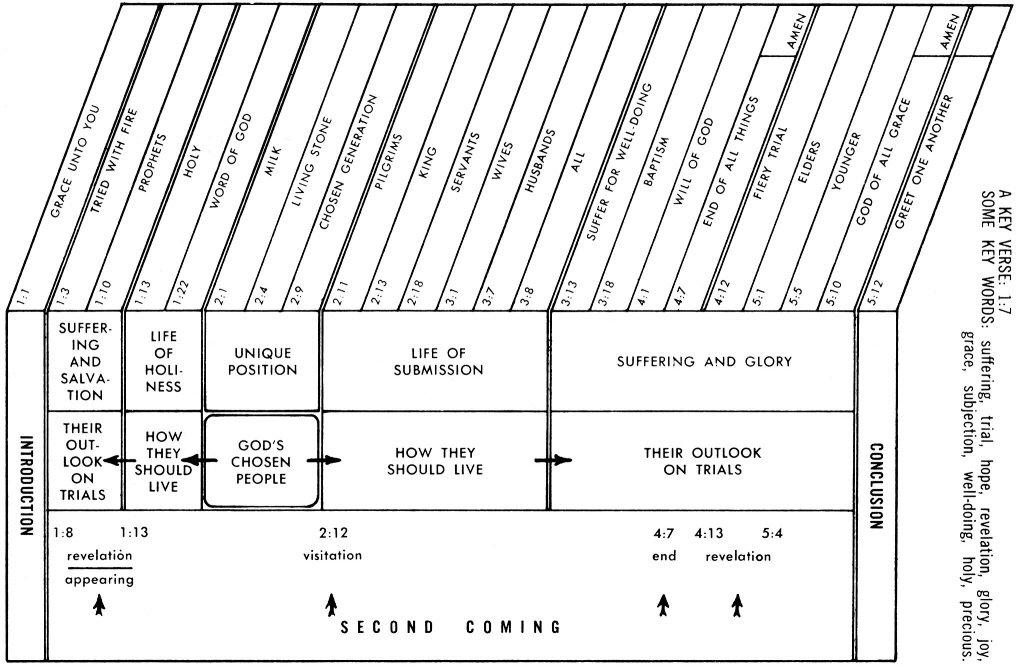
1 Peter: Trials, Holy Living & The Lord's Coming
Click chart to enlarge
Chart from Jensen's Survey of the NT - used by permission
See Another Chart from Charles Swindoll
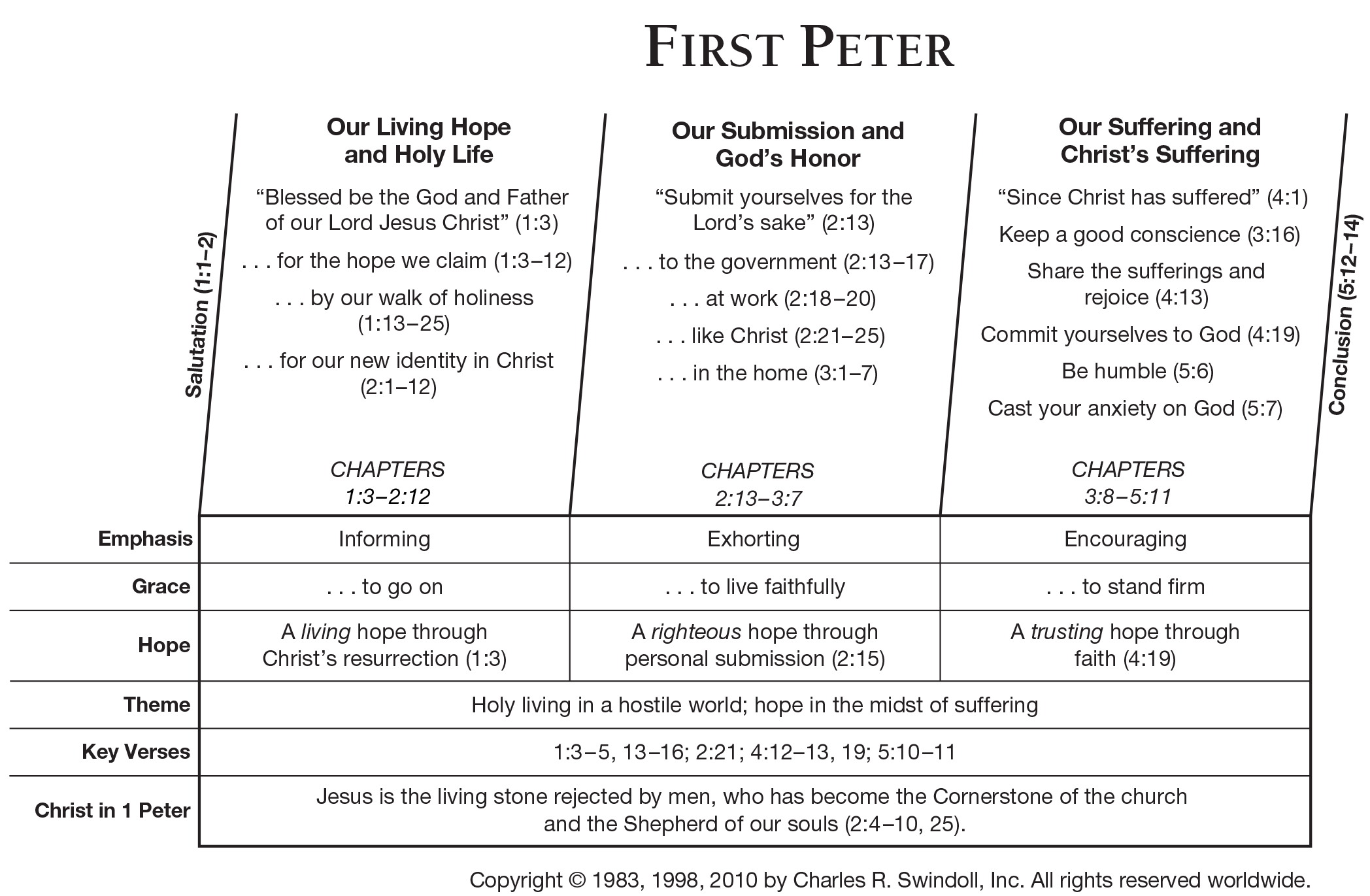
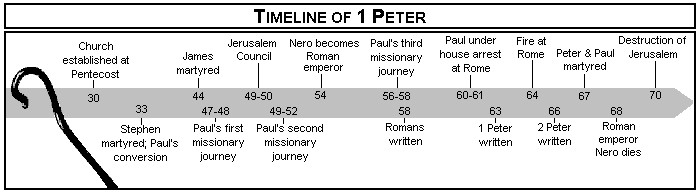
Source: Borrow Ryrie Study Bible
Click to enlarge
PART I: DOCTRINAL FOUNDATION
I. The Opening Salutation (1Pe 1:1-2)
A. The Writer (1Pe 1:1a)
B. The Readers (1Pe 1:1b-2a)
1. True character of the readers (1Pe 1:1b)
2. Geographical location of the readers (1Pe 1:1c)
3. Spiritual supports for the readers (1Pe 1:2a)
C. The Greeting (1Pe 1:2b)
II. The Thanksgiving for Our Salvation (1Pe 1:3-12)
A. The Description of Salvation (1Pe 1:3-5)
1. The author of salvation (1Pe 1:3a-b)
a. His relation to the Savior (1Pe 1:3a)
b. His act of mercy to the saved (1Pe 1:3b)
2. The nature of salvation (1Pe 1:3c-4a)
a. The living hope grounded in Christ's resurrection (1Pe 1:3c)
b. The glorious inheritance awaiting believers (1Pe 1:4a)
3. The certainty of salvation (1Pe 1:4b-5)
a. The safekeeping of the inheritance (1Pe 1:4b)
b. The preservation of the heirs (1Pe 1:5)
B. The Experiences Relating to Salvation (1Pe 1:6-9)
1. The paradoxical nature of the experiences (1Pe 1:6-7)
a. The experience of exultation (1Pe 1:6a)
b. The experience of distress (1Pe 1:66-7)
1. The nature of the distress (1Pe 1:6b)
2. The purpose behind the trials (1Pe 1:7)
a. The testing of faith (1Pe 1:7a)
b. The outcome of the testing (1Pe 1:7b)
2. The sustaining relations of believers (1Pe 1:8-9)
a. Their dual relation to Jesus Christ (1Pe 1:8)
b. Their experiential relation to their salvation (1Pe 1:9)
C. The Magnification of Salvation (1Pe 1:10-12)
1. The magnification through prophetic research (1Pe 1:10-12a)
a. Their intensive search (1Pe 1:10a)
b. Their prophetic function (1Pe 1:10b)
c. Their personal perplexity (1Pe 1:11)
1. The time and circumstances (1Pe 1:11a)
2. The sufferings and the glories (1Pe 1:11b)
d. Their restricted ministry (1Pe 1:12a)
2. The magnification through Christian proclamation (1Pe 1:12b)
3. The magnification through angelic inquiry (1Pe 1:12c)
PART 2: PRACTICAL EXHORTATION
I. Exhortations in View of Our Salvation (1Pe 1:13-2:10)
A. The Life Arising from Salvation (1Pe 1:13-2:3)
1. The Christian life in relation to God (1Pe 1:13-21)
a. A life of steadfast hope (1Pe 1:13)
1. The supports of hope (1Pe 1:13a)
2. The call to hope (1Pe 1:13b)
b. A life of personal holiness (1Pe 1:14-16)
1. The foundation for personal holiness (1Pe 1:14a)
2. The call to personal holiness (1Pe 1:14b-15)
a. The negative demand of holiness (1Pe 1:14b)
b. The positive call to holiness (1Pe 1:15)
3. The justification of the call to holiness (1Pe 1:16)
c. A life of motivated reverence (1Pe 1:17-21)
1. The basis for reverent living (1Pe 1:17a)
2. The call for reverent living (1Pe 1:17b)
3. The knowledge that motivates reverence (1Pe 1:18-21)
a. The means of our redemption (1Pe 1:18-19)
b. The nature of the Redeemer (1Pe 1:20)
c. The characteristics of the redeemed (1Pe 1:21)
2. The Christian life in relation to the brethren (1Pe 1:22-25)
a. The experience of inner purification (1Pe 1:22a)
b. The duty of mutual love (1Pe 1:22b)
c. The foundation in personal regeneration (1Pe 1:23-25)
1. The fact of their regeneration (1Pe 1:23a)
2. The nature of their regeneration (1Pe 1:23b-25a)
3. The evangelization leading to their regeneration (1Pe 1:25b) (D Edmond Hiebert)
1 Peter 1:1 Peter, an apostle of Jesus Christ , to those who reside as aliens, scattered throughout Pontus, Galatia, Cappadocia, Asia, and Bithynia, who are chosen (NASB: Lockman)
Greek: Petros apostolos Iesou Christou eklektois parepidemois diasporas Pontou, Galatias, Kappadokias, Asias, kai Bithunias
Amplified: PETER, AN apostle (a special messenger) of Jesus Christ, [writing] to the elect exiles of the dispersion scattered (sowed) abroad in Pontus, Galatia, Cappadocia, Asia, and Bithynia, (Amplified Bible - Lockman)
ESV: Peter, an apostle of Jesus Christ, To those who are elect exiles of the dispersion in Pontus, Galatia, Cappadocia, Asia, and Bithynia, (ESV)
NLT: This letter is from Peter, an apostle of Jesus Christ. I am writing to God's chosen people who are living as foreigners in the lands of Pontus, Galatia, Cappadocia, the province of Asia, and Bithynia. (NLT - Tyndale House)
NIV: Peter, an apostle of Jesus Christ, To God's elect, strangers in the world, scattered throughout Pontus, Galatia, Cappadocia, Asia and Bithynia, (NIV - IBS)
KJV: Peter, an apostle of Jesus Christ, to the strangers scattered throughout Pontus, Galatia, Cappadocia, Asia, and Bithynia,
Weymouth: Peter, an Apostle of Jesus Christ: To God's own people scattered over the earth, who are living as foreigners in Pontus, Galatia, Cappadocia, Roman Asia, and Bithynia,
Wuest: Peter, an ambassador of Jesus Christ, to those who have settled down alongside of the native pagan population, scattered as seed throughout Pontus, Galatia, Cappadocia, Asia, and Bithynia, chosen-out ones (Eerdmans Publishing - used by permission)
Young's Literal: Peter, an apostle of Jesus Christ, to the choice sojourners of the dispersion of Pontus, Galatia, Cappadocia, Asia, and Bithynia,
PETER AN APOSTLE OF JESUS CHRIST: Petros apostolos Iesou Christou:
- Peter: Mt 4:18 10:2 Jn 1:41,42 21:15-17
- 1 Peter 1 Resources - Multiple sermons and commentaries
Spurgeon…
It must have been very pleasant to his heart to write those words, — not “Peter, who denied his Master, “not” Peter, full of imperfections and infirmities, the impetuous and changeable one of the twelve; “but” Peter, an apostle of Jesus Christ,” as truly sent of God as any of the other apostles, and with as much of the Spirit of his Master resting upon him: “Peter, an apostle of Jesus Christ”
How sweetly the apostle is obeying his Master’s command, “When thou art converted, strengthen thy brethren.” This is the same Peter who once began to sink beneath the waves, yet now he is helping others to stand. This is the very Peter who denied his plaster, but he begins his Epistle by owning himself to be “an apostle of Jesus Christ.” What wonders the Lord Jesus had wrought for Peter by his grace! It is no marvel, therefore, that he should say to others, “Grace unto you, and peace, be multiplied.”
Peter (4074) (Petros; Latin = Petrus) is a masculine proper noun which means a "stone" and generally a smaller stone than the feminine form petra which refers to a massive rock or a foundation boulder (eg Mt 7:24-note). Peter is the Greek equivalent of the Syriac or Aramaic name Cephas (Kephas from Aramaic kay fah) which was assigned to Simon by Jesus.
Peter was not always a model of rock-like (petros is a symbol of imperturbability as determined from used in Greek literature) firmness. Note for example his actions in Gethsemane, his denial three times of Christ, his unsuccessful attempt at walking on water and his conduct at Antioch (Gal 2:11, 12, 13, 14, 15, 16, 17, 18, 19, 20, 21) where he is called Cephas. Despite all this Peter was clearly the leader of Jesus’ disciples, the spokesman for the Twelve and one of the three closest to Jesus.
Petros is used 156x in 151v -
Matt 4:18; 8:14; 10:2; 14:28f; 15:15; 16:16, 18, 22f; 17:1, 4, 24; 18:21; 19:27; 26:33, 35, 37, 40, 58, 69, 73, 75; Mark 3:16; 5:37; 8:29, 32f; 9:2, 5; 10:28; 11:21; 13:3; 14:29, 33, 37, 54, 66f, 70, 72; 16:7f; Luke 5:8; 6:14; 8:45, 51; 9:20, 28, 32f; 12:41; 18:28; 22:8, 34, 54f, 58, 60f; 24:12; John 1:40, 42, 44; 6:8, 68; 13:6, 8f, 24, 36f; 18:10f, 15ff, 25ff; 20:2ff, 6; 21:2f, 7, 11, 15, 17, 20f; Acts 1:13, 15; 2:14, 37f; 3:1, 3f, 6, 11f; 4:8, 13, 19; 5:3, 8f, 15, 29; 8:14, 20; 9:32, 34, 38ff; 10:5, 9, 13f, 17ff, 21, 25f, 32, 34, 44ff; 11:2, 4, 7, 13; 12:3, 5ff, 11, 14, 16, 18; 15:7; Gal 2:7f; 1 Pet 1:1; 2 Pet 1:1
See nice summary of Scriptures relating to Peter in the Thompson Chain Ref
Peter is known by several different names in the New Testament as indicated by the following passages.
Matthew says he was
Simon who was called Peter (Mt 4:18) (ISBE article on Simon Peter)
Later Matthew records that
"the names of the twelve apostles are these: The first, Simon, who is called Peter… " (Mt 10:2)
Matthew later refers to him as "Simon Peter" (Mt 16:16) at his confession to Jesus that "Thou art the Christ, the Son of the Living God."
Jesus "answered and said to him,
Blessed are you, Simon Barjona ("Bar-jonas" = son of Jonah or John) for, because flesh and blood did not reveal this to you, but My Father who is in heaven. And I also say to you that you are Peter (Petros), and upon this rock (petra) I will build My church; and the gates of Hades shall not overpower it. (Mt 16:17,18)
At the inception of Jesus' ministry the apostle John records another name for Peter writing that his brother Andrew
"brought him to Jesus. Jesus looked at him, and said, "You are Simon the son of John; you shall be called Cephas" (which is translated Peter)." (Jn 1:42) (Article on Cephas)
Kenneth Wuest has this note on Peter's name writing that "Thayer says of petros the Greek word from which we get the name Peter, “an appellative proper name, signifying ‘a stone, rock, ledge, or cliff,’ used metaphorically of a soul hard and unyielding, and so resembling a rock,” and says that it is so used in classical writings. Defining petra the feminine form of the word, he says that this word means “a rock, large stone,” and was used metaphorically to refer to a man like a rock by reason of his firmness and strength of soul." Wuest goes on to add that "We find the English name “Peter,” used in the expression, “It just petered out,” meaning that the thing referred to, just failed and failed until it ceased to exist. This comes from the example of Peter’s character before he was filled with the Spirit, vacillating, unpredictable, frequently failing, especially in crises. But as the Lord used it, it means what the Greek word means of which it is the transliteration, and is descriptive of a rock-like man, dependable, immovable, equal to the emergencies and crises that confront him." (Wuest Word Studies - Eerdman Publishing Company Volume 1, Volume 2, Volume 3 - used by permission)
PETER'S NAMES
- Simon Mt 4:18 Shimon (Hebrew)
- Simon Peter Mt 16:16
- Simon Barjona Mt 16:17
- Peter Mt 10:2 Petros (Greek)
- Cephas 1Co 15:5 Kephas (Aramaic)
- Peter synonymous with Cephas Jn 1:42
Peter fulfilled his commission by laying the foundation of the church among the Jews on the Day of Pentecost (Acts 2:14, 15, 16, 22, 23, 24, 25, 26, 27, 28, 29, 30, 31, 32, 33, 34, 35, 36, 37, 38, 39, 40) and also among the Gentiles after a special revelation resulting in the subsequent conversion of the Gentile Cornelius (Acts 10:1, 2, 3, 4ff, 34, 35, 36, 37, 38, 39, 30, 41, 42, 43, 44, 45).
As Paul in his letters does not call himself by his original name of Saul, so Peter calls himself, not Simon, but Peter, the name most significant and precious both to himself and to his readers, because it was bestowed upon him by his Lord.
By the addition of the title apostle to his name, Peter at the very beginning of his letter, claims to be one who is divinely commissioned to preach the gospel and authorized to plant Christianity. Peter puts forward his apostleship in the introduction probably because he is addressing churches with which he had no immediate connection, and he appeals to his apostleship in explanation of his writing to them.
Apostle (652) (apostolos from apo = from + stello = send forth) (Click discussion of apostle) means one sent forth from by another, often with a special commission to represent another and to accomplish his work. It can be a delegate, commissioner, ambassador sent out on a mission or orders or commission and with the authority of the one who sent him.
Apostolos referred to someone who was officially commissioned to a position or task, such as an envoy. Cargo ships were sometimes called apostolic, because they were dispatched with a specific shipment for a specific destination. In secular Greek apostolos was used of an admiral of a fleet sent out by the king on special assignment.
In the ancient world a apostle was the personal representatives of the king, functioning as an ambassador with the king’s authority and provided with credentials to prove he was the king's envoy.
Apostolos - 80x in 79v - Apostolos is usually translated apostle with two renderings messenger. Matt 10:2; Mark 3:14; 6:30; Luke 6:13; 9:10; 11:49; 17:5; 22:14; 24:10; John 13:16; Acts 1:2, 26; 2:37, 42f; 4:33, 35ff; 5:2, 12, 18, 29, 40; 6:6; 8:1, 14, 18; 9:27; 11:1; 14:4, 14; 15:2, 4, 6, 22f; 16:4; Rom 1:1; 11:13; 16:7; 1 Cor 1:1; 4:9; 9:1f, 5; 12:28f; 15:7, 9; 2 Cor 1:1; 8:23; 11:5, 13; 12:11f; Gal 1:1, 17, 19; Eph 1:1; 2:20; 3:5; 4:11; Phil 2:25; Col 1:1; 1 Thess 2:7; 1 Tim 1:1; 2:7; 2 Tim 1:1, 11; Titus 1:1; Heb 3:1; 1 Pet 1:1; 2 Pet 1:1; 3:2; Jude 1:17; Rev 2:2; 18:20; 21:14.
Related Resources:
Unger's Bible Dictionary writes that "The Jews, it is said, called the collector of the half shekel, which every Israelite paid annually to the Temple, an apostle; also those who carried about encyclical letters from their rulers." (Unger, M. F., Harrison, R. K., Vos, H. F., Barber, C. J., & Unger, M. F. The New Unger's Bible Dictionary. Chicago: Moody Press)
A good parallel of apostle is our English word ambassador defined by Webster as "a diplomatic agent of the highest rank accredited to a foreign government as the resident representative of his own government for a special and often temporary diplomatic assignment". (cf Ep 6:20-note)
The related verb apostello is used in the Septuagint or LXX to describe the LORD sending (apostello) Moses "to Pharaoh so that you may bring My people, the sons of Israel, out of Egypt" (Ex 3:10+)
At times in the NT apostle carried the broad meaning of one sent as a messenger or delegate with instructions from a group or an individual (cf 2Cor 8:23, Php 2:25-note).
In its broadest sense, apostle can refer to all believers, because every believer is sent into the world as a witness for Christ. But the term is primarily used as a specific and unique title for the thirteen men (the Twelve, with Matthias replacing Judas, and Paul) whom Christ personally chose and commissioned to authoritatively proclaim the gospel and lead the early church. The thirteen apostles not only were all called directly by Jesus but all were witnesses of His resurrection, Paul having encountered Him on the Damascus Road after His ascension. Those thirteen apostles were given direct revelation of God’s Word to proclaim authoritatively, the gift of healing, and the power to cast out demons (Mt 10:1). By these signs their teaching authority was verified (cf. 2Co 12:12+). Their teachings became the foundation of the church (Ep 2:20+), and their authority extended beyond local bodies of believers to the entire believing world. In the present context Peter uses apostle in its more common specialized or restricted meaning. The authority of Peter's message did not derive from the messenger but from the Sender.
In Acts 1:21, 22+ the Apostle Peter delineates the necessary qualifications of this latter group:
Therefore it is necessary that of the men who have accompanied us all the time that the Lord Jesus went in and out among us--beginning with the baptism of John until the day that He was taken up from us--one of these must become a witness with us of His resurrection.
So as used here an apostle was a man who had seen the risen Messiah and who was sent forth by Him with His full authority to plant the flag of faith in every community to which His master led him. Peter was Christ's emissary and spoke with His authority. Peter who in the past had often manifested a "foot shaped" mouth is now the mouthpiece of the King of kings. In Heb 3:1+ the holy brethren were called to "consider Jesus the Apostle and High Priest", Jesus being the ultimate emissary sent out on mission and given "all authority… in heaven and on earth" (Mt 28:18) of the Father.
While there are no apostles today (although we hear many who lay claim to this title -- beware!) it is certainly to be expected that believers, regardless of the spiritual gift they possess, minister their gift as those sent on a mission with authority for as Paul says in (2Co 5:20+) "we are (all) ambassadors for Christ."
Note that by designating himself an "apostle of Jesus Christ", Peter called attention not to himself (as he often seemed to do in the gospels) but to the One Who commissioned him. The double designation is by design as it summarizes His true nature, Jesus (Iesous) being the Greek form of the Hebrew name Joshua, both names meaning "salvation of Jehovah" (Mt 1:21+) and representing His humanity (fully Man).
Christ is the Greek translation of of the Hebrew term "Messiah" which means "Anointed" or the divine One (fully God) the Jews were looking for and of Whom the OT bore prophetic witness. And so for Peter and the early church the full name "Jesus Christ" embodied their basic conviction that the human Jesus was the anointed Messiah, the Bringer of messianic redemption (cf Acts 3:20+)
Despite the strong acceptance by the early church fathers, some contemporary scholars feel that the Greek text of this letter is simply too polished to have originated from the pen of Peter for the Greek text in this letter is even "smoother" than Paul’s and naturally one would expect the latter's Greek to be far more proficient.
John MacArthur addresses this issue of the Petrine authorship: "Because of his (Peter's) unique prominence, there was no shortage in the early church of documents falsely claiming to be written by Peter. That the Apostle Peter is the author of 1 Peter, however, is certain… The only significant doubt to be raised about Peter’s authorship arises from the rather classical style of Greek employed in the letter. Some have argued that Peter, being an “unlearned” fisherman (Acts 4:13+), could not have written in sophisticated Greek, especially in light of the less classical style of Greek employed in the writing of 2 Peter. However, this argument is not without a good answer. In the first place, that Peter was “unlearned” does not mean that he was illiterate, but only that he was without formal, rabbinical training in the Scriptures. Moreover, though Aramaic may have been Peter’s primary language, Greek would have been a widely spoken second language in Palestine. It is also apparent that at least some of the authors of the NT, though not highly educated, could read the Greek of the OT Septuagint (see James’ use of the Lxx in Acts 15:14, 16, 17, 18+). Beyond these evidences of Peter’s ability in Greek, Peter also explained (1Pe 5:12+) that he wrote this letter “by Silvanus,” also known as Silas. Silvanus was likely the messenger designated to take this letter to its intended readers. But more is implied by this statement in that Peter is acknowledging that Silvanus served as his secretary, or amanuensis. Dictation was common in the ancient Roman world (cf. Paul and Tertius; Ro 16:22+), and secretaries often could aid with syntax and grammar. So, Peter, under the superintendence of the Spirit of God, dictated the letter to Silvanus, while Silvanus, who also was a prophet (Acts 15:32), may have aided in some of the composition of the more classical Greek."
Related Resources: John MacArthur has sermons on all of the apostles.
- Luke 6:12-13 Common Men, Uncommon Calling
- Luke 6:14 Common Men, Uncommon Calling: Peter, Part 1
- Luke 6:14 Common Men, Uncommon Calling: Peter, Part 2
- Luke 6:14 Common Men, Uncommon Calling: Peter, Part 3
- Luke 6:14 Common Men, Uncommon Calling: Andrew and James
- Luke 6:14 Common Men, Uncommon Calling: John
- Luke 6:15 Common Men, Uncommon Calling: Matthew and Thomas
- Luke 6:16 Common Men, Uncommon Calling: Judas Iscariot, Part 1
- Luke 6:16 Common Men, Uncommon Calling: Judas Iscariot, Part 2
- Luke 6:15-16 Common Men, Uncommon Calling: James, Simon, and Judas
- Matthew 10:2 The Master's Men Andrew, James Son of Zebedee, John
- Matthew 10:3 The Master's Men, Philip and Bartholomew
- Matthew 10:3b The Master's Men, Matthew and Thomas
- Matthew 10:3-4 The Master's Men James Son of Alphaeus, Simon Zealot
- Matthew 10:4 The Master's Men, Part 5: Judas Iscariot
TO THOSE WHO RESIDE AS ALIENS: eklektois parepidemois diasporas:
- See Torrey's Pilgrims & Strangers;
- see Characteristics of pilgrims in Thompson Chain Reference
- Aliens - 1Pe 2:11 Ac 2:5-11 Eph 2:12,19 Heb 11:13
- 1 Peter 1 Resources - Multiple sermons and commentaries
exiles (ESV)
temporary residents (GWT)
refugees (TEV)
sojourners (NAB)
those away from their homes (NCV)
pilgrims (NKJV)
living as foreigners (NLT)
those who have settled down alongside a pagan population (Wuest)
those temporarily residing abroad" (NET)
The Greek literally reads "to the chosen sojourners" or "to the elect strangers".
Peter's Description of Believers
- Reside: as Aliens-1Peter 1:2, 2:11- See notes - 1Peter 1:2, 2:11
- Lifestyle: Holiness - 1Peter 1:13; 14;15; 1:16 - See notes - 1Pe 1:13; 14;15; 16
- Responsibility: To do What is Right - 1Peter 2:15; 2:20; 3:6; 3:13;3:17; 4:19 - See notes -1Pe 2:15; 20; 3:6; 13; 17; 4:19
- Results:
- Glory to God - 1Peter 2:12; 4:16-see notes 1Pe 2:12; 4:16
- Personal Suffering - 1Pe 2:20, 3:14; 15; 16; 17, 4:19, 5:9; 5:10-see notes 1Pe 2:20, 3:14; 15; 16; 17, 4:19, 5:9; 10
Reside as aliens (3927) (parepidemois from para = near by and here implies a transitory sense describing one who passes near but on to something beyond + epidemos = stranger, epidemos from epi = in or among + demos = a people) Parepidemos literally means a stranger alongside and so a stranger or sojourner. This person is not simply one who is passing through, but a foreigner who has settled down, however briefly, next to or among the native people. What a picture of the believer in the midst of a crooked and perverse generation! Parepidemos describes one who makes a brief stay in a strange or foreign place, who sojourns (stays as a temporary resident) or who resides temporarily among a native people to whom he or she does not belong. The parepidemos did not expect to be regarded as a native of the place he resided. Beloved are you becoming too comfortable and too familiar with this evil world system which is "devolving" and corrupting almost daily before our very eyes (and ears)? Remember that you are an "alien".
Parepidemos is used 3 times in the NT (Heb 11:13; 1Pet 1:1; 2:11) and is translated in NAS as exiles, 1; reside as aliens, 1; strangers, 1. KJV translates it twice as "pilgrim". Two cognate words (words related by derivation), parepidemeo and parepidemia, are used in inscriptions in connection with civil servants who distinguish themselves for exemplary conduct while on international duty.
Vincent writes that parepidemos refers to "Persons sojourning for a brief season in a foreign country. Though applied primarily to Hebrews scattered throughout the world (Ge 23:4; Ps 39:12 [see Spurgeon's comment] parepidemos is used in Greek of both these OT passages), it has here a wider, spiritual sense, contemplating Christians as having their citizenship in heaven." (Vincent, M. R. Word studies in the New Testament. Vol. 1, Page 3-628)
In chapter two Peter uses parepidemos to exhort his readers "Beloved, I urge you as aliens and strangers to (continually) abstain from fleshly lusts (sensual urges, passions of your lower nature), which (continually) wage war against the soul. (1Pe 2:11-note) (Note: The Christian life is a continual war, not a casual cake walk!)
In the last use of parepidemos in the NT the writer of Hebrews referring to the patriarchs (Abraham, Isaac, Jacob) records that "
All these died in faith (controlled and sustained by their faith, cp He 11:1-note), without receiving the promises, but having seen them and having welcomed them from a distance, and having confessed that they were strangers (xenos) and exiles (parepidemos) on the earth." (He 11:13-note)
For the person of faith, God’s promise is as good as the reality. His promise of the glory ahead (cp Titus 2:13-note was as encouraging and certain to the patriarchs as actually possessing it could have been. They were exiles or refugees in their own Promised Land. They refused the temptation and urge to settle down and become comfortable in this present world (Gal 1:4). Their desire was to pass through the world without taking any of its character upon themselves, knowing that this world and even its lusts is passing away (1Jn 2:17-note). Their hearts were set on pilgrimage described by the psalmist below. These faithful patriarchs were passing through the promised land of Canaan to a better land. Let all God's faithful family continually refuse the lure of the passing pleasures the sins of this world have to offer and continually seek first His kingdom and His righteousness (Mt 6:33-note).
The psalmist speaks of this "alien mindset" declaring "How blessed is the man whose strength is in Thee. In whose heart are the highways to Zion!" (Ps 84:5) (See Spurgeon's comment)
Martyred missionary Jim Elliot was such a man of faith once declaring the powerful truth that…
He is no fool to give what he cannot keep,
to gain what he cannot lose.
It was when Lot stopped being a sojourner, and became a resident in Sodom (Ge 13:1-18), that he lost his consecration and his testimony and everything he lived for went up in smoke! (Ge 19:1-29)
Keep reminding yourself that you are residing as an alien in this present evil age "and do not be conformed to (poured into the mold of) this world, but be transformed by the renewing of your mind, that you may prove what the will of God is, that which is good and acceptable and perfect. (Ro 12:2-note)
I’m a pilgrim and a stranger,
Rough and thorny is the road,
Often in the midst of danger,
But it leads to God.
Clouds of darkness oft distress me;
Great and many are my foes;
Anxious cares and thoughts oppress me;
But my Father knows.Oh, how sweet is this assurance,
’Midst the conflict and the strife,
Although sorrows past endurance
Follow me through life.
Home in prospect can still cheer me:
Yes, and give me sweet repose,
While I feel His presence near me,
For my Father knows.Yes, He sees and knows me daily,
Watches over me in love;
Sends me help when foes assail me,
Bids me look above.
Soon my journey shall be ended,
Life is drawing to a close;
I shall then be well attended—
This my Father knows.I shall then with joy behold Him;
Face to face my Savior see;
Fall with rapture, and adore Him
For His love to me.
Nothing more shall then distress me—
In the land of sweet repose:
Jesus stands engaged to bless me—
This my Father knows.
Peter's point in using parepidemos is that God's saints are just passing through -- our future and our hope is in a city "not made with hands, eternal in the heavens." (2Co 5:1).
Consequently we need to live our lives with a song in our heart, especially a song like the little chorus we used to sing in Sunday School…
This world is not my home, I'm just a passin' through,
My treasures are laid up somewhere beyond the blue.
God wants His "chosen out ones" to live like it (like they're chosen out of this world which is passing away) and to focus their spirit, soul, heart and mind on the world to come. This does not mean that we become so heavenly minded that we are no earthly good but it does mean that we hold lightly the things of this world and continually seek
"the things above, where Christ is, seated at the right hand of God." (Col 3:1-note)
Spiritual Christians keep themselves “loosely attached” to this world because they live for something and Someone far better. We need to remember that our stay on earth is temporary until they were called
"to Mount Zion and to the city of the living God, the heavenly Jerusalem" (He 12:22-note).
Webster says an "alien" is one "belonging to another person & place", a good description of believers who are not their own and don't call this world their home. Christians should be different, not odd. When you are different, you attract people; when you are odd, you repel them.
The saint should understand that although he or she is just "passing through" and this world which is not our home, it does not suggest that we are to withdraw from the world. What this great truth does mean is that the sojourning saint should view all circumstances and all people in the light of eternity. The way we think about eternity will determine the importance we attach to people and things. It is true that as a man thinks in his heart, so he (or she) is and so will his conduct be. It is because a saint sees all things in the light of eternity that he is the best of all citizens, for it is only in the light of eternity that the true values of anything can be measured.
Note that the NIV translates parepidemos as "strangers" but this should not be taken to mean that saints are not well known by their neighbors, but rather that their status is those who no longer are a native part of the world scene
"for our citizenship is in heaven, from which also we eagerly wait for a Savior, the Lord Jesus Christ Who will transform the body of our humble state into conformity with the body of His glory, by the exertion of the power that He has even to subject all things to Himself." (see notes Philippians 3:20; 3:21)
Hence, let us go out to Him outside the camp, bearing His reproach. For here we do not have a lasting city, but we are seeking the city which is to come. (He 13:13, 14-notes)
Peter's understanding of the Christian life as that of an "sojourner" is beautifully illustrated in an early anonymous Christian work, Epistle to Diognetus
"Christians… reside in their respective countries, but only as aliens. They take part in everything as citizens and put up with everything as foreigners. Every foreign land is their home, and every home a foreign land… They find themselves in the flesh, but do not live according to the flesh. They spend their days on earth, but hold a citizenship in heaven."
Spurgeon gives an interesting picture of how aliens should live "Imagine that you are in a round tower with slits in the walls used for shooting through with guns. Now imagine that you are whirled around the inner circumference. Would you appreciate the beauties of the surrounding landscape? No. But there are openings in the wall. Yes, but your eyes are set for objects near and do not have the time to adjust to distance as you are whirled past the slits. It would be as if the wall were solid. So it is with earthly living. The near and earthly wall obstructs the view. An occasional slit is left open, perhaps a Sunday sermon or personal Bible reading. Heaven might be seen through these, but the eye which is set for the earthly cannot adjust itself to higher things during such momentary glimpses. So long has the soul looked upon the world, that when it is turned for a moment heavenward, it feels only a quiver of inarticulate light. Unless you pause and look steadfastly, you will not see or retain any distinct impression of the things which are eternal."
Wherever a Jew settled, his eyes were always towards Jerusalem. In foreign countries his synagogues were so built that, when the worshipper entered, he was facing towards Jerusalem. However useful a citizen of his adopted country the Jew was, his greatest loyalty was to Jerusalem. What a lesson for believers today. We should recognize ourselves as temporary residents of the world on their way to their eternal home. Our eyes should be constantly drawn to our "heavenly Jerusalem" (He 12:22-note).
It's amazing how the world's glitter fades when we begin to make it our habit to continually set our minds on the things above and not on the things on the earth (Col 3:1, 2, 3-see notes Col 3:1; 3:2; 3:3)
From a practical standpoint especially for you men out there who may be tempted from time to time by the lure of the seductive "secret" sensuality so readily accessible on the internet - there is a computer program that you need to examine. It is called "Covenant Eyes" and it actually monitors & records (at a central location) all your "pages visited" and shares that information with an accountability partner you have selected. Men, if this is not an issue with you that's fine but if it is and you're serious about living as a "sojourner" who is setting your mind on the things above, I highly recommend that you examine this relatively inexpensive program by click here (I receive no compensation).
You will frequently read commentaries that say Peter was writing from Rome and was just using Babylon as a code word in 1Pe 5:13 "She who is in Babylon, chosen together with you, sends you greetings, and so does my son, Mark." The first question is who is "she"? First, note that she is given a specific location, Babylon. The question is whether this refers to literal Babylon or is a "code word" for Rome. As an avowed literalist, I still take Babylon as the city of Babylon (for it was still in existence at this time). Secondly, she is chosen and thus is a genuine believer. In support of this "she" being Peter's wife read Mt 8:14 1 Cor 9:5 Mark 1:29-31, all of which support Peter as having a wife. Another literalist, Dr Henry Morris, writes "Babylon had a large Jewish population, and Peter had gone there to evangelize and make disciples among them since his special calling was to the Jews, as Paul's had been to the Gentiles (Galatians 2:7). Some have speculated that Babylon was a mystical name for Rome, but no basis exists for this idea, with no indication that Peter had ever been there. Paul wrote a letter to Rome about this same time and had no hesitancy in calling the city by name (Romans 1:7)." (Borrow The Defender's Study Bible) The Believer's Study Bible (associated with W. A. Criswell) adds "Peter is probably alluding to the Babylon on the Euphrates, a part of that Eastern world where he lived and did his work, rather than Rome (with Babylon being utilized as a cryptic word). Evidence for this position includes the following: (1) There is no evidence that Rome was ever called Babylon until after the writing of the Book of Revelation in A.D. 90-96 (ED: I DISAGREE WITH THIS COMMENT - ROME IS NOT CALLED BABYLON IN THE REVELATION BUT THERE ALSO REFERS TO THE LITERAL CITY OF BABYLON, WHICH LIKE THE TEMPLE IN JERUSALEM, WILL BE REBUILT IN THE END OF THIS AGE!), many years after Peter's death. (2) Peter's method and manner of writing are not apocalyptic. On the contrary, Peter is a man plain of speech, almost blunt, who would not interject such a mystical allusion into his personal explanations and final salutation. (3) Babylon is no more cryptic than Pontus, Asia, or the other places mentioned when Peter says the elect in Babylon send greetings to the Jews of the Dispersion in Pontus, Galatia, Cappadocia, Asia, and Bithynia. (4) Babylon, no longer a great world capital in the time of Peter, was still inhabited by a colony of people, mostly Jews, many of whom Peter befriended and won to Christ. (5) A study of the chronology of Peter's travels argues for Babylon to be the Babylon on the Euphrates. Such a study reveals these significant points: (a) In A.D. 40, three years after Paul's conversion and subsequent travels into Arabia, Peter was still in Jerusalem. Around that time, he made his missionary journey through the western part of Judea to Lydda, Joppa, Caesarea, and back to Jerusalem (Acts 9-11). (b) Imprisoned under Herod Agrippa I, he was miraculously delivered by the angel of the Lord (Acts 12). Peter was probably still in the vicinity of Palestine when Herod Agrippa I died (Acts 12:17, 20-23). The date, according to Josephus, was the fourth year of the reign of Claudius, c. A.D. 45. In A.D. 54, soon after Paul visited Peter again in Jerusalem (Gal. 2), Peter returned the visit by going to Antioch where Paul was working and where the famous interview between the two occurred (Gal. 2:11-14). (c) From A.D. 54 to c. A.D. 60, Peter apparently made an extensive missionary journey (or journeys) throughout the Roman provinces of the East, taking his wife with him (1 Cor. 9:5). During their travels in Pontus, Galatia, Cappadocia, Asia and Bithynia, Peter and his wife remained in the Orient, never entering Rome. One can verify this by the last chapter of the epistle to the church at Rome, written c. A.D. 60, in which Paul salutes 27 persons, never mentioning Peter. It would seem that Paul did not send him greetings simply because Peter neither was there nor ever had been. Those who hold that Peter governed a church at Rome must face the fact of Paul's omission of Peter's name. Had Peter been in Rome, the omission would have been a gross insult. Furthermore, it had been agreed at the Jerusalem Conference that Peter should go to the Jews and Paul to the Gentiles. The church at Rome was Gentile (Rom. 1:13), and Paul was eager to go where no other apostle had been (Rom. 15:20; 2 Cor. 10:15, 16). Since he wrote his Roman epistle to the people at Rome, Paul's desire to witness to that city would be inexplicable had Peter been there at the time, or had he ever spent a number of years there. Neither while Paul was under Roman imprisonment from about A.D. 60 to 63, when he wrote four letters -- Ephesians, Philippians, Colossians, and Philemon -- nor shortly before his death, when he wrote his final letter to young Timothy, did he mention Peter. In his letters he mentioned many fellow Christians who were in Rome, but he stated clearly in 2 Tim. 4:11 that only Luke was with him."
It is very surprising that even someone as literal generally as Dr John MacArthur says of Babylon "This refers to a church in Rome." This is another example of why you must first do your own observations of every Biblical text, so that you might hear from your ultimate Teacher, the Holy Spirit, for then you will be equipped to comment on the commentators, even those that are generally usually "spot on." Others who say Peter was being "cryptic" include ESV Study Bible, KJV Bible Commentary, Faith Life Study Bible, Holman Study Bible, Ryrie Study Bible, Nelson Study Bible, NLT Study Bible (at least they are honest and not dogmatic but say "probably"), Reformation Study Bible (also says "probably"). Others who intepret the text literally as Babylon include Jamieson, Fausset, and Brown, pp. 1463, 1484-85; A. C Gaebelein, 4:2:87; Kenneth Wuest, 2:4:132; McGee, 5:714; E. Schuyler English, “Was St. Peter Ever in Rome?” Bibliotheca Sacra 124:496 (October-December 1967):317; Charles H. Dyer, borrow The Rise of Babylon (read his comments), pp. 106-7.
J C Philpot in his work "Pearls" has a note entitled "Strangers!" (Aliens) and introducing his thoughts with a question worth pondering…
What makes the children of God so strange?
The grace of God which calls them out of this wretched world. Every man who carries the grace of God in his bosom is necessarily, as regards the world, a stranger in heart, as well as in profession, and life.
As Abraham was a stranger in the land of Canaan;
as Joseph was a stranger in the palace of Pharaoh;
as Moses was a stranger in the land of Egypt;
as Daniel was a stranger in the court of Babylon;
so every child of God is separated by grace, to be a stranger in this ungodly world.
And if indeed we are to come out from it and to be separate, the world must be as much a strange place to us; for we are strangers to …
- its views,
- its thoughts,
- its desires,
- its prospects,
- its anticipations,
- in our daily walk,
- in our speech,
- in our mind,
- in our spirit,
- in our judgment,
- in our affections.
We will be strangers from …
- the world's company,
- the world's maxims,
- the world's fashions,
- the world's spirit.
"They confessed that they were strangers and pilgrims on the earth." (see note Hebrews 11:13)
"I am a stranger with you and a sojourner, as all my fathers were." Psalm 39:12
"I am but a stranger here on earth." Psalm 119:19 (Spurgeon's Note)
The main character of a child of God is that he is a stranger upon earth. One of the first effects of the grace of God upon our soul was to separate us from the world, and make us feel ourselves strangers in it.
The world was once our home—the active, busy center of all our thoughts, desires, and affections. But when grace planted imperishable principles of life in our bosom, it at once separated us from the world in heart and spirit,
if not in actual life and walk. We are strangers inwardly and experimentally, by the power of divine grace making this world a wilderness to us. (J. C. Philpot. Pearls).
SCATTERED THROUGHOUT: diasporas:
- Scattered - Lev 26:33 Dt 4:27 28:64 32:26 Es 3:8 Ps 44:11 Eze 6:8 John 7:35, 11:52 Ac 8:4 Jas 1:1
- 1 Peter 1 Resources - Multiple sermons and commentaries
Scattered (1290) (diaspora noun form of diaspeiro from dia = through + speiro = sow, scatter seed) literally means "through a sowing". "Speiro" is the derivative from which sperma the Greek word for “seed” comes. All this to say that diaspora indicates a scattering abroad which is a technical term to identify Jews living outside Palestine.
Diaspora is used 3 times in the NT (John 7:35; Jas 1:1; 1Pet 1:1) and is translated: dispersion, 1; dispersed, 1; scattered throughout, 1.
(John 7:35) The Jews then said to one another, “Where does this man intend to go that we will not find Him? He is not intending to go to the Dispersion among the Greeks, and teach the Greeks, is He?
(Jas 1:1) James, a bond-servant of God and of the Lord Jesus Christ, To the twelve tribes who are dispersed abroad: Greetings.
Diaspora - 8 uses in the Septuagint (LXX) - Dt. 28:25; 30:4; Neh. 1:9; Ps. 147:2; Isa. 49:6; Jer. 15:7; 34:17; Da 12:2
At various times, and from the operation of divers causes, the Jews were separated and scattered into foreign countries “to the outmost parts of heaven (Deut. 30:4-note). (Additional resources on dispersion Easton, ISBE Smith)
Some of these dispersions were voluntary (of great importance during the Greco-Roman period when Jews voluntarily migrated to all the chief towns of the civilized world, chiefly for the sake of trade), while others were forced upon them by the conquering nations (see below: Assyria, Babylon, Rome, etc).
Jewish dispersions were predicted and sovereignly decreed by God if Israel rejected His statutes and their soul abhorred His ordinances so as not to carry out all of His commandments, thereby breaking His covenant. In a very real sense the Jewish dispersions were a fulfillment of OT prophecy. And so in Leviticus we read God' s warning to Israel
You however, I will scatter (diaspeiro in the Greek translation of the Hebrew) among the nations and will draw out a sword after you, as your land becomes desolate and your cities become waste." (Lev 26:33-note)
Moses warned Israel again that
"Jehovah will scatter (diaspeiro in the Greek translation of the Hebrew) you among the peoples, and you will be left few in number among the nations where Jehovah drives you." (Dt 4:27-note)
So clearly the various Jewish diasporas, especially those secondary to foreign conquest, were the result of the sovereign outworking of the righteous justice of Jehovah. He is faithful to keep all of His "promises"!
God speaking to His prophet Ezekiel in exile in Babylon explained that
I will leave a remnant, for you will have those who escaped the sword among the nations when you are scattered among the countries. (Ezek 6:8-note)
The majority of the nation of Israel were apparently not of the elect (as this term refers to salvation), but God's grace and mercy preserved a godly group ("the remnant") in the nation. There never has been nor ever will be a complete end to Israel. Click study of doctrine of the remnant (believing Israel).
One of the most interesting and strategic "dispersions" occurred in Acts 8, after the stoning of Stephen, at which time
"a great persecution began against the church in Jerusalem and they were scattered (diaspeiro) throughout the regions of Judea and Samaria" and "those who had been scattered (diaspeiro) went about preaching the word." (Acts 8:4)
The church was scattered like seed so that they might spread the "seed" of the Word of God, the Gospel.
The scattering that Peter is referring to took place prior to the world-wide dispersion associated with the Roman conquest and destruction of Jerusalem and the Holy Temple in 70AD. Therefore at the time of Peter's writing the majority of the Jews living outside of Jerusalem and Palestine were living there by their own choice, the chief reason being the opportunity for business activity which the Gentile centers of population afforded. They were in these strategic population centers when the Christian missionaries contacted them. They had been providentially sown there by the Lord of the harvest, to become themselves disseminators of the gospel which was to be given to the Jew first and then to the Greek (Gentile).
Diaspora is used two other times in the NT:
(1) "The Dispersion among the Greeks" (Jn 7:35) refers to the Jews dwelling either among the Gentiles generally or among nations that used the Greek language.
"The diaspora took place over several centuries. While its exact beginnings are difficult to date, two major events greatly contributed to it. In 722 B. C. the Assyrians captured the Northern Kingdom (Israel) (Ed note: 10 tribes). Following this victory, the Assyrians resettled large numbers of the Israelites in Assyria (2Ki 17:6). In 586 B. C. the Babylonians captured the Southern Kingdom (Judah) (Ed note: Actually composed of 2 tribes: Judah and Benjamin) and followed the same policy of resettlement. Many of the residents of Judah were transported to Babylon (2Ki 25:8, 9, 10, 11, 12). While some of these persons later returned to Judah, many of them remained permanently in Babylon. Later, other wars fought by the Greeks and Romans in Palestine helped scatter more of the Jewish people. The diaspora was further encouraged by severe economic conditions which gripped Palestine. The warfare in the land disrupted the ability of the people to make a living. Also, heavy taxes were exacted from the people by the dominant foreign powers. This made life even more difficult. Adding to this impulse to leave Palestine was the good reception the Jews generally received in other lands. As a rule, they were allowed to practice their own religion without interference. The result of the diaspora was that by New Testament times as many Jews lived outside of Palestine as lived within the land. In almost every city which Paul visited on his missionary journeys, he found a Jewish synagogue (Acts 14:1; 17:1,17:10; 18:4). The diaspora thus helped pave the way for the spread of the gospel." (See Holman Bible Dictionary)
(2) James describes himself as "James, a bond-servant of God and of the Lord Jesus Christ (writing) to the twelve tribes (titule used in NT to refer to nation of Israel) who are dispersed abroad… " (Jas 1:1)
James is referring to any place in the world outside of Palestine. Over the previous several hundred years, various conquerors (including the Roman Pompey in 63 b.c. who carried hundreds of Jewish captives back to Rome) had deported Jews from their homeland and spread them throughout the known world. In addition, many other Jews had voluntarily moved to other countries for business or other reasons (cf. Acts 2:5-11). By New Testament times, many Jews lived abroad. In fact by the time of Philo (20bc to 50ad), a Jewish philosopher of Alexandria, Egypt, an estimated one million Jews lived in Alexandria. An equal number had settled in both Persia and Asia Minor, and about 100,000 lived in Cyrenaica and Italy. The Jews who were dispersed throughout the world in this manner outnumbered the Jews who remained in their native land. Though the "twelve tribes" were scattered (and are to this day), they are not "lost" being listed at the close of biblical history in the Revelation record (Re 7:5, 6, 7, 8-see notes Re 7:5; 7:6; 7:7; 7:8).
The Jewish diaspora came about through deportation and voluntary movement to a foreign land. The people generally lived in their own settlement or quarters ("Jewish quarter") in a foreign land but were still vitally joined to the land of Palestine and the city of Jerusalem with her temple. There was always hope for the eschatological re-gathering of those who had been scattered.
SOME OF THE USES OF DIASPORA IN THE SEPTUAGINT THE GREEK TRANSLATION OF HEBREW OT
Each of the four OT verses below uses diaspora (used 8x total in the OT Greek translation) in the Septuagint, which was translated ironically by Jewish scholars who were themselves dispersed in Alexandria! All four of these uses relate to the hope of re-gathering of the believing Jewish remnant, which will be consummated at the end of this age, specifically at the termination of the "great tribulation" (click for a detailed chart overview of this critical time period).
(1) The Jewish hope of a future re-gathering of those scattered is based on a promise recorded by Moses:
"If your outcasts (diaspora) are at the ends of the earth, from there the LORD your God will gather you, and from there He will bring you back." (Dt 30:4)
(2) The promise is reiterated after the dispersion and return from Babylonian captivity, Nehemiah recording
"but if you return to Me and keep My commandments and do them (this refers to the remnant of Jews who place their faith in the Messiah and are saved, the culmination of which will occur at the end of this age [Ro 11:26, 27-see notes Ro 11:26; 27]-- in that day when God puts His law within them, writing it on their heart [see Jer 31:33, cf Ezek 36:26, 27] fulfilling His promise of the New Covenant) , though those of you who have been scattered (diaspora) were in the most remote part of the heavens, I will gather them from there and will bring them to the place where I have chosen to cause My name to dwell." (Neh 1:9)
Although God had brought some of the Jews back to Jerusalem after the dispersion to Babylon, as discussed there awaits a future promised re-gathering of believing Jews at the end of this present age.
(3) The psalmist similarly affirms the promise of re-gathering of the disaspora writing
"Jehovah builds up Jerusalem. He gathers the outcasts (diaspora) of Israel." (Ps 147:2) (Spurgeon's comment)
(4) Isaiah records a similar affirmation by God declaring
"It is too small a thing that You should be My Servant (the Father speaking to the Son, the Messiah) to raise up the tribes of Jacob, and to restore the preserved ones ("the scattered ones" = diaspora) of Israel. I will also make You a light of the nations so that My salvation may reach to the end of the earth." (Isaiah 49:6)
Related Resources:
- Diaspora - Holman Bible Dictionary - Bible Dictionary
- Dispersion - Hastings' Dictionary of the New Testament
- Dispersion - Hastings' Dictionary of the Bible - Bible Dictionary
PONTUS, GALATIA, CAPPADOCIA, ASIA, AND BITHYNIA: Pontou, Galatias, Kappadokias, Asias kai Bithunias:
- Click here for nice MAP (Pontus, Galatia, Cappadocia, Asia, Bithynia
- More Maps of Paul's journeys which include some of the regions mentioned by Peter
- Pontus: Acts 2:5,9,10 18:2
- Galatia: Acts 16:6 18:23 Ga 1:2
- Cappadocia: Acts 2:9
- Asia: Acts 6:9 16:6 19:10 20:16-18 1Co 16:19 2Co 1:8 2Ti 1:15 Rev 1:11
- Bithynia: Acts 16:7
- 1 Peter 1 Resources - Multiple sermons and commentaries
These were all Roman provinces in "Asia Minor". Jews from Pontus, Cappadocia, Asia had been present at Pentecost (Acts 2:9).These were contiguous states stretching along the southern shore of the Black Sea, just those regions in which Paul wanted to minister but was precluded by the Holy Spirit (Acts 16:6, 7, 8). There were a number of churches in those provinces. For example, we know that in the province of Asia there were at least eight churches. Seven of those churches received letters from the Lord Jesus in Revelation 2 and 3. Another church in the province of Asia, the one at Colossae, is not mentioned in Revelation.
Clearly, this area was divinely preserved for Peter’s ministry, and his mission was obviously successful, for Pliny, the Roman governor of this region, pays eloquent though reluctant testimony to the steadfast faith of the "aliens" to whom Peter had written. Years after Peter had written this letter, Pliny the Younger was put in charge of Bithynia and wrote to the Emperor Trajan concerning the Christians ("Christiani"). He tried to make them recant by force and have them acknowledge the pagan gods, bow down before the image of the emperor and curse ("maledixerunt") Christ. Some did, others did not, so Pliny asked for advice. He writes
"It seems to me to be necessary to get advice because many in every age group, every status of life and both male & female are now in danger and will be in the future. This plague of superstition has spread over cities and over the fields and villages, but I believe that its advance can be stopped." (Pliny the Younger: Letters, Book 10, Letter 16, circa 112AD).
Christianity in fact was so entrenched in this region that most of the pagan temples were deserted, no doubt a visible fruit borne by the truth expounded in Peter's epistle.
WHO ARE CHOSEN: eklektois parepidemois diasporas:
- 1 Peter 2:9; Dt 7:6; Isa 65:9; Mt 24:22 ,24, ,31 Mk 13:20,22,27; Lk 18:7; Jn 15:16, 17, 18, 19; Jn 15:19; 2Jn 1:1,13
- Ro 8:29, 33, 11:2, 5, 6, 7, 28, Ep 1:4, 5; Col 3:12, 2Ti 2:10, Titus 1:1
- 1 Peter 1 Resources - Multiple sermons and commentaries
Related Resources on Election:
For more notes on this difficult doctrine of election see notes on the following verses - type in "election" and search the page for the specific notes Ro 8:29; Ro 8:33; Ro 11:2; Ro 11:5; 11:6; 11:7; 11:28; Ep 1:4; Ep 1:5; Col 3:12; 2Ti 2:10; Titus 1:1
See notes on related doctrines of "calling" & choosing" - Notes on 2 Peter
Other translations - whom God the Father knew and chose long ago (Phillips), "chosen-out ones" (Wuest)
The NASB is not an accurate rendering of the original word order. A more literal word order is maintained in Young's Literal
"Peter, an apostle of Jesus Christ, to the choice sojourners of the dispersion".
The Amplified also retains the original word order:
"Peter, an apostle (a special messenger) of Jesus Christ, [writing] to the elect exiles of the dispersion scattered (sowed) abroad… "
Note: The following discussion is primarily a word study on eklektos and is not intended to be a definitive study on the doctrine of election. Please refer to other resources if would like more in depth and specific discussion of the doctrine of election. Note also that this word study has no major discussion of the role of free will in salvation but that does not mean I do not believe in free will. Read the balance approach of Dr. J Vernon McGee who said
"There are certain things which I believe that to me are not contradictory, but they certainly are paradoxical. Election and free will happen to be one of those… There is a theological argument that rages today on election or free will. There are some people who put all their eggs in the basket of election. There are others who put all their eggs in the basket of free will. I’m not proposing to reconcile the two because I have discovered that I cannot. If you had met me the year that I entered seminary, or the year I graduated, I could have reconciled them for you. I never have been as smart as I was my first year and my last year in seminary. I knew it all then. I could reconcile election and free will, and it was a marvelous explanation. Now I’ve even forgotten what it was. It was pretty silly, if you want to know the truth… You can argue about divine election and free will all you want to, but it works. You cannot make it work out by arguing, but it sure works out in life, friend…
Dr McGee comments on John 6:37 (All that the Father giveth me shall come to me; and him that cometh to me I will in no wise cast out.)
"Election and free will are both in this verse. “All that the Father giveth me shall come to me” states a truth, and that is election. But wait a minute! “And him that cometh to me I will in no wise cast out” is also true, and “him that cometh to me” is free will. I don’t know how to reconcile them, but they are both true. The Father gives men to Christ, but men have to come. And the ones that come are the ones, apparently, whom the Father gives to Him. You and I are down here, and we don’t see into the machinery of heaven. I don’t know how God runs that computer of election, but I know that He has given to you and to me a free will and we have to exercise it. Because Spurgeon preached a “whosoever will” gospel, someone said to him, “If I believed like you do about election, I wouldn’t preach like you do.” Spurgeon’s answer was something like this, “If the Lord had put a yellow stripe down the backs of the elect, I’d go up and down the street lifting up shirttails, finding out who had the yellow stripe, and then I’d give them the gospel. But God didn’t do it that way. He told me to preach the gospel to every creature that ‘whosoever will may come.’” Jesus says, “and him that cometh to me I will in no wise cast out.” So, my friend, you can argue about election all you want to, but you can come. And if you come, He’ll not cast you out. Someone may ask, “You mean that if I’m not the elect I can still come?” My friend, if you come, you will be the elect. How tremendous this is!"… Does election shut out certain people? No. Life eternal is to know the only true God and Jesus Christ Whom He has sent. Do you have a desire to know the true God and Jesus Christ? Then you are not shut out. You must be one of the elect. He gives eternal life to those who have heard the call and have responded down in their hearts. They have come to Christ of their own free will… We cannot avoid the doctrine of election, nor can we reconcile God’s sovereign election with man’s free will. Both are true. Let’s keep in mind that this is His universe. He is sovereign. I am but a little creature on earth, and He could take away the breath from me in the next moment. Do I have the audacity to stand on my two feet, look Him in the face, and question what He does? That would be rebellion of the worst sort. I bow to my Creator and my Redeemer, knowing that whatever choice He makes is right. By the way, if you do not like what He does, perhaps you should move out of His universe and start one of your own so you can make your own rules. But as long as you live in God’s universe, you will have to play according to His rules. Little man needs to bow his stiff neck and stubborn knees before Almighty God"… I cannot repeat often enough that election is God’s choosing us in Christ. I emphasize again that men are not lost because they have not been elected. They are lost because they are sinners and that is the way they want it and that is the way they have chosen. The free will of man is never violated because of the election of God. The lost man makes his own choice. (McGee, J V: Thru the Bible Commentary: Nashville: Thomas Nelson) (Listen to the Mp3's on this section - John 6:30-37.mp3 John 6:37,38.mp3)
C. H. Spurgeon, when asked how he reconciled God’s election with man's free will replied, “I never have to reconcile friends!” Touché! He also commented that…
You might go for fifty years to some places of worship, and never hear the word “elect” even mentioned. Modern ministers seem to be ashamed of the grand old doctrine of election; but it was not so with the apostles and the early Christians, they were accustomed to speak of one another as the elect of God. The doctrine of election was most precious to their hearts, and therefore Peter writes: “elect according to the foreknowledge of God the Father,”
The first Christians were not so afraid of the doctrine of election as some are now-a-days. Peter was not ashamed to address the saints as the elect of God, for so, indeed, they are, if they be saints at all. It is he that chose them, not because they were sanctified, but that they might be sanctified — chose them to eternal life through sanctification. Oh! happy are they who by grace have made their calling and election sure (see note 2 Peter 1:10), and now ascribe all the glory of their salvation to the sovereign choice of God. “Grace unto you, and peace be multiplied.”
Chosen (1588) (eklektos from verb eklego which in middle voice [eklegomai] means select or pick out for one's self which is derived from ek =out + lego =call) means literally the "called out ones" or "chosen out ones". The idea of eklektos is the ones who have been chosen for one's self, selected out of a larger number.
Eklektos - 22x in 22v - The NAS renders ekletos as = choice(2), choice man(1), chosen(1), chosen(9), chosen one(1), elect(8). Note however that the proper interpretation of the meaning of elect in each of these NT uses depends on the context. Mt 22:14; 24:22, 24, 31; Mk 13:20, 22, 27; Lk 18:7; 23:35; Ro 8:33; 16:13; Col 3:12; 1Ti 5:21; 2Ti 2:10; Titus 1:1; 1Pe 1:1; 2:4, 6, 9; 2Jn 1:1, 13; Rev 17:14.
In regard to election as related to salvation, Wuest comments that "This election does not imply the rejection of the rest (those not chosen out), but is the outcome of the love of God lavished upon those chosen-out." ) ((Wuest Word Studies - Eerdman Publishing Company Volume 1, Volume 2, Volume 3 - used by permission))
Webster's definition of elect is not bad --"to pick out; to select from among two or more, that which is preferred… in theology, to designate, choose or select as an object of (divine) mercy or favor".
The 1828 Webster's is even better writing that election means…In theology, divine choice; predetermination of God, by which persons are distinguished as objects of mercy, become subjects of grace, are sanctified and prepared for heaven. (Webster, N. Noah Webster's first edition of An American dictionary of the English language)
Someone (?) else has written that "Election is God's eternal choice of persons unto everlasting life -- not because of foreseen merit in them, but of His mere mercy in Christ - in consequence of which choice they are called, justified, and glorified."
You may not realize it but you've sung about the "elect" if you've ever sung "The Church's One Foundation" because the second stanza (in the original version) begins "Elect from every nation… " (Note: When you click this hymn on "Cyberhymnal", you will notice that the second stanza has been ALTERED! "Elect from every nation" has been removed and replaced by "She is from every nation"! How tragic to see the Drift from Doctrine which is sound and true! I think the writer Samuel Stone would roll over in his grave to see this downgrade regarding the truth of election! Click here for the original UNALTERED VERSION! Election is a doctrine worth singing about, worth studying and eminently worth preaching.
Related Resources: see many more resources on election below
- Wayne Barber's sermon Chosen in Christ
- Making Your Calling and Election Sure - 2 Peter 1:10-11
- Who are the elect of God?
- How can I know if I am one of the elect?
- What is conditional election?
- Unconditional election - is it biblical?
- What does Peter mean when he tells us to make our calling and election sure in 2 Peter 1:10?
- How are predestination and election connected with foreknowledge?
- Daniel Wallace - My Understanding of the Doctrine of Election
- List of Multiple Topics on Election, Including Questions
- Election - Bob Utley
- Election/Predestination and the Need for A Theological Balance - Bob Utley
Have you encouraged your sheep with the glorious truth that they have been chosen (?) …
in Him (Christ) (WHEN?) before the foundation of the world, (WHY? TO WHAT ETERNAL PURPOSE?) that (they) should be holy and blameless before Him" Ep1:4-note)
Comment: As R B Kuiper put it "When God chose certain persons unto eternal life he did not do so in order that they might be in Christ, but He viewed them from eternity as being in Christ.") (Oh, that the Bride would be diligent to keep her gown spotless, adorned in fine linen which is the righteous deeds of the saints [holy ones] - see Re 19:7, 8-see notes Rev 19:7; 19:8)
The prince of preachers, C H Spurgeon was right when he said
There seems to be an inveterate prejudice in the human mind against this doctrine (of election) and although most other doctrines will be received by professing Christians, some with caution, others with pleasure, yet this one seems to be most frequently disregarded and discarded.
The doctrine of election is surely "solid food" and as such it is tempting as a pastor to avoid preaching this truth ,but remember that
solid food is for the mature, who because of practice have their senses trained to discern good and evil." (Heb 5:14-note)
Comment: As George Whitfield put it "Let a man go to the grammar school of faith and repentance before he goes to the university of election and predestination."
Jeffrey writes that "Discussions of divine election, with its subheadings of predestination and divine foreknowledge, provide the millstones by which countless theological efforts in Western Christendom have been ground. Yet in its rudiments, election means simply the act of choice whereby God in love picks an individual or group out of a larger company for a purpose or destiny of his own appointment. (A Dictionary of Biblical Tradition in English literature. Grand Rapids, Mich. Eerdmans)
God's angels are referred to as "chosen (eklektos) angels" (1Ti 5:21).
Jesus is referred to as "the Christ of God, His Chosen (eklektos) One.” (Lk 23:35) and "choice (eklektos) and precious in the sight of God" (1Pe 2:4-note). Peter quotes the Septuagint translation of Isa 28:16 writing that "this is contained in Scripture (in Isa 28:16):
BEHOLD I LAY IN ZION A CHOICE (eklektos) STONE, A PRECIOUS CORNER stone AND HE WHO BELIEVES IN HIM SHALL NOT BE DISAPPOINTED" (1Pe 2:6-note) which again clearly refers to the Messiah.
Rufus was called "a choice (eklektos) man in the Lord." (Ro 16:13-note) The meaning of eklektos in uses such as this conveys the idea of the "best of class", thus one who is excellent or preeminent. Colloquially we might say "the cream of the crop."
This section in 1 Peter 1:1-2 is the most concise passage of Scripture dealing with the doctrine of election. Note how Peter begins his letter with theology, because he knows that the truths about their sure election will strengthen suffering saints. Elect is in the plural in this verse and as such refers to those who are chosen of God (“selected out ones”) for salvation, who enjoy His favor and who are called to lead a holy life in everlasting communion with Him. In chapter two Peter goes on to inform his readers that they are a "chosen (eklektos) race (offspring, posterity, generation, kin)" (1Pe 2:9-note), in a sense designating believers as a separate "race" of men (cf 2Cor 5:17), who have been "elected" by God to
"proclaim the excellencies of Him Who called" them "out of darkness into His marvelous light." (1Pe 2:9-note)
Comment: The elect are to proclaim the gospel.
The elect is used three times in Jesus' Olivet Discourse, our Lord declaring to His believing Jewish disciples (Peter, James, John and Andrew were the only ones present) that
"unless those days had been cut short, no life would have been saved; but for the sake of the elect (this is the first use of eklektos in the NT) those days shall be cut short." (Mt 24:22, cf Mt 24:24)
He went on to declare that at the end of the Great Tribulation He would
send forth His angels with A GREAT TRUMPET and THEY WILL GATHER TOGETHER His elect from the four winds, from one end of the sky to the other. (Mt 24:31)
In context "the elect" in Matthew 24 is referring to Jews who place their faith in Messiah during the Great Tribulation at the end of this age. Obviously there will be Gentiles saved during this time (and they are also clearly of the elect), but the in the context, the Gentiles do not appear to be the primary group of "the elect" Jesus is addressing in the Olivet Discourse.
John MacArthur commenting on who the "elect" are in Matthew 24 writes that
"The elect could represent the nation of Israel, which is often referred to in the Old Testament as God’s elect, or chosen, people. It could also include those who become Christians during the Tribulation (Re 7:14-note). Both applications seem appropriate, because God will preserve a redeemed remnant of the nation of Israel as well as some redeemed Gentiles." (Matthew 24-28)
The elect of God is a privilege which conveys the responsibility to walk worthy of the calling to which we have been called. Thus Paul reminds the Colossians that
"those who have been chosen of God, holy and beloved" should strive to "put on a heart of compassion, kindness, humility, gentleness and patience… " (Col 3:12-note)
Paul clearly accepted the doctrine of election writing to Timothy that
for this reason (the preeminence of Christ and the power of God's word - 2Ti 2:9-note) I endure all things (WHY? WHAT DROVE PAUL?) for the sake of those who are chosen (ELECTED - destined for salvation but not yet brought into this glorious state), that they also may obtain the salvation which is in Christ Jesus and with it eternal glory. (2Ti 2:10-note)
The doctrine of election did not discourage Paul from evangelizing the lost, but in fact had the opposite effect. Don't let the truth about election discourage you from proclaiming the gospel to all men.
In the last use of eklektos in the NT, we see that at the end of this age rebellious men led by the Antichrist
will wage war against the Lamb, and the Lamb will overcome them, because He is Lord of lords and King of kings, and those who are with Him are the called and chosen and faithful." (Re 17:14-note)
The elect will have the incredible privilege of witnessing the overthrow of the final evil world ruler and all those who follow him.
Eklektos was used in secular Greek to describe anything that was specially chosen, such as specially chosen ("choice") fruit, articles specially chosen because they are so outstandingly well made or picked troops specially chosen for some great exploit.
Eklektos carries the accessory ideas of kindness, favor, love. Specifically in regard to salvation, God’s choice is part of His predetermined plan, not based on any merit in those who are chosen, but solely on His grace and love. The verb form (eklegomai [word study]) is used in Ephesians 1:4-note where it is rendered “chose,” referring to the act of God in sovereign grace choosing out certain ones from among mankind for Himself "before the foundation of the world". The verb (eklegomai) is middle voice (reflexive… conveys the sense of "for Himself") which indicates that God as the subject was acting in His own interest.
Horatio Bonar's hymn beautifully depicts the Father's electing love for His "wandering sheep."
I WAS A WANDERING SHEEP
by Horatio Bonar
(Play hymn)
I was a wand'ring sheep,
I did not love the fold:
I did not love my Shepherd's voice,
I would not be controlled.
I was a way-ward child,
I did not love my home:
I did not love my Father's voice,
I loved afar to roam.
The Shepherd sought His sheep,
the Father sought His child:
He followed me o'er vale and hill,
o'er deserts waste and wild:
He found me nigh to death,
famished, and faint and lone,
He bound me with the bands of love,
He saved the wand'ring one.
Jesus my Shepherd is:
'Twas He that loved my soul,
'Twas He that washed me in His blood,
'Twas He that made me whole:
'Twas He that sought the lost,
That found the wand'ring sheep:
'Twas He that bro't me to the fold,
'Tis He that still doth keep.
No more a wand'ring sheep,
I love to be controlled,
I love my tender Shepherd's voice,
I love the peaceful fold:
No more a way-ward Child,
I seek no more to roam:
I love my heavenly Father's voice,
I love, I love His home!
Nelson's New Illustrated Bible Dictionary writes that election is "the gracious and free act of God by which He calls those who become part of His kingdom and special beneficiaries of His love and blessings. The Bible describes the concept of election in three distinct ways. (1) Election sometimes refers to the choice of Israel (see next paragraph) and the church as a people for special service and privileges. (2) Election may also refer to the choice of a specific individual to some office or to perform some special service. (3) Still other passages of the Bible refer to the election of individuals to be children of God and heirs of eternal life." (Youngblood, R. F., Bruce, F. F., Harrison, R. K., & Thomas Nelson Publishers. Nelson's New Illustrated Bible Dictionary) (Numbers added)
The principle of God's sovereign good pleasure in election is illustrated In the OT Israel where God reminds Israel
"I have chosen you to be a people for His own possession out of all the peoples who are on the face of the earth." (Dt 7:6).
The "election" of Israel differs from election of believers in the NT as the former election is national and does not necessarily imply salvation of those chosen, whereas election in the NT refers only to those who are granted salvation.
The Greek word eklektos occurs some 83 times in the Septuagint (LXX)
Gen. 23:6; 41:2, 4f, 7, 18, 20; Exod. 14:7; 30:23; Num. 11:28; Deut. 12:11; Jdg. 20:15, 34; 1 Sam. 24:2; 26:2; 2 Sam. 8:8; 21:6; 22:27; 1 Ki. 4:20, 23; 2 Ki. 8:12; 19:23; 1 Chr. 7:40; 9:22; 16:13; 18:8; Ezr. 5:8; Neh. 5:18; Est. 8:12; Job 37:11; Ps. 18:26; 78:31; 89:3, 19; 105:6, 43; 106:5, 23; 141:4; Prov. 8:19; 12:24; 17:3; Cant. 5:15; 6:9f; Isa. 22:7f; 28:16; 40:30; 42:1; 43:20; 45:4; 49:2; 54:12; 65:9, 15, 23; Jer. 3:19; 10:17; 22:7; 25:34; 31:39; 46:15; 48:15; Lam. 1:15; 5:13f; Ezek. 7:20; 19:12, 14; 25:9; 27:20, 24; 31:16; Dan. 11:15; Amos 5:11; Hab. 1:16; Hag. 2:7; Zech. 7:14; 11:16)
Some of these Septuagint (LXX) occurrences utilize eklektos to describe those who are or who will be saved. For example, in a prophecy describing a believing remnant of Israel who would come into the millennial kingdom of Messiah, God promises
I will bring forth offspring from Jacob, and an heir of My mountains from Judah; even My chosen (elect = eklektos) ones shall inherit it, and My servants shall dwell there. (Isa 65:9)
The faithful Jewish remnant will inherit the land of Israel at the end of the Great Tribulation, which immediately precedes the millennial reign of Christ from an earthly Jerusalem. In the context of the 1000 year reign God goes on to add that
"My chosen (elect = eklektos) shall not toil in vain, neither shall they beget children to be cursed; for they are a seed blessed of God, and their offspring with them." (Isa 65:23)
One familiar use of eklektos is found in Mt 22:14 where Jesus concludes a parable on the king's wedding feast with the declaration
"For many are called, but few are chosen (eklektos)."
How is this to be interpreted? How does the use of "call" in Matthew's gospel differ from the use of "call" by Paul (and Peter)? The "call" spoken of in this parable is referred to as the “general call” (“external” call)—a summons to repentance and faith that is inherent in the gospel message. This call extends to all who hear the gospel but clearly does not constitute or guarantee election. For example the Jews heard but did not heed the call, as Paul explains in (Ro 10:16, 17, 18-notes). “Many” hear it; “few” respond (Mt 7:13, 14-notes). Those who respond are the “chosen,” the elect and for them the call has been an "effectual call". In the writings of Paul and Peter “call” usually equates with those who are the elect and thus is an effectual call (see sermon by Spurgeon).
D L Moody said it this way "The elect are the whosoever wills, the non-elect are the whosoever "won'ts"."
Schematically the difference is depicted below:
- In Matthew 22:14 "The Called" may or may not = "The Chosen"
- In Paul & Peter's writings: "The Called" = "The Chosen"
This truth of “effectual call” is often referred to as God’s irresistible call extended to the elect (Ro 8:30-note). This “effectual call” is the supernatural drawing of God for Jesus explained that
No one can come to Me, unless the Father Who sent Me draws him… (Jn 6:44)
In Jesus' parable here in Matthew 22, a "general call" is in view, and this call extends to all who hear (presumably the gospel) — this call is the great “whosoever will” of the gospel (cf. Re 22:17-note).
So now we see the proper balance between human responsibility and divine sovereignty: the “called” who reject the invitation do so willingly, and therefore their exclusion from the kingdom is perfectly just. The “chosen” enter the kingdom only because of the grace of God in choosing and drawing them. All Israel had been invited, but only a remnant would accept the invitation and follow Jesus. Those Jews who accepted this general call were clearly the chosen. Now are you totally confused?
Election is not an easy doctrine for finite man to understand and so it is not a popular doctrine. Election however does allow God to be God and all attempt to make it "logical" in our mind only detracts from the sovereignty of God in salvation. If one has difficulty resolving the doctrines of divine election and man's free will, the difficulty lies not in God's plan but in man’s mind. One must accept that Scripture teaches both doctrines. The doctrine of election is a "sacred secret" that belongs to God's children, a "family truth" intended to foster the welfare of believers, and to strengthen and encourage saints in their affliction. It is not a doctrine that believers can cogently explain to the unsaved. The miracle of divine election does not depend on anything that we are or that we have done, for If God saved a sinner on the basis of our merit or works, nobody would be saved. Election and salvation is all through God’s grace that it might all bring glory to God.
Spurgeon - Andrew Fuller remarks, in a letter to two relatives:—"I used to think that the doctrine of election was a reason why we need not pray, and I fear there are many who split upon this rock, who think it is to no purpose to pray, as things will be as they will be. But I now see that the doctrine of election is the greatest encouragement instead of a discouragement to prayer. He that decreed that any one should be finally saved, decreed that it should be in the way of prayer; as much as he that has decreed what we shall possess of the things of this life, has decreed that it shall be in the way of industry; and as we never think of being idle in common business, because God has decreed what we shall possess of this world's good, so neither should we be slothful in the business of our souls, because our final state is decreed." — Feathers for Arrows
O Happy Day, That Fixed My Choice
--Philip Doddridge
Oh, happy day, that fixed my choice
On thee, my Saviour and my God!
Well may this glowing heart rejoice,
And tell its raptures all abroad.
Refrain
Happy day, happy day, when Jesus washed my sins away!
He taught me how to watch and pray, and live rejoicing every day
Happy day, happy day, when Jesus washed my sins away.O happy bond, that seals my vows
To Him Who merits all my love!
Let cheerful anthems fill His house,
While to that sacred shrine I move.
Refrain’Tis done: the great transaction’s done!
I am the Lord’s and He is mine;
He drew me, and I followed on;
Charmed to confess the voice divine.
RefrainNow rest, my long divided heart,
Fixed on this blissful center, rest.
Here have I found a nobler part;
Here heavenly pleasures fill my breast.
RefrainHigh heaven, that heard the solemn vow,
That vow renewed shall daily hear,
Till in life’s latest hour I bow
And bless in death a bond so dear.
Refrain
Some quotes on election from well respected saints…
- Thou didst seek us when we sought thee not; didst seek us indeed that we might seek thee. - Augustine
- Man is not converted because he wills to be, but he wills to be because he is ordained to election. - Augustine
- God chooses us, not because we believe, but that we may believe. - Augustine
- You begin at the wrong end if you first dispute about your election. Prove your conversion, and then never doubt your election. - Joseph Alleine
- Election is a doctrine I am called upon to believe; evangelism is a command I am called upon to obey. - John Blanchard
- At the heart of the election doctrine throbs God's freedom. - Carl F. H. Henry
- Election demands evangelism. All of God's elect must be saved. Not one of them may perish. And the gospel is the means by which God bestows saving faith upon them. - R. B. Kuiper
- Nothing could be further from the truth than the suggestion that God's choice destroys moral effort on our part. - Sinclair Ferguson
- None can know their election but by their conformity to Christ; for all that are chosen are chosen to sanctification. - Matthew Henry
- Election, so far from undermining evangelism, undergirds it, for it provides the only hope of its succeeding in its aim. - J. I. Packer
- Election is always to sanctification. Those whom Christ chooses out of mankind, he chooses not only that they may be saved, but that they may bear fruit, and fruit that can be seen. All other election beside this is a mere vain delusion, and a miserable invention of man. - J. C. Ryle
- Our election is not based on our wills but on the purposes of the will of God. - R. C. Sproul
- God has not chosen us because we were holy, or because he foresaw we should become holy, but in order that we might be holy. - Charles Simeon
- Until we have come to the place where we can sing about election with a full heart we have not grasped the spirit of the New Testament teaching. - Sinclair Ferguson
- It is idle to seek assurance of election outside of holiness of life. - B B. Warfield
- Amiable agnostics will talk cheerfully about man's search for God. For me, they might as well talk about the mouse's search for a cat… God closed in on me. - C. S. Lewis
- The believer who knows his own heart will ever bless God for election. - J. C. Ryle
- You must first deny the authenticity and full inspiration of the Holy Scripture before you can legitimately and truly deny election. - C. H. Spurgeon
- Election is the cause of our vocation and vocation is the sign of our election. - Thomas Watson
- Sanctification is the earmark of Christ's elect sheep. - Thomas Watson
- God never repents of his electing love. - Thomas Watson
- The realization that we are predestined and elected to life is one of the mightiest incentives to Christian living. - W. H. Griffith Thomas
- As God did not at first choose you because you were high, so he will not forsake you because you are low. - John Flavel
- Let a man go to the grammar school of faith and repentance before he goes to the university of election and predestination. - George Whitefield
Who Shall the Lord's Elect Condemn?
--Isaac WattsWho shall the Lord’s elect condemn?
’Tis God that justifies their souls;
And mercy, like a mighty stream,
O’er all their sins divinely rolls.Who shall adjudge the saints to hell?
’Tis Christ that suffered in their stead;
And, the salvation to fulfill,
Behold Him rising from the dead!He lives! He lives and sits above,
For ever interceding there:
Who shall divide us from His love?
Or what should tempt us to despair?Shall persecution, or distress,
Famine, or sword, or nakedness?
He that hath loved us bears us through,
And makes us more than conquerors too.Faith hath an overcoming power;
It triumphs in the dying hour:
Christ is our life, our joy, our hope,
Nor can we sink with such a prop.Not all that men on earth can do,
Nor powers on high, nor powers below,
Shall cause His mercy to remove,
Or wean our hearts from Christ our love.
Pastor Steven Cole has a well reasoned approach to a thoughtful believer's study of difficult doctrines like election…
Before we examine the text (Ed: see his sermon on 2Timothy 1:9 Why Suffer for the Gospel?), I want to respond to a frequent objection that I hear that goes like this: “Steve, why do you put such a strong emphasis on God’s sovereignty in salvation? You’re always bringing up the doctrine of election. It’s just a divisive issue that gets people upset. Some have left this church because you hammer so much on this. Why not just emphasize other things that aren’t so controversial? Besides, people want to hear more practical truth. This may have been an interesting topic in seminary, but we need practical help with our problems. So, back off!”
Here is my response. First, the reason that I mention the subject of God’s sovereignty so often is that the Bible mentions it often. I preach through the Bible verse to verse. If it’s in the text, I talk about it, even if it’s controversial. It just so happens that the Bible often talks about God’s sovereignty with regard to our salvation. Not only Paul, but also Jesus spoke often about these matters. But I cannot be faithful in preaching the whole counsel of God if I tiptoe around the subject of God’s sovereign election. I realize that it is difficult to understand and that it takes time to grasp these things. It took me a long time to wrestle with these truths before I embraced them. I grant you the time to struggle. Because of this, I feel the need to take the time to explain these doctrines when they are in the text. But I won’t dodge biblical truth just because it is controversial or difficult to understand.
By the way, I did not come to believe in these truths by reading Calvin or Edwards or Spurgeon or any other of the men who taught these things. I came to believe these things as a college student by wrestling with God’s Word, especially Romans 9. I didn’t read Calvin’s Institutes until I had been a pastor for about 13 years. To label and dismiss these truths as “Calvinism” is not fair or intellectually honest. Calvin was just wrestling to understand the same Bible that we have. You should follow that example. So, I’m not doing you a favor if I dodge what God saw fit to put repeatedly in His Word. These truths are intensely practical, because they have to do with your view of God, your view of man as a sinner, and your view of salvation. When Paul taught these truths, he burst into spontaneous praise (Rom. 11:33-36). So the bottom line of understanding these truths is so that we would bow in worship and ascribe all glory to God. Paul didn’t write Romans for theologians, but for the believers in Rome, many of whom were uneducated slaves. Jesus taught the truths of election to the common Jewish farmers and fishermen of His day. So I exhort you not to run from the hard work of thinking through these truths by saying, “Nobody can understand these things or come to agreement, so why bother?” (Why Suffer for the Gospel?- His sermons are highly recommended)
Please note: If you are still "wrestling" with the doctrine of the elect (which we all have done at some point in our spiritual journey), let me encourage your to look at some of the following resources.
C H Spurgeon sermons…
- Deuteronomy 10:14-16 Election and Holiness
- 1Samuel 16:12 Who Are Elected?
- Matthew 15:24, 25 How to Meet the Doctrine of Election
- 1 Thessalonians 1:4-6 Election: Its Defenses and Evidences
- 2 Thessalonians 2:13, 14 Election - excellent sermon (see quote)
- 2 Peter 1:10,11 Particular Election
- 1 Corinthians 1:26-28 God's Strange Choice
Wayne Grudem
- Chapter 32 Election and Reprobation When and why did God choose us? Are some not chosen? - in Systematic Theology - scroll down to page 580
GotQuestions
- What is conditional election? | GotQuestions.org
- Unconditional election - is it biblical?
- Who are the elect of God? | GotQuestions.org
- How can I know if I am one of the elect? | GotQuestions.org
- Can the elect be deceived (Matthew 24:24)? | GotQuestions.org
- Who are the elect of God? | GotQuestions.org
- Is there any scriptural basis for praying on behalf of the unsaved? | GotQuestions.org
Daniel Wallace excellent 12 point treatise
John Macarthur
- 1 Peter 1:1 Chosen by God--Pt 1 - Study Guide (see dropdown list)
- 1 Peter 1:1 Chosen by God--Pt 1
- 1 Peter 1:2 Chosen by God--Pt 2 - Study Guide (see dropdown list)
- 1 Peter 1:2 Chosen by God--Pt 2
- 1 Peter 1:2 Chosen by God--Pt 3 - Study Guide (see dropdown list)
- 1 Peter 1:2 Sovereignty of God in Salvation - Study Guide (see dropdown list)
- 1 Peter 1:2 Chosen by God--Pt 3
- 1 Peter 2:9a The Believer's Privileges = Election Pt 5 - Sermon
- 1 Peter 2:9a The Believer's Privileges = Election Pt 5 - Study Guide (see dropdown)
- What is the Doctrine of Election - John MacArthur
- The Doctrine of Election, Part 1 - John MacArthur
- The Doctrine of Election, Part 2 - John MacArthur
- What does the Bible teach about election? - John MacArthur
- Election and Predestination: The Sovereignty of God in Salvation - A Panel Discussion with John MacArthur
- Is the Doctrine of Election Biblical - John MacArthur
- Is the Doctrine of Election Unfair? - John MacArthur
Interesting Analysis of Hymns
A W Pink
- The Doctrine of Election - 12 chapters
John Piper has several excellent resources on election:
- The Greatness of God's Electing Love
- Are There Two Wills in God?
- The Called of Christ and the Loved of God
- The Elect Are Kept by the Power of God
- Unconditional Election And the Invincible Purpose of God
- The Freedom and Justice of God in Unconditional Election
- Five Reasons to Embrace Unconditional Election
- Pastoral Thoughts on the Doctrine of Election
- The Pleasure of God in Election
- Is Election Divine Favoritism
Dictionary Articles
- Torrey Topical Textbook Election
- Bridgeway Bible Dictionary Election
- Baker Evangelical Dictionary Elect, Election
- Charles Buck Dictionary Election
- CARM Theological Dictionary Elect, election
- Easton's Bible Dictionary Election of Grace
- Fausset Bible Dictionary Election
- Spurgeon's Illustration Collection Election
- Holman Bible Dictionary Election
- Hastings' Dictionary of the Bible Election
- Hastings' Dictionary of the NT Election Elect, Election
- International Standard Bible Encyclopedia Election
- McClintock and Strong's Bible Encyclopedia Unconditioned Election
Oswald Chambers commenting on “I have chosen you” wrote
"Keep that note of greatness in your creed. It is not that you have got God, but that He has got you. Why is God at work in me, bending, breaking, molding, doing just as He chooses? For one purpose only—that He may be able to say, “This is my man, my woman.” When once a saint puts his confidence in the election of God, no tribulation or affliction can ever touch that confidence. When we realize that there is no hope of deliverance in human wisdom, or in human rectitude, or in anything that we can do … this is the finest cure for spiritual degeneration or spiritual sulks."
The great revivalist preacher George Whitefield once said "Let a man go to the grammar school of faith and repentance before he goes to the university of election and predestination."
Spurgeon also reminds us that
one sure result of divine election is the world’s enmity. “If ye were of the world, the world would love his own: but because ye are not of the world, but I have chosen you out of the world, therefore the world hateth you.” (Jn 15:19) So you too, my brethren, chosen out from among men, to be the peculiar people of God, must expect to be partakers of the cross, for the servant is not greater than his Lord; since they persecuted him they will also persecute you… He who swims with the stream shall find all things go easily with him until he reaches the cataract of destruction; but he who stems the torrent must expect to breast many a raging billow; and therefore to such the strong consolations of the gospel are necessary.
In his sermon on Election Spurgeon opens by saying
"If there were no other text in the sacred Word except this one, I think we should all be bound to receive and acknowledge the truthfulness of the great and glorious doctrine of God's ancient choice of His family. But there seems to be an inveterate prejudice in the human mind against this doctrine; and although most other doctrines will be received by professing Christians, some with caution, others with pleasure, yet this one seems to be most frequently disregarded and discarded. In many of our pulpits it would be reckoned a high sin and treason to preach a sermon upon election, because they could not make it what they call a "practical" discourse. I believe they have erred from the truth therein. Whatever God has revealed, he has revealed for a purpose. There is nothing in Scripture which may not, under the influence of God's Spirit, be turned into a practical discourse… " In another sermon delivered on Spurgeon added "I do not hesitate to say, that next to the doctrine of the crucifixion and the resurrection of our blessed Lord - no doctrine had such prominence in the early Christian church as the doctrine of the election of Grace."
Clement, referring to the persecution of Nero 64AD, mentions a "vast multitude of the elect," who were contemporary with Paul and Peter, and who, "through many indignities and tortures, became a most noble example among ourselves" (that is, the Roman Christians).
I SOUGHT THE LORD
(Beautiful Vocal - A Hymn on Electing Grace)
I sought the Lord, and afterward I knew
He moved my soul to seek Him, seeking me.
It was not I that found, O Savior true;
No, I was found of Thee.
Thou didst reach forth Thy hand and mine enfold;
I walked and sank not on the storm vexed sea.
’Twas not so much that I on Thee took hold,
As Thou, dear Lord, on me.
I find, I walk, I love, but oh, the whole
Of love is but my answer, Lord, to Thee!
For Thou were long beforehand with my soul,
Always Thou lovest me.
Dr Charles Ryrie (The Ryrie Study Bible) succinctly summarizes the thematic substructure of 1 Peter as follows:
| Salutation | 1 Peter 1:1-2 |
| Grace Means Security | 1 Peter 1:3-12 |
| Grace Means Sobriety | 1 Peter 1:13-2:10 |
| Grace Means Submission | 1 Peter 2:11-3:12 |
| Grace Means Suffering | 1 Peter 3:13-4:19 |
| Grace Means Service | 1 Peter 5:1-11 |
| Concluding Remarks | 1 Peter 5:12-14 |
Howard Marshall wrote that "The case could be made that if one were to be ship wrecked on a desert island and allowed to have only one of the New Testament letters as a companion, then 1 Peter would be the ideal choice, so rich is its teaching, so warm its spirit, and so comforting its message in a hostile environment. (Howard Marshall -- Intro to 1 Peter in IVP Commentary Series.)
Charles Spurgeon remarking on the emboldening effect a firm grasp the "doctrine of election" will give a man or woman said "No man will be so bold as he who believes that he is elect of God. What cares he for man, if he is chosen of his Maker? What will he care for the pitiful chirpings of some tiny sparrows when he knows he is an eagle of a royal race? Will he care when the beggar pointeth at him, when the blood royal of heaven runs in his veins? Will he fear it if all the whole world stand against him? If earth be all in arms abroad, he dwells in perfect peace, for he is in the secret place of the tabernacle of the Most High, in the great pavilion of the Almighty. 'I am God's,' says he, 'I am distinct from other men… Is not my name written in God's book?' Does he care for the world? Nay: like the lion that careth not for the barking of the dog, he smileth at all his enemies; and when they come too near him, he moveth himself and dasheth them to pieces. He walks about them like a Colossus; while little men walk under him and understand him not. His brow is made of iron, his heart of flint--what doth he care for man? Nay: if one universal hiss came up from the wide world, he would smile at it, for he would say, 'He that hath made his refuge God, shall find a most secure abode" (Sermon on Election by C H Spurgeon, Delivered on Sabbath Morning, September 2, 1855).
F B Meyer in his book Tried by Fire has the following comments…
This Epistle was the child of many tears and of much sorrow. It was written probably about the year A.D. 65, when the followers of Jesus of Nazareth were regarded with growing dislike, whilst clouds of suffering and persecution were passing over the house of God (1Pe 4:17-note). The disciples had already begun to learn by bitter experience that they were to follow their Master's steps by way of the Via Dolorosa to the light of the Resurrection morn; and that they must not expect softer names or usage than had been accorded to Him. They needed comfort; a stimulus to patience; a recital of the arguments for heroic endurance--all of which the Spirit of God supplied through these fervid and persuasive paragraphs.
And thus there is hardly any portion in the Word of God which has been more eagerly read than this Epistle, by those who were pressed with many trials and weaknesses. By exiles in distant lands, shut out from all human tendernesses; by travellers and voyagers; by persecuted and suffering saints, hunted into the dens and caves of the earth, or immured in the living rock and beneath the boom of the ocean wave; by those whom sore sickness or venerable age may have incapacitated from meeting with the visible church--these words have been lovingly pondered and treasured, as a priceless heritage.
To a student of the earlier life of the Apostle Peter it would have seemed in the highest degree unlikely that one so impulsive, so rough-handed, so fond of action, should have been selected to write some of the tenderest and most consolatory words that have ever fallen on the ears of suffering and persecuted saints. Yet so it befell. And we are left to infer how keenly this strong nature must have suffered before it could have become so sweetened and softened, so humble and tender, as to afford a tropic soil for the luxuriant growth of the balsam and spicery of Divine comfort. Very different was this Apostle of Jesus Christ, when he wrote this Epistle, from the fisherman who girded himself in early life to his toils--from the disciple who abandoned all to follow the Master with enthusiastic ardour. Frost and fire had disintegrated the rock. Age had diminished the writer's strength, taken the sparkle from his eye, sown his head with grey, and bowed his frame. His self-reliance had learnt to cling to a stronger than himself; his wisdom to defer to a wiser. The asperities and ruggedness of his character had been toned and mellowed by suffering and sorrow, as the tints of a picture are softened by the breath of the years. In the deepest sense he was "converted'' at last, that he might set himself to strengthen his brethren (Luke 22:32).
We cannot now recover his hidden history, lost in the gulf which separates this Epistle from the moment when last we caught sight of him emerging from the prison at Jerusalem (Acts 12:19), or exciting the indignation of St. Paul at Antioch (Gal. 2:11). We have no certain record of how those years were spent. Though, since he speaks so familiarly to these saints scattered throughout Asia Minor, many of whom may have received their first impressions from his lips on the day of Pentecost (comp. first verse with Acts 2:9), we should judge that he traveled with his wife (1Cor. 9:5) for some time throughout those regions, settling for a longer time in the new city, which was rising on the ancient site of Babylon (1Pe 5:13-note). This Epistle was written there; and the countries mentioned are enumerated in the order which would naturally have suggested itself to one looking out on them from a commanding central position.
1. THE INSCRIPTION
To the “Strangers of the Dispersion.” These words clearly designate Jews as principally addressed. While as yet the site which was to be occupied by Rome was covered by but a few straggling huts within a rude enclosure, the King of Assyria was already engaged in carrying into exile the ten tribes of Israel (2Kings 17:6, etc.). They were captives quite a century and a half before Judah and Benjamin were transplanted to Babylon; and it does not appear that they, to any great extent, participated in the restoration decreed by Cyrus. They remained in the land of their adoption, whence many travelled in various directions until, at the time of the writing of the New Testament, they were found in all the principal cities of the world. These were the "Strangers of the Dispersion." Their speech, their garb, their physiognomy, their religious rites--marked them out as perfectly different from those around them, and identified them with the holy city and with that peculiar people whose name they bore.
Many of them had become Christians, not only through the influences experienced when visiting their national metropolis, the very atmosphere of which must have been impregnated with Christian thought; but also through the labours of the Apostle Paul, whose first efforts were always directed to his own people, and whose name must be for ever associated with the infant churches which he founded in the regions where so many of the Jews of the dispersion had settled.
But we must not limit the scope of these words to Christian Jews. There are phrases which demand a wider interpretation. That, for instance, which alludes to "former lusts" of those addressed (1Pe 1:14-note); and that also which speaks of them as not having been "a people" in time past (1Pe 2:!0-note). Besides which, the term strangers is distinctly employed in a spiritual sense (1Pe 2:11-note), and so applies equally to all who go out to Christ without the camp, bearing his reproach, and who confess that they have here no continuing city, but seek one to come.
Do we cultivate enough the spirit of the stranger? We know what it is to turn from the attractions of a foreign city, with its wealth of art, its churches and its picture galleries, its antique buildings, and the glitter of its modern boulevards, towards a tiny box of brick in a grimy street, which is endeared to us as home. We may not linger longer; we are going home. Or if we stay on from day to day, we hardly unpack our portmanteaus, and certainly do not secure a settled abode, because it is not our home. Nor are we too much troubled by the discomforts and annoyances of our hotel, or by the risings of popular excitement around. Of what consequence are such things to those who may indeed bestow a passing interest on events transpiring around them, but whose interests are elsewhere, in the place which, however humble, differs from all the world beside in being home?
Oh for more of the TENT LIFE
amongst God's people!
But it is only possible, when they catch sight, and keep sight, of "the city which hath foundations." When that city is a city of tradition or dream, men will begin to dig the foundations of permanent homes and ample fortunes. But when it is realized as the object of passionate persuasion, descried by faith rising above the mists and plains of time, and embraced by outstretched eager arms, they dwell in tents, and confess themselves strangers and pilgrims.
It is said that when, in a strange land, the Swiss soldier hears the rude melody which gathers the cows back from the pastures, he is so filled with longings for home that he will cast down his sword, tear off his foreign livery, renounce his claims for wage, in order to hurry back to his mountain home. Would that such an effect might be experienced, after a spiritual sort, by many readers of these lines; who, as we speak of the inheritance, shall also array their spirits in the pilgrim garb, and start, not as they did in the Middle Ages for the holy sepulchre, or in quest of the holy grail, but for the New Jerusalem, on which the hand of invasion has never fallen, nor sin left its blight!
2. THE SPIRITUAL DESIGNATION
Scattered in the countries, and yet gathered in God's election, chosen or picked out; strangers to men amongst whom they dwelt, but known and foreknown to God; removed from their own country, to which men have naturally an unalterable affection, but made heirs of a better.
Elect.--
Before all worlds God chose us in Christ (Ep 1:4-note). There is no election outside of Christ. He was chosen, and all who were one with Him, in a union which was before time, but which is manifested in the process of time. We know little or nothing of the secret transactions of Eternity; but we can tell if we were included in them by a very simple test. All whom the Father gave to Christ come unto Him (John 6:37). If, therefore, we have come to Christ, attracted to Him, as steel filings to the magnet, we may assure our hearts, and dare to lay claim to the blessings and responsibilities included within that mystic circle.
But notice to what we are elect!--
We are elect to OBEDIENCE. Not merely that we should escape the penalty due to sin, or that we should pass into a region where storms do not rave and sin does not molest. No, this is but a small thing in the history of our souls. We are elect to obey; elect to suffer, that through suffering we may become strong; elect to be the saviours, and helpers, and priests, of other men, through a very baptism of blood and tears; elect to be nearest Christ, because resembling Him most closely in ministry, and devotion, and love.
Election is no selfish thing.--
Those who think it is, and who lay flattering unction to their hearts that they at least are right, and may therefore leave the world to its fate, are probably utterly deceived; or have only beheld the faintest glimmer of what God means by his high calling and choice. We are chosen to obey; to serve; to learn; to suffer; to die daily that others may be blessed and saved. Elect stars shine--to illumine the night. Elect nations--to lead the van of the world's progress. Elect spirits, like Isaiah, Jeremiah, Paul, Luther, and Knox--to be the channels down which, at much cost to them, the grace of God may better reach the world beneath their feet.
According to the foreknowledge of God the Father.--
From all eternity He knew those who would accept the overtures of mercy. Shall we say that He foresaw the certain affinity between the elect One and those who would cleave to Him by faith? And concerning all these, whom He foreknew, He also predestinated, determined, resolved, that they should be conformed to the image of his Son. To those who are really saved by faith in the Lord Jesus, there is an infinite source of comfort here, in knowing that--beneath all the changes of our moral and spiritual condition--outlasting time, strong as Omnipotence, tender and true as the heart of God, there is a Divine purpose which is pledged to carry us onwards to beauty of moral character, and an obedience which is fashioned after the pattern of Christ's (Ro 8:29-note).
(From F B Meyer's book "Tried by Fire" a commentary on 1 Peter)