1 Peter: Trials, Holy Living & The Lord's Coming
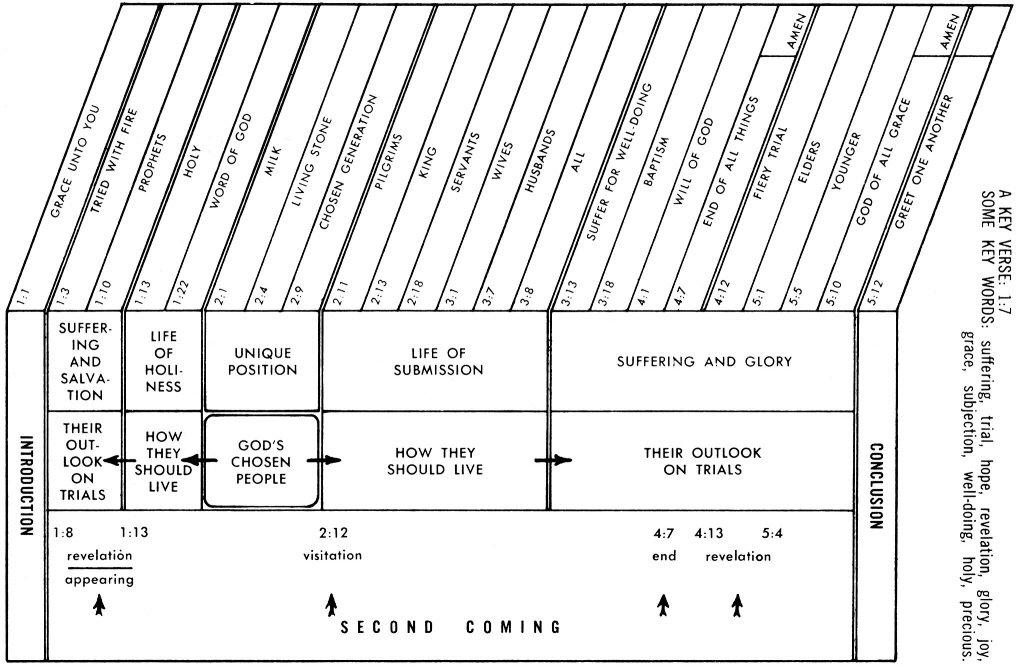
Click chart to enlarge
Chart from Jensen's Survey of the NT - used by permission
Another Chart from Charles Swindoll - click chart on right side
| FIRST PETER | SECOND PETER |
| Letter of consolation | Letter of Warning |
| Encouragement for the Church | Error in the Church |
| Main teaching: Comfort for Suffering Saints | Main teaching: Exposure of False Teachers |
| Suffering of Christ | Glory of Christ |
| Christ - His Redemptive Title | Lord - His Title of Dominion |
| Hope - Enables us to Face Trials | Full Knowledge - Enables us to Recognize Error |
| External Opposition | Internal Opposition |
| Hostility | Heresy |
| Danger from Without | Danger from Within |
| Hope in the Lord's Return | Certainty of the Lord's Return |
| Walk in Holiness as God is Holy | Growth in Grace and Knowledge of Christ |
| "Pain with a Purpose" | "Poison in the Pew" |
|
Adapted from Jensen's Survey of the New Testament and Wilkinson and Boa's Talk Thru the Bible |
|
1 Peter 2:2 like newborn babies, long for (2PAAM ) the pure milk of the word, so that by it you may grow in respect to salvation, (NASB: Lockman)
Greek: os artigenneta brephe to logikon adolon gala epipothesate, (2PAAM) hina en auto auxethete eis soterion
Amplified: Like newborn babies you should crave (thirst for, earnestly desire) the pure (unadulterated) spiritual milk, that by it you may be nurtured and grow unto [completed] salvation, (Amplified Bible - Lockman)
KJV: As newborn babes, desire the sincere milk of the word, that ye may grow thereby (Note Textus Receptus omits "eis soterion" - unto salvation)
NET: And yearn like newborn infants for pure, spiritual milk, so that by it you may grow up to salvation, (NET Bible)
NLT: You must crave pure spiritual milk so that you can grow into the fullness of your salvation. Cry out for this nourishment as a baby cries for milk,
Phillips: You are babies, new-born in God's family, and you should be crying out for unadulterated spiritual milk to make you grow up to salvation (Phillips: Touchstone)
Wuest: as newborn infants do, intensely yearn for the unadulterated spiritual milk in order that by it you may be nourished and make progress in [your] salvation
Young's Literal: as newborn babes the word's pure milk desire ye, that in it ye may grow
LIKE NEWBORN BABES: os artigenneta brephe:
- 1Pe 1:23; Mt 18:3; Mk 10:15; Ro 6:4; 1Cor 3:1; 14:20
- 1 Peter 2 Resources - Multiple Sermons and Commentaries
1. The New Spiritual Birth (1Pe 1:22-25)
2. Continued Spiritual Growth (1Pe 2:1-3)
3. Privileges of believers as the holy and royal priesthood (1Pe 2:4-10)
SOUND DOCTRINE!
HEALTHY SAINTS!
Like (hōs) - is a simile is which is a terms of comparison introduced either by like or as. Whenever you encounter a simile, consider invoking the "5 P's" (Pause to Ponder the Passage and Practice it in Power of Spirit). Peter draws a poignant comparison between the instinctive (God given) appetite of a healthy baby for its mother's milk and the appetite a newborn (and old) "healthy" believer for the Word of God.
Hiebert - Like (hōs), an adverb of manner, indicates that the designation is figurative. It characterizes Christians as newborn infants with an inborn longing for their mothers milk. The term is not derogative, but rather "sets forth the tenderness of their relation to God, and implies the idea of guiltlessness." (1 Peter Commentary - recommended)
Beloved, even as a baby must partake regularly of pure milk (see illustration) in order to grow and be physically healthy, so too must the newborn believer (and "old born again", like yours truly!) daily partake of sound doctrine (cf Mt 4:4 quoting Dt 8:3, context Dt 8:1-2, Dt 32:47 word = "life"; Job 23:12), that they might grow in grace and Christlikeness (2Pe 3:18). It is an immutable maxim that sound doctrine (cf 1Ti 4:6, 2Ti 4:3, Titus 1:9) is the crucial cog supernaturally "energizing" godly living. Even as sinners are regenerated by the Word of Truth (Jas 1:18), so too must they thereafter be "revived" by that same Word of life (Php 2:16, cf Jn 17:17, Ps 119:25). (Related Resource: Study the Power of God's Word)
The Christian is bred by the Word
and he must be fed by it.
-William Gurnall
Spurgeon - When the apostle describes us under the character of “newborn babes,” he would have us lay aside all that is inconsistent with that character. Newborn children have no malice; they have no guile or craftiness; they have no hypocrisies, nor envies, nor evil speakings. They are clear from all these evils; would God we were as clear as they are! It would be better to be infants, not speaking at all, than to be among those who speak evil. It would be better to begin life over again than to live long enough to have gained a treasure of malice, and a hoard of cunning, and to have learned the tricks of hypocrisy. Let us be as simple as little children, as guileless, as harmless, as free from anything like unkindness as newborn babes are. And inasmuch as we are to follow them in what they have not, let us also imitate them in what they have. Let us desire ardently, as for our very life, the unadulterated milk of the Word. Let us cultivate that combination of hunger and thirst which is found in a little child, that we may hunger and thirst thus after God’s Word. We have done more than taste the Word; we have tasted that the Lord himself is gracious. Let us long to feast more and more upon this divine food, that we may grow thereby. (1 Peter 2- Commentary )
Read John Piper's discussion of what he refers to as "spiritual fatalism" which he defines as…
the belief or feeling that you are stuck with the way you are—"this is all I will ever experience of God—the level of spiritual intensity that I now have is all I can have; others may have strong desires after God and may have deep experiences of personal pleasure in God, but I will never have those because … well, just because … I am not like that. That's not me." This spiritual fatalism is a feeling that genetic forces and family forces and the forces of my past experiences and present circumstances are just too strong to allow me to ever change and become more zealous for God (Titus 2:14), or more fervent (Romans 12:12), or more delighted in God (Psalm 37:4), or more hungry for fellowship with Christ (John 6:35), or more at home with spiritual things (Romans 8:5), more bold (2 Timothy 1:7), or more constant or joyful (Romans 12:12), or hopeful (1 Peter 1:13). Spiritual fatalism is tragic in the church. church. It leaves people stuck. It takes away hopes and dreams of change and growth. It squashes the excitement of living—which is growth. (1 Peter 2:1-3 Long for the Pure Milk)
As newborn - Bengel says that newborns "are capable of nothing but desire" adding that in babes "in whom there is no guile."
Peter had just discussed their new birth explaining that
The God and Father of our Lord Jesus Christ… according to His great mercy has caused us to be born again to a living hope through the resurrection of Jesus Christ from the dead (The Gospel)… (and) you have been born again not of seed which is perishable but imperishable, that is, through the living and abiding Word of God. (1Pe 1:3, 23)
Hiebert observes that 1Peter 2:1-3 "constitute one sentence that centers on the imperative "crave" (1Pe 2:2). That craving is essential to the healthy growth of the new life. The obligation to grow involves the negative duty to remove all hindrances to growth (1Pe 2:1), and the positive duty to actively appropriate nourishment that furthers growth (1Pe 2:2). 1Pe 2:3 cites past experience as an incentive to growth. (1 Peter Commentary)
Lenski - The point of the figurative language is this: as a babe longs for nothing but its mother’s milk and will take nothing else, so every Christian should take no spiritual nourishment save the Word. The imagery is beautiful and expressive. Look at a babe at its mother’s breast! In this way you should ever drink the milk of the Word. Peter understood the intent of Jesus’ action which is recorded in Mt. 18:2, 3 and here carries the illustration which Jesus used still farther, down to babes that have just been born. (The interpretation of the epistles of St. Peter, St. John and St. Jude)
J Vernon McGee - I remember when our little grandson was born. Because his father was over in Turkey at the time, his mother brought him into our home. We had him with us those first few months, and every now and then it was my task to give him his bottle. I want to tell you, that little fellow went into high gear when he saw that bottle of milk. He started moving his hands, his mouth, his feet? He was reaching out for it with every part of his body. At that time I was still the pastor of a congregation, and I thought, I wish I had a congregation that would reach out after the Word of God like that! My friend, without a hunger for the Word of God you will not grow in grace and in the knowledge of Christ. You will not develop as a Christian—you will always be in your babyhood. We must remember that a little baby and a full-grown man are both human beings, but they are in different stages of growth and development. The little one needs milk so he can grow up to become a man. Now, how does a Christian grow? He grows by studying the Word of God. There is no growth apart from the Word of God. I receive letters from many pastors who tell me that they are wet nurses for a lot of little babes. As one pastor said, “I spend my time burping spiritual babies!” Those babies should grow up so they wouldn’t need a pastor to pat them and burp them all the time. And they would grow if they desired the pure milk of the Word. (Thru the Bible - Listen to his crusty comments on 1Peter 2:1-2)
Newborn (738) (artigennetos from arti, an adverb of time = now, newly, recently + gennetos = begotten, born) is literally one just born, lately born and so newborn. It refers to a child at birth or of tender years and in context could refer to new converts or it could simply refer to how any convert should approach the "pure milk" of God's Word.
Peter uses this figurative language to give the readers the mental picture of infants craving nourishment, for anyone who has been a parent or had a baby sibling knows how newborn babies vocally and ardently express their desire to be fed regularly. In fact, newborn babies act as if their life depends on the next feeding, an attitude that should be true of believers, for Jesus Himself clearly stated that…
Man shall not live and be upheld and sustained by bread alone, but by every word that comes forth from the mouth of God. (Matthew 4:4) (Amplified Version)
Comment: Jesus is quoting (Dt 8:3, context Dt 8:1, 2, 3, 4, 5) to emphasize that it is not food that is the most necessary part of life, but instead it is the creative, energizing, and sustaining power of God's Word that is the only real source of man’s existence.
In Moses' last words to the children of Israel just before they crossed the Jordan River to possess their possessions (what God had already declared was their inheritance), he made this profound statement …
"Take to your heart all the words with which I am warning you today, which you shall command your sons to observe carefully, even all the words of this law. For it (the Word) is not an idle (empty, vain) Word for you; indeed it (the Word) is your life. And by this Word you shall prolong your days in the land, which you are about to cross the Jordan to possess." (Deuteronomy 32:46, 47)
The NLT paraphrases Deuteronomy 32:47 as…
These instructions are not mere words--they are your life! (Comment: How important in the success of Israel was the pure milk of the Word and obedience to that Word?)
Job had come to the understanding of the importance of God's Word for his sustenance (which I believe was one reason he was able to endure such profound losses and afflictions) declaring…
I have not departed from the command of His lips; I have treasured the words of His mouth more than my necessary food." (Job 23:12) (Bolding added)
Comment: Read over Job's affirmation slowly and ask yourself
What is more important to me?
God's Word or _______!
Take a moment before God and "fill in the blank" -- my job, my exercise, my hobby, my favorite television show, time with my family, etc
Babes (1025) (brephos) is used most often in the NT of a literal baby whether unborn or born or newly born. Some contexts signify a young child.
Peter's has the only figurative use of brephos in the NT. In context brephos could be interpreted as referring to believers who have only recently been born again into the family of God by grace through faith (see Peter's mention of the new birth in notes on 1Pe 1:3 and 1Pe 1:23). The alternative interpretation is that believers are in a sense always to be considered like infants in the sense that they are always in need of and totally dependent upon the pure milk of God's Word.
Hiebert observes that 1Peter 2:1-3 - In classical Greek, the term "baby" (brephos) was used of the embryo, the unborn child, but in later writings it was extended to include the suckling child and even small children generally. Those who view 1 Peter as originally a baptismal homily naturally appeal to that designation as confirmation of their view Thus Beare asserts that the designation "could not be used with any appropriateness of the general body of Christians in the provinces mentioned in the salutation" and insists that "the words are wholly appropriate to the condition of converts who have just been received into the Church by baptism." Admittedly, Peter's designation can be understood to support that view. Kelly remarks, "The adjective need mean no more than that the Asian communities included a substantial proportion of fairly recent converts." Rather, as Selwyn maintains, "The purpose of the adjective is to make the imagery of the passage more vivid… What the author wants to express is the ardor of the suckled child." Such an ardor for spiritual food is essential for spiritual growth. Believers should at all times be like infants in their craving for the nourishment that the Lord has provided for their spiritual growth. The imagery is both expressive and challenging! Peter's picture is apparently based on the teaching of Christ that the kingdom of God must be received as a little child (Matt. 18:3; Mark 10:15). Peter made no mention of a process of growth from infancy to adulthood, where the longing for milk is replaced by the ability to eat solid food. His picture of the readers as babes, unlike that of Paul and the author of Hebrews (1Cor. 3:1-4; Heb. 5:12-14), is not derogatory. He was eager for them, as those who had been born again (1:23), to maintain the distinctive characteristic of baby-like eagerness for spiritual nourishment. His figure was clearly influenced by the imagery that follows.(1 Peter Commentary)
Meyer rightly observes that - The most advanced among us, in knowledge and attainment, are, in comparison with what they shall be, only as babes.
Classic Greek used brephos to describe a babe at the breast, one who is dependent on the mother's milk for nourishment. The use of cows’ milk was rare in ancient times. It was believed that children were very impressionable at the nursing stage, and those who allowed them to be tended by nursemaids were advised to select the nurses with care.
Brephos - 8x in the NT…
Luke 1:41 And it came about that when Elizabeth heard Mary's greeting, the baby leaped in her womb; and Elizabeth was filled with the Holy Spirit.
Luke 1:44 "For behold, when the sound of your greeting reached my ears, the baby leaped in my womb for joy.
Luke 2:12 "And this will be a sign for you: you will find a baby wrapped in cloths, and lying in a manger."
Luke 2:16 And they came in haste and found their way to Mary and Joseph, and the baby as He lay in the manger.
Luke 18:15 And they were bringing even their babies to Him so that He might touch them, but when the disciples saw it, they began rebuking them.
Acts 7:19 "It was he who took shrewd advantage of our race, and mistreated our fathers so that they would expose their infants and they would not survive.
2 Timothy 3:15 and that from childhood you have known the sacred writings which are able to give you the wisdom that leads to salvation through faith which is in Christ Jesus.
1 Peter 2:2 like newborn babes, long for the pure milk of the word, that by it you may grow in respect to salvation,
Peter is painting a vivid picture -- Grasp for the Word like a baby grasps for its bottle!
The Bible tells us that the goal of Bible study is not just that we might know (and be smarter sinners), but that we might grow (and be more like the Savior) as shown schematically…
Appetite
v
Attitude
v
Aim
Peter is saying that more than simply receiving spiritual nourishment, the readers should be ardently (Ardent = from root = to burn > expressed in eager zealous activity; impassioned) longing for it.
Matthew Henry on newborn babes - He puts them in mind of their regeneration. A new life requires suitable food. They, being newly born, must desire the milk of the word. Infants desire common milk, and their desires towards it are fervent and frequent, arising from an impatient sense of hunger, and accompanied with the best endeavors of which the infant is capable.
Jamieson on newborn babes "new-born babes—altogether without “guile” (1Pe 2:1). As long as we are here we are “babes,” in a specially tender relation to God (Is 40:11). The childlike spirit is indispensable if we would enter heaven. “Milk” is here not elementary truths in contradistinction to more advanced Christian truths, as in 1Co 3:2; Heb 5:12, 13; but in contrast to “guile, hypocrisies,” &c. (1Pe 2:1); the simplicity of Christian doctrine in general to the childlike spirit. The same “word of grace” which is the instrument in regeneration, is the instrument also of building up. “The mother of the child is also its natural nurse” [Steiger]. The babe, instead of chemically analyzing, instinctively desires and feeds on the milk; so our part is not self-sufficient rationalizing and questioning, but simply receiving the truth in the love of it (Mt 11:25).
Illustration - 1Peter 2:2 tells us to "long for the pure milk of the Word." Pure means undiluted. A lot of us want the Word but we mix it up with other information. At most county or state fairs, you can find candied apples—apples dipped in sugar. Now, apples by themselves are a great, healthy fruit. Once you dip them in sugar, however, you’ve just killed the benefit of the apple although it tastes good. A candied apple is sweet but its nutritional value is diluted because something with no value has been added to it. Many of us will read the Word, hear the Word, and then talk to people about the Word but then dip it in human viewpoint. - Tony Evans
Illustration - WHEN you travel to a country where you don’t speak the language, you shouldn’t be surprised when you don’t understand what is being said. More than likely, you will need an interpreter so that you can communicate. There is nothing wrong with you if you don’t understand. It’s simply that you are new to a very different environment. This is how things seem for an infant Christian. They are new to the Christian environment, and they may not know how to “walk the walk” and “talk the talk.” They are babies born into a whole new world. - Tony Evans
How to Get the Most
from Reading your Bible
Puritan writer Thomas Watson tells us how to prepare for reading the Bible…
1. Remove hindrances. (a) remove the love of every sin (b) remove the distracting concerns of this world, especially covetousness [Matt. 13:22] (c) Don't make jokes with and out of Scripture.
2. Prepare your heart. [1 Sam. 7:3] Do this by: (a) collecting your thoughts (b) purging unclean affections and desires (c) not coming to it rashly or carelessly.
3. Read it with reverence, considering that each line is God speaking directly to you.
4. Read the books of the Bible in order.
5. Get a true understanding of Scripture. [Ps. 119:73] This is best achieved by comparing relevant parts of Scripture with each other.
6. Read with seriousness. [Deut. 32:47] The Christian life is to be taken seriously since it requires striving [Luke 13:24] and not falling short [Heb. 4:1].
7. Persevere in remembering what you read. [Ps. 119:52] Don't let it be stolen from you [Matt. 13:4,19]. If it doesn't stay in your memory it is unlikely to be much benefit to you.
8. Meditate on what you read. [Ps. 119:15] The Hebrew word for meditate' means to be intense in the mind'. Meditation without reading is wrong and bound to err; reading without meditation is barren and fruitless. It means to stir the affections, to be warmed by the fire of meditation [Ps. 39:3].
9. Read with a humble heart. Acknowledge that you are unworthy that God should reveal himself to you [James 4:6]
10. Believe it all to be God's Holy Word. [2 Tim 3:16] We know that no sinner could have written it because of the way it describes sin. No saint could blaspheme God by pretending his own Word was God's. No angel could have written it for the same reason. [Heb 4:2]
11. Prize the Bible highly. [Ps. 119:72] It is your lifeline; you were born by it [James 1:18] you need to grow by it [1 Pet 2:2] [cf. Job 23:12].
12. Love the Bible ardently [Ps. 119:159].
13. Come to read it with an honest heart. [Luke 8:15] (a) Willing to know the entire and complete will of God (b) reading in order to be changed and made better by it [John 17:17].
14. Apply to yourself everything that you read, take every word as spoken to yourself. Its condemnation of sins as the condemnation of your own sin; the duty that it requires as the duty God would require from you [2 Kings 22:11].
15. Pay close attention to the commands of the Word as much as the promises. Think of how you need direction just as much as you need comfort.
16. Don't get carried away with the minor details, rather make sure to pay closest attention to the great things [Hosea 8:12].
17. Compare yourself with the Word. How do you compare? Is your heart something of a transcript of it, or not?
18. Pay special attention to those passages that speak to your individual, particular and present situation. e.g. (a) Affliction -- [Heb. 12:7, Isaiah 27:9, John 16:20, 2 Cor 4:17. (b) Sense of Christ's presence and smile withdrawn -- [Isaiah 54:8, Isaiah 57:16, Ps. 97:11] (c) Sin -- [Gal 5:24, James 1:15, 1 Peter 2:11, Prov 7:10&22-23, Prov 22:14] (d) Unbelief -- [Isaiah 26:3, 2 Sam 22:31, John 3:15, 1 John 5:10, John 3:36]
19. Pay special attention to the examples and lives of people in the Bible as living sermons. (a) Punishments [Nebuchadnezzar, Herod, Num 25:3-4&9, 1 Kings 14:9-10, Acts 5:5,10, 1 Cor 10:11, Jude 7] (b) mercies and deliverances [Daniel, Jeremiah, the 3 youths in the fiery furnace]
20. Don't stop reading the Bible until you find your heart warmed. [Ps 119:93] Let it not only inform you but also inflame you [Jer 23:29, Luke 24:32].
21. Put into practice what you read [Ps 119:66, Ps 119:105, Deut 17:19].
22. Christ is for us Prophet, Priest and King. Make use of His office as a Prophet [Rev 5:5, John 8:12, Ps 119:102-103]. Get Christ not only to open the Scriptures up to you, but to open up your mind and understanding [Luke 24:45]
23. Make sure to put yourself under a true ministry of the Word, faithfully and thoroughly expounding the Word [Pr 8:34] be earnest and eager in waiting on it.
24. Pray that you will profit from reading [Isaiah 48:17, Ps 119:18, Nehemiah 9:20].
Natural obstacles You may still be able to profit from reading even though:
1. You don't seem to profit as much as others do. Remember the different yields [Matt 13:8] though the yield isn't as much as others it is still a true and fruitful yield.
2. You may feel slow of understanding [Luke 9:45, Heb 5:11].
3. Your memory is bad (a) remember you are still able to have a good heart despite this (b) you may still remember the most important things even if you cannot remember everything, be encouraged by John 14:26. (How to Get the Most from Reading your Bible)
The Westminster Shorter Catechism
Question 90. How is the Word to be read and heard, that it may become effectual to salvation?
Answer. That the Word may become effectual to salvation, we must attend thereunto with diligence, preparation, and prayer [a]; receive it with faith and love, lay it up in our hearts, and practice it in our lives [b]. [a]. Dt 6:6, 7, 8, 9; Ps. 119:18; 1Pet. 2:1,2 [b]. Ps 119:11; 2Th 2:10; Heb. 4:2; Jas 1:22-25
LONG FOR: epipothesate (2PAAM):
- 1 Peter 2 Resources - Multiple Sermons and Commentaries
This is the main verb in 1Pe 2:1-3, which is one sentence in the Greek.
NO INTAKE OF THE WORD
NO SPIRITUAL GROWTH
Peter gives a command to have this attitude (longing, yearning, passionate) for the Scripture, for he knows that studying the Scriptures is the only means of spiritual growth, not to mention that His Lord had instructed him repeatedly regarding the importance of proper spiritual nutrition for God's flock ("Tend my lambs") Jn 21:15, 16, 17). You can mark it down - There is no growth spiritually speaking, apart from the intake of the pure Word of Truth (cp Ps 119:43, 2Cor 6:7, Col 1:5, 2Ti 2:15, Jas 1:18).
Pastors remember the words of John Brown "A man can't always be defending the truth; there must be a time to feed on it."
Jamieson on the picture of longing for the Word notes that this is "a natural impulse to the regenerate (born again), “for as no one needs to teach new-born babes what food to take, knowing instinctively that a table is provided for them in their mother’s breast,” so the believer of himself thirsts after the word of God
Matthew Henry writes that Peter "like a wise physician, having prescribed the purging out of vicious humours, goes on to direct to wholesome and regular food, that they may grow thereby. The duty exhorted to is a strong and constant desire for the word of God, which word is here called reasonable milk, only, this phrase not being proper English, our translators rendered it the milk of the word, by which we are to understand food proper for the soul, or a reasonable creature, whereby the mind, not the body, is nourished and strengthened. This milk of the word must be sincere, not adulterated by the mixtures of men, who often corrupt the word of God, 2Co. 2:17.
Adam Clarke writes that the Jewish "rabbins frequently express learning to know the law, etc., by the term sucking, and their disciples are often denominated those that suck the breast. The figure is very expressive: as a child newly born shows an immediate desire for that nourishment, and that only, which is its most proper food
John Calvin wrote that - Those only are worthy students of the law who come to it with a cheerful mind, and are so delighted with its instruction as to account nothing more desirable or delicious than to make progress therein.
Albert Barnes makes an excellent point regarding one's longing for pure milk of God's word explaining that it…
furnishes evidence of conversion, if we have a love for the simple and pure truths of the Gospel. It is evidence that we have spiritual life, as really as the desire of appropriate nourishment is evidence that an infant has natural life. The new-born soul loves the truth. It is nourished by it. It perishes without it. The gospel is just what it wants; and without that it could not live.
Comment: Dear reader, Barnes' insightful point begs a question - Have you ever at any time since your profession of belief in Christ had a true longing for God's Word? If not, you may be self-deceived. Remember, when someone is deceived by definition they don't know it! So let me repeat the question with a slight alteration - Do you have a hunger and thirst that is only satisfied by God's Word? The corollary question is whether you once had a strong impulse for God's Word, but in recent times have not. This latter situation may reflect a different problem. You would do well to look back over 1Peter 2:1 and the notes on that passage. Your appetite may be blunted by unconfessed sin.
Long for (epipotheo [word study] from epi = toward or an intensifier + potheo = yearn) means to have a strong desire for something, with implication of need. It mean to long for, have great affection for, yearn for someone or something. The preposition epi in this compound indicates intensive desire directed toward an object (in context God's pure Word).Epipotheo describes an intense yearning for something. It is to long for or intensely crave something with the implication that the one longing recognizes the lack or the need.
Epipotheo - 9x NAS - Ro 1:11; 2Cor 5:2; 9:14; Phil 1:8; 2:26; 1Th 3:6; 2Ti 1:4; Jas 4:5; 1Pe 2:2
Epipotheo is used in the Lxx - Dt 13:8; 32:11; Ps 42:1; 62:10; 84:2; 119:20, 131, 174; Jer 13:14 (Note especially the longing described in Ps 42:1; 62:10; 84:2; 119:20, 131, 174)
In Psalm 42:1 David uses the verb pant which is translated by the Septuagint with epipotheo to describe the psalmist's deepest longing for God
As the deer pants (Hebrew = arag = yearn for, Lxx = epipotheo) for the water brooks, So my soul pants (Hebrew = arag = yearn for, Lxx = epipotheo) for Thee, O God. (See Spurgeon's Comment on Psalm 42:1)
Epipotheo is used by Paul in (Ro 1:11) when he writes, “I long to see you” and when he writes to young Timothy, that he is “longing to see” him (2Ti 1:4). In these uses one can see a picture of the deep longing Peter is trying to convey to his readers and to all saints. Beloved, the question is this…
Are you "panting" for God's word
as a deer in the desert does for the water brooks?
If not, why not?
Long for is in the aorist imperative which calls for a decisive action (attitude change in this case) on the reader's part. The idea is -- Do it! Do it now! Don't delay! It is a command and not an option. In other words, longing in one's heart for Truth is not an option if we desire to grow in grace and the knowledge of our Savior and Lord Jesus Christ. Since we have been born again by the Word of God, we have a new nature with a new longing. Peter is saying "Now make up your mind once and for all to intensely crave the word of God!"
Nothing but pure milk satisfies a baby and nothing but the pure milk of God's Word will truly satisfy one who has been born again.
Do you see the connection between the Word of God in the preceding section (1Pe 1:23, 24, 25 )? We are born again into the Kingdom of God by the "imperishable seed… the living and abiding Word of God" Now, long for that same pure word. You began this new life in Christ with the Word and the only way to grow in Christ likeness is by letting the "the Word of Christ richly dwell within you" (see note Colossians 3:16)
Peter exhorts his readers to intensely crave for pure milk! Epipotheo is a strong word. It paints the picture of being an absolute hungering and thirsting after the Word. If a believer is to grow, it is absolutely essential that he hunger and thirst after the milk of the Word. What this says is that just as essential as having the desires for the word that we are supposed to have is having the trust in God that He gives what He commands. If God says to desire, long for (Aorist Imperative = do it now!), when we don't desire, then we trust Him that He must know something we don't know. He must have some power we don't have. There must be a way. God commands it. So there must be a way. I will not settle for less than what God commands. It's saying "Lord, I can't but You can and you said you would" so cry out to Him to give you that desire which you know is a prayer in His will (1Jn 5:14, 15) and then wait upon the Lord and He will renew your strength so that you then can mount up with wings like an eagle (Isaiah 40:31).
Each morning when you get up you need to deal with those "verse one" (1Peter 2:1) issues first so that your inner man will be ''healthy'' and you have a natural (supernatural) God given appetite for His Living Word, the spiritual bread of life. God will give you an intense craving and deep-seated longing for His Word. (Phil 2:13 - The Holy Spirit gives the desire and energizes that desire).
Spiritual growth is always marked by a craving for and a delight in God’s Word with the intensity with which a baby craves milk. The opposite of longing after the pure milk of the Word is to neglect so great a salvation (He 2:3)!
Note that in the present context, milk does not stand in contrast to solid food (as it does in 1Corinthians 3:2 and Hebrews 5:12 [note])
The use of milk as symbol for spiritual nourishment found in Judaism et. al. religions. It would have been immediately familiar to Peter’s readers. All believers are seen as needing to grow and to learn more about the Lord. All believers are to desire the milk (food) of the Word.
How does a believer increase their desire for the truth of God’s Word?
1) Remembering life’s source (1Peter 1:25; Isa 55:10,11; Jn 15:3; Heb 4:12, Mt 4:4)
2) Eliminating (confessing/repenting of) sin (1Peter 2:1) so the Spirit is not quenched (Ep 4:30).
3) Admitting need for God’s truth (beseeching Him to give hunger) (1Peter 2:2)
4) Pursuing spiritual growth (1Peter 2:2, “that you may grow thereby”)
5) Surveying His blessings (1Peter 2:3, “Lord is gracious”)
Life example of "longing" -- In the Antarctic summer of 1908–1909, Sir Ernest Shackleton and three companions attempted to travel to the South Pole from their winter quarters. They set off with four ponies to help carry the load. Weeks later, their ponies dead, rations all but exhausted, they turned back toward their base, their goal not accomplished. Altogether, they trekked 127 days. On the return journey, as Shackleton records in The Heart Of The Antarctic, the time was spent talking about food — elaborate feasts, gourmet delights, sumptuous menus. As they staggered along, suffering from dysentery, not knowing whether they would survive, every waking hour was occupied with thoughts of eating. Jesus, who also knew the ravages of food deprivation, said, “Blessed are those who hunger and thirst for RIGHTEOUSNESS.” (Mt 5:6) We can understand Shackleton’s obsession with food, which offers a glimpse of the passion Jesus intends for our quest for righteousness.
THE PURE MILK OF THE WORD: to logikon adolon gala:
- Ps 19:7-10; 1Co 3:2; Heb 5:12,13
- 1 Peter 2 Resources - Multiple Sermons and Commentaries
THE NOURISHING POWER
OF PURE MILK!
The pure milk of the Word - "Pure spiritual milk" (NET), "Unadulterated, spiritual milk" (Berkeley), "which is without mixture" (Mace), "Sincere milk of the word" (KJV), "the pure and simple teaching" (ICB), "the true milk of the word" (BBE), "spiritual milk which is without guile" (ASV)
J Vernon McGee has an interesting thought on what pure milk of the word means…
It is my conviction that the “pure milk of the word” means the total Word of God. We don’t grow spiritually by lifting out a verse for comfort here and there. We need the total Word of God to grow. We need a full, well-balanced diet. Of course, we start out with milk, but the day comes when we want a porterhouse steak, a good baked potato, a green salad, and maybe some black-eyed peas on the side. And you get all the spiritual nutrition you need in the total Word of God. (Thru the Bible - Listen to his crusty comments on 1Peter 2:1-2)
Columbia University (New York City) was established in 1754 and its original seal depicted a woman sitting down, with the 4 letters of the so-called Tetragrammaton (YHWH - transliterated as "Yahweh" or Jehovah) inscribed above her head and 1Peter 2:1-2 under her feet was inscribed “admonishing students to desire of the pure milk of God’s word.” My, how times have changed!
Spurgeon comments that…
If you have once had that sweet taste in your mouths, you will wish to have it always there, and you may do so if you continue to drink the unadulterated milk of the Word, and do not sour that good milk through tempests of malice, and envy, and evil speaking…
Be glad to get simple truth, the “milk of the Word.” Even if you can digest the strong meat of the Word, never grow weary of the milk, for it is always good diet even for a full-grown man in Christ. Do not crave milk and water, but “desire the unadulterated milk of the Word that ye may grow thereby.” It is not enough for you to be spiritually alive, you must grow; and especially while you are babes in grace, your great desire should be that you may grow…
The unadulterated “milk of the Word” is the best food for those who are, spiritually, “newborn babes.” Desire this unadulterated milk of the Word not out of an idle curiosity, but…
- that you may grow thereby,
- that you may grow wiser, holier, more earnest, more like your Savior,
- that you may grow up into the likeness of Him Whose you are, and Whom you serve.
You are in the family of God, but you are only babes in it yet; you have to grow to the stature of men in Christ Jesus, so “desire the sincere (unadulterated) milk of the word, that ye may grow thereby.” There is no other way of growing.
You begin with tasting that the Lord is gracious, you go on to desire the unadulterated milk of the Word, and so you grow in grace more and more.
If you have spiritually tasted this great truth, you have the flavour of it upon your palate, so that it makes you long for more of it. (1 Peter 2 Commentary )
Pure (97) (adolos from a = negative + dolos = trap, trick, deceit, deceitful cunning to mislead) means literally without deceit, without guile, without trickery. Adolos describes that which is honest, sincere, pure, not mixed with with anything else, without admixture or unadulterated. Adolos is an adjective which is not found in the Septuagint (LXX) but was used in secular Greek writings describing seed or liquids which were described as "unadulterated." Adolos was also used to describe treaties as without fraud or guileless.
And so in this context Peter is calling for intake of God's word, the only Word which is guileless, without imperfections, flaws, dilutions or anything that would deceive or lead astray!
Steven Cole adds that "Dishonest merchants in that day would add water to their milk to make more profit. This was “deceitful” milk. Peter tells us to long for the pure, not-deceitful milk. (1 Peter 2:1-3 Sermon)
Adolos contrasts with the second attitude in 1Peter 2:1 where Peter exhorts Christians to get rid of guile (dolos).
Jamieson - Irenaeus says of heretics. They mix chalk with the milk. The article, “the,” implies that besides the well-known pure milk, the Gospel, there is no other pure, unadulterated doctrine; it alone can make us guileless
Peter's point is that God's Word is pure and has no additives. This food of the Word has not the slightest admixture of anything evil in it. The word is commonly used in this sense of corn, wheat, barley, oil, wine, and farm products.
William Barclay - Adolos is an almost technical word to describe corn that is entirely free from chaff or dust or useless or harmful matter. In all human wisdom there is some admixture of what is either useless or harmful; the Word of God alone is altogether good. (Daily Study Bible)
Milk today has all manner of "additives" and unadulterated milk is virtually impossible to find. Peter says spiritual babes need to suckle on the pure word of God in order to grow into spiritual maturity. The pure Word of God has no ulterior motives like so many human teachings, but has as its primary purpose the nourishing of our soul.
The following statement was found in an old law in Baltimore - "Only pure unadulterated, unsophisticated and wholesome milk (may be sold)."
Like water from a mountain spring, Christianity is most pure at its source. While there are fine and honorable Christian teachers and ministers here and there around the world, there remains a very fundamental question: Can the word of any human be more right than The Word of God?
Both Paul (1Cor 3:1, 2) and the author of Hebrews (He 5:12, 13-see notes He 5:12;13) use milk in contrast to solid food as metaphor for elementary teaching to new converts, but Peter uses milk instead as that irreplaceable nutritional source which is vital for growing, sustaining and perfecting the children of God. The analogy with a newborn baby is obvious for just as God has designed milk to be the perfect food for the physical nourishment for for babies, He has similarly given us the Word which is the perfect food for spiritual nourishment. Even as the mother's milk immunizes her baby from many illnesses and nourishes her baby's growth, so too God’s Word protects Christians from the many spiritual "diseases" which abound and nourishes them to grow in the Lord. Furthermore there is no other source of pure, unadulterated doctrine, which is why the Word must be held in such high esteem and preached purely from the pulpits.
Many today do not desire pure milk - Warren Wiersbe quips that the naive church member who foolishly declares "We don’t want doctrine; just give us helpful devotional thoughts!” does not not know what he is saying. Apart from the truth (and this means Bible doctrine), there can be no spiritual help or health. (Wiersbe, W: Bible Exposition Commentary. 1989. Victor)
C. H. Spurgeon encourages believers to continually imbibe the pure mild of the word, writing that "It is blessed, to eat into the very soul of the Bible until, at last, you come to talk in Scriptural language, and your spirit is flavored with the words of the Lord, so that your blood is Bibline and the very essence of the Bible flows from you.
Let us partake of the beautiful invitation Ps 34:8 "O taste and see that the LORD is good; How blessed (fully satisfied independent of circumstances) is the man who takes refuge in Him!" As we taste and see His goodness, this only serves to whet our appetites for more of God's goodness as revealed in His Word. And the more we taste God's goodness, the more tasteless, less attractive and less satisfying the worldly options will become!
The pure milk of the Word - As discussed below the original Greek (to logikon adolon gala) is a bit ambiguous and thus it is rendered variously by the translators…
The spiritual milk which is without guile (A T Robertson)
the pure spiritual milk (ESV)
the sincere milk of the word (KJV)
pure spiritual milk (NAB)
The Psalms speak of the purity of God's Word…
Ps 12:6 The words of the LORD are pure words; as silver tried in a furnace on the earth, refined seven times.
Ps 19:8 The precepts of the LORD are right, rejoicing the heart; The commandment of the LORD is pure, enlightening the eyes.
David spoke of the supremacy and sufficiency of God's Word in Psalm 19…
7 The law of the LORD is perfect (needing nothing for completeness), restoring the soul; The testimony of the LORD is sure, making wise the simple. (Spurgeon's note)
8 The precepts of the LORD are right, rejoicing the heart; The commandment of the LORD is pure, enlightening the eyes. (Spurgeon's note)
9 The fear of the LORD is clean, enduring forever; The judgments of the LORD are true; they are righteous altogether. (Spurgeon's note)
10 They are more desirable than gold, yes, than much fine gold; Sweeter also than honey and the drippings of the honeycomb. (Spurgeon's note)
In Proverbs we read…
Pr 30:5-6 Every word of God is tested; He is a shield to those who take refuge in Him.:6 Do not add to His words Lest He reprove you, and you be proved a liar. (Bridges Commentary;
The Puritan Thomas Watson presents a pithy picture regarding spiritual nourishment…
What profit is it, to have the Bible in our heads, but not in our hearts? It is better to practice one truth, than to know all truths.
The Lord gives us His precepts, as a physician gives the patient his prescriptions—to take and apply. This is the end are all God's institutes—that we may, by practice, apply them for the purging out of sin and bringing the soul into a more holy temper.
God gives us His Word as the mother gives the child the breast—not only to look upon, but to draw from. Many have gone to hell with the breast in their mouths, because they have not drawn it, and turned the milk of the Word into sacred nourishment. (from his sermon Comfort for the Church)
How do you "drink" the "pure spiritual milk"?
Read it - God communicates with man through His living and abiding Word in the Bible. Listen to it while you drive around (Mp3's, CD's) but better yet read it. Remember to talk to Author before, during and after you've read His personal love letter to you. Picture yourself as a newborn babe and don't let anything keep you for your "feeding time"!
Study it - It's rational, logical milk, so begin to hone the discipline of slowing down so that you might truly observe (observation) what God is saying (consider learning the powerful discipline of inductive Bible study). Memorize the Word so that it becomes "portable" no matter where you are or what your circumstances are. You will find that memorization in turn facilitates meditation on the Word.
Taste it - Steven Cole explains tasting the Word this way "The image of milk and of tasting the Lord’s kindness brings up the fact that the Word is not just to fill your head with knowledge. It is to fill your life with delight as you get to know the Divine author and enjoy Him in all His perfections. Taste points both to personal experience and enjoyment. I can’t taste for you, nor you for me. We can only taste for ourselves. To taste something, we’ve got to experience it up close. You can see and hear and smell at a distance, but you can only taste something by touching it to your tongue. You can only taste God’s Word by drawing near to God and personally appropriating the riches of knowing Him. Once you like the taste of something, you don’t just eat it to live; you live to eat it. You want it as often as you can get it. God’s Word is that way for all who have tasted His kindness.
Wayne Grudem - To drink the milk of the Word is to ‘taste’ again and again what He is like, for in the hearing of the Lord’s words believers experience the joy of personal fellowship with the Lord Himself.
George Sweeting
The Bible is literally God speaking to you. It is God's instrument in salvation (1Peter 1:23, James 1:18) and God's instrument for growing mature Christians (1Peter 2:2). It is the blueprint for the Christian.
Thomas Watson
The Scripture is both the breeder and feeder of grace. How is the convert born, but by “the Word of truth”? (James 1:18). How doth he grow, but by “the sincere milk of the Word”? (1Peter 2:2)
Tertullian
God’s purpose and promises to man are for the benefit not of the soul alone but of the soul and the flesh.
Martin Luther
Nothing is more perilous than to be weary of the Word of God. Thinking he knows enough, a person begins little by little to despise the Word until he has lost Christ and the gospel altogether.
John Henry Jowett…
“As newborn babes, long for the spiritual milk.” [1Pe 2:2] Having tasted of the grace of the Lord, and freeing yourselves from the embittering presence of sin, adopt an exacting diet—“long for the spiritual milk which is without guile.”
Feed upon the loftiest ideals. Suffer nothing of adulterating compromise to enter into your spiritual food. Nourish yourselves upon aspirations undefiled. Do not let your wine be mingled with water. Do not permit any dilution from the suggestions of the world.
“Long for the spiritual milk which is without guile, that ye may grow thereby unto salvation.” [1Pe 2:2] It is the unadulterated food that ministers to growth. It is the high ideal which lifts men to the heights. The loftiness of one’s aim determines the degree of one’s growth. In these matters my spiritual gravitation is governed by my personal aspirations, my spirit pursues the path and gradient of my desires.
Here, then, is the threefold preparation of the individual for a family life of intimate and fruitful fellowship—a personal experience of grace, the expulsion from the life of all uncleanness, and the adoption of a rigorous and uncompromising ideal. The whole preparatory process is begun, continued, and ended in Christ. In Christ the individual is lodged, and in His grace, which is all-sufficient, he finds an abundant equipment for the spacious purpose of his perfected redemption. (Epistles of St. Peter)
Pure Milk - Recently it was discovered that some milk producers in China had been diluting cow’s milk and adding the industrial chemical Melamine. This chemical was added because it artificially enhanced protein readings. Several infants died and others became seriously ill. Such adulteration is not new. Other countries have been adding Melamine to animal feed for at least 40 years for the same purpose, resulting in the death of animals.
Another kind of adulteration is when people add to God’s Word, “the pure milk of the Word” as Peter described it (1Pe 2:2). The word pure means “unadulterated” or “uncontaminated.” The early church had to deal with those who considered circumcision necessary for salvation (Acts 15:1). That idea was rejected because it was not in accordance with the Word of God, which says that salvation is by grace alone. Peter encouraged his brethren in the Lord: “Why do you test God by putting a yoke on the neck of the disciples? … We believe that through the grace of the Lord Jesus Christ we shall be saved” (Acts 15:10, 11).
Examine carefully any teaching that asks you to do anything more than what is in God’s Word. Otherwise it can be deadly to your spiritual well-being. - C. P. Hia (Our Daily Bread, Copyright RBC Ministries, Grand Rapids, MI. Reprinted by permission. All rights reserved)
The Lord has given man His Word,
His will He has made known;
Let man not try to change that Word
With words that are his own. —D. De HaanGod’s Word needs no additions or subtractions.
Frenchman Michel Lotito has an iron gut. For some reason Lotito likes to eat metal. In the past twenty-five years, says writer Rosie Mestel, Lotito has eaten eleven bicycles, seven shopping carts, a metal coffin, a cash register, a washing machine, a television, and 660 feet of fine chain. Lotito says it wasn’t easy eating his first bicycle: “I started with the metal and moved on to the tires,” he recalls. “It was really difficult to stay that extra day to finish off the rubber. Metal’s tasteless, but rubber is horrible.” Now Lotito swallows pieces of tire and frame together. But none of that can compare with his biggest meal: a Cessna. That’s right, Lotito has eaten an entire light airplane, 2,500 pounds of aluminum, steel, vinyl, Plexiglas, and rubber. With a meal like that he cuts the metal into pieces about the size of his fingernail and consumes about two pounds a day. Most people would agree that Michel Lotito has an unhealthy appetite. When we first come to Christ, we have appetites just as unhealthy. New believers need to change their appetites from what is not food at all to what is true food for the soul.
In the 1994 Winter Olympics, held in Norway, twenty-three-year-old Tommy Moe of the United States won the gold on the men’s downhill. It was “a beautifully controlled run,” said William Oscar Johnson in Sports Illustrated, “on which he held tucks and thrust his hands forward in perfect form at places where others had stood up and flailed their arms.” After his victory, Tommy Moe explained his thought processes. “I kept it simple,” he said, “focused on skiing, not on winning, not on where I’d place. I remembered to breathe—sometimes I don’t.” The winner of the gold medal in the Olympics had to remember the most basic of basics: breathing! He kept it simple. Likewise as we seek to have a strong walk with God, it doesn’t take a rocket scientist to know where we win or lose. Spiritual strength depends on the basics. We need to make sure we’re breathing the things of the Spirit. (Larson, Craig Brian - 750 engaging illustrations for preachers, teachers & writers) (Bolding Added)
Of the word (spiritual, reasonable) (3050) (logikos from logos = reason) describes that which belongs to the reason or is agreeable with reason or thus is reasonable or rational. Some lexicons define logikos as true to real nature.
See the New International Dictionary of New Testament Theology for a 30+ page discussion of WORD - logos, word, utterance, meaning; lego, collect, count, say; logikos, intellectual, rational, reasonable, spiritual; logion, saying; logios, eloquent; cultured; alogos, irrational, without speech; laleo, to talk, chat, speak.
BDAG says that logikos was a favorite word with Greek philosophers as it referred to that which had been carefully thought though.
TDNT adds that logikos means belonging to speech (a sense that is foreign to the NT) or belonging to reason.
The UBS Handbook Series explains that logikos can be rendered in three ways:
(1) “Of the word” that is, the word of God, or the Gospel, referred to in the previous section (1Pe 1.23, 24, 25). Some scholars and translations opt for this alternative (for example, Barclay “the pure milk that flows from the word of God”; Kelly “the milk of the word”).
(2) “Rational,” which is the common way the term is used in classical Greek literature, particularly among the Stoic philosophers.
(3) “Spiritual.” Most commentaries and translations follow this interpretation. The milk spoken of is a figure referring not to physical milk which nourishes the body, but spiritual milk, which is nourishment for one’s spiritual existence. This is further explained in the last part of the verse: the readers are to drink of this spiritual milk in order that they may grow up and be saved (literally “grow up into salvation”). (The United Bible Societies' New Testament Handbook Series)
This verse literally reads the logical unadulterated (sincere, pure) milk with no Greek word for "word". The context however indicates that Peter is clearly referring to the Word of God as Robertson explains.
A T Robertson writes that logikos is…
used here with allusion to logos (1Pe 1:23) and rhema (1Pe 1:25), “the sincere milk of the word” (“the milk belonging to the word,” either the milk which is the word or the milk contained in the word (Word Pictures in the New Testament)
In the only other NT use of logikos the NAS translates it as spiritual…
I urge you therefore, brethren, by the mercies of God, to present your bodies a living and holy sacrifice, acceptable to God, which is your spiritual (logikos) service of worship. (Ro 12:1) (Comment: If one takes the nuance of logikos as "thoughtful", then the idea is that of "thoughtful service of worship", which is not a bad interpretation given the tendency of many churches to accentuate the experiential at the expense of the thoughtful! In this regard it is interesting to note one of the Greek sentences that uses logikos "the singing of hymns is the sacred service of a human being, as a logikos [one endowed with reason]")
Steven Cole - The literal translation of verse 2 is that we should long for “the pure, spiritual milk.” The word “spiritual” also means “rational” (Greek = “logikos,” from “logos”). The only other time it occurs in the Bible is in Romans 12:1, where Paul says that presenting our bodies as a living sacrifice to God is our “spiritual (or rational) service of worship.” He means that it is a spiritual thing to do, since we don’t do it literally (as a burnt offering), but rather spiritually by yielding ourselves to the will of God. And, it is the reasonable thing to do in light of God’s great mercies to us. Thus the term is purposefully ambiguous. Peter uses it to show us that he’s not talking about literal mother’s milk, but rather about the spiritual milk of the living and abiding Word of God (1:23). This spiritual milk is rational--it is grasped with the mind. Thus Christianity is essentially rational, but not rational in the worldly sense, but rational in a spiritual sense. Human reason must be subject to the written revelation God has given of Himself in the Bible. But you cannot know God without using your mind, since He has revealed Himself in the propositional revelation of the written Word. (Getting Into the Word)
Rienecker has this note on milk writing that "The many-breasted goddesses of the heathen religions who were to sustain and nourish life were widespread in the ancient world. The rabbis also compared the Law to milk" (New Linguistic & Exegetical Key to the Greek New Testament)
Irenaeus, an early church father, wrote that heretics "mix chalk with the milk". (= not pure).
Tertullian, another early church father, said that…
"The Word is to be desired with appetite as the cause of life,
to be swallowed in the hearing,
to be chewed as cud is by rumination with the understanding, and
to be digested by faith"
William Barclay explains that "Logos is the Greek for word, and logikos means belonging to the word. This is the sense in which the Authorized Version takes the word, and we think that it is entirely correct. Peter has just been talking about the word of God which lives and abides for ever (1Pe 1:23, 24, 25). It is the word of God which is in his mind; and we think that what Peter means here is that the Christian must desire with his whole heart the nourishment which comes from the word of God, for by that nourishment he can thrive and grow up. In face of all the evil of the heathen world the Christian must strengthen his soul and his life with the pure food of the word of God ( Daily Study Bible Series)
An unknown writer listed these seven rules for good health spiritually…
A person who is “born again” starts a new life similar to that of a newborn infant. Seven rules that promote good health in babies can be adapted and applied to a Christian’s spiritual growth.
1. Daily Food. Take in the “pure milk of the word” through study and meditation.
2. Fresh Air. Pray often or you will faint. Prayer is the oxygen of the soul.
3. Regular Exercise. Put into practice what you learn in God’s Word.
4. Adequate Rest. Rely on God at all times in simple faith.
5. Clean Surroundings. Avoid evil company and whatever will weaken you spiritually.
6. Loving Care. Be part of a church where you will benefit from a pastor’s teaching and Christian fellowship.
7. Periodic Checkups. Regularly examine your spiritual health. (7 Rules for "Good Health")
I like the old but venerable commentator you may or may not be familiar with (but with whom I encourage you to become familiar) Matthew Poole who wrote…
Pursuant to his discourse, 1Pe 1:23, where he speaks of their new birth, he here calls them new-born babes; but that not in opposition to those that are adult, or of full age, as Heb 5:14; 1Co 3:1, but in opposition to their former corrupt and unregenerate state, in which they were destitute of all spiritual life; and so this agrees, not only to young converts, but generally to all regenerate persons.
Desire; being new-born babes, act as such in earnestly desiring and longing for that spiritual nourishment, which is so needful for you, even as children, as soon as they come into the world, are lingering after the breast.
The sincere milk of the word: the Greek may be rendered (and is by some) reasonable milk, viz. such as is for the soul, not for the body; that whereby the mind is nourished and strengthened; or, wordy milk, the substantive from which it is derived properly and first signifying word, or speech, and being used for the word of God, Heb 4:12. But this not being proper English, our translation renders it best, the milk of the word, i.e. the word which is milk. The apostle uses an adjective for a substantive, but that adjective doth not signify the quality of the subject, milk, as the other, sincere, does, but the subject of itself. The like phrase we have, 1Pe 3:7; Greek, female, or wifeish, weaker vessel, which we turn by the substantive, wife, who is said there to be the weaker vessel. So that the doctrine of the gospel is here to be understood, as Isa 55:1, and believers are to be nourished by the same word, as their food, by which, as the seed, they are said to be begotten, 1Pe 1:23. This milk of the word is said to be sincere, i.e. pure, without mixture or adulteration, not blended, or diluted, (as vintners do by their wine, to whose practice Paul alludes, when he speaks of men's corrupting the word, 2Co 2:17; 4:2), with human fictions or traditions. Infants love the sweetness of their mothers' milk, and desire it pure, as it is: believers should desire the word pure, as it is in itself, not mixed with any thing that may lessen its sweetness and hinder its efficacy.
That ye may grow thereby; that by the word, as your spiritual nourishment, ye may grow more in spiritual life and strength, till ye come to be perfect men, Eph 4:13. (Matthew Poole's Commentary on the Holy Bible)
Steven Cole writes…
In his book, A Quest for Godliness [Crossway Books], subtitled “The Puritan Vision of the Christian Life,” J. I. Packer reports that a Puritan preacher named Laurence Chaderton once apologized to his congregation for preaching for two hours. They responded, “For God’s sake, sir, Go on, go on!” Ah! Every preacher’s dream! At 82, after preaching for 50 years, Chaderton decided to retire. He received letters from 40 clergy begging him not to, testifying that they owed their conversion to his ministry of the Word (p. 57). Packer states (p. 98):
Puritanism was, above all else, a Bible movement. To the Puritan the Bible was in truth the most precious possession that this world affords. His deepest conviction was that reverence for God means reverence for Scripture, and serving God means obeying Scripture. To his mind, therefore, no greater insult could be offered to the Creator than to neglect his written word; and, conversely, there could be no truer act of homage to him than to prize it and pore over it, and then to live out and give out its teaching. Intense veneration for Scripture, as the living word of the living God, and a devoted concern to know and do all that it prescribes, was Puritanism’s hallmark.
… the Bible, if you take it straight, tells you the honest truth about yourself. It exposes the very thoughts and motives of your heart so that you have no where to hide (He 4:12, 13-notes He 4:12; 4:13). It is not uncommon, after I preach, to have someone come up to me and ask,
“Did anyone tell you about what I went through this past week?”
When I assure them that no one told me anything, they say,
“It seemed like you knew everything and you were aiming that sermon directly at me.”
It isn’t me; it’s the Bible! We tend to deceive and flatter ourselves. But the Word of God cuts through the deception and lays out the honest truth so that we can deal with our problems. I must warn you that there are legions of so-called evangelical churches where the Word of God is being watered down by upbeat preachers who want to be liked and who want to make everybody feel good about themselves. But that’s like going to a doctor who doesn’t talk about sickness, but who gives his patients sugar-coated pills that make them feel good without dealing with the root cause of their problems. As the Lord said to Jeremiah,
“They have healed the wound of My people superficially” (Jer. 6:14).
The Bible declares that the root cause of our problems is our sin. By confronting our sin and presenting God’s remedy for it, the Bible brings lasting healing. So I try to preach the Bible in its pure, not deceitful form, because then it confronts us with where our lives have gone astray and shows us God’s way to get back on the path.(Getting Into the Word)
Constant Companion - When my wife and I are preparing for a trip, one of the first things we do is get out the road atlas. We study it intensely to learn the best routes, determine the number of miles we’ll have to travel, pick out interesting places to visit, decide how far we can get in a day, and estimate expenses. On the journey, the atlas is our constant companion, and we consult it many times a day. We couldn’t get along without it.
For Christians, the Bible is an atlas for their spiritual journey, but it is much more. It is described as:
sweeter than honey (Psalm 19:10; Ps 119:103)
a lamp (Psalm 119:105)
rain and snow (Isaiah 55:10,11)
a fire (Jeremiah 23:29)
a hammer (Jeremiah 23:29)
water (Ephesians 5:26)
a sword (Ephesians 6:17)
solid food (Hebrews 5:12, He 5:14)
a mirror (James 1:23)
milk (1Peter 2:2)
Like the highway traveler, we as Christians are on a long and sometimes hazardous journey. We face many decisions and will have many needs on our pilgrimage to paradise. The Bible has been given to us to help us make those decisions and to meet those needs. It should be our constant companion–studied diligently and consulted often along the way. We can’t do without it. -- David C. Egner (Our Daily Bread, Copyright RBC Ministries, Grand Rapids, MI. Reprinted by permission. All rights reserved)
I have a companion, a dear, faithful friend,
A union of blessing that never shall end;
Till Jesus returns with His saints from on high
We'll travel together, my Bible and I.
—Anon
The Bible is like a compass—
it always points the believer in the right direction.
Grow, Baby, Grow! - Whenever children visit relatives, they often hear this kind of greeting: “My, haven’t you grown!” This embarrasses them, but inside they’re glad they’ve outgrown babyhood. Not that babyhood is bad. How else can life begin? But it is sad when babies remain babies.
Sometimes mature Christians, eager to keep new converts from stagnating in their growth, make them feel guilty for being babies and rush them down the road to maturity before they are ready.
In 1 Peter 2, the apostle affirmed that spiritual babyhood is normal. Instead of forcing newborns to run before they can walk, he encouraged them to crave the wholesome milk of Christ’s basic teaching. He knew that as they continued to take in milk, in time they would move on to solid food and maturity (Heb 5:14). What a joy to see that happen!
Several years ago I received a phone call from a friend, a former drug addict and now a Christian. “Hi, Chris,” I responded cheerily. “How are you doing?” A long, worrisome pause made me wonder, Had he slipped back? Then came words that uplifted my heart: “Growing, Joanie, growing!” That said it all. I hope you can say the same. - Joanie Yoder (Our Daily Bread, Copyright RBC Ministries, Grand Rapids, MI. Reprinted by permission. All rights reserved)
O to be like Thee! O to be like Thee,
Blessed Redeemer, pure as Thou art!
Come in Thy sweetness, come in Thy fullness;
Stamp Thine own image deep on my heart.
—Chisholm
The Christian life is more like climbing a mountain
than riding an elevator.
James Moffatt…
Like newly-born children (babes at the breast)—either an indication that this part of the homily had been originally addressed to the newly-baptized, or a reminder that, however experienced, they were not beyond the need of simple spiritual nourishment for the regenerate life, that they might grow up to salvation (the other side of 1Pe 1:5). This is a striking and original expression; the present attitude of Christians is more than mere waiting for the imminent salvation (1Pe 1:9), it is an active faith and love for the Lord which here and now brings them into vital contact with him. Thirst for (as the one food you appreciate) the pure (unadulterated) spiritual milk, i.e. for what faith receives from the living Lord. Peter does not contrast milk with solid food, as Paul had done in 1 Corinthians iii. 2 (see Hebrews 5:12, 13, 14); he describes it as spiritual, using, like Paul (in Romans 12:1), a Greek term, logikon, which in contemporary religious language had acquired this sense. The mistaken idea that there was a play on the resemblance between it and logos (Word) led to the rendering ‘milk of the Word,’ as though Christ were the content of Scripture or the Word. By a quaint custom in the later church the newly-baptized were sometimes given milk and honey as a symbol of their birth into God’s household—a practice for which there was apparently a precedent in the cults; the initiated in some Phrygian rites received milk, to symbolize their new birth to life eternal. The prevalence of such rites would lend point to Peter’s figure. But what is in his mind is 3 a reminiscence of Psalm 34:8:
Andrew Murray on The Milk of the Word…
Beloved young Christians, hear what your Father has to say in this word. You have just recently given yourselves to the Lord and have believed that He has received you. You have received the new life from God. You are now as newborn infants. He will teach you in this word what is necessary so that you may grow strong.
The first point is: you must know that you are God's children.
Hear how distinctly Peter says this to those just converted: "You have been born again," "you are newborn infants," "you are now converted," "you are now the people of God." (1Pe 1:23; 2:2,10,25) A Christian, however young and weak, must know that he is God's child. Only then can he have the courage to believe that he will make progress and the boldness to use the food provided in the Word. All Scripture teaches us that we must know and can know that we are children of God. (Ro 8:16; 1Cor. 3:1,16; Gal 4:6,7; 1John 3:2,14,24; 4:13; 5:10,13) The assurance of faith is indispensable for a healthy, powerful growth in the Lord. (Ep 5:8; Col. 2:6; 1Pe 1:14,18,19)
The second point which this word teaches you is: you are still very weak, weak as newborn children.
The joy and love which a new convert sometimes experiences do indeed make him think that he is very strong. He runs the risk of exalting himself and of trusting in what he experiences. He should nevertheless learn much about how he should become strong in his Lord Jesus. Endeavor to deeply feel that you are still young and weak. (1Co 3:1,13; He 5:13,14) Out of this sense of weakness comes the humility which has nothing in itself. (Mt. 5:3; Ro 12:3,10; Ep 4:2; Php 2:3,4; Col. 3:12; 4:14; 1Th 4:1; 2Pe 3:18) It therefore expects all from its Lord. (Mt 8:8,15,27,28)
The third lesson is: the young Christian must not remain weak.
He must make progress and become strong. He must grow and increase in grace. God lays it upon us as a command. Concerning this point, His Word gives us the most glorious promises. It lies in the nature of the thing--a child of God must and can make progress. The new life is a life that is healthy and strong. When a disciple surrenders himself to it, the growth certainly follows. (Jdg 5:31; Ps 84:7; 92:13,14; Pr 4:18; Is40:31; Ep 4:14; 1Th 4:1; 2Pe 3:18)
The fourth and principal lesson, the lesson which young disciples of Christ have the most need of, is: it is through the milk of the Word that God's newborn infants can grow.
The new life from the Spirit of God can be sustained only by the Word of God. Your life, my young brothers and sisters, will largely depend on whether you learn to deal wisely and well with God's Word, whether you learn to use the Word from the beginning as your milk. (Ps 19:8,11; 119:97,100; Is 55:2,3; 1Co 12:11)
See what a charming parable the Lord has given us here in the mother's milk. Out of her own life does the mother give food and life to her child. The feeding of the child is the work of the tenderest love. The child is pressed to the breast and is held in the closest fellowship with the mother. The milk is just what the weak child requires, food--gentle and yet strong.
Even so, the very life and power of God is found in His Word. (Jn 6:63; 1Th 2:13; He 4:12) Through the Word, His tender love will receive us into the gentlest and most intimate fellowship with Himself. (Jn 10:4) From the Word, His love will give us what is needed for our weakness. Let no one suppose that the Word is too high or too hard for him. For the disciple who receives the Word and trustfully relies on Jesus to teach him by the Spirit, the Word of God will prove to be as gentle, sweet milk for newborn infants. (Ps 119:18; Jn 14:26; Ep1:17,18)
Dear young Christians, would you continue standing, would you become strong, would you always live for the Lord? Then hear this day the voice of your Father-"As newborn babes, desire the sincere milk of the Word." Receive this Word into your heart and hold it firmly as the voice of your Father. Your spiritual life will depend on your use of the Word of God. Let the Word of God be precious to you above everything. (Ps 119:14,47,48,111,127)
Above all, do not forget, the Word is the milk. The sucking or drinking on the part of the little child is the inner, living, blessed fellowship with the mother's love. Through the Holy Spirit, your use of the milk of the Word can become warm, living fellowship with the living love of your God. Long very eagerly for the milk. Do not consider the Word something hard and troublesome to understand-in that way you lose all delight in it. Receive it with trust in the love of the living God. With a tender motherly love, the Spirit of God will teach and help you in your weakness. Always believe that the Spirit will make the Word in you life and joy-a blessed fellowship with your God.
Precious Savior, You have taught me to believe Your Word, and You have made me a child of God by that faith. Through that Word, as the milk of the newborn babes, You will also feed me. Lord, for this milk I will be very eager. I will long after it everyday. Teach me, through the Holy Spirit and the Word to walk and converse everyday in living fellowship with the love of the Father. Teach me to always believe that the Spirit has been given to me with the Word. Amen.
Notes
1. What texts do you consider the best for proving that the Scriptures teach us that we must know we are children of God?
2. What are the three points in which the sucking child is to us an example of the young child in Christ in his dealing with the Word?
3. What must the young Christian do when he has little blessing in the reading of God's Word? He must set himself down through faith in fellowship with Jesus Himself and believe that Jesus will teach him through the Spirit, and so trustfully continue in the reading. (Ed: I would add he should take personal inventory of the list of sins in 1Pe 2:1, confess and repent of any that are identified by the searching light of the Spirit.)
4. One verse chosen to meet our needs, read ten times and then laid up in the heart, is better than ten verses read once. Only as much of the Word as I actually receive and inwardly appropriate for myself is food for my soul. (Ed: Beloved, have you not had this experience? You read a chapter in the morning and by noon you can't even remember what book you read it in! See related topics - Memorizing His Word; Memory Verses by Topic, Meditate; Primer on Biblical Meditation)
5. Choose for yourselves what you consider one of the most glorious promises about making progress and becoming strong, and learn it by heart. Repeat it continually as the language of your positive expectation.
6. Have you learned to understand well what the great means for growth in grace is? (From Andrew Murray's book for new Christians - The New Life)
IN ORDER THAT BY IT YOU MAY GROW IN RESPECT TO SALVATION: hina en auto auxethete (2PAPS) eis soterian:
- 2Sa 23:5; Job 17:9; Pr 4:18; Ho 6:3; 14:5,7; Mal 4:2; Eph 2:21; 4:15; 2Thes 1:3; 2Pe 3:18
- 1 Peter 2 Resources - Multiple Sermons and Commentaries
THE CRUCIAL IMPORTANCE
OF PROPER INTAKE
Spurgeon - When a man is ill, he often loses his taste. The most delicious food is nauseous to him. His "soul abhors all manner of meat" (Ps 107:18). But such is the flavor of the truth that the Lord is gracious, that it is more pleasant to us when we are sick than at any other time. The love of Christ is a delicious refreshment for a sufferer.
In order that (hina) is a purpose clause. Whenever you encounter a purpose clause (identified by "in order that", "so that" [991x in NAS95], "for the purpose that" - see more discussion terms of purpose or result) consider the "5P's" (Pause to Ponder the Passage then Practice it in the Power of the Spirit).
Hina means "to the end that." As we observe it, we will find ourselves naturally re-reading the previous section (context). Questions we can ask include "What is the purpose?", "How do we achieve this purpose?", "What has to happen for this purpose to become a reality?", etc.
Peter is explaining the purpose of intake of pure milk, with the implication that we should make sure it is indeed pure! The fulfillment of the purpose is critically dependent on the purity of the product, so to speak!. In short, the aim of the desire for God’s pure spiritual milk is growth in Christ-likeness.
In summary, Peter's conclusion is simple - Just as babies grow best on pure milk, so too believers grow best on the pure milk of the Word of God. Believers never reach a place in this life where they stop needing pure milk.
Johann Bengel - We are said to be born again unto salvation (1Pe 1:3, 5, 9) and in this passage, to grow unto salvation. Peter had in view Ps 34 which in the ninth verse (Ps 34:9), in the words following those used by Peter, offers salvation "O taste and see that the Lord is good; blessed is the man that trusteth in Him." Fuller and happier experiences follow the first tastes of God's goodness. (Amen!) (The critical English Testament)
Robert Leighton says that we are to…
Crave the Word not just to hear it, but to grow from hearing it. The ear is the mouth of the mind, but meat that goes no further than the mouth does not nourish. To desire the Word in order to increase in knowledge, while necessary and commendable, is not the true reason for listening to the Word. As the Word is the means for beginning the Christian life, so it is also the means for continuing the Christian life.
First, this will happen if we consider the nature of the Word in general, that it is spiritual and divine. The Gospel is called “light,” and God’s children are also called “light.” They are transformed by the Gospel and thus become even more enlightened the more they hear it, and so they grow.
Second, if we look more particularly at the nature of the Word, it will be seen that it is most fit for increasing the graces of the Spirit (Ed: Cp Heb 10:29b) in a Christian, for there are truths in it that apply to them and through which they grow.
It fans “into flame the gift of God” (2Ti 1:6). It does this by particular exhortations regarding the study and exercise of those graces, sometimes emphasizing one and sometimes another.
The Word feeds faith by setting before it the free grace of God, His rich promises, and His power to carry them all out. The Word shows the strength of the New Covenant, so that “through Him the ‘Amen’ is spoken by us to the glory of God” (2Corinthians 1:20).
The Word feeds repentance by making the vileness and deformity of sin daily more clear and visible.
The Word increases our love for God by opening up more and more of His infinite excellency and loveliness to us.
The Word brings Jesus Christ into our view, not only as the perfect pattern, but as the fountain of all grace. As we contemplate Him as God’s perfect image, the soul sees Him more clearly and can grow spiritually…
As far as spiritual growth is concerned, remember that it is not observable in people while they are growing, but only after they have grown. It may appear that you are not growing in grace, but if you grow more in self-denial and are humble about your slow growth, all is not lost. While the branches may not be shooting up as fast as you would wish, yet if the root grows deeper, that will be useful for future growth. The person who is still learning to be more in Jesus Christ and less in himself, and is seeking all his dependence and comfort in him, is doubtless a growing believer.
Many people wrongly conclude they are growing just because they are acquiring more knowledge. But the natural man is incapable of spiritual growth, for he is dead and does not have any of the new life to which this growth relates. Remember, Herod “liked to listen” to John (Mark 6:20).
Consider, then, what true delight we might have in this. You find it a pleasure to see your children growing as they begin to stand and walk. But for the soul to be in the process of becoming more like God is a pleasure beyond all other pleasures. To find pride, earthliness, and vanity abating, and faith, love, and spiritual-mindedness increasing is the greatest delight. “You have made known to me the path of life; you will fill me with joy in your presence, with eternal pleasures at your right hand” (Psalm 16:11). (1 Peter 2:1,2 Commentary-in depth)
Grow (837) (auxano) means to cause to increase, to become greater in extent, size, state, or quality, (like a plant or a tree [or follower of Christ] would increase in size, stature, beauty, fruitfulness, etc). Figuratively, auxano describes the supernatural effect of the Gospel of grace (1Cor 3:6).
For something to grow, it must be acted upon by an outside power and/or have the element of life within. In the spiritual realm, this growth is in a sense "synergistic" - that is to say believers must fulfill their responsibility to take in the Word of truth (James 1:18) that they might "be energized" in their spiritual life (Mt 4:4). As we take in the living and active Word (Heb 4:12), God's Spirit uses that nourishing supernatural source to supernaturally grow us into the likeness of God's Son, Jesus Christ. To reiterate, no intake of spiritual food equates with no spiritual growth!
There is much published in America regarding how to "grow" one's church, but the focus is primarily on methods for increasing church membership. What Peter is addressing is the growth in grace and knowledge of our Lord and Savior Jesus Christ (2Peter 3:18) that should be occurring in those believers who are already in the church.
Auxano - 23x in 23v in NAS - causes the growth(1), causing the growth(1), full grown(1), grew(1), grow(8), growing(2), grows(2), increase(2), increased(2), increasing(2), spreading(1). Matt 6:28; 13:32; Mark 4:8; Luke 1:80; 2:40; 12:27; 13:19; John 3:30; Acts 6:7; 7:17; 12:24; 19:20; 1 Cor 3:6f; 2 Cor 9:10; 10:15; Eph 2:21; 4:15; Col 1:6, 10; 2:19; 1 Pet 2:2; 2 Pet 3:18.
In Acts 6:7 Luke records that the church in Jerusalem had leaders who were devoted to prayer and the ministry of the Word (Acts 6:4), with the result that…
the Word of God kept on spreading (auxano - growing); and the number of the disciples continued to increase greatly in Jerusalem, and a great many of the priests were becoming obedient to the faith.
THOUGHT - John the Baptist said "He (Jesus) must increase (auxano in present tense = continually), but I must decrease (present tense = continually)." (Jn 3:30) How is Jesus going to increase in our heart beloved? What is Jesus called? The Word of God (Jn 1:1). Now answer the question as to how Jesus is going to increase in your heart? You can see clearly that if you want to apply this "John the Baptist Principle" (and it is worth seeking to apply it!), you need to imbibe the pure milk of the Word. And as you take it in one ear, make sure it does not go out the other! (cf James 1:22). How? By obeying what you read (cf Luke 11:28). And you do not have to obey out of a sense of legalism but out of a desire to be pleasing to your Father, a desire and power with are supernaturally enabled by His indwelling Holy Spirit (see Php 2:13NLT). Then Jesus will continually be increasing and the natural (supernatural) effect on our persistent pride is that we will be decreasing. And do not miss the ORDER. Jesus first increases, and then we decrease. Don't say I'm going to decrease so that Jesus can increase! That inverts the order of the verse and simply does not work because everything in our flesh will fight against decreasing in stature! A good way to remember this principle is to recall the line in the hymn "the things of earth will grow strangely dim in the light of His glory and grace." So Turn Your Eyes on Jesus and you will find Savior increasing and self decreasing, as the Spirit transforms you from glory to glory into His image (2 Cor 3:18).
This passage teaches that as we are faithful to the Master's Plan to make disciples, (Mt 28:18, 19, 20) "church growth" will take care of itself and it will be a church no longer filled with spiritual babies (See 1Cor 3:1-3, Heb 5:12-14) but with mature disciples who are trained to fight the good fight of faith (1Ti 6:12).
1 Corinthians 3:1-3 And I, brethren, could not speak to you as to spiritual men, but as to men of flesh, as to infants in Christ. 2 I gave you milk to drink, not solid food; for you were not yet able to receive it. Indeed, even now you are not yet able, 3 for you are still fleshly. For since there is jealousy and strife among you, are you not fleshly, and are you not walking like mere men?
Hebrews 5:12-14 For though by this time you ought to be teachers, you have need again for someone to teach you the elementary principles of the oracles of God, and you have come to need milk and not solid food. 13 For everyone who partakes only of milk is not accustomed to the word of righteousness, for he is an infant. 14 But solid food is for the mature, who because of practice have their senses trained to discern good and evil.
See the same figure of speech (metaphorical picture) in Colossians 2:19 where the entire body grows [auxano] with a growth which is from God".
Similarly, in Ephesians 4:15 Paul instructs us to be "speaking the truth [The "pure milk of the Word"!] in love, we are to grow up [auxano] in all aspects into Him, Who is the head, even Christ."
Are you growing spiritually
or just growing old?
Appetite for the Word needs to be developed and part of the development process involves putting off the old habits, sins, etc (See 1 Peter 2:1.
When you say "I'm not getting much out of the Bible" This says more about you than it does about the Bible! Beloved, if you desire to be a growing, healthy Christian, don't treat the Bible as snack food. A Chinese proverb says “Be not afraid of growing slowly, be afraid only of standing still” which is the tragic plight of many who profess to be Christians and yet never take time to open God's Word!
As someone has said "Just as you can’t be standing still you should never think that you have “arrived’ in your growth! – For “as long as you're green, you're growing. As soon as you're ripe, you start to rot.”
In his second epistle Peter commands his readers to…
grow (present imperative = continually, not an arrival on this earth but a process, glorification is the arrival in eternity future - see our need to depend on the Holy Spirit to obey) in the grace and knowledge of our Lord and Savior Jesus Christ. To Him be the glory, both now and to the day of eternity. Amen. (2Pe 3:18)
You may be asking "So how can I measure my growth in Christ likeness?" There are many ways one could answer this question but one way to measure your growth in grace is by your sensitiveness to sin.
Christian author Jerry Bridges spoke to our need to continually grow in grace and knowledge of Christ when he said that…
It is impossible to practice godliness without a constant, consistent and balanced intake of the Word of God in our lives.
Vance Havner understood this truth about the power of the Word and it's relation to spiritual growth, explaining that…
The storehouse of God’s Word was never meant for mere scrutiny, not even primarily for study but for sustenance. It is not simply a collection of fine proverbs and noble teachings for men to admire and quote as they might Shakespeare. It is ration for the soul, resources of and for the spirit, treasure for the inner man. Its goods exhibited upon every page are ours, and we have no business merely moving respectfully amongst them and coming away none the richer.
A. H. Strong (of Strong's numbers fame) wrote that…
A student asked the President of his school whether he could not take a shorter course than the one prescribed. ‘Oh yes,’ replied the President, ‘but then it depends upon what you want to be. When God wants to make an oak, He takes a hundred years, but when He wants to make a squash, He takes six months.’”
Strong also wisely points out to us that “growth is not a uniform thing in the tree or in the Christian. In some single months there is more growth than in all the year besides. During the rest of the year, however, there is solidification, without which the green timber would be useless. The period of rapid growth, when woody fiber is actually deposited between the bark and the trunk, occupies but four to six weeks in May, June and July.”—there are no shortcuts to reality! A meteor is on a shortcut as it proceeds to burn out, but not a star, with its steady light so often depended on by navigators. To taste of the grace of God is one thing; to be established in it and manifest it in character, habit, and regular life, is another.
Experiences and blessings, though real gracious visitations from the Lord, are not sufficient to rest upon, nor should they lead us to glory in ourselves, as if we had a store of grace for time to come, or were yet at the end of the conflict. No. Fruit ripens slowly; days of sunshine and days of storm each add their share. Blessing will succeed blessing, and storm follow storm before the fruit is full grown or comes to maturity.”. Consider some familiar names of believers whom God obviously brought to maturity and used for His glory—such as Pierson, Chapman, Moody, Goforth, Mueller, Taylor, Watt, Trumbull, Meyer, Murray, Havergal, Gordon, Hyde, McCheyne, McConkey, Paxson, Carmichael and Hopkins. The average for these was 15 years after they entered their life work before they began to know the Lord Jesus as their Life and ceased trying to work for Him and began allowing Him to be their All in all and do His work through them.
As Horatius Bonar once said "We must study the Bible more. We must not only lay it up within us, but transfuse it through the whole texture of the soul."
Warren Wiersbe - The Word of God is our spiritual food: milk (1Peter 2:2), bread (Mt 4:4), meat (Heb 5:11-14), and even honey (Ps. 119:103). Just as the physical man needs a balanced diet if his body is to be healthy, so the inner man needs a balanced diet of spiritual food. The baby begins with milk, but as he grows and his teeth develop, he needs solid food. It is not difficult to determine a believer’s spiritual maturity, or immaturity, if you discover what kind of “diet” he enjoys. The immature believer knows little about the present ministry of Christ in heaven. He knows the facts about our Lord’s life and ministry on earth, but not the truths about His present ministry in heaven. He lives on “Bible stories” and not Bible doctrines. He has no understanding of 1Corinthians 2:6, 7.
Salvation (4991) (soteria from sozo= to save, to deliver, to rescue from danger or destruction or from injury or peril, keep safe and sound) describes a condition of safety, deliverance, preservation from danger or destruction.
Christians are those who are being saved (present tense salvation = sanctification), those who have been saved (past tense salvation) and will be saved (future tense salvation = glorification 1 Pet 1:5). (See discussion of the Three Tenses of Salvation)
We need to be "saved" every day of our life on earth, and every word that proceeds from the mouth of God provides the daily bread necessary to fight this life long battle with our mortal, indefatigable enemies, our fallen flesh, the evil world system and the Evil One himself (and his minions).
Henry Alford explains the salvation to which Peter refers "The end to which growth leads is perfected salvation. “Growth is the measure of the fulness of that, not only rescue from destruction, but positive blessedness, which is implied in salvation
John Bunyan spoke of our need for daily milk (bread) when he said that "Sin will keep you from this book, or this book will keep you from sin.
Warren Wiersbe - You and I need bread for the body (Mt 6:11), but we must not live by physical bread alone. We also need food for the inner person to satisfy our spiritual needs. This food is the Word of God (Ps 119:103; Jer 15:16; 1Pe 2:2). What digestion is to the body, meditation is to the soul As we read the Word and meditate on it, we receive spiritual health and strength for the inner person, and this enables us to obey the will of God. (BEC)
John MacArthur - To become more like Christ you need to know the Word of God (1Pe 2:2). You need to know how Christ lived when He was on earth, and the only place to learn that is the Scriptures, which are the revelation of Christ. The Old Testament sets the scene for Him, creates the need for Him, and predicts His coming. The gospels record His arrival. The Book of Acts describes the immediate impact of His ministry. The epistles delineate the long–term significance of His life and ministry. And Revelation details His future return and judgment of earth. Christ is the focus of the entire Bible, and you need to study it to know what He is like. Too often we study the Bible for the sake of theological arguments or to answer questions. Those things are important, but the main point of Bible study is to know more about Christ so that you can be like Him. (Truth for today : a daily touch of God's grace)
Spiritual Famine - In the novel No Blade of Grass, a destructive virus attacks the grasses of the world. Not just the grass in lawns but all grasses, including wheat, barley, rye, oats, and rice. In a matter of months, the world is plunged into famine and its brutal companion, violence. People begin by fighting, then killing, for food. The novel depicts a scene that has been lived out in the real world in recent famines and is terrifying when seen on TV news networks. Yet I can only imagine what it’s like.
The prophet Amos spoke of a different kind of famine. He called it a famine of “hearing the words of the Lord” (Amos 8:11). While a lack of food can lead to disease and death, a famine of the Word can produce eternal consequences. Without access to God’s Word, we lack wisdom for life and the message of eternal life in Christ. As Christians, we need “the pure milk of the Word, that [we] may grow thereby” (1Peter 2:2). We can identify with the prophet when he said, “Your words were found, and I ate them, and Your word was to me the joy and rejoicing of my heart” (Jer. 15:16).
The world is starving for the knowledge of the God who can satisfy the needs of the human heart. Let’s help fill their hearts by sharing His Word. --Bill Crowder
Give us, O Lord, a strong desire
To look in Your Word each day;
Help us to hide its truths in our heart,
Lest from His path our feet would stray.
—BoschWithout a heart for God,
we cannot hear His Word.
Word Hunger - I had just completed a night of Bible conference ministry in Kuala Lumpur, Malaysia, and was chatting with some of the people who had attended. At the end of the line was a young man in his twenties. He shared with me that he had been a Christ-follower for only about 4 months, and he was eager to learn more of the teachings of the Bible. I referred him to the RBC Web site with the Discovery Series topics as one possible resource for his personal study.
The next night the young man returned to the conference and shared that he had stayed up until 3:30 reading and processing the biblical truths he discovered in that online resource. With a big smile on his face, he declared that he just couldn’t get enough of God’s Word (1Peter 2:2).
What spiritual hunger! That excited young man is a reminder to us of the wonder of the Bible and its heart-enriching truths. It’s all too easy for us to ignore God’s Book in a world filled with voices screaming for our attention. But only in the Bible can we find God’s wisdom for our struggles, God’s answers for our questions, and God’s truths for our understanding. These truths are worth hungering for. Bill Crowder
For Further Study - If you’re interested in digging deeper into the Bible, review the Discovery Series at www.discoveryseries.org. You’ll find more than 150 topics.
Study the Bible to be wise;
Believe it to be safe;
Practice it to be holy.
ILLUSTRATIONS OF BIBLE TRUTH by Harry A. Ironside - MILK YOUR OWN COW
"As newborn babes, desire the sincere milk of the word, that ye may grow thereby" (1 Pet. 2:2)
Patrick was an Irish Catholic, who for years had longed for the assurance of peace with GOD. A visiting tourist, who fell in conversation with him, left him a copy of the New Testament. Through reading this, Pat was brought to a saving knowledge of the LORD JESUS CHRIST, and from that time on, read and studied his Testament with eagerness, ever seeking a deeper knowledge of the things of GOD.
The parish priest, who had missed him from the regular services, called on him and found him deep in the study of the Word.
"Pat," he asked, "what is that book you are reading?"
"Sure, your riverence," was the reply, "it's the New Testament."
In horrified accents the priest exclaimed, "The New Testament! Why, Pat, that's not a book for the likes of you. You'll be getting all kings of wild notions from reading it and will be funning off into heresy."
"But, your reverence," remonstrated Pat, "I have just been reading here -- it's the blessed apostle Peter himself that wrote it -- 'As newborn babes, desire the sincere milk of the word, that you may grow thereby,' and sure it's a newborn babe in CHRIST I am and it's the milk of the Word I'm after. So I can't see the harm of reading the Testament."
"Ah," said the priest, "It's perfect true, Patrick, that you need the milk of the Word, but the Almighty has appointed the clergy to be the milkmen. The clergy go to the college and the seminary and learn the meaning of the Word and then when the people come to the church we give it to them as they are able to bear it, and explain it in a way that they won't misunderstand."
"Well, sure, your reverence," said Pat, "you know I kept a cow of me own out there in the barn, and when I was sick, sometime ago, I had to hire a man to milk the cow and I soon found he was stealin' half the milk and fillin' the bucket up with water, and sure it was awful weak milk I was gettin'.
But now that I am well again I let him go and I am milkin' my own cow, and so it's the rich cream I am gettin' and not watered down milk. And your riverence, when I was dependin' on you for the milk of the Word, sure it was the blue, watery stuff you were given' me. But now I am milkin' me own cow and enjoyin' the cream of the Word all the time."
We may well emulate Patrick and each for himself milk his own cow and thus get GOD's Word firsthand as He opens it by the HOLY SPIRIT. (See the best Bible Study method for "milking your own cow" so to speak - Inductive Bible study)
THOUGHT - Beloved are you milking your own cow? Have you read the Word of God today? Or have you instead read someone's devotional on the Word? There is nothing like milking the cow yourself!.
Open Wide - Early in the spring, my wife and I watched a fascinating bird show outside our kitchen window. A couple of blackbirds with straw in their beaks entered a small vent in the house next door. A couple of weeks later, to our delight, we saw four baby birds stick their heads out of the vent. Mom and Dad took turns feeding their hungry babies.
Seeing the babies’ wide-open mouths reminded me of how important it is for followers of Christ to eagerly desire spiritual food. In 1 Peter 2:2, the apostle Peter uses the analogy of babies longing to be fed: “As newborn babes, desire the pure milk of the Word, that you may grow thereby.” The Greek word translated “desire” speaks of an intense yearning. It is a compound word meaning to “earnestly desire” or to “long after.”
It might seem strange to be commanded to earnestly long for something. But unlike hungry birds and babies, we need to be reminded of our need for spiritual nourishment. Even though we may have fed on the Word in the past (v.3), we need to realize that our need is ongoing and that without more nourishment we will grow spiritually weak. God is eager to feed His dear children. So, open wide! (Our Daily Bread)
My hunger for the truth He satisfies;
Upon the Word, the Living Bread, I feed:
No parching thirst I know, because His grace,
A pool of endless depth, supplies my need.
—Sanders
Neglecting the Word will famish your soul;
meditating on the Word will feed it.
Are You Starving… Spiritually Speaking? - Many of us live in countries where food is abundant and people are well-fed. That's why we may not be familiar with the symptoms of starvation. At the outset, victims have an insatiable craving for nourishment. As time passes, however, the body weakens, the mind is dulled, and the desire for something to eat wanes. In fact, starving people actually reach a point when they don't even want food that is placed before them. Spiritual starvation follows much the same course. If we have been feeding daily on God's Word, it's natural to feel "hungry" when we skip our quiet time. But if we continue to neglect it, we may lose all desire to study the Scriptures. In fact, we may be starving ourselves. How much time do you spend reading the Bible and meditating on its truths? Do you miss the Word when you neglect it? Thomas Guthrie wrote,
If you find yourself loving any pleasure better than your prayers, any book better than the Bible, any persons better than Christ, or any indulgence better than the hope of heaven--take alarm.
If you've lost your taste for the "bread of life," confess your negligence and ask God to revive your appetite for His Word. Avoid spiritual starvation! --Richard W De Haan (Our Daily Bread, Copyright RBC Ministries, Grand Rapids, MI. Reprinted by permission. All rights reserved)
Break Thou the bread of life, dear Lord, to me,
As Thou didst break the loaves beside the sea.
Beyond the sacred page I seek Thee, Lord;
My spirit pants for Thee, O Living Word.
--Lathbury
A well-read Bible
is a sign of a well-fed soul
How To Live For God - Have you accepted Jesus Christ as your Savior? Are your sins forgiven? Does God’s Spirit bear witness with your spirit that you have passed from death unto life (Ro 8:16)? Have you been born again, and do you really want to live for God? If so, there are five things I would ask you to do:
First, be sure of your own salvation.
How can you know you are saved? By God’s Word. The blood makes you safe, and the Word makes you sure. “These things have I written unto you… that ye may KNOW that ye have eternal life (1 John 5:13). “Him that cometh to me I will in no wise cast out” (John 6:37). Have you come to Him? Then where are you, out or in? He says He won’t cast you out. Then He must have taken you in. You see, it depends on God’s Word not on your feelings. Believe what God says.
Second, take a public stand for Christ.
Don’t try to be a secret believer, for it won’t work. Confess Christ at every opportunity. “Whosoever therefore shall be ashamed of me and of my words… of him also shall the Son of man be ashamed” (Mark 8:38). If you want to grow rapidly, confess Him openly.
Third, turn from all you know to be wrong.
He gives you a new nature, a nature that loves righteousness and hates iniquity. You can now overcome. “Sin shall not have dominion over you” (Rom. 6:14). But you must choose righteousness and forsake sin. Turn your back on it. Put it away. “Let not sin therefore reign in your mortal body” (Rom. 6:12). Come clean. Be through with sin.
Fourth, spend much time in Bible study and prayer.
The more you read the Bible the more you will want to read it. If you want to grow in grace, meet God every day. Have a place and time for prayer and Bible study. Be a Bible Christian. Never let a day pass without spending time alone with God. “As newborn babes, desire the sincere milk of the word, that ye may grow thereby” (1 Peter 2:2).
Fifth, keep busy in God’s service.
Satan always finds mischief for idle hands to do. Therefore find something to do. Give out gospel tracts. Get into a soul-winning church. Sing in the choir. Help in the young people’s work. Attend the prayer meeting. Put first things first. God to church where people are being converted and where the message is, “Ye must be born again.” If you follow these simple steps, you will be a bright and happy Christian, God will use you in His service, and you will be a blessing wherever you go. - Oswald J. Smith
In his conclusion of his excellent message on this section of Peter, Pastor Steven Cole has the following story…
J. I. Packer (A Quest for Godliness, pp. 47-48, 97-98) tells of a Puritan preacher in the 1620’s named John Rogers who bore down on his 500 hearers for neglecting the Bible. First he personated God to the people, telling them, “I have trusted you so long with my Bible … it lies in such and such houses all covered with dust and cobwebs; you care not to listen to it. Do you use my Bible so? Well, you shall have my Bible no longer.” And he took the Bible from the pulpit and seemed as if he were going to carry it away from them.
But then he spun around and personated the people to God. He fell on his knees and pleaded earnestly, “Lord, whatever you do to us, take not your Bible from us. Kill our children, burn our houses, destroy our goods, only spare us your Bible! Don’t take away your Bible!”
Then he personated God again to the people: “Say you so? Well I will try you a while longer; and here is my Bible for you. I will see how you will use it, whether you will love it more, observe it more, practice it more, and live more according to it.”
At this point, according to Thomas Goodwin, who was there and who later became a powerful preacher in his own right, the entire congregation dissolved in tears. Goodwin himself, when he got outside, hung on the neck of his horse weeping for a quarter of an hour before he had the strength to mount, so powerful an impression was upon him.
If you don’t have a craving for God’s Word, there could be several reasons. Maybe you’ve never tasted the Lord’s kindness in salvation. You need to believe that He died for your sins and that He offers His salvation to you as a free gift. Take it! And start feeding on the Bible. You may not have a craving for God’s Word because of sin in your life. Someone has said that God’s Word will keep you from sin or sin will keep you from God’s Word. Confess and forsake it! And get back into the Bible.
You may have ruined your appetite by feeding on the junk food of this world. “Hunger makes a good cook,” as the saying goes. If you don’t sense your great need for God and His Word, it may be because you’ve filled up on junk like television. Shut it off! Or, maybe you’ve been filling up on the junk food being sold at Christian book stores under the label of Christian, but which waters down the pure Word of God with modern man’s wisdom. Such junk food makes you feel full, but it doesn’t nourish the soul. Don’t waste your time reading it! There are some excellent Christian books that will help you to understand and apply God’s truth. They’re well worth reading. But above all else, read your Bible! Hunger for God’s truth. Drink it in like a nursing infant. You’ve got to have it above all else if you want to grow in your salvation.
DISCUSSION QUESTIONS
1. How can a person know if a preacher is giving out pure or watered down milk?
2. Must every Christian become a student of the Word in order to grow? What if a person just isn’t a reader?
3. How can these relational sins (2:1) hinder desire for God’s Word?
4. Should we read the Word only when we’re motivated or even when we don’t feel like it? Why? (Getting Into the Word)
1 Peter 2:3 if you have tasted (2PAMI) the kindness of the Lord. (NASB: Lockman)
Greek: ei egeusasthe (2PAMI) hoti chrestos o kurios.
Amplified: Since you have [already] tasted the goodness and kindness of the Lord. (Amplified Bible - Lockman)
KJV: If so be ye have tasted that the Lord is gracious.
Wuest: in view of the fact that you tasted that the Lord is kind, loving, and benevolent
Young's Literal: if so be ye did taste that the Lord is gracious,
IF YOU HAVE TASTED THE KINDNESS OF GOD: ei egeusasthe (2PAMI) hoti chrestos o kurios:
- Ps 9:10; 24:8; 63:5; Song 2:3; Zech 9:17; Heb 6:5,6
- 1 Peter 2 Resources - Multiple Sermons and Commentaries
AN INCENTIVE FOR
LAYING ASIDE ALL HINDRANCES &
ACTIVELY APPROPRIATING PROPER NOURISHMENT
If you have tasted - "Since you have tasted", Wuest = "in view of the fact that you tasted" NET = "If you have experienced."; NLT = "Now that you have tasted." CSB = "Since you have tasted."
Peter's point is that in view of the fact that his readers had tasted the kindness of the Lord in causing them to be born again, they should now be motivated to rid themselves of the hindrances that ruin our spiritual appetite, so that they might long for proper nourishment found only in the Word and only in which one can attain genuine spiritual growth and maturity.
If (ei) is a First Class Conditional clause (see note) which signifies that the statement that follows is assumed true. It indicates a fulfilled condition and could be translated "Since you have tasted… " They as newborn babes had tasted the Word of God, and had found in it that the Lord was gracious. As Wesley puts it the readers as born again believers had "Sweetly and experimentally known" the Lord's kindness.
Steven Cole observes that "For Peter, Christ is the Lord (as 1 Peter 2:4 makes clear). Since this is a quote from Psalm 34:8 (from Septuagint (LXX - see Spurgeon's note on verse 8), it shows that Peter believed Christ to be God (“Yahweh” for the psalmist). Psalm 34 must have been Peter’s favorite--he quotes from it again in 1 Peter 3:10; 3:11; 3:12 (see notes). Also, the theme of Psalm 34 is roughly the same as that of 1 Peter: “If in distress you seek the Lord, He will deliver you from all your troubles, for ‘though the afflictions of the righteous are many, the Lord will rescue them out of them all’” (J. N. D. Kelly, A Commentary on the Epistles of Peter and Jude [Baker], p. 87). ((Getting Into the Word)
Spurgeon agrees writing that…
I THINK there can be very little doubt that Peter is here quoting from Psalm 34:8: O taste and see that the Lord is good. As I read you the chapter just now, I could not help observing the constant traces of Old Testament language. It endears Peter to us when we see how he prizes the ancient Word of the Lord; and, at the same time, it puts honor upon the Old Testament itself, when we see the Holy Spirit in the New thus quoting from the Old.
It is noteworthy that in Psalm 34:8 the Lord God is spoken of. The passage actually runs — “O taste and see that Jehovah is good”; and Peter does not hesitate for a moment to apply the passage to the Lord Jesus. The word “Lord” is here used in its utmost fullness of meaning, as the equivalent for Jehovah, and it is applied to our Savior Jesus Christ. That Peter is here speaking of Jesus we are sure from the context: “To whom coming, as unto a living stone, disallowed indeed of men, but chosen of God, and precious.” The chosen foundation-stone is, beyond question, the Lord Jesus; and Peter uses words concerning him which were written by inspiration concerning Jehovah himself. Evidently, to Peter the Lord Jesus was Lord and God…
But now let us think of A SPECIAL SENSE which is exercised in tasting that the Lord is gracious. Faith is the soul’s eye by which it sees the Lord. Faith is the soul’s ear by which we hear what God the Lord will speak. Faith is the spiritual hand which touches and grasps the things not seen as yet. Faith is the spiritual nostril which perceives the precious perfume of our Lord’s garments, which smell of myrrh, and aloes, and cassia. Faith also is the soul’s taste by which we perceive the sweetness of our Lord, and enjoy it for ourselves. Taste is an inward sense, a private, powerful, personal appreciation. To taste is to know a thing in the essence, outcome, and enjoyment of it. To taste is to exercise discernment, to make discovery, and to gain assured knowledge of a thing. Apply this to the fact that the Lord is gracious, and what a weighty matter it is to taste thereof!…
If you have tasted it, long for more of it. Do not hanker after the dilutions and concoctions of “modern thought,” which you will find vended in many a pulpit. Beware of dangerous foods, compounded of speculations and heresies.
If you have ever tasted the true milk of the word, you will not desire any other; for there is none like it. When the other foods come into the market, say to yourself, “The best is good enough for me, and Christ Jesus is the best of the best. The Lord is so gracious that none can compare with him for a moment, and therefore I shall not leave him.”
Let others fly to poisoned cups of error, or intoxicating draughts of superstition, we will keep to that which is so grateful to our taste, so nourishing to our souls.
Next, expect to grow, and pray that you may do so. You, dear friends, have tasted that the Lord is gracious; and now you desire to be nourished up in sound doctrine, that your whole nature may be developed.
How do Christians grow? If they grow aright, they grow all over.
Some grow in knowledge, but they do not grow in virtue: this is as if a child’s head should get bigger and bigger, and the rest of his body should remain as it was: he will become a hideous creature, or will die of water on the brain.
Some say they will make their hearts grow, and never mind their heads. This also will not do. If your heads remain pimples while your hands and feet increase, you will be deformed.
We must grow up into Christ in all things. How? Why, by drinking in the unadulterated milk of the Word. To feed thereon makes us grow (1Pe 2:2b).
Why are some stunted? Because they do not take enough spiritual food, or else because it is not the true word of God which they hear. It is sad that there should be so much evil teaching: it is the pest of our age. One of the most active agencies in London for the spread of certain diseases is milk; and though persons take in their milk carelessly, and think it is an innocent fluid, there may often be death in the can, and the pint of milk may be a pint of poison.
The gospel is the most sustaining food for the soul; but if it is adulterated, it may convey spiritual disease and death into the soul. More mischief can be done by the pulpit than by all other agencies put together.
Brethren, pray for ministers; for if they preach the gospel and water, so that the gospel loses its power; or if they preach gospel and poison, so that it ceases to be pure truth, then the people cannot grow, nor even live.
Brethren, let us pray for more faith, more hope, more love, more zeal, and so let us grow. “Desire the sincere milk of the word, that you may grow.”
Next, “If so be ye have tasted that the Lord is gracious,” abhor the garlic flavor of the world’s vices. I mean those alluded to in the first verse — “malice, guile, hypocrisies, envies, and all evil speaking.” If the Lord is gracious to you, be gracious to others.
If you have tasted that the Lord is gracious, do not carry about with you the bitterness of malice, or the sourness of envy. Have no savor of cunning about you, nor the least taint of hypocrisy, nor the foul tang of evil speaking. Is not even a smack of evil too much?
A man that has tasted that the Lord is gracious ought to have a sweet mind, and a sweet mouth; he should judge charitably, and speak kindly of others. If you do not do so, I advise you to taste again and again that the Lord is gracious, till the powerful savor of grace shall abide in the mouth, and cast out all the noisome savors of hate.
I want you also, dear friends, if you have tasted that the Lord is gracious, to lose taste for all earthly trifles. Some amusements we are supposed to condemn; but we have not condemned them indiscriminately. We have nothing to say about their suitability for those who can be satisfied with them. Many diversions may be suited to those whose natures can be gratified with them. As to the children of God, we judge for them by quite another rule. Let the ox have its grass and the horse its hay; but souls must feed on spiritual meat. A farmer takes me over his farm. I see that he keeps swine, and I see the men bring out for them barley-meal and wash. The farmer asks me what I think of it. I think it is capital stuff for those for whom it is prepared. I do not condemn the swine for enjoying it, nor the farmer for providing it for them. But if he asks me whether I will have some of the wash, I am quick at answering, “No, farmer, not I.” “Why not?” “Well, I have other tastes. In your own house I have eaten bread and beef, and other foods are not what I hunger for.” That is all I say.
Those who want vain amusements may judge themselves by their likings; but if so be that we have tasted that the Lord is gracious, our tastes are henceforth spoiled for the world’s impure delights. To dispute about taste is acknowledged to be unwise; and when sin and holiness become matters of taste with men, we shall soon see what manner of men they are.
The taste of the world will never be our taste. I hope it never will; for if it were, we should have grave cause to fear that we were of the world. If we were of the world, the world would love its own, and we should love the world’s own as much as the world loves it. May you lose all taste for the apples of Sodom and the grapes of Gomorrah!
Lastly, if you have tasted that the Lord is gracious, taste again. For what does the next verse say? “To whom coming, as unto a living stone.” You have come to Jesus; keep on coming to Jesus. You tell me that you trust Christ; trust him again, my brother.
“He is all my hope.” Hope in him yet more.
“He is my joy.” Rejoice in him still more.
“He is my love.” Love him with all your souls.
If you have tasted and enjoyed, then feast and enjoy. “Eat ye that which is good, and let your soul delight itself in fatness.” There is no stint at my Lord’s table, and you need not restrain yourself from fear of surfeit or sickness. You can never partake too freely of the grace of Christ Jesus your Lord. No man was ever made ill by feeding too freely upon heavenly things. No, the dainties of heaven create an expansion of soul, and as we receive we gain capacity to receive yet more of holy gifts. We feast on when once we have tasted that the Lord is gracious. The Lord feed you to the full, for Jesus’ sake! Amen.(1 Peter 2:3 The Test of Taste - Pdf)
Albert Barnes explains that by using "if"…
The apostle did not mean to express any doubt on the subject, but to state that, since they had had an experimental acquaintance with the grace of God, they should desire to increase more and more in the knowledge and love of him. (Barnes' Notes on the Bible)
Conditional clause = These dependent clauses can be identified in most English translations by beginning with the conjunction "IF".
A conditional clause is a supposition (a fact that is supposed) which may or may not be true, depending on the fulfillment of certain specified conditions.
A conditional clause in Greek is formed by combining a preposition with a certain verb mood (Indicative mood = fact; subjunctive = has some degree of uncertainty; optative = reflects even more uncertainty).
Conditional clauses can be grouped into two general categories:
(1). The first and second class conditional statements are used with the indicative mood and view the situation from a standpoint of reality, assuming the premise is either true (First Class Condition) or untrue (Second Class Condition). The speaker is simply making a declarative statement based on the assumption that what he is saying is either true or false.
(2). The third and fourth class conditional statements use the subjunctive and optative moods respectively and reflect uncertainty or doubt.
Summary of the Four
Class Conditions of "IF" in Greek:
1. First class = (If) what follows is accepted as TRUE. Could be translated "since" or "because". True statement or fulfilled condition.
Ei + any tense of indicative mood
1 Peter 2:1, Col 1:23, Col 3:1 Eph 3:2; Eph 4:21, etc
2. Second class = (If) what follows is NOT TRUE. Statement contrary to fact or an unfulfilled condition.
Ei + past tenses of indicative mood
Jn 15:19 "“If you were of the world"
3. Third class = (If)… and it may be true or may not be true. Supposition where the reality of the issue is uncertain.
Ean + subjunctive mood implying uncertainty
Mt 4:9 “All these things I will give You, if You fall down and worship me.”
4. Fourth class = (If) = IF… it might be true, but it is very doubtful. Same expression as 3rd class but even > doubt of fulfillment.
Ei + optative mood
1 Peter 3:14
Greek Conditional Sentences
(Source: Corey Keating)
Conditional sentences are "If ..., then ..." statements.
They make a statement that if something happens, then something else will happen. The 'if' clause is referred to as the 'protasis' by grammarians. It comes from the Greek words 'pro' (meaning before) and 'stasis' (meaning 'stand'). So the 'protasis' means 'what stands before' or 'comes first' as far as these two clauses are concerned. The 'then' clause is termed the 'apodosis'; it is what 'comes after' the protasis.
Logical Relationship between Protasis and Apodosis
There are a number of different relationships that can exist between the protasis and apodosis. It is important that you try to distinguish between these relationships for sake of more clearly understanding the text. Please also note that there can be some overlap between these three relationships.
They could represent a Cause-Effect relationship, where the action in the protasis will cause the effect in the apodosis. For example Romans 8:13b, "...but if by the spirit you put to death the practices of the body, you will live."
They could show a Evidence-Inference type relationship, where the apodosis is inferred to be true based upon the evidence presented in the protasis. This will often be semantically the converse of the ‘Cause-Effect’ relationship. For example 1 Cor. 15:44, "If there is a soulish body, there is also a spiritual one."
Or, the relationship could be one showing Equivalence between the protasis and apodosis, which is actually a subset of the Evidence-Inference relationship. For example Gal. 2:18, "...if I build up again those things which I destroyed, I prove myself a transgressor."
Classification of Greek Conditional Sentences
Greek has more ability than English in describing the kind of relationship between the protasis, and the apodosis. It is possible for the writer/speaker to indicate whether the protasis is true or not. Actually they can indicate if they are presenting the protasis as 'assumed true (or false) for the sake of argument'. In order to indicate this kind of relationship between the protasis and apodosis, Classical Greek traditional had four kinds of conditional sentences, based upon what tense and mood the verb occurs in and upon some helping words. These are much the same in Koine (Biblical) Greek, with slight variations.
- First Class Condition - Is considered the 'Simple Condition' and assumes that the premise (protasis) is true for the sake of argument. The protasis is formed with the helping word ei ('if') with the main verb in the indicative mood, in any tense; with any mood and tense in the apodosis.
- Second Class Condition - Is known as the 'Contrary-to-Fact Condition' and assumes the premise as false for the sake of argument. The protasis is again formed with the helping word ei ('if') and the main verb in the indicative mood. The tense of the verb (in the protasis) must also be in a past-time tense (aorist or imperfect). The apodosis will usually have the particle an as a marking word, showing some contingency.
- Third Class Condition - Traditionally known as the 'More Probable Future Condition', the third class condition should actually be split into two different categories, the 'Future More Probable Condition' (indicating either a probable future action or a hypothetical situation) and the 'Present General Condition' (indicating a generic situation or universal truth at the present time). It is formed in the protasis using the word ean (ei plus an = 'if') and a verb in the subjunctive mood. The main verb of the protasis can be in any tense, but if the condition is a 'Present General', the verb must be in the present tense.
- Fourth Class Condition - Is usually called the 'Less Probable Future Condition' and does not have a complete example in the New Testament. The fulfillment of this condition was considered even more remote than the Third Class Condition. It was formed with the helping word ei and the optative mood in the protasis. The apodosis had the helping word an and its verb was also in the optative mood. (Source: Corey Keating)
Spurgeon comments on "if" writing…
If —then, this is not a matter to be taken for granted concerning every one of the human race.
If —then there is a possibility and a probability that some may not have tasted that the Lord is gracious.
If —then this is not a general but a special mercy; and it is needful to enquire whether we know the grace of God by inward experience. There is no spiritual favour which may not be a matter for heart-searching.
But while this should be a matter of earnest and prayerful inquiry, no one ought to be content whilst there is any such thing as an if about his having tasted that the Lord is gracious.
A jealous and holy distrust of self may give rise to the question even in the believer’s heart, but the continuance of such a doubt would be an evil indeed. We must not rest without a desperate struggle to clasp the Saviour in the arms of faith, and say,
“I know whom I have believed, and I am persuaded that he is able to keep that which I have committed unto him.”
Do not rest, O believer, till thou hast a full assurance of thine interest in Jesus. Let nothing satisfy thee till, by the infallible witness of the Holy Spirit bearing witness with thy spirit, thou art certified that thou art a child of God.
Oh, trifle not here; let no “perhaps” and “peradventure” and “if” and “maybe” satisfy thy soul. Build on eternal verities, and verily build upon them. Get the sure mercies of David, and surely get them. Let thine anchor be cast into that which is within the veil, and see to it that thy soul be linked to the anchor by a cable that will not break. Advance beyond these dreary “ifs;” abide no more in the wilderness of doubts and fears; cross the Jordan of distrust, and enter the Canaan of peace, where the Canaanite still lingers, but where the land ceaseth not to flow with milk and honey. (Spurgeon, C. H. Morning and evening : Daily readings May 21 AM)
Martin Luther said…
Whosoever has not tasted the word to him it is not sweet it has not reached the heart; but to them who have experienced it, who with the heart believe, ‘Christ has been sent for me and is become my own: my miseries are His, and His life mine,’ it tastes sweet
Johann Bengel…
Tasting excites appetite (Ed: Beloved this also unfortunately true of the "forbidden fruit" of sin! So beware! Eat healthy "soul food"!). Compare Malachi 3:10 (The Critical English Testament)
Peter continues the milk metaphor and likened their present knowledge of salvation to tasting. The readers had tasted and experienced God’s grace in their new birth, and had found that indeed the Lord is good.
In this verse in which he gives the readers another reminder of the grace they had already experience, Peter quotes from Psalm 34:8 which in the Greek translation (Septuagint (LXX) uses very similar language…
O taste (Lxx = geuomai - aorist imperative = do it now!)
And see that the LORD is good (Lxx = chrestos )
How blessed is the man who takes refuge in Him! (Psalm 34:8)
Robert Leighton writes…
Our natural desire for food arises principally from its necessity for the nourishment of our bodies. In addition to this there is a sweetness and pleasantness as we eat it that serves to sharpen our desire, and nature has given it to us for this purpose. Thus God’s children, in their spiritual life, naturally desire the means of their nourishment and growth, as in this life we are always in a growing state. In addition, there is a spiritual delight and sweetness in the Word, for it reveals God, and this adds to their desire and stirs up their appetite for it. By the Word we grow, and in the Word we taste the graciousness of God. David, in the psalm that he dedicates wholly to this subject, gives both of these as reasons for his appetite. “Oh, how I love your law!” (Psalm 119:97). He declares that by it he was made “wiser than my enemies… I have more insight than all my teachers” (Psalm 119:98-99). He has been taught to keep his feet “from every evil path” (Psalm 119:101). He is taught by the Author of the Word, the Lord himself, to grow wiser and holier in divine ways. And then, in verse 103, he adds another reason: “How sweet are your words to my taste, sweeter than honey to my mouth!” (Ibid)
O taste and see that the LORD is good.
How blessed is the man who takes refuge in Him!
Ps 34:8
Spurgeon (Notes on Ps 34:8) has the following meditation…
O taste and see. Make a trial, an inward, experimental trial of the goodness of God. You cannot see except by tasting for yourself; but if you taste you shall see, for this, like Jonathan's honey, enlightens the eyes. That the Lord is good. You can only know this really and personally by experience. There is the banquet with its oxen and fatlings; its fat things full of marrow, and wine on the lees well refined; but their sweetness will be all unknown to you except you make the blessings of grace your own, by a living, inward, vital participation in them.
Blessed is the man that trusts ("takes refuge") in Him (Ps 34:8KJV). Faith is the soul's taste; they who test the Lord by their confidence always find Him good, and they become themselves blessed. The second clause of the verse, is the argument in support of the exhortation contained in the first sentence.
Ps 34:8. Experience the only true test of religious truth.
Taste and see. There are some things, especially in the depths of the religious life, which can only be understood by being experienced, and which even then are incapable of being adequately embodied in words. O taste and see that the Lord is good. The enjoyment must come before the illumination; or rather the enjoyment is the illumination. There are things that must be loved before we can know them to be worthy of our love; things to be believed before we can understand them to be worthy of belief. And even after this -- after we are conscious of a distinct apprehension of some spiritual truth, we can only, perhaps, answer, if required to explain it, in the words of the philosopher to who the question was put, "What is God?" "I know, if I am not asked." - Thomas Binney's "Sermons," 1869.
Be unwilling that all the good gifts of God should be swallowed without taste, or maliciously forgotten, but use your palate, know them, and consider them. - D. H. Mollerus.
Our senses help our understandings; we cannot by the most rational discourse perceive what the sweetness of honey is; taste it and you shall perceive it. "His fruit was sweet to my taste." Dwell in the light of the Lord, and let thy soul be always ravished with His love. Get out the marrow and the fatness that thy portion yields thee. Let fools learn by beholding thy face how dim their blazes are to the brightness of thy day. Richard Alleine (See "Desire" on page 20 of Heaven Opened or a Brief and Plain Discovery of The Riches of God's Covenant of Grace) (1665)
Tasted (1089) (geuomai; Latin - gusto) literally means to taste with the mouth, to try or test the flavor of (Mt 27:34).
Figuratively geuomai (as used in secular Greek) meaning to "come to know" or to experience something. (Mt 16:28, Mk 9:1, Lk 9:27, Jn 8:52, He 2:9, 1Pe 2:3).
BDAG - (1) to partake of something by mouth = to taste, partake of (2) to experience something cognitively or emotionally = to come to know.
Geuomai - 15x in 15v in NAS - Mt 16:28; 27:34; Mk 9:1; Luke 9:27; 14:24; John 2:9; 8:52; Acts 10:10; 20:11; 23:14; Col 2:21; Heb 2:9; 6:4f; 1Pe 2:3. NAS = eat(1), eaten(1), taste(8), tasted(4), tasting(1).
Matthew 16:28 "Truly I say to you, there are some of those who are standing here who will not taste death until they see the Son of Man coming in His kingdom."
Matthew 27:34 they gave Him wine to drink mixed with gall; and after tasting it, He was unwilling to drink.
Mark 9:1 And Jesus was saying to them, "Truly I say to you, there are some of those who are standing here who will not taste death until they see the kingdom of God after it has come with power."
Luke 9:27 "But I say to you truthfully, there are some of those standing here who will not taste death until they see the kingdom of God."
Luke 14:24 'For I tell you, none of those men who were invited shall taste of my dinner.'"
John 2:9 When the headwaiter tasted the water which had become wine, and did not know where it came from (but the servants who had drawn the water knew), the headwaiter called the bridegroom,
John 8:52 The Jews said to Him, "Now we know that You have a demon. Abraham died, and the prophets also; and You say, 'If anyone keeps My word, he will never taste of death.'
Acts 10:10 But he became hungry and was desiring to eat; but while they were making preparations, he fell into a trance;
Acts 20:11 When he had gone back up and had broken the bread and eaten, he talked with them a long while until daybreak, and then left.
Acts 23:14 They came to the chief priests and the elders and said, "We have bound ourselves under a solemn oath to taste nothing until we have killed Paul.
Colossians 2:21 "Do not handle, do not taste, do not touch!"
Hebrews 2:9 But we do see Him who was made for a little while lower than the angels, namely, Jesus, because of the suffering of death crowned with glory and honor, so that by the grace of God He might taste death for everyone.
Hebrews 6:4 For in the case of those who have once been enlightened and have tasted of the heavenly gift and have been made partakers of the Holy Spirit,
Hebrews 6:5 and have tasted the good word of God and the powers of the age to come,
1 Peter 2:3 if you have tasted the kindness of the Lord.
Geuomai - 12 x in the non-apocryphal Septuagint - Most refer to literal tasting. Ge 25:30; 1Sa 14:24, 29, 43; 2Sa 3:35; 2Sa 19:35; Job 12:11; Job 20:18; Job 34:3; Ps 34:8; Pr 31:18 ("senses" - Lxx "tastes"); Jonah 3:7
Job 12:11 (cp Job 34:3)“Does not the ear test words, as the palate tastes its food?
The aorist tense of geuomai suggests that an initial act of tasting is referred to. Since this taste has proved satisfactory, the believers are urged to long for additional spiritual food (cp Mt 4:4, Lk 4:4, Dt 8:2, 3 Isa 8:20NLT, Dt 32:47, Job 23:12, Ps 19:10, Ps 119:11, Ps 119:103, Ps 119:127).
The writer of Hebrews uses geuomai in his description of our Great High Priest "we do see Him who has been made for a little while lower than the angels, namely, Jesus, because of the suffering of death crowned with glory and honor, that by the grace of God He might taste (geuomai) death for everyone." (Hebrews 2:9)
ILLUSTRATION OF TASTING
THE WORD OF GOD
A powerful illustration of someone "tasting" the Word of God:
A beautiful and touching story is told of a young French girl who had been born blind. After she learned to read by touch, a friend gave her a Braille copy of Mark’s gospel. She read it so much that her fingers became calloused and insensitive. In an effort to regain her feeling, she cut the skin from the ends of her fingers. Tragically, however, her calluses were replaced by permanent and even more insensitive scars. She sobbingly gave the book a goodbye kiss, saying, "FAREWELL, FAREWELL, SWEET WORD OF MY HEAVENLY FATHER." In doing so, she discovered that her lips were even more sensitive than her fingers had been, and she spent the rest of her life reading her great treasure with her lips. Would that every Christian had such an appetite for the Word of God! (As told by Dr John MacArthur)
Similar phrase
- Kindness of God - 2Sa 9:3, Ro 2:4, Titus 3:4
Kindness (5543) (chrestos [word study] from chraomai = to use or from chresteuomai = to act kindly) has the basic meaning being well adapted to fulfill a purpose, i.e. useful, suitable, excellent, serviceable. It means goodness with a nuance of ‘serviceableness.' (as in Luke 5:39 where the old wine is fine or superior for use). Chrestos refers to morals in 1Cor 15:33 as those which are useful or benevolent. In several NT verses (Lk 6:35, Ro 2:4;Eph 4:32 1Pe 2:3) the main idea of chrestos is kind which conveys the sense of possessing attributes such as loving affection, sympathy, friendliness, patience, pleasantness, gentleness, and goodness. Kindness is a quality shown in the way a person speaks and acts. It is more volitional than emotional. Vine writes that chrestos "primarily signifies “fit for use, able to be used” (akin to chraomai, “to use”), hence, “good, virtuous, mild, pleasant” (in contrast to what is hard, harsh, sharp, bitter). (Vine's Complete Expository Dictionary)
Chrestos is used 7 times in the NT…
Matthew 11:30 "For My yoke is easy, and My load is light."
Comment: Here chrestos refers to that which causes no discomfort. It is that which is well-fitting. In Palestine ox-yokes were made of wood; the ox was brought, and the measurements were taken. The yoke was then roughed out, and the ox was brought back to have the yoke tried on. The yoke was carefully adjusted, so that it would fit well, and not gall the neck of the patient beast. The yoke was tailor-made to fit the ox. Ponder that thought for a moment! Christ’s yoke is wholesome, serviceable, kindly. “Christ’s yoke is like feathers to a bird; not loads, but helps to motion” -- Jeremy Taylor)
Luke 5:39 "And no one, after drinking old wine wishes for new; for he says, 'The old is good enough.'"
Comment: Here chrestos refers to that which meets a relatively high standard of value)
Luke 6:35 "But love your enemies, and do good, and lend, expecting nothing in return; and your reward will be great, and you will be sons of the Most High; for He Himself is kind to ungrateful and evil men.
Romans 2:4 (note) Or do you think lightly of the riches of His kindness and forbearance and patience, not knowing that the kindness of God leads you to repentance?
Comment: Here chrestos refers to the beneficent nature of God, His desire to perform acts of kindness and charity. This meaning also applies to His children in Ephesians 4:32 who perform acts of charity because of His life in them and flowing through them.
1Corinthians 15:33 Do not be deceived (stop being deceived): "Bad company corrupts good morals."
Comment: Here chrestos refers to that which morally good and thus which is reputable.
Ephesians 4:32 (note) And be kind to one another, tender-hearted, forgiving each other, just as God in Christ also has forgiven you.
Comment: In experiencing the kindness of the Lord, men are to be like him in showing kindness towards others
1 Peter 2:3 (note) if you have tasted the kindness of the Lord.
Comment: Plato used chrestos for food. There also may be a play on words between “kindness” (chrestos) and “Christ” (Christos), two words which were probably pronounced the same at that time. The believers have therefore tasted chrestos, that is, Christ Himself, the Living Word.
Vincent says chrestos is…Actively benignant, “as distinguished from other adjectives which describe goodness on the side of its sterling worth and its gentleness” (Salmond). (Commenting on the use of chrestos to describe Jesus' yoke in Mt 11:30 Vincent writes) In Luke 5:39, chrestos is used of old wine, where the true reading, instead of better, is good (chrestos), mellowed with age. Plato (“Republic,” 424) applies the word to education. “Good nurture and education, implant good (agathos) constitutions; and these good (chrestos) constitutions improve more and more;” thus evidently using chrestos and agathos as synonymous. The three meanings combine in the word, though it is impossible to find an English word which combines them all. Christ’s yoke is wholesome, serviceable, kindly.
The Christians of Asia Minor should long for the gospel like a baby longs for milk because they have already tasted how good the Lord is. How could anyone who has taken even a sip from the kindness of the Lord resist drinking more?
William MacDonald - What a tremendous impetus for thirsting for the pure spiritual milk! The if does not express any doubt; we have tasted and seen that the Lord is good. His sacrifice for us was an act of unspeakable goodness and kindness (Titus 3:4). What we have already tasted of His kindness should whet our appetites to feed more and more on Him. The sweet taste of nearness to Him should make us dread the thought of ever wandering away from Him." (MacDonald, W & Farstad, A. Believer's Bible Commentary: Thomas Nelson)
Or as Bengel puts it "The first “tastes” of God’s goodness are afterwards followed by fuller and happier experiences. A taste whets the appetite.
Martin Luther wrote that "Whosoever has not tasted the word to him it is not sweet it has not reached the heart; but to them who have experienced it, who with the heart believe, ‘Christ has been sent for me and is become my own: my miseries are His, and His life mine,’ it tastes sweet
William Barclay makes the following application stating that "Here is something of the greatest significance. The fact that God is gracious is not an excuse for us to do as we like, depending on him to overlook it; it lays on us an obligation to toil towards deserving his graciousness and love. The kindness of God is not an excuse for laziness in the Christian life; it is the greatest of all incentives to effort. (Daily Study Bible)
So since we have tasted of the riches of His kindness (Ro 2:4), our appetites are now enabled (new heart, new spirit within, Ezek 36:26, 27) to desire the pure milk of the Word. But if we stop tasting the Word, we stop growing, and we stop enjoying the continual kindnesses that we find in the Lord.
Lord (2962)(kurios) is the master or owner, in the present context describing Jesus as our Master which is not just a "title" but in a designation which calls for a response. If Jesus is truly my Master I should willingly, reverently bow before Him.. If Christ is my Lord, I am called to live under His rule, consciously, continually (enabled by His Spirit) submitting my will to Him as would any ancient loyal, loving bondservants. I should be seeking first His Kingdom and His righteousness (Mt 6:33). This begs a simple question "Is Jesus Christ my Lord?". "Do I arise each day, acknowledging this is the day the Lord has made and that it is His gift to me to use in a way that please Him?" (Ps 118:24) "Do I surrender my will to His will as I begin my new day?" (This is a great discipline to practice [under grace, not law - cp Ro 6:14] See Ro 12:1, Ro 12:2) Beloved, don't misunderstand. None of us have "arrived" in this area of completely yielding to Jesus as Lord of our lives. And it is precisely for that reason that Peter commands us to continually "grow (present imperative) in the grace (unmerited favor, supernatural power for supernatural spiritual growth) and knowledge (not so much intellectual but transformational - when God takes the measure of a man, He does not put the tape measure around our head but our heart!) of our Lord and Savior Jesus Christ. To Him be the glory, both now and to the day of eternity. Amen." (2Pe 3:18) So do not become discouraged when you perceive your growth is slow or even stunted! Keep on pressing (continually = present tense) "on toward the goal for the prize of the upward call of God in Christ Jesus" (Php 3:14) remembering that God has already promised that he "good work" He began in us He "will perfect it until the day of Christ Jesus." (Php 1:6)
Steven Cole concludes his sermon Getting Into the Word on 1Peter 2:1-3 with these words…
The image of milk and of tasting the Lord’s kindness brings up the fact that the Word is not just to fill your head with knowledge. It is to fill your life with delight as you get to know the Divine author and enjoy Him in all His perfections. Taste points both to personal experience and enjoyment. I can’t taste for you, nor you for me. We can only taste for ourselves. To taste something, we’ve got to experience it up close. You can see and hear and smell at a distance, but you can only taste something by touching it to your tongue. You can only taste God’s Word by drawing near to God and personally appropriating the riches of knowing Him. Once you like the taste of something, you don’t just eat it to live; you live to eat it. You want it as often as you can get it. God’s Word is that way for all who have tasted His kindness.
Conclusion - J. I. Packer (A Quest for Godliness, pp. 47-48, 97-98) tells of a Puritan preacher in the 1620’s named John Rogers who bore down on his 500 hearers for neglecting the Bible.
First he personated God to the people, telling them, “I have trusted you so long with my Bible … it lies in such and such houses all covered with dust and cobwebs; you care not to listen to it. Do you use my Bible so? Well, you shall have my Bible no longer.”
And he took the Bible from the pulpit and seemed as if he were going to carry it away from them. But then he spun around and personated the people to God. He fell on his knees and pleaded earnestly, “Lord, whatever you do to us, take not your Bible from us. Kill our children, burn our houses, destroy our goods, only spare us your Bible! Don’t take away your Bible!”
Then he personated God again to the people: “Say you so? Well I will try you a while longer; and here is my Bible for you. I will see how you will use it, whether you will love it more, observe it more, practice it more, and live more according to it.”
At this point, according to Thomas Goodwin, who was there and who later became a powerful preacher in his own right, the entire congregation dissolved in tears. Goodwin himself, when he got outside, hung on the neck of his horse weeping for a quarter of an hour before he had the strength to mount, so powerful an impression was upon him.
If you don’t have a craving for God’s Word, there could be several reasons.
Maybe you’ve never tasted the Lord’s kindness in salvation. You need to believe that He died for your sins and that He offers His salvation to you as a free gift. Take it! And start feeding on the Bible.
You may not have a craving for God’s Word because of sin in your life. Someone has said that God’s Word will keep you from sin or sin will keep you from God’s Word. Confess and forsake it! And get back into the Bible.
You may have ruined your appetite by feeding on the junk food of this world. “Hunger makes a good cook,” as the saying goes. If you don’t sense your great need for God and His Word, it may be because you’ve filled up on junk like television. Shut it off! Or, maybe you’ve been filling up on the junk food being sold at Christian book stores under the label of Christian, but which waters down the pure Word of God with modern man’s wisdom. Such junk food makes you feel full, but it doesn’t nourish the soul. Don’t waste your time reading it! There are some excellent Christian books that will help you to understand and apply God’s truth. They’re well worth reading.
But above all else, read your Bible! Hunger for God’s truth. Drink it in like a nursing infant. You’ve got to have it above all else if you want to grow in your salvation.
DISCUSSION QUESTIONS: (1) How can a person know if a preacher is giving out pure or watered down milk? (2) Must every Christian become a student of the Word in order to grow? What if a person just isn’t a reader? (3) How can these relational sins (1Peter 2:1) hinder desire for God’s Word? (4) Should we read the Word only when we’re motivated or even when we don’t feel like it? Why? (Getting Into the Word) (Bolding added)