1 Peter 4 :2
1 Peter 4 :3
1 Peter 4 :4
1 Peter 4 :5
1 Peter 4 :6
1 Peter 4:7
1 Peter 4:8
1 Peter 4:9
1 Peter 4:10
1 Peter 4:11
1 Peter 4:12
1 Peter 4:13
1 Peter 4:14
1 Peter 4:15
1 Peter 4:16
1 Peter 4:17
1 Peter 4:18
1 Peter 4:19
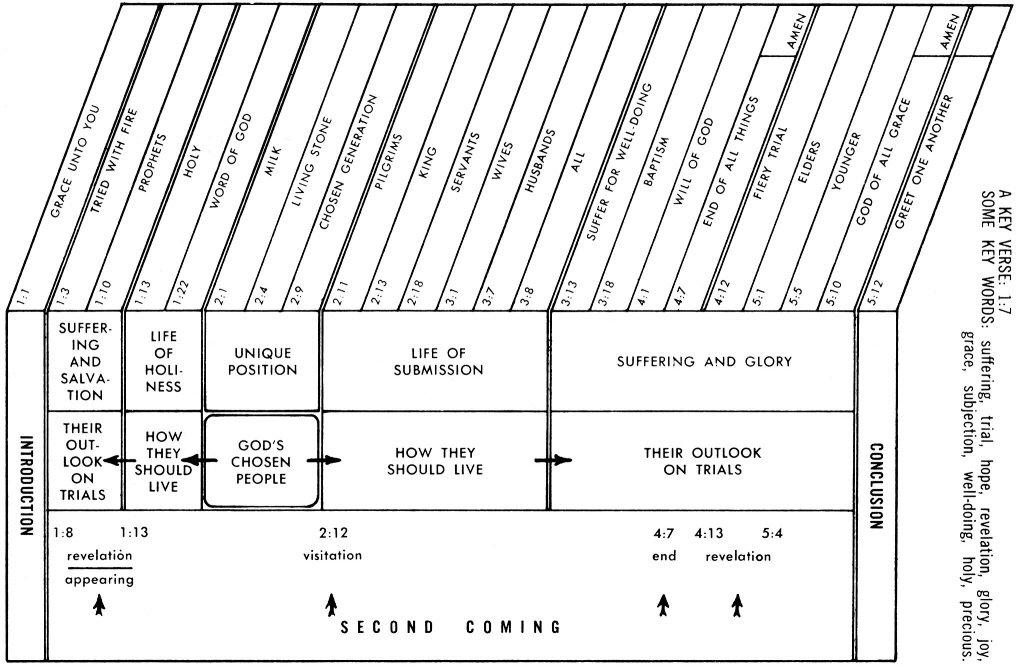
1 Peter: Trials, Holy Living & The Lord's Coming
Click chart to enlarge
Chart from Jensen's Survey of the NT - used by permission
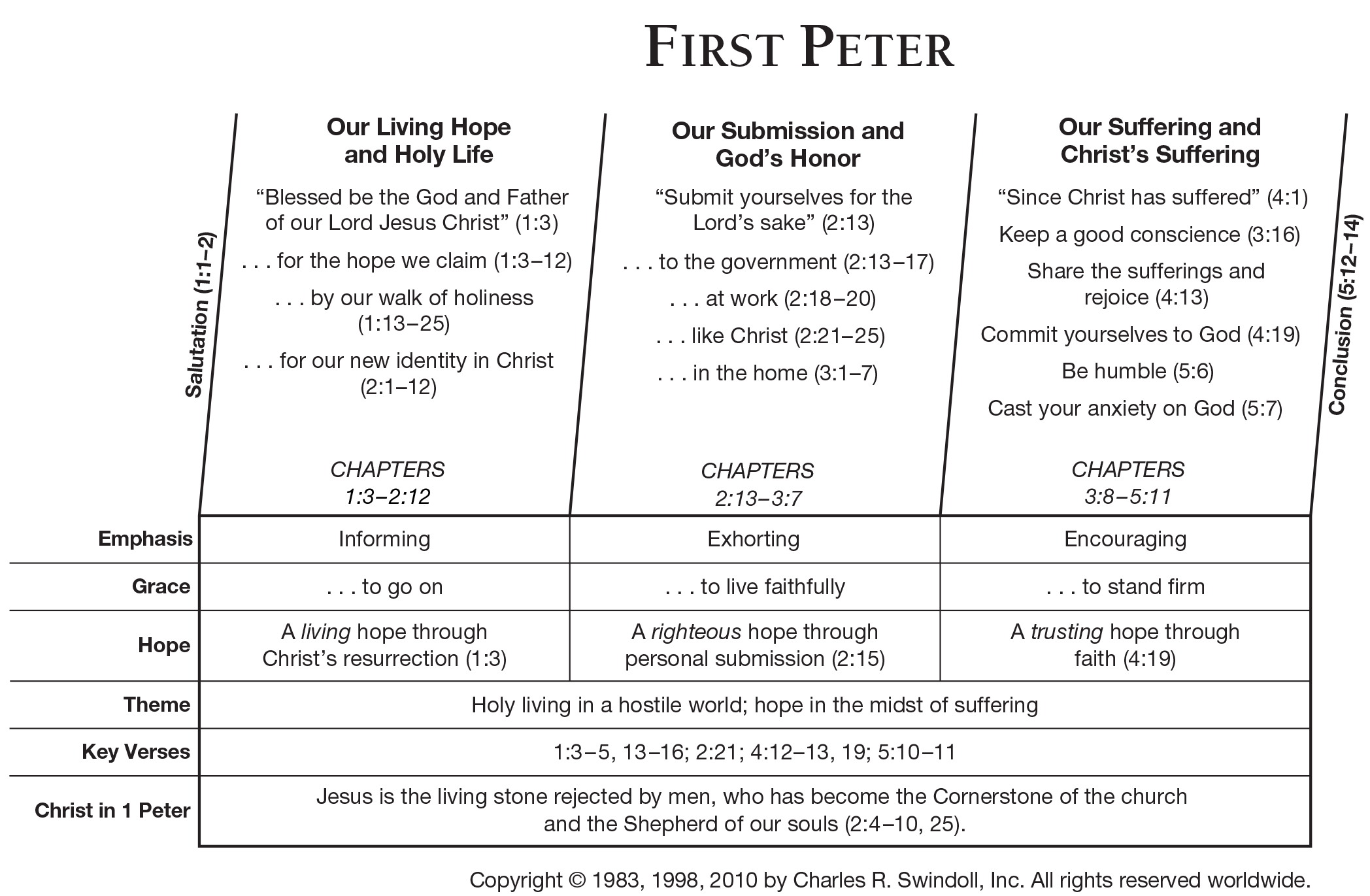
See Another Chart from Charles Swindoll
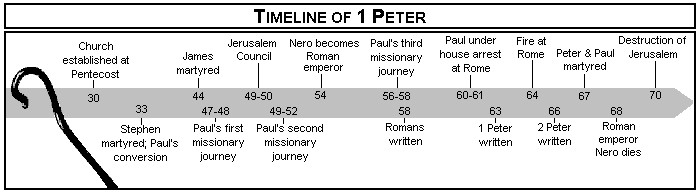
Source: Borrow Ryrie Study Bible
Click to enlarge
| Salvation of the Believer 1 Pe 1:1-2:12 |
Submission of the Believer 1 Pe 2:13-3:12 |
Suffering of the Believer 1 Pe 3:13-5:14 |
||||||||
| Salvation 1Pe 1:1-1:12 |
Sanctification 1Pe 1:13-2:12 |
Submit to Government 1Pe 2:13-17 |
Submit in Business 1Pe 2:18-25 |
Submit in Marriage 1Pe 3:1-8 |
Submit in all of life 1Pe 3:9-12 |
Conduct in Suffering 1Pe 3:13-17 |
Christ's Example of Suffering 1Pe 3:18-4:6 |
Commands in Suffering 1Pe 4:7-19 |
Minister in Suffering 1Pe 5:1-14 |
|
| Belief of Christians | Behavior of Christians | Buffeting of Christians | ||||||||
| Holiness | Harmony | Humility | ||||||||
|
Adapted from Bruce Wilkinson and Kenneth Boa's Talk Thru the Bible (borrow) |
||||||||||
1 Peter 4:1 Therefore, since Christ has suffered in the flesh, arm yourselves also with the same purpose, because he who has suffered in the flesh has ceased from sin, (NASB: Lockman)
Greek: Christou oun pathontos (AAPMSG) sarki kai humeis ten auten ennoian hoplisasthe ( 2PAMM) hoti o pathon (AAPMSN) sarki pepautai (3SRMI) hamartias,
KJV: Forasmuch then as Christ hath suffered for us in the flesh, arm yourselves likewise with the same mind: for he that hath suffered in the flesh hath ceased from sin;
NET: So, since Christ suffered in the flesh, you also arm yourselves with the same attitude, because the one who has suffered in the flesh has finished with sin, (NET Bible)
Young's Literal: Christ, then, having suffered for us in the flesh, ye also with the same mind arm yourselves, because he who did suffer in the flesh hath done with sin,
THEREFORE SINCE CHRIST HAS SUFFERED IN THE FLESH: Christou oun pathontos (AAPMSG) sarki:
- 1 Peter 4 Resources - Multiple Sermons and Commentaries
For Christ also died for sins once for all, the just for the unjust, in order that He might bring us to God, having been put to death in the flesh, but made alive in the spirit (1Pe 3:18)
Therefore looks back primarily to Christ's suffering and death in 1 Peter 3:18 and Peter reiterates that Jesus suffered as a Man and His example and selfless attitude should motivate us to arm ourselves with the same attitude.
Hiebert feels that the "therefore shows that a practical application is being made, but the application is restricted to the point in 1 Pe 3:18. (1 Peter Commentary)
Cornerstone Bible Commentary - On the basis of the exaltation and victory of Christ in 1 Pe 3:18–22 (“So then” [THEREFORE] moves into a conclusion from that paragraph), 1 Pet 4:1 returns to the model of Christ in his suffering. In 1 Pe 3:18 we are told how Christ “suffered” and “died” on our behalf, and 1 Pet 4:1 resumes that emphasis and once more makes this the archetypal example for all Christian reaction to antagonism.
Kenneth Wuest - In 1 Pe 3:18–22 Peter spoke of the sufferings of the Lord Jesus and of His example of patience and submissiveness under unjust treatment. Now, he exhorts the saints to arm themselves with the same mind that Christ had regarding unjust punishment. Our Lord’s attitude toward unjust suffering is found in the words, “It is better, if the will of God be so, that ye suffer for well doing, than for evil doing” (1 Pe 3:17).
Swindoll - With the logical conjunction “therefore” Peter is saying in shorthand, “Now in light of everything I have just written about Christ, I’m going to present you with some practical conclusions.” In the previous section, Peter discussed Christ’s suffering and death to pay for our sins and His resurrection to give us new life. (Swindoll's Living Insights New Testament Commentary – James, 1 & 2 Peter)
Steven Cole adds that "The motivation for holiness comes from the sufferings of Christ (1 Peter 3:18) and His imminent return to judge all people (1 Peter 4:5).
THE EXAMPLE
OF CHRIST
Since Christ has suffered in the flesh - Here Peter is saying that Christ has died as a Man, that He was crucified and died.
Christ "endured the cross, despising the shame" for "the joy that was set before him" (Hebrews 12:2). This same attitude of sacrificing self, enduring patiently, and rejoicing in tribulation will equip us as believers to face false accusations and to resist sinful temptations, even as Christ resisted in the power of the Spirit, the same power we have access to (cf Lk 4:1,2, Acts 10:38). Study this vital related topic - The Holy Spirit-Walking Like Jesus Walked!
Christ (5547)(Christos from chrio = to rub or anoint, consecrate to an office) describes one who has been anointed with oil, one who has been consecrated. The majority of the NT uses refer to Jesus (exceptions = "false Christs" - Mt 24:24, Mk 13:22).
Suffered (3958)(pascho) means essentially what happens to a person experience. It means to undergo something; to experience a sensation, to experience an impression from an outside source, to undergo an experience (usually difficult) and normally with the implication of physical or psychological suffering.
Flesh (4561)(sarx) in this context clearly refers to His physical flesh, His suffering as a Man.
John Phillips - The Man who now sits enthroned in glory with all power in His hands once lived on earth. He tasted suffering, pain, and death. Peter had seen Him suffer. Moreover, He never shrank from suffering. He knew from the beginning that His path led surely to the death of the cross. He had been born to die. At the age of twelve, He went to Jerusalem. Perhaps He was at a point where He could see the priests busy at the altar. He knew moreover who His real Father was. And He knew what His Father's business was (Luke 2:49). The work He had come to do on earth involved death on a cross (Php 2:5, Php 2:8). Peter was aware of this fact. More than once he had heard the Lord foretell His crucifixion. The first time the Lord had dropped that bombshell, the disciples were stunned. Indeed, Peter had taken it upon himself to rebuke the Lord for entertaining any such thought. Consequently, he had been roundly rebuked himself (Mt 16:21, 22, 23, 24, 25). He had been told to start thinking in terms of the cross himself. Indeed, his own cross was now never far from Peter's mind (2Peter 1:14). He had been arming himself with this thought for years (Jn 21:18,19). (Exploring 1 Peter0
Spurgeon - Brethren, we have a Savior who suffered for us. As the Head was, such must the members expect to be. Let us, then, be resolutely determined that, suffer as we may, we will never turn aside from our Lord; for, inasmuch as we suffered in him, yea, and died in him, we ought to reckon that we are henceforth dead to sin, and that we have ceased from it, and can no longer be drawn into it.
In the flesh - Sarx in this context clearly refers to Christ's physical body. In other words, contrary to what some falsely teach, Jesus was no phantom, but He was fully Man, Who lived a sinless life.
Since He as a Man has died for us. (1Pe 3:18). The design was to set the suffering Redeemer before them as an example in their trials and refers to the Passion and Crucifixion of Christ. He had to suffer (He 2:9, 10, He 5:8) because of sin. And so our Lord came to earth to deal with sin and to conquer it forever. He dealt with the ignorance of sin by teaching the truth and by living it before men’s eyes. He dealt with the consequences of sin by healing and forgiving; and, on the cross, He dealt the final deathblow to sin itself. He was armed, as it were, with a militant attitude toward sin, even though He had great compassion for lost sinners. When He died, we died (co-crucified with Him - see Ro 6:3; Ro 6:4, 5; Ro 6:6; Ro 6:14, Galatians 2:20). Therefore how can we enjoy that which made Jesus suffer and die on the cross (cf attitude in Ezekiel 9:4-see notes)? We have been spiritually circumcised and have been given a new heart (with a new motivation, a new power, His Spirit of holiness to lead us). And specifically believers in light of Jesus' suffering should be motivated to deal decisively with sin, for He dealt the death blow to sin for us when He suffered and died on the Cross. Believers are now dead to the power of sin positionally and thus are free from its power to control us. Sure we still sin, but now we make the conscious choice to sin. Peter says now we need to make the conscious choice to cease from sin. Sin is destructive, deceptive, decay producing and death dealing. In light of our Savior's unjust suffering in our place and as our substitute, we should hate sin, for it was sin that took our Lord Jesus to the Cross.
ARM YOURSELVES ALSO WITH THE SAME PURPOSE: kai humeis ten auten ennoian hoplisasthe (2PAMM):
- Arm yourselves - Ro 13:12-14; Php 2:5; Heb 12:3
- 1 Peter 4 Resources - Multiple Sermons and Commentaries
THE EXHORTATION
TO BELIEVERS
Peter has just given us the perfect Example and now gives us the pertinent Exhortation ("Arm yourselves").
First note that the NAS is probably not the best translation especially the use of the word "purpose." Here are several other translations which are a more accurate translation of the Greek noun ennoia:
- KJV "arm yourselves likewise with the same mind."
- ESV " arm yourselves with the same way of thinking."
- HCSB "equip yourselves also with the same resolve."
- NIV "arm yourselves also with the same attitude."
Arm yourselves - Peter issues a "military like" command in the aorist imperative. The idea is "Do this now without delay!" As is always the case in Scripture the imperatives (commands) are preceded by the indicatives ("mood of reality" - the declarative indicative gives a statement of fact - in this case "Christ has suffered").
Swindoll - In light of our relationship to Christ’s saving work, Peter urges his readers: “Arm yourselves also with the same purpose” of dying to the old and living for the new. (Ibid)
Reformed Expository Commentary - When Jesus submitted to death on the cross, he defied the instinct of self-preservation. We can and must make the same break, even if we don’t face a clear test such as persecution. (1 Peter)
This phrase brings out the force of the Greek, which conveys the metaphor of going out to battle after putting on armor (cp similar metaphor [fleshly lusts which wage war against the soul.] in our continual war against the lusts of the flesh in 1 Pe 2:11). Don't miss Peter's implication beloved. You are involved (whether you like it or not) in a relentless war with the world, the flesh and the devil, so you had better arm yourself!
If we put on or adopt the same frame of mind as Jesus had, we shall find that we have protected ourselves (our heart and mind, cf Proverbs 4:23-see notes) against the attacks of temptation (Eph 6:17, 1Th 5:8) The picture is that of a soldier who puts on his equipment and arms himself for battle. Our attitudes are weapons, and weak or wrong attitudes will lead us to defeat.
To be forewarned is to be forearmed.
Arm (3695) (hoplizo from hoplon = weapon) basically means to make ready or prepare, with a focus upon the process of equipping. Hoplizo is fouind only here in the NT. In Greek it was used from Homer down meaning to arm, to furnish with arms or to provide. In the case of soldiers it means to equip one's self with weapons. This verb was used of a Greek soldier preparing himself for the coming battle by putting on his armor.
The noun hoplon was used for a soldier who was heavily armed with javelin and large shield and so the picture is that this soldier is heavily armed. Peter is not speaking of literal weapons or armor but uses hoplizo figuratively to convey the idea of arming oneself with a mind or thought in preparation for suffering. Remember the way you think determines how you act (and react).
Wuest comments that hoplon "was used of a heavy-armed footsoldier who carried a pike and a large shield,,,The Christian needs the heaviest armor he can get, to withstand the attacks of the enemy of his soul.
Paul uses hoplon three times as a military metaphor...
Romans 13:12 The night is almost gone, and the day is near. Therefore let us lay aside the deeds of darkness and put on the armor (hoplon) of light.
2 Cor 6:7 in the word of truth, in the power of God; by the weapons (hoplon) of righteousness for the right hand and the left,
2 Cor 10:4 for the weapons (hoplon) of our warfare are not of the flesh, but divinely powerful for the destruction of fortresses.
Swindoll quips that "Peter’s point is clear. Christ didn’t send us into the world as vacationers on a self-guided tour of a playground but as soldiers on a tour of duty in a battlefield. We’re not called to kick back, relax, take in the scenery, and wait for our Guide to take us home. We’re engaged in a fierce conflict on foreign soil. We need to arm ourselves with spiritual armor to withstand the temptations of this world. Peter says if you have been conformed to Christ’s death and resurrection, the power of sin has been broken (4:1). Because the old person you used to be has died with Christ, you are now free to live with Christ." (Ibid)
Phillips notes that "Peter does not use the Greek word for light armor here but the word for heavy armor. We need all of the protection we can get to prepare ourselves for the battles ahead. God does not promise to carry us to the skies on flowery beds of ease. God does not hand out colorful brochures offering good health, prosperity, wide popularity, and a long life to those who accept Christ. Those who array themselves in such flimsy robes are in for a shock. Peter had long since learned to arm himself for battle. When he had been arrested years before in Jerusalem and sentenced to death, he simply went to sleep in his prison! He was not only a conqueror but also "more than conqueror," as Paul would have put it (Ro 8:37). He had learned how to arm his mind. (Phillips, John: Exploring Ephesians: An Expository Commentary)
The verb arm in aorist imperative which calls for a decisive choice to effectively accomplish this action and implies an urgent and immediate call to do so. Peter is commanding the reader to adopt the attitude of Christ -- equip or arm yourself with this most appropriate tool or weapon -- an attitude similar to that which Christ (cp similar thoughts about preparing our minds - gird your mind - 1 Peter 1:13 , keep sober in spirit - see 1Pe 5:8, cp Ep 6:14, 2Ti 2:3, 4) Why the mind? What is the important point? The world make look like the battleground for believers (and it is) but the real war takes place in our mind where the battle is over truth. We are in a truceless war (Ro 13:12, 2Cor 6:7, 2Co 10:4, 1Pe 2:11). Peter also uses of the middle voice which calls his hearers to a personal responsibility in doing the arming. The idea is you arm yourself. Only girded with this mindset can you be victorious in the conflict. Fiery trials awaited them and similar trials await each one of His disciples who seeks to walk worthy of the gospel to which we were called.
Nicholson - The call to arms anticipates a conflict. There is attack which comes from without, by opposition and false accusation. A subtle and much more dangerous one is that which arises from within; that is the evil subterfuge that finds a field of operation in the flesh of the believer (Rom 7:23). Against this, the only safeguard is to be "armed" with the mind of Christ. The cognate noun hoplon is used, in the plural, for actual weapons in John 18:3 (What the Bible teaches - What the Bible Teaches – 1 Peter through Jude)
OUTLOOK
DETERMINES
OUTCOME
Outlook determines outcome, and a believer must have the right attitudes if he is to live a right life. Since this is a constant struggle we need to be properly motivated and that is what Peter is doing in this section, teaching that we can be motivated by the truth that our Lord also suffered and also by the certainty of His imminent return to judge the living and the dead.
Yourselves - humeis = you is plural and is first in this clause for emphasis. You yourselves is the idea.
With the same purpose - As discussed a better way to translate this word would be intention. What Peter is showing us is that righteous living begins right thinking (intentions).
Purpose is better translated "mind" (He 4:12) and indicates an attitude, viewpoint or resolve that expresses itself in determined action. Attitude determines action. Peter says we are to have the same attitude about suffering for righteousness sake as did the Righteous One. The idea of arm is "put on the same armor", "arm yourselves with the same insight." Christ had perfect insight into the true nature of Sin and its consequences and this led Him to deliberately set His face like flint (Isa 50:7) toward Jerusalem and the Cross (Lk 9:51) and so too must we (Lk 9:23, Mk 8:34, 35, 36)
If anyone would come after me, he must deny himself and take up his cross and follow me (Mt 16:24).
Broadman Bible Commentary – The Christian looks to the innocent suffering of his Lord. He sets his mind on one goal. If his own life in opposition to evil is to involve suffering, he will accept that suffering.
MacArthur - The Christian should be armed (terminology that realizes a battle) with the same thought that was manifest in the suffering of Christ, namely that one can be triumphant in suffering, even the suffering of death. In other words, the Christian should voluntarily accept the potential of death as a part of the Christian life (cf. Mt 10:38, 39; 2Co 4:8–11). Peter would have his opportunity to live this principle himself, when he faced martyrdom (see Jn 21:18, 19). (Study Bible)
Purpose (1771) (ennoia from en = in + noús = mind) is literally "in mind" and so refers to a thought, principle, counsel, resolve. The principle of thought and feeling here referred to is that of the dying life voluntarily accepted and put on as armor, and finding expression in the meek & courageous pursuit of the spiritual life. This word deals with forming motivations.
Nicholson adds "The "mind" (ennoia) signifies "primarily a thinking ... [and] denotes purpose" (W. E. Vine). It is translated "intents" in Heb 4:12. It is the thought, clothed with the intent or resolve. In the context, arming oneself with the mind of Christ is the intent, if suffering for righteousness' sake, to endure it submissively and with patience, recognising God's sovereign purpose will prevail. The mind of Christ is "the temper of patient submission and unwavering trust in the wisdom and love of the Father" (E. H. Plumptre). (What the Bible Teaches – 1 Peter through Jude)
The only other NT use of ennoia is in Hebrews...
For the word of God is living and active and sharper than any two-edged sword, and piercing as far as the division of soul and spirit, of both joints and marrow, and able to judge the thoughts and intentions (ennoia) of the heart. (See note Hebrews 4:12)
Comment: Here the point is that God’s Word discerns morally questionable motivations of our hearts.
Richison makes an excellent point that "Every time we resist temptation, we become more equipped to resist the next temptation. Each time we conquer sin makes us better able to face the next attack. As we build momentum of conquering sin, we become more spiritually mature. Spiritual maturity guarantees infrequency of sin in our lives. (1 Peter 4:1b)
H Mears - Such a high resolve will involve a measure of actual suffering, for God’s will may cut across our desire to gratify some bodily craving. Very few in this world escape suffering, either mental, physical or spiritual. We cannot choose the way we shall suffer. Often God allows us to go through life denied the one thing we wish more than anything else. But we should be comforted in this that whom God loves, He chastens. If He grinds down the surface of our lives, it is that the stone may shine the more brilliantly. The many facets of the diamond are what make it dazzling.
THOUGHT - What is your attitude toward sin? Have you armed yourself? Are you willing to suffer for righteousness sake?
Teacher's Outline and Study Bible on arm yourselves... - The mind of Christ, the very same mind that delivered and saved Christ. Christ kept His mind and thoughts upon righteousness and salvation. Therefore, Christ gave Himself up—denied Himself—and suffered for us. We must do the same: we must keep our minds upon righteousness and salvation. We must die to self and suffer for Christ. We must become identified with Christ in His self-denial and suffering of death. We must identify with Him by denying ourselves and suffering for His name. Jesus Christ denied the desires of the flesh in order to please God and to save us. We are to do the same; our minds and thoughts are to be armed, that is, clothed, with the very armor of Christ's mind. (1 Peter: The Teacher's Outline and Study Bible)
Jack Arnold on arm yourselves with the same purpose - When the Christian is undergoing suffering of any kind he needs to arm himself with heavy armor. The armor (protection) of a Roman infantryman was a shield and a pike (spear) or sword. The shield provided defensive protection while the pike or sword provided offensive thrust. Notice carefully it says a Christian must arm himself, so this is something he must do to defeat the enemies of his soul—the world, the flesh and the devil. Christians must arm themselves with faith in the commands, promises and principles of the Word of God, and to do this they must know, memorize and meditate on them. When we are not saturated with God’s Word and operating on faith, our shield goes down and we are laid open to the subtle attacks of the world, the flesh and the devil. (Psalm 119:9, 11). The Word must also be used offensively to penetrate the enemy just like the sword or the pike was used to get to the enemy before he got to the soldier. The best defense is still the best offense, and when we are using the Word of God, we are pushing back our enemies—the world, the flesh and the devil. Paul made it clear that we must have a sword as well as a shield to defeat the enemy. “In addition to all, taking up the shield of faith with which you will be able to extinguish all the flaming missiles of the evil one. And take the helmet of salvation, and the sword of the Spirit, which is the word of God” (Eph. 6:16-17). When our Lord was being tempted by the devil, Christ used the word of God to turn him back. Quoting from Deut. 8:3, Jesus said to Satan, “Man shall not live on bread alone, but on every word that proceeds out of the mouth of God.” Christ used the Word as a sword to push back the enemy, Satan. Peter goes on to say that Christians are to arm themselves “with the same purpose” (thought, mind) of Christ in the face of suffering. We are to have the mind of Christ in suffering; that is, we are to view suffering as Christ viewed it. It is our attitude in suffering which will determine how we are going to come out of it in the end. If we do not have a right attitude, then we are going to fail and learn nothing from a suffering experience. How did Christ look at suffering? He looked at it through the eyes of God. He had a divine viewpoint, not a human one. How then do we get the mind of Christ in suffering? We must know God’s Word and apply it to our lives by faith. To be forewarned is to be forearmed. We are to prepare ourselves for suffering by knowing God’s Word, operating on faith daily, and scrutinizing the example of Christ, so that when suffering comes we will be prepared for it, able to handle it and learn from it the lessons God wants us to learn. We must apply doctrine to experience by faith so as to have a positive mental attitude or the mind of Christ in suffering. (1 Peter 4:1-6)
BECAUSE HE WHO HAS SUFFERED IN THE FLESH HAS CEASED FROM SIN: hoti o pathon (AAPMSN) sarki pepautai (3SRMI) hamartias:
- Because Ro 6:2,7,11; Gal 2:20; 5:24; Col 3:3, 4, 5
- Ceased from Isa 1:16; Ezek 16:41; Heb 4:10
- 1 Peter 4 Resources - Multiple Sermons and Commentaries
A DIFFICULT VERSE
TO INTERPRET
Because (hoti) - Term of explanation. Peter gives the reason for the exhortation.
Suffered (3958) (pascho) means essentially what happens to a person experience. It means to undergo something; to experience a sensation, to experience an impression from an outside source, to undergo an experience (usually difficult) and normally with the implication of physical or psychological suffering. Pascho can refer to experiencing something pleasant, but in the present context (and most NT contexts) it refers to experiencing something trying, distressing or painful.
John MacArthur writes regarding suffering that "Some experts state that approximately 200 million Christians worldwide face the continual threat of harassment, torture, and even death because of their faith in Jesus Christ. It is believed that more followers of Christ were martyred in the 20th cent than in the previous 19 centuries combined."
This is a difficult passage there are several possible interpretations of "because he who has suffered in the flesh has ceased from sin." Below is an attempt to summarize the main possibilities. I initially attempted to place the various interpretations into one of the categories but found it confusing as some commentators or pastors "combined" interpretations. In summary, in my opinion these explanations are not all easy to understand, but are provided to give you an example of the difficulty of this passage and hopefully aid your personal interpretation.
(1) Suffering purges a believer from sin...
Cole argues against this interpretation noting that "The main problem with this view is that the verb “ceased” is in the perfect tense, meaning that it was completed in the past with ongoing results. How could any suffering (except for physical death) result in a complete, ongoing cessation from sin?"
(2) The clause refers to the believer’s physical death.
Steven Cole explains "This view takes the phrase “suffered in the flesh” as parallel to the same phrase as applied to Christ. The idea is, then, that since at death believers will be completely through with sin, as Christ was at His death (1Pe 3:18), they should now live the rest of their lives no longer for the lusts of men, but for the will of God. The main problem with this view is that it seems like an awkward way to say that."
(3) The clause is similar to Paul’s teaching in Romans 6 - as a result of our union with Christ we are dead to sin.
(4) This phrase refers to Christ with application to believers. (1 Peter 4:1-6 Intent On Holiness)
Steven Cole
The fourth view takes the phrase to refer to Christ with application to believers. This view takes the first participle (“Christ has suffered in the flesh”) as the antecedent to the second anonymous participle (“he who has suffered in the flesh”), which is parallel to it. It is the only view that adequately explains the singular form of the second participle. The second phrase is parenthetical and explanatory: Christ’s suffering in the flesh ended His relationship with sin once for all. Believers, by way of application, are to arm themselves with the same holy intent. They will not be sinless until they die; but, as verse 1Pe 4:2 explains, they can live the rest of their lives for the will of God rather than for the lusts of men.
The main problem with this view is that it seems to imply that since Christ ceased from sin, before that He was a sinner. But it need not mean that. Already Peter has twice affirmed Christ’s sinlessness (1Pe 2:22; 1Pe 3:18). But His purpose in coming to this earth was to be identified with sinners by taking on the likeness of sinful flesh (Ro 8:3) and bearing our sins in His body on the cross (1Pe 2:24). Paul even states it so strongly as to say that He who knew no sin was made sin on our behalf (2Co 5:21). So Peter here means that once Christ bore our sins, He was through with sin. Since Christ died for our sins once for all (1Pe 3:18), the direction of our lives should be to arm ourselves with the decisive intent to be through with sin, to live for God’s will, not for the lusts of men. I realize that all this is rather complicated. Let me try to cinch it down on a practical level with a familiar illustration. Suppose a woman’s husband was killed trying to save her from the attack of a rapist who was infected with AIDS. It would be absurd for the woman, after her husband’s funeral, to call up the rapist and say, “Let’s meet at a motel.” Having been rescued from that which would destroy her, why would she want to go back to it? Peter’s argument is, since Christ gave Himself to deliver us from the sin which would destroy us, why go back to live in it? Christ’s suffering for our sin should motivate us to holy living.
Jack Arnold
The “he” in this verse (he who has suffered in the flesh) seems to refer to Christ instead of the Christian, although the application is to the Christian. The word “ceased” means “to make an end of by death.” Christ suffered (died) once and for all that in His death He might cause sin to cease once for all. In His perfect and complete death on the cross for all sin, Christ died for the one purpose of defeating sin or delivering men from sin. Jesus died, was buried, and was resurrected to prove that He defeated sin, causing it to cease in that it will never reign as king again and will one day in the future be wiped off the face of the earth. (Sermon)
Edmund Clowney
It is possible that in the last half of 1 Pe 4:1 Peter is still speaking of Jesus: he who has suffered in his body is done with sin. In any case, Peter applies this principle to us. We are to arm ourselves with a thought that is decisive for our new manner of life. Christ’s mortal suffering ended his conquest of sin and ushered in his resurrection life. Peter has already shown the connection with us: Jesus bore our sins in his body on the tree so that we, having died to sins, might live to righteousness (1 Pe 2:24). In that passage, too, Peter spoke of an event in the past that marks the end of sin and the beginning of a life of righteousness. When Christ died to sin in our place, we died to sin, just as when He rose, we were given new birth (1 Pe 1:3). Our decisive ‘suffering in the body’ is that death which we share with Christ who suffered in the body for us. Baptism (ED: SPIRITUAL - Ro 6:3) marks our union with Christ in His death and resurrection (1 Pe 3:21). It is nothing less than death that separates us from a life of sin. When Peter encourages us to arm ourselves with this thought, he is saying in his way what Paul, too, tells us: "Now if we died with Christ, we believe that we will also live with him ... The death he died, he died to sin once for all; but the life he lives, he lives to God. In the same way, count yourselves dead to sin but alive to God in Christ Jesus. Therefore do not let sin reign in your mortal body so that you obey its evil desires." (Ro 6:8-12) (The Bible Speaks Today – The Message of 1 Peter: The Way of the Cross)
Kenneth Wuest
The words “suffered in the flesh” are in the same construction as the similar phrase “being put to death in the flesh” (1 Pe 3:18). In the latter expression we found that Peter was speaking of the fact that our Lord was put to death with respect to the flesh, thus suffering with respect to the flesh. This suffering was the result of unjust treatment. The same holds true in 1 Peter 4:1 where the Christian who has suffered in the flesh is the Christian who has suffered ill-treatment from the persecuting world of sinners. The fact that he has been persecuted is an indication of another fact, namely, that he has ceased from sin. The world directs its persecution against those who are living lives of obedience to God, thus those who have ceased from sin. The verb is passive. Literally, the Christian “hath got release” from sin. God broke the power of sin in his life when He saved him. Thus our reaction to unjust suffering should be that of a saint, not a sinner, since we have in salvation been released from sin’s compelling power.
C H Spurgeon
“I beg you to remember that there is no getting quit of sin – there is no escaping from its power – except by contact and union with the Lord Jesus Christ.
Brethren, we have a Savior who suffered for us. As the Head was, such must the members expect to be. Let us, then, be resolutely determined that, suffer as we may, we will never turn aside from our Lord; for, inasmuch as we suffered in him, yea, and died in him, we ought to reckon that we are henceforth dead to sin, and that we have ceased from it, and can no longer be drawn into it. “He that hath suffered in the flesh hath ceased from sin:”
Ray Summers
This commitment to suffering in one’s opposing evil means that he has ceased from sin as a way of life. Sin no longer is the dominating force in his life. (Broadman Bible Commentary)
Daniel Doriani -
The Greek verb translated “is done” means “to stop, cease, or have finished” with something.
That means that when we identify with Christ in his suffering, we break with sin globally. A willingness to suffer for the faith, for our convictions, is galvanizing. It is empowering to suffer for the Lord. A willingness to suffer proves our faith real. One secular historian noted, “A religion of compromise would not … have been a Christian religion.”
When we stay with Jesus at the cost of physical or material suffering, we follow him. The very willingness to suffer shows that we have made a break with sin in its essential selfishness. We see that there is more to us than rhetoric, that we do put the Lord ahead of self. (Reformed Expository Commentary – 1 Peter)
Stanely Gundry
“You too arm yourselves with the same mindset” implies that Christ had a mindset that made him determined to do good (the good of bringing people to God [3:18 again]) despite having to suffer for it. Peter portrays this mindset as armor which enables Christians as imitators of Christ to withstand persecution, even persecution inflicted on their flesh in addition to verbal abuse and ostracism by non-Christians. “As to flesh” draws a parallel with Christ’s having been put to death “as to flesh” (3:18 yet again). A Christian hasn’t ceased from sin because he suffered physically. Just the reverse: he has suffered physically because he ceased from sin; and since cessation from sinning provokes non-Christians to persecute him, he needs to arm himself with Christ’s mindset. Moreover, ceasing from sin at conversion results in living from that point on for God’s will (that is, to do it) rather than for the lusts that human beings act on unless they’re converted. The shift from sinning to carrying out God’s will provides the reason why Christians need to arm themselves with Christ’s mindset. (Commentary on the New Testament: Verse-by-Verse Explanations with a Literal Translation - Baker Academic)
Grant Richison
By arming ourselves with the mind of Christ we will no doubt suffer the same suffering of Jesus. He suffered in the body and so will the Christian. If we suffer like Jesus suffered, we cease from sin. When we identify with Christ’s suffering, we free ourselves from sin. God expects us to make a clean break with habitual sinning. “Cease” means to stop, to make an end. When we think like Jesus thought, our sinful thinking comes to an end. This verse does not say that the Christian has ceased completely from sinning for that would be sinless perfection. No Christian can reach a stage of sinless perfection, but can come to a place of victory over sin. This verse says that the Christian has ceased at a point in the past with the results going on (perfect tense). God gave us release from sin when we received Christ as Savior. God broke the power of sin at Christ’s death. We can translate “cease” as “has been made to cease.” We have been made to cease from sin in the death of Christ. We do not fight for victory over sin because Christ has already won the victory. We fight a victory already won (Romans 6:6–11, esp. Ro 6:7). God gave us release from sin by Christ’s final suffering for sin. We react to undeserved suffering as a saint, not a sinner. It is God who gave us release from sin. God broke the power of sin by Christ’s death. Also, God did not free from sins (plural) but from “sin” (singular). Sin in the singular is the depraved capacity for sin that we received when born into this world. The potential for sin is always present in that nature because it never improves, never alters or changes. It cannot improve by education or refinement. Dead men do not sin. We lose our tenderness toward Christ if we do not deal decisively with sin. He died to deal with sin and he dealt with it decisively on the cross. If we do not deal with it ourselves, sin will invade our daily relationship with Him. We deal with sin first in our mind, not by outward rite of religion. Our natural mind is dark and alienated from the life of God (Ephesians 4:18). That make us disingenuous with God. We are blind to our own wicked motivations until we deal with sin. Some of us are so dull spiritually that we do not even recognize what springs from our sin capacity. Spiritual callousness sets in our soul and we become immune to deal with deadly sin in our lives. We cannot know the will of God while in this shape. We remain under the jurisdiction of the old taskmaster of the sin capacity. A Christian who gets out from under this taskmaster makes a clean break with the momentum of sin. To take orders from the old slave master is to act out of character, like wearing a mask. Identification with Christ’s finished suffering sets up a compatibility with Christ that makes it difficult for us to sin. A man just released from the army has his discharge papers. He is now a civilian and free from the authority of the army. As he walks out of the gate of the military base he meets his sergeant who snarls: “Get in the kitchen and do the dishes.” Out of force of habit he may have a tendency to obey but then he remembers that he has his papers so he says, “Oh no, you have no more authority over me. I have my discharge papers.” When the sin capacity orders us to do something, we need to realize that we have a new boss. His name is Jesus. Whenever we sin, we act out of character. Alas, we do act out of character. When we do this we fail to appropriate the finished work of Christ to the sin master of our lives. (1 Peter 4:1 1 Peter 4:1b 1 Peter 4:1c 1 Peter 4:1d)
J Vernon McGee
I must confess that I have recently been given new insights into this verse. Over the years it is a verse that has disturbed me a great deal, and I have never gone into a great deal of detail in my teaching on it. I have been rather amazed to discover that other commentators have likewise more or less bypassed it rather than dealing with it in detail. I trust that the Spirit of God will give us an understanding that will make this verse helpful to us.
“Forasmuch” refers us back, I believe, to 1 Peter 3:18, “For Christ also hath once suffered for sins, the just for the unjust, that he might bring us to God, being put to death in the flesh, but quickened by the Spirit.” These two verses go together, and this is again a reminder that in His human body Christ not only endured pain but He was actually put to death in the flesh.
In recent years there was a very popular book, When God Died, as well as a popular theology which said, “God is dead.” Well, God never died, my friend, and He is not dead today—He hasn’t even been sick. Christ died in His human body, which He took yonder at Bethlehem. As the writer to the Hebrews put it, He was “in all points tempted like as we are.” He knew what it was to suffer. He knew what it was to bleed. He knew what it was to shed tears. He knew what it was to be brokenhearted. He was perfectly human, and He died in that human body.
Christ brought an end to His relation to the sins of man when He died on the cross because He bore the penalty for sin in His own body. We are told back in 1 Peter 2:24, “Who his own self bare our sins in his own body on the tree, that we, being dead to sins, should live unto righteousness: by whose stripes ye were healed.” Three times (1 Pet. 2:24; 3:18; 4:1) Peter says that it was in His flesh and in His body that Christ paid the penalty for man’s sin. That leads me to say this: Christ did not die in sin, nor did He die under sin, but He died to sin. He took my place, He took your place, and He paid the penalty for our sin. From that point on, Christ will not come back to die for sin. He will no longer have any relationship to sin Himself because of the fact that He arose from the dead. When He came back from the dead, He came in a glorified body. He was “quickened by the Spirit,” or “made alive by the Spirit” is the better translation (see 1 Pet. 3:18). He has a life that now lives in a body. He is up yonder in a body that is completely devoted to the service of God, for He is God and He is in the enjoyment of full and free access to God and to all creation.
Now Christ is able to make over this benefit to us. Peter tells us, “Arm yourselves likewise with the same mind.” “The same mind” actually means “the same thought.” Some people have said that it means resolution, but that is not quite the idea. This refers to the thought which leads to a resolution. This is what Paul spoke of when he said, “Let this mind be in you, which was also in Christ Jesus” (Phil. 2:5). “Christ hath suffered for us in the flesh,” Peter says, and those of us who have suffered in the flesh have “ceased from sin.” The translation of the word ceased is a very unsatisfactory one, and this is what had disturbed me about this verse. The Greek word translated as “ceased” is pauo. In the active voice, pauo means “to stop or to cease.” It is used like that in 1 Corinthians 13:8, “Whether there be tongues, they shall cease”; that is, tongues are going to stop, and that is something I have emphasized in my teaching. When I was in Athens, Greece, I took a walk from the Hilton Hotel down to Constitution Square. As I would come to a corner, I would see a sign like our “Stop” sign, only there it said, Pauo. Pauo means “to stop” when it is used in the active voice. An active verb means that the subject does something; a passive verb (or the middle voice in the Greek) means that the subject is acted upon and the subject itself doesn’t do anything. In this verse which we are studying, pauo is in the middle voice or the passive. Therefore Dr.Joseph Thayer, in his lexicon of the New Testament, translates this literally as “hath got release.” In other words if you have suffered in the flesh, you’ve got release from sin. Just what does Peter mean by this? First of all, I would say that God will use suffering to keep you from sin. I am confident that many of us have experienced that personally. Suffering will keep us from sin, but Peter is saying more than that here. Peter says we have got release from sin. That means that God has made an adequate provision for you and me to live the Christian life. Dr. Griffith Thomas has said that in this verse Peter puts Paul’s Romans 6 into a nutshell of just one verse. Romans 6 is that chapter which speaks of the provision God has made for you and me to live the Christian life.
Peter has made it very clear that we have been born again by the Word of God. The Spirit of God using the Word of God will produce a son of God. And that son of God now has a new nature, a new nature that is not going to live in sin.
The Bible’s illustration of this truth, which I use a great deal, is the story of the Prodigal Son (see Luke 15:11–32). The Prodigal Son got down in the pigpen, but, you see, he wasn’t a pig. He had the nature of his father who lived down the road in that wonderful mansion. Because that boy had the nature of his father, he didn’t like eating out of a trough. He didn’t like eating the swill that the swine ate. He enjoyed sitting down at a table covered with a white linen tablecloth and eating with a knife and fork. He liked having a nice steak or prime rib before him, with all the other delicacies, topped off with ice cream. That boy didn’t care for the pigpen for he had the nature of his father.
Peter says you are now identified with Christ. When you came to the Lord Jesus and were born again, the Spirit of God baptized you, that is, He identified you with Christ. Now let that mind, that thought, be in you which is in Christ. Christ is up yonder at God’s right hand in a body totally devoted to the service of God for you and me. Do you think, my friend, if you have really been born again, if you are really a child of God with a new nature, that you can go on living in sin? Now I am a Calvinist and I emphasize the security of the believer. However, I think that there is such an overemphasis on that point that many of our Arminian friends also need to be heard today. This is one reason I feel as kindly as I do toward the Pentecostals; they are preaching a doctrine that has been largely forgotten, the doctrine of holiness. They emphasize that believers should live a holy life for God today. My friend, you cannot be a child of God and go out and live in the pigpen. Let’s face it—if you do, you are a pig. Pigs live in pigpens and they love it, but sons do not love the pigpen.
Peter says that God has made every provision for you: you are born again, indwelt by the Spirit, baptized by the Spirit, identified with Christ, and you can now live life by the power of the Spirit of God. In Romans 7 Paul shows how the Christian is defeated when he lives in the flesh, but in Romans 8 he tells how God has provided the Holy Spirit that we might live by the power of the Spirit. Again I come back to this word pauo. It is not used in the active voice; what we have here is a word that does not mean “cease,” but means “hath got release.” God has made every arrangement for you and me not to live in sin today. It would be impossible for us to live in sin. Oh, the son might go to the pigpen, but you can put this down for sure, he will not stay in the pigpen. One day he has to say, “I will arise and go to my father …” (Luke 15:18).
If you are living in sin today and you are comfortable in it, I would surely question your salvation. Someone may ask, “Can a Christian do this or do that?” He might do it one time, my friend, but if he lives in sin there is something radically wrong. A child of God with a new nature longs to please Christ in all things. This is the reason that I believe the study of the entire Word of God is essential today. I know that I will be accused of playing on an instrument of only one string. Well, since I’m no musician, I have an instrument with only one string on it, and it is this: You need the total Word of God—not just a few little verses to draw out some little legalistic system by which to live the Christian life. You cannot live the Christian life by following rules. You can live the Christian life only by having the mind of Christ, by having the Spirit of God moving in you to please God and to refrain from those things which bring disgrace to Him. (1 Peter 4 Lectures)
Raymond Saxe
R C Sproul
First Peter 4:1 calls us again to look to Christ as our example in suffering. We read that since He suffered in the flesh, that is, since He suffered in His body, we must arm ourselves with the same way of thinking since anyone who suffers in his body has ceased from sin. As the second Adam, Jesus had to break decisively with sin for the sake of His people. First Peter 4:1–2 tells us that by suffering for the sake of God’s will, Jesus made this break with sin. He ceased from sin on our behalf, not by renouncing His own sinful past for He was sinless (1 Pe 2:22), but by standing firm in the midst of temptation. He refused to give in to the temptations of Satan to sin and reject the Lordship of the Father (Mt. 4:1–11). Instead of abandoning the cross, He fulfilled God’s will that He die to save His people (Mt 27:41–50). Rather than give in and disobey His Father, our Lord willingly suffered at the hands of the civil authority for doing the right thing. We too must cease from sin by being so willing to do God’s will that we would rather suffer at the hands of the civil authority and society than disobey His will in order to avoid pain. However, we will only be able to completely cease from sin when we enter glory. If by faith we are in union with Christ, if we have partaken of His death through the Spirit, we too have partaken of His resurrection glory and are enabled to do the will of God even if it brings suffering. (Devotional)
Jamieson, Faussett, Brown
hath ceased—literally, “has been made to cease,” has obtained by the very fact of His having suffered once for all, a cessation from sin, which had heretofore lain on Him (Ro 6:6–11, especially, 1 Pe 4:7). The Christian is by faith one with Christ: as then Christ by death is judicially freed from sin; so the Christian who has in the person of Christ died (Gal 2:20), has no more to do with it judicially, and ought to have no more to do with it actually. “The flesh” is the sphere in which sin has place.
Warren Wiersbe
Our goal in life is to “cease from sin.” We will not reach this goal until we die, or are called home when the Lord returns; but this should not keep us from striving (1 John 2:28–3:9). Peter did not say that suffering of itself would cause a person to stop sinning. Pharaoh in Egypt went through great suffering in the plagues, and yet he sinned even more! I have visited suffering people who cursed God and grew more and more bitter because of their pain. Suffering, plus Christ in our lives, can help us have victory over sin. But the central idea here seems to be the same truth taught in Romans 6: We are identified with Christ in His suffering and death, and therefore can have victory over sin. As we yield ourselves to God, and have the same attitude toward sin that Jesus had, we can overcome the old life and manifest the new life. (Bible Exposition Commentary)
John MacArthur
Ceased from sin - The perfect tense of the verb emphasizes a permanent eternal condition free from sin. The worst that can happen to a believer suffering unjustly is death, and that is the best that can happen because death means the complete and final end of all sins. If the Christian is armed with the goal of being delivered from sin, and that goal is achieved through his death, the threat and experience of death is precious (cf. Ro 7:5, 18; 1Co 1:21; 15:42, 49). Moreover, the greatest weapon that the enemy has against the Christian, the threat of death, is not effective.
William MacDonald
Whoever has suffered in the flesh, that is, in the body, has ceased from sin. The believer is faced with two possibilities—sin or suffering. On the one hand, he can choose to live like the unsaved people around him, sharing their sinful pleasures, and thus avoid persecution. Or he can live in purity and godliness, bearing the reproach of Christ, and suffer at the hands of the wicked. James Guthrie, a martyr, said just before he was hanged, “Dear friends, pledge this cup of suffering as I have done, before you sin, for sin and suffering have been presented to me, and I have chosen the suffering part.” When a believer deliberately chooses to suffer persecution as a Christian rather than to continue in a life of sin, he has ceased from sin. This does not mean that he no longer commits acts of sin, but that the power of sin in his life has been broken. When a man suffers because he refuses to sin, he is no longer controlled by the will of the flesh. (Believer's Study Bible)
Brian Bell
Ceased from sin – this refers to a break with a sinful life (listed in 1 Pe 4:3) 1. Ro 6:6,7 knowing this, that our old man was crucified with Him, that the body of sin might be done away with, that we should no longer be slaves of sin. For he who has died has been freed from sin. (or declared righteous) (Sermon)
Gregory Brown
This is one of the most debated texts in 1 Peter. Who is the “he” who suffered? In what way is he “done with sin?” This text has brought considerable debate among scholars. The question is, when verse 1 says “he who has suffered in his body,” who is it referring to, Christ or to believers? If it was referring primarily to believers, it would not seem to fit since suffering does not make us “cease from sin.” Some believers in suffering actually fall farther away from God. There is not the same inconsistency if it is referring to Christ’s sufferings in his body because his death did pay the penalty for sin and break the power of sin over the believer’s life. But clearly, in 1 Pe 4:2, Peter seems to be speaking directly to believers and not Christ since Christ never lived in sin. How should we understand this? Peter seems to be referring to Christ’s suffering in his body and the defeat of sin in believers in verse 1 and then speaking to Christians and how this reality should affect their relationship to sin in the verse 2. This is the same argument Paul uses for believers to stop sinning in Romans 6:4-6 (Semon).
Nelson Study Bible
He who has suffered in this context refers to suffering Christians. has ceased from sin: Those who serve God faithfully in the midst of suffering take on a different attitude toward sin than what they previously held. Sin no longer holds the same grip on them. The phrase has ceased here does not suggest that those who have suffered become sinlessly perfect or that they will never sin again.
NET Note
Has finished with sin. The last sentence in 1 Pe 4:1 may refer to Christ as the one who suffered in the flesh (cf. 1 Pe 2:21, 23; 3:18; 4:1a) and the latter part would then mean, “he has finished dealing with sin.” But it is more likely that it refers to the Christian who suffers unjustly (cf. 1 Peter 2:19–20; 3:14, 17). This shows that he has made a break with sin as 1 Pe 4:2 describes.
UBS Handbook
The last part of the verse (whoever … with sin) is probably a proverbial saying, similar to Romans 6:7: “When a person dies he is set free from the power of sin” (TEV). Suffers physically is the same expression used at the beginning of this verse, but as we shall see later, it is possible that it has a different meaning here. Is no longer involved with sin is literally “has ceased from sin” and may convey three meanings: (1) In a general way, he has no further connection with sin. (2) Taking the verb as middle, the expression conveys an urgent resolve and active determination to stop sinning. (3) Taking the verb with a passive sense, the expression may have the meaning of having been delivered from the power of sin. Against this third interpretation is that sin in this letter primarily refers to an act, and not to a state or to a power which controls people and leads them to do wrong (compare 1 Peter 2:22, 24; 3:18).
The whole proverbial saying itself may be interpreted in different ways.
(a) The sense may be that suffering for what is right purifies the sufferer from sin, since it eradicates the desire or the tendency to commit sin.
(b) Suffering may refer to martyrdom, and martyrdom atones for sin. This interpretation faces two difficulties: first, it is not at all clear that suffering here refers to martyrdom, and secondly, it is difficult to get the meaning of “atoning for sins” from the expression “has ceased from sin.”
(c) The whole saying may refer to Christ instead of to the Christian. This involves taking the Greek word as “that” (see above) instead of “because.” Furthermore, this would mean taking “cease from sin” with the passive sense, that is, freed from the power of sin (see above), since to take it in any other way would give the idea that Christ himself committed sin, a notion which is already denied in the letter (see 1 Peter 2:22; 3:18).
(d) The whole proverbial saying may have reference to the Christian’s experience in baptism. “Suffering” is used metaphorically, referring to the Christian’s experience of “dying” with Christ at baptism, an event which is interpreted negatively as no longer having anything to do with sin, and positively as beginning to live according to God’s will (1 Peter 4:2). Furthermore, “in the flesh” here (compare RSV) must also be taken in another sense, not physically or bodily, but in the sense of “sinful nature,” the unregenerated self, or the person before he is converted and baptized. This self is the one that experiences “death” at baptism. Many scholars hold to this fourth alternative. However, it is not at all certain that “suffered” is used here in a metaphorical sense. It is more natural to take “suffered” and “in the flesh” with the same meaning they had at the beginning of the verse, and it is for this reason that the first of these four alternatives seems to be closest to what the author is trying to say.The proverbial saying then means that anyone who in this life suffers physically has turned his back on sin, and no longer has any desire to keep on sinning.
Hiebert
It is better to adopt the common view that hoti is causal—"because." It specifies the reason for the readers arming themselves. The stated reason may be in the form of a proverbial expression. Beare categorically asserts that the statement is "certainly a proverbial expression, found in a different wording in Romans 6:7—'for he that has died is freed from the claims of sin.'" The expression has been differently understood. Some, like Fronmüller, argue that the expression is "best applied to Christ Himself" as a definition of the preceding call, but that involves the problem of Christ having ceased from sin. Though Christ belongs to the category of the victorious sufferers, He is only indirectly in view here as the One who through His own suffering broke the power of sin and Satan, enabling our victory.
Accepting that the statement specifies a reason, some understand it as a strand of Jewish thought that portrays physical suffering, if rightly borne, as that which can purify the sufferer from sin (which has its seat in the flesh).
Others think the meaning is that physical suffering disciplines the flesh so that it is unable to exert its desires.
Still others understand the statement as a reference to Christian martyrdom that places the believer beyond the realm of further sin.
Another interpretation sees the suffering as a figurative denotation of the believer's union with Christ in death and resurrection as symbolized in Christian baptism. (ED: A "Romans 6 interpretation")
Is done with sin depicts the spiritual state of the victorious sufferer. It carries a note of triumph; he has effectively broken with a life dominated by sin. It need not mean that he no longer commits any act of sin, but that his old life, dominated by the power of sin, has been terminated. The verb, which does not occur elsewhere in the New Testament in the perfect tense, may be viewed as either middle or passive: if middle, it asserts the fact that he "has ceased from sin, has done with sin"; if passive, there is an implied reference to the divine agent who brought the victory, "has been caused to cease from sin." According to either view, the perfect tense records a definite break with sin. The singular means that his old life, dominated by the power of sin, has ended....He who in loyalty to Christ, and in His power, has steadfastly endured persecution rather than join in the wicked practices of the pagan world, has demonstrated that the pursuit of sin in his life has ended.
David Holwick
He who has suffered in the body is done with sin. Several interpretations possible. (1) Jesus is one who suffered. (a) "Done with sin" would mean he did away with it. Peter stresses Jesus' sinlessness. (b) But atonement doesn't seem to be in view. "Done with sin" is unusual for atonement. And note "rest of life" lived for God. (c) Passage is moving focus from Jesus to Christians.
(2) Christians are purified by suffering. (a) "Done with sin" is explained by 1 Peter 4:2. <1> We do not live for lusts, but honor God. <2> Does not have to mean we are perfect, but we are moving away from majoring in sin.(b) Jews saw "flesh" as seat of sin. <1> When we suffer physically our desires are quenched. <2> You focus on what has real meaning.
David Guzik
When a person suffers physical persecution for the sake of Jesus, it almost always profoundly changes their outlook regarding sin and the pursuit of the lusts of the flesh. That one is more likely to live the rest of his time in the flesh not for the lusts of men, but for the will of God. (1 Peter 4 Commentary)
Wayne Grudem
There is a motive for this: they should be willing, like Christ, to suffer for doing right for whoever has suffered in the flesh has ceased from sin. As a general statement, without qualification, this would not be true, for there are many people who have suffered physically and yet still sin very much. Nor is Peter simply saying that physical suffering somehow purifies and strengthens people – it strengthens some, but others become rebellious toward God and embittered. Rather, we must read the sentence in the light of the theme of suffering for doing right which is found in the preceding context (1 Peter 3:14, 16-18). The kind of suffering in the flesh which Peter means is defined by 1 Peter 3:17: 'For it is better to suffer for doing right, if that should be God's will, than for doing wrong.' Therefore whoever has suffered in the flesh has ceased from sin means 'whoever has suffered for doing right, and has still gone on obeying God in spite of the suffering it involved, has made a clear break with sin'. The phrase has ceased from sin cannot mean 'no longer sins at all', for certainly that is not true of everyone who has been willing to suffer for doing right, and several passages in Scripture rule out the idea that anyone can be absolutely free from sin in this life (1 Ki 8:46; Prov. 20:9; Eccl. 7:20; Jas 3:2; 1 John 1:8). It rather means 'has made a clear break with sin', 'has most definitely acted in a way which shows that obeying God, not avoiding hardship, is the most important motivation for his or her action'. Thus, following through with a decision to obey God even when it will mean physical suffering has a morally strengthening effect on our lives: it commits us more firmly than ever before to a pattern of action where obedience is even more important than our desire to avoid pain. (Tyndale New Testament Commentaries – 1 Peter)
Bruce Barton (this interpretation has some element of interpretation #3 below)
The third and most likely interpretation is that Christians, having died in Christ, are one with him and are legally free from the penalty of sin. They are in union with Christ, so they regard themselves as dead to sin (ED: cf Interpretation #3). Believers are no longer bound by sin's penalty; they must strive, in practice, to be free from its power. Suffering can be helpful in that area. Just as Christ's sufferings led to death and resurrection, so our suffering can help us put sin and selfishness behind us and enter more fully into a new life of service to God. Christ's suffering made him victorious over Satan; believers' suffering, if they follow Christ's example, can strengthen their faith and solidify their obedient lifestyle. Believers ought to "arm" themselves with a resolve to be like Christ when they face suffering....Suffering helps us be like Christ, yet people will do anything to avoid pain. Followers of Christ, however, should be willing and prepared to do God's will and to suffer for it if necessary. We can overcome sin when we focus on Christ and what he wants us to do. Pain and danger reveal our real values. Anyone who suffers for doing good and still faithfully obeys in spite of suffering has made a clean break with sin.(Life Application Bible Commentary – 1 & 2 Peter and Jude)
Peter H Davids
“the one suffering in the flesh has finished with sin.…” Unfortunately, this very phrase which Peter felt was so clear is extremely difficult for us to understand. While many relate it to Rom. 6:7 (“For he who has died is freed from sin,” RSV), the vocabulary there is different enough that no easy equation is possible. Here we are dealing with “suffer,” not “died,” and with “ceased” or “has finished with,” not “is freed from.” 3 More puzzling is the combination of the aorist tense (which often indicates a single completed act) in “suffering” with the perfect tense (which indicates a past event with a continuing present result) in “has finished with.”
A number of explanations have been offered for this phrase: (1) when a person identifies with Christ’s death at baptism, he has finished with sin and its power over him (with Rom. 6:1–12 and 1 John 5:18–19 as parallel ideas); (2) when a person suffers, he breaks the power of sin (which is rooted in his flesh) over his life or atones for the sin in his life; 5 (3) when a person decides to suffer, he has chosen decisively to break with sin; (4) when Christ suffered, he finished with sin (i.e., the phrase does not refer to the Christian at all); 7 or (5) when a Christian suffers (dies), he will, like Christ (3:18), be freed from sin.
While it is obvious that this is a difficult phrase, it seems most likely that (2) and (4) in the list above make the best sense of this clause, and that they are related in that (2) expresses the main point based on the underlying assumption of (4). First, sin in 1 Peter always indicates concrete acts of sin, not the power of sin over people (i.e., the evil impulse or yēṣer for the Jews or the sin principle for Paul). Thus it is not a breaking of a power, but the ceasing of concrete acts that is intended. Second, the desire is to draw out a principle from Christ: he suffered for sin once in the past (i.e., during his life on earth) with the result that he will never have to deal with sin again. 10 Third, this means that dealing with sin and life in the flesh are coterminous; the battle has an ending point. Finally, the point is that once the Christian grasps this insight he will realize from the example of Christ in 3:18–22 that he must live for God now (which means a suffering in the flesh and thus a battling of sin), for that will lead to a parallel victory (a state of having ceased from sin). (NICNT)
Scott McKnight
Some argue that Peter has in mind only the inevitable transfer (seen here as a suffering death) from a sinful to a saved state that takes place at conversion (or baptism), as can be seen in Paul (cf. Rom. 6:1–12) and John (1 John 5:18–19). Others contend that Peter is dealing more generically: The one who suffers physically learns from such experiences not to sin but to value the obedient life.4 A variation of this second view is that the one who suffers has chosen to break definitively from sin. A final view particularizes the phrase “he who has suffered” so that it refers only to the suffering Christ. That is, “he who has suffered” is Christ, and he is the example to whom Peter is appealing. In this context, “is done with sin” means that Christ did away with sin.6
It is hard to decide what evidence counts the most in deciding among these options. I would eliminate the third option (the variation of the second view) because it seems to be little more than a nuancing of the first and second views. Since the first two views are similar except on the precise meaning of “suffer,” it is best to decide between them by examining what “suffer” means in 1 Peter. Clearly, the term refers too consistently to “physical suffering” to expect readers to read this as a conversion term. Thus, the options reduce themselves down to who is suffering. Is it Christ? Or is it the Christians?
In my judgment, since Peter has moved in this verse from Christ (“since Christ suffered in his body”) to Christians (“arm yourselves also with the same attitude”), it makes more sense to think he is still speaking of Christians in the next clause (“because he who has suffered in his body is done with sin”). Furthermore, the use of “is done with sin” for describing the work of Christ is unusual and inconsistent with Peter’s other expressions for the achievements of the cross (cf. 1:18; 2:21, 24; 3:18). Finally, 4:2 goes on to explain the Christian’s subsequent life; this suggests Peter has the Christian (not Christ) in mind at 4:1b. Thus, the most likely interpretation of this difficult expression is that it refers to Christians who are suffering and that they learn not to sin by undergoing persecution.
However, to be fair to all sides, we do recognize another possibility: that Peter is summing the Christian’s entire life on earth as a life of suffering. In this case, “is done with sin” describes not some state on earth (post-conversion/suffering holiness) but their eternal reward. Just as Christ got to sit down at his Father’s right hand and enjoy his victory, so also will the Christians. While there is some contextual analogy (3:18–22) for this view, 4:2–5 leads the reader to think not in terms of the eternal reward for obedience, but rather in terms of a kind of life on earth—a life not so much of sinlessness, but of obedience. Thus, the theme of 4:2 follows naturally from our interpretation of 4:1b: “As a result, he does not live the rest of his earthly life for evil human desires, but rather for the will of God.” (NIV Application Commentary)
Thomas Schreiner
The most difficult part of the verse is the last phrase, “because he who has suffered in his body is done with sin.” Once again the NIV translates sarx (“flesh”) as “body,” so that the connection between Christ’s suffering and that of believers is preserved. Still the NIV captures the meaning by rendering both as “body.” Some scholars also understand the word “because” (hoti) as an explanation of the word “intention” (NRSV) rather than causal. But a causal meaning seems more likely syntactically. Fortunately, the meaning is not affected significantly either way since a reason is given for why believers should prepare themselves to suffer. Scholars debate, however, on what reason is supplied. Three different interpretations are quite possible.First, the one who suffered could be identified as Jesus Christ. The objection to this view is that Jesus never sinned (cf. 1 Pe 2:22; 3:18), so how could it be said that he had ceased from sin? This interpretation could still be defended if sin is understood in terms similar to Rom 6:8–10. By virtue of his death and resurrection, the power of sin was broken, and Christ ceased to have any relationship with sin. At the cross the sinless one took sin upon himself, but now that he has suffered, he no longer deals with sin. His triumph over it is complete. This interpretation is attractive in that it removes any implication that believers could somehow be sinlessly perfect. It is difficult to see how believers are done with sin in this life, but it makes good sense to say that Christ was done with sin once for all at the cross. Nevertheless, this interpretation should be rejected. It is scarcely clear that the phrase “he who has suffered” refers to Christ. The subject is almost surely believers, for the syntax of the text indicates that those who arm themselves are to be equated with those who suffer. The singular form here is generic and should not be pressed as if the reference were to a solitary individual. The need to posit Christ as the subject can be eliminated if we show that there are plausible ways of speaking of Christians as ceasing from sin without importing any idea that believers are sinless. Both of the following interpretations fit this requirement.
Second, the one who suffers in the flesh refers to Christians, but it should be understood in terms similar to Rom 6:7, “Anyone who has died has been freed from sin.” In Romans 6 believers died with Christ, via baptism, to the power of sin. Similarly, the verse here says that the dominion of sin has been broken in the lives of those who have died with Christ. The advantage of this interpretation is that it coheres with Paul and sensibly explains how believers cease with sin. Still, the interpretation should be rejected.355 We must beware of imposing the Pauline writings on 1 Peter, and the two contexts are quite different. It is apparent in Romans 6 that the believer dies with Christ, but no such language is used in 1 Peter. Indeed, the word “suffered” in the last phrase of v. 1 cannot be equated with dying. As Elliott argues, Paul spoke metaphorically of dying with Christ whereas Peter had in mind actual suffering. We should note that the verb used is “suffer” (paschō), not “die” (apothēnskō). The notion here is not that believers have died with Christ but that they should follow Christ in their daily lives by consenting to suffering. Further, Peter did not use the word “sin” (hamartia) to designate a power, something that is quite common in Paul. The word “sin” in Peter is used of acts of sin (cf. 2:22, 24; 4:1, 8).
The third interpretation is most persuasive. “He who has suffered” refers to believers and relates back to the imperative to prepare themselves for suffering. Peter explained why they should prepare themselves to suffer, seeing the commitment to suffer as evidence that they have broken with a life of sin.359 The point is not that believers who suffer have attained sinless perfection, as if they do not sin at all after suffering. What Peter emphasized was that those who commit themselves to suffer, those who willingly endure scorn and mockery for their faith, show that they have triumphed over sin. They have broken with sin because they have ceased to participate in the lawless activities of unbelievers and endured the criticisms that have come from such a decision. The commitment to suffer reveals a passion for a new way of life, a life that is not yet perfect but remarkably different from the lives of unbelievers in the Greco-Roman world. (New American Commentary - 1 Peter)
Holman NT Commentary
Because he who has suffered in his body is done with sin does not suggest that the believer, because he suffers for doing what is right, will never stumble or sin again. A Christian does not, through suffering, magically vault to the level of moral perfection. Verses 1–2 indicate that believers take seriously their struggle against sin and their commitment to obedience. By following this counsel, you demonstrate to others that obeying God is the most important motivation for your life, more important by far than avoiding hardship and pain. The Amplified Bible’s rendering of this section clearly conveys the meaning Peter wished to communicate: “So, since Christ suffered in the flesh, arm yourselves with the same thought and purpose (patiently to suffer rather than fail to please God). For whoever has suffered in the flesh has done with (intentional) sin—has stopped pleasing himself and the world, and pleases God” (1 Pet. 4:1–2, AMP).
Albert Barnes
For he that hath suffered in the flesh hath ceased from sin. Comp. Notes, Rom. 6:7. To ‘suffer in the flesh’ is to die. The expression here has a proverbial aspect, and seems to have meant something like this: ‘when a man is dead, he will sin no more;’ referring of course to the present life. So if a Christian becomes dead in a moral sense—dead to this world, dead by being crucified with Christ (see Notes, Gal. 2:20)—he may be expected to cease from sin. The reasoning is based on the idea that there is such a union between Christ and the believer that his death on the cross secured the death of the believer to the world. Comp. 2 Tim. 2:11; Col. 2:20; 3:3.
John Piper (his interpretation is place here but is somewhat difficult to pigeon hole)
I'm not completely sure, but I believe what this ("because he who has suffered in the flesh has ceased from sin.") means is that if you trust God enough to suffer for doing what is right (as 1 Pe 3:17 says), then you have made a decisive break with sin. In other words, choose suffering because if you don't, you will choose sin. But if you do, you will prove that your bondage to sin has been broken. Get the thought and the purpose in your head that Christ is worth suffering for; live out that conviction when the choice comes between suffering and sin; and in suffering sin will be defeated and you will be triumphant. If you come to the point where you suffer for righteousness' sake, you have ceased from sin—not perfection, but a clean break with the past of sin. (Sermon)
Reformation Study Bible
has ceased from sin. Some interpret this to refer to the character-building effects of suffering. But the preceding reference to baptism (3:21; cf. Rom. 6:1-10) indicates that Peter is thinking of the union of believers with Christ in His suffering and death, a union particularly symbolized by baptism (Rom. 6:4). Though Christ was always sinless (2:22; 2 Cor. 5:21; Heb. 4:15), He nevertheless fully identified with sinful humanity by coming "in the likeness of sinful flesh" (Rom. 8:3) and becoming subject to temptation, suffering, and death (Mark 1:12, 13; Heb. 2:10; 4:15). Christ "died to sin" (Rom. 6:10) in the sense that after His death and Resurrection He was no longer subject to the power of sin and death. (1 Pet 4:1)
Bob Utley
"because he who has suffered in the flesh has ceased from sin" This phrase can be interpreted in several ways depending on the grammatical form. Christ is our example in suffering innocently, even vicariously (aorist active participle). Believers are now involved in suffering because of their identification with Him.
The main verb can be either middle...or passive...If it is middle it is encouraging believers to be actively involved in not sinning as followers of Christ's example. If passive it is emphasizing the spiritual fact of the believer's deliverance from the power of sin.
Death annuls one's relationship to sin. This may be connected to the theological concepts of Rom. 6:1-12. Death to the old life brings potential service to God (cf. Rom. 6:2,6,7) or baptism symbolizes one's newness of life (cf. Rom. 6:4; Col. 2:12).
The whole point is that as believers follow Christ's example of suffering, so too, His example of victory over sin. We are new creatures in Christ! We must live like it. Christlikeness is the will of God (cf. Rom. 8:28-29; 2 Cor. 3:18; 7:1; Gal. 4:19; Eph. 1:4; 4:13; 1 Thess. 3:13; 4:3,7; 5:23; 1 Pet. 1:15). It reflects the fact that the image of God lost in the Fall (cf. Genesis 3) is fully restored in Christ. Christians have a choice again on how they will live. They are no longer slaves of sin! Walk in Him! (1 Peter 4 Notes)
Dave Roper
What does Peter mean, "He who has suffered in the flesh has ceased from sin?" Does he mean that suffering has some purifying effect on us, that it purges us from sin? Well, there is truth in that. Suffering does have that effect on us. But that is not what Peter is saying here. He is not referring to the consequences of our actions, but to the consequences of Jesus' actions. Jesus suffered for us. He went through death, burial, and resurrection for us, and now sin has no dominion over him. Dead men do not sin. And we are to arm ourselves with the same thought: Since we are in Christ, we too, have died. We have died to the old life, the flesh that used to dominate us. It no longer has control over our life. We are free from the power of sin. And now we have been raised to a new kind of life, free from guilt and impotence. Peter says arm yourself with that thought. When you are tempted to give way to some habit, when a giant makes a strong appeal to your life, when you have been treading water too long and you begin to go under, arm yourself with that thought. Get in the Ark. identify yourself with Christ. (Dead Men Don't Sin)
Ron Ritchie
The second reality is, "Arm yourselves also with the same purpose, because he who has suffered in the flesh has ceased from sin." In other words, he who has died in the flesh has stopped sinning; a dead man has no ability to sin. Peter commands them, as Christ suffered at the hands of wicked men, but entrusted Himself to the righteous Judge, and finally suffered physical death, so Christians were to consider the spiritual reality of what that physical death meant to their own spiritual death. The fact is that the life they had before they accepted Jesus Christ was now dead. It died when Christ died, so temptation and sin no longer had any power over them; it was dead. And because of the resurrection of Jesus, as new creatures in Christ, they now had a new life, with resurrection power, available to them so that they might make righteous choices. In Romans 6:8-14, the apostle Paul sums up our new life in Christ....I'm always amazed at how clearly the tempter tries to move in on me in certain areas of my life which I spent time developing before I came to know Jesus Christ. Yet, this Scripture says that once I place my faith in Christ, I'm set free for the first time in my life from continually participating in sin. In fact, I have discovered that when I'm about to sin now, the Lord quietly says to me, "You don't have to do this. This is contrary to My will. You now have My power to make a righteous choice." The voice of the tempter, of course, tries to encourage me not to make that righteous choice. (And keep in mind that temptation is not sin. Sin enters when I make the choice to sin, according to James 1.) So remember that as Christians, we have been given power through the resurrected Jesus Christ so that we don't have to sin. The power of sin has been broken. When I sin now, it's not because I have to, but because I want to. That's the difference between the new life in Christ and the old life. (How Can We Overcome Temptation in the Midst of Suffering?)
Ryrie Study Bible.
The thought is this: Christ suffered in the flesh. He is your example. So, arm yourselves by taking the same view of suffering as Christ took, which is to accept it in the will of God. Thereby the dominion of sin is broken in practical experience.
Suffered in the flesh - as Christ did equates with His death, burial and resurrection bringing victory over sin and death. As we "suffer in the flesh" (note aorist tense here signifying a once for all time suffering ~ when He died we died when we by faith identified with His death). Now because of our IDENTIFICATION with Christ by faith, we too have died to the power of sin in our life. Sin no longer reigns and controls us (Ro 6:11; Ro 6:14). We have ceased once and for all from our former slavery to Sin and now are slaves to Christ, slaves to righteousness (cf Ro 6:17, 18).
Note "ceased" is in the perfect tense which signifies a definite break with sin's rule at one point in time (their day of salvation when they identified by faith with Christ's propitiatory work of Romans 6) with the effect of that once for all break from the domination of Sin continuing in their new life in Christ.
So the central idea here seems to be the same truth taught in Romans 6 (also see Ro 8:13): As we daily and even moment by moment yield ourselves in total abandonment to to God, we are arming ourselves with the same attitude toward sin that Jesus had and we are enabled by His Spirit Who indwells us to overcome the strong desires that once ruled over us in our old life. Remember however Jesus' warning in (Mt 25:41) and be vigilant and diligent (2Pe 1:5ff).
Ceased from sin - NET = "finished with sin." Peter is saying that when we became believers Christ set us free from our bondage to sin. Sin's domination over us came to an end. Sin was no longer our "master." And yet the sin principle still lives within our mortal bodies until we are glorified. Now we must daily fight the good fight of faith and by the Spirit put sin to death. In other words we now have the privilege and the power (enabled by the indwelling Spirit) to say "no" to sin and sin's temptations (cf James 1:14). Paul alludes to this in Romans 8:13
if you are living (present tense = daily) according to the flesh, you must die (YOU ARE AN UNBELIEVER - A PROFESSOR BUT NOT A POSSESSOR); but if by the Spirit you are putting to death (present tense = daily, as our general direction, not perfection) the deeds of the body, you will live (YOU ARE A BELIEVER)
Comment - Some use the first part of this passage to teach a person can lose his salvation. This verse is NOT teaching that false teaching! A person who continually lives according to the flesh has never been saved! They do not have the power to live any other way. That power is provided by the Holy Spirit and only genuine believers are indwelt by the Spirit. John MacArthur agrees adding that "that a person whose life is characterized by the things of the flesh is not a true Christian and is spiritually dead, no matter what his religious affiliations or activities may be. If he does not come to Christ in true faith, he must die the second death under God's final judgment." (MacArthur New Testament Commentary – Romans)
Ceased (3973) (pauo) means to stop, restrain, refrain, quit, desist. To come to an end. To reiterate ceased is in the perfect tense which indicates that this "cessation" occurred at a point in time in the past (the moment of salvation) and that the effects continue. Stated another way the perfect tense emphasizes that believers are permanently freed from the power of Sin. As discussed above, the Sin principle is still present in our members and it can tempt us but we do not have to yield to the temptation.
Peter is encouraging the saints that although they may be currently suffering or soon will enter a season of suffering, they are victors (overcomers) in Christ (1 Jn 5:4, 5) and they have effectively broken with their former slavery to the old master sin (Ro 6:17, 18; Ro 6:18; Ro 6:22). The power of sin has been terminated by Christ's death on the Cross and we can now walk in newness of life (Ro 6:4). Believers now do not so much fight for victory as from the victory that has already been accomplished on Calvary. Paul writes
For the word of the cross is foolishness to those who are perishing, but to us who are being saved it is the power of God. (1 Cor 1:18)
Comment: Power in 1 Co 1:18 is dunamis (power from the indwelling Spirit). The phrase being saved is present tense which speaks of ongoing or daily "salvation." Other ways to describe this process are "present tense salvation" (see Three Tenses of Salvation) or progressive sanctification.
F B Meyer in Our Daily Homily - THE Church was redeemed in a baptism of pain: for her members to suffer, and by suffering to overcome the world, is to fulfill the forecast which Jesus gave when He said, "In the world ye shall have tribulation; be of good cheer, I have overcome the world." Arm yourselves with this mind; put on this thought, this resolution, this purpose; determine that suffering at least shall never daunt you.
The reason for donning this armor.--Here we have no continuing city. In the death of Jesus we suffered in the flesh, and ceased from our connection with the world which cast Him out: and, as suffering is meted out to us, we become increasingly convinced that we can have no fellowship with its sins. The pain which the world allots to the followers of Jesus widens the chasm between them and it, pulls down the old nests in which their affections once built, and makes them more determined than ever to follow their Lord.
The choice which this armor involves.--No more the lusts of men, but the will of God. Never again to work the desire of the Gentiles, but to live according to God. Not henceforth to bow before the bondage of evil habit, but with erect and upright gaze to behold the face of Christ --such is the choice. Will you not now make it at this solemn moment, as you stand on this watershed between the two continents--here of the morning, there of the midnight? Follow the King, cost what it may.
The nature of the armor.--It is armor of Light: in which Christ's nature was encased, and on which all the shafts of man and devil broke into splinters. No weapon that was ever manufactured can prevail against its heavenly temper.
F B Meyer - "Arm yourselves with the same mind" (or thought, R. V. marg). - Let this thought be deeply inwrought by the power of the Holy Ghost. Let it be the ruling conception of your soul. Muse (Meditate) on it as steadfastly as the saint is said to have considered the stigmata. Gird it about you each morning (1Pe 1:13), as the soldier his cuirass (ED: piece of armor covering the body from neck to waist - the breastplate of such a piece) before he enters on the fight (Ep 6:12; Ep 6:13). Whenever the world approaches with its soft caress, or the flesh allures (see Chart contrasting in the flesh vs in the Spirit), or the devil tempts, answer each unhallowed suggestion with the words,
I cannot do that now; I have passed into a new world, where such things are not admissible. I am seated in Christ Jesus, where all that is unclean and defiling is far down under my feet.
Then reckon on the blessed Spirit to make your boasting good, and to realize in you all that Jesus accomplished when He breathed out His Spirit in the last throes of death. There is no need to be overcome of sin. We are risen. We have ascended (Ep 2:6). We are one with Jesus in His glorious triumph (see notes Colossians 1:27; Colossians 3:4). The Spirit Who raised Jesus from the dead dwells in us, and is prepared to realize in us, as in miniature, all that glory and victory which He wrought in our glorious Lord.
He that hath suffered in the flesh (and we have done that in Jesus) hath ceased from sin.
Let us ponder these deep and precious words. (F B Meyer from The Glorious Lord)
A Cure For Self Pity - We all have a tendency to feel sorry for ourselves when trouble comes our way and everything seems to be going wrong. One cure for these feelings can be found in remembering what other believers have endured in their service for Christ.
Consider American missionary David Brainerd (1718-1747). He wrote,
My diet consists mostly of hasty-pudding, boiled corn, and bread baked in ashes, and sometimes a little meat and butter. My lodging is a little heap of straw, laid upon some boards. . . . My work is exceedingly hard and difficult. . . . These and many other uncomfortable circumstances attend me; and yet my spiritual conflicts and distresses so far exceed all these that I scarce think of them, but feel as if I were entertained in the most sumptuous manner.
It's helpful to consider what people like David Brainerd have endured, but it's even more helpful to remember what our Lord Jesus went through for us. The most effective cure for self-pity is to recall the suffering of our Savior on the cross and to think of the great joy we will experience when He returns in His glory (1 Peter 4:1,13).
As we focus our thoughts on Jesus, we'll gain a new perspective and our self-pity will cease. —Richard De Haan (Our Daily Bread, Copyright RBC Ministries, Grand Rapids, MI. Reprinted by permission. All rights reserved)
Lord, I thank You for the lessons
You have taught through those in need,
For they show how by affliction
They have learned on You to feed. —Anon.
When you think no one has problems like yours,
remember what Jesus endured.
1 Peter 4:2 so as to live the rest of the time in the flesh no longer for the lusts of men, but for the will of God. (NASB: Lockman)
Greek: eis to meketi anthropon epithumiais alla thelemati theou ton epiloipon en sarki biosai (AAN) chronon.
Amplified: So that he can no longer spend the rest of his natural life living by [his] human appetites and desires, but [he lives] for what God wills. (Amplified Bible - Lockman)
KJV: That he no longer should live the rest of his time in the flesh to the lusts of men, but to the will of God.
NET: in that he spends the rest of his time on earth concerned about the will of God and not human desires. (NET Bible)
Young's Literal: no more in the desires of men, but in the will of God, to live the rest of the time in the flesh
SO AS TO LIVE THE REST OF THE TIME: ton epiloipon...biosai (AAN) chronon:
- 1 Peter 4 Resources - Multiple Sermons and Commentaries
REDEEMING THE
REST OF OUR TIME!
So as - Peter elaborates on the result or the purpose of the "arming" they did in the preceding verse (1Pe 4:1). If one equips himself with the same mindset as Christ (by grace thru faith cp Col 2:6) the result will be that you won't live according to the evil desires of unregenerate men. You won't continue presenting the members of your body to Sin (your old defeated "master" or "lord") to bring about unrighteous acts, but now you are enabled to continually present yourself to God for righteous deeds (cp Ro 6:11, 12, 13- notes Ro 6:11; 6:12-13).
Rest of the time - What is left of our life on this earth. Peter reminds them (and all of us) of the brevity of the remainder of their earthly life (cp "time of your stay" 1Pe 1:17[note], "ALL FLESH IS LIKE GRASS...THE GRASS WITHERS" 1Pe 1:24 [note]) which should inspire us all to "redeem the time" and make the most of each opportunity God gives us (Ep 5:16, Col 4:5, 6)
If we do the will of God, then we will invest the rest of our time in that which is lasting and satisfying, but if we choose to give in to the world around us, the flesh within us, and/or the devil confronting us, we will waste the rest of our time and regret it when we stand before Jesus. This same idea was alluded to earlier when Peter said that...
if you address as Father the One who impartially judges according to each man's work, conduct (aorist imperative) yourselves in fear during the time of your stay upon earth (1Pe 1:17)
Steven Cole observes that "living a holy life will be easy. Clearly, it’s not. As our text shows, it’s a constant struggle. Peter’s readers were being persecuted for their faith. Some were being ridiculed by their former friends because they no longer joined them in their drinking and sexual orgies. The persecution was making them wonder, “Why am I enduring this? Why not go with the flow and enjoy the pleasures I used to enjoy?” When they saw the first century version of the Schlitz commercial, which encouraged them to grab all the gusto they could, since they only go around once, they were tempted. But Peter counters that mentality by saying, “Yes, you only go around once, and then you stand before Christ who suffered for our sins and who will judge the living and the dead! In light of that, you must be intent on holiness. Any suffering you encounter for Christ’s sake should steel you to live for the will of God, not for the lusts of men.” (1 Peter 4:1-6 Intent On Holiness)
Wiersbe writes concerning the rest of your time - While on our way home from the African trip... we were delayed in London by a typical English fog. London is one of my favorite places, so I was not disturbed a bit! But the delay gave my wife and me the opportunity to show London to a couple who were traveling with us. Imagine trying to see that marvelous city in one day! We had to make the most of the time—and we did! Our friends saw many exciting sites in the city. How long is “the rest of your time”? Only God knows. Don’t waste it! Invest it by doing the will of God. (Wiersbe, W: Bible Exposition Commentary. 1989. Victor)
Nicholson - While spiritual gifts and opportunities vary, there is one commodity that all possess equally every day, even the ungodly. That is time. It walks hand in hand with life itself and every heartbeat reminds us that "Time ... happeneth to them all". If wasted it can never be recovered, but is as water spilled on the ground which cannot be gathered up again. The first readers of this epistle were reminded, as individuals, that the immediate purpose of Christ's suffering and their following on was not to stop with "resting" from sin (pauō, "to take one's rest ... to refrain from", W. E. Vine), but positively and actively to "live ... to the will of God". (What the Bible teaches - 1 Peter through Jude)
Spurgeon on to live the remaining time . . . for God’s will - I do not know how much time remains, but it cannot be long even for the longest-lived person. We must not forget that while we are talking about the rest of our life, it is already passing by. Every moment we are here, we are traveling at an immense rate, speeding onward to the great goal of death. We must be earnest. For while we are making up our minds to be earnest, our time is slipping away. The way to do a great deal is to keep on doing a little. The way to do nothing at all is to be continually resolving that we will do everything.
Guzik - Peter gave us two time references that are helpful in having the right attitude in our following of Jesus Christ.
- First, no longer should we live in sin, and we should answer every temptation and sinful impulse with the reply, “no longer.”
- Second, we should carefully consider how to live the rest of our time. God has appointed us some further days on this earth; when each of us must answer to Him how we live this time.
Related Resource:
Time Flies - Many metaphors are used in literature to describe life's brevity. It is a dream, a swift runner, a mist, a puff of smoke, a shadow, a gesture in the air, a sentence written in the sand, a bird flying in one window of a house and out another. Another symbolic description was suggested by a friend of mine who said that the short dash between the dates of birth and death on tombstones represents the brief span of one's life.
When we were children, time loitered. But as we get closer to the end of our lives, time moves with increasing swiftness, like water swirling down a drain. In childhood we measured our age in small increments. "I'm 6 1/2," we would say, for it seemed to take so long to get older. Now we have no time for such childishness. Who claims to be 60 1/2?
It's good to ponder the brevity of life now and then. Life is too short to treat it carelessly. In Psalm 90, after describing the shortness of life, Moses prayed, "Teach us to number our days, that we may gain a heart of wisdom" (Ps 90:12).
To make the most of our earthly existence, we must lose ourselves in the will of God
(1Peter 4:2). This we can do even when time is running out. It's never too late to give ourselves totally to God. —David H. Roper (Our Daily Bread, Copyright RBC Ministries, Grand Rapids, MI. Reprinted by permission. All rights reserved)
Lord, help us to redeem the time
You give us every day—
To take each opportunity
To follow and obey. —Sper
Don't just count your days,
make your days count.
IN THE FLESH NO LONGER FOR THE LUSTS OF MEN: eis to meketi anthropon epithumiais alla thelemati theou ton epiloipon en sarki biosai (AAN) chronon:
- No longer 1Peter 2:1,14; Ro 7:4; 14:7; Eph 4:17,22, 23, 24; 5:7,8; Col 3:7,8; Titus 3:3, 4, 5, 6, 7, 8
- Lusts: Hos 6:7; Mk 7:21; Eph 2:3
- 1 Peter 4 Resources - Multiple Sermons and Commentaries
OUR FORMER
LIFE IN ADAM
In the flesh - Refers in context to our physical bodies, not our Sin nature inherited from Adam which refer to flesh as that evil disposition which is indefatigably opposed to the will of God. This is the way most of the people in the world spend their lives - indulging themselves in various sins to gratify self. With believers it ought not to be that way. Remember that the church is most effective in the world when she is least like the world! Jesus prayed for us to in the world but not of the world. (Jn 17:11 = "in" Jn 17:14 = "not of") Sadly, the modern church has become all too much like the world from whom she is to be radically different and distinct! For example, I think of what the Church watches on television and know for a fact that some leading pastors of a large evangelical church are avid fans of programs like the Walking Dead! Peter would say to them "no longer" indulge your senses with the garbage of the fallen world. It is becoming increasingly difficult to find a program that is not labeled "MA" (Mature Audience) and words that would have been censored, now are commonplace even in "regular" television shows. Beloved, we must remember the frog in the kettle who remains there because the heat is being increased so slowly he is unaware he is being cooked! Peter would say "No longer!"
John Phillips notes that Peter "had learned how to arm his mind. We are in enemy territory. We cannot expect to get through it unscathed. But we can get through it victoriously. God expects us to do just that. We are not to spend the rest of our lives giving way to our flesh or to our fears. We are to live in harmony with God's will, whatever that may be. God's will for one person might be quite different from His will for another person. The Lord had once pointed out that fact forcibly enough to Peter years before (Jn 21:17, 18, 19, 20, 21, 22)." (Exploring Peter: An Expository Commentary)
No longer - No longer for our Self but for the Savior. In Adam ("BC" - Before Christ) we all had a pattern of life that sought to please Self (cf Ro 5:12), but now in Christ ("AD" - After Christ) we are empowered and called to be oriented to do the will of God for the short time we have left on earth.
Paul uses a similar "time phrase" no longer in Corinthians writing...
For the love of Christ compels us, because we judge thus: that if One died for all, then all died; and He died for all, that those who live should live no longer for themselves, but for Him who died for them and rose again. (2Cor 5:14, 15)
Lusts - Note that it lusts is plural (in Greek and English) which pictures the many and variable cravings our fallen flesh (still present even in believers!) is prone to wander as Robert Robertson so "beautifully" phrased it in his hymn Come, Thou Fount of Every Blessing (play) ...
O to grace how great a debtor
Daily I’m constrained to be!
Let Thy goodness, like a fetter,
Bind my wandering heart to Thee.
Prone to wander, Lord, I feel it,
Prone to leave the God I love;
Here’s my heart, O take and seal it,
Seal it for Thy courts above.
Lusts (1939)(epithumia from epi = at, toward {the preposition "epi-" in the compound is directive conveying the picture of "having one’s passion toward" } + thumos = passion. The root verb epithumeo = set heart upon) is a neutral term denoting the presence of strong desires or impulses, longings or passionate craving (whether it is good or evil is determined by the context) directed toward an object. (Click article in ISBE) Most often epithumia in the NT describes strong desires which are perverted and unrestrained and which originate from our SIN (flesh) nature, which is corrupt and fallen.
Warren Wiersbe writes that "these fundamental desires of life are the steam in the boiler that makes the machinery go. Turn off the steam and you have no power. Let the steam go its own way and you have destruction. The secret is in constant control. These desires must be our servants and not our masters; and this we can do through Jesus Christ. (Bible Exposition Commentary. 1989. Victor)
A Jewish proverb says "Lust is like rot in the bones."
Hiebert has an interesting note that the "degeneration in the meaning of the term (epithumia from God given desires to perverted desires) is a revealing commentary on human nature. Left to himself, instead of gaining mastery over his base desires and steadfastly adhering to the good, the individual is characteristically overcome by his evil cravings, so that they become the dominating force of his life." (Hiebert, D. Edmond: 1 Peter. Page 94. Moody)
The memory of our sinful past as unsaved men should serve as a sharp goad against any tendency to relapse into that kind of lifestyle. Conversion makes us sometimes painfully aware of two different types of life, one set on self's will and the other on God's will. To live for the lusts of men refers to a life ruled or controlled by the variegated evil cravings or sinful desires that characterize man's fallen, depraved mind (1Pe 1:14).
Pastor Steven Cole introduces his sermon on this section with the following statistics - In 1988 Leadership, a leading journal for pastors, commissioned a poll to determine, “How common is pastoral indiscretion?” One question was, “Since you’ve been in local church ministry, have you ever done anything with someone (not your spouse) that you feel was sexually inappropriate?” The responses: 23% yes; 77% no. A second question was more explicit: “Have you ever had sexual intercourse with someone other than your spouse since you’ve been in local church ministry?” Yes: 12%; No: 88%. To put these figures in perspective, they also surveyed subscribers to Christianity Today magazine who are not pastors. The incidences of immorality were nearly double: 45% had done something they considered sexually inappropriate; 23% admitted to adultery (Leadership, Winter, 1988, p. 12.) Those figures disturb me! If one out of four pastors admits to doing something sexually inappropriate and one out of eight has crossed the line into adultery, and twice that many lay people have done so, is it any wonder that the American church is lacking God’s power and blessing? (1 Peter 4:1-6 Intent On Holiness)
Spurgeon on no longer - Remember that it must be short work with every sin. Your watchword must be, “NO LONGER!” There must be no parleying, no trifling. You have already parleyed too long, and trifled too long. Now for the one deadly shot that shall penetrate the very heart of sin-love, and make it fall slain within you. It will have to be sharp work with some of you, as well as short work. It will be like cutting off your right arm or tearing out your right eye, but it must be done! It must be with you as it was with John Bunyan, “Will you have your sins, and go to hell? Or will you give them up and go to heaven?” There is no other alternative. As God lives, it must be one of these two! As it is short work and sharp work, it will be saving work, for when you have parted with your sins, you will be joined to Christ! And when at Christ’s feet you have laid down your love of sin, then you may go your way hearing the apostle’s comforting message, “Being justified by faith, we have peace with God through our Lord Jesus Christ.” Trusting in Christ, you are saved, and you may sing of it, and bless the name of the Most High! (Luminous Words)
BUT FOR THE WILL OF GOD: alla thelemati theou:
- The will of God 1Peter 2:15; Ps 143:10; Mt 7:21; 12:50; 21:31; Mk 3:35; Jn 1:13; 7:17; Ro 6:11; 12:2; 2Cor 5:15; Gal 2:19,20; Eph 5:17; 6:6; Col 1:9; 4:12; 1Th 5:18; Heb 13:1; Jas 1:18; 1Jn 2:17
- 1 Peter 4 Resources - Multiple Sermons and Commentaries
GOD'S WILL FOR
YOUR LIFE
But - Marks a strong term of contrast. The but marks a sharp line in the sand - will of God versus lusts of men. So on one side a life lived only to satisfy self and on the other side a life lived to please the Father in heaven and bring glory to His holy name...with no middle ground (cp Mt 6:24, Jas 4:4, 1 Jn 2:15). Don't let the world pour you into its mold! (Ro 12:2) or it will do it! When we are living to please Him, His will is our law, His Word our rule, His Son's life our Example, His Spirit rather than our own soul is our Guide and Source of strength. God's will should ever be the pole star (cf polaris) for the believer.
Will (2307) (thelema from thelo = to will with the "-ma" suffix indicating the result of the will = "a thing willed") generally speaks of the result of what one has decided. One sees this root word in the feminine name "Thelma." In its most basic form, thelema refers to a wish, a strong desire, and the willing of some event. (Note: See also the discussion of the preceding word boule for comments relating to thelema).
Zodhiates says that thelema is the "Will, not to be conceived as a demand, but as an expression or inclination of pleasure towards that which is liked, that which pleases and creates joy. When it denotes God's will, it signifies His gracious disposition toward something. Used to designate what God Himself does of His own good pleasure. (Complete Word Study Dictionary: New Testament. AMG)
Spurgeon comments that "The doctrine of substitution is the strongest possible argument for holiness. You lived in sin once, but Christ died for your sin, so you must reckon that, in Him, you died to sin, seeing that He died in your stead. And the argument is that, henceforth, your life is to be a life in Him, a life of holiness, to the praise and glory of God.
The will of God is not a burden that the Father places on us. Rather it is a privilege of divine enjoyment and enablement which makes all burdens light. The will of God comes from the heart of God (Ps 33:11) and therefore is an expression of the love of God. We may not always understand what He is doing, but we know that He is doing what is best for us. We do not live on shaky explanations but on His sure promises.
Richison adds these practical thoughts on the will of God...
If we count ourselves dead to sin in the death of Christ, we can live to the will of God. When Christians live for the will of God, they affirm that the will of God is best for them. Making the will of God our rule of life demonstrates our essential motivation for life (1Pe 4:1).
Acceptance of God’s will is an important attitude for the believer. God opens doors and closes doors. God is the God of providence. No circumstance comes into our lives without His will. We do not knock doors down. We wait until He opens the door. A closed door is as good as an open door if the Lord closed the door. We love open doors but we are not enthusiastic about shut ones.
“And do not be conformed to this world, but be transformed by the renewing of your mind, that you may prove what is that good and acceptable and perfect will of God” (Ro 12:2).
We prove the will of God as God transforms our minds
Therefore do not be unwise, but understand what the will of the Lord is (Ep 5:17)
It is possible to understand the will of God. God’s will is no esoteric idea difficult to grasp. God does not tease us with His will by making us wonder what it is.
For this reason we also, since the day we heard it, do not cease to pray for you, and to ask that you may be filled with the knowledge of His will in all wisdom and spiritual understanding (Col 1:9)
Are you “filled” with the will of God? It is one thing to follow the will of God occasionally and it is another thing to fill our whole lives with the will of God. When we operate like this we will not run contrary to the will of God.
In everything give thanks; for this is the will of God in Christ Jesus for you (1Th 5:18)
There is no doubt about the will of God here. Christians need to develop a capacity for appreciation for what God has done in their life.
For this is the will of God, that by doing good you may put to silence the ignorance of foolish men (1Pe 2:15)
A life of integrity shuts the mouth of our critics.
For it is better, if it is the will of God, to suffer for doing good than for doing evil (1Pe 3:17)
The will of God is for Christians to suffer for integrity, not inconsistency.
Therefore let those who suffer according to the will of God commit their souls to Him in doing good, as to a faithful Creator (1Pe 4:19)
Those who suffer in the will of God understand God’s providence in allowing suffering to enter their lives.
The word will carries the idea of purpose and design. Purpose plus design equals the will of God. God has a purpose for our lives. When we enter God’s plan for our lives we enter maximum blessing. (Notes)
How do you know the will of God? Simply put, by doing the will of God. Jesus alluded to this principle...
If any man is willing to do His will, he shall know of the teaching, whether it is of God, or whether I speak from Myself. (John 7:17)
Related Resources:
- The Will Of God
- How can I know God's will for my life?
- How can I be sure I am praying according to the will of God?
- How can I know God's will for my life?
- How can we recognize the voice of God?
- How can I find my spiritual calling?
- What is the difference between God's sovereign will and God's perfect will?
- How can we recognize the voice of God?
- Does God still speak to us today?
- How can I know when God is telling me to do something?
- How can I know what God’s timing is?
- How can I see the hand of God moving in my life?
- 1 Thessalonians 4:3 Commentary
- Colossians 1:9 Commentary
- Colossians 4:12 Commentary
- Ephesians 1:11-12 Commentary
- Ephesians 5:17-18 Commentary
- Romans 12:2 Commentary
R C Sproul - I know no other way to gain the mind of Christ than to immerse ourselves in His Word. Studying the Scriptures is the way by which we learn the mind of Christ, because the Scriptures reveal Christ. We are living in the most anti-intellectual period in the history of the Christian church. The application of the mind to the search for understanding of the things of God is dismissed in some quarters and actually despised in others. Feeling is substituted for thinking. Christians, we are called to think, to seek understanding of the Word of God; there is no other way to get the mind of Christ.
People have tried countless tactics to avoid thinking. I once had a student who was fond of practicing what she called “lucky dipping.” She would close her eyes and place her finger on a line of text in the Bible, and whatever the text said was, she assumed, her answer from God. Her method required no study, preparation, or thought whatsoever. Her great passion was to find a husband, so she applied her method to try to determine whether God was going to provide her with a spouse. The text she got was, “Rejoice greatly, O daughter of Zion! Shout, O daughter of Jerusalem! Behold, your King is coming to you.... Lowly and riding on a donkey” (Zech. 9:9), which she took to mean that Prince Charming was on his way. I tried gently to disavow her of this practice and explained that she ought not to get her hopes up for this imminent encounter with Prince Charming. She stuck to her guns, and two weeks later she met the fellow that she married. Nevertheless, that is not how we get the mind of Christ. We have to search the Scriptures, and this is a serious matter. We simply cannot find the mind of Christ in fifteen minutes a day. We must immerse ourselves in the Word of God if we really want to progress in this battle. (St. Andrew's Expositional Commentary – 1–2 Peter)
ILLUSTRATION: Doing the will of God keeps us from going our own way. Have you reached a place in your Christian walk where you can do God's business while trusting that He will take care of yours? This story echoes that thought. "Queen Elizabeth asked a rich English merchant to go on a mission for the crown. The merchant [protested]....saying that such a long absence would be fatal to his business. 'You take care of my business,' replied the Queen, 'and I will take care of yours.' "When he returned, he found that through the patronage and care of the Queen, his business had increased in volume and he was richer than when he left. So every business can afford to place Christ's interests first, for the promise is clear and unmistakable. Do Christ's will, and He will look after your welfare." (1 Peter: The Teacher's Outline and Study Bible)
The Good That Pain Can Do - Affliction, when we accept it with humility, can be instructive, a discipline that leads us to a deeper, fuller life. “Before I was afflicted I went astray,” David said, “but now I keep Your Word” (Psalm 119:67 - See Spurgeon's note). Peter would agree: Affliction leads us not to live for ourselves “but for the will of God” (1Peter 4:2).
Far from being an obstacle to our spiritual growth, pain can be the instrument of it—if we’re trained by it. It can push us closer to God and deeper into His Word. It is a means by which He graciously shapes us to be like His Son, gradually giving us the compassion, contentment, tranquility, and courage we long and pray for. Without pain, we wouldn’t be all that God wants us to be. His strength shines brightest through human weakness.
Has God set you apart today to receive instruction through suffering and pain? Endure this training patiently. He can turn the trial into a blessing. He can use it to draw you close to His heart and into His Word, teach you the lessons He intends for you to learn, and use it to bestow His grace on you.
God is making more of you—something much better—than you ever thought possible. —David H. Roper (Our Daily Bread, Copyright RBC Ministries, Grand Rapids, MI. Reprinted by permission. All rights reserved)
By faith a Christian can have poise
And rise above all that annoys—
Sustained and strengthened by God’s power
To live in victory hour by hour. —Hess
Whatever God teaches us through pain is gain.
1 Peter 4:3 For the time already past is sufficient for you to have carried out the desire of the Gentiles, having pursued a course of sensuality, lusts, drunkenness, carousing, drinking parties and abominable idolatries (NASB: Lockman)
Greek: arketos gar o pareleluthos (RAPMSN) chronos to boulema ton ethnon kateirgasthai, (RMN) peporeumenous (RMPMPA) en aselgeiais, epithumiais, oinophlugiais, komois, potois, kai athemitois eidololatriais.
Amplified: For the time that is past already suffices for doing what the Gentiles like to do—living [as you have done] in shameless, insolent wantonness, in lustful desires, drunkenness, reveling, drinking bouts and abominable, lawless idolatries. (Amplified Bible - Lockman)
KJV: For the time past of our life may suffice us to have wrought the will of the Gentiles, when we walked in lasciviousness, lusts, excess of wine, revellings, banquetings, and abominable idolatries:
NET: For the time that has passed was sufficient for you to do what the non-Christians desire. You lived then in debauchery, evil desires, drunkenness, carousing, drinking bouts, and wanton idolatries. (NET Bible)
Young's Literal: for sufficient to us is the past time of life the will of the nations to have wrought, having walked in lasciviousnesses, desires, excesses of wines, revellings, drinking-bouts, and unlawful idolatries,
FOR THE TIME ALREADY PAST IS SUFFICIENT: arketos gar o pareleluthos (RAPMSN) chronos:
- For the time Ezek 44:6; 45:9; Acts 17:30; Ro 8:12,13; 1Cor 6:11
- 1 Peter 4 Resources - Multiple Sermons and Commentaries
DESCRIPTION OF LIFE
BEFORE CHRIST
Swindoll sums up four reminders of our new condition that will help obey Peter's command to "arm ourselves" -
- We no longer serve sin as our master (4:1).
- We don’t spend our days overwhelmed by desires (4:2a).
- We’ve opened the door to the will of God (4:2b).
- We’ve closed the door on godless living (4:3).
For (gar) - term of explanation. What is Peter explaining?
Peter gives in 1Pe 4:3, 4, 5, 6 the reasons (x3) that should motivate us to effectively endure suffering. It is not natural to endure suffering for righteousness sake & to persevere such suffering victoriously requires strong definitive motivation...from the past (1Pe 4:3), the present (v4) and the future (1Pe 4:5, 6).
Our past life had more than enough sin. The readers (and myself included) had done their "full tour of duty" and then some in their past service as slaves to sin. We should all take a good sober backward look at the consequences of our past self-gratification to motivate us now to orient our lives around a new view of life, a new authority and a new dynamic available to us in the old rugged Cross of Christ, from which flows the power of Almighty God to endure whatever suffering might come our way for His sake.
Dave Roper on the time is already past - He is contrasting the time which is past with the rest of the time. "From now on, you do not need to be controlled by the passions of men," he says; "that was past." Peter divides our life just as history is divided - into two eras: Before Christ; and Anno Domini (in the year of our Lord). Something has happened which has changed our entire life. When Christ comes into our life, the past is past; there is a new quality of life which begins at that point. Peter indicates in 1 Peter 4:3 that the people to whom he was writing had a very sordid past. We tend to think of people in the New Testament church as extraordinary mortals, perhaps not subject to the same passions and drives and problems as we. Rut they were men and women just like us. They had the same problems. And yet, the past is past - buried in the deepest sea. It can never, never trouble me! It is gone, buried under the Flood. I should not get my scuba gear and try to find it. It is gone, buried, past. And that is true on a day-to-day basis, as well. Not only did it become true for me when I asked Christ to come into my life, but it is true today, this moment. Perhaps last night or this morning you were guilty of one of the sins mentioned here, and now you are sitting there with a burden of guilt, frustrated by your failure, feeling your weakness. The past is past. The time past was sufficient for living like that; there is a new era which begins now. Accept forgiveness, go back into the Ark, and let the Lord carry you right on through whatever problems you have to face today. (Dead Men Don't Sin)
Past (3928) (parerchomai from para = beside + erchomai = come) means to pass by. It means to be no longer available for something.
Parerchomai - 29x in 25v -
Matt 5:18; 8:28; 14:15; 24:34f; 26:39, 42; Mark 6:48; 13:30f; 14:35; Luke 11:42; 12:37; 15:29; 16:17; 17:7; 18:37; 21:32f; Acts 16:8; 27:9; 2 Cor 5:17; Jas 1:10; 1 Pet 4:3; 2 Pet 3:10
The verb past is perfect tense indicating that their old life is a closed chapter and should stay closed! Paul parallels this truth by reminding the Roman believers that they once were slaves to SIN (Ro 6:17) but now they have become slaves of GOD. (see Ro 6:18 cp Ro 6:22). Note the 3 perfect tenses in this chapter emphasize the thought that this past of theirs is a closed chapter & that part of the story is over and done with ("finis"). (cf 1 Pe 1:14).
Guzik - Sadly, many Christians (in their heart of hearts) think that they have not spent enough time doing the will of the ungodly. They want to experience more of the world before they make a full commitment to godliness. This is a tragic mistake and takes a path that leads away from eternal life.
Sufficient (713) (arketos from arkeo = be sufficient) means adequate or enough. This is the first word in the Greek sentence emphasizing they have had sufficient sin in the past!" Literally arketos means enough to meet the needs of a situation or a proposed end. Jesus in warning disciples about excessive care (anxiety) for the future says the cares of the day was sufficient (Mt 6:34). It is enough for the disciple to become like his teacher (Mt 10:25).
Gilbrant - In secular Greek arketos, which does not occur until the First Century B.C., denotes an expression of satisfaction or contentment. It refers to that contentment a man has when he is satisfied with his mode of life regardless of material possessions. It is related to religion when a man fashions his life in accordance to his philosophy and finds contentment in doing so. (Complete Biblical Library Greek-English Dictionary)
Arketos is used 2 other times in the NT with no uses in the Septuagint.
Matthew 6:34 “So do not worry about tomorrow; for tomorrow will care for itself. Each day has enough trouble of its own.
Matthew 10:25 “It is enough for the disciple that he become like his teacher, and the slave like his master. If they have called the head of the house Beelzebul, how much more will they malign the members of his household!
John Phillips comments that "we might have gotten away with things when we were pagans, but that will not do for the new life we have in Christ. Peter reminds us that the past is the past. It is over and done with. There must be no going back to it. There must be a break with all that now. As Paul puts it, "our old man [the man of old, the man I used to be] is crucified with [Christ]" (Ro 6:6). (Phillips, John: Exploring 1Peter: An Expository Commentary)
Guzik - Sadly, many Christians (in their heart of hearts) think that they have not spent enough time doing the will of the ungodly. They want to experience more of the world before they make a full commitment to godliness. This is a tragic mistake. (1Peter 4 )
Barnes - "We have spent sufficient time in indulging ourselves, and following our wicked propensities, and we should hereafter live in a different manner." This does not mean that it was ever proper thus to live, but that, as we would say, "we have had enough of these things; we have tried them; there is no reason why we should indulge in them any more." (Albert Barnes. Barnes NT Commentary)
Richison observes that "Peter greatly emphasizes this word in the Greek by being placed first in the sentence. Living that life in the past is emphatically sufficient! “Enough” pertains to what is sufficient for some purpose and resulting in satisfaction. We came to a place when we said, “Enough is enough already! I have had it with that kind of life. It does not satisfy.” “Sufficient (arketos) for the day are its troubles” (Mt 6:34) Knowing Jesus personally gives ultimate satisfaction. At a point in our life we came to realize that our former life without Christ was “enough.” We had our fill of it. When we met Christ that life no longer satisfied us. It is difficult for us to think about past sin and the harm that we did before coming to Christ. Our sin built upon itself until it sent us into a spiral downward. Sin is not a static thing because it creates a momentum of sinning. At the point when sin completely controlled us, it was only then that we came to realize the futility of our lives. (Notes)
Spurgeon comments on sufficient (suffice) asking "Suffice? O brethren, let it do much more than that! Let it make us cry, “Would God that we had never wrought the will of the Gentiles at all!” Some young people foolishly say that they must have a little space in which they can “see life.” Ah, those of you who have been converted in after years regret that ever you saw what men call “life”, which is but the alias for corruption and death!
Wiersbe - Remember what you were before you met Christ (v. 3). There are times when looking back at your past life would be wrong, because Satan could use those memories to discourage you. But God urged Israel to remember that they had once been slaves in Egypt (Dt 5:15). Paul remembered that he had been a persecutor of believers (1Ti 1:13ff), and this encouraged him to do even more for Christ. We sometimes forget the bondage of sin and remember only the passing pleasures of sin." (Wiersbe, W: Bible Exposition Commentary. 1989. Victor)
Spurgeon on "So teach us to number our days" (Ps 90:12) - Here is heavenly arithmetic! It has been well said that many men will number their cows or their coins, but forget to number their days! Yet number our days is the kind of arithmetic that would be exceedingly profitable to those who practice it aright. Counting our days and finding them but few, we should seek to use them discreetly and we should reckon that we cannot afford to lose so much as one of them! Who would be a spendthrift (miser) with so small a store as that which belongs to us? Count how many days have gone. Will not the time past suffice us to have wrought the will of the flesh? (1Pe 4:1-2) You cannot tell how few remain, but still, if you live to the longest period of life, taking that for granted which you may not take for granted, how little remains! Oh! that we might, by the shortness of life, be led to apply our hearts unto wisdom, so as to live wisely (Eph 5:15). And what is the best way of living wisely, but to live in union with Christ, in the enabling power of His Spirit and to the glory of God the Father? That is the great matter, after all, to get the heart applied to wisdom, to learn what is the right way, and to walk in it in the practical actions of daily life. It is of little use for us to learn to number our days if it merely enables us to sit down in self-confidence and carnal security; but if our hearts be applied to true wisdom, the Lord’s teaching has been effectual.
The clock of life is wound but once,
And no man has the power
To say just when the hands will stop;
At late, or early hour.
Now is the only time we own
to do His precious will,
Do not wait until tomorrow;
For the clock may then be still.
-Anon.
Instead of counting the days,
make your days count.
FOR YOU TO HAVE CARRIED OUT THE DESIRE OF THE GENTILES: to boulema ton ethnon kateirgasthai (RMN):
- 1Peter 1:14; Dt 12:30,31; Ro 1:20, 21, 22, 23, 24, 25, 26, 27, 28, 29, 30, 31, 32; Eph 2:2,3; 4:17; 1Th 4:5; Titus 3:3
- 1 Peter 4 Resources - Multiple Sermons and Commentaries
DOING WHAT COMES
NATURALLY IN ADAM
The KJV translates it the will of the Gentiles. There could hardly be a more dramatic contrast with the will of God in the preceding passage.
To have carried out (2716) (katergazomai from katá = intensifies meaning of verb + ergazomai = labor, work or engage in an activity involving considerable expenditure of effort) means to work out fully and thoroughly, to accomplish or achieve an end (implying thoroughness), to finish or carry something to its conclusion. To work so as to bring something to fulfillment or successful completion and implies doing something with thoroughness. It means to do that from which something results. This verb always means to complete the effort and the work begun.
You have spent enough (sufficient) time in the past doing what pagans choose to do! The memory of their (our) varied and often sordid past conduct should undergird the readers' (our) present suffering for righteousness.
Carried out is perfect tense which defines the activity as terminated.
Katergazomai - 22x in 22v - NAS = accomplished(1), brings about(2), carried(1), committed(1), committing(1), does(1), doing(4), done(1), effecting(1), performed(1), prepared(1), produced(2), produces(2), producing(2), work(1).
Rom 1:27; 2:9; 4:15; 5:3; 7:8, 13, 15, 17f, 20; 15:18; 1 Cor 5:3; 2 Cor 4:17; 5:5; 7:10f; 9:11; 12:12; Eph 6:13; Phil 2:12; Jas 1:3; 1 Pet 4:3.
Desire (will) (1013) (boulema from boulomai = to will or from boule) denotes a determined resolve and can be translated "choose to do". Either means the thing desired, willed. Here boulema describes the deliberate chosen acts of disobedience while they were unregenerate pagans. These actions were a frontal assault, so to speak, representing "in the face" rebellion against the Almighty Holy One.
Boulema - 3x in 3v - Acts 27:43; Ro 9:19; 1Pet 4:3. NAS = desire(1), intention(1), will(1). No uses in the Septuagint.
Richison comments that "Now that we have become Christians, we mark that passage of time as non-Christians as a thing of the past. We clearly mark the distinction between our life before and after knowing Christ. Years without Christ were the wasted years — the time between birth and new birth. Our entire career before Christ was a waste and we were sick of it. That life did not satisfy us. It was a wretched treadmill of vacuous sin. We came to hate our sin and bad habits. (Notes)
Paul recorded a similar reminder of the "before/after" picture of every believer...
For we also once were foolish ourselves, disobedient, deceived, enslaved to various lusts and pleasures, spending our life in malice and envy, hateful, hating one another. 4 But when the kindness of God our Savior and His love for mankind appeared, 5 He saved us, not on the basis of deeds which we have done in righteousness, but according to His mercy, by the washing of regeneration and renewing by the Holy Spirit (Titus 3:3, 4, 5-See notes Titus 3:3; 3:4; 3:5)
Comment: Before coming to Christ we simply put in time on Earth. We went through the motions of life without any true purpose or meaning. God saved us and gave us meaning and purpose.
The Gentiles - From a Biblical viewpoint all the world is ethnically, nationally divided into either Jews (Israel) or Gentiles (the nations). This division is in distinguish to the two spiritual families - In Adam (Satan is the father of this family) or In Christ (God is the Father of this family).
Gentiles (nations) (1484)(ethnos) gives us our word "ethnic") in general refers to a multitude (especially persons) associated with one another, living together, united in kinship, culture or traditions and summed up by the words nation, Gentiles (especially when ethnos is plural), people (much like "people groups" in our modern missionary vernacular). In somewhat of a negative sense ethnos conveys the meaning of godless (generally idol worshipping) pagans (heathens, cp Eph 4:17, Mt 6:32), foreign nations not worshipping the true God (Mt 4:15).
HAVING PURSUED A COURSE OF SENSUALITY, LUSTS, DRUNKENNESS, CAROUSING, DRINKING PARTIES AND ABOMINABLE IDOLATRIES: peporeumenous (RMPMPA) en aselgeiais epithumiais oinophlugiais, komois, potois kai athemitois eidololatriais:
- A course of Mk 7:22; 2 Cor 12:21; Gal 5:19; Eph 4:19; Jude 1:4
- Drunkenness - 2 Sa 3:28; Pr 23:29-35; Isa 5:11; 28:7; Eph 5:18
- Drinking parties Gal 5:21
- Abominable idolatries 1 Ki 21:26; 2 Chr 15:8; Isa 65:4; Jer 16:18; Rev 17:4,5
- 1 Peter 4 Resources - Multiple Sermons and Commentaries
A REPRESENTATIVE LIST OF
SELF-INDULGENT ESCAPADES
Having pursued (4198) (poreuomai from poros = a passing or passage) means to go from one place to another and is used in 1Pe 3:22 (note) to describe Christ's ascension. Peter uses poreuomai to picture the unregenerate lifestyles of the pagans as a journey, traveling as it were from one sinful destination to another.
Having pursued is in the perfect tense which Vincent says is
an inferential reference to a course of life now done with.
Jude uses this same verb recording that...
"In the last time there shall be mockers, following (poreuomai) after their own ungodly lusts." (Jude 1:18)
Now Peter describes the will of the Gentiles, recording 6 ugly sins that characterized their will and not God's will. Note all 6 evils mentioned here are in the plural, indicating the variety and frequency of these vices! It has been observed that all 6 of these vices were pagan excesses often connected with the practice of idolatry and celebrations to the honor of heathen gods.
Having pursued - This is more literally "having walked in" which identifies all 6 of these sins as in the locative case with preceding preposition "en" (English = in).
Reformation Study Bible - This catalog of sins closely resembles Ro 13:13 and Gal. 5:19-21, and is strong evidence for the pagan background of most of Peter's audience (1 Peter 1:14, 18)
Sensuality (766) (aselgeia from aselges = licentious <> a = negates next word + selges = continent) originally referred to any excess or lack of restraint but came to convey the idea of shameless excess and the absence of restraint, especially with sexual excess. Thus like koite, aselgeia was used almost exclusively of especially lewd sexual immorality, of uninhibited and unabashed lasciviousness. It refers to the kind of sexual debauchery and abandonment that characterizes much of modern society and that is often flaunted almost as a badge of distinction!
Guzik - This word means to live without any sense of moral restraint, especially in regard to sexual immorality and violence.
Hiebert says aselgeia "“denotes excesses of all kinds of evil. Involving a lack of personal self-restraint, the term pictures sin as an inordinate indulgence of appetites to the extent of violating a sense of public decency.”
Aselgeia refers to uninhibited sexual indulgence without shame and without concern for what others think or how they may be affected (or infected). They have no concern about even their reputation, much less their character.
Aselgeia indicates indecency, wanton behavior, and a complete lack of restraint. In his second letter, Peter uses the word to describe the "filthy" lifestyle of the people of Sodom (2Pe 2:7). The dominating idea behind the word is that of shameless conduct with emphasis on sensuality and behavior that shocks public decency.
Aselgeia - 10x in 10v - Mark 7:22; Rom 13:13; 2 Cor 12:21; Gal 5:19; Eph 4:19; 1 Pet 4:3; 2 Pet 2:2, 7, 18; Jude 1:4. NAS = licentiousness(1), sensual(1), sensuality(8).
The Greeks defined aselgeia as "a disposition of soul that resents all discipline,” as “a spirit that acknowledges no restraints, dares whatsoever its caprice and wanton insolence may suggest."
Aselgeia pictures sin as an inordinate indulgence of appetites to the extent of violating a sense of public decency. This word pictures unbridled, unrestrained living, all sorts of evil involving lack of self-restraint.
Barclay writes that aselgeia "does not solely mean sexual uncleanness; it is sheer wanton insolence. As Basil defined it, “It is that attitude of the soul which has never borne and never will bear the pain of discipline.” It is the insolence that knows no restraint, that has no sense of the decencies of things, that will dare anything that wanton caprice demands, that is careless of public opinion and its own good name so long as it gets what it wants...It has been defined as “readiness for any pleasure.”...The great characteristic of aselgeia is this—the bad man usually tries to hide his sin (they have enough respect for common decency not to wish to be found out); but the man who has aselgeia in his soul does not care how much he shocks public opinion so long as he can gratify his desires...the man who is guilty of aselgeia is that he is lost to decency and to shame... he does not care who sees his sin. It is not that he arrogantly and proudly flaunts it; it is simply that he can publicly do the most shameless things, because he has ceased to care for decency at all...Sin can get such a grip of a man that he is lost to decency and shame. He is like a drug taker who first takes the drug in secret, but comes to a stage when he openly pleads for the drug on which he has become dependent. A man can become such a slave of liquor that he does not care who sees him drunk. A man can let his sexual desires so master him that he does not care who sees him satisfy them...It has been defined as “readiness for any pleasure.”...Jezebel was the classic instance of aselgeia when she built a heathen shrine in Jerusalem the Holy City. Josephus ascribed it to Jezebel when she built a temple to Baal in Jerusalem. The idea is that of a man who is so far gone in desire that he has ceased to care what people say or think... Aselgeia is the insolently selfish spirit, which is lost to honour, and which will take what it wants, where it wants, in shameless disregard of God and man." (Daily Study Bible Series)
Drunkenness (3632) (oinophlugia from oinos = wine + phluo = to bubble up, to overflow) means literally to be bubbling over with wine! What a picture of a drunken orgy and debauchery!
Vincent notes that this word is used...
Only here in New Testament. The kindred verb occurs in the Septuagint, Deut. 21:20; Isa. 56:12. From oinos, wine, and phleo or phluo, to teem with abundance; thence to boil over or bubble up, overflow. It is the excessive, insatiate desire for drink, from which comes the use of the word for the indulgence of the desire — debauch. So Rev., wine-bibbings.
Carousing ("orgies")(2970) (komos) originally referred to a band of friends who accompanied a victor in a military engagement or athletic contest on his way home, singing with rejoicing and praises to the victor. But the word "degenerated:" until it came to mean "a noisy, nocturnal and riotous procession of half drunken revelers and frolicsome fellows who after supper paraded through the streets at night with torches and music in honor of Bacchus or some other deity, singing and playing before houses of male and female friends (and causing a major public disturbance). Hence komos generally refers to feasts and drinking parties that are protracted till late at night and indulge in revelry.
Barclay adds that komos "describes the kind of revelry which lowers a man’s self and is a nuisance to others...A komos was a band of friends who accompanied a victor of the games after his victory. They danced and laughed and sang his praises. It also described the bands of the devotees of Bacchus, god of wine. It describes what in regency England would have been called a rout. It means unrestrained revelry, enjoyment that has degenerated into license. (Daily Study Bible Series, Rev. ed. Philadelphia: The Westminster Press)
Drinking parties (4224) (potos from pino = to drink) drinking especially bouts of drinking.
Abominable (111) (athemitos from a = negative + themis = statute, an adjective from themis = law) is literally contrary to statute, and thus illegal or unlawful. It describes that which is forbidden. Idolatry is not only unlawful but it is indeed an abomination in the eyes of God (see God's attitude toward idolatry in Jer 16:18)! Vincent writes "More literally, unlawful, emphasizing the idolatries as violations of divine law."
THOUGHT - Let us not forget that idolatry is not just carved images, but today includes items like pieces of green paper with dollar signs inscribed upon them! Are there any idols in your life that you need to discard, even burning them (literally or figuratively - cf King Asa - 2 Chr 15:8), like when one burns a bridge so that there can be no return. Or like Cortez when he landed at Vera Cruz in 1519 to begin his conquest of Mexico with a small force of 700 men and purposely set fire to his fleet of 11 ships. His men on the shore watched their only means of retreat sinking to the bottom of the Gulf of Mexico! Now that's commitment to a cause! Are you as committed to the cause of Christ, the glory of the LORD? Then search your heart for abominable idols (because that is ultimately the "shelf" on which they sit) and do some holy housecleaning! And if you are having difficulty identifying the idols in your life, and you are sincere in your desire to remove them from your life, then with a sense of sobriety, pray the prayer of David (who knew a thing or two about idols in the heart!) (note six imperatives!) "Search me, O God, and know my heart; Try me and know my anxious thoughts; And see if there be any hurtful way in me, And lead me in the everlasting way." (Ps 139:23-24)
Athemitos is used in the Apocryphal book of 2 Maccabees to describe unlawful sacrifices.
2 Maccabees 7:1 records Jews who were "compelled by the king against the law (athemitos) to taste swine's flesh."
Luke records the only other NT use of athemitos by the Apostle Peter in Acts 10:28
And he (Peter is speaking and is the one who uses athemitos) said to them, "You yourselves know how unlawful (athemitos) it is for a man who is a Jew to associate with a foreigner or to visit him; and yet God has shown me that I should not call any man unholy or unclean.
Since idolatries were not forbidden by Gentile laws, Peter has to be referring to the fact that they were "unlawful" and "abominable" before a Holy God. Going beyond the inner sense of what was proper, their idolatries led to evils that tended to make men shudder. Their past associations with such idolatries should motivate them assiduously and unswervingly to adhere to their new life (armed for the same purpose verse 1) in Christ with its demands (1Pe 1:15) and provision (Ro 8:13) for moral purity.
King Ahab is described as one who "acted very abominably in following idols, according to all that the Amorites had done, whom the LORD cast out before the sons of Israel." (1 Ki 21:26)
Idolatries (1495) (eidololatreia from eidolon [from eídos = that which is seen, what is visible, figure, appearance] idol, some sort of physical representation of a deity, image + latreia = service, worship <> latreuo = minister, render religious service) means idol worship and is the pagan (Gentile) counterpart (and opposite of) Jewish latreia (worship). This pagan practice involved the worship of many gods and took various forms in which devotion to the idols was expressed. Idolatry in the first century was far worse than simple idol worship. Idol worship encouraged as part of its exercise not only drunkenness but also sensuality, sexual laxity and sexual vice.
As Robertson notes that "The Greeks actually carried lust and drunkenness into their religious observances (Aphrodite, for instance)."
Aphrodite[a] is an ancient Greek goddess associated with love, beauty, pleasure, and procreation. She is identified with the planet Venus, which is named after the Roman goddess Venus, with whom Aphrodite was extensively syncretized. Aphrodite's major symbols include myrtles, roses, doves, sparrows, and swans. The cult of Aphrodite was largely derived from that of the Phoenician goddess Astarte, a cognate of the East Semitic goddess Ishtar, whose cult was based on the Sumerian cult of Inanna. Aphrodite's main cult centers were Cythera, Cyprus, Corinth, and Athens. Her main festival was the Aphrodisia, which was celebrated annually in midsummer. In Laconia, Aphrodite was worshipped as a warrior goddess. She was also the patron goddess of prostitutes, an association which led early scholars to propose the concept of "sacred prostitution", an idea which is now generally seen as erroneous. (Wikipedia)
1 Peter 4:4 In all this, they are surprised that you do not run with them into the same excesses of dissipation, and they malign you (NASB: Lockman)
Greek: en o xenizontai me suntrechonton (RAPMPG) humon eis ten auten ten asotias anachusin, blasphemountes; (PAPMPN)
Amplified: They are astonished and think it very queer that you do not now run hand in hand with them in the same excesses of dissipation, and they abuse [you]. (Amplified Bible - Lockman)
KJV: Wherein they think it strange that ye run not with them to the same excess of riot, speaking evil of you
NET: So they are astonished when you do not rush with them into the same flood of wickedness, and they vilify you. (NET Bible)
Young's Literal: in which they think it strange -- your not running with them to the same excess of dissoluteness, speaking evil
AND IN ALL THIS, THEY ARE SURPRISED: en o xenizontai (3PPPI):
- 1 Peter 4 Resources - Multiple Sermons and Commentaries
WHAT DO YOU MEAN
YOU DON'T DO THAT?
And in all this (this manner of life) - The "sick" six above, a veritable sewer of vice.
Spurgeon said: You set your heart aflame with the Word of God and man shall come and watch you burn.
They - Your pagan friends!
Dave Roper - In the midst of a generation of men and women who act contrarily, you will be an astonishment. As a matter of fact, the term Peter uses means that you will be a "stranger" to them. You are not even of their culture. (Dead Men Don't Sin)
They are surprised - Sometimes it borders on shock and it won't be long before the invitations to their lewd parties disappear. I noticed some doctor friends with whom we had socialized before I came to Christ simply stopped inviting us out or over. As a new believer I did not completely understand. Needless, to say I had not yet studied Peter's letter!
Spurgeon on they are surprised - They are surprised that you don’t join them in the same flood of wild living—and they slander you.” How strange this world is! It speaks evil of men because they will not do evil. Yet it has always been so. Those of whom “the world was not worthy” (Heb 11:38) have been the people of whom the worldly have said, “He should not be allowed to live!” (Acts 22:22). The world’s verdict concerning Christians is of little value.
They are surprised (they are taken aback)(3579)(xenizo from xenos = stranger. Words in xen- stem can mean foreign, strange, or even guest) means to appear strange to another, to astonish (cp Acts 17:20) or to surprise. The present tense pictures the old pagan friends continuing to be astonished at the radical change of direction of behavior in those who used to be their companions in riotous, raucous sins. This is a quite unfamiliar element which they could not understand (cp 1 Cor 2:14) and thus it seemed strange to them. And because it is human nature to resent and be suspicious of that which disturbs the status quo, we see that their surprised attitudes were acted out in slanderous statements against their former soul mates in sin!
Peter uses this same verb again commanding the saints "Beloved, do not be surprised (present imperative with a negative = stop an action or reaction you've begun to have) at the fiery ordeal among you." (1Pe 4:12)
Richison writes that "It is surprising (”strange”) to the fast crowd that the Christian broke away from them. They cannot imagine any value system other than their own. The fact that the Christian chooses values polar opposite to theirs’ blows apart their assumptions about life. The mob is so closed in its view of life that when one of their crowd makes a decision like this, it is astonished. It seems so strange that a person would make this decision. It is a cause for wonder. They think you are crazy for leaving this party life. They wonder at this as something unusual. The Christian’s testimony gets their attention. (Note)
There is a type of suffering that comes from no longer running in the fast lane with the fast crowd. Your old (unregenerate) friends will not take it lying down (so to speak) that you no longer cavort with them and this is a form of undeserved suffering for the sake of your Lord. Remember that when you suffer, He suffers, for He is your Covenant Partner and your Covenant Defender. You never suffer alone when you suffer for His Name's sake.
Spurgeon comments "What a strange world this world is! It speaks evil of men because they will not do evil. Yet it has ever been so; the men, “of whom the world was not worthy,” have been the very people of whom worldliness have said, “Away with such fellows from the earth! It is not fit that they should live.” The world’s verdict concerning Christians is of little value.
Wiersbe comments that the "Unsaved people do not understand the radical change that their friends experience when they trust Christ and become children of God. They do not think it strange when people wreck their bodies, destroy their homes, and ruin their lives by running from one sin to another! But let a drunkard become sober, or an immoral person pure, and the family thinks he has lost his mind! Festus told Paul, “You are out of your mind!” (Acts 26:24) and people even thought the same thing of our Lord (Mark 3:21). (Wiersbe, W: Bible Exposition Commentary. 1989. Victo)
THAT YOU DO NOT RUN WITH THEM INTO THE SAME EXCESS (pouring out) OF DISSIPATION: me suntrechonton (PAPMPG) humon eis ten auten tes asotias anachusin:
- Mt 23:25; Lk 15:13; Ro 13:13; 2Pe 2:22
- 1 Peter 4 Resources - Multiple Sermons and Commentaries
NO LONGER SOUL
MATES IN SIN!
That you do not run with them - You believers do not consort or hang out with unbelievers the way you once did.
Run with (4936) (suntrecho from sun = with, speaks of intimate association + trecho = run) means literally to run together like a crowd or a mob as here even as we say today that someone is "running with the wrong crowd"! To reiterate the prefix sun indicates the former extremely close ties between the now polarized parties.
What a word picture -- these pagans were running after the six vices like rats scurrying for the darkness (cf John 3:19, 20).
Vincent commenting on the phrase do not run with them says this is a description of those. “In a troop” (Bengel); like a band of revelers."
Vincent quotes a Ovid’s description of a typical debauched Bacchic rite...
“Lo, Bacchus comes! and with the festive cries
Resound the fields; and mixed in headlong rout,
Men, matrons, maids, paupers, and nobles proud,
To the mysterious rites are borne along.”
Metamorphoses, iii., 528–530.
Richison adds that run with "means to run a course of evil with others so as to be closely associated with them in a particular type of conduct. The fast crowd gathers together to live out the same values jointly. They get confidence from closely associating with each other. They justify what they do by mob thinking. The Devil’s crowd does not tolerate anyone out of harmony with it’s values. The cults of Artemis and Demeter centered in Ephesus and the cults of Dionysius and Cybele in Phrygia and Pergamum are illustrations of these kinds of mobs. The fast crowd depends on group influence so they want us to run “with” them. They maintain their course of evil by peer pressure. If you are going to be “with it,” you must accept their extreme values. (Note)
The same excesses of dissipation - The NET Bible renders it "the same flood of wickedness".
Excesses (401) (anachusis from ana = intensifies meeting + cheo = to pour out) is literally a pouring out or overflowing. It is an extremely high point on a scale of extent and implies an excess of something with negative value. Excessive. Extreme. Classic Greek used this word of a tide that filled the pools lying off the beach.
Dissipation (810) (asotia related to ásotos or prodigal, which in turn is derived from a = negative + sozo = save which describes something devoid of saving quality) strictly speaking describes the disposition of an ásotos or prodigal. Literally it is the picture of having no hope of safety, then describing the act of one who has abandoned himself to such reckless behavior.
Vincent says that asotia is literally "unsavingness" and describes the "the prodigal son who lived unsavingly [asotia]."
Asotia is variously translated as profligacy (state of being completely given up to dissipation and licentiousness), reckless abandon, debauchery (extreme indulgence in sensuality), riotous living, wild, excess, extravagant squandering, dissoluteness, prodigality (quality of being recklessly extravagant with wasteful lavishness threatening to lead to early exhaustion of resources).
Asotia describes behavior which shows lack of concern or thought for the consequences of an action as seen with senseless or reckless deeds.
Asotia is the characteristic of an abandoned man, denoting a dissolute life and carries the idea even of rioting (as translated in the KJV) and was commonly used to describe drunken revelry at pagan festivals.
Asotia portrays the utter recklessness in expenditure on part of those who have lost self-control (or never had it). Paul commanded the Ephesians not to "get drunk with wine, for that is dissipation, (asotia) but be filled with the Spirit" (Ep 5:18)
In sum, the picture here is of a large crowd running together in a mad, wild race—a melee pursuing sin.
ILLUSTRATION: The world does not understand a Christian believer's convictions. The believer's drive is to please the Lord—as the world looks on and wonders what to think. Donald Barnhouse gives us an example of a man who marched to the beat of a different drum—Eric Liddell.
"In the summer of 1924 the young Scot, Eric Liddell, faced two great moments of his life: As a student of the ministry he was soon to be ordained; as an aspiring sprinter he was favored to bring glory to England by winning the 100-meter dash at the Olympic games in Paris.
"When Liddell discovered that this event was scheduled for a Sunday afternoon, it was a crucial moment for him; he believed that it was not to the glory of God for him to compete on Sunday. [Instead, Liddell changed his plans and entered a different race, scheduled for a different day of the week.]
"The young Scot made one major change in his daily round of study and athletic practice; he dropped his customary nightly discussion with his classmates. After the evening meal he left the dining hall, disappeared, and returned to his room hours later, tired and spent. His friends were perplexed, but he never told them where he went.
"The whole world learned his secret, at the Olympics. Eric Liddell, received the Gold Medal as 400-meter champion.
"Eric Liddell not only made a record for speed in the 400-meter class; he made a record of God's work in a man's heart, and a testimony to faithfulness. Eric Liddell was faithful in one thing, and the Lord honored him in another."
The world looks and says, "How strange!" God looks and says "How strong!" (1 Peter: The Teacher's Outline and Study Bible)
AND THEY MALIGN YOU: blasphemountes (PAPMPN):
- 1 Peter 2:12; 3:16; Acts 13:45; 18:6; 2Pe 2:12; Jude 1:10
- 1 Peter 4 Resources - Multiple Sermons and Commentaries
BLASPHEMED FOR
THE SAKE OF THE SAVIOR
Meyer writes that "It does not matter how your good deeds are received by men. If you are like God, you will find them received with contempt and ingratitude."
Maligning or blaspheming you for your stand in Christ makes them guilty of blaspheming Christ, and for this they will pay a dear price!
They malign (987) (blasphemeo derived from bláx = sluggish, slow, stupid + phémē = rumor, fame or more likely derived from bláptō = to hurt, injure, harm + phémē from phēmí = to speak) means literally to speak to harm and in general therefore means to bring into ill repute and so to slander, to defame (to harm the reputation of by libel or slander), speak evil of, to rail at (revile or scold in harsh, insolent, or abusive language and rail stresses an unrestrained berating), to speak calumny (noun form = a misrepresentation intended to blacken another’s reputation = the act of uttering false charges or misrepresentations maliciously calculated to damage another’s reputation), to calumniate (verb form = to utter maliciously false statements, charges, or imputations about - calumniate imputes malice to the speaker and falsity to the assertions)
THOUGHT - Beloved, have you ever been "maligned" for your faith in Jesus Christ? If not, why not? Either your faith is not "showing" or your faith is fake! Be honest! A good heart check up ever now and then is good for our (spiritual) health!
The idea of blasphemeo is that the words spoken hurt or smite the reputation of another. It means to destroy or discredit another's good name by speaking evil against them. In the context of the NT, the "reputation" or "good name" slandered or discredited is usually that of God or of His Truth.
Hiebert - Since heathen religious ceremonies were part and parcel of ordinary life (e.g., all civic and national activities were bound up with them) the Christians were compelled to avoid what would have seemed to their fellows a wholly innocuous co-operation and to go much further than merely separate themselves from actual heathen worship.”
F B Meyer - It does not matter how your good deeds are received by men. If you are like God, you will find them received with contempt and ingratitude.
Blasphemeo refers to a “malicious misrepresentation”. Note that in several of the New Testament uses of blasphemeo, we see that the actions of professed Christians can speak louder than their words and thus convey "malicious misrepresentation" of God and/or the Gospel to those who observe those actions. In such situations God and His Gospel have in effect been blasphemed. Thus Christians for their part must take care that they do not, by their own conduct, give cause for blasphemy against God or against his word.
The present tense indicates this is not a one time "pot shot" but a continual barrage of vilifying remarks from their former party pals.
The former friends are surprised, offended, and resentful because of the Christian’s lack of interest in ungodly pleasures.
We must be patient toward the lost, even though we do not agree with their lifestyles or participate in their sins. Unsaved people are blind to spiritual truth (2Cor 4:3, 4) and dead to spiritual enjoyment (Ep 2:1). In fact, our contact with the lost is important to them since we are the bearers of the truth of the Good News that they need to receive to be set free from their bondage to sin. When unsaved friends attack us, this is our opportunity to witness to them (1Pe 3:15), especially not returning evil from evil. This may provide an entree for dialogue about why we don't return their blasphemous remarks.
A CONVICTING ILLUSTRATION - To not run with the crowd will not be easy, for the temptation to compromise is ever present. We need to be like the little animal called the ermine described in the following illustration...
In the forests of northern Europe and Asia lives little animal called the ERMINE, known for his snow-white fur in winter. He instinctively protects his white coat against anything that would soil it. Fur hunters take advantage of this unusual trait of the ermine. They don’t set a snare to catch him, but instead they find his home, which is usually a cleft in a rock or a hollow in an old tree. They smear the entrance and interior with grime. Then the hunters set their dogs loose to find and chase the ermine. The frightened animal flees toward home but doesn’t enter because of the filth. Rather than soil his white coat, he is trapped by the dogs and captured while preserving his purity. For the ermine, purity is more precious than life. The Lord wants His people to keep themselves separated from the filth of this world at all cost. In (Nu 15:38,40) the Lord told the Jews to put a blue thread on the borders of their clothes. When they saw the blue, they were to remember God's holy purpose for their lives and to keep a distance from sin. Do we remind ourselves often of our high and holy purpose for living? The best way to live in the world is to live above it.- Henry G Bosch (Our Daily Bread, Copyright RBC Ministries, Grand Rapids, MI. Reprinted by permission. All rights reserved)
AGAINST THE FLOW (READ: 1 Peter 4:1-5 "Do not be conformed to this world." -- Ro 12:2 (see note)
Two university students in Moorhead, Minnesota, painted a mural on the wall outside their dormitory room. According to USA Today, it showed a school of fish all swimming in the same direction except for a single fish heading the opposite way.
The one fish was intended to be the age-old symbol for Christ. Printed on the picture were the words, "Go against the flow." University officials, arguing that the mural might offend non-Christians, ordered the students to paint over it.
In obedience to our Master, we must be willing to go against the flow of society. As we follow Jesus, our motives, values, and habits are bound to be
different from those who are not Christians. That's the way it was in the first century when the pagans were puzzled and convicted by the lifestyle of Christians. Peter wrote, "They think it strange that you do not run with them in the same flood of dissipation, speaking evil of you" (1Peter 4:4).
When we are marching to the beat of a different drummer, of course we will be out of step with people around us. This takes conviction, courage, and courtesy. But by God's enabling grace we can be disturbingly different -- and effectively different too. -- Vernon C. Grounds (Our Daily Bread, Copyright RBC Ministries, Grand Rapids, MI. Reprinted by permission. All rights reserved)
Some will hate you, some will love you;
Some will flatter, some will slight;
Cease from man and look above you,
Trust in God and do the right.-- MacleodWhen we walk with the Lord,
we'll be out of step with the world.
When Right Seems Wrong - There is a way that seems right to a man, but its end is the way of death. --Proverbs 14:12
When the crowd is running the wrong way, it's hard to be the oddball who runs the right way. Most of the participants in the NCAA 10,000-meter cross-country race in Riverside, California, thought Mike Delcavo was heading the wrong way. He kept waving for the other 127 runners to follow him, but only 4 believed he had taken the right turn--the turn that all the other competitors had missed.
When he was asked about the reaction to his mid-course decision not to let the crowd determine his direction, Mike responded, "They thought it was funny that I went the right way."
First-century pagans reacted the same way to the changed lifestyle of their Christian neighbors. The apostle Peter said, "They think it strange that you do not run with them in the same flood of dissipation, speaking evil of you" (1Pe 4:4). Non-Christians still think that followers of Jesus Christ are going in the wrong direction. But actually, believers are headed for the victor's crown and a heavenly home (2Ti 4:7 8-notes).
The route that non-Christians choose may seem right to them, but it leads to eternal loss. Keep on the right path, no matter how many are running the other way. --V C Grounds (Our Daily Bread, Copyright RBC Ministries, Grand Rapids, MI. Reprinted by permission. All rights reserved)
The path we're on determines our
Eternal destination;
One leads to everlasting life,
The other, condemnation. --Sper
It's better to be right
than popular.
1 Peter 4:5 but they will give account to Him who is ready to judge the living and the dead. (NASB: Lockman)
Greek: oi apodosousin (3PFAI) logon to hetoimos echonti (PAPMSD) krinai (AAN) zontas (PAPMPA) kai nekrous.
Amplified: But they will have to give an account to Him Who is ready to judge and pass sentence on the living and the dead. (Amplified Bible - Lockman)
KJV: Who shall give account to him that is ready to judge the quick and the dead.
NET: They will face a reckoning before Jesus Christ who stands ready to judge the living and the dead. (NET Bible)
Young's Literal: who shall give an account to Him who is ready to judge living and dead
BUT THEY SHALL GIVE ACCOUNT TO HIM WHO IS READY TO JUDGE THE LIVING AND THE DEAD: oi apodosousin (3PFAI) logon to hetoimos echonti (PAPMSD)krinai (AAN) zontas (PAPMPA) kai nekrous:
- They shall - Mal 3:13, 14, 15; Mt 12:36; Lk 16:2; Ro 14:12; Jude 1:14,15
- To Him who is ready Mt 25:31-46; 1 Co 15:51,52
- 1 Peter 4 Resources - Multiple Sermons and Commentaries
PAY DAY
SOME DAY!
They shall give an account - The Greek word for account is logos which usually means "word" but in this context means a formal (and frightening) reckoning for their sinful actions and mistreatment of God's children. This use of "logos" was frequently used in the commercial world to speak of business accounts which pictures an accounting ledger. God has an "accounting ledger" and He will repay "with interest" (so to speak)! Woe! (See also additional notes below).
THOUGHT - Have you been unjustly treated or maligned because of your faith in Jesus Christ? Most of us have been. Our natural reaction is to want to "pay them back." Or at least to withhold forgiveness, which is almost as bad, as it does more damage to our hearts then to their hearts! When we are tempted to engage in either of these sinful responses, we need to remember that those who have hurt us may look like they are "getting away with it" in this life, but the day is coming when they must "pay the piper," or more accurately the frightening day of God's just judgement with He repays them. If you are having trouble believing and living in the light of this truth, consider memorizing Paul's parallel teaching in Romans 12:14-21, but with the understanding that YOU ABSOLUTELY CANNOT keep these exhortations and commandments (note uses of present tense calling for this to be your habitual response!) in reliance on your own (old man) natural strength/ability, but the Spirit in you can energize you with both the desire and the power (Php 2:13NLT) to keep them as you learn to daily surrender to His filling and control (Eph 5:18)!
Bless (present imperative) those who persecute you; bless (present imperative) and do not curse (present imperative with a negative). 15 Rejoice (present tense) with those who rejoice, and weep with those who weep. 16 Be of the same mind (present tense) toward one another; do not be haughty in mind (present tense), but associate (present tense) with the lowly. Do not be wise (present imperative with a negative) in your own estimation. 17 Never (HOW OFTEN?) pay back evil for evil to anyone. Respect what is right in the sight of all men. 18 If possible, so far as it depends on you, be at peace (present tense) with all men. 19 Never take your own revenge (present tense) , beloved, but leave room (aorist imperative - Do this now!) for the wrath of God, for it is written, “VENGEANCE IS MINE, I WILL REPAY,” says the Lord. 20 “BUT IF YOUR ENEMY IS HUNGRY, FEED (present imperative) HIM, AND IF HE IS THIRSTY, GIVE HIM A DRINK (present imperative); FOR (TERM OF EXPLANATION) IN SO DOING YOU WILL HEAP BURNING COALS ON HIS HEAD.” 21 Do not be overcome (present tense) by evil, but overcome (present imperative) evil with good. (Romans 12:14-21)
This is similar in content to how Jesus interacted with deceit, threats, etc (1 Pe 2:23). And in that same context recall Peter's exhortation to walk like Jesus walked (cf 1 Jn 2:6)...
For (term of explanation - see what Peter is explaining in 1 Pe 2:20) you have been called for this purpose, since Christ also suffered for you, leaving you an example for you to follow in His steps, (1 Peter 2:21).
This verse pictures a court scene where one's antagonists are brought before "Christ Jesus, Who is to judge the living and the dead, and by His appearing and His kingdom." (2 Ti 4:1). People who have “walked in lewdness” (see note 1 Peter 4 :3) and who malign believers (1 Peter 4 :4) are amassing a debt to God which they will spend all eternity paying back (BUT NEVER PAYING BACK!) (Mt 18:23; cf. Mt 12:36; Ro 14:11, 12; He 4:13).
Here are several verses on righteous judgment, but note that some clearly separate the judgment of the godly (saved) from the ungodly (unregenerate) which may not be the exact meaning of the living and the dead in this context (see discussion following verses)
Psalm 1:6 For the LORD knows (IS INTIMATE WITH) the way of the righteous, but the way of the wicked will perish.
Spurgeon comments - Or, as the Hebrew hath it yet more fully, "The Lord is knowing the way of the righteous." He is constantly looking on their way, and though it may be often in mist and darkness, yet the Lord knoweth it. If it be in the clouds and tempest of affliction, he understandeth it. He numbers the hairs of our head; he will not suffer any evil to befall us. "He knoweth the way that I take: when He hath tried me, I shall come forth as gold." (Job 23:10.) But the way of the ungodly shall perish. Not only shall they perish themselves, but their way shall perish too. The righteous carves his name upon the rock, but the wicked writes his remembrance in the sand. The righteous man ploughs the furrows of earth, and sows a harvest here, which shall never be fully reaped till he enters the enjoyments of eternity; but as for the wicked, he ploughs the sea, and though there may seem to be a shining trail behind his keel, yet the waves shall pass over it, and the place that knew him shall know him no more for ever. The very "way" of the ungodly shall perish. If it exist in remembrance, it shall be in the remembrance of the bad; for the Lord will cause the name of the wicked to rot, to become a stench in the nostrils of the good, and to be only known to the wicked themselves by its putridity. May the Lord cleanse our hearts and our ways, that we may escape the doom of the ungodly, and enjoy the blessedness of the righteous!
Eccl 12:14 For God will bring every act to judgment, everything which is hidden, whether it is good or evil.
Ezekiel 18:30 "Therefore I will judge you, O house of Israel, each according to his conduct," declares the Lord GOD. "Repent and turn away from all your transgressions, so that iniquity may not become a stumbling block to you.
John 5:22 "For not even the Father judges anyone, but He has given all judgment to the Son, 23 in order that all may honor the Son, even as they honor the Father. He who does not honor the Son does not honor the Father who sent Him....28 "Do not marvel at this; for an hour is coming, in which all who are in the tombs shall hear His voice, 29 and shall come forth; those who did the good deeds to a resurrection of life (the "first" resurrection), those who committed the evil deeds to a resurrection of judgment (the "second" resurrection). (See related topic on The Two Resurrections - "First" and "Second")
Acts 10:42 "And He ordered us to preach to the people, and solemnly to testify that this is the One who has been appointed by God as Judge of the living and the dead.
Acts 17:31 (note) because He has fixed a day in which He will judge the world in righteousness through a Man whom He has appointed, having furnished proof to all men by raising Him from the dead."
Romans 14:10 But you, why do you judge your brother? Or you again, why do you regard your brother with contempt? For we shall all stand before the judgment seat (bema) of God. 11 For it is written, "AS I LIVE, SAYS THE LORD, EVERY KNEE SHALL BOW TO ME, AND EVERY TONGUE SHALL GIVE PRAISE TO GOD." 12 So then each one of us shall give account of himself to God. (see notes Romans 14:10; 14:11; 14:12)
2 Timothy 4:1 (see note) I solemnly charge you in the presence of God and of Christ Jesus, who is to judge the living and the dead, and by His appearing and His kingdom:
James 5:9 Do not complain, brethren, against one another, that you yourselves may not be judged; behold, the Judge is standing right at the door.
All the unsaved, currently alive or dead, will be brought before the Judge, the Lord Jesus Christ at the Great White Throne Judgment
And I saw a great white throne and Him who sat upon it, from whose presence earth and heaven fled away, and no place was found for them. 12 And I saw the dead, the great and the small, standing before the throne, and books were opened; and another book was opened, which is the book of life; and the dead were judged from the things which were written in the books, according to their deeds. 13 And the sea gave up the dead which were in it, and death and Hades gave up the dead which were in them; and they were judged, every one of them according to their deeds. 14 And death and Hades were thrown into the lake of fire. This is the second death, the lake of fire. 15 And if anyone's name was not found written in the book of life, he was thrown into the lake of fire. (See notes Revelation 20:11; 12; 13; 14; 15; cf. Ro 3:19; 2Th 1:6-10).
Alternatively the living could refer to those who survive the Great Tribulation and are judged "alive" by Christ at the Judgment of the Sheep and Goats (Mt 25:31ff) to determine who enters into the 1000 year Millennial reign of Christ (only those who are born again will be allowed to enter). Then at the Great White Throne, all of the remaining lost the dead will be judged.
We probably cannot be dogmatic regarding this phrase the living and the dead for others interpret the living refers to those "born again" and who will be judged at the bema seat of Christ... This interpretation is possible but the context here in Peter is more consistent with judgment against those who malign believers. In sum be a Berean (Acts 17:11) and don't be argumentative on points like this.
Boyd Nicholson comments - There is an accounting (logos) to be given. The believer, eternally alive in Christ, will give account of his stewardship at the judgment seat, where his words and works will be assessed. Sin as to its retribution will not be considered at all; its penal consequence has been fully dealt with at the cross. The believer's sin, as to its results however, will be evident to those who suffer loss of reward (1 Cor 3:13-15; 2 Cor 5:10). His faithfulness in respect of stewardship will be rewarded, and "then shall every man have praise of God". In the meantime Peter has already challenged his readers with the same word in 3:15. There it is to be ready, here and now, to give an "answer", an account, to everyone who asks a reason of the hope within. The wicked dead will stand before the judge at the great white throne (Rev 20:12). To give "account" (logos) is to do so by word of mouth. The Lord Jesus warned the Pharisees they would give "account" this way in the day of judgment (Mt 12:36 = But I tell you that every careless ["non-working" = argos = Inactive and barren words that do no useful work in those who hear - they do not edify] word that people speak, they shall give an accounting [logos] for it in the day of judgment."). It would appear however that every voice will at last be "stopped", "gagged" (Ro 3:19). "The word is akin to phragmos, "a fence" (W. E. Vine). Struck dumb before a holy God, without advocate, without attorney, without argument, without an excuse, it will truly be, for the wicked dead, "Silence in the court!" (What the Bible Teaches – 1 Peter through Jude)
The unsaved may judge us today, but one day, God will judge them. Instead of arguing with them, we should pray for them, knowing that the final judgment is with God. This was the attitude that Jesus took
while being reviled, He did not revile in return; while suffering, He uttered no threats, but kept entrusting Himself to Him who judges righteously (note 1 Peter 2:23)
This was also the attitude advocated by the Apostle Paul
And the Lord's bond-servant must not be quarrelsome, but be kind to all, able to teach, patient when wronged,25 with gentleness correcting those who are in opposition, if perhaps God may grant them repentance leading to the knowledge of the truth,26 and they may come to their senses and escape from the snare of the devil, having been held captive by him to do his will. (2Ti 2:24, 25,2 6).
HERE COME
DA' JUDGE!
Ready (2093)(hetoimos from the adjective hetoimos) means ready, in a suitable state for an action (in this context to serve as Judge). Fully prepared. There are 3 NT uses - In Acts 21:13; 2 Co. 12:14 the idea is that of “being willing." Here in 1 Peter 4:5 the idea is "poised for action!" Jesus is holding Himself in readiness, a sure truth that should encourage saints and frighten sinners!
To judge (decide, determine, condemn)(2919)(krino; root of English words critic, critical) primarily signifies to distinguish, to decide between (in the sense of considering two or more things and reaching a decision), to make up one's mind, to separate, to discriminate. to distinguish between good and evil, right and wrong, without necessarily passing an adverse sentence, although that is often what is involved. The basic meaning of krino is to form an opinion after separating and considering the particulars in the case. Krino means to evaluate and determine what is right, proper, and expedient for correction.
What the Bible Teaches - The day is appointed, the judge is appointed (Acts 17:31), the place is appointed (Rev 20:11). The evidence is already entered in the record (Rev 20:12), and the six-fold principles by which the judgment will be carried out have already been set down (Rom 2:2, 6, 9, 11, 12, 16). This judgment will embrace all, those who have already died and those still in the body when the judgment call goes forth. (1 Peter through Jude)
Living (2198)(zao) can refer to the physically living or the spiritually living! See note above regarding interpretation in this context.
Related Resources:
- What does the Bible say about revenge?
- What is the law of retribution?
- What is the significance of burning coals in the Bible?
- What does the Bible say about retaliation?
1 Peter 4:6 For the gospel has for this purpose been preached even to those who are dead, that though they are judged in the flesh as men, they may live in the spirit according to the will of God. (NASB: Lockman)
Greek: eis touto gar kai nekrois eueggelisthe (3SAPI) hina krithosi men kata anthropous sarki zosi de kata theon pneumati
Amplified: For this is why the good news (the Gospel) was preached [in their lifetime] even to the dead, that though judged in fleshly bodies as men are, they might live in the spirit as God does. (Amplified Bible - Lockman)
KJV: For this cause was the gospel preached also to them that are dead, that they might be judged according to men in the flesh
NET: Now it was for this very purpose that the gospel was preached to those who are now dead, so that though they were judged in the flesh by human standards they may live spiritually by God’s standards. (NET Bible)
Young's Literal: for for this also to dead men was good news proclaimed, that they may be judged, indeed, according to men in the flesh, and may live according to God in the spirit
Warning! Someone has said this is the most difficult verse in the Bible to interpret! There are some 20 interpretations according to one writer! We will not even attempt to go there, but recommend that you be a Berean (see Acts 17:11)
Spurgeon for example comments that "This is a very difficult passage to expound, but I suppose the meaning is that the gospel was preached to those departed saints who had been called to die for Christ’s sake, and that it was preached to them for this very reason, that, while they were judged by wicked men, and were by them condemned to die, they still live a far more glorious life than they lived here, because they were thus enabled, by their martyr death, to consummate their consecration to God."
THE GOSPEL HAS FOR THIS PURPOSE BEEN PREACHED EVEN TO THOSE WHO ARE DEAD THAT THOUGH THEY ARE JUDGED IN THE FLESH AS MEN: eis touto gar kai nekrois eueggelisthe (3SAPI) hina krithosi (3PAPS) men kata anthropous sarki:
- 1Peter 3:19; Jn 5:25,26) (1Pe 4:1,2; Mt 24:9; Ro 8:9, 10, 11; 1Cor 11:31,32
- 1 Peter 4 Resources - Multiple Sermons and Commentaries
For this purpose - Whenever you see a phrase like this the question which should immediately enter you mind is "What purpose?" The short answer is because everyone is going to stand before the Judge some day. This connecting phrase refers back to 1 Pe 4:5, to save people from the judgment Peter is referring to. We must not interpret 1 Peter 4:6 apart from the context of suffering. Remember that Peter is encouraging his readers to be ready to suffer for righteousness. If we interpret this passage out of this context we may arrive at the misinterpretation of a second chance for salvation after death, a doctrine which Scripture does not teach. Peter was reminding his readers of the Christians who had been martyred for their faith. They had been falsely judged by men, but now, in the presence of God, they received their true judgment.
The Gospel has...been preached (2097)(euaggelizo/euangelizo from eu = good, well + aggéllo = proclaim, tell; English = evangelize) means to announce good news concerning something. Euaggelizo was often used in the Septuagint for preaching a glad or joyful message (cf. 1Sam. 31:9; 2 Sa 1:20; 4:10). Euaggelizo/euangelizo in its original sense could be used to refer to a declaration of any kind of good news, but in the NT it (with 2 exceptions discussed below) refers especially to the glad tidings of the coming kingdom of God and of salvation obtained through Jesus Christ's death, burial and resurrection. Most of NT uses of euaggelizo are translated "preach" or "preach the gospel," whichever fits more smoothly into the context. There are two passages that illustrate the original meaning of simply to "bring glad tidings" or "bring good news" of any nature. The first is in Luke...
Lk 1:19 And the angel answered and said to him (Zacharias), "I am Gabriel, who stands in the presence of God; and I have been sent to speak to you, and to bring you this good news. (that he would have a son, John the Baptist).
Those who are dead - Those who had heard and accepted the gospel while still alive, but who had died by the time of this letter. Some may have been martyred now dead.
MacDonald asks "Does this mean that the Gospel was preached to people after they had died or while they were still alive? And who were these people? We understand this verse to refer to people to whom the gospel was preached while they were still alive on the earth and who believed on the Lord. Because of their valiant stand for the truth, they suffered at the hands of wicked men, and in some cases were martyred. These believers, though judged, or condemned, according to men in the flesh, were vindicated by God. They are now enjoying eternal life with Him. They were not dead when the gospel was preached to them. But they are dead now, as far as their bodies are concerned. Though men thought them mad, God honored them, and their spirits are now in heaven. Preaching the gospel brings two results to those who believe—the blame of men and the approval of God. (Believer's Bible Commentary)
Dave Roper on preached to even those who are dead - He is not saying here that the Gospel has ever been, or ever will he, preached to dead people. That is not The point. It was preached to living people who by the time Peter wrote this had passed away, perhaps from natural causes, or who had been slain in the persecutions which broke out around this time. They were judged in the flesh, according to men. Men felt that they had dispensed with them in the flesh,had put them away. They were gone, dead. But they are alive in the spirit, according to God. And Peter says this is why we preach the gospel -- because, though men may die in the flesh, their spirits can live eternally in fellowship with God. If you have a friend whom you lead to Christ, and he dies, you can rejoice because you know that 'though he was judged in the flesh according to men, lie is now living in the spirit according to God. (Dead Men Don't Sin)
The Gospel is preached (see euaggelizo/euangelizo) only to the living (1Pe 1:25) because there is no opportunity for salvation after death for "it is appointed for men to die once and after this comes judgment." (He 9:27).
Unsaved friends may speak evil of us and even oppose us, but the final Judge is God. We may sacrifice our lives in the midst of persecution, but God will honor and reward us. We must fear God and not men (see notes 1 Peter 3:13;14; 15; 16; 17; see Mt 10:24-33, 28). While we are in these human bodies (“in the [physical] flesh” - see word study of sarx = flesh), we are judged by human standards. One day, we shall be with the Lord (“in the spirit”) and receive the true and final judgment. See Judgment seat of Christ (see notes on the bema)
That (hina) expresses the purpose of the gospel having been preached to those who are now dead. Peter explains they may die but they will live.
Judged in the flesh - Refers here to the physical flesh. How were they judged? He had just said to those who are dead. This supports the interpretation that they were judged in the flesh and probably implies a martyr's death (but we cannot be absolutely dogmatic), but since they are regenerate, they are alive in the spirit after death.
Another interpretation relates this preaching to that of 1Pe 3:19 (note) "in which also He went and made proclamation to the spirits now in prison."
The misinterpretation of this passage holds that Christ evangelized those in the unseen world giving them a "second chance" but the Bible does not teach a second chance for salvation (Heb 9:27, 28). Furthermore, the context supports the interpretation that this truth was intended to encourage suffering believers to persevere in face of present danger, even to the point of death.
THEY MAY LIVE IN THE SPIRIT ACCORDING TO THE WILL OF GOD: zosi (3PPAS) de kata theon pneumati:
- Ro 8:2; Gal 2:19; 5:25; Ep 2:3, 4, 5; Titus 3:3, 4, 5, 6, 7; Rev 14:18
- 1 Peter 4 Resources - Multiple Sermons and Commentaries
The point of this verse is to encourage us that even though there is a judgment coming beyond the grave, and even though all of us die, nevertheless those who hear and believe the gospel will live in the spirit according to the will of God.
The will of - Note that these words are added by the translators. This is a useful feature in the NASB, KJV and NKJV to help one discern how literal the passage has been rendered (Note: The new excellent translation, the ESV, unfortunately does not have italics).
Wuest gives a reasonable explanation of this difficult passage noting that...
The key to the understanding of this difficult verse is found in the context of the entire book. In 1Pe 1:6, 7 (note) we are told that the recipients are in heaviness in the midst of manifold trials. In 1Pe 2:18ff (note) we have the case of Christian household slaves being unjustly punished because of their Christian testimony. In 1Pe 3:8ff (note) the saints are instructed as to their behavior when undergoing persecution. In 1Pe 4:1ff (note) the apostle deals with the glory of suffering for righteousness’ sake. He speaks of this persecution of the saints by the world as a judgment that begins at the house of God, the Church (1Pe 4:17).
In 1Peter 4:1-11 he speaks of the necessity of having the mind of Christ as armored protection against the persecution of the world. Thus the phrase judged according to men, refers to the judgment spoken of in 1Pe 4:17 which is defined as to its nature by the words in 1Pe 4:14 (note), “If ye be reproached for the name of Christ.”
The words them that are dead, refer to Christian believers who had died. The gospel had been preached to them and they had become Christians. As a result of this they had been judged according to men while they were on earth. This judgment was in the form of persecution because of their Christian testimony.
The word translated according to (kata) means literally “down,” and speaks of domination. This judgment was in the hands of men and was administered by them.
The words in the flesh are to be construed with might be judged, for they balance up the words in the spirit which clearly are to be understood with live. We have here the dative of respect. These Christians were judged with respect to the flesh, that is, with respect to their earthly existence in the body. The natural result of accepting the gospel would be the living of a Christian life, and the natural result of that would be persecution. But these Christians died, many of them as martyrs. Now, in heaven they were living according to the Word of God with respect to their spirits, their human spirits. They in their disembodied state were serving the Lord in the future life. (Wuest, K. S. Wuest's Word Studies from the Greek New Testament: Eerdmans)
Nelson Study Bible
There are four main interpretations of who Peter refers to when he speaks of the dead in this verse.
(1) Some see a connection between the gospel preached in this verse and the proclamation of Christ in 3:19, 20. Accordingly, they understand this verse to be about Christ offering salvation to those who lived in pre-Christian times (see 3:19, 20). This is most likely mistaken, because there is no indication in Scripture that anyone gets a “second chance” to be saved after death.
(2) Another group of commentators also connects this preaching to 3:19, 20, but holds that this verse is speaking of Christ preaching the gospel only to the righteous people of Old Testament times. The other two interpretations maintain that this verse is not connected to 3:19, 20:
(3) One view has Peter speaking of the gospel which was preached to believers who are now dead. They had died just like other people, but they were now living with God.
(4) The final and perhaps the most sound interpretation of this verse is that Peter is referring to the spiritually dead. The gospel was being preached to them so that they could come alive spiritually.