1 Peter 3:2
1 Peter 3:3
1 Peter 3:4
1 Peter 3:5
1 Peter 3:6
1 Peter 3:7
1 Peter 3:8
1 Peter 3:9
1 Peter 3:10
1 Peter 3:11
1 Peter 3:12
1 Peter 3:13
1 Peter 3:14
1 Peter 3:15
1 Peter 3:16
1 Peter 3:17
1 Peter 3:18
1 Peter 3:19
1 Peter 3:20
1 Peter 3:21
1 Peter 3:22
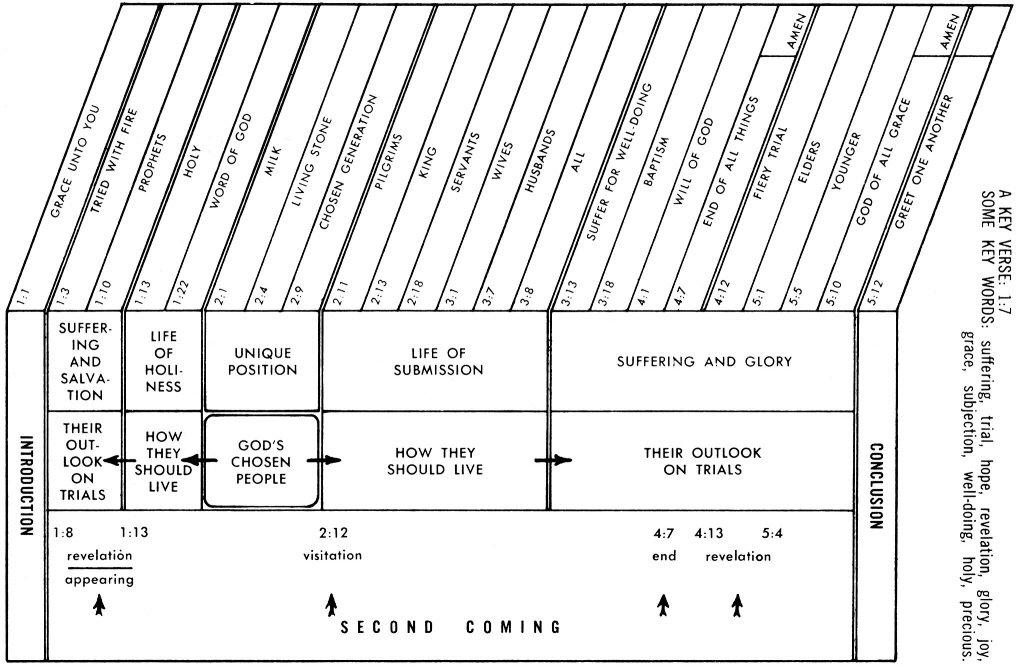
1 Peter: Trials, Holy Living & The Lord's Coming
Click chart to enlarge
Chart from Jensen's Survey of the NT - used by permission
See Another Chart from Charles Swindoll
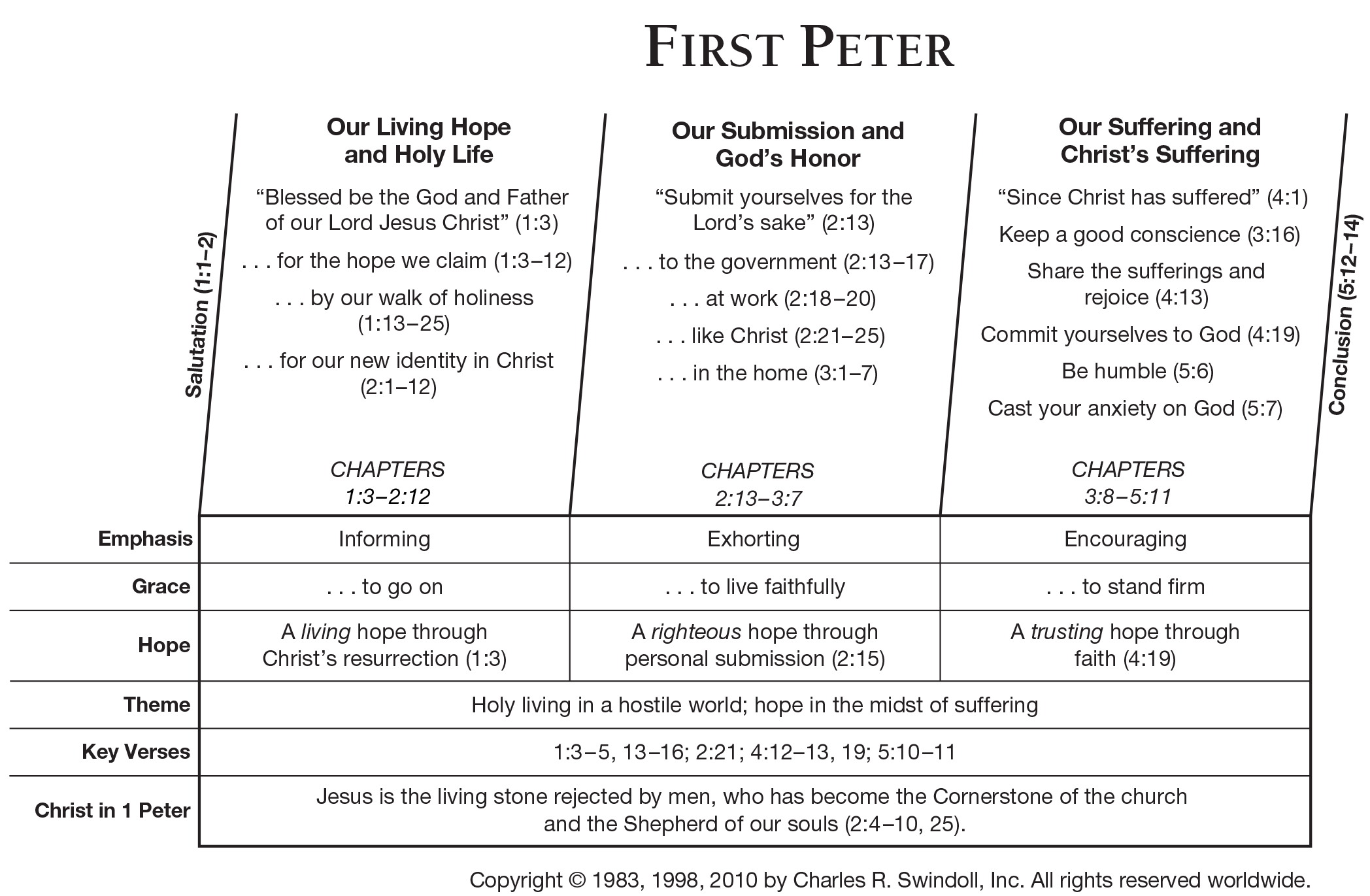
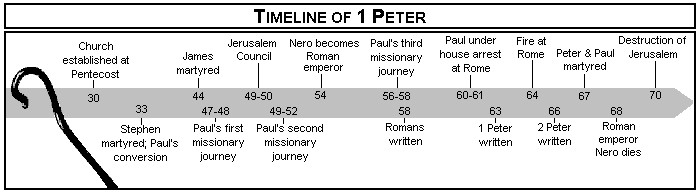
Source: Borrow Ryrie Study Bible
Click to enlarge
1 Peter 3:13 Who is there to harm you if you prove zealous for what is good? (NASB: Lockman)
Greek: Kai tis o kakoson (FAPMSN) humas ean tou agathou zelotai genesthe? (2SAMS)
Amplified: Now who is there to hurt you if you are zealous followers of that which is good? (Amplified Bible - Lockman)
KJV: And who is he that will harm you, if ye be followers of that which is good?
NLT: Now, who will want to harm you if you are eager to do good? (NLT - Tyndale House)
Phillips: After all, who in the ordinary way is likely to injure you for being enthusiastic for good?
Wuest: And who is he that will do you evil if you become zealots of the good?
Young's Literal: and who is he who will be doing you evil, if of Him who is good ye may become imitators?
AND WHO IS THERE TO HARM YOU: Kai tis o kakoson (FAPMSN) humas:
- Pr 16:7; Ro 8:28; 13:3
- 1 Peter 3 Resources - Multiple Sermons and Commentaries
1Peter 3:13-15 begins with a rhetorical question to introduce his discussion of the relationship between God’s grace and suffering which the readers were experiencing (both grace and suffering!). (1Pe 2:21-note, 1Pe 1:6-note). The sense of the question expects the negative answer "no one." However as Hiebert says "Peter did not promise his readers that they would escape such suffering. The teaching of Jesus, his own experience, as well as his insight into the perversity of human nature, made him fully aware that there were exceptions. His very purpose in writing was to prepare his readers for such experiences."
And who is there to harm you - One idea is “seeing that God takes such good care of the righteous,” who is there to harm you?
MacDonald comments that..
The answer implied is “No one.” And yet the history of the martyrs seems to prove that enemies of the gospel do harm faithful disciples. There are at least two possible explanations of this paradox:
1. Generally speaking, those who follow a path of righteousness are not harmed. A policy of nonresistance disarms the opposition. There may be exceptions, but as a rule, the one who is eager for the right is protected from harm by his very goodness.
2. The worst that the foe can do to a Christian does not give eternal harm. The enemy can injure his body but he cannot damage his soul.
During World War II a Christian boy of twelve refused to join a certain movement in Europe. “Don’t you know that we have power to kill you?” they said. “Don’t you know,” he replied quietly, “that I have power to die for Christ!” He had the conviction that no one was able to harm him. (MacDonald, W & Farstad, A. Believer's Bible Commentary: Thomas Nelson)
John MacArthur adds...
that it is unusual for most people, even those hostile to Christianity, to harm believers who prove zealous for what is good. (MacArthur, J. 1 Peter. Chicago: Moody Press)
Harm (2559) (kakoo from kakos = bad, evil) denotes mistreatment and implies that real damage is done through such actions (cp Acts 7:6, 19), including active persecution against the church (Acts 12:1, 18:10) or in vicious attitudes toward believers (Acts 14:2). Kakoo includes any hostile and injurious attitude or activity that produces essential damage. The Septuagint uses kakoō far more than does the New Testament. Numbers 20:15 reads: “The Egyptians mistreated us and our fathers” (NIV). Frequently the Septuagint uses kakoō to translate the Hebrew word ‛ānâh (“to afflict, oppress, humble”). A significant example is Isaiah 53:7 which is a prophecy of Christ’s sufferings: “He was oppressed, and he was afflicted.” This last use of kakoo is encouraging for it says when we are treated by others who desire to do evil to us, we are in good company, for so they did to our Master!
An important spiritual principle Peter is building toward is that the fear of the Lord conquers every other fear. After all the worst they can do to us is kill us and that ushers us into the best, into the presence of Jesus forever!
Peter quoted Isaiah 8:13, 14 to back up his admonition
But in your hearts set apart Christ as Lord” (see note 1 Peter 3:15)
One meaning of Peter's question could be "who is able to harm you"? Because v12 teaches they were under the watchful care of their Father & thus no one was able to do them any real & essential harm. Persecution encountered could inflict no real damage. Because of their union with the living Christ, the enemy can only injure the part of their being which is not permanent or eternal. As Paul said
If God is for us, who can be against us? (Ro 8:31-note, cp 2Ti 4:18-note, Da 3:17,18-note)
David expressed a similar assurance (Ps 56:4-note). Although there is some truth in this interpretation, the context in 1Peter 3:14 indicates that suffering for the sake of righteousness would come.
IF YOU PROVE ZEALOUS ("sold out") FOR WHAT IS GOOD: ean tou agathou zelotai genesthe (2SAMS):
- Ps 38:20; Pr 15:9; 1Cor 14:1; Eph 5:1; 1Th 5:15; 1Ti 5:10; 3Jn 1:11
- 1 Peter 3 Resources - Multiple Sermons and Commentaries
If you prove - More literally this reads "If you have become" (the idea that something has come into existence that was not in existence). If introduces a conditional clause (see discussion).
The KJV says followers instead of zealots, as in the NAS, because the Greek manuscript for the KJV has mimetes (translated imitators) not zelotes.
Zealots for the good - Even a hostile world is slow to hurt people who are benefactors of society, who are kind and caring (cf. 1Pe 4:12-note), but it does happen (1Pe 3:14).
Zealous (2207) (zelotes from zeloo = to burn with zeal; cf root verb zeo = to be hot or figuratively to be fervent) means to be filled with or controlled by eagerness and ardent interest in pursuit of something. Zealous pictures one with intensity or enthusiasm and describes a person with great ardor for a specific cause. Zelotes thus conveys the idea of wholeheartedness and singleness of purpose. The condition is not just an occasional good deed but being zealots for good, possessing a passion for good, aggressively seeking to perform good.
Good (18)(agathos) means intrinsically good, inherently good in quality but with the idea of good which is also profitable, useful, benefiting others, benevolent (marked by or disposed to doing good). Agathos is that which is good in its character, beneficial in its effects and/or useful in its action.
J H Jowett - Now let us turn to the sterner products of the sanctified life. Let us turn to the hearts-of-oak of which the softer graces are the perfected fruit. Let us contemplate the severer virtues, the more commanding strength. “Zealous of that which is good.” That sounds suggestive of strength! “Clarify your conception of duty! Get it clearly in your eye! Set the good firmly before you! Then be zealous!” Such is the strong, definite virtue which is the fruit of the sanctified life. “Zealous of the good!” You will get the native energy of the word “zealous” if you recall its kinsman “jealous.” It is significant of consuming eagerness and ceaseless vigilance. It is suggestive of burning passion. There towers the “good!” The “zealous” soul confronts it, not with faint and timid aspiration, but possessed by a blazing and driving ambition! The strength of his passion is the measure of his defence. You may play tricks with a candle-flame; you must give margin to a bonfire. You may trifle with the lukewarm; who would try it on with the zealot? You may carry an evil suggestion to one man, and quite unembarrassed you may lay it across the threshold of his mind. You may take the suggestion to another man, and before you have got out of the preface you are scorched and consumed. There are lives so sanctified by the indwelling Christ that they blight all evil approaches, and cause them to wither away. Their fire is their defence. That is a wonderful figure employed by the prophet—“clad with zeal as a cloak.” The man wears a protective garment of fire! He is secured in his own enthusiasms! He is preserved in the spirit of burning. Now, that burning passion for “that which is good “is one of the strengths of the sanctified life. “Why, our very word “enthusiasm,” which is now suggestive of ardour, passion, fire, had no such significance in its earliest day. It literally signifies “in God,” and it is because men have found that souls which are united with God are characterised by zeal and fire, that the word has lost its causal content, and is now limited to the description of the effect. The enthusiastic is the fiery, but fiery because in fellowship with God. “He shall baptize . . . with fire.” One of the resultant virtues of sanctification is spiritual enthusiasm, a zeal for “that which is good.” (Epistles of St. Peter)
Spurgeon - We know that all things work together for good for those who love God, for those who are called according to his purpose” (Rom 8:28). Then how can anything work for your hurt if you are really the Lord’s? Can anyone curse those whom God blesses?
Jack Arnold - A general rule is that if Christians live a good life, they will be responded to by the unsaved world by good and kind acts. The normal response to living a good life is to expect that people will respond to the Christian the same way the Christian responds to the unsaved. There are always some unsaved people who are so hardened that they treat all Christians with contempt and harshness. However, normally, if we do good to the unsaved world, if we turn the other cheek, if we reply with a soft answer, if we have a benevolent attitude, the unsaved will not harm us. However, the Bible teaches that “all who desire to live godly in Christ Jesus will be persecuted” (2 Tim. 3:12). We know that Christ was put to death for doing good; the Apostles were put to death for following Christ’s example; and multitudes of Christians have suffered persecution only because they desired to do good. Yet we know that this kind of suffering is not typical. While it is true that the godly will suffer, this suffering is not the pattern of the Christian’s life. We should never expect suffering to be the normal return for doing good. Suffering may come as Christians seek to live godly lives which will convict the non-Christians, but we ought not to be waiting for persecution to come. We need to avoid any kind of persecution complex about our Christian lives. Martin Luther said, “Go on in faith and love; if the cross comes, take it; if it comes not, do not seek it.” It should also be noted that suffering is not a constant activity. It comes in spurts, for there are many periods in our lives in which we are relatively free from external suffering, and it is during these times that we are to be learning doctrine from God’s inspired Word so that when it does come we will be able to stand up under it. Even in church history, especially in the first three centuries of the church, there was not constant persecution; it was spasmodic. If there had been constant persecution, the church would have been wiped out. The general rule, then, is that when we do good to others we can expect good in return. (Sermon)
1Peter 3:14 But even if you should suffer for the sake of righteousness, you are blessed. AND DO NOT FEAR THEIR INTIMIDATION, AND DO NOT BE TROUBLED, (NASB: Lockman)
Greek: all' ei kai paschoite (2PPAO) dia dikaiosunen, makarioi. ton de phobon auton me phobhetge (2PAPS) mede tarachthete, (2PAPS)
Amplified: But even in case you should suffer for the sake of righteousness, [you are] blessed (happy, to be envied). Do not dread or be afraid of their threats, nor be disturbed [by their opposition]. (Amplified Bible - Lockman)
KJV: But and if ye suffer for righteousness' sake, happy are ye: and be not afraid of their terror, neither be troubled;
NLT: But even if you suffer for doing what is right, God will reward you for it. So don't be afraid and don't worry. (NLT - Tyndale House)
Phillips: And if it should happen that you suffer "for righteousness' sake", that is a privilege. You need neither fear their threats nor worry about them; (Phillips: Touchstone)
Wuest: But if even you should perchance suffer for the sake of righteousness, you are spiritually prosperous ones. Moreover, do not be affected with fear of them by the fear which they strive to inspire in you, neither become agitated,
Young's Literal: but if ye also should suffer because of righteousness, happy are ye! and of their fear be not afraid, nor be troubled,
BUT EVEN IF YOU SHOULD SUFFER FOR THE SAKE OF RIGHTEOUSNESS YOU ARE BLESSED: all ei kai paschoite (2PPAO) dia dikaiosunen makarioi::
- But even if you should suffer for the sake of righteousness - 1Peter 2:19,20; 4:13-16; Jer 15:15; Mt 5:10, 11, 12; 10:18, 19, 20, 21, 22,39; 16:25; 19:29; Mk 8:35; 10:29; Lk 6:22,23; Acts 9:16; 2Cor 12:10; Php 1:29; Jas 1:12
- 1 Peter 3 Resources - Multiple Sermons and Commentaries
THE PROMISE FOR
UNJUST SUFFERING
I like the way Ray Pritchard summarizes this section in five simple commands...
- 14a Cheer up! (you are blessed)
- v14b Give up! (do not fear)
- v15a Lift up! (set apart Christ as Lord)
- v15b Speak up! (Always ready to give an answer)
- v16 Shape up! (keeping a clear conscience)
- Reference: 1 Peter 3:13-17 Are You Prepared to Suffer for Christ?
But - Note that "but" is a strong contrast which always begs the question of what is being contrasted? (See term of contrast)
Even if - This introduces a so called condition of fourth class with ei and the optative mood (expresses a wish, sometimes a prayer). The optative expresses a fourth-class condition implying there is no certainty that suffering will happen, but it might. In other words Peter is saying that suffering is not generally the expected outcome of zeal for good but it might occur. If matters, in spite of the note of victory in v13 should come to actual suffering "for righteousness' sake" as in Mt 5:10 (note), then "blessed" would be their condition! Peter alludes to some aspects of what that "blessing" might entail near the close of his letter writing
And after you have suffered for a little while, the God of all grace, Who called you to His eternal glory in Christ, will Himself perfect, confirm, strengthen and establish you. (1Pe 5:10-note)
Someone has said, “Jesus often spoke of Christianity as a banquet but He never said it would be a picnic.”
Spurgeon - The apostle Peter would have Christians prepare themselves for this suffering. They had to bear very much of it in his day. They will have to bear some of it as long as ever the Church of Christ remains in this wicked world. As long as Jesus was here, He was the acquaintance of grief. His life was, in a sense, a life of suffering. All the while He was here, even when He was not upon the cross, and even when no bloody sweat was on His brow, it is written, “He was the one who lifted up our sicknesses, and he carried our pain” (Isa 53:4). He was bearing the load, not as some say, “on the tree” alone (1 Pet 2:24), but up to the tree—daily bearing it till, at length, He came to the cross. There it was for the last time that He felt the pressure of human sin.
Paul encouraged the Corinthians writing...
Therefore we do not lose heart, but though our outer man is decaying, yet our inner man is being renewed day by day. For momentary, light affliction is producing for us an eternal weight of glory far beyond all comparison, while we look not at the things which are seen, but at the things which are not seen; for the things which are seen are temporal, but the things which are not seen are eternal. (2Cor 4:16-18)
Jesus gave a similar encouragement to the church at Smyrna declaring...
Do not fear what you are about to suffer. Behold, the devil is about to cast some of you into prison, that you may be tested, and you will have tribulation ten days. Be faithful until death, and I will give you the crown of life. (See note Revelation 2:10)
Even if you are affected by something or someone from without or are vexed in your spirit...hang in there...the promised condition is blessed. Is this what you would naturally expect? No, for it speaks of supernatural support as we chose not to fear and not to be agitated which implies that we are trusting God's sovereign (in control) hand no matter what the external, temporal circumstances look like.
Make sure the qualifier -- for the sake of righteousness -- is operative if you plan on invoking this promise of God in the midst of your suffering.
As John MacArthur reminds us...
Suffering must be viewed as an opportunity to receive spiritual blessings, not as an excuse to compromise the faith before a hostile world. (MacArthur, J. 1 Peter. Chicago: Moody Press)
As McGee observes...
Suffering for the right should bring joy to the child of God. Some Christians actually make themselves obnoxious in their witness to others, thinking they are taking a stand for the Lord. But if we have simply taken a quiet stand for the right and for God, we ought to rejoice if we suffer for that. I must repeat this again: you are not going to escape suffering in this world if you are a child of God. Someone has said, “Jesus often spoke of Christianity as a banquet but never as a picnic.” How true that is! He never said that we are going to have it easy down here. (McGee, J V: Thru the Bible Commentary: Thomas Nelson)
J H Jowett...
Suffering for righteousness sake. That sounds like a masculine virtue! It is a phrase which unveils a little more of the firm strength of this spiritual ambition! The zealot goes right on, with “the good” as his goal, suffering loss, if need be, of ease and comfort and wealth and fame, and counting the loss as “blessed” if only it help him in the way of spiritual attainment, This is the character of spiritual enthusiasts! We may reserve for such character whatever criticism we please, we cannot deny it the eulogium of “strength.” At any rate it is not weak and effeminate. There is something about it granitic and majestic! Christ Jesus makes men and women who despise ease, who are “ready to be offered,” who will plod through toils and pains and martyrdom if these lie in the way of duty and truth. Only a few months ago our little chapels outside Pekin were destroyed by the Boxers, and the majority of the native Christians foully murdered. The chapels are being erected again. I have read the account of the opening of one of these restored sanctuaries. And who took part in the reopening? The remnant of the decimated church! Men stood there whose wives and children had been butchered in the awful carnival; there they stood, their love undimmed, their faith unshaken, themselves “ready to be offered” in their devotion to the Lord! I say, give to it any criticism you please, you cannot deprive it of the glory of superlative strength!
“They rejoiced that they were counted worthy to suffer shame for His name.”
That is the product of the sanctified life. The Lord lifts us above the common fear. See how the passage proceeds: “And fear not their fear, neither be troubled.” [Verse 14] That is the characteristic which is even now shining resplendently in the lives of the native Christians in China. They have been gloriously delivered from common fear and distraction. They are fearless and collected, quietly prepared to “suffer for righteousness sake,” and strongly holding on the way of life, “zealous of that which is good.” “Unto them it is given on the behalf of Christ, not only to believe in His name, but also to suffer for His sake.” (Epistles of St. Peter)
You are blessed - Notice that "you are" is added. It is almost like Peter is saying your condition is that of a blessed state of existence. Wuest adds that "the spiritual state of those who suffer persecution because of their righteous lives is prosperous, spiritually prosperous."
Blessed (3107) (makarios) is "used to describe the benefits bestowed by someone (usually a higher power) to another; these benefits include prosperity, good fortune, and happiness" (UBS Handbook). Peter is saying that they are fully satisfied no matter the circumstances, fully satisfied because of the indwelling ministry of the Holy Spirit, their supernatural Comforter.
Here blessed serves not so much to emphasize the effect but the motive to not fear or be troubled. And to consider oneself blessed while suffering persecution is not natural, so Peter goes on to offer some practical guidelines. First, negatively, don't yield to the natural reaction of fear and agitation. Secondly, from the positive aspect, keep Christ as the central focus of your life and make appropriate responses to your adversaries. No matter what a believer suffers, he still has his most cherished possession — Jesus Christ (Mt 6:33-note, Ro 8:28-note; Ro 8:29-note)
Puritan Thomas Watson said...
Afflictions work for good, as they make way for glory...Not that they merit glory, but they prepare for it. As ploughing prepares the earth for a crop, so afflictions prepare and make us [ready] for glory. The painter lays his gold upon dark colours, so God first lays the dark colours of affliction, and then He lays the golden colour of glory. The vessel is first seasoned before wine is poured into it: the vessels of mercy are first seasoned with affliction, and then the wine of glory is poured in. Thus we see afflictions are not prejudicial, but beneficial, to the saints" (All Things for Good [Edinburgh: The Banner of Truth Trust, 1986], p. 32).
Jack Arnold writes that "becoming a Christian does not mean that we will be set free from all suffering. In fact, becoming a Christian may mean we have more suffering. Never become a Christian because you think it will solve all your problems. It may solve some and create others, but God will use all your sufferings to bring about your progress in the Christian life. Remember, it is a privilege to suffer for Christ. Chrysostom, an early church father, said this about the privilege of suffering:
“Should the empress determine to banish me, let her banish me; ‘The earth is the Lord’s and the fulness thereof.’ If she will cast me into the sea, let her cast me into the sea; I will remember Jonah. If she will throw me into a burning, fiery furnace, the three children were there before me. If she will throw me to the wild beasts, I will remember that Daniel was in the den of lions. If she will condemn me to be stoned, I will be the associate of Stephen, the proto-martyr. If she will have me beheaded, the Baptist has submitted to the same punishment. If she will take away my substance, ‘naked came I out of my mother’s womb, and naked shall I return to it.’”
AND DO NOT FEAR THEIR INTIMIDATION AND DO NOT BE TROUBLED: ton de phobon auton me phobethete (2PAPS) mede tarachthete (2PAPS):
- Isa 8:12,13; 41:10, 11, 12, 13, 14; 51:12; Jer 1:8; Ezek 3:9; Mt 10:28,31; Lk 12:4,5; Jn 14:1,27; Acts 18:9,10
- 1 Peter 3 Resources - Multiple Sermons and Commentaries
Wuest notes that "Literally it is: “Be not affected with fear by the fear which they strive to inspire in your heart.”
Fear (5399) (phobeo) describes a painful emotion or passion excited by an expectation of evil, or the apprehension of impending danger.
Do not fear their intimidation - Do not fear their threats is a good paraphrase.
Intimidation (5401) (phobos [word study]) is fear. To intimidate (from Latin = timidus = fearful from timeo = to fear) is to make timid or frightened, to inspire fear in, to discourage or dishearten. To intimidate someone is to frighten them especially in order to make them do what one wants.
More literally and with considerable force Peter writes (quoting Isaiah)...
"Fear of them do not fear."
The negative instruction in the aorist tense comes across much like a command, prohibiting yielding to any kind of fear. Christians are not to allow a feeling of fright or terror to grip them.
Peter is quoting from the Hebrew and the Septuagint (LXX) of Isaiah 8:12-13 which reads
You are not to say, 'It is a conspiracy!' In regard to all that this people call a conspiracy, And you are not to fear what they fear or be in dread of it. (Isaiah 8:12)
The historical context of the Isaiah quotation is helpful. In Isaiah's day, the King of Judah (Ahaz) was faced with an impending invasion by the powerful Assyrians. In addition the kings of Israel (the Northern Kingdom of 10 tribes) and Syria wanted King Ahaz to join them in an alliance. When King Ahaz refused to join them, Israel and Syria threatened to invade Judah! And sadly "behind the scenes" King Ahaz allied himself with Assyria! In this background, God's prophet, Isaiah, warned King Ahaz against any ungodly alliances and urged him to trust in Jehovah for deliverance. Below is the English translation of the Septuagint (LXX) translation (Greek translation of the Hebrew) of Isaiah 8:13. Notice that it begins with "Sanctify the LORD..." which is picked up in the following verse (1Pe 3:15-note)
Sanctify (Lxx = aorist imperative) the Lord of hosts (see study of Jehovah Sabaoth, LORD of hosts or of armies) Himself; and let Him be your fear, and let Him be your dread (Isaiah 8:13)
But God sends His prophet Isaiah to say, "Don't fear". Peter applies these words in Isaiah 8:12,13 saying in essence 'Instead of fearing man, fear GOD.
Compare Jesus' words to His disciples regarding Whom we should fear...
And do not fear those who kill the body, but are unable to kill the soul; but rather fear Him who is able to destroy both soul and body in hell. (Mt 10:28).
As Christians, we are like King Ahaz and are many times faced with crises, and are tempted to give in to our fears and make the wrong decisions. But if we sanctify Christ as Lord in our hearts ("Turn your eyes upon Jesus and look full in His wonderful face and the things of this earth will grow slowly dim in the light of His glory and grace" play the hymn as you ponder your future glory with Him), we need not fear men or circumstances. Our enemies might hurt us, but they cannot harm us. Only we can harm ourselves if we fail to trust God. As already stated, generally speaking, people do not oppose us if we do good but even if they do, it is better to suffer for righteousness’ sake than to compromise our testimony. Peter discussed this theme in more detail in 1Pe 4:12-19.
Spurgeon - If a man suffers as a Christian for doing that which is right, he is suffering for Christ’s sake. If he cannot and will not act disreputably and contrary to the commands of God, as others do, the suffering that he willingly bears, the loss that he cheerfully incurs because of his uprightness, is so much borne for Christ’s sake. If a man is out-and-out righteous in this world, he will be sure to be pointed at by certain persons as an oddity. He cannot lie, as others lie; nor practice tricks in trade, as others do; nor frequent their places of amusement; nor indulge in their lusts.
Therefore straightaway they say, “He is a hypocrite; he is a cant.” And as they cannot understand the principle that inspires him, they impute to him motives that he abhors. This is how they talk:
“He is doing it for the sake of being thought a saint.”
“He is paid for it.”
“He has some sinister motive or other.”
Or else they sum up the whole matter by declaring, “He is a downright impostor.”
Now, if in any of these ways you are made to suffer for that which is right—for speaking the truth, and acting the truth—never mind, but rather rejoice that you are permitted to suffer for Christ’s sake. Say within yourself, “If my dear Lord lost all things for me, I may well lose some things for Him. If He was stripped to the last rag for me, I may well be content to be poor for His sake.” Set your “face like flint” (Isa 50:7) and say, “We can be poor, but we cannot be dishonest. We can suffer, but we cannot sin.”
DON'T BE
TROUBLED
Do not worry - This phrase "is frequently expressed idiomatically, for example, “do not let your mind kill you” or “do not let your thoughts run about in all directions” or “thinking about all the things that might happen to you.” (UBS Handbook) And remember that 1 Peter 3:12 says, “The eyes of the Lord are upon the righteous.” God is not blind nor impotent when we suffer!
Troubled (5015)(tarasso) literally means to shake back and forth and therefore to agitate and stir up (like the pool in John 5:4,7, Lxx = Ezek 32:2, 13, Isa 51:15). To shake together, stir up, disturb, unsettle, throw into disorder (Lxx = Ps 46; 2Sa 22:8 = of earth shaking).
Most of the NT uses of tarasso are figurative and describe the state of one's mind as stirred up, agitated or experiencing inward commotion. The passive voice is always used in the NT with a negative meaning, conveying the sense of emotional disturbance or inner turmoil, so that one is unsettled, thrown into confusion, or disturbed by various emotions, including excitement, perplexity, fear or trepidation.
Tarasso conveys the idea of to disturb mentally or to cause a deep emotional disturbance and thus refers to an unsettled mind, as when Herod heard of the birth of Jesus (Mt 2:3), Zacharias' fear when he saw the angel (Lk 1:12), the terror of the disciples when they witnessed Jesus walking on the water (Mt 14:26), Jesus' reaction to the lack of faith among the people before He raises Lazarus (Jn 11:33), in Jesus' command to not let their hearts be troubled (Jn 14:1) and of disturbing the faith of someone (Gal 5:10). Tarasso emphasizes the intensity of the Lord's reaction to His impending death (Jn 12:27) and His response to Judas' imminent betrayal.
Tarasso is a strong word, meaning “to deeply upset,” “to deeply disturb,” “to perplex,” or “to create fear.” Tarasso also describes the potential effect of false teaching in Galatians 1:7 and Gal 5:10.
NIDNTT notes that in Classic Greek tarasso is a "Homeric term (the root tarach-, still discernible in trachys, rough, harsh, savage), means to shake something out of inertia and throw it into confusion, i.e. to disturb, to upset, to confound, to agitate (from the stirring up of the sea or movement of the air, to violent emotional agitation), hence to confuse, but also, to shake (both of shaking up a medicine and of shaking a conviction, causing shock). There is a corresponding use of the passive: to be disturbed, agitated, confused, even to become alarmed.
TLNT - Tarasso and tarachos are used especially for disorders, social disturbances, political agitation, and riots. It is in this sense (Latin tumultus) that they are used in Acts 16:8, 13; 19:23: At Thessalonica, Paul and Silas are accused of instigating a disturbance; at Berea, it is the Jews who agitate and upset the crowds; at Ephesus, it is the riot of the silversmiths. It is a technical term for insurrections, like the Jewish revolt at Cyrene...With respect to individuals, tarasso usually expresses simple uneasiness mixed with fear: (Spicq, C., & Ernest, J. D. Theological Lexicon of the New Testament 3:372-373. Peabody, MA.: Hendrickson)
Tarasso -17 times in the NT - Mt. 2:3; 14:26; Mk. 6:50; Lk 1:12; 24:38; Jn 5:7; 11:33; 12:27; 13:21; 14:1, 27; Acts 15:24; 17:8, 13; Gal. 1:7; 5:10; 1Pet 3:14. NAS = disturbed(1), disturbing(2), stirred(3), stirring(1), terrified(2), troubled(9).
Matthew 2:3 And when Herod the king heard it, he was troubled, and all Jerusalem with him.
John 12:27 Now My soul has become troubled; and what shall I say, 'Father, save Me from this hour '? But for this purpose I came to this hour.
Matthew 2:3 When Herod the king heard this, he was troubled, and all Jerusalem with him.
Matthew 14:26 When the disciples saw Him walking on the sea, they were terrified, and said, "It is a ghost!" And they cried out in fear.
Mark 6:50 for they all saw Him and were terrified. But immediately He spoke with them and said to them, "Take courage; it is I, do not be afraid."
Luke 1:12 Zacharias was troubled when he saw the angel, and fear gripped him.
Luke 24:38 And He said to them, "Why are you troubled, and why do doubts arise in your hearts?
John 5:7 The sick man answered Him, "Sir, I have no man to put me into the pool when the water is stirred up, but while I am coming, another steps down before me."
John 11:33 When Jesus therefore saw her weeping, and the Jews who came with her also weeping, He was deeply moved in spirit and was troubled,
John 12:27 "Now My soul has become troubled; and what shall I say, 'Father, save Me from this hour '? But for this purpose I came to this hour.
John 13:21 When Jesus had said this, He became troubled in spirit, and testified and said, "Truly, truly, I say to you, that one of you will betray Me."
John 14:1 "Do not let your heart be troubled; believe in God, believe also in Me.
John 14:27 "Peace I leave with you; My peace I give to you; not as the world gives do I give to you. Do not let your heart be troubled, nor let it be fearful.
Acts 15:24 "Since we have heard that some of our number to whom we gave no instruction have disturbed you with their words, unsettling your souls,
Comment: Tarasso describes the effect of the unauthorized instruction which had troubled, upset or thrown into confusion those who heard the message. It is interesting that tarasso is the same word which Paul used of those who were distorting the truth (the gospel) and stirring up the saints in Galatians 1:7 and Gal 5:10.
John Stott comments: The Galatian congregations had been thrown by the false teachers into a state of turmoil—intellectual confusion on the one hand and warring factions on the other. It is rather interesting that the Council at Jerusalem, which probably met just after Paul had written this Epistle, were to use the same verb in their letter to the churches: ‘We have heard that some persons from us have troubled you with words, unsettling your minds, although we gave them no instructions’ (Acts 15:24). This trouble was caused by false doctrine. The Judaizers were trying to ‘pervert’ or ‘distort’ the gospel....To tamper with the gospel is always to trouble the church. You cannot touch the gospel and leave the church untouched, because the church is created and lives by the gospel. Indeed the church’s greatest troublemakers (now as then) are not those outside who oppose, ridicule and persecute it, but those inside who try to change the gospel. (The Message of Galatians)
Acts 17:8 They stirred up the crowd and the city authorities who heard these things.
Acts 17:13 But when the Jews of Thessalonica found out that the word of God had been proclaimed by Paul in Berea also, they came there as well, agitating and stirring up the crowds.
Galatians 1:7-note which is really not another; only there are some who are disturbing you and want to distort the gospel of Christ.
Galatians 5:10 I have confidence in you in the Lord that you will adopt no other view; but the one who is disturbing you will bear his judgment, whoever he is.
1Peter 3:14 But even if you should suffer for the sake of righteousness, you are blessed. AND DO NOT FEAR THEIR INTIMIDATION, AND DO NOT BE TROUBLED,
Tarasso - 119x in the non-apocryphal Septuagint -
Gen 19:16; 40:6; 41:8; 42:28; 43:30; 45:3; Deut 2:25; Judg 11:35; Ruth 3:8; 1 Sam 14:16; 2 Sam 18:33; 22:8; 1 Kgs 3:26; 21:4f; 1 Chr 29:11; Esther 1:1; 3:15; 4:4; 5:2; 7:6; Job 8:3; 19:6; 34:10, 12; 37:1; Ps 2:5; 6:2f, 7, 10; 18:7; 30:7; 31:9f; 38:10; 39:6, 11; 42:6; 46:2f, 6; 48:5; 55:2, 4; 57:4; 64:8; 65:7; 68:4; 76:5; 77:4, 16; 83:15, 17; 90:7; 104:29; 107:27; 109:21; 119:60; 143:4; Pr 12:25; Eccl 10:10; Isa 3:12; 8:12; 13:8; 14:31; 17:12; 19:3; 24:14, 19; 30:28; 51:15; 64:2; Jer 4:24; 5:22; Lam 1:20; 2:11; 3:9; Ezek 30:16; 32:2, 13; 34:18f; Dan 2:1; 4:5; 5:9f; 7:15; 11:12, 44; Hos 6:8; Amos 8:8; Hab 3:2, 15f;
Psalm 42:6 O my God, my soul is in despair (Heb = shachach = bowed down; Lxx = tarasso) within me; Therefore I remember You from the land of the Jordan And the peaks of Hermon, from Mount Mizar.
Psalm 46:2 Therefore we will not fear, though the earth should change (Lxx = tarasso) And though the mountains slip into the heart of the sea;
Da 2:1-note Now in the second year of the reign of Nebuchadnezzar, Nebuchadnezzar had dreams; and his spirit was troubled (Lxx = tarasso) and his sleep left him.
Jack Arnold - In suffering, God is our protector and He is able to vanquish all our foes, to uphold us in all of our trials, to conduct us through the valley of death, and to bring us to heaven. Whenever persecution comes or any kind of suffering, our natural response is to retreat, escape and back off. We begin to cower with fear. We want to get out of suffering. Yet, this may be the very thing which God will use to push us deeper into Christian maturity. Remember, when the Lord Jesus was being tested, Satan took Him to a very high mountain and showed Him all the kingdoms of the world and their glory. And Satan said to Him, “All these things will I give You, if you fall down and worship me.” He was offering Christ the earthly kingdom without the Cross. He was saying that Christ could rule and reign over the world without dying on the Cross for sin so as to make the millennial kingdom possible. Satan was saying that if Christ would bow down and worship him, He could avoid suffering. This would have been an easy way out of suffering, but Christ submitted Himself to the will of the Father and said to Satan, “You shall worship the Lord your God, and serve Him only” (Matt. 4:10). Peter is teaching us that when suffering comes, we almost always try to find some way out or some short cut that will make it easier. Satan is going to tempt us to run, to hide, to escape suffering so we will not reap the good consequence of that suffering—spiritual growth in Christ.
Peter says don't let your mind be smitten with fear and dread. Don't be stirred up, troubled, anxious, distressed, agitated. How well the martyrs lived out this policy (See also Fox's Book of Martyrs)!
POLYCARP WAS NOT
FEARFUL OR TROUBLED
When Polycarp was promised release if he would blaspheme Christ, he said,
Eighty six years I have served Christ and He has never done me wrong. How can I blaspheme my King and my Savior?
When the proconsul threatened to expose him to the wild beasts, he replied
It is well for me to be speedily released from this life of misery.
Finally the ruler threatened to burn him alive. Polycarp said,
I fear not the fire that burns for a moment: You do not know that which burns forever and ever.
Polycarp understood Jesus' piercing warning...
If your hand causes you to stumble, cut it off; it is better for you to enter life crippled, than, having your two hands, to go into hell, into the unquenchable fire (Mk 9:43)
MacArthur - It’s not likely, but according to the apostle Peter, there is a remote possibility that you may suffer for being righteous. Indeed, many Christians suffered for their obedience to Christ in the early church, but others suffered for their disobedience. When a Christian disobeys God’s Word, the world senses a greater justification and freedom for hostility. Even godly Christians should not be surprised or afraid when the world treats them with hostility. A passion for goodness is no guarantee against persecution. Doing good only reduces the likelihood of it. No one did more good than Jesus, yet a hostile world eventually killed Him. Nevertheless, your life should be above reproach so critics will have no justification for any accusations against you.
F B Meyer (Our Daily Homily) - It was a time of very real and fiery trial when Peter wrote these words. Persecution was already beginning with the House of God. The first mutterings of the awful storm which was to break in Nero’s terrible atrocities were making themselves heard throughout the Roman world. The intention of this Epistle, therefore, was to encourage these scattered saints, that they might not be overwhelmed. Some who read these words may need similar comfort.
Remember, beloved fellow-believers, that Jesus has suffered; your Lord and Master has trodden these thorns before you. See, they are flecked with his blood. Would you not desire to be fellow-partaker with Him in his sorrow, that you may share his glory? It is only in suffering that we can properly identify ourselves with the great anguish of the world, or learn to comfort or pray for others. And, probably, none know the innermost tenderness and companionship of Jesus like those who daily fill up that which is behind of his sufferings. Besides, their fear is much worse in anticipation than in actual experience. Probably God entirely delivers his martyrs from those physical tortures which to onlookers might seem unbearable.
This has been the perpetual testimony of the Armenian refugees. Miss Codrington’s story of her experiences in China, and Dr. Baedeker’s statement of what he has learnt in his wide experience amid the refugees and imprisoned saints in all parts of Europe support and confirm the same conclusion. Sanctify Jesus Christ in your heart as Lord and King. Maintain a good conscience; do not be turned aside for fear of man; and when you come to suffer, yea will find the fire has lost its sting. (Meyer, F B: Our Daily Homily)
Prepared For Persecution? - While I was visiting the Russian Far East, I had a conversation with my friend Lena that I will not soon forget. She is an excellent student and works at a Christian radio station in Magadan. Since becoming a believer in Christ in 1994, she has enjoyed remarkable spiritual growth.
Like most Russians, Lena has much hope, but she is also realistic about what could happen in her changing land. As we talked about the future of her country, she looked me in the eye and said with unsettling candor, "I am preparing myself for persecution."
I had two reactions when she said those words. The first was a chill I felt as I matched what I know about Russian political history with this young believer's realistic outlook. The second was to look seriously into my own heart. I realized that I hadn't been preparing to suffer for Christ. The thought had never even crossed my mind!
In 1Peter 3, the apostle wanted to prepare Christians for the threat of persecution that faced them daily. He instructed them to live a life marked by love and free from evil (1Peter 3:8, 9, 10, 11, 12). If persecution still came, Peter knew it would be better "to suffer for doing good than for doing evil" (1Peter 3:17).
Am I prepared to suffer for doing good? Are you? —David C. Egner (Our Daily Bread, Copyright RBC Ministries, Grand Rapids, MI. Reprinted by permission. All rights reserved)
Today in the Word - The great Colonial-era pastor and theologian Jonathan Edwards once wrote, “The truly humble Christian is clothed with lowliness, mildness, meekness, gentleness of spirit and behavior. These things are just like garments to him. Christian humility has no such thing as roughness, or contempt, or fierceness, or bitterness in its nature.... Yet in searching and awakening the conscience, [the Christian] should be a son of thunder.... He should be like a lion to guilty consciences, but like a lamb to men and women.”
The person Edwards was describing fits the profile 1 Peter presents to us in today’s reading. Christians must be humble and yet fearless, with a powerful testimony for the Savior that makes them like lions in the presence of their false accusers. Both humility and courage are qualities especially important in situations where believers may have to suffer because of their faith.
We said that Peter’s purpose for writing his first letter was to help Christians live godly lives in a hostile world, and also to know how to handle persecution in a Christ-like way. In verse 13, this theme of suffering for Christ comes to the forefront.
In this verse Peter reiterated his counsel for Christians facing persecution: be sure that if you suffer, it’s for doing right, not for doing wrong. Continue to do what’s right and entrust your ultimate vindication to God, because He will give special blessings to those who stand firm in the faith.
Peter’s reference to Isaiah 8:12-13 is interesting because it helps to explain his reference to fear. Isaiah was telling godly Israelites not to fear the coming Assyrian invasion that would result in captivity and exile for the northern kingdom. Because these righteous people feared the Lord, He would take care of them even in frightening times.
TODAY ALONG THE WAY - A major part of the “answer” we should be ready to give at any time involves being able to explain the gospel in clear and simple terms (Copyright Moody Bible Institute. Used by permission. All rights reserved)
The Blessing Of Persecution - Persecution, even martyrdom, has been the cost of discipleship for Christians down through the centuries. In many lands believers still suffer imprisonment and death for their uncompromising devotion to their Savior. Even in nations that have religious freedom, a person with a bold witness for the Lord may become the target of ridicule.
When we experience hardship because of our Christian commitment, no verse of Scripture is more comforting than the beatitude spoken by our Savior, "Blessed are those who are persecuted for righteousness' sake, for theirs is the kingdom of heaven" (Mt. 5:10).
At one time in his life, British preacher Charles Haddon Spurgeon was so intensely criticized that he became deeply depressed. So his wife printed that beatitude along with the other seven on a large sheet of paper and placed it above their bed. The first thing Spurgeon saw in the morning and the last thing he read at night was our Savior's glorious promise.
Are you discouraged because you are suffering for your Christian testimony? The antidote is this one sustaining promise: "Blessed are those who are persecuted for righteousness' sake." --V C Grounds (Our Daily Bread, Copyright RBC Ministries, Grand Rapids, MI. Reprinted by permission. All rights reserved)
The consecrated cross I'll bear
Till death shall set me free,
And then go home, my crown to wear,
For there's a crown for me. --ShepherdIf you live for God,
you can expect trouble from the world.
1 Peter 3:15 but sanctify Christ as Lord in your hearts, always being ready to make a defense to everyone who asks you to give an account for the hope that is in you, yet with gentleness and reverence; (NASB: Lockman)
Greek: kurion de ton Christon hagiasate (2PAAM ) en tais kardiais humon hetoimoi aei pros apologian panti to aitounti (PAPMSD) humas logon peri tes en humin elpidos, alla meta prautetos kai phobou,
Amplified: But in your hearts set Christ apart as holy [and acknowledge Him] as Lord. Always be ready to give a logical defense to anyone who asks you to account for the hope that is in you, but do it courteously and respectfully. (Amplified Bible - Lockman)
My Amplified Paraphrase: “But sanctify (set apart, treat as absolutely holy) Christ as Lord in your hearts, letting Him reign as the sovereign, supreme authority, and Master of your inner life; and always be ready (continually prepared, equipped) to give a thoughtful, clear, reasoned defense (a verbal testimony, a well-grounded answer) to everyone who asks you about the hope (confident expectation of God’s future goodness) that anchors and animates your life, yet do so with a spirit of gentleness (meekness, strength under control) and reverence (holy respect, humble fear of God).”
But continually set Christ apart as the Holy One and sovereign Lord in the deepest part of your being. Let Him reign over your thoughts, motives, attitudes, and responses (play reign in me). And live in such a way that when people notice the stability and confidence of your hope in Christ, you are always ready to gently, thoughtfully, and humbly explain why. Your defense should not be harsh or proud, but marked by a meek and reverent spirit that reflects the character of the Lord you honor.”
KJV: But sanctify the Lord God in your hearts: and be ready always to give an answer to every man that asketh you a reason of the hope that is in you with meekness and fear:
NLT: Instead, you must worship Christ as Lord of your life. And if you are asked about your Christian hope, always be ready to explain it. (NLT - Tyndale House)
Phillips: simply concentrate on being completely devoted to Christ in your hearts. Be ready at any time to give a quiet and reverent answer to any man who wants a reason for the hope that you have within you. (Phillips: Touchstone)
Wuest: but set apart Christ as Lord in your hearts, always being those who are ready to present a verbal defense to everyone who asks you for a logical explanation concerning the hope which is in all of you, but doing this with meekness and a wholesome serious caution
Young's Literal: and the Lord God sanctify in your hearts. And be ready always for defence to every one who is asking of you an account concerning the hope that is in you, with meekness and fear;
BUT SANCTIFY (the) CHRIST AS LORD IN YOUR HEARTS: kurion de ton Christon hagiasate (2PAAM) en tais kardiais humon:
- Nu 20:12; 27:14; Isa 5:16; 29:23
- 1 Peter 3 Resources - Multiple Sermons and Commentaries
BE DEVOTED TO CHRIST
AS YOUR LORD
But is a term of contrast, which begs the question of what is Peter contrasting? Here he is saying that instead of fearing and being stirred up and agitated because of possible suffering for righteousness' sake, the solution is to set apart Christ as your Lord. If He is in your heart, He is ruling over the control center of your being. Don't fear man. ''Fear'' (reverentially) the Lord! When the center of one's life is rightly related to the Lord Jesus, that person is able to respond properly to the vicissitudes of life.
But sanctify - As A T Robertson says "This instead of being afraid." Sanctify Christ as Lord instead of worrying or being afraid.
Peter lifts the quotation "sanctify the...Lord" from the Greek translation (Septuagint - LXX) of Isaiah 8:13 which reads
kurion auton hagiasate
Sanctify (aorist imperative) the Lord
Peter adds "the Christ" (the Messiah) ton Christos to the Septuagint - LXX rendering...
kurion de ton Christon hagiasate
Peter was exhorting the readers to set apart the Messiah, the Lord Jesus, as Jehovah, Very God, in their hearts, giving first place to Him in obedience of life. To sanctify Christ has the sense of to recognize, to worship, and to honor Him as the only Lord.
Sanctify (37)(hagiazo from hagios [see word study] = holy, set apart) means to set apart for God, to sanctify, to make a person or thing (in the OT altars, days, priests, etc were set apart) the opposite of koinos, which means profane or common. Sanctify is translated “Hallowed,” with reference to the Name of God the Father in the Lord’s Prayer "Hallowed (hagiazo) be Thy Name" (Mt 6:9-note) This verb was used in pagan Greek religions of the act of setting apart or consecrating a building as a temple, designating it as religious in character to be used for religious purposes. They used it for that which was counterfeit, but Christians use this verb for the One Who is real, Christ Jesus! And where is the "Temple" today? It is in our hearts, for we have been bought with a price and are no longer our own. Every Christian is like the Old Testament portable tabernacle where the Shekinah glory dwelt. Now the Shekinah glory in a sense should dwell any place we go and should give a proper opinion of God, even as did the OT Shekinah glory (see Mt 5:16). Do you, Christian, have a little sanctuary, a little chapel in your heart? Do you fellowship with Christ constantly, whether riding along in a car, walking down the street, in the shop, office or classroom? Do you make your heart a chapel where you can sanctify Christ as Lord in the midst of suffering? Christianity is fellowship with Christ at all times because He lives as Lord in the heart.
There are 28 uses of hagiazo in the NT - Matt. 6:9; 23:17, 19; Lk. 11:2; Jn. 10:36; 17:17, 19; Acts 20:32; 26:18; Rom. 15:16; 1 Co. 1:2; 6:11; 7:14; Eph. 5:26; 1 Thess. 5:23; 1 Tim. 4:5; 2 Tim. 2:21; Heb. 2:11; 9:13; 10:10, 14, 29; 13:12; 1 Pet. 3:15; Rev. 22:11
Here in 1 Peter 3:15, hagiazo is in the aorist imperative which means do it now. Do it effectively! The aorist imperative can even convey a sense of urgency.
Venerate and adore Jesus
thus dispelling all fear of man.
This is a moral imperative that holds priority over all other decisions -- This foundational choice begets and controls all subsequent choices. Is He really the Lord of my life?
Submit to Christ as Kurios, the One Who is to in control (our failure to daily submit to Him may in fact why we so often feel "out of control!" Ponder that thought!). Remember the context is potential persecution/suffering. No matter what looms on the horizon we are to live in submissive communion with our Lord and Master Christ Jesus and the result will be that we have nothing to fear. The writer of Proverbs declares...
The fear of man brings a snare, But he who trusts in the LORD will be exalted. (Proverbs 29:25)
Sanctify Him in the secret place,
and He will steady you in the public place.
How do we “sanctify Christ as Lord” in our hearts? We daily motivated by the Spirit and love surrender our will to His (cf Ro 12:1-note). We voluntarily and with joy turn everything over to Him, and live only to please Him and glorify Him. It means we fear displeasing Him rather than fear what men might say about us as His disciples or what they might do to us. And one evidence that Christ is Lord in our lives is the readiness with which we tell others about Him.
A similar phrase "sanctify My Name" is used prophetically to describe the future day (Ro 11:25-27-note) when Israel will have the veil lifted and by grace through faith will recognize her Messiah as her Lord...
Therefore thus says the LORD, Who redeemed Abraham, concerning the house of Jacob ("Israel"): "Jacob shall not now be ashamed (in the future when the remnant of Israel is saved), nor shall his face now turn pale; 23 BUT WHEN (Not "if") he sees his children, the work of My hands, in his midst, they (the saved remnant of Jacob) will sanctify My Name. Indeed, they will sanctify the Holy One of Israel (The Lord Jesus Christ). (Isaiah 29:22-23)
Comment: Notice that Jehovah's promise is to literal Jacob ("Israel") and not to the church, which did not even exist at the time of this prophecy. To "replace Israel" with the NT church is to impugn (attack with words, dispute the truth of) the prophetic Word of Prophecy (2 Pe 1:19) Jehovah gave specifically to Jacob (the nation of Israel).
Related article What is replacement theology?
Christ (5547) (Christos from from chrio = to rub or anoint, consecrate to an office) refers to the Anointed One and thus is a title of the Messiah, the divine One (fully God) the Jews were looking for and of Whom the OT bore prophetic witness.
In the Gospels "the Christ" is not a personal name but an official designation for the expected Messiah (Mt 2:4, Lk 3:15). As by faith the human Jesus was recognized and accepted as the personal Messiah, the definite article ("the") was dropped and the designation "Christ" came to be used as a personal name. The name "Christ" speaks of His Messianic dignity and emphasizes that He is the fulfillment of the Old Testament promises concerning the coming Messiah.
Lord (Master, Owner)(2962)(kurios from kúros = might, power in turn from kuróo = give authority, confirm) describes One who has absolute ownership. Kurios describes the One who has sovereign power and authority. Kurios also conveys the idea of master. Thus, the second Person of the Trinity was to be Lord and Master of their lives. He was to be their resource and defender when persecution came.
Jesus is referred to some ten times as Savior and some 700 times as Lord. Supreme in Authority. Kurios translates Jehovah (LORD in OT) in Septuagint (LXX) 7000 times. When the two titles are mentioned together, Lord always precedes Savior. Is He your kurios, your Lord, your Master, your Owner, your Possessor?
In summary, kurios signifies sovereign power and absolute authority. The primary idea is Jesus is the One in possession of all power and authority over those who are truly His possession. Paul in his description of genuine believers asks the saints at Corinth...
Or do you not know that your body is a temple of the Holy Spirit Who is in you, Whom you have from God, and that you are not your own? For you have been bought with a price: therefore glorify God in your body. (1Co 6:19,20)
Paul's point is that every genuine believer has been purchased (and redeemed) by the precious blood of the Lamb and now is rightfully the sole possession of the Lamb of God, Who is Lord, the Lord Jesus Christ.
I love Paul's description in Titus describing Jesus as the Possessor (cp Lord - "Absolute Possessor") of blood bought believers for He...
gave Himself for us, that He might redeem us from every lawless deed and purify for Himself a people for His own possession, zealous for good deeds. (Titus 2:14-note)
Comment: Possession translates the Greek noun periousios, which speaks of property owned as a rich and distinctive possession. The KJV translates it as peculiar people. Here the word is used figuratively to refer God's redeemed people as His costly possession and a distinctive treasure. It speaks of that which is choice, chosen, being beyond usual, special (one's own) peculiar, costly, select. The Septuagint (LXX) translation of Ex 19:5 uses periousios- you shall be My own possession, referring in that context to Israel (cp Dt 7:6; 14:2 Isa 43:21; Mal 3:17). Unfortunately, she forgot and forsook (for the most part - see for exception) her Husband (Is 54:5, Je 31:32, Ho 2:19).
Note also the word order in the original Greek. Kurios or Lord is placed first in Peter's sentence for emphasis. He is to have first place in everything (see note Colossians 1:18).
JESUS IS LORD!
When the Lord sanctifies us He makes us holy (1Pe 1:2-note, 1Pe 2:9-note) but when we sanctify the Lord, we set Him apart as the Holy One, treating Him as holy, enshrining as the object of supreme, absolute reverence, as free from all defilement and possessed of all excellence. (cp 1Pe 2:23-note entrusted = surrendered, abandoned, yielded).
Ray Pritchard makes an interesting point regarding Christ as Lord...
Chuck Colson commented that in the early church, if a person stood up in a public arena and cried out, “Jesus is God!” no one would be offended because the Romans and Greeks believed in many gods. To call Jesus “God” would not have seemed revolutionary or even risky. But if a Christian stood up and shouted, “Jesus is Lord and there is no other,” he would be putting his own life at risk. The Roman Caesars claimed the title of Lord, and this was a central reason why Christians faced persecution. They were willing to obey Roman laws, but they were not willing to call Caesar “Lord.” The same struggle over ultimate lordship explains much of the persecution Christians endure in various countries. In a totalitarian state, worshiping Christ as Lord can easily be seen as an act of treason. The real issue is the Lordship of Fear versus the Lordship of Christ. Those who make Christ Lord need not fear what earthly rulers do to them. (1 Peter 3:13-17 Are You Prepared to Suffer for Christ?)
In you heart - Not just in your head (although you do indeed need to read and intellectually "imbibe" the truth that Jesus is Lord), but also in the "control center", the center of your being, your heart.
A ready heart
makes a ready witness.
Heart (2588) (kardia) does not refer to the physical organ but is always used figuratively in Scripture to refer to the seat and center of human life. The heart is the center of the personality, and it controls the intellect, emotions, and will.
While kardia does represent the inner person, the seat of motives and attitudes, the center of personality, in Scripture it represents much more than emotion, feelings. It also includes the thinking process and particularly the will. For example, in Proverbs we are told, “As (a man) thinks in his heart, so is he” (Proverbs 23:7). Jesus asked a group of scribes, “Why are you thinking evil in your hearts?” (Matthew 9:4). The heart is the control center of mind and will as well as emotion.
A bold witness starts
with a bowed heart.
Vine writes that kardia "came to denote man’s entire mental and moral activities, and to stand figuratively for the hidden springs of the personal life, and so here signifies the seat of thought and feeling." (Vine, W. Collected writings of W. E. Vine. Nashville: Thomas Nelson )
MacArthur commenting on kardia writes that "While we often relate heart to the emotions (e.g., “He has a broken heart”), the Bible relates it primarily to the intellect (e.g., “Out of the heart come evil thoughts, murders, adulteries, fornications, thefts, false witness, slanders,” Matt 15:19). That’s why you must “watch over your heart with all diligence” (Pr 4:23-note). In a secondary way, however, heart relates to the will and emotions because they are influenced by the intellect. If you are committed to something, it will affect your will, which in turn will affect your emotions." (Drawing Near. Crossway Books) MacArthur adds that "In most modern cultures, the heart is thought of as the seat of emotions and feelings. But most ancients—Hebrews, Greeks, and many others—considered the heart to be the center of knowledge, understanding, thinking, and wisdom. The New Testament also uses it in that way. The heart was considered to be the seat of the mind and will, and it could be taught what the brain could never know. Emotions and feelings were associated with the intestines, or bowels." (MacArthur, J: Ephesians. 1986. Chicago: Moody Press)
Sanctifying Christ as Lord in your heart is the alternative to fearing man. Don't fear man, sanctify Christ as Lord.
Alexander Maclaren asks...
How am I to sanctify Jesus Christ? It is the same word used in the Lord’s Prayer as “hallowed.” We sanctify or hallow one who is holy already when we recognize the holiness and honor what we recognize. So the plain meaning of the commandment here is:
Set Christ in your hearts on the pedestal and pinnacle that belongs to Him, and then bow down before Him with all reverence and submission.
Be sure you give Him all that is His due, and in the love of your hearts, as well as in the thoughts of your mind, recognize Him for what He is—the Lord. Many of us only see a part of the whole Christ. He is our Creator as well as our Redeemer, our Judge as well as our Savior. Forgetting that, some do not hallow Him enough in their hearts as Lord. Embrace the whole Christ, and see to it that you do not dethrone Him from His rightful place or take from Him the glory due His name....
...‘Be not troubled;
sanctify Christ as Lord in your hearts.’Peter leaves out a clause of Isaiah’s, though he conveys the idea without reiterating the words. But Isaiah had added a sweet promise which means much the same thing as I have now been saying, when he went on to declare that to those who sanctify the Lord God in their hearts, He shall be for a sanctuary. ‘The sanctuary was an asylum where men were safe. And if we have made our hearts temples in which Christ is honoured, worshipped, and trusted, then we shall dwell in Him as in the secret place of the Most High’; and in the inner chamber of the Temple it will be quiet, whatever noises are in the camp, and there is light coming from the Shekinah, whatever darkness may lie around. If we take Christ into our hearts, and reverence and love Him there, He will take us into His heart, and we shall dwell in peace, because we dwell in Him. (Alexander Maclaren from 1 Peter 3:14,15 Hallowing Christ)
J H Jowett...
“Sanctify in your hearts Christ as Lord.” [1Peter 3:15] The heart is a sanctuary. It is a place of worship. Worship is always proceeding. There is a large congregation. Who are the worshippers? Let me name a few.
There are our wishes, our ambitions, our motives, our willings. All these are worshippers, bowing in the heart before some enthroned and sovereign Lord.
Our dispositions are also among the crowd.
All the forces of thought and feeling are mingled in the varied congregation!
Go into the sanctuary of any heart, and you will find, kneeling side by side in homage and obeisance, wishes, motives, sentiments, purposes, dispositions, all bowing before some central shrine.
“Who is the Lord of the temple? In some temples it is Mammon! He is sanctified as Lord, and round him are kneeling the congregated thoughts, passions, and ambitions, offering him incense, supplication, and praise.
Who is the Lord? In some temples it is the Lord of Misrule. He is sanctified as Lord! Chaos reigns, and in riotous disorder the mob of tumultuous thoughts and feelings offer him noisy acclamation.
Who is the Lord of the temple? In some temples indifference is enthroned. Indifference is sanctified as Lord! The atmosphere is opiated; life is a lounge; everything comes and goes in carelessness; all the worshippers are narcotised in thoughtlessness, or sunk in profound and perilous sleep.
Who is the Lord of the temple? In some temples it is the devil. Every worshipper bends in adoration of vice, reciting the liturgy of uncleanness, and every member of the congregation, every thought, every feeling, every ambition, bears upon its forehead the mark of the beast.
Who is the Lord of the temple? In some temples it is the Christ. All the assembled forces and powers of the life willingly prostrate themselves in fervent and lowly worship. Every hour of the day there is a worshipper in the radiant temple! Now it is a wish, now a shaping plan, now a completed purpose, now a penitent feeling, now a gay delight—these all stoop in reverent homage before the exalted Christ, and as we always appropriate the worth of the object we worship, the bending congregation of thoughts and sentiments acquire the beauty of the Lord. The worshipping motive is chastened and refined; the kneeling wish is etherealised; the stooping sorrow is transfigured; all the reverent forces of the personality are transformed into children of light.
Who is the Lord in the temple?
That is the all-determining question. “Sanctify in your hearts Christ as Lord.” In your temple let the Christ be enthroned. Let everything in the life be made to kneel in that sanctuary. Bring ye everything to the foot of the great...throne. Let the Lord be King!” Little children, keep yourselves from idols.” (1Jn 5:21)
“Sanctify in your hearts Christ as Lord.” That is the creative centre of the passage. All the surrounding context is resultant and consequent. This is the all-originating fountain! Around it are stretches of land, threaded with rivers which are the children of its creative springs. Let us pass from the springs to the rivers. If Christ be sanctified in the heart as Lord, if everything in the deep, secret places of the life bow before His throne, if at Matins and Evensong, and through all the intervening hours of the day, the endless procession of mystic forces in the soul reverently bend to His dominion, what will be the quality of the issues, what will be the striking characteristics of the life?...
Now, let me sum up my exposition. The fruits of the sanctified life are to be found in the tender graces and in commanding virtues, in compassion, sensitive and humbleminded (1Pe 3:8), and in moral and spiritual enthusiasm which is perfectly devoid of fear. Now, do you not think that where these soft compassions flow and these sterner virtues dwell—river and rock—a man will be able to “give answer to every man that asketh a reason concerning the hope that is in him”? [1Peter 3:15]
The finest reason a man can give
for a spiritual hope is a spiritual experience.What have I seen, and heard, and felt, and known? In these experiences I shall find invincible reasons in days of inquiry and controversy. If a man has sanctified in his heart Christ as Lord, and discovers that his hardness has been softened into gracious sympathies, that his coldness towards the right has been changed into passionate enthusiasm, and that his trembling timidities have given place to firm and fruitful fearlessness, has he not a splendid answer to give to every man who asks him a reason concerning the hope that is in him? The answer does not peep out in an apologetic “perhaps” or a trembling “if”; it is a masculine “verily,” a confident “I know.” As to the issues of such an answer the apostle is clear.
A vital testimony is invincible.
Fine living is not only a fine argument, it is the only effective silencer of bad men. “They will be put to shame who revile your good manner of life in “Christ.” Men may more than match you in subtlety of argument. In intellectual controversy you may suffer an easy defeat.
But the argument of a redeemed life
is unassailable.“Seeing the man that was healed standing with them, they could say nothing against it.” (Epistles of St. Peter)
F B Meyer...
The one thing for all of us to be really anxious about is to enshrine Jesus Christ in our hearts as Lord. Is there a door in your heart opening on a throne room which is reserved for Jesus only? Have you written on that door such words as these: "Other lords have had dominion over me, but henceforth He only is my King."? Be ready to give a reason for the hope that is in you. This is what Peter, on one memorable occasion, failed to do; and we shall fail also but for the help of the Holy Spirit, who will teach us what we ought to say (John14:26)....
HERE IS no doubt that if every Christian person were to begin to live up to the New Testament ideal, avoiding always what Christ would not be, and seeking to be always what He would be, there would be .little need for preaching, for the beauty of the Christian character would in itself be sufficiently attractive to win men for Jesus Christ....
Help me, O God, so to live that those who are associated with me, directing or serving me day by day, may long to have the love and joy which they see in me. Show me how to apply to the common things of daily life the heavenly principles of the risen life. AMEN. (F B Meyer. Our Daily Walk, Feb 12)
G Campbell Morgan writes that...
The simple meaning of the injunction is that at the very centre of life there is to be but one Lord, and that is Christ. To do this is to ensure the unification of being, consistency of conduct, and accomplishment of purpose. We are divided in our own life, inconsistent in our conduct, and ineffective in our service, when our loyalty is divided. This is so self-evident a truth that it hardly seems necessary to argue it. Nevertheless, while holding the truth theoretically, how constantly we are in danger of failing to live by it!
Other lords are permitted to invade the sanctuary of the heart, and to exercise dominion over us. Our own selfish desires, the opinion of others, worldly wisdom, the pressure of circumstances, these and many other lords command us, and we turn from our simple and complete allegiance to our one Lord, and give ourselves up to the false mastery of these things.
The results are always disastrous. We become storm-tossed and feverish; our conduct is not consistent; our work is spasmodic and devoid of power. Therefore the urgency of the injunction. To hallow the heart by excluding all other lords save Christ Himself, is to be strong, true, and effective. His knowledge is perfect, of the heart, of the circumstances, of the true way of life.
To be governed by many lords is to be in bondage to them all, and to be desolated by their conflicting ways. To be in bondage to Christ, is to be released from all other captivity. (Morgan, G. C. Life Applications from Every Chapter of the Bible)
ALWAYS...READY: hetoimoi aei (always) pros apologian panti to aitounti (PAP) humas logon peri tes en humin elpidos:
- Ps 119:46; Jer 26:12-16; Da 3:16-18; Am 7:14-17; Mt 10:18-20; Lk 21:14,15; Acts 4:8-12; 5:29-31; 21:39,40; 22:1-5; Col 4:6; 2Ti 2:25
- 1 Peter 3 Resources - Multiple Sermons and Commentaries
THE CHRISTIAN'S MOTTO:
BE PREPARED!
See Old Testament illustrations of men who were "always...ready" - Jeremiah - Jer 26:12-16; Daniel - Da 3:16-18;
Believers need to be like Boy Scouts... prepared, fit. We can't manufacture the opportunities but we can redeem the time [Ep 5:16-note, Col 4:5-note]. And so we must be ready (submitted to Christ as Lord, walking by the Spirit [Ga 5:16-note], redeeming the time, eating solid food [He 5:14-note], pure milk [1Pe 2:2-note], daily bread [Mt 4:4]) when God presents them. In the context, the opportunity is that we are suffering for righteousness sake.
Spurgeon on always ready - We want Bible students as Christians—men who not only believe the truth, but have good reasons for believing it. We want men who can meet error with the argument, “It is written,” and can maintain the truth at all hazards, using weapons taken from the armory of God’s inspired Book. Oh, that we had among us more who were fit to be teachers! May we grow in grace so that, when the question is asked, “Who is this?” we may be able to answer it. Covet earnestly this spiritual gift of knowledge, and give yourselves diligently to the search after it, that you may become fully established in the principles of the gospel of Jesus Christ. What a blessing you will be to others if you have much knowledge of the things of God!
Always...ready (2092) (hetoimos) means in a state of preparedness or readiness. It means to be prepared mentally or physically for some experience or action. You should know what you believe, why you believe it, and you should be ready, willing and able to explain what you believe to someone else. You are to be ready at a moment’s notice to explain what you believe.
Hetoimos is used 17 times in the NT -
Matt. 22:4, 8; 24:44; 25:10; Mk. 14:15; Lk. 12:40; 14:17; 22:33; Jn. 7:6; Acts 23:15, 21; 2 Co. 9:5; 10:6, 16; Titus 3:1; 1Pe 1:5; 3:15
UBS Handbook - Be ready is literally “prepared,” taken here in an imperative sense, as it is obvious from the Greek (in the Greek “prepared” etc. is part of the sentence beginning with sanctify, and the force of the imperative verb carries itself therefore into the following adjective). The tone of the expression is one of urgency; it is as if Peter expected his readers to be called upon to explain their faith in the immediate future, if they had not already done so. (The United Bible Societies' New Testament Handbook Series)
Need guidelines to help you share your faith? Read the RBC Booklet How Can I Break The Silence?
Spurgeon - Have your doctrinal views, and all your knowledge of Christ, packed away in a handy form, so that, when people want to know what you believe, you can tell them. If they wish to know why you believe that you are saved, have your answer all ready in a few plain, simple sentences; and in the gentlest and most modest spirit make your confession of faith to the praise and glory of God. Who knows but what such good seed will bring forth an abundant harvest? (1 Peter 3 Commentary)
TO MAKE A DEFENSE TO EVERYONE WHO ASKS YOU TO GIVE AN ACCOUNT OF THE HOPE THAT IS IN YOU: pros aplogian panti to aitounti (PAP) humas logon peri tes en humin elpidos:
- 1Sa 12:7; Isa 1:18; 41:21; Acts 24:25
- 1Pe 1:3,4; Col 1:5,23,27; Titus 1:2; Heb 3:6; 6:1,18,19
- 1 Peter 3 Resources - Multiple Sermons and Commentaries
MAKE AN DEFENSE
NOT AN APOLOGY!
Suffering done with the right attitude will often create a witnessing opportunity for Christ.
To make (pros) is a preposition which pictures motion or direction. The idea is being ready "toward" or extending toward a goal, the goal being a defense which is translated "to make a defense" (no verb in the original Greek).
This means that there is an effective apologetic that can be given. The unbeliever is "without excuse" ( = anapologetos) (Ro 1:20-note, Ro 2:1-note). We are to always be ready to make a careful, logical defense of the Christian faith against the attacks of its adversaries, showing its validity as the true saving gospel of God, our Creator and Savior.
Sanctify Christ privately,
speak of Him publicly.
Jack Arnold - When a Christian is being persecuted for good works, when he is suffering, an unbeliever may ask why he can take it so calmly and how he can have hope in Christ. The Christian’s positive response to suffering will cause the unbeliever to ask certain questions because there will be a quality of life that he has never seen before. When the non-Christian asks us about our hope in Christ and our confident assurance of heaven, we are to give an answer, a defense of our Christian faith to them. Whenever we are asked about the source of our power, we are to be ready, prepared. We are to not only give our testimony but also to show from the Bible why we are Christians. We should be thinking through our theology now, and this takes some mental effort. We are to always be ready to give an answer. We Christians must not only be ready, we should also be eager and willing to speak out concerning our hope in Christ and to share the basic elements of our faith. We are to make a defense; that is, we are to give a reasonable, logical, intelligent answer, not an emotional response or a theological discourse, but an explanation of what Christ has done in our lives and why we have an assured hope of heaven. Often when we suffer for our testimony for Christ we get quiet rather than speak out because we are intimidated and we do not like to suffer. We try to melt into the group. We become like a chameleon who blends into the scenery and we keep quiet. When things get tough, when we are asked about our faith, perhaps we say, “I’ll just keep my witness to myself!” Peter says we are not to do that. We are under obligation to give a response. Notice also that we are to make our defense to everyone; that is, we ought to be able to explain our faith to all kinds of unbelievers. Can we explain our faith to modernists, Mormons, Jehovah Witnesses, Unitarians or Roman Catholics? Can we answer the college professor as well as the college hippie? Every man means every man; all kinds of men. When we witness we are to tell about our hope in Christ. This is an eschatological hope. It is the absolute confidence and assurance that we shall one day be with Jesus in heaven. Philosophers have tabbed this age as the age of despair, but we Christians do not despair; we have hope.
McGee has a pithy comment observing that...
This means you ought to know more than a little about the Bible. The tragedy of the hour is that there are so many folk who say they are Christians, but the skeptic is able to tie them up into fourteen different knots like a little kitty caught up in a ball of yarn—they cannot extricate themselves at all. Why? Because of the fact that they do not know the Word of God. (McGee, J V: Thru the Bible Commentary: Thomas Nelson)
To make a defense - The Amplified renders it "Always be ready to give a logical defense."
The heart of the righteous ponders how to answer,
But the mouth of the wicked pours out evil things. (Pr 15:28)
Wuest comments that not only were these persecuted believers "to find a refuge in Christ Jesus as they set Him apart as Lord of their lives, but they were to be ready to give an answer to these persecutors who attacked them and the Word of God which they believed. (Wuest, K. S. Wuest's Word Studies from the Greek New Testament: Eerdmans)
Defense (627) (apologia from apo = from + logos = speech) literally means, “to talk one’s self off from". Apologia was a technical word used in the Greek law courts and was used of an attorney who talked his client off from a charge preferred against him. In short it refers to a speech given in defense.
Although apologia may have the idea of a judicial interrogation in which one is called to answer for the manner in which he has exercised his responsibility, the word can also mean an informal explanation or defense of one's position (1Cor 9:3, 2Cor 7:11) and the word would aptly describe giving an answer to the skeptical, abusive or derisive inquiries of ill-disposed neighbors.
There are 9 uses of apologia in the NT...
Acts 22:1 "Brethren and fathers, hear my defense which I now offer to you."
Acts 25:16 "And I answered them that it is not the custom of the Romans to hand over any man before the accused meets his accusers face to face, and has an opportunity to make his defense against the charges.
1 Corinthians 9:3 My defense to those who examine me is this:
2 Corinthians 7:11 For behold what earnestness this very thing, this godly sorrow, has produced in you: what vindication of yourselves, what indignation, what fear, what longing, what zeal, what avenging of wrong! In everything you demonstrated yourselves to be innocent in the matter.
Philippians 1:7 (note) For it is only right for me to feel this way about you all, because I have you in my heart, since both in my imprisonment and in the defense and confirmation of the gospel, you all are partakers of grace with me.
Philippians 1:16 (note) the latter do it out of love, knowing that I am appointed for the defense of the gospel;
2 Timothy 4:16 (note) At my first defense no one supported me, but all deserted me; may it not be counted against them.
1 Peter 3:15 (note) but sanctify Christ as Lord in your hearts, always being ready to make a defense to everyone who asks you to give an account for the hope that is in you, yet with gentleness and reverence
The English word “apologetics” comes from the Gr. word here translated “defense.” Peter is using the word in an informal sense (cf. notes Philippians 1:16; 1:17) and is insisting that the believer must understand what he believes and why one is a Christian, and then be able to articulate one’s beliefs humbly, thoughtfully, reasonably, and biblically.
When Jesus Christ is Lord of our lives, each crisis becomes an opportunity for witness. We are “ready always to give an answer.”
Our English word apology originally did not mean “to say I am sorry” but actually referred to “a defense presented in court.”
Apologetics is the branch of theology that deals with the defense of the faith. Every Christian should be able to give a reasoned defense of his hope in Christ, especially in hopeless situations. A crisis creates the opportunity for witness when a believer behaves with faith and hope, because the unbelievers will then sit up and take notice.
The best apologetic
is a life crowned by Christ.
Wuest - The exhortation is to Christians to talk the Bible off from the charges preferred against it, thus presenting for it a verbal defense. Today, Modernism has preferred charges against the Word of God, has placed it in the dungeons of the destructive critic’s inquisition, and has charged it with gross errors, and with being man-made. It is not allowed to speak for itself except through the prosecuting attorney, the destructive critic. But those who believe in a whole Bible, rather than a Bible full of holes, are admonished not to remain silent in the face of this attack by Modernism, but to defend the Bible against these false charges by presenting a verbal defense for it, refuting the statements of the destructive critic. Such a great classical Greek scholar as Professor John A. Scott, Ph.D., LL.D., in his excellent defense of the historical accuracy of the Gospels, writing in a context of the discovery of ancient manuscripts says, “So far as I know, not a single discovery has ever confirmed the conclusions of destructive criticism either in classical or biblical literature.” (Wuest, K. S. Wuest's Word Studies from the Greek New Testament: Eerdmans)
Asks (154) (aiteo) means to ask for something or make petition. It can mean to ask with a sense of urgency and even to the point of demanding. For example, Thayer notes that the use of aiteo in 1Cor 1:22 conveys a stronger sense of demand. One gets that same sense ofaiteo in Mt 27:20 (in fact NJB translates it "demand."). In this passage aiteo is in the present tense which means in essence "every time someone asks."
Who is in us? The Spirit of Christ, Christ in us the hope of glory. We have been born again to a "living hope" (see note 1 Peter 1:3).
Account (3056) (logos) refers to a communication whereby the mind finds expression, from which we derive our word "logical." We do, indeed, have logical, factual reasons for our hope in Christ (E.g., see the crystal clear logic of Messianic Prophecies)
Barclay explains that the account "must be reasonable. It is a logos that the Christian must give, and a logos is a reasonable and intelligent statement of his position. A cultivated Greek believed that it was the mark of an intelligent man that he was able to give and to receive a logos concerning his actions and belief. As Bigg puts it, he was expected “intelligently and temperately to discuss matters of conduct.” To do so we must know what we believe; we must have thought it out; we must be able to state it intelligently and intelligibly. Our faith must be a first-hand discovery and not a second-hand story. It is one of the tragedies of the modern situation that there are so many Church members who, if they were asked what they believe, could not tell, and who, if they were asked why they believe it, would be equally helpless. The Christian must go through the mental and spiritual toil of thinking out his faith, so that he can tell what he believes and why. (Barclay, W: The Daily Study Bible Series. The Westminster Press)
Lehman Strauss - Someone may ask, “Is it the Lord God who sanctifies us, or do we sanctify Him?” It is both. In regeneration He sets us apart for Himself. Then He asks us to set Him apart as Lord in our hearts. We are to enthrone Him, give Him the pre-eminence. By so doing we have given a partial answer to any man who asks a reason of our hope. I am not so certain that this text means we are to have all the answers that will satisfy the minds of unbelievers. Certainly we should be mentally alert and prepared to give a good witness for our Lord, but the important thing here is that we have a good conscience before God and man. Right speaking will not produce a good conscience, but right living will. It is useless to testify with our lips of the hope of Christ’s return if our hearts are not right. But any person who lives every day in the light of His appearing will be doing precisely what our text demands. If I am expecting Him to come at any moment, I will be regarding Him in my heart for what He is, the eternal, holy one. J. H. Jowett said "Fine living is not only a fine argument, it is also an effective silencer of bad men." A man may be more than a match for you or me in a debate, but the sanctified life produced by the Lordship of Christ in my heart, and the hope of His imminent return is unassailable. The blessed hope will make us sure, stedfast, and pure.
The hope - see in depth study of the Believer's Blessed Hope
Hope (1680) (elpis [word study]) in Scripture is not the world's definition of "I hope so", with a few rare exceptions (e.g., Acts 27:20.) Hope is defined as a desire for some future good with the expectation of obtaining it. Hope is confident expectancy. Hope is the looking forward to something with some reason for confidence respecting fulfillment. And so in this same chapter Peter encouraged the suffering saints writing
There are 53 uses of elpis in the NT -
Acts 2:26; 16:19; 23:6; 24:15; 26:6f; 27:20; 28:20; Rom. 4:18; 5:2, 4f; 8:20, 24; 12:12; 15:4, 13; 1 Co. 9:10; 13:13; 2 Co. 1:7; 3:12; 10:15; Gal. 5:5; Eph. 1:18; 2:12; 4:4; Phil. 1:20; Col. 1:5, 23, 27; 1 Thess. 1:3; 2:19; 4:13; 5:8; 2 Thess. 2:16; 1 Tim. 1:1; Titus 1:2; 2:13; 3:7; Heb. 3:6; 6:11, 18; 7:19; 10:23; 1 Pet. 1:3, 21; 3:15; 1 Jn. 3:3
Therefore (on the basis of the salvation and the "living hope" they now possessed) (to) gird your minds for action, keep sober in spirit, fix your hope (elpizo - verb form of elpis) completely on the grace to be brought to you at the revelation of Jesus Christ." (1Pe 1:13-note)
Hope as the world typically defines it is a desire for some future occurrence of which one is not assured of attaining. The ancient world did not generally regard hope as a virtue, but merely as a temporary illusion. Historians tell us that a great cloud of hopelessness covered the ancient world. Philosophies were empty; traditions were disappearing; religions were powerless to help men face either life or death. People longed to pierce the veil and get some message of hope from the other side, but there is none outside of Christ.
Hope in Scripture is the absolute certainty of future good and believers are to be continually, actively, expectantly
looking for the blessed hope and the appearing of the glory of our great God and Savior, Christ Jesus." (see note Titus 2:13).
Hope that is real
always invites questions.
A living hope should motivate a "looking" hope, so that we are waiting anxiously for Christ's return at any time, this event providing great incentive to...
have nothing to do with worldly fables fit only for old women. On the other hand, discipline yourself for the purpose of godliness for bodily discipline is only of little profit, but godliness is profitable for all things, since it holds promise for the present life and also for the life to come. (see notes 1Timothy 4:7; 4:8)
G K Chesterton said that
Hope means hoping when things are hopeless or it is no virtue at all...As long as matters are really hopeful, hope is mere flattery or platitude. It is only when everything is hopeless that hope begins to be a strength.
Gabriel Marcel said,
Hope is for the soul what breathing is for the living organism.
A study of concentration camp survivors found that those prisoners who were able to hold onto their sense of hope (‘things are going to get better’ or ‘we’re going to get out of here one day’ ) were much more likely to survive. Hope then is not optional but for these prisoners proved to be a matter of life and death.
Vincent writes that hope
in classical Greek, has the general signification of expectancy, relating to evil as well as to good. Thus Plato speaks of living in evil hope (“Republic,” i., 330); i.e., in the apprehension of evil; and Thucydides, of the hope of evils to come; i.e., the expectation or apprehension. In the New Testament the word always relates to a future good. (Vincent, M. R. Word Studies in the New Testament Vol. 1)
Seneca, Rome's leading intellectual figure, tutor of the depraved emperor Nero (who forced Seneca to commit suicide!) and contemporary of Paul tragically defined hope as “an uncertain good”, the antithesis of Biblical hope! What a difference the new birth in Christ makes in one's perspective.
The cynical editor H. L. Mencken also inaccurately defined hope as
a pathological belief in the occurrence of the impossible.
His cynical definition does not even agree with the secular Webster's Collegiate dictionary which defines "Hope" much like the NT declaring that hope means "to cherish a desire with anticipation, desire with expectation of obtainment, expect with confidence."
Biblical hope is not "finger crossing", but is alive and certain because of the resurrection of Jesus Christ from the dead. Life without Christ is a hopeless end whereas life in Christ is an endless hope.
The book of Hebrews defines hope as that which gives "full assurance" (He 6:11-note). Thus we can have strong confidence that God is going to do good to us in future. The opposite of hope is despair, (hopelessness; a hopeless state; a destitution of hope or expectation) which is all that those without Christ as Savior can know, for Paul defines hope as "Christ Jesus, Who is our Hope" (1Ti 1:1). Thus genuine Biblical hope is not a concept but a Person, Christ Jesus!
PRACTICAL APPLICATION
OF 1 PETER 3:15
Ken Boa suggests a pattern for building bridges that will be helpful as you form relationships with those from different worldviews:
• "Sanctify Christ as Lord in your hearts." In other words, be certain Jesus is Lord of your life and affirm your utter dependence upon Him. Remember that when you are talking with someone embracing another worldview, this is a spiritual battle. Your task is to be faithful in proclaiming the truth. It is God's business to change the person.
• "Always being ready." Know God's Word and know how and when to use it. In doing so, you will be prepared to correct misconceptions about biblical Christianity.
• "To make a defense." Always keep the discussion focused on Jesus and His finished work on the cross. Stay away from minor issues and do your best to prevent the other person from focusing on his or her misconceptions. Stay focused in a friendly, God-honoring manner, and do not be sidetracked by the other person's unique claims or errors.
• "To everyone who asks you." Pray that God will give you opportunities to share your faith in this pluralistic culture. Above all, be a good listener and ask for permission to express your view in the discussion. Do not be pushy or arrogant.
• "To give an account for the hope that is in you." It is your personal relationship with the living God that is the source of your power and strength. Do not be afraid to recount your personal experiences of all that God has done for you. He is your hope and strength.
• "Yet with gentleness and reverence." Show patience, respect, and love as you talk. Always look for common ground and seek to develop a relationship of trust and confidence that God can use to bring that person to Himself. (From James P Eckman,
The Truth About Worldviews)
YET WITH GENTLENESS AND REVERENCE: alla meta prautetos kai phobou:
- 1Peter 2:4; 2Ti 2:25,261 Peter 3 Resources - Multiple Sermons and Commentaries
OUR WITNESS SHOULD BE
GENTLE AND REVERENT
Jack Arnold - As witnesses for Christ, we must respect the sensibilities of men. We are not necessarily to stop every person we meet and say, “Are you saved, brother?” Some people can do this, but most cannot. John Wesley tried to ask every man, “How is it with your soul today?” In our witness, we are not to come on like a speeding train and trample all over other people’s personalities. We are to witness with gentleness and respect, but we are to witness!
Yet (alla) is a strong contrast (see value of observing and learning to interrogate terms of contrast). How is the the Christian apologist who defends the Faith once for all delivered to the saints, to deal with the opposition? Peter says it must be in a spirit of gentleness and reverence, not in a high-handed, domineering way. We are to follow in the steps of our Lord Who said “I am gentle and humble in heart.”
Wuest has an excellent rendering - "Be ready at any time to give a quiet and reverent answer to any man who wants a reason for the hope that you have within you."
Barclay - There are many people who state their beliefs with a kind of arrogant belligerence. Their attitude is that anyone who does not agree with them is either a fool or a knave and they seek to ram their beliefs down other people’s throats. The case for Christianity must be presented with winsomeness and with love, and with that wise tolerance which realizes that it is not given to any man to possess the whole truth. “There are as many ways to the stars as there are men to climb them.” Men may be wooed into the Christian faith when they cannot be bullied into it. (Barclay, W: The Daily Study Bible Series. The Westminster Press)
Gentleness opens doors
that arguments slam shut.
Gentleness (4240) (prautes) describes the quality of not being overly impressed by a sense of one’s self-importance. Prautes is a quality of gentle friendliness - gentleness, meekness (as strength that accommodates to another's weakness), consideration, restrained patience, patient trust in the midst of difficult circumstances.
Prautes is used 11 times in the NT - 1 Co. 4:21; 2 Co. 10:1; Gal. 5:23; 6:1; Eph. 4:2; Col. 3:12; 2 Tim. 2:25; Tit. 3:2; Jas. 1:21; 3:13; 1 Pet. 3:16
Prautes describes a deep and reverential sense of accountability to God. Do not answer with arrogance and a know-it-all attitude. We are witnesses, not prosecuting attorneys! Gentleness or meekness is the idea that we avoid any sense of seeking to overpower the opponent with the force of human personality, aggressiveness or our "brilliant" logic! This "gentleness" is not weakness but quite to the contrary is the external behavior and reserve that emanates from an inner strength (ultimately Christ in us) and enables one to exhibit an attitude of humility, courtesy, considerateness, even toward those who do not manifest such a spirit (and in this present context may be somewhat confrontational). Although being fully confident in what we believe we must at all costs avoid an attitude of arrogant belligerence in defense of our faith. Guard against giving an impression of haughty superiority toward your ignorant (1Pe 2:15-note) opponents. A personal modesty and genuine humility, suffused with radiant living hope (1Pe 1:1-note) and future grace (1Pe 1:13-note), make for a winsome testimony.
In Greek literature prautes was sometimes used of a feigned, hypocritical concern for others that is motivated by self-interest. But in the New Testament it is always used of genuine consideration for others.
Prautes "denotes the humble and gentle attitude which expresses itself, in particular, in a patient submissiveness to offense, free from malice and desire for revenge...controlled strength, the ability to bear reproaches and slights without bitterness and resentment; the ability to provide a soothing influence on someone who is in a state of anger, bitterness and resentment against life...the word indicates an obedient submissiveness to God and His will, with unwavering faith and enduring patience displaying itself in a gentle attitude and kind acts toward others, and this often in the face of opposition. It is the restrained and obedient powers of the personality brought into subjection and submission to God’s will by the Holy Spirit (Gal 5:23- note)....the opposite of arrogance...the word stands in contrast to the term orge (wrath, anger as a state of mind)...It denotes the humble and gentle attitude which expresses itself, in particular, in a patient submissiveness to offense, a freedom from malice and desire for revenge...mildness, patient trust in the midst of difficult circumstances." (2Cor 10:1) (Compiled from the "Linguistic and Exegetical Key to the Greek NT")
Reverence (5401) (phobos) is literally "fear" and in context refers to a sense of reverence because of the solemnity of the subject.
We must defend the Faith with reverential fear. Wardlaw explains that...
This fear is self-distrust; it is tenderness of conscience; it is vigilance against temptation; it is the fear which inspiration opposes to high-mindedness in the admonition, ‘be not high-minded but fear.’ It is taking heed lest we fall; it is a constant apprehension of the deceitfulness of the heart, and of the insidiousness and power of inward corruption. It is the caution and circumspection which timidly shrinks from whatever would offend and dishonor God and the Saviour.
Barclay explains that with reverence means that...
any argument in which the Christian is involved must be carried on in a tone which God can hear with joy. No debates have been so acrimonious as theological debates; no differences have caused such bitterness as religious differences. In any presentation of the Christian case and in any argument for the Christian faith, the accent should be the accent of love. (Barclay, W: The Daily Study Bible Series. The Westminster Press)
Martin Luther based on his own experience at Worms said
Then must ye not answer with proud words and bring out the mater with a defiance and with violence as if ye would tear up trees, but with such fear and lowliness as if ye stood before God's tribunal...so must thou stand in fear, and not rest on thine own strength, but on the word and promise of Christ. Mt 10:19,20"
Ray Pritchard writes that with gentleness and reverence...
means to be winsome, kind and gracious in your dealings with the lost. You can’t argue people into the Kingdom of God. And you can’t swear at them and then say, “Don’t you want to accept Jesus?” It doesn’t work that way. We must be winsome if we would win some. And we must treat people with respect. Don’t ever confuse arguing with answering. If we don’t show respect for them, how will they ever show respect for us or for our message? People know when we are talking down to them or making fun of them or taking them lightly. Treat people with gentleness and respect, and they are likely to listen to what we have to say.
On a practical level, this means listening to people, paying attention to them, looking at them while we talk to them, listening for the details, remembering names, and letting them tell us about their spiritual journey. It also means that we don’t try to cram everything we know into one conversation. Most people come to Christ slowly, over a period of time, as they understand more and more of the truth. Better to give them bits and pieces than to try to force the whole message on them if they aren’t ready to hear it. (1 Peter 3:13-17 Are You Prepared to Suffer for Christ?)
Spurgeon on gentleness and reverence - Have your doctrinal views, and all your knowledge of Christ, packed away in a handy form so that, when people want to know what you believe, you can tell them. If they wish to know why you believe that you are saved, have your answer all ready in a few plain, simple sentences; and in the gentlest and most modest spirit make your confession of faith to the praise and glory of God. Who knows but what such good seed will bring forth an abundant harvest?
Will They See Him In Us? - Always be ready to give a defense to everyone who asks you a reason for the hope that is in you. --1 Peter 3:15
On April 19, 1995, a bomb destroyed the federal building in Oklahoma City, killing 169 people. On the same day, an Ohio couple, Julie and Bruce Madsen, set out on a cross-country odyssey to write a book about hope and goodness in America.
In their search, the Madsens found stories of hope in the lives of ordinary people responding to adversity and tragedy. For example, a minister leads prayer vigils at the site of every murder in his midwestern city, and a physician has devoted his career to helping the homeless.
"By their fruits you will know them," Julie wrote in one of her stories. She wondered, "Do we leave people feeling uplifted, or drained and downhearted?"
If the Madsens had met you or me, would they have discovered a story of hope? If Christ is at work in and through us, the answer can be a resounding "Yes!" Whether our service for Christ is obvious or obscure, even if we suffer for doing good, the Bible urges us to keep Christ on the throne of our hearts and be ready to answer everyone who asks us about the hope within us (1 Pet. 3:15).
People are looking for hope. They can find it in Christ. Will they see Him in us? —David C. McCasland (Our Daily Bread, Copyright RBC Ministries, Grand Rapids, MI. Reprinted by permission. All rights reserved)
Let my hands perform His bidding,
Let my feet run in His ways;
Let my eyes see Jesus only,
Let my lips speak forth His praise. --James
Your life can be a message of hope
for a searching world
A Witness Of Hope - As a child growing up in the former Soviet Union, Nickolas was the only one in his school who refused to join the political group for young people. Because of his faith in God, he was singled out for ridicule, given bad grades he did not deserve, and denied a recommendation to the university. Despite the opposition, he persisted, and in later years he led some of his persecutors to trust in Jesus Christ. Now he is the pastor of a thriving church in Belarus.
The apostle Paul also suffered persecution. His faith landed him in the court of King Agrippa, and he had opportunity to tell how God had changed his life. He testified, "Now I stand and am judged for the hope of the promise made by God to our fathers" (Acts 26:6). His witness to the king about salvation in Christ and the hope of resurrection was clear and convicting.
When we live out our faith in Christ, we're bound to attract the attention of others and may even face persecution. We know our sins are forgiven, and we look forward to being with Jesus forever in heaven. We want to share our faith with others, and some people will want to know the reason for our hope (1 Peter 3:15). When questions come, let's be ready to give a witness.—David C. Egner (Our Daily Bread, Copyright RBC Ministries, Grand Rapids, MI. Reprinted by permission. All rights reserved)
When witnessing, if people ask,
"How do you know it's true?"
Remember that they can't deny
What Christ has done for you. —Sper
Our witness for Christ
is the light for a world in darkness.
A Ready Witness - Whenever I read the book of Acts, I'm struck by the spontaneity of the witness of the first Christians. Everywhere they went, in every circumstance, they boldly proclaimed Jesus as the true Messiah and the Savior of mankind--and many people believed. After Peter and John were arrested for proclaiming the good news, Peter told the council, "We cannot but speak the things which we have seen and heard" (Acts 4:20).
Today many of us find it difficult to witness. Sometimes it takes the simple courage of young people to motivate and encourage us.
Last summer, some teens from our church were conducting 5-day Bible clubs in the area. One hot afternoon the pastor took them out for ice cream. The line was long, so one of the teens took out her "wordless book," which was made up of colors to help explain the gospel to young children. Before long, several children and one mom had heard the story of Jesus from that willing witness.
Peter wrote in his first letter, "Always be ready to give a defense to everyone who asks you a reason for the hope that is in you" (1Pet. 3:15). Sometimes the best witness is a simple response to a sudden opportunity to talk about Jesus.
Are you ready? —David C. Egner (Our Daily Bread, Copyright RBC Ministries, Grand Rapids, MI. Reprinted by permission. All rights reserved)
PUTTING IT INTO PRACTICE
Do you know how to explain the gospel to others?
Do you regularly look for opportunities to tell others what Christ means to you?
The good news of the gospel
is too good to keep to ourselves
Questions - A young boy was in a church service with his grandfather. Full of curiosity, the boy kept asking, "What does that mean?" Grandpa quietly explained everything that was going on. When the minister began his sermon, he took off his watch and placed it on the podium. The boy whispered, "What does that mean"? Grandpa, who had heard many long sermons that sent the service into overtime, answered, "Not a thing, sonny. Not a thing."
That's a funny story, but there's a serious side to it. The boy's barrage of questions may have irritated some people, but the grandfather knew that children have an inquisitive nature that makes them open to spiritual truth.
According to today's Bible reading, Joshua knew that too. He knew that children of future generations would ask about the pile of stones in the Jordan River. So he told parents to use the opportunity to tell how God had miraculously parted the waters of the Jordan (Josh. 4:6, 7).
Since questions can open the door for us to witness about our faith, we should invite them from children or adults. If we are friendly, moral, kind, and peaceful under pressure, people will notice. And some will even ask how we can live this way. Then we will have the opportunity to share with them the life-changing message of the gospel. —Herbert Vander Lugt (Our Daily Bread, Copyright RBC Ministries, Grand Rapids, MI. Reprinted by permission. All rights reserved)
Lord, help us live in such a way
That people ask and want to know
How they can have real joy and peace
While living in a world of woe. --Sper
God gave you a message to share--
Don't keep it to yourself
Gentle Persuasion - While teaching a college writing class, I used a textbook based on Aristotle's classic work Art of Rhetoric. He outlined three forms of persuasion that can apply to the way we witness to others about Christ.
1. Ethos (character). Henry Stanley said of Scottish missionary and explorer David Livingstone, "He never tried to convert me, but if I had been with him any longer I would have become a Christian." When people around us see the reality of Christ in our lives (see note 1Thessalonians 4:12), our words are taken more seriously.
2. Pathos (feeling). While touring Europe, a group of students from a Christian college witnessed to their bus driver. One girl tearfully pleaded, "If you don't accept Jesus, you'll go to hell. Please, please trust in Jesus." That reminds me of Paul's impassioned plea and its effect on King Agrippa (Acts 26:28).
3. Logos (reason). When we live a holy life, we will attract attention. This will lead to questions. It's then that we are to be ready to give reasons for what we believe, and we are to do so gently and humbly (1Peter 3:15).
Is God leading you to witness to someone? Ask for His help. One, two, or all three of these classic methods may help open the door of that person's heart. —David C. Egner (Our Daily Bread, Copyright RBC Ministries, Grand Rapids, MI. Reprinted by permission. All rights reserved)
Thinking It Over
Why is your character so crucial to your witness?
Do nonbelievers sense your compassion for them?
Why do you believe in Christ? Have you told anyone?
When you know Christ,
you want others to know Him too.
The Kingdom Of Me? - In 1977, 15-year-old Kevin Baugh and a teenage friend decided to create their own country, just for fun. The Republic of Molossia began as they drew a map, created paper money, and made a flag. Today, Mr. Baugh continues his micro-nation the same way it began—just for fun. When Chicago Tribune reporter Colleen Mastony toured his 1.3 acre kingdom in the Nevada desert, Baugh assured her he still pays US taxes, which he calls “foreign aid.”
“It’s always tongue-in-cheek,” Baugh admits. “I’m doing this for the pleasure and enjoyment of having my own country.”
Not many of us will create our own nation, but we all have a kingdom of the heart where we decide who will rule. The apostle Peter wrote: “Sanctify the Lord God in your hearts” (1 Peter 3:15). “Sanctify” means to set apart Christ as Lord or Ruler of our life.
There is something within each of us that longs to be in control of our lives. It may be only a small corner where we assert our spiritual independence and answer to no one but ourselves.
But true freedom comes when we allow Christ to rule our hearts. — David C. McCasland (Our Daily Bread, Copyright RBC Ministries, Grand Rapids, MI. Reprinted by permission. All rights reserved)
’Tis mine to choose if self shall die
And never rise again;
’Tis mine to yield the throne to Christ
And bid Him rule and reign. —Christiansen
When Christ rules in our heart,
our feet will walk in His ways.
Ready To Speak - Lee Eclov and his wife were at a coffee shop in Estes Park, Colorado. At another table sat four men, one of whom was mocking Christianity and the resurrection of Jesus.
Lee could sense the Lord telling him to respond. But his fear kept him from doing so. Finally, he knew he had to make a stand. So he walked over to the men and began giving historical evidence for the resurrection.
How do we respond when we’re in a similar situation? The apostle Peter encouraged his readers to make a commitment to stand up for Jesus, especially during extreme suffering. This commitment meant not remaining speechless when circumstances warranted them to defend their faith. He said, “Always be ready to give a defense to everyone who asks you a reason for the hope that is in you, with meekness and fear” (1 Peter 3:15). Their readiness to answer required them to know God’s Word. They were to respond in godly meekness and fear, so that their persecutors would be ashamed of their own conduct.
Had Lee Eclov remained silent or responded rudely, the cause of Christ would have suffered. Lee later wrote, “God has a way of flushing us out of our quiet little places, and when He does we must be ready to speak for Him.” — Marvin Williams (Our Daily Bread, Copyright RBC Ministries, Grand Rapids, MI. Reprinted by permission. All rights reserved)
When people wonder about our faith,
What answer will we give?
We’ll tell of Jesus who bore our sins
And shows us how to live. —Fitzhugh
To be silent about the Savior and His salvation
is a dreadful sin of omission.
Tight Lines - Fishermen sometimes bestow this blessing on one another: "May you keep a tight line," by which we mean, "May you always have a trout on your line."
As I've gotten older, however, I must confess that a tight line means less to me now than it once did. I get as much enjoyment from fishing as I do from catching.
When I'm fishing, I have more time to walk streamside and enjoy the solitude and silence, and to look for places where fish might be lurking. When I try too hard to catch, I lose too many fish and the enjoyment of the day.
Jesus calls us to be fishers of men, not catchers (Matthew 4:19). My job is to go where the fish are, walk among them, study their habitat, and learn their ways. And then to toss out a line and see if one rises to the surface. There's more enjoyment in that easy effort, and I have better results.
So I want to fish for people, looking for opportunities to speak a word about Jesus, casting here and there, and leaving the results with God. It's more calming for me and for the fish—the folks who might get spooked by my clumsiness.
Thus I now bless my fellow fishers with: "May you keep your line in the water." Or, as another fisherman once put it, "Always be ready" (1Peter 3:15).— David H. Roper (Our Daily Bread, Copyright RBC Ministries, Grand Rapids, MI. Reprinted by permission. All rights reserved)
White are the fields for the harvest,
Workers are all too few;
Souls are awaiting the message—
Christ still depends on you. —Anon.
When you fish for souls,
cast your nets in faith and
draw them in with love.
Always Be Ready - I was concerned about my neighbor's spiritual health because he had been in such poor physical health. So one day I asked him, "Are you ready to meet God? If something were to happen to you, are you ready?"
To my delight, he answered, "Yes, I took care of that." And he proceeded to tell me that he had trusted Jesus as Savior when he was a teenager. As we continued to talk, though, I found out he had some serious questions about the Bible and how everything fits together. He asked about God, Satan, sin, and the existence of evil in the world. I answered his questions the best I could, but that wasn't the way I thought the conversation would go.
Thankfully, my neighbor was a believer and was open to the things of God. Some people, though, can be antagonistic and may have the desire to mock or persecute us. Peter said that when such people ask us questions about our faith, we should "always be ready"—ready to explain our faith and hope in Christ (1Peter 3:15). But to do so effectively, we must answer our questioners with gentleness and courtesy, not with harshness or disrespect.
We may not always be persecuted for or questioned about our faith, but we should always be ready! — Dave Branon (Our Daily Bread, Copyright RBC Ministries, Grand Rapids, MI. Reprinted by permission. All rights reserved)
When people ask about our faith,
What answer will we give?
We'll tell of Christ who bore our sins
And shows us how to live. —Fitzhugh
Those who have questions about Christ
need someone who has the answers.
Christianity's Best Argument - What's the best argument we can give those who ask why we have accepted Jesus as our Savior? How can we most persuasively bear witness to our faith?
"Always be ready," Peter urged, "to give a defense to everyone who asks you a reason for the hope that is in you" (1Peter 3:15). The Greek term for "reason" is apology. That doesn't mean a weak-kneed excuse; it means a convincing argument.
Philosopher William Alston of Syracuse University has written very helpful books in defense of the Christian faith. He has something to say that should encourage all of us: "The final test of the Christian scheme comes from trying it out in one's life, testing the promises the scheme tells us God has made, following in the way enjoined on us by the church, and seeing whether it leads to the new life of the Spirit."
Don't think that because you aren't a philosopher or a scholar that you can't be an apologist. You can bear witness to the truth and power of the gospel. Your life can be your own best argument—your best defense of your faith in Jesus Christ—to anyone who asks why you believe.
So put your faith into practice. Let people see the difference Jesus makes. — Vernon C. Grounds (Our Daily Bread, Copyright RBC Ministries, Grand Rapids, MI. Reprinted by permission. All rights reserved)
O that my life may useful be
As I serve Jesus faithfully;
And may the world see Christ in me—
This is my earnest prayer. —Hess
People will listen to you carefully
if they see you living faithfully.
1 Peter 3:16 and keep a good conscience so that in the thing in which you are slandered, those who revile your good behavior in Christ will be put to shame. (NASB: Lockman)
Greek: suneidesin echontes (PAPMPN) agathen, hina en o katalaleisthe (2PPPI) kataischunthosin (3PAPS) oi epereazontes (PAPMPN) humon ten agathen en Christo anastrophen.
Amplified: [And see to it that] your conscience is entirely clear (unimpaired), so that, when you are falsely accused as evildoers, those who threaten you abusively and revile your right behavior in Christ may come to be ashamed [of slandering your good lives]. (Amplified Bible - Lockman)
KJV: Having a good conscience; that, whereas they speak evil of you, as of evildoers, they may be ashamed that falsely accuse your good conversation in Christ.
NLT: But you must do this in a gentle and respectful way. Keep your conscience clear. Then if people speak evil against you, they will be ashamed when they see what a good life you live because you belong to Christ. (NLT - Tyndale House)
Phillips: Make sure that your conscience is perfectly clear, so that if men should speak slanderously of you as rogues they may come to feel ashamed of themselves for libelling your good Christian behaviour. (Phillips: Touchstone)
Wuest: having a conscience unimpaired, in order that in the very thing in which they defame you, they may be put to shame, those who spitefully abuse, insult, and traduce your good behavior which is in Christ;
Young's Literal: having a good conscience, that in that in which they speak against you as evil-doers, they may be ashamed who are traducing your good behaviour in Christ
AND KEEP A GOOD CONSCIENCE: suneidesin echontes (PAPMPN) agathen
- 1 Peter 3:21; 2:19; Acts 24:16; Ro 9:1; 2Cor 1:12; 4:2; 1Ti 1:5,19; 2Ti 1:3; Heb 9:14; 13:18
- 1 Peter 3 Resources - Multiple Sermons and Commentaries
TO BE A GOOD WITNESS
KEEP A GOOD CONSCIENCE
Jack Arnold - A Christian is to have a good conscience towards God and a good testimony before men. When persecuted for their faith, Christians will confound their opponents by their good lives and sweet testimony. When unbelievers see Christians operating on a supernatural principle by faith in the midst of suffering, then they will be attracted to Christ and will want to know the basis for this power. One who acknowledges the Lordship of Christ in the midst of suffering will bring conviction to the unsaved man who is in desperate need of Christ to help him deal with the crisis of life. One of the basic reasons we Christians are often not effective witnesses is that our consciences condemn us. We are in sin or are indifferent to Christ and we know He is not working in us like He should. A Christian with a condemned conscience has a very difficult time telling others about the excitement of being a Christian. We are the most silent witnesses when we are not occupied with Christ in our experiences. Whenever our conscience condemns us, we must face up to the sin that is plaguing us, confess it, turn from it, and move on for Christ or we will never be effective in reaching the lost for Christ. It is this kind of openness and honesty before God and men which will draw people to Christ, not perfection, but a good conscience.
Keep (2192) (echo) means to have or hold. The present tense can have sense of "to possess" or "to maintain" and here the participle is used with the sense of an imperative. A good conscience is not an option for a Christ follower and is vital if we are to serve our Lord. We need to be able to say with Paul "I serve with a clear conscience." (2 Ti 1:3) How's your service today?
Barclay adds that the most "compelling argument is the argument of the Christian life. Let a man so act that his conscience is clear. Let him meet criticism with a life which is beyond reproach. Such conduct will silence slander and disarm criticism. “A saint,” as someone has said, “is someone whose life makes it easier to believe in God.” (Barclay, W: The Daily Study Bible Series. The Westminster Press)
Good (18) (agathos) means intrinsically good, inherently good in quality but with the idea of good which is also profitable, useful, benefiting others, benevolent (marked by or disposed to doing good). Agathos is one whose goodness and works of goodness are transferred to others. Good and doing good is the idea. Agathos is that which is good in its character, beneficial in its effects and/or useful in its action
Agathos implies that the conscience has been cleansed and enlightened by God's grace to know what is right and wrong and further that its possessor obeys its dictates. The maintenance of such a conscience enables one to face an opponent without fear, and to effectively defend the truth. Only a believer has the potential to possess a good (clear) conscience as explained by the writer of Hebrews with a rhetorical question...
how much more will the blood of Christ, Who through the eternal Spirit offered Himself without blemish to God, cleanse your conscience from dead works to serve the living God? (Heb 9:14)
Agathos describes that which is perfect, producing pleasure, satisfaction, and a sense of well-being, for example describing a good conscience in (1Ti 1:5) -
But the goal of our instruction is love from a pure heart and a good (agathos) conscience and a sincere faith.
Conscience (4893) (suneidesis [word study] from sun = with + eido = know) literally means a "knowing with", a co-knowledge with oneself or a being of one's own witness in the sense that one's own conscience "takes the stand" as the chief witness, testifying either to one's innocence or guilt. It describes the witness borne to one's conduct by that faculty by which we apprehend the will of God.
Our English word conscience comes from Latin - con = “with” + scio = “to know.” The conscience is that internal judge that witnesses to us, that enables us to “know with,” either approving our actions or accusing (Ro 2:14,15-note).
Webster defines "conscience" as the sense or consciousness of the moral goodness or blameworthiness of one’s own conduct, intentions, or character together with a feeling of obligation to do right or be good.
There are 30 uses of suneidesis in the NT -
Acts 23:1; 24:16; Rom. 2:15; 9:1; 13:5; 1 Co. 8:7, 10, 12; 10:25, 27ff; 2 Co. 1:12; 4:2; 5:11; 1 Tim. 1:5, 19; 3:9; 4:2; 2 Tim. 1:3; Tit. 1:15; Heb. 9:9, 14; 10:2, 22; 13:18; 1 Pet. 2:19; 3:16, 21
A clear conscience consists in being able to say that there is no one (God or man) whom I have knowingly offended and not tried to make it right (either by asking forgiveness or restoration or both). To continually reject God’s truth causes the conscience to become progressively less sensitive to sin, as if covered with layers of unspiritual scar tissue. Peter says our conscience is to be clear, sensitive, and responsive to its convicting voice.
Conscience may be compared to a window that lets in the light of God’s truth. If we persist in disobeying, the window gets dirtier and dirtier, until the light cannot enter. This leads to a “defiled conscience” (Titus 1:15-note). A “seared conscience” is one that has been so sinned against that it no longer is sensitive to what is right and wrong (1Ti 4:2). It is even possible for the conscience to be so poisoned that it approves things that are bad and accuses when the person does good! This the Bible calls “an evil conscience” (He 10:22-note). A criminal feels guilty if he “squeals” on his friends, but happy if he succeeds in his crime!
Conscience depends on knowledge, the “light” coming through the window. As a believer studies the Word, he better understands the will of God, and his conscience becomes more sensitive to right and wrong. A “good conscience” is one that accuses when we think or do wrong and approves when we do right. It takes “exercise” to keep the conscience strong and pure (Acts 24:16). If we do not grow in spiritual knowledge and obedience, we have a “weak conscience” that is upset very easily by trifles (1Cor 8).
The conscience accuses (see notes Romans 2:14; 2:15) by notifying the person of sin by producing guilt, shame, doubt, fear, anxiety, or despair. A life free of ongoing and unconfessed sin, lived under the command of the Lord, will produce a conscience “without offense” (Acts 24:16; 2Cor 1:12; 4:2). This will cause your false accusers to feel the “shame” of their own consciences (cf. 1Pe 2:12-note, 1Pe 2:!5-note).
How does a good conscience help a believer in times of trial and opposition? For one thing, it fortifies him with courage because he knows he is right with God and men, so that he need not be afraid. Inscribed on Martin Luther’s monument at Worms, Germany are his courageous words spoken before the church council on April 18, 1521
Here I stand; I can do no other. God help me. Amen.” His conscience, bound to God’s Word, gave him the courage to defy the whole established church!
A good conscience also gives us peace in our hearts; and when we have peace within, we can face battles without. The restlessness of an uneasy conscience divides the heart and drains the strength of a person, so that he is unable to function at his best. How can we boldly witness for Christ if conscience is witnessing against us?
A good conscience removes from us the fear of what other people may know about us, say against us, or do to us. When Christ is Lord and we fear only God, we need not fear the threats, opinions, or actions of our enemies.
The LORD is for me; I will not fear;
What can man do to me? (Psalm 118:6)Spurgeon comments on this Psalm... He does not say that he should not suffer, but that he would not fear: the favour of God infinitely outweighed the hatred of men, therefore setting the one against the other he felt that he had no reason to be afraid. He was calm and confident, though surrounded with enemies, and so let all believers be, for thus they honour God.
What can man do unto me? He can do nothing more than God permits; at the very uttermost he can only kill the body, but he hath no more that he can do. God having purposed to set his servant upon the throne, the whole race of mankind could do nothing to thwart the divine decree: the settled purpose of Jehovah's heart could not be turned aside, nor its accomplishment delayed, much less prevented, by the most rancorous hostility of the most powerful of men. Saul sought to slay David, but David outlived Saul, and sat upon his throne. Scribe and Pharisee, priest and Herodian, united in opposing the Christ of God, but he is exalted on high none the less because of their enmity. The mightiest man is a puny thing when he stands in opposition to God, yea, he shrinks into utter nothingness. It were a pity to be afraid of such a pitiful, miserable, despicable object as a man opposed to the almighty God. The Psalmist here speaks like a champion throwing down the gauntlet to all comers, defying the universe in arms; a true Bayard, without fear and without reproach, he enjoys God's favour, and he defies every foe.)
It was in this matter that Peter failed when he feared the enemy and denied the Lord.
Peter made it clear that conscience alone is not the test of what is right or wrong. A person can be involved in either “welldoing” or “evildoing.” For a person to disobey God’s Word and claim it is right simply because his conscience does not convict him, is to admit that something is radically wrong with his conscience. Conscience is a safe guide only when the Word of God is the teacher.
A strong, clear conscience is the result of obedience based on knowledge, and a strong conscience makes for a strong Christian witness to the lost. It also gives us strength in times of persecution and difficulty.
How do you have a good conscience according to Peter? Submit to authorities (including the example of Christ), masters, husbands (1 Peter 2:13-3:7). You must live with your wife in an understanding way in order to have a clear conscience. You need to get to know you wife. Husbands are commanded to love their wives (see notes Ephesians 5:25ff) because they are standing in the role of God in the relationship. The man is to give a correct opinion (glory) to others of God 1Cor 11:7 whereas the wife is to give a proper opinion or estimate of the husband. We must live above the natural tendencies of man's fallen nature (1 Peter 3:8-12). Be at peace with others as much as possible within you. Next to have a good conscience you are not to fear men but to sanctify Christ as Lord (King Asa feared men not God 2Chr 16:9 see context beginning in 2Chr 14-16). In (1 Peter 3:17-4:6) Peter is going to give us the doctrinal justification of the Christian's confidence in the face of persecution. How can we have confidence when we are being intimidated or threatened. We can have confidence because of what Christ has done.
Related Resources:
- What is the conscience?
- What does it mean to have a seared conscience?
- How can I get a clear conscience?
SO THAT IN THE THING IN WHICH YOU ARE SLANDERED THOSE WHO REVILE YOUR GOOD BEHAVIOR IN CHRIST MAY BE PUT TO SHAME: hina en o katalaleisthe (2PPPI) kataischunthosin (3PAPS) oi epereazontes (PAPMPN) humon ten agathen en Christo anastrophen:
- 1 Peter 2:12; Titus 2:8
- Mt 5:11
- 1 Peter 3 Resources - Multiple Sermons and Commentaries
LET YOUR BEHAVIOR
SUBSTANTIATE YOUR BELIEF
I love what someone said "When men speak ill of you, live so that no one will believe them."
So that (2443) (hina) introduces a purpose clause, explaining the purpose of a believer maintaining a clear conscience.
Slandered (2635) (katalaleo from katá = against, down + laleo = to speak) (see study of related word katalalia an onomatopoetic word whose pronunciation suggests its meaning) means literally to speak down or against and so to speak evil against. It means to expose to shame or blame by means of falsehood, misrepresentation or evil speaking.
Katalaleo means to speak against a person and refers to the act of defaming or slandering another. It means to speak evil or malicious words intended to damage or destroy another person. The greatest slanderer of course is the Devil (false accuser, slanderer) also called Satan (means adversary), the one who continually opposes God’s people, slandering them and accusing them before God.
Here are the NT uses of katalaleo - Jas 4:11 (3x); 1 Pet. 2:12; 3:16
James 4:11 Do not speak against one another, brethren. He who speaks against a brother or judges his brother, speaks against the law and judges the law; but if you judge the law, you are not a doer of the law but a judge of it.
1 Peter 2:12 Keep your behavior excellent among the Gentiles, so that in the thing in which they slander you as evildoers, they may because of your good deeds, as they observe them, glorify God in the day of visitation.
1 Peter 3:16 and keep a good conscience so that in the thing in which you are slandered, those who revile your good behavior in Christ will be put to shame.
Slander is synonymous with calumny which refers to a misrepresentation intended to blacken another’s reputation or the act of uttering false charges or misrepresentations maliciously calculated to damage another’s reputation. (Merriam-Webster Collegiate Dictionary)
Revile (1908)(epereazo from epi = against, upon + epéreia = threat, insult) means to threaten, spitefully abuse, insult, treat abusively, treat spitefully, accuse falsely, treat in a despicable manner. Peter's point in this section is that a good conscience can withstand and fend off abusive, insulting speech that comes from the pagans. Moulton-Milligan cites an example from the papyri where the parents of a wasteful youth “are taking precautions lest he should deal despitefully with us.”
There is one use in the Greek Textus Receptus (KJV) in Mt 5:44 ("pray for them which despitefully use you") but this clause is not presnt in the more modern Greek texts (See NET Note below).
NET Note on epereazo in Mt 5:44 - Most MSS ([D] L [W] Θ f13 33 ? lat) read “bless those who curse you, do good to those who hate you, and pray for those who mistreat you,” before “those who persecute you.” But this is surely a motivated reading, importing the longer form of this aphorism from Luke 6:27–28. The shorter text is found in א B f1 pc sa, as well as several fathers and versional witnesses.
The only other NT use of epereazo is by Luke...
Luke 6:28-note bless those who curse you, pray for those who mistreat you.
Good (18) (agathos) means intrinsically good, inherently good in quality, profitable, useful, benefiting others. Agathos is that which is good in its character, beneficial in its effects and/or useful in its action
Behavior (391) (anastrophe from anastrépho = to turn up, to move about <> aná = again, back + strépho = turn) literally means "a turning about" and in the NT figuratively refers to how one conducts one's life, with a focus on daily behavior. In short the word describes how you live each day. If you are daily filed with the Spirit, surrendering your will to His, the result will without question be "good behavior." So are you diligent to assure you are daily filled with the Holy Spirit? See Spirit-Filled Believers Are Like Artesian Wells, The Holy Spirit-Walking Like Jesus Walked!
There are 13 uses of anastrophe in the NT - behavior(6), conduct(4), manner of life(2), way of life(1).
Gal. 1:13; Eph. 4:22; 1 Tim. 4:12; Heb. 13:7; Jas. 3:13; 1 Pet. 1:15, 18; 2:12; 3:1f, 16; 2 Pet. 2:7; 3:11.
In Christ - (see discussion of phrases in Christ and in Christ Jesus) those who have "entered" the "Ark" so to speak, saved by having been baptized (identified - Ro 6:3-note) into Christ. Continually abiding in the sphere of Christ's presence and power (cp Jn 8:31, 32, 15:5, 7, 1Jn 2:28) is in fact the only way genuine, God pleasing and glorifying good behavior can be borne in a believer's life. Surrendering to His Spirit. Yielding one's will and "rights" to His good, acceptable and perfect will. Trusting (and obeying) Him to both will and work to His good pleasure, resulting in good behavior.
More and more, Christians in today’s society are going to be accused and slandered because our personal standards are not those of the unsaved world (cf 1 Pe 4:12-note). As a rule, Christians we do not (or at least should not) create problems, but we should live such Christ-like lives so that His light shines through us and exposes the darkness and the problems in this present evil age. As Paul charged the saints in Philippi...
Do (present imperative = make it your habit to do, only possible as we are filled with and empowered by the Spirit - see immediate context = Php 2:13NLT-note; see also resources below) all (How many? Just try to obey this command in your own natural power!) things without grumbling or disputing that you may prove yourselves to be blameless and innocent, children of God above reproach in the midst of a crooked and perverse generation, among whom you appear as lights in the world (Php 2:14-15-note)
And to the saints in Ephesus Paul said...
do not participate (present imperative with negative commands us not to begin this or to stop an action already in progress, a comman which again calling for dependence on the Holy Spirit) in the unfruitful deeds of darkness, but instead even expose (present imperative = do this as one's lifestyle) them for it is disgraceful even to speak of the things which are done by them in secret. reveal “the unfruitful works of darkness” (see notes Ephesians 5:11; 12).
When Joseph began to serve as steward in Potiphar’s house, and refused to sin, he was falsely accused and thrown into prison. The government officials in Babylon schemed to get Daniel in trouble because his life and work were a witness against them. Our Lord Jesus Christ by His very life on earth revealed the sinful hearts and deeds of people, and this is why they crucified Him (read John 15:18, 19, 20, 21, 22, 23, 24, 25).
Paul gives us a conditional promise you probably won't find in most books on "God's Promises"!
Indeed, all (GOD'S "NO EXCEPTIONS" CLAUSE!) who desire (IS THIS YOUR DESIRE? IF SO IT WILL COST YOU!) to live godly in Christ Jesus will be persecuted (2 Ti 3:12-note)
Peter may have had in mind his personal experience at Pentecost, when the Jews first scoffed and were then pierced to the heart (Acts 2:13, 37). The subjunctive is used in a purpose clause.
May be put to shame (2617) (Kataischuno from kata = down but here intensifies meaning of verb aischuno = to shame) means primarily to put to shame, to humiliate, to disgrace (1Cor 11:4, 5) and (as used in the present verse) to disappoint or to frustrate one's hope (Ro 9:33-note, Ro 10:11-note, 1Pe 2:6-note).
To disappoint means to fail to meet the expectation or hope of, to hinder from the possession or enjoyment of that which was intended, to prevent the fulfilment of (a plan, intention, etc.
In the passive voice it can mean to blush with shame at one's predicament.
There are 13 uses of kataischuno in the NT -
Lk. 13:17; Ro 5:5; 9:33; 10:11; 1 Co. 1:27; 11:4, 5, 22; 2 Co. 7:14; 9:4; 1Pet. 2:6; 3:16
A Good Conscience- What does it take to have a good conscience? Well, if we could go through life without ever breaking any of God's laws, we would have nothing to feel guilty about. But I don't know anyone with that kind of record. Only Jesus Christ could confidently ask, "Which of you convicts Me of sin?" and have no fear of being accused (Jn. 8:46).
Yet the apostle Peter told his readers to commit their hearts to the Lord God, "having a good conscience" (1Pe 3:15,16). And Paul encouraged Timothy to wage a good warfare, "having faith and a good conscience" (1Ti 1:19). On one occasion, when brought before some religious leaders who didn't like what he was saying, Paul even asserted, "I have lived in all good conscience before God until this day" (Acts 23:1).
How is it possible for you to have a good conscience? The New Testament book of Hebrews presents Jesus Christ and His sacrificial death as your only hope of achieving it. Through faith in Him your heart can be "sprinkled from an evil conscience" (He 10:22-note). And His blood can "cleanse your conscience from dead works to serve the living God" (He 9:14-note).
Do you know the joy of a good conscience? —Dennis J. De Haan (Our Daily Bread, Copyright RBC Ministries, Grand Rapids, MI. Reprinted by permission. All rights reserved)
There is a treasure you can own
That's greater than a crown or throne;
This treasure is a conscience clear
That brings the sweetest peace and cheer. --Isenhour
A good conscience is one of the best friends you'll ever have
Doing Good - Joseph (not his real name) was the model of a trusted military officer, rising in his nation’s army to the rank of colonel in the special forces. With this came great opportunity, both for good and bad.
Deployed into a region racked with drug trafficking, Joseph was intent on bringing justice to that plagued area. He and his troops began dealing with the criminals to protect the people. Some of his superiors, who were corrupt and took bribes from the drug runners, ordered him to turn his head to let them move their drugs. He repeatedly refused until he was finally arrested and imprisoned for 8 years—for doing good.
Sadly, we live in a world where at times doing good brings suffering. This was true for Joseph; his payment for serving his people was unjust imprisonment.
The apostle Peter, having also been jailed for doing good, understood that kind of heartache. He gave us this perspective: “It is better, if it is the will of God, to suffer for doing good than for doing evil” (1Peter 3:17).
As Joseph shared the stories of what God taught him in prison, I learned that the justice of God is not hampered by the evil of men. Doing good is still pleasing in His sight—even when we’re mistreated by the world for it. — Bill Crowder (Our Daily Bread, Copyright RBC Ministries, Grand Rapids, MI. Reprinted by permission. All rights reserved)
From the example of Jesus,
Who went about doing good,
We are to honor our Savior
By helping wherever He would. —Hess
The joy of doing good
may be the only reward we receive
—but it’s worth it!
1 Peter 3:17 For it is better, if God should will it so, that you suffer for doing what is right rather than for doing what is wrong. (NASB: Lockman)
Greek: kreitton gar agathopoiountas, (PAPMPA) ei theloi (3SPAO) to thelema tou theou, paschein (PAN) e kakopoiountas. (PAPMPA)
Amplified: For [it is] better to suffer [unjustly] for doing right, if that should be God’s will, than to suffer [justly] for doing wrong. (Amplified Bible - Lockman)
BBE Because if it is God's purpose for you to undergo pain, it is better to do so for well-doing than for evil-doing.
KJV: For it is better, if the will of God be so, that ye suffer for well doing, than for evil doing.
NLT: Remember, it is better to suffer for doing good, if that is what God wants, than to suffer for doing wrong! (NLT - Tyndale House)
Phillips: If it is the will of God that you should suffer it is really better to suffer unjustly than because you have deserved it. (Phillips: Touchstone)
Wuest: for it is better when doing good, if perchance it be the will of God, that ye be suffering, rather than when doing evil.
Young's Literal: for it is better doing good, if the will of God will it, to suffer, than doing evil;
FOR IT IS BETTER: kreitton gar:
- 1Pe 4:19; Mt 26:39,42; Acts 21:14
- 1 Peter 3 Resources - Multiple Sermons and Commentaries
For [it is] better to suffer [unjustly] for doing right (Amp).
Better (2909) (kreitton/kreisson from kratos = strong, which denotes power in activity and effect) serves as the comparative degree of agathos, “good” (good or fair, intrinsically). Kreitton/kreisson means more useful, more profitable more advantageous, greater, superior; greater advantage. In this case it speaks of the book of Christ, even the use of the plural (sacrifices) as a description of the single offering of Christ.
Why better? You will put to shame those who slander you. You are blessed.
Kreitton -19 times in the NT - 1Co 7:9, 38; 11:17; Phil 1:23; He 1:4; 6:9; 7:7, 19, 22; 8:6; 9:23; 10:34; 11:16, 35, 40; 12:24; 1Pe 3:17; 2Pe 2:21
Earlier Peter had said something similar writing
For this finds favor, if for the sake of conscience toward God a man bears up under sorrows when suffering unjustly. For what credit is there if, when you sin and are harshly treated, you endure it with patience? But if when you do what is right and suffer for it you patiently endure it, this finds favor with God. (1Pe 2:19, 20-note)
Guzik - it is better, if it is the will of God, to suffer for doing good than for doing evil: None of us want to suffer. But if we must, may it be for doing good, not for doing evil. Sometimes Christians are obnoxious and offensive, and are made to suffer for it. They may wish it were persecution for the same of the gospel, but really it is simply suffering for doing evil.
Spurgeon - Yet we hear persons say, “I would not mind being blamed if I deserved it,” which is very absurd, since it is the deserving of blame which ought to trouble us far more than the rebuke. Further on, at the beginning of the next chapter, Peter says: “Because Christ suffered in the flesh, you also equip yourselves with the same way of thinking” (1 Pet 4:1). He warns us that we shall need to be clad in heavenly armor, for we shall have to pass through conflict and suffering for Christ’s sake and for righteousness’ sake.
IF GOD SHOULD WILL IT SO, THAT YOU SUFFER FOR DOING WHAT IS RIGHT: agathopoiountas (PAPMPA) , ei theloi (3SPAO) to thelema tou theou, paschein (PAN):
Remember, if God wants you to suffer, it is better to suffer for doing good than for doing wrong! (TLB)
For if God has in fact willed that you should suffer, it is better that you suffer for doing what is good than for doing what is evil (Jewish NT)
If God should will it so (if the will of God should will it - NET) - This statement is a reflection of the sovereignty and providence of God, of His good pleasure. There used to be a television show in the 1960's called "Father Knows Best," and here Peter is implying our Heavenly Father knows what is best for us. Sometimes suffering is on God's agenda because He desires to purify our faith (1 Peter 1:6-7-note).
Jack Arnold - The probability that one will suffer for doing good is not great, but if a Christian does suffer for doing good, it is God’s will. It is always better that we suffer for good, not deserving it, than to suffer for bad, deserving it. When we suffer and we cannot pinpoint a specific sin, then we can conclude that this suffering is God’s will and He has brought it either to glorify Himself or to cause us to grow in Christ. Often God wants us to learn to trust Him alone, and that can only be done as we suffer. Yet, in our suffering we can claim the promises of God. Here are a few of them: (Isa. 41:10 Ps 23:4, 27:1, 46:1-3).
Should will (2309) (thelo) describes that desire which comes from one’s emotions. It is a predetermined and focused will that one sets to do. It is an active decision of the will, implying volition (making a choice) and purpose. It is a conscious willing that denotes a more active resolution urging on to action.
Should will is the optative mood in a 4th class conditional clause, which does not present a probability, but only a possibility in the Greek. It could be read as follows “if perchance the will of God should so will,” that is, for the Christian to suffer for doing good.
If God Who sees all, knows that it to be necessary for your good that you should suffer, it is better that you should suffer for doing well. The truth is that there are effects to be accomplished by affliction which can be realized in no other way; and some of the most wonderful effects on the soul of a Christian are the effect of trials (see related discussion of the benefits of testing - Jas 1:2-note, Jas 1:3, 4-note)
Suffering (3958) (pascho) means to experience a sensation or feeling which comes from outside of one's self and which has to be suffered. It means to undergo an experience, usually difficult, normally with implication of physical or psychological suffering. The present tense speaks of continual suffering.
Pascho -42 times in the NT (note the concentration in 1Peter, an epistle that emphasizes trials and afflictions) - Mt 16:21; 17:12, 15; 27:19; Mk 5:26; 8:31; 9:12; Lk. 9:22; 13:2; 17:25; 22:15; 24:26, 46; Acts 1:3; 3:18; 9:16; 17:3; 28:5; 1Co. 12:26; 2Co. 1:6; Gal. 3:4; Php 1:29; 1Th 2:14; 2Th 1:5; 2Ti 1:12; He 2:18; 5:8; 9:26; 13:12; 1Pe 2:19, 20, 21, 23; 3:14, 17, 18; 4:1, 15, 19; 5:10; Re 2:10
Thomas Watson reminds us of the "power" of suffering noting that "Afflictions work for good, as they make way for glory.… Not that they merit glory, but they prepare for it. As ploughing prepares the earth for a crop, so afflictions prepare and make us [ready] for glory. The painter lays his gold upon dark colors, so God first lays the dark colors of affliction, and then He lays the golden color of glory. The vessel is first seasoned before wine is poured into it: the vessels of mercy are first seasoned with affliction, and then the wine of glory is poured in. Thus we see afflictions are not prejudicial, but beneficial, to the saints. (All Things for Good [reprint; Edinburgh: Banner of Truth, 1986)
Peter's words are reminiscent of those of Jesus in Luke 6:28-note for being cursed or mistreated are both forms of personal suffering...
bless those who curse you, pray for those who mistreat you.
God sometimes has to put us on our backs in order to make us look up.
Anon.The face of Jesus must be very near our own when the thorns from his crown of suffering are pressing our brow and hurting us.
Anon.We can sometimes see more through a tear than through a telescope.
Anon.There is as much difference between the sufferings of the saints and those of the ungodly as there is between the cords with which an executioner pinions a condemned malefactor and the bandages wherewith a tender surgeon binds his patient.
John ArrowsmithSuffering so unbolts the door of the heart that the Word hath easier entrance.
Richard BaxterWeakness and pain helped me to study how to die; that set me on studying how to live.
Richard BaxterTears are often the telescope by which men see far into heaven.
Henry Ward BeecherGod would sooner we had holy pain than unholy pleasure.
John BlanchardPain and suffering are not necessarily signs of God’s anger; they may be exactly the opposite.
John BlanchardStrictly speaking, the atheist has no questions to ask about suffering; neither does he have any answers.
John BlanchardThose who sing loudest in the kingdom will be those who on earth had the greatest bodily suffering. We pity them now, but then we shall almost envy them.
Andrew BonarSuffering … is the badge of the true Christian.
Dietrich BonhoefferIn suffering one learns to pray best of all.
Harold A. BosleySuffering times are teaching times.
William BridgeGod understands our suffering because he has experienced it.
Francis BridgerTo ask God to step in constantly to prevent human or natural causes of suffering would be to ask for a puppet-master, nothing less.
Francis BridgerSuffering times are a Christian’s harvest times.
Thomas BrooksWe must suffer patiently, because impatience is rebellion against the justice of God.
John CalvinThe sovereign and utterly good God created a good universe. We human beings rebelled; rebellion is now so much a part of our make-up that we are all enmeshed in it. Every scrap of suffering we face turns on this fact.
D. A. CarsonThe staying power of our faith is neither demonstrated nor developed until it is tested by suffering.
D. A. CarsonThere is a certain kind of maturity that can be attained only through the discipline of suffering.
D. A. CarsonBecause Jesus drank so deeply of bitter suffering, he is able to steady our hand as we drink what for us is a bitter draught but is, by comparison with his, a diluted cup.
Herbert CarsonSuffering is God’s furnace in which he tests the quality of our faith.
Herbert CarsonTo be human is to face the issue of suffering.
Herbert CarsonWe must not assume that because someone is suffering deeply it is a sign of God’s judgement on him individually.
Herbert CarsonOut of suffering have emerged the strongest souls; the most massive characters are seared with scars.
E. H. ChapinThe soul would have no rainbow had the eye no tears.
John Vance CheneySufferings are but as little chips of the cross.
Joseph ChurchGod sometimes washes the eyes of his children with tears in order that they may read aright his providence and his commandments.
T. L. CuylerTears are part of existence on this earth. They have flowed from Eden right down through history to the present day.
Wayne DetzlerI am convinced that the Christian answer to the question of suffering is positive and hopeful.
Brian EdwardsThere is no authentic Christian service that does not have suffering written into it.
Donald EnglishWithout a doubt, what helps us most in accepting and dealing with suffering is an adequate view of God—learning who he is and knowing he is in control.
Joni Eareckson TadaScripture teaches that not all suffering builds character. Unbelievers suffer and often learn no lessons from it.
John M. FrameTo a lesser or greater degree, we all contribute to the suffering in the world.
Stephen GaukrogerA Christian never moves so swiftly to heaven as when he is under a sanctified cross.
Andrew GraySuffering often awakens a consciousness of sin in the sufferer.
D. Edmond HiebertMany parts of religion relate entirely to suffering, and every part receives a lustre from it.
William JayThere is a sanctity in suffering when meekly borne.
D. JerroldAlthough the world is full of suffering, it is full also of the overcoming of it.
Helen KellerSuffering prepares us for glory.
David KingdonGod whispers to us in health and prosperity, but, being hard of hearing, we fail to hear God’s voice in both. Whereupon God turns up the amplifier by means of suffering. Then his voice booms.
C. S. LewisThe real problem is not why some pious, humble, believing people suffer, but why some do not.
C. S. LewisSuffering is a choice instrument for shaping character, and without its touch the most delicate chasing on the vessel would be impossible.
Ian MaclarenThere is a great want about all Christians who have not suffered. Some flowers must be broken or bruised before they emit any fragrance.
Robert Murray M’CheyneThere is nothing the body suffers that the soul may not profit by.
George MeredithGood men are often great sufferers.
William S. PlumerIt is and should be the care of a Christian not to suffer for sin, nor sin in suffering.
Vavasor PowellSaints should fear every sin, but no sufferings.
Vavasor PowellOur sufferings are not always reasonable.
Frank RetiefProbably one of the hardest aspects of suffering to endure is the fact that our suffering is not explained. It would be much easier if we knew why.
Frank RetiefWe must do away once and for all with the great myth that suffering is never part of God’s will.
Frank RetiefThere are no gains without pains.
J. C. RyleOutward weaknesses are oft a means to restrain men from inward evils. God usually sanctifies the pains and griefs of his servants to make them better.
Richard SibbesWe must shed tears if we would hereafter have them wiped away.
Richard SibbesAll the suffering I could possibly endure could not earn me a place in heaven.
R. C. SproulGod does not witness to the world by taking his people out of suffering, but rather by demonstrating his grace through them in the midst of pain.
C. Samuel StormsI would … suggest that some form of suffering is virtually indispensable to holiness.
John R. W. StottA man is not known by his effervescence but by the amount of real suffering he can stand.
C. T. StuddIf God made a world without suffering, it would be a world in which humans had little responsibility for each other and for other creatures.
Richard SwinburneThe best of saints have borne the worst of sufferings.
George SwinnockThe Bible has a great deal to say about suffering and most of it is encouraging.
A. W. TozerIt is worth noting that suffering only becomes a problem when we accept the existence of a good God.
David WatsonSuffering can often produce great depths of character, mature understanding, warm compassion and rich spirituality.
David WatsonCalvary is God’s great proof that suffering in the will of God always leads to glory.
Warren Wiersbe
- Source: Complete Gathered Gold - John Blanchard (highly recommended resource)
RATHER THAN FOR DOING WHAT IS WRONG: e kakopoiountas (PAPMPA):
Rather than - Always take a moment and observe what is being contrasted.
Doing wrong (kakopoieo from kakos = evil + poieo= to do or make) means literally to be an evil doer (present tense = continuously).
Peter does not want his readers to think that he is saying they should seek situations in which they will experience suffering (by doing evil). Doing evil usually brings suffering of some sort because of the divine principle of sowing and reaping (Gal 6:7-note, Gal 6:8-note) as well as the doctrine of discipline for disciples (Heb 12:5, 6-note, Heb 12:7, 8-note) On the contrary, believers should make certain that when they do suffer it is because they have been faithful to God rather than because they have done evil.
MacArthur sums this up by noting that "A believer has two options. The first is to do right, even if it results in suffering. A believer is to accept suffering as a part of God's wise and sovereign plan for his or her life. The second option is to choose to do wrong, which will result in suffering. Both options are according to God's will. God wills a believer to suffer for doing right so that he receives spiritual strength and glorifies God, and God wills that a believer suffer divine chastisement for doing wrong. So do good and avoid bringing suffering upon yourself from doing wrong. (MacArthur, J. 1 Peter. Chicago: Moody Press)