1 Thes 2:2
1 Thes 2:3
1 Thes 2:4
1 Thes 2:5
1 Thes 2:6
1 Thes 2:7
1 Thes 2:8
1 Thes 2:9
1 Thes 2:10
1 Thes 2:11
1 Thes 2:12
1 Thes 2:13
1 Thes 2:14
1 Thes 2:15
1 Thes 2:16
1 Thes 2:17
1 Thes 2:18
1 Thes 2:19
1 Thes 2:20
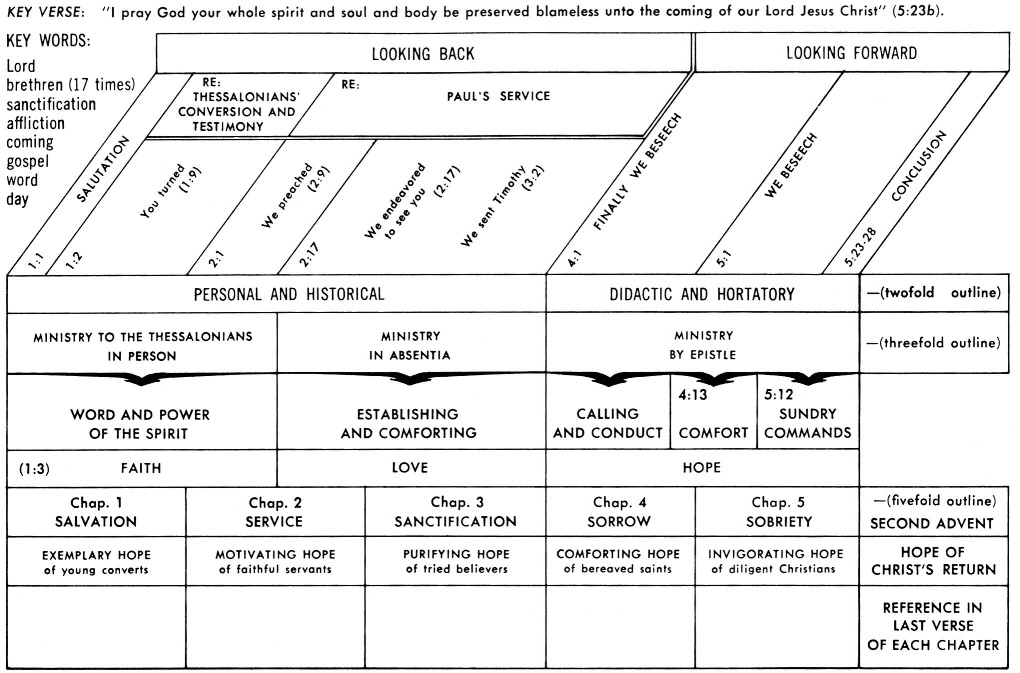
JESUS IS COMING AGAIN
Click chart to enlarge
Charts from Jensen's Survey of the NT - used by permission
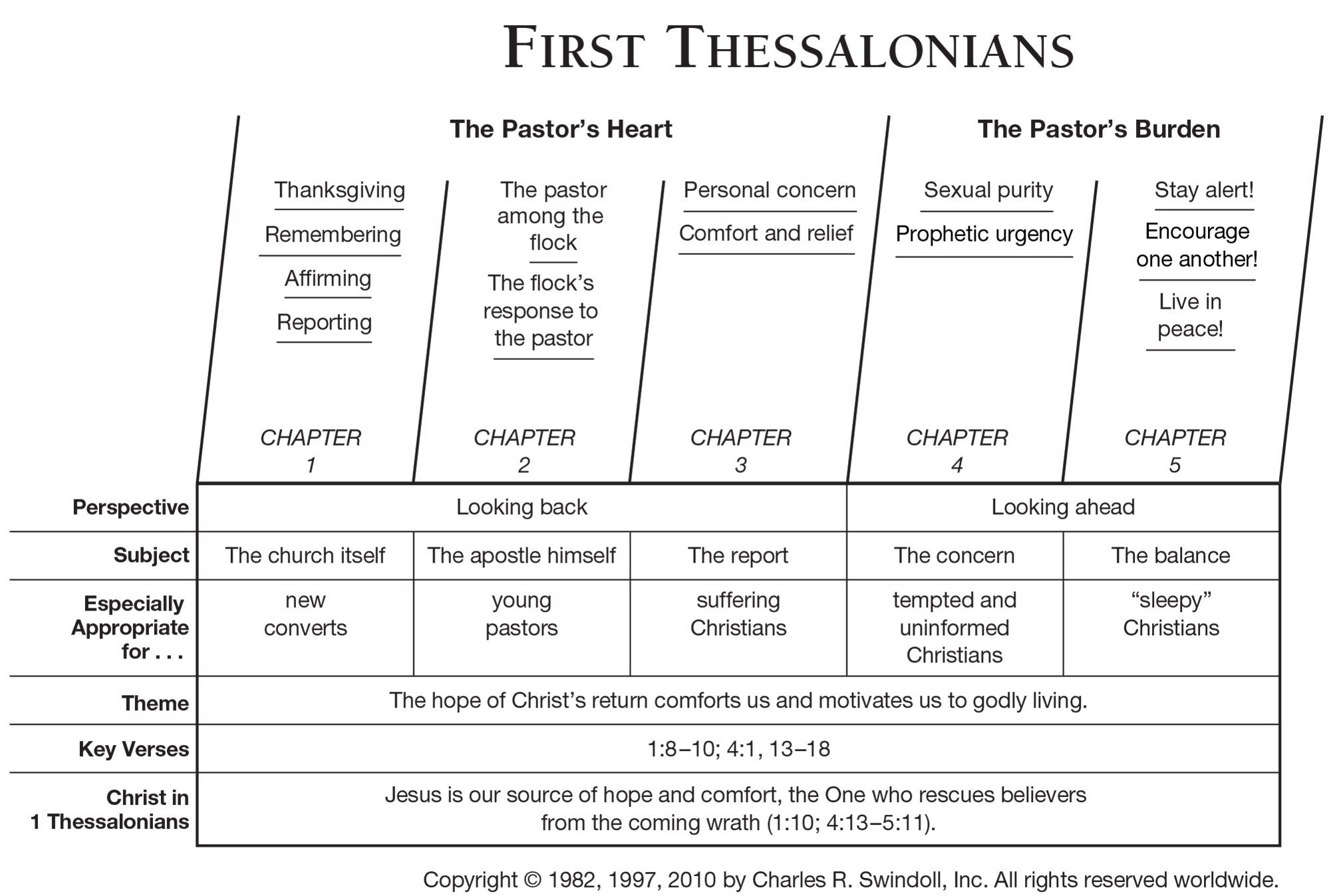
Chart by Charles Swindoll
|
1 Thessalonians |
||||||
| 1 Th 1:1-10 | 1 Th 2:1-20 | 1 Th 3:1-13 | 1 Th 4:1-18 | 1 Th 5:1-28 | ||
|
LOOKING BACK |
LOOKING FORWARD |
|||||
|
Personal Reflections |
Practical Instructions |
|||||
| Ministry In Person |
Ministry in Absentia (Thru Timothy) |
Ministry by Epistle |
||||
| Word and Power of the Spirit |
Establishing & Comforting |
Calling & Conduct | 1Th 4:13ff Comfort |
1Th 5:12ff Commands |
||
| 1 Salvation |
2 Service |
3 Sanctification |
4 Sorrow |
5 Sobriety |
||
| Paul Commends Spiritual Growth |
Paul Founds the Church |
Strengthening of the Church |
Directions for Spiritual Growth |
Holy Living in Light of Day of the Lord | ||
| Exemplary Hope of Young Converts | Motivating Hope of Faithful Servants |
Purifying Hope of Tried Believers | Comforting Hope of Bereaved Saints | Invigorating Hope of Diligent Christians | ||
|
Written from Corinth |
||||||
1 Thessalonians 2:1 For you yourselves know , brethren, that our coming to you was not in vain, (NASB: Lockman)
Greek: Autoi gar oidate, (2PRAI) adelphoi, ten eisodon hemon ten pros humas hoti ou kene gegonen, (3SRAI)
Amplified: FOR YOU yourselves know, brethren, that our coming among you was not useless and fruitless. (Amplified Bible - Lockman)
NLT: You yourselves know, dear brothers and sisters, that our visit to you was not a failure. (NLT - Tyndale House)
Phillips: My brothers, you know from your own experience that our visit to you was no failure. (Phillips: Touchstone)
Wuest: For you yourselves know positively, brethren, our entrance which was into your midst, that it has not proved futile,
Young's Literal: For yourselves have known, brethren, our entrance in unto you, that it did not become vain,
|
1Thessalonians |
||||||
| Chapter 1 | Chapter 2 | Chapter 3 | Chapter 4 | Chapter 5 | ||
|
LOOKING BACK |
LOOKING FORWARD |
|||||
|
Personal Reflections |
Practical Instructions |
|||||
| Ministry In Person |
Ministry in Absentia (Thru Timothy) |
Ministry by Epistle |
||||
| Word and Power of the Spirit |
Establishing & Comforting |
Calling & Conduct | 4:13ff Comfort |
5:12ff Commands |
||
| 1 Salvation |
2 Service |
3 Sanctification |
4 Sorrow |
5 Sobriety |
||
| Exemplary Hope of Young Converts | Motivating Hope of Faithful Servants | Purifying Hope of Tried Believers | Comforting Hope of Bereaved Saints | Invigorating Hope of Diligent Christians | ||
|
Written from Corinth |
||||||
|
Modified from the excellent book Jensen's Survey of the NT |
||||||
| OUTLINE OF 1 THESSALONIANS CHAPTERS 1-3 |
|
|
CHAPTER |
THEME |
|
1 |
An Exemplary Conversion |
|
2 |
An Exemplary Witness |
|
3 |
An Exemplary Follow-Up |
FOR YOU YOURSELVES KNOW, BRETHREN: Autoi gar oidate, (2PRAI) adelphoi:
- 1 Thessalonians 2 Resources - Multiple Sermons and Commentaries
- 1 Thessalonians 2:1-12 Becoming Men of Integrity - Steven Cole
- 1 Thessalonians 2:1-6: Fail-Proof Spiritual Leadership - John MacArthur
THIS IS TRUTH YOU KNOW
BEYOND A SHADOW OF A DOUBT
For (see gar) is a conjunction basically introducing an explanation and here opens this section marking the transition from Paul's primary thanksgiving for his assurance of the authenticity of their conversion (1Th 1:2-10) to the body or of the letter (1 Th 2:1-5:22).
What the for links back to is debatable. Some feel that the fact that Paul begins with our coming indicates that he is linking this back to the related subject in 1Thessalonians 1:9 (note) what kind of reception we had with you.
Ryrie on the other hand feels that…
This verse builds on 1Thes 1:5. not in vain = not without results. Paul returns to this subject in 1Thes 2:13, after reviewing his ministry (1Thes 1:1-12). (The Ryrie Study Bible: New American Standard Translation: 1995. Moody Publishers)
Hiebert agrees writing that…
The conjunction for (gar), not represented in the NIV rendering, is usually used to link a statement with what has immediately preceded, but here it obviously does not substantiate the reference to Christ's deliverance from coming wrath (note 1Thessalonians 1:10). Clearly the connecting link is broader and finds its proper explanation "in the train of thought which was running in the Apostle's mind."'
Best agrees that "for" links back "to the whole of 1Thes 1.2-10 with special reference to 1Thessalonians 1:5 where the entrance of Paul was discussed."' Thus Paul here takes up explicitly the defense already hinted at in 1Thessalonians 1:5. This entire section is in fact an elaboration of the two points mentioned in 1Thessalonians 1:9.
1Thes 2:1-12 are an expansion of what kind of reception you gave us, whereas 1Thes 2:13-16 renew the theme of how you turned to God from idols to serve the living and true God.
Paul had informed the readers about the reports he was continually receiving concerning the ministry at Thessalonica (note 1Thessalonians 1:9), but the Thessalonians were not dependent on such reports for their knowledge of what happened. (Hiebert, D. Edmond: 1 & 2 Thessalonians: BMH Book. 1996)
MacDonald makes the salient point that…
What we are is far more important than anything we ever say. Our unconscious influence speaks more loudly than our conscious influence. James Denney said:
A Christian’s character is the whole capital he has for carrying on his business. In most other callings, a man may go on, no matter what his character is, provided his balance at the bank is on the right side; but a Christian who has lost his character has lost everything.
The missionary martyr Jim Elliot wrote in his journal: In spiritual work, if nowhere else, the character of the worker decides the quality of his work. Shelley and Byron may be moral free-lancers and still write good poetry. Wagner may be lecherous and still produce fine music, but it cannot be so in any work for God. Paul could refer to his own character and manner of living for proof of what he was saying to the Thessalonians. Nine times over in this first epistle he says, “You know,” referring to the Thessalonians’ firsthand observation of Paul’s private as well as public life. Paul went to Thessalonica and lived a life that more than illustrated what he preached; it went beyond illustration to convincing proof. No wonder so much work in the Kingdom is shoddy; look at the moral character of the worker. (Borrow Believer's Bible Commentary)
The Disciple's Study Bible has an interesting comment noting that…Paul outlined his method of evangelism and gave us an example to follow:
- he ministered despite hardship and persecution;
- he ministered with pure motives;
- he ministered the true gospel of Christ;
- he ministered for God's glory;
- he ministered selflessly;
- he ministered in humility;
- he ministered with care and sacrificial love;
- and he ministered long and laboriously.
- Little wonder Paul could say "our visit to you was not a failure'' (v 1). (Borrow Disciple's Study Bible)
In this section (1Thes 2:1-12) Paul reminds the Thessalonians of how the missionaries had chosen to minister, live and work while in their presence and in so doing provides them a description of the specific behaviors and attitudes he desired for them to imitate, in so doing also providing a model that is applicable to all believers everywhere. Paul alludes to his desire (in the context of discussing work) for them to imitate his walk in the second epistle, writing that the missionaries worked …
in order to offer ourselves as a model (see tupos) for you, that you might follow our example. (2Thes 3:9)
For you yourselves know - An appeal again to the Thessalonians own experience (cf. 1Thessalonians 1:5-note), as distinguished from the report of others, and strengthened in the present instance by the repetition of the significant word brethren. You is emphatic in the Greek emphasizing that the Thessalonians knew personally how Paul’s team came into Thessalonica with the gospel (see notes 1Thessalonians 1:5; 2:1, 2:2, 2:5, 2:11; 4:2).
Know (1492) (oida) refers to having come to a perception or realization of something. Oida generally means to know intuitively or instinctively. To be acquainted with. To have information about. Know occurs repeatedly throughout chapter two, emphasizing that the Thessalonians knew this gospel team intimately. Paul was reminding them of his exemplary witness, not to boast but that they too might walk in a manner worthy of the God Who calls us into His own Kingdom and glory.
Michael Holmes in the NIV Application Commentary (Zondervan) observes that…
The repeated appeal to the Thessalonians’ own knowledge of these two matters (1Th 2:1 2, 5, 9 10 11) serves both to minimize the distance between Paul and the Thessalonians and to reinforce the relationship between them — points characteristic of ancient “letters of friendship”
Not only do others report the power and efficacy of our preaching among you, but you yourselves are experimentally acquainted with it as Paul had recorded in chapter 1…
for our gospel did not come to you in word only, but also in power and in the Holy Spirit and with full conviction; just as you know what kind of men we proved to be among you for your sake. (See note 1Thessalonians 1:5)
Brethren (80) (adelphos from collative a = denoting unity + delphús = womb) is literally one born from same womb and so a male having the same father and mother as reference person. Figuratively, adelphos as in this verse refers to a close associate of a group of persons having well-defined membership, specifically here referring to fellow believers in Christ who are united by the bond of affection.
Adelphos - 18x in 1 Thess proportionately greater than any other Pauline epistle -- 1:4; 1 Thess. 2:1; 1 Thess. 2:9; 1 Thess. 2:14; 1 Thess. 2:17; 1 Thess. 3:2; 1 Thess. 3:7; 1 Thess. 4:1; 1 Thess. 4:6; 1 Thess. 4:10; 1 Thess. 4:13; 1 Thess. 5:1; 1 Thess. 5:4; 1 Thess. 5:12; 1 Thess. 5:14; 1 Thess. 5:25; 1 Thess. 5:26; 1 Thess. 5:27; and 8x in 2 Thess -- 2 Thess. 1:3; 2 Thess. 2:1; 2 Thess. 2:13; 2 Thess. 2:15; 2 Thess. 3:1; 2 Thess. 3:6; 2 Thess. 3:13; 2 Thess. 3:15
For (1063)(gar) is a subordinating conjunction expressing cause or explanation and thus introduces an explanation. GAR is "a causative particle standing always after one or more words in a clause and expressing the reason for what has been before, affirmed or implied. For, in the sense of because, and so forth." (Borrow The Complete Word Study Dictionary: New Testament - Page 357 and Page 358 - see the preceding pages for Zodhiates' lengthy description of gar)
THOUGHT - In simple terms for is a term of explanation and its occurrence should always prompt one to pause and ponder the text and context, always asking at least one 5W/H question "What is the text explaining?" which will force you to examine the preceding passages, which in turn will hone or refine your skill of observation and help you establish thte context, which will lead to a more accurate Interpretation, which is essential for valid Application of the text.
While not every "for" in the Bible is a term of explanation, most are and since there are over 7500 uses of for (NAS), you will have ample opportunity to observe and interrogate the text. Two clues that the for is a term of explanation - (1) It is at the beginning of the sentence or clause or (2) you can substitute the word "because" and it makes good sense. As you practice this discipline of pausing to ponder, you are establishing the context (which leads to more accurate interpretation and thus more apropos application) and you are in effect engaging in the blessed activity of Biblical Meditation (See Ps 1:2+, Ps 1:3+ and Joshua 1:8+ for the blessed benefits of meditation = I like to call it a "mini-meditation".).
THAT OUR COMING TO YOU WAS NOT IN VAIN: ten eisodon hemon ten pros humas hoti ou kene gegonen, (3SRAI):
- 1Th 2:13; 1:3-10; 2Th 3:1
- 1Th 3:5; Job 39:16; Ps 73:13; 127:1; Isa 49:4; 65:23; Hab 2:13; 1Co 15:2,10,58; 2Co 6:1; Gal 2:2; 4:11; Php 2:16
- 1 Thessalonians 2 Resources - Multiple Sermons and Commentaries
- 1 Thessalonians 2:1-12 Becoming Men of Integrity - Steven Cole
- 1 Thessalonians 2:1-6: Fail-Proof Spiritual Leadership - John MacArthur
The Jerusalem Bible renders it "our visit to you has not proved ineffectual."
Coming (our entering in) (1529) (eisodos from eis = in + hodos = a way) literally means a way in, an entrance. Eisodos can refer to the action of coming in (access, entrance). It is used in the first chapter of entrance upon Gospel work into the locality and/or as the reception given (acceptance or welcome as in 1Thes 1.9…
For they themselves report about us what kind of a reception (eisodos) we had with you, and how you turned to God from idols to serve a living and true God (see note)
McGee puts it this way - When he (Paul) came to Thessalonica, it rocked a great many folk, bringing many to a saving knowledge of Christ. And it brought a church into existence. Paul was not simply talking about a theory or a philosophy, but about something that worked in Thessalonica. The gospel walked down the streets of that city, and it got into the hearts and homes and lives of men and women. (McGee, J V: Thru the Bible Commentary: Thomas Nelson)
Was not - is more literally "had not come to be" or "that it has not become empty". Literally it reads "that it did not become vain".
Was not (1096) (ginomai) refers to what has come into existence. Ginomai in perfect tense point to fact that an enduring result was secured, that the effects of Paul and Silas' coming to Thessalonica continued into the present. The perfect tense expresses this as an accomplished, unassailable fact. And this effect continues even into eternity for Paul says later that the Thessalonian believers are his
hope and joy and crown of exultation… in the presence of our Lord Jesus at His coming! (1Th 2:19-note)
A T Robertson rightly notes that "Every pastor watches wistfully to see what will be the outcome of his work. (Word Pictures)
Vain (2756) (kenos) means empty, hollow, vain, fruitless, without usefulness or success. Kenos can also refer to that in which there is nothing of truth or reality and which is thus false or fallacious. Kenos can describe one who cannot be depended upon and whose deeds do not correspond to his words.
Paul used kenos again in chapter 3 writing that…
when I could endure it no longer, I also sent to find out about your faith, for fear that the tempter might have tempted you, and our labor would be in vain. (See note 1Thessalonians 3:5)
A similar expression is used by Paul in his letter to the saints at Philippi exhorting them to be continually
holding fast the word of life, so that in the day of Christ I will have reason to glory because I did not run in vain [kenos] nor toil in vain [kenos] (Philippians 2:16 note)
Both the previous passages refer to laboring to the point of exhaustion, something Paul did not want to be for naught (in vain). It is therefore no coincidence that kenos is used here at the beginning of a section which not only alludes to Paul's tent-making activities (1Thessalonians 2:9 - note), but also the labor and effort of his whole evangelistic work (1Thes 2:2, 2:8).
Robertson (Word Pictures) uses the related word mataios (3152) stating that…
In 1Cor 15:14, 17 Paul speaks of empty the preaching and vain the faith (both vain if the resurrection is not truth). One easily leads to the other…
1Cor 15:14 and if Christ has not been raised, then our preaching is vain (kenos), your faith also is vain.
1Cor 15:17 and if Christ has not been raised, your faith is worthless (mataios); you are still in your sins.
Kenos is often used in speaking of work which is either futile and useless in itself (1Cor 15.58), receives no reward (Mk 12.3; Lk 20.10), or produces no result (1 Cor 15.10).
Paul's coming to the Thessalonians was not empty of real meaning or purpose and was not a failure (in the sense of being ineffective) for they themselves are, in view of their genuine conversion (their "work of faith, labor of love and steadfastness of hope in our Lord Jesus Christ" 1Thessalonians 1:3-note) the evidence of the efficacy and success of the Gospel which is the power of God unto salvation (Ro 1:16 - note). Paul and Silas had arrived in Thessalonica which apparently had no believers in Christ (see notes Acts 17:1-9). They left a vibrant, dynamic church that was imitating their example, growing in faith and love, standing steadfast against persecution, and becoming an example to all believers sounding forth the gospel across the world. Their coming with the gospel had resulted in changed lives and so clearly their visit had not been a failure (kenos). The occasion for the writing of this letter in fact was when Paul had learned from Timothy (see note 1Thessalonians 3:6) that the assaults of Satan had not annulled or derailed their labors at Thessalonica.
On the other hand one could also interpret not in vain as a reference to the character and ethic of the missionaries and their work. In other words their approach was not with unsound motives or methods (as described in 1Thes 2:2-12; cf their "exemplary witness"). But while not in vain might refer to the character of their mission and not the results of their labors, in fact it surely true that character cannot be separated from results and thus their sound character produced credible results, so that neither of these were in vain!
Guzik notes that not in vain could refer here "either to the result of the ministry, or the character of the ministry. Because it was evident to everyone that Paul’s ministry in Thessalonica was a success, it is better to see it as a reference to the character of Paul’s ministry. His coming was not empty or hollow, as if he were a mere salesman or marketer.
Green explains this section noting that "The Thessalonians knew what kind of persons Paul and the others were (1Thessalonians 1:5b), and this section now helps them to remember in detail the blameless character they exhibited. The call to remember what they already knew appears frequently in this section (1Thess 2:1, 2:2, 2:5, 2:9, 2:10, 2:11) and at other points in this letter (1:5; 3:3, 3:4; 4:2; 5:2; and cf. 2 Thess. 2.5-6; 3.7). In ancient ethical instruction, moralists commonly called their readers to remember what they already knew (e.g., Dio Chrysostom 17.1-6), and Paul repeatedly does the same, bringing to mind not only the teaching he had previously given the church but also helping them recall his character upon his “entry” to the city (see 1Thessalonians 1:9). He reminds the Thessalonians that his entry was not a failure. (Green, G. L. The Letters to the Thessalonians. The Pillar New Testament Commentary. Grand Rapids, Mich.; Leicester, England: W. B. Eerdmans Pub.; Apollos)
Vine has a thoughtful note worth pondering…
Though the apostle well knew that no labor in the Lord is vain, 1 Corinthians 15:58 (Therefore, my beloved brethren, be steadfast, immovable, always abounding in the work of the Lord, knowing that your toil is not in vain in the Lord.), he also knew that only in the day of Christ, when all service is to be reviewed by the Lord, 1 Corinthians 3:12, 15 (Now if any man builds upon the foundation with gold, silver, precious stones, wood, hay, straw… 15 If any man's work is burned up, he shall suffer loss; but he himself shall be saved, yet so as through fire.), will it be finally manifest whether or no he had run and labored in vain, Philippians 2:16 (holding fast the word of life, so that in the day of Christ I may have cause to glory because I did not run in vain nor toil in vain.). He earnestly desired, therefore to assure himself of the stability of his work, and such tidings as Timothy had brought comforted and gladdened his heart, 1Thes 3:6-8. (Vine, W. Collected writings of W. E. Vine. Nashville: Thomas Nelson)
Comment: Dear reader, today would be a good time to ponder your life work. {Download and read John Piper's book Don't Waste Your Life} Is your work "in Christ" {John 15:5} and destined to endure the Refiner's fire and so last throughout eternity (see note Ephesians 2:10)? Or is it "in self" and destined for destruction? Is there some disciple you need to call to see how they are walking in their Christian life?)
1Thessalonians 2:2 but after we had already suffered and been mistreated in Philippi, as you know , we had the boldness in our God to speak to you the gospel of God amid much opposition. (NASB: Lockman)
Greek: alla propathontes (AAPMPN) kai hubristhentes (APPMPN) kathos oidate (2PRAI) en Philippois eparresiasametha (1PAMI) en to theo hemon lalesai (AAN) pros humas to euaggelion tou theou en pollo agoni.
Amplified: But though we had already suffered and been outrageously treated at Philippi, as you know, yet in [the strength of] our God we summoned courage to proclaim to you unfalteringly the good news (the Gospel) with earnest contention and much conflict and great opposition. (Amplified Bible - Lockman)
NLT: You know how badly we had been treated at Philippi just before we came to you and how much we suffered there. Yet our God gave us the courage to declare his Good News to you boldly, even though we were surrounded by many who opposed us. (NLT - Tyndale House)
Phillips: We had, as you also know, been treated abominably at Philippi, and we came on to you only because God gave us courage. We came to tell you the Gospel, whatever the opposition might be.(Phillips: Touchstone)
Wuest: the evidence of its success being still in existence, but although we had previously suffered and had been mistreated in an arrogant and spiteful manner as you know well in Philippi, we became bold in our God to speak to you the good news of God in the midst of much conflict.
Young's Literal: but having both suffered before, and having been injuriously treated (as ye have known) in Philippi, we were bold in our God to speak unto you the good news of God in much conflict,
BUT AFTER WE HAD ALREADY SUFFERED AND BEEN MISTREATED IN PHILIPPI: alla propathontes (AAPMPN) kai hubristhentes (APPMPN) kathos oidate (2PRAI) en Philippois:
- Acts 5:41 16:12,22 23 24,37; 2Ti 1:12; Heb 11:36,37; 12:2,3; 1Pe 2:14 15 16
- 1 Thessalonians 2 Resources - Multiple Sermons and Commentaries
- 1 Thessalonians 2:1-12 Becoming Men of Integrity - Steven Cole
- 1 Thessalonians 2:1-6: Fail-Proof Spiritual Leadership - John MacArthur
But (235) (alla) is a strong adversative (expressing opposition or antithesis - a contrast (see contrasts) or opposition between two things) conjunction indicating contrast. In Greek there is more than one word for but, and this verse begins with the strongest adverse word at Paul's disposal and thus makes the greatest possible contrast with the previous section.
More than being not in vain to the contrary, their preaching had been in boldness which is all the more dramatic when we recall the context of what had happened to them just before coming to Thessalonica (see Acts 16:12-40 Commentary, then in Thessalonica in Acts 17 Commentary).
Already suffered (4310) (propascho from pros = before + pascho = experience a sensation/suffer pain experience something that falls to one's lot good or ill to suffer, to be in pain) is used only here in Scripture and means to undergo hardship previously or suffer before, to be affected beforehand, to experience before.
Paul recalls the physical suffering he and Silas had undergone at Philippi, as recorded by Luke in Acts 16:23-24…
And when they had inflicted many blows upon them, they threw them into prison, commanding the jailer to guard them securely; and he, having received such a command, threw them into the inner prison, and fastened their feet in the stocks.
It should be kept in mind that a Roman flogging was no light matter and surely was an experience not easily forgotten.
As the word propascho does not in itself imply that the sufferings were unjust, the apostle adds, that they were shamefully mistreated.
Mistreated (5195) (hubrizo from húbris = injury, insult, reproach, arrogance, insolence, ill-treatment. Our English word hubris refers to exaggerated pride or self-confidence) means act with insolence, wantonness, wicked violence, to treat injuriously. To act spitefully toward someone, treat shamefully, and therefore to injure or to abuse. It conveys the idea of treating someone contemptuously in an insolent and arrogant way.
Hubrizo expresses insulting and outrageous treatment and especially treatment which is calculated to publicly insult and openly humiliate the victim.
Thayer writes that "in Greek usage the mental injury and the wantonness of its infliction being prominent."
Milligan notes that in the present verse hubrizo emphasizes that the missionaries' insolent treatment was "More than the bodily suffering it was the personal indignity that had been offered to him as a Roman citizen
Gilbrant notes that in Classical Greek "Hubrizō means “to run riot,” especially “in the use of superior strength or power, or in sensual indulgence” (Liddell-Scott; cf. the noun hubris, “wanton violence,” and hubristēs, “a violent person”). Thus, it can mean “to mistreat, to insult,” or passively, “to be arrogant, rude.” The word has the connotation of severity and harshness. In the papyri it occurs at times in connection with a husband’s mistreatment of his wife; the example illustrates the intensity behind hubrizō (Moulton-Milligan; cf. Trench’s comments on hubris; he suggests the motive for hubris is the “pleasure” of the inflicting party [Synonyms of the New Testament, pp.97f.]). (Complete Biblical Library Greek-English Dictionary)
NIDNTT notes that originally the root word hubris "meant excess weight, excess power; sometimes more concretely, ill-treatment, abuse, insult; sometimes more abstractly, arrogance, insolence, brutality.: (Brown, Colin, Editor. New International Dictionary of NT Theology. 1986. Zondervan)
TDNT has an excellent background discussion on this word family (hubris, hubrizo)…
1. The original sense of this group, which is of obscure derivation, is that of invading the sphere of another, with an implication of arrogance. Conveyed is the idea of trespass with overweening force and the infliction of insult, injury, etc. There are warnings against hubris, which is a common fault among the free, but which finally brings destruction to the self or others.
2. Tragedy deals with hubris. It is the scornful right of the mighty. The gods visit it with retribution and hence it plays a big role in the Greek sense of sin. It breeds tyrants, plunges into excess, and entails violation of reverence for the holy. In human relations it means either scorn and contempt or, more actively, hurt and violence.
3. For the historians hubris is an important factor in the course of events. In Herodotus the religious basis is plain; the Persian plan of conquest is in keeping with a fundamental attitude. In Thucydides affluence leads to hubris and punishment follows. Xenophon finds in the decay of Sparta and Athens a judgment on hubris.
4. In legal rhetoric hubris denotes the violence of the rich or the violation of personal rights.
5. Socrates has no sense of arrogance. For Plato hubris is the negative side of érōs and an essential force. In young people it leads to attacks on parents and public order. It hits the weakest most severely and results in injustice and destruction. If education brings victory over it, the victory can lead to fresh hubris. hubris is a power of fate that permeates all areas of life.
6. In Aristotle hubris denotes sexual violation but also scorn, ill-will, arrogance, greed, and offense against the gods. A presumptuous disposition is a general human complaint which the law cannot punish. It raises a political problem; only prudence can achieve the peace that is the goal of politics, but periods of peace also produce transgression.
7. The usual senses continue in the later period, but while hubris retains its emotional force, it often takes on much weaker meanings, and it never becomes a key concept in Greek thinking. (Kittel, G., Friedrich, G., & Bromiley, G. W. Theological Dictionary of the New Testament. Eerdmans)
Bruce comments that "The outrage lay not so much in their being subjected, Roman citizens though they were, to treatment from which Roman citizens were legally exempt, as to their being publicly stripped and flogged without any inquiry into the charges brought against them outrageous treatment whether they were Roman citizens or not. (Bruce, F F: 1 and 2 Thessalonians. Word Biblical Commentary. Dallas: Word, Incorporated. 1982)
There are 4 uses of hubrizo in the Septuagint (LXX) (2Sa 19:43; Isa 13:3; 23:12; Jer. 48:29) and 5 in the NT (including the present verse)…
Matt. 22:5 But they paid no attention and went their way, one to his own farm, another to his business, 6 and the rest seized his slaves and mistreated them and killed them.
Luke 11:45+ And one of the lawyers said to Him in reply, "Teacher, when You say this, You insult us too."
Luke 18:32+ For He will be delivered to the Gentiles, and will be mocked and mistreated and spit upon, 33 and after they have scourged Him, they will kill Him; and the third day He will rise again."
Acts 14:5+. And when an attempt was made by both the Gentiles and the Jews with their rulers, to mistreat and to stone them, 6 they became aware of it and fled to the cities of Lycaonia, Lystra and Derbe, and the surrounding region;7 and there they continued to preach the gospel.
The insult (hubris) was a theme that was frequently touched upon by ancient moralists. Aristotle, for example, comments on insults (hubris), saying "For insult (hubris) consists in causing injury or annoyance whereby the sufferer is disgraced."
Insults were treated so seriously that the victim could take legal action against the person who caused the insult, similar to the way we could take a person to court for defamation of character.
Hiebert adds that for Paul "the physical suffering was not the worst part of the treatment received. Paul more strongly resented that he and his co-workers had been shamefully treated, grievously "insulted." Gross indignities had been heaped on them in the way they had been treated—arrested on a false charge, stripped of their clothes and publicly beaten without a trial, and thrown into the inner prison with their feet in the stocks as though they were the most dangerous criminals. They had suffered not only bitter cruelty but public humiliation. Paul was deeply conscious that his social status as a Roman citizen had been outraged. The treatment accorded them was contrary to Roman law. His desire to reverse this mistreatment caused Paul to demand that the Philippian magistrates come personally to conduct them out of prison (Acts 16:37). (Hiebert, D. Edmond: 1 & 2 Thessalonians: BMH Book. 1996)
In Philippi - The account of Paul's beating and imprisonment there is found in Acts 16:12-40. Philippi was about one hundred miles or 3-4 days’ journey, northeast of Thessalonica. Recall that Paul and Silas could sing hymns to God in jail after the abusive treatment they received (see Acts 16:25) and thus were not likely to be deterred by physical suffering from further testimony in Thessalonica.
Paul wrote to Timothy…
For this reason (because if the gospel for which he had been appointed a preacher and an apostle and a teacher) I also suffer these things, but I am not ashamed; for I know whom I have believed and I am convinced that He is able to guard what I have entrusted to Him until that day. (See note 2 Timothy 1:12)
AS YOU KNOW, WE HAD THE BOLDNESS IN OUR GOD: eparresiasametha (1PAMI) en to theo hemon:
- 1Th 1:5; Acts 4:13,20,31; 14:3; 17:2,3; Ep 6:19,20
- 1 Thessalonians 2 Resources - Multiple Sermons and Commentaries
- 1 Thessalonians 2:1-12 Becoming Men of Integrity - Steven Cole
- 1 Thessalonians 2:1-6: Fail-Proof Spiritual Leadership - John MacArthur
Paul appeals to their personal experiences in Thessalonica which were well known to the saints there.
It is notable that Paul was human just like you and me and His source of courage and bold speech was not in self but in God. He reminds us of his humanness in 1Corinthians writing that he was with them…
in weakness (literally without strength, in a sate of limited capacity to do something) and in fear and in much (much in amount) trembling (quaking or quivering with fear as bespeaks great timidity). (1Cor 2:3)
And in Paul's second epistle to the Corinthians (writing from Ephesus) he states that…
we were afflicted (present tense = continually, verb = thlibo = pressed together, hemmed in figuratively referring to sufferings from pressure of circumstances and/or antagonism of persons) on every side: conflicts (mache = fightings, controversies, battles, almost assured over the Gospel) without, fears within. (2Cor 7:5)
Vincent commenting on as you know notes that this is…
One of the many characteristic expressions of these Epistles which indicate community of experience and sentiment on the part of Paul and his readers. See 1Th 1:5, 8; 2:1, 5, 10, 11; 3:3, 4, 12; 4:1, 2, 6, 11; 5:1, 11; 2Th 2:15; 3:1.
Know (1492) (oida) refers to having come to a perception or realization of something. Oida generally means to know intuitively or instinctively. To be acquainted with. To have information about. Paul is introducing this explanation with an appeal to his (Silas and Timothy's) personal experiences in Thessalonica which were well known to them. These things were absolutely true and they knew it beyond a shadow of a doubt.
Paul gave a similar reminder to the saints at Philippi writing that…
For to you it has been granted for Christ's sake, not only to believe in Him, but also to suffer for His sake, experiencing the same conflict (agon) which you saw in me, and now hear to be in me. (See notes Philippians 1:29; 1:30)
Hiebert comments that…
Paul's insertion of the words as you know within his statement about the sufferings indicates his vivid feeling and strong desire to carry his readers fully with him in recalling the facts. His words, quite literally, "even as you know," indicate that their memory would recall an exact correspondence between his assertion and the facts. When the missionaries arrived in Thessalonica their lacerated backs were still far from fully healed. The painful movements of the new arrivals soon brought out the story of the suffering they had undergone at Philippi. It became immediately clear to their hearers that their work of preaching carried the possibilities of dangerous consequences. But the missionaries believed they had nothing to hide. (Ibid)
Robertson (Word Pictures) comments that…
The insult in Philippi did not close Paul’s mouth, but had precisely the opposite effect in our God. It was not wild fanaticism, but determined courage and confidence in God that spurred Paul to still greater boldness in Thessalonica… be the consequences what they might.
Had the boldness in our God - Their holy boldness was not self-wrought but Spirit empowered. Their boldness was not self confidence that the world extols, but was confidence based solely on their God and their trust that He would sustain them. Paul would later write to the Ephesians charging them (in light of the reality of spiritual warfare as for example when one shares the Gospel) to continually (present imperative)…
be strong (more literally "be continually strengthened" - passive voice = continually depending upon and allowing the Spirit to strengthen you) in the Lord, and in the strength of His might. (see note Ephesians 6:10)
And as Paul wrote to the Corinthians, he came to understand that the way to power was though weakness…
(After Paul had entreated the Lord three times unsuccessfully that the thorn in his flesh might depart Paul wrote that God) has said to me, "My grace is sufficient for you, for power is perfected in weakness." Most gladly, therefore, I will rather boast about my weaknesses, that the power of Christ may dwell in me. Therefore I am well content with weaknesses, with insults, with distresses, with persecutions, with difficulties, for Christ's sake; for when I am weak, then I am strong. (2Cor 12:9-10)
The pattern and power for boldness in the early church and for all believers of all times is recorded by Luke… in Acts 4 he writes that the Jewish rulers and elders and scribes (those adamantly opposed to the Gospel of Jesus Christ)
(13)… observed the confidence {parrhesia - boldness} of Peter and John, and understood that they were uneducated and untrained men, they were marveling, and began to recognize them as having been with Jesus… 29 (After being released Peter and John joined the fellow believers and prayed) "And now, Lord, take note of their threats, and grant that Thy bond-servants may speak Thy word with all confidence {parrhesia - boldness} 30 while Thou dost extend Thy hand to heal, and signs and wonders take place through the name of Thy holy servant Jesus." 31 And when they had prayed, the place where they had gathered together was shaken, and they were all filled (second time filling was mentioned. The first time was Acts 2:4. This repetition emphasizes the importance of believer's continual dependence upon the Holy Spirit to live out the supernatural Christian life, the Christ life), and began to speak the word of God with boldness. {parrhesia} (Acts 4:13, 29-31) (Comment: Are you allowing the Spirit to fill you continually? Holy Spirit enabled boldness was a mandatory requirement for the missionaries to witness and speak forth the gospel in Acts [Acts 9:27, 28, 13:46, 14:3, 18:26, 19:8] and is no less critically important to all believers today so that we might speak forth the gospel even if it is in the face of much opposition, which it quite likely will be!)
In his letter to the saints at Ephesus, Paul requested specifically to…
pray on my behalf, that utterance may be given to me in the opening of my mouth, to make known with boldness the mystery of the gospel for which I am an ambassador in chains; that in proclaiming it I may speak boldly, as I ought to speak. (see notes Ephesians 6:19; 20)
Had the boldness (3955) (parrhesiazomai from parrhesia = freedom or frankness in speaking or confident in spirit and demeanor <> pas = all + rhesis = speech) means literally speaking out of every word and conveys the idea idea of freedom to say all and thus means to speak freely, openly, boldly, fearlessly, without constraint. The Greeks used this word for speaking in a democratic assembly. This verb is always used in the NT of speaking. It means to be bold and courageous in one's speech reflecting an attitude of openness that comes from freedom and lack of fear.
Gilbrant say parrhesiazomai "refers to fearless and frank speaking with the freedom to speak openly even in the face of opposition. A full citizen (though not a slave) in the Greek city-states had the right to express any opinion freely in the public assembly. The word is also used to express the openness of intimate conversation with a friend. Later, the philosophical school of Cynicism used the word to denote the freedom of speech that someone who is morally pure has; he need not fear the public scrutiny of his life which his words might incite." (Complete Biblical Library Greek-English Dictionary)
Paul uses the aorist tense which conveys the sense that "we took courage" or "we became bold."
As Morris has written parrhesiazomai…
denotes the state of mind when the words flow freely, the attitude of feeling quite at home with no sense of stress or strain. This attitude includes both boldness and confidence.
Parrhesia is the opposite of kolakeia which is flattery and literally conveys the idea of freedom to say all or of unreservedness in speech. It can also convey the ideas of plainness or outspokenness. Parrhesia is speaking in a way conceals nothing and passes over nothing. It can describe state of boldness and confidence mixed with courage and fearlessness, especially in the presence of persons of high rank or in the face of possible danger. It is that attitude of openness that stems from freedom and lack of fear ("shaking" fear whereas godly, reverential fear is always appropriate). Greeks used parrhesia of those with the right to speak openly in the assembly.
Parrhesiazomai describes both a lack of fear and a full confidence in the message itself, two additional indicators of authentic evangelism.
This verb was used in classical Greek to signify freedom of speech or expression often with a political connotation.
Boldness in our God or on account of our fellowship with God. This boldness was their own natural courage but was that inspired by God's Spirit Who enabled them in the midst of the opposition even in light of the memories they had of the recent sufferings at Philippi! Furthermore, their boldness in face of the awareness that it could happen again in Thessalonica, was sure proof that their ministry was not a self-seeking, mercenary endeavor, for if it had been so motivated they would surely have shrunk back.
They had confidence in God, Luke recording that as the opponents…
observed the confidence (parrhesia) of Peter and John, and understood that they were uneducated and untrained men, they were marveling, and began to recognize them as having been with Jesus. (Acts 4:13)
Richison writes that…
True ministry withstands the blast of criticism and persecution. Out of the crucible of Philippi came the pure gold of Thessalonica. The gospel team was clearly not in ministry for selfish purposes. The Devil tried to cut Paul’s ministry off, but Paul did not stop communicating the gospel. His trials only became a platform for further ministry. (Ref)
Calvin notes that…
We know that indignity and persecution weaken and indeed completely break men’s minds. It was, therefore, a work of God that, although Paul had suffered various misfortunes and indignity, he appeared unaffected, and did not hesitate to launch an assault on a large and wealthy city for the purpose of leading its people captive to Christ.
Hiebert comments that the fact that their boldness was in our God means that…
It was imparted to them by their union with Him. In Him their suffering was metabolized into strength and courage in His service. Boldness arose with their consciousness that their life had its sphere of existence in Him and all that happened to them was under His control. "Christian courage springs from the belief that 'this God is our God.' (Ibid)
Luke also speaks of the ultimate Source of bold speech…
Acts 4:31 And when they had prayed, the place where they had gathered together was shaken, and they were all filled with the Holy Spirit, and began to speak the word of God with boldness. (parrhesia from pas = all + rhesis = speech - literally conveys the idea of freedom to say all or of unreservedness in speech.) (Comment: See also See Acts 4:29 where they prayed for boldness ["confidence"].
THOUGHT - Are you timid and fearful to speak forth the gospel? Most of us are beloved. But have you ever ask your Father in heaven to give you a supernatural boldness {not a brusqueness but a boldness!} that come from the empowering presence of His Spirit Who dwells in you? Try it this week and stand and see the salvation of the LORD, cf 2Chr 20:17, see note 2 Timothy 1:7)
In a surprising request Paul ask others to pray for his boldness! This demonstrates Paul's continual dependence on the Holy Spirit's enablement coupled in a supernatural way with the prayers of the saints. This is surely a mysterious equation!…
Pray on my behalf, that utterance may be given to me in the opening of my mouth, to make known with boldness the mystery of the gospel, for which I am an ambassador in chains; that in proclaiming it I may speak boldly, as I ought to speak. (See notes Ephesians 6:19; 6:20)
Vine adds an interesting note on the historical context writing that…
shortly before writing these words, at Corinth (Ed note: Recall Paul wrote the epistle to the Thessalonians from Corinth), the apostle had been “in weakness, and in fear, and in much trembling,” 1Corinthians 2:3, a state of mind probably due in some measure, at least, to the absence of his fellow workers, for it seems to have passed with the arrival of Silas and Timothy from Macedonia, Acts 18:5. In the overruling providence of God, the wrath of the Jews, notwithstanding the conversion of the ruler of their synagogue, was at Corinth restrained, and the inevitable outbreak deferred for a year and a half whereas at Philippi, Acts 16:19, and at Thessalonica, Acts 17:5, and at Berea, Acts 17:13, persecution began very shortly. It was about the time, too, of the writing of this epistle, that God encouraged His servant by a vision and reassuring words in the night, Acts 18:9. Thus graciously did the Lord consider the frailty of the earthen vessel to which He had committed the treasure of His gospel, 2Corinthians 4:7, and in the apostle’s human weakness displayed His own divine power, 2Corinthians 12:9, 10; see also at 2Cor 3:7. Hence it is clear that the characteristic boldness of the apostle was not mere natural courage, though he was not devoid of that, but the calm fearlessness that comes of consciousness of the presence of God, cp. 1 Peter 2:19 (note), (Vine, W. Collected writings of W. E. Vine. Nashville: Thomas Nelson)
F F Bruce comments that…
They do not say, Having been ill-treated at Philippi, we were more circumspect in Thessalonica but rather: we were emboldened in God to preach the gospel there too. In Greek democratic parlance meant freedom of speech and something of this sense attaches to it and its derivative verb as used in the NT, together with the sense of courage.
Here the writers imply, We took courage (ingressive aorist) and declared the gospel of God to you frankly and fearlessly (NEB).
Undoubtedly Paul is reacting here against all sorts of religious propagandists of his day. His preaching does not aim at pleasing men, not even himself, but pleasing God: his gospel is not according to man (Gal 1:11) and therefore provokes opposition; but he has not adulterated the gospel.
The word freedom of speech has here its place in the missionary-practice of the apostle: it comprises both the full truth of the gospel and full freedom towards the judgment of men (van Unnik, Freedom of Speech, 473). (Bruce, F F: 1 and 2 Thessalonians. Word Biblical Commentary. Dallas: Word, Incorporated. 1982) (Italics and bolding added)
Parrhesiazomai occurs 4 times in the Lxx (Job 22:26 Psalm 12:5 Psalm 94:1 Proverbs 20:9)
Here are the 9 uses of parrhesiazomai in the NT. Note the concentration in Acts in Luke's description of Spirit filled men proclaiming the gospel.
Acts 9:27 But Barnabas took hold of him and brought him to the apostles and described to them how he had seen the Lord on the road, and that He had talked to him, and how at Damascus he had spoken out boldly in the name of Jesus. 28 And he was with them moving about freely in Jerusalem, speaking out boldly in the name of the Lord.
Acts 13:46 And Paul and Barnabas spoke out boldly and said, "It was necessary that the word of God should be spoken to you first; since you repudiate it, and judge yourselves unworthy of eternal life, behold, we are turning to the Gentiles.
Acts 14:3 Therefore they spent a long time there speaking boldly with reliance upon the Lord, who was bearing witness to the word of His grace, granting that signs and wonders be done by their hands.
Acts 18:26 and he (Apollos) began to speak out boldly in the synagogue. But when Priscilla and Aquila heard him, they took him aside and explained to him the way of God more accurately.
Acts 19:8 And he entered the synagogue and continued speaking out boldly for three months, reasoning and persuading them about the kingdom of God.
Acts 26:26 "For the king knows about these matters, and I (Paul) speak to him also with confidence, since I am persuaded that none of these things escape his notice; for this has not been done in a corner.
Ephesians 6:20 (see note) (pray on my behalf, that utterance may be given to me in the opening of my mouth, to make known with boldness the mystery of the gospel) for which I am an ambassador in chains; that in proclaiming it I may speak boldly, as I ought to speak. (Comment: Always a good prayer request).
1 Thessalonians 2:2 but after we had already suffered and been mistreated in Philippi, as you know, we had the boldness in our God to speak to you the gospel of God amid much opposition.
Barnes summarizes this section writing that their boldness was a result of "humble dependence on the support of our God. It was only his powerful aid that could have enabled them to persevere with ardour and zeal in such a work after such treatment. The meaning here is, that they were not deterred from preaching the gospel by the treatment which they had received, but at the very next important town, and on the first opportunity, they proclaimed the same truth, though there was no security that they might not meet with the same persecution there. Paul evidently appeals to this in order to show them that they were not impostors, and that they were not influenced by the hope of ease or of selfish gains. Men who were not sincere and earnest in their purposes would have been deterred by such treatment as they had received at Philippi. (Albert Barnes. Barnes NT Commentary)
TO SPEAK TO YOU THE GOSPEL OF GOD AMID MUCH OPPOSITION: lalesai (AAN) pros humas to euaggelion tou theou en pollo agoni:
- Acts 6:9,10; 15:1,2; 17:2-9,17; 19:8; Php 1:27 28 29 30; Col 2:1; Jude 1:3
- 1 Thessalonians 2 Resources - Multiple Sermons and Commentaries
- 1 Thessalonians 2:1-12 Becoming Men of Integrity - Steven Cole
- 1 Thessalonians 2:1-6: Fail-Proof Spiritual Leadership - John MacArthur
John MacArthur who himself has experienced much opposition reminds us that "In the ministry, there is always pressure to mitigate the message, to be inoffensive to sinners, to make the gospel acceptable to them. But such a compromise had no place in Paul’s strategy. Instead, he had full confidence in God’s power to overcome all opposition and achieve His redemptive purpose. The servant of God preaches the true, unmitigated message God has laid out in His Word, not some other message. He does so for the sake of truth, not for personal popularity. And when opposition comes, he trusts in the power of God and stays obedient to his calling. All that was true of Paul and his companions. As with all dedicated preachers of the gospel, they counted the cost of faithfully confronting sinners with the truth and rested boldly in the sovereign, supreme power of God. (MacArthur, John: 1 & 2 Thessalonians. Moody Press)
To speak to you the gospel - Most of us shy away from this out of fear of men's ridicule and rejection. What we need is boldness in God to speak forth on such a "hypersensitive" hot button topic as the Gospel. We need to remember that the Gospel is good news but it first must prick the heart of the hearer with the bad news that they are sinners in danger of experiencing separation from God and His eternal wrath! This is really bad news! Thus it should come as no surprise that the Gospel offends people, because it strips them of the defenses found in the trappings of religion in contrast to the security found in a relationship with Christ. The Gospel strips them bare and shows them what they are and what they deserve before a holy God. Hebrews 4 pictures this dynamic exhorting the readers…
Let us therefore be diligent to enter that rest, lest anyone fall through following the same example of disobedience (they did not enter God's rest, in this life or the one to come). For the word of God is living and active and sharper than any two-edged sword, and piercing as far as the division of soul and spirit, of both joints and marrow, and able to judge the thoughts and intentions of the heart. And there is no creature hidden from His sight (God's microscope lays bare the smallest microbe of sin), but all things are open (literally "stark naked"!) and laid bare (describes the bending back and exposing of the neck of an animal to be slaughtered as an offering! This verb was also used of a wrestler taking his opponent by the throat creating a position in which the two men were unavoidably face to face. Finally it was used in regard to a criminal trial. A sharp dagger would be bound to the neck of the accused, with the point just below his chin, so that he could not bow his head, but had to face the court!) to the eyes of Him with Whom we have to do (or as NIV renders it "to Whom we must give account") (See notes Hebrews 4:11; 12; 13)
Richison rightly reminds us that…
No one likes to communicate that, but this is part of the Gospel message. That is why most Christians, including preachers want to remain in the safe cloister of the church. Everyone likes to be liked. If we love the Lord, we must set forth the unvarnished facts of the gospel. That means we have to reveal human nature in its stark reality… Suffering for the gospel sharpens our boldness, if all things are spiritually equal… No one can daunt people in ministry who have confidence in God. Nothing can drive them from telling about Christ and His gospel. They are far from the current consumer Christianity that seeks self–interest above all else. As the saying goes, “No pain, no gain.”… Most of us concern ourselves with self–protection, but the successful Christian life is no rosy bed of ease. Do you declare the gospel in spite of opposition, or do you fold up and silently steal away? (Ref)
Paul declared that he was a man just like all of us (weak, fearful, tremulous) but then explained how he could boldly speak the Gospel writing that…
And I was with you in weakness and in fear and in much trembling. And my message and my preaching were not in persuasive words of wisdom, but in demonstration of the Spirit and of power, that your faith should not rest on the wisdom of men, but on the power of God. (1Cor 2:3 4 5)
Speak (2980) (laleo) is the Greek verb meaning to make a sound and then to utter words and this gives added emphasis to the oral nature of their boldness in Thessalonica.
To you (pros humas) is literally before you or fact to face, emphasizing the need for divinely given boldness.
Vincent says that laleo is
used of speaking, in contrast with or as a breaking of silence, voluntary or imposed. Thus the dumb man, after he was healed, spake (Mt 9:33 "And after the demon was cast out, the dumb man spoke; and the multitudes marveled, saying (lego), "Nothing like this was ever seen in Israel.") and Zacharias, when his tongue was loosed, began to speak (Lk 1:64 "And at once his mouth was opened and his tongue loosed, and he began to speak in praise of God") The use of the word laleo … contemplates the fact rather than the substance of speech. Hence it is used of God (Heb 1:1), the point being, not what God said, but the fact that he spake to men. On the contrary, lego refers to the matter of speech. The verb originally means to pick out, and hence to use words selected as appropriate expressions of thought, and to put such words together in orderly discourse." (Vincent, M. R. Word studies in the New Testament).
Kenneth Wuest - Laleo (was) used originally just of sounds like the chatter of birds, the prattling of children, (but was also used) of the most serious kind of speech. It takes note of the sound and the manner of speaking. One thinks of the words in the song In the Garden; “He speaks, and the sound of His voice is so sweet, the birds hush their singing.”
Gospel (2098)(euaggelion from eú = good + aggéllo = proclaim, tell) originally referred to a reward for good news and later became the good news itself. The word euaggelion was in just as common use in the first century as our words good news today. “Have you any good news for me today?” would have been a common question. In this secular use euaggelion described good news of any kind and prior to the writing of the New Testament, had no definite religious connotation in the ancient world until it was taken over by the "Cult of Caesar" which was the state religion and in which the emperor was worshipped as a god (see more discussion of this use below). The writers of the New Testament adapted the term as God's message of salvation for lost sinners.
This phrase Gospel of God occurs 8 times in the NT…
Mark 1:14 And after John had been taken into custody, Jesus came into Galilee, preaching the gospel of God, (Jesus began His ministry with the Gospel of God)
Romans 1:1 (note) Paul, a bond-servant of Christ Jesus, called as an apostle, set apart for the gospel of God,
Romans 15:16 (note) to be a minister of Christ Jesus to the Gentiles, ministering as a priest the gospel of God, that my offering of the Gentiles might become acceptable, sanctified by the Holy Spirit.
2 Cor 11:7 Or did I commit a sin in humbling myself that you might be exalted, because I preached the gospel of God to you without charge?
1 Th 2:2 but after we had already suffered and been mistreated in Philippi, as you know, we had the boldness in our God to speak to you the gospel of God amid much opposition.
1Th 2:8+ Having thus a fond affection for you, we were well-pleased to impart to you not only the gospel of God but also our own lives, because you had become very dear to us.
1Th 2:9+ For you recall, brethren, our labor and hardship, how working night and day so as not to be a burden to any of you, we proclaimed to you the gospel of God.
1 Peter 4:17+ For it is time for judgment to begin with the household of God; and if it begins with us first, what will be the outcome for those who do not obey the gospel of God?
The writers of the New Testament adapted the term Gospel as God's glorious message of salvation for lost otherwise hopeless, helpless sinners. Euaggelion is found in several combination phrases, each describing the gospel like a multifaceted jewel in various terms from a different viewpoint (from the NASB, 1977):
- the gospel of the kingdom (Mt 4:23+, Mt 9:35+, Mt 24:14+)
- the gospel of Jesus Christ, the Son of God (Mk 1:1+) because it centers in Christ
- the gospel of God (Mk 1:14+, Ro 15:16+, 2Co 11:7+, 1Th 2:2+, 1Th 2:8,9+, 1Pe 4:17+) because it originates with God and was not invented by man
- the gospel of the kingdom of God (Lu 16:16+)
- the gospel of the grace of God (Acts 20:24+, Ro 1:1+),
- the gospel of His Son (Ro 1:9+)
- the gospel of Christ (Ro 15:19+, 1Co 1:9+, 2Co 2:12+, 2Co 9:13+, 2Co 10:14+, Gal 1:7+, Phil 1:27+, 1Th 3:2+)
- the gospel of the glory of Christ (2Co 4:4+)
- the gospel of your salvation (Eph 1:14+)
- the gospel of peace (Eph 6:15+)
- the gospel of our Lord Jesus (2Th 1:8+)
- the glorious gospel of the blessed God (1Ti 1:11+)
- In Ro 16:25, 26+ Paul called it “my Gospel” indicating that the special emphasis he gave the gospel in his ministry.
For a rewarding study, study the preceding references in context making notation of the truth you observe about the gospel. If you would like a special blessing, take an afternoon to go through all 76 uses of euaggelion in context making a list of what you learn about the gospel. The Spirit of God will enlighten your heart and encourage your spirit in a very special way...and you'll want to share the "good news" with someone because of your "discoveries"!
Euaggelion - Matt. 4:23; Matt. 9:35; Matt. 24:14; Matt. 26:13; Mk. 1:1; Mk. 1:14; Mk. 1:15; Mk. 8:35; Mk. 10:29; Mk. 13:10; Mk. 14:9; Mk. 16:15; Acts 15:7; Acts 20:24; Rom. 1:1; Rom. 1:9; Rom. 1:16; Rom. 2:16; Rom. 10:16; Rom. 11:28; Rom. 15:16; Rom. 15:19; Rom. 16:25; 1 Co. 4:15; 1 Co. 9:12; 1 Co. 9:14; 1 Co. 9:18; 1 Co. 9:23; 1 Co. 15:1; 2 Co. 2:12; 2 Co. 4:3; 2 Co. 4:4; 2 Co. 8:18; 2 Co. 9:13; 2 Co. 10:14; 2 Co. 11:4; 2 Co. 11:7; Gal. 1:6; Gal. 1:7; Gal. 1:11; Gal. 2:2; Gal. 2:5; Gal. 2:7; Gal. 2:14; Eph. 1:13; Eph. 3:6; Eph. 6:15; Eph. 6:19; Phil. 1:5; Phil. 1:7; Phil. 1:12; Phil. 1:16; Phil. 1:27; Phil. 2:22; Phil. 4:3; Phil. 4:15; Col. 1:5; Col. 1:23; 1 Thess. 1:5; 1 Thess. 2:2; 1 Thess. 2:4; 1 Thess. 2:8; 1 Thess. 2:9; 1 Thess. 3:2; 2 Thess. 1:8; 2 Thess. 2:14; 1 Tim. 1:11; 2 Tim. 1:8; 2 Tim. 1:10; 2 Tim. 2:8; Phlm. 1:13; 1 Pet. 4:17; Rev. 14:6
Much opposition (much agony) - compare much tribulation (1Th 1:6-note), suffered and been mistreated (1Th 2:2-note), sufferings (1Th 2:14-note, cf 1Th 2:15 16-note), thwarted (1Th 2:18-note), afflictions (1Th 3:3--note), affliction (1Th 3:4-note), distress and affliction (1Th 3:7-note). Observe that Paul's record of suffering and affliction is discussed in the first segment (Chapters 1-3) which looks back (reminding and encouraging), and not mentioned in the second segment (Chapter 4-5) which looks forward (emphasizing requests and instructions).
Much (4183) (polus) is much in number, quantity or amount, probably all three nuances being applicable in the present context - from many opponents, great in intensity and on numerous occasions. Paul could have written opposition but he wants to emphasize it was not just token opposition. And we ill face the same hostility when we seek to share the gospel with others who don't know God.
Westerners read NT verses like these that describe tribulation, suffering, opposition, etc, and have a difficult time identifying with Paul's experience. But not in other parts of the world, as evidenced by a report I received of a Feb 4, 2007 beating of 4 women missionaries and two of their supervising pastors in India (Gospel for Asia missionaries), the report noting "that one of the leaders of the (anti-Christian Hindu fundamentalist) group, who is also a local police officer, used his police night stick to beat the missionaries during the assault". The report goes on to say that this area "is one of India's least evangelized Christian states, and the four women have faced fierce opposition [cf our verse in Thessalonians] since they began ministering to the people there more than a year ago" and despite this opposition they asked for prayer as they "continue to share the Gospel" in this hostile environment. And they also sought "prayer for the fundamentalists who carried out the beating, that they would come to know Jesus as their Savior"! (cf 1Th 5:15-note). It has been some 2000 years since Paul penned the epistle to the Thessalonians but the hearts of men and their inherent hostility against the Gospel have not changed, even though we don't witness it quite as dramatically in the Western World. Beloved, the next time you suffer for the gospel, take heart that you are not alone, but are a member of an elite core of bold soldiers of Christ!
Amid much opposition - Literally in much conflict, agony or contention, as in an athletic contest. Paul declared that even after they had experienced such bad treatment in Philippi they continued to preach the gospel in Thessalonica, where they were falsely accused of treason (Acts 17:7) and unfairly assaulted by a mob (Acts 17:5-6). True ministry is not necessarily "fun" nor "fair".
MacArthur comments that "Paul’s statement here makes it clear that confident, bold, biblical preaching does not lead to popularity. Rather, it leads to conflict that requires courage and renewed boldness. (MacArthur, John: 1 & 2 Thessalonians. Moody Press)
Opposition (73) (agon noun; verb = agonizomai) originally referred to a contest in the arena picturing the intense struggle for victory between athletes (as in the Olympic and Pythian games) and came to be used of any struggle, outward or inward.
Agon refers to strife (bitter sometimes violent conflict. Exertion or contention for superiority), contention (a violent effort to obtain something; to strive or vie in contest or rivalry or against difficulties), a competition, a contest, a race, a struggle against opposition. Inward and outward conflict cannot be sharply divided one from the other.
Vine adds that agon can also describe "the inward conflict of the soul, this inward conflict often the result of or the accompaniment of outward conflict… and implying a contest against spiritual foes, as well as human adversaries. (Vine, W. Collected writings of W. E. Vine. Nashville: Thomas Nelson)
In secular Greek agon was used generally, any struggle, trial, or danger, as for example a "struggle for life and death." Other secular meanings include "a battle" and "an action at law, trial" (Liddell, H. Abridged from Liddell and Scott's Greek-English Lexicon)
Agon refers to the gathering or assembly where a number of people brought together and thus describes the actual place where the contest took place and then the contest itself, effort for victory owing to opposition. The first-century Roman world was acquainted with these Greek athletic terms, for the Greek stadium was a familiar sight, and the Greek athletic games were well known in the large cities of the Empire. Paul seized upon the terms agon and agonizomai using them to vividly illustrate the intensity of purpose and activity that should characterize Christian living and service. Football and soccer matches are a good modern day picture of the terrific struggle for supremacy in the Greek athletic games that was commonly seen by the first-century stadium crowds.
Agon implies that there is opposition against which it is necessary to contend. This is so even in Colossians 2:1-note, where the conflict is inward and spiritual, specifically the opposition is the false teaching to which the churches of the Lycus valley are exposed.
Sometimes the opposition came from surprising sources as in Acts 15…
And some men came down from Judea (to Antioch where Paul had been sent out from as a missionary) and began teaching the brethren, "Unless you are circumcised according to the custom of Moses, you cannot be saved." 2 And when Paul and Barnabas had great dissension and debate with them, the brethren determined that Paul and Barnabas and certain others of them should go up to Jerusalem to the apostles and elders concerning this issue. (Acts 15:1 2)
MacDonald - The bitter opposition and outrageous treatment at Philippi, including his imprisonment there with Silas, did not daunt, discourage, or intimidate him. He pressed on to Thessalonica. There, with the courage which only God can give, he preached the gospel in the face of much conflict. A less robust person could have thought of numerous theological reasons why God was calling him to more congenial audiences. But not Paul! He preached the message fearlessly despite great opposition, a direct result of the Spirit's filling. (Comment: Opposition is not necessarily an indication that one is not in the will of God! On the other hand opposition from godly sources should at least raise a yellow light of caution. Keep the source and context of the opposition in mind!) (Borrow Believer's Bible Commentary)
Thomas Constable in the The Bible Knowledge Commentary notes that…
This mission had cost them dearly, but God gave them uncommon boldness to stand up in the synagogue at Thessalonica and preach the same message that had brought them persecution in Philippi. And when opposition broke out in Thessalonica the missionaries kept on preaching. This is not the reaction of people who are trying to make money or build personal reputations at the expense of their hearers. Paul called on his readers to remember these actions and to recognize the sincerity behind them. The missionaries' boldness amid strong opposition was the sign of God at work in His servants and was proof of their genuineness. (Walvoord, J. F., Zuck, R. B., et al: The Bible Knowledge Commentary. 1985. Victor)
Keathley sums up this chapter with some practical application writing that…
The term “opposition” (agon) reminds us that ministry to others, the work of leading people to Christ and helping them grow in Christ, is a contest; it is a spiritual struggle. As such, if we are to be victorious in the struggle, there are certain things we need to keep in mind and commit ourselves to.
Let me suggest four:
1. Earnest effort—we never win by half trying. The struggle calls for hard work, though never in the energy of our abilities, strategies or methods (1Cor 15:10; Col 1:29 Col 2:1).
2. Putting off that which hinders, stripping down to the essentials (Heb 12:1; 1Ti 4:7 8 15 16). In our consumer- and comfort-oriented world, this has become a tremendous hindrance.
3. Singleness of mind, eyes on the goal (Matt. 6:19-24; Heb 12:1 2 3; 1Pe1:13).
4. Pain—as the saying goes, no pain, no gain. If we are committed to our comfort and pleasure above the needs of others and God’s call, we simply won’t be able to follow the Lord. Compare Philippians 1:29 30. Remember, the word “conflict” here is agon. The Apostle pictures the Christian life as a contest, a struggle that demands dedication and great energy.
Actually, chapter 2 is a great chapter to help us establish and maintain biblical priorities. It challenges us to be the people God wants us to be individually and corporately. In this chapter the Apostle gives us a number of priorities that are essential. The first priority in seen in the next point of our outline, His Message. This is the priority of being biblical in all that we do in our character, methods, and motives, and the means we employ. (1Thessalonians 2:1-12)
McGee notes that…
when he came to Thessalonica, he came in boldness. In other words, he didn't slow down because of his previous experience. He didn't play down the gospel. After his terrifying experience, Paul didn't say, ''Now I'm going to change my approach. I'm going to be more tactful and less outspoken about the gospel.'' No, Paul was not a secret believer. He spoke right out, just as he had done at Philippi. You see, it would have been so easy for Paul to rationalize. He could have decided that he had better be more careful to win friends and influence people. Excessive tact and the soft sell were not Paul's method. He boldly declared the gospel, and his experiences did not affect his approach.
Now when he entered in among them, he presented the Word of God. If you were asked to choose, what would you select as the greatest sermon of the apostle Paul… I would choose his life in Thessalonica. His greatest sermon was not in writing or speaking, but in walking. It was not in exposition, but in experience; not in his profession, but in his practice. He took his text from James 2:26, faith without works is dead. and he made his points on the pavement of the streets of Thessalonica.
Every believer is a preacher. Maybe you don't like me to call you a preacher, but you are one nonetheless. You can't escape it - you are saying something to somebody by the life you live. Perhaps your life is speaking to the child in your home. I think that is one of the reasons we have so many of our young people out on the highways and byways, the streets and alleys of this world. They watched mom and dad at home, and they didn't like what they saw; so they took to the highways. The greatest sermon you will ever preach is by the life that you live (McGee, J V: Thru the Bible Commentary: Thomas Nelson)
1Thessalonians 2:2 -The Fear of Man Brings a Snare - The pioneer evangelist Peter Cartwright spent 70 years in the work of the Lord and always preached the Word of God without fear or favor. One Sunday he was asked to speak at a Methodist church in the southern part of the United States. During the song just before the message, the pastor whispered to him that Andrew Jackson had just entered the sanctuary. He cautioned Cartwright to be very careful of what he said lest he offend their famous guest. The evangelist, however, knowing that “the fear of man bringeth a snare” (Pr 29:25), was determined not to compromise the truth. He also knew that great leaders need the Lord as much as anyone, so he boldly proclaimed the gospel. In fact, halfway though his sermon he said, “I understand that Andrew Jackson is present in the congregation today. If he does not repent of his sins and accept Jesus Christ as his personal Savior, he will be just as lost as anyone else who has never asked God for His forgiveness.”
Instead of becoming angry, Jackson admired the preacher for his courage. He listened with keen interest to the message and felt such deep conviction that after the service Cartwright was able to lead him to the Lord. From that moment on, the two became the best of friends.
The fear of man should never keep us from speaking out for Christ. The gospel is a powerful message, and the indwelling Holy Spirit will impart power to our words (2Ti 1:7-note). Holy boldness is needed, and if we trust Christ, holy boldness will be given. -HGB (Our Daily Bread, Copyright RBC Ministries, Grand Rapids, MI. — Reprinted by permission. All rights reserved)