1 Thes 3:2
1 Thes 3:3
1 Thes 3:4
1 Thes 3:5
1 Thes 3:6
1 Thes 3:7
1 Thes 3:8
1 Thes 3:9
1 Thes 3:10
1 Thes 3:11
1 Thes 3:12
1 Thes 3:13
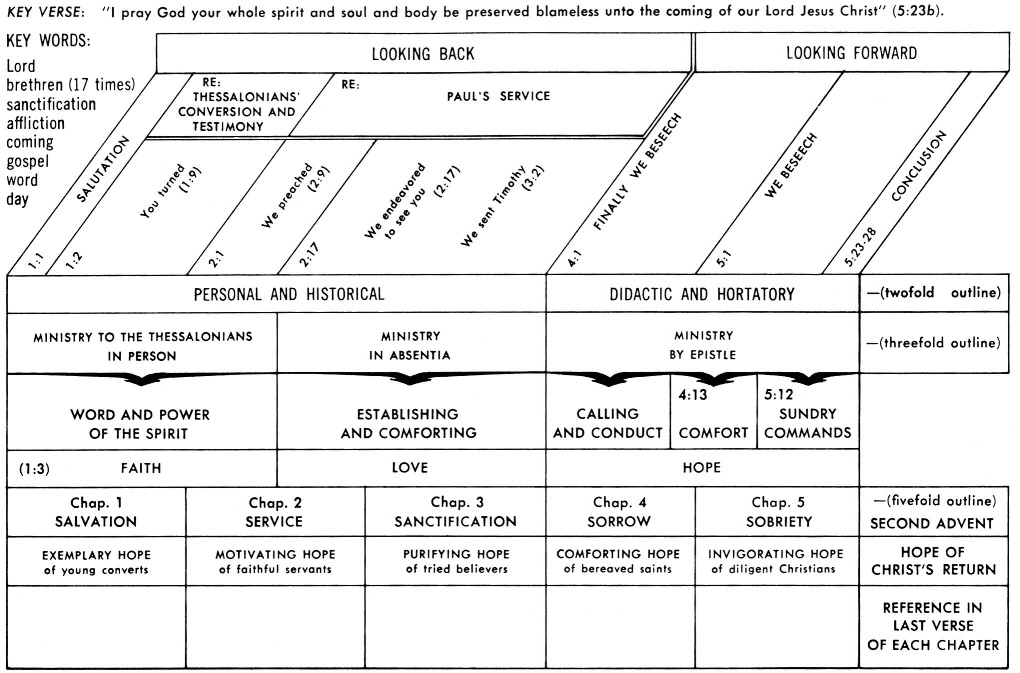
JESUS IS COMING AGAIN
Click chart to enlarge
Charts from Jensen's Survey of the NT - used by permission
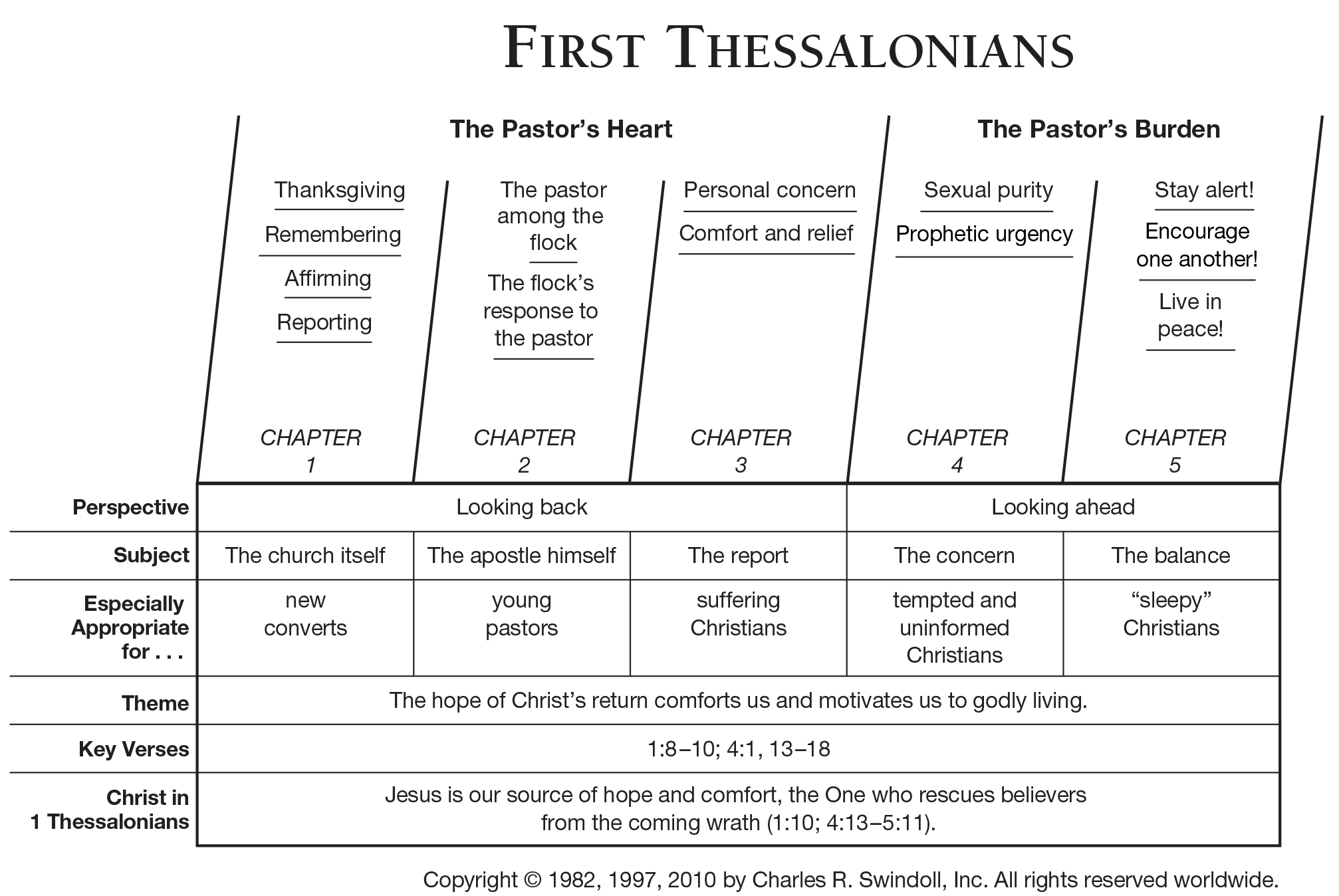
Chart on 1 Thessalonians from Charles Swindoll
1 Thessalonians 3:11 Now may our God and Father Himself and Jesus our Lord direct our way to you; (NASB: Lockman)
Greek: Autos de o theos kai pater hemon kai o kurios hemon Iesous kateuthunai (2SAAO) ten hodon hemon pros humas
Amplified: Now may our God and Father Himself and our Lord Jesus Christ (the Messiah) guide our steps to you. (Amplified Bible - Lockman)
NLT: May God himself, our Father, and our Lord Jesus make it possible for us to come to you very soon. (NLT - Tyndale House)
Phillips: So may God our Father himself and our Lord Jesus Christ guide our steps to you. (Phillips: Touchstone)
Wuest: Now, our God and Father himself and our Lord Jesus direct our way to you. And as for you, (Eerdmans)
Young's Literal: And our God and Father Himself, and our Lord Jesus Christ, direct our way unto you,
|
1THESSALONIANS |
||||||
| Chapter 1 | Chapter 2 | Chapter 3 | Chapter 4 | Chapter 5 | ||
|
LOOKING BACK |
LOOKING FORWARD |
|||||
|
Personal Reflections |
Practical Instructions |
|||||
| Ministry In Person |
Ministry in Absentia (Thru Timothy) |
Ministry by Epistle |
||||
| Word and Power of the Spirit |
Establishing & Comforting |
Calling & Conduct | 1Th 4:13ff Comfort |
1Th 5:12ff Commands |
||
| 1 Salvation |
2 Service |
3 Sanctification |
4 Sorrow |
5 Sobriety |
||
| Exemplary Hope of Young Converts | Motivating Hope of Faithful Servants | Purifying Hope of Tried Believers | Comforting Hope of Bereaved Saints | Invigorating Hope of Diligent Christians | ||
|
Written from Corinth |
||||||
|
Modified from the excellent book Jensen's Survey of the NT |
||||||
|
OUTLINE OF 1 THESSALONIANS |
|
|
CHAPTER |
THEME |
|
1 |
An Exemplary Conversion |
|
2 |
An Exemplary Witness |
|
3 |
An Exemplary Follow-Up |
NOW MAY OUR GOD AND FATHER HIMSELF AND JESUS OUR LORD DIRECT OUR WAY TO YOU: Autos de o theos kai pater emon kai o kurios hemon Iesous kateuthunai (2SAAO) ten hodon hemon pros humas:
- May our God - 1Th 3:13; Isa 63:16; Jer 31:9; Mal 1:6; Mt 6:4,6,8,9,14,18,26,32; Luke 12:30,32; John 20:17; 2Cor 6:18; Col 1:2; 1John 3:1
- Jesus our Lord - Ro 1:3; 2 Th 2:16
- Our way to you - Ezra 8:21, 22, 23; Pr 3:5,6; Mark 1:3
- 1 Thessalonians 3 Resources - Multiple Sermons and Commentaries
OUR GOD
THOUGHT - Our is a pronoun of personal possession. Our means "of, belonging to, or associated in some way with" someone. Can you declare with confidence and beyond a shadow of a doubt the phrase"our God"? Or even better can you say "my God?" (cf Ex 15:2, Ps 18:2,29, Ps 30:12, Ps 20:7) Is He your God? Even better are you God's possession? (Titus 2:14, 1 Cor 6:19,20, 1 Pe 2:9) Are you living like it daily, enabled by the power of His Spirit and with the realization that your days on earth are finite and numbered (Ps 90:12, cf Redeem the Time) and will soon explode into eternity where your days will be infinite and numberless? Beloved, what you are looking for will determine what you living for -- are you living for time or eternity? Jesus' return is Imminent so may God grant you the desire and power (Php 2:13NLT) to live in light of that awesome truth, so that you may receive a great reward (Heb 10:35, Mt 5:11-12) at the Bema seat of Christ! Maranatha! Hosanna! Hallelujah! Amen! What we do durning our short sojourn on this planet will determine how we enjoy eternity (See Francis Chan's illustration). We will soon see the King of kings (Second Coming). May His imminent return supercharge your heart and mind and spirit and soul to live daily for His glory and honor daily looking expectantly for your blessed hope, Christ Jesus. Amen. If you want some vocal motivation to live in a new way, supernaturally enabled by the Spirit and the Word, living no longer for self but for "our God" play this song "Our God!"
But as for me, I trust in You, O LORD,
I say, “You are my God.”
Ps 31:14
Now Paul tells them specifically what he is praying for them.
God and Father Himself and Jesus our Lord - Thomas writes that here we see…
Two persons viewed as one (cf. John 10:30) possess power to open the way to Thessalonica once again; ‘our God and Father himself and our Lord Jesus’ is the compound subject of a singular verb … probably an indication of the unity of the Godhead.
Denney remarks "It is an involuntary assent of the Apostle to the word of the Lord, "I and My Father are one.
Hiebert writes that…
Thus to address the Lord Jesus as the object of their prayer, equally with the Father, is to ascribe full deity to Him. To make Christ one with the Father in the prerogative of hearing and answering prayer is to bracket Him with the Father as equal in power and glory. For a strong monotheist like Paul this would have been unthinkable if he had regarded Christ Jesus as a mere man, however exalted.
His view of Christ is further underlined by the fact that the verb "clear" is singular in number although the subject is plural. One can hardly conceive of a stronger way for Paul to indicate his unquestioned acceptance of the lordship of Jesus and His oneness with the Father. And the fact that this occurs in his prayer and not in a doctrinal discussion indicates that it was part of the accepted faith of the Thessalonians as well as Paul… It was an essential part of the faith of the Christian church from the very beginning. Here we see implicit in Paul's earliest letter the Lordship of Jesus Christ which is made explicit in the epistle to the Colossians. (Hiebert, D. Edmond: 1 & 2 Thessalonians: BMH Book. 1996)
Direct (2720)(kateuthuno from kata = down, exactly according to, intensifies meaning + euthunô = straighten, make straight from euthus = straight) means to make straight, to straighten fully, to guide or lead directly straight towards or upon something, to guide one's way or journey to a place. The idea is that of conducting one straight to a place, and not by a round-about course.
Gary Hill on kateuthuno - properly, go straight down by the most direct route; to go in a straight course which avoids all unnecessary delays, i.e. without any undue loss of time or achievement. The prefix kata lends the idea "exactly direct or guide" – literally "down to without unnecessary deviation." All three occasions of kateuthýnō teach that every moment of time is infinitely important to eternity. See Lk 1:79; 1 Th 3:11; 2 Th 3:5 (cf. with 1 Cor 4:5; Ecc 12:14)." (Discovery Bible)
Note that this verb is singular whereas the subject is plural (God… Jesus our Lord) which substantiates the deity of Christ and the unity of the Godhead. Vine thus translates the verse as…
But God Himself even our Father and our Lord Jesus, direct our way unto you (Vine, W. Collected writings of W. E. Vine. Nashville: Thomas Nelson)
Kateuthuno gives a picture of opening up the way by removal of obstacles so that the desired goal may be reached. Paul recognizes the uselessness of personal efforts toward a revisit unless God "clears the way" and removes the obstacles that Satan had previously placed in his path of return which made that path impassable. Paul had learned the secret (Php 4:13) that it is God Who "directs our way" and Who Alone is powerful enough to remove all hindrances (1Th 2:18) that Satan places in our path.
The missionaries are making their request, but they recognize that the Sovereign God is the supreme Disposer of events. They acknowledge their dependence upon Him and know that it is His prerogative to determine the time and manner in which their prayer will be answered.
Here are the only other NT uses of kateuthuno and in each place it has the sense of divine providence controlling human action.
Luke 1:79To shine upon those who sit in darkness and the shadow of death, To guide our feet into the way of peace."
2 Thessalonians 3:5 And may the Lord direct your hearts into the love of God and into the steadfastness of Christ.
There are 50 uses of kateuthuno in the Septuagint (LXX) Jdg. 12:6; 1 Sam. 6:12; 2 Sam. 19:17; 1 Ki. 11:43; 1 Chr. 29:18; 2 Chr. 12:14; 17:5; 19:3; 20:33; 30:19; 32:30; Est. 3:13; 8:12; Ps. 5:8; 7:9; 37:23; 40:2; 59:4; 78:8; 90:17; 101:7; 102:28; 119:5, 133; 140:11; 141:2; Prov. 1:3; 4:26; 9:15; 13:13; 15:8, 21; 21:2; 23:19; 29:27; Jer. 15:11; 21:12; Ezek. 17:9f, 15; 18:25; Dan. 3:30; 6:28; 8:24f; 11:27, 36; Hos. 4:10; Zech. 11:16; Mal. 2:6
Way (3598)(hodos) means any place along which one travels and so a way, a road, a highway. Hodos is a way for traveling or moving from one place to another.
Hodos - 101x in 99v - NAS = highways(2), journey(7), path(1), paths(1), road(24), roads(1), streets(1), way(54), ways(9). Matt 2:12; 3:3; 4:15; 5:25; 7:13f; 8:28; 10:5, 10; 11:10; 13:4, 19; 15:32; 20:17, 30; 21:8, 19, 32; 22:9f, 16; Mark 1:2f; 2:23; 4:4, 15; 6:8; 8:3, 27; 9:33f; 10:17, 32, 46, 52; 11:8; 12:14; Luke 1:76, 79; 2:44; 3:4f; 7:27; 8:5, 12; 9:3, 57; 10:4, 31; 11:6; 12:58; 14:23; 18:35; 19:36; 20:21; 24:32, 35; John 1:23; 14:4ff; Acts 1:12; 2:28; 8:26, 36, 39; 9:2, 17, 27; 13:10; 14:16; 16:17; 18:25f; 19:9, 23; 22:4; 24:14, 22; 25:3; 26:13; Rom 3:16f; 11:33; 1 Cor 4:17; 12:31; 1 Thess 3:11; Heb 3:10; 9:8; 10:20; Jas 1:8; 2:25; 5:20; 2 Pet 2:2, 15, 21; Jude 1:11; Rev 15:3; 16:12.
1 Thessalonians 3:12 and may the Lord cause * you to increase and abound in love for one another, and for all people, just as we also do for you; (NASB: Lockman)
Greek: humas de o kurios pleonasai (3SAAO) kai perisseusai (3SAAO) te agape eis allelous kai eis pantas, kathaper kai hemeis eis humas
Amplified: And may the Lord make you to increase and excel and overflow in love for one another and for all people, just as we also do for you, (Amplified Bible - Lockman)
NLT: And may the Lord make your love grow and overflow to each other and to everyone else, just as our love overflows toward you. (NLT - Tyndale House)
Phillips: May the Lord give you the same increasing and overflowing love for each other and towards all men as we have towards you. (Phillips: Touchstone)
Wuest: the Lord cause you to increase and superabound in your divine and self-sacrificial love for one another and toward all, even as also we have this divine and self-sacrificial love for you, (Eerdmans)
Young's Literal: and you the Lord cause to increase and to abound in the love to one another, and to all, even as we also to you,
AND MAY THE LORD CAUSE YOU TO INCREASE AND ABOUND IN LOVE FOR ONE ANOTHER, AND FOR ALL MEN, JUST AS WE ALSO DO FOR YOU: humas de o kurios pleonasai (3SAAO) kai perisseusai (3SAAO) te agape eis allelous kai eis pantas, kathaper kai hemeis eis humas:
- May the Lord cause you to increase - 1 Th 4:10; Ps 115:4; Luke 17:5; 2 Co 9:10; James 1:17; 2Peter 3:18
- And abound 1 Th 4:9,10; Philippians 1:9; 2 Th 1:3
- In love for one another - 1 Th 3:15; Mt 7:12; 22:39; Ro 13:8; 1 Co 13:1-13; Galatians 5:6,13,14,22; 2 Peter 1:7; 1 Jn 3:11-19; 4:7-16
- 1 Thessalonians 3 Resources - Multiple Sermons and Commentaries
PRAY FOR INCREASING
SUPERABOUNDING LOVE
THOUGHT - CHALLENGE QUESTION - What if your church began to seriously, soberly and consistently pray (enabled by the Spirit of grace - Heb 10:29) for love to increase and abound for each of the members of your congregation? I mean really prayed this pray in 1 Th 3:12-13 with sincerity and expectancy of an Ephesians 3:20 type answer! The devil will fight this suggestion mightily because he knows that a church praying and coming into oneness in love is a mighty instrument in the hands of Almighty God. We have not because we ask not. Quit praying only (or primarily) for physical needs of those in your church (that is not wrong but you missing the best!) and begin to pray earnestly, daily and by names on your church roster for the spiritual needs of your church, and then just watch what God will do! He will do something supernatural! I guarantee it! Why? You can have full confidence because of the truth of 1 Jn 5:14-15 and also and primarily because everything God does is supernatural and He desires to be magnified and exalted among His people and among the nations. So don't hesitate, procrastinate or prevaricate. Just do it....begin to pray. And enlist your Sunday school class (if you still have one!), your Bible study group, your closest friends in church to be part of what God does in answer to your prayers!
Increase and abound - the idea is that their love be enlarged and made abundant, taken together giving the force of "increase to overflowing"! Clearly this was not a loveless church (eg they had a labor of love - 1Th 1:3), but they were not yet glorified (!) and therefore still had room to grow in love, the essential mark of the Christian faith as our Lord declared…
A new commandment I give to you, that you love one another, even as I have loved you, that you also love one another. By this all men will know that you are My disciples, if you have love (agape) for one another. (John 13:34, 35).
And so it is not surprising that Paul prayed for increasing love for other churches such as the one at Philippi…
And this I pray, that your love may abound (perisseuo - superabound, overflow; present tense = as a continual supernatural outflow of your Spirit controlled and empowered life) still more and more (and here is the qualifier of such an overflowing love - it is not mindless sentimentality) in real knowledge and all discernment, so that you may approve the things that are excellent, in order to be sincere and blameless until the day of Christ (Php 1:9, 10)
In Paul's second letter we see his thanksgiving to God for having answered this prayer…
We ought always to give thanks to God for you, brethren, as is only fitting, because your faith is greatly enlarged, and the love of each one of you toward one another grows ever greater (2 Th 1:3)
Increase and abound in love - This is a prayer (in the aorist, optative) as discussed more fully below. Clearly the apostle Paul knew we depend on the Holy Spirit for the fruit of holiness such as love, and he expressed this dependence through prayer. Remember that prayer is not limited by time or place. Your prayers for your fellow believers (and your loved ones) will do more good than you realize, so stay devoted to prayer with an attitude of thanksgiving (Col 4:2)
Increase (4121)(pleonazo from pleion = more) means to cause to increase (in quantity) or to superabound. It suggests an abundance, an increase in number. It means to have or cause to have much, or more than enough. To have a surplus.
Pleonazo - 9x in 8v - NAS = cause*(1), grows… greater(1), have too much(1), increase(3), increased(1), increases(1), increasing(1), spreading(1).
Rom 5:20; 6:1; 2 Cor 4:15; 8:15; Phil 4:17; 1 Thess 3:12; 2 Thess 1:3; 2 Pet 1:8.
Abound (4052)(perisseuo from perissós = abundant from peri = in sense of beyond) means to cause to overflow or superabound (quantitatively or qualitatively), to cause to excel. It means to exceed a fixed number or measure, to exist in superfluity.
Perisseuo - 39x in 35v - NAS = abound(10), abounded(1), abounding(1), abundance(2), abundant(1), better(1), cause(1), cause*(1), excel(2), has an abundance(1), have an abundance(3), have more than enough(1), having abundance(1), increasing(1), lavished(1), left over(4), leftover(1), live in prosperity(1), make… abound(1), overflowed(1), overflowing(2), surpasses(1), surplus(2). Matt 5:20; 13:12; 14:20; 15:37; 25:29; Mark 12:44; Luke 9:17; 12:15; 15:17; 21:4; John 6:12f; Acts 16:5; Rom 3:7; 5:15; 15:13; 1 Cor 8:8; 14:12; 15:58; 2 Cor 1:5; 3:9; 4:15; 8:2, 7; 9:8, 12; Eph 1:8; Phil 1:9, 26; 4:12, 18; Col 2:7; 1 Thess 3:12; 4:1, 10.
Hiebert writes that the two verbs increase and abound
are both aorist, optative of wish. They are virtually synonymous in import, and the use of both strengthens the expression of the prayer-wish. The former means "to become more, to increase, to be in abundance," while the latter means "to he present in abundance, to overflow" They may be rendered "to increase and to overflow" (Weymouth, Williams). The former may be viewed as "pointing to the process of growth" and the latter "to superlative attainment."' Then they may be thought of as standing in a relationship of cause and effect. The petition is not merely that their converts will "increase" but will be filled to overflowing in "love."
It is assumed that love is already present in their lives; the request is that it may increase to overflowing fullness. Its overflowing presence is the tangible evidence of a robust faith. Genuine Christian love, whose characteristics are set forth in 1 Corinthians 13, is the one thing in the Christian life that cannot be carried to excess. This abounding love will first of all express itself in their relations to "each other," the fellow-believers at Thessalonica. The reciprocal pronoun indicates that this love is to be shown mutually. But it must also be expressed as "for everyone else," not merely Christians in other places, but all men generally. For the persecuted Thessalonians this meant also loving their enemies, as Christ commanded (Mt 5:44). To show love to their persecutors was the true safeguard against the natural tendency to retaliate when mistreated by outsiders. Such a love is not natural to man; it can he known and practiced only as it is received as a gift from the Lord and made to increase and abound by Him. (Hiebert, D. Edmond: 1 & 2 Thessalonians: BMH Book. 1996)
Love (26) (agape) is unconditional, sacrificial love and a love that God is (1Jn 4:8,16) that God shows (Jn 3:16, 1Jn 4:9). Greek literature throws little light on this distinctive NT meaning. Agape love is the love of choice and of serving with humility. It is the highest kind of love, the noblest kind of devotion, the love of the will (intentional, conscious choice) and not done for appearance or motivated by emotional attraction. Agape is not based on pleasant emotions or good feelings that might result from a physical attraction or a familial bond. From all of the descriptions of agape love, it is clear that true agape love is a sure mark of salvation.
Agape does not depend on the world’s criteria for love, such as attractiveness, emotions, or sentimentality. Believers can easily fall into the trap of blindly following the world’s demand that the one who loves is to feel positive toward the beloved. This is not agape love, but is a love based on impulse. Impulsive love characterizes the spouse who announces to the other spouse that they are planning to divorce their mate. Why? They reason “I can’t help it. I fell in love with another person!” Christians must understand that this type of impulsive love is completely contrary to God’s decisive love, which is decisive because He is in control and has a purpose in mind.
Jerry Bridges asks…
How then can we fulfill our responsibility to love “more and more”? Recognizing that love is an inner disposition of the soul produced only by the Holy Spirit, what can we do to fulfill our responsibility?
First, as we have already seen, the Spirit of God uses His WORD to transform us. Therefore, if we want to grow in love, we must saturate our minds with Scriptures that describe love (Ed: And frankly everything for Genesis 1:1 to Revelation 22:21 is a reflection in some way of God's love - for it is all His "Love Letter" to us!) and show its importance to us… Do you truly want to grow in love? Then you must begin by meditating on some of these love passages (Ed: In fact just begin to meditate on Scripture, for meditation slows you down and gives the Holy Spirit an opportunity to teach you and lead you).
The second thing we must do is pray for the Holy Spirit to apply His WORD to our hearts and to our daily lives . Paul did not just exhort the Thessalonians to grow in love; he looked to the Lord to work in their hearts: “May the Lord make your love increase and overflow for each other and for everyone else, just as ours does for you” (1 Th 3:12). As we see instances in our lives of failing to love, we should confess them to God, asking Him to help us grow in those specific areas and be more sensitive to such occasions in the future.
Finally, we must obey (ED: See Php 2:13NLT for it is Spirit working in us Who gives us both the desire and the power to obey!). We must do those things that love dictates. We must do no harm to our neighbor (Ro 13:10); we must meet our neighbor’s needs and forgive our neighbor’s wrongs against us. We must put his interests before our own, and we must reach out and embrace our brother in Christ. But we must do all this in dependence upon the Holy Spirit, who works in us to will and to act according to His good purpose. (BORROW The Practice of Godliness. Page 212)
Donald W. Burdick gives an excellent summary of agape writing that "It is spontaneous. There was nothing of value in the persons loved that called forth such sacrificial love. God of His own free will set His love on us in spite of our enmity and sin. [Agape] is love that is initiated by the lover because he wills to love, not because of the value or lovableness of the person loved. [Agape] is self-giving. and is not interested in what it can gain, but in what it can give. It is not bent on satisfying the lover, but on helping the one loved whatever the cost. [Agape] is active and is not mere sentiment cherished in the heart. Nor is it mere words however eloquent. It does involve feeling and may express itself in words, but it is primarily an attitude toward another that moves the will to act in helping to meet the need of the one loved." (Burdick, D W: The Letters of John the Apostle. Chicago: Moody, 1985, page 351)
EBC comments that "The goal of Paul's prayer for the Thessalonians is that the Lord will grant them "inner strength" to be "blameless" in holiness "in the presence of our God and Father" when the Lord Jesus returns. He looks forward to the time of final accounting. An overflow of love (1Th 3:12) is the only route to holy conduct in which no fault can be found (1Th 3:13). For unless love prevails, selfish motives inhibit ethical development by turning us toward ourselves and away from God and blameless living. The holiness that belongs to God is the ideal we must seek (cf. Lev 19:2; 1Pe 1:16). (Gaebelein, F, Editor: Expositor's Bible Commentary 6-Volume New Testament. Zondervan Publishing)
For one another and for all men - Paul had been thankful for their labor of love (1Th 1:3) and here is praying for an ever widening circle of love, like the Father has even for the unsaved (all men) and even their countrymen who had caused them suffering (1Th 2:14)
Just as we do for you - Paul daringly set himself as a standard of love to be emulated. We should live such Christian lives that we could tell young Christians, “Love other people just the way that I do.”
Someone has paraphrased this prayer as follows "The Lord enable you more and more to spend your lives in the interests of others, in order that He may so establish you in Christian character now, that you might be vindicated from every charge that might possibly be brought against you."
R Larry Moyer has an note worth pondering regarding Paul's prayers for the saints (disciples)…
Paul’s emphasis on prayer for new converts is seen in other portions of his epistles such as 1 Th 1:2, 3; 3:10, 11,12, 13; and Php 1:3, 4. What is striking is that Paul was keenly aware that no matter how many times he revisited the new believers, how many fellow workers he sent to labor among them, or how much communication he maintained with them, only the Holy Spirit could accomplish spiritual growth. God through His Spirit had to apply the truths of Scripture to their lives and cause them to be comprehended. Paul viewed his prayers to this end as an essential part of his follow-through.
Referring to Paul’s emphasis on prayer for new converts, Erdman notes,
A large portion of Paul’s time was spent in this pursuit. The “anxiety of all the churches” he had established found its natural expression in earnest intercession in their behalf. In the preface of his epistle written to any one of these churches, he states the requests which formed the substance of these daily supplications. There were in each case petitions appropriate to the particular need. However, these opening prayers of the apostle indicate exactly the requests which should be offered for the churches of the present day, and indeed for each individual Christian. They form possibly the most precious portions of the New Testament epistles. (Charles R. Erdman, The Epistles of Paul to the Colossians and to Philemon Philadelphia: Westminster, 1966, 45)
One cannot help but wonder how much further along new converts (ED: I WOULD ADD "OLD CONVERTS" TO THAT QUESTION!!!) would be if the amount of time given to criticism were directed to prayer for their spiritual growth. The Christian community has often had the practice and reputation of talking about prayer, but not praying enough. Moments given to persevering prayer could do more for new (AND OLD) converts than hours of criticism or days of discussion on prayer. (Moyer, R. Larry: Assimilating New Converts into the Local Church: Bibliotheca Sacra: Volume 151, Issue 603, Page 340. Dallas TX: Dallas Theological Seminary)
Related Resources (on prayer)
- Colossians 1:9 Commentary
- Colossians 4:12 Commentary
- Devotional on Prayer
- Guide to Praying for Missionaries
- Pithy Prayer Phrases
- Prayer - Greek Words for Prayer
- Prayer Devotionals and Illustrations
- Prayer Hymns and Poems
- Prayer Quotes
- Prayer Quotes, Devotionals and Illustrations
- Praying for People from Every Tribe, Tongue, People and Nation
- Praying His Word
- Praying in the Spirit
- Spurgeon's Gems on Prayer
THE HEALTHIEST PLACE ON EARTH - IT'S one of the few places on earth where the air is as fresh and clean as it must have been millennia ago. Constant winds keep out pollution and germs, and the climate discourages the growth of native viruses.
It sounds like the healthiest place on earth. So why doesn't anyone want to live there? Because it's also the coldest place on earth. With temperatures that drop to minus 100 degrees Fahrenheit, the South Pole is too frigid even for germs.
Some churches bear a striking resemblance to that sterile atmosphere. The truth of God is preached, Scriptures are meticulously quoted, and error has no chance to survive. But neither does life. The spiritual temperature is subzero, as evidenced by the cold shoulder given to the poor and needy (James 2:2, 3, 4, 5, 6). Those weak in the faith engage in icy arguments (Romans 14:1). Those who threaten to invade their comfortable cliques are left out in the cold (3John 5, 6, 7, 8, 9, 10). Unloved and unwelcomed, many people leave.
The church is to function as the body of Christ. As such, it should be warm, compassionate, and inviting. Our goal is not to keep out germs; it's to create an atmosphere where the spiritually sick can find healing. —M R De Haan II (Our Daily Bread, Copyright RBC Ministries, Grand Rapids, MI. Reprinted by permission. All rights reserved)
1 Thessalonians 3:13 so that He may establish your hearts without blame in holiness before our God and Father at the coming of our Lord Jesus with all His saints (NASB: Lockman)
Greek: eis to sterixai (AAN) umon tas kardias amemptous en hagiosune emprosthen tou theou kai patros emon en te parousia tou kuriou emon Iesou meta panton ton agion autou. [amen.]
Amplified: So that He may strengthen and confirm and establish your hearts faultlessly pure and unblamable in holiness in the sight of our God and Father, at the coming of our Lord Jesus Christ (the Messiah) with all His saints (the holy and glorified people of God)! Amen, (so be it)! (Amplified Bible - Lockman)
NLT: As a result, Christ will make your hearts strong, blameless, and holy when you stand before God our Father on that day when our Lord Jesus comes with all those who belong to him. (NLT - Tyndale House)
Phillips: May he establish you, holy and blameless in heart and soul, before himself, the Father of us all, when our Lord Jesus Christ comes with all who belong to him. (Phillips: Touchstone)
Wuest: to the end that He might stabilize your hearts blameless in the sphere of holiness in the presence of our God and Father at the coming of our Lord Jesus with all His saints. (Eerdmans)
Young's Literal: to the establishing your hearts blameless in sanctification before our God and Father, in the presence of our Lord Jesus Christ with all His saints.
SO THAT HE MAY ESTABLISH YOUR HEARTS UNBLAMABLE IN HOLINESS BEFORE OUR GOD AND FATHER AT THE COMING OF OUR LORD JESUS WITH ALL HIS SAINTS: eis to sterixai (AAN) humon tas kardias amemptous en hagiosune emprosthen tou theou kai patros emon en te parousia tou kuriou emon Iesou meta panton ton agion autou:
- 1Th 5:23; Romans 14:4; 16:25; 1Cor 1:8; Philippians 1:10; 2 Th 2:16,17; 1 Peter 5:10; 1 John 3:20,21
- Ephesians 5:27; Colossians 1:22; 1 John 3:20,21; Jude 1:24
- 1 Th 2:19; 4:15; 5:23; 1 Co 1:7; 15:23; 2 Th 2:1
- Deut 33:2; Zechariah 14:5; 2 Th 1:10; Jude 1:14
- 1 Thessalonians 3 Resources - Multiple Sermons and Commentaries
A PRAYER RELATED TO
THE SECOND COMING
So that he may establish (sterizo) your hearts (kardia) unblamable (amemptos) in holiness (hagiosune) - What a great purpose for prayer for one's love to abound!
THOUGHT- Have you ever prayed 1 Thessalonians 3:11-13 for yourself or anyone else? You should! God will surely answer because He gives us His Word as recorded by John who writes "This is the confidence which we have before Him, that, if we ask anything according to His will, He hears us. And if we know that He hears us in whatever we ask, we know that we have the requests which we have asked from Him." (1Jn 5:14-15) How many prayers have such a "money back guarantee" (so to speak)? That's rhetorical of course! So pray for physical issues, but even more pray for spiritual issues. The body is temporal, but the soul is eternal, so pray prayers that will impact eternity! You will be eternally grateful and so will the saints for whom you prayed! Carpe Diem! Seize the day! Seize the fleeting opportunity to pray a prayer today that will have repercussions that resonate throughout eternity!
So (1519) (eis) marks the conclusion of the petition and introduces a statement of its goal or aim ("contemplated result", Lenski). The verse thus reads not as another request but the goal literally
to the end that he may strengthen your hearts blameless in holiness
The NIV dynamic paraphrase is somewhat inaccurate rendering this phrase as a separate prayer request…
May he strengthen your hearts so that you will be blameless and holy in the presence of our God and Father when our Lord Jesus comes with all his holy ones.
Hiebert commenting on establish your hearts notes that…
The Lord works through their increasing love to strengthen them—make them firm and solid (cf. 1Th 3:2)—in Christian character. Only as Christ develops in them the needed inner spiritual stability will they be able to stand firm and unmoved through whatever the future holds. Timothy had been sent to Thessalonica to help strengthen and encourage them (1Thes 3:2); this prayer is a reminder that however helpful the ministries of the Lord's servants may be, it is the Lord Himself who must work that inner stability in them. (Hiebert, D. Edmond: 1 & 2 Thessalonians: BMH Book. 1996)
Establish (4741) (sterizo from histemi = to stand as in 1 Pe 5:12 "stand firm in" the true grace of God) means to make firm or solid, to set fast, to fix firmly in a place, to establish (make firm or stable), to cause to be inwardly firm or committed, to strengthen. The basic idea of the verb sterizo is that of stabilizing something by providing a support or buttress (a projecting structure of masonry or wood for supporting or giving stability to a wall or building), so that it will not totter.
Sterizo - 13x in 13v - NAS = confirm(1), determined(1), establish(2), established(2), fixed(1), strengthen(6), strengthening(1). Lk 9:51; 16:26; 22:32; Ro 1:11; 16:25; 1Th 3:2, 13; 2Th 2:17; 3:3; Jas 5:8; 1Pe 5:10; 2Pe 1:12; Re 3:2.
Barclay writes that sterizo "means to make as solid as granite. Suffering of body and sorrow of heart do one of two things to a man. They either make him collapse or they leave him with a solidity of character which he could never have gained anywhere else. If he meets them with continuing trust in Christ, he emerges like toughened steel that has been tempered in the fire. (Daily Study Bible Series)
Guzik has a wise remark noting that "The heart must be made holy first. The devil wants us to develop a holy exterior while neglecting the interior, like whitewashed tombs, full of death (Matthew 23:27).
The following uses of sterizo demonstrate the various ways God uses to strengthen His saints and thus what and how Timothy was enabled to strengthen the faith of the saints in Thessalonica. These are the same "methods" believers today can utilize to strengthen the faith of their brethren, a need which is always present because every believer's faith is continually subject to testing. Have you ever been sent to strengthen another's faith? How would Timothy going to carry out Paul's charge to strengthen the faith of the saints at Thessalonica? Read on…
Believers are strengthened…
By fervent, Scripturally based prayers of the saints…
May the Lord cause you to increase and abound in love for one another, and for all men, just as we also do for you that He may establish (sterizo) your hearts unblamable in holiness before our God and Father at the coming of our Lord Jesus with all His saints. (see notes 1Thes 3:12; 13)
Now may our Lord Jesus Christ Himself and God our Father, who has loved us and given us eternal comfort and good hope by grace, comfort and strengthen (sterizo) your hearts in every good work and word. (2Th 2:16, 17)
By the Lord Himself, our Strength and Protector…
But the Lord is faithful, and He will strengthen (sterizo) and protect you from the evil one. (2Th 3:3)
By looking and living for the Lord's return…
You too be patient (makrothumeo - having a "long fuse" especially with difficult people - aorist imperative); strengthen (sterizo - aorist imperative Do it now - it's urgent!, active voice = you make the choice to do this) your hearts (the "control center" of your life), for the coming (parousia) of the Lord is at hand. (Jas 5:8)
By the God of all grace working through suffering…
And after you have suffered for a little while, the God of all grace, who called you to His eternal glory in Christ, will Himself perfect, confirm, strengthen and establish you. (1Pe 5:10)
By the truth of God's Word…
Therefore, I shall always be ready to remind you of these things, even though you already know them, and have been established (sterizo) in the truth which is present with you. (2Pe 1:12)
By the revealing of the mystery of the gospel…
Now to Him who is able to establish (sterizo) you according to my gospel and the preaching of Jesus Christ, according to the revelation of the mystery which has been kept secret for long ages past (Ro 16:25);
By the strengthening ministered through His saints who come alongside…
(Peter) Simon, Simon, behold, Satan has demanded permission to sift you like wheat but I have prayed for you, that your faith may not fail; and you, when once you have turned again, strengthen (sterizo - aorist imperative conveys a sense of urgency. Do it effectively! When the opportunity presents itself, don't delay) your brothers. (Lk 22:31, 32)
(Timothy) and we sent Timothy, our brother and God's fellow worker in the gospel of Christ, to strengthen (sterizo) and encourage you as to your faith,
(Paul) For I long to see you in order that I may impart some spiritual gift to you, that you may be established (sterizo) (Ro 1:11).
So although it is the God Himself Who ultimately strengthens and stabilizes us, these other NT uses of sterizo teach that God uses the the encouragement and prayers of the saints, the certainty of Christ's return and the truth of His Word and the gospel to supernaturally exert a stabilizing effect on our faith.
Heart (2588) (kardia) does not refer to the physical organ but is always used figuratively in Scripture to refer to the seat and center of human life. The heart is the center of the personality, and it controls the intellect, emotions, and will. No outward obedience is of the slightest value unless the heart turns to God.
Hiebert observes that…In Scripture the "heart" (kardia) is a comprehensive term standing for the whole inner life, including thought, feeling, and will (cf. 1Th 2:4). Christian stability is not achieved through outward conformity to rules and regulations, needful as that is, but through the development of conscious inner strength and stability. Such a petition for the strengthening of the inner life of the believer is timely today when much attention is given to head and hand but the inner spiritual life is often neglected. (Ibid)
Hughes explains that…The heart is the wellspring of man’s spiritual life, and that is where the Roman Christians’ obedience was rooted. It was not just a formal obedience—it came from the center of their being. This is the example of slavery Paul holds up for us all: a heartfelt obedience to Christ and his Word. It is an obedience which brings liberation." (SEE Romans: Righteousness from Heaven - note scroll up and down to show more content)
While kardia does represent the inner person, the seat of motives and attitudes, the center of personality, in Scripture it represents much more than emotion, feelings. It also includes the thinking process and particularly the will. For example, in Proverbs we are told, “As (a man) thinks in his heart, so is he” (Pr 23:7). Jesus asked a group of scribes, “Why are you thinking evil in your hearts?” (Mt 9:4). The heart is the control center of mind and will as well as emotion.
Vine writes that kardia…came to denote man’s entire mental and moral activities, and to stand figuratively for the hidden springs of the personal life, and so here signifies the seat of thought and feeling." (Collected writings of W. E. Vine)
MacArthur commenting on kardia writes that "While we often relate heart to the emotions (e.g., “He has a broken heart”), the Bible relates it primarily to the intellect (e.g., “Out of the heart come evil thoughts, murders, adulteries, fornications, thefts, false witness, slanders,” Mt 15:19). That’s why you must “watch over your heart with all diligence” (Pr 4:23). In a secondary way, however, heart relates to the will and emotions because they are influenced by the intellect. If you are committed to something, it will affect your will, which in turn will affect your emotions." (BORROW Drawing Near. Crossway Books or see page 126) MacArthur adds that "In most modern cultures, the heart is thought of as the seat of emotions and feelings. But most ancients—Hebrews, Greeks, and many others—considered the heart to be the center of knowledge, understanding, thinking, and wisdom. The New Testament also uses it in that way. The heart was considered to be the seat of the mind and will, and it could be taught what the brain could never know. Emotions and feelings were associated with the intestines, or bowels. (See Ephesians MacArthur New Testament Commentary - scroll up and down for more content)
Marvin Vincent has a lengthy comment on kardia writing…
Heart (kardia). The heart is, first, the physical organ, the centre of the circulation of the blood. Hence, the seat and centre of physical life. In the former sense it does not occur in the New Testament. As denoting the vigor and sense of physical life, see Acts 14:17; Jas 5:5; Luke 21:34. It is used fifty-two times by Paul.
Never used like psuche soul, to denote the individual subject of personal life, so that it can be exchanged with the personal pronoun (Acts 2:42 Acts 3:21; Romans 13:1 ); nor like pneuma spirit, to denote the divinely-given principle of life.
It is the central seat and organ of the personal life (psuche) of man regarded in and by himself, Hence it is commonly accompanied with the possessive pronouns, my, his, thy, etc.
Like our heart it denotes the seat of feeling as contrasted with intelligence. 2Cor 2:4; Romans 9:2 (note); Ro 10:1 (note); 2Cor 6:11; Php 1:7 (note). But it is not limited to this. It is also the seat of mental action, feeling, thinking, willing.
It is used —
1. Of intelligence, Ro 1:21 (note) 2Cor 3:15; 4:6; Ep 1:18 (note).
2. Of moral choice, 1Cor 7:37 2Cor 9:7.
3. As giving impulse and character to action, Romans 6:17 (note); Ephesians 6:5 (note); Colossians 3:22 (note); 1Ti 1:5; 2 Timothy 2:22 (note) . The work of the law is written on the heart, Romans 2:15 (note). The Corinthian Church is inscribed as Christ’s epistle on hearts of flesh, 2Cor 1:23.
4. Specially, it is the seat of the divine Spirit, Gal 4:6; Romans 5:5 (note); 2Cor 1:22. It is the sphere of His various operations, directing, comforting, establishing, etc., Php 4:7 (note); Col 3:15 (note); 1Th 3:13 (note); 2Thes 2:17; 3:5. It is the seat of faith, and the organ of spiritual praise, Ro 10:9 (note); Acts 2:42, Ep 5:19 (note); Col 3:16 (note).
It is equivalent to the inner man, Ep 3:16 (note); Ep 3:17 (note). Its characteristic is being hidden, Ro 2:28, 29 (note); Ro 8:27 (note); 1Cor 4:5; 14:25.
It is contrasted with the face, 1Th 2:17 (note); 2Cor 5:12; and with the mouth, Romans 10:8 (note).
Unblamable (273)(amemptos from a = negates following word + mémphomai = find fault) means irreproachable, faultless, without defect or blemish and thus describes not being able to find fault in someone or some thing (cf use in Heb 8:7 regarding the Old Covenant). Not blameworthy either by omission or commission; above reproach because morally pure. The idea is that the person is such that he or she is without the possibility of rightful charge being brought against them. Paul's desire for the Philippian saints is that there be no legitimate ground for accusation when the Lord returns to judge (see discussion of the bema or Judgment Seat of Christ for believers) (see below, 1Thes 3:13, for Paul's similar desire and prayer for the saints at Thessalonica).
Amemptos signifies that whatever charges might be made, no charge could be maintained. It points to the high standard God sets for His children (cf. 1John 2:1). It must ever be their aspiration and aim to so live that no fault may be found in them, that nothing in their conduct can be censured as evil. This adjective was often used to characterize someone who is flawless in the sight of other people.
Barclay adds that amemptos…expresses what the Christian is to the world. His life is of such purity that none can find anything in it with which to find fault. It is often said in courts of law that the proceedings must not only be just but must be seen to be just. The Christian must not only be pure, but the purity of his life must be seen by all. (Daily Study Bible)
The Septuagint (LXX) uses show that amemptos describes some very godly men. Moses for example records …
Now when Abram was ninety-nine years old, the LORD appeared to Abram and said to him, "I am God Almighty; Walk before Me, and be blameless. (amemptos) (Ge 17:1)
In Job we read that
There was a man in the land of Uz, whose name was Job, and that man was blameless (amemptos), upright, fearing God, and turning away from evil… 8 And the LORD said to Satan, "Have you considered My servant Job? For there is no one like him on the earth, a blameless (amemptos) and upright man, fearing God and turning away from evil." (Job 1:1,8, cf 2:3)
Regarding the distinction from the closely related word amomos used in the next verse, Trench writes that…
If amomos is the 'unblemished,' amemptos is the 'unblamed.'… Christ was amomos in that there was in Him no spot or blemish, and He could say, 'Which of you convinceth Me of sin?' but in strictness of speech He was not amemptos (unblamed), nor is this epithet ever given to Him in the N.T., seeing that He endured the contradiction of sinners against Himself, who slandered His footsteps and laid to His charge 'things that He knew not' (i.e., of which He was guiltless). (Trench, R. C. Synonyms of the New Testament)
Believers are to walk (live) in such a manner that we will not justifiably elicit the reproach of others. Even if a charge would be made against us, this word amemptos signifies that the charge could not be maintained.
Our position in Christ before God is blameless but Paul's prayer speaks of our daily walk and his desire for it to be blameless in holiness. He continues this theme in the next chapter exhorting them to excel still more
In holiness - Holiness is the sphere in which their spiritual career will unfold.
Holiness (42)(hagiosune from hagios = holy) basically refers to separation from what is common or unclean, and consecration to God (Lev 20:24-26 Acts 6:13; 21:28). Separation from the world involves more than keeping our distance from sinners but also means staying close to God. More than avoiding entertainment that leads to sin, it extends into how we spend our time and money. There is no way to separate ourselves totally from all sinful influences. Nevertheless, we are to resist the sin around us, without either giving up or giving in. When you know what God wants you to do, make a clean break with sinful practices. But beware of the trap of falling prey to keeping a list of do's and don't's or you will fall into the bondage of legalism.
Hagiosune refers to holiness not in the sense of describing the process of becoming "holy" but rather the quality of "being holy". It is the quality of holiness as an expression of the divine in contrast with the human. It has an ethical quality that reveals itself in purity of life. It indicates the state or condition of holiness.
Hiebert explains that…The demand for holiness is rooted in the fact that by virtue of his acceptance of the atoning work of Christ, the believer has been separated from the world and set apart as belonging unto God. That which is devoted to God must he separated from sin. Genuine holiness is motivated by the obligations love imposes. (Ibid)
There are only 3 uses of hagiosune in the NT and here are the other two…
Romans 1:4 who was declared the Son of God with power by the resurrection from the dead, according to the Spirit of holiness, Jesus Christ our Lord
Comment: Here hagiosune indicates a spirit or disposition of holiness which characterized Christ spiritually.
2 Corinthians 7:1 Therefore, having these promises (ASK "WHAT PROMISES?" - see 2Cor 6:14-18), beloved, let us cleanse ourselves from all defilement of flesh and spirit, perfecting holiness in the fear of God.
Comment: Note the little phrase "in the fear of God." It is what is known as a locative of sphere. You are probably saying "So what?" Here is the practical point - a fish in water functions well, but out of what is in big trouble! So too the believer who "swims" in the "atmosphere" of the reverential awe (fear) of Yahweh is much more likely to heed Paul's exhortation and avoid the trouble wrought by the fallen flesh! The fear of the Lord is a "big deal!" Read and meditate on the last words of Solomon's wisdom in Ecclesiastes 12:13-14 (even better memorize them so you can wear them around your neck and write them on the tablet of your heart! Pr 3:3-4)! If we truly fear Him with a reverential fear, we will seek by the power of His Spirit to choose to obey Him. I fear (pun intended) many saints are "aint's" when it comes to a "fear of Yahweh!" I have heard mature saints say "But that's an OT teaching and not a NT teaching." Excuse me! That is a false assumption, proven even by the verse above. Beloved, the fear of Yahweh is the beginning of wisdom (Pr 9:10) and is a powerful motivating influence for holy conduct (not based on legalism, but enabled by the Spirit - see Php 2:13NLT). To see how vitally important fear of Yahweh is you might want to read the study on The Fear of the Lord.
Hagiosúne and hagiótes (41) are qualities of character for which there need not be any proof; but for hagiasmos (38), the process of sanctification and the result of that process upon the individual, proof is necessary at each stage of its progressive achievement.
Hagios means to be set apart for a specific use or purpose. Includes the idea of taking something filthy, dirty and washing it and setting it apart as something brand new and useful for a different purpose--salvation
Hagiosune refers to a quality of life expressed in careful obedience to God.
Hagiosune refers to holiness of God pervading scheme of redemption and being made manifest in and by Christ. It emphasizes not an act of holiness but the state or condition of holiness. God's will is that our lives be characterized in every area by Christ-likeness in our attitudes and actions. The imminent "coming of our Lord Jesus" provides an apt incentive for all believers to pursue holiness.
Before our God and Father - This phrase removes this holiness from the realm of fallible human evaluation and lifts it into the presence of God Who is also our Father. The Christian must always be concerned about the evaluation that God our Father will make of our character. Our holiness of character and conduct are derived from Him and will be tested by Him. These grand attributes we are to prayerfully seek in this life will have their full realization at the coming of our Lord Jesus.
Hiebert comments that…
In keeping with the realization that the parousia of Jesus is not a single event, Walvoord accepts that
"this word coming here may not refer especially to the coming of Christ with His saints to earth, but rather specifically to the coming to heaven when they will be in the presence of the Father."
Then the reference is to the coming of Christ to catch up His people at the Rapture (see notes 1Thessalonians 4:13; 14; 15; 16; 17; 18), which marks the initiation of His personal presence with His redeemed people. The Judgment Seat of Christ (2 Cor 5:10 - see bema) is also the Judgment Seat of God (see note Romans 14:10), since the judgment of the saints takes place in the presence of God the Father on whose throne Christ is now seated (see note Revelation 3:21). Having been judged and rewarded, the saints will be presented to Christ as His spotless Bride. By virtue of their union with the Lord Jesus they will appear before God the Father as sons free from all fault and imperfection (see note Ephesians 5:27; cf. 1 John 3:2). (Hiebert, D. Edmond: 1 & 2 Thessalonians: BMH Book. 1996)
AT THE COMING OF OUR LORD JESUS WITH ALL HIS SAINTS: en te parousia tou kuriou emon Iesou meta panton ton agion autou:
- At the coming - 1 Th 2:19; 4:15; 5:23; 1 Co 1:7; 15:23; 2 Th 2:1
- With all His saints - Dt 33:2; Zech 14:5; 2 Th 1:10; Jude 1:14, Rev 19:14, 17:14
- 1 Thessalonians 3 Resources - Multiple Sermons and Commentaries
THE MOTIVATING TRUTH AND
SURETY OF THE SECOND COMING
Surety means something clearly established, the state of being sure, sure knowledge; certainty; confidence in manner or behavior; assurance. And this definition is especially good considering what Jesus did on the Cross for us - surety is a person who accepts legal responsibility for another person's debt or behaviour. Remember that His second coming is as sure as His first coming!
At the coming (parousia) - Remember that every chapter in this epistle ends with a reference to the return of Jesus Christ, and as in this section this great truth is applied to motivate expectant daily living. The imminent return of Jesus (1) is an evidence of salvation (1 Th 1:9,10), (2) is a motivation for soul winning (1 Th 2:17, 18, 19, 20), (3) is an encouragement for holy living (1 Th 3:11, 12, 13), (4) is a comfort in sorrow (1 Th 4:18) (5) is a stimulus to have more confidence in the Lord (1 Th 5:23, 24). In fact 1 in 30 NT verses speaks directly or indirectly to the Second Coming. Why would the Spirit do that? One reason is certain, for He knows that what (Who) you are looking for will (should) radically impact what (Who) you are living for! For example, look at first John where the looking impacts the living...
Beloved, now we are children of God, and it has not appeared as yet what we will be. We know that when He appears, we will be like Him, because we will see Him just as He is. And everyone who has this hope (TO SEE HIM AND BE LIKE HIM) fixed on Him purifies himself, just as He is pure. (1 John 3:2-3)
COMMENT: Remember that about 1 in 20-24 NT passages alludes to the Second Coming. The Spirit knows that if we are looking for Him, we are much more motivated to be living for Him (See Vertical Vision Transforms Horizontal Living).
Alexander Maclaren described the perspective of the early church writing "The primitive Church thought more about the Second Coming of Jesus Christ than about death or heaven. They were not looking for a cleft in the ground called "the grave," but for a cleavage in the sky called "glory." They were not watching for the "undertaker" but for the "Uppertaker." They felt man's chief end was to get right with God or be left behind when Christ returned.
Blessed are those whom the Lord finds watching,
In His glory they shall share;
If He shall come at the dawn or midnight,
Will He find us watching there?
Fanny Crosby
(physically blind but 20/20 spiritual eyesight!)
Have you seen the T-shirts with the logo below? Perhaps a little "cheesy" but theologically accurate (UNLESS, you have fallen for the false teaching that there is no such thing as The Rapture (If you believe that lie, you might want to watch my video - The Rapture - Is It Real or Fantasy? What is the Timing - Pre-, Mid- or Post-Tribulation?)

John writes "Now, little children, abide (present imperative - As your lifestyle - Don't try to do this trusting in yourself!!! See discussion of the Need for the Holy Spirit to obey NT commands) in Him, so that when He appears, we may have confidence and not shrink away from Him in shame at His coming." (1 Jn 2:28)
Coming (3952) (parousia from pareimi = to be present) is a combination of two Greek words para = with, alongside + ousia = being (ousia is the participial form of the verb eimi = to be) which together literally mean to be alongside.
Parousia - 24x in 24v - coming(22), presence(2).Matt 24:3, 27, 37, 39; 1 Cor 15:23; 16:17; 2 Cor 7:6f; 10:10; Phil 1:26; 2:12; 1 Thess 2:19; 3:13; 4:15; 5:23; 2 Thess 2:1, 8f; Jas 5:7f; 2 Pet 1:16; 3:4, 12; 1 John 2:28
Most lexicons in fact state that parousia is derived from pareimi (from para = near, with + eimi = to be) which means to be present, to be nearby, to have come.
Parousia then literally means a being beside or a presence. The word denotes both an arrival and a consequent presence with.
Parousia conveys the thought of an arrival (advent or coming) of a person to a place plus the idea of their presence at that place until a certain event transpires. The word parousia has no English equivalent and therefore is often transliterated in writings.
John MacArthur writes that "Parousia refers to more than just coming; it includes the idea of “presence.” Perhaps the best English translation would be “arrival.” The church’s great hope is the arrival of Jesus Christ when He comes to bless His people with His presence. That glorious truth appears in more than 500 verses throughout the Bible. (Macarthur J. James. Moody) (Bolding added)
In an ancient Greek letter a lady speaks of the necessity of her parousia in a place in order to attend to matters relating to her property there. Moulton and Milligan have these secular quotes…
the repair of what has been swept away by the river requires my presence
“we await your presence,” (a man to his “brothers)
it is no use if a person comes too late for what required his presence
In another secular Greek writing we find parousia used to refer to the coming of a king or other noted official (see note below). In the visit of the ruler was accompanied by magnificent ceremonies, delicacies to eat, gifts of money, street improvements, new buildings, addressing of complaints and requests! Sounds like the coming of the King to take His throne in the 1000 year Millennial or Messianic Kingdom!
As Jesus sat with Peter and James and John and Andrew,
on the Mount of Olives, the disciples came to Him privately, saying, "Tell us, when will these things be, and what will be the sign of Your coming, (parousia) and of the end of the age? (Mt 24:3)
This passage begins what is commonly referred to as the "Olivet Discourse" (Click for a discussion on Mt 24 entitled "When Jesus Returns to the Earth: Where Will the Church Be?")
Parousia refers to the Second Coming of the Lord, but be aware that the Second Coming is not just a single event taking place at a particular time. Rather the Second Coming is composed of a series of events. One can understand which event is being referred to only by a careful examination of the context ("Context is king" in interpretation in Inductive Bible Study!)
In sum, the period referred to as the Parousia (coming) of Christ has a beginning, a course and a final conclusion. Although there is not uniform agreement, most conservative evangelical scholars would agree that the Parousia of Jesus Christ begins with the Rapture, when He comes for His saints, as mentioned discussed by Paul in (1Th 4:16). (For more on His coming see "The Comfort of His Coming (4:13-18)")
This first phase is to followed by the period of His presence with the saints when, having come to the air for them, and received them to Himself, He will take them to the place prepared for them, the Father’s “House,” (cf Jn 14:2).
At the end of the second half of Daniel's Seventieth Week (the last 3.5 year period being referred to as the "Great Tribulation") Matthew records that
"then the sign (the sign is not mystical but is Christ coming on the clouds) of the Son of Man will appear in the sky, and then all the tribes of the earth will mourn, and they will see the SON OF MAN COMING ON THE CLOUDS OF THE SKY with power and great glory. And He will send forth His angels with A GREAT TRUMPET and THEY WILL GATHER TOGETHER His elect from the four winds, from one end of the sky to the other." (Mt 24:30,31)
At that time Christ will come with His saints in manifest glory and will overthrow all of His foes ("crushed" in both Da 2:35, Da 2:45) and establish His 1000 year (millennial) kingdom on earth. (unless you do not believe the 1000 years is a literal period of time). (Click Chart summary of Daniel's Seventieth Week) (Click comparison of Day of the Lord, Day of Christ)
Paul prayed for the Thessalonians that there would be no grounds of accusation because of unholiness. Compare a similar thought in these other NT passages…
1 Cor 1:8 (awaiting eagerly the revelation of our Lord Jesus Christ) Who shall also confirm you to the end, blameless in the day of our Lord Jesus Christ.
2 Cor 11:2 For I am jealous for you with a godly jealousy; for I betrothed you to one husband, that to Christ I might present you as a pure virgin.
Eph 5:25-27 Husbands, love your wives, just as Christ also loved the church and gave Himself up for her that He might sanctify her, having cleansed her by the washing of water with the word, that He might present to Himself the church in all her glory, having no spot or wrinkle or any such thing; but that she should be holy and blameless.
1 Pet. 1:16-17 but like the Holy One who called you, be (aorist imperative see our need to depend on the Holy Spirit to obey) holy yourselves also in all your behavior because it is written, "YOU SHALL BE HOLY, FOR I AM HOLY."
Jude 1:24 Now to Him who is able to keep you from stumbling, and to make you stand in the presence of His glory blameless with great joy
Ryrie comments on saints - Probably refers here to angels who will accompany the return of Christ (Mk 8:38), or possibly also holy men (cf. 1Th 4:14)
Henry Morris - When the Lord Jesus Christ returns, He will bring with Him all His holy ones, both angels (2 Thessalonians 1:7) and redeemed men (1 Thessalonians 4:14). (Defender's Study Bible)
With all His saints - The expression literally is all his holy ones indicates that when the Lord Jesus Christ returns, He will bring with Him all His holy ones, which I think without a doubt refers to believers but could also include angels (2 Thessalonians 1:7 "and to give relief to you who are afflicted and to us as well when the Lord Jesus shall be revealed from heaven with His mighty angels in flaming fire")
Read what John says in Revelation
Revelation 19:14 And the armies which are in heaven, clothed in fine linen, white and clean, were following Him on white horses.
Tony Garland comments - The army is composed of “saints” which denotes those who are set apart and dedicated to God. This term includes both angels (e.g., 2Th 1:7) and men (1Th 3:13).
Revelation 17:14 “These will wage war against the Lamb, and the Lamb will overcome them, because He is Lord of lords and King of kings, and those who are with Him are the called and chosen and faithful.”
Comment: Note first how these two descriptions parallel one another. Second observe that "fine linen" has just been described in the immediate context as the garments given to the Bride of Christ (Rev 19:8). Third, note that those who are with Him are "the called and chosen and faithful." This triplicate description does not fit with angels for nowhere in Scripture are the angels referred to as "the called." "The called" is clearly a description of believers in Jesus Christ (Ro 1:6, 1 Cor 1:24, Jude 1:1). Now "chosen" is used of angels in 1 Ti 5:21, but of course repeatedly refers to believers (Col 3:12, 2 Pe 1:10, 1 Pe 1:1-2, 2:9, et al). In summary, believers are members of the "armies which are in heaven" and will surely accompany the King of kings when He returns to set up His millennial kingdom. And you will not even need to take horseback riding lessons!
Morris basically agrees commenting that "It is best to understand the ‘holy ones’ as all those bright beings who will make up His train be they angels or the saints who have gone before.
Vincent is somewhat dogmatic writing that "Saints is often explained as angels; but the meaning is the holy and glorified people of God. Hoi hagioi is uniformly used of these in NT and never of angels unless joined with aggeloiι. See Lk 9:26; Mk. 8:38; Acts 10:22. It is doubtful if hoi hagioi is used of angels in LXX. Zech. 14:5, which is confidently cited as an instance, is quoted at the conclusion of the Didache (16:7), clearly with the sense of glorified believers. Hagioi aggeloi appears Tob. 11:14; 12:15; Job 5:1. Angels has no connection with anything in this Epistle, but glorified believers is closely connected with the matter which was troubling the Thessalonians. See 1Th 4:13. This does not exclude the attendance of angels on the Lord’s coming (see Mk. 8:38; Lk 9:26), but when Paul speaks of such attendance, as 2Th. 1:7, he says, with the angels (aggelon) of his power."
Hiebert sums up Paul's closing writing "With this sublime prayer-wish the historical and personal portion of the epistle comes to a close. If Timothy's report had contained no account of "what is lacking in your faith" (1Thes 3:10) the letter might suitably have closed here. Rut the mention of the deficiencies in the faith of the readers prepares the way for the second half of the letter, which deals with the needed instructions and exhortations. (Ibid)
W A Criswell adds "The apostle's desire is to see them standing fast in holiness when the Lord returns to examine them. The form of the word "holiness" (hagiosune, Gk.) emphasizes not an act of holiness but the state or condition of holiness. God's will is that our lives be characterized in every area by Christlikeness. This includes both attitudes and actions. "The coming of our Lord Jesus Christ" provides incentive to holiness. Paul's statement that all of God's people will be together at the return of Christ reflects a concern about the status of God's people at the rapture of the church (ED: see harpazo, cf 1 Jn 2:28). Perhaps some taught that the dead in Christ would be absent from this event. Paul will answer this question when he addresses it more fully in 1 Th 4:13-18. Paul's statement is possibly a response to those who doubted there would be a resurrection and were concerned about Christian loved ones now dead." (Believer's Study Bible)
A B Simpson writes that…
THE LORD'S COMING IS A MOTIVE FOR CHRISTIAN LOVE - "The Lord make you to increase and abound in love one toward another, and toward all men, even as we do toward you: To the end he may establish your hearts unblameable in holiness before God, even our Father, at the coming of our Lord Jesus Christ with all his saints." (1Thes 3:12, 13.)
In the beautiful series of parables of the kingdom (Mat. 13) there is a progression in the parable of the treasure and of the pearl from the individual to the body. In the first of these two parables the Church is viewed as made up of innumerable persons, but in the second as one beautiful pearl. The unity of the Church must be accomplished before the Lord's coming. He is to meet not a number of virgins, but the Bride. The divisions of Christendom hinder His coming. It may be we shall never see all the denominations united as one organic body, but we do see something coming to pass which is perhaps God's substitute for this; that is, a gathering together of the spiritual elements of the Church of God in a deeper unity of heart and holy fellowship. They are being drawn to Christ as a mystical and spiritual body. As such we meet in our great conventions forgetting our denominational names, and it is this company whom Christ is calling out and training for the hour of His parousia.
Of course, it goes without saying that all individual bitterness, strife, and uncharitableness is an offense to Jesus Christ and a hindrance to His coming. You cannot expect Him to call you to the meeting in the air if there is anyone in that assembly with whom you stand in strained relations. There can be no adjustments and reconciliations there. You must be "found of him in peace" and love with all men. Beloved, are we ready in this regard for the coming of the Lord Jesus Christ with all His saints? (A. B. Simpson. Christ in the Bible - Thessalonians)