1 Thes 3:2
1 Thes 3:3
1 Thes 3:4
1 Thes 3:5
1 Thes 3:6
1 Thes 3:7
1 Thes 3:8
1 Thes 3:9
1 Thes 3:10
1 Thes 3:11
1 Thes 3:12
1 Thes 3:13
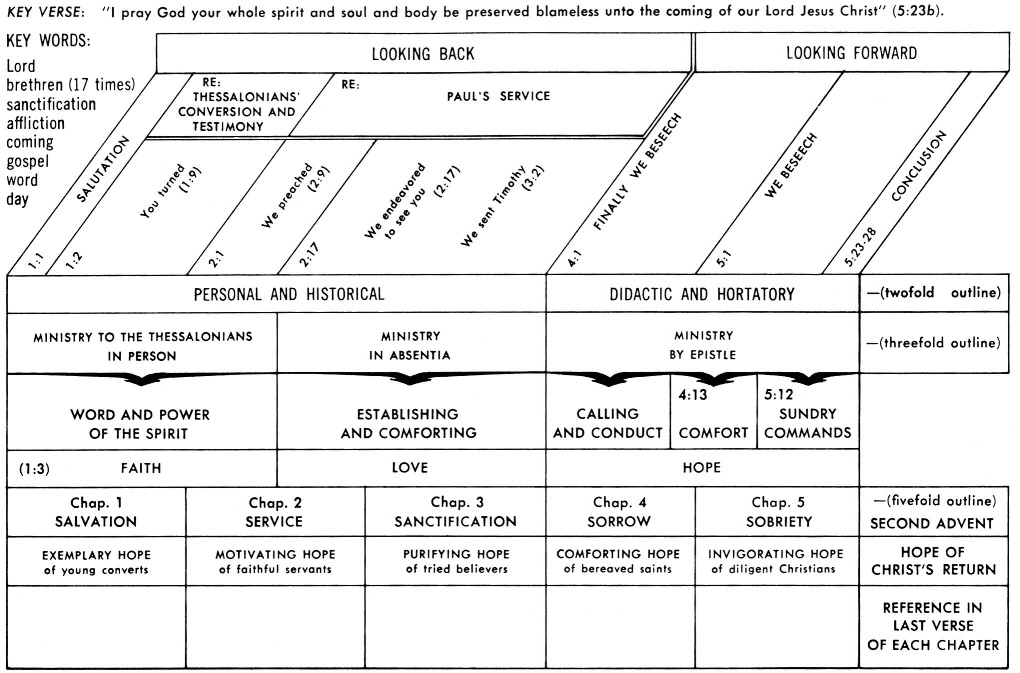
JESUS IS COMING AGAIN
Click chart to enlarge
Charts from Jensen's Survey of the NT - used by permission
Chart by Charles Swindoll

|
1 Thessalonians |
||||||
| 1 Th 1:1-10 | 1 Th 2:1-20 | 1 Th 3:1-13 | 1 Th 4:1-18 | 1 Th 5:1-28 | ||
|
LOOKING BACK |
LOOKING FORWARD |
|||||
|
Personal Reflections |
Practical Instructions |
|||||
| Ministry In Person |
Ministry in Absentia (Thru Timothy) |
Ministry by Epistle |
||||
| Word and Power of the Spirit |
Establishing & Comforting |
Calling & Conduct | 1Th 4:13ff Comfort |
1Th 5:12ff Commands |
||
| 1 Salvation |
2 Service |
3 Sanctification |
4 Sorrow |
5 Sobriety |
||
| Paul Commends Spiritual Growth |
Paul Founds the Church |
Strengthening of the Church |
Directions for Spiritual Growth |
Holy Living in Light of Day of the Lord | ||
| Exemplary Hope of Young Converts | Motivating Hope of Faithful Servants |
Purifying Hope of Tried Believers | Comforting Hope of Bereaved Saints | Invigorating Hope of Diligent Christians | ||
|
Written from Corinth |
||||||
| OUTLINE OF 1 THESSALONIANS CHAPTERS 1-3 |
|
|
CHAPTER |
THEME |
| 1 | An Exemplary Conversion |
| 2 | An Exemplary Witness |
| 3 | An Exemplary Follow-Up |
1 Thessalonians 3:9 Forwhat thanks can we render to God for you in return for all the joy with which we rejoice before our God on your account, NASB: Lockman)
Greek: tina gar eucharistian dunametha (1PPPI) to theo antapodounai (AAN) peri humon epi pase te chara e chairomen (1PPAI) di' humas emprosthen tou theou hemon
Amplified: For what [adequate] thanksgiving can we render to God for you for all the gladness and delight which we enjoy for your sakes before our God? (Amplified Bible - Lockman)
NLT: How we thank God for you! Because of you we have great joy in the presence of God. (NLT - Tyndale House)
Phillips: How can we thank our God enough for all the joy you give us as we serve him, (Phillips: Touchstone)
Wuest: For what thanks are we able to give back to God in return concerning you for all the joy with which we are rejoicing on account of you in the presence of our God,
Young's Literal: for what thanks are we able to recompense to God for you, for all the joy with which we do joy because of you in the presence of our God?
FOR WHAT THANKS CAN WE RENDER TO GOD FOR YOU IN RETURN: tina gar eucharistian dunametha (1PPPI) to theo antapodounai (AAN) peri humon:
- 1Th 1:2,3; 2Samuel 7:18, 19, 20; Nehemiah 9:5; Psalm 71:14,15; 2Corinthians 2:14; 9:15
- 1 Thessalonians 3 Resources - Multiple Sermons and Commentaries
What thanks can we render - The sense of this rhetorical question is that words simply cannot adequately express to God the thanks which filled Paul’s heart. His joy was overflowing every time he remembered these saints before his God.
Thanks (2169)(eucharista from eú = well + charízomai = to grant, give. It speaks of grateful language (to God, as an act of worship), thankfulness. Thanksgiving is only element of prayer that will continue forever. Expresses that which ought never to be absent from any of our devotions; namely, the grateful acknowledgment of past mercies, as distinguished from earnest seeking of future mercies.
Eucharista - 15x in 15v - Acts 24:3; 1 Cor 14:16; 2 Cor 4:15; 9:11f; Eph 5:4; Phil 4:6; Col 2:7; 4:2; 1 Thess 3:9; 1 Tim 2:1; 4:3f; Rev 4:9; 7:12. NAS = giving of thanks(3), gratefully*(1), gratitude(2), thankfulness(1), thanks(2), thanksgiving(4), thanksgivings(2).
Guzik writes that…Some find it easy to rejoice in the material prosperity in the life of others, but Paul honestly rejoiced in the spiritual prosperity of others.
Hiebert explains that this is a rhetorical question…expressive of deep emotion. Fully aware that his words are but a poor and inadequate formulation of the thanksgiving that is properly due, Paul yet attempts to give expression to the deep gratitude he feels. (Hiebert, D. Edmond: 1 & 2 Thessalonians: BMH Book. 1996)
Render to God for you - Here for you means "concerning you" or "on your behalf". Note that Paul does not thank them but thanks God for them. While this should encourage them it provides no occasion for personal pride.
Render in return (467) (antapodidomi from antí = in turn + apodídomi = render <> from apo = from + didomi = give) means to give back in return for something received. The idea is to practice reciprocity with respect to an obligation.
It means to pay back something owed. Paul is saying we as Christians owe to God joyful thanksgiving and praise for what He has done.
In a positive sense it means to repay, to recompense or to reward. In a negative sense it means to requite or exact retribution. Requite implies a paying back according to one’s preference and often not equivalently.
Hiebert explains…The effort to thank God "in return for" His gracious work translates the aorist active infinitive antapodounai (antapodidomi) "to repay, recompense, requite," and that as a definite act. The simple verb, meaning "to give," is compounded with two prepositions: anti, marking the idea of a return or exchange for something received, and apo, referring to something that is due "from" us as a debt; the thought is that of a full and complete return for the boon that has been received. No thanksgiving in their power is equivalent to the debt of gratitude they owe God because of the joy He has given them. This third outburst of thanksgiving for the readers (see notes 1Thessalonians 1:2; 2:13) is called forth by the news of their steadfastness under persecution. Their thanksgiving is Godward. That the Thessalonians stood steadfast is due not to the missionaries, or even to the converts, hut to God Himself who has upheld them under the storm of persecution. Paul viewed all spiritual blessings :is coming ultimately from God. What by human standards would have been regarded as a triumph for the missionaries, Paul humbly acknowledges to be the work of God. Let Christian workers beware of taking credit for results only God can produce. (Hiebert, D. Edmond: 1 & 2 Thessalonians: BMH Book. 1996)
Antapodidomi is used 53 times in the Septuagint (LXX) (Gen. 44:4; 50:15; Lev. 18:25; Deut. 32:6, 35, 41, 43; Jdg 1:7; 16:28; 1 Sam. 24:17; 25:21; 2 Sam. 3:39; 19:36; 22:21; 1 Ki. 2:44; 2 Ki. 9:26; 2 Chr. 32:25; Job 21:19, 31; Ps. 7:4; 18:20, 24; 31:23; 35:12; 38:20; 41:10; 103:10; 116:12; 119:17; 137:8; 138:8; 142:7; Prov. 19:17; 25:22; Isa. 35:4; 59:18; 63:7; 66:4, 6; Jer. 16:18; 18:20; 50:29; 51:6, 24, 56; Hos. 4:9; 12:2, 14; 14:2; Joel 2:25; 3:4, 7; Ob 1:15; Zech. 9:12). Here are some representative uses…
Genesis 50:15 When Joseph's brothers saw that their father was dead, they said, "What if Joseph should bear a grudge against us and pay us back in full for all the wrong which we did to him!"
Deuteronomy 32:35 'Vengeance is Mine, and retribution (Lxx = antapodidomi = "I will repay"), In due time their foot will slip; For the day of their calamity is near, And the impending things are hastening upon them.'
2Samuel 22:21 "The LORD has rewarded (Lxx = antapodidomi) me according to my righteousness; According to the cleanness of my hands He has recompensed (Lxx = antapodidomi) me.
Psalm 31:23 O love the LORD, all you His godly ones! The LORD preserves the faithful, And fully recompenses the proud doer.
Psalm 103:10 He has not dealt with us according to our sins, Nor rewarded us according to our iniquities.
Psalm 116:12 What shall I render to the LORD For all His benefits toward me?
Proverbs 25:22 For you will heap burning coals on his head, And the LORD will reward you.
Joel 2:25 "Then I will make up to (Lxx = antapodidomi) you for the years That the swarming locust has eaten, The creeping locust, the stripping locust, and the gnawing locust, My great army which I sent among you.
Obadiah 1:15 "For the day of the LORD draws near on all the nations. As you have done, it will be done to you. Your dealings will return (Lxx = antapodidomi - literally the Greek reads "your reward will be recompensed") on your own head.
Antapodidomi is used 7 times…
Luke 14:14 and you will be blessed, since they do not have the means to repay you; for you will be repaid at the resurrection of the righteous.
Romans 11:35 (note) Or who has first given to Him that it might be paid back to him again?
Romans 12:19 (note) Never take your own revenge, beloved, but leave room for the wrath of God, for it is written, "Vengeance is Mine, I will repay," says the Lord.
1Thessalonians 3:9 (note) For what thanks can we render to God for you in return for all the joy with which we rejoice before our God on your account,
2 Thessalonians 1:6 For after all it is only just for God to repay with affliction those who afflict you
Hebrews 10:30 (note) For we know Him who said, "Vengeance is Mine, I will repay." And again, "The Lord will judge His people."
FOR ALL THE JOY WITH WHICH WE REJOICE BEFORE OUR GOD ON YOUR ACCOUNT: epi pase te chara e chairomen (1PPAI) di' humas emprosthen tou theou hemon:
- 1Thes 3:7,8; 2:19) (Deuteronomy 12:2,18; 16:11; 2Samuel 6:21; Psalms 68:3; 96:12,13; 98:8,9
- 1 Thessalonians 3 Resources - Multiple Sermons and Commentaries
For all the joy with which we rejoice - God's joy sometimes comes to us because of other Christians and their faithfulness to Christ. Literally Paul says
Upon all the joy wherewith we are rejoicing
Joy (5479) (chara) is a feeling of inner gladness, delight or rejoicing. Secular dictionaries define joy as the emotion evoked by well-being, success, or good fortune or the emotion evoked by the prospect of possessing what one desires. The world's definition of joy is therefore virtually synonymous with the definition of happiness, for both of these "emotions" are dependent on what "happens".
Certainly there is joy in human life, such as joy when one experiences a victory (" We will sing for joy over your victory, and in the name of our God we will set up our banners. May the LORD fulfill all your petitions." Ps 20:5 Spurgeon's comment) or reaps a bountiful harvest (see Isaiah 9:3), but more often the Bible speaks of joy in a spiritual sense. For example, Nehemiah declared to the down in the mouth (not very filled with joy) Jews that "The joy of the Lord is your strength" (Nehemiah 8:10). Similarly, David pleaded with God to “restore to me the joy of Thy salvation” (Psalm 51:12 Spurgeon's Comment). It is not surprising that joy and rejoicing are found most frequently in the Psalms (about 80 references) and the Gospels (about 40 references).
C. S. Lewis got a bit closer to the Biblical meaning when he called joy an “unsatisfied desire which is itself more desirable than any other satisfaction.” That statement is a bit obtuse but Lewis then goes on to add that joy "must be sharply distinguished both from happiness and from pleasure". Ultimately Lewis' experienced joy when he discovered that Jesus was the wellspring of all joy.
Joy then is the deep-down sense of well-being that abides in the heart of the person who knows all is well between himself and the Lord. It is not an experience that comes from favorable circumstances but even occurs when those circumstances are the most painful and severe as Jesus taught His disciples declaring…
Truly, truly, I say to you, that you will weep and lament, but the world will rejoice; you will be sorrowful, but your sorrow will be turned to joy. 21 "Whenever a woman is in travail she has sorrow, because her hour has come; but when she gives birth to the child, she remembers the anguish no more, for joy that a child has been born into the world. 22 "Therefore you too now have sorrow; but I will see you again, and your heart will rejoice, and no one takes your joy away from you. (John 16:20, 21, 22)
Believers have the Resident Source of joy within for as as Paul teaches
the fruit of the Spirit is love, joy, peace, patience, kindness, goodness, faithfulness (Galatians 5:22)
Rejoice (5463)(chairo) means to be "cheer" full or full of cheer, to be delighted, to be calmly happy or to be well-off in one's emotional status. Chairo was frequently used in ancient Greece as a greeting or address in the imperative (command) implying a wish for well-being (something like "welcome", "good morning").
Chairo - 74x in 68v - Matt 2:10; 5:12; 18:13; 26:49; 27:29; 28:9; Mark 14:11; 15:18; Luke 1:14, 28; 6:23; 10:20; 13:17; 15:5, 32; 19:6, 37; 22:5; 23:8; John 3:29; 4:36; 8:56; 11:15; 14:28; 16:20, 22; 19:3; 20:20; Acts 5:41; 8:39; 11:23; 13:48; 15:23, 31; 23:26; Rom 12:12, 15; 16:19; 1 Cor 7:30; 13:6; 16:17; 2 Cor 2:3; 6:10; 7:7, 9, 13, 16; 13:9, 11; Phil 1:18; 2:17f, 28; 3:1; 4:4, 10; Col 1:24; 2:5; 1 Thess 3:9; 5:16; Jas 1:1; 1 Pet 4:13; 2 John 1:4, 10f; 3 John 1:3; Rev 11:10; 19:7. NAS = am glad(1), glad(7), gladly(1), greeted*(1), greeting(2), greetings(4), hail(4), joyfully(1), make(1), rejoice(33), rejoiced(8), rejoices(2), rejoicing(10).
In this passage, the present tense indicates that their joy was a continuing, supernatural, Spirit given fruit (Gal 5:22-note), not a passing emotional reaction as one sees in those who are merely "happy" where one is happy when things are going well but not happy when things are not going well.
Hiebert writes that "The use of both the noun and verb underlines the reality of their joy, while "all" brings out the superlative quality of the joy. Because of the nature and scope of their joy, they owe God a greater debt of thanks than they can express. Theirs is a continuing joy, as the present tense of the verb indicates. It counterbalances "all our distress and persecution" (1Th 3:7). (Hiebert, D. Edmond: 1 & 2 Thessalonians: BMH Book. 1996)
Before (1715)(emprosthen from en = in, + prósthen = in front of, before from prós = toward, + syllabic suffix –then denoting direction, a place) means before, in front of., in presence of, sight of, used of place or position only.
Emprosthen - 48x in 45v - Matt 5:16, 24; 6:1f; 7:6; 10:32f; 11:10, 26; 17:2; 18:14; 23:13; 25:32; 26:70; 27:11, 29; Mark 2:12; 9:2; Luke 5:19; 7:27; 10:21; 12:8; 14:2; 19:4, 27f; 21:36; John 1:15, 30; 3:28; 10:4; 12:37; Acts 10:4; 18:17; 2 Cor 5:10; Gal 2:14; Phil 3:13; 1 Thess 1:3; 2:19; 3:9, 13; 1 John 3:19; Rev 4:6; 19:10; 22:8. NAS = ahead(5), before(28), front(4), higher rank(2), presence(4), sight(3).
On your account - Paul again stresses that the truth about the steadfastness of the Thessalonian converts is the catalyst that brings about their continual rejoicing with all joy. Note the radical change from all our distress and affliction (1Th 3:7-note) to all the joy on account of the steadfastness of the Thessalonians. Paul is modeling for us the discipline of giving thanks in all things (distress and affliction, cp note 1Th 5:18-note). How does this supernatural reaction relate to 1Th 1:6-note? Clearly we see the key to rejoicing in tribulations and giving thanks in all things is being controlled by the Holy Spirit, continually learning to lean on His strength and not our own understanding (cp Proverbs 3:5, 6) Joy is a fruit of a Spirit filled life and here was "fertilized" by the good news brought by Timothy.
Hiebert writes that…That they are expressing it before "our God," the God with whom they stand in intimate personal relationship, indicates its purity. It is a joy that is given free rein in the presence of God without embarrassment, for it is uncontaminated by personal selfishness or worldly motives. We have here another instance of Paul's practice of lifting everything that came into his life, whether sad or glad, into the presence of God. Thus he lived in the sense of God's presence with him. (Ibid)
The psalmist writes…
But let the righteous be glad; let them exult before God; Yes, let them rejoice with gladness. (Ps 68:3)
Spurgeon comments The presence of God on the throne of grace is an overflowing source of delight to the godly; and let them not fail to drink of the streams which are meant to make them glad. The courtiers of the happy God should wear the garments of gladness, for in his presence is fulness of joy. That presence, which is the dread and death of the wicked, is the desire and delight of the saints. Let them dance with all their might, as David did, for very joy. No bounds should be set to joy in the Lord. "Again, I say, rejoice," says the apostle, as if he would have us add joy to joy without measure or pause. When God is seen to shine propitious from above the mercy seat in the person of our Immanuel, our hearts must needs leap within us with exultation, if we are indeed among those made righteous in his righteousness, and sanctified by his Spirit. Move on, O army of the living God, with shouts of abounding triumph, for Jesus leads the van.
1Thessalonians 3:10 as we night and day keep praying most earnestly that we may see your face, and may complete what is lacking in your faith? (NASB: Lockman)
Greek: nuktos kai emeras huperekperissou deomenoi (PPPMPN) eis to idein (AAN) humon to prosopon kai katartisai (AAN) ta husteremata tes pisteos humon?
Amplified: [And we] continue to pray especially and with most intense earnestness night and day that we may see you face to face and mend and make good whatever may be imperfect and lacking in your faith. (Amplified Bible - Lockman)
NLT: Night and day we pray earnestly for you, asking God to let us see you again to fill up anything that may still be missing in your faith. (NLT - Tyndale House)
Phillips: praying earnestly day and night to see you again, and to complete whatever is imperfect in your faith? (Phillips: Touchstone)
Wuest: night and day asking in prayer quite beyond measure and as earnestly as possible that we might see your face and complete the things which are lacking in your faith?
Young's Literal: night and day exceedingly beseeching, that we might see your face, and perfect the things lacking in your faith.
AS WE NIGHT AND DAY KEEP PRAYING MOST EARNESTLY THAT WE MAY SEE YOUR FACE, AND MAY COMPLETE WHAT IS LACKING IN YOUR FAITH: nuktos kai emeras huperekperissou deomenoi (PPPMPN) eis to idein (AAN) humon to prosopon kai katartisai (AAN) ta husteremata tes pisteos humon:
- Luke 2:37; Acts 26:7; 2Timothy 1:3; Revelation 4:8; 7:15
- 1Th 3:11; 2:17,18; Romans 1:10; 15:30, 31, 32; Philemon 1:22
- Romans 1:11,12; 2Corinthians 1:15,24; 13:9,11; Philippians 1:25; Colossians 1:28; 4:12; 2Thessalonians 1:11
- 1 Thessalonians 3 Resources - Multiple Sermons and Commentaries
Night and day (this predominantly Pauline phrase is used 3 times in his letters to the Thessalonians and occurs 9x = Mark 5:5; Luke 2:37; Acts 20:31; 26:7; 1Th 2:9; 3:10; 2Th 3:8; 1Ti 5:5; 2Ti 1:3) - Night and day does not mean once in the evening and once in the morning, nor that he did nothing else but pray but emphasizes the frequency of his prayers, while most earnestly refers to the extreme intensity of their prayers (as discussed below).
Hiebert has a technical note on night and day writing that…
The terms are in the genitive to indicate that they are praying by night and by day, not all night and all day long. Again and again during the long hours of the night as well as during the busy hours of the day they MI their prayers to God for them. (Ibid)
Praying (1189)(deomai from deo = to bind, cause someone to be under authority of someone or something - see word study on the related word deesis) conveys the basic meaning of to lack or be in need of and so means to beg (as binding oneself), to petition, to beseech, to make request. Deomai usually represents asking from a point of need.
Deomai - 22x in 22v - Matt 9:38; Luke 5:12; 8:28, 38; 9:38, 40; 10:2; 21:36; 22:32; Acts 4:31; 8:22, 24, 34; 10:2; 21:39; 26:3; Rom 1:10; 2 Cor 5:20; 8:4; 10:2; Gal 4:12; 1 Thess 3:10. NAS = ask(1), beg(6), begged(1), begging(2), beseech(2), implored(1), making request(1), please(1), pray(2), prayed(3), praying(2).
Deomai implies that it is an asking that is motivated by a sense of personal need or is asking for a personal favor. Deomai is common in secular Greek writings of someone making a petition to a ruling sovereign. The missionaries were appealing not to a sovereign but to the Sovereign One, the One in control of everything.
The missionaries felt that they had a vital personal interest in the petitions made. The use of the present tense indicates that their praying is not spasmodic or an isolated act but reflected their habitual practice (cf note 1Thessalonians 5:17)
Most earnestly (huperekperissou from huper = above + ek = intensifies meaning, adding idea of exhaustlessness + perissos = exceeding some number or measure, over and above, more than necessary) means more than out of bounds, overflowing all bounds, surpassing, superabundantly, surpassingly, beyond measure, exceedingly, quite beyond all measure, overwhelming, over and above, more than enough. It describes an extraordinary degree, involving a considerable excess over what would be expected.
This prayer was fervent, this word expressing strong even "superabundant" praying. Clearly Paul prayed beyond the normal measure for this request. This is extraordinary prayer over what one would normally pray.
Barnes writes that "there was much more than ordinary prayer. He made this a special subject of prayer; he urged it with earnestness, and without intermission (Albert Barnes. Barnes NT Commentary)
The sense in this verse is that Paul, Silvanus and Timothy are praying with extreme earnestness or as earnestly as humanly possible.
F F Bruce said that here we encounter another "one of Paul’s coined ‘super-superlatives'".
Vincent writes that this is…One of the numerous compounds of huper - beyond, over and above, of which Paul is fond. Of 28 words compounded with this preposition in the New Testament, Paul alone uses 20.
Huperekperissou is the the highest form of comparison imaginable and so means immeasurably more than, quite beyond all measure, infinitely more than
Now to Him who is able to do far more abundantly beyond all that we ask or think, according to the power that works within us (See note Ephesians 3:20)
Morris writes that "There are various ways of expressing the thought of abundance, and this double compound is probably the most emphatic of all."
Huperekperissou is found only 3 times in all the Bible - Ep 3:20-note; 1Th 5:12, 13)
But we request of you, brethren, that you appreciate those who diligently labor among you, and have charge over you in the Lord and give you instruction, 13 and that you esteem them very highly (huperekperissou) in love because of their work. Live in peace with one another. (1Th 5:12, 13-)
Wuest comments on the use of huperekperissou in Ephesians 3:20 writing that it…is a superlative of superlatives in force. It speaks of the ability of God to do something, that ability having more than enough potential power, this power exhaustless, and then some on top of that. Thus, Paul says that God is able to do super-abundantly above and beyond what we ask or think, and then some on top of that.
This pray contained 2 requests
(1) to see them again face to face (not granted until several years later)
(2) supply what is lacking in their faith.
Face (4383) (prosopon from prós = toward + ops = the eye or face) is literally the part toward, at, or around the eye. front (face or eye toward) (being towards view)
Paul heard good news from Timothy, but it wasn’t enough. He wanted to see the face of the church family in Thessalonica. Paul wanted it enough to pray night and day.
Matthew Poole writes that..
Though his Epistles might avail towards it, yet his personal presence would do more. There is a peculiar blessing attends oral preaching, more than reading.
Complete what is lacking - In the midst of all this joy, Paul called attention to the fact that they were still lacking. Though the apostle repeatedly complimented them (see notes on 1Thes 1:3, 1:7, 2:13, 2:19, 2:20, and 3:6), he was also concerned to perfect (complete) what is lacking in their faith.
Complete (2675) (katartizo from katá = with + artízō = to adjust, fit, finish, in turn from artios = fit, complete) means to thoroughly prepare something to meet demands. To make fitted or equipped for a duty or function. To make someone completely adequate or sufficient for something. To supply that which is missing.
When applied to that which is weak and defective, it denotes setting right what has gone wrong or restoring to a former condition, whether mending broken nets or setting broken bones. And so it means to fit or join together and thus to mend or repair. For example Mark records
And going on a little farther, He saw James the son of Zebedee, and John his brother, who were also in the boat mending (katartizo - present tense) the nets. (Mark 1:19)
Katartizo conveys the fundamental idea of putting something into its appropriate condition so it will function well. It conveys the idea of making whole by fitting together, to order and arrange properly.
Secular Greek used katartizo for manning a fleet or outfitting an army with provisions so they would be thoroughly prepared to go to war. This latter secular use has spiritual parallels for the saints in Thessalonica (indeed all saints) needed to be thoroughly prepared and "outfitted" with the provision of sound doctrinal truth in order to wage war against the lies and perversions of truth by the Tempter (cp John 8:44) and his minions.
Barnes reasonable assessment is that…whatever was deficient in their views of religious doctrine the apostle desired to supply. It is to be remembered that he was with them but a comparatively short time before he was compelled to depart to Berea, and it is reasonable to suppose that there were many subjects on which he would be glad to have an opportunity to instruct them more fully.
Wuest adds that katartízō "has in it the idea of equipping something or preparing it for future use."
Vincent says that katartízō "signifies to readjust, restore, set to rights, whether in a physical or a moral sense (Vincent, M. R. Word Studies in the New Testament. Vol. 1, Page 3-317)
Westcott writes that the word "includes the thoughts of the harmonious combination of different powers, the supply of that which is defective, and the amendment of that which is faulty.
Hiebert notes that "The meaning is not that something has gone wrong with the faith of the Thessalonians and that rectification is needed. Rather, Paul clearly recognized that the faith of their converts needed to be brought to its full development. This is indicated by the addition "what is lacking in your faith." Not that the faith they had was defective, but it still needed completing and rounding out. (Hiebert, D. Edmond: 1 & 2 Thessalonians: BMH Book. 1996)
What is lacking (short comings) (5303) (husterema from hustereo = to lack, fall behind) means that which is behind or that which is lacking.
Husterema - 9x in 8v - Luke 21:4; 1 Cor 16:17; 2 Cor 8:14; 9:12; 11:9; Phil 2:30; Col 1:24; 1 Thess 3:10
The root hustereo pictures someone in a company marching together w/ others who march faster than he can. He cannot keep up, so he falls behind. Falling behind in religious matters means not being able to fulfill all the demands.
I agree with Ryrie's assessment that…
There will always be lacks in our faith until we reach heaven where, at last, we will be "without blame" (The Ryrie Study Bible: New American Standard Translation: 1995. Moody Publishers)
In your faith - Faith in this context does refer to their trust or confidence in God, but of the body of Christian doctrine, as in Jude 3 (see related study of the faith = pistis)
Vine reasons from what Paul discusses in chapters 4 and 5 that…
The principal things lacking, apparently, concerned their conduct, their hope, and their mutual relationships in the church, for instruction on these points occupies the remainder of the Epistle; the first is dealt with in 1Thes 4:1-12, the second in 1Thes 4:13–5:11, the third in 1Thes 5:12-22.
Hiebert adds that
The substantive translated what is lacking is plural and is quite literally "the short-comings, deficiencies." The plural indicates that more than one thing needed completing so that their faith might be brought to the place where it would fully discharge its intended function. Paul recognized that the work begun at Thessalonica was incomplete. Because they had been prematurely torn away from the work there they had not been able to do all that was needed. The missionaries yearned to return and, like skilled artisans, complete the task and put things in top working condition.
Although Paul was overflowing with thanksgiving for his converts, he had no illusions about their actual condition. He was not blind to their deficiencies and needs. He deeply appreciated what had already been attained, but he frankly acknowledged that they had not yet arrived. Calvin comments
We learn from this that those who far outdistance others are still a long way from their goal.
Conversion is only the beginning. They still needed pastoral instruction and guidance. Their faith had shown itself strong and steadfast under persecution; their defects of faith were not on the side of zeal and loyalty but of knowledge and insight. As novices in the faith they lacked a clear and reassuring view of Christian truth and insight regarding its practical application in daily life. Their faith needed to be perfected by giving them needed enlightenment, exhortations, and warnings. Instruction and admonition were necessary, but Paul was "wise enough to convey any correction or remonstrance on the back of hearty commendation."
Paul yearned and prayed to be able to return to Thessalonica to deal with the deficiencies of his converts. Had he been able to return he would have dealt with them directly and orally. Paul doubtless shared the common feeling that "personal intercourse goes farther than letters in establishing the weak and wavering." But since he was not able to return he dealt with their deficiencies in the second part of his letter. If he had been able to return we would not have the benefit of this invaluable epistle. Thus the success of Satan in blocking his return was divinely overruled for the Instruction and enrichment of Christ's church down through the centuries. (Ibid)