1 Thes 4:2
1 Thes 4:3
1 Thes 4:4
1 Thes 4:5
1 Thes 4:6
1 Thes 4:7
1 Thes 4:8
1 Thes 4:9
1 Thes 4:10
1 Thes 4:11
1 Thes 4:12
1 Thes 4:13
1 Thes 4:14
1 Thes 4:15
1 Thes 4:16
1 Thes 4:17
1 Thes 4:18
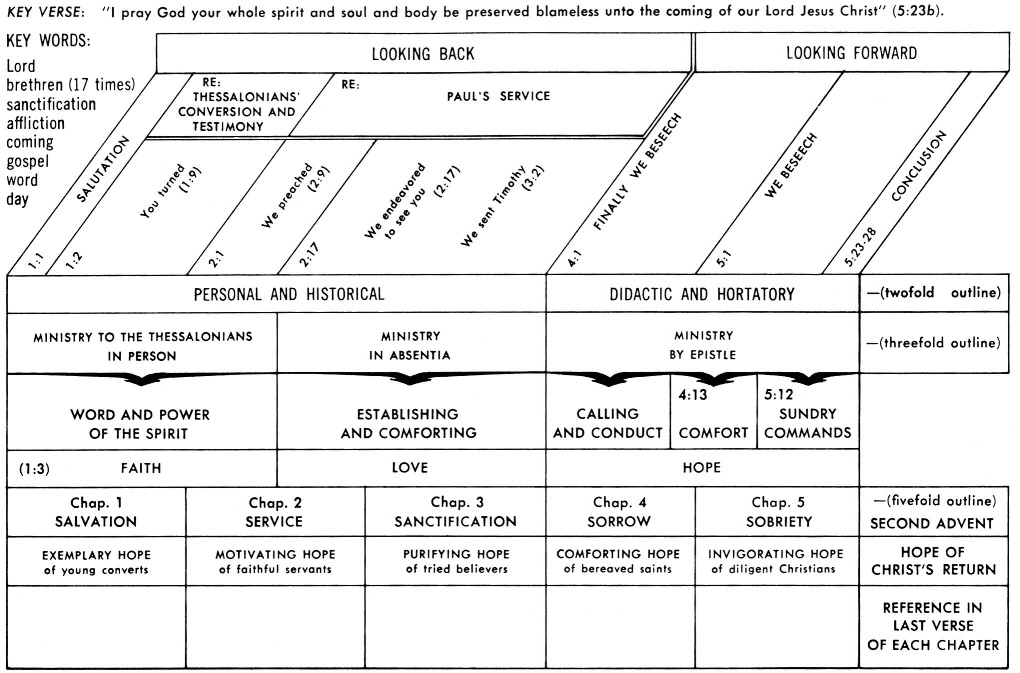
JESUS IS COMING AGAIN
Click chart to enlarge
Charts from Jensen's Survey of the NT - used by permission
Chart by Charles Swindoll

|
1 Thessalonians |
||||||
| 1 Th 1:1-10 | 1 Th 2:1-20 | 1 Th 3:1-13 | 1 Th 4:1-18 | 1 Th 5:1-28 | ||
|
LOOKING BACK |
LOOKING FORWARD |
|||||
|
Personal Reflections |
Practical Instructions |
|||||
| Ministry In Person |
Ministry in Absentia (Thru Timothy) |
Ministry by Epistle |
||||
| Word and Power of the Spirit |
Establishing & Comforting |
Calling & Conduct | 1Th 4:13ff Comfort |
1Th 5:12ff Commands |
||
| 1 Salvation |
2 Service |
3 Sanctification |
4 Sorrow |
5 Sobriety |
||
| Paul Commends Spiritual Growth |
Paul Founds the Church |
Strengthening of the Church |
Directions for Spiritual Growth |
Holy Living in Light of Day of the Lord | ||
| Exemplary Hope of Young Converts | Motivating Hope of Faithful Servants |
Purifying Hope of Tried Believers | Comforting Hope of Bereaved Saints | Invigorating Hope of Diligent Christians | ||
|
Written from Corinth |
||||||
1 Thessalonians 4:1 Finally then, brethren, we request and exhort you in the Lord Jesus, that as you received from us instruction as to how you ought to walk and please God (just as you actually do walk ), that you excel still more. (NASB: Lockman)
Greek: Loipon oun, adelphoi, erotomen (1PPAI) humas kai parakaloumen (1PPAI) en kurio Iesou, hina kathos parelabete (2PAAI) par' hemon to pos dei (3SPAI) humas peripatein (PAN) kai areskein (PAN) theo, kathos kai peripateite, (2PPAI) hina perisseuete (1PPAS) mallon.
Amplified: Furthermore, brethren, we beg and admonish you in [virtue of our union with] the Lord Jesus, that [you follow the instructions which] you learned from us about how you ought to walk so as to please and gratify God, as indeed you are doing, [and] that you do so even more and more abundantly [attaining yet greater perfection in living this life]. (Amplified Bible - Lockman)
KJV: Furthermore then we beseech you, brethren, and exhort you by the Lord Jesus, that as ye have received of us how ye ought to walk and to please God, so ye would abound more and more.
NLT: Finally, dear brothers and sisters, we urge you in the name of the Lord Jesus to live in a way that pleases God, as we have taught you. You are doing this already, and we encourage you to do so more and more. (NLT - Tyndale House)
Phillips: To sum up, my brothers, we beg and pray you by the Lord Jesus, that you continue to learn more and more of the life that pleases God, the sort of life we told you about before. (Phillips: Touchstone)
Wuest: Finally, therefore, brethren, I request you and I beg of you, please, in the Lord Jesus, that even as you received from us the particular way in which it is necessary in the nature of the case for you to be ordering your behavior and to be striving to please God, even as also you are conducting yourselves, that you superabound yet more and more.
Young's Literal: As to the rest, then, brethren, we request you, and call upon you in the Lord Jesus, as ye did receive from us how it behoveth you to walk and to please God, that ye may abound the more,
FINALLY THEN, BRETHREN, WE REQUEST AND EXHORT YOU IN THE LORD JESUS: Loipon oun, adelphoi, erotomen (1PPAI) humas kai parakaloumen (1PPAI) en kurio Iesou:
- 1Thes 2:11; Ro 12:1; 2Corinthians 6:1; 10:1; Ephesians 4:1; Philemon 1:9,10; Hebrews 13:22
- 1Thes 4:2; Ephesians 4:20; 2Thessalonians 2:1; 1Timothy 5:21; 6:13,14; 2Timothy 4:1
- 1 Thessalonians 4 Resources - Multiple Sermons and Commentaries
|
1Thessalonians |
||||||
| Chapter 1 | Chapter 2 | Chapter 3 | Chapter 4 | Chapter 5 | ||
|
LOOKING BACK |
LOOKING FORWARD |
|||||
|
Personal Reflections |
Practical Instructions |
|||||
| Ministry In Person |
Ministry in Absentia (Thru Timothy) |
Ministry by Epistle |
||||
| Word and Power of the Spirit |
Establishing & Comforting |
Calling & Conduct | 1Th 4:13ff Comfort |
1Th 5:12ff Commands |
||
| 1 Salvation |
2 Service |
3 Sanctification |
4 Sorrow |
5 Sobriety |
||
| Exemplary Hope of Young Converts | Motivating Hope of Faithful Servants | Purifying Hope of Tried Believers | Comforting Hope of Bereaved Saints | Invigorating Hope of Diligent Christians | ||
|
Written from Corinth |
||||||
|
Modified from the excellent book Jensen's Survey of the NT |
||||||
| 1Thessalonians Segment Divisions |
|
| Chapters 1-3 | Chapters 4-5 |
|
LOOKING BACK |
LOOKING FORWARD |
| Reminding Encouraging |
Requesting Instructing |
| Personal Experience |
Practical Exhortation |
| Reflections | Instructions |
| Past Salvation |
Present Sanctification |
| Personal and Historical |
Practical and Hortatory |
1 Thessalonians 4 can be divided as follows…
1 Thes 4:1-2 = General Call to a God Pleasing Walk
1 Thes 4:3-12 = Specific Aspects of God Pleasing Walk
1 Thes 4:3-8 = Sanctification in Area of Sexual Purity
1 Thes 4:9-12 = Sanctification in Area of Love and Work
1 Thes 4:13-18 = Hope for Grieving Saints
Paul now introduces the practical hortatory (exhortational) section (refer to chart above), much like he does in other epistles…
I urge (parakaleo) you therefore, brethren, by the mercies of God, to present your bodies a living and holy sacrifice, acceptable to God, which is your spiritual service of worship. (see note Romans 12:1)
I, therefore, the prisoner of the Lord, entreat (parakaleo) you to walk in a manner worthy of the calling with which you have been called (see note Ephesians 4:1)
Notice that in the first 2 verses (1 Thes 4:1, 2) Paul is quite general but that in the next section (1 Thes 4:3, 4, 5, 6, 7, 8) he is very specific as he deals with sexual purity.
Hiebert makes an excellent point noting that…
It is instructive to notice that the teaching concerning the second advent (see Second Coming) is preceded and followed by sections dealing with daily life and conduct. Although the teaching concerning the Lord's return was clearly an exciting subject for the Thessalonians, Paul endeavored to set it into a context of practical daily living. The Christian's hope for the future must have a sanctifying influence upon the present. (Hiebert, D. Edmond: 1 & 2 Thessalonians: BMH Book. 1996)
Finally (3062)(loipos = remaining) pertains to the part of a whole which remains or continues and thus constitutes the rest of the whole. Finally is not the most satisfactory rendering since it commonly implies that the conclusion is next. A better translation would be "for the rest," or "further." In fact literally this phrase is as for the rest and in every case, the use of this Greek expression has the idea of something left over. That is, all that remains is to offer these exhortations and instructions.
Loipos - 55x in 55v in the NAS = beyond(1), else(2), finally(6), future(1), moreover(1), now(2), other(1), other matters(1), other people(1), other things(1), other women(1), others(4), remaining(2), rest(26), still(2), then(1), things that remain(1), time onward(1).
Matt 22:6; 25:11; 26:45; 27:49; Mark 4:19; 14:41; 16:13; Luke 8:10; 12:26; 18:9, 11; 24:9f; Acts 2:37; 5:13; 17:9; 27:20, 44; 28:9; Rom 1:13; 11:7; 1 Cor 1:16; 4:2; 7:12, 29; 9:5; 11:34; 15:37; 2 Cor 12:13; 13:2, 11; Gal 2:13; 6:17; Eph 2:3; 6:10; Phil 1:13; 3:1; 4:3, 8; 1 Thess 4:1, 13; 5:6; 2 Thess 3:1; 1 Tim 5:20; 2 Tim 4:8; Heb 10:13; 2 Pet 3:16; Rev 2:24; 3:2; 8:13; 9:20; 11:13; 12:17; 19:21; 20:5.
Paul uses loipon frequently in the concluding portion of his Epistles, introducing practical exhortations but not necessarily implying that the letter is drawing to a close. In other words, the "finally" formula is often used by Paul to attach in a somewhat loose way (even in the midst of an Epistle) a new subject to the one which he has been discussing. In the present letter he is marking a transition in the subject matter (see table above), similar to his practice in other epistles such as in
Philippians 3:1 Finally my brethren rejoice… "
2Thessalonians 3:1 Finally, brethren, pray for us…
2Corinthians 13:11 Finally, brethren, rejoice, be made complete, be comforted, be like-minded, live in peace; and the God of love and peace shall be with you
As previously noted, Satan had seemingly won the battle by successfully hindering Paul from speaking face to face to these relatively young (in the faith) saints in Thessalonica (1Th 2:17; 2:18 see notes 1Th 2:17; 18). And yet what Satan meant for evil, the sovereign, omnipotent Creator used for good (cf Ro 8:28, Ge 50:20), the Spirit inspiring Paul to take up and write this precious epistle that has ministered to scores of believers throughout the ages!
Henry Alford adds that finally has…
no reference to time, but introduces this second portion, thus dividing it from the first, and implying the close of the Epistle. St. Paul uses it towards the end of his Epistles: see Ep 6:10; Php 4:8.
Then (3767) (oun) means therefore, so, consequently and introduces a logical result or inference from that which has previously been stated. Paul had just prayed for the establishment of their hearts unblamable in holiness before God at the coming of the Lord Jesus (see note 1 Thessalonians 3:13) and therefore now exhorts them to the same end because he knew that the highway to holiness is only along the path of obedience to the revealed will of God.
I love Charles Simeon's opening words to his sermon on this verse…
OUR blessed Lord, when about to leave the world, commanded his Apostles to go and “proselyte all nations” to his religion, “teaching them at the same time to observe and do all things that he had commanded them.” (Mt 28:18, 19, 20) Thus, in their ministrations, principle and practice were to go hand in hand. But many are disposed to separate what he has thus united; some making the Gospel little else than a system of moral duties; whilst others omit duty altogether, and occupy themselves entirely in establishing their own peculiar views of its doctrines. Both of these parties we conceive to be wrong. A superstructure is nothing without a foundation; neither is a foundation any thing without a superstructure. Each indeed has its appropriate place; but both are alike important: for if, on the one hand, the superstructure will fall, without a foundation; so on the other hand, it is for the sake of the superstructure alone that the foundation is laid. St. Paul, “as a wise master-builder,” (1Cor 3:10) was careful at all times to lay his foundation deep and strong: but, having done this, he was careful also to raise upon it a beauteous edifice, such as God Himself would delight to inhabit. This appears in all his epistles, not excepting those which are most devoted to the establishment of sound doctrine (cf 1Ti 4:6, 2Ti 4:3, Titus 1:9, Titus 2:1). In the epistle before us he seems to have had little else in view, than to assure the Thessalonians of his tender regard for them, and to excite them to the highest possible attainments in universal holiness (see Holiness Quotes). He was ready enough to acknowledge, that his instructions had produced the most salutary effects upon them; but he was anxious that they should still press forward for higher attainments, as long as any thing should remain to be attained. The words which we have just read (1Th 4:1) consist of an appeal, and an exhortation. (1Thessalonians 4:1 Advancement in Holiness Enforced)
Brethren (80) (adelphos from collative a = copulative prefix {joining together coordinate words} or connective particle serving to join or unite + delphús = womb) is literally one born from same womb and is literally the word for a male having the same father and mother. Figuratively, as used in this verse adelphos refers to Paul's fellow believers in Thessalonica which includes not just brothers but sisters in Christ, all of whom are united by a bond of affection, for all have been born of one Spirit and have God as their Father and Jesus as their Brother. In sum, Paul appeals to the Thessalonians by affectionately referring to them as his brothers in Christ.
Hiebert reminds us that…
The readers are again affectionately addressed as "brothers." These appeals are being made in the interest of that spiritual brotherhood in Christ into which they have been brought. It is a loving reminder of their common interests and concerns as Christians. (Ibid)
Request and exhort - The combination of two verbs expresses the writer’s sense of the paramount importance of maintaining the Christian character. The two verbs enforce each other and add emphasis to the request being made. Having prayed for their establishment in holiness, Paul now exhorts and instructs them to that end. The prayer that they may be blameless in holiness at the Lord's return cannot be realized without the cooperation of those for whom the prayer is made. Paul therefore urges his beloved converts to excel in their striving after a holy walk.
Request (2065)(erotao [word study] from éromai = ask, inquire) means to ask for, usually w implication of an underlying question. Erotao provides the most delicate and tender expression for prayer or request with the one asking and the one being asked being on an equal level, such as the Lord Jesus asking of the Father (it is never used of men asking God for we are not on the same level as the Son is to the Father). In the present context Paul is speaking to the believers at Thessalonica as a fellow believer and not as someone who is "holier than though" as we often say. Paul is calling for them to seriously strive to walk holy, worthy and without blame.
Erotao - 63x in 61v NAS = ask(15), ask a question(1), asked(14), asking(11), asks(3), beg(1), begging(1), implored(1), imploring(1), make request(1), please(2), question(5), questioned(2), request(4), requesting(1), urging(1).
Matt 15:23; 16:13; 19:17; 21:24; Mark 4:10; 7:26; 8:5; Luke 4:38; 5:3; 7:3, 36; 8:37; 9:45; 11:37; 14:18f, 32; 16:27; 19:31; 20:3; 22:68; 23:3; John 1:19, 21, 25; 4:31, 40, 47; 5:12; 8:7; 9:2, 15, 19, 21; 12:21; 14:16; 16:5, 19, 23, 26, 30; 17:9, 15, 20; 18:19, 21; 19:31, 38; Acts 1:6; 3:3; 10:48; 16:39; 18:20; 23:18, 20; Phil 4:3; 1 Thess 4:1; 5:12; 2 Thess 2:1; 1 John 5:16; 2 John 1:5.
Note that both erotao and parakaleo are in the present tense indicating that these are meant to convey continuous action -- we are continually requesting and continually exhorting you.
Paul has similar uses of erotao in the following passages…
But we request (erotao) of you, brethren, that you appreciate those who diligently labor among you, and have charge over you in the Lord and give you instruction, (note 1 Thessalonians 5:12)
Now we request (erotao) you, brethren, with regard to the coming of our Lord Jesus Christ, and our gathering together to Him, (2Thessalonians 2:1)
Indeed, true comrade, I ask (erotao) you also to help these women who have shared my struggle in the cause of the gospel, together with Clement also, and the rest of my fellow workers, whose names are in the book of life. (note Philippians 4:3)
Exhort (3870) (parakaleo [word study] from para = side of, alongside, beside + kaleo [ word study] = call) means literally to call one alongside, to call someone to oneself, to call for, to summon. Parakaleo can include the idea of giving help or aid but the primary sense in the NT is to urge someone to take some action, especially some ethical course of action. Sometimes the word means convey the idea of comfort, sometimes of exhortation but always at the root there is the idea of enabling a person to meet some difficult situation with confidence and with gallantry.
Kent Hughes illustrates the root idea of parakaleo "to come alongside and encourage" with the following example
I see this exemplified every time my church has a roller skating party, and the parents put their little ones on skates for the first time. Mom and Dad skate with their child, holding on to his or her hands, sometimes with the child’s feet on the ground and sometimes in the air. But all the time the parents are alongside encouraging… [exhortation] is a wonderful gift, and we are to place it at Christ’s feet and be willing to be worn out in its use.
Encourage one another - Study the "one anothers" - most positive, some negative
Despite the fact that parakaleo can convey a wide range of meanings most Bible versions translate this verb with either exhort or urge.
In English exhort (from Latin exhortari from ex- = thoroughly + hortari = to excite, encourage, urge) means to urge or persuade someone earnestly; advise strongly. To give warnings or advice. To make urgent appeals.
In English to urge (from Latin urgere = to press or drive) means to strongly recommend, to entreat earnestly to do something, to encourage someone to continue. To advocate or recommend earnestly and persistently; plead or insist. To press or impel to action, effort, or speed. Synonyms include egg (on), exhort, goad, prick, prod, prompt, propel, sic, spur.
In classic Greek parakaleo was used to exhort troops about to go into battle which is apropos as Paul proceeds in the following verses with a call to sexual purity! No one reading this has ever "battled" with this enemy I'm sure! I'm being sarcastic. A Greek historian recorded the struggle of a military regiment which had lost heart and was utterly dejected. The general sent a leader to come alongside these downcast troops in such a way that their courage was reborn and a body of dispirited men became fit for heroic action! So if you have been defeated in the area of sexual purity, don't give up but allow the apostle's timeless words come alongside your spirit and lift you up to fight the good fight of faith.
In the Lord Jesus - In His name, and by His authority. The point is clear that this is God's will and not just Paul's view on sexual purity.
Bruce explains that in the Lord Jesus implies…
not only his authority (which is indicated by dia = through or by in verse 2) but “a sense that Christ is thoroughly involved in the situation or action in question—a consciousness of Christ”… The writers, being themselves “in the Lord Jesus,” are counseling fellow-members of Christ. (Bruce, F F: 1 and 2 Thessalonians. Word Biblical Commentary. Dallas: Word, Incorporated. 1982)
Hiebert adds that in the Lord Jesus…
indicates that the activity being engaged in is carried on in virtue of their union with the Lord Jesus, not "by the Lord Jesus" (KJV and Phillips). It is not a form of adjuration. The phrase sets out the spiritual context for the following exhortations. They are united in Him as their common Lord. Paul's appeal carries authority for them because it operates in the sphere of the regenerate life. He does not presume to advise them on the basis of personal status or special ecclesiastical prerogatives, but because writers and readers are members of one family, the Body of Christ. (Hiebert, D. Edmond: 1 & 2 Thessalonians: BMH Book. 1996)
Vine comments that…
in the original the order is “we beseech you, and we exhort in the Lord Jesus”; thus the name of the Lord is directly associated only with the word “exhort.” Paul begs on his own account, as one who loved them, but he urges in the name of his Lord and theirs, cp. 2Thessalonians 3:12. What he laid on the consciences of the saints did not originate with himself but with the Lord, to whose authority, therefore, he appealed. For a good illustration see Matthew 8:9. (Vine, W. Collected writings of W. E. Vine. Nashville: Thomas Nelson)
THAT, AS YOU RECEIVED FROM US INSTRUCTION AS TO HOW YOU OUGHT TO WALK AND PLEASE GOD: hina kathos parelabete (2PAAI) par' hemon to pos dei (3SPAI) humas peripatein (PAN) kai areskein (PAN) theo:
- 1Thes 4:11,12; Acts 20:27; 1Corinthians 11:23; 15:1; Philippians 1:27; Colossians 2:6; 2Thessalonians 3:10-12
- 1Thes 2:12
- Romans 8:8; 12:2; Ephesians 5:17; Colossians 1:10; Hebrews 11:6; 13:16; 1John 3:22
- 1 Thessalonians 4 Resources - Multiple Sermons and Commentaries
As you received - Paul is reminding them of instructions he had given them on his first visit. He is not asking them to do something new. Note that the word instruction is not in the Greek but is supplied by the translators. Paul had used the same verb paralambano in reference to the initial presentation of the gospel to the Thessalonians (see 1Th 2:13). As discussed in preceding sections, the missionaries had not only declared the way of salvation to the Gentiles but they had also discipled these young converts, instructing them in how to live so as to please God. Now Paul reaffirms this teaching before he proceeds to supplement it. These passages help us understand what Paul meant when he wrote that…
we (he, Silas and Timothy) night and day keep praying most earnestly that we may see your face, and may complete what is lacking in your faith? (see note 1 Thessalonians 3:10)
What was lacking in their faith constitutes the instructions and exhortations found in chapters 4 and 5 (and also probably includes the subjects addressed in the second letter).
Received (3880)(paralambano [word study] from para = beside + lambano = appropriate, receive) means to receive from another, to receive alongside or to take to oneself (into close association). There are two basic ideas - to take or to receive.
Paralambano lays stress not so much on the manner of the Thessalonians’ receiving, as on the contents of what they received.
Here paralambano is used for the reception of something transmitted, specifically spiritual instruction or truth. The aorist tense looks back to the time when the Thessalonians heard the missionaries' proclaim the gospel and records their active response to that message - they took hold of the divine message. They received it alongside. They took it to themselves.
Paralambano conveys the idea that they had received the word of God's message into their mind and were taught and so they learned it. Paralambano also has nuances of seizing or taking to one's self or taking something into one's possession (ponder that as you think about the "attitude" of the Thessalonians. How do I compare when I am confronted with "the word of God's message"?)
Paralambano is used of receiving a message or body of instruction handed down by tradition, to be delivered (paradidomi - literally give beside and so to pass down) to others in turn. Paul uses it in this sense in 2Thessalonians…
Now we command you, brethren, in the name of our Lord Jesus Christ, that you keep aloof from every brother who leads an unruly life and not according to the tradition (paradosis derived from paradidomi - give alongside) which you received (paralambano) from us. (2Th 3:6)
Similar uses of paralambano as it relates to the reception of truth are found in…
As we have said before, so I say again now, if any man is preaching to you a gospel contrary to that which you received, let him be accursed… 12 For I neither received (paralambano) it from man, nor was I taught it, but I received it through a revelation of Jesus Christ. (Gal 1:9,12)
For I received (paralambano) from the Lord that which I also delivered to you, that the Lord Jesus in the night in which He was betrayed took bread (1Cor 11:23)
Now I make known to you, brethren, the gospel which I preached to you, which also you received (paralambano), in which also you stand 2 by which also you are saved, if you hold fast the word which I preached to you, unless you believed in vain. 3 For I delivered to you as of first importance what I also received (paralambano), that Christ died for our sins according to the Scriptures (1Co 15:1; 1Cor 15:2)
The things you have learned and received (paralambano) and heard and seen in me, practice these things; and the God of peace shall be with you. (see note Philippians 4:9)
In sum, paralambano conveys the idea that the Thessalonians had received the word of God's message into their mind and had learned it.
Bruce explains that as you received is…
a further reference (see 1Th 2:13) to the “tradition” which the missionaries had delivered to the Thessalonian believers. In 2:13 it was the saving message that they received; here the reference is to ethical teaching.
The tradition (paradosis) of Christ in the apostolic writings has three main components: (1) a summary of the gospel story, whether it takes the form of preaching (kerugma) or confession of faith; (2) a rehearsal of deeds and words of Christ; (3) ethical and procedural guidelines for Christians. These guidelines are derived from the teaching and example of Christ, who is indeed the embodiment of the tradition: “as you received (paralambano) Christ Jesus the Lord, so live in him, rooted and built up in him, just as you were taught …” (see notes Colossians 2:6; 2:7). (Bruce, F F: 1 and 2 Thessalonians. Word Biblical Commentary. Dallas: Word, Incorporated. 1982)
From us - is more literally "from along side of us" and indicates that the missionaries had personally transmitted these teachings to their converts.
How - Christians should have some know how. They should know how to gain victory over sin in their lives. (Richison)
Keathley concludes that the missionaries had…
laid a doctrinal foundation and then taught them the moral obligations of that doctrine. This was Paul’s practice and forms a precedent for us: first doctrine, then duty; precept and then practice. Doctrine should lead to godly practice, but a godly practice that is in keeping with God’s Word as to its character and the means (root to fruit). Learning to live and please God is a matter of biblical instruction. It is neither natural nor innate. Without the Word, there is simply no way any of us are going to be able to walk as we should so we are able to please the Lord (see Col 2:6). Over and over again in the Old Testament we read that God’s people are to walk in His ways, statutes, and laws, i.e., according to the Word (Lev 26:3; Deut 5:33; 8:6; 10:12; Josh 22:5). (See discussion of 1 Thessalonians 4:1-12)
Ought (it is necessary) (1163) (dei from deo = to bind, tie objects together, put in prison, deo is also root of doulos, bond-servant) refers to what is not optional but needful (binding) out of intrinsic necessity or inevitability. Dei refers to inward constraint which is why it is often translated must. Dei describes that which is under the necessity of happening or which must necessarily take place, often with the implication of inevitability.
Dei in this context denotes the inner compulsion of duty and stresses the moral obligation resting upon the Thessalonians because of their personal relationship to their Lord (as bondservants or "love slaves" to their Master).
In other words, as Richison puts it
There is a logical and moral imperative to walk in order to please God. The Thessalonians lived in a seaport where sin was unbridled. There were many temptations there. No one can be casual about Christianity in the face of temptation. Daily, consistent walk with the Lord is imperative if any victory is going to come their way. (1 Thessalonians 4:1)
In a day when many hold to a teaching that all one has to do is believe without any demonstrable change in their lifestyle, Hiebert reminds us that…
Christian living is not a desirable option but a compelling obligation. That binding obligation is "how you ought to walk and to please God." The matter of how they should live as Christians is central for all followers of the Lord Jesus. Paul is seeking to help them to know how they can fulfill this obligation. (Hiebert, D. Edmond: 1 & 2 Thessalonians: BMH Book. 1996)
The TDNT comments that dei
expresses the character of necessity or compulsion in an event. The term itself does not denote the authority which imparts this character. It is thus given its precise significance when conjoined with this power. In most cases the word bears a weakened sense derived from everyday processes. It thus denotes that which in a given moment seems to be necessary or inevitable to a man or group of men… In the language of philosophy the term expresses logical and scientific necessities… Ethical or even religious obligations may also be denoted (as used here in Titus 1:7)." (Kittel, G., Friedrich, G., & Bromiley, G. W. Theological Dictionary of the New Testament. Eerdmans)
Walk and please God - Pleasing God is logically related to how one walks or conducts their life. To please God explains to walk for only an acceptable walk pleases God. In a parallel passage, Paul had exhorted the converts as a father would his children…
that (they might) walk in a manner worthy of the God who calls (them) into His own kingdom and glory. (see note 1 Thessalonians 2:12)
Morris writes that…
When a man is saved by the work of Christ for him it does not leave open before him as a matter for his completely free decision whether he will serve God or not. He has been bought with a price (1 Corinthians 6:20). He has become the slave of Christ. (see study of Slave = doulos)
Walk (4043) (peripateo from peri = about, around + pateo = walk, tread) means literally to go here and there in walking, to tread all around. Most NT uses are figurative and refer to one's manner of life, one's moral conduct or one's life-style. Life is often represented as a journey.
As the Apostle John states…
the one who says he abides in Him (Christ) ought (present tense = is continually indebted) himself to walk in the same manner as He walked. (present tense = as Jesus habitually walked) (1John 2:6)
The NIV renders 1 Thes 4:1 "how to live in order to please God". Indeed to walk in a manner that pleases God should be the ultimate goal and aim every Christian's walk (cp Col 1:1, Col 3:20 Pr 16:7 Php 4:18 2Ti 2:4 Heb 11:5, Heb 13:16 1Jn 3:22 ).
Luke uses peripateo to describe Zacharias and Elizabeth, the parents of John the Baptist, as being
righteous in the sight of God, walking (conducting their lives) blamelessly in all the commandments and requirements of the Lord (Luke 1:6). (Comment: They were not perfect but they conducted their life in a way that was pleasing to God.)
Paul used peripateo earlier in reminding the Thessalonians that…
we were exhorting and encouraging and imploring each one of you as a father would his own children, so that you may walk in a manner worthy of the God who calls you into His own kingdom and glory. (see notes 1 Thes 2:11; 2:12)
In contrast, Paul counseled Ephesian believers to…
walk no longer just as the Gentiles (in context a description of all the unsaved) also walk, in the futility of their mind (see note Ephesians 4:17).
J Vernon McGee explains "walking" observing that…
Walking is not a balloon ascension. A great many people think the Christian life is some great, overwhelming experience and you take off like a rocket going out into space. That’s not where you live the Christian life. Rather, it is in your home, in your office, in the schoolroom, on the street. The way you get around in this life is to walk. You are to walk in Christ. God grant that you and I might be joined to Him in our daily walk. (McGee, J V: Thru the Bible Commentary: Thomas Nelson)
Ray Stedman illustrates the Christian's walk noting that walking…
merely consists of two simple steps, repeated over and over again. It is not a complicated thing. In the same way, the Christian life is a matter of taking two steps, one step after another. Then you are beginning to walk. Those two steps (are seen in Colossians 3). Paul describes them as, "Put off the old man" (see Colossians 3:5-10) and "put on the new." (see specific attitudes and actions in Colossians 3:12-Colossians 4:6) Then repeat them. That is all. Keep walking through every day like that. That is how Scripture exhorts us to live." (Click for full text of True Human Potential)
The goal of the instructions Paul had given the Thessalonians was that they might manifest right conduct in the midst of a pagan society that had lost all ethical moorings. Paul knew that a Christian’s walk is a Christian’s life. And so he desired that his spiritual children would have a walk that matched their talk.
As Richison reminds us…
A central characteristic of the Christian life is to please God. Christians accommodate themselves to their God. God never accommodates Himself to us. The idea is not that we appease God or conciliate Him. Christ did that on the cross. We please Him because we honour Him. It is a matter of gratefulness. A holy walk pleases God. We want to walk in a way that puts a smile on the face of God. Many of us make Him frown. (1 Thessalonians 4:1)
As the famous Evangelist D. L. Moody quaintly but plainly phrased it…
Every Bible should be bound in shoe-leather.
O FOR A CLOSER WALK WITH THEE
by William Cowper
O for a closer walk with God, a calm and heav’nly frame, a light to shine upon the road that leads me to the Lamb!
The dearest idol I have known, whate’er that idol be, help me to tear it from Thy throne, and worship only Thee.
So shall my walk be close with God, calm and serene my frame, so purer light shall mark the road that leads me to the Lamb.
Please (700) (aresko from airo = through the idea of raising up, elevating or exciting emotion - not everyone agrees ) originally meant to make peace, to reconcile someone, to be well disposed to someone. It came to mean to be satisfied with, to take pleasure in and then to take a pleasant attitude toward someone. In short it means to cause someone to be pleased with someone or something or to be pleasing to or acceptable to. Aresko can sometimes mean to strive to please to accommodate one’s self to the opinions desires and interests of others.
To please means to give or be the source of satisfaction, pleasure or contentment to another.
The present tense of aresko in 1 Thes 4:1 calls for this to be one's continual practice or lifestyle. Earlier Paul reminded the converts that they spoke forth the gospel
not as pleasing men but God Who examines our hearts (see note 1 Thessalonians 2:4)
Hiebert comments that the believers goal should be to…
live to please God. Such an aim for the Christian's endeavor is the logical outcome of his love for his Lord. It marks the service of freedom and gladness that characterizes the believer who has been released from the bondage of the law and has entered into the perfect law of Christian liberty (compare to use of aresko in Gal 1:10). Such a life will assure the fulfillment of the prayer for blamelessness in holiness at Christ's return (see note 1 Thessalonians 3:13). (Ibid)
Several lexicons make the point that aresko almost takes on the meaning of to serve in some contexts (for this sense see 1 Thes 2:4, Ro 15:1, 3, see especially the discussion below regarding the use of aresko in 1Cor 10:33). In light of this association, it is not surprising that aresko is found in ancient inscriptions to people who have served their fellow citizens and conveys the sense of service and obedience that was pleasing.
Aresko is the root of the related verb euaresteo (eu = well, good + aresko = please) which is notable because euaresteo is used several times in the Septuagint (LXX) to translate the Hebrew word for walk. God clearly associates one's walk with being pleasing to Him. In light of that principle, note the names of the following OT men who walked in a manner so as to please Him! May their tribe increase!
Genesis 5:22 Then Enoch walked (LXX = euaresteo = was well-pleasing to God) with God three hundred years after he became the father of Methuselah, and he had other sons and daughters.
Comment: William MacDonald in his introductory comments on chapter 4 has some interesting thoughts in regard to Enoch and how he might relate to this chapter…
Chapter 4 opens with a plea to walk in holiness and thus to please God, and closes with the taking up of the saints. Paul was probably thinking of Enoch when he wrote this. Notice the similarity: (1) Enoch walked with God (Gen. 5:24a); (2) Enoch pleased God (Heb 11:5b); and (3) Enoch was taken up (Gen. 5:24b; Heb 11:5a). The apostle commends the believers for their practical holiness, but urges them to advance to new levels of accomplishment. Holiness is a process, not an achievement. (MacDonald, W & Farstad, A. Believer's Bible Commentary: Thomas Nelson)
Genesis 5:24 And Enoch walked (LXX = euaresteo = was well-pleasing to God) with God; and he was not, for God took him.
Comment: In Hebrews 11:5 the Septuagint of Ge 5:24 is quoted. To please God, we must walk with Him in the light of His Word. See also Heb 11:6 ) It follows that…
To please God is to walk with Him
To walk with God is to please Him
Genesis 6:9 These are the records of the generations of Noah. Noah was a righteous man, blameless in his time; Noah walked LXX = euaresteo = was well-pleasing to God) with God.
Genesis 17:1 Now when Abram was ninety-nine years old, the LORD appeared to Abram and said to him, "I am God Almighty; Walk before Me (LXX = euaresteo = be well pleasing before Me), and be blameless.
NIDNTT notes that aresko is…
Attested from Homer onwards, it denotes the pleasure which men or the gods derive from something. From it are derived the adjectives. arestos, pleasant, and euarestos, pleasing, content (often attested in inscriptions). The noun areskeia, pleasure, grace, is attested from Aristotle onwards. Formations peculiar to the LXX are euaresteo, find pleasure, be content… In Josephus aresko is found equally of God (it pleased God to make David king, Ant. 6, 8, 1) as of men (King Hyrcanus will do everything that pleases God, Ant. 13, 10, 5). (Brown, Colin, Editor. New International Dictionary of NT Theology. 1986. Zondervan)
TDNT writes that aresko…
implies the establishment of a positive relationship between two factors and therefore “to make peace” or “to reconcile.” From the original legal sphere the term passed into the aesthetic in the sense of “to please” someone with such nuances as a. “to be well disposed,” b. “to take a pleasant attitude,” and c. “to please.”
Aresko is used 17 times in the NT…
Matthew 14:6 But when Herod's birthday came, the daughter of Herodias danced before them and pleased Herod.
Mark 6:22 and when the daughter of Herodias herself came in and danced, she pleased Herod and his dinner guests; and the king said to the girl, "Ask me for whatever you want and I will give it to you."
Acts 6:5 And the statement found approval ("to please in the sight of someone" = to be acceptable to them) with the whole congregation; and they chose Stephen, a man full of faith and of the Holy Spirit, and Philip, Prochorus, Nicanor, Timon, Parmeand Nicolas, a proselyte from Antioch.
Romans 8:8 (note) and those who are in the flesh cannot (absolutely excludes the possibility that they can) please God.
Romans 15:1 (note) Now we who are strong ought to bear the weaknesses of those without strength and not just please ourselves. 15:2 Let each of us please his neighbor for his good, to his edification. 15:3 For even Christ did not please Himself; but as it is written, "The reproaches of those who reproached Thee fell upon Me."
1 Corinthians 7:32 But I want you to be free from concern. One who is unmarried is concerned about the things of the Lord, how he may please the Lord;
1 Corinthians 7:33 but one who is married is concerned about the things of the world, how he may please his wife, 34 and his interests are divided. And the woman who is unmarried, and the virgin, is concerned about the things of the Lord, that she may be holy both in body and spirit; but one who is married is concerned about the things of the world, how she may please her husband.
1 Corinthians 10:33 just as I also please all men in all things, not seeking my own profit, but the profit of the many, that they may be saved.
Comment: Here aresko means that Paul is seeking to accommodate himself to each one without discrimination in order to win as many as possible to Christ. Paul however is not a "pleaser" in the sense of the flatterer who simply approves of everything and never raises an objection. And so aresko needs to be understood in the context of his being Christ's slave as in Gal 1:10, and thus rendering service to Christ. As Christ's slave, he also renders service to others regardless of the cost to himself. And thus again we see the meaning of aresko overlap between please and service. In secular Greek aresko is often found in contexts describing slavery since "the slaves purpose is to please the master.")
Galatians 1:10 For am I now seeking the favor of men, or of God? Or am I striving to please men? If I were still trying to please men, I would not be a bond-servant of Christ.
1 Thessalonians 2:4 (note) but just as we have been approved by God to be entrusted with the gospel, so we speak, not as pleasing men but God, who examines our hearts.
1 Thessalonians 2:15 (note) who both killed the Lord Jesus and the prophets, and drove us out. They are not pleasing to God, but hostile to all men,
1 Thessalonians 4:1 Finally then, brethren, we request and exhort you in the Lord Jesus, that, as you received from us instruction as to how you ought to walk and please God (just as you actually do walk), that you may excel still more.
2Timothy 2:4 (note) No soldier in active service entangles himself in the affairs of everyday life, so that he may please the one who enlisted him as a soldier.
Aresko is used 37 times in the Septuagint (LXX)
Ge 19:8; 20:15; 34:18; 41:37; Lev. 10:20; Num. 22:34; 23:27; 36:6; Deut. 1:23; 23:16; Jos. 9:25; 22:30, 33; 24:15; Jdg. 21:14; 2 Sam. 3:19, 36; 18:4; 1 Ki. 3:10; 9:12; 12:24; 21:2; 2 Chr. 30:4; Est. 1:21; 2:4, 9; 5:13f; Job 31:10; Ps. 69:31; Prov. 12:21; 24:18; Isa. 59:15; Jer. 18:4; Dan. 4:2, 27; 6:1; Mal. 3:4
Summarizing the above passages on the relationship between one's walk and being pleasing, we note first that one sure way to not walk pleasing to God is to be in the flesh (this term describes an unbeliever - believers can act "fleshly" but are no longer truly "in the flesh) (see note Ro 8:8). A good model for a pleasing walk is to walk selflessly as did Jesus (see notes Romans 15:1; 15:2; 15:3) conducting ourselves as bondservants of the Lord (Gal 1:10), and continually seeking to please God knowing that He examines our hearts (see note 1 Thes 2:4). Finally, as believers we should walk in a way that does not entangle us in every day affairs of the world and should instead seek to please the one who enlisted us as His soldiers (see note 2Timothy 2:4)
Pleasing God has to do with our what we set our mind on! Be careful where you allow your thoughts to wander. Every believer potentially has God's power to control their thought life or at least to take ungodly thoughts captive (see 2Cor 10:3-5).
JUST AS YOU ACTUALLY DO WALK: kathos kai peripateite, (2PPAI):
- 1 Thessalonians 4 Resources - Multiple Sermons and Commentaries
Referring to a believer's conduct as a walk is apropos for Christianity was originally called “The Way” (cf. Acts 9:2; 19:9, 23; 22:4; 24:14, 22; 18:25–26). One's walk speaks of his or her abiding lifestyle. The saints initial response in repentance and faith must be followed by continuing obedience and perseverance.
Keathley explains that…
The Christian life is compared to walking. Walking becomes a visual aid to teach us how to live. By means of walking we move from one sphere to another; we seek to carry out certain responsibilities at work, at home, in the church, and in society. We do many things, some good and some not so good. But walking also means taking one step at a time, and with each step, while one foot is off the ground as we move forward, we are susceptible to being knocked off balance, to stumbling, or stepping into trouble. (1 Thessalonians 4:1-12)
Paul loves to give praise where it is due. Indeed they were not just "talking the walk" but actually were "walking the talk" yet Paul requests and exhorts them to press on even more toward the goal. The point is that in the spiritual walk we cannot "rest on our laurels" but we must continually running with endurance the race that is set before each of us… our endurance being a product of a mindset of continually looking away from those things that would distract us and looking to our Lord Jesus (see notes Hebrews 12:1; Hebrews 12:2) Who blazed the path for us and reached the goal. (see notes Hebrews 2:10, 5:8, 5:9).
The Lutheran commentator Lenski remarks that this opening exhortation is
psychologically perfect. It acknowledges all that the Thessalonians have hitherto achieved, and makes this the ground for achieving still more. It in no manner discourages the Thessalonians; it encourages them in the strongest manner.
THAT YOU MAY EXCEL STILL MORE: hina perisseuete (1PPAS) mallon:
- 1 Th 4:10; Job 17:9; Psalms 92:14; Proverbs 4:18; John 15:2; 1 Corinthians 15:58; Philippians 1:9; 3:14; 2 Thessalonians 1:3; 2Peter 1:5-10; 3:18)
Literally this reads "that you may be abounding the more".
That (hina) expresses the purpose of the call of a pleasing walk.
Excel (4052) (perisseuo from perissós = abundant, exceeding some number, measure, rank or need, over and above, more than sufficient from peri = in sense of beyond) means to to exceed a fixed number or measure and so to exist in superfluity, to cause to superabound, to be superfluous, to be in excess, to overflow, to be in affluence, to excel or to be in abundance. The implication is that there is considerably more than what would be expected. The idea is to overflow like a river out of its banks!
This verb is well illustrated in Matthew 14 where we read that…
they all ate, and were satisfied. And they picked up what was left over (perisseuo) of the broken pieces, twelve full baskets. (Mt 14:20)
In that passage we see that loaves were left over after feeding the 5000. There was more than enough! As an aside, you can be certain that when Jesus supplies the need there is always more than enough so that some is even left over! How quick we are to forget this basic principle! His power is always perfected in our weakness.
Moulton and Milligan give a secular Greek usage quoting extracts as follows - “more than enough has been written; if you find any purchasers of the surplus donkeys”. Of the noun M&M say; “superfluity.” The verb perisseuo means to exist in superfluity, to super-abound”
Perisseuo is used with the idea of excelling (as in Thessalonians) in Paul's letter to the Corinthians where he exhorts them…
Therefore, my beloved brethren, be steadfast, immovable, always abounding in the work of the Lord, knowing that your toil is not in vain in the Lord. (1Cor 15:58)
How can will the Thessalonians be enabled to excel still more? Paul knew that the God of all grace would answer his prayer in the previous chapter…
and may the Lord cause you to increase and abound (excel - perisseuo) in love for one another, and for all men, just as we also do for you; (1 Thes 3:12)
He had prayed a similar prayer for the Philippians to exhibit an excelling love…
And this I pray, that your love may abound (perisseuo - present tense = indicates a continual process - this God-like love is to grow and even abound throughout the life of every believer) still more and more in real knowledge and all discernment, (See note Philippians 1:9)
So how is God able to make the love of the saints excel or abound? It is all in accord with His amazing grace. Writing to the Corinthians Paul explained the basic principle that
God is able (dunateo - present tense = is continually fully capable and powerful enough) to make all grace abound (perisseuo - present tense = is continually abound) to you, that always having all sufficiency in everything, you may have an abundance for every good deed; (2Cor 9:8)
More (3123) (mallon) means "very, very much" or to a greater degree.
Paul wanted his spiritual children to superabound very, very much and be pleasing God, but he does not name a specific quality (such as love or faith) in which they are to abound. His desire was that they might continue to abound in every area of the Christian life.
Richison notes that…
The words “more and more” point to spiritual growth. It is not enough to exist as a Christian, we must move toward excellence. It is one thing to park ourselves in the Christian life but it is another thing to prevail in it. God wants us to move beyond the status quo. We should ask ourselves whether we are making any progress in the Christian life. We do not tell our spouses that we love them the day we get married and that is supposed to last them for the rest of their lives! Neither do we live the Christian life with one fell swoop. Each day with the Lord should be sweeter than the day before but it will take work. Status quo in the Christian life always means stagnation, deterioration and decay in holiness. Doctrine precedes duty and precept precedes practice. The Christian life is not a set of rules but a set of principles. The design of the Christian life is to teach us God’s viewpoint on life by forming that viewpoint into principles. When we apply those principles by faith God transforms our lives. Principles are lifeless without application (1 Thessalonians 4:1) (Bolding added)
Christian maturity is never finished on this side of eternity. No matter how far a Christian has come in love (see Paul's call for them to abound in love for one another in 1 Thessalonians 2:12) and holiness, they still have room to continue excel!
As Vine points out Paul's call to excel still more emphasizes that…
There is no finality in practical holiness while the Christian remains on the earth. Life is marked either by growth or by decay. (Vine, W. Collected writings of W. E. Vine. Nashville: Thomas Nelson)
Don't Forget Monday - God is quite popular on Sunday. Millions of people around the world stop what they're doing to visit a building where the sole purpose is to meet with others to worship, sing, and learn about God. But then Monday rolls around. What place does God have in their lives then? When the emphasis is on a thousand other things, they can easily go all week without considering Him.
Even among many believers who go to church on Sunday, God's name isn't spoken in reverence. Often His plans are not considered, and His guidelines for living aren't given a thought.
Where did we get the idea that God wants our attention only on Sunday? Certainly not from the apostle Paul, who said we are to "pray without ceasing" (see note 1Thessalonians 5:17)—a sure sign that God is listening on Monday through Saturday too. Paul also wrote, "Rejoice always" (see note 1Thessalonians 5:16), which indicates that we shouldn't stop singing just because the organ stops playing. And what about the command, "In everything give thanks"? (see note 1Thessalonians 5:18). That would surely suggest that the rest of the week is just as full of opportunities to say, "Thank You, God."
Sunday is a special day to give direct attention to God. But it doesn't stop there. Don't forget Monday! —Dave Branon (Our Daily Bread, Copyright RBC Ministries, Grand Rapids, MI. Reprinted by permission. All rights reserved)
The Christian life is not confined
To church one day a week;
God wants us to obey His Word—
Each day His will to seek. —Sper
Worship God on Sunday, then walk with Him on Monday.
1 Thessalonians 4:2 For you know what commandments we gave you by the authority of the Lord Jesus. (NASB: Lockman)
Greek: oidate (2PRAI) gar tinas paraggelias edokamen (1PAAI) humin dia tou kuriou Iesou.
Amplified: For you know what charges and precepts we gave you [on the authority and by the inspiration of] the Lord Jesus. (Amplified Bible - Lockman)
NLT: For you remember what we taught you in the name of the Lord Jesus. (NLT - Tyndale House)
Phillips: You will remember the instructions we gave you then in the name of the Lord Jesus. (Phillips: Touchstone)
Wuest: For you know with a positive assurance what charges we gave you through the Lord Jesus, .
Young's Literal: for ye have known what commands we gave you through the Lord Jesus,
FOR YOU KNOW WHAT COMMANDMENTS: oidate (2PRAI) gar tiparaggelias:
- Ezekiel 3:17; Matthew 28:20; 1 Corinthians 9:21; 2 Thessalonians 3:6,10
- 1 Thessalonians 4 Resources - Multiple Sermons and Commentaries
For you know - Again Paul reminds them of what he had taught them (cf. 1:5; 2:1, 2, 5, 11; 3:3, 4). They are not being told something for the first time but reminded of what they know already. In the preceding verse the emphasis was on what the Thessalonians had received from their teachers, whereas here the emphasis is upon what the missionaries gave or imparted to their converts.
Know (1492) (oida) literally means perception by sight (perceive, see) as in Mt 2:2 where the wise men "saw His star". It is the verb that describes absolute, positive, beyond a chance of a doubt type of knowing something. The perfect tense speaks of the permanence of their knowing. It refers to that quality of knowledge that is intuitive.
Keathley draws an excellent application noting that…
It seems that far too often some Christians just want to hear new truth. Certainly, God wants us to grow in the knowledge of His Word, but we also need the exhortation to excel still more in the truth we know; our goal should be to press on to greater and greater appropriation of the truths which we already know and are already practicing, but to only a limited degree. (1 Thessalonians 4:1-12)
Commandments (3852)(paraggelia from para = beside, alongside + aggello = announce, tell, declare) literally describes the handing on of an announcement from one person to the side of another or the passing along of a message from one to another such as to what must be done. Paraggelia represents a directive from an authoritative source and was used of commands received from a superior and transmitted to others.
Paul not only taught them how to be saved but also how to live as saved people. Furthermore, the idea of commandments by the authority of the Lord Jesus adds a further emphasis to show that none of this is optional if we are to please God.
In the present passage the plural of paraggelia points to what Milligan refers to as "precepts (Vulgate - praecepta) or rules of living, which the writers had laid down when in Thessalonica, and which they had referred to the Lord Jesus as the medium through Whom alone they could be carried into effect: cf. Romans 15:30 "Now I urge you, brethren, by our Lord Jesus Christ and by the love of the Spirit, to strive together with me in your prayers to God for me", 1 Cor. 1:10 "Now I exhort you, brethren, by the name of our Lord Jesus Christ, that you all agree, and there be no divisions among you, but you be made complete in the same mind and in the same judgment.". (St. Paul's Epistles to the Thessalonians. 1908)
In secular usage paraggelia had a technical meaning of a “summons” to appear in court,
Xenophon notes the secular use of paraggelia in a military order.
Hiebert adds that paraggelia was "a semi military term and carries a tone of authority. It was used to designate "a word of command" received from a superior officer to be passed down to others. The plural indicates that instructions or orders had been given in specific moral areas. They had not left their readers in ignorance of what kind of a life was expected of Christians, and had given "their converts something like a systematic moral teaching." (Ibid)
Luke writes that the Philippian jailer…
having received such a command (paraggelia), threw them (Paul and Silas) into the inner prison, and fastened their feet in the stocks. (Acts 16:24)
The Jewish religious leaders addressing Peter and the other apostles said…
We gave you strict orders (paraggelia) not to continue teaching in this name, and behold, you have filled Jerusalem with your teaching, and intend to bring this man's blood upon us. (Acts 5:28)
The only other NT uses of paraggelia (out of a total of 5 - there are none in the Septuagint) are by Paul in his first letter to Timothy where he uses paraggelia to refer to the whole practical teaching of Christianity writing that…
the goal of our instruction (paraggelia) is love from a pure heart and a good conscience and a sincere faith. (1 Ti 1:5)
This command (paraggelia) I entrust to you, Timothy, my son, in accordance with the prophecies previously made concerning you, that by them you may fight the good fight, (1 Ti 1:18)
It is easy to understand how this paraggelia evolved to be used of the order of a military commander and passed along the line by his subordinates. It demands obedience from an inferior to the order passed on from the superior. It is a call to obedience by one in authority. It is like giving a mandate, which is an authoritative command. It means to charge by way of proclaiming. It means to to request with a command or charge implied. It designates a command the execution of which is virtually taken for granted.
The related verb paraggello is used far more often and means to transmit a message or order from one to another. A military command—it demands that a subordinate obey an order from a superior (2Ti 4:1) and required unhesitating and unqualified obedience. The equivalent of a modern subpoena, which to disregard made a person liable to severe punishment. Doctor’s prescription/instruction > patient. Every use included the idea of binding a person to make the proper response to an instruction.
Bruce comments that "There is an authoritative note about the word paraggelia. The apostolic tradition is not to be treated indifferently; it is to be accepted because it is the tradition of Christ, by whose authority the apostles deliver it. (Bruce, F F: 1 and 2 Thessalonians. Word Biblical Commentary. Dallas: Word, Incorporated. 1982)
WE GAVE YOU BY THE AUTHORITY OF THE THE LORD JESUS: edokamen (1PAAI) humin dia tou kuriou iesou:
- 1 Thessalonians 4 Resources - Multiple Sermons and Commentaries
The words of instruction and care Paul offered were not his alone. They came directly from Jesus Christ, as revealed to the apostle. Rejecting the Bible's instructions is a rejection of God (4:8) and a refusal to follow the Holy Spirit's presence in your life.
By the authority of the Lord Jesus - Literally it reads "through the Lord Jesus". The translators rightly added the phrase "the authority of" for these commandments wee stamped by the authority of the exalted Lord Jesus. In 1 Thessalonians 4:1, Paul had indicated that their exhortations were in the Lord Jesus or given in the sphere of His rule, whereas here he states that the orders were given through Him as their source and authority.
Lord (2962) (kurios) signifies sovereign power and absolute authority. It is the one who has absolute ownership and uncontested power. The apostolic tradition does not derive from the apostles themselves; it is “the commandment (entole) of the Lord” (1 Cor 14:37) and is to be obeyed as such.
Paul conveys a similar idea in Second Corinthians writing…
Therefore, we are ambassadors for Christ, as though God were entreating through us; we beg you on behalf of Christ, be reconciled to God. (2Cor 5:20)
In short the words spoken and later written by Paul were weighted with the authority of Almighty God which places on every believer the responsibility of giving due heed and unflinching obedience to these words. We do well to study Paul's following words with sobriety and a sense of fear and trembling.
In a day when many voices, even in conservative churches, fail to make a clear distinction between between what the Bible says and what man says, we do well to ask "Where did you get that? Show me that in the Scriptures." Paul gave it to them by the authority of the Lord Jesus and we do well to imitate his example.
Gloag writes that the phrase "by the Lord Jesus; or, through the Lord Jesus; that is, not merely by His authority, but by means of Him, so that these commandments did not proceed from Paul, but from the Lord Jesus Himself. We have here, and indeed in this chapter throughout, an assertion of the inspiration of the apostle: the commandments which he gave to the Thessalonians were the commandments of the Lord Jesus. (The Pulpit Commentary)
Vine - The words in the Lord Jesus verse 1, are an appeal to their relationship to Him as the reason why they should respond to an exhortation. Here the words through the Lord Jesus are intended to give the weight of His authority to a command, cp. “I give charge, yea not I, but the Lord,” (in 1 Corinthians 7:10) (Vine, W. Collected writings of W. E. Vine. Nashville: Thomas Nelson)