1 Thes 4:2
1 Thes 4:3
1 Thes 4:4
1 Thes 4:5
1 Thes 4:6
1 Thes 4:7
1 Thes 4:8
1 Thes 4:9
1 Thes 4:10
1 Thes 4:11
1 Thes 4:12
1 Thes 4:13
1 Thes 4:14
1 Thes 4:15
1 Thes 4:16
1 Thes 4:17
1 Thes 4:18
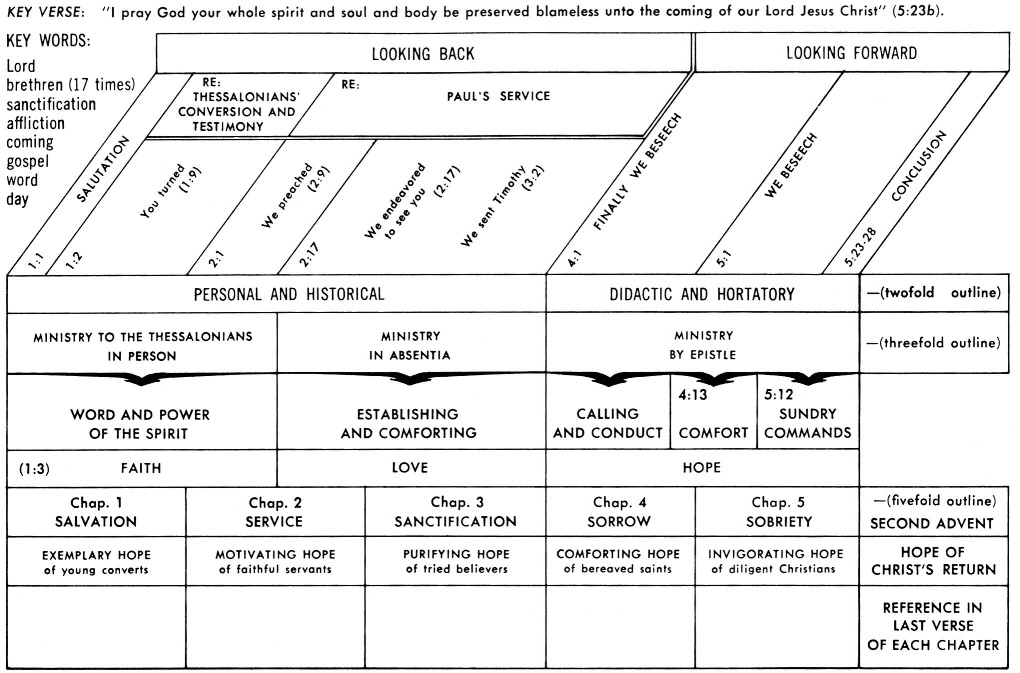
JESUS IS COMING AGAIN
Click chart to enlarge
Charts from Jensen's Survey of the NT - used by permission
Chart by Charles Swindoll
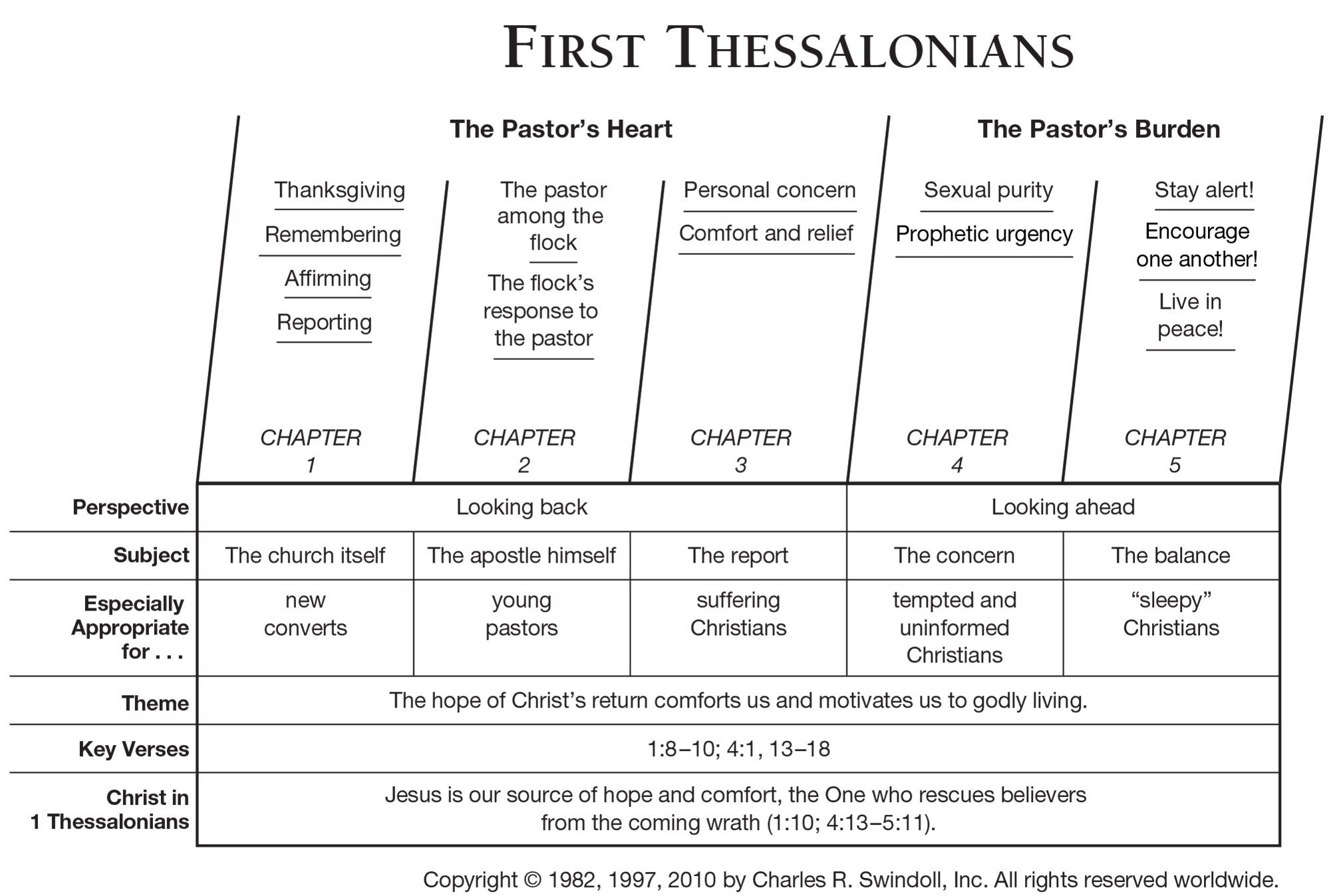
|
1 Thessalonians |
||||||
| 1 Th 1:1-10 | 1 Th 2:1-20 | 1 Th 3:1-13 | 1 Th 4:1-18 | 1 Th 5:1-28 | ||
|
LOOKING BACK |
LOOKING FORWARD |
|||||
|
Personal Reflections |
Practical Instructions |
|||||
| Ministry In Person |
Ministry in Absentia (Thru Timothy) |
Ministry by Epistle |
||||
| Word and Power of the Spirit |
Establishing & Comforting |
Calling & Conduct | 1Th 4:13ff Comfort |
1Th 5:12ff Commands |
||
| 1 Salvation |
2 Service |
3 Sanctification |
4 Sorrow |
5 Sobriety |
||
| Paul Commends Spiritual Growth |
Paul Founds the Church |
Strengthening of the Church |
Directions for Spiritual Growth |
Holy Living in Light of Day of the Lord | ||
| Exemplary Hope of Young Converts | Motivating Hope of Faithful Servants |
Purifying Hope of Tried Believers | Comforting Hope of Bereaved Saints | Invigorating Hope of Diligent Christians | ||
|
Written from Corinth |
||||||
1 Thessalonians 4:13 But we do not want you to be uninformed, brethren, about those who are asleep, so that you will not grieve as do the rest who have no hope. (NASB: Lockman)
Greek: Ou thelomen (1PPAI) de humas agnoein, (PAN) adelphoi, peri ton koimomenon, (PPPMPG) ina me lupesthe (2PPPS) kathos kai oi loipoi oi me echontes (PAPMPN) elpida.
Amplified: Now also we would not have you ignorant, brethren, about those who fall asleep [in death], that you may not grieve [for them] as the rest do who have no hope [beyond the grave]. (Amplified Bible - Lockman)
NLT: And now, brothers and sisters, I want you to know what will happen to the Christians who have died so you will not be full of sorrow like people who have no hope. (NLT - Tyndale House)
Phillips: Now we don't want you, my brothers, to be in any doubt about those who "fall asleep" in death, or to grieve over them like men who have no hope. (Phillips: Touchstone)
Wuest: Now, we do not wish you to be ignorant, brethren, concerning those who from time to time are falling asleep [dying], in order that you may not be mourning in the same manner as the rest who do not have a hope. (Eerdmans)
Young's Literal: And I do not wish you to be ignorant, brethren, concerning those who have fallen asleep, that ye may not sorrow, as also the rest who have not hope,
BUT WE DO NOT WANT YOU TO BE UNINFORMED BRETHREN ABOUT THOSE WHO ARE ASLEEP: Ou thelomen (1PPAI) de humas agnoein, (PAN) adelphoi peri ton koimomenon, (PPPMPG):
- we do not want you to be uninformed Romans 1:13; 1Corinthians 10:1; 12:1; 2Corinthians 1:8; 2Peter 3:8
- about those who are asleep 1Th 4:15; 5:10; 1Ki 1:21; 2:10; Da 12:2; Mt 27:52; Lk 8:52,53; Jn 11:11, 12, 13; Acts 7:60; 13:36; 1Co 15:6,18; 2Pe 3:4
- 1 Thessalonians 4 Resources - Multiple Sermons and Commentaries
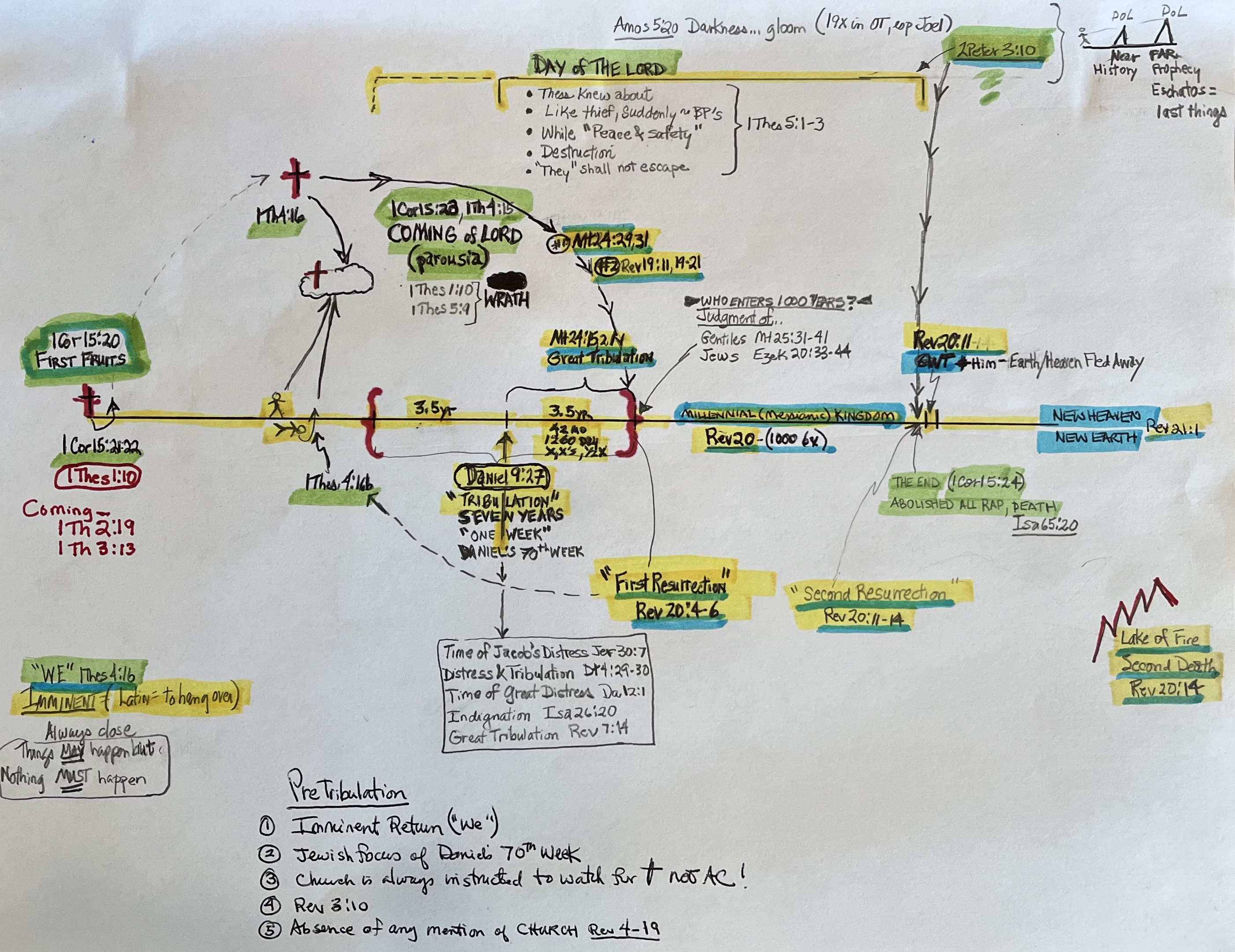
Here Is a Handwritten Timeline I Put Together in 2007 Studying 1 Thessalonians
PAUL INFORMS US ABOUT FATE
OF THOSE WHO ARE ASLEEP IN JESUS
1 Thessalonians 4:13-18 is the classic New Testament passage on the rapture of the church. The Thessalonians’ ignorance about the Rapture caused them to grieve. It was to give them hope and to comfort them that Paul discussed that momentous event.
Frame writes that "Since Paul’s departure, one or more of the Thessalonian Christians had died. The brethren were in grief not because they did not believe in the resurrection of the saints, but because they feared that their dead would not have the same advantages as the survivors when the Lord came. Their perplexity was due not simply to the Gentile difficulty of apprehending the meaning of resurrection, but also to the fact that Paul had not when he was with them discussed explicitly the problem of the relation of survivors to dead at the Parousia. (Frame, J. E.. A Critical and Exegetical Commentary on the Epistles of St. Paul to the Thessalonians. New York: C. Scribner's Sons. 1912)
Spurgeon wrote "Tears are permitted to us, but they must glisten in the light of faith and hope. Jesus wept, but Jesus never repined (to be fretful or low-spirited through discontent). We, too, may weep, but not as those who are without hope, nor yet as though forgetful that there is greater cause for joy than for sorrow in the departure of our brethren
But (de) introduces a transition to a new subject.
Richison comments that "The restlessness of disorderly believers (1Thessalonians 4:11, 12) was, in part, caused by an incomplete understanding of the Rapture of the church. They rightly understood that the coming of Christ was imminent, that is, no sign needed fulfillment before He came again. However, they had not considered the possibility that some of their friends would die before it occurred. They, therefore, plunged into deep grief. Doubts filled their minds as to the status of these prematurely deceased believers. (1Thessalonians 4:13; 13b; 13c; 4:14; 14b)
Ray Stedman says that to help understand this account we must remember that "the Thessalonians had clearly been expecting the return of Jesus before any of them died. This was a moment-by-moment expectancy in the early church. First century Christians never entertained the thought that death would occur for them. They believed the Lord was coming within days, or weeks at the most. In the first chapter of this letter Paul commends the Thessalonians for "waiting for God's Son from heaven," {cf, note 1Th 1:10}. That is what they were looking for. (See his sermon Comfort at the Grave)
Not (3756) (ou) means absolutely "never"!
The Pauline phrase "not want you to be unaware (ignorant)" although negative in form is positive in meaning. Milligan adds that this phrase is commonly used by Paul to introduce a new, important topic (eg, see cf. Ro 1:13 [note], Ro 11:25 [note - God's plan for Israel], 1Cor 10:1, 12:1 [spiritual gifts], 2Cor 1:8 [afflictions and comfort]).
Want (2309) (thelo) speaks of a desire that comes from one’s emotions and represents an active decision of the will (implying volition and purpose). Thelo is a conscious willing and denotes a more active resolution urging one on to action.
Vincent commenting on the phrase I would not have you to be ignorant writes that the introductory phrase "we would not, etc. (was) a formula often used by Paul to call special attention to what he is about to say. See Ro 1:13; Ro 11:25; 1Cor 10:1, etc.
Richison comments that "This phrase, expressing that Paul does not want them to be ignorant is a formula customarily used to discuss difficult problems and correct false ideas (Ro 1:13 [note], Ro 11:25 [note]; 1Co 10:1; 12:1). Usually, whenever the Bible warns us that we are ignorant about something, it is warranted. The topic of Christians dying is so important to the Thessalonians that it requires an explanation from the apostle Paul. The only way we can know about the afterlife is through the revelation found in the Bible. If we have adequate knowledge of what the Bible teaches about this subject, then it will dispel excessive grief in our souls. We can only resolve our ignorance by reading the Bible. We will rid ourselves of excessive grief by eliminating our ignorance about the future. The Thessalonians were clearly looking for the Lord’s return at the rapture, but they did not know the state of their dead loved ones until that point. They thought that those who died would miss the Rapture. (1Thessalonians 4:13; 13b; 13c; 4:14; 14b)
Uniformed (50) (agnoeo [word study] from a = not + noéo = perceive with the mind, to understand) (See study of noun agnoia) means to be ignorant, to not have information about, to not know, to be unaware of.
Ignorance is not bliss in regard to what happens when a believer dies!
MacArthur explains that "Their concern for those who had died shows that the Thessalonians believed the return of Christ was imminent and could happen in their lifetime. Otherwise, there would have been no reason for their concern. The Thessalonians’ fear that their fellow believers who had died might miss the Rapture also implies that they believed in a pretribulational Rapture. If the Rapture precedes the Tribulation, they might have wondered when believers who died would receive their resurrection bodies. But there would have been no such confusion if the Rapture follows the Tribulation; all believers would then receive their resurrection bodies at the same time. Further, if they had been taught that they would go through the Tribulation, they would not have grieved for those who died, but rather would have been glad to see them spared from that horrible time. (MacArthur, John: 1 & 2 Thessalonians. Moody Press)
Brethren (80) (adelphos from collative a = copulative prefix {joining together coordinate words} or connective particle serving to join or unite + delphús = womb) is literally one born from same womb and literally identifies a male having the same father and mother. Figuratively as used throughout this epistle adelphos refers to a close associate of a group of persons having well-defined membership, specifically identifying fellow believers in Christ united by the bond of affection. In chapter 4 Paul repeatedly (1Th 4:1, 6, 8-see notes 1Th 4:1; 4:6; 4:9) appeals to the relationship the Thessalonians have with Paul in Christ. In short, the truth that Paul is about to reveal is strictly for those who know Christ as their Savior and Lord.
About (4012) (peri) means around and here conveys the sense of concerning or regarding.
Are asleep (2837) (koimao related to keímai = to lie outstretched, to lie down) literally refers to normal sleep but is used figuratively in the present context referring to those who are dead and specifically those who are "dead in Christ" ("those also who have fallen asleep in Christ")
Robertson comments that the "Present tense (of koimao) gives idea of repetition, from time to time fall asleep. Greeks and Romans used this figure of sleep for death
In other words Paul is referring to those are continually falling asleep as a regular course of life in the church. The believers in Thessalonica had grown increasingly concerned as their fellow believers continued to die.
Here are other uses of koimao which help us understand that it was a "euphemistic" reference to death in certain contexts..
(After Stephen had been stoned Luke records) And (Stephen) falling on his knees, he cried out with a loud voice, "Lord, do not hold this sin against them!" And having said this, he fell asleep (koimao) (Acts 7:60)
For David, after he had served the purpose of God in his own generation, fell asleep, and was laid among his fathers, and underwent decay (Acts 13:36)
1 Corinthians 7:39 A wife is bound as long as her husband lives; but if her husband is dead (koimao), she is free to be married to whom she wishes, only in the Lord.
1 Corinthians 11:30 For this reason many among you are weak and sick, and a number sleep (have died)
1 Corinthians 15:6 After that He appeared to more than five hundred brethren at one time, most of whom remain until now, but some have fallen asleep… 18 Then (if Christ was not resurrected) those also who have fallen asleep in Christ have perished… 20 But now Christ has been raised from the dead, the first fruits (see Christ the First Fruits) of those who are asleep… 51 Behold, I tell you a mystery; we shall not all sleep, (not all believers will die - specifically those who alive when the Lord returns will not die a physical death) but we shall all be changed,
2Peter 3:4 (note) and saying, "Where is the promise of His coming? For ever since the fathers fell asleep, all continues just as it was from the beginning of creation.
Hiebert notes that sleep was a well known euphemism for death and "did not originate with Christianity. It was a common metaphor among the Jews and was current even among pagans. The figure was apparently suggested by the stillness of the body and its apparent restfulness upon death; it was used even where there was no hope of resurrection. Having been used by the Master Himself (Mark 5:39; John 11:11), Christians readily accepted the term as a witness to their faith concerning death. The figure is not distinctively Christian, yet, as Morris well remarks, it is "much more at home in a Christian context than elsewhere." (Hiebert, D. Edmond: 1 & 2 Thessalonians: BMH Book. 1996)
Sleep was used as a euphemism for death in Homer’s poem The Iliad, when at the death of a young warrior the lament sounds forth…
So there he fell, and slept a sleep of bronze, unhappy youth, far from his wedded wife. (Iliad 11.241-243)
The Roman poet Catullus appeals for the devotion of his lover by reminding her that life is short and that an unending night follows
Suns may set and rise again. For us, when the short light has once set, remains to be slept the sleep of one unbroken night. (Poems 5)
Jacob as he anticipates his own death makes this request of Joseph…
When I lie down with my ancestors, carry me out of Egypt and bury me in their burial place. (Ge 47:30)
The death of King David is described as sleep…
Then David slept with his ancestors (1Kings 2:10)
Stedman adds that koimao "is never used in the New Testament of anyone but believers. It never says of a non-believer when he died that he "fell asleep." There is a wonderful lesson in that. It shows that death, for the believer, is nothing more than sleep. When your loved ones fall asleep you do not run to the phone and dial 911 for emergency service for them. You know that they are quietly resting, that they will awaken again, and that you will have contact with them again soon. That is why the New Testament regards the death of believers as nothing but sleep. (See his sermon Comfort at the Grave)
Koimao is the root of our English word cemetery (koimeterion) which was adopted by the early Christians as their optimistic name for the graveyard, being used this way first in Christian burials in the Roman Catacombs. The Koimeterion literally meant "a sleeping place" and was used by Greeks to describe a place of rest, a room for sleeping (bedroom), or a rest house for strangers. Koimeterion was also a synonym for a dormitory or place where people sleep.
Death for a Christian is considered merely being asleep. Jesus even had to explain this great truth to His disciples.
This He said, and after that He said to them, "Our friend Lazarus has fallen asleep (koimao); but I go, that I may awaken him out of sleep." The disciples therefore said to Him, "Lord, if he has fallen asleep (koimao), he will recover." Now Jesus had spoken of his death, but they thought that He was speaking of literal sleep. Then Jesus therefore said to them plainly, "Lazarus is dead, (John 11:11, 12, 13, 14)
The sleep, however, applies only to the body, for the soul and spirit are with the Lord
we are of good courage, I say, and prefer rather to be absent from the body and to be at home with the Lord. (2 Corinthians 5:8).
The metaphorical use of the word sleep is appropriate because of the similarity in appearance between a sleeping body and a dead body, restfulness and peace at least outwardly characterizing both states.
Just as the sleeper does not cease to exist while his body "sleeps", so the dead person continues to exist despite his absence from the region in which those who remain can communicate with him. In addition, just as normal sleep is temporary, so too is the death of the body. And thus even as sleep has its time of waking, death will have its awakening which we call the resurrection. There is a resurrection of believers (the "first resurrection") and of non-believers ("second resurrection" which is the preface to the "second death" or eternal separation from God in the Lake of fire). (See discussion of The "First" and "Second" Resurrection)
There is a false teaching known as "soul sleep" that says that souls of the dead are in a state of unconscious existence. They claim that after a long period, God will awaken the soul. This is not the teaching of Scripture. In the NT "sleep" in the context of death applies only to the body and never to the soul.
Hiebert adds that…
The theory of soul sleep is inconsistent with Paul's assertion in 1Th 5:10 (see note) that God's purpose for us is that whether we live or die we should live together with Christ. (Ibid)
MacArthur explains why "soul sleep" is a false teaching writing that…
In 2Corinthians 5:8 Paul wrote that he “prefer[red] rather to be absent from the body and to be at home with the Lord,” while in Php 1:23 (note) he expressed his “desire to depart and be with Christ, for that is very much better.”
Those statements teach that believers go consciously into the Lord’s presence at death, for how could unconsciousness be “very much better” than conscious communion with Jesus Christ in this life?
Jesus promised the repentant thief on the cross, “Truly I say to you, today you shall be with Me in Paradise [heaven; cf. 2 Cor. 12:4; Re 2:7{note}]” (Luke 23:43).
Moses’ and Elijah’s souls were not asleep, since they appeared with Jesus at the Transfiguration (Mt 17:3), nor are those of the Tribulation martyrs in Revelation 6:9, 10, 11 (see notes Re 6:9; 10; 11), who will be awake and able to speak to God. After death the redeemed go consciously into the presence of the Lord, while the unsaved go into conscious punishment (Ed note: Read this passage about a "certain rich man" and a "poor man named Lazarus" who both die and end up in different "compartments" of Hades, the temporary abode of the dead. - Lk 16:19, 20, 21, 22, 23, 24, 25, 26, 27, 28, 29, 30, 31). (MacArthur, John: 1 & 2 Thessalonians. Moody Press)
Vincent comments that…
in Christian speech and thought, as the doctrine of the resurrection (1Corinthians 15:1-58) struck its roots deeper, the word dead, with its hopeless finality, gave place to the more gracious and hopeful word sleep. The pagan burying-place carried in its name no suggestion of hope or comfort. It was a burying-place, a hiding-place, a monumentum, a mere memorial of something gone; a columbarium, or dove-cot, with its little pigeon-holes for cinerary urns; but the Christian thought of death as sleep, brought with it into Christian speech the kindred thought of a chamber of rest, and embodied it in the word cemetery (koimeterion) — the place to lie down to sleep.
The Christian's unique hope that is not shared by non-believers is the Blessed Hope (Titus 2:13 cp 1Jn 3:2-3; 1Pe 1:13) of the return of Christ for His own just as He had promised (John 14:2-3). That will be the great resurrection day when living believers will be reunited with all their loved ones who have died. Believers then and now have this promise by the word of the Lord (1Th 4:15) Himself Who declared to His disciples…
Let not your heart be troubled; believe in God, believe also in Me. In My Father's house are many dwelling places; if it were not so, I would have told you; for I go to prepare a place for you. And if I go and prepare a place for you, I will come again, and receive you to Myself; that where I am, there you may be also. And you know the way where I am going." (John 14:1-4)
THAT YOU MAY NOT GRIEVE AS THE REST WHO HAVE NO HOPE: Hina me lupesthe (2PPPS) kathos kai oi loipoi oi me echontes (PAPMPN) elpida:
- That you may not grieve - Ge 37:35; Lev 19:28; Dt 14:1,2; 2 Sa 12:19,20; 18:33; Job 1:21; Ezek 24:16, 17, 18; Jn 11:24; Acts 8:2
- As the rest who have no hope 1 Th 4:17; Genesis 49:19; Zech 14:15; Matthew 24:31; 1 Co 15:23; Phil 3:20,21; 2 Th 2:1; Jude 1:14,15
- 1 Thessalonians 4 Resources - Multiple Sermons and Commentaries
BELIEVERS HAVE "HOPE SURE"
NOT A "HOPE SO"
So that (2443) (hina) is a terms of purpose or result. Paul says the purpose of this section is that he does not want them to grieve because they are uninformed about the matter of a Christian who falls asleep.
You may not grieve - The negative particle (me) with the present tense indicates that the goal of the truth in this section is to stop the grieving of the readers. They are not to go on grieving as the rest. Paul's goal is to cure their grief by removing their ignorance.
Grieve (3076) (lupeo from lupe = sadness, sorrow, grief) means to feel pain, of body or mind and so to experience severe mental or emotional distress. It can also refer to physical pain which may be accompanied by sadness, sorrow or grief.
The present tense also speaks of the continual lot of those (the rest) who do not intimately know Christ as Lord and Savior (those with "no hope").
At Gethsemane as our Lord anticipated Calvary, He
began to be grieved" (lupeo) and distressed. Then He said to them, "My soul is deeply grieved (related verb "perilupeo" grieved all around, surrounded by grief, severely grieved) to the point of death; remain here and keep watch with Me. (Mt 26:37,38)
If the trial of Gethsemane was painful to the perfect Man, Christ Jesus, we must understand that to deny that our trials are painful is to make them even worse. Christians must accept the fact that there are difficult experiences in life and not put on a brave front just to appear “more spiritual.”
Hiebert explains the grieving is not just over their temporal loss of believing loved ones, but as indicated in 1 Thessalonians 4:15…
rather indicates that they feared that those who failed to live until the coming of Christ would be at an irreparable disadvantage at His return. They thought there was a peculiar advantage attached to survival until the end time (cf. Da 12:12). They fancied that those who had departed would miss the blissful reunion, or at least come behind those who lived until the parousia. Thus their grief was not just a natural sorrow for their own loss but grief for the supposed loss of their loved ones sustained by their death before the return of the Lord. (Ibid)
And so here Paul writes to the saints at Thessalonica who had lost loved ones so that they would not grieve but to the contrary they would be empowered by this sound doctrine regarding a believer's death to comfort one another with the sure hope of future glory to be revealed at Christ's return (1Th 4:18).
As Rotherham has commented
God not only holds out a future release but sympathizes with our present struggle.
Trials from God (in contrast to trials from Satan) are intended not to provoke us but to prove us and to improve us for our good and His glory.
That you may not be continually sad, sorrowful, distressed. So this helps define those the rest = for one thing they have no hope. Whoa!
Apparently some of the saints in Thessalonica, despite having clearly been taught on some eschatological topics had ignorantly come to the conclusion that the saints who died would miss the Lord’s return and thus they were grieved over their absence at such a glorious event.
Vincent has some additional comments on the specific reason they might grieve about the believers who had died writing that..
Opinions differ as to the possible ground of this sorrow. According to some, the Thessalonians supposed that eternal life belonged only to such as should be found alive at the parousia, (coming of the Lord Jesus) and therefore that those already dead would not share the blessings of the Second Advent.
Others, assuming an interval between the Advent and the general resurrection, think that the Thessalonians were anxious lest their brethren who died before the Advent would be raised only at the general resurrection, and therefore would not share the blessings of communion with the Lord during the millennial reign.
It is impossible to decide the question from Paul's words, since he does not argue, but only consoles. The value of his consolation does not depend upon the answer to the question whether the departed saints shall first be raised up at the general resurrection, or at a previous resurrection of believers only. The Thessalonians were plainly distressed at the thought of separation from their departed brethren, and had partially lost sight of the elements of the Christian hope and reunion with them and fellowship with the Lord. These elements Paul emphasizes in his answer. The resurrection of Jesus involves the resurrection of believers. The living and the dead Christians shall alike be with the Lord. (Vincent, M. R. Word Studies in the New Testament. Volume 4:39)
We should not misunderstand what Paul is saying here about not grieving. He is not saying that believers are not to experience and express the normal sorrow that accompanies the death of a loved one which brings with it the pain of separation and loneliness. Even our Lord Jesus grieved over the death of His friend ("Jesus… was deeply moved in spirit and was troubled… Jesus wept" John 11:35). Although Jesus expressed sorrow, He did not despair over ever seeing His friend again. Normal human beings grieve over the physical death of their loved ones (Php 2:27). Paul is not saying Christians are to be dehumanized by removing grief from the realm of their experience. He goes on to qualify that the believer's grief is not as the rest, for the believer's goodbye is only temporary and our sure hope of reunion with our believing loved ones is forever!
As the rest - Paul draws a sharp distinction between Christians and all others, specifically all who are not believers in Christ. Earlier Paul had used a synonymous phrase outsiders (literally those without - see 1Th 4:12). One commentator has remarked on the difference between the terms outsiders versus the rest reasoning that the earlier expression outsiders implies exclusion, while the rest implies deprivation. In other words, non-believers are deprived of the hope and the associated comfort that believers possess when the truth regarding death is rightly understood.
Rest (3062) (loipos = pertaining to the part of a whole which remains, the rest of the whole from leípo = to leave, lack) means the remaining, the remnant, the residue, the rest. Although loipos is an adverb, the NT uses it as a noun here and in other passages (Mt 22:6, Re 11:13, 12:17, 19:21)
Have (2192) (echo) means to hold on to. It means the rest (continually = present tense) have no hope to cling to. Christians should not grieve over their dead loved ones like pagans do, as if they have no hope of ever seeing them again. There is such a profound difference between a Christian funeral and a pagan funeral because believers possess this sure hope.
The Believer's hope is not
a "hope so"
but a "hope sure!"
Hope (1680) (elpis) (see also the Believer's Blessed Hope) is a desire of some good with expectation of obtaining it. Hope in Scripture is the absolute certainty of future good. In He 6:11 (note) hope is full assurance. In 1Timothy 1:1 hope is not some abstract concept but is embodied in the Person and atoning world of Jesus Christ Jesus our Hope.
Writing to the Philippians Paul confidently declares…
for to me, to live is Christ, and to die is gain (Php 1:21)
Comment: Paul is saying in essence that his life found all its meaning in Christ and that even if he dies it is to his profit, because then there will be perfect union with Christ, without any of the limitations of this life, and the old flesh nature.
In marked contrast, in the face of death the pagan world stood in utter despair and abysmal hopelessness which "enshrouded" them as it rightly should. They vainly attempted to meet the certainty of death with grim resignation and bleak outlooks as stated by the pagan Aeschylus who wrote (incorrectly) that
Once a man dies there is no resurrection (Comment: Wrong! There is a resurrection for unbelievers but it is unto death, not life [see Order of Resurrection], see Jn 5:28,29 below)
Addressing the Athenians on Mars Hill Paul declared that…
having overlooked the times of ignorance, God is now declaring to men that all everywhere should repent, because He has fixed a day in which He will judge the world in righteousness through a Man Whom He has appointed, having furnished proof to all men by raising Him from the dead." Now when they heard of the resurrection of the dead, some began to sneer (this word stresses insulting another by contemptuous facial expression, phrasing, or tone of voice), but others said, "We shall hear you again concerning this." (Acts 17:30, 31, 32).
In John 5 Jesus declared…
Do not marvel at this; for an hour is coming, in which all (how many? all without qualification as to spiritually dead in Adam and sin or spiritually alive in Christ and salvation) who are in the tombs shall hear His voice, and shall come forth; those who did the good deeds (deeds don't save but they do indicate one is genuinely saved as James taught - James 2:14-26-notes, see Re 2:5, 6 ) to a resurrection of life (see notes on first resurrection in Re 20:5), those who committed the evil deeds to a resurrection of judgment (see notes on the second death - Re 20:11, 12, 13, 14, 15-notes Re 20:11; 12;13; 14; 15). (John 5:28, 29)
Paul writing the converted Gentiles in Ephesus exhorted them to…
remember that you were at that time separate from Christ, excluded from the commonwealth of Israel, and strangers to the covenants of promise, having (present tense = continually) no hope and without God in the world. (Ep 2:12)
Only believers have a sure hope (absolute certainty that God will do them good in the future) of life after death. The speculations of pagan philosophy do not amount to a hope but "I hope so". The "odds" are eternally against this type of hope, for the only sure, steadfast hope of eternal life with God is a hope that is built on nothing less than Jesus' blood and righteousness…
Christ Jesus our Hope (Literal rendering of 1 Timothy 1:1)
Milligan wrote that…
The general hopelessness of the pagan world in the presence of death is almost too well-known to require illustration (St. Paul's Epistles to the Thessalonians. 1908)
Theocritus rightly summarized the the hope of all outside Christ and still "in Adam" (and responsible to pay for the wages of sin which is death) wrote
There is hope for those who are alive, but those who have died are without hope.
Catullus echoes the tragic refrain…
When once our brief light sets, there is one perpetual night through which we must sleep. (Comment: Unfortunately, this is only partially correct, for in hell there is full consciousness not perpetual sleep, read Luke 16:19-32)
Lucretius wrote that…
No one awakes and arises who has once been overtaken by the chilling end of life
On pagan tombstones we read the hopeless carvings of their grim epitaphs
I was not
I became
I am not
I care not
An inscription has reportedly been found on a pagan tomb at Thessalonica which read…
After death there is no revival, after the grave no meeting of those who have loved each other on earth
As Paul so powerfully proclaimed in his last letter (just before he "fell asleep") God…
has saved us, and called us with a holy calling, not according to our works, but according to His own purpose and grace which was granted us in Christ Jesus from all eternity ("before the beginning of time" - NIV), but now has been revealed by the appearing of our Savior Christ Jesus, Who abolished death, and brought life and immortality to light through the gospel (2Ti 1:9; 2Ti 1:10)
John MacArthur comments that…
Even though Paul’s ministry in Thessalonica was brief, it is clear the people had come to believe in and hope for the reality of their Savior’s return (cf 1Th 1:3, 9, 10, 2:19, 5:1, 2-notes 1Th 1:3, 1:9;10; 2:19; 5:1; 5:2; 2Th 2:1,5). They were living in expectation of that coming, eagerly awaiting Christ. This verse (v13) (cf. 2Th 2:1, 2, 3) indicates they were even agitated about some things that were happening to them that might affect their participation in it.
They knew Christ’s return was the climactic event in redemptive history and didn’t want to miss it. The major question they had was “What happens to the Christians who die before He comes? Do they miss His return?” Clearly, they had an imminent view of Christ’s return and Paul had left the impression it could happen in their lifetime. Their confusion came as they were being persecuted, an experience they thought they were to be delivered from by the Lord’s return (cf. 3:3,4). (MacArthur, John: 1 & 2 Thessalonians. Moody Press)
The Hope (Certainty) of Christ's Return at His Glorious Second Coming is a…
- living hope (1Pe 1:3)
- blessed hope (Titus 2:13)
- joyful hope (1Th 2:19)
- comforting hope (1Th 4:13, 14, 15, 16, 17, 18-see note 1Th 4:13; 14; 15; 16; 17; 18)
- hope of glory (Col 1:27)
- anchoring hope (He 6;19)
- purifying hope (1John 3:3)
Related Resources:
- Believer's Blessed Hope
- A Powerful Principle: Hope in God
- Blessed Hope Part 2
- God's Word of Hope
- Psalm 42:5 Commentary-Hope in God!
- Resources on the Blessed Hope
- Watching and Waiting
F B Meyer (in Our Daily Homily) has the following note on 1Thessalonians 4:13…
NATURE will have her due. Tears will fall, and hearts seem near to breaking. Nowhere does God chide the tears of natural affection; how could He, since it is written that "Jesus wept"? But He sets Himself to extract their bitterness. Sorrow you may, and must; but not as without hope.
Those who die in Christ are with Him.--They are said to sleep, not because they are unconscious, but because their decease was as devoid of terror as an infant's slumbers. Believers have all died once in Christ, and it was necessary to find a word which, whilst significant of death, was not death, in order to describe the moment of our farewell to this world and birth into the next. This word was furnished by Death's twin sister Sleep. The catacombs are covered with the brief significant sentence, Obdormivit in Christo (He slept in Christ). But just as in sleep the spirit is conscious, of which dreams bear witness, so in the last sleep. Absent from the body, we shall be present with the Lord.
Those who die in Christ will come with Him.--They are now waiting around Him till He give the final order for the whole heavenly cortege, which has been collecting for ages, to move. The holy angels will accompany; but the beloved saints shall ride in the chariots of God as the bride beside the bridegroom.
Those who die in Christ shaft be forever reunited with us who wait for Him and them.--They shall come with Him. "God will bring them." We, on the other hand, if we are living at that supreme moment, shall be changed and caught up to meet Him and them; and then, all one m Christ, we shall be forever with Him, to go no more out.
1 Thessalonians 4:14 For if we believe that Jesus died and rose again, even so God will bring with Him those who have fallen asleep in Jesus. (NASB: Lockman)
Greek: ei gar pisteuomen (1PPAI) oti Iesous apethanen (3SAAI) kai aneste, (3SAAI) outos kai o theos tous koimethentas (APPMPA) dia tou Iesou axei (3SFAI) sun auto.
Amplified: For since we believe that Jesus died and rose again, even so God will also bring with Him through Jesus those who have fallen asleep [in death]. (Amplified Bible - Lockman)
Barclay: For if we believe that Jesus died and rose again, so also we can be sure that God will bring with him those who have fallen asleep through Jesus. (Westminster Press)
NLT: For since we believe that Jesus died and was raised to life again, we also believe that when Jesus comes, God will bring back with Jesus all the Christians who have died. (NLT - Tyndale House)
Phillips: After all, if we believe that Jesus died and rose again from death, then we can believe that God will just as surely bring with Jesus all who are "asleep" in him. (Phillips: Touchstone)
Wuest: For in view of the fact that we believe that Jesus died and arose, thus also will God bring with Him those who have fallen asleep through the intermediate agency of Jesus. (Eerdmans)
Young's Literal: for if we believe that Jesus died and rose again, so also God those asleep through Jesus he will bring with him,
FOR IF WE BELIEVE THAT JESUS DIED AND ROSE AGAIN: ei gar pisteuomen (1PPAI) hoti Iesoue apethanen (3SAAI) kai aneste (3SAAI):
- If we believe - Isa 26:19; Ro 8:11; 1 Cor 15:12, 13, 14, 15, 16, 17, 18, 19, 20, 21, 22, 23; 2 Cor 4:13,14; Rev 1:18
- 1 Thessalonians 4 Resources - Multiple Sermons and Commentaries
For (gar) explains the two foundational truths (of the Gospel) that counteract the inordinate grief that (justifiably) characterizes unbelievers. Paul is explaining why his readers do not need to grieve for dead believers in the same way as the unsaved world grieves the loss of their loved ones and friends.
If (1487) does not imply uncertainty and is not a suggestion the Thessalonians (and Paul = "we") might not believe these foundational truths but to the contrary assumes the condition (i.e., it is a condition of reality) is that they actually do believe. It could be translated "For since we believe".
So the hope we have as an anchor of our soul (see note Hebrews 6:19) is the death, burial and resurrection of Jesus Christ. The certainty of the past, historical resurrection of Jesus is the basis for our confidence in the future resurrection of believers. (See Paul's summary of the "Gospel" - 1Co 15:1, 2, 3, 4, 5,6, 7, 8-see notes 1Co 15:1; 15:2; 15:3; 15:4; 15:5; 15:6 ; 15:7 ; 15:8)
Hiebert - The we is inclusive, both writers and readers; we as Christians accept Christ's death and resurrection as the great major premise of the Christian faith. They are the sure foundation of Christian hope. The two facts must be kept together. St. Paul bases his Gospel not on the Cross taken in isolation, but on the Cross as followed by and interpreted by the Resurrection. (Ibid)
Believe (4100) (pisteuo from pistis; pistos) means to consider something to be true and therefore worthy of one’s trust. To accept as true, genuine, or real. To have a firm conviction as to the goodness, efficacy, or ability of something or someone in this case the Gospel of Jesus Christ. (See related study on the obedience of faith)
Paul's point is that the following truths are only effective in countering grief if we believe the foundation stones of Christianity, the death of Christ and the resurrection of Christ.
Vincent notes that pisteuo "means to persuade, to cause belief, to induce one to do something by persuading, and so runs into the meaning of to obey, properly as the result of persuasion
In secular Greek literature, as well as in the New Testament, pisteuo (pistis, pistos) has a basic meaning of an intellectual assent or a belief that something is true. James described this type of faith as dead faith stating that "The devils also believe, and tremble" (Ja 2:19).
The other secular Greek meaning that is the more common use in the New Testament is the transitive or active use which means to "put faith in" or "rely upon" someone or something. An example of this use in the New Testament is 2Timothy 1:12. Paul said
I know whom I have believed, and am persuaded that he is able to keep that which I have committed unto him against that day (see note 2 Timothy 1:12)
Comment: Here pisteuo means to trust in or rely upon Christ to save us.
Jesus (2424) (Iesous from the Hebrew Yeshu'a = Jehovah will save or Yahweh is salvation) is His human name which was given to Him before His birth and which conveys the idea of His historical nature as a Man and His saving work through the incarnation ("you shall call His name Jesus, for He will save His people from their sins" Mt 1:21). Iesous is the Greek form of the Hebrew name Joshua (see He 4:8 Joshua means "Jehovah is Salvation"). God incarnate died for sinners to satisfy the just demands of God's law.
Died (599) (apothnesko from apo = intensifies meaning of verb or conveys sense of away from + thnesko = die means literally to die off) means to die a natural death, applied to both men and animals. It literally means to cease to have vital functions.
Applied to Christ apothnesko means to die for or on account of sin and so to make atonement for sin. Apothnesko as used here does not refer to a figurative death but to the literal, historical death of Christ which has eternal spiritual ramifications. Death was not final for Christ, and neither will it be for believers.
Note that Paul does not say Jesus slept but uses the harsher word apothnesko - He died. Christians can enjoy peaceful sleep because Jesus became a curse for us and endured death as the penalty.
Hiebert adds that Paul's declaration that "He died" rather than "He slept" signifies that Jesus…
experienced death, the result of sin, in all its grim horror. But His death brought the death of death; in dying as our sin-bearer He transformed death for believers into sleep with a future awakening. (Ibid)
MacArthur explains that…
Jesus experienced the full fury of death in all its dimensions as He “bore our sins in His body on the cross, so that we might die to sin and live to righteousness” (1Pe 2:24). His death transformed death into sleep for believers. T. E. Wilson notes
“Death has been changed to sleep by the work of Christ. It is an apt metaphor in which the whole concept of death is transformed. ‘Christ made it the name for death in the dialect of the church (Acts 7:60 - Stephen being stoned "fell asleep".) (Findlay)’ ” (What the Bible Teaches: 1 and 2 Thessalonians [Kilmarnock, Scotland: John Ritchie Ltd., 1983], 45).
When believers die, their spirit goes immediately into conscious fellowship with the Lord, while their bodies temporarily sleep in the grave, awaiting the Rapture. (Ibid)
Barclay elaborates on the importance of Christ's death and resurrection writing that "Paul lays down a great principle. The man who has lived and died in Christ (see in Christ and in Christ Jesus) is still in Christ even in death and will rise in Him. Between Christ and the man who loves Him there is a relationship which nothing can break, a relationship which overpasses death. Because Christ died and rose again, so the man who is one with Christ will rise again. (The Daily Study Bible )
Rose again (450) (anistemi from ana = up, again + histemi = stand) (see related word study anastasis = Resurrection) literally means to stand again, to stand up, arise, lift up, be raised up, rise (again), to stand upright again. In context rose again refers to the resurrection of Christ from the dead, the climactic event that demonstrated His victory over sin and death and the foundation stone of the Gospel of our salvation (see notes on His death, burial and resurrection - 1Co 15:3, 4 notes).
Marshall writes that…
The death of believers does not take place apart from Jesus, and hence Paul can conclude that God will raise them up and bring them into the presence of Jesus at the parousia. God will treat those who died trusting in Jesus in the same way He treated Jesus Himself, namely by resurrecting them (1 and 2 Thessalonians, The New Century Bible Commentary. Eerdmans, 1983)
No longer must the mourners weep
And call departed Christians dead;
For death is hallowed into sleep,
And every grave becomes a bed.
Now once more, Eden's door
Open stands to mortal eyes!
Now at last, old things past,
Christ is risen! We too shall rise.
-- J. Sidlow Baxter
Vine writes that "By the death and burial of His body He came down to our condition; by His Resurrection He raised us to His position. (Vine, W. Collected writings of W. E. Vine. Nashville: Thomas Nelson)
It is notable that because the idea of resurrection was foreign to Greek thought, there existed no technical words in Greek to describe it.
Spurgeon (ref) commenting on Psalm 16:10 wrote "Into the outer prison of the grave his body might go, but into the inner prison of corruption he could not enter. He who in soul and body was preeminently God's "Holy One," was loosed from the pains of death, because it was not possible that he should be holden of it. This is noble encouragement to all the saints; die they must, but rise they shall, and though in their case they shall see corruption, yet they shall rise to everlasting life. Christ's resurrection is the cause, the earnest, the guarantee, and the emblem of the rising of all his people. Let them, therefore, go to their graves as to their beds, resting their flesh among the clods as they now do upon their couches.
Since Jesus is mine, I will not fear undressing,
But gladly put off these garments of clay;
To die in the Lord is a covenant blessing,
Since Jesus to glory through death led the way.
Wretched will that man be who, when the Philistines of death invade his soul, shall find that, like Saul, he is forsaken of God; but blessed is he who has the Lord at his right hand, for he shall fear no ill, but shall look forward to an eternity of bliss.
John S. Whale wrote that..
The Gospels do not explain the Resurrection; the Resurrection explains the Gospels. Belief in the Resurrection is not an appendage to the Christian faith; it is the Christian faith.
The concept of the resurrection of the dead although not made effective until the resurrection of Christ, the "First fruits" (1Cor 15:20 "now Christ has been raised from the dead, the first fruits of those who are asleep"), was clearly alluded to in the Old Testament. (see Christ the First Fruits)
Job (the oldest book in the Bible) testifies …
And as for me, I know that my Redeemer lives, and at the last He will take His stand on the earth. Even after my skin is destroyed, yet from my flesh I shall see God Whom I myself shall behold, and Whom my eyes shall see and not another. My heart faints within me. (Job 19:25, 26, 27)
While Job's declaration does not definitively foretell a physical resurrection, a number of conservative commentators agree that Job is alluding to that event. (See comments regarding the resurrection implications of Job 19:25-27 in Walvoord, J. F., Zuck, R. B., et al: The Bible Knowledge Commentary. 1985. Victor)
Isaiah issues a prophecy that applies to corporate redeemed Israel (only those Jews who believe in Messiah, cf the concept of the remnant) that…
Your dead will live. Their corpses will rise. You who lie in the dust, awake and shout for joy, For your dew is as the dew of the dawn, and the earth will give birth to the departed spirits. (Isaiah 26:19)
Comment: Dr Ryrie in The Ryrie Study Bible writes that "This verse, along with Job 19:26 and Da 12:2, explicitly teaches the bodily resurrection of OT believers."
Daniel unambiguously affirms a belief in an individual future resurrection of the "living (believers = everlasting life) and the dead (unbelievers = everlasting contempt)" writing that…
many of those who sleep in the dust of the ground will awake, these to everlasting life, but the others to disgrace and everlasting contempt. (Daniel 12:2)
Comment: This verse predicts 2 resurrections which parallels Jesus' prophecy in John 5:28, 29, but in neither it 1000 year interval between the "first" and "second" resurrection mentioned. See study of The Two Resurrections
Then in Daniel 12:13 we read
“But as for you, go your way to the end; then you will enter into rest and rise again for your allotted portion at the end of the age.”
Comment: Rise again is clearly a promise to Daniel that he will be resurrected at the end of this age and beginning of the next age which is the Messianic Age (aka "The Millennium")
One other point is worth noting in support of the fact that the resurrection was taught in the Old Testament. The writer of Hebrews tells us that Abraham believed in the resurrection writing that…
He (Abraham) considered (logizomai = thought about this truth in a detailed and logical manner = bookkeeping term = Abraham "made an entry" in his "spiritual ledger" so that he would have a permanent record that could be consulted whenever needed! Are you doing the same with the precious and magnificent promises of God, beloved?) that God is able (dunatos = has the inherent ability to perform what He promises) to raise men even from the dead; from which he also received him (Isaac, the son whom he loved, Genesis 22) back as a type (parabole = illustration thrown alongside truth to make latter easier to understand). (See note Hebrews 11:16)
Related Resources:
- Does the Old Testament Teach Resurrection Hope?
- Resurrection In The Old Testament
- Where did Old Testament believers/saints go when they died?
- What is the first resurrection? What is the second resurrection?
EVEN SO GOD WILL BRING WITH HIM THOSE WHO HAVE FALLEN ASLEEP: houtos kai o theos tous koimethentas (APPMPA) dia tou Iesou axei (3SFAI) sun auto:
- Those who have fallen asleep 1Thes 4:13; 3:13; 1Cor 15:18; Rev 14:13
- God will bring with Him - 1Th 4:17; Genesis 49:19; Zechariah 14:15; Matthew 24:31; 1Corinthians 15:23; Philippians 3:20,21; 2Thessalonians 2:1; Jude 1:14,15
- 1 Thessalonians 4 Resources - Multiple Sermons and Commentaries
Even so (2532)(houtos) in this manner, in this way. This introduces the the parallel between the resurrection of the bodies of believers and the resurrection of Christ. The two resurrections are inextricably linked. In his first letter to the Corinthians Paul recorded a similar truth writing that…
But now Christ has been raised from the dead, the first fruits (see Christ the First Fruits) of those who are asleep. 21 For since by a man came death, by a man also came the resurrection of the dead. 22 For as in Adam all die, so also in Christ all shall be made alive. 23 But each in his own order: Christ the first fruits, after that those who are Christ's at His coming (at the parousia) (1 Corinthians 15:20-23)
In John 14:19 Jesus said "Because I live, you will live also."
Even so as Christ died and was raised the resurrection of the body of the believer is as sure. Our physical bodies will rise from the dead since Christ rose from the dead. The guarantee of our bodily resurrection is the resurrection of Christ. This is not a general resurrection for He will bring back only those who fell asleep in Christ and no others.
MacArthur - To further assuage their fears, Paul reassured believers that God will bring with Him [Jesus] those who have fallen asleep in Jesus. Their fellow believers who died will not miss out on the Rapture but will return with Christ in glory. Some interpret the phrase God will bring to mean that the spirits of dead believers will come from heaven with Christ to meet their resurrected bodies. Others see in it the truth that at the Rapture, God will bring all believers, living and dead, back to heaven with Christ. While the first view is certainly true, the second one seems to be the emphasis of this passage. What the passage does not teach is that the spirits of dead believers immediately return to earth with Christ for the establishing of the millennial kingdom. That view places the Rapture at the end of the Tribulation and essentially equates it with the Second Coming. It trivializes the Rapture into a meaningless sideshow that serves no purpose. (MacArthur New Testament Commentary – 1 & 2 Thessalonians)
Thomas R. Edgar comments on the "futility" of a post-tribulation Rapture askings "What can be the purpose for keeping a remnant alive through the tribulation so that some of the church survive and then take them out of their situation and make them the same as those who did not survive? Why keep them for this? [The] explanation that they provide an escort for Jesus does not hold up. Raptured living saints will be exactly the same as resurrected dead saints. Why cannot the dead believers fulfill this purpose? Why keep a remnant alive [through the Tribulation], then Rapture them and accomplish no more than by letting them die? There is no purpose or accomplishment in [such] a Rapture...With all the saints of all the ages past and the armies [of angels] in heaven available as escorts and the fact that [raptured] saints provide no different escort than if they had been killed, why permit the church to suffer immensely, most believers [to] be killed, and spare a few for a Rapture which has no apparent purpose, immediately before the [Tribulation] period ends?... Is this the promise? (REFERRING TO Rev 3:10) You will suffer, be killed, but I will keep a few alive, and take them out just before the good times come. Such reasoning, of course, calls for some explanation of the apparent lack of purpose for a post-tribulation Rapture of any sort. We can note the following:
(1) An unusual, portentous, one-time event such as the Rapture must have a specific purpose. God has purposes for his actions. This purpose must be one that can be accomplished only by such an unusual event as a Rapture of living saints.
(2) This purpose must agree with God's general principles of operation.
(3) There is little or no apparent reason to Rapture believers when the Lord returns and just prior to setting up the long-awaited kingdom with all of its joyful prospects.
(4) There is good reason to deliver all who are already believers from the tribulation, where they would be special targets of persecution.
(5) To deliver from a period of universal trial and physical destruction such as the tribulation requires a removal from the earth by death or Rapture. Death is not appropriate as a promise in Rev. 3:10.
(6) Deliverance from the tribulation before it starts agrees with God's previous dealings with Noah and Lot and is directly stated as a principle of God's action toward believers in 2 Pet. 2:9. ("Robert H. Gundry and Revelation 3:10," Grace Theological Journal 3 [Spring 1982], 43-44)
Will bring (71)(ago) means to lead or lead along and so to cause to come along with one toward the place from which the action is being regarded. Note the verb bring is in the active voice indicating it is our Lord's choice to bring those with Him who have fallen asleep in Him. He does not need to be coerced. He is the Head and they are in perfect union with Him, so it is only supernatural that He bring them with Him.
This bringing refers to the first phase of His parousia, His return to Rapture the saints who remain alive on earth. At the second phrase of His parousia, there will be another bringing so to speak at the end of the Great Tribulation. John describes it this way…
And I saw heaven opened; and behold, a white horse, and He who sat upon it is called Faithful and True (ponder this Name of our Lord for a moment) and in righteousness He judges and wages war. 12 And His eyes are a flame of fire, and upon His head are many diadems; and He has a Name written upon Him which no one knows except Himself. 13 And He is clothed with a robe dipped in blood; and His name is called The Word of God (cf John 1:1). 14 And the armies which are in heaven, clothed in fine linen, white and clean, were following Him on white horses. (See notes Revelation 19:11; 12; 13; 14)
Some might say that this event in Revelation 19 does not describe our Lord bringing the saints with Him but instead bringing armies of angels. This is where it is helpful to compare Scripture with Scripture because in Revelation 17, a parallel passage, John records that…
These (ten kings/kingdoms plus The Beast - the Antichrist) will wage war against the Lamb (the Lord Jesus Christ), and the Lamb will overcome (nikao - obtain the victory) them, (why does the Lord obtain the victory?) because He is Lord of lords and King of kings, and those who are with Him are the called (kletos) and chosen (eklektos) and faithful (pistos). (See note Revelation 17:14)
Comment: Although angels are referred to as "elect" they are never referred to as "the called" which indicates that this description can refer only to saints. It follows that the parallel passage in Revelation 19 also refers to saints, albeit not excluding angels in this heavenly, holy entourage!
Are asleep (2837) (koimao related to keímai = to lie outstretched, to lie down) is again used figuratively to denote all those believers who had died (and who will die in the future) prior to the return of Christ.
Hiebert explains "That those who have fallen asleep "God will bring with Jesus" is the fundamental declaration in Paul's reply to the unenlightened sorrowing of the Thessalonians. They have no cause to sorrow for their departed loved ones, because when God acts to bring back the risen Christ at the parousia they will return with Him. (Ibid)
In Jesus - Literally reads "through Jesus" which leads to two different ways this passage has been translated, one way associating "through Jesus" with "those that are asleep" and the other way associating "through Jesus" with the verb bring. And so we the same publishing company renders this verse in two ways…
For if we believe that Jesus died and rose again, even so God will bring with Him those who have fallen asleep in (through) Jesus. (NAS - Lockman)
For since we believe that Jesus died and rose again, even so God will also bring with Him through Jesus those who have fallen asleep [in death]. (Amplified Bible - Lockman)
This subtlety will not be further discussed as it does not change Paul's basic declaration that the Thessalonians have no need to grieve for their departed loved ones (who are believers) because when God acts to bring back the risen Christ at the parousia the believing dead will return with Him.
James Denney comments that…
The 14th verse gives the Christian proof of this consoling doctrine. “For if we believe that Jesus died and rose again, even so them also that are fallen asleep in Jesus will God bring with Him.”
It is quite plain that something is wanting here to complete the argument. Jesus did die and rise again, there is no dispute about that; but how is the Apostle justified in inferring from this that God will bring the Christian dead again to meet the living? What is the missing link in this reasoning?
Clearly it is the truth, so characteristic of the New Testament, that there is a union between Christ and those who trust Him so close that their destiny can be read in His. All that He has experienced will be experienced by them. They are united to Him as indissolubly as the members of the body to the head, and being planted together in the likeness of His death, they shall be also in the likeness of His resurrection.
Death, the Apostle would have us understand, does not break the bond between the believing soul and the Saviour. Even human love is stronger than the grave; it goes beyond it with the departed; it follows them with strong yearnings, with wistful hopes, sometimes with earnest prayers. But there is an impotence, at which death mocks, in earthly love; the last enemy does put a great gulf between souls, which cannot be bridged over; and there is no such impotence in the love of Christ. He is never separated from those who love Him. He is one with them in death, and in the life to come, as in this life.
Through Him God will bring the departed again to meet their friends. There is something very expressive in the word “bring.” “Sweet word,” says Bengel: “it is spoken of living persons.” The dead for whom we mourn are not dead; they all live to God; and when the great day comes, God will bring those who have gone before, and unite them to those who have been left behind. When we see Christ at His coming, we shall see also those that have fallen asleep in Him
Shortly before his death, C H Spurgeon preached a sermon on the Second Coming of Christ in which he declared "Brethren, no truth ought to be more frequently proclaimed, next to the first coming of the Lord, than His Second Coming; you cannot thoroughly set forth all the ends and bearings of the first advent if you forget the second."
And in fact in Spurgeon's last days of preaching, he spoke much on the Second Coming and the millennial reign of Christ, which was quite a reversal from his early days of preaching in which he actually declared "I scarcely think it would be justifiable for me to spend my time upon prophetic studies for which I have not the necessary talent, nor is it the vocation to which my Master has ordained me."
Related Resources:
- The Millennial Position of Spurgeon by Dennis Swanson - 29 pages. Swanson concludes "Spurgeon was most certainly premillennial, but not dispensational."
- What is the concept of a secret rapture?
- What is the difference between the Rapture and the Second Coming?
- What is the rapture of the church?
- What are the strengths and weaknesses of the pretribulational view of the rapture (pretribulationism)?
- How can I be sure I won’t be left behind in the rapture?
- When is the Rapture going to occur in relation to the Tribulation?
- How can I be ready to be caught up in the rapture?
- What are the strengths and weaknesses of the posttribulational view of the rapture (posttribulationism)?
- Will there be a second chance for salvation after the Rapture?
David Sper has an interesting thought that supports the supposition that the Rapture occurs not at the end of the Great Tribulation, but at a time when we would not expect it! - "I remember a conversation I had with some friends of mine at the outset of WWII. One of them asked, “Do you think it’s possible that Jesus might come tonight and deliver us from the mess we are in?” “No,” I replied, “The signs of the end have not yet been fulfilled. Antichrist must rule the world for a short time before Jesus comes back.” We all agreed that Jesus couldn’t return yet. Then one of them said, “This would be a perfect time, then, for Him to return because Jesus said that He would return ‘at an hour you do not expect'” (Mt. 24:44). This got me thinking. Matthew 24:15-31 depicts a frightening time of tribulation plus awesome wonders in nature as preludes to Christ’s return. Yet Jesus said He would come when people would not be expecting Him. Paul’s letters to the Thessalonians helped me solve this problem and clarified many other second-coming issues as well. I pray that this booklet will bring to you a clearer understanding of the events of the end times that these wonderful letters provide." (Read this short booklet Knowing God Through Thessalonians - Discovery Series)
John MacArthur addresses the idea of a so-called post-tribulation rapture noting that…
What the passage ("God will bring with Him… ") does not teach is that the spirits of dead believers immediately return to earth with Christ for the establishing of the millennial kingdom. That view places the Rapture at the end of the Tribulation and essentially equates it with the Second Coming. It trivializes the Rapture into a meaningless sideshow that serves no purpose. Commenting on the pointlessness of a posttribulational Rapture, Thomas R. Edgar asks,
What can be the purpose for keeping a remnant alive through the tribulation so that some of the church survive and then take them out of their situation and make them the same as those who did not survive? Why keep them for this? [The] explanation that they provide an escort for Jesus does not hold up. raptured living saints will be exactly the same as resurrected dead saints. Why cannot the dead believers fulfill this purpose? Why keep a remnant alive [through the Tribulation], then Rapture them and accomplish no more than by letting them die? There is no purpose or accomplishment in [such] a Rapture ….With all the saints of all the ages past and the armies [of angels] in heaven available as escorts and the fact that [raptured] saints provide no different escort than if they had been killed, why permit the church to suffer immensely, most believers [to] be killed, and spare a few for a Rapture which has no apparent purpose, immediately before the [Tribulation] period ends?… Is this the promise? You will suffer, be killed, but I will keep a few alive, and take them out just before the good times come. Such reasoning, of course, calls for some explanation of the apparent lack of purpose for a posttribulational Rapture of any sort.
We can note the following:
(1) An unusual, portentous, one-time event such as the Rapture must have a specific purpose. God has purposes for his actions. This purpose must be one that can be accomplished only by such an unusual event as a Rapture of living saints.
(2) This purpose must agree with God’s general principles of operation.
(3) There is little or no apparent reason to Rapture believers when the Lord returns and just prior to setting up the long-awaited kingdom with all of its joyful prospects.
(4) There is good reason to deliver all who are already believers from the tribulation, where they would be special targets of persecution.
(5) To deliver from a period of universal trial and physical destruction such as the tribulation requires a removal from the earth by death or Rapture. Death is not appropriate as a promise in Rev 3:10.
(6) Deliverance from the tribulation before it starts agrees with God’s previous dealings with Noah and Lot and is directly stated as a principle of God’s action toward believers in 2Pe 2:9. (“Robert H. Gundry and Revelation 3:10, ” Grace Theological Journal 3 [Spring 1982], 43–44)
The view that the raptured saints return to earth with Christ also contradicts John 14:1, 2, 3:
Do not let your heart be troubled; believe in God, believe also in Me. In My Father’s house are many dwelling places; if it were not so, I would have told you; for I go to prepare a place for you. If I go and prepare a place for you, I will come again and receive you to Myself, that where I am, there you may be also.
The phrases “My Father’s house” and “where I am” clearly refer to heaven (cf. John 7:34). Jesus promised to take believers back to heaven with Him when He returns to gather His people. There has to be a time interval, then, between Christ’s return to gather His people (the Rapture) and His return to earth to establish the millennial kingdom (the Second Coming). During that interval between the Rapture and the Second Coming, the believers’ judgment takes place (1Co 3:11, 14, 15; 2Co 5:10); a posttribulational Rapture would leave no time for that event. (MacArthur, John: 1 & 2 Thessalonians. Moody Press)