1 Thes 4:2
1 Thes 4:3
1 Thes 4:4
1 Thes 4:5
1 Thes 4:6
1 Thes 4:7
1 Thes 4:8
1 Thes 4:9
1 Thes 4:10
1 Thes 4:11
1 Thes 4:12
1 Thes 4:13
1 Thes 4:14
1 Thes 4:15
1 Thes 4:16
1 Thes 4:17
1 Thes 4:18
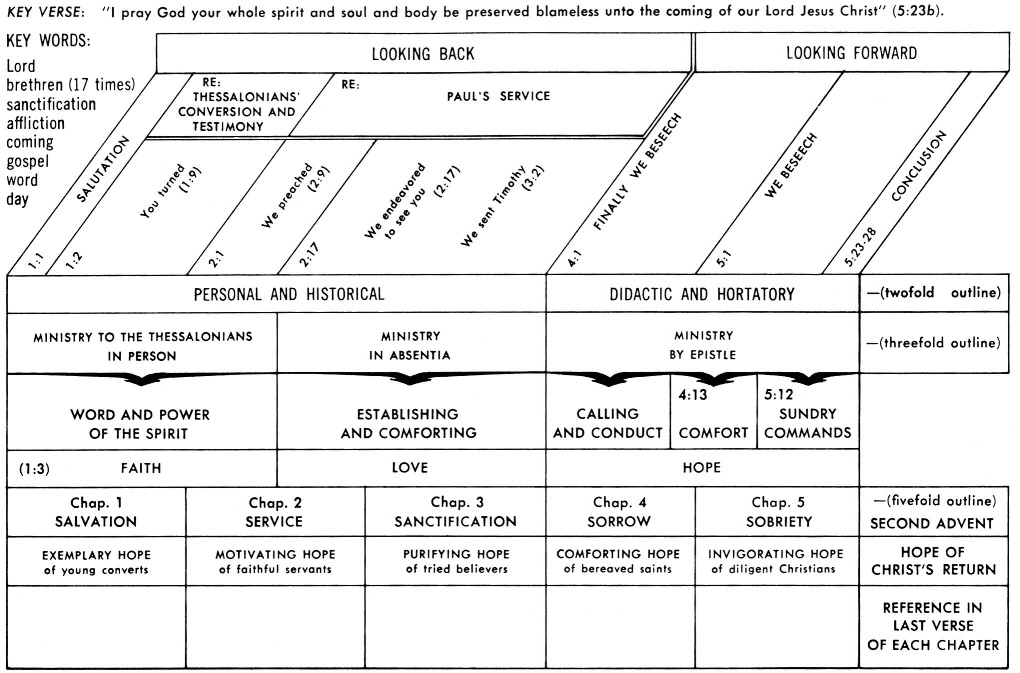
JESUS IS COMING AGAIN
Click chart to enlarge
Charts from Jensen's Survey of the NT - used by permission
Chart by Charles Swindoll

|
1 Thessalonians |
||||||
| 1 Th 1:1-10 | 1 Th 2:1-20 | 1 Th 3:1-13 | 1 Th 4:1-18 | 1 Th 5:1-28 | ||
|
LOOKING BACK |
LOOKING FORWARD |
|||||
|
Personal Reflections |
Practical Instructions |
|||||
| Ministry In Person |
Ministry in Absentia (Thru Timothy) |
Ministry by Epistle |
||||
| Word and Power of the Spirit |
Establishing & Comforting |
Calling & Conduct | 1Th 4:13ff Comfort |
1Th 5:12ff Commands |
||
| 1 Salvation |
2 Service |
3 Sanctification |
4 Sorrow |
5 Sobriety |
||
| Paul Commends Spiritual Growth |
Paul Founds the Church |
Strengthening of the Church |
Directions for Spiritual Growth |
Holy Living in Light of Day of the Lord | ||
| Exemplary Hope of Young Converts | Motivating Hope of Faithful Servants |
Purifying Hope of Tried Believers | Comforting Hope of Bereaved Saints | Invigorating Hope of Diligent Christians | ||
|
Written from Corinth |
||||||
1Thessalonians 4:9 Now as to the love of the brethren, you have no need for anyone to write to you, for you yourselves are taught by God to love one another; (NASB: Lockman)
Greek: Peri de tes philadelphias ou chreian echete (2PPAI) graphein (PAN) umin, autoi gar humeis theodidaktoi este (2PPAI) eis to agapan (PAN) allelous;
Amplified: But concerning brotherly love [for all other Christians], you have no need to have anyone write you, for you yourselves have been [personally] taught by God to love one another. (Amplified Bible - Lockman)
NLT: But I don't need to write to you about the Christian love that should be shown among God's people. For God himself has taught you to love one another. (NLT - Tyndale House)
Phillips: Next, as regards brotherly love, you don't need any written instructions. God himself is teaching you to love each other, (Phillips: Touchstone)
Wuest: Now, concerning brotherly affection you are not having any need that I should be writing to you, for as for you, you yourselves are those taught by God with a view to loving one another with a love that impels you to deny yourselves for the benefit of the one whom you love,
Young's Literal: And concerning the brotherly love, ye have no need of my writing to you, for ye yourselves are God-taught to love one another,
NOW AS TO THE LOVE OF THE BRETHREN YOU HAVE NO NEED FOR ANYONE TO WRITE TO YOU FOR YOU YOURSELVES ARE TAUGHT BY GOD TO LOVE ONE ANOTHER:
- Now as to the love - Lev 19:8; Ps 133:1; Jn 13:34,35; 15:12-17; Acts 4:32; Ro 12:10; Ep 5:1,2; He 13:1; 1Pe 3:8; 2Pe 1:7; 1Jn 2:10; 3:11,14, 15, 16, 17, 18, 19,23; 1Jn 4:7, 8, 9, 10, 11, 12, 13, 14, 15, 16
- You have no need 1Th 5:1; Je 31:34; He 8:10,11; 1Jn 2:20, 21, 22, 23, 24, 25, 26, 27
- For you yourselves are taught Is 51:13; Mt 22:39; Jn 6:44,45; 13:34; 14:26; 15:12,17; Ep 5:2; He 10:16; 1Pe 4:8; 1Jn 3:11,23; 4:21; 5:1
- 1 Thessalonians 4 Resources - Multiple Sermons and Commentaries
1Thessalonians 4 can be divided as follows…
- 1Thes 4:1-2 = General Call to a God Pleasing Walk
- 1Thes 4:3-12 = Specific Aspects of God Pleasing Walk
1Thes 4:3, 4, 5, 6,7, 8 = Sanctification in Area of Sexual Purity
1Thes 4:9, 10, 11, 12 = Sanctification in Area of Love and Work
- 1Thes 4:13-18 = Hope for Grieving Saints
LOVING THE
BRETHREN
Now (1161) (de) is translated most often as "but" however in this use is best translated as "now" marking Paul's transition from his discussion of sexual purity to new topics of a believers "love life" and work. Paul now further amplifies what a God pleasing walk looks like and in so doing describes another manifestation of sanctification.
Now as to (peri de) - This is an interesting way to begin this section and raises the possibility that Paul may be addressing some specific questions from the Thessalonians that were relayed to him by Timothy upon his return (see similar intro in 1Cor 7:1 where Paul begins to respond to a series of questions). Notice that Paul begins 1Thessalonians 5 (note) with these same words ("now as to") again suggesting he is addressing their specific concerns about the Day of the Lord.
In a day when there was no active postal service, email or cell phone communication, the sending of letters via returning messengers (like Timothy) was a situation that was seldom wasted. For example Cicero wrote to Atticus that although he had no letter to send…
I cannot refrain from entrusting letters to folk who are bound for Rome, especially when they are members of my household. (Cicero, Epistulae ad Atticum 8.14.1)
Now as to the love of the brethren - ponder the cross references below regarding the love of the brethren…
Ps 133:1 (A Song of Ascents, of David.) Behold, how good and how pleasant it is For brothers to dwell together in unity!
(Click Spurgeon's comments on this verse some of which include the following… "Behold. It is a wonder seldom seen, therefore behold it! It may be seen, for it is the characteristic of real saints, -- therefore fail not to inspect it! It is well worthy of admiration; pause and gaze upon it! It will charm you into imitation, therefore note it well! God looks on with approval, therefore consider it with attention. How good and holy pleasant it is for brethren to dwell together in unity! No one can tell the exceeding excellence of such a condition; and so the Psalmist uses the word "how" twice; -- Behold how good! and how pleasant! He does not attempt to measure either the good or the pleasure, but invites us to behold for ourselves. The combination of the two adjectives "good" and "pleasant", is more remarkable than the conjunction of two stars of the first magnitude: for a thing to be "good" is good, but for it also to be pleasant is better. All men love pleasant things, and yet it frequently happens that the pleasure is evil; but here the condition is as good as it is pleasant, as pleasant as it is good, for the same "how" is set before each qualifying word.")
John 13:34 A new commandment I give to you, that you love one another, even as I have loved you (with a love that was altogether altruistic and unselfish even unto death, the ultimate definition of agape love), that you also love one another. 35 By this all men will know that you are My disciples, if you have love for one another.
(Comment: The law of love to others is now explained with new clarity, enforced by new motives and obligations, illustrated by a new example, and obeyed in a new way. The "badge" of Christianity is not a "fish" on the back of our car or a cross around our neck but is a Christ-like love for one's fellow Christians which requires His divine power, a power only demonstrated in the lives of those indwelt by His Spirit Who Alone can bring forth such precious fruit - Gal 5:22. Love for fellow believers produces a harmony and "aroma" that is inescapably obvious to those who witness it. Indeed, the practice of brotherly love was one of the outstanding features of the early Christian church which made it both distinctive and at the same time attractive to outsiders. One wonders how Paul would describe the church we presently attend? Does the brotherly love at our church draw believers into the fold? Or instead or they drawn by the facilities, etc?)
John 15:12-13 This is My commandment, that you love one another, just as I have loved you. Greater love has no one than this, that one lay down his life for his friends.
(Comment: Here Jesus states the ultimate expression of agape love - sacrificial to the point of being willing to give up one's very life!)
Romans 12:10 (note) (Based on the true of our new life in Christ and our presentation of our bodies to God {note Romans 12:1}, demonstrate that you are a living sacrifice and) Be devoted (philostorgos = a word that was common in ancient wills where bequests were made "according to philostorgos") to one another in brotherly love; give preference to one another in honor
Ephesians 5:1 (note) Therefore be imitators of God, as beloved children; 5:2 and walk in love, just as Christ also loved you, and gave Himself up for us, an offering and a sacrifice to God as a fragrant aroma.
(Comment: The present imperative be and walk is a command calling for divine imitation to be the saints way of living day by day. Saints are to continually "mimic" God's attitudes and actions by exhibiting His love strengthened by His Spirit - see prayer of Ephesians 3:16 - note)
Hebrews 13:1 (note) Let love of the brethren continue ( present imperative).
(Comment: If it is to continue, it indicates it was already present, which is a marker that they were genuine believers. Note that Brotherly love is the natural outflow of the Christian life. It cannot be generated, but it can be stifled as well as nurtured. We are therefore not told to make it happen but to let it continue. When a person is saved he is naturally drawn to fellowship with other believers. The deepest fellowship is not based on blood but on whether you are ''under the blood of Jesus'' and have a future and a hope to share.)
1 John 2:10+ The one who loves his brother abides in the light and there is no cause for stumbling in him.
Comment: Stumbling is the Greek word skandalon which literally was the part of a trap on on which the bait was laid, when touched caused the trap to close on its prey and thus came to mean any entanglement of the foot. In the context of the present verse, skandalon means {1} that the believer is not in danger of stumbling {as into sin} and/or {2} that he would not "trip up" other believers or non-believers and cause them to sin {stumble}. When others see such an individual abiding in light as manifest by his sacrificial love for his brethren, they see no discordance between his profession and his practice.)
There is a famous quote by Tertullian (ca AD 192) who says the pagans remark in amazement "Behold how these Christians love one another."
Love of the brethren (5360) (philadelphia from phílos = beloved, dear, friendly + adelphós = brother) means "fraternal love", brotherly love (kindness), love of the brethren. Brotherly love normally referred to the love members of a family held for each other (this was the way it was used in secular Greek) and would not normally be used to describe the love between members of different families.
However, in the NT philadelphia is used to describe the love that believers possess for one to another, for even though they were members of different natural families, they were united in Christ and were recipients of family love originating from the Father Who had bestowed His great love on His spiritual children (1John 3:1+, cf 1 Peter 1:22+).
Philadelphia describes a love which calls for an affection for one another like that one expressed between natural family members (Ro 12:10+ where devoted or "loving warmly" = philostorgos from philos = beloved, dear + storge = family love, the love of parents and children). Remember that Christianity forged a radical relationship in Christ wherein believing Greeks and Jews, circumcised and uncircumcised, barbarians, Scythians, slaves and freemen, men and women were now all one in their Lord (cp Gal 3:28+, Col 3:11+, Eph 4:1, 2, 3+). Such a diverse cultural community would have continual need for emphasis on love of the brethren. As Christians we have become brothers and sisters in the community of faith and Paul refers to them as brothers (sisters is clearly implied) some nineteen times in 1 Thessalonians alone. Our love is not just a passive disposition of fondness but manifests itself in overt acts of kindness toward the brethren.
Paul frequently mentions love in the Thessalonian epistles…
constantly bearing in mind your work of faith and labor of love… (see note 1Thes 1:3)
But now that Timothy has come to us from you, and has brought us good news of your faith and love, and that you always think kindly of us, longing to see us just as we also long to see you, (see note 1Thes 3:6)
and may the Lord cause you to increase and abound in love for one another, and for all men, just as we also do for you (see note 1Thes 3:12)
But since we are of the day, let us be sober, having put on the breastplate of faith and love, and as a helmet, the hope of salvation. (see note 1Thes 5:8)
and that you esteem them very highly in love because of their work. Live in peace with one another. (see note 1Thes 5:13)
We ought always to give thanks to God for you, brethren, as is only fitting, because your faith is greatly enlarged, and the love of each one of you toward one another grows ever greater (2 Thes 1:3+)
And may the Lord direct your hearts into the love of God and into the steadfastness of Christ. (2 Thes 3:5)
In common Greek philadelphia means love of those actually kin by blood, but in the NT it is the kinship in the love of Christ as in this passage and the others listed below.
Here are the 5 uses on philadelphia in the NT…
- Romans 12:10 (note) (see above)
- 1Thessalonians 4:9
- Hebrews 13:1 (note) (see above)
- 1 Peter 1:22 (note) (see below)
- 2 Peter 1:7 (note) and in your godliness, brotherly kindness, and in your brotherly kindness, love.
There is a use of philadelphia in the Apocryphal book of 2 Maccabees…
And Onias spoke, saying, “This is a man who loves the brethren and prays much for the people and the holy city, Jeremiah, the prophet of God.”
Josephus (Ant 4.26) has this use of philadelphia…
nor have I taken and given this office to my brother, because he excelled others in riches, for thou exceedest us both in the greatness of thy wealth; nor indeed because he was of an eminent family, for God, by giving us the same common ancestor, has made our families equal: nay, nor was it out of brotherly affection, which another might yet have justly done;
You have no need for anyone to write to you - See above for the numerous instances of Paul's discussion of love in regard to the Thessalonians. The emphasis now is on what God had taught them. Isaiah has a parallel passage writing…
And all your sons will be taught of the LORD; And the well-being of your sons will be great. (Is 54:13, cp Jn 6:45, Jer 31:33, 34, Micah 4:2, 1Jn 2:27)
Comment: The specific promise is to Israel to be fulfilled in the Millennium and yet the principle is eternal and applicable to all believers in this present age.
John Calvin eloquently explained why explicit instructions were not needed writing that "Love was engraved on their hearts, so that there was no need of letters written on paper."
Need (5532)(chreia from chraomai = to use, make use of or chreos = a debt) means a necessity, what is needed or the occasion of need. Chreia refers in (Acts 6:3) to the needful matter, duty or task.
Gingrich -1. need, necessity Lk 10:42; Hb 7:11. crei,an e;cein have need Mt 3:14; 6:8; Mk 11:3; Lk 19:31, 34; 1 Cor 12:21, 24; Hb 5:12; 10:36.—2. need, lack, want, difficulty crei,an e;cein be in need, lack something Mk 2:25; Ac 2:45; 4:35; Eph 4:28; Rv 3:17.—In other expressions Ac 20:34; Ro 12:13; Phil 4:16, 19.—3. the thing that is necessary Eph 4:29.—4. office, duty, service Ac 6:3. [pg 217]
Friberg - (1) need, lack, necessity; have need of someone or something (Mt 3.14; Mk 2.25); plural needs, necessities of life (Acts 20.34); (2) abstractly what is needed, what is useful (Eph 4.29); (3) needful matter, business, duty (Acts 6.3) (Analytical Lexicon)
In Ephesians chreia refers to an abstract need, the thing that is needed…
Ephesians 4:29 (note) Let no unwholesome word proceed from your mouth, but only such a word as is good for edification according to the need of the moment, that it may give grace to those who hear.
Chreia can also convey the idea of something which is lacking and therefore is needed as in …
Mark 2:25+ And He said to them, "Have you never read what David did when he was in need and became hungry, he and his companions:
Acts 2:45+ and they began selling their property and possessions, and were sharing them with all, as anyone might have need.
Romans 12:13+ contributing to the needs of the saints, practicing hospitality.
Philippians 4:19+ And my God shall supply all your needs according to His riches in glory in Christ Jesus.
Chreia can refer to that which should happen or be supplied because there is a need…
Matthew 3:14+ But John tried to prevent Him, saying, "I have need to be baptized by You, and do You come to me?"
Chreia is used 49 times in the NT and is translated necessary (1), need (40), needed (1), needs (6), task (1). Matt. 3:14; Matt. 6:8; Matt. 9:12; Matt. 14:16; Matt. 21:3; Matt. 26:65; Mk. 2:17; Mk. 2:25; Mk. 11:3; Mk. 14:63; Lk. 5:31; Lk. 9:11; Lk. 10:42; Lk. 15:7; Lk. 19:31; Lk. 19:34; Lk. 22:71; Jn. 2:25; Jn. 13:10; Jn. 13:29; Jn. 16:30; Acts 2:45; Acts 4:35; Acts 6:3; Acts 20:34; Acts 28:10; Rom. 12:13; 1 Co. 12:21; 1 Co. 12:24; Eph. 4:28; Eph. 4:29; Phil. 2:25; Phil. 4:16; Phil. 4:19; 1 Thess. 1:8; 1 Thess. 4:9; 1 Thess. 4:12; 1 Thess. 5:1; Tit. 3:14; Heb. 5:12; Heb. 7:11; Heb. 10:36; 1 Jn. 2:27; 1 Jn. 3:17; Rev. 3:17; Rev. 21:23; Rev. 22:5
Chreia - 9x in the Septuagint - 2 Chr. 2:16; Ezr. 7:20; Job 31:16; Ps. 16:2; Prov. 18:2; Isa. 13:17; Jer. 22:28; 48:38; Dan. 3:16
Chreia is used 4 times in this letter…
1 Thessalonians 1:8 For the word of the Lord has sounded forth from you, not only in Macedonia and Achaia, but also in every place your faith toward God has gone forth, so that we have no need to say anything.
1Thessalonians 4:9 Now as to the love of the brethren, you have no need for anyone to write to you, for you yourselves are taught by God to love one another;
1Thessalonians 4:12 so that you may behave properly toward outsiders and not be in any need.
1Thessalonians 5:1 Now as to the times and the epochs, brethren, you have no need of anything to be written to you.
You yourselves - is emphatic. The readers themselves are taught by God, the very essence of Love and the Source of agape love.
Taught by God to love one another - God's call to His own has always emphasized unselfish love, Moses recording…
you shall love your neighbor as yourself; I am the LORD. (Lev 19:18+)
The concept of God teaching His children is found also in the NT John writing…
And as for you, the anointing (the Spirit) which you received from Him abides in you, and you have no need for anyone to teach you; but as His anointing teaches you about all things, and is true and is not a lie, and just as it has taught you, you abide in Him. (1John 2:27)
Comment: Do not misinterpret and misapply this passage. John is not saying we will never have need for human teachers. The present context refers to false teachers {1John 2:26}, so take care not to interpret this verse out of that context. In fact Scripture teaches that the church has a continual need to be edified by Spirit anointed and Spirit filled human teachers as seen in Paul's instructions to the church at Ephesus - Eph 4:11, 12, 13, 14 (see notes Ep 4:11; 12, 13; 14).
David prayed to be taught by God…
Lead me in Thy truth and teach me, for Thou art the God of my salvation. For Thee I wait all the day. (Psalm 25:5) (Spurgeon's Note)
Teach me to do Thy will, for Thou art my God. Let Thy good Spirit lead me on level ground. (Psalm 143:10)
Spurgeon comments: "How childlike -- "teach me"! How practical "Teach me to do"! How undivided in obedience -- "to do thy will"! To do all of it, let it be what it may. This is the best form of instruction, for its source is God, its object is holiness, its spirit is that of hearty loyalty. The man is hidden in the Lord, and spends his peaceful life in learning the will of his Preserver. A heart cannot long be desolate which is thus docile." Spurgeon's Full Note
The psalmist declared…
O God, Thou hast taught me from my youth; and I still declare Thy wondrous deeds. (Psalm 71:17) (Spurgeon's Note)
In the coming 1000 year earthly reign of the Messiah (see Millennium) the world will seek to be taught of God, Isaiah prophetically recording that…
(in the last days when the mountain of the house of the LORD is established as the chief of the mountains) many peoples will come and say, "Come, let us go up to the mountain of the LORD (in Jerusalem, the Holy City), to the house of the God of Jacob (the Millennial Temple described by Ezekiel beginning in Ezekiel 40) that He may teach us concerning His ways, and that we may walk in His paths. (Note that God's teaching is never to be just "head knowledge" but is to be transmitted into "show leather" obedience as we behave according to what we believe)" For the law will go forth from Zion, And the word of the LORD from Jerusalem. (Is 2:3, cp Mic 4:2 which speaks of the same time and same truth)
Taught by God (2312)(theodidaktos from Theós = God + didasko = to teach from dáo = to learn) (only Scriptural use of this Greek word) means divinely instructed or taught of God and conveys the sense that the Thessalonians should innately know that their Father expects them to love all of His children.
The main verb for taught (didasko) means to provide instruction in a formal or informal setting imparting positive truth. To be taught is the responsibility of every believer (see note Colossians 3:16), is part of the Great Commission (Mt 28:20) and is especially the responsibility of church leaders. “An overseer, then, must be… able to teach” (1Ti 3:2). Heresy flourishes where sound Christian teaching lags. The idea inherent in didasko is to hold discourse with others in order to instruct them by word of mouth (tutor, direct, advise, put in mind). In the NT almost without exception didasko refers to the teaching of groups. Didasko also conveys the sense that one is to teach a student in such a way that the will of the student becomes conformed to the teaching taught. So the teacher teaches in such a way that as the student is taught, he now changes his mind saying in essence ''I won't do it this way, but I will do it this way because I've learned this sound doctrine or this true teaching.'' Doctrine determines direction of our behavior, conformed to world or to God? Teaching that Scripture finds significant is not that which provides information alone but also the teaching that creates disciples who live in responsive obedience to God's will.
Taught by God is the same truth that Jesus had reminded His hearers of as He quoted from Isaiah 54:13…
It is written in the prophets, 'AND THEY SHALL ALL BE TAUGHT OF GOD.' Everyone who has heard and learned from the Father, comes to Me.
Only those taught by God and controlled by His Spirit (Eph 5:18-note; Ga 5:16-note Ga 5:22, 23-notes) keep on loving one another, loving neighbours and even loving enemies as Jesus taught
Matthew 5:44 (note) But I say to you, love (agapao - present imperative = agape love is to be the habit of your life) your enemies, and pray (agapao - present imperative = make prayer for your enemies your habitual practice) for those who persecute you
How are believers taught by God? The Holy Spirit teaches believers.
But the Helper (Parakletos - one called alongside to help, to protect, to comfort, to counsel. A legal term for an advocate or defender), the Holy Spirit, Whom the Father will send in My name, He will teach you all things, and bring to your remembrance all that I said to you. (John 14:26)
But when He, the Spirit of truth, comes, He will guide (literally, lead one on the way or show the way by giving guidance, instruction, assistance) you into all the truth; for He will not speak on His own initiative, but whatever He hears, He will speak; and He will disclose (announce) to you what is to come. (John 16:13)
Who has the Holy Spirit? All believers have the Holy Spirit from the moment of their new birth.
However, you are not in the flesh but in the Spirit, if indeed the Spirit of God dwells in you. But if anyone does not have the Spirit of Christ, he does not belong to Him. (see note Romans 8:9)
The apostle John links the presence of the Holy Spirit with the truth that believers are taught by God writing…
But you have an anointing (referring to the Holy Spirit given to all believers, cf 1Cor 12:13) from the Holy One (the Lord Jesus Christ) , and you all know (beyond a shadow of a doubt, intuitively, the result of God's giving us that inner knowledge)… And as for you, the anointing which you received from Him abides (present tense = continually) in you, and you have no need for anyone to teach you; but as His anointing teaches you about all things, and is true and is not a lie, and just as it has taught you, you abide in Him. (1Jn 2:20+,1 Jn 2:27+)
Not only is the Spirit our Helper and Teacher, He is also our Supplier and and the One Who enables us to demonstrate divine (agape) love…
And do not get drunk with wine, for that is dissipation, but be (command to continually to yield and allow yourself to be) filled with (controlled by) the Spirit (See note Ephesians 5:18)
But I say, walk (command to continually conduct your life) by the Spirit, and you will not carry out the desire of the flesh. (See note Gal 5:16)
Comment: Controlled by the Spirit we are empowered to live according to His guidance and we bring forth divine fruit of love.
But the fruit of the Spirit is love (agape), joy, peace, patience, kindness, goodness, faithfulness (Galatians 5:22-note)
But you say I don't even like that brother or sister, much less love them with divine love. How does God help this quagmire? Paul tells us in Philippians to…
So then, my beloved, just as you have always obeyed, not as in my presence only, but now much more in my absence, work out (present imperative = command to continually do this but you don't have to do it by yourself for the next verse explains that the indwelling Spirit of God gives us the "want to" and the spiritual energy to do what we simply cannot do in our natural state) your salvation with fear and trembling for it is God Who is at work (present tense = continually energizing and creating in you the power and desire) in you, both to will (present tense = continually ) and to work (present tense = continually) for His good pleasure. (Php 2:12,13 -See notes Ph 2:12; 13)
Comment: So what do we have to do as believers? We have to humble ourselves before the Lord for He is opposed to the proud. We have to boast in our weakness and inability to love for His power is perfected in our weakness and to the humble He gives grace - the supernatural ability to perform what He has commanded us to do, to love as He loves).
Paul explains that we have the very source of divine love indwelling us from the moment we are justified by faith writing that..
hope does not disappoint (bring disillusion, failure of expectation), because the love of God has been poured out (figuratively given in abundance, generously provided and in the perfect tense = poured out when we were justified by faith with continuance of it's presence and effect) within our hearts through the Holy Spirit Who was given to us.
To love (25) (agapao - see related study of noun agape) means to love unconditionally and sacrificially as God Himself loves sinful men (John 3:16), the way He loves the Son (John 3:35, 15:9, 17:23, 24). Note that agapao is a verb and by its verbal nature calls for action. This quality of love is not an emotion but is an action initiated by a volitional choice.
MacArthur writes that agapao "expresses the purest, noblest form of love, which is volitionally driven, not motivated by superficial appearance, emotional attraction, or sentimental relationship. (SEE 1 & 2 Thessalonians MacArthur New Testament Commentary)
Wuest writes that "Agapao speaks of a love which is awakened by a sense of value in an object which causes one to prize it. It springs from an apprehension of the preciousness of an object. It is a love of esteem and approbation. The quality of this love is determined by the character of the one who loves, and that of the object loved. (Eerdmans Publishing - used by permission)
Vine - Love can be known only from the actions it prompts. God’s love is seen in the gift of His Son, 1 John 4:9, 10. But obviously this is not the love of complacency, or affection, that is, it was not drawn out by any excellency in its objects, Ro 5:8 (note). It was an exercise of the divine will in deliberate choice, made without assignable cause save that which lies in the nature of God Himself, cp. Deuteronomy 7:7, 8. Love had its perfect expression among men in the Lord Jesus Christ, 2Co 5:14; Ep 2:4 (note); Ep 3:19 (note); Ep 5:2 (note); Christian love is the fruit of His Spirit in the Christian, Galatians 5:22 (note). Christian love has God for its primary object, and expresses itself first of all in implicit obedience to His commandments, John 14:15, 21, 23; 15:10; 1Jn 2:5; 5:3; 2Jn 6. Self-will, that is, self-pleasing, is the negation of love to God. (Vine's Expository Dictionary of Old Testament and New Testament Words) )
Agapao in the perfect tense is translated "beloved" some 7 times (eg two times in Romans 9:25, Ephesians 1:6 of the Son, Colossians 3:12, 1Thessalonians 1:2, 2Thes 2:13 of believers, Revelation 20:9 of the "beloved city", Jerusalem.)
… empowered by the Holy Spirit in the heart of the surrendered saint (Gal 5:22+)
… commanded of Spirit filled husbands for their wives even as Jesus demonstrated for His bride, the church, giving Himself up for her (Ep 5:25+)
… to be given in the same way Spirit filled husbands love their own bodies (Ep 5:28+)
… the love with which the Father loved the Son and which may be in believers (Jn 17:26+)
… a debt we are to always seek to repay but can never fully discharge (Ro 13:8+)
… taught by God (1Th 4:9+)
… manifested by specific actions and attitudes (1Cor 13:4, 5, 6, 7, 8+)
… shown not just by words but by deeds (1Jn 3:17+, cf such love in action as a manifestation of genuine faith in James 2:15, 16-+)
… manifested by keeping God's commandments (Jn 14:15, 21, 23, 24+)
… the response Jesus called for one to demonstrate to his or her enemies (Mt 5:44+)
… love calls for one to love one's neighbor as one's self (Mt 19:19+)
… love that seeks the recipient's highest good, not activated by virtue in the recipient (undeserved) (Jn 3:16+)
… love that finds its perfect expression in Jesus Christ and the Cross (Jn 3:16+, cp 1Jn 3:16+)
… the love of the overcomers in Revelation who did not love their life even to death (Re 12:10+)
… not based on affection, sentiment or emotion but upon a decision of the will
… given or offered even if the love is not received or reciprocated
… love differs from phileo which is based on affection
… love that cannot be manifested by unregenerate individuals in its true Biblical sense of being Spirit enabled. Agapao when used in the context of the unregenerate means generally to have a high esteem for or to take pleasure in something. This type of agapao love is based on one showing a high regard for the object's perceived value or importance as shown in the following passages…
Luke 7:5+ of a Roman centurion who loved Israel
Luke 11:43+ of Pharisees who loved the front seats in the synagogues and the respectful greetings in the market places
John 3:19+ of unregenerate men who loved the darkness rather than the light
John 12:43+ of the men who loved the approval of men rather than the approval God
2 Timothy 4:10+ of Demas who loved this present world and as a result deserted Paul and went to Thessalonica
1 John 2:15+ of those who love the world which indicates they do not possess the love of the Father within them (Compare uses in LXX translation of Ps 4:2, 11:5, 52:3, 4)
2 Peter 2:15+ of the false teachers who forsook and went astray from the right way because they like Balaam loved the wages of unrighteousness
Agapao is found 143 times in 110 NT verses in the NAS - Matt. 5:43, 44, 46; 6:24; 19:19; 22:37, 39; Mk. 10:21; 12:30, 31, 33; Lk. 6:27, 32, 35; 7:5, 42, 47; 10:27; 11:43; 16:13; Jn. 3:16, 19, 35; 8:42; 10:17; 11:5; 12:43; 13:1, 23, 34; 14:15, 21, 23, 24, 28, 31; 15:9, 12, 17; 17:23, 24, 26; 19:26; 21:7, 15, 16, 20; Ro 8:28, 37; 9:13, 25; 13:8, 9; 1Co. 2:9; 8:3; 2Co 9:7; 11:11; 12:15; Ga 2:20; 5:14; Ep 1:6; 2:4; 5:2, 25, 28, 33; 6:24; Col 3:12, 19; 1Th 1:4; 4:9; 2Th 2:13, 16; 2Ti 4:8, 10; He 1:9; 12:6; James 1:12; 2:5, 8; 1Pe 1:8, 22; 2:17; 3:10; 2Pe 2:15; 1Jn 2:10, 15; 3:10,11, 14, 18, 23; 4:7f, 10, 11, 12, 19, 20, 21; 5:1,2; 2Jn 1:1, 5; 3Jn 1:1; Jude 1:1; Re 1:5; 3:9; 12:11; 20:9
Agapao is found 198 times in the Septuagint (LXX) Ge 22:2; 24:67; 25:28; 29:18, 20, 30, 32; 34:3; 37:3; 44:20; Ex 20:6; 21:5; Lev. 19:18, 34; Deut. 4:37; 5:10; 6:5; 7:8, 9, 13; 10:12, 15, 18f; 11:1, 13, 22; 13:3; 15:16; 19:9; 21:15f; 23:5; 30:6, 16, 20; 32:15; 33:5, 12, 26; Jos. 22:5; 23:11; Jdg 5:31; 14:16; 16:4, 15; Ru 4:15; 1Sa 1:5; 16:21; 18:16, 20, 22, 28; 20:17; 2Sa 1:23; 7:18; 12:24; 13:1, 4, 15, 21; 19:6; 1 Ki. 3:3; 5:1; 10:9; 11:2; 1Chr. 17:16; 29:17; 2 Chr. 2:11; 9:8; 11:21; 20:7; Neh. 1:5; 13:26; Esther 6:9; Job 19:19; Ps. 4:2; 5:11; 11:5, 7; 18:1; 26:8; 29:6; 31:23; 33:5; 34:12; 37:28; 40:16; 45:7; 47:4; 51:6; 52:3f; 69:36; 70:4; 78:68; 84:11; 87:2; 94:19; 97:10; 99:4; 109:4, 17; 115:18; 119:47f, 97, 113, 119, 127, 132, 140, 159, 163, 165, 166, 167; 122:6; 145:20; 146:8; Pr 3:12; 4:3; 8:17, 21, 36; 9:8; 12:1; 13:24; 15:9, 12, 32; 16:13, 17; 19:8; 20:13; 21:17; 22:11, 14; 28:4, 13, 17; 30:15; Eccl. 5:10; 9:9; Song 1:3, 4, 7; 3:1, 2, 3; Isa. 1:23; 3:25; 5:1, 7; 41:8; 43:4; 44:2; 48:14; 51:2; 56:6; 57:8; 60:10; 61:8; 63:9; 66:10; Jer. 2:25; 5:31; 8:2; 11:15; 12:7; 14:10; 31:3; 49:25; La 1:2; Ezek. 16:37; Dan. 4:27; 9:4; Hos. 3:1; 4:18; 8:9, 11f; 9:1, 10, 15; 10:11; 11:1; 12:7; 14:4; Amos 4:5; 5:15; Mic 6:8; Zec 8:17, 19; 10:6; Mal 1:2; 2:11)
The first use of agapao in the LXX corresponds to the first mention of love in the Bible in the context of Abraham's call to sacrifice Isaac…
And He said, "Take now your son, your only son, whom you love (LXX = agapao) , Isaac, and go to the land of Moriah; and offer him there as a burnt offering on one of the mountains of which I will tell you." (Genesis 22:2+)
Here are some other representative uses of agapao in the LXX…
You shall not take vengeance, nor bear any grudge against the sons of your people, but you shall love (LXX = agapao) your neighbor as yourself; I am the LORD. (Leviticus 19:18) (Cited in at least 8 NT passages - Matthew 5:43; Matthew 19:19; 22:39; Mark 12:31; Luke 10:27; Romans 13:9; Galatians 5:14; James 2:8)
O love (Lxx = agapao in the aorist imperative) the LORD, all you His godly ones! The LORD preserves the faithful, And fully recompenses the proud doer. (Psalm 31:23)
And the descendants of His servants will inherit it, and those who love His name will dwell in it (Zion). (Psalm 69:36)
Let all who seek Thee rejoice and be glad in Thee; and let those who love Thy salvation say continually, "Let God be magnified." (Psalm 70:4)
O how I love Thy law! It is my meditation all the day. (Psalm 119:97)
Peter emphasized the primacy of Christian love writing that…
1 Peter 1:22+ Since you have in obedience to the truth purified your souls for a sincere (unhypocritical, unfeigned, lacking pretense or show and thus genuine) love of the brethren, fervently (ektenes = an athletic term = “striving with all of one’s energy” - used to describe a runner who is moving at maximum output with taut muscles straining and stretching to the limit) love one another from the heart (not just head knowledge, not just with words but with deeds) (Philadelphia is the fruit of the new birth into the family of God.)
1 Peter 4:8+ Above all (most important of all), keep fervent (ektenes = an athletic term = “striving with all of one’s energy” - used to describe a runner who is moving at maximum output with taut muscles straining and stretching to the limit) in your love for one another, because love covers a multitude of sins. (Comment: One aspect of this "covering" is to overlook sins against one's self if possible, and be ready to forgive as you have been forgiven.)
In his first Epistle, John makes a number of important statements regarding the vital importance of Christian love. including its source, its manifestation, its effect on the one who demonstrates it, etc
First, Christian love is evidence of genuine new birth. Conversely, not loving is evidence that one abides in spiritual death and is not born again.
1 John 3:10+ By this the children of God and the children of the devil are obvious: anyone who does not practice righteousness is not of God, nor the one who does not love his brother. 11 For this is the message which you have heard from the beginning, that we should love one another; 12 not as Cain, who was of the evil one, and slew his brother. And for what reason did he slay him? Because his deeds were evil, and his brother's were righteous. 13 Do not marvel, brethren, if the world hates you. 14 We know that we have passed out of death into life, because we love the brethren. He who does not love abides in death. 15 Everyone who hates his brother is a murderer; and you know that no murderer has eternal life abiding in him.
Secondly, Christian love is shown by its sacrificial nature, laying down of one's life.
1 John 3:16+ We know love by this, that He laid down His life for us; and we ought to lay down our lives for the brethren.
Third, Christian love is shown not just by words but by action. Agape love is not so much a feeling as it is an action.
1 John 3:17+ But whoever has the world's goods, and beholds his brother in need and closes his heart against him, how does the love of God abide in him? 18 Little children, let us not love with word or with tongue, but in deed and truth.
Fourth, manifesting genuine Christian love in deeds not just words will gives assurance regarding their salvation and confidence in prayer.
1 John 3:19+ (NLT) It is by our actions (of meeting other's needs) that we know we are living in the truth (that we are "children of God" {1John 3:10} and not "of the evil one" {1John 3:12}, so we will be confident when we stand before the Lord, 20 even if our hearts condemn us (our tangible evidences of demonstration of love for the brethren provide comfort to us when we feel guilty that we have not loved enough or we have doubts. We can come to Him now in confidence and look forward with confidence to standing before Him some day in the future - see 1 John 3:21). For God is greater than our hearts, and He knows everything.
Fifth, belief in Jesus is intimately related to love of the brethren and we are to show Christian love because God commanded us. If we obey we experience a greater sense of His abiding presence in us.
1 John 3:23+ And this is His commandment, that we believe in the name of His Son Jesus Christ, and love one another, just as He commanded us. 24 And the one who keeps His commandments abides in Him, and He in him. And we know by this that He abides in us, by the Spirit whom He has given us.
Sixth, Christian love should continue as it reflects God Who is love and the source of love.
1 John 4:7+ Beloved, let us love one another, for love is from God; and everyone who loves is born of God and knows God. 8 The one who does not love does not know God, for God is love. (In simple terms, John explains that if we don't love, we are note believers because the essence of God is love and to fail to demonstrate His love shows we do not belong to His family.)
Seventh, God manifested His love by giving us what we need (propitiation for sins), not what we want and His love is the basis for our life in and through union with Christ…
1John 4:9+ By this the love of God was manifested in us, that God has sent His only begotten Son into the world so that we might live through Him. 10 In this is love, not that we loved God, but that He loved us and sent His Son to be the propitiation for our sins.
Eighth, because of God's love for us we are to love one another.
1John 4:11+ Beloved, if God so loved us, we also ought to love one another.
Ninth, loving others prove God abides in us.
1John 4:12+ No one has beheld God at any time; if we love one another, God abides in us, and His love is perfected in us.
Tenth, living a love filled life will result in a God filled life.
1 John 4:16+ And we have come to know and have believed the love which God has for us. God is love, and the one who abides in love abides in God, and God abides in him. ("all who live in love live in God, and God lives in them", NLT)
Eleventh, practicing love gives us confidence that we can stand before the judgment seat of Christ and not fear.
1 John 4:17+ By this (by abiding in love - e.g., as shown by sacrificial laying down of our life, by meeting our neighbor's need with actions not just words, by keeping God's commandments as in 1John 2:5), love is perfected (as we practice love and manifest God's love, His love is brought to maturity) with us, that we may have confidence (boldness in speech) in the day of judgment (see bema - judgment of believers); because as He is (as Christ is - as we practice a life of love it shows we are like His Son, that we belong to His family, that we can have confidence at the judgment, cp 1 John 2:28, 29+ which says the same thing in slightly different words, cp 1 John 3:1, 2, 3+ "we are children of God… we shall be like Him {Jesus}"), so also are we in this world.18 There is no fear (the context is still the day of judgment - that there is no fear because we demonstrate a "perfected" love, a maturing love) in love; but perfect love casts out fear, because fear involves punishment, and the one who fears is not perfected in love.
Comment: John Piper explains "In other words the reason there is no fear in love is that there is no threat of punishment for being a loving person. When you love someone with real practical deeds, you never hear a warning signal that says, "You're going to get punished for this." Fear is what you feel when you have done something that ought to be punished. But love is never threatened with punishment. So there is no fear in love." see Piper's full sermon Perfect Love Casts Out Fear
Twelfth, love of the brethren shows we genuinely love God and is made possible only because He first loved us.
1 John 4:19+ We love, because He first loved us. 20 If someone says, "I love God," and hates his brother, he is a liar; for the one who does not love his brother whom he has seen, cannot love God whom he has not seen. 21 And this commandment we have from Him, that the one who loves God should love his brother also.
Thirteenth, love of God is shown by keeping His commandments and this shows we love the brethren.
1John 5:1+ Whoever believes that Jesus is the Christ is born of God; and whoever loves the Father loves the child born of Him. 2 By this we know that we love the children of God, when we love God and observe His commandments. 3 For this is the love of God, that we keep His commandments; and His commandments are not burdensome (because we now have His Spirit to enable us to keep them).
One another (240) (allelon) means each other and speaks of a mutuality or sharing of sentiments between two persons or groups of persons. Allelon is a reciprocal pronoun which denotes that the encouragement and edification is to be a mutual beneficial activity. As each submits, encourages, loves, etc, the other members benefit. This is the God's description and prescription for a body of believers.
One another is a common NT phrase (especially in Paul's letters) with most uses relating to some aspect of the building up of the body of Christ. As such the "one anothers" in the NT would make an excellent Sunday School study (or topical sermon series), taking time to meditate on each occurrence, asking whether it is being practiced (in the Spirit-note) in your local church and seeking to excel still more (cp Php 1:9, 10, 11-note; 1Th 3:12-note, 1Th 4:1-note), 1Th 4:10-note). Below is a list of the NT uses of one another (be sure to check the context for the most accurate interpretation).
The Positive
><> Ro 12:10-note, Ro 12:16-note; Ro 13:8-note; Ro 14:13-note, Ro 14:19-note; Ro 15:5-note, Ro 15:7-note, Ro 15:14-note; Ro 16:16-note;
><>1Co 12:25; 1Co 16:20; 2Co 13:12;
><> Ga 5:13; Ep 4:2-note, Ep 4:25-note, Ep 4:32-note; Ep 5:19-note, Ep 5:21-note;
><> Php 2:3-note; Col 3:13-note, Col 3:16-note
><> 1Th 3:12-note; 1Th 4:9-note, 1Th 4:18-note; 1Th 5:11-note, 1Th 5:13-note, 1Th 5:15-note; 2Th 1:3;
><> Heb 3:13-note; He 10:24, 25-note;
><> Jas 5:16, 1Pe 1:22-note; 1Pe 4:8, 9-note, 1Pe 4:10-note; 1Pe 5:5-note, 1Pe 5:14-note
><> 1Jn 1:7,3:11,23,4:7,11, 12, 2Jn 1:5
The Negative
<>< 1Co 6:7, 7:5, 11:33, Ga 5:15, Ga 5:26-note Col 3:9-note, Jas 4:11, 5:9
What does Christian love for one another look like? In 1Corinthians 13:4-7 Paul gives a practical, applicable, succinct description of agape love which is read during most wedding ceremonies but often forgotten by the time the honeymoon is over. This "divine checklist" on agape love needs to be read and re-read (consider once a week or at least once a month) by married couples as well as singles for such an exercise would surely prove profitable for teaching, reproof, correction and training in right behavior toward one another.
Love is patient (has a long fuse), love is kind (provides what is needed), and is not (note every "not" in these verses = absolute negation = never!) jealous (possessive); love does not brag (does not say "look how loving I am", does not parade it's imagined superiority of others) and is not arrogant (exaggerated self conception), (see note 1Corinthians 13:4)
does not act unbecomingly (ugly, indecent, rude); it does not seek its own (seek its own way like "it's my way or the highway!"), is not provoked (irritable; English paroxysm = sudden outburst of emotion), does not take into account a wrong suffered (like an accountant keeps written records on the ledger), (see note 1Corinthians 13:5)
does not rejoice in unrighteousness (does not take delight in that which is offensive to God, does not justify wrong or make wrong look right), but rejoices with the truth (Love cheers whenever the truth wins out. It is glad to know that suspicions were unfounded. Love believes the best and is glad when the verdict is "Not guilty") (see note 1Corinthians 13:6)
bears all things ("puts a roof over" = covers, keeps silent about, keeps confidential. Throws a cloak of silence over what is displeasing in another person. Protects from exposure, ridicule, or harm) believes all things (not gullible but seeing the best in others, giving them the benefit of the doubt), hopes all things (looking at the bright side of things and not conveying a sense of despair or pessimism. Avoiding a negative, critical spirit, instead being positive and hoping for what is good for another), endures all things (endures patiently and triumphantly and not passively putting up with the difficulties). (see note 1Corinthians 13:7)
Remember that these practical aspects of supernatural love can only be carried out by a believer who is filled with, strengthened by and walking in the Holy Spirit (Eph 5:18-note; Ep 3:16-note; Gal 5:16-note).
Related Resource:
1Thessalonians 4:10 for indeed you do practice it toward all the brethren who are in all Macedonia. But we urge you, brethren, to excel still more, (NASB: Lockman)
Greek: kai gar poieite (2PPAI) auto eis pantas tous adelphous [tous] en hole te Makedonia. parakaloumen (1PPAI) de humas, adelphoi, perisseuein (PAN) mallon
Amplified: And indeed you already are [extending and displaying your love] to all the brethren throughout Macedonia. But we beseech and earnestly exhort you, brethren, that you excel [in this matter] more and more, (Amplified Bible - Lockman)
NLT: Indeed, your love is already strong toward all the Christians in all of Macedonia. Even so, dear friends, we beg you to love them more and more. (NLT - Tyndale House)
Phillips: and you are already extending your love to all the Macedonians. Yet we urge you to have more and more of this love, and to make ot your ambition to have no ambition!. (Phillips: Touchstone)
Wuest: for you also are doing the same with respect to all the brethren in the whole of Macedonia. Now, as for you, I beg of you, please, brethren, that you see to it that you continually are increasing more and more [in this love],
Young's Literal: for ye do it also to all the brethren who are in all Macedonia; and we call upon you, brethren, to abound still more,
FOR INDEED YOU DO PRACTICE IT TOWARD ALL THE BRETHREN WHO ARE IN ALL MACEDONIA: kai gar poieite (2PPAI) auto eis pantas tous adelphous [tous] en ole te Makedonia:
- 1Thes 1:7; 2Corinthians 8:1,2,8, 9, 10; Ephesians 1:15; Colossians 1:4; 2Thessalonians 1:3; Philemon 1:5, 6, 7
- 1 Thessalonians 4 Resources - Multiple Sermons and Commentaries
A SPIRIT FILLED
BODY OF CHRIST
For indeed - This phrase introduces the reason (term of explanation) that they had no need to write to the saints in Thessalonica. Timothy had brought the good news to Paul that the Thessalonians were demonstrating both faith and love (see note 1Thes 3:6) and that this love was being manifest to brethren in all Macedonia.
Practice (4160) (poieo) means to accomplish or do something that brings about a state or condition, in this case deeds that bore eloquent testimony to the authenticity of their Spirit driven love. Exactly how their love was manifested is not stated (? financial aid - cp 2Cor 8:1, 2ff). The main point is that whatever the manifestation was, it was clearly evident to their spiritual father Paul. Practice is in the present tense indicating their habitual practice (only possible in Spirit filled, energized individuals - Eph 5:18+, Php 2:13NLT+) and the active voice indicating it is a definite decision of their will (again energized by the Spirit - not "Let go, let God," but "Let God and let's go" = 100% Dependent and 100% Responsible").
All the brethren in all Macedonia - Note repeat of "all." Regardless of whether they were Jew or Gentile, male or female, slave or freeman - ALL were recipients of this love, which is another indication of the power of the Gospel received to break down socio-economic barriers. On the other hand churches in which class distinctions still persist, demonstrate that there has been incomplete penetration and/or understanding of the power of the gospel" (Ro 1:16+) which places all believers on level ground at the foot of Christ's Cross.
Brethren (80) (adelphos from collative a = copulative prefix {joining together coordinate words} or connective particle serving to join or unite + delphús = womb) is literally one born from same womb and literally identifies a male having the same father and mother. Figuratively (as used throughout this epistle) adelphos refers to a close associate of a group of persons having well-defined membership, specifically identifying fellow believers in Christ united by the bond of affection energized by the Spirit (cf Eph 4:3+).
Related Resource:
- What is a Spirit Filled Church? What does it look like?
- What is the history and significance of the church at Thessalonica? |
BUT WE URGE YOU, BRETHREN, TO EXCEL STILL MORE: parakaloumen (1PPAI) de humas, adelphoi, perisseuein (PAN) mallon:
- 1 Thes 4:1;1 Thes 3:12; Philippians 1:9; 3:13, 14, 15; 2 Peter 3:18
- 1 Thessalonians 4 Resources - Multiple Sermons and Commentaries
CONTINUAL
ENCOURAGEMENT
We (continually present tense) urge you brethren - This is a good practice to imitate with our brethren. When was the last time you definitely said an encouraging word to a brother or sister in Christ?
Urge (3870) (parakaleo from para = side of, alongside, beside + kaleo = call) means literally to call one alongside, to call someone to oneself, to call for, to summon. Parakaleo can include the idea of giving help or aid but the primary sense in the NT is to urge someone to take some action, especially some ethical course of action. Sometimes the word means convey the idea of comfort, sometimes of exhortation but always at the root there is the idea of enabling a person to meet some difficult situation with confidence and with gallantry.
Kent Hughes illustrates the root idea of parakaleo "to come alongside and encourage" with the following example - I see this exemplified every time my church has a roller skating party, and the parents put their little ones on skates for the first time. Mom and Dad skate with their child, holding on to his or her hands, sometimes with the child’s feet on the ground and sometimes in the air. But all the time the parents are alongside encouraging… [exhortation] is a wonderful gift, and we are to place it at Christ’s feet and be willing to be worn out in its use.
Because a person can be called alongside for many purposes, parakaleo has a wide range of meanings as determined by the context -- to entreat, to appeal to, to summon, to comfort, to exhort, or to encourage. Despite the fact that parakaleo can convey a wide range of meanings most Bible versions translate this verb with either exhort or urge.
In English exhort (from Latin exhortari from ex- = thoroughly + hortari = to excite, encourage, urge) means to urge or persuade someone earnestly; advise strongly. To give warnings or advice. To make urgent appeals.
In English to urge (from Latin urgere = to press or drive) means to strongly recommend, to entreat earnestly to do something, to encourage someone to continue. To advocate or recommend earnestly and persistently; plead or insist. To press or impel to action, effort, or speed. Synonyms include egg (on), exhort, goad, prick, prod, prompt, propel, sic, spur.
The idea of encourage is also present in the verb parakaleo. Note that the English word "encourage" means “with heart” or to hearten (to spur on, to stimulate). To encourage in a sense is to give them new heart. Shallow sympathy makes people feel worse but true spiritual encouragement brings out the best in people and spurs them onward which is what Paul sought to do in this verse.
In classic Greek parakaleo was used to exhort troops about to go into battle which is apropos as Paul proceeds in the following verses with a call to sexual purity! No one reading this has ever "battled" with this enemy I'm sure! I'm being sarcastic. A Greek historian recorded the struggle of a military regiment which had lost heart and was utterly dejected. The general sent a leader to come alongside these downcast troops in such a way that their courage was reborn and a body of dispirited men became fit for heroic action! So if you have been defeated in the area of sexual purity, don't give up but allow the apostle's timeless words come alongside your spirit and lift you up to fight the good fight of faith.
Related Resource
- See "one anothers" - most positive, some negative
To excel still more - To continually (present tense) to keep superabounding in agape love. How is this even possible? Only by depending on the Source of this supernatural love, the Holy Spirit (Eph 5:18+, Php 2:13NLT+)
Excel (4052) (perisseuo from perissós = abundant, exceeding some number, measure, rank or need, over and above, more than sufficient from peri = in sense of beyond) means to to exceed a fixed number or measure and so to exist in superfluity, to cause to superabound, to be superfluous, to be in excess, to overflow, to be in affluence, to excel or to be in abundance. The implication is that there is considerably more than what would be expected. Moulton and Milligan give a secular Greek usage -- “more than enough has been written; if you find any purchasers of the surplus donkeys”. Of the noun M & M say; “superfluity.” The verb perisseuo means to exist in superfluity, to super-abound” The idea is to overflow like a river out of its banks! This verb is well illustrated in Matthew 14 where we read that "they all ate, and were satisfied. And they picked up what was left over (perisseuo) of the broken pieces, twelve full baskets." (Mt 14:20) In this passage we see that loaves were left over after feeding the 5000. There was more than enough! As an aside, you can be certain that when Jesus supplies the need there is always more than enough so that some is even left over! How quick we are to forget this basic principle! His power is always perfected in our weakness.
Perisseuo is used with the idea of excelling (as in Thessalonians) in Paul's letter to the Corinthians where he exhorts them…
Therefore, my beloved brethren, be (present imperative see our need to depend on the Holy Spirit to obey) steadfast, immovable, always abounding in the work of the Lord, knowing that your toil is not in vain in the Lord (NOTE WHY IT IS NOT "IN VAIN" - IT IS "IN" THE LORD - ABIDING IN THE VINE - Jn 15:5, cf Jn 15:16 = fruit that remains forever). (1Cor 15:58+)
How can the Thessalonians be enabled to excel still more? Paul knew that the God of all grace would answer his prayer in the previous chapter…
and may the Lord cause you to increase and abound (excel - perisseuo) in love for one another, and for all men, just as we also do for you; (1 Thes 3:12+)
He had prayed a similar prayer for the Philippians to exhibit an excelling love…
And this I pray, that your love may abound (perisseuo - present tense = indicates a continual process - this God-like love is to grow and even abound throughout the life of every believer - again calls for continual dependence on the Spirit - Eph 5:18+, Php 2:13NLT+) still more and more in real knowledge and all discernment, (See note Philippians 1:9)
So how is God able to make the love of the saints excel or abound? It is all in accord with His amazing grace. Writing to the Corinthians Paul explained the basic principle that
God is able (dunateo - present tense = is continually fully capable and powerful enough) to make all grace abound (perisseuo - present tense = is continually abound) to you, that always having all sufficiency in everything, you may have an abundance for every good deed; (2Cor 9:8)
Peter ends his letter with a great prayer that would relate to Paul's exhortation to excel still more
2 Peter 3:18+ but grow (present imperative see our need to depend on the Holy Spirit to obey) in the grace and knowledge (NOTE GRACE BEFORE KNOWLEDGE - cf 1 Cor 8:1b+) of our Lord and Savior Jesus Christ. To Him be the glory, both now and to the day of eternity. Amen.