1 Thes 5:2
1 Thes 5:3
1 Thes 5:4
1 Thes 5:5
1 Thes 5:6
1 Thes 5:7
1 Thes 5:8
1 Thes 5:9
1 Thes 5:10
1 Thes 5:11
1 Thes 5:12
1 Thes 5:13
1 Thes 5:14
1 Thes 5:15
1 Thes 5:16
1 Thes 5:17
1 Thes 5:18
1 Thes 5:19
1 Thes 5:20
1 Thes 5:21
1 Thes 5:22
1 Thes 5:23
1 Thes 5:24
1 Thes 5:25
1 Thes 5:26
1 Thes 5:27
1 Thes 5:28
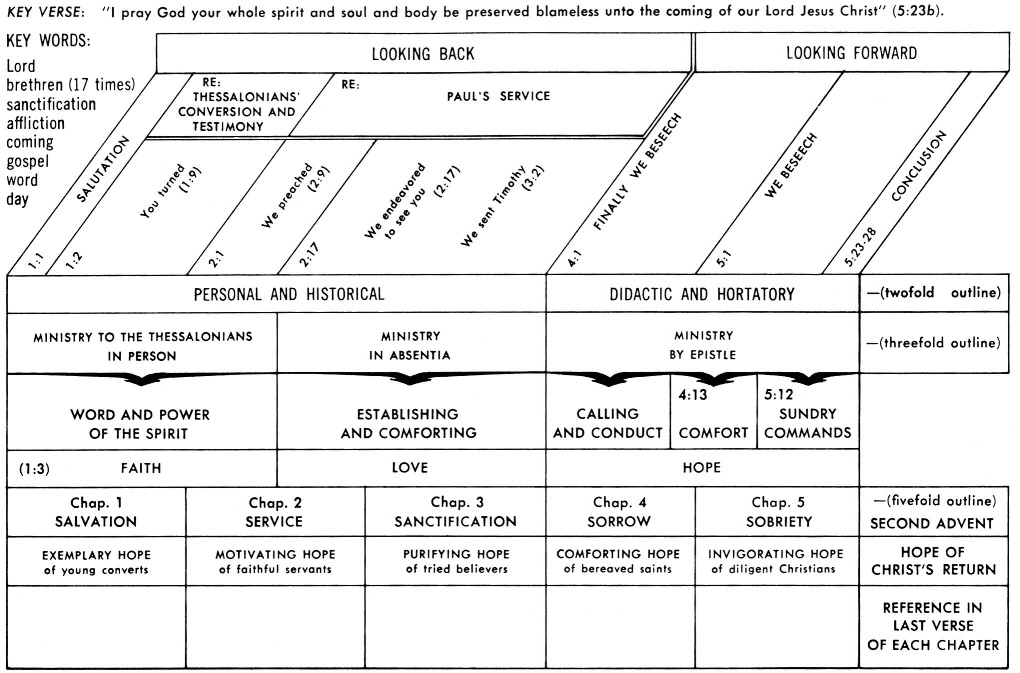
JESUS IS COMING AGAIN
Click chart to enlarge
Charts from Jensen's Survey of the NT - used by permission
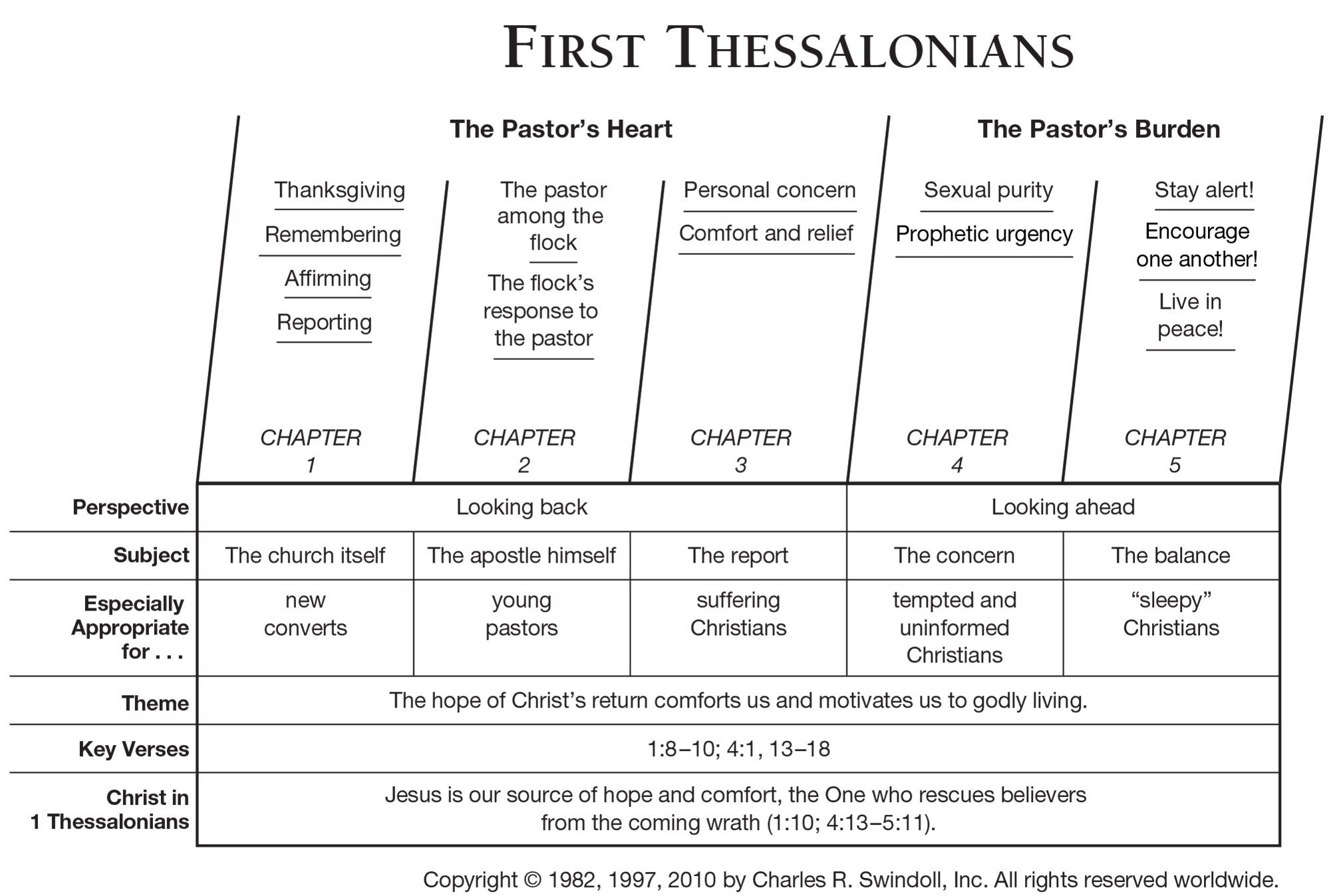
Chart by Charles Swindoll
|
1 Thessalonians |
||||||
| 1 Th 1:1-10 | 1 Th 2:1-20 | 1 Th 3:1-13 | 1 Th 4:1-18 | 1 Th 5:1-28 | ||
|
LOOKING BACK |
LOOKING FORWARD |
|||||
|
Personal Reflections |
Practical Instructions |
|||||
| Ministry In Person |
Ministry in Absentia (Thru Timothy) |
Ministry by Epistle |
||||
| Word and Power of the Spirit |
Establishing & Comforting |
Calling & Conduct | 1Th 4:13ff Comfort |
1Th 5:12ff Commands |
||
| 1 Salvation |
2 Service |
3 Sanctification |
4 Sorrow |
5 Sobriety |
||
| Paul Commends Spiritual Growth |
Paul Founds the Church |
Strengthening of the Church |
Directions for Spiritual Growth |
Holy Living in Light of Day of the Lord | ||
| Exemplary Hope of Young Converts | Motivating Hope of Faithful Servants |
Purifying Hope of Tried Believers | Comforting Hope of Bereaved Saints | Invigorating Hope of Diligent Christians | ||
|
Written from Corinth |
||||||
1 Thessalonians 5:1 Now as to the times and the epochs, brethren, you have no need of anything to be written to you. (NASB: Lockman)
Greek: Peri de ton chronon kai ton kairon, adelphoi, ou chreian echete (2PPAI) umin graphesthai, (PPN)
Amplified: BUT AS to the suitable times and the precise seasons and dates, brethren, you have no necessity for anything being written to you. (Amplified Bible - Lockman)
NLT: I really don't need to write to you about how and when all this will happen, (NLT - Tyndale House)
Phillips: But as far as times and seasons go, my brothers, you don't need written instructions. (Phillips: Touchstone)
Wuest: But concerning the duration of the successive intervals of time and the epoch-making periods of time, brethren, you have no need that I should be writing to you,
Young's Literal: And concerning the times and the seasons, brethren, ye have no need of my writing to you,
NOW AS TO THE TIMES AND THE EPOCHS BRETHREN: Peri de ton chronon kai ton kairon, adelphoi:
- Matthew 24:3,36; Mark 13:30, 31, 32; Acts 1:7
- 1 Thessalonian Resources - Multiple Sermons and Commentaries
This paragraph is the second half of the distinctly eschatological section of this epistle.
|
The Eschatological Section |
|
| 1 Thes 4:13-18 | 1 Thes 5:1-12 |
| Salvation | Judgment |
| "we do not want you to be uninformed" |
"we have no need of anything to be written to you" |
| New Teaching |
Review Teaching |
| "We" | "They" |
| Comfort One Another | Edify One Another |
| Be Assured | Be Sober |
Moore remarks "There is no suggestion (as some maintain) of a crisis in the church, nor even of a problem, but Paul would be aware of the constant need under any circumstances for exhortation and pastoral care if slackness and apostasy were to be avoided. (Moore, A L: 1 and 2 Thessalonians. The Century Bible) (Comment: How vital that every pastor heed this sage advice regarding the need for ongoing "preventive maintenance" for the flock!)
Now (1161) (de) can be translated but as in the KJV which does bring out the marked contrast.
In 1Th 4:13-18+ the subject was instruction the church needed concerning the fate those who had fallen asleep in Jesus. The main cause for unrest among the believers was their thought that only those who were alive at the time of the parousia would witness and share in its glories. All grounds for their unrest were removed with the assuring revelation that there would be no difference in the experience of the believers who had died and those who were alive when Christ returned for His Church.
Now in the second half of the distinctively eschatological section of this letter Paul provides a word of needed exhortation to the those those who living in Christ to motivate them (and us) to be daily living FOR Christ (in the Power of His Spirit).
In the preceding Paul addressed the ignorance of the readers but now he addresses their knowledge, for his statement we have no need of anything to be written to you clearly indicates this teaching was already known by the Thessalonians. In short, they do not need further instruction but fatherly encouragement to live according to the truth they already know, which is the need of most believers today. Most of us do not need "new teaching" but a renewed spirit to obey (by the Spirit) what we already know!
Now in this section Paul presents the solemn truth that the returning Lord will bring a day of judgment for the unbelieving world. With this in mind the duty of the believers is to so live that they will be prepared to meet the Lord whenever He comes giving diligence to be morally and spiritually ready.
Vine commenting in regard this conjunction but writes that…
having thus reassured his readers concerning the share of the departed in the glory of Christ by explaining to them that all in Christ, living and dead, will be received into the presence of the Lord before that glory is revealed to the world at all, the apostle proceeds to describe the effect of that revelation upon the world, (1Th 5:2, 3), and to instruct and exhort them as to their own conduct in the meantime, (1Th 5:4-11). The change of subject is marked, for whereas 1Th 4:13-17 is concerned with salvation, 1Th 5:1-3 is concerned with judgment. In 1Th 4:13-17 the language of the apostle closely follows that of the Lord recorded in John 14:1, 2, 3; where the first and second personal pronouns are used, “I come again and will receive you unto Myself” with which compare “the Lord Himself shall descend… we… shall be caught up… to meet the Lord in the air.” But in 1Th 5:3 the language corresponds with that of the Lord recorded, for example, in Matthew 16:27; Mt 24:31; Mark 13:26; Luke 9:26, where, as always in the Synoptists, the third personal pronoun only is used, “the Son of Man,” “they,” “them,” with which compare “When they are saying, Peace and safety, then sudden destruction cometh upon them.” (BORROW his excellent commentary Vine's Expository Commentary on 1 & 2 Thessalonians)
The change in subject from hope to judgment indicates that the Day of the Lord is a distinctly different subject from the Rapture of the Church and conveys a definite implication that the Day of the Lord will not include the Rapture of the Church. (See discussion of When Will the Rapture Occur?)
Times and epochs - Paul repeats the words of our Lord in Acts 1:7+ which certainly suggests he was familiar with the teaching of Christ. The expression (you have no need of anything to be written to you) indicates that the Thessalonians already were acquainted with the truth about the times and epochs. Apparently Paul is using familiar language concerning the time of the parousia
In his appearance before Nebuchadnezzar king of Babylon and the most powerful human ruler of his day, Daniel testifies to the sovereign control of El Elyon, the Most High God regarding the times and epochs declaring
And it is He who changes the times and the epochs. He removes kings and establishes kings. He gives wisdom to wise men, and knowledge to men of understanding. (Daniel 2:21+)
While the words times and epochs both relate to time and are on occasion used interchangeably, they are not equivalent terms. For example, the ancient writer Ammonius remarked that times (chronos) denotes quantity and the epochs (kairos) quality. As discussed more fully below, chronos designates time in its duration, whether a longer or shorter period, while kairos draws attention to the characteristics of the period. Chronos deals with the measurement of time, while kairos deals with the suitable or critical nature of the time. Note that both chronos and kairos are plural.
Criswell writes that "times refers to more specific and precise occasions; seasons (epochs) to the great moving periods of God's eternal plan.
Morris reiterates that "The times have to do with the chronology of future periods, the seasons (epochs) with the characteristics of those periods. (Morris, Henry: Defenders Study Bible. World Publishing)
Hiebert explains that "The times (chronos) point to the chronological ages that may intervene before the parousia (Second Coming of Christ) takes place; the dates (epochs - kairos) indicate the times in their critical character, the occurrences that will distinguish these times. Involved is the thought of the opportune seasons that have their own distinctive characteristics calling for an appropriate response. (cf. Luke 19:44 where Jesus prophetically warned the Jews that the Romans "will level you to the ground and your children within you, and they will not leave in you one stone upon another, because you did not recognize the time [kairos] of your visitation [ie, the first coming of the Messiah!].") (Ref)
Times (5550) (chronos) means a space of time. Chronos is a period of measured time, not a period of accomplishment as kairos.
Hiebert writes that "The ancient writer Ammonius remarked that the first (chronos) denotes quantity and the second (kairos) quality. The first designates time in its duration, whether a longer or shorter period; the second draws attention to the characteristics of the period. The first deals with the measurement of time; the second with the suitable or critical nature of the time. Both terms are in the plural. "The times" point to the chronological ages that may intervene before the parousia takes place; "the dates" indicate the times in their critical character, the occurrences that will distinguish these times. Involved is the thought of the opportune seasons that have their own distinctive characteristics calling for an appropriate response. (cf. Luke 19:44b)… We may use the rendering "the eras and the crises." (1 & 2 Thessalonians)
Chronos refers to chronological time, to clock time or calendar time, to a general space or succession of time. Kairos, on the other hand, refers to a specific and often predetermined period or moment of time and so views time in terms of events, eras, or seasons, such as the times of the Gentiles (see below) In other words, kairos defines the best time to do something, the moment when circumstances are most suitable, the psychologically "ripe" moment.
Time (quantity of, that is, lapse, span), chronos describes a “period of time” in general, especially in phrases like a long time (Mt 25:19) or a little while (Jn 7:33). Chronos can also be used with certain verbs to denote the period of time when something is to occur (Mt 2:7; Lk 1:57; Acts 7:17) or when something is complete (Gal 4:4). The plural of chronos appears in expressions to specify a rather long period of time, even an eternal period before earthly time (2Ti 1:9; Titus 1:2). This word can also be used as an eschatological term (Acts 1:7; 1 Th 5:1; 1Pe 1:20).
Epochs (2540)(kairos) means a point of time or period of time, frequently with the implication of being especially fit for something and without emphasis on precise chronology. It means a moment or period as especially appropriate to the right, proper, favorable time (at the right time). Kairos can refer to a fixed and definite time, the time when things are brought to crisis, the decisive epoch waited for or a strategic point in time. Kairos speaks of a limited period of time, with the added notion of suitableness ("the suitable time", "the right moment", "the convenient time"). Kairos refers to a distinct, fixed time period, rather than occasional moments. Kairos is not so much a succession of minutes (Greek chronos 5550), but a period of opportunity.
Kairos is a season, an opportune time, an opportunity ("window of opportunity"). It is a fixed and definite time. It is a period possessed of certain characteristics. For example, a "season" is a time characterized by a particular circumstance or feature. Thus the time for bringing forth fruit is the season (kairos) in which the tree bears fruit, in contrast to late autumn, when there is no more fruit. Kairos does not emphasize a point of time but rather a time space filled with all kinds of possibilities. And so Kairos characteristically means an "opportunity" (and is so translated in some versions -- in Col 4:5 {note} in the NIV & NASB & in Eph 5:16 {note} in NIV) which represents the best time to do something, the moment when circumstances are most suitable.
Webster's defines opportunity as a favorable juncture of circumstances or a good chance for advancement or progress. There is no good English equivalent for kairos, and when it it plural with chronos it is translated “seasons,” or times at which certain foreordained events take place as is the case here in 1Thessalonians 5:1.
Vincent writes that the phrase times and epochs has
special reference to the Lords coming. The plural is used because Paul is thinking of a number of incidents attending the preparation and accomplishment of the second advent, and occurring at different times. The collocation times and seasons only here and Acts 1:7.
He said to them, "It is not for you to know times or epochs which the Father has fixed by His own authority 8 but you shall receive power when the Holy Spirit has come upon you; and you shall be My witnesses both in Jerusalem, and in all Judea and Samaria, and even to the remotest part of the earth. (Acts 1:7,8)
(It) is the suitable time, the time measured by duration. Hence kairos a juncture, an occasion, as Matt. 16:3 ("And in the morning, 'There will be a storm today, for the sky is red and threatening.' Do you know how to discern the appearance of the sky, but cannot discern the signs of the times?). The distinction is so well marked that we have the phrases chronon kairos the right moment of the time, and the opportune moment (eukairos chronos). The former (chronos) of these words, time absolutely, without regard to circumstances; the latter (kairos), definite periods, with the idea of fitness.
Vine adds that…
chronos and kairos, are synonyms, and while they have much in common and are used interchangeably on occasion, when they are used together they supplement each the other and hence are to be distinguished in meaning. In the New Testament they appear together again only in Acts 1:7, and in LXX only in Daniel 2:21; Ecclesiastes 3:1; in the latter place, however, the words are both in the singular.
Broadly speaking, chronos, “time,” (a) implies duration, Revelation 10:6, whether longer, Acts 1:21; 13:18, or shorter, Luke 4:5; 18:4, or (b) refers to the date of an occurrence, whether in the past, Matthew 2:7; Luke 8:29, or in the future, Acts 3:21; 7:17. Kairos, “season,” refers to the characteristics of a period, as of harvest, Matthew 13:20; Acts 14:17; Galatians 6:9; of the fulfillment of prophecy, Luke 1:20; Acts 3:19; 1 Peter 1:11; of punishment, Matthew 8:29; of discharging duties, Luke 12:42; of opportunity for doing anything, good, Matthew 26:18; Galatians 6:10; Ephesians 5:16, or evil, Revelation 12:12; of a time suitable for a purpose, Luke 4:13, lit., “until a season,” as for the preaching of salvation, 2Corinthians 6:2. In 2Timothy 4:6, and a few other passages, the distinction between the two words is not so sharply defined.
Here, “times” refers to the length of the interval before the Parousia (Second Coming) takes place, and to the length of time it will occupy; “seasons” refers to the characteristics of the periods before, during, and after the Parousia. An ancient writer expresses the distinction thus: “times” has to do with quantity, “seasons” with quality.
YOU HAVE NO NEED OF ANYTHING TO BE WRITTEN TO YOU: ou chreian echete (2PPAI) humin graphesthai, (PPN):
- 1Thes 4:9; 2Corinthians 9:1; Jude 1:3
- 1 Thessalonian Resources - Multiple Sermons and Commentaries
As noted earlier Paul's point is that the saints at Thessalonica already knew about the times and epochs. There was no need for him to write of these matters, for he had already conveyed all this information concerning the future to them. He was not saying that instruction on this eschatological (related to prophecy) point was not useful, but that they already possessed a basic understanding of these end time events. By contrast the previous eschatological section (1Th 4:13-note) was introduced with the phrase we do not want you to be uninformed, brethren indicating that regarding the rapture, there was need for instruction and/or clarification.
Need (5532)(chreia from chraomai = to use, make use of or chreos = a debt) means a necessity, what is needed or the occasion of need.
Brethren (80) (adelphos from collative a = copulative prefix {joining together coordinate words} or connective particle serving to join or unite + delphús = womb) is literally one born from same womb and literally identifies a male having the same father and mother. Figuratively (as used throughout this epistle) adelphos refers to a close associate of a group of persons having well-defined membership, specifically identifying fellow believers in Christ united by the bond of affection.
No need of anything to be written to you - The implication is that the Thessalonians had already received oral teaching concerning the second coming of Christ, which obviously was an integral part of the sound doctrine given by the missionaries during their initial time in Thessalonica. In addition, the doctrinal truth about the times and epochs had not been neglected. It had been made plain to the saints at Thessalonica that the Second Coming of the Lord was not an event they could mark as a fixed date on their "daytimer".
Hiebert adds a note of caution writing that the church at Thessalonica "had been told that times or seasons (cf Acts 1:7) are a matter of divine determination, and not a proper subject for Christian speculation. Biblical interpretation transcends its legitimate function whenever it presumes to establish fixed dates for coming prophetic events. The Scriptures do not sanction the senseless practice of setting dates for the return of Christ. The failure of such attempts only serves to bring the prophetic hope into disrepute. (1 & 2 Thessalonians)
Write (1125)(grapho from root graph- = primarily means to scratch on or engrave as on an ornament, reports, letters, etc; English = graph, graphic, etc) means to engrave or inscribe with a pen or stylus characters or letters on a surface which can be wood, wax, metal, leather, stone, parchment, dirt (John 8:6), paper, etc.
The original sense of grapho was to carve or +-to engrave as deduced from uses in the Septuagint (where grapho occurs some 300 times usually for the Hebrew kathab 3789) such as the following…
Write (Lxx = grapho) on them (Lxx = lithos = stones) all the words of this law (Deut 27:3)
Then he (Solomon) carved (Lxx = egkolapto = cut or carve) all the walls of the house round about with carved (Lxx = grapho) engravings of cherubim… (1Kings 6:29)
… You who carve (Lxx = grapho) a resting place for yourself in the rock? (Isaiah 22:16)
NIDNTT has a historical note writing that…grapho is found in its original sense in Homer, Il. 17, 599. In Herodotus, 4, 36 the word is used meaning to draw, of lines on maps; and scholars of the 3rd cent. B.C. used it of drawing of mathematical figures. In Homer grapho is already used in the sense of scratching signs on a tablet as a kind of letter (Il. 6, 169). From the time of Herodotus. it is used generally in the normal sense of to write, and from the time of Pindar in the derived sense of to prescribe, to order. From the practice of handing in a written accusation, grapho came in judicial language to mean to accuse (Plato, Euthyphro 2b). (Brown, Colin, Editor. New International Dictionary of NT Theology. 1986. Zondervan)
Hiebert explains that…The mention of "writing" seems to suggest a contrast to oral teaching. The implication is that the Thessalonians had already received oral teaching on the point. Teaching concerning the second advent formed an important part of the instruction given by the missionaries while at Thessalonica, and this matter about "the times and the dates" had not been neglected. It had been made plain to them that the coming of the Lord was not an event they could mark as a fixed date on the calendar. They had been told that "times or seasons" (Acts 1:7, ASV) are a matter of divine determination, and not a proper subject for Christian speculation. Biblical interpretation transcends its legitimate function whenever it presumes to establish fixed dates for coming prophetic events. The Scriptures do not sanction the senseless practice of setting dates for the return of Christ. The failure of such attempts only serves to bring the prophetic hope into disrepute. (1 & 2 Thessalonians)
1 Thessalonians 5:2 For you yourselves know full well that the day of the Lord will come just like a thief in the night. (NASB: Lockman)
Greek: autoi gar akribos oidate (2PRAI) oti emera kuriou os kleptes en nukti outos erchetai. (3SPMI)
Amplified: For you yourselves know perfectly well that the day of the [return of the] Lord will come [as unexpectedly and suddenly] as a thief in the night. (Amplified Bible - Lockman)
NLT: for you know quite well that the day of the Lord will come unexpectedly, like a thief in the night. (NLT - Tyndale House)
Phillips: You are well aware that the day of the Lord will come as unexpectedly as a burglary to a householder. (Phillips: Touchstone)
Wuest: for you yourselves know positively that the day of the Lord comes in the same manner as a thief at night.
Young's Literal: for yourselves have known thoroughly that the day of the Lord as a thief in the night doth so come,
FOR YOU YOURSELVES KNOW FULL WELL THAT THE DAY OF THE LORD WILL COME JUST LIKE A THIEF IN THE NIGHT: autoi gar akribos oidate (2PRAI) hoti hemera kuriou hos kleptes en nukti houtos erchetai. (3SPMI):
- Jeremiah 23:20
- Matthew 24:42, 43, 44; 25:13; Mark 13:34,35; Luke 12:39,40; 2 Pe 3:10; Rev 3:3; Rev 16:15
- 1 Thessalonian Resources - Multiple Sermons and Commentaries
Young's literal translation brings out the order of the original Greek…
the day of the Lord as a thief in the night doth so come.
For (gar) is a term of explanation conjunction which in this case explains the reason that Paul does not need to review the times and epochs.
You yourselves know is an appeal to the knowledge that each of the readers personally possessed (yourselves - 846 = autos), such knowledge making further teaching on that subject unnecessary. What subject were they already knowledgeable about? They knew full well that the Day of the Lord would come like a thief in the night. How did the saints at Thessalonica have this knowledge? Although Paul doesn't state it directly, the clear implication is that even as new converts they had received this teaching from Paul and Silas and Timothy.
THOUGHT- One wonders whether the modern church has to a great extent lost sight of the importance of teaching such basic doctrinal truth even to new converts (INCLUDING ESCHATOLOGY! Too many in the modern church shy away from it, saying it's too controversial, too impractical!). When was the last time your church taught on the crucial eschatological topic, the Day of the Lord? Or have you ever been taught the truths concerning this are similar prophetic passagesc? We see the pattern of the apostolic teaching was clearly grounded in the teaching of Christ and His imminent return (cf Mt. 24:43, 44; Luke 12:39, 40, 2Pe 3:10-note; Re 3:3-note, Re 16:15-note). How crucial is teaching on the Second Coming? Incredibly crucial! Almost 1 in every 20-25 NT verses speak directly or indirectly to the Lord's Second Coming! Clearly, the Holy Spirit wanted this truth on our "radar screen" because He knows that Who/what we are looking for will (or at least should) radically impact Who/what we are living for! See related topic Vertical Vision Empowers Horizontal Living.
The suggestion of some writers that the Thessalonians had derived their knowledge from their study of the gospel of Luke, or that of Matthew, which had already come into their hands, is very unlikely' There is no evidence that either gospel had already been written this early.
Know (1492) (eido, perfect tense) The discussion of the participants in the parousia leads to questions about the time and the signs of the parousia. In response to these, Paul alerts the believers to constant readiness. Vigilance and sobriety are the proper attitudes, while faith, love, and hope are the Christian’s arsenal.
Full well (199) (akribos from akríbes = exact, precise) means circumspectly, perfect, diligently, accurately, exactly. It means to trace down to the last and minutest detail. Akribos implies an exactness of knowledge as the result of careful teaching.
The saints at Thessalonica knew perfectly well (Rotherham) or accurately about the Day of the Lord.
In general terms, the Day of the Lord (abbreviated DOL) refers to a special or unique time when God’s power and holiness are unveiled, bringing terror and death to His enemies. The DOL is a prophetic term that primarily speaks of the supernatural outpouring of God's judgment on Israel, the Gentile nations or both. DOL never refers to a literal day but is used figuratively to refer to a period of time much as John uses hour in the phrase "the hour of His judgment has come" (see note Rev 14:7)
Reginald E. Showers adds that "The Day of the Lord refers to God's special interventions into the course of world events to judge His enemies, accomplish His purpose for history, and thereby demonstrate who He is--the sovereign God of the universe. (BORROW Maranatha, Our Lord Come - Highly recommended)
The DOL is not a New Testament concept but has its roots in the Old Testament, being found some 16 times in the NASB (Isaiah 13:6; 13:9; 58:13; Ezek 13:5; 30:3: Joel 1:15; 2:1; 2:11; 2:31; 3:14; Amos 5:18; 20; Obadiah 1:15; Zeph 1:7; 14 {there are some 19 references to the DOL in this short book}; Mal 4:5). In addition the Day of the Lord is abbreviated many times with the terms "the day" or "that day" so there are far more than 16 mentions in the OT, making it a very important concept.
As is often the case with prophecy one has to be aware of the principle of partial (historical) fulfillment and complete (future) fulfillment. John MacArthur explains that…
The phrase the Day of the Lord is not limited to future, final wrath, but sometimes refers to imminent historical judgments, which occurred during Old Testament history (e.g., Is 13:6–22; Ezek 30:2, 3, 4, 5, 6, 7, 8, 9, 10, 11, 12, 13, 14, 15, 16, 17, 18, 19; Joel 1:15; Amos 5:18, 19, 20; Obad 11, 12, 13, 14; Zeph. 1:14ff). These historical Day of the Lord judgments were usually preceded by some preliminary judgments of lesser severity. They acted as warnings by providing sample previews of the far more devastating judgments to come when the Day actually arrived. (See Revelation Commentary) (Bolding added)
For example, the first use of DOL in Isaiah declares…
Wail, for the day of the LORD is near! It will come as destruction from the Almighty… Behold, the day of the LORD is coming, Cruel, with fury and burning anger, To make the land a desolation; And He will exterminate its sinners from it. (Isaiah 13:6,9).
In context of Isaiah 13, the DOL was directed at Babylon, and was partially fulfilled (historical fulfillment) in 539 BC when the Medes and Persians captured the city. And yet there will be a complete fulfillment (future) of the DOL against Babylon, Revelation 17-18 describing the utter and final destruction of the literal, re-built city of Babylon at the end of the Great Tribulation. Is it not intriguing that the former dictator Hussein was actively re-building the city of Babylon! And although Iraq is certainly in a state of chaos in 2007, they do sit upon one of the richest oil reserves in the world. Given such riches, it would not be difficult to see how Babylon could arise to the status of the most influential city in the world.
Not every mention of the DOL has a historical and future component. Some uses of the phrase Day of the Lord refer directly to God’s final, eschatological judgments at the end of human history (e.g., Joel 2:28, 29, 30, 31, 32; Zech 14:1; Mal. 4:1, 5; Acts 2:20; 1Thes 5:2; 2Thess 2:2; 2Pet 3:10).
There are four NT passages that use the same phrase, the Day of the Lord, and they will be discussed in more detail in the following section.
Acts 2:20+ 'THE SUN SHALL BE TURNED INTO DARKNESS, AND THE MOON INTO BLOOD, BEFORE THE GREAT AND GLORIOUS DAY OF THE LORD SHALL COME. (See Notes on Revelation, Lecture 9 for discussion of how this verse favors a Mid-Tribulation onset for the Day of Lord)
1 Thessalonians 5:2 For you yourselves know full well that the day of the Lord will come just like a thief in the night.
2 Thessalonians 2:2 that you may not be quickly shaken from your composure or be disturbed either by a spirit or a message or a letter as if from us, to the effect that the day of the Lord has come.
2 Peter 3:10 (notes) But the day of the Lord will come like a thief, in which the heavens will pass away with a roar and the elements will be destroyed with intense heat, and the earth and its works will be burned up.
First, let's address the problematic issue raised by Peter's teaching on the Day of the Lord and then we will deal with the other 3 uses of this phrase in the discussion of when the Day of the Lord begins.
When are the earth and its works burned up? The Day in 2 Peter 3:10 is most logically placed after the 1000 year Millennial Reign of Christ and prior to the Great White Throne Judgment. How can one arrive at that conclusion? Let's look at the status of the heaven and earth at the outset of the Great White Throne judgment.
John writes…
And I saw a great white throne and Him Who sat upon it, from Whose presence (face) earth and heaven fled away, and (absolutely) no place was found for them. (see note Revelation 20:11)
Clearly there is an awesome "moment" in eternity future when the universe is "un-created", this time chronologically following the 1000 year Reign of Christ and perfectly fulfilling Peter's prophecy that the heavens would pass away and the earth would be burned up. And notice that immediately following the Great White Throne judgment of unbelievers John sees
A new heaven and a new earth; for the first heaven and the first earth passed away, and there is no longer any sea. (see note Revelation 21:1)
These events are depicted below and will be followed by a discussion of when the Day of the Lord begins.
WHEN DOES THE
DAY OF THE LORD BEGIN
AND HOW LONG DOES IT LAST?
|
Heaven & earth |
||||
|
Pre-Tribulation |
The Tribulation |
(2) Day of Lord 2Peter 3:10 > |
Great White < Throne |
|
|
(1a) Day of the Lord begins > |
Mid-Tribulation |
1000 Years |
New Heaven |
|
|
3.5 |
3.5 |
|||
From the introductory discussion and timeline it becomes apparent the Day of the Lord is an extended period of time, which appears to incorporate the entire Tribulation (if it begins at point 1a in the diagram) or to incorporate the last half of the Tribulation (Great Tribulation) (begins at point 1b), the Millennial Reign and from 2Pe 3:10-note terminates at the end of the 1000 years and prior to the Great White Throne Judgment, which in turn is followed by the New Heavens and New Earth, the period that is often referred to as The Day of God.
(1a ) At the Beginning of the Tribulation -
In this view the DOL begins after a Pre-Tribulation Rapture and/or coincides with the beginning of the Tribulation, the Seventieth Week of Daniel (Da 9:27-note). Although this is the most commonly held view, when one compares Scripture with Scripture, there is also support for view (1b)
(1b) At the Middle of the Tribulation -
The argument from 2Thessalonians 2 - In 2Th 2:3-4+ we note that Paul specifically states that that Day would not begin until the Antichrist had been revealed and in the immediate context Paul associates this revelation of the Antichrist with his taking a seat in the rebuilt Jewish Temple and proclaiming himself as God. According to Jesus in Matthew 24:15+ (Mt 24:21+) this "abominable event" will set in motion the last 3.5 year period referred to as the Great Tribulation. Prior to this time certainly the Antichrist was on the scene but his evil ambition to be the other "Christ" had not yet become obvious to the doting world, who viewed him as a miracle worker who was able to broker a peace deal in the Middle East. If indeed Paul is stating that the revelation of the Antichrist in the sense of his true inner evil, satanically inspired character coincides with the revelation of the abomination of desolation, this would mark the midpoint of the Tribulation as the time of onset of the DOL.
On the other hand if one interprets the "revelation" of the Antichrist as coinciding with his signing of a covenant with Israel in Da 9:27(note), then the Day of the Lord would have its onset at the beginning of the Tribulation, which is the timing most evangelical commentaries favor. Some expositors reason that the Antichrist's evil character was in fact revealed prior to mid-tribulation, because Daniel stated the following…
As for the ten horns (often referred to as the "Revived Roman Empire"), out of this kingdom ten kings will arise; and another (the "Little Horn", the Antichrist) will arise after them, and he will be different from the previous ones and will subdue (shepal = cause to bow down, to humble) three kings. (Daniel 7:24+)
Comment: One can see how this might be the time when the wicked character of the Antichrist is revealed, but again remember the context of 2 Th 2:3, 4+, where Paul immediately describes a specific event, which can be correlated with a specific time, the midpoint of the tribulation. In contrast one cannot state exactly when the Little Horn subdues three kings.
The second argument from Acts 2 - Let's look at this passage again…
Acts 2:20+ 'THE SUN SHALL BE TURNED INTO DARKNESS, AND THE MOON INTO BLOOD, BEFORE THE GREAT AND GLORIOUS DAY OF THE LORD SHALL COME.
The question arises as to when is the sun turned to darkness and the moon to blood? The answer from Scripture is found in Revelation 6 John recording…
And I looked when He broke the sixth seal, and there was a great earthquake; and the sun became black as sackcloth made of hair, and the whole moon became like blood; (See note Revelation 6:12)
Notice that these incredible celestial events associated with the breaking of the Sixth Seal precede the Day of the Lord. Although it is not possible to definitely state when the Lord begins to Seals, most literal interpreters of the Revelation place these events at some time in the first half of the Tribulation. That being the case it would be difficult to support the teaching that the Day of the Lord begins at the outset of the Tribulation because it's inception follows the first 6 Seal judgments. This verse would lend considerable Scriptural support to a Mid-Tribulation onset for the Day of the Lord. Those who favor the onset at the beginning of the Tribulation have offered various explanations in an attempt to minimize the significance of the Acts passage, but it is difficult to avoid the plain sense of this verse.
In summary, whether the Day begins at the beginning of the Tribulation or in the Middle of Tribulation is less significant than the fact that it is a definite appointment on God's prophetic timetable, and thus it will come to pass as He has declared in both the Old and New Testaments. Whichever start date one favors should not affect one's fellowship with believers who hold the opposite view. Spirit filled believers need to agree to amicably disagree and not to divide over non-soteriological issues.
WHAT WILL THE DAY
OF THE LORD LOOK LIKE?
Summarizing some of the descriptions in the OT references (and one NT use), God describes the Day of the Lord as…
"coming, cruel, with fury and burning anger, to make the land a desolation; and He will exterminate its sinners from it" (Is 13:9), "a day of vengeance, so as to avenge Himself on His foes… a slaughter for the Lord GOD of hosts" (Je 46:10), "a day of clouds, a time of doom for the nations" (Eze 30:3), "near, and it will come as destruction from the Almighty" (Joel 1:15), "surely it is near" (Joel 2:1), "great and very awesome, and who can endure it?" (Joel 2:11), "the great and awesome day" (Joel 2:31), "near in the valley of decision" (Joel 3:14), "It will be darkness and not light" (Amos 5:18), "even gloom with no brightness in it" (Am 5:20), "(a day when) your dealings will return on your own head" (Obadiah 1:15), "near and coming very quickly… in it the warrior cries out bitterly, a day of wrath is that day, a day of trouble and distress, a day of destruction and desolation, a day of darkness and gloom, a day of clouds and thick darkness" (Zeph 1:14,15), "the day of the LORD'S wrath and all the earth will be devoured in the fire of His jealousy, for He will make a complete end, Indeed a terrifying one, of all the inhabitants of the earth" (Zeph 1:18), "the day of the LORD'S anger" (Zeph 2:2), "His coming… is like a refiner's fire and like fullers' soap" (Mal 3:2), "the great and terrible day" (Mal 4:5), "will come just like a thief in the night" (1Th 5:2).
And these are only a sampling of descriptions of the Day of the Lord, beloved. It will be so awful that men's hands will hang limp, they will writhe like women in pain, their faces will be red hot because of what is happening. This Day is when the wrath of God exterminates sinners and sin forever from earth in preparation for the new heavens and new earth (as described by Peter).
Will come - Paul uses the present tense rather than the future tense, the present tense being regularly used in doctrinal statements signifying the abiding reality of the truth asserted. Stated another way, the Day of the Lord is continually on its way and is certain of arriving, but at a time when it is least expected (especially by those who deny the reality of God's sovereign control and certain intervention in human history!)
Hiebert notes that "Paul uses the expression the Day of the Lord without a definite article (ie, there is no preceding the in the Greek). The absence of the definite article lays stress upon the character of the day: it is a day belonging to the Lord. It is His day, when He will display His character and work in judging the wicked and vindicating His justice in the establishment of His righteous rule. As the expression is used in the Old Testament, "the Lord" denotes Yahweh (Jehovah), but for Paul it means Christ. Plummer remarks, "We have here another instance of the easy way in which what in the Old Testament is said of Jehovah is transferred in the New Testament to Christ."(1 & 2 Thessalonians)
Just like a thief in the night - The NT alludes to the suddenness of this event in several passages…
(Jesus warns) Therefore be on the alert (present imperative = command for continual attitude of alertness - see our need to depend on the Holy Spirit to obey) for you do not know which day your Lord is coming. But be sure of this, that if the head of the house had known at what time of the night the thief was coming, he would have been on the alert and would not have allowed his house to be broken into. For this reason you be ready too; for the Son of Man is coming at an hour when you do not think He will. (Mt 24:42-44)
(Jesus warns) Behold, I am coming like a thief. Blessed is the one who stays awake and keeps his garments, lest he walk about naked and men see his shame. (Re 16:15+)
Comment: He only comes as a thief upon those who are not watching. Jesus told the church at Sardis, “Be watchful… if you will not watch, I will come upon you as a thief, and you will not know what hour I will come upon you” See commentary on Rev 3:3-note. Those who are in Christ are to be constantly on the lookout for His arrival, not that of Antichrist. Jesus indicated that a day was coming which would arrive unexpectedly as a snare to the earth dwellers, but by vigilance and prayer, the watchful believer could escape the things that were coming to pass - cp Lk 21:34, 35, 36+. The day which Jesus spoke of was The Day of the Lord which professing but unbelieving “Christians,” who miss the Rapture, will endure along with those dwelling upon the earth. For them, the beginning of the end comes as a surprise since they are not expecting it. It arrives, as a thief. Jesus comes for those who are watching in the Rapture of the Church prior to this time - Luke 21:34, 35, 36; John 14:1, 2, 3). He comes as a thief in the night in the judgments which usher in The Day of the Lord, culminating with His personal arrival in judgment at the Second Coming to conclude the Campaign of Armageddon.
(Peter declares) But the day of the Lord will come like a thief, in which the heavens will pass away with a roar and the elements will be destroyed with intense heat, and the earth and its works will be burned up. (See note 2 Peter 3:10)
Vincent adds that "It is noteworthy how many of the gospel lessons on watchfulness are associated with the night and a visit by night. See Mt 24:43; 25:1-13; Mk. 13:35; Luke 12:35, 38; 17:34; 12:20.
Just like - Paul utilizes a term of comparison (in this case a simile) in order to help the readers appreciate the character of this coming Day. How does a thief's coming compare to the Day of the Lord? The comparison lies in the suddenness and unexpectedness of both events. The thief comes suddenly and at a time that is not known. So too the Day of the Lord will come suddenly when people are not expecting it. Remember however that in interpreting figures of speech and terms of comparison, to interpret the figures/comparisons in the clear light of the context (see example here). For example, to suggest that the coming Lord is being portrayed as a thief, who takes property by stealth is to misuse the comparison. To reiterate figures of speech and comparisons are still intended to convey literal truth and context must rule lest one misinterpret the Scripture! And so how does a thief come? He comes stealthily at night when men are asleep rather than awake and watchful.
Thief (2812)(kleptes from klépto = steal) is a stealer or thief who acts with stealth or subterfuge. Kleptes contrasts with lestes (3027), Jesus using both terms in His discussion of sheep and security in John 10…
Truly, truly, I say to you, he who does not enter by the door into the fold of the sheep, but climbs up some other way, he is a thief (kleptes) and a robber (lestes)… All who came before Me are thieves (kleptes) and robbers (lestes), but the sheep did not hear them. (Jn 10:1,8)
Kleptes - 17v - Ezr. 2:6; Matt. 6:19; Matt. 6:20; Matt. 24:43; Lk. 12:33; Lk. 12:39; Jn. 10:1; Jn. 10:8; Jn. 10:10; Jn. 12:6; 1 Co. 6:10; 1 Thess. 5:2; 1 Thess. 5:4; 1 Pet. 4:15; 2 Pet. 3:10; Rev. 3:3; Rev. 16:15
The kléptes steals by fraud and in secret (Mt 24:43; Jn 12:6, Jn 10:10) whereas the robber or lestes steals by violence and openly. The NT often uses kleptes in a figurative sense to describe the false teachers and deceivers who "steal" men away from the truth. In the present context kleptes is used as a figure of speech (see term of comparison = simile) to describe the sudden and unexpected appearance of the Day of the Lord.
Hiebert has an interesting note that relates to incorrect interpretation writing that…The phrase "in the night" serves to strengthen the thought of the manner rather than the time of his coming. It speaks of the unhappy surprise that his coming brings to those who are not watching and are therefore caught unprepared. Although the phrase is added only here, the thought is present in the teaching of our Lord (Matt. 24:43; Luke 12:39). The original makes perfectly clear that it is the thief who comes in the night, not that the Lord will come in the night. Yet the tradition early arose in the church that the Lord would come again at night. It was apparently stimulated by Paul's phrase "in the night" as well as the reference in Christ's teaching about a coming at night. (That it will be night for some on this globe when He returns is self-evident.) Later tradition fixed this coming as on Easter Eve. This expectation gave rise to the observance of night vigils as an expression of the hope to be overtaken in a waking condition by the returning Christ. But it is obvious that Paul's words do not justify such a view. The coming of the thief at night simply serves to emphasize his secretive and unannounced coming. (Ibid) (Bolding added)
Although the Day of the Lord is describes as a period of great judgment on God's enemies, this judgment would be like a thief's intrusion in the night and would begin unexpectedly and quietly. This figure of speech of a thief coming secretly occurs several times in the NT, all in the context of unfulfilled prophetic…
(Jesus instructed His disciples) Therefore (read the preceding section to see why He says therefore or draws the following conclusion) Be on the alert (present imperative) for you do not know which day your Lord is coming. But be sure of this, that if the head of the house had known at what time of the night the thief was coming, he would have been on the alert and would not have allowed his house to be broken into. For this reason you be ready too; for the Son of Man is coming at an hour when you do not think He will. (Mt 24:42-44)
But (the following judgment contrasts with God's desire that none perish but all come to repentance) the day of the Lord will come like a thief, in which the heavens will pass away with a roar and the elements will be destroyed with intense heat, and the earth and its works will be burned up. (See note 2 Peter 3:10)
(Jesus to the Church at Sardis) Remember (present imperative) therefore what you have received and heard; and keep it, and repent. If therefore you will not wake up, I will come like a thief, and you will not know at what hour I will come upon you. (See note Revelation 3:3) (Comment: Beloved do you realize that each of the last four of the seven letters to the churches of the Revelation has a reference to the imminent return of Christ! Why would this be so important? What might it do to a church's behavior individually and corporately if this truth began to permeate the heart and soul of a local body? How much emphasis does your church place on the imminent return of Christ? As each day draws one day nearer to His sure return, this doctrinal truth becomes more and more vital for the saints to hear and assimilate into their thinking and their behavior!)
(Jesus declares) "Behold, I am coming like a thief. Blessed is the one who stays awake and keeps his garments, lest he walk about naked and men see his shame. (See note Revelation 16:15)
Therefore, in light of the awesome nature and absolute certainty of the Day of the Lord, we should be constantly watchful, and live accordingly. Paul was watching throughout his life (see note 2 Timothy 4:8), and here he urges to be alert and sober (see note 1 Thessalonians 5:6).
Barclay commenting on kleptes writes that "The ancient world was cursed with them. Houses were easy to break into. The robbers particularly haunted two places—the public baths and the public gymnasia where they stole the clothes of those who were washing or exercising themselves. It was common to kidnap slaves who had special gifts. The state of the law shows how serious this problem was. There were three kinds of theft punishable by death: (i) Theft to the value of more than 50 drachmae, that is, about £2. (ii) Theft from the baths, the gymnasia and the ports and harbours to the value of 10 drachmae, that is about 40 pence. (iii) Theft of anything by night. The Christian lived in the middle of a pilfering population. (The Daily Study Bible)
Night (3571) (nux) is literally the time from dusk to dawn when no sunlight is visible. The night in OT times was apparently divided into three periods or watches. The latter name originated with the changing of the guard at these times. Gideon’s 300 men blew their trumpets and broke their pitchers at the beginning of the middle watch (Judges 7:19). Although no references in the OT give the limits of these three periods, night was considered to begin at sunset and consequently the periods may have been 6 to 10 pm, 10 pm to 2 am, and 2 to 6 am. Later, according to the Roman calculation of time, night was divided into four watches. Matthew 14:25 and Mark 6:48 appear to follow the Roman calculation when they locate Jesus’ walking on the water at about the fourth watch of the night.
1 Thessalonians 5:3 While they are saying, "Peace and safety!" then destruction will come upon them suddenly like labor pains upon a woman with child *, and they will not escape. (NASB: Lockman)
Greek: hotan legosin, (3PPAS) Eirene kai asphaleia, tote aiphnidios autois ephistatai (3SPMI) olethros hosper e odin te en gastri echouse, (PAPFSD) kai ou me ekphugosin. (3PAAS)
Amplified: When people are saying, All is well and secure, and, There is peace and safety, then in a moment unforeseen destruction (ruin and death) will come upon them as suddenly as labor pains come upon a woman with child; and they shall by no means escape, for there will be no escape. . (Amplified Bible - Lockman)
NLT: When people are saying, "All is well; everything is peaceful and secure," then disaster will fall upon them as suddenly as a woman's birth pains begin when her child is about to be born. And there will be no escape. (NLT - Tyndale House)
Phillips: When men are saying "Peace and security" catastrophe will sweep down upon them as suddenly and inescapably as birth-pangs to a pregnant woman. (Phillips: Touchstone)
Wuest: When they are saying, Peace and safety, then comes sudden destruction upon them as birth-pains upon a woman with child. And they shall by no means escape. .
Young's Literal: for when they may say, Peace and surety, then sudden destruction doth stand by them, as the travail doth her who is with child, and they shall not escape;
WHILE THEY ARE SAYING PEACE AND SAFETY: hotan legosin, (3PPAS) eirene kai asphaleia:
- Deuteronomy 29:19; Judges 18:27,28; Ps 10:11, 12, 13; Isaiah 21:4; 56:12; Daniel 5:3-6; Nahum 1:10; Matthew 24:37, 38, 39; Luke 17:26, 27, 28, 29, 30; 21:34,35
- 1 Thessalonian Resources - Multiple Sermons and Commentaries
FALSE FORECAST!
PEACE AND SAFETY
The weather forecast is sometimes spot on, but the forecast of unbelievers in the last days is 100% in error. They won't be caught without their umbrellas because of an unexpected downpour, but they will be caught without Christ in their hearts and in danger of eternal hellfire, not a good "forecast!"
In this verse Paul uses vivid metaphorical language (see discussion of terms of comparison) to portray the fate of those who are unprepared for the coming of the Day of the Lord. The contrast in the next verse (but you brethren - 1Th 5:4-note) indicates that those who are saying peace and safety are unbelievers (also see below).
Note third person pronoun they, not first person pronoun we. You ask "so what?" The implication is that those who are the we (believers) are not here in that awful, awesome Day, but the they (professors and overt non-believers) are still here.
Just as false prophets of old fraudulently forecast a bright future, in spite of the imminence of God’s judgment (Je 6:14; 8:11; 14:13,14; Lam 2:14; Eze 13:10,16; Micah 3:5), so they will again in future days just before the final Day of the Lord destruction.
While (3752) (hotan) is an indefinite point or points of time which may be roughly simultaneous to or overlap with another point of time.
While they are saying peace and safety - The majority of mankind will be preoccupied with the things of this present evil age and will exhibit no anticipation of (or even absolutely no belief in) and no interest in preparing for the Second Coming of Christ. Our Lord used similar terms of comparison to describe the days before His return, declaring that on one hand they would be like the days of Noah (what event does this speak of?) or on the other hand like the days of Lot (what event does this speak of? Do you see the emphasis?)
For the coming of the Son of Man will be just like the days of Noah. For as in those days which were before the flood they were eating and drinking, they were marrying and giving in marriage, until the day that Noah entered the ark, and they did not understand until the flood came and took them all away; so shall the coming of the Son of Man be. (Matt. 24:37, 38, 39) (cf Luke 17:26,27)
It was the same as happened in the days of Lot: they were eating, they were drinking, they were buying, they were selling, they were planting, they were building but on the day that Lot went out from Sodom it rained fire and brimstone from heaven and destroyed them all. It will be just the same on the day that the Son of Man is revealed. (Luke 17:28, 29, 30).
Instead of anticipating and preparing for the coming day of judgment, earth dwellers (as unbelievers are repeatedly referred to in the Revelation of Jesus Christ) will be wrapped in a fatal, self-deceiving sense of security, saying peace and safety. This speaks of their false sense of security. And of note, the verb saying is in the present tense which denotes that they will be continually and repeatedly assuring themselves that there is peace everywhere and that everything is safe and secure. Deception can be a dangerous and deadly disposition!
Peace and safety - The question one might ask is when the unbelieving world be saying peace and safety? Daniel (in Da 9:24, 25, 26, 27- notes) foretold that in the first half of 70th week (of 7 years - see chart Daniel's Seventieth Week) a covenant of peace with Israel (which most likely allows them to rebuild the temple) will be made with Israel. In light of events in the Middle East at the turn of the Twenty First century, it is easy to imagine how the world might respond to what ostensibly appears to be Peace in the Middle East! The fact that the long sought after peace with Israel has been achieved will lead to a feeling of peace and safety. But this will be short lived for into this atmosphere of peace and safety comes the Day of the Lord . As discussed elsewhere this Day is much more likely to come at the midpoint of Daniel's 70th week rather than at the beginning as is noted in many commentaries. (study the following passages and note especially Peter's quotations in Acts 2:20 [see below] Joel 2:31, Rev 6:12, 13, 14, 2Th 2:2, Acts 2:20)
THE SUN SHALL BE TURNED INTO DARKNESS, AND THE MOON INTO BLOOD, BEFORE THE GREAT AND GLORIOUS DAY OF THE LORD SHALL COME. (Acts 2:20) (What very visible and very obvious sign has to proceed the Day of the Lord? What does John describe in Rev 6:12, 13, 14, which most literal interpreters would place as occurring in the first half of Daniel's Seventieth Week).
Peace (1515) (eirene from verb eiro = to join or bind together that which has been separated) literally pictures the binding or joining together again of that which had been separated or divided and thus setting at one again, a meaning convey by the common expression of one “having it all together”. Eirene can convey the sense of an inner rest, well being and harmony. Peace speaks of the absence of conflict and in the present context points to circumstances existing in the world that do not evoke a feeling of alarm or dread. Paul predicts of a false sense of inward repose and security that will exist in the unbelieving world in the end times (and to a certain degree probably exists in the minds of all unbelievers for much of their life).
Safety (803) (asphaleia from asphales = safe from a = without + sphállo = throw down, trip up, totter) describes firmness, security, safety, security from peril. Asphaleia describes the mindset of unbelievers in the last days in which they possess (falsely) a sense of sureness and safety that is not interfered with or compromised by outward obstacles. They feel that everything is safe and secure and see no external evidence to dispute their sense of security.
Whatever is the source of the unbelieving world's feeling of security is a fatal delusion, for at the very time they are uttering confident claims of peace and safety, destruction will come upon them suddenly.
THEN DESTRUCTION WILL COME UPON THEM SUDDENLY: tote aiphnidios autois ephistatai (3SPMI) olethros:
- Ex 15:9,10; Josh 8:20, 21, 22; Jdg 20:41,42; 2Chr 32:19, 20, 21; Ps 73:18-20; Pr 29:1; Isa 30:13; Lk 17:27, 28, 29; 21:34,35; Acts 12:22,23; 13:41; 2Th 1:9; 2Peter 2:4; Rev 18:7,8
- 1 Thessalonian Resources - Multiple Sermons and Commentaries
SUDDEN AND SURE
DESTRUCTION
The word order in the original Greek presents a dramatic picture…
then sudden destruction doth stand by them (Young's Literal)
Then (5119)(tote) is an adverb of time translated when, at the time that, then.
Suddenly stands emphatically at the beginning of the sentence.
Suddenly (160)(aiphnidios from aíphnes = unexpected, sudden) describes that which is unexpected or unforeseen. It is something that one cannot anticipate nor understand how it happened. In the present verse aiphnidios is at the beginning of the sentence for emphasis and refers to the sudden, unexpected, unforeseen destruction accompanying the last 3.5 year period referred to as the Great Tribulation (Mt 24:21+), the time of Jacob's distress or trouble (Jeremiah 30:7+ "Alas! for that day is great, There is none like it; And it is the time of Jacob's distress, But he will be saved from it.") or the time of distress in (Daniel 12:1+ "… And there will be a time of distress such as never occurred since there was a nation until that time; and at that time your people, everyone who is found written in the book, will be rescued.") The only other NT use of aiphnidios is in Luke 21:34+ (click discussion of this verse).
MacDonald comments on this fateful time writing that "There will be an air of confidence and security in the world. Then God’s judgment will suddenly begin to descend with vast destructive force. Destruction does not mean loss of being, or annihilation; it means loss of well-being, or ruin as far as the purpose of one’s existence is concerned. It will be as inevitable and unavoidable as labor pains upon a pregnant woman. From this judgment there will be no escape for unbelievers. (BORROW Believer's Bible Commentary)
This destruction will not be a loss of being but rather a loss of well-being.
Destruction (3639)(olethros from ollumi = to destroy. Derivative = apollumi = destroy utterly or fully and has to do with that which is ruined and is no longer usable for its intended purpose) is a state of utter and hopeless ruin and the end of all that gives worth to human existence! Do not confuse with a state of annihilation (and non-existence so that there is no longer an actual personal perception) for olethros signifies an unavoidable, very real experience of distress and torment! The destruction Paul warns about is a time of unavoidable distress, disaster and ruin. This destruction will not be a loss of being but rather a loss of well-being. The idea of olethros is to suffer the loss of all that gives worth to existence. (Related words - exolothreuo; olothreuo)
Olethros - 4x in 4v - destroyed(1), destruction(3), ruin(1). - 1Co. 5:5; 1Th 5:3; 2Th 1:9; 1Ti. 6:9; Heb. 11:28
1 Corinthians 5:5 I have decided to deliver such a one to Satan for the destruction of his flesh, that his spirit may be saved in the day of the Lord Jesus.
1 Thessalonians 5:3 While they are saying, "Peace and safety!" then destruction will come upon them suddenly like birth pangs upon a woman with child; and they shall not escape.
Comment - The context of this destruction is the frightening Day of the Lord (1 Th 5:2+), when God unleashes His pent up wrath (orge) on rebellious mankind as the "age of Man" comes to a crashing conclusion and He commences the "age of Messiah" (the Millennium).
2 Thessalonians 1:9 And these ("those who do not know God and to those who do not obey the Gospel of our Lord Jesus" 2Th 1:8, cp Jn 3:36+) will pay the penalty of eternal destruction, away from the presence of the Lord and from the glory of His power
Comment: This verse makes it very clear that olethros does not mean physical annihilation but rather the eternal separation from Christ of the lost. Regarding those who do not obey the Gospel see the discussion of the Obedience of faith and the Relationship of faith and obedience.
MacArthur adds that: Retribution is not dealt out because of persecuting Christians, but rather because they did not obey God’s command to believe (cf. Ac 17:30, 31; Ro 1:5; 10:16; 15:18; 16:19) and call upon the name of the Lord to be saved from their sin (Ro 10:9–13; 1Co 16:22; Heb 10:26–31). Salvation is never obtained by works but always by placing one’s faith alone in the Lord Jesus Christ (Eph 2:8–10).
1 Timothy 6:9+ But those who want to get rich fall into temptation and a snare and many foolish and harmful desires which plunge men into ruin (olethros) and destruction (apoleia = utter ruin, complete loss of purpose for which one was created in the image of God! Not annihilation which is wishful thinking!).
Olethros - 13 times in the LXX -1Ki 13:34; Pr 1:26f; 21:7; Jer 25:31; 48:3, 8, 32; 51:55; Ezek 6:14; 14:16; Hos 9:6; Obadiah 1:13. Here are some representative uses…
Proverbs 1:26 I will also laugh at your calamity; I will mock when your dread (Lxx = olethros) comes,
Jeremiah 48:3 "The sound of an outcry from Horonaim, 'Devastation (Lxx = olethros) and great destruction!'
Jeremiah 48:8 "A destroyer (Lxx = olethros) will come to every city, So that no city will escape; The valley also will be ruined And the plateau will be destroyed, As the LORD has said.
Ezekiel 14:16 though these three men were in its midst, as I live," declares the Lord GOD, "they could not deliver either their sons or their daughters. They alone would be delivered, but the country would be desolate (Lxx = olethros).
Will come upon (2186) (ephistemi from epí = by, near, upon + hístemi = stand) means literally to stand upon or over and then conveys the sense of to be at hand (instant) or to be present and is generally used of any sudden unexpected appearance. Ephistemi was often used in the NT of a person coming suddenly upon another (Luke 2:9; 24:4; Acts 4:1; 12:7). In this verse ephistemi conveys the idea that the unbelieving world will be oblivious to the coming of the God's righteous judgment. As MacArthur says " the Day of the Lord will come suddenly and unexpectedly on unbelievers. They will fail to heed the many precursors that should have warned them of its imminent arrival."
Them - the ones upon whom the destruction falls, unbelievers, those who have spurned all warnings of coming judgment and rejected the offers of grace as described in 2 Thessalonians…
And then that lawless one (Antichrist) will be revealed {apokalupto - see related word apokalupsis} whom the Lord will slay with the breath of His mouth and bring to an end by the appearance of His coming (parousia); 9 that is, the one whose coming is in accord with the activity of Satan, with all power and signs and false wonders, 10 and with all the deception of wickedness for those who perish, (Why do they perish?) because they did not {ouk = absolutely do not ever} receive {dechomai} the love of the truth so as to be saved {sozo}. 11 (What does God do since they have rejected His free gift of eternal life in Christ Jesus?) And for this reason (because they rejected God's offers of grace cp Ro 2:4-note) God will send upon them a deluding influence so that they might believe what is false,12 in order that they all may be judged who did not believe the truth, but took pleasure in wickedness. (2Thessalonians 2:8, 9, 10, 11, 12+).
Comment: Those who do not believe the truth of the glorious gospel of Christ when they have opportunity in this age, rejecting Him as Creator, Redeemer and Savior, are destined for eternal punishment {"destruction", "ruin"} in the lake of fire. There will be no opportunity for them to be saved in the tribulation period, for their names will have been blotted out of the book of life {Re 3:5-note; Re 13:8-note}. However, there will be a great multitude out of every tribe and nation saved during the tribulation period {Re 7:9-note, Re 7:14-note}. These will be men and women who never had a real opportunity to understand and receive the gospel before the rapture, but who will believe even suffering martyrdom for their faith when they read or hear it during this coming time of the Day of the Lord and His judgment on earth.
LIKE LABOR PANGS UPON A WOMAN WITH CHILD: hosper e odin te en gastri echouse (PAPFSD):
- Ps 48:6; Isaiah 43:6, 7, 8, 9; 21:3; Jeremiah 4:31; 6:24; 13:21; 22:23; Ho 13:13; Micah 4:9,10
- 1 Thessalonian Resources - Multiple Sermons and Commentaries
ANOTHER VIVID TERM
OF COMPARISON
We men may not fully grasp this simile, but all mothers know experientially what Paul is saying!
This common Greek idiom for a pregnant woman is literally rendered "even as the travail to her in womb having"
Paul uses this phrase as a figure of speech to refer to labor pains or birth pangs which pictures intense pain and sorrow (in contrast to the joy of a new born baby).
The Old Testament uses a similar imagery…
(The prophet Isaiah records) And they (referring to Babylon) will be terrified, pains and anguish will take hold of them. They will writhe like a woman in labor. They will look at one another in astonishment, their faces aflame. Behold, the day of the LORD is coming, cruel, with fury and burning anger, to make the land a desolation and He will exterminate its sinners from it. (Isaiah 13:8, 9)
Comment: These verses had a partial fulfillment in the Medo-Persian triumph over Babylon, but awaits a final and complete fulfillment preceding the return of the Messiah at the end of the age.
The comparison of birth pains is used many times in the OT to describe the human sufferings in the period just before the final deliverance of Israel
(The Prophet Micah records) Now, why do you cry out loudly? Is there no king among you, Or has your counselor perished, That agony has gripped you like a woman in childbirth? Writhe and labor to give birth, Daughter of Zion, Like a woman in childbirth, For now you will go out of the city, Dwell in the field, And go to Babylon. There you will be rescued; There the LORD will redeem you From the hand of your enemies. (Micah 4:9, 10)
Comment: Micah refers to the Babylonian captivity of the Jews and to their later return to Palestine under King Cyrus. What is fascinating is that in Micah's time, Babylon was only a vassal of Assyria!) (See other instances of this picture of a woman in birth pangs in Is 21:3; 26:17,18; 66:7, 8, 9ff.; Jer. 4:31; 13:21; 22:23; Ho 13:13; Mic 5:2,3)
In all of these uses of the figure of birth pangs, including that by Paul in this verse, the idea from the very nature of this comparison is that the inevitable cannot be excluded. So just as the comparison with a thief indicated the unexpected character of the catastrophe, so birth pangs point to the fact that these events are inevitable.
The sudden and inevitable nature of the coming Day of judgment for unbelievers is now explained as one from which they shall not escape. They stand in sharp contrast to the believers, addressed 1 Thes 5:4, 5, 6, 7, 8, 9, 10, 11, who will escape.
The Lord Jesus used this same illustration in the Olivet Discourse
But all these things are merely the beginning of birth pangs (odin). (Mt 24:8)
In summary, the tumultuous nature of the birth process pictures the inevitability, suddenness, inescapable nature, and painfulness of the Day of the Lord. It is not only sudden but comes unannounced and with considerable pain. And even as maternal birth pangs exhibit an increasing intensity and shortened intervals between their occurrence, the events associated with the Day of the Lord exhibit a similar pattern, and as with human birth, the ultimate result and glorious purpose is to bring forth a new life. In other words, the coming of the Day of the Lord marks the beginning of the end of human existence as we have known it for some 6000+ years, the birth of this "new age" culminating with the return of the Messiah as King of kings at which time He restores the groaning earth to its redeemed state and fulfills His covenant promises to Abraham as He brings in a literal earthly kingdom of 1000 years, the Millennium (see also Millennium 2; Millennium 3). Paul describes the earth as in a sense "pregnant" and groaning…
For we know that the whole creation groans and suffers the pains of childbirth together until now. And not only this, but also we ourselves, having the first fruits of the Spirit, even we ourselves groan within ourselves, waiting eagerly for our adoption as sons, the redemption of our body. (See notes Ro 8:22; 23)
Labor pangs (5604)(odin from odune = sorrow, torment, grief, pain, distress of body or mind) is found in the secular Greek writings from Homer (Iliad 11,271) down and primarily refers to the the pain of childbirth and so is rendered labor pain or birth-pang. In secular Greek usage, metaphorically, odin referred to any travail or anguish. Jesus ujsed the picture of the intense agonizing pains of childbirth as a metaphorical description of the intense anguish men will experience because of the dramatic calamities which will precede His Second Coming. (Mt 24:8, Mk 13:8) Luke uses odin to describe the agonies that Jesus experienced associated with His death (Acts 2:24). In the present passage, Paul uses odin to describe the Day of the Lord (1Th 5:2), emphasizing that even as labor pains often have a sudden onset, the destruction associated with the Day of the Lord will unexpectedly overtake those who live in self-security.
Odin - 4x in 4v in the NT - Translated agony(1), birth pangs(2), labor pains(1).
Matthew 24:8 "But all these things are merely the beginning of birth pangs.
Mark 13:8 "For nation will rise up against nation, and kingdom against kingdom; there will be earthquakes in various places; there will also be famines. These things are merely the beginning of birth pangs.
Acts 2:24 "But God raised Him up again, putting an end to the agony of death, since it was impossible for Him to be held in its power.
1Thessalonians 5:3 While they are saying, "Peace and safety!" then destruction will come upon them suddenly like labor pains upon a woman with child, and they will not escape.
Odin - 28v in the Septuagint - Ex 15:14; Dt 2:25; 1Sa 4:19; 2Sa 22:6; 2Ki 19:3; Job 2:9; 21:17; 39:1, 2; Ps 18:4, 5; 48:6; 116:3; Isa 13:8; 21:3; 26:17; 37:3; 66:7; Jer 6:24; 8:21; 13:21; 22:23; 50:43; Ezek 7:7; Hos 9:11; 13:13; Mic 4:9; Nah 2:10
Exodus 15:14 The peoples have heard, they tremble; Anguish (Lxx = odin) has gripped the inhabitants of Philistia.
Deuteronomy 2:25 'This day I will begin to put the dread and fear of you upon the peoples everywhere under the heavens, who, when they hear the report of you, will tremble and be in anguish (Lxx = odin) because of you.'
Psalm 48:6 Panic seized them there, anguish (Lxx = odin), as of a woman in childbirth.
Isaiah 13:8 (When? Day of the Lord - Isa 13:6) They will be terrified, Pains and anguish (Lxx = odin) will take hold of them; They will writhe like a woman in labor, They will look at one another in astonishment, Their faces aflame.
Birth (1064)(gaster) means the belly. Particularly the stomach. The womb (Lk 1:31; Ge 25:23; Ps 58:3).
To be pregnant with child is expressed as (en gastrí échein) in the womb to have.
Keathley writes that the phrase “Like labor pangs on a pregnant woman” obviously makes the coming of the Day of Lord analogous to labor which pictures four aspects…
1. The world is “pregnant,” ripe for what will happen because of its rejection of the Lord. God’s wrath, which has been building up throughout history, will suddenly break forth. The signs of its coming are discernible, even though the moment of its arrival is unpredictable.
2. This stresses the element of surprise: it will come suddenly, like the birth pains of a woman when the child is ready to be born.
3. The world can no more escape the coming wrath of God when it breaks out in the Day of the Lord, than a pregnant woman can escape labor pains. A strong expression is used in the Greek (a double negative, ou me) to stress that fleeing or seeking escape will be futile.
4. Like birth pains, it will be short-lived, but will steadily grow in intensity. (Reference)
AND THEY SHALL NOT ESCAPE: kai ou me ekphugosin. (3PAAS):
- Matthew 23:33; Hebrews 2:3; 12:23
- 1 Thessalonian Resources - Multiple Sermons and Commentaries
There shall be no escape for them—none! (Way)
But they shall not escape, no, not at all. (Williams)
NO ESCAPE HATCH
FOR UNBELIEVERS!
Neither can it be interpreted to mean the day of each man's death.
The writer of Hebrews alludes to this idea of no escape asking…
how shall we escape if we neglect so great a salvation? After it was at the first spoken through the Lord, it was confirmed to us by those who heard (See note Hebrews 2:3)
Paul addresses the unbelieving religious person asking them a question to prompt their conscience and will to move toward justification by faith…
And do you suppose this, O man, when you pass judgment upon those who practice such things and do the same yourself, that you will escape the judgment of God? (See note Romans 2:3)
Shall not escape - The English translation misses the sense of the Greek passage which is actually a strong double negative (ou me) which removes any hope one might have about their ability to escape this dreadful time. There is absolutely no escape.
Perhaps you are reading these notes as a curious agnostic or even a professor but not possessor of faith in Christ and you have never truly repented of your sins and thrown yourself wholly upon the Lord Jesus Christ accepting His perfect, eternally satisfactory, substitutionary sacrifice. If not, let the picture of no escape draw you to the throne of grace to receive by faith His free gift of salvation, which alone can give you genuine peace and safety.
Paul used another strong double negative in the previous chapter writing…
For this we say to you by the word of the Lord, that we who are alive, and remain until the coming of the Lord, shall not (ou me) precede those who have fallen asleep. (see note 1 Thessalonians 4:15)
Escape (1628) (ekpheugo from ek + pheugo = move quickly from a point; flee; run) means to flee away, to flee out of a place, to flee from, to escape. To escape like the prisoners in Acts 16:27 or like Paul in Damascus in 2Cor 11:33.
Four times in the NT ekpheugo is associated in some way with the judgment of God…
Luke 21:34+ Be on guard (present imperative see our need to depend on the Holy Spirit to obey) that your hearts may not be weighted down with dissipation and drunkenness and the worries of life, and that day (What day? Note that literally it reads "the day that" indicating a very specific day. Although some think this refers to the day of Jesus' return, more likely it refers to the Day of the Lord which comes suddenly in 1 Thes 5:3 like birth pangs) come on you suddenly like a trap 35 for it will come upon all those who dwell on the face of all the earth (This Day will affect the entire world which supports that this is a reference to the Day of the Lord). 36 But keep on the alert (present imperative see our need to depend on the Holy Spirit to obey) at all times (Compare Paul's exhortation to "not sleep… be alert and sober" - 1Th 5:6-note), praying in order that you may have strength to escape (ekpheugo) all these things that are about to take place, and to stand before the Son of Man.
Comment: The KJV Bible Commentary states that "these verses speak of the universal extent of the Great Tribulation, and are a warning to those who will await Christ’s return in that day {Rev 7:1-16 tells of the Jews {see notes Revelation 7:1ff} and of the great multitude {Re 7:9- note} who will be saved during the Tribulation} {Ref or ref}
Romans 2:3 (note) And do you suppose this, O man, when you pass judgment upon those who practice such things and do the same yourself, that you will escape the judgment of God?
Hebrews 2:3 (note) how shall we escape if we neglect so great a salvation? After it was at the first spoken through the Lord, it was confirmed to us by those who heard
The doom of the unbelieving world will be inescapable in the eschatological Day of the Lord.
1 Thessalonians 5:3 is an incredible verse when interpreted in the light of parallel Bible prophecies. So let's take a quick tour of the events described in this verse.
First, while they are saying ''Peace and safety!''…
Note that Paul does not say before but while they are feeling comfortable with world events, which in our present day likely refers to coming to a peace agreement in the Middle East. Without going into all the details, the time of peace and safety could correspond at least some of the first half of Daniel's Seventieth Week, when the Antichrist makes a ''firm covenant with the many (Israel) for one week (7 years)'' (Da 9:27-note). This covenant would also explain how Israel would be able to rebuild their Temple in Jerusalem on the Dome of the Rock, an occurrence which would bring about a Holy War if it were attempted today. During this first half of the 7 year period the "true colors" of the Antichrist are not apparent and so the world feels comfortable and confident now that the long sought after peace in the Middle East has been achieved. There are however some problems with this interpretation, primarily the fact that when the third seal is broken, "it was granted to take peace from the earth" {Re 6:4-note} although the timing of this cannot be accurately stated. It may correspond to the Antichrist ("Little Horn") exerting his power coming up out of 10 heads three of which fell before him (see Da 7:20 and note that it is followed in Da 7:21 describing the Antichrist "waging war with the saints {especially the Jews} and overpowering them" and event that clearly fits best in the second half of the 7 years. In sum, one cannot be dogmatic about when peace is taken in Re 6:4-note but it could be closer to the midpoint of the last seven years than the beginning and so it still very conceivable that the time of "peace and safety" is during the first half of Daniel's Seventieth Week.
Second, then destruction… suddenly…
Then is a word marking succession. After this period of false peace and safety, there is the onset of sudden destruction. When is "then"? If one studies (and interprets literally) the timing of events in the Revelation, the "then" corresponds best with the seventh angel sounding his trumpet in Re 11:15 (see note). The sounding of the seventh trumpet signals that the third woe (the seven bowl judgments - Re 11:14-note) is coming quickly (compare then destruction… suddenly). The onset of this woe and the beginning of the outpouring of the seven bowl judgments corresponds to the midpoint of Daniel's Seventieth Week. This midpoint is also associated with several other "earth shaking" events…
(1) Satan is thrown down from heaven to earth (Re 12:9, 10-see notes Re 12:9; 12:10) where he proceeds to persecute Israel for "time, times and half a time" (the last 3.5 years of the 7 year period often referred to as "The Tribulation" - Re 12:13,1 4- notes Re 12:13; 14, the same time period and event described in Re 12:6-note)
(2) The Day of the Lord begins and is signaled by the revealing of the true nature of the Antichrist. (Note: As discussed in the previous verse, not everyone agrees with a mid-tribulation onset of the Day of the Lord, instead favoring onset at the beginning of the Tribulation.)
(3) These events also signal the beginning of the Great Tribulation during the last three and one-half years of Daniel's Seventieth Week.
Paul writes about the relationship between the timing of the Day of the Lord and the revelation of the Antichrist…
Let no one in any way deceive you, for it (Day of the Lord) will not come unless the apostasy comes first, and the man of lawlessness (Antichrist) is revealed, the son of destruction, 4 who opposes and exalts himself above every so-called god or object of worship, so that he takes his seat in the temple of God, displaying himself as being God. (2Thes 2:3, 4+)
Comment: This "revelation" of the Antichrist occurs at the midpoint of the seven years. It is true that the Antichrist may have given some indications of his evil satanically inspired nature earlier during the first 3.5 years {eg, see the three heads who fell before him in Da 7:20}. However, at no point in the first 3.5 years does he ever proclaim to be God as far as one can discern from Scripture. The only time we indubitably recognize him for the counterfeit Christ is at the midpoint of Daniel's Seventieth Week.
Jesus gives a parallel description of the revelation of the Antichrist, that signals the beginning of the Great Tribulation during the last 3.5 years.
Therefore when you see the ABOMINATION OF DESOLATION (Jesus quotes Daniel 9:27 which describes the Antichrist; cp Revelation 13:6) which was spoken of through Daniel the prophet, standing in the holy place (let the reader understand), (Matthew 24:15+)
(Jesus goes on to explain that when the Antichrist takes his seat in the rebuilt Jewish Temple) then there will be a Great Tribulation, such as has not occurred since the beginning of the world until now, nor ever shall. (Matthew 24:21+)
The question the preceding discussion sheds light upon is "When does the Day of the Lord" begin? Does it begin with the onset of Daniel's Seventieth Week, popularly known as "The Tribulation"? Or does it begin at the midpoint of the seven year period? These notes favor the onset of the Day of the Lord as at "Mid Tribulation" rather than at the beginning of the Seven Year "Tribulation", but in fairness it must be stated that the latter interpretation is the most popular among evangelical commentators.
Third, they shall not escape…
Indeed, most of the inhabitants of the world (the "earth dwellers" {"those who dwell on the earth"} in the book of Revelation, as in Re 6:10-note) do not escape but worship the beast (Re 13:8-note; Re 13:12-note), receive the mark of 666 (Re 13:16, 17, 18-see notes Re 13:16; 17; 18) and are condemned to "the second death, the lake of fire" (Re 20:14-note; Re 20:15-note)
For after all it is only just for God to repay with affliction those who afflict you, and to give relief to you who are afflicted and to us as well when the Lord Jesus shall be revealed from heaven with His mighty angels in flaming fire, dealing out retribution to those who do not know God and to those who do not obey the gospel of our Lord Jesus. (2Thessalonians 1:6, 7, 8)
In light of this inescapable destruction, how comforting to believers were Paul's opening words describing Christ's delivering us from this horrible time…
and to wait for His Son from heaven, whom He raised from the dead, that is Jesus, who delivers us from the wrath to come. (1Th 1:10-note)