1 Thes 5:2
1 Thes 5:3
1 Thes 5:4
1 Thes 5:5
1 Thes 5:6
1 Thes 5:7
1 Thes 5:8
1 Thes 5:9
1 Thes 5:10
1 Thes 5:11
1 Thes 5:12
1 Thes 5:13
1 Thes 5:14
1 Thes 5:15
1 Thes 5:16
1 Thes 5:17
1 Thes 5:18
1 Thes 5:19
1 Thes 5:20
1 Thes 5:21
1 Thes 5:22
1 Thes 5:23
1 Thes 5:24
1 Thes 5:25
1 Thes 5:26
1 Thes 5:27
1 Thes 5:28
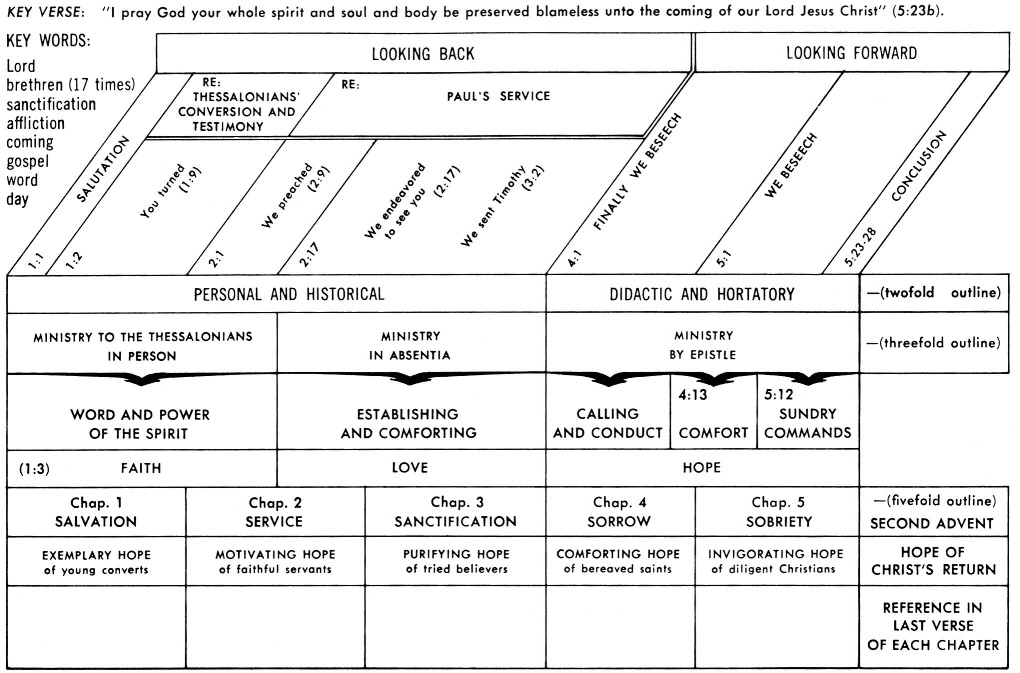
JESUS IS COMING AGAIN
Click chart to enlarge
Charts from Jensen's Survey of the NT - used by permission
Chart by Charles Swindoll
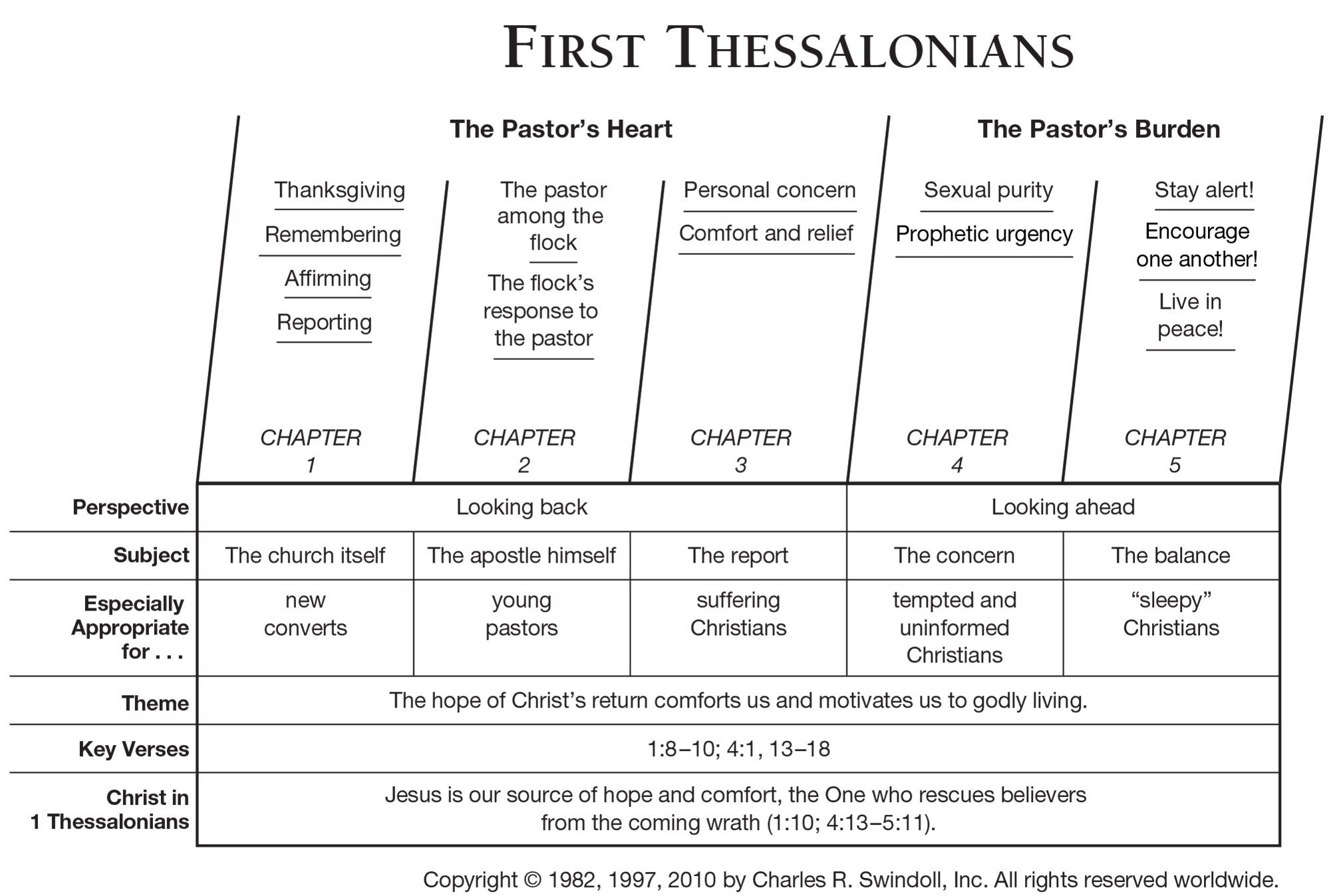
|
1 Thessalonians |
||||||
| 1 Th 1:1-10 | 1 Th 2:1-20 | 1 Th 3:1-13 | 1 Th 4:1-18 | 1 Th 5:1-28 | ||
|
LOOKING BACK |
LOOKING FORWARD |
|||||
|
Personal Reflections |
Practical Instructions |
|||||
| Ministry In Person |
Ministry in Absentia (Thru Timothy) |
Ministry by Epistle |
||||
| Word and Power of the Spirit |
Establishing & Comforting |
Calling & Conduct | 1Th 4:13ff Comfort |
1Th 5:12ff Commands |
||
| 1 Salvation |
2 Service |
3 Sanctification |
4 Sorrow |
5 Sobriety |
||
| Paul Commends Spiritual Growth |
Paul Founds the Church |
Strengthening of the Church |
Directions for Spiritual Growth |
Holy Living in Light of Day of the Lord | ||
| Exemplary Hope of Young Converts | Motivating Hope of Faithful Servants |
Purifying Hope of Tried Believers | Comforting Hope of Bereaved Saints | Invigorating Hope of Diligent Christians | ||
|
Written from Corinth |
||||||
1 Thessalonians 5:12 But we request of you, brethren, that you appreciate those who diligently labor among you, and have charge over you in the Lord and give you instruction, (NASB: Lockman)
Greek: Erotomen (1PPAI) de humas adelphoi, eidenai (RAN) tous kopiontas (PAPMPA) en humin kai proistamenous (PMPMPA) humon en kurio kai nouthetountas (PAPMPA) humas
Amplified: Now also we beseech you, brethren, get to know those who labor among you [recognize them for what they are, acknowledge and appreciate and respect them all]—your leaders who are over you in the Lord and those who warn and kindly reprove and exhort you. (Amplified Bible - Lockman)
KJV: And we beseech you, brethren, to know them which labour among you, and are over you in the Lord, and admonish you;
NLT: Dear brothers and sisters, honor those who are your leaders in the Lord's work. They work hard among you and warn you against all that is wrong. (NLT - Tyndale House)
Phillips: We ask you too, my brothers, to get to know those who work so hard among you. They are your spiritual leaders to keep you on the right path. (Phillips: Touchstone)
Wuest: Now, we request of you, brethren, that you recognize those for what they are and as entitled to the respect due them who work to the point of weariness among you and who are in authority over you in the Lord and admonish you,
Young's Literal: And we ask you, brethren, to know those labouring among you, and leading you in the Lord, and admonishing you,
BUT WE REQUEST OF YOU, BRETHREN THAT YOU APPRECIATE THOSE WHO DILIGENTLY LABOR AMONG YOU: Erotomen (1PPAI) de humas adelphoi, eidenai (RAN) tous kopiontas (PAPMPA) en humin:
- 1Co 16:18; Phil 2:19; He 13:7,17
- 1Th 2:9; Mt 9:37,38; Lk 10:1,2,7; Jn 4:38; Acts 20:35; 1Co 3:9; 15:10; 1Co 16:16; 2Co 5:9; 6:1; 11:23; Ga 4:11; Phil 2:16; Col 1:29; 1Ti 5:17,18; 2Ti 2:6; Re 2:3
- 1 Thessalonians 5 Resources
Now in 1Thessalonians 5:12-22 Paul gives general instructions for the church, a section Denney subtitles "Rulers and ruled".
Pastor Ray Stedman sounds a serious warning in his introduction to this next section…
I heard a man say, "The most important thing in learning to relate to others is personal honesty. Once you learn to fake that," he added, "everything else is easy!" Many people, unfortunately, seem to follow that philosophy. Perhaps one of the most discouraging aspects of modern-day living is not so much the moral collapse of leaders, such as we have seen many examples of recently, but the low level of ethical behavior on the part of many Christians.
I do not understand what has happened to the Christian community. Believers who go regularly to church, and profess to believe the Bible, often seem to go along with practices of the world around them with hardly any consciousness that what they are doing is unbiblical and really wrong. They lie without hesitation. They evade paying their bills. They cheat on their taxes. They ignore needy people. They fail to keep appointments. They freeload shamelessly. They lose their tempers. They grow critical and caustic. They desert their mates. If the Apostle Paul were here he would be very concerned about this. To him, the mark of true Christian faith is that it changes everything you do and say. It affects every area of your life. A Christian may no longer act as he did before he came to Christ. This is very clear in the letters of the apostle. Every letter that he wrote ends with pointed, practical applications to daily situations of the truth that he had set out.
The letter of First Thessalonians is no exception. The closing verses of Chapter 5, to which we now come, are wonderfully practical guidelines on how to live Christianly, in three areas of life. First, how to act toward the leaders of a church; we do not say much about this at Peninsula Bible Church, but it is part of the record of the New Testament. Then, how to live with other believers, whether at home, at work, or wherever. And finally, how to live toward God and respond to the situations where he puts you. (Living Christianly 1 Thess 5:12-28)
Request (2065)(erotao from éromai = ask, inquire) means to ask for, usually with implication of an underlying question. The verb does not carry the note of an authoritative command but rather that of a friend making an urgent appeal to a friend. The term suggests that those making the request stand in a position of familiarity with those being treated.
In MacArthur's comments on this verse, he explains that erotao is…
a verb that means “to plead,” “implore,” or even “to beg.” Instead of coming across as authoritarian, intolerant, or overbearing, Paul gently corrected those struggling under this error. (MacArthur, John: 1 & 2 Thessalonians. Moody Press)
Webster says that request conveys the expression of desire to some person for something to be granted or done.
Erotao as noted above in some context means to put a query to someone or to seek information, and so to ask, inquire, question (Mt 19:71, Lk 22:68, Jn 1:25, 8:7, 9:21, 16:19, 30.) It is often used of questions asked Jesus, but it is also used of intercessory prayer, e.g.,
If anyone sees his brother committing a sin not leading to death, he shall ask and God will for him give life to those who commit sin not leading to death. There is a sin leading to death; I do not say that he should make request for this. (1Jn 5:16)
Erotao provides the most delicate and tender expression for prayer or request with the one asking and the one being asked being on an equal level, such as the Lord Jesus asking of the Father. And thus in the gospel of John erotao is used several times by Jesus in His prayer to His Father for those who belong to Him…
John 14:16 “I will ask the Father, and He will give you another Helper, that He may be with you forever;
John 17:9 “I ask on their behalf; I do not ask on behalf of the world, but of those whom You have given Me; for they are Yours;
John 17:15 I do not ask You to take them out of the world, but to keep them from the evil one.
John 17:20 “I do not ask on behalf of these alone, but for those also who believe in Me through their word
NIDNTT writes that…erotao is found in classic Greek from Homer onwards in the sense of ask, ask a question (in Homer and the best codices of Herodotus as eirotao). Eperotao occurs in secular Gk. from Herodotus, meaning to consult a person or to put a question. Later Greek used it technically for putting a formal question at a meeting or in the process of making a contract. It may even mean to accept the terms of a treaty. In religious contexts both verbs can mean to put a question to an oracle or to a god (Hdt., 1, 53, 1 and often; Inscriptions of Magnesia on the Meander, ed. O. Kern, 1900, 17, 12 f., 26, 36; SIG III3 1160, 1163, 1165). The noun eperotema can mean a question put to another person, to someone in authority for a formal, binding answer (SIG 856, 6, 2nd cent. A.D.). In the papyri (2nd cent. A.D.) the noun and the verb are used of an agreement pledged in a contract (Moulton-Milligan, 231 f.). (Brown, Colin, Editor. New International Dictionary of NT Theology. 1986. Zondervan)
Ralph Earle writes that…The original meaning of erotao was "ask" in the sense of "ask a question." This is found not only in Homer but also in the papyri and nearly always in the Septuagint. It carries the same connotation regularly in the Gospels. But in the rest of the NT, except for Acts 1:6, its predominant meaning is "to request." Thus it becomes almost equivalent to aiteo. Greeven points out the slight difference thus: "In distinction from aiteo, which often suggests a claim or passion, erotao denotes a genuine request which is humble or courteous" (TDNT, 2:686). (Earle, R. Word Meanings in the New Testament)
Erotao - 61x in 63v in the NAS - Matt. 15:23; 16:13; 19:17; 21:24; Mk. 4:10; 7:26; 8:5; Lk. 4:38; 5:3; 7:3, 36; 8:37; 9:45; 11:37; 14:18, 19, 32; 16:27; 19:31; 20:3; 22:68; 23:3; Jn 1:19, 21, 25; 4:31, 40, 47; 5:12; 8:7; 9:2, 15, 19, 21; 12:21; 14:16; 16:5, 19, 23, 26, 30; 17:9, 15, 20; 18:19, 21; 19:31, 38; Acts 1:6; 3:3; 10:48; 16:39; 18:20; 23:18, 20; Phil 4:3; 1Th 4:1; 5:12; 2Th 2:1; 1Jn. 5:16; 2Jn. 1:5
The NAS renders erotao as ask(18), asked(13), asking(12), asks(3), beg(1), begging(1), made request(1), make request(1), please(2), question(6), questioned(2), request(4), requesting(3).
Erotao - 59x in the non-apocryphal Septuagint (LXX) where it has only the meaning ask, while “request” is expressed with aiteo - Ge 24:47, 57; 32:17, 29; 37:15; 40:7; 43:7, 27; 44:19; Exod. 3:13; 13:14; Deut. 6:20; 13:14; Jos. 4:6, 21; Jdg. 4:20; 13:6, 18; 18:5, 15; 20:18, 23; 1 Sam. 10:4; 19:22; 22:10, 13, 15; 23:4; 25:5, 8; 30:21; 2 Sam. 5:19; 8:10; 20:18; 1 Chr. 14:10, 14; 18:10; Ezr. 5:9f; Neh. 1:2; Job 21:29; 38:3; 40:7; 42:4; Ps. 35:11; 122:6; Isa. 41:28; 45:11; Jer. 6:16; 18:13; 23:33; 30:6; 36:17; 37:17; 38:14, 27; 48:19; 50:5; Dan. 2:10
Erotao is to be distinguished from another verb with similar meaning aiteo which Vine says…
more frequently suggests the attitude of a suppliant, the petition of one who is lesser in position than he to whom the petition is made; e.g., in the case of men in asking something from God, Mt. 7:7; a child from a parent, Mt. 7:9,10; a subject from a king, Acts 12:20; priests and people from Pilate, Lk 23:23 (Vine, W E: Vine's Complete Expository Dictionary of Old and New Testament Words. 1996. Nelson) (BDAG - aiteo = "to ask for, with a claim on receipt of an answer")
Brethren (80) (adelphos from collative a = denoting unity + delphús = womb) is literally one born from same womb and so a male having the same father and mother as reference person. Figuratively, adelphos as in this verse refers to a close associate of a group of persons having well-defined membership, specifically here referring to fellow believers in Christ who are united by the bond of affection.
Hiebert observes that…The solicitous tone indicates that the writers were aware that difficulties did exist in the Thessalonian church regarding the subject now being dealt with. It must be borne in mind that Timothy had just returned from Thessalonica and had given a detailed report of the situation in the church. Sound principles of guidance for their assembly relations are therefore now set forth. Instructions are given concerning their relations to their leaders (1Thes 5:12, 13) as well as their duties as a congregation toward faulty members (1Thes 5:14, 15). It seems obvious that some feelings of tension and misunderstanding had arisen between the members and their leaders. The members seemingly had not appreciated or rightly understood the nature and function of their leaders. (Hiebert, D. Edmond: 1 & 2 Thessalonians: BMH Book. 1996)
Appreciate (1492) (eido, oida - eido is used only in the perfect tense = oida) literally means perception by sight (perceive, see) as in Mt 2:2 where the wise men "saw His star". The meaning of eido is somewhat difficult to convey but in general this type of "knowing" is distinguished from ginosko (and epiginosko, epignosis), the other major NT word for knowing, because ginosko refers to knowledge obtained by experience or "experiential knowledge" whereas eido often refers to more intuitive knowledge, although the distinction is not always crystal clear.
Appreciate is not most accurate rendering of "eido" (to know) which in context is recognition of the vital function for which these leaders have been gifted. The idea is that the saints at Thessalonica need to come to know the worth of their leaders. They must not remain ignorant concerning them but by careful consideration come to a full understanding of their true character and diligent labor. The practical result of such acknowledgment will be cooperation with and submission to their nurturing admonishments.
Vincent writes that we are to…Recognise them for what they are, and as entitled to respect because of their office.
This does not mean simple face recognition, but that the people are to literally know those who labor among them (today this would refer especially to pastors and staff) well enough to have an intimate appreciation for them and to respect them because of their value.
Spurgeon explains this verse this way…You see, in the church of old they edified one another, but for all that they did not cast off God’s ordinance of Christian ministry. There was rule in the church then as there should be now; and the apostle, when he speaks of this individual edification, this mutual instruction, does not forget to notice those who were the pastors of the flock. He says, “Know them which labor among you and are over you in the Lord, and admonish you; and esteem them very highly in love for their work’s sake.”
Stedman writes that appreciate means …"know them." Recognize them. Be aware of them. Do not take them for granted. I know of churches where pastors are treated as hired servants; they are there to respond to the whims of the board of the church or the vote of the congregation. They are treated with little or no respect and at times are severely mistreated. That is a shame. Here the apostle is saying, "Get to know your leaders. Understand that they are people and do not ignore them." (Living Christianly 1 Thess 5:12-28)
Hiebert makes some interesting observations on this passage writing that…
Ministers are often urged, and rightly so, to "know" their members, but here the members are called upon to "know" their leaders. And surely much of the tension that at times develops between the pastors and members would be dissipated if the members would learn to know and appreciate the duties and ministries of their spiritual leaders. Such a recognition and appreciation of their spiritual leaders is "a purely spiritual exercise possible only to spiritual persons. Non-spiritual persons cannot recognize, and would not acknowledge, spiritual workers or their work.
Some scholars hold that the terminology indicates they are not ordained officers in the church but rather voluntary workers. Certainly the three present tense participles stress the work of these men rather than the dignity of the office, but that does not prove the Thessalonian church was still without duly appointed leaders.
From Acts 14:23 it is clear that it was Paul's practice to appoint elders in his recently established churches. And even if we accept the assertion of some, that the missionaries were driven out of Thessalonica before they had time to appoint elders over their converts, that does not prove that the church remained unorganized. Those who had been former attendants of the Jewish synagogue would be familiar with the basic organization of the synagogue and would thus know how to secure the needed leadership for the church. That the need for a definitely constituted leadership for the group would soon be felt is certain. That they remained without the needed organization and appointed leaders is highly improbable. If the church had not been properly organized and remained without qualified leaders, would not Timothy have attended to that need while he was there? This exhortation to the members takes it for granted that the ministerial overseeing of their leaders was an essential function in the church.
When this passage is combined with 2 Thessalonians 3:6-13, "it becomes plain that this was a community which had an accepted leadership and a pattern for enforcing conformity to the standards of the Christian community"6 But it is clear that their organization was simple, and thus nothing like the organized hierarchy operative in many churches today.
The plural "those" points to a plurality of elders in the church. This is in harmony with Paul's practice of establishing leaders for his churches (Acts 14:23). These men were naturally chosen from among their own numbers on the basis of their willingness and abilities. Since they apparently continued their secular employment for a livelihood, several would be chosen to work together in giving the needed overseeing and leadership to the group of believers.
The work of these leaders is set forth with three present tense participles, delineating their continuing activities. The use of participles instead of nouns of office presents these leaders as exercising specific ministerial functions rather than being given official status. (Ibid)
Diligently labor (2872) (kopiao [word study] from kopos = labor, fatigue) This root word kopos (see word study) is used in secular Greek of “a beating,” “weariness” (as though one had been beaten) and “exertion,” was the proper word for physical tiredness induced by work, exertion or heat. Kopiao was common used among the down-trodden masses of the Roman world. Kopiao means to to exhibit great effort and exertion, to the point of sweat and exhaustion (cp Paul's zeal to present all men complete in Christ! May we imitate his exhausting labor, knowing that His power mightily works within us. He is the ultimate power, and yet are called to toil even to the point of growing faint - see Col 1:29-note, cp 1Ti 4:10-note where Paul labors for godliness). Kopiao means to physically become worn out, weary or faint. To engage in hard work with the implication of difficulty and trouble. Kopiao speaks of intense toil even to the point of utter exhaustion if necessary (cp elders preaching and teaching 1Ti 5:17). The work described by kopiao was left one so weary it was as if the person had taken a beating (Paul calls Timothy and all disciples to this "backbreaking labor" [so to speak] in order to make disciples - 2Ti 2:6-note). Kopiao describes not so much the actual exertion as the weariness which follows the straining of all one's powers to the utmost.
Kopiao - 23x in 21v in the NAS diligently labor(1), grown weary(1), hard-working(1), labor(3), labored(4), labors(1),toil(4), wearied(1), weary(1), work hard(1), worked(2), worked hard(1), workers(1), working hard(1).- Matt. 6:28; 11:28; Lk. 5:5; 12:27; Jn. 4:6, 38; Acts 20:35; Rom. 16:6, 12; 1 Co. 4:12; 15:10; 16:16; Gal. 4:11; Eph. 4:28; Phil. 2:16; Col. 1:29; 1 Thess. 5:12; 1 Tim. 4:10; 5:17; 2 Tim. 2:6; Rev. 2:3
Stedman writes that those in leaders word hard…They spend hours toiling in difficult and sometimes demeaning work. Contrary to what some people think, it is not true that pastors work only one day a week. The ministry is a very demanding job. (Living Christianly 1 Thess 5:12-28)
Lightfoot says that kopiao "is used especially of the labor undergone by the athlete in his training. (cp Paul's use in 1Ti 4:10-note )
MacArthur adds that kopiao "does not stress the amount of work, but rather the effort. A man’s reward from God is proportional to the excellence of his ministry and the effort he puts into it. Excellence combined with diligence mark a man worthy of the highest honor. (MacArthur, John: 1Timothy Moody Press)
Henry Blackaby says that God will wear you out when you are in the center of His will and in fact Paul repeatedly uses kopiao to describe the quality of labor involved in ministering for the Lord. He is not referring to those who work hard at their job as in a field but those who perform the spiritual labor among the saints in the church in Thessalonica. A review of some of Paul's uses of kopiao in the NT gives one a good sense of why these workers were to be appreciated…
Acts 20:35 In everything I (Paul) showed you that by working hard in this manner you must help the weak and remember the words of the Lord Jesus, that He Himself said, 'It is more blessed to give than to receive.'
Romans 16:6 (note) Greet Mary, who has worked hard for you… 16:12 (note) Greet Tryphaena and Tryphosa, workers in the Lord. Greet Persis the beloved, who has worked hard in the Lord.
1 Corinthians 4:12 and we toil, working with our own hands; when we are reviled, we bless; when we are persecuted, we endure;
1 Corinthians 15:10 But by the grace of God I am what I am, and His grace toward me did not prove vain; but I labored even more than all of them, yet not I, but the grace of God with me. (Comment: Note the juxtaposition of human effort and God's grace. We are to work hard and yet it is God working in and through us and thus He alone receives the glory!)
Galatians 4:11 I fear for you, that perhaps I have labored over you in vain. (Comment: Paul fear that some might fall prey to the false teaching of the Judaizers who added works and legalism to salvation by faith alone.)
Philippians 2:16 (note) (The saints at Philippi were to keep) holding fast the word of life, so that in the day of Christ I may have cause to glory because I did not run in vain nor toil in vain.
Colossians 1:29 (note) And for this purpose (to present every man complete in Christ, a mature believer ever being conformed to the image of the Son) also I labor (kopiao), striving (agonizomai) (How?) according to His power, which mightily works (Greek = energeo ~ God's power, His grace, His Spirit, "energized" Paul) within me.
1Timotny 4:10 (note) For it is for this (with a view to the promise which godliness holds forth so that it might actually be fulfilled -- see note 1Ti 4:8) we labor (kopiao) and strive (agonizomai), because we have fixed our hope on the living God, Who is the Savior of all men, especially of believers.
1 Timothy 5:17 Let the elders who rule well be considered worthy of double honor, especially those who work hard at preaching and teaching.
2 Timothy 2:6 (note) The hard-working farmer ought to be the first to receive his share of the crops (karpos).
Hiebert comments that…Who work hard among you is broad enough to include various types of work and might in itself include Christian workers in the church who held no office of any kind. It might be allowed to involve any service to the church by any of its members. But the following two participles, linked to the preceding by "and," make it clear that their leaders are in view: those who "are over you in the Lord, and who admonish you." Their labors are in the realm of leadership and admonition. (Ibid)
Here is an illustration of a laborer among the fields of Africa…Henry C. Morrison was a little known hard worker in God's missionary fields, toiling some forty years in the difficult fields of Africa. As the story is told, he became sick and had to return home to America, and as providence would have it, the boat he returned on was also carrying a well known guest. As the great ocean liner docked in New York Harbor there was a great crowd gathered to greet President Teddy Roosevelt who received a grand welcome-home-party after his widely publicized African Safari. Resentment seized Henry Morrison, and he turned to God saying "I have come back home after all this time and service to the church and there is no one, not even one person here to welcome me home." Then a small voice came to Morrison reminding him "You're not home yet." Our ultimate harvest is yet future and our future reward is out of this world!
As sure as this future "appreciation" is here in Thessalonians God is calling for us to appreciate men like Henry Morrison in this life also.
AND HAVE CHARGE OVER YOU IN THE LORD AND GIVE YOU INSTRUCTION: kai proistamenous (PMPMPA) humon en kurio kai nouthetountas (PAPMPA) humas:
- Acts 20:28; 1Corinthians 12:28; Titus 1:5; Hebrews 13:7,17; 1Peter 5:2,3; Revelation 1:20; 2:1,8,12,18; 3:1,7,14
- 1Th 5:14; 1Timothy 5:1,20; Titus 1:3; 2:15)
- 1 Thessalonians 5 Resources
MacDonald comments that…
This verse is one of many in the NT that shows that there was no one-man rule in the apostolic churches. There was a group of elders in each congregation, pastoring the local flock. As Denney explains:
At Thessalonica there was not a single president, a minister in our sense, possessing to a certain extent an exclusive responsibility; the presidence was in the hands of a plurality of men.
However, the absence of one-man rule does not justify every-man rule. The assembly should not be a democracy, but an aristocracy, the rule of the best qualified. (MacDonald, W & Farstad, A. Believer's Bible Commentary: Thomas Nelson)
Have charge over (4291) (proistemi from pró = before, over + hístemi = put, place, stand) literally means those who are put or placed before you or over you. Proistemi has the basic meaning of “standing before” others and, hence, the idea of leadership. It describes one who presides over others, and exercises a position of leadership (rule, direct, be at the head of).
Rogers writes that proistemi has two possible meanings in this passage "either to preside, lead, direct or to protect , to care for. (Rogers, C L - originally by Fritz Rienecker: New Linguistic and Exegetical Key to the Greek New Testament. Zondervan. 1998)
In secular Greek proistemi was used in some context (not these ways in NT) meaning to put forward as a pretence or use as a screen. To stand before so as to guard.
Proistemi (as in this passage) also includes the idea of having an interest in, showing concern for, caring for or giving aid.
Hiebert adds that proistemi…literally means "standing before," hence to be at the head, to direct, to rule. It may denote informal leadership or management of any kind, but papyrus usage establishes that it can be used of various kinds of officials.' It points to the spiritual guidance these men are giving to the church, a recognized function of the elder. It combines the concepts of leading, protecting, and caring for.' (Ibid)
Vincent writes the use of proistemi refers…to any position involving superintendence. No special ecclesiastical office is meant.
The IVP Bible Background Commentary notes that proistemi was used "for those who “have charge” (NASB, NRSV) or “are over” (KJV, NIV) the Thessalonian Christians was especially applied in the Greco-Roman world to patrons (The social superior in the Roman patron-client relationship, who granted favors to and acted as political sponsor for his clients, or social dependents. The obligations in the relationship were viewed as reciprocal; clients were to grant the patrons honor as their benefactors), sponsors of clients ( A person socially dependent on a patron in Roman society) and religious associations. (Keener, Craig: The IVP Bible Background Commentary: New Testament. 1994. IVP)
Here are the 7 other NT uses of proistemi and is rendered -- engage in (2), have charge over(1), leads(1), manage(1), managers(1), manages(1), rule(1).
Romans 12:8 (note) or he who exhorts, in his exhortation; he who gives, with liberality; he who leads (stands on the first place), with diligence; he who shows mercy, with cheerfulness.
1 Timothy 3:4 He (overseer) must be one who manages (proistemi - to stand before, to rule over, to manage. Note that in the ancient Greek culture, the authority of the father was exceedingly great.) his own household well, keeping his children under control with all dignity 5 (but if a man does not know how to manage (proistemi) his own household, how will he take care of the church of God?)
1 Timothy 3:12 Let deacons be husbands of only one wife, and good managers of their children and their own households.
1 Timothy 5:17 Let the elders who rule well (Guthrie notes that the word means general superintendence and describes the duties allotted to all presbyters) be considered worthy of double honor, especially those who work hard at preaching and teaching.
Titus 3:8 (note) This is a trustworthy statement; and concerning these things I want you to speak confidently, so that those who have believed God may be careful to engage (here proistemi speaks of a responsible preoccupation with something. Take the lead in. Be careful to busy yourself with. The word also has a technical meaning - "to practice a profession") in good deeds. These things are good and profitable for men.
Titus 3:14 (note) And let our people also learn to engage (proistemi) in good deeds to meet pressing needs, that they may not be unfruitful.
There are 5 uses of proistemi in the non-apocryphal Septuagint - 2Sam. 13:17; Pr. 23:5; 26:17; Isa. 43:24; Amos 6:10
Stedman comments that…The English translators of the Scriptures were in a church that had a highly structured hierarchical leadership. Thus, many Scriptural references are translated in that direction. The phrase, "those who … are over you in the Lord," is not a good translation. It reflects a relationship that Scripture everywhere speaks against. Jesus said to his disciples, "do not be called Rabbi; for One is your Teacher, and you are all brothers." {Mt 23:8}. Christians are brothers. That is not practiced in very many places, unfortunately. What is really being said here in Thessalonica is, "respect those who labor among you and stand before you in the Lord." The apostle is referring to those who stand in front and lead the whole group. There is no suggestion of anyone being "over" others. Tradition has caused this proper translation to be lost sight of down through the years. It badly needs correction. What Paul is saying, therefore, is, "follow your leaders." (Living Christianly 1 Thess 5:12-28)
In the Lord - This phrase clearly identifies these men not as secular leaders (as one might think of leading men in the community) but as those who lead in connection with spiritual concerns in the sphere of the Lord -- as His appointees, under His authority, etc
Stedman comments that…Leaders have been appointed by the Lord Jesus, regardless of the human process by which they were chosen. That does not mean that they cannot be changed or that in the course of events they will not go someplace else. What it means is that when they are in leadership they are to be regarded as the Lord's men and the Lord's women. He has sent them among us. (Living Christianly 1 Thess 5:12-28)
Hiebert adds that…Their position does not stem from personal ambition but rather from their spiritual maturity. Their position of leadership in the church is based upon the recognized fact that both they and those being led are in the Lord. "His Lordship underlies their leadership." Their authority is not that of a formal ecclesiastical hierarchy but rather is "one exercised in the warmth of Christian bonds." (Ibid)
Give instruction (3560) (warning, cautioning, gently reproving, exhorting) (noutheteo [word study] from noús = mind + títhemi = place) literally means to place in the mind and so to warn or give notice to beforehand especially of danger or evil. The idea is to lay it on the mind or heart of the person, with the stress being on influencing not only the intellect, but also the will, emotions and disposition. The idea is to counsel about avoidance or cessation of an improper course of conduct. Noutheteo has the connotation of confronting with the intent of changing one’s attitudes and actions.
Noutheteo is in the present tense which indicating that these leaders were continually admonishing, warning, cautioning, etc. It often conveys an implication of blame attached or of calling attention to faults or defects. It follows that noutheteo speaks of the activity of reminding someone of what he has forgotten or is in danger of forgetting. It may involve a rebuke for wrongdoing as well as a warning to be on guard against wrongdoing. It directs an appeal to the conscience and will of one being admonished in order to stir him to watchfulness or obedience.
Noutheteo - 8x in 8v in the NAS - Acts 20:31; Rom. 15:14; 1 Co. 4:14; Col. 1:28; 3:16; 1 Thess. 5:12, 14; 2 Thess. 3:15 and is rendered in the NAS as admonish(5), admonishing(2), give instruction(1).
Morris remarks "While its tone is brotherly, it is big-brotherly
English dictionaries state that to admonish is to indicate duties or obligations to; to express warning or disapproval to especially in a gentle, earnest, or solicitous manner; to give friendly earnest advice or encouragement to; to reprove firmly but not harshly; to advise to do or against doing something; warn; caution.
Stedman writes that noutheteo…is literally, "to put in mind." They instruct and inspire you, reminding you of truth that is easily forgotten in these days. The only voice that is speaking powerfully against the spirit of the age, the self-centered, self-sufficient, restless spirit of the Me generation, is the voice of the church. We need to be reminded continually of the danger in that kind of philosophy. This is done by the leadership who instruct, warn, and point out folly. They help us to keep our feet on the right path. (Living Christianly 1 Thess 5:12-28)
Noutheteo describes "putting sense into someone’s head", alerting them of the serious consequences of their actions and does not mean being judgmental or critical in a superior manner but instead imparting a caring kind of warning against danger.
Vines writes that noutheteo "is used, (a) of instruction, (b) of warning. It is thus distinguished from paideuo, “to correct by discipline, to train by act,” He 12:6 (note); cf. Ep 6:4 (note). The difference between admonish and teach seems to be that, whereas the former has mainly in view the things that are wrong and call for warning, the latter has to do chiefly with the impartation of positive truth, cf. Col 3:16 (note); they were to let the Word of Christ dwell richly in them, so that they might be able (1) to teach and ‘admonish’ one another, and (2) to abound in the praises of God.Admonition differs from remonstrance, in that the former is warning based on instruction; the latter may be little more than expostulation. For example, though Eli remonstrated with his sons, 1Sa 2:24, he failed to admonish them, 1Sa 3:13, LXX. Pastors and teachers in the churches are thus themselves admonished, i.e., instructed and warned, by the Scriptures, 1 Cor. 10:11, so to minister the Word of God to the saints, that, naming the Name of the Lord, they shall depart from unrighteousness, 2Ti 2:19 (note).” (Vine, W E: Vine's Complete Expository Dictionary of Old and New Testament Words. 1996. Nelson)
Trench adds that the idea of noutheteo "is the training by word—by the word of encouragement, when this is sufficient, but also by that of remonstrance (an earnest presentation of reasons for opposition or grievance), of reproof, of blame, where these may be required; as set over against the training by act and by discipline, which is paideía."
Trench goes on to say that admonishing is a most needful element of Christian education. He says that noutheteo when the need calls for it can be earnest and even severe and is much more than a feeble remonstrance like the priest Eli gave to his worthless sons (1Sa 2:12).
Scripture records that
"Eli was very old and he heard all that his sons were doing to all Israel, and how they lay with the women who served at the doorway of the tent of meeting. And he said to them, "Why do you do such things, the evil things that I hear from all these people? No, my sons; for the report is not good which I hear the LORD'S people circulating. If one man sins against another, God will mediate for him; but if a man sins against the LORD, who can intercede for him?" But they would not listen to the voice of their father, for the LORD desired to put them to death." (1Sa 2:22, 23, 24, 25)
The results of Eli's failure to admonish are recorded in 1Sa 3:13
"For I have told him that I am about to judge his house forever for the iniquity which he knew, because his sons brought a curse on themselves and he did not rebuke (Greek Septuagint translates this Hebrew word with noutheteo) them."
Warning and admonishing is as critical for the leaders in the church as it was for Eli. Note that warning and teaching belong inseparably together, as the constant counterpart of knowledge and action.
Paul in his parting words to the Ephesian elders reminded them that
"from among your own selves men will arise, speaking perverse things, to draw away the disciples after them" and therefore they had to "be on the alert, remembering that night and day for a period of three years (note what Paul did for 3 years! Is this an active aspect of ministry in the modern day church?) I did not cease to admonish (noutheteo) each one with tears." (Acts 20:30, 31)
Note that in this passage Paul gives us a model to imitate when we admonish. In verse 31 Paul clearly demonstrates a spirit of humility ("with tears") Paul was not unsympathetic, mean-spirited, or callous with them, and neither should we be when we are called to admonish one another.
Richards adds that…admonishing is a ministry calling for much warmth and closeness. There is no hint of a distant judgmentalism or of criticism launched from some height of supposed superiority. Paul's admonitions were stimulated by a deep love for young believers. His love was so deep that his admonitions were often accompanied by tears. Paul does not see admonition as an exclusive prerogative of leaders. The members of the body of Christ at Rome were "competent to instruct [admonish] one another" (Ro 15:14-note), and all believers are called to exercise this ministry with one another (Col 3:16-note). When we love our brothers and sisters and have a genuine concern for their well-being, we can hardly hesitate to encourage them to live godly lives and thus bring glory to the Lord." (Richards, L O: Expository Dictionary of Bible Words: Regency)
Paul exhorted the Colossian saints to
Let the word of Christ richly dwell within you, with all wisdom teaching and admonishing one another… (see note Colossians 3:16)
When Christ's word is richly dwelling in God’s people they are wise and discerning and "enabled" to admonish one another.
Paul wrote to the Roman saints letting them know that he was
convinced that you yourselves are full of goodness, filled with all knowledge, and able also to admonish one another. (see note Romans 15:14)
In a note on the Romans 15:14 passage John MacArthur writes that noutheteo…is a comprehensive term for counseling. In this context, it refers to coming alongside other Christians for spiritual and moral counseling. Paul is not referring to a special gift of counseling, but of the duty and responsibility that every believer has for encouraging and strengthening other believers. Tragically, many Christians today have been convinced that competent counseling can only be accomplished by a person who is trained in the principles of secular psychology—despite the fact that the various schools of psychology are, for the most part, at extreme odds with God’s Word and frequently with each other. Although they may profess that “all Scripture is inspired by God and profitable for teaching, for reproof, for correction, for training in righteousness” (2Ti 3:16-note), many evangelicals—both those who give and those who receive counseling—do not rely on the full sufficiency of God’s Word… When God’s Word rules our hearts (cf Col 3:16-note), His Holy Spirit makes us “rich in the true wisdom” and prepares us to admonish one another, to “teach and help one another along the right road.” The place for Christians to counsel and be counseled is in the church. That is not, of course, to say that it must be done in a church building, but that it be Christian counseling Christian. That principle applies to general admonitions among fellow believers, as Paul mentions in this text, as well as to counseling regarding more serious and prolonged problems confronted by a biblically oriented and spiritually gifted Christian minister." (MacArthur, J: Romans 9-16. Chicago: Moody Press) (bolding added, reference links added)
Paul considered himself a spiritual father to the local churches, and it was his duty to warn his children --
"I do not write these things to shame you, but to admonish you as my beloved children" (1Corinthians 4:14)
Children who are not warned can get in a lot of trouble! Using the noun form (nouthesia) Paul instructs fathers, writing…
"And, fathers, do not provoke your children to anger; but bring them up in the discipline and instruction (nouthesia) of the Lord." (Ep 6:4-note)
THOUGHT - Fathers, are you warning your children? It is critical for their well being in a amoral society which has run amuck and scoffs at the life giving Biblical principles like this one in Ephesians!
In admonishment there is a moral emphasis, in teaching a doctrinal emphasis.
The Wycliffe Bible commentary says that "The ‘doctor of souls’ has a warning and teaching ministry, not self-centered but patient-centered."
Guzik has a practical comment on admonishing noting that "The work of warning - or helping to impart understanding - was a passion for Paul in ministry (Acts 20:31). It is also the job of church leaders (1Thes 5:12) and of the church body in general (Col 3:16), providing that they are able to admonish others (Ro 15:14).
In sum Paul gives a three fold description of the spiritual leaders at Thessalonica --
(1) They are laboring to the point of exhaustion
(2) They are "overseeing" or more literally standing before the flock to lead them (in the way of righteousness)
(3) They are admonishing (almost certainly in the truths of God’s Word).
The writer of Hebrews also calls on the saints to acknowledge their leaders exhorting them to
Remember those who led you, who spoke the word of God to you; and considering the result of their conduct, imitate their faith. (He 13:7-note; He 13:17-note)
Obey your leaders, and submit to them; for they keep watch over your souls, as those who will give an account. Let them do this with joy and not with grief, for this would be unprofitable for you. (He 13:17-note)
1Thessalonians 5:13 and that you esteem them very highly in love because of their work. Live in peace with one another. (NASB: Lockman)
Greek: kai egeisthai (PMN) autous huperekperissou en agape dia to ergon auton. eireneuete (2PPAM) en heautois
Amplified: And hold them in very high and most affectionate esteem in [intelligent and sympathetic] appreciation of their work. Be at peace among yourselves. (Amplified Bible - Lockman)
NLT: Think highly of them and give them your wholehearted love because of their work. And remember to live peaceably with each other. (NLT - Tyndale House)
Phillips: and our instruction to this end is to reprimand the unruly, encourage the timid, help the weak and be very patient with all men. (Phillips: Touchstone)
Wuest: and be esteeming them most highly with a divine and self-sacrificial love because of their work. Be constantly at peace among yourselves.
Young's Literal: and to esteem them very abundantly in love, because of their work; be at peace among yourselves
AND THAT YOU ESTEEM THEM VERY HIGHLY IN LOVE BECAUSE OF THEIR WORK: kai egeisthai (PMN) autous huperekperissou en agape dia to ergon auton:
- Matthew 10:40; 1Corinthians 4:1,2; 9:7, 8, 9, 10, 11; Galatians 4:14; 6:6
- 1 Thessalonians 5 Resources
In addition to knowing those who work among them, those who benefit from their leaders are to think rightly and lovingly of them, not because of their charm or personality, but because of the fact that they work for the Chief Shepherd as His servants. (1Pe 6:1-3-note; 1Pe 5:4-note)
"Hold them in the highest regard in love"
Esteem (2233) (hegeomai [word study] from ágo = to lead) has two basic meanings in the NT. One is to lead as one would do in a supervisory capacity as when describing men in any leading position - ruler, leader, governor (Ac 7:10) and stands opposite of a diakonos or servant in (Lk 22:26). In the apocryphal writings hegeomai was used of military commanders. It was also used to describe leaders of religious bodies, both pagan and Christian (latter in Heb 13:7, 17, 24, "leading men" in Acts 15:22, "chief speaker" in Acts 14:12). In secular Greek hegeomai was used to describe the pagan god Hermes as "the leader of the word"
The second meaning means to engage in an intellectual process (Here in 1Th 5:13, 2Co 9:5, Php 2:25, Php 3:8, 2Pe 1:13. In this latter sense, hegeomai conveys the picture of leading out (note the root verb of origin = ago = to lead) before the mind, and thus to regard, esteem, count, reckon. This latter meaning is found in the present verse. In this sense, hegeomai pictures one giving careful thought to something and not making a quick decision. The picture is that of one leading his or her mind through a reasoning process to arrive at a conclusion.
In the present context Paul is calling for saints to make a conscious judgment of their leaders after deliberate weighing of the facts (eg, their diligent labor even to the point of exhaustion among the saints). The present tense calls for the flock to continually regard their leaders and in context to regard them in a good light, even "beyond measure!
Beloved, how do you regard those who have charge over your souls?
A T Robertson has an interesting comment writing that Paul is saying we are to…Get acquainted with them and esteem the leaders. The idlers in Thessalonica had evidently refused to follow their leaders in church activities. We need wise leadership today, but still more wise following. An army of captains and colonels never won a battle.
Very highly (4057) (huperekperissou from huper = above + ek = intensifies meaning, adding idea of exhaustlessness + perissos = exceeding some number or measure, over and above, more than necessary) means more than, out of bounds, overflowing all bounds, surpassing, superabundantly, surpassingly, beyond measure, exceedingly, quite beyond all measure, overwhelming, over and above, more than enough. It describes an extraordinary degree, involving a considerable excess over what would be expected.
F F Bruce said that here we encounter another "one of Paul’s coined ‘super-superlatives'".
Vincent writes that this is…One of the numerous compounds of huper - beyond, over and above, of which Paul is fond. Of 28 words compounded with this preposition in the New Testament, Paul alone uses 20.
Paul used this same word earlier describing their (Paul, Silas, Timothy) prayers for the Thessalonians…
For what thanks can we render to God for you in return for all the joy with which we rejoice before our God on your account, 10 as we night and day keep praying most earnestly (huperekperissou) that we may see your face, and may complete what is lacking in your faith? (1Th 3:9, 10-note)
Huperekperissou is the the highest form of comparison imaginable and so means immeasurably more than, quite beyond all measure, infinitely more than
Now to Him who is able to do far more abundantly beyond all that we ask or think, according to the power that works within us (1Ep 3:20-note)
Morris writes that "There are various ways of expressing the thought of abundance, and this double compound is probably the most emphatic of all.
Vincent writes that…Their esteem for their superintendents is not to rest only on personal attachment or respect for their position, but on intelligent and sympathetic appreciation of their work. It is a good and much-needed lesson for the modern congregation no less than for the Thessalonian church
In love - In the sphere or "atmosphere" of unconditional, giving love (see study of agape), as is seen in Spirit filled believers.
Hiebert adds that…Whenever love does not dominate, the admonitions of the leaders, however much they may he deserved by the members, will always tend to provoke resentment against those giving the admonition. If they are to have cordial relations between leaders and members, love must prevail. When they have genuine love they will not merely tolerate the admonitions of their leaders but will graciously accept them. (Ibid)
J Vernon McGee for years did the Thru the Bible radio broadcast diligently laboring among the saints to encourage, edify, admonish, etc. Regarding this verse he wrote…I have always appreciated people who love the Word of God because I have found that they become my friends. One of the things I have so appreciated about my radio ministry is the number of friends that God has raised up for me across this country. Many of them have written to say their home is open to me (of course, I can’t accept all those invitations), but when I am in their town, they do nice things for me. They reveal their love. When they reveal that love to me—and I’m hard to love—it reveals that they honor the Word of God since I teach the Word of God (McGee, J V: Thru the Bible Commentary: Thomas Nelson)
Because of their work - This is the reason the leaders are to be esteemed very highly in love. Their work is kingdom work, the Lord's work, and this calls for appropriate esteem for the leaders in regard to the intrinsic value of their efforts.
Stedman adds that esteem them very highly means we are to…Value them, in other words. Understand that though they may have their own personal idiosyncrasies that may be hard to handle on occasion (we all have those), recognize that their work is important and they should be highly esteemed for that reason.One of the ways in which the church through the centuries has tried to do this is by giving their leaders rather high-sounding titles. They often do not pay them much, but they give them a nice title, like bishop, reverend, or some other high-sounding word. But Paul is not talking about that. I have always appreciated the fact that during the 37-1/2 years that I have been here I have been called "Ray." Not Dr. Ray or even Brother Ray (I don't like that), but just Ray. I notice in the New Testament that the early church leaders, even these mighty apostles of our Lord, were all called by their first names. We find references such as "Paul answered, etc." They are not St. Peter or the Apostle John. There are references to "Peter and John." This was the way they were recognized. It is most appropriate that we call leaders by their real names and not try to glorify them by some high-sounding title. To "esteem them very highly," is not only to regard leaders as valuable but also to express that esteem in a practical manner. This is why Paul wrote to Timothy, "If an elder rules well [actually leads well], he is worthy of double honor." (1Ti 5:17) The apostle meant that the leader should be paid twice as much salary! A double honorarium is the idea. I want to bear testimony to the fact that this church is an outstanding example in that regard. I have been here for 37 years and I have no complaints whatsoever about the way the congregation and the leadership of this church have treated me and my family. Our needs have been fully met. Every pastor of this church could say the same. You have been outstanding in this respect. I want to express a public word of gratitude for that. (Living Christianly 1 Thess 5:12-28)
LIVE IN PEACE WITH ONE ANOTHER: eireneuete (2PPAM) en heautois:
- Genesis 45:24; Ps 133:1; Mark 9:50; Luke 7:3, 4, 5; John 13:34,35; 15:17; Romans 4:17, 18, 19; 2Corinthians 13:11; Galatians 5:22; Ephesians 4:3; Colossians 3:15; 2Thessalonians 3:16; 2Timothy 2:22; Hebrews 12:14; Jas 3:18
- 1 Thessalonians 5 Resources
The saints at Thessalonica were to submit to their leadership so that “peace” prevailed, instead of introducing divisions and disorder by insubordination or carping.
Live at peace (1514) (eireneuo from = eirene [word study] from verb eiro = to join or bind together that which has been separated) literally pictures the binding or joining together again of that which had been separated or divided and thus setting at one again, a meaning convey by the common expression of one “having it all together”. It follows that living at peace is the opposite of division or dissension. Living at peace as a state of concord and harmony is the opposite of war. To live at peace brings about a state of freedom from disturbance, whether outwardly, as of a nation from war or enemies or inwardly, as in the current context, within the congregation of saints. When saints are living at peace the implication is that there is spiritual health, well-being, and prosperity. Peace contrasts with strife and thus denotes the absence or end of strife.
The present imperative is not a suggestion but a command for this to be their lifestyle. (See discussion of the Need for the Holy Spirit to obey NT commands or "How to Keep All 1642 Commandments in the New Testament!") Why a lifestyle? I know my heart and it is no different than the Thessalonian believers. And therefore all believers have an inherent "spiritual entropy" that resides in our residual evil flesh, and instead of peace and concord and harmony, there is a tendency to gravitate toward "war", discord, and disharmony. This tendency is countered as we continually partake of God's amazing grace (e.g., Ro 6:11, 12, 13, 14-see notes Ro 6:11;12; 13; 14) and the empowerment (and fruit bearing) of His Spirit (Ga 5:16, 17, 22, 25, 26-see notes Ga 5:16; 17; 22; 25; 26). The believer's mindset is to be one of continual, complete dependence on (and yielding to) God's Spirit Who alone make possible the supernatural behavior of living at peace with one another. When we do conduct ourselves in such a manner worthy of the Lord, He is greatly glorified and the Light of the Gospel is made attractive to the lost world which dwells in spiritual darkness.
So the call is not to make peace but to continually maintain the peace. Hiebert adds that this is…a compliment to them, implying that their peaceful relations had not been broken. Let them continue. The use of the imperative form, rather than the indicative, as in Th 5:12, stresses the importance of this point. (Ibid)
Why is this command necessary and so important? MacDonald observes that…The exhortation “be at peace among yourselves” is no incidental insertion. The number one problem among Christians everywhere is the problem of getting along with each other. Every believer has enough of the flesh in him to divide and wreck any local church. Only as empowered by the Spirit can we develop the love, brokenness, forbearance, kindness, tender-heartedness, and forgiveness that are indispensable for peace. A particular threat to peace which Paul may be warning against is the formation of cliques around human leaders. (MacDonald, W & Farstad, A. Believer's Bible Commentary: Thomas Nelson)
Keathley adds that God gives…a harvest of peace when believers sow and water their minds with the Word. But Satan, the agent of disunity and strife, seeks to sow fear and anger in order to reap a harvest of discord through hurt feelings, failure to forgive, and selfish ambition. This happens when Christians refuse to operate on the principles and promises of the Word. (Grace and Peace)