1 Thes 5:2
1 Thes 5:3
1 Thes 5:4
1 Thes 5:5
1 Thes 5:6
1 Thes 5:7
1 Thes 5:8
1 Thes 5:9
1 Thes 5:10
1 Thes 5:11
1 Thes 5:12
1 Thes 5:13
1 Thes 5:14
1 Thes 5:15
1 Thes 5:16
1 Thes 5:17
1 Thes 5:18
1 Thes 5:19
1 Thes 5:20
1 Thes 5:21
1 Thes 5:22
1 Thes 5:23
1 Thes 5:24
1 Thes 5:25
1 Thes 5:26
1 Thes 5:27
1 Thes 5:28
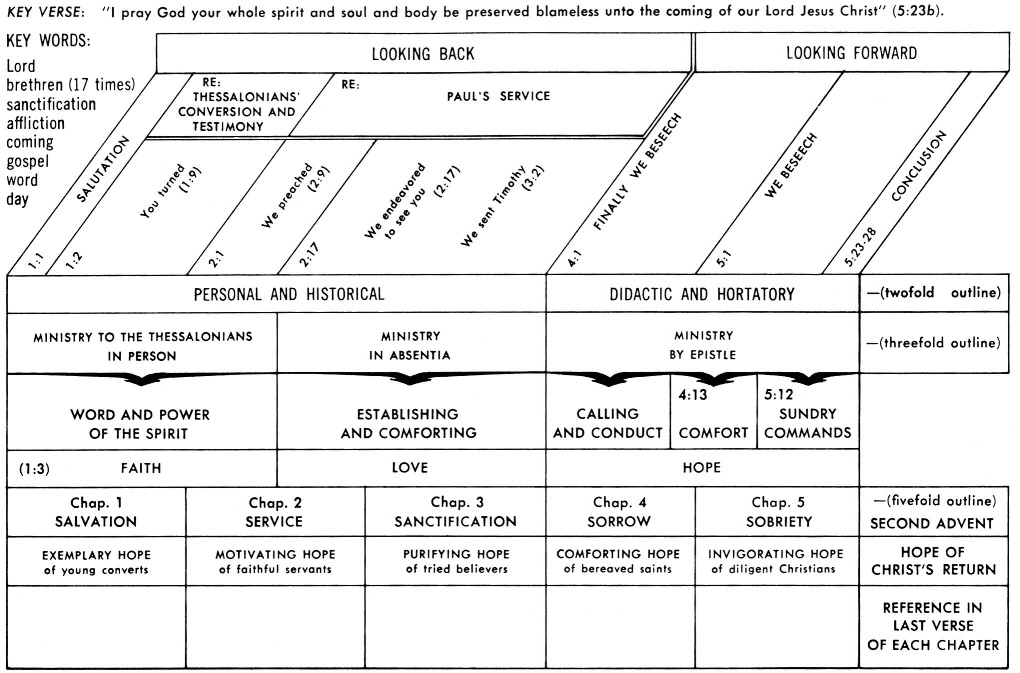
JESUS IS COMING AGAIN
Click chart to enlarge
Charts from Jensen's Survey of the NT - used by permission
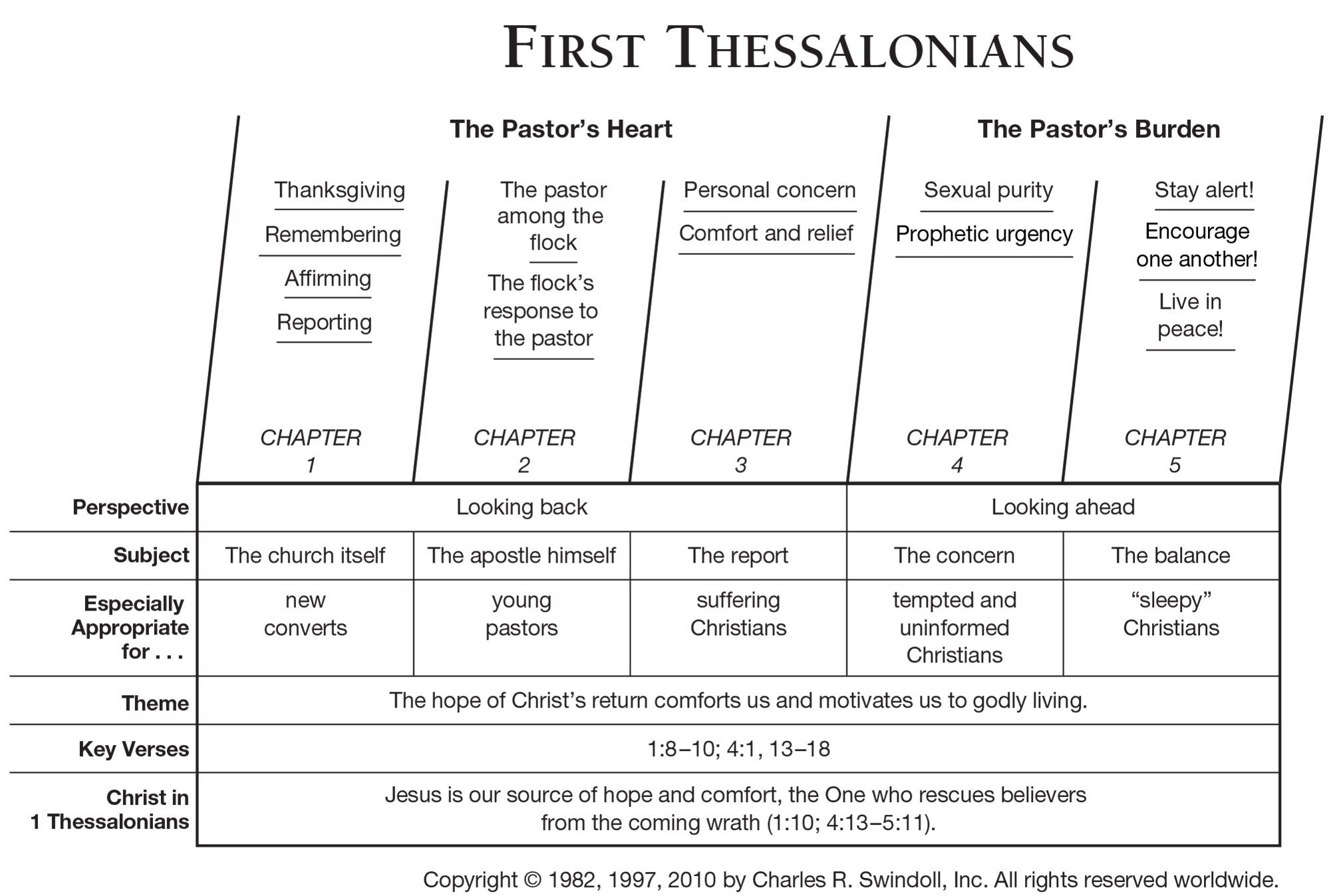
Chart by Charles Swindoll
|
1 Thessalonians |
||||||
| 1 Th 1:1-10 | 1 Th 2:1-20 | 1 Th 3:1-13 | 1 Th 4:1-18 | 1 Th 5:1-28 | ||
|
LOOKING BACK |
LOOKING FORWARD |
|||||
|
Personal Reflections |
Practical Instructions |
|||||
| Ministry In Person |
Ministry in Absentia (Thru Timothy) |
Ministry by Epistle |
||||
| Word and Power of the Spirit |
Establishing & Comforting |
Calling & Conduct | 1Th 4:13ff Comfort |
1Th 5:12ff Commands |
||
| 1 Salvation |
2 Service |
3 Sanctification |
4 Sorrow |
5 Sobriety |
||
| Paul Commends Spiritual Growth |
Paul Founds the Church |
Strengthening of the Church |
Directions for Spiritual Growth |
Holy Living in Light of Day of the Lord | ||
| Exemplary Hope of Young Converts | Motivating Hope of Faithful Servants |
Purifying Hope of Tried Believers | Comforting Hope of Bereaved Saints | Invigorating Hope of Diligent Christians | ||
|
Written from Corinth |
||||||
1 Thessalonians 5:14 We urge you, brethren, admonish the unruly, encourage the fainthearted, help the weak, be patient with everyone. (NASB: Lockman)
Greek: parakaloumen (1PPAI) de humas, adelphoi, noutheteite (2PPAM) tous ataktous, paramutheisthe (2PPMM) tous oligopsuchous, antechesthe (2PPMM) ton asthenon, makrothumeite (2PPAM) pros pantas
Amplified: And we earnestly beseech you, brethren, admonish (warn and seriously advise) those who are out of line [the loafers, the disorderly, and the unruly]; encourage the timid and fainthearted, help and give your support to the weak souls, [and] be very patient with everybody [always keeping your temper]. (Amplified Bible - Lockman)
Milligan: Further we call upon you, Brothers, to warn those who are neglecting their proper duties. Let the despondent be encouraged, and those who are still weak in faith be upheld. Cherish a spirit of forbearance towards all men (St Paul's Epistles to the Thessalonians)
NLT: Brothers and sisters, we urge you to warn those who are lazy. Encourage those who are timid. Take tender care of those who are weak. Be patient with everyone. (NLT - Tyndale House)
Phillips: and our instruction to this end is to reprimand the unruly, encourage the timid, help the weak and be very patient with all men. (Phillips: Touchstone)
Wuest: Now, we beg of you, please, brethren, be admonishing those who are rebellious, be encouraging the fainthearted, be a mainstay to those who are [spiritually] weak, be always patient toward all with that patience which endures ill-treatment meekly and without retaliation.
Young's Literal: and we exhort you, brethren, admonish the disorderly, comfort the feeble-minded, support the infirm, be patient unto all
AND WE URGE YOU, BRETHREN, ADMONISH THE UNRULY: parakaloumen (1PPAI) de humas, adelphoi, noutheteite (2PPAM) tous ataktous:
- Urge - Romans 12:1
- Admonish - Jeremiah 6:12; Ezekiel 3:17-21; 33:3,-9; Acts 20:27,31; 1Cor 4:14; Col 1:28
- The unruly - Titus 1:6,10 2 Th 3:11-13
- 1 Thessalonians 5 Resources - Multiple Sermons and Commentaries
A GENTLE URGING
TO ADMONISH
Paul would frequently issue exhortations after teaching doctrine, a good pattern for all preachers to emulate…
Ro 12:1 I urge you therefore (based on the doctrine in Ro 1-11!), brethren, by the mercies of God, to present your bodies a living and holy sacrifice, acceptable to God, which is your spiritual service of worship.
And we urge you brethren - Paul is introducing a new series of exhortations, as he is concerned that the church deal effectively with three "groups" of members whose attitudes and action needed attention - the idle, the timid and the weak. Specific behavior is called for in interacting with each of these groups of people. In each case the verbs (except the first verb urge) are in the present imperative which is a command to carry these out as a perpetual duty (empowered by grace and strengthened with the Spirit of course!).
Milligan writes that here we encounter…
A fresh series of instructions still addressed like the preceding to the whole company of believers, and calling upon the (stronger) ‘brethren’ to extend their aid towards those who are ‘weak.’ (1 Thessalonians 5:14-15 Commentary)
FYI
NOTE
Verbs in red on this site are commands, yellow highlighting indicates there is an in depth study of the Greek word. 1Thessalonians 5:14 has 4 present imperatives (commands to make these actions our lifestyle) which means the believer has four "opportunities" to depend on the enabling supernatural power of the Holy Spirit to fulfill these supernatural attitudes/actions! In short, every command in Scripture (all 880 present imperatives and 762 aorist imperatives!) necessitates that the believer jettison self-reliance, surrender to the Spirit, and rely wholly on His Holy enabling power. We don't just need help from the Helper (help implies we have innate natural ability to carry out the commands and just need a little "push" - but see Jn 15:5 where "nothing" means absolutely nothing!), but we need Him to give us both the desire and the power to carry out the commands (Php 2:13NLT-note). The Christian life is not just let go and let God, for that popular saying greatly deemphasizes the believer's responsibility to act. Yes, it is 100% our responsibility (Php 2:12-note), but it is 100% His enablement (Php 2:13NLT-note)! Is this "human-divine synergism" mysterious? Yes, but it is the Scriptural way to live the supernatural life we were called to live for His glory (Mt 5:16-note). Only a supernatural life gives proof to the lost world of the invisible Supernatural God, our Father Who art in heaven.
Hiebert comments that…
There is some question as to whether this series of precepts is addressed to the church as a whole or to the leaders in particular. Lightfoot notes that the Greek commentators regarded them as addressed to the presbyters, but he holds that "there is nothing in the form of the sentence to indicate this restriction.' The use of the address, "brothers," which would otherwise here have an unusual restriction in its scope, and the similarity of the introductory words with those in 1Th 5:12, support the view that the whole church is addressed. Dealing with faulty church members is admittedly in a special measure the responsibility of the leaders, but it is not confined to them. All believers must be ready to minister to the needy as here indicated. Hogg and Vine remark, "There is no hard and fast line drawn between the elders and the people."' The opening formula, "Now we urge you, brothers," introduces a fresh series of exhortations. The verb "urge" conveys the thought of "entreat" or "request" and denotes persuasion with a sense of authority. Paul is concerned that those members whose actions and attitudes needed attention were effectively dealt with. They are urged to work with various individuals who need help (1Th 5:14) as well as to promote proper relations with others (1Th 5:15). (D Edmond Hiebert -1 Thessalonians Commentary)
Urge (3870) (parakaleo [word study] from para = side of, alongside, beside + kaleo [ word study] = call) means literally to call one alongside, to call someone to oneself, to call for, to summon. Parakaleo can include the idea of giving help or aid but the primary sense in the NT is to urge someone to take some action, especially some ethical course of action. Sometimes the word means convey the idea of comfort, sometimes of exhortation but always at the root there is the idea of enabling a person to meet some difficult situation with confidence and with gallantry.
Kent Hughes illustrates the root idea of parakaleo "to come alongside and encourage" with the following example
I see this exemplified every time my church has a roller skating party, and the parents put their little ones on skates for the first time. Mom and Dad skate with their child, holding on to his or her hands, sometimes with the child’s feet on the ground and sometimes in the air. But all the time the parents are alongside encouraging… [exhortation] is a wonderful gift, and we are to place it at Christ’s feet and be willing to be worn out in its use.
Related Resource:
- Encourage one another - Study the "one anothers" - most positive, some negative
Admonish (warn) (3560)(noutheteo [word study] from noús = mind + títhemi = place) literally means to place in the mind, training by word and hence to give instruction, to warn or to give notice beforehand especially of danger or evil. The idea is to lay it on the mind or heart of the person, with the stress being on influencing not only the intellect, but also the will, emotions and disposition. The idea is to counsel about avoidance or cessation of an improper course of conduct.
Noutheteo describes "putting sense into someone’s head", alerting them of the serious consequences of their actions and does not mean being judgmental or critical in a superior manner but instead imparting a caring kind of warning against danger. Admonishing calls for disapproval of their present conduct while at the same time urging them to mend their ways. In other words, this group of idle or unruly believer's daily conduct must be corrected even while it is being disapproved (cp Eph 4:29-note).
Noutheteo - 8x in 8v - Acts 20:31; Ro 15:14; 1Cor 4:14; Col 1:28; 3:16; 1Th 5:12, 14; 2Th 3:15
Vine notes that …
The difference between “admonish” and “teach” seems to be that whereas the former has mainly in view the things that are wrong and call for warning, the latter has to do chiefly with the impartation of positive truth, cp. Colossians 3:16-note (they were to let the word of Christ dwell richly in them so that they might be able, [1] to teach and admonish one another, and, [2] to abound in the praises of God), and 2Th 3:15.
Admonition differs from remonstrance (Pressing suggestions in opposition to a measure or act) in that the former is warning based on instruction; the latter may be little more than expostulation (reasoning earnestly with a person for purposes of dissuasion). For example, though Eli remonstrated with his sons, 1Sa 2:24, he failed to admonish them, 1Sa 3:13, (noutheteo is used to translate the Hebrew "rebuke" in the Septuagint). Pastors and teachers in the churches are thus themselves admonished, i.e., instructed and warned, by the Scriptures, 1 Corinthians 10:11, so to minister the Word of God to the saints that, naming the Name of the Lord, they shall depart from unrighteousness, 2Timothy 2:19-note. (Vine, W. Collected writings of W. E. Vine. Nashville: Thomas Nelson or Logos)
Brethren (80) (adelphos from collative a = denoting unity + delphús = womb) is literally one born from same womb and so a male having the same father and mother as reference person. Figuratively, adelphos as used in this verse refers to a close associate of a group of persons having well-defined membership, and specifically refers to fellow believers in Christ (not just to the church leaders as discussed above) who are united by the bond of peace (Eph 4:3b-note), a bond of unity (Col 3:14b-note).
Admonish the unruly - Those who are "out of step" with the rest of the crowd.
All believers are called to bear (present imperative = not a suggestion, but a command to make this our everyday practice to bear) one another's burdens (Gal 6:2), to "save (present imperative = a command, not a suggestion) others, snatching them out of the fire; and on some have mercy (present imperative = a command, not a suggestion) with fear, hating even the garment polluted by the flesh" (Jude 1:23), "If anyone sees his brother committing a sin not leading to death, he shall ask and God will for him give life to those who commit sin not leading to death" (1Jn 5:16), "if any among you strays from the truth, and one turns him back,
let him know that he who turns a sinner from the error of his way will save his soul from death, and will cover a multitude of sins," (James 5:19-20), in short to be watchmen on the wall as God instructed Ezekiel…
Son of man, I have appointed you a watchman to the house of Israel; whenever you hear a word from My mouth, warn them from Me. 18 “When I say to the wicked, ‘You shall surely die’; and you do not warn him or speak out to warn the wicked from his wicked way that he may live, that wicked man shall die in his iniquity, but his blood I will require at your hand.19 “Yet if you have warned the wicked, and he does not turn from his wickedness or from his wicked way, he shall die in his iniquity; but you have delivered yourself. 20 “Again, when a righteous man turns away from his righteousness and commits iniquity, and I place an obstacle before him, he shall die; since you have not warned him, he shall die in his sin, and his righteous deeds which he has done shall not be remembered; but his blood I will require at your hand. 21 “However, if you have warned the righteous man that the righteous should not sin, and he does not sin, he shall surely live because he took warning; and you have delivered yourself.” (Ezekiel 3:17-21)
Unruly (813)(ataktos from a = without, not + tasso = to set in order, arrange) is an adjective which means out of line, out of place, disorderly, unruly insubordinate, lazy, idle, acting in defiance of good order. Ataktos is one who is out of step and going his own way, like a soldier who breaks rank or an army that advances in disarray. It can also convey the sense of being without socially recognized constraint and thus undisciplined. In the papyri, the cognate verb is used with the meaning "to be idle."'
Contrast eutaktos which means literally good order (used in the Septuagint to describe the locusts who "go out in ranks [good order]" - Pr 30: 27).
In one early Christian writing ataktos was used to describe those holding religious services without regard to established times, apparently without respect for established custom or received instruction.
In secular Greek writing (The Problems of Labour Relations in Roman Law) ataktos described irresponsible behavior such as freeloading or sponging (e.g., On contractual obligations in the Roman world).
This is the only use of ataktos in the Scripture (not in Lxx).
Ataktos in secular Greek was primarily a military term describing a soldier out of step or an army moving in disarray and not in battle order. Then it was applied to those who quit the ranks and did not perform their duty. More generally ataktos speaks of whatever is out of order and came to mean disorderly or irregular living of any kind." In the Greek papyri, the cognate verb (atakteo) is used with the meaning "to be idle" or to neglect one's duties.
When the Greeks wanted to make a word mean the opposite to what it meant originally, they placed the letter Alpha as its first letter (a = without + tasso = set in order). Thus atakteō refers to soldiers marching out of order or quitting the ranks, thus being disorderly. The word therefore means “deviating from the prescribed order or rule.” Its original meaning was that of riot or rebellion. The word is found only in the Thessalonian epistles, in its verb form in 2Th 3:7, as an adjective in 1Th 5:14 and as an adverb in 2Th 3:6, 11.
The NIV paraphrases these individuals as "idlers" implying that they are those who could work but refused to do so (I have a 27 you daughter who fits this category!) Another apropos word would be "loafers"! Apparently they were neglecting their daily tasks and thus were out of order or out of place compared to the rest of the church.
Vine adds that…
An insubordinate spirit manifests itself in different ways, of which two, idleness and officiousness, are specified, 2Thes 3:11, and a third, excitability, is suggested by the word “quietness” in 1Th 5:12-note. This disorderliness was, probably, the failure of the more energetic among the converts. But refusal to submit to rule is evidence of weakness, not of strength. Moreover, it involves disobedience to the direct command of God, that believers are to “also be in subjection to such men and to everyone who helps in the work and labors.” (1Co 16:16)
Discipline is necessary to order, taxis, with which ataktos is connected, lit., “rank keeping,” and order in the church is the evidence of the submission of all to the Holy Spirit, 1Cor 14:40, cp. 2Ti 1:7-note. Without rulers no church is properly constituted, cp. Acts 20:17; Php 1:1-note, et al., without godly rule no church can prosper, and without godly submission to rule no church can maintain effectual fellowship or be efficient in service. Hence the elders are urged not to shirk the responsibility of admonishing those who fail in this respect, lest godly order, Col 2:5-note, should be vainly sacrificed in the interests of false peace.
On the other hand, admonition can only be effective when it expresses the judgment, and commands the consciences, of the saints generally. Authority is not sufficient, self-will may usurp authority, and admonition so given could only work mischief. Admonition in the power of the Holy Spirit, and with the fellowship of the church, will minister to the profit of all concerned. (Vine, W. Collected writings of W. E. Vine. Nashville: Thomas Nelson)
Why might they be unruly, idle, loafing around? Considering Paul's emphasis on the Second Coming of Christ in both the first and second epistle, the thought (Ryrie Study Bible) is that some Thessalonians were so sure that the Coming was so close that they had given up their jobs in order to prepare for it! This is being so "heavenly minded" that one is of no "earthly good"! The command is directed to stir up the loafers and order them to do their duty.
Milligan adds that…
In the present passage the special reference would seem to be to the idleness and neglect of duty which characterized certain members of the Thessalonian Church in view of the shortly-expected Parousia (Intr. p. 46 f.). Contrast the unbroken front over which St Paul rejoices in Col 2:5 (note) "For even though I am absent in body, nevertheless I am with you in spirit, rejoicing to see your good discipline [taxis = order] and the stability [stereoma = anything firm, solid and so unchanging] of your faith in Christ." (1 Thessalonians 5:14-15 Commentary)
Stedman agrees observing that…
In Thessalonica, it meant those people whom he had referred to earlier who had quit working because they expected the Lord to come at any moment. These were living off the gifts of others, and were not willing to work and support themselves. "Admonish them," says the apostle. Tell them to mend their ways. Do not let them go on like that. He does not mean to do this in a mean-spirited way, but to point out to them that this kind of behavior is unacceptable. (Living Christianly)
J. A. James - The sin of killing time (from "The Young Man's Friend and Guide Through Life to Immortality") "Only fools idle away their time." Pr 12:11
Idleness is a complicated vice. Yes, I say VICE! First it is a most wasteful vice. It wastes time, which is more precious than rubies; it wastes a man's mental faculties; it wastes property.
Idleness is a disgraceful vice. How reproachful is it in a being made to be active, to spend life in doing nothing, and to throw away his mental powers in sloth.
Idleness is a criminal vice. God has commanded us to be active, and will call us to account for the sin of killing time.
Idleness is a dangerous vice. Doing nothing is next to doing evil—and is sure to lead to it. From its very inaction it ultimately becomes the active cause of all evil. "The Devil tempts all men; but the idle man tempts the Devil."
Idleness is a wretched vice. An idle man is the most miserable of all God's creatures. Woe be to the man who is doomed to bear the pain and penalties of a slothful disposition.
ENCOURAGE THE FAINTHEARTED: paramutheisthe (2PPMM) tous oligopsuchous:
- Encourage - 1Th 2:7, 8, 9, 10, 11, 12; Isaiah 35:3,4; 40:1,2,11; Eze 34:16; Mt 12:20; Lk 22:32; Jn 21:15, 16, 17; Ro 14:1; 15:1, 2, 3; Gal 6:1,2; He 12:12
- 1 Thessalonians 5 Resources - Multiple Sermons and Commentaries
Encourage (3888)(paramutheomai from para = towards, beside, pictures one coming to another's side of one to stimulate or comfort + muthéomai = to speak from múthos = a tale, myth, speech) literally means to speak to someone coming close to his or her side and speak to them in a friendly way. The meaning can develop along two main lines -- with reference to rousing up someone's will about what ought to be done (admonish to something) or with reference to what has happened rousing up hope for a good outcome (to console about something, cheer up - as in a secular use - "consolation for Alexander when he was depressed") It was used in secular Greek especially in connection with death or other tragic events.
Note that encouraging the saints was the very action Paul, Silvanus and Timothy had carried out in 1Thes 2:11-note (uses same verb - paramutheomai). Paul never asks the saints to do something he would not do. This is a good parent for all leaders to imitate (1Cor 11:1) and emulate!
In the NT it means to relate near, encourage, console (to serve as a source of comfort in disappointment, loss, sadness, trouble), comfort. The idea is to speak kindly, soothingly, to comfort or pacify.
As noted Paul uses the present imperative which calls the saints to practice this virtue as their lifestyle. How is your "ministry of encouragement" lately? (remember that the English word encourage is derived from en = in + courage = root derivation means related to the heart)
The TDNT makes the point that…
It is natural to seek a distinction between parakaleo and paramutheomai, but difficult to find a convincing criterion by which to draw any sharp line of demarcation. Both are characterized by the two-foldhess of admonition and comfort, nor can one show that in the NT the element of comfort is the more pronounced in the case of paramutheomai. For in all the relevant passages other meanings might be seen with at least the same right, eg., “to encourage” at 1Th 2:12, “to strengthen” at 1Th 5:14… In the NT, however, the close relation between admonition and consolation in the two groups has a very different basis from that in secular usage. In the secular world consolation only too often takes the form of moral exhortation… In the NT, however, admonition becomes genuine comfort and vice versa, so that it is hard to separate or distinguish between the two… The unity of admonition and consolation is rooted in the Gospel itself, which is both gift and task. (Kittel, G., Friedrich, G., & Bromiley, G. W. Theological Dictionary of the New Testament. Eerdmans)
Fainthearted (3642)(oligopsuchos from oligos = puny in extent, degree, number, duration or value + psuche = soul, mind) means literally "small souled" (their souls have "shriveled up"), the little-spirited, the faint-hearted, the despondent, the feebleminded (KJV - this is a bit misleading as the Greek word does not carry any hint of mental deficiency), fretful, discouraged, depressed, worried, who feel inadequate, sad, fearful, timid. These souls are on the edge of giving up. Only once in the NT (hapax legomenon). Of those who are tempted to lose heart in any "battle." The idea is that this is a description of the person who feels their resources are too small for a given situation and so they are despondent or discouraged over the task or trial that is facing them! In addition to brethren coming alongside, could I suggest that in such a state one run let the Word come alongside in 2Cor 12:9-10+ so that God's Spirit might comfort and encourage (Etymology - en = put in or make + corage = heart, courage) your heart to keep on running the race, fighting the good fight, enduring the trial, etc.
FAINTHEARTED (Gk. oligopsuchos, “little spirited”). Often occurs in the LXX and signifies one who is laboring under such trouble that his heart sinks within him; it may also mean one’s despairing of working out his salvation (1 Thess. 5:14). (Borrow The New Unger's Bible Dictionary)
FEEBLE-MINDED, fēʹb’l-mīnʹded (ὀλιγόψυχος, oligópsuchos): Only in 1 Thess 5:14 AV, in the sense of “fainthearted,” as in RV. In LXX it is used as the equivalent of kōshēl, the tottering or feeble-kneed in Isa 35:3; 54:6; oligopsuchía occurs in LXX twice (Ex 6:9; Ps 54:7), for “anguish of spirit” and “trouble.” The term refers to weakness of will and vacillation of purpose rather than to idiocy or morbid imbecility. (ISBE)
Gilbrant - Oligos, “small,” and psuchē, signifying “soul” or “life principle,” are combined to form an adjective that occurs in the New Testament only in 1 Thessalonians 5:14. There Paul exhorted the brethren not only to show respect to the hard workers among them (verse 12), but to “warn those who are idle, encourage the timid (’feebleminded,’ KJV; ‘fainthearted,’ RSV), help the weak, be patient with everyone” (NIV). These general exhortations were given by Paul as instructions for those who would live peaceable, effectual lives while being sanctified “through and through” (verse 23, NIV). (Complete Biblical Library)
Septuagint - oligopsuchos - Prov. 14:29; Prov. 18:14; Isa. 25:5; Isa. 35:4; Isa. 54:6; Isa. 57:15;
George Brooks - The fainthearted (oligopsuchos) are the little-spirited, small souled, or feebleminded. These are people who worry and become fretful. They are the discouraged and timid. The fainthearted are people who have little motivation for setting and reaching goals. They are people who have no courage. They do not have a strong heart. The members of a church have a responsibility to encourage the fainthearted. (George Brooks Preaching Commentary Collection)
John MacArthur on oligopsuchos -
THE WORRIED These individuals aren’t on the fringes; they’re huddled in the middle. They don’t want to get near the edge—it’s too scary! They need encouragement from God’s Word, which is the solution to anxiety.
Paul described these anxious believers as “the fainthearted” (Gk., oligopsuchos). That term comes from two words meaning “small” and “soul.” The opposite term, megalopsuchos, is commonly translated “great souled.”
Mohandas Gandhi, who is usually thought of as a humble man, chose to identify himself by the Sanskrit form of megalopsuchos, which is Mahatma. It refers to a person who embraces the massive problems and needs of humanity, who takes great risks because there is great principle and truth at stake. This person is bold, has a sense of adventure, and loves the battle even before tasting the victory.
The oligopsuchos is not at all like that. Challenges threaten such individuals. They certainly don’t thrive on them. Since they like what is familiar, they tend to cling to traditions. They are reluctant to do anything that hasn’t been done before; they love what is safe. They want a risk-free life with absolute security.
Since absolute security is impossible in this life, they’re usually depressed. They lack the strength to move out with the church and try new ministries. Because they fear persecution, they find it difficult to share the Gospel. Instead of rising above their problems, they sink under everything. They seem to have a great weight upon them. Consequently, they themselves are like weights that the church needs to drag around.
If you look at the church as a parade, they would be the ones carrying the red flags. Everyone else is moving, and they throw up the stop sign because they lack vision and fear failure. I think deep down in their hearts their hero is Indiana Jones, but they’d be reluctant to admit it. They admire courage and a sense of adventure, but rather than learning to cultivate those virtues, they find it much easier to fall into familiar patterns of anxiety.
How are we to deal with such people? Paul said simply to encourage them. The Greek term pictures speaking to someone side-by-side. If you know someone who’s fearful, worried, melancholy, depressed, or despairing, the Lord wants you to come alongside and develop a friendly relationship with him or her. If you tend to be that way yourself, develop friendships with godly people who will console, comfort, strengthen, reassure, cheer, refresh, and soothe you from God’s Word. You will be a different person because such relationships bring relief from anxiety.
What kinds of encouragement bring the most relief? The encouragement of prayer to the God of all encouragement, the encouragement of a secure salvation, the encouragement of our sovereign God working out everything for the believer’s good, the encouragement of the love of Christ, the encouragement of the final resurrection and the righting of all wrongs. All that and more helps the worried to participate in the adventure of life. (Borrow MacArthur's book - Anxiety Attacked)
This word for faint-hearted or timid (NIV, TEV) referred especially to those who were self-denigrating, who had a low opinion of themselves. .
The Septuagint (LXX) uses oligopsuchos in a good sense in Isaiah 57 and a bad sense in Proverbs 18…
For thus says the high and exalted One Who lives forever, whose name is Holy, "I dwell on a high and holy place, And also with the contrite and lowly of spirit In order to revive the spirit of the lowly (Hebrew = shaphal = low, humble, low in station; LXX = oligopsuchos) And to revive the heart of the contrite. ( Is 57:15)
The spirit of a man can endure his sickness, but as for a broken spirit (Lxx = oligopsuchos) who can bear it? (Pr 18:14-Sermon by Charles Simeon; Sermon by C H Spurgeon)
Paul does not state why they are fainthearted but from the context Milligan writes…
whether from over-anxiety regarding their departed friends, or from fear of persecution, or from any other cause leading to despondency. (1 Thessalonians 5:14-15 Commentary)
John MacArthur - The second group of spiritually needy sheep Paul identified was the fainthearted, literally the “small souled” (oligopsuchos). Whereas the unruly were pushing on the edges of acceptable Christian behavior, these were the worried sheep, huddled in the middle and afraid to get near the edge. There are those in the church who are bold and courageous, unafraid of persecution or difficulty, and willing to put their lives on the line for a noble cause or principle of truth. In contrast, the fainthearted lack the boldness to accept a challenging new ministry, fear change and the unknown, and want a risk-free ministry that is traditional, safe, and absolutely secure. Some of the Thessalonians were fainthearted because they did not deal well with persecution; apparently they had not understood or were unwilling to heed Paul’s call for bold evangelism, fearing it might lead to suffering (1 Thess. 3:2–4; cf. Matt. 5:10–12; John 15:18–21; Phil. 1:29–30; 2 Tim. 3:12; 1 Peter 4:19; 5:10). The apostle Paul’s instruction for how the confident sheep should help the worried was simple: the confident should encourage the worried. Encourage (paramutheomai) literally means “to speak alongside” someone, and in so doing, to offer comfort and consolation. The confident need to become personal instructors and examples to the worried and teach them the biblical certainty that their Lord answers their prayers (1 John 5:14–15), secures their salvation (John 10:27–29), includes them in a final resurrection (John 11:24–27), loves them eternally (Rom. 8:38–39), and sovereignly fulfills His will for their lives (Prov. 19:21; Rom. 8:28–29). By such reminders the joyful, confident believer cheers up the joyless, timid one. (See 1 & 2 Thessalonians Commentary)
Hiebert adds that…
They are members who have become discouraged for some reason, perhaps because of adverse circumstances or because of their deep consciousness of their own sinfulness, causing them to despair of being able to live the Christian life. These timid, discouraged individuals needed to be encouraged, cheered up, stimulated, and helped along. They did not need to be rebuked and warned like the idle, but rather needed to be encouraged through the use of helpful words to continue the battle for the Lord. Let such souls, who instinctively fear the worst, learn to take courage from the gentle Lord who would not break the bruised reed or quench the smoking flax (Mt 12:20) (Ibid)
W E Vine writes that…
The “fainthearted” lack the energy and boldness in which the “disorderly” superabound. They require constraint as the others require restraint. Sensitiveness to criticism, 2:3–6, dread of persecution, 3:3, a sense of failure to follow the Lord, 1:6, apprehensiveness concerning the future, 4:13, are among the causes that produce faintness of heart. (Ibid)
Ray Stedman writes that Paul is referring to the…
one who feels inadequate and ungifted. We would call them the introverts among us. "Help them find their place," says the apostle. This is addressed to everybody. People who feel out of it, who think they do not belong and cannot contribute anything, must be helped to find their place because they do have a place. In the wonderful picture of the body at work, in First Corinthians 12, the apostle says, "The ear cannot say, 'Because I am not an eye I am not part of the body.' No," says Paul, "even if it says that, it does not make it any less a part of the body," {cf, 1Cor 12:16}. There are people who feel that way. They think, "I cannot do anything. I do not have any gifts." That is wrong thinking. God has equipped all His people with gifts. We are to help each other find our place, give them something to do and encourage them in the work that they are doing. (Living Christianly)
Matthew Henry adds that by oligopsuchos Paul is referring to…
the timorous and faint-hearted or such as are dejected and of a sorrowful spirit. Some are cowardly, afraid of difficulties, and disheartened at the thoughts of hazards, and losses, and afflictions; now such should be encouraged; we should not despise them, but comfort them; and who knows what good a kind and comfortable word may do them?
HELP THE WEAK: antechesthe (2PPMM) ton asthenon:
- Acts 20:35
- 1 Thessalonians 5 Resources - Multiple Sermons and Commentaries
Help (bear with and care for) (472) (antechomai from antí = against or to + écho = have) literally means "to hold on by," to hold one's self over against, to keep close to. The primary sense is, keeping one's self directly opposite to another, so as to sustain him. The present imperative calls for this to be our lifestyle. "Lay hold of the weak" with the idea of supporting them and doing so after the example of Christ (cp Mk 6:34; Heb 2:17-18, see also Ro 15:1; Jude 1:22-23)
Paul issues an opposite command to Timothy to turn from (instead of keeping close to) those who have a form of godliness but lack the power (in context false teachers and hypocrites) (2Ti 3:5, context 2Ti 3:1-4).
Antechomai - 4x in 4v in NAS - Mt 6:24 Lk 16:13 1Th 5:14 Titus 1:9
In middle voice the idea is hold oneself face to face with, holding to support or keeping one's self directly opposite to any one. The idea is of supporting another by keeping one's self directly over against the weak one so as to sustain him.
Hiebert writes…
Let the strong put their arms around the weak and hold them up. They need to be assured that they are not forgotten or despised because of their helplessness. (Ibid)
Weak (772)(asthenes [word study] from a = without + sthénos = strength, bodily vigor) (Study related verb astheneo - note concentration of asthenes/astheneo in Corinthian epistles - almost 50% of NT uses) is literally those without strength or bodily vigor, "strengthless." Asthenes describes one's state of limited capacity to do or be something and is used literally of physical weakness (most of the uses in the Gospels) and as in the present passage figuratively to describe spiritual weakness (weak flesh, weak conscience, weak religious system or commandment - Gal 4:9, Heb 7:18, etc) and thus powerlessness to produce spiritual results ("fruit"), this latter meaning well exemplified in Romans 5…
For while we were still helpless (asthenes), at the right time Christ died for the ungodly. (Ro 5:6-note)
In the present context, although one cannot exclude the literal meaning (for Paul also approved of support for the physically and materially weak and impoverished as shown by his own efforts to supply the material needs of the Jerusalem church -- Acts 24:17; 1Cor 16:1; Gal 2:10), the figurative meaning (spiritual weakness) is more likely.
Vine comments that…
some believers are weak through lack of knowledge of the will of God, some through lack of courage to trust God; some, who are timorous or over scrupulous, hesitate to use their liberty in Christ, some, through lack of stability or purpose, are easily carried away; some lack courage to face, or will to endure; persecution or criticism; some are unable to control the appetites of the body or the impulses of the mind. These, and all such as these, are to be the peculiar objects of the shepherd’s care, since, more than the rest, they need the sympathy and help of those who are of maturer Christian experience. For characteristic examples of such care see Ge 33:13, 14; Lk 10:34, 35; Jn 13:1–17. (Ibid)
John MacArthur adds that asthenes is…
used in a general sense to describe people who are simply deficient in some way (e.g., see 1Cor 1:27). Their deficiency may be a lack of education, opportunities, or finances, or perhaps a physical problem. These people sometimes find it harder to do what is right because of their “weaknesses.” According to Paul, they need more than encouragement: they actually need someone to come alongside and help them to do what they need to do. (MacArthur, J., F., Jr, Mack, W. A., & Master's College. Introduction to Biblical Counseling: Word Pub)
Weak (asthenes) focuses on susceptibility to sin and applies to believers who struggle with abandoning sin and obeying God’s will… The weak are always impediments and stumbling blocks to growth and power in the church. (MacArthur, John: 1 & 2 Thessalonians. Moody Press)
Neil well remarks that the presence of weak believers in the church is
no Thessalonian peculiarity … Weak souls are the normally frail human stuff of which the Christian Church consists. (Neil, William. The Epistles of Paul to the Thessalonians - Moffatt NT Commentary).
Based on what Paul has already said in this letter Hiebert feels that…
These three classes of individuals needing the assistance of the whole church may be identified with three groups who have already appeared in the letter: "The idle" or disorderly may be identified with the idlers of 1Th 4:11, 12 (note); the "timid" or fainthearted are those who are anxious about their departed loved ones (1Th 4:12, 15, 16, 17-see notes 1Th 4:14; 15; 16; 17) or are worried about their own salvation (1Th 5:9, 10, 11-see notes 1Th5:9; 10; 11); the weak are those who are suffering from temptations to lapse into immorality (1Th 4:1, 2, 3, 4, 5, 6, 7ff-see notes 1Thessalonians 4:2ff) (Ibid)
Stedman has a good word (in his comments on Romans) writing that asthenes…
means especially those whom Romans 14 describes as being "weak in the faith" {Ro 14:1KJV-note}; those who do not know very much about the doctrine of the Christian life, who have not learned the truth that sets them free and need extra help. Perhaps they are not sure of their salvation, or they feel guilty about the past and do not sense they have really been forgiven yet by God. Whatever it may be, the word is to help them, to hold them fast. That demands a little extra effort; a phone call perhaps, an invitation to lunch or a quiet talk about their needs. This is addressed to us all. We are all to watch out for one another like this. (Living Christianly)
Matthew Henry adds that…
Some are not well able to perform their work, nor bear up under their burdens; we should therefore support them, help their infirmities, and lift at one end of the burden, and so help to bear it. It is the grace of God, indeed, that must strengthen and support such; but we should tell them of that grace, and endeavour to minister of that grace to them.
BE PATIENT WITH ALL MEN: makrothumeite (2PPAM) pros pantas:
- Isa 63:9; 1Cor 13:4,5; Gal 5:22; Eph 4:2, Eph 4:32; Eph 5:1,2; Cols 3:12,13; 1Ti 3:3; 6:11; 2Ti 2:24-25; 4:2; Heb 5:2,3; Heb 13:3
- 1 Thessalonians 5 Resources - Multiple Sermons and Commentaries
Paul balances the three preceding commands with three attitudes that are necessary if we are to carry out the commands. The first is found in this verse and the other two in verse 15.
Patience is a supernatural attitude produced by the Holy Spirit (Gal 5:22-note), is an integral component of Paul's definition of true Christ-like love (1Cor 13:4-note), should characterize all God's bondservants (2Ti 2:24-25-note) and preachers (2Ti 4:2-note), is an attitude those who are chosen, holy and beloved by God are to put on (Col 3:12-13-note) and to continually pursue (1Ti 6:11-note) by all believers.
Be patient (3114) (makrothumeo [word study] from makros = long, distant, far off, large + thumos = temper, passion, emotion or thumoomai = to be furious or burn with intense anger) (See study of makrothumia) literally describes prolonged restraint of thumos, of emotion, anger or agitation. It means one's temper is long (as opposed to "short tempered) and does not give way to a short or quick temper toward those who fail. It describes holding out of the mind for a long time before it gives room to action or passion. The picture of this word is that of a person in whom it takes a long time before fuming and breaking into flames!
Longsuffering is that admirable quality that refuses readily to yield to anger and retaliation in the face of provocation or irritation. In the simplest of terms patience is willingness to keep trying over and over again.
Vine - does not hastily retaliate nor promptly punish; it is the opposite of anger and is associated with mercy, and is used of God, Exodus 34:6, LXX; Romans 2:4; 1 Peter 3:20. Patience is the quality that does not surrender to circumstances or succumb under trial; it is the opposite of despondency and is associated with hope, 1:3; it is not used of God. (Ibid)
In short, we are to manifest a "long fuse" before we "blow up"! Considering the nature of the three groups Paul has just mentioned, the readers of this letter would need supernatural patience to obey the three previous commands.
Makrothumeo refers to the ability to be inconvenienced or taken advantage of by a person over and over again and yet not be upset or angry! Try this in your natural state! Without a doubt only an individual walking in the Spirit, filled with and controlled by the Spirit can obey this command.
Don't give way to a quick burst of temper toward those around you who fail or fall but be considerate toward them, holding off your mind not giving it room to take action or invoke passion. Take a long time before fuming and breaking into flames (in fact don't even "strike the match"!)
It is only fitting that makrothumeo is used in Paul's practical definition of love…
Love is patient (makrothumeo - present tense = continually!), love is kind and is not jealous; love does not brag and is not arrogant (1Co 13:4-note)
Trench adds that this word refers to one who has the power to avenge himself and yet refrains from exercising this power.
Makrothumeo describes manifesting a state of emotional calm or quietness in the face of provocation, misfortune or unfavorable circumstances. Love never says, “I’ve had enough.” It suffers indefinitely. It is longsuffering and continues in spite of conduct likely to quench it. This continuance often, but not always, shows itself in restraining anger.
Makrothumeo describes especially patience towards people who act unjustly toward us. Another verb meaning to be patient is hupomeno which describes patience under circumstances, although there can be some overlap for circumstances often involve people. In other words the emphasis of makrothumeo is not so much a call to patience with circumstances as to patience with people. The action indicated by both verbs is essential to development of our Christian character, for patience with people is just as important as patience with circumstances. Patience is the righteous standard God expects all believers to conform to no matter what person he places (or allows) into your life or whatever trying circumstance you might face.
Everyone (3956) (pas) means all -- No exceptions. Not just those people you like but those you don't particularly like to be around. Some feel Paul is speaking only of believers, but in either event practical application would include both believers and non-believers.
Vine - It is always a temptation to show less forbearance with the weak than with the masterful, hence this inclusive word.
The venerable Matthew Henry adds that "We must bear and forbear. We must be long-suffering, and suppress our anger, if it begin to rise upon the apprehension of affronts or injuries; at least we must not fail to moderate our anger: and this duty must be exercised towards all men, good and bad, high and low. We must not be high in our expectations and demands, nor harsh in our resentments, nor hard in our impositions, but endeavour to make the best we can of every thing, and think the best we can of every body
The devil's tennis-ball - (Thomas Brooks, "The Privy Key of Heaven" 1665) "Warn those who are idle." 1 Thessalonians 5:14
Take heed of an idle and slothful spirit. An idle life and a holy heart are far asunder. By doing nothing men learn to do evil things. It is easy slipping out of an idle life into an evil and wicked life. Yes, an idle life is of itself evil, for man was made to be active, not to be idle. Idleness is a mother-sin, a breeding-sin; it is the devil's cushion--on which he sits; and the devil's anvil--on which he frames very great and very many sins. Look! as toads and serpents breed most in standing waters, so sin thrives most in idle people. Idleness is that which provokes the Lord to forsake men's bodies, and the devil to possess their souls.
No man has less means to preserve his body, and more temptations to infect his soul, than an idle
person. Oh shake off sloth! The sluggish Christian will be sleeping, or idling, or trifling; when he should be in his closet a-praying. Sloth is a fatal sickness of the soul; get it cured--or it will be your eternal bane. Of all devils, it is the 'idle' devil which keeps men most out of their closets. There is nothing that gives the devil so much advantage against us as idleness.
Idleness is the time of temptation. An idle person is the devil's tennis-ball, tossed around by him
at his pleasure.
The fowler bends his bow and spreads his net for birds when they are set, not when they are upon the wing. So Satan shoots his most fiery darts at men, when they are most idle and slothful.
Slothful and idle people commonly lie so long a-bed, and spend so much precious time between the comb and the mirror, and in eating, drinking, sporting, and trifling; that they can find no time for private prayer. Certainly such as had rather go sleeping to hell, than sweating to heaven, will never care much for prayer. And therefore shun sloth and idleness, as you would shun a lion in your way, or poison in your food, or coals in your bosom! (Grace Gems)
Look Close - Imagine what bowling would be like if you couldn't see the pins. Well, in 1933 Bill Knox bowled just such a game—and had a perfect score!
The event took place in Philadelphia. Bill wanted to demonstrate the technique of spot bowling, in which you throw the ball at a mark on the floor just beyond the foul line. He had a screen placed over the lane so he couldn't see the pins at the far end but could still see the marks. He knew that a bowler can throw more accurately when aiming at a mark that is close rather than at pins a long way off. He proved his point by bowling a perfect game of 300—12 strikes in a row!
Spot bowling reminds me of Paul's words in today's Bible reading. He told the Thessalonian believers that the ultimate goal of their salvation was to "be preserved blameless at the coming of our Lord Jesus Christ" (1 Thessalonians 5:23). Although this could be done only by Christ, who was working in them (1Th 5:23,24), their part was to focus on "near actions" that were in line with that end. He urged them to comfort one another, help the weak, warn the wayward, pray without ceasing, and rejoice always (1Th 5:12-22).
Lord, help us to concentrate on what we can do today to stay in line with Your eternal goal for us. —Mart De Haan II (Our Daily Bread, Copyright RBC Ministries, Grand Rapids, MI. Reprinted by permission. All rights reserved)
Thinking It Over
- Which admonitions in 1 Thessalonians 5 do you find difficult to obey? Why?
- What can you do to overcome that difficulty?
- Keep eternity's goal in sight by walking daily in God's light.
Why Do We Suffer?- READ: 2Corinthians 12:1-10 - When evangelist Vance Havner was in his mid-thirties, he developed a troubling nervous disorder. Previously he had been critical of people who were experiencing this condition. He said, "For 2 years I suffered from nervous exhaustion, and I learned not to laugh at nervous people."
How easy it is to make light of the difficulties others face until we experience a similar problem! In God's school, we learn to sympathize with a variety of frailties we thought shouldn't affect Christians or should be easily overcome. We learn that God doesn't deliver us quickly and easily from such conditions.
Paul was a person of great faith and strength, but his "thorn in the flesh" (2Cor. 12:7, 8, 9, 10) remained with him in spite of his repeated pleas for God to remove it. Instead of resenting this "thorn," Paul learned to welcome the resulting weakness that led him to find strength in Christ. This same apostle, perhaps because of his affliction, had earlier urged Christians to "comfort the fainthearted, uphold the weak, be patient with all" (1Th. 5:14).
Through the emotional and physical thorns that God allows in our lives, we learn what it means to trust Him. And in the process, we learn patience and kindness toward all. — David C. McCasland (Our Daily Bread, Copyright RBC Ministries, Grand Rapids, MI. Reprinted by permission. All rights reserved)
Because I've grieved and tasted bitter loss,
Because I've stumbled carrying my cross,
Because I've learned of Christ's sufficiency,
I'll show His grace to others just like me. —Gustafson
We can comfort others because God has comforted us.
Friend or Foe? - During the Boer War (1899-1902), a man was convicted of a very unusual crime. He was found guilty of being a "discourager." The South African town of Ladysmith was under attack, and this traitor would move up and down the lines of soldiers who were defending the city and do everything he could to discourage them. He would point out the enemy's strength, the difficulty of defending against them, and the inevitable capture of the city. He didn't use a gun in his attack. It wasn't necessary. His weapon was the power of discouragement.
Encouragement, on the other hand, can be a powerful friend. It strengthens the weak, imparts courage to the fainthearted, and gives hope to the faltering. One of the greatest ministries we can have is to lift the spirits of fellow believers.
Many Christians have become weary in their daily conflict with the evil one and are tempted to give up in their spiritual struggle. They need an encouraging word. Pastors and others involved in ministry need expressions of appreciation and the assurance of our prayer support. With discouragement taking its toll, they need encouragement to spur them on.
Encourage someone today! — Richard De Haan (Our Daily Bread, Copyright RBC Ministries, Grand Rapids, MI. Reprinted by permission. All rights reserved)
People all around are hurting,
Wounded by discouragement;
God has called us to befriend them,
Bringing His encouragement. —Sper
A little encouragement can spark a great accomplishment.
1 Thessalonians 5:15 See that no one repays another with evil for evil, but always seek after that which is good for one another and for all people (NASB: Lockman)
Greek: horate (2PPAM) me tis kakon anti kakou tini apodo, (3SAAS) alla pantote to agathon diokete (2PPAM) [kai] eis allelous kai eis pantas
Amplified: See that none of you repays another with evil for evil, but always aim to show kindness and seek to do good to one another and to everybody. (Amplified Bible - Lockman)
Milligan: and take special care that, so far from yielding to the old spirit of revenge, you make it your constant effort to seek the good of all. (St Paul's Epistles to the Thessalonians)
NLT: See that no one pays back evil for evil, but always try to do good to each other and to everyone else. (NLT - Tyndale House)
Phillips: Be sure that no one repays a bad turn by a bad turn; good should be your objective always, among yourselves and in the world at large. (Phillips: Touchstone)
Wuest: Be seeing to it constantly that a person does not return evil in exchange for evil to anyone, but always be striving for that which is beneficial for one another and for all men.
Young's Literal: see no one evil for evil may render to any one, but always that which is good pursue ye, both to one another and to all
SEE TO IT THAT NO ONE REPAYS ANOTHER WITH EVIL FOR EVIL: horate (2PPAM) me tis kakon anti kakou tini apodo, (3SAAS):
- See to it - Ge 45:24; 1Co 16:10; Ep 5:15,33; 1Pe 1:22; Re 19:10; 22:9
- That no one repays - Ex 23:4,5; Lv 19:18; 1Sa 24:13; Ps 7:4; Pr 17:13; 20:22; 24:17,29; Pr 25:21; Mt 5:39,44,45; Lk 6:35; Ro 12:17, 18, 19, 20, 21; 1Co 6:7; 1Pe 2:22,23; 3:9
- 1 Thessalonians 5 Resources - Multiple Sermons and Commentaries
Note that all the verbs in this verse are in the present imperative which is a command to carry these out continually (empowered by grace and strengthened with the Spirit of course!). (Verbs in red on this site are commands).
See to it (3708)(horao) means not the mere act of seeing, but also the actual perception of some object. The force of this verb is "be careful, be on your guard, make sure!"
Hiebert adds that this command "implies that watchfulness is necessary to keep the prohibited practice from creeping in. The plural imperative "make sure" is clearly addressed to the church as a whole, not just the leaders. All have a standing duty to see to it that this undesirable practice does not gain entrance. The temptation to retaliate generally comes on the personal level, hence each member must see to it that he on his part does not give in to it. The danger was real because of the persecution being experienced by the members of the church. (Hiebert, D. Edmond: 1 & 2 Thessalonians: BMH Book. 1996)
No one repays another - Mark it down Paul says -- retaliation is never an option for a believer!
Repays (591) (apodidomi from apó = from + dídomi = give) means to pay or give back, implying a debt. It carries the idea of obligation and responsibility for something that is not optional. The prefixed preposition apo (off, away from) makes the verb mean “to give off” from one’s self. In simple terms in the present context, not to repay or to retaliate means that you do not strike back and try to get even with someone who may have hurt you in the process of helping him or her.
For (473)(anti) means "instead of", "in return for" and conveys the idea of exchange, in this context denoting the deliberate return (exchange) of evil for evil received. Retaliation is a categorically prohibited.
Evil (2556) (kakos) is a word which basically, denotes a lack of something and in this context has the meaning of that which is injurious or harmful—harm caused by evil intent.
Calvin writes that the prohibition includes not only the act but also the tendency "For if it is forbidden to render evil for evil, every desire to do injury is wrong.
Hogg and Vine add that the principle of non-retaliation is calculated to counteract 'one of the strongest impulses of fallen human nature, for no vice is more certainly regarded as a virtue among men than is retaliation. (Ibid)
Milligan wrote that a non-retaliatory spirit was occasionally advocated in heathen writings but "Christianity first made 'no retaliation' a practical precept for all, by providing the 'moral dynamic' through which alone it could be carried out. (1 Thessalonians 5:14-15 Commentary)
Hiebert adds comments that "The prohibition against retaliation is distinctly Christian. It is grounded in the teaching of our Lord (Mt 5:38-48) and was inculcated by the apostles (Ro 12:17-21; 1 Pet 3:9). Compliance with this demand constitutes one of the sternest tests of Christian character (Ibid)
This call to God's people to practice non-retaliation is repeatedly given in both testaments. In the OT, Moses records God's command to Israel…
You shall not take vengeance, nor bear any grudge against the sons of your people, but you shall love your neighbor as yourself; I am the LORD. (Lev 19:18)
David practiced this attitude against his enemy Saul declaring to Saul on one occasion…
As the proverb of the ancients says, 'Out of the wicked comes forth wickedness'; but my hand shall not be against you. (1Sam 24:13)
Solomon warned that…
He who returns evil for good, Evil will not depart from his house. (Pr 17:13)
Do not say, "I will repay evil"; Wait for the LORD, and He will save you. (Pr 20:22)
Do not rejoice when your enemy falls, And do not let your heart be glad when he stumbles (Pr 24:17)
Do not say, "Thus I shall do to him as he has done to me; I will render to the man according to his work." (Pr 24:29)
Jesus declared to the multitude…
"You have heard that it was said, 'AN EYE FOR AN EYE, AND A TOOTH FOR A TOOTH.' "But I say to you, do not resist him who is evil; but whoever slaps you on your right cheek, turn to him the other also. (See notes Matthew 5:38; 39)
In a lengthy section of Romans 12 to those who had presented their bodies to God as living sacrifices Paul gave explicit instructions regarding retaliation…
Never (how often?) pay back evil for evil to anyone. Respect what is right in the sight of all men. 18 If possible, so far as it depends on you, be at peace with all men. 19 Never take your own revenge, beloved, but leave room for the wrath of God, (why not?) for it is written, "VENGEANCE IS MINE, I WILL REPAY," says the Lord. 20 "BUT IF YOUR ENEMY IS HUNGRY, FEED HIM, AND IF HE IS THIRSTY, GIVE HIM A DRINK; FOR IN SO DOING YOU WILL HEAP BURNING COALS UPON HIS HEAD." 21 Do not be overcome by evil, but overcome evil with good. (See notes Romans 12:17; 18 ; 19; 20; 21)
In Peter's teaching we read a similar charge…
For you have been called for this purpose, since Christ also suffered for you, leaving you an example for you to follow in His steps, 22 WHO COMMITTED NO SIN, NOR WAS ANY DECEIT FOUND IN HIS MOUTH; 23 and while being reviled, He did not revile in return; while suffering, He uttered no threats, but kept entrusting Himself to Him who judges righteously (See notes 1 Peter 2:21; 22; 23)
(Believers are not to be) returning evil for evil or insult for insult, but giving a blessing instead; for you were called for the very purpose that you might inherit a blessing. (see note 1 Peter 3:9)
Matthew Henry adds that "This we must look to, and be very careful about, that is, we must by all means forbear to avenge ourselves. If others do us an injury, this will not justify us in returning it, in doing the same, or the like, or any other injury to them. It becomes us to forgive, as those that are, and that hope to be, forgiven of God.
BUT ALWAYS SEEK AFTER THAT WHICH IS GOOD FOR ONE ANOTHER AND FOR ALL MEN: alla pantote to agathon diokete (2PPAM) [kai] eis allelous kai eis pantas:
- Always seek after - 1Th 2:12; Deut 16:20; Ps 38:20; Ro 14:19; 1Cor 14:1; 1Ti 6:11; Heb 12:14; 1Pe 3:11, 12, 13; 3Jn 1:11
- For all men - Ro 12:17,18; Ga 6:10; 2Ti 2:24; Titus 3:2; 1 Pe 2:17
- 1 Thessalonians 5 Resources - Multiple Sermons and Commentaries
But - introduces the behavior that in both the ancient and modern world stands in radical contrast to retaliation - seeking the other's good! (cf "overcome evil with good" Ro 12:21) In the cross references just mentioned above notice that in contrast to retaliation Peter charges believers to give "a blessing instead"! Christianity does not merely prohibit retaliation but as Paul commands should seek to "counter" it with "active good". And when is this commanded? Always - on each and every occasion this is to be our practice! No exceptions! Try to do this in your own strength!
Williams renders it - Always keep looking for ways to show kindness
Literally Paul says - what is good be continually making a choice to pursue
Always (3842)(pantote from pás = all, every + tóte = when, then) an adverb which literally is "every when" means always, at all times, ever (more), on all occasions.
Seek (present imperative)(1377) (dioko from dío = pursue, prosecute, persecute, also pursue in good sense) means to follow or press hard after, pursue with earnestness and diligence in order to obtain, go after with the desire of obtaining. To hunt, pursue, seek eagerly. Keep up the chase after the good. In addition to this being a present imperative, note the many imperatives below and remember the principle that they believer who would successfully carry out these commands needs to continually depend on the Holy Spirit to obey them!
This idea of seeking things that are good is repeated in several New Testament passages…
Romans 14:19 (note) So then let us pursue the things which make for peace and the building up of one another.
1 Corinthians 14:1 Pursue (present imperative = command to continually pursue) love, yet desire earnestly spiritual gifts, but especially that you may prophesy.
Philippians 3:12 (note) Not that I have already obtained it, or have already become perfect, but I press on in order that I may lay hold of that for which also I was laid hold of by Christ Jesus.
Philippians 3:14 (note) I press on toward the goal for the prize of the upward call of God in Christ Jesus.
1 Timothy 6:11 But flee from these things, you man of God; and pursue (present imperative = command to continually pursue) righteousness, godliness, faith, love, perseverance and gentleness.
2 Timothy 2:22 (note) Now flee (present imperative = command to continually flee) from youthful lusts, and pursue (present imperative = command to continually pursue) righteousness, faith, love and peace, with those who call on the Lord from a pure heart.
Hebrews 12:14 (note) Pursue (present imperative = command to continually pursue) peace with all men, and the sanctification without which no one will see the Lord.
1 Peter 3:11 (note) "And let him turn away (aorist imperative) from evil and do (aorist imperative) good (agathos); Let him seek (aorist imperative) peace and pursue (aorist imperative - Do this now!) it.
Good (18) (agathos) means profitable, benefiting others. Here good is whatever is useful and helpful and would benefit those to whom it is done. So instead of retaliating true Christian kindness actively returns beneficial good for injurious wrong. Wow!
Saints are made adequate and equipped for these agathos works by God's Word for
All Scripture is inspired by God and profitable for teaching, for reproof, for correction, for training in righteousness that the man of God may be adequate, equipped for every good (agathos) work. (2Ti 3:16, 17-note).
Equipped with the word for every good work, saints then order their steps accordingly. Consider the fruit tree. It is not "conscious" of bearing fruit. We are to be like the fruit tree for it is God Who is causing fruit to be borne in good works as we walk in the Spirit in loving obedience to His revealed will (cf Ga 5:16-note; Gal 5:22-note; Gal 5:23-note).
Vine comments that every good work "signifies every kind of activity undertaken for the name of Christ; everything so undertaken is a means of fruitfulness, and the operating power is the indwelling Holy Spirit, upon Whom the believer is entirely dependent. (Vine, W. Collected writings of W. E. Vine. Nashville: Thomas Nelson )
All men (3956) (pas) means all men without exception. It means not playing favorites. It means treating others not how they deserve.
Neil writes that "The aim of the Christian must always be to secure the greatest GOOD for ALL (Ibid)
Matthew Henry - In general, we must study to do what is our duty, and pleasing to God, in all circumstances, whether men do us good turns or ill turns; whatever men do to us, we must do good to others. We must always endeavour to be beneficent and instrumental to promote the welfare of others, both among ourselves (in the first place to those that are of the household o faith), and then, as we have opportunity, unto all men, Ga 6:10.