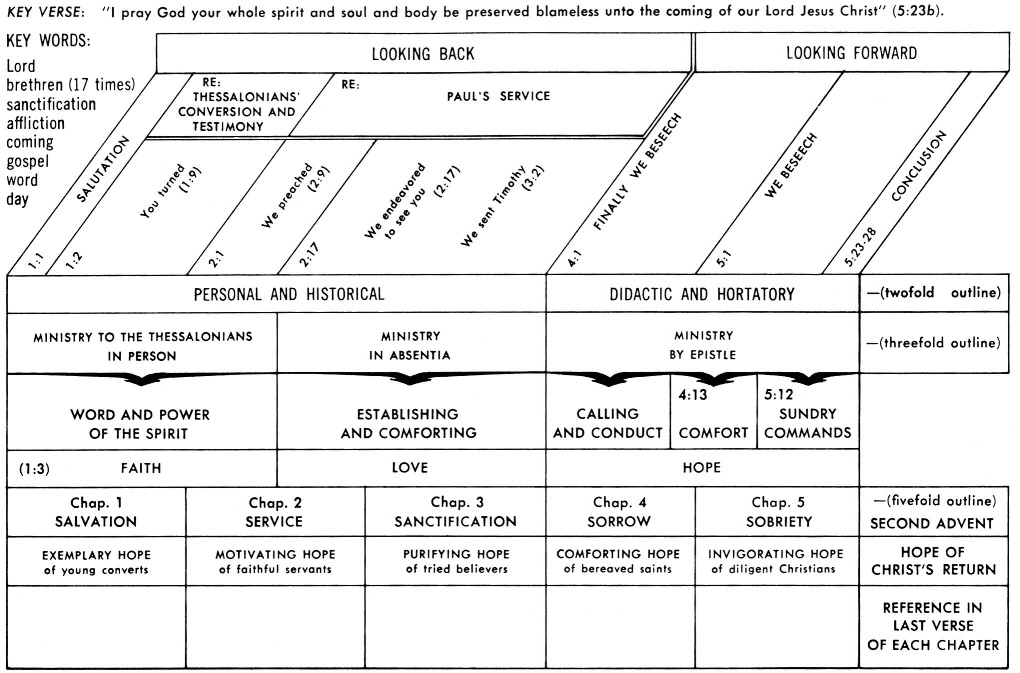
JESUS IS COMING AGAIN
Click chart to enlarge
Charts from Jensen's Survey of the NT - used by permission
Chart by Charles Swindoll
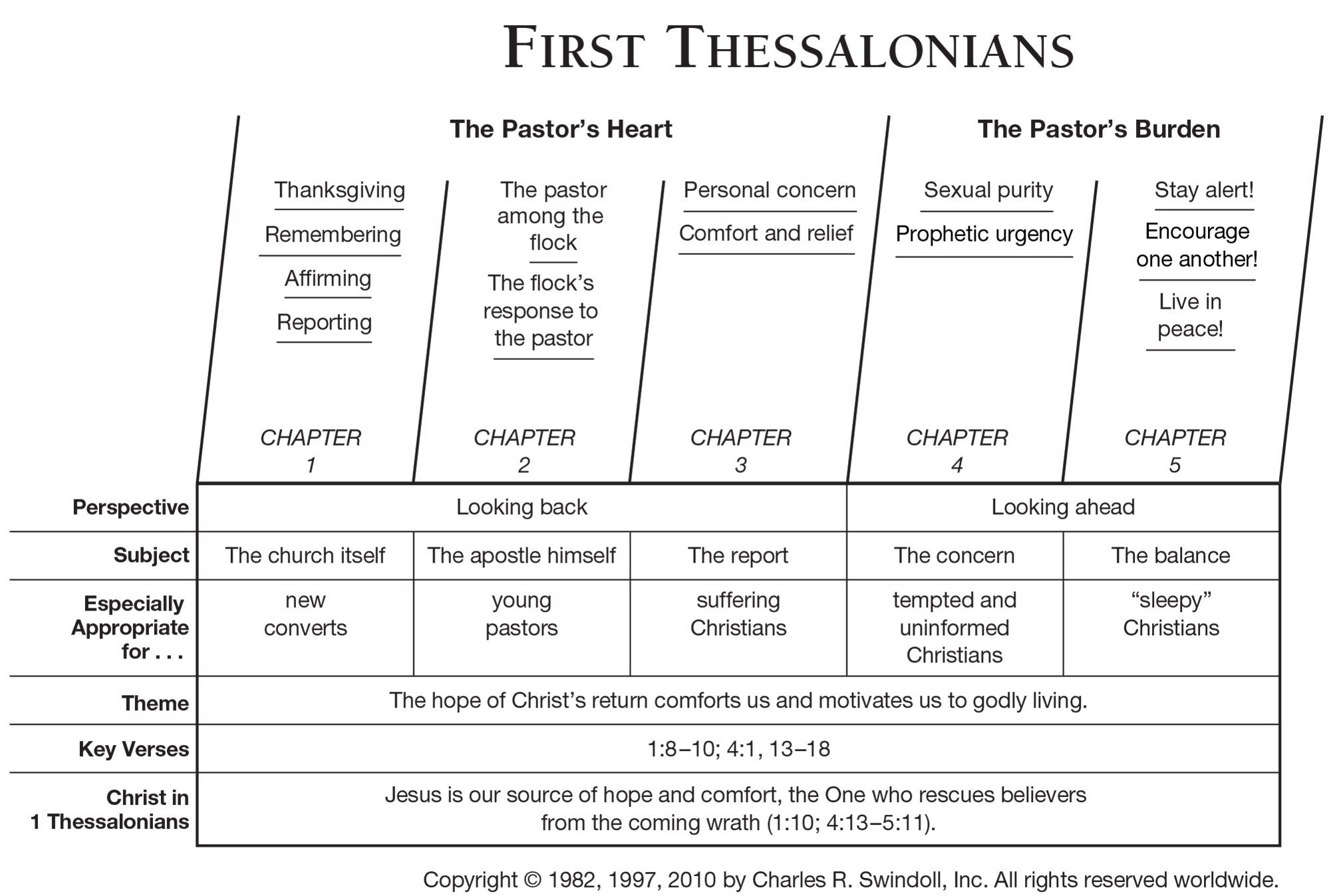
|
1 Thessalonians |
||||||
| 1 Th 1:1-10 | 1 Th 2:1-20 | 1 Th 3:1-13 | 1 Th 4:1-18 | 1 Th 5:1-28 | ||
|
LOOKING BACK |
LOOKING FORWARD |
|||||
|
Personal Reflections |
Practical Instructions |
|||||
| Ministry In Person |
Ministry in Absentia (Thru Timothy) |
Ministry by Epistle |
||||
| Word and Power of the Spirit |
Establishing & Comforting |
Calling & Conduct | 1Th 4:13ff Comfort |
1Th 5:12ff Commands |
||
| 1 Salvation |
2 Service |
3 Sanctification |
4 Sorrow |
5 Sobriety |
||
| Paul Commends Spiritual Growth |
Paul Founds the Church |
Strengthening of the Church |
Directions for Spiritual Growth |
Holy Living in Light of Day of the Lord | ||
| Exemplary Hope of Young Converts | Motivating Hope of Faithful Servants |
Purifying Hope of Tried Believers | Comforting Hope of Bereaved Saints | Invigorating Hope of Diligent Christians | ||
|
Written from Corinth |
||||||
1 Thessalonians 5:16 Rejoice always (NASB: Lockman)
Greek: Pantote chairete, (2PPAM)
Amplified: Be happy [in your faith] and rejoice and be glad-hearted continually (always); (Amplified Bible - Lockman)
Milligan: At all times cherish a spirit of joyfulness
NLT: Always be joyful. (NLT - Tyndale House)
Phillips: Be happy in your faith at all times. (Phillips: Touchstone)
Wuest: Always be rejoicing.
Young's Literal: always rejoice ye
REJOICE ALWAYS: Pantote chairete (2PPAM):
- 2Corinthians 6:10; Philippians 4:4; Matthew 5:12; Luke 10:20; Romans 12:12
- 1 Thessalonians 5 Resources - Multiple Sermons and Commentaries
- 1 Thessalonians 5:16: Rejoicing Always - John MacArthur
- 1 Thessalonians 5:16 Rejoice Always - John MacArthur
Notice that in the original Greek, the adverb is placed first, to emphasize when we are to rejoice - at all times, always.
In this last section of chapter five we find instructions on how to behave toward God. Hiebert refers to verses 16-18 as "principles for the inner life" for each of these passages deals with the believers life in relationship to God. Like a general speaking to his troops, Paul utters three crisp injunctions, which Moffatt calls "diamond drops"!
Spurgeon - Here follows a string of Christian precepts-a golden chain.
Denney writes that…
THE three precepts of these three verses may be called the standing orders of the Christian Church. However various the circumstances in which Christians may find themselves, the duties here prescribed are always binding upon them. We are to rejoice alway, to pray without ceasing, and in everything to give thanks. We may, live in peaceful or in troubled times; we may be encompassed with friends or beset by foes; we may see the path we have chosen for ourselves open easily before us, or find our inclination thwarted at every step; but we must always have the music of the gospel in our hearts in its own proper key. Let us look at these rules in order.
“Rejoice alway.” There are circumstances in which it is natural for us to rejoice; whether we are Christians or not, joy fills the heart till it overflows. Youth, health, hope, love, these richest and best possessions, give almost every man and woman at least a term of unmixed gladness; some months, or years perhaps, of pure light heartedness, when they feel like singing all the time. But that natural joy can hardly be kept up. It would not be good for us if it could; for it really means that we are for the time absorbed in ourselves, and having found our own satisfaction decline to look beyond. It is quite another situation to which the Apostle addresses himself. He knows that the persons who receive his letter have had to suffer cruelly for their faith in Christ; he knows that some of them have quite lately stood beside the graves of their dead. Must not a man be very sure of himself, very confident of the truth on which he stands, when he ventures to say to people so situated, “Rejoice alway”?
But these people, we must remember, were Christians; they had received the gospel from the Apostle; and, in the gospel, the supreme assurance of the love of God. We need to remind ourselves occasionally that the gospel is good news, glad tidings of great joy. Wherever it comes, it is a joyful sound; it puts a gladness into the heart which no change of circumstances can abate or take away. There is a great deal in the Old Testament which may fairly be described as doubt of God’s love. Even the saints sometimes wondered whether God was good to Israel; they became impatient, unbelieving, bitter, foolish; the outpourings of their hearts in some of the psalms show how far they were from being able to rejoice evermore. But there is nothing the least like this in the New Testament. The New Testament is the work of Christian men, of men who had stood quite close to the supreme manifestation of God’s love in Jesus Christ. Some of them had been in Christ’s company for years. They knew that every word He spoke and every deed He wrought declared His love; they knew that it was revealed, above all, by the death which He died; they knew that it was made almighty, immortal, and ever present, by His resurrection from the dead. The sublime revelation of Divine love dominated everything else in their experience. It was impossible for them, for a single moment, to forget it or to escape from it. It drew and fixed their hearts as irresistibly as a mountain peak draws and holds the eyes of the traveller. They never lost sight of the love of God in Christ Jesus, that sight so new, so stupendous, so irresistible, so joyful. And because they did not, they were able to rejoice evermore; and the New Testament, which reflects the life of the first believers, does not contain a querulous word from beginning to end. It is the book of infinite joy.
We see, then, that this command, unreasonable as it appears, is not impracticable. If we are truly Christians, if we have seen and received the love of God, if we see and receive it continually, it will enable us, like those who wrote the New Testament, to rejoice evermore. There are places on our coast where a spring of fresh water gushes up through the sand among the salt waves of the sea; and just such a fountain of joy is the love of God in the Christian soul, even when the waters close over it. “As sorrowful,” says the Apostle, “yet alway rejoicing.” Most churches and Christians need to lay this exhortation to heart. It contains a plain direction for our common worship. The house of God is the place where we come to make united and adoring confession of His name. If we think only of ourselves, as we enter, we may be despondent and low spirited enough; but surely we ought to think, in the first instance, of Him, Let God be great in the assembly of His people; let Him be lifted up as He is revealed to us in Jesus Christ, and joy will fill our hearts. If the services of the Church are dull, it is because He has been left outside; because the glad tidings of redemption, holiness, and life everlasting are still waiting for admission to our hearts. Do not let us belie the gospel by dreary, joyless worship: it is not so that it is endeared to ourselves or commended to others.
The Apostle’s exhortation contains a hint also for Christian temper. Not only our united worship, but the habitual disposition of each of us, is to be joyful. It would not be easy to measure the loss the cause of Christ has sustained through the neglect of this rule. A conception of Christianity has been set before men, and especially before the young, which could not fail to repel; the typical Christian has been presented, austere and pure perhaps, or lifted high above the world, but rigid, cold, and self-contained. That is not the Christian as the New Testament conceives him. He is cheerful, sunny, joyous; and there is nothing so charming as joy. There is nothing so contagious, because there is nothing in which all men are so willing to partake; and hence there is nothing so powerful in evangelistic work. The joy of the Lord is the strength of the preacher of the gospel. There is an interesting passage in 1 Corinthians 9, where Paul enlarges on a certain relation between the evangelist and the evangel. The gospel, he tells us, is God’s free gift to the world; and he who would become a fellow worker with the gospel must enter into the spirit of it, and make his preaching also a free gift. So here, one may say, the gospel is conceived as glad tidings; and whoever would open his lips for Christ must enter into the spirit of his message, and stand up to speak clothed in joy. Our looks and tones must not belie our words. Languor, dulness, dreariness, a melancholy visage, are a libel upon the gospel. If the knowledge of the love of God does not make us glad, what does it do for us? If it does not make a difference to our spirits and our temper, do we really know it? Christ compares its influence to that of new wine; it is nothing if not exhilarating; if it does not make our faces shine, it is because we have not tasted it. I do not overlook, any more than St. Paul did, the causes for sorrow; but the causes for sorrow are transient; they are like the dark clouds which overshadow the sky for a time and then pass away; while the cause of joy — the redeeming love of God in Christ Jesus — is permanent; it is like the unchanging blue behind the clouds, ever present, ever radiant, overarching and encompassing all our passing woes. Let us remember it, and see it through the darkest clouds, and it will not be impossible for us to rejoice evermore.
It may seem strange that one difficult thing should be made easy when it is combined with another; but this is what is suggested by the second exhortation of the Apostle, “Pray without ceasing.” It is not easy to rejoice alway, but our one hope of doing so is to pray constantly. How are we to understand so singular a precept? (1 Thessalonians 5 - Expositor's Bible Commentary)
James Moffatt - To comment adequately on these diamond drops would be outline a history of the Christian experience in its higher levels.
Rejoice (5463)(chairo) means be glad, be joyful, be delighted. The present tense calls for the saint to continually be in a state of happiness and well being, something that is only possible as we surrender to the willing of the Holy Spirit, trusting in His supernatural enablement and not relying on our natural "strength" to pull this off (we can't!).
Chairo is used 74 times in the NT -
Matt. 2:10; 5:12; 18:13; 26:49; 27:29; 28:9; Mk. 14:11; 15:18; Lk. 1:14, 28; 6:23; 10:20; 13:17; 15:5, 32; 19:6, 37; 22:5; 23:8; Jn. 3:29; 4:36; 8:56; 11:15; 14:28; 16:20, 22; 19:3; 20:20; Acts 5:41; 8:39; 11:23; 13:48; 15:23, 31; 23:26; Rom. 12:12, 15; 16:19; 1 Co. 7:30; 13:6; 16:17; 2 Co. 2:3; 6:10; 7:7, 9, 13, 16; 13:9, 11; Phil. 1:18; 2:17, 18, 28; 3:1; 4:4, 10; Col. 1:24; 2:5; 1 Thess. 3:9; 5:16; Jas. 1:1; 1 Pet. 4:13; 2 Jn. 1:4, 10f; 3 Jn. 1:3; Rev. 11:10; 19:7.
There are 30 uses of chairo in the Septuagint (LXX) -
Gen. 45:16; Ex 4:14, 31; 1 Sam. 19:5; 1 Ki. 4:20; 5:7; 8:66; 2 Ki. 11:14, 20; 20:13; Esther 8:12, 15; Ps. 96:12; Prov. 2:14; 6:16; 17:19; 23:25; 24:19; Isa. 13:3; 39:2; 48:22; 57:21; 66:10, 14; Jer. 7:34; 31:13; Lam. 1:21; 4:21; Ezek. 7:12; Hos. 9:1; Joel 2:21, 23; Jon. 4:6; Hab. 1:15; 3:18; Zeph. 3:14; Zech. 4:10; 9:9; 10:7;
I love Luke's description of Peter, et al, after imprisonment for proclaiming Jesus and defending themselves before the Jewish Sanhedrin…
Acts 5:41 So they went on their way from the presence of the Council, rejoicing that they had been considered worthy to suffer shame for His name.
Both Matthew and Luke record the command to rejoice in persecution…
Matthew 5:11 (see notes) "Blessed are you when men cast insults at you, and persecute you, and say all kinds of evil against you falsely, on account of Me. 12 "Rejoice, (present imperative = as your lifestyle) and be glad, for your reward in heaven is great, for so they persecuted the prophets who were before you.
Luke 6:22 "Blessed are you when men hate you, and ostracize you, and cast insults at you, and spurn your name as evil, for the sake of the Son of Man. 23 "Be glad (aorist imperative = Do this now!) in that day, and leap for joy, for behold, your reward is great in heaven; for in the same way their fathers used to treat the prophets.
Paul gives a similar command to the Philippians…
Philippians 4:4 (see notes) Rejoice (present imperative = as your lifestyle) in the Lord always; again I will say, rejoice present imperative = as your lifestyle)!
Stedman comments that rejoice…
perhaps ought to be translated, "Be cheerful." Do not let things get you down. Society is filled with despair and gloom. I have had several phone calls this week from people who are at the end of themselves. The pressures under which we live today can do this. But a Christian has an inner resource. Therefore, we can obey the word of James, "Count it all joy, my brethren, when you encounter various trials and temptations," {cf, James 1:2}. Do not take it as an attack upon you. Do not moan and groan and say, "What have I done to deserve this sort of thing?" But rejoice, because it is good for you. Trials make you grow up, make you face yourself and learn things about yourself you did not know. That is what James goes on to say, "That you may be perfect and complete, lacking nothing," {James 1:4b RSV}. (1 Thessalonians 5:12-28 Loving Christianly)
Believers can rejoice always because their joy isn’t based in circumstances, but on God. Circumstances change, but God never changes (cf Malachi 3:6 "For I, the LORD, do not change… ").
The present imperative is a command (imperative mood) calling for for all the saints at Thessalonica (rejoice is second person plural) to continually (present tense) make a personal choice (active voice) to rejoice. Yes, it is a choice we must make (see Phil 2:12), but one that is only possible to make as we learn to lean on the empowerment of the indwelling Spirit, Who gives us the desire and the power (see Phil 2:12NLT) In sum, this command is an appeal to the will of the saints at Thessalonica. And it served as a reminder to them (and to all believers) that they had a part in maintaining this experience of joy - the choice to rejoice. Paul charged them not to allow adverse circumstances to rob them of their joy. Once again we see that mysterious balance of human responsibility and divine sovereignty, (Jerry Bridges calls this "dependent synergism") as Paul so well described in Philippians…
Work out (present imperative; middle voice - make the choice to do this continually) your salvation with fear and trembling for it is God who is at work (energeo - continually energizing you - present tense) in you, both to will (continually giving you the "want to" to choose to rejoice) and to work (present tense - continually energizing that choice) for His good pleasure (see notes Philippians 2:12; 13)
Paul's command is even more surprising in view of the suffering they had already endured…
You also became imitators of us and of the Lord, having received the word in much tribulation with the joy of the Holy Spirit (See note 1Thessalonians 1:6)
For you, brethren, became imitators of the churches of God in Christ Jesus that are in Judea, for you also endured the same sufferings at the hands of your own countrymen, even as they did from the Jews, (See note 1Thessalonians 2:14)
We sent Timothy, our brother and God's fellow worker in the gospel of Christ, to strengthen and encourage you as to your faith, 3 so that no man may be disturbed by these afflictions; for you yourselves know that we have been destined for this. 4 For indeed when we were with you, we kept telling you in advance that we were going to suffer affliction; and so it came to pass, as you know. (See note 1Thessalonians 3:2; 3:3; 3:4)
How could the Thessalonians obey this command? Paul tells us in 1Thes 1:6, explaining that the source of the joy was not their efforts to keep a joyful outlook but was the joy produced by the Spirit Who indwelt them. It was supernatural joy which Paul explained was…
the fruit of the Spirit (which) is love, joy, peace, patience, kindness, goodness, faithfulness (see note Galatians 5:22)
Hiebert writes that
A Spirit-prompted attitude of rejoicing unlocks the whole of a believer's nature; it influences his outward conduct and stimulates his affections and desires… Paul held that joy was a distinctive and abiding characteristic of the Christian. But Paul was no blind optimist. He well knew that in leading the Thessalonians to faith in Christ he had shared with them a heritage of suffering (1Th 3:2, 3-see notes 1Th 3:2; 3). But he also knew that suffering for the Lord was not incompatible with rejoicing in the Lord. He could testify to the paradoxical experience of joy amid sorrow and suffering (2Co 6:10)… It was the exhibition of this joy amid suffering that was one of the distinctive features of the early Christian church, amazing the heathen world, and drawing many to Christ.
Paul's explanation for the unnatural paradox of joy in suffering is found in his letters to the Romans and Corinthians
For I consider that the sufferings of this present time are not worthy to be compared with the glory that is to be revealed to us. (see note Romans 8:18)
Therefore we do not lose heart, but though our outer man is decaying, yet our inner man is being renewed day by day. 17 For momentary, light affliction is producing for us an eternal weight of glory far beyond all comparison, 18 while we look not at the things which are seen, but at the things which are not seen; for the things which are seen are temporal, but the things which are not seen are eternal. (2Corinthians 4:16-18)
Paul had learned the secret as he explained to the saints at Philippi…
Not that I speak from want; for I have learned to be content in whatever circumstances I am. 12 I know how to get along with humble means, and I also know how to live in prosperity; in any and every circumstance I have learned the secret of being filled and going hungry, both of having abundance and suffering need. 13 I can do all things through Him who strengthens me. (See notes Php 4:11; 12; 13)
In his letter to the Colossians Paul wrote…
Now I rejoice (present tense = continually; active voice = personal choice to rejoice) in my sufferings for your sake, and in my flesh I do my share on behalf of His body (which is the church) in filling up that which is lacking in Christ's afflictions. (see note Colossians 1:24) (Comment: Sufferings for His Name sake, but not in any sense with an atoning value [payment for sin], for Christ death paid the penalty in full once and for all time.)
In short, Paul had learned the secret that sorrow and suffering voluntarily endured for Christ open a new spring of joy. The NT teaches that the believer's joy is not dependent upon external circumstances but springs out of the fact that we are in Christ (note) and rooted in the blessings which flow from that mystical union. Believers have ample reason to rejoice even amid unfavorable circumstances for they can know that their sins have been forgiven (past), that they are being conformed into the image of God's Son (present) and that they possess a sure hope of a glorified body throughout eternity with Christ (future).
Always (3842)(pántote from pás = all + tóte = then) is an adverb of time meaning at all times. Why always? Because as noted above the believer's joy originates not naturally from "happy" happenings but supernaturally, independent of circumstances and dependent on Christ our Example, "Who for the joy set before Him endured the cross, despising the shame" (He 12:2 )
Rejoicing can be in and concerning one's circumstances, but ultimately should be in God and His promises, because the people around us (and us included) can be (will be) unruly and fainthearted and weak and antagonistic. Such people would make an ordinary (natural, in Adam) person angry and sullen and discouraged. But we as believers (supernaturally, in Christ) have our roots planted somewhere else and are drawing up the sap of joy from a source that cannot be depleted (cf Ps 1:2, 3-notes), the river of God and his Word which the Spirit takes and uses to transform our thinking and our response to adverse circumstances and uncomfortable people. What is the key to rejoicing or delighting? You have to go no further than the next verse (remember context is king in interpretation!)
Spurgeon writes that…
This is a sunny precept. When we read it we feel that the time of the singing of birds has come. That joy should be made a duty is a sure token of the blessedness of the New Covenant. Because Jesus has suffered, we are encouraged, commanded, and enabled to rejoice. Only the Man of Sorrows and his chosen apostles can teach for a precept such a word as this — Rejoice evermore. Happy people who can be thus exhorted! We ought to rejoice that there is a command to rejoice. Glory be unto the God of happiness Who bids His children be happy. While musing on this text, I seem carried in spirit to the green woods, and their bowers. As in a dell all blue with hare-bells, where the sun smiles down upon me through the half-born oak leaves, I sit me down, and hear the blessed birds of the air piping out their love-notes: their music saith only this — Rejoice evermore. All that I see, and hear, and feel, surrounds me with garlands of delight; while the fairest of all the shepherds of Sharon sings to me this delicious pastoral — Rejoice evermore. The very words have breathed spring into my soul, and set my heart a blossoming. Thus am I also made to be as a daffodil which long has hidden away among the clods, but now at last ventures to uplift her yellow lily, and ring out her golden bell. Who can be sad, or silent, when the voice of the Beloved saith Rejoice evermore?
Our apostle speaks of rejoicing as a personal, present, permanent duty to be always carried out by the people of God. The Lord has not left it to our own option whether we will sorrow or rejoice; but he has pinned us down to it by positive injunction — Rejoice evermore. He will have this cloth of gold spread over the whole field of life. He has laid down as first and last, beginning, middle and end — Rejoice evermore. Some things are to be done at one time, some at another; but rejoicing is for all times, for ever, and for evermore, which, I suppose, is more than ever, if more can be. Fill life’s sea with joy up to highwater mark. Spare not, stint not, when rejoicing is the order of the day. Run out to your fall tether; sweep your largest circle when you use the golden compasses of joy.
Some things being once done are done with, and you need not further meddle with them; but you have never done with rejoicing. Rejoice evermore…
The command to rejoice is set in the midst of duties; it is put there to teach us how to perform them all.
Also notice that our text comes after just a flavoring of trouble and bitterness. Read verse fifteen: “See that none render evil for evil unto any man.” Children of God are apt to have evil rendered to them. They may have slanderous reports spread about them: they may be accused of things they never dreamed of: they may be cut to the heart by the ingratitude of those who ought to have been their friends; but still they are bidden, “rejoice evermore.” Even rejoice in the persecution and in the slander. “Blessed are ye, when men shall revile you, and persecute you, and shall say all manner of evil against you falsely, for my sake. Rejoice, and be exceeding glad: for great is your reward in heaven: for so persecuted they the prophets which were before you.” So says our Lord. “Rejoice ye,” he says, “and be exceeding glad.” There is an expression in the Greek that never has been rendered into English, and never will be — agalliasthe. Old Trapp half puns upon the agalliasthe as he says, “dance a galliard.” I do not know what a “galliard” was, but I suppose that it was some very joyous kind of dance. Certainly we know of no better way of translating our Lord’s word than by — exult, or leap for joy. Even when your good name shall be tarnished by the malice of the wicked, then you are to leap. When are you to be wretched? Surely despondency is excluded. If slander is to make us dance, when are we to fret? Suppose some other kind of trial should come upon you, you are still to rejoice in the Lord always. The dearest friend is dead: “rejoice evermore.” The sweet babe is sickening, the darling of your household will be taken away: “rejoice evermore.” Trade is ebbing out, prosperity is disappearing from you, you may even be brought to poverty; but, “rejoice evermore.” Your health is affected, your lungs are weak, your heart does not beat with regularity, very soon you may be sick unto death; but, “rejoice evermore.” Shortly you must put off this tabernacle altogether! Tokens warn you that you must soon close your eyes in death; but, “rejoice evermore.” There is no limit to the exhortation. It is ever in season. Through fire and through water, through life and through death, “rejoice evermore.”
Now and then a commentator says that the command of our text must mean that we are to be in the habit of rejoicing, for there must necessarily be intervals in which we do not rejoice. It is to be “constant but intermittent”: so one good man says. I do not know how that can be, though I know what he means. He means that it ought to be the general tenor of our life that we rejoice: yet he evidently feels that there must be black clouds now and then to vary the abiding sunshine. He warns us that there will be broken bits of road where as yet the steam roller has not forced in the granite. But that will not do as an interpretation of the text; for the apostle expressly says, “Rejoice evermore”: that is, rejoice straight on, and never leave off rejoicing. Whatever happens, rejoice. Come what may, rejoice. If the worst darkens to the worst — if the night lowers into a sevenfold midnight, yet “rejoice evermore.” This carillon of celestial bells is to keep on ringing through the night as well as through the day. “Rejoice, rejoice, ye saints of God at every time, in every place, and under every circumstance. Joy, joy, for ever. Rejoice evermore. In the midst of a thousand duties, amid the surges of ten thousand trials, still rejoice.” There is to be about the Christian a constancy of joy. (Read the full message Rejoice Evermore)
Keener notes that…
Greek ethics often listed succinct statements one after another as Paul does here. Many biblical psalms associate rejoicing with celebration and worship (e.g., Ps 9:14; 33:1; 47:1; 95:2; 149:1, 2, 3, 4, 5); here it is thus naturally linked with prayer and thanksgiving. (Keener, Craig: The IVP Bible Background Commentary: New Testament. 1994. IVP)
In verse 17, Paul commands us to "Pray without ceasing." And then he follows up in verse 18, by commanding us to give thanks not for some things but for all things! So how can we continually rejoice? At least part of the answer seems to be that continual prayer and thanksgiving provides the soil in which rejoicing can grow and flourish. We observe a similar sequence of joy rooted in prayer in Philippians. (Php 4:3, 4, 5, 6-See notes Php 4:3; 4:4; 4:5; 4:6)
In his prayer for the Colossians, Paul gives us a clue how saints today can rejoice and give thanks in all things as he prays that they might be
strengthened (passive voice = literally being strengthened = the effect comes from an outside source, ie, the grace God supplies) with all power (dunamis), according to His glorious might (kratos), for the attaining of all steadfastness (hupomone) and patience (makrothumia); joyously (charas) giving thanks to the Father (see notes on Colossians 1:11, 12) (Note the "all's")
In his comments on Habakkuk Wiersbe writes…
I will rejoice in the Lord" (Hab 3:17, 18). By the time Babylon was through with the land of Judah, there wouldn't be much of value left (Hab 2:17). Buildings would be destroyed, treasures would be plundered, and farms and orchards would be devastated. The economy would fall apart and there would be little to sing about. But God would still be on His throne, working out His divine purposes for His people (Ro 8:28). Habakkuk couldn't rejoice in his circumstances, but he could rejoice in his God!
The prophet's testimony here reminds us of Paul's admonitions to Christians today: "Rejoice always, pray without ceasing, in everything give thanks, for this is the will of God in Christ Jesus for you" (1Thes 5:16-18, NKJV). Habakkuk discovered that God was his strength (Hab. 3:19) and song as well as his salvation (see Isa 12:1, 2; Ex 15:2; Ps 118:14); and therefore he had nothing to fear.
It's one thing to "whistle in the dark" and try to bolster our courage, and quite something else to sing about the eternal God who never fails. Though his lips were trembling and his legs were shaking (Hab 3:16, NIV), the prophet burst into song and worshiped his God. What an example for us to follow! It reminds us of our Lord before He went to the cross (Mark 14:26), and Paul and Silas in the Philippian dungeon (Acts 16:19-34). God can give us "songs in the night" (Ps 42:8; 77:6; Job 35:10) if we'll trust Him and see His greatness. (Bible Exposition Commentary - Old Testament)
Milligan writes of…
An interesting example of the spirit of joy ruling in the early Church is afforded by the names found in the inscriptions—Victor, Nice, Gaudentius, Gaudiosus, Hilaris, Hilaritas (St. Paul's Epistles to the Thessalonians. 1908)
Spurgeon declared…
I am bound to mention among the curiosities of the churches, that I have known many deeply spiritual Christian people who have been afraid to rejoice… Some take such a view of religion that it is to them a sacred duty to be gloomy.
Turn this book over and see if there be any precept that the Lord has given you in which He has said, ‘Groan in the Lord always, and again I say groan.’ You may groan if you like. You have Christian liberty for that; but, at the same time, do believe that you have larger liberty to rejoice, for so it is put before you.
F B Meyer has a devotional entitled CULTIVATING CHEERFULNESS on verses 16-17…
A HAPPY AND cheerful heart is a matter of cultivation. We cannot afford to abandon ourselves entirely to our moods. There are times when we feel depressed and sad, for no special reason, except that a mood is on us! It is at such times that we need to anoint our heads, and wash our faces, that we may not be consumed by our fretfulness, or impose our depression upon others, for nothing is worse than to be a wet blanket! (Mt 6:16, 17, 18-see notes Mt 6:16; 17; 18)
On the other hand, there is nothing more objectionable than to be always in the presence of a comic person who thinks that every occasion must serve for frolic. After a time one gets as tired of funny stories and perpetual punning as of gloom, but while avoiding this extreme, we must not fall into the other of wearing a lugubrious expression and giving way to a moodiness of spirit, which cannot be accounted for.
We may alter our dispositions and moods by a resolute action of the will. We can refuse to look miserable, to speak mournfully, to be pessimistic, to pass on depression. In a spirit of unselfishness we can put on a cheerful courage, array ourselves in the garments of joy, anoint ourselves with the spirit of praise and thankfulness, and go forth into the world to shed sunbeams rather than shadows on the path of life. Do not nurse your sorrow of heart, lest your spirit and the spirits of others be broken.
We can promote a cheerful heart by dwelling on the bright things of our lot; by counting up the mercies which are left, rather than dwelling on what we have lost. When the heart is full of the light and love of God, can it be other than cheerful? How can this be obtained except by a living union with Jesus Christ. In Him there is an infinitude of supply of peace and joy, sunshine and light. Let us open our hearts to him, and put on these things as we array ourselves each morning in our garments (Isa. 61:3, 4, 5, 6, 7,8, 9, 10). (Our Daily Walk)
Through all the changing scenes of life,
In trouble and in joy,
The praises of my God shall still
My heart and tongue employ. AMEN.
- God gives -Ecclesiastes 2:26; Psalms 4:7
- Christ appointed to give -Isaiah 61:3
- Is a fruit of the Spirit -Galatians 5:22
- The gospel, good tidings of -Luke 2:10,11
- God’s word affords -Nehemiah 8:12; Jeremiah 15:16
- The gospel to be received with -1 Thessalonians 1:6
- Promised to saints -Psalms 132:16; Isaiah 35:10; 55:12; 56:7
- Prepared for saints -Psalms 97:11
- Enjoined to saints -Psalms 32:11; Philippians 3:1
- Fulness of, in God’s presence -Psalms 16:11
- Vanity of seeking, from earthly things -Ecclesiastes 2:10,11; 11:8
EXPERIENCED BY
- Believers -Luke 24:52; Acts 16:34
- Peace-makers -Proverbs 12:20
- The just -Proverbs 21:15
- The wise, and discreet -Proverbs 15:23
- Parents of good children -Proverbs 23:24
- Increased to the meek -Isaiah 29:19
OF SAINTS IS
- In God -Psalms 89:16; 149:2; Habakkuk 3:18; Romans 5:11
- In Christ -Luke 1:47; Philippians 3:3
- In the Holy Spirit -Romans 14:17
- For election -Luke 10:20
- For salvation -Psalms 21:1; Isaiah 61:10
- For deliverance from bondage -Psalms 105:43; Jeremiah 31:10-13
- For manifestation of goodness -2 Chronicles 7:10
- For temporal blessings -Joel 2:23,24
- For supplies of grace -Isaiah 12:3
- For divine protection -Psalms 5:11; 16:8,9
- For divine support -Psalms 28:7; 63:7
- For the victory of Christ -John 16:33
- For the hope of glory -Romans 5:2
- For the success of the gospel -Acts 15:3
OF SAINTS SHOULD BE
- Great -Zechariah 9:9; Acts 8:8
- Abundant -2 Corinthians 8:2
- Exceeding -Psalms 21:6; 68:3
- Animated -Psalms 32:11; Luke 6:23
- Unspeakable -1 Peter 1:8
- Full of glory -1 Peter 1:8
- Constant -2 Corinthians 6:10; Philippians 4:4
- For evermore -1 Thessalonians 5:16
- With awe -Psalms 2:11
- In hope -Romans 12:12
- In sorrow -2 Corinthians 6:10
- Under trials -James 1:2; 1 Peter 1:6
- Under persecutions -Matthew 5:11,12; Luke 6:22,23; Hebrews 10:34
- Under calamities -Habakkuk 3:17,18
- Expressed in hymns -Ephesians 5:19; James 5:13
- Afflictions of saints succeeded by -Ps 30:5; 126:5; Is 35:10; Jn 16:20
- Pray for restoration of -Psalms 51:8,12; 85:6
- Promote, in the afflicted -Job 29:13
OF SAINTS, MADE FULL BY
- The favour of God -Acts 2:28
- Faith in Christ -Romans 15:13
- Abiding in Christ -John 15:10,11
- The word of Christ -John 17:13
- Answers to prayer -John 16:24
- Communion of saints -2 Timothy 1:4; 1 John 1:3,4; 2 John 1:12
- Saints should afford, to their ministers -Philippians 2:2; Philemon 1:20
MINISTERS SHOULD
- Esteem their people as their -Philippians 4:1; 1 Thessalonians 2:20
- Promote, in their people -2 Corinthians 1:24; Philippians 1:25
- Pray for, for their people -Romans 15:13
- Have, in the faith and holiness of their people -2Co 7:4; 1Th 3:9; 3Jn 1:4
- Come to their people with -Romans 15:32
- Finish their course with -Acts 20:24
- Desire to render an account with -Philippians 2:16; Hebrews 13:17
- Serve God with -Psalms 100:2
- Liberality in God’s service should cause -1 Chronicles 29:9,17
- Is strengthening to saints -Nehemiah 8:10
- Saints should engage in all religious services with -Ezra 6:22; Psalms 42:4
- Saints should have, in all their undertakings -Deuteronomy 12:18
- Saints shall be presented to God with exceeding -1 Peter 4:13; Jude 1:24
- The coming of Christ will afford to saints, exceeding -1 Peter 4:13
- Shall be the final reward of saints at the judgment day -Matthew 25:21
OF THE WICKED
- Is derived from earthly pleasures -Ecclesiastes 2:10; 11:9
- Is derived from folly Proverbs 15:21
- Is delusive -Proverbs 14:13
- Is short-lived -Job 20:5; Ecclesiastes 7:6
- Should be turned into mourning -James 4:9
- Shall be taken away -Isaiah 16:10
Holy-Illustrated -Isaiah 9:3; Matthew 13:44
Holy-Exemplified -
- Hannah -1 Samuel 2:1
- David -1 Chronicles 29:9
- Wise men -Matthew 2:10
- Mary -Luke 1:47
- Zacchaeus -Luke 19:6
- Converts -Acts 2:46; 13:52
- Peter, etc -Acts 5:41
- Samaritans -Acts 8:8
- Jailor -Acts 16:34
- Duty of-Dt12:7,16:11 Ps5:11,32:11 Zep3:14 Zec9:9 Lk10:20 Ro12:15 Php4:4 1Th 5:16
- Instances of 1Sa 2:1, 11:15 Mt 2:10 Luke 1:47 Acts 8:39, 16:34 Romans 5:2
- In Tribulation, examples of
- Famine -Habakkuk 3:17; 18 Matthew 5:12 Luke 6:23
- Persecution -Acts 5:41
- Imprisonment -Acts 16:23 Acts 16:25
- Poverty -2Corinthians 6:10 Colossians 1:24
- Loss of Property -Hebrews 10:34
- Fiery Trials -1 Peter 4:12; 4:13
- In Evil Forbidden -Job 31:29 Ps 35:19 Pro 17:5, 24:17 Ob 1:12 1Co 13:6
1 Thessalonians 5:17 pray without ceasing (NASB: Lockman)
Greek: adialeiptos proseuchesthe, (2PPMM)
Amplified: Be unceasing in prayer [praying perseveringly]; (Amplified Bible - Lockman)
NLT: Keep on praying (NLT - Tyndale House)
Phillips: Never stop praying. (Phillips: Touchstone)
Wuest: Be praying unceasingly.
Young's Literal: continually pray ye
PRAY WITHOUT CEASING: adialeiptos proseuchesthe (2PPMM):
- Luke 18:1; 21:36; Romans 12:12; Ephesians 6:18; Colossians 4:2; 1 Peter 4:7
- 1 Thessalonians 5 Resources - Multiple Sermons and Commentaries
- 1 Thessalonians 5:17: Praying Unceasingly- John MacArthur
- 1 Thessalonians 5:17 Pray Without Ceasing - John MacArthur
The literal Greek word order places adialeiptos first in the sentence which emphasizes the time element, without ceasing.
Having trouble praying without ceasing? Not even sure what Paul means by this description? A good audio overview is available from Dr John Piper - on the following link right click, select "Save Target As", then save to your computer or Ipod - Mp3 Audio - Pray Without Ceasing.
In the following passages related to praying without ceasing, notice the repetitive use of the present imperative and the present tense.
Seek (Qal imperative) the LORD and His strength; Seek (Qal imperative) His face continually. (1Chronicles 16:11)
Ask (present imperative = commands continual asking), and it shall be given to you; seek (present imperative = commands continual seeking), and you shall find; knock (present imperative = commands continual knocking), and it shall be opened to you. (see note Matthew 7:7)
Keep watching (present imperative = commands continual attention to) and praying (present imperative = command to continue in an attitude of prayer), that you may not enter into temptation; the spirit is willing, but the flesh is weak. (Matthew 26:41)
Now He was telling them a parable to show that at all times they ought to pray (present tense = continually, as the habit of their life) and not to lose heart (Luke 18:1)
But keep on the alert (present imperative = commands continual attention) at all times, praying (present tense = continually, as the habit of their life) in order that you may have strength to escape all these things that are about to take place, and to stand before the Son of Man. (Luke 21:36)
rejoicing in hope, persevering in tribulation, devoted to (imperative sense, present tense - always be prayerful) prayer (See note Romans 12:12)
With all prayer and petition pray (present tense = continually, as the habit of their life) at all times in the Spirit, and with this in view, be on the alert with all perseverance and petition for all the saints (See note Ephesians 6:18)
Devote (present imperative = commands continual attention to) yourselves to prayer, keeping alert in it with an attitude of thanksgiving (see note Colossians 4:2)
Therefore I want the men in every place to pray (present tense = continually, as the habit of their life), lifting up holy hands, without wrath and dissension. (1 Timothy 2:8)
The end of all things is at hand; therefore, be of sound judgment and sober spirit (both verbs aorist imperative = do this now! don't delay!) for the purpose of prayer. (see note 1 Peter 4:7)
Pray without ceasing - Out of approximately 667 recorded prayers in the Bible, there are about 454 recorded answers. This should encourage and motivate us to pray without ceasing!
Spurgeon introduces his sermon on this verse by setting the context…
THE position of our text is very suggestive. Observe what it follows. It comes immediately after the precept, “Rejoice evermore;” as if that command had somewhat staggered the reader, and made him ask “How can I always rejoice?” and, therefore, the apostle appended as answer, “Always pray.” The more praying the more rejoicing. Prayer gives a channel to the pent-up sorrows of the soul, they flow away, and in their stead streams of sacred delight pour into the heart. At the same time the more rejoicing the more praying; when the heart is in a quiet condition, and full of joy in the Lord, then also will it be sure to draw nigh unto the Lord in worship. Holy joy and prayer act and react upon each other.
Observe, however, what immediately follows the text: “In everything give thanks.” When joy and prayer are married their first born child is gratitude. When we joy in God for what we have, and believingly pray to him for more, then our souls thank him both in the enjoyment of what we have, and in the prospect of what is yet to come. Those three texts are three companion pictures, representing the life of a true Christian, the central sketch is the connecting link between those on either side. These three precepts are an ornament of grace to every believer’s neck, wear them every one of you, for glory and for beauty; “Rejoice evermore;” “Pray without ceasing;” “in everything give thanks.”
Paul was asking them to do something which was characteristic of his life for he "prayed without ceasing" for all of the churches he had planted…
We give thanks to God always for all of you, making (present tense = continually, a habitual practice) mention of you in our prayers (see note 1Thessalonians 1:2)
Daniel "prayed without ceasing", in fact making it a practice to pray three times each day, even when he knew it might well cost him his life in a lion’s den
Now when Daniel knew that the document was signed, he entered his house (now in his roof chamber he had windows open toward Jerusalem); and he continued kneeling on his knees three times a day, praying and giving thanks before his God, as he had been doing previously. (Daniel 6:10)
David "prayed without ceasing"…
Evening and morning and at noon, I will complain and murmur, And He will hear my voice. (Ps 55:17).
Spurgeon comments "Evening and morning, and at noon, will I pray. Often but none too often. Seasons of great need call for frequent seasons of devotion. The three periods chosen are most fitting; to begin, continue, and end the day with God is supreme wisdom. Where time has naturally set up a boundary, there let us set up an altar stone. The psalmist means that he will always pray; he will run a line of prayer right along the day, and track the sun with his petitions. Day and night he saw his enemies busy (Psalms 55:10), and therefore he would meet their activity by continuous prayer.
And cry aloud. He would give a tongue to his complaint; he would be very earnest in his pleas with heaven. Some cry aloud who never say a word. It is the bell of the heart that rings loudest in heaven. Some read it, "I will nurse and murmur;" deep heart thoughts should be attended with inarticulate but vehement utterances of grief. Blessed be God, moaning is translatable in heaven. A father's heart reads a child's heart.
And he shall hear my voice. He is confident that he will prevail; he makes no question that he would be heard, he speaks as if already he were answered. When our window is opened towards heaven, the windows of heaven are open to us. Have but a pleading heart and God will have a plenteous hand. (Ref)
In the book of First Chronicles, in the genealogical list of the tribes of Israel we see a striking example of praying without ceasing...
They (the tribes of Israel just mentioned) waged war against the Hagrites, the Jeturites, the Naphishites, and the Nodabites. They cried out to God during the battle, and he answered their prayer because they trusted in him. So the Hagrites and all their allies were defeated. (1Chronicles 5:19,20, NLT) (Comment: Somehow, in the midst of the battle, these men managed to pray, to call upon the Lord and He answered them on the spot. This should encourage us for He can do the same for us today.)
W A Criswell quoted the following prayer from a source unknown…
When you are weary in body and soul
Cumbered with many a care
When work is claiming its strength-taking toll
Make it a matter of prayer.
And when you're discouraged, distraught or dismayed
Sinking almost in despair
Remember there's One who will come to your aid,
If you'll make it a matter of prayer.
And when you are lost in this world's tangled maze
When life seems a hopeless affair
Direction will come for all of your ways
If you'll make it a matter of prayer.
Regular, daily prayer takes discipline and concerted effort. It is sadly possible for a believer to go through the whole day and not speak to God even once. This should not be. Prayer is a vital aspect of man’s role as one who is beloved of God the Father.
How many times have you told someone you would pray for them and then you did not? We've all done that haven't we? But here's a little exercise that dovetails nicely with Paul's command to pray without ceasing…
Stop saying you will pray about a thing.
Instead stop right there and pray about it.
The greatly used preacher Charles Spurgeon (1834-1892) put great emphasis on prayer in preparation for preaching. He felt that ministers ought to pray without ceasing and in fact once wrote that…
All our libraries and studies are mere emptiness compared with our closets (Ed note: our "prayer closets" - Mt 6:6). We grow, we wax mighty, we prevail in private prayer
When Spurgeon prepared to preach, he would pray at all times -- before choosing his topic, as he was getting into the spirit of the text, as he sought God’s help for deep truths and the lifting out of those truths, as he sought to receive fresh streams of thought regarding the application of the text, and of course for his delivery of the message thus prepared. Spurgeon declared that…
nothing can so gloriously fit you to preach as descending fresh from the mount of communion with God to speak with men. None are so able to plead with men as those who have been wrestling with God on their behalf.
Tony Evans speaking of abiding in the Vine, Christ Jesus, asks…
How do you stay connected to Jesus every moment? One way is through prayer. Remember the command, “Pray without ceasing” (1Th 5:17)? You don’t have to be on your knees moving your lips to pray. Prayer can be the atmosphere in which you exist. You can bring the Lord to bear on every aspect of your day by staying in touch with Him, communing with Him in your spirit. Prayer is an expression of your dependence on Christ. And because He is also your Great High Priest as well as the vine, He can do something about your situation. The Lord who is sitting at the right hand of God in the place of authority wants to work in your life to bear spiritual fruit. The key to fruit bearing is abiding in Him, and the key to abiding is obedience. (Evans, A. T. Who is This King of Glory? Experiencing the Fullness of Christ's Work in Our Lives. Chicago: Moody Press)
The call to prayer at all times is frequent in the NT…
Now He (Jesus) was telling them a parable to show that at all times they ought (dei = this verb means it is necessary binding or needful. It speaks of an obligation out of intrinsic necessity or inevitability) to pray and not to lose heart (don't give up, grow weary or become discouraged because answers do not come immediately). 2 saying, "There was in a certain city a judge who did not fear God, and did not respect man. 3 "And there was a widow in that city, and she kept coming to him, saying, 'Give me legal protection from my opponent.' 4 "And for a while he was unwilling; but afterward he said to himself, 'Even though I do not fear God nor respect man, 5 yet because this widow bothers me, I will give her legal protection, lest by continually coming she wear me out.'" 6 And the Lord said, "Hear what the unrighteous judge said 7 now shall not God bring about justice for His elect, who cry to Him day and night, and will He delay long over them? (Luke 18:1-7) (Comment: This does not refer to interminable prayer, but to a lifestyle saturated with prayer, not giving up when an answer is not immediate.)
Jesus told His disciples to…
keep on the alert (present imperative) at all times, praying in order that you may have strength to escape all these things that are about to take place, and to stand before the Son of Man." (Luke 21:36) (Comment: Praying brings spiritual strength to maintain alertness. It enables disciples to withstand their temptations to depart from God’s will. Disciples are to watch and pray at all times, thus separating themselves from the ungodly world which is doomed to experience the wrath of God.)
(He also said) "Ask (present imperative = command to keep on asking), and it shall be given to you; seek (present imperative = command to keep on seeking), and you shall find; knock (present imperative = command to keep on knocking), and it shall be opened to you. For everyone who asks (present tense = as their habitual practice) receives, and he who seeks (present tense = as their habitual practice) finds, and to him who knocks (present tense = as their habitual practice) it shall be opened. (See notes Matthew 7:7; 7:8)
Paul exhorted the saints at Rome after calling on them to present themselves to God as living and holy sacrifices (see note Romans 12:1) to be…
rejoicing in hope, persevering in tribulation, devoted (proskartereo - present tense = as our lifestyle or habitual practice) to prayer (see note Romans 12:12)
Writing to the Ephesians Paul exhorted them…
With all prayer and petition pray at all times in the Spirit, and with this in view, be on the alert with all perseverance and petition for all the saints (See notes Ephesians 6:18)
Paul sounds a similar call to the Colossian saints…
Devote (proskartereo - present imperative) yourselves to prayer, keeping alert in it with an attitude of thanksgiving (See note Colossians 4:2) (Comment: This reads like an order from a general to his troops engaged in a fierce struggle and emphasizes the critical need for prayer in the continual spiritual war we find ourselves in as soldiers of the Cross. Paul is not saying pray if you feel like it but pray all the time!) (See other Scriptural examples of Paul "always" praying below)
Paul instructed Timothy regarding widows writing that…
Now she who is a widow indeed and who has been left alone, has fixed her hope on God and continues in entreaties (deesis = requests, including pleas for personal needs which demonstrates the widow's total dependence on God to supply her needs) and prayers night and day. (1Ti 5:5) (Comment: Night and day is a Jewish idiomatic expression that means "constantly," or "all the time". Anna the prophetess "prayed without ceasing" - see Luke 2:36, 37)
Spurgeon once quipped…
As you are tempted without ceasing, so pray without ceasing (Ed note: !!!) (Cp note Hebrews 2:18 where tempting is in the present tense indicating we are continually being tempted).
Pray (4336)(proseúchomai related to the noun proseuche from pros = toward or immediately before + euchomai = to pray or vow) is the more general or comprehensive covering all form of reverent approach to God, especially the offering of prayer. It is used only of praying to God.
The prefix pros conveys the sense of being immediately before Him and hence the ideas of adoration, devotion, and worship. The basic idea is to bring something, and in prayer this pertains to bringing up prayer requests. In early Greek culture an offering was brought with a prayer that it be accepted. Later the idea was changed slightly, so that the thing brought to God was a prayer. In later Greek, prayers appealed to God for His presence.
There are 87 uses of proseuchomai in the NT -
Mt 5:44; 6:5, 6, 7, 9; 14:23; 19:13; 23:14; 24:20; 26:36, 39, 41, 42, 44; Mk. 1:35; 6:46; 11:24, 25; 12:40; 13:18, 33; 14:32, 35, 38, 39; Lk. 1:10; 3:21; 5:16; 6:12, 28; 9:18, 28, 29; 11:1, 2; 18:1, 10, 11, 12; 20:47; 22:40, 41, 44, 46; Acts 1:24; 6:6; 8:15; 9:11, 40; 10:9, 30; 11:5; 12:12; 13:3; 14:23; 16:25; 20:36; 21:5; 22:17; 28:8; Ro 8:26; 1 Co. 11:4, 5, 13; 14:13, 14,15; Ep 6:18; Php 1:9; Col. 1:3, 9; 4:3; 1Th 5:17, 25; 2Th 1:11; 3:1; 1Ti 2:8; Heb. 13:18; Jas 5:13,14, 17,18; Jude 1:20
In short, proseuchomai was a religious technical term for talking to a deity in order to ask for help, usually in the form of a request, vow, or wish. In the NT, as noted above, proseuchomai never refers to praying to men, but only to God.
Hiebert adds that proseuchomai…
The term suggests the reverential attitude of the one praying rather than the length of the prayers being offered. The readers are being called to maintain such a reverential approach to God as a continuing practice. (Ibid)
Pray in this passage is a present imperative which is a command to make this our habitual practice, our lifestyle and not just we feel like it! Furthermore, Paul is not giving us a suggestion but a command and this calls for a conscious choice on each believer's part to obey, which in turn means we have to work at it, learn it, cultivate the habit, all the while keeping in mind that we can only obey in the power of the Spirit. The Spirit must teach us and lead us even as we seek to obey this command. And given that unceasing praying involves the sovereign work of the Spirit in us and our necessary cooperation (Php 2:12, 13-see notes Php 2:12; 13), it follows that it can only grow and develop in an atmosphere of obedience. Conversely, unceasing prayer withers and ceases when we sin! The moment we become conscious of sin, we must repent, confess, and go on. Communication with the Lord resumes the moment we turn back to Him.
As an aside the Psalmist instructs us that our
delight is in the law of the LORD and in His law (we) meditate day and night. (Psalm 1:2)
And so the believer's life should be permeated by meditation and prayer throughout the day. The benefits are inestimable and eternal.
Lawrence Richards writes that proseuchomai…
In classical Greek was the technical term for calling on a deity. The NT transforms the classical stiffness into the warmth of genuine conversation. Such entreaty in the NT is addressed to God or Jesus and typically is both personal and specific. (Richards, L O: Expository Dictionary of Bible Words: Regency)
Unceasing prayer refers more to prayer as an attitude and not just an activity, and thus serves as a good reflection of our level of communion ("high, medium, low") with our Father. Unceasing prayer speaks more of a reverential attitude of the one praying than of the length of the prayers.
Unceasing prayer is not restricted to a set time, place or position of one's body. The believer is not in a right place with God's Spirit if he cannot pray anytime, anywhere. In short, Paul's injunction means that we are to be constantly conscious of our dependence upon the Spirit. It refers, however, to the attitude of prayer, or reverence before God. The Christian's life of righteousness and his approach to relationships and responsibilities should be such that he maintains a constant attitude of being in God's presence. Such a person will pray often and about many things, including requests, praise, and thanksgiving.
The regal gate - "Pray without ceasing." 1 Thessalonians 5:17
A man may always pray habitually; he may have his heart in a praying disposition in all estates and conditions, in prosperity and adversity, in health and sickness, in strength and weakness, in wealth and wants, in life and death. The Christian needs …
mercy to pardon him,
grace to purify him,
balm to heal him,
divine favor to comfort him,
power to support him,
wisdom to counsel him,
goodness to satisfy him.
Our daily weaknesses, our daily wants, our daily fears, our daily dangers, our daily temptations, etc., call for our daily prayers.
Prayer is the regal gate by which the Lord enters into the heart, comforting, quieting, strengthening, quickening, and raising of it. By it,
faith is increased,
hope strengthened,
the spirit exhilarated,
the heart pacified,
the conscience purified,
temptations vanquished,
corruptions weakened,
the affections inflamed,
the will more renewed, and
the whole man more advantaged.
Fausset writes that…
The Greek is, "Pray without intermission"; without allowing prayerless gaps to intervene between the times of prayer. (Jamieson-Fausset-Brown Bible Commentary)
Matthew Henry writes that it was…
Not that Paul did nothing else but pray, but he kept up stated times for the solemn performance of that duty, and those very frequent, and observed without fail.
Note, The way to rejoice evermore is to pray without ceasing. We should rejoice more if we prayed more. We should keep up stated times for prayer, and continue instant in prayer. We should pray always, and not faint: pray without weariness, and continue in prayer, till we come to that world where prayer shall be swallowed up in praise. The meaning is not that men should do nothing but pray, but that nothing else we do should hinder prayer in its proper season. Prayer will help forward and not hinder all other lawful business, and every good work. (Matthew Henry Unabridged)
Henrietta Mears wrote that…
Prayer is the keynote of success. Neither a class nor an individual can succeed in Christ without it. Prayer is the breath of the Christian. We are commanded to "pray continually" (1Th 5:17). As natural as breathing is to a natural person, so natural should prayer be to a spiritual person. Does all this describe you? (What the Bible is All About)
J Vernon McGee says that…
Now by this Paul did not mean that you are to get on your knees and remain there twenty-four hours a day. But Paul did mean for you to get on your knees and pray and then live in the expectation of that prayer for twenty-four hours every day.
This does not mean you are to go to an all-day or all-night prayer meeting. Prayer is an attitude of the life. It is more an attitude of life than an action of the lips. Remember that Paul said to the Romans, "the Spirit itself makes intercession for us with groanings which cannot be uttered" (Ro 8:26). That is, they cannot be put into our words. And many times we do not have the words to pray, but we are praying nonetheless. And it is the entire life that is behind the words which are spoken that makes prayer effective.
There was a famous preacher, years ago in the state of Georgia, who had many very unusual expressions. One of them was this, "When a man prays for a corn crop, God expects him to say 'Amen' with a hoe." (McGee, J V: Thru the Bible Commentary: Thomas Nelson or Logos)
Praying is talking to our best Friend, One Who will stick closer than a brother (Pr 18:24, 17:17), Who has promised to never leave us or forsake us (Heb 13:5) and Who never puts us on "call waiting". Let us therefore draw near with confidence to His marvelous throne of grace. What an awesome invitation.
Jesus Who was without sin prayed constantly and so how much more ought we, who are sinners, to be faithful in prayer! He who had all power in heaven and earth considered adequate times of prayer as essential as His public service. So He often withdrew and prayed and He is our example.
E. M. Bounds said that…
The little estimate we put on prayer is evident from the little time we give to it. (Power Through Prayer)
R. A. Torrey has highlighted what is true for many of us…
How little time the average Christian spends in prayer! We are too busy to pray, and so we are too busy to have power. We have a great deal of activity, but we accomplish little … The power of God is lacking in our lives and in our work. We have not because we ask not.
S. D. Gordon reminds us that God's great people are those who pray. They do not have the time, but must take the time from other things that are important and pressing.
A. W. Tozer portrayed a praying Christian as a constant threat to the stability of Satan's government writing that…
The Christian is a holy rebel loose in the world with access to the throne of God
Since prayer is detrimental to the evil one's purposes, Satan and his minions do their utmost to interfere when we pray especially opposing us when we try to take time for prayer because. The enemy knows better than most Christian's the power of persistent prayer!
Susannah Wesley, mother of the great eighteenth-century evangelist and Christian leader John Wesley, had nineteen children. When she wanted to pray and meditate, she would sit in her rocking chair and cover her face with her apron. She trained her children to respect these times of quietness and fellowship with God.
MacArthur has several comments on prayer without ceasing writing that…
In any posture, in any attire, at any time, in any place, and under any circumstance prayer is appropriate. Prayer is to be a total way of life, an open and constant communion with God (MacArthur, J: Matthew 1-7 Chicago: Moody Press or Logos)
Such unceasing or recurring prayer demands first of all an attitude of God-consciousness. That does not mean to be constantly in the act of verbal prayer, but to view everything in life in relation to God. For example, if we meet someone, we immediately consider where they stand with God. If we hear of something bad happening, we react by praying for God to act in the situation because we know He cares. If we hear of something good that has happened, we respond with immediate praise to God for it because we know He is glorified. When Paul looked around his world, everything he saw prompted him to prayer in some way. When he thought of or heard about one of his beloved churches, it moved him toward communion with God.
A second aspect of unceasing prayer is people-consciousness. We cannot effectively pray for people unless we are aware of their needs. Paul exhorted the Colossians to keep alert in prayer (Col 4:2), while to the Ephesians he wrote, "With all prayer and petition pray at all times in the Spirit, and with this in view, be on the alert with all perseverance and petition for all the saints" (Ep 6:18).
The two elements of praying without ceasing came together in Paul’s prayer life. His love for God led him to seek unbroken communion with Him. His love for people drove him to unceasing prayer on their behalf. The prayers of Paul recorded in his letters are a precious legacy. They reveal his heart and are models for us to emulate. This text records the first of those prayers. (MacArthur, J. Colossians. Chicago: Moody Press or Logos)
Without ceasing (89) (adialeiptos from a = negative + dialeipô = leave off, cease, leave an interval whether of space or time) means uninterruptedly, without intermission, constantly, incessantly, unceasingly, always, unintermittently, continually, without omission or without ceasing.
There are 4 uses of adialeiptos in the NT - Ro 1:9; 1Th 1:2; 2:13; 5:17
Adialeiptos is used to describe that which is continuously done - uninterrupted necessary payment of hard taxes, continual uninterrupted cough, repeated military attacks, continual failing of a military effort, regular and consistent production of fruit.
We've all had an unceasing, hacking cough. What happens? When you get a tickle in your throat, you cough. Applying this thought to unceasing prayer, when opportunity knocks or Spirit gives you a "tickle" (a "burden"), then your reflex reaction should be to pray.
Josephus used adialeiptos for the incessant attacks of the Romans against Jotapatha (Josephus, Jewish Wars 3:155-57) or for the continual hammering of a battering ram against the walls of Jerusalem (Josephus, Jewish Wars 5:298-302).
In the NT adialeiptos is used only by Paul and always connected with prayer.
Adialeiptos describes that which is continuously performed. Pray every time an opportunity presents itself and be in a constant attitude of dependence upon God. It does not imply we should neglect everything and utter unending prayer or abstain from work and cloister ourselves in a monastery where we can constantly pray. But it does mean we are ready to pray at a "moment's notice".
Hiebert comments that the command to pray without ceasing…
means more than "never give up praying" (Goodspeed) in the sense that they must not give up the practice of prayer. The practical demands of life make it impossible for them to give themselves to constant praying, but they are to live in a spirit of constant communion with God. In the Christian life the act of prayer is intermittent, but the spirit of prayer should be incessant. "It is not in the moving of the lips, but in the elevation of the heart to God, that the essence of prayer consists." But such a spirit of prayer will manifest itself in repeated utterances of prayer to God. "The spirit of prayer is only known by constant secret acts of prayer."…
He who lives in a spirit of unceasing prayer will ever be ready and fit to approach God in worshipful prayer. His praying is not limited by time or place. He is not restricted to set hours of prayer. Neither is he restricted to any specific place of prayer, "but the believer is not in a right place if he cannot continue to pray there.' (Ibid)
The idea of unceasing prayer or communication with God is to view everything in life in relation to God. Paul's love for God led him to seek unbroken communion with Him. The two epistles to the Thessalonians are dotted with seemingly random (of course they are not "random" but ordained and inspired by the Spirit as all prayer should be) prayers as evidence that Paul practiced what he preached. His love for people drove him to unceasing prayer on their behalf.
Milligan suggests that as an example of this command we should note Paul's
constantly interjected prayers in this and the later epistle. (See below)
When Paul looked around his world, everything he saw prompted him to prayer in some way and he was especially disposed to pray for the saints as indicated by the following passages…
We give thanks to God always for all of you, making mention of you in our prayers (See note 1Thessalonians 1:2)
And for this reason we also constantly thank God that when you received from us the word of God's message, you accepted it not as the word of men, but for what it really is, the word of God, which also performs its work in you who believe. (See note 1Thessalonians 2:13)
(Upon receiving the good news from Timothy of their faith and love he writes) For what thanks can we render to God for you in return for all the joy with which we rejoice before our God on your account, as we night and day keep praying most earnestly that we may see your face, and may complete what is lacking in your faith? (See notes 1Thessalonians 3:9; 3:10)
(Writing to saints in Rome who he had never even met personally Paul says… ) For God, Whom I serve in my spirit in the preaching of the gospel of His Son, is my Witness as to how unceasingly I make mention of you (See note Romans 1:9)
(In his last letter he is still praying without ceasing as he issues his final charge to Timothy) I thank God, whom I serve with a clear conscience the way my forefathers did, as I constantly remember you in my prayers night and day, (See note 2 Timothy 1:3)
As those who are to be imitators of Paul (who imitated Christ), we too should pray for our brethren. And so when we hear of something bad happening to a brother or sister in Christ, we should "reflexively" respond with prayers and petitions on their behalf. If we hear of something good happening to them, similarly we should respond with praise and thanksgiving to God for His goodness to them.
Nehemiah gives a practical example of praying without ceasing. After King Artaxerxes inquired why he was sad, Nehemiah related to the King the destruction of Jerusalem. Asked by the King for his request, he prayed a quick prayer before replying
Then the king said to me, "What would you request?" So I prayed to the God of heaven." (Neh 2:4)
In the midst of a stressful situation, Nehemiah was conscious of God’s character and purposes. Short, concise prayers offered anytime, anywhere, are both scriptural and immensely useful. In another stressful situation Nehemiah made time for prayer, writing that…
all of them were trying to frighten us, thinking, "They will become discouraged with the work and it will not be done." But now, O God, strengthen my hands. (Neh 6:9)
Nehemiah even concluded his book with a brief cry that he often used, with variations…
Remember me, O my God, for good. (Neh 13:31 cp Neh 1:8, 13:14, 22, 29)
Spurgeon asked "What Do These Words Imply? Pray without ceasing. Do they not imply that the use of the voice is not an essential element in prayer? It would be most unseemly even if it were possible for us to continue unceasingly to pray aloud. There would of course be no opportunity for preaching and hearing, for the exchange of friendly intercourse, for business, or for any other of the duties of life; while the din of so many voices would remind our neighbors rather of the worship of Baal than that of Zion. It was never the design of the Lord Jesus that our throats, lungs, and tongues should be for ever at work. Since we are to pray without ceasing, and yet could not pray with the voice without ceasing, it is clear that audible language is not essential to prayer. We may speak a thousand words which seem to be prayer, and yet never pray; on the other hand, we may cry into God’s ear most effectually, and yet never say a word. In the book of Exodus God is represented as saying to Moses, “Why criest thou unto me?” And yet it is not recorded that Moses had uttered so much as a single syllable at that time. It is true that the use of the voice often helps prayer. I find, personally, that I can pray best when alone if I can hear my own voice; at the same time it is not essential, it does not enter at all into the acceptability, reality, or prevalence of prayer. Silence is as fit a garment for devotion as any that language can fashion.
Robert Morgan records an incredible example of praying without ceasing. If you're not convicted by this example of a 92 year old saint, you didn't read it! Click here and scroll down to the middle of the page to the description of Dr Guido - you will be amazed.
Mark Littleton writes that…
Walking illustrates prayer without ceasing. Think of yourself as on a hike with Jesus. You're walking down the road together. Sometimes you're engrossed in deep theological discussions. Other times, you're just commenting on the landscape. Suddenly, a rattlesnake slithers into your path and you're nearly screaming to Him. Then there is the moment when you just stand together admiring the sunset. No words. No comments. But real communication. (Discipleship Journal)
Guzik (Ref) notes that we are commanded to pray without ceasing but…
We can’t bow our heads, close our eyes, and fold our hands without ceasing, but those are customs or prayer, not prayer itself. Prayer is communication with God, and we can live each minute of the day in a constant, flowing, conversation with God. There is significant, important value in a time where we shut out all other distractions and focus on God in a time of closet prayer (Mt 6:6). But there is also room - and great value - in every-moment-of-the-day fellowship with God. There are many valuable implications from this command…
· The use of the voice is not an essential element in prayer.
· The posture of prayer is not of primary importance.
· The place of prayer is not of great importance.
· The particular time of prayer is not important.
· A Christian should never be in a place where he could not pray.
MacArthur asks…
When are we to pray? Always. Some of you may have come out of backgrounds where you read out of a prayer book or prayed at a certain time. Jewish people pray at certain times. When the early church met for prayer, it was a holdover from Judaism, when certain times of the day were set aside for prayer. But with the New Testament and the birth of the church came a new era. There is to be a constant character to prayer. We are not to pray at set times anymore; we are to pray at all times. (MacArthur, J. The Believer's Armor. Chicago: Moody Press)
Barnes explains this verse writing that…
The direction here may be fairly construed as meaning
(1.) that we are to be regular and constant in the observance of the stated seasons of prayer. We are to observe the duty of prayer in the closet, in the family, and in the assembly convened to call on the name of the Lord. We are not to allow this duty to be interrupted or intermitted by any trifling cause. We are so to act that it may be said we pray regularly in the closet, in the family, and at the usual seasons when the church prays to which we belong.
(2.) We are to maintain an uninterrupted and constant spirit of prayer. We are to be in such a frame of mind as to be ready to pray publicly if requested; and when alone, to improve any moment of leisure which we may have when we feel ourselves strongly inclined to pray. That Christian is in a bad state of mind who has suffered himself, by attention to worldly cares, or by light conversation, or by gayety and vanity, or by reading an improper book, or by eating or drinking too much, or by late hours at night among the thoughtless and the vain, to be brought into such a condition that he cannot engage in prayer with proper feelings. There has been evil done to the soul if it be not prepared for communion with God at all times, and if it would not find pleasure in approaching his holy throne. (Albert Barnes. Barnes NT Commentary)
Torrey writes that…
Our whole life should be a life of prayer. We should walk in constant communion with God. There should be a constant upward looking of the soul to God. We should walk so habitually in His presence that even when we awake in the night it would be the most natural thing in the world for us to speak to Him in thanksgiving or in petition. (How To Pray)
Smith writes that…
Prayer is like breathing—you can do it while you do other things. I try to maintain the constant awareness of God's presence throughout the day, communing with the Father from moment to moment, from issue to issue. I acknowledge Him when blessings come and cry out to Him when I am challenged. He and I walk and talk together. In 1 Thes. 5:17, Paul describes this as ceaseless prayer. For me it's never been so much a question of what would Jesus do if He were here. It's more of the question, Jesus, what are You going to do since You are here? We are to assume His presence, not His absence! When I am in this mode, the Holy Spirit continually prompts me to pray for people and situations. Our prayer response to such prompting and directing by the Holy Spirit is known as prophetic praying. (Help! I'm Married to an Intercessor)
A B Simpson writing on "Pray without ceasing." (1Thes 5:17) observes that…
There is a great difference between prayer and the life of prayer. Almost everyone prays, but very few pray without ceasing. This is the habit of devotion. This is the altar of incense ever burning in the Holy Place. This is the fragrance of a heart that lives in the presence of the Holy One, and breathes the very life of God. This is the deep undertone of a sanctified life. It is from this that the sweetness, the gladness, the holiness, and the helpfulness come. Lord, teach us the habit of prayer, the prayer that springs spontaneously from the heart, and which neither secular duty, satanic temptation, nor the waves of sorrow, can interrupt, but which is only stimulated by the things that try us, until every experience becomes transformed into an occasion for communion and fellowship with God. (A. B. Simpson. Christ in the Bible)
Harry Ironside wrote…
We cannot always be uttering words of prayer, but we can be in the attitude of prayer continuously; that is, we can always be in the spirit of dependence on God. As hymnist James Montgomery wrote,
Prayer is the soul's sincere desire
Uttered or unexpressed.
We are to go through life with our hearts looking up to God no matter how much we may be occupied with other matters. (Ironside Expository Commentary on 1Thessalonians)
Tony Evans wrote that…
When prayer is understood to bring God to bear on every aspect of our lives, then we can be in a constant attitude of prayer because we live with a perpetual God-consciousness. This consciousness may regularly give rise to verbal prayers, but it should be ever-present. Prayer then is not a position of the body or a carefully arranged set of words to express religious sentiments. It is first and foremost an attitude of the heart and mind that seeks to make contact with God. (Evans, A. T. (1994). Our God is Awesome. Chicago: Moody Press)
John Piper feels that unceasing prayer means three things …
First, it means that there is a spirit of dependence that should permeate all we do. This is the very spirit and essence of prayer. So, even when we are not speaking consciously to God, there is a deep, abiding dependence on him that is woven into the heart of faith. In that sense, we "pray" or have the spirit of prayer continuously.
Second - and I think this is what Paul has in mind most immediately - praying without ceasing means praying repeatedly and often. I base this on the use of the word "without ceasing" (adialeiptos) in Ro 1:9, where Paul says, "For God, whom I serve in my spirit in the preaching of the gospel of His Son, is my witness as to how unceasingly I make mention of you." Now we can be sure that Paul did not mention the Romans every minute of his prayers. He prayed about many other things. But he mentioned them over and over and often. So "without ceasing" doesn't mean that verbally or mentally we have to be speaking prayers every minute of the day. But we should pray over and over and often. Our default mental state should be: "O God … "
Third, I think praying without ceasing means not giving up on prayer. Don't ever come to a point in your life where you cease to pray at all. Don't abandon the God of hope and say, "There's no use praying." Go on praying. Don't cease.
So the key to delight in the Word of God is to pray continually - that is, to lean on God all the time. Never give up looking to Him for help, and come to Him repeatedly during the day and often. Make the default mental state a Godward longing.
I think it would be good to notice here that in real life some discipline in regular prayer times helps keep this kind of spontaneity alive. In other words, if you want to have a vital hour-by-hour spontaneous walk with God you must also have a disciplined regular meeting with God. Daniel had some remarkable communion with God when it was critically needed. But look what it grew out of. The decree was passed that no one could pray except to the king, under penalty of death. But notice what Daniel does, according to Daniel 6:10. "Now when Daniel knew that the document was signed, he entered his house (now in his roof chamber he had windows open toward Jerusalem); and he continued kneeling on his knees three times a day, praying and giving thanks before his God, as he had been doing previously." The point here is that Daniel lived a life that combined discipline (three times a day) with spontaneous encounters with God. So it will be with us: if we hope to pray without ceasing day and night - enjoying a continual coming and communion with God - we will need to develop disciplined times of prayer. Nobody maintains pure spontaneity in this fallen world. (See Psalm 119:62; 55:17.)
Finally, then, what are we to pray in order to have the delight in God and his Word that will keep us meditating and fruitful and durable and spiritually prosperous? (Pray Without Ceasing)
Wiersbe writes that praying without ceasing…
certainly doesn’t mean that we should constantly be repeating prayers, because Jesus warned against that kind of praying (Mt 6:7). Rather, it means to make prayer as natural to us as our regular breathing. Unless we are sick or smothering, we rarely think about our breathing; we just do it. Likewise with prayer—it should be the natural habit of our lives, the “atmosphere” in which we constantly live.
Samuel M. Zwemer, missionary to the Muslim world, used to call prayer "the gymnasium of the soul," and John Bunyan wrote, "In prayer it is better to have a heart without words than words without heart." To put your full heart into intercessory prayer will cost you, but it will also bless you. (Bible Exposition Commentary Old Testament)
To "pray without ceasing" (1Th 5:17) does not mean to walk around muttering prayers. It means to "keep the receiver off the hook" so that nothing comes between the Father and us. (Bible Exposition Commentary - Old Testament)
Jewish people were accustomed to pray at nine o'clock in the morning, noon, and three o'clock in the afternoon, the third, sixth, and ninth hours of the day, and Daniel carried that discipline with him to Babylon. Those who set aside special times of prayer are more likely to "pray without ceasing" (1Th 5:17), for the special times of prayer help to sanctify all times and keep us in touch with God. (Bible Exposition Commentary - Old Testament)
Prayer is much more than the words of our lips; it is the desires of our hearts, and our hearts are constantly “desiring” before Him, even if we never speak a word. So, to “pray without ceasing” means to have such holy desires in our hearts, in the will of God, that we are constantly in loving communion with the Father, petitioning Him for His blessing. Take your choice: do you want to pray—or faint?…
Always be in communion with the Lord. Keep the receiver off the hook! Never have to say when you pray, “Lord, we come into Thy presence,” because you never left His presence! A Christian must “pray always” because he is always subject to temptations and attacks of the devil. A surprise attack has defeated more than one believer who forgot to “pray without ceasing.”…
This is not to suggest that God is reluctant to answer prayer and that we must “wear Him out” by our praying. Quite the opposite is true: God enjoys answering our prayers. But He sometimes delays the answer to increase our faith and devotion and to accomplish His purposes at the right time. God’s delays are not always God’s denials. As we continue in prayer, our own hearts are prepared for the answer God will give. We find ourselves growing in grace even before His answer comes.
“Pray without ceasing” does not mean we must always be mumbling prayers. The word means “constantly recurring,” not continuously occurring. We are to “keep the receiver off the hook” and be in touch with God so that our praying is part of a long conversation that is not broken. God knows the desires of the heart (Ps. 37:4), and He responds to those desires even when our voice is silent. See Ps 10:17; 21:2…
Our real praying is expressed by the desires of our heart. If our lips frame requests that are different from the desires in our heart, then we are praying hypocritically. God does not hear words; He sees hearts. So, when we live in the will of God, the desires of our heart should become more and more godly; and these desires are really prayers that constantly ascend to the Lord…
“Pray without ceasing” suggests the attitude of the heart as well as the words of the lips. A Christian who has his heart fixed on Christ and is trying to glorify Him is praying constantly even when he is not conscious of it.
Charles Spurgeon, the famous preacher, was working hard on a message but was unable to complete it. It grew late and his wife said, “Why don’t you go to bed. I’ll wake you up early and you can finish your sermon in the morning.” Spurgeon dozed off and in his sleep began to preach the sermon that was giving him so much trouble! His wife wrote down what he said and the next morning gave her preacher-husband the notes. “Why, that’s exactly what I wanted to say!” exclaimed the surprised preacher. The message had been in his heart; it had simply needed expression. So with prayer: if we are abiding in Christ, the very desires of our heart are heard by God whether we voice them or not. (Wiersbe, W: Bible Exposition Commentary. 1989. Victor or Logos)
Warren Myers in his article entitled "The Best Time for Prayer" wrote…
God never limits us to scheduled times for approaching Him. Each of us has a private line, an immediate connection that we can use without any preliminaries. The switchboard never gives us a busy signal, nor need we fear monopolizing God's time and crowding out someone else.
We need diligence in using our private line whenever the Lord prompts us, whether for ourselves or others. Everything that concerns us interests Him. The great antidote for worry, weakness, frustration, and disappointment is to pray about everything.
Learning to pray about what comes to mind during the day helps develop the habit of praying without ceasing, as we're told to do in 1 Thes. 5:17. Sometimes a prayer is only a few seconds long. At other times we start with one brief request, and the Lord leads us on to pray for a number of things.
Think of odd moments of the day when you could engage in brief prayers; for example, standing in line, walking between classes, riding in an elevator, or waiting for an appointment. Decide also on specific acts that will remind you to pray: leaving the house, beginning a new task, sealing a letter, or washing dishes.
One of the shortest prayers recorded in the Bible is a three-word cry of desperation: "Lord, save me!" (Mt 14:30) Peter had suddenly realized the total impossibility of walking on water. His faith faltered and he began to sink. At a time like that, a "proper prayer" with introductory phrases, eloquence, and careful grammar was inadvisable. Peter's arrow prayer was enough. Christ immediately reached out His hand and rescued His sinking apostle…
Moment-by-moment praying keeps our confidence centered in God. Consciously relying on God keeps us from unconsciously relying on ourselves. The secret uplifting of our hearts to depend on God does not mean we will become "so heavenly minded that we are of no earthly good." (Discipleship Journal)
John Owen gives us a powerful motivation for praying without ceasing writing that we are to…
Resist temptation by making prayer of first importance… “Praying always” means at all times and seasons (compare 1 Thessalonians 5:17). “With all prayer and supplication in the Spirit” (Ep 6:18) implies expressing desires to God that are suited to our needs according to His will, by the assistance of the Holy Spirit. “Watching thereunto” means we are never distracted from this essential stance. “With all perseverance” means this is more than a passing whim, but a permanent inclination. By doing this we will stand. If we do not abide in prayer, we will abide in temptation. Let this be one aspect of our daily intercession:
God, preserve my soul, and keep my heart and all its ways so that I will not be entangled.
When this is true in our lives, a passing temptation will not overcome us. We will remain free while others lie in bondage. (John Owen)
Rigaux comments that Paul
does not ask them to recite prayers all day long; he asks that they should feel the need of turning to God, not only when important things are happening but at all times.
Charles H. Brent wrote that…
A low standard of prayer means a low standard of character and a low standard of service. Those alone labor effectively among men who impetuously fling themselves upward towards God. Pray hardest when it is hardest to pray.
John Wesley once declared
I have resolved to devote an hour each morning, noon, and evening to prayer -- no pretense, no excuse whatsoever.
John Calvin wrote that…
The reason why Paul enjoins, Pray without ceasing; in everything give thanks (1Thessalonians 5:17,18), is, because he would have us with the utmost assiduity, at all times, in every place, in all things, and under all circumstances, direct our prayers to God, to expect all the things which we desire from him, and when obtained ascribe them to him; thus furnishing perpetual grounds for prayer and praise.
Augustine said…
For your desire is your prayer; and your desire is without ceasing; your prayer will also be without ceasing
Martin Luther, when once asked what his plans for the following day were, answered
“Work, work, from early until late. In fact, I have so much to do that I shall spend the first three hours in prayer.”
Spurgeon commenting on Psalm 109:4 "But I give myself unto prayer." writes…
Continuance and perseverance are intended in the expression of our text. David did not cry once, and then relapse into silence; his holy clamour was continued till it brought down the blessing. Prayer must not be our chance work, but our daily business, our habit and vocation. As artists give themselves to their models, and poets to their classical pursuits, so must we addict ourselves to prayer. We must be immersed in prayer as in our element, and so pray without ceasing. Lord, teach us so to pray that we may be more and more prevalent in supplication. (Morning and Evening)
John Piper (this quote is similar but not identical to the Piper quote posted above) explains that…
Praying without ceasing means at least three things. First, it means that there is a spirit of dependence that should permeate all we do. This is the very spirit and essence of prayer. So, even when we are not speaking consciously to God, there is a deep, abiding dependence on Him that is woven into the heart of faith. In that sense, we "pray" or have the spirit of prayer continuously.
Second—and I think this is what Paul has in mind most immediately—praying without ceasing means praying repeatedly and often. I base this on the use of the word "without ceasing" (adialeiptos) in Romans 1:9, where Paul says, "For God is my witness, whom I serve with my spirit in the gospel of his Son, that without ceasing [adialeiptos] I mention you." Now we can be sure that Paul did not mention the Romans every minute of his waking life, or even every minute of his prayers. He prayed about many other things. But he mentioned them over and over, and often. So "without ceasing" doesn't mean that, verbally or mentally, we have to be speaking prayers every minute of the day in the fight for joy. It means we should pray over and over, and often. Our default mental state should be: "O God, help… "
Third, praying without ceasing means not giving up on prayer. Don't ever come to a point in your life where you cease to pray at all. Don't abandon the God of hope and say, "There's no use praying." Jesus is very jealous for us to learn this lesson. One of his parables is introduced by the words, "And he told them a parable to the effect that they ought always to pray and not lose heart" (Luke 18:1). He knew our experience in prayer would tempt us to quit altogether. So He, along with the apostle Paul, says, Never lose heart. Go on praying. Don't cease.
So from the context of 1 Thessalonians 5, I say that the key to "rejoice always" is to "pray without ceasing." Lean on God all the time for the miracle of joy in your life. Never give up looking to him for help. Come to him repeatedly during the day and often. Make your default mental state a Godward longing for all that you need, especially for spiritual desires. (When I Don't Desire God) (Listen to the Mp3 Audio which has a more detailed discussion than the transcription)
Martin Luther source declares…
How glibly we talk of praying without ceasing! Yet we are quite apt to quit, if our prayer remained unanswered but one week or month! We assume that by a stroke of His arm or an action of His will, God will give us what we ask. It never seems to dawn on us, that He is the Master of nature, as of grace, and that, sometimes He chooses one way, and sometimes another in which to do His work. It takes years, sometimes, to answer a prayer and when it is answered, and we look backward we can see that it did. But God knows all the time, and it is His will that we pray, and pray, and still pray, and so come to know, indeed and of a truth, what it is to pray without ceasing.
E. M. Bounds had several quotes regarding unceasing prayer…
The best, the greatest offering is an offering of prayer. If the preachers of the twentieth century will learn well the lesson of prayer, and use fully the power of prayer, the millennium will come to its noon ere the century closes. “Pray without ceasing” is the trumpet call to the preachers of the twentieth century. If the twentieth century will get their texts, their thoughts, their words, their sermons in their closets, the next century will find a new heaven and a new earth. The old sin-stained and sin-eclipsed heaven and earth will pass away under the power of a praying ministry…
To “pray without ceasing,” to pray in everything, and to pray everywhere—these commands of continuity are expressive of the sleepless energy of prayer, of the exhaustless possibilities of prayer, and of its exacting necessity. Prayer can do all things. Prayer must do all things…
“Prayer is the simplest form of speech
That infant lips can try;
Prayer the sublimest strains that reach
The majesty on high.”
This joyous, care-free, peaceful experience bringing the believer into a joyousness, living simply by faith day by day, is the will of God. Writing to the Thessalonians, Paul tells them: “Rejoice evermore; pray without ceasing, and in everything give thanks, for this is the will of God in Christ Jesus concerning you.” So that not only is it God’s will that we should find full deliverance from all care and undue anxiety, but He has ordained prayer as the means by which we can reach that happy state of heart…
How enthroned, magnificent and royal the intercession of our Lord Jesus Christ at His Father’s right hand in heaven! The benefits of His intercession flow to us through our intercessions. Our intercession ought to catch by contagion, and by necessity the inspiration and largeness of Christ’s great work at His Father’s right hand. His business and His life are to pray. Our business and our lives ought to be to pray, and to pray without ceasing…
Here are some of the comprehensive, and exhaustive statements of the Word of God about prayer, the things to be taken in by prayer, the strong promise made in answer to prayer: “Pray without ceasing;” “continue in prayer;” “continuing instant in prayer;” “in everything by prayer, let your request be made known unto God;” “pray always, pray and not faint;” “men should pray everywhere;” “praying always, with all prayer and supplication.”
A Biographical note on E M Bounds - As breathing is a physical reality to us so prayer was a reality for Bounds. He took the command, “Pray without ceasing” almost as literally as animate nature takes the law of the reflex nervous system, which controls our breathing. Prayer-books—real text-books, not forms of prayer—were the fruit of this daily spiritual exercise. Not brief articles for the religious press came from his pen—though he had been experienced in that field for years—not pamphlets, but books were the product and result. He was hindered by poverty, obscurity, loss of prestige, yet his victory was not wholly reserved until his death.
><> ><> ><>
Pray as God Would Have Us Pray- British writer Samuel Chadwick had this to say: “To pray as God would have us pray is the greatest achievement on earth. Such a prayer life costs. It takes time. All praying saints have spent hours every day in prayer. In these days, there is no time to pray; but without time, and a lot of it, we shall never learn to pray.” - H. G. Bosch
><> ><> ><>
Our Daily Bread has the following interesting devotional on Why Pray (at all much less without ceasing)
One of the great paradoxes of the Christian faith is that God wants us to talk to Him about everything that is going on in our lives, even though He already knows everything. So why pray? If you’ve ever wrestled with that question, perhaps the thoughts of the 19th-century preacher R. A. Torrey can help. Among the reasons he gave for prayer are these:
• Because prayer is God’s way for us to obtain what we need from Him (Luke 11:3, 4, 5, 6, 7, 8, 9, 10, 11, 12, 13; Jas 4:2).
• Because prayer is the means God has appointed for us to find “grace to help in time of need” (He 4:16).
Besides these reasons, it’s enough to read the command in 1Th 5:17, “Pray without ceasing,” and realize that God wants us to talk with Him. Yes, He is all-knowing, but He also desires our fellowship. When we seek God’s face in prayer, we strengthen our relationship with Him. That’s the most important reason to pray. —J D Branon (Our Daily Bread, Copyright RBC Ministries, Grand Rapids, MI. Reprinted by permission. All rights reserved)
><> ><> ><>
Spurgeon wrote…
Never give up praying, even when Satan suggests that prayer is in vain. Pray in his teeth. “Pray without ceasing” (1Th 5:17). If the heavens are brass and your prayer only echoes above your head, pray on! If month after month your prayer appears to have miscarried, if you have had no answer, continue to draw close to the Lord. Do not abandon the mercy seat for any reason. If it is a good thing that you have been asking for, and if you are sure that it is according to the divine will, wait, tarry, pray, weep, plead, wrestle, and agonize until you get what you are praying for.
If your heart is cold, do not wait until your heart warms. Pray your soul into heat with the help of the ever-blessed Holy Spirit, who helps in our weakness, who makes intercession for us with groanings that cannot be uttered (Ro 8:26).
Never cease prayer for any reason. If the philosopher tells you that every event is fixed and that prayer cannot possibly change anything, go on praying. If you cannot reply to every difficulty that man suggests, resolve to be obedient to the divine will. “Pray without ceasing.” Never, never, never renounce the habit of prayer or your confidence in its power.
><> ><> ><>
A number of ministers were assembled for the discussion of difficult questions; and, among others, it was asked, how the command to “Pray without ceasing” (1Thes 5:17) could be complied with. Various suppositions were stated; and at length one of the number was appointed to write an essay upon it to be read at the next meeting; which being overheard by a female servant, she exclaimed, “What! a whole month waiting to tell the meaning of that text? It is one of the easiest and best texts in the Bible.” “Well, well,” said an old minister. “Mary, what can you say about it? Let us know how you understand it. Can you pray all the time?” “Oh, yes, sir!” “What, when you have so much to do?” “Why, sir, the more I have to do the more I can pray.” “Indeed! Well, Mary, do let us know how it is; for most think otherwise.” “Well, sir,” said the girl, “when I first open my eyes in the morning, I pray, ‘Lord, open the eyes of my understanding,’ and, while I am dressing, I pray that I may be clothed with the robe of righteousness, and when I have washed me, I ask for the washing of regeneration, and as I begin to work I pray that I may have strength equal to my day; when I begin to kindle up the fire, I pray that my heart may be cleansed from all its impurities. And while preparing and partaking of breakfast, I desire to be fed with the hidden manna and the sincere milk of the Word; and, as I am busy with the little children I look up to God as my Father, and pray for the spirit of adoption, that I may be His child: and so on all day. Everything I do furnishes me with a thought for prayer,” “Enough, enough!” cried the old divine: “These things are revealed to babes, and often hid from the wise and prudent. Go on, Mary,” said he, “Pray without ceasing; and as for us, my brethren, let us bless the Lord for this exposition, and remember that He has said, “The meek will He guide in judgment” (Ps 25:9). After this little event, the essay was not considered necessary. If we pray for the Lord to fill our cups, may it be for the purpose of letting someone else share the blessing with us. A selfish prayer is lost in the air.— (W. S. Bowden)
><> ><> ><>
Spurgeon commenting on praying without ceasing wrote…
Observe what 1Thessalonians 5:17 follows. It comes immediately after “rejoice always” (1Thes 5:16). Has that command ever staggered you and made you ask, “How can I rejoice always?”
The apostle gives the answer, “Pray without ceasing” (1Thes 5:17). The more praying, the more rejoicing. Prayer gives a channel to pent up sorrow, and it flows away in a steady stream of scared delight. The more rejoicing, the more praying. When the heart is quiet and full of joy, it will draw near to the Lord in worship. A holy joy and prayer act and react on each other.
Now look at the verse that follows, “In everything give thanks” (1Thes 5:18). When joy and prayer are married, the firstborn child is gratitude. When we joy in God for what we have and in faith pray for more, then our souls thank Him for the enjoyment of what we have and for the prospect of what is to come.
These three verses are companion-pictures representing the life of a true Christian. The middle verse is the link. These three precepts are an ornament of grace to every believer. Wear them for glory and beauty.
“Rejoice always.”
“Pray without ceasing.”
“In everything give thanks.”
><> ><> ><>
He's Waiting -READ: Ephesians 3:8-21 - Telephone answering machines can be helpful, but it's often frustrating to call someone and hear a recorded voice say, "I'm sorry I can't take your call just now, but please leave your name and phone number and I'll get back to you." Disappointed, we speak into the machine, hoping the other person won't be forgetful or too busy to call back.
In our high-tech world, it's encouraging to know that when we call out to God we get straight through to Him. In Ephesians 3, the apostle Paul said that "in Christ Jesus our Lord … we have boldness and access with confidence through faith in Him" (1T 5:11,12).
In 1Thessalonians 5:17, Paul encouraged believers to "pray without ceasing," which assumes, of course, that God is always listening and wants to hear from us. Yet, for some reason we often keep God waiting. Our prayerlessness gives God the repeated message that we won't answer His call to pray now, but we'll get back to Him later.
What are the things that keep you from praying? Begin by talking to God about whatever is hindering your prayer-life. Such praying will cultivate the two-way closeness that your heavenly Father is longing to enjoy with you.
Why keep God waiting any longer? — Joanie Yoder (Our Daily Bread, Copyright RBC Ministries, Grand Rapids, MI. Reprinted by permission. All rights reserved)
We can know that God is watching,
Always present, everywhere,
And with hope and joy and patience
He is waiting for our prayer. —Roworth
If you're too busy to pray, you're too busy.
Don't Forget Monday - Read 1Th 4:1-12- God is quite popular on Sunday. Millions of people around the world stop what they're doing to visit a building where the sole purpose is to meet with others to worship, sing, and learn about God. But then Monday rolls around. What place does God have in their lives then? When the emphasis is on a thousand other things, they can easily go all week without considering Him.
Even among many believers who go to church on Sunday, God's name isn't spoken in reverence. Often His plans are not considered, and His guidelines for living aren't given a thought.
Where did we get the idea that God wants our attention only on Sunday? Certainly not from the apostle Paul, who said we are to "pray without ceasing" (1 Thessalonians 5:17)—a sure sign that God is listening on Monday through Saturday too. Paul also wrote, "Rejoice always" (v.16), which indicates that we shouldn't stop singing just because the organ stops playing. And what about the command, "In everything give thanks"? (v.18). That would surely suggest that the rest of the week is just as full of opportunities to say, "Thank You, God."
Sunday is a special day to give direct attention to God. But it doesn't stop there. Don't forget Monday! — Dave Branon (Our Daily Bread, Copyright RBC Ministries, Grand Rapids, MI. Reprinted by permission. All rights reserved)
The Christian life is not confined
To church one day a week;
God wants us to obey His Word—
Each day His will to seek. —Sper
Worship God on Sunday, then walk with Him on Monday.
><> ><> ><>
Chambers writes that…
We think rightly or wrongly about prayer according to the conception we have in our minds of prayer. If we think of prayer as the breath in our lungs and the blood from our hearts, we think rightly. The blood flows ceaselessly, and breathing continues ceaselessly; we are not conscious of it, but it is always going on. We are not always conscious of Jesus keeping us in perfect joint with God, but if we are obeying Him, He always is. Prayer is not an exercise, it is the life. Beware of anything that stops ejaculatory prayer. “Pray without ceasing,” keep the childlike habit of ejaculatory prayer in your heart to God all the time. Jesus never mentioned unanswered prayer; He had the boundless certainty that prayer is always answered. Have we by the Spirit the unspeakable certainty that Jesus had about prayer, or do we think of the times when God does not seem to have answered prayer? “Every one that asks receives.” We say—‘But… but… ’ God answers prayer in the best way, not sometimes, but every time, although the immediate manifestation of the answer in the domain in which we want it may not always follow. Do we expect God to answer prayer?
Andrew Murray in his book With Christ in the School of Prayer has the following chapter entitled Pray without ceasing;’ 1 Thess. 5:16, 17, 18. Or, A Life of Prayer.
OUR Lord spake the parable of the widow and the unjust judge to teach us that men ought to pray always and not faint. As the widow persevered in seeking one definite thing, the parable appears to have reference to persevering prayer for some one blessing, when God delays or appears to refuse. The words in the Epistles, which speak of continuing instant in prayer, continuing in prayer and watching in the same, of praying always in the Spirit, appear more to refer to the whole life being one of prayer. As the soul is filling with the longing for the manifestation of God’s glory to us and in us, through us and around us, and with the confidence that He hears the prayers of His children; the inmost life of the soul is continually rising upward in dependence and faith, in longing desire and trustful expectation.
At the close of our meditations it will not be difficult to say what is needed to live such a life of prayer. The first thing is undoubtedly the entire sacrifice of the life to God’s kingdom and glory. He who seeks to pray without ceasing because he wants to be very pious and good, will never attain to it. It is the forgetting of self and yielding ourselves to live for God and His honour that enlarges the heart, that teaches us to regard everything in the light of God and His will, and that instinctively recognises in everything around us the need of God’s help and blessing, an opportunity for His being glorified. Because everything is weighed and tested by the one thing that fills the heart-the glory of God, and because the soul has learnt that only what is of God can really be to Him and His glory, the whole life becomes a looking up, a crying from the inmost heart, for God to prove His power and love and so show forth His glory. The believer awakes to the consciousness that he is one of the watchmen on Zion’s walls, one of the Lord’s remembrancers, whose call does really touch and move the King in heaven to do what would otherwise not be done. He understands how real Paul’s exhortation was, ‘praying always with all prayer and supplication in the Spirit for all the saints and for me,’ and ‘continue in prayer, withal praying also for us.’ To forget oneself, to live for God and His kingdom among men, is the way to learn to pray without ceasing.
This life devoted to God must be accompanied by the deep confidence that our prayer is effectual. We have seen how our Blessed Lord insisted upon nothing so much in His prayer-lessons as faith in the Father as a God who most certainly does what we ask. ‘Ask and ye shall receive;’ count confidently on an answer, is with Him the beginning and the end of His teaching (compare Matt. 7:8 and John 16:24). In proportion as this assurance masters us, and it becomes a settled thing that our prayers do tell and that God does what we ask, we dare not neglect the use of this wonderful power: the soul turns wholly to God, and our life becomes prayer. We see that the Lord needs and takes time, because we and all around us are the creatures of time, under the law of growth; but knowing that not one single prayer of faith can possibly be lost that there is sometimes a needs-be for the storing up and accumulating of prayer, that persevering pray is irresistible, prayer becomes the quiet, persistent living of our life of desire and faith in the presence of our God. O do not let us any longer by our reasonings limit and enfeeble such free and sure promises of the living God, robbing them of their power, and ourselves of the wonderful confidence they are meant to inspire. Not in God, not in His secret will, not in the limitations of His promises, but in us, in ourselves is the hindrance; we are not what we should be to obtain the promise. Let us open our whole heart to God’s words of promise in all their simplicity and truth: they will search us and humble us; they will lift us up and make us glad and strong. And to the faith that knows it gets what it asks, prayer is not a work or a burden, but a joy and a triumph; it becomes a necessity and a second nature.
This union of strong desire and firm confidence again is nothing but the life of the Holy Spirit within us. The Holy Spirit dwells in us, hides Himself in the depths of our being, and stirs the desire after the Unseen and the Divine, after God Himself. Now in groanings that cannot be uttered, then in clear and conscious assurance; now in special distinct petitions for the deeper revelation of Christ to ourselves, then in pleadings for a soul, a work, the Church or the world, it is always and alone the Holy Spirit who draws out the heart to thirst for God, to long for His being made known and glorified. Where the child of God really lives and walks in the Spirit, where he is not content to remain carnal, but seeks to be spiritual, in everything a fit organ for the Divine Spirit to reveal the life of Christ and Christ Himself, there the never-ceasing intercession-life of the Blessed Son cannot but reveal and repeat itself in our experience. Because it is the Spirit of Christ who prays in us, our prayer must be heard; because it is we who pray in the Spirit, there is need of time, and patience, and continual renewing of the prayer, until every obstacle be conquered, and the harmony between God’s Spirit and ours is perfect.
But the chief thing we need for such a life of unceasing prayer is, to know that Jesus teaches us to pray. We have begun to understand a little what His teaching is. Not the communication of new thoughts or views, not the discovery of failure or error, not the stirring up of desire and faith, of however much importance all this be, but the taking us up into the fellowship of His own prayer-life before the Father-this it is by which Jesus really teaches. It was the sight of the praying Jesus that made the disciples long and ask to be taught to pray. It is the faith of the ever-praying Jesus, whose alone is the power to pray, that teaches us truly to pray. We know why: He who prays is our Head and our Life. All He has is ours and is given to us when we give ourselves all to Him. By His blood He leads us into the immediate presence of God. The inner sanctuary is our home, we dwell there. And He that lives so near God, and knows that He has been brought near to bless those who are far, cannot but pray. Christ makes us partakers with Himself of His prayer-power and prayer-life. We understand then that our true aim must not be to work much and have prayer enough to keep the work right, but to pray much and then to work enough for the power and blessing obtained in prayer to find its way through us to men. It is Christ who ever lives to pray, who saves and reigns. He communicates His prayer-life to us: He maintains it in us if we trust Him. He is surety for our praying without ceasing. Yes, Christ teaches to pray by showing how He does it, by doing it in us, by leading us to do it in Him and like Him. Christ is all, the life and the strength too for a never-ceasing prayer-life.
It is the sight of this, the sight of the ever-praying Christ as our life, that enables us to pray without ceasing. Because His priesthood is the power of an endless life, that resurrection-life that never fades and never fails, and because His life is our life, praying without ceasing can become to us nothing less than the life-joy of heaven. So the Apostle says: ‘Rejoice evermore; pray without ceasing; in everything give thanks.’ Borne up between the never-ceasing joy and the never-ceasing praise, never-ceasing prayer is the manifestation of the power of the eternal life, where Jesus always prays. The union between the Vine and the branch is in very deed a prayer-union. The highest conformity to Christ, the most blessed participation in the glory of His heavenly life, is that we take part in His work of intercession: He and we live ever to pray. In the experience of our union with Him, praying without ceasing becomes a possibility, a reality, the holiest and most blessed part of our holy and blessed fellowship with God. We have our abode within the veil, in the presence of the Father. What the Father says, we do; what the Son says, the Father does. Praying without ceasing is the earthly manifestation of heaven come down to us, the foretaste of the life where they rest not day or night in the song of worship and adoration. (Andrew Murray. With Christ In The School of Prayer)
James Denney in his commentary notes on 1Thessalonians has the following
Prayer, we know, when we take it in the widest sense, is the primary mark of the Christian. “Behold, he prayeth,” the Lord said of Saul, when He wished to convince Ananias that there was no mistake about his conversion (see Acts 9:11). He who does not pray at all — and is it too much to suppose that some come to churches who never do? — is no Christian. Prayer is the converse of the soul with God; it is that exercise in which we hold up our hearts to Him, that they may be filled with His fulness, and changed into His likeness. The more we pray, and the more we are in contact with Him, the greater is our assurance of His love, the firmer our confidence that He is with us to help and save. If we once think of it, we shall see that our very life as Christians depends on our being in perpetual contact and perpetual fellowship with God. If He does not breathe into us the breath of life, we have no life. If He does not hour by hour send our help from above, we face our spiritual foes without resources.
It is with such thoughts present to the mind that some would interpret the command, Pray without ceasing. “Cherish a spirit of prayer,” they would render it, “and make devotion the true business of life. Cultivate the sense of dependence on God; let it be part of the very structure of your thoughts that without Him you can do nothing, but through His strength all things.” But this is, in truth, to put the effect where the cause should be. This spirit of devotion is itself the fruit of ceaseless prayers; this strong consciousness of dependence on God becomes an ever present and abiding thing only when in all our necessities we betake ourselves to Him. Occasions, we must rather say, if we would follow the Apostle’s thought, are never wanting, and will never be wanting, which call for the help of God; therefore, pray without ceasing. It is useless to say that the thing cannot be done before the experiment has been made. There are few works that cannot be accompanied with prayer; there are few indeed that cannot be preceded by prayer; there is none at all that would not profit by prayer. Take the very first work to which you must set your mind and your hand, and you know it will be better done if, as you turn to it, you look up to God and ask His help to do it well and faithfully, as a Christian ought to do it for the Master above. It is not in any vague, indefinite fashion, but by taking prayer with us wherever we go, by consciously, deliberately, and persistently lifting our hearts to God as each emergency in life, great or small, makes its new demand upon us, that the apostolic exhortation is to be obeyed. If prayer is thus combined with all our works, we shall find that it wastes no time, though it fills all. (Ed note: See an example of this type of praying -- click here and scroll down to the middle of the page to the description of Dr Guido - you will be amazed) Certainly it is not an easy practice to begin, that of praying without ceasing. It is so natural for us not to pray, that we perpetually forget, and undertake this or that without God.
But surely we get reminders enough that this omission of prayer is a mistake. Failure, loss of temper, absence of joy, weariness, and discouragement are its fruits; while prayer brings us without fail the joy and strength of God.
The Apostle himself knew that to pray without ceasing requires an extraordinary effort: and in the only passages in which he urges it, he combines with it the duties of watchfulness and persistence (Ephesians 6:15; Colossians 4:2; Romans 12:12). We must be on our guard that the occasion for prayer does not escape us, and we must take care not to be wearied with this incessant reference of everything to God. (Classic Commentary Collection. See AGES Software for their full selection of highly recommended resources)
Thompson Chain Reference
Prayer
Select Readings Genesis 18:23-32, 32:24-30 2Sa 7:18-29 1Ki 8:22-61 Lk 11:1-13, 18:1-8, Jn 17:1-26
General References to
First Mentioned Genesis 4:26
Universal Need of Psalms 65:2 Isaiah 56:7 Luke 11:2
The Holy Spirit Aids in -Romans 8:26, 8:27
Prayers of the Saints Precious - Revelation 5:8
Ascends as Incense before God - Re 8:3, 8:4
Enjoined 1Chr 16:11 Ho 14:2 Mt 7:7, 26:41 Lk 18:1, 21:36 Jn 16:24 Ep 6:18 Php 4:6 Col 4:2 1Th 5:17 1Ti 2:8 Jas 5:13
Prayers Answered, examples of
Moses -Exodus 15:24, 25
Gideon -Jdg 6:39, 40 Jdg 13:9
Hannah -1 Samuel 1:27
Samuel -1 Samuel 7:9, 7:10
Solomon -1 Kings 3:12, 9:3
Elijah -1 Kings 18:37, 38 2Ki 6:18, 13:4
Hezekiah -2 Kings 19:19, 20 1 Chronicles 5:20
Jehoshaphat 2Chr 18:31, 32:21, 33:13
Ezra Ezra 8:23 Nehemiah 9:27 Daniel 2:19, 9:22, 10:12
Zacharias Luke 1:13
The Early Church Acts 4:31
Answer Promised Ps 91:15 Is 41:17, 58:9, 65:24 Je 33:3 Zech 13:9 Lk 11:9 John 14:14, 15:7 1Jn 3:22
Causes of Failure in
Disobedience -Deuteronomy 1:45
1 Samuel 14:37
1 Samuel 28:6
Secret sin Psalms 66:18
Indifference -Proverbs 1:28
Neglect of mercy -Proverbs 21:13
Despising the law -Proverbs 28:9
Blood-guiltiness -Isaiah 1:15
Iniquity -Isaiah 59:2
Micah 3:4
Stubbornness -Zechariah 7:13
Instability -James 1:6
James 1:7
Self-indulgence -James 4:3
True Prayer Heard -Job 34:28 Ps 4:3, 18:6, 34:17 Pr 15:29 Mic 7:7 Zech 10:6
Sometimes Refused because not in accord with the Divine Will -Ex 33:20 Deuteronomy 3:26 2Samuel 12:16 Ezekiel 20:3 2Corinthians 12:8
Social and Family -Mt 18:19 Lk 1:10 Acts 1:14, 4:24,12:12, 21:5
Conditions for Successful
Contrition -2 Chronicles 7:14 Isaiah 58:9
Whole-heartedness -Jeremiah 29:13
Faith -Mark 11:24
Righteousness -James 5:16
Obedience -1 John 3:22, 5:14
Notable Prayers
Abraham, for Sodom Genesis 18:23
Jacob, at Peniel Genesis 32:24
David, when denied the privilege of building the temple 2 Samuel 7:18
Solomon, at Gibeon 1 Kings 3:6
Solomon, at the dedication of the Temple 1 Kings 8:22
Hezekiah, at the invasion of Sennacherib 2 Kings 19:15 1 Chronicles 17:16
Ezra, for the sins of the people Ezra 9:6
Daniel, for the captive Jews Daniel 9:4
Habakkuk's Prayer Habakkuk 3:1
The Lord's Prayer Matthew 6:9
Christ's Intercessory prayer John 17:1
Paul, for the Ephesians Ephesians 3:14
Brevity in Prayer
Examples of Brief Prayers
Elijah at Carmel 1 Kings 18:36 1 Kings 18:37
Jabez 1 Chronicles 4:10
Hezekiah, when sick Isaiah 38:2 Isaiah 38:3
The Publican Luke 18:13
Jesus on the Cross Luke 23:34
The Dying Thief Luke 23:42
Stephen Acts 7:60
Brevity Enjoined Ecclesiastes 5:2 Matthew 6:7, 23:14
Special Pleas Offered in - Ge 18:32, 32:9 Nu 14:13 2Ki 20:3 Ps 71:18 Je 14:20 Da 9:18
Postures in prayer
Bowing Genesis 24:26 Exodus 4:31, 12:27, 34:8
Kneeling- 1Kings 8:54 2Chr 6:13 Ezra 9:5 Ps 95:6 Is 45:23 Da 6:10 Lk 22:41 Ac 7:60, 9:40, 20:36, 21:5 Ep 3:14
On the Face Before God- Nu 20:6 Jos 5:14 1Ki 18:42 2Chr 20:18 Mt 26:39
Standing 1 Kings 8:22 Mark 11:25 Luke 18:11
Examples of Secret Prayer
Moses Deuteronomy 9:25
Samuel 1 Samuel 15:11
Elijah 1 Kings 17:19 1 Kings 17:20
Daniel Daniel 6:10
Christ's Command Matthew 6:6
Peter Acts 10:9
Cornelius Acts 10:30
Private, of Christ
Morning Devotions Mark 1:35
Evening Prayer Mark 6:46, 6:47
Solitary Communion Luke 5:15, 5:16
All-night Prayer Luke 6:12
Only the Disciples near Luke 9:18
In the Garden of Gethsemane Luke 22:41, 22:42
Public, of Christ Matthew 11:25 Luke 3:21 John 11:41, 17:1
Requests for Prayer 1Sa 7:8,12:19 1Ki 13:6 Ac 8:24 Ro 15:30 Ep 6:19 1Th 5:25 2Th 3:1 He 13:18
Unwise Prayers, examples of Numbers 11:15 1 Kings 19:4 Jn 4:3 Matthew 20:21
Access in Psalms 24:3 Psalms 24:4 Isaiah 26:2 John 10:9 John 14:6 Romans 5:2 Ephesians 2:18, 3:12 Hebrews 10:19 1Pe 3:12 Revelation 3:8
All-night Prayers
Jacob Genesis 32:24
Samuel 1 Samuel 15:11 Psalms 55:17, 119:62
Christ Luke 6:12 Acts 16:25
Answer Delayed - Ps 13:1, 40:17, 69:3, 119:82 Jn 11:6, 11:21 Jas 5:7 2Pe 3:9
Prayers Answered, examples of
Moses Exodus 15:24, 15:25
Gideon Judges 6:39, 6:40, 13:9
Hannah 1 Samuel 1:27
Samuel 1 Samuel 7:9,10
Solomon 1 Kings 3:12 1 Kings 9:3
Elijah 1 Kings 18:37 1 Kings 18:38 2 Kings 6:18, 13:4
Hezekiah 2 Kings 19:19,20 1 Chronicles 5:20
Jehoshaphat 2 Chronicles 18:31, 32:21, 33:13
Ezra Ezra 8:23 Nehemiah 9:27 Da 2:19, 9:22, 10:12
Zacharias Luke 1:13
The Early Church Acts 4:31
Bowing in Genesis 24:26 Ex 4:31, 12:27, 34:8
Earnestness in
CRYING TO GOD Examples of Ex 2:23, 14:10, 17:4 Jdg 3:9, 4:3, 6:7 1Sa 7:9 1Ki 17:20 1Chr 5:20 2Chr 13:14, 14:11 Ps 34:6, 61:2 Lamentations 2:18
SEVEN EARNEST SUPPLIANTS
The cry for Help (Jacob) Genesis 32:26
The cry for Intercession (Moses) Exodus 32:31, 32:32
The cry for Wisdom (Solomon) 1 Kings 3:7, 8, 9
The cry for Cleansing (David) Psalms 51:1,2
The cry of the Dying Soul (Penitent Thief) Luke 23:42
The cry for Salvation (Philippian Jailer) Acts 16:30
The cry for Deliverance (Paul) 2 Corinthians 12:8, 12:9
Encouragements to
1Ki 3:5 Zec 10:1 Mt 7:8,21:22 Lk 11:9 Jn 14:13, 15:7, 16:24 Jas 1:5 1Jn 5:14
For Enemies -Matthew 5:44 Luke 23:34 Acts 7:60
For Food- Genesis 28:20 Proverbs 30:8 Matthew 6:11
For the Church- Jn 17:20 Ro 1:9 Ep 1:16, 3:14 Php 1:4 Col 1:3, 4:12 1Th 1:2
For Wisdom- 2Chr 1:10 Ps 90:12 Pr 2:3 Ep 1:17 Col 1:9 Jas 1:5
Heard
True Prayer Heard Job 34:28 Ps 4:3, 18:6, 34:17 Pr 15:29 Mic 7:7 Zech 10:6
Importunity, examples of
Abraham Genesis 18:32
Jacob Genesis 32:26
Moses Deuteronomy 9:18
Syrophenician Woman Matthew 15:27 Luke 11:8, 18:5
Jesus Luke 22:44
The Nobleman from Capernaum John 4:49
The Early Church Acts 12:5 James 5:16
Elijah James 5:17
In Affliction
CRYING TO GOD Examples of Exodus 2:23, 14:10, 17:4 Jdg 3:9, 4:3, 6:7 1Sa 7:9 1Ki 17:20 1Chr 5:20 2Chr 13:14, 14:11 Ps 34:6, 61:2 Lam 2:18
In Christ's Name Luke 24:47 John 14:13, 15:16, 16:26, 20:31 Acts 3:6,16m 4:10 Acts 16:18 Ep 5:20
Intercessory
Christ's Intercession with the Father for Mankind
For Sinners Isaiah 53:12
For Weak Believers Luke 22:32
For Enemies Luke 23:34
For Sending of the Comforter John 14:16
Special for the Church John 17:9
Our Acceptance Depends upon Romans 8:34
Salvation through Hebrews 7:25
Examples of Man's with his Fellow-men - Ge 37:21, 37:26, 44:33 1Sa 19:4, 25:24 Je 38:9 Philemon 1:10
Intercessory Prayer, examples of
Moses for Israel -Exodus 32:32
for Miriam- Numbers 12:13
for Israel- Numbers 14:17 Deuteronomy 9:26
Samuel for Israel- 1 Samuel 7:5
A Man of God for Jeroboam -1 Kings 13:6
David for Israel -1 Chronicles 21:17
Hezekiah for the People -2 Chronicles 30:18
Other instances of- Job 42:10 Psalms 106:23 Ephesians 1:16
Kneeling in -1Ki 8:54 2Chr 6:13 Ezra 9:5 Ps 95:6 Is 45:23 Da 6:10 Lk 22:41 Ac 7:60, 9:40, 20:36, 21:5 Ep 3:14
Lord's The - Matthew 6:9, 10, 11, 12, 13 Luke 11:2, 3, 4
Morning Devotions -Genesis 22:3
Of Jacob- Ge 28:16, 28:17, 28:18 Ex 24:4
Of Samuel's Parents- 1 Samuel 1:19
Of Hezekiah- 2 Chronicles 29:20
Of Job- Job 1:5
Of David- Psalms 57:8, 119:147
Of Jesus-Mark 1:35
Neglect of - Ps 53:4 Is 43:22, 64:7 Je 10:21 Da 9:13 Ho 7:7 Zeph 1:6 Jas 4:2
Examples of
Abraham, for Sodom -Genesis 18:23
Jacob, at Peniel -Genesis 32:24
David, when denied the privilege of building the temple -2 Samuel 7:18
Solomon, at Gibeon- 1 Kings 3:6
Solomon, at the dedication of the Temple -1 Kings 8:22
Hezekiah, at the invasion of Sennacherib- 2 Kings 19:15 1 Chronicles 17:16
Ezra, for the sins of the people -Ezra 9:6
Daniel, for the captive Jews- Daniel 9:4
Habakkuk's Prayer -Habakkuk 3:1
The Lord's Prayer -Matthew 6:9
Christ's Intercessory prayer John 17:1
Paul, for the Ephesians -Ephesians 3:14
Power of
Increased by Self-denial -Matthew 17:21
Dependent upon Faith -Matthew 21:22 John 14:13
Unlimited to those who Abide in Christ -John 15:7
To be most Effective, should be accompanied by Praise -Acts 16:25,26
Manifest in the life of Elijah -James 5:18
Examples of
Jacob -Genesis 32:26, 27, 28
Elijah -1 Kings 17:21,22
The dying thief- Luke 23:42
Early disciples- Acts 4:31
Promises of Answers to- Ps 91:15 Is 41:17, 58:9, 65:24 Je 33:3 Zec 13:9 Lk 11:9 John 14:14, 15:7 1Jn 3:22
Successful
Conditions for Successful
Contrition- 2 Chronicles 7:14 Isaiah 58:9
Whole-heartedness- Jeremiah 29:13
Faith -Mark 11:24
Righteousness- James 5:16
Obedience -1Jn 3:22, 5:14
Standing in -1 Kings 8:22 Mark 11:25 Luke 18:11
Three Times a Day -Psalms 55:17 Daniel 6:10
United
Social and Family- Mt 18:19 Lk 1:10 Ac 1:14, 4:24, 12:12, 21:5