
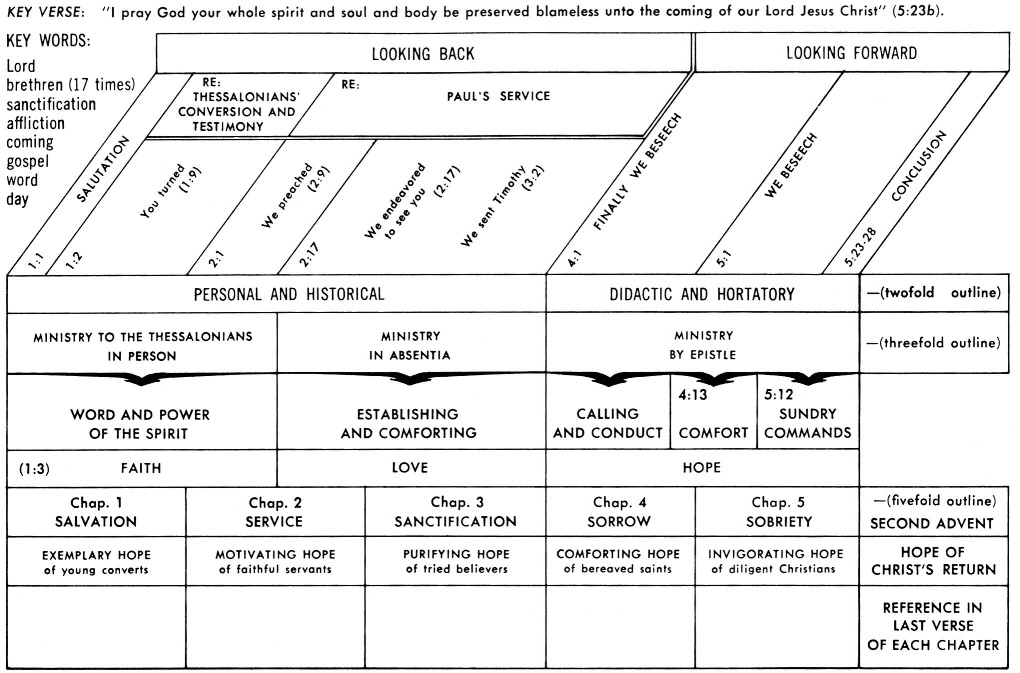
JESUS IS COMING AGAIN
Click chart to enlarge
Charts from Jensen's Survey of the NT - used by permission
|
1 Thessalonians |
||||||
| 1 Th 1:1-10 | 1 Th 2:1-20 | 1 Th 3:1-13 | 1 Th 4:1-18 | 1 Th 5:1-28 | ||
|
LOOKING BACK |
LOOKING FORWARD |
|||||
|
Personal Reflections |
Practical Instructions |
|||||
| Ministry In Person |
Ministry in Absentia (Thru Timothy) |
Ministry by Epistle |
||||
| Word and Power of the Spirit |
Establishing & Comforting |
Calling & Conduct | 1Th 4:13ff Comfort |
1Th 5:12ff Commands |
||
| 1 Salvation |
2 Service |
3 Sanctification |
4 Sorrow |
5 Sobriety |
||
| Paul Commends Spiritual Growth |
Paul Founds the Church |
Strengthening of the Church |
Directions for Spiritual Growth |
Holy Living in Light of Day of the Lord | ||
| Exemplary Hope of Young Converts | Motivating Hope of Faithful Servants |
Purifying Hope of Tried Believers | Comforting Hope of Bereaved Saints | Invigorating Hope of Diligent Christians | ||
|
Written from Corinth |
||||||
1Thessalonians 5:23 Now may the God of peace Himself sanctify you entirely; and may your spirit and soul and body be preserved complete, without blame at the coming of our Lord Jesus Christ (NASB: Lockman)
Greek: Autos de o theos tes eirenes agiasai (3SAAO) umas oloteleis, kai olokleron umon to pneuma kai e psuche kai to soma amemptos en te parousia tou kuriou emon Iesou Christou teretheie. (3SAPO)
Amplified: And may the God of peace Himself sanctify you through and through [separate you from profane things, make you pure and wholly consecrated to God]; and may your spirit and soul and body be preserved sound and complete [and found] blameless at the coming of our Lord Jesus Christ (the Messiah). (Amplified Bible - Lockman)
Barclay: May the God of peace Himself consecrate you through and through; and may your spirit and soul and body be kept complete so that you will be blameless at the coming of our Lord Jesus Christ. (Westminster Press)
Milligan's Paraphrase: ‘As however without God all your strivings must be in vain we pray that the God of peace Himself will sanctify you through and through, that the whole man may become God’s, each part preserved entire and without blame, and found so at the Parousia of the Lord Jesus. (St. Paul's Epistles to the Thessalonians. 1908)
NLT: Now may the God of peace make you holy in every way, and may your whole spirit and soul and body be kept blameless until that day when our Lord Jesus Christ comes again. (NLT - Tyndale House)
Phillips: May the God of peace make you holy through and through. May you be kept in soul and mind and body in spotless integrity until the coming of our Lord Jesus Christ. (Phillips: Touchstone)
Wuest: Now, may the God of peace himself consecrate you, every part of each one of you, to His worship and service, and may your spirit and soul and body be preserved in their entirety blameless at the coming of our Lord Jesus Christ.
Young's Literal: and the God of the peace Himself sanctify you wholly, and may your whole spirit, and soul, and body, be preserved unblameably in the presence of our Lord Jesus Christ
NOW MAY THE GOD OF PEACE HIMSELF SANCTIFY YOU ENTIRELY: Autos de o theos tes eirenes hagiasai (3SAAO) humas holoteleis:
- Ro 15:5,13,33; 16:20; 1Cor 14:33; 2Co 5:19; Phil 4:9; 2Th 3:16; Heb 13:20; 1Pe 5:10
- 1Th 3:13; 4:3; Lev 20:8,26; Ezekiel 37:28; John 17:19; Acts 20:32; 26:18; 1Co 1:2; Hebrews 2:11; 1Pe 1:2; Jude 1:1
- 1 Thessalonians 5 Resources - Multiple Sermons and Commentaries
A PRAYER FOR PROGRESSIVE
SANCTIFICATION
Progressive sanctification is continuing growth in holiness and Christlikeness, wrought by the transforming power of the Holy Spirit (2 Cor 3:18), the intake of the Holy Word (1 Pe 2:2, Mt 4:4) and Spirit enabled obedience of holy ones (Php 2:13NLT).
Now (1161)(de) marks a transition from the previous commands to a short but spiritually rich prayer (pray this prayer for your family members, your church members [by name], you pastor and elders [individually and by name]). And this prayer to God for sanctification is a fitting conclusion to the preceding exhortations to holiness, for it is only by His enablement they will be fully realized. God Alone is the Source of genuine sanctification, which makes this prayerful appeal to Him appropriate.
James Denney introduces this section with the comment that… "THESE verses open with a contrast to what precedes, which is more strongly brought out in the original than in the translation. The Apostle has drawn the likeness of a Christian church, as a Christian church ought to be, waiting for the coming of the Lord; he has appealed to the Thessalonians to make this picture their standard, and to aim at Christian holiness; and conscious of the futility of such advice, as long as it stands alone and addresses itself to man’s unaided efforts, he turns here instinctively to prayer: “The God of peace Himself” — working in independence of your exertions and my exhortations — “sanctify you wholly.”… Notice the comprehensiveness of the Apostle’s prayer in this place. It is conveyed in three separate words — wholly, entire, and without blame . It is intensified by what has, at least, the look of an enumeration of the parts or elements of which man’s nature consists — “your spirit and soul and body.” It is raised to its highest power when the sanctity for which he prays is set in the searching light of the Last Judgment — in the day of our Lord Jesus Christ." (1 Thessalonians 5 - The Expositor's Bible Commentary)
Frame explains it as "if Paul had said: “I have exhorted you to ethical consecration and to the things that make for peace, but God himself is the only power that can make the exhortation effective.” (Frame, J. E. A Critical and Exegetical Commentary on the Epistles of St. Paul to the Thessalonians. New York: C. Scribner's Sons. 1912)
Calvin - Having given various injunctions, he now proceeds to prayer. And unquestionably doctrine is disseminated in vain, unless God implant it in our minds… Paul, accordingly, knowing that all doctrine is useless until God engraves it, as it were, with his own finger upon our hearts, beseeches God that he would sanctify the Thessalonians.
Matthew Henry - He prays that they may be wholly sanctified, that is, more perfectly, for the best are sanctified but in part while in this world; and therefore we should pray for and press towards complete sanctification.
Himself (846) (autos) In the Greek sentence this pronoun is first for emphasis. Paul's emphasis is that it is God Who sanctifies us ("Himself sanctify you"), accomplishing His work in us. We are to cooperate with His work as just emphasized by a series of exhortations and commandments beginning in 1Thessalonians 4. But ultimately Paul wants to make it clear that sanctification is God’s work in us. Our part and God's part is clearly seen in Paul's exhortation to the Philippians to…
Work out (present imperative) your salvation with fear and trembling for it is God who is at work in you, both to will (give you the desire to obey) and to work (energizing that desire) for His good pleasure. (See notes Philippians 2:12; 13)
Hiebert writes that as the God of Peace it is His "prerogative it is to bestow the well-known Christian peace upon those who have been reconciled to Him through Christ."
God of Peace - a frequent phrase in the NT…
Romans 15:33 (note) Now the God of peace be with you all. Amen.
Romans 16:20 (note) And the God of peace will soon crush Satan under your feet. The grace of our Lord Jesus be with you.
Philippians 4:9 (note) The things you have learned and received and heard and seen in me, practice these things; and the God of peace shall be with you.
1Thessalonians 5:23 Now may the God of peace Himself sanctify you entirely; and may your spirit and soul and body be preserved complete, without blame at the coming of our Lord Jesus Christ.
Hebrews 13:20 (note) Now the God of peace, who brought up from the dead the great Shepherd of the sheep through the blood of the eternal covenant, even Jesus our Lord,
Vincent comments that this phrase God of peace means "God Who is the Source and Giver of peace. Peace, in the Pauline sense, is not mere calm or tranquility. It is always conceived as based upon reconciliation with God. God is the God of peace only to those who have ceased to be at war with Him, and are at one with Him (see notes Romans 5:1, Col 1:20, 1:21; 1:22). God’s peace is not sentimental but moral. Hence the God of peace is the Sanctifier. Peace is habitually used, both in the Old and New Testaments, in connection with the Messianic salvation. The Messiah himself will be Peace (Micah 5:5 "And this One will be our peace..."). Peace is associated with righteousness as a Messianic blessing (Ps 72:7 In his days may the righteous flourish, And abundance of peace till the moon is no more; Ps 85:10 Lovingkindness and truth have met together; Righteousness and peace have kissed each other.). Peace, founded in reconciliation with God, is the theme of the gospel (Acts 10:36 The word which He sent to the sons of Israel, preaching peace through Jesus Christ (He is Lord of all)). The gospel is the gospel of peace (see notes Ephesians 2:17; 6:15; Romans 10:15). Christ is the Giver of peace (John 14:27 Peace I leave with you; My peace I give to you; not as the world gives, do I give to you. Let not your heart be troubled, nor let it be fearful.; John 16:33 These things I have spoken to you, that in Me you may have peace. In the world you have tribulation, but take courage; I have overcome the world.).
Other titles of God which exhibit a similar construction are as follows. Notice that God is the Source of each of these spiritual blessings!
God is the…
• God of glory, Acts 7:2
• God of patience, Ro 15:5 (note)
• God of hope, Ro 15:13 (note)
• God of all comfort, 2Corinthians 1:3, cp. Ro 15:4 (note)
• God of love, 2Corinthians 13:11
• God of all grace, 1Pe 5:10 (note).
We see that the anticipation of Christ's imminent return for His beloved Bride, prompts (or should prompt) in her an attitude of expectancy and actions commensurate with that mindset. Remember that right actions always emanate from right attitudes. Paul's point is that the Bridegroom really is coming quickly and this certainty should marinate our minds and cause us work out our salvation in fear and trembling, purify ourselves for He is holy, cleansing ourselves from all defilement of the flesh and spirit and perfecting holiness in the fear of the Lord or the awe of what it will be like when we truly do see Him face to face!
John has this meeting in mind when he gently exhorts believers…
And now, little children, abide in Him, so that when He appears, we may have confidence and not shrink away from Him in shame at His coming. If you know that He is righteous, you know that everyone also who practices righteousness is born of Him. (1John 2:28-29)
Guzik comments that "The idea behind the word sanctify is “to set apart” - to make something different and distinct, breaking old associations and forming a new association. For example, a dress is a dress; but a wedding dress is sanctified - set apart for a special, glorious purpose. God wants us to be set apart to Him… In all that he told the Christian to do in 1Thessalonians 4:1 through 1Th 5:22, he never intended that they do them in their own power. More Christians are defeated on account of self-reliance than on account of Satanic attack. (1 Thessalonians 5 )
Morris agrees with Guzik writing that "The way in which he effects the transition… indicates that it is only in the power of the God on whom he calls that his exhortations can be brought to fruition. ‘I have been urging you to do certain things, but it is only in God’s strength that you will be able to do them. (Morris, Leon. The Epistles of Paul to the Thessalonians. The Tyndale New Testament Commentaries. Grand Rapids: Wm. B. Eerdmans Publishing Co., 1957)
Calvin writes that "under the term sanctification is included the entire renovation of the man. The Thessalonians, it is true, had been in part renewed, but Paul desires that God would perfect what is remaining. From this we infer, that we must, during our whole life, make progress in the pursuit of holiness.
Frame commenting on sanctify you renders it "“Consecrate you throughout,” “through and through” (Luther). The note of consecration already struck (1Th 3:13 and 1Th 4:3, 4, 5, 6, 7,8- notes 1Th 4:3; 4:4; 4:5; 4:6; 4:7; 4:8) is heard again. As in those passages so here consecration includes not only religion, devotion to God, but conduct, ethical soundness. (Ibid)
Elwell writes that…
The concern of Paul in 1 Thessalonians 4:1-5:22 has been that the lives of his readers be sanctified more and more. It is fitting, therefore, that he should in the end pray once again for their complete sanctification (Gk. holoteles, found only here in the NT, means “entirely,” “completely”). Sanctification is a process which begins with conversion and will be completed only when “perfection comes” (1 Cor. 13:10). (Elwell, W. A.. Vol. 3: Evangelical Commentary on the Bible. Baker Book House)
Sanctify (37)(hagiazo from hagios = holy, set apart) means to set apart for God, to sanctify, to make a person or thing (in the OT altars, days, priests, etc were set apart) the opposite of koinos, which means profane or common.
Hiebert - The primary meaning of sanctify is "to set apart, to consecrate," but it also carries the thought of the resultant holiness of character in the consecrated. The note of holiness was already sounded in 1Thes 3:13 and 4:3-8. (Hiebert, D. Edmond: 1 & 2 Thessalonians: BMH Book. 1996)
Sanctify is in the aorist tense which usually speaks of a point in time, but which in this context according to Vine speaks "not an act begun and accomplished in a moment, but a “process seen in perspective,” and so contemplated as a complete act. This is the case also with the word “keep,” tereo, in 1Ti 6:14 (that you keep the commandment without stain or reproach until the appearing of our Lord Jesus Christ), where a momentary act is out of the question. These passages are complementary one to the other, here the divine side is presented, there the human, the action in each terminating only with the coming of the Lord, cp. Php 1:6 (note). Since those addressed were already saints, i.e., “sanctified ones” (see note on “saints,” 1Th 3:13 (note), and 2Th 2:13), the apostle must be understood here to desire for them the continuous and complete realization of this calling, that by His power they might be enabled to live consistently with the fact that every part of their complex being belonged to God, cp. Ep 5:25, 26, 27-notes Ep 5:25; 26; 27 (Collected writings of W. E. Vine)
Hiebert agrees with Vine noting that "Some insist that the aorist here points to the crisis experience of entire sanctification," but it is generally accepted that the action is best viewed as constative (An aorist tense verb that, along with other contextual features, presents the action simply, in summary, or as a whole. Also called complexive, comprehensive, global, historical, punctiliar, simple or summary), a process of sanctification occurring during this present life and viewed as consummated at the return of Christ. Even those who insist upon the meaning of an initial crisis experience stress that it must be followed by a continuing process of sanctification. The completion of that process is in view here. (Hiebert, D. Edmond: 1 & 2 Thessalonians: BMH Book. 1996)
Wuest writes that hagiazo does not mean…
merely “to set apart,” but in the case of the pagan word, “to set apart for the gods,” and in the case of the Christian word “to set apart for God.” The worshipper of the pagan god acquired the character of that pagan god and the religious ceremonies connected with its worship. The Greek temple at Corinth housed a large number of harlots who were connected with the worship of the Greek god. Thus, the set-apartness of the Greek worshipper was in character licentious, totally depraved, and sinful.
The believer in the Lord Jesus is set apart for God by the Holy Spirit, out of the First Adam with the latter’s sin and condemnation, into the Last Adam with the latter’s righteousness and life (cf 1Cor 15:22,45). Thus, the worshipper of the God of the Bible partakes of the character of the God for Whom he is set apart. This is positional sanctification, an act of God performed at the moment a sinner puts his faith in the Lord Jesus (1Cor 1:2). The work of the Holy Spirit in the yielded saint, in which He sets the believer apart for God in his experience, by eliminating sin from his life and producing His fruit (cf notes Galatians 5:22; 23), a process which goes on constantly throughout the believer’s life, is called progressive sanctification (1Thes 5:23). When our Lord sanctifies Himself, He sets Himself apart for God as the Sacrifice for sin (John 17:19; He 10:7).
When man sanctifies God, “the word denotes that manner of treatment on the part of man which corresponds with the holiness of God, and which springs from faith, trust, and fear” (see 1Pe 3:15)” (Wuest's Word Studies from the Greek New Testament: Eerdmans)
Vine - A number of things are "sanctified" in the NT - (a) the gold adorning the Temple and of the gift laid on the altar, Matt. 23:17, 19; (b) food, 1Ti 4:5; (c) the unbelieving spouse of a believer, 1Co 7:14; (d) the ceremonial cleansing of the Israelites, Heb 9:13; (e) the Father’s Name, Luke 11:2; (f) the consecration of the Son by the Father, Jn 10:36; (g) the Lord Jesus devoting Himself to the redemption of His people, Jn 17:19; (h) the setting apart of the believer for God, Acts 20:32; cf. Ro 15:16; (i) the effect on the believer of the Death of Christ, Heb 10:10, said of God, and He 2:11; 13:12, said of the Lord Jesus; (j) the separation of the believer from the world in his behavior— by the Father through the Word, Jn 17:17, 19; (k) the believer who turns away from such things as dishonor God and His gospel, 2Ti 2:21; (l) the acknowledgment of the Lordship of Christ, 1Pe 3:15. “Since every believer is sanctified in Christ Jesus, 1Cor 1:2, cf. Heb 10:10, a common NT designation of all believers is ‘saints,’ hagioi, i.e., ‘sanctified’ or ‘holy ones.’ Thus sainthood, or sanctification, is not an attainment, it is the state into which God, in grace, calls sinful men, and in which they begin their course as Christians, Col 3:12; Heb 3:1.” (Vine, W. Collected writings of W. E. Vine. Nashville: Thomas Nelson)
Richards makes an interesting point noting that "A basic distinction must be made between the OT and the NT doctrines of holiness. In the OT, the holy is that which is set apart from the common so that it is isolated for God's service. In the NT, holiness is a dynamic process. The holy is actually the common, infused now by God's Spirit and transformed for his service. Thus, our sanctification has to do with God's transformation of us into persons whose actions in daily life are expressions of the Lord. (Richards, L O: Expository Dictionary of Bible Words: Regency)
Hagiazo primarily conveys the idea of separation from and consecration to the service of deity in secular Greek but to God Almighty in the Biblical context. Believers are to separate themselves from profane things and dedicate themselves wholly to their Holy God. As alluded to in the notes on the verses that use hagiazo, there are 3 aspects of sanctification…
(1) Past (positional) Sanctification - This refers to the time of our initial salvation, which was wrought by the atoning work of Christ, at which time we were clothed with His righteousness, we were given a new nature and we were freed from the power of sin and death. This a one time event, never to be repeated.
(2) Present (progressive, experiential) Sanctification - This aspect of sanctification proceeds from past sanctification and deals with present Christian living. It is the process in which believers are working out their salvation by the Spirit’s power, who sets us more and more apart from the world and more and more conformed to the image of Christ. This is the aspect to which Paul's prayer in 1Thes 5:23 relates.
(3) Future (ultimate, perfect) Sanctification - Glorification when God makes believers free of even the desire of sin, free of the fallen flesh nature, and joined with our transformed, glorified bodies for all eternity.
MacArthur writes that "The Puritan Thomas Watson stated it this way, '[Sanctification] is a principle of grace savingly wrought, whereby the heart becomes holy, and is made after God’s own heart. A sanctified person bears not only God’s name, but His image” (Body of Divinity [reprint; Grand Rapids: Baker, 1979], 167).' In all of Paul’s epistles, whenever he moves from doctrinal exposition to practical exhortation (Ed note: E.g., doctrine in Ephesians 1-3; duty in Ephesians 4-6), he has this aspect of sanctification in mind (Experiential sanctification). His passionate prayer for the Thessalonians and for all believers was that through experiential sanctification God would progressively conform them to holiness. (MacArthur, John: 1 & 2 Thessalonians. Moody Press)
There are 28 uses of hagiazo in the NT…
Matthew 6:9 (note) "Pray, then, in this way: 'Our Father who art in heaven, Hallowed (aorist imperative) be Thy name.
Comment: When we pray hallowed be we are asking God to make His Name holy, a Name that people will treat as holy and not as profane. We are saying "Treat Thy Name as holy", the idea being that the Father would secure before the whole world in a final and decisive way the holiness appropriate to His Name, to which human beings will respond with praise and adoration. In fact, in Ezekiel God promises to answer this prayer declaring "I will vindicate the holiness of My great Name which has been profaned among the nations, which you [unfaithful Israel] have profaned in their midst. Then the nations [Gentiles] will know that I am the LORD," declares the Lord GOD, "when I prove Myself holy among you in their sight. [Ezekiel 36:23] The psalmist Solomon prays "And blessed be His glorious Name forever; and may the whole earth be filled with His glory. Amen, and Amen." [Ps 72:19]
Barclay - The word which is translated hallowed is a part of the Greek verb hagiazo. The Greek verb hagiazo is connected with the adjective hagios, and means to treat a person or a thing as hagios. Hagios is the word which is usually translated holy; but the basic meaning of hagios is different or separate. A thing which is hagios is different from other things. A person who is hagios is separate from other people. So a temple is hagion (Greek #39) because it is different from other buildings. An altar is hagios because it exists for a purpose different from the purpose of ordinary things. God's day is hagios because it is different from other days. A priest is hagios because he is separate from other men. So, then, this petition means, "Let God's name be treated differently from all other names; let God's name be given a position which is absolutely unique." But there is something to add to this. In Hebrew the name does not mean simply the name by which a person is called-- John or James, or whatever the name may be. In Hebrew the name means the nature, the character, the personality of the person in so far as it is known or revealed to us. That becomes clear when we see how the Bible writers use the expression. The Psalmist says, "Those who know thy name put their trust in thee" (Ps 9:10). Quite clearly that does not mean that those who know that God is called Jehovah will trust in him. It means that those who know what God is like, those who know the nature and the character of God will put their trust in him. The Psalmist says, "Some boast of chariots and some of horses, but we boast of the name of the Lord our God" (Ps 20:7). Quite clearly that does not mean that in a time of difficulty the Psalmist will remember that God is called Jehovah. It means that at such a time some will put their trust in human and material aids and defenses, but the Psalmist will remember the nature and the character of God; he will remember what God is like, and that memory will give him confidence. So, then, let us take these two things and put them together. Hagiazo, which is translated to hallow, means to regard as different, to give a unique and special place to. The name is the nature, the character, the personality of the person in so far as it is known and revealed to us. Therefore, when we pray "Hallowed be Thy name," it means, "Enable us to give to thee the unique place which thy nature and character deserve and demand." (Matthew 6 - William Barclay's Daily Study Bible)
Matthew 23:17 "You fools and blind men; which is more important, the gold, or the temple that sanctified the gold?
Matthew 23:19 "You blind men, which is more important, the offering or the altar that sanctifies the offering?
Luke 11:2 And He said to them, "When you pray, say: 'Father, hallowed (aorist imperative) be Thy name. Thy kingdom come.
John 10:36 do you say of Him, whom the Father sanctified (set apart for a specific task) and sent into the world, 'You are blaspheming,' because I said, 'I am the Son of God '?
John 17:17 "Sanctify (aorist imperative) them in the truth; Thy word is truth.
Barclay on hagiazo - Jesus prayed that his disciples might be consecrated by the truth. The word for to consecrate is hagiazo which comes from the adjective hagios. In the King James Version hagios is usually translated "holy" but its basic meaning is "different" or "separate." So then hagiazo has two ideas in it.
(a) It means to set apart for a special task. When God called Jeremiah, he said to him: "Before I formed you in the womb I knew you; and before you were born I consecrated (Heb = qadash; Lxx = hagiazo) you; I appointed you a prophet to the nations" (Jeremiah 1:5). Even before his birth God had set Jeremiah apart for a special task. When God was instituting the priesthood in Israel he told Moses to ordain the sons of Aaron and to consecrate (Heb = qadash; Lxx = hagiazo) them that they might serve in the office of the priests (Exodus 28:41). Aaron's sons were to be set apart for a special office and a special duty.
(b) But hagiazo means not only to set apart for some special office and task, it also means to equip a man with the qualities of mind and heart and character which are necessary for that task. If a man is to serve God, he must have something of God's goodness and God's wisdom in him. He who would serve the holy God must himself be holy too. And so God does not only choose a man for his special service, and set him apart for it, he also equips a man with the qualities he needs to carry it out.
We must always remember that God has chosen us out and dedicated us for His special service. That special service is that we should love and obey him and should bring others to do the same. And God has not left us to carry out that great task in our own strength, but out of his grace he fits us for our task, if we place our lives in his hands. (John 17 - William Barclay's Daily Study Bible)
John 17:19 "And for their sakes I sanctify Myself, that they themselves also may be sanctified in truth.
Acts 20:32 "And now I commend (entrust to the care of God and His word, to deposit for safekeeping!) you to God and to the word of His grace, which is able to build you up and to give you the inheritance among all those who are sanctified. (perfect tense)
Acts 26:18 to open their eyes so that they may turn from darkness to light and from the dominion of Satan to God, in order that they may receive forgiveness of sins and an inheritance among those who have been sanctified (perfect tense) by faith in Me.'
Romans 15:16 (note) to be a minister of Christ Jesus to the Gentiles, ministering as a priest the gospel of God, that my offering of the Gentiles might become acceptable, sanctified (perfect tense) by the Holy Spirit.
Comment: Hagiazo here refers to the moment these Gentile sinners were set apart and made saints - the moment of salvation (so called "positional sanctification") with perfect tense pointing to the permanence of their position in Christ (which should give you assurance regarding eternal security).
Denney explains that “The offering which Paul conceives himself as presenting to God is the Gentile Church, and the priestly function in the exercise of which this offering is made is the preaching of the gospel.” (Nicoll, W Robertson, Editor: Expositors Greek Testament)
MacArthur writes that "In faithful fulfillment of his unique apostolic calling, Paul’s supreme offering to God was a multitude of Gentiles, who by virtue of the Holy Spirit’s power had been sanctified and thus made acceptable for fellowship with the Father. Like Paul, every believer who is instrumental in winning a soul to Jesus Christ presents that convert, whether Jew or Gentile, as a priestly offering to the Lord." (MacArthur, J: Romans 9-16. Chicago: Moody Press)
1 Corinthians 1:2 to the church of God which is at Corinth, to those who have been sanctified (perfect tense) in Christ Jesus, saints by calling, with all who in every place call upon the name of our Lord Jesus Christ, their Lord and ours:
John MacArthur explains that "They were saints because they had been sanctified (hagiazo), set apart from sin, made holy in Christ Jesus. According to Scripture, every true believer in Jesus Christ—whether faithful or unfaithful, well known or unknown, leader or follower—is a set apart person, a holy person, a saint. In the biblical sense, the most obscure believer today is just as much a saint as the apostle Paul. This is the believer’s position in Christ. Holiness, in that positional sense (Ed note: Synonymous with "positional sanctification" in contrast to progressive sanctification), is not a matter of good works, of holy living. As Christians we should live holy lives, but holy living does not make us holy. To the extent our living is holy, it is because, in Christ, we already are holy and have the counsel and power of His Holy Spirit. We are holy because the Sanctifier (the One who makes holy) has already sanctified us in response to our trust in Him (Heb. 2:11). Christ’s work, not our own, makes us holy. We are “saints by calling.” That refers to the efficacious call of God to salvation (1 Cor 1:24, 26). (1Corinthians. Chicago: Moody Press) (Bolding added)
1 Corinthians 6:11 And such were some of you; but you were washed, but you were sanctified (aorist tense), but you were justified in the name of the Lord Jesus Christ, and in the Spirit of our God.
Comment: To be sanctified is to be made holy inwardly and to be able, in the Spirit’s power, to live a righteous life outwardly. Before a person is saved he has no holy nature and no capacity for holy living. But in Christ we are given a new nature and can live out the new kind of life. Sin’s total domination is broken and is replaced by a life of holiness. By their fleshly sinfulness the Corinthians were interrupting that divine work. (Ibid)
1 Corinthians 7:14 For the unbelieving husband is sanctified through his wife, and the unbelieving wife is sanctified through her believing husband; for otherwise your children are unclean, but now they are holy.
Wuest notes that "In the case where the unbelieving wife is sanctified by the believing husband, and the unbelieving husband is sanctified by the believing wife, it “clearly cannot signify the sanctification in its fulness which the NT divine and saving work produces; for a personal faith is required in the object of it, which is in this case denied. Still it is unmistakably intimated that by virtue of the marriage union, the unbelieving side in its measure participates in the saving work and fellowship with God experienced by the believing side" (Ibid)
MacArthur adds that "In God’s eyes a home is set apart for Himself when the husband, wife, or, by implication, any other family member, is a Christian. Such a home is not Christian in the full sense, but it is immeasurably superior to one that is totally unbelieving. Even if the Christian is ridiculed and persecuted, unbelievers in the family are blessed because of that believer. One Christian in a home graces the entire home. God’s indwelling that believer and all the blessings and graces that flow into the believer’s life from heaven will spill over to enrich all who are near." (Ibid)
Ephesians 5:26 (note) that He might sanctify her, having cleansed her by the washing of water with the word,
1Thessalonians 5:23 (note) Now may the God of peace Himself sanctify (optative mood) you entirely; and may your spirit and soul and body be preserved complete, without blame at the coming of our Lord Jesus Christ.
1 Timothy 4:5 (For everything created by God is good, and nothing is to be rejected, if it is received with gratitude) for it (everything created by God) is sanctified (present tense) by means of the word of God and prayer.
Comment: BKC explains that "All the seemingly “ordinary” things of life can then become extraordinary as they are consecrated (hagiazo) by the Word of God and prayer (Ed note: in context especially gratitude or thanksgiving). In the light of the Scriptures a Christian recognizes God’s good hand behind the things provided, and offers thanksgiving to the Lord. In this way the ordinary things so easily taken for granted (some of which are forbidden by errorists) become sanctified (set apart from common things) as occasions for worship and praise. (The Bible Knowledge Commentary)
2 Timothy 2:21 (note) Therefore, if a man cleanses himself from these things, he will be a vessel for honor, sanctified (perfect tense), useful to the Master, prepared for every good work.
Hebrews 2:11 (note) For both He who sanctifies (present tense) and those who are sanctified (present tense) are all from one Father; for which reason He is not ashamed to call them brethren
Comment: "He Who sanctifies" is the Lord Jesus Christ. "Those who are sanctified" is present tense, passive voice which could be paraphrased "those who are continually being set apart from the world and to God" which describes our present state of progressive sanctification ("present tense salvation" -- see the Three Tenses of Salvation) which describes our daily being conformed to the image of God's Son, which will culminate in our being "like Him" (1 John 3:2-3) (glorification).
Hebrews 9:13 (note) For if the blood of goats and bulls and the ashes of a heifer sprinkling those who have been defiled (made "common" or unclean, violating the state required for ritual holiness), sanctify for the cleansing (purifying, making ritually cleansed and acceptable to offer worship in the setting of the Tabernacle) of the flesh
Comment: In the OT the worshippers were "set apart" from whatever ritually defiled them by the blood of animals, which effected only an "external" cleansing, not an internal one (contrast this effect with that brought about by the blood of Christ in Hebrews 13:12 below).
Hebrews 10:10 (note) By this will we have been sanctified (perfect tense) through the offering of the body of Jesus Christ once for all.
Comment: Here the writer's use of perfect tense pictures a past completed event with present ongoing effect/result. Note also that sanctified is in the passive voice, indicating we are being acted upon by an outside force [God and His will] Who takes a sinner and sets them apart as a same person. Furthermore note that the perfect tense shows in the strongest way the permanent and continuous state of salvation into which the believer is brought and in which he lives, which is especially significant if you wrestle with the issue of eternal security - even the verb tense underscores the truth of "eternal security"!
Hebrews 10:14 (note) For by one offering He has perfected for all time those who are sanctified (present tense).
Comment: This verse can be amplified as follows - "Those who are continually (present tense) being (passive voice = subject acted upon by outside source, ie, the sanctifying work of the Spirit) set apart from the world and unto God".
Here the reference is to ongoing sanctification or so-called "progressive sanctification" (= "present tense salvation") which is a continuous process in this life and is terminated only when we are glorified ("future tense salvation") in eternity future in heaven. (See also the Three Tenses of Salvation)
Hebrews 10:29 (note) How much severer punishment do you think he will deserve who has trampled under foot the Son of God, and has regarded as unclean the blood of the covenant by which he was sanctified, and has insulted the Spirit of grace?
Comment: Wuest writes that "The words “by which he was sanctified” in connection with the identity of the person who committed this sin (trampling under foot… ), might trouble the reader when he remembers that the historical background and analysis of the book show that that person is an unsaved person. But the difficulty disappears when we remember that the writer is addressing himself to the professing Christian church, made up of saved and unsaved, and that the idea here is, “by which he professed to be sanctified.” (ibid)
Hebrews 13:12 (note) Therefore Jesus also, that He might sanctify the people through His own blood, suffered outside the gate.
1 Peter 3:15 (note) but sanctify (aorist imperative) Christ as Lord in your hearts (quoting from Isaiah 8:13), always being ready to make a defense to everyone who asks you to give an account for the hope that is in you, yet with gentleness and reverence
Comment: Instead of worrying or being afraid, the readers are commanded to set Christ apart as Lord in their heart. The idea is that instead of fear, affirm Jesus is Lord and submit to (and trust) His control, instruction and guidance. Set Christ apart from all others as the sole object of their reverence and obedience, even in the face of unjust suffering. He will give courage, boldness and fortitude that we might be able to weather the storm.
Revelation 22:11 (note) "Let the one who does wrong, still do wrong; and let the one who is filthy, still be filthy; and let the one who is righteous, still practice righteousness; and let the one who is holy, still keep himself holy (aorist imperative)."
From the preceding passages we learn several truths about hagiazo or sanctifying… In Romans 15:16 the Spirit produces an initial sanctification or so-called positional sanctification (which equates with the moment of salvation). Other passages also speak of our initial salvation as the time at which we were sanctified or set apart from the world and unto God (Acts 20:32, 26:18, 1 Corinthians 1:2, 6:11). In John 17:17 Jesus teaches that the Word of truth is the agent by which believers are sanctified (here speaking of ongoing sanctification once we are saved). In Hebrews 10 we see these two aspects of sanctification - past tense salvation or initial salvation where by God's "will we have been sanctified" (Hebrews 10:10) and present tense salvation or experiential (progressive) sanctification.
There are 144 uses of hagiazo in the Septuagint (LXX) (Ge 2:3; Ex 13:2, 12; 19:14, 22f; 20:8, 11; 28:38, 41; 29:1, 20, 27, 33, 36f, 43f; 30:29f; 31:13; 40:8ff, 13; Lev. 6:18, 27; 8:10, 12, 15, 30; 10:3; 11:44; 16:4, 19; 20:3, 8; 21:8, 12, 15, 23; 22:2f, 9, 16, 32; 25:10f; 27:14ff, 22; Num. 3:13; 5:9f; 6:11f; 7:1; 8:17; 16:16, 37f; 18:8f, 29; 20:12f; 27:14; Deut. 5:12, 15; 15:19; 22:9; 32:51; 33:3; Jos. 7:13; Jdg. 17:3; 1 Sam. 7:1, 16; 16:5; 21:5; 2 Sam. 8:11; 11:4; 1 Ki. 8:8, 64; 9:3, 7; 2 Ki. 10:20; 12:18; 1 Chr. 18:11; 23:13; 26:26ff; 2 Chr. 2:4; 5:11; 7:7, 16, 20; 26:18; 29:33; 30:8; 31:6; 35:3; Ezr. 3:5; Neh. 3:1; 12:47; 13:22; Ps. 46:4; Prov. 20:25; Isa. 8:13; 10:17; 13:3; 29:23; 49:7; Jer. 1:5; 17:22, 24, 27; 51:27f; Ezek. 20:12, 20, 41; 28:22, 25; 36:23; 37:28; 38:16, 23; 39:27; 44:19, 24; 46:20; 48:11; Dan. 4:22; 12:7, 10; Joel 1:14; 2:15f; 3:9; Amos 2:12; Zeph. 1:7; Hag. 2:12) Hagiazo is repeatedly used in the Septuagint (LXX) to express the entire dedication and consecration of persons (including an entire nation, Israel), things (altar, etc), times (days, etc) to God.
Genesis 2:3 Then God blessed the seventh day and sanctified (Hebrew = qadash = set apart; Lxx = hagiazo) it, because in it He rested from all His work which God had created and made.
Exodus 13:2 "Sanctify (Hebrew = qadash = set apart; Lxx = hagiazo) to Me every first-born, the first offspring of every womb among the sons of Israel, both of man and beast; it belongs to Me."
Exodus 29:1 Now this is what you shall do to them to consecrate (Hebrew = qadash = set apart; Lxx = hagiazo) them to minister as priests to Me: take one young bull and two rams without blemish
Exodus 40:13 And you shall put the holy garments on Aaron and anoint him and consecrate (Hebrew = qadash = set apart; Lxx = hagiazo) him, that he may minister as a priest to Me.
Leviticus 11:44 'For I am the LORD your God. Consecrate (Hebrew = qadash = set apart; Lxx = hagiazo) yourselves therefore, and be holy; for I am holy. And you shall not make yourselves unclean with any of the swarming things that swarm on the earth.
Leviticus 22:2, 3 Tell Aaron and his sons to be careful with the holy gifts of the sons of Israel, which they dedicate (Hebrew = qadash = set apart; Lxx = hagiazo) to Me, so as not to profane My holy name; I am the LORD. Say to them, 'If any man among all your descendants throughout your generations approaches the holy gifts which the sons of Israel dedicate (Hebrew = qadash = set apart; Lxx = hagiazo) to the LORD, while he has an uncleanness, that person shall be cut off from before Me. I am the LORD.
Jeremiah 1:5 "Before I formed you in the womb I knew you, And before you were born I consecrated (Hebrew = qadash = set apart; Lxx = hagiazo) you; I have appointed you a prophet to the nations."
MacArthur comments that this prayer is for their sanctification explaining that…
Sanctification is the ongoing spiritual process by which God increasingly sets believers apart from sin and moves them toward holiness. The apostle’s entreaty for the Thessalonians parallels and reiterates the theme and form of his earlier prayer for their spiritual growth (see notes 1Thes 3:11; 12; 13)
Entirely (3651)(holoteles from hólos = all, the whole, complete + télos = end, consummation) is used only here in the NT and means complete to the end, i.e. absolutely perfect, wholly complete, completely-entirely! Holoteles describes something complete in all its parts, with no part wanting or unsound. It implies entirety and also the idea of completion. Paul asks God that nothing in these saints would escape the sanctifying power (of His Word and His Spirit). Paul is praying that God would sanctify these saints "through and through".
Hiebert adds that the basic idea of holoteles… is "wholly attaining the end, reaching the intended goal," hence has the force of no part being left unreached. The prayer is that the divine sanctification may extend to every part of their being, leaving no area untouched by the pervasive power of divine holiness. It is tragically true that "many are satisfied with a partial Christianity; some parts of their life are still worldly" (Lenski) (Hiebert, D. Edmond: 1 & 2 Thessalonians: BMH Book. 1996)
Denney writes that our…inward life, in all its aspects, is to be sanctified through and through. All our powers of thought and imagination are to be consecrated; unholy thoughts are to be banished; lawless, roving imaginings, suppressed. All our inventiveness is to be used in God’s service. All our affections are to be holy. Our heart’s desire is not to settle on anything from which it would shrink in the day of the Lord Jesus. The fire which He came to cast on the earth must be kindled in our souls, and blaze there till it has burned up all that is unworthy of His love. Our consciences must be disciplined by His word and Spirit, till all the aberrations due to pride and passion and the law of the world have been reduced to nothing, and as face answers face in the glass, so our judgment and our will answer His. (Ibid)
AND MAY YOUR SPIRIT AND SOUL AND BODY BE PRESERVED COMPLETE AND WITHOUT BLAME AT THE COMING OF OUR LORD JESUS CHRIST: kai holokleron humon to pneuma kai e psuche kai to soma amemptos en te parousia tou kuriou hemon Iesou Christou teretheie. (3SAPO):
- Hebrews 4:12) (1Thes 3:13; 1Corinthians 1:8,9; Ephesians 5:26,27; Philippians 1:6,10; 2:15,16; Colossians 1:22; Jude 1:24
- 1 Thessalonians 5 Resources - Multiple Sermons and Commentaries
Hiebert observes that "The prayer that they may be wholly sanctified is now carried forward with the petition that they may be preserved in all parts of their being until the return of Christ. Sanctification and preservation go together. (Ibid)
Regarding the phrase your spirit and soul and body Hiebert explains that "All three areas (spirit, soul and body) stand in need of the sanctifying and keeping (preserving) power of God. It is a prayer that is applicable only to believers. The three terms are arranged in the order of merit, the highest first. The enumeration begins with that which is highest and purest in man and ends with the outward and material part of man. The divine sanctification begins with the inner and spiritual and reaches down to the outward and material. The precise implication of this threefold enumeration for the essential cure of man has been much debated. (Ibid)
The sanctifying work of God includes not only the immaterial part of the believer (spirit and soul), but also the body.
Matthew Poole rightly observes that "true sanctification reaches to the whole man - spirit, soul, and body. (Matthew Poole's Commentary on the New Testament)
Spirit (4151) (pneuma) describes the immaterial part of the human personality in contrast outward and visible aspects of physical flesh and body (soma).
Soul (5590) (psuche or psyche from psucho = to breathe, blow, English = psychology, "study of the soul") is the breath, then that which breathes, the individual, animated creature. However the discerning reader must understand that psuche is one of those Greek words that can have several meanings, the exact nuance being determined by the context. It follows that one cannot simply select of the three main meanings of psuche and insert it in a given passage for it may not be appropriate to the given context. The meaning of psuche is also contingent upon whether one is a dichotomist or trichotomist. (Click an excellent article on Soul in the Evangelical Dictionary of Biblical Theology; see also ISBE article on Soul) (See word study on psuche)
BAGD's lexicon makes the point that…It is often impossible to draw hard and fast lines in the use of this multivalent word. Generally it is used in reference to dematerialized existence or being… Without psuche a being, whether human or animal, consists merely of flesh and bones and without functioning capability. Speculations and views respecting the fortunes of psuche and its relation to the body find varied expression in our literature. (Arndt, W., Danker, F. W., & Bauer, W. A Greek-English Lexicon of the New Testament and Other Early Christian Literature)
Body (4983) (soma) describes an organized whole made up of parts and members and generally describes any material body, in this case the human body.
MacArthur - In view of the prevailing Greek culture, it is significant that Paul included the body in his benediction. That culture—influenced by a philosophical dualism which taught that man’s spirit is inherently good and his body inherently evil—held the body in low esteem. That philosophy provided a convenient rationale for dismissing as inconsequential whatever immoral physical behavior people might have engaged in… If sanctification is to be complete, it will extend to every part of the believer, especially the body, which thinks, feels, and acts in response to the holiness of the inner person. (Ibid)
Ryrie for feels that "spirit and soul and body should not be understood as defining the parts of man, but as representing the whole man.
Nevertheless as alluded to earlier, this passage has been the subject of considerable debate over the question "Is man a trichotomous (three part) or dichotomous (two part) being?"
Hiebert writes that…
All agree at man in his essential nature is both material and nonmaterial. The body is the outward, material part of man, the instrument through which the inner life expresses itself. It is an essential part of man as created by God (Genesis 2:7), and in the biblical view man is incomplete without a body. Our salvation will not be completed until we receive our glorified bodies at Christ's return (Heb 11:40; Php 3:20, 21).
Spirit and soul relate to the nonmaterial part of man. The Bible at times speaks of man as a bipartite being, referred to as composed of "body and spirit" (James 2:26; 2Cor. 7:1) or of "body and soul" (Matt. 10:28). But here, as in several other places (e.g., He 4:12 [note]), man is viewed as tripartite. This raises the thorny problem of what is meant here by spirit and soul. Both terms are used with various shades of meaning in the Scriptures…
The common suggestion that these terms are simply a rhetorical piling up of words for emphasis is rejected by Ellicott with the remark that such a position is "plainly to set aside all sound rules of scriptural exegesis."
Bible students who accept the accuracy of Scripture have always believed that a distinction between the two terms was intended here. If there is no difference between them it is difficult to see how the Spirit of God can distinguish them, as in He 4:12 [note]. That there is a distinction between soul and spirit is clear from Paul's use of the adjectives psuchikos (soulish) and pneumatikos (spiritual) in 1Corinthians 2:14, 15 and 1Cor 15:44.
The spirit is the highest and most distinctive part of man. It is the life principle imparted to man by God Who is Spirit, enabling him to know and communicate with God. But with the fall, man as a spiritual being was separated from God and spiritual death resulted. The impartation of a new spiritual nature in the new birth is necessary so that man can again have direct communion with God.
The soul may be viewed as the self-conscious life of man, the seat of personality. The self-conscious personality reaches out in two directions. In its relation to the world, the soul is entirely dependent upon the body for its information and responses. Through his spirit, man reaches up to the spiritual world, Godward. The fallen man has an awareness of the reality of God and the spiritual world, but in his unregenerate condition he had no direct communion with God. Thus, the unregenerated man can only understand a religion of the senses. With the new birth, he is brought into direct relation with God through the renewed spirit, enabling him to worship God in spirit and truth.
Hebrews 4:12 [note], however, suggests that it is very difficult to distinguish between spirit and soul. Scriptural usage indicates an overlapping of functions. Nor need we try to keep them in watertight compartments. Students of Scripture are not agreed as to whether the distinction between spirit and soul in our passage is substantial or functional. Trichotomists hold to the former, dichotomists to the latter.
We agree with those who, like Marshall, conclude that this triple designation, most naturally understood, presents a trichotomous view of human nature, "taking it in the sense that Paul here distinguishes three aspects of the Christian's personality, his life in relationship with God through the 'spiritual' part of his nature, his human personality, or 'soul,' and the human body through which he acts and expresses himself. (Ibid)
Guzik writes that the trichotomist view has "some merit, but also has problems. One might say that Mark 12:30 divides man’s nature into four parts (heart, soul, mind, and strength), and that 1Corinthians 7:34 divides man’s nature into two parts (body and spirit). In some passages the terms soul and spirit seem to be synonymous, other times they seem to be distinct and hard to define precisely. It seems that there are indeed these three different aspects to the human person, yet the specific meaning of spirit or soul must be determined by the context. (Ibid)
Vincent - It is useless to attempt to draw from these words a technical, psychological statement of a threefold division of the human personality. If Paul recognised any such technical division, it was more probably twofold; the body or material part, and the immaterial part with its higher and lower sides (1 Thessalonians 5)
John MacArthur feels that the view of man as trichotomous cannot be Scripturally substantiated writing that…
No Scripture text ascribes different, distinct substance and functions to the spirit and soul. Trichotomists nevertheless usually propose that spirit is man’s Godward consciousness and soul is his earthward consciousness; however, neither the Greek usage of spirit (pneuma) nor of soul (psuche) sustains that proposition. The nonmaterial part of man does have myriad capacities to respond to God, Satan, and the world’s many stimuli, but it is untenable to arbitrarily separate the spirit from the soul. The two terms are used interchangeably in Scripture (cf. Heb 6:19; 10:39; 1Peter 2:11; 2Peter 2:8). Spirit and soul are familiar and common synonyms that Paul used to emphasize the depth and scope of sanctification. Some suggest that an acceptable translation of this portion of Paul’s prayer could be, “May your spirit, even soul and body,” in which case “spirit” would refer to the whole person, and “soul and body” to the person’s nonmaterial and material parts. References from Paul’s other epistles provide clear evidence that he was a dichotomist (Ro 8:10; 1Cor. 2:11; 5:3, 5; 7:34; 2Cor. 7:1; Gal. 6:18; Col. 2:5; 2Ti 4:22).
Some claim Hebrews 4:12, “For the word of God is living and active and sharper than any two-edged sword, and piercing as far as the division of soul and spirit, of both joints and marrow, and able to judge the thoughts and intentions of the heart,” supports a trichotomist view of man’s essence because it suggests splitting soul and spirit. But a careful look at the verse’s language refutes that contention. The writer did not say the sword of the Word penetrates a person’s inner being and separates his soul from his spirit. He said only that the sword cuts open the soul and the spirit of the person. He used a second metaphorical expression “piercing … both joints and marrow” to further depict the deep penetration God’s Word makes into the inner person. This verse poses no special difficulty for the dichotomist position. (MacArthur, John: 1 & 2 Thessalonians. Moody Press or Logos)
Milligan adds that "your spirit and your soul and your body,’ but this triple subject must not be pressed as if it contained a psychological definition of human nature. St Paul ‘is not writing a treatise on the soul, but pouring forth, from the fulness of his heart, a prayer for his converts’ (Jowett), and consequently all appeals to the verse in support of a Pauline system of Trichotomy as against the Dichotomy found elsewhere in his Epistles are beside the mark. At the same time it will not do to regard the three subjects as of ‘mere rhetorical significance’ (de Wette): they are evidently chosen in accordance with the general O.T. view of the constitution of man to emphasize a sanctification which shall extend to man’s whole being, whether on its immortal, its personal, or its bodily side… (St. Paul's Epistles to the Thessalonians. 1908)
Preserved (5083)(tereo from teros - a guard or warden) means to keep an eye on, keep something in view, to attend carefully, or to watch over it. It conveys the sense of protecting, watching over and guarding something which is in one’s possession. To watch as one would some precious thing. It means to observe attentively, to keep watch over and to retain in custody.
Complete (3648) (holokleros from holos = all, the whole [holos gives us holograph, a 360-degree, three-dimensional depiction of an object] + kleros = part, share, lot, allotment or all that has fallen by lot) literally is the "whole lot" and thus means having the entire allotment, complete in all its parts and in no part wanting or unsound. The idea is that which retains all that was initially allotted to it and is wanting nothing for its wholeness. Holokleros means without lack or deficiency, complete and whole in all its parts and thus conveys the idea of "with integrity" (English word integrity is from Latin "integer" meaning entire, intact, whole - cp English word "integer" meaning a whole number, a complete entity, a thing complete in itself!)
Holokleros was used of unhewn stones, as having lost nothing in the process of shaping and polishing.' Josephus (Ant. iii. 12, 2) uses holokleros of an unblemished victim for sacrifice.
Barclay writes that holokleros means "entire, perfect in every part. It is used of the animal which is fit to be offered to God and of the priest who is fit to serve him. It means that the animal or the person has no disfiguring and disqualifying blemishes. Gradually this unswerving constancy removes the weaknesses and the imperfections from a man’s character. Daily it enables him to conquer old sins, to shed old blemishes and to gain new virtues, until in the end he becomes entirely fit for the service of God and of his fellow-men. (James 1 - William Barclay's Daily Study Bible)
Moulton and Milligan write that holokleros "is common of material or physical soundness and completeness
There are 2 NT uses of holokleros, the other use being in…
James 1:4 (Here James' exhortation is given to motivate them to comprehend the value of trials in the believer's life so that he or she is enabled to by faith "consider them all joy" -- note "not fun" but "joy") And let endurance (see hupomone) have its perfect result, that you may be perfect (see teleios) and complete (holokleros), lacking in nothing. (Comment: Observe that James tells us in essence the "definition" of holokleros -- "lacking in nothing." The idea is complete in all respects. Consummate.)
Vine comments on the distinction between "perfect" and "complete" noting that complete "signifies that every grace should be manifest in the believer that is present in Christ, John 1:16 ("For of His fulness we have all received grace upon grace") (whereas) perfect (teleios) signifies that every grace should be developed and matured.
There are 6 uses of holokleros in the non-apocryphal Septuagint (LXX) (Lev. 23:15; Deut. 16:9; 27:6; Jos. 8:31; Ezek. 15:5; Zech. 11:16). In the LXX holokleros is used of the full week, Leviticus 23:5 (see below), of the unhewn/uncut stones of the alter, Deut 27:6, Joshua 8:31, and of the growing vine tree, Ezekiel 15:5. In the use in Leviticus note that holokleros translates the Hebrew word tamiym which is elsewhere used to describe character, the first use in fact referring to Noah as "blameless (tamiym) in his time" (Ge 6:9)…
Leviticus 23:15 'You shall also count for yourselves from the day after the sabbath, from the day when you brought in the sheaf of the wave offering; there shall be seven complete (Hebrew = tamiym = complete, sound, whole; Lxx = holokleros) sabbaths.
Deuteronomy 27:6 "You shall build the altar of the LORD your God of uncut (KJV = whole) (Hebrew = shalam = complete, perfect, whole; Lxx = holokleros) stones; and you shall offer on it burnt offerings to the LORD your God (Comment: And God still requires "whole" stones to build His "altars" today! cp notes on "living stones" in 1 Peter 2:5 and saints "being built together into a dwelling of God in the Spirit" - Ephesians 2:20; 21; 22)
Joshua 8:31 just as Moses the servant of the LORD had commanded the sons of Israel, as it is written in the book of the law of Moses, an altar of uncut (KJV = whole) (Hebrew = shalam = complete, perfect, whole; Lxx = holokleros) stones, on which no man had wielded an iron tool; and they offered burnt offerings on it to the LORD, and sacrificed peace offerings.
Ezekiel 15:5 "Behold, while it is intact (KJV = whole) (Hebrew = tamiym = complete, sound, whole; Lxx = holokleros), it is not made into anything. How much less, when the fire has consumed it and it is charred, can it still be made into anything!
Here in 1 Thessalonians 5:23, holokleros is used in an ethical sense to convey the thought that all the virtues that belong to the sanctified believer may be complete in them. In one sense, holokleros describes the perfection of Adam before the fall. In the present context the prayer is that no part of the Christian personality should be lacking in consecration.
Luke uses the corresponding noun form holokleria in Acts, where Peter testifies…
And on the basis of faith in His name, it is the name of Jesus which has strengthened this man whom you see and know; and the faith which comes through Him has given him this perfect health (holokleria - state of soundness or well-being in all parts, wholeness, completeness) in the presence of you all. (Acts 3:16)
Comment: Latin integritas; used of an unimpaired condition of body, in which all its members are healthy and fit for use and thus the Latin Vulgate translates the Greek as integra sanitas. Peter's use in context speaks of the lame man's physical healing or wholeness, although there is clearly application to the ethical sense, where faith likewise produces an "internal healing" of our soul and spirit in the regeneration or new birth.)
Bishop Trench has a lengthy note comparing holokleros and teleios…
Holokleros signifies first, as its etymology declares, that which retains all which was allotted to it at the first (Ezek. 15:5), being thus whole and entire in all its parts (holokleros kai panteles, Philo, De Merc. Meret. 1); with nothing necessary for its completeness wanting.
Thus Darius would have been well pleased not to have taken Babylon if only Zopyrus, who had maimed himself to carry out the stratagem by which it fell, were holokleros still (Plutarch, Reg. et Imper. Apoph.). Again, unhewn stones, as having lost nothing in the process of shaping and polishing, are holokleroi (Deut. 27:6; 1 Macc. 4:47); perfect weeks are ebdomadas holoklerous (Lev. 23:15); and a man en holoklero dermati is ‘in a whole skin’ (Lucian, Philops. 8). We next find holokleros expressing that integrity of body, with nothing redundant, nothing deficient (cf. Lev. 21:17-23), which was required of the Levitical priests as a condition of their ministering at the altar, which also might not be wanting in the sacrifices they offered.
In both these senses Josephus uses it (Ant. iii. 12. 2); as does Philo continually. It is with him the standing word for this integrity of the priests and of the sacrifice, to the necessity of which he often recurs, seeing in it, and rightly, a mystical significance, and that these are holokleroi thusia holoklero Theo (De Vict. 2; De Vict. Off. 1, holokleron kai panteleos momos ametochon. De Agricul. 29; De Cherub. 28; cf. Plato, Legg. vi. 759 c). Teleios is used by Homer (Il. 1. 66) in the same sense.
It is not long before holokleros and holokleria, like the Latin ‘integer’ and ‘integritas, ’ are transferred from bodily to mental and moral entireness (Suetonius, Claud. 4). The only approach to this in the Apocrypha is Wisdom xv. 3, holokleros dikaiosune (righteousness): but in an interesting and important passage in the Phoedrus of Plato (250 c; cf. Tim. 44 c), holokleros expresses the perfection of man before the Fall; I mean, of course, the Fall as Plato contemplated it; when to men, as yet holokleroi kai apatheis kakon, were vouchsafed holoklera phasmata, as contrasted with those weak partial glimpses of the Eternal Beauty, which are all that to most men are now vouchsafed. That person then or thing is holokleros, which is ‘omnibus numeris absolutus,’ or en medeni leipomenos, (not lacking in anything) as James himself (James 1:4) explains the word…
The distinction then is plain (Trench's discussion of teleios has been left out after the ellipsis [… ]). The holokleros is one who has preserved, or who, having once lost, has now regained, his completeness: the teleios is one who has attained his moral end, that for which he was intended, namely, to be a man in Christ; however it may be true that, having reached this, other and higher ends will open out before him, to have Christ formed in him more and more. In the holokleros no grace which ought to be in a Christian man is deficient; in the teleios no grace is merely in its weak imperfect beginnings, but all have reached a certain ripeness and maturity. Holoteles, occurring once in the N. T. (1Th 5:23; cf. Plutarch, De Plac. Phil. v. 21), forms a connecting link between the two, holding on to holokleros in its first half, to teleios in its second. (Perfect - Trench's Synonyms of the New Testament)
As distinguished from the preceding word holoteleis, holokleros is qualitative, while holteleis is quantitative. The holókleros is one who has persevered or, having once suffered loss, has now regained completeness. In the holókleros individual no grace which a Christian man should possess is deficient. (2Pe 1:3)
John Stott writes that "If these words can be distinguished, then probably the former implies ‘a totality from which no part is excluded’ and the latter ‘an integrity in which each part has its due place and proportion’. (1 & 2 Thessalonians. The Bible Speaks Today. Leicester, England; Downers Grove, Ill., U.S.A, IVP)
In sum, Paul issues a prayer designed to make us wholly holy inside and out, not just on the "outside" (which of course is the essence of hypocrisy - hupokrisis) like the "super" religious Pharisees who Jesus "raked over the proverbial coals" declaring to them…
You blind Pharisee, first clean (aorist imperative = Not a suggestion but a command. Do it now! It is your urgent need!) the inside of the cup and of the dish, so that the outside of it may become clean also. (Mt 23:26)
Without blame (274)(amémptōs from the noun ámemptos from a = negates following word + mémphomai = find fault) means irreproachably, faultlessly. The noun describes that which is without defect or blemish and thus describes not being able to find fault in someone or some thing (cf use in He 8:7 {note} regarding the Old Covenant). The idea is that the person is such that he or she is without the possibility of rightful charge being brought against them. Amémptōs was used in the Greco-Roman world of people who were characterized by extraordinary civic consciousness.
This adverb is used in 1Th 2:10 (note) to describe the life of Paul and his companions as they conducted themselves before the Thessalonians, their conduct being such that there was no legitimate ground for accusation. This doesn’t mean that their enemies didn’t accuse them—because they did—but that the charges could not "stick".
TECHNICAL NOTE - There is no verifiable archaeological evidence to support the oft-repeated claim that the Greek term amemptos (“blameless”) was inscribed on early Christian tombstones. While the word is theologically rich, describing the believer’s position as blameless in Christ through His finished work on the Cross, the assertion that it functioned as a funerary inscription remains undocumented in the archaeological record. In other words, the theology is sound, but the historical claim is unsubstantiated. That said, one could choose to have “Amemptos” engraved on a grave marker, as a quiet testimony that might stir curiosity and point others to the One Who Alone makes sinners blameless before God.
Barclay adds that amémptōs…expresses what the Christian is to the world. His life is of such purity that none can find anything in it with which to find fault. It is often said in courts of law that the proceedings must not only be just but must be seen to be just. The Christian must not only be pure, but the purity of his life must be seen by all. (The Daily Study Bible Series)
With this background it is easy to see why Paul prayed for the saints at Thessalonica to be without blame.
Ray Stedman sums up the prayer calling on us to…
recognize that God is able to minister to the whole man -- spirit, soul and body. God can touch you in all those areas. Then you can rest on his faithfulness. He will do it! Choose to obey and he will give you power to perform; but he will not give you the power to perform until you make the choice to obey!
And always remember the end: it is until the coming of our Lord Jesus. All through this letter this has been the great hope set before us. Jesus is coming again. God's kingdom will come on earth. There is only a limited time of testing to go through now. It cannot go on forever. One lifetime is very short. I often think of the motto that used to be prominent in many homes,
Only one life, 'twill soon be past,
Only what's done for Christ will last.
I would like to change one word in that: "Only what's done by Christ will last." That is where the apostle leaves us, with the hope of the coming of our Lord, and the resources God has provided, so that we may live in a new and different way in the midst of this modern age. (Read his full sermon Loving Christianly)
At the coming of the Lord (see Table comparing Rapture vs Second Coming) - Paul associates one's behavior with the truth of Christ's return in order to motivate the saints' diligent, zealous pursuit of holiness (see related topics (see related topics Holiness Quotes; exposition of "be holy" in 1Pe 1:15,16; name of God = The Lord Who Sanctifies; The Lord Who Sanctifies Part 2; Holiness by J. C. Ryle). On that glorious day when we see our Lord face to face, the process of sanctification will be perfect and complete (cp 1Jn 3:2, 1Jn 3:3)! In the meantime, expecting to see Jesus Christ at any moment is a great motivation for holy living (see Doctrine of Imminency). What (really "Who") you are looking for will greatly impact what you are living for! (Or at least it should!) (cp Paul's parallel thoughts on what living in the light of our Savior's return in 2Ti 1:12)
Hiebert agrees writing that "It is in view of that anticipated coming that the prayer for their preservation is offered. Were there no future parousia, this preservation would he quite pointless. The prayer for their preservation is significant view of what that day will disclose. It will assure that then they will be and as blameless. (Ibid)
Coming (3952) (parousia [word study]) is a combination of two Greek words para = with, alongside + ousia = being (ousia is the participial form of the verb eimi = to be) which together literally mean to be alongside. Most lexicons in fact state that parousia is derived from pareimi (from para = near, with + eimi = to be) which means to be present, to be nearby, to have come.
Parousia then literally means a being beside or a presence. The word denotes both an arrival and a consequent presence with.
Parousia conveys the thought of an arrival (advent or coming) of a person to a place plus the idea of their presence at that place until a certain event transpires. The word parousia has no English equivalent and therefore is often transliterated in writings.
John MacArthur - Parousia refers to more than just coming; it includes the idea of “presence.” Perhaps the best English translation would be “arrival.” The church’s great hope is the arrival of Jesus Christ when He comes to bless His people with His presence. That glorious truth appears in more than 500 verses throughout the Bible. (Macarthur J. James. Moody or Logos) (Bolding added)
MacDonald observes that here at the end of this epistle Paul "seems to point to the Judgment Seat (see bema) of Christ, which follows the Rapture (see harpazo). At that time, the Christian’s life, service, and testimony will be reviewed, and he will be rewarded or suffer loss. (MacDonald, W & Farstad, A. Believer's Bible Commentary: Thomas Nelson)
While I certainly would agree with the excellent commentator William MacDonald, there is no question that the certainty of Christ's Second Coming at the end of the Great Tribulation (the last 3.5 years of the 7 year period of testing) just prior to the establishment of His Millennial Kingdom will also be a blessed stabilizing hope to those individuals who experience new birth in the hard to bear seven year period known as the Tribulation or Daniel's Seventieth Week. For more discussion of the relationship of the Rapture and the Second Coming of Christ see the comparison of the Rapture versus the Second Coming.
Spurgeon has the following exhortation…
Thomas Manton (Ed: Puritan writer) says: If an earthly king lie but a night in a house, what care is there taken that nothing be offensive to him, but that all things be neat, clean, and sweet? How much more ought you to be careful to get and keep your hearts clean, to perform service acceptably to Him; to be in the exercise of faith, love and other graces, that you may entertain, as you ought, your heavenly King, who comes to take up His continual abode and residence in your hearts!
We know a house in which an empress rested for a very short time, and the owner henceforth refused to admit other inmates. Such is his devotion to his royal guest that no one may now sit in her chair or dine at the table which she honoured. Our verdict is that he makes loyalty into absurdity by this conduct; but if we imitate him in this procedure in reference to the Lord Jesus we shall be wise. Let our whole being be set apart for Jesus, and for Jesus only. We shall not have to shut up the house; for our beloved Lord will inhabit every chamber of it, and make it a permanent palace. Let us see to it that all be holy, all pure, all devout. Help us, O Purifier of the temple, to drive out all intruders, and reserve our soul in all the beauty of holiness for the Blessed and Only Potentate.
1Thessalonians 5:24 Faithful is He who calls you, and He also will bring it to pass (NASB: Lockman)
Greek: pistos o kalon (PAPMSN) umas, os kai poiesei. (3SFAI)
Amplified: Faithful is He Who is calling you [to Himself] and utterly trustworthy, and He will also do it [fulfill His call by hallowing and keeping you]. (Amplified Bible - Lockman)
Barclay: You can rely on Him Who calls you—and We will do this very thing. (Westminster Press)
Milligan's Paraphrase: Nor need you have any fear regarding this. The very fact that it is God Who is calling is to you the pledge that He will not suffer His calling to become null and void. (St. Paul's Epistles to the Thessalonians. 1908)
NLT: God, who calls you, is faithful; he will do this. (NLT - Tyndale House)
Phillips: He who calls you is utterly faithful and he will finish what he has set out to do. (Phillips: Touchstone)
Wuest: Faithful is He who gives you the divine summons [into salvation], who also will do it.
Young's Literal: stedfast is He who is calling you, who also will do it.
FAITHFUL IS HE WHO CALLS YOU:pistos o kalon (PAPMSN) umas, os kai poiesei (3SFAI):
- Dt 7:9; Ps 36:5; 40:10; 86:15; 89:2; 92:2; 100:5; 138:2; 146:6; Isa 25:1; Lam 3:23; Micah 7:20; Jn 1:17; 3:33; 1Cor 1:9; 10:13; 2Th 3:3; 2Ti 2:13; Titus 1:2; Heb 6:17,18
- 1Th 2:12; Ro 8:30; 9:24; Gal 1:15; 2Th 2:14; 2Ti 1:9; 1Pe 5:10; 2Pe 1:3; Rev 17:14
- Numbers 23:19; 2Ki 19:31; Isaiah 9:7; 14:24, 25, 26; 37:32; Matthew 24:35
- 1 Thessalonians 5 Resources - Multiple Sermons and Commentaries
Never forget -- You can depend upon God…
God not only keeps His promises.
He also keeps His people!
The prayer of verse 23 will certainly be answered!
In his letter to the Philippians, Paul expressed a similar confidence in God's faithfulness to finish His work in believers…
I am confident of this very thing, that He who began a good work in you will perfect it until the day of Christ Jesus. (see note Philippians 1:6)
Spurgeon has a devotional entitled Perfection and Preservation (Faith's Checkbook) on 1Thessalonians 5:24 (notice how he artfully uses the inductive Bible study technique of interrogating the text with the 5W'S & H)…
What will He do? He will sanctify us wholly. See the previous verse. He will carry on the work of purification till we are perfect in every part. He will preserve our "whole spirit, and soul, and body, blameless unto the coming of our Lord Jesus Christ." He will not allow us to fall from grace, nor come under the dominion of sin. What great favors are these! Well may we adore the Giver of such unspeakable gifts.
Who will do this? The Lord Who has called us out of darkness into His marvelous light, out of death in sin into eternal life in Christ Jesus. Only He can do this: such perfection and preservation can only come from the God of all grace.
Why will He do it? Because He is "faithful"--faithful to His own promise which is pledged to save the believer; faithful to His Son, whose reward it is that His people shall be presented to Him faultless; faithful to the work which He has commenced in us by our effectual calling (See calling and also "the called"). It is not their own faithfulness but the Lord's Own faithfulness on which the saints rely.
Come, my soul, here is a grand feast to begin a dull month with. There may be fogs without, but there should be sunshine within.
Faithful (4103) (pistos from peitho = to persuade) is something or someone who is worthy of faith or keeps promises and is applied to God, humans, His Word. Assurance that this penetrating and far-reaching prayer for the readers is not a cry of despair is found in the faithful nature and activity of God.
Related Resource:
Hiebert- The construction puts the emphasis upon His faithfulness as caller and doer. It is this fact that assures the consummation of their salvation. God is "faithful," to be trusted, reliable concerning all that He has said. The faithfulness of God is one of the central themes of Scripture. He never lies in making a promise and never begins a work without carrying it through to completion. Here is indeed comforting assurance. "If you enjoy His calling, rejoice in His faithfulness, Who will do it." (Ibid)
Barnes comments that "your sanctification after all depends on him, and as he has begun a work of grace in your hearts, you may depend on his faithfulness to complete it. (Albert Barnes. Barnes NT Commentary)
Matthew Henry - The kindness and love of God had appeared to them in calling them to the knowledge of His truth, and the faithfulness of God was their security that they should persevere to the end; and therefore, the apostle assures them, God would do what He desired; He would effect what He had promised; He would accomplish all the good pleasure of His goodness towards them. Note, Our fidelity to God depends upon His faithfulness to us.
Webster says that Faithful means firm in adherence to whatever one owes allegiance and implies unswerving adherence to a person or thing or to the oath or promise by which a he was contracted.
Vincent gives a nice summary (expanded in the discussion that follows) of the meaning of pistos, faithful, writing that it is used "(1), of one who shows Himself faithful in the discharge of a duty or the administration of a trust (Mt 24:45). Hence, trustworthy (2Ti 2:2). Of things that can be relied upon (2Ti 2:11). (2), Confiding; trusting; a believer (Gal 3:9; Acts 16:1; 2Cor 6:15; 1Ti 5:16)"
Paul writes that even
if we are faithless, He remains faithful; for He cannot deny Himself. (see note 2 Timothy 2:13)
Pistos is used of the Word of God that can be relied upon because…
It is a trustworthy (pistos) statement: For if we died with Him, we shall also live with Him. (see note 2 Timothy 2:11)
Pistos with the meaning of trustworthy describes God as the One Who fulfills His promises…
Let us hold fast the confession of our hope without wavering, for He who promised is faithful (see note Hebrews 10:23)
By faith even Sarah herself received ability to conceive, even beyond the proper time of life, since she considered (means to think about carefully and come to a conclusion) Him faithful Who had promised (announced with certainty as to what He would do) (see note Hebrews 11:11)
God is faithful in fulfilling the purpose for which He called men…
Faithful is He who calls you, and He also will bring it to pass. (note 1Thessalonians 5:24)
God is faithful, through Whom you were called into fellowship with His Son, Jesus Christ our Lord. (1Cor 1:9),
God is faithful to respond with guardianship to the trust men have placed in Him…
No temptation has overtaken you but such as is common to man; and God is faithful, who will not allow you to be tempted beyond what you are able, but with the temptation will provide the way of escape also, that you may be able to endure it. (1Cor 10:13)
Therefore, let those also who suffer according to the will of God entrust their souls to a faithful Creator in doing what is right. (1Pe 4:19)
The Lord Jesus Christ is faithful as the Scriptures amply testify…
But the Lord is faithful, and He will strengthen and protect you from the evil one. (2Thes 3:3)
Therefore, He had to be made like His brethren in all things, that He might become a merciful and faithful high priest in things pertaining to God, to make propitiation for the sins of the people. (see note Hebrews 2:17)
He (the Son) was faithful to Him (the Father) who appointed Him, as Moses also was in all His house. (see note Hebrews 3:2)
And I saw heaven opened; and behold, a white horse, and He who sat upon it is called Faithful and True; and in righteousness He judges and wages war. (see note Revelation 19:11)
The Lord Jesus Christ is the faithful witness…
and from Jesus Christ, the faithful witness, the first-born of the dead, and the ruler of the kings of the earth. To Him who loves us, and released us from our sins by His blood (see note Revelation 1:5)
And to the angel of the church in Laodicea write: The Amen, the faithful and true Witness, the Beginning of the creation of God says this (whatever He says is clearly trustworthy) (see note Revelation 3:14)
God’s and Christ's faithfulness speaks of only of Their essential being (faithful is Who He is), and also of Their active faithfulness toward us, as shown for example in the famous verse
If we confess our sins, He is faithful and righteous to forgive us our sins and to cleanse us from all unrighteousness. (1 Jn 1:9)
The Septuagint (LXX) uses pistos 42 times, Moses using it for example to describe God
Know therefore that the LORD your God, He is God, the faithful God, Who keeps His covenant and His lovingkindness to a thousandth generation with those who love Him and keep His commandments." (Dt 7:9) (Comment: Notice that the seal of assurance stamped upon God's covenant because it is backed up by His faithful character.)
Calls (2564) (kaleo - called = kletos) refers in context to God's effective call of one unto salvation. The Greek reads literally "the caller", thus emphasizing the person rather than the act.
It is God Who saves, so it is God Who keeps. God called them in the first place, and He will preserve them.
Frame quotes Chrysostom…“This happens not from my prayers, he says, but from the purpose with which he called you” (Chrysostom).
This faithfulness of God has already been manifested when in keeping with His eternal choice (1Th 1:4) He called them (1Th 2:12) through the preaching of the gospel (2Thes 2:14). But if the Caller is faithful, He may also be relied upon to perform the very thing involved in the call, namely, that for which Paul prayed (that they would be sanctified entirely and preserved complete and without blame). (Ibid)
Calvin - Observe, however, by what argument he promises them the never failing aid of God—because He has called them; by which words he means, that when the Lord has once adopted us as his sons, we may expect that his grace will continue to be exercised towards us. For He does not promise to be a Father to us merely for one day, but adopts us with this understanding, that He is to cherish us ever afterwards. Hence our calling ought to be held by us as an evidence of everlasting grace, for He will not leave the work of his hands incomplete. (Psalm 138:8) Paul, however, addresses believers, who had not been merely called by outward preaching, but had been effectually brought by Christ to the Father, that they might be of the number of his sons.
Thomas Constable notes that "God does not save a person by grace and then leave him alone to work out his Christian growth by works (Gal. 3:3). As God calls and justifies by grace, He sanctifies by grace too. (The Bible Knowledge Commentary)
Matthew Poole comments that "Those that are effectually called are brought into God’s covenant, where perfection and perseverance are promised, and God’s faithfulness obliges Him to make good His covenant. It is an act of grace and mercy to call men; but when called, God’s faithfulness is engaged to preserve them, and perfect the work begun: as the apostle tells the Corinthians that God…shall also confirm (guarantee, establish unwaveringly) you to the end, blameless (legally unaccused - implies not merely acquittal, but the absence of even a charge or accusation against a person) in the day of our Lord Jesus Christ. (1Cor 1:8)
Related Resource:
- See Commentary on 1 Cor 1:8 - "Who will also confirm you to the end, blameless in the day of our Lord Jesus Christ."
In Romans 8 Paul sounds a similar note that God's calling assures God's completion…all the justified will be glorified!
Whom He predestined, these He also called; and whom He called, these He also justified; and whom He justified, these He also glorified. (Ro 8:30)
Comment: He uses the aorist tense for glorified, which speaks of an action already completed! In other words, the glorified in the aorist tense speaks of God Who sees the end from the beginning and in Whose decree & purpose all future events are comprehended and fixed. And thus our glorification is so certain that it is already an accomplished fact in the mind and purpose of God.
Will bring to pass (4160)(poieo) means "make, do, etc," so God will do it or accomplish it. Or as we say today "He will MAKE it happen!" God's doing will accomplish His calling! And His calling is the pledge of His desire for the sanctification of their "whole man" as they await the return of Christ.
Hiebert sums this section up writing that "As Moore aptly remarks, "Paul never affirms God's oversight in these matters as an excuse for idleness, but as the reason for the convert to have confident hope."" Nor, it may be added, did Paul feel that it rendered "prayer for them superfluous, as human effort and application also have their place in carrying out the purposes of God." (Ibid)
Spurgeon has the following note regarding God's faithfulness…
Grandly did the old Scottish believer, of whom Dr. Brown tells us in his “Horae Subsecivae,” respond to the challenge of her pastor regarding the ground of her confidence. “Janet,” said the minister, “what would you say, if after all He has done for you, God should let you drop into hell?” E’en’s (even as) He likes,” answered Janet. “If He does, He’ll lose mair than I’ll do.” At first sight Janet’s reply looks irreverent, if not something worse. As we contemplate it, however, its sublimity grows upon us. Like the Psalmist she could say, “I on Thy Word rely” (Psalm 119:114, metrical version). If His Word were broken, if His faithfulness should fail, if that foundation could be destroyed, truly He would lose more than His trusting child. But that could never be. “Forever, O Lord, Thy word is settled in heaven. Thy faithfulness is unto all generations.” Well then might Janet encourage herself in the Lord her God, and say, “God hath spoken in His holiness; I will rejoice.” Assurance of victory — I can never conceive that it dispirits the soldier, when he is fighting, to tell him that he must win the victory. This is what Cromwell’s ironsides said when they saw the great general riding along the ranks, “‘Tis he!” they said, “‘tis he!” they felt the victory was sure where Cromwell was, and like thunderbolts they dashed upon their enemies, until as thin clouds before the tempest the foemen flew apace. The certainty of victory gives strength to the arm that wields the sword. To say to the Christian you shall persevere till you get to the journey’s end — will that make him sit down on the next milestone? No; he will climb the mountain, wiping the sweat from his brow; and as he looks upon the plain, he will descend with surer and more cautious footsteps, because he knows he shall reach the journey’s end. God Will speed the ship over the waves into the desired haven; will the conviction of that on the part of the captain make him neglect the vessel? Yes, if he be a fool; but if he be a man in his wits, the very certainty that he shall cross the deep will only strengthen him in time of storm to do what he would not have dreamt of doing if he had been afraid the vessel would be cast away. Brethren, let this doctrine impel us to a holy ardency of watchfulness, and may the Lord bless us and enable us to persevere to the end. (C. H. Spurgeon.)
R. Fergusson - The sovereign kindness and infinite love of God had already graciously appeared to them in calling them to the saving knowledge of His truth, and the sure faithfulness of God was their security that they would be Divinely helped to persevere to the end. Accordingly, the apostle assures them that God would do what he desired: He would effect what He had Himself promised: He would accomplish all the good pleasure of His goodness toward them. Verily, our fidelity to God depends upon God’s faithfulness to us.
In his devotional Morning and Evening Spurgeon writes…
Heaven is a place where we shall never sin; where we shall cease our constant watch against an indefatigable enemy, because there will be no tempter to ensnare our feet. There the wicked cease from troubling, and the weary are at rest. Heaven is the "undefiled inheritance"; it is the land of perfect holiness, and therefore of complete security. But do not the saints even on earth sometimes taste the joys of blissful security? The doctrine of God's word is, that all who are in union with the Lamb are safe; that all the righteous shall hold on their way; that those who have committed their souls to the keeping of Christ shall find Him a faithful and immutable Preserver. Sustained by such a doctrine we can enjoy security even on earth; not that high and glorious security which renders us free from every slip, but that holy security which arises from the sure promise of Jesus that none who believe in Him shall ever perish, but shall be with Him where He is. Believer, let us often reflect with joy on the doctrine of the perseverance of the saints, and honour the faithfulness of our God by a holy confidence in Him.
May our God bring home to you a sense of your safety in Christ Jesus! May He assure you that your name is graven on His hand; and whisper in your ear the promise, "Fear not, I am with thee. " Look upon Him, the great Surety of the covenant, as faithful and true, and, therefore, bound and engaged to present you, the weakest of the family, with all the chosen race, before the throne of God; and in such a sweet contemplation you will drink the juice of the spiced wine of the Lord's pomegranate, and taste the dainty fruits of Paradise. You will have an antepast of the enjoyments which ravish the souls of the perfect saints above, if you can believe with unstaggering faith that
faithful is he that calleth you, who also will do it.
F B Meyer writes the following note…
OUR God has set Himself the work of our sanctification. As the Greek indicates, He looks upon us as His inheritance, and He will not rest until He has brought every acre of territory under cultivation. It is not enough that briars and thistles should be exterminated; they must be replaced by the rare growth of Christian virtue, which is Christ.
The work of sanctification is quiet and silent.--It is wrought by the God of Peace. The mightiest forces of nature are stilled; and when God comes with power into the human spirit there is often no hurricane, tempest, fire, or earthquake, but the thrilling whisper of the still, small voice. Do not be afraid, as though God would treat you roughly. So long as peaceful, gentle methods will effect His purpose, He will gladly employ them.
The work is also gradual. We are not made faultless, but preserved blameless; i. e., we are kept from known sin, preserved from incurring perpetual self-reproach. "There is no condemnation." I saw the other day the love-letter of a little boy to his father. It was anything but faultless; but the father, at least, did not count it worthy of blame, since he carried it next his heart. So we are not to be faultless, as judged by God's perfect standard, till we are presented before the presence of His glory; but we may be blameless up to our acquaintance with the Divine will.
The work is from within outward.--Notice the order--spirit, soul, body. The Shechinah of His presence shines in the holy of holies, and thence pours over into the holy place, and so into the outer court, until the very curtains of the body are irradiated with its light. He will do it. (Our Daily Homily)
F B Meyer has another devotional entitled THE BLAMELESS LIFE - HE WILL do it. There is a tone of confidence in these words which bespeaks the unwavering faith of the Apostle in the faithfulness and power of God to do for these early Christian folk what indeed is needed by all of us; first, to be sanctified wholly, and secondly, to be preserved without blame until the coming of our Lord Jesus Christ.
We can hardly realise how much this meant for men and women reared amid the excesses and evils of those days, when religion was another name for unbridled indulgence. Blamelessness of life, the stainless habit of the soul, sell-restraint--these were the attributes of the few whose natures seemed cast in a special mould. And yet how strong the assertion of the Apostle that, in the face of the insurmountable difficulties, the God of Peace would do even as much for them.
We must distinguish between blamelessness and faultlessness. The latter can only be ours when we have passed into the presence of His glory, and are presented faultless before Him with exceeding joy (Jude 1:24). The former, however, is within the reach of each of us, because God has said that He will do it. The Agent of the blameless life is God Himself. None beside could accomplish so marvellous a result, and He does it by condescending to indwell the soul. As His glory filled Solomon's Temple, so He waits to infill the spirit, soul, and body of those who trust Him.
He will do it as the God of Peace. The mightiest forces are the stillest. Who ever heard the day break, or detected the footfall of Spring? Who thinks of listening for the throb of gravitation, or the thud of the forces that redden the grape, golden the corn, and cover the peaches with bloom? So God works in the hearts of those who belong to Him. When we think we are making no progress, He is most at work. The presence of ozone in the air can only be detected by a faint colour on a piece of litmus-paper, and God's work in the soul is only apparent as the bloom of perfect love is shown in the life.
PRAYER - Almighty God, who lovest us, and to whom are known our yearnings for this blessed life; work Thou within us, quietly, gently, mightily, ridding us of the love of sin, and producing within us that blamelessness of soul which in Thy sight is of priceless value. AMEN. (F. B. Meyer. Our Daily Walk)
F. B. Meyer in his book The Future Tenses of the Blessed Life has the following chapter entitled HE WILL DO IT based on 1 Thess. 5:24 - WHAT is it that He will do? There is a tone of confidence in these words which bespeaks the unwavering faith of the apostle in the willinghood and power of God to do for these Thessalonian Christians that which indeed is needed by all of us for life and godliness: first, that they should be sanctified wholly; and secondly, that they should be preserved without blame, until the coming of our Lord Jesus Christ.
We can hardly realize how much this meant to men and women reared amid the excesses and abominations of those days, when religion was another name for unbridled indulgence in every kind of sin. Blamelessness of life, the stainless habit of the soul, self-restraint were the attributes of the few whose natures seemed cast in a special mold; while they mocked ordinary people, much as Alpine summits do emaciated invalids or disabled cripples. And yet the apostle was a practical man, not likely to ask that which lay outside the limits of possibility for man to realize, or for God to give. And the fact of his having prayed for these things was clear evidence that believers might seek for, and attain, that condition of soul which his words implied.
We must distinguish carefully between "blamelessness" and "faultlessness." The latter can only be ours when we have passed the gate of pearl, and been presented faultless in the presence of His glory, with exceeding joy; the former alone is possible to us here and now--but, thank God, it is possible, because He has said that" He will do it."
Every one admits that there is a difference between these two words. Take an instance from common life. A working woman comes home weary from her day's toil, and having provided the evening meal, and put her little ones to bed, she sits down to work for her babe. Presently the little frock falls upon her knee, and she leans back in a snatch of unconsciousness, such as only the most tired know. Her eldest little girl, noticing the collapse of her mother's efforts, steals to her side, takes her work gently out of the tired fingers, and creeping back to her chair by the fire, essays to finish the uncompleted hem. "Mary," says the mother, suddenly awaking, "what are you doing?" "Helping you, mother," replies a voice with a touch of scaredness in it. "Let me see what you have done; bring it here, child." And as the quick woman's eyes look down at the tortuous stitches, she sees at a glance that every one of them will have to be unpicked and done again. But she says never a word to the little maiden of blame or fault-finding. The work is not faultless, by a long way; but the child is blameless. Had the cobbled seam been due to slovenliness or neglect, the work had been blameworthy as well as faulty; but inasmuch as it has been done to the very best of the child's ability, she stands without blame in her mother's presence. Of course, the analogy is not perfect, because other conditions connected with our Saviour's work have to be introduced before we can stand in the presence of God, blameless and faultless. Yet the illustration will show how it is possible for those whose every moment is full of fault to be nevertheless blameless and harmless, the sons of God without reproach; because they have not wilfully ignored any known command, or failed in any service to which they were called, but have lived in the current of the precious blood, and within the charmed circle of the will of God. Oh to live that blameless life, the life hid with Christ in God!
The agent of this condition of stainless purity and beauty is God himself--He is often spoken of as "the God of Peace." None less than He could accomplish so marvelous a result. Consider the greatness of the contrast! There is no true heart illumined by the Spirit of God which will hesitate to adopt the confession of the patriarch, "Behold, I am vile!" It were difficult to find words to set forth with sufficient emphasis our natural undone and sinful state in the sight of God. Pure snow trampled into mud by the passers-by! The refuse of gas-retorts which, till recently, was deemed too filthy for use I Ink, jet black, and apt to leave a deep permanent stain! And to think that such can be made blameless, not only yonder, but here and now--this is a marvel which the finger of God alone can effect. "He will do it." But he will do it as the God of Peace.
The mightiest forces in the universe are the stillest. Destruction ever crashes on its way, like the express which tears through the little wayside station. The roar of the autumn sea! The vehemence of the hurricane hurtling through the forests! The crackling of the devouring fire! The thunder, the earthquake, the volcano! But who can hear the day break? Or detect the footfall of the spring, stepping through the woods, scattering flowers? Who thinks of listening for the pulse of the law of gravitation, or the thud of the forces that redden the grape, golden the corn, and cover the peaches with their delicate bloom?
Stand on an eminence and watch the effect of a long summer day on an English landscape. There is no sound but the far away bleat of the sheep, the low of the cattle, or the lazy murmur of the bee, by which the effect of the silence is rendered yet more intense. Nature seems asleep beneath some drowsy spell of slumber. The hours move slowly, as if loath to leave their merry dance in the woodland glade. But all the while, as you lie in a delightful reverie, you are aware that mighty chemical processes are at work, by which the juices of the earth and the elements in the air, the dew and the sunshine, are being elaborated for the sustenance of man.
So God works in the hearts He loves. He does not strive, nor cry, nor cause His voice to be heard in the streets of the inner city. It is sometimes difficult to detect His working, and impossible to say, Lo, here! or Lo, there! His touch is so gentle; His voice so still and small; His breath so zephyr-like. When He is most at work within we think that we are making no progress, and even that we are going back. Comparing the experiences of some others with our own, we are inclined to imagine that we have not been the subjects of the Spirit's work; or that His operations have come to a standstill because there is nothing sensible to record. At such times we should remember that we have to do with the God of Peace. He works most energetically and mightily, when to any of the senses of the soul there is no evidence that He is there at all.
The presence of ozone in the air can only be detected by the most delicate tests, a faint color on a piece of litmus paper--that is all. And the presence of God in the soul is only apprehended when the bloom of perfect health becomes apparent as its result.
The method of His work is from within, outwards.--This text is often quoted, and generally misquoted. Men often speak of body, soul, and spirit--and, indeed, that is generally their method; but it is not God's. Man begins from without and works inwards; God begins from within and works outwards--from the spirit to the soul, and from the soul to the body.
There is a beautiful analogy suggested by the Lord Himself between our nature and the temple, in whose precincts He stood when He spake of "the temple of His Body." It is also accentuated by the Holy Ghost through the apostle Paul. As God is a Trinity in Unity, so was the temple; and so is man. The spirit corresponds to the most Holy Place; the soul by which we reason, imagine, hope, and love, to the Holy Place, where white-stoled priests went to and fro on their sacred duties; the body, to the outer Court. In the case of the unregenerate, the most holy or inner shrine is either destitute of light or tenanted by the spirit of evil. But in the nature which has been truly regenerated by the Holy Ghost, a marvelous addition has been made by the entrance of the true Shekinah light, the nature of God. This is the distinction between the unsaved and the saved. The former are like a deserted castle; the latter like that castle when the royal pennon tells that the sovereign has come to reside within.
Before the act of consecration it would seem as if a heavy curtain hung between the spirit and the soul, shutting out the glow of the Shekinah glory; but when the will has been entirely resigned and yielded, that veil is torn from the top to the bottom, and the soul also becomes pervaded with the blessed light and power of God. Nor can it be confined there; but as in the dedication of Solomon's Temple there was an overflow of light in cascades of glory, driving the priests before it by excess of splendor, so the body of the believer comes under the gracious influence of the indwelling spirit, and is transfigured, refined, purified, and saved.
This is Sanctification. There are many definitions of the word sanctify; but there is none so entirely satisfactory as that which affirms that it is the result wrought on character by the indwelling and presence of God. Wherever God is, there, as the necessary result, are the essential forces which sanctify, whether it be the seventh day, or the sacred ground on which the burning bush stood, or the tabernacle in whose inner shrine the Shekinah shone, or the heart of man where God has taken up His abode. Art thou wholly sanctified? Hast thou opened thine entire being in every department to His indwelling? Does that Divine presence fill thee, which makes heaven what it is? If not, then never rest until through the open casements of thy being His presence is wafted, never to go out again, but to occupy and possess thee in every part. Then thou shalt be sanctified. Thou wilt carry with thee everywhere the sign of the Divine Presence which will be the true antidote against sin. He who dreads the influenza saturates his garments with Eucalyptus oil; and he who fears to sin must steep his nature in the Presence of God. Then when he is wholly sanctified he is wholly kept and preserved blameless in spirit, soul, and body. The certainty that God will do this. "He will do it."
Old habits are strong, but He is stronger; temptations masterful, but He can quell them; circumstances unfavorable, but He is above them; the difficulty of securing in us a blameless life almost insuperable but "He will do it."
What can He not do, who hath made the heavens and the earth, the stars and the seas, the soaring Alps and the dainty shells that lie along the coast? He can do these greater miracles in the moral sphere; and He will do them because He has instilled the appetite and desire for them, and has trained us to yearn for them, and surely cannot disappoint the instinctive cravings which He has Himself imparted. He is faithful. He does not teach babes to cry for milk which is not stored in their mother's breasts. He does not create instincts without providing satisfaction for their demands. He does not teach us to long almost to agony for a blameless life, and then dash our hopes with disappointment on the ground. No; He is faithful to His Son, to His covenant, and to the yearnings which He has implanted for a blameless life; and He will do it of His spirit and grace, far more exceed-ding abundantly above all that we ask or think. (F. B. Meyer. The Future Tenses of the Blessed Life)