1 Thes 5:2
1 Thes 5:3
1 Thes 5:4
1 Thes 5:5
1 Thes 5:6
1 Thes 5:7
1 Thes 5:8
1 Thes 5:9
1 Thes 5:10
1 Thes 5:11
1 Thes 5:12
1 Thes 5:13
1 Thes 5:14
1 Thes 5:15
1 Thes 5:16
1 Thes 5:17
1 Thes 5:18
1 Thes 5:19
1 Thes 5:20
1 Thes 5:21
1 Thes 5:22
1 Thes 5:23
1 Thes 5:24
1 Thes 5:25
1 Thes 5:26
1 Thes 5:27
1 Thes 5:28
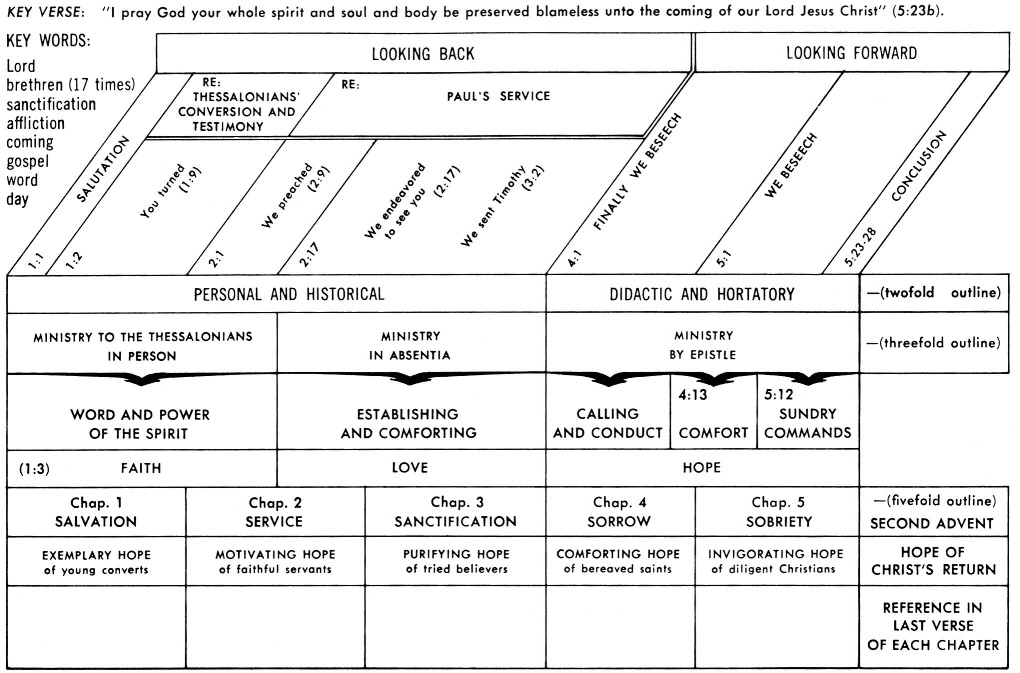
JESUS IS COMING AGAIN
Click chart to enlarge
Charts from Jensen's Survey of the NT - used by permission
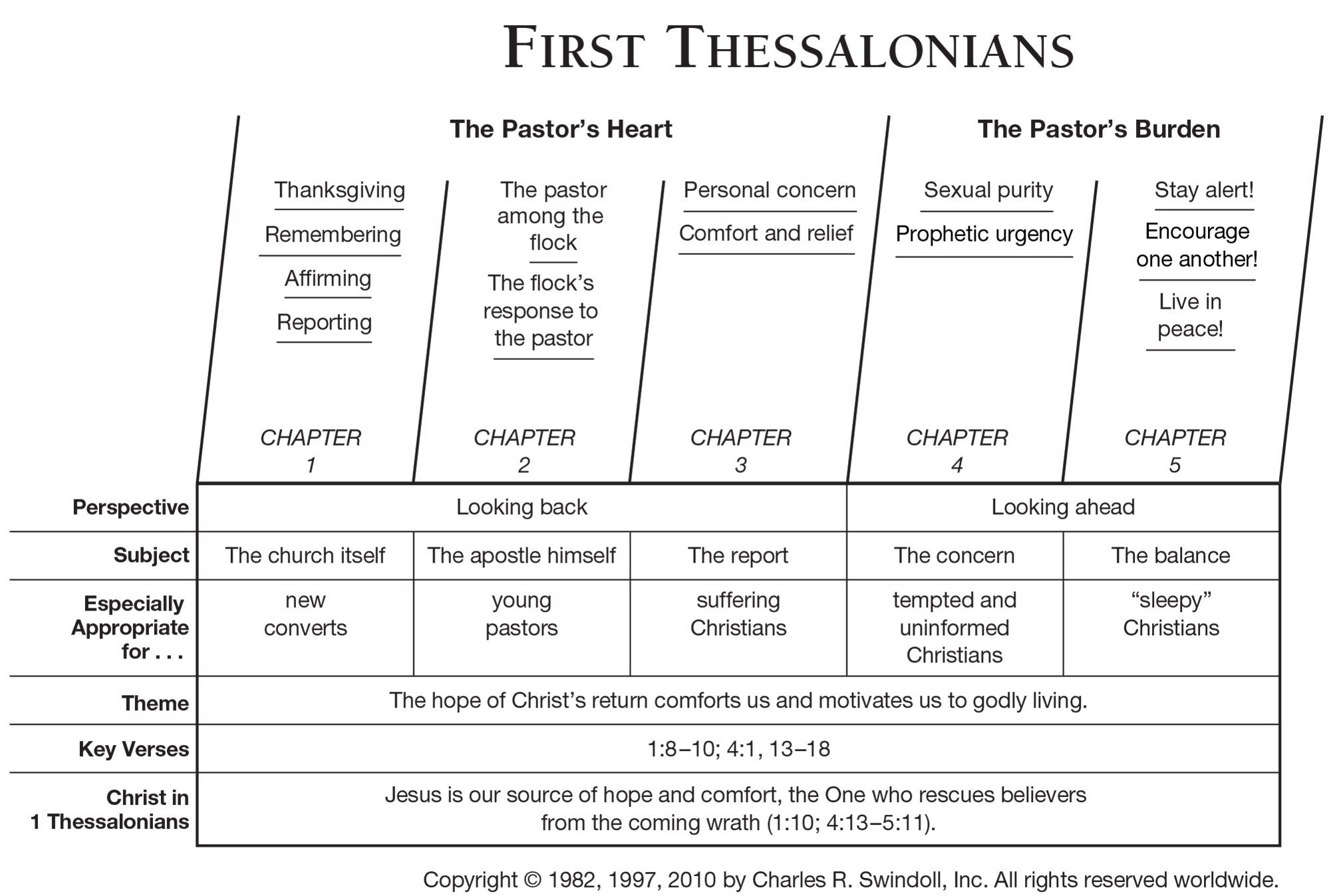
Chart by Charles Swindoll
|
1 Thessalonians |
||||||
| 1 Th 1:1-10 | 1 Th 2:1-20 | 1 Th 3:1-13 | 1 Th 4:1-18 | 1 Th 5:1-28 | ||
|
LOOKING BACK |
LOOKING FORWARD |
|||||
|
Personal Reflections |
Practical Instructions |
|||||
| Ministry In Person |
Ministry in Absentia (Thru Timothy) |
Ministry by Epistle |
||||
| Word and Power of the Spirit |
Establishing & Comforting |
Calling & Conduct | 1Th 4:13ff Comfort |
1Th 5:12ff Commands |
||
| 1 Salvation |
2 Service |
3 Sanctification |
4 Sorrow |
5 Sobriety |
||
| Paul Commends Spiritual Growth |
Paul Founds the Church |
Strengthening of the Church |
Directions for Spiritual Growth |
Holy Living in Light of Day of the Lord | ||
| Exemplary Hope of Young Converts | Motivating Hope of Faithful Servants |
Purifying Hope of Tried Believers | Comforting Hope of Bereaved Saints | Invigorating Hope of Diligent Christians | ||
|
Written from Corinth |
||||||
1Thessalonians 5:25 Brethren, pray for us (NASB: Lockman)
Greek: Adelphoi, proseuchesthe (2PPMM) [kai] peri hemon
Amplified: Brethren, pray for us. (Amplified Bible - Lockman)
Milligan: Meanwhile, Brothers, in your prayers do not forget us. (St. Paul's Epistles to the Thessalonians. 1908)
NLT: Dear brothers and sisters, pray for us. (NLT - Tyndale House)
Phillips: Pray for us, my brothers. (Phillips: Touchstone)
Wuest: Brethren, be praying definitely for us. (Eerdmans)
BRETHREN PRAY FOR US: Adelphoi proseuchesthe (2PPMM ) kai peri hemon:
- Romans 15:30; 2Corinthians 1:11; Ephesians 6:18, 19, 20; Philippians 1:19; Colossians 4:3; 2Thessalonians 3:1, 2, 3; Philemon 1:22; Hebrews 13:18,19
- 1 Thessalonians 5 Resources - Multiple Sermons and Commentaries
- 1 Thessalonians 5:25-28 A Plea to Pray for Pastors - John MacArthur
A PLEA FOR
PRAYER FOR PASTORS!
Paul's command begs the question of all of us - Do we pray for our pastor? Do we encourage him and build him up or do we criticize him and tear him down? Convicting questions especially in light of Paul's warning in 1 Cor 4:5
Therefore do not go on passing judgment before the time, but wait until the Lord comes who will both bring to light the things hidden in the darkness and disclose the motives of men’s hearts; and then each man’s praise will come to him from God.
Spurgeon wrote "If I were allowed to offer only one request to you, it would be this: "Brethren, pray for us." Of what use can our ministry be without the divine blessing, and how can we expect the divine blessing unless it be sought for by the church of God? I would say it even with tears, "Brethren, pray for us." Do not restrain prayer. On the contrary, be abundant in intercession, for only so can our prosperity as a church be increased, or even continued....Dismiss me or else intercede for me."
Brethren (80) (adelphos from collative a = denoting unity + delphús = womb) is literally one born from same womb and so a male having the same father and mother as reference person. Figuratively, adelphos as in this verse refers to a close associate of a group of persons having well-defined membership, specifically here referring to fellow believers (including sisters!) in Christ who are united by the bond of affection.
It is notable that brethren is the first word in the Greek sentence which indicates that Paul is emphasizing adelphos (none of the 14 other uses of adelphos in 1 Thessalonians are emphatic) He wants the brothers to not miss his strong plea for personal prayer! This great apostle understood the vital importance of prayer in effective ministry. To him going into the battlefield without prayer would be like walking out completely unclothed. Paul knew his need for God and God's supernatural solution of providing that need through the prayers of the saints. Are you a pastor? A teacher? An elder? If so, when was the last time you asked those in your flock for specific prayer. You didn't just say pray for me but you specifically ask them to pray the prayers of Paul such as Colossians 1:9-12, Ephesians 3:14ff, Philippians 1:9-11, 1Thessalonians 5:23-24, etc. Tomorrow is not too soon to make this a regular part of your ministry.
Utley writes that "Prayer somehow releases the power of God for effective ministry. The sovereign God has chosen to limit Himself in some areas to the prayers of His children (cf. James 4:2). What a responsibility this puts on each one of us as Christians. (Utley, R. J. D. Volume 11: Paul's First Letters: Galatians and I & II Thessalonians. Marshall, Texas: Bible Lessons International)
Constable is surely correct in stating that "Doubtless much of the success of his missionary work could be attributed to the prayers of the Thessalonians and other believers. Paul understood both his personal insufficiency and God’s sufficiency (cf. 2 Cor. 3:5). He requested prayer for his fellow workers as well as for himself. (Walvoord, J. F., Zuck, R. B., et al: The Bible Knowledge Commentary. 1985. Victor)
Adam Clarke offers a pithy comment noting that...
Even apostles, while acting under an extraordinary mission, and enjoying the inspiration of the Holy Ghost, felt the necessity of the prayers of the faithful. God requires that his people should pray for his ministers; and it is not to be wondered at, if they who pray not for their preachers should receive no benefit from their teaching. How can they expect God to send a message by him, for whom they, who are the most interested, have not prayed? If the grace and Spirit of Christ be not worth the most earnest prayers which a man can offer, they, and the heaven to which they lead, are not worth having.
Matthew Poole comments that Paul...
The apostle, as he did not think it below him to call these Thessalonians brethren, so neither to beg their prayers. Those that stand highest in the church may stand in need of the meanest and lowest; the head cannot say to the foot, I have no need of thee. Those that preach not the gospel, may yet promote it by their prayers (Matthew Poole's Commentary on the New Testament)
Pray for us - Hiebert makes an interesting observation noting that
The preposition rendered "for" literally means "around, about" and pictures the prayers of the readers as surrounding the writers and their work. They were keenly conscious of their need for the supporting prayers of fellow believers for success in their missionary labors (cf. 2 Cor. 1:11; Philippians 4:19; Philemon 1:22). Elsewhere, Paul's requests for prayers are more specific (see notes Romans 15:30; 31; 32; Ephesians 6:19; 20; Colossians 4:3; 4:4; 2 Th 3:1-2), always in connection with his ministry, but here the request for prayer is left undefined as to its contents.
Paul believed in the efficacy of prayer. He makes it a practice at the beginning of his letters to assure his readers that he is praying for them and at the close to urge their prayers on his behalf. This request assures the readers "that it is the privilege of the saints to pray for the most honoured servant of the Lord, and that he seeks and values their prayers!"' Surely the widespread prayer support Paul was able to enlist is one of the keys to the power of his ministry.
Paul "knew of no faster way to get the Gospel through the enemy lines than by recruiting Christian converts into the secret service of prayer.... He depended upon it as his basic weapon." (Hiebert, D. Edmond: 1 & 2 Thessalonians: BMH Book. 1996)
Marshall says that Paul's request includes
the thought that through prayer the churches share in the work of mission; those who cannot go on mission themselves can share in the work by praying for missionaries. (New Century Bible Commentary)
Plummer makes the significant observation that...
The Apostle prays for himself and for his disciples, and he charges them to pray for themselves and for others, and in particular for himself. Christ prays for Himself and for His disciples, and He charges them to pray for themselves and for others; but He never asks them to pray for Him. (A Commentary on St Paul's First Epistle to the Thessalonians)
Barnes comments that Paul...
He was a man of like passions as others; liable to the same temptations; engaged in an arduous work; often called to meet with opposition, and exposed to peril and want, and he peculiarly needed the prayers of the people of God. A minister, surrounded as he is by temptations, is in great danger if he has not the prayers of his people. Without those prayers, he will be likely to accomplish little in the cause of his Master. His own devotions in the sanctuary will be formal and frigid, and the word which he preaches will be likely to come from a cold and heavy heart, and to fall also on cold and heavy hearts. There is no way in which a people can better advance the cause of piety in their own hearts, than by praying much for their minister. (Albert Barnes. Barnes NT Commentary)
Pray (4336) (proseuchomai from pros = toward, facing, before [emphasizing the direct approach of the one who prays in seeking God’s face] + euchomai = originally to speak out, utter aloud, express a wish, then to pray or to vow. Greek technical term for invoking a deity) in the NT is always used of prayer addressed to God (to Him as the object of faith and the One who will answer one’s prayer) and means to speak consciously (with or without vocalization) to Him, with a definite aim (See study of noun proseuche).
Proseuchomai encompasses all the aspects of prayer -- submission, confession, petition, supplication (may concern one's own need), intercession (concerned with the needs of others), praise, and thanksgiving.
Vine says that proseuchomai carries with it a notion of worship (but see the Greek word for worship = proskuneo) which is not present in the other words for prayer (eg, aiteo, deomai, both of which involve spoken supplication)
Wuest adds that the prefixed preposition pros...
gives it the idea of definiteness and directness in prayer, with the consciousness on the part of the one praying that he is talking face to face with God...(thus proseuchomai) speaks also of the consciousness on the part of the one who prays, of the fact of God’s presence and His listening ear.
Detzler writes that...
The basic idea of proseuchomai is to bring something, and in prayer this pertains to bringing up prayer requests. In early Greek culture an offering was brought with a prayer that it be accepted. Later the idea was changed slightly, so that the thing brought to God was a prayer. In later Greek, prayers appealed to God for His presence. (Detzler, Wayne E: New Testament Words in Today's Language. Victor. 1986)
Richards notes that
In classical Greek proseuchomai was the technical term for calling on a deity. The NT transforms the classical stiffness into the warmth of genuine conversation. Such entreaty in the NT is addressed to God or Jesus and typically is both personal and specific. (Richards, L O: Expository Dictionary of Bible Words: Regency)
NIDNTT writes that...
In profane Gk. prayer is often accompanied by an offering, the object of which is to make the gods favorably disposed. Here prayer mostly takes the form of supplication. Though used originally, as early as Mycenean Greek, almost exclusively with reference to tangible benefits, at a later period (e.g. in the Tragic Poets), the words have in view spiritual and ethical values (e.g. Aesch., Cho. 140 f.; Eur., Medea 635 ff.) or denote prayer for preservation from spiritual or moral harm. Characteristically, the assurance of being heard is lacking, belief in an omnipresent divine principle excluding all possibility of an epiphany. In the piety associated with the Hellenistic mysteries the worshipper at prayer experiences the nearness of the deity, especially at those rare moments of climax when he is granted a sight of the god concerned. At such times all prayer is extinguished, and is replaced by silent rapture. Intercession, and supplication for earthly things, are totally absent from this kind of prayer.
In the OT prayer is all-important because of that which both characterizes and constitutes the nation of Israel, his relation to his God. The whole history of Israel is therefore permeated and borne along by prayer. At all its important points man is found in converse with God. This is true even when no use is made of those specific Hebrew terms for to pray...Expressions like to speak, to call or to cry are frequently used instead. To indicate intense emotional involvement, the Hebrew used verbs such as to groan, to sigh or to weep (Lament). But however urgently he prayed, the OT suppliant never forgot that he was addressing the holy, almighty God (an utter impossibility apart from God’s condescending kindness and grace). This is shown by the frequent use of the verb histahawâh which really means to prostrate oneself (before superior) (proskuneo), and which may therefore indicate man’s customary posture in prayer, though there is also evidence of prayer being offered from a standing position. The parallel expression, to fall down on one’s knees, is also used occasionally. Such phrases are intended to indicate the humility of mind which must always characterize a man as he prays. In addition the OT contains many expressions for the prayer of praise and thanksgiving, e.g. the familiar verb halal, to praise, glorify, extol (halelûyâh, praise the Lord; yâh = Yahweh; Amen, Greek = allelouia), and a whole range of words intensifying the idea of praise: to shout with joy, to exult, to sing (often to instrumental accompaniment; Thank). (Brown, Colin, Editor. New International Dictionary of NT Theology. 1986. Zondervan)
This is a command (imperative mood) calling for continued prayer (present tense). Paul is calling for them to keep on praying! How often have you asked those you lead or teach or pastor to pray for you -- ask frequently! Paul did! He understood that God's work done in God's power was dependent on God's people interceding. He knew that he was not sufficient in himself to carry out the great work he had been called to -- to take the gospel to the Gentiles. It is therefore not surprising that Paul called for prayer at the close of six of the thirteen epistles!
Note prefixed preposition pros meaning towards adds the idea of definiteness, a conscious direction of one’s prayer to God, and a consciousness on the part of the one praying, of God’s presence and attention. This verb is always used of requests addressed to God, whereas another verb meaning to pray, deomai, may be used of requests addressed to man as well. Proseuchomai carries with it a notion of worship which is not present in the word deomai.
Here are some other instances in which Paul sought the prayers of the saints...
Romans 15:30 Now I urge you, brethren, by our Lord Jesus Christ and by the love of the Spirit, to strive together with me in your prayers to God for me, (see note)
2Cor 1:11 (God would deliver Paul and his co-workers from great peril) you also joining in helping us through your prayers, that thanks may be given by many persons on our behalf for the favor bestowed upon us through the prayers of many.
Ephesians 6:18 With all prayer and petition pray at all times in the Spirit, and with this in view, be on the alert with all perseverance and petition for all the saints, 19 and pray on my behalf, that utterance may be given to me in the opening of my mouth, to make known with boldness the mystery of the gospel, 20 for which I am an ambassador in chains; that in proclaiming it I may speak boldly, as I ought to speak. (See notes Ephesians 6:18; 6:19; 6:20)
Colossians 4:2 Devote yourselves to prayer, keeping alert in it with an attitude of thanksgiving; praying at the same time for us as well, that God may open up to us a door for the word, so that we may speak forth the mystery of Christ, for which I have also been imprisoned (see notes Colossians 4:2; 4:3)
2Thessalonians 3:1-2 Finally, brethren, pray for us that the word of the Lord may spread rapidly and be glorified, just as it did also with you 2 and that we may be delivered from perverse and evil men; for not all have faith.
Note that Paul says us, referring obviously to not just himself but to Silas and Timothy for they were all equally standing in the need of prayer.
Paul had begun the letter with an emphasis on prayer, reminding the saints at Thessalonica that the missionaries were praying for them (see note 1Thessalonians 1:2) but now he calls for their prayers. This is the beautiful, interdependence of the body of Christ. We really do need each other and prayer is one vital facet of that need.
If you have any doubt about our need for one another, take some time to study the Pauline uses of the phrase one another (not all 40 occurrences are relevant to the point of the believer's interdependence but those you can quickly discern from the context. Studylight also includes Hebrews an epistle which cannot be proven as having been authored by Paul) - click here.
James Denney notes that...
Paul has prayed for the Thessalonians; he begs their prayers for himself. This request is made no less than seven times in his Epistles — including the one before us: a fact which shows how priceless to the Apostle was the intercession of others on his behalf. So it is always; there is nothing which so directly and powerfully helps a minister of the gospel as the prayers of his congregation. They are the channels of all possible blessing both for him and those to whom he ministers. (Classic Commentary Collection. See AGES Software for their full selection of highly recommended resources)
William Barclay comments that...
It is a wonderful thing that the greatest saint of them all should feel that he was strengthened by the prayers of the humblest Christians. Once his friends came to congratulate a great statesman who had been elected to the highest office his country could offer him. He said, “Don’t give me your congratulations, but give me your prayers.” For Paul prayer was a golden chain in which he prayed for others and others prayed for him. (Barclay, W: The Daily Study Bible Series. The Westminster Press)
Dear reader, are you praying for your spiritual leaders? Would you call it prevailing prayer or pittance prayer?
Proseuchomai is used some 85x in 80v in the NT and a study of these Scriptures makes for a wonderful Biblical view of prayer (Interrogate these passages with the 5W'S & H and always examine the context). For example, where do you find most of the commands to pray? Where (which book) do we see the most emphasis on prayer (and what might the implications of this observation be to the church in America?...your local church?...the Wednesday evening prayer meeting?)....
Matthew 5:44 (note) "But I say to you, love your enemies, and pray (present imperative - command to make this your habit) for those who persecute you
Matthew 6:5 (note) "And when you pray, you are not to be as the hypocrites; for they love to stand and pray in the synagogues and on the street corners, in order to be seen by men. Truly I say to you, they have their reward in full. 6:6 "But you, when you pray, go into your inner room, and when you have shut your door, pray (aorist imperative) to your Father who is in secret, and your Father who sees in secret will repay you. 6:7 "And when you are praying, do not use meaningless repetition, as the Gentiles do, for they suppose that they will be heard for their many words. 6:9 "Pray (present imperative - command to make this your habit) , then, in this way: 'Our Father who art in heaven, Hallowed be Thy name.
Matthew 14:23 And after He had sent the multitudes away, He went up to the mountain by Himself to pray; and when it was evening, He was there alone. (Note how all important decisions are made with prayer)
Matthew 19:13 Then some children were brought to Him so that He might lay His hands on them and pray; and the disciples rebuked them.
Matthew 24:20 "But pray (present imperative - command to make this your habit) that your flight may not be in the winter, or on a Sabbath;
Matthew 26:36 Then Jesus came with them to a place called Gethsemane, and said to His disciples, "Sit here while I go over there and pray."
Matthew 26:39 And He went a little beyond them, and fell on His face and prayed, saying, "My Father, if it is possible, let this cup pass from Me; yet not as I will, but as Thou wilt."
Matthew 26:41 "Keep watching (present imperative - command to make this your habit) and praying (present imperative - command to make this your habit) , that you may not enter into temptation; the spirit is willing, but the flesh is weak."
Matthew 26:42 He went away again a second time and prayed, saying, "My Father, if this cannot pass away unless I drink it, Thy will be done."
Matthew 26:44 And He left them again, and went away and prayed a third time, saying the same thing once more.
Mark 1:35 And in the early morning, while it was still dark, He arose and went out and departed to a lonely place, and was praying there.
Mark 6:46 And after bidding them farewell, He departed to the mountain to pray.
Mark 11:24 "Therefore I say to you, all things for which you pray and ask, believe that you have received them, and they shall be granted you. 25 "And whenever you stand praying, forgive, if you have anything against anyone; so that your Father also who is in heaven may forgive you your transgressions.
Mark 12:40 who devour widows' houses, and for appearance's sake offer long prayers; these will receive greater condemnation."
Mark 13:18 "But pray (present imperative - command to make this your habit) that it may not happen in the winter.
Mark 14:32 And they came to a place named Gethsemane; and He said to His disciples, "Sit here until I have prayed."
Mark 14:35 And He went a little beyond them, and fell to the ground, and began to pray that if it were possible, the hour might pass Him by.
Mark 14:38 "Keep watching (present imperative - command to make this your habit) and praying (present imperative - command to make this your habit) , that you may not come into temptation; the spirit is willing, but the flesh is weak." 14:39 And again He went away and prayed, saying the same words.
Luke 1:10 And the whole multitude of the people were in prayer outside at the hour of the incense offering.
Luke 3:21 Now it came about when all the people were baptized, that Jesus also was baptized, and while He was praying, heaven was opened,
Luke 5:16 But He Himself would often slip away to the wilderness and pray.
Luke 6:12 And it was at this time that He went off to the mountain to pray, and He spent the whole night in prayer to God.
Luke 6:28 bless (present imperative - command to make this your habit) those who curse you, pray (present imperative - command to make this your habit) for those who mistreat you.
Luke 9:18 And it came about that while He was praying alone, the disciples were with Him, and He questioned them, saying, "Who do the multitudes say that I am?"
Luke 9:28 And some eight days after these sayings, it came about that He took along Peter and John and James, and went up to the mountain to pray. 29 And while He was praying, the appearance of His face became different, and His clothing became white and gleaming.
Luke 11:1 And it came about that while He was praying in a certain place, after He had finished, one of His disciples said to Him, "Lord, teach us to pray just as John also taught his disciples." 2 And He said to them, "When you pray, say: 'Father, hallowed be Thy name. Thy kingdom come.
Luke 18:1 Now He was telling them a parable to show that at all times they ought to pray and not to lose heart,
Luke 18:10 "Two men went up into the temple to pray, one a Pharisee, and the other a tax-gatherer. 11 "The Pharisee stood and was praying thus to himself, 'God, I thank Thee that I am not like other people: swindlers, unjust, adulterers, or even like this tax-gatherer.
Luke 20:47 who devour widows' houses, and for appearance's sake offer long prayers; these will receive greater condemnation."
Luke 22:40 And when He arrived at the place, He said to them, "Pray (present imperative - command to make this your habit) that you may not enter into temptation." 41 And He withdrew from them about a stone's throw, and He knelt down and began to pray,
Luke 22:44 And being in agony He was praying very fervently; and His sweat became like drops of blood, falling down upon the ground.
Luke 22:46 and said to them, "Why are you sleeping? Rise and pray (present imperative - command to make this your habit) that you may not enter into temptation."
Acts 1:24 And they prayed, and said, "Thou, Lord, who knowest the hearts of all men, show which one of these two Thou hast chosen
Acts 6:6 And these they brought before the apostles; and after praying, they laid their hands on them.
Acts 8:15 who came down and prayed for them, that they might receive the Holy Spirit.
Acts 9:11 And the Lord said to him, "Arise and go to the street called Straight, and inquire at the house of Judas for a man from Tarsus named Saul, for behold, he is praying,
Acts 9:40 But Peter sent them all out and knelt down and prayed, and turning to the body, he said, "Tabitha, arise." And she opened her eyes, and when she saw Peter, she sat up.
Acts 10:9 And on the next day, as they were on their way, and approaching the city, Peter went up on the housetop about the sixth hour to pray.
Acts 10:30 And Cornelius said, "Four days ago to this hour, I was praying in my house during the ninth hour; and behold, a man stood before me in shining garments,
Acts 11:5 "I was in the city of Joppa praying; and in a trance I saw a vision, a certain object coming down like a great sheet lowered by four corners from the sky; and it came right down to me,
Acts 12:12 And when he realized this, he went to the house of Mary, the mother of John who was also called Mark, where many were gathered together and were praying.
Acts 13:3 Then, when they had fasted and prayed and laid their hands on them, they sent them away.
Acts 14:23 And when they had appointed elders for them in every church, having prayed with fasting, they commended them to the Lord in whom they had believed.
Acts 16:25 But about midnight Paul and Silas were praying and singing hymns of praise to God, and the prisoners were listening to them;
Acts 20:36 And when he had said these things, he knelt down and prayed with them all.
Acts 21:5 And when it came about that our days there were ended, we departed and started on our journey, while they all, with wives and children, escorted us until we were out of the city. And after kneeling down on the beach and praying, we said farewell to one another.
Acts 22:17 "And it came about when I returned to Jerusalem and was praying in the temple, that I fell into a trance,
Acts 28:8 And it came about that the father of Publius was lying in bed afflicted with recurrent fever and dysentery; and Paul went in to see him and after he had prayed, he laid his hands on him and healed him.
Romans 8:26 (note) And in the same way the Spirit also helps our weakness; for we do not know how to pray as we should, but the Spirit Himself intercedes for us with groanings too deep for words;
1 Corinthians 11:4 Every man who has something on his head while praying or prophesying, disgraces his head. 5 But every woman who has her head uncovered while praying or prophesying, disgraces her head; for she is one and the same with her whose head is shaved.
1 Corinthians 11:13 Judge for yourselves: is it proper for a woman to pray to God with head uncovered?
1 Corinthians 14:13 Therefore let one who speaks in a tongue pray that he may interpret. 14 For if I pray in a tongue, my spirit prays, but my mind is unfruitful. 15 What is the outcome then? I shall pray with the spirit and I shall pray with the mind also; I shall sing with the spirit and I shall sing with the mind also.
Ephesians 6:18 (note) With all prayer and petition pray at all times in the Spirit, and with this in view, be on the alert with all perseverance and petition for all the saints,
Philippians 1:9 (note) And this I pray, that your love may abound still more and more in real knowledge and all discernment,
Colossians 1:3 (note) We give thanks to God, the Father of our Lord Jesus Christ, praying always for you,
Colossians 1:9 (note) For this reason also, since the day we heard of it, we have not ceased to pray for you and to ask that you may be filled with the knowledge of His will in all spiritual wisdom and understanding,
Colossians 4:3 (note) praying at the same time for us as well, that God may open up to us a door for the word, so that we may speak forth the mystery of Christ, for which I have also been imprisoned;
1Thessalonians 5:17 (note) pray (present imperative - command to make this your habit) without ceasing...5:25 Brethren, pray (present imperative - command to make this your habit) for us.
2 Thessalonians 1:11 To this end also we pray for you always that our God may count you worthy of your calling, and fulfill every desire for goodness and the work of faith with power;
2 Thessalonians 3:1 Finally, brethren, pray (present imperative - command to make this your habit) for us that the word of the Lord may spread rapidly and be glorified, just as it did also with you;
1 Timothy 2:8 Therefore I want the men in every place to pray, lifting up holy hands, without wrath and dissension.
Hebrews 13:18 (note) Pray (present imperative - command to make this your habit) for us, for we are sure that we have a good conscience, desiring to conduct ourselves honorably in all things.
James 5:13 Is anyone among you suffering? Let him pray (present imperative - command to make this your habit) . Is anyone cheerful? Let him sing praises. 14 Is anyone among you sick? Let him call for the elders of the church, and let them pray (aorist imperative) over him, anointing him with oil in the name of the Lord;
James 5:17 Elijah was a man with a nature like ours, and he prayed earnestly that it might not rain; and it did not rain on the earth for three years and six months. 18 And he prayed again, and the sky poured rain, and the earth produced its fruit.
Jude 1:20 But you, beloved, building yourselves up on your most holy faith; praying in the Holy Spirit;
There are 73 uses of proseúchomai in the non-apocryphal Septuagint (LXX)
Gen. 20:7, 17; Exod. 10:17; Jdg. 13:8; 1 Sam. 1:10, 12, 26f; 2:25; 7:5; 8:6; 12:19, 23; 14:45; 2 Sam. 7:27; 1 Ki. 8:28ff, 33, 35, 42, 44, 48, 54; 2 Ki. 4:33; 6:17f; 19:20; 1 Chr. 17:25; 2 Chr. 6:19ff, 24, 26, 32, 34, 38; 7:1, 14; 30:18; 32:20, 24; 33:13; Ezr. 6:10; 10:1; Neh. 1:4, 6; 2:4; 4:9; Est. 5:1; Ps. 5:2; 32:6; 72:15; 109:4; Isa. 16:12; 37:15, 21; 38:2; 44:17; 45:14, 20; Jer. 7:16; 11:14; 14:11; 29:7, 12; 32:16; 37:3; 42:2, 4, 20; Dan. 6:5, 8, 10; 9:4, 20; Jon. 2:1; 4:2)
Genesis 20:17 And Abraham prayed (Hebrew = palal = intervene, mediate, intercede, pray; Lxx = proseuchomai) to God; and God healed Abimelech and his wife and his maids, so that they bore children.
Judges 13:8 Then Manoah entreated (Hebrew = athar; Lxx = proseuchomai) the LORD and said, "O Lord, please let the man of God whom Thou hast sent come to us again that he may teach us what to do for the boy who is to be born."
1 Samuel 1:10 And she (the godly but barren Hannah), greatly distressed, prayed (Hebrew = palal = intervene, mediate, intercede, pray; Lxx = proseuchomai) to the LORD and wept bitterly. (Note mention of prayer 4 times in chapter 1 of 1Samuel!)
1 Samuel 7:5 Then Samuel (like mother [Hannah] like son) said, "Gather all Israel to Mizpah, and I will pray (Hebrew = palal = intervene, mediate, intercede, pray; Lxx = proseuchomai) to the LORD for you."
1 Samuel 8:6 But the thing was displeasing in the sight of Samuel when they said, "Give us a king to judge us." And Samuel prayed (Hebrew = palal = intervene, mediate, intercede, pray; Lxx = proseuchomai) to the LORD.
1 Samuel 12:23 "Moreover, as for me (Samuel speaking to the rebellious King Saul), far be it from me that I should sin against the LORD by ceasing to pray (Hebrew = palal = intervene, mediate, intercede, pray; Lxx = proseuchomai) for you; but I will instruct you in the good and right way.
1 Kings 8:30 (cf also 1 Ki 8:33, 35, 42, 44, 48, 54) "And listen to the supplication of Thy servant and of Thy people Israel, when they pray (Hebrew = palal = intervene, mediate, intercede, pray; Lxx = proseuchomai) toward this place (Jerusalem, the Holy City and the Holy Temple, the House of God); hear Thou in heaven Thy dwelling place; hear and forgive. (Note what godly Daniel did in Daniel 6:10 - see below).
Nehemiah 1:4 Now it came about when I heard these words, I sat down and wept and mourned for days; and I was fasting and praying before the God of heaven.
Nehemiah 2:4 Then the king said to me, "What would you request?" So I prayed to the God of heaven. (A classic "arrow" prayer!)
Psalm 32:6 Therefore, let everyone who is godly pray (Hebrew = palal = intervene, mediate, intercede, pray; Lxx = proseuchomai) to Thee in a time when Thou mayest be found; Surely in a flood of great waters they shall not reach him.
Jeremiah 29:12 'Then you will call upon Me and come and pray to Me, and I will listen to you.
Daniel 6:10 Now when Daniel knew that the document was signed (forbidding petition to any God or man for 30 days, except King Darius), he entered his house (now in his roof chamber he had windows open toward Jerusalem); and he continued kneeling on his knees three times a day, praying and giving thanks before his God, as he had been doing previously.
Jonah 2:1 Then Jonah prayed (Hebrew = palal = intervene, mediate, intercede, pray; Lxx = proseuchomai) to the LORD his God from the stomach of the fish
Hosea Ballou, an American preacher once said
Between the humble and the contrite heart and the majesty of heaven there are no barriers; the only password is prayer.
Fred Beck said
If you are swept off your feet, it's time to get on your knees.
The following phrase was scrawled on the wall of an underground bomb shelter during the blitz in London
If your knees are knocking, kneel on them.
As the famous Presbyterian Pastor Louis Evans said
The man who kneels to God can stand up to anything.
Puritan John Bunyan said that
Prayer is a shield to the soul, a sacrifice to God, and a scourge to Satan.
Richard Cook wrote that...
Most of us have much trouble praying when we are in little trouble, but we have little trouble praying when we are in much trouble.
Ole Hallesby a theologian in the early part of the 20th century said that..
To pray is nothing more involved than to lie in the sunshine of God's grace.
Rowland Hill a preacher in the late 1800's said that...
Prayer is the breath of the newborn soul, and there can be no Christian life without it.
Robert Murray McCheyne spoke about the association of revival and prayer writing that...
What a man is on his knees before God, that he is--and nothing more.
Dwight L. Moody said
The Christian on his knees sees more than the philosopher on tiptoe.
Leonard Ravenhill in his book Revival Praying said
The self-sufficient do not pray, the self-satisfied will not pray, the self-righteous cannot pray. No man is greater than his prayer life.
Donald Grey Barnhouse, the great Presbyterian preacher once said
I am not sure that I believe in the 'power of prayer,' but I do believe in the power of the Lord who answers prayer.
See Topic Prayer
- Colossians 1:9 Commentary
- Colossians 4:12 Commentary
- Devotional on Prayer
- Guide to Praying for Missionaries
- Pithy Prayer Phrases
- Prayer - Greek Words for Prayer
- Prayer Devotionals and Illustrations
- Prayer Hymns and Poems
- Prayer Quotes
- Prayer Quotes, Devotionals and Illustrations
- Praying His Word
- Praying in the Spirit
- Spurgeon's Gems on Prayer
1 Thessalonians 5:26 Greet all the brethren with a holy kiss (NASB: Lockman)
Greek: Aspasasthe (2PAMM) tous adelphous pantas en philemati hagio
Amplified: Brethren, pray for us. (Amplified Bible - Lockman)
Milligan: Convey our greetings with the customary holy kiss to all the Brothers. (St. Paul's Epistles to the Thessalonians. 1908)
NLT: Dear brothers and sisters, pray for us. (NLT - Tyndale House)
Phillips: Give a handshake all round among the brotherhood. (Phillips: Touchstone)
Wuest: Greet all the brethren with an affectionate kiss. (Eerdmans)
Young's Literal: salute all the brethren in an holy kiss
GREET ALL THE BRETHREN WITH A HOLY KISS: Aspasasthe (2PAMM) tous adelphous pantas en philemati hagio:
- Romans 16:16; 1Corinthians 16:20
- 1 Thessalonians 5 Resources - Multiple Sermons and Commentaries
- 1 Thessalonians 5:25-28 A Plea to Pray for Pastors - John MacArthur
A HOLY GREETING
Today this would probably look more like a "holy hug" than a "holy kiss." (Just a thought). J B Phillips makes offers a reasonable alternative to the holy kiss in his paraphrase rendering it "Give a handshake all around among the brotherhood."
Spurgeon suggests that we are to "Give one another a hearty shake of the hands. That is the western interpretation of the eastern form. Outward forms differ. The inward sense abides the same. Let brotherly love continue in a hearty friendliness among yourselves."
Greet (782) (aspazomai from a + spao = draw out as a sword, pull, breathe) (aorist imperative) means to enfold in arms, welcome, embrace. It is spoken of those who meet or separate. This is one final expression of Paul's paternal love. Note that Paul does not say - to the orderly - but to all, which indicates his unconditional love did not exclude even the disorderly brethren. Agape love is all inclusive love.
Aspazomai is constantly used in the papyri for conveying the greetings at the end of a letter.
It is interesting to note that Paul's usual statement of greeting one another (see note Romans 16:16; 1 Cor 16:20; 2 Cor 13:12; cf. 1 Peter 5: 14) is replaced by greet all the brethren.
Wiersbe makes a convicting point of application noting that...
After the corporate worship is ended, the saints minister to one another. They greet one another and seek to encourage. I have been in churches where the congregation escaped like rats leaving a sinking ship. Fellowship is a part of worship. (Wiersbe, W: Bible Exposition Commentary. 1989. Victor)
All - "All" means all without exception who are members of the inclusive brotherhood of the saints and thus tactfully would even include those that it has been necessary to rebuke in this letter.
Brethren (80) (adelphos from collative a = denoting unity + delphús = womb) is literally one born from same womb and so a male having the same father and mother as reference person. Figuratively, adelphos as in this verse refers to a close associate of a group of persons having well-defined membership, specifically here referring to fellow believers in Christ who are united by the bond of affection.
Constable comments that "The man to man and woman to woman kiss of brotherly affection in Christ was and is a customary greeting in many parts of the world. In North American culture an embrace or handshake more often communicates the same sentiments. (1 Thessalonians Notes)
Holy (40)(hagios) means set apart from that which is common or profane. In this context it means that which is sacred, chaste, pure (in motive and act), not passionate nor "fleshly"! The kiss is holy because it is the expression not of romantic but of Christian love. In American Christianity, this practice would not be culturally acceptable, although I will frequently embrace a brother and even sister (gently and discreetly) as a substitute for the "holy kiss."
Kiss (5370) (philema from phileo = to be a friend to, to be fond of an individual or an object, to have affection for and sometimes to kiss as a mark of tenderness) refers to a kiss as a token of love or friendship.
The holy kiss in the first century was a physical toke of welcome or farewell. Such physical expression was normal among the same sex.
Thayer notes that philema was....
the kiss with which, as a sign of fraternal affection, Christians were accustomed to welcome or dismiss their companions in the faith.
Here are all the Scriptural uses of philema...
Proverbs 27:6 Faithful are the wounds of a friend, But deceitful are the kisses (LXX) of an enemy.
Song of Solomon 1:2 "May he kiss me with the kisses (LXX) of his mouth! For your love is better than wine.
Luke 7:45 "You gave Me no kiss; but she, since the time I came in, has not ceased to kiss My feet.
Luke 22:48 But Jesus said to him, "Judas, are you betraying the Son of Man with a kiss?"
Romans 16:16 (note) Greet one another with a holy kiss. All the churches of Christ greet you.
1 Corinthians 16:20 All the brethren greet you. Greet one another with a holy kiss.
2 Corinthians 13:12 Greet one another with a holy kiss.
1 Thessalonians 5:26 Greet all the brethren with a holy kiss.
1 Peter 5:14 (note) Greet one another with a kiss of love. Peace be to you all who are in Christ.
Wanamaker - The kiss in the ancient world had a variety of functions both within the family and outside it. Kisses were used to indicate love, respect, reconciliation, even the striking of a contract. They also played various roles in pagan cults. That Paul speaks of kissing all the brothers (probably kissing of the opposite sex was not encouraged—see Apostolic Constitutions 2.57.17 for evidence from the fourth century that probably reflects the practice from a much earlier time) suggests that the act had a family connotation for him. The community was part of the one family of God. (Wanamaker, C. A.. The Epistles to the Thessalonians: A Commentary on the Greek Text. Grand Rapids, Mich. Eerdmans)
Pfeiffer - Its character was completely divorced from the sensual. A pure display of the deep emotion of Christian love, this type of kiss remained a Christian custom until abuse and heathen misunderstanding caused the practice to be curtailed. (Pfeiffer, C F: Wycliffe Bible Commentary. 1981. Moody)
Frame - In the ancient world one kissed the hand, breast, knee, or foot of a superior, and the cheek of a friend. Herodotus (I, 134) mentions kissing the lips as a custom of the Persians. Possibly from them it came to the Jews (Frame, J. E.. A Critical and Exegetical Commentary on the Epistles of St. Paul to the Thessalonians. New York: C. Scribner's Sons. 1912)
Why holy? So that there might be nothing suggestive, untoward or profane about the kiss. It signified personal affection but not romantic passion. The holy kiss was on the cheek and not on the lips. Public affection among brothers and sisters in Christ is natural, as we all belong to the same family.
John Bunyan in Grace Abounding wrote that "Some indeed have urged the holy kiss, but then I have asked why they made baulks? Why did they salute the most handsome and let the ill-favoured go? Thus how laudable soever such things have been in the eyes of others, they have been unseemly in my sight.
James Denney explains that "The kiss was the ordinary greeting among members of a family; brothers and sisters kissed each other when they met, especially after long separation; even among those who were no kin to each other, but only on friendly terms, it was common enough, and answered to our shaking of hands. In the Church the kiss was the pledge of brotherhood; those who exchanged it declared themselves members of one family. When the Apostle says, “Greet one another with a holy kiss,” he means, as holy always does in the New Testament, a Christian kiss; a greeting not of natural affection, nor of social courtesy merely, but recognising the unity of all members of the Church in Christ Jesus, and expressing pure Christian love... “Greet one another with a holy kiss” means, Show your Christian love one to another, frankly and heartily, in the way which comes natural to you. Do not be afraid to break the ice when you come into the church. There should be no ice there to break. Greet your brother or your sister cordially and like a Christian: assume and create the atmosphere of home. (Classic Commentary Collection. See AGES Software for their full selection of highly recommended resources)
In his devotional Morning and Evening, Spurgeon writes...
This one morning in the year we reserved to refresh the reader's memory upon the subject of prayer for ministers, and we do most earnestly implore every Christian household to grant the fervent request of the text first uttered by an apostle and now repeated by us.
Brethren, our work is solemnly momentous, involving weal or woe to thousands; we treat with souls for God on eternal business, and our word is either a savour of life unto life, or of death unto death. A very heavy responsibility rests upon us, and it will be no small mercy if at the last we be found clear of the blood of all men. As officers in Christ's army, we are the especial mark of the enmity of men and devils; they watch for our halting, and labour to take us by the heels. Our sacred calling involves us in temptations from which you are exempt, above all it too often draws us away from our personal enjoyment of truth into a ministerial and official consideration of it. We meet with many knotty cases, and our wits are at a non plus; we observe very sad backslidings, and our hearts are wounded; we see millions perishing, and our spirits sink.
We wish to profit you by our preaching; we desire to be blest to your children; we long to be useful both to saints and sinners; therefore, dear friends, intercede for us with our God. Miserable men are we if we miss the aid of your prayers, but happy are we if we live in your supplications. You do not look to us but to our Master for spiritual blessings, and yet how many times has He given those blessings through His ministers; ask then, again and again, that we may be the earthen vessels into which the Lord may put the treasure of the gospel. We, the whole company of missionaries, ministers, city missionaries, and students, do in the name of Jesus beseech you
BRETHREN, PRAY FOR US
1 Thessalonians 5:27 I adjure you by the Lord to have this letter read to all the brethren (NASB: Lockman)
Greek: Enorkizo (1SPAI) humas ton kurion anagnosthenai (APN) ten epistolen pasin tois adelphois
Amplified: I solemnly charge you [in the name of] the Lord to have this letter read before all the brethren. (Amplified Bible - Lockman)
Milligan: As regards this letter I charge that it be read aloud to all the Brothers. (St. Paul's Epistles to the Thessalonians. 1908)
NLT: command you in the name of the Lord to read this letter to all the Christians. (NLT - Tyndale House)
Phillips: God's command, which I give you now, is that this letter should be read to all the brothers. (Phillips: Touchstone)
Wuest: I adjure you by the Lord that the [foregoing] letter be read to all the brethren. (Eerdmans)
Young's Literal: I charge you by the Lord, that the letter be read to all the holy brethren;
I ADJURE YOU BY THE LORD TO HAVE THIS LETTER READ TO ALL THE BRETHREN: Enorkizo (1SPAI) humas ton kurion anagnosthenai (APN) ten epistolen pasin tois adelphois:
- 1Th 2:11; Nu 27:23; 1Ki 22:16; 2Chr 18:15; Mt 26:63; Mk 5:7; Acts 19:13; 1Ti 1:3,18; 5:7,21; 6:13,17; 2Ti 4:1
- Colossians 4:16; 2Thessalonians 3:14, Hebrews 3:1
- 1 Thessalonians 5 Resources - Multiple Sermons and Commentaries
- 1 Thessalonians 5:25-28 A Plea to Pray for Pastors - John MacArthur
A SOLEMN CHARGE TO
READ THE WORD PUBLICALLY
I - The singular pronoun is used only 3 times in this letter, in this verse, 1Th 2:18-note and 1Th 3:5-note and emphasizes that this is Paul's personal strong desire (adjure implies more than just a suggestion as discussed below) for the Thessalonians.
Calvin comments that "there will always be found some who say that it is of no advantage to publish generally things that otherwise they recognize as very excellent. At least, whatever artifice or pretext Satan may have at that time contrived, in order that the Epistle might not come to the knowledge of all, we may gather from Paul’s words with what earnestness and keenness he sets himself in opposition to it. For it is no light or frivolous thing to adjure by the name of God. (1 Thessalonians 5 )
Adjure (1775) (enorkizo from hórkos = an oath) (the only use in Scripture) means to put someone under (or bind by) an oath or to make to swear. To place someone under a solemn charge. Figuratively, the idea is that of an earnest appeal. Enorkizo is found only here in all of Scripture.
Note that the Textus Receptus has the verb horkizo (also used in Mark 5:7, Acts 19:13; cf related word exorkizo Mt 26:63) instead of enorkizo as found in the manuscripts generally recognized by Biblical scholars as more accurate to the original Greek.
English dictionaries state that to adjure (ad = to + jurare = to swear from jus = oath) means to solemnly urge someone to do something and implies advising as well as pleading with the idea of the invoking of something sacred. To adjure can include the idea of to command, often by exacting an oath.
The present tense indicates the abiding nature of this charge.
Paul is saying that the Thessalonian saints (probably especially the leaders) are in a sense to "take an oath" that they will read this letter in the public assembly. This is not simply a suggestion but conveys a more solemn request which is backed by the phrase by the Lord which indicates that Paul receives his authority to make this statement from the Lord Jesus Christ!
Constable comments that Paul "put his readers under oath (I charge you) to do this, suggesting that God would discipline them if they disobeyed. Were there some problems in the church that Paul wanted to get at by having everyone hear his words? Or did he realize that this epistle was written under divine inspiration and was therefore spiritually valuable? Perhaps he had both motives. (Walvoord, J. F., Zuck, R. B., et al: The Bible Knowledge Commentary. 1985. Victor)
Remember that most people in the early church did not read but received their exposure to the Bible by public reading. Compare Paul's request to the pattern in Nehemiah 8...
And Ezra opened the book in the sight of all the people for he was standing above all the people; and when he opened it, all the people stood up. 6 Then Ezra blessed the LORD the great God. And all the people answered, "Amen, Amen!" while lifting up their hands; then they bowed low and worshiped the LORD with their faces to the ground. 7 Also Jeshua, Bani, Sherebiah, Jamin, Akkub, Shabbethai, Hodiah, Maaseiah, Kelita, Azariah, Jozabad, Hanan, Pelaiah, and the Levites, explained the law to the people while the people remained in their place. 8 And they read from the book, from the law of God, translating to give the sense (give understanding) so that they understood the reading. (Nehemiah 8:5-8) (Comment: The Scriptures were written in Hebrew, but the people had no doubt used the Aramaic language or possibly other languages while in Babylon or while scattered in Assyria. Thus translation, as well as simple reading and exposition, would have been required for many of the people.)
Vincent comments that "This strong appeal (as emphasized by the verb horkizo) may perhaps be explained by a suspicion on Paul's part that a wrong use might be made of his name and authority (see 2 Th. 2:2), so that it was important that his views should be made known to all. (note the Greek word all means all without exception - all were in need of the Word of God! This is imperative!)
Guzik comments that "Many different reasons have been suggested for why Paul added this phrase at the end of his letter.
- Since this was his first letter, there was as of yet no established custom of the public reading of his letters, and he wanted to make sure the practice was established.
- Since the letter was a substitute for his personal presence, Paul did not want any disappointment at his absence to dampen the spread of the letter.
- Paul wanted to make sure that the church heard the letter first-hand, and not through intermediaries who might misstate his message.
- Perhaps Paul feared that people would look up passages in the letter that spoke to the issues that interested them the most, and ignore the other parts. (1 Thessalonians 5)
Have this letter read to all the brethren - The Greek reads literally "the (specific) letter".
Letter (1992) (epistole from epistello = to send to, to send upon, to send word verbally or by letter, latter meaning primarily in the NT <> from epi = to + stello = to send) from the verb epistello, "send a message" (especially by writing) gives the noun epistole the sense of what was transmitted, and so a "letter." It refers to a personal written message addressed to a person or group of people and sent by a messenger. Epistole is used in 2Cor 3:2-3 to refer metaphorically to the church as a message produced by Christ, especially as a commendation of the success of the founding apostle. The uses of epistole in Acts 9:2, 22:5 (Lxx of Neh 2:7,8) convey the idea that the letter is a letter of authority (conveying official permission or giving the power or right to give orders or make decisions)
Epistle (Wikipedia) in English is defined as a specially long, formal letter. a writing directed or sent to a person or group of people, usually an elegant and formal didactic letter. A letter, especially a long, formal, instructive letter. The epistle genre of letter-writing was common in ancient Egypt as part of the scribal-school writing curriculum.
The ISBE notes that the NT epistles represent "A written communication; a term inclusive of all forms of written correspondence, personal and official, in vogue from an early antiquity. As applied to the twenty-one letters, which constitute well-nigh one-half of the New Testament, the word “epistle” has come to have chiefly a technical and exclusive meaning. It refers, in common usage, to the communications addressed by five (possibly six) New Testament writers to individual or collective churches, or to single persons or groups of Christian disciples. Thirteen of these letters were written by Paul; three by John; two by Peter; one each by James and Jude; one — the epistle to the Hebrews — by an unknown writer. (Orr, J, et al: The International Standard Bible Encyclopedia: 1915)
EPISTLES, letters; personal correspondence by writing. The twenty-one epistles of the New Testament took the place of tracts among us. In their outward form they are such as might be expected from men who were brought into contact with Greek and Roman customs, themselves belonging to a different race, and so reproducing the imported style with only partial accuracy. They begin (the Epistle to the Hebrews and 1 John excepted) with the names of the writer and of those to whom the epistle is addressed. Then follows the formula of salutation. Then the letter itself commences in the first person, the singular and plural being used indiscriminately. When the substance of the letter has been completed, come the individual messages. The conclusion in this case was probably modified by the fact that the letters were dictated to an amanuensis. When he had done his work, the apostle took up the pen or reed, and added in his own large characters, Gal. 6:11, the authenticating autograph. In one instance, Rom. 16:22, the amanuensis in his own name adds his salutation. An allusion in 2 Cor. 3:1 brings before us another class of letters which must have been in frequent use in the early ages of the Christian Church, by which travellers or teachers were commended by one church to the good offices of others. - Smith's Bible Dictionary
Epistole - 24x in 23v - translated letter or letters. Most uses by Paul
Acts 9:2 and asked for letters from him to the synagogues at Damascus, so that if he found any belonging to the Way, both men and women, he might bring them bound to Jerusalem.
Acts 15:30 So when they were sent away, they went down to Antioch; and having gathered the congregation together, they delivered the letter.
Acts 22:5 as also the high priest and all the Council of the elders can testify. From them I also received letters to the brethren, and started off for Damascus in order to bring even those who were there to Jerusalem as prisoners to be punished.
Acts 23:25 And he wrote a letter having this form:
33 When these had come to Caesarea and delivered the letter to the governor, they also presented Paul to him.Romans 16:22 I, Tertius, who write this letter, greet you in the Lord.
1 Corinthians 5:9 I wrote you in my letter not to associate with immoral people;
1 Corinthians 16:3 When I arrive, whomever you may approve, I will send them with letters to carry your gift to Jerusalem;
2 Corinthians 3:1 Are we beginning to commend ourselves again? Or do we need, as some, letters of commendation to you or from you?
2 You are our letter, written in our hearts, known and read by all men;
3 being manifested that you are a letter of Christ, cared for by us, written not with ink but with the Spirit of the living God, not on tablets of stone but on tablets of human hearts.2 Corinthians 7:8 For though I caused you sorrow by my letter, I do not regret it; though I did regret it-- for I see that that letter caused you sorrow, though only for a while--
2 Corinthians 10:9 for I do not wish to seem as if I would terrify you by my letters.
10 For they say, "His letters are weighty and strong, but his personal presence is unimpressive and his speech contemptible."
11 Let such a person consider this, that what we are in word by letters when absent, such persons we are also in deed when present.Colossians 4:16 When this letter is read among you, have it also read in the church of the Laodiceans; and you, for your part read my letter that is coming from Laodicea.
1 Thessalonians 5:27 I adjure you by the Lord to have this letter read to all the brethren.
2 Thessalonians 2:2 that you not be quickly shaken from your composure or be disturbed either by a spirit or a message or a letter as if from us, to the effect that the day of the Lord has come.
15 So then, brethren, stand firm and hold to the traditions which you were taught, whether by word of mouth or by letter from us.2 Thessalonians 3:14 If anyone does not obey our instruction in this letter, take special note of that person and do not associate with him, so that he will be put to shame.
17 I, Paul, write this greeting with my own hand, and this is a distinguishing mark in every letter; this is the way I write.2 Peter 3:1 This is now, beloved, the second letter I am writing to you in which I am stirring up your sincere mind by way of reminder,
16 as also in all his letters, speaking in them of these things, in which are some things hard to understand, which the untaught and unstable distort, as they do also the rest of the Scriptures, to their own destruction.
Epistole is used 22x in the Septuagint - 2 Chr. 30:1, 6; Ezr. 4:6, 8, 11; 5:6; Neh. 2:7ff; 6:5, 17, 19; Est. 3:13f; 8:12; 9:26, 29; 10:3; Isa. 18:2; 39:1; Jer. 29:1; Dan. 4:1
Read (314)(anaginosko from aná = emphatic, again + ginosko = know <> know again) literally to know again or to recognize again. It came to mean to distinguish between, to know accurately and then to read.
In the NT anaginosko is only used with the meaning of to read (albeit once in a figurative sense of men "reading" the lives of the Corinthian saints as one would an actual written letter), especially referring to reading aloud and to public reading. In Acts 8:28, 30, 32 we see the Ethiopian eunuch is reading in private (until encountered by Phillip!).
Surely one cannot miss the point that the pure milk of God's Word is to have a vital and central role in the corporate worship of the church at Thessalonica.
Anaginosko compared to gnōsis, 'knowledge,' is that which leads up to knowledge; consequently, it is reading (or hearing it read) and studying to acquire a knowledge of something.
Anaginosko is found in the papyri in the reading aloud of a petition or of the reading aloud of a will. In another use anaginosko refers to copies of an edict set up in public places "in full view of those who wish to read (anaginosko)."
Gary Hill - For believers, the written revelation of Scripture "re-offers" knowing God Himself as He "gives Himself away" every time the Bible is read with a receptive heart. It refers to re-grasping what was originally revealed to the Scripture authors. This incredible privilege enables everyone to encounter (know) God each time they read His infallible Word with an open heart. What a blessing that we can read ("know again") what God originally recorded in His infallible, inerrant Word – anytime we wish! Reading the 66 books of "the divine library" spares us from having to learn things the hard way! (See 1 Cor 10:6). 1 Th 5:27 commands us to publicly read the Word of God aloud. (Compare Dt 31:10-13; Jer 5:20, 11:6, 36:6-8; Col 4:16; Ex 19:7, 24:7; Josh 8:34,35; 2 Ki 23:2; 2 Chr 34:18,30; Neh 8:2-5,18; Jer 36:10-16). (Discovery Bible)
A. T. Robertson, "Christians in their public worship followed the Jewish custom of public reading of the Scriptures (2 Cor 3:14f). The church reader (anagnōstēs lector) gradually acquired an official position. John expects Revelation to be read in each of the seven churches mentioned (Rev 1:4) and elsewhere. Today the public reading of the Bible is an important part of worship that is often poorly done (OR NOT DONE AT ALL)."
In all 7 uses of anaginosko in Matthew (4 parallel uses in Mark) Jesus appeal to his opponent's reading of the Scripture ("have you not read...").
NIDNTT explains that originally anaginosko...
had only an intensive or restrictive force, to know exactly, or know again, acknowledge. Then it came to mean generally read, read aloud. There is no essential difference, for in the classical world anyone reading for himself alone always did so aloud. In legal orations anaginosko was frequently used as a call to the court secretary, whose duty it was to read the documents in the case. Similarly anagnosis occasionally meant recognizing, but normally reading, or reading aloud, especially in meetings or before a court.
In late Judaism the reading of the Law was an unquestioned part of every service (cf. the synagogue inscription found in Jerusalem: synagogen eis anagnosin nomou, the synagogue is for the reading of the Law). This was the right of every member of the congregation (Luke 4:16ff), but was early on linked to a lectionary, at least for the Torah. In spite of opinions to the contrary there were no regular readings in the Temple. In the synagogue there is a reading from the Pentateuch on sabbaths, all festivals, the New Moon, fast days, Mondays and Thursdays, with a reading from the Prophets on sabbaths, festivals and fasts. No fixed lectionary existed in the 1st cent. A.D.) In this connection it should be noted that already in the LXX Yahweh’s command to the prophets to proclaim the word (Jer. 3:12; 11:6, etc.) was translated by anaginosko, thereby implying reading in a service. (Brown, Colin, Editor. New International Dictionary of NT Theology. 1986. Zondervan)
Obviously this injunction by Paul means that the letter was to be read aloud, one reason being that not all the believers were able to read. Furthermore these early saints lacked photocopying capabilities and thus copies could not be distributed to every household. Paul's solution was to give this Letter a place in public worship alongside the reading of the Old Testament Scriptures (which were regularly read in the Jewish synagogues - see Luke 4:16 below and the LXX use of anaginosko in Deuteronomy 31:11 for example), one consequence of which would eventually be that this letter would receive recognition by the church leader as divinely authoritative and inspired.
Jamieson writes that read aloud means...
namely, publicly in the congregation at a particular time. The Greek aorist tense implies a single act done at a particular time. The earnestness of his adjuration implies how solemnly important he felt this divinely inspired message to be. Also, as this was the first of the Epistles of the New Testament, he makes this the occasion of a solemn charge, that so its being publicly read should be a sample of what should be done in the case of the others, just as the Pentateuch and the Prophets were publicly read under the Old Testament, and are still read in the (Jewish) synagogue... What Paul commands with an adjuration, (some groups) forbid under a curse [paraphrased from Bengel]. Though these Epistles had difficulties, the laity were all to hear them read (1Pe 4:11-note ; 2Pe 3:10-note; even the very young, 2Ti 1:5-note ; 2Ti 3:15-note)
In Colossians Paul has a similar instruction to have the letters read aloud to the congregations...
And when this letter is read (anaginosko) among you, have it also read in the church of the Laodiceans; and you, for your part read my letter (Some think this refers to the letter to the Ephesians which many feel was a so-called "circular" letter - to be circulated through the churches) that is coming from Laodicea. (See note Colossians 4:16)
In Paul's second letter to the Thessalonians, he makes a statement that also implies that the second letter was to have been read before the entire congregation...
And if anyone does not obey our instruction in this letter, take special note of that man and do not associate with him, so that he may be put to shame. (2Th 3:14)
Here are all the NT uses of anaginosko...
Matthew 12:3 (Context of accusation by Pharisees that Jesus' disciples were breaking the Sabbath) But He said to them, "Have you not read what David did, when he became hungry, he and his companions. 4 how he entered the house of God, and they ate the consecrated bread, which was not lawful for him to eat, nor for those with him, but for the priests alone? 12:5 Or have you not read in the Law, that on the Sabbath the priests in the temple break the Sabbath, and are innocent?
Matthew 19:4 (Context is Pharisees testing Jesus on whether divorce was lawful for any reason) And He answered and said, "Have you not read, that He who created them from the beginning made them male and female,
Matthew 21:16 (Context: The chief priests and scribes heard the children who were crying out "Hosanna to the Son of David" as Jesus entered Jerusalem in his last week of life) and said to Him, "Do You hear what these are saying?" And Jesus said to them, "Yes; have you never read, 'Out of the mouth of infants and nursing babes Thou hast prepared praise for Thyself'?"
Matthew 21:42 Jesus said to them, "Did you never read in the Scriptures (Ps 118:22-23), 'The stone which the builders rejected, This became the chief corner stone; This came about from the Lord, And it is marvelous in our eyes '?
Matthew 22:31 (Context: Sadducees who did note believe in resurrection questioned Jesus to which he answered) "But regarding the resurrection of the dead, have you not read that which was spoken to you by God, saying 32 'I AM (present tense = continually, not "I was" past tense - implication = there must be life after death!) THE GOD OF ABRAHAM, AND THE GOD OF ISAAC, AND THE GOD OF JACOB'? He is not the God of the dead but of the living."
Matthew 24:15 "Therefore when you see the abomination of desolation which was spoken of through Daniel the prophet, standing in the holy place (let the reader understand), (Context: Jesus is referring to Da 9:27 [note] which some Jews have read and been saved by God!)
Mark 2:25 And He said to them, "Have you never read what David did when he was in need and became hungry, he and his companions:
Mark 12:10 "Have you not even read this Scripture: 'The stone which the builders rejected, This became the chief corner stone;
Mark 12:26 "But regarding the fact that the dead rise again, have you not read in the book of Moses, in the passage about the burning bush, how God spoke to him, saying, 'I am the God of Abraham, and the God of Isaac, and the God of Jacob '?
Mark 13:14 "But when you see the abomination of desolation standing where it should not be (let the reader understand), then let those who are in Judea flee to the mountains.
Luke 4:16+ And He came to Nazareth, where He had been brought up; and as was His custom, He entered the synagogue on the Sabbath, and stood up to read.
Comment: Vincent commenting on the use of anaginosko in this passage says that "After the liturgical services which introduced the worship of the synagogue, the “minister” took a roll of the law from the ark, removed its case and wrappings, and then called upon some one to read. On the Sabbaths, at least seven persons were called on successively to read portions of the law, none of them consisting of less than three verses. After the law followed a section from the prophets, which was succeeded immediately by a discourse. It was this section which Jesus read and expounded. See Acts 13:15; Neh. 8:5, 8. For a detailed account of the synagogue-worship, click article in Edersheim's “Life and Times of Jesus"
Luke 6:3+ And Jesus answering them said, "Have you not even read what David did when he was hungry, he and those who were with him,
Luke 10:26+ And He said to him, "What is written in the Law? How does it read to you?"
John 19:20 Therefore this inscription many of the Jews read, for the place where Jesus was crucified was near the city; and it was written in Hebrew, Latin, and in Greek.
Acts 8:28+ And he was returning and sitting in his chariot, and was reading the prophet Isaiah.... 30 And when Philip had run up, he heard him reading Isaiah the prophet, and said, "Do you understand what you are reading?"... 32 Now the passage of Scripture which he was reading was this: "He was led as a sheep to slaughter; And as a lamb before its shearer is silent, So He does not open His mouth."
Acts 13:27+ "For those who live in Jerusalem, and their rulers, recognizing neither Him nor the utterances of the prophets which are read every Sabbath, fulfilled these by condemning Him.
Comment: The Jews and the religious leaders were literally fulfilling the prophecies at the very same time they were reading them! They read without understanding what they were reading. It follows that reading Scripture is not like reading any writing, for one must have their eyes opened to understand what they are reading (cp 1Cor 2:14)
Acts 15:21+ "For Moses from ancient generations has in every city those who preach him, since he is read in the synagogues every Sabbath."
Acts 15:31+ And when they (Gentile converts) had read it (decision by Jerusalem council that Gentiles did not have to fulfill legalistic requirements - only abstain from things sacrificed to idols and from blood and from things strangled and from fornication), they rejoiced because of its encouragement.
Acts 23:34+ And when he (Felix) had read it (letter from the Roman commander, "Claudius Lysias, to Felix), he (Felix) asked from what province he (Paul) was; and when he learned that he was from Cilicia,
Comment: Felix was a deputy of the legate of Syria and Cilicia, and so claimed the right to conduct the hearing, whichever choice Paul made.
2 Corinthians 1:13 For we write nothing else to you than what you read and understand, and I hope you will understand until the end;
2 Corinthians 3:2 You are our letter, written in our hearts, known and read by all men
Comment: In his case there was no need of a letter written with pen and ink. The Corinthian converts were the fruit of his ministry and were known and read by all men in the sense that their conversion was a well-known fact in the whole area. People realized that a change had come over these people, that they had turned to God from idols, and that they were now living separated lives. They were the evidence of Paul’s divine ministry.
2 Corinthians 3:15 But to this day whenever Moses is read, a veil lies over their heart
Comment: A spiritual veil blinded the eyes of the Jews who read the OT. They read it but did not comprehend the spiritual meaning of the Old Covenant.
Ephesians 3:4 (note) And by referring to this, when you read you can understand my insight into the mystery of Christ,
Colossians 4:16 (note) And when this letter is read among you, have it also read in the church of the Laodiceans; and you, for your part read my letter that is coming from Laodicea.
Comment: Since at that time there were no facilities for multiplying copies of a writing, and since education was not widely diffused, the public reading of the letter was the only available means of making its contents generally known.
1Thessalonians 5:27 (note) I adjure you by the Lord to have this letter read to all the brethren.
Revelation 1:3 (note) Blessed is he who reads and those who hear the words of the prophecy, and heed the things which are written in it; for the time is near.
Comment: The phrase denotes a single reader who reads the letter out loud in the midst of a congregation of listeners. At the time the book was written, writing materials were expensive and scarce. Nor was there an inexpensive means for producing copies of a written document—tedious copying by hand being the means of replication. Generally, a Christian assembly might only have access to a single copy of a document so written works were often read so that their contents might be accessible to the wider assembly. The message of God is not conveyed by some existential and personal encounter. Rather, it is conveyed by words. God has specifically chosen normative language as the mode for communicating what He wants us to know and keep. This is the basis for the Golden Rule of Interpretation discussed in the introduction. (Reference)
There are 46 uses of anaginosko in the non-apocryphal Septuagint (LXX)
Ex 24:7; Deut. 17:19; 31:11; Jos. 8:30; 2 Ki. 5:7; 19:14; 22:8, 10, 16; 23:2; 2 Chr. 34:18, 24, 30; Ezra 4:23; Neh. 8:3, 8, 18; 9:3; 13:1; Est. 6:1; Job 31:36; Isa. 29:11f; Jer. 3:12; 11:6; 19:2; 29:29; 32:11, 14; 36:6, 8, 10, 13ff, 21, 23; 51:61, 63; Dan. 5:7f, 15ff; Amos 4:5; Hab. 2:2
Exodus 24:7 Then he took the book of the covenant and read (Hebrew = qara' = call out, recite, read aloud; Lxx = anaginosko) it in the hearing of the people; and they said, "All that the LORD has spoken we will do, and we will be obedient!"
Comment: Israel made a promise to keep the Mosaic Law, a promise they would break almost immediately for no man (except Christ) can keep all that the LORD has spoken!
Deuteronomy 17:19 "And it (the copy of the law on a scroll which the king was to write out in the presence of the Levitical priests) shall be with him (the king of Israel), and he shall read it all the days of his life, that he may learn to fear the LORD his God, by carefully observing all the words of this law and these statutes
Comment: What impact it would have had on Israel if the kings had carried out this instruction from the heart. One is especially amazed that a man like Solomon apparently did not carry out this instruction!
Nehemiah 8:3 (Context -- After the Jews had gathered in the street, they ask Ezra to bring the book of the Law. Verse 2 says "Then Ezra the priest brought the law before the assembly of men, women, and all who could listen with understanding, on the first day of the seventh month") And he read (Hebrew = qara' = call out, recite, read aloud; Lxx = anaginosko) from it before the square which was in front of the Water Gate from early morning until midday, in the presence of men and women, those who could understand; and all the people were attentive to the book of the law.
Comment: Read what happened when Ezra opened the Book in Nehemiah 8:5-10! Note the powerful effect the public reading had on these Jews who began to weep! Would it be so in our congregations across America. Lord do it again for Thy Name's sake and Thy glory. Amen.
Deuteronomy 31:11 when all Israel comes to appear before the LORD your God at the place which He will choose, you shall read (Hebrew = qara' = call out, recite, read aloud; Lxx = anaginosko) this law in front of all Israel in their hearing.
Comment: MacArthur writes that "The law that Moses wrote down was given to the priests who were required to be its custodians and protectors and to read it in the hearing of all Israel at the Feast of Tabernacles during each sabbatical year. This reading of the law every 7 years was to remind the people to live in submission to their awe-inspiring God." (MacArthur, J.: The MacArthur Study Bible Nashville: Word)
MacDonald adds that "The reading of Holy Scripture is sadly neglected even in doctrinally conservative circles today. The following extended but valuable words from C. H. Mackintosh (Notes on the Pentateuch) are unfortunately much more true today than a century ago when they were written:
The Word of God is not loved and studied, either privately or publicly. Trashy literature is devoured in private, and music, ritualistic services, and imposing ceremonies are eagerly sought after in public. Thousands will flock to hear music, and pay for admission, but how few care for a meeting to read the holy Scriptures! These are facts, and facts are powerful arguments. We cannot get over them. There is a growing thirst for religious excitement, and a growing distaste for the calm study of holy Scripture and the spiritual exercises of the Christian assembly. It is perfectly useless to deny it. We cannot shut our eyes to it. The evidence of it meets us on every hand.
Thank God, there are a few, here and there, who really love the Word of God, and delight to meet, in holy fellowship, for the study of its precious truths. May the Lord increase the number of such, and bless them abundantly! May our lot be cast with them, "till travelling days are done!" They are but an obscure and feeble remnant everywhere; but they love Christ and cleave to His word; and their richest enjoyment is to get together and think and speak and sing of Him. May God bless them and keep them! May He deepen His precious work in their souls, and bind them more closely to Himself and one another, and thus prepare them, in the state of their affections, for the appearing of "The Bright and Morning Star". (MacDonald, W & Farstad, A. Believer's Bible Commentary: Thomas Nelson)
2 Kings 22:8 Then Hilkiah the high priest said to Shaphan the scribe, "I have found the book of the law in the house of the LORD." And Hilkiah gave the book to Shaphan who read (Hebrew = qara' = call out, recite, read aloud; Lxx = anaginosko) it...10 Moreover, Shaphan the scribe told the king saying, "Hilkiah the priest has given me a book." And Shaphan read it in the presence of the king. 11 And it came about when the king heard the words of the book of the law, that he tore his clothes... 23:2 And the king (godly king Josiah) went up to the house of the LORD and all the men of Judah and all the inhabitants of Jerusalem with him, and the priests and the prophets and all the people, both small and great; and he read (Hebrew = qara' = call out, recite, read aloud; Lxx = anaginosko) in their hearing all the words of the book of the covenant, which was found in the house of the LORD.
Comment: King Josiah demonstrates the effect of reading the Book of the Law with a tender heart (2Ki 22:19) instead of a rebellious heart. God used the effect of the truth Josiah read to bring about a "revival" in Israel.
Wiersbe notes that "Paul ended with another reminder that the Word of God is the important thing in the local church. The Word must govern our conduct and guide our lives. We are to read the Word personally, but we also need to hear the Word in the fellowship of the local church, for the one experience helps balance the other. (Wiersbe, W: Bible Exposition Commentary. 1989. Victor)
Dear pastor or teacher, are you holding fast (present tense = continually) to the faithful (trustworthy) Word in your preaching and teaching, the Word of truth which is in accordance with the teaching, so that (you) may be able both to exhort in sound doctrine and to refute those who contradict (Titus 1:9-note)? Or instead are you substituting words of men in a variety of forms (jokes, stories, video series that only use a few token Scriptures, etc)? Paul would say "I adjure you to read the Word, to exposit the Word, to explain the Word, nothing but the Word, which is the whole truth!"
To all the brethren - All the believers in the body.
Brethren (80) (adelphos from collative a = denoting unity + delphús = womb) is literally those born from same womb and so a male having the same parentage, which is true of believer for we have one Father, God and (1 Jn 3:1+). Figuratively, adelphos as used by Paul refers to a close associate of a group of persons having well-defined membership, specifically referring to fellow believers in Christ who are united by the bond of affection.
MacDonald makes several observations from this verse...
1. Paul invests the Letter with the authority of the word of God. The OT was read publicly in the synagogues. Now this epistle will be read aloud in the churches.
2. The Bible is for all Christians, not for some inside circle or privileged class. All its truths are for all the saints.
Notice that in 1Th 5:25, 26, 27 we have three keys to a successful Christian life: (1) prayer (1Th 5:25); (2) love for fellow believers, which speaks of fellowship (1Th 5:26); and (3) reading and study of the word (1Th 5:27) (MacDonald, W & Farstad, A. Believer's Bible Commentary: Thomas Nelson)
Hiebert notes that "Paul desired that the letter should not merely be passed from hand to hand, lest some might be omitted. Nor is it certain that all the members of the Thessalonian church would be able to read it for themselves. His suggestion is that the letter be read publicly when "all the brothers" assemble for their united worship service. Whether the reading would take place before, during, or after the service is not clear. The request that the letter be read to all the brethren makes clear that Paul intended this letter to be recognized as the possession of the entire Thessalonian church." It guards against any thought on the part of the elders that the letter was only for them and that they might "communicate its contents to those whom they chose to take into their confidence."' Paul insisted that its message was for all who were "brothers." There were to be no inner and outer circles in their brotherhood. Christianity has no esoteric teachings that are reserved for the initiated few. The message of the gospel is an open secret. (Ibid)
Denney remarks that "The charge to read the letter to all the brethren is one of the many indications in the New Testament that, though the gospel is a mysterion, as it is called in Greek, there is no mystery about it in the modern sense. It is all open and aboveboard. There is not something on the surface, which the simple are to be allowed to believe; and something quite different underneath, into which the wise and prudent are to be initiated. The whole thing has been revealed unto babes. He who makes a mystery out of it, a professional secret which it needs a special education to understand, is not only guilty of a great sin, but proves that he knows nothing about it. Paul knew its length and breadth and depth and height better than any man; and though he had to accommodate himself to human weakness, distinguishing between babes in Christ and such as were able to bear strong meat, he put the highest things within reach of all; “Him we preach,” he exclaims to the Colossians, “warning every man, and teaching every man in every wisdom, that we may present every man perfect in Christ.” (see note Colossians 1:28) ... Let us who have the Book in our hands, and the Spirit to guide us, prize at its true worth this unspeakable gift. (Ibid)
1Thessalonians 5:28 The grace of our Lord Jesus Christ be with you (NASB: Lockman)
Greek: e charis tou kuriou hemon Iesou Christou methe' humon
Amplified: The grace (the unmerited favor and blessings) of our Lord Jesus Christ (the Messiah) be with you all. Amen, (so be it). (Amplified Bible - Lockman)
NLT: And may the grace of our Lord Jesus Christ be with all of you. (NLT - Tyndale House)
Phillips: The grace of our Lord Jesus Christ be with you all. (Phillips: Touchstone)
Wuest: The grace of our Lord Jesus Christ be with you. (Eerdmans)
Young's Literal: the grace of our Lord Jesus Christ is with you! Amen.
THE GRACE OF OUR LORD JESUS CHRIST BE WITH YOU: e charis tou kuriou hemon Iesou Christou methe' humon:
- Romans 1:7; 16:20,24; 2Thessalonians 3:18 1 Thes 1:1
- 1 Thessalonians 5 Resources - Multiple Sermons and Commentaries
- 1 Thessalonians 5:25-28 A Plea to Pray for Pastors - John MacArthur
BLESSED BOOKENDS OF GRACE
FROM START TO FINISH
This title is a good "motto" for every believer's short sojourn on earth, so that we might truly live (progressive sanctification) from the day of our justification and beginning of our new life in Christ until the day of last day on earth and our glorification and future life in Christ, living daily in reliance on God's grace, not our vain efforts! (cf Gal 3:3)
Paul began his salutation with grace (1 Th 1:1 "Grace to you and peace") and ends with a "benediction" of grace to his readers. His second letter to the saints at Thessalonica also begins and ends with grace (2 Th 1:2, 3:18). Paul wants his readers (and us) to be encompassed by, saturated with, "swimming in a sea" of grace, for he knows that only by grace did we enter into salvation (Eph 2:8-9) and only by grace will we progress in sanctification (cf 2 Pet 3:18, cf Gal 5:7). Grace from beginning to end! Grace with us, walking (so to speak) side by side with us throughout our Christian life.
Grace...with you - The preposition with is instructive. It is the Greek word meta (3326) which conveys the primary meaning of mid, amid, in the midst, with, among. "With" implies accompaniment and in this verse is in the genitive which further implies companionship or fellowship. Think about that for a moment -- have you ever considered "grace" as your "companion" in your Christian walk? Or what about experiencing "fellowship" with grace. God's grace in Christ desires to walk with us and strengthen us (cp 2 Ti 2:1+) to fight the good fight of faith. Am I willing to humble myself and receive the aid of grace? Remember God is opposed to the proud but gives grace (cp "companionship" and "fellowship") to the humble. Ask God's Spirit of grace to make these great truths experientially real in your life and I think He will answer affirmatively (cp 1 John 5:14-15+).
Grace of the our Lord - This refers to sanctifying grace, grace that transforms us from glory to glory (2 Cor 3:18+, cf Ro 8:29+), grace that empowers, grace that is sufficient (2 Cor 12:9, 10+) so that we might walk worthy and in the will of God in a society that has gone 180 degrees the opposite direction. Note the Source of this grace is of our Lord Jesus Christ. It is that same grace and Source that Paul instructed Timothy to depend on...
You (Paul knowing he is about to die, writing to Timothy, who might have been a bit timid, see 2Ti 1:7+) therefore, my son (in spiritual terms), be strong (present imperative = command to be continually strengthened, implying Timothy's continual need of inner strengthening. The passive voice indicates Jesus is the Source and Timothy the recipient) in the grace that is in Christ Jesus. (2Ti 2:1+) (So in this passage as in 1 Th 5:28, the Source or the "Sphere" of this grace is the Lord Jesus Christ -- in Christ - see discussions of In Christ and in Christ Jesus)
Grace (5485)(charis) is God’s generous favor to undeserving sinners and needy saints. Saving grace is God's provision for the believer's sinful past and enabling grace His portion for daily Christian living. God’s enabling grace can give us strength in times of trial (2Cor 12:1-10). Grace enables us to serve God in spite of difficulties (1Cor 15:9,10+). Whatever begins with God’s grace will always lead to God's glory (Ps 84:11 [Spurgeon's note]; 1Pe 5:10-note) because we can take no credit for the effects or results.
But remember that grace is not license to do as we please, but power to do as we should. God’s grace insures that those who have been truly regenerated will in fact persevere until the end of life. This entire work is called sanctification, (See Torrey's Topic "Sanctification") a work of God “whereby we are renewed in the whole man and are enabled more and more to die daily unto sin and to live unto righteousness” as stated by the Westminster Shorter Catechism (Ro 12:2+; Ep 4:23+e; Col 3:10+; 2Cor 4:16+).
Wuest characterizes grace - In its use among the pagan Greeks it referred to a favor done by one Greek to another out of the pure generosity of his heart, and with no hope of reward. When it is used in the New Testament, it refers to that favor which God did at Calvary when He stepped down from His judgment throne to take upon Himself the guilt and penalty of human sin. In the case of the Greek, the favor was done to a friend, never an enemy. In the case of God it was an enemy, the sinner, bitter in his hatred of God, for whom the favor was done. God has no strings tied to the salvation He procured for man at the Cross. Salvation is given the believing sinner out of the pure generosity of God’s heart. The Greek word referred to an action that was beyond the ordinary course of what might be expected, and was therefore commendable. What a description of that which took place at the Cross! The grace spoken of here is sanctifying grace [Ed note: Grace is the Spirit of Christ indwelling me and enabling me to overcome sin. I cannot overcome it...it will overcome me if I try. All attempts to defeat the flesh in my own power will fail ] that part of salvation given the saint in which God causes him to grow in Christ-likeness through the ministry of the Holy Spirit. (Wuest's Word Studies from the Greek New Testament: Eerdmans)
Denney has an apt word regarding grace in view of Paul's use of this word at the beginning and end of this epistle writing that "grace is the first and last word of the Gospel; and peace—perfect spiritual soundness—is the finished work of grace."
Without the grace of God, we could never know peace with God or the peace of God.
Hiebert adds "The grace of God," Constable remarks, is always "with" His children, but Paul's concern was that his readers experience and enjoy this grace." Clearly Paul assumes that the reading of this epistle will be a Spirit-empowered means in the enrichment of their experience of God's grace. He was anxious that all the brothers experience the enrichment to be derived from the written Word. (Ibid)
Be with you - As discussed above, the picture is that of a close association. Grace is to be your lifetime covenant partner. It is one thing to know the theological facts about grace but it is quite another thing to have grace as your experiential partner! Let it be with you as you walk through life. Don't try to walk this supernatural walk on your own and in dependence on your natural abilities. Daily, moment by moment appropriate His amazing, abundant grace to live this Christian life on the highest plane. That's abundant life, to which all God's people shout "Amen, to the glory of God!"
James Denney sums up grace writing that "the. grace of the Lord Jesus Christ is their alpha and their omega, their first word and their last. Whatever God has to say to us — and in all the New Testament letters there are things that search the heart and make it quake — begins and ends with grace. It has its fountain in the love of God; it is working out, as its end, the purpose of that love. I have known people take a violent dislike to the word grace, probably because they had often heard it used without meaning; but surely it is the sweetest and most constraining even of Bible words. All that God has been to man in Jesus Christ is summed up in it: all His gentleness and beauty, all His tenderness and patience, all the holy passion of His love, is gathered up in grace. What more could one soul wish for another than that the grace of the Lord Jesus Christ should be with it?