1 Thes 5:2
1 Thes 5:3
1 Thes 5:4
1 Thes 5:5
1 Thes 5:6
1 Thes 5:7
1 Thes 5:8
1 Thes 5:9
1 Thes 5:10
1 Thes 5:11
1 Thes 5:12
1 Thes 5:13
1 Thes 5:14
1 Thes 5:15
1 Thes 5:16
1 Thes 5:17
1 Thes 5:18
1 Thes 5:19
1 Thes 5:20
1 Thes 5:21
1 Thes 5:22
1 Thes 5:23
1 Thes 5:24
1 Thes 5:25
1 Thes 5:26
1 Thes 5:27
1 Thes 5:28
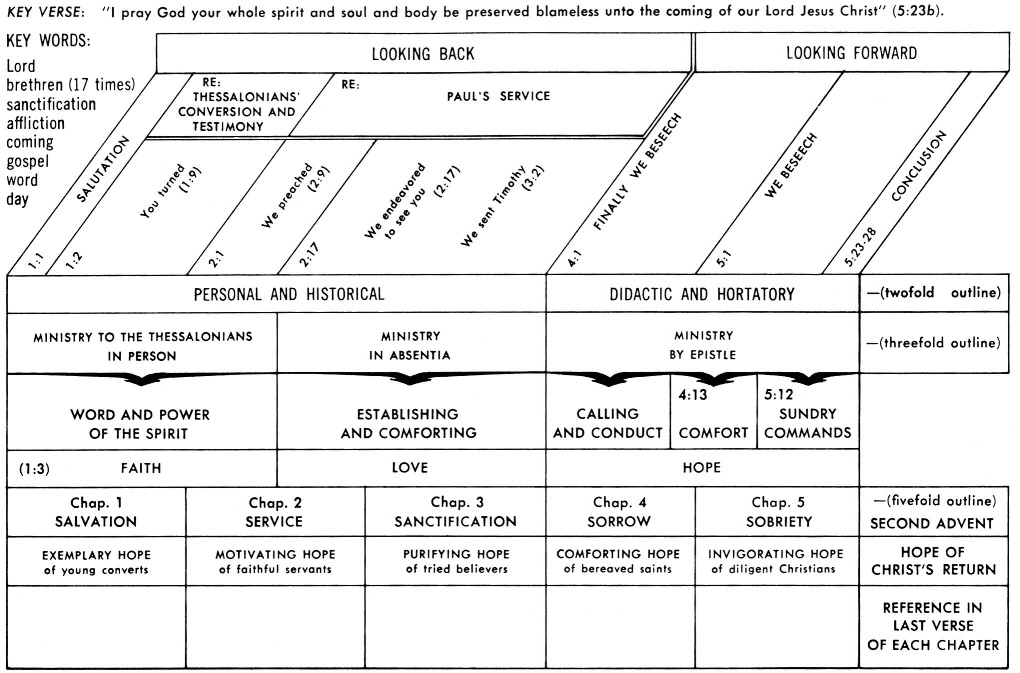
JESUS IS COMING AGAIN
Click chart to enlarge
Charts from Jensen's Survey of the NT - used by permission
Chart by Charles Swindoll
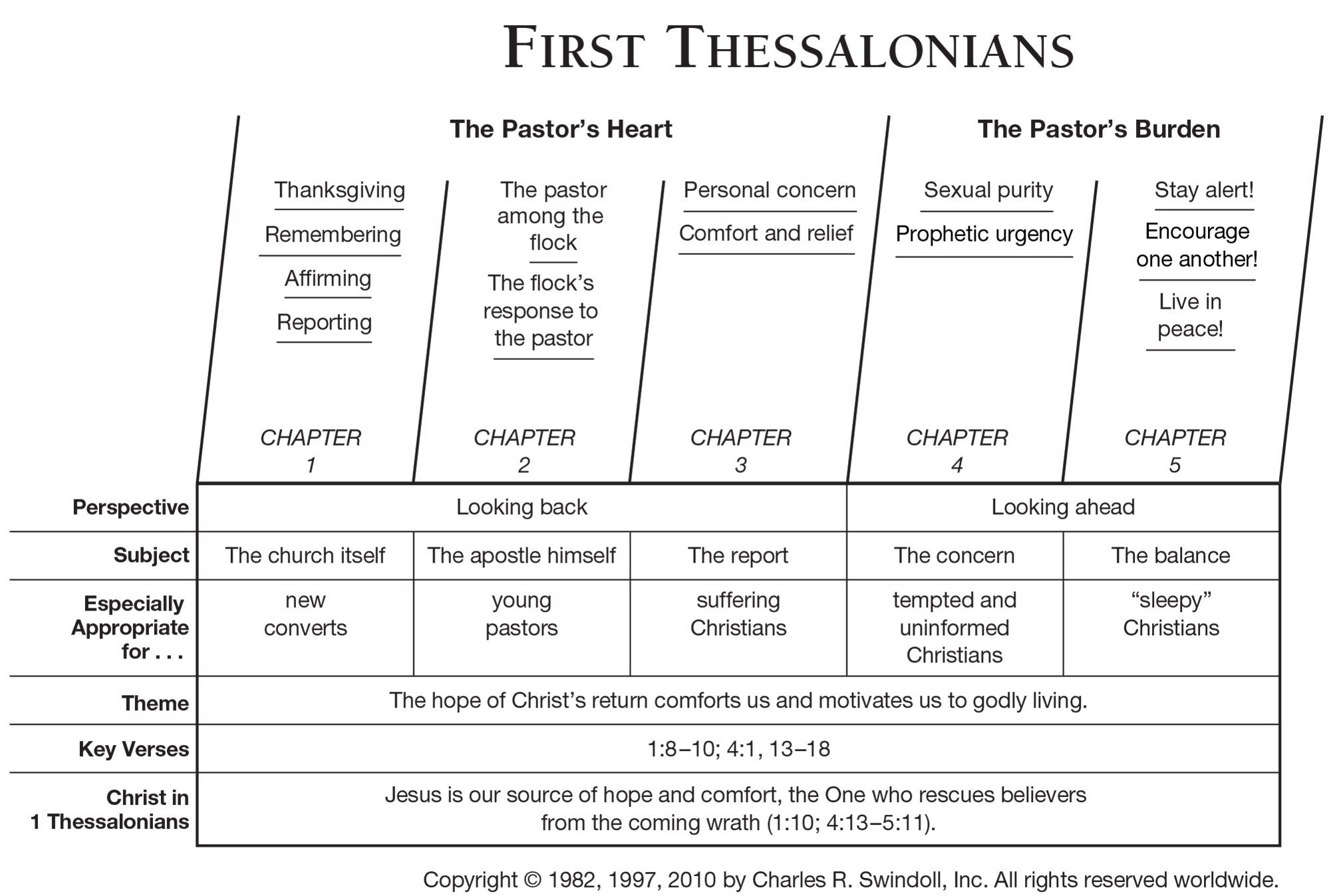
|
1 Thessalonians |
||||||
| 1 Th 1:1-10 | 1 Th 2:1-20 | 1 Th 3:1-13 | 1 Th 4:1-18 | 1 Th 5:1-28 | ||
|
LOOKING BACK |
LOOKING FORWARD |
|||||
|
Personal Reflections |
Practical Instructions |
|||||
| Ministry In Person |
Ministry in Absentia (Thru Timothy) |
Ministry by Epistle |
||||
| Word and Power of the Spirit |
Establishing & Comforting |
Calling & Conduct | 1Th 4:13ff Comfort |
1Th 5:12ff Commands |
||
| 1 Salvation |
2 Service |
3 Sanctification |
4 Sorrow |
5 Sobriety |
||
| Paul Commends Spiritual Growth |
Paul Founds the Church |
Strengthening of the Church |
Directions for Spiritual Growth |
Holy Living in Light of Day of the Lord | ||
| Exemplary Hope of Young Converts | Motivating Hope of Faithful Servants |
Purifying Hope of Tried Believers | Comforting Hope of Bereaved Saints | Invigorating Hope of Diligent Christians | ||
|
Written from Corinth |
||||||
1 Thessalonians 5:4 But you, brethren, are not in darkness, that the day would overtake you like a thief; (NASB: Lockman)
Greek: humeis de, adelphoi, ouk este (2PPAI) en skotei, hina e hemera humas os kleptes katalabe, (3SAAS)
Amplified: But you are not in [given up to the power of] darkness, brethren, for that day to overtake you by surprise like a thief. (Amplified Bible - Lockman)
NLT: But you aren't in the dark about these things, dear brothers and sisters, and you won't be surprised when the day of the Lord comes like a thief. (NLT - Tyndale House)
Phillips: But because you, my brothers, are not living in darkness the day cannot take you completely by surprise. After all, burglary only takes place at night! (Phillips: Touchstone)
Wuest: But as for you, brethren, you are not in darkness, that the day shall come down upon you as a thief,
Young's Literal: and ye, brethren, are not in darkness, that the day may catch you as a thief
BUT YOU, BRETHREN, ARE NOT IN DARKNESS, THAT THE DAY SHOULD OVERTAKE YOU LIKE A THIEF: humeis de, adelphoi, ouk este (2PPAI) en skotei, hina he hemera humas hos kleptes katalabe, (3SAAS):
- Ro 13:11, 12, 13; Col 1:13; 1P 2:9,10; 1Jn 2:8
- Deuteronomy 19:6; 28:15,45; Je 42:16; Ho 10:9; Zech 1:6
- 1 Thessalonians 5 Resources - Multiple Sermons and Commentaries
But you - Placed first in the Greek sentence to provide strong emphasis (Paul does not want his readers to miss the striking contrast in destiny of day people versus night people). And so Paul dramatically shifts from the third person plural pronoun they (3 times in 1Th 5:3) to the second person plural you. He is now addressing the believers at Thessalonica, emphasizing the day coming like a thief cannot overtake them because they are safe in Christ.
That the day - This should prompt a the 5W & H type question "What day?". To what day or time is Paul referring? Notice even in English, the translation does not say "a day" but "the day". So what? The point is that he is referencing a specific time, not just any day. The Greek construction (using the definite article "he" = "the") before day ("hemera"), substantiates this premise. So again, the day begs the question what day? In this case the context makes this answer quite clear -- Paul is referring to the Day of the Lord, the time he had just mentioned in 1Th 5:2. I believe that the church will be raptured (see comparison of the Rapture vs Second Coming) before the pouring out of God's wrath in the Day of the Lord, and therefore "church age" believers will not be present on earth to experience its terrors and destruction (1Th 5:3). Although most expositors and commentaries state that the day begins just prior to and/or coincides with the Seventieth Week of Daniel. (cp Da 9:27 where "week" = a 7 year period = Daniel's "70th" Week - see notes).
Brethren (80) (adelphos from collative a = copulative prefix {joining together coordinate words} or connective particle serving to join or unite + delphús = womb) is literally one born from same womb and literally identifies a male having the same father and mother. Figuratively (as used throughout this epistle) adelphos refers to a close associate of a group of persons having well-defined membership, specifically identifying fellow believers in Christ united by the bond of affection.
You are (2075) (este) is in the present tense indicating that the believer's continual state is not like that of the unbelieving world - in mental, moral and spiritual darkness because they are still in Adam (1Co 15:22), in sin (Ro 5:12-note, Ep 2:1-note) and in the darkness because they have not believed in the Light (See Jn 1:5; 3:19; 8:12; 2Co 4:4, Ep 4:17, 18-note, speaking to believers Paul says Ep 5:8-note; Ep 5:11-note). As such they are children of Satan (John 8:44) who is called the power of darkness (Lk 22:53).
Not in darkness - Not is (ou) which is the Greek negative meaning absolutely not. It means as believers our position is sure in Christ, the Light of the world. Yes, we can choose to walk in the darkness, for we still have the flesh nature within these decaying physical bodies. The difference is that now that we are children of light, and do not have to stay in the darkness under the dominion of Sin (Jn 8:36, Ro 6:11-note, Ro 6:14-note). How tragic, when a genuine believer chooses to "go back to the leeks, and the onions, and the garlic" of Egypt for a moment, a day or a season (cp Nu 11:5, 6). Dear reader, do not be deceived -- if one habitually, continually abides in the darkness despite a profession of being a child of the Light, their persistence in the darkness proves that they is none of His. Do not be deceived, God is not mocked. Repent. Believe (Mk 1:15, Ac 26:20). Come out from the darkness (cp Is 52:11). Come out from their midst and be separate, for "what fellowship (koinonia - association involving close mutual relations and involvement) has light with darkness"? (2Co 6:14, 15,16, 17, 18)
Spurgeon writing to believers says…You know that Christ will come (Jn 14:3, 1Th 4:16-note, 1Th 4:17-note). You expect the dissolution of this present state (2Pe 3:10-note, 2Pe 3:11-note). To you therefore, it will come as one who calls at daytime. You cannot know the hour (Mt 24:36). You must not know it; but since you know that He will come (Re 1:7-note), and come to your joy; and since you are in the light (1Jn 1:7, 2:10), you look with gladness to that coming (Titus 2:13-note, Ro 13:11-note, Ro 13:12-note, 2Pe 3:14-note).
Darkness (4655)(skotos from skia = shadow thrown by an object, shade caused by the interception of light. Skia it can assume the meaning of skotos and indicate the sphere of darkness) is literally that sphere in which light is absent. In spiritual terms, absence of light by default pictures that which is ensphered in evil and sin.
Furthermore, the opposite of light is absolute darkness. Where God is there can be no darkness. Conversely where the darkness is indicates separation from God. God’s children have been "qualified… to share in the inheritance of the saints in light… delivered… from the domain of darkness and transferred… to the kingdom of His beloved Son" (Col 1:12, 13-note). The children of the devil, especially his servants who masquerade as ambassadors of light, walk around in spiritual darkness (and separation from God), but their darkness is but a foretaste of the utter "black darkness" that awaits them when they die. Not only is their eternal destiny of purposeless existence horrible but their present life is utter emptiness and purposelessness. All life lived without the spiritual goals of glorifying God and worshiping Him is an empty and purposeless existence!
TDNT notes that skotos…denotes darkness experienced as an enveloping sphere that has significance for existence, e.g., by hampering movement or foresight, or causing anxiety or danger. If light means potentiality, going into the dark means death. The realm of the dead is a dark realm. It projects already into the present life. Darkness can take the form of blindness. The transferred senses arise as follows. Subjectively, darkness is (1) secrecy or deception, (2) the obscurity of an object or speaker, or (3) lack of knowledge or insight. (Kittel, G., Friedrich, G., & Bromiley, G. W. Theological Dictionary of the New Testament. Eerdmans)
Skotos as used in 1Thessalonians figuratively refers to spiritual or moral darkness (including a lack of understanding) as in the following examples
(Jesus declared) And this is the judgment, that the light is come into the world, and men loved the darkness rather than the light; for their deeds were evil. (John 3:19)
(the gospel would) to open their eyes so that they may turn from darkness to light and from the dominion of Satan to God, in order that they may receive forgiveness of sins and an inheritance among those who have been sanctified by faith in Me.' (Acts 26:18) (Comment: Night people have Satan as their master and father , John 8:44).
If we say that we have fellowship with Him and yet walk in the darkness, we lie and do not practice the truth (truth is not only something we should believe and teach but also something we should practice, otherwise our life is a "lie") (1John 1:6)
And do not participate in the unfruitful deeds of darkness, but instead even expose them; (Ep 5:11-note)
For He delivered us from the domain of darkness, and transferred us to the kingdom of His beloved Son, (Col 1:13-note)
Comment: The domain of night people is the kingdom ruled by Satan not the Son
The night is almost gone, and the day is at hand. Let us therefore lay aside the deeds of darkness and put on the armor of light. (Ro 13:12-note)
Keathley explains that…Darkness continues the figure of night mentioned in 1Th 5:2 and calls to mind the darkness versus light analogy of the Bible. Darkness stands for the realms of:
1. Error and ignorance versus truth and understanding—this is the intellectual aspect of the darkness/light analogy of Scripture. In other words, the world, because of its darkened understanding, is ignorant of this impending doom that even today stands imminently ready to strike.
2. Blindness versus sight—the operational element of this analogy. The world is spiritually blind, it cannot see the truth of Scripture and has believed the delusions of Satan (2Th 2:9, 10, 11, 12).
3. Wickedness or immoral living versus righteousness—the moral element of this analogy.
The Day of the Lord in one sense is just a preview of "coming attractions" for night people as Jesus describes their ultimate destiny declaring that…
the sons of the kingdom (speaking of the Jews who had the special privilege as the chosen nation - but by way of application this includes all who are still in Adam and not in Christ by grace through faith) shall be cast out into the outer darkness (the final hell); in that place there shall be weeping and gnashing of teeth (Mt 8:12)
Comment: Weeping and gnashing of teeth indicate that separation from God will not be a mindless eternal soul sleep but a conscious awareness of eternal torment! "Believe in the Lord Jesus Christ and you shall be saved" from such a fate is the clarion call that day people as ambassadors of reconciliation need to continuously sound forth with their supernatural, Spirit filled lives and their Scripturally sound speech.
The day (2250) (hemera) here refers to the specific Day of the Lord.
Overtake (2638) (katalambano from katá = adds intensity [or surprise as in 1Th 5:4] to the meaning of the verb + lambáno = take) means to take eagerly, grasp with force, lay hold of, seize with hostile intent (this literal meaning vividly depicted by the demon who seizes the son and dashed him to the ground in Mark 9:18). Katalambano was used in the sense of laying hold of so as to gain control of. In a secular Greek use we read "they were pursued and overtaken."
Figuratively katalambano is used in the middle voice meaning to "seize" or lay hold of with one's mind and thus to comprehend (Jn 1:5, Ep 3;18) or understand (Ac 4:13, 10:34).
Katalambano in some contexts meant to make something one’s own, to obtain (the prize = win - 1Co 9:24), to attain (Php 3:12, 13, Ro 9:30). In a similar use in the papyri, katalambano is used in the papyri of colonists appropriating land.
NIDNTT gives us the background classic use of the root verb lambano writing that it…originally grasp, seize, is attested since Homer. (a) It means to take or grasp. It can indicate both benevolent and hostile actions, and have as object either people or things; e.g. take a wife, collect taxes, accept a verdict, take a road, and fig. take courage. It is used with a material subject, as when, for example, fear or terror seizes men. lambano may serve to enliven the style when used pleonastically. (b) lambano also means to receive, regularly with acc. of the thing; used to embrace all areas of life from simple things to spiritual benefit… katalambano strengthens the original intention, meaning to seize, take a firm grip, attack; mid. seize for oneself; mental apprehension is basically appropriation and understanding… katalambano is used in the LXX to describe God’s holding grip, and men’s. God’s hand takes hold of the world (Isa. 10:14). He traps men (Job 5:13), and comprehends the incomprehensible (Job 34:24)… The powers of destruction also clutch at man and attack him (Ge 19:19)
Wuest writes that katalambano in Mk 9:18 gives…The picture in the word is that of seizing something and pulling it down. Our word “katalepsy” comes from the Greek word. Greek writers used it when speaking of fits.
Vine writes that katalambano…properly means to lay hold of, and then to do this so as to appropriate a thing to oneself, possess as one’s own (cp. 1Co 9:24, “attain”). (Vine, W. Collected writings of W. E. Vine. Nashville: Thomas Nelson)
Katalambano was used in secular Greek of evils seizing with hostile intent, coming upon or overtaking someone which is somewhat of the sense Paul uses katalambano to describe the Day of the Lord "seizing upon" or coming suddenly upon unbelievers in the same way a thief would come into one's house and seize our possessions! The Greeks also used katalambano of of night, evening or darkness coming upon a person. Jesus uses katalambano with this sense (speaking of spiritual darkness) declaring to the multitudes…
For a little while longer the light (He is alluding to Himself, Jn 1:9, 8:12) is among you. Walk (present imperative - as your lifestyle, your habitual practice) while you have the light, that darkness (skotia - absence of light, personified by John of the forces hostile to God) may not overtake (katalambano - grasp or seize) you; he who walks (present tense = as the habit of their life, as manifest by their lifestyle) in the darkness (skotia) does not know where he goes. (John 12:35)
Here are all 15 uses of katalambano… [attained(1), caught(2), comprehend (2), found(1), laid hold of(2), lay hold of(1),overtake(2), seizes(1), understand(1), understood(1), win(1)]
Mark 9:18 and whenever it seizes him, it dashes him to the ground and he foams at the mouth, and grinds his teeth, and stiffens out. And I told Your disciples to cast it out, and they could not do it."
John 1:5+ And the light shines in the darkness, and the darkness did not comprehend it.
Comment: Here katalambano can mean either either "comprehend" mentally, or "seize hold of" with hostile intent.
- Amplified = [put it out or absorbed it or appropriated it, and is unreceptive to it].
- ASV = apprehended it not
- BBE = not overcome by the dark
- Darby = apprehended it not
- ESV = apprehended it not
- GNT = has never put it out
- ISV = has never put it out
- KJV = the darkness comprehended it not
- NAB = has not overcome it
- NET = has not mastered it
- NIV = has not understood it
- NJB = has not mastered it
- NLT = can never extinguish it
- Phillips = has never put it out
- Weymouth (and NCV) = has not overpowered it
- Wuest = did not overwhelm it
John 8:3+ And the scribes and the Pharisees brought a woman caught in adultery, and having set her in the midst, 4 they said to Him, "Teacher, this woman has been caught in adultery, in the very act.
John 12:35 (see above)
Acts 4:13+ Now as they observed the confidence of Peter and John, and understood (discovered = NET, perceived = ESV, KJV, YLT that they were uneducated and untrained men, they were marveling, and began to recognize them as having been with Jesus.
Acts 10:34+ And opening his mouth, Peter said: "I most certainly understand (Idea = to seize with the mind) now that God is not one to show partiality,
Acts 25:25+ "But I found that he had committed nothing worthy of death; and since he himself appealed to the Emperor, I decided to send him.
Romans 9:30 What shall we say then? That Gentiles, who did not pursue righteousness, attained righteousness, even the righteousness which is by faith;
1 Corinthians 9:24 Do you not know that those who run in a race all run, but only one receives the prize? Run in such a way that you may win (obtain it = ESV, YLT, make it yours = Amplified).
Ephesians 3:18 may be able to comprehend with all the saints what is the breadth and length and height and depth
Comment: Wuest writes that "The word “comprehend” conveys to the English reader the idea of “understand.” The Greek word means “to lay hold of so as to make one’s own, to seize, take possession of.” One could translate “apprehend,” in the sense of mentally grasping some idea or truth.
Php 3:12 Not that I have already obtained it, or have already become perfect, but I press on in order that I may lay hold of that for which also I was laid hold of by Christ Jesus. 13 Brethren, I do not regard myself as having laid hold of (Friberg says that "with kata adding certainty to possession") it yet; but one thing I do: forgetting what lies behind and reaching forward to what lies ahead,
1Th 5:4 But you, brethren, are not in darkness, that the day should overtake (Friberg says that "with kata adding suddenness") you like a thief
Katalambano is used 120 times in the non-Apocryphal Septuagint (LXX) Ge 19:19; 31:23, 25; 44:4; Ex 15:9; 22:4; Lv 26:5; Nu 21:32; 32:23; Dt. 19:6; 28:15, 45; Jos. 2:5; 8:19; 10:19; 11:10; 19:47; Jdg. 1:5,6, 8; 7:24; 9:45, 50; 18:22; 1Sa 30:8; 2Sa 5:7; 12:26,27, 29; 15:14; 21:11; 1Ki. 18:44; 2Ki. 18:10; 25:5; 2Chr 9:20; 22:9; 25:23; 33:11; Neh 9:25; Esther 4:17; Job 5:13; 34:24; Ps 7:5; 18:37; 40:12; 69:24; 71:11; Pr 1:13; 2:17, 19; 11:27; 13:21; 16:32; Is 10:14; 20:1; 35:10; 37:8; 51:11; 59:9; Je 3:8; 10:19; 42:16; 51:34; 52:8; Lam 1:3; Eze 33:4; Da 1:20; 4:1; 6:11; Ho 2:7; 10:9; Amos 9:13; Obad 1:6; Mic 6:6; Zec 1:6
Genesis 19:19 (Context = similar to the Day of the Lord for it was in the day when God judged the wickedness of Sodom and Gomorrah) "Now behold, your servant has found favor in your sight, and you have magnified your lovingkindness, which you have shown me by saving my life; but I cannot escape to the mountains, lest the disaster overtake (Heb = dabaq = cleave, stick like glue; Lxx = katalambano) me and I die;
Psalm 7:5 Let the enemy pursue my soul and overtake (Lxx = katalambano) it; And let him trample my life down to the ground, And lay my glory in the dust. Selah.
Psalm 18:37 I pursued my enemies and overtook (Lxx = katalambano) them, And I did not turn back until they were consumed.
Psalm 40:12 For evils beyond number have surrounded me; My iniquities have overtaken (Lxx = katalambano) me, so that I am not able to see; They are more numerous than the hairs of my head; And my heart has failed me.
Psalm 69:24 Pour out Thine indignation on them, And may Thy burning anger overtake (Lxx = katalambano) them.
Thief (2812)(kleptes from klépto = steal; kleptomaniac) is a stealer or thief who acts with stealth or subterfuge. The kleptes steals by fraud and in secret (Mt 24:43; Jn 12:6) whereas the robber or lestes steals by violence and openly. The NT uses kleptes in a figurative sense to describe the false teachers and deceivers who "steal" men away from the truth. In the present context kleptes is used as a figure of speech ("like a thief" - see term of comparison = simile) to describe the sudden and unexpected appearance of the Day of the Lord.
Click here for an in depth discussion comparing kleptes and lestes from the NIDNTT. Below is a partial excerpt...
In Matt. 27:64 the Jews fear that the disciples may quietly steal (klepsosin) the body of Jesus, and in Mt 28:13 they decide to put it about that this explains the empty tomb. The verb klepto and the noun kleptes are used to describe the sudden arrival without warning of the messianic age. As by keeping alert the householder is able to forestall a thief approaching secretly, so the disciple needs to be on the watch for the parousia of the Lord (Mt. 24:43; Lk. 12:39). The same simile illustrates the unexpected moment of the Lord’s coming in 1Th 5:2, 4; 2Pe 3:10; Rev. 3:3; Rev 16:15.
The Fourth Gospel’s discourse on the Good Shepherd opens with a description of a prospective sheepstealer as kleptes kai lestes, i.e., using stealth or force as required to get into the sheepfold, and not the proper entrance (Jn. 10:1). Judas, who pilfered money, was a kleptes (Jn. 12:6); Barabbas, who was implicated in violence, was a lestes (Jn. 18:40). The plural phrase kleptai kai lestai, used by Jesus in Jn. 10:8 to define all who came before him, is not intended to include the godly of earlier days, but refers to false messiahs, such as Theudas and Judas the Galilean (Acts 5:36 f.). “All who came” alludes to the technical term for the messiah, the “coming one” (Matt. 11:3; Mk. 11:9; Lk. 7:19; Ro 5:14). The purpose of the coming of the kleptes was to destroy life in furthering his own ends. By contrast, Jesus had come to give life, even at the expense of his own, and abundant life at that (Jn. 10:10). (Page 378 NIDNTT)
Kleptes contrasts with lestes (3027), Jesus using both terms in His discussion of sheep and security in John 10…
Truly, truly, I say to you, he who does not enter by the door into the fold of the sheep, but climbs up some other way, he is a thief (kleptes) and a robber (lestes)… All who came before Me are thieves (kleptes) and robbers (lestes), but the sheep did not hear them. (Jn 10:1,8)
Kleptes - 16x in 16v in the NAS - Mt 6:19, 20-note; 24:43; Lk. 12:33, 39; Jn. 10:1, 8, 10; 12:6; 1Co. 6:10; 1Th. 5:2, 4; 1Pe 4:15-note; 2Pe 3:10-note; Re 3:3-note; Re 16:15-note
The concept of classifying people spiritually as day people or night people is not new to Paul but was seen in the OT as exemplified by this passage from the Psalms…
Psalm 107:10 There were those (referring His chosen people Israel) who dwelt in darkness and in the shadow of death, prisoners in misery and chains (Why were they in darkness?) 11 Because they had rebelled against the words of God, And spurned the counsel of the Most High.
And so here in Thessalonians we get a picture of the terrible bondage of being in the night and in the darkness. As an aside we should note that it is never God's desire that men and women stay in the bondage of spiritual darkness but to be set free, a desire that reverberates through the following passages…
The people who walk in darkness (here refers to Gentiles - see Mt 4:14-16) will see a great light (an allusion to the advent of the Messiah) Those who live in a dark land, The light will shine on them. (Isaiah 9:2)
Again therefore Jesus spoke to them, saying, "I am the light of the world; he who follows Me shall not walk in the darkness, but shall have the light of life." (John 8:12)
(Jesus sent Paul to speak the Gospel to the Gentiles) to open their eyes so that they may turn from darkness to light and from the dominion of Satan to God, in order that they may receive forgiveness of sins and an inheritance among those who have been sanctified by faith in Me.' (Acts 26:18)
1Thessalonians 5:5 for you are all sons of light and sons of day. We are not of night nor of darkness. (NASB: Lockman)
Greek: pantes gar humeis huioi photos este (2PPAI) kai huioi hemeras ouk esmen (1PPAI) nuktos oude skotous
Amplified: For you are all sons of light and sons of the day; we do not belong either to the night or to darkness. (Amplified Bible - Lockman)
NLT: For you are all children of the light and of the day; we don't belong to darkness and night. (NLT - Tyndale House)
Phillips: You are all sons of light, sons of the day, and none of us belongs to darkness or the night. (Phillips: Touchstone)
Wuest:for as for all of you, sons of light you are and sons of day. We are not of the night nor of darkness.
Young's Literal: all ye are sons of light, and sons of day; we are not of night, nor of darkness,
FOR YOU ARE ALL SONS OF LIGHT AND SONS OF DAY: pantes gar humeis huioi photos este (2PPAI) kai huioi hemeras:
- Luke 16:8; John 12:36; Acts 26:18; Ephesians 5:8
- 1 Thessalonians 5 Resources - Multiple Sermons and Commentaries
For (gar) introduces the positive reason why the Day of the Lord will not overtake believers as a thief who catches his unsuspecting victims off guard. Paul is explaining why the believers will not be taken by surprise by the Day of the Lord.
You - This pronoun is emphatic as is the word all. Paul's point is that his description (sons of… ) applies to all the saints at Thessalonica, even those who are weak and faint-hearted. The evidence of genuine conversion described in 1Th 1:3, 4, 5, 6, 7, 8, 9, 10, was assurance to Paul that even this latter group was included.
You are (2075) (este) in the present tense indicates that believers are continually spiritual light.
Believers are habitually associated with light as illustrated by the following passages…
(Jesus told the multitudes listening to the Sermon on the Mount) You are the light of the world. A city set on a hill cannot be hidden. Nor do men light a lamp, and put it under the peck-measure, but on the lampstand; and it gives light to all who are in the house. Let your light shine before men in such a way that they may see your good works, and glorify your Father who is in heaven. (Mt 5:14, 15, 16-notes; cp Php 2:14, 15-note)
(John writes that) he who practices (present tense = habitually) the truth (lives it out, not just professes to believe it but as one truly reborn of God puts it into practice - these "works" don't save him but demonstrate that he is genuinely saved) comes (present tense = as a lifestyle, continually) to the light, that his deeds may be manifested as having been wrought in God. (John 3:21)
(Believers) are A CHOSEN RACE, a royal PRIESTHOOD, A HOLY NATION, A PEOPLE FOR God's OWN POSSESSION, that you may proclaim the excellencies of Him who has called you out of darkness into His marvelous light (1Pe 2:9-note)
(John writes that) if we walk in the light as He Himself is in the light, we have fellowship with one another, and the blood of Jesus His Son cleanses us from all sin. (1John 1:7)
All (pas - pantes) is the first word in this clause and means all without exception.
Sons of light - This is a Hebraism which describes one as belonging to or characterized something in this case light (spiritually speaking). Paul uses a similar phrase in Ephesians describing unbelievers as sons of disobedience (Ep 2:2-note) or sons who are characterized by disobedience.
In Ephesians Paul explains that…
you were formerly darkness, but now you are Light in the Lord; walk as children of Light (Eph 5:8-note)
In Colossians Paul explains that…
the Father… has qualified us to share in the inheritance of the saints in Light for He rescued us from the domain of darkness, and transferred us to the kingdom of His beloved (Col 1:12, 13-note)
Comment: Sinners who once existed only in the sphere of spiritual darkness, blind to the light of the Word (Jn 8:12), have been miraculously made into saints by a divine rescue operation which removed them from the "dark side" and transferred them into the new sphere, the kingdom of light, the kingdom of Christ.
Hiebert writes that…The Hebrews described a person as "the son of" anything that completely dominated and controlled him. Thus the expression means that spiritual light is the pervading element of their character. (Hiebert, D. E. First and Second Thessalonians)
Sons (5207)(huios) is literally a male offspring but is used here to depict an individual as sharing in the nature or quality of spiritual light (believers) versus spiritual darkness (unbelievers) in the next clause (where Paul drops the word "sons" and just states "of night… of darkness"). Believers are those who are characterized by all the blessings and privileges of sons.
METAPHORICAL
USES OF SONS
Sons is used metaphorically to picture prominent moral/ethical characteristics -- sons of God, Mt 5:9, 45; Lk 6:35, sons of the kingdom Mt 8:12, 13:38, sons of the light, Lk 16:8; Jn 12:36, sons of peace, Lk 10:6KJV, sons of this age (world), Lk 16:8, sons of disobedience, Ep 2:2, sons of the Evil One, Mt 13:38, son of the Devil Ac 13:10, son of destruction (perdition, KJV), 2Th 2:3. Sons is also used to describe characteristics other than moral including sons of the resurrection, Lk 20:36, children (huios not teknon) of the bride chamber, Mk 2:19KJV, son of encouragement, Acts 4:36, sons of thunder, Boanerges (Sons of Thunder), Mark 3:17.
Teknon, children, a synonym of huios, is used in similar phrases including children of God, Jn 1:12, children of Light, Ep 5:8, children of obedience (obedient children), 1Pe 1:14, children of the promise, Ro 9:8; Ga 4:28, children of the Devil, 1Jn 3:10, children of wrath, Ep 2:3 (synonymous with "children of the devil"!), children of a curse 2Pe 2:14YLT.
Light (5457) (phos) can refer to literal light (in contrast to darkness) but in context refers to those who belong to God Who is light and Who Himself exists in light.
Vine writes that…Primarily light is a luminous emanation, probably of force, from certain bodies, which enables the eye to discern form and color. Light requires an organ adapted for its reception, Matthew 6:22. Where the eye is absent, or where it has become impaired from any cause light is useless. Man, naturally, is incapable of receiving spiritual light inasmuch as he lacks the capacity for spiritual things, 1Co 2:14. Hence believers are celled “sons of light,” not merely because they have received a revelation from God, but because in the new birth, they have received the spiritual capacity for it. (Vine, W. Collected writings of W. E. Vine. Nashville: Thomas Nelson)
METAPHORICAL
USES OF LIGHT
Light is used figuratively in Scripture to describe the glory of God’s dwelling place, 1Ti 6:16, the nature of God, 1Jn 1:5, the impartiality of God, Jas 1:17, the favor of God, Ps 4:6, the favor of the King, Pr 16:15, the favor of an influential man, Job 29:24, of God, as the illuminator of His people, Is 60:19, 20, the Lord Jesus as the illuminator of men, Jn 8:12; Ac 13:47, the illuminating power of the Scriptures, Ps119:105, of the judgments and commandments of God, Is 51:4; Pr 6:23, cp. Ps 43:3, the guidance of God, Job 29:3; Ps 112:4; Is 50:10; of the guidance of man, Ro 2:19, of salvation, 1Pe 2:9, of righteousness, Ro 13:12; 2Co 11:14, 15; 1Jn 2:9, 10, of witness for God, Mt 5:14, 16, of prosperity and general well-being, Esther 8:16; Job 18:18; Is 58:8, 9, 10.
Jesus made it very clear how sons of darkness could become sons of light declaring…"While you have the Light, believe in the Light (He had clearly identified Himself as the Light - Jn 8:12), so that you may become sons of Light.” These things Jesus spoke, and He went away and hid Himself from them. (John 12:36)
Sons of day - This repetition of the "sons of… " idiom adds emphasis to the description of these believers and calls for conduct concordant with their status as day people.
Day (2250) (hemera) is used here not of a literal day but in the same sense as "light". Some commentaries think this "day" refers to the Day of the Lord, but that is not the most logical interpretation. For one thing there is no definitive article modifying day which means Paul is not trying to describe a specific day such as the Day of the Lord. The contrast is with night and so as with light, the term day refers to the realm in which they are now living as light possessed people.
WE ARE NOT OF NIGHT NOR OF DARKNESS: ouk esmen (1PPAI) nuktos oude skotous:
- 1 Thessalonians 5 Resources - Multiple Sermons and Commentaries
We - Paul includes himself (Paul, Silas, Timothy) in this statement and so identifies with his readers. Notice that the use of "we" extends though 1Th 5:10. So after Paul reminds the saints of who they are and what God will rescue them from, he builds on this truth to calling them to live as who they are. Creed should always lead to conduct.
Not of night nor of darkness - The word for not signifies absolutely not! Believers are absolutely not in either of these categories (of night… of darkness) which describe unbelievers (cp "the rest who have no hope" 1Th 4:13-note). Here Paul drops the Hebraic phrase "sons of… " and now plainly denies that believers belong to either the domain of night or darkness. There is a similar phrase referring to believers in Acts 9:2KJV as "of the way".
John speaking of unbelievers notes that…
the one who hates (habitually) his brother is in the darkness and walks (as their lifestyle) in the darkness, and does not know where he is going because the darkness has blinded his eyes. (1Jn 2:11, cp 1Jn 2:8, 9)
Believers don't live in the sphere of darkness any longer but instead live in the light of Christ's life, Who lives in us (Col 1:27-note, Ro 8:9-note, 1Co 3:16, 1Jn 4:4). Furthermore, believers are hidden with Christ in God (cp Col 3:3-note), and therefore are no longer in the domain of darkness (Acts 26:18), which is the realm of all still dead in their trespasses and sins (Ep 2:1-note) and still in Adam (cp 1Co 15:22, 45). Believers have a new nature (partakers of the divine nature - 2Pe 1:4-note), a new domain (Acts 26:18), a new sphere of life (in Christ, Ga 2:20-note), a new kingdom (of light, Col 1:12, 13-note) and a new King (Christ - Re 17:14-note, Re 19:16-note)! Because these things are true of day people, the Day of the Lord will not overtake them like a thief.
Night (3571) (nux) is not the literal period between sunset and sunrise, but figuratively describes the state of alienation of all men who are not believers. Nux is used of nux, night, is used of the period of the absence of light, Ge 1:5; Mt 2:14, the period of man’s alienation from God, Ro 13:12 (used this same way in the present verse), a period during which prophecy is silent, Mic3:6, and death, John 9:4.
Of darkness - Regarding this phrase "of darkness" Marvin Vincent makes a subtle but interesting distinction writing that the…
The genitive ("of" in "of darkness") marks an advance of thought from in darkness, 1Th 5:4. "En" (Greek preposition in 1Th 5:4 "in darkness") indicates the element in which one is. The genitive (used here in 1Thes 5:5), of darkness, points to nature and origin. To belong to darkness is more than to be in darkness. (Vincent, M. R. Word studies in the New Testament) (Bolding added)
Thomas writes,
Growing out of this assertion that believers will not participate in darkness is the promise of their non-participation in “the day” of the Lord. It will not overtake them by surprise—“like a thief” overtakes his victim. As 1Th 5:5 explains, their position in Christ guarantees their deliverance from this. (From Gaebelein, F, Editor: Expositor's Bible Commentary 6-Volume New Testament. Zondervan Publishing)
Darkness (4655) (skotos [word study] from skia = shadow thrown by an object) is literally that sphere in which light is absent. In spiritual terms, absence of light by default pictures that which is ensphered in evil and sin. The world is divided into night people and day people a division which is forever (unless the night person repents and believes in Jesus). Fittingly, hell is the abode of night people and is manifest by eternal darkness. In stark contrast, heaven is the eternal light, the abode of day people. John describes heaven as a place where…
there shall no longer be any night; and they shall not have need of the light of a lamp nor the light of the sun, because the Lord God shall illumine them; and they shall reign forever and ever. (Re 22:5-note)
The contrast of day people and night people is dramatic as summarized in this table…
| DAY PEOPLE |
NIGHT PEOPLE |
| Experience the Rapture |
Experience the Day of the Lord |
| Are caught up to heaven |
Are destroyed on earth |
| Spiritual Life | Spiritual Death |
| Hope | No hope |
| Dwell in spiritual light |
Dwell in spiritual darkness |
| Spiritually Alert | Spiritually Asleep |
| Spiritually Sober | Spiritually Drunk |
| Forever With the Lord |
Never With the Lord |
This table demonstrates a total separation between believers and unbelievers, those who are saved and lost.
Believers can be assured they will not suffer the wrath of God in the Day of the Lord, for Christ on the Cross took His Father's wrath which we deserved (Gal 3:13, Titus 2:13-note, Titus 2:14-note, 1Pe 1:18, 19-note).
Paul says we should be encouraged because of the distinctiveness of three things… our nature, our behavior, and our destiny
John Stott elaborates on the day/night, light/dark descriptions noting that…
the Bible divides history into two ages or ‘aeons’. From the Old Testament perspective they were called ‘the present age’ (which was evil, Ga 1:4) and ‘the age to come’ (which would be the time of the Messiah [Ed note: see discussion of Millennium]). Moreover, the two ages were sometimes portrayed in terms of the night and the day. The present age was like a long dark night, but when the Messiah came, the sun would rise, the day would break, and the world would be flooded with light (Lk 1:78, 79 [Ed: cp Is 9:2, Mt 4:16, Jn 1:9, 3:19, 20, 21, 8:12, 9:5, 12:46, 2Ti 1:10-note]).
The Bible also teaches that Jesus Christ is that long-awaited Messiah, and that therefore the new age began when He came. He was the dawn of the new era. He ushered in the day (Ed: cp Lk 17:21). He proclaimed the break-in of the kingdom of God (Mk 1:14, 15). At the same time, the old age has not yet come to an end. As John put it, ‘the darkness is passing and the true light is already shining’ (1Jn 2:8). So, for the time being, the two ages overlap. Unbelievers belong to the old age, and are still in the darkness. But those who belong to Jesus Christ have been transferred into the new age, into the light. Already in Christ we have ‘tasted … the powers of the coming age.’ (He 6:5-note) Already, God has brought us ‘out of darkness into his wonderful light’ (1Pe 2:9-note). Only when Christ comes in glory will the present overlap then end (Ed: Mt 24:30). The transition period will be over. The old age will finally vanish, and those who belong to it will be destroyed. The new age will be consummated, and those who belong to it will be fully and finally redeemed.
So then (and this is the point which we have been working up to), whether we are ready for Christ’s coming or not depends on which age we belong to, on whether we are still in the darkness or already belong to the light. It is only if we are in the light that we will not be taken by surprise…
So the question which Paul’s teaching presses upon us is this: to which age do we belong, the old or the new? Do we belong to the night or to the day? Are we asleep or awake? Are our curtains still drawn, or has the light of Jesus Christ shone in upon us? Verses 4 to 8 become quite clear, once we have grasped the biblical teaching on the two ages—the old age of darkness and the new age of light. For the imagery of day and night, light and darkness, is continued throughout.
Moreover, Paul begins with an affirmation as to who we are, and continues with an exhortation as to what we should be ("alert and sober" - 1Th 5:6-note). (Stott, J. R. W. The Message of Thessalonians).