1 Thes 5:2
1 Thes 5:3
1 Thes 5:4
1 Thes 5:5
1 Thes 5:6
1 Thes 5:7
1 Thes 5:8
1 Thes 5:9
1 Thes 5:10
1 Thes 5:11
1 Thes 5:12
1 Thes 5:13
1 Thes 5:14
1 Thes 5:15
1 Thes 5:16
1 Thes 5:17
1 Thes 5:18
1 Thes 5:19
1 Thes 5:20
1 Thes 5:21
1 Thes 5:22
1 Thes 5:23
1 Thes 5:24
1 Thes 5:25
1 Thes 5:26
1 Thes 5:27
1 Thes 5:28
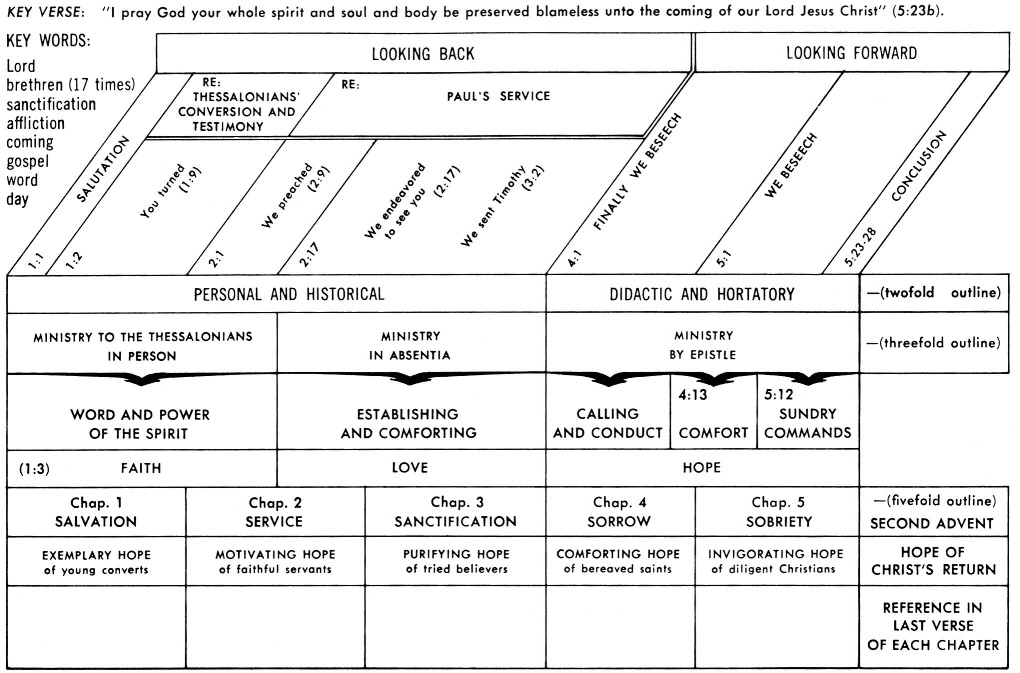
JESUS IS COMING AGAIN
Click chart to enlarge
Charts from Jensen's Survey of the NT - used by permission
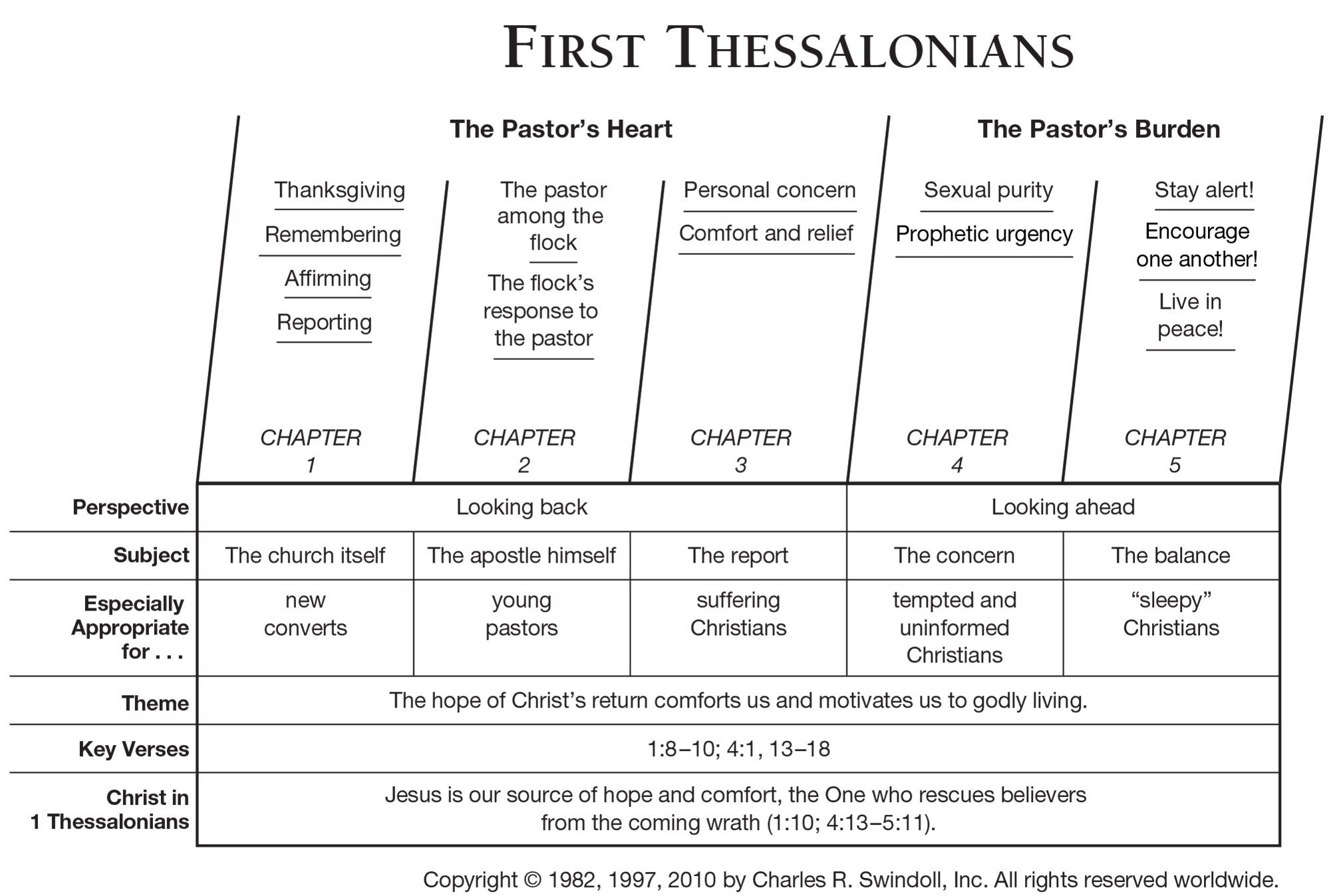
Chart by Charles Swindoll
|
1 Thessalonians |
||||||
| 1 Th 1:1-10 | 1 Th 2:1-20 | 1 Th 3:1-13 | 1 Th 4:1-18 | 1 Th 5:1-28 | ||
|
LOOKING BACK |
LOOKING FORWARD |
|||||
|
Personal Reflections |
Practical Instructions |
|||||
| Ministry In Person |
Ministry in Absentia (Thru Timothy) |
Ministry by Epistle |
||||
| Word and Power of the Spirit |
Establishing & Comforting |
Calling & Conduct | 1Th 4:13ff Comfort |
1Th 5:12ff Commands |
||
| 1 Salvation |
2 Service |
3 Sanctification |
4 Sorrow |
5 Sobriety |
||
| Paul Commends Spiritual Growth |
Paul Founds the Church |
Strengthening of the Church |
Directions for Spiritual Growth |
Holy Living in Light of Day of the Lord | ||
| Exemplary Hope of Young Converts | Motivating Hope of Faithful Servants |
Purifying Hope of Tried Believers | Comforting Hope of Bereaved Saints | Invigorating Hope of Diligent Christians | ||
|
Written from Corinth |
||||||
1 Thessalonians 5:8 But since we are of the day, let us be sober, having put on the breastplate of faith and love, and as a helmet, the hope of salvation. (NASB: Lockman)
Greek: hemeis de hemeras ontes (PAPMPN) nephomen, (1PPAS) endusamenoi (AMPMPN) thoraka pisteos kai agapes kai perikephalaian elpida soterias
Amplified: But we belong to the day; therefore, let us be sober and put on the breastplate (corslet) of faith and love and for a helmet the hope of salvation. (Amplified Bible - Lockman)
NLT: But let us who live in the light think clearly, protected by the body armor of faith and love, and wearing as our helmet the confidence of our salvation. (NLT - Tyndale House)
Phillips: but we men of the daylight should be alert, with faith and love as our breastplate and the hope of our salvation as our helmet. (Phillips: Touchstone)
Wuest: But as for us who are of the day, let us be mentally and spiritually well-balanced and self-controlled, having clothed ourselves with a breastplate of faith and love, and for a helmet, a hope of salvation, (Eerdmans)
Young's Literal: and we, being of the day -- let us be sober, putting on a breastplate of faith and love, and an helmet -- a hope of salvation
BUT SINCE WE ARE OF THE DAY LET US BE SOBER: hemeis de hemeras ontes (PAPMPN) nephomen:
- 1Th 5:5; Romans 13:13; Ephesians 5:8,9; 1 Peter 2:9; 1 John 1:7
- 1 Thessalonians 5 Resources - Multiple Sermons and Commentaries
DAY PEOPLE ARE TO
BE SOBER MINDED
But - Paul again introduces a contrast between those who engage in activities characteristic of the night ("sleep...get drunk" - 1Th 5:7-note, cp "night life" in Ro 13:13-note) and believers who belong to the day. See value of observing and interrogating terms of contrast.
For example Paul has a similar exhortation to the Romans in view of the shortness of time, especially the brevity of our lives in light of eternity...
And this do, knowing the time, that it is already the hour for you to awaken from sleep; for now salvation is nearer to us than when we believed. 12 The night is almost gone, and the day is at hand. Let us therefore lay aside the deeds of darkness and put on the armor of light. 13 Let us behave properly as in the day, not in carousing and drunkenness, not in sexual promiscuity and sensuality, not in strife and jealousy. 14 But (in stark contrast to the aforementioned wicked behavior of "night people") put on (aorist imperative - do this now! Don't delay!) the Lord Jesus Christ (Abide in Him - 1Jn 2:6, walk by the power of [Php 2:13NLT] His Spirit - Ga 5:16-note, etc), and make (present imperative = stop an attitude or activity already in progress!) no provision for the flesh in regard to its lusts. (See notes Romans 13:11; 13:12; 13:13; 13:14)
Of the day - our identity which takes us back to 1Th 5:5, sons of light and sons of day...not of night nor of darkness.
Spurgeon comments that when soldiers...
sleep they put off their armor; but in the day when they are awake and on their guard they wear their armor, and are ready for the fray. See how much is involved in Christian wakefulness. God help us to carry out every virtue to its legitimate consequences,-not to be wakeful after a fashion, but wakeful after God’s fashion.
Because our true nature is that of a day person, Paul exhorts us to continually be sober and not allow ourselves to become "drunk" so to speak when it comes to spiritual truth. Believers are to live in the light of Christ, not the darkness ruled by Satan.
Let us be sober - This is an exhortation ("Let us...") a communication intended to urge or persuade the saints at Thessalonia to take some action.
Paul wants us to live sober minded.
He wants us to live experientially (like Christ) in conformity with who you are positionally (in Christ). Paul gives a similar positional-experiential charge in Ephesians reminding the Gentile believers...
you were formerly darkness (Note: Not just "in" darkness, but were the essence of darkness!), but now you are Light in (the sphere of) the Lord; walk (not a suggestion but a command based on the empowering truth of the fact that believers are now in Christ and His enabling Spirit is now in them - Ro 8:9-note) as children of Light (when we sin [moral/ethical darkness] we are living like night people, whose only haunt is moral/ethical darkness.) (and then Paul gives an overview of what the life of day people looks like writing that) the fruit of the Light consists in all goodness and righteousness and truth (Ep 5:8-note, Ep 5:9-note)
Let us be Sober (3525) (nepho) (Click discussion of sober in previous verse) in the physical sense literally referred to either complete abstinence or in a relative sense to temperance (drinking but not to the point of intoxication). Don't misunderstand what Paul is saying here -- he is not saying you need to walk around with a sad, gloomy countenance. The idea of sober in this context includes spiritual stability, stability we need in Christ, in the Spirit, to withstand the onslaught of the darkness. As the return of Christ draws nigh, and the temptations of the darkness intensify, it is absolutely crucial for believers to have a cool, collected, mind of Christ attitude toward temptation.
The NT uses nepho only in the figurative sense meaning to be free from every form of mental and spiritual "intoxication". The idea is to be calm and collected in spirit, circumspect, self-controlled, well-balanced, clear headed. Be self-possessed ("Spirit" possessed) under all circumstances. Nepho speaks of exercising self-restraint (enabled by the Spirit) and being free from excess, from evil passion, from rashness, etc. Without sobriety true vigilance is impossible.
And so Paul is calling believers to continually (present tense) live soberly and in this state we are more alert and watchful and less likely of being enticed by the deeds of darkness. Night people can only do night deeds and cannot do the deeds of the day. However sons of light and sons of day can do the deeds of the night, tracking back to their old patterns of conduct. To be sure, as sons of day we have the power to commit sins, but we can still commit acts of darkness unless we remain sober. What is even more tragic is that when believers commit sins, they do so in the light of God's revealed truth, regarding our dethroned sinful nature. Paul calls for our behavior to be consistent with our new nature.
The sober-minded believer knows the future is secure because he knows the One Who holds the future in His, and is enabled to live calmly and obediently. On the other hand, if a Christian falls into patterns of sinfulness, he loses assurance, loses confidence, loses hope and may fear that he will get caught in the Day of the Lord.
Denney writes that...
Wakefulness and sobriety do not exhaust the demands made upon the Christian. He is also to be on his guard. “Put on the breastplate of faith and love; and for a helmet, the hope of salvation.” While waiting for the Lord’s coming, the Christian waits in a hostile world. He is exposed to assault from spiritual enemies who aim at nothing less than his life, and he needs to be protected against them. In the very beginning of this letter we came upon the three Christian graces; the Thessalonians were commended for their work of faith, labour of love, and patience of hope in the Lord Jesus Christ. There they were represented as active powers in the Christian life, each manifesting its presence by some appropriate work, or some notable fruit of character; here they constitute a defensive armour by which the Christian is shielded against any mortal assault. We cannot press the figure further than this. If we keep our faith in Jesus Christ, if we love one another, if our hearts are set with confident hope on that salvation which is to be brought to us at Christ’s appearing, we need fear no evil; no foe can touch our life.
It is remarkable, I think, that both here and in the famous passage in Ephesians, as well as in the original of both in Isaiah 59:17, salvation, or, to be more precise, the hope of salvation, is made the helmet. The Apostle is very free in his comparisons; faith is now a shield, and now a breastplate; the breastplate in one passage is faith and love, and in another righteousness; but the helmet is always the same. Without hope, he would say to us, no man can hold up his head in the battle; and the Christian hope is always Christ’s second coming. If He is not to come again, the very word hope may be blotted out of the New Testament. This assured grasp on the coming salvation — a salvation ready to be revealed in the last times — is what gives the spirit of victory to the Christian even in the darkest hour. (Expositor's Commentary)
HAVING PUT ON THE BREASTPLATE OF FAITH and LOVE: endusamenoi (AMPMPN) thoraka pisteos kai agapes kai perikephalaian elpida soterias:
- Isaiah 59:17; Romans 13:12; 2Corinthians 6:7; Ephesians 6:11,13, 14, 15, 16, 17, 18
- Job 19:23, 24, 25, 26, 27; Ps 42:5,11; 43:5; Lam 3:26; Ro 5:2, 3, 4, 5; 8:24,25; 1Co 13:13; Ga 5:5; 2Th 2:16; He 6:19; 10:35,36; 1Pe 1:3, 4, 5,13; 1Jn 3:1, 2, 3
- 1 Thessalonians 5 Resources - Multiple Sermons and Commentaries
ARMED FOR
SPIRITUAL WARFARE
For Paul's use of the metaphor of a soldier, his armor and his warfare as a picture of the believer's spiritual life see the related notes on Ro 13:12-note; Ep 6:10-note; 2Ti 2:3, 4-note; 2Ti 4:7-note
Having put on the breastplate - well equipped soldiers had two essential pieces of equipment, one to preserve the vital organs and the other to preserve the head. The modern-day equivalent is the bulletproof vest. The emphasis in this picture is on the protection of a believer and therefore Paul does not mention a sword.
Adrian Rogers on put on the breastplate... - you need to get your heart right; that's the breastplate of faith and love that covers your heart. You need to love Jesus; you need to love one another. You need to put your faith where God put your sins: on the Lord Jesus Christ. That's the breastplate; you need to wear that. If you don't wear that, you're not ready to live in these dark days. And then, not only keep your heart right, but you keep your head right. Put on the helmet of salvation, the helmet of the hope of salvation. (see his comment below)
Having put on (1746) (enduo from en = in + dúo = to sink, go in or under, to put on) means literally to clothe or dress someone and to put on as a garment, to cause to get into a garment (eg, Lk 15:22 where the father says "quickly bring out the best robe and put it on him...").
Aorist tense in this context indicates this putting on is a past completed action and includes the idea that this action was decisive. When did the Thessalonians put on the breastplate? This transpired the moment they confessed Christ as Lord and Savior (Ro 10:9, 10-note) and were by grace through faith born again (Jn 3:3, Titus 3:5-note) as new creations in Christ (2Co 5:17) at which time they were delivered from the domain of darkness ruled by Satan (Ac 26:18, 1Jn 5:19) and transferred into the Kingdom of God's dear Son (Col 1:13-note)
In the middle voice (as in Paul's description of the new man/self in Col 3:10-note;cp Ep 4:24-note) it means to clothe oneself with something, in this case the clothes worn by the "new man" who is clothed in the robe of Christ's righteousness (1Co 1:30, Is 45:24, 25, 2Co 5:21, Php 3:9-note), which includes the breastplate of faith and love. Don't pass over this truth -- because the truth is that it is your responsibility to now live out the fact that you have put on this breastplate. Every believer has put on the breastplate of faith and love "positionally" at the moment of salvation, but now in the process of daily (even moment by moment) sanctification (growth in holiness or Christ-likeness) believers have the privileged obligation to live out experientially what is true positionally. And we can do this because God has provided everything necessary for life and godliness according to a true knowledge (see epignosis) of Him Who called us, but we have to avail ourselves of this true knowledge (2Pe 1:3-note), working it from our head (head knowledge) and into our heart (heart transformation). God's desire for us as day people is not to be "smarter sinners" but to be becoming more like the Savior.
Enduo - 27x in 25v in the NAS - Mt 6:25; 22:11; 27:31; Mk. 1:6; 6:9; 15:20; Lk. 8:27; 12:22; 15:22; 24:49; Acts 12:21; Ro 13:12, 14; 1Co. 15:53, 54; Ga 3:27; Ep 4:24; 6:11, 14; Col 3:10, 12; 1Th 5:8; Re 1:13; 15:6; 19:14 and is rendered clothed(6), dressed(1), enter(1), put on(21).
Hiebert writes that...
The believer is not only a watchman but also a warrior. He must not only be alert and self-possessed but also equipped to resist the onslaught of the enemy. While awaiting the return of his Lord, the believer must be on his guard, for he waits in a hostile world. (Hiebert, D. Edmond: 1 & 2 Thessalonians: BMH Book. 1996)
Luke uses enduo figuratively describing clothing with spiritual power...
And behold, I am sending forth the promise of My Father upon you; but you are to stay in the city until you are clothed (enduo) with power from on high." (Luke 24:49, cp Acts 1:8)
Comment: Here the indirect middle conveys the sense "put on yourselves power from on high as a garment". They were to wait until this experience came to them. The “the promise of the Father” refers to the Spirit (Ac 2:33, Who came first at Pentecost and now comes to indwell every believer at salvation - cp 1Co 12:13, 3:16, 6:19, Ro 8:9-note) Enduo used in this figurative in classical Greek by Aristophanes who writes "clothed with audacity"; Homer, "clothed with strength"; Plutarch, "clothed with nobility and wealth".
Vine writes that
At conversion the believer is said to have “put on the new man,” Ep 4:24; Col 3:10, cp. Gal 3:27; and “therefore,” he is exhorted to “put on a heart of compassion, kindness, humility, meekness, longsuffering, … and love,” Col 3:12, 14. Such is to be the ordinary apparel of the Christian, in this character he is to appear daily in the world. The believer, however, is “enrolled—as a soldier,” 2Ti 2:4, and as such has suitable armor provided for him, and with this he is exhorted to clothe himself Ro 13:12; Ep 6:11, and here. The whole is summed up in Ro 13:14, for the man who “puts on the Lord Jesus Christ” stands both in the Christian’s dress and in the Christian’s panoply. (Vine, W. Collected writings of W. E. Vine. Nashville: Thomas Nelson)
Breastplate (2382) (thorax [word study]) describes either the chest area or part of the body covered by the breastplate or the protective covering of this area as utilized in combat. The breastplate was a piece of armor that covered the soldier's body from neck to waist and protected his heart, the very center of his life and the spring of his vital forces.
Polybius tells us that the breastplate was known as a heart-protector. Usually it was made of bronze but the more affluent officers wore a coat of chain mail. The front piece was strictly the breastplate, but a back piece was commonly worn as well.
Isaiah foretold of the Messiah wearing a breastplate of righteousness, recording (in the context of a tragic description of sins by Israel) that...
He (Messiah) put on righteousness like a breastplate, and a helmet of salvation on His head; and He put on garments of vengeance for clothing, and wrapped Himself with zeal as a mantle. 18 According to their deeds, so He will repay, wrath to His adversaries, recompense to His enemies (at His Second Coming in Re 19:11, 12, 13, 14, 15, 16, 20-note). To the coastlands He will make recompense (2Th 1:6, 7, 8, 9, 10). 19 So they will fear the name of the LORD from the west and His glory from the rising of the sun, for He will come like a rushing stream, which the wind of the LORD drives. (Isaiah 59:17, 18, 19)
Comment: This prophecy is a picture of Messiah's second advent (see Second Coming), at the end of the Great Tribulation, to save those who will be saved {Ro 11:26, 27-note, cp Zech 12:9, 10, 13:8, 9) and to judge those who rejected His salvation {see Mt 25:31 of the judgment of Gentiles who will enter the Millennial Kingdom and Ezek 20:33, 34, 35, 36, 37, 38 for the corresponding judgment of the Jews to determine who will enter the Messianic Kingdom - upshot = ONLY saved Jews [= the remnant] and Gentiles will enter into the Kingdom from the Tribulation}. Had our Substitute not been fully, perfectly righteous (He 7:26-note), we could never have attained God's required righteousness (Mt 5:20-note, Php 3:8-note, Php 3:9-note). Instead Paul explains that believers have nothing to boast it for by God's "doing you are in Christ Jesus, who became to us wisdom from God, and righteousness and sanctification, and redemption" 1Cor 1:30.
PAULINE
MILITARY METAPHORS
Paul frequently uses military metaphors when describing the Christian life and thus refers to the believer as a soldier (1Co 9:7; Php 2:25; 2Ti 2:3, 4; Philemon 2) and describes his armor (1Th 5:8, Ro 13:12; 2Co 6:7; Eph 6:11, 12, 13, 14, 15, 16, 17), his weapons (2Co 10:4; Ep 6:17; cp. 1Pe 4:1), his warfare (1Ti 1:18), his order in the ranks (1Co 14:40; Col 2:5), a shout like a military order (1Th 4:16), and the members of a believer’s body as God’s weapons (instruments) (Ro 6:13)
Faith and love - Faith is the attitude the believer should have toward the Lord and love is the proper attitude he or she should express toward the saints.
Faith (4102) (pistis [word study]) is synonymous with trust or belief and is the conviction of the truth of anything, but in context speaks of the conviction that God exists and is the Creator and Ruler of all things well as the Provider and Bestower of eternal salvation through Christ. As faith relates to Christ it represents a strong and welcome conviction or belief that Jesus is the Messiah, through Whom we obtain eternal salvation and entrance into the Kingdom of Heaven. Stated another way, eternal salvation comes only through belief in Jesus Christ and no other way.
Faith is an essential protection against temptations to doubt God's promise that they would not experience the Day of the Lord's wrath. Faith in God's promise is tantamount to putting on a breastplate to cover one's vital organs, especially our heart (cp Ep 6:16-note).
And what is ultimate manifestation of faith that protects like a breastplate? It is obedience. When I obey what God has commanded and instructed, for example, putting to death the sinful, earthly things lurking within my physical body (Col 3:5NLT-note), I am showing that I believe God by my choice to mortify (Col 3:5KJV) my members and this Spirit motivated and enabled obedience (Php 2:13NLT) functions like a "breastplate" to deflect doubt concerning the certainty of God's promise that He "has not destined us for wrath".
Richison explains that faith...
protects the affections or heart. Unbelief strikes hardest at the heart, so Paul mentions it first. The downfall of those without Christ is that they “believed not the truth” (2Th 2:12). If we live by faith (2Co 5:7, cp Col 2:6-note), this will keep us sober — spiritually stable in spiritual war. Faith will enable us to stand against those who would undermine what we believe (cp Ro 10:17-note). A heart full of love (Ro 5:5-note) will arm us against broken relationships. It will stabilize relationships and promote accountability, thus reducing the chances that people will steer into apostasy (Col 1:23NLT-note). (Reference)
Love (26)(agape [word study]) refers to unconditional, sacrificial love that God is (1Jn 4:8,16) and that God demonstrates (Jn 3:16, 1Jn 4:9, Ro 5:8-note). Agape love is the love of choice. It is a Christ-like love manifest by selflessly serving others with humility (Php 2:5-note, Php 2:8-note). It is not motivated by the recipient's superficial appearance, by an emotional attraction, by one's sentiments. Agape chooses as an act of self-sacrifice to serve the recipient. See Paul's definition of this Christ-like love - (1Co 13:4, 5, 6, 7-note).
Richison explains that "A heart full of love will arm us against broken relationships. It will stabilize relationships and promote accountability, thus reducing the chances that people will steer into apostasy.(Reference)
From all of the descriptions of agape love, it is clear that true agape love is a sure mark of salvation as John explains in his first epistle explaining that...
By this the children of God and the children of the devil are obvious: anyone who does not practice (present tense - as a habit or as a lifestyle) righteousness is (absolutely, definitively) not of God, nor the one who does not love (present tense - as a habit or as a lifestyle) his brother. For this is the message which you have heard from the beginning, that we should love one another (John now illustrates absence of love) not as Cain, who was of the evil one (Cain was an unbeliever and his spiritual father was Satan, John 8:44), and slew his brother (Abel, see He 11:4-note). And for what reason did he slay him? Because his (Cain's) deeds were evil, and his brother's (Abel's) were righteous. Do not marvel, brethren, if the world hates you. We know that we have passed out of death into life, (in other words, we know that we are genuinely born again) because we love (present tense - as a habit or as their lifestyle) the brethren. He who does not love (present tense - as a habit or as their lifestyle) abides (present tense - continually) in death (i.e., spiritual death = an unbeliever) Everyone who hates (the opposite of love - see Jesus' words on anger - Mt 5:21, 22-notes notes) his brother is a murderer; and you know that no murderer has eternal life abiding in him. (1John 3:10, 11, 12, 13, 14, 15)
And so clearly when we demonstrate love in a sacrificial manner, not just with words but deeds (such as providing for the needs of our brethren) and by obeying God's commands (cp 1John 5:2-3 "By this we know that we love the children of God, when we love God and observe His commandments For this is the love of God, that we keep His commandments; and His commandments are not burdensome." cp Jesus' words - "If you love Me, you will keep My commandments." Jn 14:15), we are in effect "putting on" the breastplate of love in a practical, experiential sense. This love functions as a shield to give us assurance, John explaining that...
We shall know by this (by our demonstration of love) that we are of the truth, and shall assure our heart before Him, in whatever our heart condemns us; for God is greater than our heart, and knows all things. Beloved, if our heart does not condemn us, we have confidence before God; and whatever we ask we receive from Him, because we keep His commandments and do the things that are pleasing in His sight. (1John 3:19, 20, 21, 22)
Believers can fall into the trap of following the world’s demand that a lover feel positive toward the beloved. This is not agape love, but is a love based on impulse. Impulsive love characterizes the spouse who announces to the other spouse that they are planning to divorce their mate. Why? They reason “I can’t help it. I fell in love with another person!” Christians must understand that this type of impulsive love is completely contrary to God’s decisive love, which is decisive because He is in control and has a purpose in mind. There are many reasons a proper understanding of the truth of God's word (and of the world's lie) is critical and one of the foremost is Jesus' declaration that
"By this all men will know that you are My disciples, if you have love (agape) for one another." (John 13:35).
Hiebert - The breastplate is pictured as being double or having two sides. Faith denotes the proper inner attitude of the believer toward Christ as his Redeemer and Lord, while love is the proper outward expression of the Christian life toward the saints. Constable remarks, "Faith in God protects inwardly and love for people protects outwardly. These two graces cannot be separated; if one believes in God, he will also love other people (cf. 1Thes. 1:3; 3:5)." (Ibid)
Puritan Thomas Watson writes (sermon) says hat a Christian's life is military...
In respect to COMBAT. 1Timothy 6:12: "Fight the good fight of faith." In order to fight, a Christian must get his armor and weapons ready.
He must get his ARMOR ready. The care of most is to get riches, not armor. There are two things absolutely needful—food and armor. It is necessary to get Christ for our food—and grace for our armor—without which there is no abiding the day of trial. A soldier who wears his prince's colors but has no armor, will soon flee the field. If you wear Christ's colors but have not the armor of God upon you, you will turn your backs in the day of battle. There are two chief pieces of the spiritual armor.
First, the HELMET is divine hope. 1Thessalonians 5:8: "For a helmet—the hope of salvation." A helmet is to defend the head so that it is not hurt. So the hope of salvation as a helmet defends a person and makes him lift up his head in the greatest dangers. Christians, be sure you get the right helmet, because the helmet of hope may be counterfeited.
The first deceit of the helmet, or a false hope—is DEAD hope. Hypocrites have a faint wish for heaven. They hope for heaven—but exert no activity in working out salvation. True hope is a "lively hope" (1Peter 1:3-note). True hope of glory sets the affectations on fire, and adds wings to the endeavor.
A false hope is an UNCLEAN hope. A man hopes—but continues in his sins. It is vain to speak of hopes of salvation—and have the marks of damnation. True hope is a helmet made of pure metal. 1John 3:3: "He who has this hope purifies himself."
A false hope is VANISHING. It is not a helmet—but a spider's web. The least terror of conscience makes it vanish. But a true hope is permanent. Pr 14:32: "The righteous has hope in his death." In a dying hour—his hope is in a living God.
Quintian the persecutor commanded one of his men to cut off the breasts of Agatha, a martyr. "Do your worst, tyrant," said the martyr, "yet I have two breasts which you cannot touch. The one is of faith, the other of hope." Oh, get the right helmet! The devil laughs at hypocrites who are deceived with false armor. A fool is content with a paper helmet.
The second piece of the spiritual armor is the BREASTPLATE, which is love. "Putting on the breastplate of love" (1Thessalonians 5:8). This breastplate is inseparable; it may be shot at—but it cannot be shot through, Song 8:7. A soul armed with love will go through a sea and a wilderness and will die in God's service.
AND AS A HELMET THE HOPE OF SALVATION: kai perikephalaian elpida soterias:
- Eph 6:17 And take THE HELMET OF SALVATION, and the sword of the Spirit, which is the word of God.
- 1 Thessalonians 5 Resources - Multiple Sermons and Commentaries
PROTECT YOUR MIND
WITH BIBLICAL HOPE
Helmet (4030) (perikephalaia from peri = around + kephale = head) means literally around the head or encirclement of the head and thus a helmet.
A Roman soldier who had lost his helmet was in danger of receiving severe head wounds which would (at the very least) disorient him and render him ineffective and in danger of further injury. Similarly, a Christian who has no assurance of salvation (or has "lost his hope") cannot be bold in resisting Satan.
Roman military helmets were of two types: the galea (made of leather) or the cassis (metal). The helmet had a band to protect the forehead and plates for the cheeks, and extended down in back to protect the neck. When the helmet was strapped in place, it exposed little besides the eyes, nose, and mouth. The metal helmets, due to their weight, were lined with sponge or felt. Virtually the only weapons which could penetrate a metal helmet were hammers or axes. No soldier’s uniform was complete without a proper helmet. A helmet, being hot and uncomfortable, would be put on by a soldier only when he faced impending danger.
A Roman soldier would be foolish to enter a battle without his helmet. He knew that the helmet would protect his head from arrows, but that it's primary function was to ward off blows from the enemy's broadsword (not the small dagger, the machaira, mentioned in Ep 6:17 - note) but the broadsword, which was from three to four-feet long with a massive handle that was held with both hands like a baseball bat. The soldier lifted it over his head and brought it down on his opponent’s head. The broadsword was a vicious weapon that could deal a crushing blow to the skull. The helmet on one's head was the only way to deflect it. An archaeological dig discovered a skeleton with a cleavage right through the skull. Although it is only conjecture, it is quite likely that this fatal would was made by someone who attacked the person with a broadsword. Beloved, please do not leave home today without putting on the helmet of salvation. In fact, don't ever take it off. Not even when you go to sleep (it's a good thing we are speaking in spiritual terms!).
Ray Stedman - If you think it is hard to stand now, if world events throw you for, a loss now, how will you stand when the darkness increases, when the cause looks hopeless, and things get very much worse? That is the hour when we must have the hope of salvation--the helmet of salvation that protects the mind.
Pulpit Commentary (comment on Eph 6:14-17) - the helmet that covers the head, is our true defense against the devil. It will make you active in all duties, courageous in all conflicts, cheerful in all conditions, and constant to the end of life.
Selwyn Hughes - The attack of Satan on the mind proceeds differently. He says to us: "Just look around you at the state of the world. God seems powerless to put things right. He has given lots of promises that things will one day get better, but none has come to pass. Hadn't you better give up this foolish idea that it's all going to work out right?" If you were to let your mind dwell on that kind of satanic argument, you would soon find yourself in distress. The answer is to put on the helmet, the hope of salvation. You must remind yourself that things are not as they appear. The battle is not ours, but the Lord's. We may be individual soldiers fighting in the army of God, but the ultimate cause is sure and the end is certain. We need not be unduly troubled by what is happening in the world, for our commander is not just winning—He has already won!
DAY PEOPLE LIVE IN THE LIGHT
(OF CHRIST'S RETURN)!
Robert J Morgan explains the helmet of salvation this way - This is talking about hope, about the awareness of salvation (Ed comment: I would add Paul is referring especially to "future tense salvation" -- past = justification, one time event; present = sanctification, ongoing process; future = glorification, one time event. See Three Tenses of Salvation),, about the impact our eternal life should have on our thinking. The Bible tells us that the trials and problems of this present world are not worth comparing to the glory that will be revealed (2 Cor 4:17). When we’re in the midst of a satanic attack, we need to remind ourselves that one day soon the devil will be consigned to hell where he belongs and we’ll be enjoying the fun and fellowship and fulfilling work of heaven forever and ever. The final victory is already in the books! The war was won the moment Christ rose from the grave! All our trials are brief and momentary. When we have the helmet of the hope of our eternal life protecting our brains, it’s hard for the devil to rattle us.
Notice that 1Th 5:9 begins with FOR (a strategic "term of explanation" which should always prompt the question "What is the writer explaining?"). Clearly Paul is explaining what the "hope of salvation" means -- in 1 Thes 5:9 our future is not WRATH but by default it's GLORY (it's not BAD but GOOD would be another way to look at it). In practical terms, Paul wants us to put this helmet on, put this type of thinking on. This "UPLOOK" IS THE "OUTLOOK" God wants His children to have in the midst of their trials and tribulations. And we need to always be alert to the wiles of Satan and quickly remind ourselves of that TRUTH when he shoots those fiery missiles of doubt and lies (like "God doesn't really care for you -- look at how your child is being bullied at school," etc).
In sum, Paul is exhorting the saints to let "hope of salvation" be your mindset (your "helmet"), practicing "vertical vision" (focusing on the things above - Col 3:2, your future from above - 1Pe 1:13, your absolute assurance that God will do good to you in the future and not deliver you over to wrath - 1Th 5:8,9, etc) so to speak, in contrast to "horizontal vision" (focusing on the earthly trials, tests, tribulations, temptations, etc).
Warren Wiersbe describes "vertical vision" in similar but slightly different way...
Outlook determines outcome; and when your outlook is the uplook, then your outcome is secure
John MacArthur illustrates how the enemy attacks the believer's mind writing that...
Satan’s "broadsword" has two sides to it: discouragement and doubt. Satan wants to belt you in the head with discouragement and doubt. His attacks of discouragement might go like this:
You sure are giving a lot and not getting much in return. You’re circumscribing your life to a certain standard and setting yourself apart from the world. But what happens? You just lost your job! Some blessing! You’ve been reading your Bible every day, but your wife is as cranky as she was before you bought it, and it hasn’t had any effect on her. What is God doing in your life? You’ve been going to church for years, but look at your kids. They don’t respect you today anymore than they ever did.
That would discourage anyone. You might have been teaching a class for a long time, yet wonder if anyone is getting anything out of it. That could discourage you. Satan also wants to hit you in the head with doubt:
How do you know you’re a Christian? Are you sure you’re saved? You certainly don’t deserve to be; look what you just did! Do you think that’s what a Christian does?
Many people suffer from doubt and discouragement, but the helmet of salvation is our protection. (MacArthur, J.. The Believer's Armor. Chicago: Moody Press 1986)
Glen Spencer on helmet and hope of salvation - The helmet of the hope of salvation protects our head from doubt and uncertainty. Hope speaks of expectancy and certainty. The hope of our salvation is not something that God might deliver. No! No! It is definite that every child of God is to be a victor.
Matthew Poole - despair, to which the devil tempts us, makes us quit our combat; whereas hope of salvation makes us lift up our heads in the midst of temptations and afflictions.....Hope of salvation is of great use to a Christian many ways: it is a cordial to comfort him, a spur to quicken him, a staff to support him, a bridle to restrain him, and so also a helmet to defend him: and therefore no wonder that the apostle calls true hope “:a lively hope,” 1 Pe 1:3. And as itself is lively, so it is a defence to the life of the soul, as a helmet is to the life of the body.
John Calvin - In 1 Thessalonians 5:8 Paul calls “the hope of salvation” a helmet, and I take it in the same sense here (Eph 6:17). The head is protected by the best helmet when it is buoyed up by hope to look toward heaven and the salvation that is promised us. It is only through hope that salvation is a helmet.
John Wesley - The head is that part which is most carefully to be defended. One stroke here may prove fatal. The armour for this is the hope of salvation. The lowest degree of this hope is a confidence that God will work the whole work of faith in us; the highest is a full assurance of future glory, added to the experimental knowledge of pardoning love.
J Vernon McGee on the helmet - it isn’t the style for men or women to wear hats—most people today go bareheaded—but it should be the style for every Christian to wear the helmet of the hope of salvation....The “hope of salvation” is that blessed hope of the future. We are not looking for the Great Tribulation Period. I don’t see how there could be any rejoicing in that! We are looking for that blessed hope, which is the consummation of our salvation. John writes, “Beloved, now are we the sons of God, and it doth not yet appear what we shall be: but we know that, when he shall appear, we shall be like him; for we shall see him as he is” (1 John 3:2). God is not through with me, so don’t you be impatient with me. A little lady down in West Texas in a testimony meeting said, “Most Christians ought to have written on their backs, ‘This is not the best that the grace of God can do.’” I know that I ought to have that written on my back. Since He is not through with me yet, don’t be impatient with me, and I won’t be impatient with you—because I don’t think He is through with you either. Today we have “the hope of salvation,” which is that He will consummate that which He has begun in us. “Being confident of this very thing, that he which hath begun a good work in you will perform it until the day of Jesus Christ” (Phil. 1:6).
Adrian Rogers on helmet the hope of salvation - What does he mean by "the hope of salvation?" (1 Thessalonians 5:8). Does that mean, "I hope I'm saved?" No, that isn't what that means, at all. You're not to have a hope-so salvation; you're to have a know-so salvation. And, why does the Bible use the words "the hope of salvation?" (1 Thessalonians 5:8). Because, the Bible uses the word hope in a way that we don't use it today. In the Bible, the word hope means "absolute certainty, rock-rib certainty, based on the Word of God." For example, the Second Coming of Jesus is called "the blessed hope" (Titus 2:13). You are to have your heart covered with faith and love, and you are to have a helmet of absolute certainty that you're saved. I would not go one day without knowing that I'm saved. Listen, God in Heaven is listening to me. I would not go one day not knowing that I'm saved—willingly go that day for one million or one billion dollars—not one day. You need to know that you know that you know that you're saved. We are living in surrounding darkness. Put on the breastplate of faith and love, and put on the helmet of the hope, the certainty of salvation. You need to be alert and dress up.
My hope is built on nothing less
Than Jesus' blood and righteousness;
I dare not trust the sweetest frame,
But wholly lean on Jesus' Name.
On Christ the Solid Rock, I stand;
All other ground is sinking sand.
Vincent observes that in this discussion of the Day of the Lord...
only defensive armour is mentioned, in accordance with the darkness and uncertainty of the last time; and that the fundamental elements of Christian character, faith, hope, and love, are brought forward again as in 1 Thessalonians 1:3 (note); 1 Cor. 13:13. (Word Studies in the New Testament)
Thomas Watson (The Sacred Anchor) writes...
Hope makes us endure: therefore, it is compared to an anchor which holds the ship in a storm (cp He 6:19, 20-note), and to a helmet, 1Th 5:8. The helmet keeps off the blow of the sword or arrow from entering. So hope is a helmet keeps off the stroke from a Christian so that it shall not hurt or dismay him. In time of public calamities, hope keeps the soul from sinking.
Hope of salvation - Refers to “the hope that salvation gives to us.” The hope that is directed toward salvation. Ultimately this hope culminates in the return of our Bridegroom, the Lord Jesus, to Rapture His Bride, the church, out of evil age (1Th 4:13, 14, 15, 16, 17, 18-see notes 1Th 4:13; 14; 15; 16; 17; 18), rescuing us from the terrible, righteous wrath of God that is coming upon the whole world. (1Th 1:10-note, Re 3:10-note;Titus 2:11, 12, 13, 14-notes Ti2:11; 12; 13; 14).
It is that hope (certainty) that is particularly focused on the believer's future deliverance, especially our snatching away. (see Table comparing Rapture vs Second Coming). As such this hope is the absolute antithesis of the wrath described 1Th 5:9.
Grant Richison on helmet the hope of salvation - The protective armor for the head is the “helmet.” This helmet is the hope of salvation. The lost have no such covering. Our hope is in the coming of the Lord Jesus at the Rapture for the church. Those without Christ have no hope, but believers look forward with anticipation to the blessed hope, the appearing of the Lord Jesus Christ (Titus 2:13). This is the hope directed to ultimate salvation. “Hope” does not mean that Christians simply yearn for eternal life. The Greek word “hope” does not carry the same meaning as the English. In English the word has the idea of a wish as in, “I hope it does not rain tomorrow for our picnic.” The Greek word incorporates the idea of confidence in God’s promise. “…in hope of eternal life which God, who cannot lie, promised before time began…” (Titus 1:2). “…looking for the blessed hope and glorious appearing of our great God and Savior Jesus Christ…” (Titus 2:13). “…that having been justified by His grace we should become heirs according to the hope of eternal life” (Titus 3:7). “Salvation” here is that future deliverance for which believers hope at the coming of the Lord Jesus in the Rapture. Negatively, it means they will be rescued from the wrath of the Day of the Lord (1 Thessalonians 1:10; 5:9; 2 Thessalonians 1:8, 9). Positively, it means the perfect redemption of their physical body (Romans 8:23) and their sanctification and glorification (1 John 3:2). The hope of salvation in the future is the best safeguard for the here and now. No team ever gave up, no matter how bad the reverses, if they were confident of victory in the end. The hope of salvation is an indication of our eternal security in Christ. (Commentary)
Ray Pritchard (Like a Thief in the Night) notes that the helmet - protects the mind and produces clear thinking. What is the “hope of salvation"? It is the certainly that if we die before Jesus returns, we who believe will go directly to heaven. If we live till his return, it is the certainty that we will be raptured off this earth to meet the Lord in the earth. Either way we’re going to be delivered—whether alive or dead we’re going to meet Jesus very soon. Paul is telling us there is a moral value to the Second Coming of Christ. There are certain standards that go with that truth. While we wait for his return, we live in a world of spiritual darkness that is hostile to spiritual truth. There is a battle raging all around us, a battle for the hearts and minds of men and women. I dare say it is also a battle for our culture and for our nation. Every Christian is a soldier in that battle. In short, Paul is telling us to do three things in light of Christ’s return:
Wake up! (1Thes 5:6)
Clean up! (1Thes 5:7)
Dress up! (1Thes 5:8)
Hiebert writes that "It is this hope of the future consummation of our salvation that "lifts up the head toward heaven, and wards off all the power of the blows inflicted by Satan and this world." While we believers already know the blessed experience of salvation from the bondage of sin, we are eagerly awaiting the coming consummation of our salvation with the return of the Savior who will climax our salvation with the glorification of our bodies (Ro 8:23-note; Php 3:21-note). This blessed hope must inspire present purification of life (1Jn 3:2, 3). It also encourages the believer to resist the enervating influences of the present evil age. It makes the dangers and trials of this earthly life seem light and endurable (Ro 8:18-note cp 2Co 4:16, 17, 18). (Hiebert, D. E. First and Second Thessalonians)
Matthew Henry - This good hope, through grace, of eternal life, will be as a helmet to defend the head, and hinder our being intoxicated with the pleasures of sin, which are but for a season. If we have hope of salvation, let us take heed of doing any thing that shall shake our hopes, or render us unworthy of or unfit for the great salvation we hope for.
Stephen Olford - This hope of salvation is not only from the penalty and power of sin, but from its very presence. It is the certainty of the Christian, assuring him that, however thick and titanic the battle, there will be ultimate victory. The Christian fights with the knowledge that he is bound to win. There is nothing that thrills the true child of God more than this word “hope.” It is not something intangible and abstract, but something concrete, optimistic and vital. The writer to the Hebrews calls it a hope “… both sure and steadfast …” (Heb. 6:19-note).
Hope (1680) (elpis [word study]) is confident expectancy, a looking forward to something with some reason for confidence respecting fulfillment or an absolute assurance that God will do good to me in the future. Hope is a desire for some future good with the expectation of obtaining it.
Hope in Scripture (with rare exceptions as Acts 27:20) is not the world's definition of "I hope so". In contrast, Biblical hope is the absolute certainty of future good. Believers are to be continually, actively, expectantly "looking (prosdechomai [word study]) for the blessed hope [cp 1Ti 1:1 - Hope = a Person!] and the appearing of the glory of our great God and Savior, Christ Jesus." (Titus 2:13-note)
Vine has an interesting thought on the believer's hope observing that...
Until the Lord comes the believer will be surrounded by the enervating influences of a world bent on ease and pleasure, hence (in Paul's exhortation) his eye is directed to the future in order to encourage him to resist the spirit of the age in which he lives (cp Ga 1:4 "present evil age"). (Collected writings of W. E. Vine. Nashville: Thomas Nelson)
Peter says that believers have a "lively hope" (KJV) writing...
Blessed be the God and Father of our Lord Jesus Christ, who according to His great mercy has caused us to be born again to a living (present tense = continuously alive) hope through the resurrection of Jesus Christ from the dead (1Pe 1:3-note)
Biblical hope is not "finger crossing", but is a continuously alive and sure hope because of the resurrection of Jesus Christ from the dead. Life without Christ is a hopeless end but life in Christ is an endless hope and this truth is like a helmet with which we can gird our mind for action, as Peter exhorts the suffering saints in his first epistle
Therefore, gird (the loins of) your minds for action, keep sober (present tense = continually) in spirit, fix your hope (aorist imperative = this is imperative - do it now and do it effectively) completely on the grace to be brought to you at the revelation of Jesus Christ. (1Pe 1:13-note)
A living hope should motivate a "looking" hope, motivating us to be waiting eagerly and longingly for Christ's return at any time (imminency = no prophetic events need to be fulfilled for Christ to return).
We need more men like G Campbell Morgan who said...
I never begin my work in the morning without thinking that perhaps he may interrupt my work and begin his own. I am not looking for death, I am looking for him.
Click in depth study of Biblical hope summarizing the definition, source, stabilizing effect and sanctifying effect of hope)
Here in 1Thessalonians 5:8 Paul says our hope is to function like a helmet to protect our mind, from doubts about whether we are saved or whether we might experience the Day of the Lord. Paul goes on to explain that this hope is certain and sure
for God has not destined us for wrath (the Day of the Lord in the present context) but (here is the striking contrast) for obtaining salvation through our Lord Jesus Christ (here referring to "future tense salvation" or glorification when believers are changed in a moment, in the twinkling of an eye. - see related topic Three Tenses of Salvation) (1Th 5:9-note)
This hope speaks especially of the return of Christ for as Paul wrote to Titus we are to be...
looking for the blessed hope and the appearing of the glory of our great God and Savior, Christ Jesus (Titus 2:13-note)
And so this helmet, the hope of salvation fends off some of Satan’s most fierce and powerful blows directed at the believer’s eternal security. Therefore Paul encourages believers to have confidence in the salvation they already possess. Paul knew that doubting their security in Christ would render them ineffective in spiritual warfare, just as a blow to the soldier's head would render his physical body incapable of defending itself. Discouragement and doubt are deflected when you know you’re secure in Christ.
The Church’s One Foundation
Mid toil and tribulation, and tumult of her war,
She waits the consummation of peace for evermore;
Till, with the vision glorious, her longing eyes are blest,
And the great church victorious shall be the church at rest.
Samuel Stone
Salvation (4992) (soterios/soterion [word study] from soter = savior) is an adjective which refers to that which is pertains to the means of salvation = bringing salvation, delivering, rescuing. Soterios describes the act of delivering or saving from great danger or peril but also includes the ideas of healing, protecting and preserving.
Obviously salvation is the present possession of all true Christians, but what Paul is describing is our future tense salvation (see Three Tenses of Salvation) when we are gloried (Adrian Rogers' comment above speaks primarily of past tense salvation, justification, which is a truth we need to have nailed down). At this time we will fully experience our salvation from the penalty, the power, the presence and even the pleasure of sin. This is what Paul is referring to in Romans 8 when he writes that...
we ourselves, having the first fruits of the Spirit, even we ourselves groan within ourselves, waiting eagerly for our adoption as sons, the redemption of our body (speaking of our future glorification). (Ro 8:23-note)
John also alludes to this future hope as a motivating (purifying) hope to keep on keeping on...
Beloved, now we are children of God, and it has not appeared as yet what we shall be. We know that, when He appears, we shall be like Him, because we shall see Him just as He is. And everyone who has this hope fixed on Him purifies himself, just as He is pure. (1 John 3:2-note,1 John 3:3-note)
Warren Wiersbe feels that the helmet of salvation refers to ...
the hope the believer has in the return of Jesus Christ. Satan often uses discouragement and hopelessness as weapons to oppose us. It is when we are discouraged that we are the most vulnerable. We will make foolish decisions and be susceptible to all kinds of temptations. When the mind is protected by “the blessed hope” of the Lord’s return, Satan cannot use discouragement to attack and defeat us. Discouragement is a lethal weapon in the hands of the enemy. Moses and Elijah became so discouraged they asked God to kill them. The psalms record some of the occasions when David was “in the depths” and could only hope in God.Why are you in despair, O my soul? And why are you disturbed within me? Hope in God, for I shall again praise Him, the help of my countenance, and my God. (Ps 43:5) When your mind and outlook are focused on the return of Christ, it protects you against the despair and discouragement that always come to the life of dedicated believers. (Wiersbe, W: Strategy of Satan: How to Detect and Defeat Him)
And for the hope of His return,
Dear Lord, Your name we praise;
With longing hearts we watch and wait
For that great day of days!- SherwoodAs this world grows darker,
the promised return of the Son grows brighterLooking for Christ's return
makes a difference in our life.
A little while—then Christ will come;
The glorious hour draws nigh
When He will come to take His bride
To dwell with Him on high. —Gilmore
Christ’s second coming is as certain as His first.
Related Resources:
- A Maranatha Mindset
- Maranatha-Our Lord, Come!
- Second Coming of Christ-Quotations & Illustrations
- The Second Coming of Christ
John MacArthur illustrates the importance of the believer's hope writing that "Often when a runner is on the home stretch of a race he suddenly “hits the wall,” as the expression goes. His legs wobble and refuse to go any farther. The only hope for the runner is to keep his mind on the goal, on the victory to be won for himself and his team. It is that hope that keeps him going when every other part of his being wants to give up. (Ephesians. Chicago: Moody Press)
Blaikie - Salvation in its most comprehensive sense. The hope of salvation sustains our courage amid all the trials of life by holding out to us the prospect of eternal blessedness. Vigilance is of no avail unless armed by faith, hope, and love....The glorious truth that we are saved (Ep 2:5, 8-see notes Ep 2:5; 8) appropriated, rested on, rejoiced in, will protect even so vital a part as the head, will keep us from intellectual surrender and rationalistic doubt. (The Pulpit Commentary)
The Hope of the Coming of the Lord
Daniel Whittle
A lamp in the night, a song in time of sorrow;
A great glad hope which faith can ever borrow
To gild the passing day, with the glory of the morrow,
Is the hope of the coming of the Lord.
Refrain
Blessèd hope, blessèd hope,
Blessèd hope of the coming of the Lord;
How the aching heart it cheers,
How it glistens through our tears,
Blessèd hope of the coming of the Lord.
A star in the sky, a beacon bright to guide us;
An anchor sure to hold when storms betide us;
A refuge for the soul, where in quiet we may hide us,
Is the hope of the coming of the Lord.
Refrain
A call of command, like trumpet clearly sounding,
To make us bold when evil is surrounding;
To stir the sluggish heart and to keep in good abounding,
Is the hope of the coming of the Lord.
Refrain
A word from the One to all our hearts the dearest,
A parting word to make Him aye the nearest;
Of all His precious words, the sweetest, brightest, clearest,
Is the hope of the coming of the Lord.
Refrain
An unknown author wrote, "When I was first converted, and for some years afterward, the Second Coming of Christ was a thrilling idea, a blessed hope, a glorious promise, the theme of some of the most inspiring songs of the church.
"Later it became an accepted tenet of faith, a cardinal doctrine, a kind of invisible trademark of my ministry. It was the favorite arena of my theological discussions, in the pulpit and in print. Now suddenly the second coming means something more to me. Paul called it world."
From the human standpoint, there is no solution for the problems of the world. Leaders seem to be completely frustrated in trying to deal with the unrest and increasing violence in society. The only complete and permanent solution is found in the return of Christ. When He comes, He will set up His kingdom. He will rule the nations in righteousness, and "the earth will be filled with the knowledge of the glory of the Lord, as the waters cover the sea" (Hab 2:14).
As we await our Savior's return, let us keep on praying, working, and watching, while "looking for the blessed hope" - our only hope for this world.: - Richard W. De Haan
Kent Hughes - The helmet also instills an irrepressible hope — “the hope of salvation as a helmet,” as Paul terms it in 1 Thessalonians 5:8 — a bounding hope of future salvation and glory with Christ.
The transcending effect of all of this is an imperial confidence amidst the smoke of battle in this life. We have no doubt that we are victors, and we show this in battle. In July 1988 I watched a television videotape of the heavyweight championship “fight” between Mike Tyson and Michael Spinks, and I remember two things in particular: 1) Mike Tyson’s calm, determined demeanor before the fight. His massive muscles augmented his lethal confidence. He knew he was going to win (and I think Michael Spinks knew it too — he looked terrified); 2) the horrifying punching power of Mike Tyson which put Michael Spinks down in ninety-one seconds!
On a vastly more elevated level, “the helmet of salvation” is to bring this confidence to our lives so we can fight “without being frightened in any way by those who oppose you. This is a sign to them that they will be destroyed, but that you will be saved — and that by God” (Philippians 1:28). I have personally witnessed this spiritual confidence in the lives of mature Christians over the years. The nobility of their lives is a lingering grace as it challenges me to fully don my helmet. Confidence in battle is a sign of our salvation and the enemies’ destruction.
Are you embattled? If so, are you fearful and lacking confidence? Then reach for your helmet, pull it down hard over your ears, fasten the strap, and stand tall. It is his helmet, so nothing can fell you. You are victor!
J C Philpot writes the following devotional thoughts on 1Th 5:8...
Sobriety in religion is a blessed gift and grace. In our most holy faith there is no room for lightness. The things which concern our peace are solemn, weighty matters, and if they lie with any degree of weight and power on our spirit, they will subdue that levity which is the very breath of the carnal mind.
But sobriety implies not merely the absence of all unbecoming levity in speech and conduct, but the absence also of all wild, visionary imaginations in the things of God. It denotes, therefore, that "spirit of a sound mind" which the Apostle says is the gift of God (2Ti 1:7-note). Vital godliness, it is true, has its mysteries, its revelations and manifestations, its spiritual and supernatural discoveries and operations; but all these come through the word of truth (2Ti 2:15-note), which is simple, weighty and solid, and as far removed from everything visionary or imaginative, wild or flighty, as light is from darkness; and therefore every act of faith, or of hope, or of love, will be as simple, solid, and weighty as the word of truth itself, through the medium of which, by the power of the Spirit, they are produced and called forth. If any doubt this, let them read in some solemn moment the last discourses of our blessed Lord with his disciples. How simple, how solid, how weighty are these discourses. Must not, then, the faith which receives, believes, and is mixed with these words of grace and truth, the hope which anchors in the promises there spoken, the love which embraces the gracious and glorious Person of him who spoke them, be simple and solid too? What room is there in such a faith, hope, and love for visionary ideas, wild speculations, and false spiritualizations of Scripture, any more than there is in the words of the Lord himself?
Mark Bubeck - HOPE SHIELDS THE MIND (Illustration) - In 1 Thessalonians 5:8–9 the apostle Paul states, “But since we belong to the day, let us be self-controlled, putting on faith and love as a breastplate, and the hope of salvation as a helmet. For God did not appoint us to suffer wrath but to receive salvation through our Lord Jesus Christ” (italics added). Here the helmet of salvation is described as the hope of salvation.
Have you ever been lost in a forest? It is a very frightening experience. While on an elk hunting expedition, I once got lost for the better part of a day. As we left camp that morning, our guide pointed toward a basin several miles above timberline and explained that we would meet there sometime in the afternoon. If any of us got separated from his hunting partner, he was to head for that basin. He promised to meet us there and guide us back to camp. We were instructed to keep a couple hundred yards between us so that we might better stumble onto an elk. But that made it difficult to keep one’s hunting partner in view, and it was not long until my partner and I were separated. The forest was so vast I could no longer see that distant basin. On top of that, clouds covered the sun, and my sense of direction was gone. My only encouragement that I was going in the right direction was that I kept going uphill. After several hours of walking and climbing, I was not interested so much in hunting as in just hoping that someone would find me. I did not have a clue as to how I would ever find my way back to camp. Finally, I broke out above timberline, saw the basin, made my way there, and sat down on a large rock to wait. Several hours passed, but no hunters appeared. To add to my anxiety, the sky darkened and it began to snow lightly.
I am sure that at that moment I would have panicked if it had not been for one fact. I had hope that my guide would come for me. He had promised. He had told us where to wait. I was sure that I was at the only rocky basin in that whole area and, therefore, he must come even though it seemed past time for him to be there. The snow kept falling harder. I was feeling the cold and knew that if a heavy snow fell, I would be hopelessly lost and would probably die of exposure without help. It was hope that my guide would come that kept me confident.
Finally, late in the afternoon, far below, I could see a man climbing toward me. It was our guide. He had kept his word. The rest of the hunters had turned back because of the snow, but he had come on with my hunting partner to find me. I was so glad to see them. I had developed high altitude sickness from overexertion and would never have walked out alone. By morning, over two feet of snow had fallen on our camp, and we had to depart from the mountains before we were snowed in.
That experience helps to illustrate the hope of salvation. Christ is our salvation and our hope. He is coming to rescue us. At the moment of His return that will be true, but it is also true in every experience of the believer’s life. Just when we feel the most lost and forsaken, just when the enemy seems to be winning the day, just when the storm is heaviest, the hope of salvation comes to lead us back to safety. If the helmet of salvation is covering our minds, we need never lose hope. We always know He is going to come. He knows where we are. “God has said, ‘Never will I leave you; never will I forsake you.’ So we with confidence say ‘The Lord is my helper; I will not be afraid. What can man do to me?’ ” (Hebrews 13:5–6)
Defense Systems - A number of years ago, the US Secret Service observed that a high-ranking government official seemed to be the "least protected" of the cabinet members. So four glass security doors were installed in the official's Washington suite, at the cost of $58,000. They were in addition to a pair of huge, thick wooden doors that were impossible to break down. Later, when the person who monitors spending checked the results, he noted that the new security doors were "always open and unguarded." So their security value was zero!
I see in this incident a spiritual parallel. The Lord has provided all the armor we need to face every kind of test and temptation. For example, 1Thes 5:8 speaks of "the breastplate of faith and love." When trouble invades our lives, faith can disarm it. And love keeps difficulty from causing us to turn inward in brooding self-pity. Love focuses our attention on the needs and well-being of others.
The helmet of "the hope of salvation" is the confident anticipation of ultimate rescue, which can keep us from losing our minds in the middle of disorder.
But remember, our defense system is not automatic. God's resources must be used to be useful. —Mart De Haan II (Our Daily Bread, Copyright RBC Ministries, Grand Rapids, MI. Reprinted by permission. All rights reserved)
A strong defense to guard the soul
Is ours from heaven above;
God fills our hearts with steadfast hope
And gives us faith and love. —D. De Haan
No evil can penetrate the armor of God.
It's For Sure - Before our second child was born, my wife and I attended a childbirth class offered by the hospital. During the course we watched a film designed to relieve the fears of expectant parents. All of us had questions like: When will the labor begin? Will there be plenty of time to get to the hospital? Will the delivery be hard? And what about our baby? Will it be a boy or a girl? Will it be large or small? Will it be healthy?
The narrator then summed it up like this: "Yes, there are so many questions left unanswered. But one thing is for sure: You will deliver. You will give birth!" The class laughed. One thing was certain—the baby would come.
The experience reminded me of the Lord's second coming. We have so many questions about it. What will it be like? Will it be a startling experience? Will we be happy when we see Jesus? Where will we be when it occurs? Will we be living, or will we be among those who are raised from the dead?
Yes, as we anticipate the birth of that new day, there are many unanswered questions. But one thing is for sure—He is coming! That is why we should prepare ourselves through faith, hope, and love (1 Thessalonians 5:8). Then we will be ready for the blessed event. —Mart De Haan (Our Daily Bread, Copyright RBC Ministries, Grand Rapids, MI. Reprinted by permission. All rights reserved)
Marvelous message we bring,
Glorious carol we sing,
Wonderful word of the King:
Jesus is coming again! —Peterson
(c) 1957 Singspiration, Inc.
Jesus may come at any time,
so we should be ready all the time.