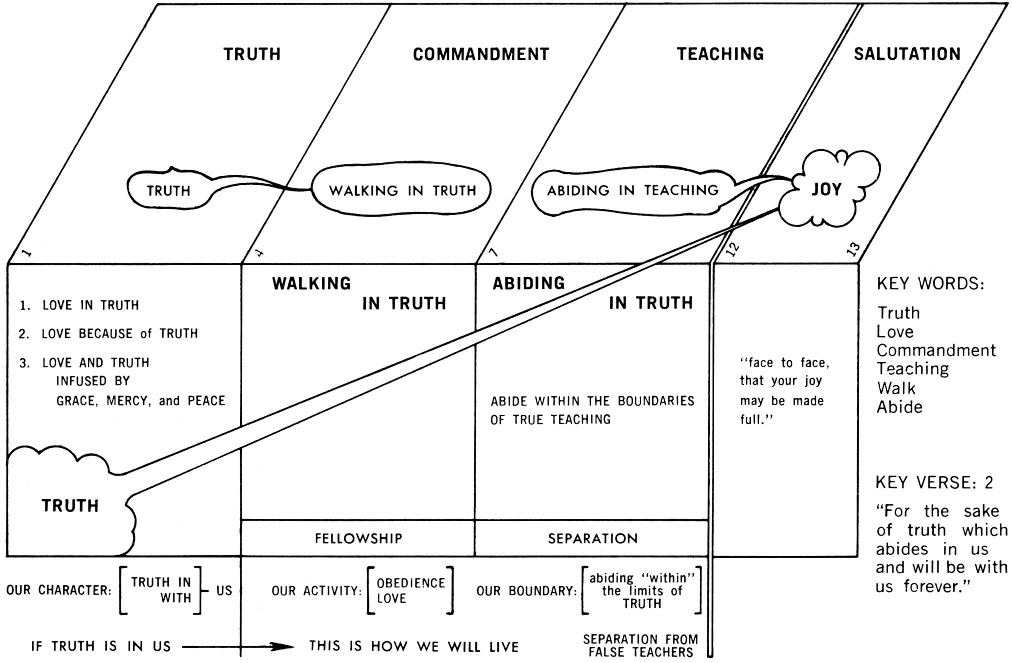
TRUTH AND THE CHRISTIAN
Click chart to enlarge
Charts from Jensen's Survey of the NT - used by permission
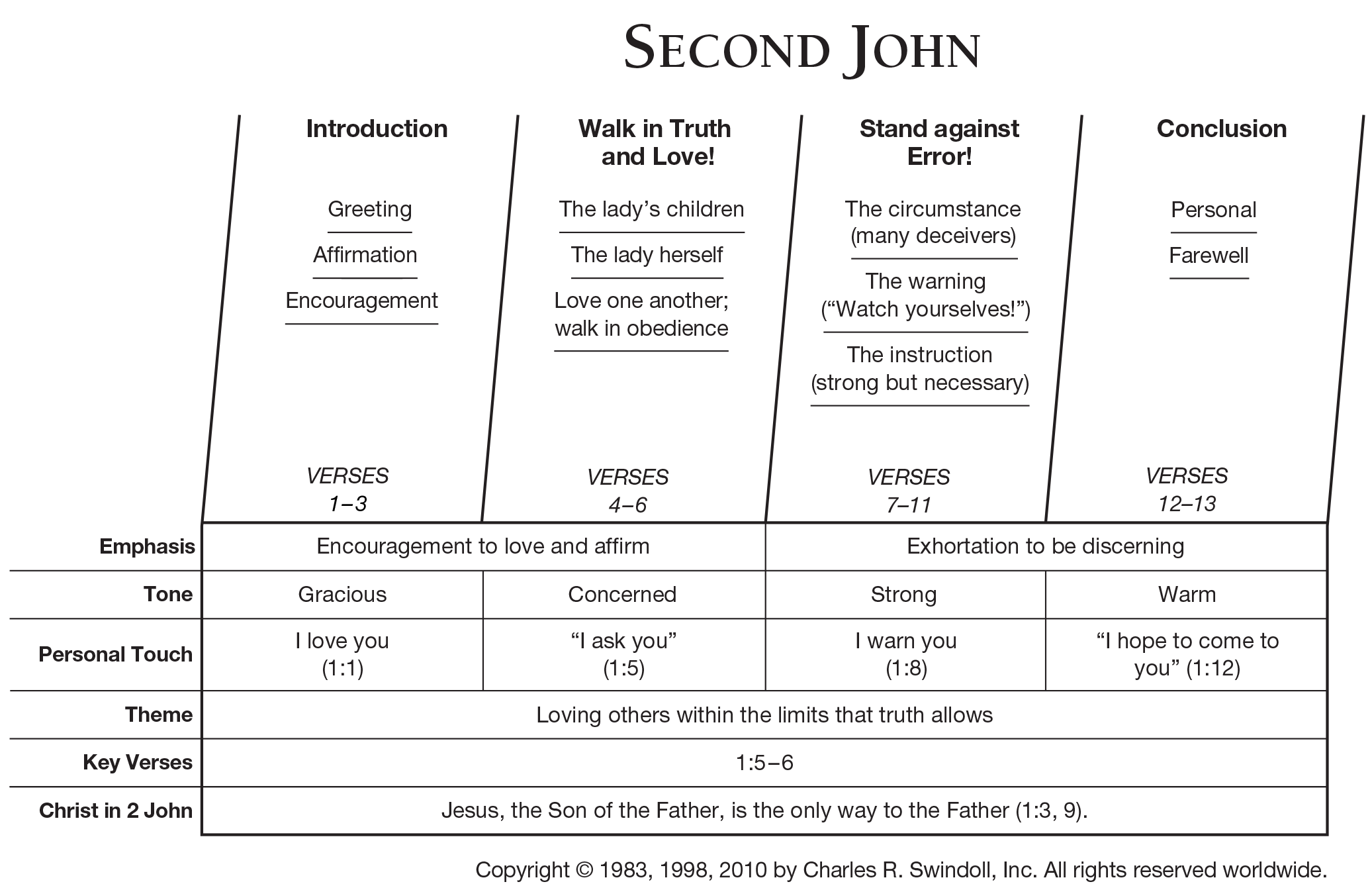
Another Overview Chart - 2 John- Charles Swindoll
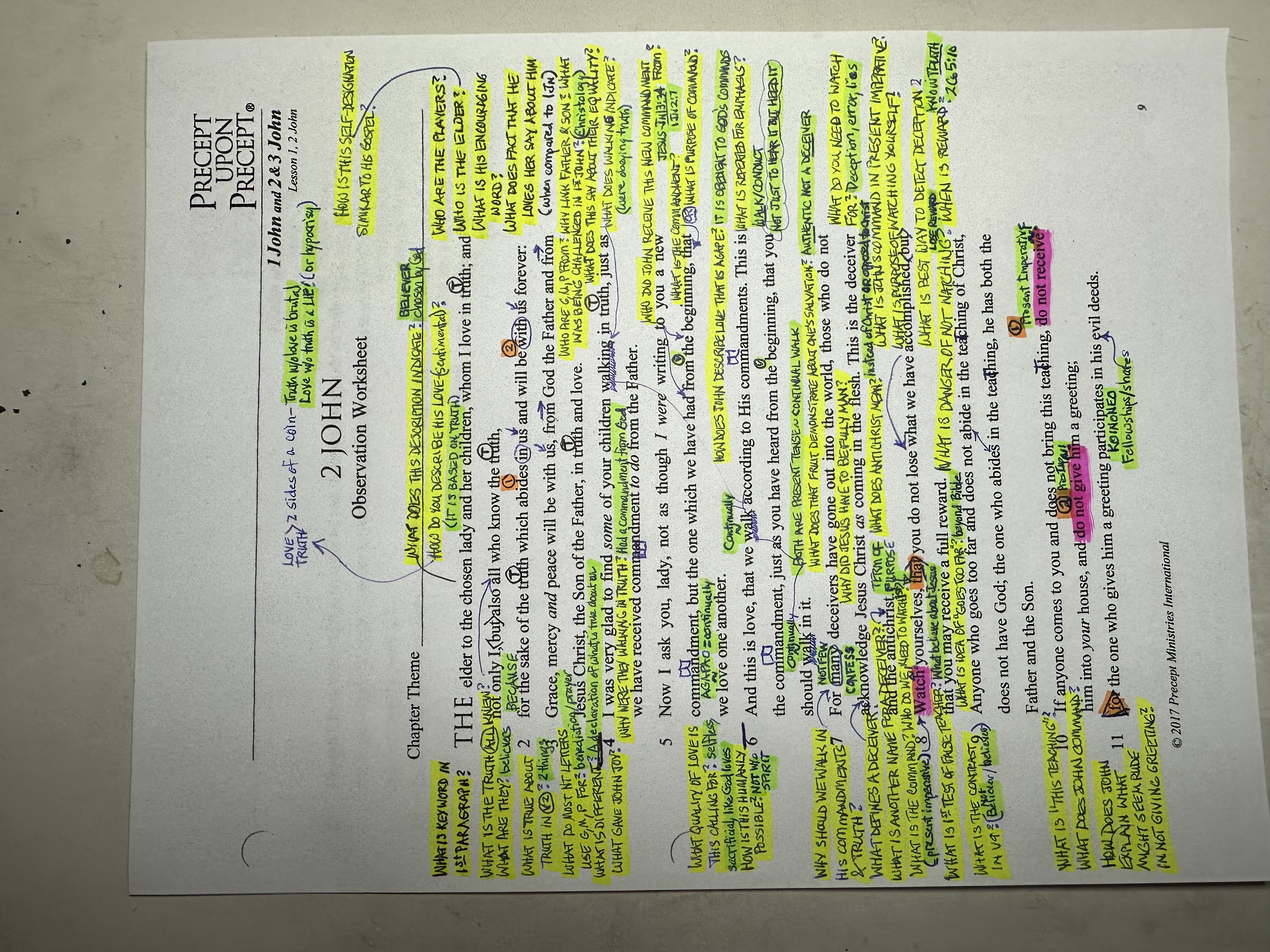
What is this? On the photograph of the Observation Worksheet for this chapter you will find handwritten 5W/H questions on each verse to help you either personally study or lead a discussion on this chapter. The questions are generally very simple and are stated in such a way as to stimulate you to observe the text to discern the answer. As a reminder, given the truth that your ultimate Teacher is the Holy Spirit, begin your time with God with prayer such as Psalm 119:12+ "Blessed are You, O LORD; Teach me Your statutes." (you can vary it with similar prayers - Ps 119:18, 26, 33, 64, 66, 68, 108, 124, 135, 171, etc) The questions are generally highlighted in yellow and the answers in green. Some questions have no answers and are left to your observations and the illuminating/teaching ministry of the Holy Spirit. Some qualifying thoughts - (1) Use "As is" - these are handwritten and will include mistakes I made, etc. (2) They may not be the best question for a given verse and my guess is that on some verses you will think of a far superior 5W/H question and/or many other questions.
Why am I doing this? Mortimer Adler among others helped me develop a questioning mindset as I read, seeking to read actively rather than passively. Over the years I have discovered that as I have practiced reading with a 5W/H questioning mindset, it has yielded more accurate interpretation and the good fruit of and meditation. In other words, consciously interacting with the inspired Holy Word of God and the illuminating Holy Spirit has honed my ability to meditate on the Scripture, and my prayer is that this tool will have the same impact in your spiritual life. The benefits of meditation are literally priceless in regard to their value in this life and in the life to come (cf discipline yourself for godliness in 1Ti 4:8+.) For some of the benefits - see Joshua 1:8+ and Psalm 1:2-3+. It will take diligence and mental effort to develop an "inductive" (especially an "observational"), interrogative mindset as you read God's Word, but it bears repeating that the benefits in this life and the rewards in the next will make it more than worth the effort you invest! Dear Christian reader let me encourage you to strongly consider learning the skills of inductive Bible study and spending the rest of your life practicing them on the Scriptures.
Although Mortimer Adler's advice is from a secular perspective, his words are worth pondering...
Strictly, all reading is active. What we call passive is simply less active. Reading is better or worse according as it is more or less active. And one reader is better than another in proportion as he is capable of a greater range of activity in reading. (Adler's classic book How to Read a Book is free online)
John Piper adds that "Insight or understanding is the product of intensive, headache-producing meditation on two or three verses and how they fit together. This kind of reflection and rumination is provoked by asking questions of the text. And you cannot do it if you hurry. Therefore, we must resist the deceptive urge to carve notches in our bibliographic gun. Take two hours to ask ten questions of Galatians 2:20+ and you will gain one hundred times the insight you would have attained by reading thirty pages of the New Testament or any other book. Slow down. Query. Ponder. Chew.... (John Dewey rightly said) "People only truly think when they are confronted with a problem. Without some kind of dilemma to stimulate thought, behavior becomes habitual rather than thoughtful.”
“Asking questions is the key to understanding.”
--Jonathan Edwards
That said, below are the 5W/H questions for each verse in this chapter (click page to enlarge). This is not neatly typed but is handwritten and used for leading a class discussion on this chapter, so you are welcome to use it in this "as is" condition...
 |
 |
Key Words -- See importance of key words - learn how to mark key words and the associated discipline of how to interrogate them with 5W/H questions. Practice "interrogating" key words as well as term of conclusion (therefore), term of explanation (for), terms of purpose or result (so that, in order that, that, as a result), terms of contrast (but, yet), expressions of time (including then; until, after) and terms of comparison (like, as). You will be amazed at how your Teacher, the Holy Spirit, will illuminate your understanding, a spiritual blessing that will grow the more you practice! Be diligent! Consider the "5 P's" - Pause to Ponder the Passage then Practice it in the Power of the Spirit. See also inductive Bible study - observation (Observe With a Purpose), Interpretation (Keep Context King, Read Literally, Compare Scripture with Scripture, Consult Conservative Commentaries), and then be a doer of the Word with Application. Do not overlook "doing the word" for if you do you are deluding yourself, and are just a "smarter sinner," but not more like the Savior! As Jesus said "blessed are those who hear the word of God, and observe it." (Lk 11:28+, cf James 1:22+),
- Truth (5x in 4v) - 2 John 1:1, 2 John 1:2, 2 John 1:3, 2 John 1:4
- Love - 2 John 1:1, 2 John 1:2, 2 John 1:3, 2 John 1:4
- Abide (3x in 2v) - 2 John 1:2, 2 John 1:9
- Teaching (3x in 2v) - 2 John 1:9, 2 John 1:10, Walk
- Walk (3x in 2v) - 2 John 1:4, 2 John 1:6
Sidlow Baxter - 2 JOHN CONTINUANCE IN THE TRUTH
- Greeting, 2Jn 1:1-3.
PRACTICAL ASPECT: WALK IN LOVE (2Jn 1:4-6).
(Love to the brethren is the centre-test of Christian practice.)
- The Divine insistence on love (2Jn 1:5).
- The human expression of love (2Jn 1:6).
DOCTRINAL ASPECT: WATCH AGAINST ERROR (2Jn 1:7-11).
(The person of Christ is the centre-test of Christian doctrine.)
- Warning against false teaching (2Jn 1:7-9).
- Warning against false charity (2Jn 1:10,11).
- Parting, 2Jn 1:12-13.
That which directly evoked this brief but concentrated note of affectionate greeting and warning was the unhappy circumstance referred to in verse 7: "Many deceivers are gone forth into the world." All that precedes in the letter is quite plainly all, lead-up to this.
The particular seducers before John's mind are certain who "confess not that Jesus Christ cometh in the flesh." just as the expression "love not" in 1 Jn 3:10,14 is the practical equiva lent of "hate" in 3:15; 4:20, so here the expression "confess not" equals "deny". Of such denial John does not hesitate to say: "This is the deceiver and the antichrist"- very plain speaking which should not be lost on us. These misleaders are here said to have denied "Jesus Christ as coming in the flesh"; or (as the Greek could mean) "Jesus as Christ coming in the flesh." The Jew denied that the Christ had come in the flesh. The Gnostic denied that Christ could come in the flesh. (Some in the present day church deny that He ever can or will come again in the flesh.)
It is the incipient Gnostic position which John thinks of in this letter to the elect lady, with its denial that the Divine Spirit could come in material form. Our remarks in connection with John's first epistle will have indicated how specious this superior-sounding religious philosophy could be, especially when plausible lips and clever reverence were allied with it.
"Look to yourselves!" That is the concentration-point of the letter (verse 8). The deceivers are beckoning you on; but the red light is against you! Pull up! "Whosoever abideth not in the doctrine of Christ, hath not God" (verse 9). It is this which brings John. to write: "If there come any unto you and bring not this [the true, apostolic] doctrine, receive him not into your house, neither bid him God speed" (verse 10). There is a superficial sentimentalism today which recoils from John's words as uncharitable. But do we castigate the doctor for being intolerant with disease? Ask any of his patients! Would any of us knowingly welcome deadly virus into our bodies? We all have to up with people of different views and beliefs, and as Christian believers we are truly to love their souls; but to fellowship co-operatively with them in Christ-dishonouring propagnda of any kind is a betrayal of our love to the Lord who bought us. (J Sidlow Baxter's Explore the Book - online - recommended resource)
Henrietta Mears - UNDERSTANDING SECOND JOHN
Second John is a good example of John’s private correspondence to an individual. This letter was addressed to an unknown Christian woman. This is the only book in the Bible addressed to a woman.
The word “truth” is found five times in this short letter of 13 verses. It is the keyword. The word “love” occurs five times. Truth and love are inseparable.
We must test all the teachings in the world by the Scriptures “for the truth’s sake” (2 John 2). Test your experience by the Word of God, but never test the Word of God by your experience!
The truth John speaks of is from above, the truth as it is in Christ Jesus. We are to walk in the truth, not just admire it. Then we will “love one another” (2 John 5). This love is genuine and not subject to change. “The love of Christ constraineth us” (2 Corinthians 5:14). The proof of our love is in our walk: “And this is love, that we walk after his commandments” (2 John 6).
John speaks of the teaching, or doctrine, of Christ: “Whosoever transgresseth, and abideth not in the doctrine of Christ, hath not God” (2 John 9). This is the test of the gospel: Not what I think or what someone else has thought or said or done, but what has Christ said? What is He to you? Is He the Son of God?
Many false teachers who would not confess that Jesus Christ was here in the flesh were traveling to the churches (see 2 John 7–11). This “is a deceiver and an antichrist” (2 John 7; see also 1 John 4:1–2). They did not believe in the humanity of Christ and denied His incarnation. If you call Jesus Lord but deny His deity, you are a liar and an antichrist. John says this.
Apply this test to some of the popular religious movements of today—Christian Science, Spiritualism, Unity, Jehovah’s Witnesses, Scientology, Transcendental Meditation, and so on. They deny all or at least parts of the Christ doctrine mentioned here (see “Four Basic Beliefs” above in the “Understanding First John” section).
Don’t be friendly with or entertain any false teachers, John commands, for by doing so you share in their wicked work. (Borrow What the Bible is All About - Wonderfully insightful resource from one of the twentieth century's greatest Bible teachers.)
Charles Swindoll - Why is Second John so important? Second John makes clear what our position should be regarding the enemies of the truth. Whereas 1 John focuses on our fellowship with God, 2 John focuses on protecting our fellowship from those who teach falsehood. The apostle went so far as to warn his readers against inviting false teachers into the house or even offering them a greeting (2 John 1:10). Such practices align the believer with the evildoer, and John was keen on keeping the believers pure from the stain of falsehood and heresy. (See full introduction)
John MacArthur - Introduction (Click for full introduction)
Background and Setting - Second John deals with the same problem as 1 John (see Introduction to 1 John: Background and Setting). False teachers influenced by the beginnings of Gnostic thought were threatening the church (v. 7; cf. 1 John 2:18,19,22,23; 4:1–3). The strategic difference is that while 1 John has no specific individual or church specified to whom it was addressed, 2John has a particular local group or house-church in mind (v. 1).The focus of 2 John is that the false teachers were conducting an itinerant ministry among John’s congregations, seeking to make converts, and taking advantage of Christian hospitality to advance their cause (vv. 10,11; cf. Rom. 12:13; Heb. 13:2; 1 Pet. 4:9). The individual addressed in the greeting (v. 1) inadvertently or unwisely may have shown these false prophets hospitality, or John may have feared that the false teachers would attempt to take advantage of her kindness (vv. 10,11). The apostle seriously warns his readers against showinghospitality to such deceivers (vv. 10,11). Although his exhortation may appear on the surface to be harsh or unloving, the acutely dangerous nature of their teaching justified such actions, especially since it threatened to destroy the very foundations of the faith (v. 9).
Historical and Theological Themes - The overall theme of 2 John closely parallels 1 John’s theme of a “recall to the fundamentals of the faith” or “back to the basics of Christianity” (vv. 4–6). For John, the basics of Christianity are summarized by adherence to the truth (v. 4), love (v. 5), and obedience (v.6). The apostle, however, conveys an additional but related theme in 2 John: “the biblical guidelines for hospitality.” Not only are Christians to adhere to the fundamentals of the faith, but the gracious hospitality that is commanded of them (Rom. 12:13) must be discriminating. The basis of hospitality must be common love of or interest in the truth, and Christians must share their love within the confines of that truth. They are not called to universal acceptance of anyone who claims to be a believer. Love must be discerning. Hospitality and kindness must be focused on those who are adhering to the fundamentals of the faith. Otherwise, Christians may actually aid those who are attempting to destroy those basic truths of thefaith. Sound doctrine must serve as the test of fellowship and the basis of separation between those who profess to be Christians and those who actually are (vv. 10,11; cf. Rom. 16:17; Gal.1:8,9; 2 Thess. 3:6,14; Titus 3:10).
OVERVIEWS AND INTRODUCTIONS:
- 2 John: The Vital Balance - Ray Stedman - "The Bible without the Spirit leads to a dead, institutional Christianity. The Spirit without the Bible leads to groundless fanaticism. We need both the Spirit and the Word to effectively Adventure through the Bible."
- 2 John: Introduction - John MacArthur
- 2 John: Introduction, Argument, and Outline - Daniel Wallace
- Key to 2 John - William Orr
- Second John - Charles Swindoll
- 2 John Introduction and Outline - J Vernon McGee- includes brief verse by verse comments
- Synthetic Bible Study - 2 and 3 John - James Gray
- John Epistles Introduction - Wil Pounds
- 2 John Introduction - NIV Study Bible
- 2 John Overview - James Van Dine
DICTIONARY ARTICLES:
- Bridgeway Bible Dictionary John, letters of
- Holman Bible Dictionary John, the Letters of
- Easton's Bible Dictionary John, Second Epistle of John
- Fausset Bible Dictionary John, the Epistles of
- Hastings' Dictionary of the Bible John, Epistles of
- Morrish Bible Dictionary John, Second Epistle of
- Smith Bible Dictionary the Second and Third Epistles of
- International Standard Bible Encyclopedia John, the Epistles of
- McClintock and Strong's Bible Encyclopedia John, Second and Third Epistles Of
- The Nuttall Encyclopedia John, Epistles of
- Baker Evangelical Dictionary John, Theology of
- Hastings' Dictionary of the Bible John, Theology of
Explanation - The following list includes not only commentaries but other Christian works by well known evangelical writers. Most of the resources below are newer works (written after 1970) which previously were available only for purchase in book form or in a Bible computer program. The resources are made freely available by archive.org but have several caveats - (1) they do not allow copy and paste, (2) they can only be checked out for one hour (but can be checked out immediately when your hour expires giving you time to read or take notes on a lengthy section) and (3) they require creating an account which allows you to check out the books free of charge. To set up an account click archive.org and then click the picture of the person in right upper corner and enter email and a password. That's all you have to do. Then you can read these more modern resources free of charge! I have read or used many of these resources but not all of them so ultimately you will need to be a Berean (Acts 17:11+) as you use them. I have also selected works that are conservative and Biblically sound. If you find one that you think does not meet those criteria please send an email at https://www.preceptaustin.org/
Note: Not in any particular order.
The Preacher's Outline & Sermon Bible : New Testament, King James Version 1 Thessalonians, 2 Thessalonians, 1 Timothy, 2 Timothy, Titus, Philemon, Hebrews, James, 1 Peter, 2 Peter, 1 John, 2 John, 3 John, Jude, Revelation. - Helpful notes.
The Letters of John : an Introduction and Commentary (Tyndale New Testament Commentaries) by Stott, John R. W (1988) 244 pages. 89 ratings
Tim Challies - John Stott is always an able commentator and his volume in the TNTC is no exception. Carson praises it as “one of the most useful conservative commentaries on these epistles, so far as the preacher is concerned” and says “it is packed with both exegetical comments and thoughtful application.” The TNTC is targeted squarely at a general audience, so both pastors and interesting general readers will find it tremendously beneficial. If you are looking for a commentary to guide you as you read John’s epistles devotionally, this is probably the one you want.
James Rosscup - Here is a recent lucid, stimulating work by a gifted writer who has served as rector of the All Souls (Anglican) Church, Langham Place, London. Several New Testament scholars have hailed it as an outstanding commentary from the standpoint of exegesis, exposition and warm application. It was listed among 22 “Choice Evangelical Books of 1964” in Christianity Today (February 12, 1965, p. 16). Stott displays a vast breadth of reading in the best conservative works on the Johannine epistles. This 1988 version updates the 1964 original.
Epistles of John & Jude : a self-study guide by Jensen, Irving
The Johannine Epistles : based on the Revised Standard version by Grayston, Kenneth
Cyril Barber - New Century Bible Commentary. Grand Rapids: Wm. B. Eerdmans Publishing Co., 1984. Following a brief but adequate introduction, Grayson reappraises Johannine scholarship, and though some of his views differ from those of others who have written on these epistles, readers are nevertheless treated to a discussion that is spiritually stimulating and culturally apropos.
The Expositor's Bible Commentary - 1994 edition - Abridged - New Testament
1-3 John by Thompson, Marianne Meye -- see below
James Rosscup - A lucid 168-pp., crisp exposition with some application in a flow for popular, general use. In a number of verses the book helps, at others it frustrates due to passing by views and reasons, or lacks sufficient comments. Much generalizing leaves an impression that in order to be seen as saved one must live an ideally perfect life (cf. 43), yet at other points one reads that Christians sin (45). The work has a healthy clarity that real grace, distinct from cheap so-called (but not genuine) grace (51) elicits confession of sin and seeking obedience to God. Such a life with God helps one’s assurance to be a properly experienced reality, as in 2:3 (51), even this by grace. Some statements are quite helpful, as “righteous conduct does not make us God’s children. Rather, such conduct is the consequence or expression of a relationship that already exists” after rebirth (87). Many issues are left in a blur, for instance “God’s seed remains” (3:9).
The Epistles of John by Hobbs, Herschel H
The Bible Exposition Commentary - Ephesians through Revelation - Warren Wiersbe
Rosscup - One of America’s most appreciated staunchly evangelical Bible conference teachers gives diligent, refreshing expositions. These are all of his 23 separate, earlier books in the “Be” series on the New Testament. He strikes a particular appeal with lay people as he crystallizes sections, deals with some of the verses, handles certain problems and backgrounds and applies principles. He is premillennial.
The letters of John the Apostle : an in-depth commentary by Burdick, Donald W
James Rosscup - This is far more detailed in getting at issues than his Everyman’s Commentary effort of 1970. It is a diligent conservative product on Greek syntax, word meaning and theology, and follows the line of thought through the epistles well. The introduction (pp. 3–92) takes up the background, authorship, date, place, recipients, occasion, purpose, character and content of I John. Later, he also has introductions to II and III John. He believes that I John gives grounds for assurance, tests of practice that can provide valid assurance (cf. pp. 81–82). Though copious in aspects of grammar that open up the books, Burdick is more lucid than Westcott’s helpful exegetical work of the past, and certainly one of the best now on the Greek. At some points one ought to go to longer discussions of views and issues in Brown, and also consult Brooke, Marshall, Plummer, Smalley, and Strecker etc. on technical matters, Marshall and Smalley also for more on studies of recent years.
Cyril Barber - Written for laypeople. This work is designed to lay bare the meaning of John's letters for his own time and ours as well. Clear and cogent.
The Epistles of John by Burdick, Donald W
James Rosscup - A part of the Everyman’s Bible Commentary series, this work by a careful evangelical New Testament scholar from Denver Seminary is quite perceptive on problems and good as a brief commentary.
1, 2, 3 John : Bible study commentary by Vaughan, Curtis
The Epistles of John by Marshall, I. Howard, author
James Rosscup - Like Ryrie and Stott, Marshall has keen ability to follow the thought of a book and articulate it with clarity. He often is helpful on stating views gleaned from the literature and is up-to-date. His use of the Greek, good footnotes, and detail on many of the problem verses make this a very good evangelical commentary by one of the best New Testament scholars in the British Isles (ca. 2001 he retired from being head of the New Testament Department at King’s College, University of Aberdeen, Scotland).
1, 2, 3 John - Morris, Leon. “New Bible Commentary Revised, ed. D. Guthrie et al. Grand Rapids: Eerdmans, 1970.
Cyril Barber - An extensive introduction that adequately surveys the historical and textual background of these letters is followed by a careful exposition of John's epistles in the order in which they were written. Provides interested readers with a complete and satisfying treatment. 2
1, 2, and 3 John by Johnson, Thomas Floyd - New International Biblical Commentary
James Rosscup - Johnson identifies the writer of the Gospel of John as “The disciple whom Jesus loved” (20:20, 24), but sees these epistles as by an “elder,” a different man (2). The concise verse comments are usually clear and well-reasoned, showing the idea of the Greek with Greek words transliterated, and with explanations of word meaning and grammar. Sections of added notes in smaller print take up some details. Some problems receive discussion, some are bypassed, in the latter category limited or unlimited atonement in I John 2:2, or interpretations of 2:12–14, or 5:16 (where much is not explained or not explained well). True, the commentary quite often is helpful, but uneven, and not one of the better all-around works one can more consistently count on.
The message of John's letters : living in the love of God by Jackman, David
Cyril Barber - Relates the message of these letters to the moral issues and theological climate of John's day. Builds upon Stott's cyclical (or spiral) theme of the content of the first letter, and treats the other letters as emphasizing truth and love. A noteworthy contribution.
1, 2, 3 John by Smalley, Stephen S - Word Biblical Commentary
James Rosscup - This ranks high with Brown, Burdick and Marshall in recent years. Smalley is excellent in helping the reader be up on views and arguments from recent years, drawn from massive research, and is second only to Brown in this regard. He is usually quite full in discussing issues so that he offers much help on verses, and does so with clarity, directness and confidence. He delves into changes in tense, many of the syntactical aspects, and doctrine. He sees the author of II and III John as John the presbyter, a Christian in the Johannine circle, and this same man may also have written I John, all in the A. D. 90’s. Smalley often makes good choices on views, and tends to give definite reasons for them. He sees charisma (2:20, 27) as both the Spirit and the Word; 3:4–10 relates to a potential state without sin, but in practice Christians do sin (1:8–2:2). Sin in 5:16–17 is apostasy, willful disobedience, etc. He is not clear on whether the saved can lose salvation.
Cyril Barber - This is a scholarly work that is well deserving of careful reading. Following a thorough introduction (pp. xvii-xxxiv), Smalley treats his readers to a word-byword or phrase-by-phrase exposition. His comments are judicious as well as insightful. This volume, for all its merit, shares the limitations of the series. It is well researched and exegetically helpful but manifests a weakness in treating the theme of these letters and fails to complete what has been begun by applying the teaching of the passage to the life of the reader
Exploring 1, 2, 3 John by Vines, Jerry
Cyril Barber - This work will be warmly received by Bible students of all persuasions. Vines deals admirably with the theme of each of John's letters. The way in which he has outlined, illustrated, and expounded each section makes his application of the truth to life easy to grasp. Recommended.
The Epistles of John by Brown, Raymond Edward
James Rosscup - Many rate this as the best work on these epistles in view of its extensive discussion of issues and the skill in which the famous Roman Catholic scholar handles so many aspects. He is highly-informed exegetically, full in consideration of views and lines of reasoning, and has a tone of respect for the truthfulness and relevance of the message. If the expositor, teacher or lay person wants a commentary that looks at just about every side of a matter in a readable manner and with authoritative grasp of the literature, he will consult this work. The same is true of Brown’s detailed commentary on the Gospel of John. Brown, however, will not always agree with a reader’s convictions, as when he favors John the Presbyter as the author. The sheer length will not please some, but the diligent and serious will find the source very useful.
Cyril Barber - †Meticulous in detail, exhaustive in analysis, persuasive in argument, this study provides the best answers available to questions and controversies that have troubled scholars and nonscholars alike ever since these epistles first saw the light of day. In addition to the superb analysis, Brown also brings to life those to whom these letters were sent, reminding us that the epistles were written by a person for real people of the first century A.D. A model of biblical study
life at its best 1 John by roy l. laurin
Cyril Barber - First published in 1957, this work provides lay readers with a commendable application of the text to the needs of Christians today. Practical.
open letter to evangelicals by r.e.o. white
James Rosscup - A Baptist minister presents both a commentary with occasional deep insight and some penetrating applications to spiritual life, ethics, and other particulars. It is a verse-by-verse devotional and homiletical exposition which sometimes deals with problems including the difficult passage in 3:4–10.
Note: The first 4 resources have no time restriction and allow copy and paste function:
(1) KJV Bible Commentary - Hindson, Edward E; Kroll, Woodrow Michael. Over 3000 pages of the entire OT/NT. Well done conservative commentary that interprets Scripture from a literal perspective. Pre-millennial. User reviews - it generally gets 4/5 stars from users. - 372 ratings
Very well done conservative commentary that interprets Scripture from a literal perspective user reviews
The King James Version Bible Commentary is a complete verse-by-verse commentary. It is comprehensive in scope, reliable in scholarship, and easy to use. Its authors are leading evangelical theologians who provide practical truths and biblical principles. Any Bible student will gain new insights through this one-volume commentary based on the timeless King James Version of the Bible.
(2) The King James Study Bible Second Edition 2240 pages (2013) (Thomas Nelson) General Editor - Edward Hindson with multiple contributing editors. . 3,194 ratings. Pre-millennial. See introduction on How to Use this Study Bible.
(3) NKJV Study Bible: New King James Version Study Bible (formerly "The Nelson Study Bible - NKJV") by Earl D Radmacher; Ronald Barclay Allen; Wayne H House. 2345 pages. (1997, 2007). Very helpful notes. Conservative. Pre-millennial. 917 ratings
(4) The Wycliffe Bible Commentary - only the New Testament (for OT see below to borrow) - 1126 pages. (1971) Everett F Harrison - Editor of New Testament. Uses the KJV. Strictly speaking not a study Bible, but short notes are similar. KJV text in left column, commentary notes in right column. The comments are generally verse by verse, short, conservative and to the point. Pre-millennial.
Zondervan NIV Study Bible - (2011) 2570 pages - Use this one if available as it has more notes than edition below. One hour limit
NIV Study Bible by Barker, Kenneth L; Burdick, Donald W (1995) 2250 pages. This is the first edition. This resource has been fully revised in 2020. One hour limit
Believer's Bible Commentary - OT and NT - MacDonald, William (1995) 2480 pages. Conservative. Literal. Often has very insightful comments. John MacArthur, says "Concise yet comprehensive - the most complete single-volume commentary I have seen." Warren Wiersbe adds "For the student who is serious about seeing Christ in the Word." One hour limit.
Rosscup - This work, originally issued in 1983, is conservative and premillennial, written to help teachers, preachers and people in every walk of life with different views, explanation and application. The 2-column format runs verse by verse for the most part, usually in a helpfully knowledgeable manner, and there are several special sections such as “Prayer” in Acts and “Legalism” in Galatians. The premillennial view is evident on Acts 1:6, 3:20, Romans 11:26, Galatians 6:16, Revelation 20, etc.
HCSB Study Bible : Holman Christian Standard Bible - General Editor Jeremy Royal Howard (2010) 2360 pages. Conservative. Good notes. Include Holmans excellent maps. One hour limit
Life Application Study Bible: Old Testament and New Testament: New Living Translation. Has some very helpful notes especially with application of texts. 4,445 ratings One hour limit
The MacArthur Study Bible - John MacArthur. Brief but well done notes for conservative, literal perspective. 1,275 ratings
ESV study Bible - Excellent resource but not always literal in eschatology and the nation of Israel 6,004 ratings
The David Jeremiah Study Bible - (2013) 2208 pages. 2,272 ratings Logos.com - "Drawing on more than 40 years of study, Dr. David Jeremiah has compiled a legacy resource that will make an eternal impact on generations to come. 8,000 study notes. Hundreds of enriching word studies"50+ Essentials of the Christian Faith" articles."
Wycliffe Bible Commentary - Charles Pfeiffer - 1560 pages (1962). 214 ratings Less detailed than the KJV Bible Commentary. Conservative. Notes are generally verse by verse but brief.
Rosscup - Conservative and premillennial scholars here have been experts in their fields. The work contains brief introductions and attempts to give a verse-by-verse exposition, though it does skip over some verses. The treatments vary with the authors, but as a whole it is a fine one-volume commentary for pastors and students to use or give to a layman. Outstanding sections include, for example: Whitcomb on Ezra-Nehemiah-Esther; Culver on Daniel; Ladd on Acts; Harrison on Galatians; Johnson on I Corinthians; and Ryrie on the Johannine Epistles.
The Defender's Study Bible : King James Version by Morris, Henry M. Excellent notes by well known creationist. 45 ratings
New Bible Commentary - (1994) See user reviews
Compact Bible commentary by Radmacher, Earl D; Allen, Ronald Barclay; House, H Wayne, et al - 954 pages. 424 ratings Multiple contributors to the comments which are often verse by verse. The comments are brief but meaty and can really help your study through a given book. A sleeper in my opinion.
The Experiencing God Study Bible: the Bible for knowing and doing the will of God - Blackaby, Henry (1996) 1968 pages - CHECK THIS ONE! Each chapter begins with several questions under the title "PREPARE TO MEET GOD." Then you will interesting symbols before many of the passages. The chapter ends with a "DID YOU NOTICE?" question. This might make a "dry chapter" jump off the page! Read some of the 48 ratings
Disciple's study Bible: New international version 54 ratings Not that helpful for verse by verse study. Focuses on application of Christian doctrines. 10,000 annotations; doctrinal summaries, "Life Helps" section relate doctrine to everyday discipleship.
The Living Insights Study Bible : New International Version - Charles Swindoll. Notes are good but somewhat sparse and not verse by verse.
The Apologetics Study Bible Understand Why You Believe by Norman Geisler
NIV archaeological study Bible (2005) 2360 pages 950 ratings (See also Archaeology and the Bible - OT and NT)
NIV Cultural Backgrounds Study Bible. Bringing to Life the Ancient World of Scripture Keener, Craig and Walton, John. Editors (2017)
The Holman illustrated study Bible 120 ratings Includes the excellent Holman maps but otherwise of little help in serious study.
Zondervan King James Version commentary - New Testament
NIV Celebrate Recovery Study Bible
Daily Study Bible for Women : New Living Translation
The Woman's Study Bible : the New King James Version
The Study Bible for Women : Holman Christian Standard Bible
Daily Study Bible for Men : New Living Translation
NIV Topical Study Bible : New International Version
The Ryrie Study Bible - Charles Ryrie (1978) 2142 pages. Conservative. 216 ratings
The Hebrew-Greek key study Bible : New American standard study by Strong, James, 1822-1894; Zodhiates, Spiros
The New Inductive Study Bible : updated New American Standard Bible - Introductions of each book give suggestions how to perform an inductive study on that specific book. Not strictly speaking a "study Bible" with notes but a Bible to help you study inductively. Has wide margins for making notes. This is one that works best in "paper," not digitally.
With the Word - Devotional Commentary - Warren Wiersbe - 428 ratings
Evangelical Commentary on the Bible - Judges by Andrew Boling (20 pages); editor Walter Elwell (1989) 1239 pages. User reviews. (See also Boling's 380 page commentary on Judges the Anchor Bible Series)
Halley's Bible Handbook Henry H. Halley - (2000) 2720 pages (much larger than original edition in 1965 and no time limit on use). (Halley's Bible handbook : an abbreviated Bible commentary - one hour limit 1965 872 pages)
Rosscup - A much-used older evangelical handbook bringing together a brief commentary on Bible books, some key archaeological findings, historical background, maps, quotes, etc. It is helpful to a lay Bible teacher, Sunday School leader, or pastor looking for quick, pertinent information on a Bible book. This is the 72nd printing somewhat revised. Halley packed in much information. Unger’s is better overall, but that is not to say that Halley’s will not provide much help on basic information.
The Shaw Pocket Bible Handbook - Editor - Walter Elwell (1984) 408 pages.
"This hardback is small in size but packed full of content: Brief summaries of every book of the bible, cultural, archaeological and historical info, word definitions, pictures, maps and charts." Worth checking!
The Lion handbook to the Bible - (1999) 822 pages. This resource is absolutely loaded with very nice color pictures and charts.
Wiersbe's Expository Outlines on the New Testament by Wiersbe, Warren W
Cyril Barber - This is a book of exceptional merit. Pastors, missionaries, and Christian workers will profit from its use. Wiersbe introduces each book of the NT, provides an outline, and then furnishes his readers with a chapter-by-chapter discussion of the contents. The homiletic style is a “plus.” Recommended.
Harper study Bible : the Holy Bible, Revised Standard Version
The Jewish Study Bible - Only OT - Interesting Jewish perspective.
The Student Bible : New International Version
Hebrew-Greek key word study Bible : New international version
Key word commentary : thoughts on every chapter of the Bible by Water, Mark
Eerdmans' Family Encyclopedia of the Bible (1978) 344 pages
Eerdmans' Handbook to the Bible (1983) 688 pages
Tyndale Handbook of Bible charts & maps by Wilson, Neil
Bible Handbook and A-Z bible encyclopedia
International Children's Bible field guide : answering kids' questions from Genesis to Revelation by Richards, Larry
The illustrated guide to Bible customs & curiosities by Knight, George W. (George William),
Today's handbook of Bible times & customs by Coleman, William L
The new Unger's Bible dictionary by Unger, Merrill Frederick, 1909-
Nelson's illustrated encyclopedia of Bible facts by Packer, J. I. (James Innell); Tenney, Merrill C.
Survey of the Bible : introductory insights, background studies, book-by- book survey by Unger, Merrill Frederick
The parallel New Testament and Unger's Bible handbook : produced for Moody monthly by Unger, Merrill (1975) 744 pages 4 ratings
The Hodder Bible handbook by Unger, Merrill
Kregel Bible handbook : a full-color guide to every book of the Bible by Kerr, William 3 ratings
The new encyclopedia of Christian quotations by Water, Mark
New Testament words - William Barclay - very interesting resource - covers about 70 NT Greek words in Barclay's unique style
Zondervan handbook to the Bible
Dictionary of the later New Testament & its developments 71 ratings IVP Series
The third of IVP's critically acclaimed series of dictionaries of the New Testament provides focused study on the often-neglected portions of the New Testament: Acts, Hebrews, the General Epistles, and Revelation. Furthermore, its scope goes beyond the life of the New Testament church to include the work of the apostolic fathers and early Christianity up through the middle of the second century.
Dictionary of New Testament background 79 ratings IVP Series
In a time when our knowledge of the ancient Mediterranean world has grown by leaps and bounds, this volume sets out for readers the wealth of Jewish and Greco-Roman background that should inform our reading and understanding of the New Testament and early Christianity. The Dictionary of New Testament Background takes full advantage of the flourishing study of the Dead Sea Scrolls and offers individual articles focused on the most important scrolls. In addition, the Dictionary encompasses the fullness of second-temple Jewish writings, whether pseudepigraphic, rabbinic, parables, proverbs, histories or inscriptions. Articles abound on aspects of Jewish life and thought, including family, purity, liturgy and messianism. The full scope of Greco-Roman culture is displayed in articles ranging across language and rhetoric, literacy and book culture, religion and cults, honor and shame, patronage and benefactors, travel and trade, intellectual movements and ideas, and ancient geographical perspectives. No other reference work presents so much in one place for students of the New Testament. Here an entire library of scholarship is made available in summary form.
Dictionary of deities and demons in the Bible (DDD) - 950 pages (1995) Read some of the 65 ratings (4.8/5 Stars). A definitive in depth resource on this subject. Very expensive to purchase.
NOTE - All of these resources can be borrowed from archive.org. This list also includes resources to help study the Bible.
See also the list of Word Study Resources
The Complete Word Study Dictionary: New Testament by Zodhiates, Spiros - This is my "go to" resource for Greek word studies. One on the best lexicons for laymen. Highly Recommended for Greek Word Studies to aid your interpretation of a passage.
Analytical Lexicon of the Greek New Testament by Friberg, Timothy. Shorter definitions than Zodhiates but does an excellent job in summarizing the various nuances of a specific Greek word. One of my favorites.
Shorter Lexicon of the Greek New Testament by Gingrich, F. Wilbur. Similar to Friberg but shorter definitions. Gingrich however gives more Scriptures for each nuance, whereas Friberg generally gives only one representative Scripture.
The New Linguistic and Exegetical Key to the Greek New Testament by Rogers, Cleon - This book is a gold mine of little gems on individual Greek words in any NT passage you are studying. If you have time it is always worth checking out! I use it in my Greek word studies all the time.
New Testament Words - William Barclay - 59 ratings very interesting resource - covers about 70 NT Greek words in Barclay's unique style. On page 289 there is a helpful index of English words with the corresponding Greek word, in turn followed by the places Barclay described them in New Testament Words and in his Daily Study Bible series (see list of DSB commentaries here). E.g., take the Greek word for "Covetousness" which is pleonexia and is found in New Testament Words on page 61 and pp 233-235 and is also described in the Daily Study Bible entries for : Mark 7:14-23; Ro 1:28-32; Eph. 4:17-24; Col. 3:5. So you can click the DSB commentary on Mark 7 and scroll down to Mark 7:14 to see Barclay's entry for pleonexia which concludes "Pleonexia ( G4124) is that lust for having which is in the heart of the man who sees happiness in things instead of in God." Interesting!
Greek-English lexicon of the New Testament : based on semantic domains - Louw Nida. Brief but nice definitions. Not easy to use - you need to know some Greek. Classifies Greek words into 93 "semantic domains" (see list on page XXV) and if you can categorize the word you are looking for in one of the domains, it can help find the specific word you are interested in.
Kittel's Theological Dictionary of the New Testament : abridged in one volume (TDNT) - Classic ("Little Kittel") work summarizing the 10 volume set by Kittel. For most of us the abridged definition is "more than enough!"
A Greek-English lexicon of the New Testament, and other early Christian literature; by Bauer, Walter, More detailed definitions but need to know Greek. Zodhiates and Friberg much easier to use.
Liddell and Scott's Greek-English lexicon, abridged : the little Liddell by Liddell, Henry George. The abridged version. You need to know Greek to use.
Exegetical dictionary of the New Testament (Volume 1 - A thru E); Exegetical dictionary of the New Testament (Volume 3- P thru ...) Volume 2 not available. I do not find this adds much to the easier to use resources like Zodhiates and Friberg.
A pocket lexicon to the Greek New Testament by Souter, Alexander. Brief definitions. Need to know some Greek. Not that helpful.
Vine's Expository Dictionary of Old Testament and New Testament Words - pdf. The old standby. You can also borrow Vine's complete expository dictionary of Old and New Testament words
Theological wordbook of the Old Testament by Harris, R. Laird - 229 ratings (5/5 Stars) One of the best OT lexicons for laymen.
Here is another link to the TWOT which has no time limit on use and does allow copy and paste. Can be downloaded as PDF.
Hebrew honey : a simple and deep word study of the Old Testament by Novak, Alfons, (332 pages) Indexed by English words. No Strong's numbers to help you determine if you are researching the correct Hebrew word. Here is a "work around" - go to page 289 and see if there is an annotation of the Scripture you are studying. E.g., say you want to see if there is anything for "heart" in Ezek 11:19. In the Scripture list find an entry for Ezek 11:19 with the English word "Heart." Now go look up "Heart" (on page 123). It does take some effort, but you might glean an insight not described in other Hebrew lexicons.
Nelson's Expository Dictionary of the Old Testament by Unger, Merrill. Indexed by English word and then any related Hebrew nouns or verbs. Definitions are solid and geared to the lay person.
Zondervan NASB exhaustive concordance - 1589 pages
Pocket dictionary for the study of New Testament Greek by DeMoss, Matthew S. If you want to dig a little deeper into Greek. 66 ratings
Analytical concordance to the Holy Bible : containing about 311,000 references, subdivided under the Hebrew and Greek original with the literal meaning and pronunciation of each by Young, Robert,
The Englishman's Greek concordance of the New Testament by Wigram, George
Synonyms of the New Testament by Trench, Richard Chenevix - or click here for list of 108 entries.
Girdlestone's Synonyms of the Old Testament - click for list of 127 entries
The Holman guide to interpreting the Bible by Dockery, David S
Foundations for biblical interpretation : a complete library of tools and resources
Expository Dictionary of Bible Words by Richards, Larry, 33 ratings It is does not go into great depth on the Greek or Hebrew words but does have some excellent insights.
Basic Bible Interpretation : a Practical Guide to Discovering Biblical Truth by Roy Zuck. Recommended.
How to Study Your Bible by Arthur, Kay (CLICK HERE for many other resources from Kay Arthur). The basics of inductive Bible study succinctly described. Recommended. This is the original edition not the new edition.
Living by the Book by Howard G. Hendricks - A classic. An entertaining and informative read that is guaranteed to invigorate your Bible study. Recommended.
Teaching to Change Lives by Howard Hendricks, Howard 561 ratings
The Christian Educator's Handbook on Teaching by Kenneth Gangel and Howard Hendricks 21 ratings
How can I understand the Bible? by DeHaan, Mart (52 page booklet)
The New How to Study Your Bible Workbook (2010) by Arthur, Kay, - Note that this workbook is the companion to the New How to Study Your Bible book (not the same as the one linked above).
Jensen's Survey of Bible (online) by Jensen, Irving 140 ratings (NT) 133 ratings (OT) This is a classic and in conjunction with the following three resources should give you an excellent background to the Bible book you are studying. Jensen has some of the best Book charts available and includes "key words." He also gives you some guidelines as to how to begin your inductive study of each book.
Discover the Bible for Yourself by Arthur, Kay 93 ratings - Proven methods to read, mark, and study God's Word. Introductions to set the stage for each book of the Bible. Maps and charts to add historic and geographic dimension. Word studies for NASB and NIV translations. Definitions and explanations to simplify interpretation. "Things to Think About" for personal application. This resource will inspire and guide anyone interested in creating a personal study of God's Word.
What the Bible is all about by Mears, Henrietta. This is a classic and is filled with "pearls" from this godly teacher of God's Word.
Talk thru the bible by Wilkinson, Bruce The Wilkinson & Boa Bible handbook : the ultimate guide to help you get more out of the Bible
How to profit from Bible reading by Jensen, Irving 2 ratings
Simply understanding the Bible by Jensen, Irving 8 ratings
Enjoy your Bible by Jensen, Irving 5 ratings
Independent Bible study by Jensen, Irving 14 ratings
MacArthur Study Bible - Topic "How to Study the Bible" - John MacArthur
MacArthur's Introductions to all 66 Books - includes a helpful discussion of "Interpretative Challenges"
Swindoll's introductions to all 66 Books - Answers the following questions - Who wrote the book? Where are we? Why is this book so important? What's the big idea? How do I apply this? He also includes a helpful Book Overview chart (right upper corner of page).
How to Get the Most from God's Word by John MacArthur 16 ratings
Journey of the Bible : the remarkable story of how the Bible came from God to you by Jensen, Irving
- 1, 2, 3 John – 1 John 1:1
- Truth or Consequences – 2 John 1-13
- The gods of This Age and the Issue of Truth (2006) – 2 John 1-13
- Truth or Consequences: The Real Story of the DaVinci Code – 2 John 1-13
- Truth or Consequences: What You Believe about Jesus Really Matters (John’s Letters Series) – 2 John 1-13
(Read his fascinating brief biography - Henry Alford and Phil Johnson's related comments)
James Rosscup writes that Alford's series on the New Testament "contains much that is valuable in the Greek New Testament… though all of the Greek New Testament words have been changed to English throughout." (Commentaries for Biblical Expositors: An Annotated Bibliography of Selected Works)
Charles Haddon Spurgeon (see his comments in following entry on Alford).
Editorial Note: If you are not proficient in Greek, you will find this work considerably more useful than the following work by Alford, because in this volume he translates the Greek and Latin into English. While the "The Greek New Testament" (see next entry below) is longer (e.g., English version of 1John = 66 pages compared to Greek version = 94 pages in part because the latter includes comments of more technical nature), the substance of the commentary is otherwise similar to that found in the "NT for English Readers".
Charles Haddon Spurgeon writes that this text "is an invaluable aid to the critical study of the text of the New Testament. You will find in it the ripened results of a matured scholarship, the harvesting of a judgment, generally highly impartial, always worthy of respect, which has gleaned from the most important fields of Biblical research, both modern and ancient, at home and abroad. You will not look here for any spirituality of thought or tenderness of feeling; you will find the learned Dean does not forget to do full justice to his own views, and is quite able to express himself vigorously against his opponents; but for what it professes to be, it is an exceedingly able and successful work. The later issues are by far the most desirable, as the author has considerably revised the work in the fourth edition. What I have said of his Greek Testament applies equally to Alford’s New Testament for English Readers,* which is also a standard work." (Spurgeon, C. H. Lectures to my Students, Vol. 4: Commenting and Commentaries; Lectures Addressed to the students of the Pastors' College, Metropolitan Tabernacle)
D Edmond Hiebert - Prints the author's own translation. A series of popular studies whose strong point is word study. Contains good illustrative material. Part of the author's interpretation follows a liberal position. Barclay holds that Christ's descent into Hades gave those who there heard Him a second chance.
Comment: I appreciate Barclay's unique insights on Greek words, but clearly his teaching about a "second chance" is NOT sound doctrine! Be an Acts 17:11 Berean with Barclay. See discussion of his orthodoxy especially the article "The Enigmatic William Barclay".
James Rosscup writes that Barnes "includes 16 volumes on the Old Testament, 11 on the New Testament. The New Testament part of this old work was first published in 1832–1851. Various authors contributed. It is evangelical and amillennial… Often the explanations of verses are very worthwhile." (Commentaries for Biblical Expositors: An Annotated Bibliography of Selected Works)
C H Spurgeon "Albert Barnes is a learned and able divine, but his productions are unequal in value, the gospels are of comparatively little worth, but his other comments are extremely useful for Sunday-school teachers and persons with a narrow range of reading, endowed with enough good sense to discriminate between good and evil… Placed by the side of the great masters, Barnes is a lesser light, but taking his work for what it is and professes to be, no minister can afford to be without it, and this is no small praise for works which were only intended for Sunday-school teachers." (Spurgeon, C. H. Lectures to my Students, Vol. 4: Commenting and Commentaries; Lectures Addressed to the students of the Pastors' College, Metropolitan Tabernacle)
Good illustrations
- II John 1-13 Who's That Lady
James Rosscup writes "This work (Gnomon), originally issued in 1742, has considerable comment on the Greek, flavoring the effort with judicious details about the spiritual life. It has much that helps, but has been surpassed by many other commentaries since its day." (Commentaries for Biblical Expositors: An Annotated Bibliography of Selected Works)
Represents Combination of Bengel's Gnomon (above) and Comments by more modern expositors (in brackets) to make this more usable for those who do not read Greek.
Spurgeon comments on the goal to make Bengel's Gnomon (listed above) more accessible -- "Such is the professed aim of this commentary, and the compilers have very fairly carried out their intentions. The whole of Bengel’s Gnomon is bodily transferred into the work, and as 120 years have elapsed since the first issue of that book, it may be supposed that much has since been added to the wealth of Scripture exposition; the substance of this has been incorporated in brackets, so as to bring it down to the present advanced state of knowledge. We strongly advise the purchase of this book, as it… will well repay an attentive perusal. Tischendorf and Alford have contributed largely… to make this one of the most lucid and concise commentaries on the text and teachings of the New Testament" (Spurgeon, C. H. Lectures to my Students, Vol. 4: Commenting and Commentaries; Lectures Addressed to the students of the Pastors' College, Metropolitan Tabernacle)
Resources that Reference 2 John
- All below on one page
- 2 John 1:1,2
- 2 John 1:3
- 2 John 1:4
- 2 John 1:5,6
- 2 John 1:7
- 2 John 1:8
- 2 John 1:9
- 2 John 1:10,11
- 2 John 1:12
International Critical Commentary Critical and Exegetical Commentary - 1912
James Rosscup: This ICC work rates with Westcott as one of the top two detailed older commentaries of a technical nature based on the Greek text. (Commentaries for Biblical Expositors: An annotated bibliography of selected works).
Hiebert's critique - Greek text. Long recognized as a classic commentary on the Johannine epistles. First published in 1883. Bruce has updated the introductory material and provided a summary of the discoveries and developments since Westcott's time.
Hiebert - definite value for the interpretation of these epistles
- 2 John 1 Commentary - Cambridge Greek Testament for Schools and Colleges
- 2 John 1 Commentary - Cambridge Bible for Schools and Colleges
James Rosscup - This old, conservative Wesleyan Methodist work is good devotionally and aggressive for righteous living. Laypeople can find it still valuable today. It is Arminian in viewpoint and thus helpful, for example, in showing the reader how this approach deals with texts involving the eternal security question. The work contains much background material from many sources on all books of the Bible.
Spurgeon - Adam Clarke is the great annotator of our Wesleyan friends; and they have no reason to be ashamed of him, for he takes rank among the chief of expositors. His mind was evidently fascinated by the singularities of learning, and hence his commentary is rather too much of an old curiosity shop, but it is filled with valuable rarities, such as none but a great man could have collected....If you have a copy of Adam Clarke, and exercise discretion in reading it, you will derive immense advantage from it, for frequently by a sort of side-light he brings out the meaning of the text in an astonishingly novel manner. I do not wonder that Adam Clarke still stands, notwithstanding his peculiarities, a prince among commentators. I do not find him so helpful as Gill, but still, from his side of the question, with which I have personally no sympathy, he is an important writer, and deserves to be studied by every reader of the Scriptures.
James Rosscup - Though often scanty, the work edited by a brilliant scholar is sometimes very helpful. Ellicott was an Anglican bishop. The New Testament part is more valuable. The work dates back to 1897 and is verse by verse, consisting of 2,292 pp. Ellicott was an outstanding Anglican conservative scholar of the 19th century in England. He also wrote critical commentaries on Galatians, Ephesians, Philippians, Colossians, Thessalonians and Philemon. Different scholars here contributed on different scripture books, Famous names included are George Rawlinson (Exodus), H. D. M. Spence (I Samuel), E. H. Plumptre (Isaiah, Jeremiah, Lamentations, Acts, 2 Corinthians), W. Sanday (Romans, Galatians), Alfred Plummer (2 Peter, Jude), etc. A one-volume condensation edited by John Bowdle is available (Zondervan, 1971, 1,242 pages).
What the Bible Teaches – Each page of this commentary has the AV text at the top and a commentary on some of the words and phrases underneath. Now over a century old, it is still very helpful.
Hiebert - Greek text. Important for linguistic study of the epistles. Defends Johannine authorship. The viewpoint is essentially conservative.
Rosscup - This is a thorough exegesis of the Greek text. It is considered to be one of the standard tools for exegetical study.
James Rosscup - A lucid 168-pp., crisp exposition with some application in a flow for popular, general use. In a number of verses the book helps, at others it frustrates due to passing by views and reasons, or lacks sufficient comments. Much generalizing leaves an impression that in order to be seen as saved one must live an ideally perfect life (cf. 43), yet at other points one reads that Christians sin (45). The work has a healthy clarity that real grace, distinct from cheap so-called (but not genuine) grace (51) elicits confession of sin and seeking obedience to God. Such a life with God helps one’s assurance to be a properly experienced reality, as in 2:3 (51), even this by grace. Some statements are quite helpful, as “righteous conduct does not make us God’s children. Rather, such conduct is the consequence or expression of a relationship that already exists” after rebirth (87). Many issues are left in a blur, for instance “God’s seed remains” (3:9).
- 2 John 1
- 2 John 1-3 Greetings to the Church
- 2 John 4-6 Living in Love
- 2 John 7-11 Living in Truth
- 2 John 12-13 Closing Greetings
James Rosscup - He is staunchly evangelical, showing good broad surveys based on diligent study, practical turns, even choice illustrations. In prophecy he is premillennial dispensational....Many preachers have found that Ironside works, read along with heavier books on details of exegesis, help them see the sweep of the message and prime their spirits for practical relevance.
James Rosscup - This is a helpful old set of 1863 for laypeople and pastors to have because it usually comments at least to some degree on problems. Though terse, it provides something good on almost any passage, phrase by phrase and is to some degree critical in nature. It is evangelical....Especially in its multi-volume form this is one of the old evangelical works that offers fairly solid though brief help on many verses. Spurgeon said, “It contains so great a variety of information that if a man had no other exposition he would find himself at no great loss if he possessed this and used it diligently” (Commenting and Commentaries, p. 3). Things have changed greatly since this assessment! It is primarily of help to pastors and lay people looking for quick, though usually somewhat knowledgeable treatments on verses.
Spurgeon - A really standard work. We consult it continually, and with growing interest. Mr. Fausset’s portion strikes us as being of the highest order.
My Comment - This is one of the best older (Pre-1800) works on interpretation of prophecy as it tends to interpret the text literally and not allegorically.
- 2 John Commentary
- 2 John Commentary - unabridged
James Rosscup - The treatments of books within this evangelical set vary in importance. Generally, one finds a wealth of detailed commentary, background, and some critical and exegetical notes. Often, however, there is much excess verbiage that does not help particularly. On the other hand, it usually has something to assist the expositor on problems and is a good general set for pastors and serious lay people though it is old.
Recommended Resource - The four sermons together are about 60 pages of material.
- 2 John 1:4 The Primacy of Truth
- 2 John 1:4 Truth: The Sphere of Existence
- 2 John 5–8 Truth: The Boundary of Love and the Test of Loyalty
- 2 John 9–13 Truth: The Test of Christian Hospitality
Mp3's that correspond to his Thru the Bible study.
Updated December 4, 2018
- 2 John 1:1-6 Ring The Bell
- 2 John 1:1-6 Pictures of Love
- 2 John 1-6 Not Boredom But Freedom
- 2 John 1:6 Don’t Go Down There
- 2 John 1:1-11 Godspeed!
James Rosscup - Many authors contributed to this work that had the aim of giving preachers material on introduction, verse by verse exposition, a section on homiletics, and a section of collected homilies (outlines, etc.) by various preachers, which can stimulate thought. It moves through one small section of Bible verses after another.
- 2 John Expositional Commentary
- Homiletics on one page
- 2 John 1 Expositional Commentary
- 2 John 1-3 Salutation
- 2 John 1-18 An Apostolic Pastoral to a Christian Family
- 2 John 1:1-3 An Exemplary Christian Greeting
- 2 John 1:4 The Rejoicing of the Good in the Exemplification of the Godly Life
- 2 John 1:5-6 Mutual Love
- 2 John 1:7 The Exhibition and Condemnation of Heretics
- 2 John 1:8 A Summons of Self-Guardianship
- 2 John 1:9 Man's True Relation to the Doctrine of Christ
- 2 John 1:10-11 How to Treat Heretics
- 2 John 1:12-13 Communications, Written and Oral
- Introduction
- 2 John 1:1
- 2 John 1:1b
- 2 John 1:2
- 2 John 1:2b
- 2 John 1:3
- 2 John 1:3b
- 2 John 1:3c
- 2 John 1:3d
- 2 John 1:3e
- 2 John 1:4
- 2 John 1:4b
- 2 John 1:4c
- 2 John 1:5
- 2 John 1:6
- 2 John 1:6b
- 2 John 1:6c
- 2 John 1:7
- 2 John 1:7b
- 2 John 1:8
- 2 John 1:8b
- 2 John 1:9
- 2 John 1:10
- 2 John 1:10b
- 2 John 1:11
- 2 John 1:12-13
This is a private personal letter from the aged Apostle John, addressed to an unknown Christian woman, and her pious family. This is the only Epistle in the New Testament addressed exclusively to a lady. There is a tradition that the lady addressed was Martha of Bethany. "The Greek Hyria (Lady, verse 1), answers to the Hebrew Martha," wrote Bengel. If this be true, the "sister" referred to in verse 13 would be Mary. It was written specifically to warn this lady and her family of some false teachers (verse 10).
LOVE AND TRUTH. 2 John 1:1, 2
The word "truth" is met with five times in this short Epistle of but thirteen verses, and forms its key-word.
I. The Source of Love. Truth. Most versions print truth with a capital "T," Truth. Certainly this is one of the Lord's Names, and He is the source of all true love.
II. The Reality of Love. That is, the nature of love commended here is true love, love that is no mere pretense or make-believe.
III. The Breadth of Love. Love cannot be confined to one. The Elder (John must have been about 90 years old when he wrote this Epistle) not only loved "The elect lady," but also "her children," and this pious family was not only loved by the aged apostle, but also by "all they that have known the truth."
IV. The Realization of Love. R. gives "understand" for "known" in verse 1. This is to say, those who have realized truth and the love of God in Christ to themselves love others.
V. The Inwardness of Love. "Which dwells in us," God's love shed abroad in our hearts by the Holy Spirit. Is it truth or love that is meant here? Well, He is both Truth and Love, and as both dwells within us and with us.
GRACE, MERCY, PEACE. 2 John 1:3
This is a very unusual form of the apostolic salutation in the New Testament, only found in the Pastoral Epistles and here (1 Timothy 1:2; 2 Timothy 1:2; Titus 1:4). You will observe that "Mercy" is added to the usual salutation, "Grace—Peace." What is the significance, and what is the teaching?
Well, read Luke 10:37 with Genesis 39:21. Who showed mercy? The Good Samaritan. What is showing mercy? Binding up wounds and bruises, etc. But what had "mercy" to do with Joseph in prison? Ah, there are more dangerous wounds than those of the body—there are wounds and bruises of the spirit. Joseph's reputation had been challenged; he had been cast into prison on a false charge. His spirit was bruised and bleeding. But the Good Samaritan came when all doors were shut, barred, and bolted, and ministered comfort and consolation to the distressed one. The Lord's servants frequently require the Lord's gracious Good Samaritan ministry.
TRUTH. 2 John 1:4
1. Is given to walk in (verse 4), not merely to admire.
2. This is one proof of our love to God (verse 6), for love manifests itself in ready obedience.
THE TEST OF TRUTH. 2 John 1:7, 11
False teachers were traveling (verses 7 to 11) among the churches, and John warns this lady against even entertaining them (verses 10 to 11), much less their false doctrines. Then the aged Apostle gives an infallible test of truth.
1. The reality of the humanity of our Lord in His earthly life. "That Jesus Christ is come in the flesh."
2. The reality of the humanity of our Lord in His second advent. "Comes in the flesh" (R.V.).
Apply this test to some popular religious movements of our day, and the result is startling. Christian Science, Spiritism, Russellism, and other similar movements are unmasked, and shown to be against Christ, and utterly wrong—of the Devil.
COMPILATION OF COMMENTARIES
Explanation - Click link below and retrieve comments from 36 separate commentaries on ONE PAGE on this one verse. Most of these are older commentaries like Matthew Henry, etc. but are generally conservative. To go to the next verse simply click "2 John 1:2" in the upper right corner. If you want to go to a specific verse here is the URL - https://www.studylight.org/commentary/2-john/1-1.html. E.g., if you want to go to 2 John 3, simply change the URL (this is in the address box at top of the page) and you change "1-1" to "1-3" (https://www.studylight.org/commentary/2-john/1-3.html)
BIBLE GATEWAY
- Devotionals related to 2 John - you will need to go through the search list - use discernment
JOHN CEREGHIN
STEVEN COLE
- Lesson 1: Rx for a Healthy Church, Part 1 (2 John 1-6)
- Lesson 2: Rx for a Healthy Church, Part 2 (2 John 7-13)
- 2 John: How to live in the Truth – Ian Mackervoy
James Rosscup - This dispensationally oriented work is not verse-by-verse, but deals with the exposition on a broader scale, treating blocks of thought within the chapters. Cf. also Arno C. Gaebelein, Gaebelein’s Concise Commentary on the Whole Bible (I Volume, Neptune, NJ: Loizeaux, 1985), the Annotated Bible revised. The author was a popular evangelical Bible teacher of the first part of the century, much like H. A. Ironside in his diligent but broad, practical expositions of Bible books. Gaebelein was premillennial and dispensational, and editor for many years of Our Hope Magazine.
- 2 John; Principle #1; 2 Jn. 1-3; Belief and Behavior: As local churches, we are to become communities of both truth and love. Video
- 2 John; Principle #2; 2 Jn. 7-11; Rejecting False Teaching: As communities of faith, we must not allow anyone to preach and teach if they deny that Jesus Christ is God who became flesh.Video
GREEK WORD STUDY RESOURCES
- Survey of 2 John
- Who is the elect lady in 2 John?
- Should we allow false teachers into our home?
- What does it mean that God is love?
- What is the definition of a cult?
- What is the best way to evangelize someone who is in a cult or false religion?
- What is the definition of heresy?
Hiebert - Prints author's new translation. Twenty wordy lectures by a noted Plymouth Brethren scholar of the past century. Provides an important study of the text with numerous comments and illustrations of the religious scene from a perspective of intense loyalty to the Scriptures.
- 2 John, Part 1 - William Still
- 2 John, Part 2 - William Still
- Signs of Authenticity - 2 John 1:4-6 - Terry Johnson
- The Marks of the Deceiver - 2 John 1:7-9 - Terry Johnson
- Responding to Apostasy - 2 John 1:10-13 - Terry Johnson
- Walking in Obedience - 2 John - John Stott
G CAMPBELL MORGAN
Rosscup - Morgan was an evangelical master at surveying a book and giving its message within a brief compass. He introduces each book with a chart giving an analysis and synthesis.....Morgan deals with the Bible chapter by chapter, with nearly 300 words on each. He devotes 400 pages to the Old Testament, 150 to the New Testament. It is a stimulating broad evangelical coverage of Scripture, if the reader is looking for synthesis rather than detail. Morgan was a master expositor in the early part of this century. Some of the effort is so general it is of little help except to those looking for sketchy treatment. It is evangelical and premillennial. Morgan is better in such works as The Crises of the Christ.
HENRY MORRIS - DEFENDER'S STUDY BIBLE - NOTES
- Introduction
- 2 John 1:1 elder elect lady children
- 2 John 1:2 For the truth’s sake
- 2 John 1:4 walking in truth
- 2 John 1:7 entered in the flesh deceiver and an antichrist
- 2 John 1:9 transgresseth doctrine
- 2 John 1:10 your house God speed
- 2 John 1:13 elect sister
WILLIAM NICHOLSON (1862)
NET BIBLE NOTES
JOSEPH PARKER
Rosscup - This work, later called Preaching Through the Bible (Baker Book House), is rich in its applications and exhortations, though often not particularly helpful for the reader who is looking for exposition that stays right with the text. Treatment of the texts is sermonic.
JOHN SCHULTZ
Excerpt: I have already shown that to walk after a thing, in the language of Scripture, means to pursue it with desire, and to do so habitually. Thus we read of "mockers walking after their ungodly lusts" (Jude 18) as a mark of the wicked, and a "walking after the commandments" of the Lord (2 John 6) as a mark of the righteous. To walk, then, after the Spirit is to walk as the Spirit leads, guides, directs, and teaches. The flesh is the motive power to those who are in the flesh; the Spirit is the moving influence to those who are in Christ Jesus. But let me open this point a little more fully.
- 2 John 1:1–3
- 2 John 1:1
- 2 John 1:3
- 2 John 1:4–6
- 2 John 1:5
- 2 John 1:7–11
- 2 John 1:7
- 2 John 1:10
- 2 John 1:12–13
- John's Salutation and Greeting - 2 John 1:1-3
- The chosen lady and her children - 2 John 1:1
- The truth that remains in us - 2 John 1:2
- Grace, mercy, and peace - 2 John 1:3
- Walking in truth - 2 John 1:4
- John's Commendation - 2 John 1:4
- Command to Love - 2 John 1:5-6
- Policy Against Housing False Teachers - 2 John 1:7-11
- In the flesh - 2 John 1:7
- Lose reward- 2 John 1:8
- 2 John 1:9-10
- Runs ahead - 2 John 1:9
- False teachers - 2 John 1:10-11
- Do not receive false teachers - 2 John 1:10
- Shares in his wicked work - 2 John 1:11
- Closing Remarks - 2 John 1:12-13
- Paper and ink - 2 John 1:12
- Chosen sister - 2 John 1:13
AUGUS VAN RYN - Plymouth Brethren
- Preface & Introduction
- Introduction: The First Epistle Of John
- The First Epistle of John: Chapters 1-2
- The First Epistle of John: Chapters 3-5
- The Second Epistle Of John
- The Third Epistle Of John
B F WESCOTT
- The Epistles of St John - pdf
OCTAVIUS WINSLOW - Devotionals
MULTIPLE COMMENTARIES ON 2 JOHN - not listed above
- Benson's Commentary
- Bible Study New Testament
- Bridgeway Bible Commentary
- Bullinger's Companion Bible Notes - "Bullinger was an ultra-dispensationalist, but his system does not usually shine through noticeably in the work. The C.B. is not especially helpful today because so many other works are better." (Rosscup)
- Burkitt's Notes
- Church Pulpit Commentary
- Coffman CommentariesFamily Bible New Testament
- Coke's Commentary
- John Dummelow's Commentary
- Everett's Study Notes
- Family Bible New Testament
- Gary Hampton Commentary
- Geneva Study Bible
- Gill's Exposition
- Godbey's NT Commentary
- Gray's Commentary
- Hawker's Poor Man's Commentary
- Kretzmann's Popular Commentary of the Bible
- Lapide's Commentary
- Mahan's Commentary
- Meyer's Commentary
- Peake's Bible Commentary
- People's New Testament
- Pett's Bible Commentary
- Poole's Annotations
- Schaff's New Testament Commentary
- Chuck Smith Commentary
- Sermon Bible Commentary
- Sutcliffe's Commentary
- Trapp's Commentary
- Treasury of Knowledge
- Wesley's Notes - " Wesley drew a lot of help from works of his day such as Matthew Henry, Matthew Poole, and John Bengel (New Testament). Wesley adds much from his pastoral concern." (Rosscup)
- Whedon's Commentary
- Zerr's N.T. Commentary
- 2 John 1:4 The Primacy of Truth
- 2 John 1:4 Truth: The Sphere of Existence
- 2 John 5-8 Truth: The Boundary of Love and the Test of Loyalty
- 2 John 9-13 Truth: The Test of Christian Hospitality
James Rosscup - This evangelical work is both homiletical and expository and is often very good homiletically but weaker otherwise. Helpful in discussing Bible characters, it is weak in prophecy at times because of allegorization. It is not really as valuable today as many other sets for the serious Bible student. The expositions are in the form of sermons.
2 John 6 This is love, that we should walk after his commandments. (r.v.) (F B Meyer)
Here is a solution to many difficulties, and given so easily and naturally by this beloved elder to the elect lady and her children. He had been laying much emphasis on truth, and combining truth and love in an exquisite unity. Probably we can never love perfectly, till we are perfectly true. If you examine yourself in the feelings of distance and dislike which you have towards some individual, it is almost certain that you will come on some want of transparency and sincerity in your dealings with him. It is also the case that if we put away all insincerity, and want of consecration, as between us and God, we shall come to love God more perfectly.
What deep, sweet rhythm of meaning there is in the first three verses of this letter! One reads them over and over again. Oh that that grace, mercy, and peace, may be with us, from God the Father, and from Jesus Christ, the Son of the Father, in truth and love.
The difficulty that you feel is that you do not love enough. You would like to love with a strong, undying flame, burning steadily towards Jesus Christ, cleansing you with its heat, constraining you with its love. But perhaps you fail to distinguish between love and the emotion of love. They are not the same. We may love without being directly conscious of love, or being able to estimate its strength and passion. Here is the solution to many of our questionings They love who obey.
It is recorded of Dr. Chalmers that when a Scotch girl applied to be admitted to the sacrament, her testimony was so halting that it seemed as though she must stand back; but as she was leaving his room she turned back and said, “I canna speak for the Lord Jesus, but I could dee for Him.” (Our Daily Homily)
A W Pink - Best of all is it when we are found "walking in the Truth" (2 John 4), for it is then God is most glorified. His Word is given to us for this very purpose—to be a lamp unto our feet and a light unto our path—to direct our conduct and regulate our deportment. In proportion as our daily life is ordered by the Word—do we evince the sincerity and reality of our profession. The extent to which we actually walk in the Truth—will determine the measure of our enjoyment of God's approbation, "If a man loves me, he will keep My words—and My Father will love him, and We will come unto him and make Our abode with him" (John 14:23). "His Truth shall be your shield and buckler" (Psalm 91:4), our defense and protection—panoplied in "the whole armor of God" the Christian is safe in the day of battle. By walking in the Truth—we find rest unto our souls (Jer 6:16).(from "The Word of Truth")
Spurgeon - This is love: that we walk in obedience to his commands.2 John 1:6NIV
Love is the spring of true obedience. “This is the love of God, that we keep His commandments.” Now a man who is not obedient to God’s commandments is evidently not a true believer; for although good works do not save us, yet, being saved, believers are sure to produce good works.
Though the fruit is not the root of the tree, yet a well-rooted tree will, in its season, bring forth its fruits. So, though the keeping of the commandments does not make me a child of God, yet, being a child of God, I shall be obedient to my heavenly Father. But this I cannot be unless I love God.
A mere external obedience, a decent formal recognition of the laws of God, is not obedience in God’s sight. He abhors the sacrifice where the heart is not found. I must obey because I love, or else I have not in spirit and in truth obeyed at all. See then, that to produce the indispensable fruits of saving faith, there must be love for God; for without it, they would be unreal and indeed impossible. (from Strengthen My Spirit)
Spurgeon Morning, October 25 “For the truth’s sake, which dwelleth in us, and shall be with us for ever.” —2 John 2
Once let the truth of God obtain an entrance into the human heart and subdue the whole man unto itself, no power human or infernal can dislodge it. We entertain it not as a guest but as the master of the house—this is a Christian necessity, he is no Christian who doth not thus believe. Those who feel the vital power of the gospel, and know the might of the Holy Ghost as he opens, applies, and seals the Lord’s Word, would sooner be torn to pieces than be rent away from the gospel of their salvation. What a thousand mercies are wrapped up in the assurance that the truth will be with us for ever; will be our living support, our dying comfort, our rising song, our eternal glory; this is Christian privilege, without it our faith were little worth. Some truths we outgrow and leave behind, for they are but rudiments and lessons for beginners, but we cannot thus deal with Divine truth, for though it is sweet food for babes, it is in the highest sense strong meat for men. The truth that we are sinners is painfully with us to humble and make us watchful; the more blessed truth that whosoever believeth on the Lord Jesus shall be saved, abides with us as our hope and joy. Experience, so far from loosening our hold of the doctrines of grace, has knit us to them more and more firmly; our grounds and motives for believing are now more strong, more numerous than ever, and we have reason to expect that it will be so till in death we clasp the Saviour in our arms.
Wherever this abiding love of truth can be discovered, we are bound to exercise our love. No narrow circle can contain our gracious sympathies, wide as the election of grace must be our communion of heart. Much of error may be mingled with truth received, let us war with the error but still love the brother for the measure of truth which we see in him; above all let us love and spread the truth ourselves.
Octavius Winslow - Evening Thoughts
Grace be with you, mercy, and peace, from God the Father, and from the Lord Jesus Christ, the Son of the Father, in truth and love. 2 John 3
THE spiritual mind will at once perceive, that our object in the preceding reflections has been to place the character of God, as the "Lord God, merciful and gracious," in its own proper light. It is possible that this truth may appear to the reader, as a newly-discovered planet in the firmament of revelation. It may be to him a new truth, presenting to his eye a fresh and a more kindly view of the paternal and gracious character of God. God, the original source of grace to sinners, has, perhaps, hitherto been but a timidly received doctrine, if received at all. In the first thirstings of your newly-quickened soul, you sought and found the gentle rivulet of grace issuing from some sequestered and shaded spot in your lone path, and you "tasted that the Lord was gracious." Grateful for its refreshing, but panting for larger draughts, you coursed the rivulet to the stream, and drank yet deeper of its fullness. Not satisfied with this, but longing to explore the glorious mystery of the supply, you traced the streamlet to the "broad river," transported with joy to find that "all fullness dwelt in Jesus," and into it you plunged. But here you have rested. Enamored of the beauty, and lost in wondering delight at the "breadth, and length, and depth, and height" of this river, you have reclined upon its green and sunny bank, forgetting that this river was but the introduction to an ocean, and that that ocean was nothing less than the heart of the Father, infinitely and eternally full of grace. Ah! little did you think, as you sipped from the rivulet, and drank from the stream, and bathed in the river of grace, that there was a depth still deeper, which, like Ezekiel's vision of the holy waters, was so deep that it "could not be passed over."
"What!" exclaims some tried believer, "is the heart of Jesus a transcript of the heart of God? Is the Father as full of forgiveness, of love, of mercy, of compassion, of tenderness, as the Son? How different from all that I had conceived Him to be! I thought of God, and was troubled. His terrors made me afraid. His dealings with me have been severe. His way has been in the whirlwind and in the storm, and his 'path in the great waters.' His judgments have been 'a great deep.' He has set a hedge about me, that I cannot pass. He has spoken to me out of the thick cloud. He answered me by fire. He has spoiled my pleasant pictures, and dashed my cup with bitter. What! is this God all that you represent Him to be? Is He so full of grace and truth? Is He my God, my loving, reconciled Father?" Yes, even so! "It pleased the Father that in Him should all fullness dwell."
Who can contemplate the work of Jesus, and not be convinced of the costliness and preciousness of this grace? How precious is the grace that pardons, that justifies, that adopts, that sanctifies, that comforts, the vilest who believe in Jesus! And yet all this Jesus does. He died for sinners. He receives sinners. He saves sinners to the uttermost. Oh, precious grace! that has opened a fountain which cleanses every stain; that has provided a robe which covers every spot; that "reigns through righteousness unto eternal life" in the soul it has renewed! Reader, have you felt the power, and tasted the sweetness, of this grace? If so, you will feel that no imagination can conceive its beauty, and that no words can express its preciousness. You will regard it as worthy of your warmest love and your highest praise. You will aim to live upon it constantly, to draw from it largely, and to magnify it holily. Nothing this side of glory will be so lovely in your eyes, or so dear to your heart, as the grace of Jesus. Ah yes! inestimably precious is it! There is more of God and of heaven, more of holiness and of happiness, unfolded and experienced in one drop of this grace, than in ten thousand worlds like this. Let others toil for wealth, or pant for glory, or plume themselves with gifts; Lord, give me your grace; this is all my salvation, and all my desire!
Octavius Winslow - Evening Thoughts
"Look to yourselves, that we lose not those things which we have wrought, but that we receive a reward. Whoever transgresses, and abides not in the doctrine of Christ, has not God. He that abides in the doctrine of Christ, he has both the Father and the Son." 2 John 8, 9
Dear reader, in whose righteousness do you at this moment stand? Is it all profession merely? Startle not at the question—turn not from it; it is for your life we ask it. Do you wonder that such a scrutiny into the ground of your hope should be made? Are you astonished at the solemn fact implied in this question? Do not be so. Many have lived in the outward profession—have put on Christ in the external garb—have talked well of Him—have been baptized in His name—given liberally for His cause, and, after all, have gone into eternity holding up the empty lamp! Oh, marvel not, then, that we repeat the question—in whose righteousness do you at this moment stand? Mere profession will not save your soul; your being found mingling among the wise virgins will not secure you an admittance with them into heaven; your talking respectfully of Jesus will avail you nothing; your church membership, your liberality, your spotless morality, your regular attendance on the sanctuary, all, all are in vain, without the justifying righteousness of the God-man upon you. What do you know of the broken heart and the contrite spirit? What do you know of the healing blood of Jesus? What do you know of a sense of pardon and acceptance? What do you know of the witness of the Spirit? What do you know of a humble, low, abasing view of yourself? What do you know of a holy and a close walk with God? What do you know of communion and fellowship with the Father and His dear Son? In a word, what do you know of yourself as a helpless, ruined sinner; and of Jesus, as a rich, able, and present Savior? Ponder these solemn questions. The hand that pens them trembles with awe as it traces this page. This is a day of great profession—a day of great ingathering into the church—a day when much chaff must necessarily be gathered with the wheat. It solemnly behooves, then, each professing member of Christ's church, of every name and denomination, narrowly to scrutinize his motives, deeply to prove his heart, and closely and habitually to examine the foundation on which he is building for eternity. Thus shall he walk, if he be an adopted child, in the sweet and holy realization of his pardon and acceptance; thus shall he experience the blessedness of "the man whose transgression is forgiven, whose sin is covered;" and thus, too, shall he constantly be "a vessel unto honor, sanctified, and meet for the Master's use, and prepared unto every good work."
2 John 9 Whosoever goeth onward and abideth not in the teaching of Christ, hath not God.-2 John 9.
Dr. Findlay has pointed out in his wonderful volume on the letters of John, that both the second and the third have to do with the subject of Christian hospitality. In this one, addressed to "the elect lady," perhaps a church, and perhaps a person, the persons to whom no Christian hospitality is to be extended are dealt with. These are described as "deceivers . even they that confess not that Jesus Christ cometh in the flesh." It is with reference to such that this declaration is made. They were persons who claimed to be leaders; they were advanced thinkers, they were progressive. The Gnostic teachers of the time were claiming that while the Gospel of the historic Jesus might be all very well for unenlightened people, they had a profounder knowledge. Such were to receive no hospitality. In this warning, we find a principle of perpetual application. There is always room for advanced thinking, for progressive interpretation, for the things of Christ are as profound as God and life. We never ought to be content to tarry with the first principles of truth. We should in know-ledge go on unto perfection. But there is one infallible test for such advanced thinking, for such progressive interpretation. It is that the advanced thinking do not contradict the first principles, or deny the fundamental facts of our faith —those of the historic Jesus, that of the fact that He came in the flesh. Such advanced thinking as denies these things, is not progress, but retrogression and apostasy. (G Campbell Morgan)
The story is told of a king who had a silver bell placed in a high tower of his palace early in his reign. He announced that he would ring the bell whenever he was happy so that his subjects would know of his joy.
The people listened for the sound of that silver bell, but it remained silent. Days turned into weeks, and weeks into months, and months into years. But no sound of the bell rang out to indicate that the king was happy.
The king grew old and gray, and eventually he lay on his deathbed in the palace. As some of his weeping subjects gathered around him, he discovered that he had really been loved by his people all through the years. At last the king was happy. Just before he died, he reached up and pulled the rope that rang the silver bell.
Think of it--a lifetime of unhappiness because he didn't know that he was warmly loved and accepted by his loyal subjects.
Like that monarch, many lonely souls live out their days without the joy of knowing they are loved and appreciated by others. Do you know people who need an encouraging word? If so, tell them how much they mean to you. It may be just what's needed to bring joy into their lives. --R W DeHaan (Our Daily Bread, Copyright RBC Ministries, Grand Rapids, MI. Reprinted by permission. All rights reserved)
Someone gave me a cheering word
Of which I was in need,
And faith was bolstered once again
By just that tiny deed. --Sheldon
The human spirit rings with hope at the sound of an encouraging word.
Don’t Go Down There - 2 John 1:6 - In his book Lessons Learned Early, Jerry Jenkins tells a story about his freshman year in college. It was 1968, a year of tremendous political and social upheaval in the US.
Riots had broken out in many major cities. From the rooftop of his dorm in Chicago, Jerry heard sirens and saw fires burning. Students had been told to stay on campus, but Jerry wanted to see what was happening.
As he ran toward a store that was blazing a few blocks away, a police car pulled up beside him. “Don’t go down there,” the officer warned.
Jerry waited till the car pulled away and then kept walking. The officer returned. This time he made it more clear as he repeated, “Don’t go down there”—and leveled a shotgun out the window.
Our rebellious or willful streaks often lead to unhappy outcomes. In anger, Moses struck the rock to get water rather than just speak to it as God had commanded. He forfeited the privilege of entering the Promised Land with his people (Nu. 20:7, 8, 9, 10, 1112). Jonah disobeyed an order to go to Nineveh and was given 3 days to think about his choice—inside a big fish (Jonah 1).
What does it take for us to obey Him? Will we obey simply because we love Him? (John 14:15,21).— Cindy Hess Kasper (Our Daily Bread, Copyright RBC Ministries, Grand Rapids, MI. Reprinted by permission. All rights reserved)
Nothing between, like worldly pleasure:
Habits of life, though harmless they seem,
Must not my heart from Him ever sever—
He is my all! There’s nothing between. —Tindley
© 1968 by Singspiration, Inc.
Obedience is another word for love and loyalty.
If anyone comes to you and does not bring this doctrine, do not receive him into your house nor greet him. —2 John 1:10
In 1962, John Glenn made history as the first American to orbit the Earth. As the rocket ascended, ground control said, “Godspeed, John Glenn.” “Godspeed” comes from the expression, “May God prosper you.”
Though we don’t often hear this word today, the apostle John used it in his second epistle: “If there come any unto you, and bring not this doctrine, receive him not into your house, neither bid him Godspeed” (2 John 1:10 kjv).
John has been referred to as “the apostle of love,” so why would he warn believers against pronouncing a blessing on others? Traveling evangelists were dependent on the hospitality of Christians to provide them with room and board. John was telling the believers that biblical truth is important. If itinerant missionaries were not preaching doctrine consistent with apostolic teaching, believers were not to bless their work by providing lodging or financial assistance.
This is also true for believers today. We are to treat everyone with kindness because God is kind to us. But when asked to financially support an endeavor, it’s important to always ask Him for wisdom. The Spirit who guides us into truth (John 16:13) will show us when it is appropriate to bid Godspeed to those we encounter. By Dennis Fisher (Our Daily Bread, Copyright RBC Ministries, Grand Rapids, MI. Reprinted by permission. All rights reserved)
Dear Lord, You know my heart. I love You
and want Your kingdom to prosper.
Give me Your wisdom to know where You want
me to take part and how. Thank You.
God’s Spirit through His Word gives wisdom to discern truth from error.
2 John 1-6 Not Boredom But Freedom
Take My yoke upon you and learn from Me, for I am gentle and lowly in heart. —Matthew 11:29
During World War II, a fellow soldier said to me, “Herb, you seem to be happy. But if I had to live the way you do, I’d just as soon be dead.” He was implying that my life was so moral that it had to be boring. But I had never thought of it that way. In fact, I often felt guilty because of my many failings.
I grew up in a Christian home where I was taught that I was a sinner in need of salvation. But I also learned that God in the person of Jesus Christ had paid the price for my sins.
Then, through the ministry of the Holy Spirit, I recognized the truth of this teaching. And as a child, I placed my trust in Jesus and committed my life to Him. From that day on, I tried to live out the command to love God and my neighbor (Matt. 22:37-40). My obedience to God was a natural response for one who had truly believed.
In 2 John the word commandment is used four times to remind us that we are to walk the path of truth and to love one another (vv.4-6). Christians who do this will find joy and freedom, not boredom and bondage, as some people mistakenly think.
I love the words of Jesus in Matthew 11:30, “My yoke is good to bear, My load is light” (NEB). By Herbert Vander Lugt (Our Daily Bread, Copyright RBC Ministries, Grand Rapids, MI. Reprinted by permission. All rights reserved)
Happy are they who love the Lord,
Whose hearts have Christ confessed,
Who by His cross have found their life,
Beneath His yoke their rest. —Bridges
Joy is the result of walking with God.
Read: 2 John 1:1–6
I am not writing you a new command but one we have had from the beginning. I ask that we love one another. 2 John 1:5
My children and I have started a new daily practice. Every night at bedtime, we gather colored pencils and light a candle. Asking God to light our way, we get out our journals and draw or write answers to two questions: When did I show love today? and When did I withhold love today?
Loving our neighbors has been an important part of the Christian life “from the beginning” (2 John 1:5). That’s what John writes in his second letter to his congregation, asking them to love one another in obedience to God (2 John 1:5–6). Love is one of John’s favorite topics throughout his letters. He says that practicing real love is one way to know that we “belong to the truth,” that we’re living in God’s presence (1 John 3:18–19). When my kids and I reflect, we find that in our lives love takes shape in simple actions: sharing an umbrella, encouraging someone who is sad, or cooking a favorite meal. The moments when we’re withholding love are equally practical: we gossip, refuse to share, or satisfy our own desires without thinking of others’ needs.
Paying attention each night helps us be more aware each day, more tuned in to what the Spirit might be showing us as we walk through our lives. With the Spirit’s help, we’re learning to walk in love (2 John 1:6).
Lord, let us not love just in words, but in actions and in truth. Teach us to be obedient to Your call to love.
How can I show love today? (Our Daily Bread, Copyright RBC Ministries, Grand Rapids, MI. Reprinted by permission. All rights reserved)
By Amy Peterson
INSIGHT - Love is a prominent theme in the apostle John’s writings. In today’s reading (2 John 1:1–6) John writes: “It has given me great joy to find some of your children walking in the truth, just as the Father commanded us” (v. 4). Just as caring parents delight in the development of the gifts and character of their children, John had a father’s pride in those who walked in love. It is interesting to contemplate what John means by “walk in love” (v. 6). The Greek word translated “walk” can also mean a consistency one exhibits in speech, attitudes, and behavior. It’s clear that we’re being told to make sure the words we say, the attitudes we have toward others, and our general behavior be characterized by sensitivity and generosity. Of course, the ultimate example of love is the Lord Jesus Christ Himself (1 John 4:10). We love others because Christ first loved us. - Dennis Fisher
"It has given me great joy to find some of your children walking in the truth, just as the Father commanded us." 2 John 1:4
It appears from verse 1, that this epistle was addressed by John to a pious female and her family. It appears that her piety was very exemplary and commanding: "Unto the elect lady and her children, whom I love in the truth; and not I only, but also all those who have known the truth."
Her piety, too, was influential. God had blessed her, and made her a blessing to some of her children, who had embraced the truth. See text. What a delightful thing it is for a parent to see his children consecrating themselves to God! Every parent will say, "I have no greater joy than to hear that my children are walking in the truth!" 3 John 1:4
He does not say all her children, but some of them.
I. The Character of Their Piety: "Walking in the truth."
1. What are we to understand by the TRUTH?
It is not mere HISTORICAL truth. A person may be well versed in Biblical truth; it may interest him, and by it he may interest others; but "walking in the truth" is a very different thing. He may understand the nature of the Gospel, its doctrines, etc.; but walking in the truth is very different from mere theory.
It is not PHILOSOPHIC or SCIENTIFIC truth. A person may understand the nature of vegetation, the nature of minerals, etc.; he may be able to analyze various chemicals; to ascertain the respective magnitude and distances of the planets — and what does it all amount to? To very little, when compared with an experimental knowledge of the truth.
It is not mere MORAL truth. Moral truth consists in integrity, uprightness, and the corresponding virtues — and this is highly useful to society. Moral truth to be acceptable to God, must be in combination with Gospel truth — as an effect is connected with its cause.
Moral truth has nothing to do with the way of salvation; a man may possess much morality, and yet be a stranger to the truth as it is in Jesus.
But, positively, the word truth is a term by which the Gospel, or the evangelical system is denoted, namely, "That Jesus of Nazareth is the true Messiah, the Son of God, the Savior of sinners; that he was delivered unto death for the offences of the guilty, and was raised, etc.; and that in him the Father is well pleased; that all who believe in him are saved." This is the truth to which he himself bore witness, John 14:6; the truth which was attested, Matthew 3:17. Hence, it is called "the truth," "the word of truth," "the word of the truth of the Gospel."
Hence the truth, or the Gospel, is summed up in such terms as these:
"By this gospel you are saved, if you hold firmly to the word I preached to you. Otherwise, you have believed in vain. For what I received I passed on to you as of first importance: that Christ died for our sins according to the Scriptures, that he was buried, that he was raised on the third day according to the Scriptures" 1 Corinthians 15:2-4
"Here is a trustworthy saying that deserves full acceptance: Christ Jesus came into the world to save sinners!" 1 Timothy 1:15
"And this is the testimony: God has given us eternal life, and this life is in his Son. He who has the Son has life; he who does not have the Son of God does not have life!" 1 John 5:11-12
2. What is implied in WALKING in the truth?
(1.) A conviction of the gospel's adaptation to the needs of the sinner, and of its superiority to every other system. It has been examined, and the verdict of the soul is, "This is the salvation I need!"
(2.) A reception of the truth. This is by the exercise of faith. John
1:12. It is by faith that the soul comes in contact with Christ, and then he feels the power of the truth in the pardon of his sins, etc. etc. 2 Thessalonians 2:13.
(3.) An experimental acquaintance with it. Hence, a Christian does not merely profess Christ; he enjoys him — the sweetness of his love — his grace — his promises — his Heaven. "We have an unction from the Holy One, and know all things;" all that is essential to his safety and welfare; he is made "wise unto salvation;" he is "wise towards God;" he knows himself; and he knows the Savior of sinners. He who is ignorant of Christ knows nothing; he who knows him knows everything. "I will give them a heart to know me, that I am the LORD. They will be my people, and I will be their God, for they will return to me with all their heart." Jeremiah 24:7
(4.) A practical regard to the precepts of the truth. "Walking" implies activity; it is opposed to indifference and inaction. "If you love me, keep my commandments." The text says, "Walking in the truth, as we have received a commandment," etc. He is a deceived man who loves the creed, and hates the commandment.
(5.) Their conduct was exemplary. "They were found walking," etc. Their religion was visible, as well as active; it was such as might be seen and observed by others. The seed had been sown; it had germinated; the plant came forth; it blossomed; it yielded its fruit; it was found; it was seen. True religion cannot long be concealed — it will be found. "When he arrived and saw the evidence of the grace of God" Acts 11:23.
II. The Joy Which This Piety Produced.
Joy is especially produced on great occasions. Many things may yield pleasure, peace, and comfort — but very few things afford us joy; for that is the overflowing of the heart. Great was the joy . . .
- at the second building of the temple;
- at the coming of the Messiah;
- at his resurrection;
- at his ascension.
But these were unusual events, and of the highest importance.
John had great cause for joy; he properly estimated it, and "rejoiced greatly." He was exceedingly filled with joy, as if he had found an invaluable treasure. His joy was like that of the father of the prodigal. Luke 15:23,24. It was akin to the joy of angels. Luke 15:7, 10.
Why did he greatly rejoice?
1. On account of their state.
(1.) Because they were "children," or young people. People in the morning of life, who, on that account, were calculated for longer and more effective service, than one converted in middle or advanced life.
The conversion of any sinner is cause for joy, but the conversion of some is more especially so, and the amount of joy is also proportionate. The conversion of an aged sinner affords joy, chiefly on his own account; to see him plucked as a brand, etc.
But in an aged convert, there is nothing left for God but the mere dregs of life — the blind and the lame for sacrifice. The powers of his soul are wasted and destroyed. His body is a worn-out instrument in the service of sin.
But when "children" begin to walk in the truth, they consecrate to Christ the first-born of their days; the first-fruits of their reason and affections. They give him the prime of their being — the strength and energy of youth.
(2.) They were the children of a friend whom he loved. Verse 1. John "rejoiced with her that rejoiced." It is delightful to see the children of strangers converted; but peculiarly so when the children of our friends return to God — those with whom we have taken sweet counsel, etc. We think how it will minister to their comfort; how it will disappoint their fears; from what evils they will be preserved, etc.
What delight can equal that which a parent feels in seeing his children rising up intelligent and amiable, and pious and useful; approved of God, and useful to man! If there be a sight on earth sufficient to arrest the flight of an angel in his passage to Heaven! It is a father and mother surrounded with the pledges of their mutual affection, endeared by grace, as well as by nature, rising up, and calling them blessed!
2. On account of the blessedness which the truth confers. The soul is more valuable than millions of worlds. Sin has ruined it, and exposed it to perdition. The Gospel saves it, enriches it, and fills it with the hope of immortality. Those who walk in the truth enjoy all the privileges and promises which that truth records.
They are engaged in an honorable service — and they shall be honored by Christ. "Whoever serves me must follow me; and where I am, my servant also will be. My Father will honor the one who serves me!" John 12:26
3. It is an answer to numerous and importunate prayers. How often have parents prayed, "O that Ishmael might live before you!"
How painful is it to run in vain — to see an object of peculiar solicitude and attention, baffling every effort and disappointing every expectation! Some godly parents have warned and instructed their children, prayed for them, and perhaps departed to glory, and left them unconverted.
In many instances the dying bed has been made uneasy by the thought of leaving their children Christless in the world! Their hearts have been full of hope, with respect to themselves, but not so of their children. Sometimes however they see their prayers answered, and then their joy is great. Sometimes their supplications are answered long after their departure to Heaven, and others live to see their children converted; and to them it gives joy.
4. Because it is beneficial to both the Church and to the world. We see in such characters, the pillars of the Church, and in some of them the angel face of some future eminent minister of the Gospel, to save souls from death. They become the salt of the earth, and the lights of the world.
APPLICATION.
1. Some, instead of giving joy to parents — are a continual source of grief.
2. Let parents not be weary in well-doing; but still advise, warn, and pray for their children.
3. Ungodly parents need not be surprised at the impiety of their children, and their dreadful end!
"I rejoiced greatly that I found of your children walking in truth." 2 John 4
Beloved Children,
The book from which my text is taken, is the shortest in the Bible. Look at it, when you go home, and you will find it so. It has only thirteen verses. But, as short as it is, it is full of important things, and I think the verse I have just read is one of them.
This book is an Epistle, or Letter, written by the Apostle John. He wrote it to a good Christian lady, whom he knew. This lady had children, and some of them were the children spoken of in the text.
It seems that John found some of this good lady's children at a place where he happened to go; and you see how well he found them behaving. He was able to write a good report of them to their mother, and that is the report of our text: "I rejoiced greatly that I found of your children walking in truth."
Now, dear children, there are only two things I want to tell you about out of this text. Some of you perhaps are thinking this very minute, "What does walking in truth mean?" Others perhaps are thinking, "Why did John rejoice so greatly?" I shall try to answer these two questions.
I. Firstly, I shall try to show you—when can it be said that children walk in truth.
II. Secondly, I shall try to show you—what were the reasons that made the Apostle John rejoice so greatly.
Dear children, let me ask you all one favor—let me ask you all to try to pay close attention. I shall not keep you long. Come then, and listen to what I have to tell you. May the Holy Spirit open all your hearts, and bless what I say.
I. I told you I would first try to show you this—"When can it be said that children walk in truth?" Let me set about it at once.
What does "walking" mean here? You must not think it means walking on our feet, as you have walked here tonight. It means rather our way of behaving ourselves—our way of living. And shall I tell you why the Bible calls this "walking." It calls it so, because a man's life is just like a journey. From the time of our birth to the time of our death, we are always traveling and moving on. Life is a journey from the cradle to the grave, and a person's manner of living is, on that account, often called his "walk."
But what does "walking in truth" mean? It means walking in the ways of true Bible religion, and not in the bad ways of this evil world. The world, I am sorry to tell you, is full of false notions and untruths, and specially full of untruths about religion. They all come from our great enemy, the devil. The devil deceived Adam and Eve in Eden, and made them sin, by telling them an untruth. He told them they would not die if they ate the forbidden fruit—and that was untrue. And the devil is always at the same work now. He is always trying to make men, and women, and children have false notions about God and about religion. He persuades them to believe that what is really evil is good; and what is really good is evil—that God's service is not pleasant—and that sin will do them no great harm. And, I grieve to say, vast numbers of people are deceived by him, and believe these untruths.
But those people who walk in truth are very different. They pay no attention to the false notions there are in the world about religion. They follow the true way which God shows us in the Bible. Whatever others may do—their chief desire is to please God, and be His true servants. Now this was the character of the children spoken of in the text. John writes home to their mother, and says, "I found them walking in truth."
Dear children, would you not like to know whether you are walking in truth yourselves? Would you like to know the marks by which you may find it out? Listen, every one of you, while I try to set these marks before you in order. Let every boy and girl come and hear what I am going to say.
1. I tell you then, for one thing, that children who walk in truth, know the truth about SIN.
What is sin? To break any command of God, is sin. To do anything that God says ought not to be done, is sin. And God is very holy, and very pure; and every sin that is sinned displeases Him exceedingly. But, in spite of all this, most people in the world, both old and young, think very little about sin. Some try to make out they are not great sinners, and do not often break God's commandments. Others say that sin is not so terrible a thing after all, and that God is not so particular and strict as ministers say He is. These are two great and dangerous mistakes.
Children who walk in truth think very differently. They have no such proud and high feelings. They feel themselves to be full of sin—and this grieves and humbles them. They believe that sin is the abominable thing which God hates. They look upon sin as their greatest enemy and plague. They hate it more than anything on earth. There is nothing they so heartily desire to be free from, as sin.
Dear children, there is the first mark of walking in truth. Look at it. Think of it. Do you hate sin?
2. I tell you, for another thing, that children who walk in truth love the true SAVIOR of sinners, and follow Him.
There are few men and women who do not feel they need in some way to be saved. They feel that after death comes the judgment, and from that awful judgment they would like to be saved.
But, alas! few of them will see that the Bible says there is only one Savior, even Jesus Christ; and few go to Jesus Christ and ask Him to save them. They trust rather to their own prayers, or their own repentance, or their own church-going, or their own regular attendance at sacrament, or their own goodness, or something of the kind. But these things, although useful in their place, cannot save any one soul from Hell. These are false ways of salvation. They cannot take away sin. They are not Christ.
Nothing can save you or I but Jesus Christ, who died for sinners on the cross. Those only who trust entirely to Him, have their sins forgiven, and will go to Heaven. These alone will find they have an Almighty Friend in the day of judgment. This is the true way to be saved.
Children who walk in truth have learned all this, and if you ask them what they put their trust in, they will answer, "Nothing but Christ!" They try to follow Jesus, as the lambs follow the good shepherd. And they love Him, because they read in the Bible that He loved them, and gave Himself for them.
Little children, there is the second mark of walking in truth. Look at it. Think of it. Do you love Christ?
3. I tell you, for a third thing, that children who walk in truth SERVE God with a true heart.
I dare say you know it is very possible to serve God with outward service only. Many do so. They will put on a grave face, and pretend to be serious, while they do not feel it. They will say beautiful prayers with their lips, and yet not mean what they say. They will sit in their places at church every Sunday, and yet be thinking of other things all the time—and such service is outward service, and very wrong.
Bad children, I am sorry to say, are often guilty of this sin. They will say their prayers regularly, when their parents make them—but not otherwise. They will seem to attend in church when the parent's eye is upon them, but not at other times. Their hearts are far away.
Children who walk in truth are not so. They have another spirit in them. Their desire is to be honest in all they do with God, and to worship Him in spirit and in truth. When they pray, they try to be in earnest, and mean all the words they say. When they go to church, they try to be really serious, and to give their minds to what they hear. And it is one of their chief troubles—that they cannot serve God more heartily than they do.
Little children, there is the third mark of walking in truth. Look at it. Think of it. Is your heart false or true?
4. I tell you, for a last thing, that children who walk in truth, really try to do things right and true in the sight of God.
God has told us very plainly what He thinks is right. Nobody can mistake this who reads the Bible with an honest heart. But it is sad to see how few men and women care for pleasing God. Many break His commandments continually, and seem to think nothing of it. Some will tell lies, and swear, and quarrel, and cheat, and steal. Others use bad words, never pray to God at all, and never read their Bibles. Others are unkind to their relations, or idle, or gluttonous, or bad-tempered, or selfish. And all these things, whatever people may choose to think, are very wicked and displeasing to the holy God.
Children who walk in truth are always trying to keep clear of bad ways. They take no pleasure in sinful things of any kind, and they dislike the company of those who do them. Their great wish is to be like Jesus—holy, harmless, and separate from sinners. They endeavor to be kind, gentle, sincere, obedient, honest, truthful, and good in all their ways. It grieves them—that they are not more holy than they are.
Little children, there is the last mark I shall give you of walking in truth. Look at it. Think of it. Are your doings right or wrong?
Children, you have now heard some marks of walking in truth. I have tried to set them plainly before you. I hope you have understood them. Knowing the truth about sin—loving the true Savior, Jesus Christ—serving God with a true heart—doing the things true and right in the sight of God. There they are, all four together. Think about them, I entreat you, and each ask yourself this question, "What am I doing at this very time—am I walking in truth?"
I dare be sure that many boys and girls here know well what answer they ought to give. And God knows, too, for He sees your hearts as plainly as I see your faces this minute! Children, the all-seeing God sends you a question this night by my mouth—He says, "Are you walking in truth?"
Why should you not walk in the truth? Thousands of dear children have walked in truth already, and found it pleasant. The way is trodden by many little feet before your own. Thousands of boys and girls are walking in truth at this moment—and there is yet room. Dear children, think this night, "Why should I not walk in the truth?"
II. And now I will go on to the second thing I promised to speak of. I said I would try to show you some of the reasons why John rejoiced to find this lady's children walking in truth. Let me set about it. The text says, "I rejoiced greatly." Now, why did he rejoice? There must have been some good reasons. John was not a man to rejoice without cause. Listen, dear children, and you shall hear what those reasons were.
1. For one thing, John rejoiced became he was a good man himself.
All good people like to see others walking in truth, as well as themselves. I dare say you have heard how the angels in Heaven rejoice when they see one sinner repenting. Some of you, no doubt, have read it in the fifteenth chapter of Luke. Well, good people are like the angels in this—they are full of love and compassion, and when they see anyone turning away from sin, and doing what is right—it makes them feel happy.
Good people find walking in truth so pleasant, that they would like everybody else to walk in truth too. They do not wish to keep all this pleasantness to themselves, and to go to Heaven alone. They want to see all around them loving Jesus Christ, and obeying Him—all their relations, all their neighbors, all their old friends, all their young ones, indeed all the world. The more they see walking in truth, the better they are pleased.
Children, John was a good man, and full of love to souls, and this was one reason why he rejoiced.
2. For another thing, John rejoiced because it is very uncommon to see children walking in truth.
Dear children, I am very sorry to tell you, there are many bad boys and girls in the world. Too many are careless, thoughtless, self-willed, and disobedient. Nobody can rejoice over them.
I hear many fathers and mothers complaining about this. I hear many school teachers speak of it. I am afraid it is quite true.
There are many children who will not give their minds to anything that is good. They will not do what they are told. They like to be idle, and to have their own way. They love playing better than learning. They do things which God says are wicked and wrong, and are not ashamed. And all this is very sad to see.
John, you may be sure, had found this out, for he was an aged man, as well as an Apostle, and had seen many things. He knew that even the children of good people sometimes turn out very badly. I dare say he remembered Jacob and David, and all the sorrow their children caused them. And no doubt he knew what Solomon says in the book of Proverbs: "Foolishness is bound in the heart of a child."
When, therefore, John saw this lady's children not turning out bad, like others, but walking in the way they should go, he might well feel it was a special mercy. I do not at all wonder that he greatly rejoiced.
3. For another thing, John rejoiced because he knew that walking in truth would make these children really happy in this life.
John was not one of those foolish people who do not like much religion, and imagine that it makes people unhappy. John knew that the more true religion people have, the more happy they are.
John knew that life is always full of care and trouble, and that the only way to get through life comfortably, is to be a real follower and servant of Jesus Christ.
Dear children, remember what I say this night: If ever you would be happy in this evil world—you must give your hearts to Jesus Christ, and follow Him. Give Him the entire charge of your souls, and ask Him to be your Savior and your God; and then you will be happy. Have no will of your own, and only try to please Him; and then your life will be pleasant.
Trust all to Christ, and He will undertake to manage all that concerns your soul. Trust in Him at all times. Trust in Him in every condition—in sickness and in health, in youth and in age, in poverty and in plenty, in sorrow and in joy. Trust in Him, and He will be a Shepherd to watch over you, a Guide to lead you, a King to protect you, a Friend to help you in time of need. Trust in Him, and He says Himself, "I will never leave you nor forsake you." He will put His Spirit into you, and give you a new heart. He will give you power to become a true child of God. He will give you grace to keep down bad tempers—to be no longer selfish—to love others as yourself. He will make your cares more light, and your work easier. He will comfort you in time of trouble. Christ can make those happy who trust in Him. Christ died to save them, and Christ ever lives to give them peace.
Dear children, John was well aware of these things. He had learned them by experience. He saw this lady's children likely to be happy in this world—so no wonder he rejoiced.
4. Lastly, John rejoiced because he knew that walking in truth in the present life—would lead to glory and honor in the life to come.
The life to come is the life we should all think most of. Many people seem only to care for what happens to them in this life. But they are sadly mistaken. This life is very short—it will soon be over. The oldest man will tell you, that it seems only a few years ago, that he was a child. The life to come is the life of real importance—it will have no end. It will be never-ending happiness—or never-ending pain. Oh, what a serious thought that is!
Children, I doubt not that John was thinking of the life to come when he rejoiced. Our Lord Jesus Christ had often told him of the glorious rewards prepared for those who walk in truth. John thought of the rewards laid up in Heaven for these children, and was glad.
I doubt not John looked forward in his heart to that day when Jesus shall come again. I dare say he saw in his mind's eye, these dear children clothed in robes as white as snow, having golden crowns on their heads, standing at Jesus Christ's right hand, enjoying pleasures forevermore. He saw them and their beloved mother meeting again in Heaven—meeting in that blessed place where parting and sorrow shall be known no more.
Dear children, these must have been sweet and pleasant thoughts. I do not wonder that John rejoiced.
And now I have finished what I have to say about our text. I have done what I promised. I have told you what it is to walk in truth—that is one important thing. I have told you why John rejoiced so much to find this lady's children walking in truth—that is the other important thing. Let me now wind up all, by saying something which, by God's help, may fasten this sermon in your minds. Alas, how many sermons are forgotten! I want this sermon to stick in your hearts, and do good.
Ask yourselves then, everyone, "Would John, if he knew me at this time, rejoice over me? Would John be pleased if he saw my ways and my behavior, or would he look sorrowful?"
O children, children—do not neglect this question. This is no light matter. It may be your life. No wise man will ever rejoice over bad children. They may be clean and pretty, and have fine clothes, and look well outwardly—but a wise man will only feel sad when he sees them—he will feel they are wrong inwardly. They do not have new hearts—they are notgoing to Heaven! Believe me, it is far better to be good—than to be handsome boy. It is far better to have grace in your hearts, than to have much money in your pockets, or fine clothes on your backs. None but children who love Christ—are the children who rejoice a wise man's heart.
Beloved children, hear the last words I have to say to you. I give you all an invitation from Christ, my Master: I say to you in His name, Come and walk in truth!
This is the way to gladden the hearts of your parents and relations. This is the one thing above all others, which will please your ministers and teachers. You little know how happy you make us, when you try to walk in truth. Then we feel that all is well, though we die and leave you behind us in this evil world. Then we feel that your souls are safe, though we are called away, and can help you and teach you no more. Then we feel that you are in the right way to be happy; and that you are prepared for troubles, however many may come upon you. For we know that walking in truth gives peace now, and we are sure that it leads to Heaven hereafter.
Come, then, this night, and begin to walk in truth. The devil will try to make you think it is too hard—that you cannot do it. Do not believe him—he is a liar! He wants to do you harm. Only trust in Christ, and follow Him—and you will soon say that His way is a way of pleasantness, and a path of peace. Only pray for the Holy Spirit to come into your heart, and you will soon feel strong. He can guide you into all truth. Only read the Bible regularly, and you will soon be made wise unto salvation. The Bible is the word of truth. Read and pray. Pray and read. Begin these habits, and keep them up. Do these things, and before long you will not say it is impossible to walk in truth. But come—come at once!
Children, I find Jesus Christ saying, in the third chapter of Revelation, "Behold I stand at the door and knock." Who knows but this may have been going on tonight? Who knows but Jesus may have been knocking at some of your hearts all through this sermon? If it is so—do not keep Him waiting any longer. If it is so—go to Him this night on your knees in prayer—go to Him and ask Him at once to come in. Ask Jesus to come and dwell in your heart, and take care of it as His own. Ask Him to enable you to walk in truth.
Oh, think how many children in the world have never been invited as you are!—how many boys and girls have never had the chance of being saved that you enjoy—how many, perhaps, would leap for joy, and walk in truth at once, if they were invited. Beloved children, take care. You, at least cannot say that you were not invited. Jesus invites you—the Bible invites you—I, the servant of Christ, invite you all tonight. Oh, come to Christ! Come, and be happy. Come and walk in truth!
| Christ the Inspiration of Christian Love | J. Mitchell. | 2 John 1:1-2 |
| Christian Friendship | A. M. Symington, D.D. | 2 John 1:1-2 |
| Honour of Women in the Old World | F. D. Maurice, M. A. | 2 John 1:1-2 |
| The Elect Lady | W. Jay. | 2 John 1:1-2 |
| The Permanent Love of Friendship | W. Jones, D. D. | 2 John 1:1-2 |
| The Salutation | T. Davies, M. A. | 2 John 1:1-2 |
| Truth the Bond of Love | Canon Liddon. | 2 John 1:1-2 |
| An Exemplary Christian Greeting | W. Jones | 2 John 1:1-3 |
| Salutation | R. Finlayson | 2 John 1:1-3 |