2 Peter 1:2
2 Peter 1:3
2 Peter 1:4
2 Peter 1:5
2 Peter 1:6
2 Peter 1:7
2 Peter 1:8
2 Peter 1:9
2 Peter 1:10
2 Peter 1:11
2 Peter 1:12
2 Peter 1:13
2 Peter 1:14
2 Peter 1:15
2 Peter 1:16
2 Peter 1:17
2 Peter 1:18
2 Peter 1:19
2 Peter 1:20
2 Peter 1:21
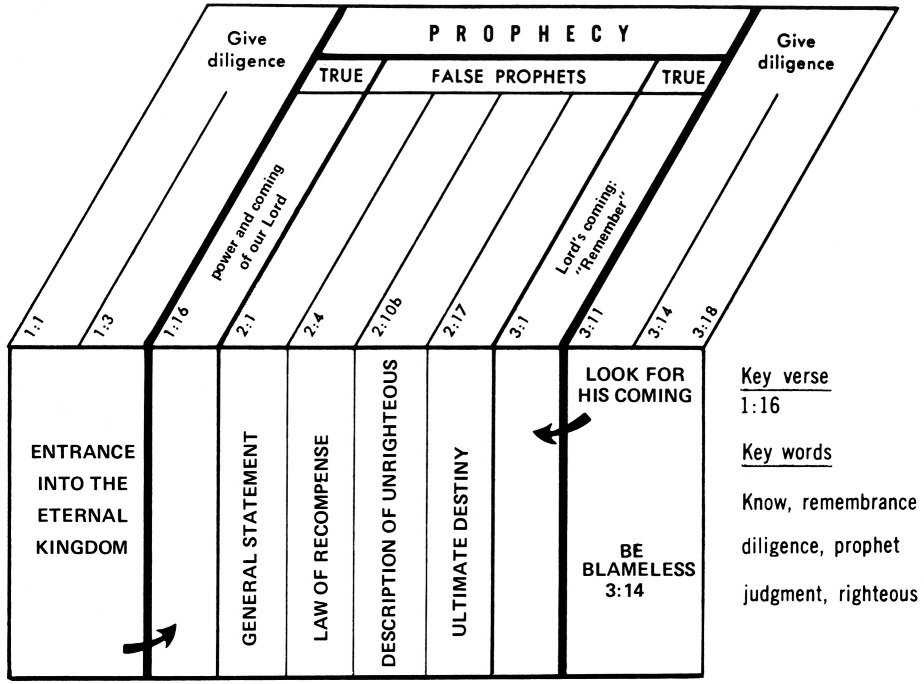
2 Peter: True and False Prophecy
Click chart to enlarge
Chart from Jensen's Survey of the NT - used by permission
|
2 PETER |
||||||||
| Cultivation of Christlike Character |
Condemnation of False Teachers |
Confidence in the Return of Christ |
||||||
| Greeting to Saints 2Pe 1:1-2 |
Growth in Christ 2Pe 1:3-14 |
Grounds |
Danger of |
Demise of |
"Decor" of |
Mockers in |
Manifest |
Maturity in light of that |
| Know Your Salvation |
Know |
Know Your Adversaries |
Know |
|||||
| True Prophecy (True Knowledge) |
False Prophets (False Teachers) |
Final Prophecy (Day of the Lord) |
||||||
| Holiness | Heresy | Hope | ||||||
| Development of Faith |
Denunciation of False Teachers |
Design of The Future |
||||||
2 Peter 1:1 Simon Peter, a bond-servant and apostle of Jesus Christ, To those who have received a faith of the same kind as ours, by the righteousness of our God and Savior, Jesus Christ,: (NASB: Lockman)
Greek: Simoeon Petros doulos kai apostolos Iesou Christou tois isotimon hemin lachousin (AAPMPD) pistin en dikaiosune tou Theou hemon kai soteros Iesou Christou
Amplified: SIMON PETER, a servant and apostle (special messenger) of Jesus Christ, to those who have received (obtained an equal privilege of) like precious faith with ourselves in and through the righteousness of our God and Savior Jesus Christ: (Amplified Bible - Lockman)
Barclay: Symeon Peter, a servant and apostle of Jesus Christ, writes this letter to those to whom there has been allotted a faith equal in honour and privilege with our own, through the impartial justice of our God and Saviour Jesus Christ. (Westminster Press)
NLT: This letter is from Simon Peter, a slave and apostle of Jesus Christ. I am writing to all of you who share the same precious faith we have, faith given to us by Jesus Christ, our God and Savior, who makes us right with God. (NLT - Tyndale House)
Phillips: Simon Peter, a servant and messenger of Jesus Christ, sends this letter to those who have been given a faith as valuable as yours in the righteousness of our God, and Savior Jesus Christ. (Phillips: Touchstone)
Wuest: Simon Peter, a bondslave and an ambassador of Jesus Christ, to those who have been divinely allotted like precious faith with us by the equitable treatment of our God and Saviour, Jesus Christ. (Eerdmans)
Young's Literal: Simeon Peter, a servant and an apostle of Jesus Christ, to those who did obtain a like precious faith with us in the righteousness of our God and Saviour Jesus Christ:
SIMON PETER: Simeon Petros:
W Griffith-Thomas - The opening words (2Pe 1:1,2) are marked by characteristic thoughts that run through the entire letter—for example, faith, righteousness, Savior, knowledge. Then a foundation is at once laid (2Pe 1:3,4) in a statement of the divine gifts by which alone the Christian life becomes possible...Simon Peter. The double name recalls the twofold aspect of his life—before and after discipleship to Christ. This combination of names is not found in St. Mark or Acts. The recurrence to the old name of the early days is an illustration of an old man’s reminiscences. The Greek is “Simeon,” as in Acts 15:14.
Simon Peter (Peter, Simon) - It is always interesting to me how the higher critics question the authorship of books of the Bible, including Peter's second letter! Peter could not have been much clearer! We must believe the inerrant, fully inspired word and grow in our faith. The alternative is to criticize with arrogant (in my opinion) academic erudition and shoot holes in our faith, which is founded on the sure word of prophecy!
Simon Peter - This same name occurs 18x in 18v in the NT - Matt 16:16; Luke 5:8; John 6:68; 13:6, 9, 24, 36; 18:10, 15, 25; 20:2, 6; 21:2, 3, 7, 11, 15; 2Pet 1:1
Peter (4074) (petros [word study]; Latin = Petrus) is a masculine proper noun which means a "stone" and generally a smaller stone than the feminine form petra which refers to a massive rock or a foundation boulder (eg Mt 7:24-note). Peter is the Greek equivalent of the Syriac or Aramaic name Cephas (Kephas from Aramaic kay fah) which was assigned to Simon by Jesus.
Peter was not always a model of rock-like (petros is a symbol of imperturbability as determined from used in Greek literature) firmness. Note for example his actions in Gethsemane, his denial three times of Christ, his unsuccessful attempt at walking on water and his conduct at Antioch (Gal 2:11, 12, 13, 14, 15, 16, 17, 18, 19, 20, 21) where he is called Cephas. Despite all this Peter was clearly the leader of Jesus’ disciples, the spokesman for the Twelve and one of the three closest to Jesus.
Peter is known by several different names in the New Testament as indicated by the following passages.
Matthew says he was
Simon who was called Peter (Mt 4:18)
Later Matthew records that
"the names of the twelve apostles are these: The first, Simon, who is called Peter..." (Mt 10:2)
Matthew later refers to him as "Simon Peter" (Mt 16:16) at his confession to Jesus that "Thou art the Christ, the Son of the Living God."
Jesus "answered and said to him,
Blessed are you, Simon Barjona ("Bar-jonas" = son of Jonah or John) for, because flesh and blood did not reveal this to you, but My Father who is in heaven. And I also say to you that you are Peter (Petros), and upon this rock (petra) I will build My church; and the gates of Hades shall not overpower it. (Mt 16:17,18)
At the inception of Jesus' ministry the apostle John records another name for Peter writing that his brother Andrew
"brought him to Jesus. Jesus looked at him, and said, "You are Simon the son of John; you shall be called Cephas" (which is translated Peter)." (Jn 1:42) (Article on Cephas)
Kenneth Wuest has this note on Peter's name writing that "Thayer says of petros the Greek word from which we get the name Peter, “an appellative proper name, signifying ‘a stone, rock, ledge, or cliff,’ used metaphorically of a soul hard and unyielding, and so resembling a rock,” and says that it is so used in classical writings. Defining petra the feminine form of the word, he says that this word means “a rock, large stone,” and was used metaphorically to refer to a man like a rock by reason of his firmness and strength of soul." (Wuest, K. S. Wuest's Word Studies from the Greek New Testament: Eerdmans)
See nice summary of Scriptures relating to Peter in the Thompson Chain Ref
Spurgeon writes...
Peter here uses both his names, Simon or Simeon, which was his first name, and signifies “hearing with acceptance,” and happy are they who have the hearing ear and the receptive heart; and then there is what I may call his Christian name, the name which Christ gave him, Petros, or Cephas, a rock or stone.
Those who learn to hear well, since faith cometh by hearing, may hope to obtain even greater stability of character than Peter had.
Observe that Peter calls himself “a servant of Christ.” There is no higher honor than to be a servant of God. “To serve God is to reign.” An ancient philosopher was the author of that maxim, and Christianity fully endorses it. He is a true king who is a servant of God.
In this respect, all believers are on a level with Peter, but here is his distinguishing title, “an apostle of Jesus Christ,” a sent one, one who had seen the Lord, and who could bear personal testimony to the fact of his existence, his death, and his resurrection. Hence the apostleship has ceased, since there are no longer any who lived in our Lord’s days upon the earth.
Mark the reason why this Epistle, like the first, is caned “the general Epistle of Peter,” since it is addressed, not to any one church, as Paul’s Epistle to the Ephesians but to all saints, not to the Hebrews alone, but to the Gentiles as well. It is a general Epistle, addressed to all those who have “obtained like precious faith.”
These words were written by the apostle Peter many centuries ago, yet they come to us as fresh as if he had written them but yesterday, and may God grant us grace to profit from them as they are read by us today! After the apostle’s titles comes the salutation of his Epistle
---
Peter was pleased to be able to write those words. There was a time when he had thrice denied his Master, but now he is glad to call himself “a servant of Jesus Christ.” Once he had said, “I know not the man,” but now he claims that he has been sent out by that glorious Lord to be his apostle, a sent one, "a servant and an apostle of Jesus Christ." Probably he had ringing in his ears, at that moment, those blessed words, “Feed My sheep; feed My lambs;” and he was going to do that work again in this his second general Epistle.
These Epistles are not written to everybody. Some readers do not seem to remember this fact. This one is written, says the apostle, to them that have obtained like precious faith with us. The faith of the weakest believer in Jesus is the same kind of faith as that which was found in Simon Peter, who stands among the very first of the worthies in the College of Apostles.” Like precious faith with us.”
Only think of it, you whose faith is of a very trembling sort, which might be well described as “little faith.” Yet yours is “like precious faith” with that of Peter and the rest of the apostles.
The tiniest diamond is as truly a diamond as the Kohinoor, and the smallest faith, if it be really the work of the Spirit of God, is “like precious faith” with that of the apostles.
Dr. Congdon once approached Bible teacher R. A. Torrey, complaining he could get nothing out of his Bible study.
“Please tell me how to study it so that it will mean something to me.”
“Read it,” replied Dr. Torrey.
“I do read it.”
“Read it some more.”
“How?”
“Take some book and read it twelve times a day for a month.”
Torrey recommended Second Peter.
Dr. Congdon later said,
“My wife and I read 2 Peter three or four times in the morning, two or three times at noon, and two or three times at dinner. Soon I was talking 2 Peter to everyone I met. It seemed as though the stars in the heavens were singing the story of 2 Peter. I read 2 Peter on my knees, marking passages. Teardrops mingled with the crayon colors, and I said to my wife,
“See how I have ruined this part of my Bible.”
“Yes,” she said, “but as the pages have been getting black, your life has been getting white.”
Dr. Kenneth Gangel offers a summary of the reasons Peter wrote his second letter.
This final impassioned plea to grow in Christian maturity and guard against false teachers was precipitated by the fact that [Peter’s] time was short (2Peter 1:13-15) and that these congregations faced immediate danger (2Peter 2:1-3). He also desired to refresh their memories (2Peter 1:13) and stimulate their thinking (2Peter 3:1-2) so they would remember his teaching (2Peter 1:15).... And he encouraged his readers with the certainty of Christ’s return (2Peter 3:1-16).”
Simon (4613) (Simon) was his name before Christ called him (Jn 1:42). Later Jesus added "Peter" --
I also say to you that you are Peter (4074) (petros) and upon this rock (4073) (petra - projecting rock, mass of rock, even a massive cliff) I will build My church; and the gates of Hades will not overpower it." (Mt 16:18).
Here Peter clearly states that he is the author. Later he reminds his readers that
"This is now beloved the second letter I am writing to you..." (2Pe 3:1-note).
He further underscores the authenticity of his authorship teaching that
"we did not follow cleverly devised tales when we made known to you the power and coming of our Lord Jesus Christ but we were eyewitnesses of His majesty" (2Pe 1:16-note, Mt 17:1, 2, 3, 4).
Despite these clear statements of authenticity, the liberal commentators (another good reason to always do your own Inductive Bible Study before you read the commentaries, including the one you are reading now!) have generated more controversy over 2 Peter’s authorship and rightful place in the canon of Scripture than over almost any other NT book. The so called "early church fathers" were also slow in giving it their acceptance. It is interesting that none of the church fathers refers to 2 Peter by name until Origen near the beginning of the third century! The ancient church historian, Eusebius included 2 Peter in his list of "disputed books", along with James, Jude, 2 John, and 3 John. Even the leading Reformers only hesitatingly accepted 2 Peter authenticity. Click here or here for an in depth analysis of who wrote Second Peter.
Peter will first describe the Christian life, because before he described the counterfeit, he described the genuine. The best way to detect the lie is to be thoroughly familiar with the truth (cf Hebrews 5:14-note).
A BOND-SERVANT AND: doulos kai:
- Dt 15:12,16, Ex 21:5, 6
- 2 Peter 1 Resources - Multiple Sermons and Commentaries
Peter's placement of "bondservant" first well illustrates the principle set down by the Master in (Mk 10:43, 44, 45). The teaching seems to have "taken root" so to speak. How about you? Do you see genuinely yourself first as the Lord's bondservant?
W Griffith-Thomas - His title: servant and apostle (compare Ro 1:1; Titus 1:1). Here we see the two sides of the Christian life—his general relationship as a servant, and his special position as an apostle. The order of the two is worth noting.
William Barclay - Peter calls himself the servant of Jesus Christ. The word is doulos (1401) which really means slave. Strange as it may seem, here is a title, apparently one of humiliation, which the greatest of men took as a title of greatest honour. Moses the great leader and lawgiver was the doulos (1401) of God (Deuteronomy 34:5; Psalms 105:26; Malachi 4:4). Joshua the great commander was the doulos (1401) of God (Joshua 24:29). David the greatest of the kings was the doulos (1401) of God (2 Samuel 3:18; Psalms 78:70). In the New Testament Paul is the doulos (1401) of Jesus Christ (Romans 1:1; Philippians 1:1; Titus 1:1), a title which James (James 1:1), and Jude (Jude 1:1 ) both proudly claim. In the Old Testament the prophets are the douloi (1401) of God (Amos 3:7; Isaiah 20:3). And in the New Testament the Christian man frequently is Christ's doulos (1401) (Acts 2:18; 1 Corinthians 7:22; Ephesians 6:6; Colossians 4:12; 2 Timothy 2:24). There is deep meaning here.
Bondservant:(1401) (doulos [word study]) is the most abject, servile Greek term for a slave of the five words that were used to describe one who serves another. In the NT doulos refers to one who serves another (the Lord) without regard for his own personal interests.
See John Henry Jowett's discussion of the freedom of the Lord's bondslave.
Doulos - 124x in 117v - NAS = bond-servant(11), bond-servants(12), bondslave(3), bondslaves(8), both men and women(8), servants(1), slave(58), slave's(1), slaves(39).
Matt 8:9; 10:24f; 13:27f; 18:23, 26ff, 32; 20:27; 21:34ff; 22:3f, 6, 8, 10; 24:45f, 48, 50; 25:14, 19, 21, 23, 26, 30; 26:51; Mark 10:44; 12:2, 4; 13:34; 14:47; Luke 2:29; 7:2f, 8, 10; 12:37, 43, 45ff; 14:17, 21ff; 15:22; 17:7, 9f; 19:13, 15, 17, 22; 20:10f; 22:50; John 4:51; 8:34f; 13:16; 15:15, 20; 18:10, 18, 26; Acts 2:18; 4:29; 16:17; Rom 1:1; 6:16f, 20; 1 Cor 7:21ff; 12:13; 2 Cor 4:5; Gal 1:10; 3:28; 4:1, 7; Eph 6:5f, 8; Phil 1:1; 2:7; Col 3:11, 22; 4:1, 12; 1 Tim 6:1; 2 Tim 2:24; Titus 1:1; 2:9; Philemon 1:16; Jas 1:1; 1 Pet 2:16; 2 Pet 1:1; 2:19; Jude 1:1; Rev 1:1; 2:20; 6:15; 7:3; 10:7; 11:18; 13:16; 15:3; 19:2, 5, 18; 22:3, 6.
Doulos is derived from the verb deo which means “to bind.” Thus a doulos is one bound to another. In the Greek culture doulos described a person who served involuntarily and had no choice as to whether he would serve or not. Peter and Paul elevate the term doulos to the level of a servant in the OT where doulos was one who has chosen to remain a slave of his master (Dt 15:12,16, Ex 21:5, 6). The word doulos therefore pictures the absolute surrender of a man or woman to their Master. The slave is totally devoted to the loving Master! And it is the slave's love for the Master which motivates this full surrender. Beloved, using this working definition, would Peter or Paul describe you as a doulos of the Lord Jesus? If not, what are you unwilling to submit to Jesus?
Doulos emphasizes that the believer is no longer his own but that he has been bought at great price for a holy purpose (1Pe 1:18, 19-note, 1Cor 6:19-note, 1Co 6:20-note,Titus 2:14-note).
A doulos as used by Peter and Paul described a man or woman who was in a permanent relation of servitude to another. Their will was altogether consumed in the will of the master.
In using doulos one must not understand the term in the sense of distasteful, involuntary servitude from which the slave desires to escape but rather reflective of the spiritual yieldedness of one totally devoted to his loving Lord. Peter uses doulos to emphasize his submission to His Master's will. Peter is saying in essence I have no life of my own, no will of my own, no purpose of my own, and no plan of my own having been purchased at great price (1Pe 1:18, 19-note). Peter's impetuous self will (with which we all quickly identify) wherewith he used to "gird (himself) and walk wherever (he) wished" (Jn 21:18) had long since been subdued and he now gladly acknowledged Christ's ownership and Lordship over his life. All I have and all I am and all I will ever be is from Christ and is subject to Him as my Lord. What a difference in Peter's mindset the Spirit of God made at Pentecost as we think of his behavior before the Cross (cf. Jn 21:18), and then after the Cross and Pentecost for then Peter's every thought, breath, and effort a result of his complete submission to the Lord Jesus Christ. (cf Amos 3:7, Jer 7:25). And so it should also be for every saint, every disciple of the Lord.
The Christian as a "Doulos" of God
Adapted from William Barclay
• To call the Christian the doulos of God means that he is inalienably possessed by God. In the ancient world a master possessed his slaves in the same sense as he possessed his tools. A servant can change his master; but a slave cannot. The Christian inalienably belongs to God.
• To call the Christian the doulos of God means that he is unqualifiedly at the disposal of God. In the ancient world the master could do what he liked with his slave; he had even the power of life and death over him. The Christian has no rights of his own, for all his rights are surrendered to God.
• To call the Christian the doulos of God means that he owes an unquestioning obedience to God. A master's command was a slave's only law in ancient times. In any situation the Christian has but one question to ask: "Lord, what will you have me do?" The command of God is his only law.
• To call the Christian the doulos of God means that he must be constantly in the service of God. In the ancient world the slave had literally no time of his own, no holidays, no leisure. All his time belonged to his master. The Christian cannot, either deliberately or unconsciously, compartmentalize life into the time and activities which belong to God, and the time and activities in which he does what he likes. The Christian is necessarily the man every moment of whose time is spent in the service of God. (Barclay Online)
Wuest adds that the word "doulos"
designated one who was born as a slave. This classical usage fits in very well with the doctrinal significance of the word as it is used in the Christian system. Sinners are born into slavery to sin at physical birth, and into a loving, willing, glad servitude to Jesus Christ by regeneration. The word referred to one whose will is swallowed up in the will of another. Before salvation, the sinner’s will is swallowed up in the will of Satan [see 2Ti 2:26-note, also Torrey's Topic "Spiritual Bondage"]. After salvation has wrought its beneficent work in his being, his will is swallowed up in the sweet will of God. The word spoke of one who is bound to another in hands which only death can break. The sinner is bound to Satan in bands which only death can break. In the case of the believing sinner, his identification with the Lord Jesus in His death on the Cross broke the bands which bound him to Satan. Now, the believer is bound to Christ in bands which only death can break. But the Lord Jesus will never die again, and since He is the life of the saint, that saint will never be severed from his Lord, but will be His loving bondslave for time and eternity. Again, doulos refers to one who serves another to the disregard of his own interests. Before salvation, the sinner served Satan to his own detriment. Since he has been saved, a Spirit-filled believer serves his Lord with an abandon that says, “Nothing matters about me, so long as the Lord Jesus is glorified. (Wuest, K. S. Wuest's Word Studies from the Greek New Testament: Eerdmans)
APOSTLE OF JESUS CHRIST: apostolos Iesou Christou:
-
2 Peter 1 Resources - Multiple Sermons and Commentaries
Apostle (652) (apostolos [word study] from apo = from + stello = send forth) refers to one sent forth by another and at times in the NT carried the broad meaning of one who is sent as a messenger or delegate with instructions from a group or an individual (cf 2Cor 8:23, Php 2:25-note).
Apostolos - 80x in 79v - NAS = apostle(19), apostles(52), apostles'(5), messenger(1), messengers(1), is sent(1).
Matt 10:2; Mark 3:14; 6:30; Luke 6:13; 9:10; 11:49; 17:5; 22:14; 24:10; John 13:16; Acts 1:2, 26; 2:37, 42f; 4:33, 35ff; 5:2, 12, 18, 29, 40; 6:6; 8:1, 14, 18; 9:27; 11:1; 14:4, 14; 15:2, 4, 6, 22f; 16:4; Rom 1:1; 11:13; 16:7; 1 Cor 1:1; 4:9; 9:1f, 5; 12:28f; 15:7, 9; 2 Cor 1:1; 8:23; 11:5, 13; 12:11f; Gal 1:1, 17, 19; Eph 1:1; 2:20; 3:5; 4:11; Phil 2:25; Col 1:1; 1 Thess 2:7; 1 Tim 1:1; 2:7; 2 Tim 1:1, 11; Titus 1:1; Heb 3:1; 1 Pet 1:1; 2 Pet 1:1; 3:2; Jude 1:17; Rev 2:2; 18:20; 21:14.
In the present context Peter uses apostle in its more common restricted meaning to denote one of the 12 disciples whom Jesus chose, trained, and commissioned to be His representatives.
In Acts 1:21, 22 Peter delineates the necessary qualifications of this latter select group:
"Therefore it is necessary that of the men who have accompanied us all the time that the Lord Jesus went in and out among us--beginning with the baptism of John until the day that He was taken up from us--one of these must become a witness with us of His resurrection."
Thus an apostle was an ambassador representing Jesus and possessing the authority and power of His Lord.
Apostolos was a technical word in secular Greek used of one sent from someone else with credentials on a mission. Peter was an ambassador of Jesus Christ sent by Him with credentials in the form of miracles, and on a mission, that of proclaiming the gospel, the good news of salvation by grace available to all who would believe. Bondservant combined with apostle undoubtedly conveys Peter's deep sense of personal humility and his keen sense of delegated authority.
Vincent makes the point that of all the non-Pauline epistles
Peter’s alone puts forward his apostleship (cf 1Pe 1:1-note) in the introduction. He is addressing churches with which he had no immediate connection, and which were distinctively Pauline. Hence he appeals to his apostleship in explanation of his writing to them, and as his warrant for taking Paul’s place.
Of Jesus Christ expresses the source of Peter's authority.
Jesus (2424) (Iesous) being His human name, received before His birth as an indication of His saving work through the incarnation (Mt 1:21) and is the Greek form of the Hebrew name Joshua (He 4:8-note which means "Jehovah is Salvation".
Charles Spurgeon commenting on Matthew 1:21 wrote that...
The angel spake to Joseph the name in a dream: that name so soft and sweet that it breaks no man’s rest, but rather yields a peace unrivalled, the peace of God. With such a dream Joseph’s sleep was more blessed than his waking. The name has evermore this power, for, to those who know it, it unveils a glory brighter than dreams have ever imagined. (The Metropolitan Tabernacle Pulpit)
Christ (Christos) is the Greek rendering of the Hebrew title Messiah and means "the anointed one" (cf Ps 2:2, Acts 4:26).
Jesus the God Man was indeed the promised Christ or Messiah. Peter's belief in this simple but profound truth arose from his association with Him on earth (cf. Andrew's proclamation to his brother Peter that "We have found the Messiah which translated means Christ" Jn 1:41, "Simon Peter answered "You are the Christ, (the Messiah) the Son of the living God" Mt 16:16) and received unshakable confirmation as witnesses of His resurrection and ascension ("This Jesus God raised up again to which we are all witnesses...God has made Him both Lord and Christ --this Jesus Whom you crucified." Acts 2:32, 33, 34, 35, 36).
TO THOSE WHO HAVE RECEIVED: hemin lachousin (AAPMPD):
- 2 Peter 1 Resources - Multiple Sermons and Commentaries
Peter immediately identifies the recipients as those who have an a unique spiritual experience, clearly implying that this message was addressed to all who had accepted the gospel of Jesus Christ.
W Griffith-Thomas...
Their spiritual position: To those who … have received a faith as precious as ours. In 1 Peter the Christians are first of all described by their geographical position. Here they are only described by their spiritual experience. Precious is a word characteristic of Peter’s two letters (see 1Pe 1:7, 19; 2:6, 7). How is faith precious? Because it links us to God; it keeps us safe in God and is the channel of spiritual purification (Acts 15:9; Gal 2:20; Heb11:6; 1Pe 1:5). In speaking of their faith as being as precious as ours, the apostle shows his tact and courtesy in putting himself on the same level of spiritual privilege. Received implies divine lot or gift. (The same word is used in Lk 1:9 and Jn 19:24.)
Received (2975) (lagchano) means to obtain by lot (as used by Homer in Greek writings; eg, to obtain by fate by the will of the gods) and so to obtain something as a portion (to receive, to obtain). Lagchano speaks of what comes to someone always apart from his own efforts.
Lagchano is a distinctive verb used only 4x in the NT...
Luke 1:9 according to the custom of the priestly office, he was chosen by lot to enter the temple of the Lord and burn incense.
Comment: The Mishna informs us that the various offices of priests and Levites in the daily service were determined by lot, a practice described here by Luke. Offering incense was a special privilege, granted each priest only once, and decided by lot.
John 19:24 They said therefore to one another, "Let us not tear it, but cast lots for it, to decide whose it shall be"; that the Scripture might be fulfilled, "They divided My outer garments among them, and for My clothing they cast lots."
Acts 1:17 "For he was counted among us (the original 12 disciples of Jesus), and received his portion in this ministry."
Comment: Here Peter uses lagchano referring to Judas Iscariot. God makes the decision, and thus the thought is that of the allotment of a share in the apostolic ministry.
2Peter 1:1 (note) Simon Peter, a bond-servant and apostle of Jesus Christ, to those who have received a faith of the same kind as ours, by the righteousness of our God and Savior, Jesus Christ:
What Peter seems to be teaching by using the verb lagchano is that the salvation he and his readers had had obtained was not the result of any personal merit or self effort on their part, but was an "allotted" as a gift from God.
TDNT adds that...
the common idea of attainment is present, but with the usual sense of allotment in the background. Attainment to faith is not a human achievement but is by divine allotment. God does not merely grant the possibility of faith; he effects it (cf ) As a divine gift, faith is the epitome of grace; hence attaining to faith is by God's gracious decision, yet closely linked with his righteousness. (Kittel, G., Friedrich, G., & Bromiley, G. W. Theological Dictionary of the New Testament. Eerdmans)
Salvation is not attained by anything his readers did but was the result of God’s grace, which is His undeserved and unmerited favor.
Received is aorist tense which speaks of a past completed action. At the moment we believed in the name of the only begotten Son of God, we were "allotted our portion" of the "full package" (see 'isotimos' below). When we were regenerated we passed from death to life, from hopelessness to hope, from futile thinking to the mind of Christ, we were made complete in Christ. Thanks be to God for His incredible gift! (2Cor 9:5)
A FAITH: pistin:
- 2 Peter 1 Resources - Multiple Sermons and Commentaries
Faith (4102) (pistis [word study]) refers to a firm persuasion that something is true. Contrary to popular thinking "faith" is not just giving mental assent to truth but includes a surrender of one's will to that truth which results in a conduct in keeping with that surrender. Simply stated, faith shows itself to be genuine Biblical saving faith by the changed life in the one expressing the faith. Peter uses faith here to mean the capacity to believe (Eph 2:8, 9-note). Even though faith or belief express the human side of salvation, God still must grant ("allot" would fit with the present context) that faith.
True faith that saves one's soul includes at least three main elements
(1) firm persuasion or firm conviction,
(2) a surrender to that truth and
(3) a conduct emanating fr that surrender. In sum, faith shows itself genuine by a changed life. (Click here for W E Vine's similar definition of faith)
The highly respected theologian Louis Berkhof defines genuine faith in essentially the same way noting that it
includes an intellectual element (notitia), which is “a positive recognition of the truth”; an emotional element (assensus), which includes “a deep conviction of the truth”; and a volitional element (fiducia), which involves “a personal trust in Christ as Savior and Lord, including a surrender … to Christ.” (Louis Berkhof, Systematic Theology. Grand Rapids: Eerdmans, 1939)
Larry Richards has an excellent discussion on faith writing that...
Originally this word group seems linked with a more formal contract between partners. It stressed faithfulness to the agreement made or trustworthiness in keeping promises. In time the use expanded. In the classical period, writers spoke of trust in the gods as well as trust in people. In the Hellenic era, "faith in God" came to mean theoretical conviction about a particular doctrine, a conviction expressed in one's way of life. As different schools of philosophy and religion developed, the particular emphasis given pistis was shaped by the tradition within which it was used. The NT retains the range of meanings. But those meanings are refined and reshaped by the dynamic message of the gospel.
The verb (pisteuo) and noun (pistis) are also used with a number of prepositions. "To believe through" (dia) indicates the way by which a person comes to faith (Jn 1:7; 1Pe 1:21-note). "Faith en" indicates the realm in which faith operates (Ep 1:15-note; Col 1:4-note; 2Ti 3:15-note). The most important construction is unique to the NT, an invention of the early church that expresses the inmost secret of our faith. That construction links faith with the preposition eis, "to" or "into." This is never done in secular Greek. In the NT it portrays a person committing himself or herself totally to the person of Jesus Christ, for our faith is into Jesus.
(Ed note: Leon Morris in "The Gospel According to John" agrees with Richards writing that “Faith, for John, is an activity which takes men right out of themselves and makes them one with Christ” indicating that Morris likewise understands the Greek preposition eis in the phrase pisteuo eis, to be a significant indication that NT faith is not just intellectual assent but includes a “moral element of personal trust.")
One other aspect of the NT's use of faith words is fascinating. Usually the object of faith is Jesus. Only twelve verses have God as the object of faith (Jn 12:44; 14:1; Acts 16:34; Ro 4:3-note, Ro 4:5-note, Ro 4:17-note, Ro 4:24-note; Gal 3:6; 1Th 1:8-note; Titus 3:8-note; He 6:1-note; 1Pe 1:21-note). Why? The reason is clearly expressed by Jesus himself: "I am the way and the truth and the life. No one comes to the father except through me" (Jn 14:6). God the Father has revealed himself in the Son. The Father has set Jesus before us as the one to whom we must entrust ourselves for salvation. It is Jesus who is the focus of Christian faith. (Richards, L O: Expository Dictionary of Bible Words: Regency)
Wuest in his study of pistis and the related words in this family, pisteuo and pistos, explains that...
When these words refer to the faith which a lost sinner must place in the Lord Jesus in order to be saved, they include the following ideas; the act of considering the Lord Jesus worthy of trust as to His character and motives, the act of placing confidence in His ability to do just what He says He will do, the act of entrusting the salvation of his soul into the hands of the Lord Jesus, the act of committing the work of saving his soul to the care of the Lord. This means a definite taking of one’s self out of one’s own keeping and entrusting one’s self into the keeping of the Lord Jesus. (Word Studies - Eerdmans)
William Barclay notes that...
Faith begins with receptivity. It begins when a man is at least willing to listen to the message of the truth. It goes on to mental assent. A man first hears and then agrees that this is true. But mental assent need not issue in action. Many a man knows very well that something is true, but does not change his actions to meet that knowledge. The final stage is when this mental assent becomes total surrender. In full-fledged faith, a man hears the Christian message, agrees that it is true, and then casts himself upon it in a life of total yieldedness.
Faith is relying on what God has done rather than on one’s own efforts. In the Old Testament, faith is rarely mentioned. The word trust is used frequently, and verbs like believe and rely are used to express the right attitude to God. The classic example is Abraham, whose faith was reckoned as righteousness (Ge 15:6). At the heart of the Christian message is the story of the cross: Christ’s dying to bring salvation. Faith is an attitude of trust in which a believer receives God’s good gift of salvation (Acts 16:30,31) and lives in that awareness thereafter (Gal 2:20-note; cf He 11:1-note).
Faith is the only thing that gives God His proper place, and puts man in his place too. C. H. Mackintosh, explains that faith
“glorifies God exceedingly, because it proves that we have more confidence in His eyesight that in our own.”
Charles Swindoll commenting on faith and obedience in John 3:36 concludes that...
In 3:36 the one who “believes in the Son has eternal life” as a present possession. But the one who “does not obey the Son shall not see life.” To disbelieve Christ is to disobey Him. And logically, to believe in Christ is to obey Him. As I have noted elsewhere, “This verse clearly indicates that belief is not a matter of passive opinion, but decisive and obedient action.” (quoting J. Carl Laney)...Tragically many people are convinced that it doesn’t really matter what you believe, so long as you are sincere. This reminds me of a Peanuts cartoon in which Charlie Brown is returning from a disastrous baseball game. The caption read, “174 to nothing! How could we lose when we were so sincere?” The reality is, Charlie Brown, that it takes more than sincerity to win the game of life. Many people are sincere about their beliefs, but they are sincerely wrong!" (Swindoll, C. R., & Zuck, R. B. Understanding Christian Theology.: Thomas Nelson Publishers) (This book is recommended if you are looking for a very readable, non-compromising work on "systematic theology". Wayne Grudem's work noted above is comparable
John MacArthur adds that
Faith, like grace, is not static. Saving faith is more than just understanding the facts and mentally acquiescing. It is inseparable from repentance, surrender, and a supernatural longing to obey. None of those responses can be classified exclusively as a human work, any more than believing itself is solely a human effort.
C H Spurgeon says that...
faith does not grow in man's heart by nature. It is a thing which is obtained. It is not a matter which springs up by a process of education, or by the example and excellent instruction of our parents. It is a thing which has to be obtained. Not imitation, but regeneration; not development, but conversion. All our good things come from without us. Only evil can be educed from within us. Now, that which is obtained by us must be given to us; and well are we taught in Scripture that “faith is not of ourselves, it is the gift of God.” Although faith is the act of man, yet it is the work of God. “With the heart man believeth unto righteousness;” but that heart must, first of all, have been renewed by divine grace before it ever can be capable of the act of saving faith. Faith, we say, is man's act, for we are commanded to “believe on the Lord Jesus Christ,” and we shall be saved. At the same time, faith is God's gift, and wherever we find it, we may know that it did not come there from the force of nature, but from a work of divine grace. How this magnifies the grace of God, my brethren, and how low this casts human nature! Faith. Is it not one of the simplest things? Merely to depend upon the blood and righteousness of the Lord Jesus Christ, does it not seem one of the easiest of virtues? To be nothing, and to let him be everything--to be still, and to let him work for me, does not this seem to be the most elementary of all the Christian graces?" (If you have questions about Biblical faith or whether your faith is genuine, let me encourage you to take a moment and read Spurgeon's entire sermon (Click Here).
And so God initiates faith when the Holy Spirit awakens the dead soul in response to hearing the Word of God (cf. Acts 11:21; Acts 16:14, Ephesians 2:8-note). What a mystery is this precious gift! (Ro 3:24-note). We don't deserve it and we couldn't have done anything to earn it. All things are from Him and through Him and to Him. To God be the glory! Amen.
Alexander Maclaren has an interesting discussion of faith...
PETER seems to have had a liking for that word ‘precious. ’ It is not a very descriptive one; it does not give much light as to the quality of the things .to which it is applied; but it is a suggestion of one-idea value. It is interesting to notice the objects to which, in his two letters-for I take this to be his letter — he applies it. He speaks of the trial of faith as being ‘precious.’ He speaks (with a slight modification of the word employed) of Jesus Christ as being ‘to them that believe, precious.’ He speaks of the ‘precious’ blood of Christ. These instances are in the first epistle. In this second epistle we have the words of my text, and a moment after, ‘exceeding great and precious promises.’ Now look at Peter’s list of valuables; ‘Christ, Christ’s blood, God’s promises, our Faith, and the discipline to which that faith is subjected.’ These are things that the old man had found out to be of worth.
But then there is another word in my text that must be noted, ‘like precious.’ It brings into view two classes, to one of which Peter himself belongs — ‘us’ and ‘they.’ Who are these two classes? It may be that he is thinking of the immense difference between the intelligent and developed faith of himself and the other Apostles, and the rudimentary and infantile faith of the recent believers to whom he may be speaking. And, if so, that would be beautiful, but I rather take it that he is tacitiy contrasting in his own mind the difference between the Gentile converts as a whole, and the members of the Jewish community who had become believers in Jesus Christ, and that he is repeating the lesson that he had learned on the housetop at Joppa, and had had further confirmed to him by the experience of Caesarea, and that he is really saying exactly what he said when he defended himself before the Council in Jerusalem: ‘Seeing that God had given unto them the like gift that he did unto us, who was I, that I should withstand God?’ And so he looks out over all the Christian community, and ignores ‘the middle wall of partition,’ and says, ‘Them that have obtained like precious faith with us.’ I wish very simply to try to draw out the thoughts that lie in these words, and cluster round that well-worn and threadbare theological expression and Christian verity of ‘faith’ or ‘trust.’
I. And the first thing that I would desire to point you to is, what we learn here as to the object of faith.
Now those of you who are using the Revised Version will notice that there is a very slight, but important, alteration there, from the rendering in the old translation. We read in the latter: ‘Like precious faith with us through the righteousness,...’ and that is a meaning that might be defended. But the Revised Version says, and says more accurately as far as the words go, and more truly as far as Christian thought goes, ‘them that have obtained like precious faith with us in the righteousness.’ Now, I daresay, it will occur to us all that that is a departure from the usual form in which faith is presented to us in the New Testament, because there, thank God! we are clearly taught that the one thing which faith grapples is not a thing but a Person. Christian faith is only human trust turned in a definite direction. Just as our trust lays hold on one another, so the object of faith is, in the deepest analysis, no doe-trine, no proposition, not even a Divine fact, not even a Divine promise, but the Doer of the fact, and the Promiser of the promise, and the Person, Jesus Christ. When you say, ‘I trust so-and-so’s word!’ what you mean is, ‘I trust him, and so I put credence in his word.’ And Christianity would have been delivered from mountains of misconception, and many a poor soul would have felt that a blaze of light had come in upon it, if this had been clearly proclaimed, and firmly apprehended by preachers and by hearers, that the object of trust is the living Person, Jesus Christ, and that the trust which grapples us to Him is essentially a personal relation entered into by our wills and hearts far more than by our heads.
All that is being apprehended by the Christian Church to-day a great deal more clearly than it used to he when some of us were young. But we have the defects of our qualities. And this generation is accustomed far too lightly and superficially to say ‘Oh! I do not care about doctrines. I cleave to the living Christ.’ Amen! say I. But there is another question — What Christ is it that you are cleaving to? For our only way of knowing a person with whom we have no external acquaintance is by what we are told about him, and believe about him. And so, while we cannot assert too strongly that faith or trust in the living Christ, and not in a dogma, is the basis of real Christian life, we have need to be very definite and sure as to what Christ — which Christ — it is that we are trusting to? And there my text comes in, and tells us that faith is to grasp Christ as our righteousness; and another saying of the Apostle Paul’s comes in, who for once speaks of faith as being faith not only in the Christ, but in ‘His blood’: —
‘Jesus ! Thy blood and righteousness,
My beauty are, my glorious dress.’Brethren! you will not get beyond that. The Christ, trusting in whom we have life and salvation, is the Christ whose blood cleanses, Whose righteousness clothes us poor, sinful men. So, while proclaiming with all emphasis, and rejoicing to press it upon all my brethren, that salvation comes by personal trust in the Person, I supplement and fill out, not contradict, that proclamation, when I further say that the Person by trusting in whom we are saved, is the Jesus whose blood cleanses and whose righteousness becomes ours. That righteousness is, in our text, contemplated as God’s, as being embodied in Christ’s, that from Him it may be imparted to us, if we will fulfil the condition on which alone it can be ours, viz., faith. It becomes ours, by no mere imputation which has not a reality at the back of it, but because faith brings us into such a vital union with Jesus Christ as that His righteousness, or at least a spark from the central flame, becomes ours, not only in reference to our exemption from the burden of our guilt, but in reference to our becoming conformed to the image of His dear Son, and created anew in righteousness and holiness. The object of faith is Christ, the Christ whose blood and righteousness cleanses and clothes sinful souls.
II. Let Me Ask You To Look, In The Next Place, To What This Text Suggests To Us About The Worth Of Christian Faith.
Peter calls it precious. Consider its worth as a channel. There is a very remarkable expression used in the Acts of the Apostles, The door of faith’ (Acts 14:27). A door is of little value in itself, worth a few shillings at the most, but if it opens the way into a palace then it is worth something. And all the preciousness that there is in faith comes, not from its intrinsic value, but from the really precious things which it gives into our hands. Just as the dyer’s hand may be tinged with royal purple, if he has been working in it, or a woman’s hand may be scented and made fragrant if she has been handling perfumes, so the hand of faith takes tint and fragrance from that with which it is conversant.
It is precious because it is the channel by which all precious things flow into our hearts and lives. If Ladysmith is, as I suppose it is, dependent for its water supply on one lead pipe, the preciousness of that pipe is not measured by what it would fetch if it were put up to auction for its lead, but by that which flows through it, and without which Death would come.
And my faith is the pipe by which all the water of life comes sparkling and rejoicing into my thirsty soul.
It is the opening of the door that the King of Glory may come in’ (Ps 24:9)
It is the taking down of the shutters that the sunshine may blaze into the darkened chamber
It is the grasping of the electric wire that the circuit may be completed.
God puts out His hand, and we lay hold of it. It is not the outstretched hand from earth, but the down-stretched hand from heaven that makes the tottering man stand.
So, dear friends, let us understand that salvation does not come as the reward of faith, but that the salvation is in the faith, because faith is the channel by which all God’s salvation pours into us. So there is nothing arbitrary in the way of salvation, as some shallow thinkers seem to propose, and there is no reason in the question, ‘Why does God make salvation depend upon faith?’ God could not but make salvation depend upon faith, because there is no other possible way by which the blessings which are gathered together into that one great pregnant word ‘salvation’ could find their way into a man’s heart but through the channel of his trust. Have you opened that channel? If you have not, you need not wonder it cannot be otherwise — that salvation does not come unto you.
Consider its worth as a defence. The Apostle in one place speaks about ‘the shield of faith.’ (Ep 6:16-note) But there is nothing in the belief that I am safe to make me safe. It is very often a fatal blunder. All depends upon that or Him, to which or whom I am trusting for my safety. Put yourself beneath the true Shield — ‘The Lord God is a sun and shield’ (Psalm 84:11) — and then you will be safe. Your way of running into the strong tower which alone, with its massive walls, protects us from all danger and from all sin, is by trusting Him. (See God's Name-A Strong Tower)
Just as light things on a ship’s deck have to be lashed in order to be secured and lie still, you and I have to lash ourselves to Jesus Christ; then, not by reason of the lashings, but by reason of Him, we are fastened and secured.
Consider the worth of faith as a means of purifying. This very Apostle, in his great speech in Jerusalem when vindicating the reception of the Gentiles into the Church, spoke of God as having ‘purified their hearts by faith.’ (Acts 15:9) And here again, I say, there is no cleansing power in the act of trust. Cleansing power is in that which, by the act of trust, comes into my heart. Faith is not simple receptivity, not mere passive absorbing of what is given, but it is the active taking by desire as well as by confidence. And when we trust in Jesus Christ, His blood and righteousness, there flows into our hearts that Divine life which, like a river turned into a dung-heap, will sweep all the filth before it. You have to get the purifying power by faith. Ay! and you have to utilize the purifying power by effort and by work. ‘What God hath joined together, let not men put asunder.’
III. Now, lastly, note the identity of faith.
‘Like precious,’ says Peter, and, as I said, there may be defended a double application of the word, and two sets of pairs of classes may be supposed to have been in his mind. I do not discuss which of these may be the case, only I would suggest to you that from this beautiful gathering together of all the diversities of the Christian character, conception, and development into one great whole, we are taught that the one thing that makes a Christian is this trust. That is the universal characteristic; that is uniform, whatever may differ. Ah! how much and how little it takes to make a Christian. ‘Only faith?’ you say. Yes, thank God! not this, or that, not rites, not anything that a priest can do to you. Not orthodoxy; not morality; these will come, but trust in Christ and His blood and righteousness. England is a Christian country; is it? This is a Christian congregation; is it? You are a Christian; are you? Are you trusting in that Christ? If you are not; no! though you be orthodox up to the eyebrows, and though seven or seven hundred sacraments may have been given to you, and though you be a clean living man — all that does not make a Christian, but this does — ‘Like precious faith with us in the righteousness of God and our Saviour.’
Again, this great thought of the identity or uniformity of the one characteristic may suggest to us how Christian faith is one, under all varieties of form. There never has been in the Christian Church again, notwithstanding all our deplorable divisions and schisms, such a tremendous cleft as there was in the primitive Church between the Jewish and Gentile components thereof. But Peter flings this flying bridge across that abyss, and knits the two sides together, because he knows that away out yonder, amongst the Gentiles, and here in the little circle of the Jewish believers, there was the one faith that unifies all.
So, dear friends, there should be the widest charity, but no vagueness; for the Christian faith in Him which unifies and bridges over all differences, mental and theological, is the Christ by whose blood we are cleansed, with whose righteousness we are made righteous.
Again, from the same thought flows the other, of the identity of the uniform characteristic, at all stages of development or maturity. The mustard-seed and the tree, ‘which is greater than all herbs,’ have the same life in them. And the feeblest, tremulous little spark in some heart, just kindled, and scarcely capable of sustaining itself, is one with the flame leaping heaven-high, which lights up and cleanses the whole soul. So for those in advance, humility, and for those in the rear, hope. And something more than hope, for if you have the feeblest beginning of tremulous trust, you have that which only needs to be fostered to make you like Jesus Christ. Look at what follows our text: ‘Add to your faith, virtue, and to virtue, knowledge,’ and so on, through the whole linked series of Christian graces. They all come out of that trust which knits us to Him who is the source of them all. So you and I are responsible for bringing our faith to the highest development of which it is capable.
Alas! alas! are we not all like this very Apostle, who, in an ecstasy of trust and longing, ventured himself on the wave, and as soon as he felt the cold water creeping above his knees lost his trust, and so lost his buoyancy, and was ready to go down like a stone? He had so little faith, that he was beginning to sink; he had so much that he put out his hand — a desperate hand it was — and cried, ‘Lord, save me!’ (Mt 14:30) And the hand came, and that steadied him, and bore him up till the water was beneath the soles of his feet again. ‘Lord! I believe; help Thou my unbelief!’ (Mark 9:24) (2 Peter 1:1 Like Precious Faith)
OF THE SAME KIND AS OURS: tois isotimon:
- 2 Peter 1 Resources - Multiple Sermons and Commentaries
Of the same kind (2472) (isotimos from isos = equal + time = price, worth or merit of some object) (Only used here in Scripture) means of equal value or honor, equally precious or esteemed equal to. Of the same kind or same value. In regard to faith the idea is faith with the same privilege as the apostles. In other words, the recipients of this letter (and believers today) are not less advantaged than the apostles! Isotimos was used to designate equal in rank, position, honor, standing, price, or value. It was used in the ancient world with strangers and foreigners who were given equal citizenship in a city.
Vincent says that isotimos does not mean
"in the same measure to all, but having equal value and honor to those who receive it, as admitting them to the same Christian privileges.” How priceless is this gift of faith which admits us to the salvation which God has provided through the death and resurrection of His Son! And what an honor is conferred upon those who are the recipients of this gift of faith!"
Isotimos is variously translated as...
"as precious as ours" (NET Bible),
"like precious (faith)" (KJV),
"as valuable as ours" (ISV),
"of equal standing with ours" (Eng Std Version),
"qui coequalem" (Latin Vulgate),
"(obtained an equal privilege of) like precious" (Amplified),
And I love the sound of the Spanish translation
"igualmente preciosa" (RV '60).
It's fascinating that this burly old fisherman gravitates so often to a "soft" sounding word like "precious" (1Pe 1:7, 19, 2:4, 6, 7, 3:4, 2Pe 1:3- See notes 1Pe 1:7, 1:19, 2:4, 2:6, 2:7, 3:4, 2Pe 1:3)
William Barclay on isotimos - Peter puts this very vividly, using a word which would at once strike an answering chord in the minds of those who heard it. Their faith is equal in honour and privilege. The Greek is isotimos (Greek 2472); isos (Greek 2470) means "equal" and time (Greek 5092) means "honour." This word was particularly used in connection with foreigners who were given equal citizenship in a city with the natives. Josephus, for instance, says that in Antioch the Jews were made isotimoi (Greek 2472), equal in honour and privilege, with the Macedonians and the Greeks who lived there. So Peter addresses his letter to those who had once been despised Gentiles but who had been given equal rights of citizenship with the Jews and even with the apostles themselves in the kingdom of God. Two things have to be noted about this great privilege which had been extended to the Gentiles. (a) It had been allotted to them. That is to say, they had not earned it; it had fallen to them through no merit of their own, as some prize falls to a man by lot. In other words, their new citizenship was all of grace. (b) It came to them through the impartial justice of their God and Saviour Jesus Christ. It came to them because with God there is no "most favoured nation clause"; his grace and favour go out impartially to every nation upon earth. (2 Peter 1 - William Barclay's Daily Study Bible)
The word "same kind" or “precious” (Webster: "of great value or high price", "highly esteemed or cherished", "dear", "very costly") is isotimon, made up of isos, “equal in quantity or quality” and time “value, price, honor or esteem rendered towards something.” Isotimon was used for foreigners who had been granted the privileges of citizenship which were equal to those of the native born. Josephus, for instance, says that in Antioch the Jews were made "isotimoi", equal in honour and privilege, with the Macedonians and the Greeks who lived there. So Peter addresses his letter to those who had once been despised Gentiles but who had been given equal rights of citizenship with the Jews and even with the apostles themselves in the kingdom of God. And so Peter emphasizes that all Christians have received the same precious, priceless saving faith. There are no first and second class Christians in spiritual, racial, or gender distinctions (cf. Gal 3:28). The compound word (isotimon) means either “like in honor” or “like in value” & here modifies "faith" thus emphasizing that the faith given the recipients of Peter's letter by God was of equal honor & privilege as that given to the original apostles.
Spurgeon - There is indeed a blessed equality here, for the poorest little-faith who ever crept into heaven on its hands and knees, has a like precious faith with the mighty apostle Peter. I say, brethren, if the one be gold, so is the other; if the one can move mountains, so can the other; for remember, that the privileges of mountain moving, and of plucking up the trees, and casting them into the sea, are not given to great faith, but “if ye have faith as a grain of mustard weed,” it shall be done. Little faith has a royal decent and is as truly of divine birth as is the greatest and fullest assurance which ever made glad the heart of man, hence it ensures the same inheritance at the last, and the same safety by the way. It is “like precious faith.” He tells us too, that faith is “precious,” and is it not precious? for it deals with precious things, with precious promises, with precious blood, with a precious redemption, with all the preciousness of the person of our Lord and Savior Jesus Christ. Well may that be a precious faith which supplies our greatest want, delivers us from our greatest danger, and admits us to the greatest glory. Well may that be called “precious faith,” which is the symbol of our election, the evidence of our calling, the root of all our graces, the channel of communion, the weapon of prevalence, the shield of safety, the substance of hope, the evidence of eternity, the guerdon (reward) of immortality, and the passport of glory. O for more of this inestimably precious faith. Precious faith, indeed it is.
Considering the context of this letter, Peter's inclusion of this description of the saint's faith suggests that he may have been contrasting their genuine faith in Christ with the "pre-Gnostic" doctrines of the false teachers who often spoke of an "inner circle" of special knowledge attainable by and available to only a privileged few. Or false teachers may have been touting their spiritual superiority and Peter is emphasizing that we are all in "Spirituality 101" so to speak. And with a single specific Greek word Peter refutes any false notions that are being promulgated.
Our faith is esteemed in God's eyes as equal to that of the great apostle Peter. What's practical import does this have in our everyday life? If this is true of our faith, why is the Christian life of many believers in America so "bland & anemic"? Faith is like a muscle. We must exercise our faith for it to ''grow'' (2Pe 1:5-note, 2Pe 3:18-note, cf 1Pe 2:2-note) to it's full potential which is that we would be ''complete in Christ'' (Col 1:28-note).
As ours (2254) (hemin - dative case plural of ego) - Who are ''OURS''? This could refer to the original apostles. If so the idea would be that even the privilege of being with Jesus physically gained no one greater spirituality than another later believer. Or "ours" could refer to ''all Jewish Christians". Or "ours" could refer to Gentile recipients who are being told by Peter that their faith carries the same privileges as the Jews. In sum "ours" probably refers to the apostles & others who saw Jesus face to face when one compares this verse with (1:16) where Peter refers to ''we...were eyewitnesses''. The point then would be that although the recipients (either because of geographical constraints or by virtue of the fact that 30 years have now passed since Christ was present) had not seen Christ just as BELIEVERS today have not had a face to face encounter with Jesus, our faith is of no less value for KINGDOM WORK. This should encourage us greatly. Despite no personal face to face encounter with Christ as Peter had, we have a faith as valuable as Peter's. So let us all be diligent to press on toward the goal.
J H Jowett...
WHEN I had read this passage through many times in my effort to discover the inwardness and sequence of the apostle’s thought, there leapt into my mind the great watchword of the French Revolution,
“Liberty, Equality, Fraternity!”
My text seemed to accept the proffered ministry of the watchword, and deigned to express itself through the heightened and glorified clarion of the Revolution.
Here is the secret of liberty: “A bondservant and apostle of Jesus Christ.” [Verse 1]
And here is the basis of equality: “They that have obtained an equally precious faith with us.”
And here is the very genius of fraternity: “Grace to you and peace be multiplied in the knowledge of God and of Jesus our Lord,” [2Pe 1:2]
Here, then, we have the apostolic evangel of liberty, equality, and fraternity.
LIBERTY
Here is the secret of liberty: “A bondslave of Jesus.” [2Pe 1:1]
At the heart of all true freedom there is a certain bondage.
Liberty without restraint is always self-destructive.
The man who will not be bound to anything
or anybody is always the most enslaved.Even anarchist societies are compelled to have some rules, and the making of a rule always implies the forging of a chain. Liberty must be limited if it is to be possessed. Every type of freedom has its chains. That is true of intellectual freedom. A man who would be intellectually free must pay obeisance to certain laws of thought. Mental disorder is a dark enslavement. The movement that springs from obedience to the laws of thought is a fruitful freedom. Free thought begins in wearing a chain; the mental freeman is at heart a slave.
That is true also of political freedom. Political freedom consists in the recognition of individual rights. To assert my brother’s rights is to state a limit to my own. Here again we start with a chain. We recognise limitations. The real political freeman is at heart a slave. And this is true also of moral freedom; no man is morally free who does not pay homage to his conscience. Moral freedom springs from the sense of obligation. Apart from that ligament, that bond, the whole body of the moral life falls limb from limb in inextricable chaos and confusion.
Now let us lift the argument up to the highest type of freedom, the glorious freedom of the spirit. A great writer has denned the French notion of liberty as political economy and the English notion of liberty as personal independence. The Christian conception of liberty is inclusive of these, but infinitely greater.
The most spacious of all liberties is liberation from self,
and this kind of freedom springs from initial bondage.True freedom in the spirit
begins in bondage to the Lord of Life.I am not surprised, therefore, that the; Apostle Peter and the Apostle Paul, men who sing so loudly and so triumphantly of the wealth and plenteousness of their freedom, should begin by proclaiming themselves the Master’s slaves. “Paul, a bondslave of Jesus.” “Peter, a bondslave and apostle of Jesus Christ.”
Bondage is the secret
of freedom.“Peter, a bondslave.” Let us see what is implied in this suggestive word.
First, the term “bondslave” implies the acknowledgment of a fact. He is a slave. He has been bought. He is the Lord’s property. A great price has been paid for him. The apostle thought of his Master’s weary days and nights, of the tears and agonies of Gethsemane, of the shame and darkness and abandonment of Calvary. By all this expenditure on the part of the Saviour the apostle had been bought. He acknowledged his Master’s rights; he was his Master’s slave.
Secondly, the term “bondslave” implies the assumption of an attitude. The apostle puts himself in the posture of homage and obedience. His eye was ever watching the Master, his ear was ever listening. He was a slave, but not servile. I do not know what word just expresses it; I have been unable to find one. But this I know, that if we would learn what “slave” means in my text we must go to the love-sphere and seek the interpretation there. We must go where the lover slaves for the loved, and yet calls her slavery exquisite freedom. A real loving mother, slaving for her child, would not change her slavery for mines of priceless wealth or for unbroken years of cushioned ease. “Thy willing bondslave I.”
And thirdly, to be a slave implies the discharge of a mission. “Peter, a bondslave and apostle.” He is sent forth to do the Master’s will. The Master bids; he goes. Anywhere! Through the long, dusty, tiring highways of righteousness, or to the valley of gloom; “through the thirsty desert or the dewy mead.”
His not to reason why,
His not to make reply,
His but to do and die!
But in that bondage the apostle finds a perfect freedom. All the powers of his being are emancipated and sing together in glorious liberty. Life that is fundamentally bound becomes like an orchestra, every faculty constituting a well-tuned instrument, and all of them co-operating in the production of a harmony which is well-pleasing in the ears of God.
EQUALITY
And here we have the basis of equality:
“To them that have obtained an equally precious faith with us in the righteousness of our God.” [2Pe 1:1]
Let us rearrange the words a little. This I think is the meaning: in the righteousness of God, the absolute justice and fairness of God, you have obtained an equally precious faith with us. God in His righteousness has, in this consummate gift of faith, made us gloriously equal.
Now look at that. Where does the apostle begin his reasoning about our primary equality? He begins with the righteousness of God. God is perfectly fair. He is no respecter of persons. I know this faith is troubled and disturbed by the material inequalities we see around us. Here is my little one safe at home in bed, and here is another little one, not much older, out upon the streets in the late night hungry and cold. Is God fair? Here is a good man in chronic pain; here is a bad man in health and wealth and honour. Yet God is righteous in His purpose! He does not treat us like puppets and marionettes. He has endowed us with brain and conscience and heart and will, and He has committed to us the power by which many of these gross in justices can be rectified.
If the Church of the living God were to awake from her sleep to day (Ed: Jowett wrote in the 1800's!) you and I know how much could be done to rearrange material comforts, and to crush and destroy many things which make for misery, disease, and death. While our sword is rusting, and our couch has almost become our tomb (Ed: Even before television!), do not let us raise a mere debating-society topic and ask the question: Is God fair? It is for our own dignity, and for the disciplining and perfecting of the race, that our God has committed unto us the power by which many of these burdensome iniquities may be removed.
But, leaving all these, let it be said that in the great primary things, the things out of which all other equalities take their spring, we may be grandly equal. We may all obtain an equally precious faith, the faith-dynamic which can remove mountains. Faith itself is a gift of God, and in this all men may be equal. You and Paul! The Salvation Army Captain and Martin Luther!
“Precious faith,” the apostle calls it, precious because of the wealth which through it comes into the life. “Faith buys wine and milk,” says an old commentator. Faith goes into the country of God among His vineyards, and out among His fields, and eats and drinks the rare and sweet and toothsome things. I say that in this great primary matter we may all be equal, and in this fundamental equality all other healthy equalities will find their impulse and resource.
And lastly, we have here the genius of fraternity.
“Grace to you and peace be multiplied in the knowledge of God and of Jesus.” [2Pe 1:2]
How deep and exquisite is the spirit of fraternity! What do these people seek for one another? Knowledge! “Knowledge of the Lord.” And this means the advanced stages of a science, the most perfect learning, the riper unfoldings of the glory of God. They are ambitious for one another, that spiritual obscurities may be clarified, and that the partial may be perfected. A little while ago, at the dawning of the day, I looked out over a great stretch of country from the vantage ground of a lofty summit. I could only see things dimly, in vague and imperfect outline. There beneath me lay stretched out into the far distance a long, white streak of dull silver; and there rested a grey cloud; and yonder loomed a dark botch which seemed to be a remnant of the departing night. But the light came on apace, and my knowledge was advanced and perfected. The thin white streak turned out to be a river! The bank of grey mist revealed itself as a lake! The dark botch, which seemed like the belated baggage of the night, revealed itself as a forest!
“The glory of the Lord shall be revealed.” (Isa 40:5)
“Now I know in part, but then. . .!” (1Co 13:12)
“Grace to you and peace be multiplied in the knowledge of God.” (2Pe 1:1)
Out of this advanced and advancing knowledge there is to come a multiplication of grace and peace. Grace is to be multiplied; the single drops are to become showers; the solitary rays are to glow like the noon. And peace is to be multiplied, deepened, heightened, and enriched! Is not this the very genius of fraternity? What thing more beautiful can brotherhood grow than wishes and intercessions like these? (Epistles of St. Peter)
BY THE RIGHTEOUSNESS OUR GOD AND SAVIOR JESUS CHRIST: en dikaiosune tou theou hemon kai soteros Iesou Christou:
- Righteousness Jer 33:16; Ro 1:17; 3:21, 22, 23, 24, 25, 26; 1Co 1:30; 2Co 5:21; Php 3:9
- Savior: Isaiah 12:2; 43:3,11; 45:15,21; 60:16 Lk 1:47; Titus 2:13
- 2 Peter 1 Resources - Multiple Sermons and Commentaries
W Griffith-Thomas - Their spiritual foundation. Through the righteousness (2Pe 1:1KJV) is literally “in the righteousness” and probably refers to God’s righteousness as the object of our faith (see Ro 1:17; Ro 3:26). Some think, however, that the reference here is not to the righteousness that makes atonement but to the justice of God that gives equally to all. Note the use of the phrase God and Savior, probably referring to our Lord since there is no article with the second substantive (see 2Pe 1:11; 2:20; 3:2, 18; Titus 2:13).
Righteousness (1343) (dikaiosune [word study] from dikaios = being proper or right in the sense of being fully justified being in accordance with what God requires) conveys the idea of conforming to a standard or norm. In Biblical terms it is that which is acceptable to God and in keeping with what God is in His holy character.
Dikaiosune - 92x in 86v - NAS = right(1), righteousness(90).
Matt 3:15; 5:6, 10, 20; 6:1, 33; 21:32; Luke 1:75; John 16:8, 10; Acts 10:35; 13:10; 17:31; 24:25; Rom 1:17; 3:5, 21f, 25f; 4:3, 5f, 9, 11, 13, 22; 5:17, 21; 6:13, 16, 18ff; 8:10; 9:30f; 10:3ff, 10; 14:17; 1 Cor 1:30; 2 Cor 3:9; 5:21; 6:7, 14; 9:9f; 11:15; Gal 2:21; 3:6, 21; 5:5; Eph 4:24; 5:9; 6:14; Phil 1:11; 3:6, 9; 1 Tim 6:11; 2 Tim 2:22; 3:16; 4:8; Titus 3:5; Heb 1:9; 5:13; 7:2; 11:7, 33; 12:11; Jas 1:20; 2:23; 3:18; 1 Pet 2:24; 3:14; 2 Pet 1:1; 2:5, 21; 3:13; 1 John 2:29; 3:7, 10; Rev 19:11; 22:11.
Righteousness is all that God is, all that He commands, all that He demands, all that He approves, and all that He provides through the gospel of Jesus Christ.
The word righteousness comes from a root word that means “straightness.” It refers to a state that conforms to an authoritative standard. Righteousness is a moral concept. God’s character is the definition and source of all righteousness. God is totally righteous because He is totally as He should be. The righteousness of God could be succinctly stated as that which is all that God is, all that He commands, all that He demands, all that He approves, all that He provides (through Christ).
When men's character and actions are used to define the standard of righteousness ("self righteousness"), their attempts always fall short of God's perfect standard. Jesus emphasized the inability of man's innate righteousness to satisfy God's perfect standard declaring
"that unless your righteousness surpasses that of the scribes and Pharisees, you will not enter the kingdom of heaven." (Mt 5:20-note)
Calvin writes that through the righteousness of God is added by Peter
"in order that they might know that they did not obtain faith through their own efforts or strength, but through God’s favor alone."
Peter’s point is that believers share the equal gift of salvation because God’s righteousness is imputed to them. So, not only do they have faith because God gives it to them, they are saved only because God imputes righteousness to them (see 1Co 1:29, 30, 31; ).
Believers share the equal gift of salvation because God’s righteousness is imputed (see discussion of "imputation" logizomai in Romans 4 notes) or reckoned to them. That righteousness recognizes no distinction between people except that the sins of some are more heinous than others. So, not only do they have faith because God gives it to them, they are saved only because God imputes righteousness to them. Our Lord Jesus Christ has three “spiritual commodities” that can be secured from nobody else: righteousness, grace, and peace. When you trust Him as your Saviour, His righteousness becomes your righteousness and you are given a right standing before God (2Co 5:21). You could never earn this righteousness; it is the gift of God to those who believe.
Our God and Savior - In the Greek there is only one definite article (tou) modifying both "God" (theos) and "Savior" (soter [word study]) a construction which demands that we translate it as “our God and Savior, Jesus Christ”. Can you discern the importance of such a seemingly small detail? Peter is teaching the indubitable Divine Nature of Jesus Christ. So much for the argumentative skeptics who claim that the Bible does not clearly state that Jesus Christ is both Savior and God. Wrong! Peter does!
Wuest has an excellent summary of the meaning of the names "Jesus" and "Christ" writing "The names, “Jesus” and “Christ” have important meanings. “Jesus” is the English spelling of the Greek word Iesous. This, in turn, is the Greek spelling of the Hebrew word which in English is “Jehoshua,” and which means, “Jehovah saves.” Thus, there are three cardinal doctrines of the Christian faith in the name “Jesus,” the deity of our Lord, His humanity, and His sacrificial atonement. Jehovah could not save sinners except on the basis of justice satisfied, this, in order that He might maintain His righteous government. Justice, to be satisfied, demanded that sin be paid for, and only God can satisfy His own demands. So, He in the person of His Son, stepped down from His judgment throne in heaven, and took upon Himself the guilt and penalty of human sin. But He could not do this except by the incarnation and the Cross. The word “Christ” is the English spelling of the Greek Christos which means “the anointed,” and this Greek word is the translation of the Hebrew word which comes into our language in the name “Messiah.” In the case of the Gospel according to Matthew, the name is a designation of the Lord Jesus as the Messiah of Israel. In the Church epistles, it speaks of Him as the Anointed of God." (Word Studies - Eerdmans)
Savior (soter from sozo = rescue from peril > from saos = safe; delivered) (Click detailed word study on soter) refers to the agent of salvation or deliverance, the one who rescues, delivers, saves and preserves. Anyone who saves or delivers can be called a deliverer or rescuer (a soter).
Soter - 24x in 24v - Luke 1:47; 2:11; John 4:42; Acts 5:31; 13:23; Eph 5:23; Phil 3:20; 1 Tim 1:1; 2:3; 4:10; 2 Tim 1:10; Titus 1:3f; 2:10, 13; 3:4, 6; 2 Pet 1:1, 11; 2:20; 3:2, 18; 1 John 4:14; Jude 1:25. NAS = Savior (24x)
The Exegetical Dictionary notes that "In secular Greek usage the gods are deliverers both as helpers of human beings and as protectors of collective entities (e.g., cities); this is the case with Zeus, Apollo, Poseidon, the Dioscuri Castor and Pollux, Heracles, Asclepius as the helper of the sick, and Serapis; it is true also for philosophers (Dio Chrysostom Or. 32.8) and statesmen (Thucydides v.11.1; Plutarch Cor. 11, also in inscriptions and elsewhere). In the Hellenistic ruler cult "theos soter" (god our savior) is attested in writings and inscriptions as a title of the Ptolemies and Seleucids. Inscriptions in the eastern part of the Empire called Pompey “Soter and Founder,” Caesar “Soter of the World,” and Augustus “Soter of Humankind.” Hadrian had the title "Soter of the Kosmos" (Balz, H. R., & Schneider, G. . Exegetical Dictionary of the New Testament. Grand Rapids, Mich.: Eerdmans)
Greeks used soter as a title of divinities such as Asclepius, the god of healing. Soter was used by the mystery religions to refer to their divinities. At an early date soter was used as a title of honor for deserving men, e.g., Epicurus (300BC) was called "soter" by his followers. As discussed below, soter was used as a designation of the "deified" ruler, e.g., Ptolemy I Soter (323-285BC).
Thayer writes that the name soter...
was given by the ancients to deities, especially tutelary deities, to princes, kings, and in general to men who had conferred signal benefits upon their country, and in the more degenerate days by way of flattery to personages of influence;
Soter was used of God as the source of salvation - the Deliverer, the Preserver, the Protector, the Healer, the One Who rescues man from danger or peril and unto a state of prosperity and happiness.
Soter was used of Jesus Christ as the agent sent by God to bring deliverance to sinful mankind.
Some of the first to call Jesus the Savior were not Jews but Samaritans!...
"and they (Samaritans) were saying to the (Samaritan) woman, "It is no longer because of what you said that we believe, for we have heard for ourselves and know that this One is indeed the Savior of the world." (John 4:42)
Soter is a frequent title given to the Father (as Source of salvation) and to the Son (as the Agent of salvation) in the epistle to Titus:
"the commandment of God our Savior" (Titus 1:3-note)
"Grace and peace from God the Father and Christ Jesus our Savior" (Titus 1:4-note),
"showing all good faith that they may adorn the doctrine of God our Savior" (Titus 2:10-note)
"looking for the blessed hope and the appearing of the glory of our great God and Savior, Christ Jesus" (Titus 2:13-note)
"Whom (the Spirit) He (Father) poured out upon us richly through Jesus Christ our Savior." (Titus 3:6-note).
Note the clear involvement of the Trinity in salvation in these verses from Titus.
Kenneth Wuest writes that the name soter
"was given by the ancients to deities, to princes, kings, and in general, to men who had conferred signal benefits upon their country, and in the more degenerate days, by way of flattery, to personages of influence." (Wuest, K. S. Wuest's Word Studies from the Greek New Testament: Eerdmans)
The Romans looked upon their emperor as a "savior" in that he held mankind together under the great Roman power, providing peace and order, prosperity and protection. In the Cult of Caesar, the state religion of Rome, the emperor was actually known as the "Saviour of the world" (at least 8 Roman emperors carried this title)! He was a "Saviour" in that he held mankind together under the great Roman power, providing peace and order, prosperity and protection. In contrast to the Cult of the Caesar, was the "Cult of Christ", in which the Lord Jesus was worshipped as the Saviour God. The former ruled over the temporal affairs of his subjects and was one of their gods. The latter was Saviour in the sense that He saved the believer’s soul from sin and exercised a spiritual control over his life. To recognize our God as the Saviour of the world instead of the Emperor was a capital offense, for this recognition was a blow at the very heart of the Roman Empire and explains the reason for the bloody persecution of Christians.
Physicians who healed others were referred to in the Greek culture as "saviors". Human physicians might be able to heal physical sickness but only the Great Physician can heal sin sickness. As alluded to above, in Greek mythology various gods were called soteres (plural) an epithet applied especially to Asclepius, the "god of healing". How tragic to call mere mortals and figments of men's imagination "saviors".
God pronounced judgment long ago on those who worship these so-called "saviors" declaring that ''They have no knowledge, who carry about their wooden idol, and pray to a god who cannot save (Hebrew word is yasha from which is derived Yeshua the Hebrew equivalent of "Jesus"!).'' (Isa 45:20b)
Soter is also used 24 times in the Greek translation of the OT (Septuagint), virtually always describing God as Savior. For example, Psalm 27:1 translated from the Greek reads "The Lord is my light and my Saviour" compared to the translation from Hebrew -- "The LORD is my light and my salvation."
Other OT uses Soter describing God -
Dt 32:15; 1Sa10:19; Neh 9:27; Ps 24:5; 25:5; 27:1, 9; 62:2, 6; 65:5; 79:9; 95:1; Isa12:2; 17:10; 45:15,21; 62:11; Mic7:7; Hab 3:18)
Wiersbe describing Savior (soter) adds that "A savior is “one who brings salvation,” and the word salvation was familiar to the people of that day. In their vocabulary, it meant “deliverance from trouble,” particularly “deliverance from the enemy.” It also carried the idea of “health and safety.” A physician was looked on as a savior because he helped deliver the body from pain and limitations. A victorious general was a savior because he delivered the people from defeat. Even a wise official was a savior because he kept the nation in order and delivered it from confusion and decay. It requires little insight to see how the title “Saviour” applies to our Lord Jesus Christ. He is, indeed, the Great Physician who heals the heart from the sickness of sin. He is the victorious Conqueror who has defeated our enemies—sin, death, Satan, and hell—and is leading us in triumph (2Cor 2:14ff). He is “God and our Saviour” (2Pe 1:1-note), “our Lord and Saviour” (2Pe 1:11-note), and “the Lord and Saviour” (2Pe 2:20-note). In order to be our Saviour, He had to give His life on the cross and die for the sins of the world. (Wiersbe, W: Bible Exposition Commentary. 1989. Victor)