2 Peter 1:2
2 Peter 1:3
2 Peter 1:4
2 Peter 1:5
2 Peter 1:6
2 Peter 1:7
2 Peter 1:8
2 Peter 1:9
2 Peter 1:10
2 Peter 1:11
2 Peter 1:12
2 Peter 1:13
2 Peter 1:14
2 Peter 1:15
2 Peter 1:16
2 Peter 1:17
2 Peter 1:18
2 Peter 1:19
2 Peter 1:20
2 Peter 1:21
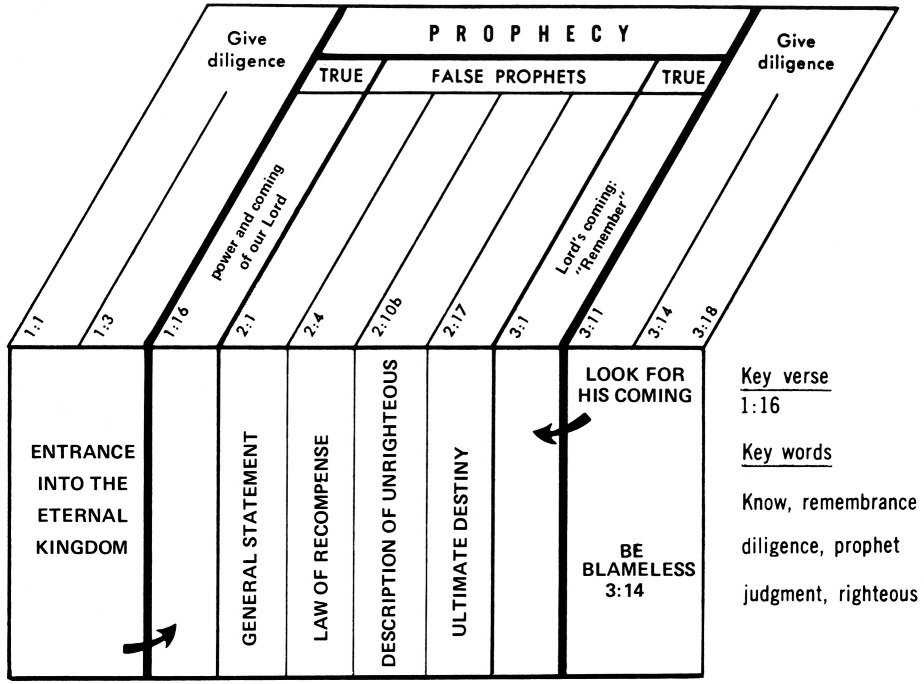
2 Peter: True and False Prophecy
Click chart to enlarge
Chart from Jensen's Survey of the NT - used by permission
|
2 PETER |
||||||||
| Cultivation of Christlike Character |
Condemnation of False Teachers |
Confidence in the Return of Christ |
||||||
| Greeting to Saints 2Pe 1:1-2 |
Growth in Christ 2Pe 1:3-14 |
Grounds |
Danger of |
Demise of |
"Decor" of |
Mockers in |
Manifest |
Maturity in light of that |
| Know Your Salvation |
Know |
Know Your Adversaries |
Know |
|||||
| True Prophecy (True Knowledge) |
False Prophets (False Teachers) |
Final Prophecy (Day of the Lord) |
||||||
| Holiness | Heresy | Hope | ||||||
| Development of Faith |
Denunciation of False Teachers |
Design of The Future |
||||||
2 Peter 1:3 seeing that His divine power has granted to us everything pertaining to life and godliness , through the true knowledge of Him who called us by His own glory and excellence. (NASB: Lockman)
Greek: os panta hemin tes theias dunameos autou ta pros zoen kai eusebeian dedoremenes (RMPFSG) dia tes epignoseos tou kalesantos (AAPMSG) hemas idia doxe kai arete,
Amplified: For His divine power has bestowed upon us all things that [are requisite and suited] to life and godliness, through the [full, personal] knowledge of Him Who called us by and to His own glory and excellence (virtue). (Amplified Bible - Lockman)
NLT: As we know Jesus better, his divine power gives us everything we need for living a godly life. He has called us to receive his own glory and goodness! (New Living Translation - Tyndale House)
Phillips: He has by his own action given us everything that is necessary for living the truly good life, in allowing us to know the one who has called us to him, through his own glorious goodness. (New Testament in Modern English)
Wuest: Seeing that all things to us His divine power has generously given, the things which pertain to life and godliness, through the experiential knowledge [which the believer has] of the One who called us [into salvation] by means of His own glory and virtue, (Eerdmans)
Young's Literal: As all things to us His divine power (the things pertaining unto life and piety) hath given, through the acknowledgement of him who did call us through glory and worthiness,
SEEING THAT HIS DIVINE POWER HAS GRANTED US EVERYTHING: hos panta hemin tes theias dunameos autou ta pros zoen kai eusebeian dedoremenes (RMPFSG):
- His divine power: Ps 110:3 Mt 28:18 Jn 17:2 2Co 12:9 Eph 1:19, 20, Ep 1:21 Col 1:16 Heb 1:3
- 2 Peter 1 Resources - Multiple Sermons and Commentaries
GOD'S POWER
FOR GODLY LIVING
Granted us everything - How much? What is lacking? Then why are we so anxious? (Mt 6:25+, Mt 6:31+, Mt 6:34+) Why do we so often have an attitude of grumbling instead of an attitude of gratitude? (Php 2:14+). This magnificent truth is echoed in other passages (Ps 23:1+; Ro 8:32+; Php 4:19+; Ps 84:11+)
Everything (pas) means just that...everything with no exceptions. Of course in the context of His good and perfect will, this refers to everything that is good for us to grow spiritually. You will note that the order in the original Greek is first "everything He has granted..." (Young's Literal -see above- is always a good source to look for the original word order if you are unable to read the Greek) emphasizing the total sufficiency available in Christ (Borrow MacArthur's Our sufficiency in Christ). When we are born into the family of God by faith in Christ, we are born complete in Christ (Col 2:10+). God gives you everything you will ever need “for life and godliness.” Nothing has to be added! “And ye are complete in Him” (Col. 2:10).
The divine bestowal is fully sufficient to resist all the assaults of the false teachers (remember the context of the book). We are possessors of everything we need to live the Christian life! Let us quit seeking broken cisterns that hold no Living Water (read God's diagnosis of Judah in Jer 2:13 - broken cisterns will lead to broken lives). The goal is that we obtain (Jn 10:10b style) life and become godly people that glorify our Father (actually a command in these two passages - Mt 5:16+, cf 1Co 6:20+). The source of this life and godliness is divine power (dispensed by the Spirit, cf Lk 4:14+ - The Holy Spirit-Walking Like Jesus Walked!) and the means by which this power produces this life and godliness is through the full knowledge of God and Jesus Christ.
His divine power - God's omnipotence at work for us and in us! Amazing truth! Amazing grace! God's power is not far off in some distant galaxy but is always abiding, always available and always adequate (the power of the indwelling Holy Spirit - cf Lk 24:49+, Ro 15:13+, Ro 15:19+, 1Co 2:4+, Eph 3:16+, 2Ti 1:7+).
THOUGHT Have you experienced His divine power in your life? Have you been born again? Then you have experienced His divine power (Jn 3:5)! Have you been able to truly forgive another who has unfairly wronged you? (Eph 4:32+, Eph 5:1-2+) Then you have experienced His divine power!
Divine (2304) (theios) describes an attribute of God such as His power and not His character in its essence and totality. See ISBE note below.
See also the commentary associated with tó theíon in Acts 17:29+, the the commentary associated with tó theíon in 2 Pe 1:3,4+; the commentary associated with theiótēs in Ro. 1:20+; and the commentary associated with theótēs in Col. 2:9+);
Theios is used five times in the Septuagint (LXX) (Ex. 31:3; 35:31; Job 27:3; 33:4; Pr 2:17) three times in the NT (Acts 17:29; 2Pe 1:3, 4) and is translated divine, 2; divine nature, 1. The KJV translates theios once as "Godhead".
Theios pertains to having the nature of God or as related to God by nature. In the next verse theios is used to refer to believers, not to be God or "gods" but to be a "partaker of the divine nature." Some teach a "modern theology" that believers are now "little gods" which is a lie. We are complete in Christ but we are not little gods. He Alone is God. The "Source" however does assure the efficacy and reliability of the gift to follow. The idea is that this is power which belongs to deity, here specifically to Jesus Christ Who is God. Christ’s power is the source of the believer’s sufficiency and perseverance. Just as His power saves us in the first place, so His power energizes us to live holy lives from then on. As Lenski has said "The deity of Jesus is the foundation of this entire epistle. Cancel it and a jumbled ruin is left."
In Acts Paul used theios in his famous sermon on the Areopagus refuting the thought that God was an idol (cf the altar inscription under an object of worship "TO AN UNKNOWN GOD" Acts 17:23+) declaring that God
"made from one, every nation of mankind to live on all the face of the earth, having determined their appointed times, and the boundaries of their habitation, that they should seek God, if perhaps they might grope for Him and find Him, though He is not far from each one of us; for in Him we live and move and exist, as even some of your own poets have said, 'For we also are His offspring.' "Being then the offspring of God (as even the pagan poets acknowledged), we ought not to think that the Divine Nature (theios - "the Godhead") is like gold or silver or stone (the logic is that God must be more than a man-made idol), an image formed by the art and thought of man. "Therefore having overlooked the times of ignorance, God is now declaring to men that all everywhere should repent." (Acts 17:26-30+)
ISBE (Revised) entry under "Deity" - DEITY [Gk. tó theíon] (Acts 17:29+); AV GODHEAD; [theiótēs] (Ro. 1:20+); AV GODHEAD; [theótēs] (Col. 2:9+); AV, NEB GODHEAD. These three closely related Greek terms are descriptive of the basic nature of God. They seem to vary but slightly in connotation.
A. Tó Theíon. Tó theíon (theios) “the divine thing,” is derived from the adjective theíos, meaning “pertaining to God,” “divine” (2 Pet. 1:3f+). It signifies “God” in an impersonal sense. In Acts 17:29+, in Paul’s speech to Greek intellectuals on Mars Hill, the term tó theíon draws attention to the qualitative aspect of God. Paul demonstrates the Greeks’ shallow conception of God, seeking to heighten their receptivity to the revealed truth of the gospel of Christ. The term tó theíon was common in their discussions, being used to designate the deity apart from any reference to a particular god. Paul focuses attention upon that quality of “the divine” which distinguishes God from all else. English terms based on the word “divine,” however, are used too commonly and are therefore inadequate to set forth the connotation of tó theíon (see II. A, B below). The idea is more adequately represented by “the Deity,” so that an appropriate translation of Acts 17:29 might be: “It is inconceivable that ‘the Deity’ can be appropriately represented by the artistic talents of men working with mere earthly elements.”
B. Theiótēs The term theiotes is an abstract noun closely related to tó theíon, derived from the same adjective, theíos. It is commonly understood as a summary term for the attributes of deity. However, the term merely “defines” with regard to essence, signifying “the quality of the divine,” that character which makes God God, and sets Him apart as worthy of worship. The Greeks used the term of their deities. Later it was applied to men by the Roman imperial cult as a term for the divinity of imperial majesty. It is rarely used in later Jewish works and occurs in biblical literature only in Wisd. 18:9 and Ro 1:20+. The term is not as impersonal as tó theíon, but its abstractness does not lend a readily discernible distinction. Its meaning is approximated by “deity,” perhaps “divineness.”
In Ro. 1:20+ theiótēs is used of that nature of the Creator discernible to the mind by observation of the existing worlds. Verse 19 states, “For what can be known about God is plain to them, because he has shown it to them.” Verse 20 affirms that man’s mind is able to form a concept of the invisible nature of God by visual perception of the universe. The discernible features of His transcendent being (“his invisible nature”) are specifically His “eternal power” and “deity.” The universe displays the eternal power it took to bring the universe into existence; in addition it displays the divine character of the one who created it, i.e., His deity. Specific attributes are not in view in the term theiótēs, simply His quality of “Godness,” which depicts Him as worthy of worship. But men suppressed this truth in unrighteousness (v 18), and are without excuse, subject to the wrath of God revealed from heaven (v 20). They did not acknowledge “his deity” as it is discernible in the things He has created.
C. Theótēs - Theotes is a kindred term (to theiotes), but is distinctive in that it is derived from the word “God” (theós). On this basis it is the most personal of the three terms (to theion - Acts 17:29+, theiotes - Ro 1:20+, theotes - Col 2:9+), and is nearly a name. Whereas tó theíon marks “the quality of deity,” and theiótēs connotes “that which makes God God,” theótēs signifies “the being of God.” Theótēs apparently denotes the utmost idea of God. On heathen lips it could do no more than designate their highest concept of God, “The Supreme Being.” In Col. 2:9+ Paul uses theótēs in declaring that “the whole fulness of deity dwells bodily” in Christ. Although it conveys the idea of a “being,” the use of “Divine Being” here would impersonalize the total expression, “the whole fulness of the Divine Being.” The term “deity,” or even “the Deity,” is likewise impersonal; furthermore, the connotation “being” is lacking. A term that better preserves the personal and qualitative aspect of theótēs is “godhead” (see III below). The total expression “the whole fulness of the Godhead,” then, signifies the sum of all that enters into the conception of “Godhead,” God in nature, character, and being. All this dwells in Christ “bodily,” i.e., in such a manner as to be shown in a bodily organism. Cf. Jn. 14:9, where Philip’s request that Jesus show them the Father was met by the Lord’s response, “He who has seen me has seen the Father.”
II. English Terms
In English the words most representative of these three Greek terms are “deity,” “divinity,” and “godhead.”
A. Deity “Deity” means “divine character” or “nature” and is used of false gods as well as of the persons of the trinity. “Deity” is qualitative in its import. The expression “the deity of Christ” is much stronger than “the divinity of Christ,” probably because “divinity” is commonly applied to men and things. When used with the article, the resultant term “the Deity” becomes a designation of God the Supreme Being, although it can also be used of specific lesser deities. Hence, the term “deity,” when used with the article, is qualitative and somewhat personal in connotation.
B. Divinity The term “divinity” is much like “deity” in that it refers to divine character or nature. But although it is used in connection with the persons of the trinity, it lacks the force of “deity.” These Latin derivatives bring into English the basic distinction created by the Latin fathers. Before the controversy about the deity of Christ, Latin had only the general term divinitas. The Latin fathers coined the term deitas as a distinctive rendering of the Gk. theótēs, and employed it to express the “deity” of the persons of the trinity. They, as well as the Greek fathers, needed unique terms to combat the attempt to ascribe to the Son and the Spirit a reduced “divinity.” This distinctiveness is largely preserved in English, although there is a tendency for “divinity” and “deity” to merge in meaning.
C. Godhead The English term “godhead” was originally a synonym for “Godhead,” a word that has all but passed out of use. As manhood is that quality which makes a man a man, so godhead is that which makes God God. This significance, however, is not readily discernible in the term today. It is presently a somewhat neutral term for the essential being of God as unique. By prefixing the article, the term becomes an abstract way of saying “God.” In fact, the article prefixed to any of these terms, “the Deity,” “the Divinity,” or “the Godhead,” draws attention to the constitutive qualities that make God the kind of being we call “God.” In strength of affirmation, or personalizing force, “godhead” seems most substantial, with “deity” nearly as strong and “divinity” weakest in this regard. All are abstract terms, nearly synonymous in meaning, yet the context will often decide the choice of one word over another.
III. Summary
Since the context of Col. 2:9+ deals with the person of Christ, Paul apparently chose a term distinctive in that respect, theótēs. The contexts of Acts 17:29+ and Rom. 1:20+ emphasize the character rather than the person of God. The terms used are impersonal in connotation. Because of these differences in context and word derivation it is preferable to use distinctive English terms. “Deity” seems appropriate for the concept of tó theíon in Acts 17:29+ and for theiótēs in Rom. 1:20+, but inadequate for theótēs in Col. 2:9+. “Godhead” more adequately portrays the truth that all that constitutes God in person, character and being dwells in Christ the Son. Speaking of God in respect to His “Godness” the term “deity” is sufficient, but in reference to His person and/or being a designation with the word “god” seems preferable. (G. E. Montgomery)
Power (1411) (dunamis from dunamai = to be able, to have power) power especially achieving power. It refers to intrinsic power or inherent ability, the power or ability to carry out some function, the potential for functioning in some way (power, might, strength, ability, capability), the power residing in a thing by virtue of its nature.
Dunamis is the implied ability or capacity to perform. It conveys the idea of effective, productive energy, rather than that which is raw and unbridled.
Note that words derived from the stem duna— all have the basic meaning of “being able,” of “capacity” in virtue of an ability. Duna- is the root for English words like dynamic, dynamo, dynamite, etc.
Dunamis is the word generally used by Paul of divine energy.
Scripture uses dunamis to describe deeds that exhibit the ability to function powerfully (deeds of power, miracles, wonders) (eg, see Mt 11:20, 23, 13:54, 58, etc)
Sometimes dunamis is used to represent an entity or being that functions with remarkable power, especially being used to describe angel as powers (eg, see notes Romans 8:38, Ephesians 6:12)
There is an instructive use of dunamis later in 2Timothy where Paul describes men...
holding to a form of godliness, although they have denied its power (dunamis); and avoid such men as these. (See + 2 Timothy 3:5)
Comment: The point is that the so-called godliness of these men is a sham and devoid of any real divine power to break the power of Sin. Those who practice such deception enjoy the enjoy expressions of evangelical worship but they are violently at odds with the gospel’s internal effects of subduing sin and nurturing holiness. They lack the inherent ability or capability, the dunamis, because they lack the indwelling Spirit Who strengthens with power for which Paul prays in Ephesians 3:16. The corollary is that those who possess the indwelling Spirit and divine dunamis have the inherent ability to wage victorious battle with the believer's three mortal enemies, the world, the flesh and the devil, all seeking to turn us from God and unto self -- flesh -- and its ungodly, unholy attitudes and actions. One can readily see the importance of praying for believers to be strengthened with dunamis power through the Spirit in their inner man - see Ephesians 3:16.
William MacDonald comments on Paul's reminder to Timothy of his access to God's "dunamis" writing that...
Unlimited strength is at our disposal. Through the enabling of the Holy Spirit, the believer can serve valiantly, endure patiently, suffer triumphantly, and, if need be, die gloriously. (Borrow Believer's Bible Commentary)
Here in 2 Peter, dunamis describes that power which is uniquely God's and proceeds from Him. Jesus by this same inherent power presently "upholds (present tense = continually!) all things by the word of His power" (He 1:3+). If He by this same power is holding all things together, can He not "hold my life together"? Can He truly provide me with everything I need to weather whatever storm might come, to scale whatever mountain obstacle might be thrown in my path? Indeed "He is able" (Meditate on the wonderful phrase "He is able" in Da 4:37+, 2Ti 1:12+, He 2:18+, He 7:25+).
His divine power is a title for God used by Jews who revered Him so much that they would not pronounce His name.
John Piper adds that the Christian faith is not merely a set of doctrines to be accepted. It is a power to be experienced. It is a tragic thing to ask people if they know the Lord and have them start listing the things they believe about the Lord. Brothers and sisters, believing things about Jesus Christ will save no one. The devils are the most orthodox believers under heaven. It is divine power that saves. If the power of God does not flow into your life and make you godly you are not Christ's. "All who are led by the Spirit of God are the sons of God" (Ro 8:14+). The mark of sonship is divine power. And the mark of power is godliness; which means a love for the things of God and a walk in the ways of God." (Read or listen to the full sermon Liberating Promises on 2 Peter 1:1-4)
He gives the power supply (that reflects God's sovereignty - Php 2:13+). Man's part (responsibility) is to walk daily in this full knowledge, trusting Him that He Who called us is faithful and He will bring it to pass (Php 2:12+) (See more discussion of this important Paradoxical Principle of 100% Dependent and 100% Responsible). The choice is ours to receive and believe, to walk by faith (Col 2:6+).
Philippians 4:11-13 teaches that our circumstances are some of our best ''tutors'', so that like Paul we too might come to know by experience
"the secret of being filled and going hungry, both of having abundance and suffering need" (Php 4:11, 12+) and that we "can do all things through Him who strengthens" us. (Php 4:13+)
The false teachers may have claimed that they had a “special doctrine” that would add something to the life of Peter’s readers, but Peter counters this false teaching. Just as a baby is born with all the “equipment” he needs for life and only needs to grow, so the Christian has all that is needed and it remains then for him or her only to grow. God never has to call back any of His “models” because something is lacking or faulty. When you are born into the family of God by faith in Christ, you are born complete.
Granted (1433) (doreomai from dorea = gift <> from doron means to bestow gratuitously or to make a gift of and is not the usual word for give (didomi) but a richer, more munificent word which emphasizes the generosity of the Giver. It carries the idea of grace by the giver. God gives His promises with no strings attached.= free gift which stresses gratuitous character)
Doreomai is used 3 times in the NT in NASB (Mark, 2 Peter 2x). There are 4 uses of doreomai in the Septuagint (Ge 30:20; Lv 7:15; Esther 8:1; Pr 4:2)
In the present use doreomai denotes the free giving of the power of God resulting in life and godliness. Doreomai indicates that this divine power does not give life and godliness because somebody deserves it, but because it is a free gift.
The English word "grant" means to give as a favor or a right, to bestow or transfer formally and implies giving to a claimant or petitioner something that could be withheld.
Arndt & Bauer say that doreomai means to "present something as a gift or confer a benefit, probably with some suggestion of formality."
Wuest quoting Strachan adds that doreomai “and its cognates always carry a certain regal sense describing an act of large-handed generosity.” (Word Studies - Eerdmans)
Doreomai is used when Joseph of Arimathea came before Pilate, and asked for the body of Jesus. Pilate upon "ascertaining (that Jesus was already dead) from the centurion, granted (doreomai) the body to Joseph." (Mk 15:45)
The body of Christ having been freely given by Pilate to Joseph of Arimathea, implying that Pilate had complete authority over the body.
Doreomai is in the perfect tense which pictures the past completed act of presenting the gift ("everything pertaining...") with the present result that it is in the possession of the believer with no strings tied to it. In other words God gave us these promises in the past with the result continuing to the present. All along our spiritual journey, God gives us spiritual equipment for the pilgrim pathway. You may not "feel" like you have these gifts as you read this truth, but the fact is they are your present possession in Christ and nothing can change that truth. What you do with what you possess however is your choice. Remember, beloved of God, it makes no difference how you feel because praise God our feelings do not determine our spiritual status (position) in Christ (see notes in Christ and in Christ Jesus). Notice however that believers do have a responsibility to "work out your salvation in fear and trembling." (Php 2:12+). Peter says "everything necessary for life and godliness" is "through the true knowledge of Him" which implies that we become aware of the specific promises God has granted us as we learn about Him in and through His Spirit illuminated Word of life. Are you eating the Word of Truth daily as if your (spiritual) life depended on it? This truth was the secret that Job had "tapped" into and which sustained him during one of the most difficult trials any human has ever experienced (see Job 23:12+). See a parallel principle in Ezra 7:10+.
As Jerry Bridges rightly states "It is impossible to practice godliness without a constant, consistent and balanced intake of the Word of God in our lives." I like to say it is IM-possible, and only HIM-possible! Only possible be the enabling power of the indwelling Spirit of Christ!
Charles Hodge echoes this truth writing that believers "are transformed into the image of the Lord by beholding it, not by reflecting it."
2Co 3:18 But we all, with unveiled face, beholding as in a mirror the glory of the Lord, are being transformed (aka progressive sanctification) into the same image from glory to glory, just as from the Lord, the Spirit.
R B Kuiper adds that "He who attempts to stress Christian living by disparaging Christian doctrine is guilty of a most serious blunder. He neglects the important fact that Christian living is rooted in Christian doctrine."
Editorial comment - that is why Paul's epistles on Christian living often demonstrate the balance of doctrine first (Ephesians first 3 chapters, Colossians first two chapters), then duty! It is a grave mistake to try to live out a supernatural life without the knowledge of supernatural truth!
Erwin W. Lutzer notes that "The difference between worldliness and godliness is a renewed mind." (Eph 4:23+)
Editorial comment - Yes, that is true, but only as we make those moment by moment choices to direct our steps according to that renewed thinking. Renewed thinking is good, but is not a guarantee of righteous behavior. We must continually jettison self-effort and continually rely on the power of the Spirit to enable us to carry out the directives that emanate from a renewed mind!)
The great Scottish Bible expositor Alexander Maclaren wrote: ‘We may have as much of God as we will. Christ puts the key of the treasure-chamber into our hand, and bids us take all that we want. If a man is admitted into the bullion vault of a bank and told to help himself, and comes out with one cent, whose fault is it that he is poor?” (2 Peter 1:3 Man Summoned by God's Glory and Energy; 2 Peter 1:4 Partakers of the Divine Nature)
Life and godliness are now our permanent possession, having been given by pure grace. Maybe you are thinking just now that you really don't have what it takes to "make it" in this life. Peter says that God’s power gives us what we need to experience real life in a way that pleases Him. God wants to affect every area of our lives—work, marriage and family, relationships, church, and community. How can you make God’s power operational in your experience? Peter says that it comes “through the knowledge of Him who called us.” In other words, we must grow closer to Christ (see discussion below). And remember that while the writings of teachers and preachers can help us better understand the Bible, only the Bible can impart life to our souls (cf Mt 4:4, Job 23:12+).
EVERYTHING PERTAINING TO LIFE: hos panta hemin pros zoen:
- Everything: Ps 84:11 Ro 8:32 1Co 3:21, 22, 23 1Ti 4:8
- 2 Peter 1 Resources - Multiple Sermons and Commentaries
GOD'S PROVISION FOR LIVING
GODLY IN A GODLESS WORLD
What is God's provision? EVERYTHING we need to live godly!
Everything (pas) in simple terms means everything without exception. Believers have all they need to grow in grace and Christ likeness and to daily live out the Christ life. Why do we so often continually run to "drink" of broken cisterns (Jer 2:13) filled with worldly wisdom, when we have access to the inexhaustible treasure troves of God's perfect wisdom in Christ and taught by His Spirit? We do this because we are too often walking by the flesh and not by the Spirit (Gal 5:16+).
To is the Greek preposition "pros" meaning toward or in the direction of, conveying the picture that God has given us all things that we might continually "move" in the direction of real life ("partakers of His divine nature" - 2Pe 1:4) as He has always desired for man created in His image.
Life (979) (zoe) speaks of life in the sense of one who is possessed of vitality and animation and is the direct antithesis of "death". It is used of the absolute fulness of life, both essential and ethical, which belongs to God. It is used to designate the life which God gives to the believing sinner, a vital, animating, spiritual, ethical dynamic which transforms his inner being and as a result, his behavior.
Zoe is real, genuine life, the way God intended for man to live...the way Adam and Eve lived in harmony with God and each other (cp Ge 3:7, 12) before Satan tempted them with his ''counterfeit'' life (Ge 3:1 - note how Satan's foundational deception is to make us doubt the loving God's promises and provision to enable us to live life abundantly) -- only God gives the ''real'' thing!
Zoe - 135 NT uses -Matt. 7:14; 18:8f; 19:16f, 29; 25:46; Mk. 9:43, 45; 10:17, 30; Lk. 10:25; 12:15; 16:25; 18:18, 30; Jn. 1:4; 3:15f, 36; 4:14, 36; 5:24, 26, 29, 39f; 6:27, 33, 35, 40, 47f, 51, 53f, 63, 68; 8:12; 10:10, 28; 11:25; 12:25, 50; 14:6; 17:2f; 20:31; Acts 2:28; 3:15; 5:20; 8:33; 11:18; 13:46, 48; 17:25; Rom. 2:7; 5:10, 17f, 21; 6:4, 22f; 7:10; 8:2, 6, 10, 38; 11:15; 1 Co. 3:22; 15:19; 2 Co. 2:16; 4:10ff; 5:4; Gal. 6:8; Eph. 4:18; Phil. 1:20; 2:16; 4:3; Col. 3:3f; 1 Tim. 1:16; 4:8; 6:12, 19; 2 Tim. 1:1, 10; Tit. 1:2; 3:7; Heb. 7:3, 16; Jas. 1:12; 4:14; 1 Pet. 3:7, 10; 2 Pet. 1:3; 1 Jn. 1:1f; 2:25; 3:14f; 5:11ff, 16, 20; Jude 1:21; Rev. 2:7, 10; 3:5; 7:17; 11:11; 13:8; 16:3; 17:8; 20:12, 15; 21:6, 27; 22:1f, 14, 17, 19
If EVERY saint has EVERY thing they need to live the ABUNDANT LIFE, why are so few living on that high plane? Maybe many are like Chief Crowfoot. When Crowfoot, the chief of the Blackfoot nation in southern Alberta, gave the Canadian Pacific Railway permission to lay track from Medicine Hat to Calgary, he was given in exchange a lifetime railroad pass. Reportedly, Crowfoot put the pass in a leather pouch and wore it around his neck for the rest of his life—but he never once availed himself of the rights and privileges it spelled out! How many Christians are like Chief Crowfoot, possessors of "all the treasures of wisdom & knowledge" in Christ (Col 2:3+) and yet living day by day as veritable spiritual paupers? What's the solution? Stop living in the world (loving the world), letting it squeeze you into its mold and begin getting into the Word and letting it conform you into the image of Jesus Christ, growing in the grace and knowledge of Him (2Pe 3:18+). If you're not in a serious Bible study, for the sake of your spiritual health, you cannot afford not to be. And if you say you're too busy for a serious Bible study, then the truth is that you are too busy! (See "The Key: Inductive Bible Study")
Maurice Roberts was right when he said that...
If society is to be awakened one day from its deep slumber, it will only be done by Christians who have first woken up themselves to the full splendour of their privilege and who have taken seriously the call to live wholly and entirely for God.
Spurgeon in his sermon (2 Peter 1:1-4 Faith and Life) flatly states that...
The two most important things in our holy religion are faith and life. He who shall rightly understand these two words is not far from being a master in experimental theology.
Faith and life! These are vital points to a Christian. They possess so intimate a connection with each other that they are by no means to be severed; God hath so joined them together, let no man seek to put them asunder.
You shall never find true faith unattended by true godliness; on the other hand, you shall never discover a truly holy life, which has not for its root and foundation a living faith upon the righteousness of our Lord Jesus Christ.
Woe unto those who seek after the one without the other! There be some who cultivate faith and forget holiness; these may be very high in orthodoxy, but they shall be very deep in damnation, in that day when God shall condemn those who hold the truth in unrighteousness, and make the doctrine of Christ to pander to their lusts.
There are others who have strained after holiness of life, but have denied the faith; these are comparable unto the Pharisees of old, of whom the Master said, they were “whitewashed sepulchers-.” they were fair to look upon externally, but inwardly, because the living faith was not there, they were full of dead men's bones and all manner of uncleanness.
Ye must have faith, for this is the foundation; ye must have holiness of life, for this is the superstructure.
Of what avail is the mere foundation of a building to a man in the day of tempest? Can he hide himself among sunken stones and concrete? He wants a house to cover him, as well as a foundation upon which that house might have been built; even so we need the superstructure of spiritual life if we would have comfort in the day of doubt.
But seek not a holy life without faith, for that would be to erect a house which can afford no permanent shelter, because it his no foundation on a rock-a house which must come down with a tremendous crash in the day when the rain descends, and the floods come, and the winds blow, and beat upon it (see notes Matthew 7:24).
Let faith and life be put together, and, like the two abutments of an arch, they shall make your piety strong. Like the horses of Pharaoh's chariot, they pull together gloriously. Like light and heat streaming from the same sum, they are alike full of blessing. Like the two pillars of the temple, they are for glory and for beauty. They are two from the fountain of grace; two lamps lit with holy fire; two olive-trees watered by heavenly care; two stars carried in Jesus' hand. The Lord grant that we may have both of these to perfection, that His Name may be praised. (Amen and Amen!)
GOD-LIKENESS
George Swinnock has an interesting "definition" of godliness writing that "Godliness is nothing but God-likeness."
Godliness (2150) (eusebeia [word study] from eu = well + sebomai = reverence. Sebomai is in turn derived from "seb" which refers to sacred awe or reverence exhibited especially in actions) means "well worship" and reflects an attitude of one's life to live with a sense of God's presence and a desire motivated by love to be pleasing to Him in all things we say, do and think. It is that inner attitude of reverence which naturally manifests itself in God pleasing activity. The godly man or woman lives above the petty things of life, the passions and pressures that control the lives of others. The order of "life" before "godliness" in the Greek text is significant for it is not by godliness that we obtain life but by life that we attain to godliness. Supernatural life and godliness are not native to the human heart but only the result of God's gift freely "granted".
Eusebeia - 15x in 15v in the NAS = Acts 3:12+; 1Ti 2:2 = prayer for our leaders that we may life this quality of life; 1Ti 3:16; 1Ti 4:7, 8+ - a quality worthy of disciplining ourselves to achieve; 1Ti 6:3 - godliness should result from teaching sound doctrine, 1Ti 6:5, 6+- Godliness associated with contentment, 1Ti 6:11+- Quality to be actively chased after!; 2Ti 3:5+-there is a fake godliness but it lacks spiritual power; Titus 1:1+-The fruit of gaining knowledge of Christ should be godliness.2 Pet. 1:3, 6, 7+; 2Pe 3:11+-The promised dissolution of this present earth should motivate a pursuit of godliness.
George Swinnock has an interesting "definition" of godliness writing that "Godliness is nothing but God-likeness."
Godliness pictures a man or woman who is empowered by grace (sanctifying grace) and the indwelling Holy Spirit to conduct themselves in reverence and awe of God, maintaining such a consciousness of God’s presence (cp "Coram Deo" - before the face of God) that they live as if He were ever watching (which He is!) and strive by His power to live as Christ lived when He walk this earth as the God-Man. Godliness means to live seeking to be like God, ever seeking to possess the very character, nature, and behavior of our glorious God. The godly man or woman of follows and even runs after godliness as if pursuing the precious treasure which it in fact is (see 1Ti 4:7+;1Ti 4:8+). They seek to gain and continually live in the atmosphere of the consciousness of God’s presence.
George Meisinger comments that...
“Godliness” is godly living, living according to the will of God. It is the kind of obedience that results from walking in the Spirit (Ro 8:4+). Since the Lord Himself gives all things powerfully and graciously, the upshot is that we do not need for a genuine experience of life and godliness - the philosophies of the world’s great thinkers, the regulations of tradition, psychology’s help, psychotherapy’s insights, the divinations of New Age proponents, or the latest fads and gimmicks of Madison Avenue, to enjoy life fully and to reap the benefits God gives to those who learn and believe His promises.
All we need to enter into life completely and fulfillingly, and to walk worthily of the grace of God, is in God’s Word. The Scripture. The Bible. The Book. That’s why Jesus said to a dear, but distracted friend
Martha, Martha, you are worried and troubled about many things. But one thing is needed, and Mary has chosen that good part, which will not be taken away from her (Luke 10:41–42).
So if you today say, “I am not satisfied with my life.” Diligently pursue the Word of God. It is God’s powerful and gracious provision for an authentic experience of life. If you say, “I am not sure what the will of God for my life is,” dig in the Scripture. You find the Lord’s provision for everything there. (Read the entire article - The Sufficiency of Scripture for Life and Godliness 2 Peter 1:1-4)
John Piper adds that "if the way of godliness is rejected so is the hope of eternal life. So Peter forbids us to turn our faith into a fire insurance policy for escaping hell while our lives remain unchanged. The hope of life and the way of godliness stand or fall together. (read or listen to Dr Piper's full message entitled Liberating Promises)
MacArthur writes that "To be godly is to live reverently, loyally, and obediently toward God. Peter means that the genuine believer ought not to ask God for something more (as if something necessary to sustain his growth, strength, and perseverance was missing) to become godly, because he already has every spiritual resource to manifest, sustain, and perfect godly living (MacArthur Study Bible)
GODLINESS
A love for God
the things God loves
an attitude & action consistent with that love
Hiebert explains Godliness - There is an intimate connection between truth and godliness. A vital possession of truth is inconsistent with irreverence…Real truth never deviates from the path of piety. A profession of the truth which allows an individual to live in ungodliness is a spurious profession (Hiebert, D. Edmond: 1 Peter)
Godliness is not talking "godly" but living "godly".
John Calvin wrote "Godliness separates us from the pollutions of the world, and by true holiness unites us to God. There is a certain secret majesty in holy discipline and in sincere godliness."
J. I. Packer rightly said that "The godly man's dearest wish is to exalt God with all that he is in all that he does.:
Jerry Bridges said that godliness "is devotion to God which results in a life that is pleasing to Him."
The OT would say godly living is living with a proper "fear of the Lord", where fear conveys a sense of reverential awe, of living Coram Deo (before the face of God), recognizing that all evil is a direct affront ("in His face") to His holy character. Such a God focused person will not sin presumptively, taking no thought of the insult such sin is against God's holiness. Thus we see "godly men" in the OT like Job "fearing God and turning away from evil" (Job 1:1). Evil will be constantly "in our face" until glory but we are to constantly make the conscious decision to turn from evil, motivated by a heart desire to be pleasing (2Cor 5:9) to our Lord Who has loved us.
In Titus 2 Paul speaks of adorning the doctrine of God our Savior or make the teachings of Christianity "attractive" (Titus 2:10+). The best way to do is not by our "lips" but by our "life", by our behavior before the looking lost (and saved) world, for as Geoffrey B. Wilson put it "A godly life is always the best advertisement for Christianity." (Amen).
Related Resources:
- What does it mean that godliness with contentment is great gain (1 Timothy 6:6)?
- Is cleanliness next to godliness?
- What does it mean to have a form of godliness but deny its power in 2 Timothy 3:5?
- What does the Bible say about being a godly woman?
- Practical Godliness - A W Pink
- The Exercise and Profit of Godliness - J C Philpot
- The Godly Man's Picture (or book) - Thomas Watson
- The Great Gain of Godliness - Thomas Watson
- The Power of Godliness - James Smith - Excerpt: "Godliness has been represented as devotion. But devotion is but a part of godliness — and a very small part of it too. Godliness embraces God's work in the man, and the man's work for God. It is God-likeness. The godly man has the image of God impressed on his heart. He is new-created, that he may bear the likeness of Jesus. He is renewed in knowledge, after the image of him that created him. The moral perfections of God are stamped on his. Justice, truth, holiness, mercy, and love, are his characteristics: and in proportion to the depth and power of the work of the Holy Spirit in his heart — do these things appear in his life. To be perfectly like God, in his moral excellencies, is the abiding desire of his soul. For this he labors. For this he prays. At this he aims. And looking forward to his future destination, he says, "I shall be satisfied, when I awake with your likeness." He loves holiness above all things else, and so far as he is godly — he has no sympathy with sin. In Godliness there is power. Viewed as the work of the Holy Spirit in a man, (ED: DON'T MISS THIS - THE SPIRIT IS THE POWER FOR TRUE GODLINESS!) it is a powerful work."
- American Tract Society Godly
- Baker Evangelical Dictionary Godly, Godliness
- Charles Buck Dictionary Godliness
- Easton's Bible Dictionary Godliness
- Holman Bible Dictionary Godliness
- Hastings' Dictionary of the NT Godliness
- Morrish Bible Dictionary Godliness
- Vines' Expository Dictionary Godliness, Godly
- Watson's Theological Dictionary Godliness
- International Standard Bible Encyclopedia Godliness; Godly
- McClintock and Strong's Bible Encyclopedia Godliness
- The Jewish Encyclopedia Godliness
- King James Dictionary Godly Godliness
GODLINESS, n. from godly. Piety belief in God, and reverence for His character and laws. A religious life a careful observance of the laws of God and performance of religious duties (ENABLED BY THE HOLY SPIRIT), proceeding from love (Gal 5:22+) and reverence for the divine character and commands. Christian obedience. Godliness is profitable unto all things. 1 Timothy 4:8+ .
THROUGH THE TRUE KNOWLEDGE OF HIM: dia tes epignoseos:
- through: 2Pe 1:2 Jn 17:3
- 2 Peter 1 Resources - Multiple Sermons and Commentaries
THE SOURCE OF
EVERYTHING WE NEED
Through (dia) means the instrument by which something happens and here means by means of true knowledge of Jesus Christ.
Dia unlocks the door of the abundant life (Jn 10:10). This life in turn is "energized" by true knowledge of God & Christ which emphasizes the absolutely critical importance of saints letting the Word of Christ continually dwell in us richly (Col 3:16+), partaking of the "pure (no additives) milk of the Word" (1Pe 2:2+).
There is a phenomena in modern day Christianity in which many are much more interested in reading novels about God's plan for the future rather than reading inspired Scriptures about the events that will soon to come to pass. The result is that many are arriving at their "theology" from novels. This is not to dismiss all Christian novels as worthless but it should challenge each of us -- if I spend 15-20 hours reading a novel like "Left Behind" am I willing to spend at least an equal amount of time studying Revelation, Mt 24, 2Thes 2, 1Thes 4, Daniel and Zech 12-14, the passages that tell the real story of "Left Behind"(!) etc? If not, then we need to ask "why not?" Sheep grow the best wool when they are fed the most nutritious grain.
Spurgeon writes that...It is through knowing God that we realize that “his divine power hath given unto us all things that pertain unto life and godliness,” for all these things are in him; and as we know him, trust him, love him, and become like him, we also come to possess all these precious things in him.
True Knowledge (1922) (epignosis from gnosis = knowledge gained by experience + epi = here used to intensify the meaning) (Click for an in depth word study of epignosis) means a full, precise knowledge thus signifying a more complete, more thorough, larger knowledge than that found in gnosis. Epignosis also implies a more intimate and personal relationship than gnosis. The learner exhibits a more thorough participation in the acquiring of knowledge. In the NT epignosis often refers to knowledge which very powerfully influences the form of one's spiritual life (in contrast to gnosis which Vincent says "may be concerned with the intellect without affecting the character"). Epignosis is not indicative of an intellectual understanding of the truth alone but a heart submission and appropriation of the same although clearly there are exceptions to this latter statement (e.g., 2 Peter 2:20+).
Epignosis - 20 NT uses -Ro 1:28; 3:20; 10:2; Ep 1:17; 4:13; Php 1:9; Col. 1:9, 10; 2:2; 3:10; 1Ti 2:4; 2Ti 2:25; 3:7; Titus 1:1; Philemon 1:6; He 10:26; 2Pe 1:2, 3, 8; 2:20
Epignosis is thus a knowledge laying claim to personal involvement. Peter wants saints to understand the riches available to them in GOD'S knowledge. Ideally epignosis controls and directs one's behavior. Ignorance contrary to popular thought is NOT bliss.
How do we obtain this "epignosis" this experiential true knowledge of Jesus? Obviously this knowledge has to be somehow related to intake of His word, but it is more than just an intellectual pursuit. Jesus Himself gives us a clue in (Jn 14:21) saying that
"He who has My commandments and keeps them, he it is who loves Me; and he who loves Me shall be loved by My Father, and I will love him, and will disclose Myself to him."
To me this promise is surely one of the most incredible "precious and magnificent promises" in all the Word of God. Notice that the verbs "has" and "keeps" are both present tense which calls for to a lifestyle of reading and then obeying His Word. The one who follows this path, finds that he will experience an ever increasing intimacy in his or her relationship with Jesus as He discloses (makes manifests or evident) Himself to greater and greater degrees. Not visibly of course but nevertheless in a very real spiritual or supernatural sense. Don't you desire this level of intimate experiential knowledge with your Savior and Lord? His desire is that we realize this quality of a relationship.
WHO HAS CALLED US: tou kalesantos (AAPMSG) hemas:
- Called - Ro 8:28-30 9:24 1Co 1:9 Eph 4:1,4 1Th 2:12 4:7 2Th 2:14 2Ti 1:9 1Pe 1:15 2:9,21 3:9 5:10 Ro 1:1, 7, 8:28-30; 8:30, 9:24; 1Cor 1:2, 1Cor 1:9; 1Cor 1:24, 1Co 1:26, Ga 1:6; Eph 1:18, 4:1, 1Th 2:12; 2Th 2:14; 2Ti1:9; Heb 3:1; 1Pet 2:9,21;2 Pet 1:10;Jude 1:1, Rev 17:14,
- Torrey's Topic Call of God
- 2 Peter 1 Resources - Multiple Sermons and Commentaries
AN "EFFECTUAL"
CALL
Called - See word studies on related words called (kletos) and calling (klesis).
Who are the called? Believers are called "with a holy" (2 Timothy 1:9+), "heavenly" calling" (Hebrews 3:1+) "out of darkness into His marvelous light" (1 Peter 2:9+) "by grace" (Gal 1:6) "not from among Jews only, but also from among Gentiles" (Romans 9:24+) through the "gospel" that we "may gain the glory of our Lord Jesus Christ" (2Th 2:14) and be brought "into fellowship with His Son, Jesus Christ our Lord" (1Cor 1:9) and return "with Him" (see Revelation 17:14 - +). Glory!
Who are the called? They are those who have heard. The Lord Jesus made it clear when He said
My sheep hear My voice, and I know them, and they follow Me (Jn 10:27).
If you are following someone or something else, you haven’t heard Him, you are not one of His sheep. The ones who hear and follow Him are the called ones. Let’s not argue about election. It is as simple as this: He calls, and you answer. If you have answered, you are among the elect, one of “the called of Jesus Christ.” Peter assures the saints that they are called ones. In the writings of both Paul and Peter when they mention "called" ("call", "calling", etc), the reference is to an "effectual" call, that is a call which is answered and thus "the called" equates essentially with those who are "the chosen" or "the elect". Note that the gospels use the term "called" differently -- in (Mt 22:1, 2, 3, 4, 5, 6, 7, 8, 9, 10, 11, 12, 13,14) many were "called" to the "wedding feast" but few were "chosen", so in the gospels the term call was not synonymous with an effectual call to salvation.
BY HIS OWN GLORY AND EXCELLENCE: idia doxe kai arete:
- Excellence (KJV - Virtue) - 2Pe 1:5 Ru 3:11 Pr 12:4 31:10,29 Php 4:8
- 2 Peter 1 Resources - Multiple Sermons and Commentaries
His own Whose own? The indescribable God (Listen to Chris Tomlin's - Indescribable; Indescribable #2 ; How Great Is Our God). There is no glory or excellence like His own!
Glory (1391) (doxa from dokéo = think, recognize) The root verb dokéo, means to think or suppose, and so doxa means thought or opinion, especially favorable human opinion, and thus in a secondary sense reputation, praise, honor (true and false), splendor, light, perfection, rewards (temporal and eternal).
The doxa of man is human opinion and is shifty, uncertain, often based on error, and its pursuit for its own safety is unworthy. The glory of God is absolutely true and changeless. Glory, therefore, is the true apprehension of God or things. The glory of God must mean His unchanging essence. Giving glory to God is ascribing to Him His full recognition. The true glory of man, on the other hand, is the ideal condition in which God created man. This condition was lost in the fall and is recovered through Christ and exists as a real fact in the divine mind. The believer waits for this complete restoration.
The glory of God is what He is essentially; the glory of created things including man is what they are meant by God to be, though not yet perfectly attained.
Glory' speaks of a manifestation of God's true nature, presence, or likeness. He is glorified when He is allowed to be seen as He really is. To be where God is will be glory. To be what God intended will be glory. To do what God purposed will be glory.
Meisinger - “By glory” is by means of what glorifies God and is in keeping with His glorious person and plan.
Excellence (703) (arete [word study]) refers to any preeminence (moral, intellectual, military). In the classical Greek it referred to the God-given ability to perform heroic deeds.
Arete came to mean quality of life which made someone stand out as excellent. Arete never meant cloistered virtue, or virtue of attitude, but virtue which is demonstrated in life. To the Greek philosophers, arete meant “the fulfillment of a thing.” When anything in nature fulfills its purpose, that is “virtue" or "moral excellence.” The land that produces crops is “excellent” because it is fulfilling its purpose. The tool that works correctly is “excellent” because it is doing what a tool is supposed to do.
Arete - 5 uses in the NT - Phil. 4:8; 1Pet. 2:9; 2Pet. 1:3, 5
Here Peter is saying that the Lord Jesus is the One who called us by means of His own uniquely possessed glory and excellence (His personal moral excellence).
Wuest says that these "words are in the instrumental case in the Greek text, and the word idios (Greek word for "own") is included...which means “one’s own private, unique, peculiar possession.” (Word Studies - Eerdmans)
It was the attracting power of our Lord’s beautiful life that worked effectively in the act of God calling us into salvation.
The great Scottish Bible expositor Alexander Maclaren once wrote ‘We may have as much of God as we will. Christ puts the key of the treasure-chamber into our hand, and bids us take all that we want. If a man is admitted into the bullion vault of a bank and told to help himself, and comes out with one cent, whose fault is it that he is poor?” (Today in the Word. Moody Bible Institute)
2 Peter 1:4 For by these He has granted to us His precious and magnificent promises, so that by them you may become partakers of the divine nature, having escaped the corruption that is in the world by lust. (NASB: Lockman)
Greek: di' on ta timia kai megista hemin epaggelmata dedoretai, (3SRMI) hina dia touton genesthe (2 PAMS) theias koinonoi phuseos apophugontes (AAPMPN) tes en to kosmo en epithumia phthoras
Amplified: By means of these He has bestowed on us His precious and exceedingly great promises, so that through them you may escape [by flight] from the moral decay (rottenness and corruption) that is in the world because of covetousness (lust and greed), and become sharers (partakers) of the divine nature. (Amplified Bible - Lockman)
Barclay: and since through these gifts there have been bestowed upon us precious and very great promises, that through them we might escape the world’s corruption caused by lust and become sharers in the divine nature (Westminster Press)
NLT: And by that same mighty power, He has given us all of His rich and wonderful promises. He has promised that you will escape the decadence all around you caused by evil desires and that you will share in his divine nature. (New Living Translation - Tyndale House)
Phillips: He has by his own action given us everything that is necessary for living the truly good life, in allowing us to know the one who has called us to him, through his own glorious goodness. It is through him that God's greatest and most precious promises have become available to us men, making it possible for you to escape the inevitable disintegration that lust produces in the world and to share in God's essential nature. (New Testament in Modern English)
Wuest: by means of which [glory and virtue] there have been generously given to us the precious and exceedingly great promises in order that through these you might become partakers of the divine nature, having escaped by flight the corruption which is in the world in the sphere of passionate cravings. (Eerdmans)
Young's Literal: through which to us the most great and precious promises have been given, that through these ye may become partakers of a divine nature, having escaped from the corruption in the world in desires.
FOR BY THESE HE HAS GRANTED TO US HIS PRECIOUS: di' hôndedoretai (3SRMI) ta timia:
- He has granted Ezekiel 36:25, 26; 36:27 Ro 9:4; 2Co 1:20; 6:17,18; 7:1; Gal 3:16; Heb 8:6-12; 9:15; 1Jn 2:25
- 2 Peter 1 Resources - Multiple Sermons and Commentaries
A PERMANENT PRECIOUS
DIVINE GIFT
By is the preposition "dia" which is a marker of instrumentality or circumstance whereby something is accomplished or effected
Granted (1433) (doreomai) is the same rare verb used in (v3) means to bestow gratuitously and carries with it the idea of the worth of the gift. The perfect tense again indicates that the giving occurred in the past as a completed action but the effect still going on. This speaks of the permanence of the granting!
- All Peter's uses of "precious": 1Pe 1:7, 1:19, 2:4, 2:6, 2:7, 3:4, 1:3
Precious (5093) (timios from time = to value or honor) describes that which is valuable, highly prized, desirable, costly, as a precious stone, an apt adjective to modify the spiritual riches inherent in the promises of God - they have genuine worth and thus should be held in high esteem. Dear pastor, do you hold His promises and His Word in high esteem? Do you handle His promises (and His Word) like fine china or like Tupperware? They are precious because their value is beyond calculation. If we lost the Word of God, there would be no way to replace it.
Tried
and
Proved
In the margin of many pages in D. L. Moody's Bible, he wrote the letters T and P, meaning "Tried and Proved." He had put into practice passages (including precious and magnificent promises) from God's Word, proving that they "work", which of course they always do. You too can try and prove God's wonder-working, supernatural, precious and magnificent promises that provide everything needed for life and godliness (cp Josh 23:14, 21:43, 44, 45, 1Ki 8:56 - He is the same trustworthy God to you as to D L Moody - Heb 13:8+)
AND MAGNIFICENT PROMISES: kai megista epaggelmata:
- Torrey's Topic Promises of God
- 2 Peter 1 Resources - Multiple Sermons and Commentaries
Magnificent (3176) (megistos) is the superlative of megas. What is a superlative? A superlative is an adjective which relates to the degree of grammatical comparison that denotes an extreme or unsurpassed level or extent. The idea of superlative is that it surpasses all others! Superlative speaks of the highest degree. Since megas means great (including great in power, authority, etc), you can picture the idea inherent in the superlative megistos, which means greatest, exceeding great or preeminent.
It is surprising that this verse marks the only use of megistos in the New Testament. Stop for a moment and meditate on what Peter is saying. He is speaking of the incomparable magnitude of God's promises. In truth we cannot even fully comprehend the breadth and length and height and depth of this truth. But we all know what it means to "exceed" the speed limit. When we exceed the speed limit, we go beyond. What Peter is saying is that God's promises are the greatest. God's promises exceed any human promise you have ever heard or will ever hear!
These promises are magnificent because they come from a magnificent God and they lead to a magnificent life.
THOUGHT: Do you search the Scriptures for God's golden promises like a miner seeking for precious gold? Beloved, don't be apathetic, lazy and prone to procrastinate or you will miss out on the boundless provision of promises that God has granted us in Christ Jesus. God's promises exceed anything, any problem, any affliction, any trial, etc, that you will ever face dear saint.
John Piper says that "Very practically I think this means we must day by day go to the Word of God and search for great promises. Fix one or two in your mind and hold them there before you all day. And use them to overcome temptation to sin and to incite you to daring acts of righteousness and love. (Liberating Promises)
Promises (1862) (epaggelma) refers to a declaration to do something with implication of obligation to carry out what is stated. This word implies an emphatic public announcement. In Classical Greek the distinction is made between promises which are "voluntarily or spontaneously" made (epaggelma) and promises made "in response to a petition."
All of God's promises are sure and are as reliable as His immutable (unchanging) character! Men make promises and often break them, but God never will. The certainty of God's promises is directly related to His omnipotence for if God were not omnipotent, He would be unable to keep His promises. But God is omnipotent and as such is the only Being Who can do everything He wills to do and everything He promises. You can stake your life on these bedrock truths!
A W Tozer agrees adding "I must confess that in my ministry I keep repeating some of the things I know about God and His faithful promises. Why do I insist that all Christians should know for themselves the kind of God they love and serve? It is because all the promises of God rest completely upon His character. Why do I insist that all Christians should search the Scriptures and learn as much as they can about this God who is dealing with them? It is because their faith will only spring up naturally and joyfully as they find that our God is trustworthy and fully able to perform every promise He has made...We need today a fresh spirit of anticipation that springs out of the promises of God. We must declare war on the mood of nonexpectation, and come together with childlike faith. Only then can we know again the beauty and wonder of the Lord's presence among us...True faith is never found alone; it is always accompanied by expectation. The man who believes the promises of God expects to see them fulfilled. Where there is no expectation, there is no faith.
Do you truly expect to see the promises
of God fulfilled in your day to day life?
Wycliffe Commentary adds that it "is not the usual term indicating a quiet private agreement, but a heraldic word implying emphatic and public announcement—a very comfortable word for those concerned. (Wycliffe Commentary)
Someone has estimated that there are at least 30,000 promises in the Bible (cp 2Co 1:20KJV, How reliable are His promises? see Josh 21:45).
John Bunyan who spent much of his life in a prison cell came to know well these precious promises of God and wrote that "The pathway of life is strewn so thickly with the promises of God that it is impossible to take one step without treading upon one of them."
C H Spurgeon comments on these precious & magnificent promises:
If you would know experimentally the preciousness of the promises, and enjoy them in your own heart, meditate much upon them. There are promises which are like grapes in the wine-press; if you will tread them the juice will flow. Thinking over the hallowed words will often be the prelude to their fulfillment. While you are musing upon them, the boon which you are seeking will insensibly come to you. Many a Christian who has thirsted for the promise has found the favor which it ensured gently distilling into his soul even while he has been considering the divine record; and he has rejoiced that ever he was led to lay the promise near his heart. But besides meditating upon the promises, seek in thy soul to receive them as being the very words of God. Speak to thy soul thus, "If I were dealing with a man's promise, I should carefully consider the ability and the character of the man who had covenanted with me. So with the promise of God; my eye must not be so much fixed upon the greatness of the mercy-that may stagger me; as upon the greatness of the Promiser-that will cheer me. My soul, it is God, even thy God, God that cannot lie, Who speaks to thee. This word of His which thou art now considering is as true as His own existence. He is a God unchangeable. He has not altered the thing which has gone out of His mouth, nor called back one single consolatory sentence. Nor doth He lack any power; it is the God that made the heavens and the earth who has spoken thus. Nor can He fail in wisdom as to the time when He will bestow the favors, for He knows when it is best to give and when better to withhold. Therefore, seeing that it is the word of a God so true, so immutable, so powerful, so wise, I will and must believe the promise." If we thus meditate upon the promises, and consider the Promiser, we shall experience their sweetness, and obtain their fulfillment." (Morning & Evening July 27)
Spurgeon has the following illustrations on these precious and magnificent promises...
If you go into the market and are likely to do a ready money business, you always take a check book with you; so carry precious promises with you, that may plead the word which suits your case. I have turned to promises for the sick, when I have been of that number, or to promises for the poor, the despondent, the weary, and such like, according to my own condition, and I have always found a Scripture fitted to my own case. I do not want a promise made to the sick when I am perfectly well; I do not want balm for a broken heart when my soul is rejoicing in the Lord; but it is very handy to know where to lay your hand upon suitable words of cheer when necessity arises. Thus the eternal comfort of the Christian is the Word of God.
><>><>><>
I met with a story which seemed to me rather a pretty one. There was a young woman, fair to look upon, who was seen by a very wealthy gentleman, who determined to make her his wife. She had been brought up to habits of rigid economy, for the family was straitened in circumstances. Her father was not one of the poorest, but still, poor enough; and on her marriage day he gave her all he could, namely, put five pounds to her banking account; on the same day, her husband also put a sum, namely, for ,£1,000, into the same bank, and handed her a check book that she might draw what she liked. Well, having been properly brought up, she spent her money very, very carefully. She soon found it gone, however, because of the new circle into which she had been taken. Then she went and drew £10, in great fear lest they would not give her the ten sovereigns all at once, and when she had received them, she was surprised and overjoyed ; she soon ran through this, and drew again till she had drawn £50. One day her husband said, "You little goose, I thought you did not know how to manage a check book." She said, "Why, have I been too extravagant?" "No," he said, "most women would have drawn and spent a thousand pounds. But instead of that, you have only spent fifty pounds, and you cannot behave yourself as my wife on such a pittance. Remember, you may be a poor man's daughter, but you are a rich man's wife; so just begin to spend according to my riches, and not your father's economy." This is our case in reference to our Lord Jesus. We know we are a poor man's children. Our original father "broke" long ago. There was nothing left of all the family estate. When father Adam was in business, he became a bankrupt, and left us nothing but a sea of debt. But then we are married to King Jesus, Who is Heir of all things, and He puts the check book of promises into our hands, that we may draw from the riches of divine grace.
><>><>><>
A promise is like a check. If I have a check what do I do with it? Suppose I carried it about in my pocket, and said, "I do not see the use of this bit of paper, I cannot buy anything with it," a person would say, "Have you been to the bank with it?" "No, I did not think of that." "But it is payable to your order. Have you written your name on the back of it?" "No, I have not done that." "And yet you are blaming the person who gave you the check? The whole blame lies with yourself. Put your name at the back of the check, go with it to the bank, and you will get what is promised to you." A prayer should be the presentation of God's promise endorsed by your personal faith. I hear of people praying for an hour together. I am very pleased that they can; but it is seldom that I can do so, and I see no need for it. It is like a person going into a bank with a check, and stopping an hour. The clerks would wonder. The common-sense way is to go to the counter and show your check, and take your money, and go about your business. There is a style of prayer which is of this fine, practical character. You so believe in God that you present the promise, obtain the blessing, and go about your Master's business.
><>><>><>
If you had in your house a number of checks which you believed to be good, I do not suppose that you would long be unaware of their nature and value. No merchant here would say "I have a number of bills, and drafts, and checks at home somewhere: I have no doubt that they are all good, and that they are my lawful property; but I do not know much about them. Their value is quite unknown to me." Such ignorance would argue insanity. Will you know your earthly wealth, and never consider your heavenly riches? (Ed: the promise of life in Christ Jesus). In the Bible there are "exceeding great and precious promises"; shall it be said that some of God's children do not know what those promises contain? They have read them, perhaps, but they have never really searched into their meaning to see what God has promised.
><>><>><>
When a man sees a garment. left at his door which fits him exactly, and is evidently cut to suit certain peculiarities of his form, he concludes that the garment was meant for him Even so, in many a promise, I see certain private marks which are the exact counterparts of the secrets of my soul, and these show that God meant me when thus and thus He spoke.
><>><>><>
Dost thou think God makes shams like some who have made belts for swimming, which were good to exhibit in a shop, but of no use in the sea? We have all heard of swords which were useless in war; and even of shoes which were made to sell, but were never made to walk in. God's shoes are of iron and brass, and you can walk to heaven in them without their ever wearing out: and His life belts, you may swim a thousand Atlantics upon them, and there will be no fear of your sinking. His word of promise is meant to be tried and proved.
><>><>><>
The other day a poor woman had a little help sent to her, by a friend, in a letter. She was in great distress, and she went to that very friend begging for a few shillings. "Why," said the other, "I sent you money yesterday, by an order in a letter!" "Dear, dear!" said the poor woman, "that must be the letter which I put behind the looking glass!" Just so; and there are lots of people who put God's letters behind the looking-glass, and fail to make use of the promise which is meant for them.
><>><>><>
I fear that many of God's promises are seldom used. They are like the whitesmith's bunch of keys. Why are they so rusty? Because they are not in constant use They have not been turned in the lock, day by day, or they would be bright enough.
If you are unfamiliar with Spurgeon's daily devotional Faith's Checkbook, you might consider reading his short daily devotional, which treats God's promises as "money in the bank of heaven" to be withdrawn by His children that they might live the abundant spiritual life as more than conquerors in Christ Jesus our Lord. This devotional is updated daily on the homepage -- preceptaustin.org -- or you can find the devotionals here...
Faith's Checkbook by C H Spurgeon
| January - March | |
| Part 2 | April - June |
| Part 3 | July - September |
| Part 4 | October - December |
IN ORDER THAT BY THEM: hina dia toutôn:
- 2 Peter 1 Resources - Multiple Sermons and Commentaries
BY WHAT?
In order that (2443) (hina) is the single Greek preposition hina which marks purpose, aim, or goal (see discussion of term of conclusion). Whenever you encounter a phrase like "in order that", "so that", "for this reason", "so then", "therefore", and similar wording, always take a breather and ask yourself questions like "For what reason?", etc. Don't be afraid to ask and don't worry that your interrogation might stump the Scriptures!
By (1223) (dia) is a marker of instrument by which something is accomplished (by means of). In this case the end in sight is to become a "partaker of the divine nature" and it is through the instrumentality of "them" that this end is achieved. So what is "them"? Hint: check the context.
Peter is simply referring back to those spiritual assets every believer now permanently possesses - everything necessary for life and godliness and God's precious and magnificent promises. It is by "use" and practicing of these truths, that the believer grows in his or her Christ likeness.
The writer of Hebrews gives us his Scriptural guidelines for "activating" these precious promises exhorting his readers by telling them
we desire that each one of you show the same diligence (Hebrews 6:10+ for an illustration of the diligence to which he makes reference) so as to realize the full assurance of hope until the end, that you may not be sluggish, but imitators of those who through faith and patience inherit the promises. (He 6:11, 12 see notes -He 6:11; 12) (What do you observe that facilitates "activation" of God's precious promises? Diligence... casting off sluggishness in spiritual matters ... seeking to imitate the faith and patience of others who are heirs of the promises.)
In order to "draw upon" our account of God's precious promises, we must read them in order to know what they are, even as one knows how much money is in their checking account before cashing a check. We should not just read a verse here and there, but should read with a purpose (see Inductive Bible Study) (and might I say, the whole counsel, the Old as well as the New!). And then we need to treasure these precious promises in our heart (see Psalm 119:9, 10, 11, Job 23:12+ ). One of the most fruitful ways of treasuring the promises of God is to memorize them (see Memorizing His Word). And then we will be capable of meditating on them for now they are in our heart and mind (see A Primer On Biblical Meditation) (Joshua 1:8- +). And then we need to learn to pray them back to God (see Praying His Word). And finally, and most importantly, enabled by the Spirit and amazing supernatural, transforming grace, we must unhesitatingly obey the Word, remembering that delayed obedience is disobedience. Throughout this process, the Spirit is renewing our mind and transforming us from glory to glory, that we might increasingly glorify our Father before a world dead in trespasses and sin (Ephesians 2:1+). Like the favorite old hymn says we must trust and obey for there is no other way to be happy in the precious promises of Jesus than to trust and obey. The Christian who would boldly claim the promises of God must diligently seek to obey the commands of God. And as someone has well said the most fitting response to undeserved promises is unreserved obedience.
When the lusts of the world, the flesh and/or the devil assault us with the empty "promises" of self-gratification (in thought, word or deed), we need to take those "enemy intruders" (especially the thoughts) captive and replace them with the truth found in the precious and magnificent promises of God, remembering that He "Who promised is faithful" (Heb 10:23+) and that having "began a good work in" us, He "will perfect it until the day of Christ Jesus" (Php 1:6+) by equipping us "in every good thing to do His will, working in us that which is pleasing in His sight, through Jesus Christ, to Whom be the glory forever and ever. Amen. (He 13:21+)
Those who cannot take God at His word
forfeit the benefit of His promises.
A W Tozer has some pithy thoughts on God's promises writing that...Christian expectation in the average church follows the program, not the promises. Prevailing spiritual conditions, however low, are accepted as inevitable. What will be is what has been. The weary slaves of the dull routine find it impossible to hope for anything better. We need today a fresh spirit of anticipation that springs out of the promises of God. We must declare war on the mood of nonexpectation, and come together with childlike faith. Only then can we know again the beauty and wonder of the Lord's presence among us. (Best of A. W. Tozer)
Vance Havner was no less pithy noting that...There are sickly Christians living on crackers and cheese when they have a standing invitation to the feast of the grace of God (adding that God's) promises are checks to be cashed, not mere mottoes to hang on the wall!
YOU MIGHT BECOME PARTAKERS: genêsthe (2 PAMS) koinônoi:
Become (1096) (ginomai) means to come into existence. Ginomai is in the middle voice which is "reflexive" and conveys the idea of "you yourself". The subject (you and I) initiates the action and participates in the effects of that action (sharer of divine nature). Yes we are complete in Christ but here Peter is emphasizing the process of sanctification, continually growing in the grace and knowledge of our Lord and Savior Jesus Christ (2Pe 3:19+) that we might be all that we have been redeemed to be in Christ (cp Ep 2:10+).
Spurgeon exhorts believers to be mindful that...
Since it is God Who, by His divine energy, has made you partakers of the divine nature, see that you use your grace-given energy; rest not idly upon your oars because the tide of grace carries your ship onward.
--
See what is God’s great object in giving us these “exceeding great and precious promises.” It is that we may become morally and spiritually like Himself - just and true and holy and righteous, even as God Himself is.
O brothers and sisters, we fail far short of the high example that we find set before us in our gracious God, nevertheless, we press forward towards the goal, strengthened by God Himself, Who, having begun to make us like Himself, will never cease that blessed work unto He has fully accomplished it.
Partakers (2844) (koinonos from koinos = common, shared by all) (Click for an in depth study of related word koinonia) is one who participates with another in an enterprise or matter of joint concern. It is one who fellowships and shares something in common with another. He or she takes part in something with someone else.
Koinonos in the Septuagint (LXX) is translated a companion, one that is closely connected with something similar as for example a person with whom one spends time or travels.
Koinonos is used 5 times in the Septuagint (LXX) (2 Kings 17:11, Esther 8:12, and the other 3 uses below)
Proverbs 28:24 He who robs his father or his mother, And says, "It is not a transgression," Is the companion of a man who destroys.
Isaiah 1:23 Your rulers are rebels, and companions of thieves; Everyone loves a bribe, And chases after rewards. They do not defend the orphan, Nor does the widow's plea come before them.
Malachi 2:14 "Yet you say, 'For what reason?' Because the LORD has been a witness between you and the wife of your youth, against whom you have dealt treacherously, though she is your companion and your wife by covenant.
Koinonos is found 10 times in the NT...
Matthew 23:30 and say, 'If we had been living in the days of our fathers, we would not have been partners with them in shedding the blood of the prophets.'
Luke 5:10 and so also James and John, sons of Zebedee, who were partners with Simon. And Jesus said to Simon, "Do not fear, from now on you will be catching men."
1 Corinthians 10:18 Look at the nation Israel; are not those who eat the sacrifices sharers in the altar...20 No, but I say that the things which the Gentiles sacrifice, they sacrifice to demons, and not to God; and I do not want you to become sharers in demons.
2 Corinthians 1:7 and our hope for you is firmly grounded, knowing that as you are sharers of our sufferings, so also you are sharers of our comfort.
2 Corinthians 8:23 As for Titus, he is my partner and fellow worker among you; as for our brethren, they are messengers of the churches, a glory to Christ.
Philemon 1:17 If then you regard me a partner, accept him as you would me.
Hebrews 10:33 (note) partly, by being made a public spectacle through reproaches and tribulations, and partly by becoming sharers with those who were so treated.
1 Peter 5:1 (note) Therefore, I exhort the elders among you, as your fellow elder and witness of the sufferings of Christ, and a partaker also of the glory that is to be revealed,
2 Peter 1:4 (note) For by these He has granted to us His precious and magnificent promises, in order that by them you might become partakers of the divine nature, having escaped the corruption that is in the world by lust.
We were introduced into this "divine nature" at the time of conversion. Then as we live in the practical enjoyment of God's precious and magnificent promises, we are made more and more conformed to His image (this would be analogous to the process of progressive sanctification). As an example God has promised that the more we behold Him the more we will become like Him (2Co 3:18). We make this promise a reality by reading the word, studying Christ as He is revealed in it, and following Him. As we do this, the Holy Spirit changes us into His likeness from one degree of glory to another. Because of the promise of the new birth (1Pe 1:3), the promise of God’s protecting power (1Pe 1:5), and the promise of God’s enabling power (2 Pe 1:3), believers can “participate in the divine nature,” and become more like Christ.
OF THE DIVINE NATURE: theias phuseôs:
- Jn 1:12,13; 2Co 3:18; Gal 2:20, Ep 4:23,24; Col 3:10; Heb 3:14, Heb 12:10; 1Pet 1:23, 1Jn 3:2
- 2 Peter 1 Resources - Multiple Sermons and Commentaries
The Net Bible has an interesting note explaining that "Although the author has borrowed the expression partakers of the divine nature from paganism, his meaning is clearly Christian. He does not mean apotheosis (man becoming a god) in the pagan sense, but rather that believers have an organic connection with God. Because of such a connection, God can truly be called our Father. Conceptually, this bears the same meaning as Paul’s “in Christ” formula (see notes on in Christ and in Christ Jesus). The author’s statement, though startling at first, is hardly different from Paul’s prayer for the Ephesians that they “may be filled up to all the fullness of God” (Eph 3:19+). (NET Bible)
Matthew Henry writes...
Those who receive the promises of the gospel partake of the divine nature. They are renewed in the spirit of their mind (Ep 4:23+; cp Ro 12:2+), after the image of God (Ge 1:27, 9:6, 2Cor 4:4), in knowledge, righteousness, and holiness (Ep 4:24+); their hearts are set for God and his service (cp 1Chr 22:19, 2Chr 11:16, 12:14, 19:3, Ezra 7:10+, Da 10:12); they have a divine temper and disposition of soul; though the law is the ministration of death, and the letter kills, yet the gospel is the ministration of life, and the Spirit quickens those who are naturally dead in trespasses and sins. (2Cor 3:6)
Those in whom the Spirit works the divine nature are freed from the bondage of corruption. Those who are, by the Spirit of grace, renewed in the spirit of their mind, are translated into the liberty of the children of God (Col 1:13+); for it is the world in which corruption reigns. Those who are not of the Father, but of the world, are under the power of sin; the world lies in wickedness, 1 Jn. 5:19. And the dominion that sin has in the men of the world is through lust (cp Jas 1:14, 15+; 1Pe 2:12+); their desires are to it, and therefore it rules over them (contrast believers Ro 6:11+, Ro 6:12, 13+). The dominion that sin has over us is according to the delight we have in it.
Divine (2304) (theios) pertains to having the nature of God or as related to God by nature. Theios is used to refer to believers, not to be God or "gods" but to be a "partaker of the divine nature."
In regeneration the believer does not cease being a human being nor does he become a "little god". Through the impartation of a new nature by the indwelling Holy Spirit believers become sharers in the moral nature of God, enabling spiritual communion with Him.
In terms of our spiritual "potential", Paul taught that all saints are complete in Christ (Col 2:10+). Yet not all believers are working out their salvation in fear and trembling, sharing more and more of His divine nature. Peter's thought parallels Paul's desire that he might "present every man complete in Christ" (Col 1:28+). People who try to live “like Christ” on the outside, but lack this divine nature on the inside, are deceived and defeated. Even true Christians who try to live the Christian life in their own strength that only Christ Himself is able to live through them will find themselves repetitively discouraged, defeated and downcast that their efforts failed achieve the desired end. The secret of the so-called "victorious Christian life" is Christ, Who alone is our life. The challenge for all of us who are not yet glorified will be to daily grow in our understanding of what it means for Christ to live His supernatural life through us. Don't be surprised however when you don't obtain "instant gratification" in this pursuit. On the other hand if we persevere we will grow progressively in the necessary grace and knowledge so that this "abundant life" will become more and more of a very real and practical experience.
John MacArthur commenting on divine nature says that...
It is noteworthy that Peter borrows from the terminology of mystical, pantheistic religion that called for its adherents to recognize the divine nature within them and lose themselves in the essence of the gods. Ancient false teachers (the Gnostics) and more recent ones (Eastern mystics and New Age gurus of all sorts) have often emphasized the importance of personally attaining transcendent knowledge. The apostle Peter, however, stressed to his readers the need to recognize that only by being spiritually born anew (Jn 3:3; Jas 1:18+; 1Pe 1:23 [note]) can anyone attain true divine knowledge, live righteously as God’s children (see Ro:11; 12; 13; 14; 15 -notes Ro 8:11; 12; 13; 14; 15; Gal 2:20 +), and thereby share in God’s nature (cf. 2Co 5:17). The false prophets of Peter’s day believed that transcendent knowledge elevated people above any need for morality. But Peter countered that notion by asserting that genuine knowledge of God through Christ gives believers all they need to live godly lives (cf. 2Ti 3:16; 3:17-notes 2Ti3:16; 17). (MacArthur, J: 2 Peter And Jude)
C H Spurgeon in his excellent devotional Morning and Evening (Sept 16) reminds us that
To be a partaker of the divine nature is not, of course, to become God. That cannot be. The essence of Deity is not to be participated in by the creature. Between the creature and the Creator there must ever be a gulf fixed in respect of essence but as the first man Adam was made in the image of God, so we, by the renewal of the Holy Spirit, are in a yet diviner sense made in the image of the Most High, and are partakers of the divine nature. We are, by grace, made like God. "God is love"; we become love--"He that loves is born of God." God is truth; we become true, and we love that which is true: God is good, and He makes us good by His grace, so that we become the pure in heart who shall see God. Moreover, we become partakers of the divine nature in even a higher sense than this--in fact, in as lofty a sense as can be conceived, short of our being absolutely divine. Do we not become members of the body of the divine person of Christ? Yes, the same blood which flows in the head flows in the hand: and the same life which quickens Christ quickens His people, for "Ye are dead, and your life is hid with Christ in God." (Col 3:3+) Nay, as if this were not enough, we are married unto Christ. He hath betrothed us unto Himself in righteousness and in faithfulness, and he who is joined unto the Lord is one spirit. Oh! marvelous mystery! we look into it, but who shall understand it? One with Jesus--so one with Him that the branch is not more one with the vine than we are a part of the Lord, our Saviour, and our Redeemer! While we rejoice in this, let us remember that those who are made partakers of the divine nature will manifest their high and holy relationship in their intercourse with others, and make it evident by their daily walk and conversation that they have escaped the corruption that is in the world through lust. O for more divine holiness of life!
Nature (5449)(phusis/physis from phuo = to bring forth. Physis gives us our root for English words like physics, the study of the laws of nature) means natural condition, nature, natural order, being, essence, kind, species. Phusis is “that which belongs to a person or thing by virtue of its origin,” then, “its essential character.” Nature speaks of the inherent character or basic constitution of a person or thing. Vincent says phusis is "The recognized constitution of things."
HAVING ESCAPED: apophugontes (AAPMPN):
- 2 Pe 2:18, 19, 20; Gal 6:8; Jas 4:1, 2, 3; 1Pe 4:2,3; 1Jn 2:15,16
- 2 Peter 1 Resources - Multiple Sermons and Commentaries
THE GREAT
ESCAPE
The "great escape" was made possible by God's "great rescue" as Paul describes in Colossians "For He rescued (rhuomai) us from the domain (exousia = the right and might) of darkness (cf Acts 26:18+), and transferred us to the kingdom of His beloved Son," (Col 1:13+)
Having escaped (668) (apopheugo from apo = marker of dissociation implying a rupture from a former association + pheugo = run away, seek safety by flight) means to escape completely, flee away from. Escaped depicts a successful flight from danger.
Escaped is aorist tense which signifies a past completed action that became effective in our lives the moment we believed. Every believer has completely, effectively escaped from the "stench of the corruption"! That's our position. Now we must act on that truth in faith (faith obeys, walking in the light of this magnificent promise)! Now that we have escaped, put this truth into practice and make the choices that are daily required of each of us so that our "escape" becomes in practice (conformity to Christ) what it is in our position (in Christ ). Let us all emulate the actions of godly Joseph who when tempted by Potiphar's wife "left his garment in her hand and fled" [Ge 39:12]
John MacArthur adds that...
Having escaped depicts a successful flight from danger, in this case the effects of one’s fallen nature, the sinfulness of the decaying world, and its final destruction (cf. Phil 3:20; 21 see notes Php 3:20; 21; Rev 20:6 +; 1Th 5:4+, 1Th 5:9, 10notes). At glorification, believers will be redeemed completely so that they possess eternal life in perfect holiness in a new heaven and new earth where no sin or corruption will ever exist (cf. Re 21:1, 2, 3, 4notes; Re 22:1, 2, 3, 4, 5notes). (MacArthur, J: 2 Peter And Jude. Moody)
Hiebert adds that this phrase
summarizes their past life as well as recognizes their full deliverance from it. The deliverance is a divine benefit from the bestowal of the new nature. The two have an intimate connection, a fact ignored by the false teachers condemned in this epistle.
Here are all the uses of apopheugo in Scripture...
2 Peter 1:4 (note) For by these He has granted to us His precious and magnificent promises, in order that by them you might become partakers of the divine nature, having escaped the corruption that is in the world by lust.
2 Peter 2:18 (note) For speaking out arrogant words of vanity they entice by fleshly desires, by sensuality, those who barely escape from the ones who live in error,
2 Peter 2:20 (note) For if after they have escaped the defilements of the world by the knowledge of the Lord and Savior Jesus Christ, they are again entangled in them and are overcome, the last state has become worse for them than the first.
Peter's description of a believer's "great escape" in this verse is a dramatic contrast with (2 Peter 2:20, 21 notes) where we find a description of false teachers who have escaped the pollution of the world but not the corruption. To state it another way, they have been washed on the outside but have not been changed on the inside like the Pharisees who Jesus labeled white washed tombs filled with dead men's bones. They have a “head knowledge” of Christ and not a heart faith and worst of all they are not truly saved, for they go back to the old life after professing faith for awhile. Instead of escaping these pseudo Christians are like “dogs” and “pigs” that have been washed but have never received a new nature within. They're still "dogs" and "pigs" as indicated by their behavior.
J. Vernon McGee has some pithy comments
Religious people (Ed: He is referring to professors but not possessors of genuine faith.) go through an antipollution program on Sundays. They participate in a little ritual, a little washing, a little of this and a little of that. My friend, you can be religious to your fingertips and still be as corrupt as anyone can possibly be. Some folk that you see on Sunday don’t look like the same folk when you see them on Monday. Why? Well, they have been through only an antipollution program on Sunday. If you are going to escape the corruption of the world, you will have to have a new nature. You will need to be a partaker of the divine nature, having escaped the corruption that is in the world through lust. However, although you have the nature of God through being born again, that doesn’t mean that you have lost your old nature. There a continuing conflict in the life of a believer between his new nature and his old nature." (Gal 5:16+), Gal 5:17+) (Thru the Bible With J. Vernon McGee )
C H Spurgeon in Morning & Evening (June 26) explains the secret of a supernaturally empowered life...
"Vanish for ever all thought of indulging the flesh if you would live in the power of your risen Lord. It were ill that a man who is alive in Christ should dwell in the corruption of sin. "Why seek ye the living among the dead?" said the angel to Magdalene. Should the living dwell in the sepulcher? Should divine life be immured in the charnel house of fleshly lust? How can we partake of the cup of the Lord and yet drink the cup of Belial? Surely, believer, from open lusts and sins you are delivered: have you also escaped from the more secret and delusive lime-twigs of the Satanic fowler? Have you come forth from the lust of pride? Have you escaped from slothfulness? Have you clean escaped from carnal security? Are you seeking day by day to live above worldliness, the pride of life, and the ensnaring vice of avarice? Remember, it is for this that you have been enriched with the treasures of God. If you be indeed the chosen of God, and beloved by him, do not suffer all the lavish treasure of grace to be wasted upon you. Follow after holiness; it is the Christian's crown and glory. An unholy church! it is useless to the world, and of no esteem among men. It is an abomination, hell's laughter, heaven's abhorrence. The worst evils which have ever come upon the world have been brought upon her by an unholy church. O Christian, the vows of God are upon you. You are God's priest: act as such. You are God's king: reign over your lusts. You are God's chosen: do not associate with Belial.
Heaven is your portion:
Live like a heavenly spirit,
So shall you prove that you have true faith in Jesus,
For there cannot be faith in the heart unless there be holiness in the life."
THE CORRUPTION: phthoras:
MORAL
"DECOMPOSITION!"
The corruption - describes decomposition or rotting of an organism and the accompanying stench! The utter depravity of the fallen flesh and the resultant moral decomposition of the world opposed to God is driven by it sinful lusts or evil desires.
Corruption (5356) (phthora from phtheíro = to shrivel or wither, spoil , ruin , deprave, corrupt , defile, to destroy by means of corrupting, to spoil as does milk. Ethically phtheiro was the opposite of sozo) refers to a state of ruin or destruction with the picture of deterioration, dissolution, disintegration, ruin, perishing, decay or rotting like organic matter (breakdown of organic matter). Phthora was sometimes used of decaying food, which turns from that which is beneficial to that which is harmful.
The basic idea of phthora is not a sudden destruction owing to external violence, but a dissolution brought about by internal decay. It describes decomposition which brings to mind the picture of loathsome decaying matter replete with maggots and other macabre microbes! Figuratively the idea is that of the horrible thought of the "rotting" of one's morals which become more depraved with greater loss of integrity as a result of "slow internal decay".
Phthora pictures a departure from the original or from what is pure or correct and aptly depicts the moral filth and pollution of the world without God! It is the very opposite of "the divine nature."
Vine comments that phthora is...
the result of the withdrawal of life (which alone maintains the physical organism in effective being) is the dissolution of the body; this process is called corruption, and is attended by conditions repugnant to the senses of the living. This idea of repulsiveness is extended to the moral sphere....Apoleia and phthora signify not the destruction of being but of well-being, not an end of the existence of a person or thing. (Vine, W. Collected writings of W. E. Vine.)
Phthora was used in Greek to refer to destruction of a fetus and thus to a miscarriage or abortion (Epistle of Barnabas 19:5), which was said to make the mother unclean for 40 days. It was used in Greek to describe the ruination of a person through an immoral act such as the seduction of a young woman.
Peter indicates this corruption is one of the effects of false teachers upon themselves (note 2 Peter 2:12)
But these, like unreasoning animals, born as creatures of instinct to be captured and killed, reviling where they have no knowledge, will in the destruction {phthora} of those creatures also be destroyed {verb form phtheiro]}.
Phthora is used 7 times in the Septuagint (LXX) (Exodus 18:18, Daniel 10:8). Here are some of the uses in the OT Greek...
Psalm 103:4 Who redeems your life from the pit (pit in Hebrew = destruction, decay as in Ps 16:10 and in several context pictures a state of death, in some context to Sheol - Job 33:24, Ezek 28:8) (LXX= phthora = corruption!). Who crowns you with lovingkindness and compassion
Isaiah 24:3 The earth will be completely laid waste (LXX= Greek literally reads corrupted [phtheiro] with corruption [phthora]!) and completely despoiled, for the LORD has spoken this word.
Daniel 3:25 He answered and said, "Look! I see four men loosed and walking about in the midst of the fire without harm (LXX= phthora = corruption!), and the appearance of the fourth is like a son of the gods!"
Jonah 2:6 "I descended to the roots of the mountains. The earth with its bars was around me forever, But Thou hast brought up my life from the pit (pit in Hebrew = destruction, decay as in Ps 16:10 and in several context pictures a state of death, in some context to Sheol - Job 33:24, Ezek 28:8) (LXX= phthora = corruption!), O LORD my God.
Micah 2:10 "Arise and go, For this is no place of rest Because of the uncleanness that brings on destruction, a painful destruction (LXX= phthora).
There are 8 uses of phthora in the NT...
Romans 8:21 (note) that the creation itself also will be set free from its slavery to corruption into the freedom of the glory of the children of God.
Comment: Corruption is here viewed as a evil power which effects all of creation as a result of Adam's sin in Romans 5:12) (Vine comments that phthora " is used in the New Testament either of decay and death, in the physical sphere (as here and in 1Cor 15:42, 50; 2 Pet 2:12), or of moral degeneracy (as in Col.2:22; Gal 6:8). The phrase “bondage of corruption” is taken by some in an objective sense, as signifying bondage which produces corruption, by others subjectively, as the bondage which consists in corruption. The latter seems to be the meaning - Vine, W. Collected writings of W. E. Vine. Nashville: Thomas Nelson)
1 Corinthians 15:42 So also is the resurrection of the dead. It is sown a perishable body, it is raised an imperishable body... 50 Now I say this, brethren, that flesh and blood cannot inherit the kingdom of God; nor does the perishable inherit the imperishable.
Here phthora describes that which is subject to corruption, perishing or decay and stands opposite aphtharsia - that which is incorruptible or imperishable.
Galatians 6:8 For the one who sows to his own flesh shall from the flesh reap corruption, but the one who sows to the Spirit shall from the Spirit reap eternal life.
Comment: No one would bother to harvest a field of decaying matter. The deeds of the flesh are always corruptive and can only make a person progressively worse. The ultimate corruption is eternal death, the wages of sin. John Stott writes that "Every time we allow our mind to harbor a grudge, nurse a grievance, entertain an impure fancy, wallow in self-pity, we are sowing to the flesh. Every time we linger in bad company whose insidious influence we know we cannot resist, every time we lie in bed when we ought to be up and praying, every time we read pornographic literature, every time we take a risk that strains our self-control we are sowing, sowing, sowing, to the flesh" -- The Message of Galatians. Inter-Varsity Press. 1984).
Colossians 2:22 (note) (which all refer to things destined to perish with the using)-- in accordance with the commandments and teachings of men?
2 Peter 1:4 (note) For by these He has granted to us His precious and magnificent promises, in order that by them you might become partakers of the divine nature, having escaped the corruption that is in the world by lust. (Here phthora describes the total destruction of an entity).
2 Peter 2:12 (note) But these, like unreasoning animals, born as creatures of instinct to be captured and killed, reviling where they have no knowledge, will in the destruction of those creatures also be destroyed. (Clearly phthora here is used in an ethical sense and refers to moral decay.
2 Peter 2:19 (note) promising them freedom while they themselves are slaves of corruption; for by what a man is overcome, by this he is enslaved. (Here it refers to a general inward depravity)
THAT IS IN THE WORLD BY LUST: tes en to kosmo en epithumia:
- 2 Peter 1 Resources - Multiple Sermons and Commentaries
THOSE ENSNARING
LITTLE LUSTS
They are really "little" for "little" lusts can lead to big trouble!
Literally "that in the world in lust"
World (2889) (kosmos [word study]) can mean an orderly arrangement but in the NT refers to the present evil man-centered (humanistic) world-system ruled and directed by the temporary "squatter" Satan (Satan speaking to Jesus = Lk 4:6, 7 - note that Jesus did not dispute Satan's claim to the "title deed" of the earth; 1Jn 5:19, Jn 12:31) and for the most part, is separated from God and is adamantly, vitriolically opposed to Him.
Vincent defines kosmos as "The sum-total of human life in the ordered world, considered apart from, alienated from, and hostile to God, and of the earthly things which seduce from God. Kosmos refers to an ordered system. Here it is the ordered system of which Satan is the head, his fallen angels and demons are his emissaries, and the unsaved of the human race are his subjects, together with those purposes, pursuits, pleasures, practices, and places where God is not wanted. Much in this world-system is religious, cultured, refined, and intellectual. But it is anti-God and anti-Christ. Trench quotes Bengel as saying that this world of unsaved humanity is inspired by "the spirit of the age," the "Zeitgeist", which Trench defines as follows: "All that floating mass of thoughts, opinions, maxims, speculations, hopes, impulses, aims, aspirations, at any time current in the world, which it may be impossible to seize and accurately define, but which constitutes a most real and effective power, being the moral, or immoral atmosphere which at every moment of our lives we inhale, again inevitably to exhale.
Hiebert adds that the phrase in the world describes "the nature of this corruption. It is first characterized as being in the world of human life and activity alienated from God. It is a degenerative power that pervades all of unredeemed life and exercises a tyranny from which human effort knows no effective escape." and "by lust" "indicates the source of this corruption, the evil passions of the human heart (Mk 7:21+, Mt 7:22, 23+). (Hiebert, D. Edmond: 1 Peter. Moody)
Lust (1939) (epithumia from verb epithumeo = set one's passion or heart upon > epí = motion upon, towards or intensifying meaning of + thumós = passion) basically speaks of a drive or passion directed toward an object. It is a neutral term denoting the presence of strong desires or impulses, longings or passionate craving and whether it is good or evil is determined by the context) directed toward an object. (Click article in ISBE) In the bad context as in this verse it refers to lusting or craving, even a kind of out-of-control craving. In fact, most often epithumia in the NT describes strong desires which are perverted and unrestrained and which originate from our SIN (flesh) nature, which is corrupt and fallen.
Note that 8 of 38 NT uses of epithumia are by Peter
Mk 4:19; Lk 22:15; Jn. 8:44; Ro 1:24; 6:12; 7:7, 8; 13:14; Gal 5:16, 24; Ep 2:3; 4:22; Php 1:23; Col 3:5; 1Th 2:17; 4:5; 1Ti 6:9; 2Ti 2:22; 3:6; 4:3; Titus 2:12; 3:3; Jas. 1:14, 15; 1Pe 1:14; 2:11; 4:2, 3; 2Pe 1:4; 2:10, 18; 3:3; 1Jn. 2:16, 17; Jude 1:16, 18; Re 18:14.
Three times in the NT epithumia denotes a good desire (Lk 22:15, Php 1:23, 1Th 2:17). In the remaining 35 NT uses it carries a bad connotation and denotes cravings which are self-centered and opposed to the will of God. Lust represents those impelling desires screaming for self gratification and which destroy by corrupting, and thus brings into a worse state.
So we see that corruption is in the world and it exerts its effect through lust. Lust then is the "instrument" of the corruption as picked up by the NET translation "worldly corruption that is produced by evil desire." Living under the sway of these lusts inevitably leads to moral deterioration and ruin.
Strachan reminds of a basic spiritual principle found in this verse "Man becomes either regenerate or degenerate. Either his spiritual and moral powers are subject to slow decay and death, the wages of sin or he rises to full participation in the Divine."
Piper sums up this section with some practical thoughts - Notice that corruption comes by lust which means that the battle against corruption is fought on the field of our desires or passions. Sin makes its attack by holding out promises to us for our happiness: if you lie on your income tax return, you will have more money and be happier; if you divorce your spouse, you will be happier; if you brag about winning the game, you will be happier; if you don't upset your relationship with your neighbor by sharing Christ, you will be happier, etc. And sin will always win the battle unless we have the luscious carrot of God's promises hanging clearly in front of our noses. Unless we enter our day armed with one or two precious and very great promises we will be utterly vulnerable to temptation. But if we hold before our eyes the astonishing things God has promised us now and in the life to come, his divine power will be present and we will escape corruption and be conformed to the image of his Son. Therefore I urge you: search this book for the promises of God and hang them like a carrot in front of your eyes so that they lure you away from sin and toward the likeness of God. (Liberating Promises)
NATURE
DETERMINES
APPETITE
Wiersbe has an excellent discussion on nature versus appetite explaining that "Nature determines appetite. The pig wants slop and the dog will even eat its own vomit (2Pe 2:22+), but the sheep desires green pastures. Nature also determines behavior. An eagle flies because it has an eagle’s nature (Isa 40:31) and a dolphin swims because that is the nature of the dolphin. Nature determines environment: squirrels climb trees, moles burrow underground, and trout swim in the water. Nature also determines association: lions travel in prides, sheep in flocks, and fish in schools. If nature determines appetite, and we have God’s nature within (Col 1:27, 3:4, 2:10-notes on Col 1:27, 3:4, 2:10), then we ought to have an appetite for that which is pure and holy (Php 4:8+). Our behavior ought to be like that of the Father, and we ought to live in the kind of “spiritual environment” that is suited to our nature. We ought to associate with that which is true to our nature (2Co 6:14, 15, 16, 17, 18, 2Co 7:1+ , 2Ti 2:22+). The only normal, fruit-bearing life for the child of God is a godly life (2Ti 2:6+, Lk 8:15). Because we possess this divine nature, we have “completely escaped” the defilement and decay in this present evil world. If we feed the new nature the nourishment of the Word, then we will have little interest in the garbage of the world. But if we “make provision for the flesh” (Ro 13:14+), our sinful nature will lust after the “old sins” (2Pe 1:9+) and we will disobey God. Godly living is the result of cultivating the new nature within." (Wiersbe, W: Bible Exposition Commentary)
Hiebert has an interesting note that the "degeneration in the meaning of the term (epithumia from God given desires to perverted desires) is a revealing commentary on human nature. Left to himself, instead of gaining mastery over his base desires and steadfastly adhering to the good, the individual is characteristically overcome by his evil cravings, so that they become the dominating force of his life." (Hiebert, D. Edmond: 1 Peter. Page 94. Moody)
W. E. Vine summarizes epithumia as follows:
epithumia denotes "strong desire" of any kind, the various kinds being frequently specified by some adjective (see below). The word is used of a good desire only in Lk 22:15; Phil 1:23 [note]; 1Thes 2:17 [note]. Everywhere else it has a bad sense. In Ro 6:12 [note] the injunction against letting sin reign in our mortal body to obey the "lust" thereof, refers to those evil desires which are ready to express themselves in bodily activity. They are equally the "lusts" of the flesh, Ro 13:14 [note]; Gal 5:16 [+], Gal 5:24 [+]; Eph 2:3 [note]; 2Pe 2:18 [note]; 1Jn 2:16, a phrase which describes the emotions of the soul, the natural tendency towards things evil. Such "lusts" are not necessarily base and immoral, they may be refined in character, but are evil if inconsistent with the will of God.
Other descriptions besides those already mentioned are: "of the mind," Ephesians 2:3 [note]; "evil (desire)," Colossians 3:5 [note]; "the passion of," 1Thessalonians 4:5 [note], RV; "foolish and hurtful," 1Ti 6:9; "youthful," 2Ti 2:22 [note]; "divers," 2Ti 3:6 [note]; Titus 3:3 [note]; "their own," 2Ti 4:3 [note]; 2Pe 3:3 [note]; Jude 1:16; "worldly," Titus 2:12 [+]; "his own," Jas 1:14 [+]; "your former," 1P 1:14 [note], RV; "fleshly," 1Pe 2:11 [note]; "of men," 1Pe 4:2 [note]; "of defilement," 2Pe 2:10 [note]; "of the eyes," 1Jn 2:16; of the world ("thereof"), 1Jn 2:17; "their own ungodly," Jude 1:18. In Re 18:14 [note] "(the fruits) which thy soul lusted after" is, lit., "of thy soul's lust." (Vine, W E: Vine's Complete Expository Dictionary of Old and New Testament Words. 1996. Nelson)
Sin within fallen man is often personified in Paul's writings and is portrayed as an organized power [think of SIN as an evil "king" for example] which ever seeks to rule our will and act out through the members of the body. Thus we see Paul explain that
SIN (the source of the desires)...produced in (him) coveting (epithumia) of every kind. (Ro 7:8+)
Lusts occur in our mind and are not physical actions per se although they may (and frequently do) lead to physical actions. Thus James warns us of the evil character of lusts writing that...
each one is tempted when he is carried away and enticed by his own lust. Then when lust has conceived, it gives birth to sin and when sin is accomplished, it brings forth death. (James 1:14-15+)
Lusts denote the varied cravings of fallen human nature pursued in the interest of self in self-sufficient independence of God. Oswald Chambers wrote that
"Love can wait and worship endlessly; lust says, "I must have it at once."
In his sermon entitled Battling the Unbelief of Lust John Piper defines lust as "a sexual desire that dishonors its object and disregards God. It's the corruption of a good thing by the absence of honorable commitment and by the absence of a supreme regard for God. If your sexual desire is not guided by respect for the honor of others and regard for the holiness of God, it is lust." (As an aside if you are in the grips of "lusts", click here to read John Piper's sobering words on a subject that is too easily avoided from the pulpit lest the "comfortable be afflicted"!)
A Jewish proverb says "Lust is like rot in the bones."
Vine adds that lust "describes the inner motions of the soul, the natural tendency of men in their fallen estate toward things evil and toward things forbidden." Vine adds that the phrase "The lust of the flesh” stands, therefore, for the temptation which proceeds from our corrupt nature, a nature which, owing to sin, stands opposed to the will and commandments of God. (Collected writings of W. E. Vine. Nashville: Thomas Nelson )
Warren Wiersbe writes that "these fundamental desires of life are the steam in the boiler that makes the machinery go. Turn off the steam and you have no power. Let the steam go its own way and you have destruction. The secret is in constant control. These desires must be our servants and not our masters; and this we can do through Jesus Christ. (Wiersbe, W: Bible Exposition Commentary. 1989. Victor)
Paul instructs the Ephesians that "in reference to (their) former manner of life (as unbelievers), (they were to) lay aside the old self, which (was) being corrupted in accordance with the lusts of deceit. (Eph 4:22+)
In other words, lusts deceive us and lead us astray, promising more than they deliver and producing (spiritual, soul) rottenness when "conceived".
John adds that "all that is in the world, the lust of the flesh (temptations originating from our corrupt SIN nature which is opposed to the Will and Word of God) and the lust of the eyes (lusts that arise from what we see in the world system ruled by Satan) and the boastful pride of life, is not from the Father, but is from the world (defined as society apart from God!). And the world is passing away, and also its lusts... (1Jn 2:16-17+)
John says lusts are temporary, in a continual process of disintegration and ultimately headed for destruction.
Matthew Henry remarks that "Carnal people think they enjoy their pleasures; the Word (of God) calls it servitude and vassalage (cp Pr 5:22+; 2Pe 2:19+; Jn 8:34 {sinning as a lifestyle}; Ro 6:16+; Ro 7:14+; Ro 7:24+; Ro 7:25+): they are very drudges (those who labor hard in servile employment) and bond slaves under them; so far are they from freedom and felicity (happiness, blissfulness, blessedness) in them that they are captivated by them, and serve them as taskmasters and tyrants. Observe further, It is the misery of the servants of sin that they have many masters, one lust hurrying them one way, and another; pride commands one thing, covetousness another, and often a contrary. What vile slaves are sinners, while they conceit themselves free! the lusts that tempt them promise them liberty (2Pe 2:19+), but in yielding they become the servants of corruption (Ro 6:16+); for of whom a man is overcome of the same is he brought into bondage (2Pe 2:19+).
Believers unfortunately are still continually assailed by sinful, ungodly lusts as Peter writes exhorting believers...
"Beloved, I urge you as aliens and strangers to abstain from fleshly lusts which wage war against the soul. which (continually - present tense) wage war ("strategize" -describing not just a battle but a veritable military campaign) against the soul." (1 Pe 2:11+)
Paul commands (present imperative with a negative) believers not to "let Sin (continually) reign in your mortal body that you should obey its lusts (Ro 6:12+). He is implying that SIN will try to take over the "throne" of our heart by lobbing fiery missiles of lustful thoughts (which are not restricted to sexual lusts -- they are variegated or multi-colored! And this is an "inside job" as James 1:13-15+ explains) (See discussion of the Need for the Holy Spirit to obey NT commands or "How to Keep All 1642 Commandments in the New Testament!")
Believers are called to
Flee (present imperative) from youthful lusts (a warning against contamination from one’s own evil propensities -- It is not sufficient to guard against evil in others, we must be watchful against evil within James 1:13-15+ ) and pursue righteousness, faith, love and peace, with those who call on the Lord from a pure heart. (2 Ti 2:22+) (See discussion of the Need for the Holy Spirit to obey NT commands or "How to Keep All 1642 Commandments in the New Testament!")
In this letter Paul writes the wonderful truth that the
grace of God has appeared (one important effect of this grace is that believers need not try to "fight" lusts in their own strength but in dependence of God's grace or enabling power - and the "Spirit of grace" Heb 10:29)" and is continually "instructing us to deny (once and for all refuse to follow or agree with evil strong desires coming from the evil world system ruled by Satan and opposed to God) ungodliness and worldly desires (lusts) and to live sensibly, righteously and godly in the present age. (Titus 2:12+)
In Romans Paul commands believers to
Put on (aorist imperative urgent command to do this now and first - see above for our need of the Spirit to obey this command) the Lord Jesus Christ and make no provision (act of making prior preparation) for the flesh (here it means the seat of SIN in man) in regard to its lusts. (Ro 13:14+)
The Jewish historian Josephus, speaking of Cleopatra, says "She was an expensive woman, enslaved to lusts."
Lusts acted upon are indeed costly!
They will cost more than you ever dreamed you would pay!
Barclay has an illustrative note on epithumia as it related to the downfall of one of the great minds of the nineteenth century writing that "The word for desire is epithumia which characteristically means desire for the wrong and the forbidden thing. To succumb to that is inevitably to come to disaster. One of the tragedies of the nineteenth century was the career of Oscar Wilde. He had a brilliant mind, and won the highest academic honours; he was a scintillating writer, and won the highest rewards in literature; he had all the charm in the world and was a man whose instinct it was to be kind; yet he fell to temptation and came to prison and disgrace. When he was suffering for his fall, he wrote his book De Profundis and in it he said: “The gods had given me almost everything. But I let myself be lured into long spells of senseless and sensual ease. … Tired of being on the heights I deliberately went to the depths in search for new sensation. What the paradox was to me in the sphere of thought, perversity became to me in the sphere of passion. I grew careless of the lives of others. I took pleasure where it pleased me, and passed on. I forgot that every little action of the common day makes or unmakes character, and that therefore what one has done in the secret chamber, one has some day to cry aloud from the house-top. I ceased to be lord over myself. I was no longer the captain of my soul, and did not know it (Ed note: he was deceived for the only man who is truly captain of his soul is the man who has surrendered his will to Christ). I allowed pleasure to dominate me. I ended in horrible disgrace.” (Barclay concludes that ) Desire is a bad master, and to be at the mercy of desire is to be a slave. And desire is not simply a fleshly thing; it is the craving for any forbidden thing. (Bolding added) (Barclay, W: The Daily Study Bible Series, Rev. ed. Philadelphia: The Westminster Press)
ILLUSTRATION - While my wife and I were shopping at a mall kiosk, a shapely young woman in a short, form-fitting dress strolled by. My eyes followed her. Without looking up from the item she was examining, my wife asked, "Was it worth the trouble you're in?" - Drew Anderson (Tucson, AZ), Reader's Digest.
ILLUSTRATION - Radio personality Paul Harvey tells the story of how an Eskimo kills a wolf. The account is grisly, yet it offers fresh insight into the consuming, self-destructive nature of sin. "First, the Eskimo coats his knife blade with animal blood and allows it to freeze. Then he adds another layer of blood, and another, until the blade is completely concealed by frozen blood. "Next, the hunter fixes his knife in the ground with the blade up. When a wolf follows his sensitive nose to the source of the scent and discovers the bait, he licks it, tasting the fresh frozen blood. He begins to lick faster, more and more vigorously, lapping the blade until the keen edge is bare. Feverishly now, harder and harder the wolf licks the blade in the arctic night. So great becomes his craving for blood that the wolf does not notice the razor-sharp sting of the naked blade on his own tongue, nor does he recognize the instant at which his insatiable thirst is being satisfied by his OWN warm blood. His carnivorous appetite just craves more--until the dawn finds him dead in the snow!" It is a fearful thing that people can be "consumed by their own lusts." Only God's grace keeps us from the wolf's fate. -- Chris T. Zwingelberg.
Cheering Promises - F B Meyer - Precious faith and precious promise are necessarily linked together (2 Pe1:1-4). The promises excite the faith, and faith reckons upon the fulfilment of promise. One is sometimes asked why it is that God's Word seems to fail, and that the righteous do appear to be forsaken! But surely the reason is, not that there is any failure on God's side to fulfil His promises, but that the promise is not claimed. It is possible to carry around a pocket-full of bank notes and cheques, and to die of starvation because they have not been cashed. When you have found a promise that just fits your need, do not rest content until you have laid it before God, and claimed its fulfilment.
Note that everything which is needed for life and godliness is already granted to us in Jesus our Lord (2 Pe1:3). We have not to pray to our Father for things which He has not anticipated, but to claim those which He has already given. The one purpose of God's preparation is that we should not only escape the corruption which is in the world, but become "partakers of His Divine Nature." What a marvellous promise is this, which almost passes human thought and comprehension, that we should become animated and filled by the very nature of God!
Note the recurrence of the phrase "these things" in the following verses. When they abound in us we cannot be idle or unfruitful. The octave of qualities enumerated reminds us of those Chinese boxes, each of which contains a smaller one, until we finally arrive at some precious article enclosed in the innermost. Faith apprehends everything else--manly courage, knowledge, sell-control, patience, godliness, kindness, and above all, love. To be deficient in "these things" is to be short-sighted (R.V.).
The Apostle says that the soul which has incorporated into itself these qualities of character will be welcomed into the Eternal Kingdom. It will enter the Harbour royally, with every sail set and pennant flying, and receive a choral entrance from the eager crowds that await its approach (2 Pe1:11). Let us be diligent in our appropriation of God's great and precious promises, so that we shall never fail.
PRAYER - Grant us, O Lord, we beseech Thee, always to seek Thy kingdom and righteousness; and of whatsoever Thou seest us to stand in need, mercifully grant us an abundant portion; through Jesus Christ our Lord. AMEN. (F B Meyer. Our Daily Walk. June 9)
ILLUSTRATION - God’s Precious Promises - Corrie ten Boom and her family had a special secret that helped them get through their difficult days under Hitler’s regime. The family members would quietly ask each other, “What do you have in your shoe, Mama?” “What do you have in your shoe, Daddy? “What do you have in your shoe, Betsy?” The answer—precious portions of Scripture that they had torn from their Bible. They were literally standing on the promises of God! (Turning Points Magazine)