2 Peter 1:2
2 Peter 1:3
2 Peter 1:4
2 Peter 1:5
2 Peter 1:6
2 Peter 1:7
2 Peter 1:8
2 Peter 1:9
2 Peter 1:10
2 Peter 1:11
2 Peter 1:12
2 Peter 1:13
2 Peter 1:14
2 Peter 1:15
2 Peter 1:16
2 Peter 1:17
2 Peter 1:18
2 Peter 1:19
2 Peter 1:20
2 Peter 1:21
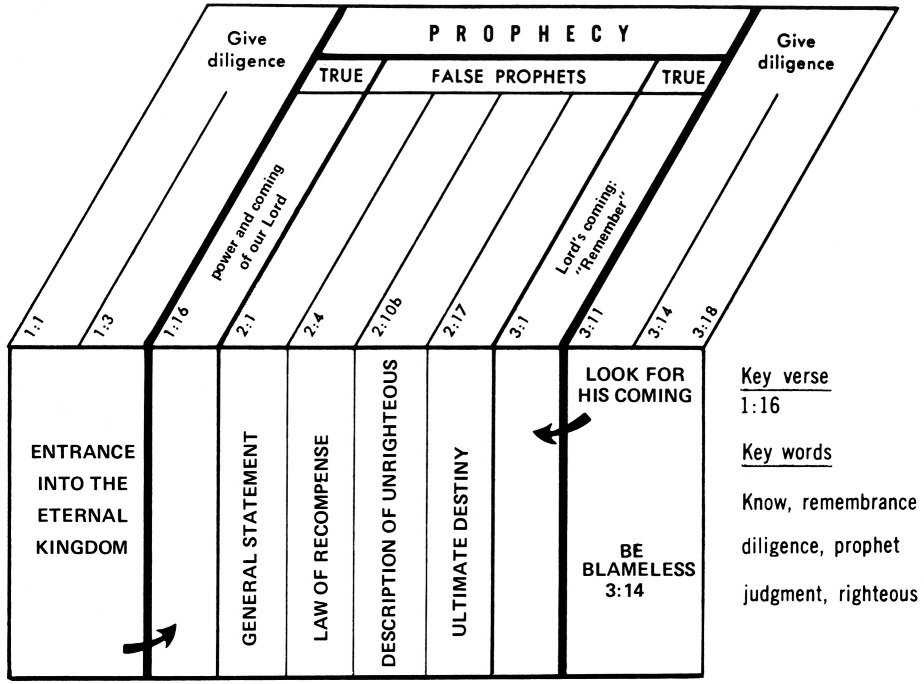
2 Peter: True and False Prophecy
Click chart to enlarge
Chart from Jensen's Survey of the NT - used by permission
|
2 PETER |
||||||||
| Cultivation of Christlike Character |
Condemnation of False Teachers |
Confidence in the Return of Christ |
||||||
| Greeting to Saints 2Pe 1:1-2 |
Growth in Christ 2Pe 1:3-14 |
Grounds |
Danger of |
Demise of |
"Decor" of |
Mockers in |
Manifest |
Maturity in light of that |
| Know Your Salvation |
Know |
Know Your Adversaries |
Know |
|||||
| True Prophecy (True Knowledge) |
False Prophets (False Teachers) |
Final Prophecy (Day of the Lord) |
||||||
| Holiness | Heresy | Hope | ||||||
| Development of Faith |
Denunciation of False Teachers |
Design of The Future |
||||||
2 Peter 1:5 Now for this very reason also, applying all diligence, in your faith supply moral excellence, and in your moral excellence, knowledge, (NASB: Lockman)
Greek: kai auto touto de spouden pasan pareisenegkantes (AAPMPN) epichoregesate ( 2PAAM) en te pistei humon ten areten, en de te arete ten gnosin,
Amplified: For this very reason, adding your diligence [to the divine promises], employ every effort in exercising your faith to develop virtue (excellence, resolution, Christian energy), and in [exercising] virtue [develop] knowledge (intelligence)
Barclay: since all this is so, bend all your energy to the task of equipping your faith with courage, your courage with knowledge (Westminster Press)
KJV - And beside this, giving all diligence, add to your faith virtue; and to virtue knowledge;
NLT: So make every effort to apply the benefits of these promises to your life. Then your faith will produce a life of moral excellence. A life of moral excellence leads to knowing God better. (NLT - Tyndale House)
Phillips: For this very reason you must do your utmost from your side, and see that your faith carries with it real goodness of life. Your goodness must be accompanied by knowledge, your knowledge (Phillips: Touchstone)
Wuest: And for this very cause, having added on your part every intense effort, provide lavishly in your faith the aforementioned virtue, and in the virtue experiential knowledge (Eerdmans)
Young's Literal: And this same also -- all diligence having brought in besides, superadd in your faith the worthiness, and in the worthiness the knowledge,
NOW FOR THIS VERY REASON ALSO: Kai auto touto de:
- Lk 16:26 24:21
THOUGHT - In light of the grand truth that we have been firmly rooted and grounded in Christ Jesus (2Peter 1:1-4)...now may our great Father by His Spirit of Christ cause us to continually grow in the grace and the knowledge of our Lord and Savior Jesus Christ to Whom be the glory both now and to the day of eternity. Amen (2 Peter 3:18+)!....

Don Anderson sums up this first section (titles in green added to Anderson's titles in blue)...
Here's What You Have (2 Peter 1:1-4)
(God's Part: Power & Promise)
Here's What You Do (2 Peter 1:5-11)
(Our Part: Faith & Diligence)
Francis Chan introduces his message on 2 Peter 1:5-11 with this probing question (one that is applicable to every follower of Christ)...
AT WHAT DO YOU
WORK HARDEST?Peter writes in his letter that we should make every effort to cultivate Christ-like character qualities. Most of us have goals that revolve around what we want to accomplish rather than who we are, but God wants us to develop character.
When we focus on being the person God wants us to be,
then we will accomplish what He wants us to accomplish.
We must be diligent in cultivating Christian virtue, self-control and knowledge. We are able to pursue these things because we are partakers in God’s divine nature (2Peter 1:4+). He makes us a slave to righteousness (Romans 6:19+). In other words, we have a new Master (1Cor 6:19+, 1Cor 6:20+). It all starts with faith (Gal 2:16+ = begin; Gal 2:20+ = continue, cp Gal 3:2, 5, 14+). He gives us the desire to live a life of integrity (Ed: Note the crucial phrase "He gives...", not "I do..." or "I get..." or "I try...", etc; see Phil 2:13NLT+, Ezek 36:27+). If we are seeking God and spending time with Him, we will see progress in godliness (Mt 6:33+). When we spend time with people on a regular basis, we become like them (Pr 13:20, Ps 119:63, Mal 3:16+, 1Cor 15:33+). When we spend time with our Savior, we become more and more like Him.
RE-CALCULATE YOUR LIFE!
Listen to God, and He will shape you into the person that reflects His image. (From Francis Chan's message on 2 Peter 1:5-11 The Holy Spirit's Power and Our Effort)
Comment based on Chan's comments: Reflecting the image of Christ is what this first section of Peter is all about -- Peter is not trying to place you under a set of rules and regulations so that you try and try and try even harder to develop these Christ-like qualities. To the contrary, the necessary action on our part is to learn to relinquish control (even that act energized by the Spirit!), to rest in Christ, to rely on His Spirit, to surrender our will to the will of the Father (in one sense we've actually prayed for this many times when we have prayed Mt 6:10+)...then, and only then, the Spirit will transform you step by step, from glory into glory into the image of God's Son (2Cor 3:18-note).
THOUGHT - Notice also how Peter's "chain" of attributes (moral excellence, knowledge, self-control, perseverance, godliness, brotherly kindness, love) at first might seem to be just a random, unconnected collection, but in fact they are like the spiritual fruit in Gal 5:22-23+, which is one fruit (karpos singular in the Greek) with manifold supernatural manifestations, ALL initiated and energized by the indwelling power (dunamis) of the Spirit of Christ. In a similar way, Peter's "chain" of Christ-like virtues constitutes an interconnected unit like the spiritual fruit in Gal 5. In other words, you can't have "love" without "knowledge" (cf Php 1:9-10+), etc. One could subtitle the list in 2 Peter 1:5-8 as "The Fruit in a Believer Filled with and Energized by the Holy Spirit." (See related topic The Holy Spirit-Walking Like Jesus Walked!) Stated another way, while we are to make the conscious choice daily (applying is in the active voice = choice of our will) to apply all diligence (OUR RESPONSIBILITY), we, by ourselves, in reliance on our natural strength, CANNOT BEAR even one of these spiritual virtues without reliance on the power of the Holy Spirit (GOD'S PROVISION/POWER). This is not "Let go, let God," but what I like to call "Let God and let's go." (His Part/Our Part). Why do I emphasize the vital role of the Spirit in our manifesting the virtues in Peter's chain? Simply because the inherent danger is ever present that we will attempt to "work out" (Php 2:12+) all of these virtues in reliance on natural rather than supernatural power (Php 2:13NLT+). And the result is that we fall into legalism, thinking things like "Today I must exercise self-control or be godly, etc." "I" can't do it without the enablement of "Him" (the Spirit). My way leads to futility and frustration in the Christian life. God's way leads to joy and peace and victory in the Christian life and brings glory to our Father in Heaven (Mt 5:16+).
For this very reason is a "term of conclusion" and as all good inductive students (see Inductive Bible Study) know, the natural "reflex" is to stop and ask "what reason?" This is not a pedantic (a pedant is one who makes a show of knowledge) exercise but serves (1) to slow you down and (2) helps you to read the passage with a purpose. Inductive Bible study "immerses" you in the environment of the passage and instead of a bored, listless, apathetic passive reader, you become engaged, and actively involved even anticipating insights your diligence will yield (And you can mark it down - as you hone this skill of "chewing the cud" so to speak, you are practicing the wonderfully spiritual discipline of Meditation, a discipline God promises to greatly bless - see Ps 1:2-note, Ps 1:3-note, Josh 1:8-note if you don't believe me!). In short your Scripture reading instead of being drudgery becomes a delight!
Steven Cole explains that for this very reason "takes us back to 2Pe 1:3, 4, where Peter told us that when we believed in Jesus Christ as Savior and Lord, God also “granted to us everything pertaining to life and godliness” (2Pe 1:3). Through the glory and moral perfection of Christ, “He has granted to us His precious and magnificent promises, so that by them you may become partakers of the divine nature, having escaped the corruption that is in the world by lust” (2Pe 1:4). “Now for this very reason also,” grow in your faith...you cannot begin to grow as a Christian until you have received new life from God through faith in Jesus Christ. It is the life of Christ in you that gives you the motivation and power to change and grow spiritually. The instant you trust in Christ, God graciously gives you the key to the unfathomable riches of Christ (Eph. 3:8), which supplies you with everything you need for life and godliness....D. A. Carson explains (Becoming Conversant with the Emerging Church [Zondervan], p. 228), “... the dominant biblical pattern is neither ‘let go and let God’ nor ‘God has done his bit, and now it’s all up to you,’ but rather, ‘since God is powerfully at work in you, you yourself must make every effort.’” As Paul said (Phil. 2:12-13), “... work out your salvation with fear and trembling; for it is God who is at work in you, both to will and to work for His good pleasure.” In other words, spiritual growth involves God’s resources as the foundation, but also our responsible effort in addition....You won’t grow spiritually if you don’t deliberately work at it. (Growing in Godliness)
In simple terms Peter is saying NOW IT'S YOUR TURN! Yes, God has given us all the necessary spiritual resources, but now we are responsible to use them. Remember, beloved, that spiritual growth occurs when doing follows hearing!
Gil Rugh - Now it is not that I reach down into the resources of myself to pull myself up to accomplish what I should. No! I reach down into the resources of almighty God, who has made me new within, and I draw upon His power, the One who is my sufficiency, and apply myself to the pursuit of the development of His character in every aspect of my life. that is the idea being presented. (Seven Virtues of Christian Growth)
Wuest - Strachan says that the words “and besides this” (for this reason) emphasize the fact of the gifts spoken of in verse four as having their logical outcome in character, and quotes Bunyan as saying, “The soul of religion is the practical part.” (Word Studies - Eerdmans)
UBS Handbook - Having reminded his readers of their great and glorious destiny, he now invites them to demonstrate this in their lives, that is, to lead lives that are morally and ethically acceptable. (The United Bible Societies' New Testament Handbook Series)
Peter is urging his readers to grow in spiritual maturity. The sanctification process is lifelong for every genuine partaker of His "divine nature". Paul might refer to the process as sanctification or a progressive setting apart of the believer from the corruption of this world and unto God to render us useful and fruit for His holy purposes. "NOW" that you've heard these great truths -- now that you have everything necessary for life & godliness, now that you have His precious and magnificent promises, and now that you have been made partakers of His divine nature..."NOW" in view of these incredible resources, work out your salvation. It will take effort but not self effort. It will take "faith" effort (Phil 2:12–13, Col 2:6). So get on with it. Walk forth laying hold of the promises that are yours in Christ for "in Him you have been made complete" (Col 2:10)
John Calvin - As it is a work arduous and of immense labor, to put off the corruption which is in us, he bids us to strive and make every effort for this purpose. He intimates that no place is to be given in this case to sloth, and that we ought to obey God calling us, not slowly or carelessly, but that there is need of alacrity; as though he had said, “Put forth every effort, and make your exertions manifest to all.” (2 Peter 1)
It should be kept in mind that Calvin's allusion to "effort" might conger up the idea of self-effort and self-reliance which is not at all what Peter is calling for in this passage.
Jerry Bridges explains that "Self-reliance toward God is a dependence on our own power, not the power of the Holy Spirit....Self-reliance is the opposite of dependence on the Holy Spirit’s power for sanctification. Just as by nature we assume we earn our salvation by our good works, so by nature we assume we grow spiritually by our own effort and willpower. What’s wrong with this kind of self-reliance? Everything. First of all, it doesn’t work. The Christian life is a spiritual life lived in a spiritual world. Our human strength, be it physical power or willpower, is inadequate. We need divine strength that comes from a divine source—the Spirit of God. When we attempt to live the Christian life in our own strength, we head in the direction of legalism, pride, frustration, or ungodly living. It can even lead to a shipwrecked faith...Furthermore, if we perceive we’ve succeeded on our own, in our arrogance we’ll boast, take the credit, and steal the glory....We need to admit that self-reliance is a subtle and insidious enemy of our souls....With one breath we express awareness that we’re dependent on God for everything, and with the next breath we express self-reliance. (The Bookends of the Christian Life)
HIS PART
OUR PART!
Brian Bell uses a surprising cake analogy (somewhat of a modern "parable") to illustrate Peter's exhortation to all saints to grow in godliness (I have added some words to make full sentences)...
What’s your favorite cake? There are two main parts to a cake: the cake (salvation) and the frosting (our sanctification). Displayed in the Master Bakers bakery one day (soon) will be a vast array of cakes. From plain cakes…to the elaborate wedding cake! (cp Rev 19:9-note) You do have to be a cake to enter, and all “real” cakes will enter! Our Father will receive even plain cakes into his bakery, for He made them! But what blesses Him is to see them beautifully decorated! Frosting, sprinkles, waves, writing, different colors, flowers (made of frosting), ornaments. All you need, He provides in His kitchen.
With regards to the cake itself: The Master Baker is in charge of putting together all the ingredients (flour, eggs, sugar, oil)…then, just add water! So He works regeneration, justification, repentance, “all of the salvation ingredients” into the mix of our lives. We simply need to “just add water”…which is ultimately supplied by Him (His indwelling Holy Spirit! cp John 3:5), we just appropriate it to ourselves, “He who believes in Me, as the Scripture has said, out of his heart will flow rivers of living water.” (Jn.7:38)
Mical (Pastor Bell's daughter) for her birthday last month wanted a chocolate cake with no frosting! Kelly (his wife) on the other hand…once when we were dating I made her a “German Chocolate cake” and she mowed the top one inch…frosting only! Both are analogous to the Christian life – Cake only Christians…those who have faith but don’t build on that faith. And, Frosting only ‘professing’ Christians …those who try to show “works” on the outside without a real cake to build upon. Like those fake cakes you see in the window, where they frost over cardboard (now you see what God tastes when bites into a “name only” Christian!)...Outline of 2Peter 1:1-11: His Part! ("The Cake" - 2Peter 1:1-4); Our Part! ("The Frosting" - 2Peter 1:5-11). (Notes on Sermon entitled "His Part-Our Part! - on 2 Peter 1:1-11)
APPLYING: pareisenegkantes (AAPMPN):
- 2Pe 1:10 3:14,18 Ps 119:4 Pr 4:23 Isa 55:2 Zec 6:15 Jn 6:27 Php 2:12 Heb 6:11 11:6 12:15)
since all this is so, bend all your energy to the task of equipping your faith. (Westminster Press)
D Edmond Hiebert wisely reminds us that "Human effort must follow the work of God, but the participial construction indicates that such human effort is subordinate to the divine bestowal and flows out of it (cf. Phil 2:12-note, Phil 2:13-note).
God's resources
equal
our requirements
Applying (3923) (pareisphero from pará = from close-beside, alongside+ eisphéro = bring into) means literally "bring deeply into," i.e. from close beside. To bear in alongside or besides (to bring to bear), and so to introduce simultaneously. To contribute besides to something. This verb implies making a strong effort to provide something necessary. In this passage this verb refers to carrying through with personal involvement (energy). It strongly stresses the need of our deep, personal involvement in the faith-life.
Henry Alford (The NT for English Readers) writes pareisphero means "literally, introducing by the side of: i.e., besides those precious promises on God's part, bring in your part."
Pareisphero was at times used of smuggling or of importing along byways. Although Jude uses a different verb (pareisduno) he describes the action of false teachers (Jude 1:4 - "certain persons have crept in unnoticed" = pareisduno from para = at the side of + eisduo = enter in).
As discussed below this verb is used idiomatically here meaning we are to to do our very best in attempting to bring forth the Christian virtues listed. Strachan (Expositor's Greek Testament) says that the words “and besides this” emphasize the fact of the gifts spoken of in verse four as having their logical outcome in character, and quotes Bunyan as saying, “The soul of religion is the practical part.” (Ibid)
Our Father has given each of as His very Own children (1John 3:1-note) everything we need in order to live a supernatural, abundant life, life on "the highest plane" (2Peter 1:3-note). In light of our Father's magnanimous, gracious generosity, we must daily set our mind and will to seek to be diligent to "cultivate the soil" of our soul so as to optimize the growth of the fruit now possible because of our new life in Christ Jesus our Lord.
God does not make us holy against our will or without our involvement. There must be desire, determination, and discipline on our part. Peter is calling for maximum effort on our part. The Christian life is not lived to the honor of God without effort. Even though God has poured His divine power into the believer via His indwelling Spirit, the Christian is required to make every disciplined effort alongside of what God has done. The picture of word "applying" (bring in alongside) is paralleled in Paul's exhortation to the church at Philippi to
work out your salvation with fear and trembling (Applying all diligence) for it is God Who is at work in you, both to will and to work for His good pleasure (God's provision of His Spirit) (Phil 2:12-note; Phil 2:12-note).
Jamieson writes that applying means 'literally, “introducing” side by side with God’s gift, on your part “diligence.”
Vincent says that pareisphero means "literally, to bring in by the side of -- adding your diligence to the divine promises. (Ed: And I would add apart from God's divine promises and enablement, our diligence would be impossible!) (2 Peter 1 - Vincent's Word Studies)
The aorist tense of pareisphero calls for effective action on the reader's part. The concern is not with the process of procuring this needed diligence but with the actual operation of diligence by the believer.
John MacArthur explains applying this way - "In view of and parallel to God’s endeavor in providing salvation, believers are compelled to call on all their regenerate faculties to live godly lives (2Pe 3:14-note, Ro 6:22-note, Eph 5:7, 8-note, Eph 5:9-note, Heb 6:10-note, Heb 6:11, 12-note, Gal 6:9) (MacArthur, J: 2 Peter And Jude. Moody)
Spurgeon rightly said "God sends every bird his food (Ed: God's part), but He doesn't throw it into the nest (Ed: Our part).
God has provided everything the believer will ever need for life and godliness (2Pe 1:3) as well as His precious and magnificent promises (2Pe 1:4), and now based on this firm foundation of truth, Peter is charging the believers to exercise effort (Spirit enabled, grace driven) in order to truly experience His gracious provisions for in Christ-likeness (observe that all 7 qualities in the 2Peter 1:5-7 are perfectly depicted in the life of Christ)..
Bill Crowder - It is the Spirit that matures us into the image of Christ so that we can give glory to the Lord Jesus Christ (Gal 3:1-3). We are called to be submissive to His control in our lives. That is our responsibility. But the Holy Spirit is the One who produces the image and likeness of Christ in us. (The Promise Of The Spirit)
Henrietta Mears speaks of applying all diligence - It is difficult to steer a parked car, so get moving. (Ed: Albeit as explained elsewhere in these notes, that "car" cannot really move without power, and the power is supplied in the believer's life by the Holy Spirit. In short "we work it out" as "He works it in us".)
Paul Apple writes that in chapter 1 we see the juxtaposition of the "Sovereignty of God and human responsibility. We are not called to "Let Go and Let God do everything", but to "Trust God and get going". We are called to exercise faith and apply all diligence to live like God wants us to; not to work hard in order to be saved; but to work hard because we have been saved. Be quick to add these qualities into your life -- idea of eagerness, haste; don’t procrastinate; earnestness; zeal; use of word in 2 Peter 1:10; 15; 3:14 -- important tone. Have to keep applying this same diligence throughout your whole life; you never advance beyond this to some resting point where you don’t need to practice self-denial and discipline and effort - Think of the context of 2 Peter -- What’s the danger if we don’t apply all diligence and add the qualities of Christlikeness to the foundation of our faith? The pressure of persecution and suffering will cause us to quit the Christian race. The attractiveness of false teaching will tickle our ears and promise us an easier life. Those that mock the 2nd coming of Christ will cause us to doubt the reality of God’s promises to us -- which are precious and magnificent. We will sink back into the corruption that is connected with the lusts of the flesh. (2Peter)
ALL DILIGENCE: spouden pasan:
- 2Pe 1:10, 3:14,18 Ps 119:4 Pr 4:23 Isa 55:2 Zec 6:15, Jn 6:27 Php 2:12 Heb 6:11, 11:6, 12:15
NO WASTE, ALL HASTE!
All diligence - Literally "diligence all." In the original Greek spoude is placed first for emphasis, in context to emphasize the attitude Peter is calling believers to exhibit in order to experience spiritual growth. Barclay paraphrases it "bend all your energy to the task." Phillips says "you must do your utmost from your side." Wuest renders it "having added every intense effort."
In his comments on 1Peter 2:2, Hiebert helps us understand one of the best ways to apply "all diligence" writing that "Grow up" (in 1Pe 2:2) is aorist passive and may be translated "be made to grow." It is an activity that is wrought within us by the nourishment supplied. The aorist tense simply pictures that growth as the essential feature of the Christian life. Spiritual growth is not a direct act of human volition. The Christians responsibility is to diligently appropriate the Word that produces the growth. The verb continues the picture of the readers as "newborn babies." Best remarks, "While the Christian is newborn he is also always in process of growth; it is not his status which requires emphasis but his progress." Hence, "may grow up." Senior notes, "1 Peter conceives of Christian life not as an instant and easily attained experience but as a life-long process of growth toward the full beauty of our [redeemed] humanity." (1 Peter Commentary)
Mark Dever - If we are to grow as individual believers and as churches, we must sit under the Word. We must pray for the Holy Spirit to plant and to weed the gardens of our hearts. This spiritual growth is not optional; it is vital, because spiritual growth indicates life. Things that are truly alive, grow. (Nine Marks of a Healthy Church)
Spurgeon exhorts us to all diligence...
For we cannot expect to go to heaven asleep. We are not taken there against our wills. It is not our will that accomplishes our salvation; but still, it is not accomplished without our will. “Giving diligence,”yes, but more than that, “giving all diligence,”
It is not man’s effort that saves him; but, on the other hand, grace saves no man to make him like a log of wood or a block of stone; grace makes man active. God has been diligently at work with you; now you must diligently work together with Him.
Diligence (4710) (spoude from speudo = move quickly, hasten, make haste) refers to eagerness, earnestness, willingness or zeal. It denotes quick movement or haste accompanying the eagerness, etc, in the interest of a person or cause. Thus spoude can refer to swiftness of movement or action and means haste or speed (like our expression "in a hurry"). It can refer to an earnest commitment in discharge of an obligation or experience of a relationship.
Spoude implies more than mere earnest desire, but includes action as well as desire. Spoude "never takes 20 minutes to do a 10 minute job." (William Hill)
Louw-Nida - Spoudē means "eagerness to do something, with the implication of readiness to expend energy and effort"
Spoude was often used in Greek and Roman literature and found on inscriptions in reference to extraordinary commitment to civic and religious responsibilities, which were frequently intertwined, and also of concern for personal moral excellence or optimum devotion to the interests of others.
For believers, spoudē ("speedy diligence") means quickly obeying what the Lord reveals is His priority. This elevates the better over the good and the more important over the important – with divinely-inspired swiftness.
Wuest, "Spoudē is used in the papyri in such senses as 'do your best, take care, hurry on with doing something.' The verb speaks of intensity of purpose followed by intensity of effort toward the realization of that purpose" (Word Studies - Eerdmans)
In sum, spoudē refers to zealous diligence which executes decisions (actions) with swiftness and priority. God inspires and empowers this swiftness in believers earnestly living out faith to do what has priority to Him. And remember that delayed obedience is still disobedience . . . and partial obedience is still sin!
Spoude is used 12 times in the NT and is translated in the NASB as: diligence, 4; earnestness, 5; effort, 1; hurry, 2. KJV also translates as business, 1; care, 1; carefulness, 1; diligence, 5; earnest care, 1; forwardness, 1; haste, 2.
Mark 6:25 Immediately she came in a hurry to the king and asked, saying, "I want you to give me at once the head of John the Baptist on a platter."
Luke 1:39 Now at this time Mary arose and went in a hurry to the hill country, to a city of Judah,
Romans 12:8 or he who exhorts, in his exhortation; he who gives, with liberality; he who leads, with diligence; he who shows mercy, with cheerfulness.
Romans 12:11 not lagging behind in diligence, fervent in spirit, serving the Lord;
2 Corinthians 7:11 For behold what earnestness this very thing, this godly sorrow, has produced in you: what vindication of yourselves, what indignation, what fear, what longing, what zeal, what avenging of wrong! In everything you demonstrated yourselves to be innocent in the matter. 12 So although I wrote to you, it was not for the sake of the offender nor for the sake of the one offended, but that your earnestness on our behalf might be made known to you in the sight of God.
2 Corinthians 8:7 But just as you abound in everything, in faith and utterance and knowledge and in all earnestness and in the love we inspired in you, see that you abound in this gracious work also. 8 I am not speaking this as a command, but as proving through the earnestness of others the sincerity of your love also.
2 Corinthians 8:16 But thanks be to God who puts the same earnestness on your behalf in the heart of Titus.
Hebrews 6:11 And we desire that each one of you show the same diligence so as to realize the full assurance of hope until the end,
2 Peter 1:5 Now for this very reason also, applying all diligence, in your faith supply moral excellence, and in your moral excellence, knowledge,
Jude 1:3 Beloved, while I was making every effort to write you about our common salvation, I felt the necessity to write to you appealing that you contend earnestly for the faith which was once for all handed down to the saints.
Spoude-17x in the non-apocryphal Septuagint (LXX)- Ex 12:11, 33; Deut 16:3; Jdg 5:22; 1 Sam 21:8; Ezra 4:23; Ps 78:33; Jer 8:15; 15:8; Lam 4:6; Ezek 7:11; Dan 2:25; 3:24; 6:19; 10:7; 11:44; Zeph 1:18
A familiar OT passage helps give us a word picture of the meaning of spoude in the - context of the last plague in Egypt (destruction of the first born sons), Jehovah instructed Israel regarding the Passover...
Now you shall eat it in this manner: with your loins girded, your sandals on your feet, and your staff in your hand; and you shall eat it in haste (cp Dt 16:3, Lxx = spoude) —it is the Lord’s Passover. (Ex 12:11)
Spoude is primarily an attitude which leads to an action. Spoude means to do something with intense effort and motivation, with quick movement and is in opposition to the attitude of slothfulness. The individual who is "spoude" who is eager to do something and ready to expend the necessary energy and effort.
Spoude means to do something with intense effort and motivation—‘to work hard, to do one’s best, to endeavor.’ Thus Paul exhorts the Roman saints that "he who leads, with diligence (spoude)" (Ro 12:8-note) There are two ways in which leader can lead —with heart and mind or in the most perfunctory way. The lead may dully and drably lead or he may do it with the joy and thrill of zeal. We need leaders with zeal (spoude) in their hearts.
Henry Alford says spoude "implies more than mere earnest desire; a man’s spoude is necessarily action as well as wish.
Kenneth Wuest adds that the related verb spoudazo conveys "the idea of making haste, being eager, giving diligence, and putting forth effort are in the word. The word speaks of intense effort and determination. (Word Studies - Eerdmans)
Peter is calling for an attitude of eagerness and zeal, an abandonment of sluggishness and self-indulgence. Note Peter's addition of the modifier all (pas = the whole amount or quantity, no holding back) to underline the comprehensiveness of the effort for which he is calling. Peter (under the inspiration of the Holy Spirit) says the spiritual growth he describes in the next few passages is so important that our effort must not be half-hearted or selective. The idea is Doing your utmost for His highest as Oswald Chambers might phrase it.
When you are diligent, you are alert, focused, committed to the task at hand, single minded, careful, business like.
The Greek phrase Peter uses here ("spouden pasan pareisphero") according to one source is an idiom which literally means to bring every effort, to do one's very best in attempting to do something, to make every effort to do it, or to try as hard as possible.
Wuest - “Diligence” is spoudē. The verb is spoudazo which means “to make haste, be eager, give diligence, to do one’s best, to take care, to exert one’s self.” In verses two and three we have the divine provision and enablement given the believer in salvation, an inner dynamic, the divine nature which impels to a holy life, giving both the desire and power to do God’s will (Phil. 2:13-note). In 2Pe 1:5-7, we have human responsibility, that of seeing to it that the various Christian virtues are included in one’s life. The divine nature (2Pe 1:4) is not an automatic self-propelling machine that will turn out a Christian life for the believer irrespective of what that believer does or the attitude he takes to the salvation which God has provided. The divine nature will always produce a change in the life of the sinner who receives the Lord Jesus as Saviour. But it works at its best efficiency when the believer cooperates with it in not only determining to live a life pleasing to God, but definitely stepping out in faith and living that life in dependence upon the new life which God has implanted in him. And this must not be a mere lackadaisical attempt at doing God’s will, but an intense effort, as shown by the word spoudē, translated “diligence.” (Word Studies - Eerdmans)
Webster defines diligence (and I paraphrase) as steady, earnest, attentive and energetic application and effort in a pursuit. This person is not lackadaisical! He or she exhibits the proverbial diligence of a bee ("busy as a bee"). Peter is saying the saint is to put forth zealous persistence in accomplishing the goal.
Diligence means steady, careful, and persistent effort toward a goal. It is not just hard work, but attentive and intentional work — marked by care, focus, and consistency. The word carries the idea of doing something thoroughly, not half-heartedly or in a careless rush.
Etymology: From Latin diligere — “to value highly, to esteem, to take delight in.” This shows that diligence is not merely drudgery, but treating the task as something worth doing well.
Practically speaking, diligence shows itself in everyday life in several ways:
Consistency over bursts of effort - Instead of cramming or rushing at the last minute, diligence shows up in daily, steady progress.
Example: A student studying a little each day instead of pulling one frantic all-nighter.
Attention to detail - Diligent people don’t cut corners. They check their work, read instructions carefully, and avoid sloppy mistakes.
Example: An accountant double-checking numbers before submitting reports.
Persistence through obstacles - Diligence is tied to perseverance — keeping at the task even when it’s hard, boring, or progress feels slow.
Example: A gardener who faithfully waters and weeds even when growth is not immediately visible.
Prioritizing what matters most - Diligence isn’t just “working a lot.” It’s about giving focused energy to what truly counts.
Example: A parent making time daily for their children despite a busy schedule.
Dependability and trustworthiness - Diligent people can be counted on to follow through on commitments.
Example: An employee who always finishes projects by the deadline without being reminded.
J. Vernon McGee in his unique style describes "all diligence" reminding us that "The Christian life is a very serious business. However, we have made it sort of an extracurricular activity. The present-day thinking is that it is not something to be taken into the business world or the schoolroom or into social life. Rather, it is something sort of like your Sunday-go-to-meeting clothes which you wear only at certain times. However, Peter said that it is something to which we are to give “all diligence." (McGee, J V: Thru the Bible Commentary: Thomas Nelson)
C. H. Spurgeon has some sage advice on the importance of diligence and faith in regard to the assurance of one's salvation:
If thou wouldest enjoy the eminent grace of the full assurance of faith (2Pe 1:10), under the blessed Spirit's influence, and assistance, do what the Scripture tells thee, "Give diligence." Take care that thy faith is of the right kind-that it is not a mere belief of doctrine, but a simple faith, depending on Christ, and on Christ alone. Give diligent heed to thy courage. Plead with God that he would give thee the face of a lion, that thou mayest, with a consciousness of right, go on boldly.
Study well the Scriptures, and get knowledge; for a knowledge of doctrine will tend very much to confirm faith. Try to understand God's Word; let it dwell in thy heart richly. (Col 3:16-note) When thou hast done this, "Add to thy knowledge temperance." Take heed to thy body: be temperate without. Take heed to thy soul: be temperate within. Get temperance of lip, life, heart, and thought. Add to this, by God's Holy Spirit, patience; ask him to give thee that patience which endureth affliction, which, when it is tried, shall come forth as gold. Array yourself with patience, that you may not murmur nor be depressed in your afflictions. When that grace is won look to godliness. Godliness is something more than religion. Make God's glory your object in life; live in His sight; dwell close to Him; seek for fellowship with Him; and thou hast "godliness"; and to that add brotherly love. Have a love to all the saints: and add to that a charity, which openeth its arms to all men, and loves their souls. When you are adorned with these jewels, and just in proportion as you practice these heavenly virtues, will you come to know by clearest evidence "your calling and election." "Give diligence," if you would get assurance, for lukewarmness and doubting very naturally go hand in hand. (From Morning & Evening 7/26)
Nigel McCullough - There is no point in praying for spiritual growth unless we do our best to live disciplined Christian lives.
Illustration of Diligence - I stood in the cold pre-dawn darkness outside a New York City hotel waiting for the airport bus. The street was deserted. My attention was drawn to one lone man who was cleaning the glass on the doors at the entrance of the hotel. With great care he removed every smudge. He even dusted overhead so that no dirt or cobwebs would collect. What made his work so noteworthy was that no one was inspecting it, and throughout the day many people would go through those doors, smearing the windows with their handprints. Nevertheless, he worked diligently and faithfully with special care to make sure those glass panels were spotless. What a lesson, I thought, for Christians! All of our work should be characterized by such diligence and thoroughness. Even when no human eye looks on and no tongue commends our efforts, we must strive to do our best as to the Lord. Our willingness to work hard should not result from a desire to win the approval of others but from a deep awareness that we are "servants of Christ." —P R Van Gorder
2 Peter 1:5 The Power of Diligence - Are you applying all diligence in your Christian walk? C. H. Spurgeon reminds us that...“God sends every bird his food, but He doesn't throw it into the nest.” Henrietta Mears speaks of applying all diligence "It is difficult to steer a parked car, so get moving." Giving all diligence, add to your faith virtue, to virtue knowledge (2 Peter 1:5).
Apply Diligence - Dr. Baylis, speaking on 2 Peter 1:1-11, was stressing the fact of our responsibility to apply diligence to incorporating godly qualities into our lives. He quoted C.H. Spurgeon, “God sends every bird his food, but He doesn’t throw it into the nest.” God has provided everything for living a godly, Christian life, but I must do something, work, to make it mine.
2 Peter 1:5 DILIGENCE (Spurgeon in Feathers for arrows) SELECT a large box and place in it as many cannon-balls as it will hold, it is after a fashion full, but it will hold more if smaller matters be found. Bring a quantity of marbles, very many of these may be packed in the spaces between the larger globes; the box is full now, but only full in a sense, it will contain more yet. There are interstices in abundance, into which you may shake a considerable quantity of small shot, and now the chest is filled beyond all question, but yet there is room. You cannot put in another shot or marble, much less another cannon-ball, but you will find that several pounds of sand will slide down between the larger materials, and even then between the granules of sand, if you empty yonder jug there will be space for all the water, and for the same quantity several times repeated. When there is no space for the great, there may be room for the little; where the little cannot enter, the less can make its way; and where the less is shut out, the least of all may find ample room and verge enough. Now, the diligent preacher may not be able to preach more sermons, his engagement book is crowded. He may not be able to offer more public prayers, or to search the word of God more constantly; there is as much time occupied with these things as could well be given to them. Still there must be stray moments, occasional intervals and snatches, which might hold a vast amount of little usefulnesses in the course of months and years. What a wealth of minor good, as we may think it to be, might be shaken down into the interstices of ten years’ work, which might prove to be as precious in result, by the grace of God, as the greater works of the same period. Little fishes are sweet, and these little works might possess in blessing what they lacked in bulk.
Alexander Maclaren writes that...
We all know what ‘diligence’ means, but it is worth while to point out that the original meaning of the word is not so much diligence as haste. It is employed, for instance, to describe the eager swiftness with which the Virgin went to Elizabeth after the angel’s salutation and annunciation. It is the word employed to describe the murderous hurry with which Herodias came rushing in to the king to demand John the Baptist’s head. It is the word with which the Apostle, left solitary in his prison, besought his sole trusty, companion Timothy to ‘make haste so as to come to him before winter.’ (see notes on 2 Timothy 4:21) (see excellent sermon 2 Timothy 4:21 Come Before Winter) Thus, the first notion in the word is haste, which crowds every moment with continuous effort, and lets no hindrances entangle the feet of the runner. Wise haste has sometimes to be content to go slowly. ‘Raw haste’ is ‘half sister to delay.’ When haste degenerates into hurry, and becomes agitation, it is weakness, not strength; it turns out superficial work, which has usually to be pulled to pieces and done over again, and it is sure to be followed by reaction of languid idleness. But the less we hurry the more should we hasten in running the race set before us.
But with this caution against spurious haste, we cannot too seriously lay to heart the solemn motives to wise and well-directed haste. The moments granted to any of us are too few and precious to let slip unused. The field to be cultivated is too wide and the possible harvest for the toiler too abundant, and the certain crop of weeds in the sluggard’s garden too poisonous, to allow dawdiing to be considered a venial fault. Little progress will be made if we do not work as feeling that ‘the night is far spent, the day is at hand,’ or as feeling the apparently opposite but really identical conviction, ‘I must work the works of Him that sent me while it is day. The night cometh when no man can work.’ The day of full salvation, repose, and blessedness is near dawning. The night of weeping, the night of toil, is nearly past. By both aspects of this brief life we should be spurred to haste.
The first element, then, in Christian diligence is economy of time as of most precious treasure, and the avoidance, as of a pestilence, of all procrastination. ‘To-morrow and to-morrow’ is the opiate with which sluggards and cowards set conscience asleep, and as each to-morrow becomes to-day it proves as empty of effort as its predecessors, and, when it has become yesterday, it adds one more to the solemn company of wasted opportunities which wait for a man at the bar of God. ‘All their yesterdays have lighted’ such idlers ‘to dusty death,’ because in each they were saying, ‘to-morrow we will begin the better course,’ instead of beginning it to-day. ‘Now is the accepted time.’ ‘Wherefore, giving all haste, add to your faith.’
Another of the phases of the virtue, which Peter here regards as sovereign, is represented in our translation of the word by ‘earnestness,’ which is the parent of diligence. Earnestness is the sentiment, of which diligence is the expression. So the word is frequently translates. Hence we gather that no Christian growth is possible unless a man gives his mind to it. Dawdlers will do nothing. There must be fervour if there is to be growth. The heated bar of iron will go through the obstacle which the cold one will never penetrate. We must gather ourselves together under the impulse of an all-pervading and noble earnestness, too deep to be demonstrative, and which does not waste itself in noise, but settles down steadily to work. The engine that is giving off its steam in white puffs is not working at its full power. When we are most intent we are most silent. Earnestness is dumb, and therefore it is terrible.
Again we come to the more familiar translation of the word as in the text, ‘Diligence’ is the panacea for all diseases of the Christian life. It is the homely virtue that leads to all success. It is a great thing to be convinced of this, that there are no mysteries about the conditions of healthy Christian living, but that precisely the same qualities which lead to victory in any career to which a man sets himself do so in this; that, on the one hand, we shall never fail if in earnest and saving the crumbs of moments, we give ourselves to the work of Christian growth; and that on the other hand/no fine emotions, no select moments of rapture and communion will ever avail to take the place of the dogged perseverance and prosaic hard work which wins in all other fields; and wins, and is the only thing that does win, in this one too. If you want to be a strong Christian — that is to say, a happy man — you must bend your back to the work and ‘give all diligence.’ Nobody goes to heaven in his sleep. No man becomes a vigorous Christian by any other course than ‘giving all diligence.’ It is a very lowly virtue. It is like some of the old wives’ recipes for curing diseases with some familiar herb that grows at every cottage door. People will not have that, but if you bring them some medicine from far away, very rare and costly, and suggest to them some course out of the beaten rut of ordinary, honest living, they will jump at that. Quackery always deals in mysteries and rare things. The great physician cures diseases with simples that grow everywhere. A pennyworth of some familiar root will cure an illness that nothing else will touch. It is a homely virtue, but if in its homeliness we practised it, this Church and our own souls would wear a different face from what it and they do to-day.
II. Note the wide field of action for this homely grace.
I can do nothing more — nor is it necessary that I should — than put before your mind, in a sentence or two, the various applications of it which our letter gives.
First, note that in our text, ‘giving all diligence, add to your faith.’ That is to say, unless you work with haste, with earnestness, and therefore with much putting forth of strength, your faith will not evolve the graces of character which is in it to bring forth. If, on the other hand, we set ourselves to our tasks, then out of faith will come, as the blossoms mysteriously and miraculously do out of an apparently dead stump, virtue, manliness, and knowledge, and temperance, and patience, and godliness, and brotherly mindedness, and charity. All that galaxy of light and beauty will shine forth on the one condition of diligence, and it will not appear without that. Without it, the faith, though it may be genuine, which lies in a man who is idle in cultivating Christian character, will bear but few and shrivelled fruits. The Apostle uses a very remarkable expression here, which is rendered in our Bible imperfectly ‘giving all diligence.’ He has just been saying that God has ‘given to us all things that pertain to life and godliness, and exceeding great and precious promises.’ The Divine gift, then, is everything that will help a man to live a high and godly life. And, says Peter, on this very account, because you have all these requisites for such a life already given you, see that you ‘bring besides into’ the heap of gifts, as it were, that which you and only you can bring, namely, ‘all diligence.’ The phrase implies that diligence is our contribution. And the very reason for exercising it is the completeness of God’s gift. ‘On this very account’ — because He has given so much — we are to lay ‘all diligence’ by the side of His gifts, which are useless to the sluggard.
On the one hand there are all great gifts and boundless possibilities as to life and godliness, and on the other diligence as the condition on which all these shall actually become ours, and, passing into our lives, will there produce all these graces which the Apostle goes on to enumerate. The condition is nothing recondite, nothing hard either to understand or to practise, but it is simply that commonplace, humdrum virtue of diligence. If we will put it forth, then the gifts that God has given, and which are not really ours unless we put it forth, will pass into the very substance of our being, and unfold themselves according to the life that is in them; even the life that is in Jesus Christ Himself, in all forms of beauty and sweetness and power and blessedness. ‘Diligence’ makes faith fruitful. Diligence makes God’s gifts ours.
Then, again, the Apostle gives an even more remarkable view of the possible field for this all-powerful diligence when he bids his readers exercise it in order to ‘make their calling and election sure.’ Peter’s first letter shows that he believed that Christians were ‘chosen according to the foreknowledge of God the Father.’ But for all that he is not a bit afraid of putting the other side of the truth, and saying to us in effect. ‘We cannot read the eternal decrees of God nor know the names written in the Book of Life. These are mysteries above us. But if you want to be sure that you are one of the called and chosen, work and you will get the assurance.’ The confirmation of the ‘call,’ of the ‘election,’ both in fact and in my consciousness depends upon my action. The ‘diligence,’ of which the Apostle thinks such great things, reaches, as it were, a hand up into heaven and binds a man to that great unrevealed, electing purpose of God. If we desire that upon our Christian lives there shall shine the perpetual sunshine of an unclouded confidence that we have the love and the favour of God, and that for us there is no condemnation, but only ‘acceptance in the beloved,’ the short road to it is the well-known and trite path of toil in the Christian life.
Still further, one of the other writers of the New Testament gives us another field in which this virtue may expatiate, when the author of the Epistle to the Hebrews exhorts to diligence, in order to attain ‘the full assurance of hope.’ If we desire that our path should be brightened by the clear vision of our blessed future beyond the grave, and above the stars, and Within the bosom of God, the road to that happy assurance and sunny, cloudless confidence in a future of rest and fellowship with God lies simply here-work! as Christian men should, whilst it is called to-day.
The last of the fields in which this virtue finds exercise is expressed by our letter, when Peter says, ‘Seeing that we look for such things, let us be diligent, that we may be found of Him in peace without spot, and-blameless.’ If we are to be ‘found in peace,’ we must be ‘found spotless,’ and if we are to be ‘found spotless’ we must be ‘diligent.’ ‘If that servant begin to say in his heart, My lord delayeth his coming; and to be slothful, and to eat and drink with the drunken, the lord of that servant will come in an hour when he is not aware.’ On the other hand, ‘who is that faithful servant whom his lord hath set ruler over his household? Blessed is that servant whom his lord when he cometh shall find so doing?’ Doing so, and diligently doing it, ‘he shall be found in peace. ‘
What a beautiful ideal of Christian life results from putting together all these items. A fruitful faith, a sure calling, a cloudless hope, a peaceful welcome at last! The Old Testament says, ‘The hand of the diligent maketh rich’; the New Testament promises unchangeable riches to the same hand. The Old Testament says, ‘Seest thou a man diligent in his business, he shall stand before kings.’ The New Testament assures us that the noblest form of that promise shall be fulfilled in the Christian man’s communion with his Lord here, and perfected when the diligent disciple shall ‘be found of Him in (Read the full sermon on 2 Peter 1:5 The Power of Diligence)
IN YOUR FAITH: en te pistei humon:
In (en) - Robertson says the preposition in is probably instrumental dative in this verse and signifies therefore the means by which the Verb's (''supply'') action takes place.
Vincent - The A. V. exhorts to add one virtue to another; but the Greek, to develop one virtue in the exercise of another: “an increase by growth, not by external junction; each new grace springing out of, attempting, and perfecting the other.” Render, therefore, as Rev. In your faith supply virtue, and in your virtue knowledge, etc. (2 Peter 1 - Vincent's Word Studies)
You can hear a kind of surging "Forward! Forward! Forward!" if one renders Peter's words as follows: "as you have obtained faith in Christ and stand in it, now apply yourself diligently to advance in moral excellence, and as you stand in that do not be satisfied but press on to increase your knowledge of God's will, and as you stand in that do not be satisfied but be diligent to enlarge your capacities of self-control and mastery of your passions, and as you stand in that don't be satisfied but cultivate every form of patience and serenity, and in that let devoutness and piety and sweet love to God flourish, and in that strive to kindle your affection for other believers, and in and through it all grow in love to all men." In other words: Forward! Forward! Press On! Advance!
Hiebert explains the phrase in your faith supply writing "The words “in your faith supply” do not ask believers to supply faith, it is accepted that they already have it (2Pe 1:1). Their spiritual life began with this life-bringing faith. “Your faith” marks the faith as personal, but it has an objective content, involving their firm adherence to the divine realities portrayed in 2Pe 1:3,4. But their faith must attain its full potential in spiritual fruitfulness through daily exercise in moral living (Ed: "Moral living" enabled by the indwelling Spirit of Christ). Peter lists seven qualities or traits of character in this moral development. Each new trait is introduced as being “in” (en) or “in connection with” the preceding. Each is inherent in the preceding, which in turn is supplemented and perfected by the new, giving it more abundant fruitage. All are empowered by a living faith which constantly draws on the divinely implanted life. The definite article ("the") is used with each new trait mentioned; the possessive “your” occurs only with faith, which believers already possess. The article ("the") makes each trait specific, not just any trait they may wish to substitute."
CHRISTIANS WHO JUST FLOAT
NEVER STAY IN THE SAME PLACE!
John Piper illustrates the deceptive danger of disobeying Peter's clear command (remember God's commandments always include His "enablements")...
Don't Float; Swim Hard -Last week I read a true story to the boys entitled Glenda's Long Swim in "The Incredible Series." Glenda and Robert Lennon were four miles off the coast of Florida fishing alone from their yacht. Glenda decided to take a swim and soon found the current had carried her too far out from the boat. Her husband, hearing her cries, without thinking dove in and swam to her, but then realized they were both being carried out. He was a champion swimmer, but not she. They made a plan. He would swim against the tide to keep the boat in view until the tide ceased and he could reach the boat. She should save her strength and just float with the tide and he would come and get her. He fought the tide for six hours and just as the boat was about to disappear on the horizon the tide turned and his strokes carried him to the boat exhausted. The sun had set. His searching was futile—he could not find his wife. The next day on one last effort of search, the search party found his wife—twenty miles out and still alive. It was an incredible story.
What it illustrates is this: Christians who just float never stay in the same place. Christians who disobey 2Peter 1:5–7 and do not apply themselves with diligence to bear the fruit of faith drift into great peril. We must strive even to stand still, the tide of temptation is so strong.
The effort towards virtue, knowledge, self-control, patience, godliness, brotherly affection, and love is not dispensable icing on the cake of faith. If Robert had not swum with all his might, the yacht would have gone out of sight, and he and his wife would have drowned. I've said before and will say again: we do not judge a person's genuineness by how close he is to heaven but by how hard he is stroking. The evidence that God's power has been given to you by faith is that you are now making every effort (as verse 5 says) to advance in the qualities of Christ (See his full sermon Confirm Your Election)
Martin De Haan II explains the relationship of diligence and faith this way...
Faith = trust, full reliance on God
Diligence = effort to do our part
Trust + Effort = SuccessKeep in mind: Peter’s seven steps are based on faith or reliance on God. Yet that reliance is not enough by itself. It is activated only when combined with diligence. And diligence, also inadequate in and of itself, needs to be combined with reliance on God. What this means is that diligence and faith are two sides of a mystery. We don’t know how it all works out. But they both have to be present if we are going to have spiritual success. This combination is often overlooked by those who emphasize the importance of living the “Christ-life.” Too many Christians sit and wait for the Spirit to move them. (Ed: A phrase that you may have heard is just "Let go and let God"-this is not Scriptural!) They never do anything great for God because they never take up the challenge. Yet that personal effort is what Peter said is our part. In behalf of God, he called for diligence, for effort, for zeal, for putting out and not putting off....
Faith doesn’t stand around
with its hands in its pockets.The issue here is not working for salvation but because of salvation. Because we have been saved by trusting Christ, how determined and diligent we should be to serve with gratitude the God who saved us! (How Do You Live The Christian Life?-this little RBC booklet is excellent and is basically a mini-exposition of 2Peter 1:5-7. It is definitely worth a few minutes of your time).
Illustration of God's part and Man's part - Some years ago, a study was done by an agricultural school in Iowa. It reported that production of a hundred bushels of corn from one acre of land required 4,000,000 lbs. of water, 6,800 lbs. of oxygen, 5,200 lbs. of carbon, 160 lbs. of nitrogen, 125 lbs. of potassium, 75 lbs. of yellow sulphur, and other elements too numerous to list. In addition to these ingredients are required rain and sunshine at the right times. Although many hours of the farmer’s labor are also needed, it was estimated that only 5 percent of the produce of a farm can be attributed to the efforts of man. So it is in spiritual realms: God causes the growth (1Cor 3:6-7). (Green, Michael P Green - Illustrations for Biblical Preaching)
Brian Bell - Faith doesn’t stand alone; real faith in God results in a changed life which can be seen or identified in these ascending virtues. Picture a ladder – Some Christians step up on the bottom rung (faith). Content to be saved & comfortable being the closest to the world from which they came. The more we climb up the ladder of virtues is to come ever nearer to “knowing” Jesus Christ. Also, the further we climb, the further we are able to climb! Moffatt quotes a saying “The Christian life must not be an initial spasm followed by a chronic inertia (inaction).” Giving all diligence – The Christian must be totally dedicated & make a maximum effort to live for God! (Notes on Sermon entitled "His Part-Our Part! - on 2 Peter 1:1-11)
Wuest on in your faith supply virtue - The exhortation is that in the faith which the saints exercise in the Lord Jesus, they should provide for virtue. The believer exercises faith in the Lord Jesus to supply his needs, to guide him along life’s way. He should also exercise faith for the generating of virtue in his inner being by the Holy Spirit. (Word Studies - Eerdmans)
Faith (4102)(pistis) is synonymous with trust or belief and is the conviction of the truth of anything, but in Scripture usually speaks of belief respecting man's relationship to God and divine things, generally with the included idea of trust and holy fervor born of faith and joined with it. Note that this discussion of pistis is only an overview and not a detailed treatise of this vitally important subject.
Faith is a firm, strong conviction and is the the root of the Christian life from which the ''sap'' of the Holy Spirit flows Who brings forth the "fruit" of the Christian virtues listed in 2Peter 1:5-7.
Genuine faith is a belief which results in behavior
which is in accord with that which is believed.
Peter uses the definite article here to identify the faith as a very specific "faith". The question is what faith is he referring to? He has told us several verses earlier that we all have a faith that is isotimos or of equal value to that of Peter the great apostle and so Peter does not ask his readers to supply faith. The fruits of faith specified are seven, the perfect number. Faith is not the end of the Christian road but its beginning. One acronym for faith is Forsaking All I Trust Him. That's a good working definition because self reliance is the antithesis of a dependent faith on God. We continually need to "forsake" our self reliance and rely on His complete sufficiency in the supernatural realm.
Lightfoot on faith - The Jews in the Talmud have the saying, 'The whole law was given to Moses at Sinai, in six hundred and thirteen precepts.' David, in the fifteenth Psalm, brings them all within the compass of eleven. Isaiah brings them to six, Isaiah 33:14-17; Micah to three, Micah 6:8; Isaiah, again, to two, Isaiah 56:1; Habakkuk to this one, 'The just shall live by faith.' Habakkuk 2:4.
Johann Bengel - Faith is the gift of God - therefore we are not ordered to provide faith, but in our faith those fruits, seven of which are enumerated: faith leading the band, love closing it (Ed: Love "brings up the rear.")
True faith that saves one's soul includes at least three main elements (1) firm persuasion or firm conviction, (2) a surrender to that truth and (3) a conduct emanating from that surrender. In sum, faith shows itself genuine by a changed life. (Click for W E Vine's 3 point definition of faith)
Spurgeon (quoted earlier) exhorts the reader of Peter's words to "Take care that thy faith is of the right kind-that it is not a mere belief of doctrine, but a simple faith, depending on Christ (Ed: And especially the enabling power of the indwelling Spirit of Christ), and on Christ alone."
Vance Havner commenting on faith once said that...We speak of a "step of faith" but with some of us it never amounts to more than a step. Now a walk (Ed: Christian life and conduct is often pictured by the Bible as a "walk") is a succession of steps and having stepped out by faith we are to keep stepping until the stepping is a steady walk.
We have thought too much of this matter of faith as one definite move
whereas it is a continuous moving onward looking toward Jesus.
And some of us just "mark time": there is a sort of activity but it gets nowhere. The faith life takes no vacations. It is not a matter of occasional ventures, excursions now and then from a walk by sight out into side roads of things unseen. It is not a matter of once in a while testing out a certain promise to see whether or not it works...(but) living day by day in the name of Christ by the power of the Holy Spirit.
(Havner added that) One serious malady of the church is infantile paralysis—too many babes who never grow.
Your marks the faith as each individual's personal possession. Faith is the seedbed out of which Christian character is produced as we do our part. Paul amplifies the picture teaching that saints have "been firmly rooted ...in (Christ) and established in (our) faith" (Col 2:7) In the schematic below envision Christ as our "Taproot" (Webster: the central element or position in a line of growth or development) in Whom our faith is firmly fixed. Empowered by His strength (in the diagram out of sight below the ground so to speak) you can begin to see how this supernatural "fruit tree" can bear these 7 Christian virtues which are visible above the ground for all the world to see. Our part then is to exert diligence & faith (human responsibility) while abiding in Christ (God's sovereignty) Who taught
I am the vine, you are the branches; he who abides in Me and I in him, he bears much fruit, for apart from Me you can do nothing. (Jn 15:5)
Matthew Henry - Spiritual growth consists most in the growth of the root, which is out of sight.
George Sweeting - Dead things cannot grow. Before there can be spiritual growth, there must be spiritual life.
J R Miller's Devotional - Add to your faith virtue. - 2 Peter 1:5
Our lesson presents us with a splendid sum in addition. The graces are to be added, one to another.
Faith comes first; but faith cannot stand-alone, so we add to our faith virtue - that is, manliness, with all the noble qualities that apply to manliness.
Next we are to add knowledge - knowledge, of course, of the true kind, wisdom for life, spiritual knowledge, knowledge of God and of God’s will.
Self-control comes next - this is the key of all noble life. No matter how strong we are, or how much we know, if we have not self-control, something is wanting. He that can rule himself is strong, while he that lacks self-mastery, no matter what other gifts he may have, is pitiably weak.
Self-control produces another element - patience, patience in suffering. Another quality to be added to patience is Godliness - Godlikeness.
Then comes brotherly kindness - affectionateness to those among whom we mingle.
Last of all - love, the crowning gift and blessing.
To have these elements of character is to be ready for life.
Giving all diligence, add to your faith virtue - You will find it less easy to unroot faults than to choke them by gaining virtues. Do not think of your faults, still less of others’ faults; in every person who comes near you look for what is good and strong; honor that; rejoice in it, and, as you can, try to imitate it; and your faults will drop off, like dead leaves, when their time comes. John Ruskin
GETTING A GRIP - David Jeremiah - 2 PETER 1:5 Giving all diligence, add to your faith virtue, to virtue knowledge, to knowledge self-control.
Most of us would agree that when it comes to the battle for the right kind of living, the biggest enemy is not out there. The biggest enemy is right here—ourselves. That’s why the principle of self-control is so very vital. It is that quality which makes it possible to achieve the goals God has set before us.
In the Greek, the word “temperance” is kratain. It means “to grab hold of, to grasp.” I believe it’s the concept from which we get the idiom, “get hold of yourself,” which we use when we’re talking to someone who is getting too emotional. The word is used only seven times in the New Testament. In almost every situation, it is used to describe the importance of gaining control and reigning over our passions and desires.
The matter of self-control is a battle fought in the mind. The mind controls the passions. The battle is fought in the thought life. There is no conflict so severe as the conflict one goes through to subdue oneself.
I’d like to suggest that the best way to deal with the struggle for control over your thoughts and passions is focusing your mind upon Jesus Christ.
DILIGENCE AND EXCELLENCE “Now for this very reason also, applying all diligence, in your faith supply moral excellence.”
2 PETER 1:5
God’s provision does not preclude our responsibility.
There are some who believe that since God has provided everything needed for the Christian life, believers should expect Him to do everything for them. Their motto is, “Let go and let God!” If Peter had a motto for the Christian life, it would have been more along the lines of the popular World War II song, “Praise the Lord and Pass the Ammunition!” Peter knew the Christian life is a struggle in which believers need to expend the maximum effort to equip themselves with godly virtues—the virtues that, when present in our lives, produce assurance of salvation. He therefore prefaces the list of those virtues in verse 5 by saying, “Now for this very reason also,” thus pointing us back to God’s provision of salvation in verses 1–4. That provision is not meant to eliminate our efforts in living the Christian life but to enable and encourage them. We must, says Peter, live our Christian lives by “applying all diligence” to develop godly virtues.
Heading the list of virtues that should characterize our lives is “moral excellence.” The Greek term arete can also be translated “virtue.” In classical Greek literature, it often referred to the ability to perform heroic deeds. It refers to the quality that makes someone or something stand out as excellent. An arete knife was one that was sharp and cut well; an arete horse was one with speed and endurance; an arete singer was one who sang well.
“Moral excellence,” it should be noted, is not an attitude but an action. In fact, some suggest the meaning “moral energy” for it—the moral energy that gives us the power to do excellent deeds. Our model for that kind of active excellence is Jesus Christ, who “went about doing good” (Acts 10:38).
Never waver in your pursuit of excellence. In the words of Paul to the Thessalonians, “Excel still more” (1 Thess. 4:1). (See John MacArthur – Strength for Today )
KNOWLEDGE “… in your moral excellence, knowledge.” 2 Peter 1:5
Moral excellence cannot develop in an intellectual vacuum.
It’s a frightening thing to realize the extent to which our culture downplays knowledge in favor of emotions. These days people are more likely to ask, “How will it make me feel?” instead of, “Is it true?” Sadly, the church has bought into the spirit of the age. Many people go to church, not to learn the truths of God’s Word, but to get an emotional high. The focus of theological discussion also reflects the contemporary hostility to knowledge. To a shocking extent, truth is no longer the issue; the questions being asked today are, “Will it divide?” or “Will it offend?” To ask if a theological position is biblically correct is considered unloving, and those who take a stand for historic Christian truth are labeled as divisive.
But knowledge is inseparable from moral excellence and Christian growth. It should be obvious that people can’t put into practice truths they don’t know; we must first understand the principles of God’s Word before we can live them out.
Peter knew well the importance of knowledge in developing a stable Christian walk and the assurance of salvation that accompanies it. Therefore, he urged his readers to add knowledge to their moral excellence. Gnosis (“knowledge”) refers to insight, discernment, and proper understanding of truth. Lacking such knowledge, believers become “children, tossed here and there by waves, and carried about by every wind of doctrine” (Eph. 4:14). The resulting turmoil is not conducive to spiritual growth or the development of a settled assurance of salvation.
The Bible commends child–like (i.e., trusting, humble) faith, but not childish faith. Paul exhorted the Corinthians, “Brethren, do not be children in your thinking … in your thinking be mature” (1 Cor. 14:20). “So let us know, let us press on to know the Lord,” urged Hosea. When we do so, “He will come to us like the rain, like the spring rain watering the earth” (Hos. 6:3).
I pray with the apostle Paul, “that your love may abound still more and more in real knowledge and all discernment” (Phil. 1:9). (John MacArthur - see Strength for Today)
Chambers - Take the initiative - Add to your faith virtue … (“Furnish your faith with resolution.”) (MOFFATT) 2 Peter 1:5. “Add” means there is something we have to do. We are in danger of forgetting that we cannot do what God does, and that God will not do what we can do. We cannot save ourselves nor sanctify ourselves, God does that; but God will not give us good habits, He will not give us character, He will not make us walk aright. We have to do all that ourselves, we have to work out the salvation God has worked in. “Add” means to get into the habit of doing things, and in the initial stages it is difficult. To take the initiative is to make a beginning, to instruct yourself in the way you have to go.
Beware of the tendency of asking the way when you know it perfectly well. Take the initiative, stop hesitating, and take the first step. Be resolute when God speaks, act in faith immediately on what He says, and never revise your decisions. If you hesitate when God tells you to do a thing, you endanger your standing in grace. Take the initiative, take it yourself, take the step with your will now, make it impossible to go back. Burn your bridges behind you—‘I will write that letter’; ‘I will pay that debt.’ Make the thing inevitable.
We have to get into the habit of hearkening to God about everything, to form the habit of finding out what God says. If, when a crisis comes, we instinctively turn to God, we know that the habit has been formed. We have to take the initiative where we are, not where we are not.
Get a move on In the Matter of Drudgery. And beside this, … add. 2 Peter 1:5.
You have inherited the Divine nature, says Peter (v. 4), now screw your attention down and form habits, give diligence, concentrate. “Add” means all that character means. No man is born either naturally or supernaturally with character; he has to make character. Nor are we born with habits; we have to form habits on the basis of the new life God has put into us. We are not meant to be illuminated versions, but the common stuff of ordinary life exhibiting the marvel of the grace of God. Drudgery is the touchstone of character. The great hindrance in spiritual life is that we will look for big things to do. “Jesus took a towel …, and began to wash the disciples’ feet.”
There are times when there is no illumination and no thrill, but just the daily round, the common task. Routine is God’s way of saving us between our times of inspiration. Do not expect God always to give you His thrilling minutes, but learn to live in the domain of drudgery by the power of God.
It is the ‘adding’ that is difficult. We say we do not expect God to carry us to heaven on flowery beds of ease, and yet we act as if we did! The tiniest detail in which I obey has all the omnipotent power of the grace of God behind it. If I do my duty, not for duty’s sake, but because I believe God is engineering my circumstances, then at the very point of my obedience the whole superb grace of God is mine through the Atonement.
SUPPLY: epichoregesate (2 PAAM):
SUPPLY LAVISHLY
Spurgeon in his exposition of 2 Peter 1:5-7 writes "As you have seen the mason take up first one stone, and then another, and then gradually build the house, so are you Christians to take first one virtue, and then another, and then another, and to pile up these stones of grace one upon the other until you have built a palace for the indwelling of the Holy Ghost."
Faith, of course, comes first, because faith is the foundation of all the graces, and there can be no true grace where there is no true faith.
Then “add to your faith virtue,” which should have been translated “courage.” True courage is a very great blessing to the Christian, indeed, without it how will he be able to face his foes? “And to courage knowledge,” for courage without knowledge would be foolish rashness, which would lead you to the cannon’s mouth when there was nothing to be gained by flinging away your life.
“And to knowledge temperance;” for there are some who no sooner get knowledge than they are carried away with the new doctrine which they have learned, and become like men intoxicated, for it is possible to be intoxicated even with truth.
Happy is that Christian who has temperance with his knowledge who, while holding one doctrine, does not push that to the extreme, but learns to hold other doctrines in due conformity with it.
“And to temperance patience,” or endurance, so that we are able to endure the “trial of cruel mockings” or sharp pains, or fierce persecutions, or the usual afflictions of this life. He is a poor Christian who has no power of endurance, a true Christian must “endure hardness as a good soldier of Jesus Christ.”
“And to endurance godliness:” having a constant respect to God in all our ways, living to God, and living like God so far as the finite can be like the Infinite.
“And to godliness brotherly kindness.” O dear friends, let us be very kind to those who are our brothers in Christ Jesus; let the ties of Christian kinship unite us in true brotherhood to each other.
“And to brotherly kindness charity;” let us have love to all men, though specially to the household of faith.
Supply describes the work that must be diligently performed. Barclay writes that what Peter is saying here is "that we must bend all our energies to equip ourselves with a series of great qualities." (Daily Study Bible)
THE 100%/100%
SPIRITUAL PRINCIPLEComment: While I would agree that we are 100% responsible to obey this command, we are also 100% dependent on the Holy Spirit Who indwells us to give us the "holy longing" and the "holy power" to obey the command. Jerry Bridges refers to this as the Holy Spirit's...
synergistic work, which refers to occasions that combine our effort with his enabling power. But this isn’t a pure synergism, as if we and the Spirit each contributed equal power to the task. Rather, we work as he enables us to work, so we use the expression qualified synergism. We’re 100 percent dependent on His power in order to participate in the work, as the psalmist illustrated:
“Unless the Lord builds the house, those who build it labor in vain. Unless the Lord watches over the city, the watchman stays awake in vain” (Psalm 127:1).
Two activities are mentioned: building a house and watching over a city. The Lord’s involvement isn’t one of helping but of building the house and watching over the city. At the same time, the builder builds and the watchman watches. The verse’s message is that the Lord doesn’t merely help the builder and the watchman; he’s totally involved with them in this qualified synergism. He supplies all the enabling power, and they do all the tangible work.
There are many such examples in the New Testament. We’re to “put to death the deeds of the body” —the sin that remains in us—yet we do so “by the Spirit” (Romans 8:13-note). We’re to use the spiritual gifts we’ve received to serve God and other people, yet we do so “by the strength that God supplies” (1Peter 4:10, 11-note).
Work out your own salvation with fear and trembling, for it is God who works in you, both to will and to work for his good pleasure.”
In this sentence, Paul refers to work three times. We are to work—to apply ourselves with utmost seriousness and vigilance. But we’re to do so with the recognition that God provides us with both the motivation (the will) and the power (the work) to obey.
Toward the end of this letter, after describing how he’d learned to be content in any and every circumstance, Paul summed up the concept of qualified synergism with a sweeping, dramatic statement:
We’re fully and wholeheartedly engaged in the work as the Spirit’s enabling power works in us. (The Bookends of the Christian Life - read the reviews then buy and digest the Biblical principles elucidated in this book I highly recommend) (E-book)
Remember that the work Christ accomplished for us,
His Spirit now completes in us as we "cooperate" with Him!
Related Resource:
Supply (2023) (epichoregeo from epi = upon + choregeo = supply) means to furnish upon. To furnish besides or in addition. To supply further. To add more unto. Epichoregeo then conveys the thought of a generous and lavish provision - give lavishly, give generously.
Even as this picturesque verb meant to richly supply everything an ancient chorus needed so that it might be a grand production, so believers are to richly supply everything needed so that our life might be a "grand production" that bring great glory to the Father (Mt 5:16).
A DIVINE
"DANCE"
The root verb choregeo gives us our English word choreography which is defined as the sequence of steps and movements in dance, the arrangement of movements that the audience sees on the stage (Beloved of the Father [1Th 1:4-note], ponder that thought a moment - Upon what stage is "the choreography" of our life now visible?) Picture your spiritual life a divinely choreographed production -- God has "written" the music and words and movements of the production even before the foundation of the world (Ephesians 1:4-note). As followers of Christ (1Jn 2:6) however we must diligently seek to fulfill the parts He has prepared for each of us to carry out in this grand choreography called the Christian life so that the Author of the play receives great honor and glory (Mt 5:16-note). How are your "dance steps" dear brother or sister in Christ?
Epichoregeo is used 5 times in the NT in the NASB...
2 Corinthians 9:10 Now He who supplies seed to the sower and bread for food will supply and multiply your seed for sowing and increase the harvest of your righteousness;
Galatians 3:5 So then, does He who provides you with the Spirit and works miracles among you, do it by the works of the Law, or by hearing with faith?
Comment: The truth about the Spirit revealed in Paul's question begs the question each of us should ask ourselves -- Is God niggardly (stingy, grudgingly mean) in His supply of His Spirit? How often we fail to live up to the potential He has provided. It's not like the New Agers say "Human Potential" as much as it is "Spirit potential"!
Colossians 2:19-note and not holding fast to the head, from whom the entire body, being supplied and held together by the joints and ligaments, grows with a growth which is from God.
2 Peter 1:5 Now for this very reason also, applying all diligence, in your faith supply moral excellence, and in your moral excellence, knowledge,
2 Peter 1:11-note for in this way the entrance into the eternal kingdom of our Lord and Savior Jesus Christ will be abundantly supplied to you.
A DIVINE
"FORMULA"Comment: Do we not see a "divine formula" in Peter's two uses of epichoregeo? As we seek diligently to supply abundantly in this life, we shall reap an abundant supply in the life to come! How much more motivation do we need to seek diligently, zealously to grow in godliness in this one short life we are each allotted? (See God's Word on the brevity of this present life - May God's Spirit help you to slowly ponder the gravity of these passages in light of eternity! - Job 7:6, 7 9:25, 26 14:1, 2 Ps 37:2 39:5, 6 Ps 90:4-5, 6, 9, 10 Ps 102:3, 11, Ps 103:15,16 Ps 144:4 Isa 38:12,13 40:6,7 Jas 1:10, 11 4:14 1Pe 1:24 2Ki 19:26 and then go forth, continually seeking to "Redeem the time!" Ephesians 5:16-note) (See onsite article - Redeem the Time; See John Piper's online PDF book - Don't Waste Your Life!)
There is another interesting use of epichoregeo in the non-canonical apocryphal book Sirach "The man is a slave, in disgrace and shame, when a wife supports her husband." (Sirach 25:21)
Epichoregeo is derived from choregós the name of the wealthy patron who would lavishly pay the wages for singers in his chorus, as well as pay the expenses of grand productions that were put on in cooperation with a poet and the state. The practice in Greece was for the state to establish a chorus but a choirmaster (choregus = director) paid the expenses for training and was responsible for supplying everything needed for choir.
Wuest adds that epichoregeo was "derived from chorus, a chorus, such as was employed in the representation of Greek tragedies. The verb originally meant ‘to bear the expense of a chorus,’ which was done by a person selected by the state, who was obliged to defray all the expense of training and maintenance.” Strachan adds, “It was a duty that prompted to lavishness in execution. Hence choregeo came to mean ‘supplying costs for any purpose,’ a public duty or religious service, with a tending, as here, towards the meaning, ‘providing more than is barely demanded.’ ” Thus, the word means “to supply in copious measure, to provide beyond the need, to supply more than generously.”"(Wuest's Word Studies from the Greek New Testament: Eerdmans)
Epichoregeo came to mean generous, costly cooperation. It never meant to equip sparingly, but to supply lavishly for a noble performance. Here the word describes the kind of generosity believers must have in giving of their own effort and in their cooperation with God in appropriating the characteristics mentioned below.
Barclay gives us his version of the historical background of the verb epichoregeo, writing that...
epichoregeo "is one of the many Greek words which have a pictorial background. The verb epichoregein comes from the noun choregos, which literally means the leader of a chorus. Perhaps the greatest gift that Greece, and especially Athens, gave to the world was the great works of men like Aeschylus, Sophocles and Euripides, which are still among its most cherished possessions.
All these plays needed large choruses and were, therefore, very expensive to produce. In the great days of Athens there were public-spirited citizens who voluntarily took on the duty, at their own expense, of collecting, maintaining, training and equipping such choruses. It was at the great religious festivals that these plays were produced. For instance, at the city of Dionysia there were produced three tragedies, five comedies and five dithyrambs (a passionate choral hymn in honour of Dionysus). Men had to be found to provide the choruses for them all, a duty which could cost as much as 3,000 drachmae (Ed: A drachma was a Greek coin made of silver, roughly equivalent to the Roman denarius, and one denarius was approximately one day's wage, which makes 3000 drachmae equate with a relatively large sum of money, so large that only a very wealthy person could provide...which is an interesting thought when we look at the use in Peter. Certainly all who are in Christ now have access to "all the treasures of wisdom and knowledge." Col 2:3-note), and have abundant spiritual riches accessible for the "production" of abundant life and godliness as Peter explained in 2Pe 1:3,4-note).
The men who undertook these duties out of their own pocket and out of love for their city were called choregoi, and choregein was the verb used for undertaking such a duty. The word has a certain lavishness in it. It never means to equip in any cheese-paring and miserly way; it means lavishly to pour out everything that is necessary for a noble performance.
Epichoregein (Ed: note the prefix preposition epi which means "upon") went out into a larger world and it grew to mean not only to equip a chorus but to be responsible for any kind of equipment. It can mean to equip an army with all necessary provisions it can mean to equip the soul with all the necessary virtues for life. But always at the back of it there is this idea of a lavish generosity in the equipment. So Peter urges his people to equip their lives with every virtue; and that equipment must not be simply a necessary minimum, but lavish and generous. The very word is an incitement to be content with nothing less than the loveliest and the most splendid life." (Daily Study Bible) (Bolding added)
Supply is in the aorist imperative which is a peremptory command to carry out this "abundant furnishing" with a sense of urgency (see our need to depend on the Holy Spirit to obey). Do this now and do not delay! What Peter is commanding by using the aorist imperative is that spiritual growth demands that we make a choice, and that such growth will not come automatically or inevitably. We are to fully supply all that is needed to make the "production" (the virtues in 2Pe 1:5-7) a "success" so to speak. And what God requires of us, God's grace provides for us (copiously, abundantly, amazingly). In other words every divine commandment is based on divine enablement (the indwelling Holy Spirit's empowerment).
Let me say it another way - Every time we encounter a command to obey, (there are over 1500 commands in the New Testament) we have an opportunity (or challenge!) to jettison self-reliance and to yield to the enabling power of the Holy Spirit. Mark it down indelibly in your mind that supernatural commands from our supernatural God can only be carried out with reliance on His supernatural power! The Spirit is called the Helper, but don't let His Name mislead you. To say that we need His help is to imply we have some ability of our own to obey and are in need of a little "push" so to speak. It is better to say that we need Him to enable us to obey divine commands, for the word enable indicates that without His power we cannot obey. Webster says enable means "to supply with power, physical or moral, to furnish with sufficient power or ability!" In Philippians 2:12,13, Paul describes the incomprehensible, mysterious balance between man's free will and God's sovereign provision of His Spirit!
Hiebert explains that "The original imagery (of epichoregeo) was that of a rich patron lavishly supplying every need for the training and staging of a grand chorus for some public celebration. This idea has faded, but the concept of a generous cooperative activity (Ed: Believers "cooperating" with the Spirit!) remains. “The Christian must engage in this sort of cooperation with God in the production of a Christian life which is a credit to Him.”
Michael Green writes that "the Christian must engage in this sort of co-operation with God in the production of a Christian life which is a credit to Him. (Green, M: The Second Epistle General of Peter and the General Epistle of Jude, TNTC, page 67, 1968).
The point is that believers have been granted abundant resources that are adequate to produce life and godliness and should use them with haste and zeal that we might grow in grace. Clearly spiritual growth calls for strenuous involvement of the believer.
Wiersbe helps us understand the picture writing...
Where there is life, there must be growth. The new birth is not the end. It is the beginning. God gives His children all that they need to live godly lives (2 Peter 1:3, 4), but His children must apply themselves and be diligent to use the “means of grace” He has provided. Spiritual growth is not automatic. It requires cooperation with God and the application of spiritual diligence and discipline.
Work out y(Ed: A command in present tense = "Make this your lifestyle, your daily practice!" Only possible as we learn to depend on the Holy Spirit!) our salvation with fear and trembling for (Ed: Note this strategic "term of explanation" - cults stop at Phil 2:12 and say "Work!" Biblical Christianity is a "hymn" = Trust [in God's provision to "work out" = everything necessary - 2Pe 1:3, 4 and "God in us" = provision of His Spirit] and Obey [Man's responsibility to be diligent = our daily, yea even moment by moment choice of our will to submit and surrender and trust in the Lord - Pr 3:5,6] for there there is no other way to be happy in Jesus than to Trust and Obey!- play this great old hymn Trust and Obey) is no it is God Who is at work in you, both to will and to work for His good pleasure.” (see notes Philippians 2:12; 2:13).
Peter listed seven characteristics of the godly life, but we must not think of them as seven beads on a string or even seven stages of development. The word translated “add” really means “to supply generously.” In other words, we develop one quality as we exercise another quality. These graces relate to each other the way the branch relates to the trunk and the twigs to the branch. Like the “fruit of the Spirit” (Gal 5:22-23-note), these qualities grow out of life and out of a vital relationship with Jesus Christ. It is not enough for the Christian to “let go and let God,” as though spiritual growth were God’s work alone. Literally, Peter wrote, “Make every effort to bring alongside.” The Father and the child must work together. (Wiersbe, W: Bible Exposition Commentary. 1989. Victor)
The KJV translates this section add to your faith which is not an entirely accurate representation of the action Peter is calling for. This translation would suggest that we are to develop moral excellence first and when that is fully developed we add knowledge, etc, clearly not the intent of Peter's command.
MacDonald agrees that add to your faith can be misunderstood and goes on to explain that "What is necessary is that faith be supplemented by seven elements of holiness, not adding these one after another, but manifesting all the graces all the time." MacDonald goes on to say that "Tom Olson’s father used to read the passage to his sons as follows: Add to your faith the virtue or courage of David; and to the courage of David the knowledge of Solomon; and to the knowledge of Solomon the patience of Job; and to the patience of Job the godliness of Daniel; and to the godliness of Daniel the brotherly kindness of Jonathan; and to the brotherly kindness of Jonathan the love of John." (Believer's Bible Commentary)
Finally MacDonald quotes the respected Lutheran commentator Lenski who suggests that "The list of seven is arranged with reference to the pseudo-prophets (2Pe 2:1) and to the way in which they live according to their pretended faith. For praise they supply disgrace; for knowledge, blindness; for self-control, libertinistic license; for perseverance in good, perseverance in evil; for godliness, ungodliness; for fraternal friendliness, dislike for God’s children; for genuine love, its terrible absence." (Ibid)
MORAL EXCELLENCE: ten areten:
- 2Pe 1:3 Php 4:8
VIRTUE
Excellence - Long-distance runner Paavo Nurmi of Finland was an Olympic champion, winning twelve medals (nine of them gold) in the 1920, 1924, and 1928 Games. Nurmi was famous not only for his achievements, but also for running with a stopwatch in his hand to check his performance. It’s good to know how you’re doing along the way if you want to win a long-distance race. Peter would probably have liked Nurmi’s commitment to excellence. The apostle was determined to win his own race--the Christian race--and help other believers to do the same. Since we’re also in the same race, we need to pay close attention to Peter’s teaching.
Moral excellence (virtue) (703) (arete) refers to any preeminence (moral, intellectual, military). It refers to virtue which is displayed to enrich the lives of others.Arete is a term denoting consummate ‘excellence’ or ‘merit’ within a social context. To the Greek philosophers, it meant “the fulfillment of a thing.” In truth, arete inherently resides only in God (1Pe 2:9), but He channels it through believers as they receive (obey) His inworking of faith.
Arete came to mean quality of life which made someone or something stand out as excellent. Arete never meant cloistered virtue or virtue of attitude, but virtue which is demonstrated in life.
When anything in nature properly fulfills its purpose, that fulfillment was referred to as “virtue' or "moral excellence.” Land that produces crops is “excellent” because it is fulfilling its purpose. The tool that works correctly is “excellent” because it is doing what a tool is supposed to do. A believer demonstrates moral excellence or virtue by living the way He now has the potential to live (possessing everything necessary for life and godliness, His precious and magnificent promises, partaker of His divine nature).
James Rawson Lumby - Here virtue (arete) means the best development of such power as a man possesses. It may be little or great, but in its kind it is to be made excellent. And here it is that the Christian workers in every sphere must surpass others. They work from a higher motive. What they do is a constant attestation of their faith, is done as in God’s sight, and in the confidence that in every act it is possible to give Him glory (Ed: That sentence is worth reading again! Do I believe that is true?). There can be no carelessness in such lives, for they are filled with a sense of responsibility, which is the first fruit of a living faith. And in St. Peter’s figurative word the believer is said to supply each grace in turn because he contributes by his careful walk to wake it into life, to make it active, and let it shine as a light before men. "And in your virtue knowledge," he continues. For, with duty rightly done, there comes illumination over the path of life: men understand more of God’s dealings, and hence bring their lives into closer harmony with His will (Ed: Do you struggle to know God's will - Lumby gives us a very important "clue."). And we have Christ’s own assurance, "If any man willeth to do His will, he shall know of the teaching". {John 7:17+ - Ed: Note the juxtaposition of "doing" and "knowing"! If we are disobeying or backsliding, etc, little wonder that we are having such great difficulty in discerning God's will!)} And the same is true not only of the Lord’s own lessons, but of all the promptings of the Spirit in men’s hearts. If they hearken to the voice which whispers, "This is the way," it (the voice of the Holy Spirit) will become at every stage plainer, and there will be shown to them not only the how, but the wherefore. (2 Peter 1 Expositor's Bible Commentary edited by Nicoll)
Arete - 5 times in the NT NASB translates it as excellence, 2; excellencies, 1; moral excellence, 2. The KJV translates it as praise, 1; virtue, 4.
Philippians 4:8 Finally, brethren, whatever is true, whatever is honorable, whatever is right, whatever is pure, whatever is lovely, whatever is of good repute, if there is any excellence and if anything worthy of praise, dwell on these things.
1 Peter 2:9 But you are A CHOSEN RACE, A royal PRIESTHOOD, A HOLY NATION, A PEOPLE FOR God's OWN POSSESSION, so that you may proclaim the excellencies of Him who has called you out of darkness into His marvelous light;
2 Peter 1:3 seeing that His divine power has granted to us everything pertaining to life and godliness, through the true knowledge of Him who called us by His own glory and excellence.
2 Peter 1:5 Now for this very reason also, applying all diligence, in your faith supply moral excellence, and in your moral excellence, knowledge,
Vine adds that arete "properly denotes whatever procures preeminent estimation for a person or thing; hence, “intrinsic eminence, moral goodness, virtue,” (a) of God, 1 Peter 2:9 , "excellencies" (AV, "praises"); here the original and general sense seems to be blended with the impression made on others, i.e., renown, excellence or praise (Hort); in 2 Peter 1:3 , "(by His own glory and) virtue," RV (instrumental dative), i.e., the manifestation of His Divine power; this significance is frequently illustrated in the papyri and was evidently common in current Greek speech; (b) of any particular moral excellence, Philippians 4:8; 2 Peter 1:5 (twice), where virtue is enjoined as an essential quality in the excercise of faith, RV, "(in your faith supply) virtue." (Vine's Complete Expository Dictionary)
Hastings - Arete "was the common heathen term for moral goodness. In this sense it is used in the books of Maccabees. But it was also the Septuagint translation of הוֹד (magnificence, splendour, Habakkuk 3:3 , Zechariah 6:13) and תְּהִלָּה (glory, praise, Isaiah 42:12 ; Isaiah 43:20 ). In Philippians 4:8 (Whatsoever things are true if there be any virtue, and if there be any praise, think on these things) and in 2 Peter 1:5 (In your faith supply virtue; and in your virtue knowledge) the reference is to a human attribute, and the sense is the ordinary classical one of moral excellence possibly colored with its Septuagint meaning of praiseworthiness (The association of παινος with arete in the former passage suggests that this fuller significance is in the writer's mind; cf. the coupling of arete with doxa in 2 Peter 1:2 .) J. B. Lightfoot gives us the meaning of arete in Philippians 4:8 , Whatever value may reside in your old heathen conception of virtue (Philippians , London, 1878, p. 162). In the other two NT passages (2 Peter 1:3 , 1 Peter 2:9 ) the reference is to an attribute of God or Christ, and the Septuagint senses of glory and praise are more appropriate. G. A. Deissmann (Bible Studies , Edinburgh, 1901, p. 95 f.) contends that arete sometimes signifies neither the righteousness nor the praise of God, but the manifestation of His power. He compares 2 Peter 1:3 with an inscription of Stratonicea in Caria belonging to the earliest years of the Imperial period, and considers that in both arete bears the meaning of marvel. Marvelous power would well suit the context in 2Peter 1:3 and 1 Peter 2:9 .(Virtue - Hastings' Dictionary of the New Testament)
The English definition of virtue speaks of a particular moral excellence, a beneficial quality or power of a thing, a commendable quality or trait or a capacity to act (potency). Virtue is a disposition or character trait that tends to lead to what is good.
Collins English Dictionary writes that virtue is "the the quality or practice of moral excellence or righteousness"
The Columbia Encyclopedia adds that "virtue [Latin = manliness], in philosophy, quality of good in human conduct." (Columbia Encyclopedia. 6th ed.)
TDNT (although somewhat difficult to follow) has the following note on the background of arete (in its use outside the NT), writing that arete...
"might be rendered
a. "eminence"... It can refer to excellence of achievement, to mastery in a specific field...The subject of achievement may be lands, animals, objects, parts of the body, but mostly it is man. Just as the ways in which the Greek world reflects on human achievement, on specifically human achievement, and indeed on man, are manifold and distinctive, so are the different contents of the word arete. Already in the time of Homer it is used to denote one particular human achievement, namely,
b. “manliness” or martial valour."
c. “merit,” with reference to rolls of honour. At the time of the Sophists the intellectual aspect of the term on the one side, and the ethical, dating from Socrates and Plato, on the other, achieve a prominence unknown in ancient Greece. It is now that the word (arete) acquires the particular meaning which becomes predominant and which primarily influences our own impression of it. Arete becomes a leading tool in the language of Greek moral philosophy in the sense of
d. “virtue.”... in philosophy “virtue,” which in Hellenistic Judaism...can approximate righteousness" (Kittel, G., Friedrich, G., & Bromiley, G. W. Theological Dictionary of the New Testament. Eerdmans) (Bolding added)
T. M. Dorman explains that arete - "In its original classical usage arete denoted either the quality of excellence (in any sphere) or the renown that such excellence duly receives. In addition, the plural form was used, often with reference to the gods, in the sense of “mighty deeds” or “manifestations of power.” Later, in Greek ethical philosophy the term came to be used in a more specific and restricted sense to represent the most comprehensive category for moral excellence (“virtue”), the general heading under which more specific virtues were arranged. Used in this ethical sense, arete achieved some currency in Hellenistic Judaism, especially in writings with an apologetic bent (notably Philo, Wisdom of Solomon, 4 Maccabees). But probably because it connoted a moral excellence that was the result of human achievement rather than of obedience to God’s Torah, it remained a marginal term in Jewish moral discourse, subordinate to and often qualified by the OT concept of “righteousness” (Bromiley, G. W. The International Standard Bible Encyclopedia, Revised. Wm. B. Eerdmans) (Bolding added)
When a Christian lives a life which brings glory to God, he is fulfilling his purpose and thus exhibits “excellence”. True virtue in the Christian life is not “polishing” human qualities but producing divine qualities that make the person more like Jesus Christ.
Notice that Peter applies this same word (arete) to Christ in (v3) and here to the growing believer. As an attribute of the incarnate Christ, it is appropriate that arete should be evident in the lives of His disciples as well.
J Vernon McGee explains arete or "virtue" (KJV) this way "The word virtue is not confined to chastity. We use it today when we refer to a woman being virtuous or morally chaste. Actually, virtue as Peter uses it has to do with excellence and courage. It means that you have the courage to excel in life. You don’t have to live a little, mousy Mr. Milquetoast life and be a yes-man to everything that comes along. You can stand on your own two feet, state your position, and be counted for God. We certainly need that kind of “virtue” in this hour in which we are living, and the only way we can get it is through the knowledge of Christ. This is the formula Peter is giving to us here: “through the knowledge of him that hath called us to glory and virtue.” (Thru the Bible Commentary) (Bolding added)
Note that each of the 7 traits is modified by the definite article, "the" (ten), which makes each new trait specific. They may not substitute just any trait.
William Barclay commenting on this verse explains that arete is "very rare in the New Testament but it is the supreme Greek word for virtue in every sense of the term. It means excellence. It has two special directions in which its meaning moves. (a) Arete is what we might call operative or efficient, excellence. To take two examples of its usage from widely differing spheres—it can be used of land which is fertile; and it can be used of the mighty deeds of the gods. ( It could describe the excellence of the ground in a field, the excellence of a tool for its purpose, the physical excellence of an animal, the excellence of the courage of a soldier, and the virtue of a man.) Arete is that virtue which makes a man a good citizen and friend; it is that virtue which makes him an expert in the technique of living well. (b) Arete often means courage. Plutarch says that God is a hope of aretē, not an excuse for cowardice. In 2 Maccabees we read of how Eleazar died rather than be false to the laws of God and his fathers; and the story ends by saying that he left his death for an example of noble courage (aretē) and a memorial of virtue, not only to young men, but also to all the nation (2 Maccabees 6:31). In this passage it is not necessary to choose between these two meanings; they are both there. Faith must issue, not in the retirement of the cloister and the cell, but in a life effective in the service of God and man; and it must issue in the courage always to show whose it is and whom it serves." (2 Peter 1 - William Barclay's Daily Study Bible) (Bolding added)
Arete is used by Paul exhorting (it is actually a command in the present imperative - therefore it requires supernatural enablement [dependence on the Spirit's filling] to accomplish this habitually!) the saints at Philippi to "let (their) mind dwell on" "whatever is true, whatever is honorable, whatever is right, whatever is pure, whatever is lovely, whatever is of good repute, if there is any excellence (arete) and if anything worthy of praise, let your mind dwell on these things." (Php 4:8-note)
The key to godly living is godly thinking, as Solomon wisely observed: "Watch over your heart with all diligence, for from it flow the springs of life” (Pr 4:23-note)
Vine commenting on (Philippians 4:8) adds that "excellence" - "properly denotes whatever procures preeminent estimation for a person or thing. In heathen usage it meant only the moral excellence of self-reliance and courage. But the New Testament raises its use to a higher meaning. It is used of God in 1 Peter 2:9-note and 2 Peter 1:3. Here and in 2 Peter 1:5, it is used of general moral excellence in the estimation of God." (Collected writings of W. E. Vine)
Peter uses arete to remind his believing readers that they are now "a chosen race, a royal priesthood, a holy nation, a people for God’s own possession, that you may proclaim the excellencies (arete) of Him who has called you out of darkness into His marvelous light." (1Peter 2:9-note)
The world is in the dark (spiritually), and does not know the “excellencies” of God, but God has chosen believers out of that spiritual darkness and given us the purpose of living in such a way ("now for this very reason applying all diligence in your faith supply moral excellence"!) that the lost and spiritually blind would be able to see the "excellence" or "virtue" of God in our lives. We are citizens of heaven who are to be living advertisements (active ambassadors) for the virtues of God. Our lives should radiate this marvelous light into which God has graciously called us.
APPLICATION: Is your life radiating or repressing the excellencies of God?
Wayne Barber gives an interesting explanation of what it means practically to supply moral excellence asking...
What does moral excellence have to do with us? In 2 Peter 1:4 (see note) we are "partakers of the divine nature" (nature = disposition), i.e., we have the actual disposition of Christ within us! We are virtuous or morally excellent Christians when we start fulfilling the purpose of not just telling the world we have the divine nature, but when the world begins to see that divine nature within us. (Ed note: which is analogous to the example of land that produces crops being referred to as excellent because it fulfills its purpose)
When a Christian fulfills his purpose, he is a virtuous person. But a person who goes around talking about it all the time and yet has no reality to back up his talk is not manifesting a virtuous life. These folks are not living according to what they have. To understand Who lives in them every Christian should read Ian Thomas' The Saving Life of Christ ...(this simple book will help them) to understand Who lives in them...(i.e., that) it is Christ living His life through us. As Wayne decreases and Christ increases the world sees Christ when they look at Wayne...this is the virtuous (morally excellent) person. It is His death that saves us, but His life transforms us because His life lives through us. This is Jn 3:30 where Christ increases and we decrease, so that when the world looks at us they see Christ, not us! Christ-like development is coming out of your faith from the character of Christ that was already there! Faith is energized by the WORD of God.
So faith comes from hearing, and hearing by the word of Christ. (see note Romans 10:17)
As I read the Word of God, obeying what I read, something already there is energized and it begins to come out of me--the nature & disposition of Christ Himself! That's when we are virtuous. Then you're not just talking it, but living it! This excellence cannot be produced apart from our faith. The secular world has a certain kind of "excellence or virtue" (the Greek philosophers like Aristotle all use this word), the difference being that they tried to bring in the humanistic virtue and in so doing replaced the divine virtue. E.g., the positive thinking hucksters say if you have a positive attitude about something, you can do it (this is a veiled form of humanism). The "virtue" Peter is describing is not something you do, but something that God does in you, because you possess the faith from which comes the divine character of God." Wayne goes on to help us understand the spiritual dynamic alluding to Gal 5:22-23 which "describes the "fruit", which is that which is already contained within the seed.
The fruit of the Spirit [not the individual but the Spirit] is agape love--you in your own strength simply cannot love like Jesus unless that love comes from Christ in you because this word for love, agape, describes love that is selfless, love that never takes but only gives...It is not me working for God. Yes, there are works, but it's the ''work'' of obedience so that it is Christ working through me. It is not us, but it is Christ living in us and working through us. If you think that you can love like Jesus loves, just try waking up tomorrow morning and telling Him "Lord, I'm going to love like You did." And God will put a brother in your life like you didn't even know existed! God knows who to drop on us to show us the futility of this approach. And then you cry out in frustration "Oh God, I can't!" And He will say ''That's exactly right and now would you like to know a little more about what moral excellence is? Would you like to know a little more about what virtue is? It doesn't come from you. It comes from Me Who lives in you." Just try coming up with that self-less love that never takes but only gives. You simply cannot do it in your own strength. This ability came as part of the complete "package" you received when you believed."
Barber goes on to describe a similar dynamic in the other aspects of the fruit of the Spirit reminding us that
joy does not equate with happiness [happiness is determined by circumstances] but only comes from a conscious relationship with God and you cannot get it anywhere else.
Peace, the absence of strife, only comes from Jesus, Who is our peace.
Kindness, godly sensitivity to one another only comes from God...And all of these aspects of fruit are produced by the divine disposition that is within us that is brought out by our faith. You don't need to go to some ''higher life'' conference. You just ''simply'' with all diligence don't quit until you see God produce this character in your life. Don't worry. He will help you out by using the classroom of "Circumstances 101" and then graduate you up to "Circumstances 203".
In sum arete describes anything that fulfills its purpose or function properly. In this context it means a Christian who fulfills his or her calling
AND IN YOUR MORAL EXCELLENCE KNOWLEDGE: en de te arete ten gnosin:
- 2Pe 1:2 3:18 1Co 14:20 Eph 1:17,18 5:17 Php 1:9 Col 1:9 1Pe 3:7
MORAL EXCELLENCE SHOULD
LEAD TO EXPERIENTIAL KNOWLEDGE
And in your moral excellence knowledge - In (en) is locative of sphere, meaning in simple terms, in the "atmosphere" (so to speak) of moral excellence, the Holy Spirit will bring forth fruit called knowledge.
Knowledge (1108) (gnosis) refers to experiential knowledge and not merely to a passing acquaintance. Gnosis is understanding, correct insight, truth properly comprehended and applied. Gnosis is functional ("working") knowledge gleaned from first hand (personal) experience, thus connecting "theory" with "application." Gnosis is "application knowledge" and thus it is not surprising that it grows best in the "field" of obedience as shown in Jn 7:17 Jesus declaring that "If any man is willing to do His will, he shall know (ginosko) of the teaching, whether it is of God, or whether I speak from Myself." (Note juxtaposition of doing and knowing!) Jesus clearly associates the obtaining of gnosis or experiential knowledge with a willingness to obey God's will. This virtue involves a diligent study and pursuit of truth in the Word of God. This kind of knowledge does not come automatically but calls for obedience.
One caveat is that gnosis is as accurate as the relationship from which it is derived. For example, the Gnostics boasted of their "applied knowledge" gained by their personal spiritual experiences, but this is hardly the gnosis that Peter is describing! In fact knowledge can be dangerous, if it doesn't lead to godly wisdom.
Bible Knowledge Commentary adds that this knowledge "comes not from intellectual pursuits, but is spiritual knowledge which comes through the Holy Spirit and is focused on the person and Word of God."
Wiersbe adds that this gnosis "suggests practical knowledge or discernment. It refers to the ability to handle life successfully."
Hiebert says this gnosis "speaks of a practical knowledge that admits of expansion and enables its possessor to discern between right and wrong in facing the duties of life. In order to maintain a balance, practical intelligence and moral insight must govern a resolute and aggressive faith. This knowledge stands over against the spurious "knowledge" of the false teachers. The cure for false knowledge is not less knowledge but a knowledge characterized by moral insight. The operation of such knowledge distinguishes the believer's conduct from his former life in spiritual ignorance (see note 1 Peter 1:14)."
Are you living on the spiritual (FM) band (only you can determine this by your conduct and your actions)? True spiritual gnosis or knowledge is going to govern the way you live. True spiritual gnosis is going to keep your conscience pure and out of your conscience flow your convictions and out of your convictions flow your lifestyle. Peter realizes his time is short and so he is is reminding them that they know something and to get back in on that band that they know and start living like they ought to live." (modified from a lecture by Dr. Wayne Barber)
Spurgeon had a number of pithy sayings regarding spiritual growth...
He who does not long to know more of Christ, knows nothing of Him yet
It is needful to dwell on this head, because many Christians appear to think that if they are just believers, it is enough. We do not in business think it is enough if we barely escape bankruptcy. A man does not say, if his dear child has been ill in bed for years, that it is quite enough so long as the child is alive. We do not think that of our own bodies, that so long as we can breathe it is enough.
Those who are never tried usually possess a poor, tottering faith but trial, especially persecution, is like the rough March wind which goes howling through the forest, and while the young oaks are almost torn up by the roots at first, it loosens the soil for them, and they send out more rootlets, till they get such a firm grip that they defy the hurricane. That which shakes them at first strengthens them afterwards.
Napoleon used to say, “Conquest has made me what I am, and conquest must maintain me.” O Christians, remember that you must advance or backslide; you must build higher and higher, love must become more and more supreme in your souls, or you will decline.
It is one mark of advanced grace that the sublime truths which concern eternity are increasingly valued.
I wish, dear friends, that half the time we spend in trying to better our circumstances were spent in bettering ourselves after the right fashion; and that even a tenth of the trouble we take to fit our circumstances to our desires were used in fitting our desires to our circumstances.
I believe that we make more real advance in the divine life in an hour of prayer than we do in a month of sermon-hearing.
There are some that seem to be born with knowledge—Christians that come to a height in Christ very rapidly. But these are only here and there. Israel did not produce a Samson every day.
Brethren, let us never sit down content with small degrees of sanctification.
From: Exploring the Mind and Heart of the Prince of Preachers: Five-Thousand Illustrations
Know to Grow - Several years ago I interviewed a student at Santa Monica College for a radio program I was hosting. He told me that he was interested in finding out all he could about religion. But when I asked him why, he explained that he wanted to expand his education. This student was curious about what motivates religious people to do what they do, but he said he was not the kind of person who gets up in the morning with a desire to do God's will.
Is it possible that we as Christians are like that? Do we have a desire to learn more about the Bible for reasons other than to know God better and to live as He wants us to? The apostle Peter said we should be increasing our understanding for one primary purpose--to bring our faith to maturity. He pointed out that knowledge is an indispensable element in the process that leads to self-control, perseverance, godliness, brotherly kindness, and love. This progression toward maturity results in knowing Jesus Christ in a deeply personal way (2 Pet. 1:5-8).
God doesn't ask us to increase our knowledge for the sake of knowledge. He asks us to increase our understanding so that we can grow into God-centered, loving, productive people. That's why we should want to know. —Mart De Haan (Our Daily Bread, Copyright RBC Ministries, Grand Rapids, MI. Reprinted by permission. All rights reserved)
Gaining knowledge of God's Word
Can be a worthy goal
If it leads us to the Lord
And nourishes our soul.
--Sper
Knowledge can be dangerous
if it doesn't lead to wisdom.
Pursuing Knowledge
In an interview at Santa Monica College a few years ago, a student told me that he was extremely interested in finding out all he could about religion, that he enjoyed studying it, and that he was looking for truth. When I questioned him further about his desire to learn so much about religion, he explained that he wanted to expand his edu¬cation. His curiosity drove him to find out what motivates religious people, but he said he was not the kind of person who gets up in the morning with a desire to do the will of God.
We are like this student when we want to learn more about the Bible for some reason other than to know God better and to do what He wants us to do. The apostle Peter said that we should increase our understanding for one primary purpose—to bring our faith to maturity. Our goal in pursuing knowledge should be self-control, perseverance, godliness, brotherly kindness, and love, which are marks of a wise Christian. This progression toward maturity results in a full experiential knowledge of Christ (v. 8)
God doesn't ask us to increase knowledge for the sake of knowledge. He asks us to grow in our understanding so that we can become God-centered, loving, productive people. —M. R. De Haan II (Our Daily Bread, Copyright RBC Ministries, Grand Rapids, MI. Reprinted by permission. All rights reserved)
Unless it leads to wisdom, knowledge can be dangerous.
Related Resources:
- Certain of the Truth by Mark Dever
- 2 Peter 1:5-8 – Seven Supplements for Spiritual Vitality and Maturity Wayne Pearce
- 2 Peter 1:4 – Partakers of the Divine Planet Peter Jones
Keep Going If you are a follower of Jesus Christ, you started out with faith in Him. After you recognized your sinfulness and need for a Savior, you asked God to forgive your sins. When you trusted in Christ, you received the gift of eternal life. By grace you’re a child of God and you are promised an eternal home in heaven with Him.
But don’t stop there! No one who has put his or her faith in Christ can afford to let spiritual growth and maturity start and stop with one act of spiritual surrender.
Salvation must be followed by spiritual growth. We must go beyond belief and seek out the truths God provides in the Bible. If we don’t, we’ll fall victim to the dangerous thinking patterns that mark our world.
According to sociologist Wade Clark Roof, in a poll of people who say they’ve trusted in Jesus, 25 percent or more believe in the non-biblical concepts of communication with the dead, reincarnation, and astrology. They have not followed Peter’s call to add knowledge to their faith (2 Peter 1:5). They did not go beyond belief.
Faith in Christ is the starting point, but keep going. Study the Bible and “grow in the grace and knowledge of our Lord and Savior Jesus Christ” (2Peter 3:18). —Dave Branon (Our Daily Bread, Copyright RBC Ministries, Grand Rapids, MI. Reprinted by permission. All rights reserved)
Dear Jesus, take my heart and hand,
And grant me this, I pray:
That I through Your sweet love may grow
More like You day by day.
—Garrison
A steady diet of God's Word will keep you growing.
SPIRITUAL
GROWTH
Manser in his book Zondervan Dictionary of Bible Themes has the following Scriptural summation on the nature of spiritual growth..
Having given spiritual life to his people, God expects them to grow to maturity.
God desires the spiritual growth of his people - Mt 5:48; Heb 6:1 See also 2Co 13:9-11; Eph 1:4; 2:10; 3:17-19; Php 3:12; 1Th 4:1,7; 2Ti 1:9
Christlikeness is the goal of spiritual growth- Ro 8:29 See also Eph 4:13-15; Php 2:5; 1Jn 3:2-3
Aspects of spiritual growth -
Growth in grace -2Pe 3:18 See also Pr 4:18; 1Pe 2:1-3
Growth in faith -2Th 1:3 See also 2Co 10:15
Growth in love -1Th 3:12 See also Ro 5:5; 1Co 14:1; Php 1:9; 1Th 4:9-10; Heb 10:24; 1Jn 4:7-21; 5:1-3
Growth in understanding -Ps 119:27; 1Co 14:20 See also Ps 119:97-99; Ro 12:2; 16:19; 1Co 13:11; Eph 1:17-19; Php 1:9-10; Col 1:9; Heb 5:14
Growth in holiness -2Co 7:1 See also Eph 5:25-26; Heb 2:11; 10:10-14; 12:14; 13:12; 1Pe 1:15-16
Growth in fruitfulness -Jn 15:16 See also Mt 13:23 pp Mk 4:20 pp Lk 8:15; Jn 15:2,8; Php 1:11; Col 1:10
Growth in contentment -Php 4:11-12 See also 1Ti 6:6; Heb 13:5
Examples of spiritual growth In individuals -
1Sa 2:26 Samuel;
Lk 1:80 John the Baptist
Jesus Christ: -Lk 2:40,52
Paul: Ac 9:22; 1Co 9:26-27; Php 3:12-14
Ac 18:26 Apollos;
Philemon 11 Onesimus
3Jn 2-3 Gaius
O THOU MOST HIGH,
In the way of Thy appointment I am waiting for Thee,
My desire is to Thy Name,
My mind to remembrance of Thee.
I am a sinner, but not insensible of my state.
My iniquities are great and numberless,
but Thou art adequate to my relief, for Thou art rich in mercy;
the blood of Thy Son can cleanse from all sin;
the agency of Thy Spirit can subdue my most powerful lusts.
Give me a tender, wakeful conscience
that can smite and torment me when I sin.
May I be consistent in conversation and conduct,
the same alone as in company,
in prosperity and adversity,
accepting all thy commandments as right,
and hating every false way.
May I never be satisfied with my present spiritual progress,
but to faith add virtue, knowledge, temperance, godliness,
brotherly kindness, charity.
May I never neglect
what is necessary to constitute Christian character,
and needful to complete it.
May I cultivate the expedient,
develop the lovely,
adorn the gospel,
recommend the religion of Jesus,
accommodate myself to thy providence.
Keep me from sinking or sinning in the evil day;
Help me to carry into ordinary life portions of divine truth
and use them on suitable occasions, so that
its doctrines may inform,
its warnings caution,
its rules guide,
its promises comfort me.
Source: The Valley of Vision -- Highly Recommended. Online Daily Devotional from Valley of Vision The Valley of Vision Archives - Banner of Truth USA
THE UNFOLDING OF CHARACTER
Yea, and for this very cause adding on your part all diligence, in your faith supply virtue; and in your virtue knowledge; and in your knowledge temperance; and in your temperance patience; and in your patience godliness; and in your godliness love of the brethren; and in your love of the brethren love.—2 Pet. 1:5–7.
THE writer had set forth in the previous verses the great doctrine that God has given to us in Christ Jesus all things pertaining to life and godliness, and that the form in which this is given is that of exceeding great and precious promises, in order that by these we should be partakers of the Divine nature. After having set forth the things revealed in Christ, he considers how it is, in what particular condition of living it is, that we become partakers of these. The fulness that is in Christ is one thing; the actual enjoyment of that fulness by us personally is another. The 5th, 6th, and 7th verses contain an exhortation by complying with which we shall receive of that fulness.
1. “Giving all diligence.” The first thing on which our attention is fixed is this, that the Christian life is an active life—one which contains in it a continual call for watchfulness and activity. It is not a condition of mere repose or of simple receiving; but there will be a continued activity connected with that receiving. A demand upon the whole man, upon the whole time of the whole man, is implied in the word “all”—“giving all diligence.”
It is a demand for business vigilance in the realm of the Spirit. We are not to close our eyes and to allow our limbs to hang limp in the expectancy that the Lord will carry us like blind logs. He “made us of clay,” but He “formed us men,” and as men He purposes that we shall live and move and have our being. And so He calls for “diligence.” It is a word which elsewhere is translated haste, carefulness, business. It is very wonderful how frequently the New Testament takes its similes from the commercial world. “Trade ye herewith till I come.” “Look therefore carefully how ye walk, buying up the opportunity.” “The kingdom of heaven is like unto a merchantman.” In all these varied passages there is a common emphasis upon the necessity of businesslike qualities in our spiritual life. We are called upon to manifest the same earnestness, the same intensity, the same strenuousness in the realm of spiritual enterprise as we do in the search for daily bread.
¶ We must bring method into our religion. We must find out the best means of kindling the spirit of praise, and of engaging in quick and ceaseless communion with God, and then we must steadily adhere to these as a business man adheres to well-tested systems in commercial life. We must bring alertness into our religion; we must watch with all the keenness of an open-eyed speculator, and we must be intent upon “buying up every opportunity for the Lord.” We must bring promptness into our religion. When some fervent impulse is glowing in our spirits we must not play with the treasured moment; we must strike while the iron is hot. “Now is the accepted time, now is the day of salvation.” We must bring boldness into our religion. Timid men make no fine ventures. In the realm of religion it is he who ventures most who acquires most. Our weakness lies in our timidity. Great worlds are waiting for us if only we had the courage to go in and possess them. “Why are ye fearful, O ye of little faith?” And we must bring persistence into our religion. We must not sit down and wail some doleful complaint because the seed sown in the morning did not bring the harvest at night. We must not encourage a spirit of pessimism because our difficulties appear insuperable. We must go steadily on, and wear down every resistance in the grace-fed expectancy that we shall assuredly win if we faint not. Such are the characteristics of common diligence which we are to bring into co-operative fellowship with the forces of grace. “Seest thou a man diligent in his business? he shall stand before kings; he shall not stand before mean men.”1
2. “Add to your faith virtue” (A.V.). There are various kinds of addition in the world. You may fling a heap of stones together, without an aim and without a plan, and they fall into some sort of shape under the influence of the law of gravitation. The stones are simply flung together, and no thought is needed to dispose of them; they fall into a certain shape, of necessity. But that is not the addition meant here. There is another kind of addition, when you lay stone to stone according to a plan, when you dress the stones and fit them together for your own purpose, and make for yourselves a home to dwell in, a place to work in, or a building in which you may worship God. That is nearer the meaning of the text, but there is something more than the mere fulfilment of a plan and purpose in the addition of the text. There is the addition which a tree makes to itself year by year, till it expands from the seed to the full majesty of perfect treehood. That addition is determined from within, not merely an addition from without and by an external agency. It is an unfolding from within, it is an addition by which the tree has mastered material once external to itself, transformed it, lifted it to a higher level and made it part of itself. That is nearer the meaning of our text. Yet one more attempt to find the full meaning of this addition. It is like that which boys and girls make to themselves from the day of their birth till they come to the fulness of the stature of perfect manhood and womanhood. They grow by striving, by winning the victory over external matter; they grow till they attain to fulness of bodily stature. But they grow also by feeling, wishing, desiring, by willing and acting, by foreseeing ends and taking means to realize them. They grow by feeling, thinking, willing. And to this kind of growth there is no limit.
(1) The older version has the preposition “to” throughout—“add to your faith virtue,” and the rest; so that virtue, knowledge, and temperance were made to appear as separate, detached things, each of which could be tied or stuck on to the others. “In your faith supply virtue” means something different. It means that faith is the root from which virtue grows up. These graces, in short, are not ready-made articles, which we can appropriate and use mechanically, like the dressed and polished blocks of stone one sees in a builder’s yard. Instead, they are as closely related as the members of a living body. They flourish together, and they decay together, so near is the affinity and sympathy between them.
¶ Every added virtue strengthens and transfigures every other virtue. Every addition to character affects the colour of the entire character. Ruskin, in his great work, Modern Painters, devotes one chapter to what he calls “The Law of Help.” And here is the paragraph in which he defines the law. “In true composition, everything not only helps everything else a little, but helps with its utmost power. Every atom is in full energy; and all that energy is kind. Not a line, nor spark of colour, but is doing its very best, and that best is aid.” It is even so in the composition of character. Every addition I make to my character adds to the general enrichment. The principle has its reverse application. To withdraw a single grace is to impoverish every element in the religious life. “For whosoever shall keep the whole law, and yet stumble in one point, he is become guilty of all.”1
(2) “In your faith supply (or furnish) virtue.” Now the Greek word translated “supply” is a very full and suggestive one. It is a word with a history. It takes us back to the days in old Athens when it was reckoned a high honour by a citizen to be asked to defray the expenses of a public ceremony. It means to furnish the chorus for the theatre; so that to the minds of many of those to whom the words were first addressed, the thought might have been suggested that these graces would come into the life like a chorus. They would come singing and dancing into it, filling it with joy and loveliest music. A saint of old thus carolled: “Thy statutes have been my songs in the house of my pilgrimage.” And here in the New Testament we have the Christian graces introduced as a chorus into life, which would be dull and fiat and discordant without them.
¶ Have we not often wondered how endless the variety of music that can be won from the simple scale of seven with its octaves? As endless is the variety of soul-music that will flow from this simple scale of grace. And nothing but music will come from it. From a musical instrument quite correctly tuned, and on which the scale is faultless, the most discordant noises may be produced; but this cannot be in the spiritual sphere. Given the gamut of graces, all discord is banished from the life. Life will become one continual song, not always in the major mode, but perhaps moat beautiful of all when it modulates into the minor in life’s dark days; but a song it shall be from beginning to end, from the keynote and starting-point of Faith swelling onward and forward till it closes in the grand finale of the upper octave Love.1
¶ Architecture is said to be “frozen music.” This is true of the commonest wayside wall. What is it that makes the sight of a well-built wall so pleasing to the eye? What is it that makes building a wall such an interesting employment that children take instinctively to it when they are in a suitable place, and have suitable materials at hand? Is it not the love of symmetry, the delight in shaping large and small, rough and smooth, pieces of stone, adapting them one to the other, and placing them in such a way that together they make a symmetrical structure? Every wall, be it rude as a moorland dyke, represents the love of order and the difficulties that have been overcome in making the stones of the wall to harmonize with one another. And if we see this curious harmony in the humblest rustic building, how grandly does it come out in the magnificent Gothic cathedral, where every part blends faultlessly with every other part, and carries out the design of the architect; and clustered pillar, and aerial arch, and groined roof soar up in matchless symmetry, and the soul is held spellbound by the poetry which speaks through the entire structure.2
I FAITH
The direction, “Add to your faith virtue,” or as the Revised Version has it, “In your faith supply virtue,” does not recognize faith as co-ordinate with these other virtues, but derives from faith the various excellences of character which are named. In naming each and all, it presupposes faith as the root from which all proceed. In this sense the Christian ideal of living begins with and presupposes a religion or a personal trust and love towards Christ as the object of love and confidence. It binds us to Him by an act of allegiance, in which are blended honour and gratitude, love and hope.
1. It must not be forgotten that this whole passage, with all the mighty possibilities which the sweep of its circle includes, proceeds on the assumption that certain great preliminary and vital transactions have taken place between the soul and God. Preparatory to this rich evolution there had to be an adequate involution. This is not merely assumed by the Apostle. It is stated. Look at verses 1, 2, and 3. “Simon Peter, a servant and apostle of Jesus Christ, to them that have obtained a like precious faith with us in the righteousness of our God and Saviour Jesus Christ: Grace to you and peace be multiplied in the knowledge of God and of Jesus our Lord; seeing that his divine power hath granted unto us all things that pertain unto life and godliness, through the knowledge of him that called us by his own glory and virtue.” Here, then, everything has been preceded by a process of moral adjustment, the harmonization of the individual will with the universal, and the insertion of a new life-principle which holds in its close-shut hand the promise and the potency of endless spiritual progression, of ever-growing similarity to God.
The writer, then, is not “preaching the Gospel”; he is not making known to the ignorant what they have not heard, or urging on the wicked and impenitent what they have neglected; he is not proclaiming pardon, mercy, reconciliation, and so on, to the miserable and the lost; he is contemplating persons of another sort, and doing a different kind of thing altogether. He assumes that the persons he addresses are believers—that they have faith, “like precious faith” with himself. They do not need, therefore, to have the Gospel “preached” to them, made known, pressed on their acceptance, or to be themselves “besought” and entreated “to be reconciled to God.” They are past all that. They have heard the Gospel; have believed it; and are recognized as partakers of that faith in “the righteousness of our God and Saviour Jesus Christ,” to which, in Scripture, the justification of the sinner is attached. Hence, you will observe, they are not exhorted to have faith,—or to “add” faith to anything. They have it; and, as having it, they are exhorted to “add” to it all the other things.
¶ If you want flowers, you must have roots, and the roots must be placed in a favourable soil. Any gardener will tell you that certain plants need a particular kind of mould if they are ever to be anything better than sickly-looking weeds; and people who neglect these precautions, or try to coerce nature into their methods, have to pay for it next summer by having no flowers. Just so there is one soil, and only one, in which temperance and patience and godliness will take root and flourish, and that is a heart that has trusted Christ as Redeemer and bowed to Him as King and Lord.1
2. By faith, the writer means faith in the Lord Jesus Christ. The trustful apprehension of God’s unspeakable gift, of the mercy which rose over the world like a bright dawn when the Redeemer came—that is what he intends by the word. This is worth mentioning; for it is not uncommon to speak of faith abstractly, as no more than a hopeful, positive, serious way of regarding life. But when the New Testament writers say “faith” they mean, quite definitely, faith in contact with its proper object, Christ, and becoming through that contact a strong triumphant thing.
This faith is more than an intellectual assent to a speculative truth or an historical fact. It is more than credit to any fact, or assent to any truth. It is an act of loving devotion to a person in answer to His claims upon the heart, the response to His manifold love of grateful devotion, the reception of His offered pardon with renunciation of the forgiven sin, the consecration of the life to His cause, and a steadfast and open avowal of discipleship. Such a faith by no means excludes definite views of Christ’s nature and work,—whence He came and whither He goes; what He must be as Divine or as human,—but it enters into the human soul and into human society as a living power, by its joyful and loving realization of Christ as the master of the heart who, though He was dead, yet lives, and, behold! is alive for evermore; but who is yet as near and as sympathizing to every disciple as when He spoke words of personal tenderness to the weakest and the most disconsolate, or wept tears of sympathy at Lazarus’ grave.
¶ On January 16, 1894, Dr. Temple (then Bishop of London) gave a striking lecture to the clergy of the diocese at Sion College on “Faith.” He began by referring at some length to a conversation upon Justification by Faith which he, when a young scholar at Balliol, once had with “Ideal” Ward, then a Fellow of the College and considerably his senior. Ward quoted the definition of faith given by Coleridge in the beginning of his Confessions of an Inquiring Spirit: “Faith subsists in the synthesis of the reason and the individual will,” a definition which the Bishop took as the text of his lecture.
It was not (he owned) a definition that would have been accepted in the last century, nor one which was generally to be found in the writers of Christian evidences; but, while it had been assumed that faith was the act of the intellect only, he contended that to make it merely an intellectual act would be to lower the nature of faith itself. Such a theory was, he said, inconsistent with the nature of man, between whose various faculties and powers a sharp distinction could not really be drawn. The tendency to separate the intellectual and the will forces was, he felt sure, a mistaken one. The intellect could not act in its fulness without the will, nor could the will act in its fulness without the intellect, nor indeed could either act without the affections. But, still further, the tendency of this attempted separation of the intellect from the will, and the assigning of faith to the intellect entirely, was always towards laying the whole stress of faith upon external evidence. The intellect taken by itself dealt with external evidence more easily than any other, and consequently, wherever that notion of faith had either consciously or unconsciously prevailed, there had been always a tendency to base faith entirely upon miracles, and to make them the one conclusive proof of the truth of God’s revelation, or especially of that part of His revelation from which we derived our Christian knowledge. That, however, was no sure foundation; for it was a resting, not upon miracles as the real basis, but upon the historical evidence of those miracles; and there, of course, there necessarily came in the fact that the judgment upon miracles belonged entirely to the ordinary intellect. The man who was the best judge of such evidence was not necessarily a good man or a spiritual man; he was simply an intellectual man who could balance one kind of testimony against another.
The Bishop then said that faith might begin in various ways. It might begin within or without; but if it was to be a permanent thing, if it was to be supreme over life, then it must find its root at last within the soul. Faith must be a total, not a partial—a continuous, not a desultory—energy. Faith must be light, a form of knowing, a beholding of truth. The anchor of faith was a true belief in the moral law, and the moral law must necessarily have a supreme personality. It was the voice which governed the man from within, and at the same time asserted its supremacy over everything else.
This analysis of faith was then applied by the Bishop to the Christian Faith.
“The acceptance of God, the acceptance of Christ, the acceptance of the Bible, the acceptance of the doctrines taught in the Bible, and the acceptance of those facts which were bound up with those doctrines—that was the faith alike of the great divine and the uneducated peasant. The one might be able to see the reasons of his faith, and the other might not; but both alike had real evidence upon which their faith rested, in that absolute firm foundation which God had given to every man in his own soul.”1
3. But, always remembering that faith is faith in Christ, let us take “faith” in all the breadth and depth of its Scripture meaning. We are so apt to make narrow what the Scriptures have not made narrow, and to make wide what the Scriptures have not made wide. When faith unfolds itself, it is not a process similar to that by which a house is built. It is not as if we were adding something to something in an external manner. No doubt there is some truth in that thought, for “ye are God’s building.” But “ye are also God’s husbandry.” We are so ready to make faith mean only the faith that justifies, to limit it to one function, and to fail to recognize its universal character and its great function. It is true that the receiving and resting on Jesus Christ for salvation is one of the great characteristics of faith, but the meaning of faith is wider than that. It is that which makes us at home in God’s eternal world; it is that which enables us to endure as seeing Him who is invisible; it is that which enables us to grasp with firm, unwavering hand the realities of God’s eternal world, and to feel at home in His unseen presence. It gives us power to grasp the eternal principles of the righteousness, truth, and love of God.
¶ Faith to Dr. John Watson was that knowledge of God and that discipline of the soul, together with that service of man which from the beginning have affected the more spiritual minds of the race and created saints, whose literature is contained in the writings of prophets, apostles, theologians, mystics, whose children have been the missionary, the martyr, the evangelist, the philanthropist, whose renaissance has been those revivals of religion which have renewed the face of society.2
4. Observe now the connexion that exists between faith and the virtues. “Add to your faith.” This is the root, the living principle. All true morality is born of spirituality, and all complete morality is born of the spirituality created and maintained by Christian faith.
(1) Faith means vision, and the faith of Christ means the vision of the perfect One. In Christ was the blending of all excellences. As a modern writer says: “No one can tell what was Christ’s predominant virtue.” As we live a life of faith in the Son of God we live in the presence of absolute beauty and perfection.
(2) Faith means aspiration, and the faith of Christ means not only the sight of perfection, but also a passion for it. As the worldly man covets property, and restlessly adds field to field and house to house; as the intellectual man thirsts for knowledge, and is ever stretching out to new horizons and cataloguing new stars,—so the spiritual man rejoices in the goodness that restlessly longs to complete itself. Nothing short of the beauty of the Lord satisfies a true believer.
(3) Faith means transformation—we are changed into the likeness of that on which we passionately gaze; and faith in Christ means that we are changed from glory into glory until we are complete, lacking nothing. Faith in God, in the higher universe, in the glorious future; faith in Christ as our Redeemer, in the grace of the Holy Spirit, in the crown that fadeth not away—this is the faith by which the just live and fulfil the whole law. Faith is the root whence spring all the fruits of righteousness, the stem whence radiate the seven branches of the golden candlestick. All colours are in the light of the sun, and all moral beauty is in Christian faith, revealing evermore its changing hues according to time, place, and circumstance.1
II VIRTUE
1. The word “virtue” cannot be taken here in the sense which it bears in ordinary use. As a general term it is employed to designate all excellence;—here, it is only one excellence out of many. It must stand, therefore, for something distinct and specific. It does so. It stands, according to the exact import of the original term, for “force,” “energy,” “manly strength.” It describes a readiness for action and effort, the disposition and the power of strenuous achievement.
The Latin word vir meant a man, or a hero; and the Latin word virtus meant the special quality of the man or the hero. Virtue, to the Latins, meant, thus, the quality of manhood, or heroism. It was the special quality of life, without which a man was merely a creature, an animal. It gave tone, and dignity, and force to men. Virtue and manliness were almost synonymous words. To be manly was to be virtuous; to be virtuous was to be manly. And it is in this sense that the word is used in our text. For the Greek word conveys just this conception of manly virtue. We associate with it the idea of courage, robustness, manhood.
In some ways “virtue” is the proper translation of the Greek word, but the Christian should remember that the meaning of human nature has been deepened and widened beyond reckoning since the Word became flesh and dwelt among men. Christ Jesus is a revelation of the possibility of human nature, and it has become a new thing since He took our nature on Himself. So when we speak of manliness in the Christian sense we mean manliness after the type introduced into life by Jesus Christ. It is not the Greek or Roman type of character that is here meant, not the life of self-assertion, of mere courage, or of that tendency which says the race is to the swift, and the battle to the strong; but the kind of life which realizes itself in service, which spends itself in saving others, which has as its ideal the life of Him who when He was reviled, reviled not again, who came not to be ministered unto but to minister, and to give His life a ransom for many.
2. We may take “virtue” in various senses, not excluding one another, but each contributing something to the whole meaning.
(1) First of all it is efficacy. It is faith in energetic action. We often employ the word in this sense. We speak of there being virtue in a medicine to cure a particular disease. We also talk of one thing happening “in virtue of” another, i.e. the one is the cause of the other, the power which produces the other. And the term is often used with this meaning in Scripture. Thus, in the case of the woman who came secretly among the crowd and touched the hem of Jesus’ garment, it is said Jesus knew that virtue had gone out of Him. That is to say, Jesus was conscious of having put forth an efficacious power to heal the woman. And on another occasion, when Jesus came down from the mount, where He had all night been engaged in prayer, we are told, “the whole multitude sought to touch him: for there went virtue out of him, and healed them all.”
Elsewhere this same writer has the word twice, but then he must be using it in quite a special and not the ordinary sense, for it is to God that he applies it. He speaks of “shewing forth the virtues of God”; and again, just before the text, he speaks, if we take the true reading, of God calling us “by his own glory and virtue.” Well, this last passage will give us a clue to what St. Peter means in the text. For when he speaks of God’s virtue, he means, we are clear, the energy and power which God exercises on those whom He calls; the strong, constraining force with which His arm draws us nearer to Himself. There you have it—the energy, the power, the effectiveness of God, or, if the case be so, of man; that is what St. Peter means by “virtue.” This is what we have to equip our faith with—energy, power, earnestness, effectiveness.
¶ Just as the optic nerve feeds the brain with images of the physical order, so the faith-nerve feeds the soul with visions of the spiritual order. The amount of will-power poured into our faith will determine the measure of its efficiency and the richness of its result. It is the same in every other department of life. Concentration, the power to focus the scattered forces of the mind on one point of observation, and the faculty of cutting out all disturbing and distracting factors, will ever be the measure of man’s success. Deficient will-power is an all-sufficient explanation of failure, whether in law, medicine, literature, commerce, or trade. If you saw a young fellow of splendid ability failing on this account, you would say, “In your faculty supply will.” Just as you have seen business men fall out of the running through lack of this element, so St. Peter had seen Christian men falling out of the Christian race. From this failure he is anxious to save them. Hence his rallying word at the close of this passage,” If ye do these things ye shall never stumble.” We live by correspondence with our surroundings. Indeed, life has been defined by Herbert Spencer as “correspondence with environment.” Now, the method of correspondence between the soul and the environing God is prayer; but prayer requires a conductor, and that conductor or line of communication is faith. That is why we read, “He that cometh to God must believe that he is, and that he is a rewarder of them that diligently seek him.” But the faith-line must not be a dead wire. It must quiver with the current of living will. Only thus can it become the conveying medium of our communication, and give carrying power to our prayers.1
(2) The term is often fairly enough translated “courage.” But the word “courage,” again, is rather narrow. It is only at times that courage is called into request, whereas the virtue the Apostle has in view is always in request. It is that practical energy which resides in the will, and which is necessary to carry faith into action. We may, for convenience, call it the grace of doing. “Faith cometh by hearing”; but there are many who hear and fail to do, for want of this practical energy, this determination which leads on to action. It is the practical, as distinguished from the speculative or the sentimental spirit.
¶ There was a moment in the French Revolution when the Republic was ringed round with enemies. The Prussians were on the Rhine, the Piedmontese in the Alps, the English in the Netherlands—La Vendée had rebelled in the west, and Lyons in the east. But Danton cried, “We need audacity, and again audacity, and always audacity.” It is what I must have in the Holy War—a sanctified audacity that will dare anything and everything on Christ’s behalf.2
¶ Once in Northern India a detachment of soldiers were led against a band of robbers who had entrenched themselves in a strong position at the head of a narrow gorge. The troops were marching along the valley between the steep sides, when a sergeant and eleven men separated from the rest by taking the wrong side of the ravine. The officer in command signalled them to return. They, however, mistook the signal for a command to charge. For a moment they looked up the rocky heights, and saw their enemies above the ramparts. Then with a ringing cheer they clambered up the steep side. At the top were seventy robbers sheltered behind a breastwork. It was a desperate encounter, but against such odds it could not last long. Six fell on the spot—the rest were hurled backward into the depths below. Now it was a custom in that nation when any of their bravest fell in battle to distinguish the most valiant by a thread tied round the wrist—a thread of red or green silk, red denoting the greatest courage. Some little time afterwards the English troops found the twelve bodies stark and gashed, but round the wrist of each was tied the scarlet thread—the distinction of the hero. So, even amongst a wild and savage robber horde, bravery, the bravery of an enemy, is a thing to be reverenced and honoured. I ask you to-day to come and pledge yourself to the Lord Jesus Christ, because it does need courage.1
(3) Among the Romans “virtue” meant especially a manly courage in the field. How they hated cunning and artifice and guile! It was part of the true combatant that he would never take unfair advantage of his adversary. He would beat him in fair contest, or not at all. There was a true chivalry about these old-world heroes. They would not stoop to trickery and deceit and evasion. They relied on strength and skill and endurance; on force of hand and head and heart. They knew how to take punishment like men, and to use victory with magnanimity. And their whole idea of this true bearing, this brave and open spirit entered into the word “virtue.”
¶ It takes more of real manhood to confess oneself in the wrong than to forgive and forget an offence. It is easier to be generous than to be just. He was not losing his manliness, but just gaining it again, who said “Father, I have sinned.” And neither the individual nor the Church is losing manliness, but gaining it, that can be great enough to say “I am wrong.” J. H. Green says that few scenes in English history are more touching than the one which closed the long struggle between Edward I. and the barons over the Charter, “when Edward stood face to face with his people in Westminster Hall, and, with a sudden burst of tears, owned himself frankly in the wrong.” Aye, they were kingly tears! and it was the confession of a king!2
3. We need this “virtue” in our faith. That is to say, we want to believe in an honest, robust, straightforward, manly way. Our convictions are to be held in a way becoming a man—frankly and manfully confessed, and based on a thoughtful and candid consideration of the various problems that we have to face. In other words, behind our beliefs, penetrating and informing them, is to be our own true and manly spirit. We may believe what is wrong—for as long as man lives it will be human to err—but, at least, we must be true. The real truth and sincerity of our mind and heart must never be in doubt. God has nowhere promised that He will keep our minds from error. To exercise the mind in discrimination, in discovery, in analysis and synthesis, this is our business—the task committed to us by the Infinite God. But God has promised to keep our hearts true.
¶ Every one remembers the well-worn tale of the pious lady of Vermont in the United States, the view from whose window was blocked by a rocky hill, and who determined to test the promise to faith that it should be removed and cast into the sea. And, according to her lights, she prayed and prayed the night through, till the dawn peeped in at the window, and there was the hill unmoved. “Ah!” she said, “just as I expected!” But there came along that way a prospecting engineer, with his instruments and chain measures and dumpy leveller, and examined that hill and accurately measured it. It was in the way of a new railroad, and he expressed his firm faith that it could be removed. The Company at his back adopted his faith, and he added to his faith virtue in the shape of two thousand navvies, and in a few months that hill was removed. If he had had no faith, he would not have put on the navvies; and if he had not put on the navvies his faith would have been uninfluential and inactive. He added to his faith virtue; he added to his orthodoxy activity; he added to his creed conduct; he added to his conviction action. His faith was as the grain of mustard seed, which, when the life or substance is awakened within, moves what, in comparison with its size, are literally mountains. And so the engineer removed the mountain that resisted the prayer, unmixed with action, of the Christian lady of Vermont.1
III KNOWLEDGE
There is always danger lest zeal should be misdirected; lest it should be employed in the accomplishment of a wrong object, or lest it should adopt wrong means to attain even a good object. There is danger too of zeal becoming a wild fanaticism. Hence, virtue must have in it a supply of knowledge. The Christian possessing zeal, but without knowledge to guide it, is like a ship without a pilot, in danger of splitting on the rocks. St. Paul was constitutionally an earnest and whole-hearted man, in whatever cause he undertook. The zeal which led Saul of Tarsus to persecute from city to city those who called on the name of the Lord Jesus was just as intense as that which led him afterwards, when he had become the great Apostle of the Gentiles, to exclaim, “I am ready to die for the name of the Lord Jesus.” In the former case, however, his zeal was without knowledge. He did it, as he himself said, “in ignorance.”
Faith without knowledge is a wilful and unmeaning thing, which can never guide men into light and truth. It will pervert their notions of God; it will transfer them from one religion to another; it may undermine and often has undermined their sense of right and wrong. It has no experience of life or of history, no power of understanding or foreseeing the nature of the struggle which is going on in the human heart or the movements which affect Churches, and which, as ecclesiastical history shows, always have been, and will be again. It is apt to rest on some misapplied quotation from Scripture, and to claim for its own creed, theories, and fancies, the authority of inspiration. It is ready to assent to anything, or at least to anything that is in accordance with its own religious feeling, and it has no sense of falsehood or truth. It is fatal to the bringing up of children, because it never takes the right means to its ends, and has never learned to discern differences of character. It never perceives where it is in this world. It is narrowed to its own faith and the articles of its creed, and has no power of embracing all men in the arms of love, or in the purposes of God. It is an element of division among mankind, and not of union. It might be compared to a fire, which gives warmth but not life or growth—which, instead of training or cherishing the tender plants, dries them up, and takes away their spring of youth.
¶ Manliness, that which colloquially we call pluck, without knowledge is practically useless, except perhaps to a bulldog. The man who knows is always bead and shoulders above the man who does not know, though the latter may be the superior of the former in vigour and endurance. What is the justification for the millions we spend annually in secular education? It is that ignorance is the mother of degradation; knowledge is the road to moral and social improvement. Plato says: “Better be unborn than untaught, for ignorance is the root of misfortune.”1
1. This knowledge covers the three great relations of life—God, self, and fellow-man. As surely as faith is translated into character will character result in richer and fuller accessions to our knowledge of God. Over against our spiritual faculties, and answering to them, is a world of spiritual being—a world with sights more beautiful, harmonies more sweet, relationships more enduring, and joys more deep and full than those of earth and time. With the growth and development of the spiritual life there will come a fuller and more accurate knowledge, not only of the spiritual world without, but also of that within. A deeper knowledge of God will result in a fuller knowledge of self, and a clearer perception of duty; for all duty springs necessarily out of the relations subsisting between the human and the Divine. And this knowledge of God and duty is not merely an intellectual acquisition to be enjoyed, but a moral dynamic to be expressed in life and turned to practical ends. If we are taken up into this Mount of Transfiguration, it is not that we may abide there in rapt contemplation, but that we may descend with increased power to dispossess the demons of the plain.
¶ Two ordination candidates, on one occasion at the Fulham dinner-table, were evidently anxious to impress him with the fact that they were total abstainers, and took occasion to boast of their profound ignorance of wines and spirituous liquors of every kind; whereupon, to their astonishment, the Bishop entered upon an exhaustive disquisition on Vintages of Port, mentioning the various years in which the grape harvest had failed or succeeded and other factors that determined the quality and quantity of the yield of wine. The youths were overheard exclaiming to each other in pious horror, as they left the hall, “Who’d have thought it from him! He talked like a wine merchant.”2
But it was his knowledge that gave Dr. Temple’s enthusiasm in the cause of temperance its power.
2. Again, knowledge here does not so much mean enlarged apprehensions of spiritual truth; the reason—exalted and purified by the light flowing and falling upon it from revealed objective realities—“comprehending” more and more the meaning of the “mystery” “in which are hid,” or deposited, “all the treasures of wisdom and knowledge.” It does not mean this, but rather the instruction and culture of the understanding, which has to do with terrene and tangible matters; the proper apprehension of the possible and the right; and the wise adaptation of means to ends. Strength and force, resolute purpose and daring energy, are to be presided over and directed by large knowledge. Without this, with the best intentions a man may blunder in all he does; may waste his powers in attempting the impossible, and be distinguished for nothing but for indiscreet and undiscriminating zeal. Ignorance is neither the mother of devotion, nor a skilful and effective doer of work. As contemplation and action must go together, so also must action and intelligence. “With all thy getting, therefore, get understanding.”
¶ Any zeal is proper for religion, but the zeal of the sword and the zeal of anger; this is the bitterness of zeal, and it is a certain temptation to every man against his duty; for if the sword turns preacher, and dictates propositions by empire instead of arguments, and engraves them in men’s hearts with a poignard, that it shall be death to believe what I innocently and ignorantly am persuaded of, it must needs be unsafe to try the spirits, to try all things, to make inquiry; and yet, without this liberty, no man can justify himself before God or man, nor confidently say that his religion is best. This is inordination of zeal; for Christ, by reproving St. Peter drawing his sword even in the cause of Christ, for His sacred and yet injured person, teaches us not to use the sword, though in the cause of God or for God Himself.
When Abraham sat at his tent door, according to his custom, waiting to entertain strangers, he espied an old man, stooping and leaning on his staff, weary with age and travail, coming towards him, who was a hundred years of age. He received him kindly, washed his feet, provided supper, caused him to sit down; but observing that the old man prayed not nor begged a blessing on his meat, he asked him why he did not worship the God of heaven. The old man told him that he worshipped the fire only, and acknowledged no other God. At which answer Abraham grew so zealously angry that he thrust the old man out of his tent, and exposed him to all the evils of the night and an unguarded condition. When the old man was gone, God called to Abraham and asked him where the stranger was? He replied, I thrust him away because he did not worship Thee. God answered him, “I have suffered him these hundred years, although he dishonoured me: and couldst not thou endure him one night?”1
3. It is a knowledge that grows out of life. It reflects and tries to understand something of its way of living, its way of acting, and strives to think out the principles of its life and action. The rugged maxims hewn out of life, and polished to roundness and smoothness by frequent action, grow into fixed and definite knowledge. It is the usual and fruitful way of human knowledge in general. It begins at the right end. It is simply thinking out into clearness the principles on which human life is based, and stating them clearly and making them the basis of further action. We are coming to understand something of this principle, and we are beginning to teach our children knowledge, and to make them see how knowledge grows out of action. Not abstract principles first, but concrete practice, and then the principles that grow out of practice. Such knowledge as the blacksmith has of iron, as the joiner has of wood, as any man has of the material of his work—such is the knowledge commended here. Faith is the proof that a man is living; faith has its results in the new character, in the new humanity, and knowledge reflecting on life and on the new character comes to know itself and its principles of action, and so leads on to more assured action. There is no limit to thinking and to the progress which comes from thinking, only thinking must always keep hold of life, must never forget that after all thinking is only a form of living. Out of manliness knowledge.
And what we know not now, we then shall know,
When from the heights of the eternal hills
We shall look back on time, interpreting
Old dreams, unravelling the tangled coil
Of life, and knowing even as we are known.
All after-thoughts belong to man, with all
The doubts that hang around us here; to God
Pertains the eternal forethought, and pure light
That knows no shadow or a shade: to Him
All space, all time, are ever, ever clear;
Himself the present, and Himself the future,
Himself the First and Last, the All in All.2
IV TEMPERANCE
The word “temperance” has in modern times become narrowed, just as the word “virtue” has become extended in meaning. Most people understand it now in relation to one sin, which is called “the sin of intemperance,” viz. drunkenness; but it need scarcely be said that while of course it applies to that sin, it does not apply to it alone; it is temperance in all things. The best word perhaps is self-control. It is the grace of abstaining from all kinds of evil to which we are tempted; of holding back when lust urges us to go forward. And certainly we all find it hard enough in some direction or other. It may be very easy for us to “hold back” from the use of intoxicating drinks if we have no temptation in that direction. It does not follow that it is easy to abstain from hasty words or from angry feelings. But to give way to the latter would be just as much a breach of self-control as to yield to the former.
1. Temperance, then, is self-control. It implies that the man truly temperate has the faculties of his mind, as well as his constitutional propensities, under the completest command. Like the managed steed in the hand of the rider, like the helm in the hand of a steersman strong and steady, his tongue, his temper, his very thoughts, are under authority, and instead of being run away with and rendered ridiculous by his own wayward passions, his strong will—strong in Another’s strength—is ever able to subdue the whole body. Temperate in all things, he is able to look without envy on the pleasures of sin, and in his farewell to Egypt he feels no pang for the flesh-pots. Amidst provocation still calm, and never frustrating by intemperate language well-intended reproof or remonstrance, he gains in momentum the force which others waste in fluster and fury; and crowns the whole by the elastic promptitude with which he is able to transfer from one theme to another all the powers of his mind, or make the instant transition from needful repose or congenial pursuits to duties stern and imperious.
¶ “Knowledge puffeth up.” It has a tendency to foster a spirit of self-sufficiency, and to lead us to become proud, boastful, self-confident. We begin to think our wisdom will preserve us from all danger and enable us to overcome all temptation. We forget that the flesh is strong, that the world is alluring, and that the devil, like a roaring lion, goeth about seeking whom he may devour. We forget that the Christian life is a struggle, and that it is no easy matter to crucify the flesh with its affections and lusts. And so the Apostle says, “In your knowledge let there be a supply of temperance,” i.e. of self-control. Let there be a crucifixion of the flesh; a keeping of the body under; a control of all evil passions, whether of the temper, of the appetite, or of the tongue. You must not only know what to do, but also have firmness and determination to do it. Solomon had wisdom, but he lacked temperance. He who would gain the mastery must be temperate in all things. He must endure hardness as a good soldier of Jesus Christ. Difficulties will stand in the Christian’s way, and no matter how great, his knowledge may be, the Hill Difficulty must be climbed on his knees. He may often have to prostrate himself before the throne of the heavenly grace, crying for help. There may even have to be “strong crying and tears.”1
¶ There are times when we have by effort to control ourselves; “Watch and pray,” says Christ, “that ye enter not into temptation: the spirit indeed is willing, but the flesh is weak.” It is dangerous for even the saintliest man to relax his guard over himself; as the example of David warns us. There is sometimes a rapid and terrible reaction from spiritual excitement to sensual excess. Hours of temptation await the hero; in weariness and unguardedness the princely Elijah was fretful and ungenerous. There is another temptation, too, of which St. Paul tells us something; the temptation to abandon the toilsome endeavour of the Christian calling, allured to voluptuous ease. Only the habit of plying himself with lofty motive secured even St. Paul against this danger. “If after the manner of men I have fought with beasts at Ephesus, what advantageth it me, if the dead rise not? let us eat and drink; for to-morrow we die.”2
2. It must be said that nothing could have been further from St. Peter’s mind than the idea of self-control in a merely bodily sense. To give it this interpretation would be to give too narrow and impoverished a range to the Apostle’s thoughts. He has long ago in his thinking left this stage behind. We must look for a larger and deeper meaning in his words. Otherwise we must believe the train of his reasoning to have suddenly reversed its gear and run back to its starting-point, an assumption which is hardly to be entertained. If we look back for a moment at the sweep of his thought, we shall see that those to whom he wrote this Epistle had evolved past the stage of ordinary self-control. The fact is, that the whole passage is related to service, and keyed to the note of diligence. It is not a question of controlling the forces of the old life, but those of a new.
¶ When Franklin discovered electricity, he introduced a new force into human history. But this new force, with all its tremendous possibilities, required to be understood before it could be safely handled. The laws of its conduction, induction, and insulation had to be ascertained, if it were to be successfully yoked to the service of man, and applied to the work of the world. So with spiritual power. Faith becomes the conductor, through which a new force passes into our lives. We have to study its laws and the conditions of its working, because we are responsible for its legitimate use. It becomes a stewardship for which we are made personally accountable. St. Peter saw the temptations to which its trustees would be exposed when faced by the awful problems of evil, and the wrongs that oppress mankind. The temptation is often strong to the social reformer to let himself go, to fling himself against the moral abuses of his time, and by unwise word and deed retard instead of hastening the Kingdom of God. Instances of misdirected zeal on the part of those whose purity of intention cannot be questioned might unfortunately be multiplied from the annals of the Christian Church. Numerous examples could be quoted to prove that even moral power, unless controlled, may work immoral ends. Elijah, John the Baptist, the Apostles James and John, and even Christ Himself, had to face this peril. The first-named had let himself go at Carmel in the slaughter of the priests of Baal; and the lesson of Horeb was intended to show, that not by the forces of wind and earthquake and fire, but by the still small voice of love, were men to be won back to loyalty. The human heart is to be subdued into allegiance, not by storm of passion and invective, but by a tenderness that never grows peevish, by a self-governing devotion that will suffer and even die that it may save.1
¶ When some one speaks a hard word to you, or writes some abominable thing about you in a newspaper, what do you do? Let me tell you one thing. When I was a young man at the University I learned boxing from a very skilled prize-fighter. Of course, at first he could do what he liked with me with his fists, and I remember when I got a very hard blow just in the middle of my face I hit out savagely. He put down his hands, took me aside, and taught me what I have never forgotten. He said, “Mr. Wilberforce, whenever you get a blow, don’t hit out wildly, but take a step back, and just keep your hands up, and ask yourself ‘What was I doing wrong, and why did I get that blow?’ ” Will you apply that lesson to life? I have taught it over and over again to young men, and more than one has learned to thank me for it.1
If Christ came questioning the soul of me,
(If Christ came questioning,)
I could but answer, “Lord, my little part
Has been to beat the metal of my heart,
Into the shape I thought most fit for Thee;
And at Thy feet, to cast the offering;
Shouldst Thou come questioning.
“From out the earth-fed furnace of desire,
(Ere Thou cam’st questioning,)
This formless and unfinished gift I brought,
And on life’s anvil flung it down, while hot:
A glowing thing, of selfishness and fire,
With blow on blow, I made the anvil ring;
(Ere Thou cam’st questioning).
“The hammer, Self-Control, beat hard on it;
(Ere Thou cam’st questioning,)
And with each blow, rose fiery sparks of pain;
I bear their scars, on body, soul, and brain.
Long, long I toiled; and yet, dear Lord, unfit,
And all unworthy, is the heart I bring,
To meet Thy questioning.”2
V PATIENCE
1. The fact that this word occurs so late in the list of the steps of ethical attainment according to St. Peter, after faith and virtue and knowledge and self-control, suggests that in its deepest signification it is a quality appertaining only to an advanced stage of spiritual acquirement.
¶ I do not know what you think about patience, but to me it is the rarest thing under the sun. I have never met a patient man. I have never met one whose patience did not break down somewhere. I have never read of a patient man. Moses was called the meekest of men, and no doubt he did bear up wonderfully under his many provocations; but his patience gave way more than once, for he broke the tables in his haste, and in his haste he smote the rock, when he ought simply to have spoken to it. Job has been called the most patient of men, but even Job, under the torment of his painful disease, under the wrong-headed argumentation of his friends, and under the nagging of his wife, lost self-control and cursed his day. There has never been a patient man on earth, save the Man who did all things well.1
¶ Most of us are terribly impatient with children, and yet that is worst of all impatience. Dean Stanley, in his Life of Arnold, relates how Dr. Arnold told him that in his early days as a schoolmaster he lost patience with a dull boy. The lad looked up in his face, and said: “Why do you speak angrily, sir; indeed, I am doing the best I can.” Dr. Arnold said: “I never was so ashamed in my life; that look and that speech cured me, and I don’t think I was ever impatient with a dull boy again.2
2. There are three stages in the exercise of patience. First, it is simply submission to the will of God under disappointment or suffering. Next, it expresses itself in persistent endurance, being almost equivalent to perseverance, and then its active quality is shown in faith in God and the forward view.
(1) Submission.—What a field for patience, understood as submission to the will of God, or Christian resignation, there is in the trials of life! The Stoic is not patient, for he is past feeling; and where the pain is not perceived there is no need for patience. But the Christian is a man of feeling, and he usually feels more acutely than other people; and it is often with the tear of desolation in his eye, or the sweat of anguish on his brow, that he clasps his hands, and cries, Father, Thy will be done!
¶ The Greek word here translated patience, means, etymologically, rather the school in which patience is learnt than actual patience. The word classically means remaining behind, either taking or being forced to take the hindermost place, being compelled to stand still when you desire to go forward; and no discipline can be imagined more severe for the average restless human character. Experience, however, is constantly proving that this “patience “is a condition, an ingredient, of real progress. For example, during that black week when we were all horrorstricken at our early reverses in South Africa, an experienced soldier assured me that these reverses would prove to be the salvation of the situation. If, he said, a few flashy successes had attended our arms at the first, we should have failed to recognize the seriousness of the undertaking. No reinforcements would have been prepared, transports and remounts would not have been forthcoming, and when our forces bad penetrated into the country far from their base, our well-armed, mobile, and perfectly prepared enemy would have surrounded us, and great disaster would have followed. I think he was right.1
(2) Perseverance.—The relation between temperance and patience is evident here. Temperance is the grace of holding back, patience is the grace of holding on. The one holds back when lust urges on, the other holds on when vexations and annoyances threaten to move us from our equanimity or steadfastness.
¶ Lord Kitchener’s railway to Khartoum is a conspicuous example of the result of this attitude of mind. Discouraged by every engineer he consulted, baffled by floods and sandstorms, opposed at every step by hostile bands of Dervishes, he persevered. The strength and secret of his success was that he added to his self-control patience.
(3) Faith.—Patience is not merely passive endurance; it contains also an ingredient of active service. A firm, bright, working faith in the moral government of God, and in the ultimate triumph of righteousness, girds the soul with quiet strength, and constitutes the ground of self-control; while the exercise of self-control in the very teeth of adverse circumstance issues in that reposefulness of spirit, that fine poise of disposition, which the word patience connotes.
¶ All lovers of literature are familiar with Richter’s Dream of the Universe. You remember how, with a mighty angel for guide, he was launched without sound or farewell upon the infinite deeps of space. With the solemn flight of angel-wings they passed through Saharas of darkness, through wildernesses of death, separating worlds of life and light. On and on they flew, through starry fields and forests of gleaming suns, past rushing comets and wheeling planets and the changing splendours of a thousand waxing and waning moons. One heaven after another opened up before them as they approached, and rolled up behind them as they passed. System after system, galaxy after galaxy, constellation after constellation piled themselves up in awful altitudes, opened out into glittering corridors that dazzled the vision, and then faded into distance as they rushed on in never-ceasing flight. At length the human heart within the man was overburdened with infinity, and yearned for some narrow cell in which to hide. Turning to his attendant angel he cried, “Angel, I will go no farther, for the spirit of man acheth with this infinity. Let me lie down in the grave and hide me from the oppression of the infinite, for end I see there is none.” Then from all the listening stars that shone around issued a choral voice, “End there is none.” “Then,” to quote the dreamer’s own words, “the mighty Angel became invisible, or vanished to his home in the unseen world of spirit. I was left alone in the centre of a universe of life, and I yearned after some sympathizing being. Suddenly from the starry deeps there came floating through the ocean of light a certain planet. Upon it there stood a woman whose face was as the face of a Madonna, and by her side there stood a Child whose countenance varied not, neither was it magnified as it drew nearer. This Child was a King; for I saw He had a crown upon His head, but the crown was a crown of thorns. Then also I perceived that the planet was our unhappy earth; and as the earth drew near, this Child, who had come forth from the starry deeps to comfort me, threw upon me a look of gentlest pity and unutterable love, so that in my heart I had a sudden rapture of joy such as passes all understanding, and I woke in a tumult of happiness.”
Now, under cover of this wonderful dream, Richter conveys the truth for which we are contending. If the soul of man is to have the patience to wait and the strength to endure, it must know that eternity is something more than infinite duration, and that immeasurable space is more than a vast and vacant solitude. Only let it be sure that all time and space are suffused with a Personal Presence, with a Mind that thinks and plans, and a Heart that feels and loves, then nothing will be too great to do, nothing too hard to bear. Let it doubt this, and it has no adequate inducement to hold on. Hence, as we have seen, it is written of Moses, “he endured as seeing Him,” not “it,” but “Him” who is invisible; not a somewhat but a Some one, who upholds all things by the word of His power, but also redeems all souls by the word of His love.1
Thou gavest unto me
No sign! I knew no loving secret, told
As oft to men beloved, and I must hold
My peace when these would speak of converse high;
Jesus, my Master, yet I would be nigh
When these would speak, and in the words rejoice
Of them who listen to the Bridegroom’s voice.
Thou gavest unto me
No goodly gift, no pearl of price untold,
No signet-ring, no ruby shut in gold,
No chain around my neck to wear for pride,
For love no token in my breast to hide;
Yea! these, perchance, from out my careless hold
Had slipped, perchance some robber shrewd and bold
Had snatched them from me! so Thou didst provide
For me, my Master kind, from day to day;
And in this world, Thine inn, Thou bad’st me stay,
And saidst,—“What thou spendest, I will pay.”
I never heard Thee say,
“Bring forth the robe for this My son, the best;”
Thou gavest not to me, as unto guest
Approved, a festal mantle rich and gay;
Still singing, ever singing, in the cold
Thou leavest me, without Thy Door to stay;
Now the Night draweth on, the Day is old,
And Thou hast never said,—“Come in, My friend,”—
Yet once, yea twice, methinks Thy love did send
A secret message,—“Bless’d unto the end
Are they that love and they that still endure.”
Jesus, my Saviour, take to Thee Thy poor,
Take home Thy humble friend.2
VI GODLINESS
1. At first sight, the mentioning of this virtue just at this place seems hardly natural. In looking at the order in which the different attributes of character are named, and in looking for the reasons on which that order itself rests, one is rather surprised to find “godliness” put where it is. For a moment, it appears as if it would have come better at the beginning or at the end of the entire series; and the question occurs, whether indeed it is not included in that “faith” which lies at the basis of the spiritual structure. But “godliness” and “faith” are not identical; and though, in a certain general sense, the one may be said to be included in the other, seeing that “godliness” cannot exist without “faith,” yet they are not so involved as to preclude their being clearly separated and distinguished, and placed, if needs be, with some space between them in a series like this. Faith is godliness in its principle, as light in the reason: godliness is faith in its actings, as love in the heart. The one flows from and is the utterance and development of the other. Godliness is faith alive; and not only alive, but active; not only looking and thinking, but feeling, speaking, doing, and thus infusing into all outward and visible performance a moral element that makes virtue holiness.
¶ Notice the place of godliness in the development of the Christian character. It is not one of the earliest graces, it comes in after much progress has been described. There is profound significance in this. In the beginnings of the Christian life, men are almost sure to be prayerful. The “exceeding great and precious promises” are in their hearts; the strain of penitence drives them to God; personal imperfection is bitterly felt; and they are compelled to pray for grace to live a better life. But when they have reached somewhat of excellency; when their will is disciplined, and pure desires are theirs; when they are at home in the study of the gospel; when they are self-possessed and patient; there is great danger of suffering from undevoutness. All their efforts are directed to self-culture, and they cease to pray. They have acquired power over themselves, and think less of God’s help. And from this come barrenness and weakness. Gradually a change is evident; their heart grows hard, self-consciousness and pride destroy the sweetness of their life. For want of heavenly motive they are impatient; for want of heavenly aim they are self-indulgent. Many a time we have seen some of the most excellent of men—noble, wise, self-possessed, and patient—undergoing a sad and serious change. We notice a strange lack in them, something that is not harmonious with the general elevation of their character. It is the want of devoutness. It makes them perhaps proud, or censorious, or wayward. And then begins a rapid deterioration; the want of godliness is fatal to spiritual advancement.
It is the little rift within the lute,
That by and by will make the music mute,
And ever widening slowly silence all.
The little rift within the lover’s lute,
Or little pitted speck in garner’d fruit,
That rotting inward slowly moulders all.
2. We lose the benefit of our patience, unless patience becomes a step to godliness. It is impossible to be godly without being patient; but it is quite possible to be patient without being godly: and the thing here taught is, that we are not to regard knowledge, temperance, and patience as the great things which God desires to see in us, but to know that these are to be cherished chiefly because they are the atmosphere in which godliness can exist.
¶ Is our patience simply a stoical endurance of what cannot be cured, opening up into no sweet and blessed intercourse with the loving Father whose children we are? Then indeed are we dwarfed growths, not without life, it may be, but it is life defeated and made retrogressive by being denied completion and defrauded of its flower and crown. In the course of this evolution, it is only by evolving to the next stage that we can render secure the stages already reached. Not to move forward is thus to move back. Not to grow up is to die down. Not to work salvation to a finish is to cancel our calling. “Wherefore,” says St. Peter, “give the more diligence to making your calling and election sure.”
3. There are three words which, taken separately, will give us some idea of the fulness of the grace of godliness—reverence, loyalty, godlikeness.
(1) The root-idea of godliness is reverence.—Because, as we have seen, patience is not a sullen submission but a glad upleaping to the Divine requirement, it passes naturally and by the laws of spiritual evolution into adoration of Him from whom it derives its staying power. That which we continually draw upon, and never draw upon without satisfying response, cannot but command our grateful and adoring love. Through patience, then, thought and feeling are carried up to their highest, till they prostrate themselves in lowly reverence at the feet of Him “who is, and who was, and who is to come, the Almighty.”
(2) The Greek conception in the word translated “godliness” is loyalty.—Thus it was understood by the Athenians centuries before it was used by the Apostle Peter. That it is charged with a deeper and fuller significance when employed in the New Testament we admit. Nevertheless this is the fundamental idea, and it signifies the adjustment of the life to a higher order, the tuning of the purpose to a loftier strain, the ranging of the affections around a new centre, and the direction of the powers to nobler and grander, because unselfish, ends. There is, then, no higher thing than duty. To it everything must bow; in its performance no human relationship, however binding, no, not even human life itself, must be taken into account. The supreme test of Christian discipleship is unquestioning loyalty to Jesus Christ, and it will be for ever true that he who loses his life for the sake of Christ and duty, will find it enlarged, enriched, and ennobled a hundredfold in the light beyond the veil.
(3) Godliness is simply godlikeness.—There are features of character which belong exclusively to God, in which man can never become like God. For God is unique. He is the Source of all power; He is eternal, He is almighty, He is present everywhere. And finite beings can never resemble Him in these respects. But the mere infinite of quantity has nothing to do with moral and spiritual attributes. We may be like God in patience, we may be like Him in love. “Love your enemies, and pray for them that persecute you; that ye may be sons of your Father which is in heaven; for he maketh his sun to rise on the evil and the good, and sendeth rain on the just and the unjust.” We may become like God in His love to men, in His patience and forbearance with men, in His hopefulness for them, and in His toil and labour for them, as He strives to win them for Himself, and to make them make themselves fit for the Kingdom of God.
¶ This new rank carries with it new and corresponding obligations. St. Peter reminds us that we are the children of the Highest, in order that he may create within us the sense of noblesse oblige. Our conceptions of the new life, its scope and scale, its relations and responsibilities, must necessarily react on conduct. We cannot live it nobly unless we think of it grandly. We must remember our high origin if we would not fail of our great destiny. Let us challenge with the poet any philosophy of life that would lower its dignity or degrade its rank. We are not
Cunning casts in clay:
Let Science prove we are, and then
What matters Science unto men,
At least to me? I would not stay.
Let him, the wiser man who springs
Hereafter, up from childhood shape
His action like the greater ape,
But I was born to other things.1
VII BROTHERLY-LOVE
Brotherly-love is the love of the brotherhood, “the household of faith.” It is the fraternal or family affection of Christianity which unites together, or ought to unite, all those who profess to regard themselves as “heirs together of the grace of life.” Christians are represented as the “sons and daughters of God Almighty”; as “members one of another”;—as, “in the Lord,” “brothers” and “sisters”;—as united in Him from whom “the whole family in heaven and in earth is named”;—as constituting His “Body,” and as so pervaded by a common consciousness and a common sentiment, that “whether one member suffer, all the members suffer with it, or one member be honoured, all the members rejoice with it.” The feeling that comes next to the love of God is, or ought to be, the love of godlike men.
1. In love of the brethren there are no distinctions.—This love is without partiality. In Christ, so far as thorough interest and sympathy are concerned, natural and artificial distinctions are superseded; “there is neither Greek nor Jew, circumcision nor uncircumcision, Barbarian, Scythian, bond nor free: but Christ is all, and in all.” He makes each like the others by making all like Himself. He requires, therefore, mutual recognition and love—family-love, where there is family-likeness. “By this shall all men know that ye are my disciples, if ye love one another.” “We know that we have passed from death unto life, because we love the brethren.” “He that loveth not his brother abideth in death.” “If a man love not his brother whom he hath seen, how can he love God whom he hath not seen?” “Let him that saith he loves God, see to it that he love his brother also.”
¶ Some ladies in the city had established an infant school in the district of Billingsgate, and finding themselves quite unsuccessful in persuading the people to send their children to it, applied to Irving to help them. When they came to the second house, he took the office of spokesman upon himself. “When the door was opened, he spoke in the kindest tone to the woman who opened it, and asked permission to go in. He then explained the intention of the ladies, asked how many children she had, and whether she would send them. A ready consent was the result; and the mother’s heart was completely won when the visitor took one of her little ones on his knee, and blessed her.” The city ladies were confounded. They had honestly intended to benefit the poor, very, very distantly related to them by way of Adam and the forgotten patriarchs—but the cheerful brotherhood of the man who had blessed the bread of the starving Glasgow weavers was as strange to them as if he had spoken Hebrew instead of English.1
2. Brotherly-love may be shown by solicitude for union among all Christians—the mutual recognition and intercommunion of Churches; and by earnest endeavour to help forward whatever seems likely to secure such a result.
¶ On his holidays he delighted to attend little chapels, and he enjoyed the homely addresses of the lay preachers. One day a farmer was preaching in a Methodist chapel where Watson often worshipped, and at the conclusion of his sermon said, “Why do I preach Sunday after Sunday? Because I cannot eat my bread alone.” Watson shook him warmly by the hand after the service, and said later, “I count that one of the greatest conclusions to a sermon I have ever heard—he could not eat his bit of bread alone.”2
3. It is manifested hest in daily acts that involve self-denial.—It is seen in little rather than in great things—by what is the spontaneous outcome of habitual feeling rather than by acts which are done from a sense of remembered duty. It is to make itself felt as a perpetual presence; a thing cheerful and genial as light, but which is not thought of, noticed, or spoken about, unless something should suddenly disturb or interrupt it, like a dark cloud deforming the day. The Saviour, after His beautifully symbolic act of washing His disciples’ feet, hastened, lest they should lose the practical lesson in their wonder at His condescending love, to uncover and lay bare the working principle which the acted parable was intended to convey. “Know ye what I have done to you? Ye call me, Master, and, Lord: and ye say well; for so I am. If I then, the Lord and the Master, have washed your feet, ye also ought to wash one another’s feet. For I have given you an example, that ye also should do as I have done to you.” Then, gathering up His whole philosophy of life into a single pregnant phrase, He said, “If ye know these things, blessed are ye if ye do them.” It is this blending of knowing and doing that constitutes the ideal life.
¶ There was a medical student a year or two ago, who was half way through his course, when it dawned upon him that he had lived for himself, and he decided to change and go and see if he could find any one to help. And he found an old chum who had gone to the dogs. He had fallen to pieces, given up his work and his exams., and was living aloof from other students and drinking hard. No. 1 went and found him lying on the floor drunk. He paid his debts and took him to his own rooms, gave him supper, and put him to bed. On the next day he had a talk with him. He produced a piece of paper, and they made a contract to keep them both straight:—
(1) Neither of us to go out alone.
(2) Twenty minutes only to be allowed to go to the college and return: overtime to be accounted for.
(3) One hour every night to be given over to reading other than studies.
(4) That byegones be byegones.
Both men put their names to this, and for weeks they lived, No. 1 paying and doing all he could to help No. 2. After a time No. 2 saw that the odd evening hour was spent by No. 1 in reading his Bible. No. 1 never spoke to him about it; he simply sat and read. Ay, gentlemen, I tell you that was a fine sermon. He never spoke about Religion; but he spoke Religion. He was teaching the brotherhood of man and the life of Christ. Now No. 2 was learning unconsciously to know God. Why? Because God is Love—No. 1 loved him; and Christ is Sacrifice—No. 1 sacrificed his life for him. Not a word was said. At last No. 2 changed. What he changed to I need not say. The last I heard of them was this. No. 1 is filling an appointment of great importance in London. No. 2 passed his exams, that year with the highest University distinction, and is now in private practice.1
4. Brotherly-love is a test of character.—For the love of the brotherhood is the love of a man because he is a man in Christ. It is a great test of Christian character to be able to discern the likeness to Christ in a man, and to love that and nothing else but that in him. For there may be much in Christians that may be unattractive. Some of them may be censorious, or in other ways disagreeable. It is something to be able to neglect all these elements of repulsion, and to see the root of the matter in an imperfect Christian, and love it. Then how great a thing it is to love the brotherhood simply because of the likeness to Christ in them, and to love them the more, the more they are like Christ. No wonder though this is placed high in the unfolding of faith.
¶ Shortly after this, I was greatly refreshed by the visit of an American whaler, the Camden Packet, under Captain Allan. He, his chief officer, and many of his double company of seamen were decided Christians—a great contrast to most of the Traders that had called at Port Resolution. The Captain cordially invited me on board to preach and conduct a religious service. That evening I enjoyed exceedingly—wells in the desert! The Captain introduced me, saying,—
“This is my ship’s company. The first officer and most of my men are real Christians, trying to love and serve Jesus Christ. We have been three years out on this voyage, and are very happy with each other. You would never hear or see worse on board of this vessel than you see now. And God has given us gratifying success.”
He afterwards told me that he had a very valuable cargo of sperm oil on board, the vessel being nearly filled up with it. He was eager to leave supplies, or do something for me, but I needed nothing that he could give. His mate, on examining my boat, found a hole in her, and several planks split and bulged in, as I had gone down on a reef with her when out on Mission work, and narrowly escaped drowning. Next morning, the Captain, of his own accord, set his carpenter to repair the boat, and left it as good as new. Not one farthing of recompense would any of them take from me; their own Christian love rewarded them, in the circumstances. I had been longing for a chance to send it to Sydney for repairs, and felt deeply thankful for such unexpected and generous aid. The Captain would not admit that the delay was any loss to him—his boats spending the day in purchasing cocoa-nuts and provisions from the Natives for his own ship. Oh, how the Christlike spirit knits together all true followers of Christ! What other earthly or human tie could have so bound that stranger to me? In the heart of Christ we met as brothers.1
VIII LOVE
Love here signifies philanthropy,—universal love; the love of humanity, of all mankind, as distinct from, or additional to, the peculiar domestic affection of the Church. Lest “the love of the brotherhood” should degenerate into a selfish and sectarian thing,—a narrow, exclusive, unamiable sentiment,—the Apostle directs that it is to flow beyond the walls of the sacred enclosure, or rather to have added to it another sentiment that will do this, and that thus the Christian is to acknowledge in every man one that has claims on his soul and service.
¶ I remember when I was in Japan, on one occasion travelling along the bank of a river which had been swollen by the great floods, and there was a poor beggar who tried to cross from the other side, within reach by rope or by wading of thirty or forty strong men. I did not see him go into the river, but from my palanquin I saw in the middle of the flood an arm rising out of the water and the next a foot and the next a pile of rags, as it seemed to me, and I asked my interpreter, a cultivated and refined Japanese, what it was. “Oh,” he said, “that is a beggar!” “Well, why don’t those men help him?” “Oh, he’s only a beggar.” “Well,” I said, “what if he is, why don’t they help him?” They looked at the beggar just as you and I would look on a piece of floating wood, and they let him drown. And in a moment or two there was nothing hut a mass of rags, with now and then a hand or foot standing up, being swept down to the ocean. That was within twenty-five feet of a strong party of able-bodied men! Why didn’t they help him? Were they cruel? No. Do not the Japanese love their children? Yes. Do not they love humanity? Yes, in a certain way. But they always have this feeling that if a man is in difficulty, and there is not much chance for him, let him go, unless he is their brother or relation. If he is a beggar or a man below them they never think of helping him. Times have changed since Christianity came there. That is what I saw, and I bear witness to the truth which I believe, that the love of man, simply because he is a man, does not exist outside of Christendom. I may be mistaken, but I believe I am speaking the truth.1
1. Love, then, is the final and fullest expression of spiritual force; but it is not love as a mere emotion. Hence it is independent of all reciprocity. It is a principle of beneficence, and, being a principle, is not subject to spasm or caprice. It holds on through all weathers and through all moods. This is the characteristic of a principle as distinguished from a policy. A policy changes with changing conditions; a principle holds on undeviatingly, admitting of no change. Look at the principle of honesty. It does not relax under one set of conditions and stiffen under another. It does not fluctuate with the temperature or become keener with the thermometer at 80° than at 100°. A man of business integrity does not wrong others because they wrong him. He has no preferential creditors, and is not more honest to his butcher than to his tailor. In like manner, love, as a principle of conduct, is absolutely superior to all circumstances.
¶ Love. What shall we call it? The root of roots, the seed of seeds, the sap of saps, the juice of juices. Love is first and last. When I have love, I have everything: without love I am nothing. Love is all faith, all hope. Love is like the earth—everything comes out of her, everything returns to her again. She is the mother and nurse of all the graces. What love is, it is hard to say: for those who have it, needless to tell; for those who have it not, impossible.2
2. Its example, as its inspiration, is in Christ.—Christ’s love is like no other love; it goes down to those that are outside the pale of loveliness. Human love can seek only her own, can love only that which is like herself. Man seeks fellowship with him that has a kindred soul. He goes out to meet the heart that is already in sympathy with his heart, he gives back to his brother what his brother has given to him. But Divine love transcends the limits of its own sympathies. It seeks those that are not yet brethren; it goes forth to make brotherhood. It keeps not on the plain of its own being; it descends into the valleys to seek and to save that which is lost. It travels down into the depths to bring up that which as yet has no affinity to itself. It follows the prodigals afar off, it searches out the lepers amid the tombs, it gathers in the outcasts from the highways and the hedges; it seeks those who are not beautiful, that it may endow them with its beauty.
¶ Paul says that this element in his Lord’s character passes knowledge (Eph. 3:19), and he is never weary of exalting it. To no element in the character of Jesus does he refer so frequently, and to none does he ascribe so great importance in the work of redemption. In his thought the love of Jesus was nothing less than the love of God. To see it and know it was to see and know the very love of the invisible Father. Thus he says that God commends His love toward us in that Christ died (Rom. 5:8), and that nothing can separate us from the love of God which is in Christ Jesus (Rom. 8:39). That is to say, in dying for the ungodly, Christ manifested the love of God for men. In Jesus, and especially in the last act of His life, we have an historical visible embodiment of the love of God the invisible.
This love is measured by the fact that Jesus laid down His life for the ungodly (Rom. 5:8), and this measure is too great for any human love. The utmost that human love attains unto is to die for the righteous and good (Rom. 5:7). The love of Jesus transcends the utmost of human love, in that Jesus died for the ungodly. Thus it was the cross which taught Paul that in the love of Jesus we see the very love of God. It shows the Divine character of His love, because it exhibits it as pure self-sacrifice. Jesus gave Himself in contrast to aught that He possessed. He gave Himself to suffer the utmost of pain and shame; and He gave Himself thus for His enemies. This love is none other than the love of God. Hence Paul thinks of this as the perfect standard of love for the kingdom of heaven (Eph. 5:2, 25, 29). It is the ideal beyond which the human mind cannot rise. And because this love is manifested in a supreme act of sacrifice in behalf of each man, it becomes the all-controlling motive in life (Gal. 2:20; Rom. 8:37).1
¶ There are many who are drawn to Christ by His love—drawn to Him, not because they are conscious either of moral weakness which His love is eager to strengthen, or of sin which His love is willing to forgive, or of unintelligible cravings which His love is able to satisfy—but by the love itself. They are drawn to Him as if by the force of moral and spiritual gravitation. Children, especially—if I may judge from my own observation—are drawn to Christ in this way. Whether the opinion is sound which is held by very many persons just now, that in nearly all cases it is the love of Christ that originates religious thought and life, seems to me very doubtful. That the opinion should be a common one is explicable; for whatever may have first awakened religious earnestness, there must be an apprehension of the love of Christ before it is possible to have faith in Him; but this is no proof that the truths and facts which created the religious solicitude were superfluous. And yet it is certain that if we could preach about the love of Christ with the ardour, the exultation, and the rapture which it ought to inspire, there would be something contagious in our faith and joy; if we could preach about it with a tenderness like that which He Himself manifested to the weak and the sorrowful and the sinful, the hearts of men would be melted by it.2
3. It is full of wise discernment.—Love always distinguishes between the person and his sin, just as a doctor distinguishes between a patient and his disease. He never by any chance identifies them. He fights the disease with a vigour, a continuity, and a relentlessness that knows no cessation and gives no quarter; but he never confounds the personality of the patient with the pathology of his disease. If you could penetrate to the innermost sacrarium of even the most depraved man you would find that which would join with you in condemning his sinful courses, and take sides with you against the wrong that he has done. This separability of the sin from the sinner is clear to the eye of love, and this it is that gives hopefulness to the task of rescue and reform.
Warm
Beneath the veriest ash, there hides a spark of soul
Which, quickened by love’s breath, may yet pervade the whole.3
¶ I was reading the other day a sensible and appreciative review of Mr. Lucas’s new biography of Charles Lamb. The reviewer quoted with cordial praise Mr. Lucas’s remark—referring, of course, to the gin-and-water, which casts, I fear, in my own narrow view, something of a sordid shadow over Lamb’s otherwise innocent life—“A man must be very secure in his own righteousness who would pass condemnatory judgment upon Charles Lamb’s only weakness.” I do not myself think this a sound criticism. We ought not to abstain from condemning the weakness, we must abstain from condemning Charles Lamb. His beautiful virtues, his tenderness, his extraordinary sweetness and purity of nature, far outweigh this weakness. But what are we to do? Are we to ignore, to condone, to praise the habit? Are we to think the better of Charles Lamb and love him more because he tippled? Would he not have been more lovable without it?1
4. It is not merely emotional but also practical.—This love towards men—of men, as men—the entire race, as it exists immediately in the neighbourhood of the Church, or fills “the habitable parts of the earth” in all lands—is not, as a Christian sentiment, to be a bit of barren though beautiful idealism, a vague, philosophic glow of “fraternity,” a feeling that utters itself in no deeds of valiant endeavour to better the world, but only in grand, eloquent talk—talk, too, it may be, about anything but men’s highest interests, or even in flat contravention of such. It is not to be this, but a really deep, earnest, intense thing, as to its nature, and a real, effective doer of work, as to its expression.
¶ Love, such as Christ’s law speaks of, never asks the question, “Who is my neighbour?” Love’s question, if Love asks questions at all, is, “How can I show myself neighbourly?” Love does not inquire, “Whom ought I to help?”—it inquires, “How can I best be a helper?” It does not look narrowly and grudgingly and fearfully round, trying to find out who the others are who may have claims on it. Its eyes are turned inward upon itself, saying, “What will make me more fit to serve?”2
Love came to me with a crown,
I took it and laid it down.
Love came to me and said,
“Wear it upon thy head.”
“’Tis too heavy, I cannot wear it,
I have not strength enough to bear it.”
Then my soul’s belovèd spake,
Saying, “Wear it for my sake.”
“When lo! the crown of love grew light,
And I wore it in all men’s sight.1
LITERATURE
Binney (T.), Sermons in King’s Weigh-House Chapel, 1st Ser., 138.
Campbell (J. McL.), Responsibility for the Gift of Eternal Life, 161.
Campbell (J. M.), Sermons and Lectures, ii. 30.
Gibson (J. M.), The Glory of Life on Earth, 53.
Gregg (J.), Sermons in Trinity Church, Dublin, ii. 298.
Hanson (C.), in Four Prize Sermons, 1.
How (W. W.), Plain Words, ii. 161.
Howard (H.), The Summits of the Soul, 3.
Iverach (J.), The Other Side of Greatness, 102.
Jowett (B.), Sermons Biographical and Miscellaneous, 44.
Keble (J.), Sermons for the Christian Year: Sermons after Trinity, i. 1.
Little (W. J. K.), The Journey of Life, 23.
Macgregor (G. H. C.), A Holy Life and How to Live it, 33.
McIlveen (J.), Christ and the Christian Life, 85.
Mackennal (A.), The Life of Christian Consecration, 48.
Mackintosh (H. R.), Life on God’s Plan, 228.
Maclaren (A.), Expositions: 1 and 2 Peter and 1 John, 198.
Macmillan (H.), The Mystery of Grace, 100.
Matheson (G.), Moments on the Mount, 139.
Miller (J.), Sermons Literary and Scientific, ii. 378.
Moule (H. C. G.), From Sunday to Sunday, 59.
Newton (J.), The Problem of Personality, 265.
Pearse (M. G.), Short Talks for the Times, 94.
Porter (N.), Yale College Sermons (1871–1886), 332, 353
Robertson (S.), The Rope of Hair, 172.
Scott (C. A.), Christian Character Building, 7.
Skrine (J. H.), A Goodly Heritage, 60.
Smellie (A.), In the Hour of Silence, 312.
Thomas (W. H. G.), The Apostle Peter, 252.
Watkinson (W. L.), Studies in Christian Character, ii. 73.
Wilberforce (B.), Sanctification by the Truth, 129.
Wilberforce (B.), The Secret of the Quiet Mind, 29.