2 Peter 2:2
2 Peter 2:3
2 Peter 2:4
2 Peter 2:5
2 Peter 2:6
2 Peter 2:7
2 Peter 2:8
2 Peter 2:9
2 Peter 2:10
2 Peter 2:11
2 Peter 2:12
2 Peter 2:13
2 Peter 2:14
2 Peter 2:15
2 Peter 2:16
2 Peter 2:17
2 Peter 2:18
2 Peter 2:19
2 Peter 2:20
2 Peter 2:21
2 Peter 2:22
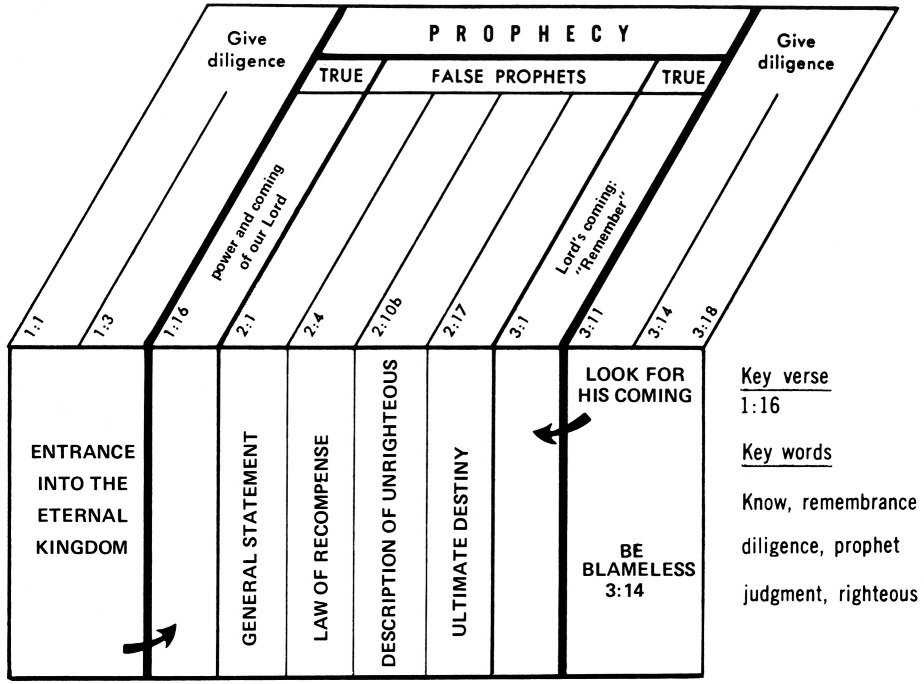
2 Peter: True and False Prophecy
Click chart to enlarge
Chart from Jensen's Survey of the NT - used by permission
|
2 PETER |
||||||||
| Cultivation of Christlike Character |
Condemnation of False Teachers |
Confidence in the Return of Christ |
||||||
| Greeting to Saints 2Pe 1:1-2 |
Growth in Christ 2Pe 1:3-14 |
Grounds |
Danger of |
Demise of |
"Decor" of |
Mockers in |
Manifest |
Maturity in light of that |
| Know Your Salvation |
Know |
Know Your Adversaries |
Know |
|||||
| True Prophecy (True Knowledge) |
False Prophets (False Teachers) |
Final Prophecy (Day of the Lord) |
||||||
| Holiness | Heresy | Hope | ||||||
| Development of Faith |
Denunciation of False Teachers |
Design of The Future |
||||||
2 Peter 2:12 But these, like unreasoning animals, born as creatures of instinct to be captured and killed, revilingwhere * they have no knowledge, will in the destruction of those creatures also be destroyed (NASB: Lockman)
Greek: outoi de, os aloga zoa gegennemena (RPPNPN) phusika eis alosin kai phthoran, en ois agnoousin (3PPAI) blasphemountes, (PPAMPN) en te phthora auton kai phtharesontai, (3PFPI)
Amplified: But these [people]! Like unreasoning beasts, mere creatures of instinct, born [only] to be captured and destroyed, railing at things of which they are ignorant, they shall utterly perish in their [own] corruption [in their destroying they shall surely be destroyed], (Amplified Bible - Lockman)
NET: But these men, like irrational animals-creatures of instinct, born to be caught and destroyed-do not understand whom they are insulting, and consequently in their destruction they will be destroyed, (NET Bible)
NLT: These false teachers are like unthinking animals, creatures of instinct, who are born to be caught and killed. They laugh at the terrifying powers they know so little about, and they will be destroyed along with them. (NLT - Tyndale House)
Phillips: But these men, with no more sense than the unreasoning brute beasts which are born to be caught and killed, scoff at things outside their own experience, and will most certainly be destroyed in their own corruption. (Phillips: Touchstone)
Wuest: But these, as irrational creatures, having been born as creatures of instinct, [destined] for capture and destruction, uttering blasphemies in the sphere of those things concerning which they are ignorant, shall in their [acts of] destroying surely be destroyed
Young's Literal: and these, as irrational natural beasts, made to be caught and destroyed -- in what things they are ignorant of, speaking evil -- in their destruction shall be destroyed
BUT THESE LIKE UNREASONING ANIMALS: houtoi de os aloga zoa:
- Ps 49:10; 92:6; 94:8; Jer 4:22; 5:4; 10:8,21; 12:3; Ezek 21:31; Jude 1:10)
But these (houtoi de) marks the contrast (Always pause and ponder this term of contrast asking what is being contrasted?) of the false teachers to the angels. Verse 12 marks the beginning of a long sentence to verse 16 launching
out into a long passage of magnificent invective. Through it glows the fiery heat of flaming moral indignation. (Daily Study Bible Series)
Unreasoning (249) (alogos from "a" = without + lógos = word, reason) means literally without speech or reason and so irrational, brute (not working by reason, characteristic of an animal in quality, action, or instinct), destitute or unendowed with reason (cf Jude 1:10). In short they are not governed or acting according to reason because they lack reasoning capacity!
See the New International Dictionary of New Testament Theology for a 30+ page discussion of WORD - logos, word, utterance, meaning; lego, collect, count, say; logikos, intellectual, rational, reasonable, spiritual; logion, saying; logios, eloquent; cultured; alogos, irrational, without speech; laleo, to talk, chat, speak.
These false teachers act like irrational natural beasts (Young's literal), unreasoning brute beasts (Phillips) or unthinking animals (NLT)!
There are 3 uses in the NT…
Acts 25:27+ "For it seems absurd to me in sending a prisoner, not to indicate also the charges against him."
2 Peter 2:12 But these, like unreasoning animals, born as creatures of instinct to be captured and killed, reviling where they have no knowledge, will in the destruction of those creatures also be destroyed,
Jude 1:10+ But these men revile the things which they do not understand; and the things which they know by instinct, like unreasoning animals, by these things they are destroyed.
Animals (2226) (zoon from zao = to live, breathe - zoe = life) is a living creature, the exact phrase that reverberates through the unfolding of the book of the Revelation. Jude also uses zoon figuratively in reference to the ungodly who have crept in unnoticed and turn the grace of God into licentiousness (Jude 1:4) (See Animal)
Some of the definitions of animal in the English dictionary present a good picture of these false teachers…
a human being considered chiefly as physical or nonrational; a brutish person; of or relating to the physical needs or desires; carnal; sensual; a very cruel, violent, or uncivilized person.
Vine writes that…
The English “animal” is the equivalent, stressing the fact of life as the characteristic feature
There are 23 uses of zoon in the NT -- Heb 13:11; 2Pe 2:12; Jude 1:10; Re 4:6 - see discussion of 4 Living Creatures in Revelation, Re 4:7, 8; 5:6, 8, 11, 14; 6:1, 3, 5, 6, 7; 7:11; 14:3; 15:7; 19:4)
There are 14 uses of zoon in the Septuagint (LXX) -- Ge 1:21; Job 38:14; Ps. 68:10; 104:25; 145:16; Ezek 1:5, 13, 15, 19, 20, 22; 3:13; 10:15, 20; 47:9; Da 4:12; Hab 3:2
These false teachers act like instinct driven animals, guided not by true intelligence (they cannot even think rightly) but by their irrational cravings and passions. Rather than following reason and revelation, the false teachers are guided only by their ignorance and their instinctual sinful passions that come from their unredeemed totally depraved flesh. They are ultimate religious hypocrites who profess to have deep religious insights when in reality their natural sense and cravings guide them rather than spiritual truths (cp "form of godliness" 2Ti 3:5-note) . Like wild (and even domesticated) animals, these spiritual masqueraders react only to present circumstances, without giving thought to the consequences of their actions (cp the principle of sowing wickedness -- Ga 6:7, 8, Job 4:8, Pr 22:8, Jer 12:13, Ho 8:7, 10:13, 2Pe 2:12,19 Rev 22:11, cp Jn 8:34, Pr 5:22, Je 2:19).
Sow a thought, and you reap an act;
Sow an act, and you reap a habit;
Sow a habit, and you reap a character;
Sow a character, and you reap a destiny.
—Samuel Smiles
Matthew Henry - Men, under the power of sin, are so far from observing divine revelation that they do not exercise reason, nor act according to the direction thereof. They walk by sight, and not by faith, and judge of things according to their senses; as these represent things pleasant and agreeable, so they must be approved and esteemed. Brute-creatures follow the instinct of their sensitive appetite, and sinful man follows the inclination of his carnal mind; these refuse to employ the understanding and reason God has given them, and so are ignorant of what they might and ought to know.
Strachan says of these false teachers that
Their chief characteristic is that they are ‘alive,’ (Ed: But see Ep 2:1-note, Ep 2:2-note, Ep 2:3-note) and have no sense of the moral issues of life. Like animals, they exist to be taken and destroyed.
Sin will take you further than you ever intended to stray.
It will keep you longer than you ever intended to stay.
And it will cost you more than you ever dreamed you would pay.
BORN AS CREATURES OF INSTINCT TO BE CAPTURED AND KILLED REVILING WHERE THEY HAVE NO KNOWLEDGE: gegennemena (RPPNPN) phusika eis alosin kai phthoran en ois agnoousin (3PPAI) blasphemountes (PAPMPN) :
Born (1080) (gennao) is used chiefly of men begetting children and here is used figuratively to identify these false teachers as the product of nature alone and thus governed by their base appetites and passions. Gennao is perfect tense picturing their continuing state after birth as "mere animals" (Thayer). They were no better than animals. They lived and spoke from mere instinct (i.e., from sinful human nature).
Creatures of Instinct (5446) (phusikos) means natural or that which is produced by and belongs to nature or is governed by the natural instincts. Phusikos describes that which in accord with the basic order of nature. It speaks of the naturally regulated order of things and is used in the NT to refer to that which should be "natural" or instinctive. It describes how one should behave by nature (Ro 1:26, 27). Here in 1Peter 2:12, phusikos refers to those who are like animals and thus are governed by natural instincts. They followed their natural desires. Like animals in a jungle, their only value was in being caught and destroyed. This harsh language from Peter is an indication of how serious he considered these heresies to be.
Here are the only other NT uses of phusikos…
Romans 1:26 (note) For this reason God gave them over to degrading passions; for their women exchanged the natural function for that which is unnatural,
Romans 1:27 (note) and in the same way also the men abandoned the natural function of the woman and burned in their desire toward one another, men with men committing indecent acts and receiving in their own persons the due penalty of their error.
Webster says instinct is a "largely inheritable (see note Romans 5:12) and unalterable tendency of an organism to make a complex and specific response to environmental stimuli without involving reason. It describes behavior that is mediated by reactions below the conscious level."
These false teachers act like irrational animals, slaves to their natural instincts and without the restraint that good angels and righteous men and women have. Animals have life, but the false teachers live purely by instinct. They lack the finer rational sensibilities that humans possess. These men operate from instinct that emanates from the sin nature inherited from Adam. They are like predatory animals which men deliberately snare in order to destroy them. They act like wild beasts and so reap the same destiny.
Philosophers (e.g., Epictetus and 2nd-century Stoic emperor Marcus Aurelius) characterized animals as creatures ruled by instinct as opposed to humans, who were ruled by reason, and considered unreasoning humans “wild beasts.”
Captured and killed - literally "for capture and destruction" or as Moffat translates it "for capture and corruption."
Capture (alosis) means a catching, a capture, as of catching of animals for food.
Killed (5356) (phthora from phtheíro = to destroy by means of corrupting) describes a state of ruin or destruction with the implication of disintegration, decay or rotting like organic matter.
J. Vernon McGee adds a pithy comment:
These apostates are like wild animals. We hear a great deal today about man descending from an animal, but both the Old and New Testaments make it very clear that man is capable of living lower than the animals. He’s not descended from anything. He’s right down with them, if you please, and lives like an animal. Peter will give an illustration of this a little later on in this chapter. (McGee, J V: Thru the Bible Commentary)
Reviling where they have no knowledge (Literally “insulting those of whom they are ignorant”) (Phillips "they scoff at things outside their own experience") illustrates just how irrational they behave and it also lays the ground for their coming destruction.
Reviling (continuously = present tense) (987) (blasphemeo from bláx = sluggish, slow, stupid + phémē = rumor, fame) OR MORE LIKELY (derived from bláptō = to hurt, injure, harm + phémē from phēmí = to speak) means literally to speak to harm and in general therefore means to bring into ill repute and so to slander, to defame (to harm the reputation of by libel or slander), speak evil of, to rail at (revile or scold in harsh, insolent, or abusive language and rail stresses an unrestrained berating), to speak calumny (noun form = a misrepresentation intended to blacken another’s reputation = the act of uttering false charges or misrepresentations maliciously calculated to damage another’s reputation), to calumniate (verb form = to utter maliciously false statements, charges, or imputations about - calumniate imputes malice to the speaker and falsity to the assertions)
Blasphemeo is used 34 times in the NT --
Mt 9:3; 26:65; 27:39; Mk 2:7; 3:28, 29; 15:29; Lk 12:10; 22:65; 23:39; Jn 10:36; Acts 13:45; 18:6; 19:37; 26:11; Ro 2:24-note; Ro 3:8-note; Ro 14:16-note; 1Co 10:30; 1Ti 1:20; 6:1; Titus 2:5-note; Titus 3:2-note; James 2:7; 1Pe 4:4-note; 2Pe 2:2-note, 2Pe 2:10-note, 2Pe 2:12-note; Jude 1:8, 10; Re 13:6-note; Re 16:9-note, Re 16:11-note, Re 16:21-note
The NAS translates blasphemeo as -- blaspheme(4), blasphemed(6), blasphemers(1), blasphemes(3), blaspheming(4), dishonored(1),hurling abuse(3), malign(2), maligned(1), revile(3), reviling(1), slandered(1), slanderously reported(1), spoken against(1), spoken of as evil(m)(1), utter(1).
There are 5 uses of blasphemeo in the Septuagint (LXX)- 2Ki. 19:4, 6, 22; Is 52:5; Da 3:29
Have no knowledge (50) (agnoeo from a = not + noéo = perceive, understand) means to be unaware of or to be ignorant of. It also conveys the sense to refuse to think about or pay attention to and so to ignore. For example in Romans 1 Paul says that men knew of God’s Being through natural revelation (Ro 1:19, 20, 21- see notes Ro 1:19; 20; 21, Ro 1:28-note), but did not know the purpose of His kindness.
They continuously (present tense) slander and rail against that which they are have no knowledge, things of which they are continually (present tense) ignorant. They have no more knowledge than the brute beasts would have. They make a lot of noise about things they know nothing about!
As someone has well said their self assurance or presumption is matched only by their ignorance. Their ignorance is never more glaring than when they criticize the Bible. Because they are devoid of divine life, they are utterly unable to understand the words, ways, and works of God (1Cor 2:14). Yet they pose as experts in the spiritual realm. A humble believer can see more on his knees than they can see on their tiptoes.
This picture of their spiritual ignorance parallels Paul's description of the false teachers in Colossians
"Let no one keep defrauding you of your prize by delighting in self-abasement and the worship of the angels, taking his stand on visions he has seen, inflated without cause by his fleshly mind." (see note Colossians 2:18)
Wycliffe Commentary - the characteristic of modern ‘liberal’ critical teachers which amazes one most is their absolute confidence in their own conclusions, based upon evidence however trivial, and involving tremendously important departures from tenets maintained for centuries by the historic church. (Pfeiffer, C F: Wycliffe Bible Commentary. 1981. Moody)
WILL IN THE DESTRUCTION OF THOSE CREATURES ALSO BE DESTROYED: en te phthora auton kai phtharesontai (3PFPI):
- 2 Pe 2:19; 1:4; Pr 14:32; Jn 8:21; Gal 6:8
Earlier Peter talked about the fact that the child of God has escaped the corruption of the world (2Peter 1:4-note)—but these have not escaped the corruption. In fact they will be "Corrupted in their own corruption" an interesting play on words. These spiritual charlatans are “corrupted by their own corrupt living.” That is the irony of sinful living: its very pleasures in the end become distasteful. Sensuality is self-destructive.
Destruction (5356) (phthora from phtheiro = to shrivel or wither, spoil , ruin, deprave, corrupt , defile, to destroy by means of corrupting, to spoil as does milk. Ethically phtheiro was the opposite of sozo) refers to a state of ruin or destruction with the picture of deterioration, dissolution, disintegration, ruin, perishing, decay or rotting like organic matter (breakdown of organic matter). Phthora was sometimes used of decaying food, which turns from that which is beneficial to that which is harmful.
The basic idea of phthora is not a sudden destruction owing to external violence, but a dissolution brought about by internal decay. It describes decomposition which brings to mind the picture of loathsome decaying matter replete with maggots and other macabre microbes! Figuratively the idea is that of the horrible thought of the "rotting" of one's morals which become more depraved with greater loss of integrity as a result of "slow internal decay".
Phthora pictures a departure from the original or from what is pure or correct and aptly depicts the moral filth and pollution of the world without God! It is the very opposite of "the divine nature."
Vine comments that phthora is "connected with phtheiro and signifies "a bringing or being brought into an inferior or worse condition, a destruction or corruption." It is used (a) physically, (1), of the condition of creation, as under bondage, Ro 8:21 ; (2) of the effect of the withdrawal of life (which alone maintains the physical organism in effective being), and so of the condition of the human body in burial, 1Corinthians 15:42 ; (3) by metonymy, of anything which is liable to "corruption," 1 Corinthians 15:50 ; (4) of the physical effects of merely gratifying the natural desires and ministering to one's own needs or lusts, Galatians 6:8 , to the flesh in contrast to the Spirit, "corruption" being antithetic to "eternal life;" (5) of that which is naturally short-lived and transient, Colossians 2:22 , "perish;" (b) of the death and decay of beasts, 2 Peter 2:12 , RV, "destroyed" (first part of verse; lit., "unto … destruction"); (c) ethically, with a moral significance, (1) of the effect of lusts, 2 Peter 1:4 ; (2) of the effect upon themselves of the work of false and immoral teachers, 2 Peter 2:12 , RV, "destroying;" AV, "corruption," and 2 Peter 2:19 … the result of the withdrawal of life (which alone maintains the physical organism in effective being) is the dissolution of the body; this process is called corruption, and is attended by conditions repugnant to the senses of the living. This idea of repulsiveness is extended to the moral sphere… Apoleia and phthora signify not the destruction of being but of well-being, not an end of the existence of a person or thing. (Expository Dictionary)
Phthora was used in Greek to refer to destruction of a fetus and thus to a miscarriage or abortion (Epistle of Barnabas 19:5), which was said to make the mother unclean for 40 days. It was used in Greek to describe the ruination of a person through an immoral act such as the seduction of a young woman.
In this passage Peter indicates this corruption is one of the effects of false teachers upon themselves! (cp 2Ti 3:13 speaking of the effects of deceiving being to be deceived! - see note)
Phthora is used 7 times in the Septuagint (LXX) (Ex 18:18; Ps 103:4; Is 24:3; Da 3:25; 10:8; Jon 2:6; Mic 2:10). Here are some of the uses in the OT Greek…
Psalm 103:4 Who redeems your life from the pit (pit in Hebrew = destruction, decay as in Ps 16:10 and in several context pictures a state of death, in some context to Sheol - Job 33:24, Ezek 28:8) (LXX= phthora = corruption!). Who crowns you with lovingkindness and compassion
Isaiah 24:3 The earth will be completely laid waste (LXX= Greek literally reads corrupted [phtheiro] with corruption [phthora]!) and completely despoiled, for the LORD has spoken this word.
Daniel 3:25 He answered and said, "Look! I see four men loosed and walking about in the midst of the fire without harm (LXX= phthora = corruption!), and the appearance of the fourth is like a son of the gods!"
Jonah 2:6 "I descended to the roots of the mountains. The earth with its bars was around me forever, But Thou hast brought up my life from the pit (pit in Hebrew = destruction, decay as in Ps 16:10 and in several context pictures a state of death, in some context to Sheol - Job 33:24, Ezek 28:8) (LXX= phthora = corruption!), O LORD my God.
Micah 2:10 "Arise and go, For this is no place of rest Because of the uncleanness that brings on destruction, a painful destruction (LXX= phthora).
There are 8 uses of phthora in the NT…
Romans 8:21 (note) that the creation itself also will be set free from its slavery to corruption into the freedom of the glory of the children of God.
Comment: Corruption is here viewed as a evil power which effects all of creation as a result of Adam's sin in Romans 5:12-note) (Vine comments that phthora " is used in the New Testament either of decay and death, in the physical sphere (as here and in 1Cor 15:42, 50; 2 Pet 2:12), or of moral degeneracy (as in Col.2:22-note; Gal 6:8). The phrase “bondage of corruption” is taken by some in an objective sense, as signifying bondage which produces corruption, by others subjectively, as the bondage which consists in corruption. The latter seems to be the meaning - Vine, W. Collected writings of W. E. Vine. Nashville: Thomas Nelson or Logos)
1 Corinthians 15:42 So also is the resurrection of the dead. It is sown a perishable body, it is raised an imperishable body… 50 Now I say this, brethren, that flesh and blood cannot inherit the kingdom of God; nor does the perishable inherit the imperishable. (Here phthora describes that which is subject to corruption, perishing or decay and stands opposite aphtharsia - that which is incorruptible or imperishable).
Galatians 6:8 For the one who sows to his own flesh shall from the flesh reap corruption, but the one who sows to the Spirit shall from the Spirit reap eternal life.
Comment: No one would bother to harvest a field of decaying matter. The deeds of the flesh are always corruptive and can only make a person progressively worse. The ultimate corruption is eternal death, the wages of sin. John Stott writes that "Every time we allow our mind to harbor a grudge, nurse a grievance, entertain an impure fancy, wallow in self-pity, we are sowing to the flesh. Every time we linger in bad company whose insidious influence we know we cannot resist, every time we lie in bed when we ought to be up and praying, every time we read pornographic literature, every time we take a risk that strains our self-control we are sowing, sowing, sowing, to the flesh" -- The Message of Galatians. Inter-Varsity Press. 1984).
Colossians 2:22 (note) (which all refer to things destined to perish with the using)-- in accordance with the commandments and teachings of men?
2 Peter 1:4 (note) For by these He has granted to us His precious and magnificent promises, in order that by them you might become partakers of the divine nature, having escaped the corruption that is in the world by lust. (Here phthora describes the total destruction of an entity).
2 Peter 2:12 (note) But these, like unreasoning animals, born as creatures of instinct to be captured and killed, reviling where they have no knowledge, will in the destruction of those creatures also be destroyed. (Clearly phthora here is used in an ethical sense and refers to moral decay.
2 Peter 2:19 (note) promising them freedom while they themselves are slaves of corruption; for by what a man is overcome, by this he is enslaved. (Here it refers to a general inward depravity)
Destroyed (5351) (phtheiro) means to destroy (middle voice) and to destroy (passive voice). The idea is to cause harm to something in a physical manner or in the outward circumstances and thus to ruin, corrupt or spoil.
In moral or ethical sense phtheiro means to cause deterioration of one's inner life (cp Ep 4:22 as caused by the lusts of deceit, Re 19:2) or to cause ruin to something as in 1Co 15:33 where the idea is that of being led astray. Phtheiro as in the present passage can describe the sense of punish by destroying.
TDNT writes that…
Economic ruin may also be in view. In curses the meaning may be “be damned” or more weakly “be off.” Another sense is “to spoil” (e.g., milk). The loss of food or of animals may sometimes be denoted. (Kittel, G., Friedrich, G., & Bromiley, G. W. Theological Dictionary of the New Testament. Eerdmans)
Vine says phtheiro
signifies “to destroy by means of corrupting,” and so “bringing into a worse state”.
(a) with this significance it is used of the effect of evil company upon the manners of believers, and so of the effect of association with those who deny the truth and hold false doctrine, 1Co 15:33 (this was a saying of the pagan poet Menander, which became a well known proverb); in 2Co 7:2, of the effects of dishonorable dealing by bringing people to want (a charge made against the apostle); in 2Co 11:3, of the effects upon the minds (or thoughts) of believers by “corrupting” them “from the simplicity and the purity that is toward Christ”; in Ep 4:22 (note), intransitively, of the old nature in waxing “corrupt,” “morally decaying, on the way to final ruin” (Moule), “after the lusts of deceit”; in Re 19:2 (note), metaphorically, of the Babylonish harlot, in “corrupting” the inhabitants of the earth by her false religion.
(b) With the significance of destroying, it is used of marring a local church by leading it away from that condition of holiness of life and purity of doctrine in which it should abide, 1Co 3:17 (kjv, “defile”), and of God’s retributive destruction of the offender who is guilty of this sin (id.); of the effects of the work of false and abominable teachers upon themselves, 2Pe 2:12 (some texts have kataphtheiro; kjv, “shall utterly perish”), and Jude 1:10 (kjv, “corrupt themselves.” rv, marg., “are corrupted”). (Vine's Expository Dictionary of NT Words)
Phtheiro is used 8 times in the NT -
1 Corinthians 3:17 If any man destroys the temple of God, God will destroy him, for the temple of God is holy, and that is what you are.
1 Corinthians 15:33 Do not be deceived: "Bad company corrupts good morals."
2 Corinthians 7:2 Make room for us in your hearts; we wronged no one, we corrupted no one, we took advantage of no one.
2 Corinthians 11:3 But I am afraid, lest as the serpent deceived Eve by his craftiness, your minds should be led astray from the simplicity and purity of devotion to Christ.
Ephesians 4:22 (note) that, in reference to your former manner of life, you lay aside the old self, which is being corrupted in accordance with the lusts of deceit,
2 Peter 2:12 (note) But these, like unreasoning animals, born as creatures of instinct to be captured and killed, reviling where they have no knowledge, will in the destruction of those creatures also be destroyed,
Jude 1:10 But these men revile the things which they do not understand; and the things which they know by instinct, like unreasoning animals, by these things they are destroyed.
Revelation 19:2 (note) because His judgments are true and righteous; for He has judged the great harlot who was corrupting the earth with her immorality, and He has avenged the blood of His bond-servants on her."
There are 17 uses of phtheiro in the non-apocryphal Septuagint (LXX)- Ge 6:11; Ex 10:15; Lev 19:27; Deut 34:7; 1Chr 20:1; Job 15:32; Is 24:3, 4; 54:16; Je 13:9; Ezek 16:52; Da 2:44; 7:14; 8:24; 9:26; 11:17; Ho 9:9
Genesis 6:11 Now the earth was corrupt (Lxx = phtheiro = morally corrupt) in the sight of God, and the earth was filled with violence.
Hosea 9:9 (KJV) They have deeply corrupted (Lxx = phtheiro = morally corrupt) themselves, as in the days of Gibeah: therefore he will remember their iniquity, he will visit their sins.
Jeremiah 13:9 "Thus says the LORD, 'Just so will I destroy (Heb = shachath = destroy, mar, spoil; Lxx = phtheiro) the pride of Judah and the great pride of Jerusalem.
Daniel 2:44 "And in the days of those kings the God of heaven will set up a kingdom which will never be destroyed (Aramaic = chabal = destroy; Lxx = phtheiro), and that kingdom will not be left for another people; it will crush and put an end to all these kingdoms, but it will itself endure forever. (cp Da 7:14 … and His kingdom is one which will not be destroyed [Lxx = phtheiro])
Daniel 9:26 "Then after the sixty-two weeks the Messiah will be cut off and have nothing, and the people of the prince who is to come will destroy (Heb = shachath = destroy; Lxx = phtheiro) the city and the sanctuary. And its end will come with a flood; even to the end there will be war; desolations are determined.
Both the noun phthora and the verb phtheiro have the double meaning of corrupting and perishing. The implication here in Peter's epistle is that although these men will certainly perish physically, there is a ruin or corruption that awaits them which will be far worse than any mere physical destruction, this second corruption most likely referring to eternal punishment
"where THEIR WORM DOES NOT DIE, AND THE FIRE IS NOT QUENCHED" (Mk 9:48)!
Such harsh words reveal the seriousness of the false teachers’ sin. Those who teach have great responsibility. Jesus had said,
“Whoever causes one of these little ones who believe to stumble, it would be better for him if, with a heavy millstone hung around his neck, he had been cast into the sea” (Mark 9:42).
Teachers who lead others astray will face great punishment. The false teachers had set aside self-restraint in order to follow their passions. False teachers cannot get beyond their own instincts and thus will be destroyed by the folly of those passions. But following one’s passions leads to self-destruction and to eternal punishment
Matthew Henry - These persons shall be utterly destroyed in their own corruption. Their vices not only expose them to the wrath of God in another world, but often bring them to misery and ruin in this life; and surely such impudent offenders, who glory in their shame, and to whom openness in sin is an improvement of the pleasure of sinning, most justly deserve all the plagues of this life and the pains of the next in the greatest extremity. Therefore whatever they meet with is the just reward of their unrighteousness.
Barclay - The evil men are like brute beasts, slaves of their animal instincts. But a beast is born only for capture and death, says Peter; it has no other destiny. Even so, there is something self-destroying in fleshly pleasure. To make such pleasure the be-all and the end-all of life is a suicidal policy and in the end even the pleasure is lost. The point Peter is making is this, and it is eternally valid--if a man dedicates himself to these fleshly pleasures, in the end he so ruins himself in bodily health and in spiritual and mental character, that he cannot enjoy even them. The glutton destroys his appetite in the end, the drunkard his health, the sensualist his body, the self-indulgent his character and peace of mind ("and begins his experience of hell while still on earth.") (Ed: Woe!) (2 Peter 2 - William Barclay's Daily Study Bible)
Wiersbe - These “brute beasts” are destined for destruction, a truth Peter mentioned often in 2 Peter 2:3, 4, 9, 12, 17, 20). As they seek to destroy the faith, they themselves shall be destroyed. They will be “corrupted in their own corruption.” Their very nature will drag them down into destruction, like the pig returning to the mire and the dog to its vomit (2Pe 2:22-note). Unfortunately, before that event takes place, these people can do a great deal of moral and spiritual damage." (see e.g. effect of Balaam on sons of Israel @ Nu 31:16) (bolding and coloring added) (Wiersbe, W: Bible Exposition Commentary. 1989. Victor)
2Peter 2:13 suffering wrong as the wages of doing wrong. They count it a pleasure to revel in the daytime. They are stains and blemishes, reveling in their deceptions, as they carouse with you (NASB: Lockman)
Greek: adikoumenoi (PMPMPN) misthon adikias; hedonen hegoumenoi (PMPMPN) ten en hemera truphen, spiloi kai momoi entruphontes (PMPMPN) en tais apatais auton suneuochoumenoi (PPPMPN)
Amplified: Being destined to receive [punishment as] the reward of [their] unrighteousness [suffering wrong as the hire for their wrongdoing]. They count it a delight to revel in the daytime [living luxuriously and delicately]. They are blots and blemishes, reveling in their deceptions and carousing together [even] as they feast with you. (Amplified Bible - Lockman)
NET: suffering harm as the wages for their harmful ways. By considering it a pleasure to carouse in broad daylight they are stains and blemishes indulging in their deceitful pleasures when they feast together with you. (NET Bible)
NLT: Their destruction is their reward for the harm they have done. They love to indulge in evil pleasures in broad daylight. They are a disgrace and a stain among you. They revel in deceitfulness while they feast with you. (NLT - Tyndale House)
Phillips: Their wickedness has earned them an evil end and they will be paid in full. These are the men who delight in daylight self-indulgence; they are foul spots and blots, playing their tricks at your very dinner-table. (Phillips: Touchstone)
Wuest: receiving unrighteousness as the hire for unrighteousness, deeming luxurious living in the daytime a pleasure; moral blemishes and disgraceful blots, reveling in their deceitful cravings while they are feasting with you [at the Christian love-feasts]
Young's Literal: about to receive a reward of unrighteousness, pleasures counting the luxury in the day, spots and blemishes, luxuriating in their deceits, feasting with you,
SUFFERING WRONG AS THE WAGES OF DOING WRONG: adikoumenoi (PMPMPN) misthon adikias:
- Is 3:11; Ro 2:8,9; Php 3:19; 2Ti 4:14; Heb 2:2;2:3 Jude 1:12, 13, 14,15, 16; Re 18:6
Suffering wrong - elaborates on the corruption or destruction Peter has just discussed. There is some difference in the manuscripts in this verse, the KJV translated from the Greek manuscript called the "Textus Receptus" uses a different verb than the more modern manuscripts. The Textus Receptus has komizo which literally means "being about" or "destined to receive". The KJV then reads "shall receive the reward (wages = NKJV) of unrighteousness".
Suffering wrong (91) (adikeo from a = without + díke = justice) means to act unjustly, do wrong, be unjust.
Here are the 28 uses of adikeo in the NT - Mt. 20:13; Lk 10:19; Acts 7:24, 26, 27; 25:10, 11; 1Co. 6:7, 8; 2Co 7:2, 12; Ga 4:12; Col 3:25; Philemon 1:18; 2Pe 2:13; Re 2:11; 6:6; 7:2, 3; 9:4, 10, 19; 11:5; 22:11
Wages (3408) (misthos) refers to pay for service, good or bad. Here it refers to the wages of unrighteousness or wages "earned" from committing iniquity. In this context misthos conveys the sense of retribution or punishment.
Instead of komizo, the ASV uses the verb adikeo which has more textual support as being the actual original verb Peter used and reads "suffering wrong as the hire of wrong-doing". The sense of the verb adikeo in this context is that of being damaged or harmed which pictures these false teachers as actually being "harmed by the reward paid for unrighteousness." Peter is saying in essence that their animalistic behavior and immorality is not worthwhile and the end it will not pay them good but bad, elaborating on one way corruption is coming upon these false teachers.
Phillips has a poignant paraphrase
"Their wickedness has earned them an evil end and they will be paid in full".
The ICB (International Children's Bible) translation puts the fate of these false teachers in plain English:
"They have caused many people to suffer; so they themselves will suffer. That is their pay for what they have done."
"Their destruction is their reward for the harm they have done." (NET)
These false teachers will be caught in their own webs and God will give them what they have done to others (Gal 6:7) or as (NIV) phrase it
"They will be paid back with harm for the harm they have done."
Sin attracts with its offer of pleasure, but in the end those who indulge in it find no pleasure at all. The principle is that sin always brings its own destruction. God does not vindictively punish sin (although He will justly punish all sin some day) for sin begets its own punishment. There is only one way of genuine life, and that is God’s way and any and all independence from Him leads to corruption and destruction.
THEY COUNT IT A PLEASURE TO REVEL IN THE DAYTIME: hedonen hegoumenoi (PMPMPN) ten en hemera truphen:
- Jn 9:4, Ro 13:13; 1Th 5:7,8; 1Pe 4:4
- See Torrey's interesting topic Worldly amusements & pleasures)
Wrong doctrine will always lead to wrong living and now Peter focuses on sensual lifestyle of these false teachers that originates from their sensual thought life which is driven by their animal instincts to gratify self without regard to the effect or impact on others.
These men deem
"luxurious living in the daytime a pleasure" (Wuest), "love to indulge in evil pleasures in broad daylight" (Phillips) and "count it a delight to revel in the daytime [living luxuriously and delicately]." (Amp)
Count (2233)(hegeomai) is a mathematical term meaning to think about something and come to a conclusion. It describes one who makes a decision only after weighing the facts and circumstances. Hegeomai implies careful thought and does not picture one making a quick decision.
These evil men think (present tense = continually as their lifestyle) about their "hedonistic" desires and come to the conclusion that it is right for them to live luxuriantly in extravagance and to have pleasure not just in the night but even in "broad daylight"!
Wuest - These count it a pleasure to live a luxurious life in the day time, which means that they do not work for a living but live off of the money they get from those whom they lead astray into false doctrine. They live luxuriously at a time when men are supposed to be sober and at their daily occupations. (Wuest, K. S. Wuest's Word Studies from the Greek New Testament: Eerdmans)
Pleasure ( 2237) (hedone from hedos = delight, enjoyment > hedomai = have sensual pleasure) describes the state or condition of experiencing pleasure for any reason and thus speaks of gratification and enjoyment. Although it can be "good", in the NT hedone is almost always used in a "bad" sense implying self indulgence and lack of control over our natural appetite (cf "unreasoning animals") and sensual gratification. Hedone is the root of our English hedonism, which is the doctrine that pleasure or happiness is the sole or chief good in life, and is manifest as an insatiable pursuit of self-satisfaction that so characterizes our modern society.
Hedone is used 5 times in the NT (Lk. 8:14; Titus 3:3-note; James. 4:1, 3; 2Pe 2:13).
Ancient hedonism expressed itself in two ways: the cruder form was that proposed by Aristippus and the early Cyrenaics, who believed that pleasure was achieved by the complete gratification of all one’s sensual desires. In contrast, Epicurus' school, though accepting the primacy of pleasure, tended to equate it with the absence of pain and taught that it could best be attained through the rational control of one’s desires. In either case it was focused on self.
In the NT hedone is used only in a bad sense, referring to indulgence and lack of control of natural appetites (sensual) pleasure.
James asks
"What is the source of quarrels and conflicts among you? Is not the source your pleasures that wage war in your members?" (James 4:1)
He goes on to explain
"You ask and do not receive, because you ask with wrong motives, so that you may spend it on your pleasures." (James 4:3)
Jesus describing nominal, non-saving belief teaches that hedone can contribute to a fruitless life
the seed which fell among the thorns, these are the ones who have heard, and as they go on their way they are choked (throttled so as to suffocate) with worries and riches and pleasures of this life, and bring no fruit to maturity. (Lk 8:14)
Hedone is not a neutral force but in other NT uses is shown to have the ability to choke out the Word of God making one unfruitful (Lk 8:14), and along with lusts hedone can enslave a person (see Titus 3:3-note), both effects undoubtedly playing an important role in the actions of these false teachers.
As noted above, the Greek word gives us our English hedonism which Webster defines as the doctrine that pleasure or happiness is the sole or chief good in life. It's the warped belief that our ultimate purpose for living is to be found in enjoying pleasure and avoiding pain. A hedonist philosophy of feeling pervades our culture. People no longer say, “I think we should do such and such,” but “I feel we should do such and such.” People live by the slogan, “If it feels good, it must be good.” Choices are made to avoid pain or any sort of discomfort, even at others’ expense. The pleasure principle pervades. These false teachers are hedonists of the worst sort and take the practice of hedonism to a new low, even to the point of "reveling in the daytime". They will not hesitate to do whatever it takes to have pleasure. Solomon who knew something of "hedonism" (Eccl 2:10) said "He who loves pleasure will become a poor man" (Pr 21:17a)
|
HEDONISM & A FEW OTHER "ISM'S" |
|
1. Humanism says, “Isn’t man wonderful!?” 2. Hedonism says, “Isn’t sin wonderful!?” 3. Materialism says, “Isn’t money wonderful!?” 4. Relativism says, “If it’s wonderful for you, that’s wonderful!” 5. Pragmatism says, “If it works, it’s wonderful!” 6. Universalism says, “There are no differences.” 7. Ecumenicism says, “Overlook the differences.” 8. Syncretism says, “Mix up all the differences.” |
Revel (5172) (truphe from thrupto = break up, figuratively to enfeeble the mind and body by indulgence) describes one engaging in a fast, self-indulgent lifestyle or indulgence. In English the noun revel (from Latin = rebellare = to revolt or rebel) describes a wild party or celebration and thus the revel means to engage or wallow in noisy festivities. It conveys the idea of a life of luxury, softness, and extravagance (big luxury cars, big Rolex's, big gold rings, tailored silk suits, etc). It describes a life lived in splendor usually associated with intemperate feasting and drinking. At the expense of those who support them, the apostates enjoy luxurious living. In our own society, there are those who plead for funds for their “ministries,” yet live in expensive houses, drive luxury cars, and wear costly clothes.
These deceptive teachers live in luxury and they even think they're right in doing it, deceived in their own minds by their own deception! They talk about "freedom while they themselves are slaves of corruption" (see note 2 Peter 2:19)! Reveling in the daytime means that they are open about it, that they don't hide it.
Reveling was part of all-night parties among the pagans and so Peter's assertion that these false teachers were "partying" in the daytime portrayed them as worse than the pagans, not hiding their debauchery under the cover of night but reveling in open daylight. (cf Is 5:11 contrast Acts 2:15) This implies that these deceived deceivers replaced the true teaching about Christian liberty with an erroneous concept that was not liberty at all but license that would lead only to corruption and destruction! What a "portfolio" Peter presents for these men -- in the preceding verse like brute beasts and now worse than even unregenerate pagans!
MacArthur - Sinning during the day without the cover of darkness was a sign of low-level wickedness in Roman society (1Th 5:7-note). But these false teachers are so consumed with lust and rebellion that they are pleased not to wait for the night. Their unbridled passions consume them. (MacArthur, J.: The MacArthur Study Bible Nashville: Word)
Adam Clarke - Most sinners, in order to practice their abominable pleasures, seek the secrecy of the night; but these, bidding defiance to all decorum, decency, and shame, take the open day, and thus proclaim their impurities to the sun.
MacDonald - These people are so shameless and abandoned that they carry on their sinful activities in full daylight. Most men wait for the cover of darkness to carouse (Jn 3:19); hence the dim lights of the bar and the brothel (1Th 5:7-note). The false teachers have cast off the restraints that usually hide sin in the shadows. (MacDonald, W & Farstad, A. Believer's Bible Commentary: Thomas Nelson)
THEY ARE STAINS AND BLEMISHES REVELING: spiloi kai momoi entruphontes (PAPMPN):
- Song 4:7; Ep 5:27; Jude 1:12
Stains (4696) (spilos) is that which constitutes an unwanted, unsightly stain upon something. Spilos describes spots that disfigure so Peter is picturing these men as "foul spots" (Phillips) or "dirty spots" (NCV) that disfigure whatever "environment" they are in.
Reveling (1792) (entrupho) means to wrongfully enjoy something, to carouse or to openly indulge in. Their habitual lifestyle (entrupho is present tense = their lifestyle) is living luxuriously and so Peter cannot resist calling them what they are… dirt spots and scabs. They are opposite to the character of Christ Who redeemed us
with precious blood, as of a lamb unblemished (aspilos) and spotless (amomos), the blood of Christ" (see note 1 Peter 1:19).
The church should be like her Lord…
having no spot (spilos) or wrinkle or any such thing; but that she would be holy and blameless. (see note Ephesians 5:27).
Blemishes (3470) (momos) defines that which constitutes a defect or blemish, either in the physical or moral sense. This word was used in the Greek translation of the Hebrew OT (Septuagint) in (Lev 21:17) of a man who could not approach God if he had a defect (momos) and in (Dt 15:21) of an animal that was unacceptable for sacrifice to God because it had a defect (momos).
Calvin translates this as
These are filthy spots to you and your assembly; for while they feast with you, they at the same time luxuriate in their errors, and shew by their eyes and gestures their lascivious lusts and detestable incontinency.
NIV Commentary adds an interesting note:
The terms look ahead to 2Pe 3:14 (note), where Christians are encouraged to be found “without spot or blemish” (spotless and blameless) at the Second Coming. The terms therefore also look back to the Jewish sacrificial system: the sacrificial animals were to be without blemish (Lev 21:17, Dt 15:21). Peter’s point, then, is that these men are sinful and unacceptable blemishes on what is otherwise a holy gathering of Christians.
IN THEIR DECEPTIONS: en tais apatais auton:
Deceptions (539) (apate from apatao = cheat, delude, deceive, beguile) describes that which gives a false impression, whether by appearance, statement or influence. It speaks of ethical enticement. It is spoken of anything which is seducing (a leading astray by persuasion or false promises) Apate describes that which causes someone to have misleading or erroneous views concerning the truth.
Enticement (Concise Oxford English Dictionary says it derives from O French enticier, prob. from a base meaning ‘set on fire’) - is that which to attracts and leads astray artfully or adroitly or by arousing hope or desire.
Deception - is that which deliberately causes (someone) to believe something that is not true.
Deceit is personified here as the source of strength as the lusts are not deceitful in themselves. This process of corruption is dominated or controlled by the passionate desires of deceit (personified). The lusts are excited by deceit, i. e. by deceitful influences seducing one to commit sins. Deceit promises joy to the lusts but fails to provide it.
Apate is that which gives a false impression, whether by appearance, by statement or by influence and which cause someone to have misleading or erroneous views concerning the truth. Some scholars say "deception" comes from a word which means "to get you off the path", that which leads you down a road that goes nowhere, except to corruption & destruction, now and eternally.
Peter's point is that their reveling or carousing unmasked their deceptive character. Not only do they deceive others, but they even deceive themselves! As shown below a luxurious lifestyle (riches Mt 13:22 Mk 4:19) as well as our old sin nature can be very deceitful (Hebrews 3:13-note). A person can become so accustomed to his vices that he sees them as virtues. When a person is deceived, by definition he doesn't even know it (otherwise he would not be deceived). They are fooling themselves that they can get away with such blatant sin before a Holy God Who is storing up wrath for the day of His righteous Wrath. While deceiving others, they are deceived themselves (cf 2Ti 3:13-note).
AS THEY CAROUSE WITH YOU: suneuochoumenoi (PPPMPN) humin,:
Carouse with (4910) (suneuocheo) means to make banquet, to feast sumptuously with or feast together with another. Present tense indicates this was the lifestyle of these false teachers. Like a stain on a clean white shirt or a scratch on a gold ring, they marred everything holy by their very presence. Many commentators think Peter is making reference to the "love feasts" of the church that these sensual swine turned into occasions for self indulgence (cf 1Cor 11:20, 21). However it is only fair to note that this term could just as easily include ordinary domestic and social gatherings at which they were foul spots. Thus wherever they eat with Christian people, they are blots and blemishes, that is, unsightly, impure intruders, who luxuriate in their excessive eating and drinking
Wycliffe Bible Commentary adds
Always eager for a good dinner, they make of such occasions an opportunity for raucous mirth and continued false teaching. (Pfeiffer, C F: Wycliffe Bible Commentary. 1981. Moody)
These men were guilty of more than false teaching and promoting evil pleasures; they were guilty of leading others away from the truth. For this “harm,” they would be “paid back".