2 Peter 2:2
2 Peter 2:3
2 Peter 2:4
2 Peter 2:5
2 Peter 2:6
2 Peter 2:7
2 Peter 2:8
2 Peter 2:9
2 Peter 2:10
2 Peter 2:11
2 Peter 2:12
2 Peter 2:13
2 Peter 2:14
2 Peter 2:15
2 Peter 2:16
2 Peter 2:17
2 Peter 2:18
2 Peter 2:19
2 Peter 2:20
2 Peter 2:21
2 Peter 2:22
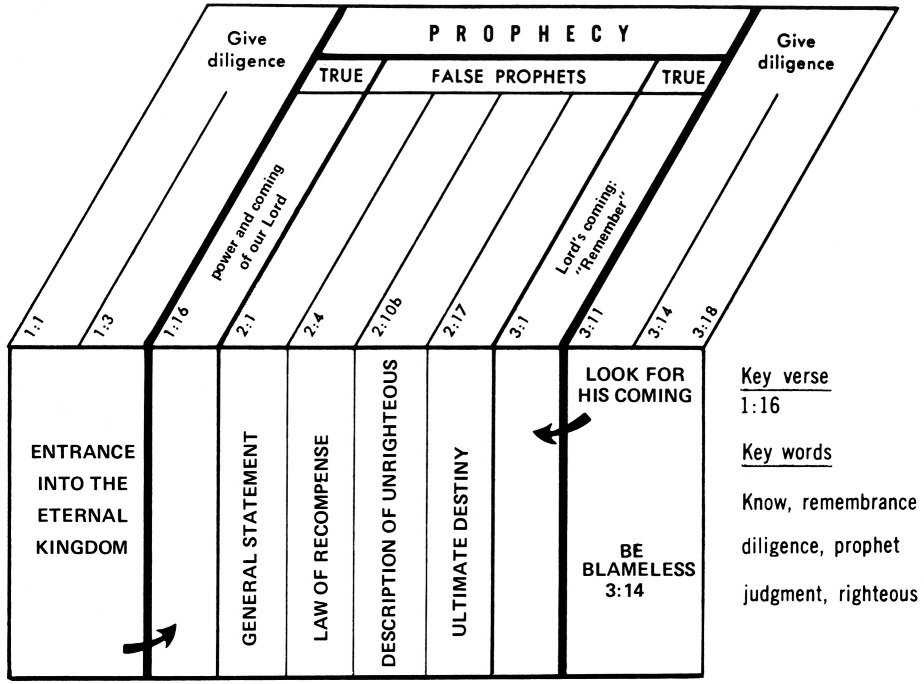
2 Peter: True and False Prophecy
Click chart to enlarge
Chart from Jensen's Survey of the NT - used by permission
|
2 PETER |
||||||||
| Cultivation of Christlike Character |
Condemnation of False Teachers |
Confidence in the Return of Christ |
||||||
| Greeting to Saints 2Pe 1:1-2 |
Growth in Christ 2Pe 1:3-14 |
Grounds |
Danger of |
Demise of |
"Decor" of |
Mockers in |
Manifest |
Maturity in light of that |
| Know Your Salvation |
Know |
Know Your Adversaries |
Know |
|||||
| True Prophecy (True Knowledge) |
False Prophets (False Teachers) |
Final Prophecy (Day of the Lord) |
||||||
| Holiness | Heresy | Hope | ||||||
| Development of Faith |
Denunciation of False Teachers |
Design of The Future |
||||||
2 Peter 2:15 forsaking (PAPMPN) the right way, they have gone astray (3PAPI), having followed the way of Balaam, the son of Beor , who loved (3SAAI) the wages of unrighteousness (NASB: Lockman)
Greek: kataleipontes (PAPMPN) eutheian hodon eplanethesan, (3PAPI) exakolouthesantes (AAPMPN) te hodo tou Balaam tou Bosor, os misthon adikias egapesen (3SAAI)
Amplified: Forsaking the straight road they have gone astray; they have followed the way of Balaam [the son] of Beor, who loved the reward of wickedness. (Amplified Bible - Lockman)
Barclay: They have left the straight road and have gone awandering, and have followed the road of Balaam, the son of Beor, who loved the profit which unrighteousness brings and who was convicted of his lawlessness. A dumb ass spoke with a man’s voice and checked the prophet’s folly (Westminster Press)
NET: By forsaking the right path they have gone astray, because they followed the way of Balaam the son of Bosor, who loved the wages of unrighteousness, (NET Bible)
New Jerusalem Bible: They have left the right path and wandered off to follow the path of Balaam son of Bosor, who set his heart on a dishonest reward, (NJB)
NLT: They have wandered off the right road and followed the way of Balaam son of Beor, who loved to earn money by doing wrong. (NLT - Tyndale House)
Phillips: for they have abandoned the right road and wandered off to follow the old trail of Balaam, son of Peor, the man who had no objection to wickedness as long as he was paid for it. (Phillips: Touchstone)
Wuest: Abandoning the straight road, they went astray, having followed assiduously the road of Balaam, the son of Bosor, who set a high value upon and thus came to love the hire of unrighteousness,
Young's Literal: having forsaken a right way, they did go astray, having followed in the way of Balaam the son of Bosor, who a reward of unrighteousness did love
FORSAKING THE RIGHT WAY: kataleipontes (PAPMPN) eutheian hodon:
- 1Sa 12:23; 1Ki 18:18; 19:10; Eze 9:10; Pr 28:4; Ho 14:8; Acts 13:10
- 2 Peter 2 Resources - Multiple Sermons and Commentaries
They have wandered off the right road (NLT).
Forsaking (2641) (kataleipo = kata = intensifies meaning + leipo = leave behind) literally means to leave behind and figuratively means to abandon or depart from.
The present tense indicates that the false teachers (active voice = their willful choice) are continually abandoning the "right way" which is God's way, synonymous with "the way of truth" Peter mentioned in (2Peter 2:2 [note]).
These men are continually making a conscious, volitional, willful choice to abandon the right way, the straight path. Departing from the straight path, they choose the crooked path. To depart from the path implies they saw it or knew about it, but simply choose to depart from it. To have light and reject light is even worse than having no light at all. Jesus sternly warned the cities of Chorazin and Bethsaida of this consequences of such actions (choices) - Mt 11:21-23). By way of striking contrast, Moses made the opposite choice "By faith he left (forsook) Egypt, not fearing the wrath of the king; for he endured (continued without wavering), as seeing Him who is unseen (How we all need this daily vision of Jesus in and through His Word, so that it serves to motivate us to stay on the right way, for our fallen flesh continually seeks to pull us off the path of righteousness).." (Heb 11:27-note)
Stated another way what these men teach continually causes both them and their unstable "victims" to veer away from the highway of holy doctrine that leads to holy living and instead leads is to the broad way of destruction (Matthew 7:13-note).
The right way - This is the RIGHTeous way, the way God would have us way, according to His Word, empowered by His Spirit. This they did not do.
Right (2117) (euthus) when used as an adjective literally means straight or a straight line and figuratively to what is proper or right. The uses below will give you a good sense of these literal and figurative meanings of euthus.
Euthus is also used as adverb to mean immediately, right away, at once. The use of euthus with the meaning of immediately is a key word in the Gospel of Mark as evidenced by 11 uses just in the first chapter!
Mk 1:3 The voice of one crying in the wilderness, ‘Make ready the way of the Lord, Make His paths straight (euthus used as an adjective) ”
Mk 1:10 Immediately (adverb) coming up out of the water, He saw the heavens opening, and the Spirit like a dove descending upon Him;
Mk 1:12 Immediately (adverb) the Spirit impelled Him to go out into the wilderness.
Mk 1:18 Immediately (adverb) they left their nets and followed Him.
Mk 1:20 Immediately (adverb) He called them; and they left their father Zebedee in the boat with the hired servants, and went away to follow Him.
Mk 1:21 They went into Capernaum; and Immediately (adverb) on the Sabbath He entered the synagogue and began to teach.
Mk 1:23 Just then (adverb) there was a man in their synagogue with an unclean spirit; and he cried out,
Mk 1:28 Immediately (adverb) the news about Him spread everywhere into all the surrounding district of Galilee.
Mk 1:29 And Immediately (adverb) after they came out of the synagogue, they came into the house of Simon and Andrew, with James and John.
Mk 1:30 Now Simon’s mother-in-law was lying sick with a fever; and Immediately (adverb) they spoke to Jesus about her.
Mk 1:42 Immediately (adverb) the leprosy left him and he was cleansed.
Mk 1:43 And He sternly warned him and Immediately (adverb) sent him away
There are 28 more uses of euthus meaning immediately in the remainder of Mark. In chapter 4 Jesus used euthus in His description of the affect of the sowing of the seed (the Word of God)...
And these are the ones who are beside the road where the word is sown; and when they hear, immediately Satan comes and takes away the word which has been sown in them. 16 And in a similar way these are the ones on whom seed was sown on the rocky places, who, when they hear the word, immediately receive it with joy; 17 and they have no firm root in themselves, but are only temporary; then, when affliction or persecution arises because of the word, immediately they fall away. (Mark 4:15-17)
Below are examples of uses of euthus as an adjective, which is the way it is used by Peter.
After Saul was blinded on the road to Damascus, Luke records the Lord's words to Ananias declaring...
Arise and go to the street called Straight (euthus - presumably this was a literal use and the street was straight and not crooked), and inquire at the house of Judas for a man from Tarsus named Saul, for behold, he is praying (Acts 9:11)
Peter addressed Simon who tried to purchase the gift of God declaring...
You have no part or portion in this matter, for your heart is not right (euthus) before God. (Acts 8:21)
Paul fixed his gaze on Elymas the magician and declared...
You who are full of all deceit and fraud, you son of the devil, you enemy of all righteousness, will you not cease to make crooked the straight (euthus) ways of the Lord? (Acts13:10)
Upright conduct in the Bible is pictured as a straight path. John the Baptizer uses the adjective euthus in the synoptic gospels to call upon the Jewish people to "make His paths straight!'" speaking of moral and spiritual preparation of their hearts (i.e. changing behavior) in anticipation of the appearing of their promised Messiah
For this is the one referred to by Isaiah the prophet, saying, "The voice of one crying in the wilderness, 'Make ready the way of the Lord, Make His paths straight!' (Mt 3:3)
In the Septuagint euthus is used 58 times
Ge 15:4; 24:45; 33:12; 38:29; Num. 23:3; Jos. 8:14; Jdg. 14:3; 1 Sam. 12:23; 1 Ki. 20:23, 25; 2 Ki. 10:15; Ezra 8:21; Neh. 9:13; Job 3:11; Ps. 7:9; 11:2; 19:8; 25:21; 27:11; 32:11; 33:1; 36:10; 37:14; 49:14; 58:1; 64:10; 73:1; 78:37; 94:15; 97:11; 107:7, 42; 111:1; 112:2, 4; 125:4; 140:13; 143:10; Prov. 2:13, 16, 19, 21; 20:11; 28:10; 29:10; Isa. 26:7; 33:15; 40:3f; 42:16; 45:13; 59:14; Jer. 3:2; Ezek. 23:40; 33:17, 20; 46:9; Dan. 11:17; Hos. 14:9
Below are some uses of euthus in the Septuagint that help understand the meaning (observe who and what is euthus and the effect of not walking in a euthus way, etc)...
My shield is with God, Who saves the upright (Hebrew = yashar = straight; pleasing; upright; righteous; LXX = euthus) in heart. (Ps 7:10) (See Spurgeon's note)
For, behold, the wicked bend the bow, They make ready their arrow upon the string, To shoot in darkness at the upright (Hebrew = yashar = straight; pleasing; upright; righteous; LXX = euthus) in heart. (Ps 11:2) (See Spurgeon's note)
The precepts of the LORD are right (Hebrew = yashar = straight; pleasing; upright; righteous; LXX = euthus), rejoicing the heart; The commandment of the LORD is pure, enlightening the eyes. (Ps 19:8) (See Spurgeon's note)
Let integrity and uprightness (Hebrew = yoshar = straight; pleasing; upright; righteous; LXX = euthus) preserve me, For I wait for Thee. (Psalm 25:21) (See Spurgeon's note)
Teach me Thy way, O LORD, and lead me in a level (Hebrew = mishor = level place, uprightness; LXX = euthus) path, Because of my foes. (Psalm 27:11) (See Spurgeon's note)
Be glad in the LORD and rejoice, you righteous ones, and shout for joy, all you who are upright (Hebrew = yashar = straight; pleasing; upright; righteous; LXX = euthus) in heart. (Psalm 32:11) (See Spurgeon's note)
Sing for joy in the LORD, O you righteous ones; Praise is becoming to the upright (Hebrew = yashar = straight; pleasing; upright; righteous; LXX = euthus). (Psalm 33:1) (See Spurgeon's note)
The righteous man will be glad in the LORD, and will take refuge in Him; And all the upright (Hebrew = yashar = straight; pleasing; upright; righteous; LXX = euthus) in heart will glory. (Psalm 64:10) (Verse 10)
Surely God is good to Israel, To those who are pure (Hebrew = bar = pure; clean; righteous; LXX = euthus) in heart! (Psalm 73:1) (See Spurgeon's note)
The upright (Hebrew = yashar = straight; pleasing; upright; righteous; LXX = euthus) see it, and are glad; but all unrighteousness shuts its mouth. (Psalm 107:42) (See Spurgeon's note)
His descendants will be mighty on earth; The generation of the upright (Hebrew = yashar = straight; pleasing; upright; righteous; LXX = euthus) will be blessed. (Psalm 112:2) (See Spurgeon's note)
Light arises in the darkness for the upright (Hebrew = yashar = straight; pleasing; upright; righteous; LXX = euthus). He is gracious and compassionate and righteous. (Psalm 112:4) (See Spurgeon's note)
Do good, O LORD, to those who are good, and to those who are upright (Hebrew = yashar = straight; pleasing; upright; righteous; LXX = euthus) in their hearts. (Psalm 125:4) (See Spurgeon's note)
Surely the righteous will give thanks to Thy name; The upright (Hebrew = yashar = straight; pleasing; upright; righteous; LXX = euthus) will dwell in Thy presence. (Psalm 140:13) (See Spurgeon's note)
From those who leave the paths of uprightness (Hebrew = yoshar = straight; pleasing; upright; righteous; LXX = euthus), To walk in the ways of darkness; 14 Who delight in doing evil, And rejoice in the perversity of evil; 15 Whose paths are crooked, And who are devious in their ways; whose paths are crooked, and who are devious in their ways. (Pr 2:13-15)
Whoever is wise, let him understand these things; Whoever is discerning, let him know them. For the ways of the LORD are right (Hebrew = yashar = straight; pleasing; upright; righteous; LXX = euthus), and the righteous will walk in them, but transgressors will stumble in them.( Hosea 14:9)
Way (3598) (hodos) literally means a way for traveling or moving from one place to another and figuratively (which is how Peter uses it in the present context) refers to the course of behavior or to one's way of life.
In Acts the Way was a common early name for the Christian faith. Luke first alludes to the Way in Acts 9...
Now Saul, still breathing threats and murder against the disciples of the Lord, went to the high priest, and asked for letters from him to the synagogues at Damascus, so that if he found any belonging to the Way, both men and women, he might bring them bound to Jerusalem. (Acts 9:1, 2 cp the Way in Acts 19:9, 23, 24:14, 22)
These false teachers have abandoned true and righteous belief ("the Way") resulting in unrighteous behavior. What you believe (and obey) is important, for your beliefs will direct your behavior.
Jude pronounces a woe on the false brethren who have gone the WAY of Cain (Jude 1:11), a clear parallel to the behavior of the false teachers here in 2 Peter.
They have gone astray - They have been led astray. The actively forsook (active voice) and were (passive voice) led astray. We see the same pattern in two passages in 2 Timothy - 2Ti 3:13 and 2Ti 4:3-4....
evil (poneros = actively harmful) men and impostors will proceed from bad to worse, deceiving (planao in the active voice) and being deceived (planao in the passive voice) . (2Ti 3:13-note)
Comment: Notice that These men actively lead others astray from THE TRUTH whether through conduct, speech, or writing, but are themselves deceived by outside source or power (as indicated by the use of passive voice "being deceived".) The deceivers will themselves be deceived!
For the time will come when they will not endure sound doctrine; but wanting to have their ears tickled, they will accumulate for themselves teachers in accordance to their own desires,:4 and will turn away (active voice) their ears from the truth and will turn aside (passive voice - more literally "will be turned aside") to myths. (2Ti 4:3-4-note)
Comment: The dynamic is when they make the choice to turn away from truth, that leaves a "spiritual vacuum" so to speak, and outside forces are given sway and turn them aside to a form of "spirituality" or spiritual things (myths) which are not true.
The "take home" message for all of us is don't forsake or turn away from truth, for if you do, you will put yourself in a dangerous situation spiritually! You open yourself up to control by that which is not true. Hiebert agrees writing that...
conscious, deliberate disobedience to the truth, which they knew (Ed: yes, they knew the truth, but they did not let the truth "know" them, and so it had no transformative effect), led to the inevitable result that they went astray, effectively lost their way. (ref)
GONE ASTRAY: eplanethesan (3PAPI):
- 2 Peter 2 Resources - Multiple Sermons and Commentaries
These false teachers left the right road and lost their way (GWT)
Gone astray (4105) (planao [word study] from plane which describes "a wandering" and gives us our English word "planet") means literally to wander out of the way (active sense), to be led astray or made to err from the right way (passive sense). Planao can describe physical wandering but more often in the NT it is used as Peter does in this verse to describe straying from spiritual truth or "following the wrong way". Compare the Latin word errare.
Planao in this verse is in the passive voice which means they have been deceived, misled and have been led astray by an outside force (e.g., the lusts of the flesh, the world, devil). The present tense indicates that this is not a momentary action but that they are continually being led astray and exerting this same tragic effect on their followers.
The Mishnah (Rabbinic commentary on the Torah) note on Balaam is interesting
The characteristics of the talmidim (Ed note: like our modern day "disciples) of Bil‘am (Ed note: Hebrew for "Balaam") the wicked are an evil eye, a proud soul... [They] inherit Gey-Hinnom (Ed note: like gehenna = lake of fire = eternal punishment) and descend to the pit of destruction.
HAVING FOLLOWED THE WAY OF BALAAM THE SON OF BEOR: exakolouthesantes (AAPMPN) te hodo tou Balaam tou Bosor:
- Jer 6:13, 8:10, Nu 22:5, 6, 7,22:18, 19, 20, 21,23,28; Nu 25:1, 2, 3, 4, 5ff, Nu 31:16; Dt 23:4,5; Josh 13:22; 24:9 Neh 13:2, Mic 6:5; Jude 1:11; Rev 2:14, the "end" of Balaam Nu 31:8
- 2 Peter 2 Resources - Multiple Sermons and Commentaries
- Dictionary discussion of Balaam
Read the story of Balaam in Numbers 22:1-24:1-25 and the effects of Balaam's counsel on Israel in Nu 25:1-18. And note Balaam's end in Nu 31:8!
Steven Cole - When you read the story of Balaam (Numbers 22-24), he seems at first to be an okay guy. He is a prophet and on the surface, he claims that he won’t say or do anything unless God permits it. But, he was a cunning, self-seeking man who used his prophetic powers to line his own pocket. When God wouldn’t let him curse Israel, as the Moabite king wanted him to do, he instead advised the king to get his women to seduce the Israelite men. So the false teachers imitated Balaam both in his greed and in his enticing people by sensuality. Peter adds (2Pe 2:16) that Balaam “received a rebuke for his own transgression, for a mute donkey, speaking with the voice of a man, restrained the madness of the prophet.” Peter intends some humor, in that a dumb donkey had more spiritual insight than the greedy prophet did. When Peter calls him “mad,” he doesn’t mean that he was literally insane. Rather, he means that anyone who pursues greed and sensuality is crazy, because you’re really going after “the wages of unrighteousness” (2Pe 2:15), which results in God’s judgment. After painting this shocking portrait, showing the false teachers as being full of arrogance, defiance, lust, and greed, Peter goes on to reveal their deceptive methods: (A Sad Portrait to Study)
Balaam is used three times in the last books of the NT describing the way of Balaam (this verse), the error of Balaam (Jude 1:11) and the teaching (doctrine) of Balaam
THE ERROR: Woe to them! For they have gone the way of Cain, and for pay they have rushed headlong into the error of Balaam, and perished in the rebellion of Korah. (Jude 1:11)
THE TEACHING: But I have a few things against you, because you have there some who hold the teaching of Balaam, who kept teaching Balak to put a stumbling block (see study of this interesting Greek word - skandalon) before the sons of Israel, to eat things sacrificed to idols, and to commit acts of immorality. (Rev 2:14-note).
This is Peter's fourth OT illustration in this chapter presenting Balaam as the perfect illustration of a leader who leads people astray for his own personal gain.
Having followed (1811) (exakoloutheo from ek = out or intensifies meaning + akolouthéo = follow) is a strong compound clearly a "key word" in 2 Peter 2 (used 3 times and no where else) where the preposition ek gives the force of following out emphasizing close pursuance, and figuratively conveys the idea that these false teachers are closely following Balaam's way to the full end. They were assiduously following Balaam's lead, treading in his steps, imitating his way of acting.
The main root word akoloutheo is used elsewhere in the NT to describe the disciple's initial commitment to follow Jesus
And they [Peter and Andrew upon hearing Jesus' call] immediately left the nets, and followed Him. (Mt 4:20).
In translating Ruth's commitment to remain with Naomi, the Septuagint (Gk translation of Hebrew OT) translators selected akoloutheo for the Hebrew word clung, the latter picturing one sticking to another like "glue"! (Ruth 1:4-note).
The picture conveyed by exakoloutheo (which again is even stronger Greek word than akoloutheo) is that of "disciples" of Balaam so to speak who "stick like glue" to his ways. The verb is in the active voice indicating that they were not coerced by external forces but that they made an active decision of their will to stick to the ways of Balaam, lest any one should wonder whether they are personally accountable for their evil actions.
Jesus teaching is relevant to this discussion of Balaam...
No one can serve two masters; for either he will hate the one and love the other, or he will be devoted to one and despise the other. You cannot serve God and wealth (see note Matthew 6:34).
These tricksters did not follow the Way of Jesus Son of God instead choosing to follow the way of Balaam son of Beor! The first "Way is narrow that leads to life and few are those who find it" (see Matthew 7:14-note) and the second "way is broad that leads to destruction and many are those who enter by it" (Matthew 7:13-note).
These false teachers may indeed experience seeming success and riches but it is only temporal pay, their eternal pay awaiting them in the form of destruction as Peter has already noted.
If you are following men who follow Balaam's ways, you need to take note, repent and return to the Way of truth. And do not delay or rationalize, just run back to Jesus the Way.
Wycliffe Commentary adds that
even in evangelical circles, an inordinate concern over financial return, or carelessness in the use of funds, has negated the work of some princes of the pulpit whose words were irresistibly powerful. (Pfeiffer, C F: Wycliffe Bible Commentary. 1981. Moody)
WHO LOVED THE WAGES OF UNRIGHTEOUSNESS: os misthon adikias egaphesen (3SAAI):
- 2 Pe 2:13
- 2 Peter 2 Resources - Multiple Sermons and Commentaries
Balaam was a "man who had no objection to wickedness as long as he was paid for it" (Phillips) and who "loved the reward of wickedness" (Amp).
Loved (25) (agapao [word study]) defines a love not as much out of affection as out of a decision of one's will, a love which is willing to sacrifice self for the "benefit" of the recipient (in this case their paychecks).
Like Balaam these men loved money and were willing to pursue it even "sacrificially" instead of obeying God (see Balaam's story especially in Nu 22:5-24:25).
Balaam also taught immorality...
OLD TESTAMENT: And Moses said to them, "Have you spared all the women (the Midianite women)? 16 "Behold, these caused the sons of Israel, through the counsel of Balaam, to trespass against the LORD in the matter of Peor, so the plague was among the congregation of the LORD. 17 "Now therefore, kill every male among the little ones, and kill every woman who has known man intimately. (Nu 31:15-17)
NEW TESTAMENT: But I have a few things against you (Jesus to the Church at Pergamum), because you have there some who hold the teaching (doctrine) of Balaam, who kept teaching Balak to put a stumbling block (see study of this interesting Greek word - skandalon) before the sons of Israel, to eat things sacrificed to idols, and to commit acts of immorality. (See note Revelation 2:14)
Comment: Note that doctrine is important - Balaam's doctrine polluted their mind and led to their unrighteous acts. False teachers are master purveyors of false doctrine. We desperately need churches where the pastors are teaching sound doctrine to renew minds able to identify and resist false doctrine that is creeping into even the most conservative evangelical churches.
The wages of sin are death (Romans 6:23-note) and so Balaam paid for his false teaching with his life...
And they killed the kings of Midian along with the rest of their slain: Evi and Rekem and Zur and Hur and Reba, the five kings of Midian; they also killed Balaam the son of Beor with the sword. (Nu 31:8).
In summary, the false teachers have left the biblical way and have gone into Balaam's error--mercenary greed and sexual impurity, the wages of which ultimately is eternal death away from the presence of God.
Wuest - Balaam was the hireling prophet who commercialized his gift. These false teachers were in the profession for the money they could get out of it.
He was bent on cursing Israel, though God had forbidden it. He wanted the money the Moabite king Balak offered him. Similarly these false teachers apparently were guilty of attempting to extract money from naive listeners.
Wages (3408) (misthos) literally refers to pay which is due for labor performed or dues paid for work.
Misthos is used in two general senses in the NT, either to refer to wages or to reward, recognition or recompense. In this latter figurative usage, misthos refers to rewards which God bestows for the moral quality of an action, such rewards most often to be bestowed in eternity future.
Some uses as in this present passage in 2Peter refer to "wages" obtained through iniquity, similar to the "wages" paid to Judas for his betrayal of Christ (see Acts 1:18).
Although Paul does not use misthos in the following passage, the principle of spiritual reaping clearly is related to rewards both here and in the future...
For the one who sows to his own flesh shall from the flesh reap corruption, but the one who sows to the Spirit shall from the Spirit reap eternal life. (Gal 6:8)
Jesus associates rewards with giving, fasting and praying teaching that are dependent upon one's motive (Mt 6:1; 6:2; 6:5; 6:16-see notes Mt 6:1; 6:2; 6:5; 6:16). Note especially future rewards for having suffered for the Name of Christ in this life (Mt 5:12-note; Lk 6:23).
Here are the 29 uses of misthos in the NT...
Matthew 5:12 (note) "Rejoice, and be glad, for your reward in heaven is great, for so they persecuted the prophets who were before you.
Matthew 5:46 (note) "For if you love those who love you, what reward have you? Do not even the tax-gatherers do the same?
Matthew 6:1 (note) "Beware of practicing your righteousness before men to be noticed by them; otherwise you have no reward with your Father who is in heaven. 6:2 "When therefore you give alms, do not sound a trumpet before you, as the hypocrites do in the synagogues and in the streets, that they may be honored by men. Truly I say to you, they have their reward in full.
Matthew 6:5 (note) "And when you pray, you are not to be as the hypocrites; for they love to stand and pray in the synagogues and on the street corners, in order to be seen by men. Truly I say to you, they have their reward in full.
Matthew 6:16 (note) "And whenever you fast, do not put on a gloomy face as the hypocrites do, for they neglect their appearance in order to be seen fasting by men. Truly I say to you, they have their reward in full.
Matthew 10:41 "He who receives a prophet in the name of a prophet shall receive a prophet's reward; and he who receives a righteous man in the name of a righteous man shall receive a righteous man's reward. 42 "And whoever in the name of a disciple gives to one of these little ones even a cup of cold water to drink, truly I say to you he shall not lose his reward."
Matthew 20:8 "And when evening had come, the owner of the vineyard said to his foreman, 'Call the laborers and pay them their wages, beginning with the last group to the first.'
Mark 9:41 "For whoever gives you a cup of water to drink because of your name as followers of Christ, truly I say to you, he shall not lose his reward.
Luke 6:23 "Be glad in that day, and leap for joy, for behold, your reward is great in heaven; for in the same way their fathers used to treat the prophets.
Luke 6:35 "But love your enemies, and do good, and lend, expecting nothing in return; and your reward will be great, and you will be sons of the Most High; for He Himself is kind to ungrateful and evil men.
Luke 10:7 "And stay in that house, eating and drinking what they give you; for the laborer is worthy of his wages. Do not keep moving from house to house.
John 4:36 "Already he who reaps is receiving wages, and is gathering fruit for life eternal; that he who sows and he who reaps may rejoice together.
Acts 1:18 (Now this man acquired a field with the price (wages) of his wickedness; and falling headlong, he burst open in the middle and all his bowels gushed out.
Romans 4:4 (note) Now to the one who works, his wage is not reckoned as a favor, but as what is due.
1 Corinthians 3:8 Now he who plants and he who waters are one; but each will receive his own reward according to his own labor.
1 Corinthians 3:14 If any man's work which he has built upon it remains, he shall receive a reward.
1 Corinthians 9:17 For if I do this voluntarily, I have a reward; but if against my will, I have a stewardship entrusted to me. 18 What then is my reward? That, when I preach the gospel, I may offer the gospel without charge, so as not to make full use of my right in the gospel.
1 Timothy 5:18 For the Scripture says, "You shall not muzzle the ox while he is threshing," and "The laborer is worthy of his wages."
James 5:4 Behold, the pay of the laborers who mowed your fields, and which has been withheld by you, cries out against you; and the outcry of those who did the harvesting has reached the ears of the Lord of Sabaoth.
2 Peter 2:13 suffering wrong as the wages of doing wrong. They count it a pleasure to revel in the daytime. They are stains and blemishes, reveling in their deceptions, as they carouse with you,
2 Peter 2:15 forsaking the right way they have gone astray, having followed the way of Balaam, the son of Beor, who loved the wages of unrighteousness,
2 John 1:8 Watch yourselves, that you might not lose what we have accomplished, but that you may receive a full reward. (Comment: Although this warning is especially in the context of spiritual deceivers, this warning is worth pondering in a general sense as we contemplate the future rewards at the Judgment Seat of Christ.)
Jude 1:11 Woe to them! For they have gone the way of Cain, and for pay they have rushed headlong into the error of Balaam, and perished in the rebellion of Korah.
Revelation 11:18 (note) "And the nations were enraged, and Thy wrath came, and the time came for the dead to be judged, and the time to give their reward to Thy bond-servants the prophets and to the saints and to those who fear Thy name, the small and the great, and to destroy those who destroy the earth."
Revelation 22:12 (note) "Behold, I am coming quickly, and My reward is with Me, to render to every man according to what he has done.
Here are the 40 uses of misthos in the Septuagint (LXX)
Gen. 15:1; 29:15; 30:18, 28, 32f; 31:7f, 41; Exod. 2:9; 22:15; Lev. 19:13; Num. 18:31; Deut. 15:18; 24:14f; Ruth 2:12; 1 Ki. 5:6; 2 Chr. 15:7; Job 7:2; Ps. 127:3; Prov. 11:18, 21; 17:8; Eccl. 4:9; 9:5; Isa. 23:18; 40:10; 62:11; Jer. 22:13; 31:16; Ezek. 27:15, 27, 33; 29:18f; Mic. 3:11; Hag. 1:6; Zech. 8:10; 11:12; Mal. 3:5
Below are some instructive uses of misthos in the Old Testament (Lxx)...
Genesis 15:1 After these things the word of the LORD came to Abram in a vision, saying, "Do not fear, Abram, I am a shield to you; Your reward (Hebrew = sakar = wages, reward; Lxx = misthos) shall be very great."
Ruth 2:12 (note) "May the LORD reward your work, and your wages (Hebrew = maskoreth = wages; Lxx = misthos) be full from the LORD, the God of Israel, under whose wings you have come to seek refuge."
Psalm 127:3 (Spurgeon's note) Behold, children are a gift of the LORD; The fruit of the womb is a reward (Hebrew = sakar = wages, reward; Lxx = misthos).
Isaiah 40:10 Behold, the Lord God will come with might, With His arm ruling for Him. Behold, His reward (Hebrew = sakar = wages, reward; Lxx = misthos) is with Him, And His recompense before Him.
Isaiah 62:11 Behold, the LORD has proclaimed to the end of the earth, Say to the daughter of Zion, "Lo, your salvation comes; Behold His reward (Hebrew = sakar = wages, reward; Lxx = misthos) is with Him, and His recompense before Him."
Zechariah 11:12 And I said to them, "If it is good in your sight, give me my wages; but if not, never mind!" So they weighed out thirty shekels of silver as my wages (Hebrew = sakar = wages, reward; Lxx = misthos).
Malachi 3:5 "Then I will draw near to you for judgment; and I will be a swift witness against the sorcerers and against the adulterers and against those who swear falsely, and against those who oppress the wage earner in his wages (Hebrew = sakar = wages, reward; Lxx = misthos), the widow and the orphan, and those who turn aside the alien, and do not fear Me," says the LORD of hosts
Unrighteousness (93) (adikia [word study] from a = not + dikê = right) is a condition of not being right, whether with God, according to the standard of His holiness and righteousness or with man, according to the standard of what man knows to be right by his conscience.
Adikia - 25x in 24v -doing wrong(1), evildoers(1), iniquities(1), iniquity(2), injustice(1), unrighteous(2), unrighteousness(12), wickedness(4), wrong(1).
Luke 13:27; 16:8f; 18:6; John 7:18; Acts 1:18; 8:23; Rom 1:18, 29; 2:8; 3:5; 6:13; 9:14; 1 Cor 13:6; 2 Cor 12:13; 2 Thess 2:10, 12; 2 Tim 2:19; Heb 8:12; Jas 3:6; 2 Pet 2:13, 15; 1 John 1:9; 5:17.
In secular Greek adikia referred to unjust acts, or to deeds which caused personal injury. Rather than a general concept of injustice, this word was taken, in the writings of Plato, to mean an unjust act which injures a specific person. Such an act was not necessarily a violation of some specific law, but rather an affront against the just order of society. Among the acts which fell into this category were theft, fraud, and sexual crimes. Later this word came to mean a neglect of duty toward the pagan gods. The Septuagint (LXX) used this word to describe social sins, those deeds which violated human relations or the political order of society. Among these injustices were deceit, fraud, and lying.
Unrighteousness is simple straightforward terms is loving sin more than loving God and His truth. Unrighteousness is costly for as Scripture and experience have proven, love of this present world is often the cause of apostasy from the Truth. Balaam's business card could have read "Prophet for hire" [cf Nu 22:17].
Balaam loved what his wrongdoing earned him (GWT)
Balaam reminds one of Demas who seemed to start well but who ended in love with the world
for Demas, having loved this present world, has deserted me and gone to Thessalonica; Crescens has gone to Galatia, Titus to Dalmatia. (See note 2 Timothy 4:10-note) cp Philemon 1:24 > Colossians 4:14 [note])
Related Resources:
- Who was Balaam in the Bible?
- What is the doctrine of Balaam?
- Did Balaam's donkey really talk to him?
- Who was Balak in the Bible?
- What was Baal Peor in the Bible?
2 Peter 2:16 but he received (3SAAI) a rebuke for his own transgression, for a mute donkey, speaking (AMPNSN) with a voice of a man, restrained the madness of the prophet. (NASB: Lockman)
Greek: elegxin de eschen (3SAAI) idias paranomias; hupozugion aphonon en anthropou phone phthegxamenon (AMPNSN) ekolusen (3SAAI) ten tou prophetou paraphronian.
Amplified: But he was rebuked for his own transgression when a dumb beast of burden spoke with human voice and checked the prophet’s madness. (Amplified Bible - Lockman)
NET: yet was rebuked for his own transgression (a dumb donkey, speaking with a human voice, restrained the prophet's madness). (NET Bible)
NLT: But Balaam was stopped from his mad course when his donkey rebuked him with a human voice. (NLT - Tyndale House)
New Jerusalem Bible: [but soon had his fault pointed out to him] a dumb beast of burden, speaking with a human voice, put a stop to the madness of the prophet. (NJB)
Phillips: But he, you remember, was sharply reprimanded for his wickedness - by a donkey, of all things, speaking with a human voice to check the prophet's wicked infatuation! (Phillips: Touchstone)
Wuest: but was the recipient of an effectual rebuke for his own lawlessness; the inarticulate beast of burden, having spoken in a man's voice, restrained the insanity of the prophet.
Young's Literal: and had a rebuke of his own iniquity -- a dumb ass, in man's voice having spoken, did forbid the madness of the prophet.
HE RECEIVED A REBUKE FOR HIS OWN TRANSGRESSION: elegxin de eschen (3SAAI) idias paranomias:
- 2 Peter 2 Resources - Multiple Sermons and Commentaries
- Torrey's Topic on Reproof
- Hastings' Dictionary of the NT Reproof
- Hastings' Dictionary of the NT Rebuke
- International Standard Bible Encyclopedia Rebuke
- McClintock and Strong's Bible Encyclopedia Reproof
- The Jewish Encyclopedia Rebuke and Reproof
On his way to "sell out" to the Moabite king Balak, Balaam was rebuked by his donkey, who saw what Balaam could not see--a the Angel of the LORD with drawn sword standing in the path (read Nu 22:22, 23, 24, 25, 26, 27, 28, 29, 30, 31, 32, 33, 34, 35, 28).
Rebuke (1649) (elegxis from elegcho [word study] = bring to the light thus exposing) is "an expression of strong disapproval" (BDAG) and in this solitary NT use refers to the rebuking of a sinner. Specifically elegxis describes the donkey's "sharp reprimand" (Phillips) or the bringing of Balaam's transgression to the light, rebuking him so as to compel him to see and admit the error of his ways. Wuest describes Balaam as" the recipient of an effectual rebuke" although it was not sufficiently effective so as to change Balaam's subsequent course of action in which he advised the Moabite king how to lead Israel's men astray.
Rebuke means far more than flinging angry and condemning words at a man. It means speaking in such a way that he sees the error of his ways and accepts the truth.
Other than Balaam's donkey, one of the most famous rebukes is Nathan's rebuke of David which opened his eyes to his sin, which in turn brought repentance (2Sa 12:1-14).
The rebuke of God then (and even of Balaam's donkey) is not so much a punishment as an illumination, and in that sense it is clear manifestation of God's lovingkindnesses and compassion. Men who walk in darkness refuse to walk in the light of rebuke as Jesus teaches in John's Gospel...
And this is the judgment, that the light is come into the world, and men loved the darkness rather than the light; for their deeds were evil. For everyone who does evil hates the light, and does not come to the light, lest his deeds should be exposed. (Jn 3:19-20).
As alluded to above, Balaam's subsequent actions proved there was no genuine repentance (godly sorrow) and as a result the prophet ends his notorious career with an ignominious death (Nu 31:8).
There is a lesson in Balaam's life for all of us. No one, regardless of the real or perceived "greatness" of their spiritual giftedness, is immune from falling if they forsake God's revealed will for their own temporal advantage. Balaam appears to have known God and certainly had the gift of prophecy for despite his self-willed compromise, he was given marvelous divine revelation, uttering amazing prophecies that would be brought to fulfillment by God many centuries later. Yet, frustrated in his desire to advance his own position and wealth, and to promote his own people against God's chosen people, he then counseled the Moabites to (Revelation 2:14-note) "put a stumbling block (see study of this interesting Greek word - skandalon) before the sons of Israel (the result being to tempt them) to eat things sacrificed to idols, and to commit acts of immorality" with the Moabite women (Read this tragic story in Nu 25:1ff 31:16). He sought to destroy by a stumbling block those whom he could not destroy by might.
In this passage Peter teaches us another important spiritual principle -- When we are reproved we should not be concerned about the source of the rebuke. In other words we do not need to ask whether it is a friend or an enemy that reproves us. Most importantly we should not discount the reproof as invalid just because it is from an adversary. God will often speak to us through those who oppose us even as He used the pagan king Abimelech to rebuke Abraham for lying about his wife Sarai (see Genesis 20:1-18).
An enemy is often of greater value to us than a friend because the enemy is not influenced by sympathy. Balaam's donkey was hardly sympathetic having himself almost been beaten to death! Keep your heart open to the correction of the Lord and be ready to receive His chastisement regardless of who holds the whip (exception -- if your pets begin to reproof you verbally, I would suggest that it is time for a visit to your physician!).
Remember that...
...the commandment is a lamp, and the teaching is light; and reproofs for discipline are the way of life (Proverbs 6:23)
All discipline (paideia) for the moment seems not to be joyful, but sorrowful; yet to those who have been trained by it, afterwards it yields the peaceful fruit of righteousness. (see note Hebrews 12:11)
Trench adds that elegxis (elegchos)
implies not merely the charge, but the truth of the charge, and further the manifestation of the truth of the charge; nay, more than all this, very often also the acknowledgment, if not outward, yet inward, of its truth on the part of the accused; it being the glorious prerogative of the truth in its highest operation not merely to assert itself, and to silence the adversary, but to silence him by convincing him of his error. (Trench, R. C. Synonyms of the New Testament. Hendrickson Publishers. 2000)
Transgression (3892) (paranomia from pará = beyond or contrary to + nómos = law) is literally one who goes beyond the law. It describes a breach of law or an act contrary to law.
Paranomia is not just a general term for wrongdoing but refers to the violation of a specific law, regulation, established custom or ordinance. Balaam acted contrary to and disobeyed the law with the implication of his having a clear intent to disobey.
TDNT says paranomia denotes...
either a condition or an act conflicting with a (legal) norm. (Kittel, G., Friedrich, G., & Bromiley, G. W. Theological Dictionary of the New Testament. Eerdmans)
Friberg says paranomia is
an act of lawbreaking that stems from habitual disregard for the law -- wrongdoing, evildoing, (deliberate) transgression (Friberg, T., Friberg, B., & Miller, N. F. Analytical Lexicon of the Greek New Testament. Baker Academic)
This is the only NT use of paranomia but there are 3 in the (Pr 10:26 and the two below)...
Psalm 37:7 Rest in the LORD and wait patiently for Him; Do not fret because of him who prospers in his way, Because of the man who carries out wicked schemes (Hebrew = mezimmah = device, plot; Lxx = paranomia).
Proverbs 5:22 His own iniquities (Hebrew = avon = perversity, depravity; ; Lxx = paranomia) will capture the wicked, And he will be held with the cords of his sin.
Wuest says that the possessive pronoun own
speaks of what is one’s own private, unique possession (Ibid)
FOR A DUMB DONKEY SPEAKING WITH A VOICE OF A MAN: hupozugion aphonon en anthropou phone phthegxamenon (AMPNSN):
- 2 Peter 2 Resources - Multiple Sermons and Commentaries
Dumb (880) (aphonos from "a" =without + phone = voice) means literally voiceless or not having the power of speech and spoken of beasts. As Balaam went to curse the children of Israel for money (if he could) "he was rebuked for his wrongdoing by a donkey--a beast without speech."
Donkey (5268) (hupozugion from hupó = under + zugós = a yoke) is literally an animal under a yoke and so a beast of burden such as a donkey.
Speaking (5350) (phtheggomai) means to sound a tone and so to speak or utter a word, putting sounds together to communicate something to someone else. How ironic a dumb beast speaking to a (spiritually) insane brute beast.
According to Rienecker phtheggomai is "especially used of a portentous prophetic utterance."
The aorist tense of phtheggomai marks this as a past completed event. Peter thus confirms the historicity of the remarkable miracle without hesitation or reservation.
Peter's acceptance of the literal event is in contrast to many commentators today who feel this was not literally a donkey speaking but reflected Balaam's disturbed conscience. Why would it be any more difficult for God to speak through this animal then it was for him to suddenly cause new languages to be spoken by men at Pentecost? Or to suddenly stop men from talking in a given language and cause them to begin to speak in another as at the tower of Babel? Actually, according to the account in Nu 22:22-35, the rebuke is twofold: first from the donkey, then from the Angel of the LORD (most probably the pre-incarnate Christ - see Angel of the LORD). Ironically the dumb animal had more "spiritual" perception than the prophet!
GOD, DONKEYS AND US: Pastor Gumercindo rides a donkey as he travels from village to village in Brazil and preaches the gospel. According to author Don Hare, the traveling evangelist fell asleep in the saddle on his return home after a tiring day. A couple of hours later he was rudely awakened by the roughness of the ride. His donkey had left the trail and was walking through a rocky field. At first the pastor was angry, but he calmed down when he saw that they were almost back to his village.
When he arrived at his church, he learned that friends had gathered to pray for his safety. A rancher who hated the gospel had sent some men to attack him at a bend in the trail. They thanked God for causing the donkey to take a shortcut home.
Centuries ago, God used another donkey. This one miraculously spoke and saved the life of Balaam, a disobedient, money-hungry prophet (Numbers 22:21-35). God got his attention, and Balaam took the Lord's message to Moab.
God cares for us and He will carry out His good plans for us, even if He has to use animals and rebellious people to do so. How has God spoken to you or cared for you through unusual circumstances? What reasons do you have to praise Him for His protection and leading? —Herbert Vander Lugt (Our Daily Bread, Copyright RBC Ministries, Grand Rapids, MI. Reprinted by permission. All rights reserved)
My times are in my Father's hand;
How could I wish or ask for more?
For He who has my pathway planned
Will guide me till my journey's o'er. --Fraser
Because God is with us,
we need not fear what is ahead of us.
RESTRAINED THE MADNESS OF THE PROPHET: ekolusen (3SAAI) ten tou prophetou paraphronian:
- Ecclesiastes 7:25; 9:3; Hosea 9:7; Lk 16:11; Acts 26:11 Acts 26:24,25
- 2 Peter 2 Resources - Multiple Sermons and Commentaries
to check the prophet's wicked infatuation! (Phillips)
checked the prophet’s madness (Amplified)
Restrained (2967) (koluo from kolazo = literally to cut off, hinder, prevent, then to chastise or correct, moderate) means to prevent. To keep something from happening. To Keep back something from someone (Acts 10:47) To forbid (Lk 18:16). Jesus commands to not hinder children from coming to Him.
Vine - "to hinder, restrain, withhold, forbid" (akin to kolos, "docked, lopped, clipped"), is most usually translated "to forbid," often an inferior rendering to that of hindering or restraining, e.g., 1Thessalonians 2:16 ; Luke 23:2 ; 2Peter 2:16 , where the RV has "stayed;" in Acts 10:47 "forbid." In Luke 6:29 , the RV has "withhold not (thy coat also)."
Friberg - (1) of persons hinder, prevent, forbid (Lk 18.16); (2) of things restrain, forbid, prevent (1Ti 4.3); (3) as keeping back something from someone refuse, deny, withhold (Acts 10.47)
BDAG (summary) 1. to keep something from happening, hinder, prevent, forbid a. in relation to persons - in relation to things hinder, prevent, forbid. something 2. keep something back, refuse, deny, withhold, keep back - Ac 10:47.
Koluo - 23x in 23v - NAS = forbid(2), forbidden(1), forbidding(1), forbids(1), hinder(5), hindered(1), hindering(1), kept(1), prevent(3), prevented(2), prevents(1), refuse(1), restrained(1), stand in...way(1), withhold(1).
Matthew 19:14 But Jesus said, "Let the children alone, and do not hinder them from coming to Me; for the kingdom of heaven belongs to such as these."
Mark 9:38 John said to Him, "Teacher, we saw someone casting out demons in Your name, and we tried to prevent him because he was not following us."
39 But Jesus said, "Do not hinder him, for there is no one who will perform a miracle in My name, and be able soon afterward to speak evil of Me.
Mark 10:14 But when Jesus saw this, He was indignant and said to them, "Permit the children to come to Me; do not hinder them; for the kingdom of God belongs to such as these.
Luke 6:29 "Whoever hits you on the cheek, offer him the other also; and whoever takes away your coat, do not withhold your shirt from him either.
Luke 9:49 John answered and said, "Master, we saw someone casting out demons in Your name; and we tried to prevent him because he does not follow along with us."
50 But Jesus said to him, "Do not hinder him; for he who is not against you is for you."
Luke 11:52 "Woe to you lawyers! For you have taken away the key of knowledge; you yourselves did not enter, and you hindered those who were entering."
Luke 18:16 But Jesus called for them, saying, "Permit the children to come to Me, and do not hinder them, for the kingdom of God belongs to such as these.
Luke 23:2 And they began to accuse Him, saying, "We found this man misleading our nation and forbidding to pay taxes to Caesar, and saying that He Himself is Christ, a King."
Acts 8:36 As they went along the road they came to some water; and the eunuch said, "Look! Water! What prevents me from being baptized?"
Acts 10:47 "Surely no one can refuse the water for these to be baptized who have received the Holy Spirit just as we did, can he?"
Acts 11:17 "Therefore if God gave to them the same gift as He gave to us also after believing in the Lord Jesus Christ, who was I that I could stand in God's way?"
Acts 16:6 They passed through the Phrygian and Galatian region, having been forbidden by the Holy Spirit to speak the word in Asia;
Acts 24:23 Then he gave orders to the centurion for him to be kept in custody and yet have some freedom, and not to prevent any of his friends from ministering to him.
Acts 27:43 but the centurion, wanting to bring Paul safely through, kept them from their intention, and commanded that those who could swim should jump overboard first and get to land,
Romans 1:13 I do not want you to be unaware, brethren, that often I have planned to come to you (and have been prevented so far) so that I may obtain some fruit among you also, even as among the rest of the Gentiles.
1 Corinthians 14:39 Therefore, my brethren, desire earnestly to prophesy, and do not forbid to speak in tongues.
1 Thessalonians 2:16 hindering us from speaking to the Gentiles so that they may be saved; with the result that they always fill up the measure of their sins. But wrath has come upon them to the utmost.
1 Timothy 4:3 men who forbid marriage and advocate abstaining from foods which God has created to be gratefully shared in by those who believe and know the truth.
Hebrews 7:23 The former priests, on the one hand, existed in greater numbers because they were prevented by death from continuing,
2 Peter 2:16 but he received a rebuke for his own transgression, for a mute donkey, speaking with a voice of a man, restrained the madness of the prophet.
3 John 1:10 For this reason, if I come, I will call attention to his deeds which he does, unjustly accusing us with wicked words; and not satisfied with this, he himself does not receive the brethren, either, and he forbids those who desire to do so and puts them out of the church.
In Balaam's case his way was literally blocked off but it was by the Angel of the LORD (study) not the donkey and Balaam's "progress" was hindered. Unfortunately he never came to his spiritual senses and ultimately he reaped death for sowing evil. Balaam is an illustration of the character of these greedy false teachers in 2 Peter and a preview of their future judgment. Woe!
Madness (3913) (paráphronia from pará = beside + phronéo = to think) means literally to think beside. It describes one who is beside (para) oneself or out of one’s mind, being apart or away from right thinking and so one whose actions are insanity or folly. The picture conveyed by the combined Greek word is that of "being beside one's wits" (Robertson).
Balaam is not stamped as insane but as exhibiting a moral perversity and senseless folly in going contrary to the command of God.
BKC - The false teachers, like Balaam, had sinned so long and so intensely that their sin had become a form of insanity. Also today many people have so thoroughly given themselves over to avarice and debauchery that their lifestyles are spiritually insane. Money and sex (even in the name of religion) continue to bring spiritual ruin to many people. This is “the error of Balaam” (Jude 1:11) (Walvoord, J. F., Zuck, R. B., et al: The Bible Knowledge Commentary. 1985. Victor)
Prophet (4396) (prophetes from pró = before or forth + phemí = tell) was a person in the OT who spoke under divine influence and inspiration, foretelling future events (as Balaam did) or exhorting, reproving, and threatening of individuals or nations as the ambassador of God and the interpreter of His will to men. Hence the prophet spoke not his own thoughts but what he received from God, retaining, however, his own consciousness and self–possession.