2 Peter 3:2
2 Peter 3:3
2 Peter 3:4
2 Peter 3:5
2 Peter 3:6
2 Peter 3:7
2 Peter 3:8
2 Peter 3:9
2 Peter 3:10
2 Peter 3:11
2 Peter 3:12
2 Peter 3:13
2 Peter 3:14
2 Peter 3:15
2 Peter 3:16
2 Peter 3:17
2 Peter 3:18
2 Peter 3:10 But the day of the Lord will come (3SFAI) like a thief, in which the heavens will pass away (3PFMI) with a roar and the elements will be destroyed (3SFPI) with intense heat (PPPNPN), and the earth and its works will be burned up (3SFPI) (NASB: Lockman)
Greek: hexei (3SFAI) de hemera kuriou os kleptes, en he hoi ouranoi roizedon pareleusontai, (3PFMI) stoicheia de kausoumena (PPPNPN) luthesetai, (3SFPI) kai ge kai ta en aut erga heurethesetai. (3SFPI)
Amplified: But the day of the Lord will come like a thief, and then the heavens will vanish (pass away) with a thunderous crash, and the [material] elements [of the universe] will be dissolved with fire, and the earth and the works that are upon it will be burned up. (Amplified Bible - Lockman)
Barclay: But when it does come, the Day of the Lord will come as a thief and in it the heavens will pass away with a crackling roar; the stars will blaze and melt; and the earth and all its works will disappear. (Westminster Press)
KJV: But the day of the Lord will come as a thief in the night; in the which the heavens shall pass away with a great noise, and the elements shall melt with fervent heat, the earth also and the works that are therein shall be burned up.
NET: But the day of the Lord will come like a thief; when it comes, the heavens will disappear with a horrific noise, and the celestial bodies will melt away in a blaze, and the earth and every deed done on it will be laid bare. (NET Bible)
NLT: But the day of the Lord will come as unexpectedly as a thief. Then the heavens will pass away with a terrible noise, and everything in them will disappear in fire, and the earth and everything on it will be exposed to judgment. (NLT - Tyndale House)
Phillips: Yet it remains true that the day of the Lord will come as suddenly and unexpectedly as a thief. In that day the heavens will disappear in a terrific tearing blast, the very elements will disintegrate in heat and the earth and all that is in it will be burnt up to nothing. (Phillips: Touchstone)
Wuest: But there will come the day of the Lord as a thief, in which the heavens with a rushing noise will be dissolved, and the elements being scorched will be dissolved, and the earth also and the works in it will be burned up.
Young's Literal: and it will come -- the day of the Lord -- as a thief in the night, in which the heavens with a rushing noise will pass away, and the elements with burning heat be dissolved, and earth and the works in it shall be burnt up.
BUT THE DAY OF THE LORD WILL COME LIKE A THIEF: Hexei (3SFAI) de hemera kuriou os kleptes :
- 1Cor 5:5; 2Cor 1:14; Jude 1:6) (thief Mt 24:42,43; Lk 12:39; 1Th 5:2; Rev 3:3; 16:15
- 2 Peter 3 Resources - Multiple Sermons and Commentaries
- 2 Peter 3:10-13 Living in Light of That Day - Steven Cole
- 2 Peter 3:10 The Certainty of the Second Coming Pt 3 - John MacArthur
- 2 Peter 3:11-13 Living in Anticipation of Christ's Return Pt 1 - John MacArthur
KJV from the Textus Receptus adds in the night but this phrase is not found in the reliable Greek manuscripts.
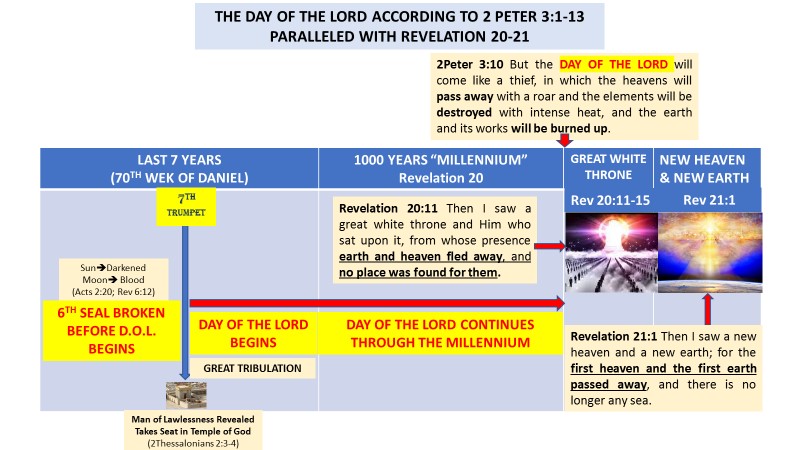
THE DAY OF YAHWEH
But (1161) (de) introduces a dramatic contrast (whenever you encounter a term of contrast,discipline yourself to pause and ask what is being contrasted) with the previous passage that spoke of God's "holding back" His hand of judgment.
The following notes represent a compilation of teaching on the incredible period in human history referred to as the Day of the Lord. The phrase day of the LORD (synonymous with "the day of the LORD's anger", "day of the wrath of the LORD" in Ezekiel 7:9 , "that day") is found in 24 verses (Click uses - OT = 20 and NT = 4, not counting one "day of the Lord Jesus") and the following passages link to uses of the specific phrase plus other related Scriptures. To get a good sense of the character of this day study these Scriptures and make a simple list of all you learn about the day of the LORD.
Reginald E. Showers says that "The Day of the Lord refers to God's special interventions into the course of world events to judge His enemies, accomplish His purpose for history, and thereby demonstrate who He is--the sovereign God of the universe. (Maranatha, Our Lord Come. Bellmawr, NJ: The Friends of Israel Gospel Ministry, 1995, 38)
The IVP Pocket Dictionary of Theological Terms defines the Day of the LORD as "A biblical phrase prevalent among OT prophets who pointed to a future event or era (not necessarily a single twenty-four-hour day) during which God would visit judgment on Israel or the world. The NT authors interpreted the phrase in a futuristic sense but saw in Jesus Christ the beginning of the fulfillment of the Day of the Lord. For believers in Christ the Day of the Lord is an anticipation of hope; for unbelievers it holds only judgment leading to damnation. (Grenz, S., et al. Page 34. Downers Grove, Ill. IVP)
The Day of the Lord is so unique and significant that it is also referred to that day. As is often the case with Old Testament prophecy that day usually has a two fold fulfillment, near and future. For example in Isaiah that day is mentioned repeatedly, referring to a time of God's judgment, the near fulfillment usually (but read the context) predicting Babylon's coming conquest of Judah and the far future (but surely not far from where we are beloved, living in the 21st century!) similar to events before he second coming of Christ. If you are intrigued by "that day" I would encourage you to study the following 45 uses of the phrase that day in Isaiah, taking care to read the verse in context so that you might interpret the passage correctly as a few of the passages do not appear to refer directly to the day of the LORD. Enjoy! (Click here for the 45 uses of that day in Isaiah). Below is a "sampling" of uses of that day from Isaiah to encourage you to take some time and study this important time period of God's "calendar"… may this awesome truth not just inform you but transform your innermost being so that if you are not living expectantly, you might, like the saints of Thessalonica, begin to eagerly look forward to the return of God's Son from heaven, Whom He raised from the dead, that is Jesus, Who delivers us from the wrath to come. (in the "Day of the LORD")" (1Th 1:10-note)
Isaiah 2:11, 17, 20
11 The proud look of man will be abased, and the loftiness of man will be humbled, and the LORD alone will be exalted in that day. 12 For the LORD of hosts will have a day of reckoning against everyone who is proud and lofty, And against everyone who is lifted up, that he may be abased.
17 And the pride of man will be humbled, and the loftiness of men will be abased, and the LORD alone will be exalted in that day.
20 In that day men will cast away to the moles and the bats their idols of silver and their idols of gold, which they made for themselves to worship
Isaiah 4:2
In that day the Branch of the LORD (the Messiah) will be beautiful and glorious, and the fruit of the earth will be the pride and the adornment of the survivors of Israel (the believing remnant of Jews - see below).
Isaiah 10:20
Now it will come about in that day that the remnant of Israel (click discussion of remnant) ), and those of the house of Jacob who have escaped, will never again rely on the one who struck them, but will truly rely on the LORD, the Holy One of Israel. 21 A remnant will return, the remnant of Jacob, to the mighty God.
As an aside, it is worth noting that Isaiah provides more information on the future Day of the Lord and the Millennial Kingdom than any other OT prophet and many of his descriptions are not found anywhere else in Scripture (see note Millennium 3).
First, note that the list below is not exhaustive. There are other allusions to the Day of the LORD that are not on this list.
Secondly, note the "concentration" of occurrences of that "day" in Zechariah 14, probably one of the more incredible chapters in the entire Word of God! In fact in 1526 in his second commentary on Zechariah Martin Luther wrote the following when he came to chapter 14
"Here, in this chapter, I give up. For I am not sure what the prophet is talking about!"
In fairness to Martin Luther, while some of the events in Zechariah 14 are obscure, enigmatic and/or problematic, most of the prophet's descriptions are comprehensible with the caveat (Latin, literally "let him beware") that one read Zechariah's words literally lest he or she end up totally confused. The confusion on this chapter is reflected by the fact that there are more than 14 major interpretations of chapter 14! If you do not read Zechariah 14 literally, you may come up with a fifteenth interpretation! So take a moment to first ask your Teacher, the Holy Spirit to lead you into all truth as you read the chapter yourself before looking at any commentary (cf Jn 16:13, 1 Jn 2:20-note, 1 Jn 2:27-note, see also Illumination in the Bible). Diligently seek to let the Word of God say what it plainly says without attempting to "imagine" (or speculate) what the prophet is saying (See related discussion on a Very Brief History of Biblical Interpretation). After you have done your own reading and study, then take a moment to read the Zechariah 14 notes (which approach the text from a literal perspective) to help you glean an understanding of some of the the truly earth shaking, mind boggling events that will surely occur on the "Day of the LORD," .
|
THE DAY OF THE LORD |
|
|
OLD TESTAMENT |
NEW TESTAMENT |
The day of the Lord is a familiar Old Testament image for the ultimate day of God’s judgment, His final day in court when He settles the injustices of the world. From the above Scriptural references (and others) one can piece together the following portrait of the Day of the Lord.
Descriptive Definition of the Day of Yahweh - The Day of Yahweh can describe a near historical fulfillment, but more often describes an eschatological fulfillment, specifically the time when Yahweh will judge the Gentile nation, and bring about divine deliverance for His chosen people Israel, in turn followed by a period of unprecedented blessing and prosperity in the Messianic Kingdom (the Millennium being a “component” of the Day of Yahweh)
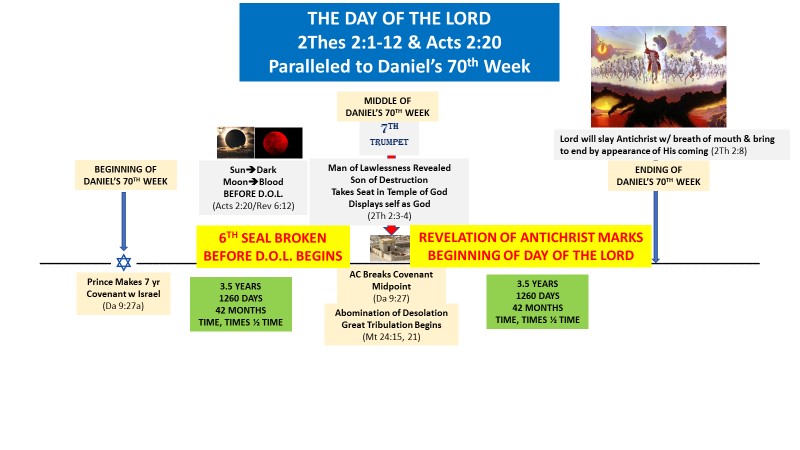
Even a cursory study indicates that this day is not a reference to a single 24 day but to an extended period of time as illustrated in the diagram which will be explained below (see also timeline at beginning of this page). Here is a partial listing of the truths about the Day of Yahweh from 8 books (4 NT, 4 OT) which is taken from a discussion I led on What the Bible Teaches about the Day of the LORD which can be found on my youtube channel -
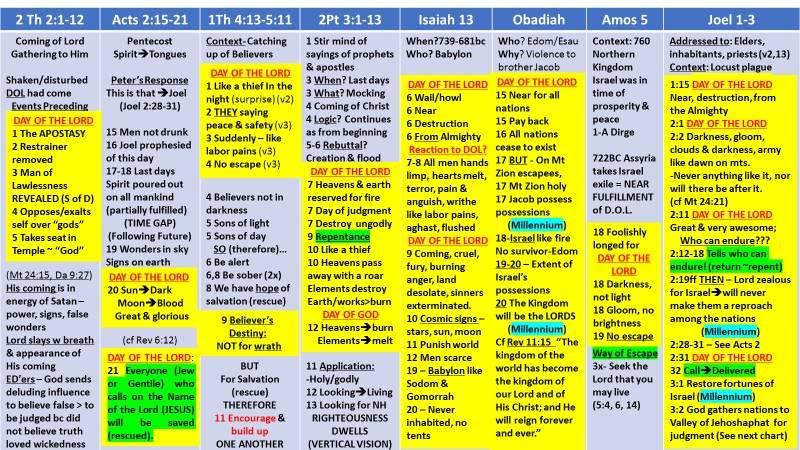
CLICK TO ENLARGE
|
Heaven & earth |
||||
|
Pre-Tribulation |
The Seven Year "Tribulation" |
(2) Day of Lord extends through the Millennium 2 Pe 3:10-note |
< Great White Throne Rev 21:1-note |
|
|
(1a) Day of the Lord begins > |
Mid-Tribulation |
1000 Years |
New Heaven |
|
| 3.5 Years Synonymous times |
3.5 Years Synonymous times |
|||

You will read descriptions in some commentaries that state the Day of the Lord follows the rapture of the church (e.g., Dr John Walvoord, et al) (1a) ("pre-tribulation rapture"- see discussion of when the rapture occurs) (1Th 4:13-18-notes 1Th 4:13; 14; 15; 16; 17; 18), the event which most evangelicals feel immediately precedes the last seven years of Seventy Weeks of Daniel, these 7 years being popularly known as the Tribulation. It is notable that nowhere in Scripture is this 70th week of 7 years specifically designated "the Tribulation" (let me know if you find a passage that contradicts this conclusion - remember that "the Great Tribulation" only refers to the last 3.5 years of this seven year period). The alternative starting point for the Day of the Lord is in the Mid-Tribulation, at the time of the 7th Trumpet sounding (1b).
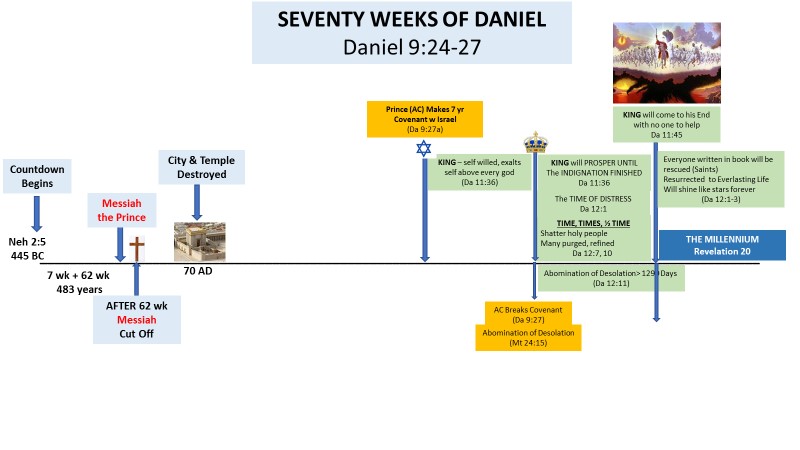
First, we must understand the basic timing of this last "Seven Year Period" (Daniel's Seventieth Week) which can be divided into two 3.5 year segments, a conclusion based upon study of Da 9:27 (see notes). Daniel records the following prophecy he received from the angel Gabriel in answer to fervent prayer…
And he (the Antichrist) will make a firm covenant with the many (the Jews/Israel) for one week (one seven year period), but in the middle of the week (after 3.5 years) he will put a stop to sacrifice and grain offering (in the rebuilt Jewish temple) and on the wing of abominations will come one who makes desolate, even until a complete destruction, one that is decreed, is poured out on the one who makes desolate." (Da 9:27+)
The Lord Jesus quoted from Daniel 9 as He explained the timing of the events immediately preceding His triumphant return because He wanted the Jews (and all mankind) living during the tumultuous time of Daniel's Seventieth Week to have an easily identifiable event that would indubitably signal the beginning of the the Great Tribulation which represents the final outpouring of God's wrath during the last 3.5 years of the Seventieth Week of Daniel…
Therefore when you see the ABOMINATION OF DESOLATION (referring to the Antichrist or some desecrating action he makes) which was spoken of through Daniel the prophet (reference to Da 9:27+, also in Daniel 11:31+, Da 12:11+ - see these depicted on the timeline below), standing in the holy place (this means the Jewish Temple will be rebuilt substantiated by Rev 11:1, 2+ and 2 Th 2:3+, 2 Th 2:4+) (let the reader understand)…there will be a Great Tribulation, (Begins - Mt 24:15+, and is named - Mt 24:21+ and is a 3.5 year period synonymous with the Time of Jacob's Distress, described in Jeremiah 30:7+, "a time of distress" - Da 12:1+, "the indignation" - Da 11:36+ - click synonyms describing the last 3.5 years of Daniel's 70th week) such as has not occurred since the beginning of the world until now, nor ever shall… but immediately after the tribulation (the Great Tribulation) of those days THE SUN WILL BE DARKENED, AND THE MOON WILL NOT GIVE ITS LIGHT, AND THE STARS WILL FALL from the sky, and the powers of the heavens will be shaken, and then the sign of the Son of Man will appear in the sky (Sign = the Lord returning on the clouds), and then all the tribes of the earth will mourn, and they will see the SON OF MAN COMING ON THE CLOUDS OF THE SKY with power and great glory. And He will send forth His angels with A GREAT TRUMPET and THEY WILL GATHER TOGETHER His elect from the four winds, from one end of the sky to the other." (Matthew 24:15-31-see in depth commentary)
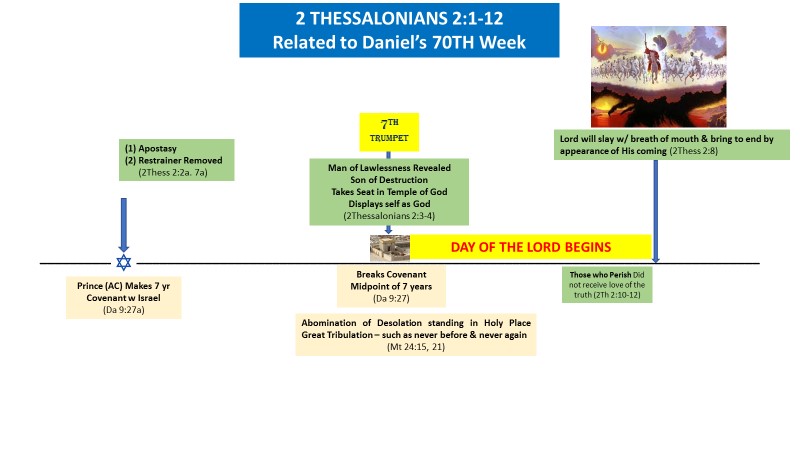
Now keeping in mind the timing of this dramatic event described by Daniel and Jesus, read Paul's second letter to the saints at Thessalonica where he addresses the false teaching that the persecution the Thessalonians were now experiencing was part of the great tribulation. He references the same crucial historical event as Daniel and Jesus in order to assure these fearful saints…
"Now we request (plead, implore, beg of) you, brethren, with regard to the coming (parousia) of our Lord Jesus Christ, and our gathering together to Him (Paul refers not to two events but one event - the rapture he had written about in 1 Th 4:13,14+, 1Th 4:15,16+; 1Th 4:17,18+), that you may not be quickly shaken from your composure (literally "mind") or be disturbed (frightened) (false teaching about the Rapture and the Day of the Lord appears to have had a devastating impact on the Thessalonian saints) either by a spirit or a message or a letter as if from us, to the effect that the day of the Lord has come. Let no one in any way deceive you, for it will not come unless the apostasy (a very specific presumably identifiable time of rebellion against God) comes first, and the man of lawlessness (the Antichrist) is revealed (apokalupto = literally has the veil removed exposing to open view what he had before hidden regarding his evil character. The aorist tense points to a definite time, a specific historical event), the son of destruction (apoleia = ruin not annihilation), who opposes and exalts himself above every so-called god or object of worship, so that he takes his seat in the temple of God (which Jesus calls the "abomination of desolation" in Mt 24:15+ as "standing in the holy place"), displaying himself as being God. Do you not remember that while I was still with you, I was telling you these things?" (2Th 2:1+, 2 Th 2:2+, 2 Th 2:3+, 2 Th 2:4+, 2 Th 2:5+ - See timeline above)
When does Paul state that the Day of the Lord will begin? Here is the order
- The apostasy will occur - most take this as indicative of a spiritual falling away from the truth, but a few suggest this could refer to the "departure" at the rapture - interesting thought for sure.
- The "restrainer" will be removed (2Th 2:7+)
- The man of lawlessness (the son of destruction) is revealed
- He takes his seat in the temple of God, displaying himself as being God.
In short all of these things must take place before the Day of the LORD. So, while many favor the Day of the Lord beginning at point (1a) in the above diagram (after a pre-tribulation rapture), when one compares Scripture with Scripture, there is more support for considering the beginning of the Day of the Lord at the midpoint of the 7 Year period of Daniel (1b), also corresponding to the time of the sounding of the 7th Trumpet. There is no definitive Scripture support (as far as I am aware) for stating the Day of the Lord begins after the Rapture. It sounds reasonable, but is it Scriptural? The other Scripture that would tend to support the mid-tribulation timing (1b) is Peter's quote from Joel's prophecy stating that ‘THE SUN WILL BE TURNED INTO DARKNESS AND THE MOON INTO BLOOD, BEFORE THE GREAT AND GLORIOUS DAY OF THE LORD SHALL COME." (Acts 2:20+). On the second timeline below Joel's description correlates with John's description of the breaking of the 6th Seal in Revelation 6:12+. Specifically, John records cosmic signs similar to those prophesied by Joel writing "I looked when He broke the sixth seal, and there was a great earthquake; and the sun became black as sackcloth made of hair, and the whole moon became like blood." If indeed John is describing similar cosmic signs as quoted by Peter in Acts, this supports that the beginning of the Day of the Lord is most likely after the revealing of the Antichrist at the midpoint of the 7 years.
Related Resources:
- Related discussion in 1 Thessalonians - there is some overlap
- Diagram of the Day of the LORD in the Prophets - ESV Global Study Bible (Disclaimer - Interesting diagram but I do not agree with all of their descriptions of the Day of Yahweh in each of the books they list)
- More on the Day of the Lord
- The Day of the Lord - John F Walvoord
- The Rapture and the Day of the Lord in 1 Thessalonians 5 - John F Walvoord
- Preparing for The Day of The Lord (Malachi 3:13--4:6) - Allen Ross
- The Day of the LORD 1 Thessalonians 5:1-11 - Bob Deffinbaugh
- Basic Introduction To The Day Of The Lord In The Old Testament Prophets
- Diagram of the Day of the LORD in the Prophets
- Lecture on Revelation, part 4
- The Day of the Lord by Jeff Miller
- The Day of the Lord by A C Gaebelein (1907)
- What is the day of the Lord?
- What is the end times timeline?
- What are the signs of the end times?
- Have any aspects of end times prophecy been fulfilled?
- What is the end times timeline?
- What is the Tribulation? How do we know the Tribulation will last seven years?
- Surviving the end times - what do I need to know?
- What is the abomination of desolation?
- What is going to happen according to end times prophecy?
- What is the Apocalypse?
- What are Gog and Magog?
- What is the battle of Armageddon?
- What is the Great Tribulation?
- What are the seven seals and seven trumpets in the Book of Revelation?
- What are tribulation saints?
Peter using the same term as Paul, says that…
the day of the Lord will come like a thief, in which the heavens will pass away with a roar and the elements will be destroyed with intense heat, and the earth and its works will be burned up. (See point 2 on the timeline above)
The question naturally follows "When will the heavens pass away?" Clearly there is no indication that the heavens pass away during the "Great Tribulation" which follows the full revelation of the Antichrist in the Jewish Temple in Jerusalem. Again comparing Scripture with Scripture, we read that following the defeat of the Antichrist at the return of Christ (read Revelation 19:1ff-note) there is a 1000 year period (I believe John clearly meant a literal 1000 years when he was inspired by the Holy Spirit - if it doesn't mean 1000, one could make it mean almost anything he wanted and it would be "meaningless" and yet it is used 4 times in the passages that follow!) in which Christ reigns on earth, John testifying…
And I saw thrones, and they sat upon them, and judgment was given to them. And I saw the souls of those who had been beheaded because of the testimony of Jesus and because of the word of God, and those who had not worshiped the beast or his image, and had not received the mark upon their forehead and upon their hand; and they came to life and reigned with Christ for a thousand years. The rest of the dead did not come to life until the thousand years were completed. This is the first resurrection. Blessed and holy is the one who has a part in the first resurrection; over these the second death has no power, but they will be priests of God and of Christ and will reign with Him for a thousand years. And when the thousand years are completed, Satan will be released from his prison, and will come out to deceive the nations which are in the four corners of the earth (indicating that Christ and His saints are on earth for a specific 1000 year period), Gog and Magog, to gather them together for the war; the number of them is like the sand of the seashore. And they came up on the broad plain of the earth and surrounded the camp of the saints and the beloved city, and fire came down from heaven and devoured them. And the devil who deceived them was thrown into the lake of fire and brimstone, where the beast and the false prophet are also; and they will be tormented day and night forever and ever." (see notes Revelation 20:4; 20:5; 20:6; 20:7; 20:8; 20:9; 20:10)
In the next event which John describes we see a clear parallel with 2 Peter 3:10. John testifies…
And I saw a great white throne and Him who sat upon it, from whose presence earth and heaven fled away, and no place was found for them. (Revelation 20:11-note)
John MacArthur commenting on presence earth and heaven fled away writes…
That amazing, incredible statement describes the “uncreation” of the universe. The earth will have been reshaped by the devastating judgments of the Tribulation and restored during the millennial kingdom. Yet it will still be tainted with sin and subject to the effects of the Fall—decay and death; hence it must be destroyed, since nothing corrupted by sin will be permitted to exist in the eternal state ("But according to His promise we are looking for new heavens and a new earth, in which righteousness dwells" 2 Pe 3:13-see note). God will in its place create “a new heaven and a new earth; for the first heaven and the first earth passed away” (John writes "And I saw a new heaven and a new earth; for the first heaven and the first earth passed away, and there is no longer any sea." Re 21:1-note ) The present earth and heaven will not merely be moved or reshaped, since John saw in his vision that no place was found for them. They will be uncreated and go totally out of existence. This is nothing less than the sudden, violent termination of the universe (Macarthur J. Revelation 1-11. and Revelation 12-22. Moody)
One can conclude that both Peter and John are describing the time period, the day which Peter refers to as the Day of the Lord. And yet we know that the Day of the Lord has already commenced at the beginning or the midpoint of the Seven Year Tribulation (as discussed above) following the revelation of the Antichrist, who is defeated by Christ at His return at which time He establishes His 1000 year Kingdom on an earth, after which Peter says the earth which will pass away in the Day of the Lord. It therefore is reasonable to conclude that the Day of the Lord is not a single day but is an extended period beginning at the middle of the Tribulation and including the Second Coming of Christ to set up His 1000 year earthly kingdom and terminating in the total destruction of the present heaven and earth as described by Peter and John. Others do not agree that the Millennium is a component of the Day of the Lord. (See also discussion below).
Related Resource:
- Millennium 2 - summary discussion of the sequential (chronological) events which lead up to the establishment of the Millennial Kingdom of God ruled by Christ, the King of kings.
Some writers (e.g., John MacArthur) feel the Day of the Lord described in 2 Peter 3:10 is a second stage of that Day and that the Day of the Lord does not include the Millennial reign of Christ. In other words these writers see the Day of the Lord as ONLY a time of doom and gloom. However even one writer, Richard Mayhue, who interprets the day of the Lord as 2 stages (Tribulation time and End of Millennium - BOTH days of doom and gloom), seems to contradict his own interpretation in writing the following description regarding the Day of the Lord
"Most passages speak of God's judgments, but some are tied closely to God's blessing (Zech 14:1-21)."
It seems that the glorious truths in Zechariah 14+ force Mayhue to admit that there is a positive aspect to the Day of the Lord. And what does Zechariah 14 describe? Among other things Zechariah 14:20+ says "In that DAY there will be inscribed on the bells of the horses, "HOLY TO THE LORD." It describes the blessed time of the Millennium, which would support the premise that the Day of the Lord is a prolonged period which includes the Millennium and ends with the final Day of the Lord in 2 Peter 3:10. The following discussion has numerous quotes that support the premise that the Day of the Lord is an extended period of time which includes the time of the Millennium.
Here is an excerpt from Gotquestions on What is the Day of the Lord? -
One key to understanding these phrases is to note that they always identify a span of time during which God personally intervenes in history, directly or indirectly, to accomplish some specific aspect of His plan. Most people associate the day of the Lord with a period of time or a special day that will occur when God’s will and purpose for His world and for mankind will be fulfilled. Some scholars believe that the day of the Lord will be a longer period of time than a single day—a period of time when Christ will reign throughout the world before He cleanses heaven and earth in preparation for the eternal state of all mankind. Other scholars believe the day of the Lord will be an instantaneous event when Christ returns to earth to redeem His faithful believers and send unbelievers to eternal damnation....
Besides being a time of judgment, it will also be a time of salvation as God will deliver the remnant of Israel, fulfilling His promise that “all of Israel will be saved” (Romans 11:26), forgiving their sins and restoring His chosen people to the land He promised to Abraham (Isaiah 10:27; Jeremiah 30:19-31, 40; Micah 4; Zechariah 13). The final outcome of the day of the Lord will be that “the arrogance of man will be brought low and the pride of men humbled; the Lord alone will be exalted in that day” (Isaiah 2:17). The ultimate or final fulfillment of the prophecies concerning the day of the Lord will come at the end of history when God, with wondrous power, will punish evil and fulfill all His promises (ED: ESPECIALLY THE BLESSINGS PROMISED TO THE NATION OF ISRAEL).
John MacArthur commenting on 2 Peter 3:10 says "In Scripture the day of the Lord signifies the extraordinary, miraculous interventions of God in human history for the purpose of judgment, culminating in His final judgment of the wicked on earth and the destruction of the present universe." However, in my humble opinion, I do not think this description is entirely accurate, because this day also has a glorious side to it as described below (and to which even MacArthur seems to agree as noted in the quote below).
John MacArthur in his sermon on Zechariah 14 seems to contradict his own belief that the Millennium is not part of the Day of the Lord writing (specifically regarding Zech 14:8) "And I think it’s a picture, too, of how blessing is going to flow. Jerusalem will become the center of the world and blessing will just flow in all directions. What an incredible time. So we see the coming of the DAY OF THE LORD. (ED: THIS DOES NOT SOUND LIKE THIS DAY IS SOLELY A DAY OF DOOM AND GLOOM!) Now very rapidly the rest of the chapter will flow. Are you ready?...Zech 14:9 begins the crowning of the Lord as King. We’ve seen the coming of the day of the Lord, now the crowning of the Lord as King. The first thing that happens when He arrives, He’s going to have a coronation. Verse 9, “And the LORD shall be King over all the earth. IN THAT DAY shall there be one LORD and His name one.” Listen, the Lord is not only going to be the King in heaven, but IN THAT DAY He’s going to be the King on earth. He will not be King de jure, that is by right, but He will be King de facto, that is in fact. This is a promised reality. The King is coming. And He is going to be King. And IN THAT DAY, it says, He’ll be King – now watch this – “And there will be one LORD and His name one.” Do you know how many religions there will be in the world in the kingdom? One – that’s all. Just one. Anybody who begins to start another one will be dealt with by the rod of iron with which Christ rules, read Revelation 19. The worldwide monotheism, one religion, all of the systems of Satan are over. And the absolutely unique and incomparable one God, the only wise God and our Savior, the Lord Jesus Christ, the Word made flesh, Him and Him alone will the world worship. And so IN THAT DAY there will be one Lord and His name will be one."
So in his sermon MacArthur certainly sounds like he sees the Day of the Lord as not just doom and gloom but blessing and glory.
Again John MacArthur alludes to a time of blessing associated with the Day of the Lord in his sermon "The Invisible Kingdom of God, Part 2" - Joel begins at the very outset of his prophecy with identifying this event, Jeol 1:15, “Alas for the day, for the day of the Lord is near and it will come as destruction from the Almighty.” The coming of the King was the day of the Lord. The day of the Lord is always associated with judgment, maximum judgment, a final kind of judgment. There are days of the Lord in the Old Testament, days when God stepped in with great judgment, BUT there is a culminating eschatological final day of the Lord which Joel has in view here. This will be destruction from the Almighty. He will come to destroy His enemies and the ungodly. At the same time, it will be a time of salvation, it will be a time of blessing for the righteous. If you go to the end of his prophecy, Joel 3:18, “It will come about in that day … that day of the Lord … the mountains will drip with sweet wine and the hills will flow with milk and all the brooks of Judah will flow with water and a spring will go out from the house of the Lord to water the valley of Shittim.” In other words, it’s going to be a time of immense blessing. (ED: SO THE QUESTION I WOULD ASK DR MACARTHUR IS "WHEN DID YOU SAY THAT TIME OF BLESSING WOULD OCCUR? AND IF I AM READING HIM CORRECTLY, HE STATES THAT IT IS IN THAT DAY OF THE LORD! WHEN IS THIS BLESSING REALIZED? THE MILLENNIUM. IT WOULD SEEM TO FOLLOW THAT THE TIME OF THE MILLENNIUM IS THE GLORIOUS ASPECT OF THE DAY OF THE LORD.)
Look at Isaiah's description of the Day of the Lord. Isaiah 13:9 certainly begins with doom and gloom writing "Behold, the day of the LORD is coming, Cruel, with fury and burning anger, To make the land a desolation; And He will exterminate its sinners from it." The description continues and seems at first to cease in Isaiah 13:22, as indicated by a chapter break (we know these breaks are not inspired) followed by the description in Isaiah 14:1 "When the LORD will have compassion on Jacob, and again choose Israel, and settle them in their own land, then strangers will join them and attach themselves to the house of Jacob." When is "when"? Clearly that is the Millennium and it flows in context from the preceding description of doom and gloom. So again we see the pattern of a day of doom and gloom progressing to a day of blessing and glory.
We see a similar pattern of doom and gloom morphing (so to speak) to blessing and glory in Joel. And so in Joel 3:14-18 we read "Multitudes, multitudes in the valley of decision! For the day of the LORD is near in the valley of decision. 15 The sun and moon grow dark and the stars lose their brightness. 16 The LORD roars from Zion And utters His voice from Jerusalem, And the heavens and the earth tremble. But the LORD is a refuge for His people and a stronghold to the sons of Israel. 17 Then you will know that I am the LORD your God, Dwelling in Zion, My holy mountain. So Jerusalem will be holy, And strangers will pass through it no more. 18 (NOTE THIS IS CLEARLY CONNECTED WITH THE PRECEDING "DAY") And in that day The mountains will drip with sweet wine, And the hills will flow with milk, And all the brooks of Judah will flow with water; And a spring will go out from the house of the LORD To water the valley of Shittim."
Joel 3:18 says "in that day" which begs the question what "day?" In context, Joel has been describing the Day of the LORD, the doom and gloom aspect of that DAY, but then he proceeds to describe the blessing and glory aspect of that DAY. This passage seems to clearly support the premise that the Day of the LORD includes the time of the blessings on Israel during the Millennium when water flows from the house of the LORD.
The Day of Yahweh is not only a day of judgment on the unrighteous
but is also a day of deliverance and blessing on the righteous.
Irwin Busenitz (who is associated with John MacArthur) on Joel 3:18 - The temporal phrase in that day introduces the final section of the prophecy, linking it with the preceding verses. The Day of Yahweh is not only a day of judgment on the unrighteous but is also a day of deliverance and blessing on the righteous. Both aspects of this theme are reiterated in these final verses. After the emphatic and universal judgment has been executed upon the heathen, the prophet summarizes the blessings which will flow from the throne of God and which will overflow the land of Israel (cf. Isa 4:2). (Mentor Commentary on Joel and Obadiah - recommended)
J Vernon McGee agrees writing (on Joel 3:18) "And it shall come to pass in that day" -- that is, the Day of the Lord. "The mountains shall drop down new wine" -- this is in the time of the Kingdom." (ED: That sounds like the blessing and glory component of the Day of the LORD!)
Thomas Constable commenting on Joel 3:18 writes "Joel continued to describe the future day of the Lord, but now he passed from the judgments of the Tribulation to the blessings of the Millennium."
Holman Study Bible: NKJV Edition on Joel 3:18-21 comments that "Joel summarized the result of the day of the Lord. The land of Israel will have miraculous fertility and fruitfulness. Traditional enemies will be punished. Yahweh will dwell with His people, and they will receive pardon for their sins."
ESV Study Bible on Joel 3:18 says "in that day. I.e., the day of the Lord." (ED: So clearly the implication is that the ESV note sees the description that follows in Joel 3:18 to be a component of the Day of the Lord.)
Michael Vlach - Joel 3:20 indicates that as a result of the day of the Lord (Joel 3:18) “Judah will be inhabited forever, and Jerusalem from generation to generation” (HCSB). In Zephaniah 3:20 God promises again to “restore” the “fortunes” of Israel (HCSB). (ED: THAT HARDLY SOUNDS LIKE JUST DOOM AND GLOOM WHICH IS THE PRIMARY DESCRIPTION OF THE DAY OF THE LORD OF A NUMBER OF WRITERS!) When examining these and other restoration texts in the Bible, certain truths emerge: (1) the restoration of Israel involves both spiritual salvation and physical blessings including possession of the land of promise; (2) the promise of restoration is not based on Israel’s greatness but on God’s choice and God’s character; and (3) the promise for restoration takes place after the period of Israel’s disobedience. As the passages above and many others indicate, the restoration of Israel is a major theme in the Old Testament. It is an explicit doctrine. (Christ's Prophetic Plans)
Steven Scherrer - The prophet Joel predicts the day of the Lord, a day of destruction and judgment, but afterward a time of salvation for the faithful remnant of his people. On that day “the sun and the moon are darkened, and the stars withdraw their shining” (Joel 3:15). “The sun shall be turn to darkness, and the moon to blood, before the great and terrible day of the Lord comes” (Joel 2:31). But finally God’s salvation shall appear, and there will be great blessings on earth, until “the mountains shall drip sweet wine, and the hills shall flow with milk” (Joel 3:18). This is what we are longing for now, the second and glorious coming of Jesus Christ on earth and the renewal of the world. (Daily Biblical Sermons)
Warren Wiersbe writes on Joel 3:18-21 - As Joel preached, the people could see the dry fields, the starving cattle, and the empty barns. They could see and hear the locusts as they ravaged the country. But Joel is picturing a time when wine, milk, and water shall flow in ceaseless measure in the land. This is, of course, the kingdom age when Jesus Christ shall sit on David's throne in Jerusalem, and when the land shall be healed and the blessing of God restored. The nation will be cleansed, and God shall dwell in Zion. This reminds us of Ezekiel's final words: "And the name of the city from that day shall be, THE LORD IS THERE." (Wiersbe's Expository Outlines on the Old Testament.)
Michael Bentley on Joel 3:18 - This verse starts with the phrase ‘In that day’. This is the same period of time that we find at Joel 3:1—‘In those days and at that time’. The prophet continued to outline the blessings of being restored to the Lord’s favour. Just as two lovers may suddenly experience a rekindling of the joy of their first love (but see Rev. 2:4), so God’s people would know the return of all past favour—except that, this time, these gifts would be ‘pressed down … and running over’ (see Luke 6:38). ‘In that day’, bountiful harvests would again be given; in fact, on the great day of the Lord there will be a triumphal time of harvest. We have already seen in Joel 3:13 that the harvest of the wicked will be all-encompassing so that no one will escape. (Opening Up Joel)
Trent Butler on Joel 3:18 - When this promise of the final Day of the Lord reaches fulfillment, the entire situation will be turned on its heels. The Day of the Lord will be a day of total reversal. No more complaints about locusts and droughts and armies destroying the crops. Vineyards on the mountainsides will drip new wine (Joel 1:10). Animals threatened with extinction by the drought and lack of pastures (Joel 1:18) will now produce so much milk that it will literally flow down the hills. Dried-up streams (cp. Joel 1:20, where the same word is used as ravines in Joel 3:18) will now run with water. (Hosea, Joel, Amos, Obadiah, Jonah, Micah)
Thomas J Finley on Joel 3:18 - The Hebrew prophets used the phrase וְהָיָה בַיּוֹם הַהוּא (wĕhāyâ bayyôm hahûʾ, “and it will happen in that day”) to mark off a new section, as here in Joel 3:18. As is so often the case in predictive portions of the OT, “that day” refers to the general events surrounding the day of the Lord. Judgment of the nations and deliverance for Israel do not exhaust God’s purposes. He has planned a new blessing for the land that will be unsurpassed, even beyond the splendor of the kingdom of David and Solomon. (Joel, Amos, Obadiah Commentary)
Hans Wolff on Joel 3:18 - The conception of the Day of Yahweh as a day of judgment on the nations and a day of deliverance for Israel (4:1–3*, 9–17*) is thus supplemented by the paradisal motif. (Joel and Amos: A Commentary)
Leander Keck - The day of the Lord will bring not only the destruction of God’s enemies and the rescue of repentant Jerusalem and Judah, but it will also usher in a paradisiacal existence for the faithful. Borrowing partially on the thought of Amos 9:13, Joel picks up themes from the first chapter of his book and portrays their reversal. Once the sweet wine was cut off (Joel 1:5); now the mountains with their vineyards will yield wine in abundance (Joel 3:18). Previously there was no milk from the cattle, because they had no pasture (Joel 1:18); now the rich grasslands on the hills will furnish an ample supply. During the drought, there was no water anywhere (Joel 1:17–20); in God’s future, the rivers and wadis of Judah will flow full all year round. Once again, borrowing an earlier prophetic theme, a fountain will flow forth from the Temple and water even the Valley of Shittim (Ezek 47:1–12; cf. Ps 46:4; Zech 14:8; Rev 22:1–2)—a symbol of the life-giving power of God’s presence (cf. Ps 36:8; Isa 33:21). (New Interpreter's Bible)
Walter Kaiser in a discussion entitled God’s Blessing as the Day of the Lord Climaxes—Joel 3:18–21 - The day of the Lord in this section is also called “in that day” (Joel 3:18). This is not unusual, for the Hebrew prophets often used the expression “in that day” instead of the full title “the day of the Lord.” In fact, this shortened form appeared so frequently, that no other modifiers were needed for the prophet’s audience, for the pointing to a particular day meant a time when God would act in judgment and blessing, depending on the state of the receiver. Just as there were four reasons for divine judgment on the nations in the previous section, so this final section of the prophet Joel describes four blessings God is to pour out on the covenant people (Joel 3:18–21). These are the blessings: 1. the healing of the land of Israel (3:18), 2. the punishment of all of Israel’s enemies (3:19), 3. the designation of the land to Israel for all times to come (3:20), and 4. the pardon of Israel and the dwelling of God in the land (3:21)....The prophet Zechariah predicts a time when all Israel will look on the One they had pierced, and the result will be a deep mourning for what they had missed (Zech. 12:10; Rev. 1:7). Yes, “on that day a fountain will be opened to the house of David and the inhabitants of Jerusalem, to cleanse them from sin and impurity” (Zech. 13:1). With this cleansing and repentance, the golden age of Messiah’s reign will arrive. And “the LORD [will dwell] in Zion” (Joel 3:21). (Preaching and Teaching the Last Things)
Cornerstone Bible Commentary on Joel 3:18 in that day - This is a familiar prophetic formula used to introduce details relative to the eschatological future (e.g., Isa 24:21; 26:1; 27:1; Jer 30:8; Amos 9:11; Mic 4:6; Zeph 3:16; Zech 14:4).....Joel ends his prophecy on a high note. He predicts that the environment where God’s future people will live will be marked by superabundant fertility. All that had been lost in the locust plague will, as God promised (2:18–27), be restored in effusive quantity. The landscape will flourish again; the streams and even the dry wadis will flow freely, bringing life and health to the land and all its inhabitants. Jerusalem’s underground water sources will also gush forth, bringing refreshing vitality to ground that has long been parched with aridity. Even the Dead Sea will come alive and be rejuvenated by the fresh waters of Jerusalem’s Temple Mount (see note on 3:18).
Duane Garrett writes on Joel 3:18 - “In that day” refers to the day of the Lord (cf. Hos 2:16,18,21; Amos 8:9,13; 9:11). As in Joel 1:5 “new wine” symbolizes not mere sufficiency but abundance. The promise that all the ravines would flow with water no doubt gave hope to a people who had seen their land parched with drought (Joel 1:12,17). (The New American Commentary)
The Open Bible on Joel - This brief book develops the crucial theme of the coming day of the Lord (Joel 1:15; 2:1, 2, 11, 31; 3:14, 18). It is a time of awesome judgment upon people and nations that have rebelled against God. But it is also a time of future blessing upon those who have trusted in Him.
See the discussion below by Dr Tony Garland who also favors the Day of the Lord as including the time of the millennial reign of Christ.
I could quote other conservative sources which make similar comments. The upshot is that while one might say there are 2 stages of the Day of the Lord (Tribulation and End of Millennium), it is just as reasonable and Scripturally supportable to say that the Day of the Lord is a prolonged period when God intervenes in human history and this includes His establishment of His glorious Millennial Kingdom.
Summarizing some of the descriptions in the OT references (see the chart above which records many of these descriptions), we see that this Day is
coming, cruel, with fury and burning anger, to make the land a desolation; and He will exterminate its sinners from it" (Isaiah 13:9), "a day of vengeance, so as to avenge Himself on His foes… a slaughter for the Lord GOD of hosts" (Jeremiah 46:10), "a day of clouds, a time of doom for the nations" (Ezekiel 30:3), "near, and it will come as destruction from the Almighty" (Joel 1:15), "surely it is near" (Joel 2:1), "great and very awesome, and who can endure it?" (Joel 2:11), "the great and awesome day" (Joel 2:31), "near in the valley of decision" (Joel 3:14), "It will be darkness and not light" (Amos 5:18), "even gloom with no brightness in it" (Amos 5:20), "(a day when) your dealings will return on your own head" (Obadiah 1:15), "near and coming very quickly… in it the warrior cries out bitterly, a day of wrath is that day, a day of trouble and distress, a day of destruction and desolation, a day of darkness and gloom, a day of clouds and thick darkness" (Zephaniah 1:14,15), "the day of the LORD'S wrath and all the earth will be devoured In the fire of His jealousy, for He will make a complete end, Indeed a terrifying one, of all the inhabitants of the earth" (Zephaniah 1:18), "the day of the LORD'S anger" (Zephaniah 2:2), "His coming… is like a refiner's fire and like fullers' soap" (Malachi 3:2), "the great and terrible day" (Malachi 4:5), "will come just like a thief in the night" (1 Thessalonians 5:2, 2Pe 3:10).
Notice that the Day of the Lord is frequently associated with seismic disturbances (Joel 2:1, 2, 3, 4, 5, 6, 7, 8, 9, 10,11; 2:31; 3:16), violent weather (Ezekiel 13:5, 5, 7f), clouds and thick darkness (Joel 2:2; Zeph 1:7, 8, 9f.), cosmic upheaval (Joel 2:3,30) Joel tells us that as a result of the Day of the Lord there will also be physical blessings, fruitfulness, and prosperity (Joel 2:21, 22, 23f.; 3:16, 17, 18, 19, 20, 21). In short the Day of the Lord results in judgment poured out upon sinners that is following by blessings on the penitent, even as the night precedes the day in the first day in Genesis 1:19. Some of the blessings of the Day of the Lord for the nation of Israel include God's promise of the Land to Abraham, Isaac and Jacob, this fulfillment being consummated in the Millennial Kingdom on earth. To do away with the "millennium" as many do is to make it impossible for God to fulfill His Covenant with the remnant of believing Israel. Sadly this is the teaching that an appreciable number of evangelicals are espousing (While I cannot substantiate it Dave Guzik makes this incredible statement - "80%-85% of all Christians in the world belong to churches that teach Replacement Theology." Incredible!!!), proposing the false teaching that God is finished with the nation of Israel and replaced Israel with the Church (yes, I believe this is a false teaching - you can get angry with me if you want, but my literal reading of the Bible does not support this teaching and refutes it in many passages). If you are one who holds to the teaching that God has "jettisoned" the nation of Israel, you might want to take 3 hours and review some of the "rotten fruit" of replacement theology over the last 2000+ years. Below are 3 excellent presentations on this topic.
To motivate you to listen to the presentations below here is an excerpt from Wikipedia entitled Martin Luther and Anti-Semitism:
In a paragraph from his On the Jews and Their Lies he deplores Christendom's failure to expel them.[1] Moreover, he proposed "What shall we Christians do with this rejected and condemned people, the Jews (ED: THAT SOUNDS LIKE "REPLACEMENT THEOLOGY" TO ME!)":[1]
- "First, to set fire to their synagogues or schools ... This is to be done in honor of our Lord and of Christendom, so that God might see that we are Christians ..."
- "Second, I advise that their houses also be razed and destroyed."
- "Third, I advise that all their prayer books and Talmudic writings, in which such idolatry, lies, cursing, and blasphemy are taught, be taken from them."
- "Fourth, I advise that their rabbis be forbidden to teach henceforth on pain of loss of life and limb ..."
- "Fifth, I advise that safe-conduct on the highways be abolished completely for the Jews. For they have no business in the countryside ..."
- "Sixth, I advise that usury be prohibited to them, and that all cash and treasure of silver and gold be taken from them ..."
- "Seventh, I recommend putting a flail, an ax, a hoe, a spade, a distaff, or a spindle into the hands of young, strong Jews and Jewesses and letting them earn their bread in the sweat of their brow ... But if we are afraid that they might harm us or our wives, children, servants, cattle, etc., ... then let us emulate the common sense of other nations such as France, Spain, Bohemia, etc., ... then eject them forever from the country ..."
(ED: Here are a few MORE QUOTES FROM LUTHER'S WORK "The Jews & Their Lies". Did anyone listen to Luther's instructions? You be the judge. See what the Nazis did to the Jews on November 9-10, 1938, etched in infamy as Kristallnacht!)
Here are 3 presentations chronicling the history and legacy of Replacement Theology:
- https://slbc.org/sermon/
replacement-theology-what-we- should-know/ - Gabe Morris - https://slbc.org/sermon/
replacement-theology-what-we- should-know-part-2/ - Gabe Morris - https://slbc.org/sermon/evils-
of-replacement-theology/ - Dr David Reagan
The preceding Scriptures on the Day of the Lord are only a sampling of descriptions, beloved. This Day will be so awful that men's hands will hang limp, they will writhe like women in pain, their faces will be red hot because of what is happening. The final day of the Day of the Lord (2Pe 3:10) is the day when the wrath of God inextricably exterminates sinners and sin from the heavens and earth in preparation for the new heavens and new earth.
A frequently found phrase throughout Scripture related to this time of trouble is the Day of the Lord (Isa. 2:10-22; 13:6, 9; Jer. 46:2, 10; Eze. 13:5, 9, 14, 21, 23; 30:3-6, 8, 19, 25-26; Dan. 9:1-27; Joel 1:15; 2:1, 11, 31; 3:14; Amos 5:18, 20; Ob. 1:15; Zep. 1:7, 14; Zec. 14:1; Mal. 4:5; Acts 2:20; 1Th. 5:2; 2Pe. 3:10). This particular day is seen to be so unique and significant that it is also referred to as simply, that day (Isa. 2:11, 17; 2:20; 4:2; Joel 3:18; Mark 13:32; Luke 21:34; 2Ti. 1:12, 18; 4:8).
The Day of the Lord refers to God’s special interventions into the course of world events to judge His enemies, accomplish His purpose for history, and thereby demonstrate who He is—the sovereign God of the universe.11
There is some disagreement concerning whether the phrase “Day of the Lord” refers just to the time of tribulation, or whether it also includes the thousand-year reign of Christ on earth which follows.
The most common biblical term for the seven years of Tribulation in both testaments is the Day of Jehovah or Day of the Lord. There are many who use the term, the Day of the Lord, to apply to both the Tribulation and the Messianic Kingdom. This is generally based on the assumption that the phrases, the Day of the Lord and that day, are synonymous. While it is true that the expression, that day, has a wide meaning that includes both the Tribulation and the Messianic Kingdom, in those passages where the actual phrase, the Day of the Lord (Jehovah) is used, they never refer to the Millennium, but always to the Tribulation.12
We believe there are reasons to understand the phrase as including the millennial reign:
- Peter’s description of the Day of the Lord appears to include events following the Millennium (2Pe. 3:10-12 cf. Rev. 20:11+; 21:1+).13
- The phrases this day and that day are not disconnected terms, but involve demonstrative pronouns which make little sense in the absence of any antecedent. The antecedent is seen to be the Day of the Lord (Isa. 2:12 cf. 2:20; Joel 3:14 cf. Joel 3:18).
Nevertheless, the phrase Day of the Lord is uniformly connected with darkness and judgment, whereas the phrases this day and that day do appear to be associated with the positive era subsequent to the initial dark elements of the day.14The two-fold nature of the day is characterized by a time of intense darkness followed by incredible blessings:
The future Day of the Lord will have at least a twofold nature. First, it will be characterized by darkness and a tremendous outpouring of divine wrath upon the world (Joel 2:1-2; Amos 5:18-20; Zep. 1:14-15; 1Th. 5:1-11). Amos 5:18-20 emphasizes that this will be the total nature of the Day of the Lord for God’s enemies. It will bring no divine light or blessing to them. This will be the nature of the Day of the Lord during the 70th week of Daniel. Second, the Day of the Lord will also be characterized by light, an outpouring of divine blessing, and the administration of God’s rule. The Prophet Joel, after talking about the darkening of the sun, moon, and stars and God’s Day of the Lord judgment of the armies of the nations gathered in Israel (Joel 3:9-16), foretold great divine blessing “in that day” (Joel 3:17-21). In addition, the Prophet Zechariah, after discussing the future Day of the Lord, when all nations will war against Jerusalem and the Messiah will come to the earth to fight against the nations (Zec. 14:1-5), indicated that although the earlier part of “that day” will be characterized by darkness, the latter part will be characterized by light (Zec. 14:6-7), great blessing (Zec. 14:8), and God’s rule over the earth (Zec. 14:9). This will be the nature of the Day of the Lord in the Millennium. . . . Just as each day of creation and the Jewish day consisted of two phases—a time of darkness (“evening”) followed by a time of light (“day”) [Gen. 1:4-6]—so the future Day of the Lord will consist of two phases, a period of darkness (judgment) followed by a period of light (divine rule and blessing). . . . First, during the 70th week of Daniel it will be characterized by darkness and a tremendous outpouring of divine wrath upon the world. Second, during the Millennium it will be characterized by light, an outpouring of divine blessing, and the administration of God’s rule over the whole world.15
This dual nature results from both a sequential division (judgment bringing in the Kingdom of God on earth followed by the blessings of the millennial reign of Christ) and a spiritual division (the enemies of God will experience only the judgment whereas the people of God will experience the blessings of the millennial reign).
Since, . . . the present day of Satan and rebellious mankind involves their rule of the world system, the future Day of the Lord would not truly be His day if it did not involve His rule of the world system during the Millennium. How could the Day of the Lord fully demonstrate who He is—the sovereign God of the universe—without the sovereign exercise of His rule in visible form over the entire world?16
Day of the Lord passages can be difficult to interpret because of the close association of near-term (historic judgments of Israel’s enemies) and far-term aspects (astronomical signs). Interpretation in many of these passages is complicated somewhat by the Law of Double Reference (clearly evidenced in passages such as Zec. 9:9-10; Isa. 61:1-2 cf. Luke 4:18-21; Mic. 5:2-4):
This law observes the fact that often a passage or a block of Scripture is speaking of two different persons or two different events which are separated by a long period of time. In the passage itself they are blended into one picture, and the time gap between the two persons or two events is not presented by the text itself. The fact that a gap of time exists is known because of other Scriptures. . .17
This has led to some difference of opinion as to whether the phrase Day of the Lord applies strictly to the future time of God’s direct intervention to bring the rule of Messiah or whether it also includes other “days of the Lord” in past history—significant days when God intervened on behalf of Israel (e.g. Jer. 46:1-10).
The Bible indicates that there have been several Days of the Lord in the past in which God demonstrated His sovereign rule by raising up several nations to execute His judgement on other nations. He raised up Assyria to judge the northern kingdom of Israel during the 700s B.C. (Amos 5:18, 20), Babylon to judge the southern kingdom of Judah during the 600s and 500s B.C. (Lam. 1:12; 2:1, 21-22; Eze. 7:19; 13:5; Zep. 2:2-3), Babylon to judge Egypt and its allies during the 500s B.C. (Jer. 46:10; Eze. 30:3), and Medo-Persia to judge Babylon during the 500s B.C. (Isa. 13:6, 9).18
But among literal interpreters, there is no question that the Day of the Lord is yet future because it entails cataclysmic events and astronomical signs which are not to be taken as mere hyperbole (Isa. 2:19-21; Joel 2:2-10, 30-31; Zec. 14:12; Acts 2:20; 2Pe. 3:10).
Isaiah 34:1-8 and Obadiah 15 describe a Day of the Lord when God will judge all nations or Gentiles of the world. None of the past Days of the Lord involved divine judgement of all the nations. . . . In light of this, we can conclude that the Day of the Lord of Isaiah 34 and Obadiah must be future. . . . in 1 Thessalonians 5:1-11 the Apostle Paul referred to a Day of the Lord that was future beyond the time when he wrote his epistle and that would bring sudden, inescapable destruction upon the unsaved of the world.19
There appear to be many different titles employed within Scripture to designate this intense time of judgment coming upon the earth.
Following the translation found in the American Standard Version of the 1901 edition, these names include [in the Old Testament]: The Time of Jacob’s Trouble (Jer. 30:7); The Seventieth Week (a seven) of Daniel (Dan. 9:27); Jehovah’s Strange Work (Isa. 28:21); Jehovah’s Strange Act (Isa. 28:21); The Day of Israel’s Calamity (Deu. 32:35; Ob. 1:12-14); The Tribulation (Deu. 4:30); The Indignation (Isa. 26:20; Dan. 11:36); The Overflowing Scourge (Isa. 28:15, 18); The Day of Vengeance (Isa. 34:8; 35:4; 61:2); The Year of Recompense (Isa. 34:8); The Time of Trouble (Dan. 12:1; Zep. 1:15); The Day of Wrath (Zep. 1:15); The Day of Distress (Zep. 1:15); The Day of Wasteness (Zep. 1:15); The Day of Desolation (Zep. 1:15); The Day of Darkness (Zep. 1:15; Amos 5:18, 20; Joel 2:2); The Day of Gloominess (Zep. 1:15; Joel 2:2); The Day of Thick Darkness (Zep. 1:15; Joel 2:2); The Day of the Trumpet (Zep. 1:16); The Day of Alarm (Zep. 1:16). The New Testament names and designations include: The Day of the Lord (1Th. 5:2); The Wrath of God (Rev. 15:1+, 7+; 14:10+, 19+; 16:1+); The Hour of Trial (Rev. 3:10+); The Great Day of the Wrath of the Lamb of God (Rev. 6:16-17+); The Wrath to Come (1Th. 1:10); The Wrath (1Th. 5:9; Rev. 11:18+); The Great Tribulation (Mat. 24:21; Rev. 2:22+; 7:14+); The Tribulation (Mat. 24:29); The Hour of Judgment (Rev. 14:7+).20
The Day of the Lord includes the judgments described within the book of Revelation which are poured out upon the earth, Israel, Babylon, and the earth dwellers. Passages such as Isaiah 2:10-22 appear to have a direct correlation to the sixth seal (Rev. 6:12-17+)21whereas Joel 3:1-16 and Zechariah 14:1-3 describe God’s judgment of the armies of the world (Rev. 16:12-16+; 19:11-21+).22
When Does the Day of the Lord Dawn?
A point of confusion arises when determining when the Day of the Lord begins. Some of the passages concerning this period appear contradictory
- Paul indicates that the day comes unexpectedly during a time of relative peace and safety: “The day of the Lord so comes as a thief in the night. for when they say ‘peace and safety!’ then sudden destruction comes upon them” [emphasis added] (1Th. 5:2-3). Peter also indicates the unexpected and sudden arrival of the day: “But the day of the Lord will come as a thief in the night, in which the heavens will pass away with a great noise, and the elements will melt with fervent heat; both the earth and the works that are in it will be burned up” (2Pe. 3:10).
- The proclamation by the earth dwellers in response to the cosmic signs of the sixth seal indicate they understand the Day of the Lord has already begun. “Hide us . . . for the great day of His wrath has come and who is able to stand?” (Rev. 6:16-17+).
- Jesus indicates that cosmic signs occur immediately after the tribulation of those days, (Mat. 24:29).
- Joel says dramatic cosmic signs precede the sixth seal: “And I will show wonders in the heavens and in the earth: blood and fire and pillars of smoke. The sun shall be turned into darkness and the moon into blood before the coming of the great and awesome day of the LORD” [emphasis added] (Joel 2:30-31).
- Zephaniah says silence in heaven will indicate that the Day of the Lord is “at hand” (Zep. 1:7). There is one-half hour of silence prior to opening the seventh seal (Rev. 8:1+).
The first two passages imply that the Day of the Lord begins early in the judgment process—prior to the opening of the seventh seal (Rev. 8:1+). The last three passages imply that the Day of the Lord must begin after the sixth seal, possible with the opening of the seventh seal.If Paul is correct, then the Day of the Lord cannot begin at a time when severe judgments have already been poured out and the earth is reeling from their effects. From Paul’s passage, it would appear that the Day of the Lord could not begin after some of the seals have been opened because the first four seals result in worldwide war, bloodshed, famine, disease, and death. One could hardly describe the situation on earth after the first six seals as being one of “peace and safety.” But how can we account for the statements of Joel and Zephaniah which seem to imply that the Day of the Lord would begin later—at the opening of the seventh seal or even later?Answering this question is more important than it might seem because understanding when the Day of the Lord begins is an important aspect of understanding the timing of the rapture. If God’s wrath is poured forth on the Day of the Lord, then the church is taken up prior to the day. If the day begins with the opening of the first four seals by the Lamb (Rev. 6:2-8+), then the church is taken up prior to that point (a pretribulational rapture). If the day begins with the opening of the seventh seal (Rev. 8:1+), then the church could be on earth during the first six seal judgments (a pre-wrath rapture).23 The pretribulation rapture view holds that God’s wrath begins with the opening of the first seal (Rev. 6:1+), whereas the pre-wrath rapture view holds that none of the first six seals involve God’s wrath and that His wrath only begins with the opening of the seventh seal. Therefore, pre-wrath advocates argue that the Day of the Lord does not begin until the opening of the seventh seal. Both positions believe the church is spared from God’s wrath and will be taken up prior to the Day of the Lord, but differ in their understanding of when the Day of the Lord begins.Regarding the seemingly contradictory statements of Paul, Joel, Zephaniah, and John: how do we solve this “bible difficulty?” For one, we remember the Golden Rule of Interpretation: that Scripture interprets Scripture. The Word of God is given by the Holy Spirit and so is self-consistent. Whatever “contradiction” we see must be a result of our lack of understanding.So which is it? Does the day come as a thief, unexpectedly upon a relatively tranquil world? Or does it come after dramatic cosmic signs and the first six seals wreak worldwide havoc? The answer appears to be . . . both! In understanding the various uses of the phrase Day of the Lord, Showers identifies both a broad and a narrow sense:
The biblical expression “the Day of the Lord” has a double sense (broad and narrow) in relationship to the future. The broad sense refers to an extended period of time involving divine interventions related at least to the 70th week of Daniel and the thousand-year Millennium. . . . Concerning this broad sense, A. B. Davidson wrote: “Though the “Day of the Lord,” as the expression implies, was at first conceived as a definite and brief period of time, being an era of judgment and salvation, it many times broadened out to be an extended period. From being a day it became an epoch.” . . .in the narrow sense it refers to one specific day—the day on which Christ will return to the earth from heaven with His angels.24
Thus, the phrase, Day of the Lord, can denote the entire period from when the initial judgments of God are first manifested (at a time of relative peace and safety) through the end of the Millennium (the broad sense) or it can denote the specific day upon which Christ physically returns to earth to destroy the armies gathered against Him (Rev. 19:11-21+).When Paul refers to the day coming “as a thief . . . when they say peace and safety,” he is referring to the Day of the Lord in its broad sense. There will be no warning—there is no prophetic precondition that warns of the coming of the Day of the Lord in its broad sense—it is imminent. When the earth dwellers react to the cosmic shaking of the sixth seal, they understand the Day of the Lord to already be in progress—the broad definition. Peace and safety are long gone—having been taken by the previous seals—and with these cosmic disturbances, it has become evident that it is God Himself who is behind the global disruption.When Joel indicates that cosmic signs occur “before” the Day of the Lord, he is speaking of the narrow sense—the precise 24-hour period in which Jesus Christ will return to earth physically in judgment (Rev. 19:11-21+).25 When Zephaniah speaks of silence in heaven indicating that the Day of the Lord is “at hand” (Zep. 1:7 cf. Rev. 8:1+), he too uses the phrase in its narrow sense:
Be silent in the presence of the Lord GOD; for the day of the LORD is at hand, for the LORD has prepared a sacrifice; He has invited His guests. And it shall be, in the day of the LORD’S sacrifice, that I will punish the princes and the king’s children, and all such as are clothed with foreign apparel. (Zep. 1:7-8)
Notice Zephaniah’s emphasis on a sacrifice attending the Day of the Lord. A sacrifice which involves kings and princes. This speaks, in an eschatological sense, of the very day on which Jesus returns physically to earth and defeats the armies gathered against Him (Rev. 19:17-19+). This can also be seen in the statement made by John concerning the spirits of demons which gather the kings of the earth “to gather them to the battle of that great day of God Almighty” [emphasis added] (Rev. 16:14+). This is long after the opening of the first seal, the sixth seal, and even the seventh seal.The Day of the Lord begins, in its broad sense, when peace and safety is taken from the earth (possibly during the opening of the first seal, certainly by the opening of the second). By the time of the sixth seal, the world is already in chaos, but the cosmic disturbances make plain even to the earth dwellers that God’s wrath is already in progress. The cosmic signs of the sixth seal and the silence before opening the seventh seal precede the Day of the Lord in its narrow sense—they occur before the final intervention of Jesus in the final destruction of His enemies prior to establishing the Millennial Kingdom.When these uses of the phrase are understood, we see that the day begins in the broadest sense when “peace and safety” are taken away when the day comes as a “thief in the night.” It is our belief that this occurs no later than the opening of the second seal. We disagree with the pre-wrath rapture position which holds that God’s wrath, and the Day of the Lord, does not begin until the opening of the seventh seal. We believe that God’s wrath is associated with all seven seals and that the church will be taken up before this time. See Rapture.
Jacob’s Trouble and the Great Tribulation
Two other titles which are related to the coming Day of the Lord are the Time of Jacob’s Trouble and the Great Tribulation.26Notice that all three involve the concept of an unparalleled time of trouble. Unparalleled implies two things concerning the time periods involved:
- Since there cannot be more than one unparalleled time of trouble, their time periods must overlap.27
- These events have not transpired in the past.28
Regarding the timing of the Great Tribulation, Jesus said
“Therefore when you see the ‘abomination of desolation,’ spoken of by Daniel the prophet, standing in the holy place” (whoever reads, let him understand), “then let those who are in Judea flee to the mountains. Let him who is on the housetop not go down to take anything out of his house. And let him who is in the field not go back to get his clothes. But woe to those who are pregnant and to those who are nursing babies in those days! And pray that your flight may not be in winter or on the Sabbath. For then there will be great tribulation, such as has not been since the beginning of the world until this time, no, nor ever shall be. And unless those days were shortened, no flesh would be saved; but for the elect’s sake those days will be shortened.” (Mat. 24:15-22)
Jesus referred to this Daniel 9:27 “overspreading of abominations” in Matthew 24:15. Then He said, “then shall be Great Tribulation, such as was not since the beginning of the world to this time, no, nor ever shall be” (Mat. 24:21), thereby indicating that the Great Tribulation will begin when the overspreading of abominations of Daniel 9:27 occurs. Since the Great Tribulation will begin when the overspreading of abominations occurs in the middle of the 70th week, we can conclude that the Great Tribulation will begin in the middle of the 70th week of Daniel, or after the first three and one-half years of that seven-year period have transpired.29
Notice Jesus says, “let those who are in Judea flee to the mountains” and “pray that your flight may not be . . . on the Sabbath.” There is an explicit Jewish element to this entire passage. This is because the events are related to the Time of Jacob’s Trouble described by Jeremiah:
‘For behold, the days are coming,’ says the LORD, ‘that I will bring back from captivity My people Israel and Judah,’ says the LORD. ‘And I will cause them to return to the land that I gave to their fathers, and they shall possess it.’ Now these are the words that the LORD spoke concerning Israel and Judah. For thus says the LORD: ‘We have heard a voice of trembling, of fear, and not of peace. Ask now, and see, whether a man is ever in labor with child? So why do I see every man with his hands on his loins like a woman in labor, and all faces turned pale? Alas! For that day is great, so that none is like it; and it is the time of Jacob’s trouble, but he shall be saved out of it.’ (Jer. 30:3-7)
Notice several important aspects within this passage:
- Jacob is Israel - Jacob fathered the 12 tribes and was given the name Israel by God (Gen. 32:28). Thus, this is describing a time of trouble specifically for the Jews.
- Gathering in the Land - This time of trouble occurs after Israel is gathered back in the Promised Land.
- Birth Pangs - The passage refers to every man acting “like a woman in labor.” How similar this is to the words of Jesus, “All these are the beginning of sorrows” (Mat. 24:8). Sorrows (ωδιν [ōdin]) indicates “a pang or throe, especially of childbirth.” [emphasis added]30
- A Unique Day - There is no other day like it.
- Results in Salvation - “But he shall be saved out of it.” Although the Jews undergo an extremely troubling time, salvation comes at the end.31
The Jewish aspect of this period can also be seen in the wider context of Micah’s well-known prophecy concerning the birthplace of Messiah:
Now gather yourself in troops, O daughter of troops; He has laid siege against us; they will strike the judge of Israel with a rod on the cheek. But you, Bethlehem Ephrathah, Though you are little among the thousands of Judah, yet out of you shall come forth to Me The One to be Ruler in Israel, Whose goings forth are from of old, from everlasting. Therefore He shall give them up, until the time that she who is in labor has given birth; then the remnant of His brethren shall return to the children of Israel. And He shall stand and feed His flock In the strength of the LORD, in the majesty of the name of the LORD His God; and they shall abide, for now He shall be great to the ends of the earth. (Mic. 5:1-4) [emphasis added]
Scripture record’s two pregnancies in relation to Messiah. The first labor terminates in the First Coming of Messiah (Rev. 12:2-4+). The second labor terminates in the ushering in of the Millennial Kingdom. It is this second period of labor, subsequent to the going forth of Messiah from Bethlehem, which Micah sets forth. This second labor leads to the millennial age: “For now He shall be great to the ends of the earth.” The time of Jacob’s trouble describes the labor pains associated with the second pregnancy.
“She who travaileth” does not refer to Israel bringing forth (giving birth to) Messiah, but to her last-day Tribulation travail (Jer. 30:5-7) in bringing forth a believing remnant, . . . Israel’s greatest and most anguishing sufferings of all her long and checkered history of woe will take place during the coming Great Tribulation (Rev. 8:1+-20:3+). Her terrible travail pains that in God’s plan precede the joy of birth (cf. Mic. 4:9; cf. John 16:21), will bring forth a regenerated nation to enter the joy of the Kingdom, which will be as unparalleled as the agony that introduces it.32
This period is mentioned in the book of Revelation and also Daniel which provides additional details as to its duration:33
Revelation 12+ states the length of time this persecution and hiding of the Jews in the wilderness will last . . . it will last 1,260 days (Rev. 12:6+) . . . Revelation 12:14+ states that Israel will hide in the wilderness from Satan for “a time, and times, and half a time.” Daniel 7:25 uses this identical time designation for the length of time that the Antichrist will persecute the saints of the 70th week. . . . Revelation 13:5-7+, when referring to this same persecution of 70th-week saints by the Antichrist, declares that it will last for 42 months, which equal three and one-half years. . . . The Jews will be persecuted and will hide in a wilderness area for three and one-half years, exactly one-half of the seven-year 70th week. . . . the Great Tribulation will be finished when God has completely shattered the obstinate rebellion of the nation of Israel against Him [Dan. 9:24; 12:7]. In other words, the Great Tribulation will end when Israel’s rebellion against God’s rule ends.34
Scofield summarizes the character of this unique period:
The elements of the tribulation are: (1) The cruel reign of the “beast out of the sea” (Rev. 13:1+), who, at the beginning of the three and a half years, will break his covenant with the Jews (by virtue of which they will have re-established the temple worship, Dan. 9:27), and show himself in the temple, demanding that he be worshipped as God (Mat. 24:15; 2Th. 2:4). (2) The active interposition of Satan “having great wrath” (Rev. 12:12+), who gives his power to the Beast (Rev. 13:4+, 5+). (3) The unprecedented activity of demons (Rev. 9:2+, 11+); and (4) the terrible “bowl” judgments of Rev. 16+.35
Although the book of Revelation indicates that all those living on the earth immediately prior to the return of Jesus will be involved in troublesome times, this is especially true for the Jews. This is because God applies judgment first and more fully to those who have greater revelation and responsibility (Amos 3:2; Luke 12:48).36
While it is true that all will suffer during that time, Israel will suffer more so. The basic reason for this lies in Israel’s relationship to God as God’s first born (Ex. 4:22) and, therefore, Israel receives double, both in blessing and cursing. The principle that Israel receives double for all her sins is stated in Isaiah 40:1-2 . . . It is also found in Jeremiah 16:16-18. The principle of Israel’s receiving double for all her sins is the reason why the Tribulation is uniquely the Time of Jacob’s Trouble.37
Stanton shows the Jewish character of the period by saying: “The tribulation is primarily Jewish. This fact is borne out by Old Testament Scriptures (Deu. 4:30; Jer. 30:7; Eze. 20:37; Dan. 12:1; Zec. 13:8-9), by the Olivet Discourse of Christ (Mat. 24:9-26), and by the book of Revelation itself (Rev. 7:4-8+; 12:1-2+, 17+ etc.). It concerns ‘Daniel’s people,’ the coming of ‘false Messiah,’ the preaching of the ‘gospel of the kingdom,’ flight on the ‘sabbath,’ the temple and the ‘holy place,’ the land of Judea, the city of Jerusalem, the twelve ‘tribes of the children of Israel,’ the ‘son of Moses,’ ‘signs’ in the heavens, the ‘covenant’ with the Beast, the ‘sanctuary,’ the ‘sacrifice and the oblation’ of the temple ritual—these all speak of Israel and prove that the tribulation is largely a time when God deals with His ancient people prior to their entrance into the promised kingdom.”38
Our study of the book of Revelation will greatly benefit by keeping in mind the purposes God has for this period of time:
The first purpose is to make an end of wickedness and wicked ones (Isa. 13:9; Isa. 24:19-20) . . . The second purpose of the Tribulation is to bring about a worldwide revival (Rev. 7:1-7+) . . . The Third purpose of the Tribulation is to break the power of the stubborn will of the Jewish nation (Dan. 12:5-7; Eze. 20:33-38).39
The Old Testament presents at least five purposes for the Tribulation. 1. The Tribulation will complete the decreed period of national Israel’s judicial hardening as punishment for its rejection of the messianic program, which the partial return from exile did not remove and which culminated in the national rejection of Jesus (Isa. 6:9-13; 24:1-6; cf. John 12:37-41; Rom. 11:7-10). 2. It will produce a messianic revival among Jewish people scattered throughout the world (Deu. 4:27-30; cf. Rev. 7:1-4+; Mat. 24:14). 3. The Tribulation will convince the Jewish nation of their need for the Messiah in order to produce a national regeneration (Dan. 12:5-7; Jer. 31:31-34; Eze. 20:34-38; 36:25-27; 37:1-14; Zec. 12:9-13:2; Isa. 59:20-21). This will result in a massive return of Jews to the land of Israel (Zec. 8:7-8; Eze. 36:24; 37:21). 4. It will end the time of the Gentiles and effect the deliverance of the Jewish people from Gentile dominion (Isa. 24:21-23; 59:16-20; cf. Mat. 24:29-31; Mark 13:24-27; Rom. 11:25). 5. The Tribulation will purge the earth of wicked people in order to establish the Messianic Kingdom in righteousness (Isa. 13:9; 24:19-20; Eze. 37:23; Zec. 13:2; 14:9; Isa. 11:9). This violent reduction of the world’s unbelieving population will result from the divine judgments unleashed throughout the Tribulation (Rev. 6+-18+), climaxing with the Battle of Armageddon under King Messiah (Rev. 19+) and His purge of rebel Jews and oppressive Gentiles at the end of the Tribulation (Eze. 20:33-38; Mat. 25:31-46).40
The Day of the Lord is coming, and it will come suddenly and will be an awesome and terrible day. It is a day of gloom and of destruction from the Almighty. It is a day which includes Christ's Second Coming to defeat the Antichrist (Re 17:14, 19:11, 12, 13, 14,1 5, 16, 17, 18, 19, 20, 21 - see notes Re 17:14, Re 19:11ff) and to reign and rule on earth for 1000 years (Millennial Reign) as King of kings and as Lord of lords (Re 20:4, 5, 6-see notes Re 20:4; 5; 6). And finally Peter tells us that it is the day in which the world as we know it will finally and irrevocably come to an end.
On the basis of these awesome events Peter exhorts us…
Since all these things are to be destroyed in this way, what sort of people ought you to be in holy conduct and godliness, looking for and hastening the coming of the day of God, on account of which the heavens will be destroyed by burning, and the elements will melt with intense heat! But according to His promise we are looking for new heavens and a new earth, in which righteousness dwells. Therefore, beloved, since you look for these things, be diligent to be found by Him in peace, spotless and blameless (See notes 2Peter 3:11; 12; 13; 14)
What does Peter emphasize by repetition? Obviously he emphasized looking to the future. And so his charge is to take care what you look for, because what you are looking for will determine what you are living for!
Dear reader, if you are not a believer, let Peter's teaching awaken in you a sense of urgency to
Seek the LORD while He may be found.
Call upon Him while He is near
(Isaiah 55:6).
And as Isaiah records elsewhere (in the King James translation):
Look unto me, and be ye saved,
All the ends of the earth
For I am God, and there is none else.
(Isaiah 45:22)
Seek Christ's righteousness through faith in His atoning sinless sacrifice. Believe in the Lord Jesus Christ and you shall be rescued from eternal loss and separation. There will be no excuses in the Day of the Lord. No second chances. No bribing the Righteous Judge.
The Day of the Lord Is at Hand
by Charles Kingsley)
The day of the Lord is at hand, at hand;
Its storms roll up the sky;
The nations sleep starving on heaps of gold;
All dreamers toss and sigh;
The night is darkest before the morn;
When the pain is sorest the child is born,
And the day of the Lord is at hand, at hand,
The day of the Lord is at hand.
Who would sit down and sigh for a lost age of gold,
While the Lord of all ages is here?
True hearts will leap at the trumpet of God,
And those who can suffer can dare.
Each old age of gold was an iron age, too,
And the meekest of saints may find stern work to do
In the day of the Lord at hand, at hand,
In the day of the Lord at hand.
Beloved, how should we who are redeemed by the blood of the Lamb respond to the truth about the great and awesome day of Jehovah? Fanny Crosby's hymn sounds the call to all who would be God's faithful watchmen and watchwomen. Let us sound the alarm to all those who the Spirit graciously sends into our life for the Day is nigh…
Sound the Alarm!
Fanny Crosby
Sound the alarm! Let the watchman cry!
“Up! for the day of the Lord is nigh;
Who will escape from the wrath to come?
Who have a place in the soul’s bright home?”
Refrain
Sound the alarm, watchman! Sound the alarm!
For the Lord will come with a conqu’ring arm;
And the hosts of sin, as their ranks advance,
Shall wither and fall at His glance.
Sound the alarm! Let the cry go forth,
Swift as the wind, o’er the realms of earth;
“Flee to the Rock where the soul may hide!
Flee to the Rock! in its cleft abide!”
Refrain
Sound the alarm on the mountain’s brow!
Plead with the lost by the wayside now:
Warn them to come and the truth embrace;
Urge them to come and be saved by grace.
Refrain
Sound the alarm in the youthful ear;
Sound it aloud that the old may hear;
Blow ye the trump while the day-beams last!
Blow ye the trump till the light is past!
Refrain
See the discussion below for the time referred to as the "Day of God" (2Pe 3:12-note, 1Co 15:28). Note that the Day of the Lord contrasts with a similar phrase the day of Christ (Php 1:6-note Php 1:10-note, Php 2:16-note, 1Cor 1:8, 5:5) all NT uses of this phrase relating to the reward and blessing of the individual members of the body of Christ.
William Barclay has an interesting note: The Day of the Lord is a conception which runs all through the prophetic books of the Old Testament. The Jews saw time in terms of two ages— this present age , which is wholly bad and past remedy; and the age to come, which is the golden age of God. How was the one to turn into the other? The change could not come about by human effort or by a process of development, for the world was on the way to destruction. As the Jews saw it, there was only one way in which the change could happen; it must be by the direct intervention of God. The time of that intervention they called the Day of the Lord. It was to come without warning. It was to be a time when universe was shaken to its foundations. It was to be a time when the judgment and obliteration of sinners would come to pass and, therefore, it would be a time of terror.
Dr Adrian Rogers answers the question "What Profit is Prophecy?"
I am always amazed by people who say we shouldn't study prophecy. Some fear we will go off into fanaticism. Others think prophecy is simply "pie in the sky by and by." Still others feel prophecy is unrelated to reality. But one-fourth of the Bible is given over to prophecy! Did the Holy Spirit make a mistake? Of course not! There is an incredible, wonderful blessing in the study of prophecy. Here are six benefits of prophecy:
(1) Prophecy Will Lead You to Praise
Revelation 1:3 says, "Blessed is he that readeth, and they that hear the words of this prophecy, and keep those things which are written therein: for the time is at hand." In a world that seems to be filled with random acts of violence and terrorism, we need to see that God has a plan and the God of that plan is worthy to be praised.If you know prophecy, you can sit back and say, "I've already looked in the back of the book for the answers. The kingdoms of this world will become the kingdoms of our Lord and His Christ."
(2) Prophecy Will Help You Make Sense Out of Suffering
If you get all of your theology from your circumstances, you'll be hopelessly confused. Romans 8:18 says, "For I reckon that the sufferings of this present time are not worthy to be compared with the glory which shall be revealed to us."Through prophecy, we understand that God is not finished yet. The tragedies of this earth will be turned into the triumphs of heaven.
(3) Prophecy Will Lead You to Rejoice in God's Justice
Paul wrote, "Judge nothing before the time, until the Lord come, who both will bring to light the hidden things of darkness, and will make manifest the counsels of the hearts" (1 Corinthians 4:5).If you are a student of prophecy, you understand that things don't end here on earth with man's judgment. God will have the last word in the judgment halls of eternity.
Prophecy allows us to understand the mystery of history, make sense of our suffering, and rejoice in God's justice as prophetic events unfold.
(4) Prophecy Will Cause You to Pray
Prophecy leads to intercession. The last prayer in the Bible is Revelation 22:20: "even so, come, Lord Jesus." Jesus taught us to pray, "Thy kingdom come. Thy will be done in earth, as it is in heaven" (Matthew 6:10). When God prophecies that something is going to happen, somehow we see those events unfold as His children pray. I cannot explain how God's ultimate sovereignty works with our prayers, but I know it does from the pages of His Word.(5) Prophecy Will Lead You to Purity
1 John 3:2-3 says, "Beloved, now are we the sons of God, and it doth not yet appear what we shall be: but we know that, when he shall appear, we shall be like him; for we shall see him as he is." That is prophecy! If you really believe that Jesus Christ is coming again, you are going to live a clean life. We ought never to take our eyes off the fact that Jesus is coming.(6) Prophecy Will Lead You to Proclamation
Revelation 19:10c says, "the testimony of Jesus is the spirit of prophecy." All prophecy is a witness to the truth that Jesus is coming back — that people need to be ready for His return.What are you doing to warn people to flee from the wrath to come? Paul knew that there was an everlasting hell. It's not enough for us to sit around and try to discover the divine mysteries of prophecy. We need to bring people to Jesus Christ!
The real test of whether you believe Bible prophecy
is if you have your feet on the sidewalk of soul-winning
instead of your head in the clouds of prophecy.
If you believe Jesus is coming back,
you will have a burning passion to bring people to Him.Jesus came as an evangelist. And He's called you to do the same. Will you pray, "Lord, lay some soul upon my heart and win that soul through me"?
Is there profit in prophecy? Praise the Lord, there is! What a wonderful thing to know that we are soon going to meet the King of kings and Lord of lords.
| OF THE LORD | OF CHRIST | OF GOD |
|
Extended period beginning after revealing of the Antichrist, including the Great Tribulation, Christ's triumphant Second Coming, the Millennium (1000 Reign of Christ on earth) terminating in the burning up of heavens and earth followed by the Great White Throne judgment. |
Occurs after the Rapture of the church, is most probably in heaven during the seven year period of Daniel's Seventieth Week and is associated with glorification and reward for believers (Note: details are sketchy on this day so avoid being too dogmatic) |
Follows the Millennium, the 1000 year reign of Christ and the cleansing of the heavens and the earth by fire preparatory to the eternal new heavens and new earth and Christ delivering the kingdom to God the Father. |
| Multiple Scriptures (see chart above) |
Php 1:6-note Php 1:10-note Php 2:16-note 1Co 1:8, 5:5 |
2Pe 3:12-note, 1Co 15:24, 25, 26, 27, 28 |
Will come - On the basis of Peter's previous arguments, he states without reservation that the Day of the Lord will come
Thief (2812) (kleptes) (Mt 24:42,43; Lk 12:39; 1Th 5:2; Rev 3:3; 16:15) is one who steals and Webster adds he does so stealthily and secretly, when you are not expecting him, suddenly without notice. A thief comes and aims to come when no one expects him.
This metaphor echoes the words of Jesus Who warned that
if the head of the house had known at what time of the night the thief was coming, he would have been on the alert and would not have allowed his house to be broken into. (Mt 24:43)
Thus the Day of the Lord will occur suddenly and unexpectedly, resulting in surprise and irreparable loss for those who are unprepared ("in the Ark" of Christ being the only "preparation")
Calvin has these thoughts by way of application:
This has been added, that the faithful might be always watching, and not promise tomorrow to themselves… he now shakes off our sleepiness, so that we may attentively expect Christ at all times, lest we should become idle and negligent, as it is usually the case. For whence is it that flesh indulges itself except that there is no thought of the near coming of Christ?
IN WHICH THE HEAVENS WILL PASS AWAY WITH A ROAR: en te hoi ouranoi rhoizedon pareleusontai (3FMI):
- Ps 102:26; Isa 51:6; Mt 24:35; Mk 13:31; Ro 8:20; Heb 1:11,12; Rev 20:11; 21:1
- 2 Peter 3 Resources - Multiple Sermons and Commentaries
- 2 Peter 3:10-13 Living in Light of That Day - Steven Cole
- 2 Peter 3:10 The Certainty of the Second Coming Pt 3 - John MacArthur
- 2 Peter 3:11-13 Living in Anticipation of Christ's Return Pt 1 - John MacArthur
Peter now unfolds the specific events connected with this aspect of the Day of the Lord beginning with the heavens. What does he mean by the heavens? The physical, visible universe, the vaulted expanse, the sky with all the things that are in it. In the primitive Hebrew they didn't appear to have a concept or even a word for universe, they simply spoke of heavens. so here Peter indicates that the whole universe will pass away.
Will pass away (3928) (parerchomai) according to TDNT means "to go by”… “to flow past”… Then more generally “to pass away” in the sense of “to come to an end,” “to perish”. Jesus used this verb twice in the following passage to remind His disciples that
Heaven and earth will pass away, but My words shall not pass away. (Mt 24:35)
The apostle John used parerchomai to describe the
new heaven and a new earth; for the first heaven and the first earth passed away, and there is no longer any sea. (see note Revelation 21:1)
Roar (4500)(rhoizedon from rhoizéo = make a whizzing or whistling noise <> from rhoízos = Homer used to describe the whizzing of an arrow in flight and by Plutarch to describe whistling of wind in a storm) often described noises made by swift movement as of the rushing of mighty waters, cracking roar of the flames of a forest fire. This verse represents the only Biblical use.
Rhoizedon conveys a sense of onomatopoeia, the sound of the word being imitative of the sound of the noise or action designated. The following noises reflect the sense of this word - an arrow whizzing or whistling by, a spear hurtling through the air with a whistling noise, the sound of filing, the splash of water, the rush of a bird’s wings in the air, or the hissing of a snake.
So the universe will pass away with a whizzing, a whistling, or a crackling sound of objects being consumed by flames. John explains this incredible time apparently just after the conflagration of the heavens and earth writing…
And I saw a great white throne and Him who sat upon it, from whose presence earth and heaven fled away, and no place was found for them. (Re 20:11-note)
AND THE ELEMENTS WILL BE DESTROYED WITH INTENSE HEAT: stoicheia de kausoumena (PPPNPN) luthesetai (3SFPI):
- Ps 46:6; 97:5; Amos 9:5; 9:13 Nahum 1:5
- 2 Peter 3 Resources - Multiple Sermons and Commentaries
- 2 Peter 3:10-13 Living in Light of That Day - Steven Cole
- 2 Peter 3:10 The Certainty of the Second Coming Pt 3 - John MacArthur
- 2 Peter 3:11-13 Living in Anticipation of Christ's Return Pt 1 - John MacArthur
Literally the Greek reads "the elements being scorched up, shall be dissolved."
Elements (4747)(stoicheia) literally means “ones in a row,” as in letters of the alphabet or numbers. The idea is things standing in a row and thus referring to something orderly in arrangement. As applied to material things, it meant the elemental substances that constitute matter, the basic elements that make up chemical composure of the universe, the components into which matter is ultimately divisible and ultimately includes the very elements that make up the universe, such as the atoms. All of these will be dissolved.
Will be destroyed (3089) (luo) means to loose, release, dissolve. This word means to set free what is bound and possibly here pictures the world being set free from the corruption that exists because of sin (Ro 8:21-note). The elements shall be loosened and broken up into their component parts, like a building being torn down. The physical structure of the present world will disintegrate. This picture is the very opposite of the consistency claimed by the mockers in (2Pe 3:5-note).
Luo is the root of the word lutron, a ransom (payment which sets free).
Luo - 42x in 39v in the -The NAS renders luo as annuls(1), break(1), breaking(1), broke down(1), broken(2), broken up(2), destroy(2),destroyed(3), loose(2), loosed(2), putting an end to(1), release(1), released(7), removed(1), take off(1), unbind(1),untie(8), untied(1), untying(4). Matt. 5:19; 16:19; 18:18; 21:2; Mk. 1:7; 7:35; 11:2, 4f; Lk. 3:16; 13:15f; 19:30f, 33; Jn. 1:27; 2:19; 5:18; 7:23; 10:35; 11:44; Acts 2:24; 7:33; 13:25, 43; 22:30; 27:41; 1 Co. 7:27; Eph. 2:14; 2 Pet. 3:10ff; 1 Jn. 3:8; Rev. 1:5; 5:2; 9:14f; 20:3, 7
The basic meaning is to loose that which is fastened or bound and thus to unbind or untie, but the exact meaning depends on the context (see following summary or verses below) determines the shade of meaning.
Summary of luo: Literally to untie something (colt = Mt 21:2, Mk 1:7+, Lk 3:16+, Lk 13:16+, Jn 1:27+ = sandal thong, man [Lazarus] wrapped in bandages = Jn 11:44 = “Unbind him, and let him go.”), break the seals of a scroll (Re 5:2 - secular use described "broken seals of a will", or "of the opening of a document" or "a letter"), release from prison (Ac 22:30+ cp release of angels and/or the devil = Re 9:14,15+, Rev 20:3, 7+).
Figuratively: to destroy (temple [Jesus' body - so referring to death in this case by crucifixion], Jn 2:19), to break a "rule" (Sabbath, Jn 5:18, 7:23), to annul (commandment, Mt 5:19+, Scripture, Jn 10:35), set free from a bond (by Satan = Lk 13:16+), cause something to cease (put an end to, death Ac 2:24+, How? By the resurrection), breaking up a group of people meeting (Ac 13:43+), break up some object (ship's stern, Ac 27:41+), release from marriage (1Co 7:27), break down a spiritual barrier (Ep 2:14+), to destroy (the heavens and earth, 2Pe 3:10, 11, 12+), destroy the works of the devil (1 Jn 3:8+ -Apostolic fathers write "consequently all magic and every kind of spell were dissolved [luo]" and "his destructiveness comes to an end"), release from bondage to our sins (Re 1:5+).
Luo can describe release by a relatively violent manner - Jn 2:19, Ep 2:14-note, Ac 27:41, 2Pe 3:10, 11, 12-note.
Luo is the root word of the important word group which includes the following
Lutron - price paid to redeem a captive, loosing them from their bonds and setting them free, Mt 20:28, Mk 10:45, Lxx = Lv 25:24
Lutroo - means to redeem or to free by paying the ransom price, 1Pe 1:18-note, Lk 24:21, Titus 2:14-note
Lutrosis - describes the act of redemption, of freeing, of releasing or of delivering, Lk 1:68, 2:38, He 9:12-note, Lxx = Lv 25:48
Lutrotes - describes a redeemer, Ac 7:35
Analuo - Literally to undo again. Loosing the anchor of a ship in order to allow the ship to set sail, used by Paul to mean depart as if by loosing an anchor freeing him to glory (Php 1:23)
Analusis - departure euphemistically of death (2Ti 4:6).
Epiluo - let loose upon literally and figuratively to clarify, explain or interpret (Mark 4:34)
Epilusis - act of explaining, exposition or interpretation (2Pe 1:20, 21)
Kataluo - To unloose what was bound. To find lodging. To destroy, dissolve (Mk 14:58, Ac 6:14, et al)
Kataluma - Lodging place, inn because when travelers arrived they "loosened" their belts. (Mk 14:14)
Akatalutos - Speaks of that which is indissoluble (He 7:16 = indestructible life).
Antilutron - A price of redemption (1Ti 2:6)
Apolutrosis - Redemption, the gift offered as ransom money. The recalling of captives from captivity through the payment of a ransom (Christ’s death).
Halusis - Literally not to loose and thus a chain, for a chain is something that cannot be loosed.
Comment: This group of words was used in secular Greek to speak of freeing prisoners, opening closed doors, breaking fetters, and liberating people from habits. In a very elemental sense, then, the ransom is a payment which frees a prisoner. As a ransom is paid the prisoner is redeemed from captivity. In secular Greek literature a ransom was paid to release prisoners of war. It was also the payment given to buy a slave out of the market and free him. Even in paganism a payment was made to free someone from the supposed wrath of pagan gods. The Septuagint Greek Old Testament used the word to describe a payment made to release a hostage. It is always a person who is ransomed in the Old Testament (Ex. 21:30; 30:12; Nu 35:31-32; Prov. 6:35). When a payment is given the hostage is freed, or redeemed.
The early church father Polycarp (who was martyred) uses luo writing…
because your firmly rooted faith, renowned from the earliest times, still perseveres and bears fruit to our Lord Jesus Christ, who endured for our sins, facing even death, “whom God raised up, having loosed (luo) the pangs of Hades (Polycarp references Acts 2:24). (Holmes, M. W. The Apostolic Fathers : Greek texts and English translations. Page 207. Grand Rapids, Mich.: Baker Books)
Josephus uses luo writing…
(140) But some time afterward there came some persons to him, and brought an accusation against certain of the multitude, and of the priests and Levites, who had transgressed their settlement, and dissolved the laws of their country, by marrying strange wives, and had brought the family of the priests into confusion. (Ant 11.139-140) (cp uses in Mt 5:19, Jn 5:18)
A Greek inscription reads "God brought the pangs of death to an end (luo)"
Here are the 42 uses of luo in the NT…
Matthew 5:19-note "Whoever then annuls (idea of making it void by "loosing" oneself from its requirements and standards - compare Jesus use of the stronger derivative kataluo = to abolish in Mt 5:17-note) one of the least of these commandments, and so teaches others, shall be called least in the kingdom of heaven; but whoever keeps and teaches them, he shall be called great in the kingdom of heaven.
Matthew 16:19 "I will give you the keys of the kingdom of heaven; and whatever you shall bind on earth shall be bound in heaven, and whatever you shall loose on earth shall be loosed in heaven." (here luo may mean to declare as not a part of the individual anymore such as his sins, cp this use of luo in Re 1:5-note)
Matthew 18:18 "Truly I say to you, whatever you shall bind on earth shall be bound in heaven; and whatever you loose on earth shall be loosed in heaven.
Matthew 21:2 saying to them, "Go into the village opposite you, and immediately you will find a donkey tied there and a colt with her; untie them, and bring them to Me.
Mark 1:7 And he was preaching, and saying, "After me One is coming who is mightier than I, and I am not fit to stoop down and untie the thong of His sandals.
Mark 7:35 And his ears were opened, and the impediment of his tongue was removed, and he began speaking plainly.
Mark 11:2 and said to them, "Go into the village opposite you, and immediately as you enter it, you will find a colt tied there, on which no one yet has ever sat; untie it and bring it here… 4 And they went away and found a colt tied at the door outside in the street; and they untied it. 5 And some of the bystanders were saying to them, "What are you doing, untying the colt?"
Luke 3:16 John answered and said to them all, "As for me, I baptize you with water; but One is coming who is mightier than I, and I am not fit to untie the thong of His sandals; He will baptize you with the Holy Spirit and fire.
Luke 13:15 But the Lord answered him and said, "You hypocrites, does not each of you on the Sabbath untie his ox or his donkey from the stall, and lead him away to water him? 16 "And this woman, a daughter of Abraham as she is, whom Satan has bound for eighteen long years, should she not have been released from this bond on the Sabbath day?"
Luke 19:30 saying, "Go into the village opposite you, in which as you enter you will find a colt tied, on which no one yet has ever sat; untie it, and bring it here. 31 "And if anyone asks you, 'Why are you untying it?' thus shall you speak, 'The Lord has need of it.'"… 33 And as they were untying the colt, its owners said to them, "Why are you untying the colt?"
John 1:27 "It is He who comes after me, the thong of whose sandal I am not worthy to untie."
John 2:19 Jesus answered and said to them, "Destroy this temple, and in three days I will raise it up."
John 5:18 For this cause therefore the Jews were seeking all the more to kill Him, because He not only was breaking the Sabbath, but also was calling God His own Father, making Himself equal with God.
John 7:23 "If a man receives circumcision on the Sabbath that the Law of Moses may not be broken, are you angry with Me because I made an entire man well on the Sabbath?
John 10:35 "If he called them gods, to whom the word of God came (and the Scripture cannot be broken),
John 11:44 He who had died came forth, bound hand and foot with wrappings; and his face was wrapped around with a cloth. Jesus said to them, "Unbind him, and let him go."
Acts 2:24 "And God raised Him up again, putting an end to the agony of death, since it was impossible for Him to be held in its power.
Acts 7:33 "But the Lord said to him, 'Take off the sandals from your feet, for the place on which you are standing is holy ground.
Acts 13:25 "And while John was completing his course, he kept saying, 'What do you suppose that I am? I am not He. But behold, one is coming after me the sandals of whose feet I am not worthy to untie.'
Acts 13:43 Now when the meeting of the synagogue had broken up, many of the Jews and of the God-fearing proselytes followed Paul and Barnabas, who, speaking to them, were urging them to continue in the grace of God.
Acts 22:30 But on the next day, wishing to know for certain why he had been accused by the Jews, he released him and ordered the chief priests and all the Council to assemble, and brought Paul down and set him before them.
Acts 27:41 But striking a reef where two seas met, they ran the vessel aground; and the prow stuck fast and remained immovable, but the stern began to be broken up by the force of the waves.
1Co 7:27 Are you bound to a wife? Do not seek to be released. Are you released from a wife? Do not seek a wife.
Eph 2:14-note For He Himself is our peace, who made both groups into one, and broke down the barrier of the dividing wall,
2Pe 3:10-note But the day of the Lord will come like a thief, in which the heavens will pass away with a roar and the elements will be destroyed with intense heat, and the earth and its works will be burned up. 11-note Since all these things are to be destroyed in this way, what sort of people ought you to be in holy conduct and godliness,12-note looking for and hastening the coming of the day of God, on account of which the heavens will be destroyed by burning, and the elements will melt with intense heat!
1John 3:8 the one who practices sin is of the devil; for the devil has sinned from the beginning. The Son of God appeared for this purpose, that He might destroy the works of the devil.
Revelation 1:5-note and from Jesus Christ, the faithful witness, the first-born of the dead, and the ruler of the kings of the earth. To Him who loves us, and released us from our sins by His blood,
Revelation 5:2-note And I saw a strong angel proclaiming with a loud voice, "Who is worthy to open the book and to break its seals?"
Revelation 9:14-note one saying to the sixth angel who had the trumpet, "Release the four angels who are bound at the great river Euphrates." 15 And the four angels, who had been prepared for the hour and day and month and year, were released, so that they might kill a third of mankind.
Revelation 20:3-note and threw him into the abyss, and shut it and sealed it over him, so that he should not deceive the nations any longer, until the thousand years were completed; after these things he must be released for a short time.
Revelation 20:7-note And when the thousand years are completed, Satan will be released from his prison,
Luo is used 32x in the Septuagint - Ge 42:27; Ex 3:5; Jos. 5:15; Job 5:20; 39:2, 5; 42:9; Ps. 102:20; 105:20; 146:7; Isa. 5:27; 14:17; 40:2; 58:6; Jer. 40:4; Dan. 3:25; 5:12. Here are some uses…
Exodus 3:5 Then He said, "Do not come near here; remove (Luo = loose, untie) your sandals from your feet, for the place on which you are standing is holy ground." (cp similar use in Josh 5:15)
Job 39:2 "Can you count the months they fulfill, Or do you know the time they give birth (luo = set free, released as from labor pains)?
Psalm 105:20 The king sent and released (Heb = natar = undo, release, set free, Luo = release) him, The ruler of peoples, and set him free.
Ps 146:7 Who executes justice for the oppressed; Who gives food to the hungry. The Lord sets the prisoners free.
Isaiah 40:2 "Speak kindly to Jerusalem; And call out to her, that her warfare has ended, That her iniquity has been removed (Heb = ratsah = to accept favorably, Luo = released), That she has received of the LORD's hand Double for all her sins."
Isaiah 58:6 "Is this not the fast which I choose, To loosen (Heb = pathach = to open; luo = loose) the bonds of wickedness, To undo the bands of the yoke, And to let the oppressed go free, And break every yoke?
Intense heat (2741)(kausoo [word study] from kausos = burning heat, fever) (2Pe 3:12-note = only other Biblical use) means to be consumed by heat, to be intensely hot, to suffer from feverish burning, to be parched with fever and thus denotes a violent consuming heat. Kausoo was medical term Greek physicians used to describe the burning heat of fever. Here kausoo describes how the destruction of the universe will occur -- it will be with intense, furious heat, beyond anything we can imagine… all going up in flames one day in the future!
That day of wrath, that dreadful day,
When Heav’n and earth shall pass away!
What pow’r shall be the sinner’s stay?
How shall he meet that dreadful day?
When, shriveling like a parchèd scroll,
The flaming heav’ns together roll;
When louder yet, and yet more dread;
Swells the high trump that wakes the dead.
O on that day, that wrathful day
When man to judgment wakes from clay,
Be Thou the trembling sinner’s stay,
Though Heav’n and earth shall pass away.
Play "The Day of Wrath"
AND THE EARTH AND ITS WORKS WILL BE BURNED UP: heurethesetai (3SFPI) or katakaesetai (PPPMPN) kai ge kai ta en aute erga:
- 2 Peter 3 Resources - Multiple Sermons and Commentaries
- 2 Peter 3:10-13 Living in Light of That Day - Steven Cole
- 2 Peter 3:10 The Certainty of the Second Coming Pt 3 - John MacArthur
- 2 Peter 3:11-13 Living in Anticipation of Christ's Return Pt 1 - John MacArthur
The works (2041) (ergon) seems to suggest the varied achievements (the "stuff," "the toys") of men in this present temporal world. Doesn't this truth make you want to go through house and get rid of anything that is not essential!
Burned up (2618) (katakaio from kata = intensifies meaning of verb + kaio = to burn) means to burn up, to consume or destroy by fire. The word denotes a violent consuming heat. It means to burn utterly as of chaff (Mt 3:17, Lk 3:17), tares (Mt 13:30,40), magic paraphernalia after citizens of Ephesus had been saved (Ac 19:19), works believers do in their own strength, for their own glory (1Cor 3:15), earth (here in 2Pe 3:10), trees and grass (Rev 8:7), the rebuilt city of Babylon (Re 17:16-note, Re 18:8-note)
Moulton and Milligan note that katakaio
is found in the Calendar of B.C. 301–240, with reference to the parching power of a strong south wind
There are 83 uses of katakaio in the Septuagint (LXX)
Gen. 38:24; Exod. 3:2f; 12:10; 29:14, 34; 32:20; 34:13; Lev. 4:12, 21; 6:30; 7:17, 19; 8:17, 32; 9:11; 13:52, 55, 57; 16:27f; 19:6; 20:14; 21:9; Num. 16:37, 39; 19:5, 8, 17; Deut. 7:5, 25; 9:21; 12:3, 31; 29:23; Jos. 7:15; 11:6; Jdg. 14:15; 1 Sam. 31:12; 2 Ki. 17:31; 23:4, 6, 11, 15f, 20; 1 Chr. 14:12; 2 Chr. 15:16; 34:5; Job 1:16; Ps. 46:9; 74:8; 83:14; Prov. 6:27f; Isa. 1:31; 9:19; 27:4; 33:12; 43:2; 44:16, 19; 47:14; 64:2; Jer. 7:31; 19:5; 21:10; 32:29; 34:22; 36:25, 27, 28, 29, 32; 38:17, 23; 43:13; 49:2; Ezek. 5:2, 4; 20:47; 39:10; 43:21; Dan. 3:27; Amos 2:1)
Note the frequent uses in Leviticus thus associating fire with being holy, which is fitting as the final fire of the earth will bring about the perfect state of holiness in the Day of God. In other OT uses of katakaio we see the burning associated with things associated with idolatry (see especially the reform under Josiah - 2Ki 23:4, 6, 11, 15, 16, 20) or with sin in a variety of forms. Here are a few representative uses of katakaio in the Septuagint (LXX)…
Exodus 3:2 And the angel of the LORD appeared to him in a blazing fire from the midst of a bush; and he looked, and behold, the bush was burning with fire, yet the bush was not consumed (Lxx = katakaio).
Leviticus 6:30 'But no sin offering of which any of the blood is brought into the tent of meeting to make atonement in the holy place shall be eaten; it shall be burned (Lxx = katakaio) with fire.
Deuteronomy 7:5 "But thus you shall do to them: you shall tear down their altars, and smash their sacred pillars, and hew down their Asherim, and burn (Lxx = katakaio) their graven images with fire.
Deuteronomy 7:25 "The graven images of their gods you are to burn (Lxx = katakaio) with fire; you shall not covet the silver or the gold that is on them, nor take it for yourselves, lest you be snared by it, for it is an abomination to the LORD your God.
Isaiah 1:31 And the strong man will become tinder, His work also a spark. Thus they shall both burn (Lxx = katakaio) together, And there will be none to quench them.
Isaiah 33:12 "And the peoples will be burned (Lxx = katakaio) to lime, Like cut thorns which are burned (Lxx = katakaio) in the fire.
Isaiah 43:2 "When you pass through the waters, I will be with you; And through the rivers, they will not overflow you. When you walk through the fire, you will not be scorched, Nor will the flame burn (Lxx = katakaio) you.
There are 12 uses of katakaio in the NT…
Matthew 3:12 "And His winnowing fork is in His hand, and He will thoroughly clear His threshing floor; and He will gather His wheat into the barn, but He will burn up the chaff with unquenchable fire."
Matthew 13:30 'Allow both to grow together until the harvest; and in the time of the harvest I will say to the reapers, "First gather up the tares and bind them in bundles to burn them up; but gather the wheat into my barn."
Matthew 13:40 "Therefore just as the tares are gathered up and burned with fire, so shall it be at the end of the age.
Luke 3:17 "And His winnowing fork is in His hand to thoroughly clear His threshing floor, and to gather the wheat into His barn; but He will burn up the chaff with unquenchable fire."
Acts 19:19 And many of those who practiced magic brought their books together and began burning them in the sight of all; and they counted up the price of them and found it fifty thousand pieces of silver.
1 Corinthians 3:15 If any man's work is burned up, he shall suffer loss; but he himself shall be saved, yet so as through fire.
Hebrews 13:11 (note) For the bodies of those animals whose blood is brought into the holy place by the high priest as an offering for sin, are burned outside the camp.
2 Peter 3:10 But the day of the Lord will come like a thief, in which the heavens will pass away with a roar and the elements will be destroyed with intense heat, and the earth and its works will be burned up.
Revelation 8:7 (note) And the first sounded, and there came hail and fire, mixed with blood, and they were thrown to the earth; and a third of the earth was burned up, and a third of the trees were burned up, and all the green grass was burned up.
Revelation 17:16 (note) "And the ten horns which you saw, and the beast, these will hate the harlot and will make her desolate and naked, and will eat her flesh and will burn her up with fire.
Revelation 18:8 (note) "For this reason in one day her plagues will come, pestilence and mourning and famine, and she will be burned up with fire; for the Lord God who judges her is strong.
This last half of the verse is referred to by the Greek scholars as one of the most difficult textual problems in the NT and hence can be confusing if you are comparing English translations. The earliest and best supported manuscript, the Nestle-Aland text has the future tense of the verb heurisko which means "to find" or "to lay bare". Although the Nestle text is generally felt to be more reliable, in this particular case even Greek scholars like A. T. Robertson favor the reading from the Textus Receptus manuscript because katakaio meaning “burn up” appears to make much better sense from the context. Thus you will see wide differences in the way this portion of the verse is translated.
Versions that favor heurisko include the
NIV = "will be laid bare"
NAB = "it will be found out"
NRSV = "will be disclosed"
By far most of the translations (including NASB, KJV, NKJV, etc) favor katakaio "to burn up". If one favors heurisko (to lay bare), this would convey the sense that God will lay bare the worthlessness of all human achievements apart from Him.
The Day of the Lord will have a surprise, sudden, unexpected, and disastrous arrival for unprepared unbelievers. Peter has painted us an astonishing picture -- the final act of God to purge the universe of sin and sinners. At the Second Coming of Christ at the end of the "Great Tribulation God first destroys the ungodly on the earth, including the Antichrist, the armies of the world, etc. (Re 19:19, 20, 21-see notes Re 19:19; 20; 21)
Those who are left alive on earth (both saved Jews and Gentiles) will enter the Millennial kingdom after they are judged by the King as worthy (as those who have placed their faith in Christ). There will be a separate judgment for the Gentiles and the Jews.
|
TWO JUDGMENTS |
|
|
Matthew 25:31-34 |
Judgment of |
|
Ezek 20:33-44 |
Judgment |
After the end of the golden Messianic age Scripture records the amazing fact that there are still many ("as many as the sand of the seashore") of those born during this 1000 years who have chosen to reject Christ and join Satan's final rebellion against the Lord at the end of the 1000 years. God will come in ultimate final judgment for the last time and destroy the whole universe and set up a new heaven and a new earth (see notes Revelation 20:7; 20:8; 20:9; 20:10) bringing down the curtain on the Day of the Lord and ushering in the Day of God, in which only righteousness dwells. All rebellious, ungodly men and rebellious angels (demons) will be consigned to eternal separation and unspeakable torment in the Lake of fire away from the presence of the glory of God.
Related Resources:
- What does the Bible say about the end of the world (eschaton)?
- What does it mean that heaven and earth will pass away?
- How can I overcome my fear of the end of days?
- Does Bible prophecy predict that there will be a World War 3 (III, three) before the end times?
- Are we living in the end times?
- Does the Bible prophesy a one-world government and a one-world currency in the end times?
- Is it possible to know when Jesus is coming back?
- How should a Christian react to all the doomsday predictions out there?
- What is the difference between the Rapture and the Second Coming?
- What is the (2nd) Second Coming of Jesus Christ?
- When is the Rapture going to occur in relation to the Tribulation?
- What are the strengths and weaknesses of the pretribulational view of the rapture (pretribulationism)?
- What is the end times timeline?
- What are the strengths and weaknesses of the posttribulational view of the rapture (posttribulationism)?
- What is the concept of a secret rapture?
You may have seen the bumper sticker that says…
Jesus is coming back
and
He is on schedule!
Are you prepared to meet your Maker?
or
Are you a mocker of the Master?
If you are not prepared let Paul's words guide you into the way of truth and eternal life…
If you confess with your mouth Jesus as Lord, and believe in your heart that God raised Him from the dead, you shall be saved for with the heart man believes, resulting in righteousness, and with the mouth he confesses, resulting in salvation. (Ro 10:9, 10-See notes Ro 10:9; 10)
Since Peter teaches that material things are transient, believers should be reminded to continually…
Set your mind on the things above, not on the things that are on earth (Col 3:2-note).
Illustration - During his 1960 presidential campaign, John F. Kennedy often closed his speeches with the story of Colonel Davenport, the Speaker of the Connecticut House of Representatives. One day in 1789, the sky of Hartford darkened ominously, and some of the representatives, glancing out the windows, feared the end was at hand. Quelling a clamor for immediate adjournment, Davenport rose and said, “The Day of Judgment is either approaching or it is not. If it is not, there is no cause for adjournment. If it is, I choose to be found doing my duty. Therefore, I wish that candles be brought.” Rather than fearing what is to come, we are to be faithful till Christ returns. Instead of fearing the dark, we’re to be lights as we watch and wait. (H Heintz)
A Storm Is Coming! - Several years ago in Florida, I watched the ominously black sky as a howling wind drove the rain in stinging sheets across angrily churning baywaters. A hurricane was approaching! All day long, radio and TV stations gave urgent instructions on how to guard against the destructive winds and surging tides of the impending storm.
As residents were frantically preparing for the storm, I asked myself, "Why do people take the warnings issued by the weather bureau so seriously, yet stubbornly refuse to hear God's warnings?" In His Word, God has told us that a much greater disaster will come upon the entire world. The Bible says, "The day of the Lord will come as a thief in the night, in which the heavens will pass away with a great noise, and the elements will melt with fervent heat; both the earth and the works that are in it will be burned up" (2Pe 3:10).
Yes, that dreadful day is coming. But there is a sure way of escaping God's judgment. It's found in Christ. Those who have placed their faith in Him enjoy His peace here on earth and are assured of spending eternity with Him in heaven.
Are you prepared? If not, accept the Lord Jesus as your Savior today (Romans 10:9, 10, 11, 12, 13). —Richard De Haan (Our Daily Bread, Copyright RBC Ministries, Grand Rapids, MI. Reprinted by permission. All rights reserved)
To reject God's deliverance is to invite destruction
Bad News - Some scientists tell us that in less than 10 million years the earth will be unable to sustain life because the sun will be too hot. This is depressing news for those who put all their hope in this world. It means that all of humankind's accomplishments will one day be wiped out.
For those who believe the Bible, though, this information is not surprising. We know that the earth in its present form will one day be destroyed "with fervent heat" (2Peter 3:10). But that's not depressing news. On the contrary, we gladly anticipate the day when our sin-marred planet will be replaced by a world "in which righteousness dwells" (v.13).
This expectation becomes for us a powerful incentive for "holy conduct and godliness" (2Pe 3:11).
We also realize that our earthly lives have great significance, because through our prayers, our behavior, and our Christian witness we become partners with God as He works in the world. And one day, when He replaces our present cosmos with the perfect world, we will be given a place in our eternal home (Jn 14:2).
Because of our faith in Christ, we can be filled with joy and hope. The Lord wants to use our life in this world and He promises us a perfect world to come. —Herbert Vander Lugt (Ibid) (Bolding and color added for emphasis)
Our earthly sight is limited,
The future we can't see;
Let come what may, one thing we know:
Our God will faithful be. —Hess
The future is bright if Christ is your hope
Junior wanted a dump truck, and he let everyone in the store know it. When his mother said no, the little boy threw a temper tantrum. He howled louder and louder until the embarrassed mother bought the toy. As I watched, I thought of what my mother told me when I was young. "Don't hang your heart on things!" she said. At times I rebelled against that idea, but today I'm deeply grateful for her advice. And I think it should be displayed as a motto in every home.
The apostle Paul warned that the earth and all "the works that are in it will be burned up" (2Pe 3:10-note). With this truth in mind, he went on to say, "Therefore, since all these things will be dissolved, what manner of persons ought you to be in holy conduct and godliness? (2Pe 3:11-note). Because material things are transient, we ought to set our affection on "things above" (Col 3:2-note).
In a day when we're bombarded as never before by appeals to buy and have, it's difficult, even for believers, to stand firm against an excessive desire for things. Beautiful full-color spreads in magazines, scintillating radio commercials, and persuasive television ads combine to make us feel that we can't get along without certain products.
We need to guard ourselves against the tendency to want more and more material possessions. They can become heart hang-ups that draw us away from the Lord. Material values pass away; spiritual values last forever. —R. W. De Haan. (Ibid)
Hold lightly to the things of earth
but tightly to the things of heaven.
Frozen Snowball - Baseball pitcher Tug McGraw had a wonderful philosophy of pitching. He called it his “frozen snowball” theory.“ If I come in to pitch with the bases loaded, ”Tug explained, “and heavy hitter Willie Stargell is at bat, there’s no reason I want to throw the ball. But eventually I have to pitch. So I remind myself that in a few billion years the earth will become a frozen snowball hurtling through space, and nobody’s going to care what Willie Stargell did with the bases loaded!”
The Bible tells us the earth will someday “melt with fervent heat; both the earth and the works that are in it will be burned up”(2Pe 3:10). Yet McGraw’s point is valid: We need to keep life in perspective. Most of the things we worry about have no eternal significance.
The writer of Hebrews was concerned about our perspective. Throughout the book, he keeps our eyes focused on heaven and away from earth. Unless our minds are on heaven, we will have little eternal influence on earth.
There will come a time when the earth will be shaken, and things that once seemed permanent will be gone (He 12:27-note). What you fear most today will be forgotten like yesterday’s headlines. What really matters is what you do today that has a touch of eternity about it.—Haddon W. Robinson (Ibid)
O for a heart that is willing to serve,
Laboring while it is day!
Nothing is lost that is done for the Lord,
He will reward and repay. —Anon.
The one who lives for this life only
will have eternity to regret it.