2 Peter 3:2
2 Peter 3:3
2 Peter 3:4
2 Peter 3:5
2 Peter 3:6
2 Peter 3:7
2 Peter 3:8
2 Peter 3:9
2 Peter 3:10
2 Peter 3:11
2 Peter 3:12
2 Peter 3:13
2 Peter 3:14
2 Peter 3:15
2 Peter 3:16
2 Peter 3:17
2 Peter 3:18
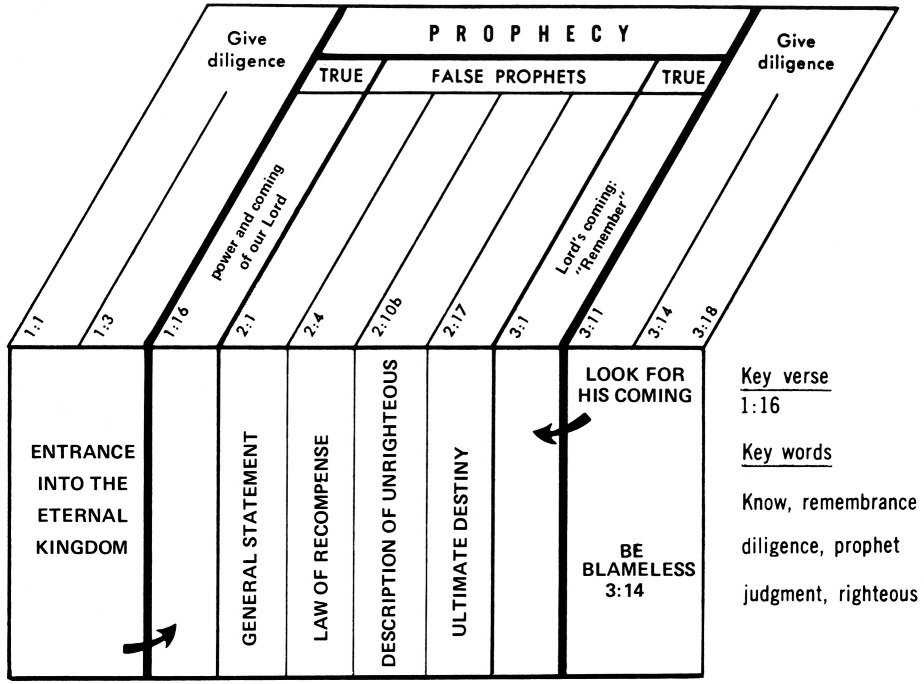
2 Peter: True and False Prophecy
Click chart to enlarge
Chart from Jensen's Survey of the NT - used by permission
Charles Swindoll's Chart - right side of page
|
2 PETER |
||||||||
| Cultivation of Christlike Character |
Condemnation of False Teachers |
Confidence in the Return of Christ |
||||||
| Greeting to Saints 2Pe 1:1-2 |
Growth in Christ 2Pe 1:3-14 |
Grounds |
Danger of |
Demise of |
"Decor" of |
Mockers in |
Manifest |
Maturity in light of that |
| Know Your Salvation |
Know |
Know Your Adversaries |
Know |
|||||
| True Prophecy (True Knowledge) |
False Prophets (False Teachers) |
Final Prophecy (Day of the Lord) |
||||||
| Holiness | Heresy | Hope | ||||||
| Development of Faith |
Denunciation of False Teachers |
Design of The Future |
||||||
2 Peter 3:9 The Lord is not slow (3SPAI) about His promise, as some count (3PPMI) slowness, but is patient (3SPAI) toward you, not wishing (PPPMSN) for any to perish (AMN) but for all to come (AAN) to repentance. (NASB: Lockman)
Greek: ou bradunei (3SPAI) kurios tes epaggelias, os tines braduteta hegountai, (3PPMI) alla makrothumei (3SPAI) eis humas me boulomenos (PPPMSN) tiapolesthai (AMN) alla pantas eis metanoian choesai (AAN)
Amplified: The Lord does not delay and is not tardy or slow about what He promises, according to some people's conception of slowness, but He is long-suffering (extraordinarily patient) toward you, not desiring that any should perish, but that all should turn to repentance. (Amplified Bible - Lockman)
Barclay: It is not that God is dilatory in fulfilling his promise, as some people reckon dilatoriness; but it is that for your sakes he patiently withholds his hands, because he does not wish any to perish, but wishes all to take the way to repentance. (Westminster Press)
KJV: The Lord is not slack concerning his promise, as some men count slackness; but is longsuffering to us-ward, not willing that any should perish, but that all should come to repentance.
NET: The Lord is not slow concerning his promise, as some regard slowness, but is being patient toward you, because he does not wish for any to perish but for all to come to repentance. (NET Bible)
NLT: The Lord isn't really being slow about his promise to return, as some people think. No, he is being patient for your sake. He does not want anyone to perish, so he is giving more time for everyone to repent. (NLT - Tyndale House)
Phillips: It is not that he is dilatory about keeping his own promise as some men seem to think; the fact is that he is very patient towards you. He has no wish that any man should be destroyed. He wishes that all men should come to repent. (New Testament in Modern English)
Wuest: The Lord is not tardy with regard to the appointed time of His promise, as certain consider tardiness, but is long-suffering toward us, not having it as His considered will that certain should perish, but that all should come to repentance. (Wuest: Expanded Translation: Eerdmans)
Young's Literal: the Lord is not slow in regard to the promise, as certain count slowness, but is long-suffering to us, not counseling any to be lost but all to pass on to reformation,
THE LORD IS NOT SLOW ABOUT HIS PROMISE AS SOME COUNT SLOWNESS: ou bradunei (3SPAInd) kurios tes epaggalias hos tines braduteta hegountai (3PPMI):
- Isa 46:13; Hab 2:3; Lk 18:7,8; Heb 10:37
- 2 Peter 3 Resources - Multiple Sermons and Commentaries
- 2 Peter 3:1-9 The Certainty of the Second Coming Pt 2 - John MacArthur
THE LORD IS
ALWAYS ON TIME
Peter moves from the timelessness of God to the tenderness of God.
Peter does not dispute the mocker's claim that the Second Coming had been delayed. He uses the delay as an opportunity to explain that another reason the Lord’s return seems to be so long in coming is that God wants as many people to be saved as possible.
Slow (1019) (braduno) means to tarry, loiter, delay, be tardy or delayed beyond the expected or proper time. Note what God is "slow" in regard to in [Ps 86:15 Is 30:18].
The KJV says God is not "slack" a state characterized by slowness, sluggishness, or lack of energy - none of those apply to God.
God’s so-called “tardiness” as viewed by some people (as some count slowness) is only a delay with respect to their time schedules, not His!
Not is the Greek word "ou" which is the absolute form of negation, so what Peter is saying is that "slowness" or "slackness" is absolutely not part of God's actions. His delay is due neither to indifference or inability to perform. God waits but is never slow, never late for it is always within His power to fulfill His promise as He sees fit. As discussed in the preceding verse, God's "timepiece" is eternity so He sees things differently than man in regard to what is "slow". God’s delay in fulfilling His promise is not, like men’s delays, owing to inability or fickleness in keeping His word, but is related to His attribute of longsuffering toward sinners.
Illustration - God is longsuffering. Men are not. We prefer to rush to judgment. Irving Stone's classic history of the American West, "Men to Match My Mountains," contains a passage on early justice. During the Gold Rush, San Francisco had a rash of crime. It got to the point where the police were more corrupt than the criminals. So in 1851 a group of concerned citizens formed a "Vigilance Committee." The word "vigilante" is derived from it. It was not just a lynch mob. They elected Sam Brannan as president, drew up a constitution and set up parliamentary rules. Only responsible citizens were allowed to join and they only acted in emergencies when the law was ineffective. The first official act of the group was to arrest John Jenkins, who had stolen a safe and dropped it into a boat. Tried in Brannan's office before a committee jury, Jenkins was declared guilty. An 1851 law said that grand larceny was punishable by death. But most of the committee seemed reluctant to hang someone for only stealing a safe. A this point William Howard threw his cap disgustedly on the table and cried: "Gentlemen, as I understand it, we came here to hang somebody!" So that's exactly what they did. If God acted like this, where would you be right now?
Promise (1860)(epaggelia/epangelia from epaggello = to announce that one is about to do or furnish something from epi = upon, intensifies meaning + aggelos = messenger or aggello = to tell or declare) is a declaration that one will do or refrain from doing something specified. It is also a legally binding declaration that gives the person to whom it is made a right to expect or to claim the performance or forbearance of a specified act.
Epaggelia - 52x in 50v -
Luke 24:49; Acts 1:4; 2:33, 39; 7:17; 13:23, 32; 23:21; 26:6; Rom 4:13, 14, 16, 20; 9:4, 8, 9; 15:8; 2 Cor 1:20; 7:1; Gal 3:14, 16, 17, 18, 21, 22, 29; 4:23, 28; Eph 1:13; 2:12; 3:6; 6:2; 1Ti 4:8; 2Ti 1:1; Heb 4:1; 6:12, 15, 17; 7:6; 8:6; 9:15; 10:36; 11:9, 13, 17, 33, 39; 2Pet 3:4, 9; 1Jn 2:25
Epaggelia is used primarily of the promises of God. God has promised to end the history of ungodly men with judgment but the other truth about God is that He has always been longsuffering toward woeful, wicked sinners desiring their repentance. If there seems to be delay, it is not because God is unfaithful to His promise.
Some count slowness indicates that delaying was being ascribed to the Lord by "some" (tines = "certain ones"), who in context could refer to the mockers or could include believers who had been "infected" by the skeptical propaganda of the scoffers. Clearly Peter desires that any of his readers who might be confused by the Lord's delay, should not succumb to the spirit of doubting.
Count (2233) (hegeomai [word study]) means to consider and give careful thought, not making a quick decision. It was a mathematical term conveying the idea of thinking about something and coming to a conclusion. In other words, one leads their mind through a reasoning process and arrives at a conclusion. Some had carefully considered the facts but "their math was bad" and they had come to an incorrect conclusion regarding the Lord's delay.
Peter undoubtedly recalls His Lord's parting words that…
It is not for you to know times or seasons which the Father has put in His own authority (Acts 1:7).
Jesus Himself had also said
But of that day and hour no one knows, no, not even the angels of heaven, but My Father only (Matt. 24:36)
Charles Stanley - A REASON FOR LIVING: 2 PETER 3:8–12 KEY VERSE: 2 PETER 3:9
The Lord is not slack concerning His promise, as some count slackness, but is longsuffering toward us, not willing that any should perish but that all should come to repentance.
There are times when the world around us seems mired in despair. Looking at their faces, hope is nowhere to be found. They have no hope because they do not know the source of all hope and strength.
Regardless of how entrenched in their sinful ways the world around us appears, they desperately want hope. They want a reason for living. And after much searching, those who never find Christ fail to discover that reason.
But as believers, we are called to show the world the reason for which we live, the One for whom we live. God desires for everyone to come to repentance and enter into relationship with Him. And as those who already have found Him, we are called to share with others the way to Him.
Because of someone’s love for Christ and love for us, we heard the truth and accepted Christ. For some of us, it was a simple message that we heard in church. For others of us, it was watching someone live as a representative of Christ day in and day out. For others still, it was understanding the reality of God through a miracle.
God introduces Himself to us through many different avenues. As His children, we, too, are called to be faithful in introducing the hope of salvation to others, whether it be through our words, actions, or lifestyle. Through followers of Christ, the world sees hope for their lives.
Lord, the ways in which You work in the heart are customized to each person’s need. Please help me be obedient to the call to be an instrument of the gospel.
BUT IS PATIENT TOWARD YOU: alla makrothumei (3SPAI) eis humas:
- 2Pe 3:15; Ex 34:6; Ps 86:15; Is 30:18; Ro 9:22; 1Ti 1:16; 1Pe 3:20
- 2 Peter 3 Resources - Multiple Sermons and Commentaries
- 2 Peter 3:1-9 The Certainty of the Second Coming Pt 2 - John MacArthur

THE LORD IS
PATIENT
As discussed below, the Greek word for patient depicts a long fuse! Praise God that He has a "long fuse!"
C H Spurgeon - While I have prayed, "Come quickly," I have often felt inclined to contradict myself and cry, "Yet tarry for a while, good Lord. Let mercy's day be lengthened. Let the heathen yet receive the Savior." We may desire the coming of the Lord, but we ought also to be in sympathy with the tarrying of the Most High, to which his loving heart inclines him.
But (235) (alla) introduces contrast (see discussion on importance of terms of contrast in the observation phase of Inductive Bible Study) and when used after a negative statement ("not slow") marks a direct, even emphatic antithesis and can be translated "but, but rather, but on the contrary".
In short, in this verse but introduces the contrasting reality that God's deliberate delaying action has a wonderfully benevolent purpose.
Toward you reminds the readers that they (and we) themselves have experienced this fact of His loving patience.
Patient (3114) (makrothumeo from makrós = long + thumós = wrath, anger) (See also word study of noun makrothumia) (See God's attribute longsuffering) means to have "a long fuse", to be longsuffering, slow to anger, slow to punish, to exhibit self-restraint in the face of provocation, not to retaliate, to bear the offenses and injuries of others, to be mild and slow in avenging.
Makrothumeo - 10x in 9v - Matt 18:26, 29; Luke 18:7; 1 Cor 13:4; 1 Thess 5:14; Heb 6:15; Jas 5:7f; 2 Pet 3:9. NAS = delay long(1), have patience(2), patient(6), patiently waited(1).
Being slow to anger does not mean that God does not care but that He has His "emotions under control."
The present tense of makrothumeo characterizes God as continually exercising restraint in the face of provocation so that He does not hastily retaliate or promptly punish, but that He continues to show mercy toward the guilty.
Paul describes the related noun makrothumia as one of the aspects of the fruit of the Holy Spirit in a believer's life (Gal 5:22-note).
Chrysostom an early church father said makrothumeo
“is a word which is used of the man who is wronged and who has it easily in his power to avenge himself but will never do it.” (cf. Nu 14:18)
God waits for men to be saved and exhibits an immense capacity for patience before He breaks forth in judgment (Joel 2:13; Lk 15:20).
God endures endless blasphemies against His name, along with rebellion, murders, and the ongoing breaking of His law, waiting patiently while He is calling and redeeming His own. It is not impotence or slackness that delays final judgment but it is His attribute of patience. This attribute of God is reflected in His ability to be inconvenienced or taken advantage of by a person over and over again and yet not manifest anger! Amazing love and grace from an amazing God.
God's "longsuffering" was behind His delaying the Genesis Flood for 120 years,
"when the patience [makrothumia] of God kept waiting in the days of Noah during the construction of the ark in which a few, that is eight persons, were brought safely through the water" (1Peter 3:20-note)
God was not blind to the violence and wickedness of man (Gen 6:5, 6) which justifiably would have warranted His immediate judgment and yet He held back His wrath, instead sending the evildoers Noah a “preacher of righteousness.” (2Peter 2:5-note).
In the case of Sodom and Gomorrah, God patiently waited while Abraham interceded for the cities and He would have spared them had He found ten righteous people in Sodom (Gen 18:23-33).
This same longsuffering that manifested itself in the days before the world's cataclysmic destruction by water and the local destruction of Sodom and Gomorrah by fire and brimstone, is still manifest today as God holds off the coming destruction of the universe by an all consuming conflagration.
It is worth noting that God revealed this same long-suffering in the years before the Flood (1Pe 3:20-note cf Ge 15:16). He saw the violence and wickedness of man and could have judged the world immediately; yet He held back.
The day of the Lord is a familiar Old Testament image for the ultimate day of God’s judgment, His final day in court when He settles the injustices of the world. From the above Scriptural references (and others) one can piece together the following portrait of the Day of the Lord.
R E Showers writes that…
The Day of the Lord refers to God’s special interventions into the course of world events to judge His enemies, accomplish His purpose for history, and thereby demonstrate who He is—the sovereign God of the universe. (R E. Showers, Maranatha, Our Lord Come Bellmawr, NJ: The Friends of Israel Gospel Ministry, 1995, 38)
Even a cursory study indicates that this day is not a reference to a single 24 day but to an extended period of time as will be explained below.
When does this "day" begin?
You will read descriptions in some commentaries that state the Day of the Lord begins with the rapture of the church (so-called "pre-trib rapture") (1Th 4:13, 14, 15,1 6, 17, 18-see notes 1Th 4:13; 14; 15; 16; 17; 18), the event which most evangelicals feel immediately precedes the last seven years of Seventy Weeks of Daniel, and is popularly known as the "Tribulation", although nowhere in Scripture is this seventieth week of 7 years actually specifically designated "the tribulation" (let me know if you find a passage that contradicts this conclusion - remember that "the Great Tribulation" only refers to the last three and one-half years of this seven year period).
According to Paul the "Day of the LORD" begins after the man of lawlessness (antichrist) (read 2Th 2:2,2:3, 2:4) takes his seat and desecrates the rebuilt Jewish temple in Jerusalem. Jesus referred to this dramatic event as the "Abomination of Desolation" (cf Daniel 9:27 see Daniel's Seventieth Week) which marks the beginning of the last 3.5 years of Daniel's Seventieth Week (Daniel 9:27-note), a period Jesus called the Great Tribulation (Mt 24:15,21) which is synonymous with the "Time of Jacob's Distress" (Jer 30:7). For more in depth study of this last 7 year period see the links below…
- Verse by Verse commentary - Daniel 9:24 9:25 9:26 9:27
- Daniel 9:24-27: Introductory Comments
- Daniel 9:24-27: Part 1: Notes on verses 24-25
- Daniel 9:24-27: Part 2: Notes on verses 26-27
- Summary Chart of Daniel's Seventieth Week
- See also lectures on Da 9:24-27: 14, 15, 16
- See related discussion on the Day of the Lord
- See Offsite discussion on the Day of the Lord
So if the Day of the Lord does not begin with the rapture of the church, when does it begin? A more likely beginning for the Day of the Lord is at the midpoint of the 7 Year period of Daniel (compare Da 9:27-note and Mt 24:15,21).
The events that take place during this 7 year period ("Tribulation") are described in great detail in Revelation (especially chapters Rev 6-21 click for over 25 lectures on Revelation).
Peter describes the Day of the Lord as a fiery conflagration of the heavens and earth, an event the would follow the 1000 year reign of Christ ("the Millennium") and which would correlate with the unique time/space description by John in Rev 20:11-note that the "earth and heaven fled away, and no place was found for them". Then comes the Great White Throne judgment, followed by "a new heaven heaven and a new earth; for the first heaven and the first earth passed away" (Rev 21:1-note).
Tony Garland comments on Revelation 20:11 noting that…
Jesus had predicted that God’s word would outlast the first heavens and earth: “Heaven and earth will pass away, but My words will by no means pass away” (Mt 24:35). The first heavens and first earth were preserved by God’s word for a time, but now the time has come for their judgment by fire and the perdition of ungodly men (2Pe 3:7). This marks the end of the period of The Day of the Lord.
(In his commentary on Revelation 21:1 Garland adds) The conjunction, now (kai), connects what follows with the previous chapter. The creation of the new heaven and new earth is in response to the destruction of the previous heaven and earth which fled away and gave up the dead (Re 20:11)… The restorative work prior to the Millennial Kingdom was a regeneration (Mt 19:28), not an entirely new created order as here. This is demonstrated by the fact that after the Millennial Kingdom (Re 20:4, 5, 6), the earth and sea still contained all the unsaved dead of history. Although the millennial earth was renovated in order to recover from the judgments of the Tribulation and to restore Eden-like conditions, sin and death remained and the earth, in one sense, remained unclean. In the conflagration of the first heaven and earth, sin and death are completely purged from the created order (Re 20:14).
It was revealed to the OT prophets that the first heavens and earth would perish (Ps. 102:25, 26; Isa. 51:6) and be replaced by a new heavens and earth (Isa. 65:17, 18, 19, 20) There is nothing in this passage of Isaiah which states that the new heavens and earth must precede the Millennium. It merely states that as the new creation will endure before God, so shall the faithful of Israel continue. (A Testimony of Jesus Christ - Revelation 21:1)
NOT WISHING FOR ANY TO PERISH: me boulomenos (PPPMSN) tiapolesthai (AMN):
- Isa 55:1; Ezek 18:23. 32; 33:11, Mt 11:28; Lk 13:3; Rev 22:17
- 2 Peter 3 Resources - Multiple Sermons and Commentaries
- 2 Peter 3:1-9 The Certainty of the Second Coming Pt 2 - John MacArthur
Isaiah 30:18 Therefore the LORD longs to be gracious to you, And therefore He waits on high to have compassion on you. For the LORD is a God of justice; How blessed are all those who long for Him.
THE FATHER'S
HEART
Wishing (1014) (boulomai [word study]) expresses more strongly than thelo the deliberate exercise of one's will. (present tense)
Scofield has an interesting thought on the will of God (but be a Berean as this categorization is somewhat strained in my opinion)…
Three aspects of the will of God may be observed in Scripture:
(1) the sovereign will of God (Isa 46:9, 10, 11; Da 4:17,35; Heb 2:4; Rev 17:17);
(2) the moral will of God, i.e. His moral law (Mk 3:35; Eph 6:6; He 13:21); and
(3) the desires of God coming from His heart of love (Ezek 33:11; Mt 23:37; 2Pet 3:9).
The sovereign will of God is certain of complete fulfillment, but the moral law is disobeyed by men, and the desires of God are fulfilled only to the extent that they are included in His sovereign will. God does not desire that any should perish, but it is clear that many will not be saved (Rev 21:8).
Boulomai expresses also the inward predisposition and bent from which active volition proceeds; hence it is never used of evil people.
Boulomai denotes the unconscious willing or an inner decision or thinking while thelo indicates conscious willing and denotes a more active resolution urging on to action.
The scoffers did not understand God’s eternality nor did they understand His undeserved mercy.
God's "wish" for mankind is the motive for His longsuffering.
Note that not wishing does not refer to the ultimate determining will of God but rather to His standing wish or desire for mankind. In other words (but it still might seem confusing) boulomai has reference to God's disposition or His nature rather than to a specific act or plan. It is not God’s considered will that any should perish. On one side we have the clear teaching of the sovereignty of God and on the other hand, the indisputable truth concerning the free will of man. God will not violate man’s free will. While it is His considered will (standing wish or desire) that no one should be lost, yet in making man in His image He necessarily had to make him a free moral agent, with a will which is able to say “yes” and “no” to Him. While God is always willing to save man, man is not always willing to be saved. Don't be confused by this section -- God's "wishing" here does not express a decree (determining will), as if God has willed everyone to be saved. Universal salvation is not taught in the Bible. Instead those words describe God’s standing wish or desire which is that He longs that all would be saved (1Ti 2:4) but knows that many reject Him, again leaving open the possibility of human freedom of choice.
Perish (622) (apollumi [word study] from apo = away from + olethros = state of utter ruin) means destruction but not annihilation and has to do with that which is ruined and is no longer usable for its intended purpose.
Apollumi is not the loss of being, but of well-being and in the present context indicates eternal separation from God Himself. To perish spiritually is to be forever lost.
Apollumi - 90x in 84v - NAS = bring(1), destroy(17), destroyed(9), dying(1), end(1), killed(1), lose(10), loses(7), lost(14), much(1), passed away(1), perish(14), perishable(1), perished(4), perishes(1), perishing(6), put to death(1), ruined(3).
Matt 2:13; 5:29f; 8:25; 9:17; 10:6, 28, 39, 42; 12:14; 15:24; 16:25; 18:14; 21:41; 22:7; 26:52; 27:20; Mark 1:24; 2:22; 3:6; 4:38; 8:35; 9:22, 41; 11:18; 12:9; Luke 4:34; 5:37; 6:9; 8:24; 9:24f; 11:51; 13:3, 5, 33; 15:4, 6, 8f, 17, 24, 32; 17:27, 29, 33; 19:10, 47; 20:16; 21:18; John 3:16; 6:12, 27, 39; 10:10, 28; 11:50; 12:25; 17:12; 18:9; Acts 5:37; 27:34; Rom 2:12; 14:15; 1 Cor 1:18f; 8:11; 10:9f; 15:18; 2 Cor 2:15; 4:3, 9; 2 Thess 2:10; Heb 1:11; Jas 1:11; 4:12; 1 Pet 1:7; 2 Pet 3:6, 9; 2 John 1:8; Jude 1:5, 11; Rev 18:14.
Note the little word "any" (Greek word tis = someone, certain one & in the plural here = "certain ones") which is the so-called "individualizing plural" which speaks of God's desire for men individually (to not perish), and is not a generalization about certain groups or classes of people. Clearly God is personally intimately concerned for every individual person, whether they accept or refuse His gracious offer of salvation by grace and belief in the Lord Jesus Christ's propitiatory (Propitiation that which satisfied the wrath of Holy God) death in their place. Peter knew as we today also know all too painfully, that many individuals will perish into a Christ-less eternity, but Peter's point is that this egregious end is not God's personal desire for them. The cause of their perishing lies not in God but in each individual's stubborn and rebellious rejection of redemption offered by faith in Christ.
God's heart on this issue is clearly revealed by the prophet Ezekiel who quoted Jehovah as follows:
'As I live!' declares the Lord GOD, 'I take no pleasure in the death of the wicked, BUT RATHER that the wicked turn from his way and live. Turn back, turn back from your evil ways!" (Ezekiel 33:11 see also Ezekiel 18:23)
In (Ezekiel 33:32) God says
I have no pleasure in the death of anyone who dies," declares the Lord GOD. "Therefore, REPENT and live.
Finally Paul unveils the Father's heart as the One
Who desires all men to be saved and to come to the knowledge of the truth (Note: Association between coming to a true knowledge of truth and salvation). (1T 2:4)
And so contrary to popular opinion of many who are misinformed concerning the character of God, His heart in both the Old and New Testaments is that not one man would perish but that all would come to repentance. And so He holds back His had of righteous judgment.
John Calvin comments on Not willing that any should perish writing that
So wonderful is His love towards mankind, that He would have them all to be saved, and is of His own self prepared to bestow salvation on the lost
He Was Not Willing
“He was not willing that any should perish”;
Jesus enthroned in the glory above,
Saw our poor fallen world, pitied our sorrows,
Poured out His life for us, wonderful love!Perishing, perishing! Thronging our pathway,
Hearts break with burdens too heavy to bear:
Jesus would save, but there’s no one to tell them,
No one to lift them from sin and despair.“He was not willing that any should perish”;
Clothed in our flesh with its sorrow and pain,
Came He to seek the lost, comfort the mourner,
Heal the heart broken by sorrow and shame.Perishing, perishing! Harvest is passing,
Reapers are few and the night draweth near:
Jesus is calling thee, haste to the reaping,
Thou shalt have souls, precious souls for thy hire.Plenty for pleasure, but little for Jesus;
Time for the world with its troubles and toys,
No time for Jesus’ work, feeding the hungry,
Lifting lost souls to eternity’s joys.Perishing, perishing! Hark, how they call us;
Bring us your Savior, oh, tell us of Him!
We are so weary, so heavily laden,
And with long weeping our eyes have grown dim.“He was not willing that any should perish”;
Am I His follower, and can I live
Longer at ease with a soul going downward,
Lost for the lack of the help I might give!Perishing, perishing! Thou wast not willing;
Master, forgive, and inspire us anew;
Banish our worldliness, help us to ever
Live with eternity’s values in view.
Waiting on God
Read: 2 Peter 3:8–15
[The Lord] is patient with you, not wanting anyone to perish, but everyone to come to repentance. 2 Peter 3:9
I was sitting with a group of passengers on an airport shuttle heading to our connecting flight when the bus driver was told to “hold in place.” It looked like we would miss our flight, and this was more than one passenger could handle. He exploded at the driver, insisting he ignore his orders or “risk the wrath of a lawsuit.” Just then an airline employee came dashing up carrying a briefcase. Looking at the angry man, the airline employee triumphantly held up the briefcase. When he had caught his breath, he said, “You left your briefcase. I heard you mention how important your meeting was, and I figured you would need this.”
Sometimes I find myself impatient with God, especially about His return. I wonder, What can He be waiting on? The tragedies around us, the suffering of people we love, and even the stresses of daily life all seem bigger than the fixes on the horizon.
Wait and witness till Jesus returns.
Then someone tells their story of having just met Jesus, or I discover God is still at work in the messes. It reminds me of what I learned that day on the shuttle. There are stories and details God knows that I don’t. It reminds me to trust Him and to remember that the story isn’t about me. It’s about God’s plan to give time to others who don’t yet know His Son (2 Peter 3:9).
I’m thankful You are patiently waiting for more people to trust in You before You return. Help me to be patient too.
Wait and witness till Jesus returns.
By Randy Kilgore | (Our Daily Bread, Copyright RBC Ministries, Grand Rapids, MI. — Reprinted by permission. All rights reserved)
All Aboard
Read: 2 Peter 3:1-13
The Lord is . . . longsuffering toward us, not willing that any should perish. —2 Peter 3:9
One day when I dropped my husband off at our local train station, I watched as the conductor scanned the area for stragglers. A woman with wet hair bounded from the parking lot and up into the train. Then, a man in a dark suit strode to the platform and climbed aboard. The conductor waited patiently while several more late-comers sprinted to the tracks and boarded at the last moment.
Just as the conductor was patient with people boarding the train, God patiently waits for people to come to know Him. However, someday Jesus will return and “the heavens will pass away with a great noise, and the elements will melt with fervent heat” (2 Peter 3:10). When this happens, or when our physical bodies die, it will be too late to establish a relationship with God.
“The Lord is . . . longsuffering toward us,” Peter says, “not willing that any should perish but that all should come to repentance” (v.9). If you have delayed deciding to follow Christ, there is good news—you can still commit yourself to Him. “If you declare with your mouth ‘Jesus is Lord,’ and believe in your heart that God raised him from the dead, you will be saved” (Rom. 10:9 niv). He is calling. Will you run in His direction?
Softly and tenderly Jesus is calling,
Calling for you and for me;
See, on the portals He’s waiting and watching,
Watching for you and for me. —Thompson
Now is the time to choose the Lord.
By Jennifer Benson Schuldt |
INSIGHT Peter wrote to a persecuted and suffering group of Christians, which is why he highlighted the faithfulness of God. Peter wanted them to remember that the Lord would fulfill the promise of His second coming (v. 13). (Our Daily Bread, Copyright RBC Ministries, Grand Rapids, MI. — Reprinted by permission. All rights reserved)
In Praise Of Slowness
Read: 2 Peter 3:1-9
The Lord is not slack concerning His promise, as some count slackness. —2 Peter 3:9
If there were a contest for most popular virtue, I suspect that “fast” would beat “best.” Many parts of the world seem to be obsessed with speed. The “fast” craze, however, is getting us nowhere—fast.
“The time has come to challenge our obsession with doing everything more quickly,” says Carl Honoré in his book In Praise of Slowness. “Speed is not always the best policy.”
According to the Bible, he’s right. Peter warned that in the last days people would doubt God because it seems He is slow (“slack”) in fulfilling His promise to return. Peter pointed out, however, that this seeming slowness is a good thing. God is actually demonstrating His patience by giving people more time to repent (2 Peter 3:9), and also being true to His character, as in patient or slow to anger (Ex. 34:6).
We too must be slow to become angry—and slow to speak (James 1:19). According to James, “quickness” is reserved for our ears. We’re supposed to be quick to listen. Think about how much trouble we could avoid if we learned to listen—really listen, not just stop talking—before we speak.
In our rush to meet goals and deadlines, let’s remember to speed up our listening and to slow down our tempers and our tongues.
Dear heart, let perfect patience be thy goal;
It is the way earth’s noblest souls have trod.
’Tis just a calm adjustment of the soul
In all things to the perfect will of God. —Hayward
When you’re tempted to lose patience with another, think how patient God has been with you.
By Julie Ackerman Link (Our Daily Bread, Copyright RBC Ministries, Grand Rapids, MI. — Reprinted by permission. All rights reserved)
Are You Ready?
Read: 2 Peter 3:1-13
The Lord is not slack concerning His promise. —2 Peter 3:9
Many will remember the fall season of 2008 as the beginning of the worst financial crisis since the Great Depression of 1929. In the months to follow, many lost their jobs, homes, and investments. In a BBC interview a year later, Alan Greenspan, former head of the US Federal Reserve, indicated that the average person doesn’t believe it will happen again. He said, “That is the unquenchable capability of human beings when confronted with long periods of prosperity to presume that it will continue.”
Assuming that things will continue as they always have is not just 21st-century-type thinking. In the first century, Peter wrote of people who thought that life would continue as it was and that Jesus would not return. He said, “Since the fathers fell asleep, all things continue as they were from the beginning of creation” (2 Peter 3:4). Jesus said He would come back, but the people continued to live in disobedience as though He would never return. But His delay is only because of God’s patience with us, for He is “not willing that any should perish but that all should come to repentance” (v.9).
Paul tells us that Christians ought to live “soberly, righteously, and godly” in the light of Christ’s certain return. (Titus 2:12). Are you ready to meet Him?
Faithful and true would He find us here If He should come today? Watching in gladness and not in fear, If He should come today? —Morris
Jesus may come any time, so we should be ready all the time.
By C. P. Hia (Our Daily Bread, Copyright RBC Ministries, Grand Rapids, MI. — Reprinted by permission. All rights reserved)
Will Everyone Eventually Be Saved? - 2 Peter 3:9 - Ray Pritchard
2 Peter 3:9. Smith - Handfuls of Purpose
1. The Character of the Lord—"Longsuffering, not willing that any should perish" (Isa. 30:18).
2. The Objects of His Compassion "Usward"—"While we were yet sinners" (1 Tim. 2:4).
3. The Purpose of His Patience—Salvation (1 Peter 3:20).
4. The Great Need of Man—"All should come to repentance" (Ezek. 33:11).
The LORD is not willing that any should perish, but that all should come to repentance."—2 Pet. 3:9
At the time of the Disruption, Dr. Macdonald visited St. Kilda, and on one occasion addressed an old man who had lost his sight, saying it would be well if his mental eyes were opened. "I trust they are," he said. "But what then do you see?" "That I am blind—that in myself I am a ruined sinner, but Christ is an Almighty Saviour." "But what if He is not willing?" "Willing! would He die for sinners if He were not willing to save them?—No! No!"
The Character of God - Richard Mayhue
Love
God is love (1 John 4:16)
Joy
The town of My joy (Jer. 49:25)
Peace
The God of peace (Heb. 13:20)
Patience
God is patient with us (2 Peter 3:9)
Kindness
God's kindness to us (Eph. 2:7)
Goodness
The goodness of the Lord (Ps. 27:13)
Faithfulness
God is faithful (1 Cor. 10:13)
Gentleness
Christ is gentle and humble in heart (Matt. 11:29)
Self-control
The divine nature includes self-control (2 Peter 1:4, 6)
2 Peter 3:9
So he hurries not. He gives the sinner space and time and verge enough in which to repent. Oh, that man would turn to God, moved by that gracious long-suffering of his!
---
Therefore does he wait. If men ask why there is no interposition of wrath to overthrow the ungodly, the answer is, because this is part of God’s great reign of love. He waits, because he is “not willing that any should perish, but that all should come to repentance;” yet there will be s limit even to his patience.
2 Peter 3:9 With His Fingers Crossed –
In 1492, Ferdinand granted Columbus great titles, vast privileges, and a tenth of the riches his explorations materialized. By 1500, when the size and wealth of the new world actually dawned on Ferdinand, he broke the agreement, though he had promised it by solemn treaty.
In the early 1950s, the Russians opened sixty million acres in Kazakhstan to grain farmers. They imported trainloads of Russians, Ukrainians, and Byelorussians to work the state-owned cooperatives, planning to be self-sufficient in grain by 1954. The Communist Party promised to bring the future to its people. The people believed … in vain. Today, several millions of those acres have reverted to pasture. The Party made promises and brought hope, one man said, then the Party vanished, leaving broken promises and ruined lives.
God understands that we live in hope and that, deprived of hope, our spirit diminishes, then dies. He has encouraged us to believe in his promises, which never fail; but we are intent on believing our own, which seldom succeed. Greed, false economic theory, political or social collapse can destroy even well-intentioned assurances. God’s promises will not fail, for they are founded on him.
--Speaker's Sourcebook
2 Peter 3:9 not wishing for any to perish but for all to come to repentance.
William Guthrie
"The Bible, which ranges over a period of 4,000 years, records but one instance of a deathbed conversion—one that none may despair, and but one that none may presume.... There be few at all saved. . . . and fewest saved this way." (William Guthrie)
George Swinnock
"All the while thou delayest, God is more provoked, the wicked one more encouraged, thy heart more hardened, thy debts more increased, thy soul more endangered, and all the difficulties of conversion daily more and more multiplied upon thee, having a day more to repent of, and a day less to repent in." (George Swinnock, Puritan)
C H Spurgeon Comment
While I have prayed, "Come quickly," I have often felt in¬clined to contradict myself and cry, "Yet tarry for a while, good Lord. Let mercy's day be length¬ened. Let the heathen yet receive the Savior." We may desire the coming of the Lord, but we ought also to be in sympathy with the tarrying of the Most High, to which his loving heart inclines him. (C H Spurgeon)
Question 109 How can the God of the New Testament, of whom Peter says, “He is patient with you, not wanting anyone to perish, but everyone to come to repentance” (2 Peter 3:9) also be the God of Joshua who commanded the annihilation of every living being in the city of Jericho (Joshua 6:17–18)?
The resolution to this dilemma is that God is both a God of love and a God of justice. The two exist in a fine balance throughout biblical history, for which we can be infinitely grateful. We can be glad that God’s justice is tinged with mercy, for if any of us got what we truly deserved, we’d be, as my kids like to put it, dead meat.
We can all cope with the notion of God’s judgment at the end of time, but the notion of God judging in the here and now somehow sets us back on our heels. It’s almost as if we don’t think He ought to be trespassing into our territory while we still have time left on the clock.
But God has been intervening since the beginning of time. The Bible opens with an act of divine love in creation, moves almost without pause to an act of human sin, to be followed by the first act of divine judgment. From that point on, human history is a litany of sin punctuated by periodic judgments.
Although God sometimes used natural forces as His tools of judgment (the Red Sea is about as natural as you can get) and sometimes supernatural, as often as not He arranged the affairs of nations to coincide with His plans for blessing and judgment.
While pestilence and famine accompanied the fall of Samaria and the fall of Jerusalem, they were natural companions of siege warfare. God used human armies to judge Israel and Judah.
Is it any surprise then that He also used a human army to judge the Canaanites? The conquest of Canaan was no afterthought with God. Some time around 2,000 B.C. He promised that land to Abraham. But even though He spoke about the land as if it had already been delivered, Israel wouldn’t take delivery until generations had passed.
It used to trouble me that God’s promise wouldn’t be fulfilled until long after Abraham was dust. But the delay was necessary. God used the time to help the patriarchs to grow in their faith. But the interval had another side to it; to give the land to Israel, God had to first throw out the Canaanites.
He wouldn’t arbitrarily evict His current tenants, even to give a gift to His chosen people. That would be unjust. Instead, He waited because “the sin of the Amorites [a name sometimes used for the residents of Canaan] has not yet reached its full measure” (Genesis 15:16).
Even in judging the Canaanites, God was gracious and patient. His justice demanded that their sinfulness be punished, but by His grace the punishment could not come until there was no other alternative. God was not willing that any should perish. But when the fullness of their iniquity had come, the armies of Israel were the tool God used to enact judgment.
THE LIFE OF CHRIST IN QUADRAPHONIC SOUND When I was a teenager, I listened to news reports of hit and run accidents and holdups with bewilderment. The police in our town always seemed to be looking for a late model blue (or brown or green) sedan. I couldn’t understand why witnesses couldn’t give a detailed description of the getaway car just by listening to the sound of the engine and the transmission.
As you might guess, I was a car fanatic. My brother and I challenged each other to identify by sound alone the makes of cars stopped at the intersection outside our duplex. We prided ourselves on being able to identify anything on the road. If either of us had witnessed a holdup or a hit and run accident, our testimony to the police would have included a detailed description of the car, including year, make, model, precise color, hubcap style, hood ornaments, and whether or not fuzzy dice were hanging from the rear view mirror.
Now that I’m middle aged, I ask my teenage son if I want a car identified. Now all I really care about cars is what they cost and if they have room for all six of my family and their assorted paraphernalia. My perspective has changed radically, and with it my perceptions.
Likewise, different observers of the same scene will describe it in terms of their own interests, expertise, and motivation. Ask the fans of opposing football teams whether a close interference call on the defender’s ten-yard line with thirty seconds left to play in a scoreless playoff game was justified, and you’ll see what I mean. This doesn’t mean that one is wrong and the other right. Even with instant replay, officials themselves can’t always agree on the call. What it does mean is that each person, with his or her own interests at stake, watches a football game from a different vantage point, and that vantage point determines what the person sees. (O'Brien - Today's Handbook for Solving Bible Difficulties)
J Vernon McGee - Please explain Hebrews 2:3 and 2 Peter 3:9. Do these verses mean we could lose our salvation—“How shall we escape” and “longsuffering to us-ward”?
These two verses that you have suggested actually have no reference at all to the security of the believer or to the question of whether you lose your salvation or not.
“How shall we escape, if we neglect so great salvation; which at the first began to be spoken by the Lord, and was confirmed unto us by them that heard him” (Heb. 2:3). This is directed to the unsaved, not to those who are already saved. “How shall we escape, if we neglect…”; that is, if we just let it pass by and do nothing about it, which is the attitude of the average unsaved man or woman today. Many are hearing the gospel, but they just do nothing about it. They are not saved and have never been saved. He is not even discussing the situation of the saved. The saved are those who have eternal life; and if they have eternal life, then they can’t lose it tomorrow. If we could lose it, it wasn’t eternal life that we had to begin with. Or, as I have heard it expressed recently, you can’t lose what you don’t have.
Your second passage of Scripture, again, has no reference at all to the condition of the saved person. “The Lord is not slack concerning his promise, as some men count slackness; but is longsuffering to us-ward, not willing that any should perish, but that all should come to repentance” (2 Peter 3:9).
Peter says to the unsaved person that God is longsuffering toward the lost. He is longsuffering toward the saved, too, but this verse is not talking about that. He is longsuffering, not willing that any should perish—that is, fail to get saved. God desires that all should come to repentance—change their minds and accept Christ. You see, God is not talking about the saved person in either situation.
Stephen Charnock - When the Spirit renews in our minds a Gospel truth, let us turn it into a present plea, and be God’s remembrancer of His own promises, as the Spirit is our remembrancer of Divine truths. We need not doubt some rich fruit of the application at such a season.
Robert Morgan - 2 Peter 3:9 - A Straw of Hope
The Bible is a machine gun with 31,173 bullets, for that’s how many verses it contains. One of those bullets had Mark Sloan’s name on it.
Mark combined alcohol and cocaine in lethal amounts, desperately trying all the while to stop. After one stay in a rehabilitation center, we invited him to live with us, thinking we could encourage his sobriety. For months all went well, then one morning he disappeared. We were unprepared for his relapse, and it seemed almost like losing a son. I would find him in despicable places, drunk, high, hurting, spiraling downward. Then several months passed with no word from him at all.
One day I heard he was in a basement across town. I found the place and banged on the door until he grudgingly let me in. He was badly depressed. I tried to persuade him to enter a treatment program, but he refused. It was time to die, he said. He had tried so hard to overcome his habits, and could not. His eyes were glazed over, his words slurred, and nothing I said fazed him.
“There’s enough cocaine in this apartment to kill an elephant,” he said, “and my body can’t stand much more. A day or two, then it’ll be over. You’ll forget about me in a few weeks; we’ll all be better off. It’s meant to be … just let it be. It’s meant to be.”
I was turning to leave, choking back tears, when a verse suddenly popped from my mouth without forethought. “Mark,” I said, “it isn’t meant to be. The Bible says that God is not willing for any to perish, but for all to come to repentance.” A flicker of hope registered in Mark’s eyes. It was very faint, but unmistakable. I repeated the verse, and he listened as if trying to grasp a straw blowing past him.
In the years since, I’ve told Mark of that moment several times. He doesn’t remember it, but I’ll never forget it. I’m convinced that verse saved his life and eventually led to his becoming the sober, dedicated Christian he is today.
John Calvin - Why God Waits. 2 Peter 3:9: Deuteronomy 29:25–29
Peter checks extreme and unreasonable haste for the day of resurrection by saying that the Lord defers his coming so that he might invite all mankind to repentance. When we hear that the Lord in delaying shows concern for our salvation and defers the time because he cares for us, there is no reason why we should continue to complain of his tardiness.
There is no tardiness in God, who regulates time in the best manner to promote our salvation. As to the duration of the whole world, we must think the same of the life of every individual, for God, by prolonging time, sustains each person so he may repent. God refrains from hastening the end of the world so that all are given time to repent.
This is a very necessary admonition given to us so that we may learn to rightly use time, for otherwise we shall suffer a just punishment for our idleness.
He is not willing that any should perish, Peter tells us. So wonderful is his love toward mankind that God would have them all saved and is himself prepared to bestow salvation on the lost. But we are to notice that God is ready to receive all to repentance so that none may perish. Therefore, everyone who is desirous of salvation must learn to enter in by this way.
Some may ask, if God wishes none to perish, why do so many perish? To this I answer that no mention is made here of the hidden purpose of God, according to which the reprobate are doomed to their own ruin, but only of God’s will made known to us in the gospel. For God stretches forth his hand to all, but lays hold only of his own to lead those to himself whom he has chosen before the foundation of the world. (365 Days with Calvin)
Stephen Hooks - The Waiting God 2 Peter 3:9
Introduction - If patience is a virtue, it is one virtue modern man has lost. In this “up-to-the-minute” world there are very few things for which we are willing to wait. Somewhere in our headlong rush into the future we have forgotten how to wait.
In direct contrast to this is the unanimous testimony of scripture that the Almighty Creator of the universe is a God who waits. For a people who have lost the meaning of the word it is sometimes hard to understand.
I. The Mystery of God’s Patience
A. God’s patience was hard for the early church to understand.
1. God had made certain promises about the future and, as yet, nothing had happened. Scoffers were beginning to arise saying, “Where is this ‘coming’ he promised?” (v. 4).
2. Some Christians were growing impatient, and some were actually considering falling away from the church.
B. Peter writes to correct their mistaken notions about God’s “slowness” to act.
1. He points out that God does not see time as we do. To the eternal Creator “a day is like a thousand years, and a thousand years are like a day” (v. 8).
2. God’s patience does not imply His powerlessness. His is a power which intentionally withholds itself for the benefit of man.
3. God’s patience does not imply His abandonment of His children. The parables of Jesus make it clear that God’s patience is purposeful. Jesus frequently tells stories of a farmer or master who travels to a far country leaving his goods in the hands of servants and who, as often as not, delays his return, waiting to see what His servants will do in His absence.
C. When we clamor for God to do something and do it now, we need to remember that His perspective on what needs to be done and when may be quite different from our own.
II. The Meaning of God’s Patience
A. God waits with a benevolent kindness that lets us share in His work.
1. At the heart of our impatience with others is the idea that “I could do it better and faster and better myself.”
2. Think of how tempting that thought must be to God! There is nothing that we can do that God could not do far better and much more quickly. Yet He invites us to participate in the unfolding of His saving will. If we are impatient with God, how much more impatient He must be with us.
B. God waits because His coming will end all things.
1. This text is set against a throne of judgment. When He finally comes, He will come to judge. There will be a finality to it which will end all opportunities for repentance.
2. Instead of resenting God’s patience we should rejoice in it. It continues to give us and those we love the opportunity to escape His judgment.
C. God waits because He loves us and wants us all to be saved.
1. The church has clamored for God’s coming many times in its history. But God has waited, and millions more have responded to the gospel.
2. It is really not God who keeps us waiting, but we who keep Him waiting by our resistance to His saving truth.
Conclusion With every tick of the clock of eternity that God in His patience allows He is saying, “I love you and I want you to be saved.” He stands at the door and knocks waiting for us to answer. We have made Him wait long enough.
Illustration Martin Luther could not understand how God could be so patient with men. He said that if he were God and the world had treated him as it treated God, he would have kicked the wretched thing to pieces. I’m glad that Martin Luther was not God.
George Bernard Shaw was once asked what he would have done if he were in charge when the great flood came and his reply was, “I would have let them all drown!”
God's Roadblocks on the Road to Hell
Here are the roadblocks God has put on the road to hell:
1. The first blockade on the Road to Hell is God Himself (2 Peter 3:9).
2. The second blockade on the Road to Hell is God's Eternal Word—it contains the plan of salvation.
3. The third blockade on the Road to Hell is the blessed Holy Spirit of God. (John 16:8).
4. The fourth blockade on the Road to Hell is Jesus Christ Himself (Acts 9 meeting Paul on the road to Damascus).
"It is easy to be saved and it is hard to be lost!" (Proverbs 13:15).
Truth for Today - Amazement is an appropriate and, in fact, unavoidable response to the words and teachings of Jesus. But our response to them should not end with amazement or even serious pondering. The ultimate response to Jesus’ teaching is belief and obedience. He did not expound the truths He did merely for our astonishment or information. He taught what He did for our salvation.
Many respond to Jesus by merely considering His words and actions but not embracing them. What is your ultimate response? (MacArthur)
BUT FOR ALL TO COME TO REPENTANCE: alla pantas eis metanoian choesai (AAN) eis metanoian choesai (AAN):
- See Torrey's Topic "Repentance"
- Ro 2:4; 1Ti 2:4; Rev 2:21
- 2 Peter 3 Resources - Multiple Sermons and Commentaries
- 2 Peter 3:1-9 The Certainty of the Second Coming Pt 2 - John MacArthur

REPENT:
ABOUT FACE!
The call "About Face" describes the act of pivoting 180 degrees, especially in a military formation. Another English definition says it is "a reversal of direction, of attitude, behavior, or point of view." This is a good picture of the repentance to which God calls us in salvation.
One of the best discussions of repentance: Repentance by J C Ryle
"The Bible, which ranges over a period of 4,000 years, records but one instance of a deathbed conversion—one that none may despair, and but one that none may presume… There be few at all saved… and fewest saved this way." (William Guthrie)
"All the while thou delayest, God is more provoked, the wicked one more encouraged, thy heart more hardened, thy debts more increased, thy soul more endangered, and all the difficulties of conversion daily more and more multiplied upon thee, having a day more to repent of, and a day less to repent in." (George Swinnock, Puritan)
All (3956) (pas, plural = pantas) means all with no exceptions. This is the Father's desire but sadly not all will come to repentance.
How good to have an answer for those who ridicule the idea of a coming Judgment Day. “God’s just waiting for you to be saved!” Delay is another evidence of God’s love.
As Hiebert notes "The fact that this is God's desire for all (pantas) individuals, underscores mankind's fundamental need for such a moral reformation.
I am including the following comment from William Barclay so that you might be wary (see another critique) when using his popular commentaries (which I do quote elsewhere on this website) which, although often providing unique insights into the Greco-Roman culture, history and word meanings, are subtly laced with the arsenic of half-truth which calls for caveat emptor ("let the buyer beware" so to speak). Now with this forewarning read Barclay's comment on 2Peter 3:9…
Ever and again there shines in Scripture the glint of the larger hope. We are not forbidden to believe that somehow and some time the God Who loves the world will bring the whole world to Himself.
Do you understand what Barclay is implying? Read it one more time like a good Berean (Acts 17:11-note). Clearly Barclay affirms the possibility of universalism (all men will be saved) and yet look back at evidence to the contrary even in the context of this book (2Peter 2:7-note). Furthermore, the plain thrust of Peter's teaching in this section is that after the second coming, ushering in the judgment of conflagration, there will be no further opportunity for repentance. You must also note what is clearly NOT being taught in passages like this --
There is absolutely no indication
of a "secret decree" by God
which predestinates certain ones
unto eternal damnation.
That specious (having deceptive attraction, having a false look of truth) argument is not substantiated in the current text nor anywhere else in Holy Writ! Keep in mind that the best commentary is to compare Scripture with Scripture (far better than these "Verse by Verse" notes!)
To come (5562) (choreo) means to “make room for something” and so to give place to or receive it.
In context choreo means to make room for (receive) repentance in one's heart by putting away stubborn pride and welcoming the Word of God which "births" forth a brand new life (1Pe 1:23, 24, 25-note).
Repentance is the gift of God as shown by the following passages
"Well then, God has granted to the Gentiles also the repentance that leads to life" = Acts 11:18, 16:14;
"God may grant them repentance leading to the knowledge of the truth" = (2Ti 2:25-note)
"the kindness of God leads you to repentance"= (Ro 2:4-note)
Yes repentance is a gift but In the divine mystery of the transaction that results in the new birth, the unbeliever has personal responsibility to make room for God's gift. Salvation is of God but He will not force us to be born again as if we were "puppets". Peter describes salvation as…
according to His great mercy He caused us to be born again to a living hope, thru the resurrection of Jesus Christ from the dead. (1Pe 1:3-note).
God may cause us but He will not coerce us (against our will) to be saved. All who are not saved have made a free will choice to not "make room for" His precious gift of repentance.
Repentance (3341) (metanoia from meta = after + noéo = to understand) literally means "afterthought" or "to think after" and implies a change of mind.
From the NT uses, it is clear that metanoia means however much more than merely a change of one's mind but also includes a complete change of heart, attitude, interest, and direction. Metanoia is a conversion in every sense of the word. Jesus' teaching would support this conclusion for our Lord declared…
I tell you that in the same way, there will be more joy in heaven over one sinner who repents (metanoeo), than over ninety-nine righteous persons who need no repentance (metanoia). (Luke 15:7)
Metanoia is used 22 times in the NT - see verses below (Matt 3:8, 11; Mark 1:4; Luke 3:3, 8; 5:32; 15:7; 24:47; Acts 5:31; 11:18; 13:24; 19:4; 20:21; 26:20; Ro 2:4; 2 Cor 7:9, 10; 2Ti 2:25; Heb 6:1, 6; 12:17; 2Pe 3:9
Bishop Ryle offers this descriptive definition of repentance…
Repentance is a thorough change of man's natural heart, upon the subject of sin. We are all born in sin. We naturally love sin. We take to sin, as soon as we can act and think—just as the bird takes to flying, and the fish takes to swimming. There never was a child that required schooling or education in order to learn deceitfulness, selfishness, passion, self-will, gluttony, pride, and foolishness. These things are not picked up from bad companions, or gradually learned by a long course of tedious instruction. They spring up of themselves, even when boys and girls are brought up alone. The seeds of them are evidently the natural product of the heart. The aptitude of all children to these evil things is an unanswerable proof of the corruption and fall of man. Now when this heart of ours is changed by the Holy Spirit, when this natural love of sin is cast out, then takes place that change which the Word of God calls "repentance." The man in whom the change is wrought is said to "repent." (Repentance)
One of the best illustrations of genuine repentance is found in Paul's description of the saints at Thessalonica…
For they themselves (other believers in Macedonia and Achaia) report about us (Paul, Silvanus and Timothy) what kind of a reception we had with you, and how you turned to God from idols to serve a living and true God, and to wait for His Son from heaven, whom He raised from the dead, that is Jesus, who delivers us from the wrath to come. (1Thessalonians 1:9; 1:10-See notes 1Th 1:9; 1:10)
C H Spurgeon in a sermon entitled The Plumbline (Amos 7:7, 8) wrote that…
Side by side with that faith, God puts true repentance. When a man attempts to convert his fellow-man, he gives him a sham repentance, or perhaps he tells him that there is no need of any repentance at all. Certain preachers have been telling us, lately, that it is a very easy matter to obtain salvation, and that there is no need of repentance; or if repentance is needed, it is merely a change of mind. That is not the doctrine that our fathers used to preach, nor the doctrine that we have believed. That faith, which is not accompanied by repentance, will have to be repented of; so, whenever God builds, he builds repentance fair and square with faith. These two things go together; the man just as much regrets and grieves over the past as he sees that past obliterated by the precious blood of Jesus. He just as much hates all his sin as he believes that his sin has been all put away. (Amos 7:7-8 The Plumbline)
Here are the 22 NT uses of metanoia…
Matthew 3:8 "Therefore bring forth fruit in keeping with repentance… 11 "As for me, I baptize you with water for repentance, but He who is coming after me is mightier than I, and I am not fit to remove His sandals; He will baptize you with the Holy Spirit and fire.
Mark 1:4 John the Baptist appeared in the wilderness preaching a baptism of repentance for the forgiveness of sins.
Luke 3:3 And he came into all the district around the Jordan, preaching a baptism of repentance for the forgiveness of sins… 8 "Therefore bring forth fruits in keeping with repentance, and do not begin to say to yourselves, 'We have Abraham for our father,' for I say to you that God is able from these stones to raise up children to Abraham.
Luke 5:32 "I have not come to call the righteous but sinners to repentance."
Spurgeon wrote "Learn this lesson—not to trust Christ because you repent, but trust Christ to make you repent; not to come to Christ because you have a broken heart, but to come to him that he may give you a broken heart; not to come to him because you are fit to come, but to come to him because you are unfit to come. Your fitness is your unfitness. Your qualification is your lack of qualification.
Luke 15:7 "I tell you that in the same way, there will be more joy in heaven over one sinner who repents, than over ninety-nine righteous persons who need no repentance.
Luke 24:47 and that repentance for forgiveness of sins should be proclaimed in His name to all the nations, beginning from Jerusalem.
Acts 5:31 "He is the one whom God exalted to His right hand as a Prince and a Savior, to grant repentance to Israel, and forgiveness of sins.
Acts 11:18 And when they heard this, they quieted down, and glorified God, saying, "Well then, God has granted to the Gentiles also the repentance that leads to life."
Acts 13:24 after John had proclaimed before His coming a baptism of repentance to all the people of Israel.
Acts 19:4 And Paul said, "John baptized with the baptism of repentance, telling the people to believe in Him who was coming after him, that is, in Jesus."
Acts 20:21 solemnly testifying to both Jews and Greeks of repentance toward God and faith in our Lord Jesus Christ.
C H Spurgeon wrote that "Repentance and faith must go together to complete each other. I compare them to a door and its post. Repentance is the door which shuts out sin, but faith is the post on which its hinges are fixed. A door without a doorpost to hang on is not a door at all, while a doorpost without the door hanging on it is of no value whatever. What God hath joined together let no man put asunder, and these two he has made inseparable—repentance and faith)
J C Ryle wrote… There can be no true repentance without faith. You may cast away your old habits, as the serpent casts off his skin—but if you are not resting all upon the Lamb of God who takes away the sins of the world, and looking to be saved by simple faith in Him, you may be wise in your own eyes—but you are just ignorant of the root and fountain, the Alpha and the Omega, the beginning and the end, the first and the last, in all true gospel religion. You may tell us you have repented—but if you have not at the same time laid hold on Christ, you have hitherto received the grace of God in vain.
Acts 26:20 but kept declaring both to those of Damascus first, and also at Jerusalem and then throughout all the region of Judea, and even to the Gentiles, that they should repent and turn to God, performing deeds appropriate to repentance.
Romans 2:4 (note) Or do you think lightly of the riches of His kindness and forbearance and patience, not knowing that the kindness of God leads you to repentance?
2Corinthians 7:9 I now rejoice, not that you were made sorrowful, but that you were made sorrowful to the point of repentance; for you were made sorrowful according to the will of God, in order that you might not suffer loss in anything through us. 10 For the sorrow that is according to the will of God produces a repentance without regret, leading to salvation; but the sorrow of the world produces death.
Comment: The danger with worldly sorrow is that it gives one a false sense of brokenness and repentance and consequently it leads to death! Remorse is sorrow over being caught and the pain of consequences that follow. Repentance is not being concerned for ourselves but having a contrite heart.
C H Spurgeon spares no words commenting that… "You are afraid of damnation, but you are not afraid of sinning. You are afraid of being cast into the pit, but not afraid to harden your hearts against God's commands. It is not the soul's state that troubles you, but hell. If hell were extinguished, your repentance would be extinguished. Be not deceived. Examine yourselves whether you are in the faith. Ask yourself if you have that which is "repentance unto life," for you may humble yourselves for a time, and yet never repent before God.)
2 Timothy 2:25 (note) with gentleness correcting those who are in opposition, if perhaps God may grant them repentance leading to the knowledge of the truth,
Hebrews 6:1 (note) Therefore leaving the elementary teaching about the Christ, let us press on to maturity, not laying again a foundation of repentance from dead works and of faith toward God,
Hebrews 6:6 (note) and then have fallen away, it is impossible to renew them again to repentance, since they again crucify to themselves the Son of God, and put Him to open shame.
Hebrews 12:17 (note) For you know that even afterwards, when he desired to inherit the blessing, he was rejected, for he found no place for repentance, though he sought for it with tears.
2 Peter 3:9 The Lord is not slow about His promise, as some count slowness, but is patient toward you, not wishing for any to perish but for all to come to repentance.
It should be stated at the outset that there are some in evangelical circles who teach that all repentance involves is a change of mind. The problem with this definition is that has nothing to do with one’s attitude toward sin and does not necessarily result in any change in lifestyle. Keeping this definition in mind now read the first NT use of metanoia by John the Baptist who is addressing the religious leaders who sought to flee from the wrath to come…
Therefore bring forth (aorist imperative = do it and do it now! Even conveys a sense of urgency) fruit (karpos - fruit is what people produce that other people see that indicates their true spiritual condition. Fruit does not save but shows that one is saved!) in keeping (axios = the idea is that of having equal weight or worth, and therefore of being appropriate) with repentance. (Matthew 3:8)
Then notice how our Lord Jesus began His ministry in Galilee…
From that time Jesus began to preach and say, "Repent (present imperative = make this your habitual practice, it is to be your lifestyle!), for the kingdom of heaven is at hand." (Matthew 4:17)
And after John had been taken into custody, Jesus came into Galilee, preaching the gospel of God, and saying, "The time is fulfilled, and the kingdom of God is at hand; repent (present imperative = make this your habitual practice, it is to be your lifestyle!) and believe (present imperative = make this your habitual practice, it is to be your lifestyle!) in the gospel." (Mark 1:14, 15)
Were John the Baptist and our Lord calling for simply a change in thinking or is he calling for a change in thinking that was evidenced by a change in behavior? What do the passages teach? John was issuing a call to repentance that was evidenced by an inner change and an outward act that gave proof that the change was genuine (possession and not just profession). As a corollary, note that the New Testament knows nothing of a gospel that lacks a call to repentance. John and Jesus were both calling Israel to have a radical change in thinking about genuine righteousness and how it was worked out in one's everyday life. The Scribes and Pharisees taught the Jews a distorted, perverted, external type of righteousness, a self-righteousness based on an adherence to manmade rules and regulations (613 of them to be exact!), the keeping of which would emphatically not guarantee one's entrance into the Kingdom of Heaven. Jesus presented the Sermon on the Mount to correct this deadly distortion of the Law and the Prophets (the entire Old Testament) by the religious leaders. (See Overview of Matthew 1-7) and commentary on Matthew 5-7 beginning in Matthew 5:1-2). In summary, the Jews needed to have a change (repentance) in regard to righteousness for as Jesus emphatically declared…
unless your righteousness surpasses that of the scribes and Pharisees, you shall not enter the kingdom of heaven. (see notes on Matthew 5:20)
J. R. Miller wrote that genuine repentance "amounts to nothing whatever if it produces only a few tears, a spasm of regret, a little fright. We must leave the sins we repent of and walk in the new, clean ways of holiness.
Vance Havner wrote that "It is a change of mind about sin and self and the Savior."
Scofield adds that…
"Repent" is the translation of a Greek verb metanoeo, meaning to have another mind, to change the mind, and is used in the NT to indicate a change of mind in respect to sin, God, and self. This change of mind may, especially in the case of Christians who have fallen into sin, be preceded by sorrow (2Cor 7:8, 9, 10, 11); but sorrow for sin, though it may cause repentance, is not repentance. The son in Mt 21:28, 29 illustrates true repentance. Repentance is not an act separate from faith, but saving faith includes and implies that change of mind which is called repentance
In the OT repentance is one of the English words used to translate the Hebrew nacham, to be eased or comforted. It is used of both God and man. Notwithstanding the literal meaning of nacham, it is evident, from a study of all the passages, that the sacred writers use it in the sense of metanoia in the NT, meaning a change of mind. See Mt 3:2; Acts 17:30. As in the NT, such change of mind is often accompanied by contrition and self-judgment.
J Edwin Orr asks "Does “repent and believe the gospel” imply that the sinner must do two things to be saved, and not one only? The exhortation is really only one requirement. The instruction, “Leave London and go to Los Angeles,” sounds like a two-fold request, but it really is only one; it is impossible to go to Los Angeles without leaving London
Marvin Vincent in his note on the verb form (metanoeo) writes that this is "A word compounded of the preposition meta, after, with; and the verb noeo, to perceive, and to think, as the result of perceiving or observing. In this compound the preposition combines the two meanings of time and change, which may be denoted by after and different; so that the whole compound means to think differently after. Metanoia (repentance) is therefore, primarily, an after-thought, different from the former thought; then, a change of mind which issues in regret and in change of conduct. These latter ideas, however, have been imported into the word by scriptural usage, and do not lie in it etymologically nor by primary usage. Repentance, then, has been rightly defined as “Such a virtuous alteration of the mind and purpose as begets a like virtuous change in the life and practice.” Sorrow is not, as is popularly conceived, the primary nor the prominent notion of the word. Paul distinguishes between sorrow and repentance (metanoia), and puts the one as the outcome of the other. “Godly sorrow worketh repentance” (2Cor 7:10). (Vincent, M. R. Word Studies in the New Testament. Vol. 1, Page 3-23) (Bolding added)
Kenneth Wuest - Repent is the translation of metanoeo which in classical Greek meant “to change one’s mind or purpose, to change one’s opinion.” The noun metanoia meant “a change of mind on reflection.” These two words used in classical Greek signified a change of mind regarding anything, but when brought over into the New Testament, their usage is limited to a change of mind in the religious sphere. They refer there to a change of moral thought and reflection which follows moral delinquency. This includes not only the act of changing one’s attitude towards and opinion of sin but also that of forsaking it. Sorrow and contrition with respect to sin, are included in the Bible idea of repentance, but these follow and are consequent upon the sinner’s change of mind with respect to it." (Wuest's Word Studies from the Greek New Testament) (Bolding added)
Thayer writes that metanoia refers "especially (to) the change of mind of those who have begun to abhor their errors and misdeeds, and have determined to enter upon a better course of life, so that it embraces both a recognition of sin and sorrow for it and hearty amendment, the tokens and effects of which are good deeds.
Friberg, et al, define metanoia as "(1) religiously and morally, a change of mind leading to change of behavior repentance, conversion, turning about ; (2) as a change of opinion in respect to one’s acts regret, remorse (a popular Greek usage not found in the NT)" (Analytical Lexicon of the Greek New Testament. Baker's Greek New Testament library. Baker Academic) (Bolding added)
Louw and Nida define metanoia as a "to change one’s way of life as the result of a complete change of thought and attitude with regard to sin and righteousness… Though in English a focal component of repent is the sorrow or contrition that a person experiences because of sin, the emphasis in metanoeo (verb form) and metanoia seems to be more specifically the total change, both in thought and behavior, with respect to how one should both think and act. Whether the focus is upon attitude or behavior varies somewhat in different contexts." (Greek-English Lexicon of the New Testament: Based on Semantic Domains. United Bible societies ) (Bolding added)
Repentance as used by is a change of mind that results in a change of will. It means “a turn about" or deliberate change of mind resulting in a change of direction in thought and behavior. There is a new attitude to God, to men, to life, to self.
One might thus say that repentance is a change of attitude toward sin which leads to a desire to change our behavior accordingly. If the sinner honestly changes his mind about sin, he will turn from it. If he sincerely changes his mind about Jesus Christ, he will turn to Him, trust Him, and be saved. In Paul's parting words to the Ephesian elders he declared…
“how I did not shrink from declaring to you anything that was profitable, and teaching you publicly and from house to house, solemnly testifying to both Jews and Greeks of repentance (metanoia) toward God and faith in our Lord Jesus Christ. (Acts 20:21)
True repentance is a godly sorrow for sin, an internal repugnance to the ugliness of sin followed by the actual forsaking of it as Paul explained to the Corinthians…
"I now rejoice, not that you were made sorrowful, but that you were made sorrowful to the point of repentance (i.e., their sorrow led them to a change of mind resulting in a change of life); for you were made sorrowful according to the will of God, in order that you might not suffer loss in anything through us. For the sorrow that is according to the will of God (godly sorrow is a grief which comes into a one's life after he or she has committed a sin and which leads to repentance) produces a repentance without regret, leading to salvation; but the sorrow of the world produces death." (2Corinthians 7:9, 10) In his respected commentary on this verse
Charles Hodge in his classic commentary on 2 Corinthians writes that "Repentance is not merely a change of purpose, but includes a change of heart which leads to a turning from sin with grief and hatred thereof unto God.”
Jameison, et al, commenting on the previous passage write that…
“Repentance” (metanoia) implies a coming to a right mind; “regret” implies merely uneasiness of feeling at the past or present, and is applied even to the remorse of Judas (Mt 27:3); so that, though always accompanying repentance, it is not always accompanied by repentance. “Repentance” removes the impediments in the way of “salvation” (to which “death,” namely, of the soul, is opposed)." (Jamieson, R., Fausset, A. R., Fausset, A. R., Brown, D., & Brown, D. A commentary, critical and explanatory, on the Old and New Testaments)
Do not confuse remorse with repentance. For example "when Judas, who had betrayed (Jesus), saw that He had been condemned, he felt remorse and returned the thirty pieces of silver to the chief priests and elders" (Matthew 27:3) What is the distinction? Repentance involves sorrow for the act of sin, remorse sorrow for its consequences. A repentant person is sorry he sinned, whereas a remorseful person is sorry he got caught.
Paul like John the Baptist warned King Agrippa:
"Consequently, King Agrippa, I did not prove disobedient to the heavenly vision, but kept declaring both to those of Damascus first, and also at Jerusalem and then throughout all the region of Judea, and even to the Gentiles, that they should repent and turn to God, performing deeds" Acts 26:19, 20)
Genuine repentance as described by Paul before King Agrippa is demonstrated by the saints at Thessalonica (although the specific word metanoia is not used here), Paul recording that…
"they themselves (those in Macedonia and Achaia) report about us what kind of a reception we had with you, and how you turned to God from idols to serve (douleuo = be in bondage to another with the servant's will now subjected to the Master's will) a living and true God (changed behavior, from serving pagan idols to serving the true God) and to wait (eagerly and expectantly - present tense = their habitual practice) for His Son from heaven (changed outlook from temporal to eternal), Whom He raised from the dead, that is Jesus, Who delivers us from the wrath to come." (1Thessalonians 1:9, 1:10-see notes 1Th 1:9, 10)
The saints at Thessalonica gave sure evidence of their changed mind in that they now submitted to a new Master. They manifested a clearly visible (to all in Macedonia and Achaia) break with pagan religion and a redirection of their whole life to God.
John MacArthur adds that…
"True repentance not only should but will have correspondingly genuine works, demonstrated in both attitudes and actions. Right relationship to God brings right relationship to our fellow human beings, at least as far as our part is concerned (cf. Romans 12:18-note). Those who claim to know Christ, who claim to be born again, will demonstrate a new way of living that corresponds to the new birth… The idea that repentance is evidenced by renunciation of sin and by righteous living did not originate with John the Baptist, but had long been an integral part of orthodox Judaism. Faithful rabbis had taught that one of the most important passages in Scripture was, “Wash yourselves, make yourselves clean; remove the evil of your deeds from My sight. Cease to do evil, learn to do good; seek justice, reprove the ruthless; defend the orphan, plead for the widow” (Isa. 1:16, 17). Theologian Erich Sauer, in The Triumph of the Crucified (Grand Rapids: Eerdmans, 1951, p. 67), speaks of repentance as “a threefold action. In the understanding it means knowledge of sin; in the feelings it means pain and grief; and in the will it means a change of mind.” True repentance first of all involves understanding and insight, intellectual awareness of the need for moral and spiritual cleansing and change. Second, it involves our emotions. We come to feel the need that our mind knows. Third, it involves appropriate actions that result from what our mind knows and our heart feels." (MacArthur, J: Matthew 1-7 Macarthur New Testament Commentary Chicago: Moody Press)
In another of his works, MacArthur summarizes repentance as follows…
"Like faith, repentance has intellectual, emotional, and volitional ramifications. Berkhof describes the intellectual element of repentance as “a change of view, a recognition of sin as involving personal guilt, defilement, and helplessness.” The emotional element is “a change of feeling, manifesting itself in sorrow for sin committed against a holy God.” The volitional element is “a change of purpose, an inward turning away from sin, and a disposition to seek pardon and cleansing.” (from Louis Berkhof, Systematic Theology (Grand Rapids, Mich.: Eerdmans, 1939), 486) Each of those three elements is deficient apart from the others." (MacArthur, J. The Gospel According to the Apostles. Nashville, TN: Word Pub)
Easton's Bible Dictionary defines "evangelical repentance" as…
"(1) a true sense of one’s own guilt and sinfulness; (2) an apprehension of God’s mercy in Christ; (3) an actual hatred of sin (Psalm 119:128; 2Corinthians 7:9, 10) and turning from it to God; and (4) a persistent endeavor after a holy life in a walking with God in the way of his commandments." (Easton)
J Vernon McGee in his comments on Ruth's turning away from a life in Moab to follow her mother in law Naomi asks…
"What is real repentance? The Greek word used in 2 Corinthians 7:10 is metanoia. It means “to change your mind.” It means to be going in one direction, then to change your mind, turn around, and go in the other direction. A lot of people come to a place where they’re under conviction, and they intend to change—or at least they say they do—and they shed a few tears, but they keep right on going the same way. And that’s exactly what Orpah did. She shed the tears right along with Ruth, but she didn’t turn around and go to Bethlehem and make a stand for God. No, she went back to idolatry. And a lot of folk are like that today—they just shed tears. Tears are not repentance, friend, although they may be a byproduct of repentance." (McGee, J. V. Thru the Bible commentary. Vol. 2, Page 94. Nashville: Thomas Nelson)
William Barclay writes that metanoia
literally means a change of mind. We are very apt to confuse two things—sorrow for the consequences of sin and sorrow for sin. Many a man is desperately sorry because of the mess that sin has got him into, but he very well knows that, if he could be reasonably sure that he could escape the consequences, he would do the same thing again. It is not the sin that he hates; it is its consequences. Real repentance means that a man has come, not only to be sorry for the consequences of his sin, but to hate sin itself. Long ago that wise old writer, Montaigne, wrote in his autobiography, “Children should be taught to hate vice for its own texture, so that they will not only avoid it in action, but abominate it in their hearts—that the very thought of it may disgust them whatever form it takes.” Repentance means that the man who was in love with sin comes to hate sin because of its exceeding sinfulness." (The Daily study Bible series, Rev. ed. Philadelphia: The Westminster Press)
Richard Trench - Repentance: That mighty change in mind, heart, and life, wrought by the Spirit of God.
Nineteenth-century theologian Heinrich Heppe defined repentance as “a gracious power, bestowed only on the elect, by which they lay aside the life of sin and busy themselves with righteousness” (Reformed Dogmatics Grand Rapids: Baker, 1978).
Puritan Thomas Watson (from his excellent treatise on repentance)…
"Unless you repent, you will also perish." Luke 13:5 Repentance is a grace of God's Spirit, whereby a sinner is inwardly humbled and outwardly reformed. Repentance is a spiritual medicine made up of six special ingredients: 1. Sight of sin 2. Sorrow for sin 3. Confession of sin 4. Shame for sin 5. Hatred for sin 6. Turning from sin If any ingredient is left out, it loses its virtue. "I preached that they should repent and turn to God and prove their repentance by their deeds." Acts 26:20…
"Then you will remember your evil ways and wicked deeds, and you will loathe yourselves for your sins and detestable practices!" Ezekiel 36:31 A true penitent is a sin-loather. If a man loathes that which makes his stomach sick, much more will he loathe that which makes his soul sick! It is greater to loathe sin—than to leave it. The nauseating and loathing of sin, argues a detestation of it.
Christ is never loved—until sin is loathed.
Heaven is never longed for—until sin is loathed.
When the soul sees its filthiness, he cries out, "Lord, when shall I be freed from this body of death! When shall I put off these filthy garments of sin—and be arrayed in the robe of Your perfect righteousness! Let all my self-love be turned into self-loathing!" We are never more precious in God's eyes—than when we are lepers in our own eyes! The more bitterness we taste in sin—the more sweetness we shall taste in Christ!…
There are several counterfeits of repentance. A man has gone on long in sin. At last God arrests him, shows him what desperate hazard he has run —and he is filled with anguish! But after a while, the tempest of conscience is blown over, and he is quiet. Then he concludes that he is a true penitent because he has felt some bitterness in sin. Do not be deceived! This is not true repentance! Both Ahab and Judas had great trouble of mind. It is one thing to be a terrified sinner—and another to be a repenting sinner. Sense of guilt is enough to breed terror in the conscience. Only infusion of divine grace, breeds true repentance. If pain and trouble were sufficient to repentance—then the damned in hell would be most penitent, for they are most in anguish. "Men gnawed their tongues in agony, and cursed the God of heaven because of their pains and their sores, but they refused to repent of what they had done!" Re16:10,11…
There is no better sign of true repentance—than a holy antipathy against sin. Sound repentance begins in love to God—and ends in the hatred of sin.
How may true hatred of sin be known? When a man's HEART is set against sin. Not only does the tongue protest against sin—but the heart abhors it. However lovely sin is painted—we find it odious—just as we abhor the picture of one whom we mortally hate, even though it may be well drawn.
Suppose a dish be finely cooked and the sauce good—yet if a man has an antipathy against the meat, he will not eat it. So let the devil cook and dress sin with pleasure and profit—yet a true penitent has a secret abhorrence of it, is disgusted by it, and will not meddle with it.
True hatred of sin is UNIVERSAL. There is a dislike of sin not only in the judgment—but in the will and affections. Many a one is convinced that sin is a vile thing, and in his judgment has an aversion to it—yet he tastes sweetness in it—and has a secret delight in it. Here is a disliking of sin in the judgment—and an embracing of it in the affections! Whereas in true repentance, the hatred of sin is in all the faculties, not only in the mind—but chiefly in the will: "I do the very thing I hate!" (Ro 7:15). Paul was not free from sin—yet his will was against it.
He who truly hates one sin—hates all sins. He who hates a serpent—hates all serpents. "I hate every false way!" (Ps 119:104). Hypocrites will hate some sins which mar their credit. But a true convert hates all sins—gainful sins, complexion sins, the very stirrings of corruption.
A holy heart detests sin for its intrinsic pollution. Sin leaves a stain upon the soul. A regenerate
person abhors sin not only for the curse—but for the contagion. He hates this serpent not only for its sting but for its poison. He hates sin not only for hell—but as hell.
Those who have no antipathy against sin, are strangers to repentance. Sin is in them—as poison in a serpent, which, being natural to it, affords delight. How far are they from repentance who, instead of hating sin—love sin! To the godly—sin is as a thorn in the eye; to the wicked—sin is as a crown on the head! "They actually rejoice in doing evil!" (Jeremiah 11:15).
Loving of sin is worse than committing it. What is it, which makes a swine love to tumble in the mire? Its love of filth. O how many there are—who love the forbidden fruit! They love their sin—and hate holiness.
There should be a deadly antipathy between the heart and sin. What is there in sin, which may
make a penitent hate it?
Sin is the accursed thing, the most deformed monster! Look upon the origin of sin, from whence it comes. It fetches its pedigree from hell: "He who commits sin is of the devil!" (1 John 3:8). Sin is the devil's special work. How hateful is it to be doing that which is the special work of the devil—indeed, that which makes men into devils!
(Concerning repentance and tears) In Luke 7:38 Mary brought two things to Christ—perfume and tears. Her tears were better than her perfume. Tears are powerful orators for mercy. They are silent—yet they have a voice. "The Lord has heard the voice of my weeping." (Ps 6:8) They say that tears have four qualities: tears are hot, moist, salty, and bitter. It is true of repenting tears. They are … hot—to warm a frozen conscience; moist—to soften a hard heart; salty—to season a soul putrefying in sin; bitter—to wean us from the love of the world. And I will add a fifth. They are sweet, in that they make the heart inwardly rejoice "Your sorrow shall be turned into joy!" (Jn 16:20)…
The two great graces essential to a saint in this life, are faith and repentance. These are the two wings by which he flies to heaven. Moist tears of repentance dry up sin—and quench the wrath of God.
Repentance is the nourisher of piety—
and the procurer of mercy.
Worldly tears fall to the earth; but godly tears of repentance are kept in a bottle. "You keep track of all my sorrows. You have collected all my tears in your bottle. You have recorded each one in your book." (Ps 56:8) Either sin must drown in the tears of repentance—or the soul must burn in hell.
An unbeliever would rather lose Christ and heaven—than his lusts!
(From the recommended resource Puritan Thomas Watson on Repentance)
See also List of multiple articles on repentance from Gracegems
A W Tozer said that "The best repentance is turning to God and away from our sin—and not doing it any longer!" He also said "I think there is little doubt that the teaching of salvation without repentance has lowered the moral standards of the Church and produced a multitude of deceived religious professors who erroneously believe themselves to be saved when in fact they are still in the gall of bitterness and the bond of iniquity."
Hughes sounds a note of warning writing that…
If you have never sorrowed over sin in your life (not just its consequences, but sin itself), then consider long and carefully whether you really are a Christian. Genuine believers, those who are truly born again, have mourned, and continue to mourn, over sin.
For Christians, mourning over sin is essential to spiritual health. The verb used here is the most intensive of the nine verbs employed in the New Testament for mourning, and it is continuous. Godly believers, therefore, perpetually mourn, and thus perpetually repent of their sins.
It is significant that the first of Martin Luther's famous 95 Theses states that the entire life is to be one of continuous repentance and contrition. It was this attitude in the Apostle Paul that caused him to affirm, well along into his Christian life, that he was the chief of sinners (1 Timothy 1:15). (Hughes, R. K. Sermon on the Mount)
Vance Havner wrote that Our Lord's last word to the church was not the great commission but "repent," and it is the last thing the church is willing to do. We hear much about revival, but revival is an Old Testament word. The New Testament word is "repent." I almost despair of our churches ever learning the difference between revival and evangelism. The average "revival" is mainly a drive for more members, and we already have too many of the kind that most of them are!…("Repent") was (Jesus') command to five out of seven of the churches in Asia and that proportion still holds (see notes on those 5 churches - Re 2:5, 16, 21, 22, 3:3, 19 - see notes Re 2:5; 2:16; 2:21 & 2:22; 3:3; 3:19). Five out of seven Christians and churches today need first of all to repent."
Havner goes on to say that "Another weakness that needs to be corrected is the present‑day accent on conversion without repentance. Do not misunderstand me here. I know that eternal life is the gift of God and that there is nothing meritorious in our tears… What I do mean is that we have made it easy for hundreds superficially to "accept Christ" without ever having faced sin and with no sense of need (Ed note: We can't put our sins behind us until we are ready to face them.). We are healing slightly the hurt of this generation, trying to treat patients who do not even know they are sick." See Is it biblical to ask Jesus into your heart?
See C H Spurgeon's sermons relating to the topic of revival…
- 2 Chronicles 35:2 Cheer Up, My Comrades
- Jonah 2:7 The Fainting Soul Revived
- Isaiah 52:10 The Great Revival
- Amos 3:3 Preparation For Revival
- Amos 9:13 A Revival Sermon
- Habakkuk 3:2 Spiritual Revival, The Want Of The Church
In his book called "Truth" (page 31) Vance Havner wrote that "The message of John the Baptist was "Repent ye, for the kingdom of heaven is at hand" (Matt. 3:2). The Kingdom was coming then in the Person of the Saviour; it was a spiritual Kingdom, the reign of God in the hearts of men. The Kingdom is coming soon; it will be a visible Kingdom when the King returns (ED: TO SET UP HIS MESSIANIC KINGDOM FOR 1000 YEARS) and once again our message should be "Repent ye, for the kingdom of heaven is at hand." Christ's message to the church for this hour is "Repent." But who dares to call the average Sunday‑morning congregation to repentance? Said Joseph Parker: "The man whose message is Repent sets himself against his age and will be battered mercilessly by the age whose moral tone he challenges. There is but one end for such a man… off with his head! You had better not preach repentance until you have pledged your head to heaven."
Kent Hughes gives the following illustration…
Those of us who grew up in the fifties are quite familiar with the name Mickey Cohen because he was the most flamboyant criminal of the day. Perhaps some have even heard of Cohen's becoming a "Christian."
The story goes like this: At the height of his career, Cohen was persuaded to attend an evangelistic service at which he showed a surprising interest in Christianity. Hearing of this, and realizing what a great influence a converted Mickey Cohen could have for the Lord, some prominent Christian leaders began visiting him in an effort to convince him to accept Christ. Late one night, after repeatedly being encouraged to open the door of his life on the basis of Revelation 3:20 ("I stand at the door and knock. If anyone hears my voice and opens the door, I will go in and eat with him, and he with me"), Cohen prayed.
Hopes ran high among his believing acquaintances. But with the passing of time no one could detect any change in Cohen's life. Finally they confronted him with the reality that being a Christian meant he would have to give up his friends and his profession. Cohen demurred. His logic? There are "Christian football players, Christian cowboys, Christian politicians; why not a Christian gangster?"
“The fact is,” said evangelist J Edwin Orr (one of the leaders who had spoken with Cohen) “repentance is the missing note in much modern evangelism.”
The absurdity of what happened to Mickey Cohen dramatically underscores what is happening to untold numbers today. Though many ostensibly have "accepted Christ," they continue life as they always have. There is no repentance. They remain self-sufficient, even puffed up. Indeed, they are nowhere near the kingdom because they have not experienced the poverty of spirit that the first Beatitude insists is the initial ground of the kingdom of heaven. (Hughes, R. K. Sermon on the Mount) (Bolding added)
Max Lucado rightly observes that…
Where there is faith, repentance, and a new birth, there is a Christian. When I meet a man whose faith is in the cross and whose eyes are on the Savior, I meet a brother. (Lucado, M.. In the Grip of Grace. Dallas, Tex.: Word Pub)
J C Ryle wrote that…
You may say, perhaps, ‘It is never too late to repent.’ I answer, ‘That is right enough; but late repentance is seldom true.’ And I say further, you cannot be certain if you put off repenting, you will repent at all.
D L Moody wrote that…
Man is born with his back toward God. When he truly repents, he turns right around and faces God. Repentance is a change of mind…Repentance is the tear in the eye of faith.
Robert Smith sounds a true note writing that…
True repentance has a double aspect; it looks upon things past with a weeping eye, and upon the future with a watchful eye.
Augustine stated that…
There is one case of death-bed repentance recorded—the penitent thief—that no one should despair; and only one, that no one should presume.
Vance Havner in "Pepper" wrote that "On his second evangelistic mission to Great Britain, D. L. Moody preached repentance. It was said: "He had come to know that unless there was a genuine turning from known sin in life and thought, there was little permanency of change."
Thomas Manton described "pseudo-repentance"…
If an unregenerate man should leave off sin under fear of death or hell, it would not be out of hatred to sin, but out of the fear of the punishment, as the bird is kept from the bait by the scarecrow.
Puritan Thomas Watson wrote that…
By delay of repentance, sin strengthens, and the heart hardens. The longer ice freezeth, the harder it is to be broken.
Corrie ten Boom (1892–1983) said that
An unrepented sin is a continued sin.
A. W. Tozer (1897–1963) wrote that "God will take nine steps toward us, but he will not take the tenth. He will incline us to repent, but he cannot do our repenting for us."
The evangelist Sammy Tippit tells the story about the roots of revival in a local Baptist church in Romania (prior to the overthrow of the dictatorship)…
This godly (pastor)… began to preach on the theme "The Repenters Must Repent." He preached repentance and taught prayer from December to the following June. Then the church entered into a covenant of repentance. Every member covenanted to no longer partake of any alcohol. Also, they covenanted not to lie on their jobs, a characteristic of the people of that area. The believers committed themselves not to be conformed to the world. The Repenters repented. The Holy Spirit was released with mighty power. Fewer than fifty had come to Jesus and were baptized in that church during the year prior to this godly pastor's arrival. The church baptized more than 200 people in the six months after entering into the covenant. The church continues to grow and has become one of the greatest churches in all of Europe.
We must learn that God is holy. If we are to experience the manifest presence of God's glory, we must repent. When Isaiah saw the glory of God in the Temple, he was driven to brokenness, confession, and repentance. Too many in the West desire to know the manifest love of God without the manifest holiness of God. We have lost the message of repentance. Now the church in the West is the sleeping Giant. The church in the East sends a strong message: The Repenters must repent! Many have attached themselves to the church without becoming "repenters." We have preached a gospel without a distinct call for repentance. But throughout the Scriptures we are admonished to repent and believe. John the Baptist preached and baptized with a "baptism of repentance" prior to the ministry of reconciliation of Jesus. (cp Mt 3:2, 4:17, 11:20, 12:41, Eze18:30, 31, 32 Mk 1:4,15, 6:12 Lk 13:3, 5, 15:7,10, 16:30, 24:47, Acts 2:38, 3:19, 5:31, 8:22, 26:20, 17:30, 20:21, 2Co7:9, 10, 12:21)
In the United States several years ago, I was witnessing to a group of homosexuals. The leader claimed to be the pastor of a homosexual church and said that he had "accepted Jesus as my Savior" and yet continued in his homosexual life-style. He believed there was no need for repentance.
This lack of repentance is typical. Recent Gallup polls show millions of people in America having had "born again" experiences. Yet there has been very little impact on the moral fiber of the country. The great awakenings of the past have always affected the morality of the people awakened and the communities in which they lived.
The disciples of Jesus were first called "followers of the Way" (Acts 19:9, 23, 24:24, 22). Jesus was the way (Jn 14:6). When they decided to follow Jesus, they decided to follow an entirely new way of life (2Co 5:17). That is simple repentance, a willingness to leave the old way of life in order to follow "the way, the truth, and the life." Jesus says, "No man can serve two masters. He will love the one and hate the other." (Mt 6:24-note)
Repentance is the liberation of the will by Jesus Christ to serve God. The will is in bondage to sin prior to conversion. Salvation takes place when a person realizes his hopelessness and absolute need of Jesus Christ as Lord and Savior. When by faith he receives Jesus, he is made a new person He now has a desire not to follow his old ways but to follow Jesus. He is placed on a highway called holiness (Is 35:8, cp Jer 6:16, 18:15). It is a highway upon which he will travel for the remainder of his life by the power of God. (Sammy Tippit Ministries - Chapter 6 - Holiness - The Root of His Grace - Part I)
Billy Graham once said…
If your sorrow is because of certain consequences that have come on your family because of your sin, this is remorse, not true repentance. If, on the other hand, you are grieved because you also sinned against God and his holy laws, then you are on the right road.
In his book I Surrender, Patrick Morley writes that the church’s integrity problem is in the misconception “that we can add Christ to our lives, but not subtract sin. It is a change in belief without a change in behavior.” (Ed comment: While ultimately only God knows a person's heart, if a person "changes belief" and never has any "change in behavior", one would have to question the authenticity of their salvation. See related topic Obedience of faith; related discussion of obedience of faith and also discussion of noun faith = pistis and verb believe = pisteuo); see discussion of no inheritance in the Kingdom of God -- Gal 5:21-note; Ep 5:5-note)
As someone has well said "Salvation is not turning over a new leaf but receiving a new life!"
Gardiner Spring (1785–1873) in contrasting remorse and repentance wrote that…
It is one thing to mourn for sin because it exposes us to hell, and another to mourn for it because it is an infinite evil; one thing to mourn for it because it is injurious to ourselves, and another thing to mourn for it because it is wrong and offensive to God. It is one thing to be terrified; another, to be humbled.
Alexander Maclaren writes that…
VERY near the close of his missionary career the Apostle Paul summed up his preaching as being all directed to enforcing two points, ‘Repentance towards God, and faith in our Lord Jesus Christ.’ These two, repentance and faith, ought never to be separated in thought, as they are inseparable in fact. True repentance is impossible without faith, true faith cannot exist without repentance.
Yet the two are separated very often, even by earnest Christian teachers. The tendency of this day is to say a great deal about faith, and not nearly enough in proportion about repentance; and the effect is to obscure the very idea of faith, and not seldom to preach ‘Peace! peace! when there is no peace.’ A gospel which is always talking about faith, and scarcely ever talking about sin and repentance, is denuded, indeed, of some of its most unwelcome characteristics, but is also deprived of most of its power, and it may very easily become an ally of unrighteousness, and an indulgence to sin. The reproach that the Christian doctrine of salvation through faith is immoral in its substance derives most of its force from forgetting that ‘repentance towards God’ is as real a condition of salvation as is ‘ faith in our Lord Jesus Christ.’ We have here the Apostle’s deliverance about one of these twin thoughts. We have three stages- the root, the stem, the fruit; sorrow, repentance, salvation. But there is a right and a wrong kind of sorrow for sin. The right kind breeds repentance; and thence reaches salvation; the wrong kind breeds nothing, and so ends in death…
Again, the true means of evoking true repentance is the contemplation of the Cross. Law and the fear of hell may startle into sorrow, and even lead to some kind of repentance. But it is the great power of Christ’s love and sacrifice which will really melt the heart into true repentance. You may hammer ice to pieces, but it is ice still. You may bray a fool in a mortar, and his folly will not depart from him. Dread of punishment may pulverise the heart, but not change it; and each fragment, like the smallest bits of a magnet, will have the same characteristics as the whole mass. But ‘the goodness of God leads to repentance,’ as the prodigal is conquered and sees the true hideousness of the swine’s trough, when he bethinks himself of he father’s love. I beseech you to put yourselves under the influence of that great love, and look on that Cross till your hearts melt…
It is when you lift the shutter off conscience, and let the light of God rush in upon your hearts and consciences, that you have the wholesome sorrow that worketh repentance and salvation and life.
Oh, dear friends, I do beseech you to lay these simple thoughts to heart. Remember, I urge no rigid uniformity of experience or character, but I do say that unless a man has learned to see his sin in the light of God, and in the light of God to weep over it, he has yet to know “the strait gate that leadeth unto life.”
I believe that a very large amount of the superficiality and easy-goingness of the Christianity of today comes just from this, that so many who call themselves Christians have never once got a glimpse of themselves as they really are. I remember once peering over the edge of the crater of Vesuvius, and looking down into the pit, all swirling with sulphurous fumes. Have you ever looked into your hearts, in that fashion, and seen the wreathing smoke and the flashing fire there? If you have, you will cleave to that Christ, Who is your sole deliverance from sin. (Alexander Maclaren. Expositions of the Holy Scripture from his sermon on 2Corinthians 7:10 "Sorrow According to God") (Bolding added)
Dietrich Bonhoeffer wrote that
Cheap grace is the deadly enemy of our church… Cheap grace is the preaching of forgiveness without requiring repentance
J. Edwin Orr writes that "The word “repentance” or “repent” is used in the writings of Paul to the Romans, the Corinthians, and to Timothy, and by the writer to the Hebrews as well as by Peter. It occurs ten times in the Book of the Revelation of John. In all of the New Testament it appears more than fifty times. Hebrews lists it as an elementary doctrine of Christ, a foundation. How serious then is the condition of a professing church where repentance is missing from its elementary evangelism or church growth?
Repentance is not just for paupers…
Some people do not wish to hear much of repentance, but I think it so necessary that, if I should die in the pulpit, I wish to die preaching repentance; and if out of the pulpit, practicing it.
In his excellent biography of Andrew Jackson, Marquis James tells of a Sunday morning in 1818 when the General traveled from his home, the Hermitage, into downtown Nashville to attend a Methodist Conference. The famous circuit-riding preacher, Peter Cartwright, was to speak that day.
The pastor of the church had invited Cartwright with misgivings, for the evangelist was unpredictable. He had been known to knock a sinner down and literally drag him to the throne of grace. But interest had been high, and it seemed that everyone in Nashville had come to church that Sunday to see the eccentric Cartwright. His text was: “What shall it profit a man if he gains the whole world and loses his own soul?”
Cartwright had just read his text and had paused to let the words sink in when General Jackson entered the church and slowly walked down the aisle. Every seat was taken, and he stood for a moment, leaning against a pillar.
Peter Cartwright felt a tug at the tail of his coat. “General Jackson has come in!” the Nashville pastor whispered excitedly. “General Jackson has come in.”
The whisper was audible to most of the church. Peter Cartwright’s jaw tightened, and he gave the minister a look of scorn.
“Who is General Jackson?” shouted Cartwright. “If he doesn’t repent and get his soul converted,” he continued, saying in effect, “God will damn his soul to hell as quick as an unconverted pagan.”
After the sermon, Rev. Cartwright was advised to leave town immediately, for Jackson was known for his fiery temper and his deadly duels. Instead, the evangelist accepted an invitation to preach at a church right next to the Hermitage.
Jackson invited him to dinner. (Morgan, R. J. 2000. Nelson's Complete Book of Stories, Illustrations, and Quotes Nashville: Thomas Nelson Publishers)
Is It Repentance?
• Regret is being sorry—mentally (King Saul, for example).
• Remorse is being sorry—mentally and emotionally (like Judas).
• Repentance is being sorry—mentally, emotionally, and volitionally (like Matthew, among others). (Ibid)
Alan Redpath wrote that…
God will never plant the seed of his life upon the soil of a hard, unbroken spirit. He will only plant that seed where the conviction of his Spirit has brought brokenness, where the soil has been watered with the tears of repentance as well as the tears of joy.
The "R" Word -
Jimmy had trouble pronouncing the letter “R” so his teacher gave him a sentence to practice at home: “Robert gave Richard a rap in the rib for roasting the rabbit so rare.”
Some days later the teacher asked him to say the sentence for her. Jimmy rattled it off like this: “Bob gave Dick a poke in the side for not cooking the bunny enough.”
He had evaded the letter “R.”
There are a lot of people today—including Christians—who go to great lengths to avoid the “R” word of “Repentance.”
Hurley offers this definition - Repentance has been defined as a turning around—from going in the wrong direction to going in the right direction. Repentance comes as a process. We first acknowledge our lost condition, then assume personal responsibility for our spiritual failures. As a result, we grieve over our rejection of God’s grace and willingly change our direction in life, turning to God’s way from our way. (Hurley, V. Speaker's Sourcebook of New Illustrations Dallas: Word Publishers)
Don't wait till the 11th hour to repent --
you may die at 10:30!
An illustration from the Speaker's Quote Book
A Sunday school teacher asked a class what the word “repentance” means.
A little boy put up his hand and said, “It is being sorry for your sins.”
A little girl also raised her hand and said, “It is being sorry enough to quit.”
A schoolgirl was saved and someone asked her, “What were you before?” She said, “A sinner.” Then she was asked, “What are you now?” She answered, “A sinner.” They asked, “What’s the difference?” She answered, “I was a sinner running after sin. But now I’m a sinner running from sin.” (Zuck, R. B.. The Speaker's Quote Book. Grand Rapids, MI: Kregel Publications)
It's never too soon to repent,
but soon it may be too late.
C. S. Lewis (1898–1963) said that "Fallen man is not simply an imperfect creature who needs improvement; he is a rebel who must lay down his arms … This process of surrender—this movement full speed astern—is what Christians call repentance. Now repentance is no fun at all. It is something much harder than merely eating humble pie. It means unlearning all the self-conceit and self-will that we have been training ourselves into for thousands of years. It means killing part of yourself, undergoing a kind of death.
Steve Gallagher writes that "True repentance comes when a man’s heart has changed its outlook on sin. A man will only quit his sinful, destructive behavior when he has truly repented of it in his heart. As he moves closer to the heart of God, he begins to develop a “godly sorrow” over his sin… Spiritual repentance is an experience whereby a person’s will is altered for the express purpose of bringing it into line with God’s will. (Gallagher, S. At The Altar Of Sexual Idolatry. Dry Ridge, KY: Pure Life Ministries)
Ray Pritchard…
In 1937 the American Tract Society sponsored a contest in which they offered a prize of $1,000 for the best new book written on one of the “essential evangelical doctrines of the Christian faith.” Sixty-one years ago, $1,000 was a lot of money and a great many well-known Christian authors entered the contest hoping to win the prize. A committee representing six denominations judged the entries. The judges unanimously chose a book written by a man whose name I have mentioned before—Dr. Harry Ironside, who for many years served as pastor of the famous Moody Memorial Church in downtown Chicago. The book he wrote is entitled Except Ye Repent. The title is taken from the King James Version of Luke 13:3 where Jesus said to the men of his day, “Except ye repent, ye shall all likewise perish.”
Let me quote the first sentence from Dr. Ironside’s introduction: “Fully convinced in my own mind that the doctrine of repentance is the missing note in many otherwise orthodox and fundamentally sound circles today, I have penned this volume out of a full heart.” Repentance, he says, is the missing note in many otherwise sound churches. If it was so in 1937, how much more it must be true in 1998.
In our day, and in our circles, the doctrine of repentance is not preached very often. There are several reasons for this. First, we live in a superficial age and any preaching of repentance is bound to cut through the superficiality. This is one point on which both liberals and conservatives share unspoken agreement—no one wants to go to church and hear hard truth from the pulpit, and repentance is the ultimate hard truth. Second, some evangelicals fear the preaching of repentance because they think it somehow opposes the gospel of grace. Their fears are justified if repentance is made to equal penance, the act whereby a man atones for his own sin. But that is not true biblical repentance. Where true repentance is preached, it actually promotes the grace of God. (Repent! The Forgotten Doctrine of Salvation by Dr. Ray Pritchard)
From a devotional in (Our Daily Bread: A Daily Devotional)
Two kinds of repentance are possible in human experience. One is ‘the sorrow of the world,” a feeling induced by the fear of getting caught. Many people recognize the unpleasant consequences of their sin and are persuaded that they are guilty. This results in a superficial sorrow that may lead to a temporary reformation but not to a genuine turning to Christ for forgiveness. Godly sorrow, on the other hand, is accompanied by conviction of sin, the work of the Holy Spirit (see Acts 2:37+). This stems from the realization of offending a holy God. It leads to genuine repentance. An unknown author wrote, “There is a radical distinction between natural regret and God-given repentance. The flesh can feel remorse, acknowledge its evil deeds, and be ashamed of itself. However, this sort of disgust with past actions can be quickly shrugged off, and the individual can soon go back to his old wicked ways. None of the marks of true repentance described in 2 Corinthians 7:11 are found in his behavior. Out of a list of 10 men in the Bible who said, “I have sinned,” we believe only five actually repented. They were David (2 Sam. 12:13), Nehemiah (Neh. 1:6), Job (Job 42:5, 6), Micah (Micah 7:9), and the prodigal son (Luke 15:18).” (Our Daily Bread, Copyright RBC Ministries, Grand Rapids, MI. Reprinted by permission. All rights reserved)
Related Resources:
- Repentance and Conversion - Middletown Bible Church (see example below)
- Is Repentance Necessary for Salvation?
- Classic book by Dr H A Ironside - Except Ye Repent (88 page pdf)
- Great Articles on repentance primarily from Puritan writers
- Quotes on Repentance - Puritans
- What is repentance and is it necessary for salvation?
- What does the Bible say about repentance? What does it mean to repent?
- Is repentance a change of mind or a turning from sin?
- What does it mean that God is not willing for any to perish, but that all should come to repentance (2 Peter 3:9)? (See also commentary)
- What is cheap grace? (Excerpt - "The idea of carnal Christianity essentially teaches that as long as one makes a profession of faith in Christ, he or she is saved (Romans 10:9), even if there is no immediate obedience to the commands of Jesus and the apostles to live a life of holiness."
- What is free grace? What is Free Grace Theology? (Excerpt - Many Reformed theologians are appalled by the assertions of Free Grace theologians, accusing them of “easy believism” or even antinomianism.)
- Nave Topical Bible Repentance
- Thompson Chain Reference Repentance
- The Topic Concordance Repentance
- Torrey Topical Textbook Repentance
- American Tract Society Repentance
- Bridgeway Bible Dictionary Repentance
- Baker Evangelical Dictionary Repentance
- Charles Buck Dictionary Repentance
- Easton's Bible Dictionary Repentance
- Holman Bible Dictionary Repentance
- Hastings' Dictionary of the Bible Repentance
- Hastings' Dictionary of the NT Repentance Repentance (2)
- Hawker's Poor Man's Dictionary Repentance
- Vines' Expository Dictionary Repent, Repentance
- Watson's Theological Dictionary Repentance
- International Standard Bible Encyclopedia Repentance
- McClintock and Strong's Bible Encyclopedia Repentance
- The Jewish Encyclopedia Repentance
- Doctrine of Repentance including Counterfeit Repentance Thomas Watson
- Ezra 10:1-44 Genuine Repentance - Pdf - Steven Cole (excellent)
- Repent! The Forgotten Doctrine of Salvation by Dr. Ray Pritchard
- Luke 13:3 Repentance - J C Ryle
- Psalm 51:17 Repentance After Conversion - Pdf - C H Spurgeon
- Jonah 3:9 - Who Can Tell? - C H Spurgeon
- Zechariah 12:12-14 - Apart - C H Spurgeon
- Mark 1:15 Faith and Repentance Inseparable - C H Spurgeon
- Luke 15:10 The Sympathy of the Two Worlds - C H Spurgeon
- Acts 11:18 Repentance Unto Life - C H Spurgeon
- Romans 2:4 God's Goodness Leading to Repentance - C H Spurgeon
- Revelation 16:9 Judgments and No Repentance: Repentance and No Salvation - C H Spurgeon
Spurgeon's Sermon Notes: Repentance
- Isaiah 55:7 Repentance
- Jeremiah 18:11 Individual Repentance
- Ezekiel 36:30, 31 Mistaken Notions About Repentance
- Jonah 3:4 The Ninevites' Repentance
- Mark 14:72 Fountains of Repentant Tears
- Revelation 16:8-9 Repentance which Glorifies God
Chambers explains that "Conviction of sin is one of the rarest things that ever strikes a man. It is the threshold of an understanding of God. Jesus Christ said that when the Holy Spirit came He would convict of sin, and when the Holy Spirit rouses a man's conscience and brings him into the presence of God, it is not his relationship with men that bothers him, but his relationship with God - "against Thee, Thee only, have I sinned, and done this evil in Thy sight." The marvels of conviction of sin, forgiveness, and holiness are so interwoven that it is only the forgiven man who is the holy man, he proves he is forgiven by being the opposite to what he was, by God's grace. Repentance always brings a man to this point: I have sinned. The surest sign that God is at work is when a man says that and means it. Anything less than this is remorse for having made blunders, the reflex action of disgust at himself. The entrance into the Kingdom is through the panging pains of repentance crashing into a man's respectable goodness; then the Holy Ghost, Who produces these agonies, begins the formation of the Son of God in the life. The new life will manifest itself in conscious repentance and unconscious holiness, never the other way about. The bedrock of Christianity is repentance. Strictly speaking, a man cannot repent when he chooses; repentance is a gift of God. The old Puritans used to pray for "the gift of tears." If ever you cease to know the virtue of repentance, you are in darkness. Examine yourself and see if you have forgotten how to be sorry. (Devotional)
So Peter that God uses the delay before the coming of Christ in order to carry out His redemptive purposes. A reasonable corollary and application of this truth is that all Christians should wisely use the time before the second advent to preach the gospel with their lives, which might open a door for us to open our lips about Jesus. Some of our lives are speaking so loud to the lost that they can't "hear" the gospel we are trying to proclaim with our lips.
"Redeem the time for the days are evil" (Ep 5:16-note)
for as Jesus said the
"Night is coming when no man can work." (Jn 9:4)
As you review Peter’s arguments, you can see that his evidence is irrefutable.
He pointed out that the scoffers willfully rejected evidence in order that they might continue in their sins and scoffing.
He proved from the Scriptures that God has intervened in past history, and that He has the power to do it today.
He showed that the scoffers had a very low view of God’s character because they thought He delayed in keeping His promises just as men do.
Finally, he explained that God does not live in the realm of human time, and that His so-called “delay” only gives more opportunity for lost sinners to repent and be saved. God is good… all the time!
From Middletown Bible
The Greek word for REPENTANCE is METANOIA (met-an-oy-ah) which is made up of two parts:
1) META=CHANGE
2) NOIA=MIND
Thus REPENTANCE means "CHANGE THE MIND." This word is similar to another Greek word (which is also an English word). This is the word METAMORPHOSIS (Greek = metamorphoo). This word is also made up of two parts:
1) META=CHANGE
2) MORPHOSIS=FORM
Metamorphosis means a CHANGE OF FORM.

God has created an insect, the butterfly, that beautifully illustrates (pictures) the word "metamorphosis." The butterfly was once a worm-like CATERPILLAR. What a CHANGE has taken place! What a TRANSFORMATION! What went into the COCOON looks completely DIFFERENT from what came out!! So, METAMORPHOSIS involves the complete TRANSFORMATION of the body, and METANOIA involves the complete TRANSFORMATION of the MIND The way we THINK at the time we get saved and after we are saved should be COMPLETELY DIFFERENT than the way we used to THINK before we were saved !! (Repentance and Conversion)
Return ye now every one from his evil way, and make your ways and your doings good. — Jeremiah 18:11
THIS is the voice of mercy, anxious about each individual.
Justice might slay the sinner in his sin; but mercy would slay the sin, and spare the sinner.
Yet it is the voice of holiness, opposed to each man's special evil way; and claiming of each man an acceptable life. The Lord Jesus has not come to be the Minister of sin, but the Destroyer of it.
Let us hear each one for himself on this occasion, for have we not every one some evil way of his own?
It is Jehovah's voice, and concerning its message we enquire:
I. WHAT? "Return."
This includes three things.
1. Stop! Stand still! Go not a foot further in your evil way.
2. Turn round! Face towards God, holiness, heaven, etc.
3. Hasten back! Practically move in the right way, and continue in that good course which is the reverse of your present one.
II. WHEN? "Return ye now."
1. Every step makes so much more to retrace.
2. Every step makes it more difficult to return.
3. Further wandering will be wanton and willful; a presumptuous rejection of the warning which is now so earnestly given.
4. Never again may you have an opportunity to return.
There is nothing certain about life save its uncertainty.
Joy is being lost by this procrastination; you are missing present peace of mind.
God is robbed of your service, and you cannot make up the loss.
Man is being injured by your example.
Every reason pleads for now, but for delay there is no excuse.
III. WHO? "Return ye now every one."
The personality of the call to each hearer of it is necessary, for—
1. Each man has his own peculiar way of sin.
2. Each man is apt to think of his neighbor's sin more than his own.
3. Each man needs a special effectual call ere he will turn.
4. Each man is now lovingly invited to return.
IV. FROM WHAT? "From his evil way."
"We have turned every one to his own way" (Isa. 53:6). This way of your own you are to return from,—
Your own personal sin.
Your constitutional sin.
Your most frequent sin.
To many it will be important to be able to discover this favorite sin.
1. It is that into which you are most easily led.
2. It is that which has already been most indulged by you.
3. It is that about which you are most irritated if you are rebuked concerning it. Darling sins must not be touched, or their fond friends grow angry.
4. It is that for which you give up other sins; a covetous person will not be extravagant, a hypocrite will deny himself, etc.
5. It is that with which you are most loth to part.
6. It is that on which you spend most money, energy, etc.
From such a darling sin each man must turn.
V. TO WHAT? "Make your ways and doings good."
Negative religion is not enough, there must be positive goodness.
1. Your general habits or ways must be made good as a whole.
2. Your ways in reference to yourself.
3. Your doings towards both God and man.
Personal examination of the utmost importance.
Practical repentance an absolute necessity.
Yet how difficult is the way back. To descend into sin is easy, but to retrace your steps, this is the work, this is the labor.
Only by faith in the Lord Jesus can it be accomplished, a look at his cross breeds more repentance than anything in the world besides.
To those who believe in Jesus, he will send the Holy Spirit to lead them in the way everlasting.
Introduction: This is the voice of mercy, anxious about each individual. It is Jehovah’s words.
1. What? Return! This includes Stopping. Turning around. Hastening back.
2. When? Now! Every step away makes it more difficult to return, and there’s no promise for future opportunities.
3. Who? Every one! We’re more apt to notice our neighbor’s sin than our own, but each of us must give an account for ourselves.
4. From What? His evil way! There is none good, not one.
5. To What? Ways and doings that are good! Negative religion is not enough, there must be positive goodness.
Conclusion: Personal repentance is of utmost importance, and practical repentance is an absolute necessity. (Charles Spurgeon's Sermon Notes 0091 -
See also Spurgeon's Sermon notes on
- Isaiah 55:7 Repentance
- Jonah 3:4 The Ninevites' Repentance
- Mark 14:72 Fountains of Repentant Tears
- Rev16:8-9 Repentance which Glorifies God
And I will multiply the fruit of the tree, and the increase of the field, that ye shall receive no more reproach of famine among the heathen. (31) Then shall ye remember your own evil ways, and your doings that were not good, and shall loathe yourselves in your own sight for your iniquities, and for your abominations. — Ezekiel 36:30, 31
THE day of manifested mercy is to be the day of hearty repentance.
"Then." When God loads you with benefits you shall loathe yourselves.
The Lord speaks as one who is supreme in the region of free agency, and able to work his will with human minds: "Then shall ye," etc.
His processes of grace are such as, in the nature of things, lead up to the end which he proposes.
He declares that he will conquer by love — love so wonderful that the objects of it must of necessity yield to its power, and change their minds and their conduct.
Repentance is wrought in the heart by a sense of love divine.
This sets repentance in its true light, and helps us to meet a great many mistakes which have darkened this subject. Many are kept from Christ and hope by misapprehensions of this matter. They have:
I. MISTAKEN IDEAS OF WHAT REPENTANCE IS.
They confound it with:
1. Morbid self-accusation, which is the fruit of dyspepsia, or melancholy, or insanity. This is an infirmity of mind, and not a grace of the Spirit. A physician may here do more than a divine.
2. Unbelief, despondency, despair: which are not even a help to repentance, but tend rather to harden the heart.
3. Dread of hell, and sense of wrath: which might occur even to devils, and yet would not cause them to repent. A measure of this may go with repentance, but it is no part of it.
4. Satanic temptations. These are by no means like to repentance, which is the fruit of the Spirit.
5. A complete knowledge of the guilt of sin; which even advanced saints have not yet obtained.
6. Entire abstinence from all sin — a consummation devoutly to be wished, but by no means included in repentance.
It is a hatred of evil, a sense of shame, a longing to avoid sin, wrought by a sense of divine love.
II. MISTAKEN IDEAS OF THE PEACE WHICH REPENTANCE OCCUPIES.
1. It is looked upon by some as a procuring cause of grace, as if repentance merited remission: a grave error.
2. It is wrongly viewed by others as a preparation for grace; a human goodness laying the foundation for mercy, a meeting of God half way; this is a deadly error.
3. It is treated as a sort of qualification for believing, and even as the ground for believing: all which is legality, and contrary to pure gospel truth.
4. Others treat it as the argument for peace of mind. They have repented so much, and it must be all right. This is to build our confidence upon a false foundation.
Repentance attends faith, and is a precious gift of the Spirit of God.
III. MISTAKEN IDEAS OF THE WAY IN WHICH IT IS PRODUCED IN THE HEART.
It is not produced by a distinct and immediate attempt to repent.
Nor by strong excitement at revival meetings.
Nor by meditating upon sin, and death, and hell, etc.
But the God of all grace produces it:
1. By his free grace, which by its action renews the heart (verse 26).
2. By bringing his great mercy to our mind.
3. By making us receive new mercy (verses 28-30).
4. By revealing himself and his methods of grace (verse 32).
Every gospel truth urges repentance upon the regenerate. Election, redemption, justification, adoption, eternal love, etc., are all arguments for loathing every evil way.
Every gospel privilege makes us loathe sin: prayer, praise, the reading of Scripture, the fellowship of saints, the table of the Lord, etc.
Every gospel hope puriles us from sin, whether it be a hope for more grace in this world, or for glory in the next.
Oh, that we might feel the touch of love, and weep ourselves away for having grieved our Lord! This would work in us a revenge against all our sins, and lead us to entire consecration to our holy Lord.
There are no arguments like those that are drawn from the consideration of the great and glorious things Christ hath done for you; and if such will not take such will not take with you, and win upon you, I do not think the throwing of hell-fire in your face will ever do it. — Thomas Brooks
God's loving-kindnesses and mercies do work more with sinners than his judgments do. All the time the Jews were in Babylon, their hearts were never so affected for their sins as after God brought them out, settled them in Canaan, and showed much love unto them; then they should remember their evil ways, before they minded them not; then they should loathe themselves. Mercies in Zion are more efficacious with sinners than judgments in Babylon; God's favor melts hard hearts sooner then the fire of his indignation; his kindness is very penetrative, it gets into the hearts of sinners sooner than his threats and frowns; it is like a small soaking rain, which goes to the roots of things, whereas a dashing rain runs away, and does little good. It was David's kindness that brake the heart of Saul (1Sa 24); and it is God's kindness which breaks the hearts of sinners. The milk and honey of the gospel affect the hearts of sinners more than the gall and wormwood of the law; Christ on Mount Zion brings more to repentance than Moses on Mount Sinai. — William Greenhill
Cowper, the poet, in his own memoirs of his early life, describes the time when he reflected on the necessity of repentance.
"I knew that many persons had spoken of shedding tears for sin; but when I asked myself whether the time would ever come when I should weep for mine, it seemed to me that a stone might sooner do it. Not knowing that Christ was exalted to give repentance, I despaired of ever attaining it."
A friend came to his bedside, and declared to him the gospel. He insisted on the all-atoning efficacy of the blood of Jesus, and his righteousness for our justification.
"Then;' says Cowper, "while I heard this part of his discourse, and the Scriptures on which he founded it, my heart began to burn within me; my soul was pierced with a sense of my bitter ingratitude to so merciful a Savior; and those tears, which I thought impossible, burst forth freely."
I Will Leave You Alone God… If... People who want nothing to do with God make themselves candidates for His ultimate judgment. They spend their days alienated from Him, and will spend eternity banished from God's presence unless they repent.
Aaron Burr, the third Vice President of the United States, was reared in a godly home and admonished to accept Christ by his grand-father Jonathan Edwards. But he refused to listen. Instead, he declared that he wanted nothing to do with God and said he wished the Lord would leave him alone. He achieved a measure of political success in spite of repeated disappointments. But he was also involved in continuous strife. When he was forty-eight years old, he killed Alexander Hamilton in a duel. He lived for thirty-two more years, but was unhappy and unproductive. During this sad chapter in his life he declared to a group of friends,"Sixty years ago I told God that if He would let me alone, I would let Him alone, and God has not bothered about me since." Aaron Burr got what he wanted.
Thomas Russell Ybarra (Ed note: incorrectly) defined a Christian as a person who does "repentance on a Sunday for what he did on Saturday and is going to do on Monday." True biblical repentance is never that short-lived; it is a complete about-face. John challenged the Jews to prepare themselves for the coming Messiah by turning from their sins to holiness. This meant changing their minds and actions. The sorry truth is that repentance has very little to do with crying our eyes out. Repentant people may be tearful, but tearful people are not always repentant. Repentance means turning around. It is a compass test; does a person know how to go south after he or she has been going north? God is sometimes described as repenting of His plans, such as with Nineveh (Jonah 3:10), but this may be humanity's limited attempt to explain the actions of an all-knowing God. What is significant, even if from a human standpoint, is that God in His repentance makes a complete U-turn, and this is a perfect model for us to follow. Never-on-Sunday sinning is not what the Changemaker had in mind. Change of heart means a change of life every day.
What is repentance? And how do we know when it is genuine?
A man who came to see me said he felt so much guilt before he was saved that he couldn't eat for days. Because he knew that I had not gone through such an intense period of grief, he said he didn't think I had truly repented.
Another man wept when he told me that his wife had left him because of his drinking and infidelity. He tearfully professed faith in Jesus and vowed to be done with his sinful lifestyle. But when his wife returned, he soon went back to his old ways.
In a similar situation, a man confessed with little emotion what a terrible sinner he was. He admitted his need for grace and received Christ. That was the end of his old lifestyle. Which of these two men genuinely repented?
Paul said godly sorrow for sin leads to salvation and a new life, whereas the sorrow of the world - merely feeling bad about sin's consequences - leaves a person unchanged and leads to death. True repentance doesn't mean we never sin again. But if we admit that we are helpless sinners, if we believe that Jesus died for our sins, if we are trusting Him for salvation, and if we have a deep desire to live for Him, our repentance is genuine. We have been forgiven.-- Herbert Vander Lugt (Our Daily Bread, Copyright RBC Ministries, Grand Rapids, MI. Reprinted by permission. All rights reserved)
True repentance leaves the sin
That we had loved before,
With firm resolve to turn from it
And yield to it no more.-- Anon.
Repentance says, "I'm sorry," but also shows, "I'm through."
Will Everyone Eventually Be Saved? - 2 Peter 3:9 - Ray Pritchard
I can think of only four ways to answer the question raised in the title of this sermon:
1) Everyone will eventually be saved.
2) No one will eventually be saved.
3) Some will be saved and some will be lost.
4) There is no way to know.
Let’s consider answer #1, which is becoming increasingly popular in our day. On what ground might we say that everyone will eventually be saved? Several possible answers come to mind.
A) The grace and mercy of God might convince us that in the end, God will find a way to save everyone he created. Note that I said, “God will find a way.” We know that God’s grace goes far beyond our sin, so perhaps we might think that his grace will reach to the point of bringing everyone eventually to heaven.
B) Or we could go to the opposite extreme, and admit that the thought of eternal suffering in hell is almost unbearable. Two hundred years ago, preachers spoke often of the terrors of hell, and even a generation ago, evangelists routinely included at least one sermon about hell during each evangelistic crusade. Think about it. When was the last time you heard an entire sermon on hell? It’s probably been a while. Cultural values have shifted to the point where even inside the church talk of eternal punishment in hell tends to be greatly downplayed.
C) We might opt for answer #1 because of loved ones who have died. After I preached this on Sunday, a man came up to me with tears in his eyes and said, “What about my brother who died? Will I ever see him again?” You could not help but feel the anguish of his heart.
D) Consider the vexing question of the fate of those who have never heard. What about them? Will God send them to hell? Or will they somehow end up in heaven even though they have never heard the gospel?
E) Finally, we may answer yes simply because we want it to be that way. Our sense of things may convince us that it ought to be that way so that’s the way we believe it will be. Understandable as that may be, our own preferences are not a safe guide when considering matters of eternal destiny.
This issue has ramifications in many directions. It touches the question of world missions. Why do we spend enormous sums of money each year supporting missionaries in distant places, and why do they risk life and limb every day for the sake of the gospel, if the lost aren’t really lost? Why make such a sacrifice if, in the end, the people of India and China and Korea and Finland and El Salvador and Malawi will all end up in heaven? This question also impacts how we witness to our loved ones. Why spend time in prayer for the salvation of our loved ones if they are going to be saved eventually anyway? And it certainly touches how we view ourselves. What will happen to us when we die? Should we “run to the cross” so that our sins can be forgiven? Or are we just as well off without Jesus?
One Door and Only One
There is only one way to answer this question. We must go back to the Bible and find out what God says. For a subject this important, reason is not sufficient and emotion is not reliable. Our main text today will be II Peter 3:9, but before we go there, let’s pause to quickly consider the word of Jesus in Luke 13:22-27.
Then Jesus went through the towns and villages, teaching as he made his way to Jerusalem. Someone asked him, “Lord, are only a few people going to be saved?” He said to them, “Make every effort to enter through the narrow door, because many, I tell you, will try to enter and will not be able to. Once the owner of the house gets up and closes the door, you will stand outside knocking and pleading, ‘Sir, open the door for us.’ “ But he will answer, ‘I don’t know you or where you come from.’ “Then you will say, ‘We ate and drank with you, and you taught in our streets.’ “But he will reply, ‘I don’t know you or where you come from. Away from me, all you evildoers!’
Notice the question Jesus is asked: “Are only a few people going to be saved?” It seems to require a yes answer, which is where Jesus begins. The person evidently wants a number, a percentage. “Is it 20%? 30%? 60%? How many people are going to make it?” Jesus doesn’t directly answer him, but he does remind us that there is a “door” that leads to heaven, and like any door on earth, it swings both ways. You can be on one side or the other.
One door and only one,
And yet its sides are two.
Inside and outside,
On which side are you?
In essence Jesus says, “Don’t worry about anyone else. Make sure you are on the right side of the door.” Don’t get left out of heaven. Then he very clearly says that some people will end up knocking on the door, begging for entrance. But the Lord will reply, “I don’t know you.” In context, it clearly means there will be some religious people who thought they knew Jesus, but he never knew them. A chilling thought for all of us in church every Sunday. Some religious people will find themselves locked out of heaven because they were religious but lost. And some of them will be people who read the Bible, prayed every day, and came to church every week.
God Wants Bolivians in Heaven
But that’s not the end of the passage. Jesus adds two important pieces of the puzzle in verses 28-29.
There will be weeping there, and gnashing of teeth, when you see Abraham, Isaac and Jacob and all the prophets in the kingdom of God, but you yourselves thrown out. People will come from east and west and north and south, and will take their places at the feast in the kingdom of God.
First, God intends to have lots of people at his banquet table in the kingdom of God. When God throws a party, he invites people from everywhere. And they will come streaming in from north, south, east and west. Revelation 7:9-10 talks about a vast crowd before the throne from every tribe, nation, language and people group. It’s the same idea here.
God intends to have Bolivians in heaven.
He wants Koreans at his banquet table.
He calls them from the islands of the Pacific.
He intends to save people from Kosovo.
He wants Russians at his table.
He wants Chinese at his table.
He calls them from Canada and Sweden.
He invites them from Czech and Cameroon.
He intends to have Moroccans feasting with him.
He wants Turks there.
He calls Iraqis and Israelis.
He wants a host of believers from Irian Jaya at his table.
In 1908 William Dunkerley wrote these words for the Pageant of Darkness and Light at the London Missionary Society’s exhibition “The Orient in London,” which ran from 1908 to 1914:
In Christ there is no East or West,
In Him no South or North;
But one great fellowship of love
Throughout the whole wide earth.
In Christ now meet both East and West,
In Him meet North and South;
All Christly souls are one in Him
Throughout the whole wide earth.
I do not think it is biblical to suggest that God intends to save only a tiny fraction of the human race he created for his good pleasure. While it is true that there is a “narrow way” that few find, that “few” turns out to be a vast, uncountable multitude from every corner of the earth.
These final verses also suggest that some people who took their place in heaven for granted will be “thrown out,” which I take to mean they will find the door of heaven slammed in their face.
So if the words of Jesus are to be believed (and they must be), then we already have the answer to the question. Multitudes will be saved but not everyone will be saved. Some will make it, others won’t. And Jesus surely intends to warn all of us “religious” types not to think that our “religion” will get us into heaven. We must know him personally.
I. The Problem: God Appears to be Slow.
Now we turn to our text—II Peter 3:9, a famous verse that has sparked a great deal of theological discussion across the generations: “The Lord is not slow in keeping his promise, as some understand slowness. He is patient with you, not wanting anyone to perish, but everyone to come to repentance.” Peter begins with an honest admission. When it comes to judgment, God often appears to be slow. The “bad guys” get away with murder and then they laugh about it. This is not just a theoretical issue. Sometimes we look at the Osama bin Ladens of the world and say, “Why doesn’t God put an end to the evil we see all around us?” As if evil were somewhere “out there” and not inside us. Why didn’t he stop Jeffrey Dahmer? Why doesn’t he put an end to all the killing? There are many answers to that question, but perhaps it is best answered with another question. Why didn’t God strike you dead when you shouted, “I hate you” at your husband? Why didn’t God punish you for cheating on your income tax? Why didn’t God lower the boom when you spread a rumor about a co-worker? God sees it all. He sees Osama bin Laden and he sees you. His mercy causes him not to judge quickly. God waits because he knows how blind we are, how obstinate, how foolish, how prone to evil we are. God waits because he knows we need more time. God waits because he wants us to repent and turn to him.
II. The Reality: God is Patient with Sinners.
Consider these truths:
A) God is “slow to anger.” Exodus 34:6 & Psalm 103:8
B) God takes no pleasure in the death of the wicked. Ezekiel 33:11
C) God loves the whole world. John 3:16
D) God wants all people to be saved. I Timothy 2:4
E) God does not desire that anyone should perish. II Peter 3:9
This progression leads us inevitably to one question. If God wants everyone to be saved, why isn’t everyone eventually saved? Some people would read these verses and conclude that everyone will be saved, but that contradicts the words of Jesus in Luke 13. If many people will eventually be lost whom God wishes to be saved, how can we account for this? This is the nub of the theological debate surrounding II Peter 3:9. One part of the answer takes us deep into a discussion of election and predestination. These are thoroughly biblical doctrines, which I truly believe and gladly preach. How do these truths apply to II Peter 3:9? I would say that God desires some things (the salvation of all people) that he does not purposefully decree. Rather than go deeper into that discussion, I recommend John Piper’s cogent explanation in “Are There Two Wills in God?” He answers yes, which I think is the biblical answer.
In our verse, however, Peter does not delve into those deep waters. He offers an explanation that we can all easily understand. God delays his judgment because he wants all people to be saved, and he delays his judgment to give them time to come to repentance. He restrains judgment and holds back the sword of punishment to give them time to wake up, open their eyes, come to their senses, see their need, and turn to Jesus for salvation. If God had not waited, none of us would ever be saved.
III. The Invitation: He Waits for Us to Come to Repentance.
Peter says that God waits patiently for the lost to come to repentance. That explains why God withholds judgment on the wicked, a term that includes the whole human race.
Why doesn’t God destroy us every time we sin? Good question. He could and if he did, he would be within his rights as our Creator. The one who made us can dispose of us as he wills, any time he wishes. He could blow us away with the breath of his mouth and we would disappear. But he does not. Suppose God killed you the next time you sinned in thought, word or deed. How long would you live? Another day? Another hour? Another minute? Would you last ten more seconds? The cemeteries would be full, except there would be no one left to bury the dead.
Why does God wait for us to come to repentance? First, God does not save us apart from our faith (Ephesians 2:8-9). Second, our faith has no power to save unless it is centered on Christ. Jesus invited sinners to come to him. The invitation is always personal, not theoretical. We are not invited to come to a system of doctrine, but to a living Person, the Lord Jesus Christ (Matthew 11:28). Third, if we will not believe on him, we will not have eternal life (John 5:40). God has no Plan B for those who choose not to believe in Jesus. He alone is the door that leads to eternal life. Fourth, God commands everyone everywhere to repent. Now that Christ has come, there is no excuse for not believing in him. If we cling to our sins instead of coming to Christ as Savior, we will face him one day as our Judge (Acts 17:30-31). Fifth, God delays his judgment to give us time to repent. It is the goodness of God that leads us to repentance (Romans 2:4). Sixth, God waits for the wicked to turn to him. Isaiah 1:18 reveals the generous heart of God when he invites sinners to “reason together” with him. Though their sins are like scarlet, God will make them “white as snow.” Thus does God treat even terrible sinners who turn to him. When Nathaniel Hawthorne wrote The Scarlet Letter, he pictured Hester Prynne wearing a scarlet A as the sign of her adultery. God says to adulterers and murderers and all other sinners, “Come to me and all your scarlet letters will be washed white as snow.” That good news often seems too good to be true. A few days ago a friend in Nashville sent me a copy of a sermon by the pastor of a very large church. Near the end of his sermon, the pastor, wanting to show how unlimited the grace of God is, said something like this: “It doesn’t matter if you slept through half your apartment building last week, come to Jesus and you will be forgiven.” Such a statement shocks us and perhaps offends our sense of propriety. Doesn’t that somehow seem to trivialize the concept of serial promiscuity? I’ll grant you that the statement was jarring when I heard it. But theologically the pastor stands on solid biblical ground. If an adulterer like King David can be forgiven, there is hope for the rest of us. When you come to Christ, God won’t quiz you about who you slept with—or if you’ve been sleeping alone. Sin is sin, and there’s plenty of it to go around.
Can Child Molesters Be Saved?
Several weeks ago I preached at Bethany Beach in Michigan. After one of my sermons, a woman approached me with a very pained expression on her face. “Pastor, I’d like to ask you a question. What about child molesters? They can’t be saved, can they?” From the look on her face, I wondered if the question came from some personal experience.
Let me just pause here for a moment … … . .
And keep on pausing … …
And pause some more … . .
And let’s wait a while before we answer that question … .
I know of only one answer. If there are any sinners that cannot be saved, then we’re in big trouble. If there is some sin that is so heinous, so shocking, so terrible, that God can never forgive it, then we’re in big trouble. If there’s one sin like that, there might be ten sins like that. And if there are ten, there might 50 or a 100. If we keep on going, we’ll eventually come to one of “our” sins. Then where would we be?
If there were any sin so heinous that the blood of Jesus will not cover it, we’d better close our doors because sin has triumphed over grace and we have no message of hope to a broken world.
Here’s what I think about the question the woman asked. If a person is truly guilty of molesting children, and if that is proven in a court of law, that person should be put in jail for a long time. And while that person is in jail, I hope someone gives him a copy of An Anchor for the Soul and he gets saved. I have a large stack of letters from prisoners all over America who have read that little book and came to Christ as a result. Some are murderers. Several have written from death row. Some are thieves. Some are guilty of drug-related crimes. Others have committed sexual crimes. They write me to say that having read the book, God opened their heart and they trusted Christ as Savior.
Are they truly saved or not? If the answer is no, then why do prison ministry at all? Why go and preach? Why send books and Bibles to prisoners if they are beyond redemption? Jesus came to bring good news to those who sit in darkness, and there is no darker place on earth than inside a prison. Can child molesters be truly saved? The answer must be yes. Though their sins be as scarlet, they too will be washed whiter than snow. That does not cancel the human punishment they must face, but it does mean they are not beyond the reach of God’s grace.
One Convert Every 17.142857 Years
Seventh, God’s patience has a limit. It had a limit in Noah’s day. For 120 years, Noah preached and preached and preached to his unbelieving neighbors. In the end, only seven people believed his message—his wife, his three sons and their wives. On Sunday, I wondered out loud how many years (out of 120) on average it took to make each convert. After the last service, a teenage girl came up and told me she knew the answer. Her mother said she perked up when she heard a math question in the sermon. I asked her to write it down and sign her name. This is what she wrote:
Noah got a recruit every 17.142857 years.
Caitlin Falladay
Pretty impressive. Noah hung in there and never gave up. If a man can’t win anyone except his own family, at least he saved the people closest to his heart. That’s perseverance.
A check of the early verses of II Peter 3 shows that he was thinking about Noah’s flood. God showed enormous patience toward a sinful world by allowing Noah 120 years to preach to his God-rejecting contemporaries. Jesus said they ate and drank and got married and went off to work right up till the day the flood came (Luke 17:26-27). I can imagine that once the animals entered the ark and the big door closed, and once the floodwaters began to rise, men came and pounded on the door:
“Noah, let us in!”
“We’re sorry we laughed at you!”
“Please open the door!”
“I can’t swim!”
God is patient, but his patience has a limit. There comes a time when the door closes and the day of salvation comes to an end.
I conclude from this survey of biblical truth that anyone could be saved, but not everyone will be saved. Several weeks ago I preached from Joel 2:32 and Acts 2:21 that “whoever calls on the Lord will be saved.” Whoever means anyone and it excludes no one. God extends the invitation to the whole human race. If you will trust Jesus Christ with all your heart, you will be saved. That is the promise of God to you.
But what can we say about those who end up in hell? What can we say about ourselves if we end up there? We can only say that the problem is not with God, but with us. No one in hell will be able to blame God.
Hell is Hot. Time is Short.
This truth ought to speak to our hearts about the urgency of the King’s business. Too often Christians say we believe in hell and then act as if we don’t. This week I spoke at Gull Lake Ministries in Hickory Corners, Michigan. On three different occasions I heard Daniel Wallace, the Executive Director, say, “Hell is hot. Time is short.” He’s right on both counts. Between services on Sunday, I spoke with Greg, the man who handles our traffic control on Lake Street. Sunday was the hottest day in six years, with temperatures reaching 104, with the heat index higher than that. Standing in the shade to get a little relief, I commented on how hot it was. Greg looked and me and said, “Not as hot as the fires of hell.” True enough, and that’s the sort of comment you don’t hear much nowadays.
If you contemplate II Peter 3:9, you must conclude that it contains some wonderful news. God is willing for you to be saved. He closes the door of heaven to no one. He wants you to go to heaven, and he takes no pleasure in the thought that you might end up in hell. Why are you not in hell already? The answer is, because God is giving you time to repent and come to him.
Are you a sinner? Then you qualify.
Are you a great sinner? Then you greatly qualify.
Before the Throne of God Above
But how can God possibly take a great sinner into heaven? Just before I left for Gull Lake last Saturday, I picked up a couple of CDs to listen to on the road. A year ago C. J. Mahaney sent me a CD called Songs for the Cross-Centered Life. The next-to-the-last song is a modern rendering of a hymn written in 1863 called Before the Throne of God Above. I had never heard it until recently. The song touched me so deeply that I played it over and over again. Here’s the second verse:
When Satan tempts me to despair
And tells me of the guilt within,
Upward I look and see him there
Who made an end of all my sin.
Because the sinless Savior died
My sinful soul is counted free.
For God the just is satisfied
To look on him and pardon me.
The last two lines contain enough gospel to save the whole world. They explain why God patiently waits for sinners to come to repentance.
God is completely satisfied with the work of his Son.
He looks on Jesus who bore my sins.
And then he pardons me.
If God did not “look on Jesus,” I could never be saved. There would be no hope for any of us if God did not “look on Jesus” and count his death as the sufficient payment for all my sin. This is the very heart of the gospel message. We are not saved by anything we do—past, present or future. We are saved only by the work of Christ who died for us. Nothing we do contributes in the least to forgiving our sins or earning God’s favor. Salvation is of the Lord.
That brings us back to the original question. Will everyone eventually be saved? With sadness, we answer no. It might be easier and certainly more popular if we answered yes. But the Bible will not allow us to give that answer. An honest reading of the biblical revelation compels us to say that some will be eternally lost. We do not know how many that will be nor can we look on the face of an individual and know with certainty their eternal destination. Salvation is first and foremost (though not ultimately and completely) a matter of the heart. And since God alone judges the heart, he alone knows who will be in heaven and who won’t. But it is perfectly clear that not everyone talking about heaven is going to go there. And not everyone who goes to church every Sunday will go there. And not all the “good people” will be there.
Consider one final thought. God has done everything necessary for you to be saved. If you are lost in the end, you cannot blame God. After giving his Son to die on the cross, you have no excuse for not being saved. If you end up in hell, you will have only yourself to blame. That you are alive today is a miracle and a mercy of God. Do not mock his kindness by rejecting his Son. Come to Jesus and you will never regret it, not now and not in the life to come. Amen.