2 Timothy 1:2
2 Timothy 1:3
2 Timothy 1:4
2 Timothy 1:5
2 Timothy 1:6
2 Timothy 1:7
2 Timothy 1:8
2 Timothy 1:9
2 Timothy 1:10
2 Timothy 1:11
2 Timothy 1:12
2 Timothy 1:13
2 Timothy 1:14
2 Timothy 1:15
2 Timothy 1:16
2 Timothy 1:17
2 Timothy 1:18
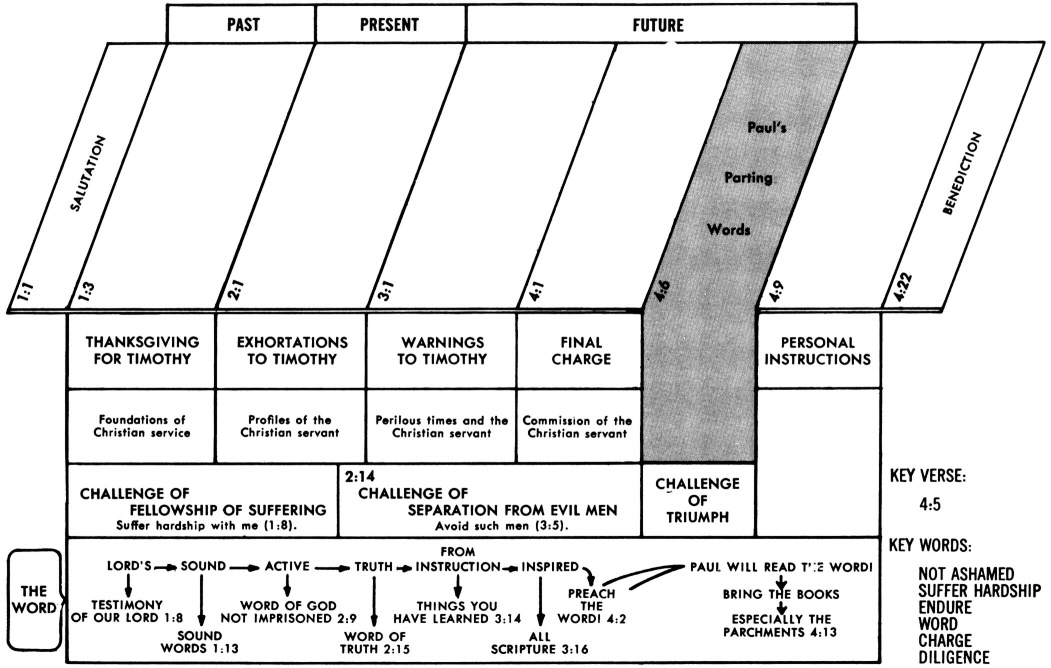
ENDURANCE AND SEPARATION IN THE MINISTRY
Click chart to enlarge
Charts from Jensen's Survey of the NT - used by permission
Second Timothy - Swindoll
| 2 TIMOTHY | |||
| 2 Timothy 1:1-18 | 2 Timothy 2:1-26 | 2 Timothy 3:1-17 | 2 Timothy 4:1-22 |
| Retain the Standard |
Rightly Divide the Word |
Difficult Times Will Come |
Preach the Word |
| PAST | PRESENT | FUTURE | |
| Foundation of Christian Service |
Pictures of Christian Servant |
Dangerous Times for Christian Servant |
Commission of Christian Servant |
| Unashamed as a Witness: Guard the Gospel |
Unashamed as a Workman: Suffer for the Gospel |
Adequate as a Workman: Continue in the Gospel |
Awarded as a Workman: Preach the Gospel |
| Power of the Gospel |
Perseverance of the Gospel Message | Protection of the Gospel |
Proclamation of the Gospel |
| Reminder | Requirements | Resistance | Requests |
| Encouragement in Ministry |
Examples in Ministry |
Exhortations in Ministry |
Exhortations to Fulfill Ministry |
| Commendation & Charge |
Commission to Fulfill |
Conflict to Face |
Course to Finish |
|
Compiled from Jensen's Survey of the NT and Wilkinson's Talk Thru the Bible |
|||
2 Timothy 1:1 Paul , an apostle of Christ Jesus by the will of God, according to the promise of life in Christ Jesus (NASB: Lockman)
Greek: Paulos apostolos Christou Iesou dia thelematos theou kat' epaggelian zoes tes en Christo Iesou
Amplified: Paul an apostle (special messenger) of Christ Jesus by the will of God, according to the promise of life that is in Christ Jesus, (Amplified Bible - Lockman)
KJV: Paul, an apostle of Jesus Christ by the will of God, according to the promise of life which is in Christ Jesus,
NLT: This letter is from Paul, an apostle of Christ Jesus by God's will, sent out to tell others about the life he has promised through faith in Christ Jesus. (NLT - Tyndale House)
Phillips: Paul, messenger by God's appointment in the promised life of Christ Jesus (Phillips: Touchstone)
Wuest: Paul, an ambassador of Christ Jesus through the will of God, according to the promise of life which is in Christ Jesus,
Young's Literal: Paul, an apostle of Jesus Christ, through the will of God, according to a promise of life that is in Christ Jesus,
| 2 TIMOTHY | |||
| 2 Timothy 1:1-18 | 2 Timothy 2:1-26 | 2 Timothy 3:1-17 | 2 Timothy 4:1-22 |
| Retain the Standard |
Rightly Divide the Word |
Difficult Times Will Come |
Preach the Word |
| PAST | PRESENT | FUTURE | |
| Foundation of Christian Service |
Pictures of Christian Servant |
Dangerous Times for Christian Servant |
Commission of Christian Servant |
| Unashamed as a Witness: Guard the Gospel |
Unashamed as a Workman: Suffer for the Gospel |
Adequate as a Workman: Continue in the Gospel |
Awarded as a Workman: Preach the Gospel |
| Power of the Gospel |
Perseverance of the Gospel Message | Protection of the Gospel |
Proclamation of the Gospel |
| Reminder | Requirements | Resistance | Requests |
| Encouragement in Ministry |
Examples in Ministry |
Exhortations in Ministry |
Exhortations to Fulfill Ministry |
| Commendation & Charge |
Commission to Fulfill |
Conflict to Face |
Course to Finish |
|
Compiled from Jensen's Survey of the NT and Wilkinson's Talk Thru the Bible |
|||
PAUL AN APOSTLE OF CHRIST JESUS: Paulo apostolos Christou Iesou:
- Ro 1:1 2 Cor 1:1
- 2 Timothy Resources - Multiple Sermons and Commentaries
2 TIMOTHY
PAUL'S LAST
"WILL & TESTAMENT"
This letter is Paul's last "will and testament" and therefore deserves every believer's careful attention and diligent study. As we see even in these introductory verses, death cast no pall (loss of strength) or long standing shadow on the heart of this great man of God who testified that it was well with his soul for he knew Whom He had believed (2Ti 1:12). May God grant all of us this same blessed assurance that it is well with our souls eternally in Christ. Amen…
For me, be it Christ, be it Christ hence to live:
If Jordan above me shall roll,
No pang shall be mine, for in death as in life
Thou wilt whisper Thy peace to my soul.
It is well, with my soul,
It is well, with my soul,
It is well, it is well, with my soul.
(Play It Is Well with My Soul)
(Take a moment and watch the
Powerful presentation of It is Well With My Soul — with visuals on the background of Horatio Spafford!)
Spurgeon - The second epistle to Timothy is remarkable as being probably the last which the apostle wrote; it contains dying advice, written in the immediate prospect of martyrdom. Looking forward calmly to the grave, and with the executioner's axe in the foreground, Paul pens this letter to his favourite disciple, and solemnly charges him to abide faithful unto death. (The Interpreter)
Regarding Paul's introduction, D. Edmond Hiebert notes that "In accordance with the accepted practice of that day, Paul begins with his own name. We moderns sign our name at the end of our letters, while the writer of a letter in that day, with greater logic, placed his name at the beginning of his letter. And the very sight of that name at the head of this communication to him must have thrilled the soul of Timothy. How eagerly he would peruse any word from his beloved friend and teacher! (Hiebert, D. E. - 2 Timothy in Everyman's Bible Commentary Series).
Radmacher reminds us that…
When death nears,
Priorities change.
In light of mortality, what used to seem significant may dim in comparison to one’s ultimate fate. That is why we listen to a person’s “last words.” When all is said and done, everyone wants to know what gave that person hope in the face of death. Second Timothy is Paul’s “last words.” From a cold, lonely Roman prison, the aged apostle Paul wrote his final instructions to his protégé Timothy. Paul knew that this letter might well be his final contact with Timothy; his execution was most likely imminent. He implored Timothy to come quickly to his side. But in case he did not make it, Paul imparted his last words of encouragement to his “son” in the faith. (Radmacher, E. D., Allen, R. B., & House, H. W. The Nelson Study Bible: NKJV. Nashville: Thomas Nelson)
Alfred Plummer introduces this letter noting that "IN the Second Epistle to Timothy we have the last known words of Paul. It is his last will and testament; his last instructions to his favorite disciple and through him to the Church. It is written with full consciousness that the end is at hand (2Ti 4:6). His course in this world is all but over; and it will be closed by a violent, it may be by a cruel death. The letter is, therefore, a striking but thoroughly natural mixture of gloom and brightness. On the one hand, death throws its dark shadow across the page. On the other, there is the joyous thought that the realization of his brightest hope is close at hand. Death will come with its pain and ignominy, to cut short the Apostle’s still unfinished work, to take him away from the Churches which he has founded and which still sorely need his guidance, and from the friends whom he loves, and who still need his counsel and support. But death, while it takes him away from much to which he clings and which clings to him, will free him from toil, and anxiety, and neglect, and will take him to be with Christ until that day when he shall receive the crown of righteousness which is laid up for him.
Warren Wiersbe has a great outline of chapter 1 noting that Paul gives "Timothy five wonderful encouragements to sustain him and help him" as a young man called to a difficult, even dangerous task
A Praying Friend (2Ti 1:1-5)
A Wonderful Gift (2Ti 1:6-7)
A Holy Calling (2Ti 1:8-11)
A Faithful Savior (2Ti 1:12-14)
A Godly Example (2Ti 1:15-18)
A C Gaebelein (ref) analyzes chapter one as follows…
Paul's affectionate words and confidence (2Ti 1:1-5)
Difficulties and assurance (2Ti 1:6-12)
Holding the form of sound words (2Ti 1:13-14)
Turning away and faithfulness in contrast (2Ti 1:15-18)
G Campbell Morgan (ref) divides 2Timothy as follows…
2Ti 1:1-5 Introduction
2Ti 1:6-2:13 Personal Responsibility
2Ti 2:14-3:13 Church Responsibility
2Ti 3:14-4:5 Truth Responsibility
2Ti 4:6-22 Conclusion
The following short section is a brief excursus (formal commentary begins again after the designation "><>><>><>") on the value on inductive Bible study as gleaned from this first section of 2Timothy…
First let's practice some observation (see also inductive Bible study) of verse 1 by asking questions. Who wrote this letter? Clearly Paul regardless of what "higher critics" might say! Who does Paul belong to? To Christ Jesus - therefore he is not his own but has been bought with a price (1Co 6:19, 1Co 6:20) and a purpose - to glorify God (Mt 5:16) by fulfilling his purpose as an apostle (Ep 2:10). What is Paul's authority to write this letter? He is a genuine apostle - he has seen Christ in Acts 9 (see Acts 9:1, 2, 3, 4, 5, 6, 7, 8, 9) on the Damascus Road and Christ has commissioned him to go (even as He has commissioned you and I to "make disciples" [command to "make learners" = aorist imperative = This is urgent! Do this now! Today! Older saints are you purposefully teaching others making them true disciples of Christ? Who is [are] your disciple [disciples]? If you can't answer this question you are being disobedient to your Lord >>>] Mt 28:18, 19, 20 - Are you obeying?) - In Acts 9:15, 16 we read Paul's job description explained to Ananias
"Go, for he is a chosen instrument of Mine, to bear My name before the Gentiles and kings and the sons of Israel;16 for I will show him how much he must suffer for My name's sake."
Whose will does Paul submit to in 2Ti 1:1? Clearly God the Father's will. Is he an apostle by his choice? Of course not! It is the Father's will. This is what we all pray for in the Lord's Prayer (Mt 6:10) - His will to be done on earth as it is in heaven. There are basically 2 wills - 2 paths for every life - my will (cp our fallen flesh) versus God's will. Paul chose to submit to God's will, the Father's will. Application: As believers we are not to seek what we want to "do" in ministry (and we are all priests of God by the way - so you do have a ministry regardless of whether you've been to seminary! cp 1Pe 2:9), but we are to seek and submit to God's will for our life that we might one day hear "Well done My good and faithful servant" (Mt 25:21, 23, Lk 19:17 - Note: A servant does his master's will [desire] and thereby pleases his master! [cp even Jesus, our "example" in Jn 8:29, Paul who imitated Christ {1Co 11:1} in 2Co 5:9, all saints in Ep 5:10, 1Th 2:4, 1Jn 3:22]). What was the purpose of the Father in making Paul an apostle of Christ Jesus? The promise of life in Christ Jesus. What does that phrase in essence signify? Is that not the message of the Gospel. What is a promise? Can God make and break a promise? Of course not. So when did He first make the promise? In Genesis 3:15 we see the promise of a Redeemer and the beginning of the story line of the whole Bible - that of the redemption of mankind, the purchase back of men's souls from bondage to the power of Sin (Ro 6:11, Ro 6:18, Ro 6:22, Jn 8:34, 30, 31, 36, 24) and the power of Satan, the power of this present evil world system (Gal 6:14) and the fear of death (1Co 15:55, 56, 57). In Genesis 3:15 God says to Satan -
And I will put enmity Between you and the woman (that is between Satan and Eve) And between your seed (that is the offspring of Satan) and her seed (the offspring of Eve); He (Christ) shall bruise you on the head, And you shall bruise him on the heel (Crucifixion)."
Which is exactly what happened on the Cross as summed up by the writer of Hebrews in chapter 2:14, 15 where we read about our redemption from the power of Satan…
Since then the children share in flesh and blood, He Himself likewise also partook of the same, that through death He might render powerless him who had the power of death, that is, the devil; 15 and might deliver those who through fear of death were subject to slavery all their lives. (cp Col 1:13, 14, Acts 26:16, 17, 18, esp verse 18)
Who is mentioned twice in verse 1? Christ Jesus Why twice? He Alone is the beginning and the end (Rev 1:8)! What is the promise a promise of? Life. Real life. Eternal life. The essence of life as God meant it to be lived by His creation. The fullest life. The most satisfying and rewarding life. Men are dead in their trespasses and sins as Paul says in Ephesians 2:1. In Romans 5:12 he explains that all mankind was infected by the "sin virus" -
Therefore, just as through one man (One man here refers to Adam) sin entered into the world (this happened in the Garden of Eden), and death through sin (So first sin came and then the penalty for sin followed which was death - death to their spirits first and later physical death and finally eternal death in the Lake of fire), and so death spread to all men, because all sinned (How do we know Romans 5:12 is true? Just look at babies who want their way! Look at yourself and how you always want your way, not God's perfect will.)
And so here in the first verse we see Paul's purpose for living was to give out the message of a living Savior so that all men who were spiritually dead could experience true life in the power of the indwelling Spirit of Christ (Ro 8:9, Ro 8:13, Gal 5:16). Have you received the gift which the Father promised in the Garden of Eden? (Jn 1:11, 12, 13, Jn 12:48, Jn 8:24, Acts 16:31, 4:12) Do you have true life in Christ? (1Jn 1:1, 2:25, 3:14, 5:11, 12, 13, 20) Do you want your life today to count for eternity? (Ep 5:15, 16, Mt 6:19, 20, 21) Do you want to live this present life to the full? (1Ti 4:7, 8, 1Ti 4:9, 10, 1Ti 6:18, 19) Then receive the Father's promise of His Son's life given in place of our dead lives so that we might have true life and live forever for Him and with Him. That is real life! Indeed, that is the Father's immutable promise of life in Christ Jesus! Amen!
Note that all of the previous comments result primarily from simply asking questions of the phrases and words in 2Ti 1:1 - Aren't you intrigued about what you could discover if you began to put into practice the discipline of inductive Bible study in your daily devotionals, your Bible studies, etc? Yes, inductive Bible study takes some work, but oh, beloved, the fruit of your labors will be sweet indeed, not only in this present life but throughout the eternal life to come! Of that truth I am fully and firmly convinced.
SHORT SYNOPSIS
OF OBSERVATION
Below is a brief summary of the most important aspects of Observation, the most frequently bypassed component in Bible study…
Establish the context - By continued observation of the text. Context is "king" in interpretation.
Key words and phrases - Mark words/phrases that are critical to meaning of the text. May stand out by repetition (but not always). Help to discern author's purpose for writing book. Helps identify the major subject of a chapter or paragraph.
Marking key words - By using symbols and/or colors.
Asking the 5W & H questions - This is the most difficult to learn as it seems awkward or simplistic at first but with time becomes one of your best tools for accurate observation of the text. Every time you mark a key word, a contrast or comparison, a term of conclusion or a time phrase stop and practice at least one of more of the who, what, where, when, why or how questions. Don't get frustrated. Keep at it, and you will be rewarded by wonderful insights.
Consider the "5P's" - Pause to Ponder the Passage then Practice it in the Power of the Spirit
Make lists - Compilation of facts on a particular word or phrase, subject, person, place or event in a particular chapter.
Be alert for contrasts - Words like "but" indicate a "change of direction" and beg the question "What is being contrasted?"
Be alert for comparisons (eg ) - By use of simile (introduced by "like" or "as" - eg, fast as lightning) and metaphor (where one word is used in place of another to express similarity and help amplify the meaning)
Mark terms of conclusion - Therefore, for, for this reason, etc indicate a conclusion. For indicates an explanation. These should be underlined in the text and "interrogated" (what's being concluded or explained).
Note expressions of time - Specific time phrases like day, week, year, etc or "time sensitive" words such as then, until, when, etc
And don't forget the little preposition "for" - (there are over 7000 "for's" in Scripture) and if the context indicates, as it does in many passages (especially when it is the first word in a clause or sentence), that the "for" is a term of explanation, pause and ask yourself what is the Spirit seeking to explain (the "5P's" above)?
Now back to a verse by verse, phrase by phrase, word by word analysis of Second Timothy.
BIBLICAL
APOSTLESHIP
Apostle of Christ Jesus - Paul is saying he is the possession of Christ. He is not his own. He belongs to another. This is the perspective which every believer should seek to emulate and cultivate for indeed we are not our own (1 Co 6:19, 2Co 5:15, Titus 2:14) for we all "have been bought with a price" and have the high and holy purpose to "glorify God in (our) body" (1Co 6:20)
The name Christ emphasizes His fulfillment of prophecy and His deity while Jesus emphasizes His humanity.
Butler alliterates the salutation (greeting) of this letter…
(1) Position of his calling - apostle
(2) Plan of his calling - by the will of God
(3) Purpose of his calling - to propagate the Gospel which tells of the promise of life
Dwight Edwards is correct when he observes that "Paul had not sought for this position of leadership but neither had he run from it. One of the problems that has always plagued the church is the reversal of this order. Too often it is the unqualified who seek positions of spiritual leadership while the qualified have run from these same roles. Our response should ever be that of Paul's, "Lord what will You have me to do?" Acts 9:6. Service For the Lord will be significant only to the degree that we can say with Paul that it is "by the will of God." (Bolding and color added for emphasis)
Apostle (652) (apostolos from apo = from + stello = send forth) (Click another discussion of apostle) means one sent forth from by another, often with a special commission to represent another and to accomplish his work. It can be a delegate, commissioner, ambassador sent out on a mission or orders or commission and with the authority of the one who sent him. The Biblical apostles had special authority and power given by God and when they died that was the end of the special office of an apostle. In other words, contrary to what some men teach there is no Biblical mandate for "apostolic succession."
Apostle is used in two ways in the Scripture - (1) to designate an official office as in this passage (2) Generically to refer to anyone who is one sent with a message.
In secular Greek apostolos referred to someone who was officially commissioned to a position or task, such as an envoy. Cargo ships were sometimes called apostolic, because they were dispatched with a specific shipment for a specific destination. In secular Greek apostolos was used of an admiral of a fleet sent out by the king on special assignment. In the ancient world a apostle was the personal representatives of the king, functioning as an ambassador with the king’s authority and provided with credentials to prove he was the king's envoy.
Apostolos - 89x NAS -
Matt. 10:2; Mk. 3:14; 6:30; Lk. 6:13; 9:10; 11:49; 17:5; 22:14; 24:10; Jn. 13:16; Acts 1:2, 26; 2:37, 42f; 4:33, 35, 36, 37; 5:2, 12, 18, 29, 40; 6:6; 8:1, 14, 18; 9:27; 11:1; 14:4, 14; 15:2, 4, 6, 22, 23; 16:4; Ro 1:1; 11:13; 16:7; 1 Co. 1:1; 4:9; 9:1, 2, 5; 12:28, 29; 15:7, 9; 2Co 1:1; 8:23; 11:5, 13; 12:11, 12; Ga 1:1, 17, 19; Ep 1:1; 2:20; 3:5; 4:11; Php 2:25; Col 1:1; 1Th 2:7; 1Ti 1:1; 2:7; 2Ti 1:1, 11; Titus 1:1; He 3:1; 1Pe 1:1; 2Pe 1:1; 3:2; Jude 1:17; Re 2:2; 18:20; 21:14
Related Resources:
- What is an apostle?
- Is God restoring the offices of apostle and prophet in the church today?
- What is the difference between a disciple and apostle?
- Nave Topical Bible Apostles Apostle
- Thompson Chain Reference Apostles
- American Church Dictionary Apostle
- American Tract Society Apostle
- Bridgeway Bible Dictionary Apostle
- Baker Evangelical Dictionary Apostle
- Charles Buck Dictionary Apostle
- CARM Theological Dictionary Apostle
- Easton's Bible Dictionary Apostle
- Fausset Bible Dictionary Apostle
- Holman Bible Dictionary False Apostles Apostles
- Hastings' Dictionary of the Bible Apostles
- Hastings' Dictionary of the NT Apostle
- King James Dictionary Apostle
- Morrish Bible Dictionary Apostle
- Hawker's Poor Man's Dictionary Apostle
- People's Dictionary of the Bible Apostle
- Smith Bible Dictionary Apostle
- Webster Dictionary Apostle
- Watson's Theological Dictionary Apostle
- 1911 Encyclopedia Britannica Apostle
- International Standard Bible Encyclopedia Apostle
- Kitto Biblical Cyclopedia Apostle
- The Jewish Encyclopedia Apostle and Apostleship
Unger's Bible Dictionary - The Jews, it is said, called the collector of the half shekel, which every Israelite paid annually to the Temple, an apostle; also those who carried about encyclical letters from their rulers." (The New Unger's Bible Dictionary. Chicago: Moody Press)
A good parallel of apostle is our English word ambassador defined by Webster as
a diplomatic agent of the highest rank accredited to a foreign government as the resident representative of his own government for a special and often temporary diplomatic assignment. (cp Eph 6:20)
Paul was a man with a mission having been commissioned by Christ Himself, Whose will was made known in (Acts 9:15, 22:14, 15, 21, 26:16, 17,18). Paul further explained that he was
an apostle (not sent from men nor through the agency of man, but through Jesus Christ and God the Father, Who raised Him from the dead (Gal 1:1).
Paul was commissioned as Christ's chosen instrument (Acts 9:15) and ambassador to the Gentiles with a message of reconciliation (Ro 5:11, 2 Co 5:18,19), a message that he "neither received… from man, nor was… taught, but … through a revelation of Jesus Christ." (Gal 1:12).
In his salutation to the Romans Paul added that
through (Jesus Christ our Lord) we have received grace and apostleship to bring about the obedience of faith among all the Gentiles for His name's sake. (Ro 1:5)
And so we see that Paul was endued with the "apostolic" authority and power to convey the Gospel of his Lord. Paul belongs to Christ, has been commissioned and sent by Him, and acts as His authorized representative.
Easton's Bible Dictionary - Apostle
A person sent by another; a messenger; envoy. This word is once used as a descriptive designation of Jesus Christ, the Sent of the Father (He 3:1; John 20:21). It is, however, generally used as designating the body of disciples to whom he entrusted the organization of his church and the dissemination of his gospel, "the twelve," as they are called (Matthew 10:1, 2, 3, 4, 5; Mark 3:14; 6:7; Luke 6:13; 9:1). We have four lists of the apostles, one by each of the synoptic evangelists (Matthew 10:2, 3, 4; Mark 3:16; Luke 6:14), and one in the (Acts 1:13). No two of these lists, however, perfectly coincide.
Our Lord gave them the "keys of the kingdom," and by the gift of his Spirit fitted them to be the founders and governors of his church (John 14:16,17,26; 15:26,27; 16:7, 8, 9, 10, 11, 12, 13, 14, 15). To them, as representing his church, he gave the commission to "preach the gospel to every creature" (Matthew 28:18, 19, 20). After his ascension he communicated to them, according to his promise, supernatural gifts to qualify them for the discharge of their duties (Acts 2:4; 1Co 2:16; 2:7,10,13; 2Co 5:20; 1Corinthians 11:2). Judas Iscariot, one of "the twelve," fell by transgression, and Matthias was substituted in his place (Acts 1:21). Saul of Tarsus was afterwards added to their number (Acts 9:3-20; 20:4; 26:15, 16, 17, 18; 1Timothy 1:12; 2:7; 2Ti 1:11).
Luke has given some account of Peter, John, and the two Jameses (Acts 12:2,17; 15:13; 21:18), but beyond this we know nothing from authentic history of the rest of the original twelve. After the martyrdom of James the Greater (Acts 12:2), James the Less usually resided at Jerusalem, while Paul, "the apostle of the uncircumcision," usually travelled as a missionary among the Gentiles (Gal 2:8). It was characteristic of the apostles and necessary (1) that they should have seen the Lord, and been able to testify of him and of his resurrection from personal knowledge (Jn 15:27; Acts 1:21,22; 1Co 9:1; Acts 22:14,15).
They must have been immediately called to that office by Christ (Luke 6:13; Galatians 1:1).
It was essential that they should be infallibly inspired, and thus secured against all error and mistake in their public teaching, whether by word or by writing (John 14:26; 16:13; 1Th 2:13).
Another qualification was the power of working miracles (Mark 16:20; Acts 2:43; 1Co 12:8, 9, 10, 11). The apostles therefore could have had no successors. They are the only authoritative teachers of the Christian doctrines. The office of an apostle ceased with its first holders.
In 2Corinthians 8:23 and Phil 2:25 the word "messenger" is the rendering of the same Greek word, elsewhere rendered "apostle."
BY THE WILL OF GOD: dia thelematos theou:
- 2 Timothy Resources - Multiple Sermons and Commentaries
AN APOSTLE BY
GOD'S COMMANDMENT & WILL
Paul, an apostle of Christ Jesus according to the commandment of God our Savior, and of Christ Jesus, Who is our hope (elpis), (1 Ti 1:1) (NB: "Hope" is a Person!)
Paul begins five of his Epistles with a similar "signature" (will of God), the other four being…
Paul, called as an apostle of Jesus Christ by the will of God, and Sosthenes our brother (1 Co 1:1).
Paul, an apostle of Christ Jesus by the will of God, and Timothy our brother,
To the church of God which is at Corinth with all the saints who are throughout Achaia: (2 Co 1:1).
Paul, an apostle of Christ Jesus by the will of God, To the saints who are at Ephesus and who are faithful in Christ Jesus: (Eph 1:1).
Paul, an apostle of Jesus Christ by the will of God, and Timothy our brother (Col 1:1).
By the will of God - The preposition dia can also be translated "through", so that the instrumentality through which he became an apostle or "sent one" was through the will of God. Stated another way God's will is "the efficient cause" (BADG). Paul is not being arrogant here but is saying in essence that he is in the center of God's will as he proclaims the promise of life in Christ Jesus.
Knight adds that "Paul describes this will of God at work in his life and especially in regard to his apostleship in Gal 1:15 16 (cf. Gal. 2:7 8 9). (The Pastoral Epistles- New International Greek Testament Commentary)
The importance of Paul's testimony (open acknowledgment) regarding the will of God is that it counters any charge that he promoted himself to the office of apostle. Paul's appointment was not a self-appointment but a divine appointment, as all service for the glory of God should be (cp importance of abiding in the Vine - Jn 15:5. See also the importance of the believer's accomplishing God's works [not "our" self initiated works] prepared for us even before the foundation of the world! - Ep 2:10).
The will of God - This phrase occurs 23 time in the NT. Consider making a list of what you discern regarding the will of God from these Scriptures
Remember to examine the context) - Mk 3:35; Ro 1:10; Ro 8:27; Ro 12:2; Ro 15:32; 1Co 1:1; 2Cor 1:1; 7:9 7:10; 8:5; Ep 1:1; Ep 6:6; Col 1:1; Col 4:12; 1Th 4:3; 2Ti 1:1; He 10:36; 1Pe 2:15; 1Pe 4:2, 1Pe 4:6, 1Pe 4:19; 1Pe 5:2; 1Jn 2:17 -- You might also want to add - Jn 7:17NLT, Ep 5:17, Col 1:9, 10 1Th 5:18
Related Resources:
- Articles under the Topic "The Will of God"
- Hundreds of onsite mentions of phrase "the will of God" (On a given page use "find function" = press Control key + the letter "F").
- F B Meyer's devotional
George Muller on "finding" the will of God…
1. Surrender your own will. - I seek at the beginning to get my heart into such a state that it has no will of its own in regard to a given matter. Nine-tenths of the trouble with people generally is just here. Nine-tenths of the difficulties are overcome when our hearts are ready to do the Lord's will, whatever it may be. When one is truly in this state it is usually but a little way to the
knowledge of what His will is.
2. Do not depend on feelings. - Having done this, I do not leave the result to feeling or simple impression. If so, I make myself liable to great elusions.
3. Seek, the Spirit's will through God's Word. - I seek the will of the Spirit of God through, or in connection with, the Word of God. The Spirit and the Word must be combined. If I look to the Spirit alone without the Word, I lay myself open to great delusion also. If the Holy Ghost guides us at all, He will do it according to the Scriptures and never contrary to them.
4. Note providential circumstances. - Next I take into account providential circumstances. These often plainly indicate God's will in connection with His Word and Spirit.
5. Pray. (Ps 119:27 Pr 2:5) - I ask God in prayer to reveal His will to me aright.
6. Wait.
Will (2307)(thelema from thelo = to will with the "-ma" suffix indicating the result of the will = "a thing willed") generally speaks of the result of what one has decided. One sees this root word in the feminine name "Thelma." In its most basic form, thelema refers to a wish, a strong desire, and the willing of some event. (Note: See also the discussion of the preceding word boule for comments relating to thelema). The upshot is that thelema indicates that this call of Paul as an apostle began in the heart of God… God started it and God completed it in Paul just as He desires to do in your life dearly beloved of God (cp Php 1:6, 1Th 5:24)!
Zodhiates says that thelema is the "Will, not to be conceived as a demand, but as an expression or inclination of pleasure towards that which is liked, that which pleases and creates joy. When it denotes God's will, it signifies His gracious disposition toward something. Used to designate what God Himself does of His own good pleasure. (Zodhiates, S. The Complete Word Study Dictionary: New Testament. AMG)
Thelema - 62x in 58v - NAS = desire(1), desires(1), will(57).
Mt 6:10; 7:21; 12:50; 18:14; 21:31; 26:42; Mark 3:35; Luke 12:47; 22:42; 23:25; Jn 1:13; 4:34; 5:30; 6:38, 39, 40; 7:17; 9:31; Acts 13:22; 21:14; 22:14; Ro 1:10; Ro 2:18; Ro 12:2; Ro 15:32; 1Cor 1:1; 7:37; 16:12; 2Cor 1:1; 8:5; Gal 1:4; Ep 1:1, Ep 1:5, Ep 1:9, Ep 1:11; Ep 2:3; Ep 5:17; Ep 6:6; Col 1:1, Col 1:9; Col 4:12; 1Th 4:3; 1Th 5:18; 2Ti 1:1; 2Ti 2:26; He 10:7, He 10:9, He 10:10, He 10:36; He 13:21; 1Pe 2:15; 1Pe 3:17; 1Pe 4:2, 1Pe 4:19; 2Pe 1:21; 1Jn 2:17; 5:14; Rev 4:11.
The NAS renders thelema as desire(1), desires(1), will(56).
In four other epistles, as here in 2 Timothy, Paul relates his apostleship to the will of God: (Take a moment and study all the NT uses of the phrase will of God in NASB [note that some of the uses have will of in italics indicating that this phrase has been added by the translators and is not in the original Greek] and make a list of what you learn about this important topic -- Mk. 3:35; Ro 1:10; 8:27; 12:2; 15:32; 1Co 1:1; 2Co 1:1; 7:9, 10; 8:5; Ep 1:1; 6:6; Col 1:1; 4:12; 1Th 4:3; 2Ti 1:1; He 10:36; 1Pe 2:15; 4:2, 6, 19; 5:2; 1Jn 2:17). As stated Paul repeatedly ascribes his apostleship not to his will (or his motivation or his drive or his ambition, etc), but to the will of God…
Paul, called as an apostle of Jesus Christ by the will of God, and Sosthenes our brother (1Corinthians 1:1)
Paul, an apostle of Christ Jesus by the will of God, and Timothy our brother, to the church of God which is at Corinth with all the saints who are throughout Achaia (2Corinthians 1:1)
Paul, an apostle of Christ Jesus by the will of God, to the saints who are at Ephesus, and who are faithful in Christ Jesus (Eph 1:1-)
Paul, an apostle of Jesus Christ by the will of God, and Timothy our brother (Col 1:1)
THOUGHT - There is a very practical lesson in Paul's repeated emphasis on the fact that his ministry was not what he necessarily sought or desired to do but was clearly in the center of God's will. Let me ask you dear saint, one who God has created for good works (Eph 2:10 , also gifted for good works - 1Pe 4:10, 11, 1Cor 12:4, 7, 11, 19, Ro 12:3, 4, 5, Ro 12:6, Ro 12:7,8) and desire to use in His kingdom growth for His glory, is there anything you are desiring in the field of Christian work that is more your desires, your will, then His will? Or are you envious or even overtly jealous of another saint who has a more "showy" gift and/or has been given a more public platform for display of their gift? If so, confess and repent of your envy, your jealousy, you sense of discontent and seek His kingdom and His righteousness in His Word, learning what it means to abide in Christ, to be controlled by His Spirit, and as you do you will begin to experience life in the glorious center of His will and the godly contentment and sense of fulfilled purpose that comes from such a God given assurance. This is surely life on the highest plane beloved.
As Augustine said "Nothing, therefore, happens unless the Omnipotent wills it to happen: he either permits it to happen, or he brings it about himself.
Jerry Bridges adds that "Our duty is found in the revealed will of God in the Scriptures. Our trust must be in the sovereign will of God, as he works in the ordinary circumstances of our daily lives for our good and for his glory.
Paul had come to understand that nothing was beyond the power of the one who obeys and orders their life within the will of God. But he has also come to the crisis of belief on the Damascus Road where he learned that the will of God means death to our own will (he was on his way to persecute believers). Paul came to understand that only in obeying God's word could he truly discover the great joy of living his life in the will of God. As a practical application it should be the aim of every Christian to seek to know and then to have his or her life (will) directed by the will of God as it is revealed in Holy Scriptures. Doing the Father's will involves first believing on the Lord Jesus (Jn 5:24; 6:29), then studying and obeying His Word, for therein is revealed His will (Jn 7:17). In fact the study of God's Word for the purpose of discovering God's will is the greatest discipline which will form the most Christlike character.
This repeated emphasis by Paul expresses his continual consciousness that the divine will had chosen him as an apostle, despite that fact that he neither sought it nor merited it. Practically, his consciousness that this was God's purpose that was being worked out and not his own plan, held him firm throughout all the years of his strenuous and eventful life. And here in his last written words, it was this conviction that kept him calm in the face of impending martyrdom. As a prisoner, lonely and largely forsaken, he could fall back upon the consciousness that he was an apostle, not by his own appointment, but by the will of God.
Horton writes, "In the hour of our extremity, when earthly friends and securities fail, there is but one security, the Rock on which we stand, the will of God, and the assurance that we are standing upon it".
THOUGHT - Are you doing what you're doing by the will of God? Or stated another way are you in the center of His will, beloved? Or are you "kicking against the goads" refusing to obey His clear call and command on your life? Remember, we only go around once, so what better place to be than in the center of the "will of God"! And as Bernard Edinger wisely said "Inside the will of God there is no failure (Ed: At least none that is not for our good and God's glory!). Outside the will of God there is no success (Ed: cp Jn 15:5)."
Remember that God's will is revealed to the one who is willing to obey God's Word for as Jesus said…
If any man is willing to do His will, he shall know of the teaching, whether it is of God, or whether I speak from Myself. (Jn 7:17)
I love what W. E. Vine says about being in God's will
"He who is assured that the work in which he engages is God’s will for him will find therein a means of steadfast continuance, no matter how great the trials and difficulties he experiences. When the will of God is the foundation of our activities, it acts as a counteractive power against all self-glorying and should render His glory the inspiring aim of our whole being and service. It will lead us to say with Paul, “Not I, but Christ.” (Vine, W. Collected writings of W. E. Vine. Nashville: Thomas Nelson )
Paul was an apostle because God in His sovereignty had willed it. He was not an apostle by personal choice but was a divine decree and entrustment. His apostleship was not of human origin or ordination, but of heavenly decree directly from Christ as he stated in Galatians writing that he was
"an apostle (not sent from men, nor through the agency of man, but through Jesus Christ, and God the Father, who raised Him from the dead)" (Galatians 1:1)
Paul had not sought for this position of apostle to the Gentiles who he had once sought to murder. On the other hand neither had Paul run from the responsibility of an apostle once he was called. It is notable that in the first letter to Timothy Paul had stated that he was
"an apostle of Christ Jesus according to the commandment of God our Savior and of Christ Jesus, our hope" (1Timothy 1:1)
Paul willingly, unhesitatingly obeyed God's command.
One of the problems that has always plagued the church is the reversal of this order. Too often it is the unqualified who seek positions of spiritual leadership while the qualified have run from these roles.
None are allowed to go for God but those who are sent by him. - Matthew Henry
The Christian worker must be sent; he must not elect to go. - Oswald Chambers
It is not what we do that matters, but what a sovereign God chooses to do through us. God doesn't want our success, he wants us. He doesn't demand our achievements; he demands our obedience. - Charles Colson
God will not thank thee for doing that which he did not set thee about. - William Gurnall
Whatever is laudable in our works proceeds from the grace of God. - John Calvin
Our efficiency without God's sufficiency is only a deficiency. - Vance Havner
Whatever it is our Lord has called us to, our response should ever be that of Paul's,
"Lord what will You have me to do?" (Acts 22:10)
Service for the Lord will be eternally significant only to the degree that we can say with Paul that it is "by the will of God" and "in Christ Jesus". Stated another way, divine service must be divinely initiated. Richard Sibbes rightly said "Whom God calls he qualifies."
Guzik has an excellent application writing that "Some of us could write, "pastor by the will of God" or "evangelist by the will of God" or "pray-er by the will of God" or "encourager by the will of God" or "supporter by the will of God." We all have our role to play, and God wants us to walk in it!
- Christ pre-eminently called "The Apostle" -Hebrews 3:1
- Ordained by Christ -Mark 3:14; John 15:16
- Received their title from Christ -Luke 6:13
- CALLED BY
- God -1Co 1:1; 12:28; Ga 1:1,15,16
- Christ -Mt 10:1; Mk 3:13; Ac 20:24; Ro 1:5
- The Holy Spirit -Ac 20:24; Ro 1:5
- Were unlearned men -Acts 4:13
- Selected from obscure stations -Mt 4:18
- Sent first to the house of Israel -Mt 10:5,6; Lk 24:47; Acts 13:46
- Sent to preach the gospel to all nations -Mt 28:19,20; Mk 16:15; 2Ti 1:11
- Christ always present with -Mt 28:20
- Warned against a timid profession of Christ -Mt 10:27, 28, 29, 30, 31, 32, 33
- The Holy Spirit given to -John 20:22; Acts 2:1, 2, 3,4; 9:17
- Guided by the Spirit into all truth -Jn 14:26; 15:26; 16:13
- Instructed by the Spirit to answer adversaries -Mt 10:19,20; Lk 12:11,12
- Specially devoted to the office of the ministry -Acts 6:4; 20:27
- Humility urged upon -Mt 20:26,27; Mk 9:33, 34, 35, 36, 37; Lk 22:24, 25, 26, 27, 28, 29, 30
- Self-denial urged upon -Matthew 10:37, 38, 39
- Mutual love urged upon -John 15:17
- Equal authority given to each of -Mt 16:19; 18:18; 2Co 11:5
- Were not of the world -Jn 15:19; 17:16
- Were hated by the world -Mt 10:22; 24:9; Jn 15:18
- Persecutions and sufferings of -Mt 10:16,18; Lk 21:16; Jn 15:20; 16:2
- Saw Christ in the flesh -Luke 1:2; Ac 1:22; 1Co 9:1; 1Jn 1:1
- Witnesses of the resurrection and ascension of Christ -Lk 24:33-41,51; Ac 1:2-9; 10:40,41; 1Co 15:8
- Empowered to work miracles -Matthew 10:1,8; Mark 16:20; Luke 9:1; Acts 2:43
ACCORDING TO THE PROMISE: kat epaggelian:
- 2Pe1:3,4-notes) (Jn 5:24,39,40; 6:40,54; 10:28; 17:3; Ro 5:21; 6:23; 2Co 1:20; Ep 3:6; Titus 1:2; He 9:15; 2Pe 1:3,4; 1Jn 2:25; 5:11, 12, 13
- 2 Timothy Resources - Multiple Sermons and Commentaries
THE GREATEST PROMISE
FROM OUR GREAT GOD:
LIFE IN CHRIST JESUS
According to is "kata" which conveys the idea "With a view to the fulfillment of the promise." The idea is that Paul's apostleship was for the accomplishment of the promise of life in Christ Jesus. (cp Ro 1:5)
Stated another way the preposition kata defines the aim and purpose of Paul's apostleship which is to further the promise of life which is in Christ Jesus. In the context of this letter the promise of life in Christ Jesus appears to be very compatible with the gospel of Jesus Christ, the good news that those who are dead in their trespasses and sins (Eph 2:1) can find life in Christ Jesus.
Paul's introduction to Romans parallels his introduction here in 2Timothty 1:1…
Paul, (His Position) a bond-servant of Christ Jesus, called as an apostle, (His Purpose) set apart for the Gospel of God (Ro 1:1)
One commentator has written: "God chose him (Paul) because He wanted to do something with him. He wished to make him the instrument by which the tidings of new life went out to men. No Christian is ever chosen entirely for his own sake, but for what he can do for others. A Christian is a man lost in wonder, love, and praise at what God has done for him; and aflame with eagerness to tell others what God can do for them." (From Ref)
Guy King agrees with the above assessment on according to the promise… noting that
The force of that "according to" seems then to be that his call to the apostolate was given him for the purpose of his publishing that "good news" of the promise of life to the needy sons and daughters of men. ("On the lines of" = Moule "in pursuance of" =Alford "in the service of" = Moffatt)
Put it this way:
(a) The water = "the promise of life"
(b) The spring = "which is in Christ Jesus," an inexhaustible Fountain
(c) The vessel = (Paul) destined to come to the spring and to carry the promised water: "a chosen vessel… to bear My Name" (Acts 9:15KJV) which is very Water of Life to famishing souls. (Reference)
Lea writes that "The phrase beginning with “according to” emphasizes the goal and purpose of Paul’s apostleship. His mission was to make known that eternal life becomes a reality through fellowship with Christ. Paul was teaching that life becomes available only in Christ. (The New American Commentary Nashville: Broadman & Holman Publishers)
The fact that Paul is being poured out as a drink offering (death is imminent - 2Ti 4:5) stands in stark contrast to God’s “promise of life” (Jn 1:4 5:26 6:35 11:25, 26 14:6,19 Ro 8:2 Col 3:4 1Jn 1:1, 2 1Jn 5:11 Rev 22:1 Rev 22:17).
Paul expands on this "promise" in Titus writing that it is a promise of "eternal life" from God "Who cannot lie promised long ages ago" (Titus 1:2) (Compare "His own purpose and grace which was granted us in Christ Jesus from all eternity" - 2Ti 1:9)
Promise (1860) (epaggelia/epangelia from epaggello = to announce that one is about to do or furnish something from epi = upon, intensifies meaning + aggelos = messenger or aggello = to tell or declare) is a declaration that one will do or refrain from doing something specified. It is also a legally binding declaration that gives the person to whom it is made a right to expect or to claim the performance or forbearance of a specified act. Epaggelia is used primarily of the promises of God. In secular Greek epaggelia was primarily a legal term denoting a summons and then coming to mean a promise to do or give something.
Epaggelia - 52x in the NT - Lk 24:49; Ac 1:4; 2:33, 39; 7:17; 13:23, 32; 23:21; 26:6; Ro 4:13, 14, 16, 20; 9:4, 8, 9; 15:8; 2Co. 1:20; 7:1; Ga 3:14, 16, 17, 18, 21, 22, 29; 4:23, 28; Ep 1:13; 2:12; 3:6; 6:2; 1Ti 4:8; 2Ti 1:1; He 4:1; 6:12, 15, 17; 7:6; 8:6; 9:15; 10:36; 11:9, 13, 17, 33, 39; 2Pe 3:4, 9; 1Jn 2:25
God promises life in Christ Jesus and God's providence will fulfil this promise in your life.
As John Blanchard said "The carrying out of God's promises is as certain as if already in the past tense. (Complete Gathered Gold: A Treasury of Quotations for Christians OR Computer Version - Excellent source of topical Christian quotes)
John Boys - The resurrection of Christ is the Amen of all His promises.
Peter echoes Boys' statement writing…
Blessed be the God and Father of our Lord Jesus Christ, Who according to His great mercy has caused us to be born again to a living hope through the resurrection of Jesus Christ from the dead. (1Pe 1:3)
Comment: We have a living (lively) hope (absolute assurance that God will do good to me in the future) because we have a Living (resurrected) Lord. The resurrection as John Boys says is indeed the "Amen" to the promise of life.
Guzik comments that…
The words according to the promise of life are unique in Paul's greetings; since Paul is imprisoned again in Rome, and facing execution (2Ti 4:6), this promise is all the more precious to him.
After Paul was released from the Roman imprisonment mentioned at the end of the book of Acts, he enjoyed a few more years of liberty until he was re-arrested, and imprisoned in Rome again. You can go to Rome today and see the place where they say Paul was imprisoned. It is really just a cold dungeon, a cave in the ground, with bare walls and a little hole in the ceiling where food was dropped down. No windows, just a cold, little cell that would have been especially uncomfortable in winter (cp 2Ti 4:21).
Paul writes this letter from his second Roman imprisonment, and he will be condemned and executed in Rome at the command of Nero shortly. Paul senses this ahead of time; therefore Second Timothy is not only the last letter we have from Paul, there is a note of urgency and passion we might expect from a man who knows he is on death row! (2 Timothy 1 Commentary )
Jamieson - Paul's apostleship is in order to carry into effect this promise. Compare "according to the faith … in hope of eternal life… promise," etc. (Titus 1:1, 2). This promise of life in Christ (cp 2Ti 1:10; 2Ti 2:8) was needed to nerve Timothy to fortitude amidst trials, and to boldness in undertaking the journey to Rome, which would be attended with much risk (2Ti 1:8). (2 Timothy 1 Commentary)
Dwight Edwards - God desires all believers to see themselves in this light, as "set apart to the gospel of God." May we cultivate the spirit of David Brainerd, the earliest missionary to the American Indians of New England. He wrote in his journal, "I cared not where or how I lived, or what hardships I endured so that I could but gain souls for Christ. While I was asleep I dreamt of such things and when I woke the first thing I thought of was winning souls to Christ.
SPURGEON ON
GOD'S PROMISES
Spurgeon has the following illustration on the promise of life (and Jn 10:10 abundant life) in Christ Jesus …
I met with a story which seemed to me rather a pretty one. There was a young woman, fair to look upon, who was seen by a very wealthy gentleman, who determined to make her his wife. She had been brought up to habits of rigid economy, for the family was straitened (subjected to deficiency) in circumstances. Her father was not one of the poorest, but still, poor enough; and on her marriage day he gave her all he could, namely, put five pounds to her banking account; on the same day, her husband also put a sum, namely, £1,000, into the same bank, and handed her a check book that she might draw what she liked. Well, having been properly brought up, she spent her money very, very carefully. She soon found it gone, however, because of the new circle into which she had been taken. Then she went and drew £10, in great fear lest they would not give her the ten sovereigns all at once, and when she had received them, she was surprised and overjoyed ; she soon ran through this, and drew again till she had drawn £50.
One day her husband said,
You little goose, I thought you did not know how to manage a check book.
She said,
Why, have I been too extravagant?
To which he responded
No, most women would have drawn and spent a thousand pounds. But instead of that, you have only spent fifty pounds, and you cannot behave yourself as my wife on such a pittance. Remember, you may be a poor man's daughter, but you are a rich man's wife; so just begin to spend according to my riches, and not your father's economy.
This is our case in reference to our Lord Jesus. We know we are a poor man's children. Our original father became "broke" long ago. There was nothing left of all the family estate (Ro 5:12). When our first father Adam was in business, he became spiritually bankrupt, and left us nothing but a sea of debt (Ro 6:23). But then we are married to King Jesus, Who is Heir of all things, and He puts the check book of promises into our hands, that we may draw from the riches of divine grace.
><>><>><>
A promise is like a check. If I have a check what do I do with it? Suppose I carried it about in my pocket, and said, "I do not see the use of this bit of paper, I cannot buy anything with it," a person would say, "Have you been to the bank with it?" "No, I did not think of that." "But it is payable to your order. Have you written your name on the back of it?" "No, I have not done that." "And yet you are blaming the person who gave you the check? The whole blame lies with yourself. Put your name at the back of the check, go with it to the bank, and you will get what is promised to you." A prayer should be the presentation of God's promise endorsed by your personal faith. I hear of people praying for an hour together. I am very pleased that they can; but it is seldom that I can do so, and I see no need for it. It is like a person going into a bank with a check, and stopping an hour. The clerks would wonder. The common-sense way is to go to the counter and show your check, and take your money, and go about your business. There is a style of prayer which is of this fine, practical character. You so believe in God that you present the promise, obtain the blessing, and go about your Master's business.
><>><>><>
If you had in your house a number of checks which you believed to be good, I do not suppose that you would long be unaware of their nature and value. No merchant here would say "I have a number of bills, and drafts, and checks at home somewhere: I have no doubt that they are all good, and that they are my lawful property; but I do not know much about them. Their value is quite unknown to me." Such ignorance would argue insanity. Will you know your earthly wealth, and never consider your heavenly riches? In the Bible there are "exceeding great and precious promises" (2Pe 1:4). Shall it be said that some of God's children do not know what those promises contain? They have read them perhaps, but they have never really searched into their meaning to see what God has promised.
><>><>><>
If you go into the market and are likely to do a ready money business, you always take a check book with you; so carry precious promises with you, that may plead the word which suits your case. I have turned to promises for the sick, when I have been of that number, or to promises for the poor, the despondent, the weary, and such like, according to my own condition, and I have always found a Scripture fitted to my own case. I do not want a promise made to the sick when I am perfectly well; I do not want balm for a broken heart when my soul is rejoicing in the Lord; but it is very handy to know where to lay your hand upon suitable words of cheer when necessity arises. Thus the eternal comfort of the Christian is the Word of God.
><>><>><>
Do you think God makes shams like some who have made belts for swimming, which were good to exhibit in a shop, but of no use in the sea? We have all heard of swords which were useless in war; and even of shoes which were made to sell, but were never made to walk in. God's shoes are of iron and brass, and you can walk to heaven in them without their ever wearing out: and His life belts, you may swim a thousand Atlantics upon them, and there will be no fear of your sinking. His word of promise is meant to be tried and proved.
><>><>><>
The other day a poor woman had a little help sent to her, by a friend, in a letter. She was in great distress, and she went to that very friend begging for a few shillings. "Why," said the other, "I sent you money yesterday, by an order in a letter!" "Dear, dear!" said the poor woman, "that must be the letter which I put behind the looking glass!" Just so; and there are lots of people who put God's letters behind the looking-glass, and fail to make use of the promise which is meant for them.
><>><>><>
I fear that many of God's promises are seldom used. They are like the whitesmith's bunch of keys. Why are they so rusty? Because they are not in constant use They have not been turned in the lock, day by day, or they would be bright enough. — Barbed Arrows from the Quiver of C. H. Spurgeon
OF (THE) LIFE IN CHRIST JESUS: zoes tes en Christo Iesou:
- Jn 5:24,39,40; 6:40,54; 10:28; 17:3; Ro 5:21; 6:23; 2Cor 1:20; Ep 3:6; Titus 1:2; Heb 9:15; 1Jn 2:25; 5:11, 12, 13
- 2 Timothy Resources - Multiple Sermons and Commentaries
CHRIST JESUS
OUR ETERNAL LIFE
Truly meaningful life, life on the "highest plane", life that really worthwhile, is found only in the promise of life in Christ Jesus (2 Ti 1:1, cp Jn 1:4 3:15 16 36 20:31 6:35 40 51 1Jn 1:1 5:11 12 13) Who came so that we might have life and might have it abundantly (Jn 10:10). This abundant life in Christ Jesus, the Word of Life (1Jn 1:1), is a supernatural life which will endure throughout eternity but which begins even now in time! How many believers are experiencing this quality of supernatural abundant life in this present evil age? Our Father's desire for all His children is eternal life, an abundant life of a heavenly quality and quantity now, a life which can never be lost. Beloved, eye has not seen and ear has not heard and it has not entered the heart of man all that God has prepared for those who love Him (1Co 2:9). Let God's sure promise of our future life in Christ Jesus motivate present supernatural living for and in Him. Take a moment, close you eyes and just imagine what it will soon be like as you listen to "I Can Only Imagine")
As Paul reminded the saints at Colossae in Colossians 3:4 (note)…
Christ (is) our life
Wuest writes that Col 3:4 describes: "the resurrection life which the saint enjoys. It is the eternal life given him as the motivating energy and directive agent of the new kind of life he lives, together with that life lived out. It is hidden with Christ (Col 3:3) in the sense that as Vincent says “Your new spiritual life is no longer in the sphere of the earthly and sensual, but is with the life of the risen Christ, who is unseen with God.” Expositors says “In God (in Col 3:3) asserts Christ’s own union with God, and emphasizes our union with God in Him.”
It is notable that Paul's uses the phrase Christ Jesus three times in the first two verses - Every believer should seek to live with such a "Christocentric" mindset for He gives temporal circumstances a proper perspective, one that Paul certainly needed! Keep in mind that Paul was writing from prison, in chains, with the knowledge that everyone in Asia had deserted him and with the awareness that his earthly life would soon end! Facing death, Paul focuses on life!
Life in context includes eternal life proclaimed in the Good News of Jesus Christ…
“Truly, truly, I say to you, he who hears My word, and believes Him who sent Me, has eternal life, and does not come into judgment, but has passed out of death into life. (John 5:24, cp John 5:39, 40)
“For this is the will of My Father, that everyone who beholds the Son and believes in Him will have eternal life, and I Myself will raise him up on the last day.” (John 6:40).
(Jesus speaking) and I give eternal life to them, and they will never perish; and no one will snatch them out of My hand. (Jn 10:28)
“This is eternal life, that they may know You, the only true God, and Jesus Christ whom You have sent. (John 17:3)
These things I have written to you who believe in the name of the Son of God, so that you may know that you have eternal life. (1 Jn 5:13)
John declares "He who has the Son has the life; he who does not have the Son of God does not have the life." (1Jn 5:12)
Paul echoes this truth testifying that…
I have been crucified with Christ; and it is no longer I who live, but Christ lives in me; and the life which I now live in the flesh I live by faith in the Son of God, Who loved me, and delivered Himself up for me. (Gal 2:20)
Patrick Fairbairn adds that in this supernatural union with Christ lies
life in the higher sense, comprehensive of all the blessings and glory, both in this world and the next, which flow from an interest in the redemption of Christ."
Steven Cole notes that although "Paul was facing death,… he was focused on the promise of life in Christ Jesus."
This description of life in Christ Jesus is clearly linked to the Gospel in verse 10 where Paul states that the purpose and grace which was granted to us in Christ Jesus from all eternity (2 Ti 1:9)…
now has been revealed by the appearing of our Savior Christ Jesus, Who abolished death and brought life and immortality to light through the gospel, (2 Ti 1:10)
Dwight Edwards agrees that…
The phrase the promise of life which is in Christ Jesus is synonymous with the Gospel. We ought to note a few things about this significant phrase.
First, it is a promise (epangelian zoes) from God to man. Therefore, it can be counted upon with absolute certainty. Promises from men to men are often broken, but not so with the living God.
God is not a man that He should lie, nor a son of man that He should repent. Has He said and will He not do it or has He spoken and will He not make it good." (Nu 23:19, cp Titus 1:2)
Thus, we can present the Gospel with absolute certainty and conviction, for it is the "good news" of God's unchanging love and faithfulness for mankind.
This promise is one which contains "life." The term "life" in Scripture speaks not of mere existence but of the quality of our existence (Jn 1:4,10:10; Ro 8:6, etc). God promises man a quality of life which is superior to anything this temporal world can offer. This life can only be found in Christ Jesus for He alone offers the living water which eternally quenches our spiritual thirst. John 4:7 8 9 10 11 12 13 14 15 . John emphasizes this in the prologue of his Gospel
In Him was life and the life was the light of men. (Jn 1:4)
So we have seen in this first verse the intense single-mindedness of Paul. He was consumed with a holy fire which brought the light and warmth of the Gospel to all he came in contact with. And it is this same fire which he desires to see blazing brightly in the life of Timothy, his disciple. And it is this same fire God desires to ignite within our lives so that we too bring the light and warmth of the Gospel to all God brings our way.
Regarding the promise of life Dwight Moody said that God never made a promise that was too good to be true. And He never made a promise that He has not kept.
Newport J D White comments that "The preciousness of that promise (of life in Christ Jesus) is never wholly absent from the minds of Christians; though of course it comes to the surface of our consciousness at crises when death is, or seems to be, imminent." (2 Timothy 1 - Expositor's Greek Testament)
Barker rightly reminds us that "All spiritual life comes to us only "in Christ.” And the more fully and consciously we live in him, the richer that life becomes. (Barker, K. L.. Expositor's Bible Commentary Abridged. Grand Rapids, MI: Zondervan Publishing House)
Barton comments that "When we are united with Christ (Ed: Compare related truths - Oneness with Christ in the New Covenant, "in Christ"), life takes on both immediate and eternal dimensions. Paul’s use of the word promise can apply to the “life” that Jesus gives immediately to those who trust Him, as well as to the “life” fully realized in eternity. On one hand, Paul said, “If anyone is in Christ, he is a new creation” (2Co 5:17). So new life begins at conversion. Yet on the other hand, “We wait eagerly for our adoption as sons, the redemption of our bodies. For in this hope we were saved” (Ro 8:23 Ro 8:24). The present experience we enjoy provides a foretaste of our complete redemption at Christ’s return. When we struggle with difficulties in this life, remember that the best is yet to come. (Barton, B, et al: The NIV Life Application Commentary Series: Tyndale) (Bolding added for emphasis)
Life (2222) (zoe) in Scripture is used (1) to refer to physical life (Ro 8:38, 1Co 3:22, Php 1:20, Jas 4:14, etc) but more often to (2) to supernatural life in contrast to a life subject to eternal death (Jn 3:36, see all 43 uses of "eternal life" below). This quality of life speaks of fullness of life which alone belongs to God the Giver of life and is available to His children now (Ro 6:4, Ep 4:18) as well as in eternity future (Mk 10:30, Titus 1:2 on Eternal Life).
- Click for an in depth 8 PAGE discussion of zoe and see preceding discussion of "BIOS" in the New International Dictionary of the New Testament
- Click for an in depth 10 PAGE discussion of PSUCHE/PSYCHE [which is often translated LIFE] in the New International Dictionary of the New Testament
Richards writes that "Zoe in classical Greek refers to natural life--the principle that enables living things to move and to grow. In the NT, zoe focuses on the theological meaning rather than on the biological. From the perspective of the NT, in every respect life is the counterpart of death. Each book of the NT speaks of zoe. In each, the principle of life lifts our vision beyond our earthly existence to reveal a unique quality of life that spans time and eternity and that has its roots in God. It is the biblical use and meaning of zoe that most concerns us as we examine what the NT says about life. (Richards, L O: Expository Dictionary of Bible Words: Regency)
Wuest (in comments on 2Pe 1:3) writes that zoe…
speaks of life in the sense of one who is possessed of vitality and animation.
It is used of the absolute fulness of life,
both essential and ethical,
which belongs to God.
It is used to designate the life which God gives to the believing sinner, a vital, animating, spiritual, ethical dynamic which transforms his inner being and as a result, his behavior.
(In comments on 1John 1:2 Wuest adds that the) life that God is, is not to be defined as merely animation, but as definitely ethical in its content. God is not the mere reason for the universe, as the Greeks thought, but a Person with the characteristics and qualities of a divine Person.
The ethical and spiritual qualities of this life which God is, are communicated to the sinner when the latter places his faith in the Lord Jesus as Saviour, and this becomes the new, animating, energizing, motivating principle which transforms the experience of that individual, and the saint thus lives a Christian life.
The message of (the epistle of) John is that since the believer is a partaker of this life, it is an absolute necessity that he show the ethical and spiritual qualities that are part of the essential nature of God, in his own life. If these are entirely absent, John says, that person is devoid of the life of God, and is unsaved. The ethical and spiritual qualities of this life were exhibited to the human race in the earthly life of the Lord Jesus. His life thus becomes the pattern of what our lives should be in holiness, self-sacrifice, humility and love. (Wuest's Word Studies)
Zoe - 135x in 127v in the NT in NAS (see verses below). There are 43 uses of the phrase eternal life in the NT (see verses below). Finally there are 174 verses that use zoe in the Septuagint (LXX) (see all verses below)
Bultmann begins his treatment of zoe by saying "Zoe denotes in Greek the physical vitality of organic beings, animals, men, and also plants. Life is understood, not as a thing, but as vitality, as the nature or manner which characterizes all living creatures as such" (TDNT, 2:832).
In classical Greek bios had ethical connotations and zoe did not (see Vincent's note below). But when we come to the NT we find the case exactly the reverse. Here we find bios used in a material and chronological sense. But zoe is the word used, especially by John (36 times in his Gospel and 13 times in his First Epistle), mostly for spiritual life that we have from God in Christ. It is not mere existence, but a new "life." Zoe was used by the NT writers to refer to the life principle in contradistinction to bios which refers to that which sustains life.
R. C. Trench puts it well when he writes "In revealed religion, which thus makes death to have come into the world through sin, and only through sin, life is the correlative of holiness. Whatever truly lives, does so because sin has never found place in it, or, having found place for a time, has since been overcome and expelled. So soon as ever this is felt and understood, zoe at once assumes the profoundest moral significance; it becomes the fittest expression for the very highest blessedness (p.95).
As W H Griffith Thomas notes in the Gospel of John zoe is a key word, writing that "Another characteristic word of John’s Gospel is life. It expresses the ultimate element of his purpose in writing. As the result of believing, the readers of this Gospel are intended to have life. The word (zoe) always refers in this Gospel to the principle of spiritual life as distinct from the earthly manifestation or principle of natural life (bios). This latter word is not found in the fourth Gospel and only twice in all of John’s writings (1 John 2:16; 1 John 3:16), where the meaning is quite clear. The word zoe occurs thirty-six times in the Gospel of John as compared with seven in Matthew, four in Mark, and six in Luke. This again shows the prominence given to it and the important place it occupies in the teaching of this Gospel. The idea is found as early as John 1:4, and then almost chapter by chapter various aspects of the life are seen and various relationships to it are borne by our Lord. The meaning of this life is perhaps best given in the words of our Lord’s prayer: “This is life eternal, to know thee the only true God, and Jesus Christ, whom thou hast sent” (John 17:3). It consists, therefore, not in any mere existence whether here or hereafter. Its essence lies in the experience of fellowship with God. Quality, not duration, is the predominant thought of life in this Gospel.
Vincent in his comments on the phrase in Him was life in John 1:4 writes that Jesus…
was the fountain of life — physical, moral, and eternal — its principle and source. Two words for life are employed in the New Testament: bios and zoe. The primary distinction is that zoe means existence as contrasted with death, and bios, the period, means, or manner of existence. Hence bios is originally the higher word, being used of men, while zoe is used of animals. We speak therefore of the discussion of the life and habits of animals as zoology; and of accounts of men’s lives as biography. Animals have the vital principle in common with men, but men lead lives controlled by intellect and will, and directed to moral and intellectual ends.
In the New Testament, bios means either living, i.e., means of subsistence (Mark 12:44; Luke 8:43), or course of life, life regarded as an economy (Luke 8:14; 1Ti 2:2; 2Ti 2:4). Zoe occurs in the lower sense of life, considered principally or wholly as existence (1Pe 3:10; Acts 8:33; 17:25; Heb. 7:3). There seems to be a significance in the use of the word in Lk 16:25: “Thou in thy lifetime receivedst thy good things;” the intimation being that the rich man’s life had been little better than mere existence, and not life at all in the true sense.
But throughout the New Testament zoe is the nobler word, seeming to have changed places with bios. It expresses the sum of mortal and eternal blessedness (Matt. 25:46; Luke 18:30; John 11:25; Acts 2:28; Ro. 5:17; 4:4), and that not only in respect of men, but also of God and Christ. So here. Compare John 5:26; 14:6; 1 John 1:2. This change is due to the gospel revelation of the essential connection of sin with death, and consequently, of life with holiness. “Whatever truly lives, does so because sin has never found place in it, or, having found place for a time, has since been overcome and expelled” (Trench).
In Christ Jesus - a frequent Name in the NT...
Acts 24:24; Ro 3:24; 6:11, 23; 8:1f, 39; 15:17; 16:3; 1 Co. 1:2, 4, 30; 4:15; 15:31; 16:24; Gal. 2:4, 16; 3:14, 26, 28; 5:6; Eph. 1:1; 2:6f, 10, 13; 3:6, 11, 21; Phil. 1:1, 26; 2:5; 3:3, 14; 4:7, 19, 21; Col. 1:4; 1 Thess. 2:14; 5:18; 1 Tim. 1:14; 3:13; 2Ti 1:1, 9, 13; 2:1, 10; 3:12, 15; Philemon 1:23
In Christ Jesus is clearly one of one of Paul's favorite phrases "in Christ Jesus" - make a SIMPLE LIST of the truths YOU DISCOVER about your new life in Christ Jesus and you will be wonderfully encouraged as you thank Him for so great a salvation, one truth at a time) (See related topics - in Christ and in Christ Jesus) (Watch the Youtube video of the song - In Christ Alone; In Christ Alone - another version)
The life that God promises in Christ is a life that is capable of enjoying the things of God down here, and a life that will be equally suitable to our heavenly home.
Jesus said "this is eternal life, that they may know Thee, the only true God, and Jesus Christ Whom Thou hast sent. (Jn 17:3)
This new quality of life then is the present possession of the believer because of his or her relationship with the Lamb Who takes away the sins of the world and it is also our future hope when we will receive our glorified bodies, have every tear wiped away and be forever free from sin, sickness, sorrow, suffering, and death (Php 3:20, 21- see notes v20; v21).
Vine - The special point here is not the promise of life, as proclaimed in the gospel, but life as ministered and enjoyed in the experience of the believer. (Collected writings of W. E. Vine)
This is life real and genuine, a life active and vigorous, devoted to God and includes the present as well as the future.
In regard to the order Christ Jesus (this is the order 12 times in 11 verses [2Ti 1:1, 2, 9, 10, 13; 2:1, 3, 10; 3:12, 15; 4:1] in 2 Timothy with the reverse order Jesus Christ only once (2Ti 2:8)
Christ (5547) is a transliteration of the Greek word Christos (from chrio = to anoint, rub with oil, consecrate to an office) which is equivalent to the Hebrew word which is translated "Messiah", the Anointed One.
In the Gospels the Christ is not a personal name but an official designation for the expected Messiah (see Matthew 2:4, Luke 3:15). As by faith the human Jesus was recognized and accepted as the personal Messiah, the definite article ("the") was dropped and the designation "Christ" came to be used as a personal name. The name "Christ" speaks of His Messianic dignity and emphasizes that He is the fulfillment of the Old Testament promises concerning the coming Messiah.
The name "Jesus," comes from the Greek lesous, the Greek form of the Hebrew name "Joshua," which means "Jehovah saves." It was the name given Him by the angel before He was born (Luke 1:31 ; Matthew 1:21). His human name speaks of the fact of His Incarnation, His taking upon Himself human form to become our Savior.
The order "Jesus Christ" places the emphasis on the historical appearing of the man Jesus Who by faith was recognized and acknowledged as the Messiah. It proclaims the fact that "Jesus is the Christ." It speaks of Him Who came in human form, became obedient unto death,, and was afterward exalted and glorified. This order is, always followed in the epistles of Peter, John, James, and Jude.
The combination of Christós Iesoús emphasizes His deity and His humanity, fully God and fully man! "Christ Jesus" points to the theological fact that the One who was with the Father in eternal glory became incarnate in human form.
Vine adds the following interesting thoughts on the order of "Christ" before or after "Jesus" writing that
Christ Jesus describes the Exalted One Who emptied Himself (Php 2:5) and testifies to His preexistence. Jesus Christ describes the despised and rejected One Who was afterwards glorified (Php 2:11) and testifies to His resurrection. Christ Jesus suggests His grace. Jesus Christ suggests His glory.
Wuest - We have therefore in these two names, the Messianic office of our Lord, His deity, and His substitutionary atonement.
D. Edmond Hiebert - The average English reader uses either order merely to designate the Person to whom reference is being made without a clear sense of any difference in meaning. But to Paul and his Greek readers each order had a significance over and above that of a mere identification of the Person. In either case the first member of the compound name indicated whether the theological or the historical idea was uppermost in the writer's mind." (Hiebert, D. E. - 2 Timothy in Everyman's Bible Commentary Series).
Vine adds the following interesting thoughts on the order of "Christ" before or after "Jesus" writing that "The order “Christ Jesus,” points to Him as the One Who had been in the glory with the Father, but Who emptied Himself taking the form of a servant, and endured the sufferings and death of the Cross. This order testifies to His preexistence (Php 2:5)." (Collected writings of W. E. Vine. Nashville: Thomas Nelson )
D. Edmond Hiebert comments that in this short salutation in 2Ti 1:1-2 we find "God the Father is mentioned twice, while the name of Christ Jesus is mentioned three times. How Paul loved and gloried in that adorable Name! The very thought of Him runs through all of his thinking and writing. He cannot move, think, or live without Him. Truly for Paul "to live is Christ" (Php 1:21)." (Ibid)
How ironic to encounter Paul deserted by those who formerly were with him, imprisoned as a criminal, poured out as a drink offering, facing imminent death (2Ti 4:6), and yet choosing to remind Timothy first of our life in Christ Jesus, a life which no physical death is able to harm for Paul knows that to be "absent from the body" is "to be at home with the Lord." (2Co 5:6, 2Co 5:8). This would surely have been an encouragement to Timothy.
Surely Paul's knowledge of and focus on the wonderful truth of "life in Christ Jesus" protected him from growing weary and losing heart (Gal 6:9) in what would appear from a human viewpoint appeared to be a hopeless situation. Paul did not have the typical "human viewpoint" but viewed his circumstances from God's perspective, convinced (and firmly held by the truth) that Christ was able to guard what Paul had entrusted to Him.
O that the Holy Spirit might open the eyes of our hearts to really "know what is the hope of His calling, what are the riches of the glory of His inheritance in the saints and what is the surpassing greatness of His power toward us who believe. (Ep 1:18, 19)
2 Timothy 1:2 To Timothy, my beloved son: Grace, mercy & peace from God the Father and Christ Jesus our Lord (NASB: Lockman)
Greek: Timotheo agapeto tekno; charis, eleos, eirene apo theou patros kai Christou Iesou tou kuriou hemon.
Amplified: o Timothy, [my] beloved child: Grace (favor and spiritual blessing), mercy, and [heart] peace from God the Father and Christ Jesus our Lord! (Amplified Bible - Lockman)
KJV: To Timothy, my dearly beloved son: Grace, mercy, and peace, from God the Father and Christ Jesus our Lord.
NLT: It is written to Timothy, my dear son. May God our Father and Christ Jesus our Lord give you grace, mercy, and peace. (NLT - Tyndale House)
Phillips: to Timothy, my own dearly loved son: grace, mercy and peace be to you from God the Father and Christ Jesus, our Lord. (Phillips: Touchstone)
Weymouth: To Timothy my dearly-loved child. May grace, mercy and peace be granted to you from God the Father and Christ Jesus our Lord.
Wuest: to Timothy, beloved child. Grace, mercy, peace, from God the Father and Christ Jesus our Lord
Young's Literal: to Timotheus, beloved child: Grace, kindness, peace, from God the Father, and Christ Jesus our Lord!
TO TIMOTHY: Timotheo:
- Timothy> -- see the 24 uses - Acts 16:1; 17:14, 15; 18:5; 19:22; 20:4; Ro 16:21; 1Co 4:17; 16:10; 2Co. 1:1, 19; Phil. 1:1; 2:19; Col. 1:1; 1Thess. 1:1; 3:2, 6; 2Thess. 1:1; 1Ti 1:2, 18; 6:20; 2Ti 1:2; Philemon. 1:1; Heb. 13:23
- 2 Timothy Resources - Multiple Sermons and Commentaries
To Timothy - The recipient of the letter.
Timothy (5095) (time = worth or merit of some object + theos = God) means "honoring God". The Greek word for "honor" has in it the ideas of reverence and veneration. What a great name.
McClintock - Timotheus [q.v.], as the name is given in the A. V. Acts 16:1; Acts 17:14-15; Acts 18:5; Acts 19:22; Acts 20:4; Romans 16:21; 1 Corinthians 4:17; 1 Corinthians 16:10; 2 Corinthians 1:19; Philippians 1:1; Philippians 2:19; Colossians 1:1; 1 Thessalonians 1:1; 1 Thessalonians 3:2; 1 Thessalonians 3:6; 2 Thessalonians 1:1), one of the most interesting of Paul's converts of whom we have an account in the New Test. Fortunately we have tolerably copious details of his history and relations in the frequent references to him in that apostle's letters to the various churches, as well as in those addressed to him personally. (See Complete Entry)
Resources on Timothy:
- American Tract Society Timothy
- Bridgeway Bible Dictionary Timothy
- Easton's Bible Dictionary Timothy
- Fausset Bible Dictionary Timothy
- Holman Bible Dictionary Timothy 2 Timothy
- Hastings' Dictionary of the Bible Timothy
- Hastings' Dictionary of the NT Timothy
- Morrish Bible Dictionary Timotheus, Timothy
- Hawker's Poor Man's Dictionary Timothy
- People's Dictionary of the Bible Timothy
- Whyte's Bible Characters Timothy as a child Timothy as a young minister
- Webster Dictionary Timothy
As summarized in the table below, the first mention of Timothy in Scriptures is found in Acts 16 during Paul's second missionary journey. Luke records this meeting…
And he came also to Derbe and to Lystra. And behold, a certain disciple (mathetes - an adherent who accepts the instruction given to him and makes it his rule of conduct) was there, named Timothy, the son of a Jewish woman who was a believer, but his father was a Greek (being both Jewish and Gentile, he had access to both cultures an important qualification for missionary service), 2 and he was well spoken of by the brethren who were in Lystra and Iconium. 3 Paul wanted this man to go with him; and he took him and circumcised him because of the Jews who were in those parts, for they all knew that his father was a Greek. (Acts 16:1-3)
Why did Paul circumcise Timothy in Acts 16 but refuse to circumcise Titus in (Galatians 2:1-5)? In Galatians the false teachers (Judaizers) insisted that Titus, a full-blooded Gentile, had to be circumcised in order to be saved. Paul however retained "the standard of sound doctrine" and refused to comply because he recognized that their request was a denial of the sufficiency of Christ’s atoning work. In contrast, the circumcision of Timothy was not going "astray from the truth" of the gospel but was more of a cultural issue. In other words, it would have been known that Timothy was part Jewish on his mother's side and many of the first contacts they would encounter in their missionary trip would be Jews. If these Jews knew that Timothy was not circumcised, they might refuse to listen to the gospel message, whereas if he were circumcised, there would be no possibility of offense on this issue. In short, in Timothy's case circumcision was not of doctrinal importance, and Paul submitted Timothy to this Jewish ordinance, so that Timothy might be made all things to all men that he might by all means save some (cf Paul's own testimony - "To the weak I became weak, that I might win the weak; I have become all things to all men, that I may by all means save some." 1 Cor 9:22) Timothy's willingness to submit "to the knife" says much about his character and commitment to the cause of the gospel of Christ.
THOUGHT - Beloved, is there anything that Paul might ask you to be willing to relinquish in order that you might be "a vessel for honor, sanctified, useful to the Master, prepared" to spread His Gospel? (2 Ti 2:21) Before you answer, ponder this question in light of the fleeting nature of our earthly life when compared to the "length" of eternity!
|
PAUL AND TIMOTHY: |
||
|
47AD |
Paul's first missionary journey took him to Lystra, probably Timothy's home town, so that Timothy either witnessed or heard of Paul's stoning. |
Acts 14 |
|
49AD |
Paul's second missionary journey again to Lystra, where Paul chose Timothy to come with him |
Acts 16:1, 2, 3 |
| 49AD |
Timothy followed Paul as they trekked westward across Turkey to Philippi where Timothy witnessed Paul and Silas being beaten and imprisoned for the sake of the Gospel |
Acts 16:22, 23 |
| 55AD |
1Corinthians written - Paul sends Timothy his beloved, faithful "child" in the Lord to remind them of his ways (see below) |
1Co 4:17 |
| 61AD |
Philippians written - excellent summary of Timothy's character based on over 10 years as a co-laborer in Christ (see below) |
Php 2:19, 20, 21, 22 |
| 66-67AD |
Paul's last written communication was to Timothy |
2 Ti 1:1, 2 |
Timothy knew that nothing had been able to cause Paul to compromise his message or quit his ministry. And so now after about 16-17 years of traveling in close companionship with Paul, Timothy the disciple receives this precious message from his mentor, one who was like a father to him.
Timothy would have known as well as anyone the price Paul had paid to proclaim the Gospel to the Gentiles (Acts 9:15, 22:21, Acts 26:16, 17, 28:28).
Ray Pritchard summarizes Paul's purpose in writing to his protégé Timothy to…
Make sure the message goes on after he is gone.
Make certain the torch is cleanly passed.
Make sure Timothy knows what to do.
Many people who could easily identify the name Martin Luther would be hard pressed to name Luther's close associate and ally. He was Philip Melanchthon, a brilliant theologian and teacher who dedicated himself to explaining and defending the truths that formed the heart of the Protestant Reformation. One writer says, ""As Timothy was to Paul, so Melanchthon was to Luther--a younger companion and co-laborer in the truth."" (Today in the Word)
MY BELOVED SON: agapeto tekno:
- 2 Timothy Resources - Multiple Sermons and Commentaries
PAUL'S SPIRITUAL
SON
My is implied but not in the original Greek.
Gordon Fee comments that "This verse exactly parallels 1 Timothy 1:2, except that dear son replaces “my true son in the faith.” Again, this reflects the altered circumstances. This letter is not for the church in Ephesus; hence no need exists to legitimatize Timothy before them. Timothy is now my dear (or “beloved”) son, as he has always been for Paul (see 1 Co 4:17). The appeal to these close ties will become a large part of this letter." (Fee, G. D. New International biblical commentary: 1 and 2 Timothy, Titus. Peabody, MA: Hendrickson Publishers)
Beloved (27) (agapetos) means dear (highly valued; precious), very much loved.
Agapetos speaks of a love called out of one’s heart by the preciousness of the object loved. The first 9 uses of this adjective in the NT are by God the Father speaking of Christ Jesus, His beloved Son (see uses below). These NT uses should give a good sense of the preciousness of Paul's description of Timothy, and the effect those words must have had on Timothy has he began reading this letter.
Agapetos - 62x in NAS -
Matt. 3:17; 12:18; 17:5; Mk. 1:11; 9:7; 12:6; Lk. 3:22; 20:13; Acts 15:25; Rom. 1:7; 11:28; 12:19; 16:5, 8, 9, 12; 1 Co. 4:14, 17; 10:14; 15:58; 2 Co. 7:1; 12:19; Eph. 5:1; 6:21; Phil. 2:12; 4:1; Col. 1:7; 4:7, 9, 14; 1Thess. 2:8; 1 Tim. 6:2; 2Tim. 1:2; Philemon 1:1, 16; Heb. 6:9; Jas 1:16, 19; 2:5; 1Pe 2:11; 4:12; 2 Pet. 1:17; 3:1, 8, 14, 15, 17; 1 Jn. 2:7; 3:2, 21; 4:1, 7, 11; 3Jn. 1:1, 2, 5, 11; Jude 1:3, 17, 20
Lenski writes that "The whole letter throbs with the love of a father for a beloved child."
Son (5043) (teknon from tikto = bring forth, bear children, be born) means child, the offspring of human parents, "a born one" so to speak. Child is often used metaphorically as a term of affection or endearment.
Paul's use of teknon is full of fatherly tenderness, a fact which the rendering "son" in the NAS and King James versions do not fully convey. Young's Literal version more accurately renders it as "beloved child". Paul had no real child of his own (as far as we know) and Timothy's father was a Greek and probably not a believer (Acts 16:1- notes). The result was that these two grew to love one another like a father and son. If you're a father and/or a son, you hopefully have experienced the special nature of the "father-son" relationship. If however you are like me and did not know your earthly father or perhaps did not experience a kind, loving relationship, be encouraged for if you are a genuine born again one, then you are a "child (birthed one) of God" (Study the 11 NT uses of the phrase "children [teknon] of God" = Jn 1:12; 11:52; Acts 17:29; Ro 8:16, 21; 9:8; Php 2:15; 1Jn 3:1f, 10; 5:2) and you have the perfect Father… forever. Hallelujah! So now imagine how young Timothy felt as his read this epistle.
Paul addressed his first epistle to his young disciple…
to Timothy, my true (gnesios = when referring to children = legitimate birth, lawfully born = genuine) child (teknon) in the faith: Grace, mercy and peace from God the Father and Christ Jesus our Lord (1 Ti 1:2)
Paul fully confident that Timothy would perfectly represent his teaching sends his trusted young disciple in his place to the troubled church at Corinth writing…
For this reason (See term of conclusion - always stop and ask "What reason?" -- to fulfill Paul's exhortation for them to become imitators of him cf 1Cor 4:16) I have sent to you Timothy, who is my beloved and faithful (trustworthy, one on whom you can depend) child in the Lord, and he will remind (bring to your remembrance truth he had previously taught - Paul had taught them truth for 18 months, cf Acts 18:11) you of my ways (my methods of proceeding, course of conduct, way of life = Paul is saying that he practiced what he preached, cf 2 Ti 3:10) which are in Christ, just as I teach (didasko = present tense = continually teach = Greek didasko which conveys the idea of intent to influence the understanding of the one taught) everywhere in every church." (1 Cor 4:17)
We see Paul's love for Timothy and Timothy's servant heart for Paul in his letter to the saints at Philippi… (note at least 6 traits that were true of Timothy in the following description)
19 But I hope in the Lord Jesus to send Timothy to you shortly, so that I also may be encouraged when I learn of your condition.
20 For I have no one else of kindred spirit (isopsuchos = literally "equal soul" - Timothy was "similar" to Paul, an imitator of him as Paul was of Christ) who will genuinely be concerned (Timothy was "sympathetic") for your welfare.
21 For they all seek after their own interests, not those of Christ Jesus (implying Timothy was "single-minded").
22 But you know of his proven worth (dokime = tested and proven genuine - Timothy was "seasoned") that he served (douleuo = serving like a bondservant = one whose will is entwined with their master's will - Timothy was a "servant") with me in the furtherance of the gospel like a child serving his father (Timothy was "submissive" to authority). (Philippians 2:19-22).
John MacArthur comments that
If we want to truly motivate other believers, we must, like Paul, have genuine, loving, and unqualified concern for their full spiritual blessing. In addition to their recognizing our authority under God, we want our brothers and sisters in Christ to know that they are loved by us without reservation.
Paul clearly thought highly of his young disciple referring to him on many occasions in his letters -
my beloved and faithful child in the Lord (1 Co 4:17)
my fellow worker (Ro 16:21; 1Th 3:2; cf. 1 Co 16:10)
our brother (2 Co 1:1; 1Th 3:2; cf. He 13:23),
as a fellow bond-servant of Christ Jesus (Php 1:1).
Timothy was with Paul in Corinth (Acts 18:5), was sent into Macedonia (Acts 19:22), and accompanied the apostle on his return trip to Jerusalem (Acts 20:4). In addition, Timothy was associated with Paul in the writing of Romans (Ro 16:21), 2 Corinthians (2 Cor 1:1), Philippians (Php 1:1), Colossians (Col 1:1), both Thessalonian epistles (1 Th 1:1; 2Th 1:1), and Philemon (Philemon 1:1). He served as Paul’s faithful representative in Corinth (1 Co 4:17), Thessalonica (1 Th 3:2), Ephesus (1 Ti 1:3, 4) and Philippi (Php 2:19)
Dwight Edwards writes "In the midst of being deserted by many he thought he could count on (2Ti 1:15, 2Ti 4:16), Paul finds great consolation and joy in Timothy (2Ti 1:3, 4, 5). This letter flows forth from the heart of a man who never had a son to a man who never really had a father (that is, spiritually). Thus, Paul and Timothy had a very special bond between them which only death could separate."
GRACE, MERCY AND PEACE: charis eleos eirene:
- 2 Timothy Resources - Multiple Sermons and Commentaries
- Torrey's Topics GRACE, SPIRITUAL PEACE)
GRACE:
PARDON FOR THE PAST
POWER FOR THE PRESENT
PROSPECT FOR THE FUTURE!
Indeed, that is why GRACE is so amazing! This title is taken from a quote by Stephen Olford.
Grace, mercy and peace - This greeting is identical to that found in 1 Timothy (1 Ti 1:2) and both are unique in that "mercy" is inserted between "grace and peace." Such a threefold invocation of blessing occurs only one other time in 2 John 1:3.
Grace is getting what we do not deserve.
Justice is getting what we do deserve.
Mercy is not getting what we do deserve.
Undoubtedly, from his experience Paul knows Timothy will need all three in order to "fulfill the ministry" (2 Ti 4:5) that has been entrusted to him. As John Stott has succinctly summarized the salutation…
Grace to the worthless
Mercy to the helpless
Peace to the restless.
One caveat: While in a sense this saying is correct, to say that we are completely worthless seems a bit too strident, for Jesus Himself says…
Are not two sparrows sold for a cent? And yet not one of them will fall to the ground apart from your Father. But the very hairs of your head are all numbered. Therefore do not fear; you are of more value than many sparrows. (Mt 10:29, 30, 31, cp Lk 12:6, 7)
Comment: While Jesus is speaking primarily to the disciples (later apostles) in this passage, He made a similar statement addressed "the multitudes" in the context of teaching why we should not be anxious about earthly things - "Are you not worth much more than they (birds of the air)?" (Mt 6:25, 26-notes)
Guzik has an interesting comment noting that…
Spurgeon used this verse, along with 1 Ti 1:2 and Titus 1:4 to show that ministers need more mercy than other believers do. After all, in the beginning to his letters to churches in general, Paul only says grace and peace in his greeting (Ro 1:7, 1 Co 1:3, 2 Co 1:2, Gal 1:3, Ep 1:2, Php 1:2, Col 1:2, 1 Th 1:1, 2 Th 1:2). But when he starts writing the pastors (Timothy and Titus) he is compelled to say grace, mercy, and peace to him!
Here is Spurgeon's actual comment…
Did you ever notice this one thing about Christian ministers, that they need even more mercy than other people? Although everybody needs mercy, ministers need it more than anybody else; and so we do, for if we are not faithful, we shall be greater sinners even than our hearers, and it needs much grace for us always to be faithful, and much mercy will be required to cover our shortcomings. So I shall take those three things to myself: 'Grace, mercy, and peace.' You may have the two, 'Grace and peace,' but I need mercy more than any of you; so I take it from my Lord's loving hand, and I will trust, and not be afraid, despite all my shortcomings, and feebleness, and blunders, and mistakes, in the course of my whole ministry.
Grace (5485) (charis; English = charity) is a word that is somewhat difficult to define, thus any definition I attempt will fall far short of the wealth of meaning found in this great Biblical word! That said, one of the most familiar short definitions of grace is God's unmerited favor (Lewis Sperry Chafer). Sadly, the working definition of grace for many believers goes little beyond this basic simple definition.
As Hampton Keathley says
since grace is at the very heart, indeed, it is the very foundation and fountain of true Christianity, we should have a better grasp of this important word and its truth… Furthermore, the doctrine of God’s Grace in Christ is multi-sided. As a doctrine of the Word it touches every area of truth or doctrine in one way or another. Every aspect of doctrine is related to grace. It is no wonder grace is an important word and one that Paul desires to be experienced by all. It is a fountain from which we must all drink deeply, but it is one that runs counter to our own natural tendencies. Rather than drink from God’s fountain, we tend to build our own broken cisterns. (Jer 2:13)
A Basic Definition—lexical: The Greek word for grace is charis. Its basic idea is simply “non-meritorious or unearned favor, an unearned gift, a favor or blessings bestowed as a gift, freely and never as merit for work performed.”
Expanded Definition—theological: Grace is “that which God does for mankind through His Son, which mankind cannot earn, does not deserve, and will never merit”
Grace is all that God freely and non-meritoriously does for man and is free to do for man on the basis of Christ’s person and work on the cross. Grace, one might say, is the work of God for man and encompasses everything we receive from God. see Grace and Peace)
I would add given the truth that we begin this race of salvation by grace, run daily by grace and finish by grace, it behooves every Christian runner to understand some of the practical truths about how he or she is enabled to run with endurance the grace race that is set before us.
Someone has devised the following acronym which is not a bad "definition" of grace…
G (God's), R (Riches) A (At) C (Christ's) E (Expense)
Grace is God’s saving love and favor. We deserve God's judgment but He instead showers favor on those have no way to earn it. Grace however is not only God's provision for our new birth (past tense salvation [see "Tenses" of Salvation] - positional sanctification) but is His present provision for our daily salvation (present tense salvation - experiential or practical or progressive sanctification) in which God's Spirit gradually and progressively sets believers apart more and more unto God and from the power of sin, the lure of this evil world system (this "present age") and the temptations of the devil. In other words if one defines grace by its divine "functions", it is first saving (regenerating, redeeming) grace and then is sanctifying grace, grace that provides the inner power for saints to walk in victory over the world, the flesh and the devil .
Timothy would soon be given the "baton" and would need to rely solely on the Spirit and the sanctifying grace of God to accomplish his objectives (cp Paul's command in 2Ti 2:1), even as Paul had learned writing…
For I am the least of the apostles, who am not fit to be called an apostle, because I persecuted the church of God. But (Ed: Always take note of this Contrast word and ask "What is being contrasted?", "What is the author's change of direction, so to speak?") by the grace of God I am what I am, and His grace toward me did not prove vain (empty); but I labored even more than all of them, yet not I (Ed: Another Contrast), but the grace of God with me. (1Co 15:9; 1Co 15:10)
Comment: Note the juxtaposition of "man's responsibility" ("I labored" = Greek verb means to the point of utter exhaustion!) and "God's provision" ("Yet not but the grace of God"). We work out what He has worked in and we do it all enabled by His amazing, sufficient grace. Mysterious? To be sure. Miraculous? That too. Necessary? Absolutely… how else can natural men and women expect to carry out the supernatural work of God!
Early in his ministry Paul learned the "secret" of partaking of God's grace. In the context of his prayer to the Lord to remove the thorn in his flesh (2Co 12:7 8) after he had experienced incredible supernatural revelation (2Co 12:2 3 4), Jesus instead of specifically addressing Paul's request, revealed the secret of power for a supernatural life and ministry. Paul recorded that…
He has said to me,
"My grace is sufficient for you,
for power is perfected in weakness."
Most gladly, therefore, I will rather boast about my weaknesses, that the power of Christ may dwell in me. Therefore I am well content with weaknesses, with insults, with distresses, with persecutions, with difficulties, for Christ's sake; for when I am weak, then I am strong. (2Co 12:9, 2Co 12:10, cp the same principle in Jas 4:6)
See sermon by Puritan Thomas Watson with 12 excellent applications - The Beauty of Grace
Hendriksen writes that "God’s grace is his active favor bestowing the greatest gift upon those who have deserved the greatest punishment. Upon this “beloved child” Paul pronounces grace (unmerited pardoning and transforming favor), mercy (warm and tender affection shown to the one who is in a difficult situation), and that blessing which flows forth from grace and mercy just as a stream issues from a fountain, namely, the blessing of peace (the consciousness of having been reconciled to God through the accomplished mediatorial work of Christ).
Hiebert explains that the grace of God "is His unmerited favor towards men, expressing itself in active love in procuring our redemption in Christ Jesus (Hiebert, D. E. - Titus and Philemon in Everyman's Bible Commentary Series)
Olford writes that "Grace is God’s goodness and severity converging. Grace is God’s mercy and justice uniting. Grace is God’s love and power redeeming.Without this grace there is no pardon for the past, no power for the present, and no prospect for the future. It is the grace of God that chose Mary to be the instrument of bringing Christ into a sin-stricken world. It is likewise the grace of God that makes you and me the channels through whom Christ can live, flow and bless others.
Grace first inscribed my name
In God's eternal book:
'Twas grace that gave me to the Lamb,
Who all my sorrows took.
--Philip Doddridge
J I Packer - Grace in the New Testament is not… an impersonal energy automatically switched on by prayer and sacraments, but the heart and hand of the living almighty God.
The puritan Thomas Watson said that "The more we grow in grace (ED: WHICH WE ARE COMMANDED TO DO = 2 Peter 3:18) the more we shall flourish in glory."
THOUGHT - Do you REALLY believe that what Watson says is true? Do you believe that how you live today will impact your eternity? Saying you believe it is not sufficient! You need to live in the light of eternity, empowered daily by the eternal Spirit, the Spirit of Grace (Hebrews 10:29). As R C Sproul (who went into eternity in 2018) wisely said "Right Now Counts Forever (read - watch video from Sproul in 2017 with nasal cannula for oxygen or video on "Eternity")."
Guy King - Grace is needed for every service, mercy for every failure, and peace for every circumstance.
D Edmond Hiebert defines grace as "the undeserved favor of God toward the guilty sinner, flowing out in divine goodness and removing the guilt of his past sins and relieving him of deserved punishment. (Hiebert, D. E. - 2 Timothy in Everyman's Bible Commentary Series).
Jonathan Edwards wrote that…
Grace is but glory begun, and glory is but grace perfected.
Grace refers to the active working of God to reach us at our point of need and supply what we cannot obtain for ourselves and becomes most evident in our lives when we are humble, helpless and things look hopeless (cf 2Cor 12:9, 2Co 12:10). In his letter to Titus Paul shows this very practical aspect of God's grace…
For the grace of God has appeared, bringing salvation to all men, 12 instructing (What/who instructs us? Answer = Grace of God!) us to deny ungodliness and worldly desires (try denying the desires of your fallen flesh in your own power = failure) and to live sensibly, righteously and godly in the present age, 13 looking for the blessed hope and the appearing of the glory of our great God and Savior, Christ Jesus; 14 who gave Himself for us, that He might redeem us from every lawless deed and purify for Himself a people for His own possession, zealous for good deeds.
Thomas Brooks echoes Paul's words regarding the instructing power of Grace "Saving grace makes a man as willing to leave his lusts as a slave is willing to leave his galley, or a prisoner his dungeon, or a thief his bolts, or a beggar his rags."
Sadly, many believers fall woefully short of experiencing the riches of God's grace in their everyday life as C H Spurgeon wrote "There are many who are barely Christians and have scarcely enough grace to float them into heaven, the keel of their vessel grating on the gravel all the way."
D. Martyn Lloyd-Jones goes a step further declaring that "If the 'grace' you have received does not help you to keep the law, you have not received grace."
THOUGHT - In other words the "fruit" of grace (by grace one is saved through faith - Eph 2:8-9) received is validated or "authenitcated" or "testified to" by one's subsequent behavior -- is it holy or unholy? Is the direction heaven-ward or hell-ward? (Note we are speaking of "direction" not perfection, for we will not obtain perfection until we are glorified). And keep in mind, that this is not "legalism" for the only way to "keep the law" is not by "trying" but by "dying" (to self), daily surrendering our will to the sweet will of the Spirit, Who indwells every believer, energizing us continually, giving us both the desire and the power to obey what is pleasing to the Father (Php 2:13).
The puritan writer Thomas Brooks once said that "Sin and grace are like two buckets at a well; when one is up the other is down… Grace… turns lions into lambs, wolves into sheep, monsters into men and men into angels… Grace… turns counters into gold, pebbles into pearls, sickness into health, weakness into strength and wants into abundance.
My God, how excellent Thy grace,
Whence all our hope and comfort spring!
The sons of Adam in distress
Fly to the shadow of Thy wing.
--Isaac Watts
Mercy (1656) (eleos) is that inexpressible blessing of deliverance from the misery that sin deserves and creates. Mercy implies the need on the part of the one to whom it is shown and especially need resulting from sin. Mercy is the manifest expression of pity. The Scripture declares that God is rich in mercy, (Eph 2:4, meditate thankfully on the rich Topic "MERCY OF GOD"). Mercy is the desire and ability to relieve the distress of another without considering whether they deserve it or not.
Grace releases us from guilt and power of sin mercy alleviates consequences of sin.
Justice is getting what you deserve; mercy is not getting what you deserve; grace is getting what you do not deserve.
Grace expresses God's love to man and "peace" the condition resulting there from.
Grace is a Gentile greeting whereas Peace is a Jewish greeting.
Grace is especially associated with men in their sins: mercy is usually associated with men in their misery.
When grace and mercy are realized in the soul, peace is sure to abound.
Eleos - 27x in the NT -
Matt. 9:13; 12:7; 23:23; Lk. 1:50, 54, 58, 72, 78; 10:37; Rom. 9:23; 11:31; 15:9; Gal. 6:16; Eph. 2:4; 1 Tim. 1:2; 2 Tim. 1:2, 16, 18; Tit. 3:5; Heb. 4:16; Jas. 2:13; 3:17; 1 Pet. 1:3; 2 Jn. 1:3; Jude 1:2, 21
Sinclair Ferguson says that "God has two sheepdogs (cp Ps 23:6): Goodness and Mercy. He sends them to us from his throne of grace; sometimes to bark at us, to badger us; sometimes to woo us by persuading us that his will is good and perfect for our lives."
Hiebert defines mercy as "the self-moved, spontaneous loving kindness of God which causes Him to deal in compassion and tender affection with the miserable and distressed. (Hiebert, D. E. - 2 Timothy in Everyman's Bible Commentary Series).
A debtor to mercy alone,
Of covenant mercy I sing;
Nor fear, with thy righteousness on,
My person and offering to bring;The terrors of law and of God
With me can have nothing to do;
My Saviour's obedience and blood
Hide all my transgressions from view.
--Augustus M. Toplady
Peace (1515) (eirene) is the Hebrew equivalent of "Shalom" and speaks of absence of enmity between parties. On basis of our faith in Jesus, we have peace WITH God the Father (Ro 5:1), peace which is immutable, eternal, because it is based on the satisfactory (propitiatory), fully atoning sacrifice of the Son, our Prince of peace (Isaiah 9:6), in Whom we are in eternal covenant by grace. We are no longer enemies of God and can now experience daily peace OF God (Php 4:7), this PEACE being a fruit of the Spirit (Gal 5:22). Thus peace is a result of the effectual interworking of all three members of the Trinity!
Peace in my salvation results from the awareness that God is in control of my eternity. Peace in my trials is the result that God is in control of my circumstances. You might want to read that again.
Hiebert defines peace as "the state of salvation and spiritual well-being which results from the experience of God's grace and mercy. It is the outcome of the restoration of harmony between the soul and God upon the basis of the atoning work of Christ." (Ibid)
Dr. Donald Hubbard nicely sums up grace, mercy and peace writing that
1. Grace is for the worthless. It is God giving me what I don’t deserve.
2. Mercy is for the helpless. God withholding from me what I do deserve.
3. Peace is for the restless. The assurance that whatever happens to me will work out for God’s glory.
C H Spurgeon well says that "Blessed men scatter blessings. When the benediction of God rests upon us, we pour out benedictions upon others. (The Second Coming)
REAL LIFE ILLUSTRATION OF "PEACE" -Jim Walton was translating the NT for the Muinane people of La Sabana in the jungles of Colombia. But he was having trouble with the word peace. During this time, Fernando, the village chief, was promised a 20-minute plane ride to a location that would have taken him 3 days to travel by walking. The plane was delayed in arriving at La Sabana, so Fernando departed on foot. When the plane finally came, a runner took off to bring Fernando back. But by the time he had returned, the plane had left. Fernando was livid because of the mix-up. He went to Jim and launched into an angry tirade. Fortunately, Walton had taped the chief's diatribe. When he later translated it, he discovered that the chief kept repeating the phrase, "I don't have one heart." Jim asked other villagers what having "one heart" meant, and he found that it was like saying, "There is nothing between you and the other person." That, Walton realized, was just what he needed to translate the word peace. To have peace with God means that there is nothing--no sin, no guilt, no condemnation--that separates us. And that peace with God is possible only through Christ (see note Romans 5:1). Do you have "one heart" with God today?
Guy King (in his expositional commentary on Philippians, Joy Way,1952 online) writes that…
Grace and peace - just the customary greeting:
"grace", the Western (or Greek)
"peace", the Eastern (or Hebrew)
but when the HOLY SPIRIT led Paul to combine them here, we may be sure that He intended their use to be something so much more than formal and usual; both writer and readers would be led to see in them very deep and rich meaning.
Wilson Cash makes the interesting suggestion that
Paul combines both Jewish 'peace' and Gentile 'grace' in one salutation as a pledge of unity between East and West, between Jew and Gentile, in the one Saviour, who unites all in the one fellowship of His Body.
Dr. Hugh Michael, in the Moffatt Commentary, speaks of
the enrichment of the commonplace by the new faith of CHRIST, which elevates a salutation into a benediction.
How arrestingly that is seen in the transmutation of everything, however lowly, that He touched - a common Name, a despised City, a humble workshop, even a felon's Cross.
Dr. Johnson said of Oliver Goldsmith,
He touched nothing that he did not adorn: how infinitely truer of the Master. So here the common greeting is invested with uncommon beauty.
What are these things that the apostle desires for his friends, and which are no less desirable for ourselves?
(a) Grace - a quality which is, at once
(i) an Attitude, which He adopts towards us, as in Eph 2:8 (note);
(ii) an Activity, which He exerts for our help, as in 1Corinthians 15:10; and
(iii) an Accomplishment, which He works in, and out from, us, as in Acts 4:33.
Paul ardently, and prayerfully, desires for his converts everywhere - for he uses the words in all his church letters - that they may experience to the full this grace, which the late Bishop Handley Moule describes as "love in action".
Then comes:
(b) Peace - the "God of all grace" is the "God of peace", 1Pet 5:10 (note); Ro 15:33 (note); and it is only by, and after, His grace that we can enjoy His peace.
Peace of heart - no condemnation before God
Peace of conscience - no controversy with God
Peace of mind - no anxiety about life
Peace of action - no grit in the machinery
This gift is an immensely precious boon. Peace may be the possession and should be the possession of every believer…
These two joys come, says Philippians 1:1 (note), from God our Father, and from the Lord Jesus Christ - the Father is the Source, from Whom they come; the Saviour is the Medium, through Whom they come. Not from the world arise such blessings, nor from our circumstances, however affluent and pleasant, nor from our own inner being, however much we strive, but only from Him, through Him, and "all the fulness of the Godhead… and ye are complete in Him" (Col 2:9, 10) (King, Guy, Joy Way,1952 - online version)
FROM GOD THE FATHER AND CHRIST JESUS OUR LORD: apo theou patros kai Christou Iesou tou kuriou hemon:
- 2 Timothy Resources - Multiple Sermons and Commentaries
THE DIVINE SOURCE
OF GRACE, MERCY AND PEACE
Kistemaker has an interesting statement about the gifts of grace, mercy and peace to us noting that "The Father bestows them. The Son has earned them (cf 2 Ti 2:1)." (Amen!)
The title God the Father is a term used only in the NT. Only those who have been born from above by grace through faith can truly call God their Father. (Jn 1:12, 13, Gal 3:26, 1Jn3:1, 5:1)
God the Father - This exact phrase is found 15x in 15v in NAS -
1Co 8:6; Gal 1:1; Ep 6:23; Php 2:11; Col 1:3; 3:17; 1Th 1:1; 2Th 1:2; 1Ti 1:2; 2Ti 1:2; Titus 1:4; 1Pe 1:2; 2Pe 1:17; 2Jn 1:3; Jude 1:1
Christ Jesus our Lord - This exact phrase is found 7x in 7v in NAS -
Ro 6:23; 8:39; 1Co 15:31; Ep 3:11; 1Ti 1:2, 12; 2Ti 1:2
The bestowment of grace, mercy and peace is from both God the Father and the Lord Jesus Christ which is a clear affirmation of the deity of Christ and His co-equality with God the Father.
Our Lord - Our is the genitive case which denotes possession. Paul affirms Jesus' Lordship in his life.
Lord (master, owner)(2962)(kurios from kuros = might or power) has the main sense of a supreme one, one who is sovereign and possesses absolute authority, absolute ownership and uncontested power. Kurios is the one to whom a person or thing belongs, over which he the kurios) has the power of deciding.
It should not be surprising that Jesus is referred to as Lord (Kurios) more frequently than by any other title. Therefore it behooves us to understand the truth concerning Jesus as Lord and not allow ourselves to become side tracked in debate over so-called "Lordship salvation". The indisputable Biblical facts are that faith in Jesus saves and Jesus is Lord. This confession of "Jesus is Lord" became a direct affront to the practice of emperor worship. Certain cities even built temples for Caesar-worship as was the case in Smyrna where the command was to honor the emperor by confessing Caesar is Lord. To declare Jesus is Lord became a crime punishable by death, resulting in the martyrdom. I think the first century believers understood the "Lordship" of Jesus in a way modern believers would find it difficult to comprehend! (cp Jesus' "prophetic" warning in Mt 10:22, 23, 24, 25 where master is kurios)
Wayne Barber says "When you refer to Jesus as Lord Jesus Christ, you’re not just referring to the position He holds, but you’re referring to the compassion He feels for the people whom He oversees… Whatever He does in the authoritative position that God has put Him in is for our good.
William Barclay (not always conservative/orthodox-critique) writes that "If a man called Jesus kurios he was ranking Him with the Emperor and with God. He was giving Him the supreme place in his life. He was pledging Him implicit obedience and reverent worship. (Barclay, W: The Daily Study Bible Series, Rev. ed. Philadelphia: The Westminster Press)
The question then is Is Jesus your "kurios"? (Ro 10:9, 10 )
Confession of Jesus as Lord is the work of the Holy Spirit in the heart of believers (1Co 12:3). One day "every tongue will confess (express agreement, declare openly in acknowledgment) that Jesus Christ is Lord, to the glory of God the Father.” (Php 2:11) Today is the day of salvation. Do not delay today for you may not have tomorrow to believe and confess Jesus as Lord. Each life is just a vapor that appears for a little while and then vanishes away (Jas 4:14, cp 2Ki19:26 Job 7:6, 7 9:25, 26 14:1, 2 Ps 37:2 39:5, 6 Ps 90:4-6, 9, 10 Ps 102:3, 11, Ps 103:15,16 Ps 144:4 Isa 38:12,13 40:6,7 Jas 1:10, 11 1Pe 1:24).
Believe in the Lord Jesus Christ today
And be saved forever.
Zoe - 135x in 127v - Translated - alive(1), life(133), living(1).
Matt. 7:14; 18:8f; 19:16f, 29; 25:46; Mk. 9:43, 45; 10:17, 30; Lk. 10:25; 12:15; 16:25; 18:18, 30; Jn. 1:4; 3:15f, 36; 4:14, 36; 5:24, 26, 29, 39f; 6:27, 33, 35, 40, 47f, 51, 53f, 63, 68; 8:12; 10:10, 28; 11:25; 12:25, 50; 14:6; 17:2f; 20:31; Acts 2:28; 3:15; 5:20; 8:33; 11:18; 13:46, 48; 17:25; Rom. 2:7; 5:10, 17f, 21; 6:4, 22f; 7:10; 8:2, 6, 10, 38; 11:15; 1 Co. 3:22; 15:19; 2 Co. 2:16; 4:10ff; 5:4; Gal. 6:8; Eph. 4:18; Phil. 1:20; 2:16; 4:3; Col. 3:3f; 1 Tim. 1:16; 4:8; 6:12, 19; 2 Tim. 1:1, 10; Tit. 1:2; 3:7; Heb. 7:3, 16; Jas. 1:12; 4:14; 1 Pet. 3:7, 10; 2 Pet. 1:3; 1 Jn. 1:1f; 2:25; 3:14f; 5:11ff, 16, 20; Jude 1:21; Rev. 2:7, 10; 3:5; 7:17; 11:11; 13:8; 16:3; 17:8; 20:12, 15; 21:6, 27; 22:1f, 14, 17, 19
Matthew 7:14 "For the gate is small and the way is narrow that leads to life, and there are few who find it.
Matthew 18:8 "If your hand or your foot causes you to stumble, cut it off and throw it from you; it is better for you to enter life crippled or lame, than to have two hands or two feet and be cast into the eternal fire.
9 "If your eye causes you to stumble, pluck it out and throw it from you. It is better for you to enter life with one eye, than to have two eyes and be cast into the fiery hell.
Matthew 19:16 And someone came to Him and said, "Teacher, what good thing shall I do that I may obtain eternal life?"
17 And He said to him, "Why are you asking Me about what is good? There is only One who is good; but if you wish to enter into life, keep the commandments."
29 "And everyone who has left houses or brothers or sisters or father or mother or children or farms for My name's sake, will receive many times as much, and will inherit eternal life.
Matthew 25:46 "These will go away into eternal punishment, but the righteous into eternal life."
Mark 9:43 "If your hand causes you to stumble, cut it off; it is better for you to enter life crippled, than, having your two hands, to go into hell, into the unquenchable fire,
45 "If your foot causes you to stumble, cut it off; it is better for you to enter life lame, than, having your two feet, to be cast into hell,
Mark 10:17 As He was setting out on a journey, a man ran up to Him and knelt before Him, and asked Him, "Good Teacher, what shall I do to inherit eternal life?"
30 but that he will receive a hundred times as much now in the present age, houses and brothers and sisters and mothers and children and farms, along with persecutions; and in the age to come, eternal life.
Luke 10:25 And a lawyer stood up and put Him to the test, saying, "Teacher, what shall I do to inherit eternal life?"
Luke 12:15 Then He said to them, "Beware, and be on your guard against every form of greed; for not even when one has an abundance does his life consist of his possessions."
Luke 16:25 "But Abraham said, 'Child, remember that during your life you received your good things, and likewise Lazarus bad things; but now he is being comforted here, and you are in agony.
Luke 18:18 A ruler questioned Him, saying, "Good Teacher, what shall I do to inherit eternal life?"
30 who will not receive many times as much at this time and in the age to come, eternal life."
John 1:4 In Him was life, and the life was the Light of men.
John 3:15 so that whoever believes will in Him have eternal life.
16 "For God so loved the world, that He gave His only begotten Son, that whoever believes in Him shall not perish, but have eternal life.
36 "He who believes in the Son has eternal life; but he who does not obey the Son will not see life, but the wrath of God abides on him."
John 4:14 but whoever drinks of the water that I will give him shall never thirst; but the water that I will give him will become in him a well of water springing up to eternal life."
36 "Already he who reaps is receiving wages and is gathering fruit for life eternal; so that he who sows and he who reaps may rejoice together.
John 5:24 "Truly, truly, I say to you, he who hears My word, and believes Him who sent Me, has eternal life, and does not come into judgment, but has passed out of death into life.
26 "For just as the Father has life in Himself, even so He gave to the Son also to have life in Himself;
29 and will come forth; those who did the good deeds to a resurrection of life, those who committed the evil deeds to a resurrection of judgment.
39 "You search the Scriptures because you think that in them you have eternal life; it is these that testify about Me;
40 and you are unwilling to come to Me so that you may have life.
John 6:27 "Do not work for the food which perishes, but for the food which endures to eternal life, which the Son of Man will give to you, for on Him the Father, God, has set His seal."
33 "For the bread of God is that which comes down out of heaven, and gives life to the world."
35 Jesus said to them, "I am the bread of life; he who comes to Me will not hunger, and he who believes in Me will never thirst.
40 "For this is the will of My Father, that everyone who beholds the Son and believes in Him will have eternal life, and I Myself will raise him up on the last day."
47 "Truly, truly, I say to you, he who believes has eternal life.
48 "I am the bread of life.
51 "I am the living bread that came down out of heaven; if anyone eats of this bread, he will live forever; and the bread also which I will give for the life of the world is My flesh."
53 So Jesus said to them, "Truly, truly, I say to you, unless you eat the flesh of the Son of Man and drink His blood, you have no life in yourselves.
54 "He who eats My flesh and drinks My blood has eternal life, and I will raise him up on the last day.
63 "It is the Spirit who gives life; the flesh profits nothing; the words that I have spoken to you are spirit and are life.
68 Simon Peter answered Him, "Lord, to whom shall we go? You have words of eternal life.
John 8:12 Then Jesus again spoke to them, saying, "I am the Light of the world; he who follows Me will not walk in the darkness, but will have the Light of life."
John 10:10 "The thief comes only to steal and kill and destroy; I came that they may have life, and have it abundantly.
28 and I give eternal life to them, and they will never perish; and no one will snatch them out of My hand.
John 11:25 Jesus said to her, "I am the resurrection and the life; he who believes in Me will live even if he dies,
John 12:25 "He who loves his life loses it, and he who hates his life in this world will keep it to life eternal.
50 "I know that His commandment is eternal life; therefore the things I speak, I speak just as the Father has told Me."
John 14:6 Jesus said to him, "I am the way, and the truth, and the life; no one comes to the Father but through Me.
John 17:2 even as You gave Him authority over all flesh, that to all whom You have given Him, He may give eternal life.
3 "This is eternal life, that they may know You, the only true God, and Jesus Christ whom You have sent.
John 20:31 but these have been written so that you may believe that Jesus is the Christ, the Son of God; and that believing you may have life in His name.
Acts 2:28 'YOU HAVE MADE KNOWN TO ME THE WAYS OF LIFE; YOU WILL MAKE ME FULL OF GLADNESS WITH YOUR PRESENCE.'
Acts 3:15 but put to death the Prince of life, the one whom God raised from the dead, a fact to which we are witnesses.
Acts 5:20 "Go, stand and speak to the people in the temple the whole message of this Life."
Acts 8:33 "IN HUMILIATION HIS JUDGMENT WAS TAKEN AWAY; WHO WILL RELATE HIS GENERATION? FOR HIS LIFE IS REMOVED FROM THE EARTH."
Acts 11:18 When they heard this, they quieted down and glorified God, saying, "Well then, God has granted to the Gentiles also the repentance that leads to life."
Acts 13:46 Paul and Barnabas spoke out boldly and said, "It was necessary that the word of God be spoken to you first; since you repudiate it and judge yourselves unworthy of eternal life, behold, we are turning to the Gentiles.
48 When the Gentiles heard this, they began rejoicing and glorifying the word of the Lord; and as many as had been appointed to eternal life believed.
Acts 17:25 nor is He served by human hands, as though He needed anything, since He Himself gives to all people life and breath and all things;
Romans 2:7 to those who by perseverance in doing good seek for glory and honor and immortality, eternal life;
Romans 5:10 For if while we were enemies we were reconciled to God through the death of His Son, much more, having been reconciled, we shall be saved by His life.
17 For if by the transgression of the one, death reigned through the one, much more those who receive the abundance of grace and of the gift of righteousness will reign in life through the One, Jesus Christ.
18 So then as through one transgression there resulted condemnation to all men, even so through one act of righteousness there resulted justification of life to all men.
21 so that, as sin reigned in death, even so grace would reign through righteousness to eternal life through Jesus Christ our Lord.
Romans 6:4 Therefore we have been buried with Him through baptism into death, so that as Christ was raised from the dead through the glory of the Father, so we too might walk in newness of life.
22 But now having been freed from sin and enslaved to God, you derive your benefit, resulting in sanctification, and the outcome, eternal life.
23 For the wages of sin is death, but the free gift of God is eternal life in Christ Jesus our Lord.
Romans 7:9 I was once alive apart from the Law; but when the commandment came, sin became alive and I died;
Romans 8:2 For the law of the Spirit of life in Christ Jesus has set you free from the law of sin and of death.
6 For the mind set on the flesh is death, but the mind set on the Spirit is life and peace,
10 If Christ is in you, though the body is dead because of sin, yet the spirit is alive because of righteousness.
38 For I am convinced that neither death, nor life, nor angels, nor principalities, nor things present, nor things to come, nor powers,
Romans 11:15 For if their rejection is the reconciliation of the world, what will their acceptance be but life from the dead?
1 Corinthians 3:22 whether Paul or Apollos or Cephas or the world or life or death or things present or things to come; all things belong to you,
1 Corinthians 15:19 If we have hoped in Christ in this life only, we are of all men most to be pitied.
2 Corinthians 2:16 to the one an aroma from death to death, to the other an aroma from life to life. And who is adequate for these things?
2 Corinthians 4:10 always carrying about in the body the dying of Jesus, so that the life of Jesus also may be manifested in our body.
11 For we who live are constantly being delivered over to death for Jesus' sake, so that the life of Jesus also may be manifested in our mortal flesh.
12 So death works in us, but life in you.
2 Corinthians 5:4 For indeed while we are in this tent, we groan, being burdened, because we do not want to be unclothed but to be clothed, so that what is mortal will be swallowed up by life.
Galatians 6:8 For the one who sows to his own flesh will from the flesh reap corruption, but the one who sows to the Spirit will from the Spirit reap eternal life.
Ephesians 4:18 being darkened in their understanding, excluded from the life of God because of the ignorance that is in them, because of the hardness of their heart;
Philippians 1:20 according to my earnest expectation and hope, that I will not be put to shame in anything, but that with all boldness, Christ will even now, as always, be exalted in my body, whether by life or by death.
Philippians 2:16 holding fast the word of life, so that in the day of Christ I will have reason to glory because I did not run in vain nor toil in vain.
Philippians 4:3 Indeed, true companion, I ask you also to help these women who have shared my struggle in the cause of the gospel, together with Clement also and the rest of my fellow workers, whose names are in the book of life.
Colossians 3:3 For you have died and your life is hidden with Christ in God.
4 When Christ, who is our life, is revealed, then you also will be revealed with Him in glory.
1 Timothy 1:16 Yet for this reason I found mercy, so that in me as the foremost, Jesus Christ might demonstrate His perfect patience as an example for those who would believe in Him for eternal life.
1 Timothy 4:8 for bodily discipline is only of little profit, but godliness is profitable for all things, since it holds promise for the present life and also for the life to come.
1 Timothy 6:12 Fight the good fight of faith; take hold of the eternal life to which you were called, and you made the good confession in the presence of many witnesses.
19 storing up for themselves the treasure of a good foundation for the future, so that they may take hold of that which is life indeed.
2 Timothy 1:1 Paul, an apostle of Christ Jesus by the will of God, according to the promise of life in Christ Jesus,
10 but now has been revealed by the appearing of our Savior Christ Jesus, who abolished death and brought life and immortality to light through the gospel,
Titus 1:2 in the hope of eternal life, which God, who cannot lie, promised long ages ago,
Titus 3:7 so that being justified by His grace we would be made heirs according to the hope of eternal life.
Hebrews 7:3 Without father, without mother, without genealogy, having neither beginning of days nor end of life, but made like the Son of God, he remains a priest perpetually.
16 who has become such not on the basis of a law of physical requirement, but according to the power of an indestructible life.
James 1:12 Blessed is a man who perseveres under trial; for once he has been approved, he will receive the crown of life which the Lord has promised to those who love Him.
James 4:14 Yet you do not know what your life will be like tomorrow. You are just a vapor that appears for a little while and then vanishes away.
1 Peter 3:7 You husbands in the same way, live with your wives in an understanding way, as with someone weaker, since she is a woman; and show her honor as a fellow heir of the grace of life, so that your prayers will not be hindered.
10 For, "THE ONE WHO DESIRES LIFE, TO LOVE AND SEE GOOD DAYS, MUST KEEP HIS TONGUE FROM EVIL AND HIS LIPS FROM SPEAKING DECEIT.
2 Peter 1:3 seeing that His divine power has granted to us everything pertaining to life and godliness, through the true knowledge of Him who called us by His own glory and excellence.
1 John 1:1 What was from the beginning, what we have heard, what we have seen with our eyes, what we have looked at and touched with our hands, concerning the Word of Life--
2 and the life was manifested, and we have seen and testify and proclaim to you the eternal life, which was with the Father and was manifested to us--
1 John 2:25 This is the promise which He Himself made to us: eternal life.
1 John 3:14 We know that we have passed out of death into life, because we love the brethren. He who does not love abides in death.
15 Everyone who hates his brother is a murderer; and you know that no murderer has eternal life abiding in him.
1 John 5:11 And the testimony is this, that God has given us eternal life, and this life is in His Son.
12 He who has the Son has the life; he who does not have the Son of God does not have the life.
13 These things I have written to you who believe in the name of the Son of God, so that you may know that you have eternal life.
16 If anyone sees his brother committing a sin not leading to death, he shall ask and God will for him give life to those who commit sin not leading to death. There is a sin leading to death; I do not say that he should make request for this.
20 And we know that the Son of God has come, and has given us understanding so that we may know Him who is true; and we are in Him who is true, in His Son Jesus Christ. This is the true God and eternal life.
Jude 1:21 keep yourselves in the love of God, waiting anxiously for the mercy of our Lord Jesus Christ to eternal life.
Revelation 2:7 'He who has an ear, let him hear what the Spirit says to the churches. To him who overcomes, I will grant to eat of the tree of life which is in the Paradise of God.'
10 'Do not fear what you are about to suffer. Behold, the devil is about to cast some of you into prison, so that you will be tested, and you will have tribulation for ten days. Be faithful until death, and I will give you the crown of life.
Revelation 3:5 'He who overcomes will thus be clothed in white garments; and I will not erase his name from the book of life, and I will confess his name before My Father and before His angels.
Revelation 7:17 for the Lamb in the center of the throne will be their shepherd, and will guide them to springs of the water of life; and God will wipe every tear from their eyes."
Revelation 11:11 But after the three and a half days, the breath of life from God came into them, and they stood on their feet; and great fear fell upon those who were watching them.
Revelation 13:8 All who dwell on the earth will worship him, everyone whose name has not been written from the foundation of the world in the book of life of the Lamb who has been slain.
Revelation 16:3 The second angel poured out his bowl into the sea, and it became blood like that of a dead man; and every living thing in the sea died.
Revelation 17:8 "The beast that you saw was, and is not, and is about to come up out of the abyss and go to destruction. And those who dwell on the earth, whose name has not been written in the book of life from the foundation of the world, will wonder when they see the beast, that he was and is not and will come.
Revelation 20:12 And I saw the dead, the great and the small, standing before the throne, and books were opened; and another book was opened, which is the book of life; and the dead were judged from the things which were written in the books, according to their deeds.
15 And if anyone's name was not found written in the book of life, he was thrown into the lake of fire.
Revelation 21:6 Then He said to me, "It is done. I am the Alpha and the Omega, the beginning and the end. I will give to the one who thirsts from the spring of the water of life without cost.
27 and nothing unclean, and no one who practices abomination and lying, shall ever come into it, but only those whose names are written in the Lamb's book of life.
Revelation 22:1 Then he showed me a river of the water of life, clear as crystal, coming from the throne of God and of the Lamb,
2 in the middle of its street. On either side of the river was the tree of life, bearing twelve kinds of fruit, yielding its fruit every month; and the leaves of the tree were for the healing of the nations.
14 Blessed are those who wash their robes, so that they may have the right to the tree of life, and may enter by the gates into the city.
17 The Spirit and the bride say, "Come." And let the one who hears say, "Come." And let the one who is thirsty come; let the one who wishes take the water of life without cost.
19 and if anyone takes away from the words of the book of this prophecy, God will take away his part from the tree of life and from the holy city, which are written in this book.
ZOE - 174 verses in the Septuagint -
Gen. 1:30; 2:7, 9; 3:14, 17, 20, 22, 24; 6:17; 7:11, 15, 22; 8:13; 23:1; 25:7, 17; 27:46; 45:5; 47:8f, 28; Exod. 1:14; 6:16, 18, 20; Deut. 4:9; 6:2; 16:3; 17:19; 28:66; 30:15, 19f; 32:47; Jos. 1:5; 10:40; Jdg. 6:4; 16:30; 17:10; 1 Sam. 7:15; 25:29; 2 Sam. 1:23; 15:21; 19:34; 1 Ki. 4:20; 11:34; 15:5; 2 Ki. 8:10, 14; 25:29f; Ezr. 6:10; Job 3:20; 7:1, 7; 9:21; 10:12, 22; 11:17; 24:22; 33:22, 28, 30; 36:14; Ps. 7:5; 16:11; 17:14; 21:4; 23:6; 26:9; 27:1, 4; 30:5; 31:10; 34:12; 36:9; 42:8; 49:18; 56:8; 63:3f; 66:9; 88:3; 103:4; 104:33; 128:5; 133:3; 143:3; 146:2; Prov. 2:19; 3:2, 16, 18; 4:10, 13, 22f; 5:6, 9; 6:23; 8:35; 9:11, 18; 10:3, 11, 16f; 11:19, 30; 12:28; 13:12, 14; 14:27; 15:4, 24; 16:15, 17, 22; 18:4, 21; 19:23; 21:21; 22:4; 23:3; 27:27; Eccl. 2:3, 17; 3:12; 5:18, 20; 6:8, 12; 8:15; 9:3, 9; Isa. 4:3; 26:14; 38:12, 20; 53:8; 57:15; 65:22; Jer. 2:13; 8:3; 17:13; 21:8; Lam. 3:53, 58; Ezek. 1:20f; 3:21; 7:13; 10:17; 16:6; 18:9, 13, 17, 19, 21, 28; 26:20; 31:17; 32:23f, 26f, 32; 33:15; 37:5; Dan. 7:12; 12:2; Hos. 10:12; Jon. 2:6; Mal. 2:5
Genesis 1:30 and to every beast of the earth and to every bird of the sky and to every thing that moves on the earth which has life, I have given every green plant for food"; and it was so.
Genesis 2:7 Then the LORD God formed man of dust from the ground, and breathed into his nostrils the breath of life; and man became a living being.
9 Out of the ground the LORD God caused to grow every tree that is pleasing to the sight and good for food; the tree of life also in the midst of the garden, and the tree of the knowledge of good and evil.
Genesis 3:14 The LORD God said to the serpent, "Because you have done this, Cursed are you more than all cattle, And more than every beast of the field; On your belly you will go, And dust you will eat All the days of your life;
17 Then to Adam He said, "Because you have listened to the voice of your wife, and have eaten from the tree about which I commanded you, saying, 'You shall not eat from it'; Cursed is the ground because of you; In toil you will eat of it All the days of your life.
20 Now the man called his wife's name Eve, because she was the mother of all the living.
22 Then the LORD God said, "Behold, the man has become like one of Us, knowing good and evil; and now, he might stretch out his hand, and take also from the tree of life, and eat, and live forever "--
24 So He drove the man out; and at the east of the garden of Eden He stationed the cherubim and the flaming sword which turned every direction to guard the way to the tree of life.
Genesis 6:17 "Behold, I, even I am bringing the flood of water upon the earth, to destroy all flesh in which is the breath of life, from under heaven; everything that is on the earth shall perish.
Genesis 7:11 In the six hundredth year of Noah's life, in the second month, on the seventeenth day of the month, on the same day all the fountains of the great deep burst open, and the floodgates of the sky were opened.
15 So they went into the ark to Noah, by twos of all flesh in which was the breath of life.
22 of all that was on the dry land, all in whose nostrils was the breath of the spirit of life, died.
Genesis 8:13 Now it came about in the six hundred and first year, in the first month, on the first of the month, the water was dried up from the earth. Then Noah removed the covering of the ark, and looked, and behold, the surface of the ground was dried up.
Genesis 23:1 Now Sarah lived one hundred and twenty-seven years; these were the years of the life of Sarah.
Genesis 25:7 These are all the years of Abraham's life that he lived, one hundred and seventy-five years.
17 These are the years of the life of Ishmael, one hundred and thirty-seven years; and he breathed his last and died, and was gathered to his people.
Genesis 27:46 Rebekah said to Isaac, "I am tired of living because of the daughters of Heth; if Jacob takes a wife from the daughters of Heth, like these, from the daughters of the land, what good will my life be to me?"
Genesis 45:5 "Now do not be grieved or angry with yourselves, because you sold me here, for God sent me before you to preserve life.
Genesis 47:8 Pharaoh said to Jacob, "How many years have you lived?"
9 So Jacob said to Pharaoh, "The years of my sojourning are one hundred and thirty; few and unpleasant have been the years of my life, nor have they attained the years that my fathers lived during the days of their sojourning."
28 Jacob lived in the land of Egypt seventeen years; so the length of Jacob's life was one hundred and forty-seven years.
Exodus 1:14 and they made their lives bitter with hard labor in mortar and bricks and at all kinds of labor in the field, all their labors which they rigorously imposed on them.
Exodus 6:16 These are the names of the sons of Levi according to their generations: Gershon and Kohath and Merari; and the length of Levi's life was one hundred and thirty-seven years.
18 The sons of Kohath: Amram and Izhar and Hebron and Uzziel; and the length of Kohath's life was one hundred and thirty-three years.
20 Amram married his father's sister Jochebed, and she bore him Aaron and Moses; and the length of Amram's life was one hundred and thirty-seven years.
Deuteronomy 4:9 "Only give heed to yourself and keep your soul diligently, so that you do not forget the things which your eyes have seen and they do not depart from your heart all the days of your life; but make them known to your sons and your grandsons.
Deuteronomy 6:2 so that you and your son and your grandson might fear the LORD your God, to keep all His statutes and His commandments which I command you, all the days of your life, and that your days may be prolonged.
Deuteronomy 16:3 "You shall not eat leavened bread with it; seven days you shall eat with it unleavened bread, the bread of affliction (for you came out of the land of Egypt in haste), so that you may remember all the days of your life the day when you came out of the land of Egypt.
Deuteronomy 17:19 "It shall be with him and he shall read it all the days of his life, that he may learn to fear the LORD his God, by carefully observing all the words of this law and these statutes,
Deuteronomy 28:66 "So your life shall hang in doubt before you; and you will be in dread night and day, and shall have no assurance of your life.
Deuteronomy 30:15 "See, I have set before you today life and prosperity, and death and adversity;
19 "I call heaven and earth to witness against you today, that I have set before you life and death, the blessing and the curse. So choose life in order that you may live, you and your descendants,
20 by loving the LORD your God, by obeying His voice, and by holding fast to Him; for this is your life and the length of your days, that you may live in the land which the LORD swore to your fathers, to Abraham, Isaac, and Jacob, to give them."
Deuteronomy 32:47 "For it is not an idle word for you; indeed it is your life. And by this word you will prolong your days in the land, which you are about to cross the Jordan to possess."
Joshua 1:5 "No man will be able to stand before you all the days of your life. Just as I have been with Moses, I will be with you; I will not fail you or forsake you.
Joshua 10:40 Thus Joshua struck all the land, the hill country and the Negev and the lowland and the slopes and all their kings. He left no survivor, but he utterly destroyed all who breathed, just as the LORD, the God of Israel, had commanded.
Judges 6:4 So they would camp against them and destroy the produce of the earth as far as Gaza, and leave no sustenance in Israel as well as no sheep, ox, or donkey.
Judges 16:30 And Samson said, "Let me die with the Philistines!" And he bent with all his might so that the house fell on the lords and all the people who were in it. So the dead whom he killed at his death were more than those whom he killed in his life.
Judges 17:10 Micah then said to him, "Dwell with me and be a father and a priest to me, and I will give you ten pieces of silver a year, a suit of clothes, and your maintenance." So the Levite went in.
1 Samuel 7:15 Now Samuel judged Israel all the days of his life.
1 Samuel 25:29 "Should anyone rise up to pursue you and to seek your life, then the life of my lord shall be bound in the bundle of the living with the LORD your God; but the lives of your enemies He will sling out as from the hollow of a sling.
2 Samuel 1:23 "Saul and Jonathan, beloved and pleasant in their life, And in their death they were not parted; They were swifter than eagles, They were stronger than lions.
2 Samuel 15:21 But Ittai answered the king and said, "As the LORD lives, and as my lord the king lives, surely wherever my lord the king may be, whether for death or for life, there also your servant will be."
2 Samuel 19:34 But Barzillai said to the king, "How long have I yet to live, that I should go up with the king to Jerusalem?
1 Kings 4:20 Judah and Israel were as numerous as the sand that is on the seashore in abundance; they were eating and drinking and rejoicing.
1 Kings 11:34 'Nevertheless I will not take the whole kingdom out of his hand, but I will make him ruler all the days of his life, for the sake of My servant David whom I chose, who observed My commandments and My statutes;
1 Kings 15:5 because David did what was right in the sight of the LORD, and had not turned aside from anything that He commanded him all the days of his life, except in the case of Uriah the Hittite.
2 Kings 8:10 Then Elisha said to him, "Go, say to him, 'You will surely recover,' but the LORD has shown me that he will certainly die."
14 So he departed from Elisha and returned to his master, who said to him, "What did Elisha say to you?" And he answered, "He told me that you would surely recover."
2 Kings 25:29 Jehoiachin changed his prison clothes and had his meals in the king's presence regularly all the days of his life;
30 and for his allowance, a regular allowance was given him by the king, a portion for each day, all the days of his life.
Ezra 6:10 that they may offer acceptable sacrifices to the God of heaven and pray for the life of the king and his sons.
Job 3:20 "Why is light given to him who suffers, And life to the bitter of soul,
Job 7:1 "Is not man forced to labor on earth, And are not his days like the days of a hired man?
7 "Remember that my life is but breath; My eye will not again see good.
Job 9:21 "I am guiltless; I do not take notice of myself; I despise my life.
Job 10:12 'You have granted me life and lovingkindness; And Your care has preserved my spirit.
22 The land of utter gloom as darkness itself, Of deep shadow without order, And which shines as the darkness."
Job 11:17 "Your life would be brighter than noonday; Darkness would be like the morning.
Job 24:22 "But He drags off the valiant by His power; He rises, but no one has assurance of life.
Job 33:22 "Then his soul draws near to the pit, And his life to those who bring death.
28 'He has redeemed my soul from going to the pit, And my life shall see the light.'
30 To bring back his soul from the pit, That he may be enlightened with the light of life.
Job 36:14 "They die in youth, And their life perishes among the cult prostitutes.
Psalm 7:5 Let the enemy pursue my soul and overtake it; And let him trample my life down to the ground And lay my glory in the dust. Selah.
Psalm 16:11 You will make known to me the path of life; In Your presence is fullness of joy; In Your right hand there are pleasures forever.
Psalm 17:14 From men with Your hand, O LORD, From men of the world, whose portion is in this life, And whose belly You fill with Your treasure; They are satisfied with children, And leave their abundance to their babes.
Psalm 21:4 He asked life of You, You gave it to him, Length of days forever and ever.
Psalm 23:6 Surely goodness and lovingkindness will follow me all the days of my life, And I will dwell in the house of the LORD forever.
Psalm 26:9 Do not take my soul away along with sinners, Nor my life with men of bloodshed,
Psalm 27:1 A Psalm of David. The LORD is my light and my salvation; Whom shall I fear? The LORD is the defense of my life; Whom shall I dread?
4 One thing I have asked from the LORD, that I shall seek: That I may dwell in the house of the LORD all the days of my life, To behold the beauty of the LORD And to meditate in His temple.
Psalm 30:5 For His anger is but for a moment, His favor is for a lifetime; Weeping may last for the night, But a shout of joy comes in the morning.
Psalm 31:10 For my life is spent with sorrow And my years with sighing; My strength has failed because of my iniquity, And my body has wasted away.
Psalm 34:12 Who is the man who desires life And loves length of days that he may see good?
Psalm 36:9 For with You is the fountain of life; In Your light we see light.
Psalm 42:8 The LORD will command His lovingkindness in the daytime; And His song will be with me in the night, A prayer to the God of my life.
Psalm 49:18 Though while he lives he congratulates himself-- And though men praise you when you do well for yourself--
Psalm 56:8 You have taken account of my wanderings; Put my tears in Your bottle. Are they not in Your book?
Psalm 63:3 Because Your lovingkindness is better than life, My lips will praise You.
4 So I will bless You as long as I live; I will lift up my hands in Your name.
Psalm 66:9 Who keeps us in life And does not allow our feet to slip.
Psalm 88:3 For my soul has had enough troubles, And my life has drawn near to Sheol.
Psalm 103:4 Who redeems your life from the pit, Who crowns you with lovingkindness and compassion;
Psalm 104:33 I will sing to the LORD as long as I live; I will sing praise to my God while I have my being.
Psalm 128:5 The LORD bless you from Zion, And may you see the prosperity of Jerusalem all the days of your life.
Psalm 133:3 It is like the dew of Hermon Coming down upon the mountains of Zion; For there the LORD commanded the blessing-- life forever.
Psalm 143:3 For the enemy has persecuted my soul; He has crushed my life to the ground; He has made me dwell in dark places, like those who have long been dead.
Psalm 146:2 I will praise the LORD while I live; I will sing praises to my God while I have my being.
Proverbs 2:19 None who go to her return again, Nor do they reach the paths of life.
Proverbs 3:2 For length of days and years of life And peace they will add to you.
16 Long life is in her right hand; In her left hand are riches and honor.
18 She is a tree of life to those who take hold of her, And happy are all who hold her fast.
Proverbs 4:10 Hear, my son, and accept my sayings And the years of your life will be many.
13 Take hold of instruction; do not let go. Guard her, for she is your life.
22 For they are life to those who find them And health to all their body.
23 Watch over your heart with all diligence, For from it flow the springs of life.
Proverbs 5:6 She does not ponder the path of life; Her ways are unstable, she does not know it.
9 Or you will give your vigor to others And your years to the cruel one;
Proverbs 6:23 For the commandment is a lamp and the teaching is light; And reproofs for discipline are the way of life
Proverbs 8:35 "For he who finds me finds life And obtains favor from the LORD.
Proverbs 9:11 For by me your days will be multiplied, And years of life will be added to you.
18 But he does not know that the dead are there, That her guests are in the depths of Sheol.
Proverbs 10:3 The LORD will not allow the righteous to hunger, But He will reject the craving of the wicked.
11 The mouth of the righteous is a fountain of life, But the mouth of the wicked conceals violence.
16 The wages of the righteous is life, The income of the wicked, punishment.
17 He is on the path of life who heeds instruction, But he who ignores reproof goes astray.
Proverbs 11:19 He who is steadfast in righteousness will attain to life, And he who pursues evil will bring about his own death.
30 The fruit of the righteous is a tree of life, And he who is wise wins souls.
Proverbs 12:28 In the way of righteousness is life, And in its pathway there is no death.
Proverbs 13:12 Hope deferred makes the heart sick, But desire fulfilled is a tree of life.
14 The teaching of the wise is a fountain of life, To turn aside from the snares of death.
Proverbs 14:27 The fear of the LORD is a fountain of life, That one may avoid the snares of death.
Proverbs 15:4 A soothing tongue is a tree of life, But perversion in it crushes the spirit.
24 The path of life leads upward for the wise That he may keep away from Sheol below.
Proverbs 16:15 In the light of a king's face is life, And his favor is like a cloud with the spring rain.
17 The highway of the upright is to depart from evil; He who watches his way preserves his life.
22 Understanding is a fountain of life to one who has it, But the discipline of fools is folly.
Proverbs 18:4 The words of a man's mouth are deep waters; The fountain of wisdom is a bubbling brook.
21 Death and life are in the power of the tongue, And those who love it will eat its fruit.
Proverbs 19:23 The fear of the LORD leads to life, So that one may sleep satisfied, untouched by evil.
Proverbs 21:21 He who pursues righteousness and loyalty Finds life, righteousness and honor.
Proverbs 22:4 The reward of humility and the fear of the LORD Are riches, honor and life.
Proverbs 23:3 Do not desire his delicacies, For it is deceptive food.
Proverbs 27:27 And there will be goats' milk enough for your food, For the food of your household, And sustenance for your maidens.
Ecclesiastes 2:3 I explored with my mind how to stimulate my body with wine while my mind was guiding me wisely, and how to take hold of folly, until I could see what good there is for the sons of men to do under heaven the few years of their lives.
17 So I hated life, for the work which had been done under the sun was grievous to me; because everything is futility and striving after wind.
Ecclesiastes 3:12 I know that there is nothing better for them than to rejoice and to do good in one's lifetime;
Ecclesiastes 5:18 Here is what I have seen to be good and fitting: to eat, to drink and enjoy oneself in all one's labor in which he toils under the sun during the few years of his life which God has given him; for this is his reward.
20 For he will not often consider the years of his life, because God keeps him occupied with the gladness of his heart.
Ecclesiastes 6:8 For what advantage does the wise man have over the fool? What advantage does the poor man have, knowing how to walk before the living?
12 For who knows what is good for a man during his lifetime, during the few years of his futile life? He will spend them like a shadow. For who can tell a man what will be after him under the sun?
Ecclesiastes 8:15 So I commended pleasure, for there is nothing good for a man under the sun except to eat and to drink and to be merry, and this will stand by him in his toils throughout the days of his life which God has given him under the sun.
Ecclesiastes 9:3 This is an evil in all that is done under the sun, that there is one fate for all men. Furthermore, the hearts of the sons of men are full of evil and insanity is in their hearts throughout their lives. Afterwards they go to the dead.
9 Enjoy life with the woman whom you love all the days of your fleeting life which He has given to you under the sun; for this is your reward in life and in your toil in which you have labored under the sun.
Isaiah 4:3 It will come about that he who is left in Zion and remains in Jerusalem will be called holy-- everyone who is recorded for life in Jerusalem.
Isaiah 26:14 The dead will not live, the departed spirits will not rise; Therefore You have punished and destroyed them, And You have wiped out all remembrance of them.
Isaiah 38:12 "Like a shepherd's tent my dwelling is pulled up and removed from me; As a weaver I rolled up my life. He cuts me off from the loom; From day until night You make an end of me.
20 "The LORD will surely save me; So we will play my songs on stringed instruments All the days of our life at the house of the LORD."
Isaiah 53:8 By oppression and judgment He was taken away; And as for His generation, who considered That He was cut off out of the land of the living For the transgression of my people, to whom the stroke was due?
Isaiah 57:15 For thus says the high and exalted One Who lives forever, whose name is Holy, "I dwell on a high and holy place, And also with the contrite and lowly of spirit In order to revive the spirit of the lowly And to revive the heart of the contrite.
Isaiah 65:22 "They will not build and another inhabit, They will not plant and another eat; For as the lifetime of a tree, so will be the days of My people, And My chosen ones will wear out the work of their hands.
Jeremiah 2:13 "For My people have committed two evils: They have forsaken Me, The fountain of living waters, To hew for themselves cisterns, Broken cisterns That can hold no water.
Jeremiah 8:3 "And death will be chosen rather than life by all the remnant that remains of this evil family, that remains in all the places to which I have driven them," declares the LORD of hosts.
Jeremiah 17:13 O LORD, the hope of Israel, All who forsake You will be put to shame. Those who turn away on earth will be written down, Because they have forsaken the fountain of living water, even the LORD.
Jeremiah 21:8 "You shall also say to this people, 'Thus says the LORD, "Behold, I set before you the way of life and the way of death.
Lamentations 3:53 They have silenced me in the pit And have placed a stone on me.
58 O Lord, You have pleaded my soul's cause; You have redeemed my life.
Ezekiel 1:20 Wherever the spirit was about to go, they would go in that direction. And the wheels rose close beside them; for the spirit of the living beings was in the wheels.
21 Whenever those went, these went; and whenever those stood still, these stood still. And whenever those rose from the earth, the wheels rose close beside them; for the spirit of the living beings was in the wheels.
Ezekiel 3:21 "However, if you have warned the righteous man that the righteous should not sin and he does not sin, he shall surely live because he took warning; and you have delivered yourself."
Ezekiel 7:13 'Indeed, the seller will not regain what he sold as long as they both live; for the vision regarding all their multitude will not be averted, nor will any of them maintain his life by his iniquity.
Ezekiel 10:17 When the cherubim stood still, the wheels would stand still; and when they rose up, the wheels would rise with them, for the spirit of the living beings was in them.
Ezekiel 16:6 "When I passed by you and saw you squirming in your blood, I said to you while you were in your blood, 'Live!' Yes, I said to you while you were in your blood, 'Live!'
Ezekiel 18:9 if he walks in My statutes and My ordinances so as to deal faithfully-- he is righteous and will surely live," declares the Lord GOD.
13 he lends money on interest and takes increase; will he live? He will not live! He has committed all these abominations, he will surely be put to death; his blood will be on his own head.
17 he keeps his hand from the poor, does not take interest or increase, but executes My ordinances, and walks in My statutes; he will not die for his father's iniquity, he will surely live.
19 "Yet you say, 'Why should the son not bear the punishment for the father's iniquity?' When the son has practiced justice and righteousness and has observed all My statutes and done them, he shall surely live.
21 "But if the wicked man turns from all his sins which he has committed and observes all My statutes and practices justice and righteousness, he shall surely live; he shall not die.
28 "Because he considered and turned away from all his transgressions which he had committed, he shall surely live; he shall not die.
Ezekiel 26:20 then I will bring you down with those who go down to the pit, to the people of old, and I will make you dwell in the lower parts of the earth, like the ancient waste places, with those who go down to the pit, so that you will not be inhabited; but I will set glory in the land of the living.
Ezekiel 31:17 "They also went down with it to Sheol to those who were slain by the sword; and those who were its strength lived under its shade among the nations.
Ezekiel 32:23 whose graves are set in the remotest parts of the pit and her company is round about her grave. All of them are slain, fallen by the sword, who spread terror in the land of the living.
24 "Elam is there and all her hordes around her grave; all of them slain, fallen by the sword, who went down uncircumcised to the lower parts of the earth, who instilled their terror in the land of the living and bore their disgrace with those who went down to the pit.
26 "Meshech, Tubal and all their hordes are there; their graves surround them. All of them were slain by the sword uncircumcised, though they instilled their terror in the land of the living.
27 "Nor do they lie beside the fallen heroes of the uncircumcised, who went down to Sheol with their weapons of war and whose swords were laid under their heads; but the punishment for their iniquity rested on their bones, though the terror of these heroes was once in the land of the living.
32 "Though I instilled a terror of him in the land of the living, yet he will be made to lie down among the uncircumcised along with those slain by the sword, even Pharaoh and all his hordes," declares the Lord GOD.
Ezekiel 33:15 if a wicked man restores a pledge, pays back what he has taken by robbery, walks by the statutes which ensure life without committing iniquity, he shall surely live; he shall not die.
Ezekiel 37:5 "Thus says the Lord GOD to these bones, 'Behold, I will cause breath to enter you that you may come to life.
Daniel 7:12 "As for the rest of the beasts, their dominion was taken away, but an extension of life was granted to them for an appointed period of time.
Daniel 12:2 "Many of those who sleep in the dust of the ground will awake, these to everlasting life, but the others to disgrace and everlasting contempt.
Hosea 10:12 Sow with a view to righteousness, Reap in accordance with kindness; Break up your fallow ground, For it is time to seek the LORD Until He comes to rain righteousness on you.
Jonah 2:6 "I descended to the roots of the mountains. The earth with its bars was around me forever, But You have brought up my life from the pit, O LORD my God.
Malachi 2:5 "My covenant with him was one of life and peace, and I gave them to him as an object of reverence; so he revered Me and stood in awe of My name.
Eternal Life - 41x in 41v - Matt. 19:16, 29; 25:46; Mk. 10:17, 30; Lk. 10:25; 18:18, 30; Jn. 3:15f, 36; 4:14; 5:24, 39; 6:27, 40, 47, 54, 68; 10:28; 12:50; 17:2f; Acts 13:46, 48; Rom. 2:7; 5:21; 6:22f; Gal. 6:8; 1 Tim. 1:16; 6:12; Tit. 1:2; 3:7; 1 Jn. 1:2; 2:25; 3:15; 5:11, 13, 20; Jude 1:21
Matthew 19:16 And someone came to Him and said, "Teacher, what good thing shall I do that I may obtain eternal life?"
29 "And everyone who has left houses or brothers or sisters or father or mother or children or farms for My name's sake, will receive many times as much, and will inherit eternal life.
Matthew 25:46 "These will go away into eternal punishment, but the righteous into eternal life."Mark 10:17 As He was setting out on a journey, a man ran up to Him and knelt before Him, and asked Him, "Good Teacher, what shall I do to inherit eternal life?"
30 but that he will receive a hundred times as much now in the present age, houses and brothers and sisters and mothers and children and farms, along with persecutions; and in the age to come, eternal life.Luke 10:25 And a lawyer stood up and put Him to the test, saying, "Teacher, what shall I do to inherit eternal life?"
Luke 18:18 A ruler questioned Him, saying, "Good Teacher, what shall I do to inherit eternal life?"
30 who will not receive many times as much at this time and in the age to come, eternal life."John 3:15 so that whoever believes will in Him have eternal life.
16 "For God so loved the world, that He gave His only begotten Son, that whoever believes in Him shall not perish, but have eternal life.
36 "He who believes in the Son has eternal life; but he who does not obey the Son will not see life, but the wrath of God abides on him."
John 4:14 but whoever drinks of the water that I will give him shall never thirst; but the water that I will give him will become in him a well of water springing up to eternal life."
John 5:24 "Truly, truly, I say to you, he who hears My word, and believes Him who sent Me, has eternal life, and does not come into judgment, but has passed out of death into life.
39 "You search the Scriptures because you think that in them you have eternal life; it is these that testify about Me;
John 6:27 "Do not work for the food which perishes, but for the food which endures to eternal life, which the Son of Man will give to you, for on Him the Father, God, has set His seal."
40 "For this is the will of My Father, that everyone who beholds the Son and believes in Him will have eternal life, and I Myself will raise him up on the last day."
47 "Truly, truly, I say to you, he who believes has eternal life.
54 "He who eats My flesh and drinks My blood has eternal life, and I will raise him up on the last day.
68 Simon Peter answered Him, "Lord, to whom shall we go? You have words of eternal life.
John 10:28 and I give eternal life to them, and they will never perish; and no one will snatch them out of My hand.
John 12:50 "I know that His commandment is eternal life; therefore the things I speak, I speak just as the Father has told Me."
John 17:2 even as You gave Him authority over all flesh, that to all whom You have given Him, He may give eternal life.
3 "This is eternal life, that they may know You, the only true God, and Jesus Christ whom You have sent.Acts 13:46 Paul and Barnabas spoke out boldly and said, "It was necessary that the word of God be spoken to you first; since you repudiate it and judge yourselves unworthy of eternal life, behold, we are turning to the Gentiles.
48 When the Gentiles heard this, they began rejoicing and glorifying the word of the Lord; and as many as had been appointed to eternal life believed.Romans 2:7 to those who by perseverance in doing good seek for glory and honor and immortality, eternal life;
Romans 5:21 so that, as sin reigned in death, even so grace would reign through righteousness to eternal life through Jesus Christ our Lord.
Romans 6:22 But now having been freed from sin and enslaved to God, you derive your benefit, resulting in sanctification, and the outcome, eternal life.
23 For the wages of sin is death, but the free gift of God is eternal life in Christ Jesus our Lord.Galatians 6:8 For the one who sows to his own flesh will from the flesh reap corruption, but the one who sows to the Spirit will from the Spirit reap eternal life.
1 Timothy 1:16 Yet for this reason I found mercy, so that in me as the foremost, Jesus Christ might demonstrate His perfect patience as an example for those who would believe in Him for eternal life.
1 Timothy 6:12 Fight the good fight of faith; take hold of the eternal life to which you were called, and you made the good confession in the presence of many witnesses.Titus 1:2 in the hope of eternal life, which God, who cannot lie, promised long ages ago,
Titus 3:7 so that being justified by His grace we would be made heirs according to the hope of eternal life.1 John 1:2 and the life was manifested, and we have seen and testify and proclaim to you the eternal life, which was with the Father and was manifested to us--
1 John 2:25 This is the promise which He Himself made to us: eternal life.
1 John 3:15 Everyone who hates his brother is a murderer; and you know that no murderer has eternal life abiding in him.
1 John 5:11 And the testimony is this, that God has given us eternal life, and this life is in His Son.
13 These things I have written to you who believe in the name of the Son of God, so that you may know that you have eternal life.
20 And we know that the Son of God has come, and has given us understanding so that we may know Him who is true; and we are in Him who is true, in His Son Jesus Christ. This is the true God and eternal life.Jude 1:21 keep yourselves in the love of God, waiting anxiously for the mercy of our Lord Jesus Christ to eternal life.