2 Timothy 1:2
2 Timothy 1:3
2 Timothy 1:4
2 Timothy 1:5
2 Timothy 1:6
2 Timothy 1:7
2 Timothy 1:8
2 Timothy 1:9
2 Timothy 1:10
2 Timothy 1:11
2 Timothy 1:12
2 Timothy 1:13
2 Timothy 1:14
2 Timothy 1:15
2 Timothy 1:16
2 Timothy 1:17
2 Timothy 1:18
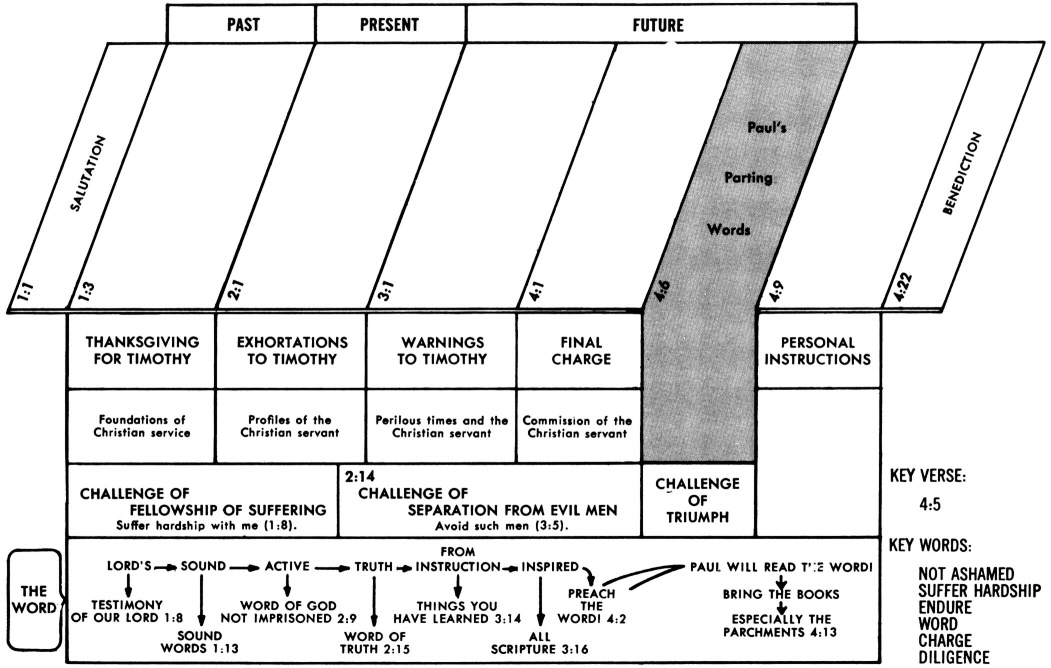
ENDURANCE AND SEPARATION IN THE MINISTRY
Click chart to enlarge
Charts from Jensen's Survey of the NT - used by permission
Second Timothy - Swindoll
| 2 TIMOTHY | |||
| 2 Timothy 1:1-18 | 2 Timothy 2:1-26 | 2 Timothy 3:1-17 | 2 Timothy 4:1-22 |
| Retain the Standard |
Rightly Divide the Word |
Difficult Times Will Come |
Preach the Word |
| PAST | PRESENT | FUTURE | |
| Foundation of Christian Service |
Pictures of Christian Servant |
Dangerous Times for Christian Servant |
Commission of Christian Servant |
| Unashamed as a Witness: Guard the Gospel |
Unashamed as a Workman: Suffer for the Gospel |
Adequate as a Workman: Continue in the Gospel |
Awarded as a Workman: Preach the Gospel |
| Power of the Gospel |
Perseverance of the Gospel Message | Protection of the Gospel |
Proclamation of the Gospel |
| Reminder | Requirements | Resistance | Requests |
| Encouragement in Ministry |
Examples in Ministry |
Exhortations in Ministry |
Exhortations to Fulfill Ministry |
| Commendation & Charge |
Commission to Fulfill |
Conflict to Face |
Course to Finish |
|
Compiled from Jensen's Survey of the NT and Wilkinson's Talk Thru the Bible |
|||
2 Timothy 1:10 but now has been revealed (APPFSA) by the appearing of our Savior Christ Jesus, who abolished (AAPMSG) death and brought life and immortality to light (AAPMSG) through the gospel, (NASB: Lockman)
Greek: phanerotheisan (APPFSA) de nun dia tes epiphaneias tou soteros hemon Christou Iesou, katargesantos (AAPMSG) men ton thanaton photisantos (AAPMSG) de zoen kai aptharsian dia tou euaggeliou,
BBE: But has now been made clear by the revelation of our Saviour Christ Jesus, who put an end to death and made life unending come to light through the good news
Darby: but has been made manifest now by the appearing of our Saviour Jesus Christ, who has annulled death, and brought to light life and incorruptibility by the glad tidings;
ICB: It was not shown to us until our Savior Christ Jesus came. Jesus destroyed death. And through the Good News, he showed us the way to have life that cannot be destroyed. (ICB: Nelson)
KJV: But is now made manifest by the appearing of our Saviour Jesus Christ, who hath abolished death, and hath brought life and immortality to light through the gospel:
NLT: And now he has made all of this plain to us by the coming of Christ Jesus, our Savior, who broke the power of death and showed us the way to everlasting life through the Good News. (NLT - Tyndale House)
Phillips: but it is only since our saviour Jesus Christ has been revealed that the method has become apparent. For Christ has completely abolished death, and has now, through the Gospel, opened to us men the shining possibilities of the life that is eternal. (Phillips: Touchstone)
TEV: but now it has been revealed to us through the coming of our Savior, Christ Jesus. He has ended the power of death and through the gospel has revealed immortal life.
Wuest: but has now been made known through the appearing of our Saviour, Christ Jesus, since He not only made of none effect the death, but also brought to light life and incorruption through the good news
YLT: and was made manifest now through the manifestation of our Saviour Jesus Christ, who indeed did abolish death, and did enlighten life and immortality through the good news,
BUT NOW HAS BEEN REVEALED: phanerotheisan (APPFSA) de nun:
- Isa 60:2,3; Lk 2:31,32; Ro 16:26; Eph 1:9; Col 1:26,27; Titus 1:3; 2:11; 1Pe 1:20,21; 1Jn 1:2
- 2 Timothy 1 Resources - Multiple Sermons and Commentaries
made visible (NET)
but made it public only now (JNT)
[It is that purpose and grace] which He now has made known and has fully disclosed and made real [to us] (Amp)
But now marks Paul's abrupt transition from a discussion of God’s purposes in eternity to Christ’s appearance in time. In ages past Jesus was not yet incarnate. But at the incarnation Jesus became manifest to the senses and visible to all men. Note the powerful effect of the gospel.
"But Now"
Why are these two of the greatest words in the Bible?
Study the following passages for the answer...
Romans 3:21-note, Ro 6:22-note, Ro 7:6-note, Ro 11:30-note, Ro 16:26-note
1Corinthians 15:20
Galatians 3:25, Gal 4:9
Ephesians 2:13-note, Ephesians 5:8-note
Hebrews 9:26-note
Revealed (5319) (phaneroo) means more than just to appear and includes the sense of making manifest, visible or known what was previously hidden or unknown.
Phaneroo - 49 times in the NT -
Mk 4:22; 16:12, 14; Jn 1:31; 2:11; 3:21; 7:4; 9:3; 17:6; 21:1, 14; Ro 1:19; 3:21; 16:26; 1Co 4:5; 2Co 2:14; 3:3; 4:10, 11; 5:10, 11; 7:12; 11:6; Ep 5:13, 14; Col 1:26; 3:4; 4:4; 1Ti 3:16; 2Ti 1:10; Titus 1:3; Heb. 9:8, 26; 1Pe 1:20; 5:4; 1Jn 1:2; 2:19, 28; 3:2, 5, 8; 4:9; Re 3:18; 15:4.
A person may appear in a false guise or without a disclosure of what he truly is, but to be manifested is to be revealed in one's true character.
Jesus' life and death and fulfilling of the Father's will revealed His character and purpose...He became obedient to the point of death, even death on a Cross (see note Philippians 2:8),thus accomplishing the Father's will & work for Him (compare the words of Jesus' early ministry -Jn 4:34- and latter ministry - Jn 17:4).
Isaiah prophesied of the coming of the Light of the World (Jn 8:12, cp Mary's song Lk 1:76, 77, 78, 79; Simeon's testimony in Lk 2:30, 31, 32, co Jn 1:5, 12:35, 36, 46)...
For behold, darkness will cover the earth, And deep darkness the peoples; But the LORD will rise upon you, And His glory will appear upon you. And nations will come to your light, And kings to the brightness of your rising. (Isa 60:2,3 cp Isaiah's prophecy in Isa 9:1,2 - see the ultimate fulfillment of the prophecy in the New Heaven and New Earth - Rev 21:23-note, Re 21:24-note)
BY THE APPEARING OF OUR SAVIOR CHRIST JESUS: dia tes epiphaneias tou soteros hemon Christou Iesou:
- 2 Timothy 1 Resources - Multiple Sermons and Commentaries
through the coming (TEV)
with the coming (GWT)
of our Deliverer the Messiah Yeshua (JNT)
by the illumination of our Saviour Jesus Christ (Douay-Rheims)
By the appearing of our Savior - Titus associates the appearing of Christ Jesus with the appearance of the grace of God writing...
For the grace of God has appeared, bringing salvation to all men (Titus 2:11-note)
John describes this appearing in the opening of his first epistle testifying that ...
1Jn 1:1 What was from the beginning, what we have heard, what we have seen with our eyes, what we beheld and our hands handled, concerning the Word of Life--2 and the life was manifested, (the Incarnation) and we have seen and bear witness and proclaim to you the eternal life, which was with the Father and was manifested to us
Appearing (2015) (epiphaneia [word study] from epí = upon + phaino = to shine) (Click for in depth study of related word epiphaino) literally means a "shining upon" and is used three times in this epistle. Epiphaneia gives us the English word "epiphany" and was a word quite familiar in Paul's time and was used by the pagan Greeks to describe the "glorious" appearance of a Greek mythological "god".
Epiphaneia - 6x in 6v - 2 Thess 2:8; 1 Tim 6:14; 2 Tim 1:10; 4:1, 8; Titus 2:13.
In other NT uses epiphaneia refers to the return of Christ (2Ti 4:1-note, 2Ti 4:8-note, 2Th 3:8, 1Ti 6:14, Titus 2:13-note, cf the "shining upon" in Mt 24:27, See Table comparing Rapture vs Second Coming) but in the present context epiphaneia refers to the first Advent.
Both the verb revealed and the noun appearing (appearing), which have the same root, express the thought of making plain or bringing into view that which was previously hidden. The "appearing" or "epiphany" of Christ refers to His Incarnation (His humanity) and His entire earthly ministry. Only here does Paul use the word "epiphany" of Christ's First Advent. Don't miss the fact that this truth of Jesus Christ appearing also implies that He existed before He came to this earth, which furthermore is an assertion of His deity. If He had not been fully God salvation would have had no good news. As an aside the importance of this truth is reflected by the fact that the cults go to great lengths to counter Jesus' deity, for if He is not fully God and fully Man, there is no gospel and He cannot save us from our sins. (eg, see what the Jehovah's Witnesses do pulling Colossians 1:15 out of context - click here - scroll to bottom of note on Col 1:15)
Epiphaneia was "a technical term relating to transcendence...to a visible and frequently sudden manifestation of a hidden divinity, either in the form of a personal appearance, or by some deed of power or oracular communication by which its presence is made known...to help humans. (Arndt)
Savior (4990) (soter) (Click word study of soter) is a rich term worth meditating on for it includes the ideas of a rescuer (one who sets free from confinement or danger), a deliverer (one who releases a person from confinement, temptation, slavery, or suffering), preserver (one who keeps safe from injury, harm, or destruction). A soter saves from danger or destruction and brings into a state of prosperity and blessedness.
Soter - 24 times in the NT - Lk. 1:47; 2:11; Jn. 4:42; Acts 5:31; 13:23; Eph. 5:23; Phil. 3:20; 1Ti 1:1; 2:3; 4:10; 2 Tim. 1:10; Titus 1:3f; 2:10, 13; 3:4, 6; 2 Pet. 1:1, 11; 2:20; 3:2, 18; 1 Jn. 4:14; Jude 1:25
Greeks applied "soter" as the epithet especially of Asclepius (Aesculapius), the god of healing (a symbol today of the medical profession).
At an early date soter was used as a title of honor for deserving persons & of high-ranking officials, being applied to personalities who are active in the world’s affairs, in order to remove them fro the ranks of ordinary mankind and place them in a significantly higher position. For example, Epicurus is called soter by his followers. Of much greater import is the designation of the (deified) rulers or emperors of Rome as "soter".
WHO ABOLISHED DEATH: katargesantos (AAPMSG) men ton thanaton:
- Isa 25:8, Jn 11:25, 1Co 15:55, Heb 2:15
- 2 Timothy 1 Resources - Multiple Sermons and Commentaries
He has broken the power of death (NET)
Who annulled death and made it of no effect (Amp)
Who has destroyed death (NIV)
He not only made of none effect the death (Wuest)
The redemptive work of Christ is set forth first its "destructive" aspect and then its "constructive" aspect.
Abolished (2673) (katargeo [word study] from kata = intensifies meaning + argeo = to be idle or inactive from argos = ineffective, idle, inactive from a = without + érgon = work) literally means to reduce to inactivity. The idea is to make the power or force of something ineffective and so to render powerless, reduce to inactivity, to cause to be idle or useless, inoperative or ineffective.
Katargeo - 27 times in NT -
Lk. 13:7; Rom. 3:3, 31; 4:14; 6:6; 7:2, 6; 1 Co. 1:28; 2:6; 6:13; 13:8, 10f; 15:24, 26; 2 Co. 3:7, 11, 13f; Gal. 3:17; 5:4, 11; Eph. 2:15; 2 Thess. 2:8; 2 Tim. 1:10; Heb. 2:14
Abolished does not mean annihilation of death but that death is nullified or made of no effect, which is the result of Christ's death and resurrection. Death is reduced to powerlessness. Because of Christ's sacrifice, physical death loses its power or effectiveness over believers. In fact for a believer, death is the doorway leading to our entrance into the presence of our Lord and our Savior Jesus Christ.
Katargeo also means to cause the release of someone from an obligation -- think about this. All men are born in Adam and owe a wage (debt) called death (Ro 3:23-note). But if anyone by grace through faith (Ep 2:8, 9-notes) enters the "ark" which is "in Christ" they are delivered from "the wrath to come" (1Th 1:10-note) and from eternal death because Christ has paid the price in full that releases us from our obligation to pay the debt incurred by our sin. Thus believers no longer need to fear death. Formerly the devil held the "power of death" (He 2:14-note) in sense that we were subject to his domain and he could entice us to sin which brings death. For a believer now "to die is gain" because to die is to be with Christ (Php 1:21-note; Php 1:23-note). There will be no more death (Re 20:6-note; Re 21:4-note). All human beings still must die (unless they are raptured), but death is not the end for there is hope beyond the grave and that certain hope (not a "hope so" hope) counters the fear of death.
Steven Cole explains that...
when Paul says that Christ abolished death, he means that through His death and resurrection, Jesus broke the power of death and freed us from fear of judgment (He 2:14, 15-notes). While believers are still subject to physical death (unless we’re alive at His coming), the sting of death has been removed...
It is because Jesus Christ took the sting of death from us (1Co 15:55, 56) that death for believers is now referred to as sleep (Acts 7:60; 1Th 4:13-note). This does not mean that our souls sleep. The moment we die, we are consciously in the presence of the Lord in heaven (2Co 5:8). But our bodies sleep in the grave until the return of Christ, when they will be raised and transformed into incorruptible bodies that are suited for heaven.
I love that scene in The Pilgrim's Progress where Christian and Hopeful come to the final river of death. They are fearful that the water will be over their heads. But Hopeful goes first and calls back to Christian, “Be of good cheer, my brother; I feel the bottom, and it is good.” For every Christian, the bottom is good because of the word of Christ Jesus our Savior, who has promised that He will take us to be with Him in heaven (John 14:3). When you face death, trust in His promise to bring you safely to the other side. (See A Cause Worth Dying For)
Vine adds that "katargeo or abolished literally means to reduce to inactivity. By His death and resurrection He actually and potentially for all His people robbed death of its sting and rendered its activity nugatory. “By dying, death He slew.” As regards death, whether of the body or spiritual death, the Lord Himself said, “He that believeth on Me, though he die, yet shall he live: and whosoever liveth and believeth on Me shall never die” (Jn 11:26). For the believer physical death is but the entrance upon a condition in which the spirit enjoys an activity far superior to that experienced here, a life entirely free from all effects of sin. This will be extended to his whole being, when the Lord comes to the air to receive the saints to Himself, death in all its forms having been robbed of its power by Him when He accomplished that for which He became incarnate." (Abolish - Vine's Expository Dictionary of NT Words)
Death (2288) (thanatos) includes not only physical death, but also the quality of one's present life (1Ti 5:6). Here Paul uses the term of the death brought in by human sin.
Death came though the tree of life - in the garden by Adam (Ro 5:12-note) - life came through the tree of death (cross) on Calvary by the second Adam (Christ - 1Pe 2:24-note). Adam's disobedience brought death to all; so Christ's obedience brought life to all (1Cor 15:22). Adam "took and ate" and thus brought death to men. Christ died and thus brought life to man by the same words, "Take and eat." (Mt 26:26). Truly, Christ put death out of business (not existence) and so we can sing with the apostle Paul,
O Death, where is your sting? O Hades, where is your victory?" (1Cor 15:55)
Death for the believer has been deprived of its power and terror by the removal of its sting, for death is now a believer's portal into the presence of our Lord. The final and ultimate annihilation of death is future when at the Great White Throne judgment "death and Hades (will be) thrown into the lake of fire." (Rev 20:14-note)
When The End Is A Beginning - Our faith in Jesus Christ ought to make a difference in the way we live--and in the way we die.
God wants us to live with zest and happiness. Indeed, Jesus said He came to offer us abundant life (Jn 10:10). Paul too affirmed that God "gives us richly all things to enjoy" (1Ti 6:17).
Yet we can't escape the fact that our days on earth are numbered. So it is wise to think about our inevitable appointment with death (He 9:27-note).
Is our attitude toward our departure from this world like that of famous scientist Marie Curie, who with her husband Pierre discovered radium? When he was accidentally killed, she lamented,
"It is the end of everything, everything, everything!"
Our attitude should be radically different. Because of our trust in the death-conquering Savior, we can say as a young German theologian (see note below) did the night before the Nazis hanged him in 1945,
"For me, this is the beginning."
For the believer, death is the end of all pain, loneliness, and sorrow, the end of whatever has made this life less than abundant, and the beginning of unimaginable blessing (Rev 21:1, 2, 3, 4, 5, 6). That prospect enables us to exclaim, "O Death, where is your sting?" (1Co 15:55). —Vernon C Grounds (Our Daily Bread, Copyright RBC Ministries, Grand Rapids, MI. Reprinted by permission. All rights reserved)
To Him I trust my soul, my dust,
When flesh and spirit sever;
The Christ we sing has plucked the sting
Away from death forever. --Anon.
Christ is the difference
between hope and hopelessness.
Scared To Death - The opening line of a country song, “Sarabeth is scared to death . . . ,” leads the listener into the fearful heart of a teenage girl who is diagnosed with cancer. The lyrics of “Skin (Sarabeth)” expose the struggles she faces, not only with the disease and its treatment but also with the obvious evidence of her struggle—the loss of her hair (hence, the title). It is a touching song of triumph in the midst of tragedy, as Sarabeth deals with the understandable life-and-death fears that cancer brings.
The specter of death is faced by every human being. Yet, whether we face that reality with fear or with confidence is not dependent on having a good outlook or a positive attitude. The way we face death depends completely on whether or not we have a personal relationship with Jesus, who gave Himself to die so that death itself could be abolished.
Paul wrote to Timothy that our Savior was the One who “abolished death and brought life and immortality to light through the gospel” (2Ti 1:10). The result is that even in the most disturbing times of life, we never need to be scared to death.
We can live confidently and filled with hope, because Jesus conquered death. —Bill Crowder (Our Daily Bread, Copyright RBC Ministries, Grand Rapids, MI. Reprinted by permission. All rights reserved)
Your love, O God, would spare no pain
To conquer death and win;
You sent Your only Son to die
To rescue us from sin. —M. Gustafson
Because Christ is alive,
we need not fear death.
Touching Bottom - Crowds gathered each week to hear the soul-stirring sermons of Joseph Parker, the famous pastor of London's City Temple in the late 19th century. Then a crisis hit him hard. His wife died after an agonizing illness. Parker later said he would not have allowed a dog to suffer as she did. A heartbroken husband whose prayers had gone unanswered, he confessed publicly that for a week he had even denied that God existed.
But Parker's loss of faith was only temporary. From that experience he gained a stronger personal trust in Jesus' death-destroying resurrection and began to testify: "I have touched the bottom, and it is sound."
Listen to this exclamation of triumph from the risen Christ as He proclaims His victory over the grave: "Do not be afraid; I am the First and the Last. I am He who lives, and was dead, and behold, I am alive forevermore" (Revelation 1:17, 18-note).
Death is our most venomous enemy, robbing us of joy and hope—unless the triumph of Christ's resurrection reverberates in our heart. As we believe in the mighty Victor over death, doubt is banished and light drives away the darkness.
Hold fast to that triumphant trust as you struggle through life's worst crises.—Vernon C Grounds (Our Daily Bread, Copyright RBC Ministries, Grand Rapids, MI. Reprinted by permission. All rights reserved)
Some through the waters, some through the flood,
Some through the fire, but all through the blood;
Some through great sorrow, but God gives a song
In the night season and all the day long. —Young
(Play "God Lead Us Along")
Because of Christ's empty tomb,
we can be full of hope.
News From The Graveyard - What's the foundation of our Christian faith? An empty tomb! Yes, the cornerstone of the gospel is that grave which held no corpse on that first resurrection morning.
French skeptic Joseph-Ernst Renan unwittingly spoke about the truth of the resurrection when he sneered,
"Christianity lives on the fragrance of the empty vase."
To express the truth more accurately, Christianity lives on the saving grace of the resurrected Jesus. He did indeed arise, breaking the bonds of death and leaving empty that garden sepulcher. And that is the good news which ever since has been proclaimed by followers of Jesus Christ.
A character in Ernest Poole's novel The Harbor remarks cynically,
"History is just news from a graveyard."
There's one great exception to the sadness of all graveyards with their silent message of death—the electrifying news from the graveyard where Jesus was buried. The news is that death has been defeated and the door to eternal life has been opened by His nail-pierced hands (1Cor. 15:54, 55, 56, 57).
The next time you drive past a cemetery or attend a funeral service, remember the good news of the resurrection of Christ and the promise of our own. —Vernon C Grounds (Our Daily Bread, Copyright RBC Ministries, Grand Rapids, MI. Reprinted by permission. All rights reserved)
Grave, where is thy victory now?
See the light upon His brow!
Empty see the stony bed;
Christ is risen from the dead. —Chisholm
Christ's empty tomb is full of hope.
For Whom The Bell Tolls - In 17th-century England, church bells tolled out the news of what was taking place in a parish. They announced not only religious services but also weddings and funerals.
So when John Donne, author and dean of St. Paul's Cathedral, lay desperately sick with the plague that was killing people in London by the thousands, he could hear the bells announce death after death. Writing down his thoughts in the devotional diary that became a classic, Donne urged his readers, "Never send to know for whom the bell tolls. It tolls for thee."
How true! The book of Hebrews teaches that we will all face death one day: "It is appointed for men to die once, but after this the judgment" (He 9:27-note).
But if we are believers in the gospel, news of death does not need to arouse dread. We know, as Paul joyfully assured us, that by His resurrection Jesus has broken the power of death and "brought life and immortality to light through the gospel" (2Timothy 1:10). Death has been "swallowed up in victory" by the Lord Jesus Christ (1Corinthians 15:54). Its sting is gone (1Cor 15:55).
When the bell tolls for the Christian, it announces the good news of Jesus' victory over death. —Vernon C Grounds (Our Daily Bread, Copyright RBC Ministries, Grand Rapids, MI. Reprinted by permission. All rights reserved)
Ring the bells, ring the bells;
Let the whole world know
Christ the Savior lives today
As He did so long ago. —Bollback
© 1958, Singspiration, Inc.
Christ's resurrection is cause for our celebration
Dietrich Bonhoeffer's tireless efforts on behalf of Jews and other victims of the Third Reich led at last to his arrest by the Gestapo on April 5, 1943. But even prison could not repress his passion for ministry to the sick and fellow prisoners. He was so congenial and selfless that his guards apologized to him for locking him in his cell after rounds in the courtyard. In prison, the Gestapo used many tactics to persuade Bonhoeffer to recant his faith. They threatened him with torture and the arrest of his family and fiancée, all of whom had helped him with his resistance efforts. Still, he defiantly declared his opposition to National Socialism and all for which it stood. Sunday, April 8, 1945, Bonhoeffer was leading a worship service to comfort women whose husbands had been executed for their resistance efforts. He had just completed the final prayer when two Gestapo agents entered the room and said,
"Prisoner Bonhoeffer, get ready to come with us."
As he bade farewell to his friends, he turned to a British officer, Payne Best, and whispered to him,
"For me, this is the beginning of life."
The next day, at Flossenburg prison in the Bavarian forest, he was hanged. (See related story of Martin Neimoller)
AND BROUGHT LIFE AND IMMORTALITY TO LIGHT: photisantos (AAPMSG) de zoen kai aphtharsian:
- LIFE > Jn 5:24, 25, 26, 27, 28, 29,40; 14:6; 20:31; Ro 2:7; 5:17;5:18 1Cor 15:53; 2Cor 5:4; 2Pe 1:3; 1Jn 1:2; Rev 2:7; 22:1,2,14,17;
- LIGHT > Lk 11:36; Jn 1:9; 1Cor 4:5; Eph 1:18; Heb 10:32; Rev 18:1
- 2 Timothy 1 Resources - Multiple Sermons and Commentaries
He showed us the way to have life that cannot be destroyed (ICB)
showed us the way to everlasting life (NLT)
and brought to light life and incorruptibility (Darby)
brought life and immortality (immunity from eternal death) (Amp)
brought to light life and incorruption (Wuest)
brought eternal life into full view (GWT)
made life unending come to light through the good news (BBE)
Brought to light (5461)(photizo from phos = light <> from phao = to shine) means to give light or to cause light to shine upon some object, in the sense of illuminating the object. Figuratively, it means to cause something to be fully known by revealing clearly and in some detail. It means to shed light upon or to illuminate.
Thayer says brought...to light (photizo) means "to cause something to exist and thus come to light and become clear to all."
Hiebert writes that "Christ's work of redemption illuminated like a blazing light of noonday sun, truth which previously existed but which was shrouded in uncertainty. The hope of immortality was in the world before but He brought it into a certainty through His teaching and above all by His own resurrection." (2 Timothy by D. Edmond Hiebert).
The Old Testament doctrines of eternal life, death, resurrection, and the eternal state were presented in shadows. Here and there one finds glimpses of light but for the most part, the picture is dark. But when Jesus Christ shone His light on death and the grave through the Gospel, He illumined the truths about eternal life, resurrection, and the hope of heaven.
Life (2222) (zoe) refers to the new (eternal) life believers receive at the new birth (regeneration) here includes the present spiritual life of the believer and the glorified state realized at the coming of Christ for His saints. This truth about life explains in part the the promise of life in Christ Jesus in (2Ti 1:1-note).
Life and immortality to light - The true meaning of life as God intended for us to experience is found only in our Savior, Christ Jesus. This eternal, incorruptible (immortal) life can never be taken from us, for Jesus declared...
I give eternal life to them, and they shall never perish; and no one shall snatch them out of My hand. (John 10:28)
;>
Immortality (861) (aphtharsia [word study] from a = not or without + phthartós = corruptible from the verb phtheiro = to corrupt, shrivel, wither, spoil by any process, ruin , deprave, defile, destroy; see related words aphthartos; phthora) is a state of not being subject to decay or death - immortality, incorruptibility (state of being free from physical decay), perpetuity.
Aphtharsia defines the state of not being subject to decay, dissolution or interruption. It speaks of an unending existence, of that which is not capable of corruption. In a word "not rotting"! Aphtharsia indicates immunity to the decay that infects all of creation.
Aphtharsia - Used 7x in NT - Ro 2:7; 1Co. 15:42, 50, 53, 54; Eph 6:24; 2Ti 1:10
Aphtharsia is thus more accurately rendered "incorruption" or "imperishability" for it refers to that which is not capable of corruption.
Paul is describing the state of unending existence in which believer's glorified resurrection body will not be subject to decay or corruption.
We enter into this state when we "have been born again not of seed which is perishable but imperishable (aphtharsia) that is, through the living and abiding word of God." (see note 1 Peter 1:23)
Vine writes that aphtharsia is used
(a) of the resurrection body, 1Cor 15:42, 50, 53, 54;
(b) of a condition associated with glory and honour and life, including perhaps a moral significance, Romans 2:7 (note); 2 Ti 1:10; this is wrongly translated “immortality” in the AV;
(c) of love to Christ, that which is sincere and undiminishing, Ephesians 6:24 (note) (Corrupt, Verb and Adjective. Corruption, Corruptible, Incorruption, Incorruptible - Vine's Expository Dictionary of NT Words)
;>;>;>
Aphtharsia is translated "imperishable" (NASB) in 1 Corinthians where Paul describes "the resurrection of the dead" whose body "is sown a perishable body, (but) ...raised an imperishable body" (1Co 15:42) adding that the "perishable (phthartos) must put on the imperishable" (1Cor 15:53, 54).
Though our body is presently corruptible because of the decaying and destructive effects of sin one day we are assured that it will be raised "imperishable and immortal." Then we will have a resurrected, glorified body which will be "conformed to His glorious body." (Php 3:21-note).
John tells us that "it has not appeared as yet what we will be. We know that when He appears, we will be like Him, because we will see Him just as He is and everyone who has this hope fixed on Him purifies himself, just as He is pure." (1Jn 3:2, 1Jn 3:3)
Brought...to light - The Old Testament has only scattered references to the hope of eternal life beyond the grave, and these were only dimly visible, in a comparative dusk, until the Son of righteousness came and brought these truths into full light in the gospel.
THROUGH THE GOSPEL: dia tou euaggeliou:
- 2 Timothy 1 Resources - Multiple Sermons and Commentaries
the Good News (GWT)
the glad tidings (Darby)
Through (dia) in this verse serves as a marker of instrumentality (the gospel) whereby something is accomplished (death rendered ineffective and life and immortality come to light). What comes to fruition through the Gospel?
All the glorious truths Paul has described in 2 Timothy 1:9-10 are brought to light "through (by means of) the gospel." And yet though God brought these truths to light through the gospel, God's human agents must bring the life and light giving gospel to lost men and women so that they might have clear exposure to the gospel's transforming power.
Gospel (2098) (euaggelion [word study] from eú = good + aggéllo = proclaim, tell) is literally good news or glad tidings) in secular Greek originally referred to a reward for good news and later became the good news itself. The word euaggelion was commonly used in the first century as our words "good news" today. The idea then and now is something like this - “Have you any good news (euaggelion) for me today?” This was a common question in the ancient world. Our English word Gospel is from the Old English or Saxon word gōdspell (gōd = good + spell = message) which is literally "good tale, message". When I was a young man Godspell was actually the name of a popular musical play (See description). I wonder if they really understood the meaning of this word which is the very foundation stone of Christianity.
Euaggelion - 76 times in the NT -
Matt. 4:23; 9:35; 24:14; 26:13; Mk. 1:1, 14f; 8:35; 10:29; 13:10; 14:9; 16:15; Acts 15:7; 20:24; Rom. 1:1, 9, 16; 2:16; 10:16; 11:28; 15:16, 19; 16:25; 1 Co. 4:15; 9:12, 14, 18, 23; 15:1; 2 Co. 2:12; 4:3f; 8:18; 9:13; 10:14; 11:4, 7; Gal. 1:6f, 11; 2:2, 5, 7, 14; Eph. 1:13; 3:6; 6:15, 19; Phil. 1:5, 7, 12, 16, 27; 2:22; 4:3, 15; Col. 1:5, 23; 1 Thess. 1:5; 2:2, 4, 8f; 3:2; 2 Thess. 1:8; 2:14; 1 Tim. 1:11; 2 Tim. 1:8, 10; 2:8; Philemon 1:13; 1 Pet. 4:17; Rev. 14:6
In modern secular use gospel has an interesting meaning of something accepted as infallible truth or as a guiding principle (e.g., such and such is "the gospel truth"). This is not a bad Biblical definition either!
In ancient secular Greek as alluded to above, euaggelion described good news of any kind and prior to the writing of the New Testament, had no definite religious connotation in the ancient world until it was taken over by the "Cult of Caesar" which was the state religion and in which the emperor was worshipped as a god (see more discussion of this use below).
The writers of the New Testament adapted the term as God's message of salvation for lost sinners. The gospel key opens the door to eternal life where death is abolished and immortality becomes reality.
So Timothy does not need to be ashamed of the gospel for it is
the power of God for salvation to everyone who believes (see note Romans 1:16)
As Hiebert reminds us "comparatively few among the masses of humanity saw personally the manifestation of life an immortality in Christ; so it is through the preaching of the Gospel, in which the manifestation is enshrined, that this revelation is now made known to men. (2 Timothy by D. Edmond Hiebert).
2 Timothy 1:11 for which I was appointed (1SAPI) a preacher and an apostle and a teacher. (NASB: Lockman)
Greek: eis o etethen (1SAPI) ego kerux kai apostolos kai didaskalos.
KJV: Whereunto I am appointed a preacher, and an apostle, and a teacher of the Gentiles.
NLT: And God chose me to be a preacher, an apostle, and a teacher of this Good News. (NLT - Tyndale House)
Wuest: with reference to which good news I was appointed a herald and an ambassador and a teacher
Young's Literal: to which I was placed a preacher and an apostle, and a teacher of nations,
FOR I WAS APPOINTED : eis ho etethen (1SAPI) ego:
- 2 Timothy 1 Resources - Multiple Sermons and Commentaries
For which - The flow of Paul's argument in this section is that Spirit wrought salvation leads to Spirit energized service. How goes it with you since you were regenerated? Having been created in Christ Jesus are you seeking the works He has prepared for you beforehand that you should walk in them? (Eph 2:10-note) Under grace not law let me remind you to run your race with endurance because...
Only one life
Twill soon be past
Only what's done
For (in) Christ will last!
I was appointed - Jesus Himself appointed Paul as "a chosen instrument of Mine, to bear My name before the Gentiles and kings and the sons of Israel (Acts 9:15, cp Acts 13:2, 1Ti 2:7)
A PREACHER: kerux kai:
- Eph 3:7,8, 1Ti 2:7, 1Co 1:17, 1:23, 2:1, 2
- 2 Timothy 1 Resources - Multiple Sermons and Commentaries
Preacher (2783) (kerux) is the Greek term describing the Imperial Herald (Crier, Messenger, Proclaimer) who made a public proclamations for kings, magistrates, princes, military commanders.
A kerux was the town crier or herald. The kerux, who often served as a close confidant of the king, would travel throughout the realm announcing to the people whatever the king wished to make known. It is this note of authoritative declaration that is so appropriately transferred to the proclamation of the gospel.
Kerux is used 3 times in the New Testament...
And for this I was appointed a preacher and an apostle (I am telling the truth, I am not lying) as a teacher of the Gentiles in faith and truth. (1 Ti 2:7)
and did not spare the ancient world, but preserved Noah, a preacher of righteousness, with seven others, when He brought a flood upon the world of the ungodly (2Pe 2:5-note)
This proclamation was given with a sense of formality, gravity and authority which must be heeded.
Kerusso the verb form of kerux is used by Paul in 2Ti 4:2 to command his young "recruit" Timothy to publicly declare the gospel...
preach (aorist imperative = do it now, and do it effectively!) the Word in season and out. (2Ti 4:2-note) (Note - Remember that all every divine commandment comes "pre-packaged" with divine enablement! In fact the only way to keep God's commandments is by manifesting a continually attitude of dependency on His enabling Spirit!
In Classic Greek kerux was used of a public servant of supreme power both in peace and in war, who summoned the town gathering (which is the Greek word ekklesia translated in the NT as "church"). Paul was the public crier of the gospel message resulting in the ekklesia being called out of the world and unto God into the body of Christ, the church. That the gospel message was also found in the OT, is implied by Peter's description of Noah as "a preacher (kerux) of righteousness" (2Pe 2:5-note).
Kerux word also stresses the boldness and openness of Paul’s evangelistic work because he had a message which he boldly, uncompromisingly proclaimed before both kings and commoners.
Paul (and every Christian in a sense) is the herald of Christ. We are not called to bring men our opinions but the message of the gospel of Jesus Christ.
William Barclay writes that ...
Kerux is the Greek word for herald, and the herald was the man who brought a message direct from the king. This word tells us of certain characteristics of the preaching of Jesus and these are characteristics which should be in all preaching.
(i) The herald had in his voice a note of certainty. There was no doubt about his message; he did not come with perhapses and maybes and probably’s; he came with a definite message. Goethe had it: “Tell me of your certainties: I have doubts enough of my own.” Preaching is the proclamation of certainties, and a man cannot make others sure of that about which he himself is in doubt.
(ii) The herald had in his voice the note of authority. He was speaking for the king; he was laying down and announcing the king’s law, the king’s command, and the king’s decision. As was said of a great preacher, “he did not cloudily guess; he knew.” Preaching, as it has been put, is the application of prophetic authority to the present situation.
(iii) The herald’s message came from a source beyond himself; it came from the king. Preaching speaks from a source beyond the preacher. It is not the expression of one man’s personal opinions; it is the voice of God that Jesus spoke to men. (Barclay, W: The Daily Study Bible Series)
We may not all be appointed preachers like Paul but we do have the same gospel message and we have all been in a sense appointed as "ambassadors for Christ" with the good news of "the word of reconciliation." (2Cor 5:19-20-note). The question we each need to ask is will we be found a "trustworthy steward" when our Lord and Master returns? (1Cor 4:2, Mt 25:21)
Edwards adds these thoughts to help illustrate kerux - This was a graphic word in the ancient Greek world. It was used in several different ways, each of which exemplified Paul's ministry. It was used of a herald who brought an announcement from the king. Paul (as well as us) was sent forth to herald the good news of salvation from the King of kings. It was used of an emissary when two armies were opposed to each other. The man of God is sent as a go-between to offer conditions of peace to men in opposition to God. It was also used of an auctioneer or merchant shouting out his wares and inviting people to come and buy. So we are to make known to those around us the gift of eternal life which God is inviting all men to come receive freely. Clearly Paul saw the gospel as something to be VERBALLY communicated. While it is absolutely essential that our walk backs our talk, it is equally essential that our talk explains our walk. Otherwise, how will people come to know the real reason for the difference in our lifestyle? (2 Timothy: Call to Completion)
Rick Renner - The word "preach" comes from the Greek word kerusso, which means to proclaim, to declare, to announce, or to herald a message. It was the message proclaimed by the kerux, who was the official spokesman or herald of a king. Because the kerux was the appointed, official representative of the king or government, his specific job was to announce with a clear and unquestionable voice the desires, dictates, orders, recent events, news, policy changes, or message that the king or government wished to express to the people. The position of this kerux ("spokesman" or "herald") was viewed to be the highest, most noble, privileged position in the kingdom because his position gave him routine access to the king that was afforded only to rare individuals. To be the king's kerux was an honor and supreme privilege that necessitated the highest level of professionalism and excellent performance. When the king wanted to give a message to his people, he summoned the kerux. The kerux came to the king's throne room with writing instrument and paper in hand; then he carefully and accurately penned the communication that the king desired to express to his people. After the king was finished dictating his message, the kerux was allowed to freely speak to the king and to ask questions of clarification to make certain he understood every point of the king's message. Because this man was speaking on behalf of the king, there was no room for mistakes in his delivery of the message. When he finally stood before the people to announce the message given to him, it had to be accurate, precise, and faithful to what the king wanted to express to his people....When the kerux had finished delivering the king's message to the people, he turned, left the platform from which he spoke, and then remained silent until the king summoned him back to the throne room to give him another message for the people. As the king's spokesman, he had no right to speak his own mind, give his own personal commentary about what the king meant, or draw any attention to himself. Such actions would be considered gross violations of his position and a guarantee that he would no longer serve as the king's spokesman.
Keeping all this in mind, let's consider again what Jesus meant when He commanded that all believers go into all the world "to preach" the Gospel. Since kerusso ("to preach") is the message of the kerux ("the king's spokesman"), it is clear that by using the word "preach," God is communicating several very powerful messages to you and to me. First, as a believer, you must learn to see yourself as the representative of Jesus Christ. Although you may never stand before a public pulpit to preach, it is a fact that your life is your most important pulpit. What you say and do in your life reflects on the Lord Jesus Christ.
EDITORIAL ADDENDUM - When people look at your life, do they see the evidence of the transforming power of the Good News of Jesus Christ? There’s an old poem that says:
You are writing a Gospel, a chapter each day,
By the deeds that you do, by the words that you say;
Men read what you write, whether faithless or true.
Say—what is the Gospel according to you?
Second, as a believer, it is absolutely essential that you spend time in the Presence of the Lord so you can hear His Word and capture His heart. You should never think of the time you must spend in God's Presence praying or reading the Word as laborious or dreadful. It is a high honor that God has given you. He beckons you to come into His throne room so He can speak to you, share with you His heart, and then empower you with His Spirit to take the message to people who are desperately waiting for it. Never forget that you possess a position of great privilege. Third, as a believer, it is imperative that you learn how to dress appropriately and how to speak kindly, courteously, and in a way that brings honor to Jesus. If your appearance communicates a low standard because you dress like a slob, never comb your hair, always look unprofessional, or allow yourself to remain overweight (yes, I know this last one affects many people, but what I am saying is true)—this is exactly the image you are imparting about Jesus Christ. Would the president of a nation allow His spokesman to be aired on television in a sweatshirt or tennis shoes? Would a national public representative dare to go on national television to speak on behalf of the government looking like a slob? Of course not! It would be disrespectful to the office or the person the spokesman represented. Likewise, we must think about what we look like, what we sound like, and how we are perceived. We are not representing ourselves; we are representing Jesus Christ. Fourth, as a believer, you must realize that your private life is just as important as your public life. If you publicly declare the Gospel, but later it is discovered that your private life is a horrible mess and a complete contradiction of what you've been preaching, this, too, will reflect poorly on the Gospel. The lost world loathes hypocrites but enjoys it immensely when a preacher or believer is found to be a contradiction of the message he or she preaches. So never forget that as the Lord's spokesman, you are required to do everything possible to maintain a life that is spotless, immaculate, pristine, gleaming, and squeaky clean—free of accusation. Fifth, as a believer and a representative of Jesus Christ, you must make a decision to refrain from making personal comments that are not your business to make. Speak what Jesus tells you to speak—but if someone tries to draw you into a debate or a conversation regarding a matter you know nothing about, just remain silent. You are not required to speak or to act like an authority regarding issues about which you are not an authority! You see, preaching the Gospel is what you do every day of your life by the way you live and conduct yourself. It is true that public pulpit ministry is a very special gift and honor that some are called to do. But the truth is, you preach every day that you get up and faithfully go to work! You preach when you choose to dress modestly or when you speak kindly to your fellow employees, believers, or friends. All these things reflect on the message of the Gospel.
So as you obey Jesus' words to take the Gospel to every ethnic group, culture, custom, civilization, and sphere where you personally have influence, always be mindful of the fact that you are His kerux in those places. You are His personal representative, and everything you do and say preaches about Jesus Christ! (Sparkling Gems from the Greek - Recommended)
AND AN APOSTLE : apostolos kai:
- 2 Timothy 1 Resources - Multiple Sermons and Commentaries
Apostle (652) (apostolos [word study]) is one sent out as an envoy or ambassador with a special commission and a proclamation to be delivered with such gravity, formality, and authority as to be heeded (eg see before Felix Acts 24:25 & before Agrippa Acts 24:28) and so Paul again (2Ti 1:1-note) emphasizes his authority as a messenger of Christ Jesus.
Apostolos - 80 times in NT -
Matt. 10:2; Mk. 3:14; 6:30; Lk. 6:13; 9:10; 11:49; 17:5; 22:14; 24:10; Jn. 13:16; Acts 1:2, 26; 2:37, 42f; 4:33, 35, 36, 37; 5:2, 12, 18, 29, 40; 6:6; 8:1, 14, 18; 9:27; 11:1; 14:4, 14; 15:2, 4, 6, 22f; 16:4; Ro 1:1; 11:13; 16:7; 1 Co. 1:1; 4:9; 9:1f, 5; 12:28f; 15:7, 9; 2 Co. 1:1; 8:23; 11:5, 13; 12:11, 12; Gal. 1:1, 17, 19; Eph. 1:1; 2:20; 3:5; 4:11; Phil. 2:25; Col. 1:1; 1Thess. 2:7; 1Tim. 1:1; 2:7; 2Tim. 1:1, 11; Titus 1:1; Heb. 3:1; 1Pet. 1:1; 2Pet. 1:1; 3:2; Jude 1:17; Rev. 2:2; 18:20; 21:14
The apostolos did not speak for himself, but for him who sent him. He did not come in his own authority, but in the authority of him who sent him. The Christian is the ambassador of Christ, come to speak for him and to represent him to men.
Steven Cole - The office of apostle as one who had unique authority from Christ no longer exists, because the church was built on the foundation of the apostles and prophets (Eph. 2:20). We have the apostolic foundation in the New Testament. In the sense of “one sent out to plant churches,” the role does exist. But for the sake of avoiding confusion, such people should not be called apostles, but missionaries or church planters (A Cause Worth Dying For )
AND A TEACHER: kai didaskalos:
- 2 Timothy 1 Resources - Multiple Sermons and Commentaries
Teacher (1320) (didaskalos gives us English "didactic" - click here for in depth study of related word didaskalía and of the verb didasko = to teach) and was one who taught others with the specific purpose of shaping the will of the one being taught by the content of what was taught, in this case the gospel. Here "teacher" has reference to the method of imparting the message.
Didaskalia - 59 times in the NT -
Mt. 8:19; 9:11; 10:24f; 12:38; 17:24; 19:16; 22:16, 24, 36; 23:8; 26:18; Mk. 4:38; 5:35; 9:17, 38; 10:17, 20, 35; 12:14, 19, 32; 13:1; 14:14; Lk. 2:46; 3:12; 6:40; 7:40; 8:49; 9:38; 10:25; 11:45; 12:13; 18:18; 19:39; 20:21, 28, 39; 21:7; 22:11; Jn. 1:38; 3:2, 10; 8:4; 11:28; 13:13f; 20:16; Acts 13:1; Rom. 2:20; 1 Co. 12:28f; Eph. 4:11; 1Ti. 2:7; 2Tim. 1:11; 4:3; Heb. 5:12; Jas. 3:1
The preacher views his office in relation to his message, the apostle in relation to his credentials, and the teacher in relation to those to whom he ministers.
In some of Paul's last recorded words he uses didaskalos in a warning - "For the time will come when they will not endure sound doctrine; but [wanting] to have their ears tickled, they will accumulate for themselves teachers in accordance to their own desires and will turn away their ears from the truth, and will turn aside to myths. (2Ti 4:3-4-note)
2 Timothy 1:12 For this reason I also suffer (1SPAI) these things, but I am not ashamed (1SPPI); for I know (1SRAI) whom I have believed (1SRAI), and I am convinced (1SRPI) that He is (3SPAI) able to guard (AAN) what I have entrusted to Him until that day. (NASB: Lockman)
Greek: di' en aitian kai tauta pascho, (1SPAI) all' ouk epaischunomai, (1SPPI) oida (1SRAI) gar o pepisteuka, (1SRAI) kai pepeismai (1SRPI) hoti dunatos estin (3SPAI) ten paratheken mou phulaxai (AAN) eis ekeinen ten hemeran.
BBE: And for which I undergo these things: but I have no feeling of shame. For I have knowledge of him in whom I have faith, and I am certain that he is able to keep that which I have given into his care till that day.
GWT: For this reason I suffer as I do. However, I'm not ashamed. I know whom I trust. I'm convinced that he is able to protect what he had entrusted to me until that day. (GWT)
ICB: And I suffer now because I tell the Good News. But I am not ashamed. I know Jesus, the One I have believed in. And I am sure that he is able to protect what he has trusted me with until that Day. (ICB: Nelson)
KJV: For the which cause I also suffer these things: nevertheless I am not ashamed: for I know whom I have believed, and am persuaded that he is able to keep that which I have committed unto him against that day.
MLB: Therefore I suffer in this way; but I am not ashamed, for I know whom I have believed and am convinced that He is able to guard safely my deposit, entrusted to Him against that Day.
NLT: And that is why I am suffering here in prison. But I am not ashamed of it, for I know the one in whom I trust, and I am sure that he is able to guard what I have entrusted to him until the day of his return. (NLT - Tyndale House)
Phillips: and it is for this Gospel that I am now suffering these things. Yet I am not in the least ashamed. For I know the one in whom I have placed my confidence, and I am perfectly certain that the work he has committed to me is safe in his hands until that day. (Phillips: Touchstone)
Weymouth: That indeed is the reason why I suffer as I do. But I am not ashamed, for I know in whom my trust reposes, and I am confident that He has it in His power to keep what I have entrusted to Him safe until that day.
Wuest: on which account I am also suffering these things. But I am not ashamed, for I know with an absolute knowledge the One in whom I have permanently placed my trust, and have come to a settled persuasion that He is of power to guard that which has been committed as a trust to me [his Christian service] with reference to that day.
Young's Literal: for which cause also these things I suffer, but I am not ashamed, for I have known in whom I have believed, and have been persuaded that he is able that which I have committed to him to guard -- to that day.
FOR THIS REASON I ALSO SUFFER THESE THINGS: di en aitian kai tauta pascho (1SPAI):
- 2Ti 1:8; 2:9; 3:10, 11;3:12 4:16; 4:17 Acts 9:16; 13:46; 13:50 14:5,6; 21:27, 28, 29, 30, 31; Acts 22:21, 22, 23, 24; Eph 3:1, 2,3, 4, 5, 6, 7, 8; 1Thes 2:16
- 2 Timothy 1 Resources - Multiple Sermons and Commentaries
For this reason - Always pause and ponder this important phrase, stopping long enough to ask at least the simple question "What reason?" Asking will usually force you to examine the immediate context. What is Paul preaching and teaching about? Why is he suffering? What might potentially happen to me when I begin to take a stand for the Gospel? Forewarned is forearmed! (cp 1Cor 15:58, 1Ti 6:12)
Suffer (3958) (pascho) means to be affected by something (in this case evil) from without. It means to undergo something; to experience a sensation, to experience an impression from an outside source, to undergo an experience (usually difficult) and normally with the implication of physical or psychological suffering.
Pascho - 42 times in the NT - Mt. 16:21; 17:12, 15; 27:19; Mk. 5:26; 8:31; 9:12; Lk. 9:22; 13:2; 17:25; 22:15; 24:26, 46; Acts 1:3; 3:18; 9:16; 17:3; 28:5; 1 Co. 12:26; 2 Co. 1:6; Gal. 3:4; Phil. 1:29; 1 Thess. 2:14; 2 Thess. 1:5; 2 Tim. 1:12; Heb. 2:18; 5:8; 9:26; 13:12; 1 Pet. 2:19ff, 23; 3:14, 17f; 4:1, 15, 19; 5:10; Rev. 2:10
Pascho is in the present tense indicating that Paul's experience of suffering was a continual action going on in the present (2Ti 3:12-note).
Paul was not asking Timothy to do anything he had not done.
Dwight Edwards makes an excellent practical point "The way we cross the dark valleys of undeserved suffering will determine whether we end up as holy or bitter individuals. Undeserved suffering will drive us into one of these two camps; either it will purify our faith so that we become increasingly holy or it will erode our confidence in God so that w e become increasingly bitter. (Heb 12:11-15-see notes Hebrews 12:11; 12:12; 12:13; 12:14; 12:15) We see in this passage how Paul responded to his undeserved suffering...This suffering had not diminished his confidence in God, in fact it was strong as ever". (2 Timothy: Call to Completion)
These things (tauta) - Paul does not enumerate here but in the context of this letter some of these things would include imprisonment and all that is entailed as well as the painful fact that "all in Asia turned away from" him (2Ti 1:15 [note], cf 2Cor 11:23, 24, 25f). He had experienced the suffering of one was abandoned and undoubtedly was lonely (cf his plea for Timothy to "make every effort to come" 2Ti 4:9-note, 2Ti 4:21-note)
Paul had a proper perspective on suffering writing "I rejoice in my sufferings for your (the Colossian saints) sake." (Col 1:24-note) This sounds somewhat like James 1:2-3-note.
BUT I AM NOT ASHAMED: all ouk epaischunomai (1SPPI):
- 2 Ti 1:8 1:16, 2:12 Ro 1:16, 1Pe 4:16)
- 2 Timothy 1 Resources - Multiple Sermons and Commentaries
Still I am not ashamed (Amp)
yet I am not in the least ashamed (Phillips)
but I have no feeling of shame (BBE)
But I am not ashamed. I know Jesus, the One I have believed in (ICB).
But - Introduces a striking contrast - suffering but unashamed. This is not humanly possible but reflects Paul's having learned the principle of Christ's sufficiency for his human weaknesses (see 2Co 12:9-note, 2Co 12:10-note)
Not (3756) (ouk) is as absolute negative. In no way was Paul ashamed.
Ashamed (1870) (epaischunomai from epi = upon or intensifies meaning of + aischunomai from aischos = disfigurement & then disgrace) means to experience a painful feeling or sense of loss of status because of some particular event or activity. It describes one's consciousness of guilt or of exposure or the fear of embarrassment that one's expectations may prove false.
Epaischunomai - 11 times in the NT - Mk. 8:38; Lk. 9:26; Ro 1:16; 6:21; 2Ti 1:8, 12, 16; Heb. 2:11; 11:16
Epaischunomai is associated with being afraid, feeling shame which prevents one from doing something, a reluctance to say or do something because of fear of humiliation, experiencing a lack of courage to stand up for something or feeling shame because of what has been done.
Marvin Vincent - The feeling expressed by (epaischunomai) has reference to incurring dishonor or shame in the eyes of men. It is “the grief a man conceives from his own imperfections considered with relation to the world taking notice of them; grief upon the sense of disesteem” (“South, ” cit. by Trench). Hence it does not spring out of a reverence for right in itself, but from fear of the knowledge and opinion of men." (2 Timothy 1 Commentary - Vincent's Word Studies)
Isaiah records a prophecy concerning the Messiah, writing "For the Lord GOD helps Me, therefore, I am not disgraced. Therefore, I have set My face like flint, and I know that I shall not be ashamed." (Isa 50:7)
Paul likewise is convinced that God is strong to enable him to be faithful to his apostolic calling, in spite of the sufferings which attend it, until the day when he shall be summoned to render his final account. Paul had "learned the secret of being filled and going hungry, both of having abundance and suffering need" (Php 4:12-note) and that "secret" was the Person of Christ, Who enabled Paul to exclaim "I can do (my responsibility) all things through Him who strengthens me (God's sovereignty - His provision = the indwelling Spirit)." (Php 4:13-note)
Paul's abiding knowledge of the Person of Jesus removed all sense of shame. From a Roman prison Paul wrote to his beloved brethren at Philippi reminding them (quoting from the NLT):
"I live in eager expectation and hope that I will never do anything that causes me shame, but that I will always be bold for Christ, as I have been in the past, and that my life will always honor Christ, whether I live or I die." (Phil 1:20-note)
Vine - "Paul’s example of freedom from shame was intended as an incentive to his younger fellow missionary to show the same confidence and endurance. He who is conscious of pleasing God has no reason for feelings of shame through experiencing any form of suffering in consequence. Faithfulness to God frees the believer from bondage to human opinion, regard, and reward." (Vine, W. Collected writings of W. E. Vine. Nashville: Thomas Nelson)
I KNOW WHOM I HAVE BELIEVED: oida (1SRAI) gar o pepisteuka (1SRAI):
- Click Fanny Crosby's hymn ’Tis Summer in My Heart
- 2 Timothy 1 Resources - Multiple Sermons and Commentaries
adhered to and trusted in and relied on (Amp)
in Whom I have put my trust (ISV)
in Whom my trust reposes (WNT)
for I know Him in whom I have trusted and still am trusting, and I became convinced and still am convinced that He is able to guard my deposit until that day.” (Literal translation bringing out the verb tenses - Steven Cole)
Know (1492) (eido/oida) is the Greek verb that signifies absolute, beyond a doubt knowledge. This knowledge is not personal knowledge gained by experience, but knowledge of a Person Who he had found absolutely dependable in any circumstance. His personal knowledge of Jesus as the One in Whom he had learned to trust, imparted the absolute assurance of His unfailing faithfulness. Ultimately this knowledge is dispensed by the Spirit Who opens the eyes of our heart to know Jesus and be assured that He is the Messiah.
Spurgeon writes that Paul's text...
THE text is wholly taken up with three things; namely, with knowing, with believing, and with the person who is known and believed; and upon both the knowing and the believing Paul is very decided. He puts in no “if,” no word of change; he does not say, “I hope so,” or “I trust so,” but “I know I have believed, and I know whom I have believed.”
It is all assurance, and not a shadow of doubt. Let us imitate the apostle, or ask for grace to be able to imitate him, that we may shake off the dubious phraseology which is so common among Christians nowadays, and may be able to speak with apostolic confidence upon, a matter upon which we ought to be confident if anywhere at all, namely, our own salvation...
“I know,” saith the apostle, — not “what “ — but “whom I have believed.” He does not say, “I know the catechism which I have believed,” nor “I know the Institutes of Calvin,” nor “I know the body and system of theology”; but, “I know whom I have believed.” Both the knowing and the believing center round the wondrous person who for our sakes left his starry throne and became a man; knowing whom, is a saving knowledge, and trusting whom, is saving trust, but of which, all other knowing and believing falls short. (see full sermon 2 Timothy 1:12 Knowing and Believing)
“He is able, he is willing:
Doubt no more.”
Believed (4100) (pisteuo from pistis; pistos; related studies the faith, the obedience of faith) means to consider something to be true and therefore worthy of one’s trust. To accept as true, genuine, or real. To have a firm conviction as to the goodness, efficacy, or ability of something or someone. To consider to be true. To accept the word or evidence of.
Using the perfect tense Paul is saying "I first trusted Jesus on the Damascus Road and I still trust Him with my eternal present and eternal future."
Paul had permanently put his trust and confidence ("convinced" below is also perfect tense) in Christ Jesus and still trusted Him even as the shadow of death loomed over him. This speaks of Paul's trust as permanent and abiding.
Wuest paraphrases the idea of the perfect tense - I have believed with the present result that my faith is a firmly settled one.” It is like hammering a nail through a board and clinching it on the other side. It is there to stay. So, Paul’s faith was placed permanently in the God whom he knew, which faith was immovable."
Note how Paul puts it: “I know Whom I have believed. He doesn’t say "I know what I have believed,” though that would be true. And he doesn’t say, “I know how much I have believed,” even though that is also true. And he doesn’t say, “I know when I believed,” which he could well have said. And he doesn’t say, “I know why I have believed,” even though that would be true as well.
Hiebert - "Paul testifies personally to that which he has asked of Timothy (v8) and explains that the secret of his attitude is a Person. It is his abiding knowledge of this Person that removes all sense of shame. The world may regard his faith in a crucified Jesus a thing of folly and a just cause for shame, but his personal relations with this Person prevent any such feeling. This Person will never put him to shame. He has permanently put his trust and confidence in Him (perfect tense), has been trusting Him all along, and is trusting Him now in the face of impending death. It is his settled, fixed assurance "that he is able to guard that which I have committed to Him." The Greek is literally, "that he is able to guard my deposit." He has unshaken confidence in His ability to do what he trusts Him to do. He is able effectively "to guard my deposit.." (2 Timothy by D. Edmond Hiebert)
As Spurgeon puts it, it is as if Paul says, "I know the Person into whose hand I have committed my present condition, and my eternal destiny. I know Who he is, and I therefore, without any hesitation, leave myself in His hands. It is the beginning of spiritual life to believe Jesus Christ." Spurgeon goes on to add that "Jesus was a distinct Person to the apostle, so real as to be known to him as a man knows a friend. Paul knew nobody else so well as he knew his Lord.”
If you are trying to keep your own soul, you are in serious trouble and will be rudely surprised one day. You cannot keep yourself safe. Your only hope is to entrust all that you are and have to Jesus. Lay it all at his feet and you will be safe.
MacArthur adds that Paul's "confidence did not come from a creed or a theological system or a denomination or an ordination. It came solely from a close, unbroken relationship with God, to whom he unreservedly gave his life, going about his divine mission with no concern for his own welfare, safety, or life.
Gill adds that "A spiritual knowledge of Christ is necessary to faith in Him: an unknown Christ cannot be the object of faith... Knowledge and faith go together: they that truly know Christ, believe in Him, and the more they know Him, the more strongly do they believe in Him... and they know... what an able, willing, suitable, and complete Saviour He is. This knowledge which they have of him... is practical, and leads to the discharge of duty, from a principle of love to Christ.
I Know Whom I Have Believed
Daniel Whittle
I know not why God’s wondrous grace
To me He hath made known,
Nor why, unworthy, Christ in love
Redeemed me for His own.
Refrain
But I know Whom I have believèd,
And am persuaded that He is able
To keep that which I’ve committed
Unto Him against that day.
I know not how this saving faith
To me He did impart,
Nor how believing in His Word
Wrought peace within my heart.
Refrain
I know not how the Spirit moves,
Convincing us of sin,
Revealing Jesus through the Word,
Creating faith in Him.
Refrain
I know not what of good or ill
May be reserved for me,
Of weary ways or golden days,
Before His face I see.
Refrain
I know not when my Lord may come,
At night or noonday fair,
Nor if I walk the vale with Him,
Or meet Him in the air.
Refrain
AND I AM CONVINCED THAT: kai pepeismai (1SRPI) hoti:
- Ro 8:38
- 2 Timothy 1 Resources - Multiple Sermons and Commentaries
I am sure (NCV)
I am positively persuaded (Amp)
I am absolutely sure (Williams)
I am thoroughly persuaded (Centenary)
I am convinced (3982) (peitho) means literally to persuade or induce by words to believe (Acts 19:26, Mt 27:20, Ro 14:14). Peitho is a strong verb which which conveys the ideas of confidence, reliance, and hope.
Peitho - 52 times in the NT -
Mt 27:20, 43; 28:14; Lk. 11:22; 16:31; 18:9; 20:6; Acts 5:36, 37, 39; 12:20; 13:43; 14:19; 17:4; 18:4; 19:8, 26; 21:14; 23:21; 26:26, 28; 27:11; 28:23, 24; Ro 2:8, 19; 8:38; 14:14; 15:14; 2Co. 1:9; 2:3; 5:11; 10:7; Gal. 1:10; 5:7, 10; Php 1:6, 14, 25; 2:24; 3:3, 4; 2Th 3:4; 2Ti 1:5, 12; Philemon 1:21; Heb 2:13; 6:9; 13:17, 18; Jas 3:3; 1Jn. 3:19
The use of the perfect tense indicates that Paul became convinced when he was saved by Christ and he remained convinced of His saving and keeping power. Paul had a settled, fixed assurance that Christ was "able". Wuest adds that "Paul had come to a settled persuasion regarding the matter and was fixed in an immovable position. You could not budge him."
Paul trusted his absolute security in God. He had been through years of relentless temptations, trials and testing, opportunities and hardships. He had seen the power of God at work again and again, both in him and around him. Are you convinced Jesus is able to guard you?
In Romans 8 Paul was likewise convinced writing... For I am convinced that neither death, nor life, nor angels, nor principalities, nor things present, nor things to come, nor powers (Ro 8:38-note)
HE IS ABLE TO GUARD: dunatos estin (3SPAI) phulaxai (AAN)
- 2 Timothy 1 Resources - Multiple Sermons and Commentaries
OUR GOD
IS ABLE!
He is able to safeguard (NJB)
He is able to guard safely (Berkley)
able to protect (GWT)
able to keep safe (TEV)
Able (1415) (dunatos from dunamai = referring to power one has by virtue of inherent ability and resources; see study of dunamis) means powerful, able, strong. Able describes that which has sufficient or necessary power, means, skill, or resources to accomplish an objective. Thus dunatos describes one who is powerful enough, who has the ability to perform the function in this case of guarding Paul's "deposit".
TDNT notes that all words deriving from the stem duna- have the basic meaning of “being able,” of “capacity” in virtue of an ability) pertains to being capable, able (having the ability to perform some function; having sufficient power, skill, or resources to accomplish an objective), adept (highly skilled or well-trained implying aptitude as well as proficiency) or competent (being what is necessary; having requisite or adequate ability or qualities).
See encouraging study on the great truth that our GOD IS ABLE.
Dunatos - 32 uses in NT
Matt. 19:26; 24:24; 26:39; Mk. 9:23; 10:27; 13:22; 14:35f; Lk. 1:49; 14:31; 18:27; 24:19; Acts 2:24; 7:22; 11:17; 18:24; 20:16; 25:5; Rom. 4:21; 9:22; 11:23; 12:18; 15:1; 1 Co. 1:26; 2 Co. 10:4; 12:10; 13:9; Gal. 4:15; 2 Tim. 1:12; Titus 1:9; Heb. 11:19; Jas. 3:2
Paul like Abraham was "fully assured (plerophoreo) that what (God) had promised, He was able (dunatos) also to perform." (Ro 4:21-note)
Luke uses dunatos to describe God as the "Mighty One" (Lk 1:49).
Paul writes to the Corinthians that God is "able (dunatos) to make all grace abound to you, that always having all sufficiency in everything, you may have an abundance for every good deed." (2Cor 9:8) (Notice the repetition of the adjective "pas" = all, every!)
Would that we all knew the "Mighty One" with such a confidence.
Paul understood the truth that the Lord God was "laying in Zion a stone, a tested stone, a costly cornerstone for the foundation, firmly placed. He who believes in it will not be disturbed. (Lxx = "ashamed")" (Isaiah 28:16)
Guard (5442) (phulasso from phulax = watchman) means not simply to keep as a possession, but to keep secure and was a military term that denotes the activity or office of a watchman whose job it was “to protect” those who are asleep from harm during the night. The soldier on watch was accountable with his own life to protect that which was entrusted to his care.
Phulasso - 31 uses in the NT - NAS = abstain(1), guard(8), guarded(1), guarding(1), guards(1), keep(5), keeping(2), keeps(1), kept(4), kept under guard(1), maintain(1), observe(2), preserved(1), protect(1), watchin
Mt 19:20; Mk. 10:20; Lk. 2:8; 8:29; 11:21, 28; 12:15; 18:21; Jn. 12:25, 47; 17:12; Acts 7:53; 12:4; 16:4; 21:24f; 22:20; 23:35; 28:16; Ro 2:26; Gal. 6:13; 2Th 3:3; 1Ti 5:21; 6:20; 2Ti 1:12, 14; 4:15; 2Pe 2:5; 3:17; 1Jn 5:21; Jude 1:24. g(1).
Phulasso refers specifically to deliberate and conscious watching, being on the alert, carrying out "sentinel" functions, to guard (one assigned to protect or oversee another) or to protect by taking careful measures. What a word picture of our ever alert, all powerful "Sentinel" Christ Jesus Who is MIGHTY enough to guard against robbery or preserve from loss.
Jesus in His great prayer to His Father said "While I was with them...I guarded (phulasso) them and not one of them perished but the son of perdition...." (John 17:12)
Paul reminded the afflicted saints at Thessalonica that "the Lord is faithful and He will strengthen and protect (phulasso) you from the evil one." (2Thes 3:3)
Jude uses phulasso to describe "Him Who is able to keep (us) from stumbling." (Jude 1:24-note).
WHAT I HAVE ENTRUSTED TO HIM: ten paratheken mou:
- 2 Timothy 1 Resources - Multiple Sermons and Commentaries
Martin Luther - I have had many things in my hands and have lost them all. But whatever I have been able to place in God's hands I still possess.
Peter has a parallel thought writing "Therefore, those also who suffer according to the will of God shall entrust their souls to a faithful Creator in doing what is right. (1Pe 4:19-note)
Note that there are 2 ways this phrase can be translated: This could refer to what Paul entrusted to God or alternatively could refer to what God had entrusted to Paul's care (eg, the gospel).
The NASB and the following versions translate this section with emphasis on Paul entrusting to God --
what I have entrusted to Him (NIV)
that which I have committed to Him (YLT)
what I have committed to Him (NKJV)
the deposit I have entrusted to Him (Darby)
to keep that which I have given into His care (BBE).
The following versions by contrast translate the phrase with the emphasis on what God entrusted to Paul --
what He had entrusted to me (GWT)
what has been entrusted to me (ESV, JNT)
what He has entrusted to me (TEV)
the work He has committed to me (Phillips)
that which has been committed as a trust to me (Wuest).
The Amplified version is interesting as it includes both views in its translation --
that which has been entrusted to me and which I have committed to Him (Amp).
Hiebert has an excellent summary writing that "the former view...regards the deposit variously as Paul's soul, his salvation or his final reward. Thus viewed, God is pictured as the Trustee with Whom he has deposited for safekeeping his temporal and eternal welfare. This truth provides wondrous comfort to the tried and tested servant of the Lord. The majority of Greek expositors... have held that the "deposit" is best explained here...in the sense of the Christian message with which Paul himself has been entrusted. The word (paratheke) occurs only in (1Ti 6:20), here and in (2Ti 1:14 [note]) following. In the other two passages the word clearly expresses what is committed by God to a person and for which he is answerable to God. This fact makes it probable that Paul, in the absence of any indication otherwise, uses it in the same sense here...Thus viewed the meaning is that the precious deposit of the Gospel, which God has entrusted to Paul, God will not in these difficult times allow to be lost. In view of his impending martyrdom and the devastating persecutions of the Church which appear inevitable (2Ti 3:12 [note]) Paul is confident that the all powerful Guardian and Protector, Whom he has learned to trust implicitly, will Himself safeguard the message which He has given. We let "the deposit" mean the Gospel which has been entrusted to him, yet this assurance ultimately includes himself, his all, since the preaching of that Gospel was his very life." (Second Timothy- Everyman's Bible Commentary)
Robertson favors the former translation and so says "Literally, “my deposit,” as in a bank, the bank of heaven which no burglar can break (Mt 6:19-note)."
Entrusted (3866) (paratheke from paratithemi from para = beside + tithemi = place) literally denotes “a putting with,” and so refers to a deposit (anything entrusted to the care of another for safekeeping), a trust, or something consigned or committed to another's charge for faithful keeping. This practice was common in days when there were no banks. The picture Paul is painting is drawn from this practice of one person trusting another with some precious deposit, to be kept for a time and then restored intact.
Paratheke is used only three times in Scripture and each time in combination with the Greek word phulasso (translated guard or keep): 1Ti 6:20 2Ti 1:12, 2Ti 1:14
In his first epistle Paul used the same combination of phulasso and paratheke in his exhortation to Timothy....
O Timothy, guard what has been entrusted to (paratheke) you, avoiding (ektrepo = present tense = continually turning away from, shunning, avoiding meeting or associating with because false doctrine is like a deadly, highly contagious plague) worldly (bebelos = originally referred to everything outside the sacred grounds of a Greek temple = describes what is outside the realm of truth, and hence unholy and profane = same word in 2Ti 2:16-note) and empty chatter and the opposing arguments (antithesis, a technical term used in rhetoric for a counter proposition in a debate. Timothy was to avoid the pseudo-intellectual arguments of those who merely wanted to attack Scripture for their talk “will spread like gangrene” 2Ti 2:17-note) of what is falsely called “knowledge”—which some have professed and thus gone astray from ( missed the mark concerning) the faith. Grace be with you." (1Ti 6:20, 21)
The third use of paratheke is found in this same chapter "Guard (aorist imperative), through the Holy Spirit who dwells in us, the treasure which has been entrusted to you. (2Ti 1:14-note)
Paratheke refers to something entrusted to another for faithful keeping or deposited for protection.
William Barclay explains that paratheke...
means a deposit which has been entrusted to a banker or someone else for safe-keeping. It is essentially something which must be handed back or handed on absolutely unchanged. That is to say the stress is on orthodoxy...It is the word for money deposited with a banker or with a friend. When such money was in time demanded back, it was a sacred duty to hand it back entire. Sometimes children were called a paratheke, a sacred trust. If the gods gave a man a child, it was his duty to present that child trained and equipped to the gods.
Barclay goes on to quote
St. Vincent of Lerins: “What is meant by the deposit? (paratheke). That which is committed to thee, not that which is invented by thee; that which thou hast received, not that which thou hast devised; a thing not of wit, but of learning; not of private assumption, but of public tradition; a thing brought to thee, not brought forth of thee; wherein thou must not be an author, but a keeper; not a leader, but a follower. Keep the deposit. Preserve the talent of the faith safe and undiminished; let that which is committed to thee remain with thee, and that deliver. Thou hast received gold, render gold.”
Finally Barclay adds that
A man does well to remember that his duty is not only to himself, but also to his children and his children’s children. If in our day the Church were to become enfeebled; if the Christian ethic were to be more and more submerged in the world; if the Christian faith were to be twisted and distorted; it would not only be we who were the losers, those of generations still to come would be robbed of something infinitely precious. We are not only the possessors but also the trustees of the faith. That which we have received, we must also hand on." (2 Timothy 1 Commentary - William Barclay's Daily Study Bible) (Bolding added)
Paratheke was a secular legal term describing something placed on trust in another's keeping.
TDNT adds that paratheke referred to "a trust agreement" and a "legal device whereby an object can be entrusted to another’s keeping for a specific period. This object was to be kept free, unused and undamaged until restoration. The trustworthiness of the trustee was thus most important. (Kittel, G., Friedrich, G., & Bromiley, G. W. Theological Dictionary of the New Testament. Eerdmans)
Vincent notes that "sums deposited with a Bishop for the use of the church were called trust-funds (paratheke) of the church.
J. N. D. Kelly comments concerning paratheke that this truth "is not something which the church’s minister works out for himself or is entitled to add to; it is a divine revelation which has been committed to his care, and which it is his bounden duty to pass on unimpaired to others."
William Barclay has an illustration of paratheke that helps understand how this specific word must have had such a profound impact on Timothy...
A man might deposit something with a friend to be kept for his children or his loved ones; he might deposit his valuables in a temple for safe keeping, for the temples were the banks of the ancient world. In each case the thing deposited was a parathēkē. In the ancient world there was no more sacred duty than the safe-guarding of such a deposit and the returning of it when in due time it was claimed. There was a famous Greek story which told just how sacred such a trust was (Herodotus 6:89; Juvenal: Satires, 13:199–208). The Spartans were famous for their strict honour and honesty. A certain man of Miletus came to a certain Glaucus of Sparta. He said that he had heard such great reports of the honesty of the Spartans that he had turned half his possessions into money and wished to deposit that money with Glaucus, until he or his heirs should claim it again. Certain symbols were given and received which would identify the rightful claimant when he should make his claim. The years passed on; the man of Miletus died; his sons came to Sparta to see Glaucus, produced the identifying tallies and asked for the return of the deposited money. But Glaucus claimed that he had no memory of ever receiving it. The sons from Miletus went sorrowfully away; but Glaucus went to the famous oracle at Delphi to see whether he should admit the trust or, as Greek law entitled him to do, should swear that he knew nothing about it. The oracle answered:
“Best for the present it were, O Glaucus, to do as thou wishest,
Swearing an oath to prevail, and so to make prize of the money.
Swear then—death is the lot even of those who never swear falsely.
Yet hath the Oath—god a son who is nameless, footless and handless;
Mighty in strength he approaches to vengeance, and whelms in destruction
All who belong to the race, or the house of the man who is perjured.
But oath-keeping men leave behind them a flourishing off-spring.”
Glaucus understood; the oracle was telling him that if he wished for momentary profit, he should deny the trust, but such a denial would inevitably bring eternal loss. He besought the oracle to pardon his question; but the answer was that to have tempted the god was as bad as to have done the deed. He sent for the sons of the man of Miletus and restored the money. Herodotus goes on: “Glaucus at this present time has not a single descendant; nor is there any family known as his; root and branch has he been removed from Sparta. It is a good thing therefore, when a pledge has been left with one, not even in thought to doubt about restoring it.” To the Greeks a paratheke was completely sacred." (Daily Study Bible) (Bolding added)
The root verb paratithemi is used in the Septuagint in Ps 31:5 where the David puts himself under (entrusts himself to) God’s protection writing...
Into Thy hand I commit (paratithemi) my spirit. Thou hast ransomed me, O LORD, God of truth. (Psalm 31:5) (See Spurgeon's Note)
Our Lord Jesus quotes first half of this verse from the cross
crying out with a loud voice, said, “Father, into Thy hands I commit (paratithemi - entrust) My spirit." And having said this, He breathed His last. (Luke 23:46)
Does not this use of the related verb paratithemi give you a added sense of the meaning of the noun paratheke and why Paul was able to triumphantly withstand suffering for his Lord. It is also interesting that church history reveals that many martyrs have also quoted this verse from Psalm 31:5 at the moment of execution. Such confidence at the point of death reveals tremendous trust in the Lord.
F B Meyer (in Our Daily Homily) writes that...
There is a double deposit here, and the comparison comes out clear and marked in the Greek. When we give our most precious treasure into the custodianship of Jesus, He turns to honor us by entrusting His own treasure to our care. Oh that we might be as eager to keep that which He entrusts to us, as He is that which we entrust to Him; so that He might be able to say of us, "I know them in whom I have trusted, and am persuaded that they will never fail to do whatever needs to be done for My honor and glory."
Our deposit with Christ. - What is the true policy of life? How can I best spend these few years to the best advantage? What is there beyond, and beyond? Such questions come to all earnest souls, and greatly trouble them, till they entrust the keeping of their souls and the direction of their lives into the hands of the faithful Saviour. We feel sure that He has the words of eternal life, and that all power is given to Him in heaven and on earth. At first there is something of a venture - we trust Him; next, there is the knowledge which comes from experience - we know Him; lastly, there is strong confidence - we are persuaded that He is able.
Christ's deposit with us. - And what is this? 1Ti 6:20, 1Ti 4:16, suggests the answer. To every believer Jesus hands the custody of His honor, His Gospel, His Father's glory, His holy day, the ordinances which He bequeathed to the Church. As Ezra charged the priests to bear safely through the desert march the sacred vessels, so our Captain charges us, and throughout the whole Bible rings the injunction: "Be ye clean, ye that bear the vessels of the Lord."
ILLUSTRATION: Steven Cole tells this story...
I read once about a family that put their elderly grandmother on a plane for her first flight. She wasn’t too sure about this mode of transportation, but she grudgingly went along with it. When she returned, some of the family members couldn’t help playfully asking, “Grannie, did the plane hold you up okay?” She reluctantly admitted that it did, but then added, “But I never put my full weight down on it.”
Trusting Christ as your Savior means getting on board and putting your full weight down on Him. You let go of any notion that you can do anything to save yourself. You abandon any trust in your good works. You rely on Christ and His shed blood as the only acceptable payment for your sins. That is the starting point of banking with God.
Someone may wonder, “If I deposit all of my life with Christ, does that mean that I have to be a missionary in Africa?” The answer is, maybe, maybe not. It does mean that you must be willing to be a missionary in Africa if the Lord calls you to do that. Trusting Christ means that you trust that He is good and that He knows what is best for your life. If He wants you to be a missionary in Africa, you’d be miserable to be a successful stockbroker on Wall Street. You’ve got to trust Him for that. You hand Him a blank check for all of your life and He fills in the details. (Banking with God)
Christ Is Able! - Only when we fully trust someone will we commit ourselves to that person. Such complete trust is depicted in the following story.
A crowd gazed in awe as a tightrope walker inched his way across Niagara Falls. The people cheered when he accomplished the feat.
Then he turned to a man and said, "Do you think I could carry someone across?" "Sure," the man replied.
"Let's go then!" "No thanks!" the man exclaimed. So the tightroper asked another man, "What about you? Will you trust me?" "Yes, I will," he said. That man climbed onto his shoulders, and with the water roaring below they reached the other side.
Hidden in this story is a spiritual challenge each of us must face. Our sinfulness is a yawning chasm between us and God, and we are unable to cross it. Only Jesus is able to bring us safely to the other side. But we must repent and trust Him with our lives. The apostle Paul confidently wrote, "I know whom I have believed and am persuaded that He is able to keep what I have committed to Him until that Day" (2Ti. 1:12).
Are you trying on your own to cross the chasm of sin that separates you from God? It's impossible. Put your trust in Christ, for He alone is able to bring you to God. —Joanie Yoder (Our Daily Bread, Copyright RBC Ministries, Grand Rapids, MI. Reprinted by permission. All rights reserved)
My hope is built on nothing less
Than Jesus' blood and righteousness;
I dare not trust the sweetest frame,
But wholly lean on Jesus' name. --Mote
Christ is the bridge over the chasm of sin.
TO HIM UNTIL THAT DAY: eis ekeinen ten hemeran:
- 2 Timothy 1 Resources - Multiple Sermons and Commentaries
That day (same phrase in 2Ti 1:18, 4:8) - This begs the question "What day?" For Paul it would be the day he would see Jesus, either by Jesus coming for Paul (see harpazo - the Rapture) or by Paul going to Jesus (falling asleep in Jesus). The early saints lived with an awareness of imminency of that day, and this was so well known to them that they did not even need to identify it. That Day was enough
Most expositors favor that day in context has reference to the Second Coming of the Lord, when the church will be raptured and then experience the Judgment (bema) Seat of Christ (see 2Co 5:10-note, cf Ro 14:10-note) where "each man's work will become evident; for the day will show it, because it is to be revealed with fire and the fire itself will test the quality of each man's work. If any man's work which he has built upon it remains, he shall receive a reward. If any man's work is burned up, he shall suffer loss; but he himself shall be saved, yet so as through fire. (1Cor 3:13, 14, 15)
Comparison with the other two uses of that day in 2 Timothy would support this interpretation. Remember that the best commentary on Scripture is always Scripture (See topic - Compare Scripture with Scripture).
the Lord grant to him (Onesiphorus) to find mercy from the Lord on that day-- and you know very well what services he rendered at Ephesus. (2Ti 1:18-note)
Thomas Constable commenting on 2Timothy 1:18 writes that "Paul wished the Lord would show Onesiphorus “mercy” at the judgment seat of Christ [cf. “that day” in 2Ti 1:12]. Paul seems to have been envisioning a scene in which all his unfaithful brethren would stand before the Lord, Onesiphorus among them, namely Christ’s judgment seat. God would express displeasure with the failure of the others, but Onesiphorus would escape that shame (cf. 1John 2:28). (2 Timothy)
in the future there is laid up for me the crown of righteousness, which the Lord, the righteous Judge, will award to me on that day; and not only to me, but also to all who have loved His appearing. (see note 2 Timothy 4:8)
Barnes has an interesting, convicting thought on that day - It seems to have been so much the object of thought and conversation among the early Christians, that the apostle supposed that he would be understood by merely referring to it as that day; that is, the day which they were always preaching about, and talking about, and thinking about.
Steven Cole explains until that day as Paul's reference to "the day of judgment, when all accounts will be squared away before God. If this life is all that there is, then we live in a cruel and unfair world. Here is a godly, self-sacrificing apostle in a dungeon while a perverted lunatic revels in luxury and debauchery as he rules the Roman Empire. Paul was executed while Nero kept on partying. That was not fair! But, that day is coming. When he was preaching to the intellectuals in Athens, Paul proclaimed (Acts 17:31) that God “has fixed a day in which He will judge the world in righteousness through a Man whom He has appointed, having furnished proof to all men by raising Him from the dead.” If Jesus is risen, then that day is coming. No one will get away with anything. All wrongs will be brought to light and punished. All who have trusted in Christ will not face judgment, but will “stand in the presence of His glory blameless with great joy” (Jude 24). In light of eternity, it is a secure and wise investment to deposit your life with Jesus Christ. Have you made that deposit with your life? That’s where you begin. You commit everything that you are and have to Christ, convinced that He is able to guard your deposit until that day. (Banking with God)
The reality (and certainty) of that day that should motivate each of us to discipline ourselves for godliness, even laboring and striving toward that worthy goal (1Ti 4:7, 8, 9, 10-see notes 1Ti 4:7; 4:8; 4:9; 4:10). In light of that day we should seek to cleanse ourselves from "all defilement of the flesh and spirit, perfecting holiness in the fear of God? (2Cor 7:1-note, cf 1Jn 3:2, 3:3)
Tozer - Before the judgment seat of Christ my service will not be judged by how much I have done but by how much of me there is in it.
When Sir James Simpson, the discoverer of chloroform, was on his deathbed, a friend asked him, “Sir, what are your speculations?” Simpson replied: “Speculations! I have no speculations! ‘For I know whom I have believed, and am persuaded that He is able to keep that which I have committed unto Him against that day.”
How wonderful that the last words on his life were a recollection of the keeping power of our Mighty Savior. I pray it be likewise with us all dear reader.