2 Timothy 1:2
2 Timothy 1:3
2 Timothy 1:4
2 Timothy 1:5
2 Timothy 1:6
2 Timothy 1:7
2 Timothy 1:8
2 Timothy 1:9
2 Timothy 1:10
2 Timothy 1:11
2 Timothy 1:12
2 Timothy 1:13
2 Timothy 1:14
2 Timothy 1:15
2 Timothy 1:16 source and personal transmission.
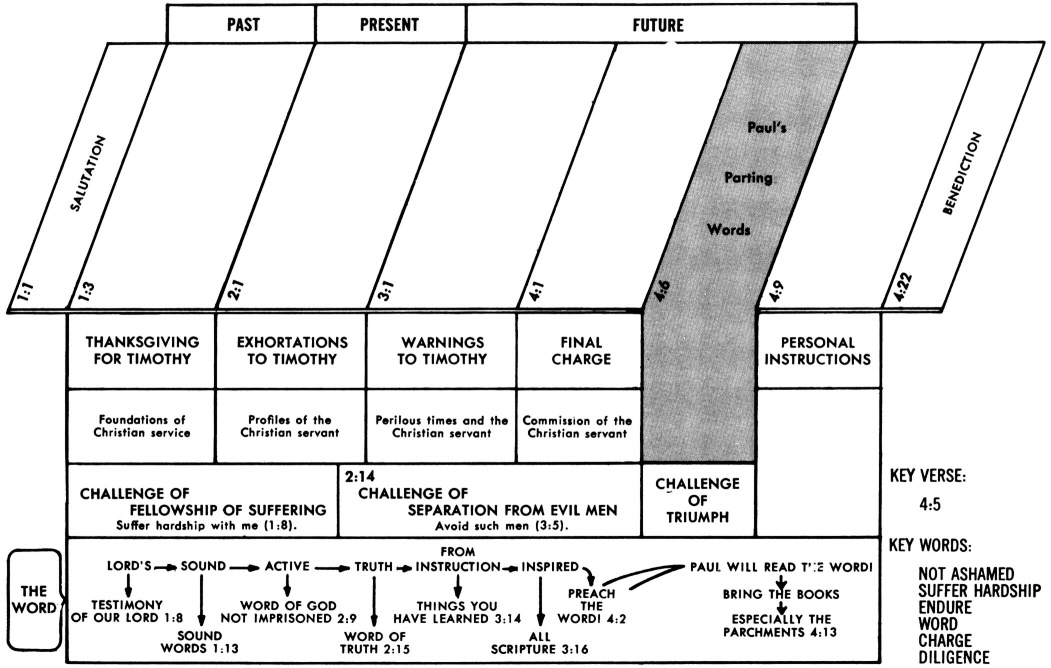
ENDURANCE AND SEPARATION IN THE MINISTRY
Click chart to enlarge
Charts from Jensen's Survey of the NT - used by permission
Second Timothy - Swindoll
| 2 TIMOTHY | |||
| 2 Timothy 1:1-18 | 2 Timothy 2:1-26 | 2 Timothy 3:1-17 | 2 Timothy 4:1-22 |
| Retain the Standard |
Rightly Divide the Word |
Difficult Times Will Come |
Preach the Word |
| PAST | PRESENT | FUTURE | |
| Foundation of Christian Service |
Pictures of Christian Servant |
Dangerous Times for Christian Servant |
Commission of Christian Servant |
| Unashamed as a Witness: Guard the Gospel |
Unashamed as a Workman: Suffer for the Gospel |
Adequate as a Workman: Continue in the Gospel |
Awarded as a Workman: Preach the Gospel |
| Power of the Gospel |
Perseverance of the Gospel Message | Protection of the Gospel |
Proclamation of the Gospel |
| Reminder | Requirements | Resistance | Requests |
| Encouragement in Ministry |
Examples in Ministry |
Exhortations in Ministry |
Exhortations to Fulfill Ministry |
| Commendation & Charge |
Commission to Fulfill |
Conflict to Face |
Course to Finish |
|
Compiled from Jensen's Survey of the NT and Wilkinson's Talk Thru the Bible |
|||
2 Timothy 1:13 Retain (2SPAM) the standard of sound (PAPMPG) words which you have heard (2SAAI) from me, in the faith and love which are in Christ Jesus. (NASB: Lockman)
Greek: hupotuposin eche (2SPAM) hugiainonton (PAPMPG) logon on par' emou ekousas (2SAAI) en pistei kai agape te en Christo Iesou; .
BBE: Keep the form of those true words which you had from me, in faith and love which is in Christ Jesus.
GWT: With faith and love for Christ Jesus, consider what you heard me say to be the pattern of accurate teachings. (GWT)
ICB: Follow the true teachings you heard from me. Follow them as an example of the faith and love we have in Christ Jesus. (ICB: Nelson)
KJV: Hold fast the form of sound words, which thou hast heard of me, in faith and love which is in Christ Jesus.
NLT: Hold on to the pattern of right teaching you learned from me. And remember to live in the faith and love that you have in Christ Jesus (NLT - Tyndale House)
Phillips: So keep my words in your mind as the pattern of sound teaching, given to you in the faith and love of Jesus Christ. (Phillips: Touchstone)
Wuest: Be holding fast the pattern of sound words which [words] from me personally you heard, in faith and love which is in Christ Jesus.
Young's Literal: The pattern hold thou of sound words, which from me thou didst hear, in faith and love that is in Christ Jesus;
RETAIN THE STANDARD: eche (2SPAM) Hupotuposin:
- 2Ti 3:14; Pr 3:18,21; 4:4 5 6 7 8,13; 23:23; Php 1:27; 1Th 5:21; Titus 1:9; Heb 3:6; 4:14; 10:23; Jude 1:3; Rev 2:25; 3:3,11
- 2 Timothy 1 Resources - Multiple Sermons and Commentaries
Follow the true teachings you heard from me (ICB)
Be holding [the] pattern (ALT)
hold on to the pattern (NLT)
Have an outline of sound words (Darby)
Keep the form of those true words (BBE)
Retain (2192) (echo) means to hold, hold fast, keep in one's possession. Hold in one's charge for safekeeping.
Paul is saying "Timothy don't lose your grip on the standard." Paul is urging Timothy not just to “grab onto” truth once, but to keep holding it tightly no matter what pressures come. The implication is that there is danger of letting go due to fear (persecution, false teachers, cultural pressure).
Spurgeon adds that "This is the main burden of the apostle's pleading with Timothy, "Hold fast." We have equal need of the same exhortation, for this is an evil day, and thousands hold everything or nothing as the winds of opinion may change."
Paul uses the present imperative indicating that this is a command of vital importance for Timothy calling for habitual action (present tense) on Timothy's part -- continually hold the "outline" (see "standard" below) taught by Paul (see our need to depend on the Holy Spirit to obey). The battle for truth is a "mind game". Our memory retains those truths that have been suggested to our mind. It can be very tempting to let go of what we once learned to take hold of a seemingly "new", "more exciting", more "palatable" truth but Paul warned Timothy in (2Ti 4:2,4+) and forewarned is forearmed.
Hold the sound words fast
and their "disinfectant" qualities will hold you fast!
Solomon the wisest man in the OT reminds us about "new, exciting" truths declaring that
There is nothing new under the sun (Eccl 1:9+)
So often today's "new truth" turns out to be yesterday's heresy, simply redressed.
One of the best ways for saints today to hold fast God's word is to hide it in our hearts, memorizing (See Memorizing His Word) and meditating (See Meditating on His Word) upon it (Ps 119:9, 10, 11+).
When was the last time you memorized
a passage of Scripture?
Don't put off laboring and striving in this vital spiritual discipline (1Ti 4:7, 8+ 1Ti 4:9,10+), because your spiritual life and health depend on it. And don't say you're too old or it's too late to do this now. You are never too old and it's never too late.
Adhere to the standard in opposition to all heresies and false doctrine, which weaken and corrupt the Christian faith as shown in corrupt, ungodly behavior.
In his first epistle Paul had similarly exhorted Timothy to
remain on at Ephesus, in order that you may instruct (paraggello does not mean to teach, but to command and thus demands obedience from an inferior to an order from a superior) certain men not to teach strange doctrines (heterodidaskaleo = heteros = another of a different kind, doctrine which poses as true Christian doctrine, but which is diametrically opposed to the true teachings of Christianity + didaskalos = teacher)" (1Ti 1:3+)
Steven Cole explains that "While the gospel is contained in the written Word, the Bible, at the same time it is preserved and communicated in and through the lives of God’s people. Many people never read the Bible, but they read your life. You are to personify the good news of Jesus Christ in what you believe and how you live. While in 2Ti 1:12 the emphasis is on whom you believe, in 2Ti 1:13 14 the emphasis is on what you believe. Satan is relentless in attacking the truth of the gospel, because “it is the power of God for salvation to everyone who believes” (Ro 1:16+). (Banking with God)
Standard (5296) (hupotuposis from hupotupóo = to draw a sketch or first draft as painters when they begin a picture -- from hupo = under, beneath + tuppos = type, impression, figure, pattern) is literally an "undertype" and means a model for imitation, an outline, a sketch or model used by an artist. In literature it described the rough draft forming the basis of a fuller exposition. A model of behavior to be imitated or avoided. A standard or norm of teaching. In classical Greek usage, it was used in rhetoric and art to mean:A rough outline (before the full detail). A model/example to copy. A sketch of character or moral quality. Usage in Koine and Patristic Literature -- Medical writers: “outline of the body.” Philosophical works: a “rough sketch” of an argument. Church Fathers: used of patterns of life and doctrine handed down for imitation. E.g., Clement of Rome used it for models of faith to emulate. Chrysostom, commenting on 2 Tim 1:13, stresses it as a “rule or canon” of sound words.
Illustrations - Architectural metaphor: Like a “blueprint” or “sketch” that guides a builder in constructing something lasting. Artistic metaphor: A rough sketch that precedes a painting, ensuring the final work remains faithful to the intended design. Spiritual metaphor: Paul = a living sketch of mercy. Timothy = guardian of the sketch of truth.
Applications - For teachers: Guard the “outline” of sound teaching; don’t add, subtract, or distort. For believers: Recognize that Paul’s conversion is a “sketch” of God’s mercy in your own story—no one is beyond grace. For discipleship: Both life and doctrine serve as hypotyposes (models). What you live out and what you teach form an outline for others to follow.
Hupotuposis is emphatic (positioned first in the Greek sentence for emphasis). Paul wants to emphasize the vital importance of "the standard". Our English word prototype conveys the same picture, for a prototype is an original model on which something is patterned or a first full-scale and usually functional form of a new type or design of a construction. The "gospel" is the prototype upon which which all preaching and teaching should be founded.
Larry Richards has an insightful note regarding personal application writing that...
In NT times, hypotyposis was used of a floor plan to guide a builder or of a first draft of written material used to guide fuller development. Paul's point is that life is to be founded on Scripture's revelation of reality. But each person and culture must move on to construction, not violating the principles laid down, but constantly seeking to flesh out the divine vision. (Borrow Expository Dictionary of Bible Words) (Bolding added)
Paul used this same word in his first epistle writing that
I was shown mercy so that in me, the worst of sinners, Christ Jesus might display his unlimited patience as an example for those who would believe on him and receive eternal life. (NIV) (1Ti 1:19+).
Hupotuposis referred to the outline or model used by an artist. So just as the artist has a model or an initial sketch before them, so Timothy is to keep before him the outline which he has heard from Paul and never depart from it. The idea is analogous to the writer's "rough draft" which forms the basis of a fuller exposition of a writing. This picturesque word thus speaks of a pattern by which one can maintain the sameness of a thing and without which the original work (in this case the gospel) would be corrupted or distorted over time.
Paul had earlier conveyed to Timothy an outline of doctrinal beliefs that were important. He now wanted Timothy to use them as a model in his own ministry. There was a definite outline of doctrine in the early church, a standard by which teaching was tested. If Timothy changed this outline or abandoned it, then he would have nothing by which to test other teachers and preachers. It would be similar to the builder of a house discarding his "plumb line" and just "eye balling" the frame of the house to see if the corners were "close enough" to perpendicular. On the other hand, a wall built with a plumb line is a perpendicular wall with mechanical correctness and solidity, a wall built to last. Paul then in so many words told Timothy, to retain the "plumb line" which you can "entrust to faithful men who will be able to teach others" (2Ti 2:2+) thereby building up strong, solid saints. As we approach closer to the end of this present age and the glorious return of our Lord, saints need to hold fast to the life giving gospel of Christ Jesus (2Ti 1:1+; 2Ti 1:10+).
Paul uses the root word tupos (model, pattern or mold) writing to the Roman saints who had become
obedient from the heart to that form (tupos) of teaching to which you were committed (delivered or entrusted). (Ro 6:17+)
Hiebert makes an interesting practical application of the "outline" Timothy was to retain stating that "the validity of a minister's message lies in its adherence to the great verities of the Christian revelation." He goes on to quote Lipscomb "None can be too careful in stating the truths of the Scriptures in the language of the inspired writers. When men cannot convey their thoughts in the words of the Scriptures, it is generally because they do not hold sound doctrine." You might re-read that last sentence, especially if you are a preacher or teacher of God's Word.
MacDonald gives us an excellent illustration of what it means for us today to retain the standard: It is not just that he is to be loyal to the truth of God’s word, but that he is to cling to the very expressions by which this truth is conveyed. Perhaps an illustration of this might help. In our day, it is sometimes suggested that we should abandon such old-fashioned expressions as “being born again” or “the blood of Jesus.” People want to use more sophisticated language. But there is a subtle danger here. In abandoning the scriptural mode of expression, they often abandon the very truths which are communicated by these expressions. (Borrow Believer's Bible Commentary)
The only other Scriptural use of hupotuposis is in Paul's first epistle to Timothy where he wrote...
It is a trustworthy statement, deserving full acceptance, that Christ Jesus came into the world to save sinners, among whom I am foremost of all. 16 And yet for this reason (term of conclusion - When you see this phrase always and stop and ask what is the conclusion? Or "for what reason?") I found mercy, in order that in me as the foremost, Jesus Christ might demonstrate His perfect patience, as an example for those who would believe in Him for eternal life. (1Ti 1:15 16+)
Thayer explains the use of hupotuposis in first Timothy writing that it was "for an example of those who should hereafter believe, i.e., to show by the example of my conversion that the same grace which I had obtained would not be wanting also to those who should hereafter believe.
William Barclay adds that "Paul uses a vivid picture. He says that what happened to him was a kind of outline-sketch of what was going to happen to those who would accept Christ in the days to come. The word he uses is hupotuposis which means an outline, a sketch-plan, a first draft, a preliminary model. It is as if Paul were saying, “Look what Christ has done for me! If someone like me can be saved, there is hope for everyone.” Suppose a man was seriously ill and had to go through a dangerous operation, it would be the greatest encouragement to him if he met and talked with someone who had undergone the same operation and had emerged completely cured. Paul did not shrinkingly conceal his record; he blazoned it abroad, that others might take courage and be filled with hope that the grace which had changed him could change them too. (The Daily Study Bible)
John MacArthur commenting on this passage in first Timothy writes that
It was for this reason (the fact that Paul had been one of the worst sinners) that Paul found mercy. God didn’t save him merely to get him out of hell or into heaven. Nor did He save him to preach the gospel or write the epistles; God could have had others do that. The purpose of salvation, whether Paul’s or ours, is to display God’s grace, power, and patience and produce a true worshiper of God (John 4:21 22 23 24). It is for His glory primarily, our benefit is secondary. It was through saving Paul that Jesus Christ could most clearly demonstrate His perfect patience. Makrothumia (patience) means to be patient with people. Paul’s point is that if the Lord was patient with the worst of sinners, no one is beyond the reach of His grace. As an example for those who would believe in Him for eternal life, Paul was living proof that God can save any sinner. He was the hupotuposis, the model, type, or pattern. Those who fear that God cannot save them would do well to consider the case of Paul. (See 1 Timothy Commentary - Page 33) (Bolding added)
OF SOUND WORDS: hugiainonton (PAPMPG) logon:
- 1Ti 1:10, 6:3, 2Ti 4:3, 4:4 Titus 1:9
- 2 Timothy 1 Resources - Multiple Sermons and Commentaries
of the wholesome wordes (Geneva)
right teaching (NLT)
A BLUEPRINT FOR
HEALTHY TEACHING
Sound (5198) (hugiaino gives us our English word hygiene which refers to "clean or healthy practices" which promote good health!) (Click word study on hugiaino)
Hugiano means healthy, sound, wholesome, free from flaw, defect or error and emphasizes the absence of disease, weakness, or malfunction.
Hugiano is translated as "good (physical) health" in (3Jn 1:2, cf Lk 5:31) and in the present context refers to words which produce good spiritual health. False "ear tickling" teaching (2Ti 4:3,4+) by contrast leads to spiritual sickness at best and eternal death at worst!
"Unhealthy" teaching composed of unsound words will manifest itself in ungodly behavior, because what (healthy or unhealthy doctrine) one is taught and what one believes affects how one behaves. Truth and falsehood will always be discerned by the fruit they produce (Mt 7:15; 16+). God’s truth produces godliness (Titus 1:1+). The transformation wrought by the intake of sound words is visibly manifest by holy conduct.
Paul did not tell Timothy he need to hold forth with a good "sound" but to hold fast to sound words! We are not called to please the masses but to afflict the comfortable and comfort the afflicted with God's sound words. Any message that does not conform to Paul's words (and the rest of the Scripture), no matter how good the teacher might sound or how large their following is to be assiduously avoided!
Barnes describes sound words as "words conducing to a healthful state of the church; that is, doctrines tending to produce order and a due observance of the proprieties of life; doctrines leading to contentment, and sober industry, and the patient endurance of evils.
Henry translates sound words as healing words noting that "there is healing virtue in the Word of God."
The Psalmist records that in answer to Israel's cry of distress, God "sent His Word and healed them." (Ps 107:19, 20)
Spurgeon commenting on Psalm 107:20 writes that..
Man is not healed by medicine alone, but by the word which proceedeth out of the mouth of God is man restored from going down to the grave. A word will do it, a word has done it thousands of times... The word of the Lord has a great delivering power; he has but to speak and the armies of death flee in an instant. Sin sick souls should remember the power of the Word, and be much in hearing it and meditating upon it.
Christ the Word is the essential cure. He heals the guilt, habit, depression, and evil results of sin. For every form of malady Christ has healing; hence preachers should preach him much, and all meditate much upon him. The word in the Book is the instrumental cure: its teachings, doctrines, precepts, promises, encouragements, invitations, examples. The word of the Lord by the Holy Spirit is the applying cure. He leads us to believe. He is to be sought by the sick soul. He is to be relied upon by those who would bring others to the Great Physician.
Paul says hold tight to words that are pure and uncorrupted because sound words ("healthy doctrine") produce "holistic health" manifest by wholly holy lives.
Bible doctrine should always breed
spiritual health and vitality wherever it goes.
Dead orthodoxy brings no honor to the Living God. Paul is reminding Timothy that in sound words (here tantamount to the gospel), we have God’s true standard which is the only divinely inspired, divinely revealed, absolute, unique, perfect, and sufficient truth which provides everything necessary for salvation (justification or past tense salvation) and for living out the saved life (sanctification or present tense salvation - see Three Tenses of Salvation).
Adam Clarke has sage advice on sound words: No man was left to invent a religion for his own use, and after his own mind. God alone knows that with which God can be pleased. If God did not give a revelation of himself, the inventions of man, in religious things, would be endless error, involving itself in contortions of unlimited confusion. God gives, in his mercy to man, a form of sound words or doctrines; a perfect plan and sketch of the original building; fair and well defined outlines of every thing which concerns the present and eternal welfare of man, and his own glory. "
Spurgeon alludes to sound words in his famous statement that "It is blessed, to eat into the very soul of the Bible until, at last, you come to talk in Scriptural language, and your spirit is flavored with the words of the Lord, so that your blood is Bibline and the very essence of the Bible flows from you.
Dr M R De Haan founder of Radio Bible Class warned "Be on guard against any tampering with the Word, whether disguised as a search for truth, or a scholarly attempt at apparently hidden meanings; and beware of the confusion created by the senseless rash of new versions, translations, editions, and improvements upon the tried and tested Bible of our fathers and grandfathers.
Paul contrasts “sound words” with the “sickly” speculations, myths, and empty chatter of false teachers (cf. 1 Tim 6:3–4; Titus 1:9). Doctrine is not just true—it is healthy food for the soul. In contrast, distorted teaching weakens spiritual health.
WHICH YOU HAVE HEARD FROM ME: on par emou ekousas (2SAAI):
- 2Ti 2:2, Php 4:9
- 2 Timothy 1 Resources - Multiple Sermons and Commentaries
which words from me personally you have heard (Wuest)
which you have heard from my lips (WNT)
Related Passages:
Philippians 4:9+ The things you have learned and received and heard and seen in me, practice these things, and the God of peace will be with you.
1 Corinthians 11:1+ Be (present imperative see our need to depend on the Holy Spirit to obey) imitators of me, just as I also am of Christ. (See also The Holy Spirit-Walking Like Jesus Walked!)
THE PATTERN OF TRUTH
PREACHED BY PAUL
The things - points back to sound words.
Have heard is aorist tense which in this context indicates a past completed action of a real event (indicative mood). Compare similar phrases "the things which you have heard from me in the presence of many witnesses" (2Ti 2:2+) and "you followed my teaching..." (2Ti 3:10+)
From me - Greek para means beside, with + genitive pronoun = “from me / alongside me.” It emphasizes source and personal transmission. “From me” shows that faith is not just abstract doctrine, but relationally handed down. Paul lived the message before Timothy, and Timothy “heard” it in the context of discipleship. Teaching and discipleship must be life-on-life. Pastors, parents, and mentors don’t just transfer information but model truth that can be heard, seen, and imitated (cf. 2 Tim 3:10–11; Phil 4:9). “From me” also sets apart Paul’s message as the authentic version of the gospel, not the distorted versions swirling around Ephesus (cf. 1 Tim 1:3–4). We are called to discern voices today. Many claim authority, but only what lines up with the apostolic Word carries Christ’s authority. “From me” = “check the source.”
Timothy received this body of teaching directly from Paul—apostolic instruction, rooted in Christ’s authority. Paul presents himself not as the originator but as the faithful transmitter of Christ’s gospel (cf. Gal 1:11–12). By saying “from me,” Paul highlights the personal discipleship chain: Jesus → Paul → Timothy → others (2 Tim 2:2).
“From me” is a reminder that the faith is apostolic in source, personal in transmission, authoritative in content, and meant to be faithfully continued without distortion. For us, it points directly to Scripture as the voice of the apostles and calls us to cling to it, live it out in relationship, and pass it on intact.
Wuest adds "Paul exhorts Timothy to hold fast the pattern of the sound words committed to him. That is, he is to hold to the doctrinal phraseology he received from the great apostle. Particular words are to be retained and used so that the doctrinal statements of the truth may remain accurate and a norm for future teachers and preachers. This is vitally connected with the doctrine of verbal inspiration which holds that the Bible writers wrote down in God-chosen words, the truth given by revelation."
IN THE FAITH AND LOVE WHICH ARE IN CHRIST JESUS: en pistei kai agape te en Christo Iesou:
- 2 Timothy 1 Resources - Multiple Sermons and Commentaries
faith and love which are ours in union with Christ Jesus (TEV)
FAITH AND LOVE
IN CHRIST ALONE
In (en) means "in the sphere of" - see locative of sphere. Locative of sphere (metaphorical): “in the faith and love” = within the realm, atmosphere, or sphere of faith and love. ἐν πίστει καὶ ἀγάπῃ is not spatial (not “inside faith and love” physically) but (figuratively speaking) spherical: Timothy is to “hold fast” while operating within the realm of faith and love. Sphere of Faith: Timothy’s environment of trust in Christ, not his own strength. Sphere of Love: the relational atmosphere that shapes how truth is held and taught (cf Eph 4:15+). Sphere in Christ Jesus: both faith and love have their home in union with Christ. In sum, Paul is saying Timothy must cling to the apostolic “pattern of sound words” within the spiritual realm of faith and love that are found in Christ Jesus.
Christ Jesus is the Source and Fountain
of both faith and love.
-- W E Vine
How was Timothy to cling to the sound words he had heard from Paul? Was it to be a formal, lifeless retention of a rote formula and rigid orthodoxy?
Clearly not and so Paul adds "in the faith and love" which mark the sphere in which the pattern of sound words must be held.
How one maintains orthodoxy is as important as the content of orthodoxy itself. Just as Timothy is called to suffer for the gospel not in his own strength but "according to the power of God" (2Ti 1:8+), so also this faith and love are not inherent qualities but rather supernatural gifts given to those who are “in Christ Jesus”. (See related topics: in Christ and in Christ Jesus)
Timothy’s faith and love were fruit of his union with Jesus Christ. Timothy's faith was energized in the faith found in Christ Jesus and the life that flows from Him. Timothy's love bathed in the love of Christ Jesus was to be intelligent and purposeful, loving the lost even as the Father so loved the world. Note that genuine love in Christ Jesus is zealous for the truth (cf Jn 2:15 16 17) and is not indifferent to the promotion of doctrines which are unhealthy and unholy.
Vincent explains this section: The teaching is to be held, preached, and practiced, not as a mere schedule of conduct, however excellent, but with the strong conviction of faith and the fervor of love.
John MacArthur comments "When we defend God’s Word in a self-righteous, unloving spirit, the resulting controversy and opposition are not caused wholly by the offense of the truth itself but also by the offensive and unspiritual way in which we proclaim it. We are to defend God’s Word in the faith, that is, with the right attitude of confidence toward God; and we are to defend it in love, with the right attitude of kindness and compassion toward unbelievers and toward poorly taught and immature believers. “Speaking the truth in love, we are to grow up in all aspects into Him, who is the head, even Christ” (Ep 4:15+). Although we must not have a doubting or a dead orthodoxy, neither should we have a loveless, cold, and insensitive orthodoxy. (See 2 Timothy Commentary)
Barnes comments that the idea is that Timothy is to "Hold these truths with sincere faith in the Lord Jesus, and with that love which is the best evidence of attachment to Him.
Steven Cole explains that "holding to sound doctrine is not enough. How you hold to sound doctrine matters greatly! First, you must hold to sound doctrine in the faith that is in Christ Jesus. You must truly believe what the Bible teaches, to the degree that it filters down into your everyday life. Jesus said (Luke 6:46), “Why do you call Me, ‘Lord, Lord,’ and do not do what I say?” Genuine faith always results in obedience to Christ. Second, you must hold to sound doctrine in the love that is in Christ Jesus. Biblical love is not syrupy sentiment, but rather a commitment to seek the highest good of the one loved. It is not mere words, but also good deeds (1Jn 3:18). I have known men who hold to sound doctrine, but they do not hold it in genuine love towards others. Rather, they use their knowledge of the truth to prove that they are right and to put down those who are wrong. That is just pride, not love. But, as Paul says (2Ti 2:24+), we must not be quarrelsome, but kind, patient, and gentle towards those who do not know the truth. (Banking with God)
An Atheist’s Point Of View - Three young men who say they are atheists decided to “sample” and report on several churches in their city. One of these men said, “There is something other than teaching that is appealing to people. We didn’t see a lot of doctrine. . . . The appeal was mostly the community. The content in most churches isn’t nearly as important as the packaging.” The three atheists offered this explanation for why thousands of people in their area attend church each Sunday: The attraction stems more from a person’s Christian identity than from what the religion teaches.
Their experience agrees with the observation of author A. W. Tozer, who said, “Increasing numbers of [Christians] are becoming ashamed to be found unequivocally on the side of truth. They say they believe, but their beliefs have been so diluted as to be impossible of clear definition.”
The apostle Paul knew whom he believed, and he instructed Timothy to “hold fast” to the truth he had been taught (2Timothy 1:12 13). We too need to hold tightly to our beliefs based on the unfailing, God-inspired Bible. What we believe about God is more crucial than any feeling we get by being in church. Tozer calls us to stand “firm on the Word of God that lives and abides forever.” —Anne Cetas (Our Daily Bread, Copyright RBC Ministries, Grand Rapids, MI. Reprinted by permission. All rights reserved)
Since by faith I have clear vision,
Your blest Word is rich and new;
Men with eyes by sin distorted
Cannot all its treasures view. —BoschDon’t be a Christian in name only.
2 Timothy 1:14 Guard (2AAM), through the Holy Spirit who dwells (PAPNSG) in us, the treasure which has been entrusted to you. (NASB: Lockman)
Greek: ten kalen paratheken phulaxon (2SAAM) dia pneumatos hagiou tou enoikountos (PAPNSG) en hemin.
Amplified: Guard and keep [with the greatest care] the precious and excellently adapted [Truth] which has been entrusted [to you], by the [help of the] Holy Spirit Who makes His home in us. (Amplified Bible - Lockman)
BBE: That good thing which was given to you keep safe, through the Holy Spirit which is in us.
GWT: With the help of the Holy Spirit who lives in us, protect the Good News that has been entrusted to you.
ICB: Protect the truth that you were given. Protect it with the help of the Holy Spirit who lives in us. (ICB: Nelson)
KJV: That good thing which was committed unto thee keep by the Holy Ghost which dwelleth in us.
MLB: Guard, by the help of the indwelling Holy Spirit within us, that precious deposit that was entrusted to you. (Berkley)
Moffat: Keep the great securities of your faith intact, by aid of the holy Spirit that dwells within us.
NJB: With the help of the Holy Spirit who dwells in us, look after that precious thing given in trust. (NJB)
NLT: With the help of the Holy Spirit who lives within us, carefully guard what has been entrusted to you. (NLT - Tyndale House)
Phillips: Take the greatest care of the good things which were entrusted to you by the Holy Spirit who lives within us. (Phillips: Touchstone)
Weymouth: That precious treasure which is in your charge, guard through the Holy Spirit who has His home in our hearts.
Wuest: That good thing which was committed in trust to you, guard through the Holy Spirit who indwells us.
Young's Literal: the good thing committed guard thou through the Holy Spirit that is dwelling in us;
GUARD: phulaxon (2SAAM):
- 1Ti 6:20 Pr 4:23
- 2 Timothy 1 Resources - Multiple Sermons and Commentaries
Protect that good thing entrusted to you (NET)
carefully guard (NLT)
guard and keep with the greatest care (Amp)
The word order of this verse reads more literally
That good thing, the trust, the deposit which was committed to you, guard
Guard (5442) (phulasso) is same verb Paul used used earlier to describes Jesus' guarding what Paul had entrusted to Him (2Ti 1:12+).
Here Paul uses phulasso in the aorist tense and imperative mood which calls for urgent attention, following through with firm resolution and conviction. The idea is "Do this now and don't delay Timothy".
Timothy is to guard, watch, and defend the truth once for all delivered to the saints in view of the defection from the truth beginning even in the first century.
A T Robertson points out that because "God has also made an investment in Timothy, Timothy must not let that fail." And neither must we. Therefore, every time we listen to a tape, each time we hear a sermon, each time we read a devotional we need to be on guard (albeit not offensive or defensive, arrogant or paranoid) to maintain the integrity of the Word of Truth, our Standard of Holiness (cf Acts 17:12+).
THROUGH THE HOLY SPIRIT WHO DWELLS IN US: dia pneumatos hagiou tou enoikountos (PAPNSG) en hemin:
- Jn 14:17; Ro 8:11; 1Cor 3:16; 6:19; Eph 2:22
- 2 Timothy 1 Resources - Multiple Sermons and Commentaries
With the help of the Holy Spirit who lives within us (NLT)
Who has His home in our hearts (WNT)
through the power of the Holy Spirit (TEV)
guard it with the help of the Holy Spirit Who lives in us (NIV)
by the help of the Holy Spirit Who makes His home in us (Amp)
The Holy Spirit Who dwells in us - Paul reiterates this glorious truth throughout his epistles...
However, you are not in the flesh but in the Spirit, if indeed (There is no doubt about this statement = those who belong to Christ have the Holy Spirit) the Spirit of God dwells in you. But if anyone does not have the Spirit of Christ, he does not belong to Him. (See notes Romans 8:9)
Comment: This verse makes it clear that every believer has the Spirit - we do not need to pray to receive the Spirit. If we do not have the Spirit we are not yet born again and indeed, then we do need to "pray to receive the Spirit"!
Do you (plural - indicates he is referring to the local church at Corinth viewed as a temple of God - see following verse) not know that you are a temple (Not the Greek word hieron = the entire temple complex, but naos = the Holy of holies!) of God, and that the Spirit of God dwells in you? (1Cor 3:16)
Comment: Note this verse although referring to the church still can be applied to each individual especially in view of the context of this passage which is the Judgment Seat of Christ [bema] - Paul's point is that we need to be very careful what we do with our bodies for we shall one day soon appear before our Lord.
Or do you not know that your body is a temple of the Holy Spirit who is in you, whom you have from God, and that you are not your own? (1Co 6:19+)
Comment: In America which is inebriated by the sensuality of sex this verse needs to be emblazoned on bill boards and the hearts of believing men, lest we be tempted to bite at this "omnipresent" lascivious lure, cp Jas 1:14 15+ Jas 1:16+.
Do not be deceived, my beloved brethren. Ryrie makes the excellent point that our body as a holy temple is "A sharp contrast to the temple of Aphrodite in Corinth where the priestesses were prostitutes." - The Ryrie Study Bible)
in Whom (Christ Jesus) the whole building, being fitted together is growing into a holy temple in the Lord in Whom you also are being built together into a dwelling of God in the Spirit. (Ep 2:21, 22-notes Ep 2:21; 22)
Dwells (1774) (enoikeo from en = in + oikéo = dwell) literally means to dwell in and so to take up residence, make one's home in or among and the present tense signifies a continual indwelling. The Spirit of God makes his home in us, not in temples made with hands (Acts 7:48).
Paul reminded the Corinthians "Do you not know that you are a temple of God, and that the Spirit of God dwells in you?" (1Cor 3:16, 6:19, 2Cor 6:16) Even those who are well taught cannot keep spiritual truth they have learned, any more than they could at first learn it, without the assistance of the Holy Spirit, which parallels Jesus' warning that "apart from Me you can do nothing." (Jn 15:5).
We must not think we can protect this spiritual truth by our own strength, but must abide in Christ, let His Word richly dwell in us, be filled with His Spirit, humbly maintaining a sense of determined dependence upon our Helper, the Holy Spirit. So in this verse we see man's responsibility (guard) and God's sovereignty (through the Holy Spirit) working together to bring about the intended result. The ministry of the Holy Spirit will enable Timothy and all believers to be a good custodian of the Gospel.
Jamieson writes that "The indwelling Spirit enables us to keep from the robbers of the soul the deposit of His word committed to us by God."
By way of contrast Boise adds that "then as now men who were wise in their own conceit, who trusted more to their own strength than to the guidance of the Holy Spirit, were preaching doctrines far removed from the teachings of Christ and His apostles."
Steven Cole writes that...
The Holy Spirit is the divine interpreter of sound doctrine. Jesus promised the apostles (John 14:26+) that “the Holy Spirit, whom the Father will send in My name, He will teach you all things….” John later wrote to a church that was wracked with confusion because of false teachers (1 John 2:27+)
As for you, the anointing which you received from Him abides in you, and you have no need for anyone to teach you; but as His anointing teaches you about all things, and is true and is not a lie, and just as it has taught you, you abide in Him.
John was not dispensing with the need for human teachers, in that he himself was at that moment teaching them! Rather, he was writing against the Gnostic false teachers, who claimed that you had to go through them to understand the secret truths about God. John was affirming the ability of believers, indwelled by the Spirit, to interpret the Word of God. As we depend on the Holy Spirit and diligently study the Scriptures, He will enable us to guard the treasure of the gospel that is always under attack.
The Holy Spirit is the divine enabler for a godly life. As we saw, we guard the deposit of the gospel by living in the faith and love that are in Christ Jesus. If we walk in daily dependence on the Holy Spirit, we will not carry out the deeds of the flesh (Gal. 5:16-21+), but will instead produce the fruit of the Spirit (Gal 5:22, 23+): “love, joy, peace, patience, kindness, goodness, faithfulness, gentleness, self-control….” Walking in dependence on the Holy Spirit enables our lives to back up the gospel, so that we will guard that good deposit that God has entrusted to us.
In one of his books, Watchman Nee points out that a person will walk differently when he has a treasure in his pocket. If you’re walking down the street and only have a quarter in your pocket, you aren’t very concerned about losing it. But if you’re given $10,000 and told to guard it in your pocket as you go from one place to another, you’ll walk a bit differently than if you only have a quarter. You’ll be careful not to go to certain places, where you could get mugged. There are certain things that you just won’t do, for fear of losing that treasure.
If you have deposited your life with Jesus Christ, then He has deposited the precious treasure of the gospel with you. He asks you to guard it by holding to sound doctrine and by godly living. To be apathetic about growing in sound doctrine or to be careless about how you live as a believer is not to guard the treasure. Walk carefully! Invest your life wisely, which means, invest wisely how you spend each day. To invest your life successfully, deposit it with Christ and guard His deposit with you. (Banking with God)
THE TREASURE (the good deposit) WHICH HAS BEEN ENTRUSTED TO YOU: ten kalen paratheken :
- 2 Timothy 1 Resources - Multiple Sermons and Commentaries
Treasure which has been entrusted - This phrase is actually two Greek words - kalos (good) + paratheke (deposit)
Good (2570)(kalos) means inherently excellent or intrinsically good and providing some special or superior benefit, an excellent description of the gospel.
Treasure (3866) (paratheke from paratithemi = place alongside, then to entrust) (Click discussion of paratheke) refers to something entrusted to another for faithful keeping or deposited for protection.
Other translations preserve the two separate words (kalos + paratheke) more clearly than the NASB...
the good thing entrusted (literal)
the good thing committed (YLT)
That precious treasure which is in your charge (WNT),
the good deposit that was entrusted (NIV)
“That good thing which was committed to you” (NKJV)
the good treasure entrusted (NRSV)
the precious entrusted deposit (Berkley)
Paratheke was a secular legal term describing something placed on trust in another's keeping.
C Maurer in the one volume abridged TDNT writes that the secular use of paratheke had the
technical meaning “to deposit,” “to entrust,” in the legal sense of leaving an object in another’s keeping, with strict penalties for embezzlement. A transferred sense develops out of the technical use. (Borrow Kittel's Theological Dictionary of the New Testament : abridged in one volume )
The treasure...entrusted - In context this phrase refers to the standard of sound words, the Christian doctrine and specifically the Gospel. Here the reference is to the deposit God makes with Timothy for which he will one day give an account of his stewardship. The deposit of our lives with God is secure. The question is, how secure is His deposit of truth with us?
Keener adds that paratheke
"was originally a monetary image, although other writers had also applied it to teaching; one was responsible to safeguard or multiply any money given one for safekeeping. Jewish teachers felt that they were passing on a sacred deposit to their disciples, who were expected to pass it on to others in turn." (cf note 2 Timothy 2:2) (See The IVP Bible Background Commentary: New Testament - Page 618)
Paratheke was used two other times, both by Paul, one in this same chapter (see note 2 Timothy 1:12) and the other in the first epistle to Timothy, where Paul uses paratheke in his closing charge...
O Timothy, guard (aorist imperative - command to carry this out effectively and immediately. Can convey a sense of urgency.) what has been entrusted to you, avoiding (present tense = continually doing so because the pressure to compromise the standard of the pure Gospel will be continually present) worldly and empty chatter and the opposing arguments of what is falsely called "knowledge"--which some have professed and thus gone astray from the faith. Grace be with you.
O Timothy, guard what has been entrusted (paratheke - the deposit, the thing consigned to his faithful keeping) to you, avoiding worldly and empty chatter and the opposing arguments of what is falsely called "knowledge " (1Ti 6:20)
W E Vine writes that the gospel..
is viewed as a treasure sedulously (constant, persistent attention and implies painstaking and persevering application) to be kept free from the admixture of error, and without loss through neglect of any detail, and that not only for the spiritual welfare of the teacher himself but for those to whom he ministers. The danger of compromise with those who ignore, or fail to teach, certain truths of the faith is ever to be avoided. (Vine, W. Collected writings of W. E. Vine. Nashville: Thomas Nelson)
The Jewish people had been "entrusted with the oracles of God" (see note Romans 3:2). Paul "had been entrusted with the gospel to the uncircumcised" (Gal 2:7, 1Ti 1:11), which he referred to as "a stewardship entrusted" (1Cor 9:17). Now he was passing the "precious baton" to Timothy.
Matthew Henry - The Christian doctrine is a trust committed to us....It is committed to us to be preserved pure and entire, and to be transmitted to those who shall come after us, and we must keep it, and not contribute any thing to the corrupting of its purity, the weakening of its power, or the diminishing of its perfection
Barclay writes that in this verse...
Paul urges Timothy to safeguard and keep inviolate the trust God has reposed in him. Not only do we put our trust in God; he also puts his trust in us. The idea of God’s dependence on men is never far from New Testament thought. When God wants something done, he has to find a man to do it. If he wants a child taught, a message brought, a sermon preached, a wanderer found, a sorrowing one comforted, a sick one healed, he has to find some instrument to do his work. (Ibid)
God has made an "investment" in you. Are you protecting and preserving (in His power) His deposit of the gospel so that you might be able to reliably transmit it to other faithful men and women? (see note 2 Timothy 2:2)
Gill elaborates on the idea of the "treasure...entrusted" adding that "it is a treasure...a rich one, it contains the riches of grace, even the unsearchable riches of Christ, is more valuable than thousands of gold and silver". In regard to a good deposit Gill adds that "that it is a trust, and requires faithfulness in ministers, who are the stewards of it; and that it is to be accounted for. Wherefore great care should be had in dispensing and keeping it:"
John MacArthur sums up this section with some thoughts on application...
Christian colleges, seminaries, pastors, and other church leaders who deviate from Scripture, defecting to “a different gospel” and wanting “to distort the gospel of Christ” (Ga1:6-7), will face a dreadful day of reckoning before God.
When a church or any other Christian organization becomes liberal, not surprisingly this "drift" usually begins with a weakening of the convictions of the leadership regarding the inerrancy and sufficiency of the Word of God.
Do not be deceived beloved brethren.
Hold fast to the Truth.