2 Timothy 1:2
2 Timothy 1:3
2 Timothy 1:4
2 Timothy 1:5
2 Timothy 1:6
2 Timothy 1:7
2 Timothy 1:8
2 Timothy 1:9
2 Timothy 1:10
2 Timothy 1:11
2 Timothy 1:12
2 Timothy 1:13
2 Timothy 1:14
2 Timothy 1:15
2 Timothy 1:16
2 Timothy 1:17
2 Timothy 1:18
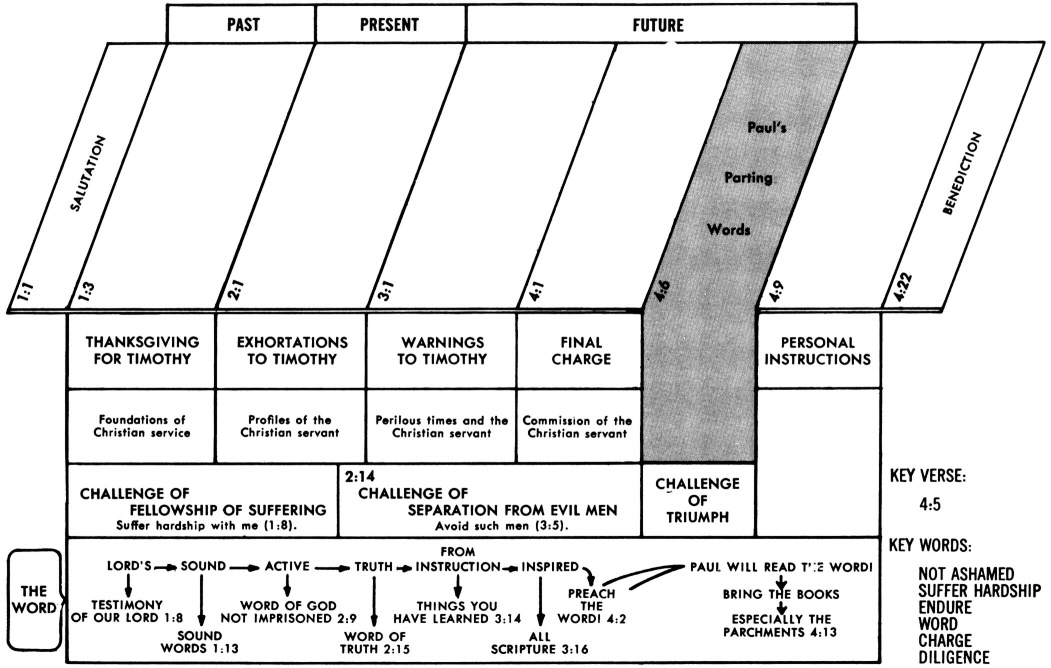
ENDURANCE AND SEPARATION IN THE MINISTRY
Click chart to enlarge
Charts from Jensen's Survey of the NT - used by permission
Second Timothy - Swindoll
| 2 TIMOTHY | |||
| 2 Timothy 1:1-18 | 2 Timothy 2:1-26 | 2 Timothy 3:1-17 | 2 Timothy 4:1-22 |
| Retain the Standard |
Rightly Divide the Word |
Difficult Times Will Come |
Preach the Word |
| PAST | PRESENT | FUTURE | |
| Foundation of Christian Service |
Pictures of Christian Servant |
Dangerous Times for Christian Servant |
Commission of Christian Servant |
| Unashamed as a Witness: Guard the Gospel |
Unashamed as a Workman: Suffer for the Gospel |
Adequate as a Workman: Continue in the Gospel |
Awarded as a Workman: Preach the Gospel |
| Power of the Gospel |
Perseverance of the Gospel Message | Protection of the Gospel |
Proclamation of the Gospel |
| Reminder | Requirements | Resistance | Requests |
| Encouragement in Ministry |
Examples in Ministry |
Exhortations in Ministry |
Exhortations to Fulfill Ministry |
| Commendation & Charge |
Commission to Fulfill |
Conflict to Face |
Course to Finish |
|
Compiled from Jensen's Survey of the NT and Wilkinson's Talk Thru the Bible |
|||
2 Timothy 1:15 You are aware (2SRAI) of the fact that all who are in Asia turned away from me, among whom are Phygelus and Hermogenes (NASB: Lockman)
Greek: Oidas (2SRAI) touto, hoti apestraphesan (3PAPI) me pantes oi en te Asia, on estin (3SPAI) Phugelos kai Hermogenes
Amplified: You are aware of the fact that all who are in Asia turned away from me, among whom are Phygelus and Hermogenes. (Amplified Bible - Lockman)
KJV: This thou knowest, that all they which are in Asia be turned away from me; of whom are Phygellus and Hermogenes.
NLT: As you know, all the Christians who came here from the province of Asia have deserted me; even Phygelus and Hermogenes are gone. (New Living Translation - Tyndale House)
Phillips: You will know, I expect, that all those who were in Asia have turned against me, Phygelus and Hermogenes among them. (New Testament in Modern English)
Wuest: You know this, that there turned away from me all those in Asia, of whom there are Phygellus and Hermogenes. (Eerdmans Publishing - used by permission)
Young's Literal: thou hast known this, that they did turn from me -- all those in Asia, of whom are Phygelus and Hermogenes;
- that: Ac 16:6 19:10,27,31 20:16 1Co 16:19
- turned away: 2Ti 4:10,16 Php 2:21
- Torrey's Topic Apostates
- 2 Timothy 1 Resources - Multiple sermons and commentaries
EXAMPLES OF
THOSE WHO FAILED
You are aware of the fact that all who are in Asia turned away from me, among whom are Phygelus and Hermogenes - You are aware (1492) (oida) speaks of absolute, positive, beyond a doubt knowledge and the perfect tense indicates that Timothy had somehow become aware of this forsaking of Paul and was in a settled state of understanding. Having dealt with Timothy's responsibility to "kindle afresh the gift of God" and not to shrink back from or be ashamed of fulfilling his God-given role of retaining the standard and guarding the treasure, Paul now reinforces these exhortations with the vivid contrast between an unfaithful (ashamed) soldier & a faithful (unashamed) soldier. Paul reminds Timothy of these men with whom he was familiar that he might keep their negative example clearly in mind, as a constant "negative incentive" not to act like them.
All (pas) means "everyone" but here is used as hyperbole or sweeping generalization because Timothy for one had not deserted Paul, nor had Onesiphorus (from Asia) as shown in the following verses and neither had Tychicus (2Ti 4:12). And yet this still has to be one of the saddest verses in the NT. Turned away is aorist tense, indicating a past completed action and pointing to a particular circumstance or incident.
Hiebert notes that "The presentation of personal examples is often an important stimulus for the diligent fulfillment of personal duty. Paul appeals to the power of human example, both negative ("the Asiatics") and positive (Onesiphorus), as an incentive to Timothy to fidelity."
Asia (cf "all who lived in Asia" Acts 19:10, 19:27 19:31 Acts 16:6; 20:16; 1Co 16:19) is not the continent of Asia but in the context of the NT times refers to the Roman province of western Asia Minor (modern day Turkey) of which Ephesus was the most prominent city (cf. 1Ti 1:3).
Vincent has a more detailed explanation of "Asia" writing that "Proconsular Asia (proconsul = governor or military commander of a Roman province), known as Asia Propria or simply Asia. It was the Roman province formed out of the kingdom of Pergamus, which was bequeathed to the Romans by Attalus III (b.c. 130), including the Greek cities on the western coast of Asia, and the adjacent islands with Rhodes. It included Mysia, Lydia, Caria, and Phrygia. The division Asia Major and Asia Minor was not adopted until the fourth century a.d. Asia Minor (Anatolia = Turkey) was bounded by the Euxine (Black Sea), Aegean, and Mediterranean on the north, west, and south; and on the east by the mountains on the west of the upper course of the Euphrates."
Turned away (654) (apostrepho [word study] from apo = away from, a marker of dissociation, implying a rupture from a former association and indicates separation, departure, cessation, reversal + strepho = turn quite around, twist, reverse, turn oneself about) means literally to turn back or away Apostrepho is used also in 2Ti 4:4 (note) describing those who "will turn away their ears from the truth" (cp similar idea - 2Ti 4:10, 16, Php 2:21 - see notes on 2Ti 4:10; 4:16, Php 2:21) The picture is to turn away from someone or something by rejecting (turn away by not accepting, receiving, or considering) or repudiating. (refusing to have anything to do with and implies a casting off or disowning as untrue or unworthy of acceptance). It reflects an abandoning of a former relationship or association. Paul uses this same verb (apostrepho) to describe "men who turn away from the truth" (Titus 1:14).
Apostrepho - 9x in 9v - Matt 5:42; 26:52; Luke 23:14; Acts 3:26; Rom 11:26; 2 Tim 1:15; 4:4; Titus 1:14; Heb 12:25. NAS = incites...to rebellion(1), put...back(1), remove(1), turn away(4), turned away (1), turning (1).
Although apostrepho can refer to "doctrinal defection" (Titus 1:14), the present context does not necessarily indicate that has occurred. But it does indicate that "all who are in Asia" deserted Paul ("turned away from me" not necessarily "from the faith") in his hour of great need. When they should have shown him friendship, they essentially ignored him disowning any association with him. By what or whom were they caused to desert Paul? Fear of man or of Rome (especially fear of guilt by association)? Maybe both.
"The fear of man brings a snare (can describe bait or lure that entraps), but he who trusts in the LORD will be exalted. (as was Onesiphorus who did not fear man)" (Pr 29:25)
One named Demas left because he "loved this present world" (if we love His appearing we will have a difficult time loving the world - 2Ti 4:8 ) more than the eternal glorious world to come (2Ti 4:10) Have you ever been forsaken by anyone in your hour of greatest need? I have been forsaken by one who I would pray with, both of us on our faces on the floor and yet when the time came for him to stand by me, he turned away. It devastated me and almost led to my withdrawal from active service to my Lord. If this has happened to you, dearly beloved, then you too can commiserate and empathize with the great grief and pain Paul must have felt in the dungeon when he received this word about those in Asia. "Super saints" have emotions too and are not immune to their circumstances, and this includes your pastor. Are you bearing one another's burdens? Are you praying for him? Are you an Aaron or a Hur who bore up Moses arms while Joshua fought the Amalekites?
When Jesus declared "the difficult" truth about salvation in John 6, the apostle records the sad result that "...many of His disciples (clearly not regenerate disciples) withdrew and were not walking with Him anymore." (John 6:66) It is also interesting to note the similarity of the end of Paul's life and the last hours of Christ's life (cf Mt 26:56).
Peter fled and even denied Christ but after he had turned back strengthened his brethren (Lk 22:31, 32) writing that Christ's disciples are called "to follow in His steps" (1Pe2:21)
The question for each of us as His disciple who are called to suffer hardship (evil) with Him is this:
How far down the rugged road of discipleship are we willing to follow Christ? Until we are willing to die for Him, we cannot really say that we are willing to live for Him.
Guy King on Phygelus and Hermogenes says that these two "couldn’t help their ugly names, but they could have helped their ugly character.”
These two are named specifically and must have represented a special disappointment to Paul. The fact that they are named specifically and without other distinguishing information suggest that they were also well known by Timothy.
What a contrast - selfish motives of these men versus the selfless motives of Onesiphorus. Two unwilling to die to self. One giving no thought to self. It is interesting that Onesiphorus' name means "help bringer", "bringing advantage", "profit bearer" or "profit bringing"! He was certainly a "profitable" friend to Paul, living up up to his name. His godly actions proved "profitable for all things," holding "promise for the present life ("mercy to the house of Onesiphorus") & also for the life to come. ("on that day" v18)" (1Ti 4:8)
MacArthur adds "To be rejected by the world is not pleasant, but to be deserted by fellow workers in the service of Christ is particularly painful. To have those you have spent your life spiritually nurturing turn away from you, and sometimes even against you, is heartbreaking in the extreme."
Barnes - "It is a sad thing when the only record made of a man - the only evidence which we have that he ever lived at all - is, that he turned away from a friend, or forsook the paths of true religion. And yet there are many men of whom the only thing to be remembered of them is, that they lived to do wrong."
Barclay draws a sobering application from this section noting that "Again and again the Bible brings us face to face with a question which is real for every one of us. Again and again it introduces and dismisses a man from the stage of history with a single sentence. Hermogenes and Phygelus—we know nothing whatever of them beyond their names and the fact that they were traitors to Paul. Onesiphorus—we know nothing of him except that in his loyalty to Paul he risked—and perhaps lost—his life. Hermogenes and Phygelus go down to history branded as deserters; Onesiphorus goes down to history as the friend who stuck closer than a brother. If we were to be described in one sentence, what would it be? Would it be the verdict on a traitor, or the verdict on a disciple who was true? "
2 Timothy 1:16 The Lord grant (3SAA0) mercy to the house of Onesiphorus, for he often refreshed (3SAAI) me and was not ashamed (3SAPI) of my chains (NASB: Lockman)
Greek: doe (3SAAO) eleos o kurios to Onesiphorou oiko, hoti pollakis me anepsuxen kai ten alusin mou ouk epaischunthe, (3SAPI)
Amplified: The Lord grant mercy to the house of Onesiphorus for he often refreshed me, and was not ashamed of my chains; (Amplified Bible - Lockman)
KJV: The Lord give mercy unto the house of Onesiphorus; for he oft refreshed me, and was not ashamed of my chain:
Phillips: But may the Lord have mercy on the household of Onesiphorus. Many times did that man put fresh heart into me, and he was not in the least ashamed of my being a prisoner in chains. (Phillips: Touchstone)
NLT: May the Lord show special kindness to Onesiphorus and all his family because he often visited and encouraged me. He was never ashamed of me because I was in prison.
Wuest: The Lord grant mercy to the household of Onesiphorus, because he often refreshed me and was not ashamed of my handcuff, (Eerdmans Publishing - used by permission)
Young's Literal: may the Lord give kindness to the house of Onesiphorus, because many times he did refresh me, and of my chain was not ashamed,
- Lord - 2Ti 1:18. Ne 5:19, 13:14, 22, 31 Ps 18:25, 37:26. Mt 5:7, 10:41, 42, 25:35, 36, 37, 38, 39, 40. 2Co 9:12, 13, 14. He 6:10, 10:34
- House. Metonymy of the Subject where “house” equates with his "family" - Ge 7:1. 2Ti 4:19. Ru 4:12. 2Sa 7:25, 26, 27, 28, 29. Ac 16:15
- 2 Timothy 1 Resources - Multiple sermons and commentaries
EXAMPLE OF ONE WHO
REMAINED FAITHFUL
The Lord grant (3SAA0) mercy to the house of Onesiphorus, for he often refreshed (3SAAI) me and was not ashamed (3SAPI) of my chains
Grant (1325) (didomi) means a granting based on a decision of the will of the Giver and not on any merit of the recipient, especially in regard to what is being granted here - mercy. This verse is a wonderful illustration of the truth "Blessed are the merciful for they shall receive mercy." (Mt 5:7). The optative mood in the NT usually indicates a prayer in this case a request for mercy (see discussion on "mercy" below). Note well that here we see Paul in dire straits himself and yet he is taking time to intercede for the needs of others (cf Acts 20:35)
The house of Onesiphorus - Not the literal physical house of course but the household. Paul first prays for the family of Onesiphorus.
Mercy (1656) (eleos) is the outward manifestation of pity and assumes need on the part of those who are recipients of the mercy and sufficient resources to meet the need on the part of those who show it. The idea of mercy is to show kindness or concern for someone in serious need or to give help to the wretched, to relieve the miserable. Here the essential thought is that mercy gives attention to those in misery.
Wuest writes that eleos is "God’s “kindness and goodwill toward the miserable and afflicted, joined with a desire to relieve them” (Vincent). Grace meets man’s need in respect to his guilt and lost condition; mercy, with reference to his suffering as a result of that sin. (Wuest's Word Studies from the Greek New Testament: Eerdmans)
Larry Richards - Originally (eleos) expressed only the emotion that was aroused by contact with a person who was suffering. By NT times, however, the concept incorporated compassionate response. A person who felt for and with a sufferer would be moved to help. This concept of mercy--as a concern for the afflicted that prompts giving help--is prominent in both the Gospels and the Epistles. (BORROW Expository Dictionary of Bible Words)
Vincent commenting on Luke 1:50 (see verses at end of this verse note) writes that eleos "emphasizes the misery with which grace deals; hence, peculiarly the sense of human wretchedness coupled with the impulse to relieve it, which issues in gracious ministry. Bengel remarks, “Grace takes away the fault, mercy the misery.”
Mercy for past sins; grace for future work, trial, and resistance to temptation. (Ed: see more below on distinction between mercy and grace)
The pre-Christian definitions of the word eleos include the element of grief experienced on account of the unworthy suffering of another. So Aristotle. The Latin misericordia (miser “wretched,” cor “the heart”) carries the same idea. So Cicero defines it, the sorrow arising from the wretchedness of another suffering wrongfully. Strictly speaking, the word as applied to God, cannot include either of these elements, since grief cannot be ascribed to Him, and suffering is the legitimate result of sin. The sentiment in God assumes the character of pitying love. Mercy is kindness and good-will toward the miserable and afflicted, joined with a desire to relieve them. (Vincent, M. R. Word Studies in the New Testament) (Bolding added)
H H Esser - In Classical Greek eleos "is “the emotion roused by contact with an affliction which comes undeservedly on someone else” (R. Bultmann, TDNT II 477), viz. compassion, pity, mercy. These feelings are the reverse of envy at another’s good fortune. There is also an element of fear that one might have to suffer in the same way. Aristotle in his Poetics stated that tragedy aroused pity and terror and these caused katharsis, purging. From Plutarch onwards we find the expressions eleon echo, to find mercy, and kat’ eleon, out of compassion. eleos was used as a technical term for the end of the speech for the defence, in which the accused tried to awaken the compassion of the judges. In Plato’s Apology Socrates refused to conform to the pattern (23 f., 34b—35d). (See online for 4 page discussion of ELEOS IN Brown, Colin, Editor. New International Dictionary of NT Theology. NIDNTT)
Trench adds that "Aristotle defined eleos this way: "Let mercy [eleos] be a certain grief for an apparently destructive and painful evil toward one who experienced what was undeserved in respect to what he himself or one of his family might expect to suffer." (Trench's Synonyms of the New Testament)
Broadus writes that mercy "includes also the idea of compassion, and implies a desire to remove the evils which excite compassion. It thus denotes not only mercy to the guilty, but pity for the suffering, and help to the needy." (Broadus, J. Sermon on the Mount).
A debtor to mercy alone,
Of covenant mercy I sing;
Nor fear, with thy righteousness on,
My person and offering to bring;
The terrors of law and of God
With me can have nothing to do;
My Saviour's obedience and blood
Hide all my transgressions from view.
Augustus M. Toplady
(Click to play his hymn)
Vincent comments on another Greek word for mercy "oiktirmos (Ed: “pity, compassion for the ills of others”), from oiktos, pity or mercy, the feeling which expresses itself in the exclamation "Oh!" on seeing another's misery. The distinction between this and eleos, according to which oiktirmos signifies the feeling, and eleos the manifestation, cannot be strictly held, since the manifestation is often expressed by oiktirmos. See Sept., Psalm 24:6; 102:4; 118:77." (Vincent's Word Studies in the New Testament) (Bolding added)
Eleos- 27x in 26v in the NAS - See uses below.
One needs to distinguish between grace and mercy. Grace or Charis is God’s free gift for the forgiveness to guilty sinners whereas His mercy is the gift He gives to alleviate the consequences of our sins. Charis or grace emphasizes the free, unmerited aspect of salvation whereas mercy is in a sense the application of grace. Grace is shown to the undeserving, while mercy is compassion to the miserable. Grace is God’s solution to man’s sin. Mercy is God’s solution to man’s misery. Thus grace is especially associated with men in their sins, while mercy is usually associated with men in their misery. Grace covers the sin, while mercy removes the pain. Grace forgives, while mercy restores. Grace gives us what we don’t deserve while mercy withholds what we do deserve.
Grace is getting what we do not deserve.
Justice is getting what we do deserve.
Mercy is not getting what we do deserve.
In the distinction between grace and mercy, Trench adds that "While charis (grace) has reference to the sins of men, and is that glorious attribute of God which these sins call out and display, His free gift in their forgiveness, eleos (mercy) has special and immediate regard to the misery which is the consequence of these sins, being the tender sense of this misery displaying itself in the effort, which only the continued perverseness of man can hinder or defeat, to assuage and entirely remove it.… In the divine Mind, and in the order of our salvation, as conceived therein, the mercy precedes the grace: God so loved the world with a pitying love (herein was the mercy), that He gave His only begotten Son (herein is the grace), that the world through Him might be saved. But in the order of the manifestation of God’s purposes in salvation, the grace must go before, and make way for the mercy. (Trench, R. C. Synonyms of the New Testament. Hendrickson Publishers. 2000)
Eleos is often used in the Septuagint (LXX) for the Hebrew word hesed which refers to God's covenant faithful love.
Mercy includes at least three elements - recognizing the need, motivation to meet the need and taking action to meet the specific need...
1. ”I see the need”
2. “I am moved by the need”
3. “I move to meet the need”
Mercy says "I have the feeling of sorrow over another person's "sad" situation and I make the volitional choice to seek to do something about their need." This is mercy in action, preeminently portrayed by our Mercy Filled (Merciful) God Who sees the sad state of lost sinners, feels compassion for them (Eph 2:1-3) and acts to grant them His mercy.
Mercy is more than a feeling, but not less than that. Mercy begins with simple recognition that someone is hurting around you. But mere seeing or feeling isn’t mercy. Mercy moves from feeling to action. It is active compassion for those in need or distress.
Nowhere do we imitate God more than in showing mercy. - Albert Barnes
The more godly any man is, the more merciful that man will be. -Thomas Brooks
Mercy prefers to deal with the needy in terms of what is needed rather than what is deserved. - D. Edmond Hiebert
If God should have no more mercy on us than we have charity one to another, what would become of us? - Thomas Fuller
Show your piety by your pity. - Thomas Watson
Mercy imitates God and disappoints Satan. - Chrysostom
Our presence in a place of need is more powerful than a thousand sermons. - Charles Colson
If the end of one mercy were not the beginning of another, we were undone. - Philip Henry
There is nothing little in God; His mercy is like Himself—it is infinite. - Spurgeon
He who demands mercy and shows none burns the bridges over which he himself must later pass.
God's throne is mercy—not marble.
Remembrance of past mercies is a great stimulus to present faith. - Jerry Bridges
All our past mercies are tokens of future mercies. - C. H. Spurgeon
There’s a wideness in God’s mercy,
Like the wideness of the sea
- Frederick W. FaberMercy is God's Benjamin; the last born and best beloved of his attributes. - C. H. Spurgeon
If God should have no more mercy on us than we have charity one to another, what would become of us? - Thomas Fuller
If God dealt with people today as he did in the days of Ananias and Sapphira, every church would need a morgue in the basement. - Vance Havner
Have mercy on us, God most high,
Who lift our hearts to Thee;
Have mercy on us worms of earth,
Most holy Trinity.
- Frederick W. FaberGod has two sheepdogs: Goodness and Mercy (Ed: cp Psalm 23:6). He sends them to us from his throne of grace; sometimes to bark at us, to badger us; sometimes to woo us by persuading us that his will is good and perfect for our lives. - Sinclair Ferguson
Spurgeon comments on this phrase goodness and mercy shall follow me all the days of my life (Psalm 23:6) - This is a fact as indisputable as it is encouraging, and therefore a heavenly verily, or "surely" is set as a seal upon it. This sentence may be read, "only goodness and mercy," for there shall be unmingled mercy in our history. These twin guardian angels will always be with me at my back and my beck. Just as when great princes go abroad they must not go unattended, so it is with the believer. Goodness and mercy follow him always -- all the days of his life -- the black days as well as the bright days, the days of fasting as well as the days of feasting, the dreary days of winter as well as the bright days of summer. Goodness supplies our needs, and mercy blots out our sins.
What a world this would be if God sat on a throne of justice only, and if no mercy were ever to be shown to men! - Albert Barnes
We are saved by God's mercy, not by our merit—by Christ's dying, not by our doing.
God's wrath comes by measure; His mercy without measure.
Depth of mercy! Can there be
Mercy still reserved for me?
Can my God His wrath forbear,
Me, the chief of sinners, spare?
- Charles Wesley
(Play "Depth of Mercy")
An actress in a town in England, while passing along the street, heard singing in a house. Out of curiosity she looked in through the open door and saw a number of people sitting together singing this hymn (Depth of Mercy). She listened to the song, and afterwards to a simple but earnest prayer. When she went away the hymn had so impressed her that she procured a copy of a book containing it. Reading and re-reading the hymn led her to give her heart to God and to resolve to leave the stage. The manager of the theater pleaded with her to continue to take the leading part in a play which she had made famous in other cities, and finally he persuaded her to appear at the theater. As the curtain rose the orchestra began to play the accompaniment to the song which she was expected to sing. She stood like one lost in thought, and the band, supposing her embarrassed, played the prelude over a second and a third time. Then with clasped hands she stepped forward and sang with deep emotion:
“Depth of mercy, can there be
Mercy still reserved for me?”This put a sudden stop to the performance; not a few were impressed, though many scoffed. The change in her life was as permanent as it was singular. Soon after she became the wife of a minister of the Gospel (Ed: What a great tale of His great mercy.) (Sankey, Ira David. My Life and the Story of the Gospel Hymns. Harper & Brothers, 1906) (Download from Google Books)
God of mercy, God of grace,
Show the brightness of Thy face;
Shine upon us, Savior, shine,
Fill Thy Church with light divine,
And Thy saving health extend,
Unto earth’s remotest end.
- Henry F Lyte
The Blue Letter Bible has this helpful note - Mercy is when that which is deserved is withheld to the benefit of the object of the mercy. God has demonstrated this attribute in abundance with respect to mankind. We from nearly the beginning of our existence have deserved nothing but wrath; having sinned and fallen short of eternal life in glory, we can do nothing to commend ourselves to or defend ourselves before God. But thankfully, God has been so amazing in His mercy. Over and against merely having the mercy to allow us to live out our miserable lives without destroying us instantly, God has chosen us to greatness and glory by the hand of His Son. The believer finds himself in Christ and enjoys full well the fruits of God's mercy.
Tasker - The merciful are those who are conscious that they are themselves the unworthy recipients of God’s mercy, and that but for the grace of God they would be not only sinners, but condemned sinners."
The mercy of God is an ocean divine,
A boundless and fathomless flood.
Launch out in the deep, cut away the shore line,
And be lost in the fullness of God.
- Albert B. Simpson,
William Barclay noted the Hebrew word (hesed) for "merciful" has the idea of
"the ability to get right inside the other person's skin until we can see things with his eyes, think things with his mind, and feel things with his feelings." (He adds in another article)
Eleos is a word which acquired a new meaning in Christian thought. The Greeks defined it as pity for the man who is suffering unjustly; but Christianity means far more than that by eleos.
(a) In Christian thought eleos means mercy for the man who is in trouble, even if the trouble is his own fault. Christian pity is the reflection of God’s pity; and that went out to men, not only when they were suffering unjustly, but when they were suffering through their own fault. We are so apt to say of someone in trouble, “It is his own fault; he brought it on himself,” and, therefore, to feel no responsibility for him. Christian mercy is mercy for any man who is in trouble, even if he has brought that trouble on himself.
(b) In Christian thought eleos means mercy which issues in good fruits, that is, which issues in practical help. Christian pity is not merely an emotion; it is action. We can never say that we have truly pitied anyone until we have helped him. (Barclay, W: The Daily Study Bible Series. The Westminster Press)
Leon Morris observes
These are people who show by their habitual merciful deeds that they have responded to God's love and are living by His grace. They will receive mercy on the last day.
Nothing proves that we have been forgiven (received God's mercy) better than our own readiness to forgive (dispense God's mercy)!
Hiebert defines mercy as “the self-moved, spontaneous loving kindness of God which causes Him to deal in compassion and tender affection with the miserable and distressed.”
O sing the greatness of His mercy,
Unto those that seek Him ever full and free;
O sing, while angels join the chorus,
Rolling onward like the sea.
- Fanny Crosby,
Related Resources:
- Mercy - God's Attribute
- Blessed are the merciful - see note on Matthew 5:7 (also lesson note)
- The Mercy of God A. W. Pink
- 1 Peter 1:3-4 God's Great Mercy and Our New Birth John Piper
- The Transforming Power of Feeling Mercy John Piper
- Psalm 33:18 Hoping in God's Mercy Spurgeon...
- Psalm 59:10 God's Mercy Going Before Spurgeon...
- Luke 1;77-79 The Tender Mercy of Our GodSpurgeon...
- Genesis 8:21 Human Depravity and Divine Mercy Spurgeon...
- Luke 13:7, 8 Judgment Threatening but Mercy Sparing Spurgeon...
- Nahum 1:3 Mercy, Omnipotence, and Justice Spurgeon...
- Isaiah 48:9-11 Mercy’s Master Motive Spurgeon...
- Lam 3:22,23 Novelties of Divine Mercy Spurgeon...
Spurgeon charges us to meditate on mercy "The mercy of God." Psalm 52:8
Meditate a little on this mercy of the Lord.
It is tender mercy. With gentle, loving touch, He healeth the broken in heart, and bindeth up their wounds. He is as gracious in the manner of His mercy as in the matter of it.
It is great mercy. There is nothing little in God; His mercy is like Himself--it is infinite. You cannot measure it. His mercy is so great that it forgives great sins to great sinners, after great lengths of time, and then gives great favours and great privileges, and raises us up to great enjoyments in the great heaven of the great God.
It is undeserved mercy, as indeed all true mercy must be, for deserved mercy is only a misnomer for justice. There was no right on the sinner's part to the kind consideration of the Most High; had the rebel been doomed at once to eternal fire he would have richly merited the doom, and if delivered from wrath, sovereign love alone has found a cause, for there was none in the sinner himself.
It is rich mercy. Some things are great, but have little efficacy in them, but this mercy is a cordial to your drooping spirits; a golden ointment to your bleeding wounds; a heavenly bandage to your broken bones; a royal chariot for your weary feet; a bosom of love for your trembling heart. It is manifold mercy. As Bunyan says, "All the flowers in God's garden are double." There is no single mercy. You may think you have but one mercy, but you shall find it to be a whole cluster of mercies.
It is abounding mercy. Millions have received it, yet far from its being exhausted; it is as fresh, as full, and as free as ever.
It is unfailing mercy. It will never leave thee. If mercy be thy friend, mercy will be with thee in temptation to keep thee from yielding; with thee in trouble to prevent thee from sinking; with thee living to be the light and life of thy countenance; and with thee dying to be the joy of thy soul when earthly comfort is ebbing fast. — Morning and Evening
House (3624) (oikos) literally means a place of dwelling (a home) but in the present context is used metaphorically for the household or family (cf similar use 1Ti 3:4, 5)
Dwight Edwards - In the midst of Paul's darkest hours, one light still shines brightly. That light belongs to Onesiphorus for he truly was a "brother born for adversity." In spite of personal danger and repeated sacrifice, Onesiphorus made his way to Rome and there refreshed the heart and soul of his beloved friend, Paul. Onesiphorus is an outstanding example of genuine love and true friendship. We find at least three Christ-like characteristics exemplified in his life: unconcerned for self ("he often refreshed me"), undaunted by sacrifice ("when he was in Rome he eagerly searched for me") and unceasing in expression ("you know very well what services he rendered at Ephesus") Truly Onesiphorus is an outstanding example of all that Paul has been exhorting Timothy to do...Onesiphorus has been eternally etched upon the pages of Scripture for his selfless, sacrificial service. Truly it is only by losing our life for the sake of Christ that we guarantee its worth to be saved beyond the grave.
Eleos - 27x in 26v - NAS translates compassion(2), mercy(25).
Matthew 9:13 "But go and learn what this means: 'I DESIRE COMPASSION, AND NOT SACRIFICE,' for I did not come to call the righteous, but sinners."
Matthew 12:7 "But if you had known what this means, 'I DESIRE COMPASSION, AND NOT A SACRIFICE,' you would not have condemned the innocent.
Matthew 23:23 "Woe to you, scribes and Pharisees, hypocrites! For you tithe mint and dill and cummin, and have neglected the weightier provisions of the law: justice and mercy and faithfulness; but these are the things you should have done without neglecting the others.
Luke 1:50 "AND HIS MERCY IS UPON GENERATION AFTER GENERATION TOWARD THOSE WHO FEAR HIM.
54 "He has given help to Israel His servant, In remembrance of His mercy,
58 Her neighbors and her relatives heard that the Lord had displayed His great mercy toward her; and they were rejoicing with her.
72 To show mercy toward our fathers, And to remember His holy covenant,
78 Because of the tender mercy of our God, With which the Sunrise from on high will visit us,
Luke 10:37 And he said, "The one who showed mercy toward him." Then Jesus said to him, "Go and do the same."
Romans 9:23 And He did so to make known the riches of His glory upon vessels of mercy, which He prepared beforehand for glory,
Romans 11:31 so these also now have been disobedient, that because of the mercy shown to you they also may now be shown mercy.
Romans 15:9 and for the Gentiles to glorify God for His mercy; as it is written, "THEREFORE I WILL GIVE PRAISE TO YOU AMONG THE GENTILES, AND I WILL SING TO YOUR NAME."
Galatians 6:16 And those who will walk by this rule, peace and mercy be upon them, and upon the Israel of God.
Ephesians 2:4 But God, being rich in mercy, because of His great love with which He loved us,
1 Timothy 1:2 To Timothy, my true child in the faith: Grace, mercy and peace from God the Father and Christ Jesus our Lord.
2 Timothy 1:2 To Timothy, my beloved son: Grace, mercy and peace from God the Father and Christ Jesus our Lord.
16 The Lord grant mercy to the house of Onesiphorus, for he often refreshed me and was not ashamed of my chains;
18 the Lord grant to him to find mercy from the Lord on that day-- and you know very well what services he rendered at Ephesus.
Titus 3:5 He saved us, not on the basis of deeds which we have done in righteousness, but according to His mercy, by the washing of regeneration and renewing by the Holy Spirit,
Hebrews 4:16 Therefore let us draw near with confidence to the throne of grace, so that we may receive mercy and find grace to help in time of need.
James 2:13 For judgment will be merciless to one who has shown no mercy; mercy triumphs over judgment.
James 3:17 But the wisdom from above is first pure, then peaceable, gentle, reasonable, full of mercy and good fruits, unwavering, without hypocrisy.
1 Peter 1:3 Blessed be the God and Father of our Lord Jesus Christ, who according to His great mercy has caused us to be born again to a living hope through the resurrection of Jesus Christ from the dead,
2 John 1:3 Grace, mercy and peace will be with us, from God the Father and from Jesus Christ, the Son of the Father, in truth and love.
Jude 1:2 May mercy and peace and love be multiplied to you.
21 keep yourselves in the love of God, waiting anxiously for the mercy of our Lord Jesus Christ to eternal life.
Eleos - 229x in the Septuagint (often translates the Hebrew word hesed/chesed/heced) -Gen 19:19; 24:12, 14, 44, 49; 39:21; 40:14; Ex 20:6; 34:7; Num 11:15; 14:19; Deut 5:10; 7:9, 12; 13:17; Josh 2:12, 14; 11:20; Jdg 1:24; 6:17; 8:35; 21:22; Ruth 1:8; 2:20; 3:10; 1 Sam 15:6; 20:8, 14f; 2 Sam 2:5f; 3:8; 7:15; 9:1, 3, 7; 10:2; 15:20; 16:17; 22:51; 1 Kgs 2:7; 3:6; 8:23; 20:31; 1 Chr 16:34, 41; 17:13; 19:2; 2 Chr 1:8; 5:13; 6:14, 42; 7:3, 6; 20:21; 24:22; 32:32; Ezra 3:11; 7:28; 9:9; Neh 1:5; 9:32; 13:14, 22; Job 6:14; 10:12; 37:13; Ps 5:7; 6:4; 13:5; 17:7; 18:50; 21:7; 23:6; 25:6f, 10; 26:3; 31:7, 16, 21; 32:10; 33:5, 18, 22; 36:5, 7, 10; 40:10f; 42:8; 48:9; 51:1; 52:8; 57:3, 10; 59:10, 16f; 61:7; 62:11; 63:3; 66:20; 69:13, 16; 77:8; 84:11; 85:7, 10; 86:13; 88:11; 89:1f, 14, 24, 28, 33, 49; 90:14; 92:2; 94:18; 98:3; 100:5; 101:1; 103:4, 11, 17; 105:45; 106:7, 45, 48; 107:8, 15, 21, 31, 43; 108:4; 109:16, 21, 26; 115:1; 117:2; 118:2ff, 29; 119:41, 64, 76, 88, 124, 149, 159; 130:7; 135:21; 136:2ff; 138:2, 8; 141:5; 143:8, 12; 144:2; 147:11; Prov 3:16; 14:22; Isa 16:5; 45:8; 47:6; 54:7f, 10; 56:1; 60:10; 63:7, 15; 64:4; Jer 2:2; 9:24; 16:13; 32:18; 33:11; 36:7; 37:20; 38:26; 42:2, 12; Lam 3:32; Ezek 18:19, 21; Dan 1:9; 9:3f, 9, 18, 20; Hos 2:19; 4:1; 6:4, 6; 12:6; Jonah 2:8; Mic 6:8; 7:18, 20; Hab 3:2; Zech 7:9;
Eleos is used 91 times in the psalms most often for the Hebrew word for Lovingkindness (02617) hesed/chesed/heced an important OT word (246x in 239v) which is defined as not merely an attitude or an emotion but an emotion that leads to an activity beneficial to the recipient. Hesed differs somewhat from the NT meaning of eleos in that hesed is a beneficent action performed, in the context of a deep and enduring commitment between two persons or parties (it is closely associated with the concept of Covenant - see Greek word diatheke), by one who is able to render assistance to the needy party who in the circumstances is unable to help him or herself.
Some representative uses of eleos in the Septuagint...
Hab 3:2 LORD, I have heard the report about Thee [and] I fear. O LORD, revive Thy work in the midst of the years, In the midst of the years make it known; In wrath remember mercy. (Hebrew = racham)
Mic 6:8 He has told you, O man, what is good; And what does the LORD require of you But to do justice, to love kindness (hesed/chesed/heced), And to walk humbly with your God?
Micah 7:18 Who is a God like You, who pardons iniquity And passes over the rebellious act of the remnant of His possession? He does not retain His anger forever, Because He delights in unchanging love (hesed/chesed/heced).
FOR HE OFTEN REFRESHED ME: hoti pollakis me anepsuxen (3SAAI):
- 1Cor 16:18; Philemon 1:7 1:20
because he often visited and encouraged me (NLT)
because he has often been a comfort to me (NJB)
he often gave me new heart (NAB)
he visited me and encouraged me often. His visits revived me like a breath of fresh air (TLB)
For he often refreshed me - Don't overlook the little word often (pollakis) which means many times, again and again, time after time. It conveys a vivid picture of the ministry of Onesiphorus to Paul.
Young's literal accurately conveys the sense of the original Greek word order as "many times he did refresh me", thus placing emphasis on the "many times". Clearly Onesiphorus did not stealthily sneak in to see Paul and leave never to see him again, but he seems to have come back time after time.
Refreshed (404) (anapsucho from ana = again ~repetition + psucho = breathe, cool, wax cold) literally means to cool again, to make cool or refresh, or to experience cooling so as to recover from the effects of overheating and so to revive by fresh air. In a transitive sense it means to give someone "breathing space" and thus to refresh them, revive them or cheer them up. In the intransitive sense it means to experience relief, reviving or refreshing.
Anapsucho is used only here in the NT in a metaphorical sense to describe relief provided to Paul from the distress associated with being in prison and being forsaken by "all who are in Asia". It is as if the air conditioner was turned on in the dank dungeon when Onesiphorus came into the cell.
The related combination verb (sunanapauomai) is used by Paul in Romans 15 in which he ask the saints at Rome to pray for him...
so that I may come to you in joy by the will of God and find refreshing rest in your company. (Literally "may be refreshed with") (see note Romans 15:32)
🙏 THOUGHT - Do you have that kind of effect on your brethren? Or do they begin to feel suffocated by your presence? Don't we all thank God for sending those saints who are like “a breath of fresh air” in our time of trial?
Phillips paraphrases it "many times did that man put fresh heart into me."
Amplified renders it "bracing me like fresh air."
Onesiphorus' visits into the squalid conditions of the dungeon was like a "cool breeze" reviving Paul's spirit and soul.
Anapsucho is the related root for the noun anapsuxis used in (Acts 3:19, 20) where Peter appeals to his unregenerate Jewish listeners at Pentecost to be born again and so to...
Repent (aorist imperative = Do this now!) therefore and return, (aorist imperative = Do this now!) that your sins may be wiped away, in order that times of refreshing (anapsuxis) may come from the presence of the Lord and that He may send Jesus, the Christ appointed for you". (Acts 3:19, 20)
The Septuagint (LXX), the Greek translation of the OT (Septuagint) uses the related word anapsucho to describe the "refreshing" that came over Saul whenever David would play his harp
So it came about whenever the evil spirit from God came to Saul, David would take the harp and play it with his hand; and Saul would be refreshed (Lxx = anapsucho) and be well, and the evil spirit would depart from him.(1Sa 16:23)
In Exodus 23 anapsucho is used to describe the "refreshment" that was to be enjoyed on the Sabbath (rest) day...
Six days you are to do your work, but on the seventh day you shall cease from labor in order that your ox and your donkey may rest, and the son of your female slave, as well as your stranger, may refresh (Lxx = anapsucho) themselves. (Exodus 23:12)
Paul used another verb anapauo with a similar meaning to anapsucho, writing to the church at Corinth Paul said...
And I rejoice over the coming of Stephanas and Fortunatus and Achaicus; because they have supplied what was lacking on your part. For they have refreshed (anapauo = caused to rest) my spirit and yours. Therefore acknowledge such men. (1Corinthians 16:1, -18)
Onesiphorus reminds one of the proverb which says that...
A friend loves at all times, and a brother is born for adversity. (Pr 17:17)
Be A Friend - I received an e-mail asking if I would spend some time with an ailing pastor. The writer said, "Even pastors need to be ministered to."
She is right. Everybody needs the encouragement of a friend. Even the courageous and deeply spiritual apostle Paul drew on the support of friends as he languished in a dungeon awaiting execution. This is evident from his desire that the Lord extend special mercy to the family of a friend named Onesiphorus (2 Ti 1:16).
This man had gone to great lengths to find Paul, who was imprisoned in Rome. His visits to the apostle were a great encouragement. Paul expressed his gratitude for Onesiphorus, and he wrote, "The Lord grant to him that he may find mercy from the Lord in that Day" (v.18). Since all believers will receive mercy when they stand before Christ, I believe Paul meant that God will give special recognition to those who have shown special kindness to His servants.
Many people are looking for a little encouragement from a Christian friend. A pleasant greeting, a verse from the Bible, or a simple prayer can do wonders. Onesiphorus was a special friend because he showed special kindness. Let's follow his example. —Herbert Vander Lugt (Our Daily Bread, Copyright RBC Ministries, Grand Rapids, MI. Reprinted by permission. All rights reserved)
Our world around us surges--duties vie
For all our time, our energies, our care;
But greater duty urges: Don't pass by
A hurting heart whose burden we may share.
--Gustafson
Kind words
are always music to a heavy heart
Oliver Greene writes that...
The majority of friends (so-called) will forsake us in the darkest hour of need; but the friend who is to be treasured as a jewel is the man who stands with us when we need encouragement, when all others are against us, and seemingly we have lost the battle. No words could ever express the worth of such a friend! (Oliver Greene, The Epistles of Paul the Apostle to Timothy and Titus, p.228f)
A Faithful Friend - After one of my relatives had a stroke, she needed help to get around and could no longer remember recent events. One day, my wife Ginny suggested that we take her out to dinner. I wondered if we should, because afterward she wouldn't even remember what we had done. Ginny responded, "While we are with her she will know we love her." How true!
All of us need to know we are loved. I recall the answer I received when I asked a 90-year-old shut-in how his grandchildren were doing. He said, "I don't know. I never see them."
The apostle Paul was locked in a damp Roman dungeon, awaiting execution. He couldn't help but feel hurt that many former friends had deserted him. How grateful he was for the friendship of Onesiphorus!
This man left his family and an active ministry in Ephesus to befriend Paul. When he arrived in Rome, he searched diligently to find where Paul was imprisoned (2Timothy 1:17). And he courageously visited the apostle again and again. Paul said of Onesiphorus, "He often refreshed me, and was not ashamed of my chain" (v.16).
Remember, "A friend loves at all times," especially in adversity (Proverbs 17:17). Like Onesiphorus, let's commit ourselves to being faithful to our friends. —Herbert Vander Lugt
Someday I hope with you to stand
Before the throne, at God's right hand,
And say to you at journey's end,
"Praise God, you've been to me a friend." —ClarkAdversity is the test of true friendship.
AND WAS NOT ASHAMED OF MY CHAINS: kai ten halusin mou ouk epaiscunth (3SAPI):
- Acts 28:20; Eph 6:20 in both these XRef's "chain" is singular
- 2 Timothy 1 Resources - Multiple sermons and commentaries
Not (ouk) is the strongest Greek negative and expresses direct and full negation, independently and absolutely. The point is that Onesiphorus was absolutely not ashamed!
Ashamed (1870) (epaischunomai [word study] from epi = upon or used to intensify the meaning of the following word + aischunomai from aischos = disfigurement & then disgrace) means to experience a painful feeling or sense of loss of status because of some particular event or activity. It describes one's consciousness of guilt or of exposure or the fear of embarrassment that one's expectations may prove false. Epaischunomai is associated with being afraid, feeling shame which prevents one from doing something, a reluctance to say or do something because of fear of humiliation, experiencing a lack of courage to stand up for something or feeling shame because of what has been done.
This great soul Onesiphorus manifested not a single one of the characteristics of shame! This man's example illustrates and exemplifies Paul's exhortation in 2 Timothy 1:8 to...
not be ashamed of the testimony of our Lord or of me His prisoner. (See note 2 Timothy 1:8)
It is interesting that the Greek word for ashamed is used only 9 times in the NT but three of those uses are in this first chapter! This observation is worth pondering.
Onesiphorus was NOT reluctant to seek and succor Paul in his distress for fear of shame or suffering. He was bold as only a man controlled by a spirit of power and love and discipline (2Ti 1:7) could be. Furthermore, he was unashamed of the gospel (Ro 1:16) for which Paul was in prison (2Ti 1:8).
Onesiphorus lived his life in the light (and in the power of the Light of the world) of eternity for he knew Whom he had believed and had entrusted himself to Him (cf 2Co 4:18, He 11:27)
Chains (254) (halusis) is "chain" singular not plural which some commentators take as evidence that he was chained to a Roman guard. Halusis is a series of interconnected (usually metallic) links intended to bind the hands or feet. Paul was handcuffed to a Roman soldier twenty-four hours a day.
Jowett has an interesting thought on Paul's "chains" writing that "A man’s chain often lessens the circle of his friends. The chain of poverty keeps many people away, and so does the chain of unpopularity. When a man is in high repute he has many friends. When he begins to wear a chain, the friends are apt to fall away. But the ministers of the morning breeze love to come in the shades of night. They delight to minister in the region of despondency, and where the bonds lie heaviest upon the soul. “He was not ashamed of my chain.” The chain was really an allurement. It gave speed to the feet of Onesiphorus and urgency to his ministry. (Ed: May his tribe increase!)
Towner adds that "it was not too long ago that open association with the Christian church in Eastern Europe and the former Soviet Union meant severe persecution. In Islamic countries and provinces this still holds true (while the situation in China is hardly predictable from one day to the next). When the church is under fire, to give aid to an imprisoned pastor becomes a courageous act of faith. At one of the worst, most dangerous times for Christians, this is precisely what Onesiphorus did for Paul. The apostle was in prison in Rome in the time of Nero. By repeatedly visiting him at this time and giving aid, Onesiphorus identified himself closely with this enemy of the state and his illegal religion. It is certainly not exaggerating to say that this friend risked his life in order to help Paul. This is “unashamed” loyalty to the gospel....we learn from this instruction to Timothy that the faithful Christian will not shrink back from speaking up about Christ and his work. Loyalty to the Lord is measured in perseverance in the face of opposition. We also learn that all that is needed to be this kind of Christian is provided in the Holy Spirit. In view of the gift of the Spirit, the gospel record of all that God has done for us and the human models of faithfulness and loyalty, there is no excuse for halfhearted commitment to God. How do we react when challenged by friends, family, classmates, colleagues who ridicule the Christian message as anti-intellectual, old-fashioned, narrow-minded or sheer fantasy? Perhaps the church had more riding on Timothy than it does today on us. But in our personal walk with God, we, like Timothy and Onesiphorus, must decide ourselves to be loyal to Christ or ashamed of him." (Bolding added for emphasis)
When all thy mercies, O my God,
My rising soul surveys,
Transported with the view,
I'm lost In wonder, love and praise
- Joseph Addison
(Play this hymn)
Matthew 9:13 "But go and learn what this means, 'I desire compassion, and not sacrifice,' for I did not come to call the righteous, but sinners."
Comment: The God of Mercy desires His offspring to demonstrate the same quality! See below for what Jesus says about the Pharisees who neglect showing this quality.
Matthew 12:7 "But if you had known what this means, 'I desire compassion, and not a sacrifice,' you would not have condemned the innocent.
Matthew 23:23 "Woe to you, scribes and Pharisees, hypocrites! For you tithe mint and dill and cummin, and have neglected the weightier provisions of the law: justice and mercy and faithfulness; but these are the things you should have done without neglecting the others.
Luke 1:50 "And His mercy is upon generation after generation Toward those who fear Him.
Comment: J. H. Bernard calls “mercy” (eleos) the key word of the Magnificat. Mercy looks toward misery and reveals the compassionate heart of God toward those who are in distress. Here we learn three things about God’s mercy: (1) it is unmerited, for God is in debt to none; (2) it is selective, for it is “to those that fear him” (3) and it is unending, for it is “from generation to generation” and includes the nations as well as Israel. (Bibliotheca Sacra)
Luke 1:54 "He has given help to Israel His servant, In remembrance of His mercy,
Luke 1:58 And her neighbors and her relatives heard that the Lord had displayed His great mercy toward her; and they were rejoicing with her.
Luke 1:72 To show mercy toward our fathers, And to remember His holy covenant,
Luke 1:78 Because of the tender (splagchnon) mercy (literally "splagchna eleous" = "bowels of mercy") of our God, With which the Sunrise from (cp Malachi 4:2 "the Sun of Righteousness will rise with healing in his wings") on high shall visit us,
Comment: All the compassions of all the tender fathers in the world compared with the tender mercies of our God would be but as a candle to the sun or a drop to the ocean. -Matthew Henry
God of mercy, God of grace,
Show the brightness of Thy face;Shine upon us, Savior, shine,
Fill Thy Church with light divine,And Thy saving health extend,
Unto earth’s remotest end.
- Henry Lyte
(Click to Play)Luke 10:37 And he said, "The one who showed mercy toward him." And Jesus said to him, "Go and do the same."
Romans 9:23 (note) And He did so in order that He might make known the riches of His glory upon vessels of mercy, which He prepared beforehand for glory,
Romans 11:31 (note) so these also now have been disobedient, in order that because of the mercy shown to you they also may now be shown mercy. (eleeo - verb form of eleos)
Romans 15:9 (note) and for the Gentiles to glorify God for His mercy; as it is written, "Therefore I will give praise to Thee among the Gentiles, And I will sing to Thy name."
Galatians 6:16 And those who will walk by this rule, peace and mercy be upon them, and upon the Israel of God.
Comment: Eleos or mercy is joined with eirene or peace in Gal. 6:16; 1 Tim. 1:2; 2 Tim. 1:2; Titus 1:4; 2 John 1:3; Jude 1:2.
Ephesians 2:4 (note) But God, being rich in mercy, because of His great love with which He loved us,
1 Timothy 1:2 to Timothy, my true child in the faith: Grace, mercy and peace from God the Father and Christ Jesus our Lord.
2 Timothy 1:2 (note) to Timothy, my beloved son: Grace, mercy and peace from God the Father and Christ Jesus our Lord.
2 Timothy 1:16 (note) The Lord grant mercy to the house of Onesiphorus for he often refreshed me, and was not ashamed of my chains;
2 Timothy 1:18 (note) the Lord grant to him to find mercy from the Lord on that day-- and you know very well what services he rendered at Ephesus.
Titus 3:5 (note) He saved us, not on the basis of deeds which we have done in righteousness, but according to His mercy, by the washing of regeneration and renewing by the Holy Spirit,
Comment: The phrase according to His mercy is only 1 Pet. 1:3. Comp. Rom. 15:9; Eph. 2:4; Jude 21.
Hebrews 4:16 (note) Let us therefore draw near with confidence to the throne of grace, that we may receive mercy and may find grace to help in time of need.
James 2:13 For judgment will be merciless to one who has shown no mercy; mercy triumphs over judgment.
James 3:17 But the wisdom from above is first pure, then peaceable, gentle, reasonable, full of mercy and good fruits, unwavering, without hypocrisy.
1 Peter 1:3 (note) Blessed be the God and Father of our Lord Jesus Christ, who according to His great mercy has caused us to be born again to a living hope through the resurrection of Jesus Christ from the dead,
2 John 1:3 Grace, mercy and peace will be with us, from God the Father and from Jesus Christ, the Son of the Father, in truth and love.
Comment: God’s blessings—favor (charis), compassion (eleos), and inner harmony and tranquility (eirene)—are enjoyed in an atmosphere where “truth” and “love” are in control. (Walvoord, J. F., Zuck, R. B., et al: The Bible Knowledge Commentary. 1985. Victor)
Jude 1:2 May mercy and peace and love be multiplied to you.
Jude 1:21 keep yourselves in the love of God, waiting anxiously for the mercy of our Lord Jesus Christ to eternal life.
2 Timothy 1:17 but when he was in Rome, he eagerly searched for me and found me-- (NASB: Lockman)
Greek: alla genomenos (AMPMSN) en Rome spoudaios ezetesen (3SAAI) me kai heuren (3SAAI)
Amp: but when he was in Rome, he eagerly searched for me, and found me— (Amplified Bible - Lockman)
KJV: But, when he was in Rome, he sought me out very diligently, and found me.
NJB: On the contrary, as soon as he reached Rome, he searched hard for me and found me (NJB)
Phillips: Indeed, when he was in Rome he went to a great deal of trouble to find me (Phillips: Touchstone)
Wuest: but when he was in Rome he sought me out with more than ordinary diligence and found me. (Eerdmans Publishing - used by permission)
Young's Literal: but being in Rome, very diligently he sought me, and found
- Ac 28:30,31
- 2 Timothy 1 Resources - Multiple sermons and commentaries
but when he was in Rome, he eagerly searched for me and found me - The clear implication is that in this imprisonment Paul was difficult to find. Nay, when he was here in Rome, he took great pains to inquire where I was living, and at last he found me (Weymouth) "When Onesiphorus arrived in Rome, he had at least three choices. First, he could have avoided any contact with the Christians. Secondly, he could have met with the believers secretly. Finally, he could boldly expose himself to danger by visiting Paul in prison. This would bring him into direct contact with the Roman authorities. To his everlasting credit, he chose the last policy." (Believer's Bible Commentary)
The NT makes several allusions to ministering to the needs of those suffering imprisonment for the cause of Christ: "I was in prison & you came to Me" Mt 25:36; "you showed sympathy to the prisoners" Heb 10:34; "Remember the prisoners, as though in prison with them & those who are ill-treated, since you yourselves also are in the body" Heb 13:3
Zeal is like fire; in the chimney it is one of the best servants, but out of the chimney it is one of the worst masters. -- Thomas Brooks
Eagerly (4709) (spoudaios - see in depth study of the related verb form spoudazo) pertains to being quick in doing something with focus on the importance of what is done. What a word picture providing us a glimpse into the character of Onesiphorus who searched for Paul earnestly, diligently, promptly, zealously or as Phillips phrases it - "he went to a great deal of trouble to find me".
Searched (2212) (zeteo) means to try to learn location of something, often by movement from place to place in the process of searching and includes the idea of attempting to learn something by careful investigation. Again we see that Onesiphorus' search for Paul was not an afterthought but his primary objective. The fact that he had to search for Paul eagerly strongly supports that this episode Paul describes here is a different imprisonment than that in Acts 28 in which "he stayed two full years in his own rented quarters and was welcoming all who came to him, preaching the kingdom of God and teaching concerning the Lord Jesus Christ with all openness, unhindered" (Acts 28:30-31)
"Found" (heurisko) means to come upon something or learn the location of something or someone after a purposeful search.
QUESTION - Who was Onesiphorus in the Bible?
ANSWER - The name Onesiphorus may not have caught on like other Bible names such as Matthew, Mark, and Mary, but that’s not because of any negative connotation the name carries. More likely, it’s the five-syllable pronunciation or the problems the spelling would cause. Onesiphorus the man was a personal friend of Paul’s and a great blessing to him. Onesiphorus lived up to his name, which means “bringing profit.”
Onesiphorus is only mentioned twice in the Bible, both times in the epistle of 2 Timothy. Early in the epistle, Paul writes a prayer of blessing upon Onesiphorus: “May the Lord show mercy to the household of Onesiphorus, because he often refreshed me and was not ashamed of my chains. On the contrary, when he was in Rome, he searched hard for me until he found me. May the Lord grant that he will find mercy from the Lord on that day! You know very well in how many ways he helped me in Ephesus” (2 Timothy 1:16–18). At the end of the letter, Paul sends greetings to “the household of Onesiphorus” (2 Timothy 4:19).
These two passages convey all we know about Onesiphorus’ background: 1) he was from Ephesus, where Paul had founded a church (Acts 19:1–10); 2) his whole family were believers; and 3) in Ephesus, he had helped Paul “in many ways.”
Paul wrote 2 Timothy from a Roman prison cell. It was a difficult time for the apostle, made more difficult by trusted friends who abandoned him in his hour of need. “You know that everyone in the province of Asia has deserted me, including Phygelus and Hermogenes” (2 Timothy 1:15). In stark contrast to these deserters was Onesiphorus, who stayed with Paul through thick and thin. In fact, Onesiphorus went out of his way to track Paul down and visit him in prison. In doing so, Onesiphorus showed great personal courage—it was dangerous to be called a Christian in Rome in those days—and compassion for the apostle.
Probably, Onesiphorus considered that he owed Paul a great debt. The church in Ephesus was a product of Paul’s third missionary journey. If not for Paul’s faithfulness in preaching the Word of God, Onesiphorus would not have heard the gospel. In gratitude to the one who first told him of Christ, Onesiphorus determined to be a blessing to Paul. He “often refreshed” the imprisoned missionary and never balked at being known as an inmate’s friend. Any physical or emotional blessing Onesiphorus could impart would still fall far short of the spiritual blessings he had received through the apostle.
Because of the mercy Onesiphorus showed, Paul prays for mercy to be shown to him. Paul’s prayer was no doubt grounded in Jesus’ promise in Matthew 5:7, “Blessed are the merciful, / for they will be shown mercy.” GotQuestions.org
2 Timothy 1:18 the Lord grant to him to find mercy from the Lord on that day --and you know very well what services he rendered (2SPAI) at Ephesus. (NASB: Lockman)
Greek: doe (3SAAO) auto o kurios heurein (AAN) eleos para kuriou en ekeine te hemera| kai hosa en Epheso diekonesen, (3SAAI) beltion su ginoskeis. (2SPAI)
Amplified: the Lord grant to him to find mercy from the Lord on that day—and you know very well what services he rendered at Ephesus. (Amplified Bible - Lockman)
KJV: The Lord grant unto him that he may find mercy of the Lord in that day: and in how many things he ministered unto me at Ephesus, thou knowest very well.
Phillips: may the Lord grant he finds his mercy in that day! - and you well know in how many ways he helped me at Ephesus as well. (Phillips: Touchstone)
Wuest: The Lord grant to him to find mercy in the presence of and from the Lord in that day. And in how many things he served me in Ephesus, you know by experience better [than I]. (Eerdmans Publishing - used by permission)
Young's Literal: may the Lord give to him to find kindness from the Lord in that day; and how many things in Ephesus he did minister thou dost very well know.
- that he: 2Ti 1:16 1Ki 17:20 Mt 25:34-40
- mercy: Ps 130:3,4 Lu 1:72,78 Ro 3:23,24 9:15-23 Eph 2:4 1Pe 1:10
- in that: 2Ti 1:12 1Th 2:19
- ministered: Lu 8:3 2Co 9:1 Heb 6:10
- Ephesus: 2Ti 4:12 Ac 19:1 1Co 16:8 1Ti 1:3 Rev 2:1
- 2 Timothy 1 Resources - Multiple sermons and commentaries
The Lord grant - This phrase introduces another intercessory prayer.
Grant (1325) (didomi) is again (cp note 2 Timothy 1:16) aorist tense and optative mood marking this verse as a prayer by Paul for his beloved Onesiphorus.
It is interesting that some commentaries state that Onesiphorus was obviously dead (a "fact" that would be difficult to prove from the NT verses) and then go one step further and use this verse (v16) to justify the unscriptural practice of praying for the dead.
Rosscup - Some decide that mention of the household and not Onesiphorus in v. 16 infers that the man had died (so many Roman Catholic writers, and Protestants such as G. Fee and T. Lea). On the other hand, many regard this as arbitrary, and consider it more natural that Paul simply prays for the entire household, then turns a special focus on the leading individual (so H. Kent, H. Moule, E. K. Simpson, J. R. W. Stott, W. Hendriksen, J. MacArthur). It seems more convincing to view Paul as thinking that Onesiphorus is still in the present life. First, separate mention of the household and the man can be not due to his death but the distance between them at the time. Paul still is in Rome and they in far away Ephesus (2Ti 4:19). Second, it is quite natural to wish blessing on the household too, for they evidently supported expressions which Onesiphorus on their behalf extended to Paul. After referring to the household, the apostle explains (Gr. gar, “for”) the household’s participation by adducing what “he” did to refresh Paul and to show that “he” was not ashamed of the prisoner’s chains. This does not suggest his death, but his devotion in delivering that in which the entire household shared. Third, the wish-prayer need no more assume death than the prayer for the opposite dealing (judgment) when God some day repays the evil Alexander suggests that Alexander had already died (2Ti 4:14). And have those died for whom Paul prayerfully seeks God’s mercy after they forsook him (2Ti 4:16)? Fourth, prayer wishes for the Lord’s blessing are frequent for those yet alive, as in the many prayers at the beginnings and the ends of epistles (cf. also 2Th 3:16). This is as the brief prayer burdens of Jesus, “Father, forgive them” (Lk. 23:34), and Stephen, “Lay not this sin to their charge” (Acts 7:60) are for those yet alive. (An Exposition on Prayer)
Spurgeon - This good man is here immortalized. When he risked his life to find out and succour a poor despised prisoner, he little knew that he would live for ever on the page of the church's history. His cup of cold water given to an apostle has received an apostle's reward. Are there any yet alive like Paul to whom we might minister in love after the manner of Onesiphorus?
Stripp'd of my earthly friends,
I find them all in One;
And peace, and joy that never ends,
And heav'n, in Christ alone!
Mercy (1656) (eleos) is the outward manifestation of pity. Mercy refers to the outward manifestation of pity and assumes need on the part of those who receive it and sufficient resources to meet the need on the part of those who show it.
Eleos assumes need on the part of him who receives it and resources adequate ("God being rich in mercy" - see note Ephesians 2:4) to meet need on part of Him (God) Who bestows it. The idea is to show kindness or concern for someone in serious need or to give help to the wretched, to relieve the miserable. Here the essential thought is that mercy gives attention to those in misery.
Rosscup explains mercy in this context first asking "What does Paul mean by the mercy? It is for those of the household, and for Onesiphorus, that their eternal destiny will be in blessing. Salvation in Paul’s conception is by grace (Titus 2:13), of mercy even in his own case (1Ti 1:13), and not by works (Titus 3:5). Good works express the presence of true life from God, grace authentically active in the life (Titus 2:13ff; 3:5 cp. with Titus 3:1, 8, 14). Good fruit reflects the inner possession of eternal life, a gift, and being set apart to God in reality that will lead on to the final goal, eternal life in its final, greater fullness (Ro 6:22). The good works in 2Ti 1:16, 18 reflect the spiritual reality of output in believers. To pray for future mercy for true believers is to ask that God grant what His own Word often declares is His will. This is the ultimate fruition of His certain promise. It is to pray in cooperation with His mind. The mercy also, more particularly, can be the specific role of reward God will give as equitable in the case of each believer (1 Cor. 3:8, 14–15; 2 Cor. 5:10; Eph. 6:8). In the final realm of general facets of blessedness that all the saved enjoy (Rev. 21:1—22:5), God does plan degrees of differentiated reward that fit each believer’s varying case, as Jesus illustrates in servants having roles with distinctive differences, in unity (Lk. 19:12–27). Paul appears to have the same essential idea in gradations of special reward (1Cor. 3:8). (An Exposition on Prayer)
Matthew Henry aptly observes "the best Christians will want mercy in that day" and so "the best thing we can seek, either for ourselves or our friends, is that the Lord will grant to them that they may find mercy of the Lord in that day, when they must pass out of time into eternity, and exchange this world for the other, and appear before the judgment seat of Christ (2Cor 5:10, Ro 14:10, 1Cor 3:10-15): the Lord then grant unto all of us that we may find mercy of the Lord in that day". As the psalmist reminds us all "If Thou, LORD, should mark iniquities, O Lord, who could stand? But there is forgiveness with Thee, that Thou may be feared." (Ps 130:3, Ps 130:4)
In the context of that day (found here and in 2Ti 1:12, 4:8) is an allusion to the day in which our Lord Jesus Christ sits as Righteous Judge of the deeds of His saints (2Cor 5:10, Ro 14:10, etc). It was a frequent wish on the part of the apostles that their converts might receive "receive a full reward" at the Bema Seat of Christ and that they might "not lose what (the apostles had) accomplished" (2 John 8, cf 1Co 3:14; 4:5).
If the love of God sets us to work,
the God of love will find us the wages.
Work for the Lord.
The pay isn't much,
but the retirement benefit is out of this world.
and you know very well what services he rendered (2SPAI) at Ephesus - You know better than anyone else how much he helped me at Ephesus (NJB) You know very well in how many ways he helped me in Ephesus (NIV)
Know (1097) (ginosko) means knowledge obtained by personal experience suggesting that Timothy had clearly seen and experienced the servant heart of Onesiphorus.
Wuest nicely picks up this meaning "And in how many things he served me in Ephesus, you know by experience better [than I]." (Wuest) W
Services...rendered (1247) (diakoneo - derivation uncertain - cp diakonis = in the dust laboring or running through the dust or possibly diako = to run on errands; see also study of related noun - diakonia) means to minister by way of rendering service in any form or to take care of by rendering humble service.
Gilbrant on diakoneo - This verb member of the diakon- word group means chiefly “serve” or (passively) “be served.” Not especially common in classical Greek, in its earliest uses diakoneō probably did not have any religious connotations and simply meant “to render a service” of any kind. Herodotus has the first-known instance; there it simply means “to wait table” (Beyer, “diakoneō,” Kittel, 2:82ff.). More general senses include “to care for, provide for,” or “to do the work of a servant.” Beyer notes that in the eyes of the Greek serving was viewed with disdain, and “ruling and not serving is proper to a man...” (ibid.). Somewhat surprisingly the Septuagint does not use the verb diakoneō at all. Slightly over one-half of the instances of diakoneō occur in the Gospels. At times the term denotes the kind of “waiting on tables” or “serving” described in its classical usage (e.g., Matthew 8:15; Mark 1:31; Luke 10:40; 17:8). In more general terms, it refers to the kind of “care” that women followers of Jesus provided (e.g., Matthew 27:55; Mark 15:41). Of more theological significance is the place of “service” in the life of the disciple, which of course is predicated upon Jesus’ own model as servant. Jesus himself “did not come to be served (ouk diakonethēnai), but to serve (diakonesai)” (Matthew 20:28, NIV; Mark 10:45). He was in their midst as a servant (ho dianonōn) (Luke 22:26). Jesus invited His followers to serve if they wished to lead (Luke 22:27; cf. John 12:26; cf. Matthew 20:26; Mark 9:35). Outside of the Gospels the idea of “to wait tables” is seen, most clearly in Acts 6:2 (in this case, money tables as in Matthew 21:12). (Complete Biblical Library Greek-English Dictionary)
Related Resource
Diakoneo gives us our English words diaconate (an official body of deacons) and deacon.
The root word diakonos refers to one who serves as a waiter upon tables performing menial duties (see below Matt 8:15; 20:28; 27:55; Mark 1:31; 10:45; 15:41; Luke 4:39; 10:40; 12:37; 17:8; 22:26, 27; John 12:2). Diakoneo conveys the basic idea of personal service, and depending on the context can mean specifically to serve, to wait on, to see after or to care for someone's needs by performing a service (conveying the sense that help is provided to the one being served - see Mt 4:11, 25:44, Mark 1:13).
Note that some NT uses convey the sense of distributing alms (charitable donations of money or food to relief the poor) (see Ro 15:25; money referred to as "grace" or charis in 2 Cor. 8:19, 20). In this sense diakoneo refer to someone simply administrating a task, such as the collection.
The group of words related to diakoneo (diakonia, diakonos) word group differs the other Greek word group, douleuo (doulos) which also means to serve, in that the former word group connotes “service” on behalf of someone while the latter speaks of “service” as a slave under or subordinate to someone (as a bondservant or bondslave to the “lord” or “master”). As Richards says...
In Greek thought, both types of service were shameful. The duty of the Greek person was to himself, to achieve his potential for excellence. To be forced to subject his will or surrender his time and efforts for the sake of others was intensely distasteful, even humiliating. But Jesus came to serve, not to be served. In giving Himself for others, Jesus set the pattern for a transformed value system. In Christ, serving is the highway to greatness. In Christ we achieve our full potential by giving, not by grasping. (Richards, L O: Expository Dictionary of Bible Words: Regency) (Ed: Or as John Blanchard says "Christian service has been dignified by Deity."
John Calvin said that "The highest honour in the church is not government but service. (and added)...We shall never be fit for the service of God if we look not beyond this fleeting life.
TDNT writes that "For the Greeks service is undignified; we are born to rule, not to serve. Service acquires value only when it promotes individual development, or the development of the whole as service of the state (or ultimately as service of God). If this demands some renunciation, the idea of self-sacrificial service finds little place...By exalting service and relating it to love of God, Jesus both sets forth a completely different view from that of the Greeks and purifies the Jewish concept.
Vance Havner - There are no trivial assignments in the work of the Lord.
Henrietta Mears - Serving God with our little is the way to make it more; and we must never think that wasted with which God is honoured or men are blessed.
Richards - These words are distinctive in that their focus is squarely on loving action on behalf of a brother or sister or a neighbor. A similar word, doulos (127 times in the NT) can mean either "slave" or "servant," and it focuses attention on our subjection to Jesus. But these ministry words call us to look at our fellow human beings as objects of the loving services we extend to them for Jesus' sake. (Ibid)
Bridges rightly observes that "Service to God through service to mankind is the only motivation acceptable to God for diligence and hard work in our vocational calling."
A good picture of the meaning of diakoneo is depicted by Peter's mother-in-law who was healed by Jesus "and she immediately got up and waited (diakoneo) on them." (Lu 4:39)
Were it not for Paul’s letter, we would never know that Onesiphorus had served Paul and the church. But the Lord knew and will reward him and He will reward you for your faithful service “on that day” "for God is not unjust so as to forget your work and the love which you have shown toward His name, in having ministered (diakoneo) and in still ministering (diakoneo) to the saints (Heb 6:10)
Related Resource:
- Torrey's Topic Reward of Saints
Diakoneo is used 38 times (see below) in the NT in the NASB (5x Mt; 4x Mk; 7x Lu; 2x Jn; 2x Acts; 1x Ro; 3x 2Co; 2x 1Ti; 1x 2Ti; 1x Phile; 1x Heb; 3x 1Pe) and is translated as: administered, 1; administration, 1; cared, 1; contributing...support, 1; do...the serving, 1; employ...in serving, 1; minister, 3; ministered, 2; ministering, 3; servant, 1; serve, 4; serve as deacons, 1; served, 2; served as deacons, 1; serves, 5; services...rendered, 1; serving, 4; take care, 1; wait, 1; waited, 3. There are surprisingly no uses in the Septuagint (LXX).
Augustine said that "We do the works, but God works in us the doing of the works. Without God, we cannot. Without us, God will not."
Here are the 38 uses of diakoneo in the NT which (along with select uses of the noun diakonia) reveal how we can serve others and what "ministry" involves -- caring for those in prison (Mt 25:44), serving tables (i.e., meeting physical needs) (Acts 6:2), teaching the Word of God (the noun diakonia in Acts 6:4), giving money to meet others' needs (2 Co 8:20), and all the service offered by Christians to others to build them up in faith (the noun diakonia in Ephesians 4:12 "or the equipping of the saints for the work of service" ). Although Paul and other apostles are called ministers, and although there was the office of deacon in the early church, there is a sense in which every believer is a minister and is to use his or her gifts to serve others as exemplified by the summation of spiritual gifts in 1 Peter 4:10, and 4:11.
Matthew 4:11 Then the devil left Him; and behold, angels came and began to minister to Him.
Matthew 8:15 And He touched her hand, and the fever left her; and she arose, and waited on Him.
Matthew 20:28 just as the Son of Man did not come to be served, but to serve, and to give His life a ransom for many."
Matthew 25:44 "Then they themselves also will answer, saying, 'Lord, when did we see You hungry, or thirsty, or a stranger, or naked, or sick, or in prison, and did not take care of You?'
Matthew 27:55 And many women were there looking on from a distance, who had followed Jesus from Galilee, ministering to Him,
Mark 1:13 And He was in the wilderness forty days being tempted by Satan; and He was with the wild beasts, and the angels were ministering to Him.
Mark 1:31 And He came to her and raised her up, taking her by the hand, and the fever left her, and she waited on them.
Mark 10:45 "For even the Son of Man did not come to be served, but to serve, and to give His life a ransom for many."
J C Ryle writes that "The world's idea of greatness is to rule, but Christian greatness consists in serving."
Mark 15:41 And when He was in Galilee, they used to follow Him and minister to Him; and there were many other women who had come up with Him to Jerusalem.
Luke 4:39 And standing over her, He rebuked the fever, and it left her; and she immediately arose and waited on them.
Luke 8:3 and Joanna the wife of Chuza, Herod's steward, and Susanna, and many others who were contributing to their support out of their private means.
Luke 10:40 But Martha was distracted with all her preparations; and she came up to Him, and said, "Lord, do You not care that my sister has left me to do all the serving alone? Then tell her to help me."
Luke 12:37 "Blessed are those slaves whom the master shall find on the alert when he comes; truly I say to you, that he will gird himself to serve, and have them recline at the table, and will come up and wait on them.
Luke 17:8 "But will he not say to him, 'Prepare something for me to eat, and properly clothe yourself and serve me until I have eaten and drunk; and afterward you will eat and drink '?
Luke 22:26 "But not so with you, but let him who is the greatest among you become as the youngest, and the leader as the servant.
Luke 22:27 "For who is greater, the one who reclines at the table, or the one who serves? Is it not the one who reclines at the table? But I am among you as the one who serves.
John 12:2 So they made Him a supper there, and Martha was serving; but Lazarus was one of those reclining at the table with Him.
John 12:26 "If anyone serves Me, let him follow Me; and where I am, there shall My servant also be; if anyone serves Me, the Father will honor him.
Acts 6:2 And the twelve summoned the congregation of the disciples and said, "It is not desirable for us to neglect the word of God in order to serve tables.
Acts 19:22 And having sent into Macedonia two of those who ministered to him, Timothy and Erastus, he himself stayed in Asia for a while.
Romans 15:25 (note) but now, I am going to Jerusalem serving the saints.
2 Corinthians 3:3 being manifested that you are a letter of Christ, cared for by us, written not with ink, but with the Spirit of the living God, not on tablets of stone, but on tablets of human hearts.
2 Corinthians 8:19 and not only this, but he has also been appointed by the churches to travel with us in this gracious work, which is being administered by us for the glory of the Lord Himself, and to show our readiness, (This passage and the one following speak of the involvement in coordinating this financial effort to aid famine-struck Christians in Jerusalem.)
2 Corinthians 8:20 taking precaution that no one should discredit us in our administration of this generous gift;
1 Timothy 3:10 And let these also first be tested; then let them serve as deacons if they are beyond reproach.
1 Timothy 3:13 For those who have served well as deacons obtain for themselves a high standing and great confidence in the faith that is in Christ Jesus.
2 Timothy 1:18 (note) the Lord grant to him to find mercy from the Lord on that day-- and you know very well what services he rendered at Ephesus.
Philemon 1:13 whom I wished to keep with me, that in your behalf he might minister to me in my imprisonment for the gospel;
Hebrews 6:10 (note) For God is not unjust so as to forget your work and the love which you have shown toward His name, in having ministered and in still ministering to the saints.
1 Peter 1:12 (note) It was revealed to them that they were not serving themselves, but you, in these things which now have been announced to you through those who preached the gospel to you by the Holy Spirit sent from heaven-- things into which angels long to look.
1 Peter 4:10 (note) As each one has received a special gift, employ it in serving one another, as good stewards of the manifold grace of God.
1 Peter 4:11 (note) Whoever speaks, let him speak, as it were, the utterances of God; whoever serves, let him do so as by the strength which God supplies; so that in all things God may be glorified through Jesus Christ, to whom belongs the glory and dominion forever and ever. Amen.
A survey of the uses of diakoneo in the NT indicates a basic meaning of “giving someone what is necessary to sustain their physical life.” Consequently the word is frequently used in the gospels to mean “set food before someone” or “wait on someone.” In Mt. 4:11 angels “attend” Jesus in the wilderness after his very long period of fasting. Later on, Peter’s mother-in-law “begins to wait on” Jesus and his disciples after being healed (Mk. 1:31). Luke relates Martha’s complaint to Jesus that her sister has left her alone with the “work” of providing Jesus and his disciples with a meal (Lk. 10:40). There are numerous other references in the gospels and Acts where this word is used to denote “serving food to” or “waiting table on” people, e.g. Lk. 12:37; 17:8; 22:27; Jn. 12:2; Acts 6:2. Beyond the idea of setting food before someone to eat, the word may also denote any act of generosity that supplies what is necessary to sustain everyday physical life. Luke tells of women who “supported” Jesus and his disciples out of their own means (8:3; cf. Mt. 27:55; Mk. 15:41).
The use of diakoneo to refer to the provision of what is necessary to sustain material or physical life continues on into the epistles. In Ro 15:25 Paul refers to his task of delivering and overseeing the distribution of an offering to alleviate the material needs of impoverished believers in the church in Jerusalem as “serving” the saints. In 2 Tim. 1:18 Paul remembers with fondness Onesiphorus for the many ways he helped Paul in Ephesus, surely a reference to service aimed at meeting the practical needs of staying alive. Finally, the author of Hebrews reassures his readers that God will not forget their past and current practice of “helping his people,” again most likely a reference to providing practical assistance to God’s people to meet the needs of day-to-day survival, probably in the face of persecution (Heb. 6:10).
Metaphorically, diakoneo is used to refer to serving people in the interests of preserving and enhancing their spiritual life with God. Thus Jesus came to serve by ransoming God’s people from the forces that held them captive (Mt. 20:28). It was also a spiritual service that the prophets of old provided for the saints in ages to come (1Pe 1:12). Whether referring to physical or spiritual sustenance, diakoneō generally denotes the practical acts of service that help people by supplying what they need to ‘carry on with’ the business of daily life...
To sum up, this survey of the diakonia word group indicates that the core idea of ministry is supplying what people need to keep on living as Christ’s body in the world. Christian ministry is fundamentally a practical activity, consisting of acts of service to others for the purpose of sustaining their life as a community of faith, promoting their maturity and growth in Christ-likeness, and enhancing their ability to carry on the mission of Christ. Ministry is obedient service done on behalf of the Master for the benefit of his people.
Ministry is making the needs of fellow believers equivalent to the command of the Lord Himself and willingly distributing to them what the Master has placed in their hands to meet those needs. (Waiting Table in God’s Household- A Personal Theology of Ministry - Ashland Theological Journal Volume 37. 2005 - Excellent)
There are several synonyms used in the NT to describe service or ministry.
(1) Diakonos - a minister, waiter, attendant, servant (applied to a teacher, pastor or deacon), and speaks of service or ministry to other men and women "as objects of the loving services we extend to them for Jesus' sake". (Richards)
(2) Doulos - one who is in bondage and thus a servant related to the master as a slave who must at all times be subservient. In the NT doulos often speaks of a believer's submission to their Master Jesus, whereas diakonos (diakonia, diakoneo) speaks more about the "loving action on behalf of a brother or sister or neighbor" (Richards) a motif concerning which Jesus set the premier example (cp Mk 10:45, Mt 20:28).
(3) Huperetes - literally an under-oarsman (originally an under–rower in a galley ship) and so a subordinate servant, a subordinate official waiting to accomplish the commands of his superior (Mt 5:25, Lk 4:20, Jn 18:36, Acts 13:5)
(4) Leitourgos - in Classic Greek one who performed public duties (Ro 13:6) but used most often in NT of a servant or minister of God (Ro 13:6, Ro 15:16 Php 2:25 Heb 1:7 Heb 8:2)
(5) Therapon - a menial attendant who shows serves voluntarily. Trench says therapon conveys "the sense of one whose services are tenderer, nobler, freer than those of the doulos." (Only used in Heb 3:5)
(6) Oiketes- a household or domestic servant (Lk 16:13; Ac 10:7; Ro 14:4; 1Pe 2:18)
(7) Misthios and misthotos (see root misthos) - a hired servant, a hireling (in both good and bad sense) (misthios - Lk 15:17, 19) (misthotos - Mk 1:20; Jn 10:12, 13)