2 Timothy 1:2
2 Timothy 1:3
2 Timothy 1:4
2 Timothy 1:5
2 Timothy 1:6
2 Timothy 1:7
2 Timothy 1:8
2 Timothy 1:9
2 Timothy 1:10
2 Timothy 1:11
2 Timothy 1:12
2 Timothy 1:13
2 Timothy 1:14
2 Timothy 1:15
2 Timothy 1:16
2 Timothy 1:17
2 Timothy 1:18
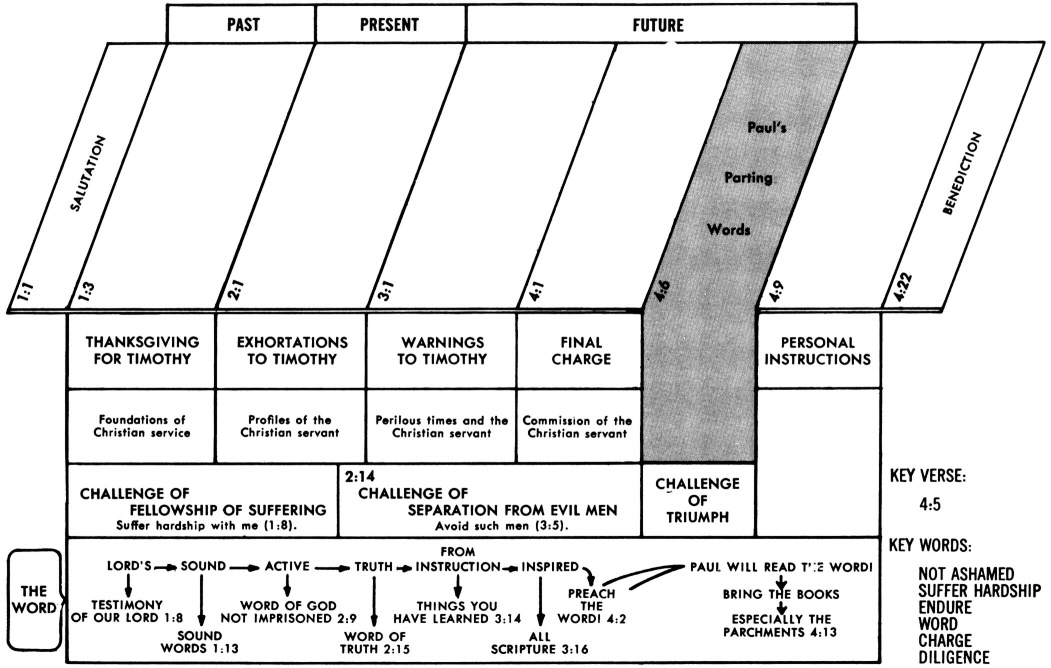
ENDURANCE AND SEPARATION IN THE MINISTRY
Click chart to enlarge
Charts from Jensen's Survey of the NT - used by permission
Second Timothy - Swindoll
| 2 TIMOTHY | |||
| 2 Timothy 1:1-18 | 2 Timothy 2:1-26 | 2 Timothy 3:1-17 | 2 Timothy 4:1-22 |
| Retain the Standard |
Rightly Divide the Word |
Difficult Times Will Come |
Preach the Word |
| PAST | PRESENT | FUTURE | |
| Foundation of Christian Service |
Pictures of Christian Servant |
Dangerous Times for Christian Servant |
Commission of Christian Servant |
| Unashamed as a Witness: Guard the Gospel |
Unashamed as a Workman: Suffer for the Gospel |
Adequate as a Workman: Continue in the Gospel |
Awarded as a Workman: Preach the Gospel |
| Power of the Gospel |
Perseverance of the Gospel Message | Protection of the Gospel |
Proclamation of the Gospel |
| Reminder | Requirements | Resistance | Requests |
| Encouragement in Ministry |
Examples in Ministry |
Exhortations in Ministry |
Exhortations to Fulfill Ministry |
| Commendation & Charge |
Commission to Fulfill |
Conflict to Face |
Course to Finish |
|
Compiled from Jensen's Survey of the NT and Wilkinson's Talk Thru the Bible |
|||
2 Timothy 1:5 For I am mindful (AAPMSN) of the sincere faith within you, which first dwelt (3AAI) in your grandmother Lois and your mother Eunice, and I am sure (1SRPI) that it is in you as well (NASB: Lockman)
Greek: hupomnesin labon (AAPMSN) tes en soi anupokritou pisteos, etis enokesen (3SAAI) proton en te mamme sou Loidi kai te metri sou Eunike, pepeismai (1SRPI) de hoti kai en soi.
Amplified: I am calling up memories of your sincere and unqualified faith (the leaning of your entire personality on God in Christ in absolute trust and confidence in His power, wisdom, and goodness), [a faith] that first lived permanently in [the heart of] your grandmother Lois and your mother Eunice and now, I am [fully] persuaded, [dwells] in you also. (Amplified Bible - Lockman)
KJV: When I call to remembrance the unfeigned faith that is in thee, which dwelt first in thy grandmother Lois, and thy mother Eunice; and I am persuaded that in thee also.
NLT: I know that you sincerely trust the Lord, for you have the faith of your mother, Eunice, and your grandmother, Lois. (NLT - Tyndale House)
Phillips: I often think of that genuine faith of yours - a faith that first appeared in your grandmother Lois, then in Eunice your mother, and is now, I am convinced, in you as well. (Phillips: Touchstone)
Wuest: having been reminded of the unhypocritical faith which is in you, which is of such a nature as to have been at home first in your grandmother Lois and in your mother Eunice, and concerning which I have come to a settled persuasion, is at home in you also
Young's Literal: taking remembrance of the unfeigned faith that is in thee, that dwelt first in thy grandmother Lois, and thy mother Eunice, and I am persuaded that also in thee.
FOR I AM MINDFUL: hupomnesin labon (AAPMSN) tes en:
- Ps 77:6
- 2 Timothy 1 Resources - Multiple Sermons and Commentaries
Paul reminds Timothy of his God given faith and godly heritage which should enable daily living and the diligent fulfillment of his holy calling in Christ.
I am mindful (literally "taking remembrance") is two Greek words, lambano (2983) meaning to receive or take in whatever manner and hupomnesis (5280) (hupó = under + mimnesko = to remind) meaning remembrance, recalling, thinking about something again, causing oneself to remember, refreshing one's memory.
Spurgeon comments…
We see here the inmost heart of Paul. Deserted by many of his friends, and in the feebleness of old age, expecting a cruel death, he cherishes the memory of his beloved young disciple, and longs to look once more upon his face. (The Interpreter)
Mindful (5280)(hupomnesis) speaks of an act of recollection especially excited by a person or thing. (Click word study on hupomnesis)
Hupomnesis is Paul's third reference to his memories ("remember" in v3, "recall" in v4) and denotes an external reminding. The fact that Paul remembered Timothy would certainly encourage him. Paul could have easily focused on his self in a cell and had a pity party but instead he repeatedly emphasized that he remember Timothy.
So the Greek is literally "Having received a reminder” It's like a "memorandum" that comes to mind. In some way or other, Paul had been reminded of Timothy’s sincere faith.
D. Edmond Hiebert remarks that…
The "call to remembrance" of the King James does not adequately give the force of the word. The occasion for this reminding is not indicated, but something had happened at Rome under Paul's eyes which strongly reminded him of Timothy's faith. It is a gracious hint to his young friend, indicating to him "how Paul esteems Timothy's faith, considers it a model, with which sincere acts of other men's faith are compared in Paul's mind" (Lenski). (2 Timothy by D. Edmond Hiebert).
Spurgeon observes that Timothy's spirit…
was a choice spirit and therefore it was desirable to see it strong, brave and energetic. No one would wish to arouse a bad man, for like a viper he is all the worse for being awake. But in proportion to the excellence of the character is the desirability of its being full of force. The Apostle Paul tells Timothy, in his first Epistle, not to neglect the gift that is in him. And in the text before us he bids him stir up that gift—in each case he is sounding the trumpet in his ear and summoning him to intense action. He speaks of the gift that was conferred by the laying on of hands, and in the former Epistle he connects that with the hands of the presbytery. (Our Gifts and How to Use Them)
OF THE SINCERE FAITH WITHIN YOU: tes en soi anupokritou pisteos :
- Ps 17:1; 18:44; 66:3; 81:15; Jeremiah 3:10 Jn 1:47; 1Ti 1:5; 4:6; 1Pe 1:22
- 2 Timothy 1 Resources - Multiple Sermons and Commentaries
Sincere (505) (anupokritos from a = negative prefix meaning without + hupokrinomai [see below] = to pretend, this Greek verb being a combination of hupó = under, indicating secrecy + krino = to judge) is literally without play acting, without playing the part or without hypocrisy.
Anupokritos describes that which is unhypocritical, genuine (faith, love and wisdom in Scripture) and without show or pretense (pretense = a claim made or implied and especially one not supported by fact).
W E Vine has this note on the related root word explaining that a hypocrite (hupokrites) was…
"a stage–actor; it was a custom for Greek and Roman actors to speak in large masks with mechanical devices for augmenting the force of the voice; hence the word became used metaphorically of a dissembler, a hypocrite." (Vine, W E: Vine's Complete Expository Dictionary of Old and New Testament Words. 1996. Nelson)
A hypocrite is therefore an actor. Timothy’s faith was not an act but was completely genuine, unhypocritical and without pretense or deceit.
Marvin Vincent explains that the related word hypocrite (hupokrites) is…
From hupokrino, to separate gradually; so of separating the truth from a mass of falsehood, and thence to subject to inquiry, and, as a result of this, to expound or interpret what is elicited. Then, to reply to inquiry, and so to answer on the stage, to speak in dialogue, to act. From this the transition is easy to assuming, feigning, playing a part. The hypocrite is, therefore, etymologically, an actor. (Greek Word Study)
Anupokritos is used 6 times in the NT once in each of the following books (Rom. 12:9; 2 Co. 6:6; 1 Tim. 1:5; 2 Tim. 1:5; Jas. 3:17; 1 Pet. 1:22) and in the NAS is translated "genuine, 1; sincere, 3; without hypocrisy, 2" whereas the KJV translates it "unfeigned, 4; without dissimulation (= act of hiding under a false appearance; e.g., "she smiled to dissimulate her anxiety"), 1; without hypocrisy, 1".
Timothy was aware that there were many who ostensibly were simply "playing the part" of a disciple ("You [Timothy] are aware of the fact that all who are in Asia turned away from me, among whom are Phygelus and Hermogenes" 2 Ti1:15). In this setting of defection by those who once stood beside Paul, it is not surprising that Timothy's "sincere faith" was a source of encouragement, joy and thanksgiving for Paul in prison.
Timothy's faith was "not an act" like the Greek play actors who were called hupokrites, because they answered from under (hupo) a mask.
D. Edmond Hiebert observes that Timothy's faith…
is given a twofold description. It is "unfeigned," literally, "unhypocritical"; a faith arising out of an inner reality of conviction and knowing no sham or pretense. It is further described by the clause "which [lit., which is such as] dwelt first in thy grandmother Lois, and thy mother Eunice." Timothy is parallel to Paul in that he too has a line of godly ancestors, in whom this "unhypocritical faith" has effectively taken up its abode." (2 Timothy by D. Edmond Hiebert) (Bolding added)
Timothy's faith was without "play acting" and this truth must have brought great joy to Paul's heart to know Timothy was "the real thing". In his third epistle John voices a similar exhortation to his readers…
"I have no greater joy than this, to hear of my children walking in the truth." (3John 1:4).
Anupokritos is used in the NT to modify "love" three times! Clearly the implication that there can be an outward show of love which is really only a facade or mask!
THE OTHER 5 USES OF ANUPOKRITOS
In Romans Paul says…
"Let love be without hypocrisy (anupokritos). Abhor what is evil; cling to what is good." (see note Romans 12:9)
Writing to the church at Corinth Paul describes himself and other "servants of God" as those who carry out there office
"in much endurance, in afflictions, in hardships, in distresses, in beatings, in imprisonments, in tumults, in labors, in sleeplessness, in hunger, in purity, in knowledge, in patience, in kindness, in the Holy Spirit, in genuine (anupokritos) love" (2Cor 6:4-6)
Peter exhorts the tested believers who reside as aliens that…
"Since you have in obedience to the truth purified your souls for a sincere (anupokritos) love of the brethren, fervently love one another from the heart" (see note 1 Peter 1:22)
In Paul's first letter to Timothy, he explained to his young disciple that…
"the goal of our instruction is love from a pure heart and a good conscience and a sincere faith." (1Timothy 1:5)
James contrasts worldly wisdom ("not that which comes down from above, but earthly, natural, demonic") with heavenly wisdom explaining that…
"the wisdom from above is first pure, then peaceable, gentle, reasonable, full of mercy and good fruits, unwavering, without hypocrisy (anupokritos). And the seed whose fruit is righteousness is sown in peace by those who make peace." (James 3:17-18).
Godly wisdom does not pose and does not deal in deception but is honest, never pretending to be what it is not; never acting a part to gain its own ends.
Lenski comments that "how Paul esteems Timothy's faith (and) considers it a model, with which sincere acts of other men's faith are compared in Paul's mind"
How would Paul characterize your faith? Sincere or an act?
Faith (4102) (pistis) is synonymous with trust or belief and is the conviction of the truth of anything, but in Scripture usually speaks of belief respecting man's relationship to God and divine things, generally with the included idea of trust and holy fervor born of faith and joined with it.
Pistis is used 8 times in 2 Timothy (click to study 8 uses in 2 Ti and here for 18 uses in 1Ti)
As pistis relates to God, it is the conviction that God exists and is the Creator and Ruler of all things well as the Provider and Bestower of eternal salvation through Christ. As faith relates to Christ it represents a strong and welcome conviction or belief that Jesus is the Messiah, through Whom we obtain eternal salvation and entrance into the Kingdom of Heaven. Stated another way, eternal salvation comes only through belief in Jesus Christ and no other way.
Scofield wrote that…
The essence of faith consists in believing and receiving what God has revealed, and may be defined as that trust in the God of the Scriptures and in Jesus Christ whom He has sent, which receives Him as Lord and Savior and impels to loving obedience and good works (John 1:12; James 2:14-26).
Genuine faith faith that results in true salvation includes at least three main elements
(1) firm persuasion or firm conviction,
(2) a surrender to that truth and
(3) a conduct emanating from that surrender. In sum, faith shows itself genuine by a changed life. (Click Vine's similar definition of faith)
The highly respected theologian Louis Berkhof defines genuine faith in essentially the same way noting that it includes an intellectual element (notitia), which is "a positive recognition of the truth"; an emotional element (assensus), which includes "a deep conviction of the truth"; and a volitional element (fiducia), which involves "a personal trust in Christ as Savior and Lord, including a surrender … to Christ." (Louis Berkhof, Systematic Theology. Grand Rapids: Eerdmans, 1939)
Wayne Grudem defines faith that saves one's soul…
Saving faith is trust in Jesus Christ as a living person for forgiveness of sins and for eternal life with God. This definition emphasizes that saving faith is not just a belief in facts but personal trust in Jesus to save me… The definition emphasizes personal trust in Christ, not just belief in facts about Christ. Because saving faith in Scripture involves this personal trust, the word "trust" is a better word to use in contemporary culture than the word "faith" or "belief." The reason is that we can "believe" something to be true with no personal commitment or dependence involved in it. (Grudem, W. A. Systematic Theology: An Introduction to Biblical Doctrine Zondervan) (Bolding added)
Maclaren writes that
Faith is the hand that grasps. It is the means of communication, it is the channel through which the grace which is the life, or, rather, I should say, the life which is the grace, comes to us. It is the open door by which the angel of God comes in with his gifts. It is like the petals of the flowers, opening when the sunshine kisses them, and, by opening, laying bare the depths of their calyxes to be illuminated and coloured, and made to grow by the sunshine which itself has opened them, and without the presence of which, within the cup, there would have been neither life nor beauty. So faith is the basis of everything; the first shoot from which all the others ascend… Faith works. It is the foundation of all true work; even in the lowest sense of the word we might almost say that. But in the Christian scheme it is eminently the underlying requisite for all work which God does not consider as busy idleness…
A sincere faith is not hypocritical and play acting but shows itself to be genuine by a changed life.
John MacArthur comments that…
Faith, like grace, is not static. Saving faith is more than just understanding the facts and mentally acquiescing. It is inseparable from repentance, surrender, and a supernatural longing to obey. None of those responses can be classified exclusively as a human work, any more than believing itself is solely a human effort.
Whittier wrote the following poem on "faith"…
"Nothing before, nothing behind,
The steps of faith
Fall on the seeming void, and find
The rock beneath."
William Barclay has an interesting description writing that
Faith begins with receptivity. It begins when a man is at least willing to listen to the message of the truth. It goes on to mental assent. A man first hears and then agrees that this is true. But mental assent need not issue in action. Many a man knows very well that something is true, but does not change his actions to meet that knowledge. The final stage is when this mental assent becomes total surrender. In full-fledged faith, a man hears the Christian message, agrees that it is true, and then casts himself upon it in a life of total yieldedness. (Barclay, W: The Daily Study Bible Series, Rev. ed. Philadelphia: The Westminster Press) (Bolding added)
The Psalms record examples of insincerity…
Say to God, "How awesome are Thy works! Because of the greatness of Thy power Thine enemies will give feigned (Hebrew = kahas = deal falsely with someone, in this case God and the opposite of being truthful or honest; Lxx = pseudomai - utter untruth, attempt to deceive by falsehood) obedience to Thee. (see Psalm 66:3)
"Those who hate the LORD would pretend (Heb = kahas; Lxx = pseudomai - both same as verse directly above) obedience to Him and their time of punishment would be forever." (Psalm 81:15)
WHICH FIRST DWELT IN YOUR GRANDMOTHER LOIS AND YOUR MOTHER EUNICE: etis enokesen (3SAAI) proton en te mamme sou Loidi kai te metri sou Eunike:
- Ps 22:10; 86:16; 116:16; Acts 16:1
- 2 Timothy 1 Resources - Multiple Sermons and Commentaries
First (4413) (protos) is used here to indicate chronology and not value or importance.
Grandmother (3125) (mamme) is used only here in the NT. Mamme corresponds exactly to our word “mamma.”
Mother (3384) (meter) defines a woman in relation to her child or children.
Eunice (2131) (eunike) means happy or good victory (happily conquering).
Jewish proverbs…
One mother achieves more than a hundred teachers.
Honor your father and mother, even as you honor God, for all three were partners in your creation.
Someone has quipped that if the three wise men had been three wise women, what would have happened? They would have asked the way, arrived on time, helped deliver the baby, cleaned up the stable by putting down fresh straw, brought practical gifts and made a casserole.
Dwelt in (1774) (enoikeo from en = in + oikéo = dwell) means literally to “dwell in”, to take up residence, make one's home in or among. To live in, inhabit; dwell in. All the NT uses of enoikeo are metaphorical.
The idea of “be at home,” defines the depth and extent to which faith has become a vital and integral part of their lives. Apply this same thought to the other things that dwell in believers in the NT -- the Word of Christ, the Spirit, God, sin.
Vine observes that enoikeo
is used, with a spiritual significance only, of (a) the indwelling of God in believers, 2Co 6:16; (b) the indwelling of the Holy Spirit, Ro 8:11; 2 Ti 1:14; (c) the indwelling of the word of Christ, Col. 3:16; (d) the indwelling of faith, 2 Ti 1:5; (e) the indwelling of sin in the believer, Ro 7:17. (Vine, W E: Vine's Complete Expository Dictionary of Old and New Testament Words. 1996. Nelson)
Here in 2 Timothy 1:5, enoikeo is used in a figurative sense meaning “to dwell in one and influence for good.” The root word oikos means “a home,” and the root verb oikeo means “to live at home” and so "the supernatural faith resident in Timothy was at home in him in the sense that it held free sway over his life." (Wuest)(Bolding added)
Enoikeo is found 5 times in the NAS (Romans 8:11; 2 Corinthians; Colossians 3:16; 2 Timothy 1:5; 2 Timothy 1:14)
Enoikeo - 40 times in the Septuagint
Lev 26:32; 2 Ki 19:26; 22:16, 19; Isa 5:3, 9; 21:14; 22:21; 23:2, 6; 24:1, 6, 17; 26:5, 9, 18, 21; 27:5; 32:18f; 33:24; 37:26; 40:22; 65:21f; Jer 27:11; 31:24; 42:17; 44:8; 49:1, 18; Da 9:7)
Ray Pritchard explains how this reminder of Timothy's godly legacy would have encouraged the young disciple writing that…
"We all have a heritage, a family tree. We all have a spiritual history—whether good or bad. We are Christians because someone influenced us to come to Christ. No one comes completely on his own. We all have others who make their mark on us and help us come to the place where we put our trust in Christ alone. We will be blessed and strengthened as we remember where we came from."
Paul uses enoikeo in this same chapter describing the Holy Spirit being "at home" in he and Timothy…
"Guard, through the Holy Spirit who dwells in (enoikeo = present tense = continuously) us, the treasure which has been entrusted to you." (see note 2 Timothy 1:14).
Paul in explaining the potential believers now possess to live a new quality of life writes…
"But if the Spirit of Him who raised Jesus from the dead dwells (oikeo) in you, He who raised Christ Jesus from the dead will also give life to your mortal bodies through His Spirit who indwells (enoikeo = present tense = continually resident, has the idea of being in one’s own home) (see note Romans 8:11) In a marvelous and incomprehensible way, the very Spirit of God makes His home in (enoikeo) the life of every person who trusts in Jesus Christ.
Paul again uses enoikeo to explain that God's presence in us should motivate us to "cleanse ourselves from all defilement of flesh and spirit, perfecting holiness in the fear of God" (2Corinthians 7:1). Paul writes
"Or what agreement has the temple of God with idols? For we are the temple of the living God; just as God said, “I will dwell in them and walk among them; and I will be their God, and they shall be My people." (2Corinthians 6:16)
Paul in the last NT use of enoikeo, exhorts the saints at Colossae (and all believers) to…
"Let the word of Christ richly dwell within (enoikeo - literally "let it house in you" - a command to do this continually) you, with all wisdom teaching and admonishing one another with psalms and hymns and spiritual songs, singing with thankfulness in your hearts to God." (see note Colossians 3:16) Paul desires that the Word would be "at home" and "be given the run of the house" (so to speak).
Wuest says that "The exhortation is to the effect that the Christian is to so yield himself to the Word that there is a certain at-homeness of the Word in his being. The Word should be able to feel al home in his heart. The saint should give it unrestricted liberty in his life."
Luke records that on Paul's second missionary journey…
"he came also to Derbe and to Lystra. And behold, a certain disciple was there, named Timothy, the son of a Jewish woman who was a believer, but his father was a Greek, and he was well spoken of by the brethren who were in Lystra and Iconium. Paul wanted this man to go with him; and he took him and circumcised him because of the Jews who were in those parts, for they all knew that his father was a Greek." (Acts 16:1 )
In sum, sincere faith was not just an occasional visitor in Lois and Eunice,
but was a permanent resident and an abiding presence exerting its influence for good on these godly role models as well as on Timothy himself.
Timothy enjoyed the great blessing of having a godly heritage, even though it was only one parent and one grandparent who contributed.
The Word of God holds out the occupation of being a faithful wife and mother as a high and sacred calling! (see notes Titus 2:4; 2:5)
"The woman's duty is to give to a child a home of faith and to faith a home in the child. " (Hodges)
Note also that in the Roman world, fathers had absolute authority over the family, and since Timothy’s father was not a Christian, his home situation was probably less than ideal and yet God used these godly women in this "less than ideal environment" so that through them
"from childhood (Timothy came to know) the sacred writings which (were) able to give (him) the wisdom that leads to salvation through faith which is in Christ Jesus." (see note 2 Timothy 3:15)
It will be a joy to meet Lois and Eunice in Heaven in the age to come! Note that it was the faith of these two godly women that greatly impacted Timothy's life not simply their knowledge of God. Who is watching your "faith"?
Note the testimony concerning the parents of John the Baptist, Zacharias and Elizabeth who
"were both righteous in the sight of God, walking blamelessly in all the commandments and requirements of the Lord" (Lu 1:6). (Who was watching them?)
J R Miller writes…
There is something in genealogy, after all. It is a fine thing for a young man to have had a good mother and a godly grandmother. This does not mean that a man is necessarily good because of the faith that dwelt in his grandmother and his own mother. Goodness cannot be passed down like an estate. Some very bad men have had most pious ancestry. At the same time, it is fitting when in successive generations piety is found. A young man with worthy ancestors owes it to them to be worthy. He should keep unspotted the white name he receives. We are responsible for the carrying on of the work which they have begun.
Paul was persuaded that the faith of his grandmother and mother was also in Timothy. It should always be so with young people with Christian parents. Those who have a noble inheritance, of memories, influences and teachings, should be better than those who have not had these blessings.
Spurgeon comments that…
There is no transmigration of souls, but there is a kind of transmigration of faith, as if the very form and shape of faith, which was in Lois and Eunice, afterwards appeared in Timothy. Truly, there are certain idiosyncrasies which may pass from some Christian people to others; and when those idiosyncrasies are of a high and noble kind, it is a great mercy to see them reproduced in children and children’s children. “I thought I heard your mother speak,” said one, when she heard a Christian woman talking of the Savior, “you speak in just the way in which she used to tell out her experience, and describe the love of Christ.”
Grace does not run in the blood, but it often runs side by side with it. The “grandmother Lois” and the “mother Eunice “ had the true grace of saving faith dwelling in them, and Paul was persuaded that it dwelt in the son and grandson Timothy. (Spurgeon, C. H. Exposition)
Charles Haddon Spurgeon the prince of preachers, telling about his grandfather in one of his sermons, said: "He had a large family and a very small income but he loved his Lord, and he would not have given up his preaching of the Gospel for anything, not even for an imperial crown. He has told me often how the Lord provided for him. He had a little farm to get his. living upon it, and he had a cow which used to give milk for his many children, and one day when he came up to the cow it fell back with the staggers and died.
"Grandmother said, 'James, how will God provide for the dear children now? What shall we do for milk?' "'Mother,' he said, 'God said He would provide, and I believe He could send us fifty cows if He pleased.' "It so happened that on that day a number of gentlemen were meeting in London, persons whom he did not know, were sitting as a committee for the distribution of money to poor ministers, and they had given it to all who had asked for any; he liked to earn his own money. He did not send in any petition or appeal. Well, after the gentlemen had distributed to all who had asked there was five pounds over, and they were considering what they should do with this balance.
"'Well,' said one, 'there is a Mr. Spurgeon down at Stambourne, in Essex, a poor minister. He stands in need of five pounds.' "'Oh,' said another, 'don't send him five pounds. I will put five to it. I know him. He is a worthy man.' "'No,' said another, 'don't send him ten pounds. I will give another five pounds if somebody else will put a fourth five to it.' "The next morning came a letter to grandfather with ninepence to pay! Grandmother did not like to pay out ninepence for a letter, but there was twenty pounds in it; and as my grandfather opened it he said, 'Now, can't you trust God about an old cow?'" How faithful God is!—Watchman-Examiner
Jay Kesler wrote that "A life thoroughly committed to Christ, lived and tested over time, seasoned with experience and humility, is more powerful than most people ever imagine. People who have a heritage of godly grandparents carry this influence in their lives sometimes without recognizing its source."
For Future Generations - When a team of Christians visited Stavropol, Russia, in 1994 to hand out Bibles, a local citizen said he recalled seeing Bibles in an old warehouse. They had been confiscated in the 1930s when Stalin was sending believers to the gulags. Amazingly, the Bibles were still there. Among those who showed up to load them into trucks was a young agnostic student just wanting to earn a day's wage. But soon he slipped away from the job to steal a Bible. A team member went looking for him and found him sitting in a corner weeping. Out of the hundreds of Bibles, he had picked up one that bore the handwritten signature of his own grandmother. Persecuted for her faith, she had no doubt prayed often for her family and her city. God used that grandmother's Bible to convict that young man. God has no grandchildren. We must each become first-generation believers through personal faith in Jesus. But the devotion to God of a grandparent or parent is a powerful ally of His Spirit to bring our children to Christ. Paul encouraged Timothy by recalling the faith of his grandmother and mother. Although Timothy's faith was his own, it was deeply linked to theirs. What an admonition to us who are parents and grandparents to be faithful! -- Dennis J. De Haan (Our Daily Bread, Copyright RBC Ministries, Grand Rapids, MI. Reprinted by permission. All rights reserved)
We can help our precious children
Follow in God's way,
Living out our faith with gladness,
Praying every day. --Sper
Better than having children bear your name
is to have your children bear Christ's name.
The Mom Box - Each Christmas I give both of my daughters a “Mom box.” Each box contains items to encourage them to be the best mothers they can be. It might have craft books or special projects, devotional books or tapes geared toward young moms, first-aid kits, recipes for cooking with kids—and often something personal like bubble bath for a little pampering after a tough day of mothering! It’s become a tradition that Rosemary and Tanya have looked forward to every year for the last decade. Encouraging our children to be good parents can begin even earlier. The best way is to start equipping them with the Word of God while they are still young. The apostle Paul wrote that “from childhood” Timothy had known “the Holy Scriptures” (see note 2 Timothy 3:15). And 2 Timothy 1:5 mentions the “genuine faith” of Timothy’s mother and grandmother. That faithful teaching and spiritual influence helped to enable Timothy to be a godly man. The Bible is our richest resource to help us raise children who will know and love Jesus. Nothing is more essential than “the Holy Scriptures” to equip them for all of life’s challenges. What are you doing to make the next generation “wise for salvation through faith”? (see note 2 Timothy 3:15). —Cindy Hess Kasper (Our Daily Bread, Copyright RBC Ministries, Grand Rapids, MI. Reprinted by permission. All rights reserved)
Parents, give your children guidance
And instruction from God’s Word;
Then with wisdom and compassion
Teach them how to love the Lord. —Sper
The character of our children tomorrow
depends on what we put into their hearts today.
John MacArthur mentions that - Some years ago I was involved in a discussion regarding the choice of a man to take up the leadership of a well-known Christian organization. In looking over the list of prospects, I commented that it was interesting that every one of those men had a godly pastor for a father. The Lord has, of course, raised up many faithful leaders, including Paul, from ungodly and even godless families. But a high percentage of the great men throughout church history have come from godly homes. Timothy’s father was an unbelieving Gentile (Acts 16:3), but his mother and grandmother were believers of great godliness." (MacArthur, J. 2 Timothy. Chicago: Moody Press)
Our Daily Bread - As a lawyer, as a congressman, as Governor of Ohio, and as President of the United States, William McKinley had a close relationship with his mother. He either visited her or sent a message to her every day. When she became seriously ill, he arranged to have a special train standing by, ready to take him to her bedside. Mrs. McKinley died December 12, 1897, in the arms of her 54-year-old son. Her gentle, Christian virtues helped mold the President's character, for when he was gunned down in Buffalo, New York, about 4 years later, he showed no bitterness toward his assassin. With Christian courage he said, "God's will be done." Before he died, he asked to hear once again the hymn "Nearer, My God, to Thee," which his mother had taught him.
Perhaps you too have been blessed with a Christian heritage. But unlike McKinley, you've strayed from God. Confess your sin and come back to the Lord. Let the precious memories of that special person in your life, who all these years has been pointing you to God, awaken in your heart a new desire to live for Him. Don't turn your back on the influence of your godly mother. --Dennis J. De Haan (Our Daily Bread, Copyright RBC Ministries, Grand Rapids, MI. Reprinted by permission. All rights reserved)
Our thanks, O God, for mothers
Who show, by word and deed,
Commitment to Thy will and plan
And Thy commandments heed.
--Johnson
No man is poor who has had a godly mother!
--Abraham Lincoln
Mothers Who Pray - The faith and prayers of mothers can have a profound impact on the lives of their children. First Samuel 1 records Hannah's plea and God's answer in the birth of her son Samuel. And in a letter to Timothy, Paul referred to the faith of Timothy's mother, which I'm sure was often expressed in earnest prayer on his behalf. No wonder he was used of God in the early church.
I know a pastor's wife who is a woman of prayer. Whenever her husband left for an important meeting or visit, she prayed a sentence or two for him, asking the Lord's guidance, protection, wisdom, and strength. She usually prayed aloud and the children often heard her, but she never thought much about the impact it would have on them.
Imagine this mother's delight when her college-bound daughter said that leaving home would be easier because she knew that her mother would pray for her--and keep on praying!
Sometimes mothers feel frustrated because they think they are limited in what they can do for their children. But they can always pray--and their prayers are among the most cherished gifts of all. —David C. Egner (Our Daily Bread, Copyright RBC Ministries, Grand Rapids, MI. Reprinted by permission. All rights reserved)
I heard my name in Mother's prayer
When I was but a child,
And now because of her concern,
To God I'm reconciled. --Hess
A mother's prayers
can build a fortress around her children
Live Honestly - As children grow up, we who are parents or leaders pray that they will learn to discriminate more and more between right and wrong. But be prepared! Eventually these children will compare our actions with our words. If what we do and what we say don’t match up, they will be confused, not knowing which to follow—our actions or our words.
In his second letter to Timothy, Paul could honestly say, “I thank God, whom I serve with a pure conscience, as my forefathers did” (2Ti 1:3). His actions and his words agreed.
Paul then described Timothy’s faith as “genuine” and pointed to his spiritual heritage: the genuine faith of his grandmother Lois and his mother Eunice (2Ti 1:5). Later in his letter, the apostle urged Timothy, “Continue in the things which you have learned and been assured of, knowing from whom you have learned them, and that from childhood you have known the Holy Scriptures” (2Ti 3:14, 15). Christians whose actions and words are consistent can influence generations of people for Christ.
Children put a searchlight on the quality of our lives. “Do as I say” is not the highest standard, but rather an honest life that invites, “Do as I do.” That means having actions and words that match up. Do yours? —Joanie Yoder (Our Daily Bread, Copyright RBC Ministries, Grand Rapids, MI. Reprinted by permission. All rights reserved)
Blest is the household where honesty reigns,
Where dad and mom practice the truth;
Blest are the children whom God leads and trains,
And are taught His Word from their youth. —Fitzhugh
Children are more likely to do what you do than to do what you say.
Happy Childhood at Stambourne - C H Spurgeon's Grand Legacy of Grandparents - Spurgeon's grandfather once said to young Charles “I have nothing to leave you but rheumatic gout; and I have left you a great deal of that.” However as one reads C H Spurgeon's own recollections of his days at his grandparents home in Stambourne, it becomes abundantly clear that grandfather and Reverend James Spurgeon who pastored an Independent Church left his grandson a great deal more than that.
Young Spurgeon went to live with his grandparents when he was about one year old and soon was quite attracted to the message and the ministry of of preaching as modeled by his grandfather.
The story is told that as a teenager, young Spurgeon was once asked to preach at a church in Suffolk but he was delayed, which forced grandfather Spurgeon to begin preaching in his place. Upon seeing the young Spurgeon's arrival in the sanctuary, Reverend James Spurgeon declared
Here comes my grandson. He may preach the gospel better than I can, but he cannot preach a better gospel—can you, Charles?
Charles continued the sermon right where his grandfather had left off. As great a preacher as James Spurgeon was, as providence would have it, his and grandmother Spurgeon's most fruitful ministry was their investment in the life of young Charles, who went on to become by most accounts the greatest and most prolific preacher the world has ever known outside of those in the Scriptures. If you are a grandparent (and even as I write this I am anticipating my first 3 grandchildren in 2008), I pray you (and I) take this encouraging story to heart and pour yourselves into the lives of the grandchildren God sees fit to place in your life.
Here are a few of C H Spurgeon's recollections of his time with his grandparents…
In this best parlour grandfather would usually sit on Sunday mornings, and prepare himself for preaching. I was put into the room with him that I might be quiet, and, as a rule, The Evangelical Magazine was given me. This contained a portrait of a reverend divine, and one picture of a mission-station. Grandfather often requested me to be quiet, and always gave as a reason that I "had the magazine." I did not at the time perceive the full force of the argument to be derived from that fact; but no doubt my venerable relative knew more about the sedative effect of the magazine than I did. I cannot support his opinion from personal experience. Another means of stilling "the child" was much more effectual. I was warned that perhaps grandpa would not be able to preach if I distracted him, and then,—ah! then, what would happen, if poor people did not learn the way to Heaven? This made me look at the portrait and the missionary-station once more. Little did I dream that some other child would one day see my face in that wonderful Evangelical portrait-gallery.
When I was a very small boy, I was allowed to read the Scriptures at family prayer. Once upon a time, when reading the passage in Revelation which mentions the bottomless pit, I paused, and said, "Grandpa, what can this mean?" The answer was kind, but unsatisfactory, "Pooh, pooh, child, go on." The child, however, intended to have an explanation, and therefore selected the same chapter morning after morning, and always halted at the same verse to repeat the enquiry, hoping that by repetition he would importune the good old gentleman into a reply. The process was successful, for it is by no means the most edifying thing in the world to hear the history of the Mother of Harlots, and the beast with seven heads, every morning in the week, Sunday included, with no sort of alternation either of Psalm or Gospel; the venerable patriarch of the household therefore capitulated at discretion, with, "Well, dear, what is it that puzzles you?" Now "the child" had often seen baskets with but very frail bottoms, which in course of wear became bottomless, and allowed the fruit placed therein to drop upon the ground; here, then, was the puzzle,—if the pit aforesaid had no bottom, where would all those people fall to who dropped out at its lower end?—a puzzle which rather startled the propriety of family worship, and had to be laid aside for explanation at some more convenient season. Queries of the like simple but rather unusual stamp would frequently break up into paragraphs of a miscellaneous length the Bible-reading of the assembled family, and had there not been a world of love and license allowed to the inquisitive reader, he would very soon have been deposed from his office. As it was, the Scriptures were not very badly rendered, and were probably quite as interesting as if they had not been interspersed with original and curious enquiries.
I can remember the horror of my mind when my dear grandfather told me what his idea of "the bottomless pit" was. There is a deep pit, and the soul is falling down,—oh, how fast it is falling! There! the last ray of light at the top has disappeared, and it falls on—on—on, and so it goes on falling—on—on—on for a thousand years! "Is it not getting near the bottom yet? Won't it stop?" No, no, the cry is, "On—on—on." "I have been falling a million years ; am I not near the bottom yet?" No, you are no nearer the bottom yet; it is "the bottomless pit." It is on—on—on, and so the soul goes on falling perpetually into a deeper depth still, falling for ever into "the bottomless pit"—on—on—on—into the pit that has no bottom! Woe, without termination, without hope of its coming to a conclusion!
In my grandfather's garden there was a fine old hedge of yew, of considerable length, which was clipped and trimmed till it made quite a wall of verdure. Behind it was a wide grass walk, which looked upon the fields; the grass was kept mown, so as to make pleasant walking. Here, ever since the old Puritanic chapel was built, godly divines had walked, and prayed, and meditated. My grandfather was wont to use it as his study. Up and down it he would walk when preparing his sermons, and always on Sabbath-days when it was fair, he had half-an-hour there before preaching. To me, it seemed to be a perfect paradise; and being forbidden to stay there when grandfather was meditating, I viewed it with no small degree of awe. I love to think of the green and quiet walk at this moment; but I was once shocked and even horrified by hearing a farming man remark concerning this sanctum sanctorum, "It 'ud grow a many 'taturs if it wor ploughed up." What cared he for holy memories? What were meditation and contemplation to him? Is it not the chief end of man to grow potatoes, and eat them? Such, on a larger scale, would be an unconverted man's estimate of joys so, elevated and refined as those of Heaven. Alphonse Karr tells a story of a servant-man who asked his master to be allowed to leave his cottage, and sleep over the stable. What was the matter with his cottage? "Why, Sir, the nightingales all around the cottage make such a 'jug, jug, jug,' at night that I cannot bear them." A man with a musical ear would be charmed with the nightingales' song, but here was a man without a musical soul who found the sweetest notes a nuisance. This is a feeble image of the incapacity of unregenerate man for the enjoyments of the world to come, and as he is incapable of enjoying them, so is he incapable of longing for them.
In the front of the house, towards the left, nearly hidden by a shrub, is a very important window, for it let light into the room wherein were the oven, the mangle, and, best of all, the kneading-trough. How often have I gone to that kneading-trough; for it had a little shelf in it, and there would be placed "something for the child!" A bit of pastry, which was called by me, according to its size, a pig or a rabbit, which had little ears, and two currants for eyes, was carefully placed in that sacred shrine, like the manna in the ark. Dear grandmother, how much you laboured to spoil that "child"! Yet your memory is more dear to him than that of wiser folks, who did not spoil "the child." Do you now look down from your mansion above upon your petted Grandson? Do you feel as if he would have been better if you had been sour and hard? Not a bit of it. Aunt Ann, who had a finger in it all, would spoil "the child" again if she had a chance. I have put in such an approach to a portrait of my grandmother as I could find: it was taken by some travelling artist who visited the district, and took off several of the family. (Read the entire section entitled Happy Childhood at Stambourne) (Related resources - Spurgeon's Personal Testimony: a must read; See also How childhood influences shaped a great preacher )
AND I AM SURE THAT IT IS IN YOU AS WELL: pepeismai (1SRPI) de hoti kai en soi:
- 2Ti 1:12; Acts 26:26; Romans 4:21; 8:38; 14:5,14; 15:14; Hebrews 6:9; 11:13
- 2 Timothy 1 Resources - Multiple Sermons and Commentaries
I am sure (3982) (peitho) means to be convinced to believe something or be persuaded of its veracity. It means to come to a settled persuasion concerning some truth or fact and so to be convinced.
Peitho suggests that a conclusion has been reached on reasonable ground. Paul’s personal observations of the transformation that God had already wrought in his young disciple Timothy led him to form this judgment. He was entirely convinced of the truth of what he said and he thus uses the language of a man who had no doubt on the subject.
The perfect tense signifies that Paul had become persuaded at some point of time in the past and he remains persuaded. Perfect tense speaks of the permanence of his state of persuasion. It expresses Paul's confidence in a once for all completed work of salvation with present ongoing results or effects of that salvation in young Timothy.
"I stand persuaded"
"I have come to a settled persuasion"
It is notable that 22 of 52 NT uses of peitho are by Paul
Matt. 27:20; Matt. 27:43; Matt. 28:14; Lk. 11:22; Lk. 16:31; Lk. 18:9; Lk. 20:6; Acts 5:36; Acts 5:37; Acts 5:40; Acts 12:20; Acts 13:43; Acts 14:19; Acts 17:4; Acts 18:4; Acts 19:8; Acts 19:26; Acts 21:14; Acts 23:21; Acts 26:26; Acts 26:28; Acts 27:11; Acts 28:23; Acts 28:24; Rom. 2:8; Rom. 2:19; Rom. 8:38; Rom. 14:14; Rom. 15:14; 2 Co. 1:9; 2 Co. 2:3; 2 Co. 5:11; 2 Co. 10:7; Gal. 1:10; Gal. 5:7; Gal. 5:10; Phil. 1:6; Phil. 1:14; Phil. 1:25; Phil. 2:24; Phil. 3:3; Phil. 3:4; 2 Thess. 3:4; 2 Tim. 1:5; 2 Tim. 1:12; Phlm. 1:21; Heb. 2:13; Heb. 6:9; Heb. 13:17; Heb. 13:18; Jas. 3:3; 1 Jn. 3:19
It wasn’t enough that this sincere faith was in Timothy’s grandmother and mother, but it had to be in Timothy also. Our children, once of age to be accountable before God, must have their own personal relationship with Jesus Christ. On the other hand although salvation cannot be inherited from believing parents, it certainly is true that there is a "household principle" in the Scriptures (cf Acts 16:31+).
D. Edmond Hiebert writes that Paul's "mention of (Lois and Eunice) by name indicates that both were personally known to Paul. And now as he reviews his memories of Timothy he is fully persuaded, or assured, that this same faith indwells Timothy also. "This is intended to cheer the depressed disciple, and suggests that whatever others may assert about Timothy, Paul is assured of his sincere godliness" (Pope). (2 Timothy by D. Edmond Hiebert)
We give a lot of thought to what we pass on to our children. You may cherish the crystal and chinaware that belonged to your grandmother. Or it may be something different in your home: a roll top desk, a handmade quilt, or an old family Bible. Heirlooms are important to us. But by the example of our lives, we can pass on to our children even more important things—such as a good name or honorable character. In this verse Paul alludes to the best gift of all—the example of faith in Jesus Christ. As you think about what you'll pass on to your children and grandchildren, don't forget the example of your faith in Jesus. It's the most valuable "heirloom" of all. The values we leave in our children are more important than the valuables we leave to them.
Heirlooms - "My great-grandfather owned this rifle," the man said proudly. In his hand was a mint-condition rifle from the days when the pioneers were moving across the American West. I admired its beautiful walnut stock and shiny brass fittings. He said, "It came down to my grandfather, who passed it on to my father, who gave it to me. It's been in the family more than 100 years. I'm going to give it to my son when he turns 25."
We give a lot of thought to what we pass on to our children. My wife Shirley cherishes the crystal and chinaware that belonged to her grandmother. It may be something different in your home: a rolltop desk, a handmade quilt, or an old family Bible. Heirlooms are important to us.
But by the example of our lives, we can pass on to our children even more important things—such as a good name or honorable character. Today's Bible reading mentions the best gift of all—the example of faith in Jesus Christ. Timothy's grandmother Lois and his mother Eunice trusted in Christ and taught Timothy to do the same (2 Ti 1:5; 3:14-15).
As you think about what you'll pass on to your children and grandchildren, don't forget the example of your faith in Jesus. It's the most valuable "heirloom" of all. —David C. Egner (Our Daily Bread, Copyright RBC Ministries, Grand Rapids, MI. Reprinted by permission. All rights reserved)
O give us homes built firm upon the Savior,
Where Christ is Head and Counselor and Guide,
Where every child is taught His love and favor
And gives his heart to Christ, the crucified. —Hart
(c) 1965 Singspiration, Inc.
The values we leave in our children
are more important than the valuables we leave to them.
Indispensable - A talented stay-at-home mother wrote a delightful essay in which she vividly describes (without complaining) the frustrations, sacrifices, and loneliness that accompany her chosen lifestyle. It's not glamorous to deal with a fussy 18-month-old who is teething, to settle quarrels between an irrational 3-year-old and a pushy 5-year old, and to listen to the incessant chatter of small children. Yet she concludes that her role is indispensable for the total well-being of her children. How true!
The importance of a godly mother's role in the life of a child cannot be overemphasized. Think of Timothy, for example, the young man the apostle Paul considered his spiritual son and a valuable partner in ministry. In his second letter to him, Paul recalled how Timothy had been influenced by "the genuine faith" of his grandmother Lois and his mother Eunice (2 Timothy 1:5). God used two generations of loving mothers to prepare Timothy for the crucial work he would have in spreading the gospel and establishing congregations of believers in Christ.
Let's praise the Lord for mothers who not only care for their children physically but also nurture them spiritually. Mothers like that are indispensable!—Herbert Vander Lugt (Our Daily Bread, Copyright RBC Ministries, Grand Rapids, MI. Reprinted by permission. All rights reserved)
God has conferred on motherhood
A true nobility,
And she who gladly fills that role
Can shape man's destiny. —D. De Haan
Guy King discusses the sincere faith writing that it refers to…
(a) The genuine article - not merely of the head, but of the heart; not just an intellectual acceptance, nor a creedal assent, but a complete trust of heart and whole being.
(b) Faith is variously set forth. You will be familiar with that description of it in Hebrews 11:1 -"Now faith is the substance of things hoped for, the evidence of things not seen". Or, in Samuel Taylor Coleridge's couplet
"Faith is an affirmation, and an act,
That bids eternal truth be present fact."
(c) The late Handley Moule says, speaking more particularly, that "for Paul, faith means faith in CHRIST". Yes, as we said earlier, he always runs beyond, and behind, things, to the Person.
(d) It is worth noticing that this quality is spoken of here as having "dwelt" in them - as if it were not just a visitor, but a resident; not merely a fair-weather friend, departing in foul.
Some of us Christians seem to lose all our faith when the storms of life overtake us - when trouble comes, or pain, or loss, or bereavement, or failure, or anxiety, or distress, faith in Him seems to leave us; we read of those who, in such sad circumstances, have lost their faith. The children at a Sunday-school treat were given as they went home, an orange, an apple, a bag of sweets, and a text card: Mary's text was "Have faith in God," Mark 11:22.
As she got on to her bus, a sudden gust of wind blew the card out of her hand. "Oh," she said, "stop the bus, I've lost my Faith in GOD!" Enough to stop any bus! But do not let any gust of ill fortune deprive you of your faith in Him. Verily, it is in the storm that faith should stand us in such good stead. Yet we let it go - just when it could be such a help!
Do you recall how when, in the boat, the MASTER had stilled the tempest, He said to the disciples (Luke 8:25), "Where is your faith?" It had gone a-walking, when its presence would have proved such a stand-by.
(e) This faith in Him should be both initial and continual - that first act of trust which, by His infinite grace, makes us His and makes Him ours: and then the attitude of trust which, according to His purpose, is to be the secret, and principle, of our daily Christian life. Not only are we "saved" by faith, as Ephesians 2:8 teaches us, but also "we walk by faith," as we learn from 2 Corinthians 5:7.
Such a faith is one of the fundamental characteristics of this Grandmotherly Religion which we are contemplating: faith in Him and faithfulness to Him - a simple trust; a stedfast fidelity. "The unfeigned faith", which was the common property of this godly family, and which, please GOD, is shared, with all its attendant blessings, by every reader.
2 Timothy 1:6 For this reason I remind (1SPAI) you to kindle afresh (PAN) the gift of God which is (3SPAI) in you through the laying on on of my hands. (NASB: Lockman)
Greek: di' en aitian anamimnesko (1SPAI) se anazopurein (PAN) to charisma tou theou, o estin (3SPAI) en soi dia tes epitheseos ton cheiron mou;
Amplified: That is why I would remind you to stir up (rekindle the embers of, fan the flame of, and keep burning) the [gracious] gift of God, [the inner fire] that is in you by means of the laying on of my hands [with those of the elders at your ordination]. (Amplified Bible - Lockman)
KJV: Wherefore I put thee in remembrance that thou stir up the gift of God, which is in thee by the putting on of my hands.
NLT: This is why I remind you to fan into flames the spiritual gift God gave you when I laid my hands on you. (NLT - Tyndale House)
Phillips: Because you have this faith, I now remind you to stir up that inner fire which God gave you at your ordination. (Phillips: Touchstone)
Wuest: for which cause I am reminding you to keep constantly blazing the gift of God which is in you through the imposition of my hands.
Young's Literal: For which cause I remind thee to stir up the gift of God that is in thee through the putting on of my hands,
FOR THIS REASON I (constantly) REMIND YOU: di en aitian anamimnesko (1SPAI):
- 2Ti 2:14; Isaiah 43:26; 1 Timothy 4:6; 2Peter 1:12; 3:1; Jude 1:5
- 2 Timothy 1 Resources - Multiple Sermons and Commentaries
For this reason (see terms of conclusion) refers to the “sincere faith within” Timothy. Having encouraged Timothy, he now begins to exhort him. In view of his godly family background & sincere faith, Timothy is to maintain its quality by diligent use.
John MacArthur observes that "The product of sincere faith is faithful service, and the heart of faithful service is ministering our gift unreservedly for the Lord, the gift which He distributes “to each one individually just as He wills.” (1 Co 12:11).
Apart from ministering our gift in the service of the Lord, our life on earth is worthless. Our sole purpose as Christians is to obey and serve the Lord through the gift with which He has uniquely blessed each of us, so that the body may be built up."
Remind (363) (anamimnesko from ana = again + mimnesko = remember so literally recall again is more forceful than mimnesko alone) carries idea of carefully thinking back and reconstructing something in one’s mind, not merely remembering (eg see use in Heb 10:32).
Present tense = I continually remind you.
Paul wanted Timothy to actively recall to mind again something he already knew. Paul is constantly actively stirring up the "embers" of past memories to stimulate Timothy not to shrink from the sufferings (reproach & tribulation) that a stand for Christ brings. Paul knows that remembering will help Timothy to press on to maturity, to run the race with endurance, to fight the good fight, to finish the course, to keep the faith. Paul is saying in essence "Remember when God did this or that for us… when He answered our prayers so clearly… when He removed incredible obstacles… when He performed the impossible… etc."
Hiebert explains "I remind you" as "more literally, I am reminding thee," (which) tactfully represent Timothy as himself conscious of these duties which are now urged upon him. All that he needs is reminding. Paul makes an appeal for zeal (v. 6) and supplies an incentive (v. 7). (2 Timothy by D. Edmond Hiebert)
Remember what God has done in your life and be encouraged that He is faithful and true and that He will complete the work He has begun in each of us (see note Philippians 1:6).
TO (continually) KINDLE AFRESH: se anazopurein (PAN):
- 1st of 32 exhortations
- 2 Timothy 1 Resources - Multiple Sermons and Commentaries
Kindle afresh (329) (anazopureo from ana = up, back or again + zoos = alive + pur = fire) means to to keep in full flame. Stir up the fire. Add fresh fuel. Cause something to begin again, to reactivate or to cause to begin to be active again.
Anazopureo was in common use in the vernacular of the time this epistle was penned and would have conjured up a vivid metaphor in young Timothy as he read these graphic words.
The present tense conveys the sense of progressive, continuous action. Keep kindling the gift afresh or make it your aim to continually keep it at full flame.
A T Robertson says "to keep blazing (continuous action, present time) (Word Pictures in the NT)
D. Edmond Hiebert notes that "It is an unwarranted inference to conclude from these words that Timothy has allowed his spiritual flame to die down. Such a view is inconsistent with Paul's statement in verse 5. It also overlooks the force of the present tense of the infinitive which means rather that Timothy is to keep the flame blazing at white heat as he has been doing. It is not an implied rebuke for neglect but a fatherly appeal bravely to continue in the face of serious difficulty. The appeal is preventative rather than corrective. The appeal is timely and pertinent in view of the development of imperial hostility to Christianity." (2 Timothy by D. Edmond Hiebert) (Bolding added)
Marvin Vincent writes that anazopureo was used. "In Classical Greek, in Euripides work "Electra" (where he records) "you are rekindling old strifes". From ana = again + zoos = alive + pur = fire. "To zopuron" (zoon = living creature + pur = fire) is a piece of hot coal, an ember, a spark. Plato calls the survivors of the flood "small sparks of the human race preserved". The word is, therefore, figurative, to stir or kindle the embers. Ana combines the meanings again and up, rekindle or kindle up. Vulgate only the former, resuscitare… It is not necessary to assume that Timothy's zeal had become cold (Ed note: There’s no reason to believe that Timothy’s fire had gone out—you can’t rekindle a fire without at least some residual live coals!)." (Greek Word Study) (Ed note: Vincent's original note has been slightly modified to make it more readable).
Clarence Jordon translates this verse - I’m reminding you to shake the ashes off the God-given fire that’s in you.
John Wesley says this verb is "Literally, blowing up the coals into a flame. (John Wesley's Explanatory Notes on the Whole Bible)
The only other use in Scripture is from the Septuagint translation of Genesis where anazopureo is used to translate the Hebrew word for "revived" which describes old Jacob's reaction as he became convinced that his son Joseph was really alive…
"When they told him all the words of Joseph that he had spoken to them, and when he saw the wagons that Joseph had sent to carry him, the spirit of their father Jacob revived. (Lxx = anazopureo - News of Joseph cause Jacob to be rekindled in his spirit, to have the old flames stirred up to full blaze. This revelation of Joseph added "fuel" to the dying embers and he became "active" again!)" (Genesis 45:27)
A related word zopuron (zoon = living creature + pur = fire) refers to a piece of hot coal or a live coal, an ember or a spark.
This word was a favorite metaphor in Classic Greek and meant either ‘to kindle afresh’ or ‘to keep in full flame’.
Amy Carmichael (biography) caught Paul's vision…
Give me the love that leads the way,
The faith that nothing can dismay,
The hope no disappointments tire,
The passion that will burn like fire.
Let me not sink to be a clod;
Make me Thy fuel, Flame of God.
Jim Elliot (bio) (Resources from the Plymouth Brethren) asked…
Am I ignitable? God deliver me from the dread asbestos of 'other things'. Saturate me with the oil of the Spirit that I may be a flame.
Robert Murray M'Cheyne (who died at age 30) said that
The oil of the lamp in the temple burnt away in giving light; so should we.
Richard Baxter made a similar statement…
What have we time and strength for, but to lay out both for God? What is a candle made for, but to burn?
Spurgeon adds that…
God deserves to be served with all the energy of which we are capable.
Samuel Chadwick said that
Men ablaze are invincible. Hell trembles when men kindle.
General Booth, founder of the Salvation Army, once sent this message to those under him
The tendency of fire is to go out; watch the fire on the altar of your heart.
Anyone who has prepared a campfire for warming or cooking is fully aware that the coals need to be stirred up occasionally. As long as the coals are glowing, they can be stirred up into a full blaze.
Gary Demarest rightly comments that
every fire needs repeated stirring and rearranging to keep it burning brightly. Here is a powerful insight into a reason why so many Christians are more like smoldering ashes than dancing fires. How do you rekindle the fire? Make some changes. Do some rearranging. If your devotional life is dull, try some different approaches. If your joy in Christ has cooled, try getting closer to someone else to renew the flame. I find small groups that meet regularly are the most helpful in shaking off the ashes of lethargy and self-pity. Don’t be surprised or alarmed when the flames go down—just shake off some ashes and get some new kindling!" (Briscoe, D. S., & Ogilvie, L. J. The Preacher's Commentary Series, New Testament. 2003; Thomas Nelson)
Albert Barnes writes that anazopureo was originally used to denote…
"the kindling of a fire, as by bellows, etc. It is not uncommon to compare piety to a flame or a fire, and the image is one that is obvious when we speak of causing that to burn more brightly. The idea is, that Timothy was to use all proper means to keep the flame of pure religion in the soul burning, and more particularly his zeal in the great cause to which he had been set apart. The agency of man himself is needful to keep the religion of the heart warm and glowing. However rich the gifts which God has bestowed upon us, they do not grow of their own accord, but need to be cultivated by our own personal care." (Albert Barnes' Notes on the Bible)
Vine writes that in the present context anazopureo…
"suggests the possibility of decline in the exercise of that which we have received spiritually from God. Not that this was actually so in Timothy’s case, though there was doubtless a natural shrinking from the full discharge of his responsibilities owing to their difficult nature." (Vine, W. Collected writings of W. E. Vine. Nashville: Thomas Nelson )
Paul is saying in essence
"Timothy you can’t be passive and expect the effects of your spiritual gift to just happen. Keep fanning to flame the 'coal' which is already glowing. It's your responsibility to keep rekindling your spiritual gift."
John Gill writes that
the apostle puts him in mind to "stir" it up: there is in the word (anazopureo) used a metaphor taken from coals of fire covered with ashes, as if almost extinct, and need to be blown up into a flame, and a very apt one it is; since the gifts of the Spirit, especially his extraordinary ones, such as ministers in those times had, are compared to fire… and these may be re-inflamed or increased, when they seem on the decline, by reading, meditation, prayer, and the frequent exercise of them." (John Gill's Exposition of the Entire Bible) (Bolding added)
Guthrie adds that
"There is no necessary suggestion that Timothy had lost his early fire, although undoubtedly, like every Christian, he needed an incentive to keep the fire burning at full flame.”
Another reason that Paul's statement does not necessarily convey censure is that fire in the ancient world was never kept at a continual blaze but rather kept alive through glowing coals which were rekindled to a flame by a bellows whenever the situation demanded flame. Paul's "flame" was almost ready to go out, so Paul begins his exhortations in this letter with a general one "FAN YOUR FLAME TIMOTHY!"
Get on fire for God
and men will come and see you burn.
--John Wesley
Wiersbe writes that "Timothy did not need any new spiritual ingredients in his life; all he had to do was “stir up” what he already had. Paul had written in his first letter, “Neglect not the gift that is in thee” (1Timothy 4:14). Now he added, “Stir up—stir into flame—the gift of God.” The Holy Spirit does not leave us when we fail (Jn 14:16); but He cannot fill us, empower us, and use us if we neglect our spiritual lives." It is possible to "grieve the Holy Spirit of God, by Whom you were sealed for the day of redemption" (Eph 4:30) and to "quench the Spirit" (1Th 5:19). (Wiersbe, W: Bible Exposition Commentary. 1989. Victor)
John Calvin - This exhortation is highly necessary; for it usually happens, and may be said to be natural, that the excellence of gifts produces carelessness, which is also accompanied by sloth; and Satan continually labors to extinguish all that is of God in us. We ought, therefore, on the other hand, to strive to bring to perfection everything that is good in us, and to kindle what is languid; for the metaphor, which Paul employs, is taken from a fire which was feeble, or that was in course of being gradually extinguished, if strength and fame were not added, by blowing upon it and by supplying new fuel. Let us therefore remember that we ought to apply to use the gifts of God, lest, being unemployed and concealed, they gather rust. Let us also remember that we should diligently profit by them, lest they be extinguished by our slothfulness." (2 Timothy 1)
Vance Havner once remarked that we need "a ministry of exhortation, a stirring ministry… Paul admonished Timothy to stir up the gift of God within him. If ever God's people needed to be awakened and aroused and shocked and alarmed into a sense of their holy privilege and solemn duty, it is today. It is not enough to be orthodox: we must awaken to action. We have more apologists than apostles. Too many fundamentalists are sound‑sound asleep! Our theology needs to go up in doxology. We have the facts but not the fire. If we had as much vitality as we have had vocality, we would have set the world on fire long ago. We have talked much farther along than we have walked. We need to let our feet catch up with our tongues. We defend the truth, but we do not demonstrate the truth. We ponder it instead of proving it. We preach a dynamite gospel and live firecracker lives." (Bolding added)
On another occasion Vance Havner commented on stirring "up the gift of God" "Paul advises Timothy to kindle the sacred flame within him… There come times in our experiences when the fires of God burn low and we must stir up the heavenly flame within our hearts. Timothy was not exhorted to stir up himself. It is not our fire but God's that we are to kindle… It is stated in another verse: "Neglect not the gift that is in thee which was given thee by the laying on of the hands of the presbytery" (1Ti 4:14). It was the gift of the Spirit for his peculiar ministry, the supreme qualification for preaching and witnessing and service. And in application it represents the fire of the Spirit in each and all of us believers… If for any reason the fire has become coals, stir up the gift of God! Keep aglow at any cost! No price is too great to pay to be a "burning and shining light" for Him! Better go to lengths that may seem absurd to others to keep the fire blazing!… We have a lot of dear folk, today, who are either in a state of cholera morbus or St. Virus's dance. The thing for us to do is to get going for God. Faith has no value in itself unless it connects you with God. The Bible is constantly trying to wake us up. "Stir up the gift of God." "Break up your fallow ground." "Gird up the loins of your mind." We need to take ourselves by the nape of the neck and make ourselves do the thing we know we ought to do, whether we feel like it or not. A lot of dear people are waiting for a lovely feeling. You have a Bible there; read it. Pray whether you feel like it or not. Go to God's house to pray. March yourself to the place where prayer is wont to be made. Get one foot in front of the other and walk down that church aisle and do the thing you ought to do. "There is none that stirreth up himself to take hold of God." These things in the church today hinder the visitation of God. Our sinfulness, our self‑righteousness and our sluggishness hinder the ministry of the Spirit. Whatever your trouble is, apply the means of grace and do something about it. God will visit you. He will do it again!"
Finally Vance Havner summed up Paul's exhortation to Timothy "We must stir up the gift of God within us, that we may be burning and shining lights. But it is the dynamic of the Spirit, not human enthusiasm‑old Adam worked up to a high pitch. Stir carries the idea of kindling the flame‑doctrine that we may believe, discipline that we may behave, dynamic that we may burn! That is the true New Testament Timothy, believing, behaving, burning!
God’s gifts must be used if they are to reach and maintain their full potential. Are you using your spiritual gift? Do you even know what your spiritual gift is? (Click here for chart summarizing "Spiritual Gifts". Also you might consider taking the Precept course on Spiritual Gifts - click here to download lesson 1)
F B Meyer writes that…
MOST YOUNG people are fond of athletics, and the Roman and Greek youth were specially addicted to them. The Divine Spirit does not under-value any of these means for keeping our physical health vigorous. But if we pay such earnest attention to these things we ought, all the more, to give attention to godliness, which disciplines the soul for Eternal Life. We all know what it is to discover and bring into play certain muscles of the body which we had not previously used. Are we equally keen to discover the hidden properties and resources of the soul and spirit?
Timothy was gifted in various ways, but specially for public ministry; and in this Epistle and the next, the Apostle bids him stir it up, i.e. stir into flame (marg.). The fire may be well provided with coal, the heat and light may be present, but the poker needs to be used to let in the air. We may have gifts, but we must carefully practise the duties in which they can be used for the benefit of others. It becomes us all to give ourselves to the duties which lie immediately to our hands, not shirking or scamping them. We must not give part of our thought and care to our appointed tasks, but give our whole selves. What our hands find to do must be done with our might. Just as men build arches of brick over slight structures of wood, and when these are taken away the substantial Material remains, so on the passing duties of an hour we are building up habits and character which will live for ever. What we do is comparatively unimportant, but how we do what we do is all-important. We must always be on guard, always on the alert, for we have in our hands the interests of others as well as our own (1Ti 4:16).
The grace of God can so reveal itself in a young man or girl, that he or she will become an example in speech, conduct, love, faith, and purity (1Ti 4:12).
PRAYER - Prosper us, O God, we pray Thee, in all that we put our hands unto. May our hearts be filled with Thy love, our lips with gentle, helpful words, and our hands with kind, unselfish deeds. May Thy Holy Spirit in all things direct and rule our hearts. AMEN. (F B Meyer. Our Daily Walk)
MacDonald adds that Timothy "should not become discouraged by the general failure around him. Neither should he become professional in his service for the Lord and lapse into a comfortable routine. Rather, he should be concerned to use his gift more and more as the days grow darker and darker. (Believer's Bible Commentary: Old and New Testaments. Nashville: Thomas Nelson)
Christians in America live in discouraging times when many in the so-called "church" have chosen to compromise truth for the sake of "unity", watering down the message of the Cross so as to make it less offensive and more seeker friendly. And although we are not (yet) being physically persecuted for our faith in America, we do see Biblical Christianity being attacked on virtually every front. The challenge for all "Timothys" and "Timotheas" is to keep the embers of our heart stoked to full blaze, so that we might be ready and able to resist the pressure to compromise truth and ready and willing to persevere to the end enduring hardship for the sake of the gospel, lest future generations be denied vital sound doctrine found only in the "Word of Truth". Every saint's prayer should be "Lord, find us faithful."
Spirit of God, Descend upon My Heart
Teach me to love Thee as Thine angels love,
One holy passion filling all my frame;
The kindling of the heaven descended Dove,
My heart an altar, and Thy love the flame.
-- George Croly, 1854 (Play)
J. Oswald Sanders reminds the disciples of Jesus Christ that "The wick exists only to be consumed. If it survives, it has failed of its purpose. There is no such thing as costless spiritual service. As we minister to others, virtue will go out of us. Ours is the privilege of offering ourselves as fuel for the flame of God.
THE GIFT OF GOD WHICH IS IN YOU: to charisma tou theou ho estin (3SPAI) en soi:
- 2 Ti 4:2; Exodus 35:26; 36:2; Matthew 25:15-30; Luke 19:13; Romans 12:6-8; 1Thessalonians 5:19 -note; 1 Peter 4:10,11
- 2 Timothy 1 Resources - Multiple Sermons and Commentaries
Matthew Henry comments that in this section Paul "exhorts Timothy to stir up the gift of God that was in him. Stir it up as fire under the embers. It is meant of all the gifts and graces the God had given him, to qualify him for the work of an evangelist, the gifts of the Holy Ghost, the extraordinary gifts that were conferred by the imposition of the apostle's hands. These he must stir up; he must exercise them and so increase them: use gifts and have gifts. To him that hath shall be given, Mt. 25:29. He must take all opportunities to use these gifts, and so stir them up, for that is the best way of increasing them. Whether the gift of God in Timothy was ordinary or extraordinary (though I incline to the latter), he must stir it up, otherwise it would decay… The great hindrance of usefulness in the increase of our gifts is slavish fear.
Gift (5486) (charisma from charis = grace, English = "charismatic") (Click study of charisma) means a gift of grace (the result of grace), an undeserved benefit.
The suffix –ma, indicates the result of grace and refers to that which is freely and graciously given. (For summary chart of spiritual gifts click here) (Click Spurgeon's sermon on 2 Ti 1:6 "Our Gifts and How to Use Them")
At salvation, each Christian’s grace gifts are bestowed on him or her uniquely to equip each to serve God in the specific area or areas of ministry to which they have been called. The grace gifts are divine enablement for effective service of the Lord.
God sovereignly bestows (1Cor 12:11) these supernatural enablements on/in believers according to His own divine will, totally apart from any personal merit, qualification, or seeking. (see notes Romans 12:6, 12:7-8, 1 Peter 4:10, 4:11, MacArthur or Piper on 1Peter 4:10)
In the first epistle to Timothy Paul had written ,
Do not neglect (present imperative = command to stop an action that may be in progress) the spiritual gift (charisma) within you, which was bestowed on you through prophetic utterance with the laying on of hands by the presbytery. (1Ti 4:14).
Dwight Edwards adds that "This spiritual gift also insured Timothy (as ours does us) that he was a vitally significant individual. For residing within him (and us) was a God-given ability which, when ignited by the Holy Spirit, could burst forth in a holy blaze, kindling other lives around him with the same holy fire. And Paul wanted Timothy (and us) to never recover from the force of this great truth."
THROUGH THE LAYING ON OF MY HANDS: dia tes epitheseos ton cheiron mou:
- 2 Timothy 1 Resources - Multiple Sermons and Commentaries
Spurgeon quips that "empty hands, it seems to me, are fitly laid on empty heads—and to submit to an empty ceremony is the most idle of all idle waste of time! (Our Gifts and How to Use Them)
Laying on (1936) (epithesis from epí = upon or besides+ títhemi = to put ) means superimposing of something on something else or a placing or laying upon, as of hands.
The gift was a grace gift (charisma) from God not because of Paul's laying on of his hands. Putting hands on served as recognition that Timothy had a gift. Timothy's responsibility was to keep rekindling his spiritual gift.
Epithesis is used 4 times in the NT…
Acts 8:18 Now when Simon saw that the Spirit was bestowed through the laying on of the apostles' hands, he offered them money
Comment: Here the laying on of hands by the apostles was accompanied by the impartation of the Holy Spirit in [as Vine phrases it] "in outward demonstration, in the cases of those in Samaria who had believed. such supernatural manifestations were signs especially intended to give witness to Jews as to the facts of Christ and the faith, they were thus temporary; there is no record of their continuance after the time and circumstances narrated in Acts 19 - Vine's Complete Expository Dictionary of Old and New Testament Words)
1 Timothy 4:14 Do not neglect the spiritual gift within you, which was bestowed upon you through prophetic utterance with the laying on of hands by the presbytery.
Comment: Vine writes that this represents the act "by the elders of a church on occasions when a member of a church was set apart for a particular work, having given evidence of qualifications necessary for it, as in the case of Timothy" - Ibid)
2 Timothy 1:6 And for this reason I remind you to kindle afresh the gift of God which is in you through the laying on of my hands.
Hebrews 6:2 (note) of instruction about washings, and laying on of hands, and the resurrection of the dead, and eternal judgment.
It is interesting to note that root verb epitithemai (2007) is frequently used in the Greek translation of the Hebrew OT (Septuagint - LXX) to describe the laying of one's hands on the substitutionary sacrifice (eg see Leviticus 1:4).
John MacArthur comments that the laying on of hands "may mean that Paul laid his hands on Timothy at the time of his conversion, which corresponded to the time of receiving his unique spiritual giftedness. Or it may mean that Timothy’s spiritual endowment was extraordinary, being received, or perhaps enhanced at a later time, through the… hands of the apostle, as well as through “the laying on of hands by the presbytery” (1 Tim. 4:14), and “in accordance with the prophecies previously made concerning you” (1 Tim. 1:18). But Paul’s basic admonition to Timothy, and to every believer, remains unchanged. Divine giftedness is to be continually rekindled, fanned into flame, in order that Christ may fully work out His will for us and through us. The very fact that we have giftedness from God demands its full and constant use. And the fact that every believer has a divinely bestowed gift means that every believer has a divinely equipped ministry. (MacArthur, J. 2 Timothy. Chicago: Moody Press or Logos)
Just Be Yourself (READ: Ephesians 4:1-16) Stir up the gift of God which is in you. —2 Timothy 1:6 -- Some Christian groups exert pressure on their members to talk, act, or look alike. This must frustrate the people who are judged for not conforming. In trying to make them "fit," the group may be stifling their strongest and best gifts.
Here's a parable that illustrates the point: A rural village was located in an area inhabited by parrots. One day a falcon landed on a windowsill. The owner of the house caught it. The villagers had never seen such a bird. They decided to trim back its feathers, cut its talons, and file down its beak so it would be like the birds they were familiar with.
As followers of Christ, we are to imitate Him (1 Corinthians 11:1; 1 John 2:6). If we become more like Him, does that mean we all will begin to act alike? Yes and no. Yes, in that our behavior toward others and reactions to circumstances will increasingly become like those of Jesus. No, in that we are each given unique gifts and interests and abilities to develop and use for His glory (see note Ephesians 4:7).
Let's not be guilty of stifling our fellow Christians. Instead, let's allow for differences. God has made them unique and gifted them to fulfill His purposes. It's a shame to turn a falcon into a parrot. —David C. Egner (Our Daily Bread, Copyright RBC Ministries, Grand Rapids, MI. Reprinted by permission. All rights reserved)
God builds His church with different stones,
He makes each one belong;
All shapes and sizes fit in place
To make the structure strong. —Sper
All Christians have the same employer—
they just have different jobs.
Let C H Spurgeon's prayer for his congregation be also a prayer for our good and God's glory…
God grant you may live as if you expected to die! We ought always to preach as though we should go out of the pulpit into Heaven and we should always to pray in that way. And we should always spend every day as if we had not another day to spend. For this we need much of the Holy Spirit’s power. And He rests upon His people! May He come and rest upon us, now, for Jesus Christ’s sake. Amen.
Vance Havner… THERE ARE SO MANY THINGS THAT CAN SMOTHER THE FIRE.
1. Wilful sin will do it.
Our Lord told us that the candle of testimony may be smothered by the bushel or the bed. The bushel stands for money making, the cares of business, the temporal concerns of this fife. The bed stands for luxury, ease, worldly pleasure, the sloth that so enervates the soul.
2. Neglect will smother the fire.
Let the fire alone and it will bum low and the ashes will gather. If we neglect the means of grace, prayer, the Word, and holy exercise, we shall soon need a stirring.
3. Then, too, others can quench the Spirit and smother our fire.
"Stir Up the Gift of God"
If [the Christian] allows it, men will tone him down, steal the joy of his salvation, and reduce him to the dreary level of the general average. If the devil cannot keep us from being saved, he next endeavors to make average Christians of us, and in this he usually succeeds… The devil does not mind our joining church if we behave like most of those who are already inside. But when a real, wide awake Christian breezes along, taking the Gospel seriously, the devil grows alarmed and begins plotting his downfall.
4. Certainly, fear can choke the fire.
Paul says to Timothy in the very word next to the passage we are considering, "For God hath not given us the spirit of fear; but of power and of love and of a sound mind. " The man who hid his talent said, "I was afraid." The fires that fear has smothered fear of the past or present or future, fear of others, of failure, of sickness, of death! Whatever fear you may have, it is not of God, for He hath not given us such a spirit.
Let us remember that stirring up the gift of God is our business. God will not do it for us. We must rouse ourselves from our lethargy and get down to business in prayer and feeding upon the Word and holy exercise.
It is related that in Scotland years ago, before the day of matches, the fires had gone out throughout a community. The people set out looking for someone who had a fire. At last, far up on a hillside, they found a humble home where the hearthstone glowed with cheery flame. Soon they were carrying coals here and there to replenish their own blackened fireplaces. Today there are weary hearts, discouraged souls, needy churches looking for a soul with a fire, someone who has kept aglow in spite of the world, the flesh and the devil.
Related Resource:
- Laying on of Hands - David Mathis Desiringgod.org
Laying On of Hands - IN ANCIENT ISRAEL the practice called “laying on of hands” was used for a variety of purposes. It was a symbol of blessing, demonstrated when Jacob laid his hands on the heads of his grandsons Ephraim and Manasseh, and blessed them (Gen. 48:14-20). It was also a symbol of identification for consecrating Aaron and his sons as priests when they placed their hands on a bull and a ram that were then slain (Exod. 29:10-21; Lev. 8:14, 18).
On the Day of Atonement, after slaying both a bull and a goat as sin offerings for the priests and the people, the high priest was “to lay both hands on the head of the live goat and confess over it all the wickedness and rebellion of the Israelites—all their sins—and put them on the goat's head” (Lev 16:21). The goat was then released into the desert as a scapegoat.
Individual Israelites similarly identified themselves with their fellowship offerings (Lev 3:1-2, 6-8, 12-13) and sin offerings (Lev 4:27-29, 32-33) by laying their hands on the heads of sacrificial animals. The elders of Israel placed their hands on the sin offering for the community (Lev 4:13-15), as the priest or other leader did for his sin (Lev 4:3-4, 22-24).
Laying on of hands was also a symbol of consecration to ministry, as with the Levites (Nu 8:10, 12-14), and commissioning, as with Joshua (27:18-20, 22-23; Deut. 34:9). The rite also was used at the execution of a blasphemer. All the Israelites who heard the blasphemy were “to lay their hands on his head” and then “the entire assembly [was] to stone him” (Lev. 24:13-14).
The Lord Jesus Christ used laying on of hands as a sign of His blessing, something He did for the little children who were brought to Him to be blessed and prayed for (Matt. 19:13-15; Mark 10:13-16; Luke 18:15-17). Jesus also laid His hands on people when He healed them (Matt. 9:18-19, 25; Mark 5:22-24; 6:5; Luke 4:40). At His ascension, although Jesus apparently did not lay His hands on the apostles' heads, He “lifted up his hands and blessed them” (Lk 24:50).
Laying on of hands continued in the apostolic church as a symbol of consecration to an office and a ministry. After seven men were chosen to care for the daily distribution of food (Acts 6:1-5), the seven were presented to the apostles, “who prayed and laid their hands on them and sent them off” (Acts 13:3).
In the apostolic church the laying on of hands was involved in ordination to ministry. Paul ordained Timothy to the ministry “through the laying on of my hands” (2 Ti 1:6; see also 1 Ti 4:14) and warned him against being “hasty in the laying on of hands” (1 Ti 5:22) in ordaining others. In the apostolic church the laying on of hands symbolized the fact that those who received the Holy Spirit were united with other believers (Acts 8:12-13, 14-17; 19:1-7). This bestowal of the Holy Spirit through the laying on of hands was a power wrongly sought by Simon the sorcerer (8:18-21). Paul and undoubtedly others in the apostolic church used laying on of hands in performing miracles of healing (28:8; Mark 16:18). It may or may not have been involved in the anointing with oil, coupled with prayer, to heal the sick (James 5:14-15).
Through the centuries, churches have continued the practice of laying on of hands as part of the ritual of ordination (John A Witmer - The Theological WordBook)
Pastor Steven Cole
Imagine that we are at a marathon race. Many contestants are lined up at the starting point, but one especially catches your eye. He’s in his sixties, but he looks much older. You can tell that his body has endured many hardships. The thought flits through your mind that the old guy could die on the course. You wonder, “Why is he even in the race?”
But as the race gets underway, you’re amazed that the old man holds his own. In fact, he even pulls in front of the pack. And to your utter astonishment, as you stand at the finish line, you see him sprinting far ahead of his competitors. As he comes across the line, you expect him to collapse in a heap. But, instead, he turns and trots back to an earlier point in the course where a younger man in his late thirties seems to be losing steam. The older man jogs along-side the younger man, saying, “Come on, you can make it! Hang in there! Don’t quit!”
If that really happened, I would want to know, “What does this old guy have that I lack?” If I heard that he was going to speak on his training secrets, I’d show up and take notes. Clearly, the old man knows something about endurance. He is an example of how to finish well.
I didn’t make up that story. It really happened, but in the spiritual race, not in an actual marathon. We read about it in Paul’s second letter to Timothy. The apostle was in his sixties, but his body bore the marks of much suffering. He was in a cold, damp dungeon in Rome, about A.D. 67, awaiting execution at the hands of the cruel madman, Nero.
There were numerous reasons that he could have been discouraged. In 2Ti 1:15-note, he writes, “all who are in Asia turned away from me.” In 2Ti 4:10-note, he mentions Demas, whom he had formerly called a “fellow worker” (Philemon 24). But now he had deserted Paul, “having loved this present world.” In 2Ti 4:14-note, he warns Timothy about Alexander the coppersmith, who did Paul much harm. Perhaps he had been responsible for Paul’s arrest and imprisonment. In 2Ti 4:16-note, he pathetically writes, “At my first defense no one sup-ported me, but all deserted me.” Only Luke was with him (2Ti 4:11-note).
Not only that, but as the aged apostle awaited execution, he saw many serious errors infiltrating the churches. Hymenaeus and Philetus had gone astray from the truth, teaching that the resurrection had already taken place, thus upsetting the faith of some (2Ti 2:17, 18-note). Other ungodly false teachers were entering households and captivating weak women weighed down with sins (2Ti 3:6-note). Paul knew that the day was soon coming when professing Christians would not endure sound doctrine, but would pile up teachers in accordance with their own desires to tickle their ears, turning from the truth to myths (2Ti 4:3, 4-note). Bishop Moule said that, humanly speaking, Christianity trembled on the verge of annihilation (Studies in I Timothy [Kregel], p. 18).
If there was ever a prime candidate for discouragement, Paul was it! Who could have blamed him if he had said, “I’ve had enough! I’ve given this thing more than my fair share of effort! I’m going to retire!” We would expect him to be a bitter, pessimistic, discouraged old man, his hopes and dreams shattered by overwhelming disappointments and setbacks. And yet we find him sprinting across the finish line and then jogging back to Timothy, who is pooping out, saying, “Come on, Timothy, keep going! Be strong! You can make it! Don’t quit!” When this guy speaks about endurance in the Christian life, I want to listen!
We live in a culture where pastors are bailing out of the ministry in droves. A newsletter in 2003 reported that 1,500 pastors leave the ministry each month due to moral failure, spiritual burn-out, or contention in their churches. It said that 70 percent of pastors constantly fight depression. Fifty percent are so discouraged that they would leave the ministry if they could, but they have no other way of making a living.
Not only pastors, but also many Christians, have burned out in serving the Lord. They have been wounded by criticism or conflict in the church. Some drop out of church entirely. Others attend occasionally, but that’s all that they do. They don’t want to risk getting hurt again. So they don’t get involved in serving the Lord.
I suggest that any discouraged pastors and Christians need a good dose of 2 Timothy. It’s a very personal letter, Paul’s last, written to his beloved son in the faith, who was timid by nature. He probably felt inadequate for the tasks facing him. The problems were overwhelming. It looked as if Paul was about to be executed, and the mantle would fall on Timothy. William Hendriksen (New Testament Commentary, I-II Timothy & Titus Baker], p. 218) nicely sums up the dominant theme of the book, “Timothy, do not be ashamed, but by God’s grace exert yourself to the utmost, being willing to endure your share of hardship in preserving and promoting sound doctrine.” We can sum up each chapter as follows:
Chapter 1: Unashamed as a witness: Guard the gospel!
Chapter 2: Unashamed as a workman: Suffer in godliness for the gospel!
Chapter 3: Adequate as a workman: Continue in the gospel!
Chapter 4: Awarded as a workman: Preach the gospel!
In Paul’s opening greeting and in his expression of thanks to God for Timothy (2Ti 1:1, 2, 3, 4, 5), we see the foundation for a lifetime of faithful ministry. When I say ministry, I’m not referring only to those who are called into so-called full time ministry. Paul himself would not qualify, since he often had to work to support himself in ministry. Rather, I’m referring to the biblical truth that every Christian is saved to minister according to his or her gifts. If you’re a Christian, you were saved to serve, as we will see more next week. So you need to lay a solid foundation so that you will not burn out or drop out of the race.
A firm foundation for faithful ministry rests on knowing God’s call on your life through the gospel.
Our text makes three points about this gospel foundation:
1. The gospel brings us into a personal relationship with the Father through faith in Christ Jesus our Lord.
Paul begins (2Ti 1:1, 2), “Paul, an apostle of Christ Jesus by the will of God, according to the promise of life in Christ Jesus, to Timothy, my beloved son: Grace, mercy and peace from God the Father and Christ Jesus our Lord.” In 2Ti 1:5-note, he also mentions the sincere faith that he is sure dwells in Timothy. These words reveal three vital truths about the gospel:
A. The gospel gives us the promise of life in Christ Jesus.
Paul was facing death, but he was focused on the promise of life in Christ Jesus (see also, 2Ti 1:10-note). Christianity is not primarily a matter of religious rituals or a moral code to live by, although it does give us God’s moral standards. Rather, Christianity is a matter of experiencing new life in Christ Jesus. By nature and by our many sins, we all were spiritually dead (Ep 2:1-note). Dead men do not need in the first place to hear about a better moral code to live by. They need life! They need God to raise them from spiritual death to spiritual life.
The eternal life that God gives centers on knowing Him personally through His Son. Jesus said (Jn 17:3), “And this is eternal life, that they may know You, the only true God, and Jesus Christ, whom you have sent.” Or, as 1Jn 5:11, 12 puts it,
“And the testimony is this, that God has given us eternal life, and this life is in His Son. He who has the Son has the life; he who does not have the Son of God does not have the life.”
Paul says that this life is a promise. God is the Promiser. Paul mentions God three times in the first three verses. The promise is as reliable and secure as God is faithful. If God promises new life in Christ Jesus, then we can count on it, even when we’re in a dungeon facing an unjust execution, when former friends have deserted us and spread falsehoods about us.
This promise of life comes to us in Christ Jesus, whom Paul also mentions three times in 2Ti 1:1,2. The other New Testament writers always use the order, Jesus Christ. But Paul, especially in his later writings, often writes, Christ Jesus. Bishop Moule (p. 30) suggests that this order breathes a certain feeling of worship and intimate affection towards the Lord. It emphasizes His office as the Anointed One (= Christ, Messiah), embodied in the human Jesus, who revealed the Father to us. The mention of Christ Jesus our Lord in conjunction with God the Father, as the source of grace, mercy, and peace, is a strong affirmation of the deity of Christ. Clearly, for Paul, Christ Jesus was central. He is the gospel. To know Him is to have eternal life. Paul the persecutor had become Paul the apostle because God had intervened in his life, giving him eternal life according to the promise in Christ Jesus.
B. This life comes to us by God’s will through sincere faith.
Paul’s conversion and his calling as an apostle both happened at the same time. When God struck down Paul on the Damascus Road, He told Ananias, whom He sent to restore Paul’s sight (Acts 9:15), “Go, for he is a chosen instrument of Mine….” Paul’s salvation and his calling as an apostle were not by his human choice, but rather, by God’s will and choice. Of course, salvation is received by faith. But the reason we believe in Christ is that before the foundation of the world, God willed to save us.
I’m not making this up! Read Ephesians and you will see it clearly. Paul says (Eph 1:4-note), “He chose us in Him before the foundation of the world.” He adds (2Ti 1:5-note), “In love He predestined us to adoption as sons through Jesus Christ to Himself, according to the kind intention of His will.” He repeats (Ep 1:11-note), “also we have obtained an inheritance, having been predestined according to His purpose who works all things after the counsel of His will.” Or (Ep 2:8, 9-note), “For by grace you have been saved through faith; and that not of yourselves, it is the gift of God; not as a result of works, so that no one may boast.”
Paul recalls (2Ti 1:5-note) the “sincere faith” within Timothy, which first dwelt in his grandmother Lois and in his mother Eunice. Timothy’s father was probably not a believer, but God used his godly grandmother and mother as links in the chain that led to Timothy’s salvation. They taught him the Scriptures (2Ti 3:15-note), but then God used Paul’s preaching to bring Timothy to saving faith. “Sincere” means, “unhypocritical.” There is such a thing as hypocritical or false faith, but Paul was convinced that Timothy’s faith was the real thing. It had to be Timothy's faith, not the faith of his grandmother or mother. God may use godly parents or grand-parents to bring us to faith in Christ, but no one gets saved apart from sincere personal faith in Jesus Christ.
By the way, these words should encourage any mothers who may be trying to raise your children without the help of a believing husband. Even though God’s best is to have a godly father and mother training their children in the Lord, His grace and power can work in imperfect situations. Train your children in the Lord and pray for the influence of a godly man, who could take your sons further in the Lord, as Paul did with Timothy.
C. The gospel brings us the benefits of God’s grace, mercy, and peace.
We saw these three qualities in our recent study of 2 John. In Paul’s writings, this threefold blessing occurs only in 1 & 2 Timothy (the addition of “mercy” in Titus 1:4 lacks solid manuscript support). Why did Paul add “mercy” in his letters to Timothy? I think it was because as he drew near to the end of his life and ministry, Paul was ever more aware of the reality of God’s mercy to him, the sinner (1Ti 1:13, 14, 15, 16).
God’s grace is His undeserved favor to those who deserve His wrath. His mercy is His compassion to those who are in misery be-cause of their sin. His peace is the result of being reconciled to Him because of His grace and mercy. These blessings come to us freely from God the Father who sent His Son, Christ Jesus our Lord, to die for our sins.
Ask yourself, “Have I experienced new life in Christ according to God’s promise? Do I know personally God’s grace, mercy, and peace? Because of God’s sovereign will, do I now personally have sincere faith in Christ Jesus?” If you can answer yes, then you have a foundation for serving Him, no matter what trials it may bring into your life. You are not your own. “For you have been bought with a price” (1Cor 6:20). God’s call on your life through the gospel is the foundation for a life of faithful service.
2. The gospel brings us into close, life-changing relation-ships with other believers.
This opening greeting oozes with Paul’s deep feelings of love for Timothy, whom he calls “my beloved son.” He constantly remembered him in his prayers and he longed for the joy of seeing him, even as he recalled Timothy’s tears on their last parting (2Ti 1:3, 4-note). We don’t know whether Timothy got to Paul’s cell before the sword fell.
Beyond Timothy, this short letter mentions many others that Paul knew and loved. There were Onesiphorus and his household (2Ti 1:16, 17-note), Crescens, Titus, Luke, Mark, Tychicus, Carpus (2Ti 4:10, 11, 12, 13-note), Prisca, Aquila, Erastus, Trophimus, Eubulus, Pudens, Linus, Claudia, and all the brethren (2Ti 4:19, 20, 21-note). Paul was not a lone ranger Christian! Each of these dear brothers and sisters in Christ meant something to Paul. The relationships that they shared had changed them all.
Often when I counsel with someone who is struggling with a personal problem or a difficult sin, I ask, “Do you know any other brothers in Christ who could meet with you each week and help you in the things of the Lord?” Sadly, the answer is often, “No.” That’s not right! The Christian life is not just you and God. It is you and God and God’s people. You may be thinking, “It’s God’s people who are my problem!” That may be so. In fact, Paul mentions many people in this letter who had caused him grief (2Ti 1:15-note; 2Ti 2:17-note; 2Ti 3:5-note, 2Ti 3:6, 7, 8, 9, 11-note, 2Ti 3:13-note; 2Ti 4:3-note, 2Ti 4:10-note, 2Ti 4:14-note, 2Ti 4:16-note).
But it’s only as you remain committed to God’s people in a local church and work through your problems in accordance with His Word, that you will grow as a Christian and have a foundation for serving Him. Try to look for both a Paul and a Timothy in your life. Ask God for an older man (or, a woman for women) who can be a friend and an example of godly maturity in your life. And, look for a younger man (or, a younger woman for women) that you can help to grow in Christ. These relationships that we form through the gospel should cause us to thank God and to pray continually for one another (2Ti 1:3-note).
So, the gospel brings us into a personal relationship with the Father through faith in Christ Jesus our Lord. It also brings us into close, life-changing relationships with others. Finally,
3. The gospel brings us into a life of service according to God’s will and gifts.
Paul was called to be an apostle by the will of God. None of us are apostles, but each of us has received a spiritual gift that God expects us to use to serve Him in some capacity (1Pet. 4:10, 11-note). There should be no benchwarmer Christians. As Paul teaches in 1 Corinthians 12, there aren’t any spare parts in the body. He wasn’t talking about a “spare tire,” of course! But except for that, we need every part of our bodies to function.
But, why does Paul emphasize his apostleship in a letter to Timothy, who knew full well that Paul was an apostle? Some suggest that it was because Paul intended for these pastoral letters to be read more widely, and he wanted all of his readers to be reminded of his divine appointment as apostle. Many were attacking Paul, saying that a true apostle would not be imprisoned. Paul wanted Timothy and others to recall the dramatic story of how God had appointed him to this office of apostle.
He also was emphasizing to Timothy that he had not volunteered for the job. Rather, he had been drafted! Timothy was faltering in the race. Maybe he was thinking, as every pastor has, “I’ll bet there is an easier line of work to get into! Maybe I should consider a career change.” Once in California I had been going through a difficult time, receiving a lot of criticism. Marla and I were driving somewhere and were stopped by a flagman for road work. I sat there watching a guy driving an earth-mover and thought, “That looks like a nice line of work to get into! You go to work, drive your machine, go home at night, and nobody criticizes you. Maybe I should look into that!”
But Paul says, “I am an apostle by the will of God.” I’m not in this line of work because I went to a guidance counselor who said, “Your aptitude tests show that you’d make a good apostle.” It wasn’t my career of choice. Rather, it was the will of God.
Why does Paul mention serving God with a clear conscience the way his forefathers did? Paul was about to lose his head for the faith. At such times it’s important to remember that you’re dying for the faith of Abraham, Isaac, Jacob, Moses, David, Elijah, and all of the other faithful men of God in history. You’ve been handed the torch and you’ve got to carry it faithfully and hand it off to those who come after you.
Also, both Nero and the Jews were persecuting Christianity as a new cult. Paul is saying, in effect, “This is not a new cult. This is the culmination and fulfillment of God’s promises to the Jewish fathers. They looked forward to the promised Messiah. Christ Jesus is the promised Messiah, in whom we also believe.” So Paul was making the point that he was in the mainstream of the history of God’s purposes as revealed in the Old Testament, but now fulfilled in Christ.
If you’re feeling like dropping out of the race, read about the heritage of godly men in the Bible and in church history. They have persevered through incredible trials, disappointments, loss of loved ones, persecution, and martyrdom. As I’ve said before, I’ve learned more by reading Christian biographies than from any other source, except for the Bible itself (which also has many biographies).
Paul mentions serving God with a clear conscience. “Serve” means to serve as an act of worship. “Clear” is literally, “cleansed.” It does not imply perfection, but it does imply walking in reality before God, confessing your sins to Him and to those you have wronged, so that you don’t fall into hypocrisy. Paul knew that God examines the heart (1Thess. 2:4-note), and so he lived to please God on the heart level (2Co 5:9). He knew that soon he would be standing before God, to give an account of his ministry. So will each of us.
Conclusion
Are you running in the race, serving God in accordance with the gifts He has bestowed on you? You may say, “I’m retired. I’ve already put in my time.” But there’s nothing in the Bible about re-tiring from serving God. Paul was an old man in jail, but he says, “God, whom I serve” (present tense). God doesn’t have a retirement program!
You say, “I don’t feel qualified to serve.” Neither did Timothy. He was in over his head. So was Paul. He exclaimed, “Who is adequate for these things?” (2Co 2:16). You think, “But I’m not in the best of health.” Neither was Timothy. He had frequent stomach and other ailments (1Ti 5:23). “But I’m shy and introverted. I don’t have the personality to lead.” Neither did Timothy. “But I tried serving and people criticized me.” Yes, talk to Paul. Here’s this old geezer, sprinting across the finish line, and then he comes back to you as you’re ready to drop out of the race. He says, “If God has called you through the gospel and given you new life in Christ, then you’ve got to hang in there. Don’t drop out! Keep going! Eternity is just ahead. Then you can rest.” (2Timothy 1:1-5 Foundation for Faithful Ministry)